US10645385B2 - Method and apparatus for performing fixed-size slice encoding with slice boundary prediction - Google Patents
Method and apparatus for performing fixed-size slice encoding with slice boundary prediction Download PDFInfo
- Publication number
- US10645385B2 US10645385B2 US16/004,419 US201816004419A US10645385B2 US 10645385 B2 US10645385 B2 US 10645385B2 US 201816004419 A US201816004419 A US 201816004419A US 10645385 B2 US10645385 B2 US 10645385B2
- Authority
- US
- United States
- Prior art keywords
- slice
- coding unit
- circuit
- bitstream
- video encoding
- Prior art date
- Legal status (The legal status is an assumption and is not a legal conclusion. Google has not performed a legal analysis and makes no representation as to the accuracy of the status listed.)
- Active, expires
Links
- 238000000034 method Methods 0.000 title claims description 23
- 238000005457 optimization Methods 0.000 claims description 6
- 230000008569 process Effects 0.000 claims description 2
- 238000013461 design Methods 0.000 description 18
- 238000010586 diagram Methods 0.000 description 16
- 238000013139 quantization Methods 0.000 description 15
- 238000012545 processing Methods 0.000 description 4
- 230000004075 alteration Effects 0.000 description 1
- 238000013459 approach Methods 0.000 description 1
- 230000008901 benefit Effects 0.000 description 1
- 230000005540 biological transmission Effects 0.000 description 1
- 238000004364 calculation method Methods 0.000 description 1
- 230000002708 enhancing effect Effects 0.000 description 1
- 238000012986 modification Methods 0.000 description 1
- 230000004048 modification Effects 0.000 description 1
Images




Classifications
-
- H—ELECTRICITY
- H04—ELECTRIC COMMUNICATION TECHNIQUE
- H04N—PICTORIAL COMMUNICATION, e.g. TELEVISION
- H04N19/00—Methods or arrangements for coding, decoding, compressing or decompressing digital video signals
- H04N19/10—Methods or arrangements for coding, decoding, compressing or decompressing digital video signals using adaptive coding
- H04N19/102—Methods or arrangements for coding, decoding, compressing or decompressing digital video signals using adaptive coding characterised by the element, parameter or selection affected or controlled by the adaptive coding
- H04N19/13—Adaptive entropy coding, e.g. adaptive variable length coding [AVLC] or context adaptive binary arithmetic coding [CABAC]
-
- H—ELECTRICITY
- H04—ELECTRIC COMMUNICATION TECHNIQUE
- H04N—PICTORIAL COMMUNICATION, e.g. TELEVISION
- H04N19/00—Methods or arrangements for coding, decoding, compressing or decompressing digital video signals
- H04N19/10—Methods or arrangements for coding, decoding, compressing or decompressing digital video signals using adaptive coding
- H04N19/102—Methods or arrangements for coding, decoding, compressing or decompressing digital video signals using adaptive coding characterised by the element, parameter or selection affected or controlled by the adaptive coding
- H04N19/119—Adaptive subdivision aspects, e.g. subdivision of a picture into rectangular or non-rectangular coding blocks
-
- H—ELECTRICITY
- H04—ELECTRIC COMMUNICATION TECHNIQUE
- H04N—PICTORIAL COMMUNICATION, e.g. TELEVISION
- H04N19/00—Methods or arrangements for coding, decoding, compressing or decompressing digital video signals
- H04N19/10—Methods or arrangements for coding, decoding, compressing or decompressing digital video signals using adaptive coding
- H04N19/102—Methods or arrangements for coding, decoding, compressing or decompressing digital video signals using adaptive coding characterised by the element, parameter or selection affected or controlled by the adaptive coding
- H04N19/103—Selection of coding mode or of prediction mode
- H04N19/105—Selection of the reference unit for prediction within a chosen coding or prediction mode, e.g. adaptive choice of position and number of pixels used for prediction
-
- H—ELECTRICITY
- H04—ELECTRIC COMMUNICATION TECHNIQUE
- H04N—PICTORIAL COMMUNICATION, e.g. TELEVISION
- H04N19/00—Methods or arrangements for coding, decoding, compressing or decompressing digital video signals
- H04N19/10—Methods or arrangements for coding, decoding, compressing or decompressing digital video signals using adaptive coding
- H04N19/102—Methods or arrangements for coding, decoding, compressing or decompressing digital video signals using adaptive coding characterised by the element, parameter or selection affected or controlled by the adaptive coding
- H04N19/117—Filters, e.g. for pre-processing or post-processing
-
- H—ELECTRICITY
- H04—ELECTRIC COMMUNICATION TECHNIQUE
- H04N—PICTORIAL COMMUNICATION, e.g. TELEVISION
- H04N19/00—Methods or arrangements for coding, decoding, compressing or decompressing digital video signals
- H04N19/10—Methods or arrangements for coding, decoding, compressing or decompressing digital video signals using adaptive coding
- H04N19/134—Methods or arrangements for coding, decoding, compressing or decompressing digital video signals using adaptive coding characterised by the element, parameter or criterion affecting or controlling the adaptive coding
- H04N19/146—Data rate or code amount at the encoder output
- H04N19/147—Data rate or code amount at the encoder output according to rate distortion criteria
-
- H—ELECTRICITY
- H04—ELECTRIC COMMUNICATION TECHNIQUE
- H04N—PICTORIAL COMMUNICATION, e.g. TELEVISION
- H04N19/00—Methods or arrangements for coding, decoding, compressing or decompressing digital video signals
- H04N19/10—Methods or arrangements for coding, decoding, compressing or decompressing digital video signals using adaptive coding
- H04N19/134—Methods or arrangements for coding, decoding, compressing or decompressing digital video signals using adaptive coding characterised by the element, parameter or criterion affecting or controlling the adaptive coding
- H04N19/146—Data rate or code amount at the encoder output
- H04N19/15—Data rate or code amount at the encoder output by monitoring actual compressed data size at the memory before deciding storage at the transmission buffer
-
- H—ELECTRICITY
- H04—ELECTRIC COMMUNICATION TECHNIQUE
- H04N—PICTORIAL COMMUNICATION, e.g. TELEVISION
- H04N19/00—Methods or arrangements for coding, decoding, compressing or decompressing digital video signals
- H04N19/10—Methods or arrangements for coding, decoding, compressing or decompressing digital video signals using adaptive coding
- H04N19/134—Methods or arrangements for coding, decoding, compressing or decompressing digital video signals using adaptive coding characterised by the element, parameter or criterion affecting or controlling the adaptive coding
- H04N19/157—Assigned coding mode, i.e. the coding mode being predefined or preselected to be further used for selection of another element or parameter
- H04N19/159—Prediction type, e.g. intra-frame, inter-frame or bidirectional frame prediction
-
- H—ELECTRICITY
- H04—ELECTRIC COMMUNICATION TECHNIQUE
- H04N—PICTORIAL COMMUNICATION, e.g. TELEVISION
- H04N19/00—Methods or arrangements for coding, decoding, compressing or decompressing digital video signals
- H04N19/10—Methods or arrangements for coding, decoding, compressing or decompressing digital video signals using adaptive coding
- H04N19/169—Methods or arrangements for coding, decoding, compressing or decompressing digital video signals using adaptive coding characterised by the coding unit, i.e. the structural portion or semantic portion of the video signal being the object or the subject of the adaptive coding
- H04N19/17—Methods or arrangements for coding, decoding, compressing or decompressing digital video signals using adaptive coding characterised by the coding unit, i.e. the structural portion or semantic portion of the video signal being the object or the subject of the adaptive coding the unit being an image region, e.g. an object
- H04N19/174—Methods or arrangements for coding, decoding, compressing or decompressing digital video signals using adaptive coding characterised by the coding unit, i.e. the structural portion or semantic portion of the video signal being the object or the subject of the adaptive coding the unit being an image region, e.g. an object the region being a slice, e.g. a line of blocks or a group of blocks
-
- H—ELECTRICITY
- H04—ELECTRIC COMMUNICATION TECHNIQUE
- H04N—PICTORIAL COMMUNICATION, e.g. TELEVISION
- H04N19/00—Methods or arrangements for coding, decoding, compressing or decompressing digital video signals
- H04N19/10—Methods or arrangements for coding, decoding, compressing or decompressing digital video signals using adaptive coding
- H04N19/169—Methods or arrangements for coding, decoding, compressing or decompressing digital video signals using adaptive coding characterised by the coding unit, i.e. the structural portion or semantic portion of the video signal being the object or the subject of the adaptive coding
- H04N19/184—Methods or arrangements for coding, decoding, compressing or decompressing digital video signals using adaptive coding characterised by the coding unit, i.e. the structural portion or semantic portion of the video signal being the object or the subject of the adaptive coding the unit being bits, e.g. of the compressed video stream
-
- H—ELECTRICITY
- H04—ELECTRIC COMMUNICATION TECHNIQUE
- H04N—PICTORIAL COMMUNICATION, e.g. TELEVISION
- H04N19/00—Methods or arrangements for coding, decoding, compressing or decompressing digital video signals
- H04N19/42—Methods or arrangements for coding, decoding, compressing or decompressing digital video signals characterised by implementation details or hardware specially adapted for video compression or decompression, e.g. dedicated software implementation
- H04N19/436—Methods or arrangements for coding, decoding, compressing or decompressing digital video signals characterised by implementation details or hardware specially adapted for video compression or decompression, e.g. dedicated software implementation using parallelised computational arrangements
-
- H—ELECTRICITY
- H04—ELECTRIC COMMUNICATION TECHNIQUE
- H04N—PICTORIAL COMMUNICATION, e.g. TELEVISION
- H04N19/00—Methods or arrangements for coding, decoding, compressing or decompressing digital video signals
- H04N19/46—Embedding additional information in the video signal during the compression process
-
- H—ELECTRICITY
- H04—ELECTRIC COMMUNICATION TECHNIQUE
- H04N—PICTORIAL COMMUNICATION, e.g. TELEVISION
- H04N19/00—Methods or arrangements for coding, decoding, compressing or decompressing digital video signals
- H04N19/90—Methods or arrangements for coding, decoding, compressing or decompressing digital video signals using coding techniques not provided for in groups H04N19/10-H04N19/85, e.g. fractals
- H04N19/91—Entropy coding, e.g. variable length coding [VLC] or arithmetic coding
Definitions
- the present invention relates to encoding a video frame, and more particularly, to a method and an apparatus for performing fixed-size slice encoding with slice boundary prediction.
- the conventional video coding standards generally adopt a block based (or coding unit based) coding technique to exploit spatial redundancy.
- the basic approach is to divide the whole source frame into a plurality of blocks (coding units), perform prediction on each block (coding unit), transform residues of each block (coding unit), and perform quantization and entropy encoding.
- a reconstructed frame is generated in a coding loop to provide reference pixel data used for coding following blocks (coding units).
- in-loop filter(s) may be used for enhancing the image quality of the reconstructed frame.
- the slices may be independently encoded at an encoder side, and thus may be independently decodable at a decoder side.
- video conference call e.g., ViLTE (Video over LTE) and video streaming service (e.g., VOD (Video on Demand) or uni-cast/multi-cast IPTV (Internet Protocol Television)
- VOD Video on Demand
- IPTV Internet Protocol Television
- One of the objectives of the claimed invention is to provide a method and an apparatus for performing fixed-size slice encoding with slice boundary prediction.
- an exemplary video encoder includes a video encoding circuit and a slice decision circuit.
- the video encoding circuit is arranged to encode a first slice in a frame according to a first coding unit boundary between an end of the first slice and a start of a second slice in the frame, and output a first bitstream of the first slice, wherein each slice in the frame comprises a plurality of coding units, and each coding unit comprises a plurality of pixels.
- the slice decision circuit is arranged to predict the first coding unit boundary before a bitstream of a last coding unit of the first slice is generated by the video encoding circuit, and inform the video encoding circuit of the first coding unit boundary, wherein the video encoding circuit refers to the first coding unit boundary predicted by the slice decision circuit to ensure that a bitstream size of the first bitstream is constrained by a predetermined bitstream size threshold.
- an exemplary video encoding method includes: encoding, by a video encoding circuit, a first slice in a frame according to a first coding unit boundary between an end of the first slice and a start of a second slice in the frame, and outputting a first bitstream of the first slice, wherein each slice in the frame comprises a plurality of coding units, and each coding unit comprises a plurality of pixels; and predicting the first coding unit boundary before a bitstream of a last coding unit of the first slice is generated by the video encoding circuit, and informing the video encoding circuit of the first coding unit boundary, wherein the video encoding circuit refers to the predicted first coding unit boundary to ensure that a bitstream size of the first bitstream is constrained by a predetermined bitstream size threshold.
- FIG. 1 is a diagram illustrating a video encoder according to an embodiment of the present invention.
- FIG. 2 is a diagram illustrating a video frame divided into a plurality of slices according to an embodiment of the present invention.
- FIG. 3 is a diagram illustrating a video encoding circuit according to an embodiment of the present invention.
- FIG. 4 is a diagram illustrating a first pipeline-based video encoder according to an embodiment of the present invention.
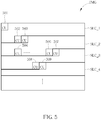
- FIG. 5 is a diagram illustrating an arrangement of coding units belonging to different slices encoded using a fixed-size slice encoding scheme according to an embodiment of the present invention.
- FIG. 6 is a flowchart illustrating a first slice boundary prediction method for determining a start/end of a slice processed under fixed-size slice encoding according to an embodiment of the present invention.
- FIG. 7 is a diagram illustrating a second pipeline-based video encoder according to an embodiment of the present invention.
- FIG. 8 is a diagram illustrating another arrangement of coding units belonging to different slices encoded using a fixed-size slice encoding scheme according to an embodiment of the present invention.
- FIG. 9 is a flowchart illustrating a second slice boundary prediction method for determining a start/end of a slice processed under fixed-size slice encoding according to an embodiment of the present invention.
- FIG. 10 is a diagram illustrating a slice boundary that is a macroblock pair boundary predicted under a macroblock-adaptive frame-field coding mode according to an embodiment of the present invention.
- FIG. 1 is a diagram illustrating a video encoder according to an embodiment of the present invention.
- the video encoder 100 includes a slice decision circuit 102 and a video encoding circuit 104 .
- the video encoder 100 divides one video frame IMG into a plurality of slices.
- the video encoder 100 may encode the slices in the same video frame IMG independently.
- encoded data of each slice may be independently decodable at a video decoder (not shown).
- FIG. 2 is a diagram illustrating a video frame divided into a plurality of slices according to an embodiment of the present invention.
- the video frame IMG includes a plurality of coding unit rows R 0 -R M-1 .
- Each of the coding unit rows R 0 -R M-1 includes a plurality of coding units (CUs) 204 .
- Each of the coding units 204 includes a plurality of pixels 206 .
- the coding units 204 may be macroblocks (MBs), superblocks (SBs), code tree blocks (CTBs), or macroblock pairs, depending upon the actual coding standard.
- the video frame IMG is divided into multiple slices (e.g., Slice # 0 , Slice # 1 , . . . , Slice # k ⁇ 1), where the slices are encoded by the video encoding circuit 104 .
- a bitstream BS SLC of the slice is output from the video encoding circuit 104 .
- the bitstream B of one slice may be stored into a storage device 116 .
- the bitstream BS SLC of one slice is forwarded to a transmitter 112 .
- the transmitter 112 packs the bitstream BS SLC of one slice into network packets PKT, and sends the network packets PKT to one or more destination devices via a network 114 .
- the network packets PKT may be real-time transport protocol (RTP) packets.
- the video encoding circuit 104 is a core part of the video encoder 100 , and has encoder architecture complying with the coding standard.
- FIG. 3 is a diagram illustrating a video encoding circuit according to an embodiment of the present invention.
- the video encoding circuit 104 shown in FIG. 1 may be implemented using the video encoding circuit 300 shown in FIG. 3 .
- the encoder architecture shown in FIG. 3 is for illustrative purposes only, and is not meant to be a limitation of the present invention. For example, different encoder architecture may be used under different coding standards, respectively.
- the video encoding circuit 300 includes a residual calculation circuit 302 , a transform circuit (denoted by “T”) 303 , a quantization circuit (denoted by “Q”) 304 , an entropy encoding circuit (e.g., a variable length encoder) 305 , an inverse quantization circuit (denoted by “IQ”) 306 , an inverse transform circuit (denoted by “IT”) 307 , a reconstruction circuit 308 , at least one in-loop filter 309 , a reference frame buffer 310 , an intra prediction circuit (denoted by “IP”) 311 , an inter prediction circuit 312 (which includes a motion estimation circuit (denoted by “ME”) 313 and a motion compensation circuit (denoted by “MC”) 314 ), and a mode decision circuit 315 . Since basic functions and operations of these circuit blocks implemented in the video encoding circuit 300 are well known to those skilled in the pertinent art, further description is omitted here for brevity.
- the slice decision circuit 102 is arranged to predict a coding unit boundary (e.g., an MB/SB/CTB/MB pair boundary) between a current slice and a next slice before a bitstream of a last coding unit (e.g., a last MB/SB/CTB/MB pair) of the current slice is generated by the video encoding circuit 104 .
- the slice decision circuit 102 is further arranged to inform the video encoding circuit 104 of the predicted coding unit boundary, such that the video encoding circuit 104 can refer to the coding unit boundary predicted by the slice decision circuit 102 to ensure that a bitstream size of the bitstream of the current slice is constrained by a predetermined bitstream size threshold SliceSize Max .
- the predetermined bitstream size threshold SliceSize Max may be a fixed value that is the maximum bitstream size of each slice encoded by the video encoding circuit 104 .
- the predetermined bitstream size threshold SliceSize Max may be adaptively adjusted.
- the predetermined bitstream size threshold SliceSize Max may be set by a first value that acts as the maximum bitstream size of a first slice encoded by the video encoding circuit 104
- the predetermined bitstream size threshold SliceSize Max may be set by a second value that acts as the maximum bitstream size of a second slice encoded by the video encoding circuit 104 , where the first value and the second value are not necessarily the same.
- the video encoding circuit 104 encodes the current slice in the video frame IMG according to the coding unit boundary between an end of the current slice (e.g., the last coding unit of the current slice) and a start of a next slice (e.g., the first coding unit of the next slice) in the same video frame IMG, and outputs the bitstream of the current slice (i.e., an encoded result of the current slice).
- the slice decision circuit 102 determines if a current coding unit is the last coding unit of the current slice before a bitstream (i.e., an encoded result) of the current coding unit is generated by the video encoding circuit 104 .
- a position of the first coding unit in the next slice and a position of the last coding unit in the current slice can be determined in advance.
- the video encoding circuit 104 can properly control the encoded size of the current coding unit to make the bitstream size of the bitstream of the current slice (i.e., an encoded size of the current slice) constrained by the predetermined bitstream size threshold SliceSize Max
- slice boundary prediction i.e., slice end prediction/slice start prediction
- slice decision circuit 102 none of coding units in the current slice is needed to be re-encoded by the video encoding circuit 104 for making the bitstream size of the bitstream of the current slice constrained by the predetermined bitstream size threshold SliceSize Max .
- slice boundary prediction i.e., slice end prediction/slice start prediction
- FIG. 4 is a diagram illustrating a first pipeline-based video encoder according to an embodiment of the present invention.
- the video encoder 100 shown in FIG. 1 may be implemented using the pipeline-based video encoder 400 shown in FIG. 4 .
- the pipeline-based video encoder 400 has a slice decision circuit 402 and a video encoding circuit (which includes an entropy encoding circuit 404 and other circuit blocks (not shown) needed by the designated video encoding function) are configured in multi-stage pipeline architecture with a plurality of cascaded pipeline stages.
- the slice decision circuit 402 of the pipeline-based video encoder 400 may act as the slice decision circuit 102 shown in FIG. 1 .
- the video encoding circuit of the pipeline-based video encoder 400 may act as the video encoding circuit 104 shown in FIG. 1 .
- the slice decision circuit 402 is located at the l th pipeline stage 401
- the entropy encoding circuit 404 is located at the n th pipeline stage 403 , where l ⁇ n.
- the video encoding circuit may have circuit blocks (not shown) other than the entropy encoding circuit 404 , and these circuit blocks may be located at certain pipeline stages (not shown) of the multi-stage pipeline architecture.
- a pipeline register 411 is coupled between the l th pipeline stage 401 and a previous pipeline stage (i.e., (l ⁇ 1) th pipeline stage), and a pipeline register 412 is coupled between the l th pipeline stage 401 and a next pipeline stage (i.e., (l+1) th pipeline stage).
- a pipeline register 413 is coupled between the n th pipeline stage 403 and a previous pipeline stage (i.e., (n ⁇ 1) th pipeline stage), and a pipeline register 414 is coupled between the n th pipeline stage 403 and a next pipeline stage (i.e., (n+1) th pipeline stage).
- Coding units of the video frame IMG may be processed in a pipeline fashion. That is, one coding unit is sequentially processed by different pipeline stages, and the different pipeline stages deal with different coding units at the same time. Further, coding units of a video frame may be encoded in a raster scan order. The coding units in the same video frame are fed into the multi-stage pipeline architecture in a raster scan order. That is, coding units in the same coding unit row are processed from the left-most coding unit to the right-most coding unit, and coding unit rows in the same video frame are processed from the uppermost coding row to the lowermost coding row.
- FIG. 5 is a diagram illustrating an arrangement of coding units belonging to different slices encoded using a fixed-size slice encoding scheme according to an embodiment of the present invention.
- bitstream sizes of bitstreams of different slices in the same video frame IMG i.e., encoded sizes of different slices in the same video frame IMG
- respective predetermined bitstream size thresholds i.e., maximum encoded slice sizes
- SliceSize Max i.e., maximum encoded slice sizes
- the coding unit boundary between adjacent slices e.g., boundary between an end of a current slice and a start of a next slice
- the slice decision circuit 402 is operative to determine that the coding unit 502 is the last coding unit of the slice SLC_ 1 , the coding unit 506 is the last coding unit of the slice SLC_ 2 , and the coding unit 508 is the last coding unit of the slice SLC_ 3 . Since the coding unit 502 is the last coding unit of the slice SLC_ 1 , the next coding unit (i.e., coding unit 503 ) is identified as the first coding unit of the next slice (i.e., CU 0 of slice SLC_ 2 ).
- the next coding unit i.e., coding unit 507
- the next coding unit is identified as the first coding unit of the next slice (i.e., CU 0 of slice SLC_ 3 ).
- the next coding unit i.e., coding unit 509
- the first coding unit of the next slice i.e., CU 0 of slice SLC_ 4 ).
- the slice SLC_ 1 starts with the coding unit 501 and ends with the coding unit 502 .
- the slice SLC_ 2 starts with the coding unit 503 and ends with the coding unit 506 .
- the slice SLC_ 3 starts with the coding unit 507 and ends with the coding unit 508 .
- different slices e.g., SLC_ 1 -SLC_ 4
- different bitstream size i.e., the same encoded slice size
- SliceSize Max is employed by encoding of different slices.
- coding units in the same video frame are fed into the multi-stage pipeline architecture in a raster scan order.
- the slice decision circuit 402 is operative to determine if the current coding unit is the last coding unit of a current slice.
- the coding unit 506 is a current coding unit that enters the l th pipeline stage 401
- a previous coding unit that has been processed by the l th pipeline stage 401 and now enters the n th pipeline stage 403 (n>l) is the coding unit 504 . Due to inherent characteristics of the multi-stage pipeline architecture, all of the coding units CU i with 0 ⁇ i ⁇ N+l ⁇ n have been processed by the entropy encoding circuit 404 sequentially.
- a bitstream of the coding unit 504 (i.e., CU N+l ⁇ n in the slice SLC_ 2 ) is generated by the entropy encoding circuit 404 .
- actual bit counts of bitstreams of all of the coding units CU i with 0 ⁇ i ⁇ N+l ⁇ n determined by the entropy encoding circuit 404 are available to the slice decision circuit 402 .
- the slice decision circuit 402 can fetch and store an actual bit count of the bitstream of a coding unit each time the bitstream of the coding unit is generated by the entropy encoding circuit 404 .
- the present invention proposes using a parameter CUBit emp in slice boundary prediction (i.e., slice end prediction/slice start prediction) performed at the slice decision circuit 402 , where the parameter CUBit emp is representative of a predicted bit count of all coding units CU i (N+l ⁇ n+1 ⁇ i ⁇ N) in the pipeline that do not undergo entropy encoding involved in encoding of the coding units CU i (N+l ⁇ n+1 ⁇ i ⁇ N) yet.
- slice boundary prediction i.e., slice end prediction/slice start prediction
- the parameter CUBit emp used by the slice decision circuit 402 may be derived from a preset empirical constant value.
- the parameter CUBit emp used by the slice decision circuit 402 may be derived from information fetched from the video encoder.
- the information fetched from the video encoder may include actual bit counts of bitstreams of previous processed coding units that are determined by the entropy encoding circuit 404 .
- the parameter CUBit emp may be set on the basis of a maximum bit count or an average bit count that is derived from the information fetched from the video encoder.
- the parameter CUBit emp used by the slice decision circuit 402 may be derived from the setting of the video encoder.
- the quantization circuit 304 shown in FIG. 3 performs quantization upon transform coefficients according to a quantization parameter (QP) setting
- the inverse quantization circuit 306 performs inverse quantization upon the quantized transform coefficients according to the same QP setting used by the quantization circuit 304 .
- the setting of the video encoder may include the QP setting.
- the setting of the parameter CUBit emp depends on the QP setting.
- the parameter CUBit emp used by the slice decision circuit 402 may be derived from the setting of the slice decision circuit 402 .
- a threshold value SLC Thr is used by the slice decision circuit 402 to judge if the current coding unit is the last coding unit of the current slice.
- the setting of the parameter CUBit emp depends on the threshold value SLC Thr .
- the parameter CUBit emp used by the slice decision circuit 402 may be derived from a capacity of a network (e.g., network 114 shown in FIG. 1 ) through which bitstreams generated by the entropy encoding circuit 404 are transmitted.
- a network e.g., network 114 shown in FIG. 1
- the parameter CUBit emp used by the slice decision circuit 402 may be derived from availability of macroblock-adaptive frame-field (MBAFF) coding.
- MAAFF macroblock-adaptive frame-field
- the MBAFF coding makes it possible to adaptively switch between frame and field coding within a single frame, for example, to maximize the coding efficiency. Since macroblocks are handled in pairs consisting of two vertically adjacent macroblocks under MBAFF coding, a coding unit boundary between an end of a current slice and a start of a next slice should be a boundary between two macroblock pairs each consisting of two vertically adjacent macroblocks.
- FIG. 10 is a diagram illustrating a slice boundary that is a macroblock pair boundary predicted under an MBAFF coding mode according to an embodiment of the present invention.
- An encoding order of macroblocks under the MBAFF coding mode is illustrated by sequential index values “1”, “2”, “3”, “4”, . . . “19”, “20”, “21”, “22”, “23”, “24”, “25”, and “26”. As shown in FIG.
- macroblocks with index values “1” and “2” form one macroblock pair
- macroblocks with index values “3” and “4” form one macroblock pair
- macroblocks with index values “19” and “20” form one macroblock pair
- macroblocks with index values “21” and “22” form one macroblock pair
- macroblocks with index values “23” and “24” form one macroblock pair
- macroblocks with index values “25” and “26” form one macroblock pair.
- each macroblock pair consists of two vertically adjacent macroblocks, the last macroblock of one slice SLC_ 1 (i.e., the macroblock with the index value “24”) and the first macroblock of the next slice SLC_ 2 (i.e., the macroblock with the index value “25”) are not vertically adjacent to each other.
- the slice decision circuit 402 calculates a bit-sum BitSum N of a slice to determine if the coding unit 506 (i.e., CU N in the slice SLC_ 2 ) is the last coding unit of the slice SLC_ 2 under fixed-size slice encoding.
- the computation of the bit-sum BitSum N may be expressed using the following formula.
- i is the coding unit index in a slice
- CUBit i is an actual bit count of a bitstream of a coding unit CU i determined by the entropy encoding circuit 404
- SLC hdr is a predetermined bit count of a slice header
- CUBit emp is a parameter representative of a predicted bit count of at least one coding unit in the pipeline that does not undergo entropy encoding yet.
- the slice decision circuit 402 compares the estimated bit-sum BitSum N with the threshold value SLC Thr to generate a comparison result, and refers to the comparison result to determine if the coding unit 506 (i.e., CU N in the slice SLC_ 2 ) is the last coding unit of the slice SLC_ 2 under fixed-size slice encoding.
- the slice decision circuit 402 determines that the coding unit 506 (i.e., CU N in the slice SLC_ 2 ) is the last coding unit of the slice SLC_ 2 under fixed-size slice encoding, and indicates end-of-slice to the video encoding circuit.
- the coding unit 506 i.e., CU N in the slice SLC_ 2
- an end-of-slice syntax is signaled in the bitstream of the slice SLC_ 2 generated from the entropy encoding circuit 404 .
- the slice decision circuit 402 determines that the coding unit 506 (i.e., CU N in the slice SLC_ 2 ) is not the last coding unit of the slice SLC_ 2 under fixed-size slice encoding.
- the setting of the threshold value SLC Thr may be adjusted, depending on the setting of the parameter CUBit emp which is a predicted bit count of coding unit(s) in the pipeline.
- the threshold value SLC Thr may be smaller than or equal to the predetermined bitstream size threshold SliceSize Max .
- the same formula (1) can be used to identify last coding units of other slices (e.g., coding unit 502 of slice SLC_ 1 and coding unit 508 of slice SLC_ 3 ) under fixed-size slice encoding.
- FIG. 6 is a flowchart illustrating a first slice boundary prediction method for determining a start/end of a slice processed under fixed-size slice encoding according to an embodiment of the present invention. Provided that the result is substantially the same, the steps are not required to be executed in the exact order shown in FIG. 6 .
- the slice boundary prediction method may include following steps.
- Step 602 The l th pipeline stage 401 performs processing of the current coding unit CU N in a current slice, wherein the slice decision circuit 402 is located at the l th pipeline stage 401 .
- Step 604 The slice decision circuit 402 fetches and stores an actual bit count CUBit N+l ⁇ n of a bitstream of the coding unit CU N+l ⁇ n from the video encoding circuit (particularly, the n th pipeline stage 403 at which the entropy encoding circuit 404 is located).
- Step 606 The slice decision circuit 402 calculates a bit-sum BitSum N of the current slice according to actual bit counts CUBit i (0 ⁇ i ⁇ N+l ⁇ n), a bit count of a slice header SLC hdr , and a derived parameter CUBit emp .
- Step 608 The slice decision circuit 402 checks if the estimated bit-sum BitSum N exceeds the threshold value SLC Thr .
- Step 610 The slice decision circuit 402 predicts a coding unit boundary between the current slice and a next slice by determining that the current coding unit CU N is the last coding unit of the current slice under fixed-size slice encoding.
- Step 612 The slice decision circuit 402 indicates end-of-slice to the video encoding circuit.
- Step 614 The slice decision circuit 402 determines that the current coding unit CU N is not the last coding unit of the current slice under fixed-size slice encoding.
- Step 616 The l th pipeline stage 401 proceeds with processing of the next coding unit CU N+l in the current slice.
- the parameter CUBit emp used by the slice decision circuit 402 is set to represent a predicted bit count of all coding units CU i (N+l ⁇ n+1 ⁇ i ⁇ N) in the pipeline that do not undergo entropy encoding involved in encoding of the coding units CU i (N+l ⁇ n+1 ⁇ i ⁇ N) yet.
- auxiliary bit information provided by intermediate pipeline stage(s) between the l th pipeline stage and the n th pipeline stage may also be used by the slice boundary prediction.
- FIG. 7 is a diagram illustrating a second pipeline-based video encoder according to an embodiment of the present invention.
- the video encoder 100 shown in FIG. 1 may be implemented using the pipeline-based video encoder 700 shown in FIG. 7 .
- the pipeline-based video encoder 700 has a slice decision circuit 702 and a video encoding circuit (which includes a bit estimation circuit 704 , an entropy encoding circuit 706 , and other circuit blocks (not shown) needed by the designated video encoding function) are configured in multi-stage pipeline architecture with a plurality of cascaded pipeline stages.
- the slice decision circuit 702 of the pipeline-based video encoder 700 may act as the slice decision circuit 102 shown in FIG. 1 .
- the video encoding circuit of the pipeline-based video encoder 700 may act as the video encoding circuit 104 shown in FIG. 1 .
- the slice decision circuit 702 is located at the l th pipeline stage 701
- the bit estimation circuit 704 is located at the m th pipeline stage 703
- the entropy encoding circuit 706 is located at the n th pipeline stage 705 , where l ⁇ m ⁇ n.
- the video encoding circuit may have circuit blocks (not shown) other than the bit estimation circuit 704 and the entropy encoding circuit 706 , and these circuit blocks may be located at some pipeline stages (not shown) of the multi-stage pipeline architecture.
- a pipeline register 711 is coupled between the l th pipeline stage 701 and a previous pipeline stage (i.e., (l ⁇ 1) th pipeline stage), and a pipeline register 712 is coupled between the l th pipeline stage 701 and a next pipeline stage (i.e., (l+1) th pipeline stage).
- a pipeline register 713 is coupled between the m th pipeline stage 703 and a previous pipeline stage (i.e., (m ⁇ 1) th pipeline stage), and a pipeline register 714 is coupled between the m th pipeline stage 703 and a next pipeline stage (i.e., (m+1) th pipeline stage); and a pipeline register 715 is coupled between the n th pipeline stage 705 and a previous pipeline stage (i.e., (n ⁇ 1) th pipeline stage), and a pipeline register 716 is coupled between the n th pipeline stage 705 and a next pipeline stage (i.e., (n+1) th pipeline stage).
- Coding units of the video frame IMG may be processed in a pipeline fashion. That is, one coding unit is sequentially processed by different pipeline stages, and the different pipeline stages may process different coding units at the same time. Further, coding units of a video frame may be encoded in a raster scan order. Hence, the coding units in the same video frame are fed into the multi-stage pipeline architecture in a raster scan order. That is, coding units in the same coding unit row are processed from the left-most coding unit to the right-most coding unit, and coding unit rows in the same video frame are processed from the uppermost coding row to the lowermost coding row.
- FIG. 8 is a diagram illustrating another arrangement of coding units belonging to different slices encoded using a fixed-size slice encoding scheme according to an embodiment of the present invention. Since bitstream sizes of bitstreams of different slices in the same video frame IMG (i.e., encoded sizes of different slices in the same video frame IMG) are required to be constrained by respective predetermined bitstream size thresholds SliceSize Max that may be identical to or different from each other, the coding unit boundary between adjacent slices (e.g., boundary between an end of a current slice and a start of a next slice) should be determined by the slice decision circuit 702 beforehand to avoid the condition in which the encoded slice size exceeds the maximum encoded slice size after encoding the current coding unit that is the last coding unit of the current slice.
- SliceSize Max bitstream size threshold
- the slice decision circuit 702 is operative to determine that the coding unit 502 is the last coding unit of the slice SLC_ 1 , the coding unit 506 is the last coding unit of the slice SLC_ 2 , and the coding unit 508 is the last coding unit of the slice SLC_ 3 . Since the coding unit 502 is the last coding unit of the slice SLC_ 1 , the next coding unit (i.e., coding unit 503 ) is identified as the first coding unit of the next slice (i.e., CU 0 of slice SLC_ 2 ).
- the next coding unit i.e., coding unit 507
- the next coding unit is identified as the first coding unit of the next slice (i.e., CU 0 of slice SLC_ 3 ).
- the next coding unit i.e., coding unit 509
- the first coding unit of the next slice i.e., CU 0 of slice SLC_ 4 ).
- the slice SLC_ 1 starts with the coding unit 501 and ends with the coding unit 502 .
- the slice SLC_ 2 starts with the coding unit 503 and ends with the coding unit 506 .
- the slice SLC_ 3 starts with the coding unit 507 and ends with the coding unit 508 .
- the different slices e.g., SLC_ 1 -SLC_ 4
- the same bitstream size i.e., the same encoded slice size
- SliceSize Max is employed by encoding of different slices.
- coding units in the same video frame are fed into the multi-stage pipeline architecture in a raster scan order.
- the slice decision circuit 702 is operative to determine if the current coding unit is the last coding unit of a current slice.
- the coding unit 506 is a current coding unit that enters the l th pipeline stage 701
- one previous coding unit that has been processed by the l th pipeline stage 701 and the m th pipeline stage 703 and now enters the n th pipeline stage 705 (n>m>l) is the coding unit 504
- another previous coding unit that has been processed by the l th pipeline stage 701 and now enters the m th pipeline stage 703 (m>l) is the coding unit 505 .
- the bit estimation circuit 704 is arranged to calculate an estimated bit count of a bitstream of a coding unit before the bitstream of the coding unit is generated by the entropy encoding circuit 706 .
- the video encoding circuit of the pipeline-based video encoder 700 is implemented using the video encoding circuit 300 shown in FIG. 3 , where the entropy encoding circuit 305 acts as the entropy encoding circuit 706 .
- the mode decision circuit 315 may act as the bit estimation circuit 704 .
- the mode decision circuit 315 may perform rate-distortion optimization (RDO) to select a best coding mode with a lowest rate-distortion cost from candidate intra prediction modes and candidate inter prediction modes.
- RDO rate-distortion optimization
- the value of R may be used as the estimated bit count provided to the slice decision circuit 702 for slice boundary prediction.
- all of the coding units CU i with 0 ⁇ i ⁇ N+l ⁇ n are processed by the entropy encoding circuit 706 sequentially, and all of the coding units CU i with N+l ⁇ n+1 ⁇ i ⁇ N+l ⁇ m are processed by the bit estimation circuit 704 sequentially.
- a bitstream of the coding unit 504 i.e., CU N+l ⁇ n in the slice SLC_ 2
- actual bit counts of bitstreams of all of the coding units CU i with 0 ⁇ i ⁇ N+l ⁇ n determined by the entropy encoding circuit 706 are available to the slice decision circuit 702 .
- the slice decision circuit 702 can fetch and store an actual bit count of a bitstream of a coding unit each time the bitstream of the coding unit is generated by the entropy encoding circuit 706 . Furthermore, after the coding unit 505 (i.e., CU N+l ⁇ m in the slice SLC_ 2 ) is processed by the bit estimation circuit 704 , estimated bit counts of bitstreams of all of the coding units CU i with N+l ⁇ n+1 ⁇ i ⁇ N+l ⁇ m determined by the bit estimation circuit 704 are available to the slice decision circuit 702 . In this embodiment, the slice decision circuit 702 can fetch and store an estimated bit count of a bitstream of a coding unit each time the bit estimation circuit 704 completes RDO of the coding unit for selecting a best coding mode of the coding unit.
- bit estimation circuit 704 located at the m th pipeline stage 703 between the l th pipeline stage 701 and the n th pipeline stage 705 , estimated bit counts of bitstreams of all of the coding units CU i with N+l ⁇ n+1 ⁇ i ⁇ N+l ⁇ m are available to the slice decision circuit 702 .
- an estimated bit count calculated by the bit estimation circuit 704 for each coding unit CU i (N+l ⁇ n+1 ⁇ i ⁇ N+l ⁇ m) and an actual bit count determined by the entropy encoding circuit 706 for each coding unit CU i (0 ⁇ i ⁇ N+l ⁇ n) can be used in slice boundary prediction (i.e., slice end prediction/slice start prediction) performed at the slice decision circuit 702 .
- the present invention proposes using a parameter CUBit emp in slice boundary prediction (i.e., slice end prediction/slice start prediction) performed at the slice decision circuit 102 , where the parameter CUBit emp is representative of a predicted bit count of all coding units CU i (N+l ⁇ m+1 ⁇ i ⁇ N) that do not undergo rate-distortion optimization and entropy encoding involved in encoding of the coding units CU i (N+l ⁇ m+1 ⁇ i ⁇ N) yet.
- slice boundary prediction i.e., slice end prediction/slice start prediction
- the parameter CUBit emp used by the slice decision circuit 702 may be derived from a preset empirical constant value.
- the parameter CUBit emp used by the slice decision circuit 702 may be derived from information fetched from the video encoder.
- the information fetched from the video encoder may include actual bit counts of bitstreams of previous processed coding units that are determined by the entropy encoding circuit 704 .
- the parameter CUBit emp may be set on the basis of a maximum bit count or an average bit count that is derived from the information fetched from the video encoder.
- the parameter CUBit emp used by the slice decision circuit 702 may be derived from the setting of the video encoder.
- the quantization circuit 304 shown in FIG. 3 performs quantization upon transform coefficients according to a quantization parameter (QP) setting
- the inverse quantization circuit 306 performs inverse quantization upon the quantized transform coefficients according to the same QP setting used by the quantization circuit 304 .
- the setting of the video encoder may include the QP setting.
- the setting of the parameter CUBit emp depends on the QP setting.
- the parameter CUBit emp used by the slice decision circuit 702 may be derived from the setting of the slice decision circuit 702 .
- a threshold value SLC Thr is used by the slice decision circuit 702 to judge if the current coding unit is the last coding unit of the current slice.
- the setting of the parameter CUBit emp depends on the threshold value SLC Thr .
- the parameter CUBit emp used by the slice decision circuit 702 may be derived from a capacity of a network (e.g., network 114 shown in FIG. 1 ) through which bitstreams generated by the entropy encoding circuit 704 are transmitted.
- a network e.g., network 114 shown in FIG. 1
- the parameter CUBit emp used by the slice decision circuit 702 may be derived from availability of macroblock-adaptive frame-field (MBAFF) coding.
- MAAFF macroblock-adaptive frame-field
- the MBAFF coding makes it possible to adaptively switch between frame and field coding within a single frame, for example, to maximize the coding efficiency. Since macroblocks are handled in pairs consisting of two vertically adjacent macroblocks under MBAFF coding, a coding unit boundary between an end of a current slice and a start of a next slice should be a vertical boundary between two macroblock pairs each consisting of two vertically adjacent macroblocks, as illustrated in FIG. 10 . Hence, the parameter CUBit emp should be properly set to ensure correctness of the slice boundary prediction (i.e., slice end prediction/slice start prediction) under fixed-length slice encoding.
- slice boundary prediction i.e., slice end prediction/slice start prediction
- the slice decision circuit 702 calculates a bit-sum BitSum N of a slice to determine if the coding unit 506 (i.e., CU N in the slice SLC_ 2 ) is the last coding unit of the slice SLC_ 2 under fixed-size slice encoding.
- the computation of the bit-sum BitSum N may be expressed using the following formula.
- i is the coding unit index in a slice
- CUBit i is an actual bit count of a bitstream of a coding unit CU i determined by the entropy encoding circuit 704
- ESTCUBit i is an estimated bit count of a bitstream of a coding unit CU i calculated by the bit estimation circuit 704
- SLC hdr is a predetermined bit count of a slice header
- CUBit emp is a parameter representative of a predicted bit count of at least one coding unit in the pipeline that does not undergo rate-distortion optimization and entropy encoding yet. It should be noted the parameter CUBit emp may have different bit-count values in above formula (1) and formula (2).
- the slice decision circuit 702 compares the estimated bit-sum BitSum N with the threshold value SLC Thr to generate a comparison result, and refers to the comparison result to determine if the coding unit 506 (i.e., CU N in the slice SLC_ 2 ) is the last coding unit of the slice SLC_ 2 under fixed-size slice encoding.
- the slice decision circuit 702 determines that the coding unit 506 (i.e., CU N in the slice SLC_ 2 ) is the last coding unit of the slice SLC_ 2 under fixed-size slice encoding, and indicates end-of-slice to the video encoding circuit.
- the coding unit 506 i.e., CU N in the slice SLC_ 2
- an end-of-slice syntax is signaled in the bitstream of the slice SLC_ 2 generated from the entropy encoding circuit 704 .
- the slice decision circuit 702 determines that the coding unit 506 (i.e., CU N in the slice SLC_ 2 ) is not the last coding unit of the slice SLC_ 2 under fixed-size slice encoding.
- the setting of the threshold value SLC Thr may be adjusted, depending on the setting of the parameter CUBit emp which is a predicted bit count of coding unit(s) in the pipeline.
- the threshold value SLC Thr may be smaller than or equal to the predetermined bitstream size threshold SliceSize Max .
- the same formula (2) can be used to identify last coding units of other slices (e.g., coding unit 502 of slice SLC_ 1 and coding unit 508 of slice SLC_ 3 ) under fixed-size slice encoding.
- FIG. 9 is a flowchart illustrating a second slice boundary prediction method for determining a start/end of a slice processed under fixed-size slice encoding according to an embodiment of the present invention. Provided that the result is substantially the same, the steps are not required to be executed in the exact order shown in FIG. 9 .
- the slice boundary prediction method may include following steps.
- Step 902 The l th pipeline stage 701 performs processing of the current coding unit CU N in a current slice, wherein the slice decision circuit 702 is located at the l th pipeline stage 701 .
- Step 904 The slice decision circuit 702 fetches and stores an actual bit count CUBit N+l ⁇ n of a bitstream of the coding unit CU N+l ⁇ n from the video encoding circuit (particularly, the n th pipeline stage 705 at which the entropy encoding circuit 706 is located).
- Step 906 The slice decision circuit 702 fetches and stores an estimated bit count ESmCUBit N+l ⁇ n of a bitstream of the coding unit CU N+l ⁇ m from the video encoding circuit (particularly, the m th pipeline stage 703 at which the bit estimation circuit 704 is located).
- Step 908 The slice decision circuit 702 calculates a bit-sum BitSum N of the current slice according to actual bit counts CUBit i (0 ⁇ i ⁇ N+l ⁇ n), estimated bit counts ESTCUBit i (N+l ⁇ n+1 ⁇ i ⁇ N+l ⁇ m), a bit count of a slice header SLC hdr , and a derived parameter CUBit emp .
- Step 910 The slice decision circuit 702 checks if the estimated bit-sum BitSum N exceeds the threshold value SLC Thr .
- Step 912 The slice decision circuit 702 predicts a coding unit boundary between the current slice and a next slice by determining that the current coding unit CU N is the last coding unit of the current slice under fixed-size slice encoding.
- Step 914 The slice decision circuit 702 indicates end-of-slice to the video encoding circuit.
- Step 916 The slice decision circuit 702 determines that the current coding unit CU N is not the last coding unit of the current slice under fixed-size slice encoding.
- Step 918 The l th pipeline stage 701 proceeds with processing of the next coding unit CU N+1 in the current slice.
Landscapes
- Engineering & Computer Science (AREA)
- Multimedia (AREA)
- Signal Processing (AREA)
- Computing Systems (AREA)
- Theoretical Computer Science (AREA)
- Compression Or Coding Systems Of Tv Signals (AREA)
Abstract
Description
where i is the index of each coding unit in a frame, MBSize is the bitstream size of each coding unit, and SliceSizeMax is the maximum bitstream size of a slice. However, when a video encoder encodes a current coding unit, bit-count information of the current coding unit is not available because of the hardware limitation of pipeline architecture employed by the video encoder. Hence, it is possible that the encoded slice size exceeds the maximum encoded slice size after encoding the current coding unit that is the last coding unit of the current slice. If the encoded slice size exceeds the maximum encoded slice size, re-encoding the last coding unit to make the encoded slice size constrained by the maximum encoded slice size is not feasible in the hardware implementation.
Since the condition in which the encoded slice size exceeds the maximum encoded slice size after encoding the current coding unit that is the last coding unit of the current slice can be avoided by slice boundary prediction (i.e., slice end prediction/slice start prediction) made by the
Claims (12)
Priority Applications (3)
| Application Number | Priority Date | Filing Date | Title |
|---|---|---|---|
| US16/004,419 US10645385B2 (en) | 2017-06-28 | 2018-06-10 | Method and apparatus for performing fixed-size slice encoding with slice boundary prediction |
| CN201810664276.8A CN109151472A (en) | 2017-06-28 | 2018-06-25 | Video encoder and video encoding method |
| TW107122194A TW201906412A (en) | 2017-06-28 | 2018-06-28 | Method and apparatus for performing fixed size slice coding with slice boundary prediction |
Applications Claiming Priority (2)
| Application Number | Priority Date | Filing Date | Title |
|---|---|---|---|
| US201762525801P | 2017-06-28 | 2017-06-28 | |
| US16/004,419 US10645385B2 (en) | 2017-06-28 | 2018-06-10 | Method and apparatus for performing fixed-size slice encoding with slice boundary prediction |
Publications (2)
| Publication Number | Publication Date |
|---|---|
| US20190007680A1 US20190007680A1 (en) | 2019-01-03 |
| US10645385B2 true US10645385B2 (en) | 2020-05-05 |
Family
ID=64735040
Family Applications (1)
| Application Number | Title | Priority Date | Filing Date |
|---|---|---|---|
| US16/004,419 Active 2038-10-02 US10645385B2 (en) | 2017-06-28 | 2018-06-10 | Method and apparatus for performing fixed-size slice encoding with slice boundary prediction |
Country Status (3)
| Country | Link |
|---|---|
| US (1) | US10645385B2 (en) |
| CN (1) | CN109151472A (en) |
| TW (1) | TW201906412A (en) |
Families Citing this family (8)
| Publication number | Priority date | Publication date | Assignee | Title |
|---|---|---|---|---|
| WO2019039012A1 (en) * | 2017-08-23 | 2019-02-28 | ソニーセミコンダクタソリューションズ株式会社 | Image processing device and image processing method |
| CN113273198B (en) | 2018-11-06 | 2024-10-18 | 交互数字Vc控股公司 | Parameter grouping between multiple codec units for video encoding and decoding |
| EP3906665B1 (en) * | 2019-01-09 | 2023-06-07 | Huawei Technologies Co., Ltd. | Sub-picture sizing in video coding |
| CN110022477B (en) * | 2019-03-29 | 2021-02-19 | 中南大学 | A fast selection method of inter prediction mode based on CUTree |
| CN110049338B (en) * | 2019-04-26 | 2023-04-18 | 杭州电子科技大学 | HEVC (high efficiency video coding) rapid inter-frame coding method based on multi-level classification |
| CN113542753B (en) * | 2021-07-27 | 2022-07-08 | 杭州当虹科技股份有限公司 | AVS3 video coding method and encoder |
| US12425607B2 (en) * | 2023-03-08 | 2025-09-23 | Sony Interactive Entertainment Inc. | Reserved bit prediction for slice size control with pipelined video encoding |
| US12445657B1 (en) * | 2023-07-21 | 2025-10-14 | Zoom Communications, Inc. | Deriving in-loop filter parameters for video coding |
Citations (2)
| Publication number | Priority date | Publication date | Assignee | Title |
|---|---|---|---|---|
| US20120230397A1 (en) * | 2011-03-10 | 2012-09-13 | Canon Kabushiki Kaisha | Method and device for encoding image data, and method and device for decoding image data |
| US9210424B1 (en) | 2013-02-28 | 2015-12-08 | Google Inc. | Adaptive prediction block size in video coding |
Family Cites Families (4)
| Publication number | Priority date | Publication date | Assignee | Title |
|---|---|---|---|---|
| JP2013509006A (en) * | 2009-10-14 | 2013-03-07 | シャープ株式会社 | Method for parallel encoding and decoding of moving pictures |
| US8634474B2 (en) * | 2011-05-03 | 2014-01-21 | Texas Instruments Incorporated | CABAC macroblock rewind and end of slice creation to control slice size for video encoders |
| US20130251022A1 (en) * | 2011-06-10 | 2013-09-26 | Telefonaktiebolaget L M Ericsson (Publ) | Signaling of end of slices |
| JP2014075652A (en) * | 2012-10-03 | 2014-04-24 | Canon Inc | Image encoder, and image encoding method |
-
2018
- 2018-06-10 US US16/004,419 patent/US10645385B2/en active Active
- 2018-06-25 CN CN201810664276.8A patent/CN109151472A/en active Pending
- 2018-06-28 TW TW107122194A patent/TW201906412A/en unknown
Patent Citations (2)
| Publication number | Priority date | Publication date | Assignee | Title |
|---|---|---|---|---|
| US20120230397A1 (en) * | 2011-03-10 | 2012-09-13 | Canon Kabushiki Kaisha | Method and device for encoding image data, and method and device for decoding image data |
| US9210424B1 (en) | 2013-02-28 | 2015-12-08 | Google Inc. | Adaptive prediction block size in video coding |
Also Published As
| Publication number | Publication date |
|---|---|
| CN109151472A (en) | 2019-01-04 |
| US20190007680A1 (en) | 2019-01-03 |
| TW201906412A (en) | 2019-02-01 |
Similar Documents
| Publication | Publication Date | Title |
|---|---|---|
| US20190007680A1 (en) | Method and apparatus for performing fixed-size slice encoding with slice boundary prediction | |
| US10560722B2 (en) | Method and apparatus for performing intra-prediction using adaptive filter | |
| US8477845B2 (en) | Predictive adaptive scan ordering for video coding | |
| EP2225887B1 (en) | Adaptive coding of video block header information | |
| US9282329B2 (en) | Methods and devices for data compression using offset-based adaptive reconstruction levels | |
| KR100942395B1 (en) | Rate Control for Multilayer Video Designs | |
| CN102783150B (en) | Block type signaling in video coding | |
| JP5350404B2 (en) | Early macroblock delta QP decision | |
| US8144789B2 (en) | Picture coding apparatus | |
| US20090296812A1 (en) | Fast encoding method and system using adaptive intra prediction | |
| JP2010515305A (en) | Choosing a coding mode using information from other coding modes | |
| US10462481B2 (en) | Video encoder and motion estimation apparatus therefor with rate-constrained search ordering of candidate blocks | |
| WO2008136828A1 (en) | Video coding mode selection using estimated coding costs | |
| CN101836453B (en) | Method for alternating entropy coding | |
| US8582639B2 (en) | Methods and devices for data compression using adaptive reconstruction levels | |
| JP5136470B2 (en) | Moving picture coding apparatus and moving picture coding method | |
| KR20150081240A (en) | Apparatus and method for lossless video coding/decoding | |
| JP4089753B2 (en) | Image compression encoding apparatus and method, program, and recording medium | |
| EP2405656B1 (en) | Methods and devices for data compression using adaptive reconstruction levels |
Legal Events
| Date | Code | Title | Description |
|---|---|---|---|
| AS | Assignment |
Owner name: MEDIATEK INC., TAIWAN Free format text: ASSIGNMENT OF ASSIGNORS INTEREST;ASSIGNORS:CHEN, LI-HENG;CHEN, LIEN-FEI;WU, TUNG-HSING;AND OTHERS;REEL/FRAME:046037/0457 Effective date: 20180604 |
|
| FEPP | Fee payment procedure |
Free format text: ENTITY STATUS SET TO UNDISCOUNTED (ORIGINAL EVENT CODE: BIG.); ENTITY STATUS OF PATENT OWNER: LARGE ENTITY |
|
| STPP | Information on status: patent application and granting procedure in general |
Free format text: DOCKETED NEW CASE - READY FOR EXAMINATION |
|
| STPP | Information on status: patent application and granting procedure in general |
Free format text: NON FINAL ACTION MAILED |
|
| STPP | Information on status: patent application and granting procedure in general |
Free format text: RESPONSE TO NON-FINAL OFFICE ACTION ENTERED AND FORWARDED TO EXAMINER |
|
| STPP | Information on status: patent application and granting procedure in general |
Free format text: NOTICE OF ALLOWANCE MAILED -- APPLICATION RECEIVED IN OFFICE OF PUBLICATIONS |
|
| STCF | Information on status: patent grant |
Free format text: PATENTED CASE |
|
| MAFP | Maintenance fee payment |
Free format text: PAYMENT OF MAINTENANCE FEE, 4TH YEAR, LARGE ENTITY (ORIGINAL EVENT CODE: M1551); ENTITY STATUS OF PATENT OWNER: LARGE ENTITY Year of fee payment: 4 |