US10644242B2 - Oligomeric perylene diimide non-fullerene acceptors via direct (hetero)arylation cross-coupling reactions - Google Patents
Oligomeric perylene diimide non-fullerene acceptors via direct (hetero)arylation cross-coupling reactions Download PDFInfo
- Publication number
- US10644242B2 US10644242B2 US16/562,829 US201916562829A US10644242B2 US 10644242 B2 US10644242 B2 US 10644242B2 US 201916562829 A US201916562829 A US 201916562829A US 10644242 B2 US10644242 B2 US 10644242B2
- Authority
- US
- United States
- Prior art keywords
- carbon atoms
- pdi
- group
- oligomeric
- alkyl
- Prior art date
- Legal status (The legal status is an assumption and is not a legal conclusion. Google has not performed a legal analysis and makes no representation as to the accuracy of the status listed.)
- Active
Links
- 125000005842 heteroatom Chemical group 0.000 title claims description 16
- 238000006254 arylation reaction Methods 0.000 title claims description 7
- 239000000370 acceptor Substances 0.000 title description 17
- XMWRBQBLMFGWIX-UHFFFAOYSA-N C60 fullerene Chemical compound C12=C3C(C4=C56)=C7C8=C5C5=C9C%10=C6C6=C4C1=C1C4=C6C6=C%10C%10=C9C9=C%11C5=C8C5=C8C7=C3C3=C7C2=C1C1=C2C4=C6C4=C%10C6=C9C9=C%11C5=C5C8=C3C3=C7C1=C1C2=C4C6=C2C9=C5C3=C12 XMWRBQBLMFGWIX-UHFFFAOYSA-N 0.000 title description 4
- 229910003472 fullerene Inorganic materials 0.000 title description 4
- KJOLVZJFMDVPGB-UHFFFAOYSA-N perylenediimide Chemical compound C=12C3=CC=C(C(NC4=O)=O)C2=C4C=CC=1C1=CC=C2C(=O)NC(=O)C4=CC=C3C1=C42 KJOLVZJFMDVPGB-UHFFFAOYSA-N 0.000 title description 3
- 238000006880 cross-coupling reaction Methods 0.000 title 1
- 150000001875 compounds Chemical class 0.000 claims abstract description 76
- 125000003118 aryl group Chemical group 0.000 claims abstract description 66
- 238000000034 method Methods 0.000 claims abstract description 25
- 125000000217 alkyl group Chemical group 0.000 claims description 120
- 125000004432 carbon atom Chemical group C* 0.000 claims description 115
- -1 PDI compound Chemical class 0.000 claims description 63
- 125000004435 hydrogen atom Chemical class [H]* 0.000 claims description 48
- 229910052739 hydrogen Inorganic materials 0.000 claims description 40
- 239000001257 hydrogen Substances 0.000 claims description 39
- 229910052736 halogen Inorganic materials 0.000 claims description 33
- 150000002367 halogens Chemical class 0.000 claims description 33
- 239000002243 precursor Substances 0.000 claims description 29
- 125000003545 alkoxy group Chemical group 0.000 claims description 28
- 125000001997 phenyl group Chemical class [H]C1=C([H])C([H])=C(*)C([H])=C1[H] 0.000 claims description 21
- 238000006467 substitution reaction Methods 0.000 claims description 21
- 125000001072 heteroaryl group Chemical class 0.000 claims description 20
- 125000001797 benzyl group Chemical class [H]C1=C([H])C([H])=C(C([H])=C1[H])C([H])([H])* 0.000 claims description 16
- 125000003710 aryl alkyl group Chemical group 0.000 claims description 14
- 229910052717 sulfur Inorganic materials 0.000 claims description 14
- 125000003538 pentan-3-yl group Chemical group [H]C([H])([H])C([H])([H])C([H])(*)C([H])([H])C([H])([H])[H] 0.000 claims description 9
- 239000010409 thin film Substances 0.000 claims description 8
- 229910052711 selenium Inorganic materials 0.000 claims description 6
- 125000001280 n-hexyl group Chemical group C(CCCCC)* 0.000 claims 3
- YTPLMLYBLZKORZ-UHFFFAOYSA-N Thiophene Chemical group C=1C=CSC=1 YTPLMLYBLZKORZ-UHFFFAOYSA-N 0.000 abstract description 48
- 125000005647 linker group Chemical group 0.000 abstract description 26
- 239000000463 material Substances 0.000 abstract description 26
- 125000006615 aromatic heterocyclic group Chemical group 0.000 abstract description 12
- 0 [1*]N1C(=O)C2=CC(C)=C3C4=C2/C(=C\C2=C4C4=C(/C=C5/C(=O)N([2*])C(=O)C6=C\C=C3/C4=C\65)N2[3*])C1=O Chemical compound [1*]N1C(=O)C2=CC(C)=C3C4=C2/C(=C\C2=C4C4=C(/C=C5/C(=O)N([2*])C(=O)C6=C\C=C3/C4=C\65)N2[3*])C1=O 0.000 description 43
- 238000006243 chemical reaction Methods 0.000 description 37
- 125000000623 heterocyclic group Chemical group 0.000 description 24
- JTPNRXUCIXHOKM-UHFFFAOYSA-N 1-chloronaphthalene Chemical compound C1=CC=C2C(Cl)=CC=CC2=C1 JTPNRXUCIXHOKM-UHFFFAOYSA-N 0.000 description 23
- 125000000732 arylene group Chemical group 0.000 description 23
- 239000002904 solvent Substances 0.000 description 21
- HEDRZPFGACZZDS-UHFFFAOYSA-N Chloroform Chemical compound ClC(Cl)Cl HEDRZPFGACZZDS-UHFFFAOYSA-N 0.000 description 18
- 239000000047 product Substances 0.000 description 17
- LTLZXJXSDAEXDQ-UHFFFAOYSA-N 6,13-bis[2,6-di(propan-2-yl)phenyl]-6,13-diazatetracyclo[6.6.2.04,16.011,15]hexadeca-1(15),2,4(16),8,10-pentaene-5,7,12,14-tetrone Chemical compound CC(C)C1=CC=CC(C(C)C)=C1N(C1=O)C(=O)C(C=C2)=C3C1=CC=C1C(=O)N(C=4C(=CC=CC=4C(C)C)C(C)C)C(=O)C2=C31 LTLZXJXSDAEXDQ-UHFFFAOYSA-N 0.000 description 15
- 239000000203 mixture Substances 0.000 description 15
- XEKOWRVHYACXOJ-UHFFFAOYSA-N Ethyl acetate Chemical compound CCOC(C)=O XEKOWRVHYACXOJ-UHFFFAOYSA-N 0.000 description 13
- 239000003054 catalyst Substances 0.000 description 13
- OKTJSMMVPCPJKN-UHFFFAOYSA-N Carbon Chemical compound [C] OKTJSMMVPCPJKN-UHFFFAOYSA-N 0.000 description 12
- OKKJLVBELUTLKV-UHFFFAOYSA-N Methanol Chemical compound OC OKKJLVBELUTLKV-UHFFFAOYSA-N 0.000 description 12
- KDLHZDBZIXYQEI-UHFFFAOYSA-N Palladium Chemical compound [Pd] KDLHZDBZIXYQEI-UHFFFAOYSA-N 0.000 description 12
- 125000002947 alkylene group Chemical group 0.000 description 12
- 229910052760 oxygen Inorganic materials 0.000 description 11
- 239000007858 starting material Substances 0.000 description 11
- 125000005549 heteroarylene group Chemical group 0.000 description 10
- 239000007787 solid Substances 0.000 description 10
- VYPSYNLAJGMNEJ-UHFFFAOYSA-N Silicium dioxide Chemical compound O=[Si]=O VYPSYNLAJGMNEJ-UHFFFAOYSA-N 0.000 description 9
- 238000010521 absorption reaction Methods 0.000 description 9
- 229910052705 radium Inorganic materials 0.000 description 9
- 239000011541 reaction mixture Substances 0.000 description 9
- 229910052701 rubidium Inorganic materials 0.000 description 9
- 238000003756 stirring Methods 0.000 description 9
- 125000001424 substituent group Chemical group 0.000 description 9
- 125000004419 alkynylene group Chemical group 0.000 description 8
- 230000015572 biosynthetic process Effects 0.000 description 8
- 229910052799 carbon Inorganic materials 0.000 description 8
- 239000000539 dimer Substances 0.000 description 7
- VLKZOEOYAKHREP-UHFFFAOYSA-N n-Hexane Chemical compound CCCCCC VLKZOEOYAKHREP-UHFFFAOYSA-N 0.000 description 7
- 150000003839 salts Chemical class 0.000 description 7
- 238000003786 synthesis reaction Methods 0.000 description 7
- 229930192474 thiophene Natural products 0.000 description 7
- QTBSBXVTEAMEQO-UHFFFAOYSA-N Acetic acid Chemical compound CC(O)=O QTBSBXVTEAMEQO-UHFFFAOYSA-N 0.000 description 6
- CSCPPACGZOOCGX-UHFFFAOYSA-N Acetone Chemical compound CC(C)=O CSCPPACGZOOCGX-UHFFFAOYSA-N 0.000 description 6
- ZMXDDKWLCZADIW-UHFFFAOYSA-N N,N-Dimethylformamide Chemical compound CN(C)C=O ZMXDDKWLCZADIW-UHFFFAOYSA-N 0.000 description 6
- 125000004450 alkenylene group Chemical group 0.000 description 6
- 150000004945 aromatic hydrocarbons Chemical class 0.000 description 6
- 238000012512 characterization method Methods 0.000 description 6
- 239000000284 extract Substances 0.000 description 6
- 229910052731 fluorine Inorganic materials 0.000 description 6
- 230000003287 optical effect Effects 0.000 description 6
- 239000000376 reactant Substances 0.000 description 6
- 125000003107 substituted aryl group Chemical group 0.000 description 6
- 238000010189 synthetic method Methods 0.000 description 6
- YMWUJEATGCHHMB-UHFFFAOYSA-N Dichloromethane Chemical compound ClCCl YMWUJEATGCHHMB-UHFFFAOYSA-N 0.000 description 5
- UFHFLCQGNIYNRP-UHFFFAOYSA-N Hydrogen Chemical compound [H][H] UFHFLCQGNIYNRP-UHFFFAOYSA-N 0.000 description 5
- 125000004429 atom Chemical group 0.000 description 5
- 125000001246 bromo group Chemical group Br* 0.000 description 5
- 125000002837 carbocyclic group Chemical group 0.000 description 5
- 238000010168 coupling process Methods 0.000 description 5
- 238000002484 cyclic voltammetry Methods 0.000 description 5
- 125000000753 cycloalkyl group Chemical group 0.000 description 5
- 239000000975 dye Substances 0.000 description 5
- 235000019439 ethyl acetate Nutrition 0.000 description 5
- 239000010408 film Substances 0.000 description 5
- 230000000155 isotopic effect Effects 0.000 description 5
- 229910052757 nitrogen Inorganic materials 0.000 description 5
- 238000012545 processing Methods 0.000 description 5
- 125000000094 2-phenylethyl group Chemical group [H]C1=C([H])C([H])=C(C([H])=C1[H])C([H])([H])C([H])([H])* 0.000 description 4
- WYURNTSHIVDZCO-UHFFFAOYSA-N Tetrahydrofuran Chemical compound C1CCOC1 WYURNTSHIVDZCO-UHFFFAOYSA-N 0.000 description 4
- MVPPADPHJFYWMZ-UHFFFAOYSA-N chlorobenzene Chemical compound ClC1=CC=CC=C1 MVPPADPHJFYWMZ-UHFFFAOYSA-N 0.000 description 4
- 230000008878 coupling Effects 0.000 description 4
- 238000005859 coupling reaction Methods 0.000 description 4
- 239000011737 fluorine Chemical group 0.000 description 4
- 125000002496 methyl group Chemical group [H]C([H])([H])* 0.000 description 4
- 125000001624 naphthyl group Chemical group 0.000 description 4
- 125000000449 nitro group Chemical group [O-][N+](*)=O 0.000 description 4
- 239000011368 organic material Substances 0.000 description 4
- 125000002080 perylenyl group Chemical group C1(=CC=C2C=CC=C3C4=CC=CC5=CC=CC(C1=C23)=C45)* 0.000 description 4
- CSHWQDPOILHKBI-UHFFFAOYSA-N peryrene Natural products C1=CC(C2=CC=CC=3C2=C2C=CC=3)=C3C2=CC=CC3=C1 CSHWQDPOILHKBI-UHFFFAOYSA-N 0.000 description 4
- 238000002360 preparation method Methods 0.000 description 4
- 239000000523 sample Substances 0.000 description 4
- 238000010898 silica gel chromatography Methods 0.000 description 4
- 239000000377 silicon dioxide Substances 0.000 description 4
- 239000012453 solvate Substances 0.000 description 4
- 238000001894 space-charge-limited current method Methods 0.000 description 4
- 239000000126 substance Substances 0.000 description 4
- MLCPSWPIYHDOKG-BUHFOSPRSA-N (3e)-3-(2-oxo-1h-indol-3-ylidene)-1h-indol-2-one Chemical compound O=C\1NC2=CC=CC=C2C/1=C1/C2=CC=CC=C2NC1=O MLCPSWPIYHDOKG-BUHFOSPRSA-N 0.000 description 3
- HBAQYPYDRFILMT-UHFFFAOYSA-N 8-[3-(1-cyclopropylpyrazol-4-yl)-1H-pyrazolo[4,3-d]pyrimidin-5-yl]-3-methyl-3,8-diazabicyclo[3.2.1]octan-2-one Chemical class C1(CC1)N1N=CC(=C1)C1=NNC2=C1N=C(N=C2)N1C2C(N(CC1CC2)C)=O HBAQYPYDRFILMT-UHFFFAOYSA-N 0.000 description 3
- 238000003775 Density Functional Theory Methods 0.000 description 3
- PXGOKWXKJXAPGV-UHFFFAOYSA-N Fluorine Chemical group FF PXGOKWXKJXAPGV-UHFFFAOYSA-N 0.000 description 3
- CPELXLSAUQHCOX-UHFFFAOYSA-N Hydrogen bromide Chemical class Br CPELXLSAUQHCOX-UHFFFAOYSA-N 0.000 description 3
- FXHOOIRPVKKKFG-UHFFFAOYSA-N N,N-Dimethylacetamide Chemical compound CN(C)C(C)=O FXHOOIRPVKKKFG-UHFFFAOYSA-N 0.000 description 3
- YXFVVABEGXRONW-UHFFFAOYSA-N Toluene Chemical compound CC1=CC=CC=C1 YXFVVABEGXRONW-UHFFFAOYSA-N 0.000 description 3
- DTQVDTLACAAQTR-UHFFFAOYSA-N Trifluoroacetic acid Chemical compound OC(=O)C(F)(F)F DTQVDTLACAAQTR-UHFFFAOYSA-N 0.000 description 3
- 239000000654 additive Substances 0.000 description 3
- 230000000996 additive effect Effects 0.000 description 3
- 239000003153 chemical reaction reagent Substances 0.000 description 3
- 239000000460 chlorine Substances 0.000 description 3
- 125000002704 decyl group Chemical group [H]C([H])([H])C([H])([H])C([H])([H])C([H])([H])C([H])([H])C([H])([H])C([H])([H])C([H])([H])C([H])([H])C([H])([H])* 0.000 description 3
- 125000001495 ethyl group Chemical group [H]C([H])([H])C([H])([H])* 0.000 description 3
- 125000001153 fluoro group Chemical group F* 0.000 description 3
- 150000002390 heteroarenes Chemical class 0.000 description 3
- 125000004051 hexyl group Chemical group [H]C([H])([H])C([H])([H])C([H])([H])C([H])([H])C([H])([H])C([H])([H])* 0.000 description 3
- 230000004048 modification Effects 0.000 description 3
- 238000012986 modification Methods 0.000 description 3
- 230000003647 oxidation Effects 0.000 description 3
- 238000007254 oxidation reaction Methods 0.000 description 3
- 229910052763 palladium Inorganic materials 0.000 description 3
- 125000001436 propyl group Chemical group [H]C([*])([H])C([H])([H])C([H])([H])[H] 0.000 description 3
- 238000000425 proton nuclear magnetic resonance spectrum Methods 0.000 description 3
- 238000000746 purification Methods 0.000 description 3
- 230000009257 reactivity Effects 0.000 description 3
- 230000009467 reduction Effects 0.000 description 3
- 125000006413 ring segment Chemical group 0.000 description 3
- 238000005406 washing Methods 0.000 description 3
- XLYOFNOQVPJJNP-UHFFFAOYSA-N water Substances O XLYOFNOQVPJJNP-UHFFFAOYSA-N 0.000 description 3
- IAAQEGBHNXAHBF-UHFFFAOYSA-N 3-thiophen-3-ylthiophene Chemical compound S1C=CC(C2=CSC=C2)=C1 IAAQEGBHNXAHBF-UHFFFAOYSA-N 0.000 description 2
- IJGRMHOSHXDMSA-UHFFFAOYSA-N Atomic nitrogen Chemical compound N#N IJGRMHOSHXDMSA-UHFFFAOYSA-N 0.000 description 2
- RMYNVBVBVMZGME-UHFFFAOYSA-N CC(C)C1=CC=C(C2=CC=C(C3=CC(C4=C(C5=CC=C(C(C)C)S5)SC(C5=CC=C(C(C)C)S5)=C4)=C(C4=CC=C(C5=CC=C(C(C)C)S5)S4)S3)S2)S1 Chemical compound CC(C)C1=CC=C(C2=CC=C(C3=CC(C4=C(C5=CC=C(C(C)C)S5)SC(C5=CC=C(C(C)C)S5)=C4)=C(C4=CC=C(C5=CC=C(C(C)C)S5)S4)S3)S2)S1 RMYNVBVBVMZGME-UHFFFAOYSA-N 0.000 description 2
- LILIYZMGTDXTJO-UHFFFAOYSA-N CC.CC.CC.CC.CC(C)C1=CC=C(C2=CC(C3=C(C4=CC=C(C(C)C)S4)SC(C4=CC=C(C(C)C)S4)=C3)=C(C3=CC=C(C(C)C)S3)S2)S1 Chemical compound CC.CC.CC.CC.CC(C)C1=CC=C(C2=CC(C3=C(C4=CC=C(C(C)C)S4)SC(C4=CC=C(C(C)C)S4)=C3)=C(C3=CC=C(C(C)C)S3)S2)S1 LILIYZMGTDXTJO-UHFFFAOYSA-N 0.000 description 2
- DJHWYUKYFULVOH-UHFFFAOYSA-N CCCCCC1=C(C(C)C)SC(C2=CC(C3=C(C4=CC(CCCCC)=C(C(C)C)S4)SC(C4=CC(C)=C(C(C)C)S4)=C3)=C(C3=CC(CCCCC)=C(C(C)C)S3)S2)=C1 Chemical compound CCCCCC1=C(C(C)C)SC(C2=CC(C3=C(C4=CC(CCCCC)=C(C(C)C)S4)SC(C4=CC(C)=C(C(C)C)S4)=C3)=C(C3=CC(CCCCC)=C(C(C)C)S3)S2)=C1 DJHWYUKYFULVOH-UHFFFAOYSA-N 0.000 description 2
- YZCKVEUIGOORGS-OUBTZVSYSA-N Deuterium Chemical compound [2H] YZCKVEUIGOORGS-OUBTZVSYSA-N 0.000 description 2
- RTZKZFJDLAIYFH-UHFFFAOYSA-N Diethyl ether Chemical compound CCOCC RTZKZFJDLAIYFH-UHFFFAOYSA-N 0.000 description 2
- VEXZGXHMUGYJMC-UHFFFAOYSA-N Hydrochloric acid Chemical compound Cl VEXZGXHMUGYJMC-UHFFFAOYSA-N 0.000 description 2
- AFVFQIVMOAPDHO-UHFFFAOYSA-N Methanesulfonic acid Chemical compound CS(O)(=O)=O AFVFQIVMOAPDHO-UHFFFAOYSA-N 0.000 description 2
- 239000007832 Na2SO4 Substances 0.000 description 2
- NFHFRUOZVGFOOS-UHFFFAOYSA-N Pd(PPh3)4 Substances [Pd].C1=CC=CC=C1P(C=1C=CC=CC=1)C1=CC=CC=C1.C1=CC=CC=C1P(C=1C=CC=CC=1)C1=CC=CC=C1.C1=CC=CC=C1P(C=1C=CC=CC=1)C1=CC=CC=C1.C1=CC=CC=C1P(C=1C=CC=CC=1)C1=CC=CC=C1 NFHFRUOZVGFOOS-UHFFFAOYSA-N 0.000 description 2
- PMZURENOXWZQFD-UHFFFAOYSA-L Sodium Sulfate Chemical compound [Na+].[Na+].[O-]S([O-])(=O)=O PMZURENOXWZQFD-UHFFFAOYSA-L 0.000 description 2
- QAOWNCQODCNURD-UHFFFAOYSA-N Sulfuric acid Chemical compound OS(O)(=O)=O QAOWNCQODCNURD-UHFFFAOYSA-N 0.000 description 2
- 239000002253 acid Substances 0.000 description 2
- 125000002029 aromatic hydrocarbon group Chemical group 0.000 description 2
- QVGXLLKOCUKJST-UHFFFAOYSA-N atomic oxygen Chemical compound [O] QVGXLLKOCUKJST-UHFFFAOYSA-N 0.000 description 2
- 239000011324 bead Substances 0.000 description 2
- 125000002619 bicyclic group Chemical group 0.000 description 2
- 125000002529 biphenylenyl group Chemical class C1(=CC=CC=2C3=CC=CC=C3C12)* 0.000 description 2
- 229910052794 bromium Inorganic materials 0.000 description 2
- 150000001649 bromium compounds Chemical class 0.000 description 2
- FJDQFPXHSGXQBY-UHFFFAOYSA-L caesium carbonate Chemical compound [Cs+].[Cs+].[O-]C([O-])=O FJDQFPXHSGXQBY-UHFFFAOYSA-L 0.000 description 2
- 230000008859 change Effects 0.000 description 2
- 239000002800 charge carrier Substances 0.000 description 2
- 229910052801 chlorine Inorganic materials 0.000 description 2
- 230000001419 dependent effect Effects 0.000 description 2
- 229910052805 deuterium Inorganic materials 0.000 description 2
- 238000011161 development Methods 0.000 description 2
- 125000003438 dodecyl group Chemical group [H]C([H])([H])C([H])([H])C([H])([H])C([H])([H])C([H])([H])C([H])([H])C([H])([H])C([H])([H])C([H])([H])C([H])([H])C([H])([H])C([H])([H])* 0.000 description 2
- 125000002541 furyl group Chemical group 0.000 description 2
- 230000014509 gene expression Effects 0.000 description 2
- 125000003187 heptyl group Chemical group [H]C([*])([H])C([H])([H])C([H])([H])C([H])([H])C([H])([H])C([H])([H])C([H])([H])[H] 0.000 description 2
- 150000002430 hydrocarbons Chemical group 0.000 description 2
- 125000001041 indolyl group Chemical group 0.000 description 2
- 238000011835 investigation Methods 0.000 description 2
- 150000004694 iodide salts Chemical class 0.000 description 2
- 229910052740 iodine Inorganic materials 0.000 description 2
- 238000004519 manufacturing process Methods 0.000 description 2
- 238000005259 measurement Methods 0.000 description 2
- 125000004170 methylsulfonyl group Chemical group [H]C([H])([H])S(*)(=O)=O 0.000 description 2
- MZRVEZGGRBJDDB-UHFFFAOYSA-N n-Butyllithium Substances [Li]CCCC MZRVEZGGRBJDDB-UHFFFAOYSA-N 0.000 description 2
- QJGQUHMNIGDVPM-UHFFFAOYSA-N nitrogen group Chemical group [N] QJGQUHMNIGDVPM-UHFFFAOYSA-N 0.000 description 2
- 125000001400 nonyl group Chemical group [H]C([*])([H])C([H])([H])C([H])([H])C([H])([H])C([H])([H])C([H])([H])C([H])([H])C([H])([H])C([H])([H])[H] 0.000 description 2
- 125000002347 octyl group Chemical group [H]C([*])([H])C([H])([H])C([H])([H])C([H])([H])C([H])([H])C([H])([H])C([H])([H])C([H])([H])[H] 0.000 description 2
- 239000001301 oxygen Substances 0.000 description 2
- IUGYQRQAERSCNH-UHFFFAOYSA-N pivalic acid Chemical compound CC(C)(C)C(O)=O IUGYQRQAERSCNH-UHFFFAOYSA-N 0.000 description 2
- 229920000642 polymer Polymers 0.000 description 2
- BWHMMNNQKKPAPP-UHFFFAOYSA-L potassium carbonate Chemical compound [K+].[K+].[O-]C([O-])=O BWHMMNNQKKPAPP-UHFFFAOYSA-L 0.000 description 2
- 239000000843 powder Substances 0.000 description 2
- 238000010926 purge Methods 0.000 description 2
- 125000000168 pyrrolyl group Chemical group 0.000 description 2
- 238000010791 quenching Methods 0.000 description 2
- 238000010992 reflux Methods 0.000 description 2
- 230000002441 reversible effect Effects 0.000 description 2
- 229920006395 saturated elastomer Polymers 0.000 description 2
- 229910052938 sodium sulfate Inorganic materials 0.000 description 2
- 239000000758 substrate Substances 0.000 description 2
- GKTQKQTXHNUFSP-UHFFFAOYSA-N thieno[3,4-c]pyrrole-4,6-dione Chemical compound S1C=C2C(=O)NC(=O)C2=C1 GKTQKQTXHNUFSP-UHFFFAOYSA-N 0.000 description 2
- 125000001544 thienyl group Chemical group 0.000 description 2
- 125000002088 tosyl group Chemical group [H]C1=C([H])C(=C([H])C([H])=C1C([H])([H])[H])S(*)(=O)=O 0.000 description 2
- 238000012546 transfer Methods 0.000 description 2
- 125000001889 triflyl group Chemical group FC(F)(F)S(*)(=O)=O 0.000 description 2
- 239000013638 trimer Substances 0.000 description 2
- 238000003828 vacuum filtration Methods 0.000 description 2
- LSPHULWDVZXLIL-UHFFFAOYSA-N (+/-)-Camphoric acid Chemical class CC1(C)C(C(O)=O)CCC1(C)C(O)=O LSPHULWDVZXLIL-UHFFFAOYSA-N 0.000 description 1
- VFWCMGCRMGJXDK-UHFFFAOYSA-N 1-chlorobutane Chemical class CCCCCl VFWCMGCRMGJXDK-UHFFFAOYSA-N 0.000 description 1
- VUQPJRPDRDVQMN-UHFFFAOYSA-N 1-chlorooctadecane Chemical class CCCCCCCCCCCCCCCCCCCl VUQPJRPDRDVQMN-UHFFFAOYSA-N 0.000 description 1
- 238000005160 1H NMR spectroscopy Methods 0.000 description 1
- WMPPDTMATNBGJN-UHFFFAOYSA-N 2-phenylethylbromide Chemical class BrCCC1=CC=CC=C1 WMPPDTMATNBGJN-UHFFFAOYSA-N 0.000 description 1
- ZRPLANDPDWYOMZ-UHFFFAOYSA-N 3-cyclopentylpropionic acid Chemical class OC(=O)CCC1CCCC1 ZRPLANDPDWYOMZ-UHFFFAOYSA-N 0.000 description 1
- IHXWECHPYNPJRR-UHFFFAOYSA-N 3-hydroxycyclobut-2-en-1-one Chemical compound OC1=CC(=O)C1 IHXWECHPYNPJRR-UHFFFAOYSA-N 0.000 description 1
- XMIIGOLPHOKFCH-UHFFFAOYSA-N 3-phenylpropionic acid Chemical class OC(=O)CCC1=CC=CC=C1 XMIIGOLPHOKFCH-UHFFFAOYSA-N 0.000 description 1
- ZCYVEMRRCGMTRW-UHFFFAOYSA-N 7553-56-2 Chemical group [I] ZCYVEMRRCGMTRW-UHFFFAOYSA-N 0.000 description 1
- 239000004475 Arginine Substances 0.000 description 1
- WREDIHMFBQLWOG-QHPLCUFWSA-N BrC1=CC(Br)=C(C2=C(Br)C=C(Br)S2)S1.C[Si](C)(C)C1=CC(Br)=C(C2=C(Br)C=C([Si](C)(C)C)S2)S1.C[Si](C)(C)C1=CC2=C(S1)C1=C(C=C([Si](C)(C)C)S1)C1=C(/S\C([Si](C)(C)C)=C/1)C1=C2C=C([Si](C)(C)C)S1.C[Si](C)(C)[Th][Th][Th][Th]([Si](C)(C)C)([Si](C)(C)C)[Si](C)(C)C Chemical compound BrC1=CC(Br)=C(C2=C(Br)C=C(Br)S2)S1.C[Si](C)(C)C1=CC(Br)=C(C2=C(Br)C=C([Si](C)(C)C)S2)S1.C[Si](C)(C)C1=CC2=C(S1)C1=C(C=C([Si](C)(C)C)S1)C1=C(/S\C([Si](C)(C)C)=C/1)C1=C2C=C([Si](C)(C)C)S1.C[Si](C)(C)[Th][Th][Th][Th]([Si](C)(C)C)([Si](C)(C)C)[Si](C)(C)C WREDIHMFBQLWOG-QHPLCUFWSA-N 0.000 description 1
- ZUXCIGKIVCKTDV-UHFFFAOYSA-N C.C.C.CC(C)C1=C(C(C)C)SC(C2=C(C(C)C)C3=C(S2)C(C(C)C)=C(C2=C(C(C)C)C4=C(S2)C(C(C)C)=C(C2=CC(C(C)C)=C(C(C)C)S2)S4)S3)=C1.CC(C)C1=C(C(C)C)SC(C2=CC(C3=CC(C(C)C)=C(C(C)C)S3)=C(C3=CC(C(C)C)=C(C(C)C)S3)C=C2C2=CC(C(C)C)=C(C(C)C)S2)=C1.CC(C)C1=C2C3=C(C4=C(C(C)C)SC(C(C)C)=C4C2=C(C(C)C)S1)C1=C(\C(C)C)S/C(C(C)C)=C\1C1=C(C(C)C)SC(C(C)C)=C31.CC(C)C1=C2C3=CC4=C/C5=C(\C=C/4C=C3C3=C(C(C)C)SC(C(C)C)=C3C2=C(C(C)C)S1)C1=C(C(C)C)SC(C(C)C)=C1C1=C(C(C)C)SC(C(C)C)=C51 Chemical compound C.C.C.CC(C)C1=C(C(C)C)SC(C2=C(C(C)C)C3=C(S2)C(C(C)C)=C(C2=C(C(C)C)C4=C(S2)C(C(C)C)=C(C2=CC(C(C)C)=C(C(C)C)S2)S4)S3)=C1.CC(C)C1=C(C(C)C)SC(C2=CC(C3=CC(C(C)C)=C(C(C)C)S3)=C(C3=CC(C(C)C)=C(C(C)C)S3)C=C2C2=CC(C(C)C)=C(C(C)C)S2)=C1.CC(C)C1=C2C3=C(C4=C(C(C)C)SC(C(C)C)=C4C2=C(C(C)C)S1)C1=C(\C(C)C)S/C(C(C)C)=C\1C1=C(C(C)C)SC(C(C)C)=C31.CC(C)C1=C2C3=CC4=C/C5=C(\C=C/4C=C3C3=C(C(C)C)SC(C(C)C)=C3C2=C(C(C)C)S1)C1=C(C(C)C)SC(C(C)C)=C1C1=C(C(C)C)SC(C(C)C)=C51 ZUXCIGKIVCKTDV-UHFFFAOYSA-N 0.000 description 1
- WIZFTZKTDSNKPF-UHFFFAOYSA-N C.CC(C)C1=CC=C(C2=CC=C(C3=CC(C4=C(C5=CC=C(C6=CC=C(C(C)C)S6)S5)SC(C5=CC=C(C6=CC=C(C(C)C)S6)S5)=C4)=C(C4=CC=C(C5=CC=C(C(C)C)S5)S4)S3)S2)S1.CCCCCC1=C(C(C)C)SC(C2=CC(C3=C(C4=CC(CCCCC)=C(C(C)C)S4)SC(C4=CC(CCCCC)=C(C(C)C)S4)=C3)=C(C3=CC(CCCCC)=C(C(C)C)S3)S2)=C1 Chemical compound C.CC(C)C1=CC=C(C2=CC=C(C3=CC(C4=C(C5=CC=C(C6=CC=C(C(C)C)S6)S5)SC(C5=CC=C(C6=CC=C(C(C)C)S6)S5)=C4)=C(C4=CC=C(C5=CC=C(C(C)C)S5)S4)S3)S2)S1.CCCCCC1=C(C(C)C)SC(C2=CC(C3=C(C4=CC(CCCCC)=C(C(C)C)S4)SC(C4=CC(CCCCC)=C(C(C)C)S4)=C3)=C(C3=CC(CCCCC)=C(C(C)C)S3)S2)=C1 WIZFTZKTDSNKPF-UHFFFAOYSA-N 0.000 description 1
- AXDOXENQKSFMLW-UHFFFAOYSA-N C1=CC2=C(C=C(CC3=CC4=C(C=CS4)S3)S2)S1 Chemical compound C1=CC2=C(C=C(CC3=CC4=C(C=CS4)S3)S2)S1 AXDOXENQKSFMLW-UHFFFAOYSA-N 0.000 description 1
- BMXFSNQGIGQSCG-YIRAZYFKSA-N C1=CC2=C(S1)C1=C(C=CS1)C1=C(/S\C=C/1)C1=C2C=CS1.CCCCCCN1C2=C3C4=C(C=CC5=C4/C(=C\2)C(=O)N(C(CC)CC)C5=O)C2=C4C3=C1/C=C1/C(=O)N(C(CC)CC)C(=O)C(=C41)C=C2C.[2H]P(I)C1=CC2=C(S1)C1=C(C=C(P([2H])I)S1)C1=C(/S\C(P([2H])I)=C/1)C1=C2C=C(P([2H])I)S1.[2H][PH](I)(I)(I)(I)[Th][Th][Th][Th].[Th][Th][Th][Th] Chemical compound C1=CC2=C(S1)C1=C(C=CS1)C1=C(/S\C=C/1)C1=C2C=CS1.CCCCCCN1C2=C3C4=C(C=CC5=C4/C(=C\2)C(=O)N(C(CC)CC)C5=O)C2=C4C3=C1/C=C1/C(=O)N(C(CC)CC)C(=O)C(=C41)C=C2C.[2H]P(I)C1=CC2=C(S1)C1=C(C=C(P([2H])I)S1)C1=C(/S\C(P([2H])I)=C/1)C1=C2C=C(P([2H])I)S1.[2H][PH](I)(I)(I)(I)[Th][Th][Th][Th].[Th][Th][Th][Th] BMXFSNQGIGQSCG-YIRAZYFKSA-N 0.000 description 1
- WDYNBINTVAFAKR-QJUJFNLESA-N C1=CC2=C(S1)C1=C(C=CS1)C1=C(/S\C=C/1)C1=C2C=CS1.C[Si](C)(C)C1=CC2=C(S1)C1=C(C=C([Si](C)(C)C)S1)C1=C(/S\C([Si](C)(C)C)=C/1)C1=C2C=C([Si](C)(C)C)S1.C[Si](C)(C)[Th][Th][Th][Th]([Si](C)(C)C)([Si](C)(C)C)[Si](C)(C)C Chemical compound C1=CC2=C(S1)C1=C(C=CS1)C1=C(/S\C=C/1)C1=C2C=CS1.C[Si](C)(C)C1=CC2=C(S1)C1=C(C=C([Si](C)(C)C)S1)C1=C(/S\C([Si](C)(C)C)=C/1)C1=C2C=C([Si](C)(C)C)S1.C[Si](C)(C)[Th][Th][Th][Th]([Si](C)(C)C)([Si](C)(C)C)[Si](C)(C)C WDYNBINTVAFAKR-QJUJFNLESA-N 0.000 description 1
- JZSRHKOFXIACDX-UHFFFAOYSA-N C1=CSC(CC2=CC=CS2)=C1 Chemical compound C1=CSC(CC2=CC=CS2)=C1 JZSRHKOFXIACDX-UHFFFAOYSA-N 0.000 description 1
- JYORHUASQPJXST-UHFFFAOYSA-N CC(C)C#CC#CC(C)C Chemical compound CC(C)C#CC#CC(C)C JYORHUASQPJXST-UHFFFAOYSA-N 0.000 description 1
- HDSSKYSTNAQZCA-UHFFFAOYSA-N CC(C)C1=C(C(C)C)C(C(C)C)=C(C(C)C)S1 Chemical compound CC(C)C1=C(C(C)C)C(C(C)C)=C(C(C)C)S1 HDSSKYSTNAQZCA-UHFFFAOYSA-N 0.000 description 1
- VBUKEOIIHLIYPS-UHFFFAOYSA-N CC(C)C1=C(C(C)C)C2=C(C=C(C3=CC4=C(S3)C(C(C)C)=C(C(C)C)S4)S2)S1.CC(C)C1=C(C(C)C)C2=C(S1)/C(C(C)C)=C(/C(C)C)S2.CC(C)C1=C(C(C)C)C2=C(S1)C(C(C)C)=C(C1=C(C(C)C)C3=C(S1)C(C(C)C)=C(C(C)C)S3)S2.CC(C)C1=C(C(C)C)C2=C(S1)SC(C(C)C)=C2C(C)C.CC(C)C1=C(C(C)C)SC(C2=CC(C(C)C)=C(C(C)C)S2)=C1.CC(C)C1=C(C(C)C)SC(C2=CC3=C(C=C(C4=CC(C(C)C)=C(C(C)C)S4)S3)S2)=C1.CC(C)C1=C2S/C(C(C)C)=C(/C(C)C)C2=C(C(C)C)S1.CC(C)C1=CC(C2=C(C(C)C)SC(C(C)C)=C2)=C(C(C)C)S1 Chemical compound CC(C)C1=C(C(C)C)C2=C(C=C(C3=CC4=C(S3)C(C(C)C)=C(C(C)C)S4)S2)S1.CC(C)C1=C(C(C)C)C2=C(S1)/C(C(C)C)=C(/C(C)C)S2.CC(C)C1=C(C(C)C)C2=C(S1)C(C(C)C)=C(C1=C(C(C)C)C3=C(S1)C(C(C)C)=C(C(C)C)S3)S2.CC(C)C1=C(C(C)C)C2=C(S1)SC(C(C)C)=C2C(C)C.CC(C)C1=C(C(C)C)SC(C2=CC(C(C)C)=C(C(C)C)S2)=C1.CC(C)C1=C(C(C)C)SC(C2=CC3=C(C=C(C4=CC(C(C)C)=C(C(C)C)S4)S3)S2)=C1.CC(C)C1=C2S/C(C(C)C)=C(/C(C)C)C2=C(C(C)C)S1.CC(C)C1=CC(C2=C(C(C)C)SC(C(C)C)=C2)=C(C(C)C)S1 VBUKEOIIHLIYPS-UHFFFAOYSA-N 0.000 description 1
- DKHVCBYIBAWNIY-UHFFFAOYSA-N CC(C)C1=C(C(C)C)C2=C(C=C(C3=CC4=C(S3)C(C(C)C)=C(C(C)C)S4)S2)S1.CC(C)C1=C(C(C)C)C2=C(S1)C(C(C)C)=C(C(C)C)S2.CC(C)C1=C(C(C)C)C2=C(S1)C(C(C)C)=C(C1=C(C(C)C)C3=C(S1)C(C(C)C)=C(C(C)C)S3)S2.CC(C)C1=C(C(C)C)C2=C(S1)SC(C(C)C)=C2C(C)C.CC(C)C1=C(C(C)C)SC(C2=C(C(C)C)C3=C(S2)C(C(C)C)=C(C2=CC(C(C)C)=C(C(C)C)S2)S3)=C1.CC(C)C1=C(C(C)C)SC(C2=CC(C(C)C)=C(C(C)C)S2)=C1.CC(C)C1=C(C(C)C)SC(C2=CC3=C(C=C(C4=CC(C(C)C)=C(C(C)C)S4)S3)S2)=C1.CC(C)C1=C2SC(C(C)C)=C(C(C)C)C2=C(C(C)C)S1.CC(C)C1=CC(C2=C(C(C)C)SC(C(C)C)=C2)=C(C(C)C)S1 Chemical compound CC(C)C1=C(C(C)C)C2=C(C=C(C3=CC4=C(S3)C(C(C)C)=C(C(C)C)S4)S2)S1.CC(C)C1=C(C(C)C)C2=C(S1)C(C(C)C)=C(C(C)C)S2.CC(C)C1=C(C(C)C)C2=C(S1)C(C(C)C)=C(C1=C(C(C)C)C3=C(S1)C(C(C)C)=C(C(C)C)S3)S2.CC(C)C1=C(C(C)C)C2=C(S1)SC(C(C)C)=C2C(C)C.CC(C)C1=C(C(C)C)SC(C2=C(C(C)C)C3=C(S2)C(C(C)C)=C(C2=CC(C(C)C)=C(C(C)C)S2)S3)=C1.CC(C)C1=C(C(C)C)SC(C2=CC(C(C)C)=C(C(C)C)S2)=C1.CC(C)C1=C(C(C)C)SC(C2=CC3=C(C=C(C4=CC(C(C)C)=C(C(C)C)S4)S3)S2)=C1.CC(C)C1=C2SC(C(C)C)=C(C(C)C)C2=C(C(C)C)S1.CC(C)C1=CC(C2=C(C(C)C)SC(C(C)C)=C2)=C(C(C)C)S1 DKHVCBYIBAWNIY-UHFFFAOYSA-N 0.000 description 1
- SVLFURBQCNGTKP-UHFFFAOYSA-N CC(C)C1=C(C(C)C)C2=C(S1)C(C(C)C)=C(C(C)C)S2 Chemical compound CC(C)C1=C(C(C)C)C2=C(S1)C(C(C)C)=C(C(C)C)S2 SVLFURBQCNGTKP-UHFFFAOYSA-N 0.000 description 1
- MLDONJWPVHFDIH-UHFFFAOYSA-N CC(C)C1=C(C(C)C)SC(CC2=CC(C(C)C)=C(C(C)C)S2)=C1 Chemical compound CC(C)C1=C(C(C)C)SC(CC2=CC(C(C)C)=C(C(C)C)S2)=C1 MLDONJWPVHFDIH-UHFFFAOYSA-N 0.000 description 1
- XSHPYGHPMXZHPK-UHFFFAOYSA-N CC(C)C1=C2C3=C(C(C)C)SC(C(C)C)=C3C3=C(C(C)C)SC(C(C)C)=C3C2=C(C(C)C)S1 Chemical compound CC(C)C1=C2C3=C(C(C)C)SC(C(C)C)=C3C3=C(C(C)C)SC(C(C)C)=C3C2=C(C(C)C)S1 XSHPYGHPMXZHPK-UHFFFAOYSA-N 0.000 description 1
- RVRAEDXXJGSFRT-UHFFFAOYSA-N CC(C)C1=C2C=CC=CC2=C(C(C)C)C=C1.CC(C)C1=CC=C(C(C)C)C=C1.CC(C)C1=CC=C(C2=CC=C(C(C)C)C=C2)C=C1.CC(C)C1=CC=C2C=C(C(C)C)C=CC2=C1.CC(C)C1=CC=CC(C(C)C)=C1.CC(C)C1=CC=CC(C2=CC=CC(C(C)C)=C2)=C1.CC(C)C1=CC=CC2=C(C(C)C)C=CC=C12 Chemical compound CC(C)C1=C2C=CC=CC2=C(C(C)C)C=C1.CC(C)C1=CC=C(C(C)C)C=C1.CC(C)C1=CC=C(C2=CC=C(C(C)C)C=C2)C=C1.CC(C)C1=CC=C2C=C(C(C)C)C=CC2=C1.CC(C)C1=CC=CC(C(C)C)=C1.CC(C)C1=CC=CC(C2=CC=CC(C(C)C)=C2)=C1.CC(C)C1=CC=CC2=C(C(C)C)C=CC=C12 RVRAEDXXJGSFRT-UHFFFAOYSA-N 0.000 description 1
- HMCQQRZCIUALNR-UHFFFAOYSA-N CC(C)C1=CC(C2=C(C(C)C)SC(C(C)C)=C2)=C(C(C)C)S1 Chemical compound CC(C)C1=CC(C2=C(C(C)C)SC(C(C)C)=C2)=C(C(C)C)S1 HMCQQRZCIUALNR-UHFFFAOYSA-N 0.000 description 1
- NTIXTUNYZFEUAE-NJKLRFTESA-N CC(C)C1=CC2=C(S1)C1=C(C=C(C(C)C)S1)C1=C(SC(C(C)C)=C1)C1=C2C=C(C(C)C)S1 Chemical compound CC(C)C1=CC2=C(S1)C1=C(C=C(C(C)C)S1)C1=C(SC(C(C)C)=C1)C1=C2C=C(C(C)C)S1 NTIXTUNYZFEUAE-NJKLRFTESA-N 0.000 description 1
- KIQZETKRYDOYAJ-PUFOULASSA-N CC(C)C1=CC=C(C(C)C)[V]1 Chemical compound CC(C)C1=CC=C(C(C)C)[V]1 KIQZETKRYDOYAJ-PUFOULASSA-N 0.000 description 1
- PDGIICJCOMUXIB-UHFFFAOYSA-N CC(C)C1=CC=C(CC2=CC=C(C(C)C)S2)S1 Chemical compound CC(C)C1=CC=C(CC2=CC=C(C(C)C)S2)S1 PDGIICJCOMUXIB-UHFFFAOYSA-N 0.000 description 1
- COYMUFPIRUNEKA-UHFFFAOYSA-N CC(C)C1=CC=C2C(=C1)C1(C3=C(C=CC(C(C)C)=C3)C3=C1C=C(C(C)C)C=C3)C1=C2/C=C\C(C(C)C)=C/1.CC(C)C1=CC=C2C(=C1)C1(C3=C(C=CC=C3)C3=C1C=CC=C3)C1=C2/C=C\C(C(C)C)=C/1.CC(C)C1=CC=C2C(=C1)CC1=C2/C=C\C(C(C)C)=C/1 Chemical compound CC(C)C1=CC=C2C(=C1)C1(C3=C(C=CC(C(C)C)=C3)C3=C1C=C(C(C)C)C=C3)C1=C2/C=C\C(C(C)C)=C/1.CC(C)C1=CC=C2C(=C1)C1(C3=C(C=CC=C3)C3=C1C=CC=C3)C1=C2/C=C\C(C(C)C)=C/1.CC(C)C1=CC=C2C(=C1)CC1=C2/C=C\C(C(C)C)=C/1 COYMUFPIRUNEKA-UHFFFAOYSA-N 0.000 description 1
- KNCMKWVOMRUHKZ-UHFFFAOYSA-N CC(C)C=CC(C)C Chemical compound CC(C)C=CC(C)C KNCMKWVOMRUHKZ-UHFFFAOYSA-N 0.000 description 1
- FPZPWGSFHQXVRT-UHFFFAOYSA-N CC(C)C=CC=CC(C)C Chemical compound CC(C)C=CC=CC(C)C FPZPWGSFHQXVRT-UHFFFAOYSA-N 0.000 description 1
- AEZFWJBGYBSMDT-UHFFFAOYSA-N CCCCC(C)(C)[N](OC)(OC)OC(C)(C)C Chemical compound CCCCC(C)(C)[N](OC)(OC)OC(C)(C)C AEZFWJBGYBSMDT-UHFFFAOYSA-N 0.000 description 1
- IPWNLIBZGSYVSG-UHFFFAOYSA-N CCCCCCC1=CC=C(C2(C3=CC=C(CCCCCC)C=C3)C3=CC4=C(C=C3C3=C2C2=C(C=C(C5=C6\C7=CC=C8C(=O)N(C(CCCCCC)CCCCCC)C(=O)/C9=C/C=C(/C%10=CC=C%11C(=O)N(C(CCCCCC)CCCCCC)C(=O)/C(=C/5)C%11=C%106)C7=C89)S2)S3)C(C2=CC=C(CCCCCC)C=C2)(C2=CC=C(CCCCCC)C=C2)C2=C4SC3=C2SC(C2=C4C5=C6C(=C2)C(=O)N(C(CCCCCC)CCCCCC)C(=O)/C6=C/C=C\5C2=CC=C5C(=O)N(C(CCCCCC)CCCCCC)C(=O)/C6=C/C=C/4C2=C56)=C3)C=C1 Chemical compound CCCCCCC1=CC=C(C2(C3=CC=C(CCCCCC)C=C3)C3=CC4=C(C=C3C3=C2C2=C(C=C(C5=C6\C7=CC=C8C(=O)N(C(CCCCCC)CCCCCC)C(=O)/C9=C/C=C(/C%10=CC=C%11C(=O)N(C(CCCCCC)CCCCCC)C(=O)/C(=C/5)C%11=C%106)C7=C89)S2)S3)C(C2=CC=C(CCCCCC)C=C2)(C2=CC=C(CCCCCC)C=C2)C2=C4SC3=C2SC(C2=C4C5=C6C(=C2)C(=O)N(C(CCCCCC)CCCCCC)C(=O)/C6=C/C=C\5C2=CC=C5C(=O)N(C(CCCCCC)CCCCCC)C(=O)/C6=C/C=C/4C2=C56)=C3)C=C1 IPWNLIBZGSYVSG-UHFFFAOYSA-N 0.000 description 1
- IYZBICZQTTYFDM-YVONPIQWSA-N CCCCCCC1=CC=C(C2(C3=CC=C(CCCCCC)C=C3)C3=CC4=C(C=C3C3=C2C2=C(C=CS2)S3)C(C2=CC=C(CCCCCC)C=C2)(C2=CC=C(CCCCCC)C=C2)C2=C4SC3=C2S/C=C\3)C=C1.CCCCCCC1=CC=C(C2(C3=CC=C(CCCCCC)C=C3)C3=CC4=C(C=C3C3=C2C2=C(S3)C(C3=C5\C6=CC=C7C(=O)N(C(CC)CC)C(=O)/C8=C/C9=C(C6=C78)C6=C(/C=C7/C(=O)N(C(CC)CC)C(=O)C(=C/3)/C7=C\65)N9CCCCCC)=C(C3=C5\C6=CC=C7C(=O)N(C(CC)CC)C(=O)/C8=C/C9=C(C6=C78)C6=C(/C=C7/C(=O)N(C(CC)CC)C(=O)C(=C/3)/C7=C\65)N9CCCCCC)\S2)C(C2=CC=C(CCCCCC)C=C2)(C2=CC=C(CCCCCC)C=C2)C2=C4SC3=C2SC(C2=C4C5=C6C7=C(C=C5)C(=O)N(C(CC)CC)C(=O)/C7=C/C5=C6C6=C\4C4=C(\C=C/6N5CCCCCC)C(=O)N(C(CC)CC)C(=O)\C4=C\2)=C3C2=C3\C4=CC=C5C(=O)N(C(CC)CC)C(=O)/C6=C/C7=C(C4=C56)C4=C(/C=C5/C(=O)N(C(CC)CC)C(=O)C(=C/2)/C5=C\43)N7CCCCCC)C=C1.CCCCCCN1C2=C3C4=C5C(=CC=C4C4=C(Br)C=C6C(=O)N(C(CC)CC)C(=O)/C7=C/C1=C3C4=C67)C(=O)N(C(CC)CC)C(=O)/C5=C/2.[2H]/N=[PH](\Br)I.[2H][IH][3H] Chemical compound CCCCCCC1=CC=C(C2(C3=CC=C(CCCCCC)C=C3)C3=CC4=C(C=C3C3=C2C2=C(C=CS2)S3)C(C2=CC=C(CCCCCC)C=C2)(C2=CC=C(CCCCCC)C=C2)C2=C4SC3=C2S/C=C\3)C=C1.CCCCCCC1=CC=C(C2(C3=CC=C(CCCCCC)C=C3)C3=CC4=C(C=C3C3=C2C2=C(S3)C(C3=C5\C6=CC=C7C(=O)N(C(CC)CC)C(=O)/C8=C/C9=C(C6=C78)C6=C(/C=C7/C(=O)N(C(CC)CC)C(=O)C(=C/3)/C7=C\65)N9CCCCCC)=C(C3=C5\C6=CC=C7C(=O)N(C(CC)CC)C(=O)/C8=C/C9=C(C6=C78)C6=C(/C=C7/C(=O)N(C(CC)CC)C(=O)C(=C/3)/C7=C\65)N9CCCCCC)\S2)C(C2=CC=C(CCCCCC)C=C2)(C2=CC=C(CCCCCC)C=C2)C2=C4SC3=C2SC(C2=C4C5=C6C7=C(C=C5)C(=O)N(C(CC)CC)C(=O)/C7=C/C5=C6C6=C\4C4=C(\C=C/6N5CCCCCC)C(=O)N(C(CC)CC)C(=O)\C4=C\2)=C3C2=C3\C4=CC=C5C(=O)N(C(CC)CC)C(=O)/C6=C/C7=C(C4=C56)C4=C(/C=C5/C(=O)N(C(CC)CC)C(=O)C(=C/2)/C5=C\43)N7CCCCCC)C=C1.CCCCCCN1C2=C3C4=C5C(=CC=C4C4=C(Br)C=C6C(=O)N(C(CC)CC)C(=O)/C7=C/C1=C3C4=C67)C(=O)N(C(CC)CC)C(=O)/C5=C/2.[2H]/N=[PH](\Br)I.[2H][IH][3H] IYZBICZQTTYFDM-YVONPIQWSA-N 0.000 description 1
- ZBEZEDHOCPLFAA-UHFFFAOYSA-N CCCCCCC1=CC=C(C2(C3=CC=C(CCCCCC)C=C3)C3=CC4=C(C=C3C3=C2C=C(C2=CC5=C6C7=C2/C2=C/C=C8/C(=O)N(CC(CC)CCCC)C(=O)C9=CC(OCCCC)=C(C2=C98)/C7=C/C=C\6C(=O)N(CC(CC)CCCC)C5=O)S3)C(C2=CC=C(CCCCCC)C=C2)(C2=CC=C(CCCCCC)C=C2)C2=C4SC(C3=CC4=C5C6=C3C3=CC=C7C(=O)N(CC(CC)CCCC)C(=O)/C8=C/C(OCCCC)=C(C3=C78)/C6=C/C=C\5C(=O)N(CC(CC)CCCC)C4=O)=C2)C=C1 Chemical compound CCCCCCC1=CC=C(C2(C3=CC=C(CCCCCC)C=C3)C3=CC4=C(C=C3C3=C2C=C(C2=CC5=C6C7=C2/C2=C/C=C8/C(=O)N(CC(CC)CCCC)C(=O)C9=CC(OCCCC)=C(C2=C98)/C7=C/C=C\6C(=O)N(CC(CC)CCCC)C5=O)S3)C(C2=CC=C(CCCCCC)C=C2)(C2=CC=C(CCCCCC)C=C2)C2=C4SC(C3=CC4=C5C6=C3C3=CC=C7C(=O)N(CC(CC)CCCC)C(=O)/C8=C/C(OCCCC)=C(C3=C78)/C6=C/C=C\5C(=O)N(CC(CC)CCCC)C4=O)=C2)C=C1 ZBEZEDHOCPLFAA-UHFFFAOYSA-N 0.000 description 1
- WYOUQGXZCKECGO-UHFFFAOYSA-N CCCCCCC1=CC=C(C2(C3=CC=C(CCCCCC)C=C3)C3=CC4=C(C=C3C3=C2C=C([Sn](C)(C)C)S3)C(C2=CC=C(CCCCCC)C=C2)(C2=CC=C(CCCCCC)C=C2)C2=C4SC(C)=C2)C=C1 Chemical compound CCCCCCC1=CC=C(C2(C3=CC=C(CCCCCC)C=C3)C3=CC4=C(C=C3C3=C2C=C([Sn](C)(C)C)S3)C(C2=CC=C(CCCCCC)C=C2)(C2=CC=C(CCCCCC)C=C2)C2=C4SC(C)=C2)C=C1 WYOUQGXZCKECGO-UHFFFAOYSA-N 0.000 description 1
- FSIDBTALQMBTKX-JEQYLXRSSA-N CCCCCCN1C2=C3C4=C(C=CC5=C4/C(=C\2)C(=O)N(C(CC)CC)C5=O)C2=C4C3=C1/C=C1/C(=O)N(C(CC)CC)C(=O)C(=C41)C=C2/C1=C/C2=C(\S1)C1=C(C=C(/C3=C/C4=C5/C(=C\C6=C7C8=C(/C=C9/C(=O)N(C(CC)CC)C(=O)C%10=C9C8=C(C=C%10)/C3=C\75)N6CCCCCC)C(=O)N(C(CC)CC)C4=O)S1)C1=C(SC(/C3=C/C4=C5/C(=C\C6=C7C8=C(/C=C9/C(=O)N(C(CC)CC)C(=O)C%10=C9C8=C(C=C%10)/C3=C\75)N6CCCCCC)C(=O)N(C(CC)CC)C4=O)=C1)C1=C2C=C(/C2=C/C3=C4/C(=C\C5=C6C7=C(/C=C8/C(=O)N(C(CC)CC)C(=O)C9=C8C7=C(C=C9)/C2=C\64)N5CCCCCC)C(=O)N(C(CC)CC)C3=O)S1 Chemical compound CCCCCCN1C2=C3C4=C(C=CC5=C4/C(=C\2)C(=O)N(C(CC)CC)C5=O)C2=C4C3=C1/C=C1/C(=O)N(C(CC)CC)C(=O)C(=C41)C=C2/C1=C/C2=C(\S1)C1=C(C=C(/C3=C/C4=C5/C(=C\C6=C7C8=C(/C=C9/C(=O)N(C(CC)CC)C(=O)C%10=C9C8=C(C=C%10)/C3=C\75)N6CCCCCC)C(=O)N(C(CC)CC)C4=O)S1)C1=C(SC(/C3=C/C4=C5/C(=C\C6=C7C8=C(/C=C9/C(=O)N(C(CC)CC)C(=O)C%10=C9C8=C(C=C%10)/C3=C\75)N6CCCCCC)C(=O)N(C(CC)CC)C4=O)=C1)C1=C2C=C(/C2=C/C3=C4/C(=C\C5=C6C7=C(/C=C8/C(=O)N(C(CC)CC)C(=O)C9=C8C7=C(C=C9)/C2=C\64)N5CCCCCC)C(=O)N(C(CC)CC)C3=O)S1 FSIDBTALQMBTKX-JEQYLXRSSA-N 0.000 description 1
- MWTPEWXKKIQGSV-UHFFFAOYSA-N CCCCOC1=C2/C3=C4C(=CC=C3C3=C5C6=C(C=C3Br)C(=O)N(CC(CC)CCCC)C(=O)/C6=C/C=C/52)C(=O)N(CC(CC)CCCC)C(=O)\C4=C\1 Chemical compound CCCCOC1=C2/C3=C4C(=CC=C3C3=C5C6=C(C=C3Br)C(=O)N(CC(CC)CCCC)C(=O)/C6=C/C=C/52)C(=O)N(CC(CC)CCCC)C(=O)\C4=C\1 MWTPEWXKKIQGSV-UHFFFAOYSA-N 0.000 description 1
- SXPLZNMUBFBFIA-UHFFFAOYSA-N CCCC[Si](OC)(OC)OC Chemical compound CCCC[Si](OC)(OC)OC SXPLZNMUBFBFIA-UHFFFAOYSA-N 0.000 description 1
- OYPRJOBELJOOCE-UHFFFAOYSA-N Calcium Chemical compound [Ca] OYPRJOBELJOOCE-UHFFFAOYSA-N 0.000 description 1
- 239000004215 Carbon black (E152) Substances 0.000 description 1
- BVKZGUZCCUSVTD-UHFFFAOYSA-L Carbonate Chemical compound [O-]C([O-])=O BVKZGUZCCUSVTD-UHFFFAOYSA-L 0.000 description 1
- 229910021592 Copper(II) chloride Inorganic materials 0.000 description 1
- 238000010499 C–H functionalization reaction Methods 0.000 description 1
- XBPCUCUWBYBCDP-UHFFFAOYSA-N Dicyclohexylamine Chemical class C1CCCCC1NC1CCCCC1 XBPCUCUWBYBCDP-UHFFFAOYSA-N 0.000 description 1
- SNRUBQQJIBEYMU-UHFFFAOYSA-N Dodecane Natural products CCCCCCCCCCCC SNRUBQQJIBEYMU-UHFFFAOYSA-N 0.000 description 1
- PIICEJLVQHRZGT-UHFFFAOYSA-N Ethylenediamine Chemical compound NCCN PIICEJLVQHRZGT-UHFFFAOYSA-N 0.000 description 1
- DGAQECJNVWCQMB-PUAWFVPOSA-M Ilexoside XXIX Chemical compound C[C@@H]1CC[C@@]2(CC[C@@]3(C(=CC[C@H]4[C@]3(CC[C@@H]5[C@@]4(CC[C@@H](C5(C)C)OS(=O)(=O)[O-])C)C)[C@@H]2[C@]1(C)O)C)C(=O)O[C@H]6[C@@H]([C@H]([C@@H]([C@H](O6)CO)O)O)O.[Na+] DGAQECJNVWCQMB-PUAWFVPOSA-M 0.000 description 1
- 150000000994 L-ascorbates Chemical class 0.000 description 1
- WHXSMMKQMYFTQS-UHFFFAOYSA-N Lithium Chemical compound [Li] WHXSMMKQMYFTQS-UHFFFAOYSA-N 0.000 description 1
- KDXKERNSBIXSRK-UHFFFAOYSA-N Lysine Natural products NCCCCC(N)C(O)=O KDXKERNSBIXSRK-UHFFFAOYSA-N 0.000 description 1
- 239000004472 Lysine Substances 0.000 description 1
- MBBZMMPHUWSWHV-BDVNFPICSA-N N-methylglucamine Chemical class CNC[C@H](O)[C@@H](O)[C@H](O)[C@H](O)CO MBBZMMPHUWSWHV-BDVNFPICSA-N 0.000 description 1
- 238000005481 NMR spectroscopy Methods 0.000 description 1
- RLKQEOPKFNWLHH-UHFFFAOYSA-N Nc1ccc(C(c2cc(-c3c(C4(c(cc5)ccc5N)c(cc5)ccc5N)c([nH]cc5)c5[nH]3)c4cc2-2)(c3c-2[nH]c2c3[nH]cc2)c(cc2)ccc2N)cc1 Chemical compound Nc1ccc(C(c2cc(-c3c(C4(c(cc5)ccc5N)c(cc5)ccc5N)c([nH]cc5)c5[nH]3)c4cc2-2)(c3c-2[nH]c2c3[nH]cc2)c(cc2)ccc2N)cc1 RLKQEOPKFNWLHH-UHFFFAOYSA-N 0.000 description 1
- 206010028980 Neoplasm Diseases 0.000 description 1
- CTQNGGLPUBDAKN-UHFFFAOYSA-N O-Xylene Chemical compound CC1=CC=CC=C1C CTQNGGLPUBDAKN-UHFFFAOYSA-N 0.000 description 1
- 229910019142 PO4 Inorganic materials 0.000 description 1
- OFOBLEOULBTSOW-UHFFFAOYSA-N Propanedioic acid Natural products OC(=O)CC(O)=O OFOBLEOULBTSOW-UHFFFAOYSA-N 0.000 description 1
- XBDQKXXYIPTUBI-UHFFFAOYSA-N Propionic acid Chemical class CCC(O)=O XBDQKXXYIPTUBI-UHFFFAOYSA-N 0.000 description 1
- 238000006619 Stille reaction Methods 0.000 description 1
- NINIDFKCEFEMDL-UHFFFAOYSA-N Sulfur Chemical compound [S] NINIDFKCEFEMDL-UHFFFAOYSA-N 0.000 description 1
- 229920006362 Teflon® Polymers 0.000 description 1
- YZCKVEUIGOORGS-NJFSPNSNSA-N Tritium Chemical compound [3H] YZCKVEUIGOORGS-NJFSPNSNSA-N 0.000 description 1
- GOOPFHOAPABKDP-GSLNDCLGSA-N [2H]P(I)C1=C(C)SC(C2=C(P([2H])I)C3=C(S2)C(P([2H])I)=C(C2=C(P([2H])I)C4=C(S2)C(P([2H])I)=C(C2=CC(P([2H])I)=C(P([2H])I)S2)S4)S3)=C1 Chemical compound [2H]P(I)C1=C(C)SC(C2=C(P([2H])I)C3=C(S2)C(P([2H])I)=C(C2=C(P([2H])I)C4=C(S2)C(P([2H])I)=C(C2=CC(P([2H])I)=C(P([2H])I)S2)S4)S3)=C1 GOOPFHOAPABKDP-GSLNDCLGSA-N 0.000 description 1
- VLGRZEQFGKUAMA-QWGLOIQWSA-N [2H]P(I)C1=C(C)SC(C2=C(P([2H])I)C3=C(S2)C(P([2H])I)=C(C2=CC(P([2H])I)=C(P([2H])I)S2)S3)=C1.[2H]P(I)C1=C(P([2H])I)C2=C(S1)C(P([2H])I)=C(C1=C(P([2H])I)C3=C(S1)C(P([2H])I)=C(C)S3)S2 Chemical compound [2H]P(I)C1=C(C)SC(C2=C(P([2H])I)C3=C(S2)C(P([2H])I)=C(C2=CC(P([2H])I)=C(P([2H])I)S2)S3)=C1.[2H]P(I)C1=C(P([2H])I)C2=C(S1)C(P([2H])I)=C(C1=C(P([2H])I)C3=C(S1)C(P([2H])I)=C(C)S3)S2 VLGRZEQFGKUAMA-QWGLOIQWSA-N 0.000 description 1
- MXKNJBIXLWOHCG-ZSWULHJMSA-N [2H]P(I)C1=C(P([2H])I)C(P([2H])I)=C(C)S1.[2H]P(I)C1=C(P([2H])I)C2=C(C=C(C3=CC4=C(S3)C(P([2H])I)=C(P([2H])I)S4)S2)S1.[2H]P(I)C1=C(P([2H])I)C2=C(S1)C(P([2H])I)=C(P([2H])I)S2.[2H]P(I)C1=C(P([2H])I)C2=C(S1)SC(P([2H])I)=C2P([2H])I.[2H]P(I)C1=C(P([2H])I)SC(C2=CC3=C(C=C(C4=CC(P([2H])I)=C(P([2H])I)S4)S3)S2)=C1.[2H]P(I)C1=C(P([2H])I)SC(C2=CC3=C(C=C(C4=CC(P([2H])I)=C(P([2H])I)S4)S3)S2)=C1.[2H]P(I)C1=C2SC(P([2H])I)=C(P([2H])I)C2=C(P([2H])I)S1 Chemical compound [2H]P(I)C1=C(P([2H])I)C(P([2H])I)=C(C)S1.[2H]P(I)C1=C(P([2H])I)C2=C(C=C(C3=CC4=C(S3)C(P([2H])I)=C(P([2H])I)S4)S2)S1.[2H]P(I)C1=C(P([2H])I)C2=C(S1)C(P([2H])I)=C(P([2H])I)S2.[2H]P(I)C1=C(P([2H])I)C2=C(S1)SC(P([2H])I)=C2P([2H])I.[2H]P(I)C1=C(P([2H])I)SC(C2=CC3=C(C=C(C4=CC(P([2H])I)=C(P([2H])I)S4)S3)S2)=C1.[2H]P(I)C1=C(P([2H])I)SC(C2=CC3=C(C=C(C4=CC(P([2H])I)=C(P([2H])I)S4)S3)S2)=C1.[2H]P(I)C1=C2SC(P([2H])I)=C(P([2H])I)C2=C(P([2H])I)S1 MXKNJBIXLWOHCG-ZSWULHJMSA-N 0.000 description 1
- ZAOICQUQZDTYEM-PYBCWCIMSA-N [2H]P(I)C1=C(P([2H])I)C2=C(C=C(CC3=CC4=C(S3)C(P([2H])I)=C(P([2H])I)S4)S2)S1.[2H]P(I)C1=C(P([2H])I)C2=C(S1)C(P([2H])I)=C(CC1=C(P([2H])I)C3=C(S1)C(P([2H])I)=C(P([2H])I)S3)S2 Chemical compound [2H]P(I)C1=C(P([2H])I)C2=C(C=C(CC3=CC4=C(S3)C(P([2H])I)=C(P([2H])I)S4)S2)S1.[2H]P(I)C1=C(P([2H])I)C2=C(S1)C(P([2H])I)=C(CC1=C(P([2H])I)C3=C(S1)C(P([2H])I)=C(P([2H])I)S3)S2 ZAOICQUQZDTYEM-PYBCWCIMSA-N 0.000 description 1
- CUMCUABTPRJVFL-GIVHGBEGSA-N [2H]P(I)C1=C(P([2H])I)SC(CC2=CC(P([2H])I)=C(P([2H])I)S2)=C1 Chemical compound [2H]P(I)C1=C(P([2H])I)SC(CC2=CC(P([2H])I)=C(P([2H])I)S2)=C1 CUMCUABTPRJVFL-GIVHGBEGSA-N 0.000 description 1
- 150000001242 acetic acid derivatives Chemical class 0.000 description 1
- 230000002378 acidificating effect Effects 0.000 description 1
- 239000011149 active material Substances 0.000 description 1
- WNLRTRBMVRJNCN-UHFFFAOYSA-N adipic acid Chemical class OC(=O)CCCCC(O)=O WNLRTRBMVRJNCN-UHFFFAOYSA-N 0.000 description 1
- 230000002776 aggregation Effects 0.000 description 1
- 238000004220 aggregation Methods 0.000 description 1
- 229920000615 alginic acid Polymers 0.000 description 1
- 235000010443 alginic acid Nutrition 0.000 description 1
- 229910052783 alkali metal Inorganic materials 0.000 description 1
- 150000001447 alkali salts Chemical class 0.000 description 1
- 229910052784 alkaline earth metal Inorganic materials 0.000 description 1
- 125000003342 alkenyl group Chemical group 0.000 description 1
- 150000001350 alkyl halides Chemical class 0.000 description 1
- 230000029936 alkylation Effects 0.000 description 1
- 238000005804 alkylation reaction Methods 0.000 description 1
- PNEYBMLMFCGWSK-UHFFFAOYSA-N aluminium oxide Inorganic materials [O-2].[O-2].[O-2].[Al+3].[Al+3] PNEYBMLMFCGWSK-UHFFFAOYSA-N 0.000 description 1
- 150000001412 amines Chemical class 0.000 description 1
- 150000001413 amino acids Chemical class 0.000 description 1
- 150000003863 ammonium salts Chemical class 0.000 description 1
- 238000004458 analytical method Methods 0.000 description 1
- ODKSFYDXXFIFQN-UHFFFAOYSA-N arginine Natural products OC(=O)C(N)CCCNC(N)=N ODKSFYDXXFIFQN-UHFFFAOYSA-N 0.000 description 1
- 235000010323 ascorbic acid Nutrition 0.000 description 1
- CKLJMWTZIZZHCS-REOHCLBHSA-L aspartate group Chemical class N[C@@H](CC(=O)[O-])C(=O)[O-] CKLJMWTZIZZHCS-REOHCLBHSA-L 0.000 description 1
- 239000012298 atmosphere Substances 0.000 description 1
- 238000004630 atomic force microscopy Methods 0.000 description 1
- 239000002585 base Substances 0.000 description 1
- 230000008901 benefit Effects 0.000 description 1
- SRSXLGNVWSONIS-UHFFFAOYSA-N benzenesulfonic acid Chemical class OS(=O)(=O)C1=CC=CC=C1 SRSXLGNVWSONIS-UHFFFAOYSA-N 0.000 description 1
- 150000001558 benzoic acid derivatives Chemical class 0.000 description 1
- 125000006267 biphenyl group Chemical group 0.000 description 1
- QAOWNCQODCNURD-UHFFFAOYSA-M bisulphate group Chemical group S([O-])(O)(=O)=O QAOWNCQODCNURD-UHFFFAOYSA-M 0.000 description 1
- 238000009835 boiling Methods 0.000 description 1
- 229910052796 boron Inorganic materials 0.000 description 1
- 150000001642 boronic acid derivatives Chemical class 0.000 description 1
- 150000004648 butanoic acid derivatives Chemical class 0.000 description 1
- 125000000484 butyl group Chemical group [H]C([*])([H])C([H])([H])C([H])([H])C([H])([H])[H] 0.000 description 1
- 229910000024 caesium carbonate Inorganic materials 0.000 description 1
- 229910052791 calcium Inorganic materials 0.000 description 1
- 239000011575 calcium Substances 0.000 description 1
- MIOPJNTWMNEORI-UHFFFAOYSA-N camphorsulfonic acid Chemical class C1CC2(CS(O)(=O)=O)C(=O)CC1C2(C)C MIOPJNTWMNEORI-UHFFFAOYSA-N 0.000 description 1
- 201000011510 cancer Diseases 0.000 description 1
- 150000001721 carbon Chemical group 0.000 description 1
- 125000003636 chemical group Chemical group 0.000 description 1
- 239000007795 chemical reaction product Substances 0.000 description 1
- 239000003795 chemical substances by application Substances 0.000 description 1
- 125000001309 chloro group Chemical group Cl* 0.000 description 1
- 239000002036 chloroform fraction Substances 0.000 description 1
- 150000001860 citric acid derivatives Chemical class 0.000 description 1
- 238000004440 column chromatography Methods 0.000 description 1
- 239000012141 concentrate Substances 0.000 description 1
- 238000010276 construction Methods 0.000 description 1
- 238000007796 conventional method Methods 0.000 description 1
- ORTQZVOHEJQUHG-UHFFFAOYSA-L copper(II) chloride Chemical compound Cl[Cu]Cl ORTQZVOHEJQUHG-UHFFFAOYSA-L 0.000 description 1
- 239000007819 coupling partner Substances 0.000 description 1
- 239000010779 crude oil Substances 0.000 description 1
- 239000012043 crude product Substances 0.000 description 1
- 125000004093 cyano group Chemical group *C#N 0.000 description 1
- 125000001995 cyclobutyl group Chemical group [H]C1([H])C([H])([H])C([H])(*)C1([H])[H] 0.000 description 1
- 125000000582 cycloheptyl group Chemical group [H]C1([H])C([H])([H])C([H])([H])C([H])([H])C([H])(*)C([H])([H])C1([H])[H] 0.000 description 1
- 125000000113 cyclohexyl group Chemical group [H]C1([H])C([H])([H])C([H])([H])C([H])(*)C([H])([H])C1([H])[H] 0.000 description 1
- 125000006547 cyclononyl group Chemical group [H]C1([H])C([H])([H])C([H])([H])C([H])([H])C([H])([H])C([H])(*)C([H])([H])C([H])([H])C1([H])[H] 0.000 description 1
- 125000000640 cyclooctyl group Chemical group [H]C1([H])C([H])([H])C([H])([H])C([H])([H])C([H])(*)C([H])([H])C([H])([H])C1([H])[H] 0.000 description 1
- 125000001511 cyclopentyl group Chemical group [H]C1([H])C([H])([H])C([H])([H])C([H])(*)C1([H])[H] 0.000 description 1
- 125000001559 cyclopropyl group Chemical group [H]C1([H])C([H])([H])C1([H])* 0.000 description 1
- 230000007547 defect Effects 0.000 description 1
- 239000002274 desiccant Substances 0.000 description 1
- 238000001514 detection method Methods 0.000 description 1
- 150000008050 dialkyl sulfates Chemical class 0.000 description 1
- 125000004177 diethyl group Chemical group [H]C([H])([H])C([H])([H])* 0.000 description 1
- 125000000118 dimethyl group Chemical group [H]C([H])([H])* 0.000 description 1
- GAFRWLVTHPVQGK-UHFFFAOYSA-N dipentyl sulfate Chemical class CCCCCOS(=O)(=O)OCCCCC GAFRWLVTHPVQGK-UHFFFAOYSA-N 0.000 description 1
- GPAYUJZHTULNBE-UHFFFAOYSA-N diphenylphosphine Chemical compound C=1C=CC=CC=1PC1=CC=CC=C1 GPAYUJZHTULNBE-UHFFFAOYSA-N 0.000 description 1
- MOTZDAYCYVMXPC-UHFFFAOYSA-N dodecyl hydrogen sulfate Chemical class CCCCCCCCCCCCOS(O)(=O)=O MOTZDAYCYVMXPC-UHFFFAOYSA-N 0.000 description 1
- 238000000921 elemental analysis Methods 0.000 description 1
- 238000010828 elution Methods 0.000 description 1
- CCIVGXIOQKPBKL-UHFFFAOYSA-N ethanesulfonic acid Chemical class CCS(O)(=O)=O CCIVGXIOQKPBKL-UHFFFAOYSA-N 0.000 description 1
- 230000007717 exclusion Effects 0.000 description 1
- 239000000706 filtrate Substances 0.000 description 1
- 238000001914 filtration Methods 0.000 description 1
- 238000009472 formulation Methods 0.000 description 1
- 238000001640 fractional crystallisation Methods 0.000 description 1
- VZCYOOQTPOCHFL-OWOJBTEDSA-L fumarate(2-) Chemical class [O-]C(=O)\C=C\C([O-])=O VZCYOOQTPOCHFL-OWOJBTEDSA-L 0.000 description 1
- 238000007306 functionalization reaction Methods 0.000 description 1
- 239000011521 glass Substances 0.000 description 1
- 150000002315 glycerophosphates Chemical class 0.000 description 1
- 150000004820 halides Chemical class 0.000 description 1
- 238000003306 harvesting Methods 0.000 description 1
- MNWFXJYAOYHMED-UHFFFAOYSA-N heptanoic acid Chemical class CCCCCCC(O)=O MNWFXJYAOYHMED-UHFFFAOYSA-N 0.000 description 1
- FUZZWVXGSFPDMH-UHFFFAOYSA-N hexanoic acid Chemical class CCCCCC(O)=O FUZZWVXGSFPDMH-UHFFFAOYSA-N 0.000 description 1
- 150000004677 hydrates Chemical class 0.000 description 1
- 229930195733 hydrocarbon Natural products 0.000 description 1
- 150000003840 hydrochlorides Chemical class 0.000 description 1
- 229910000042 hydrogen bromide Inorganic materials 0.000 description 1
- XMBWDFGMSWQBCA-UHFFFAOYSA-N hydrogen iodide Chemical class I XMBWDFGMSWQBCA-UHFFFAOYSA-N 0.000 description 1
- 238000003384 imaging method Methods 0.000 description 1
- 230000006872 improvement Effects 0.000 description 1
- 238000010348 incorporation Methods 0.000 description 1
- 239000004615 ingredient Substances 0.000 description 1
- SUMDYPCJJOFFON-UHFFFAOYSA-N isethionic acid Chemical class OCCS(O)(=O)=O SUMDYPCJJOFFON-UHFFFAOYSA-N 0.000 description 1
- 125000000959 isobutyl group Chemical group [H]C([H])([H])C([H])(C([H])([H])[H])C([H])([H])* 0.000 description 1
- 125000001449 isopropyl group Chemical group [H]C([H])([H])C([H])(*)C([H])([H])[H] 0.000 description 1
- 150000003893 lactate salts Chemical class 0.000 description 1
- 239000003446 ligand Substances 0.000 description 1
- 229910052744 lithium Inorganic materials 0.000 description 1
- DLEDOFVPSDKWEF-UHFFFAOYSA-N lithium butane Chemical compound [Li+].CCC[CH2-] DLEDOFVPSDKWEF-UHFFFAOYSA-N 0.000 description 1
- 159000000003 magnesium salts Chemical class 0.000 description 1
- VZCYOOQTPOCHFL-UPHRSURJSA-N maleic acid Chemical compound OC(=O)\C=C/C(O)=O VZCYOOQTPOCHFL-UPHRSURJSA-N 0.000 description 1
- 239000011976 maleic acid Substances 0.000 description 1
- 150000002688 maleic acid derivatives Chemical class 0.000 description 1
- 238000004949 mass spectrometry Methods 0.000 description 1
- 238000001906 matrix-assisted laser desorption--ionisation mass spectrometry Methods 0.000 description 1
- 238000001840 matrix-assisted laser desorption--ionisation time-of-flight mass spectrometry Methods 0.000 description 1
- 230000007246 mechanism Effects 0.000 description 1
- AFVFQIVMOAPDHO-UHFFFAOYSA-M methanesulfonate group Chemical class CS(=O)(=O)[O-] AFVFQIVMOAPDHO-UHFFFAOYSA-M 0.000 description 1
- 229940098779 methanesulfonic acid Drugs 0.000 description 1
- 125000002757 morpholinyl group Chemical group 0.000 description 1
- 238000003541 multi-stage reaction Methods 0.000 description 1
- 125000001421 myristyl group Chemical group [H]C([*])([H])C([H])([H])C([H])([H])C([H])([H])C([H])([H])C([H])([H])C([H])([H])C([H])([H])C([H])([H])C([H])([H])C([H])([H])C([H])([H])C([H])([H])C([H])([H])[H] 0.000 description 1
- KVBGVZZKJNLNJU-UHFFFAOYSA-N naphthalene-2-sulfonic acid Chemical class C1=CC=CC2=CC(S(=O)(=O)O)=CC=C21 KVBGVZZKJNLNJU-UHFFFAOYSA-N 0.000 description 1
- 125000004957 naphthylene group Chemical group 0.000 description 1
- 230000007935 neutral effect Effects 0.000 description 1
- 150000002814 niacins Chemical class 0.000 description 1
- 235000001968 nicotinic acid Nutrition 0.000 description 1
- 150000002823 nitrates Chemical class 0.000 description 1
- 125000004433 nitrogen atom Chemical group N* 0.000 description 1
- 238000005457 optimization Methods 0.000 description 1
- 150000007530 organic bases Chemical class 0.000 description 1
- 230000008520 organization Effects 0.000 description 1
- 150000003891 oxalate salts Chemical class 0.000 description 1
- 125000000160 oxazolidinyl group Chemical group 0.000 description 1
- 125000005968 oxazolinyl group Chemical group 0.000 description 1
- 125000002971 oxazolyl group Chemical group 0.000 description 1
- 230000033116 oxidation-reduction process Effects 0.000 description 1
- 125000004430 oxygen atom Chemical group O* 0.000 description 1
- YJVFFLUZDVXJQI-UHFFFAOYSA-L palladium(ii) acetate Chemical compound [Pd+2].CC([O-])=O.CC([O-])=O YJVFFLUZDVXJQI-UHFFFAOYSA-L 0.000 description 1
- 230000037361 pathway Effects 0.000 description 1
- 235000019371 penicillin G benzathine Nutrition 0.000 description 1
- 125000001147 pentyl group Chemical group C(CCCC)* 0.000 description 1
- JRKICGRDRMAZLK-UHFFFAOYSA-L persulfate group Chemical group S(=O)(=O)([O-])OOS(=O)(=O)[O-] JRKICGRDRMAZLK-UHFFFAOYSA-L 0.000 description 1
- 238000005191 phase separation Methods 0.000 description 1
- 125000000843 phenylene group Chemical group C1(=C(C=CC=C1)*)* 0.000 description 1
- 235000021317 phosphate Nutrition 0.000 description 1
- 150000003013 phosphoric acid derivatives Chemical class 0.000 description 1
- 229910052698 phosphorus Inorganic materials 0.000 description 1
- 238000000628 photoluminescence spectroscopy Methods 0.000 description 1
- 238000000103 photoluminescence spectrum Methods 0.000 description 1
- OXNIZHLAWKMVMX-UHFFFAOYSA-N picric acid Chemical class OC1=C([N+]([O-])=O)C=C([N+]([O-])=O)C=C1[N+]([O-])=O OXNIZHLAWKMVMX-UHFFFAOYSA-N 0.000 description 1
- 239000000049 pigment Substances 0.000 description 1
- 125000004193 piperazinyl group Chemical group 0.000 description 1
- 125000005936 piperidyl group Chemical group 0.000 description 1
- 125000005547 pivalate group Chemical group 0.000 description 1
- 238000006116 polymerization reaction Methods 0.000 description 1
- 229910000027 potassium carbonate Inorganic materials 0.000 description 1
- 159000000001 potassium salts Chemical class 0.000 description 1
- 239000002244 precipitate Substances 0.000 description 1
- 230000008569 process Effects 0.000 description 1
- 238000003672 processing method Methods 0.000 description 1
- 125000000561 purinyl group Chemical group N1=C(N=C2N=CNC2=C1)* 0.000 description 1
- 125000003373 pyrazinyl group Chemical group 0.000 description 1
- 125000004076 pyridyl group Chemical group 0.000 description 1
- 125000000714 pyrimidinyl group Chemical group 0.000 description 1
- 125000000719 pyrrolidinyl group Chemical group 0.000 description 1
- 125000001422 pyrrolinyl group Chemical group 0.000 description 1
- 125000002943 quinolinyl group Chemical group N1=C(C=CC2=CC=CC=C12)* 0.000 description 1
- 230000027756 respiratory electron transport chain Effects 0.000 description 1
- 230000004044 response Effects 0.000 description 1
- 150000003873 salicylate salts Chemical class 0.000 description 1
- 229930195734 saturated hydrocarbon Natural products 0.000 description 1
- 125000002914 sec-butyl group Chemical group [H]C([H])([H])C([H])([H])C([H])(*)C([H])([H])[H] 0.000 description 1
- 238000001338 self-assembly Methods 0.000 description 1
- 239000011734 sodium Substances 0.000 description 1
- 229910052708 sodium Inorganic materials 0.000 description 1
- 239000012265 solid product Substances 0.000 description 1
- 150000003890 succinate salts Chemical class 0.000 description 1
- 125000001273 sulfonato group Chemical class [O-]S(*)(=O)=O 0.000 description 1
- 239000011593 sulfur Substances 0.000 description 1
- 125000004434 sulfur atom Chemical group 0.000 description 1
- 150000003467 sulfuric acid derivatives Chemical class 0.000 description 1
- 150000003892 tartrate salts Chemical class 0.000 description 1
- 125000000999 tert-butyl group Chemical group [H]C([H])([H])C(*)(C([H])([H])[H])C([H])([H])[H] 0.000 description 1
- 238000012360 testing method Methods 0.000 description 1
- YLQBMQCUIZJEEH-UHFFFAOYSA-N tetrahydrofuran Natural products C=1C=COC=1 YLQBMQCUIZJEEH-UHFFFAOYSA-N 0.000 description 1
- 150000003567 thiocyanates Chemical class 0.000 description 1
- 150000003577 thiophenes Chemical class 0.000 description 1
- LBLYYCQCTBFVLH-UHFFFAOYSA-M toluenesulfonate group Chemical group C=1(C(=CC=CC1)S(=O)(=O)[O-])C LBLYYCQCTBFVLH-UHFFFAOYSA-M 0.000 description 1
- 125000005490 tosylate group Chemical group 0.000 description 1
- VZCYOOQTPOCHFL-UHFFFAOYSA-N trans-butenedioic acid Natural products OC(=O)C=CC(O)=O VZCYOOQTPOCHFL-UHFFFAOYSA-N 0.000 description 1
- 230000007704 transition Effects 0.000 description 1
- 125000004306 triazinyl group Chemical group 0.000 description 1
- 125000001425 triazolyl group Chemical group 0.000 description 1
- 125000006168 tricyclic group Chemical group 0.000 description 1
- LYRCQNDYYRPFMF-UHFFFAOYSA-N trimethyltin Chemical compound C[Sn](C)C LYRCQNDYYRPFMF-UHFFFAOYSA-N 0.000 description 1
- 229910052722 tritium Inorganic materials 0.000 description 1
- 238000000870 ultraviolet spectroscopy Methods 0.000 description 1
- 238000002371 ultraviolet--visible spectrum Methods 0.000 description 1
- ZDPHROOEEOARMN-UHFFFAOYSA-N undecanoic acid Chemical class CCCCCCCCCCC(O)=O ZDPHROOEEOARMN-UHFFFAOYSA-N 0.000 description 1
- 239000008096 xylene Substances 0.000 description 1
Images


Classifications
-
- H01L51/0053—
-
- C—CHEMISTRY; METALLURGY
- C07—ORGANIC CHEMISTRY
- C07D—HETEROCYCLIC COMPOUNDS
- C07D519/00—Heterocyclic compounds containing more than one system of two or more relevant hetero rings condensed among themselves or condensed with a common carbocyclic ring system not provided for in groups C07D453/00 or C07D455/00
-
- H01L51/0074—
-
- H—ELECTRICITY
- H10—SEMICONDUCTOR DEVICES; ELECTRIC SOLID-STATE DEVICES NOT OTHERWISE PROVIDED FOR
- H10K—ORGANIC ELECTRIC SOLID-STATE DEVICES
- H10K85/00—Organic materials used in the body or electrodes of devices covered by this subclass
- H10K85/60—Organic compounds having low molecular weight
- H10K85/615—Polycyclic condensed aromatic hydrocarbons, e.g. anthracene
- H10K85/621—Aromatic anhydride or imide compounds, e.g. perylene tetra-carboxylic dianhydride or perylene tetracarboxylic di-imide
-
- H—ELECTRICITY
- H10—SEMICONDUCTOR DEVICES; ELECTRIC SOLID-STATE DEVICES NOT OTHERWISE PROVIDED FOR
- H10K—ORGANIC ELECTRIC SOLID-STATE DEVICES
- H10K85/00—Organic materials used in the body or electrodes of devices covered by this subclass
- H10K85/60—Organic compounds having low molecular weight
- H10K85/649—Aromatic compounds comprising a hetero atom
- H10K85/657—Polycyclic condensed heteroaromatic hydrocarbons
- H10K85/6572—Polycyclic condensed heteroaromatic hydrocarbons comprising only nitrogen in the heteroaromatic polycondensed ring system, e.g. phenanthroline or carbazole
-
- H—ELECTRICITY
- H10—SEMICONDUCTOR DEVICES; ELECTRIC SOLID-STATE DEVICES NOT OTHERWISE PROVIDED FOR
- H10K—ORGANIC ELECTRIC SOLID-STATE DEVICES
- H10K85/00—Organic materials used in the body or electrodes of devices covered by this subclass
- H10K85/60—Organic compounds having low molecular weight
- H10K85/649—Aromatic compounds comprising a hetero atom
- H10K85/657—Polycyclic condensed heteroaromatic hydrocarbons
- H10K85/6576—Polycyclic condensed heteroaromatic hydrocarbons comprising only sulfur in the heteroaromatic polycondensed ring system, e.g. benzothiophene
-
- H01L51/0558—
-
- H01L51/4253—
-
- H—ELECTRICITY
- H10—SEMICONDUCTOR DEVICES; ELECTRIC SOLID-STATE DEVICES NOT OTHERWISE PROVIDED FOR
- H10K—ORGANIC ELECTRIC SOLID-STATE DEVICES
- H10K10/00—Organic devices specially adapted for rectifying, amplifying, oscillating or switching; Organic capacitors or resistors having potential barriers
- H10K10/40—Organic transistors
- H10K10/46—Field-effect transistors, e.g. organic thin-film transistors [OTFT]
- H10K10/462—Insulated gate field-effect transistors [IGFETs]
- H10K10/484—Insulated gate field-effect transistors [IGFETs] characterised by the channel regions
-
- H—ELECTRICITY
- H10—SEMICONDUCTOR DEVICES; ELECTRIC SOLID-STATE DEVICES NOT OTHERWISE PROVIDED FOR
- H10K—ORGANIC ELECTRIC SOLID-STATE DEVICES
- H10K30/00—Organic devices sensitive to infrared radiation, light, electromagnetic radiation of shorter wavelength or corpuscular radiation
- H10K30/30—Organic devices sensitive to infrared radiation, light, electromagnetic radiation of shorter wavelength or corpuscular radiation comprising bulk heterojunctions, e.g. interpenetrating networks of donor and acceptor material domains
-
- H—ELECTRICITY
- H10—SEMICONDUCTOR DEVICES; ELECTRIC SOLID-STATE DEVICES NOT OTHERWISE PROVIDED FOR
- H10K—ORGANIC ELECTRIC SOLID-STATE DEVICES
- H10K30/00—Organic devices sensitive to infrared radiation, light, electromagnetic radiation of shorter wavelength or corpuscular radiation
- H10K30/50—Photovoltaic [PV] devices
Definitions
- the invention relates to the synthesis of thiophene-based core perylene diimide tetramers, hexamers, octamers or higher oligomers via a unique direct heteroarylation (DHA).
- Certain thiophene-based core structures are functionalized with four or more perylene diimides at active C—H positions in the core.
- the methods herein provide simple synthetic pathways to tetrameric and higher oligomeric perylene diimides, which are useful, at least, as electron acceptors for organic solar cells.
- the invention further relates to the PDI tetramers, hexamers, octamers and higher oligomers that are readily prepared by this new method.
- Organic conjugated materials are useful in an array of applications ranging from photovoltaics to cancer cell imaging. 1-3 Interest in these materials stems from the ability to alter the chemical structure to fine tune materials properties. 4-7 In addition, the ability to render organic conjugated materials soluble has led to major advances in the field of printed electronics. 8 The development of practical organic building blocks and synthetic methods from which to construct organic materials suitable for large scale manufacturing is an active area of study. 9-11 With respect to the latter, the direct (hetero)arylation (DHA) reaction has emerged as one of the most useful coupling protocols to make new polymeric and molecular organic materials in a greener fashion. 12-15 Direct CH bond functionalization eliminates the need for incorporation of directing groups and allows for previously unavailable substrates to be utilized.
- DHA direct (hetero)arylation
- OSCs organic solar cells
- NFAs non-fullerene acceptors
- the IDT based NFAs have an IDT core flanked with planar, electron withdrawing end caps, with the entire molecule rendered electron accepting. 24,25
- the IDT core is insulated with bulky side chains and serves to shuttle electrons within the molecule, while the endcaps drive self-assembly and facilitates electron transfer.
- the molecules typically adopt a very planar geometry.
- PDI-based NFAs are multi-chromophore in nature and the best performing materials have highly twisted geometries to prevent strong aggregation of the PDIs, allowing for appropriate phase separation within the active layer films. 26-28 Many of the better performing materials are dimeric in nature, but an emerging trend has been to be construct tetrameric PDI NFAs. 29-32 We note in particular that a fused ring PDI-tetramer (FTTB-PDI4) with PDI units ring-fused to a tetrathienylbezene is currently the best performing material to our knowledge. 45
- U.S. Pat. No. 9,865,819 relates to certain nitrogen annulated perylene diimides useful as electron transport materials in organic electronic devices.
- the patent relates to N-annulated PDI compounds of formula:
- X is halogen (F, Cl, Br or I), triflyl, tosyl, or mesyl
- R 1 and R 2 are independently straight-chain or branched alkyl groups having 1-30 carbon atoms
- R 3 is a straight-chain or branched alkyl group having 1-30 carbon atoms.
- the patent also relates to PDI dimer compounds of formula:
- M is certain divalent linking moieties selected from an arylene, a heteroarylene, an alkynylene, a dialkynlyene, an organic dye or M is and
- M 1 is arylene, a heteroarylene, or an organic dye molecule, and to compounds of formula:
- p is 0 or 1
- n is 2, 3 or 4
- M 1 is arylene, a heteroarylene, or an organic dye molecule and M 1 groups do not contain thiophene groups.
- R is various branched alkyl groups.
- the document also includes tetramers of structure:
- n 0, 1 or 2; R is an alkyl with 5-30 carbon atoms, R′ is H or an alkyl with 1-15 carbon atoms and X is H, CN or alkoxy having 1-10 carbon atoms.
- This invention extends the DHA coupling method to reaction of N-annulated PDI derivatives and related PDI derivatives with certain thiophene-based cores, such as IDT, to prepare new N-annulated PDI tetrameric, hexameric, octameric and higher oligomeric structures.
- the resulting PDI tetramers and higher oligomers function as non-fullerene acceptors providing OSCs with high open-circuit voltages preferably greater than 1V.
- the invention relates to compounds useful as organic conjugated materials in electronic devices that contain four or more of certain PDI units bonded to an organic core.
- the organic core contains one or more thiophene rings and more preferably contains two or more thiophene rings.
- the PDI oligomeric compounds are prepared by direct heteroarylation.
- the oligomeric compound has the generic structure I:
- m is an integer of 4 or higher and more specifically is an integer from 4-10, and yet more specifically is 4, 6, 8 or 10;
- Y is S, Se or N—R 3 , where each R 3 in the molecule is independently selected from an alkyl, aryl or arylalkyl; and each R 1 and each R 2 is independently selected from straight-chain or branched alkyl groups having 1-30 carbon atoms, or more preferably 3-20 carbon atoms, or yet more preferably 6-12 carbon atoms.
- all PDI moieties in the compound are the same.
- R 1 and R 2 are alkyl groups having 6-12 carbon atoms and Y is N—R 3 , where R 3 is an alkyl group having 6-12 carbon atoms.
- m is 4 and the oligomeric compound is a PDI tetramer. In a specific embodiment, m is 6 and the oligomeric compound is a PDI hexamer.
- Scheme 1B illustrates an exemplary synthesis of a PDI tetramer with an IDT core.
- the oligomeric compounds have four or more PDI groups therein, each of which is bonded to a core structure containing at least two thiophene rings, wherein:
- the linker M can be a single bond, a double bond, or a divalent or trivalent linker comprising an alkylene (—(CH 2 ) x —), an alkenylene (e.g., —CH ⁇ CH—), a dialkenylene (e.g., —CH ⁇ CH—CH ⁇ CH—), an alkynylene (e.g., —C ⁇ C—), a dialkynylene (—C ⁇ C—C ⁇ C—), or an optionally substituted aromatic or non-aromatic carbocyclic or heterocyclic ring system.
- M is an arylene or a heteroarylene.
- M is a moiety as illustrated in Scheme 2.
- the CORE is a moiety C1-C40 as illustrated in Scheme 3, where:
- each R 7 is independently hydrogen or halogen or yet more specifically, each R 7 is independently hydrogen or fluorine.
- each R N is hydrogen or an alkyl group having 1-12 carbon atoms or an alkyl group having 1-3 carbon atoms.
- the CORE is:
- the invention additionally relates to an electronic device employing an electron acceptor wherein the electron acceptor is one or more PDI oligomeric compounds herein. More specifically, the disclosure provides an organic solar cell employing an electron acceptor wherein the electron acceptor is one or more PDI oligomeric compounds herein. More specifically the disclosure provides an organic thin film transistor employing an electron acceptor wherein the electron acceptor is one or more PDI oligomeric compounds herein. More specifically, the disclosure provides a redox flow battery, which comprises one or more PDI oligomeric compounds herein.
- the invention in another aspect, relates to a method for making oligomeric PDI compounds, and more specifically for making PDI tetramers, hexamers and higher oligomers.
- the method reacts a core carrying 4 or more active C—H bonds with 2 or more equivalents (with respect to the core) of a PDI precursor and more preferably with 4 or more equivalents of a PDI precursor in an appropriate solvent in which the reactants (core and PDI precursor) are at least partially soluble, in the presence of a palladium catalyst, a proton shuttle and carbonate base.
- the reaction is preferably carried out at a temperature of 70° C. or higher, dependent at least in part upon the solvent employed, and is preferably carried out at above ambient room pressure in a sealed vessel under an inert atmosphere (e.g., N 2 ). More preferably, the reaction is carried out at a temperature of 80° C. or higher. More preferably, the reaction is carried out at a temperature of 100° C. of higher.
- the precipitated oligomeric reaction product is washed with appropriate solvent to remove partially reacted products, such as dimers and trimers.
- FIG. 1 illustrates the proton NMR spectrum of the aromatic region of IDT-NPDI4.
- FIG. 2A illustrates the solution UV-Vis absorption (solid trace) and thin film UV-Vis absorption (dashed trace) of IDT-NPDI4.
- FIG. 2B illustrates the solution UV-Vis absorption (solid trace) versus florescence (dotted trace) of IDT-NPDI4.
- Solution measurements were performed in CHCl 3 , film was spun cast from 100 ⁇ L of a 1% w/v solution of IDT-NPDI4 in CHCl 3 at 1500 RPM onto a 2 ⁇ 2 cm UV-ozone-cleaned glass substrate.
- FIGS. 3A and 3B illustrate the optimized structure of IDT-NPDI4 face-on (A) and side-on (B) calculated using DFT at the B3LYP-6-31G(d,p) level of theory.
- FIGS. 4A and 4B illustrate the normalized thin film (CHCl 3 ) absorption profiles of IDT (dotted trace 1), NPDI (dotted trace 2), and IDT-NPDI4 (solid trace).
- FIG. 4A gives structures of IDT, NPDI and IDT-NPDI4.
- FIG. 4B shows the absorption profiles.
- FIGS. 5A and 5B illustrate cyclic voltammograms.
- FIG. 5A shows the solution cyclic voltammogram of IDT-NPDI4.
- FIG. 5B shows the solution cyclic voltammogram of IDT-NPDI4 (solid black traces) with those of the components IDT (dotted trace 1) and NPDI (dotted trace 2).
- FIGS. 6A-6D show characterization of OSCs with a PTB7-Th: IDT-NPDI4 active layer.
- FIG. 6A shows current-voltage curves and
- FIG. 6B shows external quantum efficiency of 1:1 blends processed with varying volume percentage of CN solvent additive.
- FIGS. 6C and 6D are AFM height and AFM phase images, respectively, of the 1:1 blended PTB7-Th: IDT-NPDI4 active layer processed from 10 mg/mL chlorobenzene solution with 5% v/v CN added. Images are 2 ⁇ m ⁇ 2 ⁇ m with the surface having an RMS roughness of 1.36 nm.
- FIGS. 7A and B are space charge limited current (SCLC) measurement plots for electron and hole mobility, respectively.
- This invention relates to certain oligomeric PDI compounds in which four or more PDI units are bonded to a selected organic core, particularly a core containing a thiophene ring and preferably containing two or more thiophene rings.
- the oligomeric PDI compounds of the invention have structure:
- N is the integer number of PDI moieties in the oligomeric compound and more specifically N is 4 or more and more specifically N is 4-10 and CORE is an organic core carrying N C—H bonds that are active for DHA, such as those in thiophene rings.
- N is 4, 6, 8 or 10.
- N is 4.
- N is 6.
- the PDI units are those of formula X:
- Y is S, Se or N—R 3
- R 1 and R 2 are the same or different and are each independently selected from alkyl groups having 1-30 carbon atoms
- R 3 is the same or different from R 1 and R 2 and is selected from alkyl groups having 1-30 carbon atoms.
- the PDI precursor is a compound of formula XI:
- X is halogen (F, Cl, Br or I), triflyl, tosyl, or mesyl and other variables are as in formula X.
- X is a halogen and in a more specific embodiment, X is Br.
- R 1 and R 2 are independently selected from a straight-chain alkyl having 10 or more carbon atoms or a branched chain alkyl having 3 to 20 carbon atoms. In specific embodiments, R 1 and R 2 are independently selected from a straight-chain alky having 3 to 9 carbon atoms. In specific embodiments, R 1 and R 2 are independently selected from a branched-chain alky having 3 to 10 carbon atoms. In specific embodiments, R 1 and R 2 are the same group. In specific embodiments, R 1 and R 2 are selected from branched alkyl groups of formula —C(Ra)(Rb), where Ra and Rb are, independently, alkyl groups having 2-10 carbon atoms.
- Ra and Rb are the same alkyl group. In specific embodiments, Ra and Rb are different alkyl groups. In specific embodiments, Ra and Rb are straight-chain alkyl groups. In specific embodiments, Ra and Rb are branched alkyl groups. In specific embodiments, R 1 and R 2 are independently 1-ethylpropyl, 1-propylbutyl, 1-butylpentyl, 1-pentylhexyl, 1-hexylheptyl, 1-heptyloctyl, 1-octylnonyl, 1-nonyldecyl, or 2-ethylhexyl. In specific embodiments, R 1 and R 2 are the same alkyl group.
- R 1 and R 2 are different alkyl groups. In specific embodiments, R 1 and R 2 are both 1-ethylpropyl groups. In specific embodiments, R 1 and R 2 are independently selected from branched alkyl groups having 3-8 carbon atoms. In specific embodiments, R 1 and R 2 are the same branched alkyl groups.
- Y is N—R 3 .
- Y is S.
- Y is Se.
- R 3 is independently selected from a straight chain alkyl having 1 to 12, or 1-10 or 4 to 12 or 4 to 10 or 4 to 6 carbon atoms or a branched chain alkyl having 3-12 or 3-10 carbon atoms.
- R 3 is independently a straight-chain alkyl group selected from a methyl, ethyl, propyl, butyl, pentyl, hexyl, heptyl, octyl, nonyl, and decyl group.
- R 3 is independently a branched alkyl group having 3-12 carbon atoms.
- R 3 is independently a branched alkyl group having 6-12 carbon atoms. In specific embodiments, R 3 is independently a branched alkyl group having 3-6 carbon atoms. In specific embodiments, R 3 is independently selected from 1-ethylpropyl, 1-propyl butyl, and 2-ethylhexyl.
- the CORE of the oligomer is an organic moiety which carries 4 or more C—H bonds that are active for direct arylation or direct heteroarylation.
- C—H bonds of thiophene rings are active for direct arylation or direct heteroarylation.
- a thiophene ring has the general structure:
- ring may carry substituents or be bonded to or fused to one or more aryl, heteroaryl or non-aromatic carbocyclic or heterocyclic rings.
- the CORE comprises two or more thiophene rings.
- a thiophene ring of the core may be directly or indirectly linked to or may be directly or indirectly fused to one or more thiophene ring, one or more aryl or heteroaryl rings (other than a thiophene ring) or to one or more non-aromatic carbocyclic or heterocyclic rings.
- the core structure contains at least two thiophene rings, wherein
- each of two or more thiophene rings is fused to an aromatic or non-aromatic carbocylic or an aromatic or non-aromatic heterocyclic ring system and the resulting fused rings containing a thiophene ring are each separated by a linker group M.
- the linker M can be a single bond, a double bond, or a divalent or trivalent linker comprising an alkylene (—(CH 2 ) x , where x is 1-12, preferably 1-6, more preferably 1-4), an alkenylene (e.g., —CH ⁇ CH—), a dialkenylene (e.g., —CH ⁇ CH—CH ⁇ CH—), an alkynylene (e.g., —C ⁇ C—), a dialkynylene (—C ⁇ C—C ⁇ C—), or an optionally substituted aromatic or non-aromatic carbocyclic or heterocyclic ring system.
- the linker is linear.
- the linker is branched.
- the linker is an alkylene, a dialkenylene, an alkynylene, a dialkynylene or an optionally substituted aromatic or non-aromatic carbocyclic or heterocyclic ring system.
- the linker is —CH ⁇ CH—, —CH ⁇ CH—CH ⁇ CH—, —C ⁇ C—, a dialkynylene (—C ⁇ C—C ⁇ C—), or an optionally-substituted aromatic or non-aromatic carbocyclic or heterocyclic ring system.
- M is an optionally-substituted arylene or a heteroarylene.
- M is a moiety as illustrated in Scheme 2.
- optional substitution of aromatic or non-aromatic carbocyclic or heterocyclic ring systems, arylene or heteroarylene is substitution with one or more halogen, CN, alkyl or alkoxy having 1-30 carbon atoms, 1-12 carbon atoms, 3-12 carbon atoms, 6-12 carbon atoms or 1-3 carbon atoms.
- optional substitution of aromatic or non-aromatic carbocyclic or heterocyclic ring systems is substitution with one or more halogens, or one or more alkyl groups
- the oligomeric compounds have four or more PDI groups therein, each of which is bonded to a core structure containing at least two thiophene rings, wherein:
- the linker M can be a single bond, a double bond, or a divalent or trivalent linker comprising an alkylene (—(CH 2 ) x —), an alkenylene (e.g., —CH ⁇ CH—), a dialkenylene (e.g., —CH ⁇ CH—CH ⁇ CH—), an alkynylene (e.g., —C ⁇ C—), a dialkynylene (—C ⁇ C—C ⁇ C—), or an optionally substituted aromatic or non-aromatic carbocyclic or heterocyclic ring system.
- M is an arylene or a heteroarylene.
- M is a moiety as illustrated in Scheme 2 (L1-L15), where:
- each R 6 is independently selected from hydrogen, halogen, CN, an optionally substituted phenyl or benzyl or an alkyl or alkoxy having 1-30, 1-12, 3-12, 6-12 or 1-3 carbon atoms;
- each R 7 is independently selected from hydrogen, halogen, CN, an optionally substituted phenyl or benzyl or an alkyl or alkoxy having 1-30, 1-12, 3-12, 6-12 or 1-3 carbon atoms;
- each R 8 is independently selected from hydrogen, an optionally substituted phenyl or benzyl or an alkyl having 1-30, 1-12, 3-12, 6-12 or 1-3 carbon atoms;
- R N is selected from hydrogen, an alkyl group having 1-30, 1-12, 3-12, 6-12 or 1-3 carbon atoms, an aryl group and an arylalkyl group.
- aryl groups include phenyl and naphthyl groups, among others, and arylalkyl groups include benzyl and phenethyl groups.
- M is:
- the CORE is a moiety C1-C40 as illustrated in Scheme 3, where:
- aryl groups include phenyl and naphthyl groups, among others, and arylalkyl groups include benzyl and phenethyl groups.
- each R 6 is hydrogen. In specific embodiments of CORES of Scheme 3, each R 6 is an alkyl group having 1-6 carbon atoms. In specific embodiments of CORES of Scheme 3, each R 7 is hydrogen, or a halogen and more specifically, each R 7 is hydrogen or fluorine and in a further embodiment, one R 7 is hydrogen and the other R 7 is fluorine. In specific embodiments of the CORES of Scheme 3, each R 8 is hydrogen. In specific embodiments, each R 8 is an alkyl group having 1-6 carbon atoms. In specific embodiments of CORES of Scheme 3, each R 7 is independently hydrogen or halogen or yet more specifically, each R 7 is independently hydrogen or fluorine. In specific embodiments, each R N is hydrogen or an alkyl group having 1-12 carbon atoms or an alkyl group having 1-3 carbon atoms.
- the CORE is:
- the core precursor has structure:
- M is an arylene or a heteroarylene.
- M is a moiety as illustrated in Scheme 2. In an embodiment, M itself does not contain a thiophene ring with one or more active C—H groups. M may however contain a thiophene ring with no active C—H bonds.
- the core precursor has structure:
- M is an arylene or a heteroarylene.
- M is a moiety as illustrated in Scheme 2. In an embodiment, M itself does not contain a thiophene ring with one or more active C—H groups. M may however contain a thiophene ring with no active C—H bonds.
- the core precursor has structure:
- each R 4 is as defined above.
- each R 4 is alkyl.
- each R 4 is alkoxy.
- each R 4 is optionally substituted aryl.
- each R 4 is optionally substituted phenyl.
- Optional substitution is substitution of a phenyl with 1-4 non-hydrogen substituents selected from halogen, alkyl or alkoxy having 1-12 carbon atoms, or CN.
- the core precursor has structure:
- each R 5 is as defined above and in specific embodiments each R 5 is an alkyl group. In an embodiment all R 5 are the same group. In an embodiment, each R 5 is a straight-chain alkyl of 3-12 or 3-8 carbon atoms. In a specific embodiment each R 5 is —C 6 H 13 . In other embodiments, each R 5 is a branched alkyl group. In specific embodiments, each R 5 is selected from branched alkyl groups of formula —C(Ra)(Rb), where Ra and Rb are, independently, alkyl groups having 2-10 carbon atoms. In specific embodiments, Ra and Rb are the same alkyl group. In specific embodiments, Ra and Rb are different alkyl groups.
- Ra and Rb are straight-chain alkyl groups.
- each R 5 is independently a 1-ethylpropyl, 1-propylbutyl, 1-butylpentyl, 1-pentylhexyl, 1-hexylheptyl, 1-heptyloctyl, 1-octylnonyl, 1-nonyldecyl, or 2-ethylhexyl.
- the oligomer of the invention has CORE of structure:
- R 6 is independently selected from hydrogen, halogen, CN, an optionally substituted phenyl or benzyl or an alkyl or alkoxy having 1-30 carbon atoms. In more specific embodiments, R 6 is hydrogen or an alkyl group having 1-12 carbon atoms. In more specific embodiments, R 6 is hydrogen or an alkyl group having 1-6 carbon atoms. In more specific embodiments. In more specific embodiments of compounds of core LV, in PDI, Y is NR3. In more specific embodiments of compounds of core LV, in PDI, Y is S or Se. In more specific embodiments of compounds of compounds of core LV, in PDI, R 1 and R 2 are alkyl groups having 6-12 carbon atoms.
- tetramers of the disclosure include:
- Y is N—R 3 .
- hexamers of the disclosure include:
- Y is N—R 3 .
- hexamers of the disclosure include:
- Y is N—R 3 .
- the cores of tetramers herein include:
- the cores of tetramers herein include:
- the cores of tetramers herein include:
- the cores of tetramers herein include:
- R′ is H or an alkyl having 1-15 carbon atoms.
- the cores of tetramers herein are other than 3, 3′-bithiophene.
- the cores of tetramers herein are other than:
- the cores of tetramers herein are other than:
- the cores of tetramers herein are other than:
- R′ is H or an alkyl having 1-15 carbon atoms.
- the cores of tetramers herein are other than
- z is 0 or 1 and M1 is an arylene, a heteroarylene, or an organic dye molecule.
- the invention relates to a method of making the oligomeric PDI compound herein which comprises reacting a core precursor carrying 4 or more C—H bonds that are active for direct arylation or direct heteroarylation with 2 or more equivalents with respect to the amount of core precursor of the PDI precursor of formula XI, wherein X is a good leaving group, such as Br.
- Scheme 1A illustrates a generic reaction of the disclosure in which N (which is 4 or more) PDI units are bonded to a multivalent core having N (4 or more)C—H bonds which are active for DHA coupling with a Pd catalyst.
- Scheme 1B illustrates a more specific reaction of the in which 4 PDI units are bonded to a tetrameric core (containing 4 active C—H bonds which are indicated by “*”) to form a tetramer.
- the reaction is conducted in an appropriate solvent above room temperature and is illustrated to employ at least the stoichiometric amount of the PDI precursor to form the tetramer.
- Specific reagents, solvents and reaction conditions are illustrated herein and in the Examples.
- the oligomer is a tetramer, it is preferred to employ 4 or more equivalents of the PDI precursor. More specifically, if the oligomer is a hexamer, it is preferred to employ 6 or more equivalents of the PDI precursor. More specifically, if the oligomer is an octamer, it is preferred to employ 8 or more equivalents of the PDI precursor. More specifically, if the oligomer is a decamer, it is preferred to employ 10 or more equivalents of the PDI precursor. Generally, it is preferred to employ from 1-10% in excess of the stoichiometric amount of the PDI precursor needed to form the desired oligomeric PDI compound.
- the reaction is generally conducted in a solvent in which the PDI precursor and the core precursor are at least partially soluble.
- Useful solvents include dimethylacetamide (DMA), dimethylformamide (DMF), tolulene, xylene(s), tetrahydrofuran.
- DMA dimethylacetamide
- DMF dimethylformamide
- tolulene xylene(s)
- tetrahydrofuran tetrahydrofuran
- the reaction is typically conducted at temperatures above ambient room temperature. More specifically the reaction is conducted at a temperature greater than 50° C. and more preferably at a temperature greater than 70° C. and yet more preferably at a temperature greater than 100° C.
- the upper temperature limit of the reaction at ambient room pressure is generally about the boiling point of the selected solvent and the reaction is conducted under reflux.
- the reaction is carried out in a sealed vessel at about ambient room pressure at temperatures greater than 50 OC and more preferably at a temperature greater than 70 OC and yet more preferably at a temperature greater than 100° C.
- the reaction is carried out in a sealed vessel at a temperature ranging from 70° C. to 130° C., or more preferably at a temperature ranging from 80° C.
- reaction temperature of the sealed reaction vessel can result in yield improvements.
- One of ordinary skill in the art can select appropriate reaction temperature for a given solvent and a given set of reactants in view of what is exemplified herein and in view of what is known in the art.
- the reaction is conducted in the presence of a DHA catalyst, such as a palladium catalyst.
- a DHA catalyst such as a palladium catalyst.
- exemplary Pd catalysts are Pd(PPh 3 ) 4 or Pd(OAc) 2 .
- the Pd catalyst is a catalyst with a diphenylphosphine ligand and that catalyst may be attached to a silica support.
- the catalyst is a heterogeneous Pd catalyst of formula:
- a given oligomeric compound substantially free of other oligomers.
- a tetramer is preferably prepared substantially free of corresponding dimers, trimers and higher oligomers.
- Substantially free of other oligomers means that the desired oligomer contains less than 1% by weight of other oligomers.
- Preferably the desired oligomer is prepared with less than 0.5% by weight of other oligomers.
- the oligomer prepared is generally controlled by controlling the stoichiometry of the added reactants and the reaction conditions, as illustrated in the examples herein. Undesired oligomers, if present, can be removed by selected washing with solvent as illustrated in the examples herein.
- crude product or washed product can be purified by silica gel column chromatography employing an appropriate solvent gradient, e.g., a hexane to dichoromethane gradient. It will be appreciated that purification steps, such as elution time, can vary dependent upon the given oligomer, and reactants employed.
- a divalent, trivalent or tetravalent moiety links two, three or four thiophene or other thiophene-containing moieties.
- Divalent moieties useful in compounds of the invention include, among others:
- alkenylene groups containing 1 double bond such as:
- alkynylene groups containing 1 triple bond, such as:
- dialkynylene groups those containing 2 triple bonds (also designated dialkynylene groups), such as:
- a divalent arylene moiety is derived from an aromatic hydrocarbon formally by removal of two hydrogens.
- a trivalent arylene moiety is derived from an aromatic hydrocarbon formally by removal of three hydrogens.
- a tetravalent arylene moiety is derived from an aromatic hydrocarbon formally by removal of four hydrogens arylene groups herein include those derived from an aromatic hydrocarbon have one or more aromatic hydrocarbon rings which include those with fused rings. More specifically, the arylene group can include 1, 2, 3 or 4 aromatic rings.
- arylene groups are optionally substituted with one or more alkyl groups, halogens or CN groups.
- Divalent moieties include arylene groups having available two sites of attachment:
- Di-, tri- or tetravalent aromatic linkers include those where the aromatic rings are bonded to each other by one or more single bonds (as in biphenylenes above) and are also exemplified by:
- Each of the exemplified linkers above is optionally substituted with one or more alkyl groups, halogens, nitro groups or CN groups.
- Di-, tri- or tetravalent linkers include those that are derived from heteroaromatic compounds.
- Heteroaromatic compounds include those having one or more aromatic rings that have at least one heteroatom, e.g., N, O or S.
- heteroaromatic compounds have at least one 5- or 6-member heteroaromatic ring.
- the heteroaromtic linker can be an oligomer having 1-8 repeats of the heteroaromatic ring(s).
- Divalent heteroaromtic linkers include:
- V is O, S or Se and t is 1, 2, 3, 4, 5, 6, 7 or 8.
- trivalent and tetravalent moieties or groups illustrated in Scheme 3 can be converted into divalent groups by substitution of one or two hydrogens, alkyl groups (e.g., a C 1-12 , C 1-6 , C 6-12 , C 1-3 , C 3-9 or C 3-6 alkyl group) or another non-hydrogen substituent (e.g., a nitro group, a cyano group or a halogen) at one (for trivalent moieties) or two (for tetravalent moieties) of the possible bonding sites on the moiety.
- alkyl groups e.g., a C 1-12 , C 1-6 , C 6-12 , C 1-3 , C 3-9 or C 3-6 alkyl group
- another non-hydrogen substituent e.g., a nitro group, a cyano group or a halogen
- alkyl refers to a monovalent group formally derived from a saturated hydrocarbon group by removal of a hydrogen.
- An alkyl group has the general formula C n H 2n+1 .
- Alkyl groups can be straight-chain (linear) or branched. Alkyl groups herein can have 1-30 carbon atoms and more preferably 1-20 carbon atoms. Branched alkyl groups herein can have 3-30 carbon atoms and more preferably 3-20 carbon atoms.
- Straight-chain alkyl groups include those having 1-3 carbon atoms, 1-6 carbon atoms, 4-8 carbon atoms, 6-12 carbon atoms, and 6-20 carbon atoms, among other groups of carbon atom range.
- Straight-chain alkyl groups include methyl, ethyl, propyl, hexyl, heptyl, octyl, nonyl, decyl, dodecyl individually or in any combination.
- Branched alkyl groups include isopropyl, iso-butyl, sec-butyl, 1-ethylpropyl, 1-propylbutyl, 1-butylpentyl, 1-pentylhexyl, lhexylheptyl, 1-heptyloctyl, 1-octylnonyl, 1-nonyldecyl, 2-ethylhexyl individually or in any combination.
- Branching may occur anywhere along the alkyl chain from the site of attachment of the alkyl group.
- a branch may occur at the first carbon (as in al-ethylpropyl group).
- the branching can occur for example at the second carbon along the chain (e.g., 2-ethylhexyl).
- a branched alkyl chain has one branching point which is at the first, second or third carbon from the site of attachment.
- Cycloalkyl is a subset of alkyl groups having a carbon ring of 3 or more atoms, typically 3-12 atoms and more typically 3-10 atoms. In specific embodiments, cycloalkyl groups have 3, 4, 5, 6, 7 or 8 member carbon rings. Herein a cycloalkyl can replace an alkyl group. Specific cycloalkyl groups include cyclopropyl, cyclobutyl, cyclopentyl, cyclohexyl, cycloheptyl, cyclooctyl, cyclononyl and cyclodecyl groups. Cycloalkyl groups are optionally substituted.
- alkoxy group is an alkyl group, as broadly discussed above, linked to oxygen (R alkyl —O—).
- a divalent alkyl group (e.g., for a straight-chain group —(CH 2 ) p —, where p is 1-12) is called an alkylene group herein. Such a group is attached between two other moieties by formation of a bond to two carbons in the group.
- the alkylene group is an exemplary linker herein.
- Alkylene groups may be straight-chain or branched and are optionally substituted with one or more non-hydrogen substituents. Alkylene groups include those having 2-12, 2-8, 2-6 or 2-4 carbon atoms.
- Linker groups (L1) herein include alkylene groups, particularly straight chain, unsubstituted alkylene groups, —(CH 2 )n-, where n is 1-12, n is 1-10, n is 1-9, n is 1-8, n is 1-7, n is 1-6, n is 1-5, n is 1-4, n is 1-3, n is 2-10, n is 2-9, n is 2-8, n is 2-7, n is 2-6, n is 2-5 or n is 2-4.
- Aryl groups include groups having one or more 5- or 6-member aromatic rings.
- Aryl groups can contain one, two or three, 6-member aromatic rings.
- Aryl groups can contain two or more fused aromatic rings.
- Aryl groups can contain two or three fused aromatic rings. Aryl groups are optionally substituted with one or more non-hydrogen substituents. Substituted aryl groups include among others those which are substituted with alkyl or alkenyl groups, which groups in turn can be optionally substituted. Specific aryl groups include phenyl groups, biphenyl groups, and naphthyl groups, all of which are unsubstituted or optionally substituted as described herein. Substituted aryl groups include fully halogenated or semihalogenated aryl groups, such as aryl groups having one or more hydrogens replaced with one or more fluorine atoms, chlorine atoms, bromine atoms and/or iodine atoms. Substituted aryl groups include fully fluorinated (perfluorinated) or partially fluorinated aryl groups, such as aryl groups having one or more hydrogens replaced with one or more fluorine atoms.
- Arylalkyl groups are those in which an alkyl group is substituted with an aryl group.
- Arylalkyl groups include benzyl and phenethyl groups among others. Most generally alkyl groups are straight-chain or branched as described herein. In specific embodiments, the alkyl groups of arylalkyl groups have 1-6 carbon atoms and more preferably 1-3 carbon atoms.
- Arylalkyl groups can contain any aryl group as described herein.
- Arylalkyl groups are optionally substituted as described herein.
- Substituted arylalkyl groups include those in which the aryl group is substituted with 1-5 non-hydrogen substituents and particularly those substituted with 1, 2 or 3 non-hydrogen substituents.
- Useful substituents include among others, methyl, methoxy, hydroxy, halogen, and nitro. Particularly useful substituents are one or more halogens. Specific substituents include F. Cl, and nitro.
- a divalent arylene (AR) moiety is derived from an aromatic hydrocarbon formally by removal of two hydrogens.
- Arylene groups herein include those derived from an aromatic hydrocarbon have one or more aromatic hydrocarbon rings which include those with fused rings. More specifically, the arylene group can include 1, 2, 3 or 4 aromatic rings. In specific embodiments, arylene groups are optionally substituted with one or more alkyl groups, halogens or CN groups.
- Arylene groups include among others phenylene, biphenylene, and naphthylene.
- a heterocyclic (or herterocycyl) group is a group having one or more saturated or unsaturated carbon rings and which contains one to three heteroatoms (e.g., N, O or S) per ring. These groups optionally contain one, two or three double bonds. To satisfy valence requirement, a ring atom may be substituted as described herein. One or more carbons in the heterocyclic ring can be —CO— groups.
- Heterocyclic groups include those having 3-12 carbon atoms, and 1-6, heteroatoms, wherein 1 or 2 carbon atoms are replaced with a —CO— group.
- Heterocyclic groups include those having 3-12 or 3-10 ring atoms of which up to three can be heteroatoms other than carbon.
- Heterocyclic groups can contain one or more rings each of which is saturated or unsaturated.
- Heterocyclic groups include bicyclic and tricyclic groups.
- Preferred heterocyclic groups have 5- or 6-member rings.
- Heterocyclic groups are optionally substituted as described herein. Specifically, heterocyclic groups may be substituted with one or more alkyl groups.
- Heterocyclic groups include those having 5- and 6-member rings with one or two nitrogens and one or two double bonds.
- Heterocyclic groups include those having 5- and 6-member rings with an oxygen or a sulfur and one or two double bonds.
- Heterocyclic group include those having 5- or 6-member rings and two different heteroatom, e.g., N and O, O and S or N and S.
- heterocyclic groups include among others, pyrrolidinyl, piperidyl, piperazinyl, pyrrolyl, pyrrolinyl, furyl, thienyl, morpholinyl, oxazolyl, oxazolinyl, oxazolidinyl, indolyl, triazoly, and triazinyl groups.
- Heteroaryl groups include groups having one or more aromatic rings in which at least one ring contains a heteroatom (a non-carbon ring atom). Heteroaryl groups include those having one or two heteroaromatic rings carrying 1, 2 or 3 heteroatoms and optionally have one 6-member aromatic ring. Heteroaryl groups can contain 5-20, 5-12 or 5-10 ring atoms. Rings of the group may be fused. Heteroaryl groups include those having one aromatic ring contains a heteroatom and one aromatic ring containing carbon ring atoms. Heteroaryl groups include those having one or more 5- or 6-member aromatic heteroaromatic rings and one or more 6-member carbon aromatic rings.
- Heteroaromatic rings can include one or more N, O, or S atoms in the ring. Heteroaromatic rings can include those with one, two or three N, those with one or two O, and those with one or two S, or combinations of one or two or three N, O or S.
- Specific heteroaryl groups include furyl, pyrrolyl, pyridinyl, pyrazinyl, pyrimidinyl, quinolinyl, purinyl, thiophenyl, or indolyl groups.
- Heteroatoms include O, N, S, P or B. More specifically heteroatoms are N, O or S. In specific embodiments, one or more heteroatoms are substituted for carbons in aromatic or carbocyclic rings. To satisfy valence any heteroatoms in such aromatic or carbocyclic rings may be bonded to H or a substituent group, e.g., an alkyl group or other substituent.
- carbocyclic refers generally to a hydrocarbon having one or more carbon rings, wherein the rings are not aromatic rings.
- Aryl and heteroaryl groups include those with 5 or 6-member rings.
- Carbocyclic rings include those with 3-12 member carbon rings.
- Carbocyclic rings can include bicyclic and tricyclic rings.
- any of the above groups which contain one or more substituents it is understood, that such groups do not contain any substitution or substitution patterns which are sterically impractical and/or synthetically non-feasible.
- the compounds of this invention include all stereochemical isomers arising from the substitution of these compounds.
- the atoms therein may have various isotopic forms (e.g., isotopes of hydrogen include deuterium and tritium). All isotopic variants of compounds of the disclosure are included within the disclosure and particularly include deuterium and 13C isotopic variants. It will be appreciated that such isotopic variants may be useful for carrying out various chemical and biological analyses, investigations of reaction mechanisms and the like. Methods for making isotopic variants are known in the art.
- Compounds of the disclosure may contain chemical groups (acidic or basic groups) that can be in the form of salts.
- Exemplary acid addition salts include acetates (such as those formed with acetic acid or trihaloacetic acid, for example, trifluoroacetic acid), adipates, alginates, ascorbates, aspartates, benzoates, benzenesulfonates, bisulfates, borates, butyrates, citrates, camphorates, camphorsulfonates, cyclopentanepropionates, digluconates, dodecylsulfates, ethanesulfonates, fumarates, glucoheptanoates, glycerophosphates, hemisulfates, heptanoates, hexanoates, hydrochlorides (formed with hydrochloric acid), hydrobromides (formed with hydrogen bromide), hydroiodides, 2-hydroxyethanesulfonates, lac
- Exemplary basic salts include ammonium salts, alkali metal salts such as sodium, lithium, and potassium salts, alkaline earth metal salts such as calcium and magnesium salts, salts with organic bases (e.g., organic amines) such as benzathines, dicyclohexylamines, hydrabamines [formed with N,N-bis(dehydro-abietyl)ethylenediamine], N-methyl-D-glucamines, N-methyl-D-glucamides, t-butyl amines, and salts with amino acids such as arginine, lysine and the like.
- organic bases e.g., organic amines
- organic bases e.g., organic amines
- benzathines dicyclohexylamines
- hydrabamines formed with N,N-bis(dehydro-abietyl)ethylenediamine
- N-methyl-D-glucamines N-methyl-D-glucamides
- Basic nitrogen-containing groups may be quaternized with agents such as lower alkyl halides (e.g., methyl, ethyl, propyl, and butyl chlorides, bromides and iodides), dialkyl sulfates (e.g., dimethyl, diethyl, dibutyl, and diamyl sulfates), long chain halides (e.g., decyl, lauryl, myristyl and stearyl chlorides, bromides and iodides), aralkyl halides (e.g., benzyl and phenethyl bromides), and others.
- lower alkyl halides e.g., methyl, ethyl, propyl, and butyl chlorides, bromides and iodides
- dialkyl sulfates e.g., dimethyl, diethyl, dibutyl, and diamyl sulfates
- Solvates include solvates of salts.
- Solvates include, among others, hydrates.
- the processes for preparation can use racemates, enantiomers, or diastereomers as starting materials.
- enantiomeric or diastereomeric products When enantiomeric or diastereomeric products are prepared, they can be separated by conventional methods, for example, by chromatographic or fractional crystallization.
- the inventive compounds may be in the free or hydrate form.
- enantiomerically pure refers to a sample containing molecules of a given structure whose molecules have the same chirality sense (i.e., are the same optical isomer) within the limits of detection.
- substantially enantiomerically pure refers to a sample containing molecules of a given structure, wherein equal to or less than 1% of the molecules of the sample have a different chirality sense.
- Compounds of the invention include those which are enatiomerically pure and those that are substantially enatiomerically pure.
- the disclosure provides an electronic device employing an electron acceptor wherein the electron acceptor is one or more compounds of formulas herein.
- the disclosure provides an organic solar cell, which comprises one or more compounds of any one of the formulas herein which is an electron acceptor.
- the disclosure provides an organic thin film transistor, which comprises one or more compounds of any one of the formulas herein which is an electron acceptor.
- the disclosure provides a redox flow battery, which comprises one or more compounds of any one of the formulas herein which is an electron acceptor.
- references 47,48 (Payne et al., 2018; Welsh et al., 2019, respectively) provide additional examples of synthesis of oligomers as described herein and are each incorporated by reference herein in its entirety for synthetic methods, examples methods and example starting materials and oligomers.
- compositions as claimed herein excludes any component that detrimentally and materially affects the properties of that composition for use in an application recited herein, such as use of the composition as an electron acceptor particularly in an electronic device or more specifically in a thin film transistor, a redox flow battery
- IDT flanked with N-annulated PDI (IDT-NPD12) as shown in Scheme 4 was an initial target of continuing work in view of previous success of N-annulated perylene diimide materials 33 as non-fullerene acceptors and PDI-IDT compounds showing good OPV performance 34-36
- IDT was reacted with 2.0 equivalents of the activated PDI starting material NPDI-Br ( FIG. 1A ).
- the reaction proceeded almost exclusively, albeit in relatively low yield, to the tetra-substituted product, IDT-NPDI4, instead of the expected bis-substituted product.
- the aromatic region of the 1 H NMR spectrum of IDT-NPD14 is depicted in FIG. 1 .
- the downfield shifted peaks between 8.4-9.2 ppm are attributed to NPDI (10 NPDI protons for the half molecule).
- IDT-NPDI4 The optical properties of IDT-NPDI4 were evaluated using UV-Vis spectroscopy ( FIG. 2A , Table 1), photoluminescence spectroscopy ( FIG. 2B , Table 1). As expected, with four PDI units, the UV-Vis profile is dominated by NPDI with a high molar absorptivity surpassing 200,000 M ⁇ 1cm-1, which is approximately four times that observed for monomeric PDI species. The higher energy absorption from 350-440 nm is attributed to the IDT core. The lack of any significant lower energy absorption bands indicates that there is minimal electron delocalization between the IDT and NPDI units which can be expected due to the likelihood of large dihedral angles between the building blocks as a result of the inherent steric strains.
- IDT-NPDI4 Thin film UV-Vis spectra of the individual components (IDT and NPDI) of IDT-NPDI4 can be viewed in FIG. 4B and assist in the assignment of the optical transitions.
- the photoluminescence spectra show relatively large stokes shifts for IDT-PDI4 in both solution (0.67 eV) and solid state (0.64 eV).
- PDI compounds exhibit small stoke shifts so it is postulated that this large red-shifted emission observed may be the result of an intramolecular charge transfer state. Structures of IDT, NPDI and IDT-NPDI4 are shown in FIG. 4A .
- the assignments of the oxidation and reduction waves are based on the overlaid cyclic voltammograms of IDT-PDI4 with its individual components, IDT and NPDI ( FIG. 5B ).
- IP ionization potential
- EA electron affinities
- OSC devices were fabricated using the standard donor polymer PTB7-Th with the exemplary tetramer IDT-NPDI4 as the NFA.
- An inverted bulk heterojunction (BHJ) architecture was utilized with active layer processing from chlorobenzene with the solvent additive chloronaphthalene (CN), a common processing method found to improve device performance of PDI OSCs.
- OSC characterization and device metrics are detailed in FIGS. 6A-D and Table 3.
- the PTB7-Th:IDT-NPDI4-based OSCs showed a good photovoltaic response with devices reaching power conversion efficiencies (PCEs) of 3.4% using 5% v/v CN processing additive. As seen in FIG.
- the OCS produced high voltages (VOC) above 1V, but ultimately had modest currents (JSC) from 8-10 mA cm-2 and poor fill factors (FF).
- Photocurrent generation occurred from 300-800 nm with a maximum from 500-550 nm, which is where IDT-NPDI4 absorbs indicating its significant contribution to photocurrent generation ( FIG. 6B ).
- the electron and hole mobility of the active layer was determined via the space charge limited current (SCLC) method and found to be 4.00 ⁇ 10 ⁇ 6 cm2V ⁇ 1s ⁇ 1 and 2.74 ⁇ 10 ⁇ 4 cm2V ⁇ 1s ⁇ 1, respectively ( FIGS. 7A and B, respectively).
- SCLC space charge limited current
- the unbalanced charge transport of the active layer is the primary cause of the lower FF and JSC in this case. Indeed, the shunt resistance is low indicating that free charge carriers are being generated, but not being collected fast enough.
- IDT In a 5 mL pressure vial, IDT (0.025 g, 0.0245 mmol, 1 eq), PDI precursor NPDI-Br (0.075 mg, 0.106 mmol, 4.2 eq), SiliaCat® DPP-Pd (5 mol % Pd), pivalic acid (PivOH, 30 mol % with respect to IDT core), and potassium carbonate (0.015 g, 0.0109 mmol, 4.5 eq.) were added with a stir bar followed by the addition of anhydrous N,N′-dimethylacetamide (1 mL) solvent. The reaction mixture was sealed with a Teflon® cap under N 2 and heated at 120° C.
- Acetic acid (0.5 eq., 3 mg, 0.05 mmol) was injected into the reaction vial and then the vial was placed in a 120° C. bead bath for 24 hours. The reaction mixture was then poured into methanol (150 mL), stirred for 1 hour, and vacuum filtered. The resulting crude solid was dissolved in CHCl 3 and adhered to silica. The silica adhered compound was placed on top of more silica and the plug was eluted using: i) Hexanes:Acetone (4:1), then ii) CHCl 3 , and lastly iii) CHCl 3 +5% MeOH. The CHCl 3 fraction was further purified by column chromatography using CHCl 3 . After removing solvent under reduced pressure, the crimson red solid Th4PDI4 was precipitated in methanol and collected by vacuum filtration. (187 mg, 0.07 mmol, 70%).
Landscapes
- Chemical & Material Sciences (AREA)
- Organic Chemistry (AREA)
- Physics & Mathematics (AREA)
- Spectroscopy & Molecular Physics (AREA)
- Engineering & Computer Science (AREA)
- Materials Engineering (AREA)
- Heterocyclic Carbon Compounds Containing A Hetero Ring Having Oxygen Or Sulfur (AREA)
Abstract
Description

where:
X is halogen (F, Cl, Br or I), triflyl, tosyl, or mesyl;
R1 and R2 are independently straight-chain or branched alkyl groups having 1-30 carbon atoms; and
R3 is a straight-chain or branched alkyl group having 1-30 carbon atoms. These compounds are at least employed to prepare PDI dimers of formula:


where M is certain divalent linking moieties selected from an arylene, a heteroarylene, an alkynylene, a dialkynlyene, an organic dye or M is and

where M1 is arylene, a heteroarylene, or an organic dye molecule, and to compounds of formula:

where:
p is 0 or 1, n is 2, 3 or 4, and M1 is arylene, a heteroarylene, or an organic dye molecule and

has been extended with various coupling partners including diketopyrrolopyrrole37,38 (DPP), isoindigo37 (II), thienyl isoindigo37 (II-TH), squaraine39, and thieno[3,4-c]pyrrole-4,6-dione (TPD)40. The inventors are not aware of any report of using DHA for couplings with IDT.

was reported prepared in 78% yield by reaction of the trimethyl tin IDT derivative:

with 2× of the PDI starting material:

with Pd(PPh3)4 in toluene (110° C.)34. The structurally related PDI dimer:

was reported prepared by an analogous method.35

where:
X is C or N and R1 is 2-ethylhexyl are reported by Chang et al.36 References 34, 35 and 36 are each incorporated by reference herein in its entirety herein for description of methods for characterization of materials and preparation of electronic devices using these materials.

where R is various branched alkyl groups. The document also includes tetramers of structure:

where:
n is 0, 1 or 2; R is an alkyl with 5-30 carbon atoms, R′ is H or an alkyl with 1-15 carbon atoms and X is H, CN or alkoxy having 1-10 carbon atoms. Tetramer cores:

are more specifically described therein. This document is incorporated by reference herein in its entirety for descriptions of various tetramers and for support for optional exclusion of certain cores from claims herein.

where:
m is an integer of 4 or higher and more specifically is an integer from 4-10, and yet more specifically is 4, 6, 8 or 10;
Y is S, Se or N—R3, where each R3 in the molecule is independently selected from an alkyl, aryl or arylalkyl; and
each R1 and each R2 is independently selected from straight-chain or branched alkyl groups having 1-30 carbon atoms, or more preferably 3-20 carbon atoms, or yet more preferably 6-12 carbon atoms.
-
- (1) the two or more thiophene rings are separated by a linker group M;
- (2) the two or more thiophene rings are directly fused to each other or indirectly fused to each other through an optionally substituted aromatic or non-aromatic carbocylic ring system or an optionally substituted aromatic heterocyclic or non-aromatic heterocyclic ring system; or
- (3) each of two or more thiophene rings is fused to an aromatic or non-aromatic carbocylic ring system or an aromatic heterocyclic or non-aromatic heterocyclic ring system and the resulting fused rings containing a thiophene ring are each separated by a linker group M.
each R5 is independently selected from hydrogen, halogen, CN, or alkyl or alkoxy having 1-30, 1-12, 3-12, 6-12 or 1-3 carbon atoms;
each R6 is independently selected from hydrogen, halogen, CN, an optionally substituted phenyl or benzyl or an alkyl or alkoxy having 1-30, 1-12, 3-12, 6-12 or 1-3 carbon atoms;
each R7 is independently selected from hydrogen, halogen, CN, an optionally substituted phenyl or benzyl or an alkyl or alkoxy having 1-30, 1-12, 3-12, 6-12 or 1-3 carbon atoms; and
RN is selected from hydrogen, an alkyl group having 1-30, 1-12, 3-12, 6-12 or 1-3 carbon atoms, an aryl group or an arylalkyl group. For CORES of
-
- (a) the moiety C1, C2, C6 or C7;
- (b) the moiety C3, C4 or C5;
- (c) the moiety C8, C9 or C35;
- (d) the moiety C10 or C11;
- (e) the moiety C12;
- (f) the moiety C13;
- (g) the moiety C14, C15 or C16;
- (h) the moiety C17 or C18;
- (i) the moiety C19a (Y is C), C19b (Y is P), C19c (Y is N), C19d (Y is S), C19e (Y is Si), or C19f(Y is Ge);
- (j) the moiety C19a, C19c or C19d);
- (k) the moiety C20a, C20b or C20c;
- (l) the moiety C21, C23 or C24;
- (m) the moiety C22 or C25;
- (n) the moiety C26 or C27;
- (o) the moiety C28 or C29;
- (p) the moiety C30, C31, C32, or C33;
- (q) the moiety C34 or C36;
- (r) the moiety C37;
- (s) the moiety C38;
- (t) the moiety C39; or
- (u) the moiety C40.

where N is the integer number of PDI moieties in the oligomeric compound and more specifically N is 4 or more and more specifically N is 4-10 and CORE is an organic core carrying N C—H bonds that are active for DHA, such as those in thiophene rings. In specific embodiments, N is 4, 6, 8 or 10. In specific embodiments, N is 4. In other embodiments, N is 6.

where:
Y is S, Se or N—R3,
R1 and R2 are the same or different and are each independently selected from alkyl groups having 1-30 carbon atoms, and
R3 is the same or different from R1 and R2 and is selected from alkyl groups having 1-30 carbon atoms.

where X is halogen (F, Cl, Br or I), triflyl, tosyl, or mesyl and other variables are as in formula X. In a specific embodiment, X is a halogen and in a more specific embodiment, X is Br.

where the ring may carry substituents or be bonded to or fused to one or more aryl, heteroaryl or non-aromatic carbocyclic or heterocyclic rings.
is —CH═CH—, —CH═CH—CH═CH—, —C≡C—, a dialkynylene (—C≡C—C≡C—), or an optionally-substituted aromatic or non-aromatic carbocyclic or heterocyclic ring system. In specific embodiments, M is an optionally-substituted arylene or a heteroarylene. In specific embodiments, M is a moiety as illustrated in
-
- (1) the two or more thiophene rings are separated by a linker group M;
- (2) two or more thiophene rings are directly fused to each other or indirectly fused to each other through an optionally substituted aromatic or non-aromatic carbocylic or an optionally substituted aromatic or non-aromatic heterocyclic ring system; or
- (3) each of two or more thiophene rings is fused to an aromatic or non-aromatic carbocylic or an aromatic or non-aromatic heterocyclic ring system and the resulting fused rings containing a thiophene ring are each separated by a linker group M.
-
- (a) L1 or L2;
- (b) L3 or L4;
- (c) L5 or L6;
- (d) L7;
- (e) L8;
- (f) L9 or L10;
- (g) L, L12 or L15;
- (h) L13; or
- (i) L14
each R5 is independently selected from hydrogen, halogen, CN, or alkyl or alkoxy having 1-30, 1-12, 3-12, 6-12 or 1-3 carbon atoms;
each R6 is independently selected from hydrogen, halogen, CN, an optionally substituted phenyl or benzyl or an alkyl or alkoxy having 1-30, 1-12, 3-12, 6-12 or 1-3 carbon atoms;
each R7 is independently selected from hydrogen, halogen, CN, an optionally substituted phenyl or benzyl or an alkyl or alkoxy having 1-30, 1-12, 3-12, 6-12 or 1-3 carbon atoms; and
RN is selected from hydrogen, an alkyl group having 1-30, 1-12, 3-12, 6-12 or 1-3 carbon atoms, an aryl group or an arylalkyl group.
-
- a) the moiety C1, C2, C6 or C7;
- b) the moiety C3, C4 or C5;
- c) the moiety C8, C9 or C35;
- d) the moiety C10 or C11;
- e) the moiety C12;
- f) the moiety C13;
- g) the moiety C14, C15 or C16;
- h) the moiety C17 or C18;
- i) the moiety C19a (Y is C), C19b (Y is P), C19c (Y is N), C19d (Y is S), C19e (Y is Si), or C19f(Y is Ge);
- j) the moiety C19a, C19c or C19d);
- k) the moiety C20a, C20b or C20c;
- l) the moiety C21, C23 or C24;
- m) the moiety C22 or C25;
- n) the moiety C26 or C27;
- o) the moiety C28 or C29;
- p) the moiety C30, C31, C32, or C33;
- q) the moiety C34 or C36;
- r) the moiety C37;
- s) the moiety C38;
- t) the moiety C39; or
- u) the moiety C40.

and the oligomer is:

where -M- is a single bond, an alkylene (—(CH2)x—), an alkenylene (e.g., —CH═CH—), a dialkenylene (e.g., —CH═CH—CH═CH—), an alkynylene (e.g., —C≡C—), a dialkynylene (—C≡C—C≡C—), or an optionally substituted aromatic or non-aromatic carbocyclic or heterocyclic ring system. In specific embodiments, M is an arylene or a heteroarylene. In specific embodiments, M is a moiety as illustrated in

and the oligomer is:
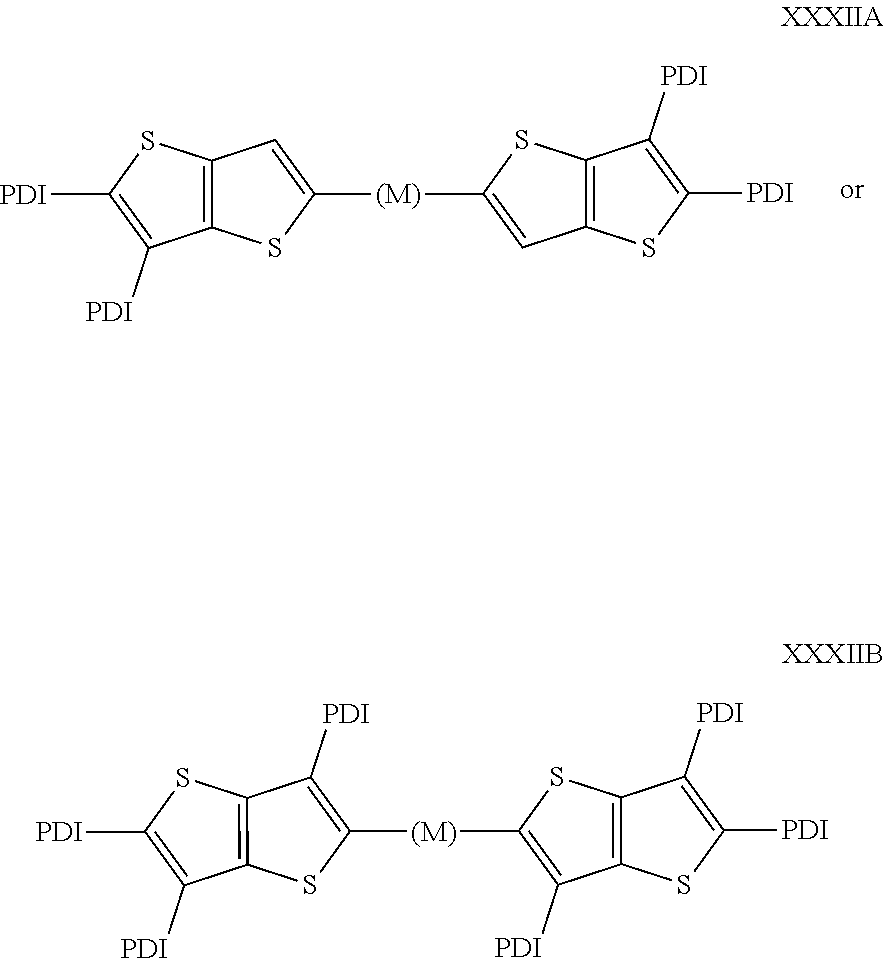
where -M- is a single bond, an alkylene (—(CH2)x—), an alkenylene (e.g., —CH═CH—), a dialkenylene (e.g., —CH═CH—CH═CH—), an alkynylene (e.g., —C≡C—), a dialkynylene (—C≡C—C≡C—), or an optionally substituted aromatic or non-aromatic carbocyclic or heterocyclic ring system. In specific embodiments, M is an arylene or a heteroarylene. In specific embodiments, M is a moiety as illustrated in

and the oligomer has structure:

where R4 is as defined above. In specific embodiments, each R4 is alkyl. In specific embodiments, each R4 is alkoxy. In specific embodiments, each R4 is optionally substituted aryl. In specific embodiments, each R4 is optionally substituted phenyl. Optional substitution is substitution of a phenyl with 1-4 non-hydrogen substituents selected from halogen, alkyl or alkoxy having 1-12 carbon atoms, or CN.

and the oligomer has structure:

where each R5 is as defined above and in specific embodiments each R5 is an alkyl group. In an embodiment all R5 are the same group. In an embodiment, each R5 is a straight-chain alkyl of 3-12 or 3-8 carbon atoms. In a specific embodiment each R5 is —C6H13. In other embodiments, each R5 is a branched alkyl group. In specific embodiments, each R5 is selected from branched alkyl groups of formula —C(Ra)(Rb), where Ra and Rb are, independently, alkyl groups having 2-10 carbon atoms. In specific embodiments, Ra and Rb are the same alkyl group. In specific embodiments, Ra and Rb are different alkyl groups. In specific embodiments, Ra and Rb are straight-chain alkyl groups. In specific embodiments, each R5 is independently a 1-ethylpropyl, 1-propylbutyl, 1-butylpentyl, 1-pentylhexyl, 1-hexylheptyl, 1-heptyloctyl, 1-octylnonyl, 1-nonyldecyl, or 2-ethylhexyl.

where R6 is independently selected from hydrogen, halogen, CN, an optionally substituted phenyl or benzyl or an alkyl or alkoxy having 1-30 carbon atoms. In more specific embodiments, R6 is hydrogen or an alkyl group having 1-12 carbon atoms. In more specific embodiments, R6 is hydrogen or an alkyl group having 1-6 carbon atoms. In more specific embodiments. In more specific embodiments of compounds of core LV, in PDI, Y is NR3. In more specific embodiments of compounds of core LV, in PDI, Y is S or Se. In more specific embodiments of compounds of compounds of core LV, in PDI, R1 and R2 are alkyl groups having 6-12 carbon atoms.


In specific embodiments of VIIIA in PDI groups, Y is N—R3.


where n is 0, 1 or 2, R′ is H or an alkyl having 1-15 carbon atoms.


where n is 0, 1 or 2, R′ is H or an alkyl having 1-15 carbon atoms.

where:
z is 0 or 1 and M1 is an arylene, a heteroarylene, or an organic dye molecule.


such as the commercially available heterogeneous Pd catalyst SiliaCat® DPP-Pd (see web site silicycle.com). One of ordinary skill in the art can select an appropriate catalyst for the desired DHA reaction and the selected reactants, solvent and reaction conditions in view of what is exemplified herein and in view of what is known in the art.


containing one double bond; or
or those containing 2 double bonds (also designated dialkenylene groups), such as

alkynylene groups, containing 1 triple bond, such as:

or those containing 2 triple bonds (also designated dialkynylene groups), such as:


Each of the exemplified linkers above is optionally substituted with one or more alkyl groups, halogens, nitro groups or CN groups.

here V is O, S or Se and t is 1, 2, 3, 4, 5, 6, 7 or 8.

remain further upfield with the singlet at 7.37 ppm corresponding to the para protons on the central phenyl ring of the IDT core. The optical properties of IDT-NPDI4 were evaluated using UV-Vis spectroscopy (
| TABLE 1 |
| Tabulated optical absorption data |
| λmax |
| abs | λonset abs | Eg | ε(λmax) | λmax | Stokes | |
| (nm) | (nm) | (eV) | (M−1cm−1) | em (nm) | Shift (eV) | |
| Solution | 533 | 568 | 2.2 | 209,803 | 748 | 0.67 |
| Film | 533 | 574 | 2.2 | 732 | 0.64 | |
| TABLE 2 |
| Tabulated electrochemical data |
| Oxidation | Reduction | |||||
| Potentials | Oxonset | IP | Potentials | Redonset | EA | Eg |
| (V) | (V) | (eV) | (V) | (V) | (eV) | (eV) |
| 0.61, 1.00 | 0.50 | 5.3 | −1.32, | −1.20 | 3.6 | 1.7 |
| −1.59 | ||||||
| TABLE 3 |
| Tabulated organic solar cell data |
| CN (v/v) | VOC (V) | JSC (mA cm−2) | | PCE | |
| 3% | 1.03 | 8.53 | 0.35 | 3.03 | |
| 5% | 1.02 | 9.62 | 0.35 | 3.41 | |
| 7% | 1.00 | 8.44 | 0.34 | 2.90 | |


- 1. T. W. Kelley, P. F. Baude, C. Gerlach, D. E. Ender, D. Muyres, M. A. Haase, D. E. Vogel and S. D. Theiss, Chem. Mater., 2004, 16, 4413-4422.
- 2. A. Facchetti, Chem. Mater., 2011, 23, 733-758.
- 3. T. P. Kaloni, P. K. Giesbrecht, G. Schreckenbach and M. S. Freund, Chem. Mater., 2017, 29, 10248-10283.
- 4. J. Roncali, Chem. Rev., 1997, 97, 173-206.
- 5. P. M. Beaujuge and J. R. Reynolds, Chem. Rev., 2010, 110, 268-320.
- 6. Y.-J. Cheng, S.-H. Yang and C.-S. Hsu, Chem. Rev., 2009, 109, 5868-5923.
- 7. G. Zhang, J. Zhao, P. C. Y. Chow, K. Jiang, J. Zhang, Z. Zhu, J. Zhang, F. Huang and H. Yan, Chem. Rev., 2018, 118, 3447-3507.
- 8. C. Sekine, Y. Tsubata, T. Yamada, M. Kitano and S. Doi, Sci. Technol. Adv. Mater., 2014, 15, 034203.
- 9. D. J. Burke and D. J. Lipomi, Energy Environ. Sci., 2013, 6, 2053-2066.
- 10. R. Po and J. Roncali, J. Mater. Chem. C, 2016, 4, 3677-3685.
- 11. A. Wadsworth, M. Moser, A. Marks, M. S. Little, N. Gasparini, C. J. Brabec, D. Baran and I. McCulloch, Chem. Soc. Rev., 2018, DOI:10.1039/C7CS00892A.
- 12. H. Bohra and M. Wang, J. Mater. Chem. A, 2017, 5, 11550-11571.
- 13. J.-R. Pouliot, F. Grenier, J. T. Blaskovits, S. Beaupre and M. Leclerc, Chem. Rev., 2016, 116, 14225-14274.
- 14. T. Bura, J. T. Blaskovits and M. Leclerc, J. Am. Chem. Soc., 2016, 138, 10056-10071.
- 15. D. J. Schipper and K. Fagnou, Chem. Mater., 2011, 23, 1594-1600.
- 16. F. Grenier, K. Goudreau and M. Leclerc, J. Am. Chem. Soc., 2017, 139, 2816-2824.
- 17. J. Zhang, L. Zhu and Z. Wei, Small Methods, 2017, 1, 1700258.
- 18. A. F. Eftaiha, J.-P. Sun, I. G. Hill and G. C. Welch, J. Mater. Chem. A, 2013, 2, 1201-1213.
- 19. S. M. McAfee, J. M. Topple, I. G. Hill and G. C. Welch, J. Mater. Chem. A, 2015, 3, 16393-16408.
- 20. P. Cheng, G. Li, X. Zhan and Y. Yang, Nat. Photonics, 2018, 12, 131-142.
- 21. J. Hou, O. Inganas, R. H. Friend and F. Gao, Nat. Mater., 2018, 17, 119-128.
- 22. C. Yan, S. Barlow, Z. Wang, H. Yan, A. K.-Y. Jen, S. R. Marder and X. Zhan, Nat. Rev. Mater., 2018, 3, 18003.
- 23. J. Zhang, H. S. Tan, X. Guo, A. Facchetti and H. Yan, Nat. Energy, DOI: 10.1038/s41560-018-0181-5.
- 24. Y. Lin, J. Wang, Z.-G. Zhang, H. Bai, Y. Li, D. Zhu and X. Zhan, Adv. Mater., 2015, 27, 1170-1174.
- 25. W. Zhao, D. Qian, S. Zhang, S. Li, O. Ingants, F. Gao and J. Hou, Adv. Mater., 28, 4734-4739.
- 26. J. Liu, S. Chen, D. Qian, B. Gautam, G. Yang, J. Zhao, J. Bergqvist, F. Zhang, W. Ma, H. Ade, O. Ingants, K. Gundogdu, F. Gao and H. Yan, Nat. Energy, 2016, 1, 16089(1)-16089(7).
- 27. D. Meng, D. Sun, C. Zhong, T. Liu, B. Fan, L. Huo, Y. Li, W. Jiang, H. Choi, T. Kim, J. Y. Kim, Y. Sun, Z. Wang and A. J. Heeger, J. Am. Chem. Soc., 2016, 138, 375-380.
- 28. D. Sun, D. Meng, Y. Cai, B. Fan, Y. Li, W. Jiang, L. Huo, Y. Sun and Z. Wang, J. Am. Chem. Soc., 2015, 137, 11156-11162.
- 29. Q. Wu, D. Zhao, A. M. Schneider, W. Chen and L. Yu, J. Am. Chem. Soc., 2016, 138, 7248-7251.
- 30. Z. Luo, T. Liu, W. Cheng, K. Wu, D. Xie, L. Huo, Y. Sun and C. Yang, J. Mater. Chem. C, 2018, 6, 1136-1142.
- 31. Q. Wu, D. Zhao, J. Yang, V. Sharapov, Z. Cai, L. Li, N. Zhang, A. Neshchadin, W. Chen and L. Yu, Chem. Mater., 2017, 29, 1127-1133.
- 32. J. Zhang, Y. Li, J. Huang, H. Hu, G. Zhang, T. Ma, P. C. Y. Chow, H. Ade, D. Pan and H. Yan, J. Am. Chem. Soc., 2017, 139, 16092-16095.
- 33. A. D. Hendsbee, J.-P. Sun, W. K. Law, H. Yan, I. G. Hill, D. M. Spasyuk and G. C. Welch, Chem. Mater., 2016, 28, 7098-7109.
- 34. Y. Lin, J. Wang, S. Dai, Y. Li, D. Zhu and X. Zhan, Adv. Energy Mater., 4, 1400420.
- 35. S. Li, W. Liu, C.-Z. Li, T.-K. Lau, X. Lu, M. Shi and H. Chen, J. Mater. Chem. A, 2016, 4, 14983-14987.
- 36. Z.-F. Chang, Y. Cai, K.-K. Liu, X.-X. Song, J.-J. Liu, X. Liu, Y. Sun, R. bo Zhang and J.-L. Wang, Dyes Pigments, 2017, 147, 31-39.
- 37. S. M. McAfee, S. V. Dayneko, A. D. Hendsbee, P. Josse, P. Blanchard, C. Cabanetos and G. C. Welch, J. Mater. Chem. A, 2017, 5, 11623-11633.
- 38. A.-J. Payne, S. Li, S. V. Dayneko, C. Risko and G. C. Welch, Chem. Commun., 2017, 53, 10168-10171.
- 39. A.-J. Payne, S. M. McAfee and G. C. Welch, Chem. Pap., 2017, 1-6.
- 40. T. A. Welsh, A. Laventure and G. C. Welch, Molecules, 2018, 23, 931.
- 41. A. E. Rudenko and B. C. Thompson, J. Polym. Sci. Part Polym. Chem., 2015, 53, 135-147.
- 42. W. Li and T. Michinobu, Polym. Chem., 2016, 7, 3165-3171.
- 43. F. Lombeck, F. Marx, K. Strassel, S. Kunz, C. Lienert, H. Komber, R. Friend and M. Sommer, Polym. Chem., 2017, 8, 4738-4745.
- 44. S. V. Dayneko, A. D. Hendsbee and G. C. Welch, Small Methods, 2018, 2, 1800081.
- 45. J. Zhang, Y. Li, J. Huang, H. Hu, G. Zhang, T. Ma, P. C. Y. Chow, H. Ade, D. Pan and H. Yan, J. Amer. Chem. Soc., 2017, 139(45), 16092-16095.
- 46. J. Urieta-Mora et al. (2019) J. Mater. Chem. C, 7:6656.
- 47. A.-J. Payne et al. (2018) Chem. Commun. 54:11443-11446.
- 48. T. A. Welsh et al. (2019) New J. Chem. 43:9333-9337.
Claims (28)


Priority Applications (2)
| Application Number | Priority Date | Filing Date | Title |
|---|---|---|---|
| US16/562,829 US10644242B2 (en) | 2018-09-07 | 2019-09-06 | Oligomeric perylene diimide non-fullerene acceptors via direct (hetero)arylation cross-coupling reactions |
| US16/867,157 US10981936B2 (en) | 2018-09-07 | 2020-05-05 | Oligomeric perylene diimide non-fullerene acceptors via direct (hetero)arylation cross-coupling reactions |
Applications Claiming Priority (2)
| Application Number | Priority Date | Filing Date | Title |
|---|---|---|---|
| US201862728462P | 2018-09-07 | 2018-09-07 | |
| US16/562,829 US10644242B2 (en) | 2018-09-07 | 2019-09-06 | Oligomeric perylene diimide non-fullerene acceptors via direct (hetero)arylation cross-coupling reactions |
Related Child Applications (1)
| Application Number | Title | Priority Date | Filing Date |
|---|---|---|---|
| US16/867,157 Continuation-In-Part US10981936B2 (en) | 2018-09-07 | 2020-05-05 | Oligomeric perylene diimide non-fullerene acceptors via direct (hetero)arylation cross-coupling reactions |
Publications (2)
| Publication Number | Publication Date |
|---|---|
| US20200083457A1 US20200083457A1 (en) | 2020-03-12 |
| US10644242B2 true US10644242B2 (en) | 2020-05-05 |
Family
ID=69718609
Family Applications (1)
| Application Number | Title | Priority Date | Filing Date |
|---|---|---|---|
| US16/562,829 Active US10644242B2 (en) | 2018-09-07 | 2019-09-06 | Oligomeric perylene diimide non-fullerene acceptors via direct (hetero)arylation cross-coupling reactions |
Country Status (2)
| Country | Link |
|---|---|
| US (1) | US10644242B2 (en) |
| CA (1) | CA3054518A1 (en) |
Cited By (1)
| Publication number | Priority date | Publication date | Assignee | Title |
|---|---|---|---|---|
| US10981936B2 (en) | 2018-09-07 | 2021-04-20 | Uti Limited Partnership | Oligomeric perylene diimide non-fullerene acceptors via direct (hetero)arylation cross-coupling reactions |
Families Citing this family (2)
| Publication number | Priority date | Publication date | Assignee | Title |
|---|---|---|---|---|
| JP2022019424A (en) * | 2020-07-17 | 2022-01-27 | 住友化学株式会社 | Photoelectric conversion element and method for manufacturing the same |
| CN114957256B (en) * | 2021-02-24 | 2023-04-18 | 中国科学院化学研究所 | Synthesis method of pyrrolo-pyrrole-dione-based aza-ring conjugated molecule |
Citations (2)
| Publication number | Priority date | Publication date | Assignee | Title |
|---|---|---|---|---|
| CN107286157A (en) | 2017-06-06 | 2017-10-24 | 武汉工程大学 | Yi Zhong perylene diimides class compounds and preparation method thereof, application |
| US9865819B2 (en) | 2016-06-06 | 2018-01-09 | Uti Limited Partnership | Nitrogen annulated perylene diimides for use as electron transport materials in organic electronic devices |
-
2019
- 2019-09-06 CA CA3054518A patent/CA3054518A1/en active Pending
- 2019-09-06 US US16/562,829 patent/US10644242B2/en active Active
Patent Citations (2)
| Publication number | Priority date | Publication date | Assignee | Title |
|---|---|---|---|---|
| US9865819B2 (en) | 2016-06-06 | 2018-01-09 | Uti Limited Partnership | Nitrogen annulated perylene diimides for use as electron transport materials in organic electronic devices |
| CN107286157A (en) | 2017-06-06 | 2017-10-24 | 武汉工程大学 | Yi Zhong perylene diimides class compounds and preparation method thereof, application |
Non-Patent Citations (76)
Cited By (1)
| Publication number | Priority date | Publication date | Assignee | Title |
|---|---|---|---|---|
| US10981936B2 (en) | 2018-09-07 | 2021-04-20 | Uti Limited Partnership | Oligomeric perylene diimide non-fullerene acceptors via direct (hetero)arylation cross-coupling reactions |
Also Published As
| Publication number | Publication date |
|---|---|
| CA3054518A1 (en) | 2020-03-07 |
| US20200083457A1 (en) | 2020-03-12 |
Similar Documents
| Publication | Publication Date | Title |
|---|---|---|
| US9865819B2 (en) | Nitrogen annulated perylene diimides for use as electron transport materials in organic electronic devices | |
| Wang et al. | The synthesis and optical properties of benzothiazole-based derivatives with various π-electron donors as novel bipolar fluorescent compounds | |
| US10644242B2 (en) | Oligomeric perylene diimide non-fullerene acceptors via direct (hetero)arylation cross-coupling reactions | |
| US10829503B2 (en) | Dibenzopyrromethene boron chelate compound, near-infrared light absorbing material, thin film and organic electronics device | |
| CN108546267A (en) | A kind of organic conjugate small molecule material of end group chain containing naphthenic base and preparation method thereof and application in solar cells | |
| Li et al. | The effect of different binding sites on the optical and electronic properties of tetraphenylethylene-substituted thiophene isomers | |
| US10647732B2 (en) | N-annulated perylene diimide dimers with active pyrrolic N—H bonds | |
| CN108467402A (en) | Fluorine replaces organic molecule hole mobile material and its application | |
| Chen et al. | A new solution-processed diketopyrrolopyrrole donor for non-fullerene small-molecule solar cells | |
| US20070069197A1 (en) | Monomers, oligomers and polymers of 2-functionalized and 2,7-difunctionalized carbzoles | |
| US11401284B2 (en) | Organic semiconducting material and its synthesis and organic semiconducting component with the material | |
| CN108117563B (en) | Anthracene bithiophene-containing organic small-molecule semiconductor material and preparation method and application thereof | |
| TW201811801A (en) | Design and synthesis of porphyrin materials for high efficiency organic photovoltaics | |
| US10981936B2 (en) | Oligomeric perylene diimide non-fullerene acceptors via direct (hetero)arylation cross-coupling reactions | |
| Busireddy et al. | Influence of the backbone structure of the donor material and device processing conditions on the photovoltaic properties of small molecular BHJSCs | |
| CN116120527A (en) | Near-infrared conjugated polymer and preparation method and application thereof | |
| Chen et al. | Synthesis and properties of Zn 2+/Cd 2+-directed self-assembled metallo-supramolecular polymers based on 1, 4-diketo-pyrrolo [3, 4-c] pyrrole (DPP) derivatives | |
| CN114133385A (en) | A kind of hole transport material with carbazole as core and thiophenazine or phenoxazine as end group and its synthesis method and application | |
| US9000170B2 (en) | Process for the preparation of tetracarboxynaphthalenediimide compounds disubstituted with heteroaryl groups | |
| US8568623B2 (en) | Triphenylamine derivatives and organic photovoltaic cells including the derivatives | |
| Chen et al. | Synthesis and optical properties of 6, 10-dihydrofluoreno [2, 3-d: 6, 7-d′] diimidazole derivatives | |
| Domínguez et al. | Cyclopentadithiophene organic core in small molecule organic solar cells: morphological control of carrier recombination | |
| US9627633B2 (en) | Perylene functionalized porphyrin dyes for dye-sensitized solar cells | |
| Peng et al. | Simultaneous enhancement of fluorescence and solubility by N-alkylation and functionalization of 2-(2-thienyl) imidazo [4, 5-f][1, 10]-phenanthroline with heterocyclic bridges | |
| CN101255130B (en) | Benzofluoranthene alkynes and uses thereof |
Legal Events
| Date | Code | Title | Description |
|---|---|---|---|
| FEPP | Fee payment procedure |
Free format text: ENTITY STATUS SET TO UNDISCOUNTED (ORIGINAL EVENT CODE: BIG.); ENTITY STATUS OF PATENT OWNER: SMALL ENTITY |
|
| FEPP | Fee payment procedure |
Free format text: ENTITY STATUS SET TO SMALL (ORIGINAL EVENT CODE: SMAL); ENTITY STATUS OF PATENT OWNER: SMALL ENTITY |
|
| AS | Assignment |
Owner name: UTI LIMITED PARTNERSHIP, CANADA Free format text: ASSIGNMENT OF ASSIGNORS INTEREST;ASSIGNORS:PAYNE, ABBY-JO;WELCH, GREGORY C.;SIGNING DATES FROM 20190917 TO 20190918;REEL/FRAME:050657/0171 |
|
| STCF | Information on status: patent grant |
Free format text: PATENTED CASE |
|
| MAFP | Maintenance fee payment |
Free format text: PAYMENT OF MAINTENANCE FEE, 4TH YR, SMALL ENTITY (ORIGINAL EVENT CODE: M2551); ENTITY STATUS OF PATENT OWNER: SMALL ENTITY Year of fee payment: 4 |