US10643309B2 - Signal-to-noise enhancement - Google Patents
Signal-to-noise enhancement Download PDFInfo
- Publication number
- US10643309B2 US10643309B2 US15/808,063 US201715808063A US10643309B2 US 10643309 B2 US10643309 B2 US 10643309B2 US 201715808063 A US201715808063 A US 201715808063A US 10643309 B2 US10643309 B2 US 10643309B2
- Authority
- US
- United States
- Prior art keywords
- mnf
- spectra
- noise
- multiplicity
- components
- Prior art date
- Legal status (The legal status is an assumption and is not a legal conclusion. Google has not performed a legal analysis and makes no representation as to the accuracy of the status listed.)
- Active, expires
Links
Images




Classifications
-
- G—PHYSICS
- G06—COMPUTING OR CALCULATING; COUNTING
- G06T—IMAGE DATA PROCESSING OR GENERATION, IN GENERAL
- G06T5/00—Image enhancement or restoration
- G06T5/70—Denoising; Smoothing
-
- G06T5/002—
-
- G—PHYSICS
- G06—COMPUTING OR CALCULATING; COUNTING
- G06T—IMAGE DATA PROCESSING OR GENERATION, IN GENERAL
- G06T5/00—Image enhancement or restoration
- G06T5/50—Image enhancement or restoration using two or more images, e.g. averaging or subtraction
-
- G—PHYSICS
- G01—MEASURING; TESTING
- G01J—MEASUREMENT OF INTENSITY, VELOCITY, SPECTRAL CONTENT, POLARISATION, PHASE OR PULSE CHARACTERISTICS OF INFRARED, VISIBLE OR ULTRAVIOLET LIGHT; COLORIMETRY; RADIATION PYROMETRY
- G01J3/00—Spectrometry; Spectrophotometry; Monochromators; Measuring colours
- G01J3/28—Investigating the spectrum
- G01J3/2823—Imaging spectrometer
- G01J2003/2826—Multispectral imaging, e.g. filter imaging
-
- G—PHYSICS
- G01—MEASURING; TESTING
- G01J—MEASUREMENT OF INTENSITY, VELOCITY, SPECTRAL CONTENT, POLARISATION, PHASE OR PULSE CHARACTERISTICS OF INFRARED, VISIBLE OR ULTRAVIOLET LIGHT; COLORIMETRY; RADIATION PYROMETRY
- G01J3/00—Spectrometry; Spectrophotometry; Monochromators; Measuring colours
- G01J3/28—Investigating the spectrum
- G01J2003/283—Investigating the spectrum computer-interfaced
- G01J2003/2843—Processing for eliminating interfering spectra
-
- G—PHYSICS
- G01—MEASURING; TESTING
- G01J—MEASUREMENT OF INTENSITY, VELOCITY, SPECTRAL CONTENT, POLARISATION, PHASE OR PULSE CHARACTERISTICS OF INFRARED, VISIBLE OR ULTRAVIOLET LIGHT; COLORIMETRY; RADIATION PYROMETRY
- G01J3/00—Spectrometry; Spectrophotometry; Monochromators; Measuring colours
- G01J3/28—Investigating the spectrum
-
- G—PHYSICS
- G01—MEASURING; TESTING
- G01J—MEASUREMENT OF INTENSITY, VELOCITY, SPECTRAL CONTENT, POLARISATION, PHASE OR PULSE CHARACTERISTICS OF INFRARED, VISIBLE OR ULTRAVIOLET LIGHT; COLORIMETRY; RADIATION PYROMETRY
- G01J3/00—Spectrometry; Spectrophotometry; Monochromators; Measuring colours
- G01J3/28—Investigating the spectrum
- G01J3/2823—Imaging spectrometer
-
- G—PHYSICS
- G06—COMPUTING OR CALCULATING; COUNTING
- G06T—IMAGE DATA PROCESSING OR GENERATION, IN GENERAL
- G06T2207/00—Indexing scheme for image analysis or image enhancement
- G06T2207/10—Image acquisition modality
- G06T2207/10016—Video; Image sequence
-
- G—PHYSICS
- G06—COMPUTING OR CALCULATING; COUNTING
- G06T—IMAGE DATA PROCESSING OR GENERATION, IN GENERAL
- G06T2207/00—Indexing scheme for image analysis or image enhancement
- G06T2207/10—Image acquisition modality
- G06T2207/10032—Satellite or aerial image; Remote sensing
- G06T2207/10036—Multispectral image; Hyperspectral image
-
- G—PHYSICS
- G06—COMPUTING OR CALCULATING; COUNTING
- G06T—IMAGE DATA PROCESSING OR GENERATION, IN GENERAL
- G06T2207/00—Indexing scheme for image analysis or image enhancement
- G06T2207/20—Special algorithmic details
- G06T2207/20076—Probabilistic image processing
Definitions
- This disclosure relates to processing a spectral dataset, such as a hyperspectral image or a large collection of individual spectra taken with the same spectrometer, to increase the signal-to-noise ratio.
- the methods can also be used to process a stack of images that differ by acquisition time rather than wavelength. The methods remove most of the sensor background noise with minimal corruption of image texture, anomalous or rare spectra or waveforms, and spectral or time resolution.
- HAI hyperspectral imaging
- images are collected in which each spatial pixel contains a spectrum—that is, a set of measured light intensities in a large number of spectral bands, typically tens to hundreds, each defined by a wavelength range and response function.
- Electronic noise which may arise from the sensor itself or from statistical fluctuations in the background radiation, adds a corrupting component to the measurements, interfering with the data analysis.
- IR infrared
- optical sensors are especially susceptible to background noise. Measures to reduce noise in IR sensors, such as aggressive cooling and selection of only the best detectors, can make the superior IR sensors extremely expensive.
- de-noising algorithms A number of methods for spectral imagery that reduce sensor noise, referred to as de-noising algorithms, have been described in the literature, and tend to fall into two major categories. Methods in the first category are known as spectral noise reduction methods since they work in the wavelength (spectral) coordinate and provide additional applicability to non-image datasets. Methods in the second category work in image spatial coordinates, and process one wavelength image at a time. The two methods can be combined, as in U.S. Pat. No. 8,358,866.
- the MNF operation transforms the data to an orthonormal coordinate system in which most of the noise is isolated from most of the signal.
- a variance or covariance linear operator describing the sensor noise is estimated from either the data itself or from a sensor specification.
- the data are then multiplied by the inverse square root of the operator, which “whitens” the noise, and the result is then processed with a Principal Component (PC) transformation.
- the PC transformation projects the spectra onto the eigenvectors of the spectral covariance matrix of the noise-whitened data. Each eigenvector has a corresponding eigenvalue.
- the combined noise whitening step and PC transformation can be considered as a single linear operation comprising the MNF transform, as described in Green [1988], Phillips, R.
- the second general class of noise reduction methods involves performing a wavelet transform on each wavelength band image.
- Example methods are described in Sihag, R., R. Sharma and V. Setia, “Wavelet Thresholding for Image De-noising,” ICVCI 2011, Proc. Int. J. Computer Applic. 2011 (“Sihag [2011]”) and Simoncelli, E. P. and Adelson, “Noise Removal via Bayesian Wavelet Coring,” Proc. 3 rd IEEE Intl. Conf. on Image Processing, Vol I, pp. 379-382, Lausanne, 16-19 Sep. 1996 (“Simoncelli [1996]”).
- the sensor noise is preferentially found in the wavelet decomposition images that correspond to fine spatial structure.
- These decomposition images are processed with a threshold function. Signal absolute values below the threshold, which consist predominantly of noise, are set to zero, while signal absolute values above the threshold, which consist predominantly of true signal, are either left unchanged (with a “hard” threshold) or reduced (with a “soft” threshold).
- the soft threshold function is also known as a shrinkage function [Sihag, 2011].
- the thresholded wavelet decomposition images are then processed with the inverse wavelet transform to yield a de-noised version of the original wavelength band image.
- a drawback of this method is that it has difficulty distinguishing sensor noise from surface texture, and thus it may over-smooth the image and degrade its sharpness. This will in turn distort the spectra.
- wavelet methods are applicable only to image data, not individual spectra.
- U.S. Pat. No. 8,358,866 for de-noising HSI data combines a wavelet transform method with a spectral filtering method. The method is also described in Othman, H. and Qian, S., “Noise reduction of hyperspectral imagery using hybrid spatial-spectral derivative-domain wavelet shrinkage”, IEEE Trans. Geosci. Remote Sensing, Vol. 44 (2), pp. 397-408, 2006 (“Othman [2006]”). First, wavelet de-noising is performed.
- the output is further processed by a spectral low-pass filtering step, involving taking differences of adjacent wavelengths, smoothing the result with a running low-pass filter, and then reversing the differencing process to restore the spectra, but with noise further reduced.
- This method has the advantages and disadvantage of other wavelet transform methods, but is capable of additional noise reduction via the spectral filtering step.
- the spectral filtering process can distort data that contain true spectral features that are comparable in resolution to the spectral resolution of the sensor.
- remote sensing data acquired in the long wavelength infrared (LWIR) wavelength region contains fine spectral structure from atmospheric water vapor spectral lines. Since this structure is as narrow as, or narrower than, the spacing between adjacent wavelength bands of typical LWIR hyperspectral sensors, this structure may be lost in the low-pass filtering step.
- LWIR long wavelength infrared
- hyperspectral imaging sensors collect the data in a staring mode, in which images of a fixed view are sequentially collected at different wavelengths by tuning a wavelength-selective optical element. In this situation, the images differ in their acquisition time, and comprise staring video imagery. Therefore, it will occur to those skilled in the art that many of the HSI denoising algorithms may also be applied to ordinary staring video imagery, in which the wavelength is not being varied. These data, in which the time dimension replaces the wavelength dimension, comprise images of waveforms rather than images of spectra.
- the signal-to-noise enhancement, or de-noising, of the present disclosure is aimed at improving the utility of hyperspectral imagery or other large spectral datasets without introducing significant spectral distortion in or spectral smoothing of the data, even for rare or anomalous spectra.
- this disclosure is aimed at enhancing the imagery from affordable infrared hyperspectral sensors, such as current commercial sensors operating in the mid-infrared to long-wavelength infrared. Since this method provides the best noise reduction for abundant spectra in the dataset, the method should especially benefit terrain classification applications, such as in minerology, agriculture, and land use.
- Another object of this disclosure is to provide a de-noising method for staring video imagery, which has the equivalent data structure to hyperspectral imagery. Another objective is to provide a method that is fully automated. Another objective is to provide a moderate, and predictable, computing time.
- a signal-to-noise enhancement method includes receiving from a spectrometer a spectral dataset that comprises a multiplicity of spectra measured with the spectrometer, in which the number of spectra exceeds the number of measured wavelength bands of the spectrometer, estimating the covariance matrix of background noise associated with the measured spectra, transforming the multiplicity of spectra to Maximum Noise Fraction (MNF) components, each component comprising the coefficients resulting from projection of the multiplicity of spectra onto an individual MNF eigenvector, calculating nonlinear mathematical functions, associated with each individual MNF eigenvector, that convert the values of the MNF components of a given spectrum into estimated values of the corresponding noise-free MNF components of the given spectrum, applying the inverse MNF transform to convert the estimated noise-free MNF components of the multiplicity of spectra back into the original units of the spectra, and generating an output spectral dataset from the converted estimated noise-free MNF components of the multiplicity of spectra.
- Embodiments may include one of the above and/or below features, or any combination thereof.
- the multiplicity of spectra may comprise a hyperspectral image.
- a system in another aspect, includes a spectrometer that provides a multiplicity of spectra, in which the number of spectra exceeds the number of measured wavelength bands of the spectrometer, and digital image processing circuitry which, in operation: estimates the covariance matrix of background noise associated with the measured spectra, transforms the multiplicity of spectra to Maximum Noise Fraction (MNF) components, each component comprising the coefficients resulting from projection of the multiplicity of spectra onto an individual MNF eigenvector, calculates nonlinear mathematical functions, associated with each individual MNF eigenvector, that convert the values of the MNF components of a given spectrum into estimated values of the corresponding noise-free MNF components of the given spectrum, applies the inverse MNF transform to convert the estimated noise-free MNF components of the multiplicity of spectra back into the original units of the spectra, and generates an output spectral dataset from the converted estimated noise-free MNF components of the multiplicity of spectra.
- MNF Maximum Noise Fraction
- Embodiments may include one of the above and/or below features, or any combination thereof.
- the spectrometer may comprise a hyperspectral imaging sensor.
- a signal-to-noise enhancement method includes receiving from an imaging device a time series of images that comprise a multiplicity of image frames, in which the number of pixels exceeds the number of image frames, estimating the covariance matrix of the background noise associated with the images, transforming the multiplicity of images to Maximum Noise Fraction (MNF) components, each component comprising the coefficients resulting from projection of the pixel waveforms onto an individual MNF eigenvector, calculating nonlinear mathematical functions, associated with each individual MNF eigenvector, that convert the values of the MNF components of a given pixel waveform into estimated values of the corresponding noise-free MNF components of the given pixel waveform, and applying the inverse MNF transform to convert the estimated noise-free MNF components of the multiplicity of pixel waveforms back into the original units of the images.
- An output image dataset is generated from the converted estimated noise-free MNF components of the multiplicity of pixel waveforms.
- Embodiments may include one of the above and/or below features, or any combination thereof.
- the covariance matrix of the background noise may comprise a diagonal constant matrix.
- a system in another aspect, includes a camera that provides a time series of images that comprise a multiplicity of image frames, in which the number of pixels exceeds the number of image frames, and digital image processing circuitry which, in operation: estimates the covariance matrix of the background noise associated with the images, transforms the multiplicity of images to Maximum Noise Fraction (MNF) components, each component comprising the coefficients resulting from projection of the pixel waveforms onto an individual MNF eigenvector, calculates nonlinear mathematical functions, associated with each individual MNF eigenvector, that convert the values of the MNF components of a given pixel waveform into estimated values of the corresponding noise-free MNF components of the given pixel waveform, applies the inverse MNF transform to convert the estimated noise-free MNF components of the multiplicity of pixel waveforms back into the original units of the images, and generates an output image dataset from the converted estimated noise-free MNF components of the multiplicity of pixel waveforms.
- MNF Maximum Noise Fraction
- Embodiments may include one of the above and/or below features, or any combination thereof.
- the covariance matrix of the background noise may comprise a diagonal constant matrix.
- FIG. 1A illustrates steps in a signal-to-noise enhancement method.
- FIG. 1B is a functional block diagram of a system that can be used to accomplish a signal-to-noise enhancement.
- FIG. 2 illustrates steps in an example of the shrinkage function estimator of FIG. 1A .
- FIGS. 3A-3D comprises plots of the MNF component optimal-estimate noise-free absolute value,
- , from Eqs. (3), (8) and (10), with s 1 ⁇ 2 in the generalized Laplacian prior PDF, Eq. (7).
- FIG. 4 comprises a plot of the value of r in Eq. (9) versus MNF eigenvector number, based on a histogram analysis of an 82-band long-wavelength infrared (LWIR) hyperspectral image taken with an airborne Telops HyperCam sensor.
- LWIR long-wavelength infrared
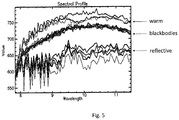
- FIG. 5 comprises plots of LWIR spectral radiance in units of microflicks versus micrometers from the hyperspectral image of FIG. 4 .
- FIG. 6 comprises plots of the same pixel spectra as in FIG. 5 but after processing with the present signal-to-noise enhancement method.
- FIG. 7 illustrates steps in another signal-to-noise enhancement method.
- FIG. 8 comprises a frame from a 30-frame video after Gaussian noise was added.
- FIG. 9 comprises the same frame as in FIG. 8 but after the video with added noise was processed with the present method.
- the signal-to-noise enhancement of this disclosure uses the MNF transform method for separating signal and noise components in multidimensional datasets in combination with the method of applying nonlinear multiplicative factors, called shrinkage functions, to the MNF components of each sample or pixel.
- shrinkage functions nonlinear multiplicative factors
- a separate shrinkage function is defined for each MNF component using the Bayesian signal estimation formula. In essence, this method suppresses MNF transform values that are within the noise level, while retaining values that exceed the noise level, which arise from anomalous or rare samples.
- a plurality of spectra 12 from a spectrometer 10 are fed into the processing system, comprised of items 14 , 16 , 18 and 20 .
- the number of spectra must be greater than the number of wavelength measurements, or bands, in the spectra, denoted N.
- the invention outputs de-noised spectra 22 .
- the spectrometer may be a hyperspectral imager.
- FIG. 1B illustrates system 80 that can be used to accomplish the signal-to-noise enhancement of FIG. 1A .
- Spectrometer 82 provides an output (a plurality of spectra) to processing system 84 .
- Processing system 84 may be a computer that is programmed to carry out the signal-to-noise enhancement.
- the output (which can be the input spectra, but de-noised) are provided to output device 86 .
- Output device 86 may be a printer or a computer display device, for example.
- An estimate of the N ⁇ N noise covariance matrix 14 may be obtained by a number of different methods, including by analysis of the data itself or from a specification of the RMS noise supplied by the sensor manufacturer. Specific methods are described in Green [1988], Phillips [2008] and Bjorgan [2015]. Typically, the noise in different wavelength bands is considered to be uncorrelated, in which case the noise covariance is a diagonal matrix of noise variances for each wavelength band. If only an average noise variance is available, then the elements of the diagonal matrix are identical.
- the MNF transform is described in numerous papers, including Phillips [2008] and Bjorgan [2015]. It can be regarded as a sequence of two steps.
- the first step which is a noise-whitening operation
- the data are multiplied by the square root of the noise covariance matrix inverse. If the noise covariance matrix is diagonal, the whitening step is a spectral weighting of the data, in which the data are divided by the noise standard deviation.
- a Principal Component (PC) transform is applied to the data.
- the MNF-transformed data consist of the projections of the mean spectrum-subtracted data onto the eigenvectors of the PC transform. We assume without loss of generality that the eigenvectors have been unit-normalized.
- the two mathematical steps outlined above are equivalent to a single data transformation.
- the first step is to subtract the mean spectrum from the data.
- ⁇ s denote the N ⁇ N covariance matrix of the spectral data
- ⁇ N denote the N ⁇ N covariance matrix of the noise.
- ⁇ is the diagonal matrix of N eigenvalues that correspond to matrix V.
- each of the N MNF components y j comprises an image.
- the y j comprise the MNF-transformed spectral dataset 16 .
- the preferred embodiment of the shrinkage function estimator procedure 18 is shown in FIG. 2 .
- the basic approach is described in Simoncelli [1996], who however applied it to wavelet transforms rather than MNF transforms.
- the first step is to estimate prior probability distribution functions (PDFs) 26 , denoted P j (x j ), associated with the noise-free MNF components.
- PDFs prior probability distribution functions
- Simoncelli [1996] describes a “blind” algorithm by which the two parameters of a generalized Laplacian prior PDF (Simoncelli [1996] Equation 2) corrupted by Gaussian white noise may be estimated from the second and fourth moments of the y j distribution across the dataset. These moments are but one example of MNF component statistics 24 that can potentially be employed to estimate the prior PDFs.
- the optimal estimate of a noise-free MNF component value is its mean value in the posterior PDF, which includes the added noise.
- This mean value which provides an unbiased-least squares estimate of x j given y j , is computed from the Bayesian signal estimation formula 28, found in Simoncelli [1996].
- braces The quantity in braces is the approximate shrinkage function S j (y j ). For the remainder of this discussion we drop the j subscripts for simplicity.
- Simoncelli [1996] suggests a range of exponents, p, from 0.5 to 1.0.
- Adler-Golden, S. M., “Improved Hyperspectral Anomaly Detection in Heavy-Tailed Backgrounds,” IEEE, First Annual WHISPERS Conference , Grenoble, FR (2009) (“Adler-Golden [2009]”) analyzed PC transforms of HSI data, which are closely related to MNF transforms, and found that the low-noise PC components had typical p values in a similar range.
- r q exp( ⁇
- P ) (9) with q 1 ( FIG. 3A ), 10 ( FIG. 3B ), 100 ( FIG. 3C ), and 1000 ( FIG. 3D ).
- the values from Eq. (8) are slightly larger at large y, meaning that its shrinkage estimates are on the conservative side (closer to 1). The agreement would be better at larger values of s (a broader Laplacian distribution).
- FIG. 4 shows some estimated r values obtained from histogram population ratios of MNF components in a thermal infrared radiance data cube, which was measured with an airborne Telops HyperCam hyperspectral sensor.
- the broad PDF component becomes extremely small (only a tiny fraction of the spectra have y values above the noise level), and the histogram ratio becomes poorly defined.
- the broad plus narrow component PDF model may be inaccurate. However, this is of little concern, since here the shrinkage function will be close to 1 regardless of what PDF model is assumed.
- Eq. (2) is used to determine the noise-free MNF component estimates, which comprise the de-noised MNF-transformed spectra 20 .
- FIGS. 5 and 6 show the application of this signal-to-noise enhancement to the HyperCam radiance data cube.
- the spectra with maximum values below 700 microflicks are from a patch of reflective material.
- FIG. 6 shows the same spectra as FIG. 5 obtained after de-noising using the Eq. (9) shrinkage function and the FIG. 4 r values.
- the noise level is dramatically reduced, especially for the non-reflective surfaces. This is seen in the greatly improved consistency among spectra of the same type of surface, and particularly in the very smooth appearance of the blackbody spectra, which are at a temperature close to that of the atmosphere.
- the de-noising processing preserves the atmospheric spectral structure, which is seen in the spectra of reflective surfaces and warm surfaces.
- the de-noising processing also preserves the sharp 10.3 micron peak in the brightest spectrum, which appears to be due to an anomaly in the focal plane array response.
- a stack of image frames 42 from a staring camera 40 are fed into the processing system, comprised of items 44 , 46 , 48 and 50 .
- the number of pixels in the images must be greater than the number of image frames, denoted N.
- the method outputs de-noised images 52 .
- the shrinkage function estimator 48 is identical to the shrinkage function estimator 18 shown in FIG. 1 .
- FIGS. 8 and 9 show the application of this method to a video from a hand-held camera.
- the original video is described in a paper Adler-Golden, S. M., S. C. Richtsmeier, and R. M. Shroll, “Suppression of Subpixel Sensor Jitter Fluctuations using Temporal Whitening,” Proc. SPIE 6969, Signal and Data Processing of Small Targets 2008, 69691D (Apr. 16, 2008); doi: 10.1117/12.780005 (“[Adler-Golden, 2008]”), and consists of 30 frames taken with a consumer digital camera.
- FIG. 8 shows a frame of the video after Gaussian white noise equivalent to 15.7% of full scale was added to the video.
- FIG. 8 shows a frame of the video after Gaussian white noise equivalent to 15.7% of full scale was added to the video.
Landscapes
- Physics & Mathematics (AREA)
- General Physics & Mathematics (AREA)
- Engineering & Computer Science (AREA)
- Theoretical Computer Science (AREA)
- Spectroscopy & Molecular Physics (AREA)
- Image Processing (AREA)
Abstract
Description
ΣSΣN −1 =VΛV −1 (1)
where Λ is the diagonal matrix of N eigenvalues that correspond to matrix V. As is usual, for the purposes of this discussion we assume that the eigenvectors and eigenvalues, which are positive, are ordered in decreasing eigenvalue size.
x′ j(y j)=S j(y j)y j (2)
x′ j(y j)=(G*Q j)(y j)/(G*P j)(y j) (3)
S j(y j)=x′ j(y j)/y j. (4)
P j(x j)=w j B j(x j)+(1−w j)D(x j) (5)
where wj is the weighting factor. We further approximate the convolutions in Eq. (3) by assuming that the broad PDF component, Bj(xj), can be represented as constant within the narrow range of xj that comprises the bulk of the noise PDF (i.e., within one or two standard deviations of G(xj)), and accordingly we factor Bj(xj) out of the restricted domain convolution integral. Noting that (1) convolutions of sums are sums of convolutions, (2) the convolution of a Dirac delta function with a Gaussian is a Gaussian, and (3) the convolution of a linear function with a Gaussian is a linear function, an approximate solution to Eq. (3) is
x′ j(y)=y j {w j B j(y j)/[(1−w j)G(y j)+w j B j(y j)]} (6)
B(y)∝exp(−|y/s| P) (7)
S(y)=exp(−|y/s| P)/[r exp(−y 2)+exp(−|y/s| P)] (8)
r=qexp(−|2/s| P) (9)
with q=1 (
S(y)=1/[r exp(−y 2)+1] (10)
has only a single adjustable parameter, r. The excellent agreement with the p=1 results indicates that, with r properly defined, the shrinkage function has little dependence on p, and thus can be estimated well with little or no knowledge of shape of the broad component of the prior PDF. One requires only an estimate of the relative magnitudes of the narrow (delta function) and broad components of the prior PDF, which sets the value of r.
-
- Evaluating the Bayesian
signal estimation formula 28 numerically using a model for theprior PDF estimate 26, where the model is a generalized Laplacian distribution, or a model that includes a Dirac delta function, or a model that includes both; - Using a user-supervised process to estimate the parameters s, p and q in the generalized Laplacian distribution model of the
prior PDF estimate 26; - Using a user-supervised process to estimate the parameter r in the shrinkage function equation (10);
- As a further approximation, using the
same shrinkage function 30 for all N of the MNF components.
- Evaluating the Bayesian
-
- The first step in the data processing is to subtract the mean waveform (i.e., the set of image means) from the image frames 42.
- Let ΣS denote the N×N covariance matrix of the image data and ΣN denote the estimated N×N covariance matrix of the
noise 44. - The matrix of N eigenvectors, V, is the solution to Eq. (1).
- The projection of the mean-subtracted data onto the N eigenvectors of the V matrix yields a set of N coefficients for each pixel waveform, which we denote yj for a given eigenvector j. Each of the N MNF components yj comprises an image; collectively these are the MNF-transformed
images 46. - Optimal estimates of the “true” MNF components, xj, which are uncontaminated with background noise, nj, are obtained by defining shrinkage functions, denoted Sj(yj), according to Eqs. (2), (3) and (4).
- For the small-eigenvalue j's, which are dominated by noise, we may assume that the vast majority of the pixel waveforms have MNF component values xj that are very close to zero, while a small minority of the pixel waveforms are associated with a relatively broad PDF.
- We may approximate the PDF of the true MNF coefficients Pj(xj) as a weighted sum of a broad distribution B(xj) and a Dirac delta function D(xj), the latter representing the limit of an extremely narrow distribution. Then the same logic found in the preferred embodiment leads to Eqs. (5) through (10).
- Other methods of estimating shrinkage functions 48 from parameters of the MNF components may occur to those skilled in the art, and may include all of the methods described in the preferred embodiment.
- Having estimated the shrinkage functions 48, Eq. (2) is used to determine the noise-free MNF component estimates, which comprise the de-noised MNF-transformed
data 50. Applying the inverse MNF transform, which includes adding back the mean waveform that was removed in the first step of the forward MNF transform, results in thede-noised images 52.
Claims (8)
Priority Applications (1)
| Application Number | Priority Date | Filing Date | Title |
|---|---|---|---|
| US15/808,063 US10643309B2 (en) | 2017-11-09 | 2017-11-09 | Signal-to-noise enhancement |
Applications Claiming Priority (1)
| Application Number | Priority Date | Filing Date | Title |
|---|---|---|---|
| US15/808,063 US10643309B2 (en) | 2017-11-09 | 2017-11-09 | Signal-to-noise enhancement |
Publications (2)
| Publication Number | Publication Date |
|---|---|
| US20190139196A1 US20190139196A1 (en) | 2019-05-09 |
| US10643309B2 true US10643309B2 (en) | 2020-05-05 |
Family
ID=66328777
Family Applications (1)
| Application Number | Title | Priority Date | Filing Date |
|---|---|---|---|
| US15/808,063 Active 2037-12-23 US10643309B2 (en) | 2017-11-09 | 2017-11-09 | Signal-to-noise enhancement |
Country Status (1)
| Country | Link |
|---|---|
| US (1) | US10643309B2 (en) |
Cited By (1)
| Publication number | Priority date | Publication date | Assignee | Title |
|---|---|---|---|---|
| US12470846B1 (en) | 2024-05-10 | 2025-11-11 | Rockwell Collins, Inc. | Noise reduction method for very low light level night vision |
Families Citing this family (3)
| Publication number | Priority date | Publication date | Assignee | Title |
|---|---|---|---|---|
| CN112598599B (en) * | 2020-12-29 | 2024-04-09 | 南京大学 | A denoising model training method and denoising method for hyperspectral images |
| CN114674786B (en) * | 2022-01-28 | 2025-02-11 | 无锡谱视界科技有限公司 | Red fire ant nest recognition method based on UAV hyperspectral imaging |
| WO2024023975A1 (en) * | 2022-07-27 | 2024-02-01 | 三菱電機株式会社 | Alignment system, alignment method, and program |
Citations (3)
| Publication number | Priority date | Publication date | Assignee | Title |
|---|---|---|---|---|
| US20030187616A1 (en) * | 2002-03-29 | 2003-10-02 | Palmadesso Peter J. | Efficient near neighbor search (ENN-search) method for high dimensional data sets with noise |
| US8358866B2 (en) | 2006-01-31 | 2013-01-22 | Canadian Space Agency | Method and system for increasing signal-to-noise ratio |
| US20140354868A1 (en) * | 2013-06-04 | 2014-12-04 | Corning Incorporated | Portable hyperspectral imager |
-
2017
- 2017-11-09 US US15/808,063 patent/US10643309B2/en active Active
Patent Citations (3)
| Publication number | Priority date | Publication date | Assignee | Title |
|---|---|---|---|---|
| US20030187616A1 (en) * | 2002-03-29 | 2003-10-02 | Palmadesso Peter J. | Efficient near neighbor search (ENN-search) method for high dimensional data sets with noise |
| US8358866B2 (en) | 2006-01-31 | 2013-01-22 | Canadian Space Agency | Method and system for increasing signal-to-noise ratio |
| US20140354868A1 (en) * | 2013-06-04 | 2014-12-04 | Corning Incorporated | Portable hyperspectral imager |
Non-Patent Citations (10)
| Title |
|---|
| Adler-Golden, S.M., "Improved Hyperspectral Anomaly Detection in Heavy-Tailed Backgrounds," IEEE, First Annual WHISPERS Conference, Grenoble, FR (2009). |
| Adler-Golden, S.M., S.C. Richtsmeier, and R.M. Shroll, "Suppression of Subpixel Sensor Jitter Fluctuations using Temporal Whitening," Proc. SPIE 6969, Signal and Data Processing of Small Targets 2008, 69691D (Apr. 16, 2008); doi: 10.1117/12.780005. |
| Bjorgan, A., and Randeberg, L.L., "Real-Time Noise Removal for Line-Scanning Hyperspectral Devices Using a Maximum Noise Fraction-Based Approach," Sensors (Basel, Switzerland),15(2): 3362-3378, 2015, doi:10.3390/s150203362. |
| Green, A.A., M. Berman, P. Switzer, and M.D. Craig, "A Transformation for Ordering Multispectral Data in Terms of Image Quality with Implications for Noise Removal," IEEE Transactions on Geoscience and Remote Sensing, 26(1):6574, 1988. |
| Lennon et al, ("Nonlinear filtering of hyperspectral images with anisotropic diffusion", 2002 IEEE, p. 2477-2479) (Year: 2002). * |
| Othman, H. and Qian, S., "Noise reduction of hyperspectral imagery using hybrid spatial-spectral derivative-domain wavelet shrinkage", IEEE Trans. Geosci. Remote Sensing, vol. 44 (2), pp. 397-408, 2006. |
| Phillips, R.D., L.T. Watson, C.E. Blinn and R.H. Wynne "An adaptive noise reduction technique for improving the utility of hyperspectral data," Pecora 17, The Future of Land Imaging . . . Going Operational, Denver, CO, Nov. 18-20, 2008. |
| Qian, S., J. Levesque and R. Neville "Evaluation of Noise Removal of Radiance Data on Onboard Data Compression of Hyperspectral Imagery," 2005 WSEAS Int. Conf. on Remote Sensing, Venice, Italy, pp. 37-42, Nov. 2-4, 2005. |
| Sihag, R., R. Sharma and V. Setia, "Wavelet Thresholding for Image De-noising," ICVCI 2011, Proc. Int. J. Computer Applic. 2011. |
| Simoncelli, E.P. and Adelson, "Noise Removal via Bayesian Wavelet Coring," Proc. 3rd IEEE Intl. Conf. on Image Processing, vol. I, pp. 379-382, Lausanne, Sep. 16-19, 1996. |
Cited By (1)
| Publication number | Priority date | Publication date | Assignee | Title |
|---|---|---|---|---|
| US12470846B1 (en) | 2024-05-10 | 2025-11-11 | Rockwell Collins, Inc. | Noise reduction method for very low light level night vision |
Also Published As
| Publication number | Publication date |
|---|---|
| US20190139196A1 (en) | 2019-05-09 |
Similar Documents
| Publication | Publication Date | Title |
|---|---|---|
| Peng et al. | Decomposable nonlocal tensor dictionary learning for multispectral image denoising | |
| Bouali et al. | Toward optimal destriping of MODIS data using a unidirectional variational model | |
| Acito et al. | Subspace-based striping noise reduction in hyperspectral images | |
| Aly et al. | A regularized model-based optimization framework for pan-sharpening | |
| Renard et al. | Improvement of target detection methods by multiway filtering | |
| Zhang et al. | A Bayesian restoration approach for hyperspectral images | |
| Bourennane et al. | Improvement of classification for hyperspectral images based on tensor modeling | |
| US20190139196A1 (en) | Signal-to-Noise Enhancement | |
| CN103793883B (en) | A kind of imaging spectrum Super-Resolution method based on principal component analysis | |
| Letexier et al. | Nonorthogonal tensor matricization for hyperspectral image filtering | |
| Bourennane et al. | Improvement of target-detection algorithms based on adaptive three-dimensional filtering | |
| Khan et al. | Pan-sharpening framework based on laplacian sharpening with Brovey | |
| El Helou et al. | Correlation-based deblurring leveraging multispectral chromatic aberration in color and near-infrared joint acquisition | |
| Gao et al. | Hyperspectral image superresolution via structure-tensor-based image matting | |
| Sadeghipoor et al. | Multiscale guided deblurring: Chromatic aberration correction in color and near-infrared imaging | |
| Xu et al. | Non-local similarity based tensor decomposition for hyperspectral image denoising | |
| Ratliff et al. | Scene-based correction of fixed pattern noise in hyperspectral image data using temporal reordering | |
| Uss et al. | Analysis of signal-dependent sensor noise on JPEG 2000-compressed Sentinel-2 multi-spectral images | |
| Das et al. | A Comparative Analysis of Image Fusion Techniques for Remote Sensed Images. | |
| Mohajeran et al. | Denoising hyperspectral images using an improved SSTV correntropy based method in the presence of non-gaussian noise | |
| Huang et al. | An image destriping method combining feature extraction and nonlinear fitting | |
| Riley et al. | Anomaly detection in noisy hyperspectral imagery | |
| Vaquar et al. | A comparative analysis of image enhancement techniques | |
| Wang et al. | Spectral-spatial destriping of hyperspectral image via correntropy based sparse representation and unidirectional Huber–Markov random fields | |
| Vuong et al. | A hyperspectral image denoising approach via low-rank matrix recovery and greedy bilateral |
Legal Events
| Date | Code | Title | Description |
|---|---|---|---|
| FEPP | Fee payment procedure |
Free format text: ENTITY STATUS SET TO UNDISCOUNTED (ORIGINAL EVENT CODE: BIG.); ENTITY STATUS OF PATENT OWNER: SMALL ENTITY |
|
| FEPP | Fee payment procedure |
Free format text: ENTITY STATUS SET TO SMALL (ORIGINAL EVENT CODE: SMAL); ENTITY STATUS OF PATENT OWNER: SMALL ENTITY |
|
| STPP | Information on status: patent application and granting procedure in general |
Free format text: NON FINAL ACTION MAILED |
|
| STPP | Information on status: patent application and granting procedure in general |
Free format text: RESPONSE TO NON-FINAL OFFICE ACTION ENTERED AND FORWARDED TO EXAMINER |
|
| STPP | Information on status: patent application and granting procedure in general |
Free format text: NOTICE OF ALLOWANCE MAILED -- APPLICATION RECEIVED IN OFFICE OF PUBLICATIONS |
|
| AS | Assignment |
Owner name: SPECTRAL SCIENCES, INC., MASSACHUSETTS Free format text: ASSIGNMENT OF ASSIGNORS INTEREST;ASSIGNOR:ADLER-GOLDEN, STEVEN;REEL/FRAME:052273/0537 Effective date: 20200328 |
|
| STCF | Information on status: patent grant |
Free format text: PATENTED CASE |
|
| MAFP | Maintenance fee payment |
Free format text: PAYMENT OF MAINTENANCE FEE, 4TH YR, SMALL ENTITY (ORIGINAL EVENT CODE: M2551); ENTITY STATUS OF PATENT OWNER: SMALL ENTITY Year of fee payment: 4 |