US10635753B2 - Neural machine translation method and apparatus - Google Patents
Neural machine translation method and apparatus Download PDFInfo
- Publication number
- US10635753B2 US10635753B2 US15/944,939 US201815944939A US10635753B2 US 10635753 B2 US10635753 B2 US 10635753B2 US 201815944939 A US201815944939 A US 201815944939A US 10635753 B2 US10635753 B2 US 10635753B2
- Authority
- US
- United States
- Prior art keywords
- word
- training data
- sub
- sentence
- feature
- Prior art date
- Legal status (The legal status is an assumption and is not a legal conclusion. Google has not performed a legal analysis and makes no representation as to the accuracy of the status listed.)
- Expired - Fee Related, expires
Links
Images


Classifications
-
- G06F17/289—
-
- G—PHYSICS
- G06—COMPUTING OR CALCULATING; COUNTING
- G06F—ELECTRIC DIGITAL DATA PROCESSING
- G06F40/00—Handling natural language data
- G06F40/40—Processing or translation of natural language
- G06F40/58—Use of machine translation, e.g. for multi-lingual retrieval, for server-side translation for client devices or for real-time translation
-
- G06F17/277—
-
- G06F17/2827—
-
- G—PHYSICS
- G06—COMPUTING OR CALCULATING; COUNTING
- G06F—ELECTRIC DIGITAL DATA PROCESSING
- G06F40/00—Handling natural language data
- G06F40/20—Natural language analysis
- G06F40/268—Morphological analysis
-
- G—PHYSICS
- G06—COMPUTING OR CALCULATING; COUNTING
- G06F—ELECTRIC DIGITAL DATA PROCESSING
- G06F40/00—Handling natural language data
- G06F40/20—Natural language analysis
- G06F40/279—Recognition of textual entities
-
- G—PHYSICS
- G06—COMPUTING OR CALCULATING; COUNTING
- G06F—ELECTRIC DIGITAL DATA PROCESSING
- G06F40/00—Handling natural language data
- G06F40/20—Natural language analysis
- G06F40/279—Recognition of textual entities
- G06F40/284—Lexical analysis, e.g. tokenisation or collocates
-
- G—PHYSICS
- G06—COMPUTING OR CALCULATING; COUNTING
- G06F—ELECTRIC DIGITAL DATA PROCESSING
- G06F40/00—Handling natural language data
- G06F40/40—Processing or translation of natural language
- G06F40/42—Data-driven translation
- G06F40/45—Example-based machine translation; Alignment
-
- G—PHYSICS
- G06—COMPUTING OR CALCULATING; COUNTING
- G06N—COMPUTING ARRANGEMENTS BASED ON SPECIFIC COMPUTATIONAL MODELS
- G06N3/00—Computing arrangements based on biological models
- G06N3/02—Neural networks
- G06N3/04—Architecture, e.g. interconnection topology
- G06N3/044—Recurrent networks, e.g. Hopfield networks
-
- G—PHYSICS
- G06—COMPUTING OR CALCULATING; COUNTING
- G06N—COMPUTING ARRANGEMENTS BASED ON SPECIFIC COMPUTATIONAL MODELS
- G06N3/00—Computing arrangements based on biological models
- G06N3/02—Neural networks
- G06N3/04—Architecture, e.g. interconnection topology
- G06N3/044—Recurrent networks, e.g. Hopfield networks
- G06N3/0442—Recurrent networks, e.g. Hopfield networks characterised by memory or gating, e.g. long short-term memory [LSTM] or gated recurrent units [GRU]
-
- G06N3/0445—
-
- G—PHYSICS
- G06—COMPUTING OR CALCULATING; COUNTING
- G06N—COMPUTING ARRANGEMENTS BASED ON SPECIFIC COMPUTATIONAL MODELS
- G06N3/00—Computing arrangements based on biological models
- G06N3/02—Neural networks
- G06N3/04—Architecture, e.g. interconnection topology
- G06N3/045—Combinations of networks
-
- G06N3/0454—
-
- G—PHYSICS
- G06—COMPUTING OR CALCULATING; COUNTING
- G06N—COMPUTING ARRANGEMENTS BASED ON SPECIFIC COMPUTATIONAL MODELS
- G06N3/00—Computing arrangements based on biological models
- G06N3/02—Neural networks
- G06N3/04—Architecture, e.g. interconnection topology
- G06N3/045—Combinations of networks
- G06N3/0455—Auto-encoder networks; Encoder-decoder networks
-
- G—PHYSICS
- G06—COMPUTING OR CALCULATING; COUNTING
- G06N—COMPUTING ARRANGEMENTS BASED ON SPECIFIC COMPUTATIONAL MODELS
- G06N3/00—Computing arrangements based on biological models
- G06N3/02—Neural networks
- G06N3/08—Learning methods
-
- G—PHYSICS
- G06—COMPUTING OR CALCULATING; COUNTING
- G06N—COMPUTING ARRANGEMENTS BASED ON SPECIFIC COMPUTATIONAL MODELS
- G06N3/00—Computing arrangements based on biological models
- G06N3/02—Neural networks
- G06N3/08—Learning methods
- G06N3/09—Supervised learning
-
- G—PHYSICS
- G10—MUSICAL INSTRUMENTS; ACOUSTICS
- G10L—SPEECH ANALYSIS TECHNIQUES OR SPEECH SYNTHESIS; SPEECH RECOGNITION; SPEECH OR VOICE PROCESSING TECHNIQUES; SPEECH OR AUDIO CODING OR DECODING
- G10L25/00—Speech or voice analysis techniques not restricted to a single one of groups G10L15/00 - G10L21/00
- G10L25/27—Speech or voice analysis techniques not restricted to a single one of groups G10L15/00 - G10L21/00 characterised by the analysis technique
- G10L25/30—Speech or voice analysis techniques not restricted to a single one of groups G10L15/00 - G10L21/00 characterised by the analysis technique using neural networks
Definitions
- the present invention relates to neural machine translation (NMT) using a neural network and a recurrent neural network with long short-term memory (RNN-LSTM). More specifically, the present invention relates to an end-to-end NMT method and apparatus based on a sub-word token to which explicit word-alignment information is added.
- NMT neural machine translation
- RNN-LSTM recurrent neural network with long short-term memory
- the encoder-decoder mechanism-based NMT refers to an artificial neural network learning and prediction mechanism which uses a recurrent neural network with long short-term memory (RNN-LSTM) or a convolutional neural network (CNN) to compress (or abstract) an input sentence of source language into a single or multiple N-dimensional vectors by using an encoder and to generate an output sentence (a translation result) of target language from the compressed (abstracted) representations by using a decoder.
- RNN-LSTM recurrent neural network with long short-term memory
- CNN convolutional neural network
- Many researches have been conducted on a neural network structure and learning method for implementing this mechanism, and the mechanism is now known as a core technology of services provided by companies, such as Google Co., Naver Corp. (from Korea), etc.
- statistics-based machine translation and artificial neural network machine translation utilize a deep-learning approach. Once a person collects and processes training data and gives the data to a computer, the computer learns by itself based on the received training data. At the end of learning, a translator has an ability to translate new sentences based on what it has learned.
- the present invention aims to solve the problems of the conventional neural machine translation (NMT) system and to improve a translation performance of a system that is trained with a small number of bilingual corpus.
- NMT neural machine translation
- a method of generating training data for NMT which includes a source sentence and a translated sentence of the source sentence.
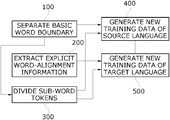
- the method includes the steps of: (1) separating basic word boundaries through morphological analysis or named entity recognition of a sentence of a bilingual corpus used for learning; (2) extracting explicit word-alignment information from the sentence of the bilingual corpus used for learning; (3) further dividing the word boundaries separated in step (1) into sub-word tokens; (4) generating new source language training data by using an output from the step (1) and an output from the step (3); and (5) generating new target language training data by using the explicit word-alignment information generated in the step (2) and the target language outputs from the steps (1) and (3).
- an NMT method using a neural network which, when training data generated by the method of generating the training data is input, is trained with the training data, and generates a connection relationship between a source sentence input to the trained neural network and a target sentence output from the trained neural network.
- an NMT apparatus using a neural network including: a training data processor configured to generate training data by using the method of generating training data; and a model generator configured to train a neural network with the training data generated by the training data processor and generate an automatic translation model used to generate a connection relationship between a target sentence and a source sentence.
- the neural network trained with the training data in the model generator may be implemented based on a recurrent neural network with long short-term memory (RNN-LSTM) architecture.
- RNN-LSTM recurrent neural network with long short-term memory
- FIG. 1 is a conceptual diagram of a neural machine translation system based on an encoder-decoder mechanism
- FIG. 2 is a flowchart illustrating a method of generating training data to which explicit word-alignment information is added according to the present invention.
- FIG. 3 is a diagram illustrating a configuration of a neural network which learns the training data generated in FIG. 2 .
- NMT neural machine translation
- the encoder compresses/abstracts contextual elements of the input source language, which means the encoder generates a series of sentence vectors that contain semantic and syntactic characteristics of the source language.
- the decoder predicts the next word on the basis of a current status and previously predicted words. It acts as a kind of language model that generates an arbitrary sentence consisting of target words. That is, the decoder is given abstractive information of the source language, which is represented as the output of the encoder, as a conditional variable, and predicts the target words based on a target language translation method trained by the decoder.
- the prediction of the decoder is repeatedly performed until an end-of-sentence reserved word, which indicates the completion of a target sentence, appears, and, from among candidate sentences generated during the process, a target sentence considered to be most natural is selectively output.
- a neural network learning step in which a collection of pairs of a sentence of source language and a sentence of target language (i.e., bilingual corpus) is received and learned; and a prediction step in which machine translation is performed on the basis of a neural network model generated in the learning step.
- source words are divided into pieces by a specific criterion, and each of the pieces is transformed into a one-dimensional vector and is represented as a two-dimensional embedding vector.
- the word tokens constituting source words and the target sentence used in the learning step are fixed. For example, when there are 1,000 unique words constituting a corpus of source language used for learning wherein each word being expressed as a one-dimensional vector represented by 500 floating points, the source words are transformed into 1,000 ⁇ 500 two-dimensional vectors. These two-dimensional vectors are embedding vectors.
- the unique word tokens when there are 500 unique word tokens constituting a corpus of target language and each word is expressed as a one-dimensional vector of the same length as that of the one-dimensional vector of the source language, the unique word tokens are also transformed into 500 ⁇ 500 two-dimensional vectors.
- the input source words and the target words are transformed into embedding vectors that match the respective unique word tokens and the embedding vectors are processed as input information.
- Approach 1 a pre-processing process in which rare words, such as proper nouns or numbers, are directly replaced by specific words of reserved language in advance is performed, such that words that are not represented in a learning step can be replaced. Then the output is learned. Thereafter, when an unknown word is input in a prediction step, the word is replaced by a word of the same reserved language and then is transmitted to an input of an encoder. Then, when the reserved language appears in a target sentence generated by a decoder, a post-processing step in which the word of the reserved language is copied from a source sentence or replaced with reference to a dictionary is performed. (Luong et al, “ Addressing the Rare Word Problem in Neural Machine Translation”, eprint arXiv: 1410.8206, 2014)
- each word is split into sub-words having shorter lengths than those of normal words used by humans, and the split sub-words are output as a target sentence and are combined to form an original word form through post-processing.
- Approach 1 has disadvantages in that a boundary of a word token to be replaced is normalized through a morphological analysis or a named entity recognition (NER) technology and a word alignment process is required to estimate a relationship between the word token in the source sentence and a word in a target sentence in an effort to figure out which word replaces the word token.
- NER named entity recognition
- Approach 2 sequences of finely split sub-word tokens are learned intact without the word alignment process used in Approach 1. Since a separate word alignment process is not necessary and detailed elementary technologies are not used, there are no problems as in Approach 1.
- Approach 2 when used in NMT, finely splits a word that does not even exist in a training corpus so that sub-words are reflected as much as possible, and thus Approach 2 may be considered as a method supportable for an open vocabulary.
- Approach 2 has a higher performance as the amount of bilingual corpus used for learning increases, and thus it has been universally used in the recent commercialized neural network machine translation system. A relatively high translation quality compared to that of Approach 1 is expected.
- Approach 2 when a bilingual corpus necessary for training has a small number of words, the degree of learning of sequences of sub-words is low, thus an inaccurate translation may frequently occur even when using Approach 2, which results in a low-quality translation result for unregistered words.
- an attention model (refer to Bandanau et al, “ Neural Machine Translation by Jointly Learning to Align and Translate ”, in Proceedings of ICLR' 15, 2015) that indirectly learns a correlation between word tokens used in a source sentence input and a target word token appearing in a generated target sentence in a neural network learning step is recently widely being used, but is still far from explicit word-alignment information or hard alignment information of individual word tokens and target word tokens.
- implicit word-alignment information or soft alignment information is used to represent such a feature. That is, there is a limitation in that attention information used for a specific target word may not be aligned one-to-one with a designated word token in a source sentence.
- an NMT system capable of correcting a mistranslated unregistered word through a configuration in which Approach 1 and Approach 2 are combined is implemented while resolving the above problems.
- operation 100 basic word boundaries are separated through morphological analysis or NER of sentences of source language and target language of a bilingual corpus used for learning. This operation may be performed for one or both of the source language and the target language.
- the word boundaries separated in operation 100 are further divided into sub-word tokens. This operation may be performed for one or both of the source language and the target language.
- new source language training data is generated using an output from processing the source language in operation 100 and an output from processing the source language in operation 300 .
- the word-alignment information extracted in operation 100 is inserted into each of the sub-word tokens divided in operation 300 as additional information and then is represented, without directly replacing the sub-word tokens constituting the input sentence of source language.
- new target language training data is generated using the explicit word-alignment information generated in operation 200 and an output obtained by processing, in operations 100 and 300 , the target language.
- the explicit word-alignment information extracted in operation 200 and source word order information which is processed and generated in operation 100 and attached to the sentence of source language, are combined with each other and the modified alignment information is inserted into each of the sub-word tokens generated in operation 300 and then is represented, without directly replacing the sub-word tokens constituting the sentence of target language.
- Operations 100 and 200 in the process flow of FIG. 2 may be performed using the above-described Approach 1, and operation 300 may be performed using Approach 2.
- word sections are determined through morphological analysis and NER for the source language and the target language, content words and functional words are separated, and boundaries of content words are determined.
- the boundaries of content words are determined as shown below.
- the explicit word-alignment information is extracted.
- We extracted the word-alignment information by using a grow-diag-final-and heuristic algorithm (Koehn '03) along with IBM Model 4 (GIZA++). The result is as shown in the following example.
- operation 300 the output of operation 100 is split into sub-words as shown below.
- a designated reserved symbol e.g., “+” is attached to the front of each of the split sub-words.
- the output of operation 300 is basically a completed form of word tokens used in a learning step.
- a final input form (training data) of the source language is completed through the output of operation 100 and the output of operation 300 .
- “ ⁇ circumflex over ( ) ⁇ ” is a separator for attaching an actual order of a word boundary, which is a kind of feature, in the source sentence to a corresponding sub-word segment. It does not need to be modified by directly attaching to a word, and training data may be separately constructed by generating a feature value sequence having the same length as an order token of the source sentence.
- the key is to configure original word boundary information extracted in operation 100 with the feature value sequence having the same length as the sub-word sequence of the source sentence.
- Letters “B,” “M,” and “E” after the numbers are examples of reserved language which, respectively, indicate “begin”, “middle”, and “end”, and other forms may be used (for example, “begin”, “intermediary”, etc.).
- operation 500 the sub-word sequence of the target language extracted in operation 300 and the explicit word-alignment information extracted in operation 200 are combined with each other.
- An example of an output of operation 500 is as shown below:
- connection information is not present in operation 200 .
- reserved language “NONE”, as shown above, is used to indicate that there is no connection information for example, e.g., a ⁇ circumflex over ( ) ⁇ NONE_B).
- connection information exists but is not consecutive, the connection information is removed from the subsequent separate element, as shown in “book ⁇ circumflex over ( ) ⁇ 11_B”, “+ed ⁇ circumflex over ( ) ⁇ 11_E”, and “room ⁇ circumflex over ( ) ⁇ NONE_B”.
- “book, +ed” is a third word and “room” is a fifth word in the target language.
- a successive order sequence of the source sentence is represented identically (N:N connection.
- a comma (,) is used as a separation symbol for an order sequence.
- a sub-word sequence of the target language does not need to be replaced. Instead, a feature value having the same length as the target sub-word sequence may be prepared.
- FIG. 3 is a neural network structure implemented based on a conventional recurrent neural network with long short-term memory (RNN-LSTM) architecture, which shows the following characteristics differently from those of the related art.
- RNN-LSTM long short-term memory
- N-dimensional embedding vectors 10 and 20 for performing a replacement of feature embedding vectors for adding a feature that matches the order of each of word sequences, along with a replacement of word embedding vectors of a source-side word sequence and a target-side word sequence used for learning.
- the sub-word tokens constituting the source-side and target-side word sequences are assigned to the word embedding vectors 10 and 20 shown in FIG. 3 and are replaced one-to-one with vectors for neural network learning, thereby becoming elements constituting S 0 to S m ⁇ 1 in layer 14 and T ⁇ 1 to T n in layer 24 .
- a vector replacement of the explicit word-alignment information attached in operations 400 and 500 is performed through feature embedding vectors 12 and 22 , so that the explicit word-alignment information is replaced with alignment information FS and explicit alignment-feature information FT that constitute the layer 14 and the layer 24 , respectively.
- Each of the vectors corresponding to the layer 14 in FIG. 3 is combined in the feature combining layer 16 according to the order (time-series) of word tokens to meet input requirements of an encoder 18 .
- the combining method may be a simple concatenation that generates a long-length vector by simply combining a sub-word (S in the layer 14 ) indicating a sub-word token and the alignment information (FS in the layer 14 ) associated with the sub-word, which are the same point in a time series, but the combination may be calculated as the sum or average of two vectors.
- the vectors in the layer 24 are combined through the feature combining layer 26 that performs the same actions as in the method of the feature combining layer 16 and then the combined output is transmitted to the decoder 28 .
- the alignment information is not inserted into a word of a target sentence given in the learning step, but a feature of a preceding word is combined to a word of the subsequent target sentence.
- the decoder 28 learns a combination of the immediately preceding word, a current word, and an immediately preceding feature, and additionally generates explicit alignment-feature vectors (FT ⁇ 1 to FT n in the layer 32 ) indicating a word immediately preceding a word sequence (T 0 to T n+1 in the layer 32 of FIG. 3 ) predicted in the learning step, unlike in the related art.
- the explicit alignment-feature vector FT ⁇ 1 constituting the layer 32 is removed and the explicit alignment-feature vectors FT 0 to FT n are returned along with the words T 0 to T n of the layer 32 .
- the present invention is similar to a general neural network structure. That is, the encoder 18 accumulates data received from the feature combining layer 16 thereunder and generates compressed information of source input data 400 for neural network learning. The output from the encoder 18 is transmitted to the decoder 28 along with the target-side input 26 , a prediction result that matches the source sentence input is sequentially, repeatedly calculated, so that a piece of compressed information for constructing the layer 32 one at a time is generated in each step.
- a softmax layer 30 receives the compressed information generated by the decoder 28 and constructs the layer 32 by transforming the information into a vector sequence replaceable with a target word token with the highest probability and alignment information of a word immediately preceding to the target word token.
- the configuration may basically utilize the above-described elements, and an additional neural network layer may be added thereto.
- An example of this additional neural network layer is an attention layer. Modifications of the configuration by adding layers in the neural network will be allowed without detracting from the technical scope of the present invention.
- the input When an input is received, the input undergoes preprocessing in which a basic word separation and division into sub-words are performed in the same manner as when training data is processed. (See operation 100 described above.)
- a word ID of “ ” is searched for in the input source sentence.
- a word ID of “ ” is number 1 and accordingly a target word connected to the number 1 word in the source sentence is searched for in the target side.
- the sub-word division results are combined and candidates to be corrected are searched for. Whether or not a word unused in the training data appears is determined by using the dictionary constructed with target words used in training data. When the word “maghreb” does not appear as a target word even once in the training data, a word connected to the ID of the pertinent word is found in the source sentence. Since the word connected to 3_B, 3_E is “maghreb,” a target word of “ ” is searched for by using prepared Korean-English dictionary data.
- maghreb is an incorrect representation of Maglev, but is a similar representation, that is, a Romanized representation.
- the translation result is corrected as shown above.
- the present invention provides an automatic translation technology robust to unregistered words, and the following effects can be obtained.
- Explicit word-alignment information assigned at the time of learning can allow for further transmitting feedback necessary for training an attention model (attention model: a model that indirectly learns the relationship between word tokens used as source sentence input in a neural network learning step and target word tokens appearing at the time of generating of a target-side output).
- attention model a model that indirectly learns the relationship between word tokens used as source sentence input in a neural network learning step and target word tokens appearing at the time of generating of a target-side output.
- predicted word-alignment information can allow for estimating an aligned position of a target word and replacing the target word with another target word.
Landscapes
- Engineering & Computer Science (AREA)
- Theoretical Computer Science (AREA)
- Physics & Mathematics (AREA)
- Health & Medical Sciences (AREA)
- Artificial Intelligence (AREA)
- Computational Linguistics (AREA)
- General Health & Medical Sciences (AREA)
- General Engineering & Computer Science (AREA)
- General Physics & Mathematics (AREA)
- Evolutionary Computation (AREA)
- Audiology, Speech & Language Pathology (AREA)
- Biophysics (AREA)
- Biomedical Technology (AREA)
- Data Mining & Analysis (AREA)
- Life Sciences & Earth Sciences (AREA)
- Molecular Biology (AREA)
- Computing Systems (AREA)
- Mathematical Physics (AREA)
- Software Systems (AREA)
- Signal Processing (AREA)
- Human Computer Interaction (AREA)
- Acoustics & Sound (AREA)
- Multimedia (AREA)
- Machine Translation (AREA)
Abstract
Description


| English Word | Korean Word | Phonetic Representation | ||
| And |  | [gu-ri-go] | ||
| we |  | [u-ri-nun] | ||
| booked |  | [ye-yak-hæt-da] | ||
| a | — | |||
| room | — | |||
| at | — | |||
| IPUNY |  | [ib-pu-ni] | ||
| Guest |  | [gest] | ||
| House |  | [haus-rul] | ||
| in |  | [e-in-nun] | ||
| Midong |  | [mi-dong] | ||
| village |  | [ma-ul] | ||
For reference, in the above table there may be no Korean word that is exactly phraseologically or grammatically equivalent to the English word. Unlike English, Korean language does not have articles; and it has a word class (postpositions or suffixes in Korean) similar to prepositions in English, which is not independent and must be attached to specific words. It is thus noted that separation of Korean words and separation of English words cannot be accurately represented in the above table.


Claims (2)
Applications Claiming Priority (2)
| Application Number | Priority Date | Filing Date | Title |
|---|---|---|---|
| KR1020170140232A KR102069692B1 (en) | 2017-10-26 | 2017-10-26 | Neural machine translation method and apparatus |
| KR10-2017-0140232 | 2017-10-26 |
Publications (2)
| Publication Number | Publication Date |
|---|---|
| US20190129947A1 US20190129947A1 (en) | 2019-05-02 |
| US10635753B2 true US10635753B2 (en) | 2020-04-28 |
Family
ID=66243934
Family Applications (1)
| Application Number | Title | Priority Date | Filing Date |
|---|---|---|---|
| US15/944,939 Expired - Fee Related US10635753B2 (en) | 2017-10-26 | 2018-04-04 | Neural machine translation method and apparatus |
Country Status (2)
| Country | Link |
|---|---|
| US (1) | US10635753B2 (en) |
| KR (1) | KR102069692B1 (en) |
Cited By (4)
| Publication number | Priority date | Publication date | Assignee | Title |
|---|---|---|---|---|
| US20200334410A1 (en) * | 2019-04-18 | 2020-10-22 | Siemens Healthcare Gmbh | Encoding textual information for text analysis |
| US20230177282A1 (en) * | 2021-12-02 | 2023-06-08 | Yandex Europe Ag | Method and server for performing domain-specific translation |
| US20240193350A1 (en) * | 2022-12-09 | 2024-06-13 | Microsoft Technology Licensing, Llc | Length-controlled text generation using a text processing model |
| US12056451B2 (en) | 2021-03-26 | 2024-08-06 | Electronics And Telecommunications Research Institute | Method and apparatus for recognizing SPO tuple relationship based on deep learning and score and probability associated with a SPO relationship class |
Families Citing this family (53)
| Publication number | Priority date | Publication date | Assignee | Title |
|---|---|---|---|---|
| US10706351B2 (en) * | 2016-08-30 | 2020-07-07 | American Software Safety Reliability Company | Recurrent encoder and decoder |
| US11354521B2 (en) * | 2018-03-07 | 2022-06-07 | Google Llc | Facilitating communications with automated assistants in multiple languages |
| US10984784B2 (en) | 2018-03-07 | 2021-04-20 | Google Llc | Facilitating end-to-end communications with automated assistants in multiple languages |
| JP7247460B2 (en) * | 2018-03-13 | 2023-03-29 | 富士通株式会社 | Correspondence Generating Program, Correspondence Generating Device, Correspondence Generating Method, and Translation Program |
| CN110489761B (en) * | 2018-05-15 | 2021-02-02 | 科大讯飞股份有限公司 | A method and device for text-level translation |
| US10721190B2 (en) * | 2018-07-31 | 2020-07-21 | Microsoft Technology Licensing, Llc | Sequence to sequence to classification model for generating recommended messages |
| CN112352275B (en) * | 2018-12-13 | 2024-11-22 | 微软技术许可有限责任公司 | Neural text-to-speech synthesis with multi-level text information |
| CN111476039B (en) * | 2019-01-04 | 2023-06-30 | 深圳永德利科技股份有限公司 | Instant language translation method for intelligent vehicle system and related products |
| US11106873B2 (en) * | 2019-01-22 | 2021-08-31 | Sap Se | Context-based translation retrieval via multilingual space |
| US10956474B2 (en) | 2019-03-14 | 2021-03-23 | Microsoft Technology Licensing, Llc | Determination of best set of suggested responses |
| KR102258906B1 (en) * | 2019-05-17 | 2021-06-01 | 한국과학기술원 | Method and apparatus for spoken language to sign language translation using attention-based artificial neural machine translation approach |
| JP7205839B2 (en) * | 2019-05-24 | 2023-01-17 | 日本電信電話株式会社 | Data generation model learning device, latent variable generation model learning device, translation data generation device, data generation model learning method, latent variable generation model learning method, translation data generation method, program |
| KR102354898B1 (en) | 2019-05-29 | 2022-01-24 | 경희대학교 산학협력단 | Vocabulary list generation method and device for Korean based neural network language model |
| CN111859977B (en) * | 2019-06-06 | 2024-06-07 | 北京嘀嘀无限科技发展有限公司 | Semantic analysis method and device, electronic equipment and storage medium |
| CN110442677A (en) * | 2019-07-04 | 2019-11-12 | 平安科技(深圳)有限公司 | Text matches degree detection method, device, computer equipment and readable storage medium storing program for executing |
| WO2021005790A1 (en) * | 2019-07-11 | 2021-01-14 | 日本電信電話株式会社 | Machine translation device, machine translation method, machine translation program, and non-temporary storage medium |
| US11263394B2 (en) * | 2019-08-02 | 2022-03-01 | Adobe Inc. | Low-resource sentence compression system |
| US11797842B2 (en) | 2019-08-02 | 2023-10-24 | International Business Machines Corporation | Identifying friction points in customer data |
| US11727266B2 (en) * | 2019-08-02 | 2023-08-15 | International Business Machines Corporation | Annotating customer data |
| US11461616B2 (en) * | 2019-08-05 | 2022-10-04 | Siemens Aktiengesellschaft | Method and system for analyzing documents |
| CN110688861B (en) * | 2019-09-26 | 2022-12-27 | 沈阳航空航天大学 | Multi-feature fusion sentence-level translation quality estimation method |
| CN110781689B (en) | 2019-10-25 | 2021-08-06 | 北京小米智能科技有限公司 | Information processing method, device and storage medium |
| KR20210067294A (en) * | 2019-11-29 | 2021-06-08 | 한국전자통신연구원 | Apparatus and method for automatic translation |
| CN111178094B (en) * | 2019-12-20 | 2023-04-07 | 沈阳雅译网络技术有限公司 | Pre-training-based scarce resource neural machine translation training method |
| US11436267B2 (en) * | 2020-01-08 | 2022-09-06 | International Business Machines Corporation | Contextually sensitive document summarization based on long short-term memory networks |
| CN111507100B (en) * | 2020-01-14 | 2023-05-05 | 上海勃池信息技术有限公司 | Convolutional self-encoder and word embedded vector compression method based on same |
| CN111274829B (en) * | 2020-02-07 | 2023-06-16 | 中国科学技术大学 | A Sequence Labeling Method Using Cross-lingual Information |
| CN111539199B (en) * | 2020-04-17 | 2023-08-18 | 中移(杭州)信息技术有限公司 | Text error correction method, device, terminal, and storage medium |
| US11868737B2 (en) | 2020-04-24 | 2024-01-09 | Direct Cursus Technology L.L.C | Method and server for processing text sequence for machine processing task |
| US11693637B1 (en) * | 2020-05-15 | 2023-07-04 | Google Llc | Using natural language latent representation in automated conversion of source code from base programming language to target programming language |
| DE102020114046A1 (en) | 2020-05-26 | 2021-12-02 | Thomas Eißfeller | Neural machine translation method, neural machine translation system, learning method, learning system and program |
| CN111832321B (en) * | 2020-05-29 | 2024-01-23 | 北京嘀嘀无限科技发展有限公司 | Corpus processing method and device, readable storage medium and electronic equipment |
| US11586833B2 (en) * | 2020-06-12 | 2023-02-21 | Huawei Technologies Co., Ltd. | System and method for bi-directional translation using sum-product networks |
| CN111860001A (en) * | 2020-07-31 | 2020-10-30 | 北京小米松果电子有限公司 | Machine translation method and device, electronic equipment and storage medium |
| US12393779B2 (en) * | 2020-08-31 | 2025-08-19 | Recruit Co., Ltd. | Systems and methods for multilingual sentence embeddings |
| CN112380882B (en) * | 2020-12-01 | 2022-01-18 | 内蒙古工业大学 | Mongolian Chinese neural machine translation method with error correction function |
| CN112446224B (en) * | 2020-12-07 | 2024-12-10 | 北京彩云环太平洋科技有限公司 | Parallel corpus processing method, device, equipment and computer readable storage medium |
| US12141542B2 (en) * | 2020-12-22 | 2024-11-12 | Y.E. Hub Armenia LLC | Methods and systems for creating a training dataset for training a Machine Learning Algorithm (MLA) for a machine-translation task |
| CN112580373B (en) * | 2020-12-26 | 2023-06-27 | 内蒙古工业大学 | High-quality Mongolian non-supervision neural machine translation method |
| KR102705070B1 (en) * | 2021-04-08 | 2024-09-11 | 한국전력공사 | Apparatus for optimizing open source korean language understanding pipeline based on artificial neural networks |
| CN113204978B (en) * | 2021-05-13 | 2024-04-02 | 中国科学技术大学 | Machine translation enhancement training method and system |
| CN113468895B (en) * | 2021-05-28 | 2023-08-15 | 沈阳雅译网络技术有限公司 | Non-autoregressive neural machine translation method based on decoder input enhancement |
| CN113705168B (en) * | 2021-08-31 | 2023-04-07 | 苏州大学 | Chapter neural machine translation method and system based on cross-level attention mechanism |
| US11900073B2 (en) * | 2021-09-07 | 2024-02-13 | Lilt, Inc. | Partial execution of translation in browser |
| CN115017921B (en) * | 2022-03-10 | 2023-08-01 | 延边大学 | Korean-Chinese Neural Machine Translation Method Based on Multi-Granularity Representation |
| US12333264B1 (en) * | 2022-03-21 | 2025-06-17 | Amazon Technologies, Inc. | Fuzzy-match augmented machine translation |
| WO2023211446A1 (en) * | 2022-04-28 | 2023-11-02 | Google Llc | Modeling ambiguity in neural machine translation |
| CN115099246B (en) * | 2022-06-09 | 2025-06-13 | 北京捷通华声科技股份有限公司 | Knowledge fusion method, device, equipment, medium and product based on machine translation |
| CN116092191B (en) * | 2023-01-16 | 2025-12-23 | 厦门大学 | Novel word level comparison learning frame for sign language translation and sign language translation system |
| CN116306899A (en) * | 2023-03-22 | 2023-06-23 | 沈阳雅译网络技术有限公司 | Reinforced learning training method applied to machine translation |
| KR20250096055A (en) * | 2023-12-20 | 2025-06-27 | 엘에스일렉트릭(주) | Generative artificial intelligence-based multilingual manual synchronization device, synchronization system including the same and synchronization method thereof |
| CN119670700B (en) * | 2024-12-12 | 2025-11-07 | 中国医学科学院医学信息研究所 | Method and related device for generating full name information |
| KR102861374B1 (en) * | 2024-12-18 | 2025-09-18 | 텔레픽스 주식회사 | Method and system for retraining a machine translation model to capture confused proper names |
Citations (5)
| Publication number | Priority date | Publication date | Assignee | Title |
|---|---|---|---|---|
| KR20080052282A (en) | 2006-12-05 | 2008-06-11 | 한국전자통신연구원 | Apparatus and method for autonomously learning translation relationship between words and phrases in statistical machine translation system |
| KR20120018687A (en) | 2010-08-23 | 2012-03-05 | 에스케이플래닛 주식회사 | Apparatus and method for decoding using joint tokenization and translation |
| US20120150529A1 (en) | 2010-12-09 | 2012-06-14 | Electronics And Telecommunication Research Institute | Method and apparatus for generating translation knowledge server |
| US20130204606A1 (en) * | 2010-08-09 | 2013-08-08 | Institute Of Automation, Chinese Academy Of Sciences | Method for labeling semantic role of bilingual parallel sentence pair |
| US20170139905A1 (en) | 2015-11-17 | 2017-05-18 | Samsung Electronics Co., Ltd. | Apparatus and method for generating translation model, apparatus and method for automatic translation |
-
2017
- 2017-10-26 KR KR1020170140232A patent/KR102069692B1/en active Active
-
2018
- 2018-04-04 US US15/944,939 patent/US10635753B2/en not_active Expired - Fee Related
Patent Citations (7)
| Publication number | Priority date | Publication date | Assignee | Title |
|---|---|---|---|---|
| KR20080052282A (en) | 2006-12-05 | 2008-06-11 | 한국전자통신연구원 | Apparatus and method for autonomously learning translation relationship between words and phrases in statistical machine translation system |
| US20130204606A1 (en) * | 2010-08-09 | 2013-08-08 | Institute Of Automation, Chinese Academy Of Sciences | Method for labeling semantic role of bilingual parallel sentence pair |
| KR20120018687A (en) | 2010-08-23 | 2012-03-05 | 에스케이플래닛 주식회사 | Apparatus and method for decoding using joint tokenization and translation |
| US20130132064A1 (en) | 2010-08-23 | 2013-05-23 | Sk Planet Co., Ltd. | Apparatus and method for decoding using joint tokenization and translation |
| US20120150529A1 (en) | 2010-12-09 | 2012-06-14 | Electronics And Telecommunication Research Institute | Method and apparatus for generating translation knowledge server |
| US20170139905A1 (en) | 2015-11-17 | 2017-05-18 | Samsung Electronics Co., Ltd. | Apparatus and method for generating translation model, apparatus and method for automatic translation |
| KR20170057792A (en) | 2015-11-17 | 2017-05-25 | 삼성전자주식회사 | Apparatus and method for generating translation model, apparatus and method for automatic translation |
Non-Patent Citations (3)
| Title |
|---|
| Dzmitry Bahdanau et al.; "Neural Machine Translation by Jointly Learning to Align and Translate"; ICLR 2015; arXiv:1409.0473v7 [cs.CL] May 19, 2016. |
| Minh-Thang Luong et al.; "Addressing the Rare Word Problem in Neural Machine Translation"; arXiv: 1410.8206v4 [cs.CL] May 30, 2015. |
| Rico Sennrich et al.; "Neural Machine Translation of Rare Words with Subword Units"; ACL 2016; arXiv: 1508.07909v5 [cs.CL] Jun. 10, 2016. |
Cited By (7)
| Publication number | Priority date | Publication date | Assignee | Title |
|---|---|---|---|---|
| US20200334410A1 (en) * | 2019-04-18 | 2020-10-22 | Siemens Healthcare Gmbh | Encoding textual information for text analysis |
| US11645447B2 (en) * | 2019-04-18 | 2023-05-09 | Siemens Healthcare Gmbh | Encoding textual information for text analysis |
| US12056451B2 (en) | 2021-03-26 | 2024-08-06 | Electronics And Telecommunications Research Institute | Method and apparatus for recognizing SPO tuple relationship based on deep learning and score and probability associated with a SPO relationship class |
| US20230177282A1 (en) * | 2021-12-02 | 2023-06-08 | Yandex Europe Ag | Method and server for performing domain-specific translation |
| US12361230B2 (en) * | 2021-12-02 | 2025-07-15 | Y.E. Hub Armenia LLC | Method and server for performing domain-specific translation |
| US20240193350A1 (en) * | 2022-12-09 | 2024-06-13 | Microsoft Technology Licensing, Llc | Length-controlled text generation using a text processing model |
| US12462094B2 (en) * | 2022-12-09 | 2025-11-04 | Microsoft Technology Licensing, Llc. | Length-controlled text generation using a text processing model |
Also Published As
| Publication number | Publication date |
|---|---|
| KR102069692B1 (en) | 2020-01-23 |
| US20190129947A1 (en) | 2019-05-02 |
| KR20190046432A (en) | 2019-05-07 |
Similar Documents
| Publication | Publication Date | Title |
|---|---|---|
| US10635753B2 (en) | Neural machine translation method and apparatus | |
| Malmi et al. | Encode, tag, realize: High-precision text editing | |
| Liu et al. | MulDA: A multilingual data augmentation framework for low-resource cross-lingual NER | |
| Zhu et al. | CAN-NER: convolutional attention network for Chinese named entity recognition | |
| Calixto et al. | Doubly-attentive decoder for multi-modal neural machine translation | |
| Zhang et al. | Chinese segmentation with a word-based perceptron algorithm | |
| Zhang et al. | Stack-propagation: Improved representation learning for syntax | |
| Sennrich et al. | Neural machine translation of rare words with subword units | |
| US8886514B2 (en) | Means and a method for training a statistical machine translation system utilizing a posterior probability in an N-best translation list | |
| US20140163951A1 (en) | Hybrid adaptation of named entity recognition | |
| WO2006138386A2 (en) | Collocation translation from monolingual and available bilingual corpora | |
| Meetei et al. | WAT2019: English-Hindi translation on Hindi visual genome dataset | |
| Hasan et al. | Neural clinical paraphrase generation with attention | |
| KR20160133349A (en) | Method for generating a phase table and method for machine translation using the phase table | |
| Delbrouck et al. | Modulating and attending the source image during encoding improves multimodal translation | |
| González-Gallardo et al. | Sentence boundary detection for french with subword-level information vectors and convolutional neural networks | |
| KR20190065665A (en) | Apparatus and method for recognizing Korean named entity using deep-learning | |
| Yuan | Grammatical error correction in non-native English | |
| Paul et al. | Multimodal Machine Translation Approaches for Indian Languages: A Comprehensive Survey. | |
| Stoeckel et al. | Voting for POS tagging of Latin texts: Using the flair of FLAIR to better ensemble classifiers by example of Latin | |
| Wiemerslage et al. | Findings of the SIGMORPHON 2021 shared task on unsupervised morphological paradigm clustering | |
| El Khbir et al. | ArabIE: Joint entity, relation and event extraction for Arabic | |
| Ravi | Scalable decipherment for machine translation via hash sampling | |
| Tillmann | A beam-search extraction algorithm for comparable data | |
| García-Martínez et al. | Addressing data sparsity for neural machine translation between morphologically rich languages |
Legal Events
| Date | Code | Title | Description |
|---|---|---|---|
| AS | Assignment |
Owner name: ELECTRONICS AND TELECOMMUNICATIONS RESEARCH INSTIT Free format text: ASSIGNMENT OF ASSIGNORS INTEREST;ASSIGNOR:SHIN, JONG HUN;REEL/FRAME:045432/0834 Effective date: 20180403 Owner name: ELECTRONICS AND TELECOMMUNICATIONS RESEARCH INSTITUTE, KOREA, REPUBLIC OF Free format text: ASSIGNMENT OF ASSIGNORS INTEREST;ASSIGNOR:SHIN, JONG HUN;REEL/FRAME:045432/0834 Effective date: 20180403 |
|
| FEPP | Fee payment procedure |
Free format text: ENTITY STATUS SET TO UNDISCOUNTED (ORIGINAL EVENT CODE: BIG.); ENTITY STATUS OF PATENT OWNER: SMALL ENTITY |
|
| FEPP | Fee payment procedure |
Free format text: ENTITY STATUS SET TO SMALL (ORIGINAL EVENT CODE: SMAL); ENTITY STATUS OF PATENT OWNER: SMALL ENTITY |
|
| STPP | Information on status: patent application and granting procedure in general |
Free format text: DOCKETED NEW CASE - READY FOR EXAMINATION |
|
| STPP | Information on status: patent application and granting procedure in general |
Free format text: NON FINAL ACTION MAILED |
|
| STPP | Information on status: patent application and granting procedure in general |
Free format text: RESPONSE TO NON-FINAL OFFICE ACTION ENTERED AND FORWARDED TO EXAMINER |
|
| STPP | Information on status: patent application and granting procedure in general |
Free format text: NOTICE OF ALLOWANCE MAILED -- APPLICATION RECEIVED IN OFFICE OF PUBLICATIONS |
|
| STCF | Information on status: patent grant |
Free format text: PATENTED CASE |
|
| FEPP | Fee payment procedure |
Free format text: MAINTENANCE FEE REMINDER MAILED (ORIGINAL EVENT CODE: REM.); ENTITY STATUS OF PATENT OWNER: SMALL ENTITY |
|
| LAPS | Lapse for failure to pay maintenance fees |
Free format text: PATENT EXPIRED FOR FAILURE TO PAY MAINTENANCE FEES (ORIGINAL EVENT CODE: EXP.); ENTITY STATUS OF PATENT OWNER: SMALL ENTITY |
|
| STCH | Information on status: patent discontinuation |
Free format text: PATENT EXPIRED DUE TO NONPAYMENT OF MAINTENANCE FEES UNDER 37 CFR 1.362 |
|
| FP | Lapsed due to failure to pay maintenance fee |
Effective date: 20240428 |