US10633403B2 - N-heterocyclic phosphines - Google Patents
N-heterocyclic phosphines Download PDFInfo
- Publication number
- US10633403B2 US10633403B2 US15/505,052 US201515505052A US10633403B2 US 10633403 B2 US10633403 B2 US 10633403B2 US 201515505052 A US201515505052 A US 201515505052A US 10633403 B2 US10633403 B2 US 10633403B2
- Authority
- US
- United States
- Prior art keywords
- alkyl
- aryl
- independently selected
- further aspect
- cycloalkyl
- Prior art date
- Legal status (The legal status is an assumption and is not a legal conclusion. Google has not performed a legal analysis and makes no representation as to the accuracy of the status listed.)
- Active, expires
Links
- 125000000041 C6-C10 aryl group Chemical group 0.000 claims description 627
- 150000001875 compounds Chemical class 0.000 claims description 429
- 229910052739 hydrogen Inorganic materials 0.000 claims description 346
- 125000001072 heteroaryl group Chemical group 0.000 claims description 325
- 125000004169 (C1-C6) alkyl group Chemical group 0.000 claims description 300
- 125000000592 heterocycloalkyl group Chemical group 0.000 claims description 298
- 125000006273 (C1-C3) alkyl group Chemical group 0.000 claims description 269
- 239000001257 hydrogen Substances 0.000 claims description 249
- 125000000753 cycloalkyl group Chemical group 0.000 claims description 207
- 125000004435 hydrogen atom Chemical group [H]* 0.000 claims description 169
- 125000000882 C2-C6 alkenyl group Chemical group 0.000 claims description 147
- 125000003601 C2-C6 alkynyl group Chemical group 0.000 claims description 147
- 125000000171 (C1-C6) haloalkyl group Chemical group 0.000 claims description 143
- 229910052760 oxygen Inorganic materials 0.000 claims description 129
- 229910052717 sulfur Inorganic materials 0.000 claims description 127
- 125000004432 carbon atom Chemical group C* 0.000 claims description 113
- 125000006274 (C1-C3)alkoxy group Chemical group 0.000 claims description 80
- 125000003118 aryl group Chemical group 0.000 claims description 80
- -1 bromo, methyl Chemical group 0.000 claims description 80
- UFHFLCQGNIYNRP-UHFFFAOYSA-N Hydrogen Chemical compound [H][H] UFHFLCQGNIYNRP-UHFFFAOYSA-N 0.000 claims description 76
- 125000001997 phenyl group Chemical group [H]C1=C([H])C([H])=C(*)C([H])=C1[H] 0.000 claims description 57
- 125000000449 nitro group Chemical group [O-][N+](*)=O 0.000 claims description 51
- 125000004209 (C1-C8) alkyl group Chemical group 0.000 claims description 46
- 229910052736 halogen Inorganic materials 0.000 claims description 46
- 125000001188 haloalkyl group Chemical group 0.000 claims description 45
- 125000006656 (C2-C4) alkenyl group Chemical group 0.000 claims description 39
- 125000006650 (C2-C4) alkynyl group Chemical group 0.000 claims description 39
- 125000006559 (C1-C3) alkylamino group Chemical group 0.000 claims description 37
- 125000006698 (C1-C3) dialkylamino group Chemical group 0.000 claims description 37
- 150000002367 halogens Chemical class 0.000 claims description 35
- 125000004178 (C1-C4) alkyl group Chemical group 0.000 claims description 33
- 125000001449 isopropyl group Chemical group [H]C([H])([H])C([H])(*)C([H])([H])[H] 0.000 claims description 31
- 125000000956 methoxy group Chemical group [H]C([H])([H])O* 0.000 claims description 24
- 125000004001 thioalkyl group Chemical group 0.000 claims description 23
- 125000006699 (C1-C3) hydroxyalkyl group Chemical group 0.000 claims description 22
- 125000006677 (C1-C3) haloalkoxy group Chemical group 0.000 claims description 18
- 125000004966 cyanoalkyl group Chemical group 0.000 claims description 18
- 150000002431 hydrogen Chemical class 0.000 claims 6
- 238000000034 method Methods 0.000 abstract description 79
- ZTWTYVWXUKTLCP-UHFFFAOYSA-N vinylphosphonic acid Chemical class OP(O)(=O)C=C ZTWTYVWXUKTLCP-UHFFFAOYSA-N 0.000 abstract description 55
- 238000006664 bond formation reaction Methods 0.000 abstract description 2
- HEDRZPFGACZZDS-MICDWDOJSA-N Trichloro(2H)methane Chemical compound [2H]C(Cl)(Cl)Cl HEDRZPFGACZZDS-MICDWDOJSA-N 0.000 description 310
- YMWUJEATGCHHMB-UHFFFAOYSA-N Dichloromethane Chemical compound ClCCl YMWUJEATGCHHMB-UHFFFAOYSA-N 0.000 description 186
- 125000002947 alkylene group Chemical group 0.000 description 176
- 238000006243 chemical reaction Methods 0.000 description 171
- 125000006376 (C3-C10) cycloalkyl group Chemical group 0.000 description 152
- ZMANZCXQSJIPKH-UHFFFAOYSA-N Triethylamine Chemical compound CCN(CC)CC ZMANZCXQSJIPKH-UHFFFAOYSA-N 0.000 description 129
- 125000002496 methyl group Chemical group [H]C([H])([H])* 0.000 description 109
- 150000003839 salts Chemical class 0.000 description 103
- 125000001495 ethyl group Chemical group [H]C([H])([H])C([H])([H])* 0.000 description 87
- 239000002585 base Substances 0.000 description 74
- 239000007787 solid Substances 0.000 description 67
- 239000000543 intermediate Substances 0.000 description 59
- 125000000217 alkyl group Chemical group 0.000 description 58
- 229910052799 carbon Inorganic materials 0.000 description 55
- 238000005160 1H NMR spectroscopy Methods 0.000 description 54
- 238000001644 13C nuclear magnetic resonance spectroscopy Methods 0.000 description 53
- 238000004679 31P NMR spectroscopy Methods 0.000 description 50
- 150000001361 allenes Chemical class 0.000 description 48
- XYFCBTPGUUZFHI-UHFFFAOYSA-N Phosphine Chemical compound P XYFCBTPGUUZFHI-UHFFFAOYSA-N 0.000 description 44
- 125000005843 halogen group Chemical group 0.000 description 38
- 239000002904 solvent Substances 0.000 description 34
- 125000004093 cyano group Chemical group *C#N 0.000 description 31
- 125000006598 aminocarbonylamino group Chemical group 0.000 description 30
- 125000004397 aminosulfonyl group Chemical group NS(=O)(=O)* 0.000 description 30
- 125000006575 electron-withdrawing group Chemical group 0.000 description 30
- 230000008569 process Effects 0.000 description 30
- 125000006583 (C1-C3) haloalkyl group Chemical group 0.000 description 29
- 125000004453 alkoxycarbonyl group Chemical group 0.000 description 29
- 125000004123 n-propyl group Chemical group [H]C([H])([H])C([H])([H])C([H])([H])* 0.000 description 29
- 125000001424 substituent group Chemical group 0.000 description 29
- 125000006601 (C1-C3) alkylcarbamyl group Chemical group 0.000 description 28
- 238000003786 synthesis reaction Methods 0.000 description 28
- 229910000073 phosphorus hydride Inorganic materials 0.000 description 25
- SJRJJKPEHAURKC-UHFFFAOYSA-N N-Methylmorpholine Chemical compound CN1CCOCC1 SJRJJKPEHAURKC-UHFFFAOYSA-N 0.000 description 24
- 230000015572 biosynthetic process Effects 0.000 description 24
- 239000000203 mixture Substances 0.000 description 24
- 239000000376 reactant Substances 0.000 description 24
- 238000013459 approach Methods 0.000 description 23
- GETQZCLCWQTVFV-UHFFFAOYSA-N trimethylamine Chemical compound CN(C)C GETQZCLCWQTVFV-UHFFFAOYSA-N 0.000 description 22
- XEKOWRVHYACXOJ-UHFFFAOYSA-N Ethyl acetate Chemical compound CCOC(C)=O XEKOWRVHYACXOJ-UHFFFAOYSA-N 0.000 description 19
- JGFZNNIVVJXRND-UHFFFAOYSA-N N,N-Diisopropylethylamine (DIPEA) Chemical compound CCN(C(C)C)C(C)C JGFZNNIVVJXRND-UHFFFAOYSA-N 0.000 description 19
- 125000000113 cyclohexyl group Chemical group [H]C1([H])C([H])([H])C([H])([H])C([H])(*)C([H])([H])C1([H])[H] 0.000 description 19
- VLKZOEOYAKHREP-UHFFFAOYSA-N n-Hexane Chemical class CCCCCC VLKZOEOYAKHREP-UHFFFAOYSA-N 0.000 description 19
- 125000002023 trifluoromethyl group Chemical group FC(F)(F)* 0.000 description 19
- YNAVUWVOSKDBBP-UHFFFAOYSA-N Morpholine Chemical compound C1COCCN1 YNAVUWVOSKDBBP-UHFFFAOYSA-N 0.000 description 18
- RWRDLPDLKQPQOW-UHFFFAOYSA-N Pyrrolidine Chemical compound C1CCNC1 RWRDLPDLKQPQOW-UHFFFAOYSA-N 0.000 description 18
- ZTWTYVWXUKTLCP-UHFFFAOYSA-L ethenyl-dioxido-oxo-$l^{5}-phosphane Chemical compound [O-]P([O-])(=O)C=C ZTWTYVWXUKTLCP-UHFFFAOYSA-L 0.000 description 18
- LFQSCWFLJHTTHZ-UHFFFAOYSA-N Ethanol Chemical compound CCO LFQSCWFLJHTTHZ-UHFFFAOYSA-N 0.000 description 17
- WYURNTSHIVDZCO-UHFFFAOYSA-N Tetrahydrofuran Chemical compound C1CCOC1 WYURNTSHIVDZCO-UHFFFAOYSA-N 0.000 description 17
- 125000001797 benzyl group Chemical group [H]C1=C([H])C([H])=C(C([H])=C1[H])C([H])([H])* 0.000 description 17
- 125000004438 haloalkoxy group Chemical group 0.000 description 17
- 229910052757 nitrogen Inorganic materials 0.000 description 17
- 125000003917 carbamoyl group Chemical group [H]N([H])C(*)=O 0.000 description 16
- 125000002924 primary amino group Chemical group [H]N([H])* 0.000 description 16
- 125000006552 (C3-C8) cycloalkyl group Chemical group 0.000 description 15
- KWYUFKZDYYNOTN-UHFFFAOYSA-M Potassium hydroxide Chemical compound [OH-].[K+] KWYUFKZDYYNOTN-UHFFFAOYSA-M 0.000 description 15
- HEMHJVSKTPXQMS-UHFFFAOYSA-M Sodium hydroxide Chemical compound [OH-].[Na+] HEMHJVSKTPXQMS-UHFFFAOYSA-M 0.000 description 15
- YXFVVABEGXRONW-UHFFFAOYSA-N Toluene Chemical compound CC1=CC=CC=C1 YXFVVABEGXRONW-UHFFFAOYSA-N 0.000 description 15
- 125000004448 alkyl carbonyl group Chemical group 0.000 description 15
- 150000001412 amines Chemical class 0.000 description 15
- 125000003178 carboxy group Chemical group [H]OC(*)=O 0.000 description 15
- 125000001309 chloro group Chemical group Cl* 0.000 description 15
- 125000000446 sulfanediyl group Chemical group *S* 0.000 description 15
- 125000006599 (C1-C3) alkylaminocarbonylamino group Chemical group 0.000 description 14
- 125000006603 (C1-C3) alkylaminosulfonyl group Chemical group 0.000 description 14
- 125000006597 (C1-C3) alkylcarbonylamino group Chemical group 0.000 description 14
- 125000006595 (C1-C3) alkylsulfinyl group Chemical group 0.000 description 14
- 125000006594 (C1-C3) alkylsulfony group Chemical group 0.000 description 14
- 125000006602 (C1-C3) alkylsulfonylamino group Chemical group 0.000 description 14
- 125000004455 (C1-C3) alkylthio group Chemical group 0.000 description 14
- 125000006272 (C3-C7) cycloalkyl group Chemical group 0.000 description 14
- WEVYAHXRMPXWCK-UHFFFAOYSA-N Acetonitrile Chemical compound CC#N WEVYAHXRMPXWCK-UHFFFAOYSA-N 0.000 description 14
- 125000004429 atom Chemical group 0.000 description 14
- WVORDZYRRVPIKZ-UHFFFAOYSA-N 2-chloro-1,3-diphenyl-1,3,2-diazaphospholidine Chemical compound ClP1N(C=2C=CC=CC=2)CCN1C1=CC=CC=C1 WVORDZYRRVPIKZ-UHFFFAOYSA-N 0.000 description 13
- 239000002253 acid Substances 0.000 description 13
- OISVCGZHLKNMSJ-UHFFFAOYSA-N 2,6-dimethylpyridine Chemical compound CC1=CC=CC(C)=N1 OISVCGZHLKNMSJ-UHFFFAOYSA-N 0.000 description 12
- OKKJLVBELUTLKV-UHFFFAOYSA-N Methanol Chemical compound OC OKKJLVBELUTLKV-UHFFFAOYSA-N 0.000 description 12
- VYPSYNLAJGMNEJ-UHFFFAOYSA-N Silicium dioxide Chemical compound O=[Si]=O VYPSYNLAJGMNEJ-UHFFFAOYSA-N 0.000 description 12
- 239000000243 solution Substances 0.000 description 12
- RTZKZFJDLAIYFH-UHFFFAOYSA-N Diethyl ether Chemical compound CCOCC RTZKZFJDLAIYFH-UHFFFAOYSA-N 0.000 description 11
- CYQYCASVINMDFD-UHFFFAOYSA-N n,n-ditert-butyl-2-methylpropan-2-amine Chemical compound CC(C)(C)N(C(C)(C)C)C(C)(C)C CYQYCASVINMDFD-UHFFFAOYSA-N 0.000 description 11
- RKBCYCFRFCNLTO-UHFFFAOYSA-N triisopropylamine Chemical compound CC(C)N(C(C)C)C(C)C RKBCYCFRFCNLTO-UHFFFAOYSA-N 0.000 description 11
- YFTHZRPMJXBUME-UHFFFAOYSA-N tripropylamine Chemical compound CCCN(CCC)CCC YFTHZRPMJXBUME-UHFFFAOYSA-N 0.000 description 11
- CDBYLPFSWZWCQE-UHFFFAOYSA-L Sodium Carbonate Chemical compound [Na+].[Na+].[O-]C([O-])=O CDBYLPFSWZWCQE-UHFFFAOYSA-L 0.000 description 10
- 239000000047 product Substances 0.000 description 10
- 229940126639 Compound 33 Drugs 0.000 description 9
- WMFOQBRAJBCJND-UHFFFAOYSA-M Lithium hydroxide Chemical compound [Li+].[OH-] WMFOQBRAJBCJND-UHFFFAOYSA-M 0.000 description 9
- JUJWROOIHBZHMG-UHFFFAOYSA-N Pyridine Chemical group C1=CC=NC=C1 JUJWROOIHBZHMG-UHFFFAOYSA-N 0.000 description 9
- PNUZDKCDAWUEGK-CYZMBNFOSA-N Sitafloxacin Chemical compound C([C@H]1N)N(C=2C(=C3C(C(C(C(O)=O)=CN3[C@H]3[C@H](C3)F)=O)=CC=2F)Cl)CC11CC1 PNUZDKCDAWUEGK-CYZMBNFOSA-N 0.000 description 9
- IJGRMHOSHXDMSA-UHFFFAOYSA-N nitrogen Substances N#N IJGRMHOSHXDMSA-UHFFFAOYSA-N 0.000 description 9
- FAIAAWCVCHQXDN-UHFFFAOYSA-N phosphorus trichloride Chemical compound ClP(Cl)Cl FAIAAWCVCHQXDN-UHFFFAOYSA-N 0.000 description 9
- 239000011734 sodium Substances 0.000 description 9
- 125000000999 tert-butyl group Chemical group [H]C([H])([H])C(*)(C([H])([H])[H])C([H])([H])[H] 0.000 description 9
- IMFACGCPASFAPR-UHFFFAOYSA-N tributylamine Chemical compound CCCCN(CCCC)CCCC IMFACGCPASFAPR-UHFFFAOYSA-N 0.000 description 9
- GQHTUMJGOHRCHB-UHFFFAOYSA-N 2,3,4,6,7,8,9,10-octahydropyrimido[1,2-a]azepine Chemical compound C1CCCCN2CCCN=C21 GQHTUMJGOHRCHB-UHFFFAOYSA-N 0.000 description 8
- QTBSBXVTEAMEQO-UHFFFAOYSA-N Acetic acid Chemical compound CC(O)=O QTBSBXVTEAMEQO-UHFFFAOYSA-N 0.000 description 8
- VEXZGXHMUGYJMC-UHFFFAOYSA-N Hydrochloric acid Chemical compound Cl VEXZGXHMUGYJMC-UHFFFAOYSA-N 0.000 description 8
- KFZMGEQAYNKOFK-UHFFFAOYSA-N Isopropanol Chemical compound CC(C)O KFZMGEQAYNKOFK-UHFFFAOYSA-N 0.000 description 8
- 125000001559 cyclopropyl group Chemical group [H]C1([H])C([H])([H])C1([H])* 0.000 description 8
- 235000019439 ethyl acetate Nutrition 0.000 description 8
- 125000005842 heteroatom Chemical group 0.000 description 8
- 229910052751 metal Inorganic materials 0.000 description 8
- 239000002184 metal Substances 0.000 description 8
- 125000004108 n-butyl group Chemical group [H]C([H])([H])C([H])([H])C([H])([H])C([H])([H])* 0.000 description 8
- 230000003647 oxidation Effects 0.000 description 8
- 238000007254 oxidation reaction Methods 0.000 description 8
- 230000000707 stereoselective effect Effects 0.000 description 8
- YLQBMQCUIZJEEH-UHFFFAOYSA-N tetrahydrofuran Natural products C=1C=COC=1 YLQBMQCUIZJEEH-UHFFFAOYSA-N 0.000 description 8
- 125000001995 cyclobutyl group Chemical group [H]C1([H])C([H])([H])C([H])(*)C1([H])[H] 0.000 description 7
- 125000000959 isobutyl group Chemical group [H]C([H])([H])C([H])(C([H])([H])[H])C([H])([H])* 0.000 description 7
- 239000008194 pharmaceutical composition Substances 0.000 description 7
- 238000002360 preparation method Methods 0.000 description 7
- 239000011541 reaction mixture Substances 0.000 description 7
- 125000006413 ring segment Chemical group 0.000 description 7
- 125000002914 sec-butyl group Chemical group [H]C([H])([H])C([H])([H])C([H])(*)C([H])([H])[H] 0.000 description 7
- VGGSQFUCUMXWEO-UHFFFAOYSA-N Ethene Chemical group C=C VGGSQFUCUMXWEO-UHFFFAOYSA-N 0.000 description 6
- UIIMBOGNXHQVGW-UHFFFAOYSA-M Sodium bicarbonate Chemical compound [Na+].OC([O-])=O UIIMBOGNXHQVGW-UHFFFAOYSA-M 0.000 description 6
- DTQVDTLACAAQTR-UHFFFAOYSA-N Trifluoroacetic acid Chemical compound OC(=O)C(F)(F)F DTQVDTLACAAQTR-UHFFFAOYSA-N 0.000 description 6
- 238000005804 alkylation reaction Methods 0.000 description 6
- 125000001511 cyclopentyl group Chemical group [H]C1([H])C([H])([H])C([H])([H])C([H])(*)C1([H])[H] 0.000 description 6
- 239000012973 diazabicyclooctane Substances 0.000 description 6
- 125000002147 dimethylamino group Chemical group [H]C([H])([H])N(*)C([H])([H])[H] 0.000 description 6
- 125000000623 heterocyclic group Chemical group 0.000 description 6
- 239000007788 liquid Substances 0.000 description 6
- DAZXVJBJRMWXJP-UHFFFAOYSA-N n,n-dimethylethylamine Chemical compound CCN(C)C DAZXVJBJRMWXJP-UHFFFAOYSA-N 0.000 description 6
- UTLDDSNRFHWERZ-UHFFFAOYSA-N n-ethyl-n-methylpropan-2-amine Chemical compound CCN(C)C(C)C UTLDDSNRFHWERZ-UHFFFAOYSA-N 0.000 description 6
- BWHMMNNQKKPAPP-UHFFFAOYSA-L potassium carbonate Chemical compound [K+].[K+].[O-]C([O-])=O BWHMMNNQKKPAPP-UHFFFAOYSA-L 0.000 description 6
- SBYHFKPVCBCYGV-UHFFFAOYSA-N quinuclidine Chemical compound C1CC2CCN1CC2 SBYHFKPVCBCYGV-UHFFFAOYSA-N 0.000 description 6
- 230000009467 reduction Effects 0.000 description 6
- 238000006722 reduction reaction Methods 0.000 description 6
- 239000000126 substance Substances 0.000 description 6
- 238000006467 substitution reaction Methods 0.000 description 6
- 150000003512 tertiary amines Chemical class 0.000 description 6
- IMNIMPAHZVJRPE-UHFFFAOYSA-N triethylenediamine Chemical compound C1CN2CCN1CC2 IMNIMPAHZVJRPE-UHFFFAOYSA-N 0.000 description 6
- ODHXBMXNKOYIBV-UHFFFAOYSA-N triphenylamine Chemical compound C1=CC=CC=C1N(C=1C=CC=CC=1)C1=CC=CC=C1 ODHXBMXNKOYIBV-UHFFFAOYSA-N 0.000 description 6
- XFDJYSQDBULQSI-QFIPXVFZSA-N (R)-doxapram Chemical compound C([C@H]1CN(C(C1(C=1C=CC=CC=1)C=1C=CC=CC=1)=O)CC)CN1CCOCC1 XFDJYSQDBULQSI-QFIPXVFZSA-N 0.000 description 5
- ZMXDDKWLCZADIW-UHFFFAOYSA-N N,N-Dimethylformamide Chemical compound CN(C)C=O ZMXDDKWLCZADIW-UHFFFAOYSA-N 0.000 description 5
- PMZURENOXWZQFD-UHFFFAOYSA-L Sodium Sulfate Chemical compound [Na+].[Na+].[O-]S([O-])(=O)=O PMZURENOXWZQFD-UHFFFAOYSA-L 0.000 description 5
- NINIDFKCEFEMDL-UHFFFAOYSA-N Sulfur Chemical group [S] NINIDFKCEFEMDL-UHFFFAOYSA-N 0.000 description 5
- QAOWNCQODCNURD-UHFFFAOYSA-N Sulfuric acid Chemical compound OS(O)(=O)=O QAOWNCQODCNURD-UHFFFAOYSA-N 0.000 description 5
- 150000007513 acids Chemical class 0.000 description 5
- QVGXLLKOCUKJST-UHFFFAOYSA-N atomic oxygen Chemical group [O] QVGXLLKOCUKJST-UHFFFAOYSA-N 0.000 description 5
- 239000003054 catalyst Substances 0.000 description 5
- 239000012043 crude product Substances 0.000 description 5
- 229960002955 doxapram Drugs 0.000 description 5
- 238000003818 flash chromatography Methods 0.000 description 5
- 239000000463 material Substances 0.000 description 5
- 125000004170 methylsulfonyl group Chemical group [H]C([H])([H])S(*)(=O)=O 0.000 description 5
- 125000004433 nitrogen atom Chemical group N* 0.000 description 5
- 239000001301 oxygen Chemical group 0.000 description 5
- 239000000546 pharmaceutical excipient Substances 0.000 description 5
- 239000000741 silica gel Substances 0.000 description 5
- 229910002027 silica gel Inorganic materials 0.000 description 5
- 229910000029 sodium carbonate Inorganic materials 0.000 description 5
- 229910052938 sodium sulfate Inorganic materials 0.000 description 5
- 239000011593 sulfur Chemical group 0.000 description 5
- 238000004809 thin layer chromatography Methods 0.000 description 5
- 125000002088 tosyl group Chemical group [H]C1=C([H])C(=C([H])C([H])=C1C([H])([H])[H])S(*)(=O)=O 0.000 description 5
- RIOQSEWOXXDEQQ-UHFFFAOYSA-N triphenylphosphine Chemical class C1=CC=CC=C1P(C=1C=CC=CC=1)C1=CC=CC=C1 RIOQSEWOXXDEQQ-UHFFFAOYSA-N 0.000 description 5
- 125000000391 vinyl group Chemical group [H]C([*])=C([H])[H] 0.000 description 5
- XLYOFNOQVPJJNP-UHFFFAOYSA-N water Substances O XLYOFNOQVPJJNP-UHFFFAOYSA-N 0.000 description 5
- MFCXZZJQPDIXAS-UHFFFAOYSA-N 1-(2-hydroxyethyl)-3-phenylthiourea Chemical compound OCCNC(=S)NC1=CC=CC=C1 MFCXZZJQPDIXAS-UHFFFAOYSA-N 0.000 description 4
- XWKFPIODWVPXLX-UHFFFAOYSA-N 2-methyl-5-methylpyridine Natural products CC1=CC=C(C)N=C1 XWKFPIODWVPXLX-UHFFFAOYSA-N 0.000 description 4
- XKRFYHLGVUSROY-UHFFFAOYSA-N Argon Chemical compound [Ar] XKRFYHLGVUSROY-UHFFFAOYSA-N 0.000 description 4
- OKKJLVBELUTLKV-MZCSYVLQSA-N Deuterated methanol Chemical compound [2H]OC([2H])([2H])[2H] OKKJLVBELUTLKV-MZCSYVLQSA-N 0.000 description 4
- 238000005654 Michaelis-Arbuzov synthesis reaction Methods 0.000 description 4
- 239000007832 Na2SO4 Substances 0.000 description 4
- XSQUKJJJFZCRTK-UHFFFAOYSA-N Urea Chemical compound NC(N)=O XSQUKJJJFZCRTK-UHFFFAOYSA-N 0.000 description 4
- 150000001299 aldehydes Chemical class 0.000 description 4
- 125000003342 alkenyl group Chemical group 0.000 description 4
- 150000001350 alkyl halides Chemical class 0.000 description 4
- 230000029936 alkylation Effects 0.000 description 4
- 125000000304 alkynyl group Chemical group 0.000 description 4
- HSFWRNGVRCDJHI-UHFFFAOYSA-N alpha-acetylene Natural products C#C HSFWRNGVRCDJHI-UHFFFAOYSA-N 0.000 description 4
- 230000008901 benefit Effects 0.000 description 4
- 239000003795 chemical substances by application Substances 0.000 description 4
- 150000002148 esters Chemical class 0.000 description 4
- 125000002534 ethynyl group Chemical group [H]C#C* 0.000 description 4
- 238000009472 formulation Methods 0.000 description 4
- 125000000524 functional group Chemical group 0.000 description 4
- 238000004128 high performance liquid chromatography Methods 0.000 description 4
- 238000004895 liquid chromatography mass spectrometry Methods 0.000 description 4
- 238000004949 mass spectrometry Methods 0.000 description 4
- 125000002816 methylsulfanyl group Chemical group [H]C([H])([H])S[*] 0.000 description 4
- 125000002950 monocyclic group Chemical group 0.000 description 4
- 239000000843 powder Substances 0.000 description 4
- UMJSCPRVCHMLSP-UHFFFAOYSA-N pyridine Natural products COC1=CC=CN=C1 UMJSCPRVCHMLSP-UHFFFAOYSA-N 0.000 description 4
- 230000002829 reductive effect Effects 0.000 description 4
- 238000007363 ring formation reaction Methods 0.000 description 4
- 239000006188 syrup Substances 0.000 description 4
- 235000020357 syrup Nutrition 0.000 description 4
- UMGDCJDMYOKAJW-UHFFFAOYSA-N thiourea Chemical compound NC(N)=S UMGDCJDMYOKAJW-UHFFFAOYSA-N 0.000 description 4
- 125000000229 (C1-C4)alkoxy group Chemical group 0.000 description 3
- KZMGYPLQYOPHEL-UHFFFAOYSA-N Boron trifluoride etherate Chemical compound FB(F)F.CCOCC KZMGYPLQYOPHEL-UHFFFAOYSA-N 0.000 description 3
- AAEAZBBRAFHNAO-UHFFFAOYSA-N C1(=C(C=CC=C1)CC(C(=O)OCC)=C=C)C1=CC=CC=C1 Chemical compound C1(=C(C=CC=C1)CC(C(=O)OCC)=C=C)C1=CC=CC=C1 AAEAZBBRAFHNAO-UHFFFAOYSA-N 0.000 description 3
- WWZKQHOCKIZLMA-UHFFFAOYSA-N Caprylic acid Natural products CCCCCCCC(O)=O WWZKQHOCKIZLMA-UHFFFAOYSA-N 0.000 description 3
- 239000005977 Ethylene Chemical group 0.000 description 3
- DGAQECJNVWCQMB-PUAWFVPOSA-M Ilexoside XXIX Chemical compound C[C@@H]1CC[C@@]2(CC[C@@]3(C(=CC[C@H]4[C@]3(CC[C@@H]5[C@@]4(CC[C@@H](C5(C)C)OS(=O)(=O)[O-])C)C)[C@@H]2[C@]1(C)O)C)C(=O)O[C@H]6[C@@H]([C@H]([C@@H]([C@H](O6)CO)O)O)O.[Na+] DGAQECJNVWCQMB-PUAWFVPOSA-M 0.000 description 3
- WHXSMMKQMYFTQS-UHFFFAOYSA-N Lithium Chemical compound [Li] WHXSMMKQMYFTQS-UHFFFAOYSA-N 0.000 description 3
- 238000005481 NMR spectroscopy Methods 0.000 description 3
- NBIIXXVUZAFLBC-UHFFFAOYSA-N Phosphoric acid Chemical compound OP(O)(O)=O NBIIXXVUZAFLBC-UHFFFAOYSA-N 0.000 description 3
- ABLZXFCXXLZCGV-UHFFFAOYSA-N Phosphorous acid Chemical compound OP(O)=O ABLZXFCXXLZCGV-UHFFFAOYSA-N 0.000 description 3
- NQRYJNQNLNOLGT-UHFFFAOYSA-N Piperidine Chemical compound C1CCNCC1 NQRYJNQNLNOLGT-UHFFFAOYSA-N 0.000 description 3
- KEAYESYHFKHZAL-UHFFFAOYSA-N Sodium Chemical compound [Na] KEAYESYHFKHZAL-UHFFFAOYSA-N 0.000 description 3
- UIIMBOGNXHQVGW-DEQYMQKBSA-M Sodium bicarbonate-14C Chemical compound [Na+].O[14C]([O-])=O UIIMBOGNXHQVGW-DEQYMQKBSA-M 0.000 description 3
- 239000004480 active ingredient Substances 0.000 description 3
- 150000001408 amides Chemical class 0.000 description 3
- 125000003277 amino group Chemical class 0.000 description 3
- 125000002393 azetidinyl group Chemical group 0.000 description 3
- 238000004587 chromatography analysis Methods 0.000 description 3
- 230000008878 coupling Effects 0.000 description 3
- 238000010168 coupling process Methods 0.000 description 3
- 238000005859 coupling reaction Methods 0.000 description 3
- SIPUZPBQZHNSDW-UHFFFAOYSA-N diisobutylaluminium hydride Substances CC(C)C[Al]CC(C)C SIPUZPBQZHNSDW-UHFFFAOYSA-N 0.000 description 3
- 239000012039 electrophile Substances 0.000 description 3
- 125000001301 ethoxy group Chemical group [H]C([H])([H])C([H])([H])O* 0.000 description 3
- OFDKLYDQMBDBTM-UHFFFAOYSA-N ethyl 2-phenylbuta-2,3-dienoate Chemical compound CCOC(=O)C(=C=C)C1=CC=CC=C1 OFDKLYDQMBDBTM-UHFFFAOYSA-N 0.000 description 3
- 238000002474 experimental method Methods 0.000 description 3
- 125000005647 linker group Chemical group 0.000 description 3
- XGZVUEUWXADBQD-UHFFFAOYSA-L lithium carbonate Chemical compound [Li+].[Li+].[O-]C([O-])=O XGZVUEUWXADBQD-UHFFFAOYSA-L 0.000 description 3
- 229910052808 lithium carbonate Inorganic materials 0.000 description 3
- UPRXAOPZPSAYHF-UHFFFAOYSA-N lithium;cyclohexyl(propan-2-yl)azanide Chemical compound CC(C)N([Li])C1CCCCC1 UPRXAOPZPSAYHF-UHFFFAOYSA-N 0.000 description 3
- 150000007522 mineralic acids Chemical class 0.000 description 3
- 150000007524 organic acids Chemical class 0.000 description 3
- IPNPIHIZVLFAFP-UHFFFAOYSA-N phosphorus tribromide Chemical group BrP(Br)Br IPNPIHIZVLFAFP-UHFFFAOYSA-N 0.000 description 3
- 229910000027 potassium carbonate Inorganic materials 0.000 description 3
- 125000006239 protecting group Chemical group 0.000 description 3
- 238000000746 purification Methods 0.000 description 3
- 125000004076 pyridyl group Chemical group 0.000 description 3
- 239000000377 silicon dioxide Substances 0.000 description 3
- 229910052708 sodium Inorganic materials 0.000 description 3
- 229910000030 sodium bicarbonate Inorganic materials 0.000 description 3
- 239000012312 sodium hydride Substances 0.000 description 3
- 229910000104 sodium hydride Inorganic materials 0.000 description 3
- 239000007858 starting material Substances 0.000 description 3
- 125000000472 sulfonyl group Chemical group *S(*)(=O)=O 0.000 description 3
- 239000000725 suspension Substances 0.000 description 3
- 238000010189 synthetic method Methods 0.000 description 3
- 125000001544 thienyl group Chemical group 0.000 description 3
- 230000009466 transformation Effects 0.000 description 3
- 238000000844 transformation Methods 0.000 description 3
- 125000000876 trifluoromethoxy group Chemical group FC(F)(F)O* 0.000 description 3
- LWIHDJKSTIGBAC-UHFFFAOYSA-K tripotassium phosphate Chemical compound [K+].[K+].[K+].[O-]P([O-])([O-])=O LWIHDJKSTIGBAC-UHFFFAOYSA-K 0.000 description 3
- KWGRBVOPPLSCSI-WPRPVWTQSA-N (-)-ephedrine Chemical compound CN[C@@H](C)[C@H](O)C1=CC=CC=C1 KWGRBVOPPLSCSI-WPRPVWTQSA-N 0.000 description 2
- FANCTJAFZSYTIS-IQUVVAJASA-N (1r,3s,5z)-5-[(2e)-2-[(1r,3as,7ar)-7a-methyl-1-[(2r)-4-(phenylsulfonimidoyl)butan-2-yl]-2,3,3a,5,6,7-hexahydro-1h-inden-4-ylidene]ethylidene]-4-methylidenecyclohexane-1,3-diol Chemical compound C([C@@H](C)[C@@H]1[C@]2(CCCC(/[C@@H]2CC1)=C\C=C\1C([C@@H](O)C[C@H](O)C/1)=C)C)CS(=N)(=O)C1=CC=CC=C1 FANCTJAFZSYTIS-IQUVVAJASA-N 0.000 description 2
- WSLDOOZREJYCGB-UHFFFAOYSA-N 1,2-Dichloroethane Chemical compound ClCCCl WSLDOOZREJYCGB-UHFFFAOYSA-N 0.000 description 2
- ZOGMVJGTIXFNGR-UHFFFAOYSA-N 1-(2-hydroxyethyl)-1-methyl-3-phenylthiourea Chemical compound OCCN(C)C(=S)NC1=CC=CC=C1 ZOGMVJGTIXFNGR-UHFFFAOYSA-N 0.000 description 2
- XTIHPEVIUMGIJU-UHFFFAOYSA-N 1-cyclohexyl-3-[2-[(1,3-diphenyl-1,3,2-diazaphospholidin-2-yl)oxy]ethyl]thiourea Chemical compound C1(CCCCC1)NC(=S)NCCOP1N(CCN1C1=CC=CC=C1)C1=CC=CC=C1 XTIHPEVIUMGIJU-UHFFFAOYSA-N 0.000 description 2
- NHQDETIJWKXCTC-UHFFFAOYSA-N 3-chloroperbenzoic acid Chemical compound OOC(=O)C1=CC=CC(Cl)=C1 NHQDETIJWKXCTC-UHFFFAOYSA-N 0.000 description 2
- NSPMIYGKQJPBQR-UHFFFAOYSA-N 4H-1,2,4-triazole Chemical compound C=1N=CNN=1 NSPMIYGKQJPBQR-UHFFFAOYSA-N 0.000 description 2
- RSIWALKZYXPAGW-NSHDSACASA-N 6-(3-fluorophenyl)-3-methyl-7-[(1s)-1-(7h-purin-6-ylamino)ethyl]-[1,3]thiazolo[3,2-a]pyrimidin-5-one Chemical compound C=1([C@@H](NC=2C=3N=CNC=3N=CN=2)C)N=C2SC=C(C)N2C(=O)C=1C1=CC=CC(F)=C1 RSIWALKZYXPAGW-NSHDSACASA-N 0.000 description 2
- KXDAEFPNCMNJSK-UHFFFAOYSA-N Benzamide Chemical compound NC(=O)C1=CC=CC=C1 KXDAEFPNCMNJSK-UHFFFAOYSA-N 0.000 description 2
- WVPJFZYDILGNFL-UHFFFAOYSA-N BrC1=CC=C(C=C1)N1P(N(CC1)C1=CC=C(C=C1)Br)(=O)C(CC(=O)OCC)=C Chemical compound BrC1=CC=C(C=C1)N1P(N(CC1)C1=CC=C(C=C1)Br)(=O)C(CC(=O)OCC)=C WVPJFZYDILGNFL-UHFFFAOYSA-N 0.000 description 2
- FERIUCNNQQJTOY-UHFFFAOYSA-N Butyric acid Chemical compound CCCC(O)=O FERIUCNNQQJTOY-UHFFFAOYSA-N 0.000 description 2
- VHVUCTLDIJGRND-UHFFFAOYSA-N C(=C)=C(C(=O)OCC)CCCCCC Chemical compound C(=C)=C(C(=O)OCC)CCCCCC VHVUCTLDIJGRND-UHFFFAOYSA-N 0.000 description 2
- JOYGKTNJEPENBY-UHFFFAOYSA-N C(C)OP(=O)(OCC)C(CC(=O)OCC)=C Chemical compound C(C)OP(=O)(OCC)C(CC(=O)OCC)=C JOYGKTNJEPENBY-UHFFFAOYSA-N 0.000 description 2
- NDBCRFIWMSEHRS-UHFFFAOYSA-N C(C)OP1N(CCN1C1=CC=CC=C1)C1=CC=CC=C1 Chemical compound C(C)OP1N(CCN1C1=CC=CC=C1)C1=CC=CC=C1 NDBCRFIWMSEHRS-UHFFFAOYSA-N 0.000 description 2
- DPGPNRMFDXPKLH-UHFFFAOYSA-N C1(=CC=CC=C1)P(=O)(C1=CC=CC=C1)CC(=C)P1(N(CCN1C1=CC=CC=C1)C1=CC=CC=C1)=O Chemical compound C1(=CC=CC=C1)P(=O)(C1=CC=CC=C1)CC(=C)P1(N(CCN1C1=CC=CC=C1)C1=CC=CC=C1)=O DPGPNRMFDXPKLH-UHFFFAOYSA-N 0.000 description 2
- HEDRZPFGACZZDS-UHFFFAOYSA-N Chloroform Chemical compound ClC(Cl)Cl HEDRZPFGACZZDS-UHFFFAOYSA-N 0.000 description 2
- JIOFBRQOMQFJOW-UHFFFAOYSA-N ClC1=CC=C(CC(C(=O)OCC)C(=C)P2(N(CCN2C2=CC=CC=C2)C2=CC=CC=C2)=O)C=C1 Chemical compound ClC1=CC=C(CC(C(=O)OCC)C(=C)P2(N(CCN2C2=CC=CC=C2)C2=CC=CC=C2)=O)C=C1 JIOFBRQOMQFJOW-UHFFFAOYSA-N 0.000 description 2
- FEWJPZIEWOKRBE-JCYAYHJZSA-N Dextrotartaric acid Chemical compound OC(=O)[C@H](O)[C@@H](O)C(O)=O FEWJPZIEWOKRBE-JCYAYHJZSA-N 0.000 description 2
- ROSDSFDQCJNGOL-UHFFFAOYSA-N Dimethylamine Chemical compound CNC ROSDSFDQCJNGOL-UHFFFAOYSA-N 0.000 description 2
- 238000007341 Heck reaction Methods 0.000 description 2
- MHAJPDPJQMAIIY-UHFFFAOYSA-N Hydrogen peroxide Chemical compound OO MHAJPDPJQMAIIY-UHFFFAOYSA-N 0.000 description 2
- 239000002841 Lewis acid Substances 0.000 description 2
- AFVFQIVMOAPDHO-UHFFFAOYSA-N Methanesulfonic acid Chemical compound CS(O)(=O)=O AFVFQIVMOAPDHO-UHFFFAOYSA-N 0.000 description 2
- BAVYZALUXZFZLV-UHFFFAOYSA-N Methylamine Chemical compound NC BAVYZALUXZFZLV-UHFFFAOYSA-N 0.000 description 2
- LRHPLDYGYMQRHN-UHFFFAOYSA-N N-Butanol Chemical compound CCCCO LRHPLDYGYMQRHN-UHFFFAOYSA-N 0.000 description 2
- MZRVEZGGRBJDDB-UHFFFAOYSA-N N-Butyllithium Chemical compound [Li]CCCC MZRVEZGGRBJDDB-UHFFFAOYSA-N 0.000 description 2
- PCLIMKBDDGJMGD-UHFFFAOYSA-N N-bromosuccinimide Chemical compound BrN1C(=O)CCC1=O PCLIMKBDDGJMGD-UHFFFAOYSA-N 0.000 description 2
- 150000001204 N-oxides Chemical class 0.000 description 2
- MLCFUHRFFCUHFJ-UHFFFAOYSA-N O=P1(N(CCN1C1=CC=CC=C1)C1=CC=CC=C1)C(C(C(=O)OCC)CC1=CC=C(C=C1)C(F)(F)F)=C Chemical compound O=P1(N(CCN1C1=CC=CC=C1)C1=CC=CC=C1)C(C(C(=O)OCC)CC1=CC=C(C=C1)C(F)(F)F)=C MLCFUHRFFCUHFJ-UHFFFAOYSA-N 0.000 description 2
- OWVZJQTZQWAMRX-UHFFFAOYSA-N O=P1(N(CCN1C1=CC=CC=C1)C1=CC=CC=C1)C(CC(C)=O)=C Chemical compound O=P1(N(CCN1C1=CC=CC=C1)C1=CC=CC=C1)C(CC(C)=O)=C OWVZJQTZQWAMRX-UHFFFAOYSA-N 0.000 description 2
- LHPBATJYLRELEW-UHFFFAOYSA-N OCCC(=C)P1(N(CCN1C1=CC=CC=C1)C1=CC=CC=C1)=O Chemical compound OCCC(=C)P1(N(CCN1C1=CC=CC=C1)C1=CC=CC=C1)=O LHPBATJYLRELEW-UHFFFAOYSA-N 0.000 description 2
- RFLVLBUCVSMVII-UHFFFAOYSA-N S-benzyl 3-(2-oxo-1,3-diphenyl-1,3,2lambda5-diazaphospholidin-2-yl)but-3-enethioate Chemical compound O=P1(N(CCN1C1=CC=CC=C1)C1=CC=CC=C1)C(CC(SCC1=CC=CC=C1)=O)=C RFLVLBUCVSMVII-UHFFFAOYSA-N 0.000 description 2
- 229910006074 SO2NH2 Inorganic materials 0.000 description 2
- FEWJPZIEWOKRBE-UHFFFAOYSA-N Tartaric acid Natural products [H+].[H+].[O-]C(=O)C(O)C(O)C([O-])=O FEWJPZIEWOKRBE-UHFFFAOYSA-N 0.000 description 2
- JIOMPMOWUIXSFQ-UHFFFAOYSA-N [N+](=O)([O-])C1=CC=C(CC(C(=O)OCC)C(=C)P2(N(CCN2C2=CC=CC=C2)C2=CC=CC=C2)=O)C=C1 Chemical compound [N+](=O)([O-])C1=CC=C(CC(C(=O)OCC)C(=C)P2(N(CCN2C2=CC=CC=C2)C2=CC=CC=C2)=O)C=C1 JIOMPMOWUIXSFQ-UHFFFAOYSA-N 0.000 description 2
- 230000002378 acidificating effect Effects 0.000 description 2
- 125000005073 adamantyl group Chemical group C12(CC3CC(CC(C1)C3)C2)* 0.000 description 2
- 239000000443 aerosol Substances 0.000 description 2
- 238000005575 aldol reaction Methods 0.000 description 2
- 238000005865 alkene metathesis reaction Methods 0.000 description 2
- 150000004703 alkoxides Chemical class 0.000 description 2
- 125000003545 alkoxy group Chemical group 0.000 description 2
- 125000000746 allylic group Chemical group 0.000 description 2
- 229910052786 argon Inorganic materials 0.000 description 2
- 125000005605 benzo group Chemical group 0.000 description 2
- WPYMKLBDIGXBTP-UHFFFAOYSA-N benzoic acid Chemical compound OC(=O)C1=CC=CC=C1 WPYMKLBDIGXBTP-UHFFFAOYSA-N 0.000 description 2
- 230000000975 bioactive effect Effects 0.000 description 2
- GDTBXPJZTBHREO-UHFFFAOYSA-N bromine Chemical compound BrBr GDTBXPJZTBHREO-UHFFFAOYSA-N 0.000 description 2
- 229910052794 bromium Inorganic materials 0.000 description 2
- 239000011203 carbon fibre reinforced carbon Substances 0.000 description 2
- 125000002915 carbonyl group Chemical group [*:2]C([*:1])=O 0.000 description 2
- 150000001735 carboxylic acids Chemical class 0.000 description 2
- 125000003636 chemical group Chemical group 0.000 description 2
- 239000003153 chemical reaction reagent Substances 0.000 description 2
- 239000003638 chemical reducing agent Substances 0.000 description 2
- 238000006880 cross-coupling reaction Methods 0.000 description 2
- 239000013078 crystal Substances 0.000 description 2
- 230000018044 dehydration Effects 0.000 description 2
- 238000006297 dehydration reaction Methods 0.000 description 2
- JQVDAXLFBXTEQA-UHFFFAOYSA-N dibutylamine Chemical compound CCCCNCCCC JQVDAXLFBXTEQA-UHFFFAOYSA-N 0.000 description 2
- XBDQKXXYIPTUBI-UHFFFAOYSA-N dimethylselenoniopropionate Natural products CCC(O)=O XBDQKXXYIPTUBI-UHFFFAOYSA-N 0.000 description 2
- 238000006073 displacement reaction Methods 0.000 description 2
- 239000003937 drug carrier Substances 0.000 description 2
- FXRRXJPKPOQNRL-NHDPSOOVSA-N ethyl (Z)-3-(2-oxo-1,3-diphenyl-1,3,2lambda5-diazaphospholidin-2-yl)hex-3-enoate Chemical compound O=P1(N(CCN1C1=CC=CC=C1)C1=CC=CC=C1)\C(\CC(=O)OCC)=C/CC FXRRXJPKPOQNRL-NHDPSOOVSA-N 0.000 description 2
- XKFHIKWVBFOOQP-DYUKFFQPSA-N ethyl (Z)-3-(2-oxo-1,3-diphenyl-1,3,2lambda5-diazaphospholidin-2-yl)pent-3-enoate Chemical compound O=P1(N(CCN1C1=CC=CC=C1)C1=CC=CC=C1)\C(\CC(=O)OCC)=C/C XKFHIKWVBFOOQP-DYUKFFQPSA-N 0.000 description 2
- MRZMKLZKXAWLBJ-UHFFFAOYSA-N ethyl 2-[(4-fluorophenyl)methyl]-3-(2-oxo-1,3-diphenyl-1,3,2lambda5-diazaphospholidin-2-yl)but-3-enoate Chemical compound FC1=CC=C(CC(C(=O)OCC)C(=C)P2(N(CCN2C2=CC=CC=C2)C2=CC=CC=C2)=O)C=C1 MRZMKLZKXAWLBJ-UHFFFAOYSA-N 0.000 description 2
- 125000004705 ethylthio group Chemical group C(C)S* 0.000 description 2
- 238000003682 fluorination reaction Methods 0.000 description 2
- 238000010575 fractional recrystallization Methods 0.000 description 2
- 239000012634 fragment Substances 0.000 description 2
- 238000007429 general method Methods 0.000 description 2
- 238000010438 heat treatment Methods 0.000 description 2
- 238000007037 hydroformylation reaction Methods 0.000 description 2
- 230000007062 hydrolysis Effects 0.000 description 2
- 238000006460 hydrolysis reaction Methods 0.000 description 2
- 229960004592 isopropanol Drugs 0.000 description 2
- JVTAAEKCZFNVCJ-UHFFFAOYSA-N lactic acid Chemical compound CC(O)C(O)=O JVTAAEKCZFNVCJ-UHFFFAOYSA-N 0.000 description 2
- 150000007517 lewis acids Chemical class 0.000 description 2
- 239000003446 ligand Substances 0.000 description 2
- 229910052744 lithium Inorganic materials 0.000 description 2
- HQKMJHAJHXVSDF-UHFFFAOYSA-L magnesium stearate Chemical compound [Mg+2].CCCCCCCCCCCCCCCCCC([O-])=O.CCCCCCCCCCCCCCCCCC([O-])=O HQKMJHAJHXVSDF-UHFFFAOYSA-L 0.000 description 2
- 238000000816 matrix-assisted laser desorption--ionisation Methods 0.000 description 2
- 230000007246 mechanism Effects 0.000 description 2
- 230000001404 mediated effect Effects 0.000 description 2
- 239000002609 medium Substances 0.000 description 2
- 229910052987 metal hydride Inorganic materials 0.000 description 2
- 150000004681 metal hydrides Chemical class 0.000 description 2
- ZKSYUNLBFSOENV-UHFFFAOYSA-N n-(2-hydroxyethyl)benzamide Chemical compound OCCNC(=O)C1=CC=CC=C1 ZKSYUNLBFSOENV-UHFFFAOYSA-N 0.000 description 2
- FBUKVWPVBMHYJY-UHFFFAOYSA-N nonanoic acid Chemical compound CCCCCCCCC(O)=O FBUKVWPVBMHYJY-UHFFFAOYSA-N 0.000 description 2
- 231100000252 nontoxic Toxicity 0.000 description 2
- 230000003000 nontoxic effect Effects 0.000 description 2
- 239000002674 ointment Substances 0.000 description 2
- 235000005985 organic acids Nutrition 0.000 description 2
- 230000008520 organization Effects 0.000 description 2
- 125000001181 organosilyl group Chemical group [SiH3]* 0.000 description 2
- 239000007800 oxidant agent Substances 0.000 description 2
- 238000007911 parenteral administration Methods 0.000 description 2
- REJGOFYVRVIODZ-UHFFFAOYSA-N phosphanium;chloride Chemical compound P.Cl REJGOFYVRVIODZ-UHFFFAOYSA-N 0.000 description 2
- UEZVMMHDMIWARA-UHFFFAOYSA-M phosphonate Chemical compound [O-]P(=O)=O UEZVMMHDMIWARA-UHFFFAOYSA-M 0.000 description 2
- 125000003386 piperidinyl group Chemical group 0.000 description 2
- 125000003367 polycyclic group Chemical group 0.000 description 2
- 159000000001 potassium salts Chemical class 0.000 description 2
- QQONPFPTGQHPMA-UHFFFAOYSA-N propylene Chemical group CC=C QQONPFPTGQHPMA-UHFFFAOYSA-N 0.000 description 2
- 125000004805 propylene group Chemical group [H]C([H])([H])C([H])([*:1])C([H])([H])[*:2] 0.000 description 2
- 125000003226 pyrazolyl group Chemical group 0.000 description 2
- 239000003169 respiratory stimulant agent Substances 0.000 description 2
- 238000004007 reversed phase HPLC Methods 0.000 description 2
- 238000000926 separation method Methods 0.000 description 2
- BEOOHQFXGBMRKU-UHFFFAOYSA-N sodium cyanoborohydride Chemical compound [Na+].[B-]C#N BEOOHQFXGBMRKU-UHFFFAOYSA-N 0.000 description 2
- 239000000758 substrate Substances 0.000 description 2
- 125000004089 sulfido group Chemical group [S-]* 0.000 description 2
- 239000000829 suppository Substances 0.000 description 2
- 238000001308 synthesis method Methods 0.000 description 2
- 239000011975 tartaric acid Substances 0.000 description 2
- 235000002906 tartaric acid Nutrition 0.000 description 2
- 238000003419 tautomerization reaction Methods 0.000 description 2
- CXWXQJXEFPUFDZ-UHFFFAOYSA-N tetralin Chemical compound C1=CC=C2CCCCC2=C1 CXWXQJXEFPUFDZ-UHFFFAOYSA-N 0.000 description 2
- JOXIMZWYDAKGHI-UHFFFAOYSA-N toluene-4-sulfonic acid Chemical compound CC1=CC=C(S(O)(=O)=O)C=C1 JOXIMZWYDAKGHI-UHFFFAOYSA-N 0.000 description 2
- IIHPVYJPDKJYOU-UHFFFAOYSA-N triphenylcarbethoxymethylenephosphorane Chemical compound C=1C=CC=CC=1P(C=1C=CC=CC=1)(=CC(=O)OCC)C1=CC=CC=C1 IIHPVYJPDKJYOU-UHFFFAOYSA-N 0.000 description 2
- NQPDZGIKBAWPEJ-UHFFFAOYSA-N valeric acid Chemical compound CCCCC(O)=O NQPDZGIKBAWPEJ-UHFFFAOYSA-N 0.000 description 2
- FMCGSUUBYTWNDP-ONGXEEELSA-N (1R,2S)-2-(dimethylamino)-1-phenyl-1-propanol Chemical compound CN(C)[C@@H](C)[C@H](O)C1=CC=CC=C1 FMCGSUUBYTWNDP-ONGXEEELSA-N 0.000 description 1
- ASGMFNBUXDJWJJ-JLCFBVMHSA-N (1R,3R)-3-[[3-bromo-1-[4-(5-methyl-1,3,4-thiadiazol-2-yl)phenyl]pyrazolo[3,4-d]pyrimidin-6-yl]amino]-N,1-dimethylcyclopentane-1-carboxamide Chemical compound BrC1=NN(C2=NC(=NC=C21)N[C@H]1C[C@@](CC1)(C(=O)NC)C)C1=CC=C(C=C1)C=1SC(=NN=1)C ASGMFNBUXDJWJJ-JLCFBVMHSA-N 0.000 description 1
- AOSZTAHDEDLTLQ-AZKQZHLXSA-N (1S,2S,4R,8S,9S,11S,12R,13S,19S)-6-[(3-chlorophenyl)methyl]-12,19-difluoro-11-hydroxy-8-(2-hydroxyacetyl)-9,13-dimethyl-6-azapentacyclo[10.8.0.02,9.04,8.013,18]icosa-14,17-dien-16-one Chemical compound C([C@@H]1C[C@H]2[C@H]3[C@]([C@]4(C=CC(=O)C=C4[C@@H](F)C3)C)(F)[C@@H](O)C[C@@]2([C@@]1(C1)C(=O)CO)C)N1CC1=CC=CC(Cl)=C1 AOSZTAHDEDLTLQ-AZKQZHLXSA-N 0.000 description 1
- ABJSOROVZZKJGI-OCYUSGCXSA-N (1r,2r,4r)-2-(4-bromophenyl)-n-[(4-chlorophenyl)-(2-fluoropyridin-4-yl)methyl]-4-morpholin-4-ylcyclohexane-1-carboxamide Chemical compound C1=NC(F)=CC(C(NC(=O)[C@H]2[C@@H](C[C@@H](CC2)N2CCOCC2)C=2C=CC(Br)=CC=2)C=2C=CC(Cl)=CC=2)=C1 ABJSOROVZZKJGI-OCYUSGCXSA-N 0.000 description 1
- QBYIENPQHBMVBV-HFEGYEGKSA-N (2R)-2-hydroxy-2-phenylacetic acid Chemical compound O[C@@H](C(O)=O)c1ccccc1.O[C@@H](C(O)=O)c1ccccc1 QBYIENPQHBMVBV-HFEGYEGKSA-N 0.000 description 1
- IUSARDYWEPUTPN-OZBXUNDUSA-N (2r)-n-[(2s,3r)-4-[[(4s)-6-(2,2-dimethylpropyl)spiro[3,4-dihydropyrano[2,3-b]pyridine-2,1'-cyclobutane]-4-yl]amino]-3-hydroxy-1-[3-(1,3-thiazol-2-yl)phenyl]butan-2-yl]-2-methoxypropanamide Chemical compound C([C@H](NC(=O)[C@@H](C)OC)[C@H](O)CN[C@@H]1C2=CC(CC(C)(C)C)=CN=C2OC2(CCC2)C1)C(C=1)=CC=CC=1C1=NC=CS1 IUSARDYWEPUTPN-OZBXUNDUSA-N 0.000 description 1
- DNISEZBAYYIQFB-PHDIDXHHSA-N (2r,3r)-2,3-diacetyloxybutanedioic acid Chemical compound CC(=O)O[C@@H](C(O)=O)[C@H](C(O)=O)OC(C)=O DNISEZBAYYIQFB-PHDIDXHHSA-N 0.000 description 1
- VIJSPAIQWVPKQZ-BLECARSGSA-N (2s)-2-[[(2s)-2-[[(2s)-2-[[(2s)-2-[[(2s)-2-[[(2s)-2-acetamido-5-(diaminomethylideneamino)pentanoyl]amino]-4-methylpentanoyl]amino]-4,4-dimethylpentanoyl]amino]-4-methylpentanoyl]amino]propanoyl]amino]-5-(diaminomethylideneamino)pentanoic acid Chemical compound NC(=N)NCCC[C@@H](C(O)=O)NC(=O)[C@H](C)NC(=O)[C@H](CC(C)C)NC(=O)[C@H](CC(C)(C)C)NC(=O)[C@H](CC(C)C)NC(=O)[C@H](CCCNC(N)=N)NC(C)=O VIJSPAIQWVPKQZ-BLECARSGSA-N 0.000 description 1
- PHDIJLFSKNMCMI-ITGJKDDRSA-N (3R,4S,5R,6R)-6-(hydroxymethyl)-4-(8-quinolin-6-yloxyoctoxy)oxane-2,3,5-triol Chemical compound OC[C@@H]1[C@H]([C@@H]([C@H](C(O1)O)O)OCCCCCCCCOC=1C=C2C=CC=NC2=CC=1)O PHDIJLFSKNMCMI-ITGJKDDRSA-N 0.000 description 1
- QFLWZFQWSBQYPS-AWRAUJHKSA-N (3S)-3-[[(2S)-2-[[(2S)-2-[5-[(3aS,6aR)-2-oxo-1,3,3a,4,6,6a-hexahydrothieno[3,4-d]imidazol-4-yl]pentanoylamino]-3-methylbutanoyl]amino]-3-(4-hydroxyphenyl)propanoyl]amino]-4-[1-bis(4-chlorophenoxy)phosphorylbutylamino]-4-oxobutanoic acid Chemical compound CCCC(NC(=O)[C@H](CC(O)=O)NC(=O)[C@H](Cc1ccc(O)cc1)NC(=O)[C@@H](NC(=O)CCCCC1SC[C@@H]2NC(=O)N[C@H]12)C(C)C)P(=O)(Oc1ccc(Cl)cc1)Oc1ccc(Cl)cc1 QFLWZFQWSBQYPS-AWRAUJHKSA-N 0.000 description 1
- IWZSHWBGHQBIML-ZGGLMWTQSA-N (3S,8S,10R,13S,14S,17S)-17-isoquinolin-7-yl-N,N,10,13-tetramethyl-2,3,4,7,8,9,11,12,14,15,16,17-dodecahydro-1H-cyclopenta[a]phenanthren-3-amine Chemical compound CN(C)[C@H]1CC[C@]2(C)C3CC[C@@]4(C)[C@@H](CC[C@@H]4c4ccc5ccncc5c4)[C@@H]3CC=C2C1 IWZSHWBGHQBIML-ZGGLMWTQSA-N 0.000 description 1
- OOKAZRDERJMRCJ-KOUAFAAESA-N (3r)-7-[(1s,2s,4ar,6s,8s)-2,6-dimethyl-8-[(2s)-2-methylbutanoyl]oxy-1,2,4a,5,6,7,8,8a-octahydronaphthalen-1-yl]-3-hydroxy-5-oxoheptanoic acid Chemical compound C1=C[C@H](C)[C@H](CCC(=O)C[C@@H](O)CC(O)=O)C2[C@@H](OC(=O)[C@@H](C)CC)C[C@@H](C)C[C@@H]21 OOKAZRDERJMRCJ-KOUAFAAESA-N 0.000 description 1
- AOSODOHQJJPEAM-VUVZNRFTSA-N (3s)-4-[[(e)-2-[3'-(4-fluorophenyl)spiro[cyclopentane-1,1'-indene]-2'-yl]ethenyl]-hydroxyphosphoryl]-3-hydroxybutanoic acid Chemical compound OC(=O)C[C@H](O)CP(O)(=O)\C=C\C1=C(C=2C=CC(F)=CC=2)C2=CC=CC=C2C11CCCC1 AOSODOHQJJPEAM-VUVZNRFTSA-N 0.000 description 1
- RYANNFABNGTQRR-WUKNDPDISA-N (4e)-4-(diethoxyphosphorylmethylidene)-1-phenyloctan-1-ol Chemical compound CCOP(=O)(OCC)\C=C(/CCCC)CCC(O)C1=CC=CC=C1 RYANNFABNGTQRR-WUKNDPDISA-N 0.000 description 1
- VUEGYUOUAAVYAS-JGGQBBKZSA-N (6ar,9s,10ar)-9-(dimethylsulfamoylamino)-7-methyl-6,6a,8,9,10,10a-hexahydro-4h-indolo[4,3-fg]quinoline Chemical compound C1=CC([C@H]2C[C@@H](CN(C)[C@@H]2C2)NS(=O)(=O)N(C)C)=C3C2=CNC3=C1 VUEGYUOUAAVYAS-JGGQBBKZSA-N 0.000 description 1
- 125000004191 (C1-C6) alkoxy group Chemical group 0.000 description 1
- MIOPJNTWMNEORI-GMSGAONNSA-N (S)-camphorsulfonic acid Chemical compound C1C[C@@]2(CS(O)(=O)=O)C(=O)C[C@@H]1C2(C)C MIOPJNTWMNEORI-GMSGAONNSA-N 0.000 description 1
- BJEPYKJPYRNKOW-REOHCLBHSA-N (S)-malic acid Chemical compound OC(=O)[C@@H](O)CC(O)=O BJEPYKJPYRNKOW-REOHCLBHSA-N 0.000 description 1
- VAVHMEQFYYBAPR-ITWZMISCSA-N (e,3r,5s)-7-[4-(4-fluorophenyl)-1-phenyl-2-propan-2-ylpyrrol-3-yl]-3,5-dihydroxyhept-6-enoic acid Chemical compound CC(C)C1=C(\C=C\[C@@H](O)C[C@@H](O)CC(O)=O)C(C=2C=CC(F)=CC=2)=CN1C1=CC=CC=C1 VAVHMEQFYYBAPR-ITWZMISCSA-N 0.000 description 1
- DEVSOMFAQLZNKR-RJRFIUFISA-N (z)-3-[3-[3,5-bis(trifluoromethyl)phenyl]-1,2,4-triazol-1-yl]-n'-pyrazin-2-ylprop-2-enehydrazide Chemical compound FC(F)(F)C1=CC(C(F)(F)F)=CC(C2=NN(\C=C/C(=O)NNC=3N=CC=NC=3)C=N2)=C1 DEVSOMFAQLZNKR-RJRFIUFISA-N 0.000 description 1
- 125000005919 1,2,2-trimethylpropyl group Chemical group 0.000 description 1
- 125000004502 1,2,3-oxadiazolyl group Chemical group 0.000 description 1
- 125000004511 1,2,3-thiadiazolyl group Chemical group 0.000 description 1
- 125000001399 1,2,3-triazolyl group Chemical group N1N=NC(=C1)* 0.000 description 1
- 125000004504 1,2,4-oxadiazolyl group Chemical group 0.000 description 1
- 125000004514 1,2,4-thiadiazolyl group Chemical group 0.000 description 1
- 125000001376 1,2,4-triazolyl group Chemical group N1N=C(N=C1)* 0.000 description 1
- 125000001781 1,3,4-oxadiazolyl group Chemical group 0.000 description 1
- 125000004520 1,3,4-thiadiazolyl group Chemical group 0.000 description 1
- KGDNJJRUJMQSLZ-UHFFFAOYSA-N 1-(2-hydroxyethyl)-3-(4-methoxyphenyl)thiourea Chemical compound COC1=CC=C(NC(=S)NCCO)C=C1 KGDNJJRUJMQSLZ-UHFFFAOYSA-N 0.000 description 1
- TZFQXYNRNGJOJH-UHFFFAOYSA-N 1-(3-hydroxypropyl)-3-phenylthiourea Chemical compound OCCCNC(=S)NC1=CC=CC=C1 TZFQXYNRNGJOJH-UHFFFAOYSA-N 0.000 description 1
- ZQYMFRGNNFTOIX-UHFFFAOYSA-N 1-(4-hydroxybutyl)-3-phenylthiourea Chemical compound OCCCCNC(=S)NC1=CC=CC=C1 ZQYMFRGNNFTOIX-UHFFFAOYSA-N 0.000 description 1
- KQZLRWGGWXJPOS-NLFPWZOASA-N 1-[(1R)-1-(2,4-dichlorophenyl)ethyl]-6-[(4S,5R)-4-[(2S)-2-(hydroxymethyl)pyrrolidin-1-yl]-5-methylcyclohexen-1-yl]pyrazolo[3,4-b]pyrazine-3-carbonitrile Chemical compound ClC1=C(C=CC(=C1)Cl)[C@@H](C)N1N=C(C=2C1=NC(=CN=2)C1=CC[C@@H]([C@@H](C1)C)N1[C@@H](CCC1)CO)C#N KQZLRWGGWXJPOS-NLFPWZOASA-N 0.000 description 1
- XEAXHIGGZMUNSO-MRVPVSSYSA-N 1-[(2r)-2-hydroxypropyl]-3-phenylurea Chemical compound C[C@@H](O)CNC(=O)NC1=CC=CC=C1 XEAXHIGGZMUNSO-MRVPVSSYSA-N 0.000 description 1
- YHIQPOONSMPLPJ-UHFFFAOYSA-N 1-[2-[(1,3-diphenyl-1,3,2-diazaphospholidin-2-yl)oxy]ethyl]-3-phenylthiourea Chemical compound S=C(NCCOP1N(CCN1C1=CC=CC=C1)C1=CC=CC=C1)NC1=CC=CC=C1 YHIQPOONSMPLPJ-UHFFFAOYSA-N 0.000 description 1
- OQEYNBQAYUMWDU-UHFFFAOYSA-N 1-[3,5-bis(trifluoromethyl)phenyl]-3-ethylthiourea Chemical compound CCNC(=S)NC1=CC(C(F)(F)F)=CC(C(F)(F)F)=C1 OQEYNBQAYUMWDU-UHFFFAOYSA-N 0.000 description 1
- UNILWMWFPHPYOR-KXEYIPSPSA-M 1-[6-[2-[3-[3-[3-[2-[2-[3-[[2-[2-[[(2r)-1-[[2-[[(2r)-1-[3-[2-[2-[3-[[2-(2-amino-2-oxoethoxy)acetyl]amino]propoxy]ethoxy]ethoxy]propylamino]-3-hydroxy-1-oxopropan-2-yl]amino]-2-oxoethyl]amino]-3-[(2r)-2,3-di(hexadecanoyloxy)propyl]sulfanyl-1-oxopropan-2-yl Chemical compound O=C1C(SCCC(=O)NCCCOCCOCCOCCCNC(=O)COCC(=O)N[C@@H](CSC[C@@H](COC(=O)CCCCCCCCCCCCCCC)OC(=O)CCCCCCCCCCCCCCC)C(=O)NCC(=O)N[C@H](CO)C(=O)NCCCOCCOCCOCCCNC(=O)COCC(N)=O)CC(=O)N1CCNC(=O)CCCCCN\1C2=CC=C(S([O-])(=O)=O)C=C2CC/1=C/C=C/C=C/C1=[N+](CC)C2=CC=C(S([O-])(=O)=O)C=C2C1 UNILWMWFPHPYOR-KXEYIPSPSA-M 0.000 description 1
- QXOGPTXQGKQSJT-UHFFFAOYSA-N 1-amino-4-[4-(3,4-dimethylphenyl)sulfanylanilino]-9,10-dioxoanthracene-2-sulfonic acid Chemical compound Cc1ccc(Sc2ccc(Nc3cc(c(N)c4C(=O)c5ccccc5C(=O)c34)S(O)(=O)=O)cc2)cc1C QXOGPTXQGKQSJT-UHFFFAOYSA-N 0.000 description 1
- GYSCBCSGKXNZRH-UHFFFAOYSA-N 1-benzothiophene-2-carboxamide Chemical compound C1=CC=C2SC(C(=O)N)=CC2=C1 GYSCBCSGKXNZRH-UHFFFAOYSA-N 0.000 description 1
- URZAGXOHZHMOND-UHFFFAOYSA-N 1-benzyl-3-(2-hydroxyethyl)urea Chemical compound OCCNC(=O)NCC1=CC=CC=C1 URZAGXOHZHMOND-UHFFFAOYSA-N 0.000 description 1
- RIXUXULYJVAPIX-UHFFFAOYSA-N 1-benzyl-3-ethylthiourea Chemical group CCNC(=S)NCC1=CC=CC=C1 RIXUXULYJVAPIX-UHFFFAOYSA-N 0.000 description 1
- MJBAEQKACQBEMK-UHFFFAOYSA-N 1-cyclohexyl-3-(2-hydroxyethyl)urea Chemical compound OCCNC(=O)NC1CCCCC1 MJBAEQKACQBEMK-UHFFFAOYSA-N 0.000 description 1
- OROCFDLTBPBLFS-UHFFFAOYSA-N 1-ethyl-3-phenylthiourea Chemical compound CCNC(=S)NC1=CC=CC=C1 OROCFDLTBPBLFS-UHFFFAOYSA-N 0.000 description 1
- BOOYHBPHFVNWNH-OAHLLOKOSA-N 1-tert-butyl-6-[[(1R)-1-(4-chlorophenyl)ethyl]amino]-5-[(4-fluorophenyl)methyl]pyrazolo[3,4-d]pyrimidin-4-one Chemical compound C[C@H](C1=CC=C(C=C1)Cl)NC2=NC3=C(C=NN3C(C)(C)C)C(=O)N2CC4=CC=C(C=C4)F BOOYHBPHFVNWNH-OAHLLOKOSA-N 0.000 description 1
- QWENRTYMTSOGBR-UHFFFAOYSA-N 1H-1,2,3-Triazole Chemical compound C=1C=NNN=1 QWENRTYMTSOGBR-UHFFFAOYSA-N 0.000 description 1
- RAXXELZNTBOGNW-UHFFFAOYSA-N 1H-imidazole Chemical compound C1=CNC=N1 RAXXELZNTBOGNW-UHFFFAOYSA-N 0.000 description 1
- YBYIRNPNPLQARY-UHFFFAOYSA-N 1H-indene Natural products C1=CC=C2CC=CC2=C1 YBYIRNPNPLQARY-UHFFFAOYSA-N 0.000 description 1
- LFHLEABTNIQIQO-UHFFFAOYSA-N 1H-isoindole Chemical compound C1=CC=C2CN=CC2=C1 LFHLEABTNIQIQO-UHFFFAOYSA-N 0.000 description 1
- FQMZXMVHHKXGTM-UHFFFAOYSA-N 2-(1-adamantyl)-n-[2-[2-(2-hydroxyethylamino)ethylamino]quinolin-5-yl]acetamide Chemical compound C1C(C2)CC(C3)CC2CC13CC(=O)NC1=CC=CC2=NC(NCCNCCO)=CC=C21 FQMZXMVHHKXGTM-UHFFFAOYSA-N 0.000 description 1
- UZYQSNQJLWTICD-UHFFFAOYSA-N 2-(n-benzoylanilino)-2,2-dinitroacetic acid Chemical compound C=1C=CC=CC=1N(C(C(=O)O)([N+]([O-])=O)[N+]([O-])=O)C(=O)C1=CC=CC=C1 UZYQSNQJLWTICD-UHFFFAOYSA-N 0.000 description 1
- NGNBDVOYPDDBFK-UHFFFAOYSA-N 2-[2,4-di(pentan-2-yl)phenoxy]acetyl chloride Chemical compound CCCC(C)C1=CC=C(OCC(Cl)=O)C(C(C)CCC)=C1 NGNBDVOYPDDBFK-UHFFFAOYSA-N 0.000 description 1
- FMKGJQHNYMWDFJ-CVEARBPZSA-N 2-[[4-(2,2-difluoropropoxy)pyrimidin-5-yl]methylamino]-4-[[(1R,4S)-4-hydroxy-3,3-dimethylcyclohexyl]amino]pyrimidine-5-carbonitrile Chemical compound FC(COC1=NC=NC=C1CNC1=NC=C(C(=N1)N[C@H]1CC([C@H](CC1)O)(C)C)C#N)(C)F FMKGJQHNYMWDFJ-CVEARBPZSA-N 0.000 description 1
- VVCMGAUPZIKYTH-VGHSCWAPSA-N 2-acetyloxybenzoic acid;[(2s,3r)-4-(dimethylamino)-3-methyl-1,2-diphenylbutan-2-yl] propanoate;1,3,7-trimethylpurine-2,6-dione Chemical compound CC(=O)OC1=CC=CC=C1C(O)=O.CN1C(=O)N(C)C(=O)C2=C1N=CN2C.C([C@](OC(=O)CC)([C@H](C)CN(C)C)C=1C=CC=CC=1)C1=CC=CC=C1 VVCMGAUPZIKYTH-VGHSCWAPSA-N 0.000 description 1
- IJXJGQCXFSSHNL-UHFFFAOYSA-N 2-amino-2-phenylethanol Chemical compound OCC(N)C1=CC=CC=C1 IJXJGQCXFSSHNL-UHFFFAOYSA-N 0.000 description 1
- TVTJUIAKQFIXCE-HUKYDQBMSA-N 2-amino-9-[(2R,3S,4S,5R)-4-fluoro-3-hydroxy-5-(hydroxymethyl)oxolan-2-yl]-7-prop-2-ynyl-1H-purine-6,8-dione Chemical compound NC=1NC(C=2N(C(N(C=2N=1)[C@@H]1O[C@@H]([C@H]([C@H]1O)F)CO)=O)CC#C)=O TVTJUIAKQFIXCE-HUKYDQBMSA-N 0.000 description 1
- QLVGHFBUSGYCCG-UHFFFAOYSA-N 2-amino-n-(1-cyano-2-phenylethyl)acetamide Chemical compound NCC(=O)NC(C#N)CC1=CC=CC=C1 QLVGHFBUSGYCCG-UHFFFAOYSA-N 0.000 description 1
- KMGUEILFFWDGFV-UHFFFAOYSA-N 2-benzoyl-2-benzoyloxy-3-hydroxybutanedioic acid Chemical compound C=1C=CC=CC=1C(=O)C(C(C(O)=O)O)(C(O)=O)OC(=O)C1=CC=CC=C1 KMGUEILFFWDGFV-UHFFFAOYSA-N 0.000 description 1
- ZFFBIQMNKOJDJE-UHFFFAOYSA-N 2-bromo-1,2-diphenylethanone Chemical compound C=1C=CC=CC=1C(Br)C(=O)C1=CC=CC=C1 ZFFBIQMNKOJDJE-UHFFFAOYSA-N 0.000 description 1
- ZKFQWPGJUYOMHI-UHFFFAOYSA-N 2-chloro-1,3-bis(4-methoxyphenyl)-1,3,2-diazaphospholidine Chemical compound ClP1N(CCN1C1=CC=C(C=C1)OC)C1=CC=C(C=C1)OC ZKFQWPGJUYOMHI-UHFFFAOYSA-N 0.000 description 1
- ASPDJSJPQBANQJ-UHFFFAOYSA-N 2-chloro-1,3-bis(4-methylphenyl)-1,3,2-diazaphospholidine Chemical compound ClP1N(CCN1C1=CC=C(C=C1)C)C1=CC=C(C=C1)C ASPDJSJPQBANQJ-UHFFFAOYSA-N 0.000 description 1
- GOXQIZBBMCFUBH-UHFFFAOYSA-N 2-chloro-1,3-bis[2,6-di(propan-2-yl)phenyl]-1,3,2-diazaphospholidine Chemical compound CC(C)C1=CC=CC(C(C)C)=C1N1P(Cl)N(C=2C(=CC=CC=2C(C)C)C(C)C)CC1 GOXQIZBBMCFUBH-UHFFFAOYSA-N 0.000 description 1
- AUVALWUPUHHNQV-UHFFFAOYSA-N 2-hydroxy-3-propylbenzoic acid Chemical class CCCC1=CC=CC(C(O)=O)=C1O AUVALWUPUHHNQV-UHFFFAOYSA-N 0.000 description 1
- 125000004493 2-methylbut-1-yl group Chemical group CC(C*)CC 0.000 description 1
- VHMICKWLTGFITH-UHFFFAOYSA-N 2H-isoindole Chemical compound C1=CC=CC2=CNC=C21 VHMICKWLTGFITH-UHFFFAOYSA-N 0.000 description 1
- FVKFHMNJTHKMRX-UHFFFAOYSA-N 3,4,6,7,8,9-hexahydro-2H-pyrimido[1,2-a]pyrimidine Chemical compound C1CCN2CCCNC2=N1 FVKFHMNJTHKMRX-UHFFFAOYSA-N 0.000 description 1
- QBWKPGNFQQJGFY-QLFBSQMISA-N 3-[(1r)-1-[(2r,6s)-2,6-dimethylmorpholin-4-yl]ethyl]-n-[6-methyl-3-(1h-pyrazol-4-yl)imidazo[1,2-a]pyrazin-8-yl]-1,2-thiazol-5-amine Chemical compound N1([C@H](C)C2=NSC(NC=3C4=NC=C(N4C=C(C)N=3)C3=CNN=C3)=C2)C[C@H](C)O[C@H](C)C1 QBWKPGNFQQJGFY-QLFBSQMISA-N 0.000 description 1
- BMYNFMYTOJXKLE-UHFFFAOYSA-N 3-azaniumyl-2-hydroxypropanoate Chemical compound NCC(O)C(O)=O BMYNFMYTOJXKLE-UHFFFAOYSA-N 0.000 description 1
- WYFCZWSWFGJODV-MIANJLSGSA-N 4-[[(1s)-2-[(e)-3-[3-chloro-2-fluoro-6-(tetrazol-1-yl)phenyl]prop-2-enoyl]-5-(4-methyl-2-oxopiperazin-1-yl)-3,4-dihydro-1h-isoquinoline-1-carbonyl]amino]benzoic acid Chemical compound O=C1CN(C)CCN1C1=CC=CC2=C1CCN(C(=O)\C=C\C=1C(=CC=C(Cl)C=1F)N1N=NN=C1)[C@@H]2C(=O)NC1=CC=C(C(O)=O)C=C1 WYFCZWSWFGJODV-MIANJLSGSA-N 0.000 description 1
- 125000004172 4-methoxyphenyl group Chemical group [H]C1=C([H])C(OC([H])([H])[H])=C([H])C([H])=C1* 0.000 description 1
- OTLNPYWUJOZPPA-UHFFFAOYSA-N 4-nitrobenzoic acid Chemical compound OC(=O)C1=CC=C([N+]([O-])=O)C=C1 OTLNPYWUJOZPPA-UHFFFAOYSA-N 0.000 description 1
- AWQSAIIDOMEEOD-UHFFFAOYSA-N 5,5-Dimethyl-4-(3-oxobutyl)dihydro-2(3H)-furanone Chemical compound CC(=O)CCC1CC(=O)OC1(C)C AWQSAIIDOMEEOD-UHFFFAOYSA-N 0.000 description 1
- MWVKLRSIDOXBSE-UHFFFAOYSA-N 5-(1-piperidin-4-ylpyrazol-4-yl)-3-(6-pyrrolidin-1-yl-1,3-benzoxazol-2-yl)pyridin-2-amine Chemical compound NC1=NC=C(C2=CN(N=C2)C2CCNCC2)C=C1C(OC1=C2)=NC1=CC=C2N1CCCC1 MWVKLRSIDOXBSE-UHFFFAOYSA-N 0.000 description 1
- HIHOEGPXVVKJPP-JTQLQIEISA-N 5-fluoro-2-[[(1s)-1-(5-fluoropyridin-2-yl)ethyl]amino]-6-[(5-methyl-1h-pyrazol-3-yl)amino]pyridine-3-carbonitrile Chemical compound N([C@@H](C)C=1N=CC(F)=CC=1)C(C(=CC=1F)C#N)=NC=1NC=1C=C(C)NN=1 HIHOEGPXVVKJPP-JTQLQIEISA-N 0.000 description 1
- 125000006163 5-membered heteroaryl group Chemical group 0.000 description 1
- HCCNBKFJYUWLEX-UHFFFAOYSA-N 7-(6-methoxypyridin-3-yl)-1-(2-propoxyethyl)-3-(pyrazin-2-ylmethylamino)pyrido[3,4-b]pyrazin-2-one Chemical compound O=C1N(CCOCCC)C2=CC(C=3C=NC(OC)=CC=3)=NC=C2N=C1NCC1=CN=CC=N1 HCCNBKFJYUWLEX-UHFFFAOYSA-N 0.000 description 1
- ZCYVEMRRCGMTRW-UHFFFAOYSA-N 7553-56-2 Chemical compound [I] ZCYVEMRRCGMTRW-UHFFFAOYSA-N 0.000 description 1
- HBAQYPYDRFILMT-UHFFFAOYSA-N 8-[3-(1-cyclopropylpyrazol-4-yl)-1H-pyrazolo[4,3-d]pyrimidin-5-yl]-3-methyl-3,8-diazabicyclo[3.2.1]octan-2-one Chemical class C1(CC1)N1N=CC(=C1)C1=NNC2=C1N=C(N=C2)N1C2C(N(CC1CC2)C)=O HBAQYPYDRFILMT-UHFFFAOYSA-N 0.000 description 1
- VCUKKMIXURRDKL-UHFFFAOYSA-N 9-(dimethylamino)-3-(4-ethylphenyl)pyrido[1,2]thieno[3,4-d]pyrimidin-4-one Chemical compound C1=CC(CC)=CC=C1N1C(=O)C(SC=2C3=C(N(C)C)C=CN=2)=C3N=C1 VCUKKMIXURRDKL-UHFFFAOYSA-N 0.000 description 1
- 244000215068 Acacia senegal Species 0.000 description 1
- 235000006491 Acacia senegal Nutrition 0.000 description 1
- GUBGYTABKSRVRQ-XLOQQCSPSA-N Alpha-Lactose Chemical compound O[C@@H]1[C@@H](O)[C@@H](O)[C@@H](CO)O[C@H]1O[C@@H]1[C@@H](CO)O[C@H](O)[C@H](O)[C@H]1O GUBGYTABKSRVRQ-XLOQQCSPSA-N 0.000 description 1
- 241000416162 Astragalus gummifer Species 0.000 description 1
- 239000005711 Benzoic acid Substances 0.000 description 1
- 239000004342 Benzoyl peroxide Substances 0.000 description 1
- OMPJBNCRMGITSC-UHFFFAOYSA-N Benzoylperoxide Chemical compound C=1C=CC=CC=1C(=O)OOC(=O)C1=CC=CC=C1 OMPJBNCRMGITSC-UHFFFAOYSA-N 0.000 description 1
- PHLMBTIVSBCYCQ-UHFFFAOYSA-N BrC1=CC=C(CC(C(=O)OCC)C(=C)P2(N(CCN2C2=CC=CC=C2)C2=CC=CC=C2)=O)C=C1 Chemical compound BrC1=CC=C(CC(C(=O)OCC)C(=C)P2(N(CCN2C2=CC=CC=C2)C2=CC=CC=C2)=O)C=C1 PHLMBTIVSBCYCQ-UHFFFAOYSA-N 0.000 description 1
- WKBOTKDWSSQWDR-UHFFFAOYSA-N Bromine atom Chemical compound [Br] WKBOTKDWSSQWDR-UHFFFAOYSA-N 0.000 description 1
- 239000007848 Bronsted acid Substances 0.000 description 1
- CPNSZTOWNRYVEF-UHFFFAOYSA-N C(C)(C)C1=C(C(=CC=C1)C(C)C)N1P(N(CC1)C1=C(C=CC=C1C(C)C)C(C)C)OCCNC(=S)NC1=CC=CC=C1 Chemical compound C(C)(C)C1=C(C(=CC=C1)C(C)C)N1P(N(CC1)C1=C(C=CC=C1C(C)C)C(C)C)OCCNC(=S)NC1=CC=CC=C1 CPNSZTOWNRYVEF-UHFFFAOYSA-N 0.000 description 1
- VDPVDXCHTHWUOJ-UHFFFAOYSA-N C(C)OC(CC(=C)P1(N(CCN1C1=CC=CC=C1)C1=CC=CC=C1)=O)=O Chemical compound C(C)OC(CC(=C)P1(N(CCN1C1=CC=CC=C1)C1=CC=CC=C1)=O)=O VDPVDXCHTHWUOJ-UHFFFAOYSA-N 0.000 description 1
- RFAFREGVNUDKAA-UHFFFAOYSA-N C(C1=CC=CC=C1)C(C(=O)OCC)C(=C)P1(N(CCN1C1=CC=CC=C1)C1=CC=CC=C1)=O Chemical compound C(C1=CC=CC=C1)C(C(=O)OCC)C(=C)P1(N(CCN1C1=CC=CC=C1)C1=CC=CC=C1)=O RFAFREGVNUDKAA-UHFFFAOYSA-N 0.000 description 1
- VWLPVKUOMQIBEA-UHFFFAOYSA-N C(C1=CC=CC=C1)NC(=S)NCCOP1N(CCN1C1=CC=CC=C1)C1=CC=CC=C1 Chemical compound C(C1=CC=CC=C1)NC(=S)NCCOP1N(CCN1C1=CC=CC=C1)C1=CC=CC=C1 VWLPVKUOMQIBEA-UHFFFAOYSA-N 0.000 description 1
- OHRCXRQKFUJLPR-UHFFFAOYSA-N C1(=CC=C(C=C1)N1P(N(CC1)C1=CC=C(C=C1)C)OCCNC(=S)NC1=CC=CC=C1)C Chemical compound C1(=CC=C(C=C1)N1P(N(CC1)C1=CC=C(C=C1)C)OCCNC(=S)NC1=CC=CC=C1)C OHRCXRQKFUJLPR-UHFFFAOYSA-N 0.000 description 1
- JBGHTZDBQHWQQL-UHFFFAOYSA-N C1(=CC=CC=C1)N1P(N(CC1)C1=CC=CC=C1)OCCCC(NC1=CC=CC=C1)=S Chemical compound C1(=CC=CC=C1)N1P(N(CC1)C1=CC=CC=C1)OCCCC(NC1=CC=CC=C1)=S JBGHTZDBQHWQQL-UHFFFAOYSA-N 0.000 description 1
- WRJOYKDLPCTRNX-UHFFFAOYSA-N C1(=CC=CC=C1)N1P(N(CC1)C1=CC=CC=C1)OCCCCNC(=S)NC1=CC=CC=C1 Chemical compound C1(=CC=CC=C1)N1P(N(CC1)C1=CC=CC=C1)OCCCCNC(=S)NC1=CC=CC=C1 WRJOYKDLPCTRNX-UHFFFAOYSA-N 0.000 description 1
- DZAZSAJSOPPDBM-UHFFFAOYSA-N C1(=CC=CC=C1)N1P(N(CC1)C1=CC=CC=C1)OCCCNC(=S)NC1=CC=CC=C1 Chemical compound C1(=CC=CC=C1)N1P(N(CC1)C1=CC=CC=C1)OCCCNC(=S)NC1=CC=CC=C1 DZAZSAJSOPPDBM-UHFFFAOYSA-N 0.000 description 1
- XSHFBDAAMHDTNH-UHFFFAOYSA-N C1(=CC=CC=C1)N1P(N(CC1)C1=CC=CC=C1)OCCN(C(=S)NC1=CC=CC=C1)C Chemical compound C1(=CC=CC=C1)N1P(N(CC1)C1=CC=CC=C1)OCCN(C(=S)NC1=CC=CC=C1)C XSHFBDAAMHDTNH-UHFFFAOYSA-N 0.000 description 1
- GBJSUBLHZVMQDQ-UHFFFAOYSA-N C1(=CC=CC=C1)N1P(N(CC1)C1=CC=CC=C1)OCCNC(=S)NC1=CC=C(C=C1)OC Chemical compound C1(=CC=CC=C1)N1P(N(CC1)C1=CC=CC=C1)OCCNC(=S)NC1=CC=C(C=C1)OC GBJSUBLHZVMQDQ-UHFFFAOYSA-N 0.000 description 1
- SEZLHALHYDEAMH-HXUWFJFHSA-N C1(=CC=CC=C1)N1P(N(CC1)C1=CC=CC=C1)O[C@@H](CNC(=S)NC1=CC=CC=C1)C Chemical compound C1(=CC=CC=C1)N1P(N(CC1)C1=CC=CC=C1)O[C@@H](CNC(=S)NC1=CC=CC=C1)C SEZLHALHYDEAMH-HXUWFJFHSA-N 0.000 description 1
- OJRUSAPKCPIVBY-KQYNXXCUSA-N C1=NC2=C(N=C(N=C2N1[C@H]3[C@@H]([C@@H]([C@H](O3)COP(=O)(CP(=O)(O)O)O)O)O)I)N Chemical compound C1=NC2=C(N=C(N=C2N1[C@H]3[C@@H]([C@@H]([C@H](O3)COP(=O)(CP(=O)(O)O)O)O)O)I)N OJRUSAPKCPIVBY-KQYNXXCUSA-N 0.000 description 1
- 125000004648 C2-C8 alkenyl group Chemical group 0.000 description 1
- 125000004649 C2-C8 alkynyl group Chemical group 0.000 description 1
- ZKZCQPCJINDJIU-UHFFFAOYSA-N CC(C(=O)OCC)C(=C)P1(N(CCN1C1=CC=CC=C1)C1=CC=CC=C1)=O Chemical compound CC(C(=O)OCC)C(=C)P1(N(CCN1C1=CC=CC=C1)C1=CC=CC=C1)=O ZKZCQPCJINDJIU-UHFFFAOYSA-N 0.000 description 1
- KCBAMQOKOLXLOX-BSZYMOERSA-N CC1=C(SC=N1)C2=CC=C(C=C2)[C@H](C)NC(=O)[C@@H]3C[C@H](CN3C(=O)[C@H](C(C)(C)C)NC(=O)CCCCCCCCCCNCCCONC(=O)C4=C(C(=C(C=C4)F)F)NC5=C(C=C(C=C5)I)F)O Chemical compound CC1=C(SC=N1)C2=CC=C(C=C2)[C@H](C)NC(=O)[C@@H]3C[C@H](CN3C(=O)[C@H](C(C)(C)C)NC(=O)CCCCCCCCCCNCCCONC(=O)C4=C(C(=C(C=C4)F)F)NC5=C(C=C(C=C5)I)F)O KCBAMQOKOLXLOX-BSZYMOERSA-N 0.000 description 1
- OJJSQIJKVDXENI-UHFFFAOYSA-N COC1=CC=C(C=C1)N1P(N(CC1)C1=CC=C(C=C1)OC)(=O)C(CC(=O)OCC)=C Chemical compound COC1=CC=C(C=C1)N1P(N(CC1)C1=CC=C(C=C1)OC)(=O)C(CC(=O)OCC)=C OJJSQIJKVDXENI-UHFFFAOYSA-N 0.000 description 1
- LBZXXRYSRMATLB-UHFFFAOYSA-N COC1=CC=C(C=C1)N1P(N(CC1)C1=CC=C(C=C1)OC)OCCNC(=S)NC1=CC=CC=C1 Chemical compound COC1=CC=C(C=C1)N1P(N(CC1)C1=CC=C(C=C1)OC)OCCNC(=S)NC1=CC=CC=C1 LBZXXRYSRMATLB-UHFFFAOYSA-N 0.000 description 1
- SUYXUPWZXHNFCU-UHFFFAOYSA-N CON(C(C=C=C)=O)C Chemical compound CON(C(C=C=C)=O)C SUYXUPWZXHNFCU-UHFFFAOYSA-N 0.000 description 1
- YMLKYNZTASPAHC-UHFFFAOYSA-N CON(C(CC(=C)P1(N(CCN1C1=CC=CC=C1)C1=CC=CC=C1)=O)=O)C Chemical compound CON(C(CC(=C)P1(N(CCN1C1=CC=CC=C1)C1=CC=CC=C1)=O)=O)C YMLKYNZTASPAHC-UHFFFAOYSA-N 0.000 description 1
- PKMUHQIDVVOXHQ-HXUWFJFHSA-N C[C@H](C1=CC(C2=CC=C(CNC3CCCC3)S2)=CC=C1)NC(C1=C(C)C=CC(NC2CNC2)=C1)=O Chemical compound C[C@H](C1=CC(C2=CC=C(CNC3CCCC3)S2)=CC=C1)NC(C1=C(C)C=CC(NC2CNC2)=C1)=O PKMUHQIDVVOXHQ-HXUWFJFHSA-N 0.000 description 1
- OKTJSMMVPCPJKN-UHFFFAOYSA-N Carbon Chemical compound [C] OKTJSMMVPCPJKN-UHFFFAOYSA-N 0.000 description 1
- 125000006605 Cn-m alkenyl group Chemical group 0.000 description 1
- 229940126657 Compound 17 Drugs 0.000 description 1
- 229940127007 Compound 39 Drugs 0.000 description 1
- 229940126062 Compound A Drugs 0.000 description 1
- XDTMQSROBMDMFD-UHFFFAOYSA-N Cyclohexane Chemical compound C1CCCCC1 XDTMQSROBMDMFD-UHFFFAOYSA-N 0.000 description 1
- FBPFZTCFMRRESA-FSIIMWSLSA-N D-Glucitol Natural products OC[C@H](O)[C@H](O)[C@@H](O)[C@H](O)CO FBPFZTCFMRRESA-FSIIMWSLSA-N 0.000 description 1
- FBPFZTCFMRRESA-KVTDHHQDSA-N D-Mannitol Chemical compound OC[C@@H](O)[C@@H](O)[C@H](O)[C@H](O)CO FBPFZTCFMRRESA-KVTDHHQDSA-N 0.000 description 1
- FBPFZTCFMRRESA-JGWLITMVSA-N D-glucitol Chemical compound OC[C@H](O)[C@@H](O)[C@H](O)[C@H](O)CO FBPFZTCFMRRESA-JGWLITMVSA-N 0.000 description 1
- GHVNFZFCNZKVNT-UHFFFAOYSA-N Decanoic acid Natural products CCCCCCCCCC(O)=O GHVNFZFCNZKVNT-UHFFFAOYSA-N 0.000 description 1
- YZCKVEUIGOORGS-OUBTZVSYSA-N Deuterium Chemical compound [2H] YZCKVEUIGOORGS-OUBTZVSYSA-N 0.000 description 1
- QUSNBJAOOMFDIB-UHFFFAOYSA-N Ethylamine Chemical compound CCN QUSNBJAOOMFDIB-UHFFFAOYSA-N 0.000 description 1
- PIICEJLVQHRZGT-UHFFFAOYSA-N Ethylenediamine Chemical compound NCCN PIICEJLVQHRZGT-UHFFFAOYSA-N 0.000 description 1
- PXUSGQNDEDLMBF-UHFFFAOYSA-N FC(C=1C=C(C=C(C=1)C(F)(F)F)NC(=S)NCCO)(F)F Chemical compound FC(C=1C=C(C=C(C=1)C(F)(F)F)NC(=S)NCCO)(F)F PXUSGQNDEDLMBF-UHFFFAOYSA-N 0.000 description 1
- OTFQKHHTKRHTSH-UHFFFAOYSA-N FC(C=1C=C(C=C(C=1)C(F)(F)F)NC(=S)NCCOP1N(CCN1C1=CC=CC=C1)C1=CC=CC=C1)(F)F Chemical compound FC(C=1C=C(C=C(C=1)C(F)(F)F)NC(=S)NCCOP1N(CCN1C1=CC=CC=C1)C1=CC=CC=C1)(F)F OTFQKHHTKRHTSH-UHFFFAOYSA-N 0.000 description 1
- 108010010803 Gelatin Proteins 0.000 description 1
- WQZGKKKJIJFFOK-GASJEMHNSA-N Glucose Natural products OC[C@H]1OC(O)[C@H](O)[C@@H](O)[C@@H]1O WQZGKKKJIJFFOK-GASJEMHNSA-N 0.000 description 1
- 229920000084 Gum arabic Polymers 0.000 description 1
- NLDMNSXOCDLTTB-UHFFFAOYSA-N Heterophylliin A Natural products O1C2COC(=O)C3=CC(O)=C(O)C(O)=C3C3=C(O)C(O)=C(O)C=C3C(=O)OC2C(OC(=O)C=2C=C(O)C(O)=C(O)C=2)C(O)C1OC(=O)C1=CC(O)=C(O)C(O)=C1 NLDMNSXOCDLTTB-UHFFFAOYSA-N 0.000 description 1
- 241000282414 Homo sapiens Species 0.000 description 1
- 238000004566 IR spectroscopy Methods 0.000 description 1
- 239000005909 Kieselgur Substances 0.000 description 1
- 125000002435 L-phenylalanyl group Chemical group O=C([*])[C@](N([H])[H])([H])C([H])([H])C1=C([H])C([H])=C([H])C([H])=C1[H] 0.000 description 1
- GUBGYTABKSRVRQ-QKKXKWKRSA-N Lactose Natural products OC[C@H]1O[C@@H](O[C@H]2[C@H](O)[C@@H](O)C(O)O[C@@H]2CO)[C@H](O)[C@@H](O)[C@H]1O GUBGYTABKSRVRQ-QKKXKWKRSA-N 0.000 description 1
- 239000002879 Lewis base Substances 0.000 description 1
- OFOBLEOULBTSOW-UHFFFAOYSA-L Malonate Chemical compound [O-]C(=O)CC([O-])=O OFOBLEOULBTSOW-UHFFFAOYSA-L 0.000 description 1
- 229930195725 Mannitol Natural products 0.000 description 1
- 241001465754 Metazoa Species 0.000 description 1
- 238000006845 Michael addition reaction Methods 0.000 description 1
- 229920000168 Microcrystalline cellulose Polymers 0.000 description 1
- FMCGSUUBYTWNDP-UHFFFAOYSA-N N-Methylephedrine Natural products CN(C)C(C)C(O)C1=CC=CC=C1 FMCGSUUBYTWNDP-UHFFFAOYSA-N 0.000 description 1
- XJTWGMHOQKGBDO-GOSISDBHSA-N N-[(3-Fluorophenyl)methyl]-1-[(1r)-1-Naphthalen-1-Ylethyl]piperidine-4-Carboxamide Chemical compound C1CN([C@H](C)C=2C3=CC=CC=C3C=CC=2)CCC1C(=O)NCC1=CC=CC(F)=C1 XJTWGMHOQKGBDO-GOSISDBHSA-N 0.000 description 1
- LIWAQLJGPBVORC-UHFFFAOYSA-N N-ethyl-N-methylamine Natural products CCNC LIWAQLJGPBVORC-UHFFFAOYSA-N 0.000 description 1
- GVWISOJSERXQBM-UHFFFAOYSA-N N-methyl-N-n-propylamine Natural products CCCNC GVWISOJSERXQBM-UHFFFAOYSA-N 0.000 description 1
- QCOGKXLOEWLIDC-UHFFFAOYSA-N N-n-butyl-N-methylamine Natural products CCCCNC QCOGKXLOEWLIDC-UHFFFAOYSA-N 0.000 description 1
- OPFJDXRVMFKJJO-ZHHKINOHSA-N N-{[3-(2-benzamido-4-methyl-1,3-thiazol-5-yl)-pyrazol-5-yl]carbonyl}-G-dR-G-dD-dD-dD-NH2 Chemical compound S1C(C=2NN=C(C=2)C(=O)NCC(=O)N[C@H](CCCN=C(N)N)C(=O)NCC(=O)N[C@H](CC(O)=O)C(=O)N[C@H](CC(O)=O)C(=O)N[C@H](CC(O)=O)C(N)=O)=C(C)N=C1NC(=O)C1=CC=CC=C1 OPFJDXRVMFKJJO-ZHHKINOHSA-N 0.000 description 1
- QOVYHDHLFPKQQG-NDEPHWFRSA-N N[C@@H](CCC(=O)N1CCC(CC1)NC1=C2C=CC=CC2=NC(NCC2=CN(CCCNCCCNC3CCCCC3)N=N2)=N1)C(O)=O Chemical compound N[C@@H](CCC(=O)N1CCC(CC1)NC1=C2C=CC=CC2=NC(NCC2=CN(CCCNCCCNC3CCCCC3)N=N2)=N1)C(O)=O QOVYHDHLFPKQQG-NDEPHWFRSA-N 0.000 description 1
- 229910020889 NaBH3 Inorganic materials 0.000 description 1
- GRYLNZFGIOXLOG-UHFFFAOYSA-N Nitric acid Chemical compound O[N+]([O-])=O GRYLNZFGIOXLOG-UHFFFAOYSA-N 0.000 description 1
- HOQOKUCFEIEWBB-UHFFFAOYSA-N O1C=CC(C2=CC=CC=C12)=O.[P] Chemical class O1C=CC(C2=CC=CC=C12)=O.[P] HOQOKUCFEIEWBB-UHFFFAOYSA-N 0.000 description 1
- UXPPCMFRZFWQAL-UHFFFAOYSA-N O=P1(N(CCN1C1=CC=C(C=C1)C)C1=CC=C(C=C1)C)C(CC(=O)OCC)=C Chemical compound O=P1(N(CCN1C1=CC=C(C=C1)C)C1=CC=C(C=C1)C)C(CC(=O)OCC)=C UXPPCMFRZFWQAL-UHFFFAOYSA-N 0.000 description 1
- VPEHWSTYHDFPKR-UHFFFAOYSA-N O=P1(N(CCN1C1=CC=CC=C1)C1=CC=CC=C1)C(=C)C(C(=O)OCC)CC(=O)OCC Chemical compound O=P1(N(CCN1C1=CC=CC=C1)C1=CC=CC=C1)C(=C)C(C(=O)OCC)CC(=O)OCC VPEHWSTYHDFPKR-UHFFFAOYSA-N 0.000 description 1
- ZFEWTGADWDHIMY-UHFFFAOYSA-N O=P1(N(CCN1C1=CC=CC=C1)C1=CC=CC=C1)C(=C)C(C(=O)OCC)CC=C Chemical compound O=P1(N(CCN1C1=CC=CC=C1)C1=CC=CC=C1)C(=C)C(C(=O)OCC)CC=C ZFEWTGADWDHIMY-UHFFFAOYSA-N 0.000 description 1
- XIJNFGPYWXAANP-UHFFFAOYSA-N O=P1(N(CCN1C1=CC=CC=C1)C1=CC=CC=C1)C(=C)C(C(=O)OCC)CCCCCC Chemical compound O=P1(N(CCN1C1=CC=CC=C1)C1=CC=CC=C1)C(=C)C(C(=O)OCC)CCCCCC XIJNFGPYWXAANP-UHFFFAOYSA-N 0.000 description 1
- CHXSVDNIZPZUHM-UHFFFAOYSA-N O=P1(N(CCN1C1=CC=CC=C1)C1=CC=CC=C1)C(C(C(=O)OCC)C1=CC=CC=C1)=C Chemical compound O=P1(N(CCN1C1=CC=CC=C1)C1=CC=CC=C1)C(C(C(=O)OCC)C1=CC=CC=C1)=C CHXSVDNIZPZUHM-UHFFFAOYSA-N 0.000 description 1
- CQZFLHODXPLSMO-UHFFFAOYSA-N O=P1(N(CCN1C1=CC=CC=C1)C1=CC=CC=C1)C(CC(=O)OCC)=C(C1=CC=CC=C1)C1=CC=CC=C1 Chemical compound O=P1(N(CCN1C1=CC=CC=C1)C1=CC=CC=C1)C(CC(=O)OCC)=C(C1=CC=CC=C1)C1=CC=CC=C1 CQZFLHODXPLSMO-UHFFFAOYSA-N 0.000 description 1
- CUFSSMGMSUAAMY-UHFFFAOYSA-N O=P1(N(CCN1C1=CC=CC=C1)C1=CC=CC=C1)C(CC(=O)OCC1=CC=CC=C1)=C Chemical compound O=P1(N(CCN1C1=CC=CC=C1)C1=CC=CC=C1)C(CC(=O)OCC1=CC=CC=C1)=C CUFSSMGMSUAAMY-UHFFFAOYSA-N 0.000 description 1
- OAICVXFJPJFONN-UHFFFAOYSA-N Phosphorus Chemical compound [P] OAICVXFJPJFONN-UHFFFAOYSA-N 0.000 description 1
- WTKZEGDFNFYCGP-UHFFFAOYSA-N Pyrazole Chemical compound C=1C=NNC=1 WTKZEGDFNFYCGP-UHFFFAOYSA-N 0.000 description 1
- IWYDHOAUDWTVEP-UHFFFAOYSA-N R-2-phenyl-2-hydroxyacetic acid Natural products OC(=O)C(O)C1=CC=CC=C1 IWYDHOAUDWTVEP-UHFFFAOYSA-N 0.000 description 1
- 229910006069 SO3H Inorganic materials 0.000 description 1
- 229920002472 Starch Polymers 0.000 description 1
- CZMRCDWAGMRECN-UGDNZRGBSA-N Sucrose Chemical compound O[C@H]1[C@H](O)[C@@H](CO)O[C@@]1(CO)O[C@@H]1[C@H](O)[C@@H](O)[C@H](O)[C@@H](CO)O1 CZMRCDWAGMRECN-UGDNZRGBSA-N 0.000 description 1
- 229930006000 Sucrose Natural products 0.000 description 1
- 229920001615 Tragacanth Polymers 0.000 description 1
- 102000004357 Transferases Human genes 0.000 description 1
- 108090000992 Transferases Proteins 0.000 description 1
- YZCKVEUIGOORGS-NJFSPNSNSA-N Tritium Chemical compound [3H] YZCKVEUIGOORGS-NJFSPNSNSA-N 0.000 description 1
- LJOOWESTVASNOG-UFJKPHDISA-N [(1s,3r,4ar,7s,8s,8as)-3-hydroxy-8-[2-[(4r)-4-hydroxy-6-oxooxan-2-yl]ethyl]-7-methyl-1,2,3,4,4a,7,8,8a-octahydronaphthalen-1-yl] (2s)-2-methylbutanoate Chemical compound C([C@H]1[C@@H](C)C=C[C@H]2C[C@@H](O)C[C@@H]([C@H]12)OC(=O)[C@@H](C)CC)CC1C[C@@H](O)CC(=O)O1 LJOOWESTVASNOG-UFJKPHDISA-N 0.000 description 1
- SPXSEZMVRJLHQG-XMMPIXPASA-N [(2R)-1-[[4-[(3-phenylmethoxyphenoxy)methyl]phenyl]methyl]pyrrolidin-2-yl]methanol Chemical compound C(C1=CC=CC=C1)OC=1C=C(OCC2=CC=C(CN3[C@H](CCC3)CO)C=C2)C=CC=1 SPXSEZMVRJLHQG-XMMPIXPASA-N 0.000 description 1
- IOSLINNLJFQMFF-XMMPIXPASA-N [(2R)-1-[[4-[[3-[(4-fluorophenyl)methylsulfanyl]phenoxy]methyl]phenyl]methyl]pyrrolidin-2-yl]methanol Chemical compound FC1=CC=C(CSC=2C=C(OCC3=CC=C(CN4[C@H](CCC4)CO)C=C3)C=CC=2)C=C1 IOSLINNLJFQMFF-XMMPIXPASA-N 0.000 description 1
- PSLUFJFHTBIXMW-WYEYVKMPSA-N [(3r,4ar,5s,6s,6as,10s,10ar,10bs)-3-ethenyl-10,10b-dihydroxy-3,4a,7,7,10a-pentamethyl-1-oxo-6-(2-pyridin-2-ylethylcarbamoyloxy)-5,6,6a,8,9,10-hexahydro-2h-benzo[f]chromen-5-yl] acetate Chemical compound O([C@@H]1[C@@H]([C@]2(O[C@](C)(CC(=O)[C@]2(O)[C@@]2(C)[C@@H](O)CCC(C)(C)[C@@H]21)C=C)C)OC(=O)C)C(=O)NCCC1=CC=CC=N1 PSLUFJFHTBIXMW-WYEYVKMPSA-N 0.000 description 1
- BEXZJJQVPWJPOA-VOTSOKGWSA-N [(e)-hept-2-enyl] 6-methyl-4-(4-nitrophenyl)-2-oxo-3,4-dihydro-1h-pyrimidine-5-carboxylate Chemical compound CCCC\C=C\COC(=O)C1=C(C)NC(=O)NC1C1=CC=C([N+]([O-])=O)C=C1 BEXZJJQVPWJPOA-VOTSOKGWSA-N 0.000 description 1
- HGDWHTASNMRJMP-UHFFFAOYSA-N [1-(hydroxyamino)-1-oxo-5-(3-phenoxyphenyl)pentan-2-yl]phosphonic acid Chemical compound ONC(=O)C(P(O)(O)=O)CCCC1=CC=CC(OC=2C=CC=CC=2)=C1 HGDWHTASNMRJMP-UHFFFAOYSA-N 0.000 description 1
- HFIVLLBFACNAFN-UHFFFAOYSA-N [1-amino-2-[2-(4-methoxyphenyl)ethylamino]ethyl]phosphonic acid Chemical compound COc1ccc(CCNCC(N)P(O)(O)=O)cc1 HFIVLLBFACNAFN-UHFFFAOYSA-N 0.000 description 1
- 235000010489 acacia gum Nutrition 0.000 description 1
- WETWJCDKMRHUPV-UHFFFAOYSA-N acetyl chloride Chemical compound CC(Cl)=O WETWJCDKMRHUPV-UHFFFAOYSA-N 0.000 description 1
- 239000012346 acetyl chloride Substances 0.000 description 1
- 230000004913 activation Effects 0.000 description 1
- 150000001266 acyl halides Chemical class 0.000 description 1
- 150000001298 alcohols Chemical class 0.000 description 1
- 235000010443 alginic acid Nutrition 0.000 description 1
- 229920000615 alginic acid Polymers 0.000 description 1
- 239000003513 alkali Substances 0.000 description 1
- 150000001336 alkenes Chemical class 0.000 description 1
- 125000004949 alkyl amino carbonyl amino group Chemical group 0.000 description 1
- 125000003282 alkyl amino group Chemical group 0.000 description 1
- 125000004471 alkyl aminosulfonyl group Chemical group 0.000 description 1
- 150000001347 alkyl bromides Chemical class 0.000 description 1
- 125000005115 alkyl carbamoyl group Chemical group 0.000 description 1
- 125000003806 alkyl carbonyl amino group Chemical group 0.000 description 1
- 125000005600 alkyl phosphonate group Chemical group 0.000 description 1
- 125000004644 alkyl sulfinyl group Chemical group 0.000 description 1
- 125000004390 alkyl sulfonyl group Chemical group 0.000 description 1
- 125000004656 alkyl sulfonylamino group Chemical group 0.000 description 1
- 125000004414 alkyl thio group Chemical group 0.000 description 1
- 208000026935 allergic disease Diseases 0.000 description 1
- OBETXYAYXDNJHR-UHFFFAOYSA-N alpha-ethylcaproic acid Natural products CCCCC(CC)C(O)=O OBETXYAYXDNJHR-UHFFFAOYSA-N 0.000 description 1
- BJEPYKJPYRNKOW-UHFFFAOYSA-N alpha-hydroxysuccinic acid Natural products OC(=O)C(O)CC(O)=O BJEPYKJPYRNKOW-UHFFFAOYSA-N 0.000 description 1
- 229910000147 aluminium phosphate Inorganic materials 0.000 description 1
- 238000004458 analytical method Methods 0.000 description 1
- 150000001450 anions Chemical class 0.000 description 1
- 125000002178 anthracenyl group Chemical group C1(=CC=CC2=CC3=CC=CC=C3C=C12)* 0.000 description 1
- 239000003242 anti bacterial agent Substances 0.000 description 1
- 230000003466 anti-cipated effect Effects 0.000 description 1
- 230000003110 anti-inflammatory effect Effects 0.000 description 1
- 229940088710 antibiotic agent Drugs 0.000 description 1
- 239000012300 argon atmosphere Substances 0.000 description 1
- 150000004982 aromatic amines Chemical class 0.000 description 1
- 125000002029 aromatic hydrocarbon group Chemical group 0.000 description 1
- 239000012298 atmosphere Substances 0.000 description 1
- ZSIQJIWKELUFRJ-UHFFFAOYSA-N azepane Chemical compound C1CCCNCC1 ZSIQJIWKELUFRJ-UHFFFAOYSA-N 0.000 description 1
- 125000003725 azepanyl group Chemical group 0.000 description 1
- XYOVOXDWRFGKEX-UHFFFAOYSA-N azepine Chemical compound N1C=CC=CC=C1 XYOVOXDWRFGKEX-UHFFFAOYSA-N 0.000 description 1
- 125000004567 azetidin-3-yl group Chemical group N1CC(C1)* 0.000 description 1
- SRSXLGNVWSONIS-UHFFFAOYSA-N benzenesulfonic acid Chemical compound OS(=O)(=O)C1=CC=CC=C1 SRSXLGNVWSONIS-UHFFFAOYSA-N 0.000 description 1
- 229940092714 benzenesulfonic acid Drugs 0.000 description 1
- 235000010233 benzoic acid Nutrition 0.000 description 1
- 235000019400 benzoyl peroxide Nutrition 0.000 description 1
- GONOPSZTUGRENK-UHFFFAOYSA-N benzyl(trichloro)silane Chemical compound Cl[Si](Cl)(Cl)CC1=CC=CC=C1 GONOPSZTUGRENK-UHFFFAOYSA-N 0.000 description 1
- PNPBGYBHLCEVMK-UHFFFAOYSA-N benzylidene(dichloro)ruthenium;tricyclohexylphosphanium Chemical compound Cl[Ru](Cl)=CC1=CC=CC=C1.C1CCCCC1[PH+](C1CCCCC1)C1CCCCC1.C1CCCCC1[PH+](C1CCCCC1)C1CCCCC1 PNPBGYBHLCEVMK-UHFFFAOYSA-N 0.000 description 1
- WQZGKKKJIJFFOK-VFUOTHLCSA-N beta-D-glucose Chemical compound OC[C@H]1O[C@@H](O)[C@H](O)[C@@H](O)[C@@H]1O WQZGKKKJIJFFOK-VFUOTHLCSA-N 0.000 description 1
- 238000009835 boiling Methods 0.000 description 1
- 239000012267 brine Substances 0.000 description 1
- HQABUPZFAYXKJW-UHFFFAOYSA-N butan-1-amine Chemical compound CCCCN HQABUPZFAYXKJW-UHFFFAOYSA-N 0.000 description 1
- OSVHLUXLWQLPIY-KBAYOESNSA-N butyl 2-[(6aR,9R,10aR)-1-hydroxy-9-(hydroxymethyl)-6,6-dimethyl-6a,7,8,9,10,10a-hexahydrobenzo[c]chromen-3-yl]-2-methylpropanoate Chemical compound C(CCC)OC(C(C)(C)C1=CC(=C2[C@H]3[C@H](C(OC2=C1)(C)C)CC[C@H](C3)CO)O)=O OSVHLUXLWQLPIY-KBAYOESNSA-N 0.000 description 1
- 239000001506 calcium phosphate Substances 0.000 description 1
- 229910000389 calcium phosphate Inorganic materials 0.000 description 1
- 235000011010 calcium phosphates Nutrition 0.000 description 1
- 239000000378 calcium silicate Substances 0.000 description 1
- 229910052918 calcium silicate Inorganic materials 0.000 description 1
- 229960003340 calcium silicate Drugs 0.000 description 1
- 235000012241 calcium silicate Nutrition 0.000 description 1
- OYACROKNLOSFPA-UHFFFAOYSA-N calcium;dioxido(oxo)silane Chemical compound [Ca+2].[O-][Si]([O-])=O OYACROKNLOSFPA-UHFFFAOYSA-N 0.000 description 1
- MIOPJNTWMNEORI-UHFFFAOYSA-N camphorsulfonic acid Chemical class C1CC2(CS(O)(=O)=O)C(=O)CC1C2(C)C MIOPJNTWMNEORI-UHFFFAOYSA-N 0.000 description 1
- 239000002775 capsule Substances 0.000 description 1
- 239000004202 carbamide Substances 0.000 description 1
- 150000001720 carbohydrates Chemical class 0.000 description 1
- 235000014633 carbohydrates Nutrition 0.000 description 1
- 150000001721 carbon Chemical group 0.000 description 1
- 238000001460 carbon-13 nuclear magnetic resonance spectrum Methods 0.000 description 1
- 230000003197 catalytic effect Effects 0.000 description 1
- 239000001913 cellulose Substances 0.000 description 1
- 235000010980 cellulose Nutrition 0.000 description 1
- 229920002678 cellulose Polymers 0.000 description 1
- 239000007795 chemical reaction product Substances 0.000 description 1
- 229910052801 chlorine Inorganic materials 0.000 description 1
- 150000001805 chlorine compounds Chemical class 0.000 description 1
- IJOOHPMOJXWVHK-UHFFFAOYSA-N chlorotrimethylsilane Chemical compound C[Si](C)(C)Cl IJOOHPMOJXWVHK-UHFFFAOYSA-N 0.000 description 1
- 238000004440 column chromatography Methods 0.000 description 1
- 229940125758 compound 15 Drugs 0.000 description 1
- 229940126086 compound 21 Drugs 0.000 description 1
- 229940125833 compound 23 Drugs 0.000 description 1
- 229940125846 compound 25 Drugs 0.000 description 1
- 229940125851 compound 27 Drugs 0.000 description 1
- 229940127204 compound 29 Drugs 0.000 description 1
- 229940126214 compound 3 Drugs 0.000 description 1
- 229940125877 compound 31 Drugs 0.000 description 1
- 229940125807 compound 37 Drugs 0.000 description 1
- 229940126540 compound 41 Drugs 0.000 description 1
- 229940127271 compound 49 Drugs 0.000 description 1
- 229940126545 compound 53 Drugs 0.000 description 1
- 229940127113 compound 57 Drugs 0.000 description 1
- 229940125900 compound 59 Drugs 0.000 description 1
- 229940126179 compound 72 Drugs 0.000 description 1
- JNGZXGGOCLZBFB-IVCQMTBJSA-N compound E Chemical compound N([C@@H](C)C(=O)N[C@@H]1C(N(C)C2=CC=CC=C2C(C=2C=CC=CC=2)=N1)=O)C(=O)CC1=CC(F)=CC(F)=C1 JNGZXGGOCLZBFB-IVCQMTBJSA-N 0.000 description 1
- 238000012790 confirmation Methods 0.000 description 1
- 239000012059 conventional drug carrier Substances 0.000 description 1
- 238000007796 conventional method Methods 0.000 description 1
- 239000006071 cream Substances 0.000 description 1
- 125000002188 cycloheptatrienyl group Chemical group C1(=CC=CC=CC1)* 0.000 description 1
- 125000000582 cycloheptyl group Chemical group [H]C1([H])C([H])([H])C([H])([H])C([H])([H])C([H])(*)C([H])([H])C1([H])[H] 0.000 description 1
- 125000003678 cyclohexadienyl group Chemical group C1(=CC=CCC1)* 0.000 description 1
- SSJXIUAHEKJCMH-UHFFFAOYSA-N cyclohexane-1,2-diamine Chemical compound NC1CCCCC1N SSJXIUAHEKJCMH-UHFFFAOYSA-N 0.000 description 1
- 125000000596 cyclohexenyl group Chemical group C1(=CCCCC1)* 0.000 description 1
- 125000002433 cyclopentenyl group Chemical group C1(=CCCC1)* 0.000 description 1
- KWGRBVOPPLSCSI-UHFFFAOYSA-N d-ephedrine Natural products CNC(C)C(O)C1=CC=CC=C1 KWGRBVOPPLSCSI-UHFFFAOYSA-N 0.000 description 1
- 238000010511 deprotection reaction Methods 0.000 description 1
- 229910052805 deuterium Inorganic materials 0.000 description 1
- 239000008121 dextrose Substances 0.000 description 1
- AQEFLFZSWDEAIP-UHFFFAOYSA-N di-tert-butyl ether Chemical class CC(C)(C)OC(C)(C)C AQEFLFZSWDEAIP-UHFFFAOYSA-N 0.000 description 1
- HPNMFZURTQLUMO-UHFFFAOYSA-N diethylamine Chemical compound CCNCC HPNMFZURTQLUMO-UHFFFAOYSA-N 0.000 description 1
- IJKVHSBPTUYDLN-UHFFFAOYSA-N dihydroxy(oxo)silane Chemical compound O[Si](O)=O IJKVHSBPTUYDLN-UHFFFAOYSA-N 0.000 description 1
- 239000003085 diluting agent Substances 0.000 description 1
- WEHWNAOGRSTTBQ-UHFFFAOYSA-N dipropylamine Chemical compound CCCNCCC WEHWNAOGRSTTBQ-UHFFFAOYSA-N 0.000 description 1
- DLNKOYKMWOXYQA-UHFFFAOYSA-N dl-pseudophenylpropanolamine Natural products CC(N)C(O)C1=CC=CC=C1 DLNKOYKMWOXYQA-UHFFFAOYSA-N 0.000 description 1
- 239000002552 dosage form Substances 0.000 description 1
- 239000006196 drop Substances 0.000 description 1
- 239000003814 drug Substances 0.000 description 1
- 230000009977 dual effect Effects 0.000 description 1
- 238000010828 elution Methods 0.000 description 1
- 239000012156 elution solvent Substances 0.000 description 1
- 239000003995 emulsifying agent Substances 0.000 description 1
- 230000001804 emulsifying effect Effects 0.000 description 1
- 239000000839 emulsion Substances 0.000 description 1
- BJXYHBKEQFQVES-NWDGAFQWSA-N enpatoran Chemical compound N[C@H]1CN(C[C@H](C1)C(F)(F)F)C1=C2C=CC=NC2=C(C=C1)C#N BJXYHBKEQFQVES-NWDGAFQWSA-N 0.000 description 1
- 229960002179 ephedrine Drugs 0.000 description 1
- DKUDPHKLLSJPKL-LKUDQCMESA-N ethyl (E)-3-(2-oxo-1,3-diphenyl-1,3,2lambda5-diazaphospholidin-2-yl)-4-phenylbut-3-enoate Chemical compound O=P1(N(CCN1C1=CC=CC=C1)C1=CC=CC=C1)\C(\CC(=O)OCC)=C\C1=CC=CC=C1 DKUDPHKLLSJPKL-LKUDQCMESA-N 0.000 description 1
- FXRRXJPKPOQNRL-SRZZPIQSSA-N ethyl (E)-3-(2-oxo-1,3-diphenyl-1,3,2lambda5-diazaphospholidin-2-yl)hex-3-enoate Chemical compound O=P1(N(CCN1C1=CC=CC=C1)C1=CC=CC=C1)\C(\CC(=O)OCC)=C\CC FXRRXJPKPOQNRL-SRZZPIQSSA-N 0.000 description 1
- XKFHIKWVBFOOQP-BIMFAAKUSA-N ethyl (E)-3-(2-oxo-1,3-diphenyl-1,3,2lambda5-diazaphospholidin-2-yl)pent-3-enoate Chemical compound O=P1(N(CCN1C1=CC=CC=C1)C1=CC=CC=C1)\C(\CC(=O)OCC)=C\C XKFHIKWVBFOOQP-BIMFAAKUSA-N 0.000 description 1
- MTCIRNCAHUHAMG-ZBJSNUHESA-N ethyl (E)-5,5-dimethyl-3-(2-oxo-1,3-diphenyl-1,3,2lambda5-diazaphospholidin-2-yl)hex-3-enoate Chemical compound CC(/C=C(\CC(=O)OCC)/P1(N(CCN1C1=CC=CC=C1)C1=CC=CC=C1)=O)(C)C MTCIRNCAHUHAMG-ZBJSNUHESA-N 0.000 description 1
- CGGUMJLEJAMPHF-OQKWZONESA-N ethyl (E)-5-methyl-3-(2-oxo-1,3-diphenyl-1,3,2lambda5-diazaphospholidin-2-yl)hex-3-enoate Chemical compound CC(/C=C(\CC(=O)OCC)/P1(N(CCN1C1=CC=CC=C1)C1=CC=CC=C1)=O)C CGGUMJLEJAMPHF-OQKWZONESA-N 0.000 description 1
- GYAHKOKTWLNQTQ-UHFFFAOYSA-N ethyl 2-[(3,5-dimethoxyphenyl)methyl]-3-(2-oxo-1,3-diphenyl-1,3,2lambda5-diazaphospholidin-2-yl)but-3-enoate Chemical compound COC=1C=C(CC(C(=O)OCC)C(=C)P2(N(CCN2C2=CC=CC=C2)C2=CC=CC=C2)=O)C=C(C=1)OC GYAHKOKTWLNQTQ-UHFFFAOYSA-N 0.000 description 1
- DYRQFRDEIYLCDG-UHFFFAOYSA-N ethyl 3-(2-oxo-1,3-diphenyl-1,3,2lambda5-diazaphospholidin-2-yl)-2-[(2-phenylphenyl)methyl]but-3-enoate Chemical compound C1(=C(C=CC=C1)CC(C(=O)OCC)C(=C)P1(N(CCN1C1=CC=CC=C1)C1=CC=CC=C1)=O)C1=CC=CC=C1 DYRQFRDEIYLCDG-UHFFFAOYSA-N 0.000 description 1
- ITRLWZUMTVWSQO-UHFFFAOYSA-N ethyl 3-cyclohexylidene-3-(2-oxo-1,3-diphenyl-1,3,2lambda5-diazaphospholidin-2-yl)propanoate Chemical compound C1(CCCCC1)=C(CC(=O)OCC)P1(N(CCN1C1=CC=CC=C1)C1=CC=CC=C1)=O ITRLWZUMTVWSQO-UHFFFAOYSA-N 0.000 description 1
- 125000004030 farnesyl group Chemical group [H]C([*])([H])C([H])=C(C([H])([H])[H])C([H])([H])C([H])([H])C([H])=C(C([H])([H])[H])C([H])([H])C([H])([H])C([H])=C(C([H])([H])[H])C([H])([H])[H] 0.000 description 1
- 239000000706 filtrate Substances 0.000 description 1
- 239000003063 flame retardant Substances 0.000 description 1
- 239000000796 flavoring agent Substances 0.000 description 1
- 239000012025 fluorinating agent Substances 0.000 description 1
- 229910052731 fluorine Inorganic materials 0.000 description 1
- 125000001153 fluoro group Chemical group F* 0.000 description 1
- 235000013355 food flavoring agent Nutrition 0.000 description 1
- 235000003599 food sweetener Nutrition 0.000 description 1
- 229960000308 fosfomycin Drugs 0.000 description 1
- YMDXZJFXQJVXBF-STHAYSLISA-N fosfomycin Chemical compound C[C@@H]1O[C@@H]1P(O)(O)=O YMDXZJFXQJVXBF-STHAYSLISA-N 0.000 description 1
- 238000001640 fractional crystallisation Methods 0.000 description 1
- 238000007710 freezing Methods 0.000 description 1
- 230000008014 freezing Effects 0.000 description 1
- 230000006870 function Effects 0.000 description 1
- 238000007306 functionalization reaction Methods 0.000 description 1
- 125000002541 furyl group Chemical group 0.000 description 1
- HNJBEVLQSNELDL-UHFFFAOYSA-N gamma-butyrolactam Natural products O=C1CCCN1 HNJBEVLQSNELDL-UHFFFAOYSA-N 0.000 description 1
- 239000000499 gel Substances 0.000 description 1
- 239000008273 gelatin Substances 0.000 description 1
- 229920000159 gelatin Polymers 0.000 description 1
- 229940014259 gelatin Drugs 0.000 description 1
- 239000007903 gelatin capsule Substances 0.000 description 1
- 235000019322 gelatine Nutrition 0.000 description 1
- 235000011852 gelatine desserts Nutrition 0.000 description 1
- 230000014509 gene expression Effects 0.000 description 1
- LEQAOMBKQFMDFZ-UHFFFAOYSA-N glyoxal Chemical compound O=CC=O LEQAOMBKQFMDFZ-UHFFFAOYSA-N 0.000 description 1
- 239000011984 grubbs catalyst Substances 0.000 description 1
- DMEGYFMYUHOHGS-UHFFFAOYSA-N heptamethylene Natural products C1CCCCCC1 DMEGYFMYUHOHGS-UHFFFAOYSA-N 0.000 description 1
- 150000004677 hydrates Chemical class 0.000 description 1
- 150000004678 hydrides Chemical class 0.000 description 1
- BHEPBYXIRTUNPN-UHFFFAOYSA-N hydridophosphorus(.) (triplet) Chemical compound [PH] BHEPBYXIRTUNPN-UHFFFAOYSA-N 0.000 description 1
- 150000002430 hydrocarbons Chemical group 0.000 description 1
- XLYOFNOQVPJJNP-UHFFFAOYSA-M hydroxide Chemical compound [OH-] XLYOFNOQVPJJNP-UHFFFAOYSA-M 0.000 description 1
- QFUVRXBMUCPEMV-UHFFFAOYSA-N hydroxythiourea Chemical class NC(=S)NO QFUVRXBMUCPEMV-UHFFFAOYSA-N 0.000 description 1
- 125000002632 imidazolidinyl group Chemical group 0.000 description 1
- 125000002883 imidazolyl group Chemical group 0.000 description 1
- 239000012535 impurity Substances 0.000 description 1
- 125000003392 indanyl group Chemical group C1(CCC2=CC=CC=C12)* 0.000 description 1
- 125000003454 indenyl group Chemical group C1(C=CC2=CC=CC=C12)* 0.000 description 1
- 230000006698 induction Effects 0.000 description 1
- 238000001802 infusion Methods 0.000 description 1
- 239000003112 inhibitor Substances 0.000 description 1
- 238000002347 injection Methods 0.000 description 1
- 239000007924 injection Substances 0.000 description 1
- 229910052500 inorganic mineral Inorganic materials 0.000 description 1
- 239000002917 insecticide Substances 0.000 description 1
- 238000001361 intraarterial administration Methods 0.000 description 1
- 238000007917 intracranial administration Methods 0.000 description 1
- 238000007918 intramuscular administration Methods 0.000 description 1
- 238000007912 intraperitoneal administration Methods 0.000 description 1
- 238000007913 intrathecal administration Methods 0.000 description 1
- 238000001990 intravenous administration Methods 0.000 description 1
- 238000007914 intraventricular administration Methods 0.000 description 1
- 229910052740 iodine Inorganic materials 0.000 description 1
- 239000011630 iodine Substances 0.000 description 1
- 230000007794 irritation Effects 0.000 description 1
- 125000000555 isopropenyl group Chemical group [H]\C([H])=C(\*)C([H])([H])[H] 0.000 description 1
- 125000003253 isopropoxy group Chemical group [H]C([H])([H])C([H])(O*)C([H])([H])[H] 0.000 description 1
- 125000004628 isothiazolidinyl group Chemical group S1N(CCC1)* 0.000 description 1
- 125000001786 isothiazolyl group Chemical group 0.000 description 1
- 125000003965 isoxazolidinyl group Chemical group 0.000 description 1
- 125000000842 isoxazolyl group Chemical group 0.000 description 1
- 150000002576 ketones Chemical class 0.000 description 1
- 239000004310 lactic acid Substances 0.000 description 1
- 235000014655 lactic acid Nutrition 0.000 description 1
- 239000008101 lactose Substances 0.000 description 1
- 150000007527 lewis bases Chemical class 0.000 description 1
- 239000011344 liquid material Substances 0.000 description 1
- AFRJJFRNGGLMDW-UHFFFAOYSA-N lithium amide Chemical compound [Li+].[NH2-] AFRJJFRNGGLMDW-UHFFFAOYSA-N 0.000 description 1
- 229910000103 lithium hydride Inorganic materials 0.000 description 1
- RENRQMCACQEWFC-UGKGYDQZSA-N lnp023 Chemical compound C1([C@H]2N(CC=3C=4C=CNC=4C(C)=CC=3OC)CC[C@@H](C2)OCC)=CC=C(C(O)=O)C=C1 RENRQMCACQEWFC-UGKGYDQZSA-N 0.000 description 1
- 239000006210 lotion Substances 0.000 description 1
- 239000007937 lozenge Substances 0.000 description 1
- 239000000314 lubricant Substances 0.000 description 1
- 235000019359 magnesium stearate Nutrition 0.000 description 1
- 238000003760 magnetic stirring Methods 0.000 description 1
- 239000001630 malic acid Substances 0.000 description 1
- 235000011090 malic acid Nutrition 0.000 description 1
- 229960002510 mandelic acid Drugs 0.000 description 1
- 239000000594 mannitol Substances 0.000 description 1
- 235000010355 mannitol Nutrition 0.000 description 1
- 238000004519 manufacturing process Methods 0.000 description 1
- 229940098779 methanesulfonic acid Drugs 0.000 description 1
- 229920000609 methyl cellulose Polymers 0.000 description 1
- 239000001923 methylcellulose Substances 0.000 description 1
- 235000010981 methylcellulose Nutrition 0.000 description 1
- 235000019813 microcrystalline cellulose Nutrition 0.000 description 1
- 239000008108 microcrystalline cellulose Substances 0.000 description 1
- 229940016286 microcrystalline cellulose Drugs 0.000 description 1
- 238000013508 migration Methods 0.000 description 1
- 230000005012 migration Effects 0.000 description 1
- 235000010755 mineral Nutrition 0.000 description 1
- 239000011707 mineral Substances 0.000 description 1
- 239000002480 mineral oil Substances 0.000 description 1
- 235000010446 mineral oil Nutrition 0.000 description 1
- 210000004400 mucous membrane Anatomy 0.000 description 1
- SIIWTWXTZDDNTI-UHFFFAOYSA-N n-(2-hydroxyethyl)-4-methylbenzenesulfonamide Chemical compound CC1=CC=C(S(=O)(=O)NCCO)C=C1 SIIWTWXTZDDNTI-UHFFFAOYSA-N 0.000 description 1
- GVOISEJVFFIGQE-YCZSINBZSA-N n-[(1r,2s,5r)-5-[methyl(propan-2-yl)amino]-2-[(3s)-2-oxo-3-[[6-(trifluoromethyl)quinazolin-4-yl]amino]pyrrolidin-1-yl]cyclohexyl]acetamide Chemical compound CC(=O)N[C@@H]1C[C@H](N(C)C(C)C)CC[C@@H]1N1C(=O)[C@@H](NC=2C3=CC(=CC=C3N=CN=2)C(F)(F)F)CC1 GVOISEJVFFIGQE-YCZSINBZSA-N 0.000 description 1
- 125000004370 n-butenyl group Chemical group [H]\C([H])=C(/[H])C([H])([H])C([H])([H])* 0.000 description 1
- UMBRDLVYORIPHM-UHFFFAOYSA-N n-ethyl-n-methylbenzamide Chemical group [CH2]CN(C)C(=O)C1=CC=CC=C1 UMBRDLVYORIPHM-UHFFFAOYSA-N 0.000 description 1
- SDIDYFBTIZOPLA-UHFFFAOYSA-N n-ethylbenzamide Chemical compound CCNC(=O)C1=CC=CC=C1 SDIDYFBTIZOPLA-UHFFFAOYSA-N 0.000 description 1
- AGVKXDPPPSLISR-UHFFFAOYSA-N n-ethylcyclohexanamine Chemical compound CCNC1CCCCC1 AGVKXDPPPSLISR-UHFFFAOYSA-N 0.000 description 1
- FUZZWVXGSFPDMH-UHFFFAOYSA-N n-hexanoic acid Natural products CCCCCC(O)=O FUZZWVXGSFPDMH-UHFFFAOYSA-N 0.000 description 1
- 125000001280 n-hexyl group Chemical group C(CCCCC)* 0.000 description 1
- RIWRFSMVIUAEBX-UHFFFAOYSA-N n-methyl-1-phenylmethanamine Chemical compound CNCC1=CC=CC=C1 RIWRFSMVIUAEBX-UHFFFAOYSA-N 0.000 description 1
- 229940073569 n-methylephedrine Drugs 0.000 description 1
- 125000000740 n-pentyl group Chemical group [H]C([H])([H])C([H])([H])C([H])([H])C([H])([H])C([H])([H])* 0.000 description 1
- 125000003506 n-propoxy group Chemical group [H]C([H])([H])C([H])([H])C([H])([H])O* 0.000 description 1
- 125000001624 naphthyl group Chemical group 0.000 description 1
- IOMMMLWIABWRKL-WUTDNEBXSA-N nazartinib Chemical compound C1N(C(=O)/C=C/CN(C)C)CCCC[C@H]1N1C2=C(Cl)C=CC=C2N=C1NC(=O)C1=CC=NC(C)=C1 IOMMMLWIABWRKL-WUTDNEBXSA-N 0.000 description 1
- 239000006199 nebulizer Substances 0.000 description 1
- 229910017604 nitric acid Inorganic materials 0.000 description 1
- 150000002825 nitriles Chemical class 0.000 description 1
- QJGQUHMNIGDVPM-UHFFFAOYSA-N nitrogen group Chemical group [N] QJGQUHMNIGDVPM-UHFFFAOYSA-N 0.000 description 1
- 239000012457 nonaqueous media Substances 0.000 description 1
- 125000002868 norbornyl group Chemical group C12(CCC(CC1)C2)* 0.000 description 1
- 125000005482 norpinyl group Chemical group 0.000 description 1
- 239000012038 nucleophile Substances 0.000 description 1
- 238000007344 nucleophilic reaction Methods 0.000 description 1
- 239000003921 oil Substances 0.000 description 1
- 238000005457 optimization Methods 0.000 description 1
- 239000012044 organic layer Substances 0.000 description 1
- 238000006053 organic reaction Methods 0.000 description 1
- 239000003960 organic solvent Substances 0.000 description 1
- 150000002903 organophosphorus compounds Chemical class 0.000 description 1
- 229910000489 osmium tetroxide Inorganic materials 0.000 description 1
- 125000000160 oxazolidinyl group Chemical group 0.000 description 1
- 125000002971 oxazolyl group Chemical group 0.000 description 1
- 125000003566 oxetanyl group Chemical group 0.000 description 1
- 230000001590 oxidative effect Effects 0.000 description 1
- AUONHKJOIZSQGR-UHFFFAOYSA-N oxophosphane Chemical compound P=O AUONHKJOIZSQGR-UHFFFAOYSA-N 0.000 description 1
- YJVFFLUZDVXJQI-UHFFFAOYSA-L palladium(ii) acetate Chemical compound [Pd+2].CC([O-])=O.CC([O-])=O YJVFFLUZDVXJQI-UHFFFAOYSA-L 0.000 description 1
- RGSFGYAAUTVSQA-UHFFFAOYSA-N pentamethylene Natural products C1CCCC1 RGSFGYAAUTVSQA-UHFFFAOYSA-N 0.000 description 1
- 125000003538 pentan-3-yl group Chemical group [H]C([H])([H])C([H])([H])C([H])(*)C([H])([H])C([H])([H])[H] 0.000 description 1
- 230000010412 perfusion Effects 0.000 description 1
- 125000001792 phenanthrenyl group Chemical group C1(=CC=CC=2C3=CC=CC=C3C=CC12)* 0.000 description 1
- DLNKOYKMWOXYQA-APPZFPTMSA-N phenylpropanolamine Chemical compound C[C@@H](N)[C@H](O)C1=CC=CC=C1 DLNKOYKMWOXYQA-APPZFPTMSA-N 0.000 description 1
- 229960000395 phenylpropanolamine Drugs 0.000 description 1
- ACVYVLVWPXVTIT-UHFFFAOYSA-M phosphinate Chemical compound [O-][PH2]=O ACVYVLVWPXVTIT-UHFFFAOYSA-M 0.000 description 1
- PZHNNJXWQYFUTD-UHFFFAOYSA-N phosphorus triiodide Chemical compound IP(I)I PZHNNJXWQYFUTD-UHFFFAOYSA-N 0.000 description 1
- 238000001394 phosphorus-31 nuclear magnetic resonance spectrum Methods 0.000 description 1
- 239000006187 pill Substances 0.000 description 1
- 239000002798 polar solvent Substances 0.000 description 1
- 125000004585 polycyclic heterocycle group Chemical group 0.000 description 1
- 229920000642 polymer Polymers 0.000 description 1
- 239000001267 polyvinylpyrrolidone Substances 0.000 description 1
- 235000013855 polyvinylpyrrolidone Nutrition 0.000 description 1
- 229920000036 polyvinylpyrrolidone Polymers 0.000 description 1
- NTTOTNSKUYCDAV-UHFFFAOYSA-N potassium hydride Chemical compound [KH] NTTOTNSKUYCDAV-UHFFFAOYSA-N 0.000 description 1
- 229910000105 potassium hydride Inorganic materials 0.000 description 1
- 239000012286 potassium permanganate Substances 0.000 description 1
- 229910000160 potassium phosphate Inorganic materials 0.000 description 1
- 235000011009 potassium phosphates Nutrition 0.000 description 1
- 239000003755 preservative agent Substances 0.000 description 1
- 150000003141 primary amines Chemical class 0.000 description 1
- 125000004368 propenyl group Chemical group C(=CC)* 0.000 description 1
- 235000019260 propionic acid Nutrition 0.000 description 1
- WGYKZJWCGVVSQN-UHFFFAOYSA-N propylamine Chemical compound CCCN WGYKZJWCGVVSQN-UHFFFAOYSA-N 0.000 description 1
- 125000002568 propynyl group Chemical group [*]C#CC([H])([H])[H] 0.000 description 1
- 239000003586 protic polar solvent Substances 0.000 description 1
- 238000000425 proton nuclear magnetic resonance spectrum Methods 0.000 description 1
- 230000005588 protonation Effects 0.000 description 1
- LVTJOONKWUXEFR-FZRMHRINSA-N protoneodioscin Natural products O(C[C@@H](CC[C@]1(O)[C@H](C)[C@@H]2[C@]3(C)[C@H]([C@H]4[C@@H]([C@]5(C)C(=CC4)C[C@@H](O[C@@H]4[C@H](O[C@H]6[C@@H](O)[C@@H](O)[C@@H](O)[C@H](C)O6)[C@@H](O)[C@H](O[C@H]6[C@@H](O)[C@@H](O)[C@@H](O)[C@H](C)O6)[C@H](CO)O4)CC5)CC3)C[C@@H]2O1)C)[C@H]1[C@H](O)[C@H](O)[C@H](O)[C@@H](CO)O1 LVTJOONKWUXEFR-FZRMHRINSA-N 0.000 description 1
- 230000002685 pulmonary effect Effects 0.000 description 1
- 238000005086 pumping Methods 0.000 description 1
- 125000004309 pyranyl group Chemical group O1C(C=CC=C1)* 0.000 description 1
- 125000003373 pyrazinyl group Chemical group 0.000 description 1
- 125000003072 pyrazolidinyl group Chemical group 0.000 description 1
- 125000002098 pyridazinyl group Chemical group 0.000 description 1
- 125000000714 pyrimidinyl group Chemical group 0.000 description 1
- HNJBEVLQSNELDL-YZRHJBSPSA-N pyrrolidin-2-one Chemical group O=C1CC[14CH2]N1 HNJBEVLQSNELDL-YZRHJBSPSA-N 0.000 description 1
- 125000000719 pyrrolidinyl group Chemical group 0.000 description 1
- 125000000168 pyrrolyl group Chemical group 0.000 description 1
- IUVKMZGDUIUOCP-BTNSXGMBSA-N quinbolone Chemical compound O([C@H]1CC[C@H]2[C@H]3[C@@H]([C@]4(C=CC(=O)C=C4CC3)C)CC[C@@]21C)C1=CCCC1 IUVKMZGDUIUOCP-BTNSXGMBSA-N 0.000 description 1
- 238000006268 reductive amination reaction Methods 0.000 description 1
- 238000010992 reflux Methods 0.000 description 1
- 230000004044 response Effects 0.000 description 1
- 238000010916 retrosynthetic analysis Methods 0.000 description 1
- 229930195734 saturated hydrocarbon Natural products 0.000 description 1
- 238000012216 screening Methods 0.000 description 1
- 150000003335 secondary amines Chemical class 0.000 description 1
- 239000012363 selectfluor Substances 0.000 description 1
- 239000012056 semi-solid material Substances 0.000 description 1
- 238000007086 side reaction Methods 0.000 description 1
- ODZPKZBBUMBTMG-UHFFFAOYSA-N sodium amide Chemical compound [NH2-].[Na+] ODZPKZBBUMBTMG-UHFFFAOYSA-N 0.000 description 1
- 235000017557 sodium bicarbonate Nutrition 0.000 description 1
- 235000011152 sodium sulphate Nutrition 0.000 description 1
- HPALAKNZSZLMCH-UHFFFAOYSA-M sodium;chloride;hydrate Chemical compound O.[Na+].[Cl-] HPALAKNZSZLMCH-UHFFFAOYSA-M 0.000 description 1
- 239000011343 solid material Substances 0.000 description 1
- 239000012453 solvate Substances 0.000 description 1
- 239000000600 sorbitol Substances 0.000 description 1
- 235000010356 sorbitol Nutrition 0.000 description 1
- 238000002798 spectrophotometry method Methods 0.000 description 1
- 239000007921 spray Substances 0.000 description 1
- 235000019698 starch Nutrition 0.000 description 1
- 239000012058 sterile packaged powder Substances 0.000 description 1
- 238000003756 stirring Methods 0.000 description 1
- 238000007920 subcutaneous administration Methods 0.000 description 1
- 239000005720 sucrose Substances 0.000 description 1
- 125000000565 sulfonamide group Chemical group 0.000 description 1
- 125000001273 sulfonato group Chemical group [O-]S(*)(=O)=O 0.000 description 1
- 239000000375 suspending agent Substances 0.000 description 1
- 239000003765 sweetening agent Substances 0.000 description 1
- 208000024891 symptom Diseases 0.000 description 1
- 230000002194 synthesizing effect Effects 0.000 description 1
- 230000009885 systemic effect Effects 0.000 description 1
- 239000003826 tablet Substances 0.000 description 1
- 239000000454 talc Substances 0.000 description 1
- 229910052623 talc Inorganic materials 0.000 description 1
- 235000012222 talc Nutrition 0.000 description 1
- 125000004213 tert-butoxy group Chemical group [H]C([H])([H])C(O*)(C([H])([H])[H])C([H])([H])[H] 0.000 description 1
- DHHKPEUQJIEKOA-UHFFFAOYSA-N tert-butyl 2-[6-(nitromethyl)-6-bicyclo[3.2.0]hept-3-enyl]acetate Chemical compound C1C=CC2C(CC(=O)OC(C)(C)C)(C[N+]([O-])=O)CC21 DHHKPEUQJIEKOA-UHFFFAOYSA-N 0.000 description 1
- MOJRJWBNECUOGG-UHFFFAOYSA-N tert-butyl 3-(2-oxo-1,3-diphenyl-1,3,2lambda5-diazaphospholidin-2-yl)but-3-enoate Chemical compound O=P1(N(CCN1C1=CC=CC=C1)C1=CC=CC=C1)C(CC(=O)OC(C)(C)C)=C MOJRJWBNECUOGG-UHFFFAOYSA-N 0.000 description 1
- 238000012360 testing method Methods 0.000 description 1
- 125000003718 tetrahydrofuranyl group Chemical group 0.000 description 1
- 125000005958 tetrahydrothienyl group Chemical group 0.000 description 1
- 125000003831 tetrazolyl group Chemical group 0.000 description 1
- 125000001984 thiazolidinyl group Chemical group 0.000 description 1
- 125000000335 thiazolyl group Chemical group 0.000 description 1
- 239000002562 thickening agent Substances 0.000 description 1
- 210000001519 tissue Anatomy 0.000 description 1
- 238000011200 topical administration Methods 0.000 description 1
- 230000000699 topical effect Effects 0.000 description 1
- 231100000419 toxicity Toxicity 0.000 description 1
- 230000001988 toxicity Effects 0.000 description 1
- 235000010487 tragacanth Nutrition 0.000 description 1
- 239000000196 tragacanth Substances 0.000 description 1
- 229940116362 tragacanth Drugs 0.000 description 1
- 230000007704 transition Effects 0.000 description 1
- 125000004306 triazinyl group Chemical group 0.000 description 1
- QORWJWZARLRLPR-UHFFFAOYSA-H tricalcium bis(phosphate) Chemical compound [Ca+2].[Ca+2].[Ca+2].[O-]P([O-])([O-])=O.[O-]P([O-])([O-])=O QORWJWZARLRLPR-UHFFFAOYSA-H 0.000 description 1
- 125000000026 trimethylsilyl group Chemical group [H]C([H])([H])[Si]([*])(C([H])([H])[H])C([H])([H])[H] 0.000 description 1
- 229910000404 tripotassium phosphate Inorganic materials 0.000 description 1
- 229910052722 tritium Inorganic materials 0.000 description 1
- 239000003981 vehicle Substances 0.000 description 1
- 229920002554 vinyl polymer Polymers 0.000 description 1
- 238000012800 visualization Methods 0.000 description 1
- 239000003039 volatile agent Substances 0.000 description 1
- 239000000080 wetting agent Substances 0.000 description 1
Images


Classifications
-
- C—CHEMISTRY; METALLURGY
- C07—ORGANIC CHEMISTRY
- C07F—ACYCLIC, CARBOCYCLIC OR HETEROCYCLIC COMPOUNDS CONTAINING ELEMENTS OTHER THAN CARBON, HYDROGEN, HALOGEN, OXYGEN, NITROGEN, SULFUR, SELENIUM OR TELLURIUM
- C07F9/00—Compounds containing elements of Groups 5 or 15 of the Periodic Table
- C07F9/02—Phosphorus compounds
- C07F9/547—Heterocyclic compounds, e.g. containing phosphorus as a ring hetero atom
- C07F9/6564—Heterocyclic compounds, e.g. containing phosphorus as a ring hetero atom having phosphorus atoms, with or without nitrogen, oxygen, sulfur, selenium or tellurium atoms, as ring hetero atoms
- C07F9/6581—Heterocyclic compounds, e.g. containing phosphorus as a ring hetero atom having phosphorus atoms, with or without nitrogen, oxygen, sulfur, selenium or tellurium atoms, as ring hetero atoms having phosphorus and nitrogen atoms with or without oxygen or sulfur atoms, as ring hetero atoms
- C07F9/6584—Heterocyclic compounds, e.g. containing phosphorus as a ring hetero atom having phosphorus atoms, with or without nitrogen, oxygen, sulfur, selenium or tellurium atoms, as ring hetero atoms having phosphorus and nitrogen atoms with or without oxygen or sulfur atoms, as ring hetero atoms having one phosphorus atom as ring hetero atom
- C07F9/65848—Cyclic amide derivatives of acids of phosphorus, in which two nitrogen atoms belong to the ring
-
- C—CHEMISTRY; METALLURGY
- C07—ORGANIC CHEMISTRY
- C07F—ACYCLIC, CARBOCYCLIC OR HETEROCYCLIC COMPOUNDS CONTAINING ELEMENTS OTHER THAN CARBON, HYDROGEN, HALOGEN, OXYGEN, NITROGEN, SULFUR, SELENIUM OR TELLURIUM
- C07F9/00—Compounds containing elements of Groups 5 or 15 of the Periodic Table
- C07F9/02—Phosphorus compounds
- C07F9/547—Heterocyclic compounds, e.g. containing phosphorus as a ring hetero atom
- C07F9/6564—Heterocyclic compounds, e.g. containing phosphorus as a ring hetero atom having phosphorus atoms, with or without nitrogen, oxygen, sulfur, selenium or tellurium atoms, as ring hetero atoms
- C07F9/6571—Heterocyclic compounds, e.g. containing phosphorus as a ring hetero atom having phosphorus atoms, with or without nitrogen, oxygen, sulfur, selenium or tellurium atoms, as ring hetero atoms having phosphorus and oxygen atoms as the only ring hetero atoms
- C07F9/657163—Heterocyclic compounds, e.g. containing phosphorus as a ring hetero atom having phosphorus atoms, with or without nitrogen, oxygen, sulfur, selenium or tellurium atoms, as ring hetero atoms having phosphorus and oxygen atoms as the only ring hetero atoms the ring phosphorus atom being bound to at least one carbon atom
- C07F9/657181—Heterocyclic compounds, e.g. containing phosphorus as a ring hetero atom having phosphorus atoms, with or without nitrogen, oxygen, sulfur, selenium or tellurium atoms, as ring hetero atoms having phosphorus and oxygen atoms as the only ring hetero atoms the ring phosphorus atom being bound to at least one carbon atom the ring phosphorus atom and, at least, one ring oxygen atom being part of a (thio)phosphonic acid derivative
-
- C—CHEMISTRY; METALLURGY
- C07—ORGANIC CHEMISTRY
- C07F—ACYCLIC, CARBOCYCLIC OR HETEROCYCLIC COMPOUNDS CONTAINING ELEMENTS OTHER THAN CARBON, HYDROGEN, HALOGEN, OXYGEN, NITROGEN, SULFUR, SELENIUM OR TELLURIUM
- C07F9/00—Compounds containing elements of Groups 5 or 15 of the Periodic Table
- C07F9/02—Phosphorus compounds
- C07F9/547—Heterocyclic compounds, e.g. containing phosphorus as a ring hetero atom
- C07F9/6564—Heterocyclic compounds, e.g. containing phosphorus as a ring hetero atom having phosphorus atoms, with or without nitrogen, oxygen, sulfur, selenium or tellurium atoms, as ring hetero atoms
- C07F9/6571—Heterocyclic compounds, e.g. containing phosphorus as a ring hetero atom having phosphorus atoms, with or without nitrogen, oxygen, sulfur, selenium or tellurium atoms, as ring hetero atoms having phosphorus and oxygen atoms as the only ring hetero atoms
- C07F9/657163—Heterocyclic compounds, e.g. containing phosphorus as a ring hetero atom having phosphorus atoms, with or without nitrogen, oxygen, sulfur, selenium or tellurium atoms, as ring hetero atoms having phosphorus and oxygen atoms as the only ring hetero atoms the ring phosphorus atom being bound to at least one carbon atom
- C07F9/65719—Heterocyclic compounds, e.g. containing phosphorus as a ring hetero atom having phosphorus atoms, with or without nitrogen, oxygen, sulfur, selenium or tellurium atoms, as ring hetero atoms having phosphorus and oxygen atoms as the only ring hetero atoms the ring phosphorus atom being bound to at least one carbon atom the ring phosphorus atom and, at least, one ring oxygen atom being part of a (thio)phosphonous acid derivative
-
- C—CHEMISTRY; METALLURGY
- C07—ORGANIC CHEMISTRY
- C07F—ACYCLIC, CARBOCYCLIC OR HETEROCYCLIC COMPOUNDS CONTAINING ELEMENTS OTHER THAN CARBON, HYDROGEN, HALOGEN, OXYGEN, NITROGEN, SULFUR, SELENIUM OR TELLURIUM
- C07F9/00—Compounds containing elements of Groups 5 or 15 of the Periodic Table
- C07F9/02—Phosphorus compounds
- C07F9/547—Heterocyclic compounds, e.g. containing phosphorus as a ring hetero atom
- C07F9/6564—Heterocyclic compounds, e.g. containing phosphorus as a ring hetero atom having phosphorus atoms, with or without nitrogen, oxygen, sulfur, selenium or tellurium atoms, as ring hetero atoms
- C07F9/6571—Heterocyclic compounds, e.g. containing phosphorus as a ring hetero atom having phosphorus atoms, with or without nitrogen, oxygen, sulfur, selenium or tellurium atoms, as ring hetero atoms having phosphorus and oxygen atoms as the only ring hetero atoms
- C07F9/6574—Esters of oxyacids of phosphorus
- C07F9/65742—Esters of oxyacids of phosphorus non-condensed with carbocyclic rings or heterocyclic rings or ring systems
-
- C—CHEMISTRY; METALLURGY
- C07—ORGANIC CHEMISTRY
- C07F—ACYCLIC, CARBOCYCLIC OR HETEROCYCLIC COMPOUNDS CONTAINING ELEMENTS OTHER THAN CARBON, HYDROGEN, HALOGEN, OXYGEN, NITROGEN, SULFUR, SELENIUM OR TELLURIUM
- C07F9/00—Compounds containing elements of Groups 5 or 15 of the Periodic Table
- C07F9/02—Phosphorus compounds
- C07F9/547—Heterocyclic compounds, e.g. containing phosphorus as a ring hetero atom
- C07F9/6564—Heterocyclic compounds, e.g. containing phosphorus as a ring hetero atom having phosphorus atoms, with or without nitrogen, oxygen, sulfur, selenium or tellurium atoms, as ring hetero atoms
- C07F9/6571—Heterocyclic compounds, e.g. containing phosphorus as a ring hetero atom having phosphorus atoms, with or without nitrogen, oxygen, sulfur, selenium or tellurium atoms, as ring hetero atoms having phosphorus and oxygen atoms as the only ring hetero atoms
- C07F9/6574—Esters of oxyacids of phosphorus
- C07F9/65744—Esters of oxyacids of phosphorus condensed with carbocyclic or heterocyclic rings or ring systems
-
- C—CHEMISTRY; METALLURGY
- C07—ORGANIC CHEMISTRY
- C07F—ACYCLIC, CARBOCYCLIC OR HETEROCYCLIC COMPOUNDS CONTAINING ELEMENTS OTHER THAN CARBON, HYDROGEN, HALOGEN, OXYGEN, NITROGEN, SULFUR, SELENIUM OR TELLURIUM
- C07F9/00—Compounds containing elements of Groups 5 or 15 of the Periodic Table
- C07F9/02—Phosphorus compounds
- C07F9/547—Heterocyclic compounds, e.g. containing phosphorus as a ring hetero atom
- C07F9/6564—Heterocyclic compounds, e.g. containing phosphorus as a ring hetero atom having phosphorus atoms, with or without nitrogen, oxygen, sulfur, selenium or tellurium atoms, as ring hetero atoms
- C07F9/6578—Heterocyclic compounds, e.g. containing phosphorus as a ring hetero atom having phosphorus atoms, with or without nitrogen, oxygen, sulfur, selenium or tellurium atoms, as ring hetero atoms having phosphorus and sulfur atoms with or without oxygen atoms, as ring hetero atoms
-
- C—CHEMISTRY; METALLURGY
- C07—ORGANIC CHEMISTRY
- C07F—ACYCLIC, CARBOCYCLIC OR HETEROCYCLIC COMPOUNDS CONTAINING ELEMENTS OTHER THAN CARBON, HYDROGEN, HALOGEN, OXYGEN, NITROGEN, SULFUR, SELENIUM OR TELLURIUM
- C07F9/00—Compounds containing elements of Groups 5 or 15 of the Periodic Table
- C07F9/02—Phosphorus compounds
- C07F9/547—Heterocyclic compounds, e.g. containing phosphorus as a ring hetero atom
- C07F9/6564—Heterocyclic compounds, e.g. containing phosphorus as a ring hetero atom having phosphorus atoms, with or without nitrogen, oxygen, sulfur, selenium or tellurium atoms, as ring hetero atoms
- C07F9/6578—Heterocyclic compounds, e.g. containing phosphorus as a ring hetero atom having phosphorus atoms, with or without nitrogen, oxygen, sulfur, selenium or tellurium atoms, as ring hetero atoms having phosphorus and sulfur atoms with or without oxygen atoms, as ring hetero atoms
- C07F9/65785—Heterocyclic compounds, e.g. containing phosphorus as a ring hetero atom having phosphorus atoms, with or without nitrogen, oxygen, sulfur, selenium or tellurium atoms, as ring hetero atoms having phosphorus and sulfur atoms with or without oxygen atoms, as ring hetero atoms the ring phosphorus atom and, at least, one ring sulfur atom being part of a thiophosphonic acid derivative
Definitions
- N-heterocyclic phosphine a five-membered nitrogen containing heterocycle with a unit of —N—P(X)—N— (two P—N bonds and one P—X bond)
- N—P(X)—N— two P—N bonds and one P—X bond
- NHP-mediated reactions have contributed to both C—C and C—P bond-forming techniques because the focus on NHP chemistry has so far been predominantly directed to phosphorus-donor nucleophiles (Ansell and Wills (2002) Chem. Soc. Rev. 31: 259) that assist NHP in coordinating to metal complexes or in forming covalent bonds to electrophiles as ligands or auxiliaries.
- chiral and achiral NHP ligands have been utilized to create C—C bonds in various transition metal-catalyzed transformations such as hydroformylation (Breeden et al. (2000) Angew. Chem. Int. Ed. 39: 4106), Heck reactions (Wucher et al.
- the invention in one aspect, relates to N-heterocyclic phosphines and methods of using these complexes for the preparation of, for example, vinylphosphonates.
- n is selected from 0 and 1; wherein p is selected from 0, 1, 2, 3, 4, and 5; wherein each of X A and X B is independently selected from NR 1 , O, and S; wherein each occurrence of R 1 , when present, is independently selected from hydrogen, C1-C6 alkyl, C1-C6 haloalkyl, C2-C6 alkenyl, C2-C6 alkynyl, C3-C10 cycloalkyl, 4-10 membered heterocycloalkyl, C6-C10 aryl, —(C1-C3 alkyl)(C6-C10 aryl), and 4-10 membered heteroaryl, and wherein each occurrence of R 1 , when present, is independently substituted with 0, 1, 2, 3, or 4 independently selected R 5 groups; wherein Y is selected from O, S, and NR 26 ; wherein R 26 , when present, is selected from hydrogen and C1-C8 alkyl; wherein Z is selected from C ⁇
- Q is selected from O, S, and NR 26 ; wherein R 26 , when present, is selected from hydrogen and C1-C8 alkyl; wherein each of X A and X B is independently selected from NR 1 , O, and S; wherein each occurrence of R 1 , when present, is independently selected from hydrogen, C1-C6 alkyl, C1-C6 haloalkyl, C2-C6 alkenyl, C2-C6 alkynyl, C3-C10 cycloalkyl, 4-10 membered heterocycloalkyl, C6-C10 aryl, —(C1-C3 alkyl)(C6-C10 aryl), and 4-10 membered heteroaryl, and wherein each occurrence of R 1 , when present, is independently substituted with 0, 1, 2, 3, or 4 independently selected R 5 groups; wherein each of R X and R Y is independently selected from hydrogen, C6-C10 aryl, and 4-10 membered heteroaryl,
- n is selected from 0 and 1; wherein p is selected from 0, 1, 2, 3, 4, and 5; wherein Y is selected from O, S, and NR 26 ; wherein R 26 , when present, is selected from hydrogen and C1-C8 alkyl; wherein Z is selected from C ⁇ O, C ⁇ S, S ⁇ O, and SO 2 ; wherein each of R X and R Y is independently selected from hydrogen, C6-C10 aryl, and 4-10 membered heteroaryl, or wherein each of R X and R Y are optionally covalently bonded together and, together with the intermediate carbon atoms, comprise a 5- to 7-membered cycloalkyl or 5- to 6-membered aryl; wherein R 2 is selected from hydrogen, C1-C6 alkyl, C1-C6 haloalkyl, C2-C6 alkenyl, C2-C6 alkynyl, C3-C10 cycloalkyl, 4-10 membered heterocycloal
- n is selected from 0 and 1; wherein p is selected from 0, 1, 2, 3, 4, and 5; wherein each of X A and X B is independently selected from NR 1 , O, and S; wherein each occurrence of R 1 , when present, is independently selected from hydrogen, C1-C6 alkyl, C1-C6 haloalkyl, C2-C6 alkenyl, C2-C6 alkynyl, C3-C10 cycloalkyl, 4-10 membered heterocycloalkyl, C6-C10 aryl, —(C1-C3 alkyl)(C6-C10 aryl), and 4-10 membered heteroaryl, and wherein each occurrence of R 1 , when present, is independently substituted with 0, 1, 2, 3, or 4 independently selected R 5 groups; wherein Y is selected from O, S, and NR 26 ; wherein R 26 , when present, is selected from hydrogen and C1-C8 alkyl; wherein Z is selected from C ⁇
- X 1 is halogen, or a derivative thereof; and (b) reacting with a second compound having a structure represented by a formula:
- Q is selected from O, S, and NR 26 ; wherein R 26 , when present, is selected from hydrogen and C1-C8 alkyl; wherein each of X A and X B is independently selected from NR 1 , O, and S; wherein each occurrence of R 1 , when present, is independently selected from hydrogen, C1-C6 alkyl, C1-C6 haloalkyl, C2-C6 alkenyl, C2-C6 alkynyl, C3-C10 cycloalkyl, 4-10 membered heterocycloalkyl, C6-C10 aryl, —(C1-C3 alkyl)(C6-C10 aryl), and 4-10 membered heteroaryl, and wherein each occurrence of R 1 , when present, is independently substituted with 0, 1, 2, 3, or 4 independently selected R 5 groups; wherein each of R X and R Y is independently selected from hydrogen, C6-C10 aryl, and 4-10 membered heteroaryl,
- n is selected from 0 and 1; wherein p is selected from 0, 1, 2, 3, 4, and 5; wherein each of X A and X B is independently selected from NR 1 , O, and S; wherein each occurrence of R 1 , when present, is independently selected from hydrogen, C1-C6 alkyl, C1-C6 haloalkyl, C2-C6 alkenyl, C2-C6 alkynyl, C3-C10 cycloalkyl, 4-10 membered heterocycloalkyl, C6-C10 aryl, —(C1-C3 alkyl)(C6-C10 aryl), and 4-10 membered heteroaryl, and wherein each occurrence of R 1 , when present, is independently substituted with 0, 1, 2, 3, or 4 independently selected R 5 groups; wherein Y is selected from CH 2 , O, and S; wherein Z is selected from C ⁇ O, C ⁇ S, S ⁇ O, and SO 2 ; wherein each of R X and R
- n is selected from 0 and 1; wherein p is selected from 0, 1, 2, 3, 4, and 5; wherein each of X A and X B is independently selected from NR 1 , O, and S; wherein each occurrence of R 1 , when present, is independently selected from hydrogen, C1-C6 alkyl, C1-C6 haloalkyl, C2-C6 alkenyl, C2-C6 alkynyl, C3-C10 cycloalkyl, 4-10 membered heterocycloalkyl, C6-C10 aryl, —(C1-C3 alkyl)(C6-C10 aryl), and 4-10 membered heteroaryl, and wherein each occurrence of R 1 , when present, is independently substituted with 0, 1, 2, 3, or 4 independently selected R 5 groups; wherein Y is selected from CH 2 , O, and S; wherein Z is selected from C ⁇ O, C ⁇ S, S ⁇ O, and SO 2 ; wherein each of R X and R
- X 1 is halogen, or a derivative thereof; and reacting with a second compound having a structure represented by a formula:
- each of X A and X B is independently selected from NR 1 , O, and S; wherein each occurrence of R 1 , when present, is independently selected from hydrogen, C1-C6 alkyl, C1-C6 haloalkyl, C2-C6 alkenyl, C2-C6 alkynyl, C3-C10 cycloalkyl, 4-10 membered heterocycloalkyl, C6-C10 aryl, —(C1-C3 alkyl)(C6-C10 aryl), and 4-10 membered heteroaryl, and wherein each occurrence of R 1 , when present, is independently substituted with 0, 1, 2, 3, or 4 independently selected R 5 groups; wherein each of R X and R Y is independently selected from hydrogen, C6-C10 aryl, and 4-10 membered heteroaryl, or wherein each of R X and R Y are optionally covalently bonded together and, together with the intermediate carbon atoms, comprise a 5- to 7-
- n is selected from 0 and 1; wherein p is selected from 0, 1, 2, 3, 4, and 5; wherein Y is selected from CH 2 , O, and S; wherein Z is selected from C ⁇ O, C ⁇ S, S ⁇ O, and SO 2 ; wherein each of R X and R Y is independently selected from hydrogen, C6-C10 aryl, and 4-10 membered heteroaryl, or wherein each of R X and R Y are optionally covalently bonded together and, together with the intermediate carbon atoms, comprise a 5- to 7-membered cycloalkyl or 5- to 6-membered aryl; wherein R 2 is selected from hydrogen, C1-C6 alkyl, C1-C6 haloalkyl, C2-C6 alkenyl, C2-C6 alkynyl, C3-C10 cycloalkyl, 4-10 membered heterocycloalkyl, C6-C10 aryl, —(C1-C3 alkyl)
- each X is independently selected from the group consisting of N, O, and S; Y is selected from the group consisting of CH 2 , O, and S; Z is selected from the group consisting of C ⁇ O, C ⁇ S, S ⁇ O, and SO 2 ; R X is selected from the group consisting of H, C 6-10 aryl, and 4-10 membered heteroaryl ring; R Y is selected from the group consisting of H, C 6-10 aryl, and 4-10 membered heteroaryl ring; or R X and R Y in combination, together with the carbon atoms to which R X and R Y are attached, form a 5, 6, or 7-membered cycloalkyl ring or a 5, 6, or 7-membered aryl ring; each R 1 is independently selected from the group consisting of H, C 1-6 alkyl, C 1-6 haloalkyl, C 2-6 alkenyl, C 2-6 alkynyl, C 3-10
- compositions comprising a compound of Formula (Ia) or Formula (Ib), or a pharmaceutically acceptable salt thereof, and at least one pharmaceutically acceptable carrier.
- each X is independently selected from the group consisting of N, O, and S; Y is selected from the group consisting of CH 2 , O, and S; Z is selected from the group consisting of C ⁇ O, C ⁇ S, S ⁇ O, and SO 2 ; R X is selected from the group consisting of H, C 6-10 aryl, and 4-10 membered heteroaryl ring; R Y is selected from the group consisting of H, C 6-10 aryl, and 4-10 membered heteroaryl ring; or R X and R Y in combination, together with the carbon atoms to which R X and R Y are attached, form a 5, 6, or 7-membered cycloalkyl ring or a 5, 6, or 7-membered aryl ring; each R 1 is independently selected from the group consisting of H, C 1-6 alkyl, C 1-6 haloalkyl, C 2-6 alkenyl, C 2-6 alkynyl, C 3-10 cycloalkyl,
- each of X A and X B is independently selected from NR 1 , 0, and S; wherein each occurrence of R 1 , when present, is independently selected from hydrogen, C1-C6 alkyl, C1-C6 haloalkyl, C2-C6 alkenyl, C2-C6 alkynyl, C3-C10 cycloalkyl, 4-10 membered heterocycloalkyl, C6-C10 aryl, —(C1-C3 alkyl)(C6-C10 aryl), and 4-10 membered heteroaryl, and wherein each occurrence of R 1 , when present, is independently substituted with 0, 1, 2, 3, or 4 independently selected R 5 groups; wherein each of R X and R Y is independently selected from hydrogen, C6-C10 aryl, and 4-10 membered heteroaryl, or wherein each of R X and R Y are optionally covalently bonded together and, together with the intermediate carbon atoms, comprise a 5- to 7-member
- FIG. 1 shows a representative image of an X-ray crystal structure of compound 1a.
- FIG. 2 shows a representative image of an X-ray crystal structure of compound 3a.
- Ranges can be expressed herein as from “about” one particular value, and/or to “about” another particular value. When such a range is expressed, a further aspect includes from the one particular value and/or to the other particular value. Similarly, when values are expressed as approximations, by use of the antecedent “about,” it will be understood that the particular value forms a further aspect. It will be further understood that the endpoints of each of the ranges are significant both in relation to the other endpoint, and independently of the other endpoint. It is also understood that there are a number of values disclosed herein, and that each value is also herein disclosed as “about” that particular value in addition to the value itself. For example, if the value “10” is disclosed, then “about 10” is also disclosed. It is also understood that each unit between two particular units are also disclosed. For example, if 10 and 15 are disclosed, then 11, 12, 13, and 14 are also disclosed.
- references in the specification and concluding claims to parts by weight of a particular element or component in a composition denotes the weight relationship between the element or component and any other elements or components in the composition or article for which a part by weight is expressed.
- X and Y are present at a weight ratio of 2:5, and are present in such ratio regardless of whether additional components are contained in the compound.
- a weight percent (wt. %) of a component is based on the total weight of the formulation or composition in which the component is included.
- the terms “optional” or “optionally” means that the subsequently described event or circumstance can or cannot occur, and that the description includes instances where said event or circumstance occurs and instances where it does not.
- All compounds, and salts thereof can be found together with other substances such as water and solvents (e.g., hydrates and solvates).
- Tautomeric forms result from the swapping of a single bond with an adjacent double bond together with the concomitant migration of a proton.
- Tautomeric forms include prototropic tautomers that are isomeric protonation states having the same empirical formula and total charge.
- Example prototropic tautomers include ketone—enol pairs, amide—imidic acid pairs, lactam—lactim pairs, enamine—imine pairs, and annular forms where a proton can occupy two or more positions of a heterocyclic system, for example, 1H- and 3H-imidazole, 1H-, 2H- and 4H-1,2,4-triazole, 1H- and 2H-isoindole, and 1H- and 2H-pyrazole.
- Tautomeric forms can be in equilibrium or sterically locked into one form by appropriate substitution.
- Compounds provided herein can also include all isotopes of atoms occurring in the intermediates or final compounds.
- Isotopes include those atoms having the same atomic number but different mass numbers.
- isotopes of hydrogen include hydrogen, tritium, and deuterium.
- phrases “pharmaceutically acceptable” is employed herein to refer to those compounds, materials, compositions, and/or dosage forms that are, within the scope of sound medical judgment, suitable for use in contact with the tissues of human beings and animals without excessive toxicity, irritation, allergic response, or other problem or complication, commensurate with a reasonable benefit/risk ratio.
- pharmaceutically acceptable salts of the compounds described herein refers to derivatives of the disclosed compounds wherein the parent compound is modified by converting an existing acid or base moiety to its salt form.
- pharmaceutically acceptable salts include, but are not limited to, mineral or organic acid salts of basic residues such as amines; alkali or organic salts of acidic residues such as carboxylic acids; and the like.
- the pharmaceutically acceptable salts of the compounds provided herein include the conventional non-toxic salts of the parent compound formed, for example, from non-toxic inorganic or organic acids.
- the pharmaceutically acceptable salts of the compounds provided herein can be synthesized from the parent compound that contains a basic or acidic moiety by conventional chemical methods. Generally, such salts can be prepared by reacting the free acid or base forms of these compounds with a stoichiometric amount of the appropriate base or acid in water or in an organic solvent, or in a mixture of the two. In various aspects, a non-aqueous media like ether, ethyl acetate, alcohols (e.g., methanol, ethanol, iso-propanol, or butanol) or acetonitrile (ACN) can be used.
- a non-aqueous media like ether, ethyl acetate, alcohols (e.g., methanol, ethanol, iso-propanol, or butanol) or acetonitrile (ACN) can be used.
- the compounds provided herein, or salts thereof are substantially isolated.
- substantially isolated is meant that the compound is at least partially or substantially separated from the environment in which it was formed or detected.
- Partial separation can include, for example, a composition enriched in the compounds provided herein.
- Substantial separation can include compositions containing at least about 50%, at least about 60%, at least about 70%, at least about 80%, at least about 90%, at least about 95%, at least about 97%, or at least about 99% by weight of the compounds provided herein, or salt thereof. Methods for isolating compounds and their salts are routine in the art.
- chemical structures that contain one or more stereocenters depicted with dashed and bold bonds are meant to indicate absolute stereochemistry of the stereocenter(s) present in the chemical structure.
- bonds symbolized by a simple line do not indicate a stereo-preference.
- chemical structures, which include one or more stereocenters, illustrated herein without indicating absolute or relative stereochemistry encompass all possible stereoisomeric forms of the compound (e.g., diastereomers and enantiomers) and mixtures thereof. Structures with a single bold or dashed line, and at least one additional simple line, encompass a single enantiomeric series of all possible diastereomers.
- An exemplary method includes fractional recrystallization using a chiral resolving acid that is an optically active, salt-forming organic acid.
- Suitable resolving agents for fractional recrystallization methods are, for example, optically active acids, such as the D and L forms of tartaric acid, diacetyltartaric acid, dibenzoyltartaric acid, mandelic acid, malic acid, lactic acid, or the various optically active camphorsulfonic acids such as camphorsulfonic acid.
- resolving agents suitable for fractional crystallization methods include stereoisomerically pure forms of methylbenzylamine (e.g., S and R forms, or diastereomerically pure forms), 2-phenylglycinol, norephedrine, ephedrine, N-methylephedrine, cyclohexylethylamine, 1,2-diaminocyclohexane, and the like.
- Resolution of racemic mixtures can also be carried out by elution on a column packed with an optically active resolving agent (e.g., dinitrobenzoylphenylglycine).
- an optically active resolving agent e.g., dinitrobenzoylphenylglycine
- Suitable elution solvent compositions can be determined by one skilled in the art.
- ambient temperature and “room temperature” as used herein are understood in the art and refer generally to a temperature, e.g., a reaction temperature, that is about the temperature of the room in which the reaction is carried out, for example, a temperature from about 20° C. to about 30° C.
- divalent linking substituents are described. It is specifically intended that each divalent linking substituent include both the forward and backward forms of the linking substituent.
- —NR(CR′R′′) n — includes both —NR(CR′R′′) n — and —(CR′R′′) n NR—.
- the Markush variables listed for that group are understood to be linking groups.
- n-membered where n is an integer typically describes the number of ring-forming atoms in a moiety where the number of ring-forming atoms is n.
- piperidinyl is an example of a 6-membered heterocycloalkyl ring
- pyrazolyl is an example of a 5-membered heteroaryl ring
- pyridyl is an example of a 6-membered heteroaryl ring
- 1,2,3,4-tetrahydro-naphthalene is an example of a 10-membered cycloalkyl group.
- the phrase “optionally substituted” means unsubstituted or substituted.
- substituted means that a hydrogen atom is removed and replaced by a substituent. It is to be understood that substitution at a given atom is limited by valency.
- C n-m indicates a range that includes the endpoints, wherein n and m are integers and indicate the number of carbons. Examples include C 1-4 , C 1-6 , and the like.
- C n-m alkyl refers to a saturated hydrocarbon group that may be straight-chain or branched, having n to m carbons.
- alkyl moieties include, but are not limited to, chemical groups such as methyl, ethyl, n-propyl, isopropyl, n-butyl, tert-butyl, isobutyl, sec-butyl; higher homologs such as 2-methyl-1-butyl, n-pentyl, 3-pentyl, n-hexyl, 1,2,2-trimethylpropyl, and the like.
- the alkyl group contains from 1 to 6 carbon atoms, from 1 to 4 carbon atoms, from 1 to 3 carbon atoms, or 1 to 2 carbon atoms.
- C n-m alkenyl refers to an alkyl group having one or more double carbon-carbon bonds and having n to m carbons.
- Example alkenyl groups include, but are not limited to, ethenyl, n-propenyl, isopropenyl, n-butenyl, sec-butenyl, and the like.
- the alkenyl moiety contains 2 to 6, 2 to 4, or 2 to 3 carbon atoms.
- C n-m alkynyl refers to an alkyl group having one or more triple carbon-carbon bonds and having n to m carbons.
- Example alkynyl groups include, but are not limited to, ethynyl, propyn-1-yl, propyn-2-yl, and the like.
- the alkynyl moiety contains 2 to 6, 2 to 4, or 2 to 3 carbon atoms.
- C n-m alkylene refers to a divalent alkyl linking group having n to m carbons.
- alkylene groups include, but are not limited to, ethan-1,2-diyl, propan-1,3-diyl, propan-1,2-diyl, butan-1,4-diyl, butan-1,3-diyl, butan-1,2-diyl, 2-methyl-propan-1,3-diyl, and the like.
- the alkylene moiety contains 2 to 6, 2 to 4, 2 to 3, 1 to 6, 1 to 4, or 1 to 2 carbon atoms.
- C n-m alkoxy refers to a group of formula —O-alkyl, wherein the alkyl group has n to m carbons.
- Example alkoxy groups include methoxy, ethoxy, propoxy (e.g., n-propoxy and isopropoxy), tert-butoxy, and the like.
- the alkyl group has 1 to 6, 1 to 4, or 1 to 3 carbon atoms.
- C n-m alkylamino refers to a group of formula —NH(alkyl), wherein the alkyl group has n to m carbon atoms. In various aspects, the alkyl group has 1 to 6, 1 to 4, or 1 to 3 carbon atoms.
- C n-m alkoxycarbonyl refers to a group of formula —C(O)O-alkyl, wherein the alkyl group has n to m carbon atoms. In various aspects, the alkyl group has 1 to 6, 1 to 4, or 1 to 3 carbon atoms.
- C n-m alkylcarbonyl refers to a group of formula —C(O)— alkyl, wherein the alkyl group has n to m carbon atoms. In various aspects, the alkyl group has 1 to 6, 1 to 4, or 1 to 3 carbon atoms.
- C n-m alkylcarbonylamino refers to a group of formula —NHC(O)-alkyl, wherein the alkyl group has n to m carbon atoms. In various aspects, the alkyl group has 1 to 6, 1 to 4, or 1 to 3 carbon atoms.
- C n-m alkylsulfonylamino refers to a group of formula —NHS(O) 2 -alkyl, wherein the alkyl group has n to m carbon atoms. In various aspects, the alkyl group has 1 to 6, 1 to 4, or 1 to 3 carbon atoms.
- aminosulfonyl refers to a group of formula —S(O) 2 NH 2 .
- C n-m alkylaminosulfonyl refers to a group of formula —S(O) 2 NH(alkyl), wherein the alkyl group has n to m carbon atoms. In various aspects, the alkyl group has 1 to 6, 1 to 4, or 1 to 3 carbon atoms.
- di(C n-m alkyl)aminosulfonyl refers to a group of formula —S(O) 2 N(alkyl) 2 , wherein each alkyl group independently has n to m carbon atoms. In various aspects, each alkyl group has, independently, 1 to 6, 1 to 4, or 1 to 3 carbon atoms.
- aminosulfonylamino refers to a group of formula —NHS(O) 2 NH 2 .
- C n-m alkylaminosulfonylamino refers to a group of formula —NHS(O) 2 NH(alkyl), wherein the alkyl group has n to m carbon atoms. In various aspects, the alkyl group has 1 to 6, 1 to 4, or 1 to 3 carbon atoms.
- di(C n-m alkyl)aminosulfonylamino refers to a group of formula —NHS(O) 2 N(alkyl) 2 , wherein each alkyl group independently has n to m carbon atoms. In various aspects, each alkyl group has, independently, 1 to 6, 1 to 4, or 1 to 3 carbon atoms.
- aminocarbonylamino employed alone or in combination with other terms, refers to a group of formula —NHC(O)NH 2 .
- C n-m alkylaminocarbonylamino refers to a group of formula —NHC(O)NH(alkyl), wherein the alkyl group has n to m carbon atoms. In various aspects, the alkyl group has 1 to 6, 1 to 4, or 1 to 3 carbon atoms.
- di(C n-m alkyl)aminocarbonylamino refers to a group of formula —NHC(O)N(alkyl) 2 , wherein each alkyl group independently has n to m carbon atoms. In various aspects, each alkyl group has, independently, 1 to 6, 1 to 4, or 1 to 3 carbon atoms.
- C n-m alkylcarbamyl refers to a group of formula —C(O)—NH(alkyl), wherein the alkyl group has n to m carbon atoms. In various aspects, the alkyl group has 1 to 6, 1 to 4, or 1 to 3 carbon atoms.
- thio refers to a group of formula —SH.
- C n-m alkylthio refers to a group of formula —S-alkyl, wherein the alkyl group has n to m carbon atoms. In various aspects, the alkyl group has 1 to 6, 1 to 4, or 1 to 3 carbon atoms.
- C n-m alkylsulfinyl refers to a group of formula —S(O)— alkyl, wherein the alkyl group has n to m carbon atoms. In various aspects, the alkyl group has 1 to 6, 1 to 4, or 1 to 3 carbon atoms.
- C n-m alkylsulfonyl refers to a group of formula —S(O) 2 -alkyl, wherein the alkyl group has n to m carbon atoms. In various aspects, the alkyl group has 1 to 6, 1 to 4, or 1 to 3 carbon atoms.
- amino refers to a group of formula —NH 2 .
- carbonyl employed alone or in combination with other terms, refers to a —C( ⁇ O)— group, which may also be written as C(O).
- cyano-C 1-3 alkyl refers to a group of formula —(C 1-3 alkylene)-CN.
- HO—C 1-3 alkyl refers to a group of formula —(C 1-3 alkylene)-OH.
- C 1-3 alkoxy-C 1-3 alkyl refers to a group of formula —(C 1-3 alkylene)-O(C 1-3 alkyl).
- carboxy refers to a group of formula —C(O)OH.
- di(C n-m -alkyl)amino refers to a group of formula —N(alkyl) 2 , wherein the two alkyl groups each has, independently, n to m carbon atoms. In various aspects, each alkyl group independently has 1 to 6, 1 to 4, or 1 to 3 carbon atoms.
- di(C n-m -alkyl)carbamyl refers to a group of formula —C(O)N(alkyl) 2 , wherein the two alkyl groups each has, independently, n to m carbon atoms. In various aspects, each alkyl group independently has 1 to 6, 1 to 4, or 1 to 3 carbon atoms.
- halo refers to F, C1, Br, or I. In various aspects, the halo group is F or Cl.
- C n-m haloalkoxy refers to a group of formula —O-haloalkyl having n to m carbon atoms.
- An example haloalkoxy group is OCF 3 .
- the haloalkoxy group is fluorinated only.
- the alkyl group has 1 to 6, 1 to 4, or 1 to 3 carbon atoms.
- C n-m haloalkyl refers to an alkyl group having from one halogen atom to 2s+1 halogen atoms which may be the same or different, where “s” is the number of carbon atoms in the alkyl group, wherein the alkyl group has n to m carbon atoms.
- the haloalkyl group is fluorinated only.
- the alkyl group has 1 to 6, 1 to 4, or 1 to 3 carbon atoms.
- amine base refers to a mono-substituted amine group (i.e., primary amine base), di-substituted amine group (i.e., secondary amine base), or a tri-substituted amine group (i.e., tertiary amine base).
- Example mono-substituted amine bases include methyl amine, ethyl amine, propyl amine, butyl amine, and the like.
- Example di-substituted amine bases include dimethylamine, diethylamine, dipropylamine, dibutylamine, pyrrolidine, piperidine, azepane, morpholine, and the like.
- the tertiary amine has the formula N(R′) 3 , wherein each R′ is independently C 1-6 alkyl, 3-10 member cycloalkyl, 4-10 membered heterocycloalkyl, 1-10 membered heteroaryl, and 5-10 membered aryl, wherein the 3-10 member cycloalkyl, 4-10 membered heterocycloalkyl, 1-10 membered heteroaryl, and 5-10 membered aryl are optionally substituted by 1, 2, 3, 4, 5, or 6 C 1-6 alkyl groups.
- Example tertiary amine bases include trimethylamine, triethylamine, tripropylamine, triisopropylamine, tributylamine, tri-tert-butylamine, N,N-dimethylethanamine, N-ethyl-N-methylpropan-2-amine, N-ethyl-N-isopropylpropan-2-amine, morpholine, N-methylmorpholine, and the like.
- the term “tertiary amine base” refers to a group of formula N(R) 3 , wherein each R is independently a linear or branched C 1-6 alkyl group.
- cycloalkyl refers to non-aromatic cyclic hydrocarbons including cyclized alkyl and/or alkenyl groups.
- Cycloalkyl groups can include mono- or polycyclic (e.g., having 2, 3 or 4 fused rings) groups and spirocycles. Cycloalkyl groups can have 3, 4, 5, 6, 7, 8, 9, or 10 ring-forming carbons (C 3-10 ). Ring-forming carbon atoms of a cycloalkyl group can be optionally substituted by oxo or sulfido (e.g., C(O) or C(S)). Cycloalkyl groups also include cycloalkylidenes.
- Example cycloalkyl groups include cyclopropyl, cyclobutyl, cyclopentyl, cyclohexyl, cycloheptyl, cyclopentenyl, cyclohexenyl, cyclohexadienyl, cycloheptatrienyl, norbornyl, norpinyl, norcamyl, and the like.
- cycloalkyl is cyclopropyl, cyclobutyl, cyclopentyl, cyclohexyl, cyclopentyl, or adamantyl.
- the cycloalkyl has 6-10 ring-forming carbon atoms.
- cycloalkyl is cyclohexyl or adamantyl. Also included in the definition of cycloalkyl are moieties that have one or more aromatic rings fused (i.e., having a bond in common with) to the cycloalkyl ring, for example, benzo or thienyl derivatives of cyclopentane, cyclohexane, and the like.
- a cycloalkyl group containing a fused aromatic ring can be attached through any ring-forming atom including a ring-forming atom of the fused aromatic ring.
- heterocycloalkyl refers to non-aromatic monocyclic or polycyclic heterocycles having one or more ring-forming heteroatoms selected from O, N, or S. Included in heterocycloalkyl are monocyclic 4-, 5-, 6-, and 7-membered heterocycloalkyl groups. Heterocycloalkyl groups can also include spirocycles.
- Example heterocycloalkyl groups include pyrrolidin-2-one, 1,3-isoxazolidin-2-one, pyranyl, tetrahydropuran, oxetanyl, azetidinyl, morpholino, thiomorpholino, piperazinyl, tetrahydrofuranyl, tetrahydrothienyl, piperidinyl, pyrrolidinyl, isoxazolidinyl, isothiazolidinyl, pyrazolidinyl, oxazolidinyl, thiazolidinyl, imidazolidinyl, azepanyl, benzazapene, and the like.
- Ring-forming carbon atoms and heteroatoms of a heterocycloalkyl group can be optionally substituted by oxo or sulfido (e.g., C(O), S(O), C(S), or S(O) 2 , etc.).
- the heterocycloalkyl group can be attached through a ring-forming carbon atom or a ring-forming heteroatom.
- the heterocycloalkyl group contains 0 to 3 double bonds.
- the heterocycloalkyl group contains 0 to 2 double bonds.
- heterocycloalkyl moieties that have one or more aromatic rings fused (i.e., having a bond in common with) to the cycloalkyl ring, for example, benzo or thienyl derivatives of piperidine, morpholine, azepine, etc.
- a heterocycloalkyl group containing a fused aromatic ring can be attached through any ring-forming atom including a ring-forming atom of the fused aromatic ring.
- the heterocycloalkyl has 4-10, 4-7 or 4-6 ring atoms with 1 or 2 heteroatoms independently selected from nitrogen, oxygen, or sulfur and having one or more oxidized ring members.
- aryl refers to an aromatic hydrocarbon group, which may be monocyclic or polycyclic (e.g., having 2, 3 or 4 fused rings).
- C n-m aryl refers to an aryl group having from n to m ring carbon atoms.
- Aryl groups include, e.g., phenyl, naphthyl, anthracenyl, phenanthrenyl, indanyl, indenyl, and the like.
- aryl groups have from 6 to about 20 carbon atoms, from 6 to about 15 carbon atoms, or from 6 to about 10 carbon atoms.
- the aryl group is a substituted or unsubstituted phenyl.
- heteroaryl refers to a monocyclic or polycyclic aromatic heterocycle having at least one heteroatom ring member selected from sulfur, oxygen, and nitrogen.
- the heteroaryl ring has 1, 2, 3, or 4 heteroatom ring members independently selected from nitrogen, sulfur and oxygen.
- any ring-forming N in a heteroaryl moiety can be an N-oxide.
- the heteroaryl has 5-10 ring atoms and 1, 2, 3 or 4 heteroatom ring members independently selected from nitrogen, sulfur and oxygen.
- the heteroaryl has 5-6 ring atoms and 1 or 2 heteroatom ring members independently selected from nitrogen, sulfur and oxygen.
- the heteroaryl is a five-membered or six-membered heteroaryl ring.
- a five-membered heteroaryl ring is a heteroaryl with a ring having five ring atoms wherein one or more (e.g., 1, 2, or 3) ring atoms are independently selected from N, O, and S.
- Exemplary five-membered ring heteroaryls are thienyl, furyl, pyrrolyl, imidazolyl, thiazolyl, oxazolyl, pyrazolyl, isothiazolyl, isoxazolyl, 1,2,3-triazolyl, tetrazolyl, 1,2,3-thiadiazolyl, 1,2,3-oxadiazolyl, 1,2,4-triazolyl, 1,2,4-thiadiazolyl, 1,2,4-oxadiazolyl, 1,3,4-triazolyl, 1,3,4-thiadiazolyl, and 1,3,4-oxadiazolyl.
- a six-membered heteroaryl ring is a heteroaryl with a ring having six ring atoms wherein one or more (e.g., 1, 2, or 3) ring atoms are independently selected from N, O, and S.
- Exemplary six-membered ring heteroaryls are pyridyl, pyrazinyl, pyrimidinyl, triazinyl and pyridazinyl.
- the definitions or aspects refer to specific rings (e.g., an azetidine ring, a pyridine ring, etc.). Unless otherwise indicated, these rings can be attached to any ring member provided that the valency of the atom is not exceeded. For example, an azetidine ring may be attached at any position of the ring, whereas an azetidin-3-yl ring is attached at the 3-position.
- rings e.g., an azetidine ring, a pyridine ring, etc.
- EWG electron withdrawing group
- Example electron withdrawing groups include, but are not limited to, halo groups (e.g., fluoro, chloro, bromo, iodo), nitriles (e.g., —CN), carbonyl groups (e.g., aldehydes, ketones, carboxylic acids, acid chlorides, esters, and the like), nitro groups (e.g., —NO 2 ), haloalkyl groups (e.g., —CH 2 F, —CHF 2 , —CF 3 , and the like), alkenyl groups (e.g., vinyl), alkynyl groups (e.g., ethynyl), sulfonyl groups (e.g., S(O)R, S(O) 2 R), sulfonate groups (e.g., —SO 3 H), and sulfonamide groups (e.g., S(O)N(R) 2 , S(O) 2 N(R)
- the electron withdrawing group is selected from the group consisting of halo, C 2-6 alkenyl, C 2-6 alkynyl, C 1-3 haloalkyl, CN, NO 2 , C( ⁇ O)OR a1 , C( ⁇ O)R b1 , C( ⁇ O)NR c1 R d1 , C( ⁇ O)SR e1 , —NR c1 S(O)R e1 , —NR c1 S(O) 2 R e1 , S( ⁇ O)R e1 , S( ⁇ O) 2 R e1 , S( ⁇ O)NR c1 R d1 , S( ⁇ O) 2 NR c1 R d1 , and P(O)(OR a1 ) 2 .
- the electron withdrawing group is selected from the group consisting of C( ⁇ O)OR a1 , C( ⁇ O)R b1 , C( ⁇ O)NR c1 R d1 , C( ⁇ O)SR e1 , S( ⁇ O)R e1 , S( ⁇ O) 2 R e1 , S( ⁇ O)NR c1 R d1 , and S( ⁇ O) 2 NR c1 R d1 .
- the electron withdrawing group is C( ⁇ O)OR a1 .
- the electron withdrawing group is C( ⁇ O)OR a1 , wherein R a1 is C 1-6 alkyl or (C 6-10 aryl)-C 1-3 alkylene. In various aspects, the electron withdrawing group is an ester.
- Example acids can be inorganic or organic acids and include, but are not limited to, strong and weak acids.
- Example acids include, but are not limited to, hydrochloric acid, hydrobromic acid, sulfuric acid, phosphoric acid, p-toluenesulfonic acid, 4-nitrobenzoic acid, methanesulfonic acid, benzenesulfonic acid, trifluoroacetic acid, and nitric acid.
- Example weak acids include, but are not limited to, acetic acid, propionic acid, butanoic acid, benzoic acid, tartaric acid, pentanoic acid, hexanoic acid, heptanoic acid, octanoic acid, nonanoic acid, and decanoic acid.
- Example bases include, without limitation, lithium hydroxide, sodium hydroxide, potassium hydroxide, lithium carbonate, sodium carbonate, potassium carbonate, sodium bicarbonate, and amine bases.
- Example strong bases include, but are not limited to, hydroxide, alkoxides, metal amides, metal hydrides, metal dialkylamides and arylamines, wherein; alkoxides include lithium, sodium and potassium salts of methyl, ethyl and t-butyl oxides; metal amides include sodium amide, potassium amide and lithium amide; metal hydrides include sodium hydride, potassium hydride and lithium hydride; and metal dialkylamides include lithium, sodium, and potassium salts of methyl, ethyl, n-propyl, iso-propyl, n-butyl, t-butyl, trimethylsilyl and cyclohexyl substituted amides (e.g., lithium N-isopropylcyclohexylamide).
- alkoxides include lithium, sodium and potassium salts of methyl, ethyl and t-butyl oxides
- metal amides include sodium amide,
- the invention relates to compounds useful in C—C and C—P bond-forming techniques. More specifically, in one aspect, the present invention relates to compounds useful in chemical reactions including, but not limited to, hydroformylations, Heck reactions, cross-coupling reactions, allylic substitutions, Pudovik-type reactions, Michael-type reactions, and Michaelis-Arbuzov reaction. The present invention further relates to compounds useful in the preparation of vinylphosphonates.
- NHPs N-heterocyclic phosphines
- one application of NHPs in organic synthesis is the formation of vinylphosphonates.
- the reaction of an appropriately substituted allene and NHP compound can promote a tandem Michael addition/Arbuzov reaction to generate vinylphosphonates.
- This process can deliver a regio- and stereoselective (e.g., E/Z ratio of about 6:1 to about 20:1) reaction via dual activation of the allene by a bi-functional NHP-thiourea scaffold which functions as Lewis base and Br ⁇ nsted acid.
- Forming phosphorus-carbon bonds under metal-free reaction conditions is also useful in, for example, polymer synthesis, where metal impurities may impart undesirable material or thermal properties.
- Organophosphorus compounds i.e., compounds having a P—C bond
- each disclosed derivative can be optionally further substituted. It is also contemplated that any one or more derivative can be optionally omitted from the invention. It is understood that a disclosed compound can be provided by the disclosed methods. It is also understood that the disclosed compounds can be employed in the disclosed methods of using.
- each X is independently selected from the group consisting of N, O, and S; Y is selected from the group consisting of CH 2 , O, and S; Z is selected from the group consisting of C ⁇ O, C ⁇ S, S ⁇ O, and SO 2 ; R X is selected from the group consisting of H, C 6-10 aryl, and 4-10 membered heteroaryl ring; R Y is selected from the group consisting of H, C 6-10 aryl, and 4-10 membered heteroaryl ring; or R X and R Y in combination, together with the carbon atoms to which R X and R Y are attached, form a 5, 6, or 7-membered cycloalkyl ring or a 5, 6, or 7-membered aryl ring; each R 1 is independently selected from the group consisting of H, C 1-6 alkyl, C 1-6 haloalkyl, C 2-6 alkenyl, C 2-6 alkynyl, C 3-10
- n is selected from 0 and 1; wherein p is selected from 0, 1, 2, 3, 4, and 5; wherein each of X A and X B is independently selected from NR 1 , O, and S; wherein each occurrence of R 1 , when present, is independently selected from hydrogen, C1-C6 alkyl, C1-C6 haloalkyl, C2-C6 alkenyl, C2-C6 alkynyl, C3-C10 cycloalkyl, 4-10 membered heterocycloalkyl, C6-C10 aryl, —(C1-C3 alkyl)(C6-C10 aryl), and 4-10 membered heteroaryl, and wherein each occurrence of R 1 , when present, is independently substituted with 0, 1, 2, 3, or 4 independently selected R 5 groups; wherein Y is selected from O and S; wherein Z is selected from C ⁇ O, C ⁇ S, S ⁇ O, and SO 2 ; wherein each of R X and R Y is independently selected
- n is selected from 0 and 1; wherein p is selected from 0, 1, 2, 3, 4, and 5; wherein each of X A and X B is independently selected from NR 1 , O, and S; wherein each occurrence of R 1 , when present, is independently selected from hydrogen, C1-C6 alkyl, C1-C6 haloalkyl, C2-C6 alkenyl, C2-C6 alkynyl, C3-C10 cycloalkyl, 4-10 membered heterocycloalkyl, C6-C10 aryl, —(C1-C3 alkyl)(C6-C10 aryl), and 4-10 membered heteroaryl, and wherein each occurrence of R 1 , when present, is independently substituted with 0, 1, 2, 3, or 4 independently selected R 5 groups; wherein Y is selected from CH 2 , O, and S; wherein Z is selected from C ⁇ O, C ⁇ S, S ⁇ O, and SO 2 ; wherein each of R X and R
- the compound of Formula (Ia) or Formula (Ib) is not:
- the compound of Formula (Ia) or Formula (Ib) is a compound of Formula (Ic):
- the compound of Formula (Ia) or Formula (Ib) is a compound of Formula (Id):
- Y is selected from the group consisting of CH 2 , O, and S; Z is selected from the group consisting of C ⁇ O, C ⁇ S, S ⁇ O, and SO 2 ; each R 1 is independently selected from the group consisting of H, C 1-6 alkyl, C 1-6 haloalkyl, C 2-6 alkenyl, C 2-6 alkynyl, C 3-10 cycloalkyl, 4-10 membered heterocycloalkyl, C 6-10 aryl, (C 6-10 aryl)-C 1-3 alkylene-, and 4-10 membered heteroaryl, wherein the C 1-6 alkyl, C 3-10 cycloalkyl, 4-10 membered heterocycloalkyl, C 6-10 aryl, (C 6-10 aryl)-C 1-3 alkylene-, and 4-10 membered heteroaryl are each optionally substituted by 1, 2, 3, or 4 independently selected R 5 groups; R 2 is selected from the group consisting of
- the compound of Formula (Ia) or Formula (Ib) is a compound of Formula (Ie):
- the compound of Formula (Ia) or Formula (Ib) is a compound of Formula (If):
- the compound of Formula (Ia) or Formula (Ib) is a compound of Formula (Ig):
- Y is selected from the group consisting of CH 2 , O, and S; Z is selected from the group consisting of C ⁇ O, C ⁇ S, S ⁇ O, and SO 2 ; each R 1 is independently selected from the group consisting of H, C 1-6 alkyl, C 1-6 haloalkyl, C 2-6 alkenyl, C 2-6 alkynyl, C 3-10 cycloalkyl, 4-10 membered heterocycloalkyl, C 6-10 aryl, (C 6-10 aryl)-C 1-3 alkylene-, and 4-10 membered heteroaryl, wherein the C 1-6 alkyl, C 3-10 cycloalkyl, 4-10 membered heterocycloalkyl, C 6-10 aryl, (C 6-10 aryl)-C 1-3 alkylene-, and 4-10 membered heteroaryl are each optionally substituted by 1, 2, 3, or 4 independently selected R 5 groups; R 2 is selected from the group consisting of
- the compound of Formula (Ia) or Formula (Ib) is a compound of Formula (Ih):
- Y is selected from the group consisting of CH 2 , O, and S; Z is selected from the group consisting of C ⁇ O, C ⁇ S, S ⁇ O, and SO 2 ; each R 1 is independently selected from the group consisting of H, C 1-6 alkyl, C 1-6 haloalkyl, C 2-6 alkenyl, C 2-6 alkynyl, C 3-10 cycloalkyl, 4-10 membered heterocycloalkyl, C 6-10 aryl, (C 6-10 aryl)-C 1-3 alkylene-, and 4-10 membered heteroaryl, wherein the C 1-6 alkyl, C 3-10 cycloalkyl, 4-10 membered heterocycloalkyl, C 6-10 aryl, (C 6-10 aryl)-C 1-3 alkylene-, and 4-10 membered heteroaryl are each optionally substituted by 1, 2, 3, or 4 independently selected R 5 groups; R 2 is selected from the group consisting of
- the compound has a structure represented by a formula:
- n is selected from 0 and 1; wherein p is selected from 0, 1, 2, 3, 4, and 5; wherein each occurrence of R 1 , when present, is independently selected from hydrogen, C1-C6 alkyl, and C6-C10 aryl, and wherein each occurrence of R 1 , when present, is independently substituted with 0, 1, 2, 3, or 4 independently selected R 5 groups; wherein Y is selected from O, S, and NR 26 ; wherein R 26 , when present, is selected from hydrogen and C1-C8 alkyl; wherein Z is selected from C ⁇ O, C ⁇ S, S ⁇ O, and SO 2 ; wherein R 2 is selected from hydrogen and C1-C6 alkyl substituted with 0, 1, 2, 3, or 4 independently selected R 5 groups; wherein each of R 3a and R 3b , when present, is independently selected from hydrogen and C1-C6 alkyl substituted with 0, 1, 2, 3, or 4 independently selected R 5 groups; wherein R 4 is selected from C3-C10 cycloalkyl,
- the compound has a structure represented by a formula:
- n is selected from 0 and 1; wherein p is selected from 0, 1, 2, 3, 4, and 5; wherein each occurrence of R 1 , when present, is independently selected from hydrogen, C1-C6 alkyl, and C6-C10 aryl, and wherein each occurrence of R 1 , when present, is independently substituted with 0, 1, 2, 3, or 4 independently selected R 5 groups; wherein Y is selected from O, S, and NR 26 ; wherein R 26 , when present, is selected from hydrogen and C1-C8 alkyl; wherein Z is selected from C ⁇ O, C ⁇ S, S ⁇ O, and SO 2 ; wherein R 2 is selected from hydrogen and C1-C6 alkyl substituted with 0, 1, 2, 3, or 4 independently selected R 5 groups; wherein each of R 3a and R 3b , when present, is independently selected from hydrogen and C1-C6 alkyl substituted with 0, 1, 2, 3, or 4 independently selected R 5 groups; wherein R 4 is selected from C3-C10 cycloalkyl,
- the compound has a structure represented by a formula selected from:
- the compound has a structure represented by a formula selected from:
- the compound has a structure represented by a formula:
- the compound has a structure represented by a formula selected from:
- the compound has a structure represented by a formula:
- the compound has a structure represented by a formula selected from:
- the compound has a structure represented by a formula:
- the compound has a structure represented by a formula:
- the compound has a structure represented by a formula:
- the compound has a structure represented by a formula:
- the compound has a structure represented by a formula:
- Non-limiting examples of a compound of Formula (I) include:
- the salt is a pharmaceutically acceptable salt.
- n is selected from 0 and 1. In a further aspect, n is 1. In a still further aspect, n is 0.
- p is selected from 0, 1, 2, 3, 4, and 5. In a further aspect, p is selected from 0, 1, 2, 3, and 4. In a still further aspect, p is selected from 0, 1, 2, and 3. In yet a further aspect, p is selected from 0, 1, and 2. In an even further aspect, p is selected from 0 and 1. In a still further aspect, p is selected from 1 and 2. In yet a further aspect, p is 5. In an even further aspect, p is 4. In a still further aspect, p is 3. In yet a further aspect, p is 2. In an even further aspect, p is 1. In a still further aspect, p is 0.
- Q is selected from O, S, and NR 26 . In a further aspect, Q is selected from O and S. In a still further aspect, Q is selected from O and NR 26 . In yet a further aspect, Q is selected from S and NR 26 . In an even further aspect, Q is S. In a still further aspect, Q is NR 26 . In yet a further aspect, Q is O.
- each X is independently selected from N, O, and S. In various aspects, each X is N. In a further aspect, each X is independently selected from N and O. In a still further aspect, each X is independently selected from O and S. In yet a further aspect, each X is independently selected from N and S. In an even further aspect, each X is N. In a still further aspect, each X is O. In yet a further aspect, each X is S.
- each of X A and X B is independently selected from NR 1 , O, and S. In a further aspect, each of X A and X B is independently selected from NR 1 and O. In a still further aspect, each of X A and X B is independently selected from NR 1 and S. In yet a further aspect, each of X A and X B is independently selected from O and S. In an even further aspect, each of X A and X B is NR 1 . In a still further aspect, each of X A and X B is O. In yet a further aspect, each of X A and X B is S.
- X 1 is halogen. In a further aspect, X 1 is selected from —Br, —Cl, and —F. In a still further aspect, X 1 is selected from —Cl and —F. In yet a further aspect, X 1 is —I. In an even further aspect, X 1 is —Br. In a still further aspect, X 1 is —Cl. In yet a further aspect, X 1 is —F.
- each X 2 is independently selected from the group consisting of —NH—, —O—, and —S—. In a further aspect, each X 2 is independently selected from the group consisting of —NH— and —O—. In a still further aspect, each X 2 is independently selected from the group consisting of —NH— and —S—. In yet a further aspect, each X 2 is independently selected from the group consisting of —O— and —S—. In an even further aspect, each X 2 is —NH. In a still further aspect, each X 2 is —O—. In yet a further aspect, each X 2 is —S—.
- X 3 is selected from halogen, tosyl, and mesyl. In a further aspect, X 3 is selected from —Cl, —F, tosyl, and mesyl. In a still further aspect, X 3 is selected from —Cl, tosyl, and mesyl. In yet a further aspect, X 3 is tosyl. In an even further aspect, X 3 is mesyl. In a still further aspect, X 3 is —Cl. In yet a further aspect, X 3 is —F.
- Y is selected from CH 2 , O, and S. In a further aspect, Y is selected from O and S. In a still further aspect, Y is selected from CH 2 and S. In yet a further aspect, Y is selected from CH 2 and O. In an even further aspect, Y is O. In a still further aspect, Y is S. In yet a further aspect, Y is CH 2 .
- Y is selected from O, S, and NR 26 . In a further aspect, Y is selected from O and S. In a still further aspect, Y is selected from O and NR 26 . In yet a further aspect, Y is selected from S and NR 26 . In an even further aspect, Y is S. In a still further aspect, Y is NR 26 . In yet a further aspect, Y is O.
- Y 1 is OH, SH, or —CH 3 . In a further aspect, Y 1 is OH. In a still further aspect, Y 1 is SH. In yet a further aspect, Y 1 is —CH 3 .
- Z is selected from C ⁇ O, C ⁇ S, S ⁇ O, and SO 2 . In a further aspect, Z is selected from C ⁇ O, C ⁇ S and SO 2 . In a still further aspect, Z is selected from C ⁇ O, C ⁇ S and S ⁇ O. In yet a further aspect, Z is selected from C ⁇ O and C ⁇ S. In an even further aspect, Z is selected from C ⁇ O and S ⁇ O. In a still further aspect, Z is selected from C ⁇ O and SO 2 . In yet a further aspect, Z is selected from C ⁇ S and S ⁇ O. In an even further aspect, Z is selected from C ⁇ S and SO 2 . In a still further aspect, Z is selected from S ⁇ O and SO 2 . In yet a further aspect, Z is C ⁇ O. In an even further aspect, Z is C ⁇ S. In an even further aspect, Z is C ⁇ S. In a still further aspect, Z is S ⁇ O. In yet a further aspect, Z is C ⁇ O. In an even further aspect, Z is C ⁇ S. In
- each R 1 is independently selected from H, C 1-6 alkyl, C 1-6 haloalkyl, C 2-6 alkenyl, C 2-6 alkynyl, C 3-10 cycloalkyl, 4-10 membered heterocycloalkyl, C 6-10 aryl, (C 6-10 aryl)-C 1-3 alkylene-, and 4-10 membered heteroaryl, wherein the C 1-6 alkyl, C 3-10 cycloalkyl, 4-10 membered heterocycloalkyl, C 6-10 aryl, (C 6-10 aryl)-C 1-3 alkylene-, and 4-10 membered heteroaryl are each optionally substituted by 1, 2, 3, or 4 independently selected R 5 groups.
- each R 1 is independently selected from the group consisting of H, C 1-3 alkyl, C 1-3 haloalkyl, C 2-4 alkenyl, C 2-4 alkynyl, C 3-8 cycloalkyl, 4-8 membered heterocycloalkyl, C 6-8 aryl, (C 6-8 aryl)-C 1-3 alkylene-, and 4-8 membered heteroaryl, wherein the C 1-3 alkyl, C 3- -8 cycloalkyl, 4-8 membered heterocycloalkyl, C 6-8 aryl, (C 6-8 aryl)-C 1-3 alkylene-, and 4-8 membered heteroaryl are each optionally substituted by 1, 2, 3, or 4 independently selected R 5 groups.
- each occurrence of R 1 when present, is independently selected from hydrogen, C1-C6 alkyl, C1-C6 haloalkyl, C2-C6 alkenyl, C2-C6 alkynyl, C3-C10 cycloalkyl, 4-10 membered heterocycloalkyl, C6-C10 aryl, —(C1-C3 alkyl)(C6-C10 aryl), and 4-10 membered heteroaryl, and wherein each occurrence of R 1 , when present, is independently substituted with 0, 1, 2, 3, or 4 independently selected R 5 groups.
- each occurrence of R 1 when present, is independently selected from hydrogen, C1-C3 alkyl, C1-C3 haloalkyl, C2-C4 alkenyl, C2-C4 alkynyl, C3-C8 cycloalkyl, 4-8 membered heterocycloalkyl, C6-C8 aryl, —(C1-C3 alkyl)(C6-C8 aryl), and 4-8 membered heteroaryl, and wherein each occurrence of R 1 , when present, is independently substituted with 0, 1, 2, 3, or 4 independently selected R 5 groups.
- each occurrence of R 1 is H.
- each R 1 is independently selected from the group consisting of H, C 1-6 alkyl, C 3-10 cycloalkyl, 4-10 membered heterocycloalkyl, C 6-10 aryl, (C 6-10 aryl)-C 1-3 alkylene-, and 4-10 membered heteroaryl.
- each R 1 is independently selected from C 1-6 alkyl, (C 6-10 aryl)-C 1-3 alkylene, and C 6-10 aryl.
- each R 1 is independently C 1-6 alkyl, optionally substituted by 1 R 5 group.
- each R 1 is methyl.
- each R 1 is ethyl, substituted by 1 R 5 ; and R 5 is phenyl.
- each R 1 is independently C 6-10 aryl optionally substituted by 1 or 2 independently selected R 5 groups; and R 5 is NO 2 , halo, C 1-3 alkyl or C 1-3 alkoxy.
- each R 1 is phenyl, optionally substituted by 1 or 2 independently selected R 5 groups; and R 5 is NO 2 , halo, C 1-3 alkyl or C 1-3 alkoxy.
- each R 1 is phenyl, optionally substituted by 1 or 2 independently selected R 5 groups; and R 5 is selected from the group consisting of NO 2 , bromo, methyl, isopropyl, and methoxy.
- each occurrence of R 1 when present, is independently selected from hydrogen, C1-C6 alkyl, C1-C6 haloalkyl, C2-C6 alkenyl, C2-C6 alkynyl, C3-C10 cycloalkyl, 4-10 membered heterocycloalkyl, C6-C10 aryl, —(C1-C3 alkyl)(C6-C10 aryl), and 4-10 membered heteroaryl, and wherein each occurrence of R 1 , when present, is independently substituted with 0, 1, 2, or 3 independently selected R 5 groups.
- each occurrence of R 1 when present, is independently selected from hydrogen, C1-C6 alkyl, C1-C6 haloalkyl, C2-C6 alkenyl, C2-C6 alkynyl, C3-C10 cycloalkyl, 4-10 membered heterocycloalkyl, C6-C10 aryl, —(C1-C3 alkyl)(C6-C10 aryl), and 4-10 membered heteroaryl, and wherein each occurrence of R 1 , when present, is independently substituted with 0, 1, or 2 independently selected R 5 groups.
- each occurrence of R 1 when present, is independently selected from hydrogen, C1-C6 alkyl, C1-C6 haloalkyl, C2-C6 alkenyl, C2-C6 alkynyl, C3-C10 cycloalkyl, 4-10 membered heterocycloalkyl, C6-C10 aryl, —(C1-C3 alkyl)(C6-C10 aryl), and 4-10 membered heteroaryl, and wherein each occurrence of R 1 , when present, is independently substituted with 0 or 1 R 5 group.
- each occurrence of R 1 when present, is independently selected from hydrogen, C1-C6 alkyl, C1-C6 haloalkyl, C2-C6 alkenyl, C2-C6 alkynyl, C3-C10 cycloalkyl, 4-10 membered heterocycloalkyl, C6-C10 aryl, —(C1-C3 alkyl)(C6-C10 aryl), and 4-10 membered heteroaryl, and wherein each occurrence of R 1 , when present, is independently monosubstituted with a R 5 group.
- each occurrence of R 1 when present, is independently selected from C1-C6 alkyl, C3-C10 cycloalkyl, C6-C10 aryl, and —(C1-C3 alkyl)(C6-C10 aryl).
- each occurrence of R 1 when present, is independently selected from C1-C4 alkyl, C3-C8 cycloalkyl, C6-C8 aryl, and —(C1-C3 alkyl)(C6-C8 aryl).
- each occurrence of R 1 when present, is independently selected from methyl, ethyl, n-propyl, i-propyl, cyclohexyl, phenyl, and benzyl. In a still further aspect, each occurrence of R 1 , when present, is independently selected from methyl, ethyl, cyclohexyl, phenyl and benzyl. In yet a further aspect, each occurrence of R 1 , when present, is independently selected from methyl, cyclohexyl, phenyl, and benzyl.
- each occurrence of R 1 when present, is independently selected from cyclohexyl, phenyl, and benzyl. In a still further aspect, each occurrence of R 1 , when present, is cyclohexyl. In yet a further aspect, each occurrence of R 1 , when present, is phenyl. In an even further aspect, each occurrence of R 1 , when present, is benzyl.
- each occurrence of R 1 when present, is independently selected from C1-C6 alkyl and C6-C10 aryl. In a still further aspect, each occurrence of R 1 , when present, is independently selected from C1-C4 alkyl and C6-C8 aryl. In yet a further aspect, each occurrence of R 1 , when present, is independently selected from methyl, ethyl, n-propyl, i-propyl, and phenyl. In an even further aspect, each occurrence of R 1 , when present, is independently selected from methyl, ethyl, and phenyl. In a still further aspect, each occurrence of R 1 , when present, is independently selected from ethyl and phenyl. In yet a further aspect, each occurrence of R 1 , when present, is independently selected from methyl and phenyl.
- each occurrence of R 1 when present, is independently selected from hydrogen and C1-C6 alkyl. In a still further aspect, each occurrence of R 1 , when present, is independently selected from hydrogen, methyl, ethyl, n-propyl, i-propyl, n-butyl, i-butyl, s-butyl, and t-butyl. In yet a further aspect, each occurrence of R 1 , when present, is independently selected from hydrogen, methyl, ethyl, n-propyl, and i-propyl. In an even further aspect, each occurrence of R 1 , when present, is independently selected from hydrogen, methyl, and ethyl. In a still further aspect, each occurrence of R 1 , when present, is independently selected from hydrogen and ethyl. In yet a further aspect, each occurrence of R 1 , when present, is independently selected from hydrogen and methyl.
- each occurrence of R 1 when present, is independently C1-C6 alkyl. In a still further aspect, each occurrence of R 1 , when present, is independently selected from methyl, ethyl, n-propyl, i-propyl, n-butyl, i-butyl, s-butyl, and t-butyl. In yet a further aspect, each occurrence of R 1 , when present, is independently selected from methyl, ethyl, n-propyl, and i-propyl. In an even further aspect, each occurrence of R 1 , when present, is independently selected from methyl and ethyl. In a still further aspect, each occurrence of R 1 , when present, is ethyl. In yet a further aspect, each occurrence of R 1 , when present, is methyl.
- R 2 is selected from the group consisting of H, C 1-6 alkyl, C 1-6 haloalkyl, C 2-6 alkenyl, C 2-6 alkynyl, C 3-10 cycloalkyl, 4-10 membered heterocycloalkyl, C 6-10 aryl, (C 6-10 aryl)-C 1-3 alkylene-, and 4-10 membered heteroaryl, wherein the C 1-6 alkyl, C 3-10 cycloalkyl, 4-10 membered heterocycloalkyl, C 6-10 aryl, (C 6-10 aryl)-C 1-3 alkylene-, and 4-10 membered heteroaryl are each optionally substituted by 1, 2, 3, or 4 independently selected R 5 groups.
- R 2 is selected from the group consisting of H, C 1-3 alkyl, C 1-3 haloalkyl, C 2-4 alkenyl, C 2-4 alkynyl, C 3-8 cycloalkyl, 4-8 membered heterocycloalkyl, C 6-8 aryl, (C 6-8 aryl)-C 1-3 alkylene, and 4-8 membered heteroaryl, wherein the C 1-3 alkyl, C 3-8 cycloalkyl, 4-8 membered heterocycloalkyl, C 6-8 aryl, (C 6-8 aryl)-C 1-3 alkylene-, and 4-8 membered heteroaryl are each optionally substituted by 1, 2, 3, or 4 independently selected R 5 groups.
- R 2 is H.
- R 2 is selected from hydrogen, C1-C6 alkyl, C1-C6 haloalkyl, C2-C6 alkenyl, C2-C6 alkynyl, C3-C10 cycloalkyl, 4-10 membered heterocycloalkyl, C6-C10 aryl, —(C1-C3 alkyl)(C6-C10 aryl), and 4-10 membered heteroaryl, and wherein R 2 is substituted with 0, 1, 2, 3, or 4 independently selected R 5 groups.
- R 2 is selected from hydrogen, C1-C3 alkyl, C1-C3 haloalkyl, C2-C4 alkenyl, C2-C4 alkynyl, C3-C8 cycloalkyl, 4-8 membered heterocycloalkyl, C6-C8 aryl, —(C1-C3 alkyl)(C6-C8 aryl), and 4-8 membered heteroaryl, and wherein R 2 is substituted with 0, 1, 2, 3, or 4 independently selected R 5 groups.
- R 2 is selected from the group consisting of H, C 1-6 alkyl, C 3-10 cycloalkyl, 4-10 membered heterocycloalkyl, C 6-10 aryl, (C 6-10 aryl)-C 1-3 alkylene-, and 4-10 membered heteroaryl.
- R 2 is H or C 1-6 alkyl.
- R 2 is C 1-6 alkyl.
- R 2 is methyl.
- R 2 is selected from hydrogen, C1-C6 alkyl, C1-C6 haloalkyl, C2-C6 alkenyl, C2-C6 alkynyl, C3-C10 cycloalkyl, 4-10 membered heterocycloalkyl, C6-C10 aryl, —(C1-C3 alkyl)(C6-C10 aryl), and 4-10 membered heteroaryl, and wherein R 2 is substituted with 0, 1, 2, or 3 independently selected R 5 groups.
- R 2 is selected from hydrogen, C1-C6 alkyl, C1-C6 haloalkyl, C2-C6 alkenyl, C2-C6 alkynyl, C3-C10 cycloalkyl, 4-10 membered heterocycloalkyl, C6-C10 aryl, —(C1-C3 alkyl)(C6-C10 aryl), and 4-10 membered heteroaryl, and wherein R 2 is substituted with 0, 1, or 2 independently selected R 5 groups.
- R 2 is selected from hydrogen, C1-C6 alkyl, C1-C6 haloalkyl, C2-C6 alkenyl, C2-C6 alkynyl, C3-C10 cycloalkyl, 4-10 membered heterocycloalkyl, C6-C10 aryl, —(C1-C3 alkyl)(C6-C10 aryl), and 4-10 membered heteroaryl, and wherein R 2 is substituted with 0 or 1 R 5 group.
- R 2 is selected from hydrogen, C1-C6 alkyl, C1-C6 haloalkyl, C2-C6 alkenyl, C2-C6 alkynyl, C3-C10 cycloalkyl, 4-10 membered heterocycloalkyl, C6-C10 aryl, —(C1-C3 alkyl)(C6-C10 aryl), and 4-10 membered heteroaryl, and wherein R 2 is monosubstituted with a R 5 group.
- R 2 is selected from hydrogen, C1-C6 alkyl, C1-C6 haloalkyl, C2-C6 alkenyl, C2-C6 alkynyl, C3-C10 cycloalkyl, 4-10 membered heterocycloalkyl, C6-C10 aryl, —(C1-C3 alkyl)(C6-C10 aryl), and 4-10 membered heteroaryl, and wherein R 2 is unsubstituted.
- R 2 is selected from hydrogen and C1-C6 alkyl. In a still further aspect, R 2 is selected from hydrogen, methyl, ethyl, n-propyl, i-propyl, n-butyl, i-butyl, s-butyl, and t-butyl. In yet a further aspect, R 2 is selected from hydrogen, methyl, ethyl, n-propyl, and i-propyl. In an even further aspect, R 2 is selected from hydrogen, methyl and ethyl. In a still further aspect, R 2 is selected from hydrogen and ethyl. In yet a further aspect, R 2 is selected from hydrogen and methyl.
- R 2 is C1-C6 alkyl. In a still further aspect, R 2 is selected from methyl, ethyl, n-propyl, i-propyl, n-butyl, i-butyl, s-butyl, and t-butyl. In yet a further aspect, R 2 is selected from methyl, ethyl, n-propyl, and i-propyl. In an even further aspect, R 2 is selected from methyl and ethyl. In a still further aspect, R 2 is ethyl. In yet a further aspect, R 2 is methyl.
- each R 3 is independently selected from the group consisting of H, C 1-6 alkyl, C 1-6 haloalkyl, C 2-6 alkenyl, C 2-6 alkynyl, C 3-10 cycloalkyl, 4-10 membered heterocycloalkyl, C 6-10 aryl, (C 6-10 aryl)-C 1-3 alkylene-, and 4-10 membered heteroaryl, wherein the C 1-6 alkyl, C 3-10 cycloalkyl, 4-10 membered heterocycloalkyl, C 6-10 aryl, (C 6-10 aryl)-C 1-3 alkylene-, and 4-10 membered heteroaryl are each optionally substituted by 1, 2, 3, or 4 independently selected R 5 groups.
- each R 3 is independently selected from the group consisting of H, C 1-3 alkyl, C 1-3 haloalkyl, C 2-4 alkenyl, C 2-4 alkynyl, C 3-8 cycloalkyl, 4-8 membered heterocycloalkyl, C 6-8 aryl, (C 6-8 aryl)-C 1-3 alkylene-, and 4-8 membered heteroaryl, wherein the C 1-3 alkyl, C 3-8 cycloalkyl, 4-8 membered heterocycloalkyl, C 6-8 aryl, (C 6-8 aryl)-C 1-3 alkylene-, and 4-8 membered heteroaryl are each optionally substituted by 1, 2, 3, or 4 independently selected R 5 groups.
- each R 3 is H.
- each of R 3a and R 3b when present, is independently selected from hydrogen, C1-C6 alkyl, C1-C6 haloalkyl, C2-C6 alkenyl, C2-C6 alkynyl, C3-C10 cycloalkyl, 4-10 membered heterocycloalkyl, C6-C10 aryl, —(C1-C3 alkyl)(C6-C10 aryl), and 4-10 membered heteroaryl, and wherein each of R 3a and R 3b is independently substituted with 0, 1, 2, 3, or 4 independently selected R 5 groups.
- each of R 3a and R 3b when present, is independently selected from hydrogen, C1-C3 alkyl, C1-C3 haloalkyl, C2-C8 alkenyl, C2-C8 alkynyl, C3-C8 cycloalkyl, 4-8 membered heterocycloalkyl, C6-C8 aryl, —(C1-C3 alkyl)(C6-C8 aryl), and 4-8 membered heteroaryl, and wherein each of R 3a and R 3b is independently substituted with 0, 1, 2, 3, or 4 independently selected R 5 groups.
- each of R 3a and R 3b when present, is hydrogen.
- each R 3 is independently selected from the group consisting of H, C 1-6 alkyl, C 3-10 cycloalkyl, 4-10 membered heterocycloalkyl, C 6-10 aryl, (C 6-10 aryl)-C 1-3 alkylene-, and 4-10 membered heteroaryl.
- each R 3 is independently selected from H and C 1-6 alkyl.
- each R 3 is independently selected from H and methyl.
- each R 3 is H.
- each of R 3a and R 3b when present, is independently selected from hydrogen, C1-C6 alkyl, C1-C6 haloalkyl, C2-C6 alkenyl, C2-C6 alkynyl, C3-C10 cycloalkyl, 4-10 membered heterocycloalkyl, C6-C10 aryl, —(C1-C3 alkyl)(C6-C10 aryl), and 4-10 membered heteroaryl, and wherein each of R 3a and R 3b is independently substituted with 0, 1, 2, or 3 independently selected R 5 groups.
- each of R 3a and R 3b when present, is independently selected from hydrogen, C1-C6 alkyl, C1-C6 haloalkyl, C2-C6 alkenyl, C2-C6 alkynyl, C3-C10 cycloalkyl, 4-10 membered heterocycloalkyl, C6-C10 aryl, —(C1-C3 alkyl)(C6-C10 aryl), and 4-10 membered heteroaryl, and wherein each of R 3a and R 3b is independently substituted with 0, 1, or 2 independently selected R 5 groups.
- each of R 3a and R 3b when present, is independently selected from hydrogen, C1-C6 alkyl, C1-C6 haloalkyl, C2-C6 alkenyl, C2-C6 alkynyl, C3-C10 cycloalkyl, 4-10 membered heterocycloalkyl, C6-C10 aryl, —(C1-C3 alkyl)(C6-C10 aryl), and 4-10 membered heteroaryl, and wherein each of R 3a and R 3b is independently substituted with 0 or 1 R 5 group.
- each of R 3a and R 3b when present, is independently selected from hydrogen, C1-C6 alkyl, C1-C6 haloalkyl, C2-C6 alkenyl, C2-C6 alkynyl, C3-C10 cycloalkyl, 4-10 membered heterocycloalkyl, C6-C10 aryl, —(C1-C3 alkyl)(C6-C10 aryl), and 4-10 membered heteroaryl, and wherein each of R 3a and R 3b is independently monosubstituted with a R 5 group.
- each of R 3a and R 3b when present, is independently selected from hydrogen, C1-C6 alkyl, C1-C6 haloalkyl, C2-C6 alkenyl, C2-C6 alkynyl, C3-C10 cycloalkyl, 4-10 membered heterocycloalkyl, C6-C10 aryl, —(C1-C3 alkyl)(C6-C10 aryl), and 4-10 membered heteroaryl, and wherein each of R 3a and R 3b is unsubstituted.
- each of R 3a and R 3b when present, is independently selected from hydrogen and C1-C6 alkyl. In a still further aspect, each of R 3a and R 3b , when present, is independently selected from hydrogen, methyl, ethyl, n-propyl, i-propyl, n-butyl, i-butyl, s-butyl, and t-butyl. In yet a further aspect, each of R 3a and R 3b , when present, is independently selected from hydrogen, methyl, ethyl, n-propyl, and i-propyl. In an even further aspect, each R 3 is independently selected from H, methyl, and ethyl. In a still further aspect, each of R 3a and R 3b , when present, is independently selected from hydrogen and ethyl. In yet a further aspect, each of R 3a and R 3b , when present, is independently selected from hydrogen and methyl.
- each of R 3a and R 3b when present, is independently C1-C6 alkyl. In a still further aspect, each of R 3a and R 3b , when present, is independently selected from methyl, ethyl, n-propyl, i-propyl, n-butyl, i-butyl, s-butyl, and t-butyl. In yet a further aspect, each of R 3a and R 3b , when present, is independently selected from methyl, ethyl, n-propyl, and i-propyl. In an even further aspect, each of R 3a and R 3b , when present, is independently selected from methyl and ethyl. In a still further aspect, each of R 3a and R 3b , when present, is ethyl. In yet a further aspect, each of R 3a and R 3b , when present, is methyl.
- R 4 is selected from the group consisting of H, C 1-6 alkyl, C 1-6 haloalkyl, C 2-6 alkenyl, C 2-6 alkynyl, C 3-10 cycloalkyl, 4-10 membered heterocycloalkyl, C 6-10 aryl, (C 6-10 aryl)-C 1-3 alkylene-, and 4-10 membered heteroaryl, wherein the C 1-6 alkyl, C 3-10 cycloalkyl, 4-10 membered heterocycloalkyl, C 6-10 aryl, (C 6-10 aryl)-C 1-3 alkylene-, and 4-10 membered heteroaryl are each optionally substituted by 1, 2, 3, or 4 independently selected R 5 groups.
- R 4 is selected from the group consisting of H, C 1-3 alkyl, C 1-3 haloalkyl, C 2-4 alkenyl, C 2-4 alkynyl, C 3-8 cycloalkyl, 4-8 membered heterocycloalkyl, C 6-8 aryl, (C 6-8 aryl)-C 1-3 alkylene-, and 4-8 membered heteroaryl, wherein the C 1-8 alkyl, C 3-8 cycloalkyl, 4-8 membered heterocycloalkyl, C 6-8 aryl, (C 6-8 aryl)-C 1-3 alkylene-, and 4-8 membered heteroaryl are each optionally substituted by 1, 2, 3, or 4 independently selected R 5 groups.
- R 4 is H.
- R 4 is selected from hydrogen, C1-C6 alkyl, C1-C6 haloalkyl, C2-C6 alkenyl, C2-C6 alkynyl, C3-C10 cycloalkyl, 4-10 membered heterocycloalkyl, C6-C10 aryl, and 4-10 membered heteroaryl, and —(C1-C3 alkyl)(C6-C10 aryl), and wherein R 4 is substituted with 0, 1, 2, 3, or 4 independently selected R 5 groups.
- R 4 is selected from hydrogen, C1-C3 alkyl, C1-C3 haloalkyl, C2-C4 alkenyl, C2-C4 alkynyl, C3-C8 cycloalkyl, 4-8 membered heterocycloalkyl, C6-C8 aryl, and 4-8 membered heteroaryl, and —(C1-C3 alkyl)(C6-C8 aryl), and wherein R 4 is substituted with 0, 1, 2, 3, or 4 independently selected R 5 groups.
- R 4 is selected from the group consisting of H, C 1-6 alkyl, C 3-10 cycloalkyl, 4-10 membered heterocycloalkyl, C 6-10 aryl, (C 6-10 aryl)-C 1-3 alkylene-, and 4-10 membered heteroaryl.
- R 4 is C 6-10 aryl or (C 6-10 aryl)-C 1-6 alkylene-.
- R 4 is (C 6-10 aryl)-C 1-6 alkylene-.
- R 4 is benzyl.
- R 4 is C 6-10 aryl, optionally substituted by 1 or 2 independently selected R 5 groups; and R 5 is selected from the group consisting of C 1-3 alkyl, C 1-3 alkoxy, and C 1-3 haloalkyl.
- R 4 is phenyl, optionally substituted by 1 or 2 independently selected R 5 groups; and R 5 is selected from the group consisting of C 1-3 alkyl, C 1-3 alkoxy, and C 1-3 haloalkyl.
- R 4 is phenyl, optionally substituted by 1 or 2 independently selected R 5 groups; and R 5 is selected from the group consisting of methyl, trifluoromethyl, and methoxy.
- R 4 is selected from hydrogen, C1-C6 alkyl, C1-C6 haloalkyl, C2-C6 alkenyl, C2-C6 alkynyl, C3-C10 cycloalkyl, 4-10 membered heterocycloalkyl, C6-C10 aryl, and 4-10 membered heteroaryl, and —(C1-C3 alkyl)(C6-C10 aryl), and wherein R 4 is substituted with 0, 1, 2, or 3 independently selected R 5 groups.
- R 4 is selected from hydrogen, C1-C6 alkyl, C1-C6 haloalkyl, C2-C6 alkenyl, C2-C6 alkynyl, C3-C10 cycloalkyl, 4-10 membered heterocycloalkyl, C6-C10 aryl, and 4-10 membered heteroaryl, and —(C1-C3 alkyl)(C6-C10 aryl), and wherein R 4 is substituted with 0, 1, or 2 independently selected R 5 groups.
- R 4 is selected from hydrogen, C1-C6 alkyl, C1-C6 haloalkyl, C2-C6 alkenyl, C2-C6 alkynyl, C3-C10 cycloalkyl, 4-10 membered heterocycloalkyl, C6-C10 aryl, and 4-10 membered heteroaryl, and —(C1-C3 alkyl)(C6-C10 aryl), and wherein R 4 is substituted with 0 or 1 R 5 group.
- R 4 is selected from hydrogen, C1-C6 alkyl, C1-C6 haloalkyl, C2-C6 alkenyl, C2-C6 alkynyl, C3-C10 cycloalkyl, 4-10 membered heterocycloalkyl, C6-C10 aryl, and 4-10 membered heteroaryl, and —(C1-C3 alkyl)(C6-C10 aryl), and wherein R 4 is monosubstituted with a R 5 group.
- R 4 is selected from hydrogen, C1-C6 alkyl, C1-C6 haloalkyl, C2-C6 alkenyl, C2-C6 alkynyl, C3-C10 cycloalkyl, 4-10 membered heterocycloalkyl, C6-C10 aryl, and 4-10 membered heteroaryl, and —(C1-C3 alkyl)(C6-C10 aryl), and wherein R 4 is unsubstituted.
- R 4 is selected from C3-C10 cycloalkyl, C6-C10 aryl, and —(C1-C3 alkyl)(C6-C10 aryl). In a still further aspect, R 4 is selected from C3-C8 cycloalkyl, C6-C8 aryl, and —(C1-C3 alkyl)(C6-C8 aryl). In yet a further aspect, R 4 is selected from cyclohexyl, phenyl, and benzyl. In an even further aspect, R 4 is selected from cyclohexyl and phenyl. In a still further aspect, R 4 is selected from cyclohexyl and benzyl.
- R 4 is selected from phenyl and benzyl. In an even further aspect, R 4 is cyclohexyl. In a still further aspect, R 4 is phenyl. In an even further aspect, R 4 is benzyl.
- each R 5 is independently selected from the group consisting of OH, NO 2 , CN, halo, C 1-3 alkyl, C 2-4 alkenyl, C 2-4 alkynyl, C 1-3 haloalkyl, cyano-C 1-3 alkyl, HO—C 1-3 alkyl, C 1-3 alkoxy-C 1-3 alkyl, C 3-7 cycloalkyl, C 6-10 aryl, C 1-3 alkoxy, C 1-3 haloalkoxy, amino, C 1-3 alkylamino, di(C 1-3 alkyl)amino, thio, C 1-3 alkylthio, C 1-3 alkylsulfinyl, C 1-3 alkylsulfonyl, carbamyl, C 1-3 alkylcarbamyl, di(C 1-3 alkyl)carbamyl, carboxy, C 1-3 alkylcarbonyl, C 1-4 alkoxycarbonyl, C 1-3 alkyl
- R 5 when present, is independently selected from halogen, —NO 2 , —CN, —OH, —SH, —NH 2 , C1-C3 alkyl, C2-C4 alkenyl, C2-C4 alkynyl, C1-C3 haloalkyl, C1-C3 cyanoalkyl, C1-C3 hydroxyalkyl, C1-C3 haloalkoxy, C1-C3 alkoxy, C1-C3 thioalkyl, C1-C3 alkyl(C1-C3 alkoxy), C1-C3 alkylamino, (C1-C3)(C1-C3) dialkylamino, C3-C7 cycloalkyl, C6-C10 aryl, —(C ⁇ O)(C1-C3 alkyl), —(S ⁇ O)(C1-C3 alkyl), —SO 2 (C1-C3 alkyl),
- R 5 when present, is independently selected from —F, —Cl, —NO 2 , —CN, —OH, —SH, —NH 2 , methyl, ethyl, ethenyl, propenyl, ethynyl, propynyl, —CH 2 F, —CHF 2 , —CF 3 , —CH 2 CH 2 F, —CH 2 Cl, —CHCl 2 , —CCl 3 , —CH 2 CH 2 Cl, —CH 2 CN, —CH 2 CH 2 CN, —CH 2 OH, —CH 2 CH 2 OH, —OCH 2 F, —OCHF 2 , —OCF 3 , —OCH 3 , —OCH 2 CH 3 , —SCH 3 , —SCH 2 CH 3 , —CH 2 OCH 3 , —CH 2 CH 2 OCH 2 CH 3 , —NHCH 3 , —
- R 5 when present, is independently selected from —F, —Cl, —NO 2 , —CN, —OH, —SH, —NH 2 , methyl, ethenyl, ethynyl, —CH 2 F, —CHF 2 , —CF 3 , —CH 2 Cl, —CHCl 2 , —CCl 3 , —CH 2 CN, —CH 2 OH, —OCH 2 F, —OCHF 2 , —OCF 3 , —OCH 3 , —SCH 3 , —CH 2 OCH 3 , —NHCH 3 , —N(CH 3 ) 2 , cyclopropyl, cyclobutyl, phenyl, —(C ⁇ O)CH 3 , —(S ⁇ O)CH 3 , —SO 2 CH 3 , —CO 2 CH 3 , —(C ⁇ O)NH 2 , —(CH) 2 , —(
- R 5 when present, is independently selected from halogen, —NO 2 , —CN, —OH, —SH, —NH 2 , C1-C3 alkyl, C1-C3 haloalkyl, C1-C3 alkoxy, C1-C3 thioalkyl, C1-C3 alkyl(C1-C3 alkoxy), C1-C3 alkylamino, and (C1-C3)(C1-C3) dialkylamino.
- R 5 when present, is independently selected from —F, —Cl, —NO 2 , —CN, —OH, —SH, —NH 2 , methyl, ethyl, —CH 2 F, —CHF 2 , —CF 3 , —CH 2 CH 2 F, —CH 2 Cl, —CHCl 2 , —CCl 3 , —CH 2 CH 2 Cl, —OCH 3 , —OCH 2 CH 3 , —SCH 3 , —SCH 2 CH 3 , —CH 2 OCH 3 , —CH 2 CH 2 OCH 2 CH 3 , —NHCH 3 , —NHCH 2 CH 3 , —N(CH 3 ) 2 , and —NH(CH 2 CH 3 ) 2 .
- R 5 when present, is independently selected from —F, —Cl, —NO 2 , —CN, —OH, —SH, —NH 2 , methyl, —CH 2 F, —CHF 2 , —CF 3 , —CH 2 Cl, —CHCl 2 , —CCl 3 , —OCH 3 , —SCH 3 , —CH 2 OCH 3 , —NHCH 3 , and —N(CH 3 ) 2 .
- R 5 when present, is independently selected from halogen, —NO 2 , —CN, —OH, —SH, —NH 2 , C1-C3 alkyl, C1-C3 haloalkyl, and C1-C3 alkoxy.
- R 5 when present, is independently selected from —F, —Cl, —NO 2 , —CN, —OH, —SH, —NH 2 , methyl, ethyl, —CH 2 F, —CHF 2 , —CF 3 , —CH 2 CH 2 F, —CH 2 C1, —CHCl 2 , —CCl 3 , —CH 2 CH 2 C1, —OCH 3 , and —OCH 2 CH 3 .
- R 5 when present, is independently selected from —F, —Cl, —NO 2 , —CN, —OH, —SH, —NH 2 , methyl, —CH 2 F, —CHF 2 , —CF 3 , —CH 2 Cl, —CHCl 2 , —CCl 3 , and —OCH 3 .
- R 5 when present, is independently selected from C1-C3 alkyl, C1-C3 haloalkyl, and C1-C3 alkoxy. In a further aspect, R 5 , when present, is independently selected from methyl, ethyl, —CH 2 F, —CHF 2 , —CF 3 , —CH 2 CH 2 F, —CH 2 Cl, —CHCl 2 , —CCl 3 , —CH 2 CH 2 Cl, —OCH 3 , and —OCH 2 CH 3 .
- R 5 when present, is independently selected from methyl, —CH 2 F, —CHF 2 , —CF 3 , —CH 2 Cl, —CHCl 2 , —CCl 3 , and —OCH 3 .
- R 5 when present, is independently selected from C1-C3 alkyl and C1-C3 alkoxy. In a further aspect, R 5 , when present, is independently selected from methyl, ethyl, —OCH 3 , and —OCH 2 CH 3 . In a still further aspect, R 5 , when present, is independently selected from methyl and —OCH 3 .
- R 5 when present, is C1-C3 haloalkyl. In a further aspect, R 5 , when present, is independently selected from —CH 2 F, —CHF 2 , —CF 3 , —CH 2 CH 2 F, —CH 2 C1, —CHCl 2 , —CCl 3 , and —CH 2 CH 2 Cl. In a still further aspect, R 5 , when present, is independently selected from —CH 2 F, —CHF 2 , —CF 3 , —CH 2 C1, —CHCl 2 , and —CCl 3 .
- R 5 when present, is independently selected from —CHF 2 , —CF 3 , —CHCl 2 , and —CCl 3 . In an even further aspect, R 5 , when present, is independently selected from —CF 3 and —CCl 3 . In a still further aspect, R 5 , when present, is —CF 3 . In yet a further aspect, R 5 , when present, is —CCl 3 .
- R 5 when present, is independently selected from —OCH 3 , —OCH 2 CH 3 , —OCH 2 CH 2 CH 3 , and —OCH(CH 3 ) 2 .
- R 5 when present, is independently selected from —OCH 3 and —OCH 2 CH 3 .
- R 5 when present, is —OCH 2 CH 2 CH 3 .
- R 5 when present, is —OCH(CH 3 ) 2 .
- R 5 when present, is —OCH 2 CH 3 .
- R 5 when present, is —OCH 3 .
- R 5 when present, is independently selected from methyl, ethyl, n-propyl, and i-propyl. In a still further aspect, R 5 , when present, is independently selected from methyl and ethyl. In yet a further aspect, R 5 , when present, is n-propyl. In an even further aspect, R 5 , when present, is i-propyl. In a still further aspect, R 5 , when present, is ethyl. In yet a further aspect, R 5 , when present, is methyl.
- each R 6 is independently selected from the group consisting of H, C 1-3 alkyl, C 1-3 haloalkyl, C 1-3 alkoxy, C 1-3 alkoxycarbonyl, C3-C7 cycloalkyl, and phenyl.
- each occurrence of R 6 when present, is independently selected from halogen, —NO 2 , —CO 2 (C1-C3 alkyl), C1-C3 alkyl, C1-C3 haloalkyl, C1-C3 alkoxy, C1-C3 alkoxycarbonyl, C3-C7 cycloalkyl, and phenyl.
- each occurrence of R 6 when present, is independently selected from C1-C3 alkyl, C1-C3 haloalkyl, C1-C3 alkoxy, C1-C3 alkoxycarbonyl, C3-C7 cycloalkyl, and phenyl.
- each occurrence of R 6 when present, is independently selected from —F, —Cl, —NO 2 , —CO 2 CH 3 , —CO 2 CH 2 , CH 3 , methyl, ethyl, —CH 2 F, —CHF 2 , —CF 3 , —CH 2 CH 2 F, —CH 2 Cl, —CHCl 2 , —CCl 3 , —CH 2 CH 2 Cl, —OCH 3 , —OCH 2 CH 3 , —O(C ⁇ O)CH 3 , —O(C ⁇ O)CH 2 CH 3 , cyclopropyl, cyclobutyl, and phenyl.
- each occurrence of R 6 when present, is independently selected from —F, —Cl, —NO 2 , —CO 2 CH 3 , methyl, —CH 2 F, —CHF 2 , —CF 3 , —CH 2 Cl, —CHCl 2 , —CCl 3 , —OCH 3 , —O(C ⁇ O)CH 3 , cyclopropyl, and phenyl.
- each occurrence of R 6 when present, is independently selected from methyl, ethyl, —CH 2 F, —CHF 2 , —CF 3 , —CH 2 CH 2 F, —CH 2 Cl, —CHCl 2 , —CCl 3 , —CH 2 CH 2 C1, —OCH 3 , —OCH 2 CH 3 , —O(C ⁇ O)CH 3 , —O(C ⁇ O)CH 2 CH 3 , and phenyl.
- each occurrence of R 6 when present, is independently selected from methyl, —CH 2 F, —CHF 2 , —CF 3 , —CH 2 Cl, —CHCl 2 , —CCl 3 , —OCH 3 , —O(C ⁇ O)CH 3 , and phenyl.
- each occurrence of R 11 when present, is independently selected from hydrogen and C1-C4 alkyl. In a further aspect, each occurrence of R 11 , when present, is independently selected from hydrogen, methyl, ethyl, n-propyl, and i-propyl. In a still further aspect, each occurrence of R 11 , when present, is independently selected from hydrogen, methyl, and ethyl. In yet a further aspect, each occurrence of R 11 , when present, is independently selected from hydrogen and ethyl. In an even further aspect, each occurrence of R 11 , when present, is independently selected from hydrogen and methyl. In a still further aspect, each occurrence of R 11 , when present, is ethyl. In yet a further aspect, each occurrence of R 11 , when present, is methyl. In an even further aspect, each occurrence of R 11 , when present, is hydrogen.
- each occurrence of R 12a and R 12b when present, is independently selected from hydrogen and C1-C3 alkyl. In a further aspect, each occurrence of R 12a and R 12b , when present, is independently selected from hydrogen, methyl, and ethyl. In a still further aspect, each occurrence of R 12a and R 12b , when present, is independently selected from hydrogen and ethyl. In yet a further aspect, each occurrence of R 12a and R 12b , when present, is independently selected from hydrogen and methyl. In an even further aspect, each occurrence of R 12a and R 12b , when present, is ethyl. In a still further aspect, each occurrence of R 12a and R 12b , when present, is methyl. In yet a further aspect, each occurrence of R 12a and R 12b , when present, is hydrogen.
- R 20 is selected from C1-C8 alkyl and C6-C10 aryl and substituted with 0, 1, 2, or 3 independently selected R 5 groups. In a further aspect, R 20 is selected from C1-C4 alkyl and C6-C8 aryl and substituted with 0, 1, 2, or 3 independently selected R 5 groups.
- R 20 is selected from C1-C8 alkyl and C6-C10 aryl and substituted with 0, 1, or 2 independently selected R 5 groups. In a still further aspect, R 20 is selected from C1-C8 alkyl and C6-C10 aryl and substituted with 0 or 1 R 5 groups. In yet a further aspect, R 20 is selected from C1-C8 alkyl and C6-C10 aryl and monosubstituted with a R 5 group. In an even further aspect, R 20 is selected from C1-C8 alkyl and C6-C10 aryl and unsubstituted.
- R 20 is C6-C10 aryl substituted with 0, 1, 2, or 3 independently selected R 5 groups. In a still further aspect, R 20 is C6-C8 aryl substituted with 0, 1, 2, or 3 independently selected R 5 groups. In yet a further aspect, R 20 is phenyl substituted with 0, 1, 2, or 3 independently selected R 5 groups.
- R 20 is C1-C4 alkyl substituted with 0, 1, 2, or 3 independently selected R 5 groups.
- R 20 is selected from methyl, ethyl, n-propyl, and i-propyl and substituted with 0, 1, 2, or 3 independently selected R 5 groups.
- R 20 is selected from methyl and ethyl and substituted with 0, 1, 2, or 3 independently selected R 5 groups.
- R 20 is ethyl substituted with 0, 1, 2, or 3 independently selected R 5 groups.
- R 20 is methyl substituted with 0, 1, 2, or 3 independently selected R 5 groups.
- R 20 is C1-C8 alkyl substituted with 0, 1, or 2 independently selected R 5 groups. In a still further aspect, R 20 is C1-C8 alkyl substituted with 0 or 1 R 5 group. In yet a further aspect, R 20 is C1-C8 alkyl monosubstituted with a R 5 group. In an even further aspect, R 20 is unsubstituted C1-C8 alkyl.
- each of R 21a and R 21b is independently C1-C8 alkyl substituted with 0, 1, 2, or 3 independently selected R 5 groups. In a further aspect, each of R 21a and R 21b is independently C1-C4 alkyl substituted with 0, 1, 2, or 3 independently selected R 5 groups. In a still further aspect, each of R 21a and R 21b is independently selected from methyl, ethyl, n-propyl, and i-propyl and substituted with 0, 1, 2, or 3 independently selected R 5 groups. In yet a further aspect, each of R 21a and R 21b is independently selected from methyl and ethyl and substituted with 0, 1, 2, or 3 independently selected R 5 groups.
- each of R 21a and R 21b is ethyl substituted with 0, 1, 2, or 3 independently selected R 5 groups. In a still further aspect, each of R 21a and R 21b is methyl substituted with 0, 1, 2, or 3 independently selected R 5 groups.
- each of R 21a and R 21b is independently C1-C8 alkyl substituted with 0, 1, or 2 independently selected R 5 groups. In a still further aspect, each of R 21a and R 21b is independently C1-C8 alkyl substituted with 0 or 1 R 5 group. In yet a further aspect, each of R 21a and R 21b is independently C1-C8 alkyl monosubstituted with a R 5 group. In an even further aspect, each of R 21a and R 21b is independently C1-C8 alkyl and unsubstituted.
- each of R 22a and R 22b is independently selected from C1-C8 alkyl, C3-C10 cycloalkyl, 4-10 membered heterocycloalkyl, C6-C10 aryl, and 4-10 membered heteroaryl and wherein each of R 22a and R 22b is independently substituted with 0, 1, 2, or 3 independently selected R 5 groups.
- each of R 22a and R 22b is independently selected from C1-C4 alkyl, C3-C8 cycloalkyl, 4-8 membered heterocycloalkyl, C6-C8 aryl, and 4-8 membered heteroaryl and wherein each of R 22a and R 22b is independently substituted with 0, 1, 2, or 3 independently selected R 5 groups.
- each of R 22a and R 22b is independently selected from methyl, ethyl, n-propyl, iso-propyl, cyclopropyl, cyclobutyl, cyclopentyl, cyclohexyl, phenyl, and pyridinyl and wherein each of R 22a and R 22b is independently substituted with 0, 1, 2, or 3 independently selected R 5 groups.
- each of R 22a and R 22b is independently selected from C1-C8 alkyl, C3-C10 cycloalkyl, 4-10 membered heterocycloalkyl, C6-C10 aryl, and 4-10 membered heteroaryl and wherein each of R 22a and R 22b is independently substituted with 0, 1, or 2 independently selected R 5 groups.
- each of R 22a and R 22b is independently selected from C1-C8 alkyl, C3-C10 cycloalkyl, 4-10 membered heterocycloalkyl, C6-C10 aryl, and 4-10 membered heteroaryl and wherein each of R 22a and R 22b is independently substituted with 0 or 1 R 5 group.
- each of R 22a and R 22b is independently selected from C1-C8 alkyl, C3-C10 cycloalkyl, 4-10 membered heterocycloalkyl, C6-C10 aryl, and 4-10 membered heteroaryl and wherein each of R 22a and R 22b is independently monosubstituted with a R 5 group.
- each of R 22a and R 22b is independently selected from C1-C8 alkyl, C3-C10 cycloalkyl, 4-10 membered heterocycloalkyl, C6-C10 aryl, and 4-10 membered heteroaryl and unsubstituted.
- R 23 when present, is C1-C8 alkyl. In a further aspect, R 23 , when present, is C1-C4 alkyl. In a still further aspect, R 23 , when present, is selected from methyl, ethyl, n-propyl, and i-propyl. In yet a further aspect, R 23 , when present, is selected from methyl and ethyl. In an even further aspect, R 23 , when present, is ethyl. In a still further aspect, R 23 , when present, is methyl.
- each of R 24a and R 24b is independently selected from C1-C4 alkyl. In a further aspect, each of R 24a and R 24b is independently selected from methyl, ethyl, n-propyl, and i-propyl. In a still further aspect, each of R 24a and R 24b is independently selected from methyl and ethyl. In yet a further aspect, each of R 24a and R 24b is ethyl. In an even further aspect, each of R 24a and R 24b is methyl.
- R 25 is selected from C1-C4 alkyl and C1-C4 alkoxy. In a further aspect, R 25 is selected from methyl, ethyl, n-propyl, i-propyl, methoxy, ethoxy, n-propoxy, and i-propoxy. In a still further aspect, R 25 is selected from methyl, ethyl, methoxy, and ethoxy. In yet a further aspect, R 25 is selected from methyl and methoxy.
- R 25 is C1-C4 alkyl. In a still further aspect, R 25 is selected from methyl, ethyl, n-propyl, and i-propyl. In yet a further aspect, R 25 is selected from methyl and ethyl. In an even further aspect, R 25 is ethyl. In a still further aspect, R 25 is methyl.
- R 25 is C1-C4 alkoxy. In a still further aspect, R 25 is selected from methoxy, ethoxy, n-propoxy, and i-propoxy. In yet a further aspect, R 25 is selected from methoxy and ethoxy. In an even further aspect, R 25 is ethoxy. In a still further aspect, R 25 is methoxy.
- R 26 is selected from hydrogen and C1-C8 alkyl. In a further aspect, R 26 is selected from hydrogen and C1-C4 alkyl. In a still further aspect, R 26 is selected from hydrogen, methyl, ethyl, n-propyl, and i-propyl. In yet a further aspect, R 26 is selected from hydrogen, methyl, and ethyl. In an even further aspect, R 26 is selected from hydrogen and ethyl. In a still further aspect, R 26 is selected from hydrogen and methyl. In yet a further aspect, R 26 is ethyl. In an even further aspect, R 26 is methyl. In a still further aspect, R 26 is hydrogen. In a still further aspect, R 26 is hydrogen.
- R A is an electron withdrawing group
- the electron withdrawing group is selected from the group consisting of halo, C 2-6 alkenyl, C 2-6 alkynyl, C 1-3 haloalkyl, CN, NO 2 , C( ⁇ O)OR a1 , C( ⁇ O)R b1 , C( ⁇ O)NR c1 R d1 , C( ⁇ O)SR e1 , —NR c1 S(O)R e1 , —NR c1 S(O) 2 R e1 , S( ⁇ O)R e1 , S( ⁇ O) 2 R e1 , S( ⁇ O)NR c1 R d1 , S( ⁇ O) 2 NR c1 R d1 , and P(O)(OR a1 ) 2 .
- the electron withdrawing group is selected from the group consisting of C( ⁇ O)OR a1 , C( ⁇ O)R b1 , C( ⁇ O)NR c1 R d1 , C( ⁇ O)SR e1 , S( ⁇ O)R e1 , S( ⁇ O) 2 R e1 , S( ⁇ O)NR c1 R d1 , and S( ⁇ O) 2 NR c1 R d1 .
- the electron withdrawing group is C( ⁇ O)OR a1 .
- the electron withdrawing group is selected from halogen, —CN, —NO 2 , C2-C6 alkenyl, C2-C6 alkynyl, C1-C3 haloalkyl, —CO 2 R a1 , —(C ⁇ O)R b1 , (C ⁇ O)NR c1 R d1 , —(C ⁇ O)SR e1 , —NR c1 (S ⁇ O)R e1 , —NR c1 SO 2 R e1 , —(S ⁇ O)R e1 , —SO 2 R e1 , —(S ⁇ O)NR c1 R d1 , —SO 2 NR c1 R d1 , —(P ⁇ O)(R a1 ) 2 , and —(P ⁇ O)(OR a1 ) 2 .
- the electron withdrawing group is selected from halogen, —CN, —NO 2 , C2-C6 alkenyl, C2-C6 alkynyl, C1-C3 haloalkyl, —CO 2 R a1 , —(C ⁇ O)R b1 , —(C ⁇ O)NR c1 R d1 , —(C ⁇ O)SR e1 , —NR c1 (S ⁇ O)R e1 , —NR c1 SO 2 R e1 , —(S ⁇ O)R e1 , —SO 2 R e1 , —(S ⁇ O)NR c1 R d1 , —SO 2 NR c1 R d1 , and —(P ⁇ O)(OR a1 ) 2 .
- the electron withdrawing group is —CO 2 R a1 .
- the electron withdrawing group is C( ⁇ O)OR a1 , wherein R a1 is C 1-6 alkyl or (C 6-10 aryl)-C 1-3 alkylene.
- R B is selected from the group consisting of H, C 1-6 alkyl, C 2-6 alkylene, C 3-10 cycloalkyl, 4-10 membered heterocycloalkyl, C 6-10 aryl, (C 6-10 aryl)-C 1-3 alkylene-, and 4-10 membered heteroaryl, wherein the C 1-6 alkyl, C 3-10 cycloalkyl, 4-10 membered heterocycloalkyl, C 6-10 aryl, (C 6-10 aryl)-C 1-3 alkylene-, and 4-10 membered heteroaryl are each optionally substituted by 1, 2, 3, or 4 independently selected R 6 groups.
- R B is selected from hydrogen, C1-C6 alkyl, C2-C6 alkylene, C3-C10 cycloalkyl, 4-10 membered heterocycloalkyl, C6-C10 aryl, —(C1-C3 alkyl)(C6-C10 aryl), and 4-10 membered heteroaryl, and wherein R B is substituted with 0, 1, 2, 3, or 4 independently selected R 6 groups.
- R B is selected from the group consisting of H, C 1-6 alkyl, C 2-6 alkylene, C 6-10 aryl, and (C 6-10 aryl)-C 1-3 alkylene-.
- R B is selected from the group consisting of H, C 1-6 alkyl, C 2-6 alkylene, C 6-10 aryl, and (C 6-10 aryl)-C 1-3 alkylene-, wherein the C 1-6 alkyl, C 6-10 aryl, and (C 6-10 aryl)-C 1-3 alkylene- are each optionally substituted by 1 or 2 independently selected R 6 groups.
- R B is selected from the group consisting of H, C 1-6 alkyl, C 2-6 alkylene, C 6-10 aryl, and (C 6-10 aryl)-C 1-3 alkylene-, wherein the C 1-6 alkyl, C 6-10 aryl, and (C 6-10 aryl)-C 1-3 alkylene- are each optionally substituted by 1 or 2 independently selected R 6 groups.
- R B is selected from hydrogen, C1-C6 alkyl, C2-C6 alkylene, C3-C10 cycloalkyl, 4-10 membered heterocycloalkyl, C6-C10 aryl, —(C1-C3 alkyl)(C6-C10 aryl), and 4-10 membered heteroaryl, and wherein R B is substituted with 0, 1, 2, or 3 independently selected R 6 groups.
- R B is selected from hydrogen, C1-C6 alkyl, C2-C6 alkylene, C3-C10 cycloalkyl, 4-10 membered heterocycloalkyl, C6-C10 aryl, —(C1-C3 alkyl)(C6-C10 aryl), and 4-10 membered heteroaryl, and wherein R B is substituted with 0, 1, or 2 independently selected R 6 groups.
- R B is selected from hydrogen, C1-C6 alkyl, C2-C6 alkylene, C3-C10 cycloalkyl, 4-10 membered heterocycloalkyl, C6-C10 aryl, —(C1-C3 alkyl)(C6-C10 aryl), and 4-10 membered heteroaryl, and wherein R B is substituted with 0 or 1 R 6 group.
- R B is selected from hydrogen, C1-C6 alkyl, C2-C6 alkylene, C3-C10 cycloalkyl, 4-10 membered heterocycloalkyl, C6-C10 aryl, —(C1-C3 alkyl)(C6-C10 aryl), and 4-10 membered heteroaryl, and wherein R B is monosubstituted with a R 6 group.
- R B is selected from hydrogen, C1-C6 alkyl, C2-C6 alkylene, C3-C10 cycloalkyl, 4-10 membered heterocycloalkyl, C6-C10 aryl, —(C1-C3 alkyl)(C6-C10 aryl), and 4-10 membered heteroaryl, and wherein R B is unsubstituted.
- R B is selected from hydrogen and C1-C6 alkyl. In a still further aspect, R B is selected from hydrogen and C1-C3 alkyl. In yet a further aspect, R B is selected from hydrogen, methyl, and ethyl. In an even further aspect, R B is selected from hydrogen and ethyl. In a still further aspect, R B is selected from hydrogen and methyl. In yet a further aspect, R B is hydrogen.
- R B is selected from C1-C6 alkyl and C2-C6 alkylene. In a still further aspect, R B is selected from C1-C3 alkyl and C2-C4 alkylene. In yet a further aspect, R B is selected from methyl, ethyl, ethylene, and propylene. In an even further aspect, R B is selected from methyl and ethylene. In a still further aspect, R B is methyl. In yet a further aspect, R B is ethyl. In an even further aspect, R B is ethylene. In a still further aspect, R B is propylene.
- R B is C6-C10 aryl substituted with 0, 1, 2, 3, or 4 independently selected R 6 groups. In a still further aspect, R B is C6-C10 aryl substituted with 0, 1, 2, or 3 independently selected R 6 groups. In yet a further aspect, R B is C6-C10 aryl substituted with 0, 1, or 2 independently selected R 6 groups. In an even further aspect, R B is C6-C10 aryl substituted with 0 or 1 R 6 group. In a still further aspect, R B is C6-C10 aryl monosubstituted with a R 6 group. In yet a further aspect, R B is unsubstituted C6-C10 aryl.
- R B is phenyl substituted with 0, 1, 2, 3, or 4 independently selected R 6 groups. In a still further aspect, R B is phenyl substituted with 0, 1, 2, or 3 independently selected R 6 groups. In yet a further aspect, R B is phenyl substituted with 0, 1, or 2 independently selected R 6 groups. In an even further aspect, R B is phenyl substituted with 0 or 1 R 6 group. In a still further aspect, R B is phenyl monosubstituted with a R 6 group. In yet a further aspect, R B is unsubstituted phenyl.
- R B is —(C1-C3 alkyl)(C6-C10 aryl) substituted with 0, 1, 2, 3, or 4 independently selected R 6 groups.
- R B is —(C1-C3 alkyl)(C6-C10 aryl) substituted with 0, 1, 2, or 3 independently selected R 6 groups.
- R B is —(C1-C3 alkyl)(C6-C10 aryl) substituted with 0, 1, or 2 independently selected R 6 groups.
- R B is —(C1-C3 alkyl)(C6-C10 aryl) substituted with 0 or 1 R 6 group.
- R B is —(C1-C3 alkyl)(C6-C10 aryl) monosubstituted with a R 6 group. In yet a further aspect, R B is unsubstituted —(C1-C3 alkyl)(C6-C10 aryl).
- R B is benzyl substituted with 0, 1, 2, 3, or 4 independently selected R 6 groups. In a still further aspect, R B is benzyl substituted with 0, 1, 2, or 3 independently selected R 6 groups. In yet a further aspect, R B is benzyl substituted with 0, 1, or 2 independently selected R 6 groups. In an even further aspect, R B is benzyl substituted with 0 or 1 R 6 group. In a still further aspect, R B is benzyl monosubstituted with a R 6 group. In yet a further aspect, R B is unsubstituted benzyl.
- R C and R D are each independently selected from the group consisting of H, C 1-6 alkyl, C 3-10 cycloalkyl, 4-10 membered heterocycloalkyl, C 6-10 aryl, and 4-10 membered heteroaryl, wherein the C 1-6 alkyl, C 3-10 cycloalkyl, 4-10 membered heterocycloalkyl, C 6-10 aryl, and 4-10 membered heteroaryl are each optionally substituted by 1, 2, 3, or 4 independently selected R 6 groups; or R C and R D together with the C atom to which they are attached form a C 3-10 cycloalkyl group.
- each of R C and R D is independently selected from hydrogen, C1-C6 alkyl, C3-C10 cycloalkyl, 4-10 membered heterocycloalkyl, C6-C10 aryl, and 4-10 membered heteroaryl, and wherein each of R C and R D is independently substituted with 0, 1, 2, 3, or 4 independently selected R 6 groups, or wherein each of R C and R D are optionally covalently bonded together and, together with the intermediate carbon atoms, comprise a 3- to 10-membered cycloalkyl.
- each of R C and R D is independently selected from hydrogen, C1-C6 alkyl, C3-C10 cycloalkyl, 4-10 membered heterocycloalkyl, C6-C10 aryl, and 4-10 membered heteroaryl, and wherein each of R C and R D is independently substituted with 0, 1, 2, 3, or 4 independently selected R 6 groups.
- each of R C and R D is independently selected from hydrogen, C1-C6 alkyl, C3-C10 cycloalkyl, 4-10 membered heterocycloalkyl, C6-C10 aryl, and 4-10 membered heteroaryl, and wherein each of R C and R D is independently substituted with 0, 1, 2, or 3 independently selected R 6 groups.
- each of R C and R D is independently selected from hydrogen, C1-C6 alkyl, C3-C10 cycloalkyl, 4-10 membered heterocycloalkyl, C6-C10 aryl, and 4-10 membered heteroaryl, and wherein each of R C and R D is independently substituted with 0, 1, or 2 independently selected R 6 groups.
- each of R C and R D is independently selected from hydrogen, C1-C6 alkyl, C3-C10 cycloalkyl, 4-10 membered heterocycloalkyl, C6-C10 aryl, and 4-10 membered heteroaryl, and wherein each of R C and R D is substituted with 0 or 1 R 6 group.
- each of R C and R D is independently selected from hydrogen, C1-C6 alkyl, C3-C10 cycloalkyl, 4-10 membered heterocycloalkyl, C6-C10 aryl, and 4-10 membered heteroaryl, and wherein each of R C and R D is monosubstituted with a R 6 group.
- each of R C and R D is independently selected from hydrogen, C1-C6 alkyl, C3-C10 cycloalkyl, 4-10 membered heterocycloalkyl, C6-C10 aryl, and 4-10 membered heteroaryl, and wherein each of R C and R D is unsubstituted.
- each of R C and R D is independently selected from hydrogen and C1-C6 alkyl. In a still further aspect, each of R C and R D is independently selected from hydrogen, methyl, ethyl, n-propyl, and i-propyl. In yet a further aspect, each of R C and R D is independently selected from hydrogen, methyl, and ethyl. In an even further aspect, each of R C and R D is independently selected from hydrogen and ethyl. In a still further aspect, each of R C and R D is independently selected from hydrogen and methyl. In yet a further aspect, each of R C and R D is hydrogen.
- each of R C and R D are optionally covalently bonded together and, together with the intermediate carbon atoms, comprise a 3- to 10-membered cycloalkyl. In a still further aspect, each of R C and R D are optionally covalently bonded together and, together with the intermediate carbon atoms, comprise a 3- to 8-membered cycloalkyl. In yet a further aspect, each of R C and R D are optionally covalently bonded together and, together with the intermediate carbon atoms, comprise a 3- to 6-membered cycloalkyl.
- each of R C and R D are optionally covalently bonded together and, together with the intermediate carbon atoms, comprise a cyclopropyl. In a still further aspect, each of R C and R D are optionally covalently bonded together and, together with the intermediate carbon atoms, comprise a cyclobutyl. In yet a further aspect, each of R C and R D are optionally covalently bonded together and, together with the intermediate carbon atoms, comprise a cyclopentyl. In an even further aspect, each of R C and R D are optionally covalently bonded together and, together with the intermediate carbon atoms, comprise a cyclohexyl.
- R C and R D are each independently selected from the group consisting of H, C 1-6 alkyl, and C 6-10 aryl. In a still further aspect, R C and R D together with the C atom to which they are attached form a C 3-10 cycloalkyl group.
- each R a1 , R b1 , R c1 , R d1 , and R e1 is independently selected from the group consisting of H, C 1-6 alkyl, C 1-6 haloalkyl, C 2-6 alkenyl, C 2-6 alkynyl, C 3-10 cycloalkyl, 4-10 membered heterocycloalkyl, C 6-10 aryl, (C 6-10 aryl)-C 1-3 alkylene-, and 4-10 membered heteroaryl, wherein the C 1-6 alkyl, C 3-10 cycloalkyl, 4-10 membered heterocycloalkyl, C 6-10 aryl, and 4-10 membered heteroaryl are each optionally substituted by 1, 2, 3, or 4 independently selected R 6 groups; or R c1 and R d1 together with the N atom to which they are attached form a 4-, 5-, 6-, or 7 membered heterocycloalkyl group, which is optionally substituted with C 1-3 al
- each occurrence of R a1 , R b1 , R e1 , R d1 , and R e1 when present, is independently selected from hydrogen, C1-C6 alkyl, C1-C6 alkoxy, C1-C6 haloalkyl, C2-C6 alkenyl, C2-C6 alkynyl, C3-C10 cycloalkyl, 4-10 membered heterocycloalkyl, C6-C10 aryl, —(C1-C3 alkyl)(C6-C10 aryl), and 4-10 membered heteroaryl, and wherein each occurrence of R a1 , R b1 , R e1 , R d1 , R e1 , when present, is independently substituted with 0, 1, 2, 3, or 4 independently selected R 6 groups; or wherein each of R c1 and R d1 are optionally covalently bonded together and, together with the intermediate atoms, comprises
- each occurrence of R a1 , R b1 , R c1 , R d1 , and R e1 when present, is independently selected from hydrogen, C1-C6 alkyl, C1-C6 haloalkyl, C2-C6 alkenyl, C2-C6 alkynyl, C3-C10 cycloalkyl, 4-10 membered heterocycloalkyl, C6-C10 aryl, —(C1-C3 alkyl)(C6-C10 aryl), and 4-10 membered heteroaryl, and wherein each occurrence of R a1 , R b1 , R c1 , R d1 , R e1 , when present, is independently substituted with 0, 1, 2, 3, or 4 independently selected R 6 groups; or wherein each of R c1 and R d1 are optionally covalently bonded together and, together with the intermediate atoms, comprises a 4- to 7-member
- R X is selected from the group consisting of H, C 6-10 aryl, and 4-10 membered heteroaryl ring
- R Y is selected from the group consisting of H, C 6-10 aryl, and 4-10 membered heteroaryl ring
- each of R X and R Y is independently selected from hydrogen, C1-C8 alkyl, C6-C10 aryl, and 4-10 membered heteroaryl, or wherein each of R X and R Y are optionally covalently bonded together and, together with the intermediate carbon atoms, comprise a 5- to 7-membered cycloalkyl or 5- to 6-membered aryl.
- R X is selected from the group consisting of H and C 6-10 aryl. In a still further aspect, R X is phenyl. In yet a further aspect, R X is H.
- R Y is selected from the group consisting of H and C 6-10 aryl. In a still further aspect, R Y is phenyl. In yet a further aspect, R Y is H.
- R X and R Y are each H. In a still further aspect, R X and R Y are each phenyl.
- R X and R Y in combination, together with the carbon atoms to which R X and R Y are attached form a 5, 6, or 7-member cycloalkyl ring or a 5, 6, or 7-member aryl ring.
- R X and R Y in combination, together with the carbon atoms to which R X and R Y are attached form a 5, 6, or 7-member cycloalkyl ring.
- R X and R Y in combination, together with the carbon atoms to which R X and R Y are attached form a cyclohexyl ring.
- each of R X and R Y is independently selected from hydrogen, C1-C8 alkyl, C6-C10 aryl, and 4-10 membered heteroaryl. In a still further aspect, each of R X and R Y is independently selected from hydrogen, C1-C4 alkyl, C6-C8 aryl, and 4-8 membered heteroaryl. In yet a further aspect, each of R X and R Y is independently selected from hydrogen, phenyl, and cyclohexyl. In an even further aspect, each of R X and R Y is hydrogen. In a still further aspect, each of R X and R Y is phenyl. In yet a further aspect, each of R X and R Y is cyclohexyl.
- each of R X and R Y is independently C1-C8 alkyl. In a still further aspect, each of R X and R Y is independently C1-C4 alkyl. In yet a further aspect, each of R X and R Y is independently selected from methyl, ethyl, n-propyl, and i-propyl. In an even further aspect, each of R X and R Y is independently selected from methyl and ethyl. In a still further aspect, each of R X and R Y is ethyl. In yet a further aspect, each of R X and R Y is methyl.
- each of R X and R Y are optionally covalently bonded together and, together with the intermediate carbon atoms, comprise a 5- to 7-membered cycloalkyl or 5- to 6-membered aryl.
- each of R X and R Y are optionally covalently bonded together and, together with the intermediate carbon atoms, comprise a 5- to 7-membered cycloalkyl.
- each of R X and R Y are optionally covalently bonded together and, together with the intermediate carbon atoms, comprise a cyclohexyl ring.
- each of R X and R Y are optionally covalently bonded together and, together with the intermediate carbon atoms, comprise a 5- to 6-membered aryl. In a still further aspect, each of R X and R Y are optionally covalently bonded together and, together with the intermediate carbon atoms, comprise a phenyl.
- a compound is selected from:
- a compound can be present as:
- a compound can be selected from:
- a compound can be present as:
- a compound can be present as:
- a compound can be present as:
- the invention relates to methods of making a compound having a structure represented by a formula:
- n is selected from 0 and 1; wherein p is selected from 0, 1, 2, 3, 4, and 5; wherein each of X A and X B is independently selected from NR 1 , O, and S; wherein each occurrence of R 1 , when present, is independently selected from hydrogen, C1-C6 alkyl, C1-C6 haloalkyl, C2-C6 alkenyl, C2-C6 alkynyl, C3-C10 cycloalkyl, 4-10 membered heterocycloalkyl, C6-C10 aryl, —(C1-C3 alkyl)(C6-C10 aryl), and 4-10 membered heteroaryl, and wherein each occurrence of R 1 , when present, is independently substituted with 0, 1, 2, 3, or 4 independently selected R 5 groups; wherein Y is selected from O, S, and NR 26 ; wherein R 26 , when present, is selected from hydrogen and C1-C8 alkyl; wherein Z is selected from C ⁇
- X 1 is halogen, or a derivative thereof; and (b) reacting with a second compound having a structure represented by a formula:
- the invention relates to methods of making a compound having a structure represented by a formula:
- n is selected from 0 and 1; wherein p is selected from 0, 1, 2, 3, 4, and 5; wherein each of X A and X B is independently selected from NR 1 , O, and S; wherein each occurrence of R 1 , when present, is independently selected from hydrogen, C1-C6 alkyl, C1-C6 haloalkyl, C2-C6 alkenyl, C2-C6 alkynyl, C3-C10 cycloalkyl, 4-10 membered heterocycloalkyl, C6-C10 aryl, —(C1-C3 alkyl)(C6-C10 aryl), and 4-10 membered heteroaryl, and wherein each occurrence of R 1 , when present, is independently substituted with 0, 1, 2, 3, or 4 independently selected R 5 groups; wherein Y is selected from CH 2 , O, and S; wherein Z is selected from C ⁇ O, C ⁇ S, S ⁇ O, and SO 2 ; wherein each of R X and R
- X 1 is halogen, or a derivative thereof; and (b) reacting with a second compound having a structure represented by a formula:
- the base is an amine base.
- the base is selected from trimethylamine, tripropylamine, triisopropylamine, tri-tert-butylamine, N,N-dimethylethanamine, N-ethyl-N-methylpropan-2-amine, N-ethyl-N-isopropylpropan-2-amine, morpholine, N-methylmorpholine, diisopropylethylamine, DABCO, triphenylamine, quinuclidine, trimethylamine, tripropylamine, triisopropylamine, tri-tert-butylamine, pyrrolidine, pyridine, 2,6-lutidine, 1,8-diazabicyclo[5.4.0]undec-7-ene, tributylamine, and triethylamine.
- the base is triethylamine.
- providing comprises reacting a compound having a structure represented by a formula:
- the phosphine is a trihalophosphine. In a still further aspect, the phosphine is selected from tribromophosphine and trichlorophosphine. In yet a further aspect, the phosphine is trichlorophosphine.
- the base is an amine base.
- the base is selected from diisopropylethylamine, DABCO, triphenylamine, quinuclidine, pyrrolidine, pyridine, 2,6-lutidine, 1,8-diazabicyclo[5.4.0]undec-7-ene, Hunig's base, tributylamine, and triethylamine.
- the base is triethylamine.
- the compounds provided herein, including salts thereof, can be prepared using known organic synthesis techniques and can be synthesized according to any of numerous possible synthetic routes.
- the reactions for preparing the compounds provided herein can be carried out in suitable solvents that can be readily selected by one of skill in the art of organic synthesis.
- suitable solvents can be substantially non-reactive with the starting materials (reactants), the intermediates, or products at the temperatures at which the reactions are carried out, e.g., temperatures which can range from the solvent's freezing temperature to the solvent's boiling temperature.
- a given reaction can be carried out in one solvent or a mixture of more than one solvent.
- suitable solvents for a particular reaction step can be selected by the skilled artisan.
- Preparation of the compounds provided herein can involve the protection and deprotection of various chemical groups.
- the chemistry of protecting groups can be found, for example, in Protecting Group Chemistry, 1 st Ed., Oxford University Press, 2000 ; March's Advanced Organic Chemistry: Reactions, Mechanisms, and Structure, 5 th Ed., Wiley-Interscience Publication, 2001; and Peturssion, S. et al., “ Protecting Groups in Carbohydrate Chemistry,” J. Chem. Educ., 74(11), 1297 (1997).
- Reactions can be monitored using an appropriate method.
- product formation can be monitored by spectroscopic means, such as nuclear magnetic resonance spectroscopy (e.g., 1 H or 13 C), infrared spectroscopy, spectrophotometry (e.g., UV-visible), mass spectrometry, or by chromatographic methods such as high performance liquid chromatography (HPLC), liquid chromatography-mass spectroscopy (LCMS), or thin layer chromatography (TLC).
- HPLC high performance liquid chromatography
- LCMS liquid chromatography-mass spectroscopy
- TLC thin layer chromatography
- Compounds can be purified using appropriate methods such as high performance liquid chromatography (HPLC) (“ Preparative LC - MS Purification: Improved Compound Specific Method Optimization ” K. F. Blom, et al., J. Combi. Chem. 6(6), 874 (2004)) and normal phase silica chromatography.
- variables R 1 , X, R X , and R Y of Formula (IV) and variables R 2 , R 3 , Z, R 4 , n, and p are defined according to the definitions described herein for compounds of Formula (I) (e.g., a compound of Formula (Ia), (Ib), (Ic), (Id), (Ie), (If), (Ig), and/or (Ih));
- X 1 is halo; and Y 1 is OH, SH, or —CH 3 .
- the salt of the compound of Formula (IV) is a pharmaceutically acceptable salt. In various aspects, the salt of the compound of Formula (V) is a pharmaceutically acceptable salt.
- each X is N. In various aspects, each X is O. In various aspects, each X is S.
- X 1 is chloro
- Y 1 is OH. In various aspects, Y 1 is SH.
- the base is a strong base, for example, lithium hydroxide, sodium hydroxide, potassium hydroxide, lithium carbonate, sodium carbonate, potassium carbonate, sodium bicarbonate, or an amine base.
- the base is an amine base, for example, diisopropylethylamine, DABCO, triphenylamine, quinuclidine, trimethylamine, triethylamine, tripropylamine, triisopropylamine, tributylamine, tri-tert-butylamine, N,N-dimethylethanamine, N-ethyl-N-methylpropan-2-amine, N-ethyl-N-isopropylpropan-2-amine, morpholine, or N-methylmorpholine.
- the base is a tertiary amine base, for example, trimethylamine, triethylamine, tripropylamine, triisopropylamine, tributylamine, or tri-tert-butylamine. In various aspects, the base is triethylamine.
- the reaction is run at a temperature at from about ⁇ 10° C. to about 10° C., for example, from about ⁇ 10° C. to about ⁇ 5° C., from about ⁇ 10° C. to about 0° C., from about ⁇ 10° C. to about 5° C., from about ⁇ 10° C. to about 10° C., from about ⁇ 5° C. to about 0° C., from about ⁇ 5° C. to about 5° C., from about ⁇ 5° C. to about 10° C., from about 0° C. to about 5° C., from about 0° C. to about 10° C., or from about 5° C. to about 10° C.
- the reacting is run at a temperature at about 0° C.
- about 1 to about 1.5 equivalents of the compound or salt of Formula (IV) is used based on 1 equivalent of the compound or salt of Formula (V), for example, about 1 equivalent, about 1.1 equivalents, about 1.15 equivalents, about 1.2 equivalents, about 1.25 equivalents, about 1.3 equivalents, about 1.35 equivalents, about 1.4 equivalents, about 1.45 equivalents, or about 1.5 equivalents. In various aspects, about 1 equivalent of the compound or salt of Formula (IV) is used based on 1 equivalent of the compound or salt of Formula (V).
- about 1 to about 1.5 equivalents of base is used based on 1 equivalent of the compound or salt of Formula (V), for example, about 1 equivalent, about 1.1 equivalents, about 1.15 equivalents, about 1.2 equivalents, about 1.25 equivalents, about 1.3 equivalents, about 1.35 equivalents, about 1.4 equivalents, about 1.45 equivalents, or about 1.5 equivalents.
- about 1.25 equivalents of base is used based on 1 equivalent of the compound or salt of Formula (V).
- the process comprises a solvent component.
- the solvent component comprises dichloromethane.
- the solvent component comprises toluene.
- a process of preparing a compound or salt of Formula (IV) comprising reacting a compound or salt of Formula (VI):
- variables R 1 , R X , and R Y of Formula (VI) are defined according to the definitions described herein for compounds of Formula (I) (e.g., a compound of Formula (Ia), (Ib), (Ic), (Id), (Ie), (If), (Ig), and/or (Ih)); and each X 2 is independently selected from the group consisting of —NH—, —O—, and —S—.
- the salt of the compound of Formula (IV) is a pharmaceutically acceptable salt. In various aspects, the salt of the compound of Formula (VI) is a pharmaceutically acceptable salt.
- each X 2 is —NH—.
- the phosphine is a trihalophosphine, for example, triiodophosphine, tribromophosphine, or trichlorophosphine. In various aspects, the phosphine is trichlorophosphine.
- about 0.5 to about 2 equivalents of phosphine is used based on 1 equivalent of the compound or salt of Formula (VI), for example, about 0.5 equivalents, about 0.6 equivalents, about 0.7 equivalents, about 0.8 equivalents, about 0.9 equivalents, about 1 equivalent, about 1.1 equivalents, about 1.2 equivalents, about 1.3 equivalents, about 1.4 equivalents, about 1.5 equivalents, about 1.6 equivalents, about 1.7 equivalents, about 1.8 equivalents, about 1.9 equivalents, about 2.0 equivalents, about 2.1 equivalents, about 2.2 equivalents, about 2.3 equivalents, about 2.4 equivalents, or about 2.5 equivalents.
- about 1 equivalent of phosphine is used based on 1 equivalent of the compound or salt of Formula (VI).
- the base is a strong base, for example, lithium hydroxide, sodium hydroxide, potassium hydroxide, lithium carbonate, sodium carbonate, potassium carbonate, sodium bicarbonate, or an amine base.
- the base is an amine base, for example, diisopropylethylamine, DABCO, triphenylamine, quinuclidine, trimethylamine, triethylamine, tripropylamine, triisopropylamine, tributylamine, tri-tert-butylamine, N,N-dimethylethanamine, N-ethyl-N-methylpropan-2-amine, N-ethyl-N-isopropylpropan-2-amine, morpholine, or N-methylmorpholine.
- the base is a tertiary amine base, for example, trimethylamine, triethylamine, tripropylamine, triisopropylamine, tributylamine, or tri-tert-butylamine. In various aspects, the base is triethylamine.
- about 1.5 to about 2.5 equivalents of base is used based on 1 equivalent of the compound or salt of Formula (VI), for example, about 1 equivalent, about 1.1 equivalents, about 1.2 equivalents, about 1.3 equivalents, about 1.4 equivalents, about 1.5 equivalents, about 1.6 equivalents, about 1.7 equivalents, about 1.8 equivalents, about 1.9 equivalents, about 2.0 equivalents, about 2.1 equivalents, about 2.2 equivalents, about 2.3 equivalents, about 2.4 equivalents, or about 2.5 equivalents.
- about 2.0 equivalents of base is used based on 1 equivalent of the compound or salt of Formula (VI).
- the reacting is run at a temperature from about ⁇ 100° C. to about 10° C., for example, from about ⁇ 100° C. to about ⁇ 90° C., from about ⁇ 100° C. to about ⁇ 80° C., from about ⁇ 100° C. to about ⁇ 70° C., from about ⁇ 100° C. to about ⁇ 60° C., from about ⁇ 100° C. to about ⁇ 50° C., from about ⁇ 100° C. to about ⁇ 40° C., from about ⁇ 100° C. to about ⁇ 30° C., from about ⁇ 100° C. to about ⁇ 20° C., from about ⁇ 100° C. to about ⁇ 10° C., from about ⁇ 100° C.
- the reacting is run at a temperature from about ⁇ 78° C. to about 0° C. In various aspects, the reacting is run at a temperature that is about ⁇ 78° C. In various aspects, the reacting is run at a temperature that is about 0° C.
- the process further comprises heating the reaction to room temperature.
- the process further comprises a solvent component.
- the solvent component comprises dichloromethane.
- substituted N-heterocyclic phosphine halide intermediates can be prepared as shown below.
- N-heterocyclic phosphine halide intermediates can begin with an ethylene derivative.
- Ethylene derivatives are commercially available or readily prepared by one skilled in the art.
- compounds of type 1.6, and similar compounds can be prepared according to reaction Scheme 1B above.
- Compounds of type 1.6 can be prepared by a cyclization reaction of an appropriate ethylene derivative, e.g., 1.4 as shown above.
- the cyclization reaction is carried out in the presence of an appropriate phosphorous trihalide, e.g., 1.5 as shown above, and an appropriate base, e.g., triethylamine, in an appropriate solvent, e.g., dichloromethane.
- the above reaction provides an example of a generalized approach wherein compounds similar in structure to the specific reactants above (compounds similar to compounds of type 1.1 and 1.2), can be substituted in the reaction to provide substituted N-heterocyclic phosphine halide intermediates similar to Formula 1.3.
- substituted N-heterocyclic phosphine analogs can be prepared as shown below.
- N-heterocyclic phosphine analogs can begin with an N-heterocyclic phosphine halide.
- N-heterocyclic phosphine halides are commercially available or readily prepared by one skilled in the art.
- compounds of type 2.5, and similar compounds can be prepared according to reaction Scheme 2B above.
- Compounds of type 2.5 can be prepared by a substitution reaction of an appropriate N-heterocyclic phosphine halide, e.g., 2.3 as shown above.
- the substitution reaction is carried out in the presence of an appropriate urea, thiourea, sulfonyl, or sulfonyl derivative, e.g., 2.4 as shown above, and an appropriate base, e.g., triethylamine, in an appropriate solvent, e.g., dichloromethane.
- an appropriate urea, thiourea, sulfonyl, or sulfonyl derivative e.g., 2.4 as shown above
- an appropriate base e.g., triethylamine
- an appropriate solvent e.g., dichloromethane.
- the above reaction provides an example of a generalized approach wherein compounds similar in structure to the specific reactants above (compounds similar to compounds of type 1.3 and 2.1), can be substituted in the reaction to provide substituted N-heterocyclic phosphine analogs similar to Formula 2.3.
- the invention relates to vinylphosphonates useful as intermediates in, for example, the synthesis of Doxapram, a known respiratory stimulant.
- the use of the disclosed vinylphosphonates as intermediates in the synthesis of other pharmaceutically active compounds is also envisioned.
- each disclosed derivative can be optionally further substituted. It is also contemplated that any one or more derivative can be optionally omitted from the invention. It is understood that a disclosed compound can be provided by the disclosed methods. It is also understood that the disclosed compounds can be employed in the disclosed methods of using.
- Q is selected from O, S, and NR 26 ; wherein R 26 , when present, is selected from hydrogen and C1-C8 alkyl; wherein each of X A and X B is independently selected from NR 1 , O, and S; wherein each occurrence of R 1 , when present, is independently selected from hydrogen, C1-C6 alkyl, C1-C6 haloalkyl, C2-C6 alkenyl, C2-C6 alkynyl, C3-C10 cycloalkyl, 4-10 membered heterocycloalkyl, C6-C10 aryl, —(C1-C3 alkyl)(C6-C10 aryl), and 4-10 membered heteroaryl, and wherein each occurrence of R 1 , when present, is independently substituted with 0, 1, 2, 3, or 4 independently selected R 5 groups; wherein each of R X and R Y is independently selected from hydrogen, C6-C10 aryl, and 4-10 membered heteroaryl,
- each of X A and X B is independently selected from NR 1 , O, and S; wherein each occurrence of R 1 , when present, is independently selected from hydrogen, C1-C6 alkyl, C1-C6 haloalkyl, C2-C6 alkenyl, C2-C6 alkynyl, C3-C10 cycloalkyl, 4-10 membered heterocycloalkyl, C6-C10 aryl, —(C1-C3 alkyl)(C6-C10 aryl), and 4-10 membered heteroaryl, and wherein each occurrence of R 1 , when present, is independently substituted with 0, 1, 2, 3, or 4 independently selected R 5 groups; wherein each of R X and R Y is independently selected from hydrogen, C6-C10 aryl, and 4-10 membered heteroaryl, or wherein each of R X and R Y are optionally covalently bonded together and, together with the intermediate carbon atoms, comprise a 5- to 7-
- the compound has a structure represented by a formula:
- the compound has a structure represented by a formula selected from:
- the compound has a structure represented by a formula:
- the compound has a structure represented by a formula:
- the compound has a structure represented by a formula:
- a compound is selected from:
- a compound can be present selected from:
- a compound can be selected from:
- a compound can be selected from:
- a compound can be selected from:
- the invention relates to methods of making N-heterocyclic phosphines useful in the preparation of vinylphosphonates.
- the vinylphosphonates of this invention can be prepared by employing reactions as shown in the following schemes, in addition to other standard manipulations that are known in the literature, exemplified in the experimental sections or clear to one skilled in the art. For clarity, examples having a single substituent are shown where multiple substituents are allowed under the definitions disclosed herein.
- the invention relates to a process of preparing a compound or salt of Formula (II):
- R 1 , X, R X , and R Y of Formula (II) are defined according to the definitions described herein for compounds of Formula (I) (e.g., a compound of Formula (Ia), (Ib), (Ic), (Id), (Ie), (If), (Ig), and/or (Ih));
- R A is an electron withdrawing group;
- R B is selected from the group consisting of H, C 1-6 alkyl, C 2-6 alkylene, C 3-10 cycloalkyl, 4-10 membered heterocycloalkyl, C 6-10 aryl, (C 6-10 aryl)-C 1-3 alkylene-, and 4-10 membered heteroaryl, wherein the C 1-6 alkyl, C 3-10 cyclo
- the invention relates to a process of preparing a compound or salt of Formula (IIb):
- the invention relates to methods of making a vinylphosphonate having a structure represented by a formula:
- Q is selected from O, S, and NR 26 ; wherein R 26 , when present, is selected from hydrogen and C1-C8 alkyl; wherein each of X A and X B is independently selected from NR 1 , O, and S; wherein each occurrence of R 1 , when present, is independently selected from hydrogen, C1-C6 alkyl, C1-C6 haloalkyl, C2-C6 alkenyl, C2-C6 alkynyl, C3-C10 cycloalkyl, 4-10 membered heterocycloalkyl, C6-C10 aryl, —(C1-C3 alkyl)(C6-C10 aryl), and 4-10 membered heteroaryl, and wherein each occurrence of R 1 , when present, is independently substituted with 0, 1, 2, 3, or 4 independently selected R 5 groups; wherein each of R X and R Y is independently selected from hydrogen, C6-C10 aryl, and 4-10 membered heteroaryl,
- n is selected from 0 and 1; wherein p is selected from 0, 1, 2, 3, 4, and 5; wherein Y is selected from O, S, and NR 26 ; wherein R 26 , when present, is selected from hydrogen and C1-C8 alkyl; wherein Z is selected from C ⁇ O, C ⁇ S, S ⁇ O, and SO 2 ; wherein each of R X and R Y is independently selected from hydrogen, C6-C10 aryl, and 4-10 membered heteroaryl, or wherein each of R X and R Y are optionally covalently bonded together and, together with the intermediate carbon atoms, comprise a 5- to 7-membered cycloalkyl or 5- to 6-membered aryl; wherein R 2 is selected from hydrogen, C1-C6 alkyl, C1-C6 haloalkyl, C2-C6 alkenyl, C2-C6 alkynyl, C3-C10 cycloalkyl, 4-10 membered heterocycloal
- the invention relates to methods of making a vinylphosphonate having a structure represented by a formula:
- each of X A and X B is independently selected from NR 1 , O, and S; wherein each occurrence of R 1 , when present, is independently selected from hydrogen, C1-C6 alkyl, C1-C6 haloalkyl, C2-C6 alkenyl, C2-C6 alkynyl, C3-C10 cycloalkyl, 4-10 membered heterocycloalkyl, C6-C10 aryl, —(C1-C3 alkyl)(C6-C10 aryl), and 4-10 membered heteroaryl, and wherein each occurrence of R 1 , when present, is independently substituted with 0, 1, 2, 3, or 4 independently selected R 5 groups; wherein each of R X and R Y is independently selected from hydrogen, C6-C10 aryl, and 4-10 membered heteroaryl, or wherein each of R X and R Y are optionally covalently bonded together and, together with the intermediate carbon atoms, comprise a 5- to 7-
- n is selected from 0 and 1; wherein p is selected from 0, 1, 2, 3, 4, and 5; wherein Y is selected from CH 2 , O, and S; wherein Z is selected from C ⁇ O, C ⁇ S, S ⁇ O, and SO 2 ; wherein each of R X and R Y is independently selected from hydrogen, C6-C10 aryl, and 4-10 membered heteroaryl, or wherein each of R X and R Y are optionally covalently bonded together and, together with the intermediate carbon atoms, comprise a 5- to 7-membered cycloalkyl or 5- to 6-membered aryl; wherein R 2 is selected from hydrogen, C1-C6 alkyl, C1-C6 haloalkyl, C2-C6 alkenyl, C2-C6 alkynyl, C3-C10 cycloalkyl, 4-10 membered heterocycloalkyl, C6-C10 aryl, —(C1-C3 alkyl)
- the salt of the compound of Formula (I) is a pharmaceutically acceptable salt. In various aspects, the salt of the compound of Formula (II) is a pharmaceutically acceptable salt. In various aspects, the salt of the compound of Formula (III) is a pharmaceutically acceptable salt.
- Non-limiting examples of compounds of Formula (III) include:
- the salt is a pharmaceutically acceptable salt.
- Non-limiting examples of compounds of Formula (IIa) or (IIb) include:
- the salt is a pharmaceutically acceptable salt.
- the compound of Formula (IIa) or (IIb) is:
- the salt is a pharmaceutically acceptable salt.
- bioactive compounds having a phosphorus-carbon bond can be prepared.
- a non-limiting list of bioactive compounds that can be prepared includes, for example, tamiphoshor (see Angew. Chem. Int. Ed. 2008, 47, 5788-5791); phosphorus chromones (see Tetrahedron 2014, 70, 417-426); inhibitors of Farnesyl Protein Transferase (see Bioorg. Med. Chem., 1998, 6, 687-694); anti-inflammatory compounds (e.g., (E)-diethyl (2-(3-hydroxy-3-phenylpropyl)hex-1-en-1-yl)phosphonate; see Eur. J. Pharmacol. 2007, 556, 9-13); and antibiotics (e.g., dehydrophos and fosfomycin; see PNAS, 2010, 107, 17557-17562).
- the process can be run at a temperature from about 0° C. to about 40° C., for example, from about 0° C. to about 35° C., from about 0° C. to about 30° C., from about 0° C. to about 25° C., from about 0° C. to about 20° C., from about 0° C. to about 15° C., from about 0° C. to about 10° C., from about 0° C. to about 5° C., from about 10° C. to about 40° C., from about 10° C. to about 35° C., from about 10° C. to about 30° C., from about 10° C. to about 25° C., from about 10° C.
- the process is run at a temperature that is about room temperature.
- the process comprises a solvent component.
- the solvent component comprises dichloromethane.
- the process is a regioselective process.
- the process is a stereoselective process.
- the stereoselective process forms a compound of Formula (IIa) or (IIb) having an E:Z ratio of from about 2:1 to about 99:1, for example, about 2:1, about 4:3, about 3:2, about 3:1, about 5:1, about 10:1, about 15:1, about 20:1, about 25:1, about 30:1, about 35:1, about 40:1, about 45:1, about 50:1, about 55:1, about 60:1, about 65:1, about 70:1, about 75:1, about 80:1, about 85:1, about 90:1, about 95:1, about 99:1.
- the stereoselective process forms a compound of Formula (II) having an E:Z ratio of from about 5:1 to about 20:1.
- the process of preparing a compound of Formula (IIa) or Formula (IIb) is a stereoselective process, wherein the compound of Formula (IIa) or Formula (IIb) has an E:Z ratio of from about 2:1 to about 50:1.
- the process of preparing a compound of Formula (IIa) or Formula (IIb) is a stereoselective process, wherein the compound of Formula (IIa) or Formula (IIb) has an E:Z ratio of from about 2:1 to about 30:1.
- the process of preparing a compound of Formula (IIa) or Formula (IIb) is a stereoselective process, wherein the compound of Formula (IIa) or Formula (IIb) has an E:Z ratio of from about 5:1 to about 20:1.
- the compound is prepared by reacting a first compound having a structure represented by a formula:
- X 1 is halogen, or a derivative thereof, with a compound having a structure represented by a formula:
- the first compound is prepared by reacting a second compound having a structure represented by a formula:
- the compound of Formula (Ia) or Formula (Ib) is prepared by a process comprising reacting a compound or salt of Formula (IV):
- X 1 is halo
- Y 1 is OH, SH, or —CH 3 .
- the base is an amine base.
- the base is selected from diisopropylethylamine, DABCO, triphenylamine, quinuclidine, trimethylamine, tripropylamine, triisopropylamine, tri-tert-butylamine, N,N-dimethylethanamine, N-ethyl-N-methylpropan-2-amine, N-ethyl-N-isopropylpropan-2-amine, morpholine, N-methylmorpholine, trimethylamine, tripropylamine, triisopropylamine, tri-tert-butylamine, pyrrolidine, pyridine, 2,6-lutidine, 1,8-diazabicyclo[5.4.0]undec-7-ene, tributylamine, and triethylamine.
- the base is triethylamine.
- the reaction is run at a temperature at from about ⁇ 10° C. to about 10° C. In a still further aspect, the reaction is run at a temperature at from about ⁇ 5° C. to about 10° C. In yet a further aspect, the reaction is run at a temperature at from about 0° C. to about 10° C. In an even further aspect, the reaction is run at a temperature at from about 5° C. to about 10° C. In a still further aspect, the reaction is run at a temperature at from about ⁇ 10° C. to about 5° C. In yet a further aspect, the reaction is run at a temperature at from about ⁇ 10° C. to about 0° C. In an even further aspect, the reaction is run at a temperature at from about ⁇ 10° C. to about ⁇ 5° C. In a still further aspect, the reaction is run at a temperature at about 0° C.
- the compound or salt of Formula (IV) is prepared by a process comprising reacting a compound or salt of Formula (VI):
- each X 2 is independently selected from the group consisting of —NH—, —O—, and —S—.
- the phosphine is a trihalophosphine. In a still further aspect, the phosphine is selected from tribromophosphine and trichlorophosphine. In yet a further aspect, the phosphine is trichlorophosphine.
- the base is an amine base.
- the base is selected from diisopropylethylamine, DABCO, triphenylamine, quinuclidine, trimethylamine, tripropylamine, triisopropylamine, tri-tert-butylamine, N,N-dimethylethanamine, N-ethyl-N-methylpropan-2-amine, N-ethyl-N-isopropylpropan-2-amine, morpholine, N-methylmorpholine, trimethylamine, tripropylamine, triisopropylamine, tri-tert-butylamine, pyrrolidine, pyridine, 2,6-lutidine, 1,8-diazabicyclo[5.4.0]undec-7-ene, tributylamine, and triethylamine.
- the base is triethylamine.
- the reaction is run at a temperature at from about ⁇ 10° C. to about 10° C. In a still further aspect, the reaction is run at a temperature at from about ⁇ 5° C. to about 10° C. In yet a further aspect, the reaction is run at a temperature at from about 0° C. to about 10° C. In an even further aspect, the reaction is run at a temperature at from about 5° C. to about 10° C. In a still further aspect, the reaction is run at a temperature at from about ⁇ 10° C. to about 5° C. In yet a further aspect, the reaction is run at a temperature at from about ⁇ 10° C. to about 0° C. In an even further aspect, the reaction is run at a temperature at from about ⁇ 10° C. to about ⁇ 5° C. In a still further aspect, the reaction is run at a temperature at about 0° C.
- the process further comprises heating the reaction to room temperature.
- allene intermediates can be prepared as shown below.
- allene intermediates can begin with an allene.
- Allenes are commercially available or readily prepared by one skilled in the art.
- compounds of type 3.6 can be prepared according to reaction Scheme 3B above.
- Compounds of type 3.6 can be prepared by a Wittig-like reaction of an appropriate triphenylphosphine derivative, e.g., 3.4 as shown above.
- the Wittig-like reaction is carried out in the presence of an appropriate acyl halide, e.g., 3.5 as shown above, in an appropriate solvent, e.g., dichloromethane.
- the above reaction provides an example of a generalized approach wherein compounds similar in structure to the specific reactants above (compounds similar to compounds of type 3.1 and 3.2), can be substituted in the reaction to provide substituted allene intermediates similar to Formula 3.3.
- allene intermediates can be prepared as shown below.
- the synthesis of allene intermediates can begin with a triphenylphosphine derivative.
- Triphenylphosphine derivatives are commercially available or readily prepared by one skilled in the art.
- compounds of type 4.10, and similar compounds can be prepared according to reaction Scheme 4B above.
- Compounds of type 4.8 can be prepared by an alkylation reaction of an appropriate triphenylphosphine derivative, e.g., 4.6 as shown above. The alkylation reaction is carried out in the presence of an appropriate alkyl halide, e.g., 4.5 as shown above, in the presence of an appropriate base, e.g., triethylamine as shown above.
- Compounds of type 4.10 can be prepared by a Wittig-like reaction of an appropriate triphenylphosphine derivative, e.g., 4.8 as shown above.
- an appropriate triphenylphosphine derivative e.g., 4.8
- the above reaction provides an example of a generalized approach wherein compounds similar in structure to the specific reactants above (compounds similar to compounds of type 4.1, 4.2, 4.3, and 4.4), can be substituted in the reaction to provide substituted allene intermediates similar to Formula 4.5.
- the compounds of provided herein may be useful in, for example, phosphorus-carbon bond forming reactions (e.g., the synthesis of vinylphosphonates), as shown below.
- phosphorus-carbon bond forming reactions e.g., the synthesis of vinylphosphonates
- vinylphosphonate analogs can be prepared as shown below.
- the synthesis of vinylphosphonate analogs can begin with an allene.
- Allenes are commercially available or readily prepared by one skilled in the art.
- compounds of type 5.3, and similar compounds can be prepared according to reaction Scheme 5B above.
- Compounds of type 5.3 can be prepared by oxidation of an appropriate N-heterocyclic phosphine, e.g., 2.5 as shown above. The oxidation is carried out in the presence of an appropriate allene, e.g., 5.2 as shown above, in an appropriate solvent, e.g., dichloromethane.
- the above reaction provides an example of a generalized approach wherein compounds similar in structure to the specific reactants above (compounds similar to compounds of type 2.2 and 4.4), can be substituted in the reaction to provide substituted vinylphosphonate analogs similar to Formula 5.1.
- vinyldiazaphosphonates may be further functionalized using a variety of methods known in the art.
- substituted vinylphosphonate analogs can be prepared as shown below.
- R 20 is selected from C1-C8 alkyl and C6-C10 aryl and substituted with 0, 1, 2, or 3 independently selected R 5 groups and wherein Q is selected from O, S, and NR 26 .
- R 20 is selected from C1-C8 alkyl and C6-C10 aryl and substituted with 0, 1, 2, or 3 independently selected R 5 groups and wherein Q is selected from O, S, and NR 26 .
- Q is selected from O, S, and NR 26 .
- compounds of type 6.6 can be prepared according to reaction Scheme 6B above.
- Compounds of type 6.6 can be prepared by dehydration of an appropriate vinylphosphonate, e.g., 6.4 as shown above. The dehydration is carried out in the presence of an appropriate aldehyde, e.g., 6.5 as shown above, in the presence of an appropriate base, e.g., pyrrolidine.
- an appropriate aldehyde e.g., 6.5 as shown above
- an appropriate base e.g., pyrrolidine.
- the above reaction provides an example of a generalized approach wherein compounds similar in structure to the specific reactants above (compounds similar to compounds of type 6.1 and 6.2), can be substituted in the reaction to provide substituted vinylphosphonate analogs similar to Formula 6.3.
- substituted vinylphosphonate analogs can be prepared as shown below.
- compounds of type 7.4, and similar compounds cane prepared according to reaction Scheme 7B above.
- Compounds of type 7.5 can be prepared by alkylation of an appropriate vinylphosphonate, e.g., 6.4 as shown above. The alkylation is carried out in the presence of an appropriate alkyl halide, e.g., 7.3 as shown above, in the presence of an appropriate base, e.g., sodium hydride, an appropriate solvent, tetrahydrofuran (THF), at an appropriate temperature, e.g., 50° C.
- an appropriate base e.g., sodium hydride
- THF tetrahydrofuran
- the above reaction provides an example of a generalized approach wherein compounds similar in structure to the specific reactants above (compounds similar to compounds of type 6.1 and 7.1), can be substituted in the reaction to provide substituted vinylphosphonate analogs similar to Formula 7.2.
- substituted vinylphosphonate analogs can be prepared as shown below.
- compounds of type 8.5 can be prepared according to reaction Scheme 8B above.
- Compounds of type 8.5 can be prepared by olefin metathesis of an appropriate vinylphosphonate, e.g., 6.4 as shown above. The olefin metathesis is carried out in the presence of an appropriate alkene, e.g., 8.4 as shown above, in the presence of an appropriate catalyst, e.g., first generation Grubbs catalyst as shown above.
- an appropriate catalyst e.g., first generation Grubbs catalyst as shown above.
- the above reaction provides an example of a generalized approach wherein compounds similar in structure to the specific reactants above (compounds similar to compounds of type 8.1 and 8.2), can be substituted in the reaction to provide substituted vinylphosphonate analogs similar to Formula 8.3.
- substituted vinylphosphonate analogs can be prepared as shown below.
- compounds of type 9.2 can be prepared according to reaction Scheme 9B above.
- Compounds of type 9.2 can be prepared by tautomerization of an appropriate vinylphosphonate, e.g., 5.3 as shown above. The tautomerization is carried out in the presence of an appropriate base, e.g., triethylamine, and an appropriate solvent, e.g., tetrahydrofuran (THF), at an appropriate temperature, e.g., 60° C.
- an appropriate base e.g., triethylamine
- an appropriate solvent e.g., tetrahydrofuran (THF)
- the above reaction provides an example of a generalized approach wherein compounds similar in structure to the specific reactants above (compounds similar to compounds of type 5.1), can be substituted in the reaction to provide substituted vinylphosphonate analogs similar to Formula 9.2.
- substituted vinylphosphonate analogs can be prepared as shown below.
- R 21a and R 21b are independently selected from C1-C8 alkyl and C6-C10 aryl and substituted with 0, 1, 2, or 3 independently selected R 5 groups and wherein Q is selected from O, S, and NR 26 .
- R 21a and R 21b is independently selected from C1-C8 alkyl and C6-C10 aryl and substituted with 0, 1, 2, or 3 independently selected R 5 groups and wherein Q is selected from O, S, and NR 26 .
- compounds of type 10.6, and similar compounds can be prepared according to reaction Scheme 10B above.
- Compounds of type 10.5 can be prepared by alkylation of an appropriate amine, e.g., 10.4 as shown above. Appropriate amines are commercially available or can be prepared by methods known in the art. The alkylation is carried out in the presence of an appropriate vinylphosphonate, e.g., 5.3 as shown above.
- Compounds of type 10.6 can be prepared by hydrolysis of a compound of type 10.5. The hydrolysis is carried out in the presence of an appropriate polar solvent system, e.g., water and acetonitrile as shown, at an appropriate temperature, e.g., reflux.
- the above reaction provides an example of a generalized approach wherein compounds similar in structure to the specific reactants above (compounds similar to compounds of type 5.1 and 10.2), can be substituted in the reaction to provide substituted vinylphosphonate analogs similar to Formula 10.3.
- substituted vinylphosphonate analogs can be prepared as shown below.
- compounds of type 11.3, and similar compounds can be prepared according to reaction Scheme 11B above.
- Compounds of type 11.3 can be prepared by silyl protection of an appropriate vinylphosphonate, e.g., 6.4 as shown above. The silyl protection is carried out in the presence of an appropriate silyl halide, e.g., trimethylsilyl chloride as shown above, in the presence of an appropriate base, e.g., triethylamine.
- an appropriate silyl halide e.g., trimethylsilyl chloride as shown above
- an appropriate base e.g., triethylamine
- substituted vinylphosphonate analogs can be prepared as shown below.
- compounds of type 12.2 can be prepared according to reaction Scheme 12B above.
- Compounds of type 12.2 can be prepared by reduction of an appropriate ester, e.g., 6.4 as shown above. The reduction is carried out in the presence of an appropriate Lewis acid, e.g., boron trifluoride diethyl etherate as shown above, in the presence of an appropriate reducing agent, e.g., diisobutyl aluminium hydride (DIBAL-H), in an appropriate solvent, e.g., dichloromethane.
- an appropriate Lewis acid e.g., boron trifluoride diethyl etherate
- DIBAL-H diisobutyl aluminium hydride
- the above reaction provides an example of a generalized approach wherein compounds similar in structure to the specific reactants above (compounds similar to compounds of type 11.1), can be substituted in the reaction to provide substituted vinylphosphonate analogs similar to Formula 11.2.
- substituted vinylphosphonate analogs can be prepared as shown below.
- compounds of type 13.3, and similar compounds can be prepared according to reaction Scheme 13B above.
- Compounds of type 13.3 can be prepared by oxidation of an appropriate vinylphosphonate, e.g., 6.4 as shown above. The oxidation is carried out in the presence of an appropriate oxidant, e.g., osmium tetraoxide as shown above, and an appropriate base, e.g., N-methylmorpholine (NMO).
- NMO N-methylmorpholine
- the above reaction provides an example of a generalized approach wherein compounds similar in structure to the specific reactants above (compounds similar to compounds of type 13.1), can be substituted in the reaction to provide substituted vinylphosphonate analogs similar to Formula 13.3.
- substituted vinylphosphonate analogs can be prepared as shown below.
- R 23 is C1-C8 alkyl substituted with 0, 1, 2, or 3 independently selected R 5 groups and wherein Q is selected from O, S, and NR 26 .
- Q is selected from O, S, and NR 26 .
- compounds of type 14.2 can be prepared according to reaction Scheme 14B above.
- Compounds of type 14.2 can be prepared by a displacement reaction of an appropriate vinylphosphonate, e.g., 6.4 as shown above.
- the displacement reaction is carried out in the presence of an appropriate acid, e.g., ethanolic hydrochloride as shown above.
- an appropriate acid e.g., ethanolic hydrochloride as shown above.
- the above reaction provides an example of a generalized approach wherein compounds similar in structure to the specific reactants above (compounds similar to compounds of type 5.1), can be substituted in the reaction to provide substituted vinylphosphonate analogs similar to Formula 14.2.
- substituted vinylphosphonate analogs can be prepared as shown below.
- R 21a and R 21b are independently selected from C1-C8 alkyl and C6-C10 aryl and substituted with 0, 1, 2, or 3 independently selected R 5 groups and wherein Q is selected from O, S, and NR 26 .
- R 21a and R 21b is independently selected from C1-C8 alkyl and C6-C10 aryl and substituted with 0, 1, 2, or 3 independently selected R 5 groups and wherein Q is selected from O, S, and NR 26 .
- compounds of type 15.4, and similar compounds can be prepared according to reaction Scheme 15B above.
- Compounds of type 15.4 can be prepared by Wittig-like reaction of an appropriate N-oxide, e.g., 15.3 as shown above.
- the above reaction provides an example of a generalized approach wherein compounds similar in structure to the specific reactants above (compounds similar to compounds of type 5.1 and 15.1), can be substituted in the reaction to provide substituted vinylphosphonate analogs similar to Formula 15.2.
- substituted vinylphosphonate analogs can be prepared as shown below.
- compounds of type 16.3, and similar compounds can be prepared according to reaction Scheme 16B above.
- Compounds of type 16.3 can be prepared by reduction of an appropriate vinylphosphonate, e.g., 16.2 as shown above. The reduction is carried out in the presence of an appropriate metal catalyst, e.g., Pd(OAc) 2 as shown above and an appropriate hydride source, e.g., (Me 3 Si) 3 SiH as shown above.
- an appropriate metal catalyst e.g., Pd(OAc) 2 as shown above
- an appropriate hydride source e.g., (Me 3 Si) 3 SiH as shown above.
- the above reaction provides an example of a generalized approach wherein compounds similar in structure to the specific reactants above (compounds similar to compounds of type 5.1), can be substituted in the reaction to provide substituted vinylphosphonate analogs similar to Formula 5.1.
- substituted vinylphosphonate analogs can be prepared as shown below.
- compounds of type 17.2, and similar compounds can be prepared according to reaction Scheme 17B above.
- Compounds of type 17.2 can be prepared by reduction of an appropriate vinylphosphonate, e.g., 6.4 as shown above. The reduction is carried out in the presence of an appropriate metal, e.g., sodium as shown above, and an appropriate protic solvent, e.g., ethanol as shown above.
- an appropriate metal e.g., sodium as shown above
- an appropriate protic solvent e.g., ethanol as shown above.
- the above reaction provides an example of a generalized approach wherein compounds similar in structure to the specific reactants above (compounds similar to compounds of type 11.1), can be substituted in the reaction to provide substituted vinylphosphonate analogs similar to Formula 17.1.
- substituted vinylphosphonate analogs can be prepared as shown below.
- compounds of type 18.2, and similar compounds can be prepared according to reaction Scheme 18B above.
- Compounds of type 18.2 can be prepared by fluorination of an appropriate vinylphosphonate, e.g., 6.4 as shown above. The fluorination is carried out in the presence of an appropriate fluorinating agent, e.g., selectfluor as shown above.
- an appropriate fluorinating agent e.g., selectfluor as shown above.
- the above reaction provides an example of a generalized approach wherein compounds similar in structure to the specific reactants above (compounds similar to compounds of type 6.1), can be substituted in the reaction to provide substituted vinylphosphonate analogs similar to Formula 18.1.
- substituted vinylphosphonate analogs can be prepared as shown below.
- compounds of type 19.2 can be prepared according to reaction Scheme 19B above.
- Compounds of type 19.2 can be prepared by oxidation of an appropriate vinylphosphonate, e.g., 6.4 as shown above. The oxidation is carried out in the presence of an appropriate epoxidizing agent, e.g., meta-chloroperoxybenzoic acid (m-CPBA) as shown above.
- an appropriate epoxidizing agent e.g., meta-chloroperoxybenzoic acid (m-CPBA) as shown above.
- m-CPBA meta-chloroperoxybenzoic acid
- the above reaction provides an example of a generalized approach wherein compounds similar in structure to the specific reactants above (compounds similar to compounds of type 5.1), can be substituted in the reaction to provide substituted vinylphosphonate analogs similar to Formula 19.1.
- substituted vinylphosphonate analogs can be prepared as shown below.
- compounds of type 20.8, and similar compounds can be prepared according to reaction Scheme 20B above.
- Compounds of type 20.6 can be prepared by cyclization of an appropriate alkyl halide, e.g., 20.5 as shown above. The cyclization is carried out in the presence of an appropriate base, e.g., sodium hydride as shown above, and an appropriate solvent, e.g., tetrahydrofuran (THF) as shown above.
- Compounds of type 20.8 can be prepared by Wittig-like reaction of an appropriate phosphonate, e.g., 20.6 as shown above. The Wittig-like reaction is carried out in the presence of an appropriate aldehyde, e.g., 20.7 as shown above.
- the above reaction provides an example of a generalized approach wherein compounds similar in structure to the specific reactants above (compounds similar to compounds of type 20.1, 20.2, and 20.3), can be substituted in the reaction to provide substituted vinylphosphonate analogs similar to Formula 20.4.
- substituted vinylphosphonate analogs can be prepared as shown below.
- each of R 22a and R 22b is independently selected from C1-C8 alkyl, C3-C10 cycloalkyl, 4-10 membered heterocycloalkyl, C6-C10 aryl, and 4-10 membered heteroaryl and wherein each of R 22a and R 22b is independently substituted with 0, 1, 2, or 3 independently selected R 5 groups and wherein Q is selected from O, S, and NR 26 .
- R 22a and R 22b is independently selected from C1-C8 alkyl, C3-C10 cycloalkyl, 4-10 membered heterocycloalkyl, C6-C10 aryl, and 4-10 membered heteroaryl and wherein each of R 22a and R 22b is independently substituted with 0, 1, 2, or 3 independently selected R 5 groups and wherein Q is selected from O, S, and NR 26 .
- compounds of type 21.5 can be prepared according to reaction Scheme 21B above.
- Compounds of type 21.5 can be prepared by an aldol reaction of an appropriate ester, e.g., 21.3 as shown above.
- the aldol reaction is carried out in the presence of an appropriate base, e.g., n-butyl lithium as shown above, and an appropriate aldehyde, e.g., 21.4 as shown above.
- an appropriate base e.g., n-butyl lithium as shown above
- an appropriate aldehyde e.g., 21.4 as shown above.
- the above reaction provides an example of a generalized approach wherein compounds similar in structure to the specific reactants above (compounds similar to compounds of type 11.1, 20.1, and 20.2), can be substituted in the reaction to provide substituted vinylphosphonate analogs similar to Formula 20.3.
- substituted vinylphosphonate analogs can be prepared as shown below.
- R 24a and R 24b are independently selected from C1-C4 alkyl, and wherein R 25 is selected from C1-C4 alkyl and C1-C4 alkoxy and wherein Q is selected from O, S, and NR 26 .
- R 24a and R 24b is independently selected from C1-C4 alkyl
- R 25 is selected from C1-C4 alkyl and C1-C4 alkoxy
- Q is selected from O, S, and NR 26 .
- compounds of type 22.7 can be prepared according to reaction Scheme 22B above.
- Compounds of type 22.7 can be prepared by a nucleophilic reaction of an appropriate vinylphosphonate, e.g., 6.4 as shown above, in the presence of an appropriate dialkyl malonate, e.g., 22.5 as shown above, and an appropriate 3,4-dione, e.g., 22.6 as shown above.
- an appropriate dialkyl malonate e.g., 22.5 as shown above
- an appropriate 3,4-dione e.g., 22.6 as shown above.
- the above reaction provides an example of a generalized approach wherein compounds similar in structure to the specific reactants above (compounds similar to compounds of type 22.1, 22.2, and 22.3), can be substituted in the reaction to provide substituted vinylphosphonate analogs similar to Formula 20.4.
- vinylphosphonate analogs can be prepared as shown below.
- the synthesis of vinylphosphonate analogs can begin with a phosphonate.
- Phosphonates are commercially available or readily prepared by one skilled in the art.
- compounds of type 5.3, and similar compounds can be prepared according to reaction Scheme 23B above.
- Compounds of type 5.3 can be prepared by oxidation of an appropriate N-heterocyclic phosphine, e.g., 23.2 as shown above. The oxidation is carried out in the presence of an appropriate oxidizing agent, e.g., hydrogen peroxide as shown above.
- the above reaction provides an example of a generalized approach wherein compounds similar in structure to the specific reactants above (compounds similar to compounds of type 23.1), can be substituted in the reaction to provide substituted vinylphosphonate analogs similar to Formula 5.1.
- Compound 67 can be envisioned as a starting compound for the synthesis of Doxapram, a known respiratory stimulant.
- amino-ester moieties of 7A could then be cyclized in the presence of 2,3,4,6,7,8-hexahydro-1H-pyrimido[1,2-a]pyrimidine to afford intermediate 7B, which could subsequently be coupled to morpholine via reductive amination in the presence of a reducing agent (e.g., sodium cyanoborohydride) to afford 7C.
- a reducing agent e.g., sodium cyanoborohydride
- 7C e.g., sodium cyanoborohydride
- aryl coupling of 7C in the presence of a strong base e.g., lithium N-isopropylcyclohexylamide
- the compounds provided herein can be administered in the form of pharmaceutical compositions, for example, the compounds of Formula (II):
- compositions can be prepared as described herein or elsewhere, and can be administered by a variety of routes, depending upon whether local or systemic treatment is desired and upon the area to be treated.
- Administration may be topical (including, for example, transdermal, epidermal, ophthalmic and to mucous membranes including, for example, intranasal, vaginal and rectal delivery), pulmonary (e.g., by inhalation or insufflation of powders or aerosols, including by nebulizer; intratracheal or intranasal), oral or parenteral.
- Parenteral administration includes intravenous, intraarterial, subcutaneous, intraperitoneal intramuscular or injection or infusion; or intracranial (e.g., intrathecal or intraventricular, administration).
- Parenteral administration can be in the form of a single bolus dose, or may be, for example, by a continuous perfusion pump.
- Pharmaceutical compositions and formulations for topical administration may include transdermal patches, ointments, lotions, creams, gels, drops, suppositories, sprays, liquids, and powders.
- Conventional pharmaceutical carriers, aqueous, powder or oily bases, thickeners, and the like may be necessary or desirable.
- compositions that contain, as the active ingredient, a compound provided herein (e.g., a compound of Formula (IIa) or Formula (IIb)) or a pharmaceutically acceptable salt thereof, in combination with one or more pharmaceutically acceptable carriers (excipients).
- the active ingredient is typically mixed with an excipient, diluted by an excipient or enclosed within such a carrier in the form of, for example, a capsule, sachet, paper, or other container.
- the excipient serves as a diluent, it can be a solid, semi-solid, or liquid material, which acts as a vehicle, carrier or medium for the active ingredient.
- compositions can be in the form of tablets, pills, powders, lozenges, sachets, cachets, elixirs, suspensions, emulsions, solutions, syrups, aerosols (as a solid or in a liquid medium), ointments, soft and hard gelatin capsules, suppositories, sterile injectable solutions, and sterile packaged powders.
- excipients include, without limitation, lactose, dextrose, sucrose, sorbitol, mannitol, starches, gum acacia, calcium phosphate, alginates, tragacanth, gelatin, calcium silicate, microcrystalline cellulose, polyvinylpyrrolidone, cellulose, water, syrup, and methyl cellulose.
- the formulations can additionally include, without limitation, lubricating agents such as talc, magnesium stearate, and mineral oil; wetting agents; emulsifying and suspending agents; preserving agents such as methyl- and propylhydroxy-benzoates; sweetening agents; flavoring agents, or combinations thereof.
- the active compound can be effective over a wide dosage range and is generally administered in a pharmaceutically effective amount. It will be understood, however, that the amount of the compound actually administered will usually be determined by a physician, according to the relevant circumstances, including the condition to be treated, the chosen route of administration, the actual compound administered, the age, weight, and response of the individual patient, the severity of the patient's symptoms, and the like.
- 1 H NMR spectra are recorded at 400 MHz and are recorded relative to CDCl 3 ( ⁇ 7.26) or TMS ( ⁇ 0.00).
- 1 H NMR coupling constants (J) are reported in Hertz (Hz) and multiplicities are indicated as follows: s (singlet), bs (broad singlet), d (doublet), t (triplet), m (multiplet), dd (doublet of doublet), dt (doublet of triplet).
- Proton-decoupled 13 C NMR spectra are recorded at 100 MHz and are reported relative to CDCl 3 ( ⁇ 77.16).
- 31 P NMR spectra are recorded at 162 MHz and 31 P chemical shifts are reported relative to 85% H 3 PO 4 as an external standard.
- NHP-thiourea catalysts were preparing according the procedure described above using the appropriate NHP—Cl and hydroxythiourea compounds.
- NHP-thiourea 1a (45.0 mg, 0.103 mmol), allene (Rout and Harned (2009) Chem. Eur. J. 15: 12926) 2a (34.6 mg, 0.309 mmol), and dry DCM (0.15 mL) were subjected to the reaction conditions described above. Off-white solid 3a (37.9, 0.102 mmol, >99%). mp: 107-109° C.
- NHP-thiourea 1a (45.0 mg, 0.103 mmol), allene (Rout and Harned (2009) Chem. Eur. J. 15: 12926) 2e (53.8 mg, 0.309 mmol), and dry DCM (0.15 mL) were subjected to the reaction conditions described above.
- Off-white solid 3e (42.3 mg, 0.0978 mmol, 95%).
- NHP-thiourea 1a (45.0 mg, 0.103 mmol), allene (Na et al. (2011) J. Am. Chem. Soc. 133: 13337) 2y (43.3 mg, 0.309 mmol), and dry DCM (0.15 mL) were subjected to the reaction conditions described above.
- Off-white solid 3ya (31.2 mg, 0.0783 mmol, 76%) and 3yb (5.10 mg, 0.0128 mmol, 12%).
- NHP-thiourea 1a (45.0 mg, 0.103 mmol), allene (Na et al. (2011) J. Am. Chem. Soc. 133: 13337) 2z (47.6 mg, 0.309 mmol), and dry DCM (0.15 mL) were subjected to the reaction conditions described above. Off-white solid 3z (32.5 mg, 0.0789 mmol, 76%). mp: 126-129° C.
- NHP-thiourea 1a (45.0 mg, 0.103 mmol), allene (Na et al. (2011) J. Am. Chem. Soc. 133: 13337) 2aa (52.0 mg, 0.309 mmol), and dry DCM (0.15 mL) were subjected to the reaction conditions described above.
- Off-white solid 3aa 38.2 mg, 0.0895 mmol, 86%).
- NHP-thiourea 1a (45.0 mg, 0.103 mmol), allene (Tsuboi et al. (1993) J. Org. Chem. 58: 5952) 2ab (43.3 mg, 0.309 mmol), and dry DCM (0.15 mL) were subjected to the reaction conditions described above.
- Off-white solid 3ab (14.1 mg, 0.0315 mmol, 31%).
- NHP-thiourea 1a (45.0 mg, 0.103 mmol), allene (Clavier et al. (2011) Org. Lett. 13: 308) 2k (39.0 mg, 0.309 mmol), and dry DCM (0.15 mL) were subjected to the reaction conditions described above. Off-white solid 3k (23.8 mg, 0.0619 mmol, 61%). mp: 142-145° C.
- NHP-thiourea 1a (45.0 mg, 0.103 mmol), allene (Na et al. (2011) J. Am. Chem. Soc. 133: 13337) 2o (62.5 mg, 0.309 mmol), and dry DCM (0.15 mL) were subjected to the reaction conditions described above. Pale yellow solid 3o (25.2 mg, 0.0547 mmol, 53%). mp: 153-155° C.
- NHP-thiourea 1a (45.0 mg, 0.103 mmol), allene (Na et al. (2011) J. Am. Chem. Soc. 133: 13337) 21 (47.1 mg, 0.309 mmol), and dry DCM (0.15 mL) were subjected to the reaction conditions described above.
- Off-white solid 31 (13.9 mg, 0.0338 mmol, 33%).
- NHP-thiourea 1a (18.0 mg, 0.0412 mmol), allene (prepared by GP-1-II) 2m (24.2 mg, 0.123 mmol), and dry DCM (0.15 mL) were subjected to the reaction conditions described above. Off-white solid 3m (8.10 mg, 0.0178 mmol, 43%). mp: 123-126° C.
- NHP-thiourea 1a (45.0 mg, 0.103 mmol), allene (prepared by GP-1-II) 2v (86.0 mg, 0.309 mmol), and dry DCM (0.15 mL) were subjected to the reaction conditions described above. Off-white solid 3v (23.1 mg, 0.0430 mmol, 42%). mp: 175-176° C.
- NHP-thiourea 1a (45.0 mg, 0.103 mmol), allene (Na et al. (2011) J. Am. Chem. Soc. 133: 13337) 2s (86.0 mg, 0.309 mmol), and dry DCM (0.15 mL) were subjected to the reaction conditions described above. Off-white solid 3s (34.1 mg, 0.0632 mmol, 62%).
- NHP-thiourea 1a (202 mg, 0.463 mmol), allene (Chen et al. (2008) J. Org. Chem. 73: 9486) 2ac (363 mg, 1.38 mmol), and dry DCM (1.00 mL) were subjected to the reaction conditions described above. Off-white solid 3ac (0.221 g, 0.423 mmol, 91%).
- NHP-thiourea 1a (45.0 mg, 0.103 mmol), allene (Liao et al. (2015) J. Am. Chem. Soc. 137: 628) 2w (73.0 mg, 0.309 mmol), and dry DCM (0.15 mL) were subjected to the reaction conditions described above. Pale yellow solid 3w (30.4 mg, 0.0578 mmol, 56%).
- NHP-thiourea 1a (45.0 mg, 0.103 mmol), allene (Na et al. (2011) J. Am. Chem. Soc. 133: 13337) 2n (52.3 mg, 0.309 mmol), and dry DCM (0.15 mL) were subjected to the reaction conditions described above. Off-white solid 3n (37.1 mg, 0.0812 mmol, 79%).
- NHP-thiourea 1a (34.4 mg, 0.0788 mmol), allene (Lee et al. (2011) J. Org. Chem. 76: 312) 2u (45.0 mg, 0.236 mmol), and dry DCM (0.15 mL) were subjected to the reaction conditions described above.
- Off-white solid 3u (31.6 mg, 0.0707 mmol, 90%).
- NHP-thiourea 1b 49.6 mg, 0.100 mmol
- allene 2a 33.6 mg, 0.300 mmol
- dry DCM 0.30 mL
- NHP-thiourea 1d (46.4 mg, 0.100 mmol), allene 2a (33.6 mg, 0.300 mmol), and dry DCM (0.30 mL) were subjected to the reaction conditions described above. Off-white solid 3d (39.2 mg, 0.0984 mmol, 98%). mp: 137-139° C.
- NHP-thiourea 1a (45.0 mg, 0.103 mmol), allene (Trost et al. (2001) J. Am. Chem. Soc. 123: 12466) 2ad (56.1 mg, 0.309 mmol), and dry DCM (0.15 mL) were subjected to the reaction conditions described above. Off-white solid 3ad (42.7 mg, 0.0973 mmol, 94%).
- NHP-thiourea 1a (30.0 mg, 0.0688 mmol), allene (Constantieux and Buono, In Organic Syntheses ; John Wiley & Sons, Inc.: 2002; Vol. 78, p 135) 2f (16.9 mg, 0.206 mmol), and dry DCM (0.18 mL) were subjected to the reaction conditions described above. Yellow solid 3f (13.6 mg, 0.0399 mmol, 58%).
- NHP-thiourea 1a (20.0 mg, 0.0458 mmol), allene (Bang et al. (2015) Org. Lett. 17: 1573) 2g (18.1 mg, 0.128 mmol), and dry DCM (0.20 mL) were subjected to the reaction conditions described GP-3. Colorless solid 3g (8.80 mg, 0.0220 mmol, 48%).
- NHP-thiourea 1a (45.0 mg, 0.103 mmol), allene (Cowen et al. (2009) J. Am. Chem. Soc. 131: 6105) 2h (59.8 mg, 0.309 mmol), and dry DCM (0.15 mL) were subjected to the reaction conditions described above. Brown syrup 3h (22.0 mg, 0.0490 mmol, 49%).
- NHP-thiourea 1a (40.0 mg, 0.0917 mmol), allene (prepared by GP-1-I) 2i (34.9 mg, 0.275 mmol), and dry DCM (0.15 mL) were subjected to the reaction conditions described above. Off-white solid 3i (31.4 mg, 0.0815 mmol, 89%).
- NHP-thiourea 1a (208 mg, 0.477 mmol), allene (Clavier et al. (2011) Org. Lett. 13: 308) 2j (106 mg, 0.441 mmol), and dry DCM (0.80 mL) were subjected to the reaction conditions described above. Colorless solid 3j (0.102 g, 0.204 mmol, 43%).
- NHP-thiourea 1a (20.0 mg, 0.0458 mmol), allene (Zhu et al. (2003) J. Am. Chem. Soc. 125: 4716) 2q (34.1 mg, 0.137 mmol), and dry DCM (0.20 mL) were subjected to the reaction conditions described above. Off-white solid 3q (16.1 mg, 0.0318 mmol, 69%).
- NHP-thiourea 1a (20.0 mg, 0.0458 mmol), allene (Na et al. (2011) J. Am. Chem. Soc. 133: 13337) 2r (30.3 mg, 0.137 mmol), and dry DCM (0.15 mL) were subjected to the reaction conditions described above. Colorless solid 3r (18.1 mg, 0.0378 mmol, 82%). mp: 164-166° C.
- NHP-thiourea 1a (20.0 mg, 0.0458 mmol), allene (Wurz and Fu (2005) J. Am. Chem. Soc. 127: 12234) 2t (37.2 mg, 0.137 mmol), and dry DCM (0.15 mL) were subjected to the reaction conditions described above. Colorless solid 3t (22.1 mg, 0.0418 mmol, 91%).
- FIG. 2 Single crystals of C 23 H 25 N 4 OPS (Compound 1a) are shown in FIG. 2 .
- a suitable crystal was selected and on a diffractometer. The crystal was kept at 100.03 K during data collection.
- Olex2 Dolomanov et al. (2009) J. Appl. Cryst. 42: 339-341
- the structure was solved with the ShelXT structure solution program using Direct Methods and refined with the XL refinement package using CGLS minimization.
- Anisotropic Displacement Parameters ( ⁇ 2 ⁇ 10 3 ) for compound 1a are illustrated in Table 4 below.
- the Anisotropic displacement factor exponent takes the form:—2 ⁇ 2 [h 2 a* 2 U 11 +2hka*b*U 12 + . . . ].
- Bond Lengths for compound 1a are illustrated in Table 5 below.
- FIG. 3 Single crystals of C 20 H 23 N 2 O 3 P (Compound 3a) are shown in FIG. 3 .
- a suitable crystal was selected and on a diffractometer. The crystal was kept at 99.91 K during data collection.
- Olex2 Dolomanov et al. (2009) J. Appl. Cryst. 42: 339-341
- the structure was solved with the ShelXT structure solution program using Direct Methods and refined with the XL refinement package using Least Squares minimization.
- Anisotropic Displacement Parameters ( ⁇ 2 ⁇ 10 3 ) for compound 3a are illustrated in Table 10 below.
- the Anisotropic displacement factor exponent takes the form:—2 ⁇ 2 [h 2 a* 2 U 11 +2hka*b*U 12 + . . . ].
- Bond Lengths for compound 3a are illustrated in Table 11 below.
Landscapes
- Chemical & Material Sciences (AREA)
- Organic Chemistry (AREA)
- Health & Medical Sciences (AREA)
- Life Sciences & Earth Sciences (AREA)
- Biochemistry (AREA)
- General Health & Medical Sciences (AREA)
- Molecular Biology (AREA)
- Pharmaceuticals Containing Other Organic And Inorganic Compounds (AREA)
Abstract
Description

wherein n is selected from 0 and 1; wherein p is selected from 0, 1, 2, 3, 4, and 5; wherein each of XA and XB is independently selected from NR1, O, and S; wherein each occurrence of R1, when present, is independently selected from hydrogen, C1-C6 alkyl, C1-C6 haloalkyl, C2-C6 alkenyl, C2-C6 alkynyl, C3-C10 cycloalkyl, 4-10 membered heterocycloalkyl, C6-C10 aryl, —(C1-C3 alkyl)(C6-C10 aryl), and 4-10 membered heteroaryl, and wherein each occurrence of R1, when present, is independently substituted with 0, 1, 2, 3, or 4 independently selected R5 groups; wherein Y is selected from O, S, and NR26; wherein R26, when present, is selected from hydrogen and C1-C8 alkyl; wherein Z is selected from C═O, C═S, S═O, and SO2; wherein each of RX and RY is independently selected from hydrogen, C1-C8 alkyl, C6-C10 aryl, and 4-10 membered heteroaryl, or wherein each of RX and RY are optionally covalently bonded together and, together with the intermediate carbon atoms, comprise a 5- to 7-membered cycloalkyl or 5- to 6-membered aryl; wherein R2 is selected from hydrogen, C1-C6 alkyl, C1-C6 haloalkyl, C2-C6 alkenyl, C2-C6 alkynyl, C3-C10 cycloalkyl, 4-10 membered heterocycloalkyl, C6-C10 aryl, —(C1-C3 alkyl)(C6-C10 aryl), and 4-10 membered heteroaryl, and wherein R2 is substituted with 0, 1, 2, 3, or 4 independently selected R5 groups; wherein each of R3a and R3b, when present, is independently selected from hydrogen, C1-C6 alkyl, C1-C6 haloalkyl, C2-C6 alkenyl, C2-C6 alkynyl, C3-C10 cycloalkyl, 4-10 membered heterocycloalkyl, C6-C10 aryl, —(C1-C3 alkyl)(C6-C10 aryl), and 4-10 membered heteroaryl, and wherein each of R3a and R3b is independently substituted with 0, 1, 2, 3, or 4 independently selected R5 groups; wherein R4 is selected from hydrogen, C1-C6 alkyl, C1-C6 haloalkyl, C2-C6 alkenyl, C2-C6 alkynyl, C3-C10 cycloalkyl, 4-10 membered heterocycloalkyl, C6-C10 aryl, and 4-10 membered heteroaryl, and —(C1-C3 alkyl)(C6-C10 aryl), and wherein R4 is substituted with 0, 1, 2, 3, or 4 independently selected R5 groups; wherein each occurrence of R5, when present, is independently selected from halogen, —NO2, —CN, —OH, —SH, —NH2, C1-C3 alkyl, C2-C4 alkenyl, C2-C4 alkynyl, C1-C3 haloalkyl, C1-C3 cyanoalkyl, C1-C3 hydroxyalkyl, C1-C3 haloalkoxy, C1-C3 alkoxy, C1-C3 thioalkyl, C1-C3 alkyl(C1-C3 alkoxy), C1-C3 alkylamino, (C1-C3)(C1-C3) dialkylamino, C3-C7 cycloalkyl, C6-C10 aryl, —(C═O)(C1-C3 alkyl), —(S═O)(C1-C3 alkyl), —SO2(C1-C3 alkyl), —CO2R11, —(C═O)NR12aR12b, —SO2NR12aR12b, —O(C═O)NR12aR12b, —NHSO2NR12aR12b, and —NH(C═O)NR12aR12b; wherein each occurrence of R11, when present, is independently selected from hydrogen and C1-C4 alkyl; and wherein each occurrence of R12a and R12b, when present, is independently selected from hydrogen and C1-C3 alkyl, or a derivative thereof.

wherein Q is selected from O, S, and NR26; wherein R26, when present, is selected from hydrogen and C1-C8 alkyl; wherein each of XA and XB is independently selected from NR1, O, and S; wherein each occurrence of R1, when present, is independently selected from hydrogen, C1-C6 alkyl, C1-C6 haloalkyl, C2-C6 alkenyl, C2-C6 alkynyl, C3-C10 cycloalkyl, 4-10 membered heterocycloalkyl, C6-C10 aryl, —(C1-C3 alkyl)(C6-C10 aryl), and 4-10 membered heteroaryl, and wherein each occurrence of R1, when present, is independently substituted with 0, 1, 2, 3, or 4 independently selected R5 groups; wherein each of RX and RY is independently selected from hydrogen, C6-C10 aryl, and 4-10 membered heteroaryl, or wherein each of RX and RY are optionally covalently bonded together and, together with the intermediate carbon atoms, comprise a 5- to 7-membered cycloalkyl or 5- to 7-membered aryl; wherein RA is an electron withdrawing group; wherein RB is selected from hydrogen, C1-C6 alkyl, C2-C6 alkylene, C3-C10 cycloalkyl, 4-10 membered heterocycloalkyl, C6-C10 aryl, —(C1-C3 alkyl)(C6-C10 aryl), and 4-10 membered heteroaryl, and wherein RB is substituted with 0, 1, 2, 3, or 4 independently selected R6 groups; and wherein each of RC and RD is independently selected from hydrogen, C1-C6 alkyl, C3-C10 cycloalkyl, 4-10 membered heterocycloalkyl, C6-C10 aryl, and 4-10 membered heteroaryl, and wherein each of RC and RD is independently substituted with 0, 1, 2, 3, or 4 independently selected R6 groups, or wherein each of RC and RD are optionally covalently bonded together and, together with the intermediate carbon atoms, comprise a 3- to 10-membered cycloalkyl; wherein each occurrence of R5, when present, is independently selected from halogen, —NO2, —CN, —OH, —SH, —NH2, C1-C3 alkyl, C2-C4 alkenyl, C2-C4 alkynyl, C1-C3 haloalkyl, C1-C3 cyanoalkyl, C1-C3 hydroxyalkyl, C1-C3 haloalkoxy, C1-C3 alkoxy, C1-C3 thioalkyl, C1-C3 alkyl(C1-C3 alkoxy), C1-C3 alkylamino, (C1-C3)(C1-C3) dialkylamino, C3-C7 cycloalkyl, C6-C10 aryl, —(C═O)(C1-C3 alkyl), —(S═O)(C1-C3 alkyl), —SO2(C1-C3 alkyl), —CO2R11, —(C═O)NR12aR12b, —SO2NR12aR12b, —O(C═O)NR12aR12b, —NHSO2NR12aR12b, and —NH(C═O)NR12aR12b; wherein each occurrence of R11, when present, is independently selected from hydrogen and C1-C4 alkyl; wherein each occurrence of R12a and R12b, when present, is independently selected from hydrogen and C1-C3 alkyl; and wherein each occurrence of R6, when present, is independently selected from halogen, —NO2, —CO2(C1-C3 alkyl), C1-C3 alkyl, C1-C3 haloalkyl, C1-C3 alkoxy, C1-C3 alkoxycarbonyl, C3-C7 cycloalkyl, and phenyl, or a derivative thereof, the method comprising the step of reacting an allene having a structure represented by a formula:

or a derivative thereof, with a compound having a structure represented by a formula:

wherein n is selected from 0 and 1; wherein p is selected from 0, 1, 2, 3, 4, and 5; wherein Y is selected from O, S, and NR26; wherein R26, when present, is selected from hydrogen and C1-C8 alkyl; wherein Z is selected from C═O, C═S, S═O, and SO2; wherein each of RX and RY is independently selected from hydrogen, C6-C10 aryl, and 4-10 membered heteroaryl, or wherein each of RX and RY are optionally covalently bonded together and, together with the intermediate carbon atoms, comprise a 5- to 7-membered cycloalkyl or 5- to 6-membered aryl; wherein R2 is selected from hydrogen, C1-C6 alkyl, C1-C6 haloalkyl, C2-C6 alkenyl, C2-C6 alkynyl, C3-C10 cycloalkyl, 4-10 membered heterocycloalkyl, C6-C10 aryl, —(C1-C3 alkyl)(C6-C10 aryl), and 4-10 membered heteroaryl, and wherein R2 is substituted with 0, 1, 2, 3, or 4 independently selected R5 groups; wherein each of R3a and R3b, when present, is independently selected from hydrogen, C1-C6 alkyl, C1-C6 haloalkyl, C2-C6 alkenyl, C2-C6 alkynyl, C3-C10 cycloalkyl, 4-10 membered heterocycloalkyl, C6-C10 aryl, —(C1-C3 alkyl)(C6-C10 aryl), and 4-10 membered heteroaryl, and wherein each of R3a and R3b is independently substituted with 0, 1, 2, 3, or 4 independently selected R5 groups; and wherein R4 is selected from hydrogen, C1-C6 alkyl, C1-C6 haloalkyl, C2-C6 alkenyl, C2-C6 alkynyl, C3-C10 cycloalkyl, 4-10 membered heterocycloalkyl, C6-C10 aryl, and 4-10 membered heteroaryl, and —(C1-C3 alkyl)(C6-C10 aryl), and wherein R4 is substituted with 0, 1, 2, 3, or 4 independently selected R5 groups, or a derivative thereof.

wherein n is selected from 0 and 1; wherein p is selected from 0, 1, 2, 3, 4, and 5; wherein each of XA and XB is independently selected from NR1, O, and S; wherein each occurrence of R1, when present, is independently selected from hydrogen, C1-C6 alkyl, C1-C6 haloalkyl, C2-C6 alkenyl, C2-C6 alkynyl, C3-C10 cycloalkyl, 4-10 membered heterocycloalkyl, C6-C10 aryl, —(C1-C3 alkyl)(C6-C10 aryl), and 4-10 membered heteroaryl, and wherein each occurrence of R1, when present, is independently substituted with 0, 1, 2, 3, or 4 independently selected R5 groups; wherein Y is selected from O, S, and NR26; wherein R26, when present, is selected from hydrogen and C1-C8 alkyl; wherein Z is selected from C═O, C═S, S═O, and SO2; wherein each of RX and RY is independently selected from hydrogen, C6-C10 aryl, and 4-10 membered heteroaryl, or wherein each of RX and RY are optionally covalently bonded together and, together with the intermediate carbon atoms, comprise a 5- to 7-membered cycloalkyl or 5- to 6-membered aryl; wherein R2 is selected from hydrogen, C1-C6 alkyl, C1-C6 haloalkyl, C2-C6 alkenyl, C2-C6 alkynyl, C3-C10 cycloalkyl, 4-10 membered heterocycloalkyl, C6-C10 aryl, —(C1-C3 alkyl)(C6-C10 aryl), and 4-10 membered heteroaryl, and wherein R2 is substituted with 0, 1, 2, 3, or 4 independently selected R5 groups; wherein each of R3a and R3b, when present, is independently selected from hydrogen, C1-C6 alkyl, C1-C6 haloalkyl, C2-C6 alkenyl, C2-C6 alkynyl, C3-C10 cycloalkyl, 4-10 membered heterocycloalkyl, C6-C10 aryl, —(C1-C3 alkyl)(C6-C10 aryl), and 4-10 membered heteroaryl, and wherein each of R3a and R3b is independently substituted with 0, 1, 2, 3, or 4 independently selected R5 groups; wherein R4 is selected from hydrogen, C1-C6 alkyl, C1-C6 haloalkyl, C2-C6 alkenyl, C2-C6 alkynyl, C3-C10 cycloalkyl, 4-10 membered heterocycloalkyl, C6-C10 aryl, and 4-10 membered heteroaryl, and —(C1-C3 alkyl)(C6-C10 aryl), and wherein R4 is substituted with 0, 1, 2, 3, or 4 independently selected R5 groups; wherein each occurrence of R5, when present, is independently selected from halogen, —NO2, —CN, —OH, —SH, —NH2, C1-C3 alkyl, C2-C4 alkenyl, C2-C4 alkynyl, C1-C3 haloalkyl, C1-C3 cyanoalkyl, C1-C3 hydroxyalkyl, C1-C3 haloalkoxy, C1-C3 alkoxy, C1-C3 thioalkyl, C1-C3 alkyl(C1-C3 alkoxy), C1-C3 alkylamino, (C1-C3)(C1-C3) dialkylamino, C3-C7 cycloalkyl, C6-C10 aryl, —(C═O)(C1-C3 alkyl), —(S═O)(C1-C3 alkyl), —SO2(C1-C3 alkyl), —CO2R11, —(C═O)NR12aR12b, —SO2NR12aR12b, —O(C═O)NR12aR12b, —NHSO2NR12aR12b, and —NH(C═O)NR12aR12b; wherein each occurrence of R11, when present, is independently selected from hydrogen and C1-C4 alkyl; and wherein each occurrence of R12a and R12b, when present, is independently selected from hydrogen and C1-C3 alkyl, or a derivative thereof, the method comprising: (a) providing a first compound having a structure represented by a formula:

wherein X1 is halogen, or a derivative thereof; and (b) reacting with a second compound having a structure represented by a formula:

or a derivative thereof, in the presence of a base.

wherein Q is selected from O, S, and NR26; wherein R26, when present, is selected from hydrogen and C1-C8 alkyl; wherein each of XA and XB is independently selected from NR1, O, and S; wherein each occurrence of R1, when present, is independently selected from hydrogen, C1-C6 alkyl, C1-C6 haloalkyl, C2-C6 alkenyl, C2-C6 alkynyl, C3-C10 cycloalkyl, 4-10 membered heterocycloalkyl, C6-C10 aryl, —(C1-C3 alkyl)(C6-C10 aryl), and 4-10 membered heteroaryl, and wherein each occurrence of R1, when present, is independently substituted with 0, 1, 2, 3, or 4 independently selected R5 groups; wherein each of RX and RY is independently selected from hydrogen, C6-C10 aryl, and 4-10 membered heteroaryl, or wherein each of RX and RY are optionally covalently bonded together and, together with the intermediate carbon atoms, comprise a 5- to 7-membered cycloalkyl or 5- to 7-membered aryl; wherein RA is an electron withdrawing group; wherein RB is selected from hydrogen, C1-C6 alkyl, C2-C6 alkylene, C3-C10 cycloalkyl, 4-10 membered heterocycloalkyl, C6-C10 aryl, —(C1-C3 alkyl)(C6-C10 aryl), and 4-10 membered heteroaryl, and wherein RB is substituted with 0, 1, 2, 3, or 4 independently selected R6 groups; and wherein each of RC and RD is independently selected from hydrogen, C1-C6 alkyl, C3-C10 cycloalkyl, 4-10 membered heterocycloalkyl, C6-C10 aryl, and 4-10 membered heteroaryl, and wherein each of RC and RD is independently substituted with 0, 1, 2, 3, or 4 independently selected R6 groups, or wherein each of RC and RD are optionally covalently bonded together and, together with the intermediate carbon atoms, comprise a 3- to 10-membered cycloalkyl; wherein each occurrence of R5, when present, is independently selected from halogen, —NO2, —CN, —OH, —SH, —NH2, C1-C3 alkyl, C2-C4 alkenyl, C2-C4 alkynyl, C1-C3 haloalkyl, C1-C3 cyanoalkyl, C1-C3 hydroxyalkyl, C1-C3 haloalkoxy, C1-C3 alkoxy, C1-C3 thioalkyl, C1-C3 alkyl(C1-C3 alkoxy), C1-C3 alkylamino, (C1-C3)(C1-C3) dialkylamino, C3-C7 cycloalkyl, C6-C10 aryl, —(C═O)(C1-C3 alkyl), —(S═O)(C1-C3 alkyl), —SO2(C1-C3 alkyl), —CO2R11, —(C═O)NR12aR12b, —SO2NR12aR12b, —O(C═O)NR12aR12b, —NHSO2NR12aR12b, and —NH(C═O)NR12aR12b; wherein each occurrence of R11, when present, is independently selected from hydrogen and C1-C4 alkyl; wherein each occurrence of R12a and R12b, when present, is independently selected from hydrogen and C1-C3 alkyl; and wherein each occurrence of R6, when present, is independently selected from halogen, —NO2, —CO2(C1-C3 alkyl), C1-C3 alkyl, C1-C3 haloalkyl, C1-C3 alkoxy, C1-C3 alkoxycarbonyl, C3-C7 cycloalkyl, and phenyl, or a derivative thereof.

wherein n is selected from 0 and 1; wherein p is selected from 0, 1, 2, 3, 4, and 5; wherein each of XA and XB is independently selected from NR1, O, and S; wherein each occurrence of R1, when present, is independently selected from hydrogen, C1-C6 alkyl, C1-C6 haloalkyl, C2-C6 alkenyl, C2-C6 alkynyl, C3-C10 cycloalkyl, 4-10 membered heterocycloalkyl, C6-C10 aryl, —(C1-C3 alkyl)(C6-C10 aryl), and 4-10 membered heteroaryl, and wherein each occurrence of R1, when present, is independently substituted with 0, 1, 2, 3, or 4 independently selected R5 groups; wherein Y is selected from CH2, O, and S; wherein Z is selected from C═O, C═S, S═O, and SO2; wherein each of RX and RY is independently selected from hydrogen, C6-C10 aryl, and 4-10 membered heteroaryl, or wherein each of RX and RY are optionally covalently bonded together and, together with the intermediate carbon atoms, comprise a 5- to 7-membered cycloalkyl or 5- to 6-membered aryl; wherein R2 is selected from hydrogen, C1-C6 alkyl, C1-C6 haloalkyl, C2-C6 alkenyl, C2-C6 alkynyl, C3-C10 cycloalkyl, 4-10 membered heterocycloalkyl, C6-C10 aryl, —(C1-C3 alkyl)(C6-C10 aryl), and 4-10 membered heteroaryl, and wherein R2 is substituted with 0, 1, 2, 3, or 4 independently selected R5 groups; wherein each of R3a and R3b, when present, is independently selected from hydrogen, C1-C6 alkyl, C1-C6 haloalkyl, C2-C6 alkenyl, C2-C6 alkynyl, C3-C10 cycloalkyl, 4-10 membered heterocycloalkyl, C6-C10 aryl, —(C1-C3 alkyl)(C6-C10 aryl), and 4-10 membered heteroaryl, and wherein each of R3a and R3b is independently substituted with 0, 1, 2, 3, or 4 independently selected R5 groups; wherein R4 is selected from hydrogen, C1-C6 alkyl, C1-C6 haloalkyl, C2-C6 alkenyl, C2-C6 alkynyl, C3-C10 cycloalkyl, 4-10 membered heterocycloalkyl, C6-C10 aryl, and 4-10 membered heteroaryl, and —(C1-C3 alkyl)(C6-C10 aryl), and wherein R4 is substituted with 0, 1, 2, 3, or 4 independently selected R5 groups; wherein each occurrence of R5, when present, is independently selected from halogen, —NO2, —CN, —OH, —SH, —NH2, C1-C3 alkyl, C2-C4 alkenyl, C2-C4 alkynyl, C1-C3 haloalkyl, C1-C3 cyanoalkyl, C1-C3 hydroxyalkyl, C1-C3 haloalkoxy, C1-C3 alkoxy, C1-C3 thioalkyl, C1-C3 alkyl(C1-C3 alkoxy), C1-C3 alkylamino, (C1-C3)(C1-C3) dialkylamino, C3-C7 cycloalkyl, C6-C10 aryl, —(C═O)(C1-C3 alkyl), —(S═O)(C1-C3 alkyl), —SO2(C1-C3 alkyl), —CO2R11, —SO2NR12aR12b, —O(C═O)NR12aR12b, —NHSO2NR12aR12b, and —NH(C═O)NR12aR12b; wherein each occurrence of R11, when present, is independently selected from hydrogen and C1-C4 alkyl; and wherein each occurrence of R12a and R12b, when present, is independently selected from hydrogen and C1-C3 alkyl, or a derivative thereof.

wherein n is selected from 0 and 1; wherein p is selected from 0, 1, 2, 3, 4, and 5; wherein each of XA and XB is independently selected from NR1, O, and S; wherein each occurrence of R1, when present, is independently selected from hydrogen, C1-C6 alkyl, C1-C6 haloalkyl, C2-C6 alkenyl, C2-C6 alkynyl, C3-C10 cycloalkyl, 4-10 membered heterocycloalkyl, C6-C10 aryl, —(C1-C3 alkyl)(C6-C10 aryl), and 4-10 membered heteroaryl, and wherein each occurrence of R1, when present, is independently substituted with 0, 1, 2, 3, or 4 independently selected R5 groups; wherein Y is selected from CH2, O, and S; wherein Z is selected from C═O, C═S, S═O, and SO2; wherein each of RX and RY is independently selected from hydrogen, C6-C10 aryl, and 4-10 membered heteroaryl, or wherein each of RX and RY are optionally covalently bonded together and, together with the intermediate carbon atoms, comprise a 5- to 7-membered cycloalkyl or 5- to 6-membered aryl; wherein R2 is selected from hydrogen, C1-C6 alkyl, C1-C6 haloalkyl, C2-C6 alkenyl, C2-C6 alkynyl, C3-C10 cycloalkyl, 4-10 membered heterocycloalkyl, C6-C10 aryl, —(C1-C3 alkyl)(C6-C10 aryl), and 4-10 membered heteroaryl, and wherein R2 is substituted with 0, 1, 2, 3, or 4 independently selected R5 groups; wherein each of R3a and R3b, when present, is independently selected from hydrogen, C1-C6 alkyl, C1-C6 haloalkyl, C2-C6 alkenyl, C2-C6 alkynyl, C3-C10 cycloalkyl, 4-10 membered heterocycloalkyl, C6-C10 aryl, —(C1-C3 alkyl)(C6-C10 aryl), and 4-10 membered heteroaryl, and wherein each of R3a and R3b is independently substituted with 0, 1, 2, 3, or 4 independently selected R5 groups; wherein R4 is selected from hydrogen, C1-C6 alkyl, C1-C6 haloalkyl, C2-C6 alkenyl, C2-C6 alkynyl, C3-C10 cycloalkyl, 4-10 membered heterocycloalkyl, C6-C10 aryl, and 4-10 membered heteroaryl, and —(C1-C3 alkyl)(C6-C10 aryl), and wherein R4 is substituted with 0, 1, 2, 3, or 4 independently selected R5 groups; wherein each occurrence of R5, when present, is independently selected from halogen, —NO2, —CN, —OH, —SH, —NH2, C1-C3 alkyl, C2-C4 alkenyl, C2-C4 alkynyl, C1-C3 haloalkyl, C1-C3 cyanoalkyl, C1-C3 hydroxyalkyl, C1-C3 haloalkoxy, C1-C3 alkoxy, C1-C3 thioalkyl, C1-C3 alkyl(C1-C3 alkoxy), C1-C3 alkylamino, (C1-C3)(C1-C3) dialkylamino, C3-C7 cycloalkyl, C6-C10 aryl, —(C═O)(C1-C3 alkyl), —(S═O)(C1-C3 alkyl), —SO2(C1-C3 alkyl), —CO2R11, —SO2NR12aR12b, —O(C═O)NR12aR12b, NHSO2NR12aR12b, and —NH(C═O)NR12aR12b; wherein each occurrence of R11, when present, is independently selected from hydrogen and C1-C4 alkyl; and wherein each occurrence of R12a and R12b, when present, is independently selected from hydrogen and C1-C3 alkyl, or a derivative thereof, the method comprising: (a) providing a first compound having a structure represented by a formula:

wherein X1 is halogen, or a derivative thereof; and reacting with a second compound having a structure represented by a formula:

or a derivative thereof, in the presence of a base.

wherein each of XA and XB is independently selected from NR1, O, and S; wherein each occurrence of R1, when present, is independently selected from hydrogen, C1-C6 alkyl, C1-C6 haloalkyl, C2-C6 alkenyl, C2-C6 alkynyl, C3-C10 cycloalkyl, 4-10 membered heterocycloalkyl, C6-C10 aryl, —(C1-C3 alkyl)(C6-C10 aryl), and 4-10 membered heteroaryl, and wherein each occurrence of R1, when present, is independently substituted with 0, 1, 2, 3, or 4 independently selected R5 groups; wherein each of RX and RY is independently selected from hydrogen, C6-C10 aryl, and 4-10 membered heteroaryl, or wherein each of RX and RY are optionally covalently bonded together and, together with the intermediate carbon atoms, comprise a 5- to 7-membered cycloalkyl or 5- to 7-membered aryl; wherein RA is an electron withdrawing group; wherein RB is selected from hydrogen, C1-C6 alkyl, C2-C6 alkylene, C3-C10 cycloalkyl, 4-10 membered heterocycloalkyl, C6-C10 aryl, —(C1-C3 alkyl)(C6-C10 aryl), and 4-10 membered heteroaryl, and wherein RB is substituted with 0, 1, 2, 3, or 4 independently selected R6 groups; and wherein each of RC and RD is independently selected from hydrogen, C1-C6 alkyl, C3-C10 cycloalkyl, 4-10 membered heterocycloalkyl, C6-C10 aryl, and 4-10 membered heteroaryl, and wherein each of RC and RD is independently substituted with 0, 1, 2, 3, or 4 independently selected R6 groups, or wherein each of RC and RD are optionally covalently bonded together and, together with the intermediate carbon atoms, comprise a 3- to 10-membered cycloalkyl; wherein each occurrence of R5, when present, is independently selected from halogen, —NO2, —CN, —OH, —SH, —NH2, C1-C3 alkyl, C2-C4 alkenyl, C2-C4 alkynyl, C1-C3 haloalkyl, C1-C3 cyanoalkyl, C1-C3 hydroxyalkyl, C1-C3 haloalkoxy, C1-C3 alkoxy, C1-C3 thioalkyl, C1-C3 alkyl(C1-C3 alkoxy), C1-C3 alkylamino, (C1-C3)(C1-C3) dialkylamino, C3-C7 cycloalkyl, C6-C10 aryl, —(C═O)(C1-C3 alkyl), —(S═O)(C1-C3 alkyl), —SO2(C1-C3 alkyl), —CO2R11, —SO2NR12aR12b, —O(C═O)NR12 aR12b, —NHSO2NR12aR12b, and —NH(C═O)NR12aR12b; wherein each occurrence of R11, when present, is independently selected from hydrogen and C1-C4 alkyl; wherein each occurrence of R12a and R12b, when present, is independently selected from hydrogen and C1-C3 alkyl; and wherein each occurrence of R6, when present, is independently selected from halogen, —NO2, —CO2(C1-C3 alkyl), C1-C3 alkyl, C1-C3 haloalkyl, C1-C3 alkoxy, C1-C3 alkoxycarbonyl, and phenyl, or a derivative thereof, the method comprising the step of reacting an allene having a structure represented by a formula:

or a derivative thereof, with a compound having a structure represented by a formula:

wherein n is selected from 0 and 1; wherein p is selected from 0, 1, 2, 3, 4, and 5; wherein Y is selected from CH2, O, and S; wherein Z is selected from C═O, C═S, S═O, and SO2; wherein each of RX and RY is independently selected from hydrogen, C6-C10 aryl, and 4-10 membered heteroaryl, or wherein each of RX and RY are optionally covalently bonded together and, together with the intermediate carbon atoms, comprise a 5- to 7-membered cycloalkyl or 5- to 6-membered aryl; wherein R2 is selected from hydrogen, C1-C6 alkyl, C1-C6 haloalkyl, C2-C6 alkenyl, C2-C6 alkynyl, C3-C10 cycloalkyl, 4-10 membered heterocycloalkyl, C6-C10 aryl, —(C1-C3 alkyl)(C6-C10 aryl), and 4-10 membered heteroaryl, and wherein R2 is substituted with 0, 1, 2, 3, or 4 independently selected R5 groups; wherein each of R3a and R3b, when present, is independently selected from hydrogen, C1-C6 alkyl, C1-C6 haloalkyl, C2-C6 alkenyl, C2-C6 alkynyl, C3-C10 cycloalkyl, 4-10 membered heterocycloalkyl, C6-C10 aryl, —(C1-C3 alkyl)(C6-C10 aryl), and 4-10 membered heteroaryl, and wherein each of R3a and R3b is independently substituted with 0, 1, 2, 3, or 4 independently selected R5 groups; and wherein R4 is selected from hydrogen, C1-C6 alkyl, C1-C6 haloalkyl, C2-C6 alkenyl, C2-C6 alkynyl, C3-C10 cycloalkyl, 4-10 membered heterocycloalkyl, C6-C10 aryl, and 4-10 membered heteroaryl, and —(C1-C3 alkyl)(C6-C10 aryl), and wherein R4 is substituted with 0, 1, 2, 3, or 4 independently selected R5 groups, or a derivative thereof.

or a salt thereof, wherein: each X is independently selected from the group consisting of N, O, and S; Y is selected from the group consisting of CH2, O, and S; Z is selected from the group consisting of C═O, C═S, S═O, and SO2; RX is selected from the group consisting of H, C6-10 aryl, and 4-10 membered heteroaryl ring; RY is selected from the group consisting of H, C6-10 aryl, and 4-10 membered heteroaryl ring; or RX and RY in combination, together with the carbon atoms to which RX and RY are attached, form a 5, 6, or 7-membered cycloalkyl ring or a 5, 6, or 7-membered aryl ring; each R1 is independently selected from the group consisting of H, C1-6 alkyl, C1-6 haloalkyl, C2-6 alkenyl, C2-6 alkynyl, C3-10 cycloalkyl, 4-10 membered heterocycloalkyl, C6-10 aryl, (C6-10 aryl)-C1-3 alkylene-, and 4-10 membered heteroaryl, wherein the C1-6 alkyl, C3-10 cycloalkyl, 4-10 membered heterocycloalkyl, C6-10 aryl, (C6-10 aryl)-C1-3 alkylene-, and 4-10 membered heteroaryl are each optionally substituted by 1, 2, 3, or 4 independently selected R5 groups; R2 is selected from the group consisting of H, C1-6 alkyl, C1-6 haloalkyl, C2-6 alkenyl, C2-6 alkynyl, C3-10 cycloalkyl, 4-10 membered heterocycloalkyl, C6-10 aryl, (C6-10 aryl)-C1-3 alkylene-, and 4-10 membered heteroaryl, wherein the C1-6 alkyl, C3-10 cycloalkyl, 4-10 membered heterocycloalkyl, C6-10 aryl, (C6-10 aryl)-C1-3 alkylene-, and 4-10 membered heteroaryl are each optionally substituted by 1, 2, 3, or 4 independently selected R5 groups; each R3 is independently selected from the group consisting of H, C1-6 alkyl, C1-6 haloalkyl, C2-6 alkenyl, C2-6 alkynyl, C3-10 cycloalkyl, 4-10 membered heterocycloalkyl, C6-10 aryl, (C6-10 aryl)-C1-3 alkylene-, and 4-10 membered heteroaryl, wherein the C1-6 alkyl, C3-10 cycloalkyl, 4-10 membered heterocycloalkyl, C6-10 aryl, (C6-10 aryl)-C1-3 alkylene-, and 4-10 membered heteroaryl are each optionally substituted by 1, 2, 3, or 4 independently selected R5 groups; R4 is selected from the group consisting of H, C1-6 alkyl, C1-6 haloalkyl, C2-6 alkenyl, C2-6 alkynyl, C3-10 cycloalkyl, 4-10 membered heterocycloalkyl, C6-10 aryl, (C6-10 aryl)-C1-3 alkylene-, and 4-10 membered heteroaryl, wherein the C1-6 alkyl, C3-10 cycloalkyl, 4-10 membered heterocycloalkyl, C6-10 aryl, (C6-10 aryl)-C1-3 alkylene-, and 4-10 membered heteroaryl are each optionally substituted by 1, 2, 3, or 4 independently selected R5 groups; each R5 is independently selected from the group consisting of OH, NO2, CN, halo, C1-3 alkyl, C2-4 alkenyl, C2-4 alkynyl, C1-3 haloalkyl, cyano-C1-3 alkyl, HO—C1-3 alkyl, C1-3 alkoxy-C1-3 alkyl, C3-7 cycloalkyl, C6-10 aryl, C1-3 alkoxy, C1-3 haloalkoxy, amino, C1-3 alkylamino, di(C1-3 alkyl)amino, thio, C1-3 alkylthio, C1-3 alkylsulfinyl, C1-3 alkylsulfonyl, carbamyl, C1-3 alkylcarbamyl, di(C1-3 alkyl)carbamyl, carboxy, C1-3 alkylcarbonyl, C1-4 alkoxycarbonyl, C1-3alkylcarbonylamino, C1-3 alkylsulfonylamino, aminosulfonyl, C1-3 alkylaminosulfonyl, di(C1-3 alkyl)aminosulfonyl, aminosulfonylamino, C1-3 alkylaminosulfonylamino, di(C1-3 alkyl)aminosulfonylamino, aminocarbonylamino, C1-3 alkylaminocarbonylamino, and di(C1-3 alkyl)aminocarbonylamino; n is 0 or 1; and p is 0, 1, 2, 3, 4, or 5.

or a salt thereof, wherein: each X is independently selected from the group consisting of N, O, and S; Y is selected from the group consisting of CH2, O, and S; Z is selected from the group consisting of C═O, C═S, S═O, and SO2; each R1 is independently selected from the group consisting of H, C1-6 alkyl, C1-6 haloalkyl, C2-6 alkenyl, C2-6 alkynyl, C3-10 cycloalkyl, 4-10 membered heterocycloalkyl, C6-10 aryl, (C6-10 aryl)-C1-3 alkylene-, and 4-10 membered heteroaryl, wherein the C1-6 alkyl, C3-10 cycloalkyl, 4-10 membered heterocycloalkyl, C6-10 aryl, (C6-10 aryl)-C1-3 alkylene-, and 4-10 membered heteroaryl are each optionally substituted by 1, 2, 3, or 4 independently selected R5 groups; R2 is selected from the group consisting of H, C1-6 alkyl, C1-6 haloalkyl, C2-6 alkenyl, C2-6 alkynyl, C3-10 cycloalkyl, 4-10 membered heterocycloalkyl, C6-10 aryl, (C6-10 aryl)-C1-3 alkylene-, and 4-10 membered heteroaryl, wherein the C1-6 alkyl, C3-10 cycloalkyl, 4-10 membered heterocycloalkyl, C6-10 aryl, (C6-10 aryl)-C1-3 alkylene-, and 4-10 membered heteroaryl are each optionally substituted by 1, 2, 3, or 4 independently selected R5 groups; each R3 is independently selected from the group consisting of H, C1-6 alkyl, C1-6 haloalkyl, C2-6 alkenyl, C2-6 alkynyl, C3-10 cycloalkyl, 4-10 membered heterocycloalkyl, C6-10 aryl, (C6-10 aryl)-C1-3 alkylene-, and 4-10 membered heteroaryl, wherein the C1-6 alkyl, C3-10 cycloalkyl, 4-10 membered heterocycloalkyl, C6-10 aryl, (C6-10 aryl)-C13 alkylene-, and 4-10 membered heteroaryl are each optionally substituted by 1, 2, 3, or 4 independently selected R5 groups; R4 is selected from the group consisting of H, C1-6 alkyl, C1-6 haloalkyl, C2-6 alkenyl, C2-6 alkynyl, C3-10 cycloalkyl, 4-10 membered heterocycloalkyl, C6-10 aryl, (C6-10 aryl)-C1-3 alkylene-, and 4-10 membered heteroaryl, wherein the C1-6 alkyl, C3-10 cycloalkyl, 4-10 membered heterocycloalkyl, C6-10 aryl, (C6-10 aryl)-C1-3 alkylene-, and 4-10 membered heteroaryl are each optionally substituted by 1, 2, 3, or 4 independently selected R5 groups; each R5 is independently selected from the group consisting of OH, NO2, CN, halo, C1-3 alkyl, C2-4 alkenyl, C2-4 alkynyl, C1-3 haloalkyl, cyano-C1-3 alkyl, HO—C1-3 alkyl, C1-3 alkoxy-C1-3 alkyl, C3-7 cycloalkyl, C6-10 aryl, C1-3 alkoxy, C1-3 haloalkoxy, amino, C1-3 alkylamino, di(C1-3 alkyl)amino, thio, C1-3 alkylthio, C1-3 alkylsulfinyl, C1-3 alkylsulfonyl, carbamyl, C1-3 alkylcarbamyl, di(C1-3 alkyl)carbamyl, carboxy, C1-3 alkylcarbonyl, C1-4 alkoxycarbonyl, C1-3 alkylcarbonylamino, C1-3 alkylsulfonylamino, aminosulfonyl, C1-3 alkylaminosulfonyl, di(C1-3 alkyl)aminosulfonyl, aminosulfonylamino, C1-3 alkylaminosulfonylamino, di(C1-3 alkyl)aminosulfonylamino, aminocarbonylamino, C1-3 alkylaminocarbonylamino, and di(C1-3 alkyl)aminocarbonylamino; n is 0 or 1; and p is 0, 1, 2, 3, 4, or 5.

comprising reacting a compound or salt of Formula (III):

with a compound or salt of Formula (Ia):

wherein: each X is independently selected from the group consisting of N, O, and S; Y is selected from the group consisting of CH2, O, and S; Z is selected from the group consisting of C═O, C═S, S═O, and SO2; RX is selected from the group consisting of H, C6-10 aryl, and 4-10 membered heteroaryl ring; RY is selected from the group consisting of H, C6-10 aryl, and 4-10 membered heteroaryl ring; or RX and RY in combination, together with the carbon atoms to which RX and RY are attached, form a 5, 6, or 7-membered cycloalkyl ring or a 5, 6, or 7-membered aryl ring; each R1 is independently selected from the group consisting of H, C1-6 alkyl, C1-6 haloalkyl, C2-6 alkenyl, C2-6 alkynyl, C3-10 cycloalkyl, 4-10 membered heterocycloalkyl, C6-10 aryl, (C6-10 aryl)-C1-3 alkylene-, and 4-10 membered heteroaryl, wherein the C1-6 alkyl, C3-10 cycloalkyl, 4-10 membered heterocycloalkyl, C6-10 aryl, (C6-10 aryl)-C1-3 alkylene-, and 4-10 membered heteroaryl are each optionally substituted by 1, 2, 3, or 4 independently selected R5 groups; R2 is selected from the group consisting of H, C1-6 alkyl, C1-6 haloalkyl, C2-6 alkenyl, C2-6 alkynyl, C3-10 cycloalkyl, 4-10 membered heterocycloalkyl, C6-10 aryl, (C6-10 aryl)-C1-3 alkylene-, and 4-10 membered heteroaryl, wherein the C1-6 alkyl, C3-10 cycloalkyl, 4-10 membered heterocycloalkyl, C6-10 aryl, (C6-10 aryl)-C1-3 alkylene-, and 4-10 membered heteroaryl are each optionally substituted by 1, 2, 3, or 4 independently selected R5 groups; each R3 is independently selected from the group consisting of H, C1-6 alkyl, C1-6 haloalkyl, C2-6 alkenyl, C2-6 alkynyl, C3-10 cycloalkyl, 4-10 membered heterocycloalkyl, C6-10 aryl, (C6-10 aryl)-C1-3 alkylene-, and 4-10 membered heteroaryl, wherein the C1-6 alkyl, C3-10 cycloalkyl, 4-10 membered heterocycloalkyl, C6-10 aryl, (C6-10 aryl)-C1-3 alkylene-, and 4-10 membered heteroaryl are each optionally substituted by 1, 2, 3, or 4 independently selected R5 groups; R4 is selected from the group consisting of H, C1-6 alkyl, C1-6 haloalkyl, C2-6 alkenyl, C2-6 alkynyl, C3-10 cycloalkyl, 4-10 membered heterocycloalkyl, C6-10 aryl, (C6-10 aryl)-C1-3 alkylene-, and 4-10 membered heteroaryl, wherein the C1-6 alkyl, C3-10 cycloalkyl, 4-10 membered heterocycloalkyl, C6-10 aryl, (C6-10 aryl)-C1-3 alkylene-, and 4-10 membered heteroaryl are each optionally substituted by 1, 2, 3, or 4 independently selected R5 groups; each R5 is independently selected from the group consisting of OH, NO2, CN, halo, C1-3 alkyl, C2-4 alkenyl, C2-4 alkynyl, C1-3 haloalkyl, cyano-C1-3 alkyl, HO—C1-3 alkyl, C1-3 alkoxy-C1-3 alkyl, C3-7 cycloalkyl, C6-10 aryl, C1-3alkoxy, C1-3 haloalkoxy, amino, C1-3 alkylamino, di(C1-3 alkyl)amino, thio, C1-3 alkylthio, C1-3 alkylsulfinyl, C1-3 alkylsulfonyl, carbamyl, C1-3 alkylcarbamyl, di(C1-3 alkyl)carbamyl, carboxy, C1-3 alkylcarbonyl, C1-4 alkoxycarbonyl, C1-3 alkylcarbonylamino, C1-3 alkylsulfonylamino, aminosulfonyl, C1-3 alkylaminosulfonyl, di(C1-3 alkyl)aminosulfonyl, aminosulfonylamino, C1-3 alkylaminosulfonylamino, di(C1-3 alkyl)aminosulfonylamino, aminocarbonylamino, C1-3 alkylaminocarbonylamino, and di(C1-3 alkyl)aminocarbonylamino; RA is an electron withdrawing group; RB is selected from the group consisting of H, C1-6 alkyl, C2-6 alkylene, C3-10 cycloalkyl, 4-10 membered heterocycloalkyl, C6-10 aryl, (C6-10 aryl)-C1-3 alkylene-, and 4-10 membered heteroaryl, wherein the C1-6 alkyl, C3-10 cycloalkyl, 4-10 membered heterocycloalkyl, C6-10 aryl, (C6-10 aryl)-C1-3 alkylene-, and 4-10 membered heteroaryl are each optionally substituted by 1, 2, 3, or 4 independently selected R6 groups; RC and RD are each independently selected from the group consisting of H, C1-6 alkyl, C3-10 cycloalkyl, 4-10 membered heterocycloalkyl, C6-10 aryl, and 4-10 membered heteroaryl, wherein the C1-6 alkyl, C3-10 cycloalkyl, 4-10 membered heterocycloalkyl, C6-10 aryl, and 4-10 membered heteroaryl are each optionally substituted by 1, 2, 3, or 4 independently selected R6 groups; or RC and RD together with the C atom to which they are attached form a C3-10 cycloalkyl group; each Ra1, Rb1, Rc1, Rd1, and Re1 is independently selected from the group consisting of H, C1-6 alkyl, C1-6 haloalkyl, C2-6 alkenyl, C2-6 alkynyl, C3-10 cycloalkyl, 4-10 membered heterocycloalkyl, C6-10 aryl, (C6-10 aryl)-C1-3 alkylene-, and 4-10 membered heteroaryl, wherein the C1-6 alkyl, C3-10 cycloalkyl, 4-10 membered heterocycloalkyl, C6-10 aryl, and 4-10 membered heteroaryl are each optionally substituted by 1, 2, 3, or 4 independently selected R6 groups; or Rc1 and Rd1 together with the N atom to which they are attached form a 4-, 5-, 6-, or 7 membered heterocycloalkyl group, which is optionally substituted with C1-3 alkyl; each R6 is independently selected from the group consisting of H, C1-3 alkyl, C1-3 haloalkyl, C1-3 alkoxy, C1-3 alkoxycarbonyl, and phenyl; n is 0 or 1; p is 0, 1, 2, 3, 4, or 5.

comprising reacting a compound or salt of Formula (III):

with a compound or salt of Formula (Ib):

wherein: each X is independently selected from the group consisting of N, O, and S; Y is selected from the group consisting of CH2, O, and S; Z is selected from the group consisting of C═O, C═S, S═O, and SO2; each R1 is independently selected from the group consisting of H, C1-6 alkyl, C1-6 haloalkyl, C2-6 alkenyl, C2-6 alkynyl, C3-10 cycloalkyl, 4-10 membered heterocycloalkyl, C6-10 aryl, (C6-10 aryl)-C1-3 alkylene-, and 4-10 membered heteroaryl, wherein the C1-6 alkyl, C3-10 cycloalkyl, 4-10 membered heterocycloalkyl, C6-10 aryl, (C6-10 aryl)-C1-3 alkylene-, and 4-10 membered heteroaryl are each optionally substituted by 1, 2, 3, or 4 independently selected R5 groups; R2 is selected from the group consisting of H, C1-6 alkyl, C1-6 haloalkyl, C2-6 alkenyl, C2-6 alkynyl, C3-10 cycloalkyl, 4-10 membered heterocycloalkyl, C6-10 aryl, (C6-10 aryl)-C1-3 alkylene-, and 4-10 membered heteroaryl, wherein the C1-6 alkyl, C3-10 cycloalkyl, 4-10 membered heterocycloalkyl, C6-10 aryl, (C6-10 aryl)-C1-3 alkylene-, and 4-10 membered heteroaryl are each optionally substituted by 1, 2, 3, or 4 independently selected R5 groups; each R3 is independently selected from the group consisting of H, C1-6 alkyl, C1-6 haloalkyl, C2-6 alkenyl, C2-6 alkynyl, C3-10 cycloalkyl, 4-10 membered heterocycloalkyl, C6-10 aryl, (C6-10 aryl)-C1-3 alkylene-, and 4-10 membered heteroaryl, wherein the C1-6 alkyl, C3-10 cycloalkyl, 4-10 membered heterocycloalkyl, C6-10 aryl, (C6-10 aryl)-C1-3 alkylene-, and 4-10 membered heteroaryl are each optionally substituted by 1, 2, 3, or 4 independently selected R5 groups; R4 is selected from the group consisting of H, C1-6 alkyl, C1-6 haloalkyl, C2-6 alkenyl, C2-6 alkynyl, C3-10 cycloalkyl, 4-10 membered heterocycloalkyl, C6-10 aryl, (C6-10 aryl)-C1-3 alkylene-, and 4-10 membered heteroaryl, wherein the C1-6 alkyl, C3-10 cycloalkyl, 4-10 membered heterocycloalkyl, C6-10 aryl, (C6-10 aryl)-C1-3 alkylene-, and 4-10 membered heteroaryl are each optionally substituted by 1, 2, 3, or 4 independently selected R5 groups; each R5 is independently selected from the group consisting of OH, NO2, CN, halo, C1-3 alkyl, C2-4 alkenyl, C2-4 alkynyl, C1-3 haloalkyl, cyano-C1-3 alkyl, HO—C1-3 alkyl, C1-3 alkoxy-C1-3 alkyl, C3-7 cycloalkyl, C6-10 aryl, C1-3 alkoxy, C1-3 haloalkoxy, amino, C1-3 alkylamino, di(C1-3 alkyl)amino, thio, C1-3 alkylthio, C1-3 alkylsulfinyl, C1-3 alkylsulfonyl, carbamyl, C1-3 alkylcarbamyl, di(C1-3 alkyl)carbamyl, carboxy, C1-3 alkylcarbonyl, C1-4 alkoxycarbonyl, C1-3 alkylcarbonylamino, C1-3 alkylsulfonylamino, aminosulfonyl, C1-3 alkylaminosulfonyl, di(C1-3 alkyl)aminosulfonyl, aminosulfonylamino, C1-3 alkylaminosulfonylamino, di(C1-3 alkyl)aminosulfonylamino, aminocarbonylamino, C1-3 alkylaminocarbonylamino, and di(C1-3 alkyl)aminocarbonylamino; RA is an electron withdrawing group; RB is selected from the group consisting of H, C1-6 alkyl, C2-6 alkylene, C3-10 cycloalkyl, 4-10 membered heterocycloalkyl, C6-10 aryl, (C6-10 aryl)-C1-3 alkylene-, and 4-10 membered heteroaryl, wherein the C1-6 alkyl, C3-10 cycloalkyl, 4-10 membered heterocycloalkyl, C6-10 aryl, (C6-10 aryl)-C1-3 alkylene-, and 4-10 membered heteroaryl are each optionally substituted by 1, 2, 3, or 4 independently selected R6 groups; RC and RD are each independently selected from the group consisting of H, C1-6 alkyl, C3-10 cycloalkyl, 4-10 membered heterocycloalkyl, C6-10 aryl, and 4-10 membered heteroaryl, wherein the C1-6 alkyl, C3-10 cycloalkyl, 4-10 membered heterocycloalkyl, C6-10 aryl, and 4-10 membered heteroaryl are each optionally substituted by 1, 2, 3, or 4 independently selected R6 groups; or RC and RD together with the C atom to which they are attached form a C3-10 cycloalkyl group; each Ra1, Rb1, Rc1, Rd1, and Re1 is independently selected from the group consisting of H, C1-6 alkyl, C1-6 haloalkyl, C2-6 alkenyl, C2-6 alkynyl, C3-10 cycloalkyl, 4-10 membered heterocycloalkyl, C6-10 aryl, (C6-10 aryl)-C1-3 alkylene-, and 4-10 membered heteroaryl, wherein the C1-6 alkyl, C3-10 cycloalkyl, 4-10 membered heterocycloalkyl, C6-10 aryl, and 4-10 membered heteroaryl are each optionally substituted by 1, 2, 3, or 4 independently selected R6 groups; or Rc1 and Rd1 together with the N atom to which they are attached form a 4-, 5-, 6-, or 7 membered heterocycloalkyl group, which is optionally substituted with C1-3 alkyl; each R6 is independently selected from the group consisting of H, C1-3 alkyl, C1-3 haloalkyl, C1-3 alkoxy, C1-3 alkoxycarbonyl, and phenyl; n is 0 or 1; p is 0, 1, 2, 3, 4, or 5.

wherein each of XA and XB is independently selected from NR1, 0, and S; wherein each occurrence of R1, when present, is independently selected from hydrogen, C1-C6 alkyl, C1-C6 haloalkyl, C2-C6 alkenyl, C2-C6 alkynyl, C3-C10 cycloalkyl, 4-10 membered heterocycloalkyl, C6-C10 aryl, —(C1-C3 alkyl)(C6-C10 aryl), and 4-10 membered heteroaryl, and wherein each occurrence of R1, when present, is independently substituted with 0, 1, 2, 3, or 4 independently selected R5 groups; wherein each of RX and RY is independently selected from hydrogen, C6-C10 aryl, and 4-10 membered heteroaryl, or wherein each of RX and RY are optionally covalently bonded together and, together with the intermediate carbon atoms, comprise a 5- to 7-membered cycloalkyl or 5- to 7-membered aryl; wherein RA is an electron withdrawing group; wherein RB is selected from hydrogen, C1-C6 alkyl, C2-C6 alkylene, C3-C10 cycloalkyl, 4-10 membered heterocycloalkyl, C6-C10 aryl, —(C1-C3 alkyl)(C6-C10 aryl), and 4-10 membered heteroaryl, and wherein RB is substituted with 0, 1, 2, 3, or 4 independently selected R6 groups; and wherein each of RC and RD is independently selected from hydrogen, C1-C6 alkyl, C3-C10 cycloalkyl, 4-10 membered heterocycloalkyl, C6-C10 aryl, and 4-10 membered heteroaryl, and wherein each of RC and RD is independently substituted with 0, 1, 2, 3, or 4 independently selected R6 groups, or wherein each of RC and RD are optionally covalently bonded together and, together with the intermediate carbon atoms, comprise a 3- to 10-membered cycloalkyl; wherein each occurrence of R5, when present, is independently selected from halogen, —NO2, —CN, —OH, —SH, —NH2, C1-C3 alkyl, C2-C4 alkenyl, C2-C4 alkynyl, C1-C3 haloalkyl, C1-C3 cyanoalkyl, C1-C3 hydroxyalkyl, C1-C3 haloalkoxy, C1-C3 alkoxy, C1-C3 thioalkyl, C1-C3 alkyl(C1-C3 alkoxy), C1-C3 alkylamino, (C1-C3)(C1-C3) dialkylamino, C3-C7 cycloalkyl, C6-C10 aryl, —(C═O)(C1-C3 alkyl), —(S═O)(C1-C3 alkyl), —SO2(C1-C3 alkyl), —CO2R11, —SO2NR12aR12b, —O(C═O)NR12aR12b, —NHSO2NR12aR12b, and —NH(C═O)NR12aR12b; wherein each occurrence of R11, when present, is independently selected from hydrogen and C1-C4 alkyl; wherein each occurrence of R12a and R12b, when present, is independently selected from hydrogen and C1-C3 alkyl; and wherein each occurrence of R6, when present, is independently selected from halogen, —NO2, —CO2(C1-C3 alkyl), C1-C3 alkyl, C1-C3 haloalkyl, C1-C3 alkoxy, C1-C3 alkoxycarbonyl, and phenyl, or a derivative thereof.


or a salt thereof, wherein: each X is independently selected from the group consisting of N, O, and S; Y is selected from the group consisting of CH2, O, and S; Z is selected from the group consisting of C═O, C═S, S═O, and SO2; RX is selected from the group consisting of H, C6-10 aryl, and 4-10 membered heteroaryl ring; RY is selected from the group consisting of H, C6-10 aryl, and 4-10 membered heteroaryl ring; or RX and RY in combination, together with the carbon atoms to which RX and RY are attached, form a 5, 6, or 7-membered cycloalkyl ring or a 5, 6, or 7-membered aryl ring; each R1 is independently selected from the group consisting of H, C1-6 alkyl, C1-6 haloalkyl, C2-6 alkenyl, C2-6 alkynyl, C3-10 cycloalkyl, 4-10 membered heterocycloalkyl, C6-10 aryl, (C6-10 aryl)-C1-3 alkylene-, and 4-10 membered heteroaryl, wherein the C1-6 alkyl, C3-10 cycloalkyl, 4-10 membered heterocycloalkyl, C6-10 aryl, (C6-10 aryl)-C1-3 alkylene-, and 4-10 membered heteroaryl are each optionally substituted by 1, 2, 3, or 4 independently selected R5 groups; R2 is selected from the group consisting of H, C1-6 alkyl, C1-6 haloalkyl, C2-6 alkenyl, C2-6 alkynyl, C3-10 cycloalkyl, 4-10 membered heterocycloalkyl, C6-10 aryl, (C6-10 aryl)-C1-3 alkylene-, and 4-10 membered heteroaryl, wherein the C1-6 alkyl, C3-10 cycloalkyl, 4-10 membered heterocycloalkyl, C6-10 aryl, (C6-10 aryl)-C1-3 alkylene-, and 4-10 membered heteroaryl are each optionally substituted by 1, 2, 3, or 4 independently selected R5 groups; each R3 is independently selected from the group consisting of H, C1-6 alkyl, C1-6 haloalkyl, C2-6 alkenyl, C2-6 alkynyl, C3-10 cycloalkyl, 4-10 membered heterocycloalkyl, C6-10 aryl, (C6-10 aryl)-C1-3 alkylene-, and 4-10 membered heteroaryl, wherein the C1-6 alkyl, C3-10 cycloalkyl, 4-10 membered heterocycloalkyl, C6-10 aryl, (C6-10 aryl)-C1-3 alkylene-, and 4-10 membered heteroaryl are each optionally substituted by 1, 2, 3, or 4 independently selected R5 groups; R4 is selected from the group consisting of H, C1-6 alkyl, C1-6 haloalkyl, C2-6 alkenyl, C2-6 alkynyl, C3-10 cycloalkyl, 4-10 membered heterocycloalkyl, C6-10 aryl, (C6-10 aryl)-C1-3 alkylene-, and 4-10 membered heteroaryl, wherein the C1-6 alkyl, C3-10 cycloalkyl, 4-10 membered heterocycloalkyl, C6-10 aryl, (C6-10 aryl)-C1-3 alkylene-, and 4-10 membered heteroaryl are each optionally substituted by 1, 2, 3, or 4 independently selected R5 groups; each R5 is independently selected from the group consisting of OH, NO2, CN, halo, C1-3 alkyl, C2-4 alkenyl, C2-4 alkynyl, C1-3 haloalkyl, cyano-C1-3 alkyl, HO—C1-3 alkyl, C1-3 alkoxy-C1-3 alkyl, C3-7 cycloalkyl, C6-10 aryl, C1-3 alkoxy, C1-3 haloalkoxy, amino, C1-3 alkylamino, di(C1-3 alkyl)amino, thio, C1-3 alkylthio, C1-3 alkylsulfinyl, C1-3 alkylsulfonyl, carbamyl, C1-3 alkylcarbamyl, di(C1-3 alkyl)carbamyl, carboxy, C1-3 alkylcarbonyl, C1-4 alkoxycarbonyl, C1-3 alkylcarbonylamino, C1-3 alkylsulfonylamino, aminosulfonyl, C1-3 alkylaminosulfonyl, di(C1-3 alkyl)aminosulfonyl, aminosulfonylamino, C1-3 alkylaminosulfonylamino, di(C1-3 alkyl)aminosulfonylamino, aminocarbonylamino, C1-3 alkylaminocarbonylamino, and di(C1-3 alkyl)aminocarbonylamino; n is 0 or 1; and p is 0, 1, 2, 3, 4, or 5 are disclosed. In a further aspect, the salt is a pharmaceutically acceptable salt.

or a salt thereof, wherein: each X is independently selected from the group consisting of N, O, and S; Y is selected from the group consisting of CH2, O, and S; Z is selected from the group consisting of C═O, C═S, S═O, and SO2; each R1 is independently selected from the group consisting of H, C1-6 alkyl, C1-6 haloalkyl, C2-6 alkenyl, C2-6 alkynyl, C3-10 cycloalkyl, 4-10 membered heterocycloalkyl, C6-10 aryl, (C6-10 aryl)-C1-3 alkylene-, and 4-10 membered heteroaryl, wherein the C1-6 alkyl, C3-10 cycloalkyl, 4-10 membered heterocycloalkyl, C6-10 aryl, (C6-10 aryl)-C1-3 alkylene-, and 4-10 membered heteroaryl are each optionally substituted by 1, 2, 3, or 4 independently selected R5 groups; R2 is selected from the group consisting of H, C1-6 alkyl, C1-6 haloalkyl, C2-6 alkenyl, C2-6 alkynyl, C3-10 cycloalkyl, 4-10 membered heterocycloalkyl, C6-10 aryl, (C6-10 aryl)-C1-3 alkylene-, and 4-10 membered heteroaryl, wherein the C1-6 alkyl, C3-10 cycloalkyl, 4-10 membered heterocycloalkyl, C6-10 aryl, (C6-10 aryl)-C1-3 alkylene-, and 4-10 membered heteroaryl are each optionally substituted by 1, 2, 3, or 4 independently selected R5 groups; each R3 is independently selected from the group consisting of H, C1-6 alkyl, C1-6 haloalkyl, C2-6 alkenyl, C2-6 alkynyl, C3-10 cycloalkyl, 4-10 membered heterocycloalkyl, C6-10 aryl, (C6-10 aryl)-C1-3 alkylene-, and 4-10 membered heteroaryl, wherein the C1-6 alkyl, C3-10 cycloalkyl, 4-10 membered heterocycloalkyl, C6-10 aryl, (C6-10 aryl)-C1-3 alkylene-, and 4-10 membered heteroaryl are each optionally substituted by 1, 2, 3, or 4 independently selected R5 groups; R4 is selected from the group consisting of H, C1-6 alkyl, C1-6 haloalkyl, C2-6 alkenyl, C2-6 alkynyl, C3-10 cycloalkyl, 4-10 membered heterocycloalkyl, C6-10 aryl, (C6-10 aryl)-C1-3 alkylene-, and 4-10 membered heteroaryl, wherein the C1-6 alkyl, C3-10 cycloalkyl, 4-10 membered heterocycloalkyl, C6-10 aryl, (C6-10 aryl)-C1-3 alkylene-, and 4-10 membered heteroaryl are each optionally substituted by 1, 2, 3, or 4 independently selected R5 groups; each R5 is independently selected from the group consisting of OH, NO2, CN, halo, C1-3 alkyl, C2-4 alkenyl, C2-4 alkynyl, C1-3 haloalkyl, cyano-C1-3 alkyl, HO—C1-3 alkyl, C1-3alkoxy-C1-3 alkyl, C3-7 cycloalkyl, C6-10 aryl, C1-3alkoxy, C1-3 haloalkoxy, amino, C1-3 alkylamino, di(C1-3 alkyl)amino, thio, C1-3 alkylthio, C1-3 alkylsulfinyl, C1-3 alkylsulfonyl, carbamyl, C1-3 alkylcarbamyl, di(C1-3 alkyl)carbamyl, carboxy, C1-3 alkylcarbonyl, C1-4 alkoxycarbonyl, C1-3alkylcarbonylamino, C1-3 alkylsulfonylamino, aminosulfonyl, C1-3 alkylaminosulfonyl, di(C1-3 alkyl)aminosulfonyl, aminosulfonylamino, C1-3 alkylaminosulfonylamino, di(C1-3 alkyl)aminosulfonylamino, aminocarbonylamino, C1-3 alkylaminocarbonylamino, and di(C1-3 alkyl)aminocarbonylamino; n is 0 or 1; and p is 0, 1, 2, 3, 4, or 5 are disclosed. In a further aspect, the salt is a pharmaceutically acceptable salt.

wherein n is selected from 0 and 1; wherein p is selected from 0, 1, 2, 3, 4, and 5; wherein each of XA and XB is independently selected from NR1, O, and S; wherein each occurrence of R1, when present, is independently selected from hydrogen, C1-C6 alkyl, C1-C6 haloalkyl, C2-C6 alkenyl, C2-C6 alkynyl, C3-C10 cycloalkyl, 4-10 membered heterocycloalkyl, C6-C10 aryl, —(C1-C3 alkyl)(C6-C10 aryl), and 4-10 membered heteroaryl, and wherein each occurrence of R1, when present, is independently substituted with 0, 1, 2, 3, or 4 independently selected R5 groups; wherein Y is selected from O and S; wherein Z is selected from C═O, C═S, S═O, and SO2; wherein each of RX and RY is independently selected from hydrogen, C1-C8 alkyl, C6-C10 aryl, and 4-10 membered heteroaryl, or wherein each of RX and RY are optionally covalently bonded together and, together with the intermediate carbon atoms, comprise a 5- to 7-membered cycloalkyl or 5- to 6-membered aryl; wherein R2 is selected from hydrogen, C1-C6 alkyl, C1-C6 haloalkyl, C2-C6 alkenyl, C2-C6 alkynyl, C3-C10 cycloalkyl, 4-10 membered heterocycloalkyl, C6-C10 aryl, —(C1-C3 alkyl)(C6-C10 aryl), and 4-10 membered heteroaryl, and wherein R2 is substituted with 0, 1, 2, 3, or 4 independently selected R5 groups; wherein each of R3a and R3b, when present, is independently selected from hydrogen, C1-C6 alkyl, C1-C6 haloalkyl, C2-C6 alkenyl, C2-C6 alkynyl, C3-C10 cycloalkyl, 4-10 membered heterocycloalkyl, C6-C10 aryl, —(C1-C3 alkyl)(C6-C10 aryl), and 4-10 membered heteroaryl, and wherein each of R3a and R3b is independently substituted with 0, 1, 2, 3, or 4 independently selected R5 groups; wherein R4 is selected from hydrogen, C1-C6 alkyl, C1-C6 haloalkyl, C2-C6 alkenyl, C2-C6 alkynyl, C3-C10 cycloalkyl, 4-10 membered heterocycloalkyl, C6-C10 aryl, and 4-10 membered heteroaryl, and —(C1-C3 alkyl)(C6-C10 aryl), and wherein R4 is substituted with 0, 1, 2, 3, or 4 independently selected R5 groups; wherein each occurrence of R5, when present, is independently selected from halogen, —NO2, —CN, —OH, —SH, —NH2, C1-C3 alkyl, C2-C4 alkenyl, C2-C4 alkynyl, C1-C3 haloalkyl, C1-C3 cyanoalkyl, C1-C3 hydroxyalkyl, C1-C3 haloalkoxy, C1-C3 alkoxy, C1-C3 thioalkyl, C1-C3 alkyl(C1-C3 alkoxy), C1-C3 alkylamino, (C1-C3)(C1-C3) dialkylamino, C3-C7 cycloalkyl, C6-C10 aryl, —(C═O)(C1-C3 alkyl), —(S═O)(C1-C3 alkyl), —SO2(C1-C3 alkyl), —CO2R11, (C═O)NR12aR12b, —SO2NR12aR12b, —O(C═O)NR12aR12b, —NHSO2NR12aR12b, and —NH(C═O)NR12aR12b; wherein each occurrence of R11, when present, is independently selected from hydrogen and C1-C4 alkyl; and wherein each occurrence of R12a and R12b, when present, is independently selected from hydrogen and C1-C3 alkyl, or a derivative thereof.

wherein n is selected from 0 and 1; wherein p is selected from 0, 1, 2, 3, 4, and 5; wherein each of XA and XB is independently selected from NR1, O, and S; wherein each occurrence of R1, when present, is independently selected from hydrogen, C1-C6 alkyl, C1-C6 haloalkyl, C2-C6 alkenyl, C2-C6 alkynyl, C3-C10 cycloalkyl, 4-10 membered heterocycloalkyl, C6-C10 aryl, —(C1-C3 alkyl)(C6-C10 aryl), and 4-10 membered heteroaryl, and wherein each occurrence of R1, when present, is independently substituted with 0, 1, 2, 3, or 4 independently selected R5 groups; wherein Y is selected from CH2, O, and S; wherein Z is selected from C═O, C═S, S═O, and SO2; wherein each of RX and RY is independently selected from hydrogen, C6-C10 aryl, and 4-10 membered heteroaryl, or wherein each of RX and RY are optionally covalently bonded together and, together with the intermediate carbon atoms, comprise a 5- to 7-membered cycloalkyl or 5- to 6-membered aryl; wherein R2 is selected from hydrogen, C1-C6 alkyl, C1-C6 haloalkyl, C2-C6 alkenyl, C2-C6 alkynyl, C3-C10 cycloalkyl, 4-10 membered heterocycloalkyl, C6-C10 aryl, —(C1-C3 alkyl)(C6-C10 aryl), and 4-10 membered heteroaryl, and wherein R2 is substituted with 0, 1, 2, 3, or 4 independently selected R5 groups; wherein each of R3a and R3b, when present, is independently selected from hydrogen, C1-C6 alkyl, C1-C6 haloalkyl, C2-C6 alkenyl, C2-C6 alkynyl, C3-C10 cycloalkyl, 4-10 membered heterocycloalkyl, C6-C10 aryl, —(C1-C3 alkyl)(C6-C10 aryl), and 4-10 membered heteroaryl, and wherein each of R3a and R3b is independently substituted with 0, 1, 2, 3, or 4 independently selected R5 groups; wherein R4 is selected from hydrogen, C1-C6 alkyl, C1-C6 haloalkyl, C2-C6 alkenyl, C2-C6 alkynyl, C3-C10 cycloalkyl, 4-10 membered heterocycloalkyl, C6-C10 aryl, and 4-10 membered heteroaryl, and —(C1-C3 alkyl)(C6-C10 aryl), and wherein R4 is substituted with 0, 1, 2, 3, or 4 independently selected R5 groups; wherein each occurrence of R5, when present, is independently selected from halogen, —NO2, —CN, —OH, —SH, —NH2, C1-C3 alkyl, C2-C4 alkenyl, C2-C4 alkynyl, C1-C3 haloalkyl, C1-C3 cyanoalkyl, C1-C3 hydroxyalkyl, C1-C3 haloalkoxy, C1-C3 alkoxy, C1-C3 thioalkyl, C1-C3 alkyl(C1-C3 alkoxy), C1-C3 alkylamino, (C1-C3)(C1-C3) dialkylamino, C3-C7 cycloalkyl, C6-C10 aryl, —(C═O)(C1-C3 alkyl), —(S═O)(C1-C3 alkyl), —SO2(C1-C3 alkyl), —CO2R11, —SO2NR12aR12b, —O(C═O)NR12aR12b, —NHSO2NR12aR12b, and —NH(C═O)NR12aR12b; wherein each occurrence of R11, when present, is independently selected from hydrogen and C1-C4 alkyl; and wherein each occurrence of R12a and R12b, when present, is independently selected from hydrogen and C1-C3 alkyl, or a derivative thereof.


or a salt thereof. In a still further aspect, each X is independently selected from the group consisting of N, O, and S; Y is selected from the group consisting of CH2, O, and S; Z is selected from the group consisting of C═O, C═S, S═O, and SO2; each R1 is independently selected from the group consisting of H, C1-6 alkyl, C1-6 haloalkyl, C2-6 alkenyl, C2-6 alkynyl, C3-10 cycloalkyl, 4-10 membered heterocycloalkyl, C6-10 aryl, (C6-10 aryl)-C1-3 alkylene-, and 4-10 membered heteroaryl, wherein the C1-6 alkyl, C3-10 cycloalkyl, 4-10 membered heterocycloalkyl, C6-10 aryl, (C6-10 aryl)-C13 alkylene-, and 4-10 membered heteroaryl are each optionally substituted by 1, 2, 3, or 4 independently selected R5 groups; R2 is selected from the group consisting of H, C1-6 alkyl, C1-6 haloalkyl, C2-6 alkenyl, C2-6 alkynyl, C3-10 cycloalkyl, 4-10 membered heterocycloalkyl, C6-10 aryl, (C6-10 aryl)-C1-3 alkylene-, and 4-10 membered heteroaryl, wherein the C1-6 alkyl, C3-10 cycloalkyl, 4-10 membered heterocycloalkyl, C6-10 aryl, (C6-10 aryl)-C1-3 alkylene-, and 4-10 membered heteroaryl are each optionally substituted by 1, 2, 3, or 4 independently selected R5 groups; R3 is selected from the group consisting of H, C1-6 alkyl, C1-6 haloalkyl, C2-6 alkenyl, C2-6 alkynyl, C3-10 cycloalkyl, 4-10 membered heterocycloalkyl, C6-10 aryl, (C6-10 aryl)-C1-3 alkylene-, and 4-10 membered heteroaryl, wherein the C1-6 alkyl, C3-10 cycloalkyl, 4-10 membered heterocycloalkyl, C6-10 aryl, (C6-10 aryl)-C1-3 alkylene-, and 4-10 membered heteroaryl are each optionally substituted by 1, 2, 3, or 4 independently selected R5 groups; R4 is selected from the group consisting of H, C1-6 alkyl, C1-6 haloalkyl, C2-6 alkenyl, C2-6 alkynyl, C3-10 cycloalkyl, 4-10 membered heterocycloalkyl, C6-10 aryl, (C6-10 aryl)-C1-3 alkylene-, and 4-10 membered heteroaryl, wherein the C1-6 alkyl, C3-10 cycloalkyl, 4-10 membered heterocycloalkyl, C6-10 aryl, (C6-10 aryl)-C1-3 alkylene-, and 4-10 membered heteroaryl are each optionally substituted by 1, 2, 3, or 4 independently selected R5 groups; and each R5 is independently selected from the group consisting of OH, NO2, CN, halo, C1-3 alkyl, C2-4 alkenyl, C2-4 alkynyl, C1-3 haloalkyl, cyano-C1-3 alkyl, HO—C1-3 alkyl, C1-3 alkoxy-C1-3 alkyl, C3-7 cycloalkyl, C6-10 aryl, C1-3 alkoxy, C1-3 haloalkoxy, amino, C1-3 alkylamino, di(C1-3 alkyl)amino, thio, C1-3 alkylthio, C1-3 alkylsulfinyl, C1-3 alkylsulfonyl, carbamyl, C1-3 alkylcarbamyl, di(C1-3 alkyl)carbamyl, carboxy, C1-3 alkylcarbonyl, C1-4 alkoxycarbonyl, C1-3 alkylcarbonylamino, C1-3 alkylsulfonylamino, aminosulfonyl, C1-3 alkylaminosulfonyl, di(C1-3 alkyl)aminosulfonyl, aminosulfonylamino, C1-3 alkylaminosulfonylamino, di(C1-3 alkyl)aminosulfonylamino, aminocarbonylamino, C1-3 alkylaminocarbonylamino, and di(C1-3 alkyl)aminocarbonylamino. In a still further aspect, the salt is a pharmaceutically acceptable salt.

or a salt thereof. In a still further aspect, Y is selected from the group consisting of CH2, O, and S; Z is selected from the group consisting of C═O, C═S, S═O, and SO2; each R1 is independently selected from the group consisting of H, C1-6 alkyl, C1-6 haloalkyl, C2-6 alkenyl, C2-6 alkynyl, C3-10 cycloalkyl, 4-10 membered heterocycloalkyl, C6-10 aryl, (C6-10 aryl)-C1-3 alkylene-, and 4-10 membered heteroaryl, wherein the C1-6 alkyl, C3-10 cycloalkyl, 4-10 membered heterocycloalkyl, C6-10 aryl, (C6-10 aryl)-C1-3 alkylene-, and 4-10 membered heteroaryl are each optionally substituted by 1, 2, 3, or 4 independently selected R5 groups; R2 is selected from the group consisting of H, C1-6 alkyl, C1-6 haloalkyl, C2-6 alkenyl, C2-6 alkynyl, C3-10 cycloalkyl, 4-10 membered heterocycloalkyl, C6-10 aryl, (C6-10 aryl)-C1-3 alkylene-, and 4-10 membered heteroaryl, wherein the C1-6 alkyl, C3-10 cycloalkyl, 4-10 membered heterocycloalkyl, C6-10 aryl, (C6-10 aryl)-C1-3 alkylene-, and 4-10 membered heteroaryl are each optionally substituted by 1, 2, 3, or 4 independently selected R5 groups; R3 is selected from the group consisting of H, C1-6 alkyl, C1-6 haloalkyl, C2-6 alkenyl, C2-6 alkynyl, C3-10 cycloalkyl, 4-10 membered heterocycloalkyl, C6-10 aryl, (C6-10 aryl)-C1-3 alkylene-, and 4-10 membered heteroaryl, wherein the C1-6 alkyl, C3-10 cycloalkyl, 4-10 membered heterocycloalkyl, C6-10 aryl, (C6-10 aryl)-C1-3 alkylene-, and 4-10 membered heteroaryl are each optionally substituted by 1, 2, 3, or 4 independently selected R5 groups; R4 is selected from the group consisting of H, C1-6 alkyl, C1-6 haloalkyl, C2-6 alkenyl, C2-6 alkynyl, C3-10 cycloalkyl, 4-10 membered heterocycloalkyl, C6-10 aryl, (C6-10 aryl)-C1-3 alkylene-, and 4-10 membered heteroaryl, wherein the C1-6 alkyl, C3-10 cycloalkyl, 4-10 membered heterocycloalkyl, C6-10 aryl, (C6-10 aryl)-C1-3 alkylene-, and 4-10 membered heteroaryl are each optionally substituted by 1, 2, 3, or 4 independently selected R5 groups; and each R5 is independently selected from the group consisting of OH, NO2, CN, halo, C1-3 alkyl, C2-4 alkenyl, C2-4 alkynyl, C1-3 haloalkyl, cyano-C1-3 alkyl, HO—C1-3 alkyl, C1-3 alkoxy-C1-3 alkyl, C3-7 cycloalkyl, C6-10 aryl, C1-3 alkoxy, C1-3 haloalkoxy, amino, C1-3 alkylamino, di(C1-3 alkyl)amino, thio, C1-3 alkylthio, C1-3 alkylsulfinyl, C1-3 alkylsulfonyl, carbamyl, C1-3 alkylcarbamyl, di(C1-3 alkyl)carbamyl, carboxy, C1-3 alkylcarbonyl, C1-4 alkoxycarbonyl, C1-3 alkylcarbonylamino, C1-3 alkylsulfonylamino, aminosulfonyl, C1-3 alkylaminosulfonyl, di(C1-3 alkyl)aminosulfonyl, aminosulfonylamino, C1-3 alkylaminosulfonylamino, di(C1-3 alkyl)aminosulfonylamino, aminocarbonylamino, C1-3 alkylaminocarbonylamino, and di(C1-3 alkyl)aminocarbonylamino. In a still further aspect, the salt is a pharmaceutically acceptable salt.

or a salt thereof. In a still further aspect, each X is independently selected from the group consisting of N, O, and S; Y is selected from the group consisting of CH2, O, and S; Z is selected from the group consisting of C═O, C═S, S═O, and SO2; each R1 is independently selected from the group consisting of H, C1-6 alkyl, C1-6 haloalkyl, C2-6 alkenyl, C2-6 alkynyl, C3-10 cycloalkyl, 4-10 membered heterocycloalkyl, C6-10 aryl, (C6-10 aryl)-C1-3 alkylene-, and 4-10 membered heteroaryl, wherein the C1-6 alkyl, C3-10 cycloalkyl, 4-10 membered heterocycloalkyl, C6-10 aryl, (C6-10 aryl)-C1-3 alkylene-, and 4-10 membered heteroaryl are each optionally substituted by 1, 2, 3, or 4 independently selected R5 groups; R2 is selected from the group consisting of H, C1-6 alkyl, C1-6 haloalkyl, C2-6 alkenyl, C2-6 alkynyl, C3-10 cycloalkyl, 4-10 membered heterocycloalkyl, C6-10 aryl, (C6-10 aryl)-C1-3 alkylene-, and 4-10 membered heteroaryl, wherein the C1-6 alkyl, C3-10 cycloalkyl, 4-10 membered heterocycloalkyl, C6-10 aryl, (C6-10 aryl)-C1-3 alkylene-, and 4-10 membered heteroaryl are each optionally substituted by 1, 2, 3, or 4 independently selected R5 groups; R3 is selected from the group consisting of H, C1-6 alkyl, C1-6 haloalkyl, C2-6 alkenyl, C2-6 alkynyl, C3-10 cycloalkyl, 4-10 membered heterocycloalkyl, C6-10 aryl, (C6-10 aryl)-C1-3 alkylene-, and 4-10 membered heteroaryl, wherein the C1-6 alkyl, C3-10 cycloalkyl, 4-10 membered heterocycloalkyl, C6-10 aryl, (C6-10 aryl)-C13 alkylene-, and 4-10 membered heteroaryl are each optionally substituted by 1, 2, 3, or 4 independently selected R5 groups; R4 is selected from the group consisting of H, C1-6 alkyl, C1-6 haloalkyl, C2-6 alkenyl, C2-6 alkynyl, C3-10 cycloalkyl, 4-10 membered heterocycloalkyl, C6-10 aryl, (C6-10 aryl)-C1-3 alkylene-, and 4-10 membered heteroaryl, wherein the C1-6 alkyl, C3-10 cycloalkyl, 4-10 membered heterocycloalkyl, C6-10 aryl, (C6-10 aryl)-C1-3 alkylene-, and 4-10 membered heteroaryl are each optionally substituted by 1, 2, 3, or 4 independently selected R5 groups; and each R5 is independently selected from the group consisting of OH, NO2, CN, halo, C1-3 alkyl, C2-4 alkenyl, C2-4 alkynyl, C1-3 haloalkyl, cyano-C1-3 alkyl, HO—C1-3 alkyl, C1-3 alkoxy-C1-3 alkyl, C3-7 cycloalkyl, C6-10 aryl, C1-3 alkoxy, C1-3 haloalkoxy, amino, C1-3 alkylamino, di(C1-3 alkyl)amino, thio, C1-3 alkylthio, C1-3 alkylsulfinyl, C1-3 alkylsulfonyl, carbamyl, C1-3 alkylcarbamyl, di(C1-3 alkyl)carbamyl, carboxy, C1-3 alkylcarbonyl, C1-4 alkoxycarbonyl, C1-3 alkylcarbonylamino, C1-3 alkylsulfonylamino, aminosulfonyl, C1-3 alkylaminosulfonyl, di(C1-3 alkyl)aminosulfonyl, aminosulfonylamino, C1-3 alkylaminosulfonylamino, di(C1-3 alkyl)aminosulfonylamino, aminocarbonylamino, C1-3 alkylaminocarbonylamino, and di(C1-3 alkyl)aminocarbonylamino. In a still further aspect, the salt is a pharmaceutically acceptable salt.

or a salt thereof. In a still further aspect, each X is independently selected from the group consisting of N, O, and S; Y is selected from the group consisting of CH2, O, and S; Z is selected from the group consisting of C═O, C═S, S═O, and SO2; each R1 is independently selected from the group consisting of H, C1-6 alkyl, C1-6 haloalkyl, C2-6 alkenyl, C2-6 alkynyl, C3-10 cycloalkyl, 4-10 membered heterocycloalkyl, C6-10 aryl, (C6-10 aryl)-C1-3 alkylene-, and 4-10 membered heteroaryl, wherein the C1-6 alkyl, C3-10 cycloalkyl, 4-10 membered heterocycloalkyl, C6-10 aryl, (C6-10 aryl)-C1-3 alkylene-, and 4-10 membered heteroaryl are each optionally substituted by 1, 2, 3, or 4 independently selected R5 groups; R2 is selected from the group consisting of H, C1-6 alkyl, C1-6 haloalkyl, C2-6 alkenyl, C2-6 alkynyl, C3-10 cycloalkyl, 4-10 membered heterocycloalkyl, C6-10 aryl, (C6-10 aryl)-C1-3 alkylene-, and 4-10 membered heteroaryl, wherein the C1-6 alkyl, C3-10 cycloalkyl, 4-10 membered heterocycloalkyl, C6-10 aryl, (C6-10 aryl)-C1-3 alkylene-, and 4-10 membered heteroaryl are each optionally substituted by 1, 2, 3, or 4 independently selected R5 groups; R3 is selected from the group consisting of H, C1-6 alkyl, C1-6 haloalkyl, C2-6 alkenyl, C2-6 alkynyl, C3-10 cycloalkyl, 4-10 membered heterocycloalkyl, C6-10 aryl, (C6-10 aryl)-C1-3 alkylene-, and 4-10 membered heteroaryl, wherein the C1-6 alkyl, C3-10 cycloalkyl, 4-10 membered heterocycloalkyl, C6-10 aryl, (C6-10 aryl)-C1-3 alkylene-, and 4-10 membered heteroaryl are each optionally substituted by 1, 2, 3, or 4 independently selected R5 groups; R4 is selected from the group consisting of H, C1-6 alkyl, C1-6 haloalkyl, C2-6 alkenyl, C2-6 alkynyl, C3-10 cycloalkyl, 4-10 membered heterocycloalkyl, C6-10 aryl, (C6-10 aryl)-C1-3 alkylene-, and 4-10 membered heteroaryl, wherein the C1-6 alkyl, C3-10 cycloalkyl, 4-10 membered heterocycloalkyl, C6-10 aryl, (C6-10 aryl)-C1-3 alkylene-, and 4-10 membered heteroaryl are each optionally substituted by 1, 2, 3, or 4 independently selected R5 groups; and each R5 is independently selected from the group consisting of OH, NO2, CN, halo, C1-3 alkyl, C2-4 alkenyl, C2-4 alkynyl, C1-3 haloalkyl, cyano-C1-3 alkyl, HO—C1-3 alkyl, C1-3 alkoxy-C1-3 alkyl, C3-7 cycloalkyl, C6-10 aryl, C1-3 alkoxy, C1-3 haloalkoxy, amino, C1-3 alkylamino, di(C1-3 alkyl)amino, thio, C1-3 alkylthio, C1-3 alkylsulfinyl, C1-3 alkylsulfonyl, carbamyl, C1-3 alkylcarbamyl, di(C1-3 alkyl)carbamyl, carboxy, C1-3 alkylcarbonyl, C1-4 alkoxycarbonyl, C1-3 alkylcarbonylamino, C1-3 alkylsulfonylamino, aminosulfonyl, C1-3 alkylaminosulfonyl, di(C1-3 alkyl)aminosulfonyl, aminosulfonylamino, C1-3 alkylaminosulfonylamino, di(C1-3 alkyl)aminosulfonylamino, aminocarbonylamino, C1-3 alkylaminocarbonylamino, and di(C1-3 alkyl)aminocarbonylamino. In a still further aspect, the salt is a pharmaceutically acceptable salt.

or a salt thereof. In a still further aspect, Y is selected from the group consisting of CH2, O, and S; Z is selected from the group consisting of C═O, C═S, S═O, and SO2; each R1 is independently selected from the group consisting of H, C1-6 alkyl, C1-6 haloalkyl, C2-6 alkenyl, C2-6 alkynyl, C3-10 cycloalkyl, 4-10 membered heterocycloalkyl, C6-10 aryl, (C6-10 aryl)-C1-3 alkylene-, and 4-10 membered heteroaryl, wherein the C1-6 alkyl, C3-10 cycloalkyl, 4-10 membered heterocycloalkyl, C6-10 aryl, (C6-10 aryl)-C1-3 alkylene-, and 4-10 membered heteroaryl are each optionally substituted by 1, 2, 3, or 4 independently selected R5 groups; R2 is selected from the group consisting of H, C1-6 alkyl, C1-6 haloalkyl, C2-6 alkenyl, C2-6 alkynyl, C3-10 cycloalkyl, 4-10 membered heterocycloalkyl, C6-10 aryl, (C6-10 aryl)-C1-3 alkylene-, and 4-10 membered heteroaryl, wherein the C1-6 alkyl, C3-10 cycloalkyl, 4-10 membered heterocycloalkyl, C6-10 aryl, (C6-10 aryl)-C1-3 alkylene-, and 4-10 membered heteroaryl are each optionally substituted by 1, 2, 3, or 4 independently selected R5 groups; R3 is selected from the group consisting of H, C1-6 alkyl, C1-6 haloalkyl, C2-6 alkenyl, C2-6 alkynyl, C3-10 cycloalkyl, 4-10 membered heterocycloalkyl, C6-10 aryl, (C6-10 aryl)-C1-3 alkylene-, and 4-10 membered heteroaryl, wherein the C1-6 alkyl, C3-10 cycloalkyl, 4-10 membered heterocycloalkyl, C6-10 aryl, (C6-10 aryl)-C1-3 alkylene-, and 4-10 membered heteroaryl are each optionally substituted by 1, 2, 3, or 4 independently selected R5 groups; R4 is selected from the group consisting of H, C1-6 alkyl, C1-6 haloalkyl, C2-6 alkenyl, C2-6 alkynyl, C3-10 cycloalkyl, 4-10 membered heterocycloalkyl, C6-10 aryl, (C6-10 aryl)-C1-3 alkylene-, and 4-10 membered heteroaryl, wherein the C1-6 alkyl, C3-10 cycloalkyl, 4-10 membered heterocycloalkyl, C6-10 aryl, (C6-10 aryl)-C1-3 alkylene-, and 4-10 membered heteroaryl are each optionally substituted by 1, 2, 3, or 4 independently selected R5 groups; and each R5 is independently selected from the group consisting of OH, NO2, CN, halo, C1-3 alkyl, C2-4 alkenyl, C2-4 alkynyl, C1-3 haloalkyl, cyano-C1-3 alkyl, HO—C1-3 alkyl, C1-3 alkoxy-C1-3 alkyl, C3-7 cycloalkyl, C6-10 aryl, C1-3 alkoxy, C1-3 haloalkoxy, amino, C1-3 alkylamino, di(C1-3 alkyl)amino, thio, C1-3 alkylthio, C1-3 alkylsulfinyl, C1-3 alkylsulfonyl, carbamyl, C1-3 alkylcarbamyl, di(C1-3 alkyl)carbamyl, carboxy, C1-3 alkylcarbonyl, C1-4 alkoxycarbonyl, C1-3 alkylcarbonylamino, C1-3 alkylsulfonylamino, aminosulfonyl, C1-3 alkylaminosulfonyl, di(C1-3 alkyl)aminosulfonyl, aminosulfonylamino, C1-3 alkylaminosulfonylamino, di(C1-3 alkyl)aminosulfonylamino, aminocarbonylamino, C1-3 alkylaminocarbonylamino, and di(C1-3 alkyl)aminocarbonylamino. In a still further aspect, the salt is a pharmaceutically acceptable salt.

or a salt thereof. In a still further aspect, Y is selected from the group consisting of CH2, O, and S; Z is selected from the group consisting of C═O, C═S, S═O, and SO2; each R1 is independently selected from the group consisting of H, C1-6 alkyl, C1-6 haloalkyl, C2-6 alkenyl, C2-6 alkynyl, C3-10 cycloalkyl, 4-10 membered heterocycloalkyl, C6-10 aryl, (C6-10 aryl)-C1-3 alkylene-, and 4-10 membered heteroaryl, wherein the C1-6 alkyl, C3-10 cycloalkyl, 4-10 membered heterocycloalkyl, C6-10 aryl, (C6-10 aryl)-C1-3 alkylene-, and 4-10 membered heteroaryl are each optionally substituted by 1, 2, 3, or 4 independently selected R5 groups; R2 is selected from the group consisting of H, C1-6 alkyl, C1-6 haloalkyl, C2-6 alkenyl, C2-6 alkynyl, C3-10 cycloalkyl, 4-10 membered heterocycloalkyl, C6-10 aryl, (C6-10 aryl)-C1-3 alkylene-, and 4-10 membered heteroaryl, wherein the C1-6 alkyl, C3-10 cycloalkyl, 4-10 membered heterocycloalkyl, C6-10 aryl, (C6-10 aryl)-C1-3 alkylene-, and 4-10 membered heteroaryl are each optionally substituted by 1, 2, 3, or 4 independently selected R5 groups; R3 is selected from the group consisting of H, C1-6 alkyl, C1-6 haloalkyl, C2-6 alkenyl, C2-6 alkynyl, C3-10 cycloalkyl, 4-10 membered heterocycloalkyl, C6-10 aryl, (C6-10 aryl)-C1-3 alkylene-, and 4-10 membered heteroaryl, wherein the C1-6 alkyl, C3-10 cycloalkyl, 4-10 membered heterocycloalkyl, C6-10 aryl, (C6-10 aryl)-C1-3 alkylene-, and 4-10 membered heteroaryl are each optionally substituted by 1, 2, 3, or 4 independently selected R5 groups; R4 is selected from the group consisting of H, C1-6 alkyl, C1-6 haloalkyl, C2-6 alkenyl, C2-6 alkynyl, C3-10 cycloalkyl, 4-10 membered heterocycloalkyl, C6-10 aryl, (C6-10 aryl)-C1-3 alkylene-, and 4-10 membered heteroaryl, wherein the C1-6 alkyl, C3-10 cycloalkyl, 4-10 membered heterocycloalkyl, C6-10 aryl, (C6-10 aryl)-C1-3 alkylene-, and 4-10 membered heteroaryl are each optionally substituted by 1, 2, 3, or 4 independently selected R5 groups; and each R5 is independently selected from the group consisting of OH, NO2, CN, halo, C1-3 alkyl, C2-4 alkenyl, C2-4 alkynyl, C1-3 haloalkyl, cyano-C1-3 alkyl, HO—C1-3 alkyl, C1-3 alkoxy-C1-3 alkyl, C3-7 cycloalkyl, C6-10 aryl, C1-3 alkoxy, C1-3 haloalkoxy, amino, C1-3 alkylamino, di(C1-3 alkyl)amino, thio, C1-3 alkylthio, C1-3 alkylsulfinyl, C1-3 alkylsulfonyl, carbamyl, C1-3 alkylcarbamyl, di(C1-3 alkyl)carbamyl, carboxy, C1-3 alkylcarbonyl, C1-4 alkoxycarbonyl, C1-3 alkylcarbonylamino, C1-3 alkylsulfonylamino, aminosulfonyl, C1-3 alkylaminosulfonyl, di(C1-3 alkyl)aminosulfonyl, aminosulfonylamino, C1-3 alkylaminosulfonylamino, di(C1-3 alkyl)aminosulfonylamino, aminocarbonylamino, C1-3 alkylaminocarbonylamino, and di(C1-3 alkyl)aminocarbonylamino. In a still further aspect, the salt is a pharmaceutically acceptable salt.

wherein n is selected from 0 and 1; wherein p is selected from 0, 1, 2, 3, 4, and 5; wherein each occurrence of R1, when present, is independently selected from hydrogen, C1-C6 alkyl, and C6-C10 aryl, and wherein each occurrence of R1, when present, is independently substituted with 0, 1, 2, 3, or 4 independently selected R5 groups; wherein Y is selected from O, S, and NR26; wherein R26, when present, is selected from hydrogen and C1-C8 alkyl; wherein Z is selected from C═O, C═S, S═O, and SO2; wherein R2 is selected from hydrogen and C1-C6 alkyl substituted with 0, 1, 2, 3, or 4 independently selected R5 groups; wherein each of R3a and R3b, when present, is independently selected from hydrogen and C1-C6 alkyl substituted with 0, 1, 2, 3, or 4 independently selected R5 groups; wherein R4 is selected from C3-C10 cycloalkyl, C6-C10 aryl, and —(C1-C3 alkyl)(C6-C10 aryl), and wherein R4 is substituted with 0, 1, 2, 3, or 4 independently selected R5 groups; wherein each occurrence of R5, when present, is independently selected from halogen, —NO2, —CN, —OH, —SH, —NH2, C1-C3 alkyl, C1-C3 haloalkyl, C1-C3 hydroxyalkyl, C1-C3 alkoxy, C1-C3 thioalkyl, C1-C3 alkylamino, and (C1-C3)(C1-C3) dialkylamino; or a derivative thereof.

wherein n is selected from 0 and 1; wherein p is selected from 0, 1, 2, 3, 4, and 5; wherein each occurrence of R1, when present, is independently selected from hydrogen, C1-C6 alkyl, and C6-C10 aryl, and wherein each occurrence of R1, when present, is independently substituted with 0, 1, 2, 3, or 4 independently selected R5 groups; wherein Y is selected from O, S, and NR26; wherein R26, when present, is selected from hydrogen and C1-C8 alkyl; wherein Z is selected from C═O, C═S, S═O, and SO2; wherein R2 is selected from hydrogen and C1-C6 alkyl substituted with 0, 1, 2, 3, or 4 independently selected R5 groups; wherein each of R3a and R3b, when present, is independently selected from hydrogen and C1-C6 alkyl substituted with 0, 1, 2, 3, or 4 independently selected R5 groups; wherein R4 is selected from C3-C10 cycloalkyl, C6-C10 aryl, and —(C1-C3 alkyl)(C6-C10 aryl), and wherein R4 is substituted with 0, 1, 2, 3, or 4 independently selected R5 groups; wherein each occurrence of R5, when present, is independently selected from halogen, —NO2, —CN, —OH, —SH, —NH2, C1-C3 alkyl, C1-C3 haloalkyl, C1-C3 hydroxyalkyl, C1-C3 alkoxy, C1-C3 thioalkyl, C1-C3 alkylamino, and (C1-C3)(C1-C3) dialkylamino; or a derivative thereof.

or a derivative thereof.

or a derivative thereof.

or a derivative thereof.

or a derivative thereof.

or a derivative thereof.

or a derivative thereof.

or a derivative thereof.

or a derivative thereof.

or a derivative thereof.

or a derivative thereof.

or a derivative thereof.


or a salt thereof. In a further aspect, the salt is a pharmaceutically acceptable salt.


or a derivative thereof.


or a derivative thereof.


wherein n is selected from 0 and 1; wherein p is selected from 0, 1, 2, 3, 4, and 5; wherein each of XA and XB is independently selected from NR1, O, and S; wherein each occurrence of R1, when present, is independently selected from hydrogen, C1-C6 alkyl, C1-C6 haloalkyl, C2-C6 alkenyl, C2-C6 alkynyl, C3-C10 cycloalkyl, 4-10 membered heterocycloalkyl, C6-C10 aryl, —(C1-C3 alkyl)(C6-C10 aryl), and 4-10 membered heteroaryl, and wherein each occurrence of R1, when present, is independently substituted with 0, 1, 2, 3, or 4 independently selected R5 groups; wherein Y is selected from O, S, and NR26; wherein R26, when present, is selected from hydrogen and C1-C8 alkyl; wherein Z is selected from C═O, C═S, S═O, and SO2; wherein each of RX and RY is independently selected from hydrogen, C6-C10 aryl, and 4-10 membered heteroaryl, or wherein each of RX and RY are optionally covalently bonded together and, together with the intermediate carbon atoms, comprise a 5- to 7-membered cycloalkyl or 5- to 6-membered aryl; wherein R2 is selected from hydrogen, C1-C6 alkyl, C1-C6 haloalkyl, C2-C6 alkenyl, C2-C6 alkynyl, C3-C10 cycloalkyl, 4-10 membered heterocycloalkyl, C6-C10 aryl, —(C1-C3 alkyl)(C6-C10 aryl), and 4-10 membered heteroaryl, and wherein R2 is substituted with 0, 1, 2, 3, or 4 independently selected R5 groups; wherein each of R3a and R3b, when present, is independently selected from hydrogen, C1-C6 alkyl, C1-C6 haloalkyl, C2-C6 alkenyl, C2-C6 alkynyl, C3-C10 cycloalkyl, 4-10 membered heterocycloalkyl, C6-C10 aryl, —(C1-C3 alkyl)(C6-C10 aryl), and 4-10 membered heteroaryl, and wherein each of R3a and R3b is independently substituted with 0, 1, 2, 3, or 4 independently selected R5 groups; wherein R4 is selected from hydrogen, C1-C6 alkyl, C1-C6 haloalkyl, C2-C6 alkenyl, C2-C6 alkynyl, C3-C10 cycloalkyl, 4-10 membered heterocycloalkyl, C6-C10 aryl, and 4-10 membered heteroaryl, and —(C1-C3 alkyl)(C6-C10 aryl), and wherein R4 is substituted with 0, 1, 2, 3, or 4 independently selected R5 groups; wherein each occurrence of R5, when present, is independently selected from halogen, —NO2, —CN, —OH, —SH, —NH2, C1-C3 alkyl, C2-C4 alkenyl, C2-C4 alkynyl, C1-C3 haloalkyl, C1-C3 cyanoalkyl, C1-C3 hydroxyalkyl, C1-C3 haloalkoxy, C1-C3 alkoxy, C1-C3 thioalkyl, C1-C3 alkyl(C1-C3 alkoxy), C1-C3 alkylamino, (C1-C3)(C1-C3) dialkylamino, C3-C7 cycloalkyl, C6-C10 aryl, —(C═O)(C1-C3 alkyl), —(S═O)(C1-C3 alkyl), —SO2(C1-C3 alkyl), —CO2R11, —(C═O)NR12aR12b, —SO2NR12aR12b, —O(C═O)NR12aR12b, —NHSO2NR12aR12b, and —NH(C═O)NR12aR12b; wherein each occurrence of R11, when present, is independently selected from hydrogen and C1-C4 alkyl; and wherein each occurrence of R12a and R12b, when present, is independently selected from hydrogen and C1-C3 alkyl, or a derivative thereof, the method comprising: (a) providing a first compound having a structure represented by a formula:

wherein X1 is halogen, or a derivative thereof; and (b) reacting with a second compound having a structure represented by a formula:

or a derivative thereof, in the presence of a base.

wherein n is selected from 0 and 1; wherein p is selected from 0, 1, 2, 3, 4, and 5; wherein each of XA and XB is independently selected from NR1, O, and S; wherein each occurrence of R1, when present, is independently selected from hydrogen, C1-C6 alkyl, C1-C6 haloalkyl, C2-C6 alkenyl, C2-C6 alkynyl, C3-C10 cycloalkyl, 4-10 membered heterocycloalkyl, C6-C10 aryl, —(C1-C3 alkyl)(C6-C10 aryl), and 4-10 membered heteroaryl, and wherein each occurrence of R1, when present, is independently substituted with 0, 1, 2, 3, or 4 independently selected R5 groups; wherein Y is selected from CH2, O, and S; wherein Z is selected from C═O, C═S, S═O, and SO2; wherein each of RX and RY is independently selected from hydrogen, C6-C10 aryl, and 4-10 membered heteroaryl, or wherein each of RX and RY are optionally covalently bonded together and, together with the intermediate carbon atoms, comprise a 5- to 7-membered cycloalkyl or 5- to 6-membered aryl; wherein R2 is selected from hydrogen, C1-C6 alkyl, C1-C6 haloalkyl, C2-C6 alkenyl, C2-C6 alkynyl, C3-C10 cycloalkyl, 4-10 membered heterocycloalkyl, C6-C10 aryl, —(C1-C3 alkyl)(C6-C10 aryl), and 4-10 membered heteroaryl, and wherein R2 is substituted with 0, 1, 2, 3, or 4 independently selected R5 groups; wherein each of R3a and R3b, when present, is independently selected from hydrogen, C1-C6 alkyl, C1-C6 haloalkyl, C2-C6 alkenyl, C2-C6 alkynyl, C3-C10 cycloalkyl, 4-10 membered heterocycloalkyl, C6-C10 aryl, —(C1-C3 alkyl)(C6-C10 aryl), and 4-10 membered heteroaryl, and wherein each of R3a and R3b is independently substituted with 0, 1, 2, 3, or 4 independently selected R5 groups; wherein R4 is selected from hydrogen, C1-C6 alkyl, C1-C6 haloalkyl, C2-C6 alkenyl, C2-C6 alkynyl, C3-C10 cycloalkyl, 4-10 membered heterocycloalkyl, C6-C10 aryl, and 4-10 membered heteroaryl, and —(C1-C3 alkyl)(C6-C10 aryl), and wherein R4 is substituted with 0, 1, 2, 3, or 4 independently selected R5 groups; wherein each occurrence of R5, when present, is independently selected from halogen, —NO2, —CN, —OH, —SH, —NH2, C1-C3 alkyl, C2-C4 alkenyl, C2-C4 alkynyl, C1-C3 haloalkyl, C1-C3 cyanoalkyl, C1-C3 hydroxyalkyl, C1-C3 haloalkoxy, C1-C3 alkoxy, C1-C3 thioalkyl, C1-C3 alkyl(C1-C3 alkoxy), C1-C3 alkylamino, (C1-C3)(C1-C3) dialkylamino, C3-C7 cycloalkyl, C6-C10 aryl, —(C═O)(C1-C3 alkyl), —(S═O)(C1-C3 alkyl), —SO2(C1-C3 alkyl), —CO2R11, —SO2NR12aR12b, —O(C═O)NR12aR12b, —NHSO2NR12aR12b, and —NH(C═O)NR12aR12b; wherein each occurrence of R11, when present, is independently selected from hydrogen and C1-C4 alkyl; and wherein each occurrence of R12a and R12b, when present, is independently selected from hydrogen and C1-C3 alkyl, or a derivative thereof, the method comprising: (a) providing a first compound having a structure represented by a formula:

wherein X1 is halogen, or a derivative thereof; and (b) reacting with a second compound having a structure represented by a formula:

or a derivative thereof, in the presence of a base.

with a phosphine in the presence of a base.

with a compound or a salt of Formula (V):

in the presence of a base, wherein: variables R1, X, RX, and RY of Formula (IV) and variables R2, R3, Z, R4, n, and p are defined according to the definitions described herein for compounds of Formula (I) (e.g., a compound of Formula (Ia), (Ib), (Ic), (Id), (Ie), (If), (Ig), and/or (Ih)); X1 is halo; and Y1 is OH, SH, or —CH3.

with a phosphine in the presence of a base, wherein: variables R1, RX, and RY of Formula (VI) are defined according to the definitions described herein for compounds of Formula (I) (e.g., a compound of Formula (Ia), (Ib), (Ic), (Id), (Ie), (If), (Ig), and/or (Ih)); and each X2 is independently selected from the group consisting of —NH—, —O—, and —S—.


wherein each of XA and XB is independently selected from NR1, O, and S; wherein each occurrence of R1, when present, is independently selected from hydrogen, C1-C6 alkyl, C1-C6 haloalkyl, C2-C6 alkenyl, C2-C6 alkynyl, C3-C10 cycloalkyl, 4-10 membered heterocycloalkyl, C6-C10 aryl, —(C1-C3 alkyl)(C6-C10 aryl), and 4-10 membered heteroaryl, and wherein each occurrence of R1, when present, is independently substituted with 0, 1, 2, 3, or 4 independently selected R5 groups; wherein each of RX and RY is independently selected from hydrogen, C6-C10 aryl, and 4-10 membered heteroaryl, or wherein each of RX and RY are optionally covalently bonded together and, together with the intermediate carbon atoms, comprise a 5- to 7-membered cycloalkyl or 5- to 7-membered aryl; wherein RA is an electron withdrawing group; wherein RB is selected from hydrogen, C1-C6 alkyl, C2-C6 alkylene, C3-C10 cycloalkyl, 4-10 membered heterocycloalkyl, C6-C10 aryl, —(C1-C3 alkyl)(C6-C10 aryl), and 4-10 membered heteroaryl, and wherein RB is substituted with 0, 1, 2, 3, or 4 independently selected R6 groups; and wherein each of RC and RD is independently selected from hydrogen, C1-C6 alkyl, C3-C10 cycloalkyl, 4-10 membered heterocycloalkyl, C6-C10 aryl, and 4-10 membered heteroaryl, and wherein each of RC and RD is independently substituted with 0, 1, 2, 3, or 4 independently selected R6 groups, or wherein each of RC and RD are optionally covalently bonded together and, together with the intermediate carbon atoms, comprise a 3- to 10-membered cycloalkyl; wherein each occurrence of R5, when present, is independently selected from halogen, —NO2, —CN, —OH, —SH, —NH2, C1-C3 alkyl, C2-C4 alkenyl, C2-C4 alkynyl, C1-C3 haloalkyl, C1-C3 cyanoalkyl, C1-C3 hydroxyalkyl, C1-C3 haloalkoxy, C1-C3 alkoxy, C1-C3 thioalkyl, C1-C3 alkyl(C1-C3 alkoxy), C1-C3 alkylamino, (C1-C3)(C1-C3) dialkylamino, C3-C7 cycloalkyl, C6-C10 aryl, —(C═O)(C1-C3 alkyl), —(S═O)(C1-C3 alkyl), —SO2(C1-C3 alkyl), —CO2R11, —SO2NR12aR12b, —O(C═O)NR12aR12b, —NHSO2NR12aR12b, and —NH(C═O)NR12aR12b; wherein each occurrence of R11, when present, is independently selected from hydrogen and C1-C4 alkyl; wherein each occurrence of R12a and R12b, when present, is independently selected from hydrogen and C1-C3 alkyl; and wherein each occurrence of R6, when present, is independently selected from halogen, —NO2, —CO2(C1-C3 alkyl), C1-C3 alkyl, C1-C3 haloalkyl, C1-C3 alkoxy, C1-C3 alkoxycarbonyl, and phenyl, or a derivative thereof are disclosed.


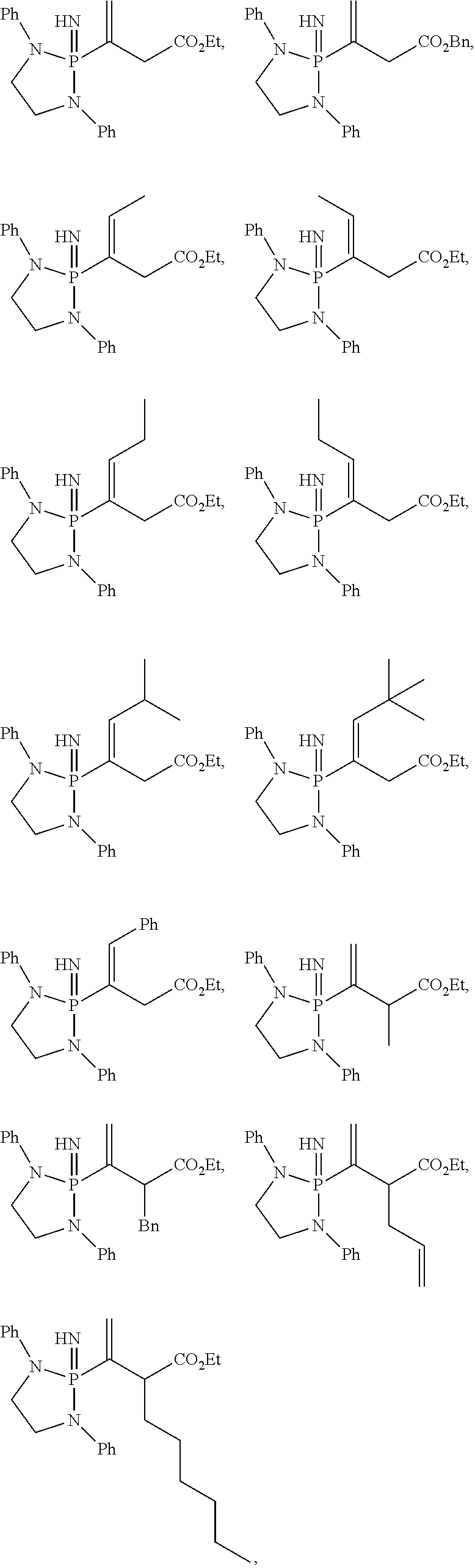


is provided, comprising reacting a compound or salt of Formula (III):

with a compound or salt of Formula (I):

wherein the compound of Formula (I) (e.g., a compound of Formula (Ia), (Ib), (Ic), (Id), (Ie), (If), (Ig), and/or (Ih)) is defined as described herein; variables R1, X, RX, and RY of Formula (II) are defined according to the definitions described herein for compounds of Formula (I) (e.g., a compound of Formula (Ia), (Ib), (Ic), (Id), (Ie), (If), (Ig), and/or (Ih)); RA is an electron withdrawing group; RB is selected from the group consisting of H, C1-6 alkyl, C2-6 alkylene, C3-10 cycloalkyl, 4-10 membered heterocycloalkyl, C6-10 aryl, (C6-10 aryl)-C1-3 alkylene-, and 4-10 membered heteroaryl, wherein the C1-6 alkyl, C3-10 cycloalkyl, 4-10 membered heterocycloalkyl, C6-10 aryl, (C6-10 aryl)-C1-3 alkylene-, and 4-10 membered heteroaryl are each optionally substituted by 1, 2, 3, or 4 independently selected R6 groups; RC and RD re each independently selected from the group consisting of H, C1-6 alkyl, C3-10 cycloalkyl, 4-10 membered heterocycloalkyl, C6-10 aryl, and 4-10 membered heteroaryl, wherein the C1-6 alkyl, C3-10 cycloalkyl, 4-10 membered heterocycloalkyl, C6-10 aryl, and 4-10 membered heteroaryl are each optionally substituted by 1, 2, 3, or 4 independently selected R6 groups; or RC and RD together with the C atom to which they are attached form a C3-10 cycloalkyl group; each Ra1, Rb1, Rc1, Rd1, and Re1 is independently selected from the group consisting of H, C1-6 alkyl, C1-6 haloalkyl, C2-6 alkenyl, C2-6 alkynyl, C3-10 cycloalkyl, 4-10 membered heterocycloalkyl, C6-10 aryl, (C6-10 aryl)-C1-3 alkylene-, and 4-10 membered heteroaryl, wherein the C1-6 alkyl, C3-10 cycloalkyl, 4-10 membered heterocycloalkyl, C6-10 aryl, and 4-10 membered heteroaryl are each optionally substituted by 1, 2, 3, or 4 independently selected R6 groups; or Rc1 and Rd1 together with the N atom to which they are attached form a 4-, 5-, 6-, or 7 membered heterocycloalkyl group, which is optionally substituted with C1-3 alkyl; and each R6 is independently selected from the group consisting of H, C1-3 alkyl, C1-3 haloalkyl, C1-3 alkoxy, C1-3alkoxycarbonyl, and phenyl.

comprising reacting a compound or salt of Formula (III):

with a compound or salt of Formula (Ib):

wherein: each X is independently selected from the group consisting of N, O, and S; Y is selected from the group consisting of CH2, O, and S; Z is selected from the group consisting of C═O, C═S, S═O, and SO2; each R1 is independently selected from the group consisting of H, C1-6 alkyl, C1-6 haloalkyl, C2-6 alkenyl, C2-6 alkynyl, C3-10 cycloalkyl, 4-10 membered heterocycloalkyl, C6-10 aryl, (C6-10 aryl)-C1-3 alkylene-, and 4-10 membered heteroaryl, wherein the C1-6 alkyl, C3-10 cycloalkyl, 4-10 membered heterocycloalkyl, C6-10 aryl, (C6-10 aryl)-C1-3 alkylene-, and 4-10 membered heteroaryl are each optionally substituted by 1, 2, 3, or 4 independently selected R5 groups; R2 is selected from the group consisting of H, C1-6 alkyl, C1-6 haloalkyl, C2-6 alkenyl, C2-6 alkynyl, C3-10 cycloalkyl, 4-10 membered heterocycloalkyl, C6-10 aryl, (C6-10 aryl)-C1-3 alkylene-, and 4-10 membered heteroaryl, wherein the C1-6 alkyl, C3-10 cycloalkyl, 4-10 membered heterocycloalkyl, C6-10 aryl, (C6-10 aryl)-C1-3 alkylene-, and 4-10 membered heteroaryl are each optionally substituted by 1, 2, 3, or 4 independently selected R5 groups; each R3 is independently selected from the group consisting of H, C1-6 alkyl, C1-6 haloalkyl, C2-6 alkenyl, C2-6 alkynyl, C3-10 cycloalkyl, 4-10 membered heterocycloalkyl, C6-10 aryl, (C6-10 aryl)-C1-3 alkylene-, and 4-10 membered heteroaryl, wherein the C1-6 alkyl, C3-10 cycloalkyl, 4-10 membered heterocycloalkyl, C6-10 aryl, (C6-10 aryl)-C1-3 alkylene-, and 4-10 membered heteroaryl are each optionally substituted by 1, 2, 3, or 4 independently selected R5 groups; R4 is selected from the group consisting of H, C1-6 alkyl, C1-6 haloalkyl, C2-6 alkenyl, C2-6 alkynyl, C3-10 cycloalkyl, 4-10 membered heterocycloalkyl, C6-10 aryl, (C6-10 aryl)-C1-3 alkylene-, and 4-10 membered heteroaryl, wherein the C1-6 alkyl, C3-10 cycloalkyl, 4-10 membered heterocycloalkyl, C6-10 aryl, (C6-10 aryl)-C1-3 alkylene-, and 4-10 membered heteroaryl are each optionally substituted by 1, 2, 3, or 4 independently selected R5 groups; each R5 is independently selected from the group consisting of OH, NO2, CN, halo, C1-3 alkyl, C2-4 alkenyl, C2-4 alkynyl, C1-3 haloalkyl, cyano-C1-3 alkyl, HO—C1-3 alkyl, C1-3 alkoxy-C1-3 alkyl, C3-7 cycloalkyl, C6-10 aryl, C1-3 alkoxy, C1-3 haloalkoxy, amino, C1-3 alkylamino, di(C1-3 alkyl)amino, thio, C1-3 alkylthio, C1-3 alkylsulfinyl, C1-3 alkylsulfonyl, carbamyl, C1-3 alkylcarbamyl, di(C1-3 alkyl)carbamyl, carboxy, C1-3 alkylcarbonyl, C1-4 alkoxycarbonyl, C1-3 alkylcarbonylamino, C1-3 alkylsulfonylamino, aminosulfonyl, C1-3 alkylaminosulfonyl, di(C1-3 alkyl)aminosulfonyl, aminosulfonylamino, C1-3 alkylaminosulfonylamino, di(C1-3 alkyl)aminosulfonylamino, aminocarbonylamino, C1-3 alkylaminocarbonylamino, and di(C1-3 alkyl)aminocarbonylamino; RA is an electron withdrawing group; RB is selected from the group consisting of H, C1-6 alkyl, C2-6 alkylene, C3-10 cycloalkyl, 4-10 membered heterocycloalkyl, C6-10 aryl, (C6-10 aryl)-C1-3 alkylene-, and 4-10 membered heteroaryl, wherein the C1-6 alkyl, C3-10 cycloalkyl, 4-10 membered heterocycloalkyl, C6-10 aryl, (C6-10 aryl)-C1-3 alkylene-, and 4-10 membered heteroaryl are each optionally substituted by 1, 2, 3, or 4 independently selected R6 groups; RC and RD are each independently selected from the group consisting of H, C1-6 alkyl, C3-10 cycloalkyl, 4-10 membered heterocycloalkyl, C6-10 aryl, and 4-10 membered heteroaryl, wherein the C1-6 alkyl, C3-10 cycloalkyl, 4-10 membered heterocycloalkyl, C6-10 aryl, and 4-10 membered heteroaryl are each optionally substituted by 1, 2, 3, or 4 independently selected R6 groups; or RC and RD together with the C atom to which they are attached form a C3-10 cycloalkyl group; each Ra1, Rb1, Rc1, Rd1, and Re1 is independently selected from the group consisting of H, C1-6 alkyl, C1-6 haloalkyl, C2-6 alkenyl, C2-6 alkynyl, C3-10 cycloalkyl, 4-10 membered heterocycloalkyl, C6-10 aryl, (C6-10 aryl)-C1-3 alkylene-, and 4-10 membered heteroaryl, wherein the C1-6 alkyl, C3-10 cycloalkyl, 4-10 membered heterocycloalkyl, C6-10 aryl, and 4-10 membered heteroaryl are each optionally substituted by 1, 2, 3, or 4 independently selected R6 groups; or Rc1 and Rd1 together with the N atom to which they are attached form a 4-, 5-, 6-, or 7 membered heterocycloalkyl group, which is optionally substituted with C1-3 alkyl; each R6 is independently selected from the group consisting of H, C1-3 alkyl, C1-3 haloalkyl, C1-3 alkoxy, C1-3 alkoxycarbonyl, and phenyl; n is 0 or 1; p is 0, 1, 2, 3, 4, or 5.

wherein Q is selected from O, S, and NR26; wherein R26, when present, is selected from hydrogen and C1-C8 alkyl; wherein each of XA and XB is independently selected from NR1, O, and S; wherein each occurrence of R1, when present, is independently selected from hydrogen, C1-C6 alkyl, C1-C6 haloalkyl, C2-C6 alkenyl, C2-C6 alkynyl, C3-C10 cycloalkyl, 4-10 membered heterocycloalkyl, C6-C10 aryl, —(C1-C3 alkyl)(C6-C10 aryl), and 4-10 membered heteroaryl, and wherein each occurrence of R1, when present, is independently substituted with 0, 1, 2, 3, or 4 independently selected R5 groups; wherein each of RX and RY is independently selected from hydrogen, C6-C10 aryl, and 4-10 membered heteroaryl, or wherein each of RX and RY are optionally covalently bonded together and, together with the intermediate carbon atoms, comprise a 5- to 7-membered cycloalkyl or 5- to 7-membered aryl; wherein RA is an electron withdrawing group; wherein RB is selected from hydrogen, C1-C6 alkyl, C2-C6 alkylene, C3-C10 cycloalkyl, 4-10 membered heterocycloalkyl, C6-C10 aryl, —(C1-C3 alkyl)(C6-C10 aryl), and 4-10 membered heteroaryl, and wherein RB is substituted with 0, 1, 2, 3, or 4 independently selected R6 groups; and wherein each of RC and RD is independently selected from hydrogen, C1-C6 alkyl, C3-C10 cycloalkyl, 4-10 membered heterocycloalkyl, C6-C10 aryl, and 4-10 membered heteroaryl, and wherein each of RC and RD is independently substituted with 0, 1, 2, 3, or 4 independently selected R6 groups, or wherein each of RC and RD are optionally covalently bonded together and, together with the intermediate carbon atoms, comprise a 3- to 10-membered cycloalkyl; wherein each occurrence of R5, when present, is independently selected from halogen, —NO2, —CN, —OH, —SH, —NH2, C1-C3 alkyl, C2-C4 alkenyl, C2-C4 alkynyl, C1-C3 haloalkyl, C1-C3 cyanoalkyl, C1-C3 hydroxyalkyl, C1-C3 haloalkoxy, C1-C3 alkoxy, C1-C3 thioalkyl, C1-C3 alkyl(C1-C3 alkoxy), C1-C3 alkylamino, (C1-C3)(C1-C3) dialkylamino, C3-C7 cycloalkyl, C6-C10 aryl, —(C═O)(C1-C3 alkyl), —(S═O)(C1-C3 alkyl), —SO2(C1-C3 alkyl), —CO2R11, —(C═O)NR12aR12b, —SO2NR12aR12b, —O(C═O)NR12aR12b, —NHSO2NR12aR12b, and —NH(C═O)NR12aR12b; wherein each occurrence of R11, when present, is independently selected from hydrogen and C1-C4 alkyl; wherein each occurrence of R12a and R12b, when present, is independently selected from hydrogen and C1-C3 alkyl; and wherein each occurrence of R6, when present, is independently selected from halogen, —NO2, —CO2(C1-C3 alkyl), C1-C3 alkyl, C1-C3 haloalkyl, C1-C3 alkoxy, C1-C3 alkoxycarbonyl, C3-C7 cycloalkyl, and phenyl, or a derivative thereof, the method comprising the step of reacting an allene having a structure represented by a formula:

or a derivative thereof, with a compound having a structure represented by a formula:

wherein n is selected from 0 and 1; wherein p is selected from 0, 1, 2, 3, 4, and 5; wherein Y is selected from O, S, and NR26; wherein R26, when present, is selected from hydrogen and C1-C8 alkyl; wherein Z is selected from C═O, C═S, S═O, and SO2; wherein each of RX and RY is independently selected from hydrogen, C6-C10 aryl, and 4-10 membered heteroaryl, or wherein each of RX and RY are optionally covalently bonded together and, together with the intermediate carbon atoms, comprise a 5- to 7-membered cycloalkyl or 5- to 6-membered aryl; wherein R2 is selected from hydrogen, C1-C6 alkyl, C1-C6 haloalkyl, C2-C6 alkenyl, C2-C6 alkynyl, C3-C10 cycloalkyl, 4-10 membered heterocycloalkyl, C6-C10 aryl, —(C1-C3 alkyl)(C6-C10 aryl), and 4-10 membered heteroaryl, and wherein R2 is substituted with 0, 1, 2, 3, or 4 independently selected R5 groups; wherein each of R3a and R3b, when present, is independently selected from hydrogen, C1-C6 alkyl, C1-C6 haloalkyl, C2-C6 alkenyl, C2-C6 alkynyl, C3-C10 cycloalkyl, 4-10 membered heterocycloalkyl, C6-C10 aryl, —(C1-C3 alkyl)(C6-C10 aryl), and 4-10 membered heteroaryl, and wherein each of R3a and R3b is independently substituted with 0, 1, 2, 3, or 4 independently selected R5 groups; and wherein R4 is selected from hydrogen, C1-C6 alkyl, C1-C6 haloalkyl, C2-C6 alkenyl, C2-C6 alkynyl, C3-C10 cycloalkyl, 4-10 membered heterocycloalkyl, C6-C10 aryl, and 4-10 membered heteroaryl, and —(C1-C3 alkyl)(C6-C10 aryl), and wherein R4 is substituted with 0, 1, 2, 3, or 4 independently selected R5 groups, or a derivative thereof.

wherein each of XA and XB is independently selected from NR1, O, and S; wherein each occurrence of R1, when present, is independently selected from hydrogen, C1-C6 alkyl, C1-C6 haloalkyl, C2-C6 alkenyl, C2-C6 alkynyl, C3-C10 cycloalkyl, 4-10 membered heterocycloalkyl, C6-C10 aryl, —(C1-C3 alkyl)(C6-C10 aryl), and 4-10 membered heteroaryl, and wherein each occurrence of R1, when present, is independently substituted with 0, 1, 2, 3, or 4 independently selected R5 groups; wherein each of RX and RY is independently selected from hydrogen, C6-C10 aryl, and 4-10 membered heteroaryl, or wherein each of RX and RY are optionally covalently bonded together and, together with the intermediate carbon atoms, comprise a 5- to 7-membered cycloalkyl or 5- to 7-membered aryl; wherein RA is an electron withdrawing group; wherein RB is selected from hydrogen, C1-C6 alkyl, C2-C6 alkylene, C3-C10 cycloalkyl, 4-10 membered heterocycloalkyl, C6-C10 aryl, —(C1-C3 alkyl)(C6-C10 aryl), and 4-10 membered heteroaryl, and wherein RB is substituted with 0, 1, 2, 3, or 4 independently selected R6 groups; and wherein each of RC and RD is independently selected from hydrogen, C1-C6 alkyl, C3-C10 cycloalkyl, 4-10 membered heterocycloalkyl, C6-C10 aryl, and 4-10 membered heteroaryl, and wherein each of RC and RD is independently substituted with 0, 1, 2, 3, or 4 independently selected R6 groups, or wherein each of RC and RD are optionally covalently bonded together and, together with the intermediate carbon atoms, comprise a 3- to 10-membered cycloalkyl; wherein each occurrence of R5, when present, is independently selected from halogen, —NO2, —CN, —OH, —SH, —NH2, C1-C3 alkyl, C2-C4 alkenyl, C2-C4 alkynyl, C1-C3 haloalkyl, C1-C3 cyanoalkyl, C1-C3 hydroxyalkyl, C1-C3 haloalkoxy, C1-C3 alkoxy, C1-C3 thioalkyl, C1-C3 alkyl(C1-C3 alkoxy), C1-C3 alkylamino, (C1-C3)(C1-C3) dialkylamino, C3-C7 cycloalkyl, C6-C10 aryl, —(C═O)(C1-C3 alkyl), —(S═O)(C1-C3 alkyl), —SO2(C1-C3 alkyl), —CO2R11, —SO2NR12aR12b, —O(C═O)NR12aR12b, —NHSO2NR12aR12b, and —NH(C═O)NR12aR12b; wherein each occurrence of R1, when present, is independently selected from hydrogen and C1-C4 alkyl; wherein each occurrence of R12a and R12b, when present, is independently selected from hydrogen and C1-C3 alkyl; and wherein each occurrence of R6, when present, is independently selected from halogen, —NO2, —CO2(C1-C3 alkyl), C1-C3 alkyl, C1-C3 haloalkyl, C1-C3 alkoxy, C1-C3 alkoxycarbonyl, and phenyl, or a derivative thereof, the method comprising the step of reacting an allene having a structure represented by a formula:

or a derivative thereof, with a compound having a structure represented by a formula:

wherein n is selected from 0 and 1; wherein p is selected from 0, 1, 2, 3, 4, and 5; wherein Y is selected from CH2, O, and S; wherein Z is selected from C═O, C═S, S═O, and SO2; wherein each of RX and RY is independently selected from hydrogen, C6-C10 aryl, and 4-10 membered heteroaryl, or wherein each of RX and RY are optionally covalently bonded together and, together with the intermediate carbon atoms, comprise a 5- to 7-membered cycloalkyl or 5- to 6-membered aryl; wherein R2 is selected from hydrogen, C1-C6 alkyl, C1-C6 haloalkyl, C2-C6 alkenyl, C2-C6 alkynyl, C3-C10 cycloalkyl, 4-10 membered heterocycloalkyl, C6-C10 aryl, —(C1-C3 alkyl)(C6-C10 aryl), and 4-10 membered heteroaryl, and wherein R2 is substituted with 0, 1, 2, 3, or 4 independently selected R5 groups; wherein each of R3a and R3b, when present, is independently selected from hydrogen, C1-C6 alkyl, C1-C6 haloalkyl, C2-C6 alkenyl, C2-C6 alkynyl, C3-C10 cycloalkyl, 4-10 membered heterocycloalkyl, C6-C10 aryl, —(C1-C3 alkyl)(C6-C10 aryl), and 4-10 membered heteroaryl, and wherein each of R3a and R3b is independently substituted with 0, 1, 2, 3, or 4 independently selected R5 groups; and wherein R4 is selected from hydrogen, C1-C6 alkyl, C1-C6 haloalkyl, C2-C6 alkenyl, C2-C6 alkynyl, C3-C10 cycloalkyl, 4-10 membered heterocycloalkyl, C6-C10 aryl, and 4-10 membered heteroaryl, and —(C1-C3 alkyl)(C6-C10 aryl), and wherein R4 is substituted with 0, 1, 2, 3, or 4 independently selected R5 groups, or a derivative thereof.


or a salt thereof.


or a salt thereof.

or a salt thereof.
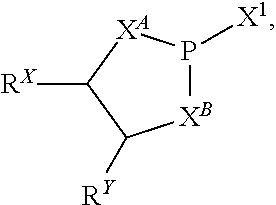
wherein X1 is halogen, or a derivative thereof, with a compound having a structure represented by a formula:

or a derivative thereof, in the presence of a base. In a still further aspect, the first compound is prepared by reacting a second compound having a structure represented by a formula:

with a phosphine in the presence of a base.

with a compound or salt of Formula (V):

in the presence of a base, wherein: X1 is halo; and Y1 is OH, SH, or —CH3.

with a phosphine in the presence of a base, wherein: each X2 is independently selected from the group consisting of —NH—, —O—, and —S—.


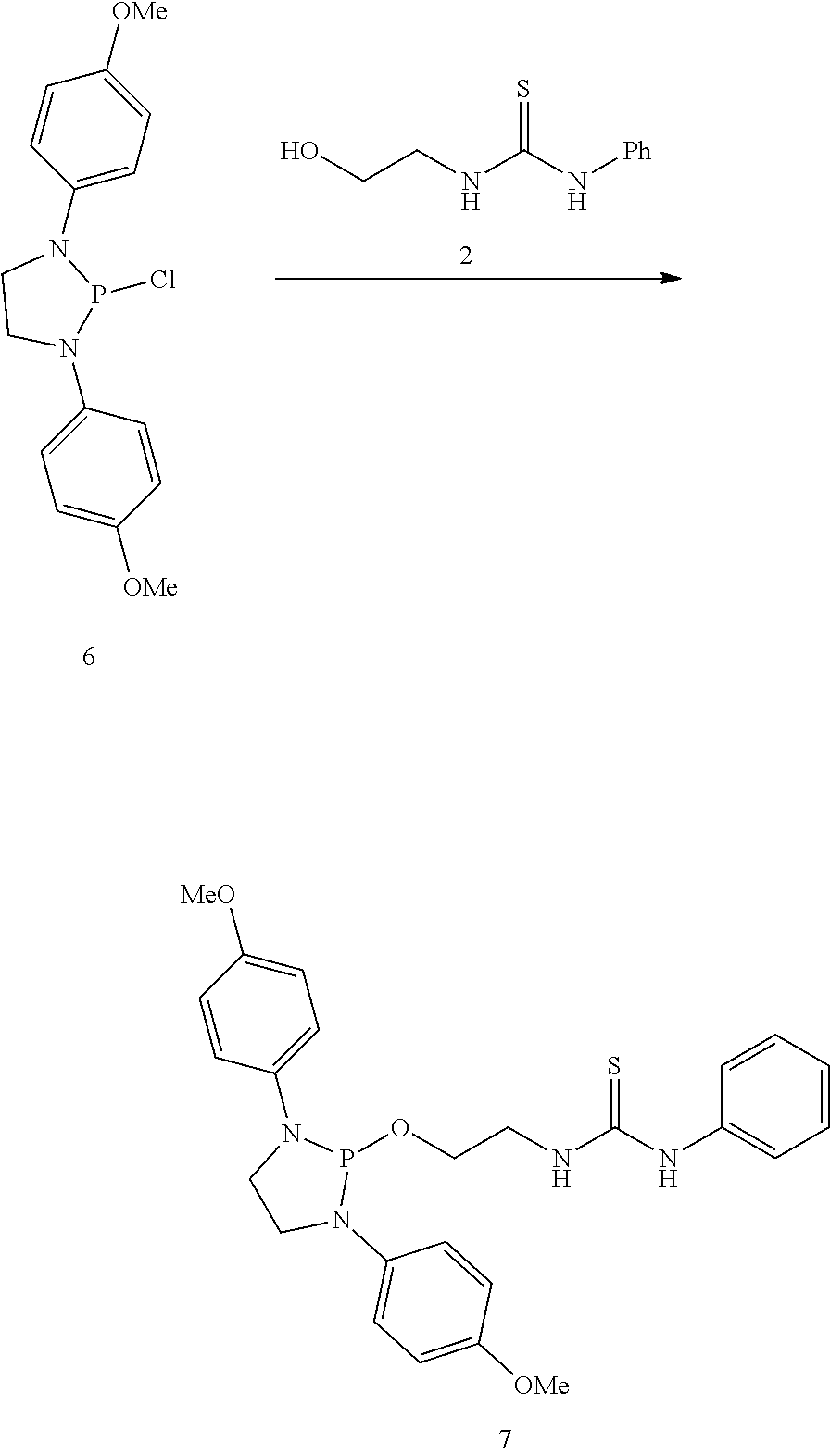


| TABLE 1 | ||
 |
||
 |
||
| Entry | Solvent | Time (h) | Yield (%)a,b | ||
| 1 | THF | 5 | 59 | ||
| 2 | Toluene | 5 | 48 | ||
| 3 | CHCl3 | 5 | 80 | ||
| 4 | MeCN | 5 | 56 | ||
| 5 | Et2O | 5 | 65 | ||
| 6 | 1,2-DCE | 5 | 50 | ||
| aReactions were performed using 2a (0.30 mmol) and NHP 1a (0.10 mmol) in 0.15 mL solvent at rt for 5 h. | |||||
| bIsolated yield. | |||||


| TABLE 2 | ||
| Identification code | 1a | |
| Empirical formula | C23H25N40PS | |
| Formula weight | 436.50 | |
| Temperature/K | 100.03 | |
| Crystal system | triclinic | |
| Space group | P-1 | |
| a/Å | 6.3703(9) | |
| b/Å | 12.1555(18) | |
| c/Å | 15.503(2) | |
| α/° | 108.683(2) | |
| β/° | 98.291(2) | |
| γ/° | 100.081(2) | |
| Volume/Å3 | 1093.6(3) | |
| Z | 2 | |
| ρcalcg/cm3 | 1.326 | |
| μ/mm−1 | 0.244 | |
| F(000) | 460.0 | |
| Crystal size/mm3 | 0.3 × 0.1 × 0.05 | |
| Radiation | MoKα (λ = 0.71073) | |
| 2Θ range for data | 2.84 to 56.562 | |
| collection/° | ||
| Index ranges | −8 ≤ h ≤ 8, −16 ≤ k ≤ 16, | |
| −20 ≤ 1 ≤ 20 | ||
| Reflections collected | 15051 | |
| Independent reflections | 5410 [Rint = 0.0236, | |
| Rsigma = 0.0267] | ||
| Data/restraints/parameters | 5410/0/271 | |
| Goodness-of-fit on F2 | 1.037 | |
| Final R indexes | R1 = 0.0316, | |
| [I >= 2σ (I)] | wR2 = 0.0775 | |
| Final R indexes [all data] | R1 = 0.0385, | |
| wR2 = 0.0807 | ||
| Largest diff. peak/hole/ | 0.34/−0.28 | |
| e Å−3 | ||
| TABLE 3 | ||||
| Atom | x | y | z | U(eq) |
| S1 | 12456.1(5) | 8697.7(3) | 10136.8(2) | 19.92(8) |
| P1 | 4104.8(5) | 5520.1(3) | 6648.7(2) | 14.72(8) |
| O1 | 6037.9(13) | 6479.7(7) | 7513.8(6) | 15.90(17) |
| N1 | 2191.2(16) | 5012.8(9) | 7190.9(7) | 16.9(2) |
| N2 | 2446.1(16) | 6349.9(9) | 6324.7(7) | 17.4(2) |
| N3 | 9303.7(16) | 8462.2(9) | 8728.7(7) | 18.0(2) |
| N4 | 12639.8(16) | 9648.2(9) | 8820.5(7) | 17.9(2) |
| C1 | 2690.7(19) | 4398.1(10) | 7797.2(8) | 17.9(2) |
| C2 | 4482(2) | 3869.2(11) | 7760.0(9) | 22.2(3) |
| C3 | 5013(2) | 3292.1(12) | 8370.2(10) | 27.0(3) |
| C4 | 3782(2) | 3215.7(14) | 9027.0(11) | 32.9(3) |
| C5 | 1979(3) | 3714.4(15) | 9054.2(12) | 36.8(4) |
| C6 | 1432(2) | 4303.5(13) | 8449.9(10) | 28.6(3) |
| C7 | 407.4(19) | 5635.0(11) | 7290.1(9) | 19.5(2) |
| C8 | 240.2(19) | 6142.4(11) | 6510.5(9) | 19.5(2) |
| C9 | 2857(2) | 6841.4(10) | 5638.8(8) | 17.4(2) |
| C10 | 1163(2) | 6917.1(11) | 4993.9(9) | 21.3(3) |
| C11 | 1627(2) | 7395.2(12) | 4319.8(9) | 25.4(3) |
| C12 | 3769(2) | 7815.8(12) | 4279.9(9) | 25.8(3) |
| C13 | 5465(2) | 7758.6(12) | 4925.7(9) | 25.4(3) |
| C14 | 5022(2) | 7281.2(11) | 5602.9(9) | 21.1(2) |
| C15 | 5603.0(19) | 7246.7(11) | 8360.7(8) | 17.3(2) |
| C16 | 7742(2) | 7760.7(11) | 9066.9(8) | 19.2(2) |
| C17 | 11384.3(19) | 8959.5(10) | 9174.5(8) | 15.7(2) |
| C18 | 12015.0(19) | 9885.3(10) | 7988.9(8) | 17.2(2) |
| C19 | 13291(2) | 9662.7(11) | 7322.2(9) | 23.4(3) |
| C20 | 12769(3) | 9915.6(12) | 6516.7(9) | 28.6(3) |
| C21 | 10973(3) | 10387.3(13) | 6374.3(9) | 30.1(3) |
| C22 | 9706(2) | 10613.6(14) | 7038.5(11) | 32.5(3) |
| C23 | 10230(2) | 10374.0(13) | 7853.1(9) | 25.6(3) |
| TABLE 4 | ||||||
| Atom | U11 | U22 | U33 | U23 | U13 | U12 |
| S1 | 16.06(15) | 27.95(16) | 17.30(15) | 12.17(12) | 2.46(11) | 2.15(12) |
| P1 | 12.55(14) | 18.03(15) | 14.04(14) | 5.40(11) | 3.87(10) | 4.49(11) |
| O1 | 12.0(4) | 20.8(4) | 14.3(4) | 5.0(3) | 4.0(3) | 3.8(3) |
| N1 | 12.5(5) | 19.8(5) | 20.1(5) | 8.4(4) | 5.0(4) | 4.3(4) |
| N2 | 12.8(5) | 23.7(5) | 18.3(5) | 9.8(4) | 4.3(4) | 5.6(4) |
| N3 | 16.5(5) | 22.0(5) | 14.9(5) | 8.7(4) | 1.8(4) | −0.1(4) |
| N4 | 14.9(5) | 22.4(5) | 15.7(5) | 8.3(4) | 2.3(4) | 0.5(4) |
| C1 | 16.2(6) | 17.5(5) | 19.1(6) | 7.1(5) | 3.0(4) | 1.1(4) |
| C2 | 21.3(6) | 23.8(6) | 25.4(6) | 11.0(5) | 9.3(5) | 7.0(5) |
| C3 | 24.1(7) | 29.3(7) | 34.5(7) | 17.7(6) | 8.1(6) | 10.1(5) |
| C4 | 34.3(8) | 39.0(8) | 37.3(8) | 26.7(7) | 11.1(6) | 11.3(6) |
| C5 | 36.1(8) | 50.7(10) | 42.1(9) | 32.5(8) | 21.0(7) | 16.3(7) |
| C6 | 24.5(7) | 37.9(8) | 34.9(8) | 21.7(6) | 15.2(6) | 12.6(6) |
| C7 | 13.0(5) | 24.0(6) | 24.5(6) | 10.6(5) | 6.7(4) | 6.2(5) |
| C8 | 12.1(5) | 23.4(6) | 24.4(6) | 9.7(5) | 4.1(4) | 5.3(4) |
| C9 | 20.1(6) | 16.7(5) | 14.7(5) | 3.8(4) | 4.0(4) | 5.9(4) |
| C10 | 21.3(6) | 20.5(6) | 19.7(6) | 6.4(5) | −0.6(5) | 4.1(5) |
| C11 | 32.7(7) | 23.2(6) | 18.6(6) | 7.2(5) | −1.3(5) | 7.9(5) |
| C12 | 38.9(8) | 25.6(7) | 19.3(6) | 11.1(5) | 11.1(5) | 13.4(6) |
| C13 | 26.9(7) | 29.7(7) | 27.4(7) | 14.0(6) | 14.0(5) | 12.3(5) |
| C14 | 20.3(6) | 25.3(6) | 20.9(6) | 10.0(5) | 6.2(5) | 8.6(5) |
| C15 | 15.0(5) | 19.7(6) | 16.5(5) | 4.5(4) | 5.8(4) | 4.2(4) |
| C16 | 17.8(6) | 23.3(6) | 14.9(5) | 6.9(5) | 4.3(4) | −0.4(5) |
| C17 | 17.2(5) | 15.9(5) | 13.8(5) | 3.7(4) | 5.5(4) | 4.7(4) |
| C18 | 19.0(6) | 17.2(5) | 13.3(5) | 5.2(4) | 2.9(4) | 0.1(4) |
| C19 | 29.1(7) | 21.7(6) | 23.5(6) | 9.2(5) | 12.5(5) | 8.2(5) |
| C20 | 45.4(8) | 22.8(6) | 20.6(6) | 8.0(5) | 16.4(6) | 7.3(6) |
| C21 | 41.3(8) | 31.0(7) | 17.6(6) | 12.6(5) | 2.8(6) | 2.5(6) |
| C22 | 27.8(7) | 46.1(9) | 32.9(8) | 25.2(7) | 5.3(6) | 11.8(6) |
| C23 | 24.6(7) | 35.2(7) | 24.1(6) | 16.2(6) | 10.3(5) | 10.1(6) |
| TABLE 5 | |||
| Atom | Atom | Length/Å | |
| S1 | C17 | 1.6969(12) | |
| P1 | O1 | 1.6414(9) | |
| P1 | N1 | 1.7138(10) | |
| P1 | N2 | 1.7119(10) | |
| O1 | C15 | 1.4427(14) | |
| N1 | C1 | 1.4107(15) | |
| N1 | C7 | 1.4710(15) | |
| N2 | C8 | 1.4699(15) | |
| N2 | C9 | 1.4102(15) | |
| N3 | C16 | 1.4601(15) | |
| N3 | C17 | 1.3370(15) | |
| N4 | C17 | 1.3520(15) | |
| N4 | C18 | 1.4262(15) | |
| C1 | C2 | 1.4040(17) | |
| C1 | C6 | 1.3985(18) | |
| C2 | C3 | 1.3847(18) | |
| C3 | C4 | 1.388(2) | |
| C4 | C5 | 1.389(2) | |
| C5 | C6 | 1.391(2) | |
| C7 | C8 | 1.5219(17) | |
| C9 | C10 | 1.3983(17) | |
| C9 | C14 | 1.4052(18) | |
| C10 | C11 | 1.3914(18) | |
| C11 | C12 | 1.388(2) | |
| C12 | C13 | 1.3902(19) | |
| C13 | C14 | 1.3918(18) | |
| C15 | C16 | 1.5095(16) | |
| C18 | C19 | 1.3934(17) | |
| C18 | C23 | 1.3921(18) | |
| C19 | C20 | 1.3881(18) | |
| C20 | C21 | 1.387(2) | |
| C21 | C22 | 1.387(2) | |
| C22 | C23 | 1.3926(18) | |
| TABLE 6 | ||||
| Atom | Atom | Atom | Angle/° | |
| O1 | P1 | N1 | 103.87(5) | |
| O1 | P1 | N2 | 105.53(5) | |
| N2 | P1 | N1 | 89.73(5) | |
| C15 | O1 | P1 | 123.07(7) | |
| C1 | N1 | P1 | 121.17(8) | |
| C1 | N1 | C7 | 119.34(10) | |
| C7 | N1 | P1 | 115.32(8) | |
| C8 | N2 | P1 | 115.81(8) | |
| C9 | N2 | P1 | 120.39(8) | |
| C9 | N2 | C8 | 119.90(10) | |
| C17 | N3 | C16 | 123.69(10) | |
| C17 | N4 | C18 | 127.06(10) | |
| C2 | C1 | N1 | 120.39(11) | |
| C6 | C1 | N1 | 121.22(11) | |
| C6 | C1 | C2 | 118.38(11) | |
| C3 | C2 | C1 | 120.59(12) | |
| C2 | C3 | C4 | 120.90(13) | |
| C3 | C4 | C5 | 118.80(13) | |
| C4 | C5 | C6 | 120.98(14) | |
| C5 | C6 | C1 | 120.32(13) | |
| N1 | C7 | C8 | 105.69(10) | |
| N2 | C8 | C7 | 105.61(9) | |
| C10 | C9 | N2 | 121.81(11) | |
| C10 | C9 | C14 | 118.65(11) | |
| C14 | C9 | N2 | 119.54(11) | |
| C11 | C10 | C9 | 120.28(12) | |
| C12 | C11 | C10 | 120.87(12) | |
| C11 | C12 | C13 | 119.27(12) | |
| C12 | C13 | C14 | 120.43(13) | |
| C13 | C14 | C9 | 120.49(12) | |
| O1 | C15 | C16 | 107.27(9) | |
| N3 | C16 | C15 | 110.01(10) | |
| N3 | C17 | S1 | 121.14(9) | |
| N3 | C17 | N4 | 118.20(10) | |
| N4 | C17 | S1 | 120.62(9) | |
| C19 | C18 | N4 | 118.45(11) | |
| C23 | C18 | N4 | 121.43(11) | |
| C23 | C18 | C19 | 120.07(11) | |
| C20 | C19 | C18 | 120.04(13) | |
| C21 | C20 | C19 | 119.98(13) | |
| C20 | C21 | C22 | 120.09(12) | |
| C21 | C22 | C23 | 120.33(13) | |
| C18 | C23 | C22 | 119.49(12) | |
| TABLE 7 | |||||
| Atom | x | y | z | U(eq) | |
| H3 | 8850 | 8563 | 8202 | 22 | |
| H4 | 13989 | 9987 | 9138 | 22 | |
| H2 | 5338 | 3908 | 7312 | 27 | |
| H3A | 6237 | 2944 | 8339 | 32 | |
| H4A | 4165 | 2829 | 9450 | 39 | |
| H5 | 1107 | 3652 | 9492 | 44 | |
| H6 | 199 | 4643 | 8481 | 34 | |
| H7A | 741 | 6284 | 7906 | 23 | |
| H7B | −979 | 5071 | 7228 | 23 | |
| H8A | −816 | 5568 | 5946 | 23 | |
| H8B | −240 | 6900 | 6707 | 23 | |
| H10 | −312 | 6641 | 5016 | 26 | |
| H11 | 463 | 7434 | 3881 | 31 | |
| H12 | 4073 | 8139 | 3816 | 31 | |
| H13 | 6935 | 8047 | 4905 | 30 | |
| H14 | 6193 | 7252 | 6044 | 25 | |
| H15A | 4530 | 6784 | 8593 | 21 | |
| H15B | 5001 | 7896 | 8245 | 21 | |
| H16A | 7501 | 8275 | 9666 | 23 | |
| H16B | 8334 | 7105 | 9176 | 23 | |
| H19 | 14518 | 9338 | 7419 | 28 | |
| H20 | 13641 | 9766 | 6063 | 34 | |
| H21 | 10611 | 10556 | 5821 | 36 | |
| H22 | 8473 | 10933 | 6937 | 39 | |
| H23 | 9376 | 10543 | 8313 | 31 | |
| TABLE 8 | ||
| Identification code | 3a | |
| Empirical formula | C20H23N2O3P | |
| Formula weight | 370.37 | |
| Temperature/K | 99.91 | |
| Crystal system | orthorhombic | |
| Space group | Pbca | |
| a/Å | 18.5763(9) | |
| b/Å | 9.7340(5) | |
| c/Å | 19884(10) | |
| α/° | 90 | |
| β/° | 90 | |
| γ/° | 90 | |
| Volume/Å3 | 3585.4(4) | |
| Z | 8 | |
| ρcalcg/cm3 | 1.372 | |
| μ/mm−1 | 0.177 | |
| F(000) | 1568.0 | |
| Crystal size/mm3 | 0.2 × 0.15 × 0.08 | |
| Radiation | MoKα (λ = 0.71073) | |
| 2Θ range for data | 4.108 to 52.736 | |
| collection/° | ||
| Index ranges | −23 ≤ h ≤ 23, −12 ≤ k ≤ 12, | |
| −24 ≤ 1 ≤ 24 | ||
| Reflections collected | 41586 | |
| Independent reflections | 3628 [Rint = 0.0483, | |
| Rsigma = 0.0290] | ||
| Data/restraints/parameters | 3628/6/244 | |
| Goodness-of-fit on F2 | 0.999 | |
| Final R indexes | R1 = 0.0298, | |
| [I >= 2σ (I)] | wR2 = 0.0768 | |
| Final R indexes [all data] | R1 = 0.0388, | |
| wR2 = 0.0807 | ||
| Largest diff. peak/hole/ | 0.32/−0.39 | |
| e Å−3 | ||
| TABLE 9 | |||||
| Atom | x | y | z | U(eq) | |
| P1 | 6232.7(2) | 6582.4(3) | 2541.8(2) | 13.25(10) | |
| O1 | 5945.4(5) | 7524.0(9) | 2026.4(4) | 18.1(2) | |
| O3 | 5641.1(5) | 5650.0(9) | 4336.5(4) | 18.1(2) | |
| O2 | 6474.5(5) | 3986.6(10) | 4270.6(5) | 24.7(2) | |
| N2 | 6889.6(6) | 5485.7(10) | 2335.2(5) | 15.5(2) | |
| N1 | 6714.1(5) | 7287.1(11) | 3164.3(5) | 15.2(2) | |
| C1 | 6860.9(7) | 4492.6(13) | 1815.0(6) | 15.6(3) | |
| C2 | 6198.3(7) | 4022.2(14) | 1570.9(7) | 19.1(3) | |
| C3 | 6173.4(7) | 2988.4(15) | 1089.1(7) | 20.8(3) | |
| C4 | 6801.1(7) | 2405.8(14) | 839.2(7) | 21.0(3) | |
| C5 | 7457.1(7) | 2882.0(14) | 1075.9(7) | 20.0(3) | |
| C6 | 7494.0(7) | 3917.9(13) | 1555.8(7) | 17.4(3) | |
| C7 | 7590.5(7) | 5860.8(13) | 2631.5(7) | 16.6(3) | |
| C8 | 7416.3(7) | 6623.0(14) | 3278.8(7) | 17.3(3) | |
| C9 | 6470.2(7) | 8311.1(13) | 3615.4(6) | 14.9(3) | |
| C10 | 6857.7(7) | 8594.1(13) | 4204.7(7) | 17.1(3) | |
| C11 | 6646.3(7) | 9670.5(14) | 4620.5(7) | 20.0(3) | |
| C12 | 6051.8(8) | 10456.4(14) | 4465.8(7) | 21.8(3) | |
| C13 | 5656.0(8) | 10156.4(14) | 3892.6(7) | 22.2(3) | |
| C14 | 5858.5(7) | 9091.1(13) | 3467.4(7) | 18.7(3) | |
| C15 | 5508.2(7) | 5602.0(13) | 2911.7(6) | 14.9(3) | |
| C16 | 4834.7(8) | 6010.1(15) | 2815.6(7) | 21.0(3) | |
| C17 | 5687.1(7) | 4344.5(13) | 3327.3(7) | 17.9(3) | |
| C18 | 5988.7(7) | 4632.8(13) | 4020.5(7) | 16.3(3) | |
| C19 | 5883.9(7) | 5935.1(14) | 5022.8(6) | 19.5(3) | |
| C20 | 5459.3(7) | 7140.9(14) | 5275.0(7) | 21.1(3) | |
| TABLE 10 | ||||||
| Atom | U11 | U22 | U33 | U23 | U13 | U12 |
| P1 | 12.57(18) | 14.30(19) | 12.89(18) | 0.70(13) | −0.97(12) | 0.27(13) |
| O1 | 18.2(5) | 20.2(5) | 16.0(5) | 2.5(4) | −0.8(4) | 1.0(4) |
| O3 | 21.0(5) | 18.8(5) | 14.5(5) | −1.3(4) | −2.2(4) | 1.1(4) |
| O2 | 21.8(5) | 29.8(6) | 22.6(5) | 1.7(4) | −0.5(4) | 7.6(4) |
| N2 | 13.3(6) | 17.1(6) | 16.1(6) | −2.0(5) | −2.2(4) | 0.5(4) |
| N1 | 13.4(5) | 15.5(6) | 16.6(6) | −1.3(4) | −2.4(4) | 0.7(4) |
| C1 | 20.1(7) | 14.8(6) | 12.1(6) | 2.7(5) | −0.5(5) | 0.4(5) |
| C2 | 17.3(7) | 24.4(8) | 15.5(7) | −0.8(6) | 0.6(5) | 1.4(6) |
| C3 | 22.8(7) | 24.5(7) | 15.2(7) | −0.2(6) | −2.5(6) | −3.9(6) |
| C4 | 30.4(8) | 18.8(7) | 13.7(7) | −0.2(5) | 1.0(6) | −0.4(6) |
| C5 | 22.9(7) | 19.5(7) | 17.7(7) | 1.9(6) | 4.3(6) | 4.1(6) |
| C6 | 17.0(7) | 17.5(7) | 17.7(7) | 2.5(5) | 0.7(5) | −0.7(6) |
| C7 | 13.0(7) | 17.0(7) | 19.7(7) | 1.0(5) | −3.2(5) | 0.1(5) |
| C8 | 14.3(7) | 18.3(7) | 19.4(7) | −0.1(5) | −3.9(5) | 1.3(5) |
| C9 | 16.4(6) | 13.2(6) | 15.2(6) | 1.5(5) | 1.5(5) | −3.4(5) |
| C10 | 16.6(7) | 16.1(7) | 18.6(7) | 2.0(5) | −1.1(5) | −2.2(5) |
| C11 | 22.9(7) | 21.2(7) | 15.8(7) | −1.5(6) | −1.6(6) | −6.6(6) |
| C12 | 26.4(8) | 16.6(7) | 22.5(8) | −3.6(6) | 2.4(6) | −0.8(6) |
| C13 | 23.0(8) | 19.2(7) | 24.3(8) | −1.2(6) | −0.7(6) | 2.8(6) |
| C14 | 19.5(7) | 18.7(7) | 17.9(7) | −0.4(5) | −2.7(6) | 0.0(6) |
| C15 | 17.0(7) | 16.3(6) | 11.3(6) | −3.6(5) | −0.2(5) | −2.1(5) |
| C16 | 19.5(7) | 24.4(8) | 19.3(8) | −2.4(6) | 0.1(6) | −1.2(6) |
| C17 | 19.4(7) | 16.4(7) | 17.8(7) | −1.2(5) | 1.9(5) | −2.3(5) |
| C18 | 14.9(6) | 16.1(7) | 17.8(7) | 2.6(5) | 2.7(5) | −2.9(5) |
| C19 | 22.0(7) | 23.1(7) | 13.3(7) | 0.5(5) | −2.9(5) | −2.3(6) |
| C20 | 23.5(7) | 21.8(7) | 18.2(7) | −0.4(6) | 2.1(6) | −3.6(6) |
| TABLE 11 | |||
| Atom | Atom | Length/Å | |
| P1 | O1 | 1.4728(9) | |
| P1 | N2 | 1.6724(11) | |
| P1 | N1 | 1.6716(11) | |
| P1 | C15 | 1.8055(13) | |
| O3 | C18 | 1.3378(15) | |
| O3 | C19 | 1.4604(15) | |
| O2 | C18 | 1.2065(16) | |
| N2 | C1 | 1.4147(16) | |
| N2 | C7 | 1.4744(16) | |
| N1 | C8 | 1.4734(16) | |
| N1 | C9 | 1.4139(16) | |
| C1 | C2 | 1.3997(18) | |
| C1 | C6 | 1.4000(18) | |
| C2 | C3 | 1.388(2) | |
| C3 | C4 | 1.3881(19) | |
| C4 | C5 | 1.3858(19) | |
| C5 | C6 | 1.3881(19) | |
| C7 | C8 | 1.5174(18) | |
| C9 | C10 | 1.3998(18) | |
| C9 | C14 | 1.3979(18) | |
| C10 | C11 | 1.3899(19) | |
| C11 | C12 | 1.378(2) | |
| C12 | C13 | 1.385(2) | |
| C13 | C14 | 1.3884(19) | |
| C15 | C16 | 1.3265(19) | |
| C15 | C17 | 1.5127(18) | |
| C17 | C18 | 1.5105(19) | |
| C19 | C20 | 1.5000(18) | |
| TABLE 12 | ||||
| Atom | Atom | Atom | Angle/° | |
| O1 | P1 | N2 | 119.45(5) | |
| O1 | P1 | N1 | 116.80(5) | |
| O1 | P1 | C15 | 109.92(6) | |
| N2 | P1 | C15 | 107.82(6) | |
| N1 | P1 | N2 | 93.00(5) | |
| N1 | P1 | C15 | 108.41(6) | |
| C18 | O3 | C19 | 115.34(10) | |
| C1 | N2 | P1 | 125.97(9) | |
| C1 | N2 | C7 | 119.54(10) | |
| C7 | N2 | P1 | 112.88(8) | |
| C8 | N1 | P1 | 114.05(8) | |
| C9 | N1 | P1 | 125.80(9) | |
| C9 | N1 | C8 | 119.71(10) | |
| C2 | C1 | N2 | 120.58(11) | |
| C2 | C1 | C6 | 118.75(12) | |
| C6 | C1 | N2 | 120.60(11) | |
| C3 | C2 | C1 | 120.29(12) | |
| C4 | C3 | C2 | 120.92(13) | |
| C5 | C4 | C3 | 118.76(13) | |
| C4 | C5 | C6 | 121.23(12) | |
| C5 | C6 | C1 | 120.04(12) | |
| N2 | C7 | C8 | 105.65(10) | |
| N1 | C8 | C7 | 105.84(10) | |
| C10 | C9 | N1 | 120.13(12) | |
| C14 | C9 | N1 | 120.71(11) | |
| C14 | C9 | C10 | 119.11(12) | |
| C11 | C10 | C9 | 119.87(12) | |
| C12 | C11 | C10 | 120.86(13) | |
| C11 | C12 | C13 | 119.42(13) | |
| C12 | C13 | C14 | 120.80(13) | |
| C13 | C14 | C9 | 119.89(12) | |
| C16 | C15 | P1 | 119.11(11) | |
| C16 | C15 | C17 | 121.86(12) | |
| C17 | C15 | P1 | 119.03(9) | |
| C18 | C17 | C15 | 115.27(11) | |
| O3 | C18 | C17 | 112.62(11) | |
| O2 | C18 | O3 | 123.66(12) | |
| O2 | C18 | C17 | 123.68(12) | |
| O3 | C19 | C20 | 107.27(11) | |
| TABLE 13 | |||||
| Atom | x | y | z | U(eq) | |
| H2 | 5764 | 4412 | 1736 | 23 | |
| H3 | 5720 | 2675 | 928 | 25 | |
| H4 | 6781 | 1694 | 512 | 25 | |
| H5 | 7890 | 2492 | 907 | 24 | |
| H6 | 7949 | 4237 | 1708 | 21 | |
| H7A | 7866 | 6457 | 2320 | 20 | |
| H7B | 7879 | 5028 | 2728 | 20 | |
| H8A | 7388 | 5976 | 3663 | 21 | |
| H8B | 7790 | 7319 | 3377 | 21 | |
| H10 | 7265 | 8051 | 4320 | 21 | |
| H11 | 6915 | 9867 | 5016 | 24 | |
| H12 | 5915 | 11197 | 4750 | 26 | |
| H13 | 5241 | 10686 | 3789 | 27 | |
| H14 | 5582 | 8893 | 3076 | 22 | |
| H17A | 5245 | 3787 | 3378 | 21 | |
| H17B | 6041 | 3784 | 3075 | 21 | |
| H19A | 6405 | 6151 | 5025 | 23 | |
| H19B | 5801 | 5126 | 5315 | 23 | |
| H20A | 5543 | 7933 | 4980 | 32 | |
| H20B | 5612 | 7367 | 5735 | 32 | |
| H20C | 4946 | 6911 | 5275 | 32 | |
| H16A | 4728(9) | 6822(16) | 2551(8) | 31(4) | |
| H16B | 4424(9) | 5516(16) | 3022(8) | 32(4) | |

| TABLE 14 |
 |
| Entry | NHP | Solvent | Time (h) | Product/Yield (%)b |
| 1c | 1a | CH2Cl2 | 24 | 3a/50 |
| 2 | 1a | CH2Cl2 | 5 | 3a/>99 |
| 3 | 1b | CH2Cl2 | 5 | 3b/97 |
| 4 | 1c | CH2Cl2 | 5 | 3c/trace |
| 5 | 1d | CH2Cl2 | 5 | 3d/98 |
| 6 | 1e | CH2Cl2 | 5 | 3a/87 |
| 7 | 1f | CH2Cl2 | 5 | 3a/92 |
| 8 | 1g | CH2Cl2 | 5 | 3a/94 |
| 9 | 1h | CH2Cl2 | 5 | 3a/61 |
| 10 | 1i | CH2Cl2 | 5 | 3a/88 |
| 11 | 1j | CH2Cl2 | 5 | 3a/86 |
| 12 | 1k | CH2Cl2 | 5 | 3a/0 |
| 13 | 1l | CH2Cl2 | 5 | 3a/82 |
| 14 | 1m | CH2Cl2 | 5 | 3a/78 |
| 15 | 1n | CH2Cl2 | 5 | 3a/95 |
| 16 | 1o | CH2Cl2 | 5 | 3a/66 |
| Reactions were performed using 2a (0.30 mmol) and NHP (1a-1n) (0.10 mmol) in CH2Cl2 (0.15 mL) at rt for 5 hrs. | ||||
| bIsolated Yield. | ||||
| cReaction using 2a (0.20 mmol). | ||||
| TABLE 15 |
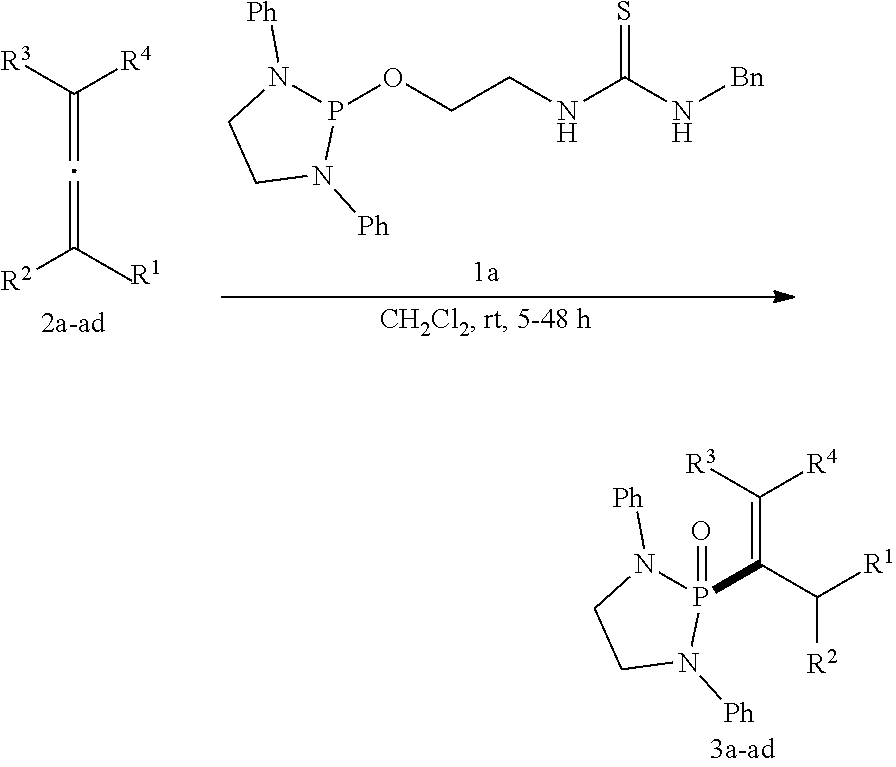 |
 |
 |
 |
 |
 |
 |
 |
|
 |
 |
 |
 |
 |
 |
 |
 |
 |
 |
 |
 |
 |
 |
 |
 |
 |
 |
 |
 |
|
| aReactions were performed using 2 (0.30 mmol) and NHP 1a (0.10 mmol) in CH2Cl2 (0.15 mL) at rt for 5-48 h. | ||
| bIsolated yield. | ||
| cReaction run for 24 h. | ||
| dReaction run for 48 h. | ||
| eReaction was conducted with 2j (0.92 equiv). | ||
| fE/Z ratio was determined by crude NMR spectrum. | ||


- Robbie, A. J.; Cowley, A. R.; Jones, M. W.; Dilworth, J. R. Polyhedron 2011, 30, 1849.
- Bemacki, A. L.; Zhu, L.; Hennings, D. D. Org. Lett. 2010, 12, 5526.
- Caputo, C. A.; Price, J. T.; Jennings, M. C.; McDonald, R.; Jones, N. D. Dalton Trans. 2008, 3461.
- Goodyer, C. L. M.; Chinje, E. C.; Jaffar, M.; Stratford, I. J.; Threadgill, M. D. Bioorg. Med. Chem. 2003, 11, 4189.
- Reiter, J. T., L.; Schafer, I Eur. J. Med. Chem. 1980, 15, 41.
- Boverie, S.; De, T. P.; Delarge, J.; Dorwald, F. Z.; Hansen, J. B.; Lebrun, P.; Mogensen, J. P.; Pirotte, B.; Tagmose, T. M.; Google Patents: 1999.
- Lown, J. W.; Chauhan, S. M. S. J. Org. Chem. 1983, 48, 507.
- Law, K. R.; McErlean, C. S. P. Chem. Eur. J. 2013, 19, 15852.
- Denton, R. M.; An, J.; Adeniran, B.; Blake, A. J.; Lewis, W.; Poulton, A. M. J. Org. Chem. 2011, 76, 6749.
- Guzaev, A. P.; Manoharan, M. J. Am. Chem. Soc. 2001, 123, 783.
- Heinelt, U.; Schultheis, D.; Jiger, S.; Lindenmaier, M.; Pollex, A.; Beckmann, H. S. g. Tetrahedron 2004, 60, 9883.
- Ambartsumova, R. F.; Levkovich, M. G.; Mil'grom, E. G.; Abdullaev, N. D. Chem Heterocycl Compd 1997, 33, 112.
- Kim, T. H.; Min, J. K.; Lee, G.-J. Tetrahedron Lett. 1999, 40, 8201.
- Rout, L.; Harned, A. M. Chem. Eur. J. 2009, 15, 12926.
- Constantieux, T.; Buono, G. In Organic Syntheses; John Wiley & Sons, Inc.: 2002; Vol. 78, p 135.
- Bang, J.; Kim, H.; Kim, J.; Yu, C.-M. Org. Lett. 2015, 17, 1573.
- Cowen, B. J.; Saunders, L. B.; Miller, S. J. J. Am. Chem. Soc. 2009, 131, 6105.
- GP-1-I, The allene was prepared by the GP-1-I.
- Clavier, H.; Jeune, K. L.; Riggi, I. d.; Tenaglia, A.; Buono, G. Org. Lett. 2011, 13, 308.
- Na, R.; Jing, C.; Xu, Q.; Jiang, H.; Wu, X.; Shi, J.; Zhong, J.; Wang, M.; Benitez, D.; Tkatchouk, E.; Goddard, W. A.; Guo, H.; Kwon, O. J. Am. Chem. Soc. 2011, 133, 13337.
- GP-1-II, The allene was prepared by GP-1-II.
- Zhu, X.-F.; Lan, J.; Kwon, O. J. Am. Chem. Soc. 2003, 125, 4716.
- Wurz, R. P.; Fu, G. C. J. Am. Chem. Soc. 2005, 127, 12234.
- Lee, P. H.; Mo, J.; Kang, D.; Eom, D.; Park, C.; Lee, C.-H.; Jung, Y. M.; Hwang, H. J. Org. Chem. 2011, 76, 312.
- Liao, J.-Y.; Shao, P.-L.; Zhao, Y. J. Am. Chem. Soc. 2015, 137, 628.
- Tsuboi, S.; Kuroda, H.; Takatsuka, S.; Fukawa, T.; Sakai, T.; Utaka, M. J. Org. Chem. 1993, 58, 5952.
- Chen, B.; Lu, Z.; Chai, G.; Fu, C.; Ma, S. J. Org. Chem. 2008, 73, 9486.
- Trost, B. M.; Pinkerton, A. B.; Seidel, M. J. Am. Chem. Soc. 2001, 123, 12466.
Claims (20)


Priority Applications (1)
| Application Number | Priority Date | Filing Date | Title |
|---|---|---|---|
| US15/505,052 US10633403B2 (en) | 2014-09-09 | 2015-09-09 | N-heterocyclic phosphines |
Applications Claiming Priority (4)
| Application Number | Priority Date | Filing Date | Title |
|---|---|---|---|
| US201462048072P | 2014-09-09 | 2014-09-09 | |
| US201562175028P | 2015-06-12 | 2015-06-12 | |
| US15/505,052 US10633403B2 (en) | 2014-09-09 | 2015-09-09 | N-heterocyclic phosphines |
| PCT/US2015/049181 WO2016040479A1 (en) | 2014-09-09 | 2015-09-09 | N-heterocyclic phosphines |
Publications (2)
| Publication Number | Publication Date |
|---|---|
| US20180118770A1 US20180118770A1 (en) | 2018-05-03 |
| US10633403B2 true US10633403B2 (en) | 2020-04-28 |
Family
ID=55459515
Family Applications (1)
| Application Number | Title | Priority Date | Filing Date |
|---|---|---|---|
| US15/505,052 Active 2036-05-01 US10633403B2 (en) | 2014-09-09 | 2015-09-09 | N-heterocyclic phosphines |
Country Status (2)
| Country | Link |
|---|---|
| US (1) | US10633403B2 (en) |
| WO (1) | WO2016040479A1 (en) |
Cited By (1)
| Publication number | Priority date | Publication date | Assignee | Title |
|---|---|---|---|---|
| US11760701B2 (en) | 2018-02-27 | 2023-09-19 | The Research Foundation For The State University Of New Yrok | Difluoromethoxylation and trifluoromethoxylation compositions and methods for synthesizing same |
Families Citing this family (4)
| Publication number | Priority date | Publication date | Assignee | Title |
|---|---|---|---|---|
| WO2016040479A1 (en) | 2014-09-09 | 2016-03-17 | The Board Of Regents Of The Nevada System Of Higher Education On Behalf Of The University Of Nevada, Las Vegas | N-heterocyclic phosphines |
| US11161863B2 (en) * | 2017-09-13 | 2021-11-02 | Dalhousie University | Chiral catalyst and method for asymmetric reduction of an imine |
| CN110591153A (en) * | 2018-06-13 | 2019-12-20 | 德生智权有限公司 | Flame retardants, their precursors and flame retardant materials |
| CN116120382B (en) * | 2023-01-29 | 2024-02-02 | 中国药科大学 | Glycosyl cyclic phosphoramide derivative, preparation method and flame retardant |
Citations (2)
| Publication number | Priority date | Publication date | Assignee | Title |
|---|---|---|---|---|
| WO1999007672A1 (en) | 1997-08-05 | 1999-02-18 | Novo Nordisk A/S | Derivatives of 2,5- and 3,5-disubstituted anilines, their preparation and use |
| WO2016040479A1 (en) | 2014-09-09 | 2016-03-17 | The Board Of Regents Of The Nevada System Of Higher Education On Behalf Of The University Of Nevada, Las Vegas | N-heterocyclic phosphines |
-
2015
- 2015-09-09 WO PCT/US2015/049181 patent/WO2016040479A1/en not_active Ceased
- 2015-09-09 US US15/505,052 patent/US10633403B2/en active Active
Patent Citations (2)
| Publication number | Priority date | Publication date | Assignee | Title |
|---|---|---|---|---|
| WO1999007672A1 (en) | 1997-08-05 | 1999-02-18 | Novo Nordisk A/S | Derivatives of 2,5- and 3,5-disubstituted anilines, their preparation and use |
| WO2016040479A1 (en) | 2014-09-09 | 2016-03-17 | The Board Of Regents Of The Nevada System Of Higher Education On Behalf Of The University Of Nevada, Las Vegas | N-heterocyclic phosphines |
Non-Patent Citations (86)
| Title |
|---|
| Ackermann, L. et al. (2010) Tetra-ortho-Substituted Biaryls Through Palladium-Catalyzed Suzuki-Miyaura Couplings with a Diaminochlorophosphine Ligand. Org Lett. 12(5):1004-7. |
| Al Quntar, A.A.A. et al. (2007) Potent Anti-Inflammatory Activity of 3-Aminovinylphosphonates as Inhibitors of Reactive Oxygen Intermediates, Nitric Oxides Generation, and Tumor Necrosis Factor-Alpha Release. EurJ Pharmacol. 556(1-3):9-13. |
| Allen, D.W. et al., (2010) Phosphines and Related P-C-bonded Compounds. Organophosphorus Chem. 39:1-48. |
| Allen, D.W. et al., (2010) Phosphines and Related P—C-bonded Compounds. Organophosphorus Chem. 39:1-48. |
| Ambartsumova et al. (1997) 1,3-Thiazepines. 4.* Reactions of 2-Iminothiazepines with Methyl Acylate, Crystal and Molecular Structure of 2-Phenylimino-3-(3-Methoxycarbonylethyl)- and 2-Benzyliminohexahydro-1,3-Thiadiazepines. Chem Heterocycl Compd. 33:475-80. |
| Ansell, J. and M. Wills (2002) Enantioselective Catalysis Using Phosphorus-Donor Ligands Containing Two or Three P-N or P-O Bonds. Chem Soc Rev. 31(5):259-68. |
| Ansell, J. and M. Wills (2002) Enantioselective Catalysis Using Phosphorus-Donor Ligands Containing Two or Three P—N or P—O Bonds. Chem Soc Rev. 31(5):259-68. |
| Arbuzov, B.A. (1964) Michaelis-Arbusow-Und Perkow-Reaktionen. Pure Appl Chem. 9(2):307-35. |
| Bang, J. et al. (2015) Asymmetric Aldol Reaction of Allenoates: Regulation for the Selective Formation of Isomeric Allenyl or Alkynyl Aldol Adduct. Org Lett. 17(6):1573-6. |
| Berge, S.M. et al. Pharmaceutical Salts. J Pharma Sci. 66(1):1-19 (1977). |
| Bernacki, A.L. et al. (2010) A Selective and Convenient Method for the Synthesis of 2-Phenylaminothiazolines. Org Lett. 12(23):5526-9. |
| Bhattacharya, A.K. and G. Thyagarajan (1981) Michaelis-Arbuzov Rearrangement. Chem Rev. 81(4):415-30. |
| Blazis, V.J. et al. (1995) Reactions of Chiral Phosphorous Acid Diamides: The Asymmetric Snthesis of Chiral α-Hydroxy Phosphonamides, Phosphonates, and Phosphonic Acids. J Org Chem. 60(4):931-40. |
| Blom, K.F. et al. (2004) Preparative LC-MS Purification: Improved Compound-Specific Method Optimization. J Comb Chem. 6(6):874-83. |
| Borowitz, I.J. et al. (1972) Organophosphorus Chemistry. XVII. Kinetics and Mechanism of the Perkow Reaction. J Am Chem Soc. 94(5):1623-8. |
| Breeden, S. et al. (2000) Rhodium-Mediated Asymmetric Hydroformylation with a Novel Bis(diazaphospholidine) Ligand. Angew Chem Int Ed. 39(22):4106-8. |
| Breen et al., 2008, caplus an 2008:1485986. * |
| Breen, D. et al. (2009) A Divergent Synthesis of Minor Groove Binders With Tail Group Variation. Org Biomol Chem. 7(1):178-86. |
| Brunel, J.M. et al. (1997) Enantioselective Palladium Catalyzed Allylic Substitution with New Chiral Pyridine-Phosphine Ligands. Tetrahedron Lett. 38(34):5971-4. |
| Buck, F.C. and J.T. Yoke, III (1962) On the Mechanism of the Arbuzov Rearrangement. J Org Chem. 27(10):3675-7. |
| Caputo, C.A. et al. (2008) N-Heterocyclic Phosphenium Cations: Syntheses and Cycloaddition Reactions. Dalton Trans. (26):3461-9. |
| Catana, D.A. et al. (2011) Synthesis of Phostone-Constrained Nucleic Acid (P-CNA) Dinucleotides Through Intramolecular Arbuzov's Reaction. Eur J Org Chem. 2011(34):6857-63. |
| Chelucci, G. et al. (2003) Chiral P,N-Ligands with Pyridine-Nitrogen and Phosphorus Donor Atoms. Syntheses and Applications in Asymmetric Catalysis. Tetrahedron. 59(48):9471-515. |
| Chen, B. et al. (2008) An Efficient Double 1,2-Addition Reaction of 2,3-Allenoates with Allyl Magnesium Chloride. J Org Chem. 73(23):9486-9. |
| Clavier, H. et al. (2011) Highly Selective Cobalt-Mediated [6+2] Cycloaddition of Cycloheptatriene and Allenes. Org Lett. 13(2):308-11. |
| Constantieux, T. and G. Buono (2002) Synthesis of Penta-1,2-Dien-4-One (Acetylallene). Orgn Syn. 78:135. |
| Cowen, B. et al. (2009) Pyridylalanine (Pal)-Peptide Catalyzed Enantioselective Allenoate Additions to N-Acyl (mines. J Am Chem Soc. 131(17):6105-7. |
| De La Cruz, A. et al. (1998) The Synthesis, Structure and Properties of Diazaphospholes: Reagents and Ligands for Asymmetric Synthesis. Tetrahedron. 54(35):10513-24. |
| Denmark, S.E. and J.H. Kim (1995) Asymmetric Michael Addition Reaction of Phosphorus-Stabilized Allyl Anions with Cyclic. J Org Chem. 60(23):7535-47. |
| Denton, R.M. et al. (2011) Catalytic Phosphorus(V)-Mediated Nucleophilic Substitution Reactions: Development of a Catalytic Appel Reaction. J Org Chem. 76(16):6749-67. |
| Derivative, 2018, https://en.wikipedia.org/wiki/Derivative (chemistry). * |
| Dolomanov, O.V. et al. (2009) OLEX2: a Complete Structure Solution, Refinement and Analysis Program. J Appl Cryst. 42(2):339-41. |
| Dupau, P. et al. (2002) Osmium-Catalyzed Dihydroxylation of Olefins in Acidic Media: Old Process, New Tricks. Adv Synth Catal. 344(3-4):421-33. |
| Enders, D. et al. (2006) the Phospha-Michael Addition in Organic Synthesis. Eur J Org Chem. 2006(1):29-49. |
| Fernandez-Valle, M.E. et al. (2015) 2D Ultrafast HMBC 1H, 31P: Obtaining Mechanistic Details on the Michaelis-Arbuzov Reaction. J Org Chem. 80(2):799-805. |
| Geng, Z.C. et al. (2014) Construction of Highly Substituted Pyrazole Derivatives with P-C Bond: Access to Racemic and Enantioselective Forms by Conjugate Addition of Diarylphosphane Oxides to α,β-Unsaturated Pyrazolones. Tetrahedron. 70(2):417-26. |
| Geng, Z.C. et al. (2014) Construction of Highly Substituted Pyrazole Derivatives with P—C Bond: Access to Racemic and Enantioselective Forms by Conjugate Addition of Diarylphosphane Oxides to α,β-Unsaturated Pyrazolones. Tetrahedron. 70(2):417-26. |
| Goodyer, C.L.M. et al. (2003) Synthesis of N-benzyl- and N-phenyl-2-amino-4,5-dihydrothiazoles and Thioureas and Evaluation as Modulators of the Isoforms of Nitric Oxide Synthase. Bioorg Med Chem. 11(19):4189-206. |
| Guadat, D. (2010) Phosphorus Heterocycles II. Bansal, R.K., Ed.Springer Berlin Heidelberg: 2010; vol. 21, pp. 63-102. |
| Guang, J. and J.C.G. Zhao (2013) Organocatalyzed Asymmetric Michael Reaction of β-aryl-a-ketophosphonates and Nitroalkenes. Tetrahedron Lett. 54(42):5703. |
| Guzaev, A.P. and M. Manoharan (2001) 2-Benzamidoethyl Group-A Novel Type of Phosphate Protecting Group for Oligonucleotide Synthesis. J Am Chem Soc. 123(5):783-93. |
| Guzaev, A.P. and M. Manoharan (2001) 2-Benzamidoethyl Group—A Novel Type of Phosphate Protecting Group for Oligonucleotide Synthesis. J Am Chem Soc. 123(5):783-93. |
| Hanessian, S. et al. (2000) Asymmetric Conjugate Additions of Chiral Phosphonamide Anions to α,β-Unsaturated Carbonyl Compounds. A Versatile Method for Vicinally Substituted Chirons. J Org Chem. 65(18):5623-31. |
| Heinelt, U. et al. (2004) A Convenient Method for the Synthesis of 2-amino Substituted AZA-Heterocycles from N,N′-disubstituted Thioureas Using TsCl/NaOH. Tetrahedron. 60(44):9883-8. |
| Hoashi, Y. et al. (2004) Bifunctional Thiourea-Catalyzed Enantioselective Double Michael Reaction of y,6-unsaturated [3-ketoester to Nitroalkene: Asymmetric Synthesis of (-)-epibatidine. Tetrahedron Lett. 45(50):9185-8. |
| Hoashi, Y. et al. (2004) Bifunctional Thiourea-Catalyzed Enantioselective Double Michael Reaction of y,6-unsaturated [3-ketoester to Nitroalkene: Asymmetric Synthesis of (—)-epibatidine. Tetrahedron Lett. 45(50):9185-8. |
| Hoashi, Y. et al. (2005) Enantioselective Michael Addition to α,β-Unsaturated Imides Catalyzed by a Bifunctional Organocatalyst. Angew Chem Int Ed. 44(26):4032-5. |
| Holstein, S.A. et al. (1998) Phosphate and Bisphosphonate Analogues of Farnesyl Pyrophosphate as Potential Inhibitors of Farnesyl Protein Tranferase. Bioorg Med Chem. 6(6):687-94. |
| Hua, D.H. et al. (1987) Remarkable Enantioselective 1,4-Addition Reactions of Chiral Allylphosphonyl Anions (Ambident Nucleophiles) with Cyclic Enones (Ambident Electrophiles). J Am Chem Soc. 109(16):5026-9. |
| International Preliminary Report on Patentability dated Mar. 14, 2017 by the International Searching Authority for International Patent Application No. PCT/US2015/049181, which was filed on Sep. 9, 2015 and published as WO 2016/040479 on Mar. 17, 2016 (Inventor-Kang et al.; Applicant-University of Nevada; (6 pages). |
| International Preliminary Report on Patentability dated Mar. 14, 2017 by the International Searching Authority for International Patent Application No. PCT/US2015/049181, which was filed on Sep. 9, 2015 and published as WO 2016/040479 on Mar. 17, 2016 (Inventor—Kang et al.; Applicant—University of Nevada; (6 pages). |
| International Search Report and Written Opinion dated Feb. 16, 2016 by the International Searching Authority for International Patent Application No. PCT/US2015/049181, which was filed on Sep. 9, 2015 and published as WO 2016/040479 on Mar. 17, 2016 (Inventor-Kang et al.; Applicant-University of Nevada; (9 pages). |
| International Search Report and Written Opinion dated Feb. 16, 2016 by the International Searching Authority for International Patent Application No. PCT/US2015/049181, which was filed on Sep. 9, 2015 and published as WO 2016/040479 on Mar. 17, 2016 (Inventor—Kang et al.; Applicant—University of Nevada; (9 pages). |
| Jackson, J.A. et al. (1989) Synthesis of α-phosphono Lactones and Esters Through a Vinyl Phosphate-Phosphonate Rearrangement. J Org Chem. 54(20):4750-4. |
| Kedrowski, S.M. and D.A. Dougherty (2010) Room-Temperature Alternative to the Arbuzov Reaction: The Reductive Deoxygenation of Acyl Phosphonates. Org Lett. 12(18):3990-3. |
| Keglevich, G. et al. (2008) Phospha-Michael Reactions Involving P-Heterocyclic Nucleophiles. Heteroat Chem. 19(3):288-92. |
| Kim, T.H. et al. (1999) One-Pot Synthesis of 2-phenylaminothiazolines from N-2-hydroxyethyl)-N′-phenylthioureas. Tetrahedron Lett. 40(47):8201-4. |
| Law, K.R. and C.S.P. McErlean (2013) Extending the Stetter Reaction with 1,6-Acceptors. Chem Eur J. 19(47):15852-5. |
| Lee, J.H. et al. (2010) Characterization and Structure of Dhpl, a Phosphonate O-Methyltransferase Involved in Dehydrophos Biosynthesis. Proc Natl Acad Sci U.S.A. 107(41):17557-62. |
| Lee, P.H. et al. (2011) Preparation of Ethyl 2-Aryl 2,3-Alkadienoates via Palladium-Catalyzed Selective Cross-Coupling Reactions. J Org Chem. 76(1):312-5. |
| Liao, J.Y. et al. (2015) Catalytic Divergent Synthesis of 3H of 1H Pyrroles by [3+2] Cyclization of Allenoates with Activated Isocyanides. J Am Chem Soc. 137(2):628-31. |
| Lown, J.W. and S.M.S. Chauhan (1983) Synthesis of Novel-N-Nitrosothioureas and Examination of Their Mechanisms of Formation by High-Field Nitrogen-15 and Carbon-13 Nuclear Magnetic Resonance Spectra of Specifically Labeled Compounds. J Org Chem. 48(4):507-12. |
| Michaelis, A. and R. Kaehne (1898) Ueber das Verhalten der Jodalkyle genen die sogen. Phosphorisäureester oder O-Phosphine. Ber Dtsch Chem Ges. 31(1):1048-55. |
| Moriwake, T. et al. (1986) A Selective 1,2-Reduction of γ-Amino-α,β-Unsaturated Esters by Means of BF3-OEt2-DIBAL-H System. Highly Versatile Chiral Building Blocks from α-Amino Acids. Chem Lett. 15(5):815-8. |
| Na, R. et al. (2011) Phosphine-Catalyzed Annulations of Azomethine (mines: Allene-Dependent [3+2], [3+3], [4+3], and [3+2+3] Pathways. J Am Chem Soc. 133(34):13337. |
| Nametz, R.C. (1967) Self-Extinguishing polyester Resins. Ind Eng Chem. 59(5):99-116. |
| Okino, T. et al. (2005) Enantio- and Diastereoselective Michael Reaction of 1,3-Dicarbonyl Compounds to Nitroolefins Catalyzed by a Bifunctional Thiourea. J Am Chem Soc. 127(1):119-25. |
| PCT/US2015/049181 (WO 2016/040479), Sep. 9, 2015 (Mar. 17, 2016), Jun Yong Kang et al. |
| Pétursson, S. et al. (1997) Protecting Groups in Carbohydrate Chemistry. J Chem Educ. 74(11):1297. |
| Pubchem-15142984. Create date: Feb. 9, 2007. |
| Rajeshwaran, G.G. et al. (2011) Lewis Acid-Mediated Michaelis-Arbuzov Reaction at Room Temperature: a Facile Preparation of Arylmethul/Heteroarylmethyl Phosphonates. Org Lett. 13(6):1270-3. |
| Rajeshwaran, G.G. et al. (2011) Lewis Acid-Mediated Michaelis—Arbuzov Reaction at Room Temperature: a Facile Preparation of Arylmethul/Heteroarylmethyl Phosphonates. Org Lett. 13(6):1270-3. |
| Reiter, J. et al. (1980) Synthesis of New "Benzyl"-Thiourea Derivatives and Their Cyclic Analogues with Diuretic and Saluretic Activity. EurJ Med Chem. 15(1):41-3. |
| Remington's Pharmaceutical Sciences, 17th ed., Mack Publishing Company, Easton, PA, 1985, p. 1418. |
| Renard, P.Y. et al. (2003) Lewis Acid Catalyzed Room-Temperature Michaelis-Arbuzov Rearrangement. Angew Chem Int Ed. 42(21):2389-92. |
| Robbie, A.J. et al. (2011) Complexes of Sterically-Hindered Diaminophosphinothiolate Ligands with Rh(I), Ni(II) and Pd(II). Polyhedron. 30(11):1849-56. |
| Rout, L. and A.M. Harned (2009) Allene Carboxylates as Dipolarophiles in Rh-Catalyzed Carbonyl Ylide Cycloadditions. Chem Eur J. 15(47):12926-8. |
| Scherer, O.J. and M. Schmidt. (1964) Synthese neuer Organoarsen- und Organophosphor-amine. Angew Chem. 76(18):787. |
| Shie, J.J. et al. (2008) a Concise and Flexible Synthesis of the Potent Anti-Influenza Agents Tamiflu and Tamiphosphor. Angew Chem Int Ed. 47(31):5788-91. |
| Trost, B.M. et al. (2001) Ruthenium-Catalyzed Two-Component Addition to Form 1,3-Dienes: Optimization, Scope, Applications, and Mechanism. J Am Chem Soc. 123(50):12466-76. |
| Tsuboi, S. et al. (1993) A New Aldol Condensation of α-allenic Esters with Aldehydes, Including a One-Pot Synthesis of Enyne Compounds. J Org Chem. 58(22):5952-7. |
| U.S. Appl. No. 62/048,072, filed Sep. 9, 2014, Jun Yong Kang et al. |
| Wurz, R.P. and G.C. Fu (2005) Catalytic Asymmetric Synthesis of Piperidine Derivatives through the [4+2] Annulation of Imines with Allenes. J Am Chem Soc. 127(35):12234-5. |
| Xiao, Y. et al. (2014) Chiral Phosphines in Nucleophilic Organocatalysis. Beilstein J Org Chem. 10:2089-121. |
| Zhu, X.F. et al. (2003) An Expedient Phosphine-Catalyzed [4+2] Annulation: Synthesis of Highly Functionalized Tetrahydropyridines. J Am Chem Soc. 125(16):4716-7. |
| Zijp, E.J et al. (2005) Chiral Bidentate Aminophosphine Ligands: Synthesis, Coordination Chemistry and Asymmetric Catalysis. Dalton Trans. 3: 512-7. |
Cited By (1)
| Publication number | Priority date | Publication date | Assignee | Title |
|---|---|---|---|---|
| US11760701B2 (en) | 2018-02-27 | 2023-09-19 | The Research Foundation For The State University Of New Yrok | Difluoromethoxylation and trifluoromethoxylation compositions and methods for synthesizing same |
Also Published As
| Publication number | Publication date |
|---|---|
| US20180118770A1 (en) | 2018-05-03 |
| WO2016040479A1 (en) | 2016-03-17 |
Similar Documents
| Publication | Publication Date | Title |
|---|---|---|
| US10633403B2 (en) | N-heterocyclic phosphines | |
| US11912715B2 (en) | Fused tricyclic pyridazinone compounds useful to treat orthomyxovirus infections | |
| CA3186854A1 (en) | Scalable synthetic route for psilocin and psilocybin | |
| RU2493156C2 (en) | Methods of producing compounds based on 4-phenyl-6-(2,2,2-trifluoro-1-phenylethoxy)pyrimidine | |
| KR102485731B1 (en) | JAK Enzyme Inhibitors and Manufacturing Methods and Uses Thereof | |
| US11873315B2 (en) | Chiral n-heterocyclic phosphorodiamidic acids (NHPAS) and derivatives as novel Brønsted acid catalysts | |
| US10927135B2 (en) | Metal-free direct arylation of dialkyl phosphonates for the synthesis of mixed alkyl aryl phosphonates | |
| US11174278B2 (en) | Functionalized phosphonates via Michael addition | |
| EP1527070B1 (en) | Azole methylidene cyanide derivatives and their use as protein kinase modulators | |
| US20230159462A1 (en) | Method for producing nitrogen-containing heteroarylcarboxamide acetic acid derivative | |
| US20130116445A1 (en) | Triazolium carbene catalysts and processes for asymmetric carbon-carbon bond formation | |
| US10087204B2 (en) | Methods and compositions for substituted alpha-aminophosphonate analogues | |
| US10618892B2 (en) | Processes for the preparation of a BACE inhibitor | |
| AU2023354158A1 (en) | Azole modulators of cholesterol biosynthesis and their use for promoting remyelination | |
| HK40055239B (en) | Fused tricyclic pyridazinone compounds useful to treat orthomyxovirus infections | |
| HK40055239A (en) | Fused tricyclic pyridazinone compounds useful to treat orthomyxovirus infections | |
| KR20160008873A (en) | Novel beta-sulfinamino malonate derivatives and process for preparing the same, and process for preparing sitagliptin using the same | |
| HK40009860A (en) | Fused tricyclic pyridazinone compounds useful to treat orthomyxovirus infections | |
| HK40009860B (en) | Fused tricyclic pyridazinone compounds useful to treat orthomyxovirus infections |
Legal Events
| Date | Code | Title | Description |
|---|---|---|---|
| AS | Assignment |
Owner name: THE BOARD OF REGENTS OF THE NEVADA SYSTEM OF HIGHER EDUCATION ON BEHALF OF THE UNIVERSITY OF NEVADA, LAS VEGAS, NEVADA Free format text: ASSIGNMENT OF ASSIGNORS INTEREST;ASSIGNORS:KANG, JUN YONG;MULLA, KARIMULLA;ALESHIRE, KYLE;AND OTHERS;SIGNING DATES FROM 20170407 TO 20170630;REEL/FRAME:043066/0036 Owner name: THE BOARD OF REGENTS OF THE NEVADA SYSTEM OF HIGHE Free format text: ASSIGNMENT OF ASSIGNORS INTEREST;ASSIGNORS:KANG, JUN YONG;MULLA, KARIMULLA;ALESHIRE, KYLE;AND OTHERS;SIGNING DATES FROM 20170407 TO 20170630;REEL/FRAME:043066/0036 |
|
| STPP | Information on status: patent application and granting procedure in general |
Free format text: PUBLICATIONS -- ISSUE FEE PAYMENT VERIFIED |
|
| STPP | Information on status: patent application and granting procedure in general |
Free format text: PUBLICATIONS -- ISSUE FEE PAYMENT VERIFIED |
|
| STPP | Information on status: patent application and granting procedure in general |
Free format text: PUBLICATIONS -- ISSUE FEE PAYMENT VERIFIED |
|
| STCF | Information on status: patent grant |
Free format text: PATENTED CASE |
|
| MAFP | Maintenance fee payment |
Free format text: PAYMENT OF MAINTENANCE FEE, 4TH YR, SMALL ENTITY (ORIGINAL EVENT CODE: M2551); ENTITY STATUS OF PATENT OWNER: SMALL ENTITY Year of fee payment: 4 |