US10630955B2 - Display device, method of driving display device, and electronic device - Google Patents
Display device, method of driving display device, and electronic device Download PDFInfo
- Publication number
- US10630955B2 US10630955B2 US15/558,279 US201615558279A US10630955B2 US 10630955 B2 US10630955 B2 US 10630955B2 US 201615558279 A US201615558279 A US 201615558279A US 10630955 B2 US10630955 B2 US 10630955B2
- Authority
- US
- United States
- Prior art keywords
- image
- display
- unit
- pixels
- eye
- Prior art date
- Legal status (The legal status is an assumption and is not a legal conclusion. Google has not performed a legal analysis and makes no representation as to the accuracy of the status listed.)
- Active, expires
Links
Images




Classifications
-
- G—PHYSICS
- G02—OPTICS
- G02B—OPTICAL ELEMENTS, SYSTEMS OR APPARATUS
- G02B30/00—Optical systems or apparatus for producing three-dimensional [3D] effects, e.g. stereoscopic images
- G02B30/20—Optical systems or apparatus for producing three-dimensional [3D] effects, e.g. stereoscopic images by providing first and second parallax images to an observer's left and right eyes
- G02B30/26—Optical systems or apparatus for producing three-dimensional [3D] effects, e.g. stereoscopic images by providing first and second parallax images to an observer's left and right eyes of the autostereoscopic type
- G02B30/27—Optical systems or apparatus for producing three-dimensional [3D] effects, e.g. stereoscopic images by providing first and second parallax images to an observer's left and right eyes of the autostereoscopic type involving lenticular arrays
- G02B30/29—Optical systems or apparatus for producing three-dimensional [3D] effects, e.g. stereoscopic images by providing first and second parallax images to an observer's left and right eyes of the autostereoscopic type involving lenticular arrays characterised by the geometry of the lenticular array, e.g. slanted arrays, irregular arrays or arrays of varying shape or size
-
- H—ELECTRICITY
- H04—ELECTRIC COMMUNICATION TECHNIQUE
- H04N—PICTORIAL COMMUNICATION, e.g. TELEVISION
- H04N13/00—Stereoscopic video systems; Multi-view video systems; Details thereof
- H04N13/10—Processing, recording or transmission of stereoscopic or multi-view image signals
- H04N13/106—Processing image signals
- H04N13/111—Transformation of image signals corresponding to virtual viewpoints, e.g. spatial image interpolation
- H04N13/117—Transformation of image signals corresponding to virtual viewpoints, e.g. spatial image interpolation the virtual viewpoint locations being selected by the viewers or determined by viewer tracking
-
- G02B27/2214—
-
- G—PHYSICS
- G02—OPTICS
- G02B—OPTICAL ELEMENTS, SYSTEMS OR APPARATUS
- G02B30/00—Optical systems or apparatus for producing three-dimensional [3D] effects, e.g. stereoscopic images
- G02B30/20—Optical systems or apparatus for producing three-dimensional [3D] effects, e.g. stereoscopic images by providing first and second parallax images to an observer's left and right eyes
- G02B30/26—Optical systems or apparatus for producing three-dimensional [3D] effects, e.g. stereoscopic images by providing first and second parallax images to an observer's left and right eyes of the autostereoscopic type
- G02B30/27—Optical systems or apparatus for producing three-dimensional [3D] effects, e.g. stereoscopic images by providing first and second parallax images to an observer's left and right eyes of the autostereoscopic type involving lenticular arrays
-
- G—PHYSICS
- G06—COMPUTING OR CALCULATING; COUNTING
- G06F—ELECTRIC DIGITAL DATA PROCESSING
- G06F3/00—Input arrangements for transferring data to be processed into a form capable of being handled by the computer; Output arrangements for transferring data from processing unit to output unit, e.g. interface arrangements
- G06F3/01—Input arrangements or combined input and output arrangements for interaction between user and computer
- G06F3/011—Arrangements for interaction with the human body, e.g. for user immersion in virtual reality
- G06F3/012—Head tracking input arrangements
-
- G—PHYSICS
- G06—COMPUTING OR CALCULATING; COUNTING
- G06F—ELECTRIC DIGITAL DATA PROCESSING
- G06F3/00—Input arrangements for transferring data to be processed into a form capable of being handled by the computer; Output arrangements for transferring data from processing unit to output unit, e.g. interface arrangements
- G06F3/01—Input arrangements or combined input and output arrangements for interaction between user and computer
- G06F3/011—Arrangements for interaction with the human body, e.g. for user immersion in virtual reality
- G06F3/013—Eye tracking input arrangements
-
- H—ELECTRICITY
- H04—ELECTRIC COMMUNICATION TECHNIQUE
- H04N—PICTORIAL COMMUNICATION, e.g. TELEVISION
- H04N13/00—Stereoscopic video systems; Multi-view video systems; Details thereof
- H04N13/10—Processing, recording or transmission of stereoscopic or multi-view image signals
- H04N13/106—Processing image signals
- H04N13/167—Synchronising or controlling image signals
-
- H—ELECTRICITY
- H04—ELECTRIC COMMUNICATION TECHNIQUE
- H04N—PICTORIAL COMMUNICATION, e.g. TELEVISION
- H04N13/00—Stereoscopic video systems; Multi-view video systems; Details thereof
- H04N13/30—Image reproducers
- H04N13/302—Image reproducers for viewing without the aid of special glasses, i.e. using autostereoscopic displays
- H04N13/31—Image reproducers for viewing without the aid of special glasses, i.e. using autostereoscopic displays using parallax barriers
-
- H—ELECTRICITY
- H04—ELECTRIC COMMUNICATION TECHNIQUE
- H04N—PICTORIAL COMMUNICATION, e.g. TELEVISION
- H04N13/00—Stereoscopic video systems; Multi-view video systems; Details thereof
- H04N13/30—Image reproducers
- H04N13/324—Colour aspects
-
- H—ELECTRICITY
- H04—ELECTRIC COMMUNICATION TECHNIQUE
- H04N—PICTORIAL COMMUNICATION, e.g. TELEVISION
- H04N13/00—Stereoscopic video systems; Multi-view video systems; Details thereof
- H04N13/30—Image reproducers
- H04N13/349—Multi-view displays for displaying three or more geometrical viewpoints without viewer tracking
- H04N13/351—Multi-view displays for displaying three or more geometrical viewpoints without viewer tracking for displaying simultaneously
-
- H—ELECTRICITY
- H04—ELECTRIC COMMUNICATION TECHNIQUE
- H04N—PICTORIAL COMMUNICATION, e.g. TELEVISION
- H04N13/00—Stereoscopic video systems; Multi-view video systems; Details thereof
- H04N13/30—Image reproducers
- H04N13/366—Image reproducers using viewer tracking
- H04N13/376—Image reproducers using viewer tracking for tracking left-right translational head movements, i.e. lateral movements
Definitions
- the present disclosure relates to a display device, a method of driving the display device, and an electronic device. More specifically, this relates to a display device capable of displaying an image with parallax, thereby realizing stereoscopic vision, a method of driving such display device, and an electronic device provided with such display device.
- Various display devices are known for realizing stereoscopic vision by observing two images with parallax by an image observer.
- a naked-eye type display device practical realization of a display device obtained by combining an optical separating unit formed of a parallax barrier or a lens sheet provided with a lens array and a display unit displaying a two-dimensional image is promoted.
- FIG. 30 A conceptual diagram of operation of the naked-eye type display device is illustrated in FIG. 30 .
- a group of rays emitted from pixels with reference signs 1 R , 3 R , 5 R , 7 R , and 9 R reaches a viewpoint 1 and a group of rays emitted from pixels with reference signs 2 L , 4 L , 6 L , 8 L , and 10 L reaches a viewpoint 2 . Therefore, at a position apart from the display unit by a predetermined distance, the image at the viewpoint 1 and the image at the viewpoint 2 are independently observed.
- the image observer observes the image at a position deviated from the viewpoint 1 and viewpoint 2 .
- images for different viewpoints are mixedly observed.
- the crosstalk damages a stereoscopic effect.
- a state such as “reverse viewing” in which the left-eye image and the right-eye image are displaced with each other occurs.
- the image observer perceives the image in which the front and the back are inverted, and feels unnatural or uncomfortable.
- Patent Document 1 a display device in which a position of an image observer is detected and contents of an image to be displayed on a display unit are changed is proposed (refer to Patent Document 1).
- Patent Document 1 Japanese Patent Application Laid-Open No. 2000-47139
- an object of the present disclosure is to provide a display device capable of observing images with small crosstalk, a method of driving the display device, and an electronic device.
- a display device for achieving the above-described object is a display device provided with:
- a display unit including a display area which displays a two-dimensional image
- an optical separating unit configured to separate the image displayed in the display area into images to be observed at a plurality of predetermined observation positions set so as to be arranged at intervals in a horizontal direction, respectively;
- a position detecting unit which detects position information of an image observer
- pixels in the display area are arranged in a matrix in a horizontal direction and in a vertical direction
- structure bodies of the optical separating unit are arranged at a predetermined angle with respect to the vertical direction, an array pitch in the horizontal direction of the structure bodies being set to be a non-integral multiple of the array pitch in the horizontal direction of the pixels in the display area, and
- the driving unit controls the image to be displayed on the display unit such that a right-eye image is observed at each of a plurality of observation positions located in the vicinity of an observer's right eye and a left-eye image is observed at each of a plurality of observation positions located in the vicinity of an observer's left eye on the basis of the position information from the position detecting unit.
- a method of driving a display device according to the present disclosure for achieving the above-described object is a method of driving a display device provided with:
- a display unit including a display area which displays a two-dimensional image
- an optical separating unit configured to separate the image displayed in the display area into images to be observed at a plurality of predetermined observation positions set so as to be arranged at intervals in a horizontal direction, respectively;
- a position detecting unit which detects position information of an image observer
- pixels in the display area are arranged in a matrix in a horizontal direction and in a vertical direction
- structure bodies of the optical separating unit are arranged at a predetermined angle with respect to the vertical direction, an array pitch in the horizontal direction of the structure bodies being set to be a non-integral multiple of the array pitch in the horizontal direction of the pixels in the display area, and
- the driving unit controls the image to be displayed on the display unit such that a right-eye image is observed at each of a plurality of observation positions located in the vicinity of an observer's right eye and a left-eye image is observed at each of a plurality of observation positions located in the vicinity of an observer's left eye on the basis of the position information from the position detecting unit.
- An electronic device for achieving the above-described object is an electronic device provided with a display device, the display device including:
- a display unit including a display area which displays a two-dimensional image
- an optical separating unit configured to separate the image displayed in the display area into images to be observed at a plurality of predetermined observation positions set so as to be arranged at intervals in a horizontal direction, respectively;
- a position detecting unit which detects position information of an image observer
- pixels in the display area are arranged in a matrix in a horizontal direction and in a vertical direction
- structure bodies of the optical separating unit are arranged at a predetermined angle with respect to the vertical direction, an array pitch in the horizontal direction of the structure bodies being set to be a non-integral multiple of the array pitch in the horizontal direction of the pixels in the display area, and
- the driving unit controls the image to be displayed on the display unit such that a right-eye image is observed at each of a plurality of observation positions located in the vicinity of an observer's right eye and a left-eye image is observed at each of a plurality of observation positions located in the vicinity of an observer's left eye on the basis of the position information from the position detecting unit.
- an image to be displayed on a display unit is controlled such that a right-eye image is observed at each of a plurality of observation positions located in the vicinity of a right eye of an observer and a left-eye image is observed at each of a plurality of observation positions located in the vicinity of a left eye of the observer on the basis of the position information from the position detecting unit. Therefore, crosstalk may be suppressed, and even if the image is observed at a position deviated from an observation position in design, it is possible to observe the image with an excellent stereoscopic effect.
- FIG. 1 is a schematic perspective view when a display device used in an embodiment is virtually separated.
- FIG. 2 is a schematic plan view of a part of a display area for illustrating an arrangement relationship of pixels in a display area of a display unit.
- FIG. 3 is a schematic plan view of a part of an optical separating unit for illustrating a structure of the optical separating unit.
- FIG. 4 is a schematic plan view of a display area for illustrating arrangement of a pixel group formed of a plurality of pixels.
- FIG. 5 is a schematic plan view of a part of the optical separating unit and the display area for illustrating an arrangement relationship between an opening of the optical separating unit and the pixels of the pixel group.
- FIG. 6 is a schematic diagram illustrating pixels which display an image to be observed at an observation position A 1 in a (j, k) pixel group.
- FIG. 7 is a schematic diagram illustrating pixels which display an image to be observed at an observation position A 2 in the (j, k) pixel group.
- FIG. 8 is a schematic diagram illustrating pixels which display an image to be observed at an observation position A 3 in the (j, k) pixel group.
- FIG. 11 is a schematic flowchart for illustrating which of left-eye image data and right-eye image data is selected for each pixel to display in a case where an image observer observes the image at a reference position in design.
- FIG. 12 is a view for illustrating pixels which display on the basis of the right-eye image data in the (j, k) pixel group in a case where the image observer observes the image at the reference position in design.
- FIG. 13 is a view for illustrating pixels which display on the basis of the left-eye image data in the (j, k) pixel group in a case where the image observer observes the image at the reference position in design.
- FIG. 14 is a schematic diagram for illustrating a state when the image observer observes the image at the reference position in design.
- FIG. 15 is a schematic diagram for illustrating a state in which the image observer observes the image at a position deviated in a +X direction from the reference position in design.
- FIG. 16 is a schematic diagram for illustrating operation of correcting a viewpoint number of the pixel and an effect associated with the operation in a case where the image observer observes the image at a position deviated in the +X direction from the reference position in design.
- FIG. 17 is a schematic flowchart for illustrating the operation when correcting the viewpoint number of the pixel to display.
- FIG. 18 is a schematic diagram for illustrating an example of a corrected viewpoint number.
- FIG. 19 is a view for illustrating pixels which display on the basis of the right-eye image data in the (j, k) pixel group in a case where the viewpoint number of the pixel is corrected.
- FIG. 20 is a view for illustrating the pixels which display on the basis of the left-eye image data in the (j, k) pixel group in a case where the viewpoint number of the pixel is corrected.
- FIG. 21 is a schematic diagram for illustrating operation of correcting the viewpoint number of the pixel and an effect associated with the operation in a case where the image observer observes the image at a position deviated in a ⁇ X direction from the reference position in design
- FIG. 22 is a schematic flowchart for illustrating operation when displaying in a second embodiment.
- FIG. 23 is a schematic graph of coefficients (gain values) to be multiplied by image data DR, DL.
- FIG. 24 is a schematic diagram for illustrating a state when an image observer observes an image at a reference position in design in the second embodiment.
- FIG. 25 is a schematic diagram for illustrating a state in which the image observer observes the image at a position deviated in a +X direction from the reference position in design in the second embodiment.
- FIG. 26 is a schematic cross-sectional view for illustrating a relationship between an observer's position and an observed pixel in a third embodiment.
- FIG. 27 is a schematic cross-sectional view for illustrating a relationship between the observer's position and the observed pixel in a case where a substantial focal length of a lens sheet forming an optical separating unit is taken into consideration.
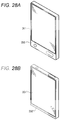
- FIG. 28A and FIG. 28B are views each illustrating an appearance of a smartphone to which the display device of the embodiment is applied.
- FIG. 29 illustrates an appearance of a television device to which the display device of the embodiment is applied.
- FIG. 30 is a conceptual diagram of a naked-eye type display device.
- FIG. 31 is a schematic diagram for illustrating that a left-eye image and a right-eye image are mixedly observed.
- a driving unit may be configured to select image data corresponding to a pixel which should display a right-eye image from right-eye image data which displays the right-eye image on an entire surface of a display area to drive the pixel and select image data corresponding to a pixel which should display a left-eye image from left-eye image data which displays the left-eye image on the entire surface of the display area to drive the pixel.
- observation positions A 1 to A P an observation position A P/4 is set to correspond to a right-eye reference position and an observation position A 3P/4 is set to correspond to a left-eye reference position.
- a position between the observation position and the adjacent observation position may correspond to the reference position.
- the reference position may be determined according to a design of the display device.
- this is a “position optimum for an observer to view the display device (optimum viewing position), the position from where the observer looks at the front of the display device”.
- a value of “P” may be determined according to the design of the display device.
- the value of “P” may be fixed or variable. For example, a mode in which this is variably controlled according to position information is also possible. Meanwhile, from a viewpoint of displaying a smooth image at the time of head tracking, it is preferable to set the value of “P” to a value not smaller than 8 at least.
- the driving unit may be configured to control an image to be displayed on a display unit such that the right-eye image is observed at the observation positions A 1 to A P/2 and the left-eye image is observed at the observation positions A (P/2)+1 to A P when observer's eyes are at predetermined reference positions, and control the image to be displayed on the display unit such that the image is observed in a state similar to that when the observer's eyes are at the predetermined reference positions when the observer's eyes are at positions deviated from the predetermined reference positions.
- the driving unit may be configured to control the image to be displayed on the display unit by correcting a viewpoint number corresponding to the pixel on the basis of a reference viewpoint number determined by a correspondence relationship between the pixels forming the pixel group and the observation positions A 1 to A P and position information from a position detecting unit.
- the driving unit may be configured to correct the viewpoint number of the pixel on the basis of the reference viewpoint number and the position information from the position detecting unit and select either the right-eye image data or the left-eye image data on the basis of a value of the corrected viewpoint number to drive the pixel. Furthermore, the driving unit may be configured to multiply a coefficient according to the value of the viewpoint number by the image data to drive the pixel.
- the driving unit may be configured to be provided with a table storing the reference viewpoint number commonly used in each pixel group.
- the optical separating unit is formed of a lens sheet
- the driving unit may be configured to correct the viewpoint number of the pixel on the basis of the reference viewpoint number, the position information from the position detecting unit, and an optical characteristic of the lens sheet.
- a correcting unit which corrects the image to be displayed on the display unit is provided so as to compensate for an effect due to deviation from the reference position.
- the correcting means includes a plurality of tables each storing the correspondence relationship between the pixels forming the pixel group and the observation positions A 1 to A P corresponding to a position of the pixel group in the display area, and the driving unit may be configured to control the image to be displayed by the pixel group on the basis of the table corresponding to the position of the pixel group in the display area and the position information from the position detecting unit.
- the correcting unit may be configured to control the image to be displayed by a relational expression based on the correspondence relationship between the pixels forming the pixel group and the observation positions A 1 to A P corresponding to the position of the pixel group in the display area.
- the display device may also have a configuration in which the optical separating unit is arranged between the display unit and an image observer.
- the optical separating unit may be arranged between the display unit and an illuminating unit.
- a widely well-known display device such as a liquid crystal display panel, an electroluminescence display panel and a plasma display panel may be used as the display unit.
- a well-known transmissive display panel such as a transmissive liquid crystal display panel may be used, for example, as the display unit.
- the display unit may be a monochrome-display type or a color-display type.
- a configuration, arrangement and the like of the optical separating unit may be appropriately set according to specifications and the like of the display device.
- a parallax barrier is used as the optical separating unit, a fixed parallax barrier or a dynamically switchable parallax barrier may be used.
- the fixed parallax barrier may be formed by well-known methods such as combination of a photolithography method and an etching method, various printing methods such as a screen printing method, an ink-jet printing method, and a metal mask printing method, a plating method (electroplating method or electroless plating method), and a lift-off method by using a base material formed of a well-known transparent material such as resin and glass.
- the dynamically switchable parallax barrier may be formed of, for example, an electrically switchable light valve provided with a liquid crystal material layer.
- a type of a material forming the light valve using the liquid crystal material layer and an operation mode of the liquid crystal material layer are not especially limited.
- a monochrome-display liquid crystal display panel may be used as the dynamic parallax barrier.
- a size of an opening of the parallax barrier and the like may be appropriately set according to the specifications and the like of the display device.
- a configuration and a structure of the lens sheet are not especially limited.
- the lens sheet integrally molded by using the above-described well-known transparent material and the like may be used, and the lens sheet obtained by forming a lens array by using a photosensitive resin material and the like, for example, on a sheet-shaped base material formed of the above-described material and the like may be used.
- a configuration provided with a gradient index lens using a liquid crystal material as a dynamically controllable lens is also possible.
- Optical power of the lens array, a pitch of the lens array and the like may be appropriately set according to the specifications and the like of the display device.
- a widely well-known illuminating unit may be used.
- a configuration of the illuminating unit is not especially limited.
- the illuminating unit may be formed of well-known members such as a light source, a prism sheet, a diffusion sheet, a light guide plate and the like.
- the display unit an active matrix type transmissive liquid crystal display panel is used as the display unit
- the fixed parallax barrier is used as the optical separating unit
- the optical separating unit is arranged between the display unit and the image observer, this is merely an example.
- the liquid crystal display panel is formed of, for example, a front panel provided with a transparent common electrode, a rear panel provided with a transparent pixel electrode, and a liquid crystal material arranged between the front panel and the rear panel.
- the operation mode of the liquid crystal display panel is not especially limited. A configuration driven in a so-called TN mode, and a configuration driven in a VA mode or an IPS mode are also possible.
- a color liquid crystal display panel it is configured such that a color filter covered with an overcoat layer formed of acrylic resin or epoxy resin is provided on an inner surface of a substrate, and the transparent common electrode is formed on the overcoat layer.
- image display resolution such as (1920, 1035), (720, 480), and (1280, 960) may be exemplified in addition to VGA (640, 480), S-VGA (800, 600), XGA (1024, 768), APRC (1152, 900), S-XGA (1280, 1024), U-XGA (1600, 1200), HD-TV (1920, 1080), and Q-XGA (2048, 1536) as a value of the resolution (M, N) of the display unit, this is not limited to these values.
- a configuration of the position detecting unit which detects the position information of the image observer is not especially limited. These may be configured by using a well-known circuit element and the like on the basis of, for example, head tracking technology, face tracking technology and the like.
- the driving unit which drives the display unit may be formed of various circuits such as an image signal processing unit, a timing control unit, a data driver, and a gate driver, for example. They may be formed by using a well-known circuit element and the like.
- FIG. 1 is a schematic perspective view when the display device used in each embodiment is virtually separated.
- a display device 1 is provided with a display unit 10 including a display area 11 which displays a two-dimensional image, an optical separating unit 30 configured to separate the image displayed in the display area 11 into images observed at a plurality of predetermined observation positions set to be arranged at intervals in a horizontal direction, respectively, a position detecting unit 40 which detects position information of the image observer, and a driving unit 100 which drives the display unit 10 .
- Pixels 12 in the display area 11 are arranged in a matrix in a horizontal direction and in a vertical direction, structure bodies of the optical separating unit 30 are arranged at a predetermined angle with respect to the vertical direction, and an array pitch in the horizontal direction of the structure bodies is set to be a non-integral multiple of the array pitch in the horizontal direction of the pixels 12 in the display area 11 .
- the array pitch in the horizontal direction of the structure bodies and the array pitch in the horizontal direction of the pixels 12 in the display area 11 are described in detail with reference to FIGS. 2 to 5 to be described later.
- the driving unit 100 controls the image to be displayed on the display unit 10 such that the right-eye image is observed at each of a plurality of observation positions located in the vicinity of an observer's right eye and the left-eye image is observed at each of a plurality of observation positions located in the vicinity of an observer's left eye on the basis of the position information from the position detecting unit 40 .
- the driving unit 100 selects image data corresponding to the pixel 12 which should display the right-eye image from the right-eye image data which displays the right-eye image on an entire surface of the display area 11 to drive the pixel 12 , and selects image data corresponding to the pixel 12 which should display the left-eye image from the left-eye image data which displays the left-eye image on the entire surface of the display area 11 to drive the pixel 12 .
- the display unit 10 is formed of an active matrix type color liquid crystal display panel.
- An illuminating unit 20 which emits light is arranged on a rear surface of the display unit 10 .
- FIG. 2 is a schematic plan view of a part of the display area for illustrating an arrangement relationship of the pixels in the display area of the display unit.
- a black matrix 13 is provided between the pixel 12 and the pixel 12 .
- a red display pixel, a green display pixel, and a blue display pixel are represented by using reference signs R, G, and B, respectively.
- the pixels 12 are arrayed such that the red display pixels are arrayed in a first column, the green display pixels are arrayed in a second column, and the blue display pixels are arrayed in a third column, and they are similarly repeatedly arrayed in fourth and subsequent columns. That is, the pixel in the m-th column is the red display pixel if the remainder when dividing “m ⁇ 1” by 3 is 0, the green display pixel if the remainder is 1, and the blue display pixel if the remainder is 2.
- the display unit 10 is formed of a front panel on a side of the optical separating unit 30 , a rear panel on aside of the illuminating unit 20 , a liquid crystal material arranged between the front panel and the rear panel and the like.
- the display unit 10 is represented as one panel.
- the illuminating unit 20 illustrated in FIG. 1 is formed of members (not illustrated) such as a light source, a prism sheet, a diffusion sheet, and a light guide plate. Diffused light through the diffusion sheet and the like is emitted from a light-emitting surface 21 toward the rear surface of the display unit 10 .
- the optical separating unit 30 is provided with an opening 31 forming the structure body. A portion between the opening 31 and the opening 31 is formed as a light shielding unit 32 .
- FIG. 3 is a schematic plan view of a part of the optical separating unit for illustrating a structure of the optical separating unit.
- An interval in a Z direction between the optical separating unit 30 and the display unit 10 , a pitch in an X direction between the pixels 12 in the X direction, an angle formed by an extending direction of the opening 31 and a Y direction, and a pitch in the X direction of the openings 31 are set so as to satisfy a condition under which a preferable stereoscopic image may be observed at the observation position determined by the specifications of the display device 1 .
- observation position A P/4 corresponds to the right-eye reference position and the observation position A 3P/4 corresponds to the left-eye reference position.
- the value of the number of observation positions P is 24, but the present disclosure is not limited to this.
- the pixel group formed of a plurality of pixels 12 and the arrangement relationship between the opening 31 of the optical separating unit 30 and the pixels 12 of the pixel group is described.
- FIG. 4 is a schematic plan view of the display area for illustrating the arrangement of the pixel group formed of a plurality of pixels.
- FIG. 5 is a schematic plan view of a part of the optical separating unit and the display area for illustrating the arrangement relationship between the opening of the optical separating unit and the pixel.
- the pixel group formed of a plurality of pixels 12 is formed in the display area 11 on the basis of the arrangement relationship between the array of the pixels 12 and the structure body of the optical separating unit 30 .
- the pixel group at the reference position is determined by defining a case where the observer is at the optimum viewing position and looks at the front as the reference position.
- the opening 31 forming the structure body of the optical separating unit 30 is arranged at a predetermined angle with respect to the vertical direction, and the array pitch in the horizontal direction of the structure bodies is set to be a non-integral multiple of the array pitch in the horizontal direction of the pixels 12 in the display area 11 .
- this is described in detail with reference to FIG. 5 .
- openings 31 are arranged in an area occupied by the pixel group (j, k).
- the arrangement relationship of the opening 31 with respect to the pixel 12 is repeated with a period of a pixel group unit.
- the array pitch of the openings 31 in the X direction is set to be a non-integral multiple of the array pitch in the X direction of the pixels 12 , even in a case where the observer moves in the X direction, moiré generated by a periodic structure of the pixels 12 and the black matrix 13 and the periodic structure of the openings 31 are not noticeable.
- the opening 31 crossing across the pixel 12 in the first row in FIG. 5 is arranged to cross across the pixel 12 in the sixth row with the same positional relationship as that when crossing across the pixel 12 in the first row with respect to the pixel 12 deviated by four pixels in the X direction.
- a length in the Y direction of the pixel 12 is represented by a reference sign PL Y
- inclination of the structure body of the optical separating unit 30 is 5PL Y /4PL X .
- SL the inclination calculated in a unit of the number of pixels
- a width in the X direction of the opening 31 is set to be approximately equal to the length PL X of the pixel 12 in the X direction.
- FIG. 6 is a schematic diagram illustrating the pixels which display the image observed at the observation position A 1 in the (j, k) pixel group.
- the pixel 12 in an a-th column and a b-th column in the (j, k) pixel group is represented as an [a, b] pixel
- the image formed mainly of a [1, 1] pixel, a [5, 6] pixel, a [9, 5] pixel, a [13, 4] pixel, a [17, 3] pixel, and a [21, 2] pixel is observed from the observation position A 1 through the opening 31 .
- the corresponding pixels 12 are enclosed by thick lines. The same applies to other drawings.
- the optical separating unit 30 Since the optical separating unit 30 is separated from the display unit 10 , the pixel 12 observed through the opening 31 also changes if the observation position changes.
- FIG. 7 is a schematic diagram illustrating the pixels which display the image observed at the observation position A 2 in the (j, k) pixel group.
- FIG. 8 is a schematic diagram illustrating the pixels which display the image observed at the observation position A 3 in the (j, k) pixel group.
- the image formed mainly of a [2, 2] pixel, a [6, 1] pixel, a [10, 6] pixel, a [14, 5] pixel, a [18, 4] pixel, and a [22, 3] pixel is observed from the observation position A 2 through the opening 31 .
- the image formed mainly of a [3, 3] pixel, a [7, 2] pixel, a [11, 1] pixel, a [15, 6] pixel, a [19, 5] pixel, and a [23, 4] pixel is observed from the observation position A 3 through the opening 31 .
- the similar relationship is repeated also out of the observation position A 1 to A P .
- the arrangement relationship similar to that at the observation position A P is established at a position deviated from the observation position A 1 in a +X direction
- the arrangement relationship similar to that at the observation position A 1 is established at a position deviated from the observation position A P in a ⁇ X direction.
- the pixels 12 which display the images corresponding to the observation point A 1 to the observation position A P are represented as illustrated in FIG. 10 .
- a numerical value illustrated in FIG. 10 is referred to as the reference viewpoint number in the pixel 12 .
- the reference viewpoint number of the pixel 12 in the a-th column and the b-th column in the (j, k) pixel group is represented as Vi-Ref [a, b].
- Vi_Ref [a, b] may be calculated as follows.
- the remainder obtained by dividing a dividend by a divisor is represented as (dividend mod divisor)
- the driving unit 100 is provided with a table storing the numerical values illustrated in FIG. 10 as the table storing the correspondence relationships between the pixels 12 forming the pixel group and the observation positions A 1 to A P .
- the table storing the correspondence relationship between the pixels 12 forming the pixel group and the observation positions A 1 to A P is commonly set in each pixel group.
- the display device 1 is set such that the observation position A P/4 corresponds to the right-eye reference position and the observation position A 3P/4 corresponds to the left-eye reference position.
- the right-eye reference position falls between the observation positions A 6 and A 7 .
- the left-eye reference position falls between the observation positions A 18 and A 19 .
- the driving unit 100 illustrated in FIG. 1 controls the image to be displayed on the display unit 10 such that the right-eye image is observed at the observation positions A 1 to A P/2 and the left-eye image is observed at the observation positions A (P/2)+1 to A P when the observer's eyes are at the predetermined reference positions.
- the right-eye image data DR (1,1) to DR (M,N) for displaying the right-eye image, and the left-eye image data DL (1,1) to DL (M,N) for displaying the left-eye image are supplied to the driving unit 100 corresponding to the pixels 12 (1,1) to 12 (M,N) , respectively.
- the driving unit 100 corrects the viewpoint number corresponding to the pixel on the basis of the reference viewpoint number determined by the correspondence relationship between the pixels 12 forming the pixel group and the observation positions A 1 to A P and the position information from the position detecting unit 40 , thereby controlling the image to be displayed on the display unit 10 .
- FIG. 11 is a schematic flowchart for illustrating which of left-eye image data and right-eye image data is selected for each pixel to display in a case where an image observer observes an image at a reference position in design.
- pixels 12 of reference viewpoint numbers 1 to 12 are driven on the basis of the right-eye image data. Specifically, when the reference viewpoint number of a pixel 12 (m,n) is 1 to 12 , the pixel 12 (m,n) is driven on the basis of data DR (m,n) .
- FIG. 12 is a view for illustrating the pixels which display on the basis of the right-eye image data in a (j, k) pixel group in a case where the image observer observes the image at the reference position in design.
- FIG. 13 is a view for illustrating the pixels which display on the basis of the left-eye image data in the (j, k) pixel group in a case where the image observer observes the image at the reference position in design.
- FIG. 14 is a schematic diagram for illustrating a state in which the image observer observes the image at the reference position in design.
- All the pixels mainly observed at each of the observation positions A 1 to A 12 are driven by the right-eye image data DR. Therefore, the left-eye image is extremely rarely mixed in the image observed by the right eye.
- all the pixels 12 mainly observed at each of the observation positions A 13 to A 24 are driven by the left-eye image data DL. Therefore, the right-eye image is extremely rarely mixed in the image observed by the left eye. Therefore, it is possible to observe the image with small crosstalk.
- FIG. 15 is a schematic diagram for illustrating a state in which the image observer observes the image at a position deviated in a +X direction from the reference position in design.
- the right-eye reference position falls between the observation positions A 3 and A 4 .
- the left-eye reference position falls between the observation positions A 15 and A 16 .
- the image to be displayed on the display unit 10 may be controlled such that the image is observed in a state similar to that when the observer's eyes are at predetermined reference positions when the observer's eyes are at positions deviated from the predetermined reference position.
- the display unit 10 is controlled when the image observer observes the image at the positions deviated from the reference positions in design.
- a driving unit 100 controls the image to be displayed on the display unit 10 on the basis of a table storing a correspondence relationship between the pixels 12 forming the pixel group and the observation positions A 1 to A P and position information from a position detecting unit 40 . More specifically, the driving unit 100 corrects the viewpoint number of the pixel 12 on the basis of the reference viewpoint number and the position information from the position detecting unit 40 and selects any one of the right-eye image data DR and the left-eye image data DL on the basis of a value of the corrected viewpoint number to drive the pixel 12 .
- An example of operation when displaying as illustrated in FIG. 16 is described with reference to FIG. 17 .
- FIG. 17 is a schematic flowchart for illustrating the operation when displaying while correcting the viewpoint number of the pixel.
- the driving unit 100 obtains a deviation amount from the reference position on the basis of position information PS (step S 101 ). For example, it is sufficient to obtain the position information of the observer's eye on the basis of head tracking technology, face tracking technology and the like and obtain difference between the same and the reference position.
- the viewpoint number of the pixel 12 is corrected on the basis of the deviation amount (step S 102 ).
- FIG. 18 illustrates the corrected viewpoint number.
- step S 103 image data to be used when each pixel displays is selected for displaying (steps S 103 , S 104 , and S 105 ).
- FIG. 19 is a view for illustrating the pixels 12 which display on the basis of the right-eye image data in the (j, k) pixel group in a case where the observation position is deviated as illustrated in FIG. 16 .
- FIG. 20 is a view for illustrating the pixels which display on the basis of the left-eye image data in the (j, k) pixel group in a case where the observation position is deviated as illustrated in FIG. 16 .
- FIG. 21 is a schematic diagram for illustrating the operation of correcting the viewpoint number of the pixel and an effect associated with the same in a case where the image observer observes the image at the position deviated in the ⁇ X direction from the reference position in design.
- a second embodiment is characterized in that a driving unit 100 further multiplies a coefficient according to a value of a viewpoint number by image data DR and DL to drive a pixel 12 .
- FIG. 22 is a schematic flowchart for illustrating operation when displaying in the second embodiment.
- FIG. 23 is a schematic graph of coefficient (gain values) to be multiplied by the image data DR and DL.
- the driving unit 100 obtains a deviation amount from the reference position on the basis of position information PS (step S 101 ). Next, the viewpoint number of the pixel 12 is corrected on the basis of the deviation amount (step S 102 ).
- the above-described operation is similar to the operation described in the first embodiment, so that the description thereof is omitted.
- the right-eye image data DR is selected and they are multiplied by the coefficients according to the viewpoint numbers to be driven on the basis of the values.
- the left-eye image data DL is selected and they are multiplied by the coefficients according to the viewpoint numbers to be driven on the basis of the values (steps S 103 , S 104 A, and S 105 A).
- the graph of the coefficients to be multiplied by the image data DR and DL has a convex shape that becomes maximum at the center of a range of the viewpoint numbers 1 to 12 .
- the maximum value of the coefficient is normalized to 1.
- this has a convex shape that becomes maximum at the center of the range of the viewpoint numbers 13 to 24 , basically the shape similar to that in the range of the viewpoint numbers 1 to 12 .
- FIG. 24 is a schematic diagram for illustrating a state when an image observer observes the image at a reference position in design in the second embodiment.
- FIG. 25 is a schematic diagram for illustrating a state in which the image observer observes the image at a position deviated in a +X direction from the reference position in design in the second embodiment.
- a left-eye image observed with a right eye is more suppressed, and similarly, a right-eye image observed with a left eye is more suppressed.
- the image observer may observe the image having luminance substantially similar to that in the first embodiment in which crosstalk is more suppressed.
- the shape of the graph of the coefficients to be multiplied by the image data DR and DL is not especially limited, and this may be appropriately set to a preferable shape on the basis of actual measurement and the like.
- the optical separating unit is formed of the lens sheet, and a driving unit corrects the viewpoint number of a pixel on the basis of a reference viewpoint number, the position information from the position detecting unit, and an optical characteristic of the lens sheet.
- FIG. 26 is a schematic cross-sectional view for illustrating a relationship between an observer's position and a pixel to be observed in the third embodiment.
- an optical separating unit 30 formed of a lenticular lens sheet is superimposed on a display unit 10 .
- An array pitch LM x of the lenticular lenses in an X direction is similar to the array pitch LM x illustrated in FIG. 5 referred to in the first embodiment. Meanwhile, for convenience of illustration, an array of pixels 12 is schematically illustrated in FIG. 26 without a black matrix 13 is illustrated.
- a thickness of the lenticular lens coincides with a focal length in design “f”.
- a refractive index of an optical material forming the lenticular lens sheet is represented as “n LT ”, and a refractive index of a space is set to “1”.
- a coordinate position of an (a, b)-th pixel is represented as (x a , y b , f).
- a reference sign d pitch represents a deviation amount from coordinates on the display unit being viewed when a coordinate position (x a , y b , 0) is viewed from an optimum viewing position (0, 0, Z ref ).
- the deviation amount in the X direction is represented by a reference sign d pitch_x
- the deviation amount in a Y direction is represented by a reference sign d pitch_y .
- a viewpoint movement amount in a case where a viewing position changes from the optimum viewing position (0, 0, Z ref ) to a certain arbitrary viewing position (X v , y v , z v ) may be obtained on the basis of geometric optical calculation.
- p 1view_x LM x /LX
- p 1view_y p 1view_x ⁇ (PL Y /PL X ) ⁇ SL are obtained.
- the reference signs LX, SL, PL X , and PL Y are similar to those described in the first embodiment. That is, the reference sign LX represents the number of pixels included in the array pitch LM X of structure bodies of the optical separating unit 30 , and the reference sign SL represents inclination of the structure body of the optical separating unit 30 calculated in a unit of the number of pixels.
- the reference signs PL X and PL Y represent lengths of the pixel 12 in the X direction and Y direction, respectively.
- the viewpoint number may be corrected on the basis of the results. Basically, it is sufficient to perform operation of adding ⁇ V x (a, b) and ⁇ V y (a, b) to the above-mentioned Vi_Ref [a, b]. Meanwhile, in a case where the result does not fall within a range from 1 to P, operation such as calculating the remainder may be performed as appropriate.
- the thickness of the lenticular lens coincides with the focal length in design “f”.
- the thickness of the lenticular lens might vary within a plane.
- “f” may be handled to be given by a function and the like according to a position in the plane.
- d x (a, b) and d y (a, b) are obtained by taking difference in focal length due to field curvature of the lenticular lens into consideration.
- the focal length of the lens varies between a case of front viewing and a case of oblique view.
- a reference sign “d” represents a deviation amount in a case where the center of an area enlarged by the field curvature is used.
- a reference sign “d′” represents a deviation amount when it is assumed that there is the pixel at a position obtained by subtracting focal distance difference ⁇ f due to the field curvature from the thickness “f” of the lenticular lens.
- the table storing the correspondence relationship between the pixels 12 forming the pixel group and the observation positions A 1 to A P is assumed to be commonly set in each pixel group.
- the correspondence relationship between the pixels 12 forming the pixel group and the observation positions A 1 to A P differs between a case where a display area 11 is viewed in a normal direction and a case where the display area 11 is viewed in an oblique direction.
- the correcting unit which corrects the image to be displayed on the display unit is provided so as to compensate for the effect due to the deviation from the reference position of the observer.
- the correcting unit may be configured to include a plurality of tables each storing the correspondence relationship between the pixels 12 forming the pixel group and the observation positions A 1 to A P corresponding to the position of the pixel group in the display area 11
- the driving unit 100 may be configured to control the image to be displayed by the pixel group on the basis of the table corresponding to the position of the pixel group in the display area 11 and the position information from the position detecting unit 40 .
- the optical separating unit 30 is formed of the lenticular lens
- a table taking an effect of aberration such as the field curvature into consideration may be prepared corresponding to the position of the pixel group in the display area 11 .
- the correcting unit may be configured to control the image to be displayed by the relational expression based on the correspondence relationship between the pixels 12 forming the pixel group and the observation positions A 1 to A P corresponding to the position of the pixel group in the display area 11 .
- an electronic device there is an electronic device which displays an externally input video signal or an internally generated video signal as an image or video.
- FIGS. 28A and 28B illustrate an appearance of a smartphone to which the display device of the above-described embodiment is applied.
- Smartphones 200 and 200 ′ include, for example, video display screens 201 and 201 ′, respectively.
- the video display screens 200 and 201 ′ are formed of the display device of the above-described embodiment.
- FIG. 29 illustrates an appearance of a television device to which the display device of the above-described embodiment is applied.
- a television device 300 includes, for example, a video display screen 301 .
- the video display screen 301 is formed of the display device of the embodiment.
- the technology of the present disclosure may also have the following configuration.
- a display device including:
- a display unit including a display area which displays a two-dimensional image
- an optical separating unit configured to separate the image displayed in the display area into images to be observed at a plurality of predetermined observation positions set so as to be arranged at intervals in a horizontal direction, respectively;
- a position detecting unit which detects position information of an image observer
- pixels in the display area are arranged in a matrix in a horizontal direction and in a vertical direction
- structure bodies of the optical separating unit are arranged at a predetermined angle with respect to the vertical direction, an array pitch in the horizontal direction of the structure bodies being set to be a non-integral multiple of the array pitch in the horizontal direction of the pixels in the display area, and
- the driving unit controls the image to be displayed on the display unit such that a right-eye image is observed at each of a plurality of observation positions located in the vicinity of an observer's right eye and a left-eye image is observed at each of a plurality of observation positions located in the vicinity of an observer's left eye on the basis of the position information from the position detecting unit.
- the driving unit selects image data corresponding to a pixel which should display the right-eye image from right-eye image data which displays the right-eye image on an entire surface of the display area to drive the pixel, and selects image data corresponding to a pixel which should display the left-eye image from left-eye image data which displays the left-eye image on an entire surface of the display area to drive the pixel.
- an observation position A P/4 is set to correspond to a right-eye reference position and an observation position A 3P/4 is set to correspond to a left-eye reference position.
- the driving unit controls the image to be displayed on the display unit such that the right-eye image is observed at the observation positions A 1 to A P/2 and the left-eye image is observed at the observation positions A (P/2)+1 to A P when the observer's eyes are at predetermined reference positions, and
- a pixel group formed of a plurality of pixels is formed in the display area on the basis of an arrangement relationship between an array of the pixels and the structure bodies of the optical separating unit
- the driving unit corrects a viewpoint number corresponding to a pixel on the basis of a reference viewpoint number determined by a correspondence relationship between the pixels forming the pixel group and the observation positions A 1 to A P and the position information from the position detecting unit, to control the image to be displayed on the display unit.
- the driving unit corrects the viewpoint number of the pixel on the basis of the reference viewpoint number and the position information from the position detecting unit, and selects any one of the right-eye image data and the left-eye image data on the basis of a value of the corrected viewpoint number to drive the pixel.
- the display device in which the driving unit multiplies the image data by a coefficient according to the value of the viewpoint number to drive the pixel.
- the driving unit is provided with a table storing the reference viewpoint number commonly used in each pixel group.
- the optical separating unit is formed of a lens sheet
- the driving unit corrects the viewpoint number of the pixel on the basis of the reference viewpoint number, the position information from the position detecting unit, and an optical characteristic of the lens sheet.
- the display device including:
- a correcting unit which corrects the image to be displayed on the display unit so as to compensate for an effect due to deviation from the reference position.
- the correcting unit includes a plurality of tables each storing the correspondence relationship between the pixels forming the pixel group and the observation positions A 1 to A P corresponding to a position of the pixel group in the display area, and
- the driving unit controls the image to be displayed by the pixel group on the basis of the table corresponding to the position of the pixel group in the display area and the position information from the position detecting unit.
- the correcting unit controls the image to be displayed by a relational expression based on the correspondence relationship between the pixels forming the pixel group and the observation positions A 1 to A P corresponding to a position of the pixel group in the display area.
- a method of driving a display device including:
- a display unit including a display area which displays a two-dimensional image
- an optical separating unit configured to separate the image displayed in the display area into images to be observed at a plurality of predetermined observation positions set so as to be arranged at intervals in a horizontal direction, respectively;
- a position detecting unit which detects position information of an image observer
- pixels in the display area are arranged in a matrix in a horizontal direction and in a vertical direction
- structure bodies of the optical separating unit are arranged at a predetermined angle with respect to the vertical direction, an array pitch in the horizontal direction of the structure bodies being set to be a non-integral multiple of the array pitch in the horizontal direction of the pixels in the display area, and
- the driving unit controls the image to be displayed on the display unit such that a right-eye image is observed at each of a plurality of observation positions located in the vicinity of an observer's right eye and a left-eye image is observed at each of a plurality of observation positions located in the vicinity of an observer's left eye on the basis of the position information from the position detecting unit.
- the driving unit selects image data corresponding to a pixel which should display the right-eye image from right-eye image data which displays the right-eye image on an entire surface of the display area to drive the pixel, and selects image data corresponding to a pixel which should display the left-eye image from left-eye image data which displays the left-eye image on an entire surface of the display area to drive the pixel.
- an observation position A P/4 is set to correspond to a right-eye reference position and an observation position A 3P/4 is set to correspond to a left-eye reference position.
- the driving unit controls the image to be displayed on the display unit such that the right-eye image is observed at the observation positions A 1 to A P/2 and the left-eye image is observed at the observation positions A (P/2)+1 to A P when the observer's eyes are at predetermined reference positions, and
- a pixel group formed of a plurality of pixels is formed in the display area on the basis of an arrangement relationship between an array of the pixels and the structure bodies of the optical separating unit
- the driving unit corrects a viewpoint number corresponding to a pixel on the basis of a reference viewpoint number determined by a correspondence relationship between the pixels forming the pixel group and the observation positions A 1 to A P and the position information from the position detecting unit, to control the image to be displayed on the display unit.
- the driving unit corrects the viewpoint number of the pixel on the basis of the reference viewpoint number and the position information from the position detecting unit, and selects any one of the right-eye image data and the left-eye image data on the basis of a value of the corrected viewpoint number to drive the pixel.
- the driving unit multiplies the image data by a coefficient according to the value of the viewpoint number to drive the pixel.
- the driving unit is provided with a table storing the reference viewpoint number commonly used in each pixel group.
- the optical separating unit is formed of a lens sheet
- the driving unit corrects the viewpoint number of the pixel on the basis of the reference viewpoint number, the position information from the position detecting unit, and an optical characteristic of the lens sheet.
- a correcting unit which corrects the image to be displayed on the display unit so as to compensate for an effect due to deviation from the reference position.
- the correcting unit includes a plurality of tables each storing the correspondence relationship between the pixels forming the pixel group and the observation positions A 1 to A P corresponding to a position of the pixel group in the display area, and
- the driving unit controls the image to be displayed by the pixel group on the basis of the table corresponding to the position of the pixel group in the display area and the position information from the position detecting unit.
- the correcting unit controls the image to be displayed by a relational expression based on the correspondence relationship between the pixels forming the pixel group and the observation positions A 1 to A P corresponding to the position of the pixel group in the display area.
- An electronic device including a display device, the display device provided with:
- a display unit including a display area which displays a two-dimensional image
- an optical separating unit configured to separate the image displayed in the display area into images to be observed at a plurality of predetermined observation positions set so as to be arranged at intervals in a horizontal direction, respectively;
- a position detecting unit which detects position information of an image observer
- pixels in the display area are arranged in a matrix in a horizontal direction and in a vertical direction
- structure bodies of the optical separating unit are arranged at a predetermined angle with respect to the vertical direction, an array pitch in the horizontal direction of the structure bodies being set to be a non-integral multiple of the array pitch in the horizontal direction of the pixels in the display area, and
- the driving unit controls the image to be displayed on the display unit such that a right-eye image is observed at each of a plurality of observation positions located in the vicinity of an observer's right eye and a left-eye image is observed at each of a plurality of observation positions located in the vicinity of an observer's left eye on the basis of the position information from the position detecting unit.
- the driving unit selects image data corresponding to a pixel which should display the right-eye image from right-eye image data which displays the right-eye image on an entire surface of the display area to drive the pixel, and selects image data corresponding to a pixel which should display the left-eye image from left-eye image data which displays the left-eye image on an entire surface of the display area to drive the pixel.
- an observation position A P/4 is set to correspond to a right-eye reference position and an observation position A 3P/4 is set to correspond to a left-eye reference position.
- the driving unit controls the image to be displayed on the display unit such that the right-eye image is observed at the observation positions A 1 to A P/2 and the left-eye image is observed at the observation positions A (P/2)+1 to A P when the observer's eyes are at predetermined reference positions, and
- a pixel group formed of a plurality of pixels is formed in the display area on the basis of an arrangement relationship between an array of the pixels and the structure bodies of the optical separating unit
- the driving unit corrects a viewpoint number corresponding to a pixel on the basis of a reference viewpoint number determined by a correspondence relationship between the pixels forming the pixel group and the observation positions A 1 to A P and the position information from the position detecting unit, to control the image to be displayed on the display unit.
- the driving unit corrects the viewpoint number of the pixel on the basis of the reference viewpoint number and the position information from the position detecting unit, and selects any one of the right-eye image data and the left-eye image data on the basis of a value of the corrected viewpoint number to drive the pixel.
- the driving unit multiplies the image data by a coefficient according to the value of the viewpoint number to drive the pixel.
- the driving unit is provided with a table storing the reference viewpoint number commonly used in each pixel group.
- the optical separating unit is formed of a lens sheet
- the driving unit corrects the viewpoint number of the pixel on the basis of the reference viewpoint number, the position information from the position detecting unit, and an optical characteristic of the lens sheet.
- the electronic device including:
- a correcting unit which corrects the image to be displayed on the display unit so as to compensate for an effect due to deviation from the reference position.
- the correcting unit includes a plurality of tables each storing the correspondence relationship between the pixels forming the pixel group and the observation positions A 1 to A P corresponding to a position of the pixel group in the display area, and
- the driving unit controls the image to be displayed by the pixel group on the basis of the table corresponding to the position of the pixel group in the display area and the position information from the position detecting unit.
- the correcting unit controls the image to be displayed by a relational expression based on the correspondence relationship between the pixels forming the pixel group and the observation positions A 1 to A P corresponding to the position of the pixel group in the display area.
Landscapes
- Engineering & Computer Science (AREA)
- Multimedia (AREA)
- Signal Processing (AREA)
- Physics & Mathematics (AREA)
- General Engineering & Computer Science (AREA)
- Theoretical Computer Science (AREA)
- General Physics & Mathematics (AREA)
- Human Computer Interaction (AREA)
- Optics & Photonics (AREA)
- Geometry (AREA)
- Testing, Inspecting, Measuring Of Stereoscopic Televisions And Televisions (AREA)
- Control Of Indicators Other Than Cathode Ray Tubes (AREA)
Abstract
Description
d x(a,b)=f×(x v −x a)/{[n LT 2×(z v 2+(x v −x a)2)−(x v −x a)2]1/2}
d y(a,b)=f×(y v −y a)/{[n LT 2×(z v 2+(y v −y a)2)−(y v −y a)2]1/2}
- 1 Display device
- 10 Display unit
- 11 Display area
- 12 Pixel
- 13 Black matrix
- 20 Illuminating unit
- 21 Light-emitting surface
- 30 Optical separating unit
- 31 Opening
- 32 Light shielding unit
- 40 Position detecting unit
- 100 Driving unit
- 200, 200′ Smartphone
- 200, 201′ Video display screen
- 300 Television Device
- 301 Video display screen
- DR Right-eye image data
- DL Left-eye image data
- A1 to AP Observation position
Claims (14)
Applications Claiming Priority (5)
| Application Number | Priority Date | Filing Date | Title |
|---|---|---|---|
| JP2015-059631 | 2015-03-23 | ||
| JP2015059631 | 2015-03-23 | ||
| JP2015-246178 | 2015-12-17 | ||
| JP2015246178 | 2015-12-17 | ||
| PCT/JP2016/051529 WO2016152217A1 (en) | 2015-03-23 | 2016-01-20 | Display device, method for driving display device, and electronic device |
Publications (2)
| Publication Number | Publication Date |
|---|---|
| US20180063502A1 US20180063502A1 (en) | 2018-03-01 |
| US10630955B2 true US10630955B2 (en) | 2020-04-21 |
Family
ID=56978709
Family Applications (1)
| Application Number | Title | Priority Date | Filing Date |
|---|---|---|---|
| US15/558,279 Active 2036-10-16 US10630955B2 (en) | 2015-03-23 | 2016-01-20 | Display device, method of driving display device, and electronic device |
Country Status (2)
| Country | Link |
|---|---|
| US (1) | US10630955B2 (en) |
| WO (1) | WO2016152217A1 (en) |
Families Citing this family (7)
| Publication number | Priority date | Publication date | Assignee | Title |
|---|---|---|---|---|
| KR102564479B1 (en) * | 2016-11-22 | 2023-08-07 | 삼성전자주식회사 | Method and apparatus of 3d rendering user' eyes |
| CN106371221B (en) * | 2016-11-22 | 2019-05-21 | 北京小米移动软件有限公司 | Show equipment, lens coating and display methods |
| EP3575854A4 (en) * | 2017-01-27 | 2021-01-27 | Osaka City University | 3D DISPLAY DEVICE, 3D DISPLAY SYSTEM, HEAD-UP DISPLAY, HEAD-UP DISPLAY SYSTEM, 3D DISPLAY DEVICE DESIGN PROCESS, AND MOBILE BODY |
| GB201800623D0 (en) * | 2018-01-15 | 2018-02-28 | Ucl Business Plc | Ophthalmic imaging system |
| EP3817379B1 (en) * | 2018-06-26 | 2024-03-13 | Kyocera Corporation | Three-dimensional display device and three-dimensional display method |
| EP3687168A1 (en) * | 2019-01-24 | 2020-07-29 | Ultra-D Coöperatief U.A. | Assigning view numbers to display elements of an autostereoscopic display |
| WO2022196809A1 (en) * | 2021-03-19 | 2022-09-22 | 株式会社Jvcケンウッド | Display device, display control method, and display control program |
Citations (10)
| Publication number | Priority date | Publication date | Assignee | Title |
|---|---|---|---|---|
| JPH09160144A (en) | 1995-12-12 | 1997-06-20 | Sharp Corp | 3D display device |
| JP2000047139A (en) | 1998-07-27 | 2000-02-18 | Mr System Kenkyusho:Kk | 3D image display device |
| US20110102423A1 (en) * | 2009-11-04 | 2011-05-05 | Samsung Electronics Co., Ltd. | High density multi-view image display system and method with active sub-pixel rendering |
| US20120200677A1 (en) * | 2011-02-04 | 2012-08-09 | Tatsuo Saishu | Three-dimensional display apparatus and three-dimensional video display method |
| WO2012165133A1 (en) | 2011-05-27 | 2012-12-06 | 株式会社Jvcケンウッド | Autostereoscopic display device |
| US20130147931A1 (en) * | 2010-08-09 | 2013-06-13 | Sony Computer Entertainment Inc. | Image DIsplay Device, Image Display Method, and Image Correction Method |
| US20130235005A1 (en) | 2012-03-07 | 2013-09-12 | Japan Display West, Inc. | Display apparatus and electronic apparatus |
| US20130258057A1 (en) * | 2012-03-29 | 2013-10-03 | Nao Mishima | Image processing device, autostereoscopic display device, image processing method and computer program product |
| US20130293691A1 (en) * | 2011-05-27 | 2013-11-07 | JVC Kenwood Corporation | Naked-eye stereoscopic display apparatus, viewpoint adjustment method, and naked-eye stereoscopic vision-ready video data generation method |
| US20140168394A1 (en) * | 2011-08-26 | 2014-06-19 | Kabushiki Kaisha Toshiba | Image processing device, stereoscopic image display, and image processing method |
-
2016
- 2016-01-20 US US15/558,279 patent/US10630955B2/en active Active
- 2016-01-20 WO PCT/JP2016/051529 patent/WO2016152217A1/en not_active Ceased
Patent Citations (14)
| Publication number | Priority date | Publication date | Assignee | Title |
|---|---|---|---|---|
| JPH09160144A (en) | 1995-12-12 | 1997-06-20 | Sharp Corp | 3D display device |
| JP2000047139A (en) | 1998-07-27 | 2000-02-18 | Mr System Kenkyusho:Kk | 3D image display device |
| US20110102423A1 (en) * | 2009-11-04 | 2011-05-05 | Samsung Electronics Co., Ltd. | High density multi-view image display system and method with active sub-pixel rendering |
| US20130147931A1 (en) * | 2010-08-09 | 2013-06-13 | Sony Computer Entertainment Inc. | Image DIsplay Device, Image Display Method, and Image Correction Method |
| US20120200677A1 (en) * | 2011-02-04 | 2012-08-09 | Tatsuo Saishu | Three-dimensional display apparatus and three-dimensional video display method |
| JP2012249060A (en) | 2011-05-27 | 2012-12-13 | Jvc Kenwood Corp | Autostereoscopic display device |
| WO2012165133A1 (en) | 2011-05-27 | 2012-12-06 | 株式会社Jvcケンウッド | Autostereoscopic display device |
| US20130278736A1 (en) | 2011-05-27 | 2013-10-24 | Jav Kenwood Corporation | Naked-eye stereoscopic display apparatus |
| US20130293691A1 (en) * | 2011-05-27 | 2013-11-07 | JVC Kenwood Corporation | Naked-eye stereoscopic display apparatus, viewpoint adjustment method, and naked-eye stereoscopic vision-ready video data generation method |
| US20140168394A1 (en) * | 2011-08-26 | 2014-06-19 | Kabushiki Kaisha Toshiba | Image processing device, stereoscopic image display, and image processing method |
| US20130235005A1 (en) | 2012-03-07 | 2013-09-12 | Japan Display West, Inc. | Display apparatus and electronic apparatus |
| CN103313077A (en) | 2012-03-07 | 2013-09-18 | 株式会社日本显示器西 | Display apparatus and electronic apparatus |
| JP2013186221A (en) | 2012-03-07 | 2013-09-19 | Japan Display West Co Ltd | Display device and electronic apparatus |
| US20130258057A1 (en) * | 2012-03-29 | 2013-10-03 | Nao Mishima | Image processing device, autostereoscopic display device, image processing method and computer program product |
Non-Patent Citations (1)
| Title |
|---|
| International Search Report and Written Opinion of PCT Application No. PCT/JP2016/051529, dated Apr. 12, 2016, 09 pages of ISRWO. |
Also Published As
| Publication number | Publication date |
|---|---|
| WO2016152217A1 (en) | 2016-09-29 |
| US20180063502A1 (en) | 2018-03-01 |
Similar Documents
| Publication | Publication Date | Title |
|---|---|---|
| US10630955B2 (en) | Display device, method of driving display device, and electronic device | |
| US8125513B2 (en) | Stereoscopic display device and display method | |
| EP2243300B1 (en) | Autostereoscopic image output device | |
| US10448005B2 (en) | Stereoscopic display device and parallax image correcting method | |
| EP2682805A2 (en) | Multiple viewpoint image display device | |
| TWI601980B (en) | Autostereoscopic display device | |
| US20130335463A1 (en) | 2d/3d switchable display device and method for manufacturing the same | |
| US11169392B2 (en) | Display apparatus, optical element, and electronic apparatus | |
| US8953026B2 (en) | Stereoscopic image display device | |
| JP5694026B2 (en) | Display device | |
| KR20160058955A (en) | Autostereoscopic display device | |
| US20150237334A1 (en) | Stereoscopic display device | |
| US12124129B2 (en) | Display apparatus and display method thereof | |
| JP5617624B2 (en) | Stereoscopic image display device | |
| EP3336599B1 (en) | 3d display panel, 3d display method and display device | |
| JP6411257B2 (en) | Display device and control method thereof | |
| US20130147932A1 (en) | Stereoscopic video display apparatus and stereoscopic video display method | |
| US20230316962A1 (en) | Display apparatus and driving method thereof | |
| KR20160083151A (en) | Stereoscopic image display device | |
| US12294689B2 (en) | Display apparatus of light-splitting structure and driving method thereof | |
| KR20170054692A (en) | Stereoscopic Image Display Device And Method For Driving the Same | |
| EP2905959A1 (en) | Autostereoscopic display device | |
| KR20170054691A (en) | Stereoscopic Image Display Device And Method For Driving the Same |
Legal Events
| Date | Code | Title | Description |
|---|---|---|---|
| AS | Assignment |
Owner name: SONY CORPORATION, JAPAN Free format text: ASSIGNMENT OF ASSIGNORS INTEREST;ASSIGNORS:OGAWA, RYO;YANO, TOMOYA;SIGNING DATES FROM 20170801 TO 20170807;REEL/FRAME:043587/0604 |
|
| FEPP | Fee payment procedure |
Free format text: ENTITY STATUS SET TO UNDISCOUNTED (ORIGINAL EVENT CODE: BIG.); ENTITY STATUS OF PATENT OWNER: LARGE ENTITY |
|
| STPP | Information on status: patent application and granting procedure in general |
Free format text: DOCKETED NEW CASE - READY FOR EXAMINATION |
|
| STPP | Information on status: patent application and granting procedure in general |
Free format text: NON FINAL ACTION MAILED |
|
| STPP | Information on status: patent application and granting procedure in general |
Free format text: RESPONSE TO NON-FINAL OFFICE ACTION ENTERED AND FORWARDED TO EXAMINER |
|
| STPP | Information on status: patent application and granting procedure in general |
Free format text: NOTICE OF ALLOWANCE MAILED -- APPLICATION RECEIVED IN OFFICE OF PUBLICATIONS |
|
| STCF | Information on status: patent grant |
Free format text: PATENTED CASE |
|
| MAFP | Maintenance fee payment |
Free format text: PAYMENT OF MAINTENANCE FEE, 4TH YEAR, LARGE ENTITY (ORIGINAL EVENT CODE: M1551); ENTITY STATUS OF PATENT OWNER: LARGE ENTITY Year of fee payment: 4 |