US10626080B2 - Process for the preparation of bimatoprost - Google Patents
Process for the preparation of bimatoprost Download PDFInfo
- Publication number
- US10626080B2 US10626080B2 US16/090,572 US201716090572A US10626080B2 US 10626080 B2 US10626080 B2 US 10626080B2 US 201716090572 A US201716090572 A US 201716090572A US 10626080 B2 US10626080 B2 US 10626080B2
- Authority
- US
- United States
- Prior art keywords
- formula
- compound
- alkyl
- reaction
- group
- Prior art date
- Legal status (The legal status is an assumption and is not a legal conclusion. Google has not performed a legal analysis and makes no representation as to the accuracy of the status listed.)
- Expired - Fee Related, expires
Links
- 0 *C(C[2*])O[C@H]1C[C@@H](OC(*)C[2*])[C@H](/C=C/[C@H](CCC2=CC=CC=C2)OC(C[2*])O[1*])[C@H]1C/C=C\CCCC(=O)OC(C[2*])O[1*] Chemical compound *C(C[2*])O[C@H]1C[C@@H](OC(*)C[2*])[C@H](/C=C/[C@H](CCC2=CC=CC=C2)OC(C[2*])O[1*])[C@H]1C/C=C\CCCC(=O)OC(C[2*])O[1*] 0.000 description 28
- JYZKDDLKSOKDHZ-WBDINVRZSA-N CCCC(=O)CCC/C=C\C[C@H]1[C@@H](O)C[C@@H](O)[C@@H]1/C=C/[C@@H](O)CCC1=CC=CC=C1 Chemical compound CCCC(=O)CCC/C=C\C[C@H]1[C@@H](O)C[C@@H](O)[C@@H]1/C=C/[C@@H](O)CCC1=CC=CC=C1 JYZKDDLKSOKDHZ-WBDINVRZSA-N 0.000 description 3
- UZQDKWCKMJSFMP-UHFFFAOYSA-N CC(C)(C)C1CCCCO1.CC(C)(C)C1CCCO1.CC(C)(C)C1COC=CO1.CC(C)(C)C1COCCO1 Chemical compound CC(C)(C)C1CCCCO1.CC(C)(C)C1CCCO1.CC(C)(C)C1COC=CO1.CC(C)(C)C1COCCO1 UZQDKWCKMJSFMP-UHFFFAOYSA-N 0.000 description 1
- XUKQTHLQDLQVPS-SKVHQDHDSA-N CCCCOC(C)OC(=O)CCC/C=C\C[C@H]1[C@@H](OC(C)C)C[C@@H](OC(C)C)[C@@H]1/C=C/[C@H](CCC1=CC=CC=C1)OC(C)OCCCC.CCCCOC(C)O[C@H](/C=C/[C@H]1[C@H](OC(C)C)C[C@H](O)[C@@H]1C/C=C\CCCC(=O)O)CCC1=CC=CC=C1.CCCCOC(C)O[C@H](/C=C/[C@H]1[C@H](OC(C)C)C[C@H](OC(C)C)[C@@H]1C/C=C\CCCC(=O)NCC)CCC1=CC=CC=C1.CCNC(=O)CCC/C=C\C[C@H]1[C@@H](O)C[C@@H](O)[C@@H]1/C=C/[C@@H](O)CCC1=CC=CC=C1 Chemical compound CCCCOC(C)OC(=O)CCC/C=C\C[C@H]1[C@@H](OC(C)C)C[C@@H](OC(C)C)[C@@H]1/C=C/[C@H](CCC1=CC=CC=C1)OC(C)OCCCC.CCCCOC(C)O[C@H](/C=C/[C@H]1[C@H](OC(C)C)C[C@H](O)[C@@H]1C/C=C\CCCC(=O)O)CCC1=CC=CC=C1.CCCCOC(C)O[C@H](/C=C/[C@H]1[C@H](OC(C)C)C[C@H](OC(C)C)[C@@H]1C/C=C\CCCC(=O)NCC)CCC1=CC=CC=C1.CCNC(=O)CCC/C=C\C[C@H]1[C@@H](O)C[C@@H](O)[C@@H]1/C=C/[C@@H](O)CCC1=CC=CC=C1 XUKQTHLQDLQVPS-SKVHQDHDSA-N 0.000 description 1
- ZIYZJDSHZFVIPT-QWZHQMJFSA-N CCCCOC(C)O[C@H](/C=C/[C@H]1[C@H](OC(C)OCCCC)C[C@@H]2OC(=O)C[C@@H]21)CCC1=CC=CC=C1.CCCCOC(C)O[C@H](/C=C/[C@H]1[C@H](OC(C)OCCCC)C[C@@H]2OC(O)C[C@@H]21)CCC1=CC=CC=C1.CCCCOC(C)O[C@H](/C=C/[C@H]1[C@H](OC(C)OCCCC)C[C@H](O)[C@@H]1C/C=C\CCCC(=O)O)CCC1=CC=CC=C1.O=C1C[C@H]2[C@H](C[C@@H](O)[C@@H]2/C=C/[C@@H](O)CCC2=CC=CC=C2)O1 Chemical compound CCCCOC(C)O[C@H](/C=C/[C@H]1[C@H](OC(C)OCCCC)C[C@@H]2OC(=O)C[C@@H]21)CCC1=CC=CC=C1.CCCCOC(C)O[C@H](/C=C/[C@H]1[C@H](OC(C)OCCCC)C[C@@H]2OC(O)C[C@@H]21)CCC1=CC=CC=C1.CCCCOC(C)O[C@H](/C=C/[C@H]1[C@H](OC(C)OCCCC)C[C@H](O)[C@@H]1C/C=C\CCCC(=O)O)CCC1=CC=CC=C1.O=C1C[C@H]2[C@H](C[C@@H](O)[C@@H]2/C=C/[C@@H](O)CCC2=CC=CC=C2)O1 ZIYZJDSHZFVIPT-QWZHQMJFSA-N 0.000 description 1
- GMPBYDBWFBJZBW-CDFNRGCXSA-N CCN.CCNC(=O)CCC/C=C\C[C@H]1[C@@H](O)C[C@@H](O)[C@@H]1/C=C/[C@@H](O)CCC1=CC=CC=C1.COC(=O)CCC/C=C\C[C@H]1[C@@H](O)C[C@@H](O)[C@@H]1/C=C/[C@@H](O)CCC1=CC=CC=C1.O=C(O)CCC/C=C\C[C@H]1[C@@H](O)C[C@@H](O)[C@@H]1/C=C/[C@@H](O)CCC1=CC=CC=C1 Chemical compound CCN.CCNC(=O)CCC/C=C\C[C@H]1[C@@H](O)C[C@@H](O)[C@@H]1/C=C/[C@@H](O)CCC1=CC=CC=C1.COC(=O)CCC/C=C\C[C@H]1[C@@H](O)C[C@@H](O)[C@@H]1/C=C/[C@@H](O)CCC1=CC=CC=C1.O=C(O)CCC/C=C\C[C@H]1[C@@H](O)C[C@@H](O)[C@@H]1/C=C/[C@@H](O)CCC1=CC=CC=C1 GMPBYDBWFBJZBW-CDFNRGCXSA-N 0.000 description 1
- UBFWQZABNFTJQA-BXPMWQMJSA-N CCNC(=O)CCC/C=C\C[C@H]1[C@@H](O)C[C@@H](O)[C@@H]1/C=C/[C@@H](O)CCC1=CC=CC=C1.CCNC(=O)CCC/C=C\C[C@H]1[C@@H](OC(C)C)C[C@@H](OC(C)C)[C@@H]1/C=C/[C@H](CCC1=CC=CC=C1)OC(C)OCC.CCOC(C)OC(=O)CCC/C=C\C[C@H]1[C@@H](OC(C)C)C[C@@H](OC(C)C)[C@@H]1/C=C/[C@H](CCC1=CC=CC=C1)OC(C)OCC.CCOC(C)O[C@H](/C=C/[C@H]1[C@H](OC(C)C)C[C@H](O)[C@@H]1C/C=C\CCCC(=O)O)CCC1=CC=CC=C1 Chemical compound CCNC(=O)CCC/C=C\C[C@H]1[C@@H](O)C[C@@H](O)[C@@H]1/C=C/[C@@H](O)CCC1=CC=CC=C1.CCNC(=O)CCC/C=C\C[C@H]1[C@@H](OC(C)C)C[C@@H](OC(C)C)[C@@H]1/C=C/[C@H](CCC1=CC=CC=C1)OC(C)OCC.CCOC(C)OC(=O)CCC/C=C\C[C@H]1[C@@H](OC(C)C)C[C@@H](OC(C)C)[C@@H]1/C=C/[C@H](CCC1=CC=CC=C1)OC(C)OCC.CCOC(C)O[C@H](/C=C/[C@H]1[C@H](OC(C)C)C[C@H](O)[C@@H]1C/C=C\CCCC(=O)O)CCC1=CC=CC=C1 UBFWQZABNFTJQA-BXPMWQMJSA-N 0.000 description 1
- OEPCPYKIWFTUHD-FYEBFNNGSA-N CCNC(=O)CCC/C=C\C[C@H]1[C@@H](O)C[C@@H](O)[C@@H]1/C=C/[C@@H](O)CCC1=CC=CC=C1.CCNC(=O)CCC/C=C\C[C@H]1[C@@H](OC2CCCCO2)C[C@@H](OC2CCCCO2)[C@@H]1/C=C/[C@H](CCC1=CC=CC=C1)OC1CCCCO1.O=C(CCC/C=C\C[C@H]1[C@@H](OC2CCCCO2)C[C@@H](OC2CCCCO2)[C@@H]1/C=C/[C@H](CCC1=CC=CC=C1)OC1CCCCO1)OC1CCCCO1.O=C(O)CCC/C=C\C[C@H]1[C@@H](O)C[C@@H](OC2CCCCO2)[C@@H]1/C=C/[C@H](CCC1=CC=CC=C1)OC1CCCCO1 Chemical compound CCNC(=O)CCC/C=C\C[C@H]1[C@@H](O)C[C@@H](O)[C@@H]1/C=C/[C@@H](O)CCC1=CC=CC=C1.CCNC(=O)CCC/C=C\C[C@H]1[C@@H](OC2CCCCO2)C[C@@H](OC2CCCCO2)[C@@H]1/C=C/[C@H](CCC1=CC=CC=C1)OC1CCCCO1.O=C(CCC/C=C\C[C@H]1[C@@H](OC2CCCCO2)C[C@@H](OC2CCCCO2)[C@@H]1/C=C/[C@H](CCC1=CC=CC=C1)OC1CCCCO1)OC1CCCCO1.O=C(O)CCC/C=C\C[C@H]1[C@@H](O)C[C@@H](OC2CCCCO2)[C@@H]1/C=C/[C@H](CCC1=CC=CC=C1)OC1CCCCO1 OEPCPYKIWFTUHD-FYEBFNNGSA-N 0.000 description 1
- VMPKQJUOMWCPIG-RPVKMXGCSA-N CCOC(C)O[C@H](/C=C/[C@H]1[C@H](OC(C)OCC)C[C@H](O)[C@@H]1C/C=C\CCCC(=O)O)CCC1=CC=CC=C1 Chemical compound CCOC(C)O[C@H](/C=C/[C@H]1[C@H](OC(C)OCC)C[C@H](O)[C@@H]1C/C=C\CCCC(=O)O)CCC1=CC=CC=C1 VMPKQJUOMWCPIG-RPVKMXGCSA-N 0.000 description 1
- GSMQYVMLTRJFLE-GSVDZZKTSA-N O=C(O)CCC/C=C\C[C@H]1[C@@H](O)C[C@@H](OC2CCCCO2)[C@@H]1/C=C/[C@H](CCC1=CC=CC=C1)OC1CCCCO1 Chemical compound O=C(O)CCC/C=C\C[C@H]1[C@@H](O)C[C@@H](OC2CCCCO2)[C@@H]1/C=C/[C@H](CCC1=CC=CC=C1)OC1CCCCO1 GSMQYVMLTRJFLE-GSVDZZKTSA-N 0.000 description 1
Classifications
-
- C—CHEMISTRY; METALLURGY
- C07—ORGANIC CHEMISTRY
- C07C—ACYCLIC OR CARBOCYCLIC COMPOUNDS
- C07C231/00—Preparation of carboxylic acid amides
- C07C231/14—Preparation of carboxylic acid amides by formation of carboxamide groups together with reactions not involving the carboxamide groups
-
- C—CHEMISTRY; METALLURGY
- C07—ORGANIC CHEMISTRY
- C07C—ACYCLIC OR CARBOCYCLIC COMPOUNDS
- C07C405/00—Compounds containing a five-membered ring having two side-chains in ortho position to each other, and having oxygen atoms directly attached to the ring in ortho position to one of the side-chains, one side-chain containing, not directly attached to the ring, a carbon atom having three bonds to hetero atoms with at the most one bond to halogen, and the other side-chain having oxygen atoms attached in gamma-position to the ring, e.g. prostaglandins ; Analogues or derivatives thereof
- C07C405/0008—Analogues having the carboxyl group in the side-chains replaced by other functional groups
- C07C405/0041—Analogues having the carboxyl group in the side-chains replaced by other functional groups containing nitrogen
-
- C—CHEMISTRY; METALLURGY
- C07—ORGANIC CHEMISTRY
- C07C—ACYCLIC OR CARBOCYCLIC COMPOUNDS
- C07C233/00—Carboxylic acid amides
- C07C233/01—Carboxylic acid amides having carbon atoms of carboxamide groups bound to hydrogen atoms or to acyclic carbon atoms
- C07C233/02—Carboxylic acid amides having carbon atoms of carboxamide groups bound to hydrogen atoms or to acyclic carbon atoms having nitrogen atoms of carboxamide groups bound to hydrogen atoms or to carbon atoms of unsubstituted hydrocarbon radicals
- C07C233/10—Carboxylic acid amides having carbon atoms of carboxamide groups bound to hydrogen atoms or to acyclic carbon atoms having nitrogen atoms of carboxamide groups bound to hydrogen atoms or to carbon atoms of unsubstituted hydrocarbon radicals with carbon atoms of carboxamide groups bound to carbon atoms of an unsaturated carbon skeleton containing rings other than six-membered aromatic rings
-
- C—CHEMISTRY; METALLURGY
- C07—ORGANIC CHEMISTRY
- C07C—ACYCLIC OR CARBOCYCLIC COMPOUNDS
- C07C67/00—Preparation of carboxylic acid esters
- C07C67/04—Preparation of carboxylic acid esters by reacting carboxylic acids or symmetrical anhydrides onto unsaturated carbon-to-carbon bonds
-
- C—CHEMISTRY; METALLURGY
- C07—ORGANIC CHEMISTRY
- C07C—ACYCLIC OR CARBOCYCLIC COMPOUNDS
- C07C69/00—Esters of carboxylic acids; Esters of carbonic or haloformic acids
- C07C69/608—Esters of carboxylic acids having a carboxyl group bound to an acyclic carbon atom and having a ring other than a six-membered aromatic ring in the acid moiety
-
- C—CHEMISTRY; METALLURGY
- C07—ORGANIC CHEMISTRY
- C07C—ACYCLIC OR CARBOCYCLIC COMPOUNDS
- C07C2601/00—Systems containing only non-condensed rings
- C07C2601/06—Systems containing only non-condensed rings with a five-membered ring
- C07C2601/08—Systems containing only non-condensed rings with a five-membered ring the ring being saturated
Definitions
- the present invention relates to a process for the preparation of bimatoprost, as well as to some new intermediates useful in such preparation process.
- Bimatoprost is the generic name of compound (Z)-7-[(1R,2R,3R,5S)-3,5-dihydroxy-2-[(E,3S)-3-hydroxy-5-phenylpent-1-enyl]cyclopentyl]-N-ethylhept-5-enamide, the chemical structure of which is the following:
- Bimatoprost is a prostaglandin derivative of the PGF2 ⁇ -series used topically (as eye drops) to control the progression of glaucoma and in the management of ocular hypertension.
- Bimatoprost was first disclosed in document WO199406433.
- This document as well as later documents such as WO2002096868 and WO20100109476, discloses processes for the preparation of bimatoprost wherein in the last step of the synthesis the amide moiety is formed via a methyl ester intermediate by reaction with ethylamine.
- the methyl ester intermediate is previously obtained by reaction of the corresponding carboxylic acid with IMe.
- the reaction is carried out either with the hydroxyl groups of the molecule unprotected or protected in part.
- the use of IMe is not advisable as it is considered to be a human carcinogen.
- the reaction of the methyl ester with ethylamine to obtain the ethylamide derivative takes place at a very low speed and with the formation of the corresponding carboxylic acid as side-product in a significant amount.
- WO2005058812 discloses a process for the preparation of bimatoprost from a tripotected precursor having a free carboxylic acid group.
- the amidation reaction is carried out either with ethylamine in the presence of a carbodiimide or with previous esterification (formation of the methyl ester as mentioned above) of the corresponding acid precursor. Nevertheless, overall yields reported are very low.
- bimatoprost or other PGF ⁇ prostaglandins analogues have been disclosed following several alternatives.
- the ones wherein the ⁇ -chain is introduced using the Wittig reagent 4-(carboxybutyl)triphenylphosphonium bromide to give the corresponding acid which has to be converted into an amide to obtain bimatoprost require the use of elaborated protecting group strategies.
- the acid is activated by groups other than an ester. Nevertheless, these alternative processes require the use of reactants that either are toxic or generate toxic waste, what is a drawback for the production on an industrial scale. Additionally, bimatoprost is obtained in insufficient purity.
- the new process allows obtaining bimatoprost with unexpectedly high overall yields and high purity.
- the process is easy to scale-up to an industrial level, and is more cost-effective than the already known processes.
- a first aspect of the present invention refers to a process for the preparation of a compound of formula (I)
- R 1 is selected from the group consisting of (C 1 -C 16 )alkyl such as methyl, ethyl, n-propyl, isopropyl, n-butyl, sec-butyl, isobutyl, tert-butyl, isoctyl, hexadecyl, and cyclohexyl; (C 1 -C 16 )haloalkyl such as 2-chloroethyl, 2-trifluoroethyl, and pentafluoroethyl; (C 2 -C 16 )alkenyl; (C 2 -C 16 )haloalkenyl; (C 1 -C 16 )alkoxy(C 1 -C 16 )alkyl; aryl such as phenyl, bencyl, and biphenylmethyl; (C 1 -C 16 )alkylaryl, allyl, —(CH 2 —CH 2 —O) n
- R 2 is selected from the group consisting of H, (C 1 -C 16 )alkyl, (C 1 -C 16 )haloalkyl, (C 2 -C 16 )alkenyl, (C 2 -C 16 )haloalkenyl, (C 1 -C 16 )alkoxy(C 1 -C 16 )alkyl, aryl, (C 1 -C 16 )alkylaryl, allyl,
- R 1 and R 2 taken together are selected from the group consisting of —CH 2 —CH 2 —CH 2 —, —CH 2 —CH 2 —, —O—CH 2 —CH 2 —, and —O—CH ⁇ CH—, that is, R 1 and R 2 taken together with the atoms to which they are joined form a 5 or 6 membered heterocycle having the formula:
- the process of the invention allows obtaining bimatoprost with overall yields unexpectedly higher than the ones obtained by the processes known in the prior art, and at the same time with a high purity, as can be seen from the Examples compared to Comparative Example.
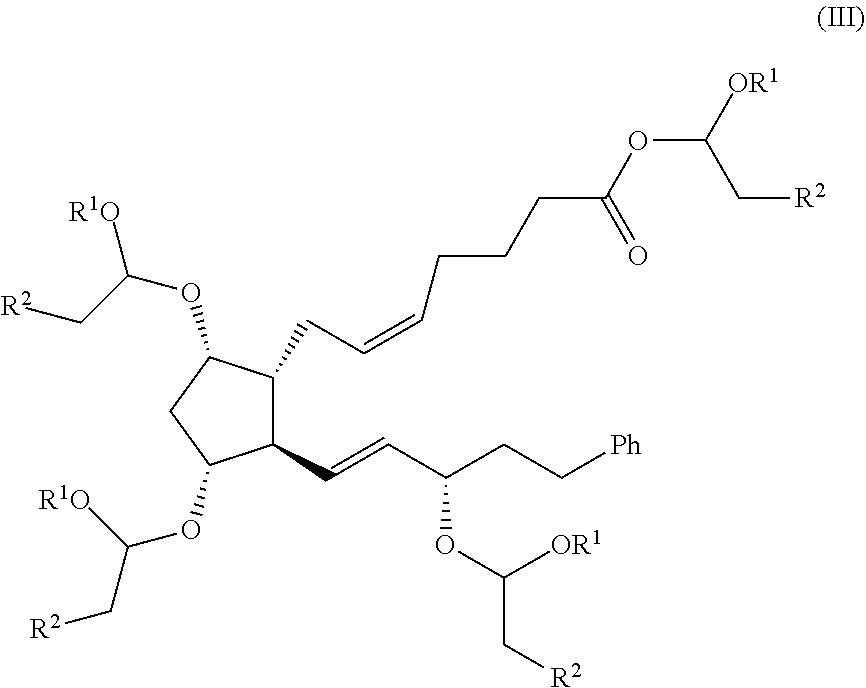
- the presence on intermediate compound of formula (III) of an ester group on an acetalic carbon provides to this intermediate an improved reactivity compared to other esters, such as methylic ester.
- the amidation reaction is faster and the generation of the acid derivative as a side-product is significantly decreased.
- the fact that all the hydroxilic groups are protected also decreases the generation of other in the amidation step. All this results in the global process being more cost-effective.
- R 1 and R 2 are as defined above, and of formula (II)
- R 1 and R 2 are as defined above or, alternatively, R 1 and R 2 taken together are selected from the group consisting of —CH 2 —CH 2 —, —O—CH 2 —CH 2 —, and —O—CH ⁇ CH—, are provided as intermediates useful for the preparation of bimatoprost.
- Another aspect of the invention relates to a process for the preparation of the compound of formula (III) as defined above, the process comprising reacting a compound of formula (V) with a vinyl ether of formula (IV)
- R 1 and R 2 are as defined above or, alternatively, R 1 and R 2 taken together are selected from the group consisting of —CH 2 —CH 2 —CH 2 —, —CH 2 —CH 2 —, —O—CH 2 —CH 2 —, and —O—CH ⁇ CH—, in the presence of an acid catalyst.
- this reaction allows the protection of the remaining hydroxyl group on compound of formula (V) and, simultaneously, the esterification of the carboxylic group.
- the presence of the ester group on an acetalic carbon provides intermediate compound of formula (III) with an improved reactivity compared to other esters.
- Still another aspect of the invention relates to a process for the preparation of the compound of formula (II) as defined above, the process comprising reacting a compound of formula (III):
- R 1 and R 2 are as defined above or, alternatively, R 1 and R 2 taken together are selected from the group consisting of —CH 2 —CH 2 —CH 2 —, —CH 2 —CH 2 —, —O—CH 2 —CH 2 —, and —O—CH ⁇ CH—, with ethylamine in the presence of a suitable solvent.
- alkyl refers to includes straight or branched chain or cyclized hydrocarbyl radicals containing the number of carbon atoms specified in the description or claims.
- (C 1 -C 4 )alkyl refers to a saturated straight or branched hydrocarbon chain containing from 1 to 4 carbon atoms, in particular methyl, ethyl, propyl, isopropyl, n-butyl, isobutyl, sec-butyl, and tert-butyl.
- alkenyl refers to an ethylenically unsaturated hydrocarbon group, straight or branched, having a chain length the number of carbon atoms specified in the description or claims and 1 to 2 ethylenic bonds.
- alkoxy refers to both branched and straight chain alkyl groups containing the number of carbon atoms specified in the description or claims at least one oxygen atom. Typical alkoxy groups are methoxy, ethoxy, n-propoxy, isopropoxy, n-butoxy, sec-butoxy, isobutoxyl, t-butoxy, n-pentoxy, isopentoxy, n-hexoxy, n-heptoxy and the like.
- aryl refers to a radical of one ring system with 1-3 rings, the rings being aromatic and being isolated or partially/totally fused and having 5-6 members, the ring system being optionally substituted by one or more radicals independently selected from the group consisting of (C 1 -C 6 )alkyl, (C 1 -C 6 )alkoxy, nitro, cyano, and halogen.
- radicals independently selected from the group consisting of (C 1 -C 6 )alkyl, (C 1 -C 6 )alkoxy, nitro, cyano, and halogen.
- aryl groups are phenil, bencyl, and biphenylmethyl
- the rings in the ring system being “isolated” embraces either only one ring or a ring system formed by two, three or four rings wherein said rings are bound to any one of the other rings through a bond.
- the rings in the ring system being “totally fused” embraces a ring system formed by two, three or four rings in which two or more atoms are common to two adjoining rings.
- fused aromatic ring systems are 1,2,3,4-tetrahydronaphthyl, 1-naphthyl, 2-naphthyl, anthryl, or phenanthryl,
- the rings in the ring system being “partially fused” embraces a ring system formed by three or four rings, being at least two of said rings totally fused and the remaining ring(s) or fused rings being bound through a bond from the atom of one ring or fused rings to the atom of another ring or fused rings.
- alkylaryl refers to groups having an alkyl moiety containing the number of carbon atoms specified in the description or claims attached to an aryl ring.
- the alkyl moiety is preferably a straight, branched or cyclic alkyl group having 1 to 6 carbon atoms.
- alkoxyalkyl refers to an alkoxy moiety covalently bonded to an alkyl moiety.
- bimatoprost can be prepared by reacting a compound of formula (III):
- R 1 and R 2 are as defined above or, alternatively, R 1 and R 2 taken together are selected from the group consisting of —CH 2 —CH 2 —CH 2 —, —CH 2 —CH 2 —, —O—CH 2 —CH 2 —, and —O—CH ⁇ CH—; with ethylamine in order to obtain a compound of formula (II)
- R 1 and R 2 are defined as above or, alternatively, R 1 and R 2 taken together are selected from the group consisting of —CH 2 —CH 2 —CH 2 —, —CH 2 —CH 2 —, —O—CH 2 —CH 2 —, and —O—CH ⁇ CH—; submitting the obtained compound to a deprotection reaction.
- R 1 is a (C 1 -C 4 )alkyl and R 2 is H. More particularly, R 1 is selected from ethyl and n-butyl and R 2 is H.
- R 1 and R 2 taken together are selected from the group consisting of —CH 2 —CH 2 —CH 2 —, —CH 2 —CH 2 —, —O—CH 2 —CH 2 —, and —O—CH ⁇ CH—. More particularly, R 1 and R 2 taken together are —CH 2 —CH 2 —CH 2 —.
- compound of formula (VII) can be prepared from compound of formula (VIII) by reaction with a vinyl ether of formula (IV)
- R 1 and R 2 are as defined above or, alternatively, R 1 and R 2 taken together are selected from the group consisting of —CH 2 —CH 2 —CH 2 —, —CH 2 —CH 2 —, —O—CH 2 —CH 2 —, and —O—CH ⁇ CH—, in the presence of an acid catalyst.
- vinyl ethers of formula IV are, without being limited to, tetraethylene glycol methylvinyl ether, tri(ethylene glycol) methyl vinyl ether, diethylene glycol methyl vinyl ether, diethyl vinyl orthoformate, and cyclic vinyl ethers such as 3,4-dihydropyrane, 2,3-dihydrofurane, 1,4-dioxin, and 2,3-dihydro-1,4-dioxin.
- the reaction is carried out with a molar ratio of the vinyl ether of formula (IV) from 2.0 moles per mol of compound of formula (VIII) to an amount wherein the vinyl ether itself acts as solvent, such as 5 volumes of vinyl ether per gram of compound of formula (VIII).
- Acid catalysis can be performed by any strong inorganic or organic acid and salts thereof with a weak base
- acid catalysts useful in the process of the invention include p-toluenesulfonic acid, methanesulfonic acid, pyridinium p-toluenesulfonate, and pyridinium methanesulfonate.
- the amount of catalyst can be from 0.1 to 1.0 moles of acid or its salt per each mol of compound of formula (VIII).
- the reaction can be carried out in a suitable solvent, particularly in an anhydrous aprotic solvent such as halogenated hydrocarbons, aliphatic or aromatic hydrocarbons, ethers, dimethylformamide, dimethylacetamide, and dimethylsulfoxide.
- anhydrous aprotic solvent such as halogenated hydrocarbons, aliphatic or aromatic hydrocarbons, ethers, dimethylformamide, dimethylacetamide, and dimethylsulfoxide.
- Preferred solvents are tetrahydrofuran, dichloromethane, and toluene.
- the reaction temperature can be from 0° C. y 100° C. depending on the solvent used.
- the preparation of compound of formula (VI) can be accomplished by reduction of compound of formula (VII) with a suitable reducing agent in the presence of an aprotic solvent such as tetrahydrofuran (THF), 2-methyltetrahydrofuran (MeTHF), diethylether, disopropylether, toluene, halogenated hydrocarbides such as dichloromethane, dimethylacetamide (DMA), and dimethylformamide (DMF).
- a suitable reducing agent include diisoamylaluminium hydride, diisobutylaluminium hydride and sodium diethylaluminum hydride. More particularly, the reducing agent is diisobutylaluminium hydride.
- Compound of formula (V) can be prepared by submitting compound of formula (VI) to a Wittig reaction with a (4-carboxybutyl)triphenylphosphonium halide, such as bromide or chloride, in the presence of a base and a suitable solvent.
- bases include butyl lithium, sodium amide, sodium hydride, sodium methoxide, sodium ethoxide, potassium tert-butoxide or potassium ethoxide, preferably potassium tert-butoxide is used.
- suitable solvent include tetrahydrofuran, toluene, dichloromethane, or mixtures thereof. Particularly, potassium tert-butoxide is used as a base and tetrahydrofuran as solvent.
- R 1 and R 2 are as defined above or, alternatively, R 1 and R 2 taken together are selected from the group consisting of —CH 2 —CH 2 —CH 2 —, —CH 2 —CH 2 —, —O—CH 2 —CH 2 —, and —O—CH ⁇ CH—, in the presence of an acid catalyst.
- the process is carried out similarly as for the preparation of compound of formula (VII) explained above, namely with a molar ratio of the vinyl ether of formula (IV) from 2.0 moles per mol of compound of formula (V) to an amount wherein the vinyl ether itself acts as solvent, such as 5 volumes of vinyl ether per gram of compound of formula (V).
- Acid catalysis can be performed by any strong inorganic or organic acid and salts thereof with a weak base such as p-toluenesulfonic acid, methanesulfonic acid, pyridinium
- the amount of catalyst can be from 0.1 to 1.0 moles of acid or its salt per each mol of compound of formula (VIII).
- the reaction can be carried out in an anhydrous aprotic solvent such as halogenated hydrocarbons, aliphatic or aromatic hydrocarbons, ethers, dimethylformamide, dimethylacetamide, and dimethylsulfoxide. Preferred solvents are tetrahydrofurane, dichloromethane, and toluene.
- the reaction temperature can be from 0° C. y 100° C. depending on the solvent used.
- compound of formula (III) can be prepared from compound of formula (V) according to the following reaction conditions and reactants:
- the kinetics of the reaction shows that protection of the alcohol is faster than the esterification reaction.
- Amidation of compound of formula (III) to obtain compound of formula (II) is carried out by reaction with EtNH 2 , particularly with an aqueous solution of EtNH 2 , in the presence or absence of an organic solvent.
- the solvent in step a) is selected from water and a mixture of water with an organic solvent.
- temperature of the amidation reaction is from 0 to 100° C., particularly from 20 to 40° C., more particularly from 25° C. to 33° C.
- the amidation reaction can be performed in a 70% aqueous solution of ethylamine (EtNH 2 ) and at a temperature from 20 to 40° C., particularly from 25° C. to 33° C.
- EtNH 2 ethylamine
- Different amounts of the aqueous solution of EtNH 2 can be added depending on the solvent used.
- 10 ml of 70% aqueous solution of per gram of prostaglandin can be added.
- the amidation reaction time at 20° C. can be from 15-72 hours.
- the reaction temperature By increasing the reaction temperature the reaction rate is increased but also the presence of bimatoprost free acid in the final product. Nevertheless, even so, levels of this impurity are significantly reduced compare with the processes of the prior art, as can be shown in Example 4.
- bimatoprost is obtained from compound of formula (II) by deprotection of the hydroxyl groups in acidic medium.
- Any strong inorganic or organic acid can be used.
- the reaction can be carried out in any suitable solvent, particularly in a water-miscible solvent such as C 1 -C 4 alcohols such as ethanol and isopropanol, acetonitrile, tetrahydrofurane, dimethyl sulfoxide, and dimethylformamide.
- deprotection is made in the presence of a strong inorganic or organic acid such as HCl or CF 3 COOH.
- a strong inorganic or organic acid such as HCl or CF 3 COOH.
- deprotection is made in the presence of HCl.
- the acid is either in stoichiometric or in catalytic amounts.
- reaction times of the deprotection reaction are significantly reduced compared to the processes of the prior art.
- the deprotection reaction can take up to 12 hours when performed at 20-25° C. Nevertheless, the reaction rate can be significantly increased by increasing the reaction temperature.
- the deprotection reaction of compound of formula (II) wherein R 1 is butyl and R 2 is H i.e. the protection was carried out with butyl vinyl ether
- the deprotection reaction of compound of formula (II) wherein R 1 is butyl and R 2 is H i.e. the protection was carried out with butyl vinyl ether
- the protection was carried out with butyl vinyl ether performed in the presence of hydrochloric acid at pH 0.5-1.5 and at 20° C. takes about 12 hours, while at 40° C. is completed in less than 2 hours, and at 50° C. is completed in 1 hour (see Example 4c below).
- R 1 and R 2 are as defined above, and of formula (II)
- R 1 and R 2 are as defined above or, alternatively, R 1 and R 2 taken together are selected from the group consisting of —CH 2 —CH 2 —, —O—CH 2 —CH 2 —, and —O—CH ⁇ CH—, which are intermediates useful for the preparation of bimatoprost, also form part of the invention.
- R 1 is a (C 1 -C 4 )alkyl and R 2 is H. More particularly, R 1 is selected from ethyl and n-butyl and R 2 is H.
- R 1 and R 2 taken together are selected from the group consisting of —CH 2 —CH 2 —CH 2 —, —CH 2 —CH 2 —, —O—CH 2 —CH 2 —, and —O—CH ⁇ CH—. More particularly, R 1 and R 2 taken together are —CH 2 —CH 2 —CH 2 —.
- R 1 and R 2 taken together are selected from the group consisting of —CH 2 —CH 2 —, —O—CH 2 —CH 2 —, and —O—CH ⁇ CH—.
- the intermediate compounds mentioned herein above can be used for the following steps without further purification or can be effectively separated and purified by employing a conventional method well known to those skilled in the art, such as recrystallization, column chromatography, or by transformation into a salt or by washing with an organic solvent or with an aqueous solution, eventually adjusting the pH.
- a conventional method well known to those skilled in the art such as recrystallization, column chromatography, or by transformation into a salt or by washing with an organic solvent or with an aqueous solution, eventually adjusting the pH.
- any one of the solvents mentioned above can be used in each reaction stage.
- the process for the preparation of bimatoprost is carried out from compound of formula (VIII) without the isolation of the different intermediates.
- bimatoprost crude is obtained with high purity and very good yields. Particularly, bimatoprost with a purity higher to 97.0% is obtained.
- the main byproducts are the trans isomer of compound of formula (V)
- the epimer (S) of compound of formula (VIII) is already present in the commercialized compound in amounts usually below 0.3%).
- Bimatoprost with a purity of at least 99.5% can be obtained by submitting this crude to conventional purification techniques or other techniques described in the prior art such as crystallization, chromatography, or a combination thereof.
- Example 2 The residue obtained in Example 1 (16.63 g, 33.1 mmol) was dissolved in 150 ml of anhydrous tetrahydrofuran (THF) under nitrogen atmosphere. The resulting yellow solution was cooled to from ⁇ 5 to 0° C. and added drop wise a 25.0% w/w solution of diisobutylaluminium hydride (26.7 mL, 39.72 mmol) in toluene maintaining the temperature range. Once the addiction is finished the mixture was stirred at 0° C. for 60 min and the reaction was monitored by TLC. Once the reaction is completed the mixture was cooled down to ⁇ 20° C. and 2.0 ml of methanol were added. The resulting slightly yellow solution was stirred at 0° C.
- THF anhydrous tetrahydrofuran
- the resulting reaction mixture was then diluted in 50 ml of toluene and washed with 50 ml of an aqueous solution of NaHCO 3 (7%). After separation of the layers, the organic layer was washed with 50 ml of demineralized water. Then, the layers were separated again and the organic layer was concentrated and dried at vacuum.
- Example 5a (Z)-1-ethoxyethyl 7-((1R,2R,3R,5S)-3,5-bis(1-ethoxyethoxy)-2-((3S,E)-3-(1-ethoxyethoxy)-5-phenylpent-1-en-1-yl)cyclopentyl)hept-5-enoate
- the resulting reaction mixture was then diluted in 16 ml of toluene and washed with 16 ml of an aqueous solution of NaHCO 3 (7%). After separation of the layers, the organic layer was washed with 16 ml of demineralized water. Then, the layers were separated again and the organic layer was concentrated and dried at vacuum.
- Example 6a (Z)-tetrahydro-2H-pyran-2-yl 7-((1R,2R,3R,5S)-2-((3S,E)-5-phenyl-3-((tetra hydro-2H-pyran-2-yl)oxy)pent-1-en-1-yl)-3,5-bis((tetrahydro-2H-pyran-2-yl)oxy)cyclopentyl)hept-5-enoate
- the completion of the reaction was checked by TLC.
- the resulting reaction mixture was then diluted in 20 ml of toluene and washed with 20 ml of an aqueous solution of NaHCO 3 (7%). After separation of the layers, the organic layer was washed with 20 ml of demineralized water. Then, the layers were separated again and the organic layer was concentrated and dried at vacuum.
- Example 6b (Z)—N-ethyl-7-((1R,2R,3R,5S)-2-((3S,E)-5-phenyl-3-((tetrahydro-2H-pyran-2-yl)oxy)pent-1-en-1-yl)-3,5-bis((tetrahydro-2H-pyran-2-yl)oxy)cyclopentyl) hept-5-enamide
- This comparative example illustrates the process disclosed in WO199406433.
- the resulting crude (1.05 g) was solved without further purification in 10.0 ml a 70.0% aqueous solution of EtNH 2 and the solution was stirred at 20-25° C. for 2-3 days until the reaction was complete. The completion of the reaction was checked by TLC. A reaction crude containing about 10.0% by weight of acid bimatoprost (depending on the reaction temperature) was obtained. After extracting the product with 10.0 ml of toluene, Then, the obtained organic phase is washed with water until the washing water is substantially neutral, and then, it was concentrated at vacuum to obtain crude bimatoprost (0.82 g to 0.92) g with a overall yield from 76.5% to 85.5% calculated from acid bimatoprost.
Landscapes
- Chemical & Material Sciences (AREA)
- Organic Chemistry (AREA)
- Chemical Kinetics & Catalysis (AREA)
- Organic Low-Molecular-Weight Compounds And Preparation Thereof (AREA)
Abstract

Description


-
- 0.2 moles of pyridinium p-toluenesulfonate per mol of compound of formula (V),
- 11.0 moles of vinyl ether (such as butyl vinyl ether, ethyl vinyl ether or dihydropirane) per mol of compound of formula (V),
- 5 ml of toluene per gram of compound of formula (V),
- at a temperature of 25±2° C. for about 3 hours.


| TABLE 1 | ||||
| Reaction T | Reaction time | Acid impurity | ||
| Ex. | Protection with | (° C.) | (h) | (%) |
| 5b | Ethyl vinyl ether | 18/20 | 15/20 | 5.0/7.0 |
| 6b | 3,4-dihydropyrane | 18/20 | 19/24 | 2.0/3.0 |
| 4b | Butyl vinyl ether | 18/20 | 68/72 | 1.0/2.0 |
| 4b | Butyl vinyl ether | 26/28 | 48/52 | 3.0/4.0 |
| 4b | Butyl vinyl ether | 31/33 | 43/46 | 4.0/5.0 |

- 1. WO9406433
- 2. WO02096868
- 3. WO20100109476
Claims (20)




Applications Claiming Priority (4)
| Application Number | Priority Date | Filing Date | Title |
|---|---|---|---|
| EP16382174.7A EP3235810A1 (en) | 2016-04-19 | 2016-04-19 | Process for the preparation of bimatoprost |
| EP16382174 | 2016-04-19 | ||
| EP16382174.7 | 2016-04-19 | ||
| PCT/EP2017/059180 WO2017182465A1 (en) | 2016-04-19 | 2017-04-18 | Process for the preparation of bimatoprost |
Publications (2)
| Publication Number | Publication Date |
|---|---|
| US20200010406A1 US20200010406A1 (en) | 2020-01-09 |
| US10626080B2 true US10626080B2 (en) | 2020-04-21 |
Family
ID=55860776
Family Applications (1)
| Application Number | Title | Priority Date | Filing Date |
|---|---|---|---|
| US16/090,572 Expired - Fee Related US10626080B2 (en) | 2016-04-19 | 2017-04-18 | Process for the preparation of bimatoprost |
Country Status (4)
| Country | Link |
|---|---|
| US (1) | US10626080B2 (en) |
| EP (2) | EP3235810A1 (en) |
| JP (1) | JP2019513808A (en) |
| WO (1) | WO2017182465A1 (en) |
Citations (5)
| Publication number | Priority date | Publication date | Assignee | Title |
|---|---|---|---|---|
| WO1994006433A1 (en) | 1992-09-21 | 1994-03-31 | Allergan, Inc. | Non-acidic cyclopentane heptanoic acid, 2-cycloalkyl or arylalkyl derivatives as therapeutic agents |
| WO2002024639A1 (en) | 2000-09-20 | 2002-03-28 | Allergan, Inc. | Cyclopentane derivatives as therapeutic agents |
| WO2002096868A2 (en) | 2001-05-31 | 2002-12-05 | Finetech Laboratories Ltd. | Preparation of 17-phenyl- 18, 19, 20- trinor-pgf2a and its derivatives |
| WO2005058812A2 (en) | 2003-12-19 | 2005-06-30 | Johnson Matthey Public Limited Company | Prostaglandin synthesis |
| WO2010109476A2 (en) | 2009-01-19 | 2010-09-30 | Matrix Laboratories Ltd | Improved process for the preparation of prostaglandins and analogues thereof |
-
2016
- 2016-04-19 EP EP16382174.7A patent/EP3235810A1/en not_active Withdrawn
-
2017
- 2017-04-18 WO PCT/EP2017/059180 patent/WO2017182465A1/en not_active Ceased
- 2017-04-18 JP JP2018554761A patent/JP2019513808A/en active Pending
- 2017-04-18 EP EP17717450.5A patent/EP3445745B1/en not_active Not-in-force
- 2017-04-18 US US16/090,572 patent/US10626080B2/en not_active Expired - Fee Related
Patent Citations (5)
| Publication number | Priority date | Publication date | Assignee | Title |
|---|---|---|---|---|
| WO1994006433A1 (en) | 1992-09-21 | 1994-03-31 | Allergan, Inc. | Non-acidic cyclopentane heptanoic acid, 2-cycloalkyl or arylalkyl derivatives as therapeutic agents |
| WO2002024639A1 (en) | 2000-09-20 | 2002-03-28 | Allergan, Inc. | Cyclopentane derivatives as therapeutic agents |
| WO2002096868A2 (en) | 2001-05-31 | 2002-12-05 | Finetech Laboratories Ltd. | Preparation of 17-phenyl- 18, 19, 20- trinor-pgf2a and its derivatives |
| WO2005058812A2 (en) | 2003-12-19 | 2005-06-30 | Johnson Matthey Public Limited Company | Prostaglandin synthesis |
| WO2010109476A2 (en) | 2009-01-19 | 2010-09-30 | Matrix Laboratories Ltd | Improved process for the preparation of prostaglandins and analogues thereof |
Non-Patent Citations (1)
| Title |
|---|
| International Search Report and Written Opinion dated Jun. 21, 2017 for PCT Application No. PCT/EP2017/059180, 13 pages. |
Also Published As
| Publication number | Publication date |
|---|---|
| EP3445745A1 (en) | 2019-02-27 |
| EP3445745B1 (en) | 2020-06-10 |
| EP3235810A1 (en) | 2017-10-25 |
| US20200010406A1 (en) | 2020-01-09 |
| JP2019513808A (en) | 2019-05-30 |
| WO2017182465A1 (en) | 2017-10-26 |
Similar Documents
| Publication | Publication Date | Title |
|---|---|---|
| US7166730B2 (en) | Process for the preparation of prostaglandin derivatives | |
| US7947740B2 (en) | Bimatoprost crystalline form I | |
| JP5791636B2 (en) | Process for preparing entecavir and its intermediates | |
| US8772544B2 (en) | Process for the production of bimatoprost | |
| CN106928227B (en) | Synthetic method of entecavir and intermediate compound thereof | |
| US9382272B2 (en) | Methods of making lubiprostone and intermediates thereof | |
| US20150011755A1 (en) | Amine salts of prostaglandin analogs | |
| WO2010109476A2 (en) | Improved process for the preparation of prostaglandins and analogues thereof | |
| KR101522218B1 (en) | Processes and intermediates for the preparations of prostaglandins | |
| US10626080B2 (en) | Process for the preparation of bimatoprost | |
| US20130296558A1 (en) | Preparation process of an antiviral drug (entecavir) and intermediates thereof | |
| ES2909890T3 (en) | Prostacyclin derivative preparation process | |
| EP2913329B1 (en) | Method for manufacturing difluoro lactone compound | |
| JP2004534040A (en) | Stereoselective synthesis of 2-hydroxy-4-phenylbutyrate | |
| US7115736B2 (en) | Process for preparing imidazopyran derivatives | |
| US11332433B2 (en) | Process for the preparation of latanoprostene bunod and intermediate thereof and compositions comprising the same | |
| US20150031898A1 (en) | Process for preparation of prostaglandin f2 alpha analogues | |
| JP4173378B2 (en) | Substituted aminoalkyl acrylate derivative or salt thereof | |
| JP4201268B2 (en) | Method for producing imidazole derivatives and salts thereof | |
| KR20250050531A (en) | Method for producing Tafluprost | |
| WO2010143150A2 (en) | Process for stereoselective preparation of an intermediate of protease inhibitors | |
| JPH10265420A (en) | Method for producing cyclohexylidene derivative |
Legal Events
| Date | Code | Title | Description |
|---|---|---|---|
| FEPP | Fee payment procedure |
Free format text: ENTITY STATUS SET TO UNDISCOUNTED (ORIGINAL EVENT CODE: BIG.); ENTITY STATUS OF PATENT OWNER: SMALL ENTITY |
|
| AS | Assignment |
Owner name: GENTEC, S.A., SPAIN Free format text: ASSIGNMENT OF ASSIGNORS INTEREST;ASSIGNORS:SILVA GUISASOLA, LUIS OCTAVIO;NEBOT TROYANO, JOAQUIN;RIPOLL ALTADILL, JORDI;SIGNING DATES FROM 20180928 TO 20181003;REEL/FRAME:047195/0769 |
|
| FEPP | Fee payment procedure |
Free format text: ENTITY STATUS SET TO SMALL (ORIGINAL EVENT CODE: SMAL); ENTITY STATUS OF PATENT OWNER: SMALL ENTITY |
|
| STPP | Information on status: patent application and granting procedure in general |
Free format text: NOTICE OF ALLOWANCE MAILED -- APPLICATION RECEIVED IN OFFICE OF PUBLICATIONS |
|
| STCF | Information on status: patent grant |
Free format text: PATENTED CASE |
|
| FEPP | Fee payment procedure |
Free format text: MAINTENANCE FEE REMINDER MAILED (ORIGINAL EVENT CODE: REM.); ENTITY STATUS OF PATENT OWNER: SMALL ENTITY |
|
| LAPS | Lapse for failure to pay maintenance fees |
Free format text: PATENT EXPIRED FOR FAILURE TO PAY MAINTENANCE FEES (ORIGINAL EVENT CODE: EXP.); ENTITY STATUS OF PATENT OWNER: SMALL ENTITY |
|
| STCH | Information on status: patent discontinuation |
Free format text: PATENT EXPIRED DUE TO NONPAYMENT OF MAINTENANCE FEES UNDER 37 CFR 1.362 |
|
| STCH | Information on status: patent discontinuation |
Free format text: PATENT EXPIRED DUE TO NONPAYMENT OF MAINTENANCE FEES UNDER 37 CFR 1.362 |
|
| FP | Lapsed due to failure to pay maintenance fee |
Effective date: 20240421 |