US10620702B2 - Internal device of brain-machine interface system including noise reduction technique, and method of controlling the internal device - Google Patents
Internal device of brain-machine interface system including noise reduction technique, and method of controlling the internal device Download PDFInfo
- Publication number
- US10620702B2 US10620702B2 US15/800,613 US201715800613A US10620702B2 US 10620702 B2 US10620702 B2 US 10620702B2 US 201715800613 A US201715800613 A US 201715800613A US 10620702 B2 US10620702 B2 US 10620702B2
- Authority
- US
- United States
- Prior art keywords
- electrode
- amplification
- operation mode
- internal device
- electrodes
- Prior art date
- Legal status (The legal status is an assumption and is not a legal conclusion. Google has not performed a legal analysis and makes no representation as to the accuracy of the status listed.)
- Active, expires
Links
Images


Classifications
-
- G—PHYSICS
- G06—COMPUTING OR CALCULATING; COUNTING
- G06F—ELECTRIC DIGITAL DATA PROCESSING
- G06F3/00—Input arrangements for transferring data to be processed into a form capable of being handled by the computer; Output arrangements for transferring data from processing unit to output unit, e.g. interface arrangements
- G06F3/01—Input arrangements or combined input and output arrangements for interaction between user and computer
- G06F3/011—Arrangements for interaction with the human body, e.g. for user immersion in virtual reality
- G06F3/015—Input arrangements based on nervous system activity detection, e.g. brain waves [EEG] detection, electromyograms [EMG] detection, electrodermal response detection
-
- A—HUMAN NECESSITIES
- A61—MEDICAL OR VETERINARY SCIENCE; HYGIENE
- A61B—DIAGNOSIS; SURGERY; IDENTIFICATION
- A61B5/00—Measuring for diagnostic purposes; Identification of persons
- A61B5/0002—Remote monitoring of patients using telemetry, e.g. transmission of vital signals via a communication network
- A61B5/0004—Remote monitoring of patients using telemetry, e.g. transmission of vital signals via a communication network characterised by the type of physiological signal transmitted
- A61B5/0006—ECG or EEG signals
-
- A61B5/04004—
-
- A61B5/04012—
-
- A61B5/0476—
-
- A61B5/0478—
-
- A—HUMAN NECESSITIES
- A61—MEDICAL OR VETERINARY SCIENCE; HYGIENE
- A61B—DIAGNOSIS; SURGERY; IDENTIFICATION
- A61B5/00—Measuring for diagnostic purposes; Identification of persons
- A61B5/24—Detecting, measuring or recording bioelectric or biomagnetic signals of the body or parts thereof
- A61B5/30—Input circuits therefor
- A61B5/307—Input circuits therefor specially adapted for particular uses
- A61B5/31—Input circuits therefor specially adapted for particular uses for electroencephalography [EEG]
-
- A—HUMAN NECESSITIES
- A61—MEDICAL OR VETERINARY SCIENCE; HYGIENE
- A61B—DIAGNOSIS; SURGERY; IDENTIFICATION
- A61B5/00—Measuring for diagnostic purposes; Identification of persons
- A61B5/24—Detecting, measuring or recording bioelectric or biomagnetic signals of the body or parts thereof
- A61B5/316—Modalities, i.e. specific diagnostic methods
- A61B5/369—Electroencephalography [EEG]
- A61B5/37—Intracranial electroencephalography [IC-EEG], e.g. electrocorticography [ECoG]
-
- A—HUMAN NECESSITIES
- A61—MEDICAL OR VETERINARY SCIENCE; HYGIENE
- A61B—DIAGNOSIS; SURGERY; IDENTIFICATION
- A61B5/00—Measuring for diagnostic purposes; Identification of persons
- A61B5/68—Arrangements of detecting, measuring or recording means, e.g. sensors, in relation to patient
- A61B5/6846—Arrangements of detecting, measuring or recording means, e.g. sensors, in relation to patient specially adapted to be brought in contact with an internal body part, i.e. invasive
- A61B5/6867—Arrangements of detecting, measuring or recording means, e.g. sensors, in relation to patient specially adapted to be brought in contact with an internal body part, i.e. invasive specially adapted to be attached or implanted in a specific body part
- A61B5/6868—Brain
-
- A—HUMAN NECESSITIES
- A61—MEDICAL OR VETERINARY SCIENCE; HYGIENE
- A61B—DIAGNOSIS; SURGERY; IDENTIFICATION
- A61B5/00—Measuring for diagnostic purposes; Identification of persons
- A61B5/72—Signal processing specially adapted for physiological signals or for diagnostic purposes
- A61B5/7203—Signal processing specially adapted for physiological signals or for diagnostic purposes for noise prevention, reduction or removal
-
- A—HUMAN NECESSITIES
- A61—MEDICAL OR VETERINARY SCIENCE; HYGIENE
- A61B—DIAGNOSIS; SURGERY; IDENTIFICATION
- A61B2562/00—Details of sensors; Constructional details of sensor housings or probes; Accessories for sensors
- A61B2562/02—Details of sensors specially adapted for in-vivo measurements
- A61B2562/0209—Special features of electrodes classified in A61B5/24, A61B5/25, A61B5/283, A61B5/291, A61B5/296, A61B5/053
Definitions
- the presently disclosed subject matter relates to a brain-machine interface (BMI) system including: an internal device which is to be implanted in the living body; and an external device which is to be placed outside the living body, particularly to the internal device and a method of controlling the internal device.
- BMI brain-machine interface
- An internal device acquires brain waves functioning as a signal source to detect the brain activity, and transmits a signal which corresponds to the brain activity, or that which is obtained by processing the signal, to an external device.
- the external device operates in accordance with the signal received from the internal device.
- the internal device disclosed in US 2006/0049957 A1 includes a plurality of electrodes which are to be implanted in the living body to detect brain waves.
- An internal device such as described above is implanted in the brain of a patient with amyotrophic lateral sclerosis (ALS) or the like, and communication with the patient is supported.
- ALS amyotrophic lateral sclerosis
- brain waves gradually diminish.
- the size increase of the internal device due to the scale enlargement of an amplification circuit, and heat generation due to the increase of power consumption are inevitable. Therefore, the design is not adequate for an implantable type internal device.
- the presently disclosed subject matter may provide an internal device of a brain-machine interface system and a method of controlling the internal device capable of performing the BMI control for a long period of time, even with respect to a patient in whom the intensity of brain waves is reduced with progression of disease.
- the internal device of a brain-machine interface system may include: an electrode group which includes N electrodes acquiring electroencephalogram signals of the living body, wherein N is 2 or more; an amplification element group which includes N amplification elements; a communicator which is configured to wirelessly communicate with an external device; and a controller which is configured to control an electrical connection between the electrode group and the amplification element group, and which is configured to control the communicator, the controller which is configured to selectively execute one of: a normal operation mode in which electroencephalogram signals of the living body that are acquired through the N electrodes of the electrode group are supplied to the amplification element group in a manner that each of the N electrodes corresponds to a respective one of the N amplification elements, and the communicator is caused to wirelessly transmit N amplified electroencephalogram signals; and a noise-reduction operation mode in which an electroencephalogram signal of the living body that is acquired through an M electrode of the electrode group is supplied to the
- FIG. 1 is a block diagram showing the functional configuration of a BMI system which is an embodiment.
- FIG. 2 is a circuit diagram showing a part of an internal device of the BMI system.
- FIG. 3 is a circuit diagram illustrating the operation of the internal device.
- FIG. 4 is a circuit diagram illustrating the operation of the internal device.
- FIG. 5 is a circuit diagram showing a modification of the internal device.
- FIG. 6 is a circuit diagram showing another modification of the internal device.
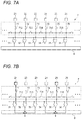
- FIGS. 7A and 7B are circuit diagrams showing a further modification of the internal device.
- FIG. 1 shows the functional configuration of a BMI system 100 of an embodiment.
- the BMI system 100 includes an internal device 1 and an external device 200 .
- the internal device 1 is configured so as to be used while being implanted in the living body 300 (specifically, the head).
- the external device 200 is configured so as to be used while being placed outside the living body 300 .
- the internal device 1 includes an electrode group 2 including N electrodes.
- N is an integer of 2 or more.
- Each of the electrodes of the electrode group 2 is configured so as to be attached to a predetermined place of the brain of the living body 300 , and acquire an electroencephalogram signal in the place.
- the internal device 1 further includes: an amplification element group 3 including N amplification elements; and a matrix switch 4 .
- the amplification element group 3 is electrically connected to the electrode group 2 through the matrix switch 4 .
- Each of the amplification elements of the amplification element group 3 is configured so as to amplify an input signal, and output the amplified signal.
- the internal device 1 further includes a communicator 5 .
- the communicator 5 is electrically connected to output terminals of the amplification element group 3 .
- the communicator 5 is configured so as to be able to wirelessly communicate with the external device 200 .
- the internal device 1 further includes a controller 6 .
- the controller 6 is configured so as to operate the matrix switch 4 to control the electrical connection state between the electrode group 2 and the amplification element group 3 .
- the controller 6 is also configured so as to be able to control the operation of the communicator 5 .
- FIG. 2 specifically shows the circuit configuration of a part of the internal device 1 .
- the electrode group 2 includes N electrodes 21 , 22 , 23 , . . . , 2 N.
- the amplification element group 3 includes N amplification elements 31 , 32 , 33 , . . . , 3 N.
- the matrix switch 4 includes an N ⁇ N number of switch elements. Each of the switch elements is electrically connected to the controller 6 through a signal line which is not shown. Therefore, the controller 6 can control the opening/closing operation of each of the switch elements.
- the matrix switch includes switch elements 411 , 412 , 413 , . . . , 41 N.
- the input ends of the switch elements 411 , 412 , 413 , . . . , 41 N are electrically connected to the electrode 21 .
- the matrix switch further includes switch elements 421 , 422 , 423 , . . . , 42 N.
- the input ends of the switch elements 421 , 422 , 423 , . . . , 42 N are electrically connected to the electrode 22 .
- the matrix switch further includes switch elements 431 , 432 , 433 , . . . , 43 N.
- the input ends of the switch elements 431 , 432 , 433 , . . . , 43 N are electrically connected to the electrode 23 .
- the matrix switch further includes switch elements 4 N 1 , 4 N 2 , 4 N 3 , . . . , 4 NN.
- the input ends of the switch elements 4 N 1 , 4 N 2 , 4 N 3 , . . . , 4 NN are electrically connected to the electrode 2 N.
- the output ends of the switch elements 411 , 421 , 431 , . . . , 4 N 1 are electrically output to the amplification element 31 .
- the switch element 4 N 1 is closed, for example, the electroencephalogram signal which is acquired by the electrode 2 N is supplied to the amplification element 31 .
- the output ends of the switch elements 412 , 422 , 432 , . . . , 4 N 2 are electrically output to the amplification element 32 .
- the switch element 432 is closed, for example, the electroencephalogram signal which is acquired by the electrode 23 is supplied to the amplification element 32 .
- the output ends of the switch elements 413 , 423 , 433 , . . . , 4 N 3 are electrically output to the amplification element 33 .
- the switch element 423 is closed, for example, the electroencephalogram signal which is acquired by the electrode 22 is supplied to the amplification element 33 .
- the output ends of the switch elements 41 N, 42 N, 43 N, . . . , 4 NN are electrically output to the amplification element 3 N.
- the switch element 41 N is closed, for example, the electroencephalogram signal which is acquired by the electrode 21 is supplied to the amplification element 3 N.
- the electrode group 2 further includes an electrode 2 R.
- the electroencephalogram signal which is acquired through the electrode 2 R is supplied as a reference potential signal to the amplification elements 31 , 32 , 33 , . . . , 3 N, respectively.
- the electrode 2 R is used as the reference potential supply source.
- Each of the amplification elements 31 , 32 , 33 , . . . , 3 N is configured so as to amplify the difference between the input electroencephalogram signal and the reference potential signal, by a predetermined amplification factor, and output the amplified signal.
- the amplified electroencephalogram signals which are output respectively from the amplification elements 31 , 32 , 33 , . . . , 3 N are supplied to the controller 6 .
- the controller 6 is configured so as to selectively execute one of a normal operation mode and a noise-reduction operation mode.
- FIG. 3 shows a configuration example of the matrix switch 4 during execution of the normal operation mode
- FIG. 4 shows a configuration example of the matrix switch 4 during execution of the noise-reduction operation mode.
- the controller 6 causes the electroencephalogram signals of the living body 300 which are acquired through the N electrodes of the electrode group 2 , to the N amplification elements of the amplification element group 3 , in such a manner that each of the electrodes corresponds to a respective one of the amplification elements.
- the controller 6 controls the matrix switch 4 so that the switch elements 411 , 422 , 433 , . . . , 4 NN are closed. Therefore, the electroencephalogram signal acquired through the electrode 21 is supplied to the amplification element 31 . Similarly, the electroencephalogram signal acquired through the electrode 22 is supplied to the amplification element 32 , that acquired through the electrode 23 is supplied to the amplification element 33 , and that acquired through the electrode 2 N is supplied to the amplification element 3 N.
- the N amplified electroencephalogram signals which are output from the amplification elements 31 , 32 , 33 , . . . , 3 N are supplied to the controller 6 .
- the controller 6 relays directly the N amplified electroencephalogram signals which are input thereto, to the communicator 5 . Thereafter, the controller 6 causes the communicator 5 to wirelessly transmit the N amplified electroencephalogram signals at a predetermined timing.
- the amplified electroencephalogram signals which are wirelessly transmitted are received by the external device 200 .
- the external device 200 operates in accordance with the received and amplified electroencephalogram signals.
- the external device 200 may be identical with or different from a device which receives the signals transmitted from the internal device 1 , and which executes an operation based on the signals.
- the external device 200 may be a device which receives the signals transmitted from the internal device 1 , and which transmits a control signal that causes another external device to execute the operation based on the transmitted signals.
- the controller 6 causes the electroencephalogram signals of the living body 300 which are acquired through an M number of electrodes (M is smaller than N) of the electrode group 2 , to be supplied to the amplification element group 3 in such a manner that each electrode corresponds to respective plural ones of the amplification elements.
- the controller 6 controls the matrix switch 4 so that the switch elements 411 , 412 , 433 , . . . , 43 N are closed. Therefore, the electroencephalogram signal acquired through the electrode 21 is supplied in parallel to the amplification elements 31 , 32 . Similarly, the electroencephalogram signal acquired through the electrode 23 is supplied in parallel to the amplification element group including the amplification elements 33 , 3 N. In this example, namely, M is 2.
- the controller 6 performs a process of arithmetically averaging the amplified electroencephalogram signals which are output from the plurality of amplification elements that correspond to each of the M electrodes.
- the amplified electroencephalogram signals which are output from the amplification elements 31 , 32 that correspond to the electrode 21 are arithmetically averaged.
- the amplified electroencephalogram signals which are output from the amplification elements 33 , 3 N that correspond to the electrode 23 are arithmetically averaged.
- the controller 6 acquires M (in the example, M is 2) arithmetically averaged and amplified electroencephalogram signals.
- the noise level of the obtained signal is reduced to 1/ ⁇ n as compared to that of the signal which has not been arithmetically averaged.
- the noise level can be reduced to 1/ ⁇ 2 by arithmetically averaging the amplified electroencephalogram signals which are output from the amplification elements 31 , 32 .
- the noise level can be reduced to 1/ ⁇ m by arithmetically averaging amplified electroencephalogram signals output from the amplification element group.
- the controller 6 relays the M amplified electroencephalogram signals in which the noise level is reduced, to the communicator 5 . Thereafter, the controller 6 causes the communicator 5 to wirelessly transmit the M amplified electroencephalogram signals at a predetermined timing.
- the amplified electroencephalogram signals which are wirelessly transmitted are received by the external device 200 .
- the external device 200 operates in accordance with the received and amplified electroencephalogram signals.
- the living body 300 is a patient in whom brain waves diminish with progression of disease.
- An example of disease is ALS.
- the internal device 1 is implanted in the head of the patient in a stage where communication with the patient can be well performed.
- the controller 6 first executes the normal operation mode.
- the normal operation mode electroencephalogram signals of the patient are acquired by using the electrode group 2 including as many (N) electrodes as possible, and therefore also the number of channels for the amplified electroencephalogram signals which are supplied to the external device 200 through the communicator 5 is maximum. Consequently, a rapid BMI control having a high degree of freedom can be performed.
- the controller 6 executes the noise-reduction operation mode.
- M electrodes which are to continue to acquire electroencephalogram signals are selected from the N electrodes of the electrode group 2 .
- the M electrodes are selected as an electrode group with higher priority to perform a significant BMI control.
- the selected M electrodes may be varied depending on the patient.
- a signal designating the selected M electrodes is wirelessly transmitted from the external device 200 , and then received by the communicator 5 . Based on the signal received by the communicator 5 , the controller 6 operates the matrix switch 4 .
- Each of M electroencephalogram signals in which the SN ratio is lowered is supplied to a plurality of amplification elements.
- the amplified electroencephalogram signals which are output from the plurality of amplification elements are arithmetically averaged.
- M amplified electroencephalogram signals in which the noise level is lowered as compared with the case of the normal operation mode are obtained.
- the number of used electrodes, i.e., the channel number is reduced, and therefore it is unavoidable that the degree of freedom of the BMI control is lowered.
- small changes, which, in the related art, are buried in noise can be distinguished. Even with respect to a patient in whom the intensity of brain waves is reduced with progression of disease, therefore, the possibility of the BMI control can be provided for a long period of time.
- the function of the controller 6 is realized from software executed by a cooperation of a processor and memory which are communicably connected to each other.
- the processor are a CPU and an MPU.
- the memory are a RAM and a ROM.
- the function of the controller 6 may be realized by hardware such as an ASIC or an FPGA, or a combination of hardware and software.
- the electroencephalogram signal acquired by the electrode 2 R is supplied as the reference potential signal to each of the amplification elements of the amplification element group 3 .
- a configuration may be employed in which, as shown in FIG. 5 , one of two electrodes 2 R 1 , 2 R 2 (an example of the plurality of reference potential supply sources) is electrically connected to the amplification element group 3 in a switchable manner.
- the number of switchable electrodes may be 3 or more.
- the internal device 1 is used while being implanted in the living body 300 , and therefore cannot be easily taken out from the body after the operation is started. According to the configuration, even when any failure occurs in the electrode 2 R 1 which is originally used as the reference potential supply source, the reference potential supply source can be switched to the other electrode 2 R 2 , so that the amplification element group 3 can continue to operate. Therefore, the number of opportunities of exchanging the internal device 1 which impose a burden on the patient can be reduced, and the possibility of the BMI control can be provided for a long period of time.
- a configuration may be employed that, as shown in FIG. 6 , includes a matrix switch 4 R in which the above-described function of switching between the electrodes 2 R 1 , 2 R 2 is more generalized.
- the matrix switch 4 R includes L ⁇ N switch elements ( 11 R, 12 R, . . . , LNR).
- L is an integer of N or less.
- the electrode group 2 includes L electrodes 2 R 1 , 2 R 2 , 2 R 3 , . . . , 2 RL.
- the electroencephalogram signal acquired by one of the electrodes 21 to 2 N, and the reference potential or differential input acquired by one of the electrodes 2 R 1 to 2 RL can be supplied to any one of the amplification elements 31 to 3 N.
- a switch signal is wirelessly transmitted from the external device 200 , and then received by the communicator 5 . Based on the received signal, the switching of the reference potential supply sources can be performed by the controller 6 . Alternatively, a configuration may be employed in which the controller 6 detects a failure of the original reference potential supply source, and then automatically performs switching of the reference potential supply sources.
- the internal device 1 may include a ladder-type switch circuit network 7 shown in FIG. 7A .
- the electrodes 21 to 26 are shown as a part of the electrode group 2
- the amplification elements 31 to 36 are shown as a part of the amplification element group 3
- switch elements 71 to 76 and 712 to 756 are shown as a part of the ladder-type switch circuit network 7 .
- the input end of the switch element 71 is connected to the electrode 21 .
- the output end of the switch element 71 is connected to the amplification element 31 .
- the switch element 712 can connect the output ends of the adjacent switch elements 71 , 72 together.
- n is an arbitrary integer
- the input end of a switch element 7 n is connected to an electrode 2 n
- the output end of the switch element 7 n is connected to an amplification element 3 n .
- a switch element 7 n (n+1) connects the output end of the switch element 7 n to that of a switch element 7 ( n +1).
- FIG. 7B shows an example of the operation of the thus configured ladder-type switch circuit network 7 .
- the switch elements 71 , 712 , 723 are closed, the electroencephalogram signal acquired by the electrode 21 is supplied to the amplification elements 31 , 32 , 33 .
- the switch elements 75 , 745 , 756 are closed, similarly, the electroencephalogram signal acquired by the electrode 25 is supplied to the amplification elements 34 , 35 , 36 .
- the selection of either of the normal operation mode and the noise-reduction operation mode is performed by the controller 6 based on the signal which is received from the external device 200 by the communicator 5 .
- the internal device 1 can be configured so as to detect the noise levels of the electroencephalogram signals acquired by the electrode group 2 . In this case, based on the detected noise levels, the controller 6 determines whether a significant BMI control can be performed in the normal operation mode or not. If it is determined that a significant BMI control cannot be performed in the normal operation mode, the controller 6 automatically selects the noise-reduction operation mode.
- electroencephalogram signals of the patient are acquired by using as many (the N number of) electrodes as possible. Therefore, also the number of channels for the amplified electroencephalogram signals which are supplied to the external device through the communicator is maximum. Consequently, a rapid BMI control having a high degree of freedom can be performed.
- the controller can execute the noise-reduction operation mode. At this time, the M number of electrodes are selected from the N electrodes.
- each of the M electroencephalogram signals in which the SN ratio is lowered is supplied to a plurality of amplification elements.
- M amplified electroencephalogram signals in which the noise level is lowered as compared with the case of the normal operation mode are obtained.
- the number of used electrodes, i.e., the channel number is reduced, and therefore it is unavoidable that the degree of freedom of the BMI control is lowered.
- small changes, which, in the related art, are buried in noise can be distinguished. Even with respect to a patient in whom the intensity of brain waves is reduced with progression of disease, therefore, the possibility of the BMI control can be provided for a long period of time.
Landscapes
- Health & Medical Sciences (AREA)
- Life Sciences & Earth Sciences (AREA)
- Engineering & Computer Science (AREA)
- General Health & Medical Sciences (AREA)
- Biomedical Technology (AREA)
- Physics & Mathematics (AREA)
- Public Health (AREA)
- Veterinary Medicine (AREA)
- Biophysics (AREA)
- Pathology (AREA)
- Heart & Thoracic Surgery (AREA)
- Medical Informatics (AREA)
- Molecular Biology (AREA)
- Surgery (AREA)
- Animal Behavior & Ethology (AREA)
- General Engineering & Computer Science (AREA)
- Neurology (AREA)
- Signal Processing (AREA)
- Theoretical Computer Science (AREA)
- Psychiatry (AREA)
- Neurosurgery (AREA)
- Physiology (AREA)
- Computer Vision & Pattern Recognition (AREA)
- Dermatology (AREA)
- Human Computer Interaction (AREA)
- General Physics & Mathematics (AREA)
- Artificial Intelligence (AREA)
- Psychology (AREA)
- Computer Networks & Wireless Communication (AREA)
- Measurement And Recording Of Electrical Phenomena And Electrical Characteristics Of The Living Body (AREA)
- Measuring And Recording Apparatus For Diagnosis (AREA)
- User Interface Of Digital Computer (AREA)
Abstract
Description
Claims (10)
Applications Claiming Priority (2)
| Application Number | Priority Date | Filing Date | Title |
|---|---|---|---|
| JP2016215375A JP6867565B2 (en) | 2016-11-02 | 2016-11-02 | Brain-machine interface system with noise reduction method and its control method |
| JP2016-215375 | 2016-11-02 |
Publications (2)
| Publication Number | Publication Date |
|---|---|
| US20180120937A1 US20180120937A1 (en) | 2018-05-03 |
| US10620702B2 true US10620702B2 (en) | 2020-04-14 |
Family
ID=60244931
Family Applications (1)
| Application Number | Title | Priority Date | Filing Date |
|---|---|---|---|
| US15/800,613 Active 2038-07-10 US10620702B2 (en) | 2016-11-02 | 2017-11-01 | Internal device of brain-machine interface system including noise reduction technique, and method of controlling the internal device |
Country Status (3)
| Country | Link |
|---|---|
| US (1) | US10620702B2 (en) |
| EP (1) | EP3318186B1 (en) |
| JP (1) | JP6867565B2 (en) |
Cited By (1)
| Publication number | Priority date | Publication date | Assignee | Title |
|---|---|---|---|---|
| US12285600B2 (en) | 2019-12-26 | 2025-04-29 | Osaka University | Resistance device, integrated circuit device, implantable device, and correction factor determining method |
Families Citing this family (5)
| Publication number | Priority date | Publication date | Assignee | Title |
|---|---|---|---|---|
| US11472579B2 (en) | 2018-12-04 | 2022-10-18 | Gpcp Ip Holdings Llc | Film securing apparatus and method |
| CN110850978A (en) * | 2019-11-06 | 2020-02-28 | 中国科学院自动化研究所 | Fully implantable brain-computer interface system |
| KR102149615B1 (en) * | 2019-11-13 | 2020-08-28 | 가톨릭관동대학교산학협력단 | Brain-machine interface learning system and method thereof |
| EP4111294A4 (en) | 2020-04-01 | 2024-03-20 | Synchron Australia Pty Ltd | SYSTEMS AND METHODS FOR CONTROLLING A DEVICE USING CHANGES DETECTED IN A SIGNAL INHERENT TO THE NEURAL SYSTEM |
| JP7455315B1 (en) | 2022-10-11 | 2024-03-26 | 株式会社JiMED | Program, manufacturing method, manufacturing equipment and connection method |
Citations (7)
| Publication number | Priority date | Publication date | Assignee | Title |
|---|---|---|---|---|
| US2920281A (en) | 1954-04-27 | 1960-01-05 | Lenkurt Electric Co Inc | Noise suppressor |
| US4300101A (en) * | 1980-01-03 | 1981-11-10 | Nancy Flowers | Multiple parallel input noise reduction system |
| US6463322B1 (en) | 2001-04-10 | 2002-10-08 | Viasys Healthcare, Inc. | Combination referential and differential amplifier for medical signal monitoring |
| US20060049957A1 (en) | 2004-08-13 | 2006-03-09 | Surgenor Timothy R | Biological interface systems with controlled device selector and related methods |
| US20080021514A1 (en) | 2006-07-21 | 2008-01-24 | Pless Benjamin D | Treatment and warning of recurring therapy and other events using an implantable device |
| US20160278713A1 (en) | 2015-03-25 | 2016-09-29 | Ecole Polytechnique Federale De Lausanne (Epfl) | Compact low-power recording architecture for multichannel acquisition of biological signals and method for compressing said biological signal data |
| US20170332973A1 (en) * | 2016-05-17 | 2017-11-23 | Case Western Reserve University | Multichannel ultra-low noise amplifier |
Family Cites Families (4)
| Publication number | Priority date | Publication date | Assignee | Title |
|---|---|---|---|---|
| JPS59177024A (en) * | 1983-12-26 | 1984-10-06 | 日本光電工業株式会社 | Body signal measuring apparatus |
| JPH0821821B2 (en) * | 1991-10-30 | 1996-03-04 | 株式会社エヌエフ回路設計ブロック | amplifier |
| US7187968B2 (en) * | 2003-10-23 | 2007-03-06 | Duke University | Apparatus for acquiring and transmitting neural signals and related methods |
| JP4289413B2 (en) * | 2007-03-26 | 2009-07-01 | 株式会社デンソー | Biological information measuring device |
-
2016
- 2016-11-02 JP JP2016215375A patent/JP6867565B2/en active Active
-
2017
- 2017-11-01 US US15/800,613 patent/US10620702B2/en active Active
- 2017-11-02 EP EP17199656.4A patent/EP3318186B1/en active Active
Patent Citations (7)
| Publication number | Priority date | Publication date | Assignee | Title |
|---|---|---|---|---|
| US2920281A (en) | 1954-04-27 | 1960-01-05 | Lenkurt Electric Co Inc | Noise suppressor |
| US4300101A (en) * | 1980-01-03 | 1981-11-10 | Nancy Flowers | Multiple parallel input noise reduction system |
| US6463322B1 (en) | 2001-04-10 | 2002-10-08 | Viasys Healthcare, Inc. | Combination referential and differential amplifier for medical signal monitoring |
| US20060049957A1 (en) | 2004-08-13 | 2006-03-09 | Surgenor Timothy R | Biological interface systems with controlled device selector and related methods |
| US20080021514A1 (en) | 2006-07-21 | 2008-01-24 | Pless Benjamin D | Treatment and warning of recurring therapy and other events using an implantable device |
| US20160278713A1 (en) | 2015-03-25 | 2016-09-29 | Ecole Polytechnique Federale De Lausanne (Epfl) | Compact low-power recording architecture for multichannel acquisition of biological signals and method for compressing said biological signal data |
| US20170332973A1 (en) * | 2016-05-17 | 2017-11-23 | Case Western Reserve University | Multichannel ultra-low noise amplifier |
Non-Patent Citations (1)
| Title |
|---|
| Communication dated Mar. 5, 2018, issued by the European Patent Office in counterpart European application No. 17199656.4. |
Cited By (1)
| Publication number | Priority date | Publication date | Assignee | Title |
|---|---|---|---|---|
| US12285600B2 (en) | 2019-12-26 | 2025-04-29 | Osaka University | Resistance device, integrated circuit device, implantable device, and correction factor determining method |
Also Published As
| Publication number | Publication date |
|---|---|
| US20180120937A1 (en) | 2018-05-03 |
| EP3318186B1 (en) | 2021-05-12 |
| JP6867565B2 (en) | 2021-04-28 |
| JP2018068886A (en) | 2018-05-10 |
| EP3318186A1 (en) | 2018-05-09 |
Similar Documents
| Publication | Publication Date | Title |
|---|---|---|
| US20180120937A1 (en) | Internal device of brain-machine interface system including noise reduction technique, and method of controlling the internal device | |
| JP5131016B2 (en) | Wireless communication apparatus and communication control method | |
| AU2025208463A1 (en) | Implantable cochlear system with integrated components and lead characterization | |
| US9559791B2 (en) | Wireless communication device for transceiving heterogeneous radio-frequency signals | |
| US10016144B2 (en) | Biological signal acquisition device and method for acquiring biological signal | |
| US11646755B2 (en) | Method and devices for determining a frequency range of a signal to be transmitted | |
| WO2009111255A1 (en) | Communication system with antenna box amplifier | |
| CN110974210B (en) | Impedance correction method and device for physiological signal acquisition channel | |
| JP7156212B2 (en) | battery monitor | |
| CN106797200A (en) | Multimode integrated power amplifier | |
| KR102842946B1 (en) | System for driving led lamp of vehicle and method thereof | |
| KR20160136380A (en) | Near-field communication system and terminal | |
| JP2009045179A (en) | Biological information communication device and biological information monitoring system | |
| US20150223278A1 (en) | System and Method for Establishing a Wireless Connection | |
| KR102032020B1 (en) | System for diagnosing insulation elemets in bms | |
| CN113572487A (en) | Radio frequency signal clutter suppression method, base station and terminal | |
| JP2015142431A (en) | Capacitor monitoring device | |
| EP4059429A1 (en) | Hearing aid with ear eeg recording | |
| KR20100002965A (en) | Redundant system and control method | |
| CN119136122A (en) | Hearing device debugging method, system, device and storage medium | |
| US12029569B2 (en) | Portable electrocardiographic waveform measurement device, information management system, method of controlling portable electrocardiographic waveform measurement device, and non-transitory recording medium including program recorded therein | |
| CN117771547A (en) | In-vitro program control equipment and remote program control system of implantable nerve stimulation equipment | |
| Wazwaz et al. | Control and monitor of IOT devices using EOG and Voice Commands | |
| JPWO2018190107A1 (en) | Monitoring system | |
| US20160056767A1 (en) | Energy-efficient mode-switch power amplifier set |
Legal Events
| Date | Code | Title | Description |
|---|---|---|---|
| FEPP | Fee payment procedure |
Free format text: ENTITY STATUS SET TO UNDISCOUNTED (ORIGINAL EVENT CODE: BIG.); ENTITY STATUS OF PATENT OWNER: LARGE ENTITY |
|
| AS | Assignment |
Owner name: NATIONAL INSTITUTE OF INFORMATION AND COMMUNICATIONS TECHNOLOGY, JAPAN Free format text: ASSIGNMENT OF ASSIGNORS INTEREST;ASSIGNORS:IMAJO, KAORU;SUZUKI, KATSUYOSHI;HIRATA, MASAYUKI;AND OTHERS;SIGNING DATES FROM 20171107 TO 20171211;REEL/FRAME:044640/0950 Owner name: NATIONAL INSTITUTE OF INFORMATION AND COMMUNICATIO Free format text: ASSIGNMENT OF ASSIGNORS INTEREST;ASSIGNORS:IMAJO, KAORU;SUZUKI, KATSUYOSHI;HIRATA, MASAYUKI;AND OTHERS;SIGNING DATES FROM 20171107 TO 20171211;REEL/FRAME:044640/0950 Owner name: OSAKA UNIVERSITY, JAPAN Free format text: ASSIGNMENT OF ASSIGNORS INTEREST;ASSIGNORS:IMAJO, KAORU;SUZUKI, KATSUYOSHI;HIRATA, MASAYUKI;AND OTHERS;SIGNING DATES FROM 20171107 TO 20171211;REEL/FRAME:044640/0950 Owner name: NIHON KOHDEN CORPORATION, JAPAN Free format text: ASSIGNMENT OF ASSIGNORS INTEREST;ASSIGNORS:IMAJO, KAORU;SUZUKI, KATSUYOSHI;HIRATA, MASAYUKI;AND OTHERS;SIGNING DATES FROM 20171107 TO 20171211;REEL/FRAME:044640/0950 |
|
| STPP | Information on status: patent application and granting procedure in general |
Free format text: DOCKETED NEW CASE - READY FOR EXAMINATION |
|
| STPP | Information on status: patent application and granting procedure in general |
Free format text: NON FINAL ACTION MAILED |
|
| STPP | Information on status: patent application and granting procedure in general |
Free format text: RESPONSE TO NON-FINAL OFFICE ACTION ENTERED AND FORWARDED TO EXAMINER |
|
| STPP | Information on status: patent application and granting procedure in general |
Free format text: NOTICE OF ALLOWANCE MAILED -- APPLICATION RECEIVED IN OFFICE OF PUBLICATIONS |
|
| STCF | Information on status: patent grant |
Free format text: PATENTED CASE |
|
| AS | Assignment |
Owner name: JIMED INC., JAPAN Free format text: ASSIGNMENT OF ASSIGNORS INTEREST;ASSIGNOR:NIHON KOHDEN CORPORATION;REEL/FRAME:057684/0080 Effective date: 20210914 |
|
| MAFP | Maintenance fee payment |
Free format text: PAYMENT OF MAINTENANCE FEE, 4TH YEAR, LARGE ENTITY (ORIGINAL EVENT CODE: M1551); ENTITY STATUS OF PATENT OWNER: LARGE ENTITY Year of fee payment: 4 |