US10618922B2 - Biaryl ligands, methods of making biaryl ligands, and methods of use thereof - Google Patents
Biaryl ligands, methods of making biaryl ligands, and methods of use thereof Download PDFInfo
- Publication number
- US10618922B2 US10618922B2 US15/927,505 US201815927505A US10618922B2 US 10618922 B2 US10618922 B2 US 10618922B2 US 201815927505 A US201815927505 A US 201815927505A US 10618922 B2 US10618922 B2 US 10618922B2
- Authority
- US
- United States
- Prior art keywords
- group
- ligand
- biaryl
- ligands
- chiral
- Prior art date
- Legal status (The legal status is an assumption and is not a legal conclusion. Google has not performed a legal analysis and makes no representation as to the accuracy of the status listed.)
- Active
Links
- 0 *.*P([3*])C.B.C.CC.CC.CCC Chemical compound *.*P([3*])C.B.C.CC.CC.CCC 0.000 description 28
- JZHSBBWDGUZGQA-UHFFFAOYSA-N CC.CC1=C(C2=NC(C3=CC=CC=C3)=C(C3=CC=CC=C3)N2CC2=CC=CC=C2)C2=CC=CC=C2C=C1 Chemical compound CC.CC1=C(C2=NC(C3=CC=CC=C3)=C(C3=CC=CC=C3)N2CC2=CC=CC=C2)C2=CC=CC=C2C=C1 JZHSBBWDGUZGQA-UHFFFAOYSA-N 0.000 description 4
- VVVMQIURCRSITP-TUWBWDNKSA-O C1=CC=C(CN2C(C3=C(P(C4=CC=CC=C4)C4=CC=CC=C4)C=CC4=CC=CC=C43)=NC(C3=CC=CC=C3)=C2C2=CC=CC=C2)C=C1.C1=CC=C(CN2C(C3=C(P(C4=CC=CC=C4)C4=CC=CC=C4)C=CC4=CC=CC=C43)=NC(C3=CC=CC=C3)=C2C2=CC=CC=C2)C=C1.CC.CC.CC.CCCP(C1=CC=CC=C1)C1=CC=CC=C1.CCl[Pd]1(C)C2=C(C3=C(C=CC=C3)C=C2)[C@@H](C)N1(C)C.C[C@@H]1C2=C(C=CC3=C2C=CC=C3)[Pd]2(N3=C(C4=C(C=CC5=CC=CC=C54)[PH]2(C2=CC=CC=C2)C2=CC=CC=C2)N(CC2=CC=CC=C2)C(C2=CC=CC=C2)=C3C2=CC=CC=C2)N1(C)C.F[P-](F)(F)(F)(F)F Chemical compound C1=CC=C(CN2C(C3=C(P(C4=CC=CC=C4)C4=CC=CC=C4)C=CC4=CC=CC=C43)=NC(C3=CC=CC=C3)=C2C2=CC=CC=C2)C=C1.C1=CC=C(CN2C(C3=C(P(C4=CC=CC=C4)C4=CC=CC=C4)C=CC4=CC=CC=C43)=NC(C3=CC=CC=C3)=C2C2=CC=CC=C2)C=C1.CC.CC.CC.CCCP(C1=CC=CC=C1)C1=CC=CC=C1.CCl[Pd]1(C)C2=C(C3=C(C=CC=C3)C=C2)[C@@H](C)N1(C)C.C[C@@H]1C2=C(C=CC3=C2C=CC=C3)[Pd]2(N3=C(C4=C(C=CC5=CC=CC=C54)[PH]2(C2=CC=CC=C2)C2=CC=CC=C2)N(CC2=CC=CC=C2)C(C2=CC=CC=C2)=C3C2=CC=CC=C2)N1(C)C.F[P-](F)(F)(F)(F)F VVVMQIURCRSITP-TUWBWDNKSA-O 0.000 description 2
- ZQHTUWKQEGYUBP-UHFFFAOYSA-N C1=CC=C(CN2C(C3=C(P(C4=CC=CC=C4)C4=CC=CC=C4)C=CC4=CC=CC=C43)=NC(C3=CC=CC=C3)=C2C2=CC=CC=C2)C=C1.CC1=C(C2=NC(C3=CC=CC=C3)=C(C3=CC=CC=C3)N2CC2=CC=CC=C2)C2=CC=CC=C2C=C1.CF.CF.FF.FF.FF.FF.O=CC1=C(O)C=CC2=CC=CC=C21.OC1=C(C2=NC(C3=CC=CC=C3)=C(C3=CC=CC=C3)N2)C2=CC=CC=C2C=C1 Chemical compound C1=CC=C(CN2C(C3=C(P(C4=CC=CC=C4)C4=CC=CC=C4)C=CC4=CC=CC=C43)=NC(C3=CC=CC=C3)=C2C2=CC=CC=C2)C=C1.CC1=C(C2=NC(C3=CC=CC=C3)=C(C3=CC=CC=C3)N2CC2=CC=CC=C2)C2=CC=CC=C2C=C1.CF.CF.FF.FF.FF.FF.O=CC1=C(O)C=CC2=CC=CC=C21.OC1=C(C2=NC(C3=CC=CC=C3)=C(C3=CC=CC=C3)N2)C2=CC=CC=C2C=C1 ZQHTUWKQEGYUBP-UHFFFAOYSA-N 0.000 description 2
- FXLOVSHXALFLKQ-UHFFFAOYSA-N CC1=CC=C(C=O)C=C1 Chemical compound CC1=CC=C(C=O)C=C1 FXLOVSHXALFLKQ-UHFFFAOYSA-N 0.000 description 2
- RYDSVDKGQRNSQS-MHZLTWQESA-N CC1=CC=C([C@H](C#C[Si](C)(C)C)N(CC2=CC=CC=C2)CC2=CC=CC=C2)C=C1 Chemical compound CC1=CC=C([C@H](C#C[Si](C)(C)C)N(CC2=CC=CC=C2)CC2=CC=CC=C2)C=C1 RYDSVDKGQRNSQS-MHZLTWQESA-N 0.000 description 2
- FYXJXDQVBLXFOL-SANMLTNESA-N C[Si](C)(C)C#C[C@@H](C1CCCCC1)N(CC1=CC=CC=C1)CC1=CC=CC=C1 Chemical compound C[Si](C)(C)C#C[C@@H](C1CCCCC1)N(CC1=CC=CC=C1)CC1=CC=CC=C1 FYXJXDQVBLXFOL-SANMLTNESA-N 0.000 description 2
- KVFDZFBHBWTVID-UHFFFAOYSA-N O=CC1CCCCC1 Chemical compound O=CC1CCCCC1 KVFDZFBHBWTVID-UHFFFAOYSA-N 0.000 description 2
- RMPLESNASQOFBZ-UHFFFAOYSA-N C#CC.CCCC(C#C[Si](C)(C)C)N(CC1=CC=CC=C1)CC1=CC=CC=C1.CCCC=O Chemical compound C#CC.CCCC(C#C[Si](C)(C)C)N(CC1=CC=CC=C1)CC1=CC=CC=C1.CCCC=O RMPLESNASQOFBZ-UHFFFAOYSA-N 0.000 description 1
- MJPCLAVMESJASY-DOTPTTDOSA-N C#C[Si](C)(C)C.C1=CC=C(CNCC2=CC=CC=C2)C=C1.C[Si](C)(C)C#C[C@@H](C1CCCCC1)N(CC1=CC=CC=C1)CC1=CC=CC=C1.O=CC1CCCCC1 Chemical compound C#C[Si](C)(C)C.C1=CC=C(CNCC2=CC=CC=C2)C=C1.C[Si](C)(C)C#C[C@@H](C1CCCCC1)N(CC1=CC=CC=C1)CC1=CC=CC=C1.O=CC1CCCCC1 MJPCLAVMESJASY-DOTPTTDOSA-N 0.000 description 1
- JUHZNYLEUJORBA-GHVWMZMZSA-N C#C[Si](C)(C)C.CC#C[C@@H](CCC)N(CC1=CC=CC=C1)CC1=CC=CC=C1.CCCC=O Chemical compound C#C[Si](C)(C)C.CC#C[C@@H](CCC)N(CC1=CC=CC=C1)CC1=CC=CC=C1.CCCC=O JUHZNYLEUJORBA-GHVWMZMZSA-N 0.000 description 1
- LIXQNXCRMIVITR-UHFFFAOYSA-N C.C.C.C.CC1=CC=C(CN2C=C(C3CCCCC3)N=C2C2=C(P(C(C)(C)C)C(C)(C)C)C=CC3=C(F)C(F)=C(F)C(F)=C32)C=C1.CC1=CC=CC=C1P(C1=C(C)C=CC=C1)C1=C(C2=NC3=C(C=CC=C3)N2S(=O)(=O)C2=C(F)C(F)=C(F)C(F)=C2F)C2=C(C=C1)OC=C2.COC1=C2C=CC(P(C3=CC=CO3)C3=CC=CO3)=C(C3=NC=NN3CC3=CC=NC=C3)C2=CC=C1.CP(C1=CC=CC=C1)C1=C(C2=NC(C3=CC=CC=C3)=C(C3=CC=CC=C3)N2CC2=CC=C([N+](=O)[O-])C=C2)C2=CC=CC=C2C=C1.CP(C1=CC=CC=C1)C1=C(C2=NC(C3=CC=CC=C3)=C(C3=CC=CC=C3)N2S(=O)(=O)C2=C(F)C(F)=C(F)C(F)=C2F)C2=CC=CC=C2C=C1 Chemical compound C.C.C.C.CC1=CC=C(CN2C=C(C3CCCCC3)N=C2C2=C(P(C(C)(C)C)C(C)(C)C)C=CC3=C(F)C(F)=C(F)C(F)=C32)C=C1.CC1=CC=CC=C1P(C1=C(C)C=CC=C1)C1=C(C2=NC3=C(C=CC=C3)N2S(=O)(=O)C2=C(F)C(F)=C(F)C(F)=C2F)C2=C(C=C1)OC=C2.COC1=C2C=CC(P(C3=CC=CO3)C3=CC=CO3)=C(C3=NC=NN3CC3=CC=NC=C3)C2=CC=C1.CP(C1=CC=CC=C1)C1=C(C2=NC(C3=CC=CC=C3)=C(C3=CC=CC=C3)N2CC2=CC=C([N+](=O)[O-])C=C2)C2=CC=CC=C2C=C1.CP(C1=CC=CC=C1)C1=C(C2=NC(C3=CC=CC=C3)=C(C3=CC=CC=C3)N2S(=O)(=O)C2=C(F)C(F)=C(F)C(F)=C2F)C2=CC=CC=C2C=C1 LIXQNXCRMIVITR-UHFFFAOYSA-N 0.000 description 1
- BKVPXDSQWDTHOZ-KBVLAROJSA-M C.C.C1Cl[Pd]1.CC#C[Pd]Cl.CC(=O)OC(/C=C/C1=CC=CC=C1)C1=CC=CC=C1.COC(=O)C(C)[C@H](/C=C/C1=CC=CC=C1)C1=CC=CC=C1.COC(=O)CC(=O)OC.O=C=O.[HH].[HH].[HH].[HH].[HH].[HH] Chemical compound C.C.C1Cl[Pd]1.CC#C[Pd]Cl.CC(=O)OC(/C=C/C1=CC=CC=C1)C1=CC=CC=C1.COC(=O)C(C)[C@H](/C=C/C1=CC=CC=C1)C1=CC=CC=C1.COC(=O)CC(=O)OC.O=C=O.[HH].[HH].[HH].[HH].[HH].[HH] BKVPXDSQWDTHOZ-KBVLAROJSA-M 0.000 description 1
- KQYRIQXNHGYKEG-TUWBWDNKSA-O C1=CC=C(CN2C(C3=C(P(C4=CC=CC=C4)C4=CC=CC=C4)C=CC4=CC=CC=C43)=NC(C3=CC=CC=C3)=C2C2=CC=CC=C2)C=C1.CC.CC.CC.CCCP(C1=CC=CC=C1)C1=CC=CC=C1.CCl[Pd]1(C)C2=C(C3=C(C=CC=C3)C=C2)[C@@H](C)N1(C)C.CP(C1=CC=CC=C1)C1=C(C2=NC(C3=CC=CC=C3)=C(C3=CC=CC=C3)N2CC2=CC=CC=C2)C2=CC=CC=C2C=C1.C[C@@H]1C2=C(C=CC3=C2C=CC=C3)[Pd]2(N3=C(C4=C(C=CC5=CC=CC=C54)[PH]2(C2=CC=CC=C2)C2=CC=CC=C2)N(CC2=CC=CC=C2)C(C2=CC=CC=C2)=C3C2=CC=CC=C2)N1(C)C.F[P-](F)(F)(F)(F)F Chemical compound C1=CC=C(CN2C(C3=C(P(C4=CC=CC=C4)C4=CC=CC=C4)C=CC4=CC=CC=C43)=NC(C3=CC=CC=C3)=C2C2=CC=CC=C2)C=C1.CC.CC.CC.CCCP(C1=CC=CC=C1)C1=CC=CC=C1.CCl[Pd]1(C)C2=C(C3=C(C=CC=C3)C=C2)[C@@H](C)N1(C)C.CP(C1=CC=CC=C1)C1=C(C2=NC(C3=CC=CC=C3)=C(C3=CC=CC=C3)N2CC2=CC=CC=C2)C2=CC=CC=C2C=C1.C[C@@H]1C2=C(C=CC3=C2C=CC=C3)[Pd]2(N3=C(C4=C(C=CC5=CC=CC=C54)[PH]2(C2=CC=CC=C2)C2=CC=CC=C2)N(CC2=CC=CC=C2)C(C2=CC=CC=C2)=C3C2=CC=CC=C2)N1(C)C.F[P-](F)(F)(F)(F)F KQYRIQXNHGYKEG-TUWBWDNKSA-O 0.000 description 1
- RSQJYZHKNCFFCN-VEDPYOEISA-O C1=CC=C(CN2C(C3=C(P(C4=CC=CC=C4)C4=CC=CC=C4)C=CC4=CC=CC=C43)=NC(C3=CC=CC=C3)=C2C2=CC=CC=C2)C=C1.CC.CCN1C(C2=CC=CC=C2)=C(C2=CC=CC=C2)N2=C1C1=C(C=CC3=CC=CC=C31)[PH](C1=CC=CC=C1)(C1=CC=CC=C1)[Pd+]21C2=C(C3=C(C=CC=C3)C=C2)[C@@H](C)N1(C)C.F[P-](F)(F)(F)(F)F Chemical compound C1=CC=C(CN2C(C3=C(P(C4=CC=CC=C4)C4=CC=CC=C4)C=CC4=CC=CC=C43)=NC(C3=CC=CC=C3)=C2C2=CC=CC=C2)C=C1.CC.CCN1C(C2=CC=CC=C2)=C(C2=CC=CC=C2)N2=C1C1=C(C=CC3=CC=CC=C31)[PH](C1=CC=CC=C1)(C1=CC=CC=C1)[Pd+]21C2=C(C3=C(C=CC=C3)C=C2)[C@@H](C)N1(C)C.F[P-](F)(F)(F)(F)F RSQJYZHKNCFFCN-VEDPYOEISA-O 0.000 description 1
- LJSXQVJSOCQVKN-FXSLHPOYSA-N C1=CC=C(P(C2=CC=CC=C2)C2=CC=C3C=CC=CC3=C2/C2=C(P(C3=CC=CC=C3)C3=CC=CC=C3)/C=C\C3=CC=CC=C32)C=C1.C1=CC=C(P(C2=CC=CC=C2)C2=CC=C3C=CC=CC3=C2/C2=N/C=C\C3=CC=CC=C32)C=C1.CC1=CC=CC(P(C2=CC=CC=C2)C2=CC=CC=C2)=C1C1=C(C)C=CC=C1P(C1=CC=CC=C1)C1=CC=CC=C1.CN(C)C1=C(\C2=C3C=CC=CC3=CC=C2P(C2=CC=CC=C2)C2=CC=CC=C2)C2=CC=CC=C2/C=C\1.C[C@@H](N/C1=N/N=C(/C2=C3C=CC=CC3=CC=C2P(C2=CC=CC=C2)C2=CC=CC=C2)C2=CC=CC=C21)C1=CC=CC=C1.OC1=CC=C2C=CC=CC2=C1/C1=C(O)/C=C\C2=CC=CC=C21 Chemical compound C1=CC=C(P(C2=CC=CC=C2)C2=CC=C3C=CC=CC3=C2/C2=C(P(C3=CC=CC=C3)C3=CC=CC=C3)/C=C\C3=CC=CC=C32)C=C1.C1=CC=C(P(C2=CC=CC=C2)C2=CC=C3C=CC=CC3=C2/C2=N/C=C\C3=CC=CC=C32)C=C1.CC1=CC=CC(P(C2=CC=CC=C2)C2=CC=CC=C2)=C1C1=C(C)C=CC=C1P(C1=CC=CC=C1)C1=CC=CC=C1.CN(C)C1=C(\C2=C3C=CC=CC3=CC=C2P(C2=CC=CC=C2)C2=CC=CC=C2)C2=CC=CC=C2/C=C\1.C[C@@H](N/C1=N/N=C(/C2=C3C=CC=CC3=CC=C2P(C2=CC=CC=C2)C2=CC=CC=C2)C2=CC=CC=C21)C1=CC=CC=C1.OC1=CC=C2C=CC=CC2=C1/C1=C(O)/C=C\C2=CC=CC=C21 LJSXQVJSOCQVKN-FXSLHPOYSA-N 0.000 description 1
- FFYOSYYRIKPBOX-AGLWJIJVSA-N C1=CC=C(P(C2=CC=CC=C2)C2=CC=C3C=CC=CC3=C2C2=C(P(C3=CC=CC=C3)C3=CC=CC=C3)C=CC3=CC=CC=C32)C=C1.C1=CC=C(P(C2=CC=CC=C2)C2=CC=C3C=CC=CC3=C2C2=NC=CC3=CC=CC=C32)C=C1.C[C@@H](NC1=NN=C(C2=C3C=CC=CC3=CC=C2P(C2=CC=CC=C2)C2=CC=CC=C2)C2=CC=CC=C21)C1=CC=CC=C1 Chemical compound C1=CC=C(P(C2=CC=CC=C2)C2=CC=C3C=CC=CC3=C2C2=C(P(C3=CC=CC=C3)C3=CC=CC=C3)C=CC3=CC=CC=C32)C=C1.C1=CC=C(P(C2=CC=CC=C2)C2=CC=C3C=CC=CC3=C2C2=NC=CC3=CC=CC=C32)C=C1.C[C@@H](NC1=NN=C(C2=C3C=CC=CC3=CC=C2P(C2=CC=CC=C2)C2=CC=CC=C2)C2=CC=CC=C21)C1=CC=CC=C1 FFYOSYYRIKPBOX-AGLWJIJVSA-N 0.000 description 1
- TUBNXCCVTNGASF-UHFFFAOYSA-N CC(C)(C)[Si](C)(C)OC1=C(C2=NC(C3=CC=CC=C3)=C(C3=CC=CC=C3)N2)C2=CC=CC=C2C=C1.CCN1C(C2=C(O)C=CC3=CC=CC=C32)=NC(C2=CC=CC=C2)=C1C1=CC=CC=C1.CCN1C(C2=C(OS(=O)(=O)C(F)(F)F)C=CC3=CC=CC=C32)=NC(C2=CC=CC=C2)=C1C1=CC=CC=C1.CCN1C(C2=C(P(C3=CC=CC=C3)C3=CC=CC=C3)C=CC3=CC=CC=C32)=NC(C2=CC=CC=C2)=C1C1=CC=CC=C1.O=CC1=C(O)C=CC2=CC=CC=C21 Chemical compound CC(C)(C)[Si](C)(C)OC1=C(C2=NC(C3=CC=CC=C3)=C(C3=CC=CC=C3)N2)C2=CC=CC=C2C=C1.CCN1C(C2=C(O)C=CC3=CC=CC=C32)=NC(C2=CC=CC=C2)=C1C1=CC=CC=C1.CCN1C(C2=C(OS(=O)(=O)C(F)(F)F)C=CC3=CC=CC=C32)=NC(C2=CC=CC=C2)=C1C1=CC=CC=C1.CCN1C(C2=C(P(C3=CC=CC=C3)C3=CC=CC=C3)C=CC3=CC=CC=C32)=NC(C2=CC=CC=C2)=C1C1=CC=CC=C1.O=CC1=C(O)C=CC2=CC=CC=C21 TUBNXCCVTNGASF-UHFFFAOYSA-N 0.000 description 1
- AMIMRNSIRUDHCM-UHFFFAOYSA-N CC(C)C=O Chemical compound CC(C)C=O AMIMRNSIRUDHCM-UHFFFAOYSA-N 0.000 description 1
- FGBIFJKRUIKLSP-QHCPKHFHSA-N CC(C)[C@H](C#C[Si](C)(C)C)N(CC1=CC=CC=C1)CC1=CC=CC=C1 Chemical compound CC(C)[C@H](C#C[Si](C)(C)C)N(CC1=CC=CC=C1)CC1=CC=CC=C1 FGBIFJKRUIKLSP-QHCPKHFHSA-N 0.000 description 1
- ZVVNXAKZYUFWFJ-UHFFFAOYSA-N CC1=CC2=CC=CC=C2C(C2=NC(C3=CC=CC=C3)=C(C3=CC=CC=C3)N2CC2=C(F)C(F)=C(F)C(F)=C2F)=C1P(C)C1=CC=CC=C1.COC1=C2C=CC(P(C)C3=CC=CC=C3)=C(C3=NC(C4=CC=CC=C4)=C(C4=CC=CC=C4)N3CC3=C(F)C(F)=C(F)C(F)=C3F)C2=CC=C1.COC1=CC(P(C)C2=CC=CC=C2)=C(C2=NC(C3=CC=CC=C3)=C(C3=CC=CC=C3)N2CC2=C(F)C(F)=C(F)C(F)=C2F)C2=CC=CC=C12.CP(C1=CC=CC=C1)C1=C(C2=NC=NN2CC2=C(F)C(F)=C(F)C(F)=C2F)C2=CC=CC=C2C=C1.CP(C1=CC=CC=C1)C1=C(C2=NN=NN2CC2=C(F)C(F)=C(F)C(F)=C2F)C2=CC=CC=C2C=C1 Chemical compound CC1=CC2=CC=CC=C2C(C2=NC(C3=CC=CC=C3)=C(C3=CC=CC=C3)N2CC2=C(F)C(F)=C(F)C(F)=C2F)=C1P(C)C1=CC=CC=C1.COC1=C2C=CC(P(C)C3=CC=CC=C3)=C(C3=NC(C4=CC=CC=C4)=C(C4=CC=CC=C4)N3CC3=C(F)C(F)=C(F)C(F)=C3F)C2=CC=C1.COC1=CC(P(C)C2=CC=CC=C2)=C(C2=NC(C3=CC=CC=C3)=C(C3=CC=CC=C3)N2CC2=C(F)C(F)=C(F)C(F)=C2F)C2=CC=CC=C12.CP(C1=CC=CC=C1)C1=C(C2=NC=NN2CC2=C(F)C(F)=C(F)C(F)=C2F)C2=CC=CC=C2C=C1.CP(C1=CC=CC=C1)C1=C(C2=NN=NN2CC2=C(F)C(F)=C(F)C(F)=C2F)C2=CC=CC=C2C=C1 ZVVNXAKZYUFWFJ-UHFFFAOYSA-N 0.000 description 1
- ZMHIJWJKFRBQDM-UHFFFAOYSA-N CC1=CC=C2C=CC(P(=O)(C3=CC=CC=C3)C3=CC=CC=C3)=C(C3=NC(C4=CC=CC=C4)=C(C4=CC=CC=C4)N3CC3=CC=CC=C3)C2=C1.CC1=CC=C2C=CC(P(=O)(C3=CC=CC=C3)C3=CC=CC=C3)=C(C3=NC(C4=CC=CC=C4)=C(C4=CC=CC=C4)N3CC3=CC=CC=C3)C2=C1.CCN1C(C2=C(P(=O)(C3=CC=CC=C3)C3=CC=CC=C3)C=CC3=CC=CC=C32)=NC(C2=CC=CC=C2)=C1C1=CC=CC=C1.CCN1C(C2=C(P(C3=CC=CC=C3)C3=CC=CC=C3)C=CC3=CC=CC=C32)=NC(C2=CC=CC=C2)=C1C1=CC=CC=C1 Chemical compound CC1=CC=C2C=CC(P(=O)(C3=CC=CC=C3)C3=CC=CC=C3)=C(C3=NC(C4=CC=CC=C4)=C(C4=CC=CC=C4)N3CC3=CC=CC=C3)C2=C1.CC1=CC=C2C=CC(P(=O)(C3=CC=CC=C3)C3=CC=CC=C3)=C(C3=NC(C4=CC=CC=C4)=C(C4=CC=CC=C4)N3CC3=CC=CC=C3)C2=C1.CCN1C(C2=C(P(=O)(C3=CC=CC=C3)C3=CC=CC=C3)C=CC3=CC=CC=C32)=NC(C2=CC=CC=C2)=C1C1=CC=CC=C1.CCN1C(C2=C(P(C3=CC=CC=C3)C3=CC=CC=C3)C=CC3=CC=CC=C32)=NC(C2=CC=CC=C2)=C1C1=CC=CC=C1 ZMHIJWJKFRBQDM-UHFFFAOYSA-N 0.000 description 1
- BTVGYRQTNHEOKH-OAHLLOKOSA-N CCCC#C[C@@H]1C=CC2=CC=CC=C2N1C(=O)OCC Chemical compound CCCC#C[C@@H]1C=CC2=CC=CC=C2N1C(=O)OCC BTVGYRQTNHEOKH-OAHLLOKOSA-N 0.000 description 1
- ZTQSAGDEMFDKMZ-UHFFFAOYSA-N CCCC=O Chemical compound CCCC=O ZTQSAGDEMFDKMZ-UHFFFAOYSA-N 0.000 description 1
- GKFOTCRBUZUQST-HSZRJFAPSA-N CCC[C@H](C#C[Si](C)(C)C)N(CC1=CC=CC=C1)CC1=CC=CC=C1 Chemical compound CCC[C@H](C#C[Si](C)(C)C)N(CC1=CC=CC=C1)CC1=CC=CC=C1 GKFOTCRBUZUQST-HSZRJFAPSA-N 0.000 description 1
- XHTTTXXQOFHKAM-FSRHSHDFSA-N CCOC(=O)N1C2=CC=C(C)C=C2C=C[C@H]1C#CC1=CC=CC=C1.O=C=O Chemical compound CCOC(=O)N1C2=CC=C(C)C=C2C=C[C@H]1C#CC1=CC=CC=C1.O=C=O XHTTTXXQOFHKAM-FSRHSHDFSA-N 0.000 description 1
- LDZKWFXAYTVBFL-OAQYLSRUSA-N CCOC(=O)N1C2=CC=C(C)C=C2C=C[C@H]1C#CCCC1=CC=CC=C1 Chemical compound CCOC(=O)N1C2=CC=C(C)C=C2C=C[C@H]1C#CCCC1=CC=CC=C1 LDZKWFXAYTVBFL-OAQYLSRUSA-N 0.000 description 1
- VABXCQDRUZNXQS-INIZCTEOSA-N CCOC(=O)N1C2=CC=C(C)C=C2C=C[C@H]1C#C[Si](C)(C)C Chemical compound CCOC(=O)N1C2=CC=C(C)C=C2C=C[C@H]1C#C[Si](C)(C)C VABXCQDRUZNXQS-INIZCTEOSA-N 0.000 description 1
- FXJVVXPRYZHGBT-ZDUSSCGKSA-N CCOC(=O)N1C2=CC=CC=C2C=C[C@H]1C#CC(=O)OC Chemical compound CCOC(=O)N1C2=CC=CC=C2C=C[C@H]1C#CC(=O)OC FXJVVXPRYZHGBT-ZDUSSCGKSA-N 0.000 description 1
- BMLUBWFLYAWLFF-MRXNPFEDSA-N CCOC(=O)N1C2=CC=CC=C2C=C[C@H]1C#CC1=CC=C(F)C(F)=C1 Chemical compound CCOC(=O)N1C2=CC=CC=C2C=C[C@H]1C#CC1=CC=C(F)C(F)=C1 BMLUBWFLYAWLFF-MRXNPFEDSA-N 0.000 description 1
- BUDBQQAAKAGOOD-GOSISDBHSA-N CCOC(=O)N1C2=CC=CC=C2C=C[C@H]1C#CC1=CC=C(OC)C(OC)=C1 Chemical compound CCOC(=O)N1C2=CC=CC=C2C=C[C@H]1C#CC1=CC=C(OC)C(OC)=C1 BUDBQQAAKAGOOD-GOSISDBHSA-N 0.000 description 1
- HFHVSMSBDFSHNG-QGZVFWFLSA-N CCOC(=O)N1C2=CC=CC=C2C=C[C@H]1C#CC1=CC=C2OCOC2=C1 Chemical compound CCOC(=O)N1C2=CC=CC=C2C=C[C@H]1C#CC1=CC=C2OCOC2=C1 HFHVSMSBDFSHNG-QGZVFWFLSA-N 0.000 description 1
- BHLCPUPLLKUHAF-KRWDZBQOSA-N CCOC(=O)N1C2=CC=CC=C2C=C[C@H]1C#CC1=CC=CC=C1[N+](=O)[O-] Chemical compound CCOC(=O)N1C2=CC=CC=C2C=C[C@H]1C#CC1=CC=CC=C1[N+](=O)[O-] BHLCPUPLLKUHAF-KRWDZBQOSA-N 0.000 description 1
- IYLRQYUGOSONHQ-HXUWFJFHSA-N CCOC(=O)N1C2=CC=CC=C2C=C[C@H]1C#CCCC1=CC=CC=C1 Chemical compound CCOC(=O)N1C2=CC=CC=C2C=C[C@H]1C#CCCC1=CC=CC=C1 IYLRQYUGOSONHQ-HXUWFJFHSA-N 0.000 description 1
- FTBYZFMRLJVGBX-GOSISDBHSA-N CCOC(=O)N1C2=CC=CC=C2C=C[C@H]1C#CCOC1=CC=C(OC)C=C1 Chemical compound CCOC(=O)N1C2=CC=CC=C2C=C[C@H]1C#CCOC1=CC=C(OC)C=C1 FTBYZFMRLJVGBX-GOSISDBHSA-N 0.000 description 1
- WBOGDCURMCBETF-HNNXBMFYSA-N CCOC(=O)N1C2=CC=CC=C2C=C[C@H]1C#C[Si](C)(C)C Chemical compound CCOC(=O)N1C2=CC=CC=C2C=C[C@H]1C#C[Si](C)(C)C WBOGDCURMCBETF-HNNXBMFYSA-N 0.000 description 1
- GCSAAMUSRURMIV-UHFFFAOYSA-N CN1N=NC(C2=C(P(C)C3=CC=CC=C3)C=CC3=CC=CC=C32)=C1CC1=C(F)C(F)=C(F)C(F)=C1F.COC1=CN(CC2=C(F)C(F)=C(F)C(F)=C2F)C(C2=C(P(C)C3=CC=CC=C3)C=CC3=CC=CC=C32)=N1.CP(C1=CC=CC=C1)C1=C(C2=NC(C3=CC=CC=C3)=CN2CC2=C(F)C(F)=C(F)C(F)=C2F)C2=CC=CC=C2C=C1.CP(C1=CC=CC=C1)C1=C(C2=NC(C3CCCCC3)=C(C3CCCCC3)N2CC2=C(F)C(F)=C(F)C(F)=C2F)C2=CC=CC=C2C=C1.CP(C1=CC=CC=C1)C1=C(C2=NC3=C(C=CC=C3)N2CC2=C(F)C(F)=C(F)C(F)=C2F)C2=CC=CC=C2C=C1 Chemical compound CN1N=NC(C2=C(P(C)C3=CC=CC=C3)C=CC3=CC=CC=C32)=C1CC1=C(F)C(F)=C(F)C(F)=C1F.COC1=CN(CC2=C(F)C(F)=C(F)C(F)=C2F)C(C2=C(P(C)C3=CC=CC=C3)C=CC3=CC=CC=C32)=N1.CP(C1=CC=CC=C1)C1=C(C2=NC(C3=CC=CC=C3)=CN2CC2=C(F)C(F)=C(F)C(F)=C2F)C2=CC=CC=C2C=C1.CP(C1=CC=CC=C1)C1=C(C2=NC(C3CCCCC3)=C(C3CCCCC3)N2CC2=C(F)C(F)=C(F)C(F)=C2F)C2=CC=CC=C2C=C1.CP(C1=CC=CC=C1)C1=C(C2=NC3=C(C=CC=C3)N2CC2=C(F)C(F)=C(F)C(F)=C2F)C2=CC=CC=C2C=C1 GCSAAMUSRURMIV-UHFFFAOYSA-N 0.000 description 1
- RAPMOZRFUFJZKM-UHFFFAOYSA-N CP(C1=CC=CC=C1)C1=C(C2=NC(C3=CC=CC=C3)=C(C3=CC=CC=C3)N2CC2=C(F)C(F)=C(F)C(F)=C2F)C(C2=CC=CC=C2)=CC=C1.CP(C1=CC=CC=C1)C1=C(C2=NC(C3=CC=CC=C3)=C(C3=CC=CC=C3)N2CC2=C(F)C(F)=C(F)C(F)=C2F)C2=C(C=C1)OC=C2.FC1=C(F)C(F)=C(CN2C(C3=C(P(C4=CC=CC=C4)C4=CC=CC=C4)C=CC4=NC=CC=C43)=NC(C3=CC=CC=C3)=C2C2=CC=CC=C2)C(F)=C1F Chemical compound CP(C1=CC=CC=C1)C1=C(C2=NC(C3=CC=CC=C3)=C(C3=CC=CC=C3)N2CC2=C(F)C(F)=C(F)C(F)=C2F)C(C2=CC=CC=C2)=CC=C1.CP(C1=CC=CC=C1)C1=C(C2=NC(C3=CC=CC=C3)=C(C3=CC=CC=C3)N2CC2=C(F)C(F)=C(F)C(F)=C2F)C2=C(C=C1)OC=C2.FC1=C(F)C(F)=C(CN2C(C3=C(P(C4=CC=CC=C4)C4=CC=CC=C4)C=CC4=NC=CC=C43)=NC(C3=CC=CC=C3)=C2C2=CC=CC=C2)C(F)=C1F RAPMOZRFUFJZKM-UHFFFAOYSA-N 0.000 description 1
- XSKHIPMYOCYAQZ-ZQUYIBPISA-N CP(C1=CC=CC=C1)C1=C(C2=NC(C3=CC=CC=C3)=C(C3=CC=CC=C3)N2CC2=C3C(F)=C(F)C(F)=C(F)C3=C(F)C(F)=C2F)C2=CC=CC=C2C=C1.CP(C1=CC=CC=C1)C1=C(C2=NC(C3=CC=CC=C3)=C(C3=CC=CC=C3)N2CC2=CC(Cl)=NC(Cl)=C2)C2=CC=CC=C2C=C1.CP(C1=CC=CC=C1)C1=C(C2=NC(C3=CC=CC=C3)=C(C3=CC=CC=C3)N2CC2=CC=NC=C2)C2=CC=CC=C2C=C1.CP(C1=CC=CC=C1)C1=C(C2=NC(C3=CC=CC=C3)=C(C3=CC=CC=C3)N2S(=O)(=O)C2=CC=CO2)C2=CC=CC=C2C=C1.C[C@@H](C1=C(F)C(F)=C(F)C(F)=C1F)N1C(C2=C(P(C)C3=CC=CC=C3)C=CC3=CC=CC=C32)=NC(C2=CC=CC=C2)=C1C1=CC=CC=C1.C[C@H](C1=C(F)C(F)=C(F)C(F)=C1F)N1C(C2=C(P(C)C3=CC=CC=C3)C=CC3=CC=CC=C32)=NC(C2=CC=CC=C2)=C1C1=CC=CC=C1 Chemical compound CP(C1=CC=CC=C1)C1=C(C2=NC(C3=CC=CC=C3)=C(C3=CC=CC=C3)N2CC2=C3C(F)=C(F)C(F)=C(F)C3=C(F)C(F)=C2F)C2=CC=CC=C2C=C1.CP(C1=CC=CC=C1)C1=C(C2=NC(C3=CC=CC=C3)=C(C3=CC=CC=C3)N2CC2=CC(Cl)=NC(Cl)=C2)C2=CC=CC=C2C=C1.CP(C1=CC=CC=C1)C1=C(C2=NC(C3=CC=CC=C3)=C(C3=CC=CC=C3)N2CC2=CC=NC=C2)C2=CC=CC=C2C=C1.CP(C1=CC=CC=C1)C1=C(C2=NC(C3=CC=CC=C3)=C(C3=CC=CC=C3)N2S(=O)(=O)C2=CC=CO2)C2=CC=CC=C2C=C1.C[C@@H](C1=C(F)C(F)=C(F)C(F)=C1F)N1C(C2=C(P(C)C3=CC=CC=C3)C=CC3=CC=CC=C32)=NC(C2=CC=CC=C2)=C1C1=CC=CC=C1.C[C@H](C1=C(F)C(F)=C(F)C(F)=C1F)N1C(C2=C(P(C)C3=CC=CC=C3)C=CC3=CC=CC=C32)=NC(C2=CC=CC=C2)=C1C1=CC=CC=C1 XSKHIPMYOCYAQZ-ZQUYIBPISA-N 0.000 description 1
- MGWREWGCCMMGGJ-UHFFFAOYSA-N C[Si](C)(C)C#CC(C1=CC=CS1)N(CC1=CC=CC=C1)CC1=CC=CC=C1 Chemical compound C[Si](C)(C)C#CC(C1=CC=CS1)N(CC1=CC=CC=C1)CC1=CC=CC=C1 MGWREWGCCMMGGJ-UHFFFAOYSA-N 0.000 description 1
- XIMBVNFJSDXACY-SANMLTNESA-N C[Si](C)(C)C#C[C@@H](C1=CC=CC=C1)N(CC1=CC=CC=C1)CC1=CC=CC=C1 Chemical compound C[Si](C)(C)C#C[C@@H](C1=CC=CC=C1)N(CC1=CC=CC=C1)CC1=CC=CC=C1 XIMBVNFJSDXACY-SANMLTNESA-N 0.000 description 1
- HUMNYLRZRPPJDN-UHFFFAOYSA-N O=CC1=CC=CC=C1 Chemical compound O=CC1=CC=CC=C1 HUMNYLRZRPPJDN-UHFFFAOYSA-N 0.000 description 1
- CNUDBTRUORMMPA-UHFFFAOYSA-N O=CC1=CC=CS1 Chemical compound O=CC1=CC=CS1 CNUDBTRUORMMPA-UHFFFAOYSA-N 0.000 description 1
- MKQWQLQKDKLQLG-UHFFFAOYSA-N [Ar]CC1=C(C2=CC=CC3=CC=CC=C32)C=CC1.[Ar]CC1=C(C2=CC=CC3=CC=CC=C32)C=NC1.[Ar]CC1=C(C2=CC=CC3=CC=CC=C32)CC=C1.[Ar]CC1=C(C2=CC=CC3=CC=CC=C32)CC=N1.[Ar]CC1=C(C2=CC=CC3=CC=CC=C32)CN=C1.[Ar]CC1=C(C2=CC=CC3=CC=CC=C32)N=CC1 Chemical compound [Ar]CC1=C(C2=CC=CC3=CC=CC=C32)C=CC1.[Ar]CC1=C(C2=CC=CC3=CC=CC=C32)C=NC1.[Ar]CC1=C(C2=CC=CC3=CC=CC=C32)CC=C1.[Ar]CC1=C(C2=CC=CC3=CC=CC=C32)CC=N1.[Ar]CC1=C(C2=CC=CC3=CC=CC=C32)CN=C1.[Ar]CC1=C(C2=CC=CC3=CC=CC=C32)N=CC1 MKQWQLQKDKLQLG-UHFFFAOYSA-N 0.000 description 1
Images


Classifications
-
- C—CHEMISTRY; METALLURGY
- C07—ORGANIC CHEMISTRY
- C07F—ACYCLIC, CARBOCYCLIC OR HETEROCYCLIC COMPOUNDS CONTAINING ELEMENTS OTHER THAN CARBON, HYDROGEN, HALOGEN, OXYGEN, NITROGEN, SULFUR, SELENIUM OR TELLURIUM
- C07F9/00—Compounds containing elements of Groups 5 or 15 of the Periodic Table
- C07F9/02—Phosphorus compounds
- C07F9/547—Heterocyclic compounds, e.g. containing phosphorus as a ring hetero atom
- C07F9/645—Heterocyclic compounds, e.g. containing phosphorus as a ring hetero atom having two nitrogen atoms as the only ring hetero atoms
- C07F9/6503—Five-membered rings
- C07F9/6506—Five-membered rings having the nitrogen atoms in positions 1 and 3
-
- B—PERFORMING OPERATIONS; TRANSPORTING
- B01—PHYSICAL OR CHEMICAL PROCESSES OR APPARATUS IN GENERAL
- B01J—CHEMICAL OR PHYSICAL PROCESSES, e.g. CATALYSIS OR COLLOID CHEMISTRY; THEIR RELEVANT APPARATUS
- B01J31/00—Catalysts comprising hydrides, coordination complexes or organic compounds
- B01J31/16—Catalysts comprising hydrides, coordination complexes or organic compounds containing coordination complexes
- B01J31/24—Phosphines, i.e. phosphorus bonded to only carbon atoms, or to both carbon and hydrogen atoms, including e.g. sp2-hybridised phosphorus compounds such as phosphabenzene, phosphole or anionic phospholide ligands
- B01J31/2404—Cyclic ligands, including e.g. non-condensed polycyclic ligands, the phosphine-P atom being a ring member or a substituent on the ring
- B01J31/2442—Cyclic ligands, including e.g. non-condensed polycyclic ligands, the phosphine-P atom being a ring member or a substituent on the ring comprising condensed ring systems
- B01J31/2447—Cyclic ligands, including e.g. non-condensed polycyclic ligands, the phosphine-P atom being a ring member or a substituent on the ring comprising condensed ring systems and phosphine-P atoms as substituents on a ring of the condensed system or on a further attached ring
-
- C—CHEMISTRY; METALLURGY
- C07—ORGANIC CHEMISTRY
- C07C—ACYCLIC OR CARBOCYCLIC COMPOUNDS
- C07C209/00—Preparation of compounds containing amino groups bound to a carbon skeleton
- C07C209/04—Preparation of compounds containing amino groups bound to a carbon skeleton by substitution of functional groups by amino groups
- C07C209/22—Preparation of compounds containing amino groups bound to a carbon skeleton by substitution of functional groups by amino groups by substitution of other functional groups
-
- C—CHEMISTRY; METALLURGY
- C07—ORGANIC CHEMISTRY
- C07C—ACYCLIC OR CARBOCYCLIC COMPOUNDS
- C07C213/00—Preparation of compounds containing amino and hydroxy, amino and etherified hydroxy or amino and esterified hydroxy groups bound to the same carbon skeleton
- C07C213/02—Preparation of compounds containing amino and hydroxy, amino and etherified hydroxy or amino and esterified hydroxy groups bound to the same carbon skeleton by reactions involving the formation of amino groups from compounds containing hydroxy groups or etherified or esterified hydroxy groups
-
- C—CHEMISTRY; METALLURGY
- C07—ORGANIC CHEMISTRY
- C07D—HETEROCYCLIC COMPOUNDS
- C07D211/00—Heterocyclic compounds containing hydrogenated pyridine rings, not condensed with other rings
- C07D211/04—Heterocyclic compounds containing hydrogenated pyridine rings, not condensed with other rings with only hydrogen or carbon atoms directly attached to the ring nitrogen atom
- C07D211/68—Heterocyclic compounds containing hydrogenated pyridine rings, not condensed with other rings with only hydrogen or carbon atoms directly attached to the ring nitrogen atom having one double bond between ring members or between a ring member and a non-ring member
- C07D211/72—Heterocyclic compounds containing hydrogenated pyridine rings, not condensed with other rings with only hydrogen or carbon atoms directly attached to the ring nitrogen atom having one double bond between ring members or between a ring member and a non-ring member with hetero atoms or with carbon atoms having three bonds to hetero atoms, with at the most one bond to halogen, directly attached to ring carbon atoms
- C07D211/74—Oxygen atoms
-
- C—CHEMISTRY; METALLURGY
- C07—ORGANIC CHEMISTRY
- C07D—HETEROCYCLIC COMPOUNDS
- C07D233/00—Heterocyclic compounds containing 1,3-diazole or hydrogenated 1,3-diazole rings, not condensed with other rings
- C07D233/04—Heterocyclic compounds containing 1,3-diazole or hydrogenated 1,3-diazole rings, not condensed with other rings having one double bond between ring members or between a ring member and a non-ring member
- C07D233/20—Heterocyclic compounds containing 1,3-diazole or hydrogenated 1,3-diazole rings, not condensed with other rings having one double bond between ring members or between a ring member and a non-ring member with substituted hydrocarbon radicals, directly attached to ring carbon atoms
-
- C—CHEMISTRY; METALLURGY
- C07—ORGANIC CHEMISTRY
- C07F—ACYCLIC, CARBOCYCLIC OR HETEROCYCLIC COMPOUNDS CONTAINING ELEMENTS OTHER THAN CARBON, HYDROGEN, HALOGEN, OXYGEN, NITROGEN, SULFUR, SELENIUM OR TELLURIUM
- C07F7/00—Compounds containing elements of Groups 4 or 14 of the Periodic Table
- C07F7/02—Silicon compounds
- C07F7/08—Compounds having one or more C—Si linkages
- C07F7/0803—Compounds with Si-C or Si-Si linkages
- C07F7/0825—Preparations of compounds not comprising Si-Si or Si-cyano linkages
- C07F7/083—Syntheses without formation of a Si-C bond
-
- B—PERFORMING OPERATIONS; TRANSPORTING
- B01—PHYSICAL OR CHEMICAL PROCESSES OR APPARATUS IN GENERAL
- B01J—CHEMICAL OR PHYSICAL PROCESSES, e.g. CATALYSIS OR COLLOID CHEMISTRY; THEIR RELEVANT APPARATUS
- B01J2231/00—Catalytic reactions performed with catalysts classified in B01J31/00
- B01J2231/70—Oxidation reactions, e.g. epoxidation, (di)hydroxylation, dehydrogenation and analogues
- B01J2231/76—Dehydrogenation
- B01J2231/766—Dehydrogenation of -CH-CH- or -C=C- to -C=C- or -C-C- triple bond species
Definitions
- Embodiments of the present disclosure provide for biaryl ligands (also referred to herein as “biaryl compound”), biaryl complexes, methods of making biaryl compounds, methods of making single enantiomers of these biaryl compounds, methods of use (e.g., catalysis), and the like.
- composition includes: a single biaryl enantiomer of the following structure:
- the A ring is selected from a benzenoid, a 5 or 6-membered heteroaromatic ring, or an aryl or heteroaryl fused-ring, system
- each of the R 5 groups is independently selected from: hydrogen, a halogen group, a cyclic or linear, alkyl group, an aryl group, a —OR group, a —SR group, a —SiR 3 group, a NR 2 cyclic or linear group, wherein R is selected from: hydrogen, a cyclic or linear, alkyl group, or an aryl group, wherein n is 1 to 5, wherein X is CR 2 or SO 2 ; wherein the B ring is selected from a 5-member or fused-ring heteroaromatic system; and wherein the C ring is selected from a benzenoid, a 5 or 6-membered heteroaromatic ring, or an aryl or heteroaryl fused-ring, system, wherein each of the R 3
- composition includes: a single biaryl enantiomer of the following structure:
- each R 6 and R 7 group is independently selected from: hydrogen, a cyclic or linear, alkyl group, an aryl group, wherein when X is SO 2 , R 6 and R 7 are not present; wherein each Q1, Q2, Q3, Q4, and Q5 are independently selected from C, N, O, or S, wherein one of Q1, Q2, Q3, Q4, and Q5 is selected from N, O, or S, and the other of Q1, Q2, Q3, Q4, and Q5 are selected from C, N, O, or S, wherein R 1 and R 2 are independently selected from: hydrogen, a halogen group, a cyclic or linear, alkyl group, an aryl group, a —OR group, a —SR group, a —SiR 3 group, a NR 2 cyclic or linear group, wherein R is selected from: hydrogen, a cyclic or linear, alkyl group, or an aryl group; and wherein each of the R 4 groups is selected from: hydrogen, a
- composition includes: a single biaryl enantiomer of the following structure:
- One exemplary method of making a biaryl compound includes:
- biaryl product has the following structure:
- One exemplary method of forming a compound includes:
- One exemplary method of forming a compound includes:
- One exemplary method of forming a compound includes: using a biaryl compound as a catalyst in a reaction selected from one of the following: an enantioselective transformation, an enantioselective A 3 coupling, an alkyne addition asymmetric allylic alkylation, and an addition to a aliphatic or an aromatic aldehyde.
- a reaction selected from one of the following: an enantioselective transformation, an enantioselective A 3 coupling, an alkyne addition asymmetric allylic alkylation, and an addition to a aliphatic or an aromatic aldehyde.
- One exemplary method includes:
- One exemplary method includes:
- R is selected from SiMe 3 and Ph.
- One exemplary method includes:
- One exemplary method includes:
- composition includes: a complex having the following structure:
- MET is a metal selected from the group consisting of, but not limited to: a transition metal, Fe, Co, Ni, Ru, Rh, Pd, Os, Ir, Pt, Cu, and Au, wherein z is 1 to 3, wherein L refers to a ligand selected from the group consisting of: amide, phenolate, thiolate, halogen, carboxylate, acetylacetonate, phosphine, phosphite, and phosphoramidite, wherein u is 1 to 5, wherein MET is bonded to a N, S, or O group in the B ring.
- composition includes: a complex having the following structure:
- FIG. 1.1 illustrates an ortho-substitution of a compound.
- FIG. 1.2 illustrates the bond angle effect.
- FIG. 1.3 illustrates QUINAP derivatives.
- FIG. 1.4 illustrates the bite angle effect
- FIG. 1.5 illustrates strategies for increasing barrier height.
- FIG. 1.6 illustrates using ⁇ -stacking to stabilize the ground state.
- FIG. 1.7 illustrates 1 H NMR spectra of 11 and 10 at 25° C. in CDCl 3 .
- FIG. 1.8 illustrates the coalescence data for 11 and 10.
- FIG. 1.9 illustrates X-ray structure of 10.
- FIG. 1.10 illustrates the comparison of pyrrole and indole biaryls.
- FIG. 1.11 illustrates the crystal structure of free ligand, 2 perspectives.
- FIG. 1.12 illustrates the crystal structures of 20 and BINAP in Pd(II)-complexes (additional ligands omitted for clarity).
- FIG. 1.13 illustrates sites of modification.
- FIG. 2.1 illustrates that the racemic ligand 1 can ultimately be reacted to form 4 in 98% ee.
- FIG. 3.1 illustrates the configurationally unstable ligand 4.
- FIG. 3.2 illustrate stabilization of the chiral conformation in 7.
- FIG. 3.3 illustrates synthesis of racemic ligand 7.
- FIG. 3.4 illustrates deracemization of ligand 7.
- FIG. 3.5 illustrates X-Ray crystal structure showing i-stacking.
- FIG. 3.6 illustrates alkyne addition with 19.
- FIG. 4.1 illustrates transformation of the products 4a, 4i, and 4j to galipinine, angustureine, and cuspareine.
- FIG. 4.2 illustrates palladium-catalyzed allylic alkylation.
- FIG. 4.3 embodiments of ligands.
- FIG. 5.1 illustrates axially chiral P,N-ligands.
- FIG. 5.2 illustrates P,N-ligands containing a 5-membered heteroaromatic biaryl.
- FIG. 5.3 illustrates geometrical distinctions between 6 and 5-membered rings in a heteroaromatic biaryls.
- FIG. 5.4 illustrates using arene-arene interactions to stabilize the chiral conformation in biaryls.
- FIG. 5.5 illustrates 1 H NMR spectra (300 MHz in CDCl 3 ) of 13 and 14.
- FIG. 5.6 illustrates the temperature-dependent NMR signals (300 MHz in CDCl 3 ) of the methylene protons in 13 and 14.
- FIG. 5.7 illustrates the X-Ray crystal structure of 14.
- FIG. 5.8 illustrates the variation of the naphthalene ring.
- FIG. 5.9 illustrates the variation of the benzyl group.
- FIG. 5.10 illustrates the complexation of racemic ligand rac-5 with palladacycle 24 and equilibration to a single diastereomer 25.
- FIG. 5.11 illustrates the complexation with palladacycle 27.
- FIG. 5.12 illustrates ortep plot of 2526 cocrystal (25 right, 26 left) with hydrogen atoms and PF6-counterions omitted for clarity.
- FIG. 5.13 illustrates conformation analysis of diastereomers 25 and 26 (counterions omitted and phenyl groups displayed in wireframe for clarity).
- FIG. 5.14 illustrates comparison between X-ray crystal structures of StackPhos 5, 25, and 29 (chiral auxiliary, hydrogen atoms, and counterions omitted for clarity).
- FIG. 5.15 illustrates A 3 -coupling employing ligand 5.
- FIG. 5.16A illustrates ortep plot of QUINAP/CuBr complex 33.
- FIG. 5.16B illustrates ortep plot of dimer 34.
- FIG. 5.16C illustrates the proposed formation of complex 34 (phenyl groups shown in wireframe for clarity).
- Embodiments of the present disclosure will employ, unless otherwise indicated, techniques of chemistry, catalysis, and the like, which are within the skill of the art. Such techniques are explained fully in the literature.
- substituted refers to any one or more hydrogens on the designated atom that can be replaced with a selection from the indicated group, provided that the designated atom's normal valence is not exceeded, and that the substitution results in a stable compound.
- substituted as in “substituted alkyl”, “substituted aryl,” “substituted heteroaryl”, and the like means, unless defined otherwise herein, at least that the substituted group can contain in place of one or more hydrogens a group such as alkyl, hydroxy, amino, halo, trifluoromethyl, cyano, —NH(alkyl), —N(alkyl) 2 , lower alkoxy, lower alkylthio, or carboxy, and thus embraces the terms haloalkyl, alkoxy, fluorobenzyl, and the sulfur and phosphorous containing substitutions referred to below.
- substituted refer to at least the substituted group
- alkyl or “alkyl group” refers to a saturated aliphatic hydrocarbon radical which can be straight or branched, having 1 to 20 carbon atoms, wherein the stated range of carbon atoms includes each intervening integer individually, as well as sub-ranges. Unless stated otherwise, “alkyl” or “alkyl group” includes substituted and unsubstituted alkyls. Examples of alkyl include, but are not limited to methyl, ethyl, n-propyl, i-propyl, n-butyl, s-butyl, t-butyl, n-pentyl, and s-pentyl.
- the term “lower alkyl” means an alkyl group having less than 10 carbon atoms.
- halo refers to a fluorine, chlorine, bromine, and iodine, and radicals thereof.
- haloalkyl or haloalkenyl
- halo refers to an alkyl or alkenyl radical in which one or more hydrogens are substituted by halogen radicals. Examples of haloalkyl include, but are not limited to, trifluoromethyl, trichloromethyl, pentafluoroethyl, and pentachloroethyl.
- cycloalkyl refers to a non-aromatic mono- or multicyclic ring system of about 3 to about 10 carbon atoms, preferably of about 5 to about 10 carbon atoms. Preferred ring sizes of rings of the ring system include about 5 to about 6 ring atoms.
- cycloalkyl includes substituted and unsubstituted cycloalkyls.
- Exemplary monocyclic cycloalkyl include cyclopentyl, cyclohexyl, cycloheptyl, and the like.
- Exemplary multicyclic cycloalkyl include 1-decalin, norbornyl, adamant-(1- or 2-)yl, and the like.
- aryl refers to an aromatic monocyclic or multicyclic ring system (fused rings). Unless stated otherwise, “aryl” includes substituted and unsubstituted aryls. Exemplary aryl groups include phenyl or naphthyl, or phenyl substituted or naphthyl substituted.
- heteroaryl is used herein to denote an aromatic ring or fused ring structure of carbon atoms with one or more non-carbon atoms, such as oxygen, nitrogen, and sulfur, in the ring or in one or more of the rings in fused ring structures.
- heteroaryl includes substituted and unsubstituted heteroaryls. Examples are furanyl, pyranyl, thienyl, imidazyl, pyrrolyl, pyridyl, pyrazolyl, pyrazinyl, pyrimidinyl, indolyl, quinolyl, isoquinolyl, quinoxalyl, and quinazolinyl. Preferred examples are furanyl, imidazyl, pyranyl, pyrrolyl, and pyridyl.
- benzenoid is used herein to denote a substituted benzene ring. Unless stated otherwise, “benzenoid” includes substituted and unsubstituted benzenoids.
- alkoxide is used herein to denote a conjugate base of an alcohol that includes an alkyl group.
- phenoixde is used herein to denote a conjugate base of an alcohol that includes a derivative of benzene.
- Embodiments of the present disclosure provide for biaryl ligands (also referred to herein as “biaryl compound”), biaryl complexes, methods of making biaryl compounds, methods of making single enantiomers of these biaryl compounds, methods of use (e.g., catalysis), and the like.
- biaryl compound also referred to herein as “biaryl compound”
- biaryl complexes methods of making biaryl compounds
- methods of making single enantiomers of these biaryl compounds methods of use (e.g., catalysis), and the like.
- Embodiments of the present disclosure are advantageous over other biaryls that are commercially available since those of the present disclosure can be readily prepared and tuned, which increases their effectiveness and reducing costs.
- Embodiments of the biaryl compound are designed to lower their ground state energy, rendering them chiral. Use of ground state stabilization to render biaryls atropisomeric is previously unknown.
- ⁇ -stacking e.g., part or whole of the A ring with part of whole of the C ring
- Embodiments can be produced in high enantiomeric excess and they impart high enantioselectivity in asymmetric reactions.
- Embodiments of these biaryl compounds can be used in asymmetric catalysis.
- embodiments of the biaryl compounds disclosed herein can be used in enantioselective transformations such as those described herein, but not limited to, enantioselective A 3 -coupling, alkyne addition reactions, asymmetric allylic alkylation, and addition to aliphatic and aromatic aldehydes. Additional details are provided herein and in the Examples.
- the single biaryl enantiomer can have the following structure (or shown bonded to a metal):
- ring e.g., ring A, B, and C
- R group e.g., R 1 to R 7 , some of which are not shown above, but in other embodiments
- MET refers to a metal such as a transition metal, Fe, Co, Ni, Ru, Rh, Pd, Os, Ir, Pt, Cu, Au, or the like, where z can be 1 to 3.
- L refers to a ligand (e.g., amide, phenolate, thiolate, halogen, carboxylate, acetylacetonate, phosphine, phosphite, phosphoramidite, or the like) and u can be 0 or 1 to 5.
- ligand e.g., amide, phenolate, thiolate, halogen, carboxylate, acetylacetonate, phosphine, phosphite, phosphoramidite, or the like
- u can be 0 or 1 to 5.
- MET can be bonded to one or more ligands.
- the MET is bonded to a N, S, or O group in the B ring.
- the A ring (shown in the structure above) can be a benzenoid, a 5 or 6-membered heteroaromatic ring, or an aryl or heteroaryl fused-ring system (e.g., including 5 and/or 6 membered rings).
- the A ring can be an aryl group.
- each of the R 5 groups is independently selected from: hydrogen, a halogen group, a cyclic or linear, alkyl group, an aryl group, a —OR group, a —SR group, a —SiR 3 group, a NR 2 cyclic or linear group.
- each R 5 group can be a halogen such as F.
- R can be selected from: hydrogen, a cyclic or linear, alkyl group, or an aryl group, wherein n is 1 to 5.
- X can be CR 2 or SO 2 , where each R group is independently selected.
- the B ring (shown in the structure above) can be selected from a 5-member or fused-ring heteroaromatic system (e.g., including 5 and/or 6 membered rings).
- the B ring can include 1 to 5 N, S, O, or a combination of atoms in the ring(s).
- the B ring can include 2 N atoms in a 5-membered heteroaromatic ring.
- the B ring can include one or more moieties (“R” groups, such as R 1 and R 2 described herein) bonded to the ring(s).
- the C ring (shown in the structure above) can be a benzenoid, a 5 or 6-membered heteroaromatic ring, or an aryl or heteroaryl fused-ring system (e.g., including 5 and/or 6 membered rings).
- the C ring can include an aryl fused-ring system (e.g., naphthyl group).
- the R 3 groups can be independently: hydrogen, a cyclic or linear, alkyl group, an alkoxide, a phenoxide, an aryl group, or a substituted amine.
- each R 3 group independently, can be an aryl group such as phenyl.
- the biaryl compound can include any combination of: the A ring can be an aryl group, each R 5 group can be a halogen (e.g., F), the B ring can include 1 to 5 N, S, and/or O atoms in the ring(s) or the B ring can include 2 N atoms in a 5-membered heteroaromatic ring, the C ring can include an aryl fused-ring system, and/or each R 3 group can be an aryl group (e.g., phenyl).
- the A ring can be an aryl group
- each R 5 group can be a halogen (e.g., F)
- the B ring can include 1 to 5 N, S, and/or O atoms in the ring(s) or the B ring can include 2 N atoms in a 5-membered heteroaromatic ring
- the C ring can include an aryl fused-ring system
- each R 3 group can be an aryl group
- the biaryl compound can have the following structure (or shown bonded to a metal):
- the A ring (shown in the structure above) can be a benzenoid, a 5 or 6-membered heteroaromatic ring (not shown), or an aryl or heteroaryl fused-ring, system (not shown).
- the A ring is a phenyl group.
- each of the R 5 groups can independently be: hydrogen, a halogen group, a substituted or unsubstituted, cyclic or linear, alkyl group, a substituted or unsubstituted aryl group, a —OR group, a —SR group, a —SiR 3 group, a NR 2 cyclic or linear group.
- R can be: hydrogen, a substituted or unsubstituted, cyclic or linear, alkyl group, or a substituted or unsubstituted aryl group.
- each R 5 group can be a halogen such as F.
- Subscript n can be 1 to 5.
- X can be C or S.
- each R 6 and R 7 group can be independently: hydrogen, a substituted or unsubstituted, cyclic or linear, alkyl group, a substituted or an unsubstituted aryl group.
- R 6 and R 7 can be hydrogen.
- the B ring (shown in the structure above) can be a 5-member or a fused-ring heteroaromatic (not shown) system.
- Q1, Q2, Q3, Q4, and Q5 are each independently selected.
- at least one of Q1, Q2, Q3, Q4, and Q5 can be N, O, or S, and the other of Q1, Q2, Q3, Q4, and Q5 can be C, N, O, or S.
- the B ring can be a 5-membered ring having one N atom and one O or S atom.
- the B ring can include 1 to 5 N atoms or 2 to 5 N atoms, in particular, the B ring is a 5-membered ring having 2 N atoms.
- a combination of N, O, and/or S atoms can be used in the 5-member or fused-ring heteroaromatic system, where atoms that are not N, O, or S atoms are carbon atoms.
- the biaryl compound structure can include one of the following embodiments:
- R groups can be those described herein and positioned as noted herein and the P group is positioned on the C ring such as noted herein.
- each R 1 and R 2 group can independently be selected from: hydrogen, a halogen group, a substituted or unsubstituted, cyclic or linear, alkyl group, a substituted or unsubstituted aryl group, a —OR group, a —SR group, a —SiR 3 group, a NR 2 cyclic or linear group.
- each of R 1 and R 2 can be an aryl group such as a phenyl group.
- R can be: hydrogen, a substituted or unsubstituted, cyclic or linear, alkyl group, or a substituted or unsubstituted aryl group.
- the C ring (shown in the structure above) can be a benzenoid, a 5 or 6-membered heteroaromatic ring, or an aryl or heteroaryl fused-ring, system.
- the C ring can be a naphthyl group including the P group and R 4 .
- each of the R 4 groups can independently be selected from: hydrogen, a halogen group, a substituted or unsubstituted, cyclic or linear, alkyl group, a substituted or unsubstituted aryl group, a —OR group, a —SR group, a —SiR 3 group, a NR 2 cyclic or linear group.
- each of the R 4 groups is hydrogen.
- Subscript n can be 1 to 5.
- R can be: hydrogen, a substituted or unsubstituted, cyclic or linear, alkyl group, or a substituted or unsubstituted aryl group.
- each of the R 3 groups can independently be selected from: hydrogen, a cyclic or linear, alkyl group, alkoxides, phenoxides, aryl groups, or substituted amines.
- each R 3 can be an aryl group such as a phenyl group.
- MET refers to a metal such as, but not limited to, transition metals, Fe, Co, Ni, Ru, Rh, Pd, Os, Ir, Pt, Cu, Au, or the like, where z can be 1 to 3.
- L refers to a ligand (e.g., amide, phenolate, thiolate, halogen, carboxylate, acetylacetonate, phosphine, phosphite, phosphoramidite, or the like) and u can be 0 or 1 to 5.
- MET can be bonded to one or more ligands.
- the MET is bonded to a N, S, or O group in the B ring, where the position can depend upon the Q1, Q2, Q3, Q4, and Q5.
- the bond to the B ring is shown as to the center of the B ring, and this indicates that the bond can be to any one of Q1, Q2, Q3, Q4, and Q5, and in particular, to Q5.
- the biaryl compound can have the following structure (or bonded to a metal):
- each R 5 can be a halogen such as F.
- each R 3 group can be an aryl group such as a phenyl group.
- each of R 1 and R 2 can be an aryl group such as a phenyl group.
- each R 4 is hydrogen.
- MET refers to a metal such as a transition metal, Fe, Co, Ni, Ru, Rh, Pd, Os, Ir, Pt, Cu, Au, or the like, where z can be 1 to 3.
- L refers to a ligand (e.g., amide, phenolate, thiolate, halogen, carboxylate, acetylacetonate, phosphine, phosphite, phosphoramidite, or the like) and u can be 0 or 1 to 5.
- ligand e.g., amide, phenolate, thiolate, halogen, carboxylate, acetylacetonate, phosphine, phosphite, phosphoramidite, or the like
- u can be 0 or 1 to 5.
- MET can be bonded to one or more ligands.
- the biaryl compound can include the following:
- each of the biaryl compounds described herein can be a mixture of enantiomers (e.g., a racemic mixture) or can be a single enantiomer.
- a racemic mixture can be deracemized by formation of a single diastereomer of complex with chiral palladium complex. The decomplexation of the complex to release the biaryl ligand in high ee and chemical yield can be achieved under appropriate conditions, such as those described in the Examples.
- conducting the reaction at low temperature provides the biaryl ligand at high ee and is highly reproducible.
- This biaryl ligand is configurationally stable and the follow provides an efficient method for its preparation as a single enantiomer (both enantiomers are readily available). Additional details regarding the methods for forming a single enantiomer are described in the Examples.
- solvents and reagents used can be substituted with known equivalent solvents and/or reagents to accomplish the same or similar results of forming the biaryl compound.
- a biaryl compound of the present disclosure can be formed using the following reaction sequence:
- racemic mixture can be deracemized by formation of a single diastereomer as shown below:
- biaryl compounds such as
- the biaryl compounds can be used as a catalyst (e.g., asymmetric catalysis).
- the biaryl compounds can be used in reactions such as: an enantioselective transformation, an enantioselective A 3 coupling, an alkyne addition asymmetric allylic alkylation, an addition to an aliphatic or an aromatic aldehyde.
- reactions such as: an enantioselective transformation, an enantioselective A 3 coupling, an alkyne addition asymmetric allylic alkylation, an addition to an aliphatic or an aromatic aldehyde.
- the following are exemplary reactions, where “7” can include anyone of the compounds represented by
- enantioselective A 3 coupling can be accomplished using embodiments of the biaryl compound, as shown in the reaction below:
- R can include groups shown in Table 1, Example 3.
- an alkyne addition reaction can be accomplished using embodiments of the biaryl compound, as shown in the reaction below:
- R is selected from SiMe 3 and Ph.
- an enantioselective A 3 coupling can be accomplished using embodiments of the biaryl compound, as shown in the reaction below:
- BINAP belongs to a family of ligands called atropisomers, where the molecule is rendered chiral by restricted rotation about a sigma-bond, as illustrated by the lack of chiral centers in the molecules below.
- Transition metal complexes ligated with BINAP function so incredibly well, in such a vast number of different reactions that it is referred to as a privileged ligand, 3 and many structural variants are built upon this ligand's framework.
- the phosphorous atoms have been changed to other heteroatoms such as oxygen and nitrogen to produce ligands such as BINOL and KenPhos.
- the aromatic systems have been modified to benzenoid aromatics (BIPHEP) and heteroaromatics (QUINAP, PINAP).
- BIPHEP benzenoid aromatics
- QUINAP heteroaromatics
- a perfect ligand system for enantioselective transformations would be able to accommodate both small and large substrates in the “chiral pocket” and impart high selectivity across a range of reactants.
- the current state-of-the-art often requires highly tuned congeners to modulate the steric demand in the chiral space about the reactive center to achieve this goal.
- a “tighter”, more sterically demanding, chiral pocket would be needed for smaller substrates and a more open reactive site for larger substrates. While it is easy to increase the steric demand, it is difficult to decrease it and maintain chirality, as described below.
- a high barrier to rotation due to ortho-substituents relies on both the identity of the substituents and also the bond angles that orient the substituents in close proximity to each other. 6
- R 1 approaches R 2 (or R 3 ). Since R 1 and R 2 are separated by 5 bonds, changes in bond angles in different aryl ring systems change the extent of the steric interactions.
- R 2 and R 3 are much closer to the neighboring aryl ring in 1 than in 2.
- the 5-membered ring expands the ideal R 2 —C—N bond angle to 126° in comparison to the 120° in benzene. This moves the groups apart, reducing steric interactions.
- a countless number of 5-membered heteroaromatics with varied steric and electronic properties are known, but this difficulty hinders their incorporation into biaryl ligands. This is highly unfortunate because heterocycles are much more easily prepared and modified than benzenoid aromatics.
- biaryls While steric effects are important for catalysis, the conformation of biaryls is also important because changing the dihedral angle ⁇ 1 by rotation about the aryl-aryl bond (arrow a) influences the ligand-metal-ligand bite angle ⁇ 2 as shown in FIG. 1.4 . 8 Changing from 6- to 5-membered aromatics (e.g. QUINAP vs. 3) alters the bond angles and would be predicted to cause a significant change in the bite angle by moving the chelating groups “outward”. This is schematically represented by the b arrows in FIG. 1.4 , but systematic studies are lacking because altering the bond angles by “opening up” the substituents also reduces the barrier to rotation leading to loss of chirality.
- 6- to 5-membered aromatics e.g. QUINAP vs. 3
- heterocyclic phosphines have been reported to be greatly beneficial in many instances, such as the use of tri(2-furyl)phosphine in Heck reactions. 9
- the second advantage is that the literature is rich with methods for the synthesis of heterocycles with a high degree of chemical diversity, suggesting that modular syntheses of a series of highly tunable ligand families will be available.
- this system has the advantage that the appearance of H a and H b in 4 and 5 should be diagnostic in the 1 H NMR.
- H a and H b are enantiotopic and therefore would appear as a singlet, while in 5, H a and H b are diastereotopic with unique signals in the 1 H NMR spectrum.
- the difference in 1 H NMR spectra should make identifying which conformation is present straightforward, but also is advantageous because the barrier to rotation should be easily measured using variable temperature NMR methods.
- the only requirement for use of the coalescence method is that H a and H b must be distinct signals that coalesce.
- the ee For use as a ligand, the ee needs to be increased even further. Using this recrystallization procedure, the ligand has been obtained in 97% ee and a superior procedure is outlined in Example 2.
- the free ligand is configurationally stable.
- the free ligand can be stored indefinitely as a solid without any decrease in ee. We have tested samples over several months now and see no indication of loss of ee.
- the C-ring is ⁇ -stacked in the free ligand as can be seen in the crystal structure in FIG. 1.11 .
- heterocyclic biaryls with 5-membered ring components can be easily prepared, rendered chiral without incorporation of bulky ortho-substituents, prepared in optically pure form, and incorporate functional groups for use as ligands. What remains is demonstration that these compounds can effectively be used as ligands to catalyze enantioselective transformations. With ligand 21 in hand, some preliminary screening was done to see if it can induce enantioselectivity. Asymmetric allylic alkylation was chosen so that comparison could be made to QUINAP and BINAP, which have been referenced extensively above.
- reaction was also performed using aromatic aldehydes, dibenzylamine, and trimethylsilyl acetylene with ligand 21 in 97% ee. Again high chemical and optical yield was observed.
- ligand 21 functions extremely well and this is currently the most reactive and appears to be the most highly selective system for the so-called A 3 -coupling reaction.
- the chiral biaryl structural motif is an important component found in a diverse array of catalysts for enantioselective synthesis 1 .
- Ligands built on the binaphthalene and biphenyl backbone are regularly employed in a variety of reactions with such success that BINAP 1 and BINOL are referred to as privileged ligands 2 .
- the atropisomeric backbone in the vast majority of chiral biaryl ligands is comprised of substituted or fused benzenoid aromatics that rely on ortho-substitution to hinder rotation about the biaryl bond.
- Atropisomeric P,N-ligands have proven to be highly selective, 7 but making structural modifica-tions for fine tuning of the ligand is challenging and relatively few derivatives are known. 8
- 5-membered heteroaromatics would offer a new unexplored chemical diversity and be much easier to prepare and modify using established methods. 10
- One potential problem is that ortho-substituents on 5-membered rings are not held as closely in space to the adjacent aromatic group due to the modified bond angles of the ring-system. This may lead to a reduced barrier to rotation and loss of chirality.
- racemic 7 was achieved in several straightforward steps starting with 2-hydroxy-1-naphthaldehyde 8, whereby the requisite heterocycle and phosphino groups were readily introduced ( FIG. 3.3 ).
- condensation of 8 with ammonium acetate and benzil furnished 9 in 80% yield 13 .
- the free alcohol was then protected as the TBS ether and the resulting imidazole alkylated with pentafluorobenzyl bromide to yield 10.
- the alcohol was then deprotected, converted to the triflate, and coupled 14 to produce rac-7 in ca. 33% overall yield from commercial materials.
- ligand 7 was significantly different than the known biaryl P,N-ligands such as QUINAP where 13 is obtained in 88% after 120 h 16,6 . Extended reaction times of several days to a week are commonly observed using these ligands.
- non-racemic material is typically obtained by resolution involving coordination to a chiral Pd-salt, crystallization, and decomplexation 5,11,18 .
- this strategy did not provide satisfactory results and 7 could only be obtained in 85-90% ee.
- rac-7 was treated with complex 14 and KPF 6 in refluxing acetone for 24 h to provide 15 in 81% yield as a single diastereomer whose structure was confirmed by X-ray crystallography ( FIG. 3.4 ) 20 .
- the free ligand was then obtained in high yield and 98% ee after treatment with dppe. 21
- 7-H 5 was prepared from 8 using the route outlined above. 19 Interestingly, the penultimate non-fluorinated palladium complex 15-H 5 was configurationally unstable, and the 1:1 diastereomeric mixture of complexes prepared from racemic 7-H 5 converged on a single diastereomer upon standing at room temperature for 24 h. When 7-H 5 was liberated from the Pd-complex, it was obtained in 52% ee, a stark contrast to 7 which was isolated in 98% ee. Racemization studies were performed 23 on both 7-H 5 and 7 to obtain their barriers to rotation and it was found that 7-H 5 has a half life of 22 min at 75° C.
- Carreira has also developed modified conditions to employ the amine 19, which is readily deprotected. 24 With these conditions, using the PINAP ligand, they report that aromatic aldehydes do not provide satisfactory results. 24 In contrast, ligand 7 enables the use of both aliphatic and aromatic aldehydes with high enantioselectivity ( FIG. 3.6 ). These results lead to the conclusion that 7 is the best ligand for the enantioselective A 3 -coupling to date, displaying the highest levels of reactivity and selectivity over the broadest range of substrates. More importantly, these results demonstrate the potential of the new design element exemplified by 7.
- Ligand 7 from Example 3 above has been named StackPhos and this ligand has been demonstrated to be excellent for enantioselective copper-catalyzed addition of acetylides to quinolinium salts, as seen in Table 4.1 below.
- StackPhos complexes of palladium and copper for catalysis have prepared and characterized. We have also prepared an Iridium complex: [(StackPhos)Ir(COD)]BPh4 for enantioselective hydrogenation.
- P,N-ligand 9 was prepared by Brown and its resolution attempted, but unfortunately this system is stereochemically labile precluding application in asymmetric catalysis. 13 There is, however, one example of an axially chiral P,N-ligand containing a 5-membered heterocycle-BIMNAP 10. 14 Although 10 is known, there are no reports of its use as a ligand in a catalytic reaction. The fact that no other examples of such P,N-ligands exist is probably related to the challenges of preparing configurationally stable biaryls with smaller ring sizes. 15 As a consequence, such C 1 -symmetric axially chiral P,N-ligands have not been widely explored in asymmetric catalysis.
- the chiral biaryl motif is present in a myriad of important molecules used in areas as disparate as catalysis and medicine. 1,16 Interestingly, the majority of the axially chiral biaryls are comprised of 6-membered benzenoid or benzo-fused ring systems. In fact, these are the most prevalent chiral biaryls found in both natural 16b and synthetic systems. 17 There are a number of reasons for this, but one vitally important element of these structures relates to how the molecules are rendered chiral. More specifically, rotation about the aryl-aryl bond is restricted by steric intrusion of ortho-substituents and this is affected by the bond angles of the arene.
- FIG. 5.6 shows the 1 H NMR (expanded in the methylene peak region) for compounds 13 and 14 at different temperatures and, as expected, the AB system observed for the methylene peak of 14 gradually coalesced to a broad singlet at elevated temperatures. Upon cooling, the broad singlet observed for 13 gradually separated into an AB system. Careful analysis of the spectra provided a coalescence temperature of 9° C. and 57° C. for 13 and 14, respectively—a remarkable difference.
- Biaryl 15 was prepared with the intention of adding an electron-donating methoxy group to enhance the interaction between the electron-rich naphthalene ring and an electron-poor pentafluorobenzyl group.
- the highest barrier to rotation observed was 17.3 kcal/mol. It is important to note that, by definition, 27 an atropisomer has a barrier of at least ⁇ 22 kcal/mol at room temperature, so a combination of sterics and electronics will likely be necessary to increase the barrier to at least this level and, for all practical purposes, higher.
- the pentafluorophenyl benzyl group is a good choice because it obviates the need for changing the electronics of the naphthalene ring by substitution.
- StackPhos (5, FIG. 5.1 ), a 5-membered heterocyclic biaryl, was designed to include the important structural elements identified above to increase the barrier to rotation, rendering it chiral. With the goal of producing an atropisomeric P,N-ligand, it was decided that a phosphine-substituted naphthalene moiety and a 5-membered heterocycle containing a basic nitrogen would be incorporated for coordination. The nitrogen heterocycle would be an imidazole to permit both coordination and facile incorporation of a pentafluorophenyl group for 7 ⁇ -stacking.
- this group was predicted to obviate the need for substitution of the naphthalene ring as described above, allowing it to retain the same elements as successful ligands such as BINAP, QUINAP, etc.
- the choice of imidazole also was thought to be advantageous because a substituent at the 5-position could be introduced to enforce a buttressing effect and raise the barrier to rotation.
- Other potentially attractive salient features were the ability to include substituents in the 4-position to protrude into the space defining the ligand's chiral binding pocket and a facile heterocycle synthesis by condensation. As described previously, preparation of racemic StackPhos was achieved from readily available starting materials in 33% overall yield.
- Brown's indole-based P,N-ligand 9 ( FIG. 5.2 ) readily gives a single diastereomer when treated with chiral palladium complex 24 at room temperature, 13 but QUINAP complexes do not interconvert even at elevated temperatures. 28 Based on this data, we were encouraged to heat the diastereomeric mixture to possibly equilibrate the system to a single diastereomer, although this would rely on a significant energy difference between 25 and 26.
- the fused benzene ring changes the conformational requirements, and consequently, a greater difference in energy for the pair of diastereomers is observed making the fractional crystallization more facile using the naphthalene-based system.
- the 5-membered palladacycle in the auxiliary must allow the benzylic methyl group more degrees of freedom, diminishing the energy difference between the diastereomers.
- the benzylic methyl groups likely have a greater conformational constraint through interaction with the peri H of the naphthalene resulting in a larger energy difference between diastereomers.
- the fluorinated aromatic ring is i-stacking with the phenyl group in the 5-position of the imidazole.
- a possible explanation for this is that the small dihedral angle observed in the biaryl moiety (54.3°) is required to bind to the metal in a bidentate fashion. Consequently, to accommodate this the pentafluorophenyl must rotate away from the naphthalene moiety to avoid repulsive steric interactions. In other words, upon complex formation, bond rotation decreases the dihedral angle preventing the ⁇ -stacking interaction observed in the free phosphine. 7 In the case of the free StackPhos, a much larger dihedral angle is observed (84.9°) allowing for what must be a more highly stabilizing arene-arene interaction with the naphthalene. 7
- the dihedral angles ⁇ and bite angles ⁇ are listed for both structures. Although the bite angle ⁇ is slightly smaller in 25, the dihedral angle ⁇ is significantly smaller (>10° difference) probably due to the smaller 5-membered imidazole ring.
- the chiral environment around the metal center in both P,N-ligands are shown with space filling structures. The selected views illustrate that a significant difference in the steric profile of the complexes is present, which both originates from and is most pronounced in the region about the imidazole moiety.
- the phenyl group at the 4-position of this 5-membered heterocycle helps to generate a bulky chiral environment reminiscent of BINAP. 32 Decomplexation and release of a single enantiomer of StackPhos
- this previously unexplored class of ligands should provide a unique, highly tunable scaffold for the development of new chiral ligands and catalysts for enantioselective reactions.
- the expansion of this new design element to the synthesis of additional new ligands and catalysts has emerged in our group in combination with the investigation of new enantioselective reactions enabled by these ligands.
- ratios, concentrations, amounts, and other numerical data may be expressed herein in a range format. It is to be understood that such a range format is used for convenience and brevity, and thus, should be interpreted in a flexible manner to include not only the numerical values explicitly recited as the limits of the range, but also to include all the individual numerical values or sub-ranges encompassed within that range as if each numerical value and sub-range is explicitly recited.
- a concentration range of “about 0.1% to about 5%” should be interpreted to include not only the explicitly recited concentration of about 0.1 wt % to about 5 wt %, but also include individual concentrations (e.g., 1%, 2%, 3%, and 4%) and the sub-ranges (e.g., 0.5%, 1.1%, 2.2%, 3.3%, and 4.4%) within the indicated range.
- the term “about” can include traditional rounding according to the measurement technique and the type of numerical value.
- the phrase “about ‘x’ to ‘y’” includes “about ‘x’ to about ‘y’”.
Landscapes
- Chemical & Material Sciences (AREA)
- Organic Chemistry (AREA)
- Chemical Kinetics & Catalysis (AREA)
- Biochemistry (AREA)
- General Health & Medical Sciences (AREA)
- Molecular Biology (AREA)
- Health & Medical Sciences (AREA)
- Life Sciences & Earth Sciences (AREA)
- Inorganic Chemistry (AREA)
- Engineering & Computer Science (AREA)
- Materials Engineering (AREA)
- Organic Low-Molecular-Weight Compounds And Preparation Thereof (AREA)
- Catalysts (AREA)
Abstract
Description

wherein the A ring is selected from a benzenoid, a 5 or 6-membered heteroaromatic ring, or an aryl or heteroaryl fused-ring, system, wherein each of the R5 groups is independently selected from: hydrogen, a halogen group, a cyclic or linear, alkyl group, an aryl group, a —OR group, a —SR group, a —SiR3 group, a NR2 cyclic or linear group, wherein R is selected from: hydrogen, a cyclic or linear, alkyl group, or an aryl group, wherein n is 1 to 5, wherein X is CR2 or SO2; wherein the B ring is selected from a 5-member or fused-ring heteroaromatic system; and wherein the C ring is selected from a benzenoid, a 5 or 6-membered heteroaromatic ring, or an aryl or heteroaryl fused-ring, system, wherein each of the R3 groups is independently selected from: hydrogen, a cyclic or linear, alkyl group, an alkoxide, a phenoxide, an aryl group, or a substituted amine, wherein each R group is independently selected.

wherein each R6 and R7 group is independently selected from: hydrogen, a cyclic or linear, alkyl group, an aryl group, wherein when X is SO2, R6 and R7 are not present; wherein each Q1, Q2, Q3, Q4, and Q5 are independently selected from C, N, O, or S, wherein one of Q1, Q2, Q3, Q4, and Q5 is selected from N, O, or S, and the other of Q1, Q2, Q3, Q4, and Q5 are selected from C, N, O, or S, wherein R1 and R2 are independently selected from: hydrogen, a halogen group, a cyclic or linear, alkyl group, an aryl group, a —OR group, a —SR group, a —SiR3 group, a NR2 cyclic or linear group, wherein R is selected from: hydrogen, a cyclic or linear, alkyl group, or an aryl group; and wherein each of the R4 groups is selected from: hydrogen, a halogen group, a cyclic or linear, alkyl group, an aryl group, a —OR group, a —SR group, a —SiR3 group, a NR2 cyclic or linear group, wherein R is selected from: hydrogen, a cyclic or linear, alkyl group, alkoxides, phenoxides, aryl groups, or substituted amines, wherein m is 1 to 5.


wherein the biaryl product has the following structure:

as described herein.


wherein R is shown in Table 1, Example 2, and


wherein

and wherein R is selected from SiMe3 and Ph.

wherein compound rac-7 is


wherein


wherein MET is a metal selected from the group consisting of, but not limited to: a transition metal, Fe, Co, Ni, Ru, Rh, Pd, Os, Ir, Pt, Cu, and Au, wherein z is 1 to 3, wherein L refers to a ligand selected from the group consisting of: amide, phenolate, thiolate, halogen, carboxylate, acetylacetonate, phosphine, phosphite, and phosphoramidite, wherein u is 1 to 5, wherein MET is bonded to a N, S, or O group in the B ring.


Although each ring (e.g., ring A, B, and C) and R group (e.g., R1 to R7, some of which are not shown above, but in other embodiments) is described separately herein and list several possible groups, any combination of the rings and the corresponding groups described and/or the R groups can be combined to form a plurality of distinct compounds, each of which is intended to be covered by the description provided herein. Each and every possible individual combination is not explicitly disclosed but is intended to be disclosed. MET refers to a metal such as a transition metal, Fe, Co, Ni, Ru, Rh, Pd, Os, Ir, Pt, Cu, Au, or the like, where z can be 1 to 3. L refers to a ligand (e.g., amide, phenolate, thiolate, halogen, carboxylate, acetylacetonate, phosphine, phosphite, phosphoramidite, or the like) and u can be 0 or 1 to 5. In an embodiment, MET can be bonded to one or more ligands. In an embodiment, the MET is bonded to a N, S, or O group in the B ring.

In an embodiment, the A ring (shown in the structure above) can be a benzenoid, a 5 or 6-membered heteroaromatic ring (not shown), or an aryl or heteroaryl fused-ring, system (not shown). In an embodiment, the A ring is a phenyl group. In an embodiment, each of the R5 groups can independently be: hydrogen, a halogen group, a substituted or unsubstituted, cyclic or linear, alkyl group, a substituted or unsubstituted aryl group, a —OR group, a —SR group, a —SiR3 group, a NR2 cyclic or linear group. In an embodiment, R can be: hydrogen, a substituted or unsubstituted, cyclic or linear, alkyl group, or a substituted or unsubstituted aryl group. In an embodiment, each R5 group can be a halogen such as F. Subscript n can be 1 to 5. In an embodiment, X can be C or S. In an embodiment, each R6 and R7 group can be independently: hydrogen, a substituted or unsubstituted, cyclic or linear, alkyl group, a substituted or an unsubstituted aryl group. In an embodiment, R6 and R7 can be hydrogen.

where the R groups can be those described herein and positioned as noted herein and the P group is positioned on the C ring such as noted herein.

In an embodiment, each R5 can be a halogen such as F. In an embodiment, each R3 group can be an aryl group such as a phenyl group. In an embodiment, each of R1 and R2 can be an aryl group such as a phenyl group. In an embodiment, each R4 is hydrogen. MET refers to a metal such as a transition metal, Fe, Co, Ni, Ru, Rh, Pd, Os, Ir, Pt, Cu, Au, or the like, where z can be 1 to 3. L refers to a ligand (e.g., amide, phenolate, thiolate, halogen, carboxylate, acetylacetonate, phosphine, phosphite, phosphoramidite, or the like) and u can be 0 or 1 to 5. In an embodiment, MET can be bonded to one or more ligands.


can include the following general scheme.
General scheme:

wherein the solvents and reagents used can be substituted with known equivalent solvents and/or reagents to accomplish the same or similar results of forming the biaryl compound.

where other alternative reactants and solvents can be used as noted above to form the biaryl compound. The racemic mixture can be deracemized by formation of a single diastereomer as shown below:

where the reactants and solvents can be replaced with appropriate compounds to produce the single diastereomer product. Additional details are provided in the Examples.

or the biaryl complex counterparts can be used as a catalyst (e.g., asymmetric catalysis). In particular, the biaryl compounds can be used in reactions such as: an enantioselective transformation, an enantioselective A3 coupling, an alkyne addition asymmetric allylic alkylation, an addition to an aliphatic or an aromatic aldehyde. For example, the following are exemplary reactions, where “7” can include anyone of the compounds represented by

or “7” can be the compound noted as “7” in Example 3. In addition, other alternative solvents and reactants can be used in place of the shown solvents and reactants as long as they produce the desired product.

where R can include groups shown in Table 1, Example 3.

where R is selected from SiMe3 and Ph.


- 1. Noyori R. (Ed.), Asymmetric Catalysis in Organic Synthesis, Wiley, New York, 1994.
- 2. A) Noyori, R.; Takaya, H. BINAP: An Efficient Chiral Element for Asymmetric Catalysis. Acc. Chem. Res. 1990, 23, 345-350. B) Berthod, M.; Mignani, G.; Woodward, G.; Lemaire, M. Modified BINAP: The How and the Why. Chem. Rev. 2005, 105, 1801-1836. C) Shimizu, H.; Nagasaki, I.; Saito, T. Recent advances in biaryl-type bisphosphine ligands. Tetrahedron 2005, 61, 5405-5432.
- 3. A) Yoon, T. P.; Jacobsen, E. N. Privileged Chiral Catalysts. Science 2003, 299, 1691. B) Qi-Lin Zhou (Ed.), Privileged Chiral Ligands and Catalysts, Wiley-VCH, Weinheim, 2011.
- 4. Alcock, N. W.; Brown, J. M.; Hulmes, D. I. Synthesis and Resolution of 1-(2-Diphenylphosphino-lnaphthyl)isoquinoline; a P—N Chelating Ligand for Asymmetric Catalysis. Tetrahedron:
Asymmetry 1993, 4, 743-756. - 5. Knopfel, T. F.; Aschwanden, P.; Ichikawa, T.; Watanabe, T.; Carreira, E. M. Readily available biaryl P,N ligands for asymmetric catalysis Angew. Chem., Int. Ed. 2004, 43, 5971-5973.
- 6. Alkorta, I.; Elguero, J.; Roussel, C.; Vanthuyne, N.; Piras, P. Atropisomerism and Axial Chirality in Heteroaromatic Compounds. Adv. Heterocycl. Chem. 2012, 105, 1-188.
- 7 Claridge, T. D. W.; Long, J. M.; Brown, J. M.; Hibbs, D.; Hursthouse, M. B. Synthesis of 1-Methyl-2-diphenylphosphino-3-(1′-isoquinolyl)indole; an Easily Racemised Ligand giving Insights into Catalytic Asymmetric Allylation. Tetrahedron 1997, 53, 4035-4050.
- 8. Birkholz, M.-N.; Freixa, Z.; van Leeuwen, P. W. N. M. Bite angle effects of diphosphines in C—C and C—X bond forming cross coupling reactions. Chem. Soc. Rev., 2009, 38, 1099-1118.
- 9. Andersen, N. G., Keay, B. A. 2-Furyl Phosphines as Ligands for Transition-Metal-Mediated Organic Synthesis Chem. Rev. 2001, 101, 997-1030.
- 10. A) Meyer, E. A., Castellano, R. K.; Diederich, F. Interactions with Aromatic Rings in Chemical and Biological Recognition. Angew. Chem., Int. Ed. 2003, 42, 1210-1250; B) Salonen, L. M., Ellermann, M., Diederich, F. Aromatic Rings in Chemical and Biological Recognition: Energetics and Structures. Angew. Chem., Int. Ed. 2011, 50, 4808-4842.
- 11 Sutherland, I. O. The investigation of the kinetics of conformational changes by nuclear magnetic resonance spectroscopy. Annu. Rep. NMR Spectrosc. 1971, 4, 71-235.
- 12. Haynes, S. W.; Sydor, P. K.; Stanley, A. E.; Song, L.; Challis, G. L. Role and substrate specificity of the Streptomyces coelicolor RedHenzyme in undecylprodiginine biosynthesis. Chem. Commun., 2008, 1865-1867.
- 13. Clift, M. D.; Thomson, R. J. Development of a Merged Conjugate Addition/Oxidative Coupling Sequence. Application to the Enantioselective Total Synthesis of Metacycloprodigiosin and Prodigiosin R1. J. Am. Chem. Soc. 2009, 131, 14579-14583.
- 14. Hasan, I.; Marinelli, E. R.; Lin, L. C. C.; Fowler, F. W.; Levy, A. B. Synthesis and Reactions of N-Protected 2-Lithiated Pyrroles and Indoles. The tert-Butoxycarbonyl Substituent as a Protecting Group. J. Org. Chem. 1981, 46, 157-164.
- 15. Schlosser, M.; Michel, D. Introduction of fluorine into organic molecules: why and how. Tetrahedron 1996, 52, 99-108.
- 16. Figge, A., Altenbach, H. J., Brauerb, D. J., Tielmannc, P. Synthesis and resolution of 2-(2-diphenylphosphinyl-naphthalen-1-yl)-1-isopropyl-1H benzoimidazole; a new atropisomeric P,N-chelating ligand for asymmetric catalysis. Tetrahedron:
Asymmetry 2002, 13, 137-144. - 17. Kwong, F. Y.; Chan, A. S. C.; Chan, K. S. Chelating Retardation Effect in Nickel Assisted Phosphination: Syntheses of Atropisomeric P,N Ligands.
Tetrahedron 2000, 56, 8893-8899. - 18. A) Otsuka, S.; Nakamura, A.; Kano, T.; Tani, K. Partial Resolution of Racemic Tertiary Phosphines with an Asymmetric Palladium Complex. J. Am. Chem. Soc. 1971, 93, 4301-4303; B) Tani, K.; Brown, L. D.; Ahmed, J.; Ibers, J. A.; Yokota, M.; Nakamura, A.; Otsuka, S. Chiral Metal Complexes. 4. Resolution of Racemic Tertiary Phosphines with Chiral Palladium(II) Complexes. The Chemistry of Diastereomeric Phosphine Pd(II) Species in Solution, and the Absolute Configuration of [(S)-Isopropyl-tert-butylphenylphosphine]-[(R)—N,N-dimethyl-□-(2-naphthyl)-ethylamine-3C,N]chloropalladium(II) Determined by X-Ray Diffraction. J. Am. Chem. Soc. 1977, 99, 7876-7886. C) Allen, D. G.; Mclaughlin, G. M.; Robertson, G. B.; Steffen, W. L.; Salem, G.; Wild, S. B. Resolutions with metal complexes. Preparation and resolution of (R,S)-methylphenyl(8-quinolyl)phosphine and its arsenic analog. Crystal and molecular structure of (+)589-[(R)-dimethyl(1-ethyl-naphthyl)aminato-C2,N][(S)-methylphenyl(8-quinolyl)phosphine]palladium(II) hexafluorophosphate. Inorg. Chem. 1982, 21, 1007-1014.
- 19. A) Brown, J. M.; Hulmes, D. I.; Guiry, P. J. Mechanistic and Synthetic Studies in Catalytic Allylic Alkylation with Palladium Complexes of 1-(2-Diphenylphosphino-1-naphthyl)isoquinoline.
Tetrahedron 1994, 50, 4493-4506. B) Yamaguchi, M.; Shima, T.; Yamagishi, T.; Hida, M. Palladium-catalyzed asymmetric allylic alkylation using dimethyl malonate and its derivatives as nucleophile. Tetrahedron:Asymmetry 1991, 2, 663-666. - 20. A) Gommermann, N.; Koradin, C.; Polbom, K.; Knochel, P. Enantioselective, Copper(I)-Catalyzed Three-Component Reaction for the Preparation of Propargylamines. Angew. Chem. Int. Ed. 2003, 42, 5763-5766; B) Gommermann, N.; Knochel, P. Practical Highly Enantioselective Synthesis of Propargylamines through a Copper-Catalyzed One-Pot Three-Component Condensation Reaction. Chem. Eur. J. 2006, 12, 4380-4392.
- 21. Peshkov, V. A.; Pereshivko, O. P.; Van der Eycken, E. V. A walk around the A3-coupling. Chem. Soc. Rev. 2012, 41, 3790-3807.
- 22. McCartney, D.; Guiry, P. J. The asymmetric Heck and related reactions. Chem. Soc. Rev. 2011, 40, 5122-5150.
- 23. Marion, N.; Diez-Gonzalez, S.; Nolan, S. P. N-heterocyclic carbenes as organocatalysts Angew. Chem., Int. Ed. 2007, 46, 2988-3000.


| TABLE 3.1 |
| Enantioselective A3-coupling employing 7.a |
 |
| yield | ee | ||||
| entry | aldehyde | product | (%)b | (%) | |
| 1 |
 |
 |
95 | 97c | |
| | 17a | ||||
| 2 |
 |
 |
92 | 95c | |
| 16b | |
||||
| 3 |
 |
 |
94 | 91 | |
| | 17c | ||||
| 4 |
 |
 |
92 | 89c | |
| 11 | 13 | ||||
| 5 |
 |
 |
80 | 94c | |
| | 17d | ||||
| 6 |
 |
 |
77 | 94d | |
| | 17e | ||||
| 7 |
 |
 |
60 | 94c,d | |
| | 17f | ||||
| 8 |
 |
 |
15 | 95c,d | |
| 9 | 16g | 17g | 70 | 92c,e | |
- (1) (a) Comprehensive Asymmetric Catalysis, Vol. 1-3 (Eds.: E. N. Jacobsen, A. Pfaltz, H. Yamamoto), Springer, Berlin, 1999. (b) Shimizu, H.; Nagasaki, I.; Saito, T. Tetrahedron 2005, 61, 5405-5432; (c) McCarthy, M.; Guiry, P. J.
Tetrahedron 2001, 57, 3809-3844. - (2) (a) Yoon, T. P.; Jacobsen, E. N. Science 2003, 299, 1691-1693. (b) Qi-Lin Zhou (Ed.), Privileged Chiral Ligands and Catalysts, Wiley-VCH, Weinheim, 2011.
- (3) (a) Noyori, R.; Takaya, H. Acc. Chem. Res. 1990, 23, 345-350. (b) Berthod, M.; Mignani, G.; Woodward, G.; Lemaire, M. Chem. Rev. 2005, 105, 1801-1836; (c) Brunel, J. M. Chem. Rev. 2005, 105, 857-897; (d) Chen, Y.; Yekta, S.; Yudin, A. K. Chem. Rev. 2003, 103, 3155-3211.
- (4) Oki, M. Top. Stereochem. 1983, 14, 1-76.
- (5) (a) Alcock, N. W.; Brown, J. M.; Hulmes, D. I. Tetrahedron:
Asymmetry 1993, 4, 743-756; (b) Lim, C. W.; Tissot, O.; Mattison, A.; Hooper, M. W.; Brown, J. M.; Cowley, A. R.; Hulmes, D I.; Blacker, A. J. Org. Process Res. Dev. 2003, 7, 379-384. - (6) Knopfel, T. F.; Aschwanden, P.; Ichikawa, T.; Watanabe, T.; Carreira, E. M. Angew. Chem., Int. Ed. 2004, 43, 5971-5973.
- (7) For leading references on enantioseletive hydroboration, see: (a) Carroll, A.; O'Sullivan, T. P.; Guiry, P. J. Adv. Synth. Catal. 2005, 347, 609-631; (b) Doucet, H.; Fernandez, E.; Layzell, T. P.; Brown, J. M. Chem. Eur. J. 1999, 5, 1320-1330; For diboration: (c) Morgan, J. M.; Miller, S. P.; Morken, J. P. J. Am. Chem. Soc. 2003, 125, 8702-8703; For conjugate addition: (d) Fujimori, S.; Knopfel, T. F.; Zarotti, P.; Ichikawa, T.; Boyall, D.; Carreira, E. M. Bull. Chem. Soc. Jpn. 2007, 80, 1635-1657; (e) Knopfel, T. F.; Zarotti, P.; Ichikawa, T.; Carreira, E. M. J. Am. Chem. Soc. 2005, 127, 9682-9683; For [3+2] dipolar cycloaddition: (f) Lim, A. D.; Codelli, J. A.; Reisman, S. E. Chem. Sci., 2013, 4, 650-654; (g) Chen, C.; Li, X.; Schreiber, S. L. J. Am. Chem. Soc. 2003, 125, 10174-10175; For allylic alkylation: (h) Brown, J. M.; Hulmes, D. I.; Guiry, P. J.
Tetrahedron 1994, 50, 4493-4506 and references cited therein. - (8) (a) Kostas, I. D. Curr. Org. Synth., 2008, 5, 227-249; (b) Guiry, P. J.; Saunders, C. P. Adv. Synth. Catal. 2004, 346, 497-537.
- (9) (a) Carroll, M. P.; Guiry, P. J.; Brown, J. M. Org. Biomol. Chem., 2013, 11, 4591-4601; (b) Birkholz, M.-N.; Freixa, Z.; van Leeuwen, P. W. N. M. Chem. Soc. Rev. 2009, 38, 1099-1118.
- (10) Li, J. J. In Name Reactions in Heterocyclic Chemistry; Wiley-VCH: Weinheim, 2004.
- (11) Claridge, T. D. W.; Long, J. M.; Brown, J. M.; Hibbs, D.; Hursthouse, M. B. Tetrahedron 1997, 53, 4035-4050.
- (12) There are several reports of 5-membered aromatic chiral biaryl ligands with bulky ortho-substituents. See: (a) Berens, U.; Brown, J. M.; Long, J.; Selke, R. Tetrahedron:
Asymmetry 1996, 7, 285-292; (b) Benincori, T.; Brenna, E.; Sannicoló, F.; Trimarco, L.; Antognazza, P.; Cesarotti, E.; Demartin, F.; Pilati, T. J. Org. Chem. 1996, 61, 6244-6251; (c) Benincori, T.; Brenna, E.; Sannicoló, F.; Trimarco, L.; Antognazza, P.; Cesarotti, E.; Zotti, G. J. Organomet. Chem. 1997, 529, 445-453; (d) Benincori, T.; Cesarotti, E.; Piccolo, O.; Sannicoló, F. J. Org. Chem. 2000, 65, 2043-2047; (e) Benincori, T.; Piccolo, O.; Rizzo, S.; Sannicoló, F. J. Org. Chem. 2000, 65, 8340-8347; (f) Andersen, N. G.; Parvez, M.; Keay, B. A. Org. Lett. 2000, 2, 2817-2820; (g) Benincori, T.; Gladiali, S.; Rizzo, S.; Sannicoló, F. J. Org. Chem. 2001, 66, 5940-5942; (h) Figge, A.; Altenbach, H. J.; Brauer, D. J.; Tielmann, P. Tetrahedron:Asymmetry 2002, 13, 137-144 for leading references. For a review see: (i) Alkorta, I.; Elguero, J.; Roussel, C.; Vanthuyne, N.; Piras, P. Adv. Heterocycl. Chem. 2012, 105, 1-188. - (13) Eseola, A. O.; Obi-Egbedi, N. O Spectrochim. Acta A 2010, 75, 693-701.
- (14) Kwong, F. Y.; Chan, A. S. C.; Chan, K. S.
Tetrahedron 2000, 56, 8893-8899. - (15) (a) Peshkov, V. A.; Pereshivko, O. P.; Van der Eycken, E. V. Chem. Soc. Rev. 2012, 41, 3790-3807; (b) Yoo, W.-J.; L. Zhao, L.; Li, C.-J. Aldrichimica Acta 2011, 44, 43-51.
- (16) Gommermann, N.; Knochel, P. Chem. Commun. 2004, 2324-2325.
- (17) (a) Gommermann, N.; Koradin, C.; Polbom, K.; Knochel, P. Angew. Chem. Int. Ed. 2003, 42, 5763-5766; (b) Gommermann, N.; Knochel, P. Chem. Eur. J. 2006, 12, 4380-4392.
- (18) Li, Y.-M.; Kwong, F.-Y.; Yu, W.-Y.; Chan, A. S. C. Coord. Chem. Rev. 2007, 251, 2119-2144.
- (19) Intentionally skipped
- (20) Anderson, N. G. Org. Process Res. Dev. 2005, 9, 800-813.
- (21) The ee of 7 was measured by HPLC after oxidation to the corresponding phosphine oxide. See SI for detailed information.
- (22) (a) Meyer, E. A.; Castellano, R. K.; Diederich, F. Angew. Chem., Int. Ed. 2003, 42, 1210-1250; (b) Salonen, L. M.; Ellermann, M.; Diederich, F. Angew. Chem., Int. Ed. 2011, 50, 4808-4842; (c) Gung, B. W.; Xue, X.; Zou, Y. J. Org. Chem. 2007, 72, 2469-2475.
- (23) Muller, C.; Pidko, E. A.; Staring, A. J. P. M.; Lutz, M.; Spek, A. L.; van Santen, R. A.; Vogt, D. Chem. Eur. J. 2008, 14, 4899-4905.
- (24) Aschwanden, P.; Stephenson, C. R. J.; Carreira, E. M. Org. Lett. 2006, 8, 2437-2440.
| TABLE 4.1 | |||||||
| Entry | Solvent | T [° C.] | t [h] | Yield[b] [%] | ee[%] | ||
| 1 | | rt | 18 | 50 | — | ||
| 2 | | rt | 18 | 55 | — | ||
| 3 | | rt | 4 | 92 | — | ||
| 4 | | rt | 4 | 90 | 93 | ||
| 5 | |
0° C. | 18 | 80 | 95 | ||
| 6 | DCM | −20° C. | 22 | 74 | 98 | ||
| [a] Entries 1-3 were performed with racemic ligand. | |||||||
| [b] Yields of isolated products. | |||||||
| Ligand = StackPhos | |||||||
| TABLE 4.2 |
 |
 |
 |
| 4a, 74% | 4b, 75% |
| 98 |
95% ee |
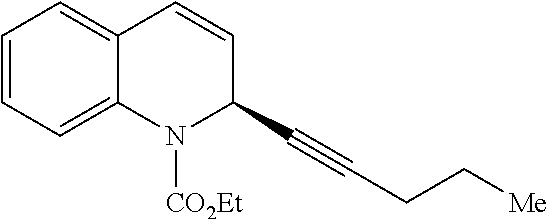 |
 |
| 4c, 62% | 4d, 68% |
| 91 |
95% ee |
 |
 |
| 4e, 62% | 4f, 77% |
| 93% ee | 94% ee |
 |
 |
| 4g, 66% | 4h, 86% |
| 95 |
95% ee |
 |
 |
| 4i, 70% | 4j, 70% |
| 91 |
96% ee |
 |
 |
| 4k, 80% | 4l, 75% |
| 93% ee | 90% ee |
| TABLE 5.1 |
| Optimization of the decomplexation reaction.a |
 |
| Entry | Temp (° C.) | yield (%) | ee (%) |
| 1 | 22 | 90-100 | 88-92 |
| 2 | 0 | 95 | 90 |
| 3 | −78 | no reaction | — |
| 4 | −78 to 0 | 97 | 98 |
| aThe ee was determined by HPLC after oxidation to the phosphine oxide. | |||
- 1. (a) Comprehensive Asymmetric Catalysis, Vol. 1-3 (Eds.: E. N. Jacobsen, A. Pfaltz, H. Yamamoto), Springer, Berlin, 1999. (b) Qi-Lin Zhou (Ed.), Privileged Chiral Ligands and Catalysts, Wiley-VCH, Weinheim, 2011.
- 2. Alcock, N. W.; Brown, J. M.; Hulmes, D. I. Tetrahedron:
Asymmetry 1993, 4, 743-756. - 3. (a) McCarthy, M.; Goddard, R.; Guiry, P. J. Tetrahedron:
Asymmetry 1999, 10, 2797-2807. (b) Connolly, D. J.; Lacey, P. M.; McCarthy, M.; Saunders, C. P.; Carroll, A.-M.; Goddard, R.; Guiry, P. J. J. Org. Chem. 2004, 69, 6572. - 4. Kwong, F. Y.; Chan, A. S. C.; Chan, K. S.
Tetrahedron 2000, 56, 8893-8899. - 5. Knopfel, T. F.; Aschwanden, P.; Ichikawa, T.; Watanabe, T.; Carreira, E. M. Angew. Chem., Int. Ed. 2004, 43, 5971-5973.
- 6. Fernández, E.; Guiry, P J.; Connole, K. P. T.; Brown, J. M. J. Org. Chem. 2014, 79, 5391-5400.
- 7. Cardoso, F. S. P.; Abboud, K. A.; Aponick, A. J. Am. Chem. Soc., 2013, 135, 14548-14551.
- 8. (a) Peshkov, V. A.; Pereshivko, O. P.; Van der Eycken, E. V. Chem. Soc. Rev. 2012, 41, 3790-3807. (b) Yoo, W.-J.; L. Zhao, L.; Li, C.-J. Aldrichim. Acta 2011, 44, 43-51.
- 9. Chung, K. H.; So, C. M.; Wong, S. M.; Luk, C. H.; Zhou, Z.; Lau, C. P.; Kwong, F. Y. Chem. Commun. 2012, 48, 1967-1969.
- 10. Song, B.; Knauber, T.; GooBen, L. J. Angew. Chem., Int. Ed. 2013, 52, 2954-2958.
- 11. Singer, R. A.; Caron, S.; McDermott, R. E.; Arpin, P.; Do, N. M.
Synthesis 2003, 11, 1727-1731. - 12. (a) Fromm, A.; van Wüllen, C.; Hackenberger, D.; GooBen, L. J Am. Chem. Soc., 2014, 136, 10007-10023. (b) Wong, S. M.; So, C. M.; Chung, K. H.; Lau, C. P.; Kwong, F. Y. Eur. J Org. Chem. 2012, 4172-4177.
- 13. Claridge, T. D. W.; Long, J. M.; Brown, J. M.; Hibbs, D.; Hursthouse, M. B. Tetrahedron 1997, 53, 4035-4050.
- 14. Figge, A., Altenbach, H. J., Brauerb, D. J., Tielmannc, P. Tetrahedron:
Asymmetry 2002, 13, 137-144. - 15. Alkorta, I.; Elguero, J.; Roussel, C.; Vanthuyne, N.; Piras, P. Atropisomerism and Axial Chirality in Heteroaromatic Compounds. Adv. Heterocycl. Chem. 2012, 105, 1-188.
- 16. (a) Clayden, J.; Moran, W. J.; Edwards, P. J.; LaPante S. R. Angew. Chem. Int. Ed. 2009, 48, 6398. (b) Bringmann, G.; Gulder, T.; Gulder, T. A. M.; Breuning, M. Chem. Rev. 2011, 111, 563-639.
- 17. Bringmann, G.; Price Mortimer, A. J.; Keller, P. A.; Gresser, M. J.; Garner, J.; Breuning, M. Angew. Chem., Int. Ed. 2005, 44, 5384-5427.
- 18. (a) Meyer, E. A., Castellano, R. K.; Diederich, F. Angew. Chem., Int. Ed. 2003, 42, 1210-1250. (b) Salonen, L. M., Ellermann, M., Diederich, F. Angew. Chem., Int. Ed. 2011, 50, 4808-4842.
- 19. Intentionally skipped
- 20. Ohkubo, M.; Hayashi, D.; Oikawa, D.; Fukuhara, K.; Okamoto, S.; Sato, F. Tetrahedron Lett. 2006, 47, 6209-6212.
- 21. (a) O. Sutherland, Annu. Rep. NMR Spectrosc., 1971, 4, 71. (b) Mati, I. K.; Cockroft, S. L. Chem. Soc. Rev. 2010, 39, 4195-4205.
- 22. (a) Patrick, R.; Prosser, G. S. Nature 1960, 187, 1021. (b) Williams, J. H.; Cockcroft, J. K.; Fitch, A. N. Angew. Chem., Int. Ed. Engl. 1992, 31, 1655-1657.
- 23. Gung, B. W.; Xue, X. W.; Zou, Y. J. Org. Chem. 2007, 72, 2469-2475.
- 24. For a matter of comparison, the barrier to rotation of 20 in C2D2Cl4 and CDCl3 were measured and it was observed that they are comparable when using these solvents. 25. The practical range for barriers determined using the coalescence method is defined by the temperature limitations of the NMR probe.
- 26. (a) Bott, G.; Field, L.-D.; Sternhell, S. J. Am. Chem. Soc. 1980, 102, 5618-5626. (b) Rieger, M.; Westheimer, F. H. J. Am. Chem. Soc. 1950, 72, 19-28.
- 27. Oki, M. Top. Stereochem. 1983, 14, 1-76.
- 28. Lim, C. W.; Tissot, O.; Mattison, A.; Hooper, M. W.; Brown, J. M.; Cowley, A. R.; Hulmes, D I.; Blacker, A. J. Org. Process Res. Dev. 2003, 7, 379-384.
- 29. Li, Y.-M.; Kwong, F.-Y.; Yu, W.-Y.; Chan, A. S. C. Coord. Chem. Rev. 2007, 251, 2119-2144.
- 30. Alcock, N. W.; Hulmes, D. I.; Brown, J. M. J. Chem. Soc., Chem. Commun. 1995, 395-397.
- 31. (a) Carroll, M. P.; Guiry, P. J.; Brown, J. M. Org. Biomol. Chem. 2013, 11, 4591-4601. (b) Birkholz, M.-N.; Freixa, Z.; van Leeuwen, P. W. N. M. Chem. Soc. Rev. 2009, 38, 1099-1118.
- 32. Noyori, R.; Takaya, H. Acc. Chem. Res. 1990, 23, 345-350.
- 33. (a) Guiry, P. J.; Saunders, C. P. Adv. Synth. Catal. 2004, 346, 497-537. (b) Carroll, M. P.; Guiry, P. J. Chem. Soc. Rev. 2014, 43, 819.
- 34. For separation of racemic phosphine oxide in a P,N-ligand see: Kwong, F. Y.; Yang, Q.; Mak, T. C. W.; Chan, A. S. C.; Chan, K. S. J Org. Chem. 2002, 67, 2769-2777.
- 35. This oxidation was performed in quantitative yield using hydrogen peroxide in dichloromethane and was performed in an analytical fashion. For full details, see
ref 7. - 36. The palladium complex ent-25 was prepared analogously to 25 as shown in
Scheme 3. - 37. (a) Gommermann, N.; Koradin, C.; Polborn, K.; Knochel, P. Angew. Chem. Int. Ed. 2003, 42, 5763-5766. (b) Gommermann, N.; Knochel, P. Chem. Eur. J. 2006, 12, 4380-4392.
- 38. Koradin, C.; Gommermann, N.; Polborn, K.; Knochel, P.
Chem. Eur. J 2003, 9, 2797-2811. - 39. For a similar complex, Quinazolinap-CuCl, see: Fleming, W. J.; Muller-Bunz, H.; Lillo, V.; Fernandez, E.; Guiry, P. J. Org. Biomol. Chem. 2009, 7, 2520-2524.
- 40. For an example of a bidentate ligand bridging two coppers, see: Shishkov, I. V.; Rominger, F.; Hofmann, P. Dalton Trans. 2009, 1428-1435.
Claims (11)


Priority Applications (2)
| Application Number | Priority Date | Filing Date | Title |
|---|---|---|---|
| US15/927,505 US10618922B2 (en) | 2013-09-13 | 2018-03-21 | Biaryl ligands, methods of making biaryl ligands, and methods of use thereof |
| US16/792,794 US11198701B2 (en) | 2013-09-13 | 2020-02-17 | Biaryl ligands, methods of making biarlyl ligands, and methods of use thereof |
Applications Claiming Priority (5)
| Application Number | Priority Date | Filing Date | Title |
|---|---|---|---|
| US201361877505P | 2013-09-13 | 2013-09-13 | |
| US201361881480P | 2013-09-24 | 2013-09-24 | |
| PCT/US2014/055356 WO2015038872A1 (en) | 2013-09-13 | 2014-09-12 | Biaryl ligands |
| US201615021053A | 2016-03-10 | 2016-03-10 | |
| US15/927,505 US10618922B2 (en) | 2013-09-13 | 2018-03-21 | Biaryl ligands, methods of making biaryl ligands, and methods of use thereof |
Related Parent Applications (2)
| Application Number | Title | Priority Date | Filing Date |
|---|---|---|---|
| PCT/US2014/055356 Continuation WO2015038872A1 (en) | 2013-09-13 | 2014-09-12 | Biaryl ligands |
| US15/021,053 Continuation US9994599B2 (en) | 2013-09-13 | 2014-09-12 | Biaryl ligands |
Related Child Applications (1)
| Application Number | Title | Priority Date | Filing Date |
|---|---|---|---|
| US16/792,794 Continuation US11198701B2 (en) | 2013-09-13 | 2020-02-17 | Biaryl ligands, methods of making biarlyl ligands, and methods of use thereof |
Publications (2)
| Publication Number | Publication Date |
|---|---|
| US20180282355A1 US20180282355A1 (en) | 2018-10-04 |
| US10618922B2 true US10618922B2 (en) | 2020-04-14 |
Family
ID=52666307
Family Applications (3)
| Application Number | Title | Priority Date | Filing Date |
|---|---|---|---|
| US15/021,053 Active US9994599B2 (en) | 2013-09-13 | 2014-09-12 | Biaryl ligands |
| US15/927,505 Active US10618922B2 (en) | 2013-09-13 | 2018-03-21 | Biaryl ligands, methods of making biaryl ligands, and methods of use thereof |
| US16/792,794 Active US11198701B2 (en) | 2013-09-13 | 2020-02-17 | Biaryl ligands, methods of making biarlyl ligands, and methods of use thereof |
Family Applications Before (1)
| Application Number | Title | Priority Date | Filing Date |
|---|---|---|---|
| US15/021,053 Active US9994599B2 (en) | 2013-09-13 | 2014-09-12 | Biaryl ligands |
Family Applications After (1)
| Application Number | Title | Priority Date | Filing Date |
|---|---|---|---|
| US16/792,794 Active US11198701B2 (en) | 2013-09-13 | 2020-02-17 | Biaryl ligands, methods of making biarlyl ligands, and methods of use thereof |
Country Status (2)
| Country | Link |
|---|---|
| US (3) | US9994599B2 (en) |
| WO (1) | WO2015038872A1 (en) |
Cited By (1)
| Publication number | Priority date | Publication date | Assignee | Title |
|---|---|---|---|---|
| US20220332739A1 (en) * | 2019-06-13 | 2022-10-20 | Shanghai Institute Of Organic Chemistry, Chinese Academy Of Sciences | A class of phosphine nitrogen ligand with multiple chiral centers and its synthesis method and application |
Families Citing this family (5)
| Publication number | Priority date | Publication date | Assignee | Title |
|---|---|---|---|---|
| EP3181552B1 (en) * | 2014-08-13 | 2020-10-21 | Nippon Soda Co., Ltd. | Diaryl imidazole compound and pest control agent |
| CN108479821A (en) * | 2018-05-10 | 2018-09-04 | 长乐智高生物科技有限公司 | A kind of catalyst and its application for synthesizing prothioconazoles intermediate |
| CN110548546A (en) * | 2018-05-31 | 2019-12-10 | 中国科学院大连化学物理研究所 | Method for catalyzing asymmetric hydrogenation of imine by iridium/linear phosphine-phosphoramidite system |
| CN111848952B (en) * | 2020-06-17 | 2021-06-04 | 扬州天启新材料股份有限公司 | Bisphenol A type cyanate ester resin prepolymer and preparation method thereof |
| US11958811B1 (en) | 2023-10-27 | 2024-04-16 | King Faisal University | 1-[4,5-bis(4-bromophenyl)-1-hexyl-1H-imidazol-2-yl]-2-naphthol as an antimicrobial compound |
Citations (2)
| Publication number | Priority date | Publication date | Assignee | Title |
|---|---|---|---|---|
| WO1995013284A1 (en) | 1993-11-09 | 1995-05-18 | Isis Innovation Limited | Asymmetric hydroboration |
| US20050277772A1 (en) | 2004-06-09 | 2005-12-15 | Erick Carreira | Monophosphine compound, transition metal complex thereof and production method of optically active compound using the complex as asymmetric catalyst |
Family Cites Families (17)
| Publication number | Priority date | Publication date | Assignee | Title |
|---|---|---|---|---|
| CA2186696A1 (en) | 1995-09-29 | 1997-03-30 | Takashi Seki | Catalyst component and catalyst |
| DE69727684D1 (en) | 1996-06-14 | 2004-03-25 | Univ Penn State Res Found | ASYMMETRIC SYNTHESIS CATALYZED BY TRANSITION METAL COMPLEXES WITH CYCLIC CHIRAL LIGANDS |
| US6521561B1 (en) | 1998-05-01 | 2003-02-18 | President And Fellows Of Harvard College | Main-group metal based asymmetric catalysts and applications thereof |
| US6307087B1 (en) | 1998-07-10 | 2001-10-23 | Massachusetts Institute Of Technology | Ligands for metals and improved metal-catalyzed processes based thereon |
| EP1354887B1 (en) | 1998-07-10 | 2007-04-25 | Massachussetts Institute of Technology | Ligands for metals and improved metal-catalyzed processes based thereon |
| US6727377B2 (en) | 1998-08-21 | 2004-04-27 | The Penn State Research Foundation | Asymmetric catalysis based on chiral phospholanes and hydroxyl phospholanes |
| WO2000019994A1 (en) * | 1998-10-02 | 2000-04-13 | Board Of Trustees Of The University Of Illinois | Estrogen receptor ligands |
| JP2002527413A (en) | 1998-10-13 | 2002-08-27 | イー・アイ・デュポン・ドウ・ヌムール・アンド・カンパニー | Phosphorus ligands supported on catalytic polymers |
| US6969720B2 (en) * | 1999-03-17 | 2005-11-29 | Amr Technology, Inc. | Biaryl substituted purine derivatives as potent antiproliferative agents |
| US6534657B2 (en) | 2000-02-10 | 2003-03-18 | The Penn State Research Foundation | Chiral ferrocene phosphines and their use in asymmetric catalytic reactions |
| EP1341797A4 (en) * | 2000-11-17 | 2005-06-15 | Penn State Res Found | Ortho substituted chiral phosphines and phosphinites and their use in asymmetric catayltic reactions |
| US6667311B2 (en) * | 2001-09-11 | 2003-12-23 | Albany Molecular Research, Inc. | Nitrogen substituted biaryl purine derivatives as potent antiproliferative agents |
| US7091292B2 (en) | 2002-04-24 | 2006-08-15 | Symyx Technologies, Inc. | Bridged bi-aromatic catalysts, complexes, and methods of using the same |
| US8188128B2 (en) * | 2005-05-12 | 2012-05-29 | The University Of Medicine And Dentistry Of New Jersey | Opioid receptor subtype-selective agents |
| CA2643493C (en) * | 2006-03-02 | 2012-07-17 | Chao-Jun Li | 1-naphtholyl tetrahyroisoquinoline derivatives and use thereof as chiral ligands in asymmetric synthesis |
| WO2008067218A1 (en) * | 2006-11-28 | 2008-06-05 | Boehringer Ingelheim International Gmbh | Electronically tuned ligands for asymmetric hydrogenation |
| US8415488B2 (en) | 2007-11-20 | 2013-04-09 | Solvias Ag | Bidentate secondary phosphine oxide chiral ligands for use in asymmetric addition reactions |
-
2014
- 2014-09-12 WO PCT/US2014/055356 patent/WO2015038872A1/en not_active Ceased
- 2014-09-12 US US15/021,053 patent/US9994599B2/en active Active
-
2018
- 2018-03-21 US US15/927,505 patent/US10618922B2/en active Active
-
2020
- 2020-02-17 US US16/792,794 patent/US11198701B2/en active Active
Patent Citations (2)
| Publication number | Priority date | Publication date | Assignee | Title |
|---|---|---|---|---|
| WO1995013284A1 (en) | 1993-11-09 | 1995-05-18 | Isis Innovation Limited | Asymmetric hydroboration |
| US20050277772A1 (en) | 2004-06-09 | 2005-12-15 | Erick Carreira | Monophosphine compound, transition metal complex thereof and production method of optically active compound using the complex as asymmetric catalyst |
Non-Patent Citations (89)
| Title |
|---|
| Alcock, N. W.; Brown, J. M.; Hulmes, D. I., Synthesis and Resolution of I-(2-Diphenylphosphino-Inaphthyl)isoquinoline; a P-N Chelating Ligand for Asymmetric Catalysis. Tetrahedron: Asymmetry 1993, 4, 743-756. |
| Alcock, N. W.; Brown, J. M.; Hulmes, D. I., Synthesis and Resolution of I-(2-Diphenylphosphino-Inaphthyl)isoquinoline; a P—N Chelating Ligand for Asymmetric Catalysis. Tetrahedron: Asymmetry 1993, 4, 743-756. |
| Alcock, N. W.; Hulmes, D. I.; Brown, J. M., Contrasting Behaviour of Related Palladium Complex-derived Resolving Agents. 8-H Conformational Locking of the I-Naphthyl, Side-chain, J. Chem. Soc., Chem. Commun. 1995, 395-397. |
| Alkorta, I.; Elguero, J.; Roussel, C.; Vanthuyne, N.; Piras, P., Atropisomerism and Axial Chirality in Heteroaromatic Compound. Adv. Heterocycl. Chem. 2012, 105, 1-188. |
| Allen, D. G.; Mclaughlin, G. M.; Robertson, G. B.; Steffen, W. L.; Salem, G.; Wild, S. B., Resolutions with metal complexes. Preparation and resolution of (R,S)-methylphenyl(8-quinolyl)phosphine and its arsenic analog. Crystal and molecular structure of (+)589-[(R)-dimethyl(1-ethyl-naphthyl)aminato-C2,N[](S)-methylphenyl(8-quinolyl)phosphine]palladium(II) hexafluorophosphate. Inorg. Chem. 1982, 21, 1007-1014. |
| Andersen, N. G.; Parvez, M.; Keay, B. A., Synthesis, Resolution, and Applicationsof 2,2′-Bis(diphenylphosphino)-3,3′-binaphtho[2,1-b]furan, Org. Lett. 2000, 2, 2817-2820. |
| Andersen, N.G., Keay, B. A., 2-Furyl Phosphines as Ligands for Transition-Metal-Mediated Organic Synthesis Chem. Rev. 2001, 101, 997-1030. |
| Anderson, N. G., Developing Processes for Crystallization-Induced Asymmetric Transformation, Org. Process Res. Dev. 2005, 9, 800-813. |
| Aschwanden, P.; Stephenson, C. R. J.; Carreira, E M., Highly Enantioselective Access to Primary Propargylamines: 4-Piperidinone as a Convenient Protecting Group, Org. Lett. 2006, 8, 2437-2440. |
| Benincori, T.; Brenna, E; Sannicolò, F.; Trimarco, L.; Antognazza, P.; Cesarotti, E.; Demartin, F.; Pilati, T., New Class of Chiral Diphosphine Ligands for Highly Efficient Transition Metal-Catalyzed Stereoselective Reactions: The Bis (diphenylphosphino) Five-membered Biheteroaryls, J. Org. Chem. 1996, 61, 6244-6251. |
| Benincori, T.; Brenna, E; Sannicolò, F.; Trimarco, L.; Antognazza, P.; Cesarotti, E; Zotti, G., Chiral atropisomeric five-membered biheteroaromatic diphosphines: new ligands of the bibenzimidazole and biindole series, J. Organomet. Chem. 1997, 529, 445-453. |
| Benincori, T.; Cesarotti, E.; Piccolo, O.; Sannicolò, F., 2,2′,5,5′-Tetramethyl-4,4′-bis(diphenylphoshino)-3,3′-bithiophene: A New, Very Efficient, Easily Accessible, Chiral Biheteroaromatic Ligand for Homogeneous Stereoselective Catalysis, J. Org. Chem. 2000, 65, 2043-2047. |
| Benincori, T.; Gladiali, S.; Rizzo, S.; Sannicolò, F., A New Modular Class of Easily Accessible, Inexpensive, and Efficient Chiral Diphosphine Ligands for Homogeneous Stereoselective Catalysis, J. Org. Chem. 2001, 66, 5940-5942. |
| Benincori, T.; Piccolo, O.; Rizzo, S.; Sannicolò, F., 3,3′-Bis(diphenylphosphino)-1,1′-disubstituted-2,2′biindoles: Easily Accessible, Electron-Rich, Chiral Diphosphine Ligands for Homogeneous Enantioselective Hydrogenation of Oxoesters, J. Org. Chem. 2000, 65, 8340-8347. |
| Berens, U.; Brown, J. M.; Long, J.; Selke, R., Synthesis and Resolution of 2,2′-bis-diphenylphosphino [3,3′]biindolyl; a New Atropisomeric Ligand for Transition Metal Catalysis, Tetrahedron: Asymmetry 1996, 7, 285-292. |
| Berthod, M.; Mignani, G.; Woodward, G.; Lemaire, M., Modified BINAP: The How and the Why. Chem. Rev. 2005, 105, 1801-1836. |
| Birkholz, M.-N.; Freixa, Z.; van Leeuwen, P. W. N. M., Bite angle effects of diphosphines in C-C and C-X bond forming cross coupling reactions. Chem. Soc. Rev., 2009, 38, 1099-1118. |
| Birkholz, M.-N.; Freixa, Z.; van Leeuwen, P. W. N. M., Bite angle effects of diphosphines in C—C and C—X bond forming cross coupling reactions. Chem. Soc. Rev., 2009, 38, 1099-1118. |
| Bott, G.; Field, L.-D.; Sternhell, S., Steric Effects. A Study of a Rationally Designed System, J. Am. Chem. Soc. 1980, 102, 5618-5626. |
| Bringmann, et al., "Atroposelective Synthesis of Axially Chiral Biaryl Compounds", Angewandte Chemie International Edition. vol. 44, Issue 34, pp. 5384-5427, Aug. 26, 2005. |
| Bringmann, G.; Gulder, T.; Gulder, T. A. M.; Breuning, M., Atroposelective Total Synthesis of Axially Chiral Biaryl Natural Products, Chem. Rev. 2011, 111, 563-639. |
| Bringmann, G.; Price Mortimer, A. J.; Keller, P. A.; Gresser, M. J.; Garner, J.; Breuning, M., Angew. Chem., Atroposelective Synthesis of Axially Chiral Biaryl Compounds, Int. Ed. 2005, 44, 5384-5427. |
| Brown, J. M.; Hulmes, D. L; Guiry, P. J., Mechanistic and Synthetic Studies in Catalytic Allylic Alkylation with Palladium Complexes of I-(2-Diphenylphosphino-1-naphthyl)isoquinoline. Tetrahedron 1994, 50, 4493-4506. |
| Brunel, J. M., BINOL: A Versatile Chiral Reagent, Chem. Rev. 2005, 105, 857-897. |
| Cardoso, F. S. P.; Abboud, K. A.; Aponick, A., Design, Preparation, and Implementation of an Imidazole-Based Chiral Biaryl P,N-Ligand for Asymmetric Catalysis, J. Am. Chem. Soc., 2013, 135, 14548-14551. |
| Carroll, A.; O'Sullivan, T. P.; Guiry, P. J., The Development of Enantioselective Rhodium-Catalysed Hydroboration of Olefins Adv. Synth. Catal. 2005, 347, 609-631. |
| Carroll, M. P.; Guiry, P. J.; Brown, J. M., Meta-analysis in asymmetric catalysis. Influence of, chelate geometry on the roles of PN chelating ligands, Org. Biomol. Chem., 2013, 11, 4591-4601. |
| Carroll, M. P.; Guiry, P., P,N ligands in asymmetric catalysis, J. Chem. Soc. Rev. 2014, 43, 819. |
| Chen, C.; Li, X.; Schreiber, S. L., Catalytic Asymmetric [3+2] Cycloaddition of Azomethine Ylides. Development of a Versatile Stepwise, Three-Component Reaction for Diversity-Oriented Synthesis, J. Am. Chem. Soc. 2003, 125, 10174-10175. |
| Chen, Y.; Yekta, S.; Yudin, A. K., Modified BINOL Ligands in Asymmetric Catalysis, Chem. Rev. 2003, 103, 3155-3211. |
| Chung, K. H.; So, C. M.; Wong, S. M.; Luk, C. H.; Zhou,Z.; Lau, C. P.; Kwong, F. Y., An efficient palladium-benzimidazolyl phosphine complex for the Suzuki-Miyaura coupling of aryl mesylates: facile ligand synthesis and metal complex characterization, Chem. Commun. 2012, 48, 1967-1969. |
| Claridge, T. D. W.; Long, J. M.; Brown, J. M.; Hibbs, D.; Hursthouse, M. B., Synthesis of 1-Methyl-2-diphenylphosphino-3-(1′-isoquinolyl)indole; an Easily Racemised Ligand giving Insights into Catalytic Asymmetric Allylation. Tetrahedron 1997, 53, 4035-4050. |
| Clayden, J.; Moran, W. J.; Edwards, P. J.; LaPante S. R., The Challenge of Atropisomerism in Drug Discovery, Angew. Chem. Int. Ed. 2009, 48, 6398. |
| Clift, M. D.; Thomson, R. J. Development of a Merged Conjugate Addition/Oxidative Coupling Sequence. Application to the Enantioselective Total Synthesis of Metacycloprodigiosin and Prodigiosin R1. J. Am. Chem. Soc. 2009, 131, 14579-14583. |
| Connolly, D. J.; Lacey, P. M.; McCarthy, M.; Saunders, C. P.; Carroll, A.-M.; Goddard, R.; Guiry, P. J., Preparation and Resolution of a Modular Class of Axially Chiral Quinazoline-Containing Ligands and Their Application in Asymmetric Rhodium-Catalyzed Olefin Hydroboration, J. Org. Chem. 2004, 69, 6572. |
| Doucet, H.; Fernandez, E.; Layzell, T. P.; Brown, J. M., The Scope of Catalytic Asymmetric Hydroboration/Oxidation with Rhodium Complexes of 1,1′-(2-Diarylphosphino-1-naphthyl)isoquinolines Chem. Eur. J. 1999, 5, 1320-1330. |
| Eseola, A. O.; Obi-Egbedi, N. O, Spectroscopic study of 2-, 4- and 5-substituents on pKa values on imidazole heterocycles prone to intramolecular proton-electrons transfer, Spectrochim. Acta A 2010, 75, 693-701. |
| Fernández, E.; Guiry, P J.; Connole, K. P. T.; Brown, J. M., Quinap and Congeners: Atropos PN ligands for Asymmetric Catalysis, J. Org. Chem. 2014, 79, 5391-5400. |
| Figge, A., Altenbach, H.J., Brauerb, D.J., Tielmannc, P., Synthesis and resolution of 2-(2-diphenylphosphinyl-naphthalen-1-yl)-1-isopropyi-1Hbenzoimidazole; a new atropisomeric P,N-chelating ligand for asymmetric catalysis. Tetrahedron: Asymmetry 2002, 13, 137-144. |
| Fleming, W. J.; Muller-Bunz, H.; Lillo, V.; Fernandez, E.; Guiry, P., Axially chiral P-N ligands for the copper catalyzed b-borylation of a,b-unsaturated esters, J. Org. Biomol. Chem. 2009, 7, 2520-2524. |
| Fromm, A.; van Wüllen, C.; Hackenberger, D.; Gooßen, L., Mechanism of Cu/Pd-Catalyzed Decarboxylative Cross-Couplings: A DFT Investigation, J. Am. Chem. Soc., 2014, 136, 10007-10023. |
| Fujimori, S.; Knopfel, T. F.; Zarotti, P.; Ichikawa, T.; Boyall, D.; Carreira, E. M., Stereoselective Conjugate Addition Reactions Using In Situ Metallated Terminal Alkynes and the Development of Novel Chiral P,N-Ligands, Bull. Chem. Soc. Jpn. 2007, 80, 1635-1657. |
| Gommermann, N.; Knochel, P., Practical Highly Enantioselective Synthesis of Propargylamines through a Copper-Catalyzed One-Pot Three-Component Condensation Reaction. Chem. Eur. J. 2006, 12, 4380-4392. |
| Gommermann, N.; Knochel, P., Practical highly enantioselective synthesis of terminal propargylamines. An expeditious synthesis of (S)-(1)-coniine, Chem. Commun. 2004, 2324-2325. |
| Gommermann, N.; Koradin, C.; Polbom, K.; Knochel, P., Enantioselective, Copper(I)-Catalyzed Three-Component Reaction for the Preparation of Propargylamines. Angew. Chem. Int. Ed. 2003, 42, 5763-5766. |
| Guiry, P. J.; Saunders, C. P., The Development of Bidentate P,N Ligands for Asymmetric Catalysis, Adv. Synth. Catal. 2004, 346, 497-537. |
| Gung, B. W.; Xue, X.; Zou, Y., Enthalpy (ΔH) and Entropy (ΔS) fom-Stacking Interactions in Near-Sandwich Configurations: Relative Importance of Electrostatic, Dispersive, and Charge-Transfer Effects, J. Org. Chem. 2007, 72, 2469-2475. |
| Hasan, I.; Marinelli, E. R.; Lin, L. C. C.; Fowler, F. W.; Levy, A. B., Synthesis and Reactions of N-Protected 2-Lithiated Pyrroles and Indoles. The tert-Butoxycarbonyl Substituent as a Protecting Group. J. Org. Chem. 1981, 46, 157-164. |
| Haynes, S. W.; Sydor, P. K.; Stanley, A. E.; Song, L.; Challis, G. L., Role and substrate specificity of the Streptomyces coelicolor RedHenzyme in undecylprodiginine biosynthesis. Chem. Commun., 2008, 1865-1867. |
| Knopfel, T. F.; Aschwanden, P.; Ichikawa, T.; Watanabe, T.; Carreira, E. M., Readily available biaryl P,N ligands for asymmetric catalysis Angew. Chem., Int. Ed. 2004, 43, 5971-5973. |
| Knopfel, T. F.; Zarotti, P.; Ichikawa, T.; Carreira, E. M., Catalytic, Enantioselective, Conjugate Alkyne Addition, J. Am. Chem. Soc. 2005, 127, 9682-9683. |
| Koradin, C.; Gommermann, N.; Polborn, K.; Knochel, P., Synthesis of Enantiomerically Enriched Propargylamines by Copper-Catalyzed Addition of Alkynes to Enamines, Chem. Eur. J. 2003, 9, 2797-2811. |
| Kostas, I. D., Recent Advances on P,N-Containing Llgands for Transition-Metal Homogeneous Catalysis, Curr. Org. Synth., 2008, 5, 227-249. |
| Kwong, F. Y.; Chan, A. S. C.; Chan, K. S., Chelating Retardation Effect in Nickel Assisted Phosphination: Syntheses of Atropisomeric P,N Ligands. Tetrahedron 2000, 56, 8893-8899. |
| Kwong, F. Y.; Yang, Q.; Mak, T. C. W.; Chan, A. S. C.; Chan, K. S., A New Atropisomeric P,N Ligand for Rhodium-Catalyzed Asymmetric Hydroboration, J. Org. Chem. 2002, 67, 2769-2777. |
| Li, et al., "Recent Advances in Developing New Axially Chiral Phosphine Ligands for Asymmetric Catalysis", Coordination Chemistry Reviews. vol. 251, Issues 17-20, Sep. 2007, pp. 2119-2144. |
| Li, Y.-M.; Kwong, F.-Y.; Yu, W.-Y.; Chan, A. S. C., Recent advances in developing new axially chiral phosphine ligands for asymmetric catalysis, Coord. Chem. Rev. 2007, 251, 2119-2144. |
| Lim, A. D.; Codelli, J. A.; Reisman, S. E., Catalytic Asymmetric Synthesis of Highly Substituted Pyrrolizidines, Chem. Sci., 2013, 4, 650-654. |
| Lim, C. W.; Tissot, O.; Mattison, A.; Hooper, M. W.; Brown, J. M.; Cowley, A. R.; Hulmes, D I.; Blacker, A. J., Practical Preparation and Resolution of 1-(2′-Diphenylphosphino-1′-naphthyl)isoquinoline: A Useful Ligand for Catalytic Asymmetric Synthesis, Org. Process Res. Dev. 2003, 7, 379-384. |
| Marion, N.; Diez-Gonzalez, S.; Nolan, S. P., N-heterocyclic carbenes as organocatalysts Angew. Chem., Int. Ed. 2007, 46, 2988-3000. |
| Mati, I. K.; Cockroft, S. L., Molecular balances for quantifying non-covalent interactions, Chem. Soc. Rev. 2010, 39, 4195-4205. |
| McCarthy, M.; Goddard, R.; Guiry, P. J., The preparation and resolution of 2-phenyl-Quinazolinap, a new atropisomeric phosphinamine ligand for asymmetric catalysis, Tetrahedron: Asymmetry 1999, 10, 2797-2807. |
| McCarthy, M.; Guiry, P. J., Axially chiral bidentate ligands in asymmetric catalysis, Tetrahedron 2001, 57, 3809-3844. |
| McCartney, D.; Guiry, P. J., The asymmetric Heck and related reactions. Chem. Soc. Rev. 2011, 40, 5122-5150. |
| Meyer, E. A., Castellano, R. K.; Diederich, F., Interactions with Aromatic Rings in Chemical and Biological Recognition. Angew. Chem., Int. Ed. 2003, 42, 1210-1250. |
| Morgan, J. M.; Miller, S. P.; Morken, J. P. J., Rhodium-Catalyzed Enantioselective Diboration of Simple Alkenes, Am. Chem. Soc. 2003, 125, 8702-8703. |
| Muller, C.; Pidko, E. A.; Staring, A. J. P. M.; Lutz, M.; Spek, A. L.; van Santen, R. A.; Vogt, D., Developing a New Class of Axial Chiral Phosphorus Ligands: Preparation and Characterization of Enantiopure Atropisomeric Phosphinines, Chem. Eur. J. 2008, 14, 4899-4905. |
| Noyori, R.; Takaya, H., BINAP: An Efficient Chiral Element for Asymmetric Catalysis. Acc. Chem. Res. 1990, 23, 345-350. |
| O. Sutherland, The Investigation of the Kinetics of Conformational Changes by Nuclear Magnetic Resonance Spectroscopy, Annu. Rep. NMR Spectrosc., 1971, 4, 71. |
| Ohkubo, M.; Hayashi, D.; Oikawa, D.; Fukuhara, K.; Okamoto, S.; Sato, F., Synthesis of N-substituted 2-arylpyrroles by the reaction of (g2-imine)titanium complexes with 3,3-diethoxypropyne, Tetrahedron Lett. 2006, 47, 6209-6212. |
| Oki, M., Recent Advances in Atropisomerism, Top. Stereochem. 1983, 14, 1-76. |
| Otsuka, S.; Nakamura, A.; Kano, T.; Tani, K., Partial Resolution of Racemic Tertiary Phosphines with an Asymmetric Palladium Complex. J. Am. Chem. Soc. 1971, 93, 4301-4303. |
| Patrick, R.; Prosser, G. S., A Molecular Complex of Benzene and Hexaflourobenzene, Nature 1960, 187, 1021. |
| Peshkov, V. A.; Pereshivko, O. P.; Van der Eycken, E. V., A walk around the A3-coupling. Chem. Soc. Rev. 2012, 41, 3790-3807. |
| Rieger, M.; Westheimer, F. H., The Calculation and Determination of the Buttressing Effect for the Racemization of 2,2′,3,3′-Tetraiodo-5,5′-dicarboxybiphenyl, J. Am. Chem. Soc. 1950, 72, 19-28. |
| Salonen, L. M., Ellermann, M., Diederich, F., Aromatic Rings in Chemical and Biological Recognition: Energetics and Structures. Angew. Chem., Int. Ed. 2011, 50, 4808-4842. |
| Schlosser, M.; Michel, D., Introduction of fluorine into organic molecules: why and how. Tetrahedron 1996, 52, 99-108. |
| Shimizu, H.; Nagasaki, I.; Saito, T., Recent advances in biaryl-type bisphosphine ligands. Tetrahedron 2005, 61, 5405-5432. |
| Shishkov, I. V.; Rominger, F.; Hofmann, P., Reversible substrate binding at copper centers in neutral copper(I) carbene complexes derived from bis(3-tert-butylimidazole-2-ylidene)methane, Dalton Trans. 2009, 1428-1435. |
| Singer, R. A.; Caron, S.; McDermott, R. E; Arpin, P.; Do, N. M., Alternative Biarylphosphines for Use in the Palladium-Catalyzed Amination of Aryl Halides, Synthesis 2003, 11, 1727-1731. |
| Song, B.; Knauber, T.; Gooßen, L., Decarboxylative Cross-Coupling of Mesylates Catalyzed by Copper/Palladium Systems with Customized Imidazolyl Phosphine Ligands, J. Angew. Chem., Int. Ed. 2013, 52, 2954-2958. |
| Sutherland, I. O., The investigation of the kinetics of conformational changes by nuclear magnetic resonance spectroscopy. Annu. Rep. NMR Spectrosc. 1971, 4, 71-235. |
| Tani, K.; Brown, L. D.; Ahmed, J.; Ibers, J. A.; Yokota, M.; Nakamura, A.; Otsuka, S., Chiral Metal Complexes. 4. Resolution of Racemic Tertiary Phosphines with Chiral Palladium(II) Complexes. The Chemistry of Diastereomeric Phosphine Pd(II) Species in Solution, and the Absolute Configuration of [(S)-Isopropyl-tert-butylphenylphosphine]-[(R)-N,N-dimethyl-(2-naphthyl)-ethylamine-3C,N]chloropalladium(II) Determined by X-Ray Diffraction. J. Am. Chem. Soc. 1977, 99, 7876-7886. |
| Williams, J. H.; Cockcroft, J. K.; Fitch, A. N., Structure of the Lowest Temperature Phase of the Solid Benzene-Hexaflourobenzene Adduct, Angew. Chem., Int. Ed. Engl. 1992, 31, 1655-1657. |
| Williams, J. H.; Cockcroft, J. K.; Fitch, A. N., Structure of the Lowest Temperature Phase of the Solid Benzene—Hexaflourobenzene Adduct, Angew. Chem., Int. Ed. Engl. 1992, 31, 1655-1657. |
| Wong, S. M.; So, C. M.; Chung, K. H.; Lau, C. P.; Kwong, F. Y., An Efficient Class of P,N-Type "PhMezole-phos" Ligands: Applications in Palladium-Catalyzed Suzuki Coupling of Aryl Chlorides, Eur. J. Org. Chem. 2012, 4172-4177. |
| Yamaguchi, M.; Shima, T.; Yamagishi, T.; Hida, M., Palladium-catalyzed asymmetric allylic alkylation using dimethyl malonate and its derivatives as nucleophile. Tetrahedron: Asymmetry 1991, 2, 663-666. |
| Yoo, W.-J.; L. Zhao, L.; Li, C.-J., The A3-Coupling (Aldehyde-Alkyne-Amine) Reaction: A Versatile Method for the Preparation of Propargyl Amines, Aldrichimica Acta 2011, 44, 43-51. |
| Yoon, T. P.; Jacobsen, E. N., Privileged Chiral Catalysts. Science 2003, 299, 1691. |
Cited By (2)
| Publication number | Priority date | Publication date | Assignee | Title |
|---|---|---|---|---|
| US20220332739A1 (en) * | 2019-06-13 | 2022-10-20 | Shanghai Institute Of Organic Chemistry, Chinese Academy Of Sciences | A class of phosphine nitrogen ligand with multiple chiral centers and its synthesis method and application |
| US12275752B2 (en) * | 2019-06-13 | 2025-04-15 | Shanghai Institute Of Organic Chemistry, Chinese Academy Of Sciences | Class of phosphine nitrogen ligand with multiple chiral centers and its synthesis method and application |
Also Published As
| Publication number | Publication date |
|---|---|
| US9994599B2 (en) | 2018-06-12 |
| US20200223878A1 (en) | 2020-07-16 |
| US20160222041A1 (en) | 2016-08-04 |
| US11198701B2 (en) | 2021-12-14 |
| US20180282355A1 (en) | 2018-10-04 |
| WO2015038872A1 (en) | 2015-03-19 |
Similar Documents
| Publication | Publication Date | Title |
|---|---|---|
| US11198701B2 (en) | Biaryl ligands, methods of making biarlyl ligands, and methods of use thereof | |
| Albrecht | Cyclometalation using d-block transition metals: Fundamental aspects and recent trends | |
| JP5719115B2 (en) | Novel organometallic complex and method for producing amine compound | |
| JP6227889B2 (en) | Novel organometallic complex and method for producing amine compound | |
| JP6254811B2 (en) | Organometallic compound having nitrogen-containing heterocyclic carbene ligand, catalyst containing the same, and method for producing amine compound | |
| Chen et al. | Phosphine-catalyzed [3+ 2] cycloadditions of trifluoromethyl enynes/enediynes with allenoates: access to cyclopentenes containing a CF 3-substituted quaternary carbon center | |
| Jana et al. | Gold-Catalyzed Carbazolation Reactions of Alkynes | |
| Gläsel et al. | Cobalt‐Catalysed [2+ 2+ 2] Cycloadditions | |
| Balázs et al. | Synthesis of stereoprojecting, chiral NC (sp3)-E type pincer complexes | |
| Nagahora et al. | Buchwald–Hartwig Amination of Phosphinines and the Effect of Amine Substituents on Optoelectronic Properties of the Resulting Coupling Products | |
| CN108473451A (en) | The synthesis of 1- [2- (2,4- Dimethyl-phenylsulfanyls)-phenyl] piperazine | |
| Han et al. | Chiral ferrocenyl P, S-ligands for highly efficient copper-catalyzed asymmetric [3+ 2] cycloaddition of azomethine ylides | |
| JP6065259B2 (en) | Method for producing optically active amines | |
| Liu et al. | Synthesis of chiral cyclohexane-backbone P, N-ligands derived from pyridine and their applications in asymmetric catalysis | |
| JP5042438B2 (en) | Process for producing β-aminoalcohols having a syn configuration | |
| US20120077989A1 (en) | Cyclic imidate ligands | |
| CN101175715B (en) | Asymmetric Hydrogenation of Diphenylalanine Derivatives | |
| US8822680B2 (en) | Paracyclophane-based ligands, their preparation and use in catalysis | |
| Kumar et al. | Synthesis of Axially Chiral Biaryls via Pd (II)-Catalysed Direct C (sp2)-H Olefination and Arylation | |
| Liu et al. | Tunable CTPhos and chloride enabled direct asymmetric reductive amination for the synthesis of chiral hydroxylamines | |
| Alsabeh | The Development of Catalysts for the Monoarylation of Ammonia and Related Challenging Cross-Coupling Reactions | |
| Huang et al. | Active, selective, and stable single-component precatalysts for asymmetric allylic alkylation | |
| JP5616976B2 (en) | Diastereoselective process for producing alcohol compounds and ruthenium compounds | |
| Kim | Hydrogen Bond-directed Stereospecific Interactions in (A) General Synthesis of Chiral Vicinal Diamines and (B) Generation of Helical Chirality with Amino Acids | |
| Carpenter | Developments in the hydrogenation of challenging substrates utilising transition metal complexes |
Legal Events
| Date | Code | Title | Description |
|---|---|---|---|
| FEPP | Fee payment procedure |
Free format text: ENTITY STATUS SET TO UNDISCOUNTED (ORIGINAL EVENT CODE: BIG.); ENTITY STATUS OF PATENT OWNER: SMALL ENTITY |
|
| FEPP | Fee payment procedure |
Free format text: ENTITY STATUS SET TO SMALL (ORIGINAL EVENT CODE: SMAL); ENTITY STATUS OF PATENT OWNER: SMALL ENTITY |
|
| STPP | Information on status: patent application and granting procedure in general |
Free format text: NON FINAL ACTION MAILED |
|
| AS | Assignment |
Owner name: UNIVERSITY OF FLORIDA RESEARCH FOUNDATION, INC., F Free format text: ASSIGNMENT OF ASSIGNORS INTEREST;ASSIGNORS:APONICK, AARON;CARDOSO, FLAVIO S.P.;REEL/FRAME:048556/0535 Effective date: 20190306 Owner name: UNIVERSITY OF FLORIDA RESEARCH FOUNDATION, INC., FLORIDA Free format text: ASSIGNMENT OF ASSIGNORS INTEREST;ASSIGNORS:APONICK, AARON;CARDOSO, FLAVIO S.P.;REEL/FRAME:048556/0535 Effective date: 20190306 |
|
| STPP | Information on status: patent application and granting procedure in general |
Free format text: NON FINAL ACTION MAILED |
|
| STPP | Information on status: patent application and granting procedure in general |
Free format text: RESPONSE TO NON-FINAL OFFICE ACTION ENTERED AND FORWARDED TO EXAMINER |
|
| STPP | Information on status: patent application and granting procedure in general |
Free format text: NOTICE OF ALLOWANCE MAILED -- APPLICATION RECEIVED IN OFFICE OF PUBLICATIONS |
|
| STPP | Information on status: patent application and granting procedure in general |
Free format text: PUBLICATIONS -- ISSUE FEE PAYMENT RECEIVED |
|
| STPP | Information on status: patent application and granting procedure in general |
Free format text: PUBLICATIONS -- ISSUE FEE PAYMENT VERIFIED |
|
| STCF | Information on status: patent grant |
Free format text: PATENTED CASE |
|
| MAFP | Maintenance fee payment |
Free format text: PAYMENT OF MAINTENANCE FEE, 4TH YR, SMALL ENTITY (ORIGINAL EVENT CODE: M2551); ENTITY STATUS OF PATENT OWNER: SMALL ENTITY Year of fee payment: 4 |