US10604863B2 - Lithium metaborate crystal, preparation method and use thereof - Google Patents
Lithium metaborate crystal, preparation method and use thereof Download PDFInfo
- Publication number
- US10604863B2 US10604863B2 US16/061,670 US201616061670A US10604863B2 US 10604863 B2 US10604863 B2 US 10604863B2 US 201616061670 A US201616061670 A US 201616061670A US 10604863 B2 US10604863 B2 US 10604863B2
- Authority
- US
- United States
- Prior art keywords
- temperature
- crystal
- lithium metaborate
- rate
- mixture
- Prior art date
- Legal status (The legal status is an assumption and is not a legal conclusion. Google has not performed a legal analysis and makes no representation as to the accuracy of the status listed.)
- Active, expires
Links
- 239000013078 crystal Substances 0.000 title claims abstract description 551
- HZRMTWQRDMYLNW-UHFFFAOYSA-N lithium metaborate Chemical compound [Li+].[O-]B=O HZRMTWQRDMYLNW-UHFFFAOYSA-N 0.000 title claims abstract description 226
- 238000002360 preparation method Methods 0.000 title abstract description 32
- 238000000034 method Methods 0.000 claims abstract description 63
- 238000002425 crystallisation Methods 0.000 claims abstract description 27
- 238000007716 flux method Methods 0.000 claims abstract description 24
- 239000000155 melt Substances 0.000 claims abstract description 5
- 239000011259 mixed solution Substances 0.000 claims description 151
- BASFCYQUMIYNBI-UHFFFAOYSA-N platinum Chemical compound [Pt] BASFCYQUMIYNBI-UHFFFAOYSA-N 0.000 claims description 114
- 239000000203 mixture Substances 0.000 claims description 82
- 230000004907 flux Effects 0.000 claims description 67
- 229910011255 B2O3 Inorganic materials 0.000 claims description 64
- JKWMSGQKBLHBQQ-UHFFFAOYSA-N diboron trioxide Chemical compound O=BOB=O JKWMSGQKBLHBQQ-UHFFFAOYSA-N 0.000 claims description 64
- 239000012803 melt mixture Substances 0.000 claims description 64
- 230000003247 decreasing effect Effects 0.000 claims description 62
- 239000000843 powder Substances 0.000 claims description 61
- WMFOQBRAJBCJND-UHFFFAOYSA-M Lithium hydroxide Chemical compound [Li+].[OH-] WMFOQBRAJBCJND-UHFFFAOYSA-M 0.000 claims description 60
- 229910052697 platinum Inorganic materials 0.000 claims description 37
- KGBXLFKZBHKPEV-UHFFFAOYSA-N boric acid Chemical compound OB(O)O KGBXLFKZBHKPEV-UHFFFAOYSA-N 0.000 claims description 33
- -1 lithium metaborate compound Chemical class 0.000 claims description 33
- XGZVUEUWXADBQD-UHFFFAOYSA-L lithium carbonate Chemical compound [Li+].[Li+].[O-]C([O-])=O XGZVUEUWXADBQD-UHFFFAOYSA-L 0.000 claims description 28
- 229910052808 lithium carbonate Inorganic materials 0.000 claims description 28
- 230000008025 crystallization Effects 0.000 claims description 26
- 150000001875 compounds Chemical class 0.000 claims description 25
- IIPYXGDZVMZOAP-UHFFFAOYSA-N lithium nitrate Chemical compound [Li+].[O-][N+]([O-])=O IIPYXGDZVMZOAP-UHFFFAOYSA-N 0.000 claims description 24
- 238000005056 compaction Methods 0.000 claims description 18
- 229910052593 corundum Inorganic materials 0.000 claims description 18
- 239000010431 corundum Substances 0.000 claims description 18
- FUJCRWPEOMXPAD-UHFFFAOYSA-N Li2O Inorganic materials [Li+].[Li+].[O-2] FUJCRWPEOMXPAD-UHFFFAOYSA-N 0.000 claims description 14
- WHXSMMKQMYFTQS-UHFFFAOYSA-N Lithium Chemical compound [Li] WHXSMMKQMYFTQS-UHFFFAOYSA-N 0.000 claims description 14
- XUCJHNOBJLKZNU-UHFFFAOYSA-M dilithium;hydroxide Chemical compound [Li+].[Li+].[OH-] XUCJHNOBJLKZNU-UHFFFAOYSA-M 0.000 claims description 14
- 229910052744 lithium Inorganic materials 0.000 claims description 14
- ZOXJGFHDIHLPTG-UHFFFAOYSA-N Boron Chemical compound [B] ZOXJGFHDIHLPTG-UHFFFAOYSA-N 0.000 claims description 12
- 229910011140 Li2C2 Inorganic materials 0.000 claims description 12
- 229910052796 boron Inorganic materials 0.000 claims description 12
- 238000007667 floating Methods 0.000 claims description 12
- AMXOYNBUYSYVKV-UHFFFAOYSA-M lithium bromide Chemical compound [Li+].[Br-] AMXOYNBUYSYVKV-UHFFFAOYSA-M 0.000 claims description 10
- WCUXLLCKKVVCTQ-UHFFFAOYSA-M Potassium chloride Chemical compound [Cl-].[K+] WCUXLLCKKVVCTQ-UHFFFAOYSA-M 0.000 claims description 8
- CDBYLPFSWZWCQE-UHFFFAOYSA-L Sodium Carbonate Chemical compound [Na+].[Na+].[O-]C([O-])=O CDBYLPFSWZWCQE-UHFFFAOYSA-L 0.000 claims description 8
- FAPWRFPIFSIZLT-UHFFFAOYSA-M Sodium chloride Chemical compound [Na+].[Cl-] FAPWRFPIFSIZLT-UHFFFAOYSA-M 0.000 claims description 8
- KWGKDLIKAYFUFQ-UHFFFAOYSA-M lithium chloride Chemical group [Li+].[Cl-] KWGKDLIKAYFUFQ-UHFFFAOYSA-M 0.000 claims description 8
- JKQOBWVOAYFWKG-UHFFFAOYSA-N molybdenum trioxide Chemical compound O=[Mo](=O)=O JKQOBWVOAYFWKG-UHFFFAOYSA-N 0.000 claims description 8
- BWHMMNNQKKPAPP-UHFFFAOYSA-L potassium carbonate Chemical compound [K+].[K+].[O-]C([O-])=O BWHMMNNQKKPAPP-UHFFFAOYSA-L 0.000 claims description 8
- PUZPDOWCWNUUKD-UHFFFAOYSA-M sodium fluoride Chemical compound [F-].[Na+] PUZPDOWCWNUUKD-UHFFFAOYSA-M 0.000 claims description 8
- FJDQFPXHSGXQBY-UHFFFAOYSA-L caesium carbonate Chemical compound [Cs+].[Cs+].[O-]C([O-])=O FJDQFPXHSGXQBY-UHFFFAOYSA-L 0.000 claims description 6
- XJHCXCQVJFPJIK-UHFFFAOYSA-M caesium fluoride Inorganic materials [F-].[Cs+] XJHCXCQVJFPJIK-UHFFFAOYSA-M 0.000 claims description 5
- 238000002844 melting Methods 0.000 claims description 5
- 230000008018 melting Effects 0.000 claims description 5
- 239000011698 potassium fluoride Substances 0.000 claims description 5
- XIXADJRWDQXREU-UHFFFAOYSA-M lithium acetate Chemical compound [Li+].CC([O-])=O XIXADJRWDQXREU-UHFFFAOYSA-M 0.000 claims description 4
- PQXKHYXIUOZZFA-UHFFFAOYSA-M lithium fluoride Chemical compound [Li+].[F-] PQXKHYXIUOZZFA-UHFFFAOYSA-M 0.000 claims description 4
- 229910000027 potassium carbonate Inorganic materials 0.000 claims description 4
- 239000001103 potassium chloride Substances 0.000 claims description 4
- 229910000029 sodium carbonate Inorganic materials 0.000 claims description 4
- 239000011780 sodium chloride Substances 0.000 claims description 4
- 239000011775 sodium fluoride Substances 0.000 claims description 4
- LEDMRZGFZIAGGB-UHFFFAOYSA-L strontium carbonate Chemical compound [Sr+2].[O-]C([O-])=O LEDMRZGFZIAGGB-UHFFFAOYSA-L 0.000 claims description 4
- 229910000018 strontium carbonate Inorganic materials 0.000 claims description 4
- 229910001637 strontium fluoride Inorganic materials 0.000 claims description 4
- FVRNDBHWWSPNOM-UHFFFAOYSA-L strontium fluoride Chemical compound [F-].[F-].[Sr+2] FVRNDBHWWSPNOM-UHFFFAOYSA-L 0.000 claims description 4
- 229910000024 caesium carbonate Inorganic materials 0.000 claims description 3
- 239000000243 solution Substances 0.000 claims description 2
- 238000010438 heat treatment Methods 0.000 claims 4
- 238000002156 mixing Methods 0.000 claims 4
- 229910013178 LiBO2 Inorganic materials 0.000 abstract description 63
- 230000003287 optical effect Effects 0.000 abstract description 25
- 238000004519 manufacturing process Methods 0.000 abstract description 7
- 239000000126 substance Substances 0.000 abstract description 5
- 238000004891 communication Methods 0.000 abstract description 4
- 238000002441 X-ray diffraction Methods 0.000 description 34
- 238000006243 chemical reaction Methods 0.000 description 25
- 239000002994 raw material Substances 0.000 description 23
- 238000001228 spectrum Methods 0.000 description 18
- 230000002269 spontaneous effect Effects 0.000 description 10
- 239000000463 material Substances 0.000 description 9
- 230000005540 biological transmission Effects 0.000 description 8
- 230000010287 polarization Effects 0.000 description 7
- 229910021532 Calcite Inorganic materials 0.000 description 4
- 238000005516 engineering process Methods 0.000 description 4
- 238000010586 diagram Methods 0.000 description 3
- 230000001678 irradiating effect Effects 0.000 description 3
- 229910001635 magnesium fluoride Inorganic materials 0.000 description 3
- 238000000926 separation method Methods 0.000 description 3
- VTYYLEPIZMXCLO-UHFFFAOYSA-L Calcium carbonate Chemical compound [Ca+2].[O-]C([O-])=O VTYYLEPIZMXCLO-UHFFFAOYSA-L 0.000 description 2
- 229910003327 LiNbO3 Inorganic materials 0.000 description 2
- 229910009372 YVO4 Inorganic materials 0.000 description 2
- 229910052784 alkaline earth metal Inorganic materials 0.000 description 2
- 230000015572 biosynthetic process Effects 0.000 description 2
- 238000003786 synthesis reaction Methods 0.000 description 2
- GWEVSGVZZGPLCZ-UHFFFAOYSA-N titanium dioxide Inorganic materials O=[Ti]=O GWEVSGVZZGPLCZ-UHFFFAOYSA-N 0.000 description 2
- 238000002834 transmittance Methods 0.000 description 2
- 229910013184 LiBO Inorganic materials 0.000 description 1
- 229910013470 LiC1 Inorganic materials 0.000 description 1
- 241000208202 Linaceae Species 0.000 description 1
- 235000004431 Linum usitatissimum Nutrition 0.000 description 1
- 239000003513 alkali Substances 0.000 description 1
- 238000004458 analytical method Methods 0.000 description 1
- 150000001450 anions Chemical group 0.000 description 1
- 230000009286 beneficial effect Effects 0.000 description 1
- 150000001642 boronic acid derivatives Chemical class 0.000 description 1
- 229910000019 calcium carbonate Inorganic materials 0.000 description 1
- RKTYLMNFRDHKIL-UHFFFAOYSA-N copper;5,10,15,20-tetraphenylporphyrin-22,24-diide Chemical compound [Cu+2].C1=CC(C(=C2C=CC([N-]2)=C(C=2C=CC=CC=2)C=2C=CC(N=2)=C(C=2C=CC=CC=2)C2=CC=C3[N-]2)C=2C=CC=CC=2)=NC1=C3C1=CC=CC=C1 RKTYLMNFRDHKIL-UHFFFAOYSA-N 0.000 description 1
- 239000012535 impurity Substances 0.000 description 1
- 238000005259 measurement Methods 0.000 description 1
- 230000007704 transition Effects 0.000 description 1
- 238000000411 transmission spectrum Methods 0.000 description 1
Images


Classifications
-
- C—CHEMISTRY; METALLURGY
- C30—CRYSTAL GROWTH
- C30B—SINGLE-CRYSTAL GROWTH; UNIDIRECTIONAL SOLIDIFICATION OF EUTECTIC MATERIAL OR UNIDIRECTIONAL DEMIXING OF EUTECTOID MATERIAL; REFINING BY ZONE-MELTING OF MATERIAL; PRODUCTION OF A HOMOGENEOUS POLYCRYSTALLINE MATERIAL WITH DEFINED STRUCTURE; SINGLE CRYSTALS OR HOMOGENEOUS POLYCRYSTALLINE MATERIAL WITH DEFINED STRUCTURE; AFTER-TREATMENT OF SINGLE CRYSTALS OR A HOMOGENEOUS POLYCRYSTALLINE MATERIAL WITH DEFINED STRUCTURE; APPARATUS THEREFOR
- C30B29/00—Single crystals or homogeneous polycrystalline material with defined structure characterised by the material or by their shape
- C30B29/10—Inorganic compounds or compositions
-
- C—CHEMISTRY; METALLURGY
- C01—INORGANIC CHEMISTRY
- C01B—NON-METALLIC ELEMENTS; COMPOUNDS THEREOF; METALLOIDS OR COMPOUNDS THEREOF NOT COVERED BY SUBCLASS C01C
- C01B35/00—Boron; Compounds thereof
- C01B35/08—Compounds containing boron and nitrogen, phosphorus, oxygen, sulfur, selenium or tellurium
- C01B35/10—Compounds containing boron and oxygen
- C01B35/12—Borates
- C01B35/121—Borates of alkali metal
-
- C—CHEMISTRY; METALLURGY
- C30—CRYSTAL GROWTH
- C30B—SINGLE-CRYSTAL GROWTH; UNIDIRECTIONAL SOLIDIFICATION OF EUTECTIC MATERIAL OR UNIDIRECTIONAL DEMIXING OF EUTECTOID MATERIAL; REFINING BY ZONE-MELTING OF MATERIAL; PRODUCTION OF A HOMOGENEOUS POLYCRYSTALLINE MATERIAL WITH DEFINED STRUCTURE; SINGLE CRYSTALS OR HOMOGENEOUS POLYCRYSTALLINE MATERIAL WITH DEFINED STRUCTURE; AFTER-TREATMENT OF SINGLE CRYSTALS OR A HOMOGENEOUS POLYCRYSTALLINE MATERIAL WITH DEFINED STRUCTURE; APPARATUS THEREFOR
- C30B11/00—Single-crystal growth by normal freezing or freezing under temperature gradient, e.g. Bridgman-Stockbarger method
-
- C—CHEMISTRY; METALLURGY
- C30—CRYSTAL GROWTH
- C30B—SINGLE-CRYSTAL GROWTH; UNIDIRECTIONAL SOLIDIFICATION OF EUTECTIC MATERIAL OR UNIDIRECTIONAL DEMIXING OF EUTECTOID MATERIAL; REFINING BY ZONE-MELTING OF MATERIAL; PRODUCTION OF A HOMOGENEOUS POLYCRYSTALLINE MATERIAL WITH DEFINED STRUCTURE; SINGLE CRYSTALS OR HOMOGENEOUS POLYCRYSTALLINE MATERIAL WITH DEFINED STRUCTURE; AFTER-TREATMENT OF SINGLE CRYSTALS OR A HOMOGENEOUS POLYCRYSTALLINE MATERIAL WITH DEFINED STRUCTURE; APPARATUS THEREFOR
- C30B11/00—Single-crystal growth by normal freezing or freezing under temperature gradient, e.g. Bridgman-Stockbarger method
- C30B11/003—Heating or cooling of the melt or the crystallised material
-
- C—CHEMISTRY; METALLURGY
- C30—CRYSTAL GROWTH
- C30B—SINGLE-CRYSTAL GROWTH; UNIDIRECTIONAL SOLIDIFICATION OF EUTECTIC MATERIAL OR UNIDIRECTIONAL DEMIXING OF EUTECTOID MATERIAL; REFINING BY ZONE-MELTING OF MATERIAL; PRODUCTION OF A HOMOGENEOUS POLYCRYSTALLINE MATERIAL WITH DEFINED STRUCTURE; SINGLE CRYSTALS OR HOMOGENEOUS POLYCRYSTALLINE MATERIAL WITH DEFINED STRUCTURE; AFTER-TREATMENT OF SINGLE CRYSTALS OR A HOMOGENEOUS POLYCRYSTALLINE MATERIAL WITH DEFINED STRUCTURE; APPARATUS THEREFOR
- C30B15/00—Single-crystal growth by pulling from a melt, e.g. Czochralski method
-
- C—CHEMISTRY; METALLURGY
- C30—CRYSTAL GROWTH
- C30B—SINGLE-CRYSTAL GROWTH; UNIDIRECTIONAL SOLIDIFICATION OF EUTECTIC MATERIAL OR UNIDIRECTIONAL DEMIXING OF EUTECTOID MATERIAL; REFINING BY ZONE-MELTING OF MATERIAL; PRODUCTION OF A HOMOGENEOUS POLYCRYSTALLINE MATERIAL WITH DEFINED STRUCTURE; SINGLE CRYSTALS OR HOMOGENEOUS POLYCRYSTALLINE MATERIAL WITH DEFINED STRUCTURE; AFTER-TREATMENT OF SINGLE CRYSTALS OR A HOMOGENEOUS POLYCRYSTALLINE MATERIAL WITH DEFINED STRUCTURE; APPARATUS THEREFOR
- C30B15/00—Single-crystal growth by pulling from a melt, e.g. Czochralski method
- C30B15/14—Heating of the melt or the crystallised materials
-
- C—CHEMISTRY; METALLURGY
- C30—CRYSTAL GROWTH
- C30B—SINGLE-CRYSTAL GROWTH; UNIDIRECTIONAL SOLIDIFICATION OF EUTECTIC MATERIAL OR UNIDIRECTIONAL DEMIXING OF EUTECTOID MATERIAL; REFINING BY ZONE-MELTING OF MATERIAL; PRODUCTION OF A HOMOGENEOUS POLYCRYSTALLINE MATERIAL WITH DEFINED STRUCTURE; SINGLE CRYSTALS OR HOMOGENEOUS POLYCRYSTALLINE MATERIAL WITH DEFINED STRUCTURE; AFTER-TREATMENT OF SINGLE CRYSTALS OR A HOMOGENEOUS POLYCRYSTALLINE MATERIAL WITH DEFINED STRUCTURE; APPARATUS THEREFOR
- C30B17/00—Single-crystal growth onto a seed which remains in the melt during growth, e.g. Nacken-Kyropoulos method
-
- C—CHEMISTRY; METALLURGY
- C30—CRYSTAL GROWTH
- C30B—SINGLE-CRYSTAL GROWTH; UNIDIRECTIONAL SOLIDIFICATION OF EUTECTIC MATERIAL OR UNIDIRECTIONAL DEMIXING OF EUTECTOID MATERIAL; REFINING BY ZONE-MELTING OF MATERIAL; PRODUCTION OF A HOMOGENEOUS POLYCRYSTALLINE MATERIAL WITH DEFINED STRUCTURE; SINGLE CRYSTALS OR HOMOGENEOUS POLYCRYSTALLINE MATERIAL WITH DEFINED STRUCTURE; AFTER-TREATMENT OF SINGLE CRYSTALS OR A HOMOGENEOUS POLYCRYSTALLINE MATERIAL WITH DEFINED STRUCTURE; APPARATUS THEREFOR
- C30B19/00—Liquid-phase epitaxial-layer growth
- C30B19/02—Liquid-phase epitaxial-layer growth using molten solvents, e.g. flux
-
- C—CHEMISTRY; METALLURGY
- C30—CRYSTAL GROWTH
- C30B—SINGLE-CRYSTAL GROWTH; UNIDIRECTIONAL SOLIDIFICATION OF EUTECTIC MATERIAL OR UNIDIRECTIONAL DEMIXING OF EUTECTOID MATERIAL; REFINING BY ZONE-MELTING OF MATERIAL; PRODUCTION OF A HOMOGENEOUS POLYCRYSTALLINE MATERIAL WITH DEFINED STRUCTURE; SINGLE CRYSTALS OR HOMOGENEOUS POLYCRYSTALLINE MATERIAL WITH DEFINED STRUCTURE; AFTER-TREATMENT OF SINGLE CRYSTALS OR A HOMOGENEOUS POLYCRYSTALLINE MATERIAL WITH DEFINED STRUCTURE; APPARATUS THEREFOR
- C30B29/00—Single crystals or homogeneous polycrystalline material with defined structure characterised by the material or by their shape
- C30B29/10—Inorganic compounds or compositions
- C30B29/16—Oxides
- C30B29/22—Complex oxides
-
- C—CHEMISTRY; METALLURGY
- C30—CRYSTAL GROWTH
- C30B—SINGLE-CRYSTAL GROWTH; UNIDIRECTIONAL SOLIDIFICATION OF EUTECTIC MATERIAL OR UNIDIRECTIONAL DEMIXING OF EUTECTOID MATERIAL; REFINING BY ZONE-MELTING OF MATERIAL; PRODUCTION OF A HOMOGENEOUS POLYCRYSTALLINE MATERIAL WITH DEFINED STRUCTURE; SINGLE CRYSTALS OR HOMOGENEOUS POLYCRYSTALLINE MATERIAL WITH DEFINED STRUCTURE; AFTER-TREATMENT OF SINGLE CRYSTALS OR A HOMOGENEOUS POLYCRYSTALLINE MATERIAL WITH DEFINED STRUCTURE; APPARATUS THEREFOR
- C30B9/00—Single-crystal growth from melt solutions using molten solvents
- C30B9/04—Single-crystal growth from melt solutions using molten solvents by cooling of the solution
- C30B9/08—Single-crystal growth from melt solutions using molten solvents by cooling of the solution using other solvents
- C30B9/12—Salt solvents, e.g. flux growth
-
- G—PHYSICS
- G02—OPTICS
- G02B—OPTICAL ELEMENTS, SYSTEMS OR APPARATUS
- G02B1/00—Optical elements characterised by the material of which they are made; Optical coatings for optical elements
- G02B1/08—Optical elements characterised by the material of which they are made; Optical coatings for optical elements made of polarising materials
-
- G—PHYSICS
- G02—OPTICS
- G02B—OPTICAL ELEMENTS, SYSTEMS OR APPARATUS
- G02B5/00—Optical elements other than lenses
- G02B5/04—Prisms
-
- G—PHYSICS
- G02—OPTICS
- G02B—OPTICAL ELEMENTS, SYSTEMS OR APPARATUS
- G02B5/00—Optical elements other than lenses
- G02B5/30—Polarising elements
- G02B5/3083—Birefringent or phase retarding elements
-
- C—CHEMISTRY; METALLURGY
- C01—INORGANIC CHEMISTRY
- C01P—INDEXING SCHEME RELATING TO STRUCTURAL AND PHYSICAL ASPECTS OF SOLID INORGANIC COMPOUNDS
- C01P2002/00—Crystal-structural characteristics
- C01P2002/70—Crystal-structural characteristics defined by measured X-ray, neutron or electron diffraction data
- C01P2002/76—Crystal-structural characteristics defined by measured X-ray, neutron or electron diffraction data by a space-group or by other symmetry indications
-
- C—CHEMISTRY; METALLURGY
- C01—INORGANIC CHEMISTRY
- C01P—INDEXING SCHEME RELATING TO STRUCTURAL AND PHYSICAL ASPECTS OF SOLID INORGANIC COMPOUNDS
- C01P2002/00—Crystal-structural characteristics
- C01P2002/70—Crystal-structural characteristics defined by measured X-ray, neutron or electron diffraction data
- C01P2002/77—Crystal-structural characteristics defined by measured X-ray, neutron or electron diffraction data by unit-cell parameters, atom positions or structure diagrams
-
- C—CHEMISTRY; METALLURGY
- C01—INORGANIC CHEMISTRY
- C01P—INDEXING SCHEME RELATING TO STRUCTURAL AND PHYSICAL ASPECTS OF SOLID INORGANIC COMPOUNDS
- C01P2006/00—Physical properties of inorganic compounds
- C01P2006/60—Optical properties, e.g. expressed in CIELAB-values
-
- C—CHEMISTRY; METALLURGY
- C01—INORGANIC CHEMISTRY
- C01P—INDEXING SCHEME RELATING TO STRUCTURAL AND PHYSICAL ASPECTS OF SOLID INORGANIC COMPOUNDS
- C01P2006/00—Physical properties of inorganic compounds
- C01P2006/80—Compositional purity
Definitions
- the invention relates to a lithium metaborate crystal, and the preparation method and use thereof.
- the crystal has a chemical formula of LiBO 2 and can be used in the wavelength range of infrared-visible-deep ultraviolet.
- the invention belongs to artificial crystal growth technology and optical technology.
- Birefringence is a phenomenon that light beam, when irradiating upon an anisotropic crystal, splits into two rays that refract in different paths. Crystals that exhibit birefringent phenomenon are called birefringent crystals. Birefringent crystals can be classified into uniaxial crystal and biaxial crystal. Crystals with trigonal, hexagonal and tetragonal systems are uniaxial crystals; whereas crystals with monoclinic, orthorhombic and triclinic systems are biaxial crystals. The birefringent property is an important optical parameter for electro-optical functional material.
- birefringent crystals become key materials for polarization splitting prism such as Glan prism and Wollaston prism, and optical communication devices such as opto-isolator, beam shifter and circulator.
- birefringent crystal materials include YVO 4 , rutile, LiNbO 3 , CaCO 3 , MgF 2 , and ⁇ -BaB 2 O 4 crystals, etc.
- YVO 4 is a kind of artificial birefringent crystal with good properties; and is easy to grow into large crystals with high optical quality by Czochralski method. However, its optical transmission range is 400-5000 nm and thus cannot be used in the ultraviolet range.
- Rutile crystal although possessing a high birefringence, is difficult to be used for manufacturing devices due to its hardness. LiNbO 3 crystal can be easily obtained in large sizes, but its birefringence is too low. Calcite is a natural crystal with relatively high content of impurities.
- MgF 2 crystal is a good material that can be used in the deep-ultraviolet range. It has a large transmission range (110-8500 nm) but a low birefringence, therefore MgF 2 crystal cannot be used for manufacturing Glan prism, but Rochon prism. Nevertheless, its beam separation angle is small and the device is in a large size, which is inconvenient for use.
- the lithium metaborate crystal provided in this invention has the chemical formula of LiBO 2 . It is a centrosymmetric compound and belongs to monoclinic system. The synthesis and detailed structure of this crystal was first reported in 1964 by W. H. Zachariasen, et al, referring to the reference, Acta Cryst., 17(1964), 749-751. Though there have been some studies about this crystal, the growth of single-crystals in high qualities and large sizes were not reported, neither was their utilization as optical crystals.
- the invention is to provide a lithium metaborate crystal and its preparation method.
- the crystal has a chemical formula of LiBO 2 , a molecular weight of 49.75, and belongs to the monoclinic crystal system.
- the crystal is grown by melt methods or flax methods, wherein the melt methods include top seeded melting method, Czochralski method, Kyropoulos method or Bridgman-Stockbarger method.
- Another purpose of the invention is to provide the use of the lithium metaborate crystal LiBO 2 .
- the lithium metaborate crystal provided in the invention has a chemical formula LiBO 2 , a molecular weight of 49.75, and belongs to the monoclinic crystal system.
- the invention provides a method for preparing the lithium metaborate crystal, wherein such a method is a melt or flux method.
- a lithium-containing compound and a boron-containing compound are mixed in a molar ratio of 1:1 and ground thoroughly. Then the mixture is placed into a corundum crucible and pre-heated at 300° C. for 8 hours. After that, the temperature is increased by 100° C. each time until 800° C., during which, at each temperature, the mixture is kept for 8 hours followed by thorough grind and compaction. When the temperature reaches 800° C., the mixture is held at this temperature for 3-5 days; and then polycrystalline powder of lithium metaborate compound is obtained. After X-ray diffraction analysis, it shows that the X-ray diffraction spectrum of the polycrystalline powder obtained as above is in consistent with that of the powder ground from lithium metaborate single crystal.
- the polycrystalline powder obtained as above is then placed into a platinum crucible; alternatively, a lithium-containing compound and a boron-containing compound are mixed in a molar ratio of 1:1 and placed directly into a platinum crucible.
- the polycrystalline powder or the mixture is heated to 600-900° C. and kept at this temperature for 1-50 hours to obtain a melt mixture.
- Said lithium-containing compound is Li 2 O, LiOH, Li 2 CO 3 , LiNO 3 , CH 3 COOLi, or Li 2 C 2 O 4 .
- Said boron-containing compound is H 3 BO 3 or B 2 O 3 .
- Step b-1 Preparation of lithium metaborate seed crystal: the temperature of the melt mixture obtained from step b-1 is reduced by 5-10° C., and held for 2-6 hours. The temperature reducing and holding process is repeated until floating crystal is observed on the surface of the melt mixture. Then the temperature is slowly decreased at a rate of 0.5-10° C./d until crystallization is completed. After that, the temperature is reduced at a rate of 10-50° C./h to room temperature, and lithium metaborate seed crystal is obtained by the spontaneous crystallization.
- the crucible containing the melt mixture obtained from step b-1 is placed into a crystal growth furnace, and the seed crystal obtained from step c-1 is fixed to a seed rod.
- the temperature is decreased to 560-850° C., and the seed crystal is placed into the hearth from the top of the furnace. After preheated for 1-30 minutes above the surface of the melt mixture, the seed crystal is moved down to or beneath the surface of the melt mixture for remelting. The temperature is kept for 1-20 minutes before reduced to 550-844° C.
- the temperature is reduced slowly at a rate of 0.1-5° C./d and the seed rod is rotated at a rate of 0-30 r/min.
- the crystal is lifted up at a rate of 0-10 mm/h.
- the crystal is lifted out of the melt mixture and the temperature is reduced to room temperature at a rate of 5-50° C./h. Then the crystal, i.e., lithium metaborate crystal in centimetre-size is obtained and collected from the hearth.
- lithium metaborate compound and flux are mixed and ground thoroughly.
- the mixture is placed into a platinum crucible, heated to 600-900° C. and kept at this temperature for 1-50 hours to generate a mixed solution containing flux, in which the molar ratio of lithium metaborate and the flux is 1:(0.01-4).
- a lithium-containing compound, a boron-containing compound and flux are directly mixed and ground thoroughly in a molar ratio of 1:1:(0.01-4). Then the mixture is placed into a platinum crucible, heated to 600-900° C. and kept at this temperature for 1-50 hours, to generate a mixed solution containing flux.
- Said lithium-containing compound is Li 2 O, LiOH, Li 2 CO 3 , LiNO 3 , CH 3 COOLi or Li 2 C 2 O 4 .
- Said boron-containing compound is H 3 BO 3 or B 2 O 3 .
- Said flux is LiCl, LiBr, LiF, Li 2 O, LiOH, Li 2 CO 3 , B 2 O 3 , H 3 BO 3 , Cs 2 CO 3 , CsF, SrCO 3 , SrF 2 , Na 2 CO 3 , NaF, NaCl, KF, KCl, K 2 CO 3 or MoO 3 .
- Step b-2 Preparation of lithium metaborate seed crystal: the temperature of the mixed solution containing flux obtained from step a-2 is reduced rapidly by 5-10° C., and held for 2-6 hours. The temperature reducing and holding process is repeated until floating crystal is observed on the surface of the mixed solution. Then the temperature is slowly decreased at a rate of 0.5-10° C./d until crystallization is completed. After that, the temperature is reduced at a rate of 10-50° C./h to room temperature and lithium metaborate seed crystal is obtained by the spontaneous crystallization.
- a platinum wire is fixed to a seed rod and then placed into the mixed solution containing flux obtained from step b-2.
- the temperature is slowly reduced at a rate of 1-5° C./h until crystal is formed on the platinum wire.
- the rod is rotated at a rate of 0-30 r/min and the temperature is reduced at a rate of 0.1-10° C./d.
- the crystal is lifted out of the solution, and the temperature is reduced at a rate of 10-50° C./h to room temperature. As a result, lithium metaborate seed crystal is obtained.
- the crucible containing the mixed solution obtained from step a-2 is placed into a crystal growth furnace, and the seed crystal obtained from step b-2 is fixed to a seed rod.
- the temperature is decreased to 560-850° C., and the seed crystal is placed into the hearth from the top of the furnace. After preheated for 1-30 minutes above the surface of the mixed solution, the seed crystal is moved down to or beneath the surface of the mixed solution for remelting. The temperature is kept for 1-20 minutes before reduced to 550-844° C.
- the temperature is reduced slowly at a rate of 0.1-5° C./d and the seed rod is rotated at a rate of 0-30 r/min.
- the crystal is lifted up at a rate of 0-10 mm/h.
- the crystal is lifted out of the mixed solution and the temperature is reduced to room temperature at a rate of 5-50° C./h. Then the crystal, i.e., lithium metaborate crystal in centimetre-size is obtained and collected from the hearth.
- Said melt method includes top seeded melting method, Czochralski method, Kyropoulos method or Bridgman-Stockbarger method.
- Said lithium-containing compound and boron-containing compound have the purity of ⁇ 99.0%.
- Said flux has the purity of ⁇ 99.0%.
- the lithium metaborate crystal prepared using said method is used for manufacturing polarization splitting prism or optical element.
- Said polarization splitting prism is Glan, prism, Wollaston prism, Rochon prism or Beam splitting polarizer.
- Said optical element is an opto-isolator, a circulator, a beam shifter, an optical polarizer, an optical modulator, an optical polarimeter, a polarizing beam splitter, a phase-delay device and an electrooptical modulation device.
- Said method for preparing the lithium metaborate of the invention involves reaction formulas as follows: Li 2 CO 3 +2H 3 BO 3 ⁇ LiBO 2 +CO 2 ⁇ +H 2 O ⁇ LiOH+H 3 BO 3 ⁇ LiBO 2 +H 2 O ⁇ Li 2 O+2H 3 BO 3 ⁇ LiBO 2 +H 2 O ⁇ LiNO 3 +H 3 BO 3 ⁇ LiBO 2 +NO 2 ⁇ +H 2 O ⁇ Li 2 C 2 O 4 +2H 3 BO 3 ⁇ LiBO 2 +CO 2 ⁇ +H 2 O ⁇ LiCH 3 COO+H 3 BO 3 ⁇ LiBO 2 +CO 2 ⁇ +H 2 O ⁇ Li 2 CO 3 +B 2 O 3 ⁇ LiBO 2 +CO 2 ⁇ 2LiOH+B 2 O 3 ⁇ LiBO 2 +H 2 O ⁇ Li 2 O+B 2 O 3 ⁇ LiBO 2 +NO 2 ⁇ Li 2 C 2 O 4 +B 2 O 3 ⁇ LiBO 2 +NO 2 ⁇ Li 2 C 2 O 4 +B 2 O
- the lithium metaborate crystal obtained using the method of the invention can be used in the wavelength range of infrared-visible-deep ultraviolet and is easily grown and processed. Therefore it can be used as optical crystal in the infrared-visible-deep Ultraviolet range. Particularly, said crystal possesses excellent deep ultraviolet transmission ability and high transmittance, thus it is suitable for deep ultraviolet range. Especially its high transmittance and birefringence in the deep ultraviolet range endows the crystal with significant advantages, as compared with other birefringent crystals, so as to compensate the shortages of deep ultraviolet birefringent crystals currently.
- the method of the invention is apt to prepare crystals in large sizes and high quality. Such crystals are easily processed and thus can be broadly used for preparing polarization splitting prism and optical elements in the infrared-visible-deep ultraviolet range. Therefore, lithium metaborate crystal is a kind of optical crystal material that possesses a great application value.
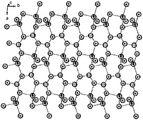
- FIG. 1 shows the structure of the lithium metaborate crystal used in the infrared-visible-deep ultraviolet range.
- FIG. 2 shows a XRD spectrum of the lithium metaborate crystal used in the infrared-visible-deep ultraviolet range.
- FIG. 3 shows a photograph of the lithium metaborate crystal used in the infrared-visible-deep ultraviolet range.
- FIG. 4 shows a schematic diagram of the wedge-shaped birefringent crystal polarization splitter made by the lithium metaborate crystal obtained in the invention.
- FIG. 5 shows a schematic diagram of the beam shifter made by the lithium metaborate crystal obtained in the invention, in which 1 represents incident light 2 represents light o (ordinary light). 3 represents light e (extraordinary light), 4 represents optical axis, 5 represents LiBO 2 crystal, 6 represents light direction, and 7 represents optic axial plane.
- FIG. 6 shows a schematic diagram of the optical isolator made by the lithium metaborate crystal obtained in the invention.
- Lithium metaborate crystal was produced according to the reaction formula, Li 2 O+2H 3 BO 3 ⁇ LiBO 2 +H 2 O ⁇ .
- the ran materials Li 2 O and H 3 BO 3 used were of analytical grade ( ⁇ 99%).
- Li 2 O and H 3 BO 3 were directly mixed and ground thoroughly in a molar ratio of 1:1 (Li:B) before placed into a platinum crucible. The mixture was slowly heated to 900° C. and kept at this temperature for 24 hours, to form a melt mixture.
- Preparation of lithium metaborate seed crystal the temperature of the melt mixture obtained as above was rapidly reduced by 5° C. each time, and held at such a temperature for 2 hours. The temperature reducing and holding process was repeated until floating crystal was observed on the surface of the melt mixture. Then the temperature was slowly decreased at a rate of 0.5° C./d until crystallization was completed. After that, the temperature was reduced at a rate of 10° C./h to room temperature, and lithium metaborate seed crystal was obtained by the spontaneous crystallization.
- the crucible containing the melt mixture obtained as above was placed into a crystal growth furnace, and the seed crystal obtained as above was fixed to the seed rod.
- the temperature was decreased to 845° C., and the seed crystal was placed into the hearth from the top of the furnace. After preheated for 5 minutes above the surface of the melt mixture, the seed crystal was moved down to the surface of the melt mixture for remelting. The temperature was kept for 1 minute before reduced rapidly to 840° C.
- the rod was rotated at a rate of 2 r/min and at the same time, the crystal was lifted up at a rate of 1 mm/h.
- the quality of the seed crystal was further optimized by shoulder extending and necking down process. Then the lifting rate was kept at 0.5 mm/h, and the temperature was slowly reduced at a rate of 0.1° C./d.
- the crystal entered an equal-diameter growth process. As the crystal grew into a desired size, the crystal was lifted out of the melt mixture and the temperature was reduced to room temperature at a rate of 10° C./h. Then the crystal, i.e., lithium metaborate crystal with a size of 26 ⁇ 19 ⁇ 33 mm 3 was obtained and collected from the hearth.
- the lithium metaborate crystal obtained using this method possesses high transparency. Transmission spectrum measurement showed that the crystal had a transmission range of 150-4000 nm and a birefringence of 0.08-0.28.
- Preparation of the lithium metaborate seed crystal a platinum wire fixed to the lower part of a seed rod was placed into the melt mixture, and then the temperature was slowly reduced at a rate of 5° C./h until crystal formed on the platinum wire. Then the rod was rotated at a rate of 5 r/min and the temperature was slowly reduced at a rate of 2° C./d. As growing into a desired size, the crystal was lifted out of the melt mixture and the temperature was decreased to room temperature at a rate of 30° C./h. As a result, lithium metaborate seed crystal was obtained.
- the crucible containing the obtained melt mixture was placed into a crystal growth furnace, the obtained seed crystal was fixed to the seed rod, and the temperature was reduced to 845° C. Thereafter, the seed crystal was placed into the hearth from the top of the furnace, and preheated for 5 minutes above the melt surface. Then the seed crystal was moved down to the surface of the melt mixture for remelting. The temperature was held for 1 minute before decreased rapidly to 842° C.
- the rod was rotated at a rate of 4 r/min and at the same time, the crystal was lifted up at a rate of 1.5 mm/h.
- the quality of the seed crystal was further optimized by shoulder extending and necking down process. Then the lifting rate was kept at 0.5 mm/h, and the temperature was slowly reduced at a rate of 0.3° C./d.
- the crystal entered an equal-diameter growth process. As the crystal grew into a desired size, the crystal was lifted out of the melt mixture and the temperature was reduced to room temperature at a rate of 10° C./h. Then the crystal, i.e., lithium metaborate crystal in a size of 36 ⁇ 29 ⁇ 47 mm 3 was obtained and collected from the hearth.
- the lithium metaborate crystal is produced on the basis of the reaction formula, Li 2 CO 3 +2H 3 BO 3 ⁇ LiBO 2 +CO 2 ⁇ +H 2 O ⁇ .
- Raw materials Li 2 CO 3 and H 3 BO 3 used were of analytical grade ( ⁇ 99%).
- Li 2 CO 3 and H 3 BO 3 were mixed at a molar ratio of 1:1 (Li:B) and round thoroughly.
- the mixture was placed into a corundum crucible and pre-heated at 300° C., for 8 hours. After that, the temperature was increased by 100° C. each time until 800° C., during which, at each temperature, the mixture was kept for 8 hours followed by thorough grind and compaction. When the temperature reached 800° C., the mixture was held at this temperature for 5 days; and then polycrystalline powder of lithium metaborate compound was obtained. After X-ray diffraction analysis, it showed that the X-ray diffraction spectrum of the polycrystalline powder obtained above was in consistent with that of the powder ground from lithium metaborate single crystal.
- the polycrystalline powders of lithium metaborate obtained as above was placed in to a platinum crucible, heated to 900° C. and held at this temperature for 24 hours, to generate melt mixture.
- Preparation of the lithium metaborate seed crystal the temperature of the melt mixture obtained as above was rapidly reduced by 10° C. and held for 6 hours. The temperature reducing and holding process was repeated until floating crystal was observed on the surface of the melt mixture. Then the temperature was slowly decreased at a rate of 10° C./d until crystallization was completed. After that, the temperature was reduced at a rate of 50° C./h to room temperature and lithium metaborate seed crystal was obtained by the spontaneous crystallization.
- the crucible containing the obtained melt mixture was placed into a crystal growth furnace, the obtained seed crystal was fixed to the seed rod, and the temperature was reduced to 850° C. Thereafter, the seed crystal was placed into the hearth from the top of the furnace, and preheated for 30 minutes above the surface of the melt mixture. Then the seed crystal was moved down to contact with the surface of the melt mixture for remelting. The temperature was held for 10 minutes before decreased rapidly to 844° C.
- the temperature was reduced slowly at a rate of 5° C./d and the seed rod was rotated at a rate of 30 r/min, so as to ensure superior growth of the crystal.
- the crystal was lifted up at a rate of 10 mm/h.
- the crystal was lifted out of the melt mixture and the temperature was reduced to room temperature at a rate of 50° C./h.
- the crystal i.e., lithium metaborate crystal in a size of 32 ⁇ 76 ⁇ 15 mm 3 was obtained and collected from the hearth
- the lithium metaborate crystal was produced on the basis of the reaction formula, LiOH+H 3 BO 3 ⁇ LiBO 2 +H 2 O ⁇ .
- Raw materials LiOH and H 3 BO 3 used were of analytical grade ( ⁇ 99%).
- LiOH and H 3 BO 3 were mixed at a molar ratio of 1:1 (Li:B) and ground thoroughly.
- the mixture was placed into a corundum crucible and pre-heated at 300° C. for 8 hours. After that, the temperature was increased by 100° C. each time until 800° C., during which, at each temperature, the mixture was kept for 8 hours followed by thorough grind and compaction. When the temperature reached 800° C., the mixture was held at this temperature for 3 days; and then polycrystalline powder of lithium metaborate compound was obtained. After X-ray analysis, it showed that the X-ray diffraction spectrum of the polycrystalline powder obtained above was in consistent with that of the powder ground from lithium metaborate single crystal.
- the polycrystalline powders of lithium metaborate obtained as above was placed in to a platinum crucible, heated to 900° C. and held at this temperature for 12 hours, to generate melt mixture.
- Preparation of the lithium metaborate seed crystal a platinum wire fixed to the lower part of a seed rod was placed into the melt mixture, and then the temperature was slowly reduced at a rate of 5° C./h until crystal formed on the platinum wire. Then the rod was rotated at a rate of 30 r/min and the temperature was slowly reduced at a rate of 10° C./d. As growing into a desired size, the crystal was lifted out of the melt mixture and the temperature was decreased to room temperature at a rate of 50° C./h. As a result, lithium metaborate seed crystal was obtained.
- the crucible containing the obtained melt mixture was placed into a crystal growth furnace, the obtained seed crystal was fixed to the seed rod, and the temperature was reduced to 848° C. Thereafter, the seed crystal was placed into the hearth from the top of the furnace, and preheated for 20 minutes above the surface of the melt mixture. Then the seed crystal was moved into the melt mixture for remelting. The temperature was held for 5 minutes before decreased rapidly to 842° C.
- the temperature was reduced slowly at a rate of 3° C./d and the seed rod was rotated at a rate of 15 r/min, so as to ensure superior growth of the crystal.
- the crystal was lifted up at a rate of 5 mm/h.
- the crystal was lifted out of the melt mixture and the temperature was reduced to room temperature at a rate of 25° C./h.
- the crystal, i.e., lithium metaborate crystal in a size of 26 ⁇ 19 ⁇ 17 mm 3 was obtained and collected from the hearth.
- the lithium metaborate crystal was produced on the basis of the reaction formula, LiNO 3 +H 3 BO 3 ⁇ LiBO 2 +NO 2 ⁇ +H 2 O ⁇ .
- Raw materials LiNO 3 and H 3 BO 3 used were of analytical grade ( ⁇ 99%).
- LiNO 3 and H 3 BO 3 were mixed at a molar ratio of 1:1 (Li:B) and around thoroughly.
- the mixture was placed into a corundum crucible and pre-heated at 300° C. for 8 hours. After that, the temperature was increased by 100° C. each time until 800° C., during which, at each temperature, the mixture was kept for 8 hours followed by thorough grind and compaction. When the temperature reached 800° C., the mixture was held at this temperature for 4 days; then polycrystalline powder of lithium metaborate compound was obtained. After X-ray analysis, it showed that the X-ray diffraction spectrum of the polycrystalline powder obtained above was in consistent with that of the powder ground from lithium metaborate single crystal.
- the polycrystalline powders of lithium metaborate obtained as above was placed in to a platinum crucible, heated to 900° C. and held at this temperature for 1 hour, to generate melt mixture.
- Preparation of the lithium metaborate seed crystal the temperature of the melt mixture obtained as above was rapidly reduced by 7° C., and held for 4 hours. The temperature reducing and holding process was repeated until floating crystal was observed on the surface of the melt mixture. Then the temperature was slowly decreased at a rate of 5° C./d until crystallization was completed. After that, the temperature was reduced at a rate of 25° C./h to room temperature, and lithium metaborate seed crystal was obtained by the spontaneous crystallization.
- the crucible containing the obtained melt mixture was placed into a crystal growth furnace, the obtained seed crystal was fixed to the seed rod, and the temperature was reduced to 847° C. Thereafter, the seed crystal was placed into the hearth from the top of the furnace, and preheated for 1 minute above the surface of the melt mixture. Then the seed crystal was moved down to contact with the surface of the melt mixture for remelting. The temperature was held for 8 minutes before decreased rapidly to 843° C.
- the temperature was reduced slowly at a rate of 2° C./d and the seed rod was not rotated (at a rate of 0/min).
- the crystal was not lifted up (at a rate of 0 mm/h).
- the crystal was lifted out of the melt mixture and the temperature was reduced to room temperature at a rate of 30° C./h.
- the crystal i.e., lithium metaborate crystal in a size of 22 ⁇ 16 ⁇ 9 mm 3 was obtained and collected from the hearth.
- the lithium metaborate crystal was produced on the basis of the reaction formula, Li 2 CO 3 +B 2 O 3 ⁇ LiBO 2 +CO 2 ⁇ .
- Raw materials Li 2 CO 3 and B 2 O 3 used were of analytical grade ( ⁇ 99%).
- Li 2 CO 3 and B 2 O 3 were placed directly into a platinum crucible after mixed at a molar ratio of 1:1 (Li:B) and ground thoroughly. The mixture was slowly heated to 900° C. and kept at this temperature for 24 hours, to generate melt mixture.
- Preparation of the lithium metaborate seed crystal the temperature of the melt mixture obtained as above was rapidly reduced by 6° C., and held for 3 hours. The temperature reducing and holding process was repeated until floating crystal was observed on the surface of the melt mixture. Then the temperature was slowly decreased at a rate of 8° C./d until crystallization was completed. After that, the temperature was reduced at a rate of 40° C./h to room temperature, and lithium metaborate seed crystal was obtained by the spontaneous crystallization.
- the crucible containing the obtained melt mixture was placed into a crystal growth furnace, the obtained seed crystal was fixed to the seed rod, and the temperature was reduced to 846° C. Thereafter, the seed crystal was placed into the hearth from the top of the furnace, and preheated for 10 minutes above the surface of the melt mixture. Then the seed crystal was moved into the melt mixture for remelting. The temperature was held for 3 minutes before decreased rapidly to 841° C.
- the temperature was reduced slowly at a rate of 1° C./d and the seed rod was rotated at a rate of 5 r/min, so as to ensure superior growth of the crystal.
- the crystal was lifted up at a rate of 0.5 mm/h.
- the crystal was lifted out of the melt mixture and the temperature was reduced to room temperature at a rate of 10° C./h.
- the crystal i.e., lithium metaborate crystal in a size of 36 ⁇ 22 ⁇ 34 mm 3 was obtained and collected from the hearth.
- the lithium metaborate crystal was produced on the basis of the reaction formula, 2LiOH+B 2 O 3 ⁇ LiBO 2 +H 2 O ⁇ .
- Raw materials LiOH and B 2 O 3 used were of analytical grade ( ⁇ 99%).
- LiOH and B 2 O 3 were mixed at a molar ratio of 1:1 (Li:B) and ground thoroughly.
- the mixture was placed into a corundum crucible and pre-heated at 300° C. for 8 hours. After that, the temperature was increased by 100° C. each time until 800° C., during which, at each temperature, the mixture was kept for 8 hours followed by thorough grind and compaction. When the temperature reached 800° C., the mixture was held at this temperature for 4 days; then polycrystalline powder of lithium metaborate compound was obtained. After X-ray diffraction analysis, it showed that the X-ray diffraction spectrum of the polycrystalline powder obtained above was in consistent with that of the powder ground from lithium metaborate single crystal.
- the polycrystalline powders of lithium netaborate obtained as above was placed in to a platinum crucible, heated to 900° C. and held at this temperature for 16 hours, to generate melt mixture.
- Preparation of the lithium metaborate seed crystal a platinum wire fixed to the lower part of a seed rod was placed into the melt mixture, and then the temperature was slowly reduced at a rate of 1° C./h until crystal formed on the platinum wire. Then the rod was not rotated (at a rate of 0 r/min) and the temperature was slowly reduced at a rate of 0.1° C./d. As growing into a desired size, the crystal was lifted out of the melt mixture and the temperature was decreased to room temperature at a rate of 10° C./h. As a result, lithium metaborate seed crystal was obtained.
- the crucible containing the obtained melt mixture was placed into a crystal growth furnace, the obtained seed crystal was fixed to the seed rod, and the temperature was reduced to 849° C. Thereafter, the seed crystal was placed into the hearth from the top of the furnace, and preheated for 15 minutes above the surface of the melt mixture. Then the seed crystal was moved down to contact with the melt mixture for remelting. The temperature was held for 3 minutes before decreased rapidly to 843.5° C.
- the temperature was reduced slowly at a rate of 0.1° C./d and the seed rod was rotated at a rate of 2 r/min, so as to ensure superior growth of the crystal.
- the crystal was lifted up at a rate of 0.5 mm/h.
- the crystal was lifted out of the melt mixture and the temperature was reduced to room temperature at a rate of 5° C./h.
- the crystal i.e., lithium metaborate crystal in a size of 36 ⁇ 29 ⁇ 47 mm 3 was obtained and collected from the hearth.
- the lithium metaborate crystal was produced on the basis of the reaction formula, Li 2 C 2 O 4 +2H 3 BO 3 ⁇ LiBO 2 +CO 2 ⁇ +H 2 O ⁇ .
- Raw materials Li 2 C 2 O 4 and H 3 BO 3 used were of analytical grade ( ⁇ 99%).
- Li 2 C 2 O 4 and H 3 BO 3 were mixed at a molar ratio of 1:1 (Li:B) and ground thoroughly.
- the mixture was placed into a corundum crucible and pre-heated at 300° C. for 8 hours. After that, the temperature was increased by 100° C. each time until 800° C., during which, at each temperature, the mixture was kept for 8 hours followed by thorough grind and compaction. When the temperature reached 800° C., the mixture was held at this temperature for 5 days; and then polycrystalline powder of lithium metaborate compound was obtained. After X-ray analysis, it showed that the X-ray diffraction spectrum of the polycrystalline powder obtained above was in consistent with that of the powder ground from lithium metaborate single crystal.
- Lithium metaborate compound obtained as above was mixed with the flux H 3 BO 3 (analytically pure, ⁇ 99%) thoroughly in a molar ratio of 1:0.01 (LiBOH 2 :H 3 BO 3 ), placed into a platinum crucible, heated to 860° C. and kept at this temperature for 50 hours, to generate a mixed solution containing the lithium metaborate and flux.
- H 3 BO 3 analytically pure, ⁇ 99%
- Preparation of the lithium metaborate seed crystal the temperature of the mixed solution obtained as above was rapidly reduced by 5° C., and held for 2 hours. The temperature reducing and holding process was repeated until floating crystal was observed on the surface of the mixed solution. Then the temperature was slowly decreased at a rate of 0.5° C./d until crystallization was completed. After that, the temperature was reduced at a rate of 10° C./h to room temperature, and lithium metaborate seed crystal was obtained by the spontaneous crystallization.
- the crucible containing the obtained mixed solution was placed into a crystal growth furnace, the obtained seed crystal was fixed to the seed rod, and the temperature was reduced to 830° C. Thereafter, the seed crystal was placed into the hearth from the top of the furnace, and preheated for 30 minutes above the surface of the mixed solution. Then the seed crystal was moved down to contact with the surface of the mixed solution for remelting. The temperature was held for 1 minute before decreased rapidly to 820° C.
- the temperature was reduced slowly at a rate of 5° C./d and the seed rod was rotated at a rate of 30 r/min, so as to ensure superior growth of the crystal.
- the crystal was lifted up at a rate of 10 mm/h.
- the crystal was lifted out of the mixed solution and the temperature was reduced to room temperature at a rate of 50° C./h.
- the crystal i.e., lithium metaborate crystal in a size of 16 ⁇ 12 ⁇ 17 mm 3 was obtained and collected from the hearth.
- the lithium metaborate crystal was produced on the basis of the reaction formula, LiCH 3 COO+H 3 BO 3 ⁇ LiBO 2 +CO 2 ⁇ +H 2 O ⁇ .
- Raw materials LiCH 3 COO and H 3 BO 3 used were of analytical grade ( ⁇ 99%).
- the mixture was then placed into a platinum crucible, slowly heated to 600° C. and kept at this temperature for 10 hours, to generate a mixed solution containing the lithium metaborate and flux.
- Preparation of the lithium metaborate seed crystal the temperature of the mixed solution obtained as above was rapidly reduced by 10° C., and held for 6 hours. The temperature reducing and holding process was repeated until floating crystal was observed on the surface of the mixed solution. Then the temperature was slowly decreased at a rate of 10° C./d until crystallization was completed. After that, the temperature was reduced at a rate of 50° C./h to room temperature, and lithium metaborate seed crystal was obtained by the spontaneous crystallization.
- the crucible containing the obtained mixed solution was placed into a crystal growth furnace, the obtained seed crystal was fixed to the seed rod, and the temperature was reduced to 560° C. Thereafter, the seed crystal was placed into the hearth from the top of the furnace, and preheated for 15 minutes above the surface of the mixed solution. Then the seed crystal was moved into the mixed solution for remelting. The temperature was held for 20 minutes before decreased rapidly to 550° C.
- the temperature was reduced slowly at a rate of 3° C./d and the seed rod was not rotated (at a rate of 0 r/min).
- the crystal was not lifted up (at a rate of 0 nm/h).
- the crystal was lifted out of the mixed solution and the temperature was reduced to room temperature at a rate of 30° C./h.
- the crystal i.e., lithium metaborate crystal in a size of 17 ⁇ 11 ⁇ 6 mm 3 was obtained and collected from the hearth.
- the lithium metaborate crystal was produced on the basis of the reaction formula, Li 2 O+B 2 O 3 ⁇ LiBO 2 .
- Raw materials Li 2 O and B 2 O 3 used were of analytical grade ( ⁇ 99%).
- Li 2 O and B 2 O 3 were mixed at a molar ratio of 1:1 (Li:B) and ground thoroughly.
- the mixture was placed into a corundum crucible and pre-heated at 300° C. for 8 hours. After that, the temperature was increased by 100° C. each time until 800° C., during which, at each temperature, the mixture was kept for 8 hours followed by thorough grind and compaction. When the temperature reached 800° C., the mixture was held at this temperature for 4 days; then polycrystalline powder of lithium metaborate compound was obtained. After X-ray diffraction analysis, it showed that the X-ray diffraction spectrum of the polycrystalline powder obtained above was in consistent with that of the powder ground from lithium metaborate single crystal.
- the lithium metaborate compound obtained as above was mixed with the flux Cs 2 CO 3 (analytically pure, ⁇ 99%) thoroughly in a molar ratio of 1:0.02 (LiBO 2 :flux), placed into a platinum crucible, heated to 760° C. and kept at this temperature for 10 hours, to generate a mixed solution containing the lithium metaborate and flux.
- Preparation of the lithium metaborate seed crystal a platinum wire fixed to a seed rod was placed into the mixed solution, and then the temperature was slowly reduced at a rate of 1° C./h until crystal formed on the platinum wire. Then the rod was rotated at a rate of 5 r/min and the temperature was slowly reduced at a rate of 0.1° C./d. As growing into a desired size, the crystal was lifted out of the mixed solution and the temperature was decreased to room temperature at a rate of 10° C./h. As a result, lithium metaborate seed crystal was obtained.
- the crucible containing the obtained mixed solution was placed into a crystal growth furnace, the obtained seed crystal was fixed to the seed rod, and the temperature was reduced to 710° C. Thereafter, the seed crystal was placed into the hearth from the top of the furnace, and preheated for 1 minute above the surface of the mixed solution. Then the seed crystal was moved down to contact with the surface of the mixed solution for remelting. The temperature was held for 15 minutes before decreased rapidly to 702° C.
- the temperature was reduced slowly at a rate of 1° C./d and the seed rod was rotated at a rate of 15 r/min, so as to ensure superior growth of the crystal.
- the crystal was lifted up at a rate of 5 mm/h.
- the crystal was lifted out of the mixed solution and the temperature was reduced to room temperature at a rate of 5° C./h.
- the crystal i.e., lithium metaborate crystal in a size of 19 ⁇ 15 ⁇ 16 mm 3 was obtained and collected from the hearth.
- the lithium metaborate crystal was produced on the basis of the reaction formula, LiNO 3 +B 2 O 3 ⁇ LiBO 2 +NO 2 ⁇ .
- Raw materials LiNO 3 and B 2 O 3 used were of analytical grade ( ⁇ 99%).
- the mixture was then placed into a platinum crucible, slowly heated to 810° C. and kept at this temperature for 30 hours, to generate a mixed solution containing the lithium metaborate and flux.
- Preparation of the lithium metaborate seed crystal a platinum wire fixed to a seed rod was placed into the mixed solution, and then the temperature was slowly reduced at a rate of 5° C./h until crystal formed on the platinum wire. Then the rod was rotated at a rate of 10 r/min and the temperature was slowly reduced at a rate of 1° C./d. As growing into a desired size, the crystal was lifted out of the mixed solution and the temperature was decreased to room temperature at a rate of 20° C./h. As a result, metaborate seed crystal was obtained.
- the crucible containing the obtained mixed solution was placed into a crystal growth furnace, the obtained seed crystal was fixed to the seed rod, and the temperature was reduced to 760° C. Thereafter, the seed crystal was placed into the hearth from the top of the furnace, and preheated for 10 minutes above the surface of the mixed solution. Then the seed crystal was moved into the mixed solution for remelting. The temperature was held for 5 minutes before decreased rapidly to 750° C.
- the temperature was reduced slowly at a rate of 0.5° C./d and the seed rod was rotated at a rate of 10 r/min.
- the crystal was lifted up at a rate of 3 mm/h.
- the crystal was lifted out of the mixed solution and the temperature was reduced to room temperature at a rate of 15° C./h.
- the crystal i.e., lithium metaborate crystal in a size of 21 ⁇ 16 ⁇ 17 mm 3 was obtained and collected from the hearth.
- the lithium metaborate crystal was produced on the basis of the reaction formula, Li 2 C 2 O 4 +B 2 O 3 ⁇ LiBO 2 +CO 2 +CO 2 ⁇ .
- Raw materials Li 2 C 2 O 4 and B 2 O 3 used were of analytical grade ( ⁇ 99%).
- Li 2 C 2 O 4 and B 2 O 3 were mixed at a molar ratio of 1:1 (Li:B) and ground thoroughly.
- the mixture was placed into a corundum crucible and pre-heated at 300° C. for 8 hours. After that, the temperature was increased by 100° C. each time until 800° C., during which, at each temperature, the mixture was kept for 8 hours followed by thorough grind and compaction. When the temperature reached 800° C., the mixture was held at this temperature for 5 days; then polycrystalline powder of lithium metaborate compound was obtained After X-ray diffraction analysis, it showed that X-ray diffraction spectrum of the the polycrystalline powder obtained above was in consistent with that of the powder ground from lithium metaborate single crystal.
- the lithium metaborate compound obtained as above was mixed with the flux Li 2 CO 3 (analytically pure, ⁇ 99%) thoroughly in a molar ratio of 1:0.05 (LiBO 2 :flux), placed into a platinum crucible, heated to 780° C. and kept at this temperature for 30 hours, to generate a mixed solution containing the lithium metaborate and flux.
- Li 2 CO 3 analytically pure, ⁇ 99%
- Preparation of the lithium metaborate seed crystal a platinum wire fixed to a seed rod was placed into the mixed solution, and then the temperature was slowly reduced at a rate of 3° C./h until crystal formed on the platinum wire. Then the rod was not rotated (at a rate of 0 r/min) and the temperature was slowly reduced at a rate of 5° C./d. As growing into a desired size, the crystal was lifted out of the mixed solution and the temperature was decreased to room temperature at a rate of 30° C./h. As a result, lithium metaborate seed crystal was obtained.
- the crucible containing the obtained mixed solution was placed into a crystal growth furnace, the obtained seed crystal was fixed to the seed rod, and the temperature was reduced to 730° C. Thereafter, the seed crystal was placed into the hearth from the top of the furnace, and preheated for 8 minutes above the surface of the mixed solution. Then the seed crystal was moved down to contact with the surface of the mixed solution for remelting. The temperature was held for 10 minutes before decreased rapidly to 723° C.
- the temperature was reduced slowly at a rate of 0.1° C./d and the seed rod was rotated at a rate of 2 r/min so as to ensure superior growth of the crystal.
- the crystal was lifted up at a rate of 5 mm/h.
- the crystal was lifted out of the mixed solution and the temperature was reduced to room temperature by 20° C./h.
- the crystal i.e., lithium metaborate crystal in a size of 24 ⁇ 17 ⁇ 11 mm 3 was obtained and collected from the hearth.
- the lithium metaborate crystal was produced on the basis of the reaction formula, 2LiCH 3 COO+B 2 O 3 ⁇ LiBO 2 +CO 2 ⁇ +H 2 O ⁇ .
- Raw materials LiCH 3 COO and B 2 O 3 used were of analytical grade ( ⁇ 99%).
- the mixture was then placed into a platinum crucible, slowly heated to 800° C. and kept at this temperature for 40 hours, to generate a mixed solution containing the lithium metaborate and flux.
- Preparation of the lithium metaborate seed crystal a platinum wire fixed to a seed rod was placed into the mixed solution, and then the temperature was slowly reduced at a rate of 5° C./h until crystal formed on the platinum wire. Then the rod was rotated at a rate of 30 r/min and the temperature was slowly reduced at a rate of 10° C./d. As growing into a desired size, the crystal was lifted out of the mixed solution and the temperature was decreased to room temperature at a rate of 50° C./h. As a result, lithium metaborate seed crystal was obtained.
- the crucible containing the obtained mixed solution was placed into a crystal growth furnace, the obtained seed crystal was fixed to the seed rod, and the temperature was reduced to 755° C. Thereafter, the seed crystal was placed into the hearth from the top of the furnace, and preheated for 20 minutes above the surface of the mixed solution. Then the seed crystal was moved into the mixed solution for remelting. The temperature was held for 3 minutes before decreased rapidly to 751° C.
- the temperature was reduced slowly at a rate of 1.5° C./d and the seed rod was rotated at a rate of 6 r/min.
- the crystal was lifted up at a rate of 2 mm/h.
- the crystal was lifted out of the mixed solution and the temperature was reduced to room temperature at a rate of 35° C./h.
- the crystal i.e., lithium metaborate crystal in a size of 22 ⁇ 19 ⁇ 17 mm 3 was obtained and collected from the hearth.
- the lithium metaborate crystal was produced on the basis of the reaction formula, 2LiOH+B 2 O 3 ⁇ LiBO 2 +H 2 O ⁇ .
- Raw materials LiOH and B 2 O 3 used were of analytical grade ( ⁇ 99%).
- LiOH and B 2 O 3 were mixed at a molar ratio of 1:1 (Li:B) and ground thoroughly.
- the mixture was placed into a corundum crucible and pre-heated at 300° C. for 8 hours. After that, the temperature was increased by 100° C. each time until 800° C., during which, at each temperature, the mixture was kept for 8 hours followed by thorough grind and compaction. When the temperature reached 800° C., the mixture was held at this temperature for 3 days; then polycrystalline powder of lithium metaborate compound was obtained. After X-ray diffraction analysis, it showed that the X-ray diffraction spectrum of the polycrystalline powder obtained above was in consistent with that of the powder ground from lithium metaborate single crystal.
- the lithium metaborate compound obtained as above was mixed with the flux B 2 O 3 (analytically pure, ⁇ 99%) thoroughly in a molar ratio of 1:0.15 (LiBO 2 :flux), placed into a platinum crucible, heated to 815° C. and kept at this temperature for 48 hours, to generate a mixed solution containing the lithium metaborate and flux.
- the flux B 2 O 3 analytically pure, ⁇ 99%
- Preparation of the lithium metaborate seed crystal the temperature of the mixed solution obtained as above was rapidly reduced by 8° C., and held for 4 hours. The temperature reducing and holding process was repeated until floating crystal was observed on the surface of the mixed solution. Then the temperature was slowly decreased at a rate of 5° C./d until crystallization was completed. After that, the temperature was reduced at a rate of 30° C./h to room temperature, and lithium metaborate seed crystal was obtained by the spontaneous crystallization.
- the crucible containing the obtained mixed solution was placed into a crystal growth furnace, the obtained seed crystal was fixed to the seed rod, and the temperature was reduced to 765° C. Thereafter, the seed crystal was placed into the hearth from the top of the furnace, and preheated for 10 minutes above the surface of the mixed solution. Then the seed crystal was moved down to contact with the surface of the mixed solution for remelting. The temperature was held for 4 minutes before decreased rapidly to 758° C.
- the temperature was reduced slowly at a rate of 1° C./d and the seed rod was rotated at a rate of 5 r/min, so as to ensure superior growth of the crystal.
- the crystal was lifted up at a rate of 0.5 mm/h.
- the crystal was lifted out of the mixed solution and the temperature was reduced to room temperature at a rate of 25° C./h.
- the crystal i.e., metaborate crystal in a size of 18 ⁇ 15 ⁇ 13 mm 3 was obtained and collected from the hearth.
- the lithium metaborate crystal was produced on the basis of the reaction formula, Li 2 CO 3 +2H 3 BO 3 ⁇ CO 2 ⁇ +H 2 O ⁇ .
- Raw materials Li 2 CO 3 and H 3 BO 3 used were of analytical grade ( ⁇ 99%).
- the mixture was then placed into a platinum crucible, slowly heated to 720° C. and kept at this temperature for 24 hours, to generate a mixed solution containing the lithium metaborate and flux.
- Preparation of the lithium metaborate seed crystal the temperature of the mixed solution obtained as above was rapidly reduced by 6° C., and held for 3 hours. The temperature reducing and holding process was repeated until floating crystal was observed on the surface of the mixed solution. Then the temperature was slowly decreased at a rate of 8° C./d until crystallization was completed. After that, the temperature was reduced at a rate of 5° C./h to room temperature, and lithium metaborate seed crystal was obtained by the spontaneous crystallization.
- the crucible containing the obtained mixed solution was placed into a crystal growth furnace, the obtained seed crystal was fixed to the seed rod, and the temperature was reduced to 675° C. Thereafter, the seed crystal was placed into the hearth from the top of the furnace, and preheated for 20 minutes above the surface of the mixed solution. Then the seed crystal was moved down to contact with the surface of the mixed solution for remelting. The temperature was held for 5 minutes before decreased rapidly to 667° C.
- the temperature was reduced slowly at a rate of 2° C./d and the seed rod was rotated at a rate of 8 r/min.
- the crystal was lifted up at a rate of 1 mm/h.
- the crystal was lifted out of the mixed solution and the temperature was reduced to room temperature at a rate of 20° C./h.
- the crystal i.e., metaborate crystal in a size of 20 ⁇ 12 ⁇ 16 mm 3 was obtained and collected from the hearth.
- the lithium metaborate crystal was produced on the basis of the reaction formula, LiOH+H 3 BO 3 ⁇ LiBO 2 +H 2 O ⁇ .
- Raw materials LiOH and H 3 BO 3 used were of analytical grade ( ⁇ 99%).
- the mixture was then placed into a platinum crucible, slowly heated to 810° C. and kept at this temperature for 12 hours, to generate a mixed solution containing the lithium metaborate and flux.
- Preparation of the lithium metaborate seed crystal a platinum wire fixed to a seed rod was placed into the mixed solution, and then the temperature was slowly reduced at a rate of 4° C./h until crystal formed on the platinum wire. Then the rod was rotated at a rate of 25 r/min and the temperature was slowly reduced at a rate of 2° C./d. As growing into a desired size, the crystal was lifted out of the mixed solution and the temperature was decreased to room temperature at a rate of 20° C./h. As a result, lithium metaborate seed crystal was obtained.
- the crucible containing the obtained mixed solution was placed into a crystal growth furnace, the obtained seed crystal was fixed to the seed rod, and the temperature was reduced to 765° C. Thereafter, the seed crystal was placed into the hearth from the top of the furnace, and preheated for 15 minutes above the surface of the mixed solution. Then the seed crystal was moved down to contact with the surface of the mixed solution for remelting. The temperature was held for 3 minutes before decreased rapidly to 756° C.
- the temperature was reduced slowly at a rate of 2° C./d and the seed rod was rotated at a rate of 10 r/min.
- the crystal was lifted up at a rate of 0.2 mm/h.
- the crystal was lifted out of the mixed solution and the temperature was reduced to room temperature at a rate of 15° C./h.
- the crystal i.e., lithium metaborate crystal in a size of 24 ⁇ 21 ⁇ 18 mm 3 was obtained and collected from the hearth.
- the lithium metaborate crystal was produced on the basis of the reaction formula, Li 2 CO 3 +B 2 O 3 ⁇ LiBO 2 +CO 2 ⁇ .
- Raw materials Li 2 CO 3 and B 2 O 3 used were of analytical grade ( ⁇ 99%).
- Li 2 CO 3 and B 2 O 3 were mixed at a molar ratio of 1:1 (Li:B) and ground thoroughly.
- the mixture was placed into a corundum crucible and pre-heated at 300° C. for 8 hours. After that, the temperature was increased by 100° C. each time until 800° C., during which, at each temperature, the mixture was kept for 8 hours followed by thorough grind and compaction. When the temperature reached 800° C., the mixture was held at this temperature for 3 days; then polycrystalline powder of lithium metaborate compound was obtained. After X-ray diffraction analysis, it showed that the X-ray diffraction spectrum of the polycrystalline powder obtained above was in consistent with that of the powder ground from lithium metaborate single crystal.
- the lithium metaborate compound obtained as above was mixed with the flux MoO 3 (analytically pure, ⁇ 99%) thoroughly in a molar ratio of 1:4 (LiBO 2 :flux) placed into a platinum crucible, heated to 700° C. and kept at this temperature for 20 hours, to generate a mixed solution containing the lithium metaborate and flux.
- MoO 3 analytically pure, ⁇ 99%
- Preparation of the lithium metaborate seed crystal a platinum wire fixed to a seed rod was placed into the mixed solution, and then the temperature was slowly reduced at a rate of 3° C./h until crystal formed on the platinum wire. Then the rod was not rotated at a rate of 0 r/min and the temperature was slowly reduced at a rate of 5° C./d. As growing into a desired size, the crystal was lifted out of the mixed solution and the temperature was decreased to room temperature at a rate of 30° C./h. As a result, lithium metaborate seed crystal was obtained.
- the crucible containing the obtained mixed solution was placed into a crystal growth furnace, the obtained seed crystal was fixed to the seed rod, and the temperature was reduced to 660° C. Thereafter, the seed crystal was placed into the hearth from the top of the furnace, and preheated for 8 minutes above the surface of the mixed solution. Then the seed crystal was moved down to contact with the surface of the mixed solution for remelting. The temperature was held for 10 minutes before decreased rapidly to 653° C.
- the temperature was reduced slowly at a rate of 0.1° C./d and the seed rod was rotated at a rate of 2 r/min, so as to ensure superior growth of the crystal.
- the crystal was lifted up at a rate of 0.5 mm/h.
- the crystal was lifted out of the mixed solution and the temperature was reduced to room temperature at a rate of 20° C./h.
- the crystal i.e., lithium metaborate crystal in a size of 16 ⁇ 17 ⁇ 11 mm 3 was obtained and collected from the hearth.
- the lithium metaborate crystal was produced on the basis of the reaction formula, 2LiOH+B 2 O 3 ⁇ LiBO 2 +H 2 O ⁇ .
- Raw materials LiOH and B 2 O 3 used were of analytical grade ( ⁇ 99%).
- LiOH and B 2 O 3 were mixed at a molar ratio of 1:1 (Li:B) and ground thoroughly.
- the mixture was placed into a corundum crucible and pre-heated at 300° C. for 8 hours. After that, the temperature was increased by 100° C. each time until 800° C., during which, at each temperature, the mixture was kept for 8 hours followed by thorough grind and compaction. When the temperature reached 800° C., the mixture was held at this temperature for 3 days; then polycrystalline powder of lithium metaborate compound was obtained. After X-ray diffraction analysis, it showed that the X-ray diffraction spectrum of the polycrystalline powder obtained above was in consistent with that of the powder ground from lithium metaborate-single crystal.
- the lithium metaborate compound obtained as above was mixed with the flux MoO 3 (analytically pure, ⁇ 99%) thoroughly in a molar ratio of 1:2 (LiBO 2 :flux), placed into a platinum crucible, heated to 780° C. and kept at this temperature for 20 hours, to generate a mixed solution containing the lithium metaborate and flux.
- MoO 3 analytically pure, ⁇ 99%
- Preparation of the lithium metaborate seed crystal a platinum wire fixed to a seed rod was placed into the mixed solution, and then the temperature was slowly reduced at a rate of 3° C./h until crystal formed on the platinum wire. Then the rod was not rotated (at a rate of 0 r/min) and the temperature was slowly reduced at a rate of 2° C./d. As growing into a desired size, the crystal was lifted out of the mixed solution and the temperature was decreased to room temperature at a rate of 30° C./h. As a result, lithium metaborate seed crystal was obtained.
- the crucible containing the obtained mixed solution was placed into a crystal growth furnace, the obtained seed crystal was fixed to the seed rod, and the temperature was reduced to 730° C. Thereafter, the seed crystal was placed into the hearth from the top of the furnace, and preheated for 5 minutes above the surface of the mixed solution. Then the seed crystal was moved down to contact with the surface of the mixed solution for remelting. The temperature was held for 10 minutes before decreased rapidly to 721° C.
- the temperature was reduced slowly at a rate of 0.5° C./d and the seed rod was rotated at a rate of 2 r/min, so as to ensure superior growth of the crystal.
- the crystal was lifted up at a rate of 1 mm/h.
- the crystal was lifted out of the mixed solution and the temperature was reduced to room temperature by 20° C./h.
- the crystal i.e., lithium metaborate crystal in a size of 14 ⁇ 10 ⁇ 9 mm 3 was obtained and collected from the hearth.
- the lithium metaborate crystal was produced on the basis of the reaction formula, 2LiCH 3 COO+B 2 O 3 ⁇ LiBO 2 +CO 2 ⁇ +H 2 O ⁇ .
- Raw materials LiCH 3 COO and B 2 O 3 used were of analytical grade ( ⁇ 99%).
- the mixture was then placed into a platinum crucible, slowly heated to 780° C. and kept at this temperature for 40 hours, to generate a mixed solution containing the lithium metaborate and flux.
- Preparation of the lithium metaborate seed crystal a platinum wire fixed to a seed rod was placed into the mixed solution, and then the temperature was slowly reduced at a rate of 5° C./h until crystal formed on the platinum wire. Then the rod was rotated at a rate of 30 r/min and the temperature was slowly reduced at a rate of 10° C./d. As growing into a desired size, the crystal was lifted out of the mixed solution and the temperature was decreased to room temperature at a rate of 50° C./h. As a result, lithium metaborate seed crystal was obtained.
- the crucible containing the obtained mixed solution was placed into a crystal growth furnace, the obtained seed crystal was fixed to the seed rod, and the temperature was reduced to 735° C. Thereafter, the seed crystal was placed into the hearth from the top of the furnace, and preheated for 20 minutes above the surface of the mixed solution. Then the seed crystal was moved into the mixed solution for remelting. The temperature was held for 3 minutes before decreased rapidly to 730° C.
- the temperature was reduced slowly at a rate of 1° C./d and the seed rod was rotated at a rate of 3 r/min.
- the crystal was lifted up at a rate of 0.1 mm/h.
- the crystal was lifted out of the mixed solution and the temperature was reduced to room temperature by 30° C./h.
- the crystal i.e., lithium metaborate crystal in a size of 12 ⁇ 11 ⁇ 5 mm 3 was obtained and collected from the hearth.
- the lithium metaborate crystal was produced on the basis of the reaction formula, 2LiOH+B 2 O 3 ⁇ LiBO 2 +H 2 O ⁇ .
- Raw materials LiOH and B 2 O 3 used were of analytical grade ( ⁇ 99%).
- LiOH and B 2 O 3 were mixed at a molar ratio of 1:1 (Li:B) and ground thoroughly.
- the mixture was placed into a corundum crucible and pre-heated at 300° C. for 8 hours. After that, the temperature was increased by 100° C. each time until 800° C., during which, at each temperature, the mixture was kept for 8 hours followed by thorough grind and compaction. When the temperature reached 800° C., the mixture was held at this temperature for 3 days; then polycrystalline powder of lithium metaborate compound was obtained. After X-ray diffraction analysis, it showed that the X-ray diffraction spectrum of the polycrystalline powder obtained above was in consistent with that of the powder ground from lithium metaborate single crystal.
- the lithium metaborate compound obtained as above was mixed with the flux KCl (analytically pure, ⁇ 99%) thoroughly in a molar ratio of 1:1(LiBO 2 :KCl), placed into a platinum crucible, heated to 810° C. and kept at this temperature for 20 hours, to generate a mixed solution containing the lithium metaborate and flux.
- the flux KCl analytically pure, ⁇ 99%
- Preparation of the lithium metaborate seed crystal a platinum wire fixed to a seed rod was placed into the mixed solution, and then the temperature was slowly reduced at a rate of 2° C./h until crystal formed on the platinum wire. Then the rod was rotated at a rate of 5 r/min and the temperature was slowly reduced at a rate of 1° C./d. As growing into a desired size, the crystal was lifted out of the mixed solution and the temperature was decreased to room temperature at a rate of 30° C./h. As a result, lithium metaborate seed crystal was obtained.
- the crucible containing the obtained mixed solution was placed into a crystal growth furnace, the obtained seed crystal was fixed to the seed rod, and the temperature was reduced to 770° C. Thereafter, the seed crystal was placed into the hearth from the top of the furnace, and preheated for 5 minutes above the surface of the mixed solution. Then the seed crystal was moved down to contact with the surface of the mixed solution for remelting. The temperature was held for 10 minutes before decreased rapidly to 740° C.
- the temperature was reduced slowly at a rate of 0.5° C./d and the seed rod was rotated at a rate of 2 r/min, so as to ensure superior growth of the crystal.
- the crystal was lifted up at a rate of 0.1 mm/h.
- the crystal was lifted out of the mixed solution and the temperature was reduced to room temperature at a rate of 20° C./h.
- the crystal i.e. lithium metaborate crystal in a size of 11 ⁇ 10 ⁇ 6 mm 3 was obtained and collected from the hearth.
- the lithium metaborate crystal was produced on the basis of the reaction formula, 2LiOH+B 2 O 3 ⁇ LiBO 2 +H 2 O ⁇ .
- Raw materials LiOH and B 2 O 3 used were of analytical grade ( ⁇ 99%).
- LiOH and B 2 O 3 were mixed at a molar ratio of 1:1 (Li:B) and ground thoroughly.
- the mixture was placed into a corundum crucible and pre-heated at 300° C. for 8 hours. After that, the temperature was increased by 100° C. each time until 800° C., during which, at each temperature, the mixture was kept for 8 hours followed by thorough grind and compaction. When the temperature reached 800° C., the mixture was held at this temperature for 3 days; then polycrystalline powder of lithium metaborate compound was obtained. After X-ray difraction analysis, it showed that the X-ray diffraction spectrum of the polycrystalline powder obtained above was in consistent with that of the powder ground from lithium metaborate single crystal.
- the lithium metaborate compound obtained as above was mixed with the flux K 2 CO 3 (analytically pure, ⁇ 99%) thoroughly in a molar ratio of 1:0.8 (LiBO 2 :K 2 CO 3 ), placed into a platinum crucible, heated to 790° C. and kept at this temperature for 10 hours, to generate a mixed solution containing the lithium metaborate and flux.
- Preparation of the lithium metaborate seed crystal a platinum wire fixed to a seed rod was placed into the mixed solution, and then the temperature was slowly reduced at a rate of 3° C./h until crystal formed on the platinum wire. Then the rod was rotated at a rate of 3 r/min and the temperature was slowly reduced at a rate of 1° C./d. As growing into a desired size, the crystal was lifted out of the mixed solution and the temperature was decreased to room temperature at a rate of 30° C./h. As a result, lithium metaborate seed crystal was obtained.
- the crucible containing the obtained mixed solution was placed into a crystal growth furnace, the obtained seed crystal was fixed to the seed rod, and the temperature was reduced to 740° C. Thereafter, the seed crystal was placed into the hearth from the top of the furnace, and preheated for 5 minutes above the surface of the mixed solution. Then the seed crystal was moved down to contact with the surface of the mixed solution for remelting. The temperature was held for 5 minutes before decreased rapidly to 732° C.
- the temperature was reduced slowly at a rate of 1° C./d and the seed rod was rotated at a rate of 2 r/min, so as to ensure superior growth of the crystal.
- the crystal was lifted up at a rate of 0.2 mm/h.
- the crystal was lifted out of the mixed solution and the temperature was reduced to room temperature at a rate of 20° C./h.
- the crystal i.e., lithium metaborate crystal in a size of 13 ⁇ 7 ⁇ 9 mm 3 was obtained and collected from the hearth.
- the lithium metaborate crystal was produced on the basis of the reaction formula, 2LiOH+B 2 O 3 ⁇ LiBO 2 +H 2 O ⁇ .
- Raw materials LiOH and B 2 O 3 used were of analytical grade ( ⁇ 99%).
- LiOH and B 2 O 3 were mixed at a molar ratio of 1:1 (Li:B) and ground thoroughly.
- the mixture was placed into a corundum crucible and pre-heated at 300° C. for 8 hours. After that, the temperature was increased by 100° C. each time until 800° C., during which, at each temperature, the mixture was kept for 8 hours followed by thorough grind and compaction. When the temperature reached 800° C., the mixture was held at this temperature for 3 days; then polycrystalline powder of lithium metaborate compound was obtained. After X-ray diffraction analysis, it showed that the X-ray diffraction spectrum of the polycrystalline powder obtained above was in consistent with that of the powder ground from lithium metaborate single crystal.
- the lithium metaborate compound obtained as above was mixed with the flux NaCl (analytically pure, ⁇ 99%) thoroughly in a molar ratio of 1:0.5 (LiBO:NaCl), placed into a platinum crucible, heated to 830° C. and kept at this temperature for 20 hours, to generate a mixed solution containing the lithium metaborate and flux.
- Preparation of the lithium metaborate seed crystal a platinum wire fixed to a seed rod was placed into the mixed solution, and then the temperature was slowly reduced at a rate of 2° C./h until crystal formed on the platinum wire. Then the rod was rotated at a rate of 5 r/min and the temperature was slowly reduced at a rate of 1° C./d. As growing into a desired size, the crystal was lifted out of the mixed solution and the temperature was decreased to room temperature at a rate of 30° C./h. As a result, lithium metaborate seed crystal was obtained.
- the crucible containing the obtained mixed solution was placed into a crystal growth furnace, the obtained seed crystal was fixed to the seed rod, and the temperature was reduced to 780° C. Thereafter, the seed crystal was placed into the hearth from the top of the furnace, and preheated for 5 minutes above the surface of the mixed solution. Then the seed crystal was moved down to contact with the surface of the mixed solution for remelting. The temperature was held for 3 minutes before decreased rapidly to 764° C.
- the temperature was reduced slowly at a rate of 0.5° C./d and the seed rod was rotated at a rate of 5 r/min, so as to ensure superior growth of the crystal.
- the crystal was lifted up at a rate of 0.2 nm/h.
- the crystal was lifted out of the mixed solution and the temperature was reduced to room temperature at a rate of 20° C./h.
- the crystal i.e., metaborate crystal in a size of 19 ⁇ 10 ⁇ 11 mm 3 was obtained and collected from the hearth.
- the lithium metaborate crystal was produced on the basis of the reaction formula, 2LiOH+B 2 O 3 ⁇ LiBO 2 +H 2 O ⁇ .
- Raw materials LiOH and B 2 O 3 used were of analytical grade ( ⁇ 99%).
- LiOH and B 2 O 3 were mixed at a molar ratio of 1:1 (Li:B) and ground thoroughly.
- the mixture was placed into a corundum crucible and pre-heated at 300° C. for 8 hours. After that, the temperature was increased by 100° C. each time until 800° C., during which, at each temperature, the mixture was kept for 8 hours followed by thorough grind and compaction. When the temperature reached 800° C., the mixture was held at this temperature for 3 days; then polycrystalline powder of lithium metaborate compound was obtained. After X-ray diffraction analysis, it showed that the X-ray diffraction spectrum of the polycrystalline powder obtained above was in consistent with that of the powder ground from lithium metaborate single crystal.
- the lithium metaborate compound obtained as above was mixed with the flux NaF (analytically pure, ⁇ 99%) thoroughly in a molar ratio of 1:2 (LiBO 2 :NaF), placed into a platinum crucible, heated to 760° C. and kept at this temperature for 5 hours, to generate a mixed solution containing the lithium metaborate and flux.
- Preparation of the lithium metaborate seed crystal a platinum wire fixed to a seed rod was placed into the mixed solution, and then the temperature was slowly reduced at a rate of 5° C./h until crystal formed on the platinum wire. Then the rod was rotated at a rate of 2 r/min and the temperature was slowly reduced at a rate of 1° C./d. As growing into a desired size, the crystal was lifted out of the mixed solution and the temperature was decreased to room temperature at a rate of 30° C./h. As a result, lithium metaborate seed crystal was obtained.
- the crucible containing the obtained mixed solution was placed into a crystal growth furnace, the obtained seed crystal was fixed to the seed rod, and the temperature was reduced to 710° C. Thereafter, the seed crystal was placed into the hearth from the top of the furnace, and preheated for 5 minutes above the surface of the mixed solution. Then the seed crystal was moved down to contact with the surface of the mixed solution for remelting. The temperature was held for 3 minutes before decreased rapidly to 704° C.
- the temperature was reduced slowly at a rate of 0.5° C./d and the seed rod was rotated at a rate of 2 r/min, so as to ensure superior growth of the crystal.
- the crystal was lifted up at a rate of 0.1 mm/h.
- the crystal was lifted out of the mixed solution and the temperature was reduced to room temperature at a rate of 20° C./h.
- the crystal i.e., lithium metaborate crystal in a size of 21 ⁇ 11 ⁇ 9 mm 3 was obtained and collected from the hearth.
- Lithium metaborate (analytically pure, ⁇ 99%) was directly mixed with flux Na 2 CO 3 (analytically pure, ⁇ 99%) in a molar ratio of 1:0.5 (LiBO 2 :Na 2 CO 3 ) and ground thoroughly. Then the mixture was placed into a platinum crucible, heated to 820° C. and kept at this temperature for 8 hours, to generate a mixed solution containing the lithium metaborate and flux.
- Preparation of the lithium metaborate seed crystal a platinum wire fixed to a seed rod was placed into the mixed solution, and then the temperature was slowly reduced at a rate of 3° C./h until crystal formed on the platinum wire. Then the rod was not rotated (at a rate of 0 r/min) and the temperature was slowly reduced at a rate of 1° C./d. As growing into a desired size, the crystal was lifted out of the mixed solution and the temperature was decreased to room temperature at a rate of 30° C./h. As a result, lithium metaborate seed crystal was obtained.
- the crucible containing the obtained mixed solution was placed into a crystal growth furnace, the obtained seed crystal was fixed to the seed rod, and the temperature was reduced to 770° C. Thereafter, the seed crystal was placed into the hearth from the top of the furnace, and preheated for 5 minutes above the surface of the mixed solution. Then the seed crystal was moved down to contact with the surface of the mixed solution for remelting. The temperature was held for 5 minutes before decreased rapidly to 762° C.
- the temperature was reduced slowly at a rate of 1° C./d and the seed rod was rotated at a rate of 2 r/min, so as to ensure superior growth of the crystal.
- the crystal was lifted up at a rate of 0.1 mm/h.
- the crystal was lifted out of the mixed solution and the temperature was reduced to room temperature at a rate of 30° C./h.
- the crystal i.e., lithium metaborate crystal in a size of 18 ⁇ 13 ⁇ 8 mm 3 was obtained and collected from the hearth.
- the lithium metaborate crystal was produced on the basis of the reaction formula, Li 2 CO 3 +B 2 O 3 ⁇ LiBO 2 +CO 2 ⁇ .
- Raw materials Li 2 CO 3 and B 2 O 3 used were of analytical grade ( ⁇ 99%).
- Li 2 CO 3 and B 2 O 3 were mixed at a molar ratio of 1:1 (Li:B) and ground thoroughly.
- the mixture was placed into a corundum crucible and pre-heated at 300° C. for 8 hours. After that, the temperature was increased by 100° C. each time until 800° C., during which, at each temperature, the mixture was kept for 8 hours followed by thorough grind and compaction. When the temperature reached 800° C., the mixture was held at this temperature for 3 days; then polycrystalline powder of lithium metaborate compound was obtained. After X-ray diffraction analysis, it showed that the X-ray diffraction spectrum of the polycrystalline powder obtained above was in consistent with that of the powder ground from lithium metaborate single crystal.
- the lithium metaborate compound obtained as above was mixed with the flux SrCO 3 (analytically pure, ⁇ 99%) thoroughly in a molar ratio of 1:0.2 (LiBO 2 :SrCO 3 ) placed into a platinum crucible, heated to 760° C. and kept at this temperature for 8 hours, to generate a mixed solution containing the lithium metaborate and flux.
- Preparation of the lithium metaborate seed crystal a platinum wire fixed to a seed rod was placed into the mixed solution, and then the temperature was slowly reduced at a rate of 3° C./h until crystal formed on die platinum wire. Then the rod was rotated at a rate of 2 r/min and the temperature was slowly reduced at a rate of 1° C./d. As growing into a desired size, the crystal was lifted out of the mixed solution, and the temperature was decreased to room temperature at a rate of 30° C./h. As a result, lithium metaborate seed crystal was obtained.
- the crucible containing the obtained mixed solution was placed into a crystal growth furnace, the obtained seed crystal was fixed to the seed rod, and the temperature was reduced to 720° C. Thereafter, the seed crystal was placed into the hearth from the top of the furnace, and preheated for 10 minutes above the surface of the mixed solution. Then the seed crystal was moved down to contact with the surface of the mixed solution for remelting. The temperature was held for 5 minutes before decreased rapidly to 712° C.
- the temperature was reduced slowly at a rate of 1° C./d and the seed rod was rotated at a rate of 2 r/min, so as to ensure superior growth of the crystal.
- the crystal was lifted up at a rate of 0.1 mm/h.
- the crystal was lifted out of the mixed solution and the temperature was reduced to room temperature at a rate of 30° C./h. Then the crystal, lithium metaborate crystal in a size of 19 ⁇ 10 ⁇ 12 mm 3 was obtained and collected from the hearth.
- the lithium metaborate crystal was produced on the basis of the reaction formula, Li 2 CO 3 +B 2 O 3 ⁇ LiBO 2 +CO 2 ⁇ .
- Raw materials Li 2 CO 3 and B 2 O 3 used were of analytical grade ( ⁇ 99%).
- Li 2 CO 3 and B 2 O 3 were mixed at a molar ratio of 1:1 (Li:B) and ground thoroughly.
- the mixture was placed into a corundum crucible and pre-heated at 300° C. for 8 hours. After that, the temperature was increased by 100° C. each time until 800° C., during which, at each temperature, the mixture was kept for 8 hours followed by thorough grind and compaction. When the temperature reached 800° C., the mixture was held at this temperature for 3 days; then polycrystalline powder of lithium metaborate compound was obtained. After X-ray diffraction analysis, it showed that the X-ray diffraction spectrum of the polycrystalline powder obtained above was in consistent with that of the powder ground from lithium metaborate single crystal.
- the lithium metaborate compound obtained as above was mixed with the flux SrF 2 (analytically pure, ⁇ 99%) thoroughly in a molar ratio of 1:0.1 (LiBO 2 :SrF 2 ), placed into a platinum crucible, heated to 790° C. and kept at this temperature for 15 hours, to generate a mixed solution containing the lithium metaborate and flux.
- Preparation of the lithium metaborate seed crystal a platinum wire fixed to a seed rod was placed into the mixed solution, and then the temperature was slowly reduced at a rate of 3° C./h until crystal formed on the platinum wire. Then the rod was rotated at a rate of 2 r/min and the temperature was slowly reduced at a rate of 1° C./d. As growing into a desired size, the crystal was lifted out of the mixed solution and the temperature was decreased to room temperature at a rate of 30° C./h. As a result, lithium metaborate seed crystal was obtained.
- the crucible containing the obtained mixed solution was placed into a crystal growth furnace, the obtained seed crystal was fixed to the seed rod, and the temperature was reduced to 740° C. Thereafter, the seed crystal was placed into the hearth from the top of the furnace, and preheated for 10 minutes above the surface of the mixed solution. Then the seed crystal was moved down to contact with the surface of the mixed solution for remelting. The temperature was held for 8 minutes before decreased rapidly to 733° C.
- the temperature was reduced slowly at a rate of 0.5° C./d and the seed rod was rotated at a rate of 2 r/min, so as to ensure superior growth of the crystal.
- the crystal was lifted up at a rate of 0.2 mm/h.
- the crystal was lifted out of the mixed solution and the temperature was reduced to room temperature at a rate of 20° C./h.
- the crystal i.e., metaborate crystal in a size of 14 ⁇ 12 ⁇ 9 mm 3 was obtained and collected from the hearth.
- the seed crystal obtained from anyone of Examples 1-26 was placed into the seed groove at the bottom of a crucible.
- Analytically pure ( ⁇ 99%) LiBO 2 and B 2 O 3 were mixed in a molar ratio of 1:1.02 (Li:B) and ground thoroughly: then placed into the crucible.
- the crucible was covered by a lid and placed into a furnace with temperature gradient. The temperature was increased to 870° C. and kept for 20 hours. Then the crucible was moved downwards at a rate of 0.5 mm/h. When crystallization was completed, the temperature was reduced to room temperature at a rate of 50° C./h. As a result, lithium metaborate crystal in a size of 34 ⁇ 29 ⁇ 28 mm 3 was obtained.
- Example 28 Growth of Lithium Metaborate Crystal by Bridgman-Stockbarger Method
- the seed crystal obtained from anyone of Examples 1-26 was placed into the seed groove at the bottom of a crucible. Li 2 CO 3 and B 2 O 3 were mixed in a molar ratio of 1:1.06 (Li:B) and ground thoroughly. The mixture was sintered before added into the crucible. Thereafter the crucible was covered by a lid and placed into a furnace with temperature gradient. The temperature was increased to 865° C. and held for 10 hours. Then the crucible was moved downwards at a rate of 1 mm/h. When crystallization was completed, the temperature was reduced to room temperature at a rate of 10° C./h. As a result, lithium metaborate crystal in a size of 37 ⁇ 31 ⁇ 34 mm 3 was obtained.
- the seed crystal obtained from anyone of Examples 1-26 was placed into the seed groove at the bottom of a crucible. Then analytically pure ( ⁇ 99%) LiBO 2 was added into the crucible. The crucible was covered by a lid and placed into a furnace with temperature gradient. The temperature was increased to 880° C. and held for 1 hour. Then the crucible was moved downwards at a rate of 2 mm/h. When crystallization was completed, the temperature was reduced to room temperature at a rate of 30° C./h. As a result, lithium metaborate crystal in a size of 34 ⁇ 29 ⁇ 28 mm 3 was obtained.
- the seed crystal obtained from anyone of Examples 1-26 was placed into the seed groove at the bottom of a crucible. LiNO 3 and B 2 O 3 were mixed in a molar ratio of 1:1.1 (Li:B) and ground thoroughly. The mixture was sintered before added into the crucible. Thereafter the crucible was, covered by a lid and placed into a furnace with temperature gradient. The temperature was increased to 850° C. and held for 5 hours. Then the crucible was moved downwards at a rate of 0.1 mm/h. When crystallization was completed, the temperature was reduced to room temperature at a rate of 20° C./h. As a result, lithium metaborate crystal in a size of 35 ⁇ 28 ⁇ 31 mm 3 was obtained.
- the LiBO 2 crystal obtained from anyone of Examples 1-30 was used to manufacture a wedge-shaped birefringent crystal polarization splitter (as shown in FIG. 4 ).
- a wedge-shaped birefringent crystal it optic axis was in the direction shown in FIG. 4 .
- a natural light beam splited into two rays of linearly polarized light The larger the birefringence was, the farther the two rays were separated apart, which benefits beam separation.
- the LiBO 2 crystal obtained from anyone of Examples 1-30 was used to manufacture a beam shifter.
- Birefringent crystal was processed to have an angle ⁇ between its optic axial plane and edge (as shown in FIG. 5 a ).
- the LiBO 2 crystal obtained from anyone of Examples 1-30 was used to manufacture an opto-isolator.
- An opto-isolator was constructed by placing a Faraday rotator, whose incident beam polarization plane had been rotated 45 between two birefringent crystal deflectors arranged at a cross angle of 45°. This opto-isolator only allowed the forward transmitting incident light to pass through the system, but interrupted the backward transmitting light.
- FIG. 6 a shows that an incident light passed through the system
- FIG. 6 b shows that the reflecting light was interrupted.
Landscapes
- Chemical & Material Sciences (AREA)
- Organic Chemistry (AREA)
- Engineering & Computer Science (AREA)
- Crystallography & Structural Chemistry (AREA)
- Materials Engineering (AREA)
- Metallurgy (AREA)
- Physics & Mathematics (AREA)
- Inorganic Chemistry (AREA)
- General Physics & Mathematics (AREA)
- Optics & Photonics (AREA)
- Crystals, And After-Treatments Of Crystals (AREA)
Abstract
Description
Li2CO3+2H3BO3→LiBO2+CO2↑+H2O↑
LiOH+H3BO3→LiBO2+H2O↑
Li2O+2H3BO3→LiBO2+H2O↑
LiNO3+H3BO3→LiBO2+NO2↑+H2O↑
Li2C2O4+2H3BO3→LiBO2+CO2↑+H2O↑
LiCH3COO+H3BO3→LiBO2+CO2↑+H2O↑
Li2CO3+B2O3→LiBO2+CO2↑
2LiOH+B2O3→LiBO2+H2O↑
Li2O+B2O3→LiBO2
2LiNO3+B2O3→LiBO2+NO2↑
Li2C2O4+B2O3→LiBO2+CO2↑
2LiCH3COO+B2O3→LiBO2+CO2↑+H2O↑
Claims (4)
Applications Claiming Priority (4)
| Application Number | Priority Date | Filing Date | Title |
|---|---|---|---|
| CN201510982616.8A CN106917139B (en) | 2015-12-24 | 2015-12-24 | Preparation method and application of lithium metaborate crystal |
| CN201510982616.8 | 2015-12-24 | ||
| CN201510982616 | 2015-12-24 | ||
| PCT/CN2016/100752 WO2017107608A1 (en) | 2015-12-24 | 2016-09-29 | Lithium metaborate crystal, preparation method and use thereof |
Publications (2)
| Publication Number | Publication Date |
|---|---|
| US20190345633A1 US20190345633A1 (en) | 2019-11-14 |
| US10604863B2 true US10604863B2 (en) | 2020-03-31 |
Family
ID=59088988
Family Applications (1)
| Application Number | Title | Priority Date | Filing Date |
|---|---|---|---|
| US16/061,670 Active 2036-11-16 US10604863B2 (en) | 2015-12-24 | 2016-09-29 | Lithium metaborate crystal, preparation method and use thereof |
Country Status (3)
| Country | Link |
|---|---|
| US (1) | US10604863B2 (en) |
| CN (1) | CN106917139B (en) |
| WO (1) | WO2017107608A1 (en) |
Families Citing this family (4)
| Publication number | Priority date | Publication date | Assignee | Title |
|---|---|---|---|---|
| CN108301045B (en) * | 2018-03-15 | 2021-02-12 | 中国科学院新疆理化技术研究所 | Calcium metaborate birefringent crystal, preparation method and application thereof |
| CN108910907A (en) * | 2018-07-20 | 2018-11-30 | 上海中锂实业有限公司 | A kind of preparation method of anhydrous lithium tetraborate |
| CN112522786B (en) * | 2020-11-10 | 2022-02-01 | 临沂大学 | Self-excited Raman composite functional crystal bismuth tungsten molybdate and crystal growth method thereof |
| CN117385463B (en) * | 2023-11-15 | 2025-04-15 | 中国科学院理化技术研究所 | A method for realizing giant expansion material, giant expansion material and application thereof |
Citations (7)
| Publication number | Priority date | Publication date | Assignee | Title |
|---|---|---|---|---|
| US5215730A (en) | 1990-10-31 | 1993-06-01 | E. I. Du Pont De Nemours And Company | Production of sodium perborate crystals having improved abrasion resistance |
| JPH0753300A (en) | 1993-08-11 | 1995-02-28 | Tokin Corp | Lithium niobate and its manufacturing method |
| WO2004007352A2 (en) | 2002-07-12 | 2004-01-22 | The State Of Oregon Acting By And Through The State Board Of Higher Education, On Behalf Of Oregon State University | Borate crystals for optical frequency conversion |
| CN101603203A (en) | 2009-07-17 | 2009-12-16 | 中国科学院新疆理化技术研究所 | Lithium metaborate octahydrate nonlinear optical crystal and its preparation method and application |
| CN102076892A (en) | 2008-07-25 | 2011-05-25 | 中国科学院福建物质结构研究所 | Doped low temperature phase BaB204 single crystal, the manufacturing method thereof and wave changing elements therefrom |
| CN102910638A (en) | 2012-11-15 | 2013-02-06 | 湖北百杰瑞新材料有限公司 | Preparation method of anhydrous lithium metaborate |
| CN104630887A (en) | 2013-11-06 | 2015-05-20 | 中国科学院新疆理化技术研究所 | Barium sodium fluoborate birefringent crystal, preparation method and applications thereof |
Family Cites Families (5)
| Publication number | Priority date | Publication date | Assignee | Title |
|---|---|---|---|---|
| CN101034180A (en) * | 2007-04-26 | 2007-09-12 | 中国科学院物理研究所 | Use of double refraction crystal of borate system |
| CN101705516A (en) * | 2009-09-25 | 2010-05-12 | 上海元亮光电科技有限公司 | Method for growing large-size high-temperature oxide crystals by using top-seeded temperature gradient method |
| CN102839421B (en) * | 2011-06-21 | 2015-06-10 | 中国科学院理化技术研究所 | Borate birefringent crystal for ultraviolet deep ultraviolet, and growth method and application thereof |
| CN103710024A (en) * | 2013-12-27 | 2014-04-09 | 中国科学院合肥物质科学研究院 | Ho, Tm, Cr and Yb codoped tantalite-niobate luminescent material and melt crystal growth method thereof |
| CN104775159B (en) * | 2014-01-10 | 2018-01-16 | 中国科学院新疆理化技术研究所 | Boronic acid compound calcium and line borate optical crystal and preparation method and purposes |
-
2015
- 2015-12-24 CN CN201510982616.8A patent/CN106917139B/en active Active
-
2016
- 2016-09-29 US US16/061,670 patent/US10604863B2/en active Active
- 2016-09-29 WO PCT/CN2016/100752 patent/WO2017107608A1/en not_active Ceased
Patent Citations (7)
| Publication number | Priority date | Publication date | Assignee | Title |
|---|---|---|---|---|
| US5215730A (en) | 1990-10-31 | 1993-06-01 | E. I. Du Pont De Nemours And Company | Production of sodium perborate crystals having improved abrasion resistance |
| JPH0753300A (en) | 1993-08-11 | 1995-02-28 | Tokin Corp | Lithium niobate and its manufacturing method |
| WO2004007352A2 (en) | 2002-07-12 | 2004-01-22 | The State Of Oregon Acting By And Through The State Board Of Higher Education, On Behalf Of Oregon State University | Borate crystals for optical frequency conversion |
| CN102076892A (en) | 2008-07-25 | 2011-05-25 | 中国科学院福建物质结构研究所 | Doped low temperature phase BaB204 single crystal, the manufacturing method thereof and wave changing elements therefrom |
| CN101603203A (en) | 2009-07-17 | 2009-12-16 | 中国科学院新疆理化技术研究所 | Lithium metaborate octahydrate nonlinear optical crystal and its preparation method and application |
| CN102910638A (en) | 2012-11-15 | 2013-02-06 | 湖北百杰瑞新材料有限公司 | Preparation method of anhydrous lithium metaborate |
| CN104630887A (en) | 2013-11-06 | 2015-05-20 | 中国科学院新疆理化技术研究所 | Barium sodium fluoborate birefringent crystal, preparation method and applications thereof |
Non-Patent Citations (1)
| Title |
|---|
| W. H. Zachariasen et al, The Crystal Structure of Lithium Metaborate, Acta Cryst, 1964, pp. 749-751. |
Also Published As
| Publication number | Publication date |
|---|---|
| CN106917139B (en) | 2019-10-15 |
| US20190345633A1 (en) | 2019-11-14 |
| WO2017107608A1 (en) | 2017-06-29 |
| CN106917139A (en) | 2017-07-04 |
Similar Documents
| Publication | Publication Date | Title |
|---|---|---|
| CN102839421B (en) | Borate birefringent crystal for ultraviolet deep ultraviolet, and growth method and application thereof | |
| Li et al. | Chemical engineering of a birefringent crystal transparent in the deep UV range | |
| US11898268B2 (en) | Calcium metaborate birefringent crystal, preparation method and use thereof | |
| US10604863B2 (en) | Lithium metaborate crystal, preparation method and use thereof | |
| CN108070902B (en) | Compound sodium fluoroborate and sodium fluoroborate birefringent crystal, preparation method and use | |
| US10487419B2 (en) | Preparation method and application of sodium barium fluoroborate birefringent crystal | |
| CN106917140B (en) | Compound lithium sodium borate birefringent crystal and its preparation method and use | |
| CN102677171A (en) | A kind of barium calcium borate birefringent crystal and its growth method and application | |
| CN111945228B (en) | A kind of birefringent crystal material, its preparation method and use | |
| CN105780119B (en) | Compound bromine lead borate barium and bromine lead borate barium optical crystal and preparation method and purposes | |
| CN115504480B (en) | Compounds zinc-barium borate and zinc-barium borate birefringent crystals and preparation methods and uses thereof | |
| CN104775159A (en) | Compound calcium borate, calcium borate optical crystal, preparation method of calcium borate optical crystal, and uses of calcium borate optical crystal | |
| CN106149055B (en) | Compound kodalk birefringece crystal and preparation method and purposes | |
| CN106192006B (en) | Compound lithium vanadate sodium optical crystal and its production and use | |
| CN108425152B (en) | Strontium metaborate birefringent crystal, preparation method and application thereof | |
| CN117865073B (en) | Sodium vanadium selenite and its birefringent crystals, preparation methods and uses | |
| CN116283532B (en) | Compound hydrated lithium hydrogen squarate and hydrated lithium hydrogen squarate birefringent crystal as well as preparation method and use thereof | |
| CN105568381A (en) | Yttrium phosphate double-refraction crystal and growing method and application thereof | |
| CN112505816B (en) | Compound potassium barium borate, potassium barium borate birefringent crystal, preparation method and application | |
| CN106521628B (en) | Lead fluorovanadate birefringent crystal and preparation method and application thereof | |
| CN102586878B (en) | Compound of barium bismuth boron oxygen and compound of barium bismuth boron oxygen optical crystal and its production and use | |
| CN114956110B (en) | Compound cesium trichloroborate and cesium trichloroborate birefringent crystal, and preparation method and application thereof | |
| CN106811795B (en) | Preparation method and application of lithium borate birefringent crystal | |
| CN115506022B (en) | Compound niobium germanate cesium birefringent crystal and preparation method and use thereof | |
| CN106811796B (en) | The preparation method and purposes of six lithium birefringece crystal of tetraboric acid |
Legal Events
| Date | Code | Title | Description |
|---|---|---|---|
| FEPP | Fee payment procedure |
Free format text: ENTITY STATUS SET TO UNDISCOUNTED (ORIGINAL EVENT CODE: BIG.); ENTITY STATUS OF PATENT OWNER: SMALL ENTITY |
|
| AS | Assignment |
Owner name: XINJIANG TECHNICAL INSTITUTE OF PHYSICS & CHEMISTR Free format text: ASSIGNMENT OF ASSIGNORS INTEREST;ASSIGNORS:PAN, SHILIE;CHEN, XINGLONG;ZHANG, FANGFANG;AND OTHERS;REEL/FRAME:046171/0457 Effective date: 20180611 Owner name: XINJIANG TECHNICAL INSTITUTE OF PHYSICS & CHEMISTRY, CHINESE ACADEMY OF SCIENCES, CHINA Free format text: ASSIGNMENT OF ASSIGNORS INTEREST;ASSIGNORS:PAN, SHILIE;CHEN, XINGLONG;ZHANG, FANGFANG;AND OTHERS;REEL/FRAME:046171/0457 Effective date: 20180611 |
|
| FEPP | Fee payment procedure |
Free format text: ENTITY STATUS SET TO SMALL (ORIGINAL EVENT CODE: SMAL); ENTITY STATUS OF PATENT OWNER: SMALL ENTITY |
|
| STPP | Information on status: patent application and granting procedure in general |
Free format text: NON FINAL ACTION MAILED |
|
| STPP | Information on status: patent application and granting procedure in general |
Free format text: RESPONSE TO NON-FINAL OFFICE ACTION ENTERED AND FORWARDED TO EXAMINER |
|
| STPP | Information on status: patent application and granting procedure in general |
Free format text: NOTICE OF ALLOWANCE MAILED -- APPLICATION RECEIVED IN OFFICE OF PUBLICATIONS |
|
| STPP | Information on status: patent application and granting procedure in general |
Free format text: PUBLICATIONS -- ISSUE FEE PAYMENT RECEIVED |
|
| STPP | Information on status: patent application and granting procedure in general |
Free format text: PUBLICATIONS -- ISSUE FEE PAYMENT VERIFIED |
|
| STCF | Information on status: patent grant |
Free format text: PATENTED CASE |
|
| MAFP | Maintenance fee payment |
Free format text: PAYMENT OF MAINTENANCE FEE, 4TH YR, SMALL ENTITY (ORIGINAL EVENT CODE: M2551); ENTITY STATUS OF PATENT OWNER: SMALL ENTITY Year of fee payment: 4 |