US10604698B2 - Light up-conversion material - Google Patents
Light up-conversion material Download PDFInfo
- Publication number
- US10604698B2 US10604698B2 US15/459,083 US201715459083A US10604698B2 US 10604698 B2 US10604698 B2 US 10604698B2 US 201715459083 A US201715459083 A US 201715459083A US 10604698 B2 US10604698 B2 US 10604698B2
- Authority
- US
- United States
- Prior art keywords
- group
- light
- photosensitizer
- conversion material
- formula
- Prior art date
- Legal status (The legal status is an assumption and is not a legal conclusion. Google has not performed a legal analysis and makes no representation as to the accuracy of the status listed.)
- Active, expires
Links
- 238000006243 chemical reaction Methods 0.000 title claims abstract description 119
- 239000000463 material Substances 0.000 title claims abstract description 66
- 239000007787 solid Substances 0.000 claims abstract description 63
- 150000001875 compounds Chemical class 0.000 claims description 57
- 239000003504 photosensitizing agent Substances 0.000 claims description 48
- 239000013078 crystal Substances 0.000 claims description 23
- 238000000034 method Methods 0.000 claims description 23
- 229910052799 carbon Inorganic materials 0.000 claims description 18
- OKTJSMMVPCPJKN-UHFFFAOYSA-N Carbon Chemical compound [C] OKTJSMMVPCPJKN-UHFFFAOYSA-N 0.000 claims description 17
- 125000001997 phenyl group Chemical group [H]C1=C([H])C([H])=C(*)C([H])=C1[H] 0.000 claims description 17
- 125000003545 alkoxy group Chemical group 0.000 claims description 15
- 125000000217 alkyl group Chemical group 0.000 claims description 15
- 125000004435 hydrogen atom Chemical group [H]* 0.000 claims description 14
- 125000001424 substituent group Chemical group 0.000 claims description 12
- 125000003277 amino group Chemical group 0.000 claims description 11
- 125000003118 aryl group Chemical group 0.000 claims description 11
- 125000002887 hydroxy group Chemical group [H]O* 0.000 claims description 11
- 125000002947 alkylene group Chemical group 0.000 claims description 9
- RTZKZFJDLAIYFH-UHFFFAOYSA-N ether Substances CCOCC RTZKZFJDLAIYFH-UHFFFAOYSA-N 0.000 claims description 8
- 238000001035 drying Methods 0.000 claims description 4
- 230000001678 irradiating effect Effects 0.000 claims description 3
- 239000000126 substance Substances 0.000 description 76
- 238000006862 quantum yield reaction Methods 0.000 description 26
- 239000000243 solution Substances 0.000 description 24
- 238000004020 luminiscence type Methods 0.000 description 23
- 239000002904 solvent Substances 0.000 description 16
- KDLHZDBZIXYQEI-UHFFFAOYSA-N palladium Substances [Pd] KDLHZDBZIXYQEI-UHFFFAOYSA-N 0.000 description 14
- LYCAIKOWRPUZTN-UHFFFAOYSA-N Ethylene glycol Chemical compound OCCO LYCAIKOWRPUZTN-UHFFFAOYSA-N 0.000 description 12
- 229920005989 resin Polymers 0.000 description 12
- 239000011347 resin Substances 0.000 description 12
- 0 C.C.C*C Chemical compound C.C.C*C 0.000 description 11
- WYURNTSHIVDZCO-UHFFFAOYSA-N Tetrahydrofuran Chemical compound C1CCOC1 WYURNTSHIVDZCO-UHFFFAOYSA-N 0.000 description 10
- 239000006059 cover glass Substances 0.000 description 9
- 239000011521 glass Substances 0.000 description 9
- 238000000295 emission spectrum Methods 0.000 description 8
- 230000003993 interaction Effects 0.000 description 8
- 229910052763 palladium Inorganic materials 0.000 description 8
- BASFCYQUMIYNBI-UHFFFAOYSA-N platinum Substances [Pt] BASFCYQUMIYNBI-UHFFFAOYSA-N 0.000 description 8
- 150000004696 coordination complex Chemical class 0.000 description 7
- 238000006467 substitution reaction Methods 0.000 description 7
- 238000012546 transfer Methods 0.000 description 7
- XKRFYHLGVUSROY-UHFFFAOYSA-N Argon Chemical compound [Ar] XKRFYHLGVUSROY-UHFFFAOYSA-N 0.000 description 6
- YMWUJEATGCHHMB-UHFFFAOYSA-N Dichloromethane Chemical compound ClCCl YMWUJEATGCHHMB-UHFFFAOYSA-N 0.000 description 6
- YLQBMQCUIZJEEH-UHFFFAOYSA-N Furan Chemical group C=1C=COC=1 YLQBMQCUIZJEEH-UHFFFAOYSA-N 0.000 description 6
- 230000000052 comparative effect Effects 0.000 description 6
- 238000001704 evaporation Methods 0.000 description 6
- 239000007788 liquid Substances 0.000 description 6
- 230000003287 optical effect Effects 0.000 description 6
- 150000004032 porphyrins Chemical class 0.000 description 6
- 229910052697 platinum Inorganic materials 0.000 description 5
- 238000012360 testing method Methods 0.000 description 5
- STMFYUGKZHBPDV-UHFFFAOYSA-N CC.CC.CC.CC.CC(C)(C)/C1=C/C=C2/C=C\C3=C(C(C)(C)C)\C=C/C4=CC=C1C2=C43.CC(C)(C)C1=C/C2=CC=C3/C=C(C(C)(C)C)\C=C4\C=C/C(=C/1)C2=C34.CC(C)(C)C1=C2/C=C\C=C3C2=C2C(=C1)/C=C\C=C2\C=C/3C(C)(C)C.CC(C)(C)C1=C2/C=C\C=C3\C=C(C(C)(C)C)/C4=C/C=C\C(=C1)C4=C23 Chemical compound CC.CC.CC.CC.CC(C)(C)/C1=C/C=C2/C=C\C3=C(C(C)(C)C)\C=C/C4=CC=C1C2=C43.CC(C)(C)C1=C/C2=CC=C3/C=C(C(C)(C)C)\C=C4\C=C/C(=C/1)C2=C34.CC(C)(C)C1=C2/C=C\C=C3C2=C2C(=C1)/C=C\C=C2\C=C/3C(C)(C)C.CC(C)(C)C1=C2/C=C\C=C3\C=C(C(C)(C)C)/C4=C/C=C\C(=C1)C4=C23 STMFYUGKZHBPDV-UHFFFAOYSA-N 0.000 description 4
- ZGOLXYFSXRVEGN-UHFFFAOYSA-N CC.CC.CC.CC.CC(C)(C)C1=C2C=C3C=CC=CC3=C(C(C)(C)C)C2=CC=C1.CC(C)(C)C1=C2C=CC=CC2=C(C(C)(C)C)C2=CC=CC=C21.CC(C)(C)C1=C2C=CC=CC2=CC2=C(C(C)(C)C)C3=C(C=CC=C3)C=C21.CC(C)(C)C1=CC2=C(C(C(C)(C)C)=CC=C2)C2=C1C=CC=C2 Chemical compound CC.CC.CC.CC.CC(C)(C)C1=C2C=C3C=CC=CC3=C(C(C)(C)C)C2=CC=C1.CC(C)(C)C1=C2C=CC=CC2=C(C(C)(C)C)C2=CC=CC=C21.CC(C)(C)C1=C2C=CC=CC2=CC2=C(C(C)(C)C)C3=C(C=CC=C3)C=C21.CC(C)(C)C1=CC2=C(C(C(C)(C)C)=CC=C2)C2=C1C=CC=C2 ZGOLXYFSXRVEGN-UHFFFAOYSA-N 0.000 description 4
- HSXQFSGSDYHDDS-UHFFFAOYSA-N CC.CC.CC.CC.CC(C)(C)C1=C2C=C3C=CC=CC3=CC2=C(C(C)(C)C)C2=CC3=C(C=CC=C3)C=C21.CC(C)(C)C1=C2C=CC=CC2=C(C(C)(C)C)C2=C3/C=C\C=C/C3=CC=C21.CC(C)(C)C1=C2C=CC=CC2=CC2=C(C(C)(C)C)C3=CC4=C(C=CC=C4)C=C3C=C21.CC(C)(C)C1=CC2=C(C=CC=C2)C2=C1C1=C(C=CC=C1)C=C2C(C)(C)C Chemical compound CC.CC.CC.CC.CC(C)(C)C1=C2C=C3C=CC=CC3=CC2=C(C(C)(C)C)C2=CC3=C(C=CC=C3)C=C21.CC(C)(C)C1=C2C=CC=CC2=C(C(C)(C)C)C2=C3/C=C\C=C/C3=CC=C21.CC(C)(C)C1=C2C=CC=CC2=CC2=C(C(C)(C)C)C3=CC4=C(C=CC=C4)C=C3C=C21.CC(C)(C)C1=CC2=C(C=CC=C2)C2=C1C1=C(C=CC=C1)C=C2C(C)(C)C HSXQFSGSDYHDDS-UHFFFAOYSA-N 0.000 description 4
- RPBQDIDSWKOGQA-UHFFFAOYSA-N CC.CC.CC.CC.CC(C)(C)C1=C2C=CC/C3=C4\C=C/C(C(C)(C)C)C5=CC=CC(=C54)C(=C23)C=C1.CC(C)(C)C1=CC2=C3C(=C1)C=CC/C3=C1\C=C(\C(C)(C)C)CC3=CC=CC2=C31.CC(C)(C)C1=CC=C2C=CC(C(C)(C)C)/C3=C4\C=C/CC5=CC=CC(=C54)C1=C23.CC(C)(C)C1=CC=C2C=CC/C3=C4C5=C(C=CC=C5C\C=C/4C(C)(C)C)C1=C23 Chemical compound CC.CC.CC.CC.CC(C)(C)C1=C2C=CC/C3=C4\C=C/C(C(C)(C)C)C5=CC=CC(=C54)C(=C23)C=C1.CC(C)(C)C1=CC2=C3C(=C1)C=CC/C3=C1\C=C(\C(C)(C)C)CC3=CC=CC2=C31.CC(C)(C)C1=CC=C2C=CC(C(C)(C)C)/C3=C4\C=C/CC5=CC=CC(=C54)C1=C23.CC(C)(C)C1=CC=C2C=CC/C3=C4C5=C(C=CC=C5C\C=C/4C(C)(C)C)C1=C23 RPBQDIDSWKOGQA-UHFFFAOYSA-N 0.000 description 4
- HEDRZPFGACZZDS-UHFFFAOYSA-N Chloroform Chemical compound ClC(Cl)Cl HEDRZPFGACZZDS-UHFFFAOYSA-N 0.000 description 4
- IAZDPXIOMUYVGZ-UHFFFAOYSA-N Dimethylsulphoxide Chemical compound CS(C)=O IAZDPXIOMUYVGZ-UHFFFAOYSA-N 0.000 description 4
- LFQSCWFLJHTTHZ-UHFFFAOYSA-N Ethanol Chemical compound CCO LFQSCWFLJHTTHZ-UHFFFAOYSA-N 0.000 description 4
- MWPLVEDNUUSJAV-UHFFFAOYSA-N anthracene Chemical compound C1=CC=CC2=CC3=CC=CC=C3C=C21 MWPLVEDNUUSJAV-UHFFFAOYSA-N 0.000 description 4
- 230000008020 evaporation Effects 0.000 description 4
- 230000005283 ground state Effects 0.000 description 4
- 230000007246 mechanism Effects 0.000 description 4
- 150000003254 radicals Chemical class 0.000 description 4
- MUSLHCJRTRQOSP-UHFFFAOYSA-N rhodamine 101 Chemical compound [O-]C(=O)C1=CC=CC=C1C(C1=CC=2CCCN3CCCC(C=23)=C1O1)=C2C1=C(CCC1)C3=[N+]1CCCC3=C2 MUSLHCJRTRQOSP-UHFFFAOYSA-N 0.000 description 4
- ZWEHNKRNPOVVGH-UHFFFAOYSA-N 2-Butanone Chemical compound CCC(C)=O ZWEHNKRNPOVVGH-UHFFFAOYSA-N 0.000 description 3
- GWCLVKNDVUNQTI-UHFFFAOYSA-N 9,10-bis(2,6-dimethoxyphenyl)anthracene Chemical compound COC1=CC=CC(OC)=C1C(C1=CC=CC=C11)=C(C=CC=C2)C2=C1C1=C(OC)C=CC=C1OC GWCLVKNDVUNQTI-UHFFFAOYSA-N 0.000 description 3
- WEVYAHXRMPXWCK-UHFFFAOYSA-N Acetonitrile Chemical compound CC#N WEVYAHXRMPXWCK-UHFFFAOYSA-N 0.000 description 3
- UHOVQNZJYSORNB-UHFFFAOYSA-N Benzene Chemical compound C1=CC=CC=C1 UHOVQNZJYSORNB-UHFFFAOYSA-N 0.000 description 3
- NVNCUCNUSYJPTR-UHFFFAOYSA-N CC.CC(C)(C)CC1=C(C(C)(C)C)C=CC=C1C(C)(C)C.CC(C)(C)CN(C(C)(C)C)C(C)(C)C Chemical compound CC.CC(C)(C)CC1=C(C(C)(C)C)C=CC=C1C(C)(C)C.CC(C)(C)CN(C(C)(C)C)C(C)(C)C NVNCUCNUSYJPTR-UHFFFAOYSA-N 0.000 description 3
- XEKOWRVHYACXOJ-UHFFFAOYSA-N Ethyl acetate Chemical compound CCOC(C)=O XEKOWRVHYACXOJ-UHFFFAOYSA-N 0.000 description 3
- OKKJLVBELUTLKV-UHFFFAOYSA-N Methanol Chemical compound OC OKKJLVBELUTLKV-UHFFFAOYSA-N 0.000 description 3
- ZMXDDKWLCZADIW-UHFFFAOYSA-N N,N-Dimethylformamide Chemical compound CN(C)C=O ZMXDDKWLCZADIW-UHFFFAOYSA-N 0.000 description 3
- IMNFDUFMRHMDMM-UHFFFAOYSA-N N-Heptane Chemical compound CCCCCCC IMNFDUFMRHMDMM-UHFFFAOYSA-N 0.000 description 3
- DNIAPMSPPWPWGF-UHFFFAOYSA-N Propylene glycol Chemical compound CC(O)CO DNIAPMSPPWPWGF-UHFFFAOYSA-N 0.000 description 3
- YXFVVABEGXRONW-UHFFFAOYSA-N Toluene Chemical compound CC1=CC=CC=C1 YXFVVABEGXRONW-UHFFFAOYSA-N 0.000 description 3
- 238000000862 absorption spectrum Methods 0.000 description 3
- 229910052786 argon Inorganic materials 0.000 description 3
- QVGXLLKOCUKJST-UHFFFAOYSA-N atomic oxygen Chemical compound [O] QVGXLLKOCUKJST-UHFFFAOYSA-N 0.000 description 3
- JFDZBHWFFUWGJE-UHFFFAOYSA-N benzonitrile Chemical compound N#CC1=CC=CC=C1 JFDZBHWFFUWGJE-UHFFFAOYSA-N 0.000 description 3
- 238000007654 immersion Methods 0.000 description 3
- 238000004519 manufacturing process Methods 0.000 description 3
- 239000001301 oxygen Substances 0.000 description 3
- 229910052760 oxygen Inorganic materials 0.000 description 3
- -1 polycyclic aromatic compound Chemical class 0.000 description 3
- 238000001228 spectrum Methods 0.000 description 3
- UBOXGVDOUJQMTN-UHFFFAOYSA-N 1,1,2-trichloroethane Chemical compound ClCC(Cl)Cl UBOXGVDOUJQMTN-UHFFFAOYSA-N 0.000 description 2
- RFFLAFLAYFXFSW-UHFFFAOYSA-N 1,2-dichlorobenzene Chemical compound ClC1=CC=CC=C1Cl RFFLAFLAYFXFSW-UHFFFAOYSA-N 0.000 description 2
- QTBSBXVTEAMEQO-UHFFFAOYSA-N Acetic acid Chemical compound CC(O)=O QTBSBXVTEAMEQO-UHFFFAOYSA-N 0.000 description 2
- CSCPPACGZOOCGX-UHFFFAOYSA-N Acetone Chemical compound CC(C)=O CSCPPACGZOOCGX-UHFFFAOYSA-N 0.000 description 2
- AJGFCKTZNUMOIX-UHFFFAOYSA-N C1=C2/C=C\C=C3\C=C/C4=C/C=C\C(=C1)C4=C23.C1=CC2=C3C(=C1)C=C1/C=C\C=C4\CC=C(/C=C\2)C3=C14.C1=CC2=CC3=CC4=CC=C5/C=C\C=C/C5=C4C=C3C=C2C=C1.C1=CC2=CC3=CC=C4/C=C5/C=CC=C/C5=C/C4=C3C=C2C=C1.C1=CC2=CC3=CC=C4/C=C\C=C5=CCC(=C2C=C1)C3=C45.CC.CC.CC.CC.CC.CC.CC(C)(C)C.CC(C)(C)C.CC(C)(C)C.CC(C)(C)C.CC(C)(C)C.CC(C)(C)C.CC(C)(C)C.CC(C)(C)C.CC(C)(C)C.CC(C)(C)C.CC(C)(C)C.CC(C)(C)C.[H][C@@]12C3=CC=C/C1=C/C=C\C2=CC=C3 Chemical compound C1=C2/C=C\C=C3\C=C/C4=C/C=C\C(=C1)C4=C23.C1=CC2=C3C(=C1)C=C1/C=C\C=C4\CC=C(/C=C\2)C3=C14.C1=CC2=CC3=CC4=CC=C5/C=C\C=C/C5=C4C=C3C=C2C=C1.C1=CC2=CC3=CC=C4/C=C5/C=CC=C/C5=C/C4=C3C=C2C=C1.C1=CC2=CC3=CC=C4/C=C\C=C5=CCC(=C2C=C1)C3=C45.CC.CC.CC.CC.CC.CC.CC(C)(C)C.CC(C)(C)C.CC(C)(C)C.CC(C)(C)C.CC(C)(C)C.CC(C)(C)C.CC(C)(C)C.CC(C)(C)C.CC(C)(C)C.CC(C)(C)C.CC(C)(C)C.CC(C)(C)C.[H][C@@]12C3=CC=C/C1=C/C=C\C2=CC=C3 AJGFCKTZNUMOIX-UHFFFAOYSA-N 0.000 description 2
- RQEXBAJWRMFELA-UHFFFAOYSA-N C1=CC2=C(C=C1)C1=C(C=C2)C2=C(C=CC=C2)C=C1.C1=CC2=C(C=C1)C1=C(C=CC=C1)C=C2.C1=CC2=CC3=CC4=C(C=CC=C4)C=C3C=C2C=C1.C1=CC2=CC3=CC4=CC5=C(C=CC=C5)C=C4C=C3C=C2C=C1.C1=CC2=CC3=CC=C4/C=C\C=C/C4=C3C=C2C=C1.C1=CC=C2C=C3C=CC=CC3=CC2=C1.CC.CC.CC.CC.CC.CC.CC(C)(C)C.CC(C)(C)C.CC(C)(C)C.CC(C)(C)C.CC(C)(C)C.CC(C)(C)C.CC(C)(C)C.CC(C)(C)C.CC(C)(C)C.CC(C)(C)C.CC(C)(C)C.CC(C)(C)C Chemical compound C1=CC2=C(C=C1)C1=C(C=C2)C2=C(C=CC=C2)C=C1.C1=CC2=C(C=C1)C1=C(C=CC=C1)C=C2.C1=CC2=CC3=CC4=C(C=CC=C4)C=C3C=C2C=C1.C1=CC2=CC3=CC4=CC5=C(C=CC=C5)C=C4C=C3C=C2C=C1.C1=CC2=CC3=CC=C4/C=C\C=C/C4=C3C=C2C=C1.C1=CC=C2C=C3C=CC=CC3=CC2=C1.CC.CC.CC.CC.CC.CC.CC(C)(C)C.CC(C)(C)C.CC(C)(C)C.CC(C)(C)C.CC(C)(C)C.CC(C)(C)C.CC(C)(C)C.CC(C)(C)C.CC(C)(C)C.CC(C)(C)C.CC(C)(C)C.CC(C)(C)C RQEXBAJWRMFELA-UHFFFAOYSA-N 0.000 description 2
- FXYRDULGHGTXTC-UHFFFAOYSA-N C1=CC2=C(C=C1)C1=C(C=C2)C=CC2=C1C1=C(C=CC=C1)C=C2.C1=CC2=C(C=C1)C1=C(C=C2)C=CC2=C1C=CC=C2.C1=CC2=C(C=C1)C1=C(C=CC=C1)C1=C2C=CC=C1.C1=CC2=C3C(=C1)/C=C\C=C/3C=C2.C1=CC2=C3C(=C1)C/C=C\C3=C1/CC=CC3=CC=CC2=C31.CC.CC.CC.CC.CC.CC(C)(C)C.CC(C)(C)C.CC(C)(C)C.CC(C)(C)C.CC(C)(C)C.CC(C)(C)C.CC(C)(C)C.CC(C)(C)C.CC(C)(C)C.CC(C)(C)C Chemical compound C1=CC2=C(C=C1)C1=C(C=C2)C=CC2=C1C1=C(C=CC=C1)C=C2.C1=CC2=C(C=C1)C1=C(C=C2)C=CC2=C1C=CC=C2.C1=CC2=C(C=C1)C1=C(C=CC=C1)C1=C2C=CC=C1.C1=CC2=C3C(=C1)/C=C\C=C/3C=C2.C1=CC2=C3C(=C1)C/C=C\C3=C1/CC=CC3=CC=CC2=C31.CC.CC.CC.CC.CC.CC(C)(C)C.CC(C)(C)C.CC(C)(C)C.CC(C)(C)C.CC(C)(C)C.CC(C)(C)C.CC(C)(C)C.CC(C)(C)C.CC(C)(C)C.CC(C)(C)C FXYRDULGHGTXTC-UHFFFAOYSA-N 0.000 description 2
- JOQMQUXNAYLZRM-UHFFFAOYSA-N C1=CC2=C(C=C1)C1=C(C=CC=N1)/C=C\2.C1=CC2=C(N=C1)C1=C(C=CC=N1)/C=C\2.C1=CC2=CC3=CC=NC=C3C=C2C=C1.C1=CC2=CC3=NC=CN=C3C=C2C=C1.C1=CC=C2N=C3C=CC=CC3=CC2=C1.C1=CC=C2N=C3C=CC=CC3=NC2=C1.CC.CC.CC.CC.CC.CC.CC(C)(C)C.CC(C)(C)C.CC(C)(C)C.CC(C)(C)C.CC(C)(C)C.CC(C)(C)C.CC(C)(C)C.CC(C)(C)C.CC(C)(C)C.CC(C)(C)C.CC(C)(C)C.CC(C)(C)C Chemical compound C1=CC2=C(C=C1)C1=C(C=CC=N1)/C=C\2.C1=CC2=C(N=C1)C1=C(C=CC=N1)/C=C\2.C1=CC2=CC3=CC=NC=C3C=C2C=C1.C1=CC2=CC3=NC=CN=C3C=C2C=C1.C1=CC=C2N=C3C=CC=CC3=CC2=C1.C1=CC=C2N=C3C=CC=CC3=NC2=C1.CC.CC.CC.CC.CC.CC.CC(C)(C)C.CC(C)(C)C.CC(C)(C)C.CC(C)(C)C.CC(C)(C)C.CC(C)(C)C.CC(C)(C)C.CC(C)(C)C.CC(C)(C)C.CC(C)(C)C.CC(C)(C)C.CC(C)(C)C JOQMQUXNAYLZRM-UHFFFAOYSA-N 0.000 description 2
- HIXLFWOSMIADDO-UHFFFAOYSA-N CC.CC(C)(C)CC1=C(C(C)(C)C)C=CC=C1C(C)(C)C Chemical compound CC.CC(C)(C)CC1=C(C(C)(C)C)C=CC=C1C(C)(C)C HIXLFWOSMIADDO-UHFFFAOYSA-N 0.000 description 2
- CAJJLZLKQRLHQQ-UHFFFAOYSA-N CC.CC.CC.CC.CC(C)(C)C#CC1=C(C(C)(C)C)C=CC=C1C(C)(C)C.CC(C)(C)C1=CC=CC(C(C)(C)C)=C1C(C)(C)C.CC(C)(C)C=CC1=C(C(C)(C)C)C=CC=C1C(C)(C)C.CC(C)(C)C=CC=CC1=C(C(C)(C)C)C=CC=C1C(C)(C)C Chemical compound CC.CC.CC.CC.CC(C)(C)C#CC1=C(C(C)(C)C)C=CC=C1C(C)(C)C.CC(C)(C)C1=CC=CC(C(C)(C)C)=C1C(C)(C)C.CC(C)(C)C=CC1=C(C(C)(C)C)C=CC=C1C(C)(C)C.CC(C)(C)C=CC=CC1=C(C(C)(C)C)C=CC=C1C(C)(C)C CAJJLZLKQRLHQQ-UHFFFAOYSA-N 0.000 description 2
- IURVWPCZIZDRKU-UHFFFAOYSA-N CCCCCCCCC1=CC2=C3C(=C1)OCCCCCCCOC1=C(C(=CC(CCCCCCCC)=C1)OCCCCCCCO2)C1=C2C=CC=CC2=C3C2=C1C=CC=C2 Chemical compound CCCCCCCCC1=CC2=C3C(=C1)OCCCCCCCOC1=C(C(=CC(CCCCCCCC)=C1)OCCCCCCCO2)C1=C2C=CC=CC2=C3C2=C1C=CC=C2 IURVWPCZIZDRKU-UHFFFAOYSA-N 0.000 description 2
- XDTMQSROBMDMFD-UHFFFAOYSA-N Cyclohexane Chemical compound C1CCCCC1 XDTMQSROBMDMFD-UHFFFAOYSA-N 0.000 description 2
- PEDCQBHIVMGVHV-UHFFFAOYSA-N Glycerine Chemical compound OCC(O)CO PEDCQBHIVMGVHV-UHFFFAOYSA-N 0.000 description 2
- KFZMGEQAYNKOFK-UHFFFAOYSA-N Isopropanol Chemical compound CC(C)O KFZMGEQAYNKOFK-UHFFFAOYSA-N 0.000 description 2
- SECXISVLQFMRJM-UHFFFAOYSA-N N-Methylpyrrolidone Chemical compound CN1CCCC1=O SECXISVLQFMRJM-UHFFFAOYSA-N 0.000 description 2
- OFBQJSOFQDEBGM-UHFFFAOYSA-N Pentane Chemical compound CCCCC OFBQJSOFQDEBGM-UHFFFAOYSA-N 0.000 description 2
- PYKYMHQGRFAEBM-UHFFFAOYSA-N anthraquinone Natural products CCC(=O)c1c(O)c2C(=O)C3C(C=CC=C3O)C(=O)c2cc1CC(=O)OC PYKYMHQGRFAEBM-UHFFFAOYSA-N 0.000 description 2
- 150000004056 anthraquinones Chemical class 0.000 description 2
- 230000005540 biological transmission Effects 0.000 description 2
- 230000015572 biosynthetic process Effects 0.000 description 2
- ILAHWRKJUDSMFH-UHFFFAOYSA-N boron tribromide Chemical compound BrB(Br)Br ILAHWRKJUDSMFH-UHFFFAOYSA-N 0.000 description 2
- MVPPADPHJFYWMZ-UHFFFAOYSA-N chlorobenzene Chemical compound ClC1=CC=CC=C1 MVPPADPHJFYWMZ-UHFFFAOYSA-N 0.000 description 2
- 238000002425 crystallisation Methods 0.000 description 2
- 230000008025 crystallization Effects 0.000 description 2
- DIOQZVSQGTUSAI-UHFFFAOYSA-N decane Chemical compound CCCCCCCCCC DIOQZVSQGTUSAI-UHFFFAOYSA-N 0.000 description 2
- 238000011161 development Methods 0.000 description 2
- 239000000539 dimer Substances 0.000 description 2
- 230000005284 excitation Effects 0.000 description 2
- 239000000835 fiber Substances 0.000 description 2
- 239000007789 gas Substances 0.000 description 2
- 229910052751 metal Inorganic materials 0.000 description 2
- 239000002184 metal Substances 0.000 description 2
- UAEPNZWRGJTJPN-UHFFFAOYSA-N methylcyclohexane Chemical compound CC1CCCCC1 UAEPNZWRGJTJPN-UHFFFAOYSA-N 0.000 description 2
- VLKZOEOYAKHREP-UHFFFAOYSA-N n-Hexane Chemical compound CCCCCC VLKZOEOYAKHREP-UHFFFAOYSA-N 0.000 description 2
- BKIMMITUMNQMOS-UHFFFAOYSA-N nonane Chemical compound CCCCCCCCC BKIMMITUMNQMOS-UHFFFAOYSA-N 0.000 description 2
- TVMXDCGIABBOFY-UHFFFAOYSA-N octane Chemical compound CCCCCCCC TVMXDCGIABBOFY-UHFFFAOYSA-N 0.000 description 2
- 150000002894 organic compounds Chemical class 0.000 description 2
- 239000003960 organic solvent Substances 0.000 description 2
- 229920005672 polyolefin resin Polymers 0.000 description 2
- 238000007348 radical reaction Methods 0.000 description 2
- 125000006850 spacer group Chemical group 0.000 description 2
- BKWVXPCYDRURMK-UHFFFAOYSA-N (2,6-dimethoxyphenyl)boronic acid Chemical compound COC1=CC=CC(OC)=C1B(O)O BKWVXPCYDRURMK-UHFFFAOYSA-N 0.000 description 1
- WSLDOOZREJYCGB-UHFFFAOYSA-N 1,2-Dichloroethane Chemical compound ClCCCl WSLDOOZREJYCGB-UHFFFAOYSA-N 0.000 description 1
- 229940015975 1,2-hexanediol Drugs 0.000 description 1
- RYHBNJHYFVUHQT-UHFFFAOYSA-N 1,4-Dioxane Chemical compound C1COCCO1 RYHBNJHYFVUHQT-UHFFFAOYSA-N 0.000 description 1
- LVWSZGCVEZRFBT-UHFFFAOYSA-N 1,7-dibromoheptane Chemical compound BrCCCCCCCBr LVWSZGCVEZRFBT-UHFFFAOYSA-N 0.000 description 1
- VFMUXPQZKOKPOF-UHFFFAOYSA-N 2,3,7,8,12,13,17,18-octaethyl-21,23-dihydroporphyrin platinum Chemical compound [Pt].CCc1c(CC)c2cc3[nH]c(cc4nc(cc5[nH]c(cc1n2)c(CC)c5CC)c(CC)c4CC)c(CC)c3CC VFMUXPQZKOKPOF-UHFFFAOYSA-N 0.000 description 1
- JUFYHUWBLXKCJM-UHFFFAOYSA-N 2,6-dibromoanthracene-9,10-dione Chemical compound BrC1=CC=C2C(=O)C3=CC(Br)=CC=C3C(=O)C2=C1 JUFYHUWBLXKCJM-UHFFFAOYSA-N 0.000 description 1
- XNWFRZJHXBZDAG-UHFFFAOYSA-N 2-METHOXYETHANOL Chemical compound COCCO XNWFRZJHXBZDAG-UHFFFAOYSA-N 0.000 description 1
- WFSMVVDJSNMRAR-UHFFFAOYSA-N 2-[2-(2-ethoxyethoxy)ethoxy]ethanol Chemical compound CCOCCOCCOCCO WFSMVVDJSNMRAR-UHFFFAOYSA-N 0.000 description 1
- POAOYUHQDCAZBD-UHFFFAOYSA-N 2-butoxyethanol Chemical compound CCCCOCCO POAOYUHQDCAZBD-UHFFFAOYSA-N 0.000 description 1
- ZNQVEEAIQZEUHB-UHFFFAOYSA-N 2-ethoxyethanol Chemical compound CCOCCO ZNQVEEAIQZEUHB-UHFFFAOYSA-N 0.000 description 1
- SVONRAPFKPVNKG-UHFFFAOYSA-N 2-ethoxyethyl acetate Chemical compound CCOCCOC(C)=O SVONRAPFKPVNKG-UHFFFAOYSA-N 0.000 description 1
- GZEFZLXJPGMRSP-UHFFFAOYSA-N 37,38,39,40-tetrazanonacyclo[28.6.1.13,10.112,19.121,28.04,9.013,18.022,27.031,36]tetraconta-1(37),2,4,6,8,10,12(39),13,15,17,19,21,23,25,27,29,31,33,35-nonadecaene Chemical compound c1ccc2c3cc4[nH]c(cc5nc(cc6[nH]c(cc(n3)c2c1)c1ccccc61)c1ccccc51)c1ccccc41 GZEFZLXJPGMRSP-UHFFFAOYSA-N 0.000 description 1
- BRUOAURMAFDGLP-UHFFFAOYSA-N 9,10-dibromoanthracene Chemical compound C1=CC=C2C(Br)=C(C=CC=C3)C3=C(Br)C2=C1 BRUOAURMAFDGLP-UHFFFAOYSA-N 0.000 description 1
- FCNCGHJSNVOIKE-UHFFFAOYSA-N 9,10-diphenylanthracene Chemical compound C1=CC=CC=C1C(C1=CC=CC=C11)=C(C=CC=C2)C2=C1C1=CC=CC=C1 FCNCGHJSNVOIKE-UHFFFAOYSA-N 0.000 description 1
- 229910015845 BBr3 Inorganic materials 0.000 description 1
- VCKHKNJASOMPES-UHFFFAOYSA-N BrC1=C2C=CC=CC2=C(Br)C2=CC=CC=C21.C1=CC=C2C(=C1)C1=C3C=CC=CC3=C2C2=C3C=CC=C2OCCCCCCCOC2=C1C(=CC=C2)OCCCCCCCO3.COC1=CC=CC(C)=C1C1=C2C=CC=CC2=C(C2=C(OC)C=CC=C2C)C2=CC=CC=C21.OC1=CC=CC(O)=C1C1=C2C=CC=CC2=C(C2=C(O)C=CC=C2O)C2=CC=CC=C21 Chemical compound BrC1=C2C=CC=CC2=C(Br)C2=CC=CC=C21.C1=CC=C2C(=C1)C1=C3C=CC=CC3=C2C2=C3C=CC=C2OCCCCCCCOC2=C1C(=CC=C2)OCCCCCCCO3.COC1=CC=CC(C)=C1C1=C2C=CC=CC2=C(C2=C(OC)C=CC=C2C)C2=CC=CC=C21.OC1=CC=CC(O)=C1C1=C2C=CC=CC2=C(C2=C(O)C=CC=C2O)C2=CC=CC=C21 VCKHKNJASOMPES-UHFFFAOYSA-N 0.000 description 1
- DKPFZGUDAPQIHT-UHFFFAOYSA-N Butyl acetate Natural products CCCCOC(C)=O DKPFZGUDAPQIHT-UHFFFAOYSA-N 0.000 description 1
- GGUJQEJPLURRKJ-YAJYDHHFSA-N C1=CC=C(C2=C3C=CC=CC3=C(C3=CC=CC=C3)C3=CC=CC=C32)C=C1.CCC1=C(CC)/C2=C/C3=N4/C(=C\C5=C(CC)C(CC)=C6/C=C7/C(CC)=C(CC)C8=N7[Pt@@]4(N65)N2C1=C8)C(CC)=C3CC Chemical compound C1=CC=C(C2=C3C=CC=CC3=C(C3=CC=CC=C3)C3=CC=CC=C32)C=C1.CCC1=C(CC)/C2=C/C3=N4/C(=C\C5=C(CC)C(CC)=C6/C=C7/C(CC)=C(CC)C8=N7[Pt@@]4(N65)N2C1=C8)C(CC)=C3CC GGUJQEJPLURRKJ-YAJYDHHFSA-N 0.000 description 1
- WDMDUMDEQXEVMG-UHFFFAOYSA-N C1=CC=C2C(=C1)C1=C3C=CC=CC3=C2C2=C3C=CC=C2OCCCCCCCCOC2=C1C(=CC=C2)OCCCCCCCCO3.C1=CC=C2C(=C1)C1=C3C=CC=CC3=C2C2=C3C=CC=C2OCCCCCCCOC2=C1C(=CC=C2)OCCCCCCCO3.C1=CC=C2C(=C1)C1=C3C=CC=CC3=C2C2=C3C=CC=C2OCCCCCCOC2=C1C(=CC=C2)OCCCCCCO3 Chemical compound C1=CC=C2C(=C1)C1=C3C=CC=CC3=C2C2=C3C=CC=C2OCCCCCCCCOC2=C1C(=CC=C2)OCCCCCCCCO3.C1=CC=C2C(=C1)C1=C3C=CC=CC3=C2C2=C3C=CC=C2OCCCCCCCOC2=C1C(=CC=C2)OCCCCCCCO3.C1=CC=C2C(=C1)C1=C3C=CC=CC3=C2C2=C3C=CC=C2OCCCCCCOC2=C1C(=CC=C2)OCCCCCCO3 WDMDUMDEQXEVMG-UHFFFAOYSA-N 0.000 description 1
- WMFKWZBDOBNIAE-OROYRVFZSA-N C1=CC=C2C(=C1)C1=C3C=CC=CC3=C2C2=C3C=CC=C2OCCCCCCCOC2=C1C(=CC=C2)OCCCCCCCO3.CCC1=C(CC)/C2=C/C3=N4/C(=C\C5=C(CC)C(CC)=C6/C=C7/C(CC)=C(CC)C8=N7[Pt@@]4(N65)N2C1=C8)C(CC)=C3CC Chemical compound C1=CC=C2C(=C1)C1=C3C=CC=CC3=C2C2=C3C=CC=C2OCCCCCCCOC2=C1C(=CC=C2)OCCCCCCCO3.CCC1=C(CC)/C2=C/C3=N4/C(=C\C5=C(CC)C(CC)=C6/C=C7/C(CC)=C(CC)C8=N7[Pt@@]4(N65)N2C1=C8)C(CC)=C3CC WMFKWZBDOBNIAE-OROYRVFZSA-N 0.000 description 1
- LBONTKRRZXQLLJ-UHFFFAOYSA-N C1=CC=C2C(=C1)C1=C3C=CC=CC3=C2C2=C3C=CC=C2OCCCCCCCOC2=C1C(=CC=C2)OCCCCCCCO3.COC1=CC=CC(C)=C1C1(O)C2=CC=CC=C2C(O)(C2=C(OC)C=CC=C2C)C2C=CC=CC21.COC1=CC=CC(C)=C1C1=C2C=CC=CC2=C(C2=C(OC)C=CC=C2C)C2=CC=CC=C21.O=C1C2=CC=CC=C2C(=O)C2C=CC=CC12.OC1=CC=CC(O)=C1C1=C2C=CC=CC2=C(C2=C(O)C=CC=C2O)C2=CC=CC=C21 Chemical compound C1=CC=C2C(=C1)C1=C3C=CC=CC3=C2C2=C3C=CC=C2OCCCCCCCOC2=C1C(=CC=C2)OCCCCCCCO3.COC1=CC=CC(C)=C1C1(O)C2=CC=CC=C2C(O)(C2=C(OC)C=CC=C2C)C2C=CC=CC21.COC1=CC=CC(C)=C1C1=C2C=CC=CC2=C(C2=C(OC)C=CC=C2C)C2=CC=CC=C21.O=C1C2=CC=CC=C2C(=O)C2C=CC=CC12.OC1=CC=CC(O)=C1C1=C2C=CC=CC2=C(C2=C(O)C=CC=C2O)C2=CC=CC=C21 LBONTKRRZXQLLJ-UHFFFAOYSA-N 0.000 description 1
- XTHFKEDIFFGKHM-UHFFFAOYSA-N Dimethoxyethane Chemical compound COCCOC XTHFKEDIFFGKHM-UHFFFAOYSA-N 0.000 description 1
- 229910021202 NaH2PO2.H2O Inorganic materials 0.000 description 1
- CTQNGGLPUBDAKN-UHFFFAOYSA-N O-Xylene Chemical compound CC1=CC=CC=C1C CTQNGGLPUBDAKN-UHFFFAOYSA-N 0.000 description 1
- JUJWROOIHBZHMG-UHFFFAOYSA-N Pyridine Chemical group C1=CC=NC=C1 JUJWROOIHBZHMG-UHFFFAOYSA-N 0.000 description 1
- VYPSYNLAJGMNEJ-UHFFFAOYSA-N Silicium dioxide Chemical compound O=[Si]=O VYPSYNLAJGMNEJ-UHFFFAOYSA-N 0.000 description 1
- CDBYLPFSWZWCQE-UHFFFAOYSA-L Sodium Carbonate Chemical compound [Na+].[Na+].[O-]C([O-])=O CDBYLPFSWZWCQE-UHFFFAOYSA-L 0.000 description 1
- 238000006161 Suzuki-Miyaura coupling reaction Methods 0.000 description 1
- YTPLMLYBLZKORZ-UHFFFAOYSA-N Thiophene Chemical group C=1C=CSC=1 YTPLMLYBLZKORZ-UHFFFAOYSA-N 0.000 description 1
- CWBYDEZPTKOCLA-UHFFFAOYSA-N [Li]C1=C(OC)C=CC=C1OC Chemical compound [Li]C1=C(OC)C=CC=C1OC CWBYDEZPTKOCLA-UHFFFAOYSA-N 0.000 description 1
- 238000002835 absorbance Methods 0.000 description 1
- 238000010521 absorption reaction Methods 0.000 description 1
- 230000002776 aggregation Effects 0.000 description 1
- 238000004220 aggregation Methods 0.000 description 1
- 230000001476 alcoholic effect Effects 0.000 description 1
- 150000001338 aliphatic hydrocarbons Chemical class 0.000 description 1
- 229910052782 aluminium Inorganic materials 0.000 description 1
- PNEYBMLMFCGWSK-UHFFFAOYSA-N aluminium oxide Inorganic materials [O-2].[O-2].[O-2].[Al+3].[Al+3] PNEYBMLMFCGWSK-UHFFFAOYSA-N 0.000 description 1
- 150000001408 amides Chemical class 0.000 description 1
- 150000004945 aromatic hydrocarbons Chemical class 0.000 description 1
- 239000012298 atmosphere Substances 0.000 description 1
- 239000000090 biomarker Substances 0.000 description 1
- 239000005388 borosilicate glass Substances 0.000 description 1
- 150000001721 carbon Chemical group 0.000 description 1
- 239000012461 cellulose resin Substances 0.000 description 1
- 239000002800 charge carrier Substances 0.000 description 1
- FTLBCTMWXUZNRJ-UHFFFAOYSA-N chembl595309 Chemical compound C1=CC=CC=C1C(C=1NC(=C2C=CC=CC2=1)C(C=1C=CC=CC=1)=C1N=C(C2=CC=CC=C21)C(C=1C=CC=CC=1)=C1NC(C2=CC=CC=C21)=C1C=2C=CC=CC=2)=C2C3=CC=CC=C3C1=N2 FTLBCTMWXUZNRJ-UHFFFAOYSA-N 0.000 description 1
- 230000001427 coherent effect Effects 0.000 description 1
- 229910052802 copper Inorganic materials 0.000 description 1
- 125000004122 cyclic group Chemical group 0.000 description 1
- HPXRVTGHNJAIIH-UHFFFAOYSA-N cyclohexanol Chemical compound OC1CCCCC1 HPXRVTGHNJAIIH-UHFFFAOYSA-N 0.000 description 1
- JHIVVAPYMSGYDF-UHFFFAOYSA-N cyclohexanone Chemical compound O=C1CCCCC1 JHIVVAPYMSGYDF-UHFFFAOYSA-N 0.000 description 1
- 125000000058 cyclopentadienyl group Chemical group C1(=CC=CC1)* 0.000 description 1
- 238000013500 data storage Methods 0.000 description 1
- 230000018044 dehydration Effects 0.000 description 1
- 238000006297 dehydration reaction Methods 0.000 description 1
- SWXVUIWOUIDPGS-UHFFFAOYSA-N diacetone alcohol Chemical compound CC(=O)CC(C)(C)O SWXVUIWOUIDPGS-UHFFFAOYSA-N 0.000 description 1
- 239000006185 dispersion Substances 0.000 description 1
- 238000005516 engineering process Methods 0.000 description 1
- 239000003822 epoxy resin Substances 0.000 description 1
- 239000003759 ester based solvent Substances 0.000 description 1
- 239000004210 ether based solvent Substances 0.000 description 1
- KLKFAASOGCDTDT-UHFFFAOYSA-N ethoxymethoxyethane Chemical compound CCOCOCC KLKFAASOGCDTDT-UHFFFAOYSA-N 0.000 description 1
- 238000011156 evaluation Methods 0.000 description 1
- 235000011187 glycerol Nutrition 0.000 description 1
- 229910052736 halogen Inorganic materials 0.000 description 1
- 150000002367 halogens Chemical class 0.000 description 1
- 238000010438 heat treatment Methods 0.000 description 1
- FHKSXSQHXQEMOK-UHFFFAOYSA-N hexane-1,2-diol Chemical compound CCCCC(O)CO FHKSXSQHXQEMOK-UHFFFAOYSA-N 0.000 description 1
- FUZZWVXGSFPDMH-UHFFFAOYSA-M hexanoate Chemical compound CCCCCC([O-])=O FUZZWVXGSFPDMH-UHFFFAOYSA-M 0.000 description 1
- 238000005286 illumination Methods 0.000 description 1
- 150000003949 imides Chemical class 0.000 description 1
- 239000011261 inert gas Substances 0.000 description 1
- 230000010354 integration Effects 0.000 description 1
- 229910052741 iridium Inorganic materials 0.000 description 1
- 229910052742 iron Inorganic materials 0.000 description 1
- 239000005453 ketone based solvent Substances 0.000 description 1
- 229910052745 lead Inorganic materials 0.000 description 1
- 229910052744 lithium Inorganic materials 0.000 description 1
- SYTLRIRYZMOMIO-UHFFFAOYSA-N lithium;1,3-dimethoxybenzene-2-ide Chemical compound [Li+].COC1=CC=CC(OC)=[C-]1 SYTLRIRYZMOMIO-UHFFFAOYSA-N 0.000 description 1
- 238000011068 loading method Methods 0.000 description 1
- 229910052749 magnesium Inorganic materials 0.000 description 1
- 229910052748 manganese Inorganic materials 0.000 description 1
- GYNNXHKOJHMOHS-UHFFFAOYSA-N methyl-cycloheptane Natural products CC1CCCCCC1 GYNNXHKOJHMOHS-UHFFFAOYSA-N 0.000 description 1
- 229910052759 nickel Inorganic materials 0.000 description 1
- 150000002825 nitriles Chemical class 0.000 description 1
- HCIIFBHDBOCSAF-UHFFFAOYSA-N octaethylporphyrin Chemical compound N1C(C=C2C(=C(CC)C(C=C3C(=C(CC)C(=C4)N3)CC)=N2)CC)=C(CC)C(CC)=C1C=C1C(CC)=C(CC)C4=N1 HCIIFBHDBOCSAF-UHFFFAOYSA-N 0.000 description 1
- 229910052762 osmium Inorganic materials 0.000 description 1
- 238000005424 photoluminescence Methods 0.000 description 1
- IEQIEDJGQAUEQZ-UHFFFAOYSA-N phthalocyanine Chemical compound N1C(N=C2C3=CC=CC=C3C(N=C3C4=CC=CC=C4C(=N4)N3)=N2)=C(C=CC=C2)C2=C1N=C1C2=CC=CC=C2C4=N1 IEQIEDJGQAUEQZ-UHFFFAOYSA-N 0.000 description 1
- JDTIEEJAXUMOSX-UHFFFAOYSA-N platinum 2,11,20,29-tetraphenyl-37,38,39,40-tetrazanonacyclo[28.6.1.13,10.112,19.121,28.04,9.013,18.022,27.031,36]tetraconta-1(37),2,4,6,8,10,12(39),13,15,17,19,21,23,25,27,29,31,33,35-nonadecaene Chemical compound [Pt].C1=CC=CC=C1C(C=1NC(=C2C=CC=CC2=1)C(C=1C=CC=CC=1)=C1N=C(C2=CC=CC=C21)C(C=1C=CC=CC=1)=C1NC(C2=CC=CC=C21)=C1C=2C=CC=CC=2)=C2C3=CC=CC=C3C1=N2 JDTIEEJAXUMOSX-UHFFFAOYSA-N 0.000 description 1
- PZXHLADRAIUBRZ-UHFFFAOYSA-N platinum 37,38,39,40-tetrazanonacyclo[28.6.1.13,10.112,19.121,28.04,9.013,18.022,27.031,36]tetraconta-1(37),2,4,6,8,10,12(39),13,15,17,19,21,23,25,27,29,31,33,35-nonadecaene Chemical compound [Pt].N1C(C=C2C3=CC=CC=C3C(C=C3C4=CC=CC=C4C(=C4)N3)=N2)=C(C=CC=C2)C2=C1C=C1C2=CC=CC=C2C4=N1 PZXHLADRAIUBRZ-UHFFFAOYSA-N 0.000 description 1
- 239000002798 polar solvent Substances 0.000 description 1
- 229920000747 poly(lactic acid) Polymers 0.000 description 1
- 229920002492 poly(sulfone) Polymers 0.000 description 1
- 229920006122 polyamide resin Polymers 0.000 description 1
- 229920005668 polycarbonate resin Polymers 0.000 description 1
- 239000004431 polycarbonate resin Substances 0.000 description 1
- 229920000647 polyepoxide Polymers 0.000 description 1
- 229920001225 polyester resin Polymers 0.000 description 1
- 239000004645 polyester resin Substances 0.000 description 1
- 239000004626 polylactic acid Substances 0.000 description 1
- 229920005862 polyol Polymers 0.000 description 1
- 150000003077 polyols Chemical class 0.000 description 1
- 229920005990 polystyrene resin Polymers 0.000 description 1
- 229920005749 polyurethane resin Polymers 0.000 description 1
- 239000004800 polyvinyl chloride Substances 0.000 description 1
- 229920000915 polyvinyl chloride Polymers 0.000 description 1
- 239000000843 powder Substances 0.000 description 1
- 238000007639 printing Methods 0.000 description 1
- 230000008569 process Effects 0.000 description 1
- BDERNNFJNOPAEC-UHFFFAOYSA-N propan-1-ol Chemical compound CCCO BDERNNFJNOPAEC-UHFFFAOYSA-N 0.000 description 1
- 125000003373 pyrazinyl group Chemical group 0.000 description 1
- PBMFSQRYOILNGV-UHFFFAOYSA-N pyridazine Chemical group C1=CC=NN=C1 PBMFSQRYOILNGV-UHFFFAOYSA-N 0.000 description 1
- 125000000714 pyrimidinyl group Chemical group 0.000 description 1
- 230000005855 radiation Effects 0.000 description 1
- 229910052761 rare earth metal Inorganic materials 0.000 description 1
- 229910052702 rhenium Inorganic materials 0.000 description 1
- 229920006395 saturated elastomer Polymers 0.000 description 1
- 238000007789 sealing Methods 0.000 description 1
- 239000005368 silicate glass Substances 0.000 description 1
- 229920002050 silicone resin Polymers 0.000 description 1
- 150000003967 siloles Chemical group 0.000 description 1
- 229910052709 silver Inorganic materials 0.000 description 1
- 239000005361 soda-lime glass Substances 0.000 description 1
- 238000007711 solidification Methods 0.000 description 1
- 230000008023 solidification Effects 0.000 description 1
- 238000004528 spin coating Methods 0.000 description 1
- 238000001694 spray drying Methods 0.000 description 1
- 239000012086 standard solution Substances 0.000 description 1
- 239000000758 substrate Substances 0.000 description 1
- 150000003462 sulfoxides Chemical class 0.000 description 1
- 238000001308 synthesis method Methods 0.000 description 1
- 229910052719 titanium Inorganic materials 0.000 description 1
- 230000007704 transition Effects 0.000 description 1
- 238000013519 translation Methods 0.000 description 1
- 229910052720 vanadium Inorganic materials 0.000 description 1
- 238000007740 vapor deposition Methods 0.000 description 1
- 229920001567 vinyl ester resin Polymers 0.000 description 1
- XLYOFNOQVPJJNP-UHFFFAOYSA-N water Substances O XLYOFNOQVPJJNP-UHFFFAOYSA-N 0.000 description 1
- 239000008096 xylene Substances 0.000 description 1
- 229910052725 zinc Inorganic materials 0.000 description 1
Images


Classifications
-
- C—CHEMISTRY; METALLURGY
- C09—DYES; PAINTS; POLISHES; NATURAL RESINS; ADHESIVES; COMPOSITIONS NOT OTHERWISE PROVIDED FOR; APPLICATIONS OF MATERIALS NOT OTHERWISE PROVIDED FOR
- C09K—MATERIALS FOR MISCELLANEOUS APPLICATIONS, NOT PROVIDED FOR ELSEWHERE
- C09K11/00—Luminescent, e.g. electroluminescent, chemiluminescent materials
- C09K11/06—Luminescent, e.g. electroluminescent, chemiluminescent materials containing organic luminescent materials
-
- C—CHEMISTRY; METALLURGY
- C09—DYES; PAINTS; POLISHES; NATURAL RESINS; ADHESIVES; COMPOSITIONS NOT OTHERWISE PROVIDED FOR; APPLICATIONS OF MATERIALS NOT OTHERWISE PROVIDED FOR
- C09K—MATERIALS FOR MISCELLANEOUS APPLICATIONS, NOT PROVIDED FOR ELSEWHERE
- C09K2211/00—Chemical nature of organic luminescent or tenebrescent compounds
- C09K2211/10—Non-macromolecular compounds
- C09K2211/1003—Carbocyclic compounds
- C09K2211/1007—Non-condensed systems
-
- C—CHEMISTRY; METALLURGY
- C09—DYES; PAINTS; POLISHES; NATURAL RESINS; ADHESIVES; COMPOSITIONS NOT OTHERWISE PROVIDED FOR; APPLICATIONS OF MATERIALS NOT OTHERWISE PROVIDED FOR
- C09K—MATERIALS FOR MISCELLANEOUS APPLICATIONS, NOT PROVIDED FOR ELSEWHERE
- C09K2211/00—Chemical nature of organic luminescent or tenebrescent compounds
- C09K2211/10—Non-macromolecular compounds
- C09K2211/1003—Carbocyclic compounds
- C09K2211/1011—Condensed systems
-
- C—CHEMISTRY; METALLURGY
- C09—DYES; PAINTS; POLISHES; NATURAL RESINS; ADHESIVES; COMPOSITIONS NOT OTHERWISE PROVIDED FOR; APPLICATIONS OF MATERIALS NOT OTHERWISE PROVIDED FOR
- C09K—MATERIALS FOR MISCELLANEOUS APPLICATIONS, NOT PROVIDED FOR ELSEWHERE
- C09K2211/00—Chemical nature of organic luminescent or tenebrescent compounds
- C09K2211/10—Non-macromolecular compounds
- C09K2211/1003—Carbocyclic compounds
- C09K2211/1014—Carbocyclic compounds bridged by heteroatoms, e.g. N, P, Si or B
Definitions
- the present invention relates to a light up-conversion material.
- light up-conversion luminescent substances that convert long-wavelength light to short-wavelength light are known.
- the light up-conversion luminescent substances inorganic light up-conversion luminescent substances in which a rare-earth element or the like is used are known.
- the inorganic light up-conversion luminescent substances have been applied, for example, to IR cards that convert infrared laser light to visible light, and have already been brought into practical use.
- organic light up-conversion luminescent substances in which an organic compound is used, it is known that an intense and broad absorption spectrum of the organic compound is used to enable light up-conversion with broader wavelengths and lower incident power compared with the inorganic light up-conversion luminescent substances.
- An example of application of the organic light up-conversion luminescent substances includes organic solar cells. In an organic solar cell, those generating free charge carriers from solar light are ultraviolet light and blue light. Hence, it is expected to improve photoelectric conversion efficiency of the organic solar cell by using an organic light up-conversion luminescent substance in the organic solar cell to convert long-wavelength light such as green and red light into short-wavelength light such as blue light. Thus, the organic light up-conversion luminescent substances are receiving attentions in recent years (see, Patent Document 1, Non-Patent Documents 1 and 2, for example).
- the organic light up-conversion luminescent substance is generally used together with a photosensitizer, and is used as an organic light up-conversion material.
- An example of a mechanism of light up-conversion in a currently known organic light up-conversion material includes the following mechanism. First, a photosensitizer molecule ( 1 A) in its ground state absorbs light energy to transit to an excited singlet state ( 1 A*) ( 1 A+hv ⁇ 1 A*). Next, intersystem crossing to an excited triplet state ( 3 A*) rapidly occurs ( 1 A* ⁇ 3 A*), and energy is transferred from the photosensitizer molecule in the excited triplet state to a luminescent molecule. As a result, the photosensitizer molecule loses the energy to return into its ground state.
- a luminescent molecule ( 1 E) in its ground state changes into an excited triplet ( 3 E*) (triplet-triplet energy transfer: 3 A*+ 1 E ⁇ 1 A+ 3 E*).
- concentration of luminescent molecules having changed into the excited triplet state increases, interaction between the luminescent molecules having changed into the excited triplet state occurs more efficiently, and energy transfers from the one luminescent molecule having changed into the excited triplet state to the other luminescent molecule.
- the one luminescent molecule having changed into the excited triplet state returns to the ground state, and the other changes into an excited singlet state (triplet-triplet annihilation process: 3 E*+ 3 E* ⁇ 1 E+ 1 E*).
- up-converted light ( 1 E* ⁇ 1 E+hv f ) is emitted as fluorescence from the luminescent molecule having changed into the excited singlet state.
- Such a mechanism is called “triplet-triplet annihilation up-conversion”, “photochemical up-conversion” and so on.
- the energy of the excited triplet state of the luminescent substance it is necessary for the energy of the excited triplet state of the luminescent substance to be about half of the energy of the excited singlet state.
- the luminescent substance for example a molecule having an aromatic ring backbone is used.
- the photosensitizer for example an organic metal complex that produces an excited triplet state with high efficiency is used.
- a light up-conversion luminescent substance in a blue light emitting region anthracene, 9,10-diphenyl anthracene and the like are known.
- light up-conversion efficiency conversion efficiency from long-wavelength light to short-wavelength light
- development of a novel organic light up-conversion material having higher light up-conversion efficiency is demanded.
- Patent Document 1 Japanese Translation of PCT Application No. 2008-506798
- Patent Document 2 WO 2014/136619
- Non-Patent Document 1 Ceroni, P., Energy up-conversion by low-power excitation: new applications of an old concept. Chemistry (Weinheim an der Bergstrasse, Germany) 2011, 17, 9560-4.
- Non-Patent Document 2 Trupke, T.; Shalav, a.; Richards, B. S.; Wurfel, P.; Green, M., Efficiency enhancement of solar cells by luminescent up-conversion of sunlight. Solar Energy Materials and Solar Cells 2006, 90, 3327-3338.
- the present inventors arrived at the idea that the luminescent substance may be crystallized earlier than the crystallization of molecules of the sensitizer, to allow the sensitizer in an uncrystallized state to be incorporated into the luminescent substance and solidified.
- the present inventors studied diligently to solve the above-described problem, by rapidly crystallizing the luminescent substance, by reducing the concentration of the sensitizer relative to the luminescent substance and increasing the concentration of the luminescent substance, and by adjusting the solvent and evaporation conditions.
- a light up-conversion material having a very high light up-conversion efficiency can be obtained by using a compound represented by the above general formula (1) as a light up-conversion luminescent substance, and solidifying the compound together with a photosensitizer.
- the present invention was accomplished by further study based on such a finding.
- the present invention provides the following aspects.
- group A represents a bivalent moiety of a polycyclic aromatic compound with 3 to 5 condensed rings optionally having a substituent.
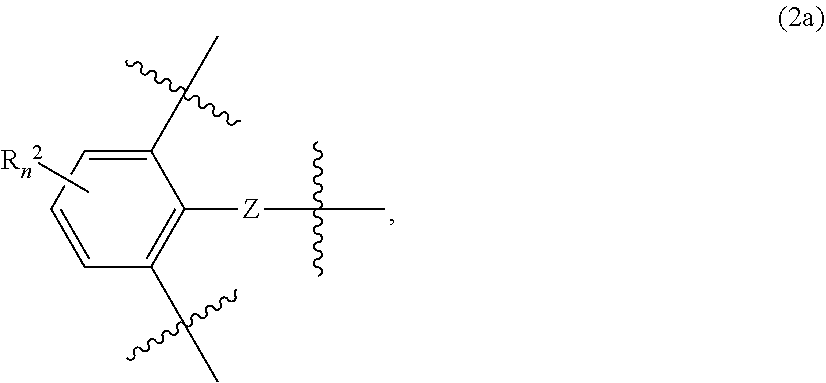
- Group B 1 and group B 2 each independently represent a trivalent group represented by the following general formula (2a) or (2b):
- group Z binds to group A, remaining two binding hands respectively bind to group X 1 and group X 2 , and group Z represents a single bond
- R n 2 is 0 to 3 substituents which substitute for a hydrogen atom on a benzene ring, and each independently represent an alkyl group, an alkoxy group, a phenyl group, a hydroxyl group, or an amino group.
- Group X 1 and group X 2 each independently represent a straight-chain or branched-chain alkylene group with a carbon number of two or more, optionally having at least one bond selected from the group consisting of an ether bond, an ester bond, an amide bond, and a sulfide bond.].
- Item 2 The light up-conversion material according to Item 1, wherein a total proportion of the compound represented by general formula (1) and the photosensitizer in the solid is 60 mass % or more.
- Item 3 The light up-conversion material according to Item 1 or 2, containing a crystal formed by the compound represented by general formula (1) and the photosensitizer.
- Item 4 The light up-conversion material according to any one of Items 1 to 3, wherein in general formula (1), group A is any one of polycyclic aromatic compound moieties represented by the following general formulas (A1) to (A23):
- bivalent binding hands each exist at any position substitutable with a hydrogen atom on an aromatic ring.
- R n 1 is 0 or more substituents each of which substitutes for a hydrogen atom bound to an aromatic ring, and each independently represent an alkyl group, an alkoxy group, a phenyl group, a hydroxyl group, or an amino group.
- group A is any one of polycyclic aromatic compound moieties represented by the following general formulas (A1-1), (A1-2), (A2-1), (A3-1), (A4-1), (A5-1), (A5-2), (A6-1), (A9-1), (A9-2), (A9-3), (A9-4), (A14-1), (A14-2), (A14-3), and (A14-4):
- R n 1 is the same as specified with regard to R n 1 defined above with respect to general formulas (A1) to (A23).].
- Item 6 The light up-conversion material according to any one of Items 1 to 5, wherein group B 1 and group B 2 each independently represent any one of trivalent groups represented by the following general formulas (3a-1) to (3a-4):
- R n 2 is the same as specific with regard to R n 2 defined above with respect to general formula (2a).
- Item 7 The light up-conversion material according to any one of Items 1 to 6, wherein in general formula (1), group X 1 and group X 2 each independently represent a straight-chain alkylene group with a carbon number of 5 to 10, optionally having at least one bond selected from the group consisting of an ether bond, an ester bond, an amide bond, and a sulfide bond.
- Item 8 A method of converting a light wavelength, including irradiating the light up-conversion material according to any one of Items 1 to 7 with light to cause emission of light having a wavelength shorter than a wavelength of radiated light.
- Item 9 A method of producing a light up-conversion material including the step of drying a solution containing a compound represented by the following general formula (1) and a photosensitizer:
- group A represents a bivalent moiety of a polycyclic aromatic compound with 3 to 5 condensed rings optionally having a substituent.
- Group B 1 and group B 2 each independently represent a trivalent group represented by the following general formula (2a) or (2b):
- group Z binds to group A, remaining two binding hands respectively bind to group X 1 and group X 2 , and group Z represents a single bond
- R n 2 is 0 to 3 substituents which substitute for a hydrogen atom on a benzene ring, and each independently represent an alkyl group, an alkoxy group, a phenyl group, a hydroxyl group, or an amino group.
- Group X 1 and group X 2 each independently represent a straight-chain or branched-chain alkylene group with a carbon number of two or more, optionally having at least one bond selected from the group consisting of an ether bond, an ester bond, an amide bond, and a sulfide bond.].
- a light up-conversion luminescent material in a solid state that realizes high light up-conversion efficiency.
- FIG. 1 is a photograph of the solid sample obtained in Example 1, wherein the solid sample was irradiated with a laser beam having an optical output power of 4 mW, and having its beam diameter enlarged with a convex lens, to cause the solid spread in circular form to be excited, and the solid sample was visually observed through a notch filter for preventing scattering of the radiated light.
- FIG. 2 is a microscopic image of crystal grains (the molar ratio of PtOEP:C7-sDPA is 1:720) contained in the solid sample obtained in Example 2.
- FIG. 3 is a photograph of an emission from a crystal grain obtained in Example 2, observed with a CCD camera through a notch filter.
- FIG. 4 is an emission spectrum of the solid sample (crystalline solid in the middle of FIG. 3 ) obtained in Example 2.
- FIG. 5 is a photograph of an emission from a crystal grain obtained in Example 4, observed with a CCD camera through a notch filter.
- FIG. 6 is an emission spectrum of the solid sample (crystalline solid in the middle of FIG. 5 ) obtained in Example 4.
- FIG. 7 is a photograph of an emission from a crystal grain obtained in Example 5, observed with a CCD camera through a notch filter.
- FIG. 8 is an emission spectrum of the solid sample (crystalline solid in the middle of FIG. 7 ) obtained in Example 5.
- the light up-conversion material of the present invention contains a compound represented by the following general formula (1) and a photosensitizer, and is a solid.
- the compound represented by general formula (1) is a compound that functions as a light up-conversion luminescent substance in the light up-conversion material of the present invention.
- the “light up-conversion luminescent substance” means a compound that emits light having a wavelength shorter than that of absorbed light.
- the photosensitizer functions as an acceptor
- the light up-conversion luminescent substance functions as a donor.
- the light up-conversion luminescent material of the present invention will be described in detail.
- the light up-conversion luminescent substance is a compound represented by the above general formula (1), and has a function of emitting light having a wavelength shorter than that of light absorbed by the light up-conversion material of the present invention.
- group A binds to group B 1 and group B 2 .
- group B 1 , group X 1 , group B 2 , and group X 2 bind in this order to form a ring, and group A is positioned in this ring.
- group A represents a bivalent moiety of a polycyclic aromatic compound with 3 to 5 condensed rings optionally having a substituent.
- aromatic ring constituting group A include a benzene ring, a cyclopentadienyl ring, a pyridine ring, a pyrazine ring, a pyrimidine ring, a pyridazine ring, a furan ring, a thiophene ring and a silole ring.
- group A include polycyclic aromatic compound moieties represented by the following general formulas (A1) to (A23):
- the positions of bivalent binding hands are not particularly limited, and the bivalent binding hands each exist at any position substitutable with a hydrogen atom on an aromatic ring.
- the bivalent binding hands preferably each exist on the same aromatic ring or on aromatic rings adjacent to each other. As a result, it can be considered that the size of the ring can be reduced, interaction between molecules of the luminescent substance becomes likely occur, and it becomes possible to further improve the light up-conversion efficiency.
- the bivalent binding hands preferably each exist at a position where a radical is likely to be generated when no binding hand exists. Existence of each binding hand at such a position inhibits generation of a radical at such a position, and suppresses decrease in the light up-conversion efficiency due to formation of a dimer resulting from radical reaction between molecules of the luminescent substance.
- R n 1 is zero or more substituents each of which substitutes for a hydrogen atom bound to an aromatic ring. Although an upper limit of the number of R n 1 differs depending on the number of hydrogen atoms bound to the aromatic ring in each of general formulas (A1) to (A23), the upper limit is typically about 0 to 8, preferably about 0 to 4.
- R n 1 each independently represent an alkyl group, an alkoxy group, a phenyl group, a hydroxyl group, or an amino group.
- R n 1 is an alkyl group or an alkoxy group
- the carbon number is not particularly limited, but from the view point of reducing the steric hindrance of group A and facilitating interaction between molecules of the luminescent substance, the carbon number includes preferably about 1 to 10.
- examples of preferred group A include polycyclic aromatic compound moieties represented by the following general formulas (A1-1), (A1-2), (A2-1), (A3-1), (A4-1), (A5-1), (A5-2), (A6-1), (A9-1), (A9-2), (A9-3), (A9-4), (A14-1), (A14-2), (A14-3), and (A14-4).
- the luminescent substance has a structure in which a ring formed by group B 1 , group X 1 , group B 2 , and group X 2 surrounds group A in a center part of group A.
- the two binding hands of group A having such a structure are each positioned on a carbon atom where a radical is likely to be generated when no binding hand exists. That is, in such a structure, the two binding hands of group A inhibit generation of a radical at such a position. This can be considered to effectively suppress decrease in the light up-conversion efficiency due to formation of a dimer resulting from radical reaction between molecules of the luminescent substance.
- R n 1 is the same as specific with regard to R n 1 defined above with respect to general formulas (A1) to (A23).
- group B 1 and group B 2 each independently represent a trivalent group represented by the following general formula (2a) or (2b):
- group Z binds to each of the two binding hands of group A. Moreover, remaining two binding hands in each of general formulas (2a) and (2b) respectively bind to group X 1 and group X 2 in general formula (1).
- group Z represents a single bond.
- R n 2 is 0 to 3 substituents which each substitute for a hydrogen atom on a benzene ring, and each independently represent an alkyl group, an alkoxy group, a phenyl group, a hydroxyl group, or an amino group.
- R n 2 is an alkyl group or an alkoxy group
- the carbon number is not particularly limited, but from the view point of reducing the steric hindrance of group B 1 and group B 2 and facilitating interaction between molecules of the luminescent substance, and simultaneously increasing the compatibility with the sensitizer, the carbon number preferably includes about 1 to 10, and more preferably about 5 to 10.
- group B 1 and group B 2 each independently include trivalent groups represented by the following general formulas (3a-1) to (3a-4):
- R n 2 in each of general formulas (3a-1) to (3a-4) is the same as R n 2 in each of the above general formulas (2a) and (2b).
- one of bivalent binding hands of each of group X 1 and group X 2 binds to group B 1 , and the other binding hand binds to group B 2 .
- Group X 1 and group X 2 are each independently a straight-chain or branched-chain alkylene group with a carbon number of two or more, optionally having at least one bond selected from the group consisting of an ether bond, an ester bond, an amide bond, and a sulfide bond.
- group X 1 and group X 2 each include preferably a straight-chain alkylene group with a carbon number of 5 to 10, optionally having at least one bond selected from the group consisting of an ether bond, an ester bond, an amide bond, and a sulfide bond, more preferably a straight-chain alkylene group with a carbon number of 5 to 10 or a straight-chain alkylene group with a carbon number of 5 to 10 having an ether bond.
- Particularly preferred as the compound represented by general formula (1) are the compounds represented by the following general formulas (1a-1) to (1a-3), (1b-1) to (1b-3), and (1c-1) to (1c-3):
- R 11 and R 12 each independently represent a hydrogen atom, an alkyl group, an alkoxy group, a phenyl group, a hydroxyl group, or an amino group.
- the carbon number is not particularly limited, but from the view point of facilitating interaction between molecules of the luminescent substance, the carbon number preferably includes about 1 to 10, and more preferably about 5 to 10.
- R 21 and R 22 each independently represents a hydrogen atom, an alkyl group, an alkoxy group, a phenyl group, a hydroxyl group, or an amino group.
- the carbon number is not particularly limited, but from the view point of facilitating interaction between molecules of the luminescent substance, the carbon number preferably includes about 1 to 10, and more preferably about 5 to 10.
- a method of producing the compound represented by general formula (1) is not particularly limited, and the compound can be produced by a known synthesis method.
- the method of producing the compound represented by general formula (1) will be described using the compound represented by the above formula (1a) as an example.
- anthraquinone (1a1) and 2,6-dimethyloxyphenyl lithium are reacted to obtain a compound represented by formula (1a2).
- the compound is dehydrated to obtain 9,10-bis(2,6-dimethoxyphenyl)anthracene (1a3).
- Dehydration can be conducted, for example, by heating to about 120° C. in the presence of NaI, NaH 2 PO 2 .H 2 O, and AcOH.
- the compound represented by general formula (1) can also be produced, for example by a method shown in the following scheme 2.
- the production method will be described using the compound represented by formula (1a) as an example.
- 9,10-dibromoanthracene (1a5) and 2,6-dimethoxyphenylboronic acid are bound to each other by Suzuki-Miyaura coupling reaction to obtain 9,10-bis(2,6-dimethoxyphenyl)anthracene (1a3).
- the compound of formula (1a) is obtained.
- the light up-conversion luminescent substance of the present invention may be used alone or in a combination of two or more kinds.
- the light up-conversion material of the present invention contains a photosensitizer in addition to the compound (light up-conversion luminescent substance) represented by the above general formula (1).
- the photosensitizer is not particularly limited as far as it can absorb light energy and transfer the light energy to the light up-conversion luminescent substance of the present invention, and a known photosensitizer can be used.
- an example of the photosensitizer preferably includes an organic metal complex.
- a metal constituting the organic metal complex is not particularly limited, but examples of the metal include Li, Mg, Al, Ti, V, Mn, Fe, Co, Ni, Cu, Zn, Ga, Ru, Pd, Ag, Re, Os, Ir, Pt, and Pb, and preferably include Pt, and Pd.
- Specific examples of the organic metal complex include a metal complex of porphyrin or its substitution product, and a metal complex of phthalocyanine or its substitution product, and among them preferably the metal complex of porphyrin or its substitution product.
- the photosensitizer include a palladium complex of porphyrin or its substitution product, and a platinum complex of porphyrin or its substitution product.
- the palladium complex of porphyrin or its substitution product include palladium tetrabenzoporphyrin, palladium tetraphenyltetrabenzoporphyrin, palladium octaethylporphyrin, and palladium cyclohexenoporphyrin.
- platinum complex of porphyrin or its substitution product examples include platinum tetrabenzoporphyrin, platinum tetraphenyltetrabenzoporphyrin, platinum octaethylporphyrin, and platinum cyclohexenoporphyrin.
- the photosensitizer may be used alone or in a combination of two or more kinds.
- the proportion (molar ratio) of the compound represented by general formula (1) and the photosensitizer to be incorporated is not particularly limited, but from the view point of effectively increasing the up-conversion luminescence quantum yield, the proportion of the compound represented by general formula (1) per mole of the photosensitizer is preferably about 10 to 10000 mol, and more preferably about 200 to 2000 mol.
- the total proportion of the compound represented by general formula (1) and the photosensitizer is not particularly limited, but from the view point of effectively increasing the up-conversion luminescence quantum yield, the total proportion may be preferably 60 mass % or more, and more preferably 90 mass % or more.
- the light up-conversion material of the present invention preferably contains a crystal formed by the compound represented by general formula (1) and the photosensitizer, from the view point of effectively increasing the up-conversion luminescence quantum yield. This is because such a crystallized portion has particularly high luminescence efficiency in the light up-conversion material of the present invention.
- Astd and Auc denote absorbances at excitation wavelengths of a standard substance and a test sample, respectively.
- Istd and Iuc denote integrated emission intensities obtained by integrating emission intensities of the standard substance and the test sample, respectively, by a wavelength over the entire region of the luminescent substance.
- the test sample for up-conversion it is an integrated emission intensity regarding an up-conversion light emitting band having a wavelength shorter than that of the excited light.
- Nstd and Nuc denote refractive indexes of solvents or surrounding media at emission wavelengths of the standard substance and the test sample.
- any standard substance can be used that can be excited at the same wavelength and in the same optical arrangement as those of the test sample, and of which reliable fluorescence quantum yield has been reported.
- an ethylene glycol solution (100 ⁇ M) of rhodamine 101 was used as the standard substance, and its fluorescence quantum yield, 0.94, was used as ⁇ std.
- This value of fluorescence quantum yield is a value determined by using a dilute solution of rhodamine 101 in ethanol as the standard substance and the fluorescent quantum yield of 0.89 reported in the article “C. Wurth, C. Lochmann, M. Petrus, J. Pauli, K. Hoffmann, T. Schuttrtechnik, T. Franzl, and U.
- the temperature at which the light up-conversion material of the present invention is solid is not particularly limited as long as it is solid during use, and the light up-conversion material is solid at least at 125° C. or lower, and preferably at 80° C. or lower.
- the light up-conversion material of the present invention can be produced using a method including the step of drying a solution containing the compound represented by the general formula (1) above and a photosensitizer, although the method is not particularly limited thereto. By adopting this production method, a light up-conversion material having particularly improved luminescence efficiency can be obtained.
- a solution is prepared that contains a photosensitizer, and has a high concentration of the compound (luminescent substance) represented by general formula (1), which is specifically one-tenth or more of the saturation concentration, and wherein the proportion of molecules of the luminescent substance per mole of the sensitizer is 100 mol or more, and preferably 500 mol or more.
- a highly volatile polar solvent such as tetrahydrofuran may be used, and dried by being dropped onto the surface of a glass substrate having good wettability.
- the light up-conversion material When the light up-conversion material is produced in this manner, it can be rapidly transferred into a solid form, with a high degree of mutual dispersion between the luminescent substance and the photosensitizer. It is believed that this suppresses the aggregation of molecules of the luminescent substance or molecules of the photosensitizer during the transition from a liquid to a solid, which allows adjacent molecules of the luminescent substance and the photosensitizer to be dispersed in the solid. It is believed that this causes efficient triplet energy transfer from the photosensitizer to the adjacent luminescent substance in the solid, resulting in a high up-conversion luminescence quantum yield.
- Patent Document 2 a solution in which a photosensitizer and the compound (luminescent substance) represented by general formula (1) are dissolved in a solvent is prepared; however, this solution is used as the light up-conversion material without drying the solvent.
- Patent Document 2 assumes the solution to be the material system that realizes the highest up-conversion efficiency, and, as shown in Non-Patent Document 3, it was known that evaporation from the solution does not lead to up-conversion because the sensitizer and the luminescent substance are separately crystallized.
- the solvent is not particularly limited, and an organic solvent, water, and so on can be used, for example.
- the organic solvent include nitrile solvents such as acetonitrile and benzonitrile; halogen solvents such as chloroform, dichloromethane, 1,2-dichloroethane, 1,1,2-trichloroethane, chlorobenzene, and o-dichlorobenzene; ether solvents such as tetrahydrofuran and dioxane; aromatic hydrocarbon solvents such as benzene, toluene and xylene; aliphatic hydrocarbon solvents such as cyclohexane, methylcyclohexane, n-pentane, n-hexane, n-heptane, n-octane, n-nonane, and n-decane; ketone solvents such as acetone, methyl ethyl ketone, and cyl
- preferred examples include diacetone, tetrahydrofuran, chloroform, dichloromethane, and cyclohexane, which have high volatility, although the solvent is not limited thereto, and may vary depending on the evaporation conditions.
- the solution may be dried using, for example, an ink-jet method or a spray-dry method.
- the light up-conversion material of the present invention may be incorporated into a resin or glass.
- the resin is not particularly limited, and can be selected appropriately according to the application.
- known resins such as a (meth)acryl resin, a polyester resin, a polyurethane resin, an epoxy resin, a polyolefin resin, a polyamide resin, a polystyrene resin, a cellulose resin, an imide resin, a polyvinyl chloride resin, a fluoric resin, a silicone resin, a polycarbonate resin, a polysulfone resin, a cyclic polyolefin resin, a polylactic acid resin, and a vinyl ester resin can be used.
- the shape of the resin is not particularly limited, and can be selected appropriately, for example according to the application. Examples of the shape include a film-like shape, a sheet-like shape, and a fibrous shape.
- the glass is not particularly limited, and can be selected appropriately according to the application.
- quartz glass, borosilicate glass, soda glass, alumina silicate glass, soda lime glass, alkali-free glass and the like can be used.
- the shape of the glass is not particularly limited, and can be selected appropriately, for example according to the application. Examples of the shape include a film-like shape, a sheet-like shape, and a fibrous shape.
- the light up-conversion material of the present invention has absorption intensity peaks at positions where the wavelength of absorbed light is typically from about 480 to 560 nm, and preferably from about 490 to 510 nm and from about 525 to 540 nm.
- the light up-conversion material of the present invention has an emission intensity peak at a position where the wavelength of emitted light is typically from about 400 to 550 nm, and preferably from about 400 to 480 nm.
- light irradiation power (mW) of light with which the light up-conversion material of the present invention is irradiated can be selected appropriately according to application of the light up-conversion material, and an example of the light irradiation power includes about 0.01 to 10 mW.
- the light up-conversion material of the present invention can efficiently convert a wavelength incident to the light up-conversion material into a short wavelength
- the light up-conversion material of the present invention can be used desirably for application including solar cells such as organic solar cells, natural light illumination, LEDs, organic EL devices, biomarkers, displays, printing, security recognition, optical data storage units, and sensors.
- the light up-conversion material of the present invention can be used desirably as a method of converting a light wavelength, which includes irradiating the light up-conversion material with light to cause emission of light having a wavelength shorter than that of the radiated light.
- Pt-octaethylporphyrin represented by formula (4) shown below was added as a photosensitizer into a medium of tetrahydrofuran (THF) to prepare a solution having a predetermined concentration.
- the molar ratio between the luminescent substance and the photosensitizer was 720 mol of the luminescent substance per mole of the photosensitizer, and the concentration of C7-sDPA was the saturated concentration at room temperature (23° C.).
- the obtained solution was taken into a pipette, one drop of the solution was dropped onto the surface of a slide glass, and the solution was allowed to dry at room temperature (23° C.) for 1 minute in the air, thus obtaining a solid sample spread in circular form (see FIG. 1 ). Note that the diameter of the portion spread in circular form was about 2 cm.
- the total proportion of the compound represented by general formula (1a) and the photosensitizer in the solid sample was 100 mass %.
- the obtained solid sample was irradiated with a laser beam having an optical output power of 4 mW (central wavelength of the incident light: 532 nm, green, continuous light), and having its beam diameter enlarged with a convex lens, to cause the solid spread in circular form to be excited, and the solid sample was visually observed through a notch filter for preventing scattering of the radiated light.
- a laser beam having an optical output power of 4 mW central wavelength of the incident light: 532 nm, green, continuous light
- the solid sample was visually observed through a notch filter for preventing scattering of the radiated light.
- the circumferential portion of the solid spread in circular form emitted blue light (the photograph shown in FIG. 1 was taken under such conditions).
- the laser beam diameter at the irradiated site was over 2 cm, the laser beam used had a Gaussian spatial profile having a high light intensity at the center, and the intensity of the radiated light in the circumferential portion emitting blue light was less than 2.3 mW/cm 2 .
- a sample was prepared in which the region of the solid sample spread in circular form, composed of Pt-octaethylporphyrin (PtOEP) and the compound (C7-sDPA) represented by formula (1a), prepared as in Example 1, was covered with a cover glass with a 80- ⁇ m spacer therebetween (sample 3-air).
- the total proportion of the compound represented by general formula (1a) and the photosensitizer in the solid sample was 100 mass %.
- a sample was also prepared in the same manner as described above, except that only the step of covering the solid sample with a cover glass was performed in a high-purity argon (99.998% or higher) atmosphere, and the periphery of the cover glass was sealed with an ultraviolet curing resin (the solid sample was masked during sealing to avoid ultraviolet radiation) to place the solid sample in an argon gas environment (sample 3-Ar).
- sample 3-oil a sample was prepared which was identical to sample 3-air, except that in the step of placing a cover glass, the solid sample was covered with a drop of an immersion oil (Olympus Corporation, refractive index 1.404) before being covered with a cover glass, and the cover glass was placed thereon (sample 3-oil).
- an immersion oil Olympus Corporation, refractive index 1.404
- reference samples were prepared using the same spacer, slide glass, and cover glass as those used for each of the above-described three samples, by loading an ethylene glycol solution (100 ⁇ M) of rhodamine 101 between glass sheets, and transmission absorption spectra and emission spectra were measured under the same conditions as those used for the above-described three samples. From these data, the luminescence quantum yield of crystal grains of each of the samples was determined based on mathematical expression (A) shown above. Although the obtained luminescence quantum yield varied for each crystal grain, the average value and the standard deviation for 10 crystal grains for each sample are shown in Table 1.
- the up-conversion luminescence quantum yield is over 10% for all the samples.
- no solid light up-conversion material utilizing triplet-triplet annihilation has been reported to have a luminescence quantum yield over 10%.
- the immersion oil serves to promote refractive index matching with a solid crystal surface to reduce losses due to scattering or reflection at the solid sample.
- the solid sample was surrounded by air, and refractive index matching was not sufficiently achieved.
- the up-conversion luminescence quantum efficiencies of the solid light up-conversion materials obtained in the present examples were higher than that (a maximum of 15.1%) of the dimethylsulfoxide solution containing Pt-octaethylporphyrin (PtOEP, formula (4)) and the compound (C7-sDPA) represented by formula (1a) disclosed in Patent Document 2, although they were measured under different conditions.
- sample 4-air, sample 4-Ar, and sample 4-oil in which the surrounding environment of each of the solid samples was air, argon gas, or the immersion oil, respectively were prepared as in Example 3, except that the compound (DPA) represented by the following formula was used as the luminescent substance instead of the compound (C7-sDPA) represented by formula (1a), and the molar ratio of the luminescent substance to the photosensitizer was 1000 mol of the luminescent substance per mole of the photosensitizer, and the up-conversion luminescence quantum yield was measured using the same procedures and method as those in Example 3. As a result, the average value and standard deviation of the up-conversion luminescence quantum yield for 10 crystal grains for each sample were obtained, as shown in Table 2. The samples of these comparative examples are clearly inferior to those of Example 3.
- Example 3 A solid sample spread in circular form was obtained as in Example 3, using the same method as that of Example 1, except that 2,6-dioctyl-C7s-DPA represented by the following formula (compound corresponding to general formula (1a-1)) was used as the luminescent substance instead of the compound (C7-sDPA) represented by formula (1a), and the molar ratio of the luminescent substance to the photosensitizer was 1000 mol of the luminescent substance per mole of the photosensitizer.
- an emission from the solid sample was observed as in Example 2, except that the intensity of the excited light at the irradiated site was 3.0 W/cm 2 , and the emission spectrum was measured. As a result, the crystal grain was confirmed to be emitting vivid blue light ( FIG.
- Example 3 A solid sample spread in circular form was obtained as in Example 3, using the same method as that of Example 1, except that C7s-bis(4-octylphenyl)anthracene represented by the following formula (corresponding to the compound of general formula 1a-2) was used as the luminescent substance instead of the compound (C7-sDPA) represented by formula (1a), and the molar ratio of the luminescent substance to the photosensitizer was 1000 mol of the luminescent substance per mole of the photosensitizer.
- an emission was observed as in Example 2, except that the light intensity at the irradiated site was 6.0 W/cm 2 , and the emission spectrum was measured. As a result, the crystal grain was confirmed to be emitting vivid blue light ( FIG. 7 ).
- the obtained spectrum is shown in FIG. 8 .
- the compound of the following formula was synthesized in accordance with the method described in paragraph [0036] of WO 2014/136619 A1, using 2,6-dimethoxy-4-octylphenyllithium instead of 2,6-dimethoxyphenyllithium.
- the luminescence quantum yield was measured as in Example 3.
- the up-conversion luminescence quantum yield of the solid light up-conversion material obtained in Example 5 was higher than that of the sample of Comparative Example 1.
- the total proportion of the compound represented by the following formula and the photosensitizer in the solid sample was 100 mass %.
Landscapes
- Chemical & Material Sciences (AREA)
- Engineering & Computer Science (AREA)
- Materials Engineering (AREA)
- Organic Chemistry (AREA)
- Electroluminescent Light Sources (AREA)
- Organic Low-Molecular-Weight Compounds And Preparation Thereof (AREA)
Abstract
Description


Φuc=2×Φstd×(Astd/Auc)×(Iuc/Istd)×(Nuc/Nstd)2 (A)
Φfl=Φstd×(Astd/Auc)×(Iuc/Istd)×(Nuc/Nstd)2 (B)

| TABLE 1 | ||||
| Example 3 | Average | Standard Deviation | ||
| Sample 3-air | 0.15 | 0.05 | ||
| Sample 3-Ar | 0.23 | 0.03 | ||
| Sample 3-oil | 0.17 | 0.06 | ||

| TABLE 2 | ||||
| Comparative Example 1 | Average | Standard Deviation | ||
| Sample 4-air | 0.010 | 0.006 | ||
| Sample 4-Ar | 0.022 | 0.014 | ||
| Sample 4-oil | 0.011 | 0.004 | ||


Claims (4)




Applications Claiming Priority (4)
| Application Number | Priority Date | Filing Date | Title |
|---|---|---|---|
| JP2016-055167 | 2016-03-18 | ||
| JP2016055167 | 2016-03-18 | ||
| JP2017-040031 | 2017-03-03 | ||
| JP2017040031A JP6960624B2 (en) | 2016-03-18 | 2017-03-03 | Optical up-conversion material |
Publications (2)
| Publication Number | Publication Date |
|---|---|
| US20170267922A1 US20170267922A1 (en) | 2017-09-21 |
| US10604698B2 true US10604698B2 (en) | 2020-03-31 |
Family
ID=59847478
Family Applications (1)
| Application Number | Title | Priority Date | Filing Date |
|---|---|---|---|
| US15/459,083 Active 2038-01-26 US10604698B2 (en) | 2016-03-18 | 2017-03-15 | Light up-conversion material |
Country Status (1)
| Country | Link |
|---|---|
| US (1) | US10604698B2 (en) |
Families Citing this family (2)
| Publication number | Priority date | Publication date | Assignee | Title |
|---|---|---|---|---|
| CN107608115A (en) * | 2017-09-30 | 2018-01-19 | 京东方科技集团股份有限公司 | Substrate and display panel for display panel |
| CN118817618B (en) * | 2024-08-14 | 2026-01-23 | 天合光能股份有限公司 | Characterization method of optical performance of light conversion film and determination method of light conversion agent in light conversion film |
Citations (2)
| Publication number | Priority date | Publication date | Assignee | Title |
|---|---|---|---|---|
| JP2008506798A (en) | 2004-07-15 | 2008-03-06 | メルク パテント ゲーエムベーハー | Use of polymers for upconversion and devices for upconversion |
| WO2014136619A1 (en) | 2013-03-05 | 2014-09-12 | 独立行政法人産業技術総合研究所 | Light up-conversion luminescent substance |
-
2017
- 2017-03-15 US US15/459,083 patent/US10604698B2/en active Active
Patent Citations (5)
| Publication number | Priority date | Publication date | Assignee | Title |
|---|---|---|---|---|
| JP2008506798A (en) | 2004-07-15 | 2008-03-06 | メルク パテント ゲーエムベーハー | Use of polymers for upconversion and devices for upconversion |
| US20080103279A1 (en) | 2004-07-15 | 2008-05-01 | Merck Patent Gmbh | Use of Polymers for Up-Conversion, and Devices for Up-Conversion |
| WO2014136619A1 (en) | 2013-03-05 | 2014-09-12 | 独立行政法人産業技術総合研究所 | Light up-conversion luminescent substance |
| US20160053168A1 (en) | 2013-03-05 | 2016-02-25 | National Institute Of Advanced Industrial Science And Technology | Light up-conversion luminescent substance |
| US9890326B2 (en) * | 2013-03-05 | 2018-02-13 | National Institute Of Advanced Industrial Science And Technology | Light up-conversion luminescent substance |
Non-Patent Citations (3)
| Title |
|---|
| Ceroni, "Energy up-conversion by low-power excitation: new applications of an old concept," Chemistry a European Journal, vol. 17, pp. 9560-9564. (2011). |
| Monguzzi, et al., "Low power, non-coherent sensitized photon up-conversion: modelling and perspectives," Phys. Chem. Chem. Phys., vol. 14, pp. 4322-4332. (2012). |
| Trupke, et al., "Efficiency enhancement of solar cells by luminescent up-conversion of sunlight," Solar Energy Materials and Solar Cells, vol. 90, pp. 3327-3338. (2006). |
Also Published As
| Publication number | Publication date |
|---|---|
| US20170267922A1 (en) | 2017-09-21 |
Similar Documents
| Publication | Publication Date | Title |
|---|---|---|
| Li et al. | Carbon dots‐in‐matrix boosting intriguing luminescence properties and applications | |
| US10669473B2 (en) | Organic molecules for use in optoelectronic components | |
| US9890326B2 (en) | Light up-conversion luminescent substance | |
| Lian et al. | Realizing near-unity quantum efficiency of zero-dimensional antimony halides through metal halide structural modulation | |
| KR102070833B1 (en) | Pyromethene boron complex, color conversion composition, color conversion film, and light source unit including it, display and illumination | |
| KR102344621B1 (en) | Color conversion composition, color conversion film, and backlight unit, display and lighting comprising same | |
| US10894375B2 (en) | Color conversion film and light source unit including the same, display, and lighting apparatus | |
| Volpi et al. | One pot synthesis of low cost emitters with large Stokes' shift | |
| TWI679268B (en) | Color conversion sheet, light source unit including the color conversion sheet, display, and lighting device | |
| CN110218220A (en) | A kind of functional metal-organic frame compound, its compound formed and its preparation method and application | |
| JP6960624B2 (en) | Optical up-conversion material | |
| US10604698B2 (en) | Light up-conversion material | |
| US20190092798A1 (en) | Organic metal complex, method for preparing the same, and light-emitting element including the same | |
| CN110832361B (en) | Color conversion composition, color conversion sheet, and light source module, display, and lighting device each comprising color conversion sheet | |
| US10961260B2 (en) | Nitrogenous compound and color conversion film comprising same | |
| JP7435960B2 (en) | optical upconversion materials | |
| JP2020528041A (en) | Method for preparing zeolite L material that accepts at least one type of guest molecule | |
| Katakami et al. | Open system synthesis of narrow-bandwidth red-fluorescent carbon quantum dots with a function of multi-metal ion sensing | |
| US11091503B2 (en) | Compound and color conversion film comprising the same | |
| US11930705B2 (en) | Diaryloxybenzoheterodiazole compounds di-substituted with thienothiophenic groups | |
| CN103012706B (en) | Melamine-dialdehyde condensation product and synthetic method and application thereof | |
| CN117120887A (en) | Color conversion composition, color conversion sheet, light source unit, display and lighting device including these | |
| US20230422589A1 (en) | High-efficiency energy down-conversion system | |
| JP2018083945A (en) | Photon up-conversion composition, compound, light emission body, light emission element and light emission method | |
| US9570691B2 (en) | Ambient temperature liquid-form organic materials and use thereof |
Legal Events
| Date | Code | Title | Description |
|---|---|---|---|
| AS | Assignment |
Owner name: NATIONAL INSTITUTE OF ADVANCED INDUSTRIAL SCIENCE AND TECHNOLOGY, JAPAN Free format text: ASSIGNMENT OF ASSIGNORS INTEREST;ASSIGNORS:KAMADA, KENJI;KOBAYASHI, KENJI;SIGNING DATES FROM 20170320 TO 20170321;REEL/FRAME:042388/0120 Owner name: NATIONAL INSTITUTE OF ADVANCED INDUSTRIAL SCIENCE Free format text: ASSIGNMENT OF ASSIGNORS INTEREST;ASSIGNORS:KAMADA, KENJI;KOBAYASHI, KENJI;SIGNING DATES FROM 20170320 TO 20170321;REEL/FRAME:042388/0120 |
|
| STPP | Information on status: patent application and granting procedure in general |
Free format text: DOCKETED NEW CASE - READY FOR EXAMINATION |
|
| STPP | Information on status: patent application and granting procedure in general |
Free format text: NON FINAL ACTION MAILED |
|
| STPP | Information on status: patent application and granting procedure in general |
Free format text: RESPONSE TO NON-FINAL OFFICE ACTION ENTERED AND FORWARDED TO EXAMINER |
|
| STPP | Information on status: patent application and granting procedure in general |
Free format text: FINAL REJECTION MAILED |
|
| STPP | Information on status: patent application and granting procedure in general |
Free format text: NOTICE OF ALLOWANCE MAILED -- APPLICATION RECEIVED IN OFFICE OF PUBLICATIONS |
|
| STPP | Information on status: patent application and granting procedure in general |
Free format text: PUBLICATIONS -- ISSUE FEE PAYMENT RECEIVED |
|
| STPP | Information on status: patent application and granting procedure in general |
Free format text: PUBLICATIONS -- ISSUE FEE PAYMENT VERIFIED |
|
| STCF | Information on status: patent grant |
Free format text: PATENTED CASE |
|
| MAFP | Maintenance fee payment |
Free format text: PAYMENT OF MAINTENANCE FEE, 4TH YEAR, LARGE ENTITY (ORIGINAL EVENT CODE: M1551); ENTITY STATUS OF PATENT OWNER: LARGE ENTITY Year of fee payment: 4 |