US10599625B2 - Managing storage of data - Google Patents
Managing storage of data Download PDFInfo
- Publication number
- US10599625B2 US10599625B2 US15/308,654 US201415308654A US10599625B2 US 10599625 B2 US10599625 B2 US 10599625B2 US 201415308654 A US201415308654 A US 201415308654A US 10599625 B2 US10599625 B2 US 10599625B2
- Authority
- US
- United States
- Prior art keywords
- projection
- data
- expression
- results data
- columns
- Prior art date
- Legal status (The legal status is an assumption and is not a legal conclusion. Google has not performed a legal analysis and makes no representation as to the accuracy of the status listed.)
- Active, expires
Links
Images



Classifications
-
- G—PHYSICS
- G06—COMPUTING OR CALCULATING; COUNTING
- G06F—ELECTRIC DIGITAL DATA PROCESSING
- G06F16/00—Information retrieval; Database structures therefor; File system structures therefor
- G06F16/20—Information retrieval; Database structures therefor; File system structures therefor of structured data, e.g. relational data
- G06F16/22—Indexing; Data structures therefor; Storage structures
- G06F16/221—Column-oriented storage; Management thereof
-
- G—PHYSICS
- G06—COMPUTING OR CALCULATING; COUNTING
- G06F—ELECTRIC DIGITAL DATA PROCESSING
- G06F16/00—Information retrieval; Database structures therefor; File system structures therefor
- G06F16/20—Information retrieval; Database structures therefor; File system structures therefor of structured data, e.g. relational data
- G06F16/23—Updating
- G06F16/2393—Updating materialised views
-
- G—PHYSICS
- G06—COMPUTING OR CALCULATING; COUNTING
- G06F—ELECTRIC DIGITAL DATA PROCESSING
- G06F16/00—Information retrieval; Database structures therefor; File system structures therefor
- G06F16/20—Information retrieval; Database structures therefor; File system structures therefor of structured data, e.g. relational data
- G06F16/24—Querying
- G06F16/245—Query processing
- G06F16/2453—Query optimisation
Definitions
- Databases are computerized data storage and retrieval systems that are organized in any of a number of different manners.
- a typical manner in which databases are organized is through the storage of data in multiple tables composed of columns and rows.
- the columns typically identify a category or topic and the rows typically include data pertaining to a particular entity or feature.
- the category of a column may be “clients” and each of the rows may identify a particular client.
- the tables in databases such as those stored as structured data, contain very large numbers of columns.
- FIG. 1A shows a simplified schematic diagram of a data managing system, which may implement various aspects of the methods disclosed herein, according to an example of the present disclosure
- FIG. 1B shows a more detailed schematic diagram of the data managing system depicted in FIG. 1A , according to an example of the present disclosure
- FIG. 2 shows a simplified block diagram of the data managing system depicted in FIGS. 1A and 1B , according to an example of the present disclosure
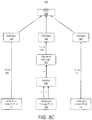
- FIGS. 3, 4, and 5A-5C respectively, show flow diagrams of methods for managing storage of data from an input table, according to examples of the present disclosure.
- FIG. 6 illustrates a schematic representation of a computing device, which may be employed to perform various functions of the computing device depicted in FIG. 2 , according to an example of the present disclosure.
- the term “includes” means includes but not limited to, the term “including” means including but not limited to.
- the term “based on” means based at least in part on.
- the terms “a” and “an” are intended to denote at least one of a particular element.
- the tables in databases often contain very large numbers of columns. As such, performance of queries on the data contained in such tables typically takes a relatively long amount of time. Secondary tuning structures, such as indexes and materialized views for the tables are often created for improved query performance. However, these tuning structures are often expensive to maintain during data load, which leads to rebuilding of these tuning structures during nightly batch windows, and thus prevents the ability to do real-time analytics.
- the data is stored in physical storage (e.g., disks) in formats that optimize query execution, such as in projections.
- Projections may be defined as collections of table columns that are optimized for query performance (or analytics performance) at the physical storage level.
- a projection may include some or all of the columns of one or more tables.
- a projection that includes all of the columns of a table may be termed a super projection and a projection that joins one or more tables may be called a pre-join projection.
- Projections may store data sets on the physical storage rather than compute them each time the projections are used in a query. Moreover, projections may not be aggregated, but rather may store every row in a table in full atomic detail and the data may automatically be refreshed whenever data values are inserted, appended, or changed. Database management systems that employ projections are available from HP VerticaTM, which is headquartered in Cambridge, Mass.
- tab 1 has the following columns: id, f, i, c, and v.
- tab 2 has the following columns: fk, f 1 , f 2 , i 1 , i 2 , c 1 , c 2 , v 1 , v 2 , d 1 , d 2 , t 1 , t 2 , m 1 , and m 2 .
- the variables used to denote the columns may represent the types of data contained in those columns. For instance, “i” may indicate integers, “f” may represent float, “c” may represent char, “v” may represent varchar, “d” may represent date, “t” may represent timestamp, and “m” may represent money value.
- the tables tab 1 and tab 2 are discussed throughout the present disclosure for purposes of illustration.
- a 1 ⁇ n relationship may be defined between tab 1 and tab 2 by adding a “foreign key” to tab 2 that references tab 1 .
- This relationship may be written as:
- a replicated super projection, sp 1 , for tab 1 may be created, in which sp 1 includes all of the columns of tab 1 .
- Sp 1 may be sorted, for instance, on column id.
- the projection sp 1 may be created, for instance, through the following example:
- a segmented super projection, sp 2 , for tab 2 may be created, in which sp 2 includes all of the columns of tab 2 .
- Sp 2 may, for instance, be sorted on columns i 1 and i 2 , run-length encoding (RLE) encoded on columns i 1 and i 2 , segmented on columns c 2 , c 1 , t 1 , and t 2 , and may still be working if one node (e.g., hard drive) is down.
- Sp 2 may be segmented based on a hash function that provides substantially even distribution of data across some or all of the nodes in a cluster for enhanced, e.g., optimal, query execution.
- sp 2 may be segmented according to a desired manner as to which nodes store particular rows of data.
- sp 2 may be unsegmented, i.e., all of the data may be stored in a single node, on all of the nodes, etc.
- sp 2 may be stored on multiple nodes to provide redundancy in case of a node failure.
- Sp 2 may be created, for example, through the following example:
- a segmented pre-join projection, prej that includes columns from both tab 1 and tab 2 may be created.
- Prej may, for instance, be sorted on columns i, i 1 , and i 2 , RLE encoded on columns i, i 1 , and i 2 , segmented on columns c, c 1 , and c 2 , and still working if one node is down.
- Prej may be segmented based on a hash function that provides substantially even distribution of data across some or all of the nodes in a cluster for enhanced, e.g., optimal, query execution.
- prej may be stored on multiple nodes to provide redundancy in case of a node failure.
- Prej may be created, for example, through the following example:
- projections may contain raw data from the input tables.
- expressions such as logical functions, mathematical functions, etc.
- the expression projection may be similar to the projection discussed above, but instead of storing data that is identical to the data contained in the input tables, the expression projection may store data that is derived, e.g., computed, applied, etc., from the data contained in the input tables.
- an expression that extracts the dates from the timestamps may be executed on that column, such that the results of the executed expression are the dates from the timestamps.
- the dates from the timestamps may be stored in an expression projection.
- the dates may be sorted, encoded, and segmented in the expression projection similarly to the data in a projection, to thus enable performance of queries on the dates to be enhanced, e.g., queries on the dates may be performed in an optimized manner (for instance, in a least amount of time).
- the timestamps contained in the input table may not be easily sorted by date due to the additional information contained in the timestamps data.
- an expression projection that contains data derived from the data contained in at least one input table may automatically be generated such that the derived data may also be stored, sorted, segmented, and encoded for enhanced query performance.
- the expression projection may be updated as new data is inserted or copied into the at least one input table.
- the amount of time required to perform a query for data derived from the data contained in the at least one input table may significantly be reduced and in some cases, minimized.
- FIG. 1A there is shown a simplified schematic diagram of a data managing system 100 , which may implement various aspects of the methods disclosed herein, according to an example. It should be understood that the data managing system 100 depicted in FIG. 1A may include additional elements and that some of the elements depicted therein may be removed and/or modified without departing from a scope of the data managing system 100 disclosed herein.
- the data managing system 100 is depicted in FIG. 1A as including a data management apparatus 110 and a node cluster 120 .
- the node cluster 120 may include multiple nodes 122 a - 122 n , in which “n” may represent a value that is larger than 1.
- Each of the nodes 122 a - 122 n may be a hard disk drive or other physical storage device on which data may be stored, for instance, as databases 124 .
- the databases 124 are also depicted as each including an expression projection 126 .
- the data management apparatus 110 may manage the expression projections 126 .
- the data management apparatus 110 may manage the expression projections 126 by creating the expression projections 126 , copying data into the expression projections 126 , updating data contained in the expression projections 126 , deleting data contained in the expression projections 126 , merging data among multiple expression projections 126 , etc.
- the data contained in the databases 124 may additionally be stored in other arrangements, for instance, as projections, input tables, etc.
- the data management apparatus 110 may therefore also manage the other arrangements of the data in manners that optimize query performance.
- a single node cluster 120 is depicted in FIG. 1A , it should be understood that the data managing system 100 may include any number of node clusters 120 , in which the nodes 122 a - 122 n may be in one node cluster 120 or in multiple node clusters 120 .
- the nodes 122 a - 122 n may each include any number of databases 124 and the databases 124 may each include any number of expression projections 126 .
- a particular expression projection 126 may be stored in a single node 122 a or across multiple nodes 122 a - 122 n , for instance, depending upon which storage arrangement of the expression projection 126 may maximize query performance. Furthermore, a particular expression projection 126 may be stored on multiple nodes 122 a - 122 n
- FIG. 1B there is shown a more detailed schematic diagram of the data managing system 100 depicted in FIG. 1A , according to an example.
- FIG. 1B depicts an expression projection 126 stored in node 122 a as being a table composed of a plurality of columns 1 ⁇ L and a plurality of rows 1 ⁇ M, in which “L” and “M” may represent values larger than 1 and may differ from each other.
- the expression projection 126 may be a structured data table and may be stored in the database 124 in any suitable manner.
- the expression projection 126 may include various types of data, such as numerical, categorical, character strings, Boolean, etc.
- data may be generalized to any data that contains elements (equivalent to rows) and fields (equivalent to columns) and may be transformed to have the form of the expression projection 126 .
- data received in a format other than in a table format, such as an XML file may be transformed into the form of the expression projection 126 .
- the data management apparatus 110 may also manage the expression projection 126 to perform queries on the expression projection 126 . That is, for instance, the data management apparatus 110 may receive query requests from a client device (not shown) and may execute the query requests on the data contained in the expression projection 126 . The data management apparatus 110 may also output results from the query execution to the client device. In other examples, the data management apparatus 110 may also execute the query requests on other projections (not shown), for instance, projections that do not contain expressions.
- FIG. 2 there is shown a simplified block diagram of the data managing system 100 depicted in FIGS. 1A and 1B , according to an example. It should be understood that the data managing system 100 depicted in FIG. 2 may include additional elements and that some of the elements depicted therein may be removed and/or modified without departing from a scope of the data managing system 100 .
- the data managing system 100 is depicted in FIG. 2 as including a computing device 200 .
- the computing device 200 is depicted as including, in addition to the data management apparatus 110 , a processor 202 , an interface 204 , and a data store 206 .
- the data management apparatus 110 is also depicted as including a projection definition accessing module 210 , an expression executing module 212 , a results data storing module 214 , a results data sorting module 216 , a results data encoding module 218 , a results data segmenting module 220 , an expression projection storing module 222 , an expression projection managing module 224 , and a query performing module 226 .
- the processor 202 which may be a microprocessor, a micro-controller, an application specific integrated circuit (ASIC), or the like, may perform various processing functions in the computing device 200 .
- the processing functions may include invoking or implementing the data management apparatus 110 and particularly, the modules 210 - 226 of the data management apparatus 110 , as discussed in greater detail herein below.
- the data management apparatus 110 is a hardware device on which is stored various sets of machine readable instructions.
- the data management apparatus 110 may be, for instance, a volatile or non-volatile memory, such as dynamic random access memory (DRAM), electrically erasable programmable read-only memory (EEPROM), magnetoresistive random access memory (MRAM), memristor, flash memory, floppy disk, a compact disc read only memory (CD-ROM), a digital video disc read only memory (DVD-ROM), or other optical or magnetic media, and the like, on which software may be stored.
- the modules 210 - 226 may be software modules, e.g., sets of machine readable instructions, stored in the data management apparatus 110 .
- the data management apparatus 110 may be a hardware component, such as a chip, an integrated circuit, etc., and the modules 210 - 226 may be hardware modules on the hardware component.
- the modules 210 - 226 may include a combination of software and hardware modules.
- the processor 202 may be an ASIC that is to perform the functions of the modules 210 - 226 .
- the processor 202 and the table processing apparatus 120 may be a single processing apparatus.
- the processor 202 may store data in the data store 206 and may use the data in implementing the modules 210 - 226 .
- the processor 202 may store data of an input table from which an expression projection 126 is to be created.
- the processor 202 may store a projection definition received from a client device in the data store 206 .
- the data store 206 may be volatile and/or non-volatile memory, such as DRAM, EEPROM, MRAM, phase change RAM (PCRAM), memristor, flash memory, and the like.
- the data store 206 may be a device that may read from and write to a removable media, such as, a floppy disk, a CD-ROM, a DVD-ROM, or other optical or magnetic media.
- the interface 204 may include hardware and/or software to enable the processor 202 to communicate with the nodes 122 a - 122 n in a node cluster 120 .
- the interface 204 may enable a wired and/or wireless connection to the nodes 122 a - 122 n over a network, such as an intranet, a local area network, the Internet, etc.
- the computing device 200 may be directly connected to the nodes 122 a - 122 n , e.g., the computing device 200 may be a server that is to manage the databases 124 stored in the nodes 122 a - 122 n .
- the interface 204 may include a network interface card and/or may also include hardware and/or software to enable the processor 202 to communicate with various input and/or output devices, such as a keyboard, a mouse, a display, another computing device, etc., through which a user may input instructions into the computing device 200 .
- FIGS. 3, 4, and 5A-5C depict flow diagrams of various methods 300 , 400 , 500 , 520 , and 540 for managing storage of data from an input table, according to a plurality of examples.
- the methods 300 , 400 , 500 , 520 , and 540 may represent generalized illustrations and that other operations may be added or existing operations may be removed, modified, or rearranged without departing from the scopes of the methods 300 , 400 , 500 , 520 , and 540 .
- the processor 202 depicted in FIG. 2 may implement the methods 300 , 400 , 500 , 520 , and 540 through implementation of at least some of the modules 210 - 226 .
- a projection definition that includes an expression to be executed on data contained in a column (or columns) of an input table may be accessed.
- a projection definition may identify which column or columns of the input table the expression is to be executed.
- a projection definition may further identify other functions that are to be performed on the results of the expression execution.
- the projection definition may include instructions as to how the results are to be sorted, segmented, stored, etc.
- a user may generate a projection definition and may communicate the generated projection definition to the processor 202 and the processor 202 may store the generated projection definition in the data store 206 .
- the projection definition accessing module 210 may access the projection definition either directly from a client device, the data store 206 , or other source.
- the projection definition may include an expression that is to be executed on data contained columns of multiple input tables.
- the expression contained in the projection definition may be executed to join multiple input tables.
- projection definitions are provided below. Definitions of at least some of the terms recited in the following examples may be found in the examples discussed above. In addition, the following examples show that the projection definition may include multiple expressions executed on multiple sets of columns, which may result in expression projections having multiple columns.
- the projection definition in Example (5) includes instructions to create an expression projection, ep 1 , that includes the execution of an expression (in this example, the expression is the addition function of columns i and f) of the data contained in the respective rows of column i and column f from tab 1 and to store the results of the expression execution in an expression projection that includes column fi.
- This projection definition also includes instructions to segment the data in column fi by a hash of columns i and f and to store copies of the column fi in all of the nodes 122 a - 122 n of a node cluster 120 as indicated by the result of the hash function.
- the projection definition in Example (6) includes instructions to create an expression projection, ep 2 , that includes the execution of an expression (in this example, the expression is to include column c and a multiplication of column i and column f) of the data contained in the respective rows of columns c, i, and f from tab 1 and to store the results of the expression execution in an expression projection that includes column fi.
- This projection definition also includes instructions to segment the data in column fi by a hash of columns i and f and to store copies of the column fi in all of the nodes 122 a - 122 n of a node cluster 120 as indicated by the result of the hash function.
- the projection definition in Example (7) includes instructions to create an expression projection, ep 3 , that includes the execution of an expression (in this example, the expression is the addition function) of the data contained in the respective rows of columns i 1 and i 2 from tab 2 and to store the results of the expression execution in an expression projection that includes column iplus.
- This projection definition also includes instructions to order the data in column iplus by the sum of columns i 1 and i 2 .
- the projection definition in Example (8) includes instructions to create an expression projection, ep 4 , that includes the execution of multiple expressions on multiple sets of columns contained in tab 2 .
- This projection definition also includes instructions to store the results of the expression executions in an expression projection that includes the columns f_mult, d 1 _year, v_length, t_minus, m_ratio, and f_sin.
- This projection definition further includes instructions to segment the data in ep 4 by a hash of column i 1 and to store a copy of ep 4 in at least two nodes, as indicated by the result of the hash function, to ensure that ep 4 will still be accessible if one of the nodes fails.
- the projection definition in Example (9) includes instructions to create an expression projection, ep 5 , that includes the execution of multiple expressions on multiple sets of columns contained in tab 2 .
- This projection definition also includes instructions to store the results of the expression executions in an expression projection that includes the columns f_mult, d 1 _year, v_length, t_minus, m_ratio, and f_sin.
- This projection definition further includes instructions to segment the data in the ep 4 by a hash that includes a function of columns f 1 *f 2 and sin(f 1 +f 2 ) and to store a copy of ep 5 in at least two nodes, as indicated by the result of the hash function, to ensure that ep 4 will still be accessible if one of the nodes fails.
- the projection definition in Example (10) includes instructions to create a pre-join expression projection, eprej, that includes the execution of multiple expressions on multiple sets of columns contained in tab 1 and tab 2 .
- This projection definition also includes instructions to store the results of the expression executions in an expression projection that includes the columns i_total and f_mult.
- This projection definition further includes instructions to order the data by the columns i+i 1 +i 2 , segment the data in the eprej by a hash that includes a function of columns c, c 1 , and c 2 , and to store a copy of eprej in at least two nodes, as indicated by the result of the hash function, to ensure that eprej will still be accessible if one of the nodes fails.
- the expression in the projection definition may be executed on the data contained in the column of the input table identified at block 302 to obtain results data.
- the processor 202 may implement the expression executing module 212 to execute the expression in the projection definition on the column or columns identified in the projection definition. This may include the execution of multiple expressions on a column or on multiple columns in instances in which the projection definition includes multiple expressions to be executed on the column or columns.
- the results data may be stored in an expression projection.
- the results data storing module 214 may store the results data in the expression projection identified in the projection definition.
- the expression projection may include at least one column that provides physical storage for the results data.
- the syntax for creating expression projections may be the same as the syntax from creating normal projections.
- a column of an expression projection may be an expression of one or many table columns.
- each table column is presented by a pair, e.g., TabColPair, of its table's object id (oid) and the position of the column in the table.
- the index for column id in tab 1 is 1.
- the TabColPair of column id is ⁇ tab 1 _oid, 1>.
- ⁇ tab 1 _oid, 2>, ⁇ tab 1 _oid, 3>, ⁇ tab 1 _oid, 4>, ⁇ tab 1 _oid, 5> are the TabColPairs of columns f, i, c, and v respectively, which is summarized in Table 1 below.
- Map 1 Mapping TabColPairs to indexes of the projection columns
- Map 2 Mapping indexes of the projection columns to its TabColPairs
- a variable, inputExprs may be added to the two maps above to map a TabColPair of an expression projection with its projection column index and vice versa.
- the inputExprs may keep the expressions of the mapped indexes and may be a vector (array) of expressions of variables that apply to an index of the two maps.
- the indexes may not represent the positions of the columns of the expression projections. Instead, the indexes may simply identify different table columns used in the expression projections. For instance, for the expression projection, ep 2 , which is discussed above, its two maps and inputExprs may be:
- Map 1 Mapping TabColPairs to indexes/numbers 1 , 2 , 3 , . . .
- the expression of the vector/array of item var[ 1 ] may mean the index/number 1 in Map 1 and Map 2 .
- the expression of the vector/array of item var[ 2 ]+var[ 3 ] may mean the indexes/numbers 2 and 3 in Map 1 and Map 2 .
- the first item of the inputExprs is “var[ 1 ],” and Map 2 may be used to retrieve the TabColPair of index/number “ 1 ” in var[ 1 ].
- var[ 1 ] is equivalent to ⁇ tab 1 _oid, 4>.
- the second item of the inputExprs is “var[ 2 ]+var[ 3 ],” and Map 2 may be used to retrieve the TabColPairs of index/number “ 2 ” and “ 3 ”.
- “var[ 2 ]+var[ 3 ]” is equivalent to “ ⁇ tab 1 _oid, 3>+ ⁇ tab 1 _oid, 2>” or (i+f).
- the results data in the expression projection may be sorted.
- the results data sorting module 216 may sort the results data contained in the expression projection according to a sorting instruction contained in the projection definition accessed at block 302 .
- the results data may be sorted in other sort orders.
- the results data in a particular column of the expression projection may be sorted with respect to each other and/or the columns of the expression projection may be sorted with respect to each other.
- the results data in the expression projection may be sorted to enhance, e.g. maximize, performance of queries on the results data.
- the results data may be sorted to enable queries to be performed on the results data in a minimal amount of time.
- the results data in the expression projection may be encoded.
- the results data encoding module 218 may perform run-length encoding on the results data to compress the results data.
- the results data encoding module 216 may compress or encode the results data using other encoding techniques.
- the results data may be stored in a node 122 a .
- the expression projection storing module 222 may store the expression projection in the node 122 a or across multiple nodes 122 a - 122 n according to the segmentation of the expression projection determined at block 312 .
- the expression projection storing module 222 may store multiple copies of the expression projection on multiple ones of the nodes 122 a - 122 n to provide redundancy in case of a failure of one of the nodes 122 a - 122 n .
- the expression projection storing module 222 may store a number of copies of the expression projection equivalent to the number identified in the projection definition accessed at block 302 .
- a plurality of other projections may also be maintained.
- the expression projection and the other projections may be maintained in a manner that enables queries to be answered from at least one of the expression projection and the other projections in an optimized, e.g., least amount of time, manner. That is, the data contained in the expression projection and the other projections may be sorted, segmented, etc. in a manner that enables the optimized query performance.
- the answer to query may be consistent, e.g., identical, to answers resulting from a query of the input table from which the expression projection and the other projections are derived.
- FIG. 4 there is shown a diagram of a method 400 for inserting or copying data into an expression projection 126 , according to an example.
- the processor 202 may implement the expression projection managing module 224 to perform the method 400 .
- the method 400 may be implemented to execute an appropriate expression on the data prior to inserting or copying the derived data into the expression projection 126 .
- the method 400 is depicted with respect to Examples (2), (5), and (6) discussed above and thus references the columns and projection definitions discussed in those examples. It should be clearly understood that the references made to those elements is for purposes of illustration only and should thus not be construed as defining the scope of the method 400 in any respect.
- data that is to be inputted, e.g., copied or inserted, into an expression projection 126 may be accessed.
- the expression projection managing module 224 may access the data to be inputted in response to receipt of an Insert or Copy command.
- an operator ExprEval (“expression evaluation”) may be executed to execute an appropriate expression on the data that is to be inserted into a data target (DT) corresponding to the expression projection ep 2 .
- the projection definition for ep 2 includes the expression “c, i*f”.
- the operator ExprEval may be executed on the input data from columns c, i, and f.
- the value for the input data of column c may be directed to the DT for ep 2 and the resulting value of the value of the input data of column i times the value of the input data of column f may also be directed to the DT for ep 2 , as indicated at block 406 .
- the resulting values of the input data from column c and columns i*f may be stored in ep 2 .
- the data contained in ep 2 may be sorted, encoded, segmented, etc., to enhance query performance on ep 2 , in manners as discussed above with respect to FIG. 3 .
- an operator ExprEval may be executed to execute an appropriate expression on the data that is to be inserted into a data target (DT) corresponding to the expression projection ep 1 .
- the projection definition for ep 1 includes the expression “i+f”.
- the operator ExprEval may be executed on the input data from columns i and f, as shown in FIG. 4 .
- the resulting value of the value of the input data of column i plus the value of the input data of column f may be directed to the DT for ep 1 , as indicated at block 410 .
- the resulting values of the input data from columns i+f may be stored in ep 1 .
- the data contained in ep 1 may be sorted, encoded, segmented, etc., to enhance query performance on ep 1 , in manners as discussed above with respect to FIG. 3 .
- an operator ExprEval may be executed to execute an appropriate expression on the data that is to be inserted into a data target (DT) corresponding to the super projection sp 1 .
- the projection definition for sp 1 includes the expression “select i, c, v, f, id from tab 1 ” and “order by id”.
- the operator ExprEval may be executed on the input data from columns i, c, v, f, and id, as shown in FIG. 4 .
- Example (2) only the order of the data contained in the columns need be modified prior to being directed to the DT for sp 1 , as indicated at block 414 .
- the resulting values of the input data from the columns may be stored in sp 1 .
- the data contained in sp 1 may be sorted, encoded, segmented, etc., to enhance query performance on sp 1 , in manners as discussed above with respect to FIG. 3 .
- the root operator may return the number of rows executed by the operators below the root operator. For instance, the root operator may return results to a client, in which the results may either be the results of a query or the number of rows processed by an insert, delete, or update operation.
- a delete operation may be required for all of the projections of a given table.
- the optimized delete which is a faster delete than the non-optimized delete, may only be performed for projections that include all of the columns used in a delete condition.
- This type of operation is called an optimized delete because the projection positions of the deleting rows may be retrieved directly from scanning that projection.
- the deleting projection does not include all of the columns used in a delete condition, and thus, the deleting positions may need to be retrieved by matching data scanned from a projection that includes all of the columns of the delete conditions and the columns of the deleting projection.
- the method 500 depicts a process that demonstrates the plan for the query: DELETE FROM tab 1 where c ⁇ 5.
- the method 500 is depicted with respect to Examples (2), (5), and (6) discussed above and thus references the columns and projection definitions discussed in those examples. It should be clearly understood that the references made to those elements is for purposes of illustration only and should thus not be construed as defining the scope of the method 500 in any respect.
- ep 2 may be scanned and evaluated for column c ⁇ 5. Because ep 2 contains column c as noted in Example (5), an optimized delete may occur on ep 2 . As such, the projection positions of the deleting rows may be retrieved directly from scanning ep 2 and the projection positions of the deleting rows may be directed to the DVDT for ep 2 , as indicated at block 504 .
- sp 1 may be scanned and evaluated for column c ⁇ 5. Because sp 1 includes column c as noted in Example (2), an optimized delete may occur on sp 1 . As such, the projection positions of the deleting rows may be retrieved directly from scanning sp 1 and the projection positions of the deleting rows may be directed to the DVDT for sp 1 , as indicated at block 508 .
- sp 1 may be scanned and evaluated for column c ⁇ 5.
- Sp 1 may be scanned instead of ep 1 at block 510 because as indicated in Example (5), ep 1 does not include column c, and because sp 1 is a super projection, sp 1 contains all of the columns of tab 1 .
- a non-optimized delete operation may be performed on ep 1 .
- sp 1 may be scanned for columns in the delete condition, in this case column c, as well as all of the columns in ep 1 , in this case, columns f and i.
- the rows that meet the condition c ⁇ 5 may be identified and the i and f values that correspond to those rows in c may also be identified.
- the output of the scan performed at block 510 may be those values of f and i that correspond to the values of c that meet the c ⁇ 5 condition, which may be sent to ExprEval to compute i+f (from Example (5)), as indicated at block 512 .
- the results of i+f may be matched with values of c ⁇ 5 in sp 1 to determine the deleting row positions in ep 1 , as indicated at block 514 . That is, at block 514 , a row in ep 1 may be found that includes the value of i+f calculated at block 512 .
- the rows in ep 1 having results of i+f that match the condition c ⁇ 5 may be targeted for deletion.
- the projection positions of the deleting rows in ep 1 may be directed to the DVDT for ep 1 , as indicated at block 516 .
- the root operator may return the number of rows executed by the operators below the root operator. For instance, the root operator may return results to a client, in which the results may either be the results of a query or the number of rows processed by an insert, delete, or update operation.
- the method 520 is depicted with respect to Examples (2), (5), and (6) discussed above and thus references the columns and projection definitions discussed in those examples. It should be clearly understood that the references made to those elements is for purposes of illustration only and should thus not be construed as defining the scope of the method 520 in any respect.
- Sp 1 may be scanned instead of ep 2 at block 522 because as indicated in Example (6), ep 2 does not include the expression i+f.
- a non-optimized delete operation may be performed on ep 2 .
- sp 1 may be scanned for columns in the delete condition as well as all of the columns in ep 2 , in this case, columns f, i, and c.
- the projection positions of the deleting rows in ep 2 may be directed to the DVDT for ep 2 , as indicated at block 528 .
- the root operator may return the number of rows executed by the operators below the root operator. For instance, the root operator may return results to a client, in which the results may either be the results of a query or the number of rows processed by an insert, delete, or update operation.
- the method 540 depicts a process that demonstrates the plan for the query: DELETE FROM tab 1 where i*f>30.
- the method 540 is depicted with respect to Examples (2), (5), and (6) discussed above and thus references the columns and projection definitions discussed in those examples. It should be clearly understood that the references made to those elements is for purposes of illustration only and should thus not be construed as defining the scope of the method 540 in any respect.
- ep 2 may be scanned and evaluated for i*f>30. Because ep 2 contains values for this expression as noted in Example (6), an optimized delete may occur on ep 2 . As such, the projection positions of the deleting rows may be retrieved directly from scanning ep 2 and the projection positions of the deleting rows may be directed to the DVDT for ep 2 , as indicated at block 544 .
- sp 1 may be scanned and evaluated for i*f>30.
- Sp 1 may be scanned instead of ep 1 at block 546 because as indicated in Example (5), ep 1 does not include the expression i*f.
- a non-optimized delete operation may be performed on ep 1 .
- sp 1 may be scanned for columns in the delete condition as well as all of the columns in ep 1 , in this case, columns f and i.
- the rows that meet the condition i*f>30 may be identified and the i and f values that correspond to those rows in i and f may also be identified.
- the output of the scan performed at block 546 may be those values of columns f and i that correspond to the values of i and f values that meet the i*f>30 condition, which may be sent to ExprEval to compute i+f (from Example (5)), as indicated at block 548 .
- the results of i+f may be matched with values of i+f in ep 1 to determine the deleting row positions in ep 1 , as indicated at block 550 . That is, at block 550 , a row in ep 1 may be found that includes the values of i and f calculated at block 548 .
- the rows in ep 1 having results of i+f that match the condition i*f>30 may be targeted for deletion.
- the projection positions of the deleting rows in ep 1 may be directed to the DVDT for ep 1 , as indicated at block 552 .
- sp 1 may be scanned and evaluated for i*f>30. Because sp 1 includes columns i and f as noted in Example (2), an optimized delete may occur on sp 1 . As such, the projection positions of the deleting rows may be retrieved directly from scanning sp 1 and the projection positions of the deleting rows may be directed to the DVDT for sp 1 , as indicated at block 556 .
- the root operator may return the number of rows executed by the operators below the root operator.
- the expression projection managing module 224 may perform other functions, such as updates and merges through performance of operations similar to those described above with respect to the methods 400 , 500 , 520 , and 540 .
- an update operation may include both a delete and an insert operation
- a merge operation may include combinations of the update, delete, and insert operations.
- Some or all of the operations set forth in the methods 300 , 400 , 500 , 520 , and 540 may be contained as utilities, programs, or subprograms, in any desired computer accessible medium.
- the methods 300 , 400 , 500 , 520 , and 540 may be embodied by computer programs, which may exist in a variety of forms both active and inactive. For example, they may exist as machine readable instructions, including source code, object code, executable code or other formats. Any of the above may be embodied on a non-transitory computer readable storage medium.
- non-transitory computer readable storage media include computer system RAM, ROM, EPROM, EEPROM, and magnetic or optical disks or tapes. It is therefore to be understood that any electronic device capable of executing the above-described functions may perform those functions enumerated above.
- the computer readable medium 610 may be any suitable medium that participates in providing instructions to the processor 602 for execution.
- the computer readable medium 610 may be non-volatile media, such as an optical or a magnetic disk; volatile media, such as memory.
- the computer-readable medium 610 may also store a data storage managing machine readable instructions 614 , which may perform the methods 300 , 400 , 500 , 520 , and/or 540 and may include the modules 210 - 226 of the data management apparatus 110 depicted in FIGS. 1 and 2 .
- the table processing machine readable instructions 614 may include a projection definition accessing module 210 , an expression executing module 212 , a results data storing module 214 , a results data sorting module 216 , a results data encoding module 218 , a results data segmenting module 220 , an expression projection storing module 222 , an expression projection managing module 224 , and a query performing module 226 .
Landscapes
- Engineering & Computer Science (AREA)
- Theoretical Computer Science (AREA)
- Data Mining & Analysis (AREA)
- Databases & Information Systems (AREA)
- Physics & Mathematics (AREA)
- General Engineering & Computer Science (AREA)
- General Physics & Mathematics (AREA)
- Computational Linguistics (AREA)
- Software Systems (AREA)
- Information Retrieval, Db Structures And Fs Structures Therefor (AREA)
Abstract
Description
- Example (1): ALTER TABLE tab2 ADD CONSTRAINT fk_tab1 FOREIGN KEY (fk) REFERENCES tab1 (id).
- Example (2): CREATE PROJECTION sp_1 AS SELECT i, c, v, f, id FROM tab1 ORDER by id UNSEGMENTED ALL NODES.
- Example (3): CREATE PROJECTION sp2 (i1 ENCODING RLE, i2 ENCODING RLE, c1, c2, f1, f2, id, v1, v2, d1, d2, t1, t2, m1, m2)
- AS SELECT i1, i2, c1, c2, f1, f2, fk, v1, v2, d1, d2, t1, t2, m1, m2
- FROM tab2
- ORDER BY i1, i2
- SEGMENTED BY hash(c2, c1, t1, t2) ALL
NODES KSAFE 1.
- Example (4): CREATE PROJECTION prej (i ENCODING RLE, i1 ENCODING RLE, i2 ENCODING RLE, c, c1, c2, f1, f2)
- AS SELECT i, i1, i2, c, c1, c2, f1, f2
- FROM tab1, tab2
- WHERE tab1.id=tab2.fk
- ORDER BY i, i1, i2
- SEGMENTED BY hash(c, c1, c2)
All Nodes Ksafe 1.
- Example (5): CREATE EXPRESSION PROJECTION ep1 AS SELECT i+f As fi FROM tab1 SEGMENTED BY HASH(i*f) ALL NODES;
- Example (6): CREATE PROJECTION ep2 AS SELECT c, i*f AS fi FROM tab1 SEGMENTED BY HASH(i*f) ALL NODES;
- Example (7): CREATE PROJECTION ep3 AS SELECT i1+i2 AS iplus FROM tab2 order by i1+i2;
- Example (8): CREATE PROJECTION ep4 AS
- SELECT i1, f1*f2 AS f_mult, EXTRACT (YEAR FROM d1) AS d1_year,
- CHAR_LENGTH(v1)+CHAR_LENGTH(v2) AS v_length,
- t1-t2 AS t_minus, m1/m2 AS m_ratio,
- SIN(f1+f2) AS f_sin
- FROM tab2
- SEGMENTED BY HASH(i1) ALL
NODES KSAFE 1;
- Example (9): CREATE PROJECTION ep5 AS
- SELECT i1, f1*f2 AS f_mult, EXTRACT (YEAR FROM d1) AS d1_year,
- CHAR_LENGTH(v1)+CHAR_LENGTH(v2) As v_length,
- t1-t2 AS t_minus, m1/m2 AS m_ratio,
- SIN(f1+f2) AS f_sin
- FROM tab2
- SEGMENTED BY HASH(f1*f2, SIN(f1+f2)) ALL
NODES KSAFE 1;
- Example (10): CREATE PROJECTION eprej AS
- SELECT i+i1+i2 AS i_total, c, c1, c2, f1*f2 AS f_mult
- FROM tab1, tab2
- WHERE tab1.id=tab2.fk
- ORDER BY i+i1+i2
- SEGMENTED BY HASH(c, c1, c2) ALL
NODES KSAFE 1;
| TABLE 1 | |
| Table Column/Attribute | TabColPair |
| id | <tab1_oid, 1> |
| f | <tab1_oid, 2> |
| i | <tab1_oid, 3> |
| c | <tab1_oid, 4> |
| v | <tab1_oid, 5> |
-
- <tab1_oid, 4>-->1: represent table column, c
- <tab1_oid, 3>-->2: represent table column, i
- <tab1_oid, 2>-->3: represent table column, f
Map 2: Mapping indexes/numbers fromMap 1 Back to the TabColPairs - 1--><tab1_oid, 4>
- 2--><tab1_oid, 3>
- 3--><tab1_oid, 2>
inputExprs: an vector (array) of expressions of variables (var[1]) that apply to index/number of the two maps above.
Claims (18)
Applications Claiming Priority (1)
| Application Number | Priority Date | Filing Date | Title |
|---|---|---|---|
| PCT/US2014/041572 WO2015191030A1 (en) | 2014-06-09 | 2014-06-09 | Managing storage of data |
Publications (2)
| Publication Number | Publication Date |
|---|---|
| US20170139959A1 US20170139959A1 (en) | 2017-05-18 |
| US10599625B2 true US10599625B2 (en) | 2020-03-24 |
Family
ID=54833985
Family Applications (1)
| Application Number | Title | Priority Date | Filing Date |
|---|---|---|---|
| US15/308,654 Active 2035-04-04 US10599625B2 (en) | 2014-06-09 | 2014-06-09 | Managing storage of data |
Country Status (2)
| Country | Link |
|---|---|
| US (1) | US10599625B2 (en) |
| WO (1) | WO2015191030A1 (en) |
Cited By (2)
| Publication number | Priority date | Publication date | Assignee | Title |
|---|---|---|---|---|
| US20190102412A1 (en) * | 2017-09-30 | 2019-04-04 | Oracle International Corporation | Performing in-memory columnar analytic queries on externally resident data |
| US20210319031A1 (en) * | 2020-04-14 | 2021-10-14 | Google Llc | Managing Real Time Data Stream Processing |
Citations (14)
| Publication number | Priority date | Publication date | Assignee | Title |
|---|---|---|---|---|
| US5687362A (en) | 1995-01-30 | 1997-11-11 | International Business Machines Corporation | Enumerating projections in SQL queries containing outer and full outer joins in the presence of inner joins |
| US6339769B1 (en) * | 1998-09-14 | 2002-01-15 | International Business Machines Corporation | Query optimization by transparently altering properties of relational tables using materialized views |
| US20020059191A1 (en) | 2000-07-07 | 2002-05-16 | Takayuki Tamura | Database operation processor |
| US6748393B1 (en) | 2001-04-20 | 2004-06-08 | Microsoft Corporation | Transparent updates to partitioned views in a federated database system |
| US20050050054A1 (en) | 2003-08-21 | 2005-03-03 | Clark Quentin J. | Storage platform for organizing, searching, and sharing data |
| US20060122964A1 (en) * | 2004-12-03 | 2006-06-08 | Tsae-Feng Yu | Materialized view maintenance and change tracking |
| US20080319957A1 (en) | 2007-06-19 | 2008-12-25 | Microsoft Corporation | Extensible command trees for entity data model platform |
| US20090158251A1 (en) * | 2007-12-18 | 2009-06-18 | Rohan Angrish | Techniques for query and dml over relational tables using spreadsheet applications |
| US20100030757A1 (en) | 2008-08-01 | 2010-02-04 | Microsoft Corporation | Query builder for testing query languages |
| US20110016157A1 (en) * | 2009-07-14 | 2011-01-20 | Vertica Systems, Inc. | Database Storage Architecture |
| US7912833B2 (en) | 2008-08-05 | 2011-03-22 | Teradata Us, Inc. | Aggregate join index utilization in query processing |
| US20110213766A1 (en) | 2010-02-22 | 2011-09-01 | Vertica Systems, Inc. | Database designer |
| US20120005190A1 (en) | 2010-05-14 | 2012-01-05 | Sap Ag | Performing complex operations in a database using a semantic layer |
| US8478733B2 (en) | 2011-09-30 | 2013-07-02 | International Business Machines Corporation | Substitute function in projection list |
-
2014
- 2014-06-09 WO PCT/US2014/041572 patent/WO2015191030A1/en not_active Ceased
- 2014-06-09 US US15/308,654 patent/US10599625B2/en active Active
Patent Citations (14)
| Publication number | Priority date | Publication date | Assignee | Title |
|---|---|---|---|---|
| US5687362A (en) | 1995-01-30 | 1997-11-11 | International Business Machines Corporation | Enumerating projections in SQL queries containing outer and full outer joins in the presence of inner joins |
| US6339769B1 (en) * | 1998-09-14 | 2002-01-15 | International Business Machines Corporation | Query optimization by transparently altering properties of relational tables using materialized views |
| US20020059191A1 (en) | 2000-07-07 | 2002-05-16 | Takayuki Tamura | Database operation processor |
| US6748393B1 (en) | 2001-04-20 | 2004-06-08 | Microsoft Corporation | Transparent updates to partitioned views in a federated database system |
| US20050050054A1 (en) | 2003-08-21 | 2005-03-03 | Clark Quentin J. | Storage platform for organizing, searching, and sharing data |
| US20060122964A1 (en) * | 2004-12-03 | 2006-06-08 | Tsae-Feng Yu | Materialized view maintenance and change tracking |
| US20080319957A1 (en) | 2007-06-19 | 2008-12-25 | Microsoft Corporation | Extensible command trees for entity data model platform |
| US20090158251A1 (en) * | 2007-12-18 | 2009-06-18 | Rohan Angrish | Techniques for query and dml over relational tables using spreadsheet applications |
| US20100030757A1 (en) | 2008-08-01 | 2010-02-04 | Microsoft Corporation | Query builder for testing query languages |
| US7912833B2 (en) | 2008-08-05 | 2011-03-22 | Teradata Us, Inc. | Aggregate join index utilization in query processing |
| US20110016157A1 (en) * | 2009-07-14 | 2011-01-20 | Vertica Systems, Inc. | Database Storage Architecture |
| US20110213766A1 (en) | 2010-02-22 | 2011-09-01 | Vertica Systems, Inc. | Database designer |
| US20120005190A1 (en) | 2010-05-14 | 2012-01-05 | Sap Ag | Performing complex operations in a database using a semantic layer |
| US8478733B2 (en) | 2011-09-30 | 2013-07-02 | International Business Machines Corporation | Substitute function in projection list |
Non-Patent Citations (2)
| Title |
|---|
| International Searching Authority, "Notification of Transmittal of the International Search Report and the Written Opinion", PCT/US2014/041572, dated Feb. 24, 2015, 10 pages. |
| Larson, P-A. et al., "View Matching for Outer-Join Views", Microsoft Research (Research Paper), Sep. 1, 2005, 12 pages. |
Cited By (5)
| Publication number | Priority date | Publication date | Assignee | Title |
|---|---|---|---|---|
| US20190102412A1 (en) * | 2017-09-30 | 2019-04-04 | Oracle International Corporation | Performing in-memory columnar analytic queries on externally resident data |
| US11675761B2 (en) * | 2017-09-30 | 2023-06-13 | Oracle International Corporation | Performing in-memory columnar analytic queries on externally resident data |
| US20210319031A1 (en) * | 2020-04-14 | 2021-10-14 | Google Llc | Managing Real Time Data Stream Processing |
| US11520796B2 (en) * | 2020-04-14 | 2022-12-06 | Google Llc | Managing real time data stream processing |
| US12411855B2 (en) * | 2020-04-14 | 2025-09-09 | Google Llc | Managing real time data stream processing |
Also Published As
| Publication number | Publication date |
|---|---|
| US20170139959A1 (en) | 2017-05-18 |
| WO2015191030A1 (en) | 2015-12-17 |
Similar Documents
| Publication | Publication Date | Title |
|---|---|---|
| US10180992B2 (en) | Atomic updating of graph database index structures | |
| US8626717B2 (en) | Database backup and restore with integrated index reorganization | |
| US8122008B2 (en) | Joining tables in multiple heterogeneous distributed databases | |
| US10657116B2 (en) | Create table for exchange | |
| US8396862B2 (en) | Product join dynamic partition elimination for multilevel partitioning | |
| US20140136573A1 (en) | System and Method for Creating and Using Computer Databases Having Schema Integrated Into Data Structure | |
| US20170255708A1 (en) | Index structures for graph databases | |
| US20180144061A1 (en) | Edge store designs for graph databases | |
| US11567995B2 (en) | Branch threading in graph databases | |
| US11422970B2 (en) | Handling of data archiving events in a replication system | |
| Kvet et al. | Complex time management in databases | |
| Akhtar | Popularity ranking of database management systems | |
| US10599625B2 (en) | Managing storage of data | |
| CN112800085B (en) | Method and device for identifying main foreign key fields among tables based on bloom filter | |
| US20180144060A1 (en) | Processing deleted edges in graph databases | |
| US10572483B2 (en) | Aggregate projection | |
| Petrov et al. | Relative Performance of Various Types of Repositories for MySQL Archive Backup and Restore Operations. | |
| US8706769B1 (en) | Processing insert with normalize statements | |
| Singh | NoSQL: A new horizon in big data | |
| US20190065538A1 (en) | Database column refresh via replacement | |
| Li et al. | Efficient time-interval data extraction in MVCC-based RDBMS | |
| Bhowmick | Overview of NOSQL Databases | |
| US11625373B2 (en) | Determining additions, deletions and updates to database tables | |
| Kuhn et al. | Partitioning | |
| Zhang et al. | Optimizing queries with expensive video predicates in cloud environment |
Legal Events
| Date | Code | Title | Description |
|---|---|---|---|
| AS | Assignment |
Owner name: HEWLETT-PACKARD DEVELOPMENT COMPANY, L.P., TEXAS Free format text: ASSIGNMENT OF ASSIGNORS INTEREST;ASSIGNORS:TRAN, HOA BINH NGA;BEAR, CHARLES EDWARD;DAVE, JAIMIN MUKESH;AND OTHERS;SIGNING DATES FROM 20140609 TO 20140617;REEL/FRAME:040211/0668 Owner name: HEWLETT PACKARD ENTERPRISE DEVELOPMENT LP, TEXAS Free format text: ASSIGNMENT OF ASSIGNORS INTEREST;ASSIGNOR:HEWLETT-PACKARD DEVELOPMENT COMPANY, L.P.;REEL/FRAME:040554/0201 Effective date: 20151027 |
|
| AS | Assignment |
Owner name: ENTIT SOFTWARE LLC, CALIFORNIA Free format text: ASSIGNMENT OF ASSIGNORS INTEREST;ASSIGNOR:HEWLETT PACKARD ENTERPRISE DEVELOPMENT LP;REEL/FRAME:042746/0130 Effective date: 20170405 |
|
| AS | Assignment |
Owner name: JPMORGAN CHASE BANK, N.A., DELAWARE Free format text: SECURITY INTEREST;ASSIGNORS:ATTACHMATE CORPORATION;BORLAND SOFTWARE CORPORATION;NETIQ CORPORATION;AND OTHERS;REEL/FRAME:044183/0718 Effective date: 20170901 Owner name: JPMORGAN CHASE BANK, N.A., DELAWARE Free format text: SECURITY INTEREST;ASSIGNORS:ENTIT SOFTWARE LLC;ARCSIGHT, LLC;REEL/FRAME:044183/0577 Effective date: 20170901 |
|
| STPP | Information on status: patent application and granting procedure in general |
Free format text: RESPONSE TO NON-FINAL OFFICE ACTION ENTERED AND FORWARDED TO EXAMINER |
|
| STPP | Information on status: patent application and granting procedure in general |
Free format text: FINAL REJECTION MAILED |
|
| STPP | Information on status: patent application and granting procedure in general |
Free format text: DOCKETED NEW CASE - READY FOR EXAMINATION |
|
| AS | Assignment |
Owner name: MICRO FOCUS LLC, CALIFORNIA Free format text: CHANGE OF NAME;ASSIGNOR:ENTIT SOFTWARE LLC;REEL/FRAME:050004/0001 Effective date: 20190523 |
|
| STPP | Information on status: patent application and granting procedure in general |
Free format text: NON FINAL ACTION MAILED |
|
| STPP | Information on status: patent application and granting procedure in general |
Free format text: RESPONSE TO NON-FINAL OFFICE ACTION ENTERED AND FORWARDED TO EXAMINER |
|
| STPP | Information on status: patent application and granting procedure in general |
Free format text: NOTICE OF ALLOWANCE MAILED -- APPLICATION RECEIVED IN OFFICE OF PUBLICATIONS |
|
| STPP | Information on status: patent application and granting procedure in general |
Free format text: PUBLICATIONS -- ISSUE FEE PAYMENT RECEIVED |
|
| STPP | Information on status: patent application and granting procedure in general |
Free format text: PUBLICATIONS -- ISSUE FEE PAYMENT VERIFIED |
|
| STCF | Information on status: patent grant |
Free format text: PATENTED CASE |
|
| AS | Assignment |
Owner name: MICRO FOCUS LLC (F/K/A ENTIT SOFTWARE LLC), CALIFORNIA Free format text: RELEASE OF SECURITY INTEREST REEL/FRAME 044183/0577;ASSIGNOR:JPMORGAN CHASE BANK, N.A.;REEL/FRAME:063560/0001 Effective date: 20230131 Owner name: NETIQ CORPORATION, WASHINGTON Free format text: RELEASE OF SECURITY INTEREST REEL/FRAME 044183/0718;ASSIGNOR:JPMORGAN CHASE BANK, N.A.;REEL/FRAME:062746/0399 Effective date: 20230131 Owner name: MICRO FOCUS SOFTWARE INC. (F/K/A NOVELL, INC.), WASHINGTON Free format text: RELEASE OF SECURITY INTEREST REEL/FRAME 044183/0718;ASSIGNOR:JPMORGAN CHASE BANK, N.A.;REEL/FRAME:062746/0399 Effective date: 20230131 Owner name: ATTACHMATE CORPORATION, WASHINGTON Free format text: RELEASE OF SECURITY INTEREST REEL/FRAME 044183/0718;ASSIGNOR:JPMORGAN CHASE BANK, N.A.;REEL/FRAME:062746/0399 Effective date: 20230131 Owner name: SERENA SOFTWARE, INC, CALIFORNIA Free format text: RELEASE OF SECURITY INTEREST REEL/FRAME 044183/0718;ASSIGNOR:JPMORGAN CHASE BANK, N.A.;REEL/FRAME:062746/0399 Effective date: 20230131 Owner name: MICRO FOCUS (US), INC., MARYLAND Free format text: RELEASE OF SECURITY INTEREST REEL/FRAME 044183/0718;ASSIGNOR:JPMORGAN CHASE BANK, N.A.;REEL/FRAME:062746/0399 Effective date: 20230131 Owner name: BORLAND SOFTWARE CORPORATION, MARYLAND Free format text: RELEASE OF SECURITY INTEREST REEL/FRAME 044183/0718;ASSIGNOR:JPMORGAN CHASE BANK, N.A.;REEL/FRAME:062746/0399 Effective date: 20230131 Owner name: MICRO FOCUS LLC (F/K/A ENTIT SOFTWARE LLC), CALIFORNIA Free format text: RELEASE OF SECURITY INTEREST REEL/FRAME 044183/0718;ASSIGNOR:JPMORGAN CHASE BANK, N.A.;REEL/FRAME:062746/0399 Effective date: 20230131 |
|
| MAFP | Maintenance fee payment |
Free format text: PAYMENT OF MAINTENANCE FEE, 4TH YEAR, LARGE ENTITY (ORIGINAL EVENT CODE: M1551); ENTITY STATUS OF PATENT OWNER: LARGE ENTITY Year of fee payment: 4 |