US10598908B2 - Wide-angle lens assembly - Google Patents
Wide-angle lens assembly Download PDFInfo
- Publication number
- US10598908B2 US10598908B2 US15/848,095 US201715848095A US10598908B2 US 10598908 B2 US10598908 B2 US 10598908B2 US 201715848095 A US201715848095 A US 201715848095A US 10598908 B2 US10598908 B2 US 10598908B2
- Authority
- US
- United States
- Prior art keywords
- lens
- wide
- image side
- angle
- lens assembly
- Prior art date
- Legal status (The legal status is an assumption and is not a legal conclusion. Google has not performed a legal analysis and makes no representation as to the accuracy of the status listed.)
- Active, expires
Links
Images



Classifications
-
- G—PHYSICS
- G02—OPTICS
- G02B—OPTICAL ELEMENTS, SYSTEMS OR APPARATUS
- G02B13/00—Optical objectives specially designed for the purposes specified below
- G02B13/06—Panoramic objectives; So-called "sky lenses" including panoramic objectives having reflecting surfaces
-
- G—PHYSICS
- G02—OPTICS
- G02B—OPTICAL ELEMENTS, SYSTEMS OR APPARATUS
- G02B13/00—Optical objectives specially designed for the purposes specified below
- G02B13/001—Miniaturised objectives for electronic devices, e.g. portable telephones, webcams, PDAs, small digital cameras
- G02B13/0015—Miniaturised objectives for electronic devices, e.g. portable telephones, webcams, PDAs, small digital cameras characterised by the lens design
- G02B13/002—Miniaturised objectives for electronic devices, e.g. portable telephones, webcams, PDAs, small digital cameras characterised by the lens design having at least one aspherical surface
- G02B13/0045—Miniaturised objectives for electronic devices, e.g. portable telephones, webcams, PDAs, small digital cameras characterised by the lens design having at least one aspherical surface having five or more lenses
-
- G—PHYSICS
- G02—OPTICS
- G02B—OPTICAL ELEMENTS, SYSTEMS OR APPARATUS
- G02B9/00—Optical objectives characterised both by the number of the components and their arrangements according to their sign, i.e. + or -
- G02B9/62—Optical objectives characterised both by the number of the components and their arrangements according to their sign, i.e. + or - having six components only
-
- G—PHYSICS
- G02—OPTICS
- G02B—OPTICAL ELEMENTS, SYSTEMS OR APPARATUS
- G02B13/00—Optical objectives specially designed for the purposes specified below
- G02B13/18—Optical objectives specially designed for the purposes specified below with lenses having one or more non-spherical faces, e.g. for reducing geometrical aberration
Definitions
- the invention relates to a wide-angle lens assembly.
- the invention provides a wide-angle lens assembly to solve the above problems.
- the wide-angle lens assembly of the invention is provided with characteristics of a shortened total lens length, a wider field of view, a decreased F-number and a resistance to severe environment temperature change and still has a good optical performance.
- the wide-angle lens assembly in accordance with the invention comprises sequentially from an object side to an image side along an optical axis: a first lens which is a meniscus lens with negative refractive power, a second lens is with negative refractive power and includes a convex surface facing the object side, a third lens is with positive refractive power and includes a convex surface facing the object side, a fourth lens is with positive refractive power and includes a convex surface facing the image side, a fifth lens is with negative refractive power and includes a convex surface facing the image side, a sixth lens is with positive refractive power.
- the wide-angle lens assembly satisfies Vd 4 ⁇ Vd 5 ⁇ 50, wherein Vd 4 is an Abbe number of the fourth lens and Vd 5 is an Abbe number of the fifth lens.
- the first lens further comprises a convex surface facing the object side and a concave surface facing the image side
- the second lens further comprises a concave surface facing the image side
- the fifth lens further comprises a concave surface facing the object side
- the sixth lens further comprises a convex surface facing the object side and a convex surface facing the image side.
- the wide-angle lens assembly satisfies Nd 3 ⁇ Nd 1 ⁇ 0.35, wherein Nd 1 is a refractive index of the first lens and Nd 3 is a refractive index of the third lens.
- the wide-angle lens assembly satisfies 79 ⁇ Vd 4 ⁇ Vd 5 ⁇ 50, 0.59 Nd 3 ⁇ Nd 1 ⁇ 0.35, wherein Vd 4 is an Abbe number of the fourth lens, Vd 5 is an Abbe number of the fifth lens, Nd 1 is a refractive index of the first lens and Nd 3 is a refractive index of the third lens.
- the wide-angle lens assembly satisfies Sag 2 /D 2 ⁇ 0.24, Sag 4 /D 4 ⁇ 0.29, wherein Sag 2 is a distance vertically measuring from a plane formed by the edge of image side surface of the first lens to the vertex of the image side surface of the first lens, D 2 is an effective diameter of the image side surface of the first lens, Sag 4 is a distance vertically measuring from a plane formed by the edge of image side surface of the second lens to the vertex of the image side surface of the second lens and D 4 is an effective diameter of the image side surface of the second lens.
- the wide-angle lens assembly satisfies 0.5 ⁇ Sag 2 /D 2 ⁇ 0.24, 1 ⁇ Sag 4 /D 4 ⁇ 0.29, wherein Sag 2 is a distance vertically measuring from a plane formed by the edge of image side surface of the first lens to the vertex of the image side surface of the first lens, D 2 is an effective diameter of the image side surface of the first lens, Sag 4 is a distance vertically measuring from a plane formed by the edge of image side surface of the second lens to the vertex of the image side surface of the second lens and D 4 is an effective diameter of the image side surface of the second lens.
- the wide-angle lens assembly satisfies 0.2 ⁇ BFL/TTL ⁇ 0.5, wherein BFL is an interval from the image side surface of the sixth lens to an image plane along the optical axis and TTL is an interval from an object side surface of the first lens to the image plane along the optical axis.
- the wide-angle lens assembly satisfies 20°/mm ⁇ DFOV/f ⁇ 30°/mm, wherein DFOV is a diagonal field of view in degree for the wide-angle lens assembly and f is an effective focal length in mm of the wide-angle lens assembly.
- the fourth lens and the fifth lens are cemented together, the second lens and the sixth lens further comprises at least one aspheric surface.
- the wide-angle lens assembly in accordance with the invention comprises sequentially from an object side to an image side along an optical axis: a first lens which is a meniscus lens with negative refractive power, a second lens is with negative refractive power and includes a convex surface facing the object side, a third lens is with positive refractive power and includes a convex surface facing the object side, a fourth lens is with positive refractive power and includes a convex surface facing the image side, a fifth lens is with negative refractive power and includes a convex surface facing the image side, a sixth lens is with positive refractive power.
- the wide-angle lens assembly satisfies Sag 4 /D 4 ⁇ 0.29, wherein Sag 4 is a distance vertically measuring from a plane formed by the edge of image side surface of the second lens to the vertex of the image side surface of the second lens and D 4 is an effective diameter of the image side surface of the second lens.
- the wide-angle lens assembly satisfies 0.5 ⁇ Sag 2 /D 2 ⁇ 0.24, 1 ⁇ Sag 4 /D 4 ⁇ 0.29, wherein Sag 2 is a distance vertically measuring from a plane formed by the edge of image side surface of the first lens to the vertex of the image side surface of the first lens, D 2 is an effective diameter of the image side surface of the first lens, Sag 4 is a distance vertically measuring from a plane formed by the edge of image side surface of the second lens to the vertex of the image side surface of the second lens and D 4 is an effective diameter of the image side surface of the second lens.
- the wide-angle lens assembly satisfies 79 ⁇ Vd 4 ⁇ Vd 5 ⁇ 50, 0.59 ⁇ Nd 3 ⁇ Nd 1 ⁇ 0.35, wherein Vd 4 is an Abbe number of the fourth lens, Vd 5 is an Abbe number of the fifth lens, Nd 1 is a refractive index of the first lens and Nd 3 is a refractive index of the third lens.
- the wide-angle lens assembly satisfies 0.2 ⁇ BFL/TTL ⁇ 0.5, wherein BFL is an interval from the image side surface of the sixth lens to an image plane along the optical axis and TTL is an interval from an object side surface of the first lens to the image plane along the optical axis.
- the wide-angle lens assembly satisfies 20°/mm ⁇ DFOV/f ⁇ 30°/mm, wherein DFOV is a diagonal field of view in degree for the wide-angle lens assembly and f is an effective focal length in mm of the wide-angle lens assembly.
- the fourth lens and the fifth lens are cemented together, the second lens and the sixth lens further comprises at least one aspheric surface.
- the wide-angle lens assembly in accordance with the invention comprises sequentially from an object side to an image side along an optical axis: a first lens which is a meniscus lens with negative refractive power, a second lens is with negative refractive power and includes a convex surface facing the object side, a third lens is with positive refractive power and includes a convex surface facing the object side, a fourth lens is with positive refractive power and includes a convex surface facing the image side, a fifth lens is with negative refractive power and includes a convex surface facing the image side, a sixth lens is with positive refractive power.
- the wide-angle lens assembly satisfies 0.279 ⁇ BFL/TTL ⁇ 0.5, wherein BFL is an interval from the image side surface of the sixth lens to an image plane along the optical axis and TTL is an interval from an object side surface of the first lens to the image plane along the optical axis.
- the wide-angle lens assembly satisfies Sag 2 /D 2 ⁇ 0.24, Sag 4 /D 4 ⁇ 0.29, wherein Sag 2 is a distance vertically measuring from a plane formed by the edge of image side surface of the first lens to the vertex of the image side surface of the first lens, D 2 is an effective diameter of the image side surface of the first lens, Sag 4 is a distance vertically measuring from a plane formed by the edge of image side surface of the second lens to the vertex of the image side surface of the second lens and D 4 is an effective diameter of the image side surface of the second lens.
- the wide-angle lens assembly satisfies Vd 4 ⁇ Vd 5 ⁇ 50, Nd 3 ⁇ Nd 1 ⁇ 0.35, wherein Vd 4 is an Abbe number of the fourth lens, Vd 5 is an Abbe number of the fifth lens, Nd 1 is a refractive index of the first lens and Nd 3 is a refractive index of the third lens.
- the wide-angle lens assembly satisfies 20°/mm ⁇ DFOV/f ⁇ 30°/mm, wherein DFOV is a diagonal field of view in degree for the wide-angle lens assembly and f is an effective focal length in mm of the wide-angle lens assembly.
- the fourth lens and the fifth lens are cemented together, the second lens and the sixth lens further comprises at least one aspheric surface.
- FIG. 1 is a lens layout diagram of a wide-angle lens assembly in accordance with a first embodiment of the invention
- FIG. 2A depicts a longitudinal aberration diagram of the wide-angle lens assembly in accordance with the first embodiment of the invention
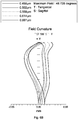
- FIG. 2B is a field curvature diagram of the wide-angle lens assembly in accordance with the first embodiment of the invention.
- FIG. 2C is a distortion diagram of the wide-angle lens assembly in accordance with the first embodiment of the invention.
- FIG. 2D is a schematic diagram of Sag 1 2 and D 1 2 of the first lens in accordance with a first embodiment of the invention
- FIG. 2E is a schematic diagram of Sag 1 4 and D 1 4 of the second lens in accordance with a first embodiment of the invention
- FIG. 3 is a lens layout diagram of a wide-angle lens assembly in accordance with a second embodiment of the invention.
- FIG. 4A depicts a longitudinal aberration diagram of the wide-angle lens assembly in accordance with the second embodiment of the invention.
- FIG. 4B is a field curvature diagram of the wide-angle lens assembly in accordance with the second embodiment of the invention.
- FIG. 4C is a distortion diagram of the wide-angle lens assembly in accordance with the second embodiment of the invention.
- FIG. 5 is a lens layout diagram of a wide-angle lens assembly in accordance with a third embodiment of the invention.
- FIG. 6A depicts a longitudinal aberration diagram of the wide-angle lens assembly in accordance with the third embodiment of the invention.
- FIG. 6B is a field curvature diagram of the wide-angle lens assembly in accordance with the third embodiment of the invention.
- FIG. 6C is a distortion diagram of the wide-angle lens assembly in accordance with the third embodiment of the invention.
- FIG. 1 is a lens layout diagram of a wide-angle lens assembly in accordance with a first embodiment of the invention.
- the wide-angle lens assembly 1 includes a first lens L 11 , a second lens L 12 , a third lens L 13 , a stop ST 1 , a fourth lens L 14 , a fifth lens L 15 , a sixth lens L 16 and an optical filter OF 1 , all of which are arranged in order from an object side to an image side along an optical axis OA 1 .
- an image of light rays from the object side is formed at the image plane IMA 1 .
- the first lens L 11 is a meniscus lens with negative refractive power and made of glass material, wherein the object side surface S 11 is a convex surface, the image side surface S 12 is a concave surface and both of the object side surface S 11 and image side surface S 12 are spherical surfaces.
- the second lens L 12 is a meniscus lens with negative refractive power and made of glass material, wherein the object side surface S 13 is a convex surface, the image side surface S 14 is a concave surface and both of the object side surface S 13 and image side surface S 14 are aspheric surfaces.
- the third lens L 13 is a meniscus lens with positive refractive power and made of glass material, wherein the object side surface S 15 is a convex surface, the image side surface S 16 is a concave surface and both of the object side surface S 15 and image side surface S 16 are spherical surfaces.
- the fourth lens L 14 is a meniscus lens with positive refractive power and made of glass material, wherein the object side surface S 18 is a concave surface, the image side surface S 19 is a convex surface and both of the object side surface S 18 and image side surface S 19 are spherical surfaces.
- the fifth lens L 15 is a meniscus lens with negative refractive power and made of glass material, wherein the object side surface S 19 is a concave surface, the image side surface S 110 is a convex surface and both of the object side surface S 19 and image side surface S 110 are spherical surfaces.
- the fourth lens L 14 and the fifth lens L 15 are cemented together.
- the sixth lens L 16 is a biconvex lens with positive refractive power and made of glass material, wherein the object side surface S 111 is a convex surface, the image side surface S 112 is a convex surface and both of the object side surface S 111 and image side surface S 112 are aspheric surfaces. Both of the object side surface S 113 and image side surface S 114 of the optical filter OF 1 are plane surfaces.
- the wide-angle lens assembly 1 of the first embodiment at least satisfies one of the following conditions: Sag 1 2 /D 1 2 ⁇ 0.24 (1) Sag 1 4 /D 1 4 ⁇ 0.29 (2) 0.2 ⁇ BFL 1/ TTL 1 ⁇ 0.5 (3) Vd 1 4 ⁇ Vd 1 5 ⁇ 50 (4) Nd 1 3 ⁇ Nd 1 ⁇ 0.35 (5) 20°/mm ⁇ DFOV 1 /f 1 ⁇ 30°/mm (6)
- Sag 1 2 is a distance vertically measuring from a plane formed by the edge of image side surface S 12 of the first lens L 11 to the vertex of the image side surface S 12 of the first lens L 11
- D 1 2 is an effective diameter of the image side surface S 12 of the first lens L 11
- Sag 1 4 is a distance vertically measuring from a plane formed by the edge of image side surface S 14 of the second lens L 12 to the vertex of the image side surface S 14 of the second lens L 12
- D 4 is an effective diameter of the image side surface S 14 of the second lens L 12
- the schematic diagram of Sag 1 4 and D 1 4 by referring to FIG.
- BFL 1 is an interval from the image side surface S 112 of the sixth lens L 16 to an image plane IMA 1 along the optical axis OA 1
- TTL 1 is an interval from an object side surface S 11 of the first lens L 11 to the image plane IMA 1 along the optical axis OA 1
- Vd 1 4 is an Abbe number of the fourth lens L 14
- Vd 1 5 is an Abbe number of the fifth lens L 15
- Nd 1 1 is a refractive index of the first lens L 11
- Nd 1 3 is a refractive index of the third lens L 13
- DFOV 1 is a diagonal field of view for the wide-angle lens assembly 1
- f 1 is an effective focal length of the wide-angle lens assembly 1 .
- the wide-angle lens assembly 1 is provided with a shortened total lens length, a decreased F-number, an effective corrected aberration and a resistance to severe environment temperature change on image quality.
- Vd 1 4 ⁇ Vd 1 5 of condition (4) is less than 50, and it will bring poor effect of the chromatic aberration correction. Therefore, the value of Vd 1 4 ⁇ Vd 1 5 needs to at least greater than 50, an optimal range is 79 ⁇ Vd 1 4 ⁇ Vd 1 5 ⁇ 50 for the optimal benefit of chromatic aberration correction.
- the wide-angle lens assembly 1 in accordance with the first embodiment of the invention is provided with the optical specifications shown in Table 1, which include the effective focal length, F-number, total lens length, diagonal field of view, radius of curvature of each lens surface, thickness between adjacent surface, refractive index of each lens and Abbe number of each lens.
- Table 1 shows that the effective focal length is equal to 3.697 mm, F-number is equal to 2.8, total lens length is equal to 23.860 mm and diagonal field of view is equal to 97.44° for the wide-angle lens assembly 1 of the first embodiment of the invention.
- the conic constant k and the aspheric coefficients A, B, C, D, E, F, G of each surface are shown in Table 2.
- Table 3 shows the parameter value and the calculated value of the above conditions (1)-(6).
- Table 3 shows the parameter value and the calculated value of the above conditions (1)-(6).
- FIGS. 2A-2C show a longitudinal aberration diagram of the wide-angle lens assembly 1 in accordance with the first embodiment of the invention
- FIG. 2B shows a field curvature diagram of the wide-angle lens assembly 1 in accordance with the first embodiment of the invention
- FIG. 2C shows a distortion diagram of the wide-angle lens assembly 1 in accordance with the first embodiment of the invention.
- the longitudinal aberration in the wide-angle lens assembly 1 of the first embodiment ranges from ⁇ 0.015 mm to 0.01 mm for the wavelength of 0.455 ⁇ m, 0.502 ⁇ m, 0.558 ⁇ m, 0.614 ⁇ m and 0.661 ⁇ m.
- the field curvature of tangential direction and sagittal direction in the wide-angle lens assembly 1 of the first embodiment ranges from ⁇ 0.04 mm to 0.04 mm for the wavelength of 0.455 ⁇ m, 0.502 ⁇ m, 0.558 ⁇ m, 0.614 ⁇ m and 0.661 ⁇ m. It can be seen from FIG.
- the distortion in the wide-angle lens assembly 1 of the first embodiment ranges from ⁇ 4.5% to 0.5% for the wavelength of 0.455 ⁇ m, 0.502 ⁇ m, 0.558 ⁇ m, 0.614 ⁇ m and 0.661 ⁇ m. It is obvious that the longitudinal aberration, the field curvature and the distortion of the wide-angle lens assembly 1 of the first embodiment can be corrected effectively. Therefore, the wide-angle lens assembly 1 of the first embodiment is capable of good optical performance.
- FIG. 3 is a lens layout diagram of a wide-angle lens assembly in accordance with a second embodiment of the invention.
- the wide-angle lens assembly 2 includes a first lens L 21 , a second lens L 22 , a third lens L 23 , a stop ST 2 , a fourth lens L 24 , a fifth lens L 25 , a sixth lens L 26 and an optical filter OF 2 , all of which are arranged in order from an object side to an image side along an optical axis OA 2 .
- an image of light rays from the object side is formed at the image plane IMA 2 .
- the first lens L 21 is a meniscus lens with negative refractive power and made of glass material, wherein the object side surface S 21 is a convex surface, the image side surface S 22 is a concave surface and both of the object side surface S 21 and image side surface S 22 are spherical surfaces.
- the second lens L 22 is a meniscus lens with negative refractive power and made of glass material, wherein the object side surface S 23 is a convex surface, the image side surface S 24 is a concave surface and both of the object side surface S 23 and image side surface S 24 are aspheric surfaces.
- the third lens L 23 is a meniscus lens with positive refractive power and made of glass material, wherein the object side surface S 25 is a convex surface, the image side surface S 26 is a concave surface and both of the object side surface S 25 and image side surface S 26 are spherical surfaces.
- the fourth lens L 24 is a biconvex lens with positive refractive power and made of glass material, wherein the object side surface S 28 is a convex surface, the image side surface S 29 is a convex surface and both of the object side surface S 28 and image side surface S 29 are spherical surfaces.
- the fifth lens L 25 is a meniscus lens with negative refractive power and made of glass material, wherein the object side surface S 29 is a concave surface, the image side surface S 210 is a convex surface and both of the object side surface S 29 and image side surface S 210 are spherical surfaces.
- the fourth lens L 24 and the fifth lens L 25 are cemented together.
- the sixth lens L 26 is a biconvex lens with positive refractive power and made of glass material, wherein the object side surface S 211 is a convex surface, the image side surface S 212 is a convex surface and both of the object side surface S 211 and image side surface S 212 are aspheric surfaces. Both of the object side surface S 213 and image side surface S 214 of the optical filter OF 2 are plane surfaces.
- the wide-angle lens assembly 2 of the second embodiment at least satisfies one of the following conditions: Sag 2 2 /D 2 2 ⁇ 0.24 (7) Sag 2 4 /D 2 4 ⁇ 0.29 (8) 0.2 ⁇ BFL 2/ TTL 2 ⁇ 0.5 (9) Vd 2 4 ⁇ Vd 2 5 ⁇ 50 (10) Nd 2 3 ⁇ Nd 2 1 ⁇ 0.35 (11) 20°/mm ⁇ DFOV 2/ f 2 ⁇ 30°/mm (12)
- Sag 2 2 , D 2 2 , Sag 2 4 , D 2 4 , BFL 2 , TTL 2 , Vd 2 4 , Vd 2 5 , Nd 2 1 , Nd 2 3 , DFOV 2 and f 2 are the same as that of Sag 1 2 , D 1 2 , Sag 1 4 , D 1 4 , BFL 1 , TTL 1 , Vd 1 4 , Vd 1 5 , Nd 1 1 , Nd 1 3 , DFOV 1 and f 1 in the first embodiment, and is not described here again.
- the wide-angle lens assembly 2 is provided with a shortened total lens length, a decreased F-number, an effective corrected aberration and a resistance to severe environment temperature change on image quality.
- Nd 2 3 ⁇ Nd 2 1 of condition (11) is less than 0.35, and it will become difficult to shorten the total lens length of wide-angle lens assembly 2 . Therefore, the value of Nd 2 3 ⁇ Nd 2 1 needs to at least greater than or equal to 0.35, an optimal range is 0.59 ⁇ Nd 2 3 ⁇ Nd 2 1 ⁇ 0.35 for the benefit of shortening the total lens length.
- the wide-angle lens assembly 2 in accordance with the second embodiment of the invention is provided with the optical specifications shown in Table 4, which include the effective focal length, F-number, total lens length, diagonal field of view, radius of curvature of each lens surface, thickness between adjacent surface, refractive index of each lens and Abbe number of each lens.
- Table 4 shows that the effective focal length is equal to 3.683 mm, F-number is equal to 2.8, total lens length is equal to 23.850 mm and diagonal field of view is equal to 97.63° for the wide-angle lens assembly 2 of the second embodiment of the invention.
- the conic constant k and the aspheric coefficients A, B, C, D, E, F, G of each surface are shown in Table 5.
- Table 6 shows the parameter value and the calculated value of the above conditions (7)-(12). For the wide-angle lens assembly 2 of the second embodiment which respectively satisfy the above conditions (7)-(12) as can be seen from table 6.
- FIGS. 4A-4C show a longitudinal aberration diagram of the wide-angle lens assembly 2 in accordance with the second embodiment of the invention
- FIG. 4B shows a field curvature diagram of the wide-angle lens assembly 2 in accordance with the second embodiment of the invention
- FIG. 4C shows a distortion diagram of the wide-angle lens assembly 2 in accordance with the second embodiment of the invention.
- the longitudinal aberration in the wide-angle lens assembly 2 of the second embodiment ranges from ⁇ 0.025 mm to 0.025 mm for the wavelength of 0.455 ⁇ m, 0.502 ⁇ m, 0.558 ⁇ m, 0.614 ⁇ m and 0.661 ⁇ m.
- the field curvature of tangential direction and sagittal direction in the wide-angle lens assembly 2 of the second embodiment ranges from ⁇ 0.035 mm to 0.05 mm for the wavelength of 0.455 ⁇ m, 0.502 ⁇ m, 0.558 ⁇ m, 0.614 ⁇ m and 0.661 ⁇ m. It can be seen from FIG.
- the distortion in the wide-angle lens assembly 2 of the second embodiment ranges from ⁇ 4.0% to 0% for the wavelength of 0.455 ⁇ m, 0.502 ⁇ m, 0.558 ⁇ m, 0.614 ⁇ m and 0.661 ⁇ m. It is obvious that the longitudinal aberration, the field curvature and the distortion of the wide-angle lens assembly 2 of the second embodiment can be corrected effectively. Therefore, the wide-angle lens assembly 2 of the second embodiment is capable of good optical performance.
- FIG. 5 is a lens layout diagram of a wide-angle lens assembly in accordance with a third embodiment of the invention.
- the wide-angle lens assembly 3 includes a first lens L 31 , a second lens L 32 , a third lens L 33 , a stop ST 3 , a fourth lens L 34 , a fifth lens L 35 , a sixth lens L 36 and an optical filter OF 3 , all of which are arranged in order from an object side to an image side along an optical axis OA 3 .
- an image of light rays from the object side is formed at the image plane IMA 3 .
- the first lens L 31 is a meniscus lens with negative refractive power and made of glass material, wherein the object side surface S 31 is a convex surface, the image side surface S 32 is a concave surface and both of the object side surface S 31 and image side surface S 32 are spherical surfaces.
- the second lens L 32 is a meniscus lens with negative refractive power and made of glass material, wherein the object side surface S 33 is a convex surface, the image side surface S 34 is a concave surface and both of the object side surface S 33 and image side surface S 34 are aspheric surfaces.
- the third lens L 33 is a biconvex lens with positive refractive power and made of glass material, wherein the object side surface S 35 is a convex surface, the image side surface S 36 is a convex surface and both of the object side surface S 35 and image side surface S 36 are spherical surfaces.
- the fourth lens L 34 is a meniscus lens with positive refractive power and made of glass material, wherein the object side surface S 38 is a concave surface, the image side surface S 39 is a convex surface and both of the object side surface S 38 and image side surface S 39 are spherical surfaces.
- the fifth lens L 35 is a meniscus lens with negative refractive power and made of glass material, wherein the object side surface S 39 is a concave surface, the image side surface S 310 is a convex surface and both of the object side surface S 39 and image side surface S 310 are spherical surfaces.
- the fourth lens L 34 and the fifth lens L 35 are cemented together.
- the sixth lens L 36 is a biconvex lens with positive refractive power and made of glass material, wherein the object side surface S 311 is a convex surface, the image side surface S 312 is a convex surface and both of the object side surface S 311 and image side surface S 312 are aspheric surfaces. Both of the object side surface S 313 and image side surface S 314 of the optical filter OF 3 are plane surfaces.
- the wide-angle lens assembly 3 of the third embodiment at least satisfies one of the following conditions: Sag 3 2 /D 3 2 ⁇ 0.24 (13) Sag 3 4 /D 3 4 ⁇ 0.29 (14) 0.2 ⁇ BFL 3/ TTL 3 ⁇ 0.5 (15) Vd 3 4 ⁇ Vd 3 5 ⁇ 50 (16) Nd 3 3 ⁇ Nd 3 1 ⁇ 0.35 (17) 20°/mm ⁇ DFOV 3 /f 3 ⁇ 30°/mm (18)
- Sag 3 2 , D 3 2 , Sag 3 4 , D 3 4 , BFL 3 , TTL 3 , Vd 3 4 , Vd 3 5 , Nd 3 1 , Nd 3 3 , DFOV 3 and f 3 are the same as that of Sag 1 2 , D 1 2 , Sag 1 4 , D 1 4 , BFL 1 , TTL 1 , Vd 1 4 , Vd 1 5 , Nd 1 1 , Nd 1 3 , DFOV 1 and f 3 in the first embodiment, and is not described here again.
- the wide-angle lens assembly 3 is provided with a shortened total lens length, a decreased F-number, an effective corrected aberration and a resistance to severe environment temperature change on image quality.
- the value of Sag 3 2 /D 3 2 of condition (13) is less than 0.24, and it will bring poor effect of the elimination of spherical aberration. Therefore, the value of Sag 3 2 /D 3 2 needs to at least greater than or equal to 0.24, an optimal range is 0.5 ⁇ Sag 3 2 /D 3 2 ⁇ 0.24 for the optimal benefit of elimination of spherical aberration.
- the value of Sag 3 4 /D 3 4 of condition (14) is less than 0.29, and it will bring poor effect of the elimination of coma aberration. Therefore, the value of Sag 3 4 /D 3 4 needs to at least greater than or equal to 0.29, but if the value of Sag 3 4 /D 3 4 greater than 1 then it will become difficult on production of lens, hence, an optimal range is 1 ⁇ Sag 3 4 /D 3 4 ⁇ 0.29 for the optimal benefit of elimination of coma aberration.
- the wide-angle lens assembly 3 in accordance with the third embodiment of the invention is provided with the optical specifications shown in Table 7, which include the effective focal length, F-number, total lens length, diagonal field of view, radius of curvature of each lens surface, thickness between adjacent surface, refractive index of each lens and Abbe number of each lens.
- Table 7 shows that the effective focal length is equal to 3.685 mm, F-number is equal to 2.8, total lens length is equal to 23.906 mm and diagonal field of view is equal to 97.46° for the wide-angle lens assembly 3 of the third embodiment of the invention.
- the conic constant k and the aspheric coefficients A, B, C, D, E, F, G of each surface are shown in Table 8.
- Table 9 shows the parameter value and the calculated value of the above conditions (13)-(18). For the wide-angle lens assembly 3 of the third embodiment which respectively satisfy the above conditions (13)-(18) as can be seen from table 9.
- FIGS. 6A-6C show a longitudinal aberration diagram of the wide-angle lens assembly 3 in accordance with the third embodiment of the invention
- FIG. 6B shows a field curvature diagram of the wide-angle lens assembly 3 in accordance with the third embodiment of the invention
- FIG. 6C shows a distortion diagram of the wide-angle lens assembly 3 in accordance with the third embodiment of the invention.
- the longitudinal aberration in the wide-angle lens assembly 3 of the third embodiment ranges from ⁇ 0.01 mm to 0.015 mm for the wavelength of 0.455 ⁇ m, 0.502 ⁇ m, 0.558 ⁇ m, 0.614 ⁇ m and 0.661 ⁇ m.
- the field curvature of tangential direction and sagittal direction in the wide-angle lens assembly 3 of the third embodiment ranges from ⁇ 0.03 mm to 0.03 mm for the wavelength of 0.455 ⁇ m, 0.502 ⁇ m, 0.558 ⁇ m, 0.614 ⁇ m and 0.661 ⁇ m. It can be seen from FIG.
- the distortion in the wide-angle lens assembly 3 of the third embodiment ranges from ⁇ 4% to 0% for the wavelength of 0.455 ⁇ m, 0.502 ⁇ m, 0.558 ⁇ m, 0.614 ⁇ m and 0.661 ⁇ m. It is obvious that the longitudinal aberration, the field curvature and the distortion of the wide-angle lens assembly 3 of the third embodiment can be corrected effectively. Therefore, the wide-angle lens assembly 3 of the third embodiment is capable of good optical performance.
Landscapes
- Physics & Mathematics (AREA)
- General Physics & Mathematics (AREA)
- Optics & Photonics (AREA)
- Lenses (AREA)
Abstract
Description
Sag12 /D12≥0.24 (1)
Sag14 /D14≥0.29 (2)
0.2≤BFL1/TTL1≤0.5 (3)
Vd14 −Vd15≥50 (4)
Nd13 −Nd 1≥0.35 (5)
20°/mm<DFOV1/f1<30°/mm (6)
| TABLE 1 |
| Effective Focal Length = 3.697 mm F-number = 2.8 |
| Total Lens Length = 23.860 mm Diagonal Field of View = 97.44° |
| Radius of | |||||
| Surface | Curvature | Thickness | |||
| Number | (mm) | (mm) | Nd | Vd | Remark |
| S11 | 16.855 | 0.797 | 1.52 | 64.2 | The First Lens L11 |
| S12 | 5.498 | 0.866 | |||
| S13 | 6.788 | 1.151 | 1.74 | 49.3 | The Second Lens L12 |
| S14 | 2.598 | 2.974 | |||
| S15 | 6.261 | 3.183 | 1.9 | 31.3 | The Third Lens L13 |
| S16 | 62.604 | 1.786 | |||
| S17 | ∞ | 0.347 | Stop ST1 | ||
| S18 | −42.068 | 2.450 | 1.5 | 81.6 | The Fourth Lens L14 |
| S19 | −2.794 | 0.398 | 1.81 | 25.5 | The Fifth Lens L15 |
| S110 | −11.055 | 0.263 | |||
| S111 | 12.846 | 2.590 | 1.68 | 54.9 | The Sixth Lens L16 |
| S112 | −4.585 | 4.195 | |||
| S113 | ∞ | 0.720 | 1.52 | 64.2 | Optical Filter OF1 |
| S114 | ∞ | 2.130 | |||
z=ch 2/{1+[1−(k+1)c 2 h 2]1/2 }+Ah 4 +Bh 6 +Ch 8 +Dh 10 +Eh 12 +Fh 14 +Gh 16
where c is curvature, h is the vertical distance from the lens surface to the optical axis, k is conic constant and A, B, C, D, E, F and G are aspheric coefficients.
| TABLE 2 | ||||||||
| Surface | ||||||||
| Number | k | A | B | C | D | E | F | G |
| S13 | −0.456 | 2.52E−03 | −2.78E−04 | 2.05E−05 | −1.24E−06 | 4.97E−08 | −1.06E−09 | 8.20E−12 |
| S14 | −0.572 | 3.67E−03 | −7.83E−04 | 1.18E−04 | −2.21E−05 | 2.29E−06 | −1.21E−07 | 2.38E−09 |
| S111 | 0.251 | −1.22E−03 | 9.56E−05 | 2.44E−05 | −1.01E−05 | 1.45E−06 | −9.40E−08 | 2.29E−09 |
| S112 | −0.708 | 7.24E−04 | 1.03E−04 | −3.55E−05 | 8.47E−06 | −1.09E−06 | 7.10E−08 | −1.80E−09 |
| TABLE 3 | |||||
| Sag12 | 2.666 mm | D12 | 9.441 mm | Sag14 | 2.607 mm |
| D14 | 6.556 mm | BFL1 | 7.045 mm | TTL1 | 23.860 mm |
| Vd14 | 81.6 | Vd15 | 25.5 | Nd11 | 1.52 |
| Nd13 | 1.9 | DFOV1 | 97.44° | f1 | 3.697 mm |
| Sag12/ | 0.282 | Sag14/D14 | 0.398 | BFL1/ | 0.295 |
| D12 | TTL1 | ||||
| Vd14 − | 56.1 | Nd13 − Nd11 | 0.38 | DFOV1/f1 | 26.357°/mm |
| Vd15 | |||||
Sag22 /D22≥0.24 (7)
Sag24 /D24≥0.29 (8)
0.2≤BFL2/TTL2≤0.5 (9)
Vd24 −Vd25≥50 (10)
Nd23 −Nd21≥0.35 (11)
20°/mm<DFOV2/f2<30°/mm (12)
| TABLE 4 |
| Effective Focal Length = 3.683 mm F-number = 2.8 |
| Total Lens Length = 23.850 mm Diagonal Field of View = 97.63° |
| Radius of | |||||
| Surface | Curvature | Thickness | |||
| Number | (mm) | (mm) | Nd | Vd | Remark |
| S21 | 13.577 | 0.862 | 1.52 | 64.2 | The First Lens L21 |
| S22 | 5.498 | 1.102 | |||
| S23 | 7.177 | 1.122 | 1.74 | 49.3 | The Second Lens L22 |
| S24 | 2.545 | 3.170 | |||
| S25 | 6.003 | 2.414 | 1.9 | 31.3 | The Third Lens L23 |
| S26 | 31.931 | 2.000 | |||
| S27 | ∞ | 0.347 | Stop ST2 | ||
| S28 | 24.006 | 2.992 | 1.5 | 81.6 | The Fourth Lens L24 |
| S29 | −2.936 | 0.531 | 1.81 | 25.5 | The Fifth Lens L25 |
| S210 | −10.412 | 0.099 | |||
| S211 | 17.398 | 2.566 | 1.68 | 54.9 | The Sixth Lens L26 |
| S212 | −5.060 | 2.840 | |||
| S213 | ∞ | 0.720 | 1.52 | 64.2 | Optical Filter OF2 |
| S214 | ∞ | 3.095 | |||
z=ch 2/{1+[1−(k+1)c 2 h 2]1/2 }+Ah 4 +Bh 6 +Ch 8 +Dh 10 +Eh 12 +Fh 14 +Gh 16
where c is curvature, h is the vertical distance from the lens surface to the optical axis, k is conic constant and A, B, C, D, E, F and G are aspheric coefficients.
| TABLE 5 | ||||||||
| Surface | ||||||||
| Number | k | A | B | C | D | E | F | G |
| S23 | −0.990 | 2.51E−03 | −2.64E−04 | 2.11E−05 | −1.31E−06 | 5.53E−08 | −1.28E−09 | 1.14E−11 |
| S24 | −0.595 | 4.13E−03 | −8.03E−04 | 1.37E−04 | −2.44E−05 | 2.45E−06 | −1.21E−07 | 2.01E−09 |
| S211 | −5.459 | −1.08E−03 | 1.07E−04 | 1.97E−05 | −1.00E−05 | 1.49E−06 | −9.14E−08 | 1.72E−09 |
| S212 | −0.646 | 3.46E−04 | 1.84E−04 | −5.44E−05 | 1.07E−05 | −1.28E−06 | 8.33E−08 | −2.23E−09 |
| TABLE 6 | |||||
| Sag22 | 2.563 mm | D22 | 9.310 mm | Sag24 | 2.604 mm |
| D24 | 6.785 mm | BFL2 | 6.655 mm | TTL2 | 23.850 mm |
| Vd24 | 81.6 | Vd25 | 25.5 | Nd21 | 1.52 |
| Nd23 | 1.9 | DFOV2 | 97.63° | f2 | 3.683 mm |
| Sag22/ | 0.275 | Sag24/D24 | 0.384 | BFL2/ | 0.279 |
| D22 | TTL2 | ||||
| Vd24 − | 56.1 | Nd23 − Nd21 | 0.38 | DFOV2/f2 | 26.508°/mm |
| Vd25 | |||||
Sag32 /D32≥0.24 (13)
Sag34 /D34≥0.29 (14)
0.2≤BFL3/TTL3≤0.5 (15)
Vd34 −Vd35≥50 (16)
Nd33 −Nd31≥0.35 (17)
20°/mm<DFOV3/f3<30°/mm (18)
| TABLE 7 |
| Effective Focal Length = 3.685 mm F-number = 2.8 |
| Total Lens Length = 23.906 mm Diagonal Field of View = 97.46° |
| Radius of | |||||
| Surface | Curvature | Thickness | |||
| Number | (mm) | (mm) | Nd | Vd | Remark |
| S31 | 17.275 | 0.834 | 1.52 | 64.2 | The First Lens L31 |
| S32 | 5.499 | 1.327 | |||
| S33 | 9.820 | 1.231 | 1.74 | 49.3 | The Second Lens L32 |
| S34 | 2.993 | 2.568 | |||
| S35 | 8.017 | 2.501 | 1.9 | 31.3 | The Third Lens L33 |
| S36 | −29.229 | 1.767 | |||
| S37 | ∞ | 0.292 | Stop ST2 | ||
| S38 | −35.602 | 2.908 | 1.5 | 81.6 | The Fourth Lens L34 |
| S39 | −2.796 | 0.413 | 1.81 | 25.5 | The Fifth Lens L35 |
| S310 | −10.482 | 0.198 | |||
| S311 | 31.342 | 2.544 | 1.68 | 54.9 | The Sixth Lens L36 |
| S312 | −4.153 | 4.351 | |||
| S313 | ∞ | 0.720 | 1.52 | 64.2 | Optical Filter OF3 |
| S314 | ∞ | 2.253 | |||
z=ch 2/{1+[1−(k+1)c 2 h 2]1/2 }+Ah 4 +Bh 6 +Ch 8 +Dh 10 +Eh 12 +Fh 14 +Gh 16
where c is curvature, h is the vertical distance from the lens surface to the optical axis, k is conic constant and A, B, C, D, E, F and G are aspheric coefficients.
| TABLE 8 | ||||||||
| Surface | ||||||||
| Number | k | A | B | C | D | E | F | G |
| S33 | −1.019 | 2.47E−03 | −2.72E−04 | 2.01E−05 | −1.23E−06 | 5.08E−08 | −1.11E−09 | 8.62E−12 |
| S34 | −0.564 | 3.42E−03 | −7.24E−04 | 1.13E−04 | −2.16E−05 | 2.40E−06 | −1.37E−07 | 3.11E−09 |
| S311 | −23.706 | −1.02E−03 | 7.91E−05 | 3.17E−05 | −1.02E−05 | 1.43E−06 | −9.22E−08 | 2.24E−09 |
| S312 | −0.683 | 5.33E−04 | 9.89E−05 | −3.49E−05 | 8.71E−06 | −1.11E−06 | 7.22E−08 | −1.82E−09 |
| TABLE 9 | |||||
| Sag32 | 2.197 mm | D32 | 8.808 mm | Sag34 | 1.916 mm |
| D34 | 6.402 mm | BFL3 | 7.324 mm | TTL3 | 23.906 mm |
| Vd34 | 81.6 | Vd35 | 25.5 | Nd31 | 1.52 |
| Nd33 | 1.9 | DFOV3 | 97.46° | f3 | 3.685 mm |
| Sag32/ | 0.249 | Sag34/D34 | 0.299 | BFL3/ | 0.306 |
| D32 | TTL3 | ||||
| Vd34 − | 56.1 | Nd33 − Nd31 | 0.38 | DFOV3/f3 | 26.448°/mm |
| Vd35 | |||||
Claims (20)
Vd 4 −Vd 5≥50
Nd 3 −Nd 1≥0.35
79≥Vd 4 −Vd 5≥50,
0.59≥Nd 3 −Nd 1≥0.35
Sag 2 /D 2≥0.24,
Sag 4 /D 4≥0.29
0.5≥Sag 2 /D 2≥0.24,
1≥Sag 4 /D 4≥0.29
0.2≤BFL/TTL≤0.5
20°/mm<DFOV/f<30°/mm
Sag 4 /D 4≥0.29
0.5≥Sag 2 /D 2≥0.24,
1≥Sag 4 /D 4≥0.29
79≥Vd 4 −Vd 5≥50,
0.59≥Nd 3 −Nd 1≥0.35
0.2≤BFL/TTL≤0.5
20°/mm<DFOV/f<30°/mm
0.279≤BFL/TTL≤0.5
Sag 2 /D 2≥0.24,
Sag 4 /D 4≥0.29
Vd 4 −Vd 5≥50,
Nd 3 −Nd 1≥0.35
20°/mm<DFOV/f<30°/mm
Applications Claiming Priority (3)
| Application Number | Priority Date | Filing Date | Title |
|---|---|---|---|
| TW106115951A TWI699552B (en) | 2017-05-15 | 2017-05-15 | Wide-angle lens assembly |
| TW106115951A | 2017-05-15 | ||
| TW106115951 | 2017-05-15 |
Publications (2)
| Publication Number | Publication Date |
|---|---|
| US20180329183A1 US20180329183A1 (en) | 2018-11-15 |
| US10598908B2 true US10598908B2 (en) | 2020-03-24 |
Family
ID=64096650
Family Applications (1)
| Application Number | Title | Priority Date | Filing Date |
|---|---|---|---|
| US15/848,095 Active 2038-04-27 US10598908B2 (en) | 2017-05-15 | 2017-12-20 | Wide-angle lens assembly |
Country Status (3)
| Country | Link |
|---|---|
| US (1) | US10598908B2 (en) |
| CN (1) | CN108873248B (en) |
| TW (1) | TWI699552B (en) |
Families Citing this family (2)
| Publication number | Priority date | Publication date | Assignee | Title |
|---|---|---|---|---|
| CN110727088B (en) * | 2019-10-17 | 2021-12-28 | 福建福光股份有限公司 | Wide-angle high-low temperature-resistant fixed-focus lens and working method thereof |
| WO2022032573A1 (en) * | 2020-08-13 | 2022-02-17 | 欧菲光集团股份有限公司 | Optical system, camera module, electronic device and automobile |
Citations (1)
| Publication number | Priority date | Publication date | Assignee | Title |
|---|---|---|---|---|
| US20100142062A1 (en) * | 2008-12-10 | 2010-06-10 | Taro Asami | Imaging lens and imaging apparatus using imaging lens |
Family Cites Families (11)
| Publication number | Priority date | Publication date | Assignee | Title |
|---|---|---|---|---|
| JP2006349920A (en) * | 2005-06-15 | 2006-12-28 | Ricoh Co Ltd | Imaging optical system, imaging lens unit, camera, and portable information terminal device |
| JP2008058387A (en) * | 2006-08-29 | 2008-03-13 | Nidec Copal Corp | Superwide-angle lens |
| KR100961124B1 (en) * | 2008-04-04 | 2010-06-07 | 삼성전기주식회사 | Ultra wide angle optical system |
| US7957074B2 (en) * | 2008-05-27 | 2011-06-07 | Fujinon Corporation | Imaging lens system and imaging apparatus using the imaging lens system |
| KR101136939B1 (en) * | 2010-07-15 | 2012-04-20 | 엘지이노텍 주식회사 | Super wide angle optic lens system |
| JP5629250B2 (en) * | 2011-09-29 | 2014-11-19 | 富士フイルム株式会社 | Imaging lens and imaging apparatus |
| CN203606551U (en) * | 2013-10-30 | 2014-05-21 | 宁波舜宇车载光学技术有限公司 | High-resolution optical lens |
| CN106468824B (en) * | 2015-08-21 | 2019-02-12 | 信泰光学(深圳)有限公司 | Wide-angle optical lens |
| CN205080307U (en) * | 2015-11-04 | 2016-03-09 | 威海嘉瑞光电科技有限公司 | Intelligence wide angle high definition camera lens for house |
| TWI664441B (en) * | 2015-12-22 | 2019-07-01 | 揚明光學股份有限公司 | Wide-angle lens |
| TWM537661U (en) * | 2016-11-03 | 2017-03-01 | Kinko Optical Co Limited | Wide-angle lens |
-
2017
- 2017-05-15 TW TW106115951A patent/TWI699552B/en active
- 2017-12-20 US US15/848,095 patent/US10598908B2/en active Active
-
2018
- 2018-02-27 CN CN201810160629.0A patent/CN108873248B/en active Active
Patent Citations (1)
| Publication number | Priority date | Publication date | Assignee | Title |
|---|---|---|---|---|
| US20100142062A1 (en) * | 2008-12-10 | 2010-06-10 | Taro Asami | Imaging lens and imaging apparatus using imaging lens |
Also Published As
| Publication number | Publication date |
|---|---|
| CN108873248A (en) | 2018-11-23 |
| US20180329183A1 (en) | 2018-11-15 |
| CN108873248B (en) | 2021-02-02 |
| TWI699552B (en) | 2020-07-21 |
| TW201901230A (en) | 2019-01-01 |
Similar Documents
| Publication | Publication Date | Title |
|---|---|---|
| US10310225B2 (en) | Wide-angle lens | |
| US10234654B2 (en) | Lens assembly | |
| US9733450B2 (en) | Lens assembly | |
| US9523840B2 (en) | Lens assembly | |
| US10310215B2 (en) | Lens assembly | |
| US9939612B2 (en) | Wide-angle lens | |
| US10859795B2 (en) | Lens assembly | |
| US9612420B2 (en) | Lens assembly | |
| US9989732B1 (en) | Lens assembly | |
| US10156698B2 (en) | Wide-angle lens assembly | |
| US20170343772A1 (en) | Projection Lens Assembly | |
| US10551597B2 (en) | Telephoto lens assembly | |
| US10261291B2 (en) | Lens assembly | |
| US9268117B2 (en) | Image capture device and converter lens assembly thereof | |
| US10866388B2 (en) | Lens assembly | |
| US10942337B2 (en) | Lens assembly | |
| US20200124827A1 (en) | Lens Assembly | |
| US10948698B2 (en) | Lens assembly | |
| US11604334B2 (en) | Lens assembly | |
| US20180329183A1 (en) | Wide-Angle Lens Assembly | |
| US10705315B2 (en) | Slim lens assembly | |
| US20250147281A1 (en) | Lens Assembly | |
| US20250362481A1 (en) | Wide-angle lens assembly | |
| US20240310610A1 (en) | Wide-angle lens assembly | |
| TWI595260B (en) | Lens assembly |
Legal Events
| Date | Code | Title | Description |
|---|---|---|---|
| AS | Assignment |
Owner name: ASIA OPTICAL CO., INC., TAIWAN Free format text: ASSIGNMENT OF ASSIGNORS INTEREST;ASSIGNOR:CHIU, WEI-TING;REEL/FRAME:044444/0637 Effective date: 20170821 Owner name: SINTAI OPTICAL (SHENZHEN) CO., LTD., CHINA Free format text: ASSIGNMENT OF ASSIGNORS INTEREST;ASSIGNOR:CHIU, WEI-TING;REEL/FRAME:044444/0637 Effective date: 20170821 |
|
| FEPP | Fee payment procedure |
Free format text: ENTITY STATUS SET TO UNDISCOUNTED (ORIGINAL EVENT CODE: BIG.); ENTITY STATUS OF PATENT OWNER: LARGE ENTITY |
|
| STPP | Information on status: patent application and granting procedure in general |
Free format text: DOCKETED NEW CASE - READY FOR EXAMINATION |
|
| STPP | Information on status: patent application and granting procedure in general |
Free format text: NON FINAL ACTION MAILED |
|
| STPP | Information on status: patent application and granting procedure in general |
Free format text: RESPONSE TO NON-FINAL OFFICE ACTION ENTERED AND FORWARDED TO EXAMINER |
|
| STPP | Information on status: patent application and granting procedure in general |
Free format text: NOTICE OF ALLOWANCE MAILED -- APPLICATION RECEIVED IN OFFICE OF PUBLICATIONS |
|
| STPP | Information on status: patent application and granting procedure in general |
Free format text: PUBLICATIONS -- ISSUE FEE PAYMENT VERIFIED |
|
| STCF | Information on status: patent grant |
Free format text: PATENTED CASE |
|
| MAFP | Maintenance fee payment |
Free format text: PAYMENT OF MAINTENANCE FEE, 4TH YEAR, LARGE ENTITY (ORIGINAL EVENT CODE: M1551); ENTITY STATUS OF PATENT OWNER: LARGE ENTITY Year of fee payment: 4 |