US10597378B2 - Tetrahydroisoquinolines for use as MOR/NOP dual agonists - Google Patents
Tetrahydroisoquinolines for use as MOR/NOP dual agonists Download PDFInfo
- Publication number
- US10597378B2 US10597378B2 US15/699,123 US201715699123A US10597378B2 US 10597378 B2 US10597378 B2 US 10597378B2 US 201715699123 A US201715699123 A US 201715699123A US 10597378 B2 US10597378 B2 US 10597378B2
- Authority
- US
- United States
- Prior art keywords
- compound
- tetrahydro
- mmol
- methyl
- morphine
- Prior art date
- Legal status (The legal status is an assumption and is not a legal conclusion. Google has not performed a legal analysis and makes no representation as to the accuracy of the status listed.)
- Active
Links
- 0 *N1CCC2=C(C([4*])=C([3*])C([2*])=C2[1*])C1C*[6*] Chemical compound *N1CCC2=C(C([4*])=C([3*])C([2*])=C2[1*])C1C*[6*] 0.000 description 11
- RTKJTEFNDKGUGL-UHFFFAOYSA-N CC1=CC=C(C(=O)NCC2NCCC3=CC=CC=C32)C=C1 Chemical compound CC1=CC=C(C(=O)NCC2NCCC3=CC=CC=C32)C=C1 RTKJTEFNDKGUGL-UHFFFAOYSA-N 0.000 description 6
- HEBXDRCQODBJLQ-UHFFFAOYSA-N CC1CCC(C(=O)NCC2NCCC3=CC=CC=C32)CC1 Chemical compound CC1CCC(C(=O)NCC2NCCC3=CC=CC=C32)CC1 HEBXDRCQODBJLQ-UHFFFAOYSA-N 0.000 description 4
- AZPNFSQLWYZXGK-UHFFFAOYSA-N CC1=CC=C(C(=O)NCC2C3=CC=CC=C3CCN2C)C=C1C Chemical compound CC1=CC=C(C(=O)NCC2C3=CC=CC=C3CCN2C)C=C1C AZPNFSQLWYZXGK-UHFFFAOYSA-N 0.000 description 3
- LIYLICKKTYEDQP-UHFFFAOYSA-N CN1CCC2=CC=CC=C2C1CNC(=O)C1=CC=C(Cl)C(Cl)=C1 Chemical compound CN1CCC2=CC=CC=C2C1CNC(=O)C1=CC=C(Cl)C(Cl)=C1 LIYLICKKTYEDQP-UHFFFAOYSA-N 0.000 description 3
- AAKKIGLXYOMAHQ-UHFFFAOYSA-N COC1=CC=CC=C1C(=O)NCC1NCCC2=CC=CC=C21 Chemical compound COC1=CC=CC=C1C(=O)NCC1NCCC2=CC=CC=C21 AAKKIGLXYOMAHQ-UHFFFAOYSA-N 0.000 description 3
- OBJZERGRBKZHAM-UHFFFAOYSA-N O=C(NCC1C2=CC=CC=C2CCN1S(=O)(=O)C1=C(C(F)(F)F)C=C(Br)C=C1)C1CCCCC1 Chemical compound O=C(NCC1C2=CC=CC=C2CCN1S(=O)(=O)C1=C(C(F)(F)F)C=C(Br)C=C1)C1CCCCC1 OBJZERGRBKZHAM-UHFFFAOYSA-N 0.000 description 3
- OCQFLLVVAKZNKU-UHFFFAOYSA-N O=C(NCC1C2=CC=CC=C2CCN1S(=O)(=O)C1=C(Cl)C=C(Br)C=C1)C1CCCCC1 Chemical compound O=C(NCC1C2=CC=CC=C2CCN1S(=O)(=O)C1=C(Cl)C=C(Br)C=C1)C1CCCCC1 OCQFLLVVAKZNKU-UHFFFAOYSA-N 0.000 description 3
- MDZUDHLPMJBCRO-UHFFFAOYSA-N O=C(NCC1NCCC2=CC=CC=C21)C1CCC1 Chemical compound O=C(NCC1NCCC2=CC=CC=C21)C1CCC1 MDZUDHLPMJBCRO-UHFFFAOYSA-N 0.000 description 3
- LZDVVBJZQAJHIX-UHFFFAOYSA-N CC(C)(C)C(=O)NCC1C2=CC=CC=C2CCN1S(=O)(=O)C1=CC=C(Br)C=C1OC(F)(F)F Chemical compound CC(C)(C)C(=O)NCC1C2=CC=CC=C2CCN1S(=O)(=O)C1=CC=C(Br)C=C1OC(F)(F)F LZDVVBJZQAJHIX-UHFFFAOYSA-N 0.000 description 2
- YEBLNTHPQPPDHL-UHFFFAOYSA-N CC1=C(S(=O)(=O)N2CCC3=CC=CC=C3C2CNC(=O)C2CCCCC2)C=CC(Br)=C1 Chemical compound CC1=C(S(=O)(=O)N2CCC3=CC=CC=C3C2CNC(=O)C2CCCCC2)C=CC(Br)=C1 YEBLNTHPQPPDHL-UHFFFAOYSA-N 0.000 description 2
- NAWRYTRXENDAPZ-UHFFFAOYSA-N CC1=C(S(=O)(=O)N2CCC3=CC=CC=C3C2CNC(=O)C2CCCCC2)C=CC(F)=C1 Chemical compound CC1=C(S(=O)(=O)N2CCC3=CC=CC=C3C2CNC(=O)C2CCCCC2)C=CC(F)=C1 NAWRYTRXENDAPZ-UHFFFAOYSA-N 0.000 description 2
- JQGHVAPVVBRXMT-UHFFFAOYSA-N CC1=CC(C(=O)NCC2NCCC3=CC=CC=C32)=CC=C1 Chemical compound CC1=CC(C(=O)NCC2NCCC3=CC=CC=C32)=CC=C1 JQGHVAPVVBRXMT-UHFFFAOYSA-N 0.000 description 2
- WZWSGIKJEHXDIO-UHFFFAOYSA-N CC1=CC=C(C(=O)NCC2C3=CC=CC=C3CCN2C)C=C1 Chemical compound CC1=CC=C(C(=O)NCC2C3=CC=CC=C3CCN2C)C=C1 WZWSGIKJEHXDIO-UHFFFAOYSA-N 0.000 description 2
- RMVRRMAGWIHRBV-UHFFFAOYSA-N CC1=CC=C(C(=O)NCC2C3=CC=CC=C3CCN2CC(C)C)C=C1 Chemical compound CC1=CC=C(C(=O)NCC2C3=CC=CC=C3CCN2CC(C)C)C=C1 RMVRRMAGWIHRBV-UHFFFAOYSA-N 0.000 description 2
- MYZICIOFVNMBGU-UHFFFAOYSA-N CC1=CC=C(C(=O)NCC2C3=CC=CC=C3CCN2CCCl)C=C1 Chemical compound CC1=CC=C(C(=O)NCC2C3=CC=CC=C3CCN2CCCl)C=C1 MYZICIOFVNMBGU-UHFFFAOYSA-N 0.000 description 2
- KBTOFMSZECVTGS-UHFFFAOYSA-N CC1=CC=C(C(=O)NCC2NCCC3=CC=CC=C32)C(C)=C1 Chemical compound CC1=CC=C(C(=O)NCC2NCCC3=CC=CC=C32)C(C)=C1 KBTOFMSZECVTGS-UHFFFAOYSA-N 0.000 description 2
- VWJLMWIMGWFRII-UHFFFAOYSA-N CC1=CC=C(C(=O)NCC2NCCC3=CC=CC=C32)C=C1C Chemical compound CC1=CC=C(C(=O)NCC2NCCC3=CC=CC=C32)C=C1C VWJLMWIMGWFRII-UHFFFAOYSA-N 0.000 description 2
- RUXNLQGVUGKSFB-UHFFFAOYSA-N CC1=CC=C(S(=O)(=O)N2CCC3=CC=CC=C3C2CNC(=O)C2CCCCC2)C=C1 Chemical compound CC1=CC=C(S(=O)(=O)N2CCC3=CC=CC=C3C2CNC(=O)C2CCCCC2)C=C1 RUXNLQGVUGKSFB-UHFFFAOYSA-N 0.000 description 2
- ZRIVGZRRAXJYPQ-UHFFFAOYSA-N CC1CCC(C(=O)NCC2C3=CC=CC=C3CCN2S(=O)(=O)C2=CC=C(Br)C=C2OC(F)(F)F)CC1 Chemical compound CC1CCC(C(=O)NCC2C3=CC=CC=C3CCN2S(=O)(=O)C2=CC=C(Br)C=C2OC(F)(F)F)CC1 ZRIVGZRRAXJYPQ-UHFFFAOYSA-N 0.000 description 2
- NBBTXHLMGYJUJQ-UHFFFAOYSA-N CC1CCCCC1C(=O)NCC1NCCC2=CC=CC=C21 Chemical compound CC1CCCCC1C(=O)NCC1NCCC2=CC=CC=C21 NBBTXHLMGYJUJQ-UHFFFAOYSA-N 0.000 description 2
- RGAQWGCPPCLXIL-UHFFFAOYSA-N CCC1=CC=C(C(=O)NCC2C3=CC=CC=C3CCN2C)C=C1 Chemical compound CCC1=CC=C(C(=O)NCC2C3=CC=CC=C3CCN2C)C=C1 RGAQWGCPPCLXIL-UHFFFAOYSA-N 0.000 description 2
- NWMKHRAVUSQKEV-UHFFFAOYSA-N CCC1=CC=C(C(=O)NCC2NCCC3=CC=CC=C32)C=C1 Chemical compound CCC1=CC=C(C(=O)NCC2NCCC3=CC=CC=C32)C=C1 NWMKHRAVUSQKEV-UHFFFAOYSA-N 0.000 description 2
- BJZGAJFESXOZQX-UHFFFAOYSA-N CCC1CCC(C(=O)NCC2NCCC3=CC=CC=C32)CC1 Chemical compound CCC1CCC(C(=O)NCC2NCCC3=CC=CC=C32)CC1 BJZGAJFESXOZQX-UHFFFAOYSA-N 0.000 description 2
- QWHOGERPITUZKI-UHFFFAOYSA-N CCCCN1CCC2=CC=CC=C2C1CNC(=O)C1=CC=C(C)C=C1 Chemical compound CCCCN1CCC2=CC=CC=C2C1CNC(=O)C1=CC=C(C)C=C1 QWHOGERPITUZKI-UHFFFAOYSA-N 0.000 description 2
- AHKXBPOUXUXYLB-UHFFFAOYSA-N COC1=C(S(=O)(=O)N2CCC3=CC=CC=C3C2CNC(=O)C2CCCCC2)C=CC=C1 Chemical compound COC1=C(S(=O)(=O)N2CCC3=CC=CC=C3C2CNC(=O)C2CCCCC2)C=CC=C1 AHKXBPOUXUXYLB-UHFFFAOYSA-N 0.000 description 2
- IHFGMUNFIUWOQY-UHFFFAOYSA-N COC1=CC(C(=O)NCC2NCCC3=CC=CC=C32)=CC=C1 Chemical compound COC1=CC(C(=O)NCC2NCCC3=CC=CC=C32)=CC=C1 IHFGMUNFIUWOQY-UHFFFAOYSA-N 0.000 description 2
- JVVUDZLUXQDMKF-UHFFFAOYSA-N COC1=CC=C(S(=O)(=O)N2CCC3=CC=CC=C3C2CNC(=O)C2CCCCC2)C=C1 Chemical compound COC1=CC=C(S(=O)(=O)N2CCC3=CC=CC=C3C2CNC(=O)C2CCCCC2)C=C1 JVVUDZLUXQDMKF-UHFFFAOYSA-N 0.000 description 2
- JWLHEVQJZPTDTL-UHFFFAOYSA-N O=C(NCC1C2=CC=CC=C2CCN1S(=O)(=O)C1=C(C(F)(F)F)C=C(F)C=C1)C1CCCCC1 Chemical compound O=C(NCC1C2=CC=CC=C2CCN1S(=O)(=O)C1=C(C(F)(F)F)C=C(F)C=C1)C1CCCCC1 JWLHEVQJZPTDTL-UHFFFAOYSA-N 0.000 description 2
- MVLDWIHLVLNVSO-UHFFFAOYSA-N O=C(NCC1C2=CC=CC=C2CCN1S(=O)(=O)C1=C(OC(F)(F)F)C=C(Br)C=C1)C1CCCCC1 Chemical compound O=C(NCC1C2=CC=CC=C2CCN1S(=O)(=O)C1=C(OC(F)(F)F)C=C(Br)C=C1)C1CCCCC1 MVLDWIHLVLNVSO-UHFFFAOYSA-N 0.000 description 2
- YNJFVIMLNJNVII-UHFFFAOYSA-N O=C(NCC1C2=CC=CC=C2CCN1S(=O)(=O)C1=C(OC(F)(F)F)C=CC=C1)C1CCCCC1 Chemical compound O=C(NCC1C2=CC=CC=C2CCN1S(=O)(=O)C1=C(OC(F)(F)F)C=CC=C1)C1CCCCC1 YNJFVIMLNJNVII-UHFFFAOYSA-N 0.000 description 2
- IIMOQARAWLRPNG-UHFFFAOYSA-N O=C(NCC1C2=CC=CC=C2CCN1S(=O)(=O)C1=CC=C(Br)C=C1)C1CCCCC1 Chemical compound O=C(NCC1C2=CC=CC=C2CCN1S(=O)(=O)C1=CC=C(Br)C=C1)C1CCCCC1 IIMOQARAWLRPNG-UHFFFAOYSA-N 0.000 description 2
- PAKVXRIODGQEPJ-UHFFFAOYSA-N O=C(NCC1C2=CC=CC=C2CCN1S(=O)(=O)C1=CC=C(Br)C=C1Br)C1CCCCC1 Chemical compound O=C(NCC1C2=CC=CC=C2CCN1S(=O)(=O)C1=CC=C(Br)C=C1Br)C1CCCCC1 PAKVXRIODGQEPJ-UHFFFAOYSA-N 0.000 description 2
- MGMUEOOKJWSDPI-UHFFFAOYSA-N O=C(NCC1C2=CC=CC=C2CCN1S(=O)(=O)C1=CC=C(Br)C=C1F)C1CCCCC1 Chemical compound O=C(NCC1C2=CC=CC=C2CCN1S(=O)(=O)C1=CC=C(Br)C=C1F)C1CCCCC1 MGMUEOOKJWSDPI-UHFFFAOYSA-N 0.000 description 2
- VMAUKQDQSJBWQQ-UHFFFAOYSA-N O=C(NCC1C2=CC=CC=C2CCN1S(=O)(=O)C1=CC=C(Br)C=C1OC(F)(F)F)C1=CC=CC=C1 Chemical compound O=C(NCC1C2=CC=CC=C2CCN1S(=O)(=O)C1=CC=C(Br)C=C1OC(F)(F)F)C1=CC=CC=C1 VMAUKQDQSJBWQQ-UHFFFAOYSA-N 0.000 description 2
- UUTKHLRGDIFLCJ-UHFFFAOYSA-N O=C(NCC1C2=CC=CC=C2CCN1S(=O)(=O)C1=CC=C(Br)C=C1OC(F)(F)F)C1CC1 Chemical compound O=C(NCC1C2=CC=CC=C2CCN1S(=O)(=O)C1=CC=C(Br)C=C1OC(F)(F)F)C1CC1 UUTKHLRGDIFLCJ-UHFFFAOYSA-N 0.000 description 2
- XTDCRISITPBOOG-UHFFFAOYSA-N O=C(NCC1C2=CC=CC=C2CCN1S(=O)(=O)C1=CC=C(Br)C=C1OC(F)(F)F)C1CCC1 Chemical compound O=C(NCC1C2=CC=CC=C2CCN1S(=O)(=O)C1=CC=C(Br)C=C1OC(F)(F)F)C1CCC1 XTDCRISITPBOOG-UHFFFAOYSA-N 0.000 description 2
- SJVPJXXRZDZLFH-UHFFFAOYSA-N O=C(NCC1C2=CC=CC=C2CCN1S(=O)(=O)C1=CC=C(Br)C=C1OC(F)(F)F)C1CCCC1 Chemical compound O=C(NCC1C2=CC=CC=C2CCN1S(=O)(=O)C1=CC=C(Br)C=C1OC(F)(F)F)C1CCCC1 SJVPJXXRZDZLFH-UHFFFAOYSA-N 0.000 description 2
- PKOLQZOVYMNWAU-UHFFFAOYSA-N O=C(NCC1C2=CC=CC=C2CCN1S(=O)(=O)C1=CC=C(Br)C=C1OC(F)(F)F)N1CCCC1 Chemical compound O=C(NCC1C2=CC=CC=C2CCN1S(=O)(=O)C1=CC=C(Br)C=C1OC(F)(F)F)N1CCCC1 PKOLQZOVYMNWAU-UHFFFAOYSA-N 0.000 description 2
- BCLGXDBGRYCCGO-UHFFFAOYSA-N O=C(NCC1C2=CC=CC=C2CCN1S(=O)(=O)C1=CC=C(Br)C=C1OC(F)(F)F)N1CCCCC1 Chemical compound O=C(NCC1C2=CC=CC=C2CCN1S(=O)(=O)C1=CC=C(Br)C=C1OC(F)(F)F)N1CCCCC1 BCLGXDBGRYCCGO-UHFFFAOYSA-N 0.000 description 2
- UFUHIYYUCFSVHE-UHFFFAOYSA-N O=C(NCC1C2=CC=CC=C2CCN1S(=O)(=O)C1=CC=C(Cl)C=C1)C1CCCCC1 Chemical compound O=C(NCC1C2=CC=CC=C2CCN1S(=O)(=O)C1=CC=C(Cl)C=C1)C1CCCCC1 UFUHIYYUCFSVHE-UHFFFAOYSA-N 0.000 description 2
- QOBIYGABRBAJNZ-UHFFFAOYSA-N O=C(NCC1NCCC2=CC=CC=C21)C1=CC=C(Cl)C(Cl)=C1 Chemical compound O=C(NCC1NCCC2=CC=CC=C21)C1=CC=C(Cl)C(Cl)=C1 QOBIYGABRBAJNZ-UHFFFAOYSA-N 0.000 description 2
- MOJGAGNVJSAJLH-UHFFFAOYSA-N O=C(NCC1NCCC2=CC=CC=C21)C1=CC=C(Cl)C=C1 Chemical compound O=C(NCC1NCCC2=CC=CC=C21)C1=CC=C(Cl)C=C1 MOJGAGNVJSAJLH-UHFFFAOYSA-N 0.000 description 2
- UQVAOHINBTXNOE-UHFFFAOYSA-N O=C(NCC1NCCC2=CC=CC=C21)C1=CC=C(F)C=C1 Chemical compound O=C(NCC1NCCC2=CC=CC=C21)C1=CC=C(F)C=C1 UQVAOHINBTXNOE-UHFFFAOYSA-N 0.000 description 2
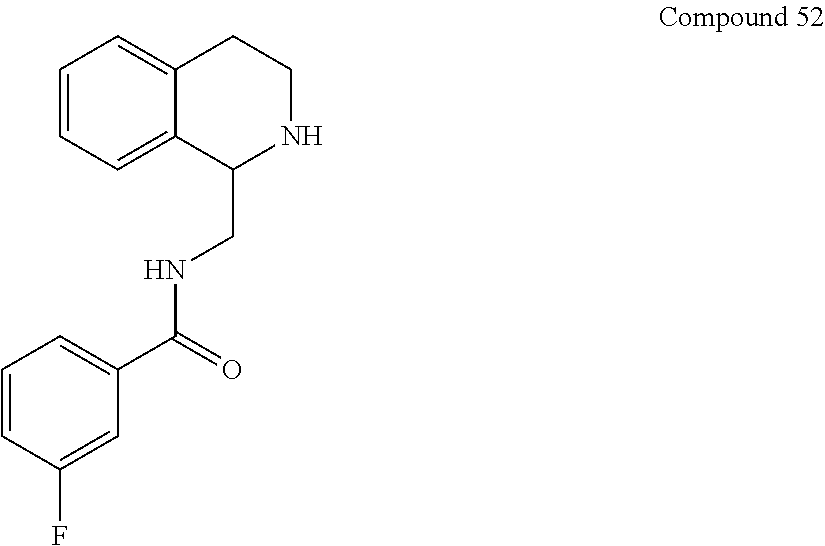
- QJTLYJXTHUXHBF-UHFFFAOYSA-N O=C(NCC1NCCC2=CC=CC=C21)C1=CC=CC(F)=C1 Chemical compound O=C(NCC1NCCC2=CC=CC=C21)C1=CC=CC(F)=C1 QJTLYJXTHUXHBF-UHFFFAOYSA-N 0.000 description 2
- NAFKORXBGRILHW-UHFFFAOYSA-N O=C(NCC1NCCC2=CC=CC=C21)C1=CC=CC=C1 Chemical compound O=C(NCC1NCCC2=CC=CC=C21)C1=CC=CC=C1 NAFKORXBGRILHW-UHFFFAOYSA-N 0.000 description 2
- FMPSOQQYUWKUBB-UHFFFAOYSA-N O=C(NCC1NCCC2=CC=CC=C21)C1=CC=CC=C1F Chemical compound O=C(NCC1NCCC2=CC=CC=C21)C1=CC=CC=C1F FMPSOQQYUWKUBB-UHFFFAOYSA-N 0.000 description 2
- PNLOCUSZOMGMIJ-UHFFFAOYSA-N O=C(NCC1NCCC2=CC=CC=C21)C1=CC=CC=C1OC(F)(F)F Chemical compound O=C(NCC1NCCC2=CC=CC=C21)C1=CC=CC=C1OC(F)(F)F PNLOCUSZOMGMIJ-UHFFFAOYSA-N 0.000 description 2
- PYYLZXCVSMUUAL-UHFFFAOYSA-N O=C(NCC1NCCC2=CC=CC=C21)C1CCCC1 Chemical compound O=C(NCC1NCCC2=CC=CC=C21)C1CCCC1 PYYLZXCVSMUUAL-UHFFFAOYSA-N 0.000 description 2
- NZUKSVDRTKIQDY-UHFFFAOYSA-N O=C(NCC1NCCC2=CC=CC=C21)C1CCCCC1 Chemical compound O=C(NCC1NCCC2=CC=CC=C21)C1CCCCC1 NZUKSVDRTKIQDY-UHFFFAOYSA-N 0.000 description 2
- ITSPWZHKWYXOCV-UHFFFAOYSA-N O=C(NCC1NCCC2=CC=CC=C21)N1CCCC1 Chemical compound O=C(NCC1NCCC2=CC=CC=C21)N1CCCC1 ITSPWZHKWYXOCV-UHFFFAOYSA-N 0.000 description 2
- SHTJSSHEUNFTKJ-UHFFFAOYSA-N O=C(NCC1NCCC2=CC=CC=C21)N1CCCCC1 Chemical compound O=C(NCC1NCCC2=CC=CC=C21)N1CCCCC1 SHTJSSHEUNFTKJ-UHFFFAOYSA-N 0.000 description 2
- HFIQLKQMAJQORY-UHFFFAOYSA-N O=C(NCC1NCCC2=CC=CC=C21)N1CCOCC1 Chemical compound O=C(NCC1NCCC2=CC=CC=C21)N1CCOCC1 HFIQLKQMAJQORY-UHFFFAOYSA-N 0.000 description 2
- JXLFHDRQCRVIQX-UHFFFAOYSA-N CC(C)(C)C1=CC=C(Cl)C(Cl)=C1.CC(C)(C)C1=CC=C(Cl)C=C1.CC(C)(C)C1=CC=C(F)C=C1.CC(C)(C)C1=CC=CC(Cl)=C1.CC(C)(C)C1=CC=CC(F)=C1.CC(C)(C)C1=CC=CC=C1.CC(C)(C)C1=CC=CC=C1F.CC(C)(C)C1=CC=CC=C1OC(F)(F)F.CC1=CC(C(C)(C)C)=CC=C1.CC1=CC=C(C(C)(C)C)C(C)=C1.CC1=CC=C(C(C)(C)C)C=C1.CC1=CC=C(C(C)(C)C)C=C1.CC1=CC=C(C(C)(C)C)C=C1.CC1=CC=C(C(C)(C)C)C=C1C.CCC1=CC=C(C(C)(C)C)C=C1.COC1=CC(C(C)(C)C)=CC=C1.COC1=CC=CC=C1C(C)(C)C Chemical compound CC(C)(C)C1=CC=C(Cl)C(Cl)=C1.CC(C)(C)C1=CC=C(Cl)C=C1.CC(C)(C)C1=CC=C(F)C=C1.CC(C)(C)C1=CC=CC(Cl)=C1.CC(C)(C)C1=CC=CC(F)=C1.CC(C)(C)C1=CC=CC=C1.CC(C)(C)C1=CC=CC=C1F.CC(C)(C)C1=CC=CC=C1OC(F)(F)F.CC1=CC(C(C)(C)C)=CC=C1.CC1=CC=C(C(C)(C)C)C(C)=C1.CC1=CC=C(C(C)(C)C)C=C1.CC1=CC=C(C(C)(C)C)C=C1.CC1=CC=C(C(C)(C)C)C=C1.CC1=CC=C(C(C)(C)C)C=C1C.CCC1=CC=C(C(C)(C)C)C=C1.COC1=CC(C(C)(C)C)=CC=C1.COC1=CC=CC=C1C(C)(C)C JXLFHDRQCRVIQX-UHFFFAOYSA-N 0.000 description 1
- LHAJOAVOHMNKFI-UHFFFAOYSA-N CC(C)(C)C1=CC=C(Cl)C(Cl)=C1.CC(C)(C)C1=CC=C(Cl)C=C1.CC(C)(C)C1=CC=CC(Cl)=C1.CC(C)(C)C1=CC=CC(F)=C1.CC(C)(C)C1=CC=CC=C1F Chemical compound CC(C)(C)C1=CC=C(Cl)C(Cl)=C1.CC(C)(C)C1=CC=C(Cl)C=C1.CC(C)(C)C1=CC=CC(Cl)=C1.CC(C)(C)C1=CC=CC(F)=C1.CC(C)(C)C1=CC=CC=C1F LHAJOAVOHMNKFI-UHFFFAOYSA-N 0.000 description 1
- WUFQHCQGZLWEFZ-UHFFFAOYSA-N CC(C)(C)C1=CC=C(Cl)C(Cl)=C1.CC(C)(C)C1=CC=CC(Cl)=C1.CC(C)(C)C1=CC=CC(F)=C1.CC(C)(C)C1=CC=CC=C1F.CC(C)(C)C1=CC=CC=C1OC(F)(F)F.CC1=CC(C(C)(C)C)=CC=C1.CC1=CC=C(C(C)(C)C)C(C)=C1.CC1=CC=C(C(C)(C)C)C=C1C.CCC1=CC=C(C(C)(C)C)C=C1.COC1=CC(C(C)(C)C)=CC=C1.COC1=CC=CC=C1C(C)(C)C Chemical compound CC(C)(C)C1=CC=C(Cl)C(Cl)=C1.CC(C)(C)C1=CC=CC(Cl)=C1.CC(C)(C)C1=CC=CC(F)=C1.CC(C)(C)C1=CC=CC=C1F.CC(C)(C)C1=CC=CC=C1OC(F)(F)F.CC1=CC(C(C)(C)C)=CC=C1.CC1=CC=C(C(C)(C)C)C(C)=C1.CC1=CC=C(C(C)(C)C)C=C1C.CCC1=CC=C(C(C)(C)C)C=C1.COC1=CC(C(C)(C)C)=CC=C1.COC1=CC=CC=C1C(C)(C)C WUFQHCQGZLWEFZ-UHFFFAOYSA-N 0.000 description 1
- KXYYXDAPJVUTBB-UHFFFAOYSA-N CC(C)(C)C1=CC=C(Cl)C(Cl)=C1.CC1=CC=C(C(C)(C)C)C(C)=C1 Chemical compound CC(C)(C)C1=CC=C(Cl)C(Cl)=C1.CC1=CC=C(C(C)(C)C)C(C)=C1 KXYYXDAPJVUTBB-UHFFFAOYSA-N 0.000 description 1
- FLYFKMPCXKCSID-UHFFFAOYSA-N CC(C)(C)C1=CC=C(Cl)C=C1.CC(C)(C)C1=CC=C(F)C=C1.CC(C)(C)C1=CC=CC(Cl)=C1.CC(C)(C)C1=CC=CC(F)=C1.CC(C)(C)C1=CC=CC=C1.CC(C)(C)C1=CC=CC=C1F.CC(C)(C)C1=CC=CC=C1OC(F)(F)F.CC(C)(C)C1CC1.CC(C)(C)C1CCC1.CC(C)(C)C1CCCC1.CC(C)(C)C1CCCCC1.CC(C)(C)N1CCCC1.CC(C)(C)N1CCCCC1.CC(C)(C)N1CCOCC1.CC1=CC(C(C)(C)C)=CC=C1.CC1=CC=C(C(C)(C)C)C=C1.CC1=CC=C(C(C)(C)C)C=C1.CC1=CC=C(C(C)(C)C)C=C1.CC1=CC=C(C(C)(C)C)C=C1C.CC1CCC(C(C)(C)C)CC1.CC1CCC(C(C)(C)C)CC1.CC1CCCCC1C(C)(C)C.CCC1=CC=C(C(C)(C)C)C=C1.CCC1CCC(C(C)(C)C)CC1.COC1=CC(C(C)(C)C)=CC=C1.COC1=CC=CC=C1C(C)(C)C Chemical compound CC(C)(C)C1=CC=C(Cl)C=C1.CC(C)(C)C1=CC=C(F)C=C1.CC(C)(C)C1=CC=CC(Cl)=C1.CC(C)(C)C1=CC=CC(F)=C1.CC(C)(C)C1=CC=CC=C1.CC(C)(C)C1=CC=CC=C1F.CC(C)(C)C1=CC=CC=C1OC(F)(F)F.CC(C)(C)C1CC1.CC(C)(C)C1CCC1.CC(C)(C)C1CCCC1.CC(C)(C)C1CCCCC1.CC(C)(C)N1CCCC1.CC(C)(C)N1CCCCC1.CC(C)(C)N1CCOCC1.CC1=CC(C(C)(C)C)=CC=C1.CC1=CC=C(C(C)(C)C)C=C1.CC1=CC=C(C(C)(C)C)C=C1.CC1=CC=C(C(C)(C)C)C=C1.CC1=CC=C(C(C)(C)C)C=C1C.CC1CCC(C(C)(C)C)CC1.CC1CCC(C(C)(C)C)CC1.CC1CCCCC1C(C)(C)C.CCC1=CC=C(C(C)(C)C)C=C1.CCC1CCC(C(C)(C)C)CC1.COC1=CC(C(C)(C)C)=CC=C1.COC1=CC=CC=C1C(C)(C)C FLYFKMPCXKCSID-UHFFFAOYSA-N 0.000 description 1
- LYCWWAJZNHIWJI-UHFFFAOYSA-N CC(C)(C)C1=CC=C(Cl)C=C1.CC(C)(C)C1=CC=C(F)C=C1.CC(C)(C)C1=CC=CC=C1.CC(C)(C)C1CC1.CC(C)(C)C1CCC1.CC(C)(C)C1CCCC1.CC(C)(C)C1CCCCC1.CC(C)(C)N1CCCC1.CC(C)(C)N1CCCCC1.CC(C)(C)N1CCOCC1.CC1=CC=C(C(C)(C)C)C=C1.CC1=CC=C(C(C)(C)C)C=C1.CC1=CC=C(C(C)(C)C)C=C1.CC1CCC(C(C)(C)C)CC1.CC1CCC(C(C)(C)C)CC1.CC1CCCCC1C(C)(C)C.CCC1CCC(C(C)(C)C)CC1 Chemical compound CC(C)(C)C1=CC=C(Cl)C=C1.CC(C)(C)C1=CC=C(F)C=C1.CC(C)(C)C1=CC=CC=C1.CC(C)(C)C1CC1.CC(C)(C)C1CCC1.CC(C)(C)C1CCCC1.CC(C)(C)C1CCCCC1.CC(C)(C)N1CCCC1.CC(C)(C)N1CCCCC1.CC(C)(C)N1CCOCC1.CC1=CC=C(C(C)(C)C)C=C1.CC1=CC=C(C(C)(C)C)C=C1.CC1=CC=C(C(C)(C)C)C=C1.CC1CCC(C(C)(C)C)CC1.CC1CCC(C(C)(C)C)CC1.CC1CCCCC1C(C)(C)C.CCC1CCC(C(C)(C)C)CC1 LYCWWAJZNHIWJI-UHFFFAOYSA-N 0.000 description 1
- VHKNZTWMVNWAOC-UHFFFAOYSA-N CC(C)(C)OC(=O)N1CCC2=CC=CC=C2C1CN Chemical compound CC(C)(C)OC(=O)N1CCC2=CC=CC=C2C1CN VHKNZTWMVNWAOC-UHFFFAOYSA-N 0.000 description 1
- OFEOFDGGJMUNGN-UHFFFAOYSA-N CC(C)(C)OC(=O)N1CCC2=CC=CC=C2C1CN1C(=O)C2=C(C=CC=C2)C1=O Chemical compound CC(C)(C)OC(=O)N1CCC2=CC=CC=C2C1CN1C(=O)C2=C(C=CC=C2)C1=O OFEOFDGGJMUNGN-UHFFFAOYSA-N 0.000 description 1
- VYPRRCRRDLEIRE-UHFFFAOYSA-N CC(C)(C)OC(=O)N1CCC2=CC=CC=C2C1CNC(=O)N1CCCC1 Chemical compound CC(C)(C)OC(=O)N1CCC2=CC=CC=C2C1CNC(=O)N1CCCC1 VYPRRCRRDLEIRE-UHFFFAOYSA-N 0.000 description 1
- MJDYIDNOTUYKIW-UHFFFAOYSA-N CC(C)(C)OC(=O)N1CCC2=CC=CC=C2C1CNC(=O)N1CCCCC1 Chemical compound CC(C)(C)OC(=O)N1CCC2=CC=CC=C2C1CNC(=O)N1CCCCC1 MJDYIDNOTUYKIW-UHFFFAOYSA-N 0.000 description 1
- PFKVHHJQEVUOMQ-UHFFFAOYSA-N CC(C)(C)OC(=O)N1CCC2=CC=CC=C2C1CNC(=O)N1CCOCC1 Chemical compound CC(C)(C)OC(=O)N1CCC2=CC=CC=C2C1CNC(=O)N1CCOCC1 PFKVHHJQEVUOMQ-UHFFFAOYSA-N 0.000 description 1
- ATUOYXFVUMWRHF-UHFFFAOYSA-N CC(C)(C)c(cc1)cc(Cl)c1Cl Chemical compound CC(C)(C)c(cc1)cc(Cl)c1Cl ATUOYXFVUMWRHF-UHFFFAOYSA-N 0.000 description 1
- WBRFTPJBYOBVSS-UHFFFAOYSA-N CC1=CC(C(=O)NCC2NCCC3=CC=CC=C32)=CC=C1.COC1=CC=CC=C1C(=O)NCC1NCCC2=CC=CC=C21.O=C(NCC1NCCC2=CC=CC=C21)C1=CC=CC(Cl)=C1.O=C(NCC1NCCC2=CC=CC=C21)C1=CC=CC=C1F.O=C(NCC1NCCC2=CC=CC=C21)C1=CC=CC=C1OC(F)(F)F Chemical compound CC1=CC(C(=O)NCC2NCCC3=CC=CC=C32)=CC=C1.COC1=CC=CC=C1C(=O)NCC1NCCC2=CC=CC=C21.O=C(NCC1NCCC2=CC=CC=C21)C1=CC=CC(Cl)=C1.O=C(NCC1NCCC2=CC=CC=C21)C1=CC=CC=C1F.O=C(NCC1NCCC2=CC=CC=C21)C1=CC=CC=C1OC(F)(F)F WBRFTPJBYOBVSS-UHFFFAOYSA-N 0.000 description 1
- JEZJNSMGUCRFJZ-UHFFFAOYSA-N CC1=CC=C(C(=O)NCC2C3=CC=CC=C3CCN2C)C=C1.CC1=CC=C(C(=O)NCC2C3=CC=CC=C3CCN2CC(C)C)C=C1.CCCCN1CCC2=CC=CC=C2C1CNC(=O)C1=CC=C(C)C=C1.CCCN1CCC2=CC=CC=C2C1CNC(=O)C1=CC=C(C)C=C1 Chemical compound CC1=CC=C(C(=O)NCC2C3=CC=CC=C3CCN2C)C=C1.CC1=CC=C(C(=O)NCC2C3=CC=CC=C3CCN2CC(C)C)C=C1.CCCCN1CCC2=CC=CC=C2C1CNC(=O)C1=CC=C(C)C=C1.CCCN1CCC2=CC=CC=C2C1CNC(=O)C1=CC=C(C)C=C1 JEZJNSMGUCRFJZ-UHFFFAOYSA-N 0.000 description 1
- BIWKNAXZOZSEDB-UHFFFAOYSA-N CC1=CC=C(C(=O)NCC2C3=CC=CC=C3CCN2C)C=C1C.CCC1=CC=C(C(=O)NCC2C3=CC=CC=C3CCN2C)C=C1.CN1CCC2=CC=CC=C2C1CNC(=O)C1=CC=C(Cl)C(Cl)=C1 Chemical compound CC1=CC=C(C(=O)NCC2C3=CC=CC=C3CCN2C)C=C1C.CCC1=CC=C(C(=O)NCC2C3=CC=CC=C3CCN2C)C=C1.CN1CCC2=CC=CC=C2C1CNC(=O)C1=CC=C(Cl)C(Cl)=C1 BIWKNAXZOZSEDB-UHFFFAOYSA-N 0.000 description 1
- RUPJLTZSWUKVNE-UHFFFAOYSA-N CC1=CC=C(C(=O)NCC2CCCC3=CC=CC=C32)C(C)=C1.CC1=CC=C(C(=O)NCC2NCCC3=CC=CC=C32)C=C1C.O=C(NCC1NCCC2=CC=CC=C21)C1=CC=C(Cl)C(Cl)=C1 Chemical compound CC1=CC=C(C(=O)NCC2CCCC3=CC=CC=C32)C(C)=C1.CC1=CC=C(C(=O)NCC2NCCC3=CC=CC=C32)C=C1C.O=C(NCC1NCCC2=CC=CC=C21)C1=CC=C(Cl)C(Cl)=C1 RUPJLTZSWUKVNE-UHFFFAOYSA-N 0.000 description 1
- QWIUWANWXPDBBW-UHFFFAOYSA-N CC1=CC=C(C(=O)NCC2NCCC3=CC=CC=C32)C=C1.CCC1=CC=C(C(=O)NCC2NCCC3=CC=CC=C32)C=C1.COC1=CC(C(=O)NCC2NCCC3=CC=CC=C32)=CC=C1.O=C(NCC1NCCC2=CC=CC=C21)C1=CC=C(Cl)C=C1.O=C(NCC1NCCC2=CC=CC=C21)C1=CC=CC(F)=C1 Chemical compound CC1=CC=C(C(=O)NCC2NCCC3=CC=CC=C32)C=C1.CCC1=CC=C(C(=O)NCC2NCCC3=CC=CC=C32)C=C1.COC1=CC(C(=O)NCC2NCCC3=CC=CC=C32)=CC=C1.O=C(NCC1NCCC2=CC=CC=C21)C1=CC=C(Cl)C=C1.O=C(NCC1NCCC2=CC=CC=C21)C1=CC=CC(F)=C1 QWIUWANWXPDBBW-UHFFFAOYSA-N 0.000 description 1
- MVZKLXCSMGDZEF-UHFFFAOYSA-N CC1=CC=C(S(=O)(=O)N2CCC3=CC=CC=C3C2CNC(=O)C2=CC=CC=C2)C(OC(F)(F)F)=C1 Chemical compound CC1=CC=C(S(=O)(=O)N2CCC3=CC=CC=C3C2CNC(=O)C2=CC=CC=C2)C(OC(F)(F)F)=C1 MVZKLXCSMGDZEF-UHFFFAOYSA-N 0.000 description 1
- CTRFPUQWKKUSKJ-UHFFFAOYSA-N NCC1C2=CC=CC=C2CCN1S(=O)(=O)C1=CC=C(Br)C=C1OC(F)(F)F Chemical compound NCC1C2=CC=CC=C2CCN1S(=O)(=O)C1=CC=C(Br)C=C1OC(F)(F)F CTRFPUQWKKUSKJ-UHFFFAOYSA-N 0.000 description 1
- WZZJAYPARCLIPG-UHFFFAOYSA-N NCC1NCCC2=CC=CC=C21 Chemical compound NCC1NCCC2=CC=CC=C21 WZZJAYPARCLIPG-UHFFFAOYSA-N 0.000 description 1
- FBNJBQAUYWVWPP-UHFFFAOYSA-N O=C(CN1C(=O)C2=C(C=CC=C2)C1=O)NCCC1=CC=CC=C1 Chemical compound O=C(CN1C(=O)C2=C(C=CC=C2)C1=O)NCCC1=CC=CC=C1 FBNJBQAUYWVWPP-UHFFFAOYSA-N 0.000 description 1
- NQTWLZVDCRVFCR-UHFFFAOYSA-N O=C(NCC1NCCC2=CC=CC=C21)C1=CC=CC(Cl)=C1 Chemical compound O=C(NCC1NCCC2=CC=CC=C21)C1=CC=CC(Cl)=C1 NQTWLZVDCRVFCR-UHFFFAOYSA-N 0.000 description 1
- VORHKXJENRYGEN-UHFFFAOYSA-N O=C1C2=C(C=CC=C2)C(=O)N1C/C1=N/CCC2=CC=CC=C21 Chemical compound O=C1C2=C(C=CC=C2)C(=O)N1C/C1=N/CCC2=CC=CC=C21 VORHKXJENRYGEN-UHFFFAOYSA-N 0.000 description 1
- YXPOAGXJSDYQAM-UHFFFAOYSA-N O=C1C2=C(C=CC=C2)C(=O)N1CC1C2=CC=CC=C2CCN1S(=O)(=O)C1=CC=C(Br)C=C1OC(F)(F)F Chemical compound O=C1C2=C(C=CC=C2)C(=O)N1CC1C2=CC=CC=C2CCN1S(=O)(=O)C1=CC=C(Br)C=C1OC(F)(F)F YXPOAGXJSDYQAM-UHFFFAOYSA-N 0.000 description 1
- OOOHRYLFPGOMKQ-UHFFFAOYSA-N O=C1C2=C(C=CC=C2)C(=O)N1CC1NCCC2=CC=CC=C21 Chemical compound O=C1C2=C(C=CC=C2)C(=O)N1CC1NCCC2=CC=CC=C21 OOOHRYLFPGOMKQ-UHFFFAOYSA-N 0.000 description 1
Classifications
-
- C—CHEMISTRY; METALLURGY
- C07—ORGANIC CHEMISTRY
- C07D—HETEROCYCLIC COMPOUNDS
- C07D401/00—Heterocyclic compounds containing two or more hetero rings, having nitrogen atoms as the only ring hetero atoms, at least one ring being a six-membered ring with only one nitrogen atom
- C07D401/02—Heterocyclic compounds containing two or more hetero rings, having nitrogen atoms as the only ring hetero atoms, at least one ring being a six-membered ring with only one nitrogen atom containing two hetero rings
- C07D401/12—Heterocyclic compounds containing two or more hetero rings, having nitrogen atoms as the only ring hetero atoms, at least one ring being a six-membered ring with only one nitrogen atom containing two hetero rings linked by a chain containing hetero atoms as chain links
-
- C—CHEMISTRY; METALLURGY
- C07—ORGANIC CHEMISTRY
- C07D—HETEROCYCLIC COMPOUNDS
- C07D209/00—Heterocyclic compounds containing five-membered rings, condensed with other rings, with one nitrogen atom as the only ring hetero atom
- C07D209/02—Heterocyclic compounds containing five-membered rings, condensed with other rings, with one nitrogen atom as the only ring hetero atom condensed with one carbocyclic ring
- C07D209/44—Iso-indoles; Hydrogenated iso-indoles
- C07D209/48—Iso-indoles; Hydrogenated iso-indoles with oxygen atoms in positions 1 and 3, e.g. phthalimide
-
- C—CHEMISTRY; METALLURGY
- C07—ORGANIC CHEMISTRY
- C07D—HETEROCYCLIC COMPOUNDS
- C07D217/00—Heterocyclic compounds containing isoquinoline or hydrogenated isoquinoline ring systems
- C07D217/12—Heterocyclic compounds containing isoquinoline or hydrogenated isoquinoline ring systems with radicals, substituted by hetero atoms, attached to carbon atoms of the nitrogen-containing ring
- C07D217/14—Heterocyclic compounds containing isoquinoline or hydrogenated isoquinoline ring systems with radicals, substituted by hetero atoms, attached to carbon atoms of the nitrogen-containing ring other than aralkyl radicals
-
- C—CHEMISTRY; METALLURGY
- C07—ORGANIC CHEMISTRY
- C07D—HETEROCYCLIC COMPOUNDS
- C07D217/00—Heterocyclic compounds containing isoquinoline or hydrogenated isoquinoline ring systems
- C07D217/22—Heterocyclic compounds containing isoquinoline or hydrogenated isoquinoline ring systems with hetero atoms or with carbon atoms having three bonds to hetero atoms with at the most one bond to halogen, e.g. ester or nitrile radicals, directly attached to carbon atoms of the nitrogen-containing ring
-
- C—CHEMISTRY; METALLURGY
- C07—ORGANIC CHEMISTRY
- C07D—HETEROCYCLIC COMPOUNDS
- C07D401/00—Heterocyclic compounds containing two or more hetero rings, having nitrogen atoms as the only ring hetero atoms, at least one ring being a six-membered ring with only one nitrogen atom
- C07D401/02—Heterocyclic compounds containing two or more hetero rings, having nitrogen atoms as the only ring hetero atoms, at least one ring being a six-membered ring with only one nitrogen atom containing two hetero rings
- C07D401/06—Heterocyclic compounds containing two or more hetero rings, having nitrogen atoms as the only ring hetero atoms, at least one ring being a six-membered ring with only one nitrogen atom containing two hetero rings linked by a carbon chain containing only aliphatic carbon atoms
Definitions
- Opioids are classified into natural opioids (e.g., morphine), semi-synthetic opioids (e.g., heroin), synthetic opioids (e.g., methadone), and endogenous opioids (e.g., endorphins). See, e.g., Piestrzeniewicz et al., Postepy Biochem, 2006, 52:313-319.
- natural opioids e.g., morphine
- semi-synthetic opioids e.g., heroin
- synthetic opioids e.g., methadone
- endogenous opioids e.g., endorphins
- Opioids act in both central and peripheral nervous systems to produce various pharmacological effects including, among others, analgesia and decreased gastrointestinal motility.
- Opioids have long been used as the most effective analgesics for treating acute pain (e.g., post-operative pain) and chronic pain (e.g., cancer pain). See, e.g., Waldhoer et al., Annu Rev Biochem, 2004, 73:953-990.
- Opioids primarily activate three classic subtypes of opioid receptors, namely, mu-opioid receptor (MOR), delta-opioid receptor (DOR), and kappa-opioid receptor (KOR).
- MOR mu-opioid receptor
- DOR delta-opioid receptor
- KOR kappa-opioid receptor
- Various heterocyclic compounds have been used as nonselective or selective MOR agonists for treating an opioid receptor-associated condition, e.g., pain, immune function, esophageal reflux, and cough.
- conventional heterocyclic compounds typically produce adverse effects, such as respiratory depression.
- long-term use of these compounds for controlling chronic pain develops severe side effects such as tolerance, dependence, and addiction. See, e.g., Tao et al., J Pharmacol Exp Ther, 2002, 303:549-556.
- the present invention relates to certain heterocyclic compounds as opioid receptor modulators for treating an opioid receptor-associated condition.
- these compounds acting as mu-opioid receptor/nociceptin receptor (MOR/NOP) dual agonists, produce anti-nociceptive effects without developing severe side effects.
- MOR/NOP mu-opioid receptor/nociceptin receptor
- each of R 1 -R 4 is H, halo, OH, CN, CF 3 , NH 2 , NO 2 , SO 2 , COOH, C 1-6 alkyl, C 1-6 haloalkyl, C 2-6 alkenyl, C 3-8 cycloalkyl, C 2-8 heterocycloalkyl, C 1-6 alkoxy, C 1-6 haloalkoxy, C 1-6 alkylamino, C 2-6 dialkylamino, C 7-12 aralkyl, C 1-12 heteroaralkyl, C 6-14 aryl, C 1-13 heteroaryl, —C(O)OR, —C(O)NRR′, —NRC(O)R′, —S(O) 2 R, —S(O) 2 NRR′, —NRS(O) 2 R′, —C(O)R, —C(O) NRS(O) 2 R′, —C(O)NRS(O)
- alkyl herein refers to a straight or branched hydrocarbon group, containing 1-20 (e.g., 1-10 and 1-6) carbon atoms. Examples include methyl, ethyl, n-propyl, i-propyl, n-butyl, i-butyl, and t-butyl.
- haloalkyl refers to alkyl substituted with one or more halogen (chloro, fluoro, bromo, or idodo) atoms. Examples include trifluoromethyl, bromomethyl, and 4,4,4-trifluorobutyl.
- alkenyl refers to a straight or branched hydrocarbon group, containing 2-20 (e.g., 2-10 and 2-6) carbon atoms and one or more double bonds. Examples include ethylenyl, propenyl, and butenyl.
- cycloalkyl refers to a saturated and partially unsaturated monocyclic, bicyclic, tricyclic, or tetracyclic hydrocarbon group having 3 to 12 carbons. Examples include cyclopropyl, cyclobutyl, cyclopentyl, cyclopentenyl, cyclohexyl, cyclohexenyl, cycloheptyl, and cyclooctyl.
- heterocycloalkyl refers to a nonaromatic 5-8 membered monocyclic, 8-12 membered bicyclic, or 11-14 membered tricyclic ring system having one or more heteroatoms (e.g., 0, N, P, and S).
- Examples include piperazinyl, imidazolidinyl, azepanyl, pyrrolidinyl, dihydrothiadiazolyl, dioxanyl, morpholinyl, tetrahydropuranyl, and tetrahydrofuranyl.
- alkoxy refers to an —O-alkyl group. Examples include methoxy, ethoxy, propoxy, and isopropoxy.
- haloalkoxy refers to alkoxy substituted with one or more halogen atoms. Examples include —O—CH 2 Cl and —O—CHClCH 2 Cl.
- halo refers to a fluoro, chloro, bromo, or iodo radical.
- amino refers to a radical derived from amine, which is unsunstituted or mono-/di-substituted with alkyl, aryl, cycloalkyl, heterocycloalkyl, or heteroaryl.
- alkylamino refers to alkyl-NH—.
- dialkylamino refers to alkyl-N(alkyl)-.
- aralkyl refers to alkyl substituted with an aryl group. Examples include benzyl and naphthylmethyl.
- heteroarylkyl refers to an alkyl group substituted with a heteroaryl group. Examples include pyridylmethyl and furylmethyl.
- aryl refers to a 6-carbon monocyclic, 10-carbon bicyclic, 14-carbon tricyclic aromatic ring system. Examples of aryl groups include phenyl, naphthyl, and anthracenyl.
- heteroaryl refers to an aromatic 5-8 membered monocyclic, 8-12 membered bicyclic, or 11-14 membered tricyclic ring system having one or more heteroatoms (e.g., 0, N, P, and S).
- Examples include triazolyl, oxazolyl, thiadiazolyl, tetrazolyl, pyrazolyl, pyridyl, furyl, imidazolyl, benzimidazolyl, pyrimidinyl, thienyl, quinolinyl, indolyl, thiazolyl, and benzothiazolyl.
- Alkyl, alkenyl, cycloalkyl, heterocycloalkyl, aralkyl, heteroaralkyl, alkoxy, aryl, and heteroaryl mentioned herein include both substituted and unsubstituted moieties.
- Possible substituents on cycloalkyl, heterocycloalkyl, aralkyl, heteroaralkyl, alkoxy, aryl, and heteroaryl include, but are not limited to, C 1 -C 10 alkyl, C 2 -C 10 alkenyl, C 2 -C 10 alkynyl, C 3 -C 20 cycloalkyl, C 3 -C 20 cycloalkenyl, C 1 -C 20 heterocycloalkyl, C 1 -C 20 heterocycloalkenyl, C 1 -C 10 alkoxy, aryl, aryloxy, heteroaryl, heteroaryloxy, amino, C 1 -C 10 alkylamino, C 1 -C 20 dialkylamino, arylamino, diarylamino, C 1 -C 10 alkylsulfonamino, arylsulfonamino, C 1 -C 10 alkylimino, arylimino, C 1 -C
- alkyl or alkenyl include all of the above-recited substituents except C 1 -C 10 alkyl.
- Cycloalkyl, heterocycloalkyl, aryl, and heteroaryl can also be fused with each other.
- a salt can be formed between an anion and a positively charged group (e.g., amino) on a compound.
- a positively charged group e.g., amino
- a suitable anion include chloride, bromide, iodide, sulfate, nitrate, phosphate, citrate, methanesulfonate, trifluoroacetate, acetate, malate, tosylate, tartrate, fumurate, glutamate, glucuronate, lactate, glutarate, and maleate.
- a salt can also be formed between a cation and a negatively charged group.
- a suitable cation examples include sodium ion, potassium ion, magnesium ion, calcium ion, and an ammonium cation such as tetramethylammonium ion.
- a salt further includes those containing quaternary nitrogen atoms.
- a solvate refers to a complex formed between an active compound and a pharmaceutically acceptable solvent. Examples of a pharmaceutically acceptable solvent include water, ethanol, isopropanol, ethyl acetate, acetic acid, and ethanolamine.
- Another aspect of this invention is a pharmaceutical composition for treating an opioid receptor-associated condition.
- the pharmaceutical composition contains one of the compounds of formula (I) described above or its pharmaceutically acceptable salt and a pharmaceutically acceptable carrier.
- This invention also covers use of such a composition for the manufacture of a medicament for treating an opioid receptor-associated condition.
- a composition for oral administration can be any orally acceptable dosage form including capsules, tablets, emulsions and aqueous suspensions, dispersions, and solutions.
- commonly used carriers include lactose and corn starch.
- Lubricating agents such as magnesium stearate, are also typically added.
- useful diluents include lactose and dried corn starch.
- the active ingredient can be suspended or dissolved in an oily phase combined with emulsifying or suspending agents. If desired, certain sweetening, flavoring, or coloring agents can be added.
- Oral solid dosage forms can be prepared by spray dried techniques; hot melt extrusion strategy, micronization, and nano milling technologies.
- a nasal aerosol or inhalation composition can be prepared according to techniques well known in the art of pharmaceutical formulation.
- a composition can be prepared as a solution in saline, employing benzyl alcohol or other suitable preservatives, absorption promoters, fluorocarbons, and/or other solubilizing or dispersing agents known in the art.
- a composition having an active compound can also be administered in the form of suppositories for rectal administration.
- the carrier in the pharmaceutical composition must be “acceptable” in the sense that it is compatible with the active ingredient of the composition (and preferably, capable of stabilizing the active ingredient) and not deleterious to the subject to be treated.
- One or more solubilizing agents can be utilized as pharmaceutical excipients for delivery of an active compound.
- examples of other carriers include colloidal silicon oxide, magnesium stearate, cellulose, sodium lauryl sulfate, and D&C Yellow #10.
- Still within the scope of the present invention is a method of treating an opioid receptor-associated condition.
- the method includes administering to a subject in need thereof an effective amount of a compound of formula (I) or a pharmaceutically acceptable salt thereof.
- parenteral as used herein includes subcutaneous, intracutaneous, intravenous, intramuscular, intraarticular, intraarterial, intrasynovial, intrasternal, intrathecal, intralesional, and intracranial injection or infusion techniques.
- treating refers to application or administration of the compound to a subject with the purpose to cure, alleviate, relieve, alter, remedy, improve, or affect the disease, the symptom, or the predisposition.
- An effective amount refers to the amount of the compound which is required to confer the desired effect on the subject. Effective amounts vary, as recognized by those skilled in the art, depending on route of administration, excipient usage, and the possibility of co-usage with other therapeutic treatments such as use of other active agents.
- each of variables R 1 -R 6 , L, m, and n is defined as in the SUMMARY section.
- each of R 1 -R 4 is H, halo, OH, CF 3 , C 1-6 alkyl, C 3-8 cycloalkyl, or C 1-6 alkoxy; and R 5 is H, C 1-6 alkyl, C 1-6 haloalkyl, or —S(O) 2 R.
- each of R 1 -R 4 is H and R 5 is H or C 1-6 alkyl.
- R 6 can be C 3-8 cycloalkyl, C 2-8 heterocycloalkyl, or C 6-14 aryl. Examples of R 6 include, but are not limited to,
- L is —NRC(O)—, e.g., —NHC(O)—, and each of m and n is 1.
- each of R 1 -R 4 is H, halo, OH, CF 3 , C 1-6 alkyl, C 3-8 cycloalkyl, or C 1-6 alkoxy;
- R 5 is H, C 1-6 alkyl, C 1-6 haloalkyl, or —S(O) 2 R;
- R 6 is C 3-8 cycloalkyl, C 2-8 heterocycloalkyl, or C 6-14 aryl;
- L is —NHC(O)—; and each of m and n is 1.
- each of R 1 -R 4 is H, R 5 is H or C 1-6 alkyl, and R 6 is one of the following moieties:
- the carbon attached to both the phenyl ring and the nitrogen atom has a stereoisomeric configuration of R or S, and the compound has an enantiomeric excess of 90% or higher (e.g., ⁇ 95% and ⁇ 99%).
- This embodiment includes compounds having each of R 1 -R 4 , independently, as H, halo, OH, CF 3 , C 1-6 alkyl, C 3-8 cycloalkyl, or C 1-6 alkoxy; R 5 as H, C 1-6 alkyl, C 1-6 haloalkyl, or —S(O) 2 R; R 6 as C 3-8 cycloalkyl, C 2-8 heterocycloalkyl, or C 6-14 aryl; and L as —NRC(O)—.
- these compounds have each of R 1 -R 4 being H, R 5 being H or C 1-6 alkyl, and R 6 being C 6 aryl, in which the C 6 aryl is optionally mono-, di-, or tri-substituted with halo, OH, CN, CF 3 , NH 2 , NO 2 , SO 2 , COOH, C 1-6 alkyl, C 1-6 haloalkyl, C 2-6 alkenyl, C 3-8 cycloalkyl, C 2-8 heterocycloalkyl, C 1-6 alkoxy, C 1-6 haloalkoxy, C 1-6 alkylamino, C 2-6 dialkylamino, C 7-12 aralkyl, C 1-12 heteroaralkyl, C 6-14 aryl, C 1-13 heteroaryl, —C(O)OR, —C(O)NRR′, —NRC(O)R′, —S(O) 2 R, —S(O) 2 NRR
- these compounds have L being —NHC(O)— and each of m and n being 1.
- compositions for treating an opioid receptor-associated condition e.g., pain
- the composition containing one of the compounds of formula (I) set forth above or a pharmaceutically acceptable salt thereof and a pharmaceutically acceptable carrier.
- a method for treating an opioid receptor-associated condition including administering to a subject in need thereof an effective amount of a compound of formula (I) or a pharmaceutically acceptable salt thereof.
- opioid receptor-associated condition examples include, but are not limited to, pain, immune disease, esophageal reflux, diarrhea, anxiety, and heroin addiction.
- the method is performed for treating pain, i.e., opioid receptor-associated pain.
- the pain can be cancer pain, post-operative pain, renal colic pain, acute pancreatitis pain, angina pain, low back pain, rheumatoid arthritis pain, osteoarthritis pain, neuropathic pain, fibromyalgia pain, or complex regional pain syndrome.
- the compound of formula (I) exerts anti-nociceptive effects without developing severe side effects via a dual mechanism, i.e., working as a mu-opioid receptor/nociceptin receptor (MOR/NOP) dual agonist.
- NOP has similar sequence homology to classical opioid receptors. It has been reported that NOP agonists produce antinociception with fewer side effects, such as abuse, respiratory depression, and gastrointestinal inhibition. See, e.g., Lin et al., ACS Chemical Neuroscience, 2013, 4:214-224.
- a MOR/NOP dual agonist e.g., a compound of formula (I), can be used for treating an opioid receptor-associated condition, e.g., pain, while producing fewer side effects than conventional MOR modulators.
- the compound used in the above-described method typically has each of R 1 -R 4 , independently, being H, halo, OH, CF 3 , C 1-6 alkyl, C 3-8 cycloalkyl, or C 1-6 alkoxy; R 5 being H, C 1 alkyl, C 1-6 haloalkyl, or —S(O) 2 R; R 6 being C 3-8 cycloalkyl, C 2-8 heterocycloalkyl, or C 6-14 aryl; and L being —NRC(O)—.
- the compounds of formula (I) thus prepared can be initially screened using in vitro assays, e.g., the FLIPR® calcium assay described in Example 68 below, for their potency in activating MOR in cells. They can be subsequently evaluated using in vivo assays, e.g., a tail-flick test assay also described in Example 68. The selected compounds can be further tested to verify their efficacy in disease related pain and adverse effects models. Based on the results, an appropriate dosage range and administration route can be determined.
- in vitro assays e.g., the FLIPR® calcium assay described in Example 68 below
- in vivo assays e.g., a tail-flick test assay also described in Example 68.
- the selected compounds can be further tested to verify their efficacy in disease related pain and adverse effects models. Based on the results, an appropriate dosage range and administration route can be determined.
- cells that express a MOR are treated with a test compound in a cellular calcium fluorescent assay and calcium fluorescence intensity is then measured to determine whether the MOR is activated.
- a test compound is identified as a MOR agonist if the MOR is activated.
- EC 50 refers to the concentration of a compound that induces a response halfway between the baseline and the maximum after a specified exposure time.
- AUC refers to the area under the response curve, an indication of the compound's capability of activating a MOR.
- a test compound is injected into a mouse pain model (e.g., via intravenous administration), basal latencies are recorded before the treatment and test latencies are recorded at various specified times after the injection, and a time-response curve is recorded and AUC values are calculated to determine whether an analgesic effect is exerted on the mouse.
- the test compound is confirmed to be a MOR agonist upon observation of an analgesic effect.
- cells are engineered to overexpress NOP and are designed to detect changes in intracellular cAMP levels in response to agonist stimulation of the receptor.
- the enzyme donor-cAMP complex complements with the acceptor and forms an active enzyme.
- the active enzyme subsequently hydrolyzes a substrate to produce a chemiluminescent signal that is directly proportional to the amount of cAMP in the cells.
- EXAMPLES 1-67 set forth the procedures for preparing certain intermediates and 56 exemplary compounds of formula (I), as well as the analytical data for the compounds thus prepared; and EXAMPLES 68 and 69 set forth the protocols for testing these compounds.
- mice Male wild-type C57BL/6 (B6) mice (25-30 g) and mu-opioid receptor-knockout mice (provided by National Health Research Institutes, Taiwan) were randomized to an study group. Animal protocols were approved by the Institutional Animal Care and Use Committee of the National Health Research Institutes, Taiwan. All Animal studies were conducted in accordance with the Policies on the Use of Animals in Neuroscience Research and the ethical guidelines for investigations of pain in conscious animals established by the International Association for the Study of Pain. Animals were kept in a temperature-controlled animal room with a 12:12 h light-dark cycle.
- Morphine hydrochloride was obtained from the Food and Drug Administration, Ministry of Health and Welfare, Taipei, Taiwan.
- [ 3 H]diprenorphine and [ 3 H]nociceptin was obtained from PerkinElmer Inc., Boston, Mass., USA.
- [Met5]enkephalin (Met-5) and oxaliplatin was obtained from Sigma Chemical Co., St. Louis, Mo., USA.
- CORNING® black with clear flat bottom 96-well assay plates were coated with a 0.1 mg/mL Poly-L-Lysine solution.
- CHO-K1/MOR/Ga15 cells were suspended in the F12 medium and plated at a density of about 8 ⁇ 10 4 cells/well in 200 pt medium. Cells were incubated in a humidified atmosphere of 10% CO 2 at 37° C. overnight so as to reach an 80-90% confluent cell monolayer before the assay.
- 150 ⁇ L medium/well was removed from plate.
- the [Ca 2+ ] i fluorescence increased after robotic injections of compounds or other reagents were monitored every 1.52 s interval with an excitation wavelength at 485 nm and with an emission wavelength at 525 nm.
- the [Ca 2+ ] i fluorescence was measured up to 90 s after agonist injection.
- the fluorescence intensity from 6 to 12 wells of cells were averaged and the relative amount of [Ca 2+ ] i release was determined by integrating the AUC of the [Ca 2+ ] i fluorescence averages.
- Compounds 5-13, 8, 15, 17-21, 24-29, 35-40, and 42-67 each showed an EC 50 less than 10 ⁇ M; and Compounds 5-7, 9-13, 15-18, 20, 21, 24-29, 35, 36, 38-43, 45-54, and 56-67 each showed an AUC higher than 5000.
- Human embryonic kidney 293 cells expressing human mu-opioid receptor were cultured in high-glucose Dulbecco's modified Eagle medium (DMEM, GIBCO) supplemented with 10% fetal bovine serum, 100 units/mL penicillin, 100 ⁇ g/mL streptomycin, 400 ⁇ g/mL G418, and 2 mM L-glutamine in T-175 tissue culture flasks and harvested with trypsin/ethylenediaminetetraacetic acid (EDTA) solution (GIBCO).
- DMEM Dulbecco's modified Eagle medium
- EDTA trypsin/ethylenediaminetetraacetic acid
- Chinese hamster ovary cells expressing human NOP receptor were cultured in F12 medium (GIBCO) containing 10% fetal bovine serum, 100 units/mL penicillin, 100 g/mL streptomycin, 200 g/mL G418, and 20 g/mL Hygromycin B in T-175 tissue culture flasks and harvested with Cell Detachment Reagent (DiscoveRx).
- Cells (72,000 per well) were plated in 100 ⁇ l/well of DMEM in 96-well solid-bottom white plates (GIBCO) and 50 ⁇ l/well of drug in HBSS in the presence of forskolin and 3-isobutyl-1-methylxanthine at final concentrations of 1 ⁇ M and 500 ⁇ M, respectively.
- MOR internalization was measured by an enzyme complementation assay in human osteosarcoma U2OS cells expressing human MOR (U2OS-MOR).
- U2OS cells express human MOR with complementary pieces of ⁇ -galactosidase that are genetically fused to the receptor and to a component of the endocytic vesicle. When activated, MOR then interacts with the endosomes in this study and the 2 fusion proteins form a complete enzyme whose activity can be detected by chemiluminescence.
- the PathHunter G protein-coupled receptor internalization assay (DiscoveRx, Fremont, Calif., USA) was performed according to the manufacturer's protocol. Cells were grown to confluence in McCoy's 5A medium (GIBCO, Waltham, Mass., USA) containing 10% fetal bovine serum, 100 units/mL penicillin, 100 ⁇ g/mL streptomycin, 20 ⁇ g/mL G418 (Sigma), 5 ⁇ g/mL Hygromycin B (InvivoGen, San Diego, Calif., USA), and 25 mM HEPES in T-175 tissue culture flasks (Corning, Corning, N.Y., USA) and harvested with Cell Detachment Reagent (DiscoveRx).
- McCoy's 5A medium containing 10% fetal bovine serum, 100 units/mL penicillin, 100 ⁇ g/mL streptomycin, 20 ⁇ g/mL G418 (Sigma), 5 ⁇ g/mL Hygromycin B
- Cells (5,000 per well) were then seeded in black 384-well assay plates (Corning) with a CP5 reagent (DiscoveRx) and incubated for 24 h before running the assay. After each treatment, cells were incubated at room temperature for 1.5 h, followed by the addition of 8 ⁇ l of the PathHunter Detection kit (DiscoveRx) for 1 h, and analyzed for chemiluminescence on a Victor 2 plate reader (PerkinElmer, Waltham, Mass., USA). Studies were performed on the same day, using the same generation of cells to ensure accurate comparison of data.
- DiscoveRx CP5 reagent
- PathHunter G protein-coupled receptor ⁇ -arrestin-2 assay was performed according to the manufacturer's protocol. Briefly, when ⁇ -arrestin-2 translocates to the active receptor, complementary ⁇ -galactosidase fragments fused to the receptor and ⁇ -arrestin-2 interact to form a functional enzyme, which can be detected by chemiluminescence.
- GIRK G-protein-coupled inwardly rectifying potassium
- the poring pulse conditions for electroporation were as follows: 110 V, pulse length of 7.5 ms, inter-pulse intervals of 50 ms, and a 10% decay rate with plus polarity.
- the transfer pulse conditions were as follows: 20 V, 50-ms pulse length, 50-ms pulse interval, and a 40% decay rate with plus and minus polarities.
- Drug-induced antinociception against acute thermal pain hypersensitivity was evaluated using the Tail-Flick Analgesia Meter (Columbia Instruments, Columbus, Ohio, USA). A basal latency was recorded before treatment and mice with the basal latency between 2.5-3.5 s were collected and randomly divided into each group. The tail-flick latencies were recorded at different time points after intravenous, intraperitoneal, subcutaneous, or oral administration of drugs. Morphine and naloxone were dissolved in saline. The subcutaneous and oral dosing solution of Compound 67 was prepared in 5% DMA, 5% solutol, 4.5% Captisol and 85.5% saline.
- Cyprodime and naloxone hydrochloride were prepared in 5% DMSO, and 95% saline.
- the solution of BANORL24 was prepared in saline.
- the antinociceptive effect was defined as the difference between the tail-flick latency and the basal latency at each time point.
- the area under the curve (AUC) value was obtained by calculating the area under the time-response curve of the antinociceptive effect after treatment of the drugs.
- Each B6 mouse was placed in an acrylic box (10 cm in diameter, 30 cm high) and allowed to acclimate for 5 min before testing, and then a clip was applied 1-cm from the base of the tail. The latency to bite or grasp the clip was measured during the clip was applied to the tail. See, e.g., Cao et al., Nature, 1998, 392:390-394. Regardless of the response to 20 s, a cut off time was set to avoid tissue damage.
- each B6 mouse was intraperitoneally injected with either oxaliplatin (3.0 mg/kg), or vehicle (saline) after habituation to the test environment and baseline measurements of pain sensitivity. See, e.g., Ta et al., Molecular Pain, 2009, 5:9-9.
- mouse B16-F1 melanoma cells were cultured in DMEM containing 10% fetal bovine serum, 100 units/mL penicillin, and 100 ⁇ g/mL streptomycin in T-175 tissue culture flasks and harvested with trypsin/EDTA solution.
- each B6 mouse was injected with either 20 ⁇ L phosphate-buffered saline or cells (6 ⁇ 10 5 cells/20 ⁇ L phosphate-buffered saline) in the footpad of the right hind paw under isoflurane anesthesia on post-inoculation day 0.
- mice were placed on a mesh floor with 5 ⁇ 5 mm holes, covered with a cup to prevent visual stimulation, and allowed to adapt for 1 h prior to testing.
- mice were fasted for at least 16 h before the study with free access to water.
- various doses of drugs were administered to the mice 30 min prior to the administration of an aqueous activated charcoal suspension (10% activated charcoal+5% gum Arabic; 0.3 mL).
- an aqueous activated charcoal suspension (10% activated charcoal+5% gum Arabic; 0.3 mL).
- the mice were euthanized by intraperitoneal administration of a ketamine/xylazine cocktail (Sigma) followed by cervical dislocation and the total length of migration of the charcoal meal was measured from the pylorus to the ileocecal junction of the small intestine. The length of the intestine from pylorus to the caecum and the distance traveled by the charcoal were measured.
- mice were fasted as described above for the charcoal meal test. Mice were given a subcutaneous injection of saline, morphine (7.2 mg/kg) or Compound 67 (1.8 mg/kg). After 20 min, animals were anesthetized with isoflurane (1-2 min) in order to insert a single 2 mm glass bead into the distal colon at a distance of 3 cm from the anus. Mice were placed into individual cages and monitored the bead expulsion time. See, e.g., Ross et al., the Journal of Pharmacology and Experimental Therapeutics, 2008, 327:561-572.
- the respiratory depression is the major side effect of most traditional opioids, such as acute morphine treatment.
- the respiratory analysis including respiratory frequency and tidal volume was determined after mice are acutely or subchronically treated with morphine or Compound 67. Mice were habituated to the Buxco chamber for 15 min prior to drug injection and at the same time the respiratory activity was recorded for 5 min which served as a baseline. The study was conducted by outsourcing services (Taiwan Mouse Clinic).
- cold allodynia in mice was assessed by using the acetone test. Absolute acetone (100%) in a volume of 5 ⁇ L was placed on the base of the paw in mice. The duration of withdrawal in the 30 seconds immediately following acetone application to the surface of the hindpaws was measured to assess cold allodynia. See, e.g., Kukkar et al., Journal of the Formosan Medical Association, 2014, 113:921-928.
- mice were injected with equivalent volume of saline in the morphine and placed in the saline-paired side and were subcutaneously injected with and 10 mg/kg morphine every afternoon and placed in the pre-assigned morphine-paired side, with the chamber door closed for 30 minutes.
- the mice received no drug or saline and were placed in the side passage and allowed free access to the entire box for 15 minutes.
- mice were put in the side passage and given free access to the box for 30 minutes. After 15 days of extinction testing there was no evidence of extinction. Following extinction the mice were distributed equally to 3 groups be assigned in the low dose morphine (2.5 mg/kg)-induced reinstatement group, high dose morphine (5 mg/kg)-induced reinstatement group, or Compound 67 induced-reinstatement group. The mice in the drug-induced reinstatement group received treatment on reinstatement day (Day 21). See, e.g., Homji et al., International Journal of Clinical and Experimental Medicine, 2012, 5:105-123.
- Opioid receptors activate two directional G protein-coupled receptor (GPCR) signaling pathways: one is through second messengers such as cAMP which leads to a decrease of the cAMP level; and the other is via ⁇ -arrestin which leads to induction of receptor internalization.
- GPCR G protein-coupled receptor
- MOR belongs to the GPCR family
- activation of MOR leads to a decrease in intracellular cAMP level.
- the effect of Compound 67 on intracellular cAMP level was assessed to investigate whether Compound 67 was an agonist of MOR.
- the G protein coupling was measured by the inhibition of cAMP accumulation in human embryonic kidney 293 (HEK-293) cells constitutively expressing MOR (HEK-MOR). Cells were simultaneously treated with Compound 67, Met-5, and morphine; and the amount of intracellular cAMP was traced by luminescence intensity.
- Compound 67, Met-5, and morphine significantly decreased cAMP production in HEK-MOR cells in a dose-dependent manner.
- Opioid receptors have been reported to couple to G protein-independent ⁇ -arrestin-2-mediated pathways. See, e.g., Al-Hasani et al, Anesthesiology, 2011, 115:1363-1381.
- Compound 67, Met-5, and morphine all triggered ⁇ -arrestin-2 recruitment. Compound 67 induced more ⁇ -arrestin recruitment than that in morphine but induced less ⁇ -arrestin recruitment than Met-5.
- the EC 50 of Compound 67, Met-5, and morphine on ⁇ -arrestin recruitment, were determined to be 1.9 ⁇ M, 0.28 ⁇ M, and 1.6 ⁇ M, respectively, and Emax of Compound 67 was 3 fold higher than that of morphine.
- GIRK G protein-coupled inwardly rectifying potassium
- Compound 67 exhibited high GIRK channels activation efficacy with an EC 50 of 59.9 nM, higher than 140.6 nM exhibited by morphine. Also, Compound 67 and morphine both caused a MOR-dependent membrane potential hyperpolarization in myc-tagged MOR-expressing AtT-20 cells, and Compound 67 had an Emax slightly higher than that of morphine.
- MOR internalization was measured by a highly sensitive enzyme complementation assay in U2OS cells expressing human MOR (U2OS-MOR). It was observed that morphine exhibited minimal receptor internalization and, by contrast, Compound 67 caused significant internalization of the MOR in this assay, at a level approximately two-fold that of the maximal responses of morphine. The efficacy and potency of Compound 67 to trigger MOR internalization were both higher than those of morphine.
- Compound 67 was studied as a NOP agonist to examine its effect on NOP-mediated intracellular cAMP content. It was measured using the PathHunter enzyme complementation assay in CHO-K1 cells expressing human NOP (CHO-K1-NOP). As orphanin FQ, Compound 67 induced more NOP-mediated cAMP inhibition in CHO-K1-NOP cells than that with morphine. The EC 50 of Compound 67 (2.2 nM) in decreasing the cAMP level was lower than that of morphine, and the Emax of Compound 67 was similar to orphanin FQ.
- ⁇ -arrestin-2 recruitment assay was further performed to determine the effect of compound 67 on NOP.
- the EC 50 of Compound 67 was lower than that of orphanin FQ and the dose-response curve of Compound 67 was similar to morphine.
- Compound 67 had G protein-coupling and GIRK channels activation potency similar to morphine and induced more MOR internalization and ⁇ -arrestin recruitment in human MOR expression cells than that with morphine. In addition, Compound 67 also induced significant NOP-mediated cAMP inhibition and ⁇ -arrestin-2 recruitment.
- thermal stimuli using tail-flick test and mechanical stimuli using tail-clip test were performed to evaluate the nociceptive effects of Compound 67 and morphine.
- Thermal nociception behavior of B6 mice was detected at the indicated time points (30, 60, 90, and 120 min) after a single dose subcutaneous injection. After detection of basal latencies, each mouse was injected with either morphine or Compound 67 to detect post-test latencies. The time-response curves were calculated and presented as percentage of MPE and AUC. Morphine induced antinociception at doses of 2.4-7.2 mg/kg (all P ⁇ 0.001; two-way ANOVA).
- MOR knockout mice were subcutaneously injected with vehicle, 7.2 mg/kg morphine, or equi-antinociceptive dose of Compound 67.
- MOR knockout mice model there was no antinociception induced by morphine (all P>0.05; two-way ANOVA) or Compound 67 (all P>0.05; two-way ANOVA).
- Quantitative results (AUC) also revealed no significant differences between the vehicle control and morphine-treated groups or between vehicle control and Compound 67-treated groups (P>0.05; one-way ANOVA).
- mice tolerant with these molecules were separately challenged with vehicle, morphine, or compound 67 on day 6.
- the antinociceptive effects in Compound 67-tolerant mice were rescued after treatment with equianalgesic dose of morphine (7.2 mg/kg) (P ⁇ 0.001; Student's t test) but not Compound 67.
- morphine-tolerant mice challenged with equianalgesic dose of Compound 67 unexpectedly exhibited a significant increase in antinociceptive effects (P ⁇ 0.001; Student's t test), which was not observed in mice treated with morphine.
- the Compound 67-tolerant mice challenged with equi-analgesic dose of morphine produced significantly lower antinociceptive efficacy (P ⁇ 0.01; Student's t test).
- mice Constipatory effects of single subcutaneous injection of morphine and Compound 67 were assessed by charcoal meal and glass bead tests in mice.
- the GI inhibition potency of morphine and Compound 67 were investigated using a charcoal meal test. Both Compound 67 and morphine showed GI inhibition potency.
- the mice treated with morphine had an ED 50 of gastrointestinal transit inhibition, i.e., 1.8 mg/kg, significantly lower than that of antinociception, i.e., 2.4 mg/kg.
- the mice treated with Compound 67 had an ED 50 of antinociception, i.e., 0.78 mg/kg, markedly lower than that of gastrointestinal transit inhibition, i.e., 1.6 mg/kg.
- morphine and Compound 67 were investigated using the glass bead test in order to assess their effects on colon motility. Both Compound 67 and morphine increased the glass bead expulsion times compared to the vehicle group (P ⁇ 0.001; one-way ANOVA). However, the bead expulsion time of Compound 67 group was significantly shorter than the morphine-treated group. Thus, use of Compound 67 as an analgesic produced antinociception, while exerting less constipation than morphine.
- Opioids have been shown to regulate both cardiovascular and respiratory function. See, e.g., Feng et al., Current Drug Targets, 2012, 13:230-246.
- a study was performed to examine the acute effects of analgesic, respiratory and cardiac regulation by treating with equi-antinociceptive doses of morphine or Compound 67 in B6 mice. Baseline was detected before treatment. Mice treated with morphine or Compound 67 then underwent 10 min to 60 min recording. After acute injection, analgesic effects were exerted by either morphine at 20 min (one-way ANOVA) or Compound 67 at 10 min (P ⁇ 0.05; one-way ANOVA), which sustained until 60 min at last.
- mice treated with morphine or Compound 67 induced respiratory frequency depression after 10 min (P ⁇ 0.05; one-way ANOVA).
- morphine also significantly reduced respiratory amplitude (tidal volume) at 10 to 20 min (P ⁇ 0.05; one-way ANOVA) but not Compound 67 (P>0.05; one-way ANOVA).
- the mice treated with morphine exhibited marked respiratory depression at 10 min and keep falling of respiratory frequency going through 60 min and, by contrast, the mice treated with Compound 67 kept recovery of respiratory frequency after 30 min. This result indicates that Compound 67 demonstrated an early return of lung function.
- oxaliplatin-induced neuropathic pain model was used to investigate antinociceptive effect of Compound 67.
- mechanical allodynia attach to maximal hyposensitive on 3 to 5 days after oxaliplantin single injection. See, e.g., Nassini et al., PAIN, 2011, 152:1621-1631.
- the mechanical thresholds of oxaliplatin-injected mice were measured using the Von Frey test to examine the antinociceptive effects of each treatment and were significantly decreased on postinoculation day 3 (PID 3) as compared to sham-treated mice (P ⁇ 0.05; Student's t test). This treatment paradigm was followed to produce neuropathic pain mice.
- mice were injected with vehicle, Compound 67, or morphine on PID 3 with the equi-antinociceptive doses.
- vehicle group both the Compound 67- and morphine-treated mice exerted similar antinociceptive effects at 30 min after treatment (P>0.05; Student's t test).
- the antinociceptive effect of Compound 67 was comparable to that of morphine in oxaliplatin-induced sensory allodynia.
- Compound 67 was also examined on its antinociception in a skin cancer pain model. Sensory allodynia almost went through maximal state in 2 weeks after intraplantar implantation of melanoma cells in mice. The threshold of mechanical allodynia in melanoma cell-implanted foot was significantly decreased on PID 18 as compared to sham-treated mice (P ⁇ 0.05; Student's t test).
- the cold allodynia was tested using acetone drop test and mechanical allodynia was measured using the Von Frey test to examine the antinociceptive effects of each drug treatment.
- Mice were injected with equi-antinociceptive doses of Compound 67 or morphine.
- the licking and shaking frequency of Compound 67-treated group was less than that of morphine at 30 min after treatment in melanoma cell-implanted mice on PID18 (P ⁇ 0.05; one-way ANOVA).
- the withdrawal threshold of Compound 67-treated group was greater than that of morphine at 30 min after treatment in melanoma cell-implanted mice on PID19 (P ⁇ 0.05; one-way ANOVA).
- Both Compound 67 and morphine exerted antinociceptive effects on PID 19, after twice daily injection, the antinociceptive effect of Compound 67 was more than that of morphine at 30 min on PID 21 and PID 23.
- Compound 67 produced antinociceptive effect of mechanical comparable to morphine in a model of chemotherapy drug induced neuropathic pain.
- Compound 67 produced a better antinociceptive effect of mechanical and cold allodynia than morphine in the cancer induced pain model.
- Compound 67 demonstrated marked potency in modulating both MOR and NOP.
- a NOP specific antagonist i.e., BANORL24
- BANORL24 a NOP specific antagonist
- 30 Minutes-pretreatment with BANORL24 did not inhibit Compound 67-induced antinociception during the beginning 30 min.
- a significant difference was observed from 60 to 120 min post-injection between the Compound 67-treated group and the Compound 67 plus BANORL24-treated group (all P ⁇ 0.001; two-way ANOVA).
- Compound 67 induced antinociception of mechanical pain was not inhibited by BANORL24 in the tail-clip test (P ⁇ 0.01; one-way ANOVA).
- Morphine conditioned mice showed a place preference during the expression test, and the place preference was attenuated by repeated extinction testing. Significant difference was observed between extinction test and reinstatement in morphine-challenged groups, but not in Compound 67-challenged group (P ⁇ 0.001; one-way ANOVA). In addition, this study also showed significant difference between Compound 67- and morphine-challenged groups (P ⁇ 0.001; one-way ANOVA). It revealed that morphine, not Compound 67, induced reinstatement of morphine CPP.
Landscapes
- Chemical & Material Sciences (AREA)
- Organic Chemistry (AREA)
- Pharmaceuticals Containing Other Organic And Inorganic Compounds (AREA)
Abstract

in which each of variables R1-R6, L, m, and n is defined herein. Also disclosed are a method for treating an opioid receptor-associated condition with a compound of formula (I) and a pharmaceutical composition containing same.
Description


in which each of variables R1-R6, L, m, and n is defined as in the SUMMARY section.


Most preferably, these compounds have L being —NHC(O)— and each of m and n being 1.
| FLIPR Ca2+ | ||||
| No. | Structure | Name | EC50 (μM) | AUC |
| 5 |
 |
N-(1,2,3,4-Tetrahydro-1- isoquinolinylmethyl) cyclohexanecarboxamide | 6.38 | 6142 |
| 6 |
 |
N-[(2-{[4-Bromo-2- (trifluoromethoxy)phenyl] sulfonyl}-1,2,3,4-tetrahydro-1- isoquinolinyl)methyl] cyclohexanecarboxamide | 1.12 | 15139 |
| 7 |
 |
N-[(2-{[4-Bromo-2- (trifluoromethyl)phenyl] sulfonyl}-1,2,3,4-tetrahydro-1- isoquinolinyl)methyl] cyclohexanecarboxamide | 2.56 | 7697 |
| 8 |
 |
N-({2-[(4-Bromo-2- methylphenyl)sulfonyl]- 1,2,3,4-tetrahydro-1- isoquinolinyl}methyl) cyclohexanecarboxamide | 6.27 | 3757 |
| 9 |
 |
N-({2-[(4- Bromophenyl)sulfonyl]- 1,2,3,4-tetrahydro-1- isoquinolinyl}methyl) cyclohexanecarboxamide | 8.82 | 6103 |
| 10 |
 |
N-({2-[(2,4- Dibromophenyl)sulfonyl]- 1,2,3,4-tetrahydro-1- isoquinolinyl}methyl) cyclohexanecarboxamide | 3.31 | 7023 |
| 11 |
 |
N-({2-[(4-Bromo-2- chlorophenyl)sulfonyl]- 1,2,3,4-tetrahydro-1- isoquinolinyl}methyl) cyclohexanecarboxamide | 5.61 | 7597 |
| 12 |
 |
N-({2-[(4-Bromo-2- fluorophenyl)sulfonyl]- 1,2,3,4-tetrahydro-1- isoquinolinyl}methyl) cyclohexanecarboxamide | 9.61 | 7271 |
| 13 |
 |
N-[(2-{[2- (Trifluoromethoxy)phenyl] sulfonyl}-1,2,3,4-tetrahydro-1- isoquinolinyl)methyl] cyclohexanecarboxamide | 3.31 | 5152 |
| 14 |
 |
N-({2-[(2- Methoxyphenyl)sulfonyl]- 1,2,3,4-tetrahydro-1- isoquinolinyl}methyl) cyclohexanecarboxamide | 22.5 | 3327 |
| 15 |
 |
N-[(2-{[4-Fluoro-2- (trifluoromethyl)phenyl] sulfonyl}-1,2,3,4-tetrahydro-1- isoquinolinyl)methyl] cyclohexanecarboxamide | 5.88 | 5153 |
| 16 |
 |
N-({2-[(4-Fluoro-2- methylphenyl)sulfonyl]- 1,2,3,4-tetrahydro-1- isoquinolinyl}methyl) cyclohexanecarboxamide | 10.0 | 6213 |
| 17 |
 |
N-({2-[(4- Chlorophenyl)sulfonyl]- 1,2,3,4-tetrahydro-1- isoquinolinyl}methyl) cyclohexanecarboxamide | 5.97 | 6144 |
| 18 |
 |
N-({2-[(4- Methylphenyl)sulfonyl]- 1,2,3,4-tetrahydro-1- isoquinolinyl}methyl) cyclohexanecarboxamide | 6.44 | 6808 |
| 19 |
 |
N-({2-[(4- Methoxyphenyl)sulfonyl]- 1,2,3,4-tetrahydro-1- isoquinolinyl}methyl) cyclohexanecarboxamide | 7.84 | 3418 |
| 20 |
 |
N-[(2-{[4-Bromo-2- (trifluoromethoxy)phenyl] sulfonyl}-1,2,3,4-tetrahydro-1- isoquinolinyl)methyl]-4- methylcyclohexanecarboxamide | 0.97 | 9180 |
| 21 |
 |
N-[(2-{[4-Bromo-2- (trifluoromethoxy)phenyl] sulfonyl}-1,2,3,4-tetrahydro-1- isoquinolinyl)methyl] cyclopentanecarboxamide | 0.81 | 14615 |
| 24 |
 |
N-[(2-{[4-Bromo-2- (trifluoromethoxy)phenyl] sulfonyl}-1,2,3,4-tetrahydro-1- isoquinolinyl)methyl] benzamide | 5.62 | 9294 |
| 25 |
 |
N-[(2-{[4-Bromo-2- (trifluoromethoxy)phenyl] sulfonyl}-1,2,3,4-tetrahydro-1- isoquinolinyl)methyl]-1- piperidinecarboxamide | 2.77 | 10498 |
| 26 |
 |
N-[(2-{[4-Bromo-2- (trifluoromethoxy)phenyl] sulfonyl}-1,2,3,4-tetrahydro-1- isoquinolinyl)methyl]-1- pyrrolidinecarboxamide | 4.34 | 12484 |
| 27 |
 |
N-[(2-{[4-Bromo-2- (trifluoromethoxy)phenyl] sulfonyl}-1,2,3,4-tetrahydro-1- isoquinolinyl)methyl] cyclobutanecarboxamide | 1.34 | 13461 |
| 28 |
 |
N-[(2-{[4-Bromo-2- (trifluoromethoxy)phenyl] sulfonyl}-1,2,3,4-tetrahydro-1- isoquinolinyl)methyl] cyclopropanecarboxamide | 5.03 | 11880 |
| 29 |
 |
N-[(2-{[4-Bromo-2- (trifluoromethoxy)phenyl] sulfonyl}-1,2,3,4-tetrahydro-1- isoquinolinyl)methyl]-2,2- dimethylpropanamide | 4.61 | 12780 |
| 35 |
 |
N-(1,2,3,4-Tetrahydro-1- isoquinolinylmethyl)-1- piperidinecarboxamide | 3.31 | 5531 |
| 36 |
 |
N-(1,2,3,4-Tetrahydro-1- isoquinolinylmethyl)-4- morpholinecarboxamide | 8.08 | 5361 |
| 37 |
 |
N-(1,2,3,4-Tetrahydro-1- isoquinolinylmethyl)-1- pyrrolidinecarboxamide | 4.02 | 3480 |
| 38 |
 |
4-Methyl-N-(1,2,3,4- tetrahydro-1- isoquinolinylmethyl) benzamide | 0.14 | 14065 |
| 39 |
 |
4-Methyl-N-(1,2,3,4- tetrahydro-1- isoquinolinylmethyl) cyclohexanecarboxamide | 1.53 | 12657 |
| 40 |
 |
4-Ethyl-N-(1,2,3,4- tetrahydro-1- isoquinolinylmethyl) cyclohexanecarboxamide | 1.12 | 10059 |
| 41 |
 |
2-Methyl-N-(1,2,3,4- tetrahydro-1- isoquinolinylmethyl) cyclohexanecarboxamide | 10 | 5627 |
| 42 |
 |
4-Methoxy-N-(1,2,3,4- tetrahydro-1- isoquinolinylmethyl) cyclohexanecarboxamide | 6.60 | 5538 |
| 43 |
 |
N-(1,2,3,4-Tetrahydro-1- isoquinolinylmethyl) cyclopentanecarboxamide | 8.91 | 5768 |
| 44 |
 |
N-(1,2,3,4-Tetrahydro-1- isoquinolinylmethyl) cyclobutanecarboxamide | 6.80 | 3646 |
| 45 |
 |
N-(1,2,3,4-Tetrahydro-1- isoquinolinylmethyl) benzamide | 0.75 | 8628 |
| 46 |
 |
4-Methoxy-N-(1,2,3,4- tetrahydro-1- isoquinolinylmethyl) benzamide | 0.37 | 12560 |
| 47 |
 |
N-(1,2,3,4-Tetrahydro-1- isoquinolinylmethyl)-4- (trifluoromethoxy)benzamide | 0.37 | 13758 |
| 48 |
 |
4-Fluoro-N-(1,2,3,4- tetrahydro-1- isoquinolinylmethyl) benzamide | 0.54 | 13060 |
| 49 |
 |
4-Chloro-N-(1,2,3,4- tetrahydro-1- isoquinolinylmethyl) benzamide | 0.23 | 15448 |
| 50 |
 |
4-Ethyl-N-(1,2,3,4- tetrahydro-1- isoquinolinylmethyl) benzamide | 0.06 | 29879 |
| 51 |
 |
3-Methoxy-N-(1,2,3,4- tetrahydro-1- isoquinolinylmethyl) benzamide | 0.86 | 13302 |
| 52 |
 |
3-Fluoro-N-(1,2,3,4- tetrahydro-1- isoquinolinylmethyl) benzamide | 0.78 | 11425 |
| 53 |
 |
3-Chloro-N-(1,2,3,4- tetrahydro-1- isoquinolinylmethyl) benzamide | 0.38 | 13149 |
| 54 |
 |
3-Methyl-N-(1,2,3,4- tetrahydro-1- isoquinolinylmethyl) benzamide | 0.37 | 16947 |
| 55 |
 |
2-Methoxy-N-(1,2,3,4- tetrahydro-1- isoquinolinylmethyl) benzamide | 3.31 | 4312 |
| 56 |
 |
N-(1,2,3,4-Tetrahydro-1- isoquinolinylmethyl)-2- (trifluoromethoxy)benzamide | 3.31 | 7855 |
| 57 |
 |
2-Fluoro-N-(1,2,3,4- tetrahydro-1- isoquinolinylmethyl) benzamide | 3.28 | 12102 |
| 58 |
 |
3,4-Dimethyl-N-(1,2,3,4- tetrahydro-1- isoquinolinylmethyl) benzamide | 0.12 | 12759 |
| 59 |
 |
3,4-Dichloro-N-(1,2,3,4- tetrahydro-1- isoquinolinylmethyl) benzamide | 0.25 | 16200 |
| 60 |
 |
2,4-Dimethyl-N-(1,2,3,4- tetrahydro-1- isoquinolinylmethyl) benzamide | 0.66 | 13375 |
| 61 |
 |
4-Methyl-N-[(2-methyl- 1,2,3,4-tetrahydro-1- isoquinolinyl)methyl] benzamide | 0.04 | 14757 |
| 62 |
 |
N-[(2-Butyl-1,2,3,4- tetrahydro-1- isoquinolinyl)methyl]-4- methylbenzamide | 0.16 | 14669 |
| 63 |
 |
4-Methyl-N-{[2-(2- methylpropyl)-1,2,3,4- tetrahydro-1- isoquinolinyl]methyl} benzamide | 0.11 | 18418 |
| 64 |
 |
N-{[2-(2-Chloroethyl)- 1,2,3,4-tetrahydro-1- isoquinolinyl]methyl}-4- methylbenzamide | 0.03 | 29079 |
| 65 |
 |
4-Ethyl-N-(2-methyl-1,2,3,4- tetrahydro-1- isoquinolinyl)methyl] benzamide | 0.01 | 18367 |
| 66 |
 |
3,4-Dimethyl-N-[(2-methyl- 1,2,3,4-tetrahydro-1- isoquinolinyl)methyl] benzamide | 0.01 | 17393 |
| 67 |
 |
3,4-Dichloro-N-[(2-methyl- 1,2,3,4-tetrahydro-1- isoquinolinyl)methyl] benzamide | 0.01 | 17879 |




% of Gastrointestinal transit=Distance Travelled by Charcoal Meal/Full Length of the Small Intestine×100%
% Gastrointestinal Inhibition (GI)=(Control group−Drug-treated group)/Control group×100%
Claims (15)


Priority Applications (1)
| Application Number | Priority Date | Filing Date | Title |
|---|---|---|---|
| US15/699,123 US10597378B2 (en) | 2017-09-08 | 2017-09-08 | Tetrahydroisoquinolines for use as MOR/NOP dual agonists |
Applications Claiming Priority (1)
| Application Number | Priority Date | Filing Date | Title |
|---|---|---|---|
| US15/699,123 US10597378B2 (en) | 2017-09-08 | 2017-09-08 | Tetrahydroisoquinolines for use as MOR/NOP dual agonists |
Publications (2)
| Publication Number | Publication Date |
|---|---|
| US20190077786A1 US20190077786A1 (en) | 2019-03-14 |
| US10597378B2 true US10597378B2 (en) | 2020-03-24 |
Family
ID=65630639
Family Applications (1)
| Application Number | Title | Priority Date | Filing Date |
|---|---|---|---|
| US15/699,123 Active US10597378B2 (en) | 2017-09-08 | 2017-09-08 | Tetrahydroisoquinolines for use as MOR/NOP dual agonists |
Country Status (1)
| Country | Link |
|---|---|
| US (1) | US10597378B2 (en) |
Families Citing this family (5)
| Publication number | Priority date | Publication date | Assignee | Title |
|---|---|---|---|---|
| US10357493B2 (en) | 2017-03-10 | 2019-07-23 | Selenity Therapeutics (Bermuda), Ltd. | Metalloenzyme inhibitor compounds |
| CN114727974A (en) | 2019-07-30 | 2022-07-08 | 艾科尼佐治疗股份有限公司 | HDAC6 inhibitors and uses thereof |
| US20220298141A1 (en) * | 2019-08-21 | 2022-09-22 | Kalvista Pharmaceuticals Limited | Enzyme inhibitors |
| WO2022169985A1 (en) | 2021-02-03 | 2022-08-11 | Eikonizo Therapeutics, Inc. | Hdac6 inhibitors and uses thereof |
| AU2023250964A1 (en) | 2022-04-08 | 2024-11-07 | Eikonizo Therapeutics, Inc. | Oxadiazole hdac6 inhibitors and uses thereof |
Citations (9)
| Publication number | Priority date | Publication date | Assignee | Title |
|---|---|---|---|---|
| US4113867A (en) * | 1973-12-17 | 1978-09-12 | Merck Patent Gesellschaft Mit Beschrankter Haftung | 2-acyl-4-oxo-pyrazino-isoquinoline derivatives and process for the preparation thereof |
| WO2000018233A1 (en) | 1998-09-30 | 2000-04-06 | President And Fellows Of Harvard College | Synthetic analogs of ecteinascidin-743 |
| WO2002089806A1 (en) | 2001-05-10 | 2002-11-14 | Agouron Pharmaceuticals, Inc. | Heterobicycles fkbp-ligands |
| US20050234044A1 (en) | 2003-04-10 | 2005-10-20 | Amgen Inc. | Cyclic amine derivatives and methods of use |
| TW200612940A (en) | 2004-06-30 | 2006-05-01 | Aventis Pharma Gmbh | Substituted tetrahydroisoquinolines as mmp inhibitors, process for their preparation and their use as medicament |
| US20100196357A1 (en) * | 2008-02-20 | 2010-08-05 | Qihong Huang | Microrna modulators and method for identifying and using the same |
| CN103160562A (en) | 2013-02-28 | 2013-06-19 | 苏州同力生物医药有限公司 | Method of synthetizing levo-praziquantel |
| US20140370556A1 (en) * | 2012-02-28 | 2014-12-18 | Suzhou Tongli Biomedical Co., Ltd | Method for preparing (r)-praziquantel |
| WO2016078765A1 (en) | 2014-11-21 | 2016-05-26 | Merck Patent Gmbh | Method for the production of praziquantel and precursors thereof |
-
2017
- 2017-09-08 US US15/699,123 patent/US10597378B2/en active Active
Patent Citations (10)
| Publication number | Priority date | Publication date | Assignee | Title |
|---|---|---|---|---|
| US4113867A (en) * | 1973-12-17 | 1978-09-12 | Merck Patent Gesellschaft Mit Beschrankter Haftung | 2-acyl-4-oxo-pyrazino-isoquinoline derivatives and process for the preparation thereof |
| WO2000018233A1 (en) | 1998-09-30 | 2000-04-06 | President And Fellows Of Harvard College | Synthetic analogs of ecteinascidin-743 |
| WO2002089806A1 (en) | 2001-05-10 | 2002-11-14 | Agouron Pharmaceuticals, Inc. | Heterobicycles fkbp-ligands |
| US20050234044A1 (en) | 2003-04-10 | 2005-10-20 | Amgen Inc. | Cyclic amine derivatives and methods of use |
| TW200612940A (en) | 2004-06-30 | 2006-05-01 | Aventis Pharma Gmbh | Substituted tetrahydroisoquinolines as mmp inhibitors, process for their preparation and their use as medicament |
| US20070203118A1 (en) | 2004-06-30 | 2007-08-30 | Sanofi-Aventis Deutschland Gmbh | Substituted tetrahydroisoquinolines used in the form of mmp inhibitors, method for the production and use thereof in the form of drugs |
| US20100196357A1 (en) * | 2008-02-20 | 2010-08-05 | Qihong Huang | Microrna modulators and method for identifying and using the same |
| US20140370556A1 (en) * | 2012-02-28 | 2014-12-18 | Suzhou Tongli Biomedical Co., Ltd | Method for preparing (r)-praziquantel |
| CN103160562A (en) | 2013-02-28 | 2013-06-19 | 苏州同力生物医药有限公司 | Method of synthetizing levo-praziquantel |
| WO2016078765A1 (en) | 2014-11-21 | 2016-05-26 | Merck Patent Gmbh | Method for the production of praziquantel and precursors thereof |
Non-Patent Citations (16)
| Title |
|---|
| About Ambinter, 2 page retrieved from the Internet on Aug. 30, 2018 at http://www.ambinter.com/about-us. * |
| Akos Consulting & Solutions GmbH company info, 2 pages retrieved from the Internet on Aug. 30, 2018 at http://www.akosgmbh.de/akosgmbh.html. * |
| CA Registry No. 1171183-85-9, entered into the Registry File on Jul. 31, 2009, supplied by Ambinter. * |
| CA Registry No. 2033743-08-5 and 2033743-09-6, entered into CA Registry File on Nov. 17, 2016, supplied by FCH Group. (Year: 2016) (Year: 2016). * |
| CA Registry No. 2035303-04-7 and 2035303-05-8, entered into CA Registry File on Nov. 21, 2016, supplied by FCH Group. (Year: 2016). * |
| CA Registry No. 2037560-35-1 and 2037560-36-2, entered into CA Registry File on Nov. 25, 2016, supplied by FCH Group. (Year: 2016). * |
| CA Registry No. 2038610-53-4 and 2038610-54-5, entered into CA Registry File on Nov. 27, 2016, supplied by FCH Group. (Year: 2016). * |
| CA Registry No. 2039189-25-6 and 2039189-26-7, entered into CA Registry File on Nov. 28, 2016, supplied by FCH Group. (Year: 2016). * |
| CA Registry No. 2040062-92-6, entered into CA Registry File on Nov. 28, 2016, supplied by FCH Group. (Year: 2016). * |
| CA Registry No. 623909-58-0, entered into the Registry File on Dec. 5, 2003, supplied by Akos Consulting & Solutions. * |
| Chen et al "1. Discovery, Structure-Activity Relationship Studies, and Anti-Nociceptive Effects of N-(1,2,3,4-Tetrahydro-1-Isoquinolinylmethyl)Benzamides as Novel Opioid Receptor Agents", European Journal of Medicinal Chemistry vol. 126, pp. 202-217, 2017. |
| Coyle et al "Dibenzo[a,g]Quinolizin-8-Ones by Acid Treatment of the Photoproducts from N-(1,2,3,4-Tetrahydroisoquinolin-2-yl-Methyl) Aromatic Dicarboximides" Journal of Chemical Research Synopses vol. 11, p. 351, 1985. |
| Coyle et al "Photocyclization of N-(Dialkylaminoalkyl) Aromatic 1,2-Dicarboximides. X-Ray Molecular Structure of a Stereoisomer of 4-Benzyl-2-Hydroxy-3-Phenyl-4,6-Diazatricyclo[6.5.0.02,6]Dodeca-1(12),8,10-Trien-7-One" Journal of the Chemical Society Perkin Transactions 1 Organic and Bio-Organic Chemistry vol. 1, pp. 121-129, 1985. |
| FCH Group Product Guide, 1 page, retrieved from the Internet at http://fchgroup.net/products.php on Apr. 5, 2014. (Year: 2014). * |
| Guo et al. "Synthesis and Biological Evaluation of 1,2,3,4-Tetrahydroisoquinolines Derivatives as Monoamine Oxidase Inhibitors for Treatment of Alzheimer's and Parkinson's Diseases", Asian Journal of Chemistry, 2015, vol. 27, No. 10, pp. 3651-3654. |
| Rupe et al. "Catalytic reduction of 1-cyano-2-benzoyl-1, 2-dihydroisoquinoline (Reissert's isoquinoline compound)", Helvetica Chimica Acta, 1939, vol. 22, pp. 673-683. |
Also Published As
| Publication number | Publication date |
|---|---|
| US20190077786A1 (en) | 2019-03-14 |
Similar Documents
| Publication | Publication Date | Title |
|---|---|---|
| US12404277B2 (en) | Substituted 4-phenylpiperidines, their preparation and use | |
| AU2011215704B2 (en) | Secondary structure stabilized NMDA receptor modulators and uses thereof | |
| CN102153562B (en) | Spiro-oxindole compounds and their uses as therapeutic agents | |
| US20190077786A1 (en) | Heterocyclic compounds and use thereof | |
| ES2585262T3 (en) | Hexahydropyran [3,4-d] [1,3] thiazin-2-amine heterocyclic compounds substituted as inhibitors of PPA, BACE1 and BACE2 | |
| EP2149560B1 (en) | 1-substituted tetrahydroisoquinoline compound | |
| US11124516B2 (en) | Pyrrolo[1,2-A]pyrimidinyl carboxamide compounds and their use in the treatment of medical disorders | |
| US20100266539A1 (en) | Chemokine receptor antagonist and medical use thereof | |
| KR20050051691A (en) | 1,4-disubstituted piperidine derivatives and their use as 11-betahsd1 inhibitors | |
| CN104968647A (en) | Amides as modulators of sodium channels | |
| JP2009510073A (en) | Carboxyamine compounds and methods of use thereof | |
| US7235548B2 (en) | Compounds and their use as positive AMPA receptor modulators | |
| EA025322B1 (en) | Dihydro-benzo-oxazine and dihydro-pyrido-oxazine derivatives | |
| KR20060099513A (en) | Phenyl-piperazine Derivatives as Modulators of Muscarinic Receptors | |
| JP2007529565A (en) | Substituted 1,4,8-triazaspiro [4.5] decan-2-one compounds | |
| AU2014214325B2 (en) | Substituted carboxylic acid derivatives as aggrecanase inhibitors for the treatment of osteoarthritis | |
| CA2813063A1 (en) | Antagonist for mutated androgen receptor | |
| US20080108586A1 (en) | Combination therapy for human immunodeficiency virus infection | |
| TWI650313B (en) | Heterocyclic compounds and use thereof | |
| EP3765447B1 (en) | Triazacyclododecansulfonamide ("tcd")-based protein secretion inhibitors | |
| WO2026043866A1 (en) | Tetrahydroisoquinolinylmethylbenzamide compounds | |
| WO2020041159A1 (en) | Non-peptide opioid receptor modulators | |
| EA045973B1 (en) | TRIAZACYCLODODECANESULFONAMIDE (“TCD”) PROTEIN SECRETION INHIBITORS | |
| HK1180582B (en) | Nmda receptor agonists and uses thereof | |
| HK1180582A (en) | Nmda receptor agonists and uses thereof |
Legal Events
| Date | Code | Title | Description |
|---|---|---|---|
| FEPP | Fee payment procedure |
Free format text: ENTITY STATUS SET TO UNDISCOUNTED (ORIGINAL EVENT CODE: BIG.); ENTITY STATUS OF PATENT OWNER: SMALL ENTITY |
|
| FEPP | Fee payment procedure |
Free format text: ENTITY STATUS SET TO SMALL (ORIGINAL EVENT CODE: SMAL); ENTITY STATUS OF PATENT OWNER: SMALL ENTITY |
|
| AS | Assignment |
Owner name: NATIONAL HEALTH RESEARCH INSTITUTES, TAIWAN Free format text: ASSIGNMENT OF ASSIGNORS INTEREST;ASSIGNORS:UENG, SHAU-HUA;YEH, SHIU-HWA;CHAO, PO-KUAN;AND OTHERS;SIGNING DATES FROM 20170922 TO 20170926;REEL/FRAME:044337/0891 |
|
| STPP | Information on status: patent application and granting procedure in general |
Free format text: NON FINAL ACTION MAILED |
|
| STPP | Information on status: patent application and granting procedure in general |
Free format text: RESPONSE TO NON-FINAL OFFICE ACTION ENTERED AND FORWARDED TO EXAMINER |
|
| STPP | Information on status: patent application and granting procedure in general |
Free format text: FINAL REJECTION MAILED |
|
| STPP | Information on status: patent application and granting procedure in general |
Free format text: RESPONSE AFTER FINAL ACTION FORWARDED TO EXAMINER |
|
| STPP | Information on status: patent application and granting procedure in general |
Free format text: DOCKETED NEW CASE - READY FOR EXAMINATION |
|
| STPP | Information on status: patent application and granting procedure in general |
Free format text: NON FINAL ACTION MAILED |
|
| STPP | Information on status: patent application and granting procedure in general |
Free format text: RESPONSE TO NON-FINAL OFFICE ACTION ENTERED AND FORWARDED TO EXAMINER |
|
| STPP | Information on status: patent application and granting procedure in general |
Free format text: NOTICE OF ALLOWANCE MAILED -- APPLICATION RECEIVED IN OFFICE OF PUBLICATIONS |
|
| STPP | Information on status: patent application and granting procedure in general |
Free format text: PUBLICATIONS -- ISSUE FEE PAYMENT RECEIVED |
|
| STPP | Information on status: patent application and granting procedure in general |
Free format text: PUBLICATIONS -- ISSUE FEE PAYMENT VERIFIED |
|
| STCF | Information on status: patent grant |
Free format text: PATENTED CASE |
|
| MAFP | Maintenance fee payment |
Free format text: PAYMENT OF MAINTENANCE FEE, 4TH YR, SMALL ENTITY (ORIGINAL EVENT CODE: M2551); ENTITY STATUS OF PATENT OWNER: SMALL ENTITY Year of fee payment: 4 |