US10595351B2 - Technique for supporting initial setup between connection request device and connection acceptance device - Google Patents
Technique for supporting initial setup between connection request device and connection acceptance device Download PDFInfo
- Publication number
- US10595351B2 US10595351B2 US15/559,704 US201615559704A US10595351B2 US 10595351 B2 US10595351 B2 US 10595351B2 US 201615559704 A US201615559704 A US 201615559704A US 10595351 B2 US10595351 B2 US 10595351B2
- Authority
- US
- United States
- Prior art keywords
- configurator
- response message
- probe response
- information
- initial setup
- Prior art date
- Legal status (The legal status is an assumption and is not a legal conclusion. Google has not performed a legal analysis and makes no representation as to the accuracy of the status listed.)
- Expired - Fee Related, expires
Links
Images


Classifications
-
- H—ELECTRICITY
- H04—ELECTRIC COMMUNICATION TECHNIQUE
- H04W—WIRELESS COMMUNICATION NETWORKS
- H04W76/00—Connection management
- H04W76/10—Connection setup
- H04W76/14—Direct-mode setup
-
- H—ELECTRICITY
- H04—ELECTRIC COMMUNICATION TECHNIQUE
- H04W—WIRELESS COMMUNICATION NETWORKS
- H04W76/00—Connection management
- H04W76/10—Connection setup
-
- H—ELECTRICITY
- H04—ELECTRIC COMMUNICATION TECHNIQUE
- H04W—WIRELESS COMMUNICATION NETWORKS
- H04W12/00—Security arrangements; Authentication; Protecting privacy or anonymity
- H04W12/50—Secure pairing of devices
-
- H—ELECTRICITY
- H04—ELECTRIC COMMUNICATION TECHNIQUE
- H04W—WIRELESS COMMUNICATION NETWORKS
- H04W12/00—Security arrangements; Authentication; Protecting privacy or anonymity
- H04W12/60—Context-dependent security
- H04W12/61—Time-dependent
-
- H—ELECTRICITY
- H04—ELECTRIC COMMUNICATION TECHNIQUE
- H04W—WIRELESS COMMUNICATION NETWORKS
- H04W4/00—Services specially adapted for wireless communication networks; Facilities therefor
- H04W4/70—Services for machine-to-machine communication [M2M] or machine type communication [MTC]
-
- H—ELECTRICITY
- H04—ELECTRIC COMMUNICATION TECHNIQUE
- H04W—WIRELESS COMMUNICATION NETWORKS
- H04W4/00—Services specially adapted for wireless communication networks; Facilities therefor
- H04W4/80—Services using short range communication, e.g. near-field communication [NFC], radio-frequency identification [RFID] or low energy communication
-
- H—ELECTRICITY
- H04—ELECTRIC COMMUNICATION TECHNIQUE
- H04W—WIRELESS COMMUNICATION NETWORKS
- H04W48/00—Access restriction; Network selection; Access point selection
- H04W48/08—Access restriction or access information delivery, e.g. discovery data delivery
- H04W48/14—Access restriction or access information delivery, e.g. discovery data delivery using user query or user detection
-
- H—ELECTRICITY
- H04—ELECTRIC COMMUNICATION TECHNIQUE
- H04W—WIRELESS COMMUNICATION NETWORKS
- H04W60/00—Affiliation to network, e.g. registration; Terminating affiliation with the network, e.g. de-registration
-
- H04W72/0406—
-
- H—ELECTRICITY
- H04—ELECTRIC COMMUNICATION TECHNIQUE
- H04W—WIRELESS COMMUNICATION NETWORKS
- H04W72/00—Local resource management
- H04W72/20—Control channels or signalling for resource management
-
- H—ELECTRICITY
- H04—ELECTRIC COMMUNICATION TECHNIQUE
- H04W—WIRELESS COMMUNICATION NETWORKS
- H04W48/00—Access restriction; Network selection; Access point selection
- H04W48/16—Discovering, processing access restriction or access information
-
- H—ELECTRICITY
- H04—ELECTRIC COMMUNICATION TECHNIQUE
- H04W—WIRELESS COMMUNICATION NETWORKS
- H04W84/00—Network topologies
- H04W84/02—Hierarchically pre-organised networks, e.g. paging networks, cellular networks, WLAN [Wireless Local Area Network] or WLL [Wireless Local Loop]
- H04W84/10—Small scale networks; Flat hierarchical networks
- H04W84/12—WLAN [Wireless Local Area Networks]
Definitions
- the present invention relates to a technique for supporting the initial setup of an Internet of Things (IoT) device, and more particularly, to an initial setup support technique using an apparatus supporting setup between an Access Point (AP) and a device.
- IoT Internet of Things
- AP Access Point
- the conventional Internet is a human-centric network in which humans generate and use information
- the current or future Internet represented by the Internet of Things (IoT)
- IoT Internet of Things
- AP Access Point
- IoE Internet of Everything
- M2M Machine-To-Machine
- MTC Machine-Type Communication
- an intelligent Internet Technology (IT) service may be provided that collects and analyzes data generated from connected objects to create new value in human life.
- the IoT will be applied to the fields of a smart home, a smart building, a smart city, a smart car or connected car, a smart grid, health care, a smart home appliance, advanced medical care services, and the like through convergence and integration of existing IT technology with various industries.
- an initial setup procedure between an AP and a device is required.
- the most direct way for the AP and the device to implement initial setup is a method in which one of the AP and the device recognizes and confirms a setup request triggered by the other.
- the AP and the device each are necessarily required to perform an operation for recognizing a user, that is, a button-pushing setup method (also known as a push-button configuration (PBC) method).
- PBC push-button configuration
- this PBC method requires an input means such as a button, and thus cannot be implemented in a device that does not provide a User Interface (UI). That is, the PBC method is inconvenient due to low usability and cannot be implemented in a device lacking a UI (UI-less device).
- UI User Interface
- UX User Experience
- the present disclosure provides a User Experience (UX) for setup that can be commonly applied to IoT devices regardless of the communication mode (for example, a Wi-Fi mode or Bluetooth Low Energy (BLE) mode) used for setup, thereby increasing the usability of an IoT device.
- UX User Experience
- BLE Bluetooth Low Energy
- the present disclosure provides a new setup procedure that is capable of reducing the load of signaling for security during a setup process.
- the present disclosure provides a simple setup procedure that is also capable of being implemented in devices not providing a User Interface (that is, UI-less devices), such as a button.
- UI-less devices such as a button.
- the present disclosure proposes a method for performing initial setup with an enroller device by an enrollee device, the method including: performing an association procedure with a configurator; transmitting a first probe request message to the configurator; receiving a first probe response message including information necessary for connection to the enroller device from the configurator; operating a timer and transmitting a second probe request message to the enroller device; receiving a second probe response message from the enroller device; and starting secure connection to the enroller device when the second probe request message is received before the timer expires, and information included in the second probe response message matches the information necessary for the connection, which is included in the first probe response message.
- the present disclosure proposes an enrollee device that performs initial setup with an enroller device, the device including: a controller that conducts control to perform an association procedure with a configurator, to transmit a first probe request message to the configurator, to receive a first probe response message including information necessary for connection to the enroller device from the configurator, to operate a timer and to transmit a second probe request message to the enroller device, to receive a second probe response message from the enroller device, and to start secure connection to the enroller device when the second probe request message is received before the timer expires and information included in the second probe response message matches the information necessary for the connection, which is included in the first probe response message; and a transceiver that transmits the first probe request message and the second probe request message and receives the first probe response message and the second probe response message under control of the controller.
- the present disclosure proposes a method for supporting initial setup between an enrollee device and an enroller device, the method including: performing an association procedure between the enrollee device and the enroller device; receiving a probe request message including information indicating an initial setup configuration from the enrollee device; and transmitting a probe response message including information necessary for connection to the enroller device to the enrollee device.
- the present disclosure proposes an apparatus for supporting initial setup between an enrollee device and an enroller device, the apparatus including: a controller that conducts control to perform an association procedure between the enrollee device and the enroller device, to receive a probe request message including information indicating an initial setup configuration operation from the enrollee device, and to transmit a probe response message including information necessary for connection to the enroller device when an input acknowledging the initial setup configuration operation is received; and a transceiver that receives the probe request message and transmits the probe response message under control of the controller.
- the present disclosure proposes a method of a device for performing an initial setup procedure as supported by the configurator, and an apparatus using the same.
- the present disclosure proposes a method of an AP for performing an initial setup procedure as supported by the configurator, and an apparatus using the same.
- the present disclosure provides a convenient Device Provisioning Protocol (DPP) setup procedure, which enables a setup procedure to be performed even in a device not providing a UI by using Touch Triggered Scan & Configuration (TTSC) triggered by only one touch on a configurator.
- DPP Device Provisioning Protocol
- TTSC Touch Triggered Scan & Configuration
- a user may perform initial setup with the same (that is, unified) UX, not only where Wi-Fi is used as a communication mode for setup but also where Neighborhood-Area Networking (NAN as a type of low-power Wi-Fi technology) and Bluetooth Low Energy (BLE) are used.
- NAN Neighborhood-Area Networking
- BLE Bluetooth Low Energy
- the present disclosure uses a time restriction, such as a time window, for the security of a device participating in initial setup, thus achieving initial setup with very little signaling.
- the present disclosure may simplify an initial setup procedure for connection of a plurality of devices.
- the present disclosure enables setup to be achieved by a configurator, thus remarkably reducing time for connection between devices.
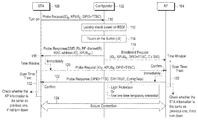
- FIG. 1 illustrates a procedure in which a device and an AP perform initial setup using a configurator according to one embodiment of the present disclosure
- FIG. 2 illustrates a procedure in which a device and an AP perform initial setup using a configurator according to one embodiment of the present disclosure
- FIG. 3 illustrates a procedure in which a device and an AP perform initial setup using a configurator according to one embodiment of the present disclosure
- FIG. 4 illustrates a procedure in which a plurality of devices and an AP perform initial setup using a configurator according to one embodiment of the present disclosure
- FIG. 5 illustrates a TTSC procedure using a configurator according to the present disclosure
- FIG. 6 illustrates an operation of a configurator according to an embodiment of the present disclosure
- FIG. 7 illustrates an operation of a device that requests connection according to an embodiment of the present disclosure
- FIG. 8 illustrates an operation of an AP that accepts connection according to an embodiment of the present disclosure
- FIG. 9 illustrates an operation of a configurator according to one embodiment of the present disclosure
- FIG. 10 schematically illustrates the configuration of a configurator according to an embodiment of the present disclosure
- FIG. 11 schematically illustrates the configuration of a device according to an embodiment of the present disclosure.
- FIG. 12 schematically illustrates the configuration of an AP according to an embodiment of the present disclosure.
- An Access Point is an entity that communicates with a device, and may also be referred to as a base station, a BS, a NodeB (NB), an eNode B (eNB), or the like.
- a device is an entity that communicates with an AP and may also be referred to as an object, a User Equipment (UE), a Mobile Station (MS), a station (STA), a Mobile Equipment (ME), a terminal, or the like.
- UE User Equipment
- MS Mobile Station
- STA station
- ME Mobile Equipment
- a configurator is an entity that serves as a medium to connect a device and an AP.
- the configurator may be provided as a separate apparatus from the device or the AP, or may be provided as a module included in the device or the AP.
- a terminal such as a smartphone, may be provided as an apparatus serving as the configurator.
- the present disclosure proposes a technique for supporting the initial setup of an AP and a device through only a single touch in a configurator using the configurator.
- the configurator transmits necessary information for two devices (that is, the device and the AP) that desire connection.
- the device or the AP may check whether information received from the counterpart thereof (the AP or the device, respectively) within a predetermined period of time matches the information received from the configurator and may allow connection to the counterpart.
- a unified UX for initial setup may be provided regardless of an initial setup communication mode (Wi-Fi or BLE) used by the device, and the usability of the device may be improved.
- Wi-Fi or BLE initial setup communication mode
- the present disclosure also proposes a method of using a time window of a limited time period in order to reduce the load of signaling for security in an initial setup process between an AP and a device. For example, when security is achieved based on close proximity using a Quick Response (QR) code or using Near Field Communication (NFC), a signaling load occurs due to the QR code or NFC communication.
- QR Quick Response
- NFC Near Field Communication
- the present disclosure may check the reception of a response during a time window of a certain length from the start time of a setup procedure triggered by the configurator to check the validity of an enrollee, thus achieving security. That is, the method according to the present disclosure is intended to eliminate the load of signaling for security and to achieve security by using a time restriction.
- the setup method of the present disclosure may reduce the load of signaling.
- the method according to the present disclosure may use temporary credentials, thereby preventing hacking attacks by other devices.
- the present disclosure provides a convenient Device Provisioning Protocol (DPP) setup procedure, which enables a setup procedure to be performed even in a device not providing a UI (that is, a UI-less device) by using Touch Triggered Scan & Configuration (TTSC) of a configurator.
- DPP Device Provisioning Protocol
- TTSC Touch Triggered Scan & Configuration
- a user may perform initial setup with the same (that is, unified) UX not only where a device uses Wi-Fi as a communication mode for setup but also where the device uses Neighborhood-Area Networking (NAN) or Bluetooth Low Energy (BLE).
- NAN Neighborhood-Area Networking
- BLE Bluetooth Low Energy
- the present disclosure uses a time restriction, such as a time window, for the security of a device participating in initial setup, thus achieving secure initial setup with very little signaling.
- FIG. 5 illustrates a TTSC procedure using a configurator according to the present disclosure.
- a configurator 502 may perform a pre-association procedure with a device 500 which is an enrollee ( 510 ).
- the configurator 502 may receive information on the device 500 ( 512 ).
- the configurator 502 may perform a pre-association procedure with an AP 504 which is an enroller ( 514 ).
- the configurator 502 may be, for example, user equipment such as a pad, a tablet, or a smartphone.
- the device 500 as the enrollee, may be any device capable of communicating with the AP, for example, a television (TV), a humidifier, or the like.
- the AP 504 as the enroller may be a small AP, for example, a wireless LAN router installed indoors.
- the configurator 502 When initial setup between the device and the AP is triggered by a user's input (for example, a touch), the configurator 502 transmits information on the AP 504 to the device 500 ( 520 ), and transmits the information on the device 500 to the AP 504 ( 522 ).
- the device 500 and the AP 504 may immediately perform an initial setup procedure, and may perform a discovery procedure ( 530 ) for connection upon receiving a response within a certain period of time.
- the device 500 may immediately transmit a message for initial setup, for example, a probe request message, to the AP 504 , may receive a response message, for example, a probe response message, from the AP 504 , and may verify whether information included in the response message matches the information 522 received from the configurator 502 , thereby determining whether the initial setup procedure succeeded (or failed).
- FIG. 1 illustrates a procedure in which a device and an AP perform initial setup using a configurator according to one embodiment of the present disclosure.
- the probe request message 110 may include ID E as an ID of enrollee information (for example, the device 100 ), KPUB E as a public key of the device 100 , and a Device Password ID (DPID) as an ID indicating which type of connection the device 100 supports.
- ID E an ID of enrollee information
- KPUB E a public key of the device 100
- DPID Device Password ID
- the DPID may have a value indicating, for example, TTSC.
- the configurator 102 may check the locality of the device 100 , that is, proximity, using the signal strength of the received probe request message, that is, a Received Signal Strength Indicator (RSSI).
- RSSI Received Signal Strength Indicator
- the configurator may notify a user through a UI that an enrollment request has been made.
- the configurator 102 may receive an acknowledgment (for example, a touch) of the request 110 ( 114 ).
- the configurator 102 transmits a probe response message to the device 100 ( 116 ), and transmits an enrollment request message to the AP 104 ( 118 ).
- the probe response message 116 may include, as information necessary for the device 100 to connect to the AP 104 , at least one of a Service Set ID (SSID), a Radio Frequency (RF) channel, KPUB AP as a public key of the AP 104 , and a Media Access Control (MAC) address.
- the probe response message 116 may optionally include the MAC address, and may be required to include the SSID and RF channel.
- the enrollment request message 118 may include at least one of ID E , KPUB E , and the DPID. Further, the enrollment request message 118 may also include a C's SIG as a signature of the configurator 102 , and the C's SIG may be used to ensure that the configurator is a device that the device 100 can trust.
- the device 100 Upon receiving the probe response message 116 from the configurator 102 , the device 100 immediately transmits a probe request message 120 to the AP 104 , and waits to receive a probe response message 122 from the AP 104 within a certain period of time (that is, a time window 132 ) by driving a timer.
- the time window 132 may be set to be short enough to ensure security, but long enough to receive the probe response message from the AP 104 . That is, the time window 132 may be set to a time period that is short enough to prevent a different device other than the AP 104 from attempting to connect to (that is, hacking or attacking) the device through copied information.
- the probe request message 120 may include at least one of ID E , KPUB E , and the DPID.
- the AP 104 Upon receiving the enrollment request message 118 from the configurator 102 , the AP 104 immediately starts a timer and waits to receive the probe request message 120 from the device 100 within a certain period of time (that is, a time window 130 ).
- the time window 130 may be set to be short enough to ensure security, but long enough to receive the probe request message from the device 100 .
- the AP 104 checks whether information on the device 100 included in the probe request message 120 matches information on the device 100 included in the enrollment request message 118 . Through the foregoing check, the AP 104 may verify whether the device 100 is a valid enrollee. When the information on the device 100 included in the probe request message 120 matches the information on the device 100 included in the enrollment request message 118 , the AP 104 may transmit the probe response message 122 to the device 100 .
- the device 100 determines whether information on the AP included in the probe response message 122 matches information on the AP in the probe response message 116 received from the configurator 102 .
- the probe response message 122 may include SetSelectedRegistrar (SR indicating the AP's confirmation) information with a value of ‘TRUE’ in addition to the DPID.
- the probe response message 122 may include ConfigData, which is configuration information on the AP 104 .
- ConfigData includes, as the information on the AP 104 , not only the SSID, the RF channel, the MAC address, and the public key KPUB AP but also temporary credentials or a light encryption (security) key as one-time credentials for connection.
- the AP 104 sends the temporary credentials to the device 100 , instead of permanent credentials, because a secure connection has not yet been established between the AP 104 and the device 100 . That is, the temporary credentials are used to prevent hacking due to leakage of permanent credentials. Since security is achieved through the use of a time window, only light encryption (security) need be applied as the temporary credentials.
- the device 100 When the device 100 receives the probe response 122 in the predefined time window 132 and checks that the probe response 122 matches the previous probe response 116 , the device 100 starts secure connection with the AP 104 ( 124 ).
- a procedure for the secure connection 124 procedure may be implemented according to any existing mode.
- the device 100 and the AP 104 may determine that an attempt to connect is being made by a device that attempts hacking, and may terminate the setup procedure.
- the device 100 and the AP 104 may start a new initial setup procedure.
- the device 100 and the AP 104 may transmit a warning message to the configurator 102 .
- FIG. 2 illustrates a procedure in which a device and an AP perform initial setup using a configurator according to one embodiment of the present disclosure.
- the device 200 the configurator 202 , and the AP 204 perform an initial setup procedure.
- Operations 210 to 224 illustrated in FIG. 2 are the same as operations 110 to 124 of FIG. 1 , and thus a detailed description thereof will be omitted.
- the AP 204 may optionally transmit a protected public action frame to the device 200 , thereby forwarding permanent credentials rather than one-time temporary credentials ( 230 ).
- the permanent credentials may be transmitted via ConfigData in the protected public action frame.
- FIG. 3 illustrates a procedure in which a device and an AP perform initial setup using a configurator according to one embodiment of the present disclosure.
- the device 300 the configurator 302 , and the AP 304 perform an initial setup procedure.
- Operations 310 to 324 illustrated in FIG. 3 are the same as operations 110 to 124 of FIG. 1 , and thus a detailed description thereof will be omitted.
- the device 300 and the AP 304 may terminate a session ( 330 ). Once the device 300 establishes secure connection by receiving temporary credentials from the AP 304 and then terminates a session, the device 300 becomes incapable of re-establishing a secure connection with the AP 304 using the temporary credentials. Thus, the device 300 transmits a probe request message for connection establishment to the configurator 302 once again ( 332 ).
- the configurator 302 may determine whether the device 300 has previously succeeded in initial setup for connection using information (for example, at least one of ID E , KPUB E , and a DPID) included in the probe request message 332 ( 334 ).
- information for example, at least one of ID E , KPUB E , and a DPID
- the configurator 302 may directly create temporary credentials for connection to the AP 304 and may forward the temporary credentials to the device 300 .
- the configurator 302 may transmit a probe response message 338 to the device 300 .
- the probe response message 338 may include ConfigData including temporary credentials of the AP 304 and may further include at least one of an SSID, a MAC address, an RF channel, and a KPUB AP of the AP 304 .
- FIG. 4 illustrates a procedure in which a plurality of devices and an AP perform initial setup using a configurator according to one embodiment of the present disclosure.
- a procedure of approving all enrollment requests from the plurality of devices through a configurator is a very complicated task (for example, when there are ten sensors, the same operation is repeated 10 times). Accordingly, the present disclosure provides a method for simplifying a triggering operation of the configurator even when a plurality of devices makes an enrollment request.
- the configurator may efficiently manage TTSC.
- the plurality of devices may have a single Group ID (GI).
- a GI may be included in a Device Provisioning Protocol (DPP) Information Element (IE) defined in the Wi-Fi Alliance standard.
- DPP Device Provisioning Protocol
- IE Information Element
- the configurator 406 may operate a timer, and may wait and scan for a probe request received from another device during a predefined time window 430 ( 420 ).
- the probe request message 410 may further include a GI in addition to at least one of ID E , KPUB E , and a DPID.
- the GI is included in the probe request message 410
- the configurator 406 may determine that there is an enrollment request from another device belonging to a group and may decide to wait to receive a new probe request. That is, the GI indicates that the device 400 belongs to the group.
- the configurator 406 may operate the timer again, and may wait and scan for a probe request received from another device during a predefined time window 432 .
- the probe request message 412 may further include a GI in addition to at least one of ID E , KPUB E , and a DPID.
- the configurator 406 may (immediately) operate the timer again, and may wait and scan for a probe request received from another device during a predefined time window 434 .
- the probe request message 414 may further include a GI in addition to at least one of ID E , KPUB E , and a DPID.
- the configurator 406 may terminate the scan operation and may start an initial setup procedure (that is, DPP) ( 422 ).
- the configurator 406 may wait for user input while displaying on a screen how many devices have requested connection or how many devices have been scanned ( 424 ).
- the configurator 406 may display the ratio of the number of devices of which enrollment requests have been received to the total number of devices belonging to the group.
- the total number of devices may be set in advance and may be shared with the configurator.
- the configurator 406 When the configurator 406 receives an input (for example, a touch) ( 440 ), the configurator may perform subsequent procedures (that is, DPP) ( 450 ) of initial setup, illustrated in FIGS. 1 to 3 .
- an input for example, a touch
- the configurator may perform subsequent procedures (that is, DPP) ( 450 ) of initial setup, illustrated in FIGS. 1 to 3 .
- Table 1 sets forth attributes of an IE that may be additionally included for a device group according to one embodiment of the present disclosure.
- FIG. 6 illustrates an operation of a configurator according to embodiments of the present disclosure.
- the configurator receives a probe request message from an enrollee (that is, a device) ( 600 ).
- the configurator checks whether a DPID included in the probe request message indicates TTSC ( 602 ).
- the configurator When the DPID does not indicate TTSC, the configurator performs an initial setup procedure according to a connection mode indicated by the DPID ( 604 ).
- the configurator checks whether there is an acknowledgement of TTSC, that is, an acknowledgment input, from a user ( 606 ).
- the configurator When there is no acknowledgment input from the user, the configurator operates no longer, and terminates the procedure ( 608 ). Alternatively, the configurator may turn off the device.
- the configurator When there is an acknowledgment input from the user, the configurator transmits a probe response message to the device ( 610 ). Further, the configurator transmits an enrollment request message to an enroller (that is, an AP) ( 612 ).
- an enroller that is, an AP
- FIG. 7 illustrates an operation of a device that requests connection according to an embodiment of the present disclosure.
- the device When an enrollee (that is, the device) is turned on ( 700 ), the device transmits a first probe request message to a configurator ( 702 ).
- the device receives a first probe response message from the configurator ( 704 ).
- the first probe response message may include pieces of information necessary for connection to an enroller (that is, an AP).
- the device transmits a second probe request message to the AP, starts a timer ( 706 ), and waits to receive a second probe response message during a predefined time window ( 708 ).
- the device determines whether a current time (T) is within the time window (TW_ 0 ) ( 712 ).
- the device may disregard the second probe request message, and may terminate an initial setup procedure ( 714 ). Alternatively, the device may be turned off.
- the device may check whether AP information included in the second probe response message 710 matches AP information included in the first probe response message 704 ( 716 ).
- the device may disregard the second probe response message and may terminate the initial setup procedure ( 720 ). Alternatively, the device may be turned off.
- the device starts a procedure for establishing a secure connection to the AP using the AP information included in the second probe response message 710 ( 718 ).
- FIG. 8 illustrates an operation of an AP that accepts connection according to an embodiment of the present disclosure.
- An enroller that is, the AP receives an enrollment request message including a DPID that indicates TTSC ( 800 ).
- the AP immediately starts a timer and waits to receive a probe request message during a predefined time window ( 802 ).
- the AP determines whether a current time (T) is within the time window (TW_ 0 ) ( 806 ).
- the AP may disregard the probe request message 804 and may terminate an initial setup procedure ( 808 ).
- the AP may check whether device information included in the probe request message 804 matches device information included in the enrollment request message 800 ( 810 ).
- the AP may disregard the probe request message 804 and may terminate the initial setup procedure ( 812 ).
- the AP transmits a probe response message including ConfigData on the AP to the device ( 814 ).
- the AP starts a procedure for secure connection with the device ( 816 ).
- FIG. 9 illustrates an operation of a configurator according to one embodiment of the present disclosure.
- the configurator receives a probe request message ( 900 ).
- the configurator starts a timer ( 902 ).
- the configurator checks whether an Enrollee Request Type (ERT) value included in the probe request message is 1 ( 904 ).
- the configurator determines that an enrollment request is made by a single device, rather than by a group, and displays the enrollment request from the device through a UI on a screen ( 906 ).
- the configurator determines that an enrollment request is made by a device in a group and checks whether a predefined time window has elapsed ( 908 ).
- the configurator may wait to receive a probe request message from another enrollee by repeating operations 900 to 910 ( 912 ).
- the configurator may notify a user of an enrollment request, displaying the number of devices that have made enrollment requests so far through a UI on the screen ( 910 ).
- FIG. 10 schematically illustrates the configuration of a configurator according to embodiments of the present disclosure.
- the configurator 1000 may include a transceiver 1010 to perform signal transmission and reception with a device or an AP and a controller 1020 to control the overall operation of the configurator 1000 . It can readily be understood that all operations of the configurator described above in the embodiments of the present disclosure are performed under the control of the controller 1020 .
- the controller 1020 and the transceiver 1010 are not necessarily configured as separate devices, but may be configured as a single component, such as a single chip.
- FIG. 11 schematically illustrates the configuration of a device according to embodiments of the present disclosure.
- the device 1100 may include a transceiver 1110 , to perform signal transmission and reception with a configurator or an AP, and a controller 1120 , to control the overall operation of the device 1100 . It can readily be understood that all operations of the device described above in the embodiments of the present disclosure are performed under the control of the controller 1120 .
- the controller 1120 and the transceiver 1110 are not necessarily configured as separate devices but may be configured as a single component, such as a single chip.
- FIG. 12 schematically illustrates the configuration of an AP according to embodiments of the present disclosure.
- the AP 1200 may include a transceiver 1210 , to perform signal transmission and reception with a device or a configurator, and a controller 1220 , to control the overall operation of the AP 1200 . It can readily be understood that all operations of the AP described above in the embodiments of the present disclosure are performed under the control of the controller 1220 .
- the controller 1220 and the transceiver 1210 are not necessarily configured as separate devices, but may be configured as a single component, such as a single chip.
- FIGS. 1 to 12 The system signal flows, the initial setup procedures, the DPP procedures, and the methods of various devices as shown in FIGS. 1 to 12 are not intended to limit the scope of the present disclosure. That is, all components or operations shown in FIGS. 1 to 12 should not be interpreted as essential components for embodying the present disclosure, and the present disclosure can be embodied using only some of the components without departing from the technical features of the present disclosure.
- the above-described operations can be realized by including a memory device storing a corresponding program code in an AP, a configurator, or an arbitrary component of a device in a communication system. That is, the AP, the configurator, or the controller of the device can execute the above-described operations by reading and executing the program code stored in the memory device through a processor or a Central Processing Unit (CPU).
- a processor or a Central Processing Unit (CPU).
- a hardware circuit e.g, a complementary metal oxide semiconductor based logic circuit, firmware, software, and/or a combination of hardware and the firmware and/or software embedded in a machine readable medium.
- a hardware circuit e.g, a complementary metal oxide semiconductor based logic circuit, firmware, software, and/or a combination of hardware and the firmware and/or software embedded in a machine readable medium.
- various electric configurations and methods may be carried out by using electric circuits such as transistors, logic gates, and an Application Specific Integrated Circuit (ASIC).
- ASIC Application Specific Integrated Circuit
Landscapes
- Engineering & Computer Science (AREA)
- Computer Networks & Wireless Communication (AREA)
- Signal Processing (AREA)
- Computer Security & Cryptography (AREA)
- Mobile Radio Communication Systems (AREA)
Abstract
Description
| TABLE 1 | ||
| Attribute | Required/Optional/C | Value |
| ERT (Enrollee | ◯ | Single request (0x01), one |
| Request Type) | of multiple requests (Ox02) | |
| TWE (Time | ◯ | The length of a time window |
| Window for | for waiting to receive the | |
| Enrollee) | next enrollee request when | |
| receiving an enrollee | ||
| request | ||
| EGI (Enrollee | ◯ | Displays the number of |
| Group | devices in a group | |
| Indicator) | ||
Claims (10)
Applications Claiming Priority (4)
| Application Number | Priority Date | Filing Date | Title |
|---|---|---|---|
| KR1020150038494A KR102238407B1 (en) | 2015-03-19 | 2015-03-19 | Scheme for supportig initial setup of enrollee apparatus and enroller appratus |
| KR10-20150038494 | 2015-03-19 | ||
| KR10-2015-0038494 | 2015-03-19 | ||
| PCT/KR2016/002810 WO2016148548A1 (en) | 2015-03-19 | 2016-03-21 | Technique for supporting initial setup between connection request device and connection acceptance device |
Publications (2)
| Publication Number | Publication Date |
|---|---|
| US20180054845A1 US20180054845A1 (en) | 2018-02-22 |
| US10595351B2 true US10595351B2 (en) | 2020-03-17 |
Family
ID=56919041
Family Applications (1)
| Application Number | Title | Priority Date | Filing Date |
|---|---|---|---|
| US15/559,704 Expired - Fee Related US10595351B2 (en) | 2015-03-19 | 2016-03-21 | Technique for supporting initial setup between connection request device and connection acceptance device |
Country Status (3)
| Country | Link |
|---|---|
| US (1) | US10595351B2 (en) |
| KR (1) | KR102238407B1 (en) |
| WO (1) | WO2016148548A1 (en) |
Families Citing this family (18)
| Publication number | Priority date | Publication date | Assignee | Title |
|---|---|---|---|---|
| US10749858B2 (en) * | 2015-09-04 | 2020-08-18 | Hewlett Packard Enterprise Development Lp | Secure login information |
| US10873842B2 (en) * | 2016-04-08 | 2020-12-22 | Blackberry Limited | Managed object to provision a device according to one of plural provisioning techniques |
| KR102390046B1 (en) * | 2017-03-08 | 2022-04-25 | 삼성전자주식회사 | Wireless router, internet of things device and system for supporting a connection to wireless router of internet of things device |
| US10171304B2 (en) | 2017-04-27 | 2019-01-01 | Blackberry Limited | Network policy configuration |
| WO2019177231A1 (en) * | 2018-03-16 | 2019-09-19 | 엘지전자 주식회사 | Method for transferring information on target access point in wireless lan system and access point using same |
| KR102411604B1 (en) * | 2018-03-22 | 2022-06-21 | 삼성전자주식회사 | Access point and method for connecting communication with external device thereof |
| US11638146B2 (en) * | 2018-03-28 | 2023-04-25 | Qualcomm Incorporated | Onboarding multiple access point (Multi-AP) device using device provisioning protocol (DPP) |
| JP7296701B2 (en) | 2018-09-06 | 2023-06-23 | キヤノン株式会社 | Communication device, control method and program |
| WO2020071776A1 (en) * | 2018-10-02 | 2020-04-09 | 엘지전자 주식회사 | Device and method for wireless connecting in wireless lan system |
| US11121871B2 (en) * | 2018-10-22 | 2021-09-14 | International Business Machines Corporation | Secured key exchange for wireless local area network (WLAN) zero configuration |
| JP7324001B2 (en) * | 2018-12-28 | 2023-08-09 | キヤノン株式会社 | COMMUNICATION DEVICE, COMMUNICATION DEVICE CONTROL METHOD, AND PROGRAM |
| JP7259334B2 (en) * | 2019-01-09 | 2023-04-18 | ブラザー工業株式会社 | Terminal and computer program for terminal |
| CN112543466B (en) * | 2019-09-23 | 2024-08-09 | 中兴通讯股份有限公司 | A method and device for role self-election |
| CN113099451A (en) * | 2020-01-07 | 2021-07-09 | 上海诺基亚贝尔股份有限公司 | Method, apparatus, device and computer readable medium for connecting to a network |
| FR3117721A1 (en) * | 2020-12-14 | 2022-06-17 | Sagemcom Broadband Sas | MULTIPLE PAIRING PROCEDURE FOR PAIRING SEVERAL STATIONS TO ONE WIRELESS ACCESS POINT |
| CN114884970B (en) * | 2021-02-05 | 2024-11-29 | Oppo广东移动通信有限公司 | Information processing method and equipment and storage medium |
| US11963200B2 (en) * | 2021-03-09 | 2024-04-16 | Amdocs Development Limited | System, method, and computer program for resource orchestration in a 5G network based on user equipment behavior analystics |
| EP4274309A4 (en) | 2021-03-24 | 2024-07-17 | Samsung Electronics Co., Ltd. | ELECTRONIC DEVICE FOR CARRYING OUT A NETWORK MANAGEMENT OPERATION, AND ASSOCIATED OPERATING METHOD |
Citations (9)
| Publication number | Priority date | Publication date | Assignee | Title |
|---|---|---|---|---|
| US20060142034A1 (en) * | 2004-12-23 | 2006-06-29 | Conexant Systems, Inc. | Systems and methods for device discovery |
| JP2012034026A (en) | 2010-07-28 | 2012-02-16 | Buffalo Inc | Encryption key sharing method, radio terminal, and access point |
| US20130283346A1 (en) | 2012-04-18 | 2013-10-24 | Futurewei Technologies, Inc. | System and Method For Rapid Authentication In Wireless Communications |
| US20140064128A1 (en) | 2012-09-06 | 2014-03-06 | Lg Electronics Inc. | Method and apparatus for a scanning in wlan |
| US20140211777A1 (en) * | 2005-04-05 | 2014-07-31 | Cisco Technology Inc. | Wireless connection selection and setup |
| WO2014181995A1 (en) | 2013-05-06 | 2014-11-13 | 엘지전자 주식회사 | Method and apparatus for active scanning in wireless lan |
| US8917651B2 (en) | 2011-10-05 | 2014-12-23 | Cisco Technology, Inc. | Associating wi-fi stations with an access point in a multi-access point infrastructure network |
| US20150052357A1 (en) | 2012-04-11 | 2015-02-19 | Siemens Aktiengesellschaft | Method and network node device for controlling the run of technology specific push-button configuration sessions within a heterogeneous or homogenous wireless network and heterogeneous or homogenous wireless network |
| US20150131608A1 (en) * | 2013-11-11 | 2015-05-14 | Intellectual Discovery Co., Ltd. | Station and method of setting connection the access point and the station |
Family Cites Families (1)
| Publication number | Priority date | Publication date | Assignee | Title |
|---|---|---|---|---|
| KR102025727B1 (en) * | 2012-07-10 | 2019-09-26 | 한국전자통신연구원 | Method and apparatus for managing resource |
-
2015
- 2015-03-19 KR KR1020150038494A patent/KR102238407B1/en active Active
-
2016
- 2016-03-21 US US15/559,704 patent/US10595351B2/en not_active Expired - Fee Related
- 2016-03-21 WO PCT/KR2016/002810 patent/WO2016148548A1/en not_active Ceased
Patent Citations (10)
| Publication number | Priority date | Publication date | Assignee | Title |
|---|---|---|---|---|
| US20060142034A1 (en) * | 2004-12-23 | 2006-06-29 | Conexant Systems, Inc. | Systems and methods for device discovery |
| US20140211777A1 (en) * | 2005-04-05 | 2014-07-31 | Cisco Technology Inc. | Wireless connection selection and setup |
| JP2012034026A (en) | 2010-07-28 | 2012-02-16 | Buffalo Inc | Encryption key sharing method, radio terminal, and access point |
| US8917651B2 (en) | 2011-10-05 | 2014-12-23 | Cisco Technology, Inc. | Associating wi-fi stations with an access point in a multi-access point infrastructure network |
| US20150052357A1 (en) | 2012-04-11 | 2015-02-19 | Siemens Aktiengesellschaft | Method and network node device for controlling the run of technology specific push-button configuration sessions within a heterogeneous or homogenous wireless network and heterogeneous or homogenous wireless network |
| US20130283346A1 (en) | 2012-04-18 | 2013-10-24 | Futurewei Technologies, Inc. | System and Method For Rapid Authentication In Wireless Communications |
| US20140064128A1 (en) | 2012-09-06 | 2014-03-06 | Lg Electronics Inc. | Method and apparatus for a scanning in wlan |
| WO2014181995A1 (en) | 2013-05-06 | 2014-11-13 | 엘지전자 주식회사 | Method and apparatus for active scanning in wireless lan |
| US20160007275A1 (en) | 2013-05-06 | 2016-01-07 | Lg Electronics Inc. | Method and apparatus for active scanning in wireless lan |
| US20150131608A1 (en) * | 2013-11-11 | 2015-05-14 | Intellectual Discovery Co., Ltd. | Station and method of setting connection the access point and the station |
Non-Patent Citations (1)
| Title |
|---|
| K. Hori, T. Ogishi, M. Lai, D. Chee and K. Sinkar, "Automatic over-the-air provisioning for Wi-Fi equipped M2M devices," 38th Annual IEEE Conference on Local Computer Networks, Sydney, NSW, 2013, pp. 675-678. http://ieeexplore.ieee.org/stamp/stamp.jsp?tp=&arnumber=6761308&isnumber=6761208. * |
Also Published As
| Publication number | Publication date |
|---|---|
| KR102238407B1 (en) | 2021-04-09 |
| US20180054845A1 (en) | 2018-02-22 |
| KR20160112563A (en) | 2016-09-28 |
| WO2016148548A1 (en) | 2016-09-22 |
Similar Documents
| Publication | Publication Date | Title |
|---|---|---|
| US20180054845A1 (en) | Technique for supporting initial setup between connection request device and connection acceptance device | |
| KR102314917B1 (en) | Method and apparatus for configuring connection between devices in a communication system | |
| US10756964B2 (en) | Internet of things configuration method and system for secure low-power-consumption proxy device | |
| CN104618988B (en) | Smart machine method for network access and device | |
| KR102060547B1 (en) | Method and apparatus for registering wireless device in wireless communication system | |
| US9438332B2 (en) | Low cost proximity pairing mechanism in wireless personal area networks | |
| KR102210823B1 (en) | Method and apparatus of communication for smart home devices | |
| KR102005408B1 (en) | Method and apparatus for registering and authenticating a device in a wireless communication system | |
| KR20170105566A (en) | Method, apparatus and computer program product for local control via intermediate device | |
| KR20140006977A (en) | Group-based machine to machine communication | |
| US20190007183A1 (en) | METHOD AND APPARATUS FOR MoCA NETWORK WITH PROTECTED SET-UP | |
| US11071045B2 (en) | Electronic device, communication method of electronic device, and communication method of mobile terminal | |
| WO2015085671A1 (en) | Wireless network access method and access apparatus | |
| US20140059643A1 (en) | Wireless communication apparatus, recording medium, and method | |
| KR102119586B1 (en) | Systems and methods for relaying data over communication networks | |
| CN107979864B (en) | Access method, device and system of access point | |
| Pratas et al. | Massive machine-type communication (mMTC) access with integrated authentication | |
| WO2016173190A1 (en) | Information providing method and device | |
| KR20170039247A (en) | Method, device and system for selecting security algorithm | |
| CN113543150A (en) | Network distribution method and device for smart device, electronic device, and computer-readable medium | |
| CN104486776A (en) | WPS (Wi Fi Protected Setup) implementation method of Wi-Fi relay equipment and Wi-Fi relay equipment | |
| US10070289B1 (en) | Client association for provisioning devices in a communication network | |
| JP2016100626A (en) | Wireless communication method, wireless communication system, wireless communication apparatus, and program | |
| US10292187B2 (en) | Wireless communication apparatus, server, payment apparatus, wireless communication method, and program | |
| CN106454819A (en) | WIFI access point accessing method and apparatus |
Legal Events
| Date | Code | Title | Description |
|---|---|---|---|
| FEPP | Fee payment procedure |
Free format text: ENTITY STATUS SET TO UNDISCOUNTED (ORIGINAL EVENT CODE: BIG.); ENTITY STATUS OF PATENT OWNER: LARGE ENTITY |
|
| AS | Assignment |
Owner name: SAMSUNG ELECTRONICS CO., LTD., KOREA, REPUBLIC OF Free format text: ASSIGNMENT OF ASSIGNORS INTEREST;ASSIGNORS:LEE, SOO-YONG;LEE, BYUNG-MOO;LEE, JOO-YEOL;AND OTHERS;SIGNING DATES FROM 20170825 TO 20170915;REEL/FRAME:043647/0267 |
|
| STPP | Information on status: patent application and granting procedure in general |
Free format text: NON FINAL ACTION MAILED |
|
| STPP | Information on status: patent application and granting procedure in general |
Free format text: RESPONSE TO NON-FINAL OFFICE ACTION ENTERED AND FORWARDED TO EXAMINER |
|
| STPP | Information on status: patent application and granting procedure in general |
Free format text: FINAL REJECTION MAILED |
|
| STPP | Information on status: patent application and granting procedure in general |
Free format text: RESPONSE AFTER FINAL ACTION FORWARDED TO EXAMINER |
|
| STPP | Information on status: patent application and granting procedure in general |
Free format text: NOTICE OF ALLOWANCE MAILED -- APPLICATION RECEIVED IN OFFICE OF PUBLICATIONS |
|
| ZAAA | Notice of allowance and fees due |
Free format text: ORIGINAL CODE: NOA |
|
| ZAAB | Notice of allowance mailed |
Free format text: ORIGINAL CODE: MN/=. |
|
| STPP | Information on status: patent application and granting procedure in general |
Free format text: PUBLICATIONS -- ISSUE FEE PAYMENT RECEIVED |
|
| STPP | Information on status: patent application and granting procedure in general |
Free format text: PUBLICATIONS -- ISSUE FEE PAYMENT VERIFIED |
|
| STCF | Information on status: patent grant |
Free format text: PATENTED CASE |
|
| FEPP | Fee payment procedure |
Free format text: MAINTENANCE FEE REMINDER MAILED (ORIGINAL EVENT CODE: REM.); ENTITY STATUS OF PATENT OWNER: LARGE ENTITY |
|
| LAPS | Lapse for failure to pay maintenance fees |
Free format text: PATENT EXPIRED FOR FAILURE TO PAY MAINTENANCE FEES (ORIGINAL EVENT CODE: EXP.); ENTITY STATUS OF PATENT OWNER: LARGE ENTITY |
|
| STCH | Information on status: patent discontinuation |
Free format text: PATENT EXPIRED DUE TO NONPAYMENT OF MAINTENANCE FEES UNDER 37 CFR 1.362 |
|
| FP | Lapsed due to failure to pay maintenance fee |
Effective date: 20240317 |