US10590141B2 - Thioglycoluril compound, and method for producing same - Google Patents
Thioglycoluril compound, and method for producing same Download PDFInfo
- Publication number
- US10590141B2 US10590141B2 US16/330,071 US201716330071A US10590141B2 US 10590141 B2 US10590141 B2 US 10590141B2 US 201716330071 A US201716330071 A US 201716330071A US 10590141 B2 US10590141 B2 US 10590141B2
- Authority
- US
- United States
- Prior art keywords
- compound
- monothioglycoluril
- dithioglycoluril
- tetrakis
- thioglycoluril
- Prior art date
- Legal status (The legal status is an assumption and is not a legal conclusion. Google has not performed a legal analysis and makes no representation as to the accuracy of the status listed.)
- Active
Links
- 150000001875 compounds Chemical class 0.000 title claims abstract description 66
- 238000004519 manufacturing process Methods 0.000 title description 4
- 125000000217 alkyl group Chemical group 0.000 claims abstract description 14
- 125000004432 carbon atom Chemical group C* 0.000 claims abstract description 11
- RTZKZFJDLAIYFH-UHFFFAOYSA-N ether Substances CCOCC RTZKZFJDLAIYFH-UHFFFAOYSA-N 0.000 claims abstract description 11
- 125000004435 hydrogen atom Chemical group [H]* 0.000 claims abstract description 10
- 229910052799 carbon Inorganic materials 0.000 claims abstract description 9
- 125000006165 cyclic alkyl group Chemical group 0.000 claims abstract description 9
- 229910052717 sulfur Chemical group 0.000 claims abstract description 9
- 125000001797 benzyl group Chemical group [H]C1=C([H])C([H])=C(C([H])=C1[H])C([H])([H])* 0.000 claims abstract description 8
- 125000001624 naphthyl group Chemical group 0.000 claims abstract description 8
- 125000001997 phenyl group Chemical group [H]C1=C([H])C([H])=C(*)C([H])=C1[H] 0.000 claims abstract description 8
- 125000004434 sulfur atom Chemical group 0.000 claims abstract description 7
- 125000004430 oxygen atom Chemical group O* 0.000 claims abstract description 6
- OKKJLVBELUTLKV-UHFFFAOYSA-N Methanol Chemical group OC OKKJLVBELUTLKV-UHFFFAOYSA-N 0.000 description 21
- HEMHJVSKTPXQMS-UHFFFAOYSA-M Sodium hydroxide Chemical compound [OH-].[Na+] HEMHJVSKTPXQMS-UHFFFAOYSA-M 0.000 description 21
- 239000000203 mixture Substances 0.000 description 18
- WSFSSNUMVMOOMR-UHFFFAOYSA-N Formaldehyde Chemical compound O=C WSFSSNUMVMOOMR-UHFFFAOYSA-N 0.000 description 15
- 0 *OCN1C(=C)N(CO*)C2C1N(CO*)C(=S)N2CO* Chemical compound *OCN1C(=C)N(CO*)C2C1N(CO*)C(=S)N2CO* 0.000 description 14
- 238000000034 method Methods 0.000 description 14
- 239000002904 solvent Substances 0.000 description 11
- 230000015572 biosynthetic process Effects 0.000 description 10
- 238000003786 synthesis reaction Methods 0.000 description 10
- XEKOWRVHYACXOJ-UHFFFAOYSA-N Ethyl acetate Chemical compound CCOC(C)=O XEKOWRVHYACXOJ-UHFFFAOYSA-N 0.000 description 9
- 238000006243 chemical reaction Methods 0.000 description 9
- IAZDPXIOMUYVGZ-WFGJKAKNSA-N Dimethyl sulfoxide Chemical compound [2H]C([2H])([2H])S(=O)C([2H])([2H])[2H] IAZDPXIOMUYVGZ-WFGJKAKNSA-N 0.000 description 8
- 239000000047 product Substances 0.000 description 8
- LFQSCWFLJHTTHZ-UHFFFAOYSA-N Ethanol Chemical compound CCO LFQSCWFLJHTTHZ-UHFFFAOYSA-N 0.000 description 7
- XGQJGMGAMHFMAO-UHFFFAOYSA-N 1,3,4,6-tetrakis(methoxymethyl)-3a,6a-dihydroimidazo[4,5-d]imidazole-2,5-dione Chemical compound COCN1C(=O)N(COC)C2C1N(COC)C(=O)N2COC XGQJGMGAMHFMAO-UHFFFAOYSA-N 0.000 description 6
- 239000003431 cross linking reagent Substances 0.000 description 6
- 239000013078 crystal Substances 0.000 description 6
- -1 glycoluril compound Chemical class 0.000 description 6
- 125000004433 nitrogen atom Chemical group N* 0.000 description 6
- 238000000425 proton nuclear magnetic resonance spectrum Methods 0.000 description 6
- 239000000243 solution Substances 0.000 description 6
- XLYOFNOQVPJJNP-UHFFFAOYSA-N water Substances O XLYOFNOQVPJJNP-UHFFFAOYSA-N 0.000 description 6
- 239000003822 epoxy resin Substances 0.000 description 5
- LNEPOXFFQSENCJ-UHFFFAOYSA-N haloperidol Chemical compound C1CC(O)(C=2C=CC(Cl)=CC=2)CCN1CCCC(=O)C1=CC=C(F)C=C1 LNEPOXFFQSENCJ-UHFFFAOYSA-N 0.000 description 5
- 238000004128 high performance liquid chromatography Methods 0.000 description 5
- 125000002496 methyl group Chemical group [H]C([H])([H])* 0.000 description 5
- 229920000647 polyepoxide Polymers 0.000 description 5
- 239000007864 aqueous solution Substances 0.000 description 4
- VPVSTMAPERLKKM-UHFFFAOYSA-N glycoluril Chemical class N1C(=O)NC2NC(=O)NC21 VPVSTMAPERLKKM-UHFFFAOYSA-N 0.000 description 4
- 125000004184 methoxymethyl group Chemical group [H]C([H])([H])OC([H])([H])* 0.000 description 4
- 239000007787 solid Substances 0.000 description 4
- ARXJGSRGQADJSQ-UHFFFAOYSA-N 1-methoxypropan-2-ol Chemical compound COCC(C)O ARXJGSRGQADJSQ-UHFFFAOYSA-N 0.000 description 3
- IMNFDUFMRHMDMM-UHFFFAOYSA-N N-Heptane Chemical compound CCCCCCC IMNFDUFMRHMDMM-UHFFFAOYSA-N 0.000 description 3
- GRYLNZFGIOXLOG-UHFFFAOYSA-N Nitric acid Chemical compound O[N+]([O-])=O GRYLNZFGIOXLOG-UHFFFAOYSA-N 0.000 description 3
- IAGQPDLYMQODIM-UHFFFAOYSA-N O=C1N(CO)C2C(N1CO)N(CO)C(=S)N2CO Chemical compound O=C1N(CO)C2C(N1CO)N(CO)C(=S)N2CO IAGQPDLYMQODIM-UHFFFAOYSA-N 0.000 description 3
- KWYUFKZDYYNOTN-UHFFFAOYSA-M Potassium hydroxide Chemical compound [OH-].[K+] KWYUFKZDYYNOTN-UHFFFAOYSA-M 0.000 description 3
- PNNCWTXUWKENPE-UHFFFAOYSA-N [N].NC(N)=O Chemical group [N].NC(N)=O PNNCWTXUWKENPE-UHFFFAOYSA-N 0.000 description 3
- 238000010521 absorption reaction Methods 0.000 description 3
- 239000002253 acid Substances 0.000 description 3
- 125000004849 alkoxymethyl group Chemical group 0.000 description 3
- 239000007810 chemical reaction solvent Substances 0.000 description 3
- 230000000052 comparative effect Effects 0.000 description 3
- 238000006266 etherification reaction Methods 0.000 description 3
- 239000008098 formaldehyde solution Substances 0.000 description 3
- 239000012535 impurity Substances 0.000 description 3
- 229910017604 nitric acid Inorganic materials 0.000 description 3
- 239000002244 precipitate Substances 0.000 description 3
- 239000011541 reaction mixture Substances 0.000 description 3
- 238000010898 silica gel chromatography Methods 0.000 description 3
- 125000001424 substituent group Chemical group 0.000 description 3
- 238000006467 substitution reaction Methods 0.000 description 3
- ZOTOTEZLBHYLEF-UHFFFAOYSA-N CCN1C(=S)N(CC)C2C1N(COC)C(=O)N2COC Chemical compound CCN1C(=S)N(CC)C2C1N(COC)C(=O)N2COC ZOTOTEZLBHYLEF-UHFFFAOYSA-N 0.000 description 2
- JIDSJNMLVHNBIH-UHFFFAOYSA-N CCN1C(=S)N(CC)C2C1N(COC)C(=S)N2COC Chemical compound CCN1C(=S)N(CC)C2C1N(COC)C(=S)N2COC JIDSJNMLVHNBIH-UHFFFAOYSA-N 0.000 description 2
- VEXZGXHMUGYJMC-UHFFFAOYSA-N Hydrochloric acid Chemical compound Cl VEXZGXHMUGYJMC-UHFFFAOYSA-N 0.000 description 2
- BPFPEHHPHIILSA-UHFFFAOYSA-N OCN1C(=S)N(CO)C2C1N(CO)C(=S)N2CO Chemical compound OCN1C(=S)N(CO)C2C1N(CO)C(=S)N2CO BPFPEHHPHIILSA-UHFFFAOYSA-N 0.000 description 2
- NINIDFKCEFEMDL-UHFFFAOYSA-N Sulfur Chemical compound [S] NINIDFKCEFEMDL-UHFFFAOYSA-N 0.000 description 2
- QAOWNCQODCNURD-UHFFFAOYSA-N Sulfuric acid Chemical compound OS(O)(=O)=O QAOWNCQODCNURD-UHFFFAOYSA-N 0.000 description 2
- 239000003929 acidic solution Substances 0.000 description 2
- 239000012141 concentrate Substances 0.000 description 2
- 150000002391 heterocyclic compounds Chemical class 0.000 description 2
- 229910052757 nitrogen Inorganic materials 0.000 description 2
- 238000000655 nuclear magnetic resonance spectrum Methods 0.000 description 2
- 230000003287 optical effect Effects 0.000 description 2
- LLHKCFNBLRBOGN-UHFFFAOYSA-N propylene glycol methyl ether acetate Chemical compound COCC(C)OC(C)=O LLHKCFNBLRBOGN-UHFFFAOYSA-N 0.000 description 2
- 230000035484 reaction time Effects 0.000 description 2
- 239000000126 substance Substances 0.000 description 2
- 239000011593 sulfur Substances 0.000 description 2
- 238000002211 ultraviolet spectrum Methods 0.000 description 2
- 238000005406 washing Methods 0.000 description 2
- XOLDQSNFOUGZRC-UHFFFAOYSA-N CCN1C(=O)N(CC)C2C1N(COC)C(=O)N2COC Chemical compound CCN1C(=O)N(CC)C2C1N(COC)C(=O)N2COC XOLDQSNFOUGZRC-UHFFFAOYSA-N 0.000 description 1
- PYRYQWCFZDMJJM-UHFFFAOYSA-N COCN(C(C(N1COC)N2COC)N(COC)C2=S)C1=S Chemical compound COCN(C(C(N1COC)N2COC)N(COC)C2=S)C1=S PYRYQWCFZDMJJM-UHFFFAOYSA-N 0.000 description 1
- ZJISUJZBBBZHPV-UHFFFAOYSA-N O=C1CC2CC(=S)NC2N1 Chemical compound O=C1CC2CC(=S)NC2N1 ZJISUJZBBBZHPV-UHFFFAOYSA-N 0.000 description 1
- BVHPAPJSCRWBCI-UHFFFAOYSA-N S=C1CC2CC(=S)NC2N1 Chemical compound S=C1CC2CC(=S)NC2N1 BVHPAPJSCRWBCI-UHFFFAOYSA-N 0.000 description 1
- ZRVIMDQCIXXVBA-UHFFFAOYSA-N [N].NC(N)=S Chemical group [N].NC(N)=S ZRVIMDQCIXXVBA-UHFFFAOYSA-N 0.000 description 1
- 150000007513 acids Chemical class 0.000 description 1
- 230000003667 anti-reflective effect Effects 0.000 description 1
- 239000007795 chemical reaction product Substances 0.000 description 1
- 238000004132 cross linking Methods 0.000 description 1
- 238000002425 crystallisation Methods 0.000 description 1
- 230000008025 crystallization Effects 0.000 description 1
- 230000000694 effects Effects 0.000 description 1
- 238000001914 filtration Methods 0.000 description 1
- 238000000746 purification Methods 0.000 description 1
- 239000004065 semiconductor Substances 0.000 description 1
- 238000003756 stirring Methods 0.000 description 1
Images


Classifications
-
- C—CHEMISTRY; METALLURGY
- C07—ORGANIC CHEMISTRY
- C07D—HETEROCYCLIC COMPOUNDS
- C07D487/00—Heterocyclic compounds containing nitrogen atoms as the only ring hetero atoms in the condensed system, not provided for by groups C07D451/00 - C07D477/00
- C07D487/02—Heterocyclic compounds containing nitrogen atoms as the only ring hetero atoms in the condensed system, not provided for by groups C07D451/00 - C07D477/00 in which the condensed system contains two hetero rings
- C07D487/04—Ortho-condensed systems
Definitions
- the present invention relates to a novel monothioglycoluril compound and a novel dithioglycoluril compound, and methods for producing these compounds.
- Glycoluril compounds are heterocyclic compounds each having four urea nitrogen atoms in the ring structure. Glycoluril compounds having various substituents on the urea nitrogen atoms have been produced and used as functional compounds.
- 1,3,4,6-tetrakis(methoxymethyl)glycoluril which has four methoxymethyl groups in the molecule, is well known as a crosslinking agent for epoxy resins (see Patent Document 1).
- a glycoluril compound prepared by substitution of an oxygen atom with a sulfur atom in the ring structure for example, a monothioglycoluril compound and a dithioglycoluril compound, have also been known.
- a monothioglycoluril compound and a dithioglycoluril compound having substituents on a urea nitrogen atom or a thiourea nitrogen atom and on a bridgehead carbon atom have been synthesized (see Non-Patent Documents 1, 2, 3, and 4).
- Patent Document 2 discloses a method involving introduction of four methoxymethyl groups in one glycoluril molecule having no substituent.
- Patent Documents 1 and 2 and Non-Patent Documents 1, 2, 3, and 4 describes a monothioglycoluril compound and a dithioglycoluril compound in which the hydrogen atom on at least one nitrogen atom is substituted with an alkoxymethyl group such as a methoxymethyl group.
- Patent Document 1 Japanese Patent Application Publication No. 2013-33276 (JP 2013-33276 A)
- Patent Document 2 Japanese Patent No. 3154819
- Non-Patent Document 1 European journal of Organic Chemistry, pp. 933-940 (2014)
- Non-Patent Document 2 Journal of Organic Chemistry, 62, 8834-8840 (1997)
- Non-Patent Document 3 Chemistry A European Journal, 21, 536-540 (2015)
- Non-Patent Document 4 Tetrahedron Letters, 56, 6085-6088 (2015)
- a monothioglycoluril or dithioglycoluril compound having a plurality of alkoxymethyl groups in the molecule is useful as, for example, a crosslinking agent for epoxy resins.
- a monothioglycoluril or dithioglycoluril compound which is prepared by substitution of at least one of two oxygen atoms with a sulfur atom in the ring structure of a glycoluril compound, has optical properties different from those of 1,3,4,6-tetrakis(methoxymethyl)glycoluril.
- a monothioglycoluril compound, in which only one of the aforementioned two oxygen atoms is substituted with a sulfur atom is expected to have excellent solubility in a solvent because of its low molecular symmetry.
- the present invention has been made on the basis of the situation described above, and an object of the present invention is to provide a novel monothioglycoluril compound and a novel dithioglycoluril compound.
- An aspect of the present invention is a thioglycoluril compound of the following Formula (1):
- X is an oxygen atom or a sulfur atom
- four Rs are each a hydrogen atom, a linear, branched, or cyclic alkyl group having a carbon atom number of 1 to 4, a phenyl group, a naphthyl group, a benzyl group, or a C 3-9 alkyl group having at least one ether bond on the main chain).
- the thioglycoluril compound of Formula (1) is a monothioglycoluril compound of the following Formula (2):
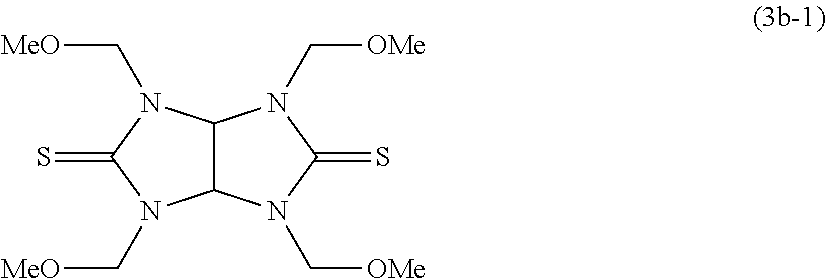
- the thioglycoluril compound of Formula (1) is a dithioglycoluril compound of the following Formula (3);
- Another aspect of the present invention is a method for producing a monothioglycoluril compound, the method comprising a first step of causing a reaction between formaldehyde and a compound of the following Formula (4a) in a basic aqueous solution, and then isolating a compound of the following Formula (2a) and a second step of causing a reaction between the compound of the following Formula (2a) and an alcohol of the following Formula (5) in an acidic solution containing the alcohol as a solvent, adding a basic aqueous solution to the resultant reaction mixture, and purifying the resultant product by silica gel column chromatography for removal of impurities from the product, so as to produce a monothioglycoluril compound of the following Formula (2b):
- R 1 s are each a linear, branched, or cyclic alkyl group having a carbon atom number of 1 to 4, a phenyl group, a naphthyl group, a benzyl group, or a C 3-9 alkyl group having at least one ether bond on the main chain).
- Still another aspect of the present invention is a method for producing a dithioglycoluril compound, the method comprising a first step of causing a reaction between formaldehyde and a compound of the following Formula (4b) in a basic aqueous solution, and then isolating a compound of the following Formula (3a); and a second step of causing a reaction between the compound of the following Formula (3a) and an alcohol of the following Formula (5) in an acidic solution containing the alcohol as a solvent, adding a basic aqueous solution to the resultant reaction mixture, and washing the resultant product with water for removal of impurities from the product, so as to produce to dithioglycoluril compound of the following Formula (3b):
- R 1 s are each a linear, branched, or cyclic alkyl group having a carbon atom number of 1 to 4, a phenyl group, a naphthyl group, a benzyl group, or a C 3-9 alkyl group having at least one ether bond on the main chain).
- the thioglycoluril compound according to the present invention is produced by substitution of the hydrogen atoms bonded to the our nitrogen atoms of thioglycoluril with a —Ch 2 —O—R group (wherein R has the same meaning as defined above in Formula (1)), and the compound is a novel sulfur-containing heterocyclic compound.
- a thioglycoluril compound having two or more —CH 2 —O—R groups (wherein R has the same meaning as defined above) in the molecule is useful as, for example, a crosslinking agent for epoxy resins.
- 1,3,4,6-tetrakis(methoxymethyl)monothioglycoluril and 1,3,4,6-tetrakis(methoxymethyl)dithioglycoluril in which the hydrogen atoms on all the nitrogen atoms are substituted with a methoxymethyl group, have excellent crosslinking performance.
- 1,3,4,6-Tetrakis(methoxymethyl)monothioglycoluril and 1,3,4,6-tetrakis(methoxymethyl)dithioglycoluril, which contain a sulfur atom, are expected to have optical properties different from those of 1,3,4,6-tetrakis(methoxymethyl)glycoluril.
- 1,3,4,6-tetrakis(methoxymethyl)monothioglycoluril has an asymmetric molecular structure and thus low molecular symmetry.
- 1,3,4,6-tetrakis(methoxymethyl)monothioglycoluril exhibits higher solubility in a solvent than conventional 1,3,4,6-tetrakis(methoxymethyl)glycoluril.
- FIG. 1 shows 1 H-NMR spectra of 1,3,4,6-tetrakis(methoxymethyl)monothioglycoluril.
- FIG. 2 shows 1 H-NMR spectra of 1,3,4,6-tetrakis(methoxymethyl)dithioglycoluril.
- FIG. 3 shows UV spectra of 1,3,4,6-tetrakis(methoxymethyl)glycoluril, 1,3,4,6-tetrakis(methoxymethyl)monothioglycoluril, and 1,3,4,6-tetrakis(methoxymethyl)dithioglycoluril.
- the thioglycoluril compound of the present invention is a monothioglycoluril compound of the following Formula (2):
- the thioglycoluril compound of the present invention is a dithioglycoluril compound of the following Formula (3):
- the number of carbon atoms of the alkyl group is, for example, 1 to 12, preferably 1 to 4, most preferably 1.
- the, most preferred alkyl group is a methyl group.
- Preferred examples of monothioglycoluril compound and dithioglycoluril compound of the present invention wherein four Rs are each the aforementioned alkyl group include 1,3,4,6-tetrakis(methoxymethyl)monothioglycoluril, 1,3,4,6-tetrakis(ethoxymethyl)monothioglycoluril, 1,3,4,6-tetrakis(propoxymethyl)monothioglycoluril, 1,3,4,6-tetrakis(n-butoxymethyl)monothioglycoluril, 1,3,4,6-tetrakis(methoxymethyl)dithioglycoluril, 1,3,4,6-tetrakis(ethoxymethyl)dithioglycoluril, 1,3,4,6-tetrakis(propoxymethyl)dithioglycoluril, and 1,3,4,6-tetrakis(n-butoxymethyl)dithioglycoluril.
- the number of carbon atoms of the alkyl group having at least one ether bond on the main chain is, for example, 3 to 9, preferably 3 to 5, most preferably 4.
- Preferred examples of the monothioglycoluril compound and dithioglycoluril compound of the present invention wherein four Rs are each the aforementioned alkyl group having at least one ether bond on the main chain include 1,3,4,6-tetrakis((2-methoxyethoxy)methyl)monothioglycoluril, 1,3,4,6-tetrakis((2-(2-methoxyethoxy)ethoxy)methyl)monothioglycoluril, 1,3,4,6-tetrakis(((1-methoxypropan-2-yl)oxy)methyl)monothioglycoluril, 1,3,4,6-tetrakis(((1-ethoxypropan-2-yl)oxy)methyl)monothioglycoluril, 1,3,4,6-tetra(2,5,8,11-tetraoxadodecyl)monothioglycoluril, 1,3,4,6-tetra(2,5,8,11,14
- R 1 s are each a linear, branched, or cyclic alkyl group having a carbon atom number of 1 to 6, a phenyl group, a naphthyl group, a benzyl group, or a C 3-9 alkyl group having at least one ether bond on the main chain
- R 1 s are each a linear, branched, or cyclic alkyl group having a carbon atom number of 1 to 6, a phenyl group, a naphthyl group, a benzyl group, or a C 3-9 alkyl group having at least one ether bond on the main chain
- R 1 s are each a linear, branched, or cyclic alkyl group having a carbon atom number of 1 to 6, a phenyl group, a naphthyl group, a benzyl group, or a C 3-9 alkyl group having at least one ether bond on the main chain
- R 1 s are each a linear, branched, or cyclic alkyl group having a carbon atom number of 1 to 6, a phenyl group, a naphthyl group, a benzyl group, or a C 3-9 alkyl group having at least one ether bond on the main chain
- the etherification method may be, for example, a method involving the use of an acid selected from the group consisting of hydrochloric acid, nitric acid, and sulfuric acid.
- the acid is used in an amount of preferably 0.1 equivalents to 1.0 equivalent relative to a tetramethylolthioglycoluril compound.
- the reaction solvent used for the aforementioned etherification is an alcohol of the following Formula (5): R 1 —OH (5) (wherein R 1 has the same meaning as defined above in Formulae (2b) and (3b)).
- the reaction temperature for etherification of a tetramethylolthioglycoluril compound using any of the aforementioned acids may vary depending on the type of the reaction solvent used, and is generally 10° C. to 150° C.
- the reaction time must be varied with the reaction temperature, and is generally 1 hour to 4 hours.
- a base e.g., an aqueous sodium hydroxide solution
- the resultant reaction product is concentrated, or dissolved in an appropriate solvent and separated by filtration, to thereby yield a product containing a monothioglycoluril or dithioglycoluril compound of interest.
- the resultant product is subjected to washing with a solvent such as water, crystallization, or purification by, for example, silica gel column chromatography, to thereby remove impurities from the product.
- a solvent such as water, crystallization, or purification by, for example, silica gel column chromatography
- 1,3,4,6-Tetramethylolmonothioglycoluril of Formula (2a) can be produced by reacting monothioglycoluril of the following Formula (4a):
- 1,3,4,6-Tetramethyloldithioglycoluril of Formula (3a) can be produced by reacting dithioglycoluril of the following Formula (4b):
- the methylolation method may be a method involving the use of, for example, a base selected from the group consisting of sodium hydroxide and potassium hydroxide in an aqueous formaldehyde solution.
- the base is used in an amount of preferably 0.001 equivalents to 0.01 equivalents relative to monothioglycoluril or dithioglycoluril.
- the reaction solvent used for the aforementioned methylolation is water.
- the reaction temperature for methylotation of a thioglycoluril compound using any of the aforementioned bases is 25° C. to 100° C.
- the reaction time must be varied with the reaction temperature, and is generally 1 hour to 24 hours.
- Monothioglycoluril of Formula (4a) was synthesized according to the method described in Non-Patent Document 1: European Journal of Organic Chemistry, pp. 933-940 (2014).
- Dithioglycoluril of Formula (4b) was synthesized according to the method described in Non-Patent Document 4: Tetrahedron Letters, 56, 6085-6088 (2015).
- FIG. 1 shows 1 H-NMR spectra oldie produced 1,3,4,6-tetrakis(methoxymethyl)monothioglycoluril.
- the ⁇ values of the NMR spectra (DMSO-d 6 were as follows.
- FIG. 2 shows 1 H-NMR spectra of the produced 1,3,4,6-tetrakis(methoxymethyl)dithioglycoluril.
- the ⁇ values of the NMR spectra (DMSO-d 6 ) were as follows.
- FIG. 3 shows UV spectra of 1,3,4,6-tetrakis(methoxymethyl)monothioglycoluril (hereinafter abbreviated as “TMOM-TGU”) produced in Example 2, 1,3,4,6-tetrakis(methoxymethyl)dithioglycoluril (hereinafter abbreviated as “TMOM-DTGU”) produced in Example 4, and commercially available 1,3,4,6-tetrakis(methoxymethyl)glycoluril (product name: POWDERLINK1174, hereinafter abbreviated as “TMOM-GU”) as Comparative Example.
- TMOM-TGU 1,3,4,6-tetrakis(methoxymethyl)monothioglycoluril
- TMOM-DTGU 1,3,4,6-tetrakis(methoxymethyl)dithioglycoluril
- TMOM-GU commercially available 1,3,4,6-tetrakis(methoxymethyl)glycoluril
- the thioglycoluril compound according to the present invention exhibits a shift of UV absorption wavelength as compared with the sulfur atom-free glycoluril, and has UV absorption around 248 nm.
- TMOM-TGU produced in Example 2
- TMOM-DTGU produced in Example 4
- TMOM-GU as Comparative Example, these compounds were dissolved in propylene glycol 1-monomethyl ether (PGME) or propylene glycol 1-monomethyl ether 2-acetate (PGMEA), each of which is a solvent commonly used in, for example, production processes for semiconductor devices.
- PGME propylene glycol 1-monomethyl ether
- PGMEA propylene glycol 1-monomethyl ether 2-acetate
- 1,3,4,6-tetrakis(methoxymethyl)monothioglycoluril exhibits particularly excellent solubility in a solvent, since it has an asymmetric molecular structure and thus low molecular symmetry.
- the thioglycoluril compound according to the present invention is expected to be useful as, for example, a crosslinking agent for epoxy resins.
- the thioglycoluril compound according to the present invention has absorption at the wavelength of KrF eximer laser and thus is useful as a crosslinking agent for an anti-reflective coating-forming composition.
Landscapes
- Chemical & Material Sciences (AREA)
- Organic Chemistry (AREA)
- Heterocyclic Carbon Compounds Containing A Hetero Ring Having Oxygen Or Sulfur (AREA)
- Nitrogen Condensed Heterocyclic Rings (AREA)
- Low-Molecular Organic Synthesis Reactions Using Catalysts (AREA)
- Epoxy Resins (AREA)
Abstract

(wherein X is an oxygen atom or a sulfur atom, and four Rs are each a hydrogen atom, a linear, branched, or cyclic alkyl group having a carbon atom number of 1 to 4, a phenyl group, a naphthyl group, a benzyl group, or a C3-9 alkyl group having at least one ether bond on the main chain).
Description

(wherein X is an oxygen atom or a sulfur atom, and four Rs are each a hydrogen atom, a linear, branched, or cyclic alkyl group having a carbon atom number of 1 to 4, a phenyl group, a naphthyl group, a benzyl group, or a C3-9 alkyl group having at least one ether bond on the main chain).

(wherein four Rs have the same meanings as defined above in Formula (1)).

(wherein four Rs have the same meanings as defined above in Formula (1)).

(wherein four R1s are each a linear, branched, or cyclic alkyl group having a carbon atom number of 1 to 4, a phenyl group, a naphthyl group, a benzyl group, or a C3-9 alkyl group having at least one ether bond on the main chain).

(wherein four R1s are each a linear, branched, or cyclic alkyl group having a carbon atom number of 1 to 4, a phenyl group, a naphthyl group, a benzyl group, or a C3-9 alkyl group having at least one ether bond on the main chain).

(wherein four Rs are each a hydrogen atom, a linear, branched, or cyclic alkyl group having a carbon atom number of 1 to 6, a phenyl group, a naphthyl group, a benzyl group, or a C3-9 alkyl group having at least one ether bond on the main chain).

(wherein four Rs have the same meanings as defined above in Formula (2)).

(wherein four R1s are each a linear, branched, or cyclic alkyl group having a carbon atom number of 1 to 6, a phenyl group, a naphthyl group, a benzyl group, or a C3-9 alkyl group having at least one ether bond on the main chain) can be produced by reacting 1,3,4,6-tetramethylolmonothioglycoluril of the following Formula (2a):

with an alcohol, to thereby etherify the methylol groups of the 1,3,4,6-tetramethylolmonothioglycoluril.

(wherein four R1s are each a linear, branched, or cyclic alkyl group having a carbon atom number of 1 to 6, a phenyl group, a naphthyl group, a benzyl group, or a C3-9 alkyl group having at least one ether bond on the main chain) can be produced by reacting 1,3,4,6-tetramethyloldithioglycoluril of the following Formula (3a):

with an alcohol, to thereby etherify the methylol groups of the 1,3,4,6-tetramethyloldithioglycoluril.
R1—OH (5)
(wherein R1 has the same meaning as defined above in Formulae (2b) and (3b)).

with formaldehyde for methylolation of the hydrogen atoms bonded to the nitrogen atoms of the monothioglycoluril.

with formaldehyde for methylolation of the hydrogen atoms bonded to the nitrogen atoms of the dithioglycoluril.


| TABLE 1 | ||
| Comparative | ||
| Examples | Example | |
 |
 |
 |
|
| |
100 | 20 | 20 |
| (g/100 g-PGME) | |||
| |
100 | 25 | 12.5 |
| (g/100 g-PGMEA) | |||
Claims (3)


Applications Claiming Priority (3)
| Application Number | Priority Date | Filing Date | Title |
|---|---|---|---|
| JP2016171647 | 2016-09-02 | ||
| JP2016-171647 | 2016-09-02 | ||
| PCT/JP2017/029980 WO2018043215A1 (en) | 2016-09-02 | 2017-08-22 | Thioglycoluril compound, and method for producing same |
Related Parent Applications (1)
| Application Number | Title | Priority Date | Filing Date |
|---|---|---|---|
| PCT/JP2017/029980 A-371-Of-International WO2018043215A1 (en) | 2016-09-02 | 2017-08-22 | Thioglycoluril compound, and method for producing same |
Related Child Applications (1)
| Application Number | Title | Priority Date | Filing Date |
|---|---|---|---|
| US16/654,664 Division US10723740B2 (en) | 2016-09-02 | 2019-10-16 | Thioglycoluril compound, and method for producing same |
Publications (2)
| Publication Number | Publication Date |
|---|---|
| US20190225619A1 US20190225619A1 (en) | 2019-07-25 |
| US10590141B2 true US10590141B2 (en) | 2020-03-17 |
Family
ID=61300911
Family Applications (3)
| Application Number | Title | Priority Date | Filing Date |
|---|---|---|---|
| US16/330,071 Active US10590141B2 (en) | 2016-09-02 | 2017-08-22 | Thioglycoluril compound, and method for producing same |
| US16/654,664 Active US10723740B2 (en) | 2016-09-02 | 2019-10-16 | Thioglycoluril compound, and method for producing same |
| US16/849,151 Active US11104683B2 (en) | 2016-09-02 | 2020-04-15 | Thioglycoluril compound, and method for producing same |
Family Applications After (2)
| Application Number | Title | Priority Date | Filing Date |
|---|---|---|---|
| US16/654,664 Active US10723740B2 (en) | 2016-09-02 | 2019-10-16 | Thioglycoluril compound, and method for producing same |
| US16/849,151 Active US11104683B2 (en) | 2016-09-02 | 2020-04-15 | Thioglycoluril compound, and method for producing same |
Country Status (6)
| Country | Link |
|---|---|
| US (3) | US10590141B2 (en) |
| JP (1) | JP6761211B2 (en) |
| KR (1) | KR102191325B1 (en) |
| CN (1) | CN109641913B (en) |
| TW (1) | TWI719247B (en) |
| WO (1) | WO2018043215A1 (en) |
Cited By (1)
| Publication number | Priority date | Publication date | Assignee | Title |
|---|---|---|---|---|
| US10723740B2 (en) * | 2016-09-02 | 2020-07-28 | Nissan Chemical Corporation | Thioglycoluril compound, and method for producing same |
Families Citing this family (1)
| Publication number | Priority date | Publication date | Assignee | Title |
|---|---|---|---|---|
| CN115947913B (en) * | 2023-02-10 | 2025-01-28 | 厦门恒坤新材料科技股份有限公司 | A kind of thioacetal polymer and its preparation method and application |
Citations (2)
| Publication number | Priority date | Publication date | Assignee | Title |
|---|---|---|---|---|
| JPH05262772A (en) | 1991-06-25 | 1993-10-12 | American Cyanamid Co | Preparation of monomeric tetramethoxymethylglycoluril |
| WO2009096340A1 (en) | 2008-01-30 | 2009-08-06 | Nissan Chemical Industries, Ltd. | Sulfur atom-containing composition for resist underlayer film formation and method for resist pattern formation |
Family Cites Families (6)
| Publication number | Priority date | Publication date | Assignee | Title |
|---|---|---|---|---|
| JPS6060144A (en) * | 1983-09-12 | 1985-04-06 | Nippon Synthetic Chem Ind Co Ltd:The | Vulcanizing agent for rubber |
| DE19824929A1 (en) * | 1998-06-04 | 1999-12-09 | Basf Ag | Process for the preparation of alkyl, alkenyl and alkynyl chlorides |
| JP3154819U (en) | 2009-06-22 | 2009-10-29 | 敏子 森部 | Dust protection cover |
| KR101259433B1 (en) * | 2012-08-03 | 2013-04-30 | 국방과학연구소 | Hexaza[3.3.3]propellane compounds as key intermediates for new molecular explosives and a method for preparing the same |
| KR20140020495A (en) * | 2012-08-08 | 2014-02-19 | 동우 화인켐 주식회사 | A colored photosensitive resin composition, color filter and liquid crystal display device having the same |
| JP6761211B2 (en) * | 2016-09-02 | 2020-09-23 | 日産化学株式会社 | Thioglycolurils and their production methods |
-
2017
- 2017-08-22 JP JP2018537162A patent/JP6761211B2/en active Active
- 2017-08-22 CN CN201780053682.4A patent/CN109641913B/en active Active
- 2017-08-22 KR KR1020197006902A patent/KR102191325B1/en active Active
- 2017-08-22 US US16/330,071 patent/US10590141B2/en active Active
- 2017-08-22 WO PCT/JP2017/029980 patent/WO2018043215A1/en not_active Ceased
- 2017-08-30 TW TW106129426A patent/TWI719247B/en active
-
2019
- 2019-10-16 US US16/654,664 patent/US10723740B2/en active Active
-
2020
- 2020-04-15 US US16/849,151 patent/US11104683B2/en active Active
Patent Citations (4)
| Publication number | Priority date | Publication date | Assignee | Title |
|---|---|---|---|---|
| JPH05262772A (en) | 1991-06-25 | 1993-10-12 | American Cyanamid Co | Preparation of monomeric tetramethoxymethylglycoluril |
| JP3154819B2 (en) | 1991-06-25 | 2001-04-09 | アメリカン・サイアナミド・カンパニー | Preparation of monomeric tetramethoxymethyl glycoluril |
| WO2009096340A1 (en) | 2008-01-30 | 2009-08-06 | Nissan Chemical Industries, Ltd. | Sulfur atom-containing composition for resist underlayer film formation and method for resist pattern formation |
| JP2013033276A (en) | 2008-01-30 | 2013-02-14 | Nissan Chem Ind Ltd | Composition for forming sulfur atom-containing resist underlay film and method for forming resist pattern |
Non-Patent Citations (6)
| Title |
|---|
| Christopher N. Cow et al. "A Facile Preparation of Thioglycolurils From Glycolurils, and Regioselectivity in Thioglycoluril Template-Directed Crossed-Claisen Condensations". Journal of Organic Chemistry, 1997, vol. 62, pp. 8834-8840. |
| Mandeep Singh et al. "Dual-Functional Semithiobambusurils". Chemistry A European Journal, 2015, vol. 21, pp. 536-540. |
| Mandeep Singh et al. "The Synthetic Challenge of Thioglycolurils". European Journal of Organic Chemistry, 2014, pp. 933-940. |
| Oct. 10, 2017 International Search Report issued in International Patent Application No. PCT/JP2017/029980. |
| Oct. 10, 2017 Written Opinion issued in International Patent Application No. PCT/JP2017/029980. |
| Vladimir V. Baranov et al. "New Access to Thioglycolurils by Condensation of 4,5-Dihydroxyimidazolidin-2-Ones(Thiones) With HSCN". Tetrahedron Letters, 2015, vol. 56, pp. 6085-6088. |
Cited By (2)
| Publication number | Priority date | Publication date | Assignee | Title |
|---|---|---|---|---|
| US10723740B2 (en) * | 2016-09-02 | 2020-07-28 | Nissan Chemical Corporation | Thioglycoluril compound, and method for producing same |
| US11104683B2 (en) * | 2016-09-02 | 2021-08-31 | Nissan Chemical Corporation | Thioglycoluril compound, and method for producing same |
Also Published As
| Publication number | Publication date |
|---|---|
| CN109641913B (en) | 2021-08-13 |
| KR102191325B1 (en) | 2020-12-15 |
| JPWO2018043215A1 (en) | 2019-07-04 |
| TW201825494A (en) | 2018-07-16 |
| WO2018043215A1 (en) | 2018-03-08 |
| TWI719247B (en) | 2021-02-21 |
| CN109641913A (en) | 2019-04-16 |
| US10723740B2 (en) | 2020-07-28 |
| US11104683B2 (en) | 2021-08-31 |
| US20190225619A1 (en) | 2019-07-25 |
| JP6761211B2 (en) | 2020-09-23 |
| US20200239485A1 (en) | 2020-07-30 |
| KR20190042025A (en) | 2019-04-23 |
| US20200109147A1 (en) | 2020-04-09 |
Similar Documents
| Publication | Publication Date | Title |
|---|---|---|
| US11104683B2 (en) | Thioglycoluril compound, and method for producing same | |
| US8871977B2 (en) | Asymmetric azine compound and method for producing the same | |
| EP3431466A1 (en) | Method for producing (poly)sulfide compound, and method for producing episulfide compound | |
| KR20190006960A (en) | Process for preparing an herbicidal compound | |
| KR102544510B1 (en) | Novel alkoxymethyl-substituted bisphenol compound | |
| JP2009107991A (en) | Novel hydroxymethyl-substituted or alkoxymethyl-substituted bisphenol compounds | |
| JP7661333B2 (en) | New trisphenol derivatives | |
| JP6507976B2 (en) | Method for producing imidazole-2-carboxylic acid ester derivative or salt thereof | |
| JP2015048325A (en) | Novel hydroxymethyl-substituted or alkoxymethyl-substituted trisphenol compound | |
| JP2010018595A (en) | Method for producing n,n'-dialkylhydrazine compound and pyrazolidinedione compound | |
| JP7674920B2 (en) | Method for producing alkoxyphenol compound | |
| KR102888694B1 (en) | Method of manufacturing alkyl-D-alaninate | |
| JPWO2022004506A5 (en) | ||
| US8809590B2 (en) | Method for industrially preparing nitrogen substituted amino-5,6,7,8-tetrahydronaphthol | |
| US20240409568A1 (en) | Method of preparing asymmetric phosphate-based compound | |
| JP2008247847A (en) | Method for producing acrylate derivative | |
| KR20220033458A (en) | Method of manufacturing alkyl-D-alaninate | |
| JPH08208546A (en) | Novel bisphenol compound and method for producing the same | |
| JPWO2018034323A1 (en) | Isocyanuric acid derivative having one substituent containing an alkoxy group and method for producing the same | |
| JPS5825663B2 (en) | Production method of guanidinocaproic acid ester | |
| WO2013176090A1 (en) | Method for producing 9,9-bis(hydroxyalkoxyphenyl)fluorene | |
| KR20140126874A (en) | Method of refining high purity 2,6-diamino-9,10-dihydroanthracene |
Legal Events
| Date | Code | Title | Description |
|---|---|---|---|
| AS | Assignment |
Owner name: NISSAN CHEMICAL CORPORATION, JAPAN Free format text: ASSIGNMENT OF ASSIGNORS INTEREST;ASSIGNORS:ENDO, MASAHISA;SON, GUN;REEL/FRAME:048485/0572 Effective date: 20190227 |
|
| FEPP | Fee payment procedure |
Free format text: ENTITY STATUS SET TO UNDISCOUNTED (ORIGINAL EVENT CODE: BIG.); ENTITY STATUS OF PATENT OWNER: LARGE ENTITY |
|
| STPP | Information on status: patent application and granting procedure in general |
Free format text: NON FINAL ACTION MAILED |
|
| STPP | Information on status: patent application and granting procedure in general |
Free format text: RESPONSE TO NON-FINAL OFFICE ACTION ENTERED AND FORWARDED TO EXAMINER |
|
| STPP | Information on status: patent application and granting procedure in general |
Free format text: NOTICE OF ALLOWANCE MAILED -- APPLICATION RECEIVED IN OFFICE OF PUBLICATIONS |
|
| STPP | Information on status: patent application and granting procedure in general |
Free format text: PUBLICATIONS -- ISSUE FEE PAYMENT VERIFIED |
|
| STCF | Information on status: patent grant |
Free format text: PATENTED CASE |
|
| MAFP | Maintenance fee payment |
Free format text: PAYMENT OF MAINTENANCE FEE, 4TH YEAR, LARGE ENTITY (ORIGINAL EVENT CODE: M1551); ENTITY STATUS OF PATENT OWNER: LARGE ENTITY Year of fee payment: 4 |