US10590099B1 - Processes for producing beta-lactone with heterogenous catalysts - Google Patents
Processes for producing beta-lactone with heterogenous catalysts Download PDFInfo
- Publication number
- US10590099B1 US10590099B1 US15/674,453 US201715674453A US10590099B1 US 10590099 B1 US10590099 B1 US 10590099B1 US 201715674453 A US201715674453 A US 201715674453A US 10590099 B1 US10590099 B1 US 10590099B1
- Authority
- US
- United States
- Prior art keywords
- reagent
- beta
- metal
- metal carbonyl
- ligand
- Prior art date
- Legal status (The legal status is an assumption and is not a legal conclusion. Google has not performed a legal analysis and makes no representation as to the accuracy of the status listed.)
- Active
Links
- 0 *C1([3*])OC(=O)C1([1*])[2*].[1*]C1([2*])OC1([3*])[4*].[C-]#[O+] Chemical compound *C1([3*])OC(=O)C1([1*])[2*].[1*]C1([2*])OC1([3*])[4*].[C-]#[O+] 0.000 description 8
- CRSOQBOWXPBRES-UHFFFAOYSA-N CC(C)(C)C Chemical compound CC(C)(C)C CRSOQBOWXPBRES-UHFFFAOYSA-N 0.000 description 8
- GOOHAUXETOMSMM-UHFFFAOYSA-N CC1CO1 Chemical compound CC1CO1 GOOHAUXETOMSMM-UHFFFAOYSA-N 0.000 description 3
- GJEZBVHHZQAEDB-SYDPRGILSA-N C1C[C@@H]2O[C@@H]2C1 Chemical compound C1C[C@@H]2O[C@@H]2C1 GJEZBVHHZQAEDB-SYDPRGILSA-N 0.000 description 2
- CMTDQQMDTPMXCT-UHFFFAOYSA-N C=C1CCCCC12COC2=O Chemical compound C=C1CCCCC12COC2=O CMTDQQMDTPMXCT-UHFFFAOYSA-N 0.000 description 2
- VIJZZJKGTNSBLL-UHFFFAOYSA-N CC1(C)CC(C)(C)C1 Chemical compound CC1(C)CC(C)(C)C1 VIJZZJKGTNSBLL-UHFFFAOYSA-N 0.000 description 2
- GSCLMSFRWBPUSK-UHFFFAOYSA-N CC1CC(=O)O1 Chemical compound CC1CC(=O)O1 GSCLMSFRWBPUSK-UHFFFAOYSA-N 0.000 description 2
- YYBSHPWHDZVUPV-UHFFFAOYSA-N O=C1CC(C2CCCCC2)O1 Chemical compound O=C1CC(C2CCCCC2)O1 YYBSHPWHDZVUPV-UHFFFAOYSA-N 0.000 description 2
- OPRZNQYDVOFTCE-UHFFFAOYSA-N O=C1CC(CC(F)(F)C(F)(F)C(F)(F)C(F)(F)F)O1 Chemical compound O=C1CC(CC(F)(F)C(F)(F)C(F)(F)C(F)(F)F)O1 OPRZNQYDVOFTCE-UHFFFAOYSA-N 0.000 description 2
- CVCKXYWJMPIEJW-UHFFFAOYSA-N O=C1CC(CC(F)(F)F)O1 Chemical compound O=C1CC(CC(F)(F)F)O1 CVCKXYWJMPIEJW-UHFFFAOYSA-N 0.000 description 2
- DGCNEGXKOCERKR-UHFFFAOYSA-N O=C1CC(CC2=CC=CC=C2)O1 Chemical compound O=C1CC(CC2=CC=CC=C2)O1 DGCNEGXKOCERKR-UHFFFAOYSA-N 0.000 description 2
- OPRZNQYDVOFTCE-GSVOUGTGSA-N O=C1C[C@H](CC(F)(F)C(F)(F)C(F)(F)C(F)(F)F)O1 Chemical compound O=C1C[C@H](CC(F)(F)C(F)(F)C(F)(F)C(F)(F)F)O1 OPRZNQYDVOFTCE-GSVOUGTGSA-N 0.000 description 2
- MMTSMKBHBNYDDO-UHFFFAOYSA-N C(=C1CCCCC1)C1CO1 Chemical compound C(=C1CCCCC1)C1CO1 MMTSMKBHBNYDDO-UHFFFAOYSA-N 0.000 description 1
- ZZPFFGYBXIGFFA-UHFFFAOYSA-N C(CC1CO1)CC1OCCO1 Chemical compound C(CC1CO1)CC1OCCO1 ZZPFFGYBXIGFFA-UHFFFAOYSA-N 0.000 description 1
- LFKLPJRVSHJZPL-UHFFFAOYSA-N C(CCC1CO1)CC1CO1 Chemical compound C(CCC1CO1)CC1CO1 LFKLPJRVSHJZPL-UHFFFAOYSA-N 0.000 description 1
- GYZLOYUZLJXAJU-UHFFFAOYSA-N C(OCC1CO1)C1CO1 Chemical compound C(OCC1CO1)C1CO1 GYZLOYUZLJXAJU-UHFFFAOYSA-N 0.000 description 1
- TTXUIYFIAKLSHT-UHFFFAOYSA-N C.C.C.C.C.C.C.C.C=C(C)(C)=CC1=C(OC(C)(C)C)C(C(C)(C)C(C)(C)C)=CC=C1.C=C(C)(C)=CC1=C(OC(C)(C)C)C(C(C)(C)C)=CC=C1.C=C(C)(C)=CC1=C(OC(C)(C)C)C(C(C)(C)C2=CC=CC=C2)=CC=C1.C=C(C)(C)=CC1=C(OC(C)(C)C)C(C(C)(CC)CC)=CC=C1.C=C(C)(C)=CC1=C(OC(C)(C)C)C(C(C)C)=CC=C1.C=C(C)(C)=CC1=C(OC(C)(C)C)C(C)=CC=C1.C=C(C)(C)=CC1=C(OC(C)(C)C)C(CC(C)(C)C)=CC=C1.C=C(C)(C)=CC1=C(OC(C)(C)C)C(CC)=CC=C1.C=C(C)(C)=CC1=C(OC(C)(C)C)C(CC2=CC=CC=C2)=CC=C1.C=C(C)(C)=CC1=C(OC(C)(C)C)C=CC(C(C)(C)C)=C1.C=C(C)(C)=CC1=C(OC(C)(C)C)C=CC(C(C)(CC)CC)=C1.C=C(C)(C)=CC1=C(OC(C)(C)C)C=CC(C(C)C)=C1.C=C(C)(C)=CC1=C(OC(C)(C)C)C=CC(C)=C1.C=C(C)(C)=CC1=C(OC(C)(C)C)C=CC(CC)=C1 Chemical compound C.C.C.C.C.C.C.C.C=C(C)(C)=CC1=C(OC(C)(C)C)C(C(C)(C)C(C)(C)C)=CC=C1.C=C(C)(C)=CC1=C(OC(C)(C)C)C(C(C)(C)C)=CC=C1.C=C(C)(C)=CC1=C(OC(C)(C)C)C(C(C)(C)C2=CC=CC=C2)=CC=C1.C=C(C)(C)=CC1=C(OC(C)(C)C)C(C(C)(CC)CC)=CC=C1.C=C(C)(C)=CC1=C(OC(C)(C)C)C(C(C)C)=CC=C1.C=C(C)(C)=CC1=C(OC(C)(C)C)C(C)=CC=C1.C=C(C)(C)=CC1=C(OC(C)(C)C)C(CC(C)(C)C)=CC=C1.C=C(C)(C)=CC1=C(OC(C)(C)C)C(CC)=CC=C1.C=C(C)(C)=CC1=C(OC(C)(C)C)C(CC2=CC=CC=C2)=CC=C1.C=C(C)(C)=CC1=C(OC(C)(C)C)C=CC(C(C)(C)C)=C1.C=C(C)(C)=CC1=C(OC(C)(C)C)C=CC(C(C)(CC)CC)=C1.C=C(C)(C)=CC1=C(OC(C)(C)C)C=CC(C(C)C)=C1.C=C(C)(C)=CC1=C(OC(C)(C)C)C=CC(C)=C1.C=C(C)(C)=CC1=C(OC(C)(C)C)C=CC(CC)=C1 TTXUIYFIAKLSHT-UHFFFAOYSA-N 0.000 description 1
- PGOUFHDWPSFTQE-UHFFFAOYSA-N C.C.C.C.C.C.C=C(C)(C)=CC1=C(OC(C)(C)C)C(C(C)(C)C(C)(C)C)=CC(C(C)(C)C)=C1.C=C(C)(C)=CC1=C(OC(C)(C)C)C(C(C)(C)C)=CC(C)=C1.C=C(C)(C)=CC1=C(OC(C)(C)C)C(C(C)(C)C2=CC=CC=C2)=CC(C(C)(C)C)=C1.C=C(C)(C)=CC1=C(OC(C)(C)C)C(C(C2=CC=CC=C2)C2=CC=CC=C2)=CC(C(C)(C)C)=C1.C=C(C)(C)=CC1=C(OC(C)(C)C)C(C(CC)(CC)CC)=CC(C(C)(C)C)=C1.C=C(C)(C)=CC1=C(OC(C)(C)C)C(CC(C)(C)C)=CC(C(C)(C)C)=C1.C=C(C)(C)=CC1=C(OC(C)(C)C)C(CC2=CC=CC=C2)=CC(C(C)(C)C)=C1 Chemical compound C.C.C.C.C.C.C=C(C)(C)=CC1=C(OC(C)(C)C)C(C(C)(C)C(C)(C)C)=CC(C(C)(C)C)=C1.C=C(C)(C)=CC1=C(OC(C)(C)C)C(C(C)(C)C)=CC(C)=C1.C=C(C)(C)=CC1=C(OC(C)(C)C)C(C(C)(C)C2=CC=CC=C2)=CC(C(C)(C)C)=C1.C=C(C)(C)=CC1=C(OC(C)(C)C)C(C(C2=CC=CC=C2)C2=CC=CC=C2)=CC(C(C)(C)C)=C1.C=C(C)(C)=CC1=C(OC(C)(C)C)C(C(CC)(CC)CC)=CC(C(C)(C)C)=C1.C=C(C)(C)=CC1=C(OC(C)(C)C)C(CC(C)(C)C)=CC(C(C)(C)C)=C1.C=C(C)(C)=CC1=C(OC(C)(C)C)C(CC2=CC=CC=C2)=CC(C(C)(C)C)=C1 PGOUFHDWPSFTQE-UHFFFAOYSA-N 0.000 description 1
- MEGIDLIHEMFGQT-DHDOMTOOSA-N C.C.C.CC[C@@H]1C(=O)O[C@H]1CC(=O)OC.CC[C@H]1OC(=O)[C@@H]1CC(=O)OC Chemical compound C.C.C.CC[C@@H]1C(=O)O[C@H]1CC(=O)OC.CC[C@H]1OC(=O)[C@@H]1CC(=O)OC MEGIDLIHEMFGQT-DHDOMTOOSA-N 0.000 description 1
- BBRIJCIQJSNTLN-UHFFFAOYSA-N C.C.C=C(C)(C)=CC1=C(OC(C)(C)C)C(C(C)(C)C)=CC(C(C)(C)C)=C1.C=C(C)(C)=CC1=C(OC(C)(C)C)C(C(C)(C)C)=CC(C(C)C)=C1.C=C(C)(C)=CC1=C(OC(C)(C)C)C(C(C)(C)C)=CC(CC)=C1.C=C(C)(C)=CC1=C(OC(C)(C)C)C(C(C)C)=CC(C(C)(C)C)=C1.C=C(C)(C)=CC1=C(OC(C)(C)C)C(C)=CC(C(C)(C)C)=C1.C=C(C)(C)=CC1=C(OC(C)(C)C)C(CC)=CC(C(C)(C)C)=C1.C=C(C)(C)=CC1=C(OC(C)(C)C)C=CC(C(C)(C)C(C)(C)C)=C1.C=C(C)(C)=CC1=C(OC(C)(C)C)C=CC(C(C)(C)C2=CC=CC=C2)=C1.C=C(C)(C)=CC1=C(OC(C)(C)C)C=CC(C(C2=CC=CC=C2)C2=CC=CC=C2)=C1.C=C(C)(C)=CC1=C(OC(C)(C)C)C=CC(CC(C)(C)C)=C1.C=C(C)(C)=CC1=C(OC(C)(C)C)C=CC(CC2=CC=CC=C2)=C1 Chemical compound C.C.C=C(C)(C)=CC1=C(OC(C)(C)C)C(C(C)(C)C)=CC(C(C)(C)C)=C1.C=C(C)(C)=CC1=C(OC(C)(C)C)C(C(C)(C)C)=CC(C(C)C)=C1.C=C(C)(C)=CC1=C(OC(C)(C)C)C(C(C)(C)C)=CC(CC)=C1.C=C(C)(C)=CC1=C(OC(C)(C)C)C(C(C)C)=CC(C(C)(C)C)=C1.C=C(C)(C)=CC1=C(OC(C)(C)C)C(C)=CC(C(C)(C)C)=C1.C=C(C)(C)=CC1=C(OC(C)(C)C)C(CC)=CC(C(C)(C)C)=C1.C=C(C)(C)=CC1=C(OC(C)(C)C)C=CC(C(C)(C)C(C)(C)C)=C1.C=C(C)(C)=CC1=C(OC(C)(C)C)C=CC(C(C)(C)C2=CC=CC=C2)=C1.C=C(C)(C)=CC1=C(OC(C)(C)C)C=CC(C(C2=CC=CC=C2)C2=CC=CC=C2)=C1.C=C(C)(C)=CC1=C(OC(C)(C)C)C=CC(CC(C)(C)C)=C1.C=C(C)(C)=CC1=C(OC(C)(C)C)C=CC(CC2=CC=CC=C2)=C1 BBRIJCIQJSNTLN-UHFFFAOYSA-N 0.000 description 1
- DHDHRNCWPBIUBG-RMEMSMLUSA-N C.C1=C/CC[C@H]2O[C@@H]2CC/C=C/CC/1 Chemical compound C.C1=C/CC[C@H]2O[C@@H]2CC/C=C/CC/1 DHDHRNCWPBIUBG-RMEMSMLUSA-N 0.000 description 1
- UPZIYYSGEFUHRG-OHIPGOEHSA-N C.CC(C)(C)[Si](C)(C)OC[C@@H]1OC(=O)[C@H]1COC(=O)C1=CC=CC=C1.CC(C)(C)[Si](C)(C)OC[C@H]1C(=O)O[C@@H]1COC(=O)C1=CC=CC=C1 Chemical compound C.CC(C)(C)[Si](C)(C)OC[C@@H]1OC(=O)[C@H]1COC(=O)C1=CC=CC=C1.CC(C)(C)[Si](C)(C)OC[C@H]1C(=O)O[C@@H]1COC(=O)C1=CC=CC=C1 UPZIYYSGEFUHRG-OHIPGOEHSA-N 0.000 description 1
- KJZNDTUDZXZTAM-UHFFFAOYSA-N C.CC1(C)CC(=O)O1.CC1(C)COC1=O Chemical compound C.CC1(C)CC(=O)O1.CC1(C)COC1=O KJZNDTUDZXZTAM-UHFFFAOYSA-N 0.000 description 1
- HLXDRXNJIHRMIU-LYXVFMSPSA-N C.CCCCC[C@@H]1C(=O)O[C@@H]1C.CCCCC[C@H]1OC(=O)[C@H]1C Chemical compound C.CCCCC[C@@H]1C(=O)O[C@@H]1C.CCCCC[C@H]1OC(=O)[C@H]1C HLXDRXNJIHRMIU-LYXVFMSPSA-N 0.000 description 1
- SEKITBLSFONCIA-IBTYICNHSA-N C.CC[C@H]1O[C@H]1CC(=O)OC Chemical compound C.CC[C@H]1O[C@H]1CC(=O)OC SEKITBLSFONCIA-IBTYICNHSA-N 0.000 description 1
- SGNKCSMTYLBRAH-QTYYGUHOSA-N C.O=C1O[C@@H]2CC/C=C/CC/C=C/CC[C@@H]12.O=C1O[C@@H]2CC/C=C/CC/C=C/CC[C@H]12 Chemical compound C.O=C1O[C@@H]2CC/C=C/CC/C=C/CC[C@@H]12.O=C1O[C@@H]2CC/C=C/CC/C=C/CC[C@H]12 SGNKCSMTYLBRAH-QTYYGUHOSA-N 0.000 description 1
- LOXDIYUWYPFYAB-UHFFFAOYSA-N C1=CC2=C(C=C1)/C1=N/C3=[N+]4/C(=N\C5=C6C=CC=CC6=C6/N=C7/C8=C(C=CC=C8)C8=[N+]7[C-2]4(N65)N1C2=N8)C1=C3C=CC=C1.CC.CC.CC.CC Chemical compound C1=CC2=C(C=C1)/C1=N/C3=[N+]4/C(=N\C5=C6C=CC=CC6=C6/N=C7/C8=C(C=CC=C8)C8=[N+]7[C-2]4(N65)N1C2=N8)C1=C3C=CC=C1.CC.CC.CC.CC LOXDIYUWYPFYAB-UHFFFAOYSA-N 0.000 description 1
- ILSLNOWZSKKNJQ-UHFFFAOYSA-N C1=CC2OC2CC1 Chemical compound C1=CC2OC2CC1 ILSLNOWZSKKNJQ-UHFFFAOYSA-N 0.000 description 1
- DSLHMICKDYVBSR-UHFFFAOYSA-N C1=CC=C(C2=C3C=C/C4=C(\C5=CC=CC=C5)C5=[N+]6/C(=C(/C7=CC=CC=C7)C7=CC=C8/C(C9=CC=CC=C9)=C9/C=CC2=[N+]9[C-2]6(N87)N34)C=C5)C=C1.CC.CC.CC.CC.CC.CC.CC.CC Chemical compound C1=CC=C(C2=C3C=C/C4=C(\C5=CC=CC=C5)C5=[N+]6/C(=C(/C7=CC=CC=C7)C7=CC=C8/C(C9=CC=CC=C9)=C9/C=CC2=[N+]9[C-2]6(N87)N34)C=C5)C=C1.CC.CC.CC.CC.CC.CC.CC.CC DSLHMICKDYVBSR-UHFFFAOYSA-N 0.000 description 1
- VDPUSDMSZWMHBT-UHFFFAOYSA-N C1=CC=C(C2=C3C=C/C4=C(\C5=CC=CC=C5)C5=[N+]6/C(=C(/C7=CC=CC=C7)C7=CC=C8/C(C9=CC=CC=C9)=C9/C=CC2=[N+]9[C-2]6(N87)N34)C=C5)C=C1.CC.CC.CC.CC.CC.CC.CC.CC.CC.CC.CC.CC.CC1=C2C=CC3=[N+]2[C-3]24N5C(=CC=C5/C(C)=C5/C=CC3=[N+]52)/C(C)=C2/C=CC1=[N+]24 Chemical compound C1=CC=C(C2=C3C=C/C4=C(\C5=CC=CC=C5)C5=[N+]6/C(=C(/C7=CC=CC=C7)C7=CC=C8/C(C9=CC=CC=C9)=C9/C=CC2=[N+]9[C-2]6(N87)N34)C=C5)C=C1.CC.CC.CC.CC.CC.CC.CC.CC.CC.CC.CC.CC.CC1=C2C=CC3=[N+]2[C-3]24N5C(=CC=C5/C(C)=C5/C=CC3=[N+]52)/C(C)=C2/C=CC1=[N+]24 VDPUSDMSZWMHBT-UHFFFAOYSA-N 0.000 description 1
- AWMVMTVKBNGEAK-UHFFFAOYSA-N C1=CC=C(C2CO2)C=C1 Chemical compound C1=CC=C(C2CO2)C=C1 AWMVMTVKBNGEAK-UHFFFAOYSA-N 0.000 description 1
- JFDMLXYWGLECEY-UHFFFAOYSA-N C1=CC=C(CC2CO2)C=C1 Chemical compound C1=CC=C(CC2CO2)C=C1 JFDMLXYWGLECEY-UHFFFAOYSA-N 0.000 description 1
- QNYBOILAKBSWFG-UHFFFAOYSA-N C1=CC=C(COCC2CO2)C=C1 Chemical compound C1=CC=C(COCC2CO2)C=C1 QNYBOILAKBSWFG-UHFFFAOYSA-N 0.000 description 1
- WEEINLJFNLBGTR-UHFFFAOYSA-N C1=CC=C(COCCC2CO2)C=C1 Chemical compound C1=CC=C(COCCC2CO2)C=C1 WEEINLJFNLBGTR-UHFFFAOYSA-N 0.000 description 1
- YQJNAANKVUNKKC-UHFFFAOYSA-N C1=CC=C(COCCCCC2CO2)C=C1 Chemical compound C1=CC=C(COCCCCC2CO2)C=C1 YQJNAANKVUNKKC-UHFFFAOYSA-N 0.000 description 1
- FQYUMYWMJTYZTK-UHFFFAOYSA-N C1=CC=C(OCC2CO2)C=C1 Chemical compound C1=CC=C(OCC2CO2)C=C1 FQYUMYWMJTYZTK-UHFFFAOYSA-N 0.000 description 1
- RUGWIVARLJMKDM-UHFFFAOYSA-N C1=COC(COCC2CO2)=C1 Chemical compound C1=COC(COCC2CO2)=C1 RUGWIVARLJMKDM-UHFFFAOYSA-N 0.000 description 1
- YWFPXWMSGJXUFS-VMPVEFHESA-N C1=C\CC[C@H]2O[C@H]2CC/1 Chemical compound C1=C\CC[C@H]2O[C@H]2CC/1 YWFPXWMSGJXUFS-VMPVEFHESA-N 0.000 description 1
- NPRYHWFMGPYJIY-UHFFFAOYSA-N C1CCC(C2CO2)CC1 Chemical compound C1CCC(C2CO2)CC1 NPRYHWFMGPYJIY-UHFFFAOYSA-N 0.000 description 1
- VLJLXEKIAALSJE-TXEJJXNPSA-N C1CCCCC[C@H]2O[C@H]2CCCC1 Chemical compound C1CCCCC[C@H]2O[C@H]2CCCC1 VLJLXEKIAALSJE-TXEJJXNPSA-N 0.000 description 1
- MELPJGOMEMRMPL-OCAPTIKFSA-N C1CCC[C@H]2O[C@H]2CC1 Chemical compound C1CCC[C@H]2O[C@H]2CC1 MELPJGOMEMRMPL-OCAPTIKFSA-N 0.000 description 1
- IAYPIBMASNFSPL-UHFFFAOYSA-N C1CO1 Chemical compound C1CO1 IAYPIBMASNFSPL-UHFFFAOYSA-N 0.000 description 1
- JPYFSQGRZAVZRF-UHFFFAOYSA-N C=C(C)C(=O)OCC1CC(=O)O1 Chemical compound C=C(C)C(=O)OCC1CC(=O)O1 JPYFSQGRZAVZRF-UHFFFAOYSA-N 0.000 description 1
- VOZRXNHHFUQHIL-UHFFFAOYSA-N C=C(C)C(=O)OCC1CO1 Chemical compound C=C(C)C(=O)OCC1CO1 VOZRXNHHFUQHIL-UHFFFAOYSA-N 0.000 description 1
- PFMOZGXOYLJJAO-UHFFFAOYSA-N C=C(C)C1(C)CO1 Chemical compound C=C(C)C1(C)CO1 PFMOZGXOYLJJAO-UHFFFAOYSA-N 0.000 description 1
- LYJKPFGPHYQRMF-UHFFFAOYSA-N C=C(C)C1(C)COC1=O Chemical compound C=C(C)C1(C)COC1=O LYJKPFGPHYQRMF-UHFFFAOYSA-N 0.000 description 1
- DMJPVPGCFJHZAK-UHFFFAOYSA-N C=C1CCCCC12CO2 Chemical compound C=C1CCCCC12CO2 DMJPVPGCFJHZAK-UHFFFAOYSA-N 0.000 description 1
- AAIKVJNVKVXSKJ-UHFFFAOYSA-N C=CCCC1CC(=O)O1 Chemical compound C=CCCC1CC(=O)O1 AAIKVJNVKVXSKJ-UHFFFAOYSA-N 0.000 description 1
- MUUOUUYKIVSIAR-UHFFFAOYSA-N C=CCCC1CO1 Chemical compound C=CCCC1CO1 MUUOUUYKIVSIAR-UHFFFAOYSA-N 0.000 description 1
- NVNJTKLIGYRZDM-UHFFFAOYSA-N C=CCCCCC1CC(=O)O1 Chemical compound C=CCCCCC1CC(=O)O1 NVNJTKLIGYRZDM-UHFFFAOYSA-N 0.000 description 1
- UKTHULMXFLCNAV-UHFFFAOYSA-N C=CCCCCC1CO1 Chemical compound C=CCCCCC1CO1 UKTHULMXFLCNAV-UHFFFAOYSA-N 0.000 description 1
- LJGWCBXPHFKHGC-UHFFFAOYSA-N C=CCOCC1CC(=O)O1 Chemical compound C=CCOCC1CC(=O)O1 LJGWCBXPHFKHGC-UHFFFAOYSA-N 0.000 description 1
- LSWYGACWGAICNM-UHFFFAOYSA-N C=CCOCC1CO1 Chemical compound C=CCOCC1CO1 LSWYGACWGAICNM-UHFFFAOYSA-N 0.000 description 1
- WVPPRORGICHSFL-UHFFFAOYSA-N CC(=O)OCC1CC(=O)O1 Chemical compound CC(=O)OCC1CC(=O)O1 WVPPRORGICHSFL-UHFFFAOYSA-N 0.000 description 1
- JKXONPYJVWEAEL-UHFFFAOYSA-N CC(=O)OCC1CO1 Chemical compound CC(=O)OCC1CO1 JKXONPYJVWEAEL-UHFFFAOYSA-N 0.000 description 1
- SJXFITPHLHUWTF-UHFFFAOYSA-N CC(C)(C)C1CC(=O)O1 Chemical compound CC(C)(C)C1CC(=O)O1 SJXFITPHLHUWTF-UHFFFAOYSA-N 0.000 description 1
- HEAYDCIZOFDHRM-UHFFFAOYSA-N CC(C)(C)C1CO1 Chemical compound CC(C)(C)C1CO1 HEAYDCIZOFDHRM-UHFFFAOYSA-N 0.000 description 1
- ILZULEZGLISUPE-UHFFFAOYSA-N CC(C)(C)[Si](C)(C)OCC1CC(=O)O1 Chemical compound CC(C)(C)[Si](C)(C)OCC1CC(=O)O1 ILZULEZGLISUPE-UHFFFAOYSA-N 0.000 description 1
- YANSSVVGZPNSKD-UHFFFAOYSA-N CC(C)(C)[Si](C)(C)OCC1CO1 Chemical compound CC(C)(C)[Si](C)(C)OCC1CO1 YANSSVVGZPNSKD-UHFFFAOYSA-N 0.000 description 1
- CHCQDZCDGGHJFE-CABCVRRESA-N CC(C)(C)[Si](C)(C)OC[C@@H]1O[C@@H]1COC(=O)C1=CC=CC=C1 Chemical compound CC(C)(C)[Si](C)(C)OC[C@@H]1O[C@@H]1COC(=O)C1=CC=CC=C1 CHCQDZCDGGHJFE-CABCVRRESA-N 0.000 description 1
- SXZHCGJVWJRYIL-UHFFFAOYSA-N CC(C)OCC1CC(=O)O1 Chemical compound CC(C)OCC1CC(=O)O1 SXZHCGJVWJRYIL-UHFFFAOYSA-N 0.000 description 1
- NWLUZGJDEZBBRH-UHFFFAOYSA-N CC(C)OCC1CO1 Chemical compound CC(C)OCC1CO1 NWLUZGJDEZBBRH-UHFFFAOYSA-N 0.000 description 1
- VKMAJMSPGIOXPQ-UHFFFAOYSA-N CC.CC.CC(C)(C)C(C)(C)C(C)(C)C(C)(C)C.CC(C)(C)C(C)(C)[Y]C(C)(C)C(C)(C)C.CC(C)(C)C1=CC=CC=C1C(C)(C)C.CC(C)(C)C1CCC1C(C)(C)C Chemical compound CC.CC.CC(C)(C)C(C)(C)C(C)(C)C(C)(C)C.CC(C)(C)C(C)(C)[Y]C(C)(C)C(C)(C)C.CC(C)(C)C1=CC=CC=C1C(C)(C)C.CC(C)(C)C1CCC1C(C)(C)C VKMAJMSPGIOXPQ-UHFFFAOYSA-N 0.000 description 1
- GGCHEZGLLSOOFV-UHFFFAOYSA-N CC.CC.CC.CC.CC1=C2C=C/C3=C(\C)C4=[N+]5/C(=C(/C)C6=CC=C7/C(C)=C8/C=CC1=[N+]8[C-2]5(N76)N23)C=C4 Chemical compound CC.CC.CC.CC.CC1=C2C=C/C3=C(\C)C4=[N+]5/C(=C(/C)C6=CC=C7/C(C)=C8/C=CC1=[N+]8[C-2]5(N76)N23)C=C4 GGCHEZGLLSOOFV-UHFFFAOYSA-N 0.000 description 1
- UHGLXRXAWLIWSP-UHFFFAOYSA-N CC.CC.CC.O=C1C2=CC=CC=[N+]2[C-2]23N1C1CCCCC1N2C(=O)C1=CC=CC=[N+]13 Chemical compound CC.CC.CC.O=C1C2=CC=CC=[N+]2[C-2]23N1C1CCCCC1N2C(=O)C1=CC=CC=[N+]13 UHGLXRXAWLIWSP-UHFFFAOYSA-N 0.000 description 1
- PIWJCLYIBIMZCR-UHFFFAOYSA-N CC.CC.CC1=C(C)N2C3=CC=CC=C3N3/C(C)=C(C)\C(C)=[N+]4\C5=C(C=CC=C5)N(=C1C)[C-]234 Chemical compound CC.CC.CC1=C(C)N2C3=CC=CC=C3N3/C(C)=C(C)\C(C)=[N+]4\C5=C(C=CC=C5)N(=C1C)[C-]234 PIWJCLYIBIMZCR-UHFFFAOYSA-N 0.000 description 1
- UWXQAJFFQCANLQ-UHFFFAOYSA-N CC.CC.C[N+]1=CC2=C(C=CC=C2)O[C-2]12OC1=C(C=CC=C1)C=[N+]2C Chemical compound CC.CC.C[N+]1=CC2=C(C=CC=C2)O[C-2]12OC1=C(C=CC=C1)C=[N+]2C UWXQAJFFQCANLQ-UHFFFAOYSA-N 0.000 description 1
- GELKGHVAFRCJNA-UHFFFAOYSA-N CC1(C)CO1 Chemical compound CC1(C)CO1 GELKGHVAFRCJNA-UHFFFAOYSA-N 0.000 description 1
- SHAVGPJBKIEHCN-UHFFFAOYSA-N CC1CC(=O)O1.CC1COC1=O Chemical compound CC1CC(=O)O1.CC1COC1=O SHAVGPJBKIEHCN-UHFFFAOYSA-N 0.000 description 1
- QTWLQDVFHKLZRA-UHFFFAOYSA-N CCC1CC(=O)O1 Chemical compound CCC1CC(=O)O1 QTWLQDVFHKLZRA-UHFFFAOYSA-N 0.000 description 1
- RBACIKXCRWGCBB-UHFFFAOYSA-N CCC1CO1 Chemical compound CCC1CO1 RBACIKXCRWGCBB-UHFFFAOYSA-N 0.000 description 1
- ORPQVELEKMNVTO-UHFFFAOYSA-N CCCC(=O)OCC1CC(=O)O1 Chemical compound CCCC(=O)OCC1CC(=O)O1 ORPQVELEKMNVTO-UHFFFAOYSA-N 0.000 description 1
- YLNSNVGRSIOCEU-UHFFFAOYSA-N CCCC(=O)OCC1CO1 Chemical compound CCCC(=O)OCC1CO1 YLNSNVGRSIOCEU-UHFFFAOYSA-N 0.000 description 1
- YBAXCVORAWDHIX-UHFFFAOYSA-N CCCC(=O)OCCC1CC(=O)O1 Chemical compound CCCC(=O)OCCC1CC(=O)O1 YBAXCVORAWDHIX-UHFFFAOYSA-N 0.000 description 1
- NADVUUFYVUHPDA-UHFFFAOYSA-N CCCC(=O)OCCC1CO1 Chemical compound CCCC(=O)OCCC1CO1 NADVUUFYVUHPDA-UHFFFAOYSA-N 0.000 description 1
- HEMQKDDVQLKFRC-UHFFFAOYSA-N CCCC(=O)OCCCC1CC(=O)O1 Chemical compound CCCC(=O)OCCCC1CC(=O)O1 HEMQKDDVQLKFRC-UHFFFAOYSA-N 0.000 description 1
- VZMXXWCOVZOZOD-UHFFFAOYSA-N CCCC(=O)OCCCC1CO1 Chemical compound CCCC(=O)OCCCC1CO1 VZMXXWCOVZOZOD-UHFFFAOYSA-N 0.000 description 1
- VQCFPYBYDCFTQC-SNSYNLEUSA-N CCCC/C=C/[C@@H]1C(=O)O[C@H]1C[C@@H](O)CCCCC Chemical compound CCCC/C=C/[C@@H]1C(=O)O[C@H]1C[C@@H](O)CCCCC VQCFPYBYDCFTQC-SNSYNLEUSA-N 0.000 description 1
- USOOOOPMNYNWNM-WBYGEDABSA-N CCCC/C=C/[C@H]1O[C@H]1C[C@@H](O)CCCCC Chemical compound CCCC/C=C/[C@H]1O[C@H]1C[C@@H](O)CCCCC USOOOOPMNYNWNM-WBYGEDABSA-N 0.000 description 1
- GDNXVYSZGHBVNK-UHFFFAOYSA-N CCCCC1CC(=O)O1 Chemical compound CCCCC1CC(=O)O1 GDNXVYSZGHBVNK-UHFFFAOYSA-N 0.000 description 1
- WHNBDXQTMPYBAT-UHFFFAOYSA-N CCCCC1CO1 Chemical compound CCCCC1CO1 WHNBDXQTMPYBAT-UHFFFAOYSA-N 0.000 description 1
- DNHQVZHSMLVIGQ-UHFFFAOYSA-N CCCCCC(O)CC1CC(=O)O1 Chemical compound CCCCCC(O)CC1CC(=O)O1 DNHQVZHSMLVIGQ-UHFFFAOYSA-N 0.000 description 1
- ZCRWZHCZPMNQEJ-UHFFFAOYSA-N CCCCCC(O)CC1CO1 Chemical compound CCCCCC(O)CC1CO1 ZCRWZHCZPMNQEJ-UHFFFAOYSA-N 0.000 description 1
- DJBHAQHDDDBJCA-UHFFFAOYSA-N CCCCCC1CC(=O)O1 Chemical compound CCCCCC1CC(=O)O1 DJBHAQHDDDBJCA-UHFFFAOYSA-N 0.000 description 1
- NMOFYYYCFRVWBK-UHFFFAOYSA-N CCCCCC1CO1 Chemical compound CCCCCC1CO1 NMOFYYYCFRVWBK-UHFFFAOYSA-N 0.000 description 1
- SNAUWGUVQBOHMZ-GVHYBUMESA-N CCCCCC1O[C@@H]1C Chemical compound CCCCCC1O[C@@H]1C SNAUWGUVQBOHMZ-GVHYBUMESA-N 0.000 description 1
- TVKAZUMAUBFYLC-UHFFFAOYSA-N CCCCOCC1CC(=O)O1 Chemical compound CCCCOCC1CC(=O)O1 TVKAZUMAUBFYLC-UHFFFAOYSA-N 0.000 description 1
- YSUQLAYJZDEMOT-UHFFFAOYSA-N CCCCOCC1CO1 Chemical compound CCCCOCC1CO1 YSUQLAYJZDEMOT-UHFFFAOYSA-N 0.000 description 1
- XAILHWWZJHWISL-UHFFFAOYSA-N CCCOC(=O)CCC1CC(=O)O1 Chemical compound CCCOC(=O)CCC1CC(=O)O1 XAILHWWZJHWISL-UHFFFAOYSA-N 0.000 description 1
- LBVCPUITNDZLRC-UHFFFAOYSA-N CCCOC(=O)CCC1CO1 Chemical compound CCCOC(=O)CCC1CO1 LBVCPUITNDZLRC-UHFFFAOYSA-N 0.000 description 1
- ROYZTFWRTZRWNL-UHFFFAOYSA-N CCOCC1CC(=O)O1 Chemical compound CCOCC1CC(=O)O1 ROYZTFWRTZRWNL-UHFFFAOYSA-N 0.000 description 1
- HQCSZRIVJVOYSU-UHFFFAOYSA-N CCOCC1CO1 Chemical compound CCOCC1CO1 HQCSZRIVJVOYSU-UHFFFAOYSA-N 0.000 description 1
- LWMLAFXOJZZZII-NTSWFWBYSA-N CC[C@@H]1C(=O)O[C@@H]1CC Chemical compound CC[C@@H]1C(=O)O[C@@H]1CC LWMLAFXOJZZZII-NTSWFWBYSA-N 0.000 description 1
- PCGTXZMDZGOMJG-PHDIDXHHSA-N CC[C@H]1O[C@@H]1CC Chemical compound CC[C@H]1O[C@@H]1CC PCGTXZMDZGOMJG-PHDIDXHHSA-N 0.000 description 1
- UVEWKTCRALQIGR-JAFIHTMFSA-N CC[C@H]1[C@@H](CC)OC2OC12 Chemical compound CC[C@H]1[C@@H](CC)OC2OC12 UVEWKTCRALQIGR-JAFIHTMFSA-N 0.000 description 1
- OWAKKVWPEGNANE-UHFFFAOYSA-N CN(C)C(=O)CCC1CC(=O)O1 Chemical compound CN(C)C(=O)CCC1CC(=O)O1 OWAKKVWPEGNANE-UHFFFAOYSA-N 0.000 description 1
- YWTJYSOTBGHKEL-UHFFFAOYSA-N CN(C)C(=O)CCC1CO1 Chemical compound CN(C)C(=O)CCC1CO1 YWTJYSOTBGHKEL-UHFFFAOYSA-N 0.000 description 1
- UOWOZUHMENFIFA-UHFFFAOYSA-N COC1=CC=C(CC2CC(=O)O2)C=C1 Chemical compound COC1=CC=C(CC2CC(=O)O2)C=C1 UOWOZUHMENFIFA-UHFFFAOYSA-N 0.000 description 1
- CLOGCPPDCZMWGQ-UHFFFAOYSA-N COC1=CC=C(CC2CO2)C=C1 Chemical compound COC1=CC=C(CC2CO2)C=C1 CLOGCPPDCZMWGQ-UHFFFAOYSA-N 0.000 description 1
- RIHGENDMHXYQPT-UHFFFAOYSA-N COCC1CC(=O)O1 Chemical compound COCC1CC(=O)O1 RIHGENDMHXYQPT-UHFFFAOYSA-N 0.000 description 1
- LKMJVFRMDSNFRT-UHFFFAOYSA-N COCC1CO1 Chemical compound COCC1CO1 LKMJVFRMDSNFRT-UHFFFAOYSA-N 0.000 description 1
- AIHCXQXXTMOMNC-XZBQEPDDSA-N COCOC/C(C)=C/[C@@H]1C(=O)OC1C1=CC=CC=C1 Chemical compound COCOC/C(C)=C/[C@@H]1C(=O)OC1C1=CC=CC=C1 AIHCXQXXTMOMNC-XZBQEPDDSA-N 0.000 description 1
- DUWMPOHIANLJBB-FKOSRXSCSA-N COCOC/C(C)=C/[C@H]1OC1C1=CC=CC=C1 Chemical compound COCOC/C(C)=C/[C@H]1OC1C1=CC=CC=C1 DUWMPOHIANLJBB-FKOSRXSCSA-N 0.000 description 1
- FSTAPBOTXMHZHO-WIVJKKAFSA-N COCOC/C=C/[C@@H]1C(=O)OC1C1=CC=CC=C1 Chemical compound COCOC/C=C/[C@@H]1C(=O)OC1C1=CC=CC=C1 FSTAPBOTXMHZHO-WIVJKKAFSA-N 0.000 description 1
- JATXFPUZSQLFGE-YJNWTAFNSA-N COCOC/C=C/[C@H]1OC1C1=CC=CC=C1 Chemical compound COCOC/C=C/[C@H]1OC1C1=CC=CC=C1 JATXFPUZSQLFGE-YJNWTAFNSA-N 0.000 description 1
- AHWUNVONCYKMLQ-UHFFFAOYSA-N CS(=O)(=O)OCC1CC(=O)O1 Chemical compound CS(=O)(=O)OCC1CC(=O)O1 AHWUNVONCYKMLQ-UHFFFAOYSA-N 0.000 description 1
- NCGARFWFKHNMJK-UHFFFAOYSA-N CS(=O)(=O)OCC1CO1 Chemical compound CS(=O)(=O)OCC1CO1 NCGARFWFKHNMJK-UHFFFAOYSA-N 0.000 description 1
- IABBAPSDOJPBAF-IUYQGCFVSA-N C[C@@H]1C(=O)O[C@@H]1C Chemical compound C[C@@H]1C(=O)O[C@@H]1C IABBAPSDOJPBAF-IUYQGCFVSA-N 0.000 description 1
- GSCLMSFRWBPUSK-GSVOUGTGSA-N C[C@@H]1CC(=O)O1 Chemical compound C[C@@H]1CC(=O)O1 GSCLMSFRWBPUSK-GSVOUGTGSA-N 0.000 description 1
- GOOHAUXETOMSMM-GSVOUGTGSA-N C[C@@H]1CO1 Chemical compound C[C@@H]1CO1 GOOHAUXETOMSMM-GSVOUGTGSA-N 0.000 description 1
- IABBAPSDOJPBAF-IMJSIDKUSA-N C[C@@H]1OC(=O)[C@H]1C Chemical compound C[C@@H]1OC(=O)[C@H]1C IABBAPSDOJPBAF-IMJSIDKUSA-N 0.000 description 1
- PQXKWPLDPFFDJP-ZXZARUISSA-N C[C@@H]1O[C@@H]1C Chemical compound C[C@@H]1O[C@@H]1C PQXKWPLDPFFDJP-ZXZARUISSA-N 0.000 description 1
- PQXKWPLDPFFDJP-QWWZWVQMSA-N C[C@H]1O[C@@H]1C Chemical compound C[C@H]1O[C@@H]1C PQXKWPLDPFFDJP-QWWZWVQMSA-N 0.000 description 1
- BRLQWZUYTZBJKN-UHFFFAOYSA-N ClCC1CO1 Chemical compound ClCC1CO1 BRLQWZUYTZBJKN-UHFFFAOYSA-N 0.000 description 1
- ZCSHSWXXDMBWOP-UHFFFAOYSA-N FC(F)(F)C(F)(CC1CO1)C(F)(F)F Chemical compound FC(F)(F)C(F)(CC1CO1)C(F)(F)F ZCSHSWXXDMBWOP-UHFFFAOYSA-N 0.000 description 1
- HMXSIEIEXLGIET-UHFFFAOYSA-N FC(F)(F)C(F)(F)C(F)(F)C(F)(F)C(F)(F)C(F)(F)C(F)(F)C(F)(F)CC1CO1 Chemical compound FC(F)(F)C(F)(F)C(F)(F)C(F)(F)C(F)(F)C(F)(F)C(F)(F)C(F)(F)CC1CO1 HMXSIEIEXLGIET-UHFFFAOYSA-N 0.000 description 1
- WUKHWLIEBSRTRH-UHFFFAOYSA-N FC(F)(F)C(F)(F)C(F)(F)C(F)(F)CC1CO1 Chemical compound FC(F)(F)C(F)(F)C(F)(F)C(F)(F)CC1CO1 WUKHWLIEBSRTRH-UHFFFAOYSA-N 0.000 description 1
- WUKHWLIEBSRTRH-VKHMYHEASA-N FC(F)(F)C(F)(F)C(F)(F)C(F)(F)C[C@H]1CO1 Chemical compound FC(F)(F)C(F)(F)C(F)(F)C(F)(F)C[C@H]1CO1 WUKHWLIEBSRTRH-VKHMYHEASA-N 0.000 description 1
- AQZRARFZZMGLHL-UHFFFAOYSA-N FC(F)(F)C1CO1 Chemical compound FC(F)(F)C1CO1 AQZRARFZZMGLHL-UHFFFAOYSA-N 0.000 description 1
- KSAGWVJHDZAMEZ-UHFFFAOYSA-N FC(F)(F)CC1CO1 Chemical compound FC(F)(F)CC1CO1 KSAGWVJHDZAMEZ-UHFFFAOYSA-N 0.000 description 1
- HFNPKDDYCOMYLN-UHFFFAOYSA-N FC(F)C(F)(F)OCC1CO1 Chemical compound FC(F)C(F)(F)OCC1CO1 HFNPKDDYCOMYLN-UHFFFAOYSA-N 0.000 description 1
- XHYZQFHWNNSAMZ-UHFFFAOYSA-N FC1=C(F)C(F)=C(CC2CO2)C(F)=C1F Chemical compound FC1=C(F)C(F)=C(CC2CO2)C(F)=C1F XHYZQFHWNNSAMZ-UHFFFAOYSA-N 0.000 description 1
- YBMAKGWPWSNGQG-UHFFFAOYSA-N N#CCCCC1CC(=O)O1 Chemical compound N#CCCCC1CC(=O)O1 YBMAKGWPWSNGQG-UHFFFAOYSA-N 0.000 description 1
- YBLGVWROEYBQBC-UHFFFAOYSA-N N#CCCCC1CO1 Chemical compound N#CCCCC1CO1 YBLGVWROEYBQBC-UHFFFAOYSA-N 0.000 description 1
- XRQKARZTFMEBBY-UHFFFAOYSA-N O=C(OCC1CO1)C1=CC=CC=C1 Chemical compound O=C(OCC1CO1)C1=CC=CC=C1 XRQKARZTFMEBBY-UHFFFAOYSA-N 0.000 description 1
- YPMKFZXZRPOEEI-UHFFFAOYSA-N O=C1CC(C(F)(F)F)O1 Chemical compound O=C1CC(C(F)(F)F)O1 YPMKFZXZRPOEEI-UHFFFAOYSA-N 0.000 description 1
- VAFAHNGNQVTKJL-UHFFFAOYSA-N O=C1CC(CC(F)(C(F)(F)F)C(F)(F)F)O1 Chemical compound O=C1CC(CC(F)(C(F)(F)F)C(F)(F)F)O1 VAFAHNGNQVTKJL-UHFFFAOYSA-N 0.000 description 1
- KTRPWGHBWXOUHS-UHFFFAOYSA-N O=C1CC(CC(F)(F)C(F)(F)C(F)(F)C(F)(F)C(F)(F)C(F)(F)C(F)(F)C(F)(F)F)O1 Chemical compound O=C1CC(CC(F)(F)C(F)(F)C(F)(F)C(F)(F)C(F)(F)C(F)(F)C(F)(F)C(F)(F)F)O1 KTRPWGHBWXOUHS-UHFFFAOYSA-N 0.000 description 1
- PEGNXGKFOQPKIM-UHFFFAOYSA-N O=C1CC(CC2=C(F)C(F)=C(F)C(F)=C2F)O1 Chemical compound O=C1CC(CC2=C(F)C(F)=C(F)C(F)=C2F)O1 PEGNXGKFOQPKIM-UHFFFAOYSA-N 0.000 description 1
- PACQTZKNHKZEPH-UHFFFAOYSA-N O=C1CC(CCCC2OCCO2)O1 Chemical compound O=C1CC(CCCC2OCCO2)O1 PACQTZKNHKZEPH-UHFFFAOYSA-N 0.000 description 1
- RNIXSIXBMOGXIJ-UHFFFAOYSA-N O=C1CC(CCCCC2CC(=O)O2)O1 Chemical compound O=C1CC(CCCCC2CC(=O)O2)O1 RNIXSIXBMOGXIJ-UHFFFAOYSA-N 0.000 description 1
- NUXKLOXJGRVTIL-UHFFFAOYSA-N O=C1CC(CCCCOCC2=CC=CC=C2)O1 Chemical compound O=C1CC(CCCCOCC2=CC=CC=C2)O1 NUXKLOXJGRVTIL-UHFFFAOYSA-N 0.000 description 1
- RAOAZXMTYYACAW-UHFFFAOYSA-N O=C1CC(CCO)O1 Chemical compound O=C1CC(CCO)O1 RAOAZXMTYYACAW-UHFFFAOYSA-N 0.000 description 1
- ILJZFCGJGZWMQI-UHFFFAOYSA-N O=C1CC(CCOCC2=CC=CC=C2)O1 Chemical compound O=C1CC(CCOCC2=CC=CC=C2)O1 ILJZFCGJGZWMQI-UHFFFAOYSA-N 0.000 description 1
- JQYKEHCFSSGQTL-UHFFFAOYSA-N O=C1CC(CCl)O1 Chemical compound O=C1CC(CCl)O1 JQYKEHCFSSGQTL-UHFFFAOYSA-N 0.000 description 1
- AKOCEYFZOKYBJF-UHFFFAOYSA-N O=C1CC(COC(=O)C2=CC=CC=C2)O1 Chemical compound O=C1CC(COC(=O)C2=CC=CC=C2)O1 AKOCEYFZOKYBJF-UHFFFAOYSA-N 0.000 description 1
- PYORFXSAODRMQD-UHFFFAOYSA-N O=C1CC(COC(F)(F)C(F)F)O1 Chemical compound O=C1CC(COC(F)(F)C(F)F)O1 PYORFXSAODRMQD-UHFFFAOYSA-N 0.000 description 1
- PTTOCFPCBPORCI-UHFFFAOYSA-N O=C1CC(COC2=CC=CC=C2)O1 Chemical compound O=C1CC(COC2=CC=CC=C2)O1 PTTOCFPCBPORCI-UHFFFAOYSA-N 0.000 description 1
- VTQQKXLPXPEIGS-UHFFFAOYSA-N O=C1CC(COCC(O)COCC2CC(=O)O2)O1 Chemical compound O=C1CC(COCC(O)COCC2CC(=O)O2)O1 VTQQKXLPXPEIGS-UHFFFAOYSA-N 0.000 description 1
- FFZUPFGJEQVPCK-UHFFFAOYSA-N O=C1CC(COCC2=CC=CC=C2)O1 Chemical compound O=C1CC(COCC2=CC=CC=C2)O1 FFZUPFGJEQVPCK-UHFFFAOYSA-N 0.000 description 1
- IABQVQUIDSJYGZ-UHFFFAOYSA-N O=C1CC(COCC2=CC=CO2)O1 Chemical compound O=C1CC(COCC2=CC=CO2)O1 IABQVQUIDSJYGZ-UHFFFAOYSA-N 0.000 description 1
- RNCOWWMXWWOVRC-UHFFFAOYSA-N O=C1CC(COCC2CC(=O)O2)O1 Chemical compound O=C1CC(COCC2CC(=O)O2)O1 RNCOWWMXWWOVRC-UHFFFAOYSA-N 0.000 description 1
- VEZXCJBBBCKRPI-UHFFFAOYSA-N O=C1CCO1 Chemical compound O=C1CCO1 VEZXCJBBBCKRPI-UHFFFAOYSA-N 0.000 description 1
- HBCAJSOSQHGRIK-UHFFFAOYSA-N O=C1OC(CSCCC2OCCO2)C1 Chemical compound O=C1OC(CSCCC2OCCO2)C1 HBCAJSOSQHGRIK-UHFFFAOYSA-N 0.000 description 1
- NITVYFHGUACTJP-UHFFFAOYSA-N O=C1OCC1C1=CC=CC=C1 Chemical compound O=C1OCC1C1=CC=CC=C1 NITVYFHGUACTJP-UHFFFAOYSA-N 0.000 description 1
- WTDPJOBWTBGLCG-UHFFFAOYSA-N O=C1OCC1C=C1CCCCC1 Chemical compound O=C1OCC1C=C1CCCCC1 WTDPJOBWTBGLCG-UHFFFAOYSA-N 0.000 description 1
- RDOOEDKHUYFYPZ-BNPBDYDZSA-N O=C1O[C@H]2CC/C=C\CC[C@H]12 Chemical compound O=C1O[C@H]2CC/C=C\CC[C@H]12 RDOOEDKHUYFYPZ-BNPBDYDZSA-N 0.000 description 1
- QWNNORORNKLPEF-RITPCOANSA-N O=C1O[C@H]2CCC=C[C@@H]12 Chemical compound O=C1O[C@H]2CCC=C[C@@H]12 QWNNORORNKLPEF-RITPCOANSA-N 0.000 description 1
- NNIYUGOOQGEBJH-RYUDHWBXSA-N O=C1O[C@H]2CCCCCCCCCC[C@H]12 Chemical compound O=C1O[C@H]2CCCCCCCCCC[C@H]12 NNIYUGOOQGEBJH-RYUDHWBXSA-N 0.000 description 1
- LPYWUOKFXMGVJU-YUMQZZPRSA-N O=C1O[C@H]2CCCCCC[C@H]12 Chemical compound O=C1O[C@H]2CCCCCC[C@H]12 LPYWUOKFXMGVJU-YUMQZZPRSA-N 0.000 description 1
- JMXRBVILBUXYIU-UHNVWZDZSA-N O=C1O[C@H]2CCC[C@@H]12 Chemical compound O=C1O[C@H]2CCC[C@@H]12 JMXRBVILBUXYIU-UHNVWZDZSA-N 0.000 description 1
- KATAXDCYPGGJNJ-UHFFFAOYSA-N OC(COCC1CO1)COCC1CO1 Chemical compound OC(COCC1CO1)COCC1CO1 KATAXDCYPGGJNJ-UHFFFAOYSA-N 0.000 description 1
- AVSUMWIDHQEMPD-UHFFFAOYSA-N OCCC1CO1 Chemical compound OCCC1CO1 AVSUMWIDHQEMPD-UHFFFAOYSA-N 0.000 description 1
Classifications
-
- C—CHEMISTRY; METALLURGY
- C07—ORGANIC CHEMISTRY
- C07D—HETEROCYCLIC COMPOUNDS
- C07D305/00—Heterocyclic compounds containing four-membered rings having one oxygen atom as the only ring hetero atoms
- C07D305/02—Heterocyclic compounds containing four-membered rings having one oxygen atom as the only ring hetero atoms not condensed with other rings
- C07D305/10—Heterocyclic compounds containing four-membered rings having one oxygen atom as the only ring hetero atoms not condensed with other rings having one or more double bonds between ring members or between ring members and non-ring members
- C07D305/12—Beta-lactones
-
- B—PERFORMING OPERATIONS; TRANSPORTING
- B01—PHYSICAL OR CHEMICAL PROCESSES OR APPARATUS IN GENERAL
- B01J—CHEMICAL OR PHYSICAL PROCESSES, e.g. CATALYSIS OR COLLOID CHEMISTRY; THEIR RELEVANT APPARATUS
- B01J29/00—Catalysts comprising molecular sieves
- B01J29/03—Catalysts comprising molecular sieves not having base-exchange properties
- B01J29/0308—Mesoporous materials not having base exchange properties, e.g. Si-MCM-41
- B01J29/0316—Mesoporous materials not having base exchange properties, e.g. Si-MCM-41 containing iron group metals, noble metals or copper
-
- B—PERFORMING OPERATIONS; TRANSPORTING
- B01—PHYSICAL OR CHEMICAL PROCESSES OR APPARATUS IN GENERAL
- B01J—CHEMICAL OR PHYSICAL PROCESSES, e.g. CATALYSIS OR COLLOID CHEMISTRY; THEIR RELEVANT APPARATUS
- B01J29/00—Catalysts comprising molecular sieves
- B01J29/03—Catalysts comprising molecular sieves not having base-exchange properties
- B01J29/0308—Mesoporous materials not having base exchange properties, e.g. Si-MCM-41
- B01J29/0341—Mesoporous materials not having base exchange properties, e.g. Si-MCM-41 containing arsenic, antimony, bismuth, vanadium, niobium, tantalum, polonium, chromium, molybdenum, tungsten, manganese, technetium or rhenium
-
- B—PERFORMING OPERATIONS; TRANSPORTING
- B01—PHYSICAL OR CHEMICAL PROCESSES OR APPARATUS IN GENERAL
- B01J—CHEMICAL OR PHYSICAL PROCESSES, e.g. CATALYSIS OR COLLOID CHEMISTRY; THEIR RELEVANT APPARATUS
- B01J29/00—Catalysts comprising molecular sieves
- B01J29/04—Catalysts comprising molecular sieves having base-exchange properties, e.g. crystalline zeolites
- B01J29/06—Crystalline aluminosilicate zeolites; Isomorphous compounds thereof
- B01J29/08—Crystalline aluminosilicate zeolites; Isomorphous compounds thereof of the faujasite type, e.g. type X or Y
- B01J29/085—Crystalline aluminosilicate zeolites; Isomorphous compounds thereof of the faujasite type, e.g. type X or Y containing rare earth elements, titanium, zirconium, hafnium, zinc, cadmium, mercury, gallium, indium, thallium, tin or lead
-
- B—PERFORMING OPERATIONS; TRANSPORTING
- B01—PHYSICAL OR CHEMICAL PROCESSES OR APPARATUS IN GENERAL
- B01J—CHEMICAL OR PHYSICAL PROCESSES, e.g. CATALYSIS OR COLLOID CHEMISTRY; THEIR RELEVANT APPARATUS
- B01J29/00—Catalysts comprising molecular sieves
- B01J29/04—Catalysts comprising molecular sieves having base-exchange properties, e.g. crystalline zeolites
- B01J29/06—Crystalline aluminosilicate zeolites; Isomorphous compounds thereof
- B01J29/08—Crystalline aluminosilicate zeolites; Isomorphous compounds thereof of the faujasite type, e.g. type X or Y
- B01J29/10—Crystalline aluminosilicate zeolites; Isomorphous compounds thereof of the faujasite type, e.g. type X or Y containing iron group metals, noble metals or copper
- B01J29/14—Iron group metals or copper
-
- B—PERFORMING OPERATIONS; TRANSPORTING
- B01—PHYSICAL OR CHEMICAL PROCESSES OR APPARATUS IN GENERAL
- B01J—CHEMICAL OR PHYSICAL PROCESSES, e.g. CATALYSIS OR COLLOID CHEMISTRY; THEIR RELEVANT APPARATUS
- B01J29/00—Catalysts comprising molecular sieves
- B01J29/04—Catalysts comprising molecular sieves having base-exchange properties, e.g. crystalline zeolites
- B01J29/06—Crystalline aluminosilicate zeolites; Isomorphous compounds thereof
- B01J29/08—Crystalline aluminosilicate zeolites; Isomorphous compounds thereof of the faujasite type, e.g. type X or Y
- B01J29/16—Crystalline aluminosilicate zeolites; Isomorphous compounds thereof of the faujasite type, e.g. type X or Y containing arsenic, antimony, bismuth, vanadium, niobium, tantalum, polonium, chromium, molybdenum, tungsten, manganese, technetium or rhenium
-
- B—PERFORMING OPERATIONS; TRANSPORTING
- B01—PHYSICAL OR CHEMICAL PROCESSES OR APPARATUS IN GENERAL
- B01J—CHEMICAL OR PHYSICAL PROCESSES, e.g. CATALYSIS OR COLLOID CHEMISTRY; THEIR RELEVANT APPARATUS
- B01J29/00—Catalysts comprising molecular sieves
- B01J29/04—Catalysts comprising molecular sieves having base-exchange properties, e.g. crystalline zeolites
- B01J29/06—Crystalline aluminosilicate zeolites; Isomorphous compounds thereof
- B01J29/18—Crystalline aluminosilicate zeolites; Isomorphous compounds thereof of the mordenite type
- B01J29/185—Crystalline aluminosilicate zeolites; Isomorphous compounds thereof of the mordenite type containing rare earth elements, titanium, zirconium, hafnium, zinc, cadmium, mercury, gallium, indium, thallium, tin or lead
-
- B—PERFORMING OPERATIONS; TRANSPORTING
- B01—PHYSICAL OR CHEMICAL PROCESSES OR APPARATUS IN GENERAL
- B01J—CHEMICAL OR PHYSICAL PROCESSES, e.g. CATALYSIS OR COLLOID CHEMISTRY; THEIR RELEVANT APPARATUS
- B01J29/00—Catalysts comprising molecular sieves
- B01J29/04—Catalysts comprising molecular sieves having base-exchange properties, e.g. crystalline zeolites
- B01J29/06—Crystalline aluminosilicate zeolites; Isomorphous compounds thereof
- B01J29/18—Crystalline aluminosilicate zeolites; Isomorphous compounds thereof of the mordenite type
- B01J29/20—Crystalline aluminosilicate zeolites; Isomorphous compounds thereof of the mordenite type containing iron group metals, noble metals or copper
-
- B—PERFORMING OPERATIONS; TRANSPORTING
- B01—PHYSICAL OR CHEMICAL PROCESSES OR APPARATUS IN GENERAL
- B01J—CHEMICAL OR PHYSICAL PROCESSES, e.g. CATALYSIS OR COLLOID CHEMISTRY; THEIR RELEVANT APPARATUS
- B01J29/00—Catalysts comprising molecular sieves
- B01J29/04—Catalysts comprising molecular sieves having base-exchange properties, e.g. crystalline zeolites
- B01J29/06—Crystalline aluminosilicate zeolites; Isomorphous compounds thereof
- B01J29/18—Crystalline aluminosilicate zeolites; Isomorphous compounds thereof of the mordenite type
- B01J29/26—Crystalline aluminosilicate zeolites; Isomorphous compounds thereof of the mordenite type containing arsenic, antimony, bismuth, vanadium, niobium, tantalum, polonium, chromium, molybdenum, tungsten, manganese, technetium or rhenium
-
- B—PERFORMING OPERATIONS; TRANSPORTING
- B01—PHYSICAL OR CHEMICAL PROCESSES OR APPARATUS IN GENERAL
- B01J—CHEMICAL OR PHYSICAL PROCESSES, e.g. CATALYSIS OR COLLOID CHEMISTRY; THEIR RELEVANT APPARATUS
- B01J29/00—Catalysts comprising molecular sieves
- B01J29/04—Catalysts comprising molecular sieves having base-exchange properties, e.g. crystalline zeolites
- B01J29/06—Crystalline aluminosilicate zeolites; Isomorphous compounds thereof
- B01J29/40—Crystalline aluminosilicate zeolites; Isomorphous compounds thereof of the pentasil type, e.g. types ZSM-5, ZSM-8 or ZSM-11, as exemplified by patent documents US3702886, GB1334243 and US3709979, respectively
- B01J29/405—Crystalline aluminosilicate zeolites; Isomorphous compounds thereof of the pentasil type, e.g. types ZSM-5, ZSM-8 or ZSM-11, as exemplified by patent documents US3702886, GB1334243 and US3709979, respectively containing rare earth elements, titanium, zirconium, hafnium, zinc, cadmium, mercury, gallium, indium, thallium, tin or lead
-
- B—PERFORMING OPERATIONS; TRANSPORTING
- B01—PHYSICAL OR CHEMICAL PROCESSES OR APPARATUS IN GENERAL
- B01J—CHEMICAL OR PHYSICAL PROCESSES, e.g. CATALYSIS OR COLLOID CHEMISTRY; THEIR RELEVANT APPARATUS
- B01J29/00—Catalysts comprising molecular sieves
- B01J29/04—Catalysts comprising molecular sieves having base-exchange properties, e.g. crystalline zeolites
- B01J29/06—Crystalline aluminosilicate zeolites; Isomorphous compounds thereof
- B01J29/40—Crystalline aluminosilicate zeolites; Isomorphous compounds thereof of the pentasil type, e.g. types ZSM-5, ZSM-8 or ZSM-11, as exemplified by patent documents US3702886, GB1334243 and US3709979, respectively
- B01J29/42—Crystalline aluminosilicate zeolites; Isomorphous compounds thereof of the pentasil type, e.g. types ZSM-5, ZSM-8 or ZSM-11, as exemplified by patent documents US3702886, GB1334243 and US3709979, respectively containing iron group metals, noble metals or copper
-
- B—PERFORMING OPERATIONS; TRANSPORTING
- B01—PHYSICAL OR CHEMICAL PROCESSES OR APPARATUS IN GENERAL
- B01J—CHEMICAL OR PHYSICAL PROCESSES, e.g. CATALYSIS OR COLLOID CHEMISTRY; THEIR RELEVANT APPARATUS
- B01J29/00—Catalysts comprising molecular sieves
- B01J29/04—Catalysts comprising molecular sieves having base-exchange properties, e.g. crystalline zeolites
- B01J29/06—Crystalline aluminosilicate zeolites; Isomorphous compounds thereof
- B01J29/40—Crystalline aluminosilicate zeolites; Isomorphous compounds thereof of the pentasil type, e.g. types ZSM-5, ZSM-8 or ZSM-11, as exemplified by patent documents US3702886, GB1334243 and US3709979, respectively
- B01J29/48—Crystalline aluminosilicate zeolites; Isomorphous compounds thereof of the pentasil type, e.g. types ZSM-5, ZSM-8 or ZSM-11, as exemplified by patent documents US3702886, GB1334243 and US3709979, respectively containing arsenic, antimony, bismuth, vanadium, niobium tantalum, polonium, chromium, molybdenum, tungsten, manganese, technetium or rhenium
-
- B—PERFORMING OPERATIONS; TRANSPORTING
- B01—PHYSICAL OR CHEMICAL PROCESSES OR APPARATUS IN GENERAL
- B01J—CHEMICAL OR PHYSICAL PROCESSES, e.g. CATALYSIS OR COLLOID CHEMISTRY; THEIR RELEVANT APPARATUS
- B01J37/00—Processes, in general, for preparing catalysts; Processes, in general, for activation of catalysts
- B01J37/02—Impregnation, coating or precipitation
- B01J37/0201—Impregnation
-
- B—PERFORMING OPERATIONS; TRANSPORTING
- B01—PHYSICAL OR CHEMICAL PROCESSES OR APPARATUS IN GENERAL
- B01J—CHEMICAL OR PHYSICAL PROCESSES, e.g. CATALYSIS OR COLLOID CHEMISTRY; THEIR RELEVANT APPARATUS
- B01J37/00—Processes, in general, for preparing catalysts; Processes, in general, for activation of catalysts
- B01J37/02—Impregnation, coating or precipitation
- B01J37/0236—Drying, e.g. preparing a suspension, adding a soluble salt and drying
-
- B—PERFORMING OPERATIONS; TRANSPORTING
- B01—PHYSICAL OR CHEMICAL PROCESSES OR APPARATUS IN GENERAL
- B01J—CHEMICAL OR PHYSICAL PROCESSES, e.g. CATALYSIS OR COLLOID CHEMISTRY; THEIR RELEVANT APPARATUS
- B01J37/00—Processes, in general, for preparing catalysts; Processes, in general, for activation of catalysts
- B01J37/04—Mixing
-
- B—PERFORMING OPERATIONS; TRANSPORTING
- B01—PHYSICAL OR CHEMICAL PROCESSES OR APPARATUS IN GENERAL
- B01J—CHEMICAL OR PHYSICAL PROCESSES, e.g. CATALYSIS OR COLLOID CHEMISTRY; THEIR RELEVANT APPARATUS
- B01J37/00—Processes, in general, for preparing catalysts; Processes, in general, for activation of catalysts
- B01J37/08—Heat treatment
-
- C—CHEMISTRY; METALLURGY
- C07—ORGANIC CHEMISTRY
- C07D—HETEROCYCLIC COMPOUNDS
- C07D305/00—Heterocyclic compounds containing four-membered rings having one oxygen atom as the only ring hetero atoms
- C07D305/14—Heterocyclic compounds containing four-membered rings having one oxygen atom as the only ring hetero atoms condensed with carbocyclic rings or ring systems
-
- C—CHEMISTRY; METALLURGY
- C07—ORGANIC CHEMISTRY
- C07D—HETEROCYCLIC COMPOUNDS
- C07D407/00—Heterocyclic compounds containing two or more hetero rings, at least one ring having oxygen atoms as the only ring hetero atoms, not provided for by group C07D405/00
- C07D407/02—Heterocyclic compounds containing two or more hetero rings, at least one ring having oxygen atoms as the only ring hetero atoms, not provided for by group C07D405/00 containing two hetero rings
- C07D407/06—Heterocyclic compounds containing two or more hetero rings, at least one ring having oxygen atoms as the only ring hetero atoms, not provided for by group C07D405/00 containing two hetero rings linked by a carbon chain containing only aliphatic carbon atoms
-
- C—CHEMISTRY; METALLURGY
- C07—ORGANIC CHEMISTRY
- C07D—HETEROCYCLIC COMPOUNDS
- C07D407/00—Heterocyclic compounds containing two or more hetero rings, at least one ring having oxygen atoms as the only ring hetero atoms, not provided for by group C07D405/00
- C07D407/02—Heterocyclic compounds containing two or more hetero rings, at least one ring having oxygen atoms as the only ring hetero atoms, not provided for by group C07D405/00 containing two hetero rings
- C07D407/12—Heterocyclic compounds containing two or more hetero rings, at least one ring having oxygen atoms as the only ring hetero atoms, not provided for by group C07D405/00 containing two hetero rings linked by a chain containing hetero atoms as chain links
-
- B—PERFORMING OPERATIONS; TRANSPORTING
- B01—PHYSICAL OR CHEMICAL PROCESSES OR APPARATUS IN GENERAL
- B01J—CHEMICAL OR PHYSICAL PROCESSES, e.g. CATALYSIS OR COLLOID CHEMISTRY; THEIR RELEVANT APPARATUS
- B01J2229/00—Aspects of molecular sieve catalysts not covered by B01J29/00
- B01J2229/10—After treatment, characterised by the effect to be obtained
- B01J2229/18—After treatment, characterised by the effect to be obtained to introduce other elements into or onto the molecular sieve itself
- B01J2229/186—After treatment, characterised by the effect to be obtained to introduce other elements into or onto the molecular sieve itself not in framework positions
-
- B—PERFORMING OPERATIONS; TRANSPORTING
- B01—PHYSICAL OR CHEMICAL PROCESSES OR APPARATUS IN GENERAL
- B01J—CHEMICAL OR PHYSICAL PROCESSES, e.g. CATALYSIS OR COLLOID CHEMISTRY; THEIR RELEVANT APPARATUS
- B01J2231/00—Catalytic reactions performed with catalysts classified in B01J31/00
- B01J2231/30—Addition reactions at carbon centres, i.e. to either C-C or C-X multiple bonds
- B01J2231/32—Addition reactions to C=C or C-C triple bonds
-
- B—PERFORMING OPERATIONS; TRANSPORTING
- B01—PHYSICAL OR CHEMICAL PROCESSES OR APPARATUS IN GENERAL
- B01J—CHEMICAL OR PHYSICAL PROCESSES, e.g. CATALYSIS OR COLLOID CHEMISTRY; THEIR RELEVANT APPARATUS
- B01J2531/00—Additional information regarding catalytic systems classified in B01J31/00
- B01J2531/02—Compositional aspects of complexes used, e.g. polynuclearity
- B01J2531/0213—Complexes without C-metal linkages
-
- B—PERFORMING OPERATIONS; TRANSPORTING
- B01—PHYSICAL OR CHEMICAL PROCESSES OR APPARATUS IN GENERAL
- B01J—CHEMICAL OR PHYSICAL PROCESSES, e.g. CATALYSIS OR COLLOID CHEMISTRY; THEIR RELEVANT APPARATUS
- B01J2531/00—Additional information regarding catalytic systems classified in B01J31/00
- B01J2531/02—Compositional aspects of complexes used, e.g. polynuclearity
- B01J2531/0238—Complexes comprising multidentate ligands, i.e. more than 2 ionic or coordinative bonds from the central metal to the ligand, the latter having at least two donor atoms, e.g. N, O, S, P
- B01J2531/0241—Rigid ligands, e.g. extended sp2-carbon frameworks or geminal di- or trisubstitution
- B01J2531/025—Ligands with a porphyrin ring system or analogues thereof, e.g. phthalocyanines, corroles
-
- B—PERFORMING OPERATIONS; TRANSPORTING
- B01—PHYSICAL OR CHEMICAL PROCESSES OR APPARATUS IN GENERAL
- B01J—CHEMICAL OR PHYSICAL PROCESSES, e.g. CATALYSIS OR COLLOID CHEMISTRY; THEIR RELEVANT APPARATUS
- B01J2531/00—Additional information regarding catalytic systems classified in B01J31/00
- B01J2531/02—Compositional aspects of complexes used, e.g. polynuclearity
- B01J2531/0238—Complexes comprising multidentate ligands, i.e. more than 2 ionic or coordinative bonds from the central metal to the ligand, the latter having at least two donor atoms, e.g. N, O, S, P
- B01J2531/0241—Rigid ligands, e.g. extended sp2-carbon frameworks or geminal di- or trisubstitution
- B01J2531/0252—Salen ligands or analogues, e.g. derived from ethylenediamine and salicylaldehyde
-
- B—PERFORMING OPERATIONS; TRANSPORTING
- B01—PHYSICAL OR CHEMICAL PROCESSES OR APPARATUS IN GENERAL
- B01J—CHEMICAL OR PHYSICAL PROCESSES, e.g. CATALYSIS OR COLLOID CHEMISTRY; THEIR RELEVANT APPARATUS
- B01J2531/00—Additional information regarding catalytic systems classified in B01J31/00
- B01J2531/30—Complexes comprising metals of Group III (IIIA or IIIB) as the central metal
- B01J2531/31—Aluminium
-
- B—PERFORMING OPERATIONS; TRANSPORTING
- B01—PHYSICAL OR CHEMICAL PROCESSES OR APPARATUS IN GENERAL
- B01J—CHEMICAL OR PHYSICAL PROCESSES, e.g. CATALYSIS OR COLLOID CHEMISTRY; THEIR RELEVANT APPARATUS
- B01J2531/00—Additional information regarding catalytic systems classified in B01J31/00
- B01J2531/60—Complexes comprising metals of Group VI (VIA or VIB) as the central metal
- B01J2531/62—Chromium
-
- B—PERFORMING OPERATIONS; TRANSPORTING
- B01—PHYSICAL OR CHEMICAL PROCESSES OR APPARATUS IN GENERAL
- B01J—CHEMICAL OR PHYSICAL PROCESSES, e.g. CATALYSIS OR COLLOID CHEMISTRY; THEIR RELEVANT APPARATUS
- B01J31/00—Catalysts comprising hydrides, coordination complexes or organic compounds
- B01J31/16—Catalysts comprising hydrides, coordination complexes or organic compounds containing coordination complexes
- B01J31/18—Catalysts comprising hydrides, coordination complexes or organic compounds containing coordination complexes containing nitrogen, phosphorus, arsenic or antimony as complexing atoms, e.g. in pyridine ligands, or in resonance therewith, e.g. in isocyanide ligands C=N-R or as complexed central atoms
- B01J31/1805—Catalysts comprising hydrides, coordination complexes or organic compounds containing coordination complexes containing nitrogen, phosphorus, arsenic or antimony as complexing atoms, e.g. in pyridine ligands, or in resonance therewith, e.g. in isocyanide ligands C=N-R or as complexed central atoms the ligands containing nitrogen
-
- B—PERFORMING OPERATIONS; TRANSPORTING
- B01—PHYSICAL OR CHEMICAL PROCESSES OR APPARATUS IN GENERAL
- B01J—CHEMICAL OR PHYSICAL PROCESSES, e.g. CATALYSIS OR COLLOID CHEMISTRY; THEIR RELEVANT APPARATUS
- B01J31/00—Catalysts comprising hydrides, coordination complexes or organic compounds
- B01J31/16—Catalysts comprising hydrides, coordination complexes or organic compounds containing coordination complexes
- B01J31/18—Catalysts comprising hydrides, coordination complexes or organic compounds containing coordination complexes containing nitrogen, phosphorus, arsenic or antimony as complexing atoms, e.g. in pyridine ligands, or in resonance therewith, e.g. in isocyanide ligands C=N-R or as complexed central atoms
- B01J31/1805—Catalysts comprising hydrides, coordination complexes or organic compounds containing coordination complexes containing nitrogen, phosphorus, arsenic or antimony as complexing atoms, e.g. in pyridine ligands, or in resonance therewith, e.g. in isocyanide ligands C=N-R or as complexed central atoms the ligands containing nitrogen
- B01J31/181—Cyclic ligands, including e.g. non-condensed polycyclic ligands, comprising at least one complexing nitrogen atom as ring member, e.g. pyridine
- B01J31/1815—Cyclic ligands, including e.g. non-condensed polycyclic ligands, comprising at least one complexing nitrogen atom as ring member, e.g. pyridine with more than one complexing nitrogen atom, e.g. bipyridyl, 2-aminopyridine
-
- B—PERFORMING OPERATIONS; TRANSPORTING
- B01—PHYSICAL OR CHEMICAL PROCESSES OR APPARATUS IN GENERAL
- B01J—CHEMICAL OR PHYSICAL PROCESSES, e.g. CATALYSIS OR COLLOID CHEMISTRY; THEIR RELEVANT APPARATUS
- B01J31/00—Catalysts comprising hydrides, coordination complexes or organic compounds
- B01J31/16—Catalysts comprising hydrides, coordination complexes or organic compounds containing coordination complexes
- B01J31/20—Carbonyls
-
- B—PERFORMING OPERATIONS; TRANSPORTING
- B01—PHYSICAL OR CHEMICAL PROCESSES OR APPARATUS IN GENERAL
- B01J—CHEMICAL OR PHYSICAL PROCESSES, e.g. CATALYSIS OR COLLOID CHEMISTRY; THEIR RELEVANT APPARATUS
- B01J31/00—Catalysts comprising hydrides, coordination complexes or organic compounds
- B01J31/16—Catalysts comprising hydrides, coordination complexes or organic compounds containing coordination complexes
- B01J31/22—Organic complexes
- B01J31/2204—Organic complexes the ligands containing oxygen or sulfur as complexing atoms
- B01J31/2208—Oxygen, e.g. acetylacetonates
- B01J31/2226—Anionic ligands, i.e. the overall ligand carries at least one formal negative charge
- B01J31/2243—At least one oxygen and one nitrogen atom present as complexing atoms in an at least bidentate or bridging ligand
-
- Y—GENERAL TAGGING OF NEW TECHNOLOGICAL DEVELOPMENTS; GENERAL TAGGING OF CROSS-SECTIONAL TECHNOLOGIES SPANNING OVER SEVERAL SECTIONS OF THE IPC; TECHNICAL SUBJECTS COVERED BY FORMER USPC CROSS-REFERENCE ART COLLECTIONS [XRACs] AND DIGESTS
- Y02—TECHNOLOGIES OR APPLICATIONS FOR MITIGATION OR ADAPTATION AGAINST CLIMATE CHANGE
- Y02P—CLIMATE CHANGE MITIGATION TECHNOLOGIES IN THE PRODUCTION OR PROCESSING OF GOODS
- Y02P20/00—Technologies relating to chemical industry
- Y02P20/10—Process efficiency
Definitions
- This invention generally relates to processes for the improved production of beta-lactone and beta-lactone derivatives. Specifically, this invention relates to processes for carbonylation of epoxides with carbon monoxide using heterogenous catalysts. Advantageously, embodiments of the present invention may more efficiently produce beta-lactone and beta-lactone derivatives from various carbon sources including petroleum and biobased material.
- biobased For the purposes of this invention, the terms “biobased”, “biobased content”, and “bio-content” are used interchangeably to describe carbon atoms from biological sources, recycled sources, renewable sources, and/or otherwise sustainable sources. Carbon atoms are fundamental building blocks for many manufactured materials. Introducing biobased carbons into manufactured materials may have positive environmental effects.
- carbonylation generally refers to chemical reactions that introduce carbon monoxide molecules into other organic and inorganic substrate molecules. Carbonylation results in a substrate molecule gaining a carbonyl functional group. Carbonylation reactions are important in industrial chemistry and are becoming a more important building block for fine and bulk chemicals. Conventional processes use homogenous catalysts for the carbonylation of epoxides to produce beta-lactones similar to the following reaction:
- a catalyst comprises one or more atoms which may alter the rate chemical reactions and/or provide an alternative mechanism for a chemical reaction with a different transition state and/or activation energy.
- a homogenous catalyst includes an atom, ion, or molecule with a particular function that is in the same phase as the reagents of a chemical reaction.
- the present invention satisfies this need with processes for carbonylation of epoxides with carbon monoxide using heterogenous catalysts.
- the present invention is directed to processes for reacting the contents of a feed stream comprising an epoxide reagent and a carbon monoxide reagent with a heterogenous catalyst to produce a product stream comprising a beta-lactone product.
- the processes of the present invention have more efficient steps and eliminate certain costs associated with conventional processes for production of beta-lactones and beta-lactone derivatives.
- One object of the present invention is to provide more efficient processes for production of beta-lactones and beta-lactone derivatives by reducing the utilities required to store, transfer, purify and heat solvents used in conventional processes.
- Another object is to reduce the cost of materials associated with conventional processes by eliminating the need for filtration membranes, reducing or eliminating the amount of solvent used, and reducing the size of reactors necessary for production of beta-lactones and beta-lactone derivatives.
- One advantage of the present invention provides for positive environmental with more efficient processes having smaller carbon footprints.
- embodiments of the present invention provide an improved life cycle assessment for beta-lactones and beta-lactone derivatives.
- the processes of the present invention overcome the deficiencies of conventional systems by providing for carbonylation of a broad range of epoxide reagents with carbon monoxide reagents to form a broad range of beta-lactones.
- the beta-lactones may be removed as products.
- the beta-lactones may undergo further reactions to produce beta-lactone derivatives.
- the heterogenous catalyst comprises an organometallic compound such as a carbonyl cobaltate, a metal porphyrin compound, a metal salen compound, and/or a metal salophen compound.
- the heterogenous catalyst may comprise a metal such as those from Groups 1 or 2 of the periodic table.
- the heterogenous catalyst may comprise a metal such as Ti, V, Cr, Mo, W, Mn, Tc, Re, Fe, Ru, Os, Co, Rh, Ir, Ni, or Al.
- preferred embodiments of the present invention include processes for carbonylation of epoxides with carbon monoxide using heterogenous catalysts.
- Embodiments of the present invention may efficiently produce beta-lactone and beta-lactone derivatives from various sources including refined petroleum sources, synthetic sources, and biobased sources.
- bio-content and biobased content mean biogenic carbon also known as bio-mass derived carbon, carbon waste streams, and carbon from municipal solid waste.
- bio-content also referred to as “biobased content”
- biobased content can be determined based on the following:
- Bio-content or Biobased content [Bio (Organic) Carbon]/[Total (Organic) Carbon] 100%, as determined by ASTM D6866 (Standard Test Methods for Determining the Biobased (biogenic) Content of Solid, Liquid, and Gaseous Samples Using Radiocarbon Analysis).
- the bio-content of the beta-lactones produced may depend based on the bio-content of the epoxide reagent and carbon monoxide reagent.
- the epoxide reagent and carbon monoxide reagent described herein may have a bio-content of greater than 0%, and less than 100%.
- the epoxide reagent and carbon monoxide reagent described herein may have a bio-content of at least 10%, at least 30%, at least 50%, at least 70%, at least 95%, at least 99%, or 100%.
- epoxide reagent and carbon monoxide reagent derived from renewable sources may be used.
- at least a portion of the epoxide reagent and/or carbon monoxide reagent is derived from renewable sources.
- halo and “halogen” as used herein refer to an atom selected from fluorine (fluoro, —F), chlorine (chloro, —Cl), bromine (bromo, —Br), and iodine (iodo, —I).
- aliphatic or “aliphatic group”, as used herein, denotes a hydrocarbon moiety that may be straight-chain (i.e., unbranched), branched, or cyclic (including fused, bridging, and spiro-fused polycyclic) and may be completely saturated or may contain at least one units of unsaturation, but which is not aromatic. Unless otherwise specified, aliphatic groups contain 1-30 carbon atoms. In some aspects, aliphatic groups contain 1-12 carbon atoms. In some aspects, aliphatic groups contain 1-8 carbon atoms. In some aspects, aliphatic groups contain 1-6 carbon atoms.
- aliphatic groups contain 1-5 carbon atoms, in some aspects, aliphatic groups contain 1-4 carbon atoms, in yet other aspects aliphatic groups contain 1-3 carbon atoms, and in yet other aspects, aliphatic groups contain 1-2 carbon atoms.
- Suitable aliphatic groups include, but are not limited to, linear or branched, alkyl, alkenyl, and alkynyl groups, and hybrids thereof such as (cycloalkyl)alkyl, (cycloalkenyl)alkyl or (cycloalkyl)alkenyl.
- heteroaliphatic refers to aliphatic groups wherein at least one carbon atoms are independently replaced by at least one atoms selected from the group consisting of oxygen, sulfur, nitrogen, phosphorus, or boron. In some aspects, one or two carbon atoms are independently replaced by at least one of oxygen, sulfur, nitrogen, or phosphorus.
- Heteroaliphatic groups may be substituted or unsubstituted, branched or unbranched, cyclic or acyclic, and include “heterocycle,” “heterocyclyl,” “heterocycloaliphatic,” or “heterocyclic” groups.
- acrylate or “acrylates” as used herein refer to any acyl group having a vinyl group adjacent to the acyl carbonyl.
- the terms encompass mono-, di- and tri-substituted vinyl groups.
- acrylates include, but are not limited to: acrylate, methacrylate, ethacrylate, cinnamate (3-phenylacrylate), crotonate, tiglate, and senecioate.
- polymer refers to a molecule of high relative molecular mass, the structure of which comprises the multiple repetitions of units derived, actually or conceptually, from molecules of low relative molecular mass.
- a polymer is comprised of only one monomer species.
- a polymer is a copolymer, terpolymer, heteropolymer, block copolymer, or tapered heteropolymer of at least one epoxides.
- cycloaliphatic refers to a saturated or partially unsaturated cyclic aliphatic monocyclic, bicyclic, or polycyclic ring systems, as described herein, having from 3 to 12 members, wherein the aliphatic ring system is optionally substituted as defined above and described herein.
- Cycloaliphatic groups include, without limitation, cyclopropyl, cyclobutyl, cyclopentyl, cyclopentenyl, cyclohexyl, cyclohexenyl, cycloheptyl, cycloheptenyl, cyclooctyl, cyclooctenyl, and cyclooctadienyl.
- the cycloalkyl has 3-6 carbons.
- Carbocyles include cyclopropane, cyclobutane, cyclopentane, cyclohexane, bicyclo[2,2,1]heptane, norbornene, phenyl, cyclohexene, naphthalene, and spiro[4.5]decane.
- the terms “cycloaliphatic”, “carbocycle” or “carbocyclic” also include aliphatic rings that are fused to at least one aromatic or nonaromatic rings, such as decahydronaphthyl or tetrahydronaphthyl, where the radical or point of attachment is on the aliphatic ring.
- a carbocyclic group is bicyclic.
- a carbocyclic group is tricyclic.
- a carbocyclic group is polycyclic.
- alkyl refers to saturated, straight- or branched-chain hydrocarbon radicals derived from an aliphatic moiety containing between one and six carbon atoms by removal of a single hydrogen atom. Unless otherwise specified, alkyl groups contain 1-12 carbon atoms. In some aspects, alkyl groups contain 1-8 carbon atoms. In some aspects, alkyl groups contain 1-6 carbon atoms. In some aspects, alkyl groups contain 1-5 carbon atoms, in some aspects, alkyl groups contain 1-4 carbon atoms, in yet other aspects, alkyl groups contain 1-3 carbon atoms, and in yet other aspects alkyl groups contain 1-2 carbon atoms.
- alkyl radicals include, but are not limited to, methyl, ethyl, n-propyl, isopropyl, n-butyl, iso-butyl, sec-butyl, sec-pentyl, iso-pentyl, tert-butyl, n-pentyl, neopentyl, n-hexyl, sec-hexyl, n-heptyl, n-octyl, n-decyl, n-undecyl, dodecyl, and the like.
- aryl used alone or as part of a larger moiety as in “aralkyl”, “aralkoxy”, or “aryloxyalkyl”, refers to monocyclic and polycyclic ring systems having a total of five to 20 ring members, wherein at least one ring in the system is aromatic and wherein each ring in the system contains three to twelve ring members.
- aryl may be used interchangeably with the term “aryl ring”.
- aryl refers to an aromatic ring system which includes, but is not limited to, phenyl, naphthyl, anthracyl and the like, which may bear at least one substituents.
- aryl is a group in which an aromatic ring is fused to at least one additional rings, such as benzofuranyl, indanyl, phthalimidyl, naphthimidyl, phenanthridinyl, or tetrahydronaphthyl, and the like.
- heteroatom refers to nitrogen, oxygen, or sulfur, and includes any oxidized form of nitrogen or sulfur, and any quaternized form of a basic nitrogen.
- Heteroaryl groups include, without limitation, thienyl, furanyl, pyrrolyl, imidazolyl, pyrazolyl, triazolyl, tetrazolyl, oxazolyl, isoxazolyl, oxadiazolyl, thiazolyl, isothiazolyl, thiadiazolyl, pyridyl, pyridazinyl, pyrimidinyl, pyrazinyl, indolizinyl, purinyl, naphthyridinyl, benzofuranyl and pteridinyl.
- heteroaryl and “heteroar-”, as used herein, also include groups in which a heteroaromatic ring is fused to at least one aryl, cycloaliphatic, or heterocyclyl rings, where the radical or point of attachment is on the heteroaromatic ring.
- Non-limiting examples include indolyl, isoindolyl, benzothienyl, benzofuranyl, dibenzofuranyl, indazolyl, benzimidazolyl, benzthiazolyl, quinolyl, isoquinolyl, cinnolinyl, phthalazinyl, quinazolinyl, quinoxalinyl, 4H-quinolizinyl, carbazolyl, acridinyl, phenazinyl, phenothiazinyl, phenoxazinyl, tetrahydroquinolinyl, tetrahydroisoquinolinyl, and pyrido[2,3-b]-1,4-oxazin-3(4H)-one.
- heteroaryl group may be monocyclic or bicyclic.
- heteroaryl may be used interchangeably with the terms “heteroaryl ring”, “heteroaryl group”, or “heteroaromatic”, any of which terms include rings that are optionally substituted.
- heteroarylkyl refers to an alkyl group substituted by a heteroaryl, wherein the alkyl and heteroaryl portions independently are optionally substituted.
- heterocycle As used herein, the terms “heterocycle”, “heterocyclyl”, “heterocyclic radical”, and “heterocyclic ring” are used interchangeably and refer to a stable 5- to 7-membered monocyclic or 7- to 14-membered bicyclic heterocyclic moiety that is either saturated or partially unsaturated, and having, in addition to carbon atoms, at least one, preferably one to four, heteroatoms, as defined above.
- nitrogen includes a substituted nitrogen.
- the nitrogen may be N (as in 3,4-dihydro-2H-pyrrolyl), NH (as in pyrrolidinyl), or +NR (as in N-substituted pyrrolidinyl).
- a heterocyclic ring can be attached to its pendant group at any heteroatom or carbon atom that results in a stable structure and any of the ring atoms can be optionally substituted.
- saturated or partially unsaturated heterocyclic radicals include, without limitation, tetrahydrofuranyl, tetrahydrothienyl, pyrrolidinyl, pyrrolidonyl, piperidinyl, pyrrolinyl, tetrahydroquinolinyl, tetrahydroisoquinolinyl, decahydroquinolinyl, oxazolidinyl, piperazinyl, dioxanyl, dioxolanyl, diazepinyl, oxazepinyl, thiazepinyl, morpholinyl, and quinuclidinyl.
- heterocycle refers to an alkyl group substituted by a heterocyclyl, wherein the alkyl and heterocyclyl portions independently are optionally substituted.
- partially unsaturated refers to a ring moiety that includes at least one double or triple bond.
- partially unsaturated is intended to encompass rings having multiple sites of unsaturation, but is not intended to include aryl or heteroaryl moieties, as herein defined.
- compounds may contain “optionally substituted” moieties.
- substituted whether preceded by the term “optionally” or not, means that at least one hydrogens of the designated moiety are replaced with a suitable substituent.
- an “optionally substituted” group may have a suitable substituent at each substitutable position of the group, and when more than one position in any given structure may be substituted with more than one substituent selected from a specified group, the substituent may be either the same or different at every position. Combinations of substituents envisioned may include those that result in the formation of stable or chemically feasible compounds.
- stable refers to compounds that are not substantially altered when subjected to conditions to allow for their production, detection, and, in some aspects, their recovery, purification, and use for at least one of the purposes disclosed herein.
- substituents are shown attached to a bond which crosses a bond in a ring of the depicted molecule. This means that at least one of the substituents may be attached to the ring at any available position (usually in place of a hydrogen atom of the parent structure). In cases where an atom of a ring so substituted has two substitutable positions, two groups may be present on the same ring atom. When more than one substituent is present, each is defined independently of the others, and each may have a different structure. In cases where the substituent shown crossing a bond of the ring is —R this has the same meaning as if the ring were said to be “optionally substituted” as described in the preceding paragraph.
- catalyst refers to a substance the presence of which increases the rate of a chemical reaction, while not being consumed or undergoing a permanent chemical change itself.
- Renewable sources means a source of carbon and/or hydrogen obtained from biological life forms that can replenish itself in less than one hundred years.
- Renewable carbon means carbon obtained from biological life forms that can replenish itself in less than one hundred years.
- Recycled sources mean carbon and/or hydrogen recovered from a previous use in a manufactured article.
- Recycled carbon means carbon recovered from a previous use in a manufactured article.
- the term “about” preceding at least one numerical values means the numerical value ⁇ 5%. It should be understood that reference to “about” a value or parameter herein includes (and describes) aspects that are directed to that value or parameter per se. For example, description referring to “about x” includes description of “x” per se.
- reference to “between” two values or parameters herein includes (and describes) aspects that include those two values or parameters per se.
- description referring to “between x and y” includes description of “x” and “y” per se.
- the mass fractions disclosed herein can be converted to wt % by multiplying by 100.
- the processes include a step for reacting the contents of a feed stream comprising an epoxide reagent and a carbon monoxide reagent with a heterogenous catalyst in a reaction zone to produce a product stream comprising a beta-lactone product.
- a heterogenous catalyst in a reaction zone to produce a product stream comprising a beta-lactone product.
- the beta-lactone product may be removed from the reaction zone in a liquid phase or a gas phase.
- the heterogenous catalyst is in a solid phase.
- the processes of the present invention do not require a membrane, filter, or sieve to remove the heterogenous catalyst from the beta-lactone product.
- the processes comprise the steps: passing a feed stream comprising an epoxide reagent and a carbon monoxide reagent to a reaction zone; contacting the epoxide reagent and the carbon monoxide reagent with a heterogenous catalyst to produce a beta-lactone product in the reaction zone; and removing the beta-lactone product from the reaction zone.
- the processes of the present invention do not require the use of solvent to dissolve reagents or products. Therefore, certain embodiments of the processes do not require a distillation step to separate the beta-lactone product from a solvent.
- the processes comprise the steps: passing a feed stream comprising an epoxide reagent and a carbon monoxide reagent to a reaction zone; contacting the epoxide reagent and the carbon monoxide reagent with a heterogenous catalyst to produce a beta-lactone intermediate in the reaction zone; reacting the beta-lactone intermediate with a derivative reagent in the reaction zone to produce a beta-lactone derivative; and removing the beta-lactone derivative from the reaction zone.
- a derivative reagent may be chosen from a list including a carbon monoxide reagent, beta-lactone reagent, an ammonia reagent, an alcohol reagent.
- the beta-lactone intermediate remains in the reactor and is reacted with the derivative reagent.
- the processes of the present invention do not require unnecessary steps for separation or isolation of intermediates.
- Embodiments of the present invention configured for producing a beta-lactone derivative may include the insertion of a heteroatom such as by nucleophilic addition.
- Typical heteroatoms are nitrogen, oxygen, sulfur, phosphorus, chlorine, bromine, and iodine and includes any oxidized form of nitrogen or sulfur, and any quaternized form of a basic nitrogen.
- the insertion of the heteroatom opens the beta-lactone ring and adds a hydroxyl group, hydroxyalkyl group, amine group, amide group, ester group, carbonyl group, carbonate group, carboxylic acid group, aldehyde group, keto group, ether group, and/or urethane group to name a few.
- the processes comprise the steps: passing a feed stream comprising an epoxide reagent and a carbon monoxide reagent to a reaction zone through a feed stream inlet; contacting the epoxide reagent and the carbon monoxide reagent with a heterogenous catalyst to produce a beta-lactone intermediate in the reactor; polymerizing the beta-lactone intermediate in the reactor to produce a polylactone product; removing the polylactone product from the reactor through a product stream outlet.
- the processes of the present invention are performed with a reactor configured for a continuous operation and wherein the epoxide reagent and carbon monoxide reagent are continuously fed to a reaction zone of the reactor.
- the reactor is mixed. In other embodiments, there is no mixing in the reactor.
- the epoxide reagent and/or carbon monoxide reagent may be fed to the reactor at ambient temperature and pressure and then heated or pressurized to reaction conditions once in the reactor. In other embodiments, the epoxide reagent and/or carbon monoxide reagent may be fed to the reactor above ambient temperature and pressure.
- the reactor itself may be any reactor conducive to continuous operation, including but not limited to a fixed bed reactor, moving bed reactor, fluidized bed reactor, trickle bed reactor, catalytic distillation reactor, continuously stirred tank reactor, or a tubular reactor.
- the reactor is an adiabatic reactor, and/or an isothermal reactor.
- the reactor pressure is constant.
- the reactor pressure varies as the reaction progresses.
- the reactor temperature varies as the reaction progress.
- the reaction is performed in a batch operation.
- One of ordinary skill in the art will recognize the temperatures, pressures, catalyst ratios, concentrations of reactants, and flow rates can all be optimized or varied to achieve a given reaction outcome.
- the processes of the present invention may include an epoxide reagent and carbon monoxide reagent introduced to a reactor in an amount sufficient for carbonylation under superatmospheric pressure.
- the epoxide reagent and/or carbon monoxide reagent is provided at a pressure in the range from about 50 psi (350 kPa) to about 5000 psi (35 MPa).
- the epoxide reagent and/or carbon monoxide reagent is more preferably provided at a pressure from about 200 psi (1.4 MPa) to about 600 psi (4.1 MPa).
- the processes of the present invention may introduce the epoxide reagent and/or carbon monoxide reagent at a weight hourly space velocity of 0.1 to 20 hr ⁇ 1 , more typically 0.25 to 10 hr ⁇ 1 , and preferably, 0.5 to 5 hr ⁇ 1 .
- the flow rate from the epoxide reagent and/or carbon monoxide reagent is set to about the stoichiometric value for a carbonylation reaction, to about 0.1% higher than the stoichiometric value, to about 1% higher than the stoichiometric value, to about 5% higher than the stoichiometric value, to about 10% higher than the stoichiometric value, to about 15% higher than the stoichiometric value, or to about 20% higher than the stoichiometric value.
- the flow rate from the epoxide reagent is set to at least 0.1% higher than the stoichiometric value for a carbonylation reaction.
- the feed stream includes a Lewis base additive.
- such Lewis base additives can stabilize or reduce deactivation of the heterogenous catalyst.
- the Lewis base additive is a modified THF; 2,6-lutidine; imidazole, 1-methylimidazole 4-dimethylaminopyridine, trihexylamine and triphenylphosphine.
- the epoxide reagent and carbon monoxide reagent contact the heterogenous catalyst to produce at least one beta-lactone and/or beta-lactone derivative.
- the beta-lactones and beta-lactone derivatives that can be produced from epoxide reagents and/or carbon monoxide reagents may have a bio-content of at least 10% and preferably at least at least 30%, at least 50%, at least 70%, at least 90%, at least 95%, at least 99%, or 100%.
- Table 1 illustrated below includes Column A directed to a non-exhaustive list of epoxides which may undergo carbonylation to produce beta-lactone according to the processes of the present invention and Column B directed to a non-exhaustive list of beta-lactones which may be produced according to the present invention.
- the heterogenous catalyst includes a single metal carbonyl compound, but in certain other preferred embodiments, mixtures of two or more metal carbonyl compounds are provided.
- a provided metal carbonyl compound “comprises”, e.g., a neutral metal carbonyl compound it is understood that the provided metal carbonyl compound can be a single metal carbonyl compound, or a metal carbonyl compound in combination with one or more metal carbonyl compounds.
- the provided metal carbonyl compound is capable of ring-opening an epoxide and facilitating the insertion of carbon monoxide into the resulting metal carbon bond.
- Metal carbonyl compounds with this reactivity are well known in the art and are used for laboratory experimentation as well as in industrial processes such as hydroformylation.
- metal carbonyl compounds include those described in U.S. Pat. No. 6,852,865.
- the metal carbonyls may be those disclosed in U.S. patent application Ser. Nos. 10/820,958; and 10/586,826.
- the metal carbonyls may be those disclosed in U.S. Pat. Nos. 5,310,948; 7,420,064; and 5,359,081. Additional catalysts for the carbonylation of epoxides are discussed in a review in Chem. Commun., 2007, 657-674. The entirety of each of the preceding references is incorporated herein by reference.
- a provided metal carbonyl compound comprises an anionic metal carbonyl moiety. In other embodiments, a provided metal carbonyl compound comprises a neutral metal carbonyl compound. In some embodiments, a provided metal carbonyl compound comprises a metal carbonyl hydride or a hydrido metal carbonyl compound. In some embodiments, a provided metal carbonyl compound acts as a pre-catalyst which reacts in situ with one or more reaction components to provide an active species different from the compound initially provided. Such pre-catalysts are specifically encompassed as it is recognized that the active species in a given reaction may not be known with certainty; thus the identification of such a reactive species in situ does not itself depart from the spirit or teachings of the present disclosure.
- the metal carbonyl compound comprises an anionic metal carbonyl species.
- anionic metal carbonyl species have the general formula [Q d M′ e (CO) w ] y ⁇ , where Q is any ligand and need not be present, M′ is a metal atom, d is an integer between 0 and 8 inclusive, e is an integer between 1 and 6 inclusive, w is a number such as to provide the stable anionic metal carbonyl complex, and y is the charge of the anionic metal carbonyl species.
- the anionic metal carbonyl has the general formula [QM′(CO) w ] y ⁇ , where Q is any ligand and need not be present, M′ is a metal atom, w is a number such as to provide the stable anionic metal carbonyl, and y is the charge of the anionic metal carbonyl.
- the anionic metal carbonyl species include monoanionic carbonyl complexes of metals from groups 5, 7 or 9 of the periodic table or dianionic carbonyl complexes of metals from groups 4 or 8 of the periodic table.
- the anionic metal carbonyl compound contains cobalt or manganese.
- the anionic metal carbonyl compound contains rhodium.
- Suitable anionic metal carbonyl compounds include, but are not limited to: [Co(CO) 4 ] ⁇ , [Ti(CO) 6 ] 2 ⁇ , [V(CO) 6 ] ⁇ [Rh(CO) 4 ] ⁇ , [Fe(CO) 4 ] 2 ⁇ , [Ru(CO) 4 ] 2 ⁇ , [Os(CO) 4 ] 2 ⁇ , [Cr 2 (CO) 10 ] 2 ⁇ , [Fe 2 (CO) 8 ] 2 ⁇ , [Tc(CO) 5 ] ⁇ , [Re(CO) 5 ] ⁇ , and [Mn(CO) 5 ] ⁇ .
- the anionic metal carbonyl comprises [Co(CO) 4 ] ⁇ .
- a mixture of two or more anionic metal carbonyl complexes may be present in the heterogenous catalysts used in the methods.
- metals which can form stable metal carbonyl complexes have known coordinative capacities and propensities to form polynuclear complexes which, together with the number and character of optional ligands Q that may be present and the charge on the complex will determine the number of sites available for carbon monoxide to coordinate and therefore the value of w.
- such compounds conform to the “18-electron rule”.
- the cation associated with an anionic metal carbonyl compound comprises a reaction component of another category described herein.
- the metal carbonyl anion is associated with a cationic Lewis acid.
- a cation associated with a provided anionic metal carbonyl compound is a simple metal cation such as those from Groups 1 or 2 of the periodic table (e.g., Na + , Li + , K + , Mg 2+ and the like).
- a cation associated with a provided anionic metal carbonyl compound is a bulky non electrophilic cation such as an ‘onium salt’ (e.g., Bu 4 N + , PPN + , Ph 4 P + Ph 4 As + , and the like).
- a metal carbonyl anion is associated with a protonated nitrogen compound (e.g., a cation may comprise a compound such as MeTBD-H + , DMAP-H + , DABCO-H + , DBU-H + and the like).
- compounds comprising such protonated nitrogen compounds are provided as the reaction product between an acidic hydrido metal carbonyl compound and a basic nitrogen-containing compound (e.g., a mixture of DBU and HCo(CO) 4 ).
- a basic nitrogen-containing compound e.g., a mixture of DBU and HCo(CO) 4
- a catalyst utilized in the methods described herein comprises a neutral metal carbonyl compound.
- such neutral metal carbonyl compounds have the general formula Q d M′ e (CO) w′ , where Q is any ligand and need not be present, M′ is a metal atom, d is an integer between 0 and 8 inclusive, e is an integer between 1 and 6 inclusive, and w′ is a number such as to provide the stable neutral metal carbonyl complex.
- the neutral metal carbonyl has the general formula QM′(CO) w′ .
- the neutral metal carbonyl has the general formula M′(CO) w′ .
- the neutral metal carbonyl has the general formula QM′ 2 (CO) w′ . In some embodiments, the neutral metal carbonyl has the general formula M′ 2 (CO) w′ .
- Suitable neutral metal carbonyl compounds include, but are not limited to: Ti(CO) 7 ; V 2 (CO) 12 ; Cr(CO) 6 ; Mo(CO) 6 ; W(CO) 6 Mn 2 (CO) 10 , Tc 2 (CO) 10 , and Re 2 (CO) 10 Fe(CO) 5 , Ru(CO) 5 and Os(CO) 5 Ru 3 (CO) 12 , and Os 3 (CO) 12 Fe 3 (CO) 12 and Fe 2 (CO) 9 Co 4 (CO) 12 , Rh 4 (CO) 12 , Rh 6 (CO) 16 , and Ir 4 (CO) 12 Co 2 (CO) 8 Ni(CO) 4 .
- Q d M′ e (CO) w′ is a species characterizable by analytical means, e.g., NMR, IR, X-ray crystallography, Raman spectroscopy and/or electron spin resonance (EPR) and isolable in pure form or a species formed in situ.
- analytical means e.g., NMR, IR, X-ray crystallography, Raman spectroscopy and/or electron spin resonance (EPR) and isolable in pure form or a species formed in situ.
- metals which can form stable metal carbonyl complexes have known coordinative capacities and propensities to form polynuclear complexes which, together with the number and character of optional ligands Q that may be present will determine the number of sites available for carbon monoxide to coordinate and therefore the value of w′.
- the stoichiometry of such compounds conforms to the “18-electron rule”.
- no ligands Q are present on the metal carbonyl compound.
- one or more ligands Q are present on the metal carbonyl compound.
- each occurrence of Q is selected from the group consisting of phosphine ligands, amine ligands, cyclopentadienyl ligands, heterocyclic ligands, nitriles, phenols, and combinations of two or more of these.
- one or more of the CO ligands of any of the metal carbonyl compounds described above is replaced with a ligand Q.
- Q is a phosphine ligand.
- Q is a triaryl phosphine. In some embodiments, Q is trialkyl phosphine. In some embodiments, Q is a phosphite ligand. In some embodiments, Q is an optionally substituted cyclopentadienyl ligand. In some embodiments, Q is cp. In some embodiments, Q is cp*. In some embodiments, Q is an amine or a heterocycle.
- the heterogenous catalyst utilized in the methods described above further includes a Lewis acidic component.
- the heterogenous catalyst includes an anionic metal carbonyl complex and a cationic Lewis acidic component.
- the metal carbonyl complex includes a carbonyl cobaltate and the Lewis acidic co-catalyst includes a metal-centered cationic Lewis acid.
- an included Lewis acid comprises a boron compound.
- an included Lewis acid comprises a boron compound
- the boron compound comprises a trialkyl boron compound or a triaryl boron compound.
- an included boron compound comprises one or more boron-halogen bonds.
- an included boron compound comprises one or more boron-halogen bonds
- the compound is a dialkyl halo boron compound (e.g., R 2 BX), a dihalo monoalkyl compound (e.g., RBX 2 ), an aryl halo boron compound (e.g., Ar 2 BX or ArBX 2 ), or a trihalo boron compound (e.g., BCl 3 or BBr 3 ), wherein each R is an alkyl group; each X is a halogen; and each Ar is an aromatic group.
- R 2 BX dialkyl halo boron compound
- a dihalo monoalkyl compound e.g., RBX 2
- an aryl halo boron compound e.g., Ar 2 BX or ArBX 2
- a trihalo boron compound e.g., BCl 3 or BBr 3
- the Lewis acid is a cationic metal complex.
- the cationic metal complex has its charge balanced either in part, or wholly by one or more anionic metal carbonyl moieties. Suitable anionic metal carbonyl compounds include those described above. In some embodiments, there are 1 to 17 such anionic metal carbonyls balancing the charge of the metal complex. In some embodiments, there are 1 to 9 such anionic metal carbonyls balancing the charge of the metal complex. In some embodiments, there are 1 to 5 such anionic metal carbonyls balancing the charge of the metal complex. In some embodiments, there are 1 to 3 such anionic metal carbonyls balancing the charge of the metal complex.
- the heterogenous catalysts used in the processes described herein include a cationic metal complex
- the metal complex has the formula [(L c ) v M b ] z+ , where:
- provided Lewis acids conform to structure I:
- M is a metal atom coordinated to the multidentate ligand
- a is the charge of the metal atom and ranges from 0 to 2;
- provided metal complexes conform to structure II:
- M 1 is a first metal atom
- M 2 is a second metal atom
- the charge (a + ) shown on the metal atom in complexes I and II above represents the net charge on the metal atom after it has satisfied any anionic sites of the multidentate ligand.
- the chromium atom would have a net charge of +1, and a would be 1.
- Suitable multidentate ligands include, but are not limited to: porphyrin derivatives 1 , salen derivatives 2 , dibenzotetramethyltetraaza[14]annulene (tmtaa) derivatives 3 , phthalocyaninate derivatives 4 , derivatives of the Trost ligand 5 , tetraphenylporphyrin derivatives 6 , and corrole derivatives 7 .
- the multidentate ligand is a salen derivative.
- the multidentate ligand is a porphyrin derivative.
- the multidentate ligand is a tetraphenylporphyrin derivative.
- the multidentate ligand is a corrole derivative.
- R c , R d , R 1a , R 2a , R 3a , R 4a , R 1a′ , R 2a′ , R 3a′ , and M is as defined and described in the classes and subclasses herein.
- Lewis acids provided heterogenous catalysts used in systems and methods described herein comprise metal-porphinato complexes.
- the moiety in some embodiments, the moiety
- the moiety is N-(2-aminoethyl)-2-aminoethyl-N-(2-aminoethyl)-2-aminoethyl-N-(2-aminoethyl)-2-aminoethyl-N-(2-aminoethyl)-2-aminoethyl-N-(2-aminoethyl)-2-aminoethyl-N-(2-aminoethyl)-2-aminoethyl-N-(2-aminoethyl)-2-aminoethyl-N-(2-aminoethyl)-2-aminoethyl-N-(2-aminoethyl)-2-aminoethyl-N-(2-aminoethyl)-2-aminoethyl-N-(2-aminoethyl)-2-aminoethyl-N
- M, a and R d are as defined above and in the classes and subclasses herein.
- the moiety is N-(2-aminoethyl)-2-aminoethyl-N-(2-aminoethyl)-2-aminoethyl-N-(2-aminoethyl)-2-aminoethyl-N-(2-aminoethyl)-2-aminoethyl-N-(2-aminoethyl)-2-aminoethyl-N-(2-aminoethyl)-2-aminoethyl-N-(2-aminoethyl)-2-aminoethyl-N-(2-aminoethyl)-2-aminoethyl-N-(2-aminoethyl)-2-aminoethyl-N-(2-aminoethyl)-2-aminoethyl-N-(2-aminoethyl)-2-aminoethyl-N
- M, a and R d are as defined above and in the classes and subclasses herein.
- Lewis acids included in heterogenous catalysts used in the processes described herein comprise metallo salenate complexes. In some embodiments, the moiety
- M, and a are as defined above and in the classes and subclasses herein.
- R 1a , R 1a′ , R 2a , R 2a′ , R 3a , and R 3a′ are independently hydrogen, halogen, —OR 4 , —NR y 2 , —SR y , —CN, —NO 2 , —SO 2 R y , —SOR y , —SO 2 NR y 2 ; —CNO, —NR y SO 2 R y , —NCO, —N 3 , —SiR y 3 ; or an optionally substituted group selected from the group consisting of C 1-20 aliphatic; C 1-20 heteroaliphatic having 1-4 heteroatoms independently selected from the group consisting of nitrogen, oxygen, and sulfur; 6- to 10-membered aryl; 5- to 10-membered heteroaryl having 1-4 heteroatoms independently selected from nitrogen, oxygen, and sulfur; and 4- to 7-membered heterocyclic having 1-2 heteroatoms independently selected from the group consisting of nitrogen, oxygen, and sulfur;
- any of (R 2a′ and R 3a′ ), (R 2a and R 3a ), (R 1a and R 2a ), and (R 1a′ and R 2a′ ) may optionally be taken together with the carbon atoms to which they are attached to form one or more rings which may in turn be substituted with one or more R y groups; and
- R 4a is selected from the group consisting of:
- R c at each occurrence is independently hydrogen, halogen, —OR 4 , —NR y 2 , —SR y , —CN, —NO 2 , —SO 2 R y , —SOR y , —SO 2 NR y 2 ; —CNO, —NR y SO 2 R y , —NCO, —N 3 , —SiR y 3 ; or an optionally substituted group selected from the group consisting of C 1-20 aliphatic; C 1-20 heteroaliphatic having 1-4 heteroatoms independently selected from the group consisting of nitrogen, oxygen, and sulfur; 6- to 10-membered aryl; 5- to 10-membered heteroaryl having 1-4 heteroatoms independently selected from nitrogen, oxygen, and sulfur; and 4- to 7-membered heterocyclic having 1-2 heteroatoms independently selected from the group consisting of nitrogen, oxygen, and sulfur;
- R c groups may be taken together with the carbon atoms to which they are attached and any intervening atoms to form one or more rings;
- R c groups when two R c groups are attached to the same carbon atom, they may be taken together along with the carbon atom to which they are attached to form a moiety selected from the group consisting of: a 3- to 8-membered spirocyclic ring, a carbonyl, an oxime, a hydrazone, an imine; and an optionally substituted alkene;
- R 4 and R y are as defined above and in classes and subclasses herein;
- Y is a divalent linker selected from the group consisting of: —NR y —, —N(R y )C(O)—, —C(O)NR y —, —O—, —C(O)—, —OC(O)—, —C(O)O—, —S—, —SO—, —SO 2 —, —C( ⁇ S)—, —C( ⁇ NR y )—, —N ⁇ N—; a polyether; a C 3 to C 8 substituted or unsubstituted carbocycle; and a C 1 to C 8 substituted or unsubstituted heterocycle;
- m′ is 0 or an integer from 1 to 4, inclusive;
- q is 0 or an integer from 1 to 4, inclusive
- x 0, 1, or 2.
- a provided Lewis acid comprises a metallo salen compound, as shown in formula Ia:
- a C 3 -C 14 carbocycle is selected from the group consisting of a C 3 -C 14 carbocycle, a C 6 -C 10 aryl group, a C 3 -C 14 heterocycle, and a C 5 -C 10 heteroaryl group; or an optionally substituted C 2-20 aliphatic group, wherein one or more methylene units are optionally and independently replaced by —NR y —, —N(R y )C(O)—, —C(O)N(R y )—, —OC(O)N(R y )—, —N(R y )C(O)O—, —OC(O)O—, —O—, —C(O)—, —OC(O)—, —C(O)O—, —S—, —SO—, —SO 2 —, —C( ⁇ S)—, —C( ⁇ NR y )—, —C( ⁇ NOR y
- At least one of the phenyl rings comprising the salicylaldehyde-derived portion of the metal complex is independently selected from the group consisting of:
- a provided Lewis acid comprises a metallo salen compound, conforming to one of formulae Va or Vb:
- each R 1a and R 3a is, independently, optionally substituted C 1 -C 20 ) aliphatic.
- the moiety is N-(2-aminoethyl)-2-aminoethyl-N-(2-aminoethyl)-2-aminoethyl-N-(2-aminoethyl)-2-aminoethyl-N-(2-aminoethyl)-2-aminoethyl-N-(2-aminoethyl)-2-aminoethyl-N-(2-aminoethyl)-2-aminoethyl-N-(2-aminoethyl)-2-aminoethyl-N-(2-aminoethyl)-2-aminoethyl-N-(2-aminoethyl)-2-aminoethyl-N-(2-aminoethyl)-2-aminoethyl-N-(2-aminoethyl)-2-aminoethyl-N
- Lewis acids included in heterogenous catalysts used in processes described herein comprise metal—tmtaa complexes.
- the moiety in some embodiments, the moiety
- M, a and R d are as defined above and in the classes and subclasses herein, and
- the moiety is N-(2-aminoethyl)-2-aminoethyl-N-(2-aminoethyl)-2-aminoethyl-N-(2-aminoethyl)-2-aminoethyl-N-(2-aminoethyl)-2-aminoethyl-N-(2-aminoethyl)-2-aminoethyl-N-(2-aminoethyl)-2-aminoethyl-N-(2-aminoethyl)-2-aminoethyl-N-(2-aminoethyl)-2-aminoethyl-N-(2-aminoethyl)-2-aminoethyl-N-(2-aminoethyl)-2-aminoethyl-N-(2-aminoethyl)-2-aminoethyl-N
- the metal atom is selected from the periodic table groups 2-13, inclusive.
- M is a transition metal selected from the periodic table groups 4, 6, 11, 12 and 13.
- M is aluminum, chromium, titanium, indium, gallium, zinc cobalt, or copper.
- M is aluminum.
- M is chromium.
- M has an oxidation state of +2.
- M is Zn(II), Cu(II), Mn(II), Co(II), Ru(II), Fe(II), Co(II), Rh(II), Ni(II), Pd(II) or Mg(II).
- M is Zn(II).
- M is Cu(II).
- M has an oxidation state of +3.
- M is Al(III), Cr(III), Fe(III), Co(III), Ti(III) In(III), Ga(III) or Mn(III).
- M is Al(III).
- M is Cr(III).
- M has an oxidation state of +4. In some embodiments, M is Ti(IV) or Cr(IV).
- M 1 and M 2 are each independently a metal atom selected from the periodic table groups 2-13, inclusive. In some embodiments, M is a transition metal selected from the periodic table groups 4, 6, 11, 12 and 13. In some embodiments, M is aluminum, chromium, titanium, indium, gallium, zinc cobalt, or copper. In some embodiments, M is aluminum. In other embodiments, M is chromium. In some embodiments, M 1 and M 2 are the same. In some embodiments, M 1 and M 2 are the same metal, but have different oxidation states. In some embodiments, M 1 and M 2 are different metals.
- M 1 and M 2 has an oxidation state of +2.
- M 1 is Zn(II), Cu(II), Mn(II), Co(II), Ru(II), Fe(II), Co(II), Rh(II), Ni(II), Pd(II) or Mg(II).
- M 1 is Zn(II).
- M 1 is Cu(II).
- M 2 is Zn(II), Cu(II), Mn(II), Co(II), Ru(II), Fe(II), Co(II), Rh(II), Ni(II), Pd(II) or Mg(II).
- M 2 is Zn(II).
- M 2 is Cu(II).
- M 1 and M 2 has an oxidation state of +3.
- M 1 is Al(III), Cr(III), Fe(III), Co(III), Ti(III) In(III), Ga(III) or Mn(III).
- M 1 is Al(III).
- M 1 is Cr(III).
- M 2 is Al(III), Cr(III), Fe(III), Co(III), Ti(III) In(III), Ga(III) or Mn(III).
- M 2 is Al(III).
- M 2 is Cr(III).
- M 1 and M 2 has an oxidation state of +4.
- M 1 is Ti(IV) or Cr(IV).
- M 2 is Ti(IV) or Cr(IV).
- the metal-centered Lewis-acidic component of the heterogenous catalyst includes a dianionic tetradentate ligand.
- the dianionic tetradentate ligand is selected from the group consisting of: porphyrin derivatives; salen derivatives; dibenzotetramethyltetraaza[14]annulene (tmtaa) derivatives; phthalocyaninate derivatives; and derivatives of the Trost ligand.
- the tetradentate ligand may be bound to siliceous material and/or tethered to the siliceous material by one or more other molecules.
- the heterogenous catalyst includes a carbonyl cobaltate in combination with an aluminum porphyrin compound.
- the heterogenous catalyst is [(TPP)Al(THF) 2 ][Co(CO) 4 ] where TPP stands for tetraphenylporphyrin and THF stands for tetrahydrofuran.
- the heterogenous catalyst includes a carbonyl cobaltate in combination with a chromium porphyrin compound.
- the heterogenous catalyst includes a carbonyl cobaltate in combination with a chromium salen compound. In some embodiments, the heterogenous catalyst includes a carbonyl cobaltate in combination with a chromium salophen compound.
- the heterogenous catalyst includes a carbonyl cobaltate in combination with a metal salen compound.
- the metal salen compound is an aluminum salen compound.
- the heterogenous catalyst includes a carbonyl cobaltate in combination with a metal salophen compound.
- the metal salophen compound is an aluminum salophen compound.
- one or more neutral two electron donors coordinate to M, M 1 or M 2 and fill the coordination valence of the metal atom.
- the neutral two electron donor is a solvent molecule.
- the neutral two electron donor is an ether.
- the neutral two electron donor is tetrahydrofuran, diethyl ether, acetonitrile, carbon disulfide, or pyridine.
- the neutral two electron donor is tetrahydrofuran.
- the neutral two electron donor is an epoxide.
- the neutral two electron donor is an ester or a lactone.
- the heterogenous catalyst includes a carbonyl cobaltate in combination with an aluminum porphyrin compound and a solid support. In certain embodiments, the heterogenous catalyst includes a carbonyl cobaltate in combination with a chromium porphyrin compound and a solid support. In certain embodiments, the heterogenous catalyst includes a carbonyl cobaltate in combination with a chromium salen compound and a solid support. In certain embodiments, the heterogenous catalyst includes a carbonyl cobaltate in combination with a chromium salophen compound and a solid support. In certain embodiments, the heterogenous catalyst includes a carbonyl cobaltate in combination with an aluminum salen compound and a solid support. In certain embodiments, the heterogenous catalyst includes a carbonyl cobaltate in combination with an aluminum salophen compound and a solid support.
- the heterogenous catalyst of the present invention includes a solid support such as a structured zeolite.
- the heterogenous catalyst includes a cationic Lewis acid functional group and/or an anionic metal carbonyl supported by a structured zeolite.
- the structured zeolite has a faujasite, mordenite, or ZSM-5 (MFI) structure.
- the structure has the hexagonal pore arrangement of MCM-41.
- the structure has the cubic pore arrangement of MCM-48.
- the structure has the lamellar pore arrangement of MCM-50.
- the structure has pores organized in a foam arrangement.
- the structure has randomly placed pores.
- the structured zeolite material is Y[MCM-41], MOR[MCM-41], or ZSM-5[MCM-41].
- the mean pore diameter within the structure is about 2 to about 5 nm. In a further embodiment, the mean pore diameter within the structure is about 2 to about 3 nm.
- the wall thickness within the structure is about 1 to about 5 nm. In a further embodiment, the wall thickness within the structure is about 1 to about 3 nm.
- the synthesis of fully crystalline structured zeolites is applicable to a wide variety of materials.
- the first strategy is based on the short-range reorganization of a zeolite structure in the presence of a surfactant to accommodate mesoporosity without loss of zeolitic full crystallinity.
- a zeolite is added to a pH controlled solution containing a surfactant.
- a zeolite is added to a pH controlled solution and thereafter a surfactant is added.
- the pH controlled solution can be, for example, a basic solution with a pH ranging from about 8 to about 12, or from about 9 to about 11, or alternatively, the basic solution pH can be about 10.
- the strength of the base and the concentration of the basic solution are selected to provide a pH within the desired range. Any suitable base can be employed that falls within the desired pH range.
- a charged chemical species for example a positively charged chemical species, can be anchored to the fully crystalline structure.
- the charged chemical species can be cations of an element, quaternary amines, ammonium ions, pyridinium ions, or phosphonium ions, or any combination thereof.
- a chemical species can be anchored and/or covalently bonded to the fully crystalline structure.
- the chemical species can be a basic chemical species, an inorganic base, an organic base, hydroxide, amine, pyridine, or phosphine, or any combination thereof.
- the heterogenous catalyst includes a solid support that comprises a siliceous based material, e.g., silica, and/or a carbon based material, e.g., carbon black or activated carbon, although any of a variety of other suitable supporting materials may be used.
- the heterogenous catalyst may comprise a material selected from the group comprising silica, alumina, titania, silica/alumina, pyrogenic silica, high purity silica, zirconia, carbon (e.g., carbon black or activated carbon), zeolites and mixtures thereof.
- the heterogenous catalyst comprises a siliceous material such as silica, pyrogenic silica, or high purity silica.
- the siliceous material is substantially free of alkaline earth metals, such as magnesium and calcium.
- the heterogeneous catalyst comprises a cationic Lewis acid functional group and/or an anionic metal carbonyl supported on a heterogenous solid support formed by contacting the support material and the cationic Lewis acid functional group and/or the anionic metal carbonyl by a method such as physical mixture, dry impregnation, wet impregnation, incipient wet impregnation, ion-exchange, and vaporization.
- At least one metal complex may be impregnated into a heterogenous solid support.
- the at least one metal complex and heterogenous solid support material are mixed together followed by drying and calcination to form the heterogenous catalyst.
- a dispersion agent, surfactant, or solubilizing agent e.g., ammonium oxalate or an acid such as acetic or nitric acid, to facilitate the dispersing or solubilizing of the first, second and/or optional third metal complex in the event one or more of the metal complexes are incompatible.
- sequential impregnation may be used to form the heterogenous catalyst.
- a first metal complex may be first added to a heterogenous solid support material followed by drying and calcining, and the resulting material may then be impregnated by subsequent one or more metal complex followed by an additional drying and calcining to form the final heterogenous catalyst.
- additional metal complexes may be added either with the first and/or second metal complex or in a separate sequential impregnation, followed by drying and calcination.
- combinations of sequential and simultaneous impregnation may be employed if desired.
Landscapes
- Chemical & Material Sciences (AREA)
- Organic Chemistry (AREA)
- Engineering & Computer Science (AREA)
- Materials Engineering (AREA)
- Chemical Kinetics & Catalysis (AREA)
- Crystallography & Structural Chemistry (AREA)
- Inorganic Chemistry (AREA)
- Physics & Mathematics (AREA)
- Thermal Sciences (AREA)
- Dispersion Chemistry (AREA)
- Organic Low-Molecular-Weight Compounds And Preparation Thereof (AREA)
- Catalysts (AREA)
Abstract
The present invention is directed to processes from producing beta-lactone and beta-lactone derivatives using heterogenous catalysts. In preferred embodiments of the present invention, the processes comprise the steps: passing a feed stream comprising an epoxide reagent and a carbon monoxide reagent to a reaction zone; contacting the epoxide reagent and the carbon monoxide reagent with a heterogenous catalyst to produce a beta-lactone product in the reaction zone; and removing the beta-lactone product from the reaction zone. In preferred embodiments, the heterogenous catalyst comprises a solid support containing a cationic Lewis acid functional group and a metal carbonyl compound comprising at least one of anionic metal carbonyl compound or a neutral metal carbonyl compound. In certain preferred embodiments, the epoxide reagent and carbon monoxide reagent have a biobased content.
Description
This invention generally relates to processes for the improved production of beta-lactone and beta-lactone derivatives. Specifically, this invention relates to processes for carbonylation of epoxides with carbon monoxide using heterogenous catalysts. Advantageously, embodiments of the present invention may more efficiently produce beta-lactone and beta-lactone derivatives from various carbon sources including petroleum and biobased material.
For the purposes of this invention, the terms “biobased”, “biobased content”, and “bio-content” are used interchangeably to describe carbon atoms from biological sources, recycled sources, renewable sources, and/or otherwise sustainable sources. Carbon atoms are fundamental building blocks for many manufactured materials. Introducing biobased carbons into manufactured materials may have positive environmental effects.
The term “carbonylation” generally refers to chemical reactions that introduce carbon monoxide molecules into other organic and inorganic substrate molecules. Carbonylation results in a substrate molecule gaining a carbonyl functional group. Carbonylation reactions are important in industrial chemistry and are becoming a more important building block for fine and bulk chemicals. Conventional processes use homogenous catalysts for the carbonylation of epoxides to produce beta-lactones similar to the following reaction:

A catalyst comprises one or more atoms which may alter the rate chemical reactions and/or provide an alternative mechanism for a chemical reaction with a different transition state and/or activation energy. A homogenous catalyst, includes an atom, ion, or molecule with a particular function that is in the same phase as the reagents of a chemical reaction.
Conventional processes for carbonylation of epoxides to produce beta-lactones using homogenous catalysts may have costs associated with catalysts recycle and material recovery that could be reduced or eliminated using heterogenous catalyst systems. Certain conventional processes require the use of homogenous catalyst in a solvent. In order to reuse the catalyst, the catalyst in solvent must be passed through expensive membranes to recycle the catalyst. Conventional homogenous processes may involve the use of large volumes of solvent, hence requiring larger capacity reactors which result in higher costs associated with the size of the reactors and higher costs associated with moving large volumes of solvent through the system. Also, the processes including solvent usually require distillation resulting in extra costs associated with heating and distillation equipment.
There is a need for less costly and more efficient processes for producing beta-lactones and beta-lactone derivatives by carbonylation of epoxides with carbon monoxide. The present invention satisfies this need with processes for carbonylation of epoxides with carbon monoxide using heterogenous catalysts.
The present invention is directed to processes for reacting the contents of a feed stream comprising an epoxide reagent and a carbon monoxide reagent with a heterogenous catalyst to produce a product stream comprising a beta-lactone product. Advantageously, the processes of the present invention have more efficient steps and eliminate certain costs associated with conventional processes for production of beta-lactones and beta-lactone derivatives.
One object of the present invention is to provide more efficient processes for production of beta-lactones and beta-lactone derivatives by reducing the utilities required to store, transfer, purify and heat solvents used in conventional processes.
Another object is to reduce the cost of materials associated with conventional processes by eliminating the need for filtration membranes, reducing or eliminating the amount of solvent used, and reducing the size of reactors necessary for production of beta-lactones and beta-lactone derivatives.
One advantage of the present invention provides for positive environmental with more efficient processes having smaller carbon footprints. Advantageously, embodiments of the present invention provide an improved life cycle assessment for beta-lactones and beta-lactone derivatives.
In preferred embodiments, the processes of the present invention overcome the deficiencies of conventional systems by providing for carbonylation of a broad range of epoxide reagents with carbon monoxide reagents to form a broad range of beta-lactones. In certain embodiments, the beta-lactones may be removed as products. In certain other embodiments, the beta-lactones may undergo further reactions to produce beta-lactone derivatives.
Preferred embodiments achieve the objects and advantages of the present invention through processes including carbonylation with a heterogenous catalyst comprising a cationic Lewis acid functional group and an anionic metal carbonyl. In certain preferred embodiments, the heterogenous catalyst comprises an organometallic compound such as a carbonyl cobaltate, a metal porphyrin compound, a metal salen compound, and/or a metal salophen compound. In certain preferred embodiments, the heterogenous catalyst may comprise a metal such as those from Groups 1 or 2 of the periodic table. In certain embodiments, the heterogenous catalyst may comprise a metal such as Ti, V, Cr, Mo, W, Mn, Tc, Re, Fe, Ru, Os, Co, Rh, Ir, Ni, or Al.
Specifically, preferred embodiments of the present invention include processes for carbonylation of epoxides with carbon monoxide using heterogenous catalysts. Embodiments of the present invention may efficiently produce beta-lactone and beta-lactone derivatives from various sources including refined petroleum sources, synthetic sources, and biobased sources.
While this disclosure is susceptible to various modifications and alternative forms, specific exemplary embodiments thereof have been shown by way of example and have herein been described in detail. It should be understood, however, that there is no intent to limit the disclosure to the particular embodiments disclosed, but on the contrary, the intention is to cover all modifications, equivalents, and alternatives falling within the scope of the disclosure as defined by the appended claims.
The terms bio-content and biobased content mean biogenic carbon also known as bio-mass derived carbon, carbon waste streams, and carbon from municipal solid waste. In some variations, bio-content (also referred to as “biobased content”) can be determined based on the following:
Bio-content or Biobased content=[Bio (Organic) Carbon]/[Total (Organic) Carbon] 100%, as determined by ASTM D6866 (Standard Test Methods for Determining the Biobased (biogenic) Content of Solid, Liquid, and Gaseous Samples Using Radiocarbon Analysis).
The bio-content of the beta-lactones produced may depend based on the bio-content of the epoxide reagent and carbon monoxide reagent. For example, in some variations of the processes described herein, the epoxide reagent and carbon monoxide reagent described herein may have a bio-content of greater than 0%, and less than 100%. In certain variations of the processes described herein, the epoxide reagent and carbon monoxide reagent described herein may have a bio-content of at least 10%, at least 30%, at least 50%, at least 70%, at least 95%, at least 99%, or 100%. In certain variations, epoxide reagent and carbon monoxide reagent derived from renewable sources may be used. In other variations, at least a portion of the epoxide reagent and/or carbon monoxide reagent is derived from renewable sources.
Definitions of specific functional groups and chemical terms are described in more detail below. The chemical elements are identified in accordance with the Periodic Table of the Elements, CAS version, Handbook of Chemistry and Physics, 75th Ed., inside cover, and specific functional groups are generally defined as described therein. Additionally, general principles of organic chemistry, as well as specific functional moieties and reactivity, are described in Organic Chemistry, Thomas Sorrell, University Science Books, Sausalito, 1999; Smith and March March's Advanced Organic Chemistry, 5th Edition, John Wiley & Sons, Inc., New York, 2001; Larock, Comprehensive Organic Transformations, VCH Publishers, Inc., New York, 1989; Carruthers, Some Modern Methods of Organic Synthesis, 3rd Edition, Cambridge University Press, Cambridge, 1987; the entire contents of each of which are incorporated herein by reference.
The terms “halo” and “halogen” as used herein refer to an atom selected from fluorine (fluoro, —F), chlorine (chloro, —Cl), bromine (bromo, —Br), and iodine (iodo, —I).
The term “aliphatic” or “aliphatic group”, as used herein, denotes a hydrocarbon moiety that may be straight-chain (i.e., unbranched), branched, or cyclic (including fused, bridging, and spiro-fused polycyclic) and may be completely saturated or may contain at least one units of unsaturation, but which is not aromatic. Unless otherwise specified, aliphatic groups contain 1-30 carbon atoms. In some aspects, aliphatic groups contain 1-12 carbon atoms. In some aspects, aliphatic groups contain 1-8 carbon atoms. In some aspects, aliphatic groups contain 1-6 carbon atoms. In some aspects, aliphatic groups contain 1-5 carbon atoms, in some aspects, aliphatic groups contain 1-4 carbon atoms, in yet other aspects aliphatic groups contain 1-3 carbon atoms, and in yet other aspects, aliphatic groups contain 1-2 carbon atoms. Suitable aliphatic groups include, but are not limited to, linear or branched, alkyl, alkenyl, and alkynyl groups, and hybrids thereof such as (cycloalkyl)alkyl, (cycloalkenyl)alkyl or (cycloalkyl)alkenyl.
The term “heteroaliphatic,” as used herein, refers to aliphatic groups wherein at least one carbon atoms are independently replaced by at least one atoms selected from the group consisting of oxygen, sulfur, nitrogen, phosphorus, or boron. In some aspects, one or two carbon atoms are independently replaced by at least one of oxygen, sulfur, nitrogen, or phosphorus. Heteroaliphatic groups may be substituted or unsubstituted, branched or unbranched, cyclic or acyclic, and include “heterocycle,” “heterocyclyl,” “heterocycloaliphatic,” or “heterocyclic” groups.
The term “acrylate” or “acrylates” as used herein refer to any acyl group having a vinyl group adjacent to the acyl carbonyl. The terms encompass mono-, di- and tri-substituted vinyl groups. Examples of acrylates include, but are not limited to: acrylate, methacrylate, ethacrylate, cinnamate (3-phenylacrylate), crotonate, tiglate, and senecioate.
The term “polymer”, as used herein, refers to a molecule of high relative molecular mass, the structure of which comprises the multiple repetitions of units derived, actually or conceptually, from molecules of low relative molecular mass. In some aspects, a polymer is comprised of only one monomer species. In some aspects, a polymer is a copolymer, terpolymer, heteropolymer, block copolymer, or tapered heteropolymer of at least one epoxides.
The term “unsaturated”, as used herein, means that a moiety has at least one double or triple bonds.
The terms “cycloaliphatic”, “carbocycle”, or “carbocyclic”, used alone or as part of a larger moiety, refer to a saturated or partially unsaturated cyclic aliphatic monocyclic, bicyclic, or polycyclic ring systems, as described herein, having from 3 to 12 members, wherein the aliphatic ring system is optionally substituted as defined above and described herein. Cycloaliphatic groups include, without limitation, cyclopropyl, cyclobutyl, cyclopentyl, cyclopentenyl, cyclohexyl, cyclohexenyl, cycloheptyl, cycloheptenyl, cyclooctyl, cyclooctenyl, and cyclooctadienyl. In some aspects, the cycloalkyl has 3-6 carbons. Representative carbocyles include cyclopropane, cyclobutane, cyclopentane, cyclohexane, bicyclo[2,2,1]heptane, norbornene, phenyl, cyclohexene, naphthalene, and spiro[4.5]decane. The terms “cycloaliphatic”, “carbocycle” or “carbocyclic” also include aliphatic rings that are fused to at least one aromatic or nonaromatic rings, such as decahydronaphthyl or tetrahydronaphthyl, where the radical or point of attachment is on the aliphatic ring. In some aspects, a carbocyclic group is bicyclic. In some aspects, a carbocyclic group is tricyclic. In some aspects, a carbocyclic group is polycyclic.
The term “alkyl,” as used herein, refers to saturated, straight- or branched-chain hydrocarbon radicals derived from an aliphatic moiety containing between one and six carbon atoms by removal of a single hydrogen atom. Unless otherwise specified, alkyl groups contain 1-12 carbon atoms. In some aspects, alkyl groups contain 1-8 carbon atoms. In some aspects, alkyl groups contain 1-6 carbon atoms. In some aspects, alkyl groups contain 1-5 carbon atoms, in some aspects, alkyl groups contain 1-4 carbon atoms, in yet other aspects, alkyl groups contain 1-3 carbon atoms, and in yet other aspects alkyl groups contain 1-2 carbon atoms. Examples of alkyl radicals include, but are not limited to, methyl, ethyl, n-propyl, isopropyl, n-butyl, iso-butyl, sec-butyl, sec-pentyl, iso-pentyl, tert-butyl, n-pentyl, neopentyl, n-hexyl, sec-hexyl, n-heptyl, n-octyl, n-decyl, n-undecyl, dodecyl, and the like.
The term “aryl” used alone or as part of a larger moiety as in “aralkyl”, “aralkoxy”, or “aryloxyalkyl”, refers to monocyclic and polycyclic ring systems having a total of five to 20 ring members, wherein at least one ring in the system is aromatic and wherein each ring in the system contains three to twelve ring members. The term “aryl” may be used interchangeably with the term “aryl ring”. In some aspects, “aryl” refers to an aromatic ring system which includes, but is not limited to, phenyl, naphthyl, anthracyl and the like, which may bear at least one substituents. Also included within the scope of the term “aryl”, as it is used herein, is a group in which an aromatic ring is fused to at least one additional rings, such as benzofuranyl, indanyl, phthalimidyl, naphthimidyl, phenanthridinyl, or tetrahydronaphthyl, and the like.
The terms “heteroaryl” and “heteroar-”, used alone or as part of a larger moiety, e.g., “heteroaralkyl”, or “heteroaralkoxy”, refer to groups having 5 to 14 ring atoms, preferably 5, 6, 9 or 10 ring atoms; having 6, 10, or 14 □ electrons shared in a cyclic array; and having, in addition to carbon atoms, from one to five heteroatoms. The term “heteroatom” refers to nitrogen, oxygen, or sulfur, and includes any oxidized form of nitrogen or sulfur, and any quaternized form of a basic nitrogen. Heteroaryl groups include, without limitation, thienyl, furanyl, pyrrolyl, imidazolyl, pyrazolyl, triazolyl, tetrazolyl, oxazolyl, isoxazolyl, oxadiazolyl, thiazolyl, isothiazolyl, thiadiazolyl, pyridyl, pyridazinyl, pyrimidinyl, pyrazinyl, indolizinyl, purinyl, naphthyridinyl, benzofuranyl and pteridinyl. The terms “heteroaryl” and “heteroar-”, as used herein, also include groups in which a heteroaromatic ring is fused to at least one aryl, cycloaliphatic, or heterocyclyl rings, where the radical or point of attachment is on the heteroaromatic ring. Non-limiting examples include indolyl, isoindolyl, benzothienyl, benzofuranyl, dibenzofuranyl, indazolyl, benzimidazolyl, benzthiazolyl, quinolyl, isoquinolyl, cinnolinyl, phthalazinyl, quinazolinyl, quinoxalinyl, 4H-quinolizinyl, carbazolyl, acridinyl, phenazinyl, phenothiazinyl, phenoxazinyl, tetrahydroquinolinyl, tetrahydroisoquinolinyl, and pyrido[2,3-b]-1,4-oxazin-3(4H)-one. A heteroaryl group may be monocyclic or bicyclic. The term “heteroaryl” may be used interchangeably with the terms “heteroaryl ring”, “heteroaryl group”, or “heteroaromatic”, any of which terms include rings that are optionally substituted. The term “heteroaralkyl” refers to an alkyl group substituted by a heteroaryl, wherein the alkyl and heteroaryl portions independently are optionally substituted.
As used herein, the terms “heterocycle”, “heterocyclyl”, “heterocyclic radical”, and “heterocyclic ring” are used interchangeably and refer to a stable 5- to 7-membered monocyclic or 7- to 14-membered bicyclic heterocyclic moiety that is either saturated or partially unsaturated, and having, in addition to carbon atoms, at least one, preferably one to four, heteroatoms, as defined above. When used in reference to a ring atom of a heterocycle, the term “nitrogen” includes a substituted nitrogen. As an example, in a saturated or partially unsaturated ring having 0-3 heteroatoms selected from oxygen, sulfur or nitrogen, the nitrogen may be N (as in 3,4-dihydro-2H-pyrrolyl), NH (as in pyrrolidinyl), or +NR (as in N-substituted pyrrolidinyl).
A heterocyclic ring can be attached to its pendant group at any heteroatom or carbon atom that results in a stable structure and any of the ring atoms can be optionally substituted. Examples of such saturated or partially unsaturated heterocyclic radicals include, without limitation, tetrahydrofuranyl, tetrahydrothienyl, pyrrolidinyl, pyrrolidonyl, piperidinyl, pyrrolinyl, tetrahydroquinolinyl, tetrahydroisoquinolinyl, decahydroquinolinyl, oxazolidinyl, piperazinyl, dioxanyl, dioxolanyl, diazepinyl, oxazepinyl, thiazepinyl, morpholinyl, and quinuclidinyl. The terms “heterocycle”, “heterocyclyl”, “heterocyclyl ring”, “heterocyclic group”, “heterocyclic moiety”, and “heterocyclic radical”, are used interchangeably herein, and also include groups in which a heterocyclyl ring is fused to at least one aryl, heteroaryl, or cycloaliphatic rings, such as indolinyl, 3H-indolyl, chromanyl, phenanthridinyl, or tetrahydroquinolinyl, where the radical or point of attachment is on the heterocyclyl ring. A heterocyclyl group may be mono- or bicyclic. The term “heterocyclylalkyl” refers to an alkyl group substituted by a heterocyclyl, wherein the alkyl and heterocyclyl portions independently are optionally substituted.
As used herein, the term “partially unsaturated” refers to a ring moiety that includes at least one double or triple bond. The term “partially unsaturated” is intended to encompass rings having multiple sites of unsaturation, but is not intended to include aryl or heteroaryl moieties, as herein defined.
As described herein, compounds may contain “optionally substituted” moieties. In general, the term “substituted”, whether preceded by the term “optionally” or not, means that at least one hydrogens of the designated moiety are replaced with a suitable substituent. Unless otherwise indicated, an “optionally substituted” group may have a suitable substituent at each substitutable position of the group, and when more than one position in any given structure may be substituted with more than one substituent selected from a specified group, the substituent may be either the same or different at every position. Combinations of substituents envisioned may include those that result in the formation of stable or chemically feasible compounds. The term “stable”, as used herein, refers to compounds that are not substantially altered when subjected to conditions to allow for their production, detection, and, in some aspects, their recovery, purification, and use for at least one of the purposes disclosed herein.
In some chemical structures herein, substituents are shown attached to a bond which crosses a bond in a ring of the depicted molecule. This means that at least one of the substituents may be attached to the ring at any available position (usually in place of a hydrogen atom of the parent structure). In cases where an atom of a ring so substituted has two substitutable positions, two groups may be present on the same ring atom. When more than one substituent is present, each is defined independently of the others, and each may have a different structure. In cases where the substituent shown crossing a bond of the ring is —R this has the same meaning as if the ring were said to be “optionally substituted” as described in the preceding paragraph.
As used herein, the term “catalyst” refers to a substance the presence of which increases the rate of a chemical reaction, while not being consumed or undergoing a permanent chemical change itself.
Renewable sources means a source of carbon and/or hydrogen obtained from biological life forms that can replenish itself in less than one hundred years.
Renewable carbon means carbon obtained from biological life forms that can replenish itself in less than one hundred years.
Recycled sources mean carbon and/or hydrogen recovered from a previous use in a manufactured article.
Recycled carbon means carbon recovered from a previous use in a manufactured article.
As used herein, the term “about” preceding at least one numerical values means the numerical value ±5%. It should be understood that reference to “about” a value or parameter herein includes (and describes) aspects that are directed to that value or parameter per se. For example, description referring to “about x” includes description of “x” per se.
Further, it should be understood that reference to “between” two values or parameters herein includes (and describes) aspects that include those two values or parameters per se. For example, description referring to “between x and y” includes description of “x” and “y” per se.
The mass fractions disclosed herein can be converted to wt % by multiplying by 100.
In preferred embodiments of the present invention, the processes include a step for reacting the contents of a feed stream comprising an epoxide reagent and a carbon monoxide reagent with a heterogenous catalyst in a reaction zone to produce a product stream comprising a beta-lactone product. Preferably, the beta-lactone product may be removed from the reaction zone in a liquid phase or a gas phase. In preferred embodiments, the heterogenous catalyst is in a solid phase. Advantageously, the processes of the present invention do not require a membrane, filter, or sieve to remove the heterogenous catalyst from the beta-lactone product.
In certain preferred embodiments of the present invention, the processes comprise the steps: passing a feed stream comprising an epoxide reagent and a carbon monoxide reagent to a reaction zone; contacting the epoxide reagent and the carbon monoxide reagent with a heterogenous catalyst to produce a beta-lactone product in the reaction zone; and removing the beta-lactone product from the reaction zone. Preferably, the processes of the present invention do not require the use of solvent to dissolve reagents or products. Therefore, certain embodiments of the processes do not require a distillation step to separate the beta-lactone product from a solvent.
In certain other preferred embodiments, the processes comprise the steps: passing a feed stream comprising an epoxide reagent and a carbon monoxide reagent to a reaction zone; contacting the epoxide reagent and the carbon monoxide reagent with a heterogenous catalyst to produce a beta-lactone intermediate in the reaction zone; reacting the beta-lactone intermediate with a derivative reagent in the reaction zone to produce a beta-lactone derivative; and removing the beta-lactone derivative from the reaction zone. A derivative reagent may be chosen from a list including a carbon monoxide reagent, beta-lactone reagent, an ammonia reagent, an alcohol reagent. Preferably, the beta-lactone intermediate remains in the reactor and is reacted with the derivative reagent. Advantageously, the processes of the present invention do not require unnecessary steps for separation or isolation of intermediates.
Embodiments of the present invention configured for producing a beta-lactone derivative may include the insertion of a heteroatom such as by nucleophilic addition. Typical heteroatoms are nitrogen, oxygen, sulfur, phosphorus, chlorine, bromine, and iodine and includes any oxidized form of nitrogen or sulfur, and any quaternized form of a basic nitrogen. In certain preferred embodiments, the insertion of the heteroatom opens the beta-lactone ring and adds a hydroxyl group, hydroxyalkyl group, amine group, amide group, ester group, carbonyl group, carbonate group, carboxylic acid group, aldehyde group, keto group, ether group, and/or urethane group to name a few.
In still other preferred embodiments, the processes comprise the steps: passing a feed stream comprising an epoxide reagent and a carbon monoxide reagent to a reaction zone through a feed stream inlet; contacting the epoxide reagent and the carbon monoxide reagent with a heterogenous catalyst to produce a beta-lactone intermediate in the reactor; polymerizing the beta-lactone intermediate in the reactor to produce a polylactone product; removing the polylactone product from the reactor through a product stream outlet.
In certain embodiments, the processes of the present invention are performed with a reactor configured for a continuous operation and wherein the epoxide reagent and carbon monoxide reagent are continuously fed to a reaction zone of the reactor. In some embodiments, the reactor is mixed. In other embodiments, there is no mixing in the reactor. In some embodiments, the epoxide reagent and/or carbon monoxide reagent may be fed to the reactor at ambient temperature and pressure and then heated or pressurized to reaction conditions once in the reactor. In other embodiments, the epoxide reagent and/or carbon monoxide reagent may be fed to the reactor above ambient temperature and pressure. The reactor itself may be any reactor conducive to continuous operation, including but not limited to a fixed bed reactor, moving bed reactor, fluidized bed reactor, trickle bed reactor, catalytic distillation reactor, continuously stirred tank reactor, or a tubular reactor. In some embodiments, the reactor is an adiabatic reactor, and/or an isothermal reactor. In some embodiments, the reactor pressure is constant. In some embodiments, the reactor pressure varies as the reaction progresses. In some embodiments, the reactor temperature varies as the reaction progress. In some embodiments, the reaction is performed in a batch operation. One of ordinary skill in the art will recognize the temperatures, pressures, catalyst ratios, concentrations of reactants, and flow rates can all be optimized or varied to achieve a given reaction outcome.
In certain preferred embodiments, the processes of the present invention may include an epoxide reagent and carbon monoxide reagent introduced to a reactor in an amount sufficient for carbonylation under superatmospheric pressure. In certain embodiments, the epoxide reagent and/or carbon monoxide reagent is provided at a pressure in the range from about 50 psi (350 kPa) to about 5000 psi (35 MPa). In certain embodiments, the epoxide reagent and/or carbon monoxide reagent is more preferably provided at a pressure from about 200 psi (1.4 MPa) to about 600 psi (4.1 MPa).
In some embodiments, the processes of the present invention may introduce the epoxide reagent and/or carbon monoxide reagent at a weight hourly space velocity of 0.1 to 20 hr−1, more typically 0.25 to 10 hr−1, and preferably, 0.5 to 5 hr−1. In some embodiments, the flow rate from the epoxide reagent and/or carbon monoxide reagent is set to about the stoichiometric value for a carbonylation reaction, to about 0.1% higher than the stoichiometric value, to about 1% higher than the stoichiometric value, to about 5% higher than the stoichiometric value, to about 10% higher than the stoichiometric value, to about 15% higher than the stoichiometric value, or to about 20% higher than the stoichiometric value. In certain preferred embodiments, the flow rate from the epoxide reagent is set to at least 0.1% higher than the stoichiometric value for a carbonylation reaction.
In some embodiments, the feed stream includes a Lewis base additive. In some embodiments, such Lewis base additives can stabilize or reduce deactivation of the heterogenous catalyst. In some embodiments, the Lewis base additive is a modified THF; 2,6-lutidine; imidazole, 1-methylimidazole 4-dimethylaminopyridine, trihexylamine and triphenylphosphine.
Within the reactor, the epoxide reagent and carbon monoxide reagent contact the heterogenous catalyst to produce at least one beta-lactone and/or beta-lactone derivative. The beta-lactones and beta-lactone derivatives that can be produced from epoxide reagents and/or carbon monoxide reagents may have a bio-content of at least 10% and preferably at least at least 30%, at least 50%, at least 70%, at least 90%, at least 95%, at least 99%, or 100%. Table 1 illustrated below includes Column A directed to a non-exhaustive list of epoxides which may undergo carbonylation to produce beta-lactone according to the processes of the present invention and Column B directed to a non-exhaustive list of beta-lactones which may be produced according to the present invention.
| Column A | Column B |
 |
 |
 |
 |
 |
 |
 |
 |
 |
 |
 |
 |
 |
 |
 |
 |
 |
 |
 |
 |
 |
 |
 |
 |
 |
 |
 |
 |
 |
 |
 |
 |
 |
 |
 |
 |
 |
 |
 |
 |
 |
 |
 |
 |
 |
 |
 |
 |
 |
 |
 |
 |
 |
 |
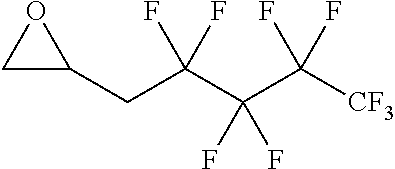 |
 |
 |
 |
 |
 |
 |
 |
 |
 |
 |
 |
 |
 |
 |
 |
 |
 |
 |
 |
 |
 |
 |
 |
 |
 |
 |
 |
 |
 |
 |
 |
 |
 |
 |
 |
 |
 |
 |
 |
 |
 |
 |
 |
 |
 |
 |
 |
 |
 |
 |
 |
 |
 |
 |
 |
 |
 |
 |
 |
 |
 |
 |
 |
 |
 |
 |
 |
 |
 |
 |
 |
 |
 |
 |
 |
 |
 |
 |
 |
 |
 |
 |
 |
 |
 |
 |
 |
 |
 |
 |
 |
In certain preferred embodiments, the heterogenous catalyst includes a single metal carbonyl compound, but in certain other preferred embodiments, mixtures of two or more metal carbonyl compounds are provided. Thus, when a provided metal carbonyl compound “comprises”, e.g., a neutral metal carbonyl compound, it is understood that the provided metal carbonyl compound can be a single metal carbonyl compound, or a metal carbonyl compound in combination with one or more metal carbonyl compounds. Preferably, the provided metal carbonyl compound is capable of ring-opening an epoxide and facilitating the insertion of carbon monoxide into the resulting metal carbon bond. Metal carbonyl compounds with this reactivity are well known in the art and are used for laboratory experimentation as well as in industrial processes such as hydroformylation.
In certain embodiments, metal carbonyl compounds include those described in U.S. Pat. No. 6,852,865. In other embodiments, the metal carbonyls may be those disclosed in U.S. patent application Ser. Nos. 10/820,958; and 10/586,826. In yet other embodiments, the metal carbonyls may be those disclosed in U.S. Pat. Nos. 5,310,948; 7,420,064; and 5,359,081. Additional catalysts for the carbonylation of epoxides are discussed in a review in Chem. Commun., 2007, 657-674. The entirety of each of the preceding references is incorporated herein by reference.
In some embodiments, a provided metal carbonyl compound comprises an anionic metal carbonyl moiety. In other embodiments, a provided metal carbonyl compound comprises a neutral metal carbonyl compound. In some embodiments, a provided metal carbonyl compound comprises a metal carbonyl hydride or a hydrido metal carbonyl compound. In some embodiments, a provided metal carbonyl compound acts as a pre-catalyst which reacts in situ with one or more reaction components to provide an active species different from the compound initially provided. Such pre-catalysts are specifically encompassed as it is recognized that the active species in a given reaction may not be known with certainty; thus the identification of such a reactive species in situ does not itself depart from the spirit or teachings of the present disclosure.
In some embodiments, the metal carbonyl compound comprises an anionic metal carbonyl species. In some embodiments, such anionic metal carbonyl species have the general formula [QdM′e(CO)w]y−, where Q is any ligand and need not be present, M′ is a metal atom, d is an integer between 0 and 8 inclusive, e is an integer between 1 and 6 inclusive, w is a number such as to provide the stable anionic metal carbonyl complex, and y is the charge of the anionic metal carbonyl species. In some embodiments, the anionic metal carbonyl has the general formula [QM′(CO)w]y−, where Q is any ligand and need not be present, M′ is a metal atom, w is a number such as to provide the stable anionic metal carbonyl, and y is the charge of the anionic metal carbonyl.
In some embodiments, the anionic metal carbonyl species include monoanionic carbonyl complexes of metals from groups 5, 7 or 9 of the periodic table or dianionic carbonyl complexes of metals from groups 4 or 8 of the periodic table. In some embodiments, the anionic metal carbonyl compound contains cobalt or manganese. In some embodiments, the anionic metal carbonyl compound contains rhodium. Suitable anionic metal carbonyl compounds include, but are not limited to: [Co(CO)4]−, [Ti(CO)6]2−, [V(CO)6]− [Rh(CO)4]−, [Fe(CO)4]2−, [Ru(CO)4]2−, [Os(CO)4]2−, [Cr2(CO)10]2−, [Fe2(CO)8]2−, [Tc(CO)5]−, [Re(CO)5]−, and [Mn(CO)5]−. In some embodiments, the anionic metal carbonyl comprises [Co(CO)4]−. In some embodiments, a mixture of two or more anionic metal carbonyl complexes may be present in the heterogenous catalysts used in the methods.
The term “such as to provide a stable anionic metal carbonyl” for [QdM′e(CO)w]y− is used herein to mean that [QdM′e(CO)w]y− is a species characterizable by analytical means, e.g., NMR, IR, X-ray crystallography, Raman spectroscopy and/or electron spin resonance (EPR) and isolable in catalyst form in the presence of a suitable cation or a species formed in situ. It is to be understood that metals which can form stable metal carbonyl complexes have known coordinative capacities and propensities to form polynuclear complexes which, together with the number and character of optional ligands Q that may be present and the charge on the complex will determine the number of sites available for carbon monoxide to coordinate and therefore the value of w. Typically, such compounds conform to the “18-electron rule”. Such knowledge is within the grasp of one having ordinary skill in the arts pertaining to the synthesis and characterization of metal carbonyl compounds.
In embodiments including an anionic metal carbonyl, one or more cations must also necessarily be present. In some variations, no particular constraints on the identity of such cations. In some embodiments, the cation associated with an anionic metal carbonyl compound comprises a reaction component of another category described herein. For example, in some embodiments, the metal carbonyl anion is associated with a cationic Lewis acid. In other embodiments, a cation associated with a provided anionic metal carbonyl compound is a simple metal cation such as those from Groups 1 or 2 of the periodic table (e.g., Na+, Li+, K+, Mg2+ and the like). In other embodiments, a cation associated with a provided anionic metal carbonyl compound is a bulky non electrophilic cation such as an ‘onium salt’ (e.g., Bu4N+, PPN+, Ph4P+ Ph4As+, and the like). In other embodiments, a metal carbonyl anion is associated with a protonated nitrogen compound (e.g., a cation may comprise a compound such as MeTBD-H+, DMAP-H+, DABCO-H+, DBU-H+ and the like). In some embodiments, compounds comprising such protonated nitrogen compounds are provided as the reaction product between an acidic hydrido metal carbonyl compound and a basic nitrogen-containing compound (e.g., a mixture of DBU and HCo(CO)4).
In some embodiments, a catalyst utilized in the methods described herein comprises a neutral metal carbonyl compound. In some embodiments, such neutral metal carbonyl compounds have the general formula QdM′e(CO)w′, where Q is any ligand and need not be present, M′ is a metal atom, d is an integer between 0 and 8 inclusive, e is an integer between 1 and 6 inclusive, and w′ is a number such as to provide the stable neutral metal carbonyl complex. In some embodiments, the neutral metal carbonyl has the general formula QM′(CO)w′. In some embodiments, the neutral metal carbonyl has the general formula M′(CO)w′. In some embodiments, the neutral metal carbonyl has the general formula QM′2(CO)w′. In some embodiments, the neutral metal carbonyl has the general formula M′2(CO)w′. Suitable neutral metal carbonyl compounds include, but are not limited to: Ti(CO)7; V2(CO)12; Cr(CO)6; Mo(CO)6; W(CO)6 Mn2(CO)10, Tc2(CO)10, and Re2(CO)10 Fe(CO)5, Ru(CO)5 and Os(CO)5 Ru3(CO)12, and Os3(CO)12 Fe3(CO)12 and Fe2(CO)9 Co4(CO)12, Rh4(CO)12, Rh6(CO)16, and Ir4(CO)12 Co2(CO)8 Ni(CO)4.
The term “such as to provide a stable neutral metal carbonyl” for QdM′e(CO)w′ is used herein to mean that QdM′e(CO)w′ is a species characterizable by analytical means, e.g., NMR, IR, X-ray crystallography, Raman spectroscopy and/or electron spin resonance (EPR) and isolable in pure form or a species formed in situ. It is to be understood that metals which can form stable metal carbonyl complexes have known coordinative capacities and propensities to form polynuclear complexes which, together with the number and character of optional ligands Q that may be present will determine the number of sites available for carbon monoxide to coordinate and therefore the value of w′. Typically, the stoichiometry of such compounds conforms to the “18-electron rule”. Such knowledge is within the grasp of one having ordinary skill in the arts pertaining to the synthesis and characterization of metal carbonyl compounds.
In some embodiments, no ligands Q are present on the metal carbonyl compound. In other embodiments, one or more ligands Q are present on the metal carbonyl compound. In some embodiments, where Q is present, each occurrence of Q is selected from the group consisting of phosphine ligands, amine ligands, cyclopentadienyl ligands, heterocyclic ligands, nitriles, phenols, and combinations of two or more of these. In some embodiments, one or more of the CO ligands of any of the metal carbonyl compounds described above is replaced with a ligand Q. In some embodiments, Q is a phosphine ligand. In some embodiments, Q is a triaryl phosphine. In some embodiments, Q is trialkyl phosphine. In some embodiments, Q is a phosphite ligand. In some embodiments, Q is an optionally substituted cyclopentadienyl ligand. In some embodiments, Q is cp. In some embodiments, Q is cp*. In some embodiments, Q is an amine or a heterocycle.
In some embodiments, the heterogenous catalyst utilized in the methods described above further includes a Lewis acidic component. In some embodiments, the heterogenous catalyst includes an anionic metal carbonyl complex and a cationic Lewis acidic component. In some embodiments, the metal carbonyl complex includes a carbonyl cobaltate and the Lewis acidic co-catalyst includes a metal-centered cationic Lewis acid. In some embodiments, an included Lewis acid comprises a boron compound.
In some embodiments, where an included Lewis acid comprises a boron compound, the boron compound comprises a trialkyl boron compound or a triaryl boron compound. In some embodiments, an included boron compound comprises one or more boron-halogen bonds. In some embodiments, where an included boron compound comprises one or more boron-halogen bonds, the compound is a dialkyl halo boron compound (e.g., R2BX), a dihalo monoalkyl compound (e.g., RBX2), an aryl halo boron compound (e.g., Ar2BX or ArBX2), or a trihalo boron compound (e.g., BCl3 or BBr3), wherein each R is an alkyl group; each X is a halogen; and each Ar is an aromatic group.
In some embodiments, where the included Lewis acid comprises a metal-centered cationic Lewis acid, the Lewis acid is a cationic metal complex. In some embodiments, the cationic metal complex has its charge balanced either in part, or wholly by one or more anionic metal carbonyl moieties. Suitable anionic metal carbonyl compounds include those described above. In some embodiments, there are 1 to 17 such anionic metal carbonyls balancing the charge of the metal complex. In some embodiments, there are 1 to 9 such anionic metal carbonyls balancing the charge of the metal complex. In some embodiments, there are 1 to 5 such anionic metal carbonyls balancing the charge of the metal complex. In some embodiments, there are 1 to 3 such anionic metal carbonyls balancing the charge of the metal complex.
In some embodiments, where the heterogenous catalysts used in the processes described herein include a cationic metal complex, the metal complex has the formula [(Lc)vMb]z+, where:
-
- Lc is a ligand where, when two or more Lc are present, each may be the same or different;
- M is a metal atom where, when two M are present, each may be the same or different;
- v is an integer from 1 to 4 inclusive;
- b is an integer from 1 to 2 inclusive; and
- z is an integer greater than 0 that represents the cationic charge on the metal complex.
In some embodiments, provided Lewis acids conform to structure I:

wherein:

is a multidentate ligand;
M is a metal atom coordinated to the multidentate ligand;
a is the charge of the metal atom and ranges from 0 to 2; and
In some embodiments, provided metal complexes conform to structure II:

Where a is as defined above (each a may be the same or different), and
M1 is a first metal atom;
M2 is a second metal atom;

comprises a multidentate ligand system capable of coordinating both metal atoms.
For sake of clarity, and to avoid confusion between the net and total charge of the metal atoms in complexes I and II and other structures herein, the charge (a+) shown on the metal atom in complexes I and II above represents the net charge on the metal atom after it has satisfied any anionic sites of the multidentate ligand. For example, if a metal atom in a complex of formula I were Cr(III), and the ligand were porphyrin (a tetradentate ligand with a charge of −2), then the chromium atom would have a net charge of +1, and a would be 1.
Suitable multidentate ligands include, but are not limited to: porphyrin derivatives 1, salen derivatives 2, dibenzotetramethyltetraaza[14]annulene (tmtaa) derivatives 3, phthalocyaninate derivatives 4, derivatives of the Trost ligand 5, tetraphenylporphyrin derivatives 6, and corrole derivatives 7. In some embodiments, the multidentate ligand is a salen derivative. In other embodiments, the multidentate ligand is a porphyrin derivative. In other embodiments, the multidentate ligand is a tetraphenylporphyrin derivative. In other embodiments, the multidentate ligand is a corrole derivative.


where each of Rc, Rd, R1a, R2a, R3a, R4a, R1a′, R2a′, R3a′, and M, is as defined and described in the classes and subclasses herein.
In some embodiments, Lewis acids provided heterogenous catalysts used in systems and methods described herein comprise metal-porphinato complexes. In some embodiments, the moiety

has the structure:

where each of M and a is as defined above and described in the classes and subclasses herein, and
-
- Rd at each occurrence is independently hydrogen, halogen, —OR4, —NRy 2, —SRy, —CN, —NO2, —SO2Ry, —SORy, —SO2NRy 2; —CNO, —NRySO2Ry, —NCO, —N3, —SiRy 3; or an optionally substituted group selected from the group consisting of C1-20 aliphatic; C1-20 heteroaliphatic having 1-4 heteroatoms independently selected from the group consisting of nitrogen, oxygen, and sulfur; 6- to 10-membered aryl; 5- to 10-membered heteroaryl having 1-4 heteroatoms independently selected from nitrogen, oxygen, and sulfur; and 4- to 7-membered heterocyclic having 1-2 heteroatoms independently selected from the group consisting of nitrogen, oxygen, and sulfur, where two or more Rd groups may be taken together to form one or more optionally substituted rings, each Ry is independently hydrogen, an optionally substituted group selected the group consisting of acyl; carbamoyl, arylalkyl; 6- to 10-membered aryl; C1-12 aliphatic; C1-12 heteroaliphatic having 1-2 heteroatoms independently selected from the group consisting of nitrogen, oxygen, and sulfur; 5- to 10-membered heteroaryl having 1-4 heteroatoms independently selected from the group consisting of nitrogen, oxygen, and sulfur; 4- to 7-membered heterocyclic having 1-2 heteroatoms independently selected from the group consisting of nitrogen, oxygen, and sulfur; an oxygen protecting group; and a nitrogen protecting group; two Ry on the same nitrogen atom are taken with the nitrogen atom to form an optionally substituted 4- to 7-membered heterocyclic ring having 0-2 additional heteroatoms independently selected from the group consisting of nitrogen, oxygen, and sulfur; and
- each R4 is independently is a hydroxyl protecting group or Ry.
In some embodiments, the moiety

has the structure:

where M, a and Rd are as defined above and in the classes and subclasses herein.
In some embodiments, the moiety

has the structure:

where M, a and Rd are as defined above and in the classes and subclasses herein.
In some embodiments, Lewis acids included in heterogenous catalysts used in the processes described herein comprise metallo salenate complexes. In some embodiments, the moiety

has the structure:

wherein:
M, and a are as defined above and in the classes and subclasses herein.
R1a, R1a′, R2a, R2a′, R3a, and R3a′ are independently hydrogen, halogen, —OR4, —NRy 2, —SRy, —CN, —NO2, —SO2Ry, —SORy, —SO2NRy 2; —CNO, —NRySO2Ry, —NCO, —N3, —SiRy 3; or an optionally substituted group selected from the group consisting of C1-20 aliphatic; C1-20 heteroaliphatic having 1-4 heteroatoms independently selected from the group consisting of nitrogen, oxygen, and sulfur; 6- to 10-membered aryl; 5- to 10-membered heteroaryl having 1-4 heteroatoms independently selected from nitrogen, oxygen, and sulfur; and 4- to 7-membered heterocyclic having 1-2 heteroatoms independently selected from the group consisting of nitrogen, oxygen, and sulfur; wherein each R4, and Ry is independently as defined above and described in classes and subclasses herein,
wherein any of (R2a′ and R3a′), (R2a and R3a), (R1a and R2a), and (R1a′ and R2a′) may optionally be taken together with the carbon atoms to which they are attached to form one or more rings which may in turn be substituted with one or more Ry groups; and
R4a is selected from the group consisting of:

Rc at each occurrence is independently hydrogen, halogen, —OR4, —NRy 2, —SRy, —CN, —NO2, —SO2Ry, —SORy, —SO2NRy 2; —CNO, —NRySO2Ry, —NCO, —N3, —SiRy 3; or an optionally substituted group selected from the group consisting of C1-20 aliphatic; C1-20 heteroaliphatic having 1-4 heteroatoms independently selected from the group consisting of nitrogen, oxygen, and sulfur; 6- to 10-membered aryl; 5- to 10-membered heteroaryl having 1-4 heteroatoms independently selected from nitrogen, oxygen, and sulfur; and 4- to 7-membered heterocyclic having 1-2 heteroatoms independently selected from the group consisting of nitrogen, oxygen, and sulfur;
where:
two or more Rc groups may be taken together with the carbon atoms to which they are attached and any intervening atoms to form one or more rings;
when two Rc groups are attached to the same carbon atom, they may be taken together along with the carbon atom to which they are attached to form a moiety selected from the group consisting of: a 3- to 8-membered spirocyclic ring, a carbonyl, an oxime, a hydrazone, an imine; and an optionally substituted alkene;
where R4 and Ry are as defined above and in classes and subclasses herein;
Y is a divalent linker selected from the group consisting of: —NRy—, —N(Ry)C(O)—, —C(O)NRy—, —O—, —C(O)—, —OC(O)—, —C(O)O—, —S—, —SO—, —SO2—, —C(═S)—, —C(═NRy)—, —N═N—; a polyether; a C3 to C8 substituted or unsubstituted carbocycle; and a C1 to C8 substituted or unsubstituted heterocycle;
m′ is 0 or an integer from 1 to 4, inclusive;
q is 0 or an integer from 1 to 4, inclusive; and
x is 0, 1, or 2.
In some embodiments, a provided Lewis acid comprises a metallo salen compound, as shown in formula Ia:

wherein each of M, Rd, and a, is as defined above and in the classes and subclasses herein,

represents is an optionally substituted moiety linking the two nitrogen atoms of the diamine portion of the salen ligand, where

is selected from the group consisting of a C3-C14 carbocycle, a C6-C10 aryl group, a C3-C14 heterocycle, and a C5-C10 heteroaryl group; or an optionally substituted C2-20 aliphatic group, wherein one or more methylene units are optionally and independently replaced by —NRy—, —N(Ry)C(O)—, —C(O)N(Ry)—, —OC(O)N(Ry)—, —N(Ry)C(O)O—, —OC(O)O—, —O—, —C(O)—, —OC(O)—, —C(O)O—, —S—, —SO—, —SO2—, —C(═S)—, —C(═NRy)—, —C(═NORy)— or —N═N—.
In some embodiments metal complexes having formula Ia above, at least one of the phenyl rings comprising the salicylaldehyde-derived portion of the metal complex is independently selected from the group consisting of:

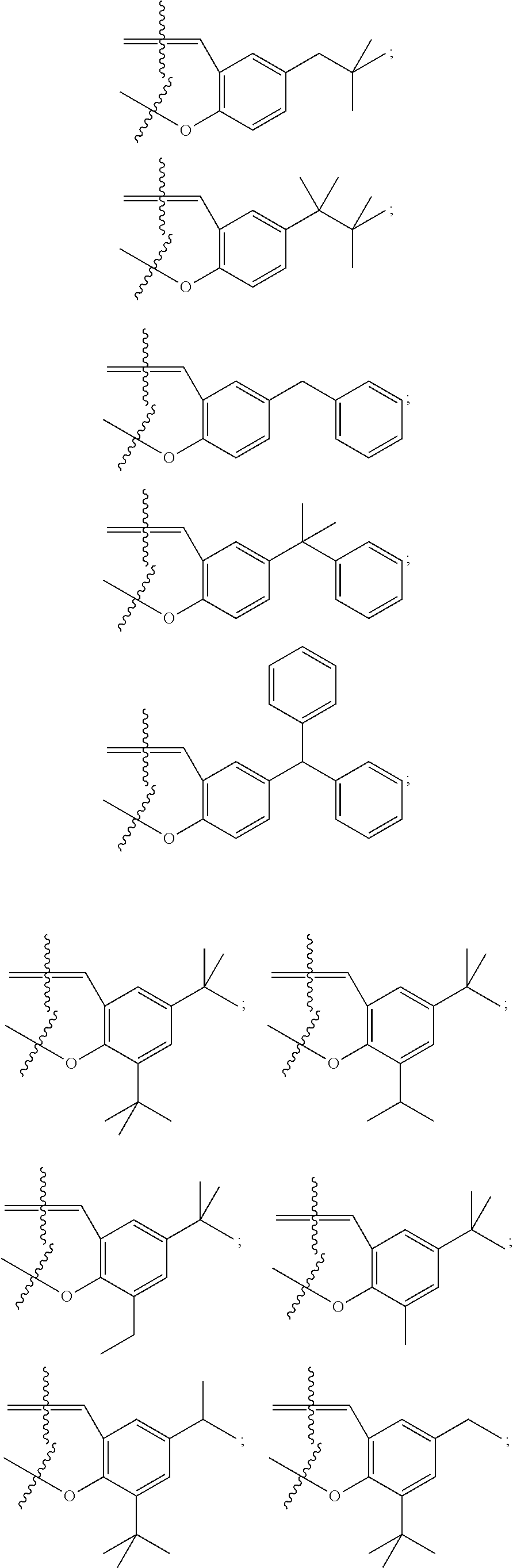

In some embodiments, a provided Lewis acid comprises a metallo salen compound, conforming to one of formulae Va or Vb:

-
- where M, a, Rd, R1a, R1a, R1a′, R3a′, and

-
- are as defined above and in the classes and subclasses herein.
In some embodiments of metal complexes having formulae Va or Vb, each R1a and R3a is, independently, optionally substituted C1-C20) aliphatic.
In some embodiments, the moiety

comprises an optionally substituted 1,2-phenyl moiety.
In some embodiments, Lewis acids included in heterogenous catalysts used in processes described herein comprise metal—tmtaa complexes. In some embodiments, the moiety

has the structure:

where M, a and Rd are as defined above and in the classes and subclasses herein, and
-
- Re at each occurrence is independently hydrogen, halogen, —OR, —NRy 2, —SRy, —CN, —NO2, —SO2Ry, —SORy, —SO2NRy 2; —CNO, —NRySO2Ry, —NCO, —N3, —SiRy 3; or an optionally substituted group selected from the group consisting of C1-20 aliphatic; C1-20 heteroaliphatic having 1-4 heteroatoms independently selected from the group consisting of nitrogen, oxygen, and sulfur; 6- to 10-membered aryl; 5- to 10-membered heteroaryl having 1-4 heteroatoms independently selected from nitrogen, oxygen, and sulfur; and 4- to 7-membered heterocyclic having 1-2 heteroatoms independently selected from the group consisting of nitrogen, oxygen, and sulfur.
In some embodiments, the moiety

has the structure:

-
- where each of M, a, Rc and Rd is as defined above and in the classes and subclasses herein.
In some embodiments, where heterogenous catalysts used in systems and methods described herein include a Lewis acidic metal complex, the metal atom is selected from the periodic table groups 2-13, inclusive. In some embodiments, M is a transition metal selected from the periodic table groups 4, 6, 11, 12 and 13. In some embodiments, M is aluminum, chromium, titanium, indium, gallium, zinc cobalt, or copper. In some embodiments, M is aluminum. In other embodiments, M is chromium.
In some embodiments, M has an oxidation state of +2. In some embodiments, M is Zn(II), Cu(II), Mn(II), Co(II), Ru(II), Fe(II), Co(II), Rh(II), Ni(II), Pd(II) or Mg(II). In some embodiments M is Zn(II). In some embodiments M is Cu(II).
In some embodiments, M has an oxidation state of +3. In some embodiments, M is Al(III), Cr(III), Fe(III), Co(III), Ti(III) In(III), Ga(III) or Mn(III). In some embodiments M is Al(III). In some embodiments M is Cr(III).
In some embodiments, M has an oxidation state of +4. In some embodiments, M is Ti(IV) or Cr(IV).
In some embodiments, M1 and M2 are each independently a metal atom selected from the periodic table groups 2-13, inclusive. In some embodiments, M is a transition metal selected from the periodic table groups 4, 6, 11, 12 and 13. In some embodiments, M is aluminum, chromium, titanium, indium, gallium, zinc cobalt, or copper. In some embodiments, M is aluminum. In other embodiments, M is chromium. In some embodiments, M1 and M2 are the same. In some embodiments, M1 and M2 are the same metal, but have different oxidation states. In some embodiments, M1 and M2 are different metals.
In some embodiments, one or more of M1 and M2 has an oxidation state of +2. In some embodiments, M1 is Zn(II), Cu(II), Mn(II), Co(II), Ru(II), Fe(II), Co(II), Rh(II), Ni(II), Pd(II) or Mg(II). In some embodiments M1 is Zn(II). In some embodiments M1 is Cu(II). In some embodiments, M2 is Zn(II), Cu(II), Mn(II), Co(II), Ru(II), Fe(II), Co(II), Rh(II), Ni(II), Pd(II) or Mg(II). In some embodiments M2 is Zn(II). In some embodiments M2 is Cu(II).
In some embodiments, one or more of M1 and M2 has an oxidation state of +3. In some embodiments, M1 is Al(III), Cr(III), Fe(III), Co(III), Ti(III) In(III), Ga(III) or Mn(III). In some embodiments M1 is Al(III). In some embodiments M1 is Cr(III). In some embodiments, M2 is Al(III), Cr(III), Fe(III), Co(III), Ti(III) In(III), Ga(III) or Mn(III). In some embodiments M2 is Al(III). In some embodiments M2 is Cr(III).
In some embodiments, one or more of M1 and M2 has an oxidation state of +4. In some embodiments, M1 is Ti(IV) or Cr(IV). In some embodiments, M2 is Ti(IV) or Cr(IV).
In some embodiments, the metal-centered Lewis-acidic component of the heterogenous catalyst includes a dianionic tetradentate ligand. In some embodiments, the dianionic tetradentate ligand is selected from the group consisting of: porphyrin derivatives; salen derivatives; dibenzotetramethyltetraaza[14]annulene (tmtaa) derivatives; phthalocyaninate derivatives; and derivatives of the Trost ligand. In some embodiments, the tetradentate ligand may be bound to siliceous material and/or tethered to the siliceous material by one or more other molecules.
In some embodiments, the heterogenous catalyst includes a carbonyl cobaltate in combination with an aluminum porphyrin compound. In some embodiments, the heterogenous catalyst is [(TPP)Al(THF)2][Co(CO)4] where TPP stands for tetraphenylporphyrin and THF stands for tetrahydrofuran.
In certain preferred embodiments, the heterogenous catalyst includes a carbonyl cobaltate in combination with a chromium porphyrin compound.
In some embodiments, the heterogenous catalyst includes a carbonyl cobaltate in combination with a chromium salen compound. In some embodiments, the heterogenous catalyst includes a carbonyl cobaltate in combination with a chromium salophen compound.
In some embodiments, the heterogenous catalyst includes a carbonyl cobaltate in combination with a metal salen compound. In certain embodiments, the metal salen compound is an aluminum salen compound. In some embodiments, the heterogenous catalyst includes a carbonyl cobaltate in combination with a metal salophen compound. In certain embodiments, the metal salophen compound is an aluminum salophen compound.
In some embodiments, one or more neutral two electron donors coordinate to M, M1 or M2 and fill the coordination valence of the metal atom. In some embodiments, the neutral two electron donor is a solvent molecule. In some embodiments, the neutral two electron donor is an ether. In some embodiments, the neutral two electron donor is tetrahydrofuran, diethyl ether, acetonitrile, carbon disulfide, or pyridine. In some embodiments, the neutral two electron donor is tetrahydrofuran. In some embodiments, the neutral two electron donor is an epoxide. In some embodiments, the neutral two electron donor is an ester or a lactone.
In certain embodiments, the heterogenous catalyst includes a carbonyl cobaltate in combination with an aluminum porphyrin compound and a solid support. In certain embodiments, the heterogenous catalyst includes a carbonyl cobaltate in combination with a chromium porphyrin compound and a solid support. In certain embodiments, the heterogenous catalyst includes a carbonyl cobaltate in combination with a chromium salen compound and a solid support. In certain embodiments, the heterogenous catalyst includes a carbonyl cobaltate in combination with a chromium salophen compound and a solid support. In certain embodiments, the heterogenous catalyst includes a carbonyl cobaltate in combination with an aluminum salen compound and a solid support. In certain embodiments, the heterogenous catalyst includes a carbonyl cobaltate in combination with an aluminum salophen compound and a solid support.
In certain preferred embodiments, the heterogenous catalyst of the present invention includes a solid support such as a structured zeolite. In certain embodiments, the heterogenous catalyst includes a cationic Lewis acid functional group and/or an anionic metal carbonyl supported by a structured zeolite. In a further embodiment, the structured zeolite has a faujasite, mordenite, or ZSM-5 (MFI) structure. In a further embodiment, the structure has the hexagonal pore arrangement of MCM-41. In a further embodiment, the structure has the cubic pore arrangement of MCM-48. In a further embodiment, the structure has the lamellar pore arrangement of MCM-50. In a further embodiment, the structure has pores organized in a foam arrangement. In a further embodiment, the structure has randomly placed pores. In a further embodiment, the structured zeolite material is Y[MCM-41], MOR[MCM-41], or ZSM-5[MCM-41]. In a further embodiment, the mean pore diameter within the structure is about 2 to about 5 nm. In a further embodiment, the mean pore diameter within the structure is about 2 to about 3 nm. In a further embodiment, the wall thickness within the structure is about 1 to about 5 nm. In a further embodiment, the wall thickness within the structure is about 1 to about 3 nm.
The synthesis of fully crystalline structured zeolites is applicable to a wide variety of materials. The first strategy is based on the short-range reorganization of a zeolite structure in the presence of a surfactant to accommodate mesoporosity without loss of zeolitic full crystallinity. A zeolite is added to a pH controlled solution containing a surfactant. Alternatively, a zeolite is added to a pH controlled solution and thereafter a surfactant is added. The pH controlled solution can be, for example, a basic solution with a pH ranging from about 8 to about 12, or from about 9 to about 11, or alternatively, the basic solution pH can be about 10. The strength of the base and the concentration of the basic solution are selected to provide a pH within the desired range. Any suitable base can be employed that falls within the desired pH range.
A charged chemical species, for example a positively charged chemical species, can be anchored to the fully crystalline structure. The charged chemical species can be cations of an element, quaternary amines, ammonium ions, pyridinium ions, or phosphonium ions, or any combination thereof. Alternatively, a chemical species can be anchored and/or covalently bonded to the fully crystalline structure. The chemical species can be a basic chemical species, an inorganic base, an organic base, hydroxide, amine, pyridine, or phosphine, or any combination thereof.
In certain embodiments, the heterogenous catalyst includes a solid support that comprises a siliceous based material, e.g., silica, and/or a carbon based material, e.g., carbon black or activated carbon, although any of a variety of other suitable supporting materials may be used. In some embodiments, the heterogenous catalyst may comprise a material selected from the group comprising silica, alumina, titania, silica/alumina, pyrogenic silica, high purity silica, zirconia, carbon (e.g., carbon black or activated carbon), zeolites and mixtures thereof. In some embodiments, the heterogenous catalyst comprises a siliceous material such as silica, pyrogenic silica, or high purity silica. In some embodiments, the siliceous material is substantially free of alkaline earth metals, such as magnesium and calcium.
In certain preferred embodiments, the heterogeneous catalyst comprises a cationic Lewis acid functional group and/or an anionic metal carbonyl supported on a heterogenous solid support formed by contacting the support material and the cationic Lewis acid functional group and/or the anionic metal carbonyl by a method such as physical mixture, dry impregnation, wet impregnation, incipient wet impregnation, ion-exchange, and vaporization.
In some embodiments, at least one metal complex may be impregnated into a heterogenous solid support. With impregnation, the at least one metal complex and heterogenous solid support material are mixed together followed by drying and calcination to form the heterogenous catalyst. With simultaneous impregnation, it may be desired to employ a dispersion agent, surfactant, or solubilizing agent, e.g., ammonium oxalate or an acid such as acetic or nitric acid, to facilitate the dispersing or solubilizing of the first, second and/or optional third metal complex in the event one or more of the metal complexes are incompatible.
In certain embodiments, sequential impregnation may be used to form the heterogenous catalyst. With sequential impregnation, a first metal complex may be first added to a heterogenous solid support material followed by drying and calcining, and the resulting material may then be impregnated by subsequent one or more metal complex followed by an additional drying and calcining to form the final heterogenous catalyst. In some embodiments, additional metal complexes may be added either with the first and/or second metal complex or in a separate sequential impregnation, followed by drying and calcination. In some embodiments, combinations of sequential and simultaneous impregnation may be employed if desired.
The embodiments described herein are not intended to be limited to the aspects shown, but are to be accorded the widest scope consistent with the principles and features disclosed herein.
Claims (19)
1. A process for producing a beta-lactone product from a carbon monoxide reagent and an epoxide reagent, the process comprising:
a. passing the epoxide reagent to a reaction zone;
b. passing the carbon monoxide reagent to the reaction zone;
c. contacting the epoxide reagent and the carbon monoxide reagent with a heterogenous catalyst at reaction conditions in the reaction zone to produce the beta-lactone product; and
d. removing the beta-lactone product from the reaction zone;
wherein at least one of the epoxide reagent and the carbon monoxide reagent is derived from renewable sources; and
wherein the heterogenous catalyst comprises:
a solid support comprising at least one zeolite having a faujasite structure, a mordenite structure, a ZSM-5 (MFI) structure, a hexagonal pore arrangement of MCM-41, a cubic pore arrangement of MCM-48, or a lamellar pore arrangement of MCM-50,
a cationic Lewis acid functional group, and
a metal carbonyl compound comprising at least one anionic metal carbonyl compound or neutral metal carbonyl compound.
2. The process of claim 1 , wherein the epoxide reagent comprises ethylene oxide, propylene oxide, 1,2-epoxyhexane, 1,2-epoxydodecane, 3,4-epoxy-1-butene, 1,2-epoxy-5-hexene, 1,2-epoxy-9-decene, isoprene monoxide, epichlorohydrin, 1,3-butadiene diepoxide, 1,2,7,8-diepoxyoctane, 1,2-epoxycyclopentane, or cyclooctene oxide.
3. The process of claim 1 , wherein the metal carbonyl compound is a metal porphyrin compound, a metal salen compound, a metal salophen compound.
4. The process of claim 1 , wherein the reaction zone includes at least one of a fixed bed reactor, a moving bed reactor, a fluidized bed reactor, a trickle bed reactor, a catalytic distillation zone, a continuously stirred tank reactor, or a tubular reactor.
5. The process of claim 1 , wherein the reaction conditions include a pressure of from atmospheric pressure to 600 psi, at a weight hourly space velocity of 0.25 to 20 hr−1.
6. The process of claim 1 , wherein the concentration of the epoxide reagent in the reaction zone is equal to or up to 10% higher than the stoichiometric value for a carbonylation reaction.
7. The process of claim 1 , wherein the reaction zone receives a Lewis base additive selected from the group consisting of a modified THF, 2,6-lutidine, imidazole, 1-methylimidazole 4-dimethylaminopyridine, trihexylamine, and triphenylphosphine.
8. The process of claim 1 , wherein the heterogenous catalyst comprises an anionic metal carbonyl species having a general formula of [QdM′e(CO)w]y−, wherein:
Q is a ligand, provided that d is not 0,
M′ is a metal atom,
d is an integer between 0 and 8 inclusive,
e is an integer between 1 and 6 inclusive,
w is the number needed to provide the stable anionic metal carbonyl complex,
y is the charge of the anionic metal carbonyl species, and
the anionic metal carbonyl species is bound to a solid support comprising silica, alumina, titania, zirconia, carbon black, activated carbon, or zeolite, or any combination thereof.
9. The process of claim 8 , wherein the anionic metal carbonyl species comprises at least one of [Co(CO)4]−, [Ti(CO)6]2−, [V(CO)6]−, [Rh(CO)4]−, [Fe(CO)4]2−, [Ru(CO)4]2−, [Os(CO)4]2−, [Cr2(CO)10]2−, [Fe2(CO)8]2−, [Tc(CO)5]−, [Re(CO)5]−, and [Mn(CO)5]−.
10. The process of claim 1 , wherein the cationic Lewis acid functional group comprises Zn(II), Cu(II), Mn(II), Co(II), Ru(II), Fe(II), Rh(II), Ni(II), Pd(II), Mg(II), Al(III), Cr(III), Fe(III), Co(III), Ti(III) In(III), Ga(III), Mn(III), Ti(IV), or Cr(IV).
11. A process for producing a beta-lactone product from a carbon monoxide reagent and an epoxide reagent, the process comprising:
a. passing the epoxide reagent to a reaction zone;
b. passing the carbon monoxide reagent to the reaction zone;
c. contacting the epoxide reagent and the carbon monoxide reagent with heterogenous catalyst at reaction conditions in the reaction zone to produce the beta-lactone product, wherein the heterogenous catalyst comprises a solid support, a cationic Lewis acid functional group and a metal carbonyl compound comprising at least one anionic metal carbonyl compound or neutral metal carbonyl compound; and
d. removing the beta-lactone product from the reaction zone;
wherein at least one metal complex is impregnated into a solid support comprising a crystalline structure by mixing the metal complex with the crystalline structure followed by drying and calcination to form the heterogenous catalyst.
12. The process of claim 11 , wherein a first metal complex is mixed with the crystalline structure followed by drying and calcining to produce an impregnated solid support and the impregnated solid support is mixed with an additional metal complex followed by an additional drying and calcining to form the heterogenous catalyst.
13. The process of claim 11 , wherein the cationic Lewis acid functional group is a cationic metal complex having the general formula [(Lc)vMb]z+, wherein:
Lc is at least one ligand;
M is at least one metal atom;
v is an integer from 1 to 4 inclusive;
b is an integer from 1 to 2 inclusive; and
z is an integer greater than 0 that represents the cationic charge on the metal complex.
14. The process of claim 13 , wherein Lc is at least one porphyrin ligand, salen ligand, dibenzotetramethyltetraaza[14]annulene (tmtaa) ligand, phthalocyaninate ligand, Trost ligand, tetraphenylporphyrin ligand, or corrole ligand.
15. The process of claim 11 , wherein the metal carbonyl compound comprises a phosphine ligand, an amine ligand, a cyclopentadienyl ligand, a heterocyclic ligand, nitrile, or phenol, or any combination thereof.
16. The process of claim 1 , wherein the epoxide reagent is ethylene oxide, and the beta-lactone product is beta-propiolactone.
17. The process of claim 11 , wherein the epoxide reagent is ethylene oxide, and the beta-lactone product is beta-propiolactone.
18. The process of claim 8 , wherein the solid support comprises silica/alumina, pyrogenic silica, or high purity silica, or any combination thereof.
19. The process of claim 13 , wherein M comprises Zn, Cu, Mn, Ru, Fe, Co, Rh, Ni, Pd, Mg, Al, Cr, Ti, In, or Ga, or any combination thereof.
Priority Applications (2)
| Application Number | Priority Date | Filing Date | Title |
|---|---|---|---|
| US15/674,453 US10590099B1 (en) | 2017-08-10 | 2017-08-10 | Processes for producing beta-lactone with heterogenous catalysts |
| US16/057,530 US10961209B2 (en) | 2017-08-10 | 2018-08-07 | Processes for producing beta-lactone and beta-lactone derivatives with heterogenous catalysts |
Applications Claiming Priority (1)
| Application Number | Priority Date | Filing Date | Title |
|---|---|---|---|
| US15/674,453 US10590099B1 (en) | 2017-08-10 | 2017-08-10 | Processes for producing beta-lactone with heterogenous catalysts |
Related Child Applications (1)
| Application Number | Title | Priority Date | Filing Date |
|---|---|---|---|
| US16/057,530 Continuation-In-Part US10961209B2 (en) | 2017-08-10 | 2018-08-07 | Processes for producing beta-lactone and beta-lactone derivatives with heterogenous catalysts |
Publications (1)
| Publication Number | Publication Date |
|---|---|
| US10590099B1 true US10590099B1 (en) | 2020-03-17 |
Family
ID=69778949
Family Applications (1)
| Application Number | Title | Priority Date | Filing Date |
|---|---|---|---|
| US15/674,453 Active US10590099B1 (en) | 2017-08-10 | 2017-08-10 | Processes for producing beta-lactone with heterogenous catalysts |
Country Status (1)
| Country | Link |
|---|---|
| US (1) | US10590099B1 (en) |
Cited By (5)
| Publication number | Priority date | Publication date | Assignee | Title |
|---|---|---|---|---|
| US20190047972A1 (en) * | 2017-08-10 | 2019-02-14 | Novomer, Inc. | Processes for producing beta-lactone and beta-lactone derivatives with heterogenous catalysts |
| CN113244945A (en) * | 2021-05-26 | 2021-08-13 | 山东锐海环境科技有限公司 | Preparation method of novel heterogeneous Fenton catalyst for wastewater treatment |
| WO2021252607A1 (en) | 2020-06-12 | 2021-12-16 | Novomer, Inc. | Beta-propiolactone compounds and ring opened beta-propiolactone compounds and uses for same |
| WO2023283594A1 (en) * | 2021-07-09 | 2023-01-12 | Novomer, Inc. | Sterically modified schiff base ligands for enhanced catalytic carbonylation activity |
| CN116041284A (en) * | 2022-12-13 | 2023-05-02 | 中国科学院大连化学物理研究所 | Application of a metal nitrogen inversion porphyrin-cobalt carbonyl multifunctional catalyst in the preparation of β-lactone from epoxide |
Citations (56)
| Publication number | Priority date | Publication date | Assignee | Title |
|---|---|---|---|---|
| US3885155A (en) | 1973-11-01 | 1975-05-20 | Stanford Research Inst | Mass spectrometric determination of carbon 14 |
| US4427884A (en) | 1982-01-25 | 1984-01-24 | The Research Foundation Of State University Of New York | Method for detecting and quantifying carbon isotopes |
| US4973841A (en) | 1990-02-02 | 1990-11-27 | Genus, Inc. | Precision ultra-sensitive trace detector for carbon-14 when it is at concentration close to that present in recent organic materials |
| US5256828A (en) | 1992-06-12 | 1993-10-26 | Texaco Chemical Company | Heterogeneous catalyst for alkoxylation of alcohols |
| US5310948A (en) | 1992-06-29 | 1994-05-10 | Shell Oil Company | Carbonylation of epoxides |
| US5438194A (en) | 1993-07-30 | 1995-08-01 | High Voltage Engineering Europa B.V. | Ultra-sensitive molecular identifier |
| US5661299A (en) | 1996-06-25 | 1997-08-26 | High Voltage Engineering Europa B.V. | Miniature AMS detector for ultrasensitive detection of individual carbon-14 and tritium atoms |
| US20050014977A1 (en) | 2003-04-09 | 2005-01-20 | Eit Drent | Process for the carbonylation of epoxides |
| US6852865B2 (en) | 2001-12-06 | 2005-02-08 | Cornell Research Foundation, Inc. | Catalytic carbonylation of three and four membered heterocycles |
| US20070161806A1 (en) | 2004-01-20 | 2007-07-12 | Basf Aktiengesellschaft | Catalyst for the carbonylation of oxiraines |
| US7420064B2 (en) | 2002-08-01 | 2008-09-02 | Basf Se | Catalyst and method for the carbonylation of oxiranes |
| WO2009155086A2 (en) | 2008-05-30 | 2009-12-23 | E. I. Du Pont De Nemours And Company | Renewably resourced chemicals and intermediates |
| WO2010118128A1 (en) | 2009-04-08 | 2010-10-14 | Novomer, Inc. | Process for beta-lactone production |
| WO2012030619A1 (en) | 2010-08-28 | 2012-03-08 | Novomer, Inc. | Succinic anhydride from ethylene oxide |
| WO2012051219A2 (en) | 2010-10-11 | 2012-04-19 | Novomer, Inc. | Polymer blends |
| WO2012158573A1 (en) | 2011-05-13 | 2012-11-22 | Novomer, Inc. | Catalytic carbonylation catalysts and methods |
| WO2013063191A1 (en) | 2011-10-26 | 2013-05-02 | Novomer, Inc. | Process for production of acrylates from epoxides |
| WO2013122905A1 (en) | 2012-02-13 | 2013-08-22 | Novomer, Inc. | Process for the production of acid anhydrides from epoxides |
| WO2013126375A1 (en) | 2012-02-22 | 2013-08-29 | Novomer, Inc. | Acrylic acid production methods |
| WO2014004858A1 (en) | 2012-06-27 | 2014-01-03 | Novomer, Inc. | Catalysts and methods for polyester production |
| WO2014008232A2 (en) | 2012-07-02 | 2014-01-09 | Novomer, Inc. | Process for acrylate production |
| WO2015085295A2 (en) | 2013-12-07 | 2015-06-11 | Novomer, Inc. | Nanofiltration membranes and methods of use |
| WO2015138975A1 (en) | 2014-03-14 | 2015-09-17 | Novomer, Inc. | Catalysts for epoxide carbonylation |
| WO2015171372A1 (en) | 2014-05-05 | 2015-11-12 | Novomer, Inc. | Catalyst recycle methods |
| WO2015184289A1 (en) | 2014-05-30 | 2015-12-03 | Novomer Inc. | Integrated methods for chemical synthesis |
| WO2016015019A1 (en) | 2014-07-25 | 2016-01-28 | Novomer, Inc. | Synthesis of metal complexes and uses thereof |
| WO2016131004A1 (en) | 2015-02-13 | 2016-08-18 | Novomer, Inc. | Integrated methods for chemical synthesis |
| WO2016130977A1 (en) | 2015-02-13 | 2016-08-18 | Novomer, Inc. | Systems and processes for polyacrylic acid production |
| WO2016130988A1 (en) | 2015-02-13 | 2016-08-18 | Novomer, Inc. | Flexible chemical production platform |
| WO2016130947A1 (en) | 2015-02-13 | 2016-08-18 | Novomer, Inc. | Systems and processes for polymer production |
| WO2016130993A1 (en) | 2015-02-13 | 2016-08-18 | Novomer, Inc. | Process for production of acrylic acid |
| WO2016130998A1 (en) | 2015-02-13 | 2016-08-18 | Novomer, Inc. | Continuous carbonylation processes |
| WO2016131001A1 (en) | 2015-02-13 | 2016-08-18 | Novomer Inc. | Process and system for production of polypropiolactone |
| WO2016131003A1 (en) | 2015-02-13 | 2016-08-18 | Novomer, Inc. | Distillation process for production of acrylic acid |
| US20170029352A1 (en) | 2015-07-31 | 2017-02-02 | Sadesh H. Sookraj | Production system/production process for acrylic acid and precursors thereof |
| US20170267618A1 (en) | 2016-03-21 | 2017-09-21 | Novomer, Inc. | Acrylic acid production process |
| WO2017165345A1 (en) | 2016-03-21 | 2017-09-28 | Novomer, Inc. | Systems and methods for producing superabsorbent polymers |
| WO2018085254A1 (en) | 2016-11-02 | 2018-05-11 | Novomer, Inc. | Absorbent polymers, and methods and systems of producing thereof and uses thereof |
| WO2018085251A1 (en) | 2016-11-02 | 2018-05-11 | Novomer, Inc. | Absorbent polymers, and methods of producing thereof and uses thereof |
| US20180153746A1 (en) | 2016-12-06 | 2018-06-07 | Novomer, Inc. | Biodegradable sanitary articles with higher biobased content |
| US20180155490A1 (en) | 2016-12-05 | 2018-06-07 | Novomer, Inc. | Biodegradable polyols having higher biobased content |
| US20180155491A1 (en) | 2016-12-05 | 2018-06-07 | Novomer, Inc | Beta-propiolactone based copolymers containing biogenic carbon, methods for their production and uses thereof |
| WO2018136638A1 (en) | 2017-01-19 | 2018-07-26 | Novomer, Inc. | Methods and systems for treatment of ethylene oxide |
| US10065914B1 (en) | 2017-04-24 | 2018-09-04 | Novomer, Inc. | Thermolysis of polypropiolactone to produce acrylic acid |
| WO2018170006A1 (en) | 2017-03-17 | 2018-09-20 | Novomer Inc. | Polyamides, and methods of producing thereof |
| US20180282251A1 (en) | 2017-03-21 | 2018-10-04 | Novomer, Inc. | Systems and processes for producing organic acids direct from beta-lactones |
| US20180305286A1 (en) | 2016-03-21 | 2018-10-25 | Novomer, Inc. | Systems and Processes for Producing Organic Acids Direct from Beta-Lactones |
| US20190002385A1 (en) | 2017-06-30 | 2019-01-03 | Novomer, Inc. | Compositions for improved production of acrylic acid |
| US20190002293A1 (en) | 2017-06-30 | 2019-01-03 | Novomer, Inc. | Biobased Carbon Fibers and Carbon Black and Methods of Making the Same |
| US20190002400A1 (en) | 2017-06-30 | 2019-01-03 | Novomer, Inc. | Acrylonitrile Derivatives from Epoxide and Carbon Monoxide Reagents |
| US20190031592A1 (en) | 2017-06-30 | 2019-01-31 | Novomer, Inc. | Compositions for Improved Production of Acrylic Acid |
| US20190047972A1 (en) | 2017-08-10 | 2019-02-14 | Novomer, Inc. | Processes for producing beta-lactone and beta-lactone derivatives with heterogenous catalysts |
| WO2019051184A1 (en) | 2017-09-09 | 2019-03-14 | Novomer, Inc. | Amide and nitrile compounds and methods of producing and using thereof |
| US20190076834A1 (en) | 2017-09-11 | 2019-03-14 | Novomer, Inc. | Processes Using Multifunctional Catalysts |
| US20190076835A1 (en) | 2017-09-11 | 2019-03-14 | Novomer, Inc. | Processses using multifunctional catalysts |
| WO2019070981A1 (en) | 2017-10-05 | 2019-04-11 | Novomer, Inc. | Isocyanates, derivatives, and processes for producing the same |
-
2017
- 2017-08-10 US US15/674,453 patent/US10590099B1/en active Active
Patent Citations (120)
| Publication number | Priority date | Publication date | Assignee | Title |
|---|---|---|---|---|
| US3885155A (en) | 1973-11-01 | 1975-05-20 | Stanford Research Inst | Mass spectrometric determination of carbon 14 |
| US4427884A (en) | 1982-01-25 | 1984-01-24 | The Research Foundation Of State University Of New York | Method for detecting and quantifying carbon isotopes |
| US4973841A (en) | 1990-02-02 | 1990-11-27 | Genus, Inc. | Precision ultra-sensitive trace detector for carbon-14 when it is at concentration close to that present in recent organic materials |
| US5256828A (en) | 1992-06-12 | 1993-10-26 | Texaco Chemical Company | Heterogeneous catalyst for alkoxylation of alcohols |
| US5310948A (en) | 1992-06-29 | 1994-05-10 | Shell Oil Company | Carbonylation of epoxides |
| US5359081A (en) | 1992-06-29 | 1994-10-25 | Shell Oil Company | Carbonylation of epoxides |
| US5438194A (en) | 1993-07-30 | 1995-08-01 | High Voltage Engineering Europa B.V. | Ultra-sensitive molecular identifier |
| US5661299A (en) | 1996-06-25 | 1997-08-26 | High Voltage Engineering Europa B.V. | Miniature AMS detector for ultrasensitive detection of individual carbon-14 and tritium atoms |
| US6852865B2 (en) | 2001-12-06 | 2005-02-08 | Cornell Research Foundation, Inc. | Catalytic carbonylation of three and four membered heterocycles |
| US7420064B2 (en) | 2002-08-01 | 2008-09-02 | Basf Se | Catalyst and method for the carbonylation of oxiranes |
| US20050014977A1 (en) | 2003-04-09 | 2005-01-20 | Eit Drent | Process for the carbonylation of epoxides |
| US20070161806A1 (en) | 2004-01-20 | 2007-07-12 | Basf Aktiengesellschaft | Catalyst for the carbonylation of oxiraines |
| WO2009155086A2 (en) | 2008-05-30 | 2009-12-23 | E. I. Du Pont De Nemours And Company | Renewably resourced chemicals and intermediates |
| WO2010118128A1 (en) | 2009-04-08 | 2010-10-14 | Novomer, Inc. | Process for beta-lactone production |
| US20140275575A1 (en) | 2009-04-08 | 2014-09-18 | Novomer, Inc. | Process for beta-lactone production |
| US8796475B2 (en) * | 2009-04-08 | 2014-08-05 | Novomer, Inc. | Process for beta-lactone production |
| US20120123137A1 (en) | 2009-04-08 | 2012-05-17 | Novomer, Inc. | Process for beta-lactone production |
| US9206144B2 (en) | 2009-04-08 | 2015-12-08 | Novomer, Inc. | Process for beta-lactone production |
| US9493391B2 (en) | 2009-04-08 | 2016-11-15 | Novomer, Inc. | Process for beta-lactone production |
| US8445703B2 (en) * | 2009-04-08 | 2013-05-21 | Novomer, Inc. | Process for beta-lactone production |
| US20160102040A1 (en) | 2009-04-08 | 2016-04-14 | Novomer, Inc. | Process for beta-lactone production |
| US20130281715A1 (en) | 2009-04-08 | 2013-10-24 | Novomer, Inc. | Process for beta-lactone production |
| WO2012030619A1 (en) | 2010-08-28 | 2012-03-08 | Novomer, Inc. | Succinic anhydride from ethylene oxide |
| US20160102068A1 (en) | 2010-08-28 | 2016-04-14 | Novomer, Inc. | Succinic anhydride from ethylene oxide |
| US20130165670A1 (en) | 2010-08-28 | 2013-06-27 | Novomer, Inc. | Succinic anhydride from ethylene oxide |
| US9156803B2 (en) | 2010-08-28 | 2015-10-13 | Novomer, Inc. | Succinic anhydride from ethylene oxide |
| US20130209775A1 (en) | 2010-10-11 | 2013-08-15 | Novomer, Inc. | Polymer blends |
| US9738784B2 (en) | 2010-10-11 | 2017-08-22 | Novomer, Inc. | Polymer blends |
| WO2012051219A2 (en) | 2010-10-11 | 2012-04-19 | Novomer, Inc. | Polymer blends |
| US10221278B2 (en) | 2011-05-13 | 2019-03-05 | Novomer, Inc. | Catalytic carbonylation catalysts and methods |
| US20140296522A1 (en) | 2011-05-13 | 2014-10-02 | Novomer, Inc | Catalytic carbonylation catalysts and methods |
| US9327280B2 (en) | 2011-05-13 | 2016-05-03 | Novomer, Inc. | Catalytic carbonylation catalysts and methods |
| WO2012158573A1 (en) | 2011-05-13 | 2012-11-22 | Novomer, Inc. | Catalytic carbonylation catalysts and methods |
| US20170073463A1 (en) | 2011-05-13 | 2017-03-16 | Novomer, Inc. | Catalytic carbonylation catalysts and methods |
| US9914689B2 (en) | 2011-10-26 | 2018-03-13 | Novomer, Inc. | Process for production of acrylates from epoxides |
| US20170247309A1 (en) | 2011-10-26 | 2017-08-31 | Novomer, Inc. | Process for production of acrylates from epoxides |
| US9096510B2 (en) | 2011-10-26 | 2015-08-04 | Novomer, Inc. | Process for production of acrylates from epoxides |
| US20150299083A1 (en) | 2011-10-26 | 2015-10-22 | Novomer, Inc. | Process for production of acrylates from epoxides |
| WO2013063191A1 (en) | 2011-10-26 | 2013-05-02 | Novomer, Inc. | Process for production of acrylates from epoxides |
| US20140309399A1 (en) | 2011-10-26 | 2014-10-16 | Novomer, Inc. | Process for production of acrylates from epoxides |
| WO2013122905A1 (en) | 2012-02-13 | 2013-08-22 | Novomer, Inc. | Process for the production of acid anhydrides from epoxides |
| US9403788B2 (en) | 2012-02-13 | 2016-08-02 | Novomer, Inc. | Process for the production of acid anhydrides from epoxides |
| US20150005513A1 (en) | 2012-02-13 | 2015-01-01 | Novomer, Inc. | Process for the production of acid anhydrides from epoxides |
| WO2013126375A1 (en) | 2012-02-22 | 2013-08-29 | Novomer, Inc. | Acrylic acid production methods |
| US20160016876A1 (en) | 2012-02-22 | 2016-01-21 | Novomer, Inc. | Acrylic acid production methods |
| US20170145126A1 (en) | 2012-02-22 | 2017-05-25 | Novomer, Inc. | Acrylic acid production methods |
| WO2014004858A1 (en) | 2012-06-27 | 2014-01-03 | Novomer, Inc. | Catalysts and methods for polyester production |
| US20150368394A1 (en) | 2012-06-27 | 2015-12-24 | Novomer, Inc. | Catalysts and methods for polyester production |
| WO2014008232A2 (en) | 2012-07-02 | 2014-01-09 | Novomer, Inc. | Process for acrylate production |
| US20150141693A1 (en) | 2012-07-02 | 2015-05-21 | Novomer, Inc. | Process for acrylate production |
| US20160288057A1 (en) | 2013-12-07 | 2016-10-06 | Novomer, Inc. | Nanofiltration membranes and methods of use |
| US10245559B2 (en) | 2013-12-07 | 2019-04-02 | Novomer, Inc. | Nanofiltration membranes and methods of use |
| WO2015085295A2 (en) | 2013-12-07 | 2015-06-11 | Novomer, Inc. | Nanofiltration membranes and methods of use |
| WO2015138975A1 (en) | 2014-03-14 | 2015-09-17 | Novomer, Inc. | Catalysts for epoxide carbonylation |
| US20170080409A1 (en) | 2014-03-14 | 2017-03-23 | Novomer, Inc. | Catalysts for epoxide carbonylation |
| WO2015171372A1 (en) | 2014-05-05 | 2015-11-12 | Novomer, Inc. | Catalyst recycle methods |
| WO2015184289A1 (en) | 2014-05-30 | 2015-12-03 | Novomer Inc. | Integrated methods for chemical synthesis |
| US20170107103A1 (en) | 2014-05-30 | 2017-04-20 | Novomer, Inc. | Integrated methods for chemical synthesis |
| US20170225157A1 (en) | 2014-07-25 | 2017-08-10 | Novomer, Inc. | Synthesis of metal complexes and uses thereof |
| WO2016015019A1 (en) | 2014-07-25 | 2016-01-28 | Novomer, Inc. | Synthesis of metal complexes and uses thereof |
| US20190030520A1 (en) | 2014-07-25 | 2019-01-31 | Novomer, Inc. | Synthesis of metal complexes and uses thereof |
| WO2016131003A1 (en) | 2015-02-13 | 2016-08-18 | Novomer, Inc. | Distillation process for production of acrylic acid |
| US20180016219A1 (en) | 2015-02-13 | 2018-01-18 | Novomer, Inc. | Process for production of acrylic acid |
| WO2016130988A1 (en) | 2015-02-13 | 2016-08-18 | Novomer, Inc. | Flexible chemical production platform |
| WO2016131004A1 (en) | 2015-02-13 | 2016-08-18 | Novomer, Inc. | Integrated methods for chemical synthesis |
| WO2016130947A1 (en) | 2015-02-13 | 2016-08-18 | Novomer, Inc. | Systems and processes for polymer production |
| WO2016131001A1 (en) | 2015-02-13 | 2016-08-18 | Novomer Inc. | Process and system for production of polypropiolactone |
| WO2016130998A1 (en) | 2015-02-13 | 2016-08-18 | Novomer, Inc. | Continuous carbonylation processes |
| US10221150B2 (en) | 2015-02-13 | 2019-03-05 | Novomer, Inc. | Continuous carbonylation processes |
| US10099988B2 (en) | 2015-02-13 | 2018-10-16 | Novomer, Inc. | Process for production of acrylic acid |
| US20180354881A1 (en) | 2015-02-13 | 2018-12-13 | Novomer, Inc. | Process for production of acrylic acid |
| US20180354882A1 (en) | 2015-02-13 | 2018-12-13 | Novomer, Inc. | Distillation process for production of acrylic acid |
| WO2016130977A1 (en) | 2015-02-13 | 2016-08-18 | Novomer, Inc. | Systems and processes for polyacrylic acid production |
| US20180022677A1 (en) | 2015-02-13 | 2018-01-25 | Novorner, Inc. | Distillation process for production of acrylic acid |
| US20180030201A1 (en) | 2015-02-13 | 2018-02-01 | Novomer, Inc. | Process and system for production of polypropiolactone |
| US20180030014A1 (en) | 2015-02-13 | 2018-02-01 | Novomer, Inc. | Integrated methods for chemical synthesis |
| US20180030015A1 (en) | 2015-02-13 | 2018-02-01 | Novomer, Inc. | Continuous carbonylation processes |
| US20180029005A1 (en) | 2015-02-13 | 2018-02-01 | Novomer, Inc. | Flexible chemical production platform |
| US20180057619A1 (en) | 2015-02-13 | 2018-03-01 | Novomer, Inc. | Systems and processes for polyacrylic acid production |
| WO2016130993A1 (en) | 2015-02-13 | 2016-08-18 | Novomer, Inc. | Process for production of acrylic acid |
| US20180094100A1 (en) | 2015-02-13 | 2018-04-05 | Novomer, Inc. | Systems and processes for polymer production |
| US10099989B2 (en) | 2015-02-13 | 2018-10-16 | Novomer, Inc. | Distillation process for production of acrylic acid |
| WO2017023777A1 (en) | 2015-07-31 | 2017-02-09 | Novomer, Inc. | Production system/production process for acrylic acid and precursors thereof |
| WO2017023820A1 (en) | 2015-07-31 | 2017-02-09 | Novomer, Inc. | Production system/production process for acrylic acid and precursors thereof |
| US20170029352A1 (en) | 2015-07-31 | 2017-02-02 | Sadesh H. Sookraj | Production system/production process for acrylic acid and precursors thereof |
| US20170267618A1 (en) | 2016-03-21 | 2017-09-21 | Novomer, Inc. | Acrylic acid production process |
| WO2017165344A1 (en) | 2016-03-21 | 2017-09-28 | Novomer, Inc. | Acrylic acid, and methods of producing thereof |
| US20190106532A1 (en) | 2016-03-21 | 2019-04-11 | Novomer, Inc. | Systems and methods for producing superabsorbent polymers |
| WO2017165323A1 (en) | 2016-03-21 | 2017-09-28 | Novomer, Inc. | Improved acrylic acid production process |
| US20180305286A1 (en) | 2016-03-21 | 2018-10-25 | Novomer, Inc. | Systems and Processes for Producing Organic Acids Direct from Beta-Lactones |
| WO2017165345A1 (en) | 2016-03-21 | 2017-09-28 | Novomer, Inc. | Systems and methods for producing superabsorbent polymers |
| WO2018085251A1 (en) | 2016-11-02 | 2018-05-11 | Novomer, Inc. | Absorbent polymers, and methods of producing thereof and uses thereof |
| WO2018085254A1 (en) | 2016-11-02 | 2018-05-11 | Novomer, Inc. | Absorbent polymers, and methods and systems of producing thereof and uses thereof |
| WO2018144998A1 (en) | 2016-12-05 | 2018-08-09 | Novomer Inc. | Beta-propiolactone based copolymers containing biogenic carbon, methods for their production and uses thereof |
| US20180155491A1 (en) | 2016-12-05 | 2018-06-07 | Novomer, Inc | Beta-propiolactone based copolymers containing biogenic carbon, methods for their production and uses thereof |
| US20190071538A1 (en) | 2016-12-05 | 2019-03-07 | Novomer, Inc. | Beta-propiolactone based copolymers containing biogenic carbon, methods for their production and uses thereof |
| US20180155490A1 (en) | 2016-12-05 | 2018-06-07 | Novomer, Inc. | Biodegradable polyols having higher biobased content |
| US10144802B2 (en) | 2016-12-05 | 2018-12-04 | Novomer, Inc. | Beta-propiolactone based copolymers containing biogenic carbon, methods for their production and uses thereof |
| WO2018107185A1 (en) | 2016-12-05 | 2018-06-14 | Novomer Inc. | Biodegradable polyols having higher biobased content |
| US20180153746A1 (en) | 2016-12-06 | 2018-06-07 | Novomer, Inc. | Biodegradable sanitary articles with higher biobased content |
| WO2018106824A1 (en) | 2016-12-06 | 2018-06-14 | Novomer, Inc. | Biodegradable sanitary articles with higher biobased content |
| WO2018136638A1 (en) | 2017-01-19 | 2018-07-26 | Novomer, Inc. | Methods and systems for treatment of ethylene oxide |
| WO2018170006A1 (en) | 2017-03-17 | 2018-09-20 | Novomer Inc. | Polyamides, and methods of producing thereof |
| US20180282251A1 (en) | 2017-03-21 | 2018-10-04 | Novomer, Inc. | Systems and processes for producing organic acids direct from beta-lactones |
| WO2018200466A1 (en) | 2017-04-24 | 2018-11-01 | Novomer, Inc. | Thermolysis of polypropiolactone to produce acrylic acid |
| US10065914B1 (en) | 2017-04-24 | 2018-09-04 | Novomer, Inc. | Thermolysis of polypropiolactone to produce acrylic acid |
| WO2018200471A1 (en) | 2017-04-24 | 2018-11-01 | Novomer, Inc. | Systems and processes for thermolysis of polylactones to produce organic acids |
| US20180305289A1 (en) | 2017-04-24 | 2018-10-25 | Novomer, Inc. | Systems and processes for thermolysis of polylactones to produce organic acids |
| WO2019006377A1 (en) | 2017-06-30 | 2019-01-03 | Novomer, Inc. | Compositions for improved production of acrylic acid |
| US20190031592A1 (en) | 2017-06-30 | 2019-01-31 | Novomer, Inc. | Compositions for Improved Production of Acrylic Acid |
| US20190002400A1 (en) | 2017-06-30 | 2019-01-03 | Novomer, Inc. | Acrylonitrile Derivatives from Epoxide and Carbon Monoxide Reagents |
| US20190002293A1 (en) | 2017-06-30 | 2019-01-03 | Novomer, Inc. | Biobased Carbon Fibers and Carbon Black and Methods of Making the Same |
| US20190002385A1 (en) | 2017-06-30 | 2019-01-03 | Novomer, Inc. | Compositions for improved production of acrylic acid |
| WO2019006366A1 (en) | 2017-06-30 | 2019-01-03 | Novomer, Inc. | Process for the preparation of organic acids from beta lactones |
| US20190047972A1 (en) | 2017-08-10 | 2019-02-14 | Novomer, Inc. | Processes for producing beta-lactone and beta-lactone derivatives with heterogenous catalysts |
| WO2019051184A1 (en) | 2017-09-09 | 2019-03-14 | Novomer, Inc. | Amide and nitrile compounds and methods of producing and using thereof |
| US20190076834A1 (en) | 2017-09-11 | 2019-03-14 | Novomer, Inc. | Processes Using Multifunctional Catalysts |
| US20190076835A1 (en) | 2017-09-11 | 2019-03-14 | Novomer, Inc. | Processses using multifunctional catalysts |
| WO2019050649A1 (en) | 2017-09-11 | 2019-03-14 | Novomer, Inc. | Processes using multifunctional catalysts converting epoxides and co; catalysts |
| WO2019070981A1 (en) | 2017-10-05 | 2019-04-11 | Novomer, Inc. | Isocyanates, derivatives, and processes for producing the same |
Non-Patent Citations (3)
| Title |
|---|
| Church, et al., Carbonylation of Heterocycles by Homogeneous Catalysts, Chem. Commun., Jan. 19, 2007 (5 pages), Royal Society of Chemistry 2018. |
| Inoue, et al., "Organometallic-Catalyzed Polymerization of Propiolactone" Makromol. (1961), Chem., 48: 229-233 https://doi.org/10.1002/macp.1961.020480121. |
| Kegel, W., et al. "The Immobilization of a Transfer Hydrogenation Catalyst on Colloidal Particles." ChemCatChem. (2017), vol. 9, pp. 440-450. (Year: 2017). * |
Cited By (7)
| Publication number | Priority date | Publication date | Assignee | Title |
|---|---|---|---|---|
| US20190047972A1 (en) * | 2017-08-10 | 2019-02-14 | Novomer, Inc. | Processes for producing beta-lactone and beta-lactone derivatives with heterogenous catalysts |
| US10961209B2 (en) * | 2017-08-10 | 2021-03-30 | Novomer, Inc. | Processes for producing beta-lactone and beta-lactone derivatives with heterogenous catalysts |
| WO2021252607A1 (en) | 2020-06-12 | 2021-12-16 | Novomer, Inc. | Beta-propiolactone compounds and ring opened beta-propiolactone compounds and uses for same |
| CN113244945A (en) * | 2021-05-26 | 2021-08-13 | 山东锐海环境科技有限公司 | Preparation method of novel heterogeneous Fenton catalyst for wastewater treatment |
| WO2023283594A1 (en) * | 2021-07-09 | 2023-01-12 | Novomer, Inc. | Sterically modified schiff base ligands for enhanced catalytic carbonylation activity |
| CN116041284A (en) * | 2022-12-13 | 2023-05-02 | 中国科学院大连化学物理研究所 | Application of a metal nitrogen inversion porphyrin-cobalt carbonyl multifunctional catalyst in the preparation of β-lactone from epoxide |
| CN116041284B (en) * | 2022-12-13 | 2024-03-15 | 中国科学院大连化学物理研究所 | Application of metal nitrogen turnover porphyrin-cobalt carbonyl multifunctional catalyst in preparation of beta-lactone by catalyzing epoxide |
Similar Documents
| Publication | Publication Date | Title |
|---|---|---|
| US10961209B2 (en) | Processes for producing beta-lactone and beta-lactone derivatives with heterogenous catalysts | |
| US10457624B2 (en) | Systems and processes for thermolysis of polylactones to produce organic acids | |
| US10590099B1 (en) | Processes for producing beta-lactone with heterogenous catalysts | |
| US11492443B2 (en) | Process and system for production of polypropiolactone | |
| US11420177B2 (en) | Flexible chemical production method | |
| US12377405B2 (en) | Synthesis of metal complexes and uses thereof | |
| US10927091B2 (en) | Continuous carbonylation processes | |
| US11027242B2 (en) | Nanofiltration membranes and methods of use | |
| US10479861B2 (en) | Catalytic carbonylation catalysts and methods | |
| CN103140482B (en) | The succinic anhydride prepared by oxirane | |
| US10676426B2 (en) | Acrylonitrile derivatives from epoxide and carbon monoxide reagents | |
| US9403788B2 (en) | Process for the production of acid anhydrides from epoxides | |
| US20190076835A1 (en) | Processses using multifunctional catalysts | |
| US20170080409A1 (en) | Catalysts for epoxide carbonylation | |
| WO2020033248A1 (en) | Processes for producing beta-lactone and beta-lactone derivatives with heterogenous catalysts |
Legal Events
| Date | Code | Title | Description |
|---|---|---|---|
| STCF | Information on status: patent grant |
Free format text: PATENTED CASE |
|
| MAFP | Maintenance fee payment |
Free format text: PAYMENT OF MAINTENANCE FEE, 4TH YEAR, LARGE ENTITY (ORIGINAL EVENT CODE: M1551); ENTITY STATUS OF PATENT OWNER: LARGE ENTITY Year of fee payment: 4 |