US10584077B2 - Atropisomers and methods of altering enantiomeric excess - Google Patents
Atropisomers and methods of altering enantiomeric excess Download PDFInfo
- Publication number
- US10584077B2 US10584077B2 US15/854,885 US201715854885A US10584077B2 US 10584077 B2 US10584077 B2 US 10584077B2 US 201715854885 A US201715854885 A US 201715854885A US 10584077 B2 US10584077 B2 US 10584077B2
- Authority
- US
- United States
- Prior art keywords
- atropisomer
- independently selected
- enantiomeric excess
- formula
- hydrocarbyl
- Prior art date
- Legal status (The legal status is an assumption and is not a legal conclusion. Google has not performed a legal analysis and makes no representation as to the accuracy of the status listed.)
- Active
Links
- 238000000034 method Methods 0.000 title claims description 45
- -1 N-protected amino Chemical group 0.000 claims description 112
- 125000001424 substituent group Chemical group 0.000 claims description 54
- 230000001678 irradiating effect Effects 0.000 claims description 27
- 125000001183 hydrocarbyl group Chemical group 0.000 claims description 26
- 239000001257 hydrogen Substances 0.000 claims description 23
- 229910052739 hydrogen Inorganic materials 0.000 claims description 23
- 229910052736 halogen Inorganic materials 0.000 claims description 21
- 150000002367 halogens Chemical class 0.000 claims description 21
- 239000002243 precursor Substances 0.000 claims description 17
- 150000001875 compounds Chemical class 0.000 claims description 16
- 150000002431 hydrogen Chemical class 0.000 claims description 14
- UFHFLCQGNIYNRP-UHFFFAOYSA-N Hydrogen Chemical compound [H][H] UFHFLCQGNIYNRP-UHFFFAOYSA-N 0.000 claims description 9
- 125000004429 atom Chemical group 0.000 claims description 9
- 230000005670 electromagnetic radiation Effects 0.000 claims description 5
- 125000002887 hydroxy group Chemical group [H]O* 0.000 claims description 3
- 125000000777 acyl halide group Chemical group 0.000 claims 1
- 125000004185 ester group Chemical group 0.000 claims 1
- YMWUJEATGCHHMB-UHFFFAOYSA-N Dichloromethane Chemical compound ClCCl YMWUJEATGCHHMB-UHFFFAOYSA-N 0.000 description 51
- PPTXVXKCQZKFBN-UHFFFAOYSA-N (S)-(-)-1,1'-Bi-2-naphthol Chemical compound C1=CC=C2C(C3=C4C=CC=CC4=CC=C3O)=C(O)C=CC2=C1 PPTXVXKCQZKFBN-UHFFFAOYSA-N 0.000 description 17
- VYPSYNLAJGMNEJ-UHFFFAOYSA-N Silicium dioxide Chemical compound O=[Si]=O VYPSYNLAJGMNEJ-UHFFFAOYSA-N 0.000 description 14
- 239000007788 liquid Substances 0.000 description 14
- VLKZOEOYAKHREP-UHFFFAOYSA-N n-Hexane Chemical class CCCCCC VLKZOEOYAKHREP-UHFFFAOYSA-N 0.000 description 14
- OKKJLVBELUTLKV-UHFFFAOYSA-N Methanol Chemical compound OC OKKJLVBELUTLKV-UHFFFAOYSA-N 0.000 description 12
- 0 *C1=C([3*])C=CC2=CC([4*])=C(C3=C(O)C4=C(C=CC([3*])=C4[2*])C=C3[4*])C(O[1*])=C21.[2*]C1=CC([3*])=C([4*])C(C2=C([4*])C([3*])=CC([2*])=C2C)=C1O.[2*]C1=CC2=C(C=C([4*])C([3*])=C2)C(C2=C3C=C([4*])C([3*])=CC3=CC([2*])=C2C)=C1O.[2*]C1=CC2=C(CCCC2)C(C2=C3CCCCC3=CC([2*])=C2C)=C1O Chemical compound *C1=C([3*])C=CC2=CC([4*])=C(C3=C(O)C4=C(C=CC([3*])=C4[2*])C=C3[4*])C(O[1*])=C21.[2*]C1=CC([3*])=C([4*])C(C2=C([4*])C([3*])=CC([2*])=C2C)=C1O.[2*]C1=CC2=C(C=C([4*])C([3*])=C2)C(C2=C3C=C([4*])C([3*])=CC3=CC([2*])=C2C)=C1O.[2*]C1=CC2=C(CCCC2)C(C2=C3CCCCC3=CC([2*])=C2C)=C1O 0.000 description 11
- 239000000047 product Substances 0.000 description 11
- 150000001413 amino acids Chemical group 0.000 description 10
- XEKOWRVHYACXOJ-UHFFFAOYSA-N Ethyl acetate Chemical compound CCOC(C)=O XEKOWRVHYACXOJ-UHFFFAOYSA-N 0.000 description 9
- YXFVVABEGXRONW-UHFFFAOYSA-N Toluene Chemical compound CC1=CC=CC=C1 YXFVVABEGXRONW-UHFFFAOYSA-N 0.000 description 9
- 238000011208 chromatographic data Methods 0.000 description 9
- 125000004122 cyclic group Chemical group 0.000 description 9
- 238000006243 chemical reaction Methods 0.000 description 8
- 239000000203 mixture Substances 0.000 description 8
- 238000007699 photoisomerization reaction Methods 0.000 description 8
- 125000006239 protecting group Chemical group 0.000 description 8
- GETQZCLCWQTVFV-UHFFFAOYSA-N anhydrous trimethylamine Natural products CN(C)C GETQZCLCWQTVFV-UHFFFAOYSA-N 0.000 description 7
- 239000000377 silicon dioxide Substances 0.000 description 7
- NSHKEMIQLLWPMM-UHFFFAOYSA-N CC(C)(C)C(F)(F)C(F)(F)C(F)(F)C(F)(F)C(F)(F)C(F)(F)C(F)(F)F.CC(C)(C)C(F)(F)C(F)(F)F.CC(C)(C)C(F)(F)F.CC(C)(C)C1=CC(C2=CC=CC=C2)=CC(C2=CC=CC=C2)=C1.CC(C)(C)C1=CC(F)=C(F)C(F)=C1.CC(C)(C)C1=CC([N+](=O)[O-])=CC=C1.CC(C)(C)C1=CC=C(C(F)(F)F)C=C1.CC(C)(C)C1=CC=C(F)C=C1.CC(C)(C)C1=CC=CC=C1.CC(C)C1=CC(C(C)C)=C(C(C)(C)C)C(C(C)C)=C1.CC(C)C1=CC(C(C)C)=C(C(C)(C)C)C(C(C)C)=C1.CC1=CC(C(C)(C)C)=CC(C(F)(F)F)=C1.CC1=CC(C(C)(C)C)=CC(C)=C1C(C)(C)C.CC1=CC(C)=C(C(C)(C)C)C(C)=C1.CC1=CC(C)=CC(C(C)(C)C)=C1.CC1=CC=C(C(C)(C)C)C=C1.CC1=CC=CC(C)=C1C(C)(C)C.COCC(C)(C)C.COCCC(C)(C)C Chemical compound CC(C)(C)C(F)(F)C(F)(F)C(F)(F)C(F)(F)C(F)(F)C(F)(F)C(F)(F)F.CC(C)(C)C(F)(F)C(F)(F)F.CC(C)(C)C(F)(F)F.CC(C)(C)C1=CC(C2=CC=CC=C2)=CC(C2=CC=CC=C2)=C1.CC(C)(C)C1=CC(F)=C(F)C(F)=C1.CC(C)(C)C1=CC([N+](=O)[O-])=CC=C1.CC(C)(C)C1=CC=C(C(F)(F)F)C=C1.CC(C)(C)C1=CC=C(F)C=C1.CC(C)(C)C1=CC=CC=C1.CC(C)C1=CC(C(C)C)=C(C(C)(C)C)C(C(C)C)=C1.CC(C)C1=CC(C(C)C)=C(C(C)(C)C)C(C(C)C)=C1.CC1=CC(C(C)(C)C)=CC(C(F)(F)F)=C1.CC1=CC(C(C)(C)C)=CC(C)=C1C(C)(C)C.CC1=CC(C)=C(C(C)(C)C)C(C)=C1.CC1=CC(C)=CC(C(C)(C)C)=C1.CC1=CC=C(C(C)(C)C)C=C1.CC1=CC=CC(C)=C1C(C)(C)C.COCC(C)(C)C.COCCC(C)(C)C NSHKEMIQLLWPMM-UHFFFAOYSA-N 0.000 description 6
- CNQRISQPGARZIA-UHFFFAOYSA-N CC(C)(C)C1=C2C=CC=CC2=CC2=C1C=CC=C2.CC(C)(C)C1=C2C=CC=CC2=CC=C1.CC(C)(C)C1=CC2=C(C=CC=C2)C=C1.CC(C)(C)C1=CC=C(C2=CC=CC=C2)C=C1.CC(C)(C)C1=CC=C([Si](C2=CC=C(C(C)(C)C)C=C2)(C2=CC=C(C(C)(C)C)C=C2)C(C)(C)C)C=C1.CC(C)(C)C1C2=C(C=CC=C2)C2=C1C=CC=C2.CC1=CC(C)=CC([Si](C2=CC(C)=CC(C)=C2)(C2=CC(C)=CC(C)=C2)C(C)(C)C)=C1.CCCCCCOC1=CC=C(C)C(C(C)(C)C)=C1.COC1=C(C(C)(C)C)C=C(C)C=C1.COC1=C(C(C)(C)C)C=CC=C1.COC1=CC=C(C(C)(C)C)C=C1 Chemical compound CC(C)(C)C1=C2C=CC=CC2=CC2=C1C=CC=C2.CC(C)(C)C1=C2C=CC=CC2=CC=C1.CC(C)(C)C1=CC2=C(C=CC=C2)C=C1.CC(C)(C)C1=CC=C(C2=CC=CC=C2)C=C1.CC(C)(C)C1=CC=C([Si](C2=CC=C(C(C)(C)C)C=C2)(C2=CC=C(C(C)(C)C)C=C2)C(C)(C)C)C=C1.CC(C)(C)C1C2=C(C=CC=C2)C2=C1C=CC=C2.CC1=CC(C)=CC([Si](C2=CC(C)=CC(C)=C2)(C2=CC(C)=CC(C)=C2)C(C)(C)C)=C1.CCCCCCOC1=CC=C(C)C(C(C)(C)C)=C1.COC1=C(C(C)(C)C)C=C(C)C=C1.COC1=C(C(C)(C)C)C=CC=C1.COC1=CC=C(C(C)(C)C)C=C1 CNQRISQPGARZIA-UHFFFAOYSA-N 0.000 description 6
- ZHZVTHXIRVTOKI-UHFFFAOYSA-N CC(C)(C)[Si](C)(C)C.CC(C)(C)[Si](C)(C)C(C)(C)C.CC(C)(C)[Si](C)(C)C1=CC=CC=C1.CC(C)(C)[Si](C1=CC=CC=C1)(C1=CC=CC=C1)C(C)(C)C.CC(C)(C)[Si](C1=CC=CC=C1)(C1=CC=CC=C1)C1=CC=CC=C1.CC(C)C[Si](CC(C)C)(CC(C)C)C(C)(C)C.CC(C)[Si](C(C)C)(C(C)C)C(C)(C)C.CCC1=CC(CC)=CC([Si](C2=CC(CC)=CC(CC)=C2)(C2=CC(CC)=CC(CC)=C2)C(C)(C)C)=C1.CCCC[Si](CCCC)(CCCC)C(C)(C)C.CCC[Si](CCC)(CCC)C(C)(C)C.CC[Si](CC)(CC)C(C)(C)C Chemical compound CC(C)(C)[Si](C)(C)C.CC(C)(C)[Si](C)(C)C(C)(C)C.CC(C)(C)[Si](C)(C)C1=CC=CC=C1.CC(C)(C)[Si](C1=CC=CC=C1)(C1=CC=CC=C1)C(C)(C)C.CC(C)(C)[Si](C1=CC=CC=C1)(C1=CC=CC=C1)C1=CC=CC=C1.CC(C)C[Si](CC(C)C)(CC(C)C)C(C)(C)C.CC(C)[Si](C(C)C)(C(C)C)C(C)(C)C.CCC1=CC(CC)=CC([Si](C2=CC(CC)=CC(CC)=C2)(C2=CC(CC)=CC(CC)=C2)C(C)(C)C)=C1.CCCC[Si](CCCC)(CCCC)C(C)(C)C.CCC[Si](CCC)(CCC)C(C)(C)C.CC[Si](CC)(CC)C(C)(C)C ZHZVTHXIRVTOKI-UHFFFAOYSA-N 0.000 description 6
- 125000001931 aliphatic group Chemical group 0.000 description 6
- 125000000217 alkyl group Chemical group 0.000 description 6
- 125000003118 aryl group Chemical group 0.000 description 6
- MBCMETGPNGJBGC-UHFFFAOYSA-N CC(C)(C)C(F)(F)F.CC(C)(C)C1=CC(F)=C(F)C(F)=C1.CC(C)(C)C1=CC([N+](=O)[O-])=CC=C1.CC(C)(C)C1=CC=C(C(F)(F)F)C=C1.CC(C)(C)C1=CC=C(C2=CC=CC=C2)C=C1.CC(C)(C)C1=CC=C(F)C=C1.CC(C)(C)C1=CC=CC=C1.CC(C)(C)CC(C1=CC=CC=C1)C1=CC=CC=C1.CC(C)(C)CN.CC(C)(C)CP(=O)(C1=CC=CC=C1)C1=CC=CC=C1.CC(C)C1=CC(C(C)C)=C(C(C)(C)C)C(C(C)C)=C1.CC1=CC(C(C)(C)C)=CC(C(F)(F)F)=C1.CC1=CC(C(C)(C)C)=CC(C)=C1C(C)(C)C.CC1=CC(C)=C(C(C)(C)C)C(C)=C1.CC1=CC(C)=CC(C(C)(C)C)=C1.CC1=CC=C(C(C)(C)C)C=C1.CC1=CC=CC(C)=C1C(C)(C)C.CCCCN(CCCC)C(=O)C(C)(C)C.CCCN(CCC)C(=O)C(C)(C)C.CCN(CC)C(=O)C(C)(C)C.CN(C)C(=O)C(C)(C)C.COCC(C)(C)C.COCCC(C)(C)C Chemical compound CC(C)(C)C(F)(F)F.CC(C)(C)C1=CC(F)=C(F)C(F)=C1.CC(C)(C)C1=CC([N+](=O)[O-])=CC=C1.CC(C)(C)C1=CC=C(C(F)(F)F)C=C1.CC(C)(C)C1=CC=C(C2=CC=CC=C2)C=C1.CC(C)(C)C1=CC=C(F)C=C1.CC(C)(C)C1=CC=CC=C1.CC(C)(C)CC(C1=CC=CC=C1)C1=CC=CC=C1.CC(C)(C)CN.CC(C)(C)CP(=O)(C1=CC=CC=C1)C1=CC=CC=C1.CC(C)C1=CC(C(C)C)=C(C(C)(C)C)C(C(C)C)=C1.CC1=CC(C(C)(C)C)=CC(C(F)(F)F)=C1.CC1=CC(C(C)(C)C)=CC(C)=C1C(C)(C)C.CC1=CC(C)=C(C(C)(C)C)C(C)=C1.CC1=CC(C)=CC(C(C)(C)C)=C1.CC1=CC=C(C(C)(C)C)C=C1.CC1=CC=CC(C)=C1C(C)(C)C.CCCCN(CCCC)C(=O)C(C)(C)C.CCCN(CCC)C(=O)C(C)(C)C.CCN(CC)C(=O)C(C)(C)C.CN(C)C(=O)C(C)(C)C.COCC(C)(C)C.COCCC(C)(C)C MBCMETGPNGJBGC-UHFFFAOYSA-N 0.000 description 5
- USJCCUBDZDDZBA-UHFFFAOYSA-N CC(C)(C)C1=C2C=CC=CC2=CC2=C1C=CC=C2.CC(C)(C)C1=C2C=CC=CC2=CC=C1.CC(C)(C)C1=CC(C2=CC=CC=C2)=CC(C2=CC=CC=C2)=C1.CC(C)(C)C1=CC2=C(C=CC=C2)C=C1.CC(C)(C)C1C2=C(C=CC=C2)C2=C1C=CC=C2.CC(C)C1=CC(C(C)C)=C(C(C)(C)C)C(C(C)C)=C1.CC(C)C[Si](CC(C)C)(CC(C)C)C(C)(C)C.CCCCCCOC1=CC=C(C)C(C(C)(C)C)=C1.CCC[Si](CCC)(CCC)C(C)(C)C.COC1=C(C(C)(C)C)C=C(C)C=C1.COC1=C(C(C)(C)C)C=CC=C1.COC1=CC=C(C(C)(C)C)C=C1 Chemical compound CC(C)(C)C1=C2C=CC=CC2=CC2=C1C=CC=C2.CC(C)(C)C1=C2C=CC=CC2=CC=C1.CC(C)(C)C1=CC(C2=CC=CC=C2)=CC(C2=CC=CC=C2)=C1.CC(C)(C)C1=CC2=C(C=CC=C2)C=C1.CC(C)(C)C1C2=C(C=CC=C2)C2=C1C=CC=C2.CC(C)C1=CC(C(C)C)=C(C(C)(C)C)C(C(C)C)=C1.CC(C)C[Si](CC(C)C)(CC(C)C)C(C)(C)C.CCCCCCOC1=CC=C(C)C(C(C)(C)C)=C1.CCC[Si](CCC)(CCC)C(C)(C)C.COC1=C(C(C)(C)C)C=C(C)C=C1.COC1=C(C(C)(C)C)C=CC=C1.COC1=CC=C(C(C)(C)C)C=C1 USJCCUBDZDDZBA-UHFFFAOYSA-N 0.000 description 5
- FQWKVOXNZQEHBY-UHFFFAOYSA-N CC(C)(C)C1=CC=C([Si](C2=CC=C(C(C)(C)C)C=C2)(C2=CC=C(C(C)(C)C)C=C2)C(C)(C)C)C=C1.CC(C)(C)[Si](C)(C)C.CC(C)(C)[Si](C)(C)C(C)(C)C.CC(C)(C)[Si](C)(C)C1=CC=CC=C1.CC(C)(C)[Si](C1=CC=CC=C1)(C1=CC=CC=C1)C(C)(C)C.CC(C)(C)[Si](C1=CC=CC=C1)(C1=CC=CC=C1)C1=CC=CC=C1.CC(C)[Si](C(C)C)(C(C)C)C(C)(C)C.CC1=CC(C)=CC([Si](C2=CC(C)=CC(C)=C2)(C2=CC(C)=CC(C)=C2)C(C)(C)C)=C1.CCC1=CC(CC)=CC([Si](C2=CC(CC)=CC(CC)=C2)(C2=CC(CC)=CC(CC)=C2)C(C)(C)C)=C1.CCCC[Si](CCCC)(CCCC)C(C)(C)C.CC[Si](CC)(CC)C(C)(C)C Chemical compound CC(C)(C)C1=CC=C([Si](C2=CC=C(C(C)(C)C)C=C2)(C2=CC=C(C(C)(C)C)C=C2)C(C)(C)C)C=C1.CC(C)(C)[Si](C)(C)C.CC(C)(C)[Si](C)(C)C(C)(C)C.CC(C)(C)[Si](C)(C)C1=CC=CC=C1.CC(C)(C)[Si](C1=CC=CC=C1)(C1=CC=CC=C1)C(C)(C)C.CC(C)(C)[Si](C1=CC=CC=C1)(C1=CC=CC=C1)C1=CC=CC=C1.CC(C)[Si](C(C)C)(C(C)C)C(C)(C)C.CC1=CC(C)=CC([Si](C2=CC(C)=CC(C)=C2)(C2=CC(C)=CC(C)=C2)C(C)(C)C)=C1.CCC1=CC(CC)=CC([Si](C2=CC(CC)=CC(CC)=C2)(C2=CC(CC)=CC(CC)=C2)C(C)(C)C)=C1.CCCC[Si](CCCC)(CCCC)C(C)(C)C.CC[Si](CC)(CC)C(C)(C)C FQWKVOXNZQEHBY-UHFFFAOYSA-N 0.000 description 5
- LJCZNYWLQZZIOS-UHFFFAOYSA-N 2,2,2-trichlorethoxycarbonyl chloride Chemical compound ClC(=O)OCC(Cl)(Cl)Cl LJCZNYWLQZZIOS-UHFFFAOYSA-N 0.000 description 4
- VHYFNPMBLIVWCW-UHFFFAOYSA-N 4-Dimethylaminopyridine Chemical compound CN(C)C1=CC=NC=C1 VHYFNPMBLIVWCW-UHFFFAOYSA-N 0.000 description 4
- BVKZGUZCCUSVTD-UHFFFAOYSA-L Carbonate Chemical compound [O-]C([O-])=O BVKZGUZCCUSVTD-UHFFFAOYSA-L 0.000 description 4
- LFQSCWFLJHTTHZ-UHFFFAOYSA-N Ethanol Chemical compound CCO LFQSCWFLJHTTHZ-UHFFFAOYSA-N 0.000 description 4
- COLNVLDHVKWLRT-QMMMGPOBSA-N L-phenylalanine Chemical compound OC(=O)[C@@H](N)CC1=CC=CC=C1 COLNVLDHVKWLRT-QMMMGPOBSA-N 0.000 description 4
- XSQUKJJJFZCRTK-UHFFFAOYSA-N Urea Chemical compound NC(N)=O XSQUKJJJFZCRTK-UHFFFAOYSA-N 0.000 description 4
- 125000001584 benzyloxycarbonyl group Chemical group C(=O)(OCC1=CC=CC=C1)* 0.000 description 4
- 239000012043 crude product Substances 0.000 description 4
- 150000002148 esters Chemical group 0.000 description 4
- 125000000524 functional group Chemical group 0.000 description 4
- 230000005855 radiation Effects 0.000 description 4
- 239000007787 solid Substances 0.000 description 4
- 239000000243 solution Substances 0.000 description 4
- JXGVXCZADZNAMJ-NSHDSACASA-N (2s)-1-phenylmethoxycarbonylpyrrolidine-2-carboxylic acid Chemical compound OC(=O)[C@@H]1CCCN1C(=O)OCC1=CC=CC=C1 JXGVXCZADZNAMJ-NSHDSACASA-N 0.000 description 3
- CSCPPACGZOOCGX-UHFFFAOYSA-N Acetone Chemical compound CC(C)=O CSCPPACGZOOCGX-UHFFFAOYSA-N 0.000 description 3
- WEVYAHXRMPXWCK-UHFFFAOYSA-N Acetonitrile Chemical compound CC#N WEVYAHXRMPXWCK-UHFFFAOYSA-N 0.000 description 3
- ZMANZCXQSJIPKH-UHFFFAOYSA-N Triethylamine Chemical group CCN(CC)CC ZMANZCXQSJIPKH-UHFFFAOYSA-N 0.000 description 3
- 125000003342 alkenyl group Chemical group 0.000 description 3
- 125000000304 alkynyl group Chemical group 0.000 description 3
- 125000001797 benzyl group Chemical group [H]C1=C([H])C([H])=C(C([H])=C1[H])C([H])([H])* 0.000 description 3
- 125000003917 carbamoyl group Chemical group [H]N([H])C(*)=O 0.000 description 3
- 125000004432 carbon atom Chemical group C* 0.000 description 3
- 238000004587 chromatography analysis Methods 0.000 description 3
- 230000008878 coupling Effects 0.000 description 3
- 238000010168 coupling process Methods 0.000 description 3
- 238000005859 coupling reaction Methods 0.000 description 3
- 229940093499 ethyl acetate Drugs 0.000 description 3
- 235000019439 ethyl acetate Nutrition 0.000 description 3
- 238000012986 modification Methods 0.000 description 3
- 230000004048 modification Effects 0.000 description 3
- 239000012454 non-polar solvent Substances 0.000 description 3
- 239000002904 solvent Substances 0.000 description 3
- 239000000126 substance Substances 0.000 description 3
- WTARULDDTDQWMU-IUCAKERBSA-N (-)-β-pinene Chemical compound C1[C@@H]2C(C)(C)[C@H]1CCC2=C WTARULDDTDQWMU-IUCAKERBSA-N 0.000 description 2
- WXYGVKADAIJGHB-ZDUSSCGKSA-N (2s)-3-(1h-indol-2-yl)-2-[(2-methylpropan-2-yl)oxycarbonylamino]propanoic acid Chemical compound C1=CC=C2NC(C[C@H](NC(=O)OC(C)(C)C)C(O)=O)=CC2=C1 WXYGVKADAIJGHB-ZDUSSCGKSA-N 0.000 description 2
- HIXDQWDOVZUNNA-UHFFFAOYSA-N 2-(3,4-dimethoxyphenyl)-5-hydroxy-7-methoxychromen-4-one Chemical compound C=1C(OC)=CC(O)=C(C(C=2)=O)C=1OC=2C1=CC=C(OC)C(OC)=C1 HIXDQWDOVZUNNA-UHFFFAOYSA-N 0.000 description 2
- 125000002774 3,4-dimethoxybenzyl group Chemical group [H]C1=C([H])C(=C([H])C(OC([H])([H])[H])=C1OC([H])([H])[H])C([H])([H])* 0.000 description 2
- 125000004172 4-methoxyphenyl group Chemical group [H]C1=C([H])C(OC([H])([H])[H])=C([H])C([H])=C1* 0.000 description 2
- IJGRMHOSHXDMSA-UHFFFAOYSA-N Atomic nitrogen Chemical compound N#N IJGRMHOSHXDMSA-UHFFFAOYSA-N 0.000 description 2
- PVORVRAPEKCCOK-PVJHOOKSSA-N C=C1CC2CCC1(CS(=O)(=O)C(C)(C)C)C2(C)C.CC(C)[C@H]1CC[C@H](C)C[C@@H]1OC(=O)C(C)(C)C Chemical compound C=C1CC2CCC1(CS(=O)(=O)C(C)(C)C)C2(C)C.CC(C)[C@H]1CC[C@H](C)C[C@@H]1OC(=O)C(C)(C)C PVORVRAPEKCCOK-PVJHOOKSSA-N 0.000 description 2
- QUKGYYKBILRGFE-UHFFFAOYSA-N CC(=O)OCC1=CC=CC=C1 Chemical compound CC(=O)OCC1=CC=CC=C1 QUKGYYKBILRGFE-UHFFFAOYSA-N 0.000 description 2
- RAKCWXIGVGGAHY-XCWSDWKGSA-N CC(C)(C)C(=O)[C@@H]1CCCN1C(=O)OCC1=CC=CC=C1.CC(C)(C)C(=O)[C@H](CC1=CNC2=C1C=CC=C2)NC(=O)OCC1=CC=CC=C1.CC(C)(C)OC(=O)N1CCC[C@H]1C(=O)C(C)(C)C.CC(C)(C)OC(=O)N[C@@H](C(=O)C(C)(C)C)C1=CC=CC=C1.CC(C)(C)OC(=O)N[C@@H](CC1=CNC2=C1C=CC=C2)C(=O)C(C)(C)C.CC(C)(C)OC(=O)N[C@H](CC1=CC=CC=C1)C(=O)C(C)(C)C Chemical compound CC(C)(C)C(=O)[C@@H]1CCCN1C(=O)OCC1=CC=CC=C1.CC(C)(C)C(=O)[C@H](CC1=CNC2=C1C=CC=C2)NC(=O)OCC1=CC=CC=C1.CC(C)(C)OC(=O)N1CCC[C@H]1C(=O)C(C)(C)C.CC(C)(C)OC(=O)N[C@@H](C(=O)C(C)(C)C)C1=CC=CC=C1.CC(C)(C)OC(=O)N[C@@H](CC1=CNC2=C1C=CC=C2)C(=O)C(C)(C)C.CC(C)(C)OC(=O)N[C@H](CC1=CC=CC=C1)C(=O)C(C)(C)C RAKCWXIGVGGAHY-XCWSDWKGSA-N 0.000 description 2
- ZGUNAGUHMKGQNY-ZETCQYMHSA-N L-alpha-phenylglycine zwitterion Chemical compound OC(=O)[C@@H](N)C1=CC=CC=C1 ZGUNAGUHMKGQNY-ZETCQYMHSA-N 0.000 description 2
- QIVBCDIJIAJPQS-VIFPVBQESA-N L-tryptophane Chemical compound C1=CC=C2C(C[C@H](N)C(O)=O)=CNC2=C1 QIVBCDIJIAJPQS-VIFPVBQESA-N 0.000 description 2
- WMFOQBRAJBCJND-UHFFFAOYSA-M Lithium hydroxide Chemical compound [Li+].[OH-] WMFOQBRAJBCJND-UHFFFAOYSA-M 0.000 description 2
- 239000007832 Na2SO4 Substances 0.000 description 2
- ONIBWKKTOPOVIA-UHFFFAOYSA-N Proline Natural products OC(=O)C1CCCN1 ONIBWKKTOPOVIA-UHFFFAOYSA-N 0.000 description 2
- YGIYXPDSUCRWCW-DLGLCQKISA-N S(=O)(=O)(Cl)Cl.[C@@]12(C(=O)CC(CC1)C2(C)C)C Chemical group S(=O)(=O)(Cl)Cl.[C@@]12(C(=O)CC(CC1)C2(C)C)C YGIYXPDSUCRWCW-DLGLCQKISA-N 0.000 description 2
- PMZURENOXWZQFD-UHFFFAOYSA-L Sodium Sulfate Chemical compound [Na+].[Na+].[O-]S([O-])(=O)=O PMZURENOXWZQFD-UHFFFAOYSA-L 0.000 description 2
- DTQVDTLACAAQTR-UHFFFAOYSA-N Trifluoroacetic acid Chemical compound OC(=O)C(F)(F)F DTQVDTLACAAQTR-UHFFFAOYSA-N 0.000 description 2
- QIVBCDIJIAJPQS-UHFFFAOYSA-N Tryptophan Natural products C1=CC=C2C(CC(N)C(O)=O)=CNC2=C1 QIVBCDIJIAJPQS-UHFFFAOYSA-N 0.000 description 2
- KIUPCUCGVCGPPA-XNWIYYODSA-N [(5r)-5-methyl-2-propan-2-ylcyclohexyl] carbonochloridate Chemical compound CC(C)C1CC[C@@H](C)CC1OC(Cl)=O KIUPCUCGVCGPPA-XNWIYYODSA-N 0.000 description 2
- 125000002777 acetyl group Chemical group [H]C([H])([H])C(*)=O 0.000 description 2
- 150000001266 acyl halides Chemical group 0.000 description 2
- 150000001408 amides Chemical class 0.000 description 2
- 125000006242 amine protecting group Chemical group 0.000 description 2
- 125000003277 amino group Chemical group 0.000 description 2
- 125000001164 benzothiazolyl group Chemical group S1C(=NC2=C1C=CC=C2)* 0.000 description 2
- 125000004600 benzothiopyranyl group Chemical group S1C(C=CC2=C1C=CC=C2)* 0.000 description 2
- 125000003236 benzoyl group Chemical group [H]C1=C([H])C([H])=C(C([H])=C1[H])C(*)=O 0.000 description 2
- 230000015572 biosynthetic process Effects 0.000 description 2
- 239000012267 brine Substances 0.000 description 2
- 150000004657 carbamic acid derivatives Chemical class 0.000 description 2
- 239000004202 carbamide Substances 0.000 description 2
- 125000000753 cycloalkyl group Chemical group 0.000 description 2
- 230000007423 decrease Effects 0.000 description 2
- 229910001873 dinitrogen Inorganic materials 0.000 description 2
- ZUOUZKKEUPVFJK-UHFFFAOYSA-N diphenyl Chemical group C1=CC=CC=C1C1=CC=CC=C1 ZUOUZKKEUPVFJK-UHFFFAOYSA-N 0.000 description 2
- RTZKZFJDLAIYFH-UHFFFAOYSA-N ether Substances CCOCC RTZKZFJDLAIYFH-UHFFFAOYSA-N 0.000 description 2
- 125000001495 ethyl group Chemical group [H]C([H])([H])C([H])([H])* 0.000 description 2
- 125000002541 furyl group Chemical group 0.000 description 2
- 230000002068 genetic effect Effects 0.000 description 2
- 239000011521 glass Substances 0.000 description 2
- 125000005843 halogen group Chemical group 0.000 description 2
- 125000000623 heterocyclic group Chemical group 0.000 description 2
- 125000004857 imidazopyridinyl group Chemical group N1C(=NC2=C1C=CC=N2)* 0.000 description 2
- PQNFLJBBNBOBRQ-UHFFFAOYSA-N indane Chemical group C1=CC=C2CCCC2=C1 PQNFLJBBNBOBRQ-UHFFFAOYSA-N 0.000 description 2
- 125000002496 methyl group Chemical group [H]C([H])([H])* 0.000 description 2
- 150000002825 nitriles Chemical class 0.000 description 2
- 239000012044 organic layer Substances 0.000 description 2
- 125000001997 phenyl group Chemical group [H]C1=C([H])C([H])=C(*)C([H])=C1[H] 0.000 description 2
- COLNVLDHVKWLRT-UHFFFAOYSA-N phenylalanine Natural products OC(=O)C(N)CC1=CC=CC=C1 COLNVLDHVKWLRT-UHFFFAOYSA-N 0.000 description 2
- 125000001436 propyl group Chemical group [H]C([*])([H])C([H])([H])C([H])([H])[H] 0.000 description 2
- 239000000376 reactant Substances 0.000 description 2
- 239000011541 reaction mixture Substances 0.000 description 2
- 229910052938 sodium sulfate Inorganic materials 0.000 description 2
- HPALAKNZSZLMCH-UHFFFAOYSA-M sodium;chloride;hydrate Chemical compound O.[Na+].[Cl-] HPALAKNZSZLMCH-UHFFFAOYSA-M 0.000 description 2
- 150000003457 sulfones Chemical class 0.000 description 2
- 125000000472 sulfonyl group Chemical group *S(*)(=O)=O 0.000 description 2
- 125000000999 tert-butyl group Chemical group [H]C([H])([H])C(*)(C([H])([H])[H])C([H])([H])[H] 0.000 description 2
- 125000005931 tert-butyloxycarbonyl group Chemical group [H]C([H])([H])C(OC(*)=O)(C([H])([H])[H])C([H])([H])[H] 0.000 description 2
- 125000005958 tetrahydrothienyl group Chemical group 0.000 description 2
- CXWXQJXEFPUFDZ-UHFFFAOYSA-N tetralin Chemical group C1=CC=C2CCCCC2=C1 CXWXQJXEFPUFDZ-UHFFFAOYSA-N 0.000 description 2
- 150000003568 thioethers Chemical class 0.000 description 2
- 125000003396 thiol group Chemical class [H]S* 0.000 description 2
- 125000004568 thiomorpholinyl group Chemical group 0.000 description 2
- 125000002088 tosyl group Chemical group [H]C1=C([H])C(=C([H])C([H])=C1C([H])([H])[H])S(*)(=O)=O 0.000 description 2
- XMGQYMWWDOXHJM-JTQLQIEISA-N (+)-α-limonene Chemical compound CC(=C)[C@@H]1CCC(C)=CC1 XMGQYMWWDOXHJM-JTQLQIEISA-N 0.000 description 1
- 229930006715 (-)-beta-pinene Natural products 0.000 description 1
- XMGQYMWWDOXHJM-SNVBAGLBSA-N (-)-α-limonene Chemical compound CC(=C)[C@H]1CCC(C)=CC1 XMGQYMWWDOXHJM-SNVBAGLBSA-N 0.000 description 1
- XBWOPGDJMAJJDG-ZETCQYMHSA-N (1s)-1-cyclohexylethanamine Chemical compound C[C@H](N)C1CCCCC1 XBWOPGDJMAJJDG-ZETCQYMHSA-N 0.000 description 1
- DXSUORGKJZADET-RXMQYKEDSA-N (2r)-3,3-dimethylbutan-2-amine Chemical compound C[C@@H](N)C(C)(C)C DXSUORGKJZADET-RXMQYKEDSA-N 0.000 description 1
- 125000004973 1-butenyl group Chemical group C(=CCC)* 0.000 description 1
- 125000004972 1-butynyl group Chemical group [H]C([H])([H])C([H])([H])C#C* 0.000 description 1
- 125000006039 1-hexenyl group Chemical group 0.000 description 1
- 125000006023 1-pentenyl group Chemical group 0.000 description 1
- YBYIRNPNPLQARY-UHFFFAOYSA-N 1H-indene Chemical group C1=CC=C2CC=CC2=C1 YBYIRNPNPLQARY-UHFFFAOYSA-N 0.000 description 1
- 125000006069 2,3-dimethyl-2-butenyl group Chemical group 0.000 description 1
- 125000004974 2-butenyl group Chemical group C(C=CC)* 0.000 description 1
- 125000000069 2-butynyl group Chemical group [H]C([H])([H])C#CC([H])([H])* 0.000 description 1
- 125000006040 2-hexenyl group Chemical group 0.000 description 1
- 125000006029 2-methyl-2-butenyl group Chemical group 0.000 description 1
- 125000006024 2-pentenyl group Chemical group 0.000 description 1
- 125000003903 2-propenyl group Chemical group [H]C([*])([H])C([H])=C([H])[H] 0.000 description 1
- 125000006041 3-hexenyl group Chemical group 0.000 description 1
- 125000006027 3-methyl-1-butenyl group Chemical group 0.000 description 1
- UQRONKZLYKUEMO-UHFFFAOYSA-N 4-methyl-1-(2,4,6-trimethylphenyl)pent-4-en-2-one Chemical group CC(=C)CC(=O)Cc1c(C)cc(C)cc1C UQRONKZLYKUEMO-UHFFFAOYSA-N 0.000 description 1
- 241001120493 Arene Species 0.000 description 1
- FHPWKBYVGCMSOO-UHFFFAOYSA-N CC(=O)C(C)(C)C.CC(=O)C(C)(C)C.CC(=O)C(C)(C)C.CC(C)(C)C(F)(F)F.CC(C)(C)C1=CC=C(C(F)(F)F)C=C1.CC(C)(C)C1=CC=C(F)C=C1.CC(C)(C)C1=CC=CC=C1.CC(C)(C)CP(=O)(C1=CC=CC=C1)C1=CC=CC=C1.CC(C)C1=CC(C(C)C)=C(C(C)(C)C)C(C(C)C)=C1.CC(CC(C)(C)C)C1=CC=CC=C1.CC1=C(F)C(F)=CC(C(C)(C)C)=C1.CC1=CC(C(C)(C)C)=CC(C)=C1C(C)(C)C.CC1=CC(C)=C(C(C)(C)C)C(C)=C1.CC1=CC(C)=CC(C(C)(C)C)=C1.CC1=CC(C)=CC(C(C)(C)C)=C1.CC1=CC=C(C(C)(C)C)C=C1.CC1=CC=CC(C)=C1C(C)(C)C.CCC(C)(C)C.CN(C)C(=O)C(C)(C)C.COCC(C)(C)C.COCCC(C)(C)C Chemical compound CC(=O)C(C)(C)C.CC(=O)C(C)(C)C.CC(=O)C(C)(C)C.CC(C)(C)C(F)(F)F.CC(C)(C)C1=CC=C(C(F)(F)F)C=C1.CC(C)(C)C1=CC=C(F)C=C1.CC(C)(C)C1=CC=CC=C1.CC(C)(C)CP(=O)(C1=CC=CC=C1)C1=CC=CC=C1.CC(C)C1=CC(C(C)C)=C(C(C)(C)C)C(C(C)C)=C1.CC(CC(C)(C)C)C1=CC=CC=C1.CC1=C(F)C(F)=CC(C(C)(C)C)=C1.CC1=CC(C(C)(C)C)=CC(C)=C1C(C)(C)C.CC1=CC(C)=C(C(C)(C)C)C(C)=C1.CC1=CC(C)=CC(C(C)(C)C)=C1.CC1=CC(C)=CC(C(C)(C)C)=C1.CC1=CC=C(C(C)(C)C)C=C1.CC1=CC=CC(C)=C1C(C)(C)C.CCC(C)(C)C.CN(C)C(=O)C(C)(C)C.COCC(C)(C)C.COCCC(C)(C)C FHPWKBYVGCMSOO-UHFFFAOYSA-N 0.000 description 1
- WMOVHXAZOJBABW-UHFFFAOYSA-N CC(=O)OC(C)(C)C Chemical compound CC(=O)OC(C)(C)C WMOVHXAZOJBABW-UHFFFAOYSA-N 0.000 description 1
- IXRUVKRWFYBJGJ-UHFFFAOYSA-N CC(C)(C)C1=C2C=CC=CC2=CC2=C1C=CC=C2.CC(C)(C)C1=C2C=CC=CC2=CC=C1.CC(C)(C)C1=CC(C2=CC=CC=C2)=CC(C2=CC=CC=C2)=C1.CC(C)(C)C1=CC([N+](=O)[O-])=CC=C1.CC(C)(C)C1=CC2=C(C=CC=C2)C=C1.CC(C)(C)C1=CC=C(C2=CC=CC=C2)C=C1.CC(C)(C)C1C2=C(C=CC=C2)C2=C1C=CC=C2.CC(C)C1=CC(C(C)C)=C(C(C)(C)C)C(C(C)C)=C1.CC(C)C[Si](CC(C)C)(CC(C)C)C(C)(C)C.CC1=C(C(C)(C)C)C=CC=C1.CC1=CC(C(C)(C)C)=C(C)C=C1.CCCCCCOC1=CC=C(C)C(C(C)(C)C)=C1.COC1=CC=C(C(C)(C)C)C=C1 Chemical compound CC(C)(C)C1=C2C=CC=CC2=CC2=C1C=CC=C2.CC(C)(C)C1=C2C=CC=CC2=CC=C1.CC(C)(C)C1=CC(C2=CC=CC=C2)=CC(C2=CC=CC=C2)=C1.CC(C)(C)C1=CC([N+](=O)[O-])=CC=C1.CC(C)(C)C1=CC2=C(C=CC=C2)C=C1.CC(C)(C)C1=CC=C(C2=CC=CC=C2)C=C1.CC(C)(C)C1C2=C(C=CC=C2)C2=C1C=CC=C2.CC(C)C1=CC(C(C)C)=C(C(C)(C)C)C(C(C)C)=C1.CC(C)C[Si](CC(C)C)(CC(C)C)C(C)(C)C.CC1=C(C(C)(C)C)C=CC=C1.CC1=CC(C(C)(C)C)=C(C)C=C1.CCCCCCOC1=CC=C(C)C(C(C)(C)C)=C1.COC1=CC=C(C(C)(C)C)C=C1 IXRUVKRWFYBJGJ-UHFFFAOYSA-N 0.000 description 1
- GQMTYBZIKLIRAF-UHFFFAOYSA-N CC(C)(C)C1=CC=C([Si](C2=CC=C(C(C)(C)C)C=C2)(C2=CC=C(C(C)(C)C)C=C2)C(C)(C)C)C=C1.CC(C)(C)[Si](C)(C)C.CC(C)(C)[Si](C)(C)C(C)(C)C.CC(C)(C)[Si](C)(C)C1=CC=CC=C1.CC(C)(C)[Si](C)(C1=CC=CC=C1)C(C)(C)C.CC(C)(C)[Si](C1=CC=CC=C1)(C1=CC=CC=C1)C1=CC=CC=C1.CC(C)[Si](C(C)C)(C(C)C)C(C)(C)C.CC1=CC(C)=CC([Si](C2=CC(C)=CC(C)=C2)(C2=CC(C)=CC(C)=C2)C(C)(C)C)=C1.CCC1=CC(CC)=CC([Si](C2=CC(CC)=CC(CC)=C2)(C2=CC(CC)=CC(CC)=C2)C(C)(C)C)=C1.CCCC[Si](C)(CCCC)C(C)(C)C.CCC[Si](CCC)(CCC)C(C)(C)C.CC[Si](CC)(CC)C(C)(C)C Chemical compound CC(C)(C)C1=CC=C([Si](C2=CC=C(C(C)(C)C)C=C2)(C2=CC=C(C(C)(C)C)C=C2)C(C)(C)C)C=C1.CC(C)(C)[Si](C)(C)C.CC(C)(C)[Si](C)(C)C(C)(C)C.CC(C)(C)[Si](C)(C)C1=CC=CC=C1.CC(C)(C)[Si](C)(C1=CC=CC=C1)C(C)(C)C.CC(C)(C)[Si](C1=CC=CC=C1)(C1=CC=CC=C1)C1=CC=CC=C1.CC(C)[Si](C(C)C)(C(C)C)C(C)(C)C.CC1=CC(C)=CC([Si](C2=CC(C)=CC(C)=C2)(C2=CC(C)=CC(C)=C2)C(C)(C)C)=C1.CCC1=CC(CC)=CC([Si](C2=CC(CC)=CC(CC)=C2)(C2=CC(CC)=CC(CC)=C2)C(C)(C)C)=C1.CCCC[Si](C)(CCCC)C(C)(C)C.CCC[Si](CCC)(CCC)C(C)(C)C.CC[Si](CC)(CC)C(C)(C)C GQMTYBZIKLIRAF-UHFFFAOYSA-N 0.000 description 1
- DNUWXBFFCFZHMN-HHHXNRCGSA-N CC(C)(C)OC(=O)C[C@@H](C(=O)OC1=C(C2=C3C=CC=CC3=CC=C2O)C2=CC=CC=C2C=C1)C1=CC=CC=C1 Chemical compound CC(C)(C)OC(=O)C[C@@H](C(=O)OC1=C(C2=C3C=CC=CC3=CC=C2O)C2=CC=CC=C2C=C1)C1=CC=CC=C1 DNUWXBFFCFZHMN-HHHXNRCGSA-N 0.000 description 1
- YMMVPKURCFFQLE-UHFFFAOYSA-N CC(C)(C)OC(=O)N1CCCC1C(=O)OC1=CC=C2C=CC=CC2=C1C1=C(O)C=CC2=CC=CC=C21 Chemical compound CC(C)(C)OC(=O)N1CCCC1C(=O)OC1=CC=C2C=CC=CC2=C1C1=C(O)C=CC2=CC=CC=C21 YMMVPKURCFFQLE-UHFFFAOYSA-N 0.000 description 1
- BTVGQKGLRKAAFZ-VGMFFHCQSA-N CC(C)(C)OC(=O)N1CCC[C@H]1C(=O)O.CC(C)(C)OC(=O)N1CCC[C@H]1C(=O)O Chemical compound CC(C)(C)OC(=O)N1CCC[C@H]1C(=O)O.CC(C)(C)OC(=O)N1CCC[C@H]1C(=O)O BTVGQKGLRKAAFZ-VGMFFHCQSA-N 0.000 description 1
- HOBFSNNENNQQIU-SNVBAGLBSA-N CC(C)(C)OC(=O)N[C@@H](C(=O)O)C1=CC=CC=C1 Chemical compound CC(C)(C)OC(=O)N[C@@H](C(=O)O)C1=CC=CC=C1 HOBFSNNENNQQIU-SNVBAGLBSA-N 0.000 description 1
- PWSICDQJVDPDBV-FGYXOPSTSA-N CC(C)(C)OC(=O)N[C@@H](CC1=CC=CC=C1)C(=O)O.CC(C)(C)OC(=O)N[C@H](CC1=CC=CC=C1)C(=O)O Chemical compound CC(C)(C)OC(=O)N[C@@H](CC1=CC=CC=C1)C(=O)O.CC(C)(C)OC(=O)N[C@H](CC1=CC=CC=C1)C(=O)O PWSICDQJVDPDBV-FGYXOPSTSA-N 0.000 description 1
- FRSLJPMTBNIOEU-CHNGVTQJSA-N CC(C)(C)OC(=O)N[C@@H](CC1=CNC2=C1C=CC=C2)C(=O)O.CC(C)(C)OC(=O)N[C@@H](CC1=CNC2=C1C=CC=C2)C(=O)O Chemical compound CC(C)(C)OC(=O)N[C@@H](CC1=CNC2=C1C=CC=C2)C(=O)O.CC(C)(C)OC(=O)N[C@@H](CC1=CNC2=C1C=CC=C2)C(=O)O FRSLJPMTBNIOEU-CHNGVTQJSA-N 0.000 description 1
- OTEZCHWINRECBQ-LJAQVGFWSA-N CC(C)(C)OC(=O)N[C@@H](CC1=CNC2=C1C=CC=C2)C(=O)OC1=C(C2=C3C=CC=CC3=CC=C2O)C2=CC=CC=C2C=C1 Chemical compound CC(C)(C)OC(=O)N[C@@H](CC1=CNC2=C1C=CC=C2)C(=O)OC1=C(C2=C3C=CC=CC3=CC=C2O)C2=CC=CC=C2C=C1 OTEZCHWINRECBQ-LJAQVGFWSA-N 0.000 description 1
- LPJHLDVUWZYRED-BYGYQDPQSA-N CC(C)C1CC[C@H](C)C[C@@H]1OC(=O)OC1=C(C2=C3C=CC=CC3=CC=C2O)C2=CC=CC=C2C=C1 Chemical compound CC(C)C1CC[C@H](C)C[C@@H]1OC(=O)OC1=C(C2=C3C=CC=CC3=CC=C2O)C2=CC=CC=C2C=C1 LPJHLDVUWZYRED-BYGYQDPQSA-N 0.000 description 1
- KHSPRARHDKEECY-KLRLICBESA-N CC(C)[C@H]1CC[C@H](C)C[C@@H]1OC(=O)Cl.CC(C)[C@H]1CC[C@H](C)C[C@@H]1OC(=O)OC1=C(C2=C3C=CC=CC3=CC=C2O)C2=CC=CC=C2C=C1.OC1=CC=C2C=CC=CC2=C1C1=C(O)C=CC2=CC=CC=C21 Chemical compound CC(C)[C@H]1CC[C@H](C)C[C@@H]1OC(=O)Cl.CC(C)[C@H]1CC[C@H](C)C[C@@H]1OC(=O)OC1=C(C2=C3C=CC=CC3=CC=C2O)C2=CC=CC=C2C=C1.OC1=CC=C2C=CC=CC2=C1C1=C(O)C=CC2=CC=CC=C21 KHSPRARHDKEECY-KLRLICBESA-N 0.000 description 1
- FOIOVEBHYNPBFU-UHFFFAOYSA-N CC1(C)C2CCC1(CS(=O)(=O)Cl)C(=O)C2.CC1(C)C2CCC1(CS(=O)(=O)OC1=C(C3=C4C=CC=CC4=CC=C3O)C3=CC=CC=C3C=C1)C(=O)C2.OC1=CC=C2C=CC=CC2=C1C1=C(O)C=CC2=CC=CC=C21 Chemical compound CC1(C)C2CCC1(CS(=O)(=O)Cl)C(=O)C2.CC1(C)C2CCC1(CS(=O)(=O)OC1=C(C3=C4C=CC=CC4=CC=C3O)C3=CC=CC=C3C=C1)C(=O)C2.OC1=CC=C2C=CC=CC2=C1C1=C(O)C=CC2=CC=CC=C21 FOIOVEBHYNPBFU-UHFFFAOYSA-N 0.000 description 1
- IBRLJSOPQZFSST-GOSISDBHSA-N C[C@H](CC(=O)OC(C)(C)C)C(=O)OC1=C(C2=C3C=CC=CC3=CC=C2O)C2=CC=CC=C2C=C1 Chemical compound C[C@H](CC(=O)OC(C)(C)C)C(=O)OC1=C(C2=C3C=CC=CC3=CC=C2O)C2=CC=CC=C2C=C1 IBRLJSOPQZFSST-GOSISDBHSA-N 0.000 description 1
- SNRUBQQJIBEYMU-UHFFFAOYSA-N Dodecane Natural products CCCCCCCCCCCC SNRUBQQJIBEYMU-UHFFFAOYSA-N 0.000 description 1
- JOYRKODLDBILNP-UHFFFAOYSA-N Ethyl urethane Chemical compound CCOC(N)=O JOYRKODLDBILNP-UHFFFAOYSA-N 0.000 description 1
- DCTDFLONLMSSQW-USPCTWCJSA-N O=C(N[C@@H](CC1=CNC2=C1C=CC=C2)C(=O)O)OCC1=CC=CC=C1.O=C(N[C@@H](CC1=CNC2=C1C=CC=C2)C(=O)O)OCC1=CC=CC=C1 Chemical compound O=C(N[C@@H](CC1=CNC2=C1C=CC=C2)C(=O)O)OCC1=CC=CC=C1.O=C(N[C@@H](CC1=CNC2=C1C=CC=C2)C(=O)O)OCC1=CC=CC=C1 DCTDFLONLMSSQW-USPCTWCJSA-N 0.000 description 1
- KNUFLEPTFUZARU-XIFFEERXSA-N O=C(N[C@@H](CC1=CNC2=C1C=CC=C2)C(=O)OC1=C(C2=C3C=CC=CC3=CC=C2O)C2=CC=CC=C2C=C1)OCC1=CC=CC=C1 Chemical compound O=C(N[C@@H](CC1=CNC2=C1C=CC=C2)C(=O)OC1=C(C2=C3C=CC=CC3=CC=C2O)C2=CC=CC=C2C=C1)OCC1=CC=CC=C1 KNUFLEPTFUZARU-XIFFEERXSA-N 0.000 description 1
- QIVUODPZYLLSBZ-QHUNOZLZSA-N O=C(O)[C@@H]1CCCN1C(=O)OCC1=CC=CC=C1.O=C(O)[C@@H]1CCCN1C(=O)OCC1=CC=CC=C1 Chemical compound O=C(O)[C@@H]1CCCN1C(=O)OCC1=CC=CC=C1.O=C(O)[C@@H]1CCCN1C(=O)OCC1=CC=CC=C1 QIVUODPZYLLSBZ-QHUNOZLZSA-N 0.000 description 1
- RRPLESABPITXAD-UHFFFAOYSA-N O=C(OC1=CC=C2C=CC=CC2=C1C1=C(O)C=CC2=CC=CC=C21)C1CCCN1C(=O)OCC1=CC=CC=C1 Chemical compound O=C(OC1=CC=C2C=CC=CC2=C1C1=C(O)C=CC2=CC=CC=C21)C1CCCN1C(=O)OCC1=CC=CC=C1 RRPLESABPITXAD-UHFFFAOYSA-N 0.000 description 1
- WTARULDDTDQWMU-UHFFFAOYSA-N Pseudopinene Natural products C1C2C(C)(C)C1CCC2=C WTARULDDTDQWMU-UHFFFAOYSA-N 0.000 description 1
- 229910006074 SO2NH2 Inorganic materials 0.000 description 1
- XUIMIQQOPSSXEZ-UHFFFAOYSA-N Silicon Chemical group [Si] XUIMIQQOPSSXEZ-UHFFFAOYSA-N 0.000 description 1
- UCKMPCXJQFINFW-UHFFFAOYSA-N Sulphide Chemical compound [S-2] UCKMPCXJQFINFW-UHFFFAOYSA-N 0.000 description 1
- 239000002253 acid Substances 0.000 description 1
- 125000004423 acyloxy group Chemical group 0.000 description 1
- 125000005073 adamantyl group Chemical group C12(CC3CC(CC(C1)C3)C2)* 0.000 description 1
- 125000003545 alkoxy group Chemical group 0.000 description 1
- 125000004453 alkoxycarbonyl group Chemical group 0.000 description 1
- 125000003282 alkyl amino group Chemical group 0.000 description 1
- 125000005196 alkyl carbonyloxy group Chemical group 0.000 description 1
- 125000004390 alkyl sulfonyl group Chemical group 0.000 description 1
- 125000004397 aminosulfonyl group Chemical group NS(=O)(=O)* 0.000 description 1
- 125000002178 anthracenyl group Chemical group C1(=CC=CC2=CC3=CC=CC=C3C=C12)* 0.000 description 1
- 239000000010 aprotic solvent Substances 0.000 description 1
- 125000005140 aralkylsulfonyl group Chemical group 0.000 description 1
- 150000001491 aromatic compounds Chemical class 0.000 description 1
- 150000004945 aromatic hydrocarbons Chemical class 0.000 description 1
- 125000001691 aryl alkyl amino group Chemical group 0.000 description 1
- 125000001769 aryl amino group Chemical group 0.000 description 1
- 125000004391 aryl sulfonyl group Chemical group 0.000 description 1
- 125000004104 aryloxy group Chemical group 0.000 description 1
- 125000000751 azo group Chemical group [*]N=N[*] 0.000 description 1
- 125000003828 azulenyl group Chemical group 0.000 description 1
- 125000003785 benzimidazolyl group Chemical group N1=C(NC2=C1C=CC=C2)* 0.000 description 1
- 125000002047 benzodioxolyl group Chemical group O1OC(C2=C1C=CC=C2)* 0.000 description 1
- 125000000499 benzofuranyl group Chemical group O1C(=CC2=C1C=CC=C2)* 0.000 description 1
- 125000004619 benzopyranyl group Chemical group O1C(C=CC2=C1C=CC=C2)* 0.000 description 1
- 125000004196 benzothienyl group Chemical group S1C(=CC2=C1C=CC=C2)* 0.000 description 1
- 125000004622 benzoxazinyl group Chemical group O1NC(=CC2=C1C=CC=C2)* 0.000 description 1
- 125000004541 benzoxazolyl group Chemical group O1C(=NC2=C1C=CC=C2)* 0.000 description 1
- 125000002619 bicyclic group Chemical group 0.000 description 1
- 239000004305 biphenyl Chemical group 0.000 description 1
- 235000010290 biphenyl Nutrition 0.000 description 1
- 229960000846 camphor Drugs 0.000 description 1
- 125000000609 carbazolyl group Chemical group C1(=CC=CC=2C3=CC=CC=C3NC12)* 0.000 description 1
- 125000003178 carboxy group Chemical group [H]OC(*)=O 0.000 description 1
- 150000001732 carboxylic acid derivatives Chemical class 0.000 description 1
- 125000003016 chromanyl group Chemical group O1C(CCC2=CC=CC=C12)* 0.000 description 1
- 125000004617 chromonyl group Chemical group O1C(=CC(C2=CC=CC=C12)=O)* 0.000 description 1
- 125000000259 cinnolinyl group Chemical group N1=NC(=CC2=CC=CC=C12)* 0.000 description 1
- 238000003776 cleavage reaction Methods 0.000 description 1
- 125000000332 coumarinyl group Chemical group O1C(=O)C(=CC2=CC=CC=C12)* 0.000 description 1
- 125000004093 cyano group Chemical group *C#N 0.000 description 1
- 150000001925 cycloalkenes Chemical class 0.000 description 1
- 125000000392 cycloalkenyl group Chemical group 0.000 description 1
- 125000001995 cyclobutyl group Chemical group [H]C1([H])C([H])([H])C([H])(*)C1([H])[H] 0.000 description 1
- 125000000113 cyclohexyl group Chemical group [H]C1([H])C([H])([H])C([H])([H])C([H])(*)C([H])([H])C1([H])[H] 0.000 description 1
- 125000001511 cyclopentyl group Chemical group [H]C1([H])C([H])([H])C([H])([H])C([H])(*)C1([H])[H] 0.000 description 1
- 125000001559 cyclopropyl group Chemical group [H]C1([H])C([H])([H])C1([H])* 0.000 description 1
- 125000002704 decyl group Chemical group [H]C([H])([H])C([H])([H])C([H])([H])C([H])([H])C([H])([H])C([H])([H])C([H])([H])C([H])([H])C([H])([H])C([H])([H])* 0.000 description 1
- 125000005992 dihydrobenzisothiazinyl group Chemical group 0.000 description 1
- 125000005993 dihydrobenzisoxazinyl group Chemical group 0.000 description 1
- 125000004852 dihydrofuranyl group Chemical group O1C(CC=C1)* 0.000 description 1
- 125000005043 dihydropyranyl group Chemical group O1C(CCC=C1)* 0.000 description 1
- 125000005051 dihydropyrazinyl group Chemical group N1(CC=NC=C1)* 0.000 description 1
- 125000005052 dihydropyrazolyl group Chemical group N1(NCC=C1)* 0.000 description 1
- 125000004655 dihydropyridinyl group Chemical group N1(CC=CC=C1)* 0.000 description 1
- 125000005053 dihydropyrimidinyl group Chemical group N1(CN=CC=C1)* 0.000 description 1
- 125000005054 dihydropyrrolyl group Chemical group [H]C1=C([H])C([H])([H])C([H])([H])N1* 0.000 description 1
- 125000005044 dihydroquinolinyl group Chemical group N1(CC=CC2=CC=CC=C12)* 0.000 description 1
- 125000003438 dodecyl group Chemical group [H]C([H])([H])C([H])([H])C([H])([H])C([H])([H])C([H])([H])C([H])([H])C([H])([H])C([H])([H])C([H])([H])C([H])([H])C([H])([H])C([H])([H])* 0.000 description 1
- 239000003814 drug Substances 0.000 description 1
- LZCLXQDLBQLTDK-BYPYZUCNSA-N ethyl (2S)-lactate Chemical compound CCOC(=O)[C@H](C)O LZCLXQDLBQLTDK-BYPYZUCNSA-N 0.000 description 1
- 239000000706 filtrate Substances 0.000 description 1
- 239000012530 fluid Substances 0.000 description 1
- 125000003983 fluorenyl group Chemical group C1(=CC=CC=2C3=CC=CC=C3CC12)* 0.000 description 1
- 239000002778 food additive Substances 0.000 description 1
- 235000013373 food additive Nutrition 0.000 description 1
- 125000002485 formyl group Chemical class [H]C(*)=O 0.000 description 1
- 239000003205 fragrance Substances 0.000 description 1
- 150000004820 halides Chemical class 0.000 description 1
- 125000001188 haloalkyl group Chemical group 0.000 description 1
- 125000001475 halogen functional group Chemical group 0.000 description 1
- 125000003187 heptyl group Chemical group [H]C([*])([H])C([H])([H])C([H])([H])C([H])([H])C([H])([H])C([H])([H])C([H])([H])[H] 0.000 description 1
- 125000004404 heteroalkyl group Chemical group 0.000 description 1
- 125000005842 heteroatom Chemical group 0.000 description 1
- 125000004051 hexyl group Chemical group [H]C([H])([H])C([H])([H])C([H])([H])C([H])([H])C([H])([H])C([H])([H])* 0.000 description 1
- 125000004435 hydrogen atom Chemical group [H]* 0.000 description 1
- RCCPEORTSYDPMB-UHFFFAOYSA-N hydroxy benzenecarboximidothioate Chemical compound OSC(=N)C1=CC=CC=C1 RCCPEORTSYDPMB-UHFFFAOYSA-N 0.000 description 1
- 125000002883 imidazolyl group Chemical group 0.000 description 1
- 150000003949 imides Chemical class 0.000 description 1
- 150000002466 imines Chemical class 0.000 description 1
- 125000003453 indazolyl group Chemical group N1N=C(C2=C1C=CC=C2)* 0.000 description 1
- 125000003454 indenyl group Chemical group C1(C=CC2=CC=CC=C12)* 0.000 description 1
- 125000003387 indolinyl group Chemical group N1(CCC2=CC=CC=C12)* 0.000 description 1
- 125000003406 indolizinyl group Chemical group C=1(C=CN2C=CC=CC12)* 0.000 description 1
- 125000001041 indolyl group Chemical group 0.000 description 1
- 125000005994 isobenzotetrahydrofuranyl group Chemical group 0.000 description 1
- 125000005995 isobenzotetrahydrothienyl group Chemical group 0.000 description 1
- 125000000959 isobutyl group Chemical group [H]C([H])([H])C([H])(C([H])([H])[H])C([H])([H])* 0.000 description 1
- 125000005468 isobutylenyl group Chemical group 0.000 description 1
- 125000003384 isochromanyl group Chemical group C1(OCCC2=CC=CC=C12)* 0.000 description 1
- 125000003151 isocoumarinyl group Chemical group C1(=O)OC(=CC2=CC=CC=C12)* 0.000 description 1
- 239000012948 isocyanate Substances 0.000 description 1
- 150000002513 isocyanates Chemical class 0.000 description 1
- 125000004491 isohexyl group Chemical group C(CCC(C)C)* 0.000 description 1
- 125000004594 isoindolinyl group Chemical group C1(NCC2=CC=CC=C12)* 0.000 description 1
- 125000000904 isoindolyl group Chemical group C=1(NC=C2C=CC=CC12)* 0.000 description 1
- 238000002955 isolation Methods 0.000 description 1
- 125000001449 isopropyl group Chemical group [H]C([H])([H])C([H])(*)C([H])([H])[H] 0.000 description 1
- 125000005956 isoquinolyl group Chemical group 0.000 description 1
- 125000001786 isothiazolyl group Chemical group 0.000 description 1
- 150000002540 isothiocyanates Chemical class 0.000 description 1
- 125000000842 isoxazolyl group Chemical group 0.000 description 1
- 150000002576 ketones Chemical class 0.000 description 1
- 238000004519 manufacturing process Methods 0.000 description 1
- 125000002950 monocyclic group Chemical group 0.000 description 1
- 125000002757 morpholinyl group Chemical group 0.000 description 1
- 125000004108 n-butyl group Chemical group [H]C([H])([H])C([H])([H])C([H])([H])C([H])([H])* 0.000 description 1
- 125000001624 naphthyl group Chemical group 0.000 description 1
- 125000004593 naphthyridinyl group Chemical group N1=C(C=CC2=CC=CN=C12)* 0.000 description 1
- 229930014626 natural product Natural products 0.000 description 1
- 125000000449 nitro group Chemical group [O-][N+](*)=O 0.000 description 1
- 229910052757 nitrogen Inorganic materials 0.000 description 1
- 125000004433 nitrogen atom Chemical group N* 0.000 description 1
- 125000001400 nonyl group Chemical group [H]C([*])([H])C([H])([H])C([H])([H])C([H])([H])C([H])([H])C([H])([H])C([H])([H])C([H])([H])C([H])([H])[H] 0.000 description 1
- 125000002347 octyl group Chemical group [H]C([*])([H])C([H])([H])C([H])([H])C([H])([H])C([H])([H])C([H])([H])C([H])([H])C([H])([H])[H] 0.000 description 1
- 125000001715 oxadiazolyl group Chemical group 0.000 description 1
- 125000002971 oxazolyl group Chemical group 0.000 description 1
- 125000001147 pentyl group Chemical group C(CCCC)* 0.000 description 1
- 125000001792 phenanthrenyl group Chemical group C1(=CC=CC=2C3=CC=CC=C3C=CC12)* 0.000 description 1
- 125000001484 phenothiazinyl group Chemical group C1(=CC=CC=2SC3=CC=CC=C3NC12)* 0.000 description 1
- 125000001644 phenoxazinyl group Chemical group C1(=CC=CC=2OC3=CC=CC=C3NC12)* 0.000 description 1
- 150000004713 phosphodiesters Chemical class 0.000 description 1
- 125000004592 phthalazinyl group Chemical group C1(=NN=CC2=CC=CC=C12)* 0.000 description 1
- 125000004193 piperazinyl group Chemical group 0.000 description 1
- 125000003386 piperidinyl group Chemical group 0.000 description 1
- 239000002798 polar solvent Substances 0.000 description 1
- 239000002244 precipitate Substances 0.000 description 1
- 125000002924 primary amino group Chemical group [H]N([H])* 0.000 description 1
- 125000002568 propynyl group Chemical group [*]C#CC([H])([H])[H] 0.000 description 1
- 239000003586 protic polar solvent Substances 0.000 description 1
- 125000001042 pteridinyl group Chemical group N1=C(N=CC2=NC=CN=C12)* 0.000 description 1
- 125000000561 purinyl group Chemical group N1=C(N=C2N=CNC2=C1)* 0.000 description 1
- 125000003373 pyrazinyl group Chemical group 0.000 description 1
- 125000003226 pyrazolyl group Chemical group 0.000 description 1
- 125000004076 pyridyl group Chemical group 0.000 description 1
- 125000000714 pyrimidinyl group Chemical group 0.000 description 1
- 125000000719 pyrrolidinyl group Chemical group 0.000 description 1
- 125000001422 pyrrolinyl group Chemical group 0.000 description 1
- 125000000168 pyrrolyl group Chemical group 0.000 description 1
- 125000002294 quinazolinyl group Chemical group N1=C(N=CC2=CC=CC=C12)* 0.000 description 1
- 125000002943 quinolinyl group Chemical group N1=C(C=CC2=CC=CC=C12)* 0.000 description 1
- 125000004620 quinolinyl-N-oxide group Chemical group 0.000 description 1
- 125000001567 quinoxalinyl group Chemical group N1=C(C=NC2=CC=CC=C12)* 0.000 description 1
- 238000001953 recrystallisation Methods 0.000 description 1
- 230000007017 scission Effects 0.000 description 1
- 239000007858 starting material Substances 0.000 description 1
- 238000003756 stirring Methods 0.000 description 1
- 125000005420 sulfonamido group Chemical group S(=O)(=O)(N*)* 0.000 description 1
- 150000003462 sulfoxides Chemical class 0.000 description 1
- 238000004808 supercritical fluid chromatography Methods 0.000 description 1
- 238000003786 synthesis reaction Methods 0.000 description 1
- 150000003512 tertiary amines Chemical class 0.000 description 1
- 125000003718 tetrahydrofuranyl group Chemical group 0.000 description 1
- 125000003039 tetrahydroisoquinolinyl group Chemical group C1(NCCC2=CC=CC=C12)* 0.000 description 1
- 125000001412 tetrahydropyranyl group Chemical group 0.000 description 1
- 125000000147 tetrahydroquinolinyl group Chemical group N1(CCCC2=CC=CC=C12)* 0.000 description 1
- 125000003831 tetrazolyl group Chemical group 0.000 description 1
- 125000001113 thiadiazolyl group Chemical group 0.000 description 1
- 125000000335 thiazolyl group Chemical group 0.000 description 1
- 125000001544 thienyl group Chemical group 0.000 description 1
- 125000003944 tolyl group Chemical group 0.000 description 1
- 125000004306 triazinyl group Chemical group 0.000 description 1
- 125000001425 triazolyl group Chemical group 0.000 description 1
- 125000002948 undecyl group Chemical group [H]C([*])([H])C([H])([H])C([H])([H])C([H])([H])C([H])([H])C([H])([H])C([H])([H])C([H])([H])C([H])([H])C([H])([H])C([H])([H])[H] 0.000 description 1
- 125000000391 vinyl group Chemical group [H]C([*])=C([H])[H] 0.000 description 1
- 229920002554 vinyl polymer Polymers 0.000 description 1
- 125000005023 xylyl group Chemical group 0.000 description 1
- 125000004933 β-carbolinyl group Chemical group C1(=NC=CC=2C3=CC=CC=C3NC12)* 0.000 description 1
Images


Classifications
-
- C—CHEMISTRY; METALLURGY
- C07—ORGANIC CHEMISTRY
- C07B—GENERAL METHODS OF ORGANIC CHEMISTRY; APPARATUS THEREFOR
- C07B55/00—Racemisation; Complete or partial inversion
-
- C—CHEMISTRY; METALLURGY
- C07—ORGANIC CHEMISTRY
- C07C—ACYCLIC OR CARBOCYCLIC COMPOUNDS
- C07C227/00—Preparation of compounds containing amino and carboxyl groups bound to the same carbon skeleton
- C07C227/36—Racemisation of optical isomers
-
- C—CHEMISTRY; METALLURGY
- C07—ORGANIC CHEMISTRY
- C07C—ACYCLIC OR CARBOCYCLIC COMPOUNDS
- C07C229/00—Compounds containing amino and carboxyl groups bound to the same carbon skeleton
- C07C229/02—Compounds containing amino and carboxyl groups bound to the same carbon skeleton having amino and carboxyl groups bound to acyclic carbon atoms of the same carbon skeleton
- C07C229/04—Compounds containing amino and carboxyl groups bound to the same carbon skeleton having amino and carboxyl groups bound to acyclic carbon atoms of the same carbon skeleton the carbon skeleton being acyclic and saturated
- C07C229/06—Compounds containing amino and carboxyl groups bound to the same carbon skeleton having amino and carboxyl groups bound to acyclic carbon atoms of the same carbon skeleton the carbon skeleton being acyclic and saturated having only one amino and one carboxyl group bound to the carbon skeleton
-
- C—CHEMISTRY; METALLURGY
- C07—ORGANIC CHEMISTRY
- C07C—ACYCLIC OR CARBOCYCLIC COMPOUNDS
- C07C269/00—Preparation of derivatives of carbamic acid, i.e. compounds containing any of the groups, the nitrogen atom not being part of nitro or nitroso groups
- C07C269/06—Preparation of derivatives of carbamic acid, i.e. compounds containing any of the groups, the nitrogen atom not being part of nitro or nitroso groups by reactions not involving the formation of carbamate groups
-
- C—CHEMISTRY; METALLURGY
- C07—ORGANIC CHEMISTRY
- C07C—ACYCLIC OR CARBOCYCLIC COMPOUNDS
- C07C309/00—Sulfonic acids; Halides, esters, or anhydrides thereof
- C07C309/63—Esters of sulfonic acids
- C07C309/64—Esters of sulfonic acids having sulfur atoms of esterified sulfo groups bound to acyclic carbon atoms
- C07C309/65—Esters of sulfonic acids having sulfur atoms of esterified sulfo groups bound to acyclic carbon atoms of a saturated carbon skeleton
-
- C—CHEMISTRY; METALLURGY
- C07—ORGANIC CHEMISTRY
- C07C—ACYCLIC OR CARBOCYCLIC COMPOUNDS
- C07C309/00—Sulfonic acids; Halides, esters, or anhydrides thereof
- C07C309/63—Esters of sulfonic acids
- C07C309/71—Esters of sulfonic acids having sulfur atoms of esterified sulfo groups bound to carbon atoms of rings other than six-membered aromatic rings
-
- C—CHEMISTRY; METALLURGY
- C07—ORGANIC CHEMISTRY
- C07C—ACYCLIC OR CARBOCYCLIC COMPOUNDS
- C07C68/00—Preparation of esters of carbonic or haloformic acids
- C07C68/06—Preparation of esters of carbonic or haloformic acids from organic carbonates
-
- C—CHEMISTRY; METALLURGY
- C07—ORGANIC CHEMISTRY
- C07C—ACYCLIC OR CARBOCYCLIC COMPOUNDS
- C07C69/00—Esters of carboxylic acids; Esters of carbonic or haloformic acids
- C07C69/96—Esters of carbonic or haloformic acids
-
- C—CHEMISTRY; METALLURGY
- C07—ORGANIC CHEMISTRY
- C07D—HETEROCYCLIC COMPOUNDS
- C07D207/00—Heterocyclic compounds containing five-membered rings not condensed with other rings, with one nitrogen atom as the only ring hetero atom
- C07D207/02—Heterocyclic compounds containing five-membered rings not condensed with other rings, with one nitrogen atom as the only ring hetero atom with only hydrogen or carbon atoms directly attached to the ring nitrogen atom
- C07D207/04—Heterocyclic compounds containing five-membered rings not condensed with other rings, with one nitrogen atom as the only ring hetero atom with only hydrogen or carbon atoms directly attached to the ring nitrogen atom having no double bonds between ring members or between ring members and non-ring members
- C07D207/10—Heterocyclic compounds containing five-membered rings not condensed with other rings, with one nitrogen atom as the only ring hetero atom with only hydrogen or carbon atoms directly attached to the ring nitrogen atom having no double bonds between ring members or between ring members and non-ring members with hetero atoms or with carbon atoms having three bonds to hetero atoms with at the most one bond to halogen, e.g. ester or nitrile radicals, directly attached to ring carbon atoms
- C07D207/16—Carbon atoms having three bonds to hetero atoms with at the most one bond to halogen, e.g. ester or nitrile radicals
-
- C—CHEMISTRY; METALLURGY
- C07—ORGANIC CHEMISTRY
- C07D—HETEROCYCLIC COMPOUNDS
- C07D209/00—Heterocyclic compounds containing five-membered rings, condensed with other rings, with one nitrogen atom as the only ring hetero atom
- C07D209/02—Heterocyclic compounds containing five-membered rings, condensed with other rings, with one nitrogen atom as the only ring hetero atom condensed with one carbocyclic ring
- C07D209/04—Indoles; Hydrogenated indoles
- C07D209/10—Indoles; Hydrogenated indoles with substituted hydrocarbon radicals attached to carbon atoms of the hetero ring
- C07D209/18—Radicals substituted by carbon atoms having three bonds to hetero atoms with at the most one bond to halogen, e.g. ester or nitrile radicals
-
- C—CHEMISTRY; METALLURGY
- C07—ORGANIC CHEMISTRY
- C07B—GENERAL METHODS OF ORGANIC CHEMISTRY; APPARATUS THEREFOR
- C07B2200/00—Indexing scheme relating to specific properties of organic compounds
- C07B2200/07—Optical isomers
-
- C—CHEMISTRY; METALLURGY
- C07—ORGANIC CHEMISTRY
- C07C—ACYCLIC OR CARBOCYCLIC COMPOUNDS
- C07C2601/00—Systems containing only non-condensed rings
- C07C2601/12—Systems containing only non-condensed rings with a six-membered ring
- C07C2601/14—The ring being saturated
-
- C—CHEMISTRY; METALLURGY
- C07—ORGANIC CHEMISTRY
- C07C—ACYCLIC OR CARBOCYCLIC COMPOUNDS
- C07C2602/00—Systems containing two condensed rings
- C07C2602/36—Systems containing two condensed rings the rings having more than two atoms in common
- C07C2602/42—Systems containing two condensed rings the rings having more than two atoms in common the bicyclo ring system containing seven carbon atoms
Definitions
- Enantioselective synthesis may be considered an important part of modern synthetic chemistry, and can be used in the production of certain chemicals, such as food additives, fragrances, natural products, and pharmaceuticals.
- BINOL 1,1′-bi-2-naphthol
- the methods include providing an atropisomer having an enantiomeric excess of 0% to 100%, wherein the atropisomer includes at least one chiral substituent; and irradiating the atropisomer to alter the enantiomeric excess.
- the enantiomeric excess is 0% to about 5% prior to the irradiating of the atropisomer, and the atropisomer is a racemic atropisomer.
- the providing of the atropisomer includes contacting an unsubstituted atropisomer with a chiral substituent precursor to form the atropisomer.
- the unsubstituted atropisomer may include a hydroxyl functional group, and the chiral substituent precursor may include an ester functional group or an acyl halide functional group.
- the atropisomers have a structure according to formula (I), (II), (III), or (IV):
- R 1 is a C 1 -C 30 hydrocarbyl comprising at least one chiral atom
- R 2 is independently selected from hydrogen, a C 1 -C 30 hydrocarbyl, or a halogen
- R 3 is independently selected from hydrogen, a C 1 -C 30 hydrocarbyl, or a halogen
- R 4 is independently selected from hydrogen or a halogen.
- FIG. 1A depicts a chromatographic plot of one embodiment of a racemic atropisomer prior to irradiation.
- FIG. 1B depicts a chromatographic plot of the atropisomer of FIG. 1A after 20 minutes of irradiation.
- FIG. 2A depicts chromatographic data collected after one embodiment of an enantiopure atropisomer was irradiated for 10 minutes.
- FIG. 2B depicts chromatographic data collected after one embodiment of an enantiopure atropisomer was irradiated for 20 minutes.
- FIG. 3A depicts chromatographic data collected from one embodiment of a racemic atropisomer before and after 60 minutes of irradiation.
- FIG. 3B depicts chromatographic data collected from one embodiment of a racemic atropisomer before and after 60 minutes of irradiation.
- FIG. 3C depicts chromatographic data collected from one embodiment of a racemic atropisomer before and after 60 minutes of irradiation.
- FIG. 3D depicts chromatographic data collected from one embodiment of a racemic atropisomer before and after 60 minutes of irradiation.
- FIG. 3E depicts chromatographic data collected from one embodiment of a racemic atropisomer before and after 60 minutes of irradiation.
- FIG. 3F depicts chromatographic data collected from one embodiment of a racemic atropisomer before and after 60 minutes of irradiation.
- FIG. 3G depicts chromatographic data collected from one embodiment of a racemic atropisomer before and after 60 minutes of irradiation.
- FIG. 4A depicts an embodiment of an N-protected amino acid substituent.
- FIG. 5A depicts an embodiment of an N-protected amino acid.
- FIG. 5B depicts an embodiment of an N-protected amino acid.
- an atropisomer may be provided as a racemic mixture, and an enantiomeric excess of one isomer may be obtained by irradiating the atropisomer.
- the extent to which the enantiomeric excess is altered may be controlled by the methods provided herein.
- the methods of altering enantiomeric excess include providing an atropisomer having an enantiomeric excess of 0% to 100%, wherein the atropisomer comprises at least one chiral substituent; and irradiating the atropisomer to alter the enantiomeric excess.
- the “atropisomers” of the methods provided herein generally may include any compound that allows for the isolation of conformers resulting from hindered rotation about a single bond.
- the “at least one chiral substituent” generally may include any moiety that (i) includes at least one chiral atom, (ii) can be covalently bonded to an atropisomer, and (iii) permits an enantiomeric excess to be altered according to the methods provided herein.
- the at least one chiral substituent includes a C 1 -C 30 hydrocarbyl, the C 1 -C 30 hydrocarbyl including at least one chiral atom.
- the at least one chiral substituent may determine, at least in part, (i) the extent of the enantiomeric excess achieved by the methods provided herein, (ii) the isomer (i.e., the (R) or (S) enantiomer) that is provided in excess by the methods provided herein, or (iii) a combination thereof.
- the atropisomer having an enantiomeric excess of 0% to 100% includes a compound of formula (I), (II), (III), or (IV):
- R 1 is the at least one chiral substituent
- R 2 is independently selected from hydrogen, a C 1 -C 30 hydrocarbyl, or a halogen
- R 3 is independently selected from hydrogen, a C 1 -C 30 hydrocarbyl, or a halogen
- R 4 is independently selected from hydrogen or a halogen
- R 1 is a C 1 -C 30 hydrocarbyl that includes at least one chiral atom.
- R 1 may be a substituent selected from formula (A) or (B):
- R 1 may be an N-protected amino acid substituent.
- the “N-protected amino acid substituent” generally may include any known amino acid substituent that includes a protecting group covalently bonded to the amine functional group.
- the N-protected amino acid substituent may have a structure according to Formula (AA), as depicted at FIG. 4A , or Formula (BB), as depicted at FIG. 4B .
- the side chain of Formula AA or BB may include the side chain of any known amino acid, including the 20 amino acids of the genetic code.
- the side chain of Formula AA is that of phenylalanine (Phe), phenylglycine (Phg), or tryptophan (Trp)
- the side chain of Formula BB is that of proline (Pro).
- the protecting group of Formula AA or BB generally may include any known amine protecting group.
- Non-limiting examples of protecting groups include the following: carbobenzyloxy (Cbz), tert-Butyloxycarbonyl (Boc), p-methoxybenzyl carbonyl (Moz), 9-fluorenylmethyloxycarbonyl (FMOC), acetyl (Ac), benzoyl (Bz), benzyl (Bn), carbamates, p-methoxybenzyl (Pmb), 3,4-dimethoxybenzyl (Dmpm), p-methoxyphenyl (Pmp), tosyl (Ts), and trichloroethyl chloroformate (Troc).
- the N-protected amino acid substituent has a structure according to formula (1), (2), (3), (4), (5), or (6):
- the atropisomer having an enantiomeric excess of 0% to 100% includes a compound of formula (I), (II), (III), or (IV), wherein R 2 is independently selected from the following substituents:
- the atropisomer having an enantiomeric excess of 0% to 100% includes a compound of formula (I), (II), (III), or (IV), wherein R 3 is independently selected from the following substituents:
- the atropisomer having an enantiomeric excess of 0% to 100% includes a compound of formula (V):
- R 5 is a substituent that (i) includes at least one chiral atom, and (ii) has a molecular weight of about 40 g/mol to about 400 g/mol.
- R 5 is selected from Boc-Phg (Formula (1)), Boc-Phe (Formula (2)), Boc-Pro (Formula (3)), Boc-Trp (Formula (4)), Cbz-Trp (Formula (5)), Cbz-Pro (Formula (6)), Men-Form (Formula (B)), or Camph-Sulf (Formula (A)).
- the atropisomer is an enantiopure atropisomer.
- the phrase “enantiopure atropisomer” generally includes atropisomers having an enantiomeric excess of about 95% to 100% prior to the irradiating of the atropisomer.
- an atropisomer prior to irradiation, may be a racemic atropisomer that includes 50% of the (R) isomer and 50% of the (S) isomer, and, after radiation, the atropisomer may include 80% of the (R) isomer and 20% of the (S) isomer, i.e., an enantiomeric excess of 60%.
- an atropisomer prior to irradiation, may be a racemic atropisomer that includes 50% of the (R) isomer and 50% of the (S) isomer, and, after radiation, the atropisomer may include 70% of the (S) isomer and 30% of the (R) isomer, i.e., an enantiomeric excess of 40%.
- an atropisomer prior to irradiation, may include 60% of the (R) isomer and 40% of the (S) isomer, i.e., an enantiomeric excess of 20%, and, after radiation, the atropisomer may include 20% of the (R) isomer and 80% of the (R) isomer, i.e., an enantiomeric excess of 60%.
- the irradiating of the atropisomers may alter the enantiomeric excess of the atropisomers by any amount.
- the irradiating of the atropisomers alters the enantiomeric excess by about 3 percentage points to 100 percentage points. For example, an enantiomeric excess of 40% that is altered by 3 percentage points will result in an enantiomeric excess of 37% or 43%.
- the irradiating of the atropisomers alters the enantiomeric excess by about 3 percentages points to about 80 percentage points. In some embodiments, the irradiating of the atropisomers alters the enantiomeric excess by about 3 percentages points to about 70 percentage points.
- the irradiating of the atropisomers alters the enantiomeric excess by about 5 percentages points to about 70 percentage points. In some embodiments, the irradiating of the atropisomers alters the enantiomeric excess by about 10 percentages points to about 70 percentage points. In some embodiments, the irradiating of the atropisomers alters the enantiomeric excess by about 20 percentages points to about 70 percentage points. In some embodiments, the irradiating of the atropisomers alters the enantiomeric excess by about 25 percentages points to about 70 percentage points.
- the irradiating of the atropisomers alters the enantiomeric excess by about 30 percentages points to about 70 percentage points. In some embodiments, the irradiating of the atropisomers alters the enantiomeric excess by about 40 percentages points to about 70 percentage points. In some embodiments, the irradiating of the atropisomers alters the enantiomeric excess by about 50 percentages points to about 70 percentage points.
- a substituent comprising at least one chiral atom may be selected to increase the enantiomeric excess of one isomer versus another.
- the atropisomer that is irradiated includes a compound of formula (V):
- R 5 is selected from Boc-Phg (Formula (1)), Boc-Phe (Formula (2)), Boc-Pro (Formula (3)), Boc-Trp (Formula (4)), Cbz-Trp (Formula (5)), Cbz-Pro (Formula (6)), Men-Form (Formula (B)), or Camph-Sulf (Formula (A)); and wherein the irradiation of the atropisomer (i) increases the enantiomeric excess of the (S) isomer (and decreases the enantiomeric excess of the (R) isomer) when R 5 is selected from Boc-Phg, Boc-Pro, Boc,-Trp, Cbz-Trp, Cbz-Pro, or Camph-Sulf, and (ii) increases the enantiomeric excess of the (R) isomer (and decreases the enantiomeric excess of the (S) isomer) when R 5 is Men-Form.
- One or more other conditions also may be used to selectively increase the enantiomeric excess of one isomer, and the foregoing chiral substituents may selectively increase the enantiomeric excess of different isomers depending on the structure of the atropisomer, the intensity and/or duration of the irradiation, etc.
- the providing of the atropisomer includes contacting an unsubstituted atropisomer with a chiral substituent precursor to form the atropisomer, wherein the unsubstituted atropisomer includes a first functional group, and the chiral substituent precursor includes a second functional group that is capable of forming a covalent bond upon contacting the first functional group.
- the unsubstituted atropisomer includes a hydroxyl functional group
- the chiral substituent precursor includes an ester functional group or an acyl halide functional group.
- the chiral substituent precursor generally may be any compound capable of [1] covalently bonding with an atropisomer, and [2] forming one of the chiral substituents described herein.
- the chiral substituent precursor includes an N-protected amino acid.
- the “N-protected amino acid” generally may include any known amino acid that includes a protecting group covalently bonded to the amine functional group.
- the N-protected amino acid may have a structure according to the following Formula (AA′), as depicted at FIG. 5A , or Formula (BB′), as depicted at FIG. 5B .
- the side chain of Formula AA′ or BB′ may include the side chain of any known amino acid, including the 20 amino acids of the genetic code.
- the side chain of Formula AA′ is that of phenylalanine (Phe), phenylglycine (Phg), or tryptophan (Trp)
- the side chain of Formula BB′ is that of proline (Pro).
- the protecting group of Formula AA′ or BB′ generally may include any known amine protecting group.
- Non-limiting examples of protecting groups include the following: carbobenzyloxy (Cbz), tert-Butyloxycarbonyl (Boc), p-methoxybenzyl carbonyl (Moz), 9-fluorenylmethyloxycarbonyl (FMOC), acetyl (Ac), benzoyl (Bz), benzyl (Bn), carbamates, p-methoxybenzyl (Pmb), 3,4-dimethoxybenzyl (Dmpm), p-methoxyphenyl (Pmp), tosyl (Ts), and trichloroethyl chloroformate (Troc).
- the chiral substituent precursor is (S)-camphor sulfonyl chloride, or (R)-menthyl chloroformate.
- the unsubstituted atropisomer generally may be any unsubstituted atropisomer capable of reacting with the chiral substituent precursor, as described herein.
- the unsubstituted atropisomer includes a compound of formula (I′), (II′), (III′), or (IV′):
- R 2 is independently selected from hydrogen, a C 1 -C 30 hydrocarbyl, or a halogen
- R 3 is independently selected from hydrogen, a C 1 -C 30 hydrocarbyl, or a halogen
- R 4 is independently selected from hydrogen or a halogen
- the unsubstituted atropisomer is a compound of formula (I′), (II′), (III′), and (IV′), wherein R 2 is independently selected from the following substituents:
- the unsubstituted atropisomer is a compound of formula (I′), (II′), (III′), and (IV′), wherein R 3 is independently selected from the following substituents:
- the unsubstituted atropisomer and the chiral substituent precursor may be contacted in the presence of any liquid and under any conditions.
- an unsubstituted atropisomer and a chiral substituent precursor are contacted in the presence of dichloromethane.
- an unsubstituted atropisomer and a chiral substituent precursor are contacted under nitrogen gas.
- an unsubstituted atropisomer and a chiral substituent precursor are contacted in the presence of dichloromethane and under nitrogen gas.
- the liquid in which an unsubstituted atropisomer and a chiral substituent precursor are contacted may be the same as, or different than, a liquid in which the resulting atropisomer is irradiated.
- any liquid including those in which the reactants and/or products are at least partially soluble may be used in the methods provided herein.
- the liquid can include a polar solvent, a non-polar solvent, a protic solvent, an aprotic solvent, a chiral solvent, etc.
- the liquid may include a non-polar solvent, or a combination of two or more non-polar solvents.
- Non-limiting examples of liquids include toluene, acetonitrile, hexanes, acetone, ethanol, dichloromethane, or any combination thereof.
- the liquid includes a chiral solvent, such as ( ⁇ )-ethyl L-lactate, (R)-(+)-limonene, (S)-( ⁇ )-limonene, ( ⁇ )- ⁇ -pinene, (R)-( ⁇ )-3,3-dimethyl-2-butylamine, (S)-(+)-1-cyclohexylethylamine.
- a chiral solvent may be used to tailor an enantiomeric excess achieved by the methods provided herein.
- an atropisomer may be irradiated with any electromagnetic radiation that includes one or more wavelengths capable of altering the enantiomeric excess of the atropisomer.
- irradiating an atropisomer includes exposing the atropisomer to electromagnetic radiation including one or more wavelengths of about 10 nm to about 900 nm, about 200 nm to about 900 nm, about 200 nm to about 800 nm, or about 200 nm to about 400 nm.
- an atropisomer may be exposed to electromagnetic radiation having a wavelength of about 365 nm.
- the atropisomer is in a liquid for at least part of the irradiating.
- an atropisomer is contacted with a base during at least a portion of the irradiating of the atropisomer.
- the base is a base that includes a nitrogen atom.
- the base is triethylamine.
- An atropisomer may be irradiated for a time sufficient to achieve a desired enantiomeric excess.
- An atropisomer may be irradiated for about 1 to about 60 minutes, about 1 to about 40 minutes, about 5 to about 30 minutes, about 10 to about 30 minutes, or about 20 minutes. Other times are envisioned, however.
- the methods provided herein also include removing the at least one chiral substituent.
- the at least one chiral substituent may be removed by contacting the atropisomer with another reactant, such as an acid.
- the atropisomers include an atropisomer according to formula (I), (II), (III), or (IV):
- R 1 is a C 1 -C 30 hydrocarbyl comprising at least one chiral atom
- R 2 is independently selected from hydrogen, a C 1 -C 30 hydrocarbyl, or a halogen
- R 3 is independently selected from hydrogen, a C 1 -C 30 hydrocarbyl, or a halogen
- R 4 is independently selected from hydrogen or a halogen.
- the atropisomers include an atropisomer according to formula (I), (II), (III), or (IV), wherein R 1 is an N-protected amino acid substituent.
- the atropisomers include an atropisomer according to formula (I), (II), (III), or (IV), wherein (i) R 2 is independently selected from the following substituents—
- the atropisomers include an atropisomer according to formula (I), (II), (III), or (IV), wherein R 3 is independently selected from the following substituents—
- C 1 -C 30 hydrocarbyl generally refers to an aliphatic group, an aromatic or aryl group, a cyclic group, or any combination thereof; any substituted derivative thereof, including but not limited to any halide-, alkoxide-, or amide-substituted derivative thereof; or hydrogen. Also included in the definition of the C 1 -C 30 hydrocarbyl are any unsubstituted, branched, or linear analogs thereof.
- the C 1 -C 30 hydrocarbyl may be substituted with one or more functional moieties selected from a halide, an ether, a ketone, an ester, an amide, a nitrile, a heterocycle comprising at least one N-, O-, or S-heteroatom, an aldehyde, a thioether, an imine, a sulfone, a carbonate, a urethane, a urea, or an imide.
- the C 1 -C 30 hydrocarbyl also may include one or more silicon atoms.
- aliphatic groups include, but are not limited to, an alkyl group, a cycloalkyl group, an alkenyl group, a cycloalkenyl group, an alkynyl group, an alkadienyl group, a cyclic group, and the like, and includes all substituted, unsubstituted, branched, and linear analogs or derivatives thereof, in each instance having from 1 to about 30 carbon atoms.
- alkyl groups include, but are not limited to, methyl, ethyl, propyl, isopropyl, n-butyl, t-butyl, isobutyl, pentyl, hexyl, isohexyl, heptyl, 4,4-dimethylpentyl, octyl, 2,2,4-trimethylpentyl, nonyl, decyl, undecyl and dodecyl.
- Cycloalkyl moieties may be monocyclic or multicyclic, and examples include cyclopropyl, cyclobutyl, cyclopentyl, cyclohexyl, and adamantyl.
- alkyl moieties have linear, branched and/or cyclic portions (e.g., 1-ethyl-4-methyl-cyclohexyl).
- Representative alkenyl moieties include vinyl, allyl, 1-butenyl, 2-butenyl, isobutylenyl, 1-pentenyl, 2-pentenyl, 3-methyl-1-butenyl, 2-methyl-2-butenyl, 2,3-dimethyl-2-butenyl, 1-hexenyl, 2-hexenyl, 3-hexenyl, 1-heptenyl, 2-heptenyl, 3-heptenyl, 1-octenyl, 2-octenyl, 3-octenyl, 1-nonenyl, 2-nonenyl, 3-nonenyl, 1-decenyl, 2-decenyl and 3-decenyl.
- alkynyl moieties include acetylenyl, propynyl, 1-butynyl, 2-butynyl, 1-pentynyl, 2-pentynyl, 3-methyl-1-butynyl, 4-pentynyl, 1-hexynyl, 2-hexynyl, 5-hexynyl, 1-heptynyl, 2-heptynyl, 6-heptynyl, 1-octynyl, 2-octynyl, 7-octynyl, 1-nonynyl, 2-nonynyl, 8-nonynyl, 1-decynyl, 2-decynyl and 9-decynyl.
- aryl or aromatic moieties include, but are not limited to, anthracenyl, azulenyl, biphenyl, fluorenyl, indan, indenyl, naphthyl, phenanthrenyl, phenyl, 1,2,3,4-tetrahydro-naphthalene, and the like, including substituted derivatives thereof, in each instance having from 3 to 30 carbons.
- Substituted derivatives of aromatic compounds include, but are not limited to, tolyl, xylyl, mesityl, and the like, including any heteroatom substituted derivative thereof.
- cyclic groups include, but are not limited to, cycloparaffins, cycloolefins, cycloacetylenes, arenes such as phenyl, bicyclic groups and the like, including substituted derivatives thereof, in each instance having from about 3 to about 30 carbon atoms.
- heteroatom-substituted cyclic groups such as furanyl are also included herein.
- aliphatic and cyclic groups are groups comprising an aliphatic portion and a cyclic portion, examples of which include, but are not limited to, groups such as: —(CH 2 ) m C 6 H q M 5-q wherein m is an integer from 1 to about 10, q is an integer from 1 to 5, inclusive; (CH 2 ) m C 6 H q R 10-q wherein m is an integer from 1 to about 10, q is an integer from 1 to 10, inclusive; and (CH 2 ) m C 5 H q R 9-q wherein m is an integer from 1 to about 10, q is an integer from 1 to 9, inclusive.
- M is independently selected from: an aliphatic group; an aromatic group; a cyclic group; any combination thereof; any substituted derivative thereof, including but not limited to any halide-, alkoxide-, or amide-substituted derivative thereof; any one of which has from 1 to about 30 carbon atoms; or hydrogen.
- aliphatic and cyclic groups include, but are not limited to: —CH 2 C 6 H 5 ; —CH 2 C 6 H 4 F; —CH 2 C 6 H 4 Cl; —CH 2 C 6 H 4 Br; —CH 2 C 6 H 4 ; —CH 2 C 6 H 4 OMe; —CH 2 C 6 H 4 OEt; —CH 2 C 6 H 4 NH 2 ; —CH 2 C 6 H 4 NMe 2 ; —CH 2 C 6 H 4 NEt 2 ; —CH 2 CH 2 C 6 H 5 ; —CH 2 CH 2 C 6 H 4 F; —CH 2 CH 2 C 6 H 4 Cl; —CH 2 CH 2 C 6 H 4 Br; —CH 2 CH 2 C 6 H 4 I; —CH 2 CH 2 C 6 H 4 OMe; —CH 2 CH 2 C 6 H 4 OEt; —CH 2 CH 2 C 6 H 4 NH 2 ; —CH 2 CH 2 C 6 H 4 NMe 2 ;
- the heterocycle comprising at least one N-, O-, or S-heteroatom may be selected from the group consisting of: morpholinyl, thiomorpholinyl, thiomorpholinyl S-oxide, thiomorpholinyl S,S-dioxide, piperazinyl, homopiperazinyl, pyrrolidinyl, pyrrolinyl, tetrahydropyranyl, piperidinyl, tetrahydrofuranyl, tetrahydrothienyl, homopiperidinyl, homomorpholinyl, homothiomorpholinyl, homothiomorpholinyl S,S-dioxide, oxazolidinonyl, dihydropyrazolyl, dihydropyrrolyl, dihydropyrazinyl, dihydropyridinyl, dihydropyrimidinyl, dihydrofuryl, dihydropyranyl, tetrahydrothienyl
- substituted when used to describe a chemical structure or moiety, refers to a derivative of that structure or moiety wherein one or more of its hydrogen atoms is substituted with a chemical moiety or functional group such as alcohol, alkoxy, alkanoyloxy, alkoxycarbonyl, alkenyl, alkyl (e.g., methyl, ethyl, propyl, t-butyl), alkynyl, alkylcarbonyloxy (—OC(O)alkyl), amide (—C(O)NH-alkyl- or -alkylNHC(O)alkyl), tertiary amine (such as alkylamino, arylamino, arylalkylamino), aryl, aryloxy, azo, carbamoyl (—NHC(O)O— alkyl- or —OC(O)NH-alkyl), carbamyl (e.g., CONH
- the terms “includes,” “is,” “containing,” “having,” and “comprises” are used in an open-ended fashion, and thus should be interpreted to mean “including, but not limited to.”
- the structures and methods can also “consist essentially of” or “consist of” the various components or processing features, unless stated otherwise.
- the enantiomeric excess is about 95% to 100% prior to the irradiating of the atropisomer.
- This range should be interpreted as encompassing values in a range of about 95% to 100%, and further encompasses “about” each of 96%, 97%, 98%, and 99%, including any ranges and sub-ranges between any of these values.
- the processes described herein may be carried out or performed in any suitable order as desired in various implementations. Additionally, in certain implementations, at least a portion of the processes may be carried out in parallel. Furthermore, in certain implementations, less than or more than the processes described may be performed.
- the mixture was stirred under N 2 and allowed to return to room temperature over 12 hours.
- the reaction was quenched with 5 mL of H 2 O, stirred for 15 minutes, and extracted three times with DCM. The organic layer was then washed with brine, and dried over Na 2 SO 4 .
- Liquid was removed under vacuum to yield a yellow waxy solid.
- a silica column was prepared using 12 g of 400-600 mesh silica, wet packed with hexanes. The crude product was dissolved in 0.5 mL of DCM, and wet loaded onto the column.
- reaction was quenched with 5 mL of 1M HCl, stirred for 15 minutes, and extracted three times with DCM. The organic layer was then washed with brine, and dried over Na 2 SO 4 .
- Liquid was removed under vacuum to yield a pale waxy solid.
- a silica column was prepared using 12 g of 400-600 mesh silica, wet packed with hexanes. The crude product was dissolved in 0.5 mL of DCM, and wet loaded onto the column. The product was eluted with 10% ethylacetate in hexanes.
- reaction mixture was removed from the ice bath, and allowed to return to room temperature while stirring. Reaction progress was monitored by TLC until completion, which took about 2 to about 3 hours.
- the reaction mixture was filtered through a fine glass frit to remove the precipitate, which was then washed with three 1 mL portions of cold DCM.
- a silica column was prepared using 12 g of 400-600 mesh silica, wet packed with hexanes. The crude product was dissolved in 0.5 mL of DCM, and wet loaded onto the column.
- Examples 1-3 may be photoisomerized according to any of the embodiments described herein, including the procedure of this example.
- Example 1 the product of Example 1 (i.e., racemic (S)-camphor-sulfonyl-BINOL) was subjected to photoisomerization by adding 0.25 mL of a 10 mM substituted BINOL solution in toluene, 0.7 5 mL of toluene, and 25 ⁇ L of TEA to a disposable glass culture tube.
- S racemic
- TEA TEA
- a LEDD1B T-Cube series LED driver THORLABS, USA
- FIG. 1A depicts a chromatographic plot of racemic (S)-camphor-sulfonyl-BINOL prior to photoisomerization
- FIG. 1B depicts a chromatographic plot of the (S)-camphor-sulfonyl-BINOL after the photoisomerization process of this example.
- the amino acid may be removed by the following cleaving procedure.
- the crude product was dissolved in 0.5 mL of DCM, and wet loaded onto a 600 mg silica Pasteur pipette column. The product was eluted with DCM and dried under vacuum to yield BINOL as a white crystalline solid.
Landscapes
- Chemical & Material Sciences (AREA)
- Organic Chemistry (AREA)
- Chemical Kinetics & Catalysis (AREA)
- Organic Low-Molecular-Weight Compounds And Preparation Thereof (AREA)
Abstract
Description

wherein (i) R1 is a C1-C30 hydrocarbyl comprising at least one chiral atom, (ii) R2 is independently selected from hydrogen, a C1-C30 hydrocarbyl, or a halogen, (iii) R3 is independently selected from hydrogen, a C1-C30 hydrocarbyl, or a halogen, and (iv) R4 is independently selected from hydrogen or a halogen.

wherein (i) R1 is the at least one chiral substituent, (ii) R2 is independently selected from hydrogen, a C1-C30 hydrocarbyl, or a halogen, (iii) R3 is independently selected from hydrogen, a C1-C30 hydrocarbyl, or a halogen, and (iv) R4 is independently selected from hydrogen or a halogen.


wherein R5 is a substituent that (i) includes at least one chiral atom, and (ii) has a molecular weight of about 40 g/mol to about 400 g/mol. In some embodiments, R5 is selected from Boc-Phg (Formula (1)), Boc-Phe (Formula (2)), Boc-Pro (Formula (3)), Boc-Trp (Formula (4)), Cbz-Trp (Formula (5)), Cbz-Pro (Formula (6)), Men-Form (Formula (B)), or Camph-Sulf (Formula (A)).

wherein R5 is selected from Boc-Phg (Formula (1)), Boc-Phe (Formula (2)), Boc-Pro (Formula (3)), Boc-Trp (Formula (4)), Cbz-Trp (Formula (5)), Cbz-Pro (Formula (6)), Men-Form (Formula (B)), or Camph-Sulf (Formula (A)); and wherein the irradiation of the atropisomer (i) increases the enantiomeric excess of the (S) isomer (and decreases the enantiomeric excess of the (R) isomer) when R5 is selected from Boc-Phg, Boc-Pro, Boc,-Trp, Cbz-Trp, Cbz-Pro, or Camph-Sulf, and (ii) increases the enantiomeric excess of the (R) isomer (and decreases the enantiomeric excess of the (S) isomer) when R5 is Men-Form. One or more other conditions also may be used to selectively increase the enantiomeric excess of one isomer, and the foregoing chiral substituents may selectively increase the enantiomeric excess of different isomers depending on the structure of the atropisomer, the intensity and/or duration of the irradiation, etc.

wherein (i) R2 is independently selected from hydrogen, a C1-C30 hydrocarbyl, or a halogen, (ii) R3 is independently selected from hydrogen, a C1-C30 hydrocarbyl, or a halogen, and (iii) R4 is independently selected from hydrogen or a halogen.


wherein (i) R1 is a C1-C30 hydrocarbyl comprising at least one chiral atom, (ii) R2 is independently selected from hydrogen, a C1-C30 hydrocarbyl, or a halogen, (iii) R3 is independently selected from hydrogen, a C1-C30 hydrocarbyl, or a halogen, and (iv) R4 is independently selected from hydrogen or a halogen.


| Protected Amino Acid | Yield (%) | Protecting Groups |
 |
72 |
 |
 |
75 |
 |
 |
84 | |
 |
67 | |
 |
62 | |
 |
78 | |
| Product | EE (%) |
 |
4 |
| Menthyl Carbonate BINOL | |
| (Example 2) | |
 |
63 |
| Boc-Phg-BINOL | |
 |
25 |
| Cbz-Pro-BINOL | |
 |
20 |
| Boc-Ala-BINOL | |
 |
27 |
| Boc-Pro-BINOL | |
 |
7 |
| Boc-Trp-BINOL | |
 |
57 |
| Cbz-Trp-BINOL | |

Claims (19)


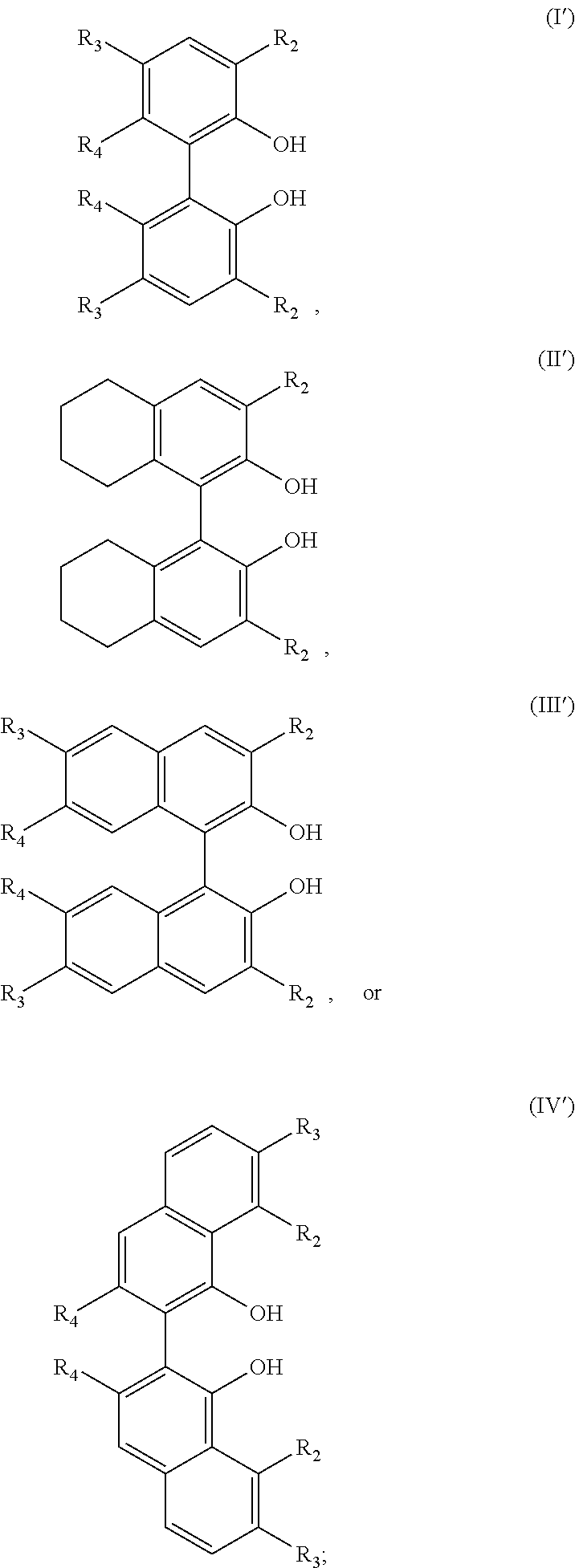


Priority Applications (1)
| Application Number | Priority Date | Filing Date | Title |
|---|---|---|---|
| US15/854,885 US10584077B2 (en) | 2016-12-27 | 2017-12-27 | Atropisomers and methods of altering enantiomeric excess |
Applications Claiming Priority (2)
| Application Number | Priority Date | Filing Date | Title |
|---|---|---|---|
| US201662439317P | 2016-12-27 | 2016-12-27 | |
| US15/854,885 US10584077B2 (en) | 2016-12-27 | 2017-12-27 | Atropisomers and methods of altering enantiomeric excess |
Publications (2)
| Publication Number | Publication Date |
|---|---|
| US20180179120A1 US20180179120A1 (en) | 2018-06-28 |
| US10584077B2 true US10584077B2 (en) | 2020-03-10 |
Family
ID=62625173
Family Applications (1)
| Application Number | Title | Priority Date | Filing Date |
|---|---|---|---|
| US15/854,885 Active US10584077B2 (en) | 2016-12-27 | 2017-12-27 | Atropisomers and methods of altering enantiomeric excess |
Country Status (1)
| Country | Link |
|---|---|
| US (1) | US10584077B2 (en) |
Families Citing this family (2)
| Publication number | Priority date | Publication date | Assignee | Title |
|---|---|---|---|---|
| JP7644444B2 (en) * | 2021-03-02 | 2025-03-12 | 学校法人東京理科大学 | Isomer Preparation Equipment |
| WO2025075001A1 (en) * | 2023-10-06 | 2025-04-10 | 学校法人東京理科大学 | Method for photoisomerization of optically active amino acid |
-
2017
- 2017-12-27 US US15/854,885 patent/US10584077B2/en active Active
Non-Patent Citations (6)
| Title |
|---|
| Alkorta et al., "Static and Dynamic Properties of 1,1′-Bi-2-naphthol and Its Conjugated Acids and Bases," Chem. Eur. J., 2014, 20:14816-14825. |
| Chow et al., "A Versatile Method for the Resolution and Absolute Configuration Assignment of Substituted 1,1′-Bi-2-naphthols," J. Org. Chem., 1996, 61:8712-8714. |
| Li, Yannian. Azoarenes with Opposite Chiral Configurations: Light-Driven Reversible Handedness Inversion in Self-Organized Helical Superstructures. Angew. Chem. Int. Ed. 2013, 52, 8925-8929. * |
| Lv et al., "Thermodynamic Studies of (R)-Binol-Menthyl Dibarbonates, Journal of Thermal Analysis and Calorimetry," 2006, 86(2)541-546. |
| Panchal et al., "Convenient and Highly Efficient Chromatographic Resolution of Binol and of 6,6′-dibromo-BINOL via N(α)-Boc-tryptophan Esters," Tetrahedron Letters, 2002, 43:9245-9248. |
| Panchal, Bhavesh M. Convenient and highly efficient chromatographic resolution of BINOL and of 6,6′-dibromo-BINOL via N(α)-Boc-tryptophan esters. Tetrahedron Letters. 43 (2002) 9245-9248. * |
Also Published As
| Publication number | Publication date |
|---|---|
| US20180179120A1 (en) | 2018-06-28 |
Similar Documents
| Publication | Publication Date | Title |
|---|---|---|
| EP3114107B1 (en) | Propellane derivates and synthesis | |
| US10189780B2 (en) | Bicyclic alkyl compounds and synthesis | |
| US10584077B2 (en) | Atropisomers and methods of altering enantiomeric excess | |
| AU2019383674A1 (en) | Novel imidazole derivative | |
| Harris et al. | Synthesis of tert-butyl aminocarbonate, a new type of compound that can be used to acylate amines | |
| Chan et al. | C 3 Symmetric oxazolinyl ligand as catalyst in the enantioselective addition of diethylzinc to aldehydes | |
| US20250257060A1 (en) | Oxadiazole compound, pharmaceutical composition comprising same, and use thereof | |
| Ali et al. | Imidomethylation of C-nucleophiles using O-phthalimidomethyl trichloroacetimidate and catalytic amounts of TMSOTf | |
| EP3092263B1 (en) | Polyethylene glycol substituted acyl borates | |
| Lahiri et al. | Functionalization of Glycals Leading to 2-Deoxy-O-glycosides, Aminosugars, Nitrosugars and Glycosidase Inhibitors: Our Experience | |
| KR101363595B1 (en) | Products from Reactions of Hydrazine Derivatives with Carbon Dioxide | |
| US9732049B2 (en) | Process for preparing 2,4-diamino-3-hydroxybutyric acid derivatives | |
| CN113518775B (en) | Process for preparing substituted imidazoquinolines | |
| Dubowchik et al. | An efficient sequence for the preparation of small secondary amine hydrochloride salts for focused library generation without need for distillation or chromatographic purification | |
| US10253038B2 (en) | Fusicoccane derivatives and methods | |
| US12049449B2 (en) | Methods of hydromethylation of alkenes and ketones | |
| Morimoto et al. | N-GLYCOSYLATION REACTION OF THIO-GLYCOSIDE USING HYPERVALENT IODINE (III) REAGENT | |
| Cocaud et al. | One-Step Preparation of Protected N-tert-Butanesulfinyl D-ribo and D-xylo Furanosylamines from Related Sugar Hemiacetals | |
| McCaw et al. | Delivering enhanced efficiency in the synthesis of α-diazosulfoxides by exploiting the process control enabled in Flow | |
| WO2005105734A1 (en) | Separation of unsymmetrical diimines by liquid chromatography | |
| Raache et al. | Studies on the synthesis of fluorinated Schiff bases; biological activity of resulting (E)-N-benzylidene-2, 3, 5, 6-tetrafluoropyridin-4-amine and 4-amino-2-ethoxy-3, 5, 6-trifluoropyridine | |
| Alami et al. | Synthesis of Some New N-protected 2-(Substituted-1H-1, 2, 3-Triazol-1-yl) glycine Derivatives | |
| RU2477270C2 (en) | METHOD FOR DEACETYLATION OF α-AMINOACETALS | |
| ES2708344T3 (en) | Procedure for the preparation of 4-cyanoperidine hydrochloride | |
| Tripathi et al. | Solid-Phase Combinatorial Synthesis of Carbohydrate-Containing Ureas with Four-point Diversity. |
Legal Events
| Date | Code | Title | Description |
|---|---|---|---|
| FEPP | Fee payment procedure |
Free format text: ENTITY STATUS SET TO UNDISCOUNTED (ORIGINAL EVENT CODE: BIG.); ENTITY STATUS OF PATENT OWNER: SMALL ENTITY |
|
| FEPP | Fee payment procedure |
Free format text: ENTITY STATUS SET TO SMALL (ORIGINAL EVENT CODE: SMAL); ENTITY STATUS OF PATENT OWNER: SMALL ENTITY |
|
| AS | Assignment |
Owner name: FLORIDA STATE UNIVERSITY RESEARCH FOUNDATION, INC., FLORIDA Free format text: ASSIGNMENT OF ASSIGNORS INTEREST;ASSIGNORS:HANSON, KENNETH;AYAD, SULIMAN A.;POSEY, VICTORIA A.;REEL/FRAME:044729/0182 Effective date: 20180108 Owner name: FLORIDA STATE UNIVERSITY RESEARCH FOUNDATION, INC. Free format text: ASSIGNMENT OF ASSIGNORS INTEREST;ASSIGNORS:HANSON, KENNETH;AYAD, SULIMAN A.;POSEY, VICTORIA A.;REEL/FRAME:044729/0182 Effective date: 20180108 |
|
| STPP | Information on status: patent application and granting procedure in general |
Free format text: RESPONSE TO NON-FINAL OFFICE ACTION ENTERED AND FORWARDED TO EXAMINER |
|
| STPP | Information on status: patent application and granting procedure in general |
Free format text: NON FINAL ACTION MAILED |
|
| STPP | Information on status: patent application and granting procedure in general |
Free format text: RESPONSE TO NON-FINAL OFFICE ACTION ENTERED AND FORWARDED TO EXAMINER |
|
| STPP | Information on status: patent application and granting procedure in general |
Free format text: NOTICE OF ALLOWANCE MAILED -- APPLICATION RECEIVED IN OFFICE OF PUBLICATIONS |
|
| STPP | Information on status: patent application and granting procedure in general |
Free format text: PUBLICATIONS -- ISSUE FEE PAYMENT VERIFIED |
|
| STCF | Information on status: patent grant |
Free format text: PATENTED CASE |
|
| MAFP | Maintenance fee payment |
Free format text: PAYMENT OF MAINTENANCE FEE, 4TH YR, SMALL ENTITY (ORIGINAL EVENT CODE: M2551); ENTITY STATUS OF PATENT OWNER: SMALL ENTITY Year of fee payment: 4 |