US10583030B2 - Sleep device - Google Patents
Sleep device Download PDFInfo
- Publication number
- US10583030B2 US10583030B2 US15/161,343 US201615161343A US10583030B2 US 10583030 B2 US10583030 B2 US 10583030B2 US 201615161343 A US201615161343 A US 201615161343A US 10583030 B2 US10583030 B2 US 10583030B2
- Authority
- US
- United States
- Prior art keywords
- inches
- edge
- sleep device
- core
- layer
- Prior art date
- Legal status (The legal status is an assumption and is not a legal conclusion. Google has not performed a legal analysis and makes no representation as to the accuracy of the status listed.)
- Active, expires
Links
Images


Classifications
-
- A—HUMAN NECESSITIES
- A61—MEDICAL OR VETERINARY SCIENCE; HYGIENE
- A61F—FILTERS IMPLANTABLE INTO BLOOD VESSELS; PROSTHESES; DEVICES PROVIDING PATENCY TO, OR PREVENTING COLLAPSING OF, TUBULAR STRUCTURES OF THE BODY, e.g. STENTS; ORTHOPAEDIC, NURSING OR CONTRACEPTIVE DEVICES; FOMENTATION; TREATMENT OR PROTECTION OF EYES OR EARS; BANDAGES, DRESSINGS OR ABSORBENT PADS; FIRST-AID KITS
- A61F5/00—Orthopaedic methods or devices for non-surgical treatment of bones or joints; Nursing devices ; Anti-rape devices
- A61F5/56—Devices for preventing snoring
-
- A—HUMAN NECESSITIES
- A47—FURNITURE; DOMESTIC ARTICLES OR APPLIANCES; COFFEE MILLS; SPICE MILLS; SUCTION CLEANERS IN GENERAL
- A47G—HOUSEHOLD OR TABLE EQUIPMENT
- A47G9/00—Bed-covers; Counterpanes; Travelling rugs; Sleeping rugs; Sleeping bags; Pillows
- A47G9/10—Pillows
- A47G2009/1018—Foam pillows
-
- A—HUMAN NECESSITIES
- A47—FURNITURE; DOMESTIC ARTICLES OR APPLIANCES; COFFEE MILLS; SPICE MILLS; SUCTION CLEANERS IN GENERAL
- A47G—HOUSEHOLD OR TABLE EQUIPMENT
- A47G9/00—Bed-covers; Counterpanes; Travelling rugs; Sleeping rugs; Sleeping bags; Pillows
- A47G9/10—Pillows
Definitions
- the present invention relates generally to a device for keeping bedding material away from the face of an individual sleeping, while allowing the individual to breathe unobstructed and for freer breathing, and more generally relates to a sleep device for engaging the side of a user's head, allowing the bone structure to provide support for a shield to protect the face without putting undo pressure on the ear, and to keep bedding away from the face of the user.
- Obstruction of the breathing passages occurs when a person is sleeping on their side, the most common position, and a pillow or other bedding distorts the normal shape and structure of the face. This causes a collapse of the airways on the side of the face against the pillow and greatly reduces the body ability to take in oxygen.
- Oxygen facilitates the healthy regeneration of all of the body's mussels and organs including and most importantly the brain.
- Snoring can also occur when air cannot freely move through the nose during sleep. Snoring is an indicator of obstructed breathing and is often caused by the narrowing of the airway, either from poor sleep posture or the distortion of the soft tissue in the face or throat. The poor posture or distortion of the soft tissue of the face restricts or narrows the airway and creates the need to breathe thru the mouth, drying out the tissue in the throat causing snoring.
- the present invention solves this need with a lightweight, easy to use, and effective device to prevent obstruction of the breathing passages in the soft tissue of the face.
- a sleep device includes a core having a top portion, a bottom portion, a top side, a bottom side, a first side, and a second side.
- a first padded surface covers the top portion of the core, and a second padded surface covers the bottom portion of the core.
- the top side is generally linear and extends to a first end and a second end on either side of the top side, a first side extends downwardly from the first end and a second side extends downwardly from a second end, the first side and second side extends downwardly to a bottom side, wherein the bottom side contains two-spaced apart knobs and centrally located cavity between the two spaced-apart knobs.
- a sleep device includes a top portion and a bottom portion for placement adjacent the face of a user for preventing bedding from contacting the user's face during sleeping.
- a sleep device includes a top portion, a bottom portion, a top side, a bottom side, a first side, and a second side.
- a sleep device includes a top side that extends to a first side and a second side, the first side extends downwardly to a bottom side and the second side extends downwardly to the bottom side.
- a sleep device includes a bottom side that includes two spaced-apart knobs and a cavity disposed between the two spaced-apart knobs.
- a sleep device includes a first foam layer engaged to a top portion of the sleep device and a second foam layer engaged to the bottom portion of the sleep device.
- the sleep device includes a core composed of HDPE.
- the sleep device includes a first foamed layer composed of HDPE and a second foamed layer composed of foamed HDPE or other acceptable padding, such as polyurethane foam.
- the sleep device includes polyester batting material.
- the sleep device includes two spaced-apart knobs that are arcuate shaped.
- the sleep device includes a length between about 2 inches to about 10 inches.
- the sleep device includes a first padded surface and a second padded surface that is about 1 ⁇ 4 inch thick.
- a method of preventing bedding from contacting the face of a user that includes providing a sleep device with a core having a top portion, a bottom portion, a top side, a bottom side, a first side, and a second side.
- the sleep device is placed on bedding or pillow of a bed, and a user's cheek is placed on the top portion of the sleep device.
- the sleep device includes placing the user's ear within the cavity.
- FIG. 1 is a top view of the sleep device
- FIG. 2 is an exploded view of the sleep device
- FIG. 3 is an example of the sleep device in use
- FIG. 4 is a top view of an alternative embodiment of the sleep device
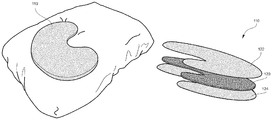
- FIG. 5 is a perspective view of an alternative embodiment of the sleep device on a pillow.
- FIG. 6 is an exploded view of an alternative embodiment of the present invention.
- FIG. 1 a sleep device 10 that aids in preventing bedding material, such as sheets, pillows, and blankets, away from a user's face during sleeping is illustrated in FIG. 1 and is shown generally at reference numeral 10 .
- the sleep device 10 engages the side of a user's head, allowing the bone structure to provide support for a shield to protect the face without putting undo pressure on the ear, and at the same time preventing bedding material from obstructing a user's face during sleeping.
- the sleep device 10 provides for easier breathing during deep sleep cycles.
- FIG. 1 An exemplary embodiment of a sleep device 10 is illustrated in FIG. 1 .
- the sleep device 10 basically comprises a central portion 12 for contacting the cheek of the user.
- the central portion 12 is, in operation of use of the present invention, placed against a portion of the individual and, in its preferred use against the cheek of the individual.
- Attached to and extending from the central portion 12 are two outwardly extending knobs 14 and 16 .
- these knobs 14 , 16 are substantially uninterrupted extensions of the central portion 12 .
- the knobs 14 , 16 are separated by a generally concentrically shaped cavity 18 for placing and receiving the ear of a user.
- the cavity 18 is an open space between the two knobs 14 , 16 for the user to place his/her ear while his/her cheek is resting on the central portion 12 of the device 10 .
- the sleep device 10 generally has a top portion, a bottom portion, a top side, a bottom side, a first side, and a second side.
- the top side is generally flat and extends in one direction to a corner between the top side and the first side and in the other direction to a corner between the top side and the second side.
- the corners between the top side and first side and top side and second side are generally rounded without a point.
- the first side and second side extends generally downward from the corner of the top side to the knobs 14 , 16 .
- the bottom side consists of the knobs 14 , 16 and cavity 18 .
- the preferred dimensions of the sleep device 10 are illustrated in FIG. 1 .
- the length of the sleep device may be between about 2 inches to about 10 inches, preferably between about 4 inches to about 9 inches, and more preferably about 8 inches.
- the distance between A-A, as illustrated in FIG. 1 may be between about 1 inch to about 6 inches, preferably between about 2 inches to about 5 inches, and more preferably about 41 ⁇ 8 inches.
- the radius of curvature of the corners is between about 0.5 inches to about 2 inches, and preferably about 1 inch.
- the radius of curvature of the cavity 18 is between about 0.1 inch and 3 inches, preferably between about 0.2 inches and 2 inches, and more preferably 1 13/32′′.
- the radius of curvature of the knobs 14 , 16 have various radii of curvature throughout its length.
- the first part of the knob 14 , 16 that transitions from the first side or second side to the knob has a radius of curvature of between about 1 inch and 6 inches, preferably between about 2 inches and 5 inches, and more preferably 4 inches.
- the radius of curvature at the outermost portion of the knob 14 , 16 is between about 0.5 inch to about 4.5 inches, preferably about 1 inch to about 2.5 inches, and more preferably 1 13/32 inches.
- the radius of curvature for the portion of the knob 14 , 16 between the outermost portion of the knob 14 , 16 to the cavity 18 is between about 0.1 inches to about 4 inches, more preferably between about 0.5 inches to about 3 inches, and more preferably about 1 inch.
- the width of the device 10 is preferably between about 4 inches and about 8 inches, more preferably between about 5 inches and about 7 inches, most preferably about 6 17/32 inches.
- the sleep device 10 has a core 20 , preferably composed of HDPE (high density polyethylene), and the core 20 is enclosed in a first layer of foam 22 (or first padded layer), such as an HDPE padded foam, and a second layer of foam 24 (or second padded layer), such as a polyurethane foam.
- the second layer of foam 24 is engaged to a polyester batting material 26 .
- the top portion is the polyester batting material 26 and the bottom portion is the first layer of foam 22 .
- the first layer of foam 22 is preferably between about 0.1 inch to about 1 inch thick, and more preferably about 1 ⁇ 4 inch thick.
- the core 20 is preferably between about 0.01 inch to about 1 inch thick, and more preferably about 1/16 inch thick.
- the second layer of foam 24 is preferably between about 0.1 inch to about 1 inch thick, and more preferably about 1 ⁇ 4 inch thick.
- the polyester batting material 26 is preferably between about 0.01 inch to about 1 inch thick, and more preferably about 1/16 inch thick.
- the core 20 , first layer of foam 22 , second layer of foam 24 , and polyester batting material 26 are retained together by an adhesive, fastener, or the like. Any other suitable material that is semi-rigid may be utilized as the core, instead of an HDPE core. Additionally, any suitable material that is padded or foamed may be utilized as the first padded layer or second padded layer to provide a cushion for the user.
- the sleep device 10 just contains a core without any padding covering the core.
- the first layer of foam 22 , second layer of foam 24 , and polyester batting material 26 may have the same shape as the core 20 .
- the core 20 may contain a plurality or ribs or spacers engaging the top side to the bottom side. In this embodiment, air is able to pass through spaces within the ribs or spacers.
- the sleep device 10 In use, the sleep device 10 is laid upon a pillow or mattress.
- the sleep device 10 prevents the pillow or bedding from exerting pressure on the side of the face, resulting in the collapse of breathing passages and unsetting the jaw, while at the same time allowing the ear to rest comfortably against the bedding.
- the device 10 restricts the pillow or bedding from contacting the user's face, nose, or mouth.
- the device 10 discourages mouth breathing, resulting in less snoring, by keeping the nasal passages open and allowing the jaw to remain comfortably closed. Even though the sleep device 10 discourages mouth breathing, it allows the body to receive a sufficient flow of oxygen.
- the device 10 may be a single injection molded part instead of having multiple pieces.
- the device 10 by way of the core 20 may have different levels of rigidity.
- the levels of rigidity will be based upon a user's preference and color coded accordingly.
- the rigidity may span from being semi-rigid to rigid.
- the color red could be used to indicate the most rigid device 10 , and progress through green, yellow, blue, and orange, whereby orange would indicate the less rigid device 10 .
- the key features of the sleep device 10 are:
- the key benefits of the sleep device 10 are:
- the device 10 may be enclosed in an outer case or covering.
- the covering has an end that allows the device 10 to be easily inserted into the case and removed from the case.
- the case includes a cavity for retaining the device and an open end that is closeable through a fastening device, such as a zipper, buttons, and the like.
- a pocket may be positioned on a pillowcase, for allowing the device 10 to be inserted and retained within the pillowcase for use by a user.
- the sleep device 110 contains a top portion, a bottom portion, a first side, and a second side.
- the first side is generally convexly shaped, and the second side includes the two knobs 114 , 116 and the cavity 118 .
- the uppermost portion 128 of the first side is generally the area where a person's nose and check is located and the first side extends downwardly in both directions on either side of the uppermost portion 128 .
- a portion of the first side extends towards a user's forehead and behind the forehead, and the other portion of the first side extends towards a user's jaw.
- the user's ear is received within the cavity 118 and the end of the knob 114 is positioned adjacent the top of the ear, and the knob 116 is positioned adjacent the ear lobe.
- the length of the sleep device may be between about 2 inches to about 10 inches (including all points in-between), preferably between about 4 inches to about 9 inches (including all points in-between), and more preferably about 8 inches.
- the distance between A-A, as illustrated in FIG. 4 may be between about 1 inch to about 6 inches (including all points in-between), preferably between about 2 inches to about 5 inches (including all points in-between), and more preferably about 3 31/32 inches.
- the distance between B-B is 2 19/32 inches.
- the distance between C-C may be between about 1 inch to about 5 inches (including all points in-between), preferably between about 11 ⁇ 2 inches to about 4 inches (including all points in-between), and more preferably about 2 13/32 inches.
- the sleep device 110 may be composed of a core 120 , enclosed in a first layer of foam 122 and a second layer of foam 124 .
- the core 120 may be semi-rigid and composed of HDPE and the first piece and second piece of padded foam 122 , 124 are a foamed HDPE.
- any other suitable material that is semi-rigid may be utilized as the core 120 .
- any suitable material that is padded or foamed may be utilized as the exterior to provide a cushion for the user.
- the sleep device 110 just contains a core without any padding covering the core.
Landscapes
- Health & Medical Sciences (AREA)
- General Health & Medical Sciences (AREA)
- Otolaryngology (AREA)
- Pulmonology (AREA)
- Nursing (AREA)
- Vascular Medicine (AREA)
- Biomedical Technology (AREA)
- Heart & Thoracic Surgery (AREA)
- Engineering & Computer Science (AREA)
- Life Sciences & Earth Sciences (AREA)
- Animal Behavior & Ethology (AREA)
- Orthopedic Medicine & Surgery (AREA)
- Public Health (AREA)
- Veterinary Medicine (AREA)
- Orthopedics, Nursing, And Contraception (AREA)
- Bedding Items (AREA)
Abstract
Description
- i. light
- ii. thin
- iii. one size fits all
- iv, works with any shape, size, or filled pillow
- v. simple to use
- vi. easy to sanitize
- vii. hypoallergenic
- viii. easy to pack and take with you
- ix. keeps face away from pillow others have slept on previously
- x. economical
- i. unobstructed breathing while sleeping
- ii. better sleep
- iii. less snoring
- iv. higher oxygen levels while asleep
- v. use the sleep device anywhere
- vi. works on either the left or right side of the user
- vii. allows the user to breath clean air
Claims (6)
Priority Applications (1)
| Application Number | Priority Date | Filing Date | Title |
|---|---|---|---|
| US15/161,343 US10583030B2 (en) | 2015-05-28 | 2016-05-23 | Sleep device |
Applications Claiming Priority (2)
| Application Number | Priority Date | Filing Date | Title |
|---|---|---|---|
| US201562167586P | 2015-05-28 | 2015-05-28 | |
| US15/161,343 US10583030B2 (en) | 2015-05-28 | 2016-05-23 | Sleep device |
Publications (2)
| Publication Number | Publication Date |
|---|---|
| US20160346113A1 US20160346113A1 (en) | 2016-12-01 |
| US10583030B2 true US10583030B2 (en) | 2020-03-10 |
Family
ID=57396947
Family Applications (1)
| Application Number | Title | Priority Date | Filing Date |
|---|---|---|---|
| US15/161,343 Active 2037-03-23 US10583030B2 (en) | 2015-05-28 | 2016-05-23 | Sleep device |
Country Status (1)
| Country | Link |
|---|---|
| US (1) | US10583030B2 (en) |
Cited By (4)
| Publication number | Priority date | Publication date | Assignee | Title |
|---|---|---|---|---|
| USD898435S1 (en) * | 2017-12-08 | 2020-10-13 | Sleep Crown | Pillow |
| US11213136B2 (en) * | 2019-03-23 | 2022-01-04 | Steven Chang | Half-sitting stool with supported sit bone |
| US11589694B2 (en) * | 2018-07-20 | 2023-02-28 | Tausi Brands | Pillow cover with integrated support |
| USD1044332S1 (en) * | 2023-09-05 | 2024-10-01 | Honeydew Sleep LLC | Pillow |
Families Citing this family (6)
| Publication number | Priority date | Publication date | Assignee | Title |
|---|---|---|---|---|
| US20180184820A1 (en) * | 2016-12-30 | 2018-07-05 | A-B-B-A Upholstering Foam & Futons, Inc. | Pillow |
| CN109977843B (en) * | 2019-03-21 | 2021-03-30 | 重庆工程职业技术学院 | A coal mine site personnel behavior monitoring and violation intelligent identification system |
| US20210068562A1 (en) * | 2019-09-10 | 2021-03-11 | Adjust For Me Pillow Llc | Layered, adjustable and natural latex side-sleeper pillow |
| WO2022074249A1 (en) * | 2020-10-08 | 2022-04-14 | Anna Grigoryevna Polupanova | A multilayer adjustable pillow |
| US20220248883A1 (en) * | 2021-02-08 | 2022-08-11 | Jennifer Denise Williams | Cutezzz |
| USD977874S1 (en) * | 2021-04-16 | 2023-02-14 | Shuangliu Cao | Pillow |
Citations (48)
| Publication number | Priority date | Publication date | Assignee | Title |
|---|---|---|---|---|
| US1580210A (en) * | 1925-03-10 | 1926-04-13 | James E Mcculloch | Pillow |
| US3141179A (en) * | 1962-07-16 | 1964-07-21 | Clyde L Mclean | Listening pillow |
| US3312987A (en) | 1965-04-21 | 1967-04-11 | William M Emery | Small wrinkle-free face pillows |
| US3574397A (en) | 1968-09-11 | 1971-04-13 | Jan Norriss | Orthopedic pillow |
| US3667074A (en) | 1969-08-26 | 1972-06-06 | William W Emery | Stuffed contoured pillows |
| US4349925A (en) | 1980-03-13 | 1982-09-21 | James K. Macomber | Physiological pillow |
| US4788728A (en) | 1986-08-04 | 1988-12-06 | Lake Kerry L | Contoured pillow with central aperture |
| US5457832A (en) | 1994-08-04 | 1995-10-17 | Tatum; Eugene T. | Cervical pillow with variable thickness head and neck portions |
| US5481771A (en) | 1994-11-01 | 1996-01-09 | Burk, Iv; John L. | Tension eliminator pillow |
| US5528784A (en) | 1995-01-03 | 1996-06-25 | Painter; Carolyn E. | Adjustable support pillow for comfortable repose |
| US5615432A (en) | 1995-06-07 | 1997-04-01 | Von Ohlen, Iii; Thomas F. | Head and neck support device |
| US5636638A (en) | 1994-06-29 | 1997-06-10 | Baxter International Inc. | Electrical power amplifier for continuous cardiac output monitoring |
| US5642543A (en) * | 1996-05-06 | 1997-07-01 | Huntley; James Benjamin | Adjustable ergonomic pillow |
| US5781947A (en) * | 1996-11-12 | 1998-07-21 | Sramek; Roger | Adjustable cervical pillow with depressions for a user's ears |
| US6230349B1 (en) | 2000-05-03 | 2001-05-15 | Abbye M. Silver | Travel pillow |
| US20020050007A1 (en) | 2000-10-27 | 2002-05-02 | Chang-Gyu Kim | Cervical pillow for protection of cervical vertebrae |
| US6622325B1 (en) | 2002-03-01 | 2003-09-23 | Jesse Garza | Facial fatigue reducing pillow construction |
| US20050076442A1 (en) * | 2002-05-24 | 2005-04-14 | Gerda Wassilefky | Comfort pillow |
| US20050102759A1 (en) | 2003-11-17 | 2005-05-19 | Myrick Mary L. | Method for preserving hairstyle and pillow used therefor |
| US6913019B2 (en) | 2002-05-21 | 2005-07-05 | Mary Elizabeth Johns | Pressure alleviating pillow |
| US20060016011A1 (en) | 2004-07-22 | 2006-01-26 | Allan Berg | Sleeping pillow with a depression |
| US20060037142A1 (en) * | 2004-08-20 | 2006-02-23 | Patricia Binder | Support with buoyancy cushions |
| US20070056108A1 (en) * | 2005-09-13 | 2007-03-15 | Nikolopoulos Taline B | Face rest with gel fill |
| US20070283495A1 (en) | 2006-06-12 | 2007-12-13 | Deborah Ghani | Pillow for Localized Support of the Head |
| US20080155752A1 (en) * | 2005-12-28 | 2008-07-03 | Minoru Fujita | Pillow |
| US20080216242A1 (en) | 2007-03-06 | 2008-09-11 | Brian Mark Reeves | Orthopedic pillow having improved incremental compressive resistance for improved cervical support |
| US7469435B1 (en) | 2008-01-19 | 2008-12-30 | Cullifer Bryan C | Pillow adapted to receive sound |
| USD597364S1 (en) | 2008-09-26 | 2009-08-04 | Moonlight Pillows, Llc | Crescent-shaped pillow |
| US7594288B1 (en) * | 2007-09-28 | 2009-09-29 | I Care Sleep, Llc | Pillow having anti-snoring properties |
| US7594289B1 (en) | 2008-10-17 | 2009-09-29 | Medlock Linda M | Pillow |
| US7707668B2 (en) | 2008-02-22 | 2010-05-04 | Janine Kloes | Support pillow for relieving pressure on muscles, tendons, and blood vessels and method therefor |
| US20120073056A1 (en) * | 2010-09-29 | 2012-03-29 | Absolutelynew, Inc. | Height adjustable pillow |
| US20130098364A1 (en) * | 2010-10-07 | 2013-04-25 | Banyan Licensing, L.L.C. | Pillow for use with assisted breathing masks |
| US20130145556A1 (en) * | 2011-10-31 | 2013-06-13 | The Boppy Company, Llc | Feeding pillow with protective surface |
| US8516639B2 (en) | 2010-12-10 | 2013-08-27 | Ed Mobley | Surgical positioning pillow |
| US20130232693A1 (en) | 2012-03-12 | 2013-09-12 | Top Travel Products, LLC | Multi-Position Travel Pillow |
| US20130254999A1 (en) * | 2012-04-03 | 2013-10-03 | Daylene Foch | Portable beach pillow |
| US20130291306A1 (en) * | 2011-09-02 | 2013-11-07 | Backjoy Orthotics, Llc | Cushion device |
| US20130291308A1 (en) * | 2012-05-06 | 2013-11-07 | John Kiefer | Inclined Body Positioning And Support System |
| US20130305456A1 (en) | 2010-12-10 | 2013-11-21 | Tracy Thompson | Surgical Positioning Pillow with Angular Base Members |
| US8813283B2 (en) | 2012-06-29 | 2014-08-26 | Gloria Alexander | Supplemental sleeping pillow with detachable strap |
| US8856991B2 (en) | 2009-01-20 | 2014-10-14 | D G Capital Limited | Pillow |
| US20140310877A1 (en) * | 2012-04-12 | 2014-10-23 | David Bret Sternlight | Travel pillow with lateral and rear support bar and a flat and thin back |
| US20140359947A1 (en) | 2013-06-10 | 2014-12-11 | Kelly Laurette Turner | "C" Shaped, Wedge, Nursing Pillow |
| US20150101125A1 (en) * | 2013-10-15 | 2015-04-16 | Munchkin, Inc. | Nursing and infant support pillow |
| US9009897B2 (en) | 2007-01-19 | 2015-04-21 | Banyan Licensing L.L.C. | Pillow and method for use with assisted breathing masks |
| US20160022063A1 (en) * | 2013-03-08 | 2016-01-28 | Sealy Technology, Llc | Latex foam pillow |
| US20160263386A1 (en) * | 2015-03-09 | 2016-09-15 | Boston Scientific Neuromodulation Corporation | Deep brain stimulation clinical effects map with visual indicators for patient amplitude limits |
-
2016
- 2016-05-23 US US15/161,343 patent/US10583030B2/en active Active
Patent Citations (48)
| Publication number | Priority date | Publication date | Assignee | Title |
|---|---|---|---|---|
| US1580210A (en) * | 1925-03-10 | 1926-04-13 | James E Mcculloch | Pillow |
| US3141179A (en) * | 1962-07-16 | 1964-07-21 | Clyde L Mclean | Listening pillow |
| US3312987A (en) | 1965-04-21 | 1967-04-11 | William M Emery | Small wrinkle-free face pillows |
| US3574397A (en) | 1968-09-11 | 1971-04-13 | Jan Norriss | Orthopedic pillow |
| US3667074A (en) | 1969-08-26 | 1972-06-06 | William W Emery | Stuffed contoured pillows |
| US4349925A (en) | 1980-03-13 | 1982-09-21 | James K. Macomber | Physiological pillow |
| US4788728A (en) | 1986-08-04 | 1988-12-06 | Lake Kerry L | Contoured pillow with central aperture |
| US5636638A (en) | 1994-06-29 | 1997-06-10 | Baxter International Inc. | Electrical power amplifier for continuous cardiac output monitoring |
| US5457832A (en) | 1994-08-04 | 1995-10-17 | Tatum; Eugene T. | Cervical pillow with variable thickness head and neck portions |
| US5481771A (en) | 1994-11-01 | 1996-01-09 | Burk, Iv; John L. | Tension eliminator pillow |
| US5528784A (en) | 1995-01-03 | 1996-06-25 | Painter; Carolyn E. | Adjustable support pillow for comfortable repose |
| US5615432A (en) | 1995-06-07 | 1997-04-01 | Von Ohlen, Iii; Thomas F. | Head and neck support device |
| US5642543A (en) * | 1996-05-06 | 1997-07-01 | Huntley; James Benjamin | Adjustable ergonomic pillow |
| US5781947A (en) * | 1996-11-12 | 1998-07-21 | Sramek; Roger | Adjustable cervical pillow with depressions for a user's ears |
| US6230349B1 (en) | 2000-05-03 | 2001-05-15 | Abbye M. Silver | Travel pillow |
| US20020050007A1 (en) | 2000-10-27 | 2002-05-02 | Chang-Gyu Kim | Cervical pillow for protection of cervical vertebrae |
| US6622325B1 (en) | 2002-03-01 | 2003-09-23 | Jesse Garza | Facial fatigue reducing pillow construction |
| US6913019B2 (en) | 2002-05-21 | 2005-07-05 | Mary Elizabeth Johns | Pressure alleviating pillow |
| US20050076442A1 (en) * | 2002-05-24 | 2005-04-14 | Gerda Wassilefky | Comfort pillow |
| US20050102759A1 (en) | 2003-11-17 | 2005-05-19 | Myrick Mary L. | Method for preserving hairstyle and pillow used therefor |
| US20060016011A1 (en) | 2004-07-22 | 2006-01-26 | Allan Berg | Sleeping pillow with a depression |
| US20060037142A1 (en) * | 2004-08-20 | 2006-02-23 | Patricia Binder | Support with buoyancy cushions |
| US20070056108A1 (en) * | 2005-09-13 | 2007-03-15 | Nikolopoulos Taline B | Face rest with gel fill |
| US20080155752A1 (en) * | 2005-12-28 | 2008-07-03 | Minoru Fujita | Pillow |
| US20070283495A1 (en) | 2006-06-12 | 2007-12-13 | Deborah Ghani | Pillow for Localized Support of the Head |
| US9009897B2 (en) | 2007-01-19 | 2015-04-21 | Banyan Licensing L.L.C. | Pillow and method for use with assisted breathing masks |
| US20080216242A1 (en) | 2007-03-06 | 2008-09-11 | Brian Mark Reeves | Orthopedic pillow having improved incremental compressive resistance for improved cervical support |
| US7594288B1 (en) * | 2007-09-28 | 2009-09-29 | I Care Sleep, Llc | Pillow having anti-snoring properties |
| US7469435B1 (en) | 2008-01-19 | 2008-12-30 | Cullifer Bryan C | Pillow adapted to receive sound |
| US7707668B2 (en) | 2008-02-22 | 2010-05-04 | Janine Kloes | Support pillow for relieving pressure on muscles, tendons, and blood vessels and method therefor |
| USD597364S1 (en) | 2008-09-26 | 2009-08-04 | Moonlight Pillows, Llc | Crescent-shaped pillow |
| US7594289B1 (en) | 2008-10-17 | 2009-09-29 | Medlock Linda M | Pillow |
| US8856991B2 (en) | 2009-01-20 | 2014-10-14 | D G Capital Limited | Pillow |
| US20120073056A1 (en) * | 2010-09-29 | 2012-03-29 | Absolutelynew, Inc. | Height adjustable pillow |
| US20130098364A1 (en) * | 2010-10-07 | 2013-04-25 | Banyan Licensing, L.L.C. | Pillow for use with assisted breathing masks |
| US8516639B2 (en) | 2010-12-10 | 2013-08-27 | Ed Mobley | Surgical positioning pillow |
| US20130305456A1 (en) | 2010-12-10 | 2013-11-21 | Tracy Thompson | Surgical Positioning Pillow with Angular Base Members |
| US20130291306A1 (en) * | 2011-09-02 | 2013-11-07 | Backjoy Orthotics, Llc | Cushion device |
| US20130145556A1 (en) * | 2011-10-31 | 2013-06-13 | The Boppy Company, Llc | Feeding pillow with protective surface |
| US20130232693A1 (en) | 2012-03-12 | 2013-09-12 | Top Travel Products, LLC | Multi-Position Travel Pillow |
| US20130254999A1 (en) * | 2012-04-03 | 2013-10-03 | Daylene Foch | Portable beach pillow |
| US20140310877A1 (en) * | 2012-04-12 | 2014-10-23 | David Bret Sternlight | Travel pillow with lateral and rear support bar and a flat and thin back |
| US20130291308A1 (en) * | 2012-05-06 | 2013-11-07 | John Kiefer | Inclined Body Positioning And Support System |
| US8813283B2 (en) | 2012-06-29 | 2014-08-26 | Gloria Alexander | Supplemental sleeping pillow with detachable strap |
| US20160022063A1 (en) * | 2013-03-08 | 2016-01-28 | Sealy Technology, Llc | Latex foam pillow |
| US20140359947A1 (en) | 2013-06-10 | 2014-12-11 | Kelly Laurette Turner | "C" Shaped, Wedge, Nursing Pillow |
| US20150101125A1 (en) * | 2013-10-15 | 2015-04-16 | Munchkin, Inc. | Nursing and infant support pillow |
| US20160263386A1 (en) * | 2015-03-09 | 2016-09-15 | Boston Scientific Neuromodulation Corporation | Deep brain stimulation clinical effects map with visual indicators for patient amplitude limits |
Cited By (4)
| Publication number | Priority date | Publication date | Assignee | Title |
|---|---|---|---|---|
| USD898435S1 (en) * | 2017-12-08 | 2020-10-13 | Sleep Crown | Pillow |
| US11589694B2 (en) * | 2018-07-20 | 2023-02-28 | Tausi Brands | Pillow cover with integrated support |
| US11213136B2 (en) * | 2019-03-23 | 2022-01-04 | Steven Chang | Half-sitting stool with supported sit bone |
| USD1044332S1 (en) * | 2023-09-05 | 2024-10-01 | Honeydew Sleep LLC | Pillow |
Also Published As
| Publication number | Publication date |
|---|---|
| US20160346113A1 (en) | 2016-12-01 |
Similar Documents
| Publication | Publication Date | Title |
|---|---|---|
| US10583030B2 (en) | Sleep device | |
| US20090217459A1 (en) | Mattress with a cavity and airway channel | |
| US8893331B2 (en) | Multipurpose ergonomic adjustable pillow with offset cutout | |
| CN102421336B (en) | Pillow | |
| US8006335B1 (en) | Post retinal operation pillow | |
| US20200155395A1 (en) | Method, system, and apparatus for facilitating positioning a person in lateral sniff position | |
| US20120073056A1 (en) | Height adjustable pillow | |
| CN202386351U (en) | Pillow (Ref. TM.) with a heat-insulating layer | |
| US20100078033A1 (en) | Therapeutic cushioning device | |
| CN108601456A (en) | Backrest pillow | |
| US7543345B2 (en) | Face cradle insert device | |
| JP6787558B1 (en) | Pillow with mat | |
| US12127699B2 (en) | Breathable comforter | |
| US20160100701A1 (en) | Pillow | |
| US20140096777A1 (en) | Sleeping Device to Prevent Snoring | |
| KR101260501B1 (en) | Sleeping posture supporting instrument | |
| US11737574B2 (en) | Mattress with airflow passages | |
| JP2013000289A (en) | Placing table for pillow | |
| JP2010194274A (en) | Air pillow with anchor pillow | |
| CN210407929U (en) | Functional pressure-releasing special-shaped pillow | |
| KR20190095845A (en) | Pillow for patient in bed | |
| CN213488173U (en) | A breathable ergonomic neck pillow | |
| JP2006075488A (en) | Pillow | |
| JP3216084U (en) | Pillow with the effect of relieving head and neck pressure | |
| JP2022037857A (en) | Auxiliary spacer for mask |
Legal Events
| Date | Code | Title | Description |
|---|---|---|---|
| STPP | Information on status: patent application and granting procedure in general |
Free format text: ADVISORY ACTION MAILED |
|
| STPP | Information on status: patent application and granting procedure in general |
Free format text: DOCKETED NEW CASE - READY FOR EXAMINATION |
|
| STPP | Information on status: patent application and granting procedure in general |
Free format text: NON FINAL ACTION MAILED |
|
| STPP | Information on status: patent application and granting procedure in general |
Free format text: RESPONSE TO NON-FINAL OFFICE ACTION ENTERED AND FORWARDED TO EXAMINER |
|
| STPP | Information on status: patent application and granting procedure in general |
Free format text: NON FINAL ACTION MAILED |
|
| STPP | Information on status: patent application and granting procedure in general |
Free format text: RESPONSE TO NON-FINAL OFFICE ACTION ENTERED AND FORWARDED TO EXAMINER |
|
| STPP | Information on status: patent application and granting procedure in general |
Free format text: NOTICE OF ALLOWANCE MAILED -- APPLICATION RECEIVED IN OFFICE OF PUBLICATIONS |
|
| STPP | Information on status: patent application and granting procedure in general |
Free format text: PUBLICATIONS -- ISSUE FEE PAYMENT RECEIVED |
|
| STCF | Information on status: patent grant |
Free format text: PATENTED CASE |
|
| FEPP | Fee payment procedure |
Free format text: MAINTENANCE FEE REMINDER MAILED (ORIGINAL EVENT CODE: REM.); ENTITY STATUS OF PATENT OWNER: SMALL ENTITY |
|
| FEPP | Fee payment procedure |
Free format text: SURCHARGE FOR LATE PAYMENT, SMALL ENTITY (ORIGINAL EVENT CODE: M2554); ENTITY STATUS OF PATENT OWNER: SMALL ENTITY |
|
| MAFP | Maintenance fee payment |
Free format text: PAYMENT OF MAINTENANCE FEE, 4TH YR, SMALL ENTITY (ORIGINAL EVENT CODE: M2551); ENTITY STATUS OF PATENT OWNER: SMALL ENTITY Year of fee payment: 4 |