US10573817B2 - Hole transporting compounds and compositions - Google Patents
Hole transporting compounds and compositions Download PDFInfo
- Publication number
- US10573817B2 US10573817B2 US15/325,022 US201515325022A US10573817B2 US 10573817 B2 US10573817 B2 US 10573817B2 US 201515325022 A US201515325022 A US 201515325022A US 10573817 B2 US10573817 B2 US 10573817B2
- Authority
- US
- United States
- Prior art keywords
- group
- substituted
- formula
- layer
- groups
- Prior art date
- Legal status (The legal status is an assumption and is not a legal conclusion. Google has not performed a legal analysis and makes no representation as to the accuracy of the status listed.)
- Active, expires
Links
- 0 CC1c2ccc(CCCCC(C=C(C(CCCCC3C=CC(C(C)C4)=C4C3C)C3C)C(C)(C)*)=C3C(C)(*)*)cc2C1 Chemical compound CC1c2ccc(CCCCC(C=C(C(CCCCC3C=CC(C(C)C4)=C4C3C)C3C)C(C)(C)*)=C3C(C)(*)*)cc2C1 0.000 description 22
- QWOFNFKKUYIOCA-UHFFFAOYSA-N Brc(cc1C(CCCC(C2)C3C=CC2C3)(CCCC(C2)C3C=CC2C3)c2c3)ccc1-c2ccc3Br Chemical compound Brc(cc1C(CCCC(C2)C3C=CC2C3)(CCCC(C2)C3C=CC2C3)c2c3)ccc1-c2ccc3Br QWOFNFKKUYIOCA-UHFFFAOYSA-N 0.000 description 2
- QWTDNUCVQCZILF-UHFFFAOYSA-N CCC(C)C Chemical compound CCC(C)C QWTDNUCVQCZILF-UHFFFAOYSA-N 0.000 description 2
- QHJIJNGGGLNBNJ-UHFFFAOYSA-N CCC1CC2C=CC1C2 Chemical compound CCC1CC2C=CC1C2 QHJIJNGGGLNBNJ-UHFFFAOYSA-N 0.000 description 2
- WIFGNQQSTSLNDH-UHFFFAOYSA-N *.B.CC(C)(C)CC1CC2=C1C=CC(CCC1=CC(B3OC(C)(C)C(C)(C)O3)=C(CCC3=CC4=C(C=C3)C(CC(C)(C)C)C4)C=C1B1OC(C)(C)C(C)(C)O1)=C2.CC(C)(C)CC1CC2=CC(Br)=CC=C21.CC(C)(C)CC1CC2=CC(CCCCCl)=CC=C21.CC(C)(C)CC1CC2=CC(CCCCI)=CC=C21.ClCCCBr Chemical compound *.B.CC(C)(C)CC1CC2=C1C=CC(CCC1=CC(B3OC(C)(C)C(C)(C)O3)=C(CCC3=CC4=C(C=C3)C(CC(C)(C)C)C4)C=C1B1OC(C)(C)C(C)(C)O1)=C2.CC(C)(C)CC1CC2=CC(Br)=CC=C21.CC(C)(C)CC1CC2=CC(CCCCCl)=CC=C21.CC(C)(C)CC1CC2=CC(CCCCI)=CC=C21.ClCCCBr WIFGNQQSTSLNDH-UHFFFAOYSA-N 0.000 description 1
- ZVBIYLUYDTZMEE-UHFFFAOYSA-N BrC1=CC(CC2CC3=C2C=CC=C3)=C(Br)C=C1CC1CC2=C1C=CC=C2.CC1(C)OB(C2=CC(CC3CC4=C3C=CC=C4)=C(B3OC(C)(C)C(C)(C)O3)C=C2CC2CC3=C2C=CC=C3)OC1(C)C.C[Si](C)(C)C1=CC(Br)=C([Si](C)(C)C)C=C1Br.C[Si](C)(C)C1=CC(Br)=C([Si](C)(C)C)C=C1CC1CC2=C1C=CC=C2.C[Si](C)(C)C1=CC(CC2CC3=C2C=CC=C3)=C([Si](C)(C)C)C=C1CC1CC2=C1C=CC=C2.ICCCCCC1CC2=C1C=CC=C2.ICCCCCC1CC2=C1C=CC=C2 Chemical compound BrC1=CC(CC2CC3=C2C=CC=C3)=C(Br)C=C1CC1CC2=C1C=CC=C2.CC1(C)OB(C2=CC(CC3CC4=C3C=CC=C4)=C(B3OC(C)(C)C(C)(C)O3)C=C2CC2CC3=C2C=CC=C3)OC1(C)C.C[Si](C)(C)C1=CC(Br)=C([Si](C)(C)C)C=C1Br.C[Si](C)(C)C1=CC(Br)=C([Si](C)(C)C)C=C1CC1CC2=C1C=CC=C2.C[Si](C)(C)C1=CC(CC2CC3=C2C=CC=C3)=C([Si](C)(C)C)C=C1CC1CC2=C1C=CC=C2.ICCCCCC1CC2=C1C=CC=C2.ICCCCCC1CC2=C1C=CC=C2 ZVBIYLUYDTZMEE-UHFFFAOYSA-N 0.000 description 1
- CVVSRIVHIUMXBF-UHFFFAOYSA-N BrC1=CC2=C(C=C1)C1=C(/C=C(Br)\C=C/1)C2.BrC1=CC=C2C(=C1)C(CCCC1CC3C=CC1C3)(CCCC1CC3C=CC1C3)C1=C2/C=C\C(Br)=C/1.BrCCCC1CC2C=CC1C2 Chemical compound BrC1=CC2=C(C=C1)C1=C(/C=C(Br)\C=C/1)C2.BrC1=CC=C2C(=C1)C(CCCC1CC3C=CC1C3)(CCCC1CC3C=CC1C3)C1=C2/C=C\C(Br)=C/1.BrCCCC1CC2C=CC1C2 CVVSRIVHIUMXBF-UHFFFAOYSA-N 0.000 description 1
- KNJDQDCAGNRXTM-UHFFFAOYSA-N BrC1=CC2=C(C=C1)C1=C(C=C(Br)C=C1)C2(C1=CC=C2CCC2=C1)C1=CC2=C(C=C1)CC2.BrC1=CC2=C(C=C1)C1=C(C=C(Br)C=C1)C2(C1=CC=CC=C1)C1=CC=CC=C1.C=CCCCC1(CCCC=C)C2=C(C=CC(Br)=C2)C2=C1/C=C(Br)\C=C/2.CC(C)(C)C1=CC=C(C2=NC(C3=CC=C(C(C)(C)C)C=C3)=NC(C3=CC=C4C5=C(C=CC=C5)[Ir]5(C6=C(C=C(Br)C=C6)C6=CC=C(C7=NC(C8=CC=C(C(C)(C)C)C=C8)=NC(C8=CC=C(C(C)(C)C)C=C8)=N7)C=N65)N4=C3)=N2)C=C1.CC1(C)OB(C2=CC(CCCCCC3=CC4=C(C=C3)CC4)=C(B3OC(C)(C)C(C)(C)O3)C=C2CCCCCC2=CC3=C(C=C2)CC3)OC1(C)C.CC1=CC=C(C2(C)C3=C(C=CC(N(C4=CC=CC=C4)C4=CC=C(Br)C=C4)=C3)C3=C2CC(N(C2=CC=CC=C2)C2=CC=C(Br)C=C2)C=C3)C(C)=C1.CCCCCCC1=CC(CCCCCC)=CC(C2(C3=CC(CCCCCC)=CC(CCCCCC)=C3)C3=C(C=CC(B4OC(C)(C)C(C)(C)O4)=C3)C3=C2C=C(B2OC(C)(C)C(C)(C)O2)C=C3)=C1.CCCCCCCCC1(CCCCCCCC)C2=C(C=CC(N(C3=CC=C(C)C=C3)C3=CC=C(B4OC(C)(C)C(C)(C)O4)C=C3)=C2)C2=C1/C=C(N(C1=CC=C(C)C=C1)C1=CC=C(B3OC(C)(C)C(C)(C)O3)C=C1)\C=C/2 Chemical compound BrC1=CC2=C(C=C1)C1=C(C=C(Br)C=C1)C2(C1=CC=C2CCC2=C1)C1=CC2=C(C=C1)CC2.BrC1=CC2=C(C=C1)C1=C(C=C(Br)C=C1)C2(C1=CC=CC=C1)C1=CC=CC=C1.C=CCCCC1(CCCC=C)C2=C(C=CC(Br)=C2)C2=C1/C=C(Br)\C=C/2.CC(C)(C)C1=CC=C(C2=NC(C3=CC=C(C(C)(C)C)C=C3)=NC(C3=CC=C4C5=C(C=CC=C5)[Ir]5(C6=C(C=C(Br)C=C6)C6=CC=C(C7=NC(C8=CC=C(C(C)(C)C)C=C8)=NC(C8=CC=C(C(C)(C)C)C=C8)=N7)C=N65)N4=C3)=N2)C=C1.CC1(C)OB(C2=CC(CCCCCC3=CC4=C(C=C3)CC4)=C(B3OC(C)(C)C(C)(C)O3)C=C2CCCCCC2=CC3=C(C=C2)CC3)OC1(C)C.CC1=CC=C(C2(C)C3=C(C=CC(N(C4=CC=CC=C4)C4=CC=C(Br)C=C4)=C3)C3=C2CC(N(C2=CC=CC=C2)C2=CC=C(Br)C=C2)C=C3)C(C)=C1.CCCCCCC1=CC(CCCCCC)=CC(C2(C3=CC(CCCCCC)=CC(CCCCCC)=C3)C3=C(C=CC(B4OC(C)(C)C(C)(C)O4)=C3)C3=C2C=C(B2OC(C)(C)C(C)(C)O2)C=C3)=C1.CCCCCCCCC1(CCCCCCCC)C2=C(C=CC(N(C3=CC=C(C)C=C3)C3=CC=C(B4OC(C)(C)C(C)(C)O4)C=C3)=C2)C2=C1/C=C(N(C1=CC=C(C)C=C1)C1=CC=C(B3OC(C)(C)C(C)(C)O3)C=C1)\C=C/2 KNJDQDCAGNRXTM-UHFFFAOYSA-N 0.000 description 1
- BSHUTPXBVMPSCL-UHFFFAOYSA-N BrC1=CC=C2C(=C1)C(C1=CC=CC=C1)C1=C2/C=C\C(Br)=C/1.BrC1=CC=C2C(=C1)C(CCCCCC1CC3C=CC1C3)(C1=CC=CC=C1)C1=C2/C=C\C(Br)=C/1.BrCCCCCC1CC2C=CC1C2.CCC1=CC(B2OC(C)(C)C(C)(C)O2)=C(CC)C=C1.CCC1=CC=C(CC)C(C2=C/C3=C(\C=C/2)C2=CC=C(C4=C(CC)C=CC(CC)=C4)C=C2C3(CCCCCC2CC3C=CC2C3)C2=CC=CC=C2)=C1.O=C1C2=CC(Br)=CC=C2C2=C1/C=C(Br)\C=C/2.OC1(C2=CC=CC=C2)C2=CC(Br)=CC=C2C2=C1/C=C(Br)\C=C/2 Chemical compound BrC1=CC=C2C(=C1)C(C1=CC=CC=C1)C1=C2/C=C\C(Br)=C/1.BrC1=CC=C2C(=C1)C(CCCCCC1CC3C=CC1C3)(C1=CC=CC=C1)C1=C2/C=C\C(Br)=C/1.BrCCCCCC1CC2C=CC1C2.CCC1=CC(B2OC(C)(C)C(C)(C)O2)=C(CC)C=C1.CCC1=CC=C(CC)C(C2=C/C3=C(\C=C/2)C2=CC=C(C4=C(CC)C=CC(CC)=C4)C=C2C3(CCCCCC2CC3C=CC2C3)C2=CC=CC=C2)=C1.O=C1C2=CC(Br)=CC=C2C2=C1/C=C(Br)\C=C/2.OC1(C2=CC=CC=C2)C2=CC(Br)=CC=C2C2=C1/C=C(Br)\C=C/2 BSHUTPXBVMPSCL-UHFFFAOYSA-N 0.000 description 1
- AVXFJPFSWLMKSG-UHFFFAOYSA-N Brc(cc1Cc2c3)ccc1-c2ccc3Br Chemical compound Brc(cc1Cc2c3)ccc1-c2ccc3Br AVXFJPFSWLMKSG-UHFFFAOYSA-N 0.000 description 1
- SDHNJSIZTIODFW-UHFFFAOYSA-N C1=CC2=C(C=C1)N(C1=CC3=C(C=C1)SC1=C3/C=C(N3C4=C(C=CC=C4)C4=C3C=CC=C4)\C=C/1)C1=C2C=CC=C1 Chemical compound C1=CC2=C(C=C1)N(C1=CC3=C(C=C1)SC1=C3/C=C(N3C4=C(C=CC=C4)C4=C3C=CC=C4)\C=C/1)C1=C2C=CC=C1 SDHNJSIZTIODFW-UHFFFAOYSA-N 0.000 description 1
- QMWPWPUDGBWAPF-UHFFFAOYSA-N C1=CC=C(C2=CC3=C(C=C2)C2=C(/C=C(C4=CC=CC=C4)\C=C/2)C3(CCCCCC2CC3C=CC2C3)C2=CC=CC=C2)C=C1.CC.CC.CC.CC.CC.CC.CC(C)(C)CC1CC2=CC(C3(C4=CC=CC=C4)C4=C(C=CC(C5=CC=CC=C5)=C4)C4=C3/C=C(C3=CC=CC=C3)\C=C/4)=CC=C21.CCC1=CC=C(CC)C(C2=C/C3=C(\C=C/2)C2=C(C=C(C4=C(CC)C=CC(CC)=C4)C=C2)C3(C2=CC=CC=C2)C2=CC3=C(C=C2)C(C)C3)=C1.CCC1=CC=C(CC)C(C2=C/C3=C(\C=C/2)C2=C(C=C(C4=C(CC)C=CC(CC)=C4)C=C2)C3(C2=CC=CC=C2)C2=CC3=C(C=C2)C(OC)C3)=C1.CCCCCCC1=CC=C(CCCCCC)C(C2=C/C3=C(\C=C/2)C2=C(C=C(C4=C(CCCCCC)C=CC(CCCCCC)=C4)C=C2)C3(C2=CC=CC=C2)C2=CC3=C(C=C2)CC3)=C1 Chemical compound C1=CC=C(C2=CC3=C(C=C2)C2=C(/C=C(C4=CC=CC=C4)\C=C/2)C3(CCCCCC2CC3C=CC2C3)C2=CC=CC=C2)C=C1.CC.CC.CC.CC.CC.CC.CC(C)(C)CC1CC2=CC(C3(C4=CC=CC=C4)C4=C(C=CC(C5=CC=CC=C5)=C4)C4=C3/C=C(C3=CC=CC=C3)\C=C/4)=CC=C21.CCC1=CC=C(CC)C(C2=C/C3=C(\C=C/2)C2=C(C=C(C4=C(CC)C=CC(CC)=C4)C=C2)C3(C2=CC=CC=C2)C2=CC3=C(C=C2)C(C)C3)=C1.CCC1=CC=C(CC)C(C2=C/C3=C(\C=C/2)C2=C(C=C(C4=C(CC)C=CC(CC)=C4)C=C2)C3(C2=CC=CC=C2)C2=CC3=C(C=C2)C(OC)C3)=C1.CCCCCCC1=CC=C(CCCCCC)C(C2=C/C3=C(\C=C/2)C2=C(C=C(C4=C(CCCCCC)C=CC(CCCCCC)=C4)C=C2)C3(C2=CC=CC=C2)C2=CC3=C(C=C2)CC3)=C1 QMWPWPUDGBWAPF-UHFFFAOYSA-N 0.000 description 1
- BSRSNZBHTJGVRB-UHFFFAOYSA-N C=CCCCC1(C2=CC=CC=C2)C2=C(C=CC(C3=C(CC)C=CC(CC)=C3)=C2)C2=C1/C=C(C1=CC(CC)=CC=C1CC)\C=C/2 Chemical compound C=CCCCC1(C2=CC=CC=C2)C2=C(C=CC(C3=C(CC)C=CC(CC)=C3)=C2)C2=C1/C=C(C1=CC(CC)=CC=C1CC)\C=C/2 BSRSNZBHTJGVRB-UHFFFAOYSA-N 0.000 description 1
- MEVKSCMYXGFQSW-UHFFFAOYSA-N CC(C)(C)C1=CC=C(C2=CC(C3=CC=C(C(C)(C)C)C=C3)=CC(C3=CC=C4[Ir]N5=C(C=CC=C5)C4=C3)=C2)C=C1 Chemical compound CC(C)(C)C1=CC=C(C2=CC(C3=CC=C(C(C)(C)C)C=C3)=CC(C3=CC=C4[Ir]N5=C(C=CC=C5)C4=C3)=C2)C=C1 MEVKSCMYXGFQSW-UHFFFAOYSA-N 0.000 description 1
- JUGOFVWGRPKOQQ-UHFFFAOYSA-M CC(C)(C)CBr.CC(C)(C)CC1(O)CC2=CC(Br)=CC=C21.CC(C)(C)CC1CC2=CC(Br)=CC=C21.CC(C)(C)CC1CC2=CC(C(O)(C3=CC4=C(C=C3)C(CC(C)(C)C)C4)C3=CC(Br)=CC=C3C3=CC=C(Br)C=C3)=CC=C21.CC(C)(C)CC1CC2=CC(C3(C4=CC5=C(C=C4)C(CC(C)(C)C)C5)C4=CC(Br)=CC=C4C4=C3/C=C(Br)\C=C/4)=CC=C21.CC(C)(C)C[Mg]Br.COC(=O)C1=CC(Br)=CC=C1C1=CC=C(Br)C=C1.O=C1CC2=CC(Br)=CC=C12 Chemical compound CC(C)(C)CBr.CC(C)(C)CC1(O)CC2=CC(Br)=CC=C21.CC(C)(C)CC1CC2=CC(Br)=CC=C21.CC(C)(C)CC1CC2=CC(C(O)(C3=CC4=C(C=C3)C(CC(C)(C)C)C4)C3=CC(Br)=CC=C3C3=CC=C(Br)C=C3)=CC=C21.CC(C)(C)CC1CC2=CC(C3(C4=CC5=C(C=C4)C(CC(C)(C)C)C5)C4=CC(Br)=CC=C4C4=C3/C=C(Br)\C=C/4)=CC=C21.CC(C)(C)C[Mg]Br.COC(=O)C1=CC(Br)=CC=C1C1=CC=C(Br)C=C1.O=C1CC2=CC(Br)=CC=C12 JUGOFVWGRPKOQQ-UHFFFAOYSA-M 0.000 description 1
- SVRLQHKYQXIJKW-UHFFFAOYSA-N CC(C)(C)CC1CC2=C1C=CC(CCC1=CC(Br)=C(CCC3=CC4=C(C=C3)C(CC(C)(C)C)C4)C=C1Br)=C2.CC(C)(C)CC1CC2=C1C=CC(CCC1=CC([Si](C)(C)C)=C(Br)C=C1[Si](C)(C)C)=C2.CC(C)(C)CC1CC2=C1C=CC(CCC1=CC([Si](C)(C)C)=C(CCC3=CC4=C(C=C3)C(CC(C)(C)C)C4)C=C1[Si](C)(C)C)=C2.CC(C)(C)CC1CC2=CC(CCCCI)=CC=C21.CC(C)(C)CC1CC2=CC(CCCCI)=CC=C21.C[Si](C)(C)C1=CC(Br)=C([Si](C)(C)C)C=C1Br Chemical compound CC(C)(C)CC1CC2=C1C=CC(CCC1=CC(Br)=C(CCC3=CC4=C(C=C3)C(CC(C)(C)C)C4)C=C1Br)=C2.CC(C)(C)CC1CC2=C1C=CC(CCC1=CC([Si](C)(C)C)=C(Br)C=C1[Si](C)(C)C)=C2.CC(C)(C)CC1CC2=C1C=CC(CCC1=CC([Si](C)(C)C)=C(CCC3=CC4=C(C=C3)C(CC(C)(C)C)C4)C=C1[Si](C)(C)C)=C2.CC(C)(C)CC1CC2=CC(CCCCI)=CC=C21.CC(C)(C)CC1CC2=CC(CCCCI)=CC=C21.C[Si](C)(C)C1=CC(Br)=C([Si](C)(C)C)C=C1Br SVRLQHKYQXIJKW-UHFFFAOYSA-N 0.000 description 1
- UVVLMTNEYWBHDV-UHFFFAOYSA-N CC(C)(C)CC1CC2=C1C=CC(CCCCC1=CC(B3OC(C)(C)C(C)(C)O3)=C(CCCCC3=CC4=C(C=C3)C(CC(C)(C)C)C4)C=C1B1OC(C)(C)C(C)(C)O1)=C2.CC(C)(C)CC1CC2=CC(C3(C4=CC5=C(C=C4)C(CC(C)(C)C)C5)C4=C(C=CC(Br)=C4)C4=C3C=C(Br)C=C4)=CC=C21.CC1(C)OB(C2=CC(CCCCCC3CC4=C3C=CC=C4)=C(B3OC(C)(C)C(C)(C)O3)C=C2CCCCCC2CC3=C2C=CC=C3)OC1(C)C.CCCCCCC1=CC(B2OC(C)(C)C(C)(C)O2)=C(CCCCCC)C=C1B1OC(C)(C)C(C)(C)O1.CCCCCCCCC1=C(CCCCCCCC)C2=CC(N(C3=CC=C(Br)C=C3)C3=C(C)C=C(CCCC)C=C3C)=CC=C2C2=CC=C(N(C3=CC=C(Br)C=C3)C3=C(C)C=C(CCCC)C=C3C)C=C21 Chemical compound CC(C)(C)CC1CC2=C1C=CC(CCCCC1=CC(B3OC(C)(C)C(C)(C)O3)=C(CCCCC3=CC4=C(C=C3)C(CC(C)(C)C)C4)C=C1B1OC(C)(C)C(C)(C)O1)=C2.CC(C)(C)CC1CC2=CC(C3(C4=CC5=C(C=C4)C(CC(C)(C)C)C5)C4=C(C=CC(Br)=C4)C4=C3C=C(Br)C=C4)=CC=C21.CC1(C)OB(C2=CC(CCCCCC3CC4=C3C=CC=C4)=C(B3OC(C)(C)C(C)(C)O3)C=C2CCCCCC2CC3=C2C=CC=C3)OC1(C)C.CCCCCCC1=CC(B2OC(C)(C)C(C)(C)O2)=C(CCCCCC)C=C1B1OC(C)(C)C(C)(C)O1.CCCCCCCCC1=C(CCCCCCCC)C2=CC(N(C3=CC=C(Br)C=C3)C3=C(C)C=C(CCCC)C=C3C)=CC=C2C2=CC=C(N(C3=CC=C(Br)C=C3)C3=C(C)C=C(CCCC)C=C3C)C=C21 UVVLMTNEYWBHDV-UHFFFAOYSA-N 0.000 description 1
- KDBZTVFTWDKECJ-UHFFFAOYSA-N CC(C)C1=CC(C2=CC=CC=C2)=CC(C(C)C)=C1N1C=CN([Ir]23(C4=C(C=CC=C4)C4=N2C=CN4C2=C(C(C)C)C=C(C4=CC=CC=C4)C=C2C(C)C)C2=C(C=CC=C2)C2=N3C=CN2C2=C(C(C)C)C=C(C3=CC=CC=C3)C=C2C(C)C)=C1C1=CC=CC=C1 Chemical compound CC(C)C1=CC(C2=CC=CC=C2)=CC(C(C)C)=C1N1C=CN([Ir]23(C4=C(C=CC=C4)C4=N2C=CN4C2=C(C(C)C)C=C(C4=CC=CC=C4)C=C2C(C)C)C2=C(C=CC=C2)C2=N3C=CN2C2=C(C(C)C)C=C(C3=CC=CC=C3)C=C2C(C)C)=C1C1=CC=CC=C1 KDBZTVFTWDKECJ-UHFFFAOYSA-N 0.000 description 1
- YOIUGOIMAYHZFY-UHFFFAOYSA-N CC(C)CC1CC2C=CC1C2 Chemical compound CC(C)CC1CC2C=CC1C2 YOIUGOIMAYHZFY-UHFFFAOYSA-N 0.000 description 1
- WKOOKHUETQTWNN-UHFFFAOYSA-N CC.CC.CC.CC.CC.CC1=CC=C(C2=CC=C(C)C=C2)C=C1.CC1=CC=C(C2=CC=C(C3=CC=C(C)C=C3)C=C2)C=C1 Chemical compound CC.CC.CC.CC.CC.CC1=CC=C(C2=CC=C(C)C=C2)C=C1.CC1=CC=C(C2=CC=C(C3=CC=C(C)C=C3)C=C2)C=C1 WKOOKHUETQTWNN-UHFFFAOYSA-N 0.000 description 1
- AUZIJHAQHLORGK-UHFFFAOYSA-N CC.CC.CC.CC1=C(C)C=CC=C1.CC1=CC=C(C)C=C1.CC1=CC=CC(C)=C1 Chemical compound CC.CC.CC.CC1=C(C)C=CC=C1.CC1=CC=C(C)C=C1.CC1=CC=CC(C)=C1 AUZIJHAQHLORGK-UHFFFAOYSA-N 0.000 description 1
- YPAFXRXQIDJINC-UHFFFAOYSA-N CC.CC.CC1=CC=CC=C1 Chemical compound CC.CC.CC1=CC=CC=C1 YPAFXRXQIDJINC-UHFFFAOYSA-N 0.000 description 1
- LCDAQRPNWFQTQU-UHFFFAOYSA-N CC.CC.CCC Chemical compound CC.CC.CCC LCDAQRPNWFQTQU-UHFFFAOYSA-N 0.000 description 1
- YPBABJPUNVFFPN-UHFFFAOYSA-N CC1=CC(C2=CC=CC=C2)=CC(C2=CC=CC=C2)=C1.CC1=CC=C(C2=CC=CC=C2)C=C1.CC1=CC=C2CCC2=C1.CC1=CC=CC=C1 Chemical compound CC1=CC(C2=CC=CC=C2)=CC(C2=CC=CC=C2)=C1.CC1=CC=C(C2=CC=CC=C2)C=C1.CC1=CC=C2CCC2=C1.CC1=CC=CC=C1 YPBABJPUNVFFPN-UHFFFAOYSA-N 0.000 description 1
- QOZZQXDPTTUSBC-UHFFFAOYSA-N CC1=CC(CCCCC2(C3=CC4=C(C=C3)C(CC(C)(C)C)C4)C3=C(C=CC=C3)C3=C2C=CC=C3)=C(C)C=C1CCCCC1(C2=CC3=C(C=C2)C(CC(C)(C)C)C3)C2=C(C=CC=C2)C2=C1C=CC=C2.CC1=CC=C2C(=C1)C(C1=CC=C3C(=C1)CC3CC(C)(C)C)(C1=CC3=C(C=C1)C(CC(C)(C)C)C3)C1=C2/C=C\C(C)=C/1.CC1=CC=C2C(=C1)C(CCCCCC1=CC=C3C(=C1)CC3CC(C)(C)C)(CCCCCC1=CC=C3C(=C1)CC3CC(C)(C)C)C1=C2/C=C\C(C)=C/1.CCC1=C(C)C=C2C(=C1)C1=C(/C=C(C)\C(CC)=C/1)C2(CCCCCC1=CC=C2C(=C1)CC2CC(C)(C)C)CCCCCC1=CC=C2C(=C1)CC2CC(C)(C)C Chemical compound CC1=CC(CCCCC2(C3=CC4=C(C=C3)C(CC(C)(C)C)C4)C3=C(C=CC=C3)C3=C2C=CC=C3)=C(C)C=C1CCCCC1(C2=CC3=C(C=C2)C(CC(C)(C)C)C3)C2=C(C=CC=C2)C2=C1C=CC=C2.CC1=CC=C2C(=C1)C(C1=CC=C3C(=C1)CC3CC(C)(C)C)(C1=CC3=C(C=C1)C(CC(C)(C)C)C3)C1=C2/C=C\C(C)=C/1.CC1=CC=C2C(=C1)C(CCCCCC1=CC=C3C(=C1)CC3CC(C)(C)C)(CCCCCC1=CC=C3C(=C1)CC3CC(C)(C)C)C1=C2/C=C\C(C)=C/1.CCC1=C(C)C=C2C(=C1)C1=C(/C=C(C)\C(CC)=C/1)C2(CCCCCC1=CC=C2C(=C1)CC2CC(C)(C)C)CCCCCC1=CC=C2C(=C1)CC2CC(C)(C)C QOZZQXDPTTUSBC-UHFFFAOYSA-N 0.000 description 1
- ZQZQQWYSSSIVCB-UHFFFAOYSA-N CC1=CC(CCCCC2=CC3=C(C=C2)C(C)C3)=C(C)C=C1CCCCC1=CC2=C(C=C1)C(C)C2.CC1=CC(CCCCC2=CC3=C(C=C2)C(CC(C)(C)C)C3)=C(C)C=C1CCCCC1=CC2=C(C=C1)C(CC(C)(C)C)C2.CC1=CC(CCCCC2=CC3=C(C=C2)CC3)=C(C)C=C1CCCCC1=CC2=C(C=C1)CC2.CC1=CC2=C(C=C1)C1=C(/C=C(C)\C=C/1)C2(C1=CC=C2CCC2=C1)C1=CC2=C(C=C1)CC2.CC1=CC2=C(C=C1)C1=C(/C=C(C)\C=C/1)C2(CCCC1CC2C=CC1C2)CCCC1CC2C=CC1C2.CC1=CC=C(N(C2=CC=C(C)C=C2)C2=CC=C(CCCCCC3CC4C=CC3C4)C=C2)C=C1.CC1=CC=C(N(C2=CC=C(C)C=C2)C2=CC=C3CCC3=C2)C=C1 Chemical compound CC1=CC(CCCCC2=CC3=C(C=C2)C(C)C3)=C(C)C=C1CCCCC1=CC2=C(C=C1)C(C)C2.CC1=CC(CCCCC2=CC3=C(C=C2)C(CC(C)(C)C)C3)=C(C)C=C1CCCCC1=CC2=C(C=C1)C(CC(C)(C)C)C2.CC1=CC(CCCCC2=CC3=C(C=C2)CC3)=C(C)C=C1CCCCC1=CC2=C(C=C1)CC2.CC1=CC2=C(C=C1)C1=C(/C=C(C)\C=C/1)C2(C1=CC=C2CCC2=C1)C1=CC2=C(C=C1)CC2.CC1=CC2=C(C=C1)C1=C(/C=C(C)\C=C/1)C2(CCCC1CC2C=CC1C2)CCCC1CC2C=CC1C2.CC1=CC=C(N(C2=CC=C(C)C=C2)C2=CC=C(CCCCCC3CC4C=CC3C4)C=C2)C=C1.CC1=CC=C(N(C2=CC=C(C)C=C2)C2=CC=C3CCC3=C2)C=C1 ZQZQQWYSSSIVCB-UHFFFAOYSA-N 0.000 description 1
- GWSLTFLKQLWZPA-UHFFFAOYSA-N CC1=CC(CCCCCC2CC3=C2C=CC=C3)=C(C)C=C1CCCCCC1CC2=C1C=CC=C2.CC1=CC(CCCCCCC2CC3C=CC2C3)=C(C)C=C1CCCCCCC1CC2C=CC1C2.CC1=CC=C(N(C2=CC=C(C)C=C2)C2=CC=C(CCCCCC3CC4=C3C=CC=C4)C=C2)C=C1.CC1=CC=C2C(=C1)C(CCCCCC1CC3C=CC1C3)(CCCCCC1CC3C=CC1C3)C1=C2/C=C\C(C)=C/1.CCC1=C(C)C=C2C(=C1)C1=C(/C=C(C)\C(CC)=C/1)C2(C1=CC=C2C(=C1)CC2CC(C)(C)C)C1=CC2=C(C=C1)C(CC(C)(C)C)C2.CCC1=C(C)C=C2C(=C1)C1=C(/C=C(C)\C(CC)=C/1)C2(CCCC1CC2C=CC1C2)CCCC1CC2C=CC1C2.CCCCCCC1=CC(C)=C(CCCCC2=CC3=C(C=C2)C(CC(C)(C)C)C3)C=C1C Chemical compound CC1=CC(CCCCCC2CC3=C2C=CC=C3)=C(C)C=C1CCCCCC1CC2=C1C=CC=C2.CC1=CC(CCCCCCC2CC3C=CC2C3)=C(C)C=C1CCCCCCC1CC2C=CC1C2.CC1=CC=C(N(C2=CC=C(C)C=C2)C2=CC=C(CCCCCC3CC4=C3C=CC=C4)C=C2)C=C1.CC1=CC=C2C(=C1)C(CCCCCC1CC3C=CC1C3)(CCCCCC1CC3C=CC1C3)C1=C2/C=C\C(C)=C/1.CCC1=C(C)C=C2C(=C1)C1=C(/C=C(C)\C(CC)=C/1)C2(C1=CC=C2C(=C1)CC2CC(C)(C)C)C1=CC2=C(C=C1)C(CC(C)(C)C)C2.CCC1=C(C)C=C2C(=C1)C1=C(/C=C(C)\C(CC)=C/1)C2(CCCC1CC2C=CC1C2)CCCC1CC2C=CC1C2.CCCCCCC1=CC(C)=C(CCCCC2=CC3=C(C=C2)C(CC(C)(C)C)C3)C=C1C GWSLTFLKQLWZPA-UHFFFAOYSA-N 0.000 description 1
- ATUOYWHBWRKTHZ-UHFFFAOYSA-N CCC Chemical compound CCC ATUOYWHBWRKTHZ-UHFFFAOYSA-N 0.000 description 1
- SUTBUMPMDOUQMK-UHFFFAOYSA-N CCC1=CC=C(CC)C(C2=C/C3=C(\C=C/2)C2=C(C=C(C4=C(CC)C=CC(CC)=C4)C=C2)C3(C2=CC=CC=C2)C2=CC3=C(C=C2)C(CC(C)(C)C)C3)=C1 Chemical compound CCC1=CC=C(CC)C(C2=C/C3=C(\C=C/2)C2=C(C=C(C4=C(CC)C=CC(CC)=C4)C=C2)C3(C2=CC=CC=C2)C2=CC3=C(C=C2)C(CC(C)(C)C)C3)=C1 SUTBUMPMDOUQMK-UHFFFAOYSA-N 0.000 description 1
- LDKSSOVPQRHGFR-UHFFFAOYSA-N CCCCCCC1=C(C)C=C(CCCCC2(C3=CC4=C(C=C3)C(CC(C)(C)C)C4)C3=C(C=CC=C3)C3C=CC=CC32)C(C)=C1.CCCCCCC1=CC(CCCCCC)=CC(C2(CCCCCC3(C4=CC5=C(C=C4)C(CC(C)(C)C)C5)C4=C(C=CC=C4)C4=C3C=CC=C4)C3=C(C=C(CC)C(C)=C3)C3=C/C(CC)=C(C)\C=C\32)=C1.CCCCCCC1=CC(CCCCCC)=CC(C2(CCCCCC3(CCCCCC4CC5=C4C=CC=C5)C4=C(C=CC=C4)C4=C3C=CC=C4)C3=C(C=C(CC)C(C)=C3)C3=C/C(CC)=C(C)\C=C\32)=C1.CCCCCCC1=CC(CCCCCC)=CC(C2(CCCCCC3(CCCCCC4CC5C=CC4C5)C4=C(C=CC=C4)C4=C3C=CC=C4)C3=C(C=C(CC)C(C)=C3)C3=C/C(CC)=C(C)\C=C\32)=C1 Chemical compound CCCCCCC1=C(C)C=C(CCCCC2(C3=CC4=C(C=C3)C(CC(C)(C)C)C4)C3=C(C=CC=C3)C3C=CC=CC32)C(C)=C1.CCCCCCC1=CC(CCCCCC)=CC(C2(CCCCCC3(C4=CC5=C(C=C4)C(CC(C)(C)C)C5)C4=C(C=CC=C4)C4=C3C=CC=C4)C3=C(C=C(CC)C(C)=C3)C3=C/C(CC)=C(C)\C=C\32)=C1.CCCCCCC1=CC(CCCCCC)=CC(C2(CCCCCC3(CCCCCC4CC5=C4C=CC=C5)C4=C(C=CC=C4)C4=C3C=CC=C4)C3=C(C=C(CC)C(C)=C3)C3=C/C(CC)=C(C)\C=C\32)=C1.CCCCCCC1=CC(CCCCCC)=CC(C2(CCCCCC3(CCCCCC4CC5C=CC4C5)C4=C(C=CC=C4)C4=C3C=CC=C4)C3=C(C=C(CC)C(C)=C3)C3=C/C(CC)=C(C)\C=C\32)=C1 LDKSSOVPQRHGFR-UHFFFAOYSA-N 0.000 description 1
- ACQMRRMOAVGBHO-UHFFFAOYSA-N CCOC(=O)C1=CC2=C(C=C1COCCOCCOCCO)C1=C(C=C(C(=O)OCC)C(OCCOCCOCCOC)=C1)C21C2=C(C=CC(C)=C2)C2=C1C=C(C)C=C2 Chemical compound CCOC(=O)C1=CC2=C(C=C1COCCOCCOCCO)C1=C(C=C(C(=O)OCC)C(OCCOCCOCCOC)=C1)C21C2=C(C=CC(C)=C2)C2=C1C=C(C)C=C2 ACQMRRMOAVGBHO-UHFFFAOYSA-N 0.000 description 1
- VGIVLIHKENZQHQ-UHFFFAOYSA-N CN(C)CN(C)C Chemical compound CN(C)CN(C)C VGIVLIHKENZQHQ-UHFFFAOYSA-N 0.000 description 1
Images


Classifications
-
- H—ELECTRICITY
- H10—SEMICONDUCTOR DEVICES; ELECTRIC SOLID-STATE DEVICES NOT OTHERWISE PROVIDED FOR
- H10K—ORGANIC ELECTRIC SOLID-STATE DEVICES
- H10K50/00—Organic light-emitting devices
-
- H—ELECTRICITY
- H10—SEMICONDUCTOR DEVICES; ELECTRIC SOLID-STATE DEVICES NOT OTHERWISE PROVIDED FOR
- H10K—ORGANIC ELECTRIC SOLID-STATE DEVICES
- H10K85/00—Organic materials used in the body or electrodes of devices covered by this subclass
- H10K85/10—Organic polymers or oligomers
- H10K85/111—Organic polymers or oligomers comprising aromatic, heteroaromatic, or aryl chains, e.g. polyaniline, polyphenylene or polyphenylene vinylene
-
- H01L51/0039—
-
- C—CHEMISTRY; METALLURGY
- C07—ORGANIC CHEMISTRY
- C07C—ACYCLIC OR CARBOCYCLIC COMPOUNDS
- C07C13/00—Cyclic hydrocarbons containing rings other than, or in addition to, six-membered aromatic rings
- C07C13/28—Polycyclic hydrocarbons or acyclic hydrocarbon derivatives thereof
- C07C13/32—Polycyclic hydrocarbons or acyclic hydrocarbon derivatives thereof with condensed rings
- C07C13/54—Polycyclic hydrocarbons or acyclic hydrocarbon derivatives thereof with condensed rings with three condensed rings
- C07C13/547—Polycyclic hydrocarbons or acyclic hydrocarbon derivatives thereof with condensed rings with three condensed rings at least one ring not being six-membered, the other rings being at the most six-membered
- C07C13/567—Polycyclic hydrocarbons or acyclic hydrocarbon derivatives thereof with condensed rings with three condensed rings at least one ring not being six-membered, the other rings being at the most six-membered with a fluorene or hydrogenated fluorene ring system
-
- C—CHEMISTRY; METALLURGY
- C08—ORGANIC MACROMOLECULAR COMPOUNDS; THEIR PREPARATION OR CHEMICAL WORKING-UP; COMPOSITIONS BASED THEREON
- C08G—MACROMOLECULAR COMPOUNDS OBTAINED OTHERWISE THAN BY REACTIONS ONLY INVOLVING UNSATURATED CARBON-TO-CARBON BONDS
- C08G61/00—Macromolecular compounds obtained by reactions forming a carbon-to-carbon link in the main chain of the macromolecule
- C08G61/12—Macromolecular compounds containing atoms other than carbon in the main chain of the macromolecule
-
- C—CHEMISTRY; METALLURGY
- C08—ORGANIC MACROMOLECULAR COMPOUNDS; THEIR PREPARATION OR CHEMICAL WORKING-UP; COMPOSITIONS BASED THEREON
- C08G—MACROMOLECULAR COMPOUNDS OBTAINED OTHERWISE THAN BY REACTIONS ONLY INVOLVING UNSATURATED CARBON-TO-CARBON BONDS
- C08G61/00—Macromolecular compounds obtained by reactions forming a carbon-to-carbon link in the main chain of the macromolecule
- C08G61/12—Macromolecular compounds containing atoms other than carbon in the main chain of the macromolecule
- C08G61/122—Macromolecular compounds containing atoms other than carbon in the main chain of the macromolecule derived from five- or six-membered heterocyclic compounds, other than imides
-
- C—CHEMISTRY; METALLURGY
- C09—DYES; PAINTS; POLISHES; NATURAL RESINS; ADHESIVES; COMPOSITIONS NOT OTHERWISE PROVIDED FOR; APPLICATIONS OF MATERIALS NOT OTHERWISE PROVIDED FOR
- C09K—MATERIALS FOR MISCELLANEOUS APPLICATIONS, NOT PROVIDED FOR ELSEWHERE
- C09K11/00—Luminescent materials, e.g. electroluminescent or chemiluminescent
- C09K11/06—Luminescent materials, e.g. electroluminescent or chemiluminescent containing organic luminescent materials
-
- H01L51/0003—
-
- H01L51/0035—
-
- H01L51/004—
-
- H01L51/0043—
-
- H01L51/0058—
-
- H—ELECTRICITY
- H10—SEMICONDUCTOR DEVICES; ELECTRIC SOLID-STATE DEVICES NOT OTHERWISE PROVIDED FOR
- H10K—ORGANIC ELECTRIC SOLID-STATE DEVICES
- H10K50/00—Organic light-emitting devices
- H10K50/10—OLEDs or polymer light-emitting diodes [PLED]
- H10K50/14—Carrier transporting layers
- H10K50/15—Hole transporting layers
-
- H—ELECTRICITY
- H10—SEMICONDUCTOR DEVICES; ELECTRIC SOLID-STATE DEVICES NOT OTHERWISE PROVIDED FOR
- H10K—ORGANIC ELECTRIC SOLID-STATE DEVICES
- H10K71/00—Manufacture or treatment specially adapted for the organic devices covered by this subclass
- H10K71/10—Deposition of organic active material
- H10K71/12—Deposition of organic active material using liquid deposition, e.g. spin coating
-
- H—ELECTRICITY
- H10—SEMICONDUCTOR DEVICES; ELECTRIC SOLID-STATE DEVICES NOT OTHERWISE PROVIDED FOR
- H10K—ORGANIC ELECTRIC SOLID-STATE DEVICES
- H10K85/00—Organic materials used in the body or electrodes of devices covered by this subclass
- H10K85/10—Organic polymers or oligomers
- H10K85/111—Organic polymers or oligomers comprising aromatic, heteroaromatic, or aryl chains, e.g. polyaniline, polyphenylene or polyphenylene vinylene
- H10K85/115—Polyfluorene; Derivatives thereof
-
- H—ELECTRICITY
- H10—SEMICONDUCTOR DEVICES; ELECTRIC SOLID-STATE DEVICES NOT OTHERWISE PROVIDED FOR
- H10K—ORGANIC ELECTRIC SOLID-STATE DEVICES
- H10K85/00—Organic materials used in the body or electrodes of devices covered by this subclass
- H10K85/10—Organic polymers or oligomers
- H10K85/141—Organic polymers or oligomers comprising aliphatic or olefinic chains, e.g. poly N-vinylcarbazol, PVC or PTFE
-
- H—ELECTRICITY
- H10—SEMICONDUCTOR DEVICES; ELECTRIC SOLID-STATE DEVICES NOT OTHERWISE PROVIDED FOR
- H10K—ORGANIC ELECTRIC SOLID-STATE DEVICES
- H10K85/00—Organic materials used in the body or electrodes of devices covered by this subclass
- H10K85/10—Organic polymers or oligomers
- H10K85/151—Copolymers
-
- H—ELECTRICITY
- H10—SEMICONDUCTOR DEVICES; ELECTRIC SOLID-STATE DEVICES NOT OTHERWISE PROVIDED FOR
- H10K—ORGANIC ELECTRIC SOLID-STATE DEVICES
- H10K85/00—Organic materials used in the body or electrodes of devices covered by this subclass
- H10K85/60—Organic compounds having low molecular weight
- H10K85/615—Polycyclic condensed aromatic hydrocarbons, e.g. anthracene
- H10K85/626—Polycyclic condensed aromatic hydrocarbons, e.g. anthracene containing more than one polycyclic condensed aromatic rings, e.g. bis-anthracene
-
- C—CHEMISTRY; METALLURGY
- C07—ORGANIC CHEMISTRY
- C07C—ACYCLIC OR CARBOCYCLIC COMPOUNDS
- C07C2602/00—Systems containing two condensed rings
- C07C2602/36—Systems containing two condensed rings the rings having more than two atoms in common
- C07C2602/42—Systems containing two condensed rings the rings having more than two atoms in common the bicyclo ring system containing seven carbon atoms
-
- C—CHEMISTRY; METALLURGY
- C07—ORGANIC CHEMISTRY
- C07C—ACYCLIC OR CARBOCYCLIC COMPOUNDS
- C07C2603/00—Systems containing at least three condensed rings
- C07C2603/02—Ortho- or ortho- and peri-condensed systems
- C07C2603/04—Ortho- or ortho- and peri-condensed systems containing three rings
- C07C2603/06—Ortho- or ortho- and peri-condensed systems containing three rings containing at least one ring with less than six ring members
- C07C2603/10—Ortho- or ortho- and peri-condensed systems containing three rings containing at least one ring with less than six ring members containing five-membered rings
- C07C2603/12—Ortho- or ortho- and peri-condensed systems containing three rings containing at least one ring with less than six ring members containing five-membered rings only one five-membered ring
- C07C2603/18—Fluorenes; Hydrogenated fluorenes
-
- C—CHEMISTRY; METALLURGY
- C08—ORGANIC MACROMOLECULAR COMPOUNDS; THEIR PREPARATION OR CHEMICAL WORKING-UP; COMPOSITIONS BASED THEREON
- C08G—MACROMOLECULAR COMPOUNDS OBTAINED OTHERWISE THAN BY REACTIONS ONLY INVOLVING UNSATURATED CARBON-TO-CARBON BONDS
- C08G2261/00—Macromolecular compounds obtained by reactions forming a carbon-to-carbon link in the main chain of the macromolecule
- C08G2261/10—Definition of the polymer structure
- C08G2261/12—Copolymers
- C08G2261/124—Copolymers alternating
-
- C—CHEMISTRY; METALLURGY
- C08—ORGANIC MACROMOLECULAR COMPOUNDS; THEIR PREPARATION OR CHEMICAL WORKING-UP; COMPOSITIONS BASED THEREON
- C08G—MACROMOLECULAR COMPOUNDS OBTAINED OTHERWISE THAN BY REACTIONS ONLY INVOLVING UNSATURATED CARBON-TO-CARBON BONDS
- C08G2261/00—Macromolecular compounds obtained by reactions forming a carbon-to-carbon link in the main chain of the macromolecule
- C08G2261/10—Definition of the polymer structure
- C08G2261/14—Side-groups
- C08G2261/141—Side-chains having aliphatic units
- C08G2261/1412—Saturated aliphatic units
-
- C—CHEMISTRY; METALLURGY
- C08—ORGANIC MACROMOLECULAR COMPOUNDS; THEIR PREPARATION OR CHEMICAL WORKING-UP; COMPOSITIONS BASED THEREON
- C08G—MACROMOLECULAR COMPOUNDS OBTAINED OTHERWISE THAN BY REACTIONS ONLY INVOLVING UNSATURATED CARBON-TO-CARBON BONDS
- C08G2261/00—Macromolecular compounds obtained by reactions forming a carbon-to-carbon link in the main chain of the macromolecule
- C08G2261/10—Definition of the polymer structure
- C08G2261/14—Side-groups
- C08G2261/148—Side-chains having aromatic units
-
- C—CHEMISTRY; METALLURGY
- C08—ORGANIC MACROMOLECULAR COMPOUNDS; THEIR PREPARATION OR CHEMICAL WORKING-UP; COMPOSITIONS BASED THEREON
- C08G—MACROMOLECULAR COMPOUNDS OBTAINED OTHERWISE THAN BY REACTIONS ONLY INVOLVING UNSATURATED CARBON-TO-CARBON BONDS
- C08G2261/00—Macromolecular compounds obtained by reactions forming a carbon-to-carbon link in the main chain of the macromolecule
- C08G2261/10—Definition of the polymer structure
- C08G2261/14—Side-groups
- C08G2261/149—Side-chains having heteroaromatic units
-
- C—CHEMISTRY; METALLURGY
- C08—ORGANIC MACROMOLECULAR COMPOUNDS; THEIR PREPARATION OR CHEMICAL WORKING-UP; COMPOSITIONS BASED THEREON
- C08G—MACROMOLECULAR COMPOUNDS OBTAINED OTHERWISE THAN BY REACTIONS ONLY INVOLVING UNSATURATED CARBON-TO-CARBON BONDS
- C08G2261/00—Macromolecular compounds obtained by reactions forming a carbon-to-carbon link in the main chain of the macromolecule
- C08G2261/10—Definition of the polymer structure
- C08G2261/14—Side-groups
- C08G2261/152—Side-groups comprising metal complexes
- C08G2261/1526—Side-groups comprising metal complexes of Os, Ir, Pt, Ru, Rh or Pd
-
- C—CHEMISTRY; METALLURGY
- C08—ORGANIC MACROMOLECULAR COMPOUNDS; THEIR PREPARATION OR CHEMICAL WORKING-UP; COMPOSITIONS BASED THEREON
- C08G—MACROMOLECULAR COMPOUNDS OBTAINED OTHERWISE THAN BY REACTIONS ONLY INVOLVING UNSATURATED CARBON-TO-CARBON BONDS
- C08G2261/00—Macromolecular compounds obtained by reactions forming a carbon-to-carbon link in the main chain of the macromolecule
- C08G2261/10—Definition of the polymer structure
- C08G2261/18—Definition of the polymer structure conjugated
-
- C—CHEMISTRY; METALLURGY
- C08—ORGANIC MACROMOLECULAR COMPOUNDS; THEIR PREPARATION OR CHEMICAL WORKING-UP; COMPOSITIONS BASED THEREON
- C08G—MACROMOLECULAR COMPOUNDS OBTAINED OTHERWISE THAN BY REACTIONS ONLY INVOLVING UNSATURATED CARBON-TO-CARBON BONDS
- C08G2261/00—Macromolecular compounds obtained by reactions forming a carbon-to-carbon link in the main chain of the macromolecule
- C08G2261/10—Definition of the polymer structure
- C08G2261/22—Molecular weight
- C08G2261/228—Polymers, i.e. more than 10 repeat units
-
- C—CHEMISTRY; METALLURGY
- C08—ORGANIC MACROMOLECULAR COMPOUNDS; THEIR PREPARATION OR CHEMICAL WORKING-UP; COMPOSITIONS BASED THEREON
- C08G—MACROMOLECULAR COMPOUNDS OBTAINED OTHERWISE THAN BY REACTIONS ONLY INVOLVING UNSATURATED CARBON-TO-CARBON BONDS
- C08G2261/00—Macromolecular compounds obtained by reactions forming a carbon-to-carbon link in the main chain of the macromolecule
- C08G2261/30—Monomer units or repeat units incorporating structural elements in the main chain
- C08G2261/31—Monomer units or repeat units incorporating structural elements in the main chain incorporating aromatic structural elements in the main chain
- C08G2261/312—Non-condensed aromatic systems, e.g. benzene
-
- C—CHEMISTRY; METALLURGY
- C08—ORGANIC MACROMOLECULAR COMPOUNDS; THEIR PREPARATION OR CHEMICAL WORKING-UP; COMPOSITIONS BASED THEREON
- C08G—MACROMOLECULAR COMPOUNDS OBTAINED OTHERWISE THAN BY REACTIONS ONLY INVOLVING UNSATURATED CARBON-TO-CARBON BONDS
- C08G2261/00—Macromolecular compounds obtained by reactions forming a carbon-to-carbon link in the main chain of the macromolecule
- C08G2261/30—Monomer units or repeat units incorporating structural elements in the main chain
- C08G2261/31—Monomer units or repeat units incorporating structural elements in the main chain incorporating aromatic structural elements in the main chain
- C08G2261/314—Condensed aromatic systems, e.g. perylene, anthracene or pyrene
-
- C—CHEMISTRY; METALLURGY
- C08—ORGANIC MACROMOLECULAR COMPOUNDS; THEIR PREPARATION OR CHEMICAL WORKING-UP; COMPOSITIONS BASED THEREON
- C08G—MACROMOLECULAR COMPOUNDS OBTAINED OTHERWISE THAN BY REACTIONS ONLY INVOLVING UNSATURATED CARBON-TO-CARBON BONDS
- C08G2261/00—Macromolecular compounds obtained by reactions forming a carbon-to-carbon link in the main chain of the macromolecule
- C08G2261/30—Monomer units or repeat units incorporating structural elements in the main chain
- C08G2261/31—Monomer units or repeat units incorporating structural elements in the main chain incorporating aromatic structural elements in the main chain
- C08G2261/314—Condensed aromatic systems, e.g. perylene, anthracene or pyrene
- C08G2261/3142—Condensed aromatic systems, e.g. perylene, anthracene or pyrene fluorene-based, e.g. fluorene, indenofluorene, or spirobifluorene
-
- C—CHEMISTRY; METALLURGY
- C08—ORGANIC MACROMOLECULAR COMPOUNDS; THEIR PREPARATION OR CHEMICAL WORKING-UP; COMPOSITIONS BASED THEREON
- C08G—MACROMOLECULAR COMPOUNDS OBTAINED OTHERWISE THAN BY REACTIONS ONLY INVOLVING UNSATURATED CARBON-TO-CARBON BONDS
- C08G2261/00—Macromolecular compounds obtained by reactions forming a carbon-to-carbon link in the main chain of the macromolecule
- C08G2261/30—Monomer units or repeat units incorporating structural elements in the main chain
- C08G2261/31—Monomer units or repeat units incorporating structural elements in the main chain incorporating aromatic structural elements in the main chain
- C08G2261/316—Monomer units or repeat units incorporating structural elements in the main chain incorporating aromatic structural elements in the main chain bridged by heteroatoms, e.g. N, P, Si or B
- C08G2261/3162—Arylamines
-
- C—CHEMISTRY; METALLURGY
- C08—ORGANIC MACROMOLECULAR COMPOUNDS; THEIR PREPARATION OR CHEMICAL WORKING-UP; COMPOSITIONS BASED THEREON
- C08G—MACROMOLECULAR COMPOUNDS OBTAINED OTHERWISE THAN BY REACTIONS ONLY INVOLVING UNSATURATED CARBON-TO-CARBON BONDS
- C08G2261/00—Macromolecular compounds obtained by reactions forming a carbon-to-carbon link in the main chain of the macromolecule
- C08G2261/90—Applications
- C08G2261/95—Use in organic luminescent diodes
-
- H01L51/5056—
Definitions
- OLEDs organic light emitting diodes
- OLEDs organic photoresponsive devices
- organic transistors organic transistors
- memory array devices organic transistors and memory array devices.
- Devices containing active organic materials offer benefits such as low weight, low power consumption and flexibility.
- use of soluble organic materials allows use of solution processing in device manufacture, for example inkjet printing or spin-coating.
- An OLED may comprise a substrate carrying an anode, a cathode and one or more organic light-emitting layers between the anode and cathode.
- Holes are injected into the device through the anode and electrons are injected through the cathode during operation of the device. Holes in the highest occupied molecular orbital (HOMO) and electrons in the lowest unoccupied molecular orbital (LUMO) of a light-emitting material combine to form an exciton that releases its energy as light.
- HOMO highest occupied molecular orbital
- LUMO lowest unoccupied molecular orbital
- a light emitting layer may comprise a semiconducting host material and a light-emitting dopant wherein energy is transferred from the host material to the light-emitting dopant.
- a semiconducting host material and a light-emitting dopant wherein energy is transferred from the host material to the light-emitting dopant.
- J. Appl. Phys. 65, 3610, 1989 discloses a host material doped with a fluorescent light-emitting dopant (that is, a light-emitting material in which light is emitted via decay of a singlet exciton).
- Phosphorescent dopants are also known (that is, a light-emitting dopant in which light is emitted via decay of a triplet exciton).
- a hole-transporting layer may be provided between the anode and the light-emitting layer.
- KR 2009/093144 discloses polymerisation of a norbornene monomer substituted with a triarylamine group.
- WO 2013/005026 discloses hole-transporting polymers substituted with benzocyclobutene groups. Use of these polymers as the hole-transporting layer of an OLED is disclosed.
- the benzocyclobutene groups are crosslinked to render the layer insoluble.
- the benzocyclobutene groups may be reacted with each other or may be reacted with a double bond group.
- the invention provides a composition comprising a first material substituted with at least one group of formula (I) and a second material substituted with at least one group selected from groups of formulae (IIa) and (IIb):
- the invention provides a method of forming a layer of an organic electronic device comprising the step of reacting a composition according to the first aspect.
- the invention provides a method of forming an organic light-emitting device, the method comprising the steps of forming a hole-transporting layer over an anode; forming a light-emitting layer on the hole-transporting layer; and forming a cathode over the light-emitting layer, wherein the step of forming the hole-transporting layer comprises depositing a first material substituted with at least one group of formula (I) hole-transporting layer over the anode and crosslinking the group of formula (I).
- the first material of this third aspect may be as described anywhere herein, and may be deposited and crosslinked by any deposition and crosslinking method described herein.
- the hole-transporting layer may be formed by forming and crosslinking a layer in which the first material is the only crosslinkable material, in which case the layer may consist essentially of the first material.
- the hole-transporting layer may be formed by forming and crosslinking a layer comprising both the first material and second material wherein the second material is as described anywhere herein.
- the invention provides a method of forming a layer of an organic electronic device, the method comprising the steps of forming a layer comprising the first material and crosslinking the first layer by thermal treatment.
- the organic electronic device is an organic light-emitting device.
- the first material of this fourth aspect may be as described anywhere herein, and may be deposited and thermally crosslinked by any deposition and thermal crosslinking method described herein.
- the layer may be formed by forming and thermally crosslinking a layer in which the first material is the only crosslinkable material, in which case the layer may consist essentially of the first material.
- the layer may be formed by forming and thermally crosslinking a layer comprising both the first material and second material wherein the second material is as described anywhere herein.
- the invention provides a non-polymeric compound comprising a core substituted with one or more groups of formula (I) wherein the one or more groups of formula (I) are bound to an aromatic group of the core.
- the core may be any core group comprising one or more aromatic groups described herein.
- the invention provides a polymer comprising a repeat unit substituted with one or more groups of formula (I) wherein the one or more groups of formula (I) are bound to one or more aromatic groups of the repeat unit.
- the repeat unit may be any repeat unit described herein comprising one or more aromatic groups.
- the non-polymeric compound of the fifth aspect and the polymer of the sixth aspect may be reacted to form a layer of an organic electronic device as described anywhere herein, for example the hole-transporting layer of an organic light-emitting device.
- FIG. 1 illustrates schematically an OLED according to an embodiment of the invention
- FIG. 2 shows the HPLC traces of a product mixture obtained by reaction of a composition according to an embodiment of the invention and a product mixture obtained by reaction of a comparative composition
- FIG. 3 is a graph of soluble material removed after heating vs. heating temperature for polymers according to embodiments of the invention and comparative polymers;
- FIG. 5 shows graphs of current density vs. voltage for devices according to embodiments of the invention and comparative devices
- FIG. 6 shows luminance vs. voltage graphs for devices according to embodiments of the invention and comparative devices
- FIG. 7 shows external quantum efficiency vs. voltage graphs for devices according to embodiments of the invention and comparative devices
- FIG. 8 is a graph of voltage vs. external quantum efficiency for a white device according to an embodiment of the invention and comparative devices.
- FIG. 9 is a graph of current density vs. voltage for a white device according to an embodiment of the invention and comparative devices.
- FIG. 1 which is not drawn to any scale, illustrates an OLED 100 according to an embodiment of the invention comprising an anode 103 , a cathode 109 , a light-emitting layer 107 between the anode and cathode and a hole-transporting layer 105 between the anode and the light-emitting layer.
- the device 100 is supported on a substrate 101 , for example a glass or plastic substrate.
- Light-emitting layer 107 may be unpatterned, or may be patterned to form discrete pixels. Each pixel may be further divided into subpixels.
- the light-emitting layer may contain a single light-emitting material, for example for a monochrome display or other monochrome device, or may contain materials emitting different colours, in particular red, green and blue light-emitting materials for a full-colour display. If the light-emitting layer 107 is patterned then hole-transporting layer 105 may be patterned in the same way as the light-emitting layer, or a patterned light-emitting layer 107 may be formed on an unpatterned hole-transporting layer 105 .
- Hole-transporting layer 105 contains a hole-transporting material.
- the hole-transporting layer is formed by reacting a first material containing a group of formula (I) with a second material containing a group of formula (IIa) or (IIb).
- the first and second materials are deposited over the anode.
- the group of formula (I) is then reacted with the group of formula (IIa) or (IIb).
- a light-emitting layer 107 is then formed on the hole-transporting layer 105 .
- the light-emitting layer is formed by depositing a formulation of the material or materials of the light-emitting layer dissolved or dispersed in a solvent or solvent mixture followed by evaporation of the solvent or solvents.
- hole-transporting layer 105 is rendered insoluble by the reaction of the group of formula (I) with the group of formula (IIa) or (IIb) such that little or none of the hole-transporting layer is dissolved by the solvent or solvents used to form the light-emitting layer, and such that there is little or no intermixing between the materials of the hole-transporting layer and the material or materials of the light-emitting layer.
- the first material and second material react to form a crosslinked hole-transporting layer.
- the first material is the only crosslinkable material used to form the hole-transporting layer 105 , in which case the hole-transporting layer is formed by reaction between groups of formula (I).
- One or more further layers may be provided between the anode 103 and cathode 109 . Further layers may be selected from one or more further light emitting layers, hole-injection layers, hole-transporting layers, electron transporting layers, hole blocking layers and electron blocking layers.
- Preferred device structures include:
- both a hole injection layer and hole-transporting layer are present.
- Light-emitting materials of the OLED 100 may be fluorescent materials, phosphorescent materials or a mixture of fluorescent and phosphorescent materials. Light-emitting materials may be selected from polymeric and non-polymeric light-emitting materials. Exemplary light-emitting polymers are conjugated polymers, for example polyphenylenes and polyfluorenes examples of which are described in Bernius, M. T., Inbasekaran, M., O'Brien, J. and Wu, W., Progress with Light-Emitting Polymers. Adv. Mater., 12: 1737-1750, 2000, the contents of which are incorporated herein by reference.
- Light-emitting layer 107 may comprise a host material and a fluorescent or phosphorescent light-emitting dopant.
- exemplary phosphorescent dopants are row 2 or row 3 transition metal complexes, for example complexes of ruthenium, rhodium, palladium, rhenium, osmium, iridium, platinum or gold.
- the OLED may be a white-emitting OLED.
- a white-emitting OLED may contain a single, white-emitting layer or may contain two or more layers that emit different colours which, in combination, produce white light.
- White light may be produced from a combination of red, green and blue light-emitting materials provided in a single light-emitting layer or distributed within two or more light-emitting layers.
- the device has a light-emitting layer comprising a red light-emitting material and a light-emitting layer comprising green and blue light-emitting materials.
- all light-emitting materials of a white-emitting OLED are phosphorescent.
- the light emitted from a white-emitting OLED may have CIE x coordinate equivalent to that emitted by a black body at a temperature in the range of 2500-9000K and a CIE y coordinate within 0.05 or 0.025 of the CIE y co-ordinate of said light emitted by a black body, optionally a CIE x coordinate equivalent to that emitted by a black body at a temperature in the range of 2700-4500K.
- a blue light emitting material may have a photoluminescent spectrum with a peak in the range of 420-490 nm, more preferably 420-480 nm.
- a green light emitting material may have a photoluminescent spectrum with a peak in the range of more than 490 nm up to 580 nm, optionally more than 490 nm up to 540 nm.
- a red light emitting material may optionally have a peak in its photoluminescent spectrum of more than 580 nm up to 630 nm, optionally 585-625 nm.
- Light-emitting layer 107 may be the only emissive layer of the device, or light may be emitted from one or more further layers of the device.
- a light-emitting dopant may be provided in hole-transporting layer 105 such that hole-transporting layer 105 and light-emitting layer 107 together emit white light when the device is in use.
- light-emitting layer 107 may be formed by reaction of a composition as described herein, in which case hole-transporting layer 105 may or may not be present.
- Light-emitting layer 107 of this embodiment may be the only layer between the anode and the cathode, or one or more further layers, for example as described above, may be provided between the anode and cathode.
- an electron-transporting layer or electron injecting layer may be provided between the light-emitting layer 107 and the cathode 109 wherein the electron-transporting or electron-injecting layer is formed by crosslinking a first material.
- the first material may be reacted with itself, or the electron-transporting or electron-injecting layer may be formed by reacting a composition comprising a first material and a second material.
- the device of this embodiment may contain the light-emitting layer 107 and the electron-transporting or electron-injecting layer only between the anode and cathode, or one or more further layers, for example as described above, may be provided between the anode and cathode.
- the norbornene group NB of formula (I) may be unsubstituted or may be substituted with one or more substituents.
- Sp 1 may be a group of formula —(R 11 ) t — wherein t is at least 1, optionally 1, 2, 3, 4 or 5 and each R 11 is independently selected from the group consisting of:
- Sp 1 may be substituted with one or more norbornene groups NB.
- Sp 1 may be a branched group having at least two branches wherein at least two of the branches are substituted with a norbornene group NB.
- R 2 independently in each occurrence may be a hydrocarbyl group, optionally a hydrocarbyl group selected from C 1-20 alkyl and phenyl that may be unsubstituted or substituted with one or more C 1-10 alkyl groups.
- Aryl or heteroaryl groups Sp 1 or forming part of Sp 1 are preferably selected from C 6-20 aryl groups that may be unsubstituted or substituted with one or more substituents, preferably phenyl that may be unsubstituted or substituted with one or more substituents, optionally one or more C 1-10 alkyl groups.
- Exemplary spacer groups Sp 1 include C 1-20 alkyl, C 1-20 alkoxy, phenyl, phenyl-C 1-20 alkyl; phenyl-C 1-20 alkoxy; groups containing polyether units for example a spacer of formula —(C 2 H 5 O) p — or -phenyl-(OC 2 H 5 ) p — wherein p is at least 2, optionally 2-10 and phenyl is unsubstituted or substituted with one or more substituents, optionally one or more C 1-20 alkyl groups; —(R 10 ) q —Si(R 2 ) 2 —(R 1 ) q — wherein R 2 is as described above; R 10 in each occurrence is C 1-20 hydrocarbyl; and q in each occurrence is 0 or 1.
- R 10 in each occurrence may independently be selected from C 1-20 alkyl and phenyl that may be unsubstituted or substituted with one or more C 1-10 al
- R 1 in each occurrence is independently H or a substituent.
- each R 1 is H.
- a substituent R 1 may increase reactivity of the group of formula (IIa) or (IIb).
- At least one R 1 is a substituent (i.e., not H).
- only one R 1 is a substituent.
- Exemplary substituents R 1 may be selected from the group consisting of:
- hydrocarbyl of tri(hydrocarbyl)silyl may be selected from the group consisting of C 1-20 alkyl and phenyl that may be unsubstituted or substituted with one or more C 1-10 alkyl groups.
- Substituents R 1 are preferably selected from C 1-10 alkyl.
- R 1 may be a linear, branched or cyclic alkyl group.
- Ar 1 is an aryl group, optionally a C 6-20 aryl group, that may be unsubstituted or substituted with one or more substituents.
- Ar 1 is phenyl that may be unsubstituted or substituted with one or more substituents, optionally one or more C 1-10 alkyl groups.
- Sp 2 may independently in each occurrence be selected from groups Sp 1 described above.
- Sp 2 may be substituted with one or more (hetero)arylcyclobutene groups.
- Sp 2 may be a branched group having at least two branches wherein at least two of the branches are substituted with a (hetero)arylcyclobutene group.
- the first material substituted with a group of formula (I) and the second material substituted with a group of formula (IIa) or (IIb) may each independently be a non-polymeric material or a polymer comprising a repeat unit substituted with a group of formula (I), (IIa) or (IIb).
- Non-polymeric material as used herein means a compound having a polydispersity of 1, and includes dendrimeric or oligomeric compounds having a polydispersity of 1. Oligomers include, without limitation, a dimer, a trimer, a tetramer or a pentamer. Preferably, non-polymeric materials have a molecular weight of less than about 5,000 Daltons.
- a non-polymeric first material may have formula (IIIa):
- Core1 is a non-polymeric first core group; Sp 1 is a first spacer group; n1 is 0 or 1; NB is a norbornene group that may be unsubstituted or substituted with one or more substituents; if n1 is 0 then m1 is 1; if n1 is 1 then m1 is at least 1, optionally 1, 2 or 3; and p1 is at least 1, optionally 1, 2, 3 or 4.
- the non-polymeric first material may have formula (IIIb):
- a polymeric first material may comprise a repeat unit of formula (IIIc):
- a repeat unit of formula (IIIc) may form 0.5-25 mol % of the repeat units of the polymer, optionally 1-20 mol % of the repeat units.
- the repeat unit of formula (IIIc) may be a repeat unit of formula (IIId)
- the norbornene group NB of formulae (IIIa) and (IIIc) may be bound to Core1 or to RU1, either directly or through Sp 1 , through any position of the norbornene group.
- the norbornene group of formulae (I), (IIIa), (IIIb), (IIIc) or (IIId) may be unsubstituted as shown in formulae (IIIb) and (IIId), or substituted with one or more substituents.
- substituents are C 1-20 alkyl wherein one or more non-adjacent C atoms may be replaced with O, S, S—O, C ⁇ O or COO; aromatic groups, optionally phenyl, that may be unsubstituted or substituted with one or more substituents; heteroaromatic groups that may be unsubstituted or substituted with one or more substituents; nitrile; and nitro.
- C 1-20 alkyl groups may be linear, branched or cyclic alkyl groups. Substituents of aromatic or heteroaromatic groups, where present, may be selected from C 1-20 alkyl.
- a non-polymeric second material may have formula (IVa) or (IVb):
- a non-polymeric second material may be substituted with one or more groups of formula (IIa) and one or more groups of formula (IIb).
- a polymeric second material may comprise a repeat unit of formula (IVc) or (IVd):
- RU2 is a second repeat unit.
- a second repeat unit may be substituted with one or more groups of formula (IIa) and one or more groups of formula (IIb).
- Ar 1 of formulae (IVa) and (IVc) may be bound to Core2 or RU2, either directly or through Sp 2 , through any position of Ar 1 .
- Ar1 is not bound through a ring atom adjacent to an atom of the benzocyclobutene ring.
- a repeat unit substituted with one or more groups of formula (IIa) or (IIb), for example a repeat unit of formula (IVc) or (IVd), may form 0.5-25 mol % of the repeat units of the polymer, optionally 1-20 mol % of the repeat units.
- a non-polymeric compound may contain at least one group of formula (I) (p1 is at least 1) and at least one group of formula (IIa) or (IIb) (p2 is at least 1), for example a compound of formula (XI) wherein Core3 is a non-polymeric third core group that may be selected from any core group described herein with reference to Core1 or Core2:
- composition as described herein may be a single non-polymeric compound substituted with least one group of formula (I) and at least one group of formula (IIa) or (IIb).
- first material and second material are the same core material to which the group or groups of formula (I) and the group or groups of formula (IIa) or (IIb) are substituted.
- compositions as described herein may be reacted by thermal treatment and/or by irradiation, for example UV irradiation.
- thermal treatment is at a temperature of less than 180° C., more preferable less than 160° C.
- Thermal treatment may be at a temperature of at least 130° C., optionally at least 140° C.
- first material is a non-polymeric material having only one norbornene group (m1 and p1 are each 1) and second material is a non-polymeric having only one (hetero)arylcyclobutene group (m2 and p2 are each 1) then these materials may be reacted to give a Diels-Alder adduct as illustrated in Scheme 1.
- first non-polymeric material contains more than two norbornene groups and/or if the second non-polymeric material is substituted with more than two (hetero)arylcyclobutene groups then the first and second materials may react to form a crosslinked polymer.
- the reaction may be a crosslinking reaction.
- Scheme 2 illustrates a crosslinking reaction between two chains of a polymer comprising a repeat unit of formula (IIId) and a non-polymeric compound of formula (IVa) wherein m2 is 1 and p2 is 2, although it will be appreciated that m2 may be greater than 1 and/or p2 may be greater than 2, for example 3 or 4:
- a non-polymeric compound of formula (IIIa) wherein p1 is 2 or more and/or m1 is 2 or more is reacted with a polymer comprising repeat units of formula (IVc) or (IVd).
- non-polymeric compound of formula (IVa) of Scheme 2 is replaced with a non-polymeric compound of formula (IVb).
- Scheme 3 illustrates a crosslinking reaction between a polymer comprising repeat units of formula (IIIc) and a polymer comprising repeat units of formula (IVc):
- a single polymer may contain both repeat units of formula (IIIc) and repeat units of formula (IVc) or (IVd), in which case the first and second materials are repeat units of the same polymer and the crosslinking reaction may be between chains of that polymer. It will therefore be appreciated that a composition as described herein may be a single polymer comprising both repeat units of formula (IIIc) and repeat units of formula (IVc) or (IVd).
- One or more further crosslinking materials may be present in addition to the polymer, for example one or more non-polymeric or polymeric crosslinking materials carrying one or more groups of formula (I), (IIa) or (IIb).
- Core1 of a non-polymeric first material may be substituted only with one or more groups of formula (I) or may be substituted with one or more further substituents.
- Core2 of a non-polymeric second material may be substituted only with one or more groups selected from formulae (IIa) or (IIb) or may be substituted with one or more further substituents.
- Exemplary further substituents include C 1-40 hydrocarbyl groups, for example C 1-20 alkyl, unsubstituted phenyl and phenyl substituted with one or more C 1-20 alkyl groups.
- Core1 and Core2 may be selected according to the function of the layer that they are to be present in.
- Core1 and Core2 are each independently selected from hole-transporting groups, electron-transporting groups and light-emitting groups.
- Core1 and Core2 comprise at least one aromatic or heteroaromatic group, more preferably at least one aromatic group.
- Exemplary Core1 and Core2 groups include arylene groups, for example benzene and fluorene, and amine groups.
- a first non-polymeric compound or second non-polymeric compound may have formula (V):
- Any two aromatic or heteroaromatic groups selected from Ar 2 , Ar 3 , Ar 5 , and, if present, Ar 4 directly bound to the same N atom may be linked by a direct bond or a divalent linking atom or group.
- Preferred divalent linking atoms and groups include O, S; substituted N; and substituted C.
- each of Ar 2 , Ar 3 and Ar 4 is independently an aryl group that, in addition to groups of formula (I), (IIa) and/or (IIb), may be unsubstituted or substituted with one or more substituents, optionally one or more C 1-20 alkyl or C 1-20 alkoxy groups.
- Ar 3 is preferably C 6-20 aryl, more preferably phenyl or a polycyclic aromatic group, for example naphthalene, perylene, anthracene or fluorene. If Ar 3 is a polycyclic aromatic group then d is preferably 1.
- Exemplary non-polymeric first and second compounds include the compounds illustrated below wherein R 3 in each occurrence is a substituent, optionally C 1-20 alkyl, and q is 0, 1, 2, 3 or 4.
- Polymers comprising repeat units RU1 and/or RU2 are preferably copolymers comprising RU1 and/or RU2 and one or more co-repeat units.
- Co-repeat units preferably do not comprise crosslinkable groups.
- RU1 and RU2 comprise at least one aromatic or heteroaromatic group, more preferably at least one aromatic group.
- polymers comprising repeat units RU1 and/or RU2 are conjugated polymers.
- RU1 and RU2 are selected from hole-transporting repeat units, electron-transporting repeat units and light-emitting repeat units.
- RU1 and RU2 may be selected according to the function of the layer that they are to be present in or may be used in combination with co-repeat units providing the required functionality.
- a hole-transporting polymer for use in a hole-transporting layer may contain a hole-transporting repeat unit RU1 or RU2 or may contain a hole-transporting co-repeat unit.
- Exemplary repeat units of conjugated polymers are arylene repeat units, arylenevinylene repeat units and arylamine repeat units, each of which may be a co-repeat unit or a repeat unit of formula (IIIc), (IIId), (IVc) or (IVd) wherein RU1 or RU2 is arylene, arylenevinylene or arylamine.
- arylene repeat units such as phenylene repeat units of formula (VI):
- w in each occurrence is independently 0, 1, 2, 3 or 4, optionally 1 or 2; n is 1, 2 or 3; and R 7 independently in each occurrence is a substituent.
- each R 7 may independently be selected from the group consisting of:
- R 7 comprises an aryl or heteroaryl group, or a linear or branched chain of aryl or heteroaryl groups
- R 8 selected from the group consisting of:
- Substituted N may be —NR 6 — wherein R 6 is a substituent and is optionally a C 1-40 hydrocarbyl group, optionally a C 1-20 alkyl group.
- each R 7 is independently selected from a group of formula (I), (IIa) or (IIb), and C 1-40 hydrocarbyl.
- Preferred C 1-40 hydrocarbyl groups are C 1-20 alkyl; unsubstituted phenyl; phenyl substituted with one or more C 1-20 alkyl groups; and a linear or branched chain of phenyl groups, wherein each phenyl may be unsubstituted or substituted with one or more substituents.
- exemplary repeat units of formula (VI) include the following:
- a particularly preferred repeat unit of formula (VI) has formula (VIa):
- Substituents R 7 of formula (VIa) are adjacent to linking positions of the repeat unit, which may cause steric hindrance between the repeat unit of formula (VIa) and adjacent repeat units, resulting in the repeat unit of formula (VIa) twisting out of plane relative to one or both adjacent repeat units.
- Exemplary repeat units where n is 2 or 3 include the following:
- a preferred repeat unit has formula (VIb):
- the two R 7 groups of formula (VIb) may cause steric hindrance between the phenyl rings they are bound to, resulting in twisting of the two phenyl rings relative to one another.
- a further class of arylene repeat units is optionally substituted fluorene repeat units, such as repeat units of formula (VII):
- R 8 in each occurrence is the same or different and is a substituent wherein the two groups R 8 may be linked to form a ring;
- R 7 is a substituent as described above; and
- d is 0, 1, 2 or 3.
- Each R 8 may independently be selected from the group consisting of:
- each R 8 is independently a group of formula (I), (IIa) or (IIb) or a C 1-40 hydrocarbyl group.
- Preferred C 1-40 hydrocarbyl groups are C 1-20 alkyl; unsubstituted phenyl; phenyl substituted with one or more C 1-20 alkyl groups; and a linear or branched chain of phenyl groups, wherein each phenyl may be unsubstituted or substituted with one or more substituents.
- Substituted N may be —NR 6 — wherein R 6 is as described above.
- the aromatic carbon atoms of the fluorene repeat unit may be unsubstituted, or may be substituted with one or more substituents R 7 as described with reference to Formula (VI).
- substituents R 7 are alkyl, for example C 1-20 alkyl, wherein one or more non-adjacent C atoms may be replaced with O, S, C ⁇ O and —COO—, optionally substituted aryl, optionally substituted heteroaryl, alkoxy, alkylthio, fluorine, cyano and arylalkyl.
- Particularly preferred substituents include C 1-20 alkyl and substituted or unsubstituted aryl, for example phenyl.
- Optional substituents for the aryl include one or more C 1-20 alkyl groups.
- the extent of conjugation of repeat units of formula (VII) to aryl or heteroaryl groups of adjacent repeat units in the polymer backbone may be controlled by (a) linking the repeat unit through the 3- and/or 6-positions to limit the extent of conjugation across the repeat unit, and/or (b) substituting the repeat unit with one or more substituents R 7 in or more positions adjacent to the linking positions in order to create a twist with the adjacent repeat unit or units, for example a 2,7-linked fluorene carrying a C 1-20 alkyl substituent in one or both of the 3- and 6-positions.
- the repeat unit of formula (VII) may be a 2,7-linked repeat unit of formula (VIIa):
- a relatively low degree of conjugation across the repeat unit of formula (VIIa) may be provided in the case where at least one d is at least 1, and where at least one substituent R 7 is present at a position adjacent to the linking 2- or 7-positions of formula (VIIa).
- each d is 1 and the 3- and/or 6-position of the repeat unit of formula (VIIa) is substituted with a substituent R 7 to provide a relatively low degree of conjugation across the repeat unit.
- the repeat unit of formula (VII) may be a 3,6-linked repeat unit of formula (VIIb)
- the extent of conjugation across a repeat unit of formula (VIIb) may be relatively low as compared to a corresponding repeat unit of formula (VIIa).
- Another exemplary arylene repeat unit has formula (VIII):
- R 7 , R 8 and d are as described with reference to formulae (VI) and (VII) above. Any of the R 7 groups may be linked to any other of the R 7 groups to form a ring. The ring so formed may be unsubstituted or may be substituted with one or more substituents, optionally one or more C 1-20 alkyl groups.
- Repeat units of formula (VIII) may have formula (VIIIa) or (VIIIb):
- the one or more co-repeat units may include a conjugation-breaking repeat unit, which is a repeat unit that does not provide any conjugation path between repeat units adjacent to the conjugation-breaking repeat unit.
- Exemplary conjugation-breaking co-repeat units include co-repeat units of formula (IX):
- Ar 4 in each occurrence independently represents an aryl or heteroaryl group that may be unsubstituted or substituted with one or more substituents; and Sp represents a spacer group comprising at least one carbon or silicon atom.
- the spacer group Sp includes at least one sp 3 -hybridised carbon atom separating the Ar 4 groups.
- Ar 4 is an aryl group and the Ar 4 groups may be the same or different. More preferably each Ar 4 is phenyl.
- Each Ar 4 may independently be unsubstituted or may be substituted with 1, 2, 3 or 4 substituents.
- the one or more substituents may be selected from:
- Preferred substituents of Ar 4 are C 1-20 alkyl groups, which may be the same or different in each occurrence.
- Exemplary groups Sp include a C 1-20 alkyl chain wherein one or more non-adjacent C atoms of the chain may be replaced with O, S, —NR 6 —, —SiR 6 2 —, —C( ⁇ O)— or —COO— and wherein R 6 in each occurrence is a substituent and is optionally in each occurrence a C 1-40 hydrocarbyl group, optionally a C 1-20 alkyl group.
- Sp contains at least one sp3-hybridised carbon atom spacing the two groups Ar 4 apart.
- a polymer comprising a repeat unit RU1 and/or RU2 may comprise arylamine repeat units of formula (X), either as a co-repeat unit or a repeat unit of formula (IIIc), (IIId), (IVc) or (IVd):
- Ar 8 , Ar 9 and Ar 10 in each occurrence are independently selected from substituted or unsubstituted aryl or heteroaryl, g is 0, 1 or 2, preferably 0 or 1, R 13 independently in each occurrence is H or a substituent, preferably a substituent, and c, d and e are each independently 1, 2 or 3.
- Repeat units of formula (X) may provide the polymer with hole-transporting properties for use in a hole-transporting layer or light-emitting layer, and/or light-emitting properties for use in a light-emitting layer R 13 , which may be the same or different in each occurrence when g is 1 or 2, is preferably selected from the group consisting of alkyl, for example C 1-20 alkyl, Ar 11 , a branched or linear chain of Ar 11 groups, or a group of formula (I), (IIa) or (IIb), wherein Ar 11 in each occurrence is independently optionally substituted aryl or heteroaryl.
- Any two aromatic or heteroaromatic groups selected from Ar 8 , Ar 9 , and, if present, Ar 10 and Ar 11 directly bound to the same N atom may be linked by a direct bond or a divalent linking atom or group to another of Ar 8 , Ar 9 , Ar 10 and Ar 11 .
- Preferred divalent linking atoms and groups include O, S; substituted N; and substituted C.
- Ar 8 and Ar 10 are preferably C 6-20 aryl, more preferably phenyl, that may be unsubstituted or substituted with one or more substituents.
- Ar 9 is preferably C 6-20 aryl, more preferably phenyl, that may be unsubstituted or substituted with one or more substituents.
- Ar 9 is preferably C 6-20 aryl, more preferably phenyl or a polycyclic aromatic group, for example naphthalene, perylene, anthracene or fluorene, that may be unsubstituted or substituted with one or more substituents.
- R 13 is preferably Ar 11 or a branched or linear chain of Ar 11 groups.
- Ar 11 in each occurrence is preferably phenyl that may be unsubstituted or substituted with one or more substituents.
- Exemplary groups R 13 include the following, each of which may be unsubstituted or substituted with one or more substituents, and wherein * represents a point of attachment to N:
- c, d and e are preferably each 1.
- Ar 8 , Ar 9 , and, if present, Ar 10 and Ar 11 are each independently unsubstituted or substituted with one or more, optionally 1, 2, 3 or 4, substituents.
- substituents may be selected from:
- Preferred substituents of Ar 8 , Ar 9 , and, if present, Ar 10 and Ar 11 are C 1-40 hydrocarbyl, preferably C 1-20 alkyl or a group of formula (I), (IIa) or (IIb).
- Preferred repeat units of formula (IX) include unsubstituted or substituted units of formulae 1-3:
- Ar 8 , Ar 10 and Ar 11 of repeat units of formula 1 are phenyl and Ar 9 is phenyl or a polycyclic aromatic group.
- Ar 8 , Ar 9 and Ar 11 of repeat units of formulae 2 and 3 are phenyl.
- Ar 8 and Ar 9 of repeat units of formula 3 are phenyl and R 13 is phenyl or a branched or linear chain of phenyl groups.
- a hole-transporting polymer comprising repeat units of formula (X) may be a homopolymer or a copolymer containing repeat units of formula (X) and one or more co-repeat units.
- Repeat units of formula (X) may be provided in a molar amount in the range of about 10 mol % up to about 95 mol %, optionally about 10-75 mol % or about 10-50 mol %.
- the polymer may contain one or two or more different repeat units of formula (X).
- repeat units of formula (IIIc) and repeat units of formula (IVc) or (IVd) are repeat units of the same polymer then a co-repeat unit that does not comprise a crosslinkable group may be provided between units of formula (IIIc) and the units of formula (IVc) or (IVd) to prevent crosslinkable substituents of the same polymer chain reacting with each other.
- Repeat units of formula (IIIc) and repeat units of formula (IVc) or (IVd) may be kept apart using polymerisation methods known to the skilled person.
- repeat units of formula (IIIc) and repeat units of formula (IVc) or (IVd) may be separated by a non-crosslinking co-repeat unit if the monomers for forming repeat units of formula (IIIc) and repeat units of formula (IVc) or (IVd) comprise reactive leaving groups selected from one of halogen and boronic acid or ester, and the co-repeat unit or units comprise leaving groups selected from the other of halogen and boronic acid or ester.
- Polymers as described herein suitably have a polystyrene-equivalent number-average molecular weight (Mn) measured by gel permeation chromatography in the range of about 1 ⁇ 10 3 to 1 ⁇ 10 8 , and preferably 1 ⁇ 10 3 to 5 ⁇ 10 6 .
- Mn number-average molecular weight measured by gel permeation chromatography
- Mw weight-average molecular weight measured by gel permeation chromatography
- the polystyrene-equivalent weight-average molecular weight (Mw) of the polymers described herein may be 1 ⁇ 10 3 to 1 ⁇ 10 8 , and preferably 1 ⁇ 10 4 to 1 ⁇ 10 7 .
- the polymers as described anywhere herein are suitably amorphous polymers.
- Preferred methods for preparation of conjugated polymers comprise a “metal insertion” wherein the metal atom of a metal complex catalyst is inserted between an aryl or heteroaryl group and a leaving group of a monomer.
- Exemplary metal insertion methods are Suzuki polymerisation as described in, for example, WO 00/53656 and Yamamoto polymerisation as described in, for example, T. Yamamoto, “Electrically Conducting And Thermally Stable ⁇ -Conjugated Poly(arylene)s Prepared by Organometallic Processes”, Progress in Polymer Science 1993, 17, 1153-1205.
- Yamamoto polymerisation a nickel complex catalyst is used; in the case of Suzuki polymerisation, a palladium complex catalyst is used.
- a monomer having two reactive halogen groups is used.
- at least one reactive group is a boron derivative group such as a boronic acid or boronic ester and the other reactive group is a halogen.
- Preferred halogens are chlorine, bromine and iodine, most preferably bromine.
- repeat units illustrated throughout this application may be derived from a monomer carrying suitable leaving groups.
- an end group or side group may be bound to the polymer by reaction of a suitable leaving group.
- Suzuki polymerisation may be used to prepare regioregular, block and random copolymers.
- homopolymers or random copolymers may be prepared when one reactive group is a halogen and the other reactive group is a boron derivative group.
- block or regioregular, in particular AB, copolymers may be prepared when both reactive groups of a first monomer are boron and both reactive groups of a second monomer are halogen.
- other leaving groups capable of participating in metal insertion include groups include tosylate, mesylate and triflate.
- a conductive hole injection layer which may be formed from a conductive organic or inorganic material, may be provided between the anode 103 and the hole-transporting layer 105 of an OLED as illustrated in FIG. 1 to assist hole injection from the anode into the layer or layers of semiconducting polymer.
- doped organic hole injection materials include optionally substituted, doped poly(ethylene dioxythiophene) (PEDT), in particular PEDT doped with a charge-balancing polyacid such as polystyrene sulfonate (PSS) as disclosed in EP 0901176 and EP 0947123, polyacrylic acid or a fluorinated sulfonic acid, for example Nafion®; polyaniline as disclosed in U.S. Pat. Nos.
- conductive inorganic materials include transition metal oxides such as VOx MoOx and RuOx as disclosed in Journal of Physics D: Applied Physics (1996), 29(11), 2750-2753.
- the cathode 109 is selected from materials that have a workfunction allowing injection of electrons into the light-emitting layer of the OLED. Other factors influence the selection of the cathode such as the possibility of adverse interactions between the cathode and the light-emitting material.
- the cathode may consist of a single material such as a layer of aluminium. Alternatively, it may comprise a plurality of conductive materials such as metals, for example a bilayer of a low work function material and a high work function material such as calcium and aluminium, for example as disclosed in WO 98/10621.
- the cathode may comprise elemental barium, for example as disclosed in WO 98/57381, Appl. Phys. Lett.
- the cathode may comprise a thin (e.g. 1-5 nm) layer of metal compound, in particular an oxide or fluoride of an alkali or alkali earth metal, between the organic layers of the device and one or more conductive cathode layers to assist electron injection, for example lithium fluoride as disclosed in WO 00/48258; barium fluoride as disclosed in Appl. Phys. Lett. 2001, 79(5), 2001; and barium oxide.
- the cathode preferably has a work function of less than 3.5 eV, more preferably less than 3.2 eV, most preferably less than 3 eV. Work functions of metals can be found in, for example, Michaelson, J. Appl. Phys. 48(11), 4729, 1977.
- the cathode may be opaque or transparent.
- Transparent cathodes are particularly advantageous for active matrix devices because emission through a transparent anode in such devices is at least partially blocked by drive circuitry located underneath the emissive pixels.
- a transparent cathode comprises a layer of an electron injecting material that is sufficiently thin to be transparent. Typically, the lateral conductivity of this layer will be low as a result of its thinness. In this case, the layer of electron injecting material is used in combination with a thicker layer of transparent conducting material such as indium tin oxide.
- a transparent cathode device need not have a transparent anode (unless, of course, a fully transparent device is desired), and so the transparent anode used for bottom-emitting devices may be replaced or supplemented with a layer of reflective material such as a layer of aluminium.
- transparent cathode devices are disclosed in, for example, GB 2348316.
- the substrate preferably has good barrier properties for prevention of ingress of moisture and oxygen into the device.
- the substrate is commonly glass, however alternative substrates may be used, in particular where flexibility of the device is desirable.
- the substrate may comprise one or more plastic layers, for example a substrate of alternating plastic and dielectric barrier layers or a laminate of thin glass and plastic.
- the device may be encapsulated with an encapsulant (not shown) to prevent ingress of moisture and oxygen.
- encapsulants include a sheet of glass, films having suitable barrier properties such as silicon dioxide, silicon monoxide, silicon nitride or alternating stacks of polymer and dielectric or an airtight container.
- a transparent encapsulating layer such as silicon monoxide or silicon dioxide may be deposited to micron levels of thickness, although in one preferred embodiment the thickness of such a layer is in the range of 20-300 nm.
- a getter material for absorption of any atmospheric moisture and/or oxygen that may permeate through the substrate or encapsulant may be disposed between the substrate and the encapsulant.
- a formulation suitable for forming a layer of an organic electronic device preferably a layer of an OLED, more preferably a hole-transporting layer of an OLED, may be formed from the composition of the invention and one or more suitable solvents.
- a light-emitting layer may be formed on the hole-transporting layer by a solution deposition technique as described herein.
- the formulation may be a solution of the composition in the one or more solvents, or may be a dispersion in the one or more solvents in which one or more components are not dissolved.
- the formulation is a solution.
- Solvents suitable for dissolving compositions of the invention include benzenes substituted with one or more C 1-10 alkyl or C 1-10 alkoxy groups, for example toluene, xylenes and methylanisoles.
- Particularly preferred solution deposition techniques include printing and coating techniques such as spin-coating and inkjet printing.
- Spin-coating is particularly suitable for devices wherein patterning of the light-emitting layer is unnecessary—for example for lighting applications or simple monochrome segmented displays.
- a device may be inkjet printed by providing a patterned layer over the first electrode and defining wells for printing of one colour (in the case of a monochrome device) or multiple colours (in the case of a multicolour, in particular full colour device).
- the patterned layer is preferably a layer of photoresist that is patterned to define wells as described in, for example, EP 0880303.
- a hole-transporting layer may be formed by inkjet printing a material or composition as described herein into the wells of the patterned layer and reacting, preferably crosslinking, the material. The light-emitting material or materials may then be inkjet printed into the wells on the hole-transporting layer.
- the ink may be printed into channels defined within a patterned layer.
- the photoresist may be patterned to form channels which, unlike wells, extend over a plurality of pixels and which may be closed or open at the channel ends.
- solution deposition techniques include dip-coating, flexographic printing and screen printing.
- compositions as described herein may be used to form one or more layers of organic electronic devices.
- a composition as described herein is used to form a crosslinked layer onto which a further layer is formed by a solution deposition method.
- compositions and layer formation methods as described herein may be used to form a charge-transporting layer or light-emitting layer of an OLED; a semiconducting layer of an organic photoresponsive device, for example a photosensor or a photovoltaic device; and a semiconducting layer or dielectric layer of an organic thin film transistor.
- An organic photoresponsive device may comprise an anode, a cathode and a semiconducting layer formed from a composition as described herein between the anode and the cathode.
- the organic semiconducting layer may be an electron accepting layer, an electron-donating layer, or a further layer between the anode and the cathode.
- a single layer containing a blend of an electron-accepting material and an electron-donating material may be provided in place of separate accepting and donating layers, and this layer may be crosslinked by substituting one or more components of this layer with at least one substituent of formula (I) and optionally at least one substituent of formula (IIa) or (IIb).
- An organic thin film transistor may comprise source and drain electrodes; an organic semiconductor layer extending between and in electrical contact with the source and drain electrodes; a gate electrode; and a dielectric layer between the organic semiconducting layer and the gate electrode.
- Non-polymeric Compound Example 1 was prepared according to the following reaction scheme:
- stage 1 product (23 g, 75% yield, 97.8% HPLC purity).
- stage 3 To a solution of XL15 stage 2 (14 g, 0.035 mol), and 5-(5-bromopenyt-1-yl) bicyclo[2.2.1] hept-2-ene (19.57 g, 0.080 mol) in THF:ACN (175 ml, 4:1), was added Aliquat-336 (0.707 g, 0.002 mol) followed by an aqueous solution of NaOH (56 ml, 10% wt/vol) and the mixture heated at 70° C. for 5 hrs. After cooling to room temperature, water (150 ml) was added and the mixture extracted with EtOAc (2 ⁇ 250 ml), the combined organic extracts were dried (Na 2 SO 4 ) and concentrated in vacuum. Purification by silica gel column chromatography (1% EtOAc/hexane) gave stage 3 product (10 g, 51% yield, 97.9% HPLC purity).
- non-polymeric compounds disclosed herein can be prepared as described above using side chains selected from 5-bromopentene, 3-bromo bicyclo[4.2.0]octa-1,3,5-triene, 3-bromo-7-methylbicyclo[4.2.0]octa-1,3,5-triene or 3-bromo-7 methoxybicyclo[4.2.0]octa-1,3,5-triene instead of 5-(5-bromopenyt-1-yl) bicyclo[2.2.1] hept-2-ene.
- N-bromosuccinimide 0.4 g, 2.25 mmol was added as a solid at 5° C. and the reaction stirred at room temperature over night. The mixture was cooled down to 10° C., water (170 ml) was added to the reaction mixture, the phases were separated, the aqueous layer was extracted with DCM (2 ⁇ 100 ml), the combined organic extracts were washed with water (5 ⁇ 100 ml) dried (MgSO 4 ) and concentrated under vacuum. The resulting solid was stirred in acetonitrile (250 ml) for 3 hrs, filtered and dried in a vacuum oven at 50° C. for 18 hours to yield Monomer B stage 3 as white solid (16.7 g, 92% yield, 95.6% pure by HPLC).
- the resulting Grignard reagent was added dropwise to a solution of 3-bromobicyclo[4.2.0]octa-1,3,5-trien-7-one (100 g, 510 mmol) in dry diethyl ether (1000 ml) so as to maintain an internal temperature of ⁇ 0° C.
- the reaction mixture was allowed to warm to room temperature overnight, it was then cooled to 0° C., quenched with dilute hydrochloric acid (340 ml, 2M aq), and allowed to warm to room temperature.
- the organic phase was separated washed with water (3 ⁇ 120 ml), dried over MgSO 4 and the solvent removed under reduced pressure to give an orange oil (134 g).
- the oil was purified by a silica plug (eluting with hexane:ethyl acetate (95:5%)) to give the title compound as an orange oil as a mixture of two isomers (111.1 g, 0.40 mol, 78% yield, 91.8% pure by 1H NMR).
- Trifluoroacetic acid (159 ml, 2062 mmol) was added dropwise over a 1 hr period to a solution of Monomer Example 1 Stage 1 (111 g, 395 mmol) and triethylsilane (67 ml, 416 mmol) in hexane (325 ml) at 0° C. under nitrogen. The reaction was warmed to room temperature and stirred for 24 hrs. The reaction mixture was poured into a solution of ice:water (2.3 L) and stirred for 1 hr until the ice had melted and the layers had separated.
- the aqueous phase was extracted with hexane (500 ml), the combined organic extracts were washed with water (3 ⁇ 600 ml), sodium acetate (10% wt:vol, 500 ml), water (3 ⁇ 600 ml), dried over MgSO 4 and the solvent removed under reduced pressure to give an orange oil (152.7 g).
- the oil was purified by a silica plug (eluting with hexane) to give the title compound as a yellow oil (103.64 g, 376 mmol, 91.8% pure by 1 H NMR (as a mixture of two isomers and containing 2% of an alkene impurity)).
- reaction mixture was stirred overnight at room temperature and then heated to 110° C., the tetrahydrofuran was distilled off and then the mixture was heated for a further 4 hrs at 110° C., after which it was cooled to room temperature and stirred overnight.
- Water (200 ml) was added to the reaction mixture, it was extracted with hexane (4 ⁇ 1 L), the combined organic extracts were washed with water (6 ⁇ 1 L), dried over MgSO 4 and the solvent removed under reduced pressure to give the title compound as a colourless oil.
- the oil was purified by a silica plug (eluting with hexane) to give the title compound as a colourless oil (92.87 g, 345 mmol, 93.9% pure by 1 H NMR as a mixture of two isomers).
- Polymers were prepared by Suzuki polymerisation as described in WO 00/53656 of monomers set out in Table 1.
- the resultant mixture was dissolved and analysed by HPLC and LC-MS, in which the peaks corresponding to the Diels Alder product were normalised to 100%.
- the mixture produced by the reaction of Example 1 contains significantly less starting material than the mixture produced by the reaction of Comparative Example 1 (dotted line). Without wishing to be bound by any theory, it is believed that this is due to a higher reactivity of Compound Example 1 compared to Comparative Compound 1.
- Peaks having a retention time between about 2.5-3 minutes observed in the product mixture of Comparative Example 1 are attributed to a side-reaction in which the BCB Compound 1 reacts with itself to form a dimer. Very little such dimer formation is observed in the product mixture of Example 1.
- a high reactivity of Compound Example 1 makes the reaction between Compound Example 1 and BCB Compound 1 significantly more favourable than the competing dimerisation reaction of BCB Compound 1.
- a 35 nm hole injection layer was formed by spin-coating a hole-injection material available from Nissan Chemical Industries on a glass substrate and annealed
- a 22 nm layer of a polymer of Table 1 above was formed by spin-coating on the hole-injection layer and heated to a temperature between 120° C. and 230° C. for 1 hour.
- the polymer layer was then soaked in ortho-xylene solvent for 5 minutes.
- the quantity of polymer that dissolved upon soaking was determined by comparing UV-vis absorption spectra at 376 nm before and after soaking in ortho xylene.
- crosslinking of Polymer Example 1, which contains a norbornene group results in significantly less soluble material than crosslinking of Comparative Polymer 1 or Comparative Polymer 2 which both contain an acyclic double bond group.
- a blue organic light-emitting device having the following structure was prepared:
- ITO is an indium-tin oxide anode
- HIL is a hole-injecting layer
- HTL is a hole-transporting layer
- LE is a light-emitting layer
- the cathode comprises a layer of sodium fluoride in contact with the light-emitting layer and a layer of silver and a layer of aluminium.
- a substrate carrying ITO was cleaned using UV/Ozone.
- the hole injection layer was formed by spin-coating an aqueous formulation of a hole-injection material available from Nissan Chemical Industries and heating the resultant layer.
- the hole transporting layer was formed by spin-coating a polymer of Table 1 and crosslinking the polymer by heating.
- the light-emitting layer was formed by spin-coating composition of a blue light-emitting polymer comprising repeat units of formulae (VII), (VIII) and (X).
- the cathode was formed by evaporation of a first layer of sodium fluoride to a thickness of about 2 nm, a second layer of aluminium to a thickness of about 100 nm and a third layer of silver to a thickness of about 100 nm.
- the hole-transporting layers were annealed at 160° C. for 1 hour, except for Comparative Polymer 2 which was annealed at 170° C. for 1 hour.
- luminance vs. voltage traces for the devices are very similar.
- the voltage required to achieve a brightness of 1000 cd/m 2 was 3.7 V in all cases.
- the external quantum efficiencies of devices containing Polymer Example 1, 2 or 3 is higher than that of devices containing Comparative Polymer 1 or 2.
- Tn lifetimes of devices are provided in Table 2 wherein Tn is the time taken for lifetime to fall to n % of an initial luminance under constant current.
- the T95, T90 and T80 lifetimes of the device containing Polymer Example 1 containing a norbornene crosslinking repeat unit is longer than that of the device containing Comparative Polymer 2 in which the norbornene group of Polymer Example 1 is replaced with an acyclic double bond group.
- ITO is an indium-tin oxide anode
- HIL is a hole-injecting layer
- LE (R) is a red light-emitting layer
- LE (G, B) is a green and blue light-emitting layer
- ETL is a electron-transporting layer
- the cathode comprises a layer of sodium fluoride in contact with the light-emitting layer, a layer of aluminium and a layer of silver.
- a substrate carrying ITO was cleaned using UV/Ozone.
- the hole injection layer was formed by spin-coating an aqueous formulation of a hole-injection material ND3202 available from Nissan Chemical Industries to a thickness of about 35 nm and heating the resultant layer.
- the red light-emitting layer was formed by spin-coating a polymer of Table 3 to a thickness of about 20 nm and crosslinking the polymer by heating to a temperature given in Table 3.
- the green and blue light-emitting layer was formed by spin-coating a composition of Host 1 , Green Phosphorescent Emitter 1 and Blue Phosphorescent Emitter 1 to a thickness of about 75 nm.
- the electron-transporting layer was formed by spin-coating a polymer comprising the cesium salt of electron-transporting unit 1 as described in WO 2012/133229 to a thickness of 10 nm.
- the cathode was formed by evaporation of a first layer of sodium fluoride to a thickness of about 2 nm, a second layer of aluminium to a thickness of about 100 nm and a third layer of silver to a thickness of about 100 nm.
- the external quantum efficiency and current density of Device Example 4A is much worse than that of Device Example 4. Efficiency and current density comparable to that of Device Example 4 is only achieved by heating Comparative Polymer 4 at a significantly higher temperature.
Landscapes
- Chemical & Material Sciences (AREA)
- Engineering & Computer Science (AREA)
- Materials Engineering (AREA)
- Organic Chemistry (AREA)
- Physics & Mathematics (AREA)
- Medicinal Chemistry (AREA)
- Chemical Kinetics & Catalysis (AREA)
- Polymers & Plastics (AREA)
- Health & Medical Sciences (AREA)
- Optics & Photonics (AREA)
- Manufacturing & Machinery (AREA)
- Spectroscopy & Molecular Physics (AREA)
- Electroluminescent Light Sources (AREA)
- Organic Low-Molecular-Weight Compounds And Preparation Thereof (AREA)
- Polyoxymethylene Polymers And Polymers With Carbon-To-Carbon Bonds (AREA)
Abstract
Description

-
- wherein:
- Sp1 represents a first spacer group;
- NB independently in each occurrence is a norbornene group that may be unsubstituted or substituted with one or more substituents;
- n1 is 0 or 1;
- m1 is 1 if n1 is 0 and m1 is at least 1 if n1 is 1;
- Sp2 represents a second spacer group;
- n2 is 0 or 1;
- m2 is 1 if n2 is 0 and m2 is at least 1 if n2 is 1;
- Ar1 independently in each occurrence represents an aryl or heteroaryl group that may be unsubstituted or substituted with one or more substituents;
- R1 independently in each occurrence is H or a substituent; and
- * represents a point of attachment to the first or second material.
-
- C1-20 alkyl wherein one or more non-adjacent C atoms of the alkyl may be replaced with, O, S, SiR2 2 wherein R2 in each occurrence is independently a substituent or an aryl or heteroaryl group that may be unsubstituted or substituted with one or more substituents; and
- aryl or heteroaryl that may be unsubstituted or substituted with one or more substituents.
-
- C1-20 alkyl;
- C1-20 alkoxy;
- tri(hydrocarbyl)silyl;
- aryl or heteroaryl that may be unsubstituted or substituted with one or more substituents, optionally phenyl that may be unsubstituted or substituted with one or more C1-10 alkyl or C1-10 alkoxy groups.

wherein Core1 is a non-polymeric first core group; Sp1 is a first spacer group; n1 is 0 or 1; NB is a norbornene group that may be unsubstituted or substituted with one or more substituents; if n1 is 0 then m1 is 1; if n1 is 1 then m1 is at least 1, optionally 1, 2 or 3; and p1 is at least 1, optionally 1, 2, 3 or 4.


wherein RU1 is a first repeat unit. A repeat unit of formula (IIIc) may form 0.5-25 mol % of the repeat units of the polymer, optionally 1-20 mol % of the repeat units.


wherein Core2 is a non-polymeric second core group; Sp2 is a second spacer group; Ar1 is an aryl or heteroaryl group that may be unsubstituted or substituted with one or more substituents; R1 in each occurrence is independently H or a substituent; n2 is 0 or 1; if n2 is 0 then m2 is 1; if n2 is 1 then m2 is at least 1, optionally 1, 2 or 3; and p2 is at least 1, optionally 1, 2, 3 or 4.

wherein RU2 is a second repeat unit.
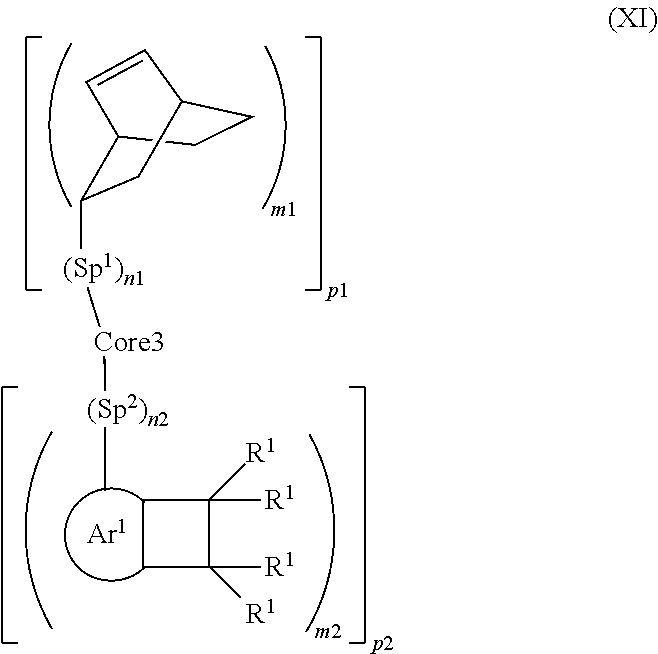


wherein Ar2, Ar3 and Ar4 in each occurrence are independently selected from substituted or unsubstituted aryl or heteroaryl or a group of formula (IIa) wherein n2=0; g is 0, 1 or 2, preferably 0 or 1; and c, d and e are each independently 1, 2 or 3, wherein at least one of Ar2, Ar3 and Ar4 is substituted with at least one group of formula (I), (IIa) or (IIb) and/or at least one of Ar2 and Ar4 is a group of formula (IIa) wherein n2=0.


wherein w in each occurrence is independently 0, 1, 2, 3 or 4, optionally 1 or 2; n is 1, 2 or 3; and R7 independently in each occurrence is a substituent.
-
- alkyl, optionally C1-20 alkyl, wherein one or more non-adjacent C atoms may be replaced with optionally substituted aryl or heteroaryl, O, S, substituted N, C═O or —COO—, and one or more H atoms may be replaced with F;
- aryl and heteroaryl groups that may be unsubstituted or substituted with one or more substituents, preferably phenyl substituted with one or more C1-20 alkyl groups;
- a linear or branched chain of aryl or heteroaryl groups, each of which groups may independently be substituted, for example a group of formula —(Ar7)r wherein each Ar7 is independently an aryl or heteroaryl group and r is at least 2, preferably a branched or linear chain of phenyl groups each of which may be unsubstituted or substituted with one or more C1-20 alkyl groups; and
- a group of formula (I), (IIa) or (IIb).
-
- alkyl, for example C1-20 alkyl, wherein one or more non-adjacent C atoms may be replaced with O, S, substituted N, C═O and —COO— and one or more H atoms of the alkyl group may be replaced with F;
- NR9 2, OR9, SR9, SiR9 3 and
- fluorine, nitro and cyano;
wherein each R9 is independently selected from the group consisting of alkyl, preferably C1-20 alkyl; and aryl or heteroaryl, preferably phenyl, optionally substituted with one or more C1-20 alkyl groups.


wherein R8 in each occurrence is the same or different and is a substituent wherein the two groups R8 may be linked to form a ring; R7 is a substituent as described above; and d is 0, 1, 2 or 3.
-
- alkyl, optionally C1-20 alkyl, wherein one or more non-adjacent C atoms may be replaced with optionally substituted aryl or heteroaryl, O, S, substituted N, C═O or —COO—, and one or more H atoms may be replaced with F;
- aryl and heteroaryl groups that may be unsubstituted or substituted with one or more substituents, preferably phenyl substituted with one or more C1-20 alkyl groups;
- a linear or branched chain of aryl or heteroaryl groups, each of which groups may independently be substituted, for example a group of formula —(Ar7)r wherein each Ar7 is independently an aryl or heteroaryl group and r is at least 2, optionally 2 or 3, preferably a branched or linear chain of phenyl groups each of which may be unsubstituted or substituted with one or more C1-20 alkyl groups; and
- a group of formula (I), (IIa) or (IIb).


wherein R7, R8 and d are as described with reference to formulae (VI) and (VII) above. Any of the R7 groups may be linked to any other of the R7 groups to form a ring. The ring so formed may be unsubstituted or may be substituted with one or more substituents, optionally one or more C1-20 alkyl groups.


wherein:
Ar4 in each occurrence independently represents an aryl or heteroaryl group that may be unsubstituted or substituted with one or more substituents; and
Sp represents a spacer group comprising at least one carbon or silicon atom.
-
- C1-20 alkyl wherein one or more non-adjacent C atoms of the alkyl group may be replaced by O, S or COO, C═O, NR6 or SiR6 2 and one or more H atoms of the C1-20 alkyl group may be replaced by F wherein R6 is a substituent and is optionally in each occurrence a C1-40 hydrocarbyl group, optionally a C1-20 alkyl group; and
- aryl or heteroaryl, optionally phenyl, that may be unsubstituted or substituted with one or more C1-20 alkyl groups.

wherein Ar8, Ar9 and Ar10 in each occurrence are independently selected from substituted or unsubstituted aryl or heteroaryl, g is 0, 1 or 2, preferably 0 or 1, R13 independently in each occurrence is H or a substituent, preferably a substituent, and c, d and e are each independently 1, 2 or 3.

c, d and e are preferably each 1.
-
- substituted or unsubstituted alkyl, optionally C1-20 alkyl, wherein one or more non-adjacent C atoms may be replaced with optionally substituted aryl or heteroaryl (preferably phenyl), O, S, C═O or —COO— and one or more H atoms may be replaced with F; and
- a group of formula (I), (IIa) or (IIb).


3-(4-chlorobutyl)-7-neopentylbicyclo[4.2.0]octa-1,3,5-triene (A)


| TABLE 1 | ||
| Diester | ||
| monomers | Dibromo | |
| Polymer | (mol %) | monomers (mol %) |
| Comparative | A (50) | D (40), G (5), |
| |
Comparative Monomer 1 (5) | |
| Comparative | A (50) | D (40), E (5), |
| |
Comparative Monomer 1 (5) | |
| Polymer Example 1 | A (50) | D (40), E (5), |
| Monomer Example 1 (5) | ||
| Polymer Example 2 | A (45) B (5) | D (40), F (5), |
| Monomer Example 1 (5) | ||
| Polymer Example 3 | A (45) C (5) | D (40), F (5), |
| Monomer Example 1 (5) | ||
| Comparative | H (10), I (20), | K (27), G (10), L (3), Comparative |
| Polymer 4 | J (20) | Monomer 1 (10) |
| Polymer Example 4 | H (10), I (20), | K (27), E (10), L (3), Monomer |
| B (20) | Example 1 (10) | |


| TABLE 2 | |||||
| Hole- | |||||
| transporting | |||||
| layer | |||||
| polymer | T95% (hrs) | T90% (hrs) | T80% (hrs) | ||
| Comparative | 15.1 | 59.9 | 269.4 | ||
| |
|||||
| Comparative | 10.9 | 45.0 | 228.5 | ||
| |
|||||
| Polymer | 12.2 | 49.8 | 244.5 | ||
| Example 1 | |||||
| Polymer | 12.5 | 51.1 | 256.6 | ||
| Example 2 | |||||
| Polymer | 13.7 | 58.5 | 285.8 | ||
| Example 3 | |||||
| TABLE 3 | |||
| Heat treatment | |||
| Device | Polymer | temperature (° C.) | |
| | Comparative Polymer | 4 | 150 |
| Comparative Device | Comparative Polymer | 4 | 180 |
| Device Example 4 | Polymer Example 4 | 150 | |
 |
| |
 |
| |
 |
| |
 |
| Electron-transporting |
Claims (20)


Applications Claiming Priority (3)
| Application Number | Priority Date | Filing Date | Title |
|---|---|---|---|
| GB1412213.9A GB2528092A (en) | 2014-07-09 | 2014-07-09 | Material, composition and method |
| GB1412213.9 | 2014-07-09 | ||
| PCT/GB2015/051981 WO2016005749A1 (en) | 2014-07-09 | 2015-07-08 | Hole transporting compounds and compositions |
Publications (2)
| Publication Number | Publication Date |
|---|---|
| US20170207393A1 US20170207393A1 (en) | 2017-07-20 |
| US10573817B2 true US10573817B2 (en) | 2020-02-25 |
Family
ID=51410870
Family Applications (1)
| Application Number | Title | Priority Date | Filing Date |
|---|---|---|---|
| US15/325,022 Active 2036-06-03 US10573817B2 (en) | 2014-07-09 | 2015-07-08 | Hole transporting compounds and compositions |
Country Status (8)
| Country | Link |
|---|---|
| US (1) | US10573817B2 (en) |
| EP (1) | EP3195378B1 (en) |
| JP (2) | JP6810920B2 (en) |
| KR (1) | KR102388075B1 (en) |
| CN (1) | CN106661446B (en) |
| GB (1) | GB2528092A (en) |
| TW (1) | TWI685538B (en) |
| WO (1) | WO2016005749A1 (en) |
Families Citing this family (7)
| Publication number | Priority date | Publication date | Assignee | Title |
|---|---|---|---|---|
| US10454036B2 (en) * | 2014-08-21 | 2019-10-22 | Dow Global Technologies Llc | Polymeric charge transfer layer and organic electronic device containing the same |
| US10439140B2 (en) | 2014-11-20 | 2019-10-08 | Lg Chem, Ltd. | Hole transport materials |
| US9954174B2 (en) | 2015-05-06 | 2018-04-24 | E I Du Pont De Nemours And Company | Hole transport materials |
| CN108349869A (en) * | 2015-11-05 | 2018-07-31 | E.I.内穆尔杜邦公司 | Crosslinkable hole mobile material |
| JP6836908B2 (en) | 2017-01-10 | 2021-03-03 | 住友化学株式会社 | Manufacturing method of organic device |
| JP6946934B2 (en) * | 2017-10-30 | 2021-10-13 | 昭和電工マテリアルズ株式会社 | Charge transport materials and organic electronics devices |
| GB2581141A (en) | 2019-01-31 | 2020-08-12 | Sumitomo Chemical Co | Light-emitting composition |
Citations (11)
| Publication number | Priority date | Publication date | Assignee | Title |
|---|---|---|---|---|
| JP2001520284A (en) | 1997-10-17 | 2001-10-30 | エスアールアイ インターナショナル | Preparation of multimodal polymer composition using polynuclear metallocene catalyst |
| US20010053842A1 (en) * | 1995-07-28 | 2001-12-20 | Woo Edmund P. | 2,7-aryl-9-substituted fluorenes and 9-substituted fluorene oligomers and polymers |
| WO2004073018A2 (en) | 2003-02-05 | 2004-08-26 | Dow Global Technologies Inc. | Sacrificial benzocyclobutene/norbornene polymers for making air gaps within semiconductor devices |
| WO2009080799A2 (en) | 2007-12-20 | 2009-07-02 | Georgia Tech Research Corporation | Carbazole-based hole transport and /or electron blocking materials and /or host polymer materials |
| KR20090093144A (en) | 2008-02-28 | 2009-09-02 | 한국과학기술원 | Olefinic triarylamine monomer, polyolefinic triarylamine polymers employing the same, preparation method therof and electronic device comprising the polyolefinic triarylamine polymers |
| JP2012111719A (en) | 2010-11-25 | 2012-06-14 | Idemitsu Kosan Co Ltd | Polymerizable monomer, material for organic device containing polymer thereof, hole injection and transporting material, material for organic electroluminescent element, and organic electroluminescent element |
| WO2013005026A2 (en) | 2011-07-04 | 2013-01-10 | Cambridge Display Technology Limited | Polymers, monomers and methods of forming polymers |
| JP2013023491A (en) | 2011-07-26 | 2013-02-04 | Idemitsu Kosan Co Ltd | Aromatic amine derivative and organic electroluminescent element including the same |
| WO2013018817A1 (en) | 2011-07-29 | 2013-02-07 | Canon Kabushiki Kaisha | Novel compound, polymer, cross-linked compound of polymer, and optical element including cross-linked compound |
| JP2013129716A (en) | 2011-12-20 | 2013-07-04 | Nippon Zeon Co Ltd | Polymerizable composition |
| JP2014013840A (en) | 2012-07-04 | 2014-01-23 | Mitsubishi Chemicals Corp | Composition for organic electroluminescent element |
Family Cites Families (4)
| Publication number | Priority date | Publication date | Assignee | Title |
|---|---|---|---|---|
| CN1229415C (en) * | 1995-07-28 | 2005-11-30 | 陶氏环球技术公司 | 2,7-aryl-9-substituted fluorenes and oligomers and polymers of 9-substituted fluorenes |
| GB0526185D0 (en) * | 2005-12-22 | 2006-02-01 | Cambridge Display Tech Ltd | Electronic device |
| JPWO2010098023A1 (en) * | 2009-02-26 | 2012-08-30 | 出光興産株式会社 | Novel polymerizable monomer and polymer thereof, organic device material using the same, hole injection transport material and organic electroluminescence element |
| JP2012062450A (en) * | 2010-09-17 | 2012-03-29 | Idemitsu Kosan Co Ltd | Novel polymerizable monomer and polymer compound, and material for organic device, material for organic electroluminescence, organic device, and organic electroluminescent element using the same |
-
2014
- 2014-07-09 GB GB1412213.9A patent/GB2528092A/en not_active Withdrawn
-
2015
- 2015-07-08 JP JP2017500356A patent/JP6810920B2/en active Active
- 2015-07-08 EP EP15738439.7A patent/EP3195378B1/en active Active
- 2015-07-08 WO PCT/GB2015/051981 patent/WO2016005749A1/en not_active Ceased
- 2015-07-08 US US15/325,022 patent/US10573817B2/en active Active
- 2015-07-08 KR KR1020177003693A patent/KR102388075B1/en active Active
- 2015-07-08 CN CN201580037243.5A patent/CN106661446B/en active Active
- 2015-07-09 TW TW104122457A patent/TWI685538B/en active
-
2020
- 2020-12-02 JP JP2020200227A patent/JP7089006B2/en active Active
Patent Citations (14)
| Publication number | Priority date | Publication date | Assignee | Title |
|---|---|---|---|---|
| US20010053842A1 (en) * | 1995-07-28 | 2001-12-20 | Woo Edmund P. | 2,7-aryl-9-substituted fluorenes and 9-substituted fluorene oligomers and polymers |
| JP2001520284A (en) | 1997-10-17 | 2001-10-30 | エスアールアイ インターナショナル | Preparation of multimodal polymer composition using polynuclear metallocene catalyst |
| WO2004073018A2 (en) | 2003-02-05 | 2004-08-26 | Dow Global Technologies Inc. | Sacrificial benzocyclobutene/norbornene polymers for making air gaps within semiconductor devices |
| WO2009080799A2 (en) | 2007-12-20 | 2009-07-02 | Georgia Tech Research Corporation | Carbazole-based hole transport and /or electron blocking materials and /or host polymer materials |
| KR20090093144A (en) | 2008-02-28 | 2009-09-02 | 한국과학기술원 | Olefinic triarylamine monomer, polyolefinic triarylamine polymers employing the same, preparation method therof and electronic device comprising the polyolefinic triarylamine polymers |
| JP2012111719A (en) | 2010-11-25 | 2012-06-14 | Idemitsu Kosan Co Ltd | Polymerizable monomer, material for organic device containing polymer thereof, hole injection and transporting material, material for organic electroluminescent element, and organic electroluminescent element |
| WO2013005026A2 (en) | 2011-07-04 | 2013-01-10 | Cambridge Display Technology Limited | Polymers, monomers and methods of forming polymers |
| JP2013023491A (en) | 2011-07-26 | 2013-02-04 | Idemitsu Kosan Co Ltd | Aromatic amine derivative and organic electroluminescent element including the same |
| US20140151677A1 (en) * | 2011-07-26 | 2014-06-05 | Idemitsu Kosan Co., Ltd. | Aromatic amine derivative, and organic electroluminescent element containing same |
| WO2013018817A1 (en) | 2011-07-29 | 2013-02-07 | Canon Kabushiki Kaisha | Novel compound, polymer, cross-linked compound of polymer, and optical element including cross-linked compound |
| JP2013028758A (en) | 2011-07-29 | 2013-02-07 | Canon Inc | Novel compound, polymer, crosslinked body thereof, and optical device having the same |
| US20140163175A1 (en) * | 2011-07-29 | 2014-06-12 | Canon Kabushiki Kaisha | Novel compound, polymer, cross-linked compound of polymer, and optical element including cross-linked compound |
| JP2013129716A (en) | 2011-12-20 | 2013-07-04 | Nippon Zeon Co Ltd | Polymerizable composition |
| JP2014013840A (en) | 2012-07-04 | 2014-01-23 | Mitsubishi Chemicals Corp | Composition for organic electroluminescent element |
Non-Patent Citations (2)
| Title |
|---|
| Combined Search and Examination Report dated May 19, 2015 for Application No. GB1412213.9. |
| International Search Report and Written Opinion dated Sep. 9, 2015 for Application No. PCT/GB2015/051981. |
Also Published As
| Publication number | Publication date |
|---|---|
| WO2016005749A1 (en) | 2016-01-14 |
| GB201412213D0 (en) | 2014-08-20 |
| US20170207393A1 (en) | 2017-07-20 |
| TW201605967A (en) | 2016-02-16 |
| KR20170028997A (en) | 2017-03-14 |
| JP2017531047A (en) | 2017-10-19 |
| EP3195378A1 (en) | 2017-07-26 |
| JP2021050349A (en) | 2021-04-01 |
| CN106661446A (en) | 2017-05-10 |
| KR102388075B1 (en) | 2022-04-18 |
| EP3195378B1 (en) | 2019-08-21 |
| TWI685538B (en) | 2020-02-21 |
| CN106661446B (en) | 2020-04-24 |
| JP7089006B2 (en) | 2022-06-21 |
| GB2528092A (en) | 2016-01-13 |
| JP6810920B2 (en) | 2021-01-13 |
Similar Documents
| Publication | Publication Date | Title |
|---|---|---|
| US10270037B2 (en) | Polymers, monomers and methods of forming polymers | |
| US10573817B2 (en) | Hole transporting compounds and compositions | |
| US9812644B2 (en) | Composition containing dopant and co-polymers having non-conjugated spacer units and its use in OLED devices | |
| US20130200348A1 (en) | Organic light-emitting material, device and method | |
| US10033019B2 (en) | Organic light-emitting composition, device and method | |
| US20150060798A1 (en) | Monomers, polymers and organic electronic devices | |
| US10497875B2 (en) | Hole transporting cyclobutene compound | |
| US9963550B2 (en) | Polymers and organic electronic device | |
| US10290810B2 (en) | Polymer and organic electronic device | |
| US20160315265A1 (en) | 4,7-phenanthroline containing polymer and organic electronic device | |
| KR102375483B1 (en) | Polymer and organic light emitting device | |
| US20170005277A1 (en) | Compound, composition and organic light-emitting device | |
| US20170294591A1 (en) | Compound, composition and organic light-emitting device | |
| US20180062089A1 (en) | Compound, composition and organic light-emitting device | |
| US20170309837A1 (en) | Polymer and organic light-emitting device |
Legal Events
| Date | Code | Title | Description |
|---|---|---|---|
| AS | Assignment |
Owner name: CAMBRIDGE DISPLAY TECHNOLOGY LIMITED, UNITED KINGDOM Free format text: ASSIGNMENT OF ASSIGNORS INTEREST;ASSIGNORS:PILLOW, JONATHAN;HUMPHRIES, MARTIN;PEGINGTON, RUTH;AND OTHERS;SIGNING DATES FROM 20161130 TO 20161209;REEL/FRAME:041035/0472 Owner name: CAMBRIDGE DISPLAY TECHNOLOGY LIMITED, UNITED KINGD Free format text: ASSIGNMENT OF ASSIGNORS INTEREST;ASSIGNORS:PILLOW, JONATHAN;HUMPHRIES, MARTIN;PEGINGTON, RUTH;AND OTHERS;SIGNING DATES FROM 20161130 TO 20161209;REEL/FRAME:041035/0472 Owner name: SUMITOMO CHEMICAL COMPANY LIMITED, JAPAN Free format text: ASSIGNMENT OF ASSIGNORS INTEREST;ASSIGNORS:PILLOW, JONATHAN;HUMPHRIES, MARTIN;PEGINGTON, RUTH;AND OTHERS;SIGNING DATES FROM 20161130 TO 20161209;REEL/FRAME:041035/0472 |
|
| STPP | Information on status: patent application and granting procedure in general |
Free format text: RESPONSE TO NON-FINAL OFFICE ACTION ENTERED AND FORWARDED TO EXAMINER |
|
| STPP | Information on status: patent application and granting procedure in general |
Free format text: NON FINAL ACTION MAILED |
|
| STPP | Information on status: patent application and granting procedure in general |
Free format text: RESPONSE TO NON-FINAL OFFICE ACTION ENTERED AND FORWARDED TO EXAMINER |
|
| STPP | Information on status: patent application and granting procedure in general |
Free format text: NOTICE OF ALLOWANCE MAILED -- APPLICATION RECEIVED IN OFFICE OF PUBLICATIONS |
|
| STPP | Information on status: patent application and granting procedure in general |
Free format text: NOTICE OF ALLOWANCE MAILED -- APPLICATION RECEIVED IN OFFICE OF PUBLICATIONS |
|
| STPP | Information on status: patent application and granting procedure in general |
Free format text: PUBLICATIONS -- ISSUE FEE PAYMENT VERIFIED |
|
| STCF | Information on status: patent grant |
Free format text: PATENTED CASE |
|
| MAFP | Maintenance fee payment |
Free format text: PAYMENT OF MAINTENANCE FEE, 4TH YEAR, LARGE ENTITY (ORIGINAL EVENT CODE: M1551); ENTITY STATUS OF PATENT OWNER: LARGE ENTITY Year of fee payment: 4 |