US10572391B2 - Methods and apparatus for implementing a logical to physical address mapping in a solid state drive - Google Patents
Methods and apparatus for implementing a logical to physical address mapping in a solid state drive Download PDFInfo
- Publication number
- US10572391B2 US10572391B2 US15/893,392 US201815893392A US10572391B2 US 10572391 B2 US10572391 B2 US 10572391B2 US 201815893392 A US201815893392 A US 201815893392A US 10572391 B2 US10572391 B2 US 10572391B2
- Authority
- US
- United States
- Prior art keywords
- nvm
- read
- partition
- host
- processing portion
- Prior art date
- Legal status (The legal status is an assumption and is not a legal conclusion. Google has not performed a legal analysis and makes no representation as to the accuracy of the status listed.)
- Active, expires
Links
Images




Classifications
-
- G—PHYSICS
- G06—COMPUTING OR CALCULATING; COUNTING
- G06F—ELECTRIC DIGITAL DATA PROCESSING
- G06F12/00—Accessing, addressing or allocating within memory systems or architectures
- G06F12/02—Addressing or allocation; Relocation
- G06F12/08—Addressing or allocation; Relocation in hierarchically structured memory systems, e.g. virtual memory systems
- G06F12/10—Address translation
- G06F12/1009—Address translation using page tables, e.g. page table structures
-
- G—PHYSICS
- G06—COMPUTING OR CALCULATING; COUNTING
- G06F—ELECTRIC DIGITAL DATA PROCESSING
- G06F3/00—Input arrangements for transferring data to be processed into a form capable of being handled by the computer; Output arrangements for transferring data from processing unit to output unit, e.g. interface arrangements
- G06F3/06—Digital input from, or digital output to, record carriers, e.g. RAID, emulated record carriers or networked record carriers
- G06F3/0601—Interfaces specially adapted for storage systems
- G06F3/0602—Interfaces specially adapted for storage systems specifically adapted to achieve a particular effect
- G06F3/061—Improving I/O performance
-
- G—PHYSICS
- G06—COMPUTING OR CALCULATING; COUNTING
- G06F—ELECTRIC DIGITAL DATA PROCESSING
- G06F12/00—Accessing, addressing or allocating within memory systems or architectures
- G06F12/02—Addressing or allocation; Relocation
- G06F12/0223—User address space allocation, e.g. contiguous or non contiguous base addressing
- G06F12/023—Free address space management
- G06F12/0238—Memory management in non-volatile memory, e.g. resistive RAM or ferroelectric memory
- G06F12/0246—Memory management in non-volatile memory, e.g. resistive RAM or ferroelectric memory in block erasable memory, e.g. flash memory
-
- G—PHYSICS
- G06—COMPUTING OR CALCULATING; COUNTING
- G06F—ELECTRIC DIGITAL DATA PROCESSING
- G06F3/00—Input arrangements for transferring data to be processed into a form capable of being handled by the computer; Output arrangements for transferring data from processing unit to output unit, e.g. interface arrangements
- G06F3/06—Digital input from, or digital output to, record carriers, e.g. RAID, emulated record carriers or networked record carriers
- G06F3/0601—Interfaces specially adapted for storage systems
- G06F3/0602—Interfaces specially adapted for storage systems specifically adapted to achieve a particular effect
- G06F3/0604—Improving or facilitating administration, e.g. storage management
-
- G—PHYSICS
- G06—COMPUTING OR CALCULATING; COUNTING
- G06F—ELECTRIC DIGITAL DATA PROCESSING
- G06F3/00—Input arrangements for transferring data to be processed into a form capable of being handled by the computer; Output arrangements for transferring data from processing unit to output unit, e.g. interface arrangements
- G06F3/06—Digital input from, or digital output to, record carriers, e.g. RAID, emulated record carriers or networked record carriers
- G06F3/0601—Interfaces specially adapted for storage systems
- G06F3/0628—Interfaces specially adapted for storage systems making use of a particular technique
- G06F3/0655—Vertical data movement, i.e. input-output transfer; data movement between one or more hosts and one or more storage devices
- G06F3/0659—Command handling arrangements, e.g. command buffers, queues, command scheduling
-
- G—PHYSICS
- G06—COMPUTING OR CALCULATING; COUNTING
- G06F—ELECTRIC DIGITAL DATA PROCESSING
- G06F3/00—Input arrangements for transferring data to be processed into a form capable of being handled by the computer; Output arrangements for transferring data from processing unit to output unit, e.g. interface arrangements
- G06F3/06—Digital input from, or digital output to, record carriers, e.g. RAID, emulated record carriers or networked record carriers
- G06F3/0601—Interfaces specially adapted for storage systems
- G06F3/0668—Interfaces specially adapted for storage systems adopting a particular infrastructure
- G06F3/0671—In-line storage system
- G06F3/0673—Single storage device
- G06F3/0679—Non-volatile semiconductor memory device, e.g. flash memory, one time programmable memory [OTP]
-
- G—PHYSICS
- G06—COMPUTING OR CALCULATING; COUNTING
- G06F—ELECTRIC DIGITAL DATA PROCESSING
- G06F3/00—Input arrangements for transferring data to be processed into a form capable of being handled by the computer; Output arrangements for transferring data from processing unit to output unit, e.g. interface arrangements
- G06F3/06—Digital input from, or digital output to, record carriers, e.g. RAID, emulated record carriers or networked record carriers
- G06F3/0601—Interfaces specially adapted for storage systems
- G06F3/0668—Interfaces specially adapted for storage systems adopting a particular infrastructure
- G06F3/0671—In-line storage system
- G06F3/0673—Single storage device
- G06F3/068—Hybrid storage device
-
- G—PHYSICS
- G06—COMPUTING OR CALCULATING; COUNTING
- G06F—ELECTRIC DIGITAL DATA PROCESSING
- G06F2212/00—Indexing scheme relating to accessing, addressing or allocation within memory systems or architectures
- G06F2212/10—Providing a specific technical effect
- G06F2212/1041—Resource optimization
- G06F2212/1044—Space efficiency improvement
-
- G—PHYSICS
- G06—COMPUTING OR CALCULATING; COUNTING
- G06F—ELECTRIC DIGITAL DATA PROCESSING
- G06F2212/00—Indexing scheme relating to accessing, addressing or allocation within memory systems or architectures
- G06F2212/20—Employing a main memory using a specific memory technology
- G06F2212/202—Non-volatile memory
-
- G—PHYSICS
- G06—COMPUTING OR CALCULATING; COUNTING
- G06F—ELECTRIC DIGITAL DATA PROCESSING
- G06F2212/00—Indexing scheme relating to accessing, addressing or allocation within memory systems or architectures
- G06F2212/65—Details of virtual memory and virtual address translation
- G06F2212/657—Virtual address space management
-
- G—PHYSICS
- G06—COMPUTING OR CALCULATING; COUNTING
- G06F—ELECTRIC DIGITAL DATA PROCESSING
- G06F2212/00—Indexing scheme relating to accessing, addressing or allocation within memory systems or architectures
- G06F2212/72—Details relating to flash memory management
- G06F2212/7201—Logical to physical mapping or translation of blocks or pages
-
- G—PHYSICS
- G06—COMPUTING OR CALCULATING; COUNTING
- G06F—ELECTRIC DIGITAL DATA PROCESSING
- G06F2212/00—Indexing scheme relating to accessing, addressing or allocation within memory systems or architectures
- G06F2212/72—Details relating to flash memory management
- G06F2212/7205—Cleaning, compaction, garbage collection, erase control
Definitions
- the present disclosure relates generally to solid state drives (SSDs), and more specifically, to methods and apparatus for implementation and management of logical to physical address mapping in SSD devices.
- SSDs solid state drives
- SSDs solid state drives
- NVMs non-volatile memories
- flash memory devices such as NAND flash memories
- the NVMs may also include multiple NAND flash dies or chips that comprise the NVM.
- a flash translation layer (FTL) within an SSD controller maintains logical to physical mapping using, in part, a Logical-to-Physical (L2P) table.
- L2P Logical-to-Physical
- Each entry of an L2P table maintains mapping information for one host logical page.
- a logical page has a size of 4096 bytes (4 KB) of information and the entry size for mapping the page in the L2P table is typically 4 bytes.
- the L2P table size may become 20 gigabytes (20 GB) in size.
- SSDs do not have random access memories (RAMs) larger than 4 GB in the SSD controller for both power and cost reasons. Thus, it becomes problematic to allocate such a large L2P table in RAM memory in an SSD controller at run time.
- RAMs random access memories
- a Solid State Drive includes an apparatus for managing a logical to physical (L2P) table in the SSD.
- the SSD includes a front-end processing portion configured to interface with a host device and manage input and output requests from the host device and transfer data to or from the host device; a non-volatile memory (NVM) configured to store the L2P table in its entirety, where the L2P table is further separated into a plurality of partitions.
- the SSD includes a back-end processing portion communicatively coupled with the front-end processing portion and the NVM, and a random access memory (RAM) communicatively coupled with the back-end processing portion.
- RAM random access memory
- the RAM includes a partition table that is stored in the RAM wherein the partition table includes one or more addresses of respective partitioned portions of the plurality partitions of the L2P table stored in the NVM.
- the back-end processing portion is configured to receive requests from the host via the front-end processing portion and to access the partition table for scheduling read or write access to the NVM based by determining one or more addresses of the respective partitioned portions of the plurality partitions of the L2P table stored in the NVM from the partition table.
- a method for operating a solid state drive (SSD) including a non-volatile memory (NVM) includes receiving a host request at a front-end portion, and then initiating signaling to a back-end portion for reading a logical to physical address table (L2P table) stored entirely in a non-volatile memory (NVM) communicatively coupled to the back-end portion, wherein the L2P table includes a plurality of L2P table partitions.
- L2P table logical to physical address table
- NVM non-volatile memory
- the method includes determining an L2P table partition to be read from the NVM based on reading a partition table stored in a random access memory (RAM) coupled to the back-end portion, where the partition table includes a plurality of partition addresses corresponding to the plurality of L2P table partitions stored in NVM to determine a partition address of a desired L2P table partition.
- the method includes reading the desired L2P table partition from the NVM into the RAM based on the partition address of the desired L2P table partition, and performing the host request using at least the back-end portion based on a physical NVM address determined from the desired L2P table partition.
- an apparatus for operating a solid state drive (SSD) including a non-volatile memory (NVM) includes first means for interfacing with a host device and managing input and output requests from the host device and transfer data to or from the host device. Additionally, the apparatus includes a non-volatile memory (NVM) configured to store a logical to physical address table (L2P table) in its entirety, where the L2P table is further separated into a plurality of partitions.
- SSD solid state drive
- NVM non-volatile memory
- the apparatus includes second means for back-end processing that is communicatively coupled with the first means and the NVM, the second means configured to receive requests from the host via the first means and to access a partition table that is stored in a random access memory (RAM) communicatively coupled with the second means, wherein the partition table includes one or more addresses of respective partitioned portions of the plurality partitions of the L2P table stored in the NVM.
- RAM random access memory
- FIG. 1 shows an exemplary schematic block diagram configuration for an SSD device.
- FIG. 2 illustrates an example of a logical-to-physical (L2P) partition table mapping according to an aspect of the present disclosure.
- L2P logical-to-physical
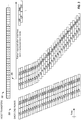
- FIG. 3 illustrates the timing of host transfers and back-end L2P reads according to an example of the operation of the presently disclosed scheme.
- FIG. 4 illustrates a flow sequence diagram of an exemplary method for reads according to aspects of the present disclosure.
- FIG. 5 illustrates an exemplary flow sequence diagram for writes according to aspects of the present disclosure.
- FIG. 6 shows an exemplary block diagram of a logging process and a host write process that, in part, illustrates the independence between the two processes in accordance with aspects of the present disclosure.
- FIG. 7 illustrates an exemplary block diagram of a logging process and a garbage collection process in accordance with aspects of the present disclosure.
- FIG. 8 shows another exemplary schematic block diagram configuration for an SSD device.
- FIG. 9 illustrates an exemplary flowchart according to an aspect of the present methodology for processing host requests using front-end and back-end portions.
- FIG. 10 illustrates an exemplary flowchart according to an aspect of the present methodology for processing host write requests using front-end and back-end portions.
- FIG. 11 illustrates a method for configuring an SSD according to aspects of the present disclosure.
- the disclosed methods and apparatus bifurcate an SSD into two operational parts (1) an SSD front-end and (2) an SSD back-end.
- the SSD front-end works like an interface layer for the host, accepting the input/output (I/O) requests from the host and passing them to the back-end.
- the front-end also takes care of data transfer between host and the SSD.
- the SSD back-end processes the I/O requests given by the front-end and manages the flash array and performs the read/write/erase operations, as examples.
- the FTL is also configured to run on the SSD back-end. In this manner, the presently disclosed methods and apparatus make it possible to accommodate large L2P tables without the need for an increase in the size of the RAM memory in the SSD controller.
- the host logical page size may be increased from the typical 4 KB size to a larger size. For example, if host logical page size is set at 8 KB then the size of L2P table may be reduced by half compared to the case when logical page size is 4 KB. With logical page sizes of 8 KB, however, any random write of size less than 8 KB requires a read-modify-write. This presents both performance and endurance problems.
- the L2P table may be only partially loaded in RAM at run time.
- the SSD controller may only store a part of the L2P table in RAM, such as 2 GB of the L2P in one example.
- the remaining 14 GB of L2P table would remain stored the in the NVM in this example.
- the L2P entries stored in RAM may be based on caching algorithms based on the host I/O patterns. During host read or write, if the request is for the logical page whose mapping is available in RAM (i.e. L2P table cache hit), then the FTL can just complete the command to the corresponding physical page.
- FIG. 1 is a block diagram of a system 100 including an exemplary solid state device (SSD) in which the disclosed methods and/or algorithms herein may be implemented in accordance with aspects of the disclosure.
- the system 100 includes a host 102 and a SSD storage device 104 coupled to the host 102 .
- the host 102 provides commands to the SSD storage device 104 for transferring data between the host 102 and the SSD storage device 104 .
- the host 102 may provide a write command to the SSD storage device 104 for writing data to the SSD storage device 104 or a read command to the SSD storage device 104 for reading data from the SSD storage device 104 .
- the host 102 may be any system or device having a need for data storage or retrieval and a compatible interface for communicating with the SSD storage device 104 .
- the host 102 may a computing device, a personal computer, a portable computer, a workstation, a server, a personal digital assistant, a digital camera, or a digital phone as merely a few examples.
- the SSD storage device 104 includes a host interface 106 , a controller 108 (or alternatively, an NVM controller 108 ), which also includes a RAM memory 110 , a non-volatile memory (NVM) interface 112 (which may also be referred to as a Flash memory interface), and a non-volatile memory (NVM) 114 , such as a NAND Flash memory composed of one or a multiple number of NAND dies, for example.
- the host interface 106 is coupled to the controller 108 and facilitates communication between the host 102 and the controller 108 . Additionally, the controller 108 is coupled to the RAM memory 110 as well as the NVM 114 via the NVM interface 112 .
- the host interface 106 may be any type of communication interface, such as an Integrated Drive Electronics (IDE) interface, a Universal Serial Bus (USB) interface, a Serial Peripheral (SP) interface, an Advanced Technology Attachment (ATA) or Serial Advanced Technology Attachment (SATA) interface, a Small Computer System Interface (SCSI), an IEEE 1394 (Firewire) interface, or the like.
- the host 102 includes the SSD storage device 104 .
- the SSD storage device 104 is remote with respect to the host 102 or is contained in a remote computing system communicatively coupled with the host 102 .
- the host 102 may communicate with the SSD storage device 104 through a wireless communication link.
- the controller 108 controls operation of the SSD storage device 104 .
- the controller 108 receives commands from the host 102 through the host interface 106 and performs the commands to transfer data between the host 102 and the NVM 114 .
- the controller 108 may manage reading from and writing to memory 110 for performing the various functions effected by the controller and to maintain and manage cached information stored in memory 110 .
- the controller 108 may include any type of processing device, such as a microprocessor, a microcontroller, an embedded controller, a logic circuit, software, firmware, or the like, for controlling operation of the SSD storage device 104 .
- some or all of the functions described herein as being performed by the controller 108 may instead be performed by another element of the SSD storage device 104 .
- the SSD storage device 104 may include a microprocessor, a microcontroller, an embedded controller, a logic circuit, software, firmware, or any kind of processing device, for performing one or more of the functions described herein as being performed by the controller 108 .
- one or more of the functions described herein as being performed by the controller 108 are instead performed by the host 102 .
- some or all of the functions described herein as being performed by the controller 108 may instead be performed by another element such as a controller in a hybrid drive including both non-volatile memory elements and magnetic storage elements.
- the RAM memory 110 may be any memory, computing device, or system capable of storing data.
- the memory 110 may be a random-access memory (RAM), a dynamic random-access memory (DRAM), a double data rate (DDR) DRAM, a static random-access memory (SRAM), a synchronous dynamic random-access memory (SDRAM), a flash storage, an erasable programmable read-only-memory (EPROM), an electrically erasable programmable read-only-memory (EEPROM), or the like.
- the controller 108 uses the memory 110 , or a portion thereof, to store data during the transfer of data between the host 102 and the NVM 114 .
- the memory 110 or a portion of the memory 110 may be a cache memory.
- the NVM 114 receives data from the controller 108 via the NVM interface 112 and stores the data.
- the NVM 114 may be any type of non-volatile memory, such as a flash storage system, a NAND-type flash memory, a solid state drive, a flash memory card, a secure digital (SD) card, a universal serial bus (USB) memory device, a CompactFlash card, a SmartMedia device, a flash storage array, or the like.
- the NVM 114 may further be constructed with a number of memory die, as illustrated by NAND memory dies 114 A, 114 B, and so forth to some N number of dies (i.e., 114 N) in the NVM 114 .
- the controller 108 may also include hardware, firmware, software, or any combinations thereof that implement read retry, as will be discussed herein.
- read requests will generally comprise a request from the host 102 via the interface 106 to read the data within a given logical Page address associated with the NVM 114 .
- Each logical Page address is associated with a specific physical address within the NVM 114 through the use of the Logical to Physical (L2P) table maintained by the system controller 108 , and more particularly by a Flash Translation Layer (FTL) 116 .
- L2P table maps each logical Page address to a physical Page address within the NVM 114 .
- the use of logical Page addresses and a logical-to-physical Page address conversion allows the controller 108 to effectively manage the memory within the NVM 114 and to implement various mapping and mechanisms, including the disclosed L2P table using having front end and back end portions.
- the FTL 116 may include an address translator 118 for performing the translation between logical and physical addresses, as well as to, in part, implement the L2P table.
- the FTL 116 may include a garbage collector process, module, or algorithm 120 that copies valid data into new or free areas and erases invalid data in physical block locations of the NVM 114 in order to free this invalid memory space.
- the FTL 116 may include a wear leveler process, module, or algorithm 122 used to ensure that erasures and re-writes are distributed evenly across the NVM 114 .
- the presently disclosed methods and apparatus include a solution whereby an SSD is divided into two parts[N]: the SSD front-end and the SSD back-end.
- the entire L2P table is stored in Flash and it is read only when it is needed.
- the L2P table is divided into several partitions comprising a predetermined number (e.g., 64) of contiguous L2Ps that makes up one L2P partition and it is written together on flash.
- the flash address of each of the partitions are always loaded in DDR while the actual L2P table is read from partition table's flash address when needed.
- the NVM controller 108 may include a front-end controller or control portion 123 that acts as the interface with the host for read/write requests.
- the FTL 116 may be configured such that it is considered part of a back-end control or processing portion 124 that achieves access of the NVM 114 through an L2P table that is stored in the NVM 114 .
- a controller or apparatus for controlling the flash or NVM memory 114 may also be included as shown by flash controller 126 .
- the FTL 116 may include a logger or logging function 128 that effects logging of memory locations for the L2P table in the NVM 114 .
- the logger 128 is used to log or record the changes made to the L2P table during reads, writes, or garbage collection, which are then ultimately written to the NVM 114 to update the L2P table.
- FIG. 2 illustrates an exemplary structure 200 of an L2P table management scheme in accordance with aspects of the present disclosure.
- the L2P table is managed by operationally splitting (i.e., not physically splitting) the SSD between an SSD front-end and an SSD back-end.
- a partition table 202 is provided in the RAM memory accessible with the FTL.
- the partition table 202 contains addresses of groupings or partitions of the L2P table 204 that is stored in the back-end (i.e., the Flash or NVM memory (e.g., NVM 114 )) in its entirety.
- the partition table 202 may be stored in RAM (e.g. RAM 110 ) in what may be considered the front-end portion of the SSD.
- the L2P table 204 is stored in the Flash or NVM memory 114 and is read only when it is needed. As further illustrated, the L2P table 204 is divided in several L2P partitions 206 , with each L2P partition 206 consisting of a predetermined number of contiguous L2P addresses in the Flash or NVM 114 that are written together on the NVM 114 . In the example of FIG. 2 , the predetermined number is 64 contiguous L2P addresses, but this is only exemplary and the number could be greater or less than this amount.
- the storage of the entire L2P table 204 in the Flash or NVM thus avoids having to store the L2P table in RAM memory to allow minimization of the RAM capacity, which is particularly advantageous for larger SSD devices where the L2P tables become much larger.
- the partition table 202 contains multiple entries 208 , each of which contains a flash or NVM address of a respective partition 206 in the L2P table 204 stored in the NVM.
- entry 208 a contains the flash address of the partition 206 a containing the flash address of a partition having 64 L2P pages
- entry 208 b contains the flash address of the partition 206 b containing the flash address of a partition having 64 L2P pages
- the flash address 208 of each partition 206 is always loaded in the RAM memory (e.g., 110 ), while the actual L2P table is then read into RAM from partition table's flash address in the NVM 114 when needed.
- the L2P configuration of FIG. 2 operates such that when the front-end portion of the NVM controller 108 receives a read request from the host 102 , the request is queued to the FTL (e.g., 116 ). To process the host read, the FTL 116 loads the partition portion (e.g., 206 ) of the L2P table 204 containing those addresses that will map to the requested data into the RAM 110 , for example. To read the L2P for incoming host requests, the controller 108 is configured to first look into the partition table 202 to get the flash address where the pertinent partition of the L2P is written.
- the partition portion e.g., 206
- the FTL 116 sends the L2P address and the host data read request to a control within the NVM controller 108 or, alternatively, a dedicated back-end control or processing portion (e.g., 124 in FIG. 1 ) to process these requests one after the other.
- the back-end control process includes issuing a read request to the L2P flash address. Once the L2P address is read from the L2P partition, this allows the NVM controller 108 to obtain the flash or NVM physical address from the L2P data for the data requested from the host and issues the host data read to the NVM 114 via the interface 112 , for example.
- the operational back-end can process multiple I/O requests in parallel, whereas the host I/O data transfer via host interface 106 occurs in serial. Because of the serialized host data transfer, the back-end control portion will have a lot of idle time while the front-end processes are busy serially transferring data from the SSD device to the host. Accordingly in another aspect, the present methods and apparatus may utilize the back-end idle time to effectively hide the L2P read behind the host data transfer time, which may be ideal for lower performance, cost sensitive interfaces such as SATA or PCI, as examples. In a particular aspect of the present disclosure, it is noted that the L2P reads can be hidden behind host data transfer during random read operations.
- an interface takes approximately 7 to 8 ⁇ sec to transfer 4K of data.
- the interface would take approximately 224 to 256 ⁇ sec.
- the back-end can perform multiple read operations in parallel, it would eventually take one read completion time to perform 32 reads in parallel.
- 32 4K I/Os of data would be available to the front-end within 60 ⁇ 70 ⁇ sec.
- the host device can send a new read request at the completion of each host data transfer. In this way all the L2P reads will be hidden behind the host read data transfer, and therefore the presently disclosed scheme will have no impact on random read performance in such instances.
- FIG. 3 illustrates the timing of host transfers and back-end L2P reads according to an example of the operation of the present scheme, where the passage of time is shown from left to right in the figure.
- the host transfers 302 for 32 transfers of 4K of data are shown serially occurring before repeating for another 32 transfers and so forth.
- the time for the 32 transfers to the host in total would be approximately 224 to 256 ⁇ sec.
- the back-end reads are shown at 304 , with each read including an L2P address determination time and a data read time. Since these reads are performable in parallel, the back-end reads may be performed much quicker.
- 32 I/Os of 4K of data will be available within approximately 60 to 70 ⁇ sec.
- FIG. 3 illustrates the timing of host transfers and back-end L2P reads according to an example of the operation of the present scheme, where the passage of time is shown from left to right in the figure.
- the host transfers 302 for 32 transfers of 4K of data are shown serially occurring before repeating for another
- FIG. 3 illustrates that L2P reads 304 may be hidden behind the host data transfer 302 .
- the process may enter a sustained read mode where the rate of reads is a normal rate. This transition is indicated at an approximate time 306 , which is merely illustrated as one example of the timing, where the read mode enters the sustained read mode.
- FIG. 4 illustrates a flow sequence diagram 400 showing an exemplary sequence for handling host read requests in accordance with the disclosed scheme. As illustrated, the sequence 400 shows messaging between a host device 401 , a front-end 402 , such as the front-end controller 123 , the FTL 404 , a flash controller 406 (which may be part of back-end control 124 as illustrated in FIG.
- the diagram 400 shows that when the front-end 402 receives a read request 409 from the host device 401 , after some amount of processing time 410 in the front-end 402 , the read request is sent to the FTL 404 as illustrated at 412 .
- the FTL 404 which may be part of the back-end processing, will determine the L2P address based on the partition table stored in RAM.
- the FTL 404 sends a scheduling message 416 to the flash controller 406 to schedule the reading of the L2P partition in the L2P table stored in the NAND die.
- a dispatch message 418 is sent from the flash controller 406 to the NAND dies 408 to access the L2P partition data portion. After a NAND sense time 402 420 , the L2P partition data is sent to the flash controller 406 as shown by transfer 422 .
- the L2P partition data is then loaded to RAM by the flash controller 406 .
- the flash controller 406 may then use this data to determine the physical address of the requested data in the NAND dies 408 . Accordingly, the flash controller 406 may then dispatch the host read request illustrated at 424 to the NAND dies 408 . After a NAND sense time 426 , the requested data is read and send to the flash controller 406 as illustrated by read completion message 428 .
- the flash controller 406 and the FTL 404 then pass the read data to the front-end control 402 (and host device 401 ) without any appreciable delay as shown by arrows 430 , 432 , and 434 .
- the front-end portion 402 when it receives a read request from the host, it will queue the read request to FTL 404 .
- the FTL 404 needs to load the L2P table first.
- the FTL will first look in the partition table stored in RAM to obtain the flash or NAND address where the L2P partition containing the L2P address is written.
- the FTL 404 serves to send a scheduled L2P read request ( 416 ) to the flash controller 406 , where the read includes instruction for the back end controller 406 to request both the L2P read first and then the actual host data read.
- a scheduled L2P read request 416
- the flash controller 406 may be configured to process the requests (e.g., 418 and 424 ) one after the other, where the controller 406 first issues a read request to the L2P flash address, and once the L2P partition is read from the NAND dies 408 , obtains the physical flash address for the host data to issue the host data read.
- the back-end portion will not process host reads until the L2P data read from the NVM is available, which may introduce some increase to the read latency.
- the present scheme further affords the ability for back-end to not need to wait for the L2P read completion from the NVM to signal write completion to the host device.
- the front-end portion receives a host write command it initiates the host data transfer and sends an early notification to the FTL to schedule the L2P read to determine the NVM address for the host write.
- the front-end queues the host write request to the FTL and sends a completion message to the host device.
- the FTL does not have to wait for the L2P read completion and, if the FTL has received has enough data to write, the FTL sends the write request to flash controller to write the host data on the flash or NVM.
- FIG. 5 is a flow sequence 500 showing the write processes according to aspects the present disclosure when the host device is writing to the NVM.
- the sequence 500 shows messaging between a host device 502 , a front-end 504 , such as the front-end controller 123 , the FTL 506 , a flash controller 508 (which may be part of back-end control 124 as shown at 126 ), and the NAND dies 510 (e.g., dies 114 ).
- the front-end When the host 502 issues a write request 512 to the front-end 504 , the front-end, in turn, immediately sends an early command received notification 514 to the FTL 506 to schedule an L2P table read for the host write, as well as starting queueing of data to be written to the NAND dies 510 .
- the FTL 506 receives, and then issues a schedule L2P read message 516 to the flash controller 508 .
- the flash controller 508 issues a dispatch L2P read message 518 to the NAND dies 510 , which is based on an L2P address obtained from the accessing the partition table 202 stored in RAM memory.
- the dispatch L2P read 518 initiates access of those particular L2P partitions that may then be read into the RAM in order to ultimately determine the logical to physical mapping for addresses in which to write the data from the host device.
- the FTL 506 After a time period during which the front-end receives and queues host data to be passed to the FTL 506 for writing of the data, when the data transfer is completed the FTL 506 will send a data transfer done message 520 to the front-end portion 504 , which in turn sends the host write completed message 522 to the host 502 even though the L2P read completion has not yet occurred, as well as the write completion of the data in the NAND die 510 . This improves latency as the FTL 506 does not need to wait for the L2P read or the write completion before signaling the host that the data transfer is complete (i.e., message 520 ).
- the FTL 506 then signals the flash controller 508 to schedule the data write as indicated by message 524 . This determination of scheduling the write may be made if there is a predetermined threshold amount data to be written.
- the flash controller 508 sends a dispatch of the L2P write to the NAND dies 510 as shown by message command 526 .
- FIG. 5 illustrates that the reading of the L2P table is completed with message 528 , which is sent directly to the FTL 506 .
- the FTL 506 will update the L2P table.
- the logger 128 will log changes to L2P table that results from the L2P write message command 526 and the updated NVM memory location.
- a write completion indication 530 is provided from the NAND die 510 directly to the FTL 506 .
- the front-end 504 queues the host write request to the FTL 506 and sends the completion message 520 (and 522 ) to the host device 502 .
- the FTL 506 is configured to not wait for the L2P read completion (e.g., message 528 ) and, if it has enough data (i.e., the predetermined threshold of data) to write, the FTL 506 sends the write request 524 to the flash controller 508 to write the host data on the flash or NAND dies 510 . Furthermore, the FTL 506 queues the new flash address to an address logger (not shown) for updating the L2P table for the written data.
- the logger will then process the L2P update (e.g., updating the valid page count (VPC) for logging purposes), and write the modified L2P on the flash or NVM at that time.
- L2P update e.g., updating the valid page count (VPC) for logging purposes
- FIG. 6 shows an exemplary block diagram 600 of a logger process and a host write process that illustrates the independence between the two processes.
- the host write does not depend on the L2P updates. Because of this independence between the two processes, write latency in not impacted and the write performance is improved as well.
- a logger or logging process 602 which may be effectuated by logger 128 , is shown with host writer or host write process 604 , wherein the two processes operate independent of each other.
- the logging process 602 includes maintaining a log of pages that have been written to during host write processes, as illustrated by 606 .
- a logged page may have multiple partitions of the multi-partitioned L2P table (e.g., 610 ).
- the logging process 602 ensures that the L2P table is then updated after data writes, where the various updated partitions of the L2P table are located in various log blocks shown within block 612 .
- the host write process 604 operates independent of the logging process wherein host data writes 616 are written to the flash or NVM 114 as shown represented at block 618 .
- the logger process 602 may be configured to log or keep track of the L2P updates over a predetermined period and then cause the flash controller ( 408 , 508 ) to periodically write the logged updates to the NVM 114 in order to update the L2P table.
- a challenge presented by the present approach of offering on demand L2P reads is moving valid data from one block (i.e., a source block) to another block (i.e., a destination block) block during garbage collection processes.
- the FTL would have to read the L2P table for all the logical pages written in the source block to know if a page is valid or not.
- this makes the garbage collection process dependent on L2P reads, as well as making the host write dependent on L2P reads because the host write depends on garbage collection.
- an aspect of the present disclosure provides that the FTL maintains a valid page bitmap for complete physical capacity for inverse look-up to improve the garbage collection and host write performance.
- FIG. 7 illustrates the processes of logging and garbage collection that is performed in the SSD, including independence between garbage collection and the L2P table.
- the FTL maintains a valid page bitmap for each written logical page in the block. This bitmap may be kept in the RAM memory, but also may be periodically written by the FTL to the NVM to guard against cases of power failure occurring in the RAM memory.
- the FTL sets the bit in the bitmap for the written location and clears the bit in the bitmap for the old location.
- the FTL may be configured to keep a valid page bitmap for complete physical capacity for inverse look-up.
- garbage collection the FTL only reads those pages for which a bit is set in the bitmap. It issues both data and L2P read but garbage collection write does not have to wait for L2P read completion. Therefore garbage collection can work independently.
- this figure illustrates a logger or logging process 702 similar to that shown in process 602 of FIG. 6 .
- the logging process 702 includes maintaining a log of pages that have been written to during host write processes or during garbage collection as well, as illustrated by garbage collection process 704 .
- the logging process 702 ensures that the L2P table is updated after data writes or garbage collection writes, where the various updated partitions of the L2P table are located in various log blocks shown within block 706 .
- the garbage collection process 704 could be implemented by garbage collector 120 as shown in FIG. 1 .
- the FTL may be configured to maintain a valid page bitmap for each written logical page in a block, as may be seen through the illustration of source block bitmap 708 , wherein bits for valid pages are asserted to indicate a valid page within the source data block 710 .
- the source block bitmap 708 may be maintained by the FTL and updated during garbage collection process 704 or during a host write. During host write or garbage collection write FTL sets the bit for written location and clears the bit of old location. During garbage collection the FTL may be configured to only read those pages for which a bit is set in the bitmap 708 , which indicates valid pages.
- the FTL issues both a data read of the valid pages (See e.g., data read 712 ) to be stored in a destination data block 714 (and destination block bitmap 716 for the valid pages written to data block 714 ) for garbage collection processes and an L2P read for the garbage collection write. It is noted that the FTL does not have to wait for the L2P read completion, however, and thus the garbage collection can work independently. In an aspect, the garbage collector in the FTL may initiate the L2P read as illustrated by arrow 718 , but the log write process 702 and the garbage collection process nonetheless work independently. It is also noted that the FTL will update the bitmap for every write that occurs to ensure that each valid data block is maintained by the bitmap.
- FIG. 8 illustrates another exemplary structure of an SSD in accordance with the disclosed scheme herein providing front and back-end portions.
- a host 802 is communicatively coupled with an SSD 804 via an interface 806 .
- the SSD 804 includes an apparatus for managing the L2P table within the SSD.
- This apparatus in the SSD includes a front-end processing portion 808 , which may include processing circuitry, a CPU, a controller, or any equivalent means for performing interfacing processes, such as those illustrated in FIGS. 4 and 5 .
- the portion 808 is configured to interface with the host device 802 and manage input and output requests from the host device 802 , as well as transfer data to or from the host device 802 via interface 806 .
- the front-end processing portion 808 may be configured to queue data received from the host device 802 in certain aspects.
- the front-end processing portion 808 is further communicatively coupled with a back-end processing portion 810 .
- the back-end processing portion 810 may include processing circuitry, a CPU, a controller, or any equivalent means for performing NAND write and reads processes and L2P table reads, such was illustrated in sequences of FIGS. 4 and 5 .
- Back-end processing portion 810 may include an FTL 812 that is part of the back-end processing portion 808 , as shown, or configured to be separately embodied and/or functioning.
- the back-end processing portion 810 is also configured to interface with the NVM or NAND dies 814 . Additionally the FTL 812 is communicatively coupled with a RAM memory 816 .
- the NAND dies 814 are configured to store the L2P table in its entirety.
- the L2P table is configured as illustrated in FIG. 2 with a plurality of partitions (e.g., 206 ), with each partition containing contiguous flash addresses as part of the logical to physical mapping of the L2P table.
- RAM memory 816 includes the partition table 202 that includes one or more addresses of respective partitioned portions of the L2P table stored in the NVM, Flash, or NAND device 814 , wherein each partitioned portion 206 includes a predetermined number of contiguous L2P addresses (e.g., 64 ) that makes up one L2P partition. Flash address of each partition is always loaded in RAM 816 while the actual L2P table is read from the partition table's flash addresses when needed into the RAM 816 for use by the FTL 812 .
- each partitioned portion 206 includes a predetermined number of contiguous L2P addresses (e.g., 64 ) that makes up one L2P partition. Flash address of each partition is always loaded in RAM 816 while the actual L2P table is read from the partition table's flash addresses when needed into the RAM 816 for use by the FTL 812 .
- FIG. 9 illustrates a flow diagram of an exemplary process 900 for performing requests from a host using the presently disclosed scheme or apparatus, such as those shown in FIGS. 1 and 8 . It is noted that method or process 900 may be implemented for either read requests or write requests from a host device. As shown, the process 900 includes receiving a host request at a front-end portion (e.g., front end controller 123 or front-end processing portion 808 ) and, in turn, initiating signaling to the back-end portion for reading the L2P table.
- a front-end portion e.g., front end controller 123 or front-end processing portion 808
- the back-end portion may include the FTL and/or a back-end control portion (e.g., FTL 116 in back end control portion 124 , FTL 406 , or portion 810 ) as shown at block 902 .
- the back-end portion acting upon the queued read request then reads the relevant corresponding L2P partition (e.g., 206 ) stored in the NVM memory into the RAM memory within the NVM controller using the partition table (e.g., 202 ) containing the L2P partition address and which is already stored in the RAM memory.
- the back-end portion may then perform the host request based on the physical memory address derived from the read L2P partition as illustrated in block 906 .
- the read and write processes may contain further process, it is nonetheless noted that the process 900 is applicable for both read and write requests from the host device.
- the use of front-end and back-end portions in conjunction with an L2P table stored entirely in NVM memory and accessed only when needed is applicable to both read and write operations, such as the sequence illustrated in FIG. 4 for host reads and the sequence illustrated in FIG. 5 for host writes. It is noted that process 906 would be performed prior to reading data in the case of host reads.
- the process 906 may involve numerous processes to perform and complete the host write request including the back-end signaling data transfer completion (See signal 520 in FIG. 5 ), and then subsequent write scheduling and completion (See messages 524 , 526 , and 530 in FIG. 5 ), as well as then updating the L2P table based on physical memory address derived from the read L2P partition(s) (See e.g., message 528 in FIG. 5 ) in order to fully complete the host write request.
- the back-end signaling data transfer completion See signal 520 in FIG. 5
- subsequent write scheduling and completion See messages 524 , 526 , and 530 in FIG. 5
- L2P table based on physical memory address derived from the read L2P partition(s)
- application of the methodology 900 in host read request scenarios may include process 904 including dispatching the L2P read message or instruction to the NVM (See e.g., message 418 in FIG. 4 ), receiving the L2P data in the back-end portion or controller responsive to the L2P read request (See e.g., message 422 in FIG. 4 ), processing the L2P data to obtain the physical address for the requested data, dispatching a host read message from the back-end portion or controller to the NVM, and then receiving and sending the read data from the NVM to the front-end without processing delays.
- process 904 including dispatching the L2P read message or instruction to the NVM (See e.g., message 418 in FIG. 4 ), receiving the L2P data in the back-end portion or controller responsive to the L2P read request (See e.g., message 422 in FIG. 4 ), processing the L2P data to obtain the physical address for the requested data, dispatching a host read message from the back-end portion or controller to the N
- the processes of block 904 of reading the L2P address information from the NVM dispatching the host reads to the NVM may be executed in parallel, while the host reads sent to the front end portion are performed in series, as was discussed before.
- the processes of blocks 904 and 906 may be repeated numerous times while the front end portion is sending the host data transfers at a slower rate as illustrated further in FIG. 3 . Accordingly, the processes of blocks 904 and 906 may be hidden from the host device.
- FIG. 10 illustrates a flow diagram 1000 of a specific exemplary method for handling write requests from a host device using the disclosed on demand L2P table scheme.
- method 1000 provides a process 1002 of receiving a host write request at the front-end portion and initiating signaling to the back-end portion to read the L2P table responsive to the host write request where the signaling includes issuing an early command receive notification to the back-end portion to schedule reading of the L2P table prior to completion of transfer of host write data to the front-end portion (See e.g., messages 514 and 516 in FIG. 5 ).
- method 1000 next includes sending an L2P table read request from the back-end portion the NVM to read at least one partition portion of the L2P table from the NVM as shown at block 1004 .
- An example of the processes of block 1004 may be seen in messages 516 and 518 of FIG. 5 .
- the process of block 1004 may also ad performing queuing of host write data to be written in either the front-end portion or the back-end portion while the host write data is being received.
- Method 1000 further includes issuing signaling from the front-end portion to the host device that writing of host write data associated with the write request is completed upon completion of transfer of the host write data transfer from the host device as shown at block 1006 .
- An example of the process of block 1006 may be seen in FIG. 5 through message 522 in conjunction with message 520 received from the back-end portion and prior to write completion of the write data.
- the back-end portion schedules or initiates writing of the host write data to the NVM as illustrated in block 1008 (See messages 524 and 526 in FIG. 5 , as examples of this process).
- back-end portion reads at least one L2P partition stored in the NVM in the RAM memory while using the partition table stored in RAM containing NVM addresses of the L2P partitions in the NVM as illustrated in block 1010 .
- the actual write of the host write data to the NVM is completed (See e.g., message 530 in FIG. 5 ).
- the L2P table is updated by the back-end portion independent of the actual writing of the data in the NVM as shown at block 1012 .
- the partition table 202 in RAM 110 is updated during the writes to point to the updated locations of the partitions of the L2P ( 204 ).
- the method shown in FIG. 10 may further include maintaining a bitmap for each written logical page in a block.
- the back-end processing portion and FTL may maintain the bitmap of valid pages in a block.
- the bitmap is stored in RAM memory associated with the FTL, but also can be periodically stored in NVM to ensure against data loss in circumstances such as a power loss in the RAM memory.
- the FTL may be configured to set the bit for a written location in the block and clears the bit for the old location.
- the back-end portion may issue both data and L2P read messages but the garbage collection write does not have to wait for the L2P read completion, and thus the garbage collection may operate independent of the L2P read operation.
- FIG. 11 illustrates a method 1100 for configuring an SSD according to aspects of the present disclosure.
- Method 1100 includes a process or state 1102 of locating, configuring, placing, or storing an entire L2P table in a NVM in an SSD.
- this location of the L2P table in the NVM avoids having to store the table in RAM memory, which can become prohibitive when the size of the NVM becomes large.
- the L2P table is configured such that it is partitioned into a plurality of partitions (e.g., 206 ) each having a predetermined number of contiguous flash addresses (e.g., 64 flash addresses).
- the SSD may be configured such that a back-end portion, such as a processor including the FTL, reads and writes to NVM, as well as reading particular partitions of the L2P table out of the NVM as needed.
- Method 1100 further includes a process or state of locating, configuring, placing, or storing a partition table (e.g., table 204 ) or similarly configured reference table in a RAM memory device associated with a back-end processing portion of the SSD.
- the partition table is configured to include multiple addresses each corresponding to an address or location of an L2P partition of the plurality of partitions in the L2P table stored in the NVM, enabling the back-end portion to use this table to find locations in the NVM of the partitions of the L2P table stored in the NVM such that the back-end processing portion can find, read, and store the partitions in the RAM memory.
- the presently disclosed methods and apparatus serve to reduce the complexity of sequential reads and sequential write workloads since there is only one on demand L2P read for every 256K data, according to the example given earlier. This may enable low cost scalable SSDs to perform better for random write workloads when compared to higher logical page solutions. Additionally, the presently disclosed methods and apparatus avoid excessive RAM costs, improve write amplification and End of life of the SSD, and are scalable.
Landscapes
- Engineering & Computer Science (AREA)
- Theoretical Computer Science (AREA)
- Physics & Mathematics (AREA)
- General Engineering & Computer Science (AREA)
- General Physics & Mathematics (AREA)
- Human Computer Interaction (AREA)
- Memory System (AREA)
Abstract
Description
Claims (32)
Priority Applications (1)
| Application Number | Priority Date | Filing Date | Title |
|---|---|---|---|
| US15/893,392 US10572391B2 (en) | 2018-02-09 | 2018-02-09 | Methods and apparatus for implementing a logical to physical address mapping in a solid state drive |
Applications Claiming Priority (1)
| Application Number | Priority Date | Filing Date | Title |
|---|---|---|---|
| US15/893,392 US10572391B2 (en) | 2018-02-09 | 2018-02-09 | Methods and apparatus for implementing a logical to physical address mapping in a solid state drive |
Publications (2)
| Publication Number | Publication Date |
|---|---|
| US20190251039A1 US20190251039A1 (en) | 2019-08-15 |
| US10572391B2 true US10572391B2 (en) | 2020-02-25 |
Family
ID=67541588
Family Applications (1)
| Application Number | Title | Priority Date | Filing Date |
|---|---|---|---|
| US15/893,392 Active 2038-04-08 US10572391B2 (en) | 2018-02-09 | 2018-02-09 | Methods and apparatus for implementing a logical to physical address mapping in a solid state drive |
Country Status (1)
| Country | Link |
|---|---|
| US (1) | US10572391B2 (en) |
Cited By (1)
| Publication number | Priority date | Publication date | Assignee | Title |
|---|---|---|---|---|
| US20240168684A1 (en) * | 2022-11-22 | 2024-05-23 | Western Digital Technologies, Inc. | Efficient Deallocation and Reset of Zones in Storage Device |
Families Citing this family (15)
| Publication number | Priority date | Publication date | Assignee | Title |
|---|---|---|---|---|
| US10949110B2 (en) * | 2018-06-29 | 2021-03-16 | Seagate Technology Llc | Configurable mapping system in a non-volatile memory |
| TWI720400B (en) * | 2019-01-04 | 2021-03-01 | 群聯電子股份有限公司 | Memory control method, memory storage device and memory control circuit unit |
| CN111045956B (en) * | 2019-12-22 | 2021-10-22 | 北京浪潮数据技术有限公司 | Solid state disk garbage recycling method and device based on multi-core CPU |
| US11294824B2 (en) * | 2020-01-03 | 2022-04-05 | Western Digital Technologies, Inc. | System and method for reduced latency of read-modify-write operations |
| US11436153B2 (en) * | 2020-05-26 | 2022-09-06 | Western Digital Technologies, Inc. | Moving change log tables to align to zones |
| KR102742128B1 (en) * | 2020-06-17 | 2024-12-13 | 에스케이하이닉스 주식회사 | Storage device and operating method thereof |
| CN112631520B (en) * | 2020-12-25 | 2023-09-22 | 北京百度网讯科技有限公司 | Distributed block storage systems, methods, devices, equipment and media |
| CN115458008B (en) | 2021-02-08 | 2025-07-22 | 长江存储科技有限责任公司 | On-die Static Random Access Memory (SRAM) for caching logical to physical (L2P) tables |
| US12449977B2 (en) * | 2021-05-21 | 2025-10-21 | Samsung Electronics Co., Ltd. | Low latency multiple storage device system |
| US11733924B1 (en) * | 2021-08-03 | 2023-08-22 | Kioxia Corporation | Method for discarding garbage collection data during power loss |
| US11593024B1 (en) * | 2021-08-30 | 2023-02-28 | Micron Technology, Inc. | Request control for memory sub-systems |
| US11809314B2 (en) * | 2021-11-21 | 2023-11-07 | Silicon Motion, Inc. | Method and apparatus for performing access control of memory device with aid of multi-stage garbage collection management |
| US12405887B2 (en) | 2023-03-31 | 2025-09-02 | Samsung Electronics Co., Ltd. | Method and data storage device for managing host requests in data storage device |
| CN117149091A (en) * | 2023-10-23 | 2023-12-01 | 四川云海芯科微电子科技有限公司 | Solid state disk data storage method and related device |
| US20260029941A1 (en) * | 2024-07-23 | 2026-01-29 | SanDisk Technologies, Inc. | Spare block pool management in storage devices |
Citations (15)
| Publication number | Priority date | Publication date | Assignee | Title |
|---|---|---|---|---|
| US20050060426A1 (en) * | 2003-07-29 | 2005-03-17 | Samuels Allen R. | Early generation of acknowledgements for flow control |
| US20090113121A1 (en) | 2004-02-26 | 2009-04-30 | Super Talent Electronics Inc. | Swappable Sets of Partial-Mapping Tables in a Flash-Memory System With A Command Queue for Combining Flash Writes |
| US20100005272A1 (en) * | 2004-04-20 | 2010-01-07 | Miljan Vuletic | Virtual memory window with dynamic prefetching support |
| US20110138100A1 (en) | 2009-12-07 | 2011-06-09 | Alan Sinclair | Method and system for concurrent background and foreground operations in a non-volatile memory array |
| US20120203958A1 (en) * | 2011-02-08 | 2012-08-09 | SMART Storage Systems, Inc. | Storage control system with change logging mechanism and method of operation thereof |
| US20130042156A1 (en) * | 2011-08-12 | 2013-02-14 | Oracle International Corporation | Utilizing multiple storage devices to reduce write latency for database logging |
| US20160139847A1 (en) * | 2014-11-13 | 2016-05-19 | Kabushiki Kaisha Toshiba | Memory device and storage system having the same |
| US9348758B2 (en) | 2012-09-24 | 2016-05-24 | Sk Hynix Memory Solutions Inc. | Virtual addressing with multiple lookup tables and RAID stripes |
| US9448946B2 (en) | 2013-08-07 | 2016-09-20 | Sandisk Technologies Llc | Data storage system with stale data mechanism and method of operation thereof |
| US9652376B2 (en) | 2013-01-28 | 2017-05-16 | Radian Memory Systems, Inc. | Cooperative flash memory control |
| US9720605B2 (en) | 2015-03-11 | 2017-08-01 | Quanta Storage Inc. | Method for dynamically establishing translation layer of solid state disk |
| US20180024778A1 (en) * | 2016-07-22 | 2018-01-25 | Samsung Electronics Co., Ltd. | SYSTEM AND METHOD OF ORCHESTRATING EXECUTION OF COMMANDS IN A NON-VOLATILE MEMORY EXPRESS (NVMe) DEVICE |
| US20180024920A1 (en) * | 2016-07-20 | 2018-01-25 | Sandisk Technologies Llc | System and method for tracking block level mapping overhead in a non-volatile memory |
| US20190073133A1 (en) * | 2017-09-06 | 2019-03-07 | Samsung Electronics Co., Ltd. | Effective transaction table with page bitmap |
| US20190108131A1 (en) * | 2017-10-06 | 2019-04-11 | Silicon Motion Inc. | Method for performing access management in a memory device, associated memory device and controller thereof, and associated electronic device |
Family Cites Families (1)
| Publication number | Priority date | Publication date | Assignee | Title |
|---|---|---|---|---|
| ITBO20030179A1 (en) * | 2003-03-31 | 2004-10-01 | Gd Spa | METHOD AND DEVICE FOR THE FEEDING OF A TAPE |
-
2018
- 2018-02-09 US US15/893,392 patent/US10572391B2/en active Active
Patent Citations (16)
| Publication number | Priority date | Publication date | Assignee | Title |
|---|---|---|---|---|
| US20050060426A1 (en) * | 2003-07-29 | 2005-03-17 | Samuels Allen R. | Early generation of acknowledgements for flow control |
| US20090113121A1 (en) | 2004-02-26 | 2009-04-30 | Super Talent Electronics Inc. | Swappable Sets of Partial-Mapping Tables in a Flash-Memory System With A Command Queue for Combining Flash Writes |
| US20100005272A1 (en) * | 2004-04-20 | 2010-01-07 | Miljan Vuletic | Virtual memory window with dynamic prefetching support |
| US20110138100A1 (en) | 2009-12-07 | 2011-06-09 | Alan Sinclair | Method and system for concurrent background and foreground operations in a non-volatile memory array |
| US20120203958A1 (en) * | 2011-02-08 | 2012-08-09 | SMART Storage Systems, Inc. | Storage control system with change logging mechanism and method of operation thereof |
| US8909851B2 (en) | 2011-02-08 | 2014-12-09 | SMART Storage Systems, Inc. | Storage control system with change logging mechanism and method of operation thereof |
| US20130042156A1 (en) * | 2011-08-12 | 2013-02-14 | Oracle International Corporation | Utilizing multiple storage devices to reduce write latency for database logging |
| US9348758B2 (en) | 2012-09-24 | 2016-05-24 | Sk Hynix Memory Solutions Inc. | Virtual addressing with multiple lookup tables and RAID stripes |
| US9652376B2 (en) | 2013-01-28 | 2017-05-16 | Radian Memory Systems, Inc. | Cooperative flash memory control |
| US9448946B2 (en) | 2013-08-07 | 2016-09-20 | Sandisk Technologies Llc | Data storage system with stale data mechanism and method of operation thereof |
| US20160139847A1 (en) * | 2014-11-13 | 2016-05-19 | Kabushiki Kaisha Toshiba | Memory device and storage system having the same |
| US9720605B2 (en) | 2015-03-11 | 2017-08-01 | Quanta Storage Inc. | Method for dynamically establishing translation layer of solid state disk |
| US20180024920A1 (en) * | 2016-07-20 | 2018-01-25 | Sandisk Technologies Llc | System and method for tracking block level mapping overhead in a non-volatile memory |
| US20180024778A1 (en) * | 2016-07-22 | 2018-01-25 | Samsung Electronics Co., Ltd. | SYSTEM AND METHOD OF ORCHESTRATING EXECUTION OF COMMANDS IN A NON-VOLATILE MEMORY EXPRESS (NVMe) DEVICE |
| US20190073133A1 (en) * | 2017-09-06 | 2019-03-07 | Samsung Electronics Co., Ltd. | Effective transaction table with page bitmap |
| US20190108131A1 (en) * | 2017-10-06 | 2019-04-11 | Silicon Motion Inc. | Method for performing access management in a memory device, associated memory device and controller thereof, and associated electronic device |
Non-Patent Citations (1)
| Title |
|---|
| Jeong et al, "Improving Flash Storage Performance by Caching Address Mapping Table in Host Memory"; Jul. 2017; https://www.usenix.org/sites/default/files/conference/protected-files/hotstorage17_slides_jeong.pdf; 20 pages. |
Cited By (1)
| Publication number | Priority date | Publication date | Assignee | Title |
|---|---|---|---|---|
| US20240168684A1 (en) * | 2022-11-22 | 2024-05-23 | Western Digital Technologies, Inc. | Efficient Deallocation and Reset of Zones in Storage Device |
Also Published As
| Publication number | Publication date |
|---|---|
| US20190251039A1 (en) | 2019-08-15 |
Similar Documents
| Publication | Publication Date | Title |
|---|---|---|
| US10572391B2 (en) | Methods and apparatus for implementing a logical to physical address mapping in a solid state drive | |
| US10891225B2 (en) | Host- directed sanitization of memory | |
| US10802733B2 (en) | Methods and apparatus for configuring storage tiers within SSDs | |
| US10915475B2 (en) | Methods and apparatus for variable size logical page management based on hot and cold data | |
| CN113168374B (en) | Write commands are kept in the partition namespace | |
| CN110955384B (en) | Data storage device and non-volatile memory control method | |
| US10289314B2 (en) | Multi-tier scheme for logical storage management | |
| US9696934B2 (en) | Hybrid solid state drive (SSD) using PCM or other high performance solid-state memory | |
| US11042305B2 (en) | Memory system and method for controlling nonvolatile memory | |
| US10613985B2 (en) | Buffer management in a data storage device wherein a bit indicating whether data is in cache is reset after updating forward table with physical address of non-volatile memory and jettisoning the data from the cache | |
| JP2013200889A (en) | Hybrid solid-state memory system having volatile memory and non-volatile memory | |
| US10223027B2 (en) | Optimized garbage collection for solid-state storage devices | |
| JP2017503266A (en) | Speculative prefetching of data stored in flash memory | |
| CN111737160B (en) | Optimized handling of multiple copies in storage management | |
| CN112130749B (en) | Data storage device and non-volatile memory control method | |
| US11422930B2 (en) | Controller, memory system and data processing system | |
| CN113744783A (en) | Write data transfer scheduling in a partitioned namespace (ZNS) drive | |
| US11556276B2 (en) | Memory system and operating method thereof | |
| US9304906B2 (en) | Memory system, controller and control method of memory | |
| EP4198745B1 (en) | Automatic deletion in a persistent storage device | |
| US11941246B2 (en) | Memory system, data processing system including the same, and operating method thereof | |
| US10564886B2 (en) | Methods and apparatus for controlling flash translation layer recycle from host | |
| CN101739343B (en) | Flash memory system and operation method thereof | |
| US20250013367A1 (en) | Performance Optimization for Storing Data in Memory Services Configured on Storage Capacity of a Data Storage Device | |
| US12346261B2 (en) | Write buffer linking for easy cache reads |
Legal Events
| Date | Code | Title | Description |
|---|---|---|---|
| FEPP | Fee payment procedure |
Free format text: ENTITY STATUS SET TO UNDISCOUNTED (ORIGINAL EVENT CODE: BIG.); ENTITY STATUS OF PATENT OWNER: LARGE ENTITY |
|
| AS | Assignment |
Owner name: WESTERN DIGITAL TECHNOLOGIES, INC., CALIFORNIA Free format text: ASSIGNMENT OF ASSIGNORS INTEREST;ASSIGNORS:MODI, ANSHUL;KAVIRAYANI, CHAITANYA;DUBEY, RISHABH;AND OTHERS;REEL/FRAME:044946/0717 Effective date: 20180213 |
|
| STPP | Information on status: patent application and granting procedure in general |
Free format text: RESPONSE TO NON-FINAL OFFICE ACTION ENTERED AND FORWARDED TO EXAMINER |
|
| STPP | Information on status: patent application and granting procedure in general |
Free format text: NOTICE OF ALLOWANCE MAILED -- APPLICATION RECEIVED IN OFFICE OF PUBLICATIONS |
|
| STPP | Information on status: patent application and granting procedure in general |
Free format text: AWAITING TC RESP, ISSUE FEE PAYMENT RECEIVED |
|
| STPP | Information on status: patent application and granting procedure in general |
Free format text: PUBLICATIONS -- ISSUE FEE PAYMENT VERIFIED |
|
| STCF | Information on status: patent grant |
Free format text: PATENTED CASE |
|
| AS | Assignment |
Owner name: JPMORGAN CHASE BANK, N.A., AS AGENT, ILLINOIS Free format text: SECURITY INTEREST;ASSIGNOR:WESTERN DIGITAL TECHNOLOGIES, INC.;REEL/FRAME:052915/0566 Effective date: 20200113 |
|
| AS | Assignment |
Owner name: WESTERN DIGITAL TECHNOLOGIES, INC., CALIFORNIA Free format text: RELEASE OF SECURITY INTEREST AT REEL 052915 FRAME 0566;ASSIGNOR:JPMORGAN CHASE BANK, N.A.;REEL/FRAME:059127/0001 Effective date: 20220203 |
|
| MAFP | Maintenance fee payment |
Free format text: PAYMENT OF MAINTENANCE FEE, 4TH YEAR, LARGE ENTITY (ORIGINAL EVENT CODE: M1551); ENTITY STATUS OF PATENT OWNER: LARGE ENTITY Year of fee payment: 4 |
|
| AS | Assignment |
Owner name: JPMORGAN CHASE BANK, N.A., ILLINOIS Free format text: PATENT COLLATERAL AGREEMENT - A&R LOAN AGREEMENT;ASSIGNOR:WESTERN DIGITAL TECHNOLOGIES, INC.;REEL/FRAME:064715/0001 Effective date: 20230818 Owner name: JPMORGAN CHASE BANK, N.A., ILLINOIS Free format text: PATENT COLLATERAL AGREEMENT - DDTL LOAN AGREEMENT;ASSIGNOR:WESTERN DIGITAL TECHNOLOGIES, INC.;REEL/FRAME:067045/0156 Effective date: 20230818 |
|
| AS | Assignment |
Owner name: SANDISK TECHNOLOGIES, INC., CALIFORNIA Free format text: ASSIGNMENT OF ASSIGNORS INTEREST;ASSIGNOR:WESTERN DIGITAL TECHNOLOGIES, INC.;REEL/FRAME:067567/0682 Effective date: 20240503 Owner name: SANDISK TECHNOLOGIES, INC., CALIFORNIA Free format text: ASSIGNMENT OF ASSIGNOR'S INTEREST;ASSIGNOR:WESTERN DIGITAL TECHNOLOGIES, INC.;REEL/FRAME:067567/0682 Effective date: 20240503 |
|
| AS | Assignment |
Owner name: SANDISK TECHNOLOGIES, INC., CALIFORNIA Free format text: CHANGE OF NAME;ASSIGNOR:SANDISK TECHNOLOGIES, INC.;REEL/FRAME:067982/0032 Effective date: 20240621 |
|
| AS | Assignment |
Owner name: JPMORGAN CHASE BANK, N.A., AS THE AGENT, ILLINOIS Free format text: PATENT COLLATERAL AGREEMENT;ASSIGNOR:SANDISK TECHNOLOGIES, INC.;REEL/FRAME:068762/0494 Effective date: 20240820 |
|
| AS | Assignment |
Owner name: SANDISK TECHNOLOGIES, INC., CALIFORNIA Free format text: PARTIAL RELEASE OF SECURITY INTERESTS;ASSIGNOR:JPMORGAN CHASE BANK, N.A., AS AGENT;REEL/FRAME:071382/0001 Effective date: 20250424 Owner name: JPMORGAN CHASE BANK, N.A., AS COLLATERAL AGENT, ILLINOIS Free format text: SECURITY AGREEMENT;ASSIGNOR:SANDISK TECHNOLOGIES, INC.;REEL/FRAME:071050/0001 Effective date: 20250424 |