US10571328B2 - Sensor arrangements, sensor systems, and methods for determining height of liquids in tanks - Google Patents
Sensor arrangements, sensor systems, and methods for determining height of liquids in tanks Download PDFInfo
- Publication number
- US10571328B2 US10571328B2 US15/249,600 US201615249600A US10571328B2 US 10571328 B2 US10571328 B2 US 10571328B2 US 201615249600 A US201615249600 A US 201615249600A US 10571328 B2 US10571328 B2 US 10571328B2
- Authority
- US
- United States
- Prior art keywords
- transducer
- couplant
- sensor arrangement
- housing
- controller
- Prior art date
- Legal status (The legal status is an assumption and is not a legal conclusion. Google has not performed a legal analysis and makes no representation as to the accuracy of the status listed.)
- Active, expires
Links
Images




Classifications
-
- G—PHYSICS
- G01—MEASURING; TESTING
- G01F—MEASURING VOLUME, VOLUME FLOW, MASS FLOW OR LIQUID LEVEL; METERING BY VOLUME
- G01F23/00—Indicating or measuring liquid level or level of fluent solid material, e.g. indicating in terms of volume or indicating by means of an alarm
- G01F23/22—Indicating or measuring liquid level or level of fluent solid material, e.g. indicating in terms of volume or indicating by means of an alarm by measuring physical variables, other than linear dimensions, pressure or weight, dependent on the level to be measured, e.g. by difference of heat transfer of steam or water
- G01F23/28—Indicating or measuring liquid level or level of fluent solid material, e.g. indicating in terms of volume or indicating by means of an alarm by measuring physical variables, other than linear dimensions, pressure or weight, dependent on the level to be measured, e.g. by difference of heat transfer of steam or water by measuring the variations of parameters of electromagnetic or acoustic waves applied directly to the liquid or fluent solid material
- G01F23/296—Acoustic waves
- G01F23/2968—Transducers specially adapted for acoustic level indicators
-
- G—PHYSICS
- G01—MEASURING; TESTING
- G01F—MEASURING VOLUME, VOLUME FLOW, MASS FLOW OR LIQUID LEVEL; METERING BY VOLUME
- G01F23/00—Indicating or measuring liquid level or level of fluent solid material, e.g. indicating in terms of volume or indicating by means of an alarm
- G01F23/22—Indicating or measuring liquid level or level of fluent solid material, e.g. indicating in terms of volume or indicating by means of an alarm by measuring physical variables, other than linear dimensions, pressure or weight, dependent on the level to be measured, e.g. by difference of heat transfer of steam or water
- G01F23/28—Indicating or measuring liquid level or level of fluent solid material, e.g. indicating in terms of volume or indicating by means of an alarm by measuring physical variables, other than linear dimensions, pressure or weight, dependent on the level to be measured, e.g. by difference of heat transfer of steam or water by measuring the variations of parameters of electromagnetic or acoustic waves applied directly to the liquid or fluent solid material
- G01F23/296—Acoustic waves
- G01F23/2962—Measuring transit time of reflected waves
-
- G—PHYSICS
- G01—MEASURING; TESTING
- G01S—RADIO DIRECTION-FINDING; RADIO NAVIGATION; DETERMINING DISTANCE OR VELOCITY BY USE OF RADIO WAVES; LOCATING OR PRESENCE-DETECTING BY USE OF THE REFLECTION OR RERADIATION OF RADIO WAVES; ANALOGOUS ARRANGEMENTS USING OTHER WAVES
- G01S7/00—Details of systems according to groups G01S13/00, G01S15/00, G01S17/00
- G01S7/52—Details of systems according to groups G01S13/00, G01S15/00, G01S17/00 of systems according to group G01S15/00
- G01S7/521—Constructional features
-
- G—PHYSICS
- G08—SIGNALLING
- G08C—TRANSMISSION SYSTEMS FOR MEASURED VALUES, CONTROL OR SIMILAR SIGNALS
- G08C17/00—Arrangements for transmitting signals characterised by the use of a wireless electrical link
-
- G—PHYSICS
- G01—MEASURING; TESTING
- G01S—RADIO DIRECTION-FINDING; RADIO NAVIGATION; DETERMINING DISTANCE OR VELOCITY BY USE OF RADIO WAVES; LOCATING OR PRESENCE-DETECTING BY USE OF THE REFLECTION OR RERADIATION OF RADIO WAVES; ANALOGOUS ARRANGEMENTS USING OTHER WAVES
- G01S15/00—Systems using the reflection or reradiation of acoustic waves, e.g. sonar systems
- G01S15/88—Sonar systems specially adapted for specific applications
Definitions
- the present disclosure generally relates to determining the amount of liquid within a tank, and more particularly to sensor arrangements and systems for determining the height of liquid within tanks such as tanks containing liquefied propane gas.
- One way to determine the amount of liquid in a tank is to correlate the temperature difference between the liquid and the gas in an attempt to determine the propane level.
- these techniques may not provide very good accuracy or resolution and may require that the connected appliance be in use in order to function.
- ultrasonic pulse there are devices in the consumer market that use ultrasonic pulse to detect propane level, but they are single point application devices that must be held to the side of the tank and give a simple red or green light indicating whether liquid propane was detected at the location they are held. Therefore, they must be used at multiple locations each time to determine an actual level.
- a key factor in making ultrasonic technology functional can be the ‘coupling’ of the ultrasonic device to the wall of the tank so that accurate signals are transmitted and received correctly. Due to the human interaction required to push these devices onto the wall of the tank, the ‘coupling’ can vary greatly and these types of devices therefore may not able to repeat their indications well. For example, the first use might give a red light, and repeated right away give a green light. Thus, it can end up being an exercise to find the fluid line, taking numerous measurements rapidly up and down the tank, until finally feeling confident in where the fluid line may be located.
- a sensor arrangement for measuring liquid height in a tank comprises a housing, a transducer, and a couplant.
- the housing has an interior and an aperture, the aperture placing the interior of the housing in communication with the environment external to the housing.
- the transducer can be seated within the aperture.
- the couplant can be mechanically connected to the transducer and has a compressible couplant body.
- the couplant body extends between the transducer and the external environment to transmit and acoustic pulse from the transducer to a tank bottom for measuring height of a liquid overlaying the transducer.
- the couplant body can extend from the transducer to a location in the external environment beyond an external surface of the housing.
- the couplant body can include a viscoelastic urethane polymer or silicon rubber material.
- the couplant body can include a tackifier of sufficient strength to adhere the couplant to the transducer.
- the couplant can have a surface opposite the transducer of tackiness sufficient to adhere the couplant to a tank bottom.
- the couplant body can include a material with a hardness between about 20 Shore and about 40 Shore.
- the housing can define a magnet seat.
- the magnet seat can be offset from the aperture.
- a magnet can be captive within the magnet seat.
- the magnet can have an attractive force that exceeds a compressive strength of the couplant body.
- the magnet can be press fit or bonded into the magnet seat.
- An external surface of the magnet can be flush with an external surface of the housing.
- the magnet can be a first magnet and a second magnet can be press fit into or bonded to the housing on a side of the aperture opposite the first magnet.
- the housing aperture can have a transducer lip.
- the transducer lip can have a plurality of segments arranged circumferentially about the housing aperture.
- the housing aperture can have a couplant lip.
- the couplant lip can be arranged axially outward of the transducer lip.
- the couplant lip can be arranged radially outward of the transducer lip. It is contemplated that the couplant lip can have a width that is greater than a width of the couplant in an uncompressed state, the couplant lip thereby providing an expansion volume for the couplant upon compressive seating of the couplant to a tank bottom.
- the couplant can be fixed to the housing about the couplant lip.
- the couplant can be sealably fixed about the couplant lip, thereby isolating the housing interior from the external environment.
- the couplant can have a relaxed profile and a compressed profile, the compressed profile being concave and extending toward (and/or into) the housing aperture.
- the relaxed profile can be block-shaped, being substantially rectangular in contemplated embodiments.
- the transducer can include a piezo body.
- the transducer can be seated about the transducer lip of housing aperture.
- An radially outer peripheral portion of the transducer can be fixed to the transducer lip.
- a radially inner portion of the transducer can be axially free, thereby being arranged to displace according to an electrical current applied to the transducer.
- the couplant can be fixed to a surface of the couplant opposite the housing interior. It is contemplated that the couplant can be adhered to the transducer.
- a controller can be disposed within the housing interior.
- the controller can be operably connected to the transducer.
- One or more micro-wire can couple the controller to the transducer, the one or more micro-wire extending into the housing aperture.
- a wireless module can be disposed within the housing interior.
- the wireless module can be in wireless communication with a remote user interface, such as a display module or mobile device, by a low-power wireless link.
- the controller can be operably connected to the wireless module.
- a battery can be electrically connected to the control module and/or the wireless module.
- the battery can be a low-power battery.
- the battery can have a low profile, and may be a coin cell battery.
- a coil can be electrically connected to the battery and the transducer for acquiring a voltage potential and applying the potential to the transducer to generate an acoustic pulse.
- the controller can be operatively connected to the coil, such as by one or more switch devices, for acquiring a voltage potential with the coil and application of the charge to the transducer.
- the controller can include a processor.
- the processor can be communicative with the transducer and/or the wireless module through an interface.
- the controller can include a non-transitory machine-readable memory connected to the controller.
- the memory can have instructions recorded thereon that, when read by the processor, cause the processor to undertake certain actions.
- the instructions can cause the transducer to generate an acoustic pulse.
- the instructions can cause the traducer to report receipt of an acoustic pulse.
- the instructions can cause the transducer to report receipt of an acoustic pulse for a predetermined time interval.
- the instructions can cause the transducer report receipt of an acoustic pulse for a predetermined time interval subsequent to generation of an acoustic pulse.
- the report can include a waveform of acoustic energy during a predetermined time interval.
- the instructions can cause the processor to compress a report received from the transducer.
- the instructions can cause the processor to record a predetermined number of acoustic peaks received from the transducer during a predetermined time interval.
- the predetermined number of peaks can be eight peaks.
- the peaks can be wirelessly pushed as an advertisement packet to one or more remote devices wireless connected to the controller by the wireless module disposed within the housing interior.
- the sensor arrangement can include a display module.
- the display module can be remote from the sensor, such as in the environment external to the housing.
- the display module can be a dedicated device.
- the display module can be a multipurpose device, such as a handheld mobile device.
- the display module can be wirelessly connected to the sensor by a wireless link.
- the wireless link can be a low-power wireless link.
- the wireless link can be a simplex wireless link, data communication on the link originating from the sensor only. It is contemplated that the sensor be unable wireless receive data from the display module via the wireless link.
- the display module can include a processor.
- the display module can include a wireless module wirelessly connected to a sensor module by a wireless link.
- the wireless link can be a simplex wireless link.
- the wireless link can be a low-power wireless link, such as a Bluetooth link by way of non-limiting example.
- the display module can include a graphical user interface (GUI) operably.
- the processor can be operably connected to the GUI.
- the display module can include a memory.
- the processor can be connected to the memory.
- the memory can be a non-transitory machine-readable memory having instructions recorded thereon that, when read by the processor, cause the processor to undertake certain actions.
- the instructions can cause the processor to receive from the sensor module data indicative of height of a liquid overlaying a tank bottom to which the sensor module is acoustically coupled.
- the data can be received via the wireless link.
- the instructions can cause the processor to receive an advertisement packet from the sensor module.
- the advertisement packet can have a predetermined number of acoustic intensity pulses.
- the advertisement packet can have eight (8) acoustic intensity pulses.
- the predetermined number of acoustic pulses can span a predetermined time interval. The time interval can be, for example, about between about 2 milliseconds and about 4 milliseconds.
- the instructions can cause the processor to determine a height of liquid overlaying the tank bottom.
- the height can be determined using a plurality of acoustic intensities related in an advertisement from the sensor module. Determining the height can include one or more calculations using acoustic intensities related in the advertisement. The calculations can include a statistical calculation. An average of the acoustic intensities can be calculated. A standard deviation of the acoustic intensities can be calculated. Determining the height can include comparing the result of a calculation to a lookup table stored on the memory, the lookup table having an association of calculated results to liquid height.
- the instructions can cause the processor to provide the determined height to a graphical user interface (GUI) of the display module, the GUI being operably connected to the processor.
- GUI graphical user interface
- the height of liquid overlaying the tank bottom can be indicative of height of liquefied propane gas (LPG) in an LPG tank.
- LPG can be issuing from the tank coincident with determining height of LPG in the tank.
- the LPG tank can be a mobile tank, for example, an LPG tank carried by a vehicle.
- the instructions can cause the processor to receipt a sync indicator from the sensor module.
- the sync indicator can be received wirelessly from the sensor module.
- the sync indicator can be provided wirelessly by the sensor module upon receiving a user input.
- the sync indicator can be provided for a predetermined time interval subsequent to receiving the user input.
- the sync indicator can accompany an advertisement packet provided wirelessly by the sensor module.
- the instructions can thereafter determine height based on advertisement packets received from the sensor module.
- a method of determining height of liquid overlaying transducer includes acoustically coupling a transducer to a tank bottom and generating an acoustic pulse with a transducer.
- the acoustic pulse can be communicated into a liquid overlaying the tank bottom.
- the acoustic pulse can be reflected pulse from a surface of the liquid overlaying the tank bottom and received with the transducer.
- a time interval between generation of the acoustic pulse and receipt of the reflected acoustic pulse can be calculated, and a height of the liquid overlaying the tank bottom can be determined based on the calculated time interval.
- the method can include providing indication of the determined height to a user interface remote from the transducer.
- the method can include acoustic pulses received by the transducer within a predetermined time period as a waveform. Peaks can be identified in the waveform that appear within the predetermined time period. A predetermined number of peaks can be selected during the predetermined time period, for example the eight (8) peaks with the greatest peak value.
- the peaks can be communicated to a display module. Communication between the sensor module and the display module can include solely the identified peaks appearing during the predetermined time interval. A height of liquid can be determined at the display module with using the received peaks.
- FIG. 1 is a exploded schematic view of a sensor arrangement in accordance with an exemplary embodiment of the present disclosure, showing a sensor module exploded away from a tank bottom and communicative with one or more display modules;
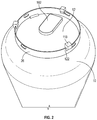
- FIG. 2 is a perspective view of the sensor module illustrated in FIG. 1 , showing the sensor module mounted to a tank bottom for determined height of liquid overlaying the sensor module;
- FIG. 3 is a perspective view of the sensor module illustrated in FIG. 1 , showing a ground-side body of sensor module housing;
- FIG. 4 is a perspective view of the sensor module illustrated in FIG. 1 , showing a tank-side body of the sensor module housing;
- FIG. 5 is an exploded perspective view of the sensor module illustrated in FIG. 1 , showing magnet seats and a transducer aperture of the sensor module housing;
- FIG. 6 is partial cross-sectional view of the sensor module illustrated in FIG. 1 , showing a transducer and couplant seated within a housing aperture of the sensor module;
- FIG. 7 is a partial cross-sectional view of the sensor module illustrated in FIG. 1 , showing the couplant in a relaxed state and a compressed state;
- FIG. 8 is an exploded perspective view of the sensor module illustrated in FIG. 1 , showing a controller and battery contained within an interior of the sensor module;
- FIG. 9 is a schematic view of the sensor arrangement of FIG. 1 , showing a controller and elements connected thereto within the sensor module;
- FIG. 10 is a schematic view of the display module of FIG. 1 , showing a controller and elements connected thereto within the display module;
- FIG. 11 is an exploded perspective of another embodiment of the sensor module, showing a couplant with a flange defined at a periphery of the couplant;
- FIG. 12 is a flowchart of a method of acquiring acoustic measurements of liquid height in a tank using an acoustic sensor, showing selection between first and second sampling rates according to whether a synchronization input is present and whether tank motion is present.
- Such implementation-specific decisions may include, and likely are not limited to, compliance with system-related, business-related, government-related and other constraints, which may vary by specific implementation, location, and from time to time. While a developer's efforts might be complex and time-consuming in an absolute sense, such efforts would be, nevertheless, a routine undertaking for those of ordinary skill in this art having benefit of this disclosure.
- Couple can include any method or device for securing, binding, bonding, fastening, attaching, joining, inserting therein, forming thereon or therein, communicating, or otherwise associating, for example, mechanically, magnetically, electrically, chemically, operably, directly or indirectly with intermediate elements, one or more pieces of members together and can further include without limitation integrally forming one functional member with another in a unity fashion.
- the coupling can occur in any direction, including rotationally.
- predetermining do not refer to a specific value or other item unless otherwise indicated, but rather refer to something known in accordance with a particular embodiment, application or step that may nonetheless change as between different embodiments, applications or steps in practice.
- This disclosure provides a sensor arrangement that measures the height of the liquid level in a tank, e.g., a portable propane tank, using a small and thin, coin cell battery powered sensor device, packaged uniquely in the small thin space under the tank using magnets.
- the ultrasonic device includes a low-power, e.g., Bluetooth, wireless technology to transmit the measured fluid level out from under the tank to a graphical user interface (GUI) of a display module, e.g., a cell phone with an application that displays the liquid level, a or to an independent, standalone, receiver display unit.
- GUI graphical user interface
- Sensor arrangement 100 includes a sensor module 102 and a display module, which can be either or both of a multipurpose device 104 or a dedicated device 106 .
- Sensor module 102 can be in wireless communication with multipurpose device 104 and/or dedicated device 106 through a wireless link 108 .
- Wireless link 108 can be a low-power wireless link. Examples of suitable wireless links include Bluetooth, wifi, Wifi-Direct, NFC, or any other current (or future) wireless link.
- wireless link 108 can be a Bluetooth Low Energy (BLE) wireless link, which lengthens the time between battery replacement for battery-containing elements of sensor arrangement 100 .
- wireless link 108 can be a simplex wireless link, data communication over wireless link 108 originating solely from sensor module 102 .
- Sensor module 102 mounts to a tank 10 .
- tank 10 is a vertical tank. This is for illustration purposes only and is non-limiting. In contemplated embodiments sensor module 102 can mount to a horizontal tank or tank of any other arrangement, as suitable for a given application.
- Exemplary tank 10 can be a portable tank having a bottom 12 and containing within its interior a liquid 14 .
- Liquid 14 has a height 16 and a surface 18 , surface 18 overlaying tank bottom 12 and being separated therefrom by height 16 .
- liquid 14 includes liquefied propane gas (LPG). This is for illustration purposes only and is non-limiting. It is to be understood and appreciated that the sensor arrangements, sensors systems, and methods described herein can be used with other types of liquid, as suitable for a given application.
- LPG liquefied propane gas
- Sensor module 102 can be acoustically coupled to surface 18 through height 16 of liquid 14 and tank bottom 12 .
- Sensor module 102 can be arranged to transmit acoustic pulses, e.g., acoustic pulse 20 , into liquid 14 .
- Sensor module 102 can be also arranged to receive reflected acoustic pulses, e.g., reflected acoustic pulse 22 , from surface 18 through liquid 14 and tank bottom 12 .
- Sensor module 102 can be further arranged to provide data 24 indicative of height 16 to either or both of multipurpose device 104 and dedicated device 106 .
- Dedicated device 106 can be arranged to receive data 24 via wireless link 108 . Upon receipt of data 24 , dedicated device 106 uses an on-board computing resource to determine height 16 based on data 24 , and provides an indication of height 16 to a graphical user interface (GUI) 110 of a user interface 112 of dedicated device 106 .
- GUI 110 can be a fuel-gage type display that graphically presents an indication of height 16 in relation to a ‘tank empty’ and a ‘tank full’ benchmark. It is contemplated that dedicated device 106 solely provide information relating to height of liquid within a tank. In contemplated embodiments, dedicated device 106 can be arranged to report respective heights of liquids in two or more tanks.
- Multipurpose device 104 can be similar to dedicated device 106 with the difference that multipurpose device 104 provide functionality beyond that relating to liquid height in a tank.
- multipurpose device 104 can be a mobile device, e.g., a mobile telephone, with a user interface 114 arranged to display a GUI 116 graphically presenting indication of height 16 .
- multipurpose device 104 can be a mobile telephone having recorded thereon an application, as will be described, which receives data 24 and determines height 16 based on data 24 using on-board computing resources of the mobile devices.
- utilizing the on-board computing resources remote from sensor module 102 can prolong the expected life of batteries used to provide power to sensor module 102 .
- sensor arrangement 100 also includes one or more feet 118 .
- Feet 118 are optional, are formed from an elastomeric material 120 such as rubber, and are configured to removably seat on a foot ring 26 of tank 10 .
- feet 118 include a slot 122 which tapers in the downward direction of feet 118 . It is contemplated that feet 118 (shown in FIGS. 1-2 ) increase space available beneath tank 10 for a width 117 of sensor module 102 , simplifying the construction of sensor module 102 .
- feet 118 improve quality of wireless link 108 , thereby reducing the amount of power required for sensor module 102 to communicate wirelessly using wireless 108 , improving the life a batteries providing power to sensor module 102 . In further contemplated embodiments, feet 118 improve the acoustic characteristics of tank 10 .
- sensor module 102 and feet 118 are shown.
- Sensor module 102 can be removably mounted to tank bottom 12 of tank 10 .
- Feet 118 are also removably mounted to foot ring 26 of tank 10 .
- Removably mounting sensor module 102 and feet 118 to tank 10 allows sensor module 102 and feet 118 to be readily applied to a replacement tank, allowing sensor arrangement 100 (shown in FIG. 1 ) to be used in conjunction with cylinder exchange service, such as Blue Rhino® cylinder exchange services available from the Ferrelgas Corporation of Overland Park, Kans.
- cylinder exchange service such as Blue Rhino® cylinder exchange services available from the Ferrelgas Corporation of Overland Park, Kans.
- Sensor module 102 includes a housing 130 .
- Housing 130 includes a tank-side body 132 and a ground-side body 134 removably connected to one another by one or more fasteners 136 .
- Fasteners 136 allow for separation of ground-side body 134 from tank-side body 132 , thereby providing access to an interior 138 (shown in FIG. 6 ) of sensor module 102 and enabling replacement of one or more batteries 140 (shown in FIG.) disposed therein.
- Ground-side body 134 has a user interface 142 disposed thereon.
- user interface 142 includes a ‘sync’ button for synchronizing sensor module 102 with sensor arrangement 100 (shown in FIG. 1 ).
- This provide synchronization functionality to sensor arrangement 100 , receipt of a user input at user interface 142 causing sensor module 102 to incorporate a sync indicia with advertisement packets, e.g., data 24 (shown in FIG. 1 ).
- the sync indicia allows sensor arrangement 100 to recognize data provided by sensor module 102 , and provides an introduction of sensor module to dedicated device 106 and/or multipurpose device 104 when otherwise unrecognized.
- tank-side body 132 of sensor module 102 is shown.
- Tank side body 132 includes a couplant 144 , e.g., a couplant body, a first magnet 146 , and a second magnet 148 .
- Couplant 144 can be fixed to housing 130 along a longitudinal axis of sensor module 102 , and can be offset longitudinally along the length of housing 130 .
- Couplant 144 includes resilient material 150 .
- Resiliency allows sensor module 102 to be switched between tanks, e.g., tank 10 , and provide acoustic communication suitable for measuring liquid notwithstanding differences between respective tank bottom, e.g., rust, cleanliness, grade of steel, etc.
- resilient material 150 includes a viscoelastic urethane polymer or silicon rubber material. Examples of such materials include Sorbothane®, available from Sorbothane, Inc. of Kent, Ohio.
- Couplant 144 can also be tacky and/or may include a tackifier 152 to provide tackiness. Tackiness improves adhesion between couplant 144 and tank bottom 12 (shown in FIG. 1 ). Tackiness also enables couplant 144 to sealably isolate interior 138 (shown in FIG. 5 ) from the external environment.
- a couplant 244 can be similar to couplant 144 and can include a flange 245 .
- Flange 245 can be defined about at least a portion of the couplant periphery and seats against an inner surface extending about at least a portion of the periphery of couplant 244 .
- Couplant 244 seats within tank-side body 232 such that flange 245 seats against an inner surface 233 of tank-side body 232 , couplant 244 thereby being captive within housing 230 between controller 276 and/or ground-side body 234 and tank-side body 232 .
- flange 245 can also improve water resistance of sensor module 202 by providing additional sealing between aperture 156 (see, e.g., FIG. 8 ) and the external environment. In contemplated embodiments, flange 245 eliminates the need to couple transducer 268 to couplant 244 with an adhesive, simplifying assembly and reducing cost of sensor module 202 .
- first magnet 146 laterally offset from couplant 144 on a first side of couplant 144 .
- Second magnet 148 can be laterally offset from couplant 144 on a side of couplant 144 opposite first magnet 146 .
- Laterally offsetting second magnet 148 on a side of couplant 144 opposite first magnet 146 enable the magnetic force of first magnet 146 and second magnet 148 to compressively deform couplant 144 , improving acoustic communication between couplant 144 and tank 10 (shown in FIG. 1 ).
- resilient material 150 can have a hardness that can be between about 20 Shore OO and about 40 Shore OO, such as between 15 Shore OO and 45 Shore OO. Hardness in this range can enable cooperation with relatively inexpensive, suitably sized, magnets to compress couplant 144 and maintain sensor module 102 in position on tank bottom 12 .
- first magnet 146 and second magnet 148 have an attractive force F that can be greater than a compressive strength C of couplant 144 , facilitating compression of couplant 144 when proximate tank bottom 12 (shown in FIGS. 1-2 ).
- Couplant 144 can also include a tackifier 152 , thereby providing of adherence to tank bottom 12 .
- the tackifier 152 can also provide adherence of the couplant 144 to a transducer 168 (shown in FIG. 5 ).
- Tank-side body 132 defines an aperture 156 , a first magnet seat 158 , and a second magnet seat 160 .
- First magnet seat 158 can be disposed between aperture 156 and a first lateral edge of tank-side body 132 .
- First magnet 146 can be captive within first magnet seat 158 , such as through a press-fit or by operation of an optional adhesive or bond material 162 .
- Optional adhesive or bond material 162 provides sealing about the periphery of first magnet seat 158 , isolating interior 138 from the external environment and allowing first magnet seat to be arranged as a through aperture.
- Second magnet seat 160 can be similar to first magnet seat 158 with the difference that second magnet seat 160 can be disposed on a side of aperture 156 opposite first magnet seat 158 .
- Second magnet 148 can be press-fit or bonded within second magnet seat 160 .
- An adhesive or bond material 162 may also be interposed between second magnet 148 and tank-side body 132 , providing sealing and adhesion therebetween.
- Aperture 156 can be centrally disposed between opposite lateral edges of tank-side body 132 , and can be longitudinally offset along a longitudinal length of tank-side body 132 .
- Aperture 156 can be a stepped aperture and includes a transducer lip 164 and a couplant lip 166 .
- Transducer lip 164 can be proximate interior 138 .
- Transducer 168 can be seated in aperture 156 and supported about at least a portion of its periphery by transducer lip 164 .
- transducer lip 164 can be segmented.
- segmented transducer lip 164 includes a plurality of circumferentially arranged arcuate segments 165 .
- the circumferentially arranged arcuate segments 165 fix axially corresponding segments of a transducer 168 , providing suitable rigid support while allowing suitable mechanical displacement of transducer 168 to generate or respond to acoustic pulses, e.g., acoustic pulse 20 (shown in FIG. 1 ) and reflected acoustic pulse 22 (shown in FIG. 1 ).
- acoustic pulse 20 shown in FIG. 1
- reflected acoustic pulse 22 shown in FIG. 1
- Couplant lip 166 can be disposed axially on a side of transducer lip 164 opposite interior 138 , has a width that can be greater than the width of transducer lip 164 , and can be radially outward of transducer lip 164 .
- Couplant 144 can be seated about its periphery on couplant lip 166 .
- Couplant lip 166 can be circumferentially continuous, couplant 144 thereby sealably seating over transducer 168 and isolating interior 138 from the external environment.
- transducer 168 is shown. Transducer 168 is interposed within aperture 156 axially between couplant 144 and tank-side body 132 . At a peripheral edge portion 171 , transducer 168 can be rigidly supported by transducer lip 164 . At an interior portion 172 , transducer 168 can be unsupported and can be free to vibrate, i.e., according to acoustic pulses generated or received.
- One or more micro wires 174 disposed within interior 138 connect transducer 168 with a controller 176 , thereby placing transducer 168 in communication with controller 176 .
- the radius of couplant lip 166 exceeds a radius of couplant 144 , couplant 144 and tank-side body 132 defining therebetween an expansion gap 178 .
- couplant 144 is shown in an uncompressed state I and in a compressed state II.
- uncompressed state I couplant 144 has a block-like shape and extends beyond a surface 180 of tank-side body 132 along substantially its entire length, and expansion gap 178 can be vacant.
- tank bottom 12 shown in FIG. 1
- couplant 144 deforms. In this respect, when compressive force D is exerted against couplant 144 a portion of resilient material 150 can flow into expansion gap 178 .
- the flow allows couplant 144 to form-fit to a contour of tank bottom 12 , facilitating acoustic coupling between transducer 168 and tank bottom 12 , and placing sensor module 102 in acoustic communication between sensor module 102 and liquid 14 (shown in FIG. 1 ) overlaying sensor module 102 .
- Controller 176 can be disposed within interior 138 and includes a battery 182 and a coil 184 .
- Battery 182 can be electrically connected to controller 176 and can be operatively connected to coil 184 .
- controller 176 be configured to allow a voltage to cyclically accumulate within coil 184 and be applied to transducer 168 via micro wire 174 .
- Transducer 168 can include a piezo element that changes size upon application of the voltage, the size change generating an acoustic pulse that can be communicated to tank bottom 12 through couplant 144 .
- battery 182 be a low-power battery.
- Battery 182 can be a coin-cell battery.
- suitable batteries include CR2032 batteries, which allow for the thickness of sensor module 102 to be sufficiently small that sensor module 102 fits within the clearance defined between the bottom of foot ring 26 (shown in FIG. 1 ) and tank bottom 12 (shown in FIG. 1 ).
- feet 118 provide additional clearance, such as when insufficient clearance exists.
- sensor module 102 includes controller 176 , user interface 142 , transducer 168 , and a wireless module 186 .
- Sensor module 102 can also include an optional accelerometer 187 .
- Controller 176 can be operatively connected to transducer 168 and wireless module 186 to generate data 24 , which wireless module 186 provides to wireless link 108 . Controller 176 can also be connected to user interface 142 , and can be arranged to receive therethrough a synchronization input S from a user, such as from an externally accessible ‘sync’ button arranged on the exterior of sensor module 102 . Controller 176 can be further connected to accelerometer 187 , and can be arranged to receive therefrom a signal including data indicative of motion of tank 12 (shown in FIG. 1 ).
- Controller 176 includes a processor 188 and a memory 190 .
- Memory 190 includes a non-transitory machine-readable medium having a plurality of program modules 192 recorded thereon containing instructions that, when read by processor 188 , cause controller 176 to execute certain operations. It is contemplated that the instructions cause sensor module 102 to acquire data indicative of height 16 (shown in FIG. 1 ) of liquid 14 (shown in FIG. 1 ), compress the data, and provides the compressed data wirelessly to display module 106 (shown in FIG. 1 ).
- the instructions cause transducer 168 to generate an acoustic pulse, e.g., acoustic pulses 20 (shown in FIG. 1 ).
- the acoustic pulse can be communicated into liquid overlaying the tank bottom, e.g., tank bottom 12 (shown in FIG. 1 ).
- the acoustic pulse travels upwards (relative to gravity) through the liquid until the acoustic pulse encounters the liquid surface, e.g., liquid surface 18 (shown in FIG. 1 ).
- the liquid surface reflects the acoustic pulse from the surface downwards (relative to gravity), towards the transducer, which receives the reflected acoustic pulse.
- the instructions also can cause the controller to record a waveform generated by the transducer for a predetermined time interval subsequent to generation of the acoustic pulse by the transducer, the waveform memorializing return of the reflected acoustic pulse as one or more waveform peaks in the waveform.
- the waveform can be recorded for between about two (2) milliseconds and about four (4) milliseconds, as appropriate for the height of liquid contained by the tank when full.
- These exemplary time values can allow for reflecting of an acoustic pulse in liquid propane where the liquid surface can be disposed between about 30 inches and about 60 inches above the transducer.
- the instructions cause the controller to compress the waveform.
- Compressing the waveform includes identifying peaks in the waveform generated during the predetermined time interval subsequent to generation of the acoustic pulse.
- a peak (or peaks) of the waveform can be identified and packaged into an advertisement package, e.g., exemplary data structure 24 .
- the advertisement package can be a 31-byte package.
- the advertisement package can include between six (6) and ten (10) peaks, e.g., eight (8) peaks, as suitable for a given application.
- numbers of peaks in these ranges do not occupy the available space within the advertisement package, allowing space for data such as synchronization input S, temperature data, and/or accelerometer data. Only sending the peaks, as opposed to the entire waveform, minimizes the amount of data necessary to communicate to the display module for purposes of re-representing the data for processing resources in the display module.
- the advertisement package can be conveyed wirelessly by wireless module 108 to display module 104 .
- Display module 104 receives the advertisement package 24 , calculates the time interval between generation of the acoustic pulse and receipt of the reflected acoustic pulse, and determines the height of the liquid overlaying the transducer based on the calculated time interval between generation of the acoustic pulse and receipt of the reflected acoustic pulse.
- compressing the data at the sensor module assembly can reduce the amount of power required to operate sensor module 102 , lengthen the service life and/or reducing the cost of the sensor module battery.
- using the processing resources of display module 104 can reduce cost of sensor module 102 by reducing the processing resources incorporated in sensor module 102 .
- Display module 106 includes a controller 101 with a processor 103 , user interface 112 with GUI 110 , and a wireless module 105 .
- Controller 101 can be operatively connected to wireless module 105 and user interface 112 , and can be configured to receive data 24 from sensor module 102 via wireless module 105 .
- Controller 101 can be also configured to recognize sensor module 102 upon receipt of data including synchronization indicator S (shown in FIG. 9 ), controller 101 thereafter recognizing data received from sensor 102 and determining liquid height 16 (shown in FIG. 1 ) using data 24 .
- Controller 101 includes a memory 107 .
- Memory 107 includes a non-transitory machine-readable medium with a plurality of program modules 109 having instructions recorded thereon that, when read by processor 103 , cause controller 101 to execute certain operations.
- the instructions generally cause controller 101 to convert the identified peak (or peaks) into a liquid height at dedicated display module 106 .
- the instructions cause controller 101 to calculate a time interval between transducer 168 (shown in FIG. 9 ) generating an acoustic pulse and the transducer receiving the reflected acoustic pulse, determine height 18 (shown in FIG. 1 ) of liquid 14 (shown in FIG. 1 ) overlaying tank bottom 12 (shown on in FIG. 1 ), and provide indication of the determined height to a user interface, e.g., user interface 110 (shown in FIG. 1 ), remote from transducer 168 .
- a user interface e.g., user interface 110 (shown in FIG. 1 )
- the instructions cause controller 101 to determine the time interval between generating the acoustic pulse, e.g., acoustic pulse 20 (shown in FIG. 1 ), and the return of the reflected acoustic pulse, e.g., reflected acoustic pulse 22 (shown in FIG. 1 ).
- the time interval may be compared to a lookup table stored on memory 107 having an association of time intervals and liquid heights.
- performing these calculations off-sensor, that is remote from sensor module 102 can allow sensor module 102 to be constructed with less processing resources than would otherwise be required for the sensor arrangement.
- an exemplary embodiment of a method of determining height of a liquid overlaying the transducer is shown.
- the transducer e.g., transducer 168 (shown in FIG. 9 )
- the sensor module e.g., sensor module 102
- checks for a user input e.g., from user interface 142 (shown in FIG. 9 ), as shown with decision box 310 .
- fluid height measurements are acquired at a relatively high second rate, which can be higher than a first rate which would otherwise be used, as shown with arrow 312 leading to box 320 .
- a synchronization input causes fluid height measurements to be acquired at a rate of about four (4) times per second for about twenty (20) minutes subsequent to a synchronization input being received, as shown with box 320 .
- increased sampling provides increased responsiveness to the user. Relatively prompt responsiveness from the sensor module when a user is manipulating the tank, for example when positioning the sensor on the tank, can improve the user experience.
- liquid height data can be acquired at the first rate, which can be relatively low, as shown with arrow 314 and leading to box 340 .
- fluid height measurements are acquired at a rate of about once every 3.5 seconds.
- sampling at relatively low rates can reduce power consumption of sensor module 102 and extends the service life of the sensor module battery.
- method 300 can also include determining whether tank motion is present.
- liquid height data can be acquired at a (higher) second rate, as shown with arrow 332 leading to box 320 .
- Tank motion can be detected, for example, using input from an accelerometer incorporated into the sensor module, e.g., accelerometer 187 (shown in FIG. 9 ).
- an accelerometer incorporated into the sensor module
- e.g., accelerometer 187 shown in FIG. 9
- obtaining more frequent liquid height measurements can improve the user experience in applications where the tank is mobile, such as when a BBQ grill is moved or cleaned prior to use.
- Absent indication of tank liquid height data can be acquired at the (lower) first rate, as shown with arrow 334 leading to box 340 .
- aspects of the present embodiments may be embodied as a system, method or computer program product. Accordingly, aspects of the present embodiments may take the form of an entirely hardware embodiment, an entirely software embodiment (including firmware, resident software, micro-code, etc.) or an embodiment combining software and hardware aspects that may all generally be referred to herein as a “circuit,” “module” or “system.” Furthermore, aspects of the present disclosure may take the form of a computer program product embodied in one or more computer readable medium(s) having computer readable program code embodied thereon.
- the computer readable medium may be a computer readable signal medium or a computer readable storage medium.
- a computer readable storage medium may be, for example, but not limited to, an electronic, magnetic, optical, electromagnetic, infrared, or semiconductor system, apparatus, or device, or any suitable combination of the foregoing.
- a computer readable storage medium may be any tangible medium that can contain, or store a program for use by or in connection with an instruction execution system, apparatus, or device.
- a computer readable signal medium may include a propagated data signal with computer readable program code embodied therein, for example, in baseband or as part of a carrier wave. Such a propagated signal may take any of a variety of forms, including, but not limited to, electro-magnetic, optical, or any suitable combination thereof.
- a computer readable signal medium may be any computer readable medium that is not a computer readable storage medium and that can communicate, propagate, or transport a program for use by or in connection with an instruction execution system, apparatus, or device.
- Program code embodied on a computer readable medium may be transmitted using any appropriate medium, including but not limited to wireless, wireline, optical fiber cable, RF, etc., or any suitable combination of the foregoing.
- Computer program code for carrying out operations for aspects of the present disclosure may be written in any combination of one or more programming languages, including an object oriented programming language such as Java, Smalltalk, C++ or the like and conventional procedural programming languages, such as the “C” programming language or similar programming languages.
- the program code may execute entirely on the user's computer, partly on the user's computer, as a stand-alone software package, partly on the user's computer and partly on a remote computer or entirely on the remote computer or server.
- the remote computer may be connected to the user's computer through any type of network, including a local area network (LAN) or a wide area network (WAN), or the connection may be made to an external computer (for example, through the Internet using an Internet Service Provider).
- LAN local area network
- WAN wide area network
- Internet Service Provider for example, AT&T, MCI, Sprint, EarthLink, MSN, GTE, etc.
- These computer program instructions may also be stored in a computer readable medium that can direct a computer, other programmable data processing apparatus, or other devices to function in a particular manner, such that the instructions stored in the computer readable medium produce an article of manufacture including instructions which implement the function/act specified in the flowchart and/or block diagram block or blocks.
- the computer program instructions may also be loaded onto a computer, other programmable data processing apparatus, or other devices to cause a series of operational steps to be performed on the computer, other programmable apparatus or other devices to produce a computer implemented process such that the instructions which execute on the computer or other programmable apparatus provide processes for implementing the functions/acts specified in a flowchart and/or block diagram block or blocks.
Landscapes
- Physics & Mathematics (AREA)
- General Physics & Mathematics (AREA)
- Acoustics & Sound (AREA)
- Electromagnetism (AREA)
- Thermal Sciences (AREA)
- Fluid Mechanics (AREA)
- Engineering & Computer Science (AREA)
- Computer Networks & Wireless Communication (AREA)
- Radar, Positioning & Navigation (AREA)
- Remote Sensing (AREA)
- Measurement Of Levels Of Liquids Or Fluent Solid Materials (AREA)
Abstract
Description
Height=Time Interval*Speed of Sound/2+Offset Equation 1:
Claims (18)
Priority Applications (3)
| Application Number | Priority Date | Filing Date | Title |
|---|---|---|---|
| US15/249,600 US10571328B2 (en) | 2015-08-29 | 2016-08-29 | Sensor arrangements, sensor systems, and methods for determining height of liquids in tanks |
| US16/801,135 US11946790B2 (en) | 2015-08-29 | 2020-02-25 | Sensor arrangements, sensor systems, and methods for determining height of liquids in tanks |
| US17/689,965 US12174053B1 (en) | 2015-08-29 | 2022-03-08 | Tank sensors |
Applications Claiming Priority (2)
| Application Number | Priority Date | Filing Date | Title |
|---|---|---|---|
| US201562211713P | 2015-08-29 | 2015-08-29 | |
| US15/249,600 US10571328B2 (en) | 2015-08-29 | 2016-08-29 | Sensor arrangements, sensor systems, and methods for determining height of liquids in tanks |
Related Child Applications (1)
| Application Number | Title | Priority Date | Filing Date |
|---|---|---|---|
| US16/801,135 Continuation-In-Part US11946790B2 (en) | 2015-08-29 | 2020-02-25 | Sensor arrangements, sensor systems, and methods for determining height of liquids in tanks |
Publications (2)
| Publication Number | Publication Date |
|---|---|
| US20170059389A1 US20170059389A1 (en) | 2017-03-02 |
| US10571328B2 true US10571328B2 (en) | 2020-02-25 |
Family
ID=58103883
Family Applications (1)
| Application Number | Title | Priority Date | Filing Date |
|---|---|---|---|
| US15/249,600 Active 2036-10-03 US10571328B2 (en) | 2015-08-29 | 2016-08-29 | Sensor arrangements, sensor systems, and methods for determining height of liquids in tanks |
Country Status (1)
| Country | Link |
|---|---|
| US (1) | US10571328B2 (en) |
Cited By (3)
| Publication number | Priority date | Publication date | Assignee | Title |
|---|---|---|---|---|
| US11946790B2 (en) | 2015-08-29 | 2024-04-02 | Mopeka Products Llc | Sensor arrangements, sensor systems, and methods for determining height of liquids in tanks |
| EP4372327A1 (en) * | 2022-11-18 | 2024-05-22 | Rosemount Tank Radar AB | Level measurement system and wireless operator device |
| US12174053B1 (en) | 2015-08-29 | 2024-12-24 | Mopeka Products Llc | Tank sensors |
Families Citing this family (20)
| Publication number | Priority date | Publication date | Assignee | Title |
|---|---|---|---|---|
| DE102015113908B4 (en) | 2015-08-21 | 2023-05-04 | Truma Gerätetechnik GmbH & Co. KG | level gauge |
| US10480982B2 (en) * | 2017-04-19 | 2019-11-19 | Saudi Arabian Oil Company | Acoustic calibration array for tanks and vessels |
| BR112020026098A2 (en) * | 2018-06-22 | 2021-03-23 | Bissell Inc. | surface cleaning device, sensing system, and method for operating a cleaning device. |
| DE102018132277A1 (en) * | 2018-12-14 | 2020-06-18 | Endress+Hauser SE+Co. KG | Self-sufficient level measuring device |
| WO2020243628A1 (en) | 2019-05-31 | 2020-12-03 | Perceptive Sensor Technologies Llc | Non-linear ultrasound method and apparatus for quantitative detection of materials (liquids, gas, plasma) |
| US11231311B2 (en) | 2019-05-31 | 2022-01-25 | Perceptive Sensor Technologies Llc | Non-linear ultrasound method and apparatus for quantitative detection of materials |
| TR201914701A2 (en) * | 2019-09-26 | 2021-04-21 | Evas Ev Aletleri Sanayi Anonim Sirketi | FILLING DETECTION DEVICE FOR LPG CYLINDER |
| EP4048984B1 (en) * | 2019-10-22 | 2025-03-12 | AMTROL Licensing Inc. | Tank level sensor and management system |
| US11729537B2 (en) | 2020-12-02 | 2023-08-15 | Perceptive Sensor Technologies, Inc. | Variable angle transducer interface block |
| WO2022120265A1 (en) | 2020-12-04 | 2022-06-09 | Perceptive Sensor Technologies, Inc. | In-wall multi-bounce material property detection and acoustic signal amplification |
| CA3201085A1 (en) | 2020-12-04 | 2022-06-09 | Lazar Bivolarsky | Acoustic temperature measurement in layered environments |
| US11788904B2 (en) | 2020-12-04 | 2023-10-17 | Perceptive Sensor Technologies, Inc. | Acoustic temperature measurement in layered environments |
| US11994494B2 (en) | 2020-12-04 | 2024-05-28 | Perceptive Sensor Technologies, Inc. | Multi-bounce acoustic signal material detection |
| US11604294B2 (en) | 2020-12-04 | 2023-03-14 | Perceptive Sensor Technologies, Inc. | Determining layer characteristics in multi-layered environments |
| WO2022120273A1 (en) | 2020-12-04 | 2022-06-09 | Perceptive Sensor Technologies, Inc. | Multi-path acoustic signal improvement for material detection |
| US11549839B2 (en) | 2020-12-04 | 2023-01-10 | Perceptive Sensor Technologies, Inc. | Systems and methods for determining floating roof level tilt and characterizing runoff |
| US11525809B2 (en) | 2020-12-04 | 2022-12-13 | Perceptive Sensor Technologies, Inc. | Apparatus, system, and method for the detection of objects and activity within a container |
| EP4271992A4 (en) | 2020-12-30 | 2025-03-12 | Perceptive Sensor Technologies, Inc. | FLUID QUALITY ASSESSMENT USING SIGNALS |
| US11860014B2 (en) | 2022-02-11 | 2024-01-02 | Perceptive Sensor Technologies, Inc. | Acoustic signal detection of material composition in static and dynamic conditions |
| US11940420B2 (en) | 2022-07-19 | 2024-03-26 | Perceptive Sensor Technologies, Inc. | Acoustic signal material identification with nanotube couplant |
Citations (29)
| Publication number | Priority date | Publication date | Assignee | Title |
|---|---|---|---|---|
| US3100885A (en) | 1961-08-14 | 1963-08-13 | Gulton Ind Inc | Ultrasonic liquid level gauge |
| US3603149A (en) | 1969-09-03 | 1971-09-07 | Us Army | Ultrasonic liquid level indicator |
| DE3703658A1 (en) | 1987-02-06 | 1988-08-18 | Siemens Ag | DEVICE FOR DETERMINING THE LEVEL OF A LIQUID IN A CONTAINER, IN PARTICULAR IN A MOTOR VEHICLE |
| US4901245A (en) * | 1987-12-01 | 1990-02-13 | Moore Technologies, Inc. | Nonintrusive acoustic liquid level sensor |
| US5586085A (en) | 1991-10-31 | 1996-12-17 | Lichte; Leo J. | Container and adaptor for use with fluid volume sensor |
| US5778726A (en) * | 1995-10-17 | 1998-07-14 | Endress + Hauser Gmbh + Co. | Device for monitoring a predetermined level of a liquid in a container |
| US5793705A (en) | 1996-09-18 | 1998-08-11 | International Business Machines Corporation | Ultrasonic liquid level gauge for tanks subject to movement and vibration |
| US5962952A (en) | 1995-11-03 | 1999-10-05 | Coherent Technologies, Inc. | Ultrasonic transducer |
| US6246154B1 (en) | 1996-11-01 | 2001-06-12 | Coherent Technologies | Ultrasonic transducer |
| US20040035873A1 (en) * | 2002-08-26 | 2004-02-26 | Willard Worden | LP gas tank with a spark preventer |
| DE102004028547A1 (en) | 2004-06-12 | 2006-02-02 | Werner Turck Gmbh & Co. Kg | Device for determining level in tank has first and second reference signal reflectors at different reference distances from floor of tank for measuring first and second reference transition times |
| US7114390B2 (en) | 2003-02-14 | 2006-10-03 | Adept Science & Technologies, Llc | Ultrasonic liquid level monitor |
| US7174783B2 (en) | 1996-01-23 | 2007-02-13 | Mija Industries, Inc. | Remote monitoring of fluid containers |
| US7174769B2 (en) | 1996-01-23 | 2007-02-13 | Mija Industries, Inc. | Monitoring contents of fluid containers |
| US7287425B2 (en) | 2004-05-17 | 2007-10-30 | Xtero Datacom Inc. | Ultrasonic fuel level monitoring device |
| US7298278B2 (en) | 2004-08-10 | 2007-11-20 | Robertshaw Controls Company | Automatic delivery/drain detection using a level monitoring system |
| US20100126267A1 (en) * | 2007-08-30 | 2010-05-27 | Uri Agam | Level sensor system for propane tanks and or the likes |
| US20110029262A1 (en) * | 2009-07-29 | 2011-02-03 | Wolfedale Engineering Limited | Container level sensor assembly |
| US7905143B2 (en) | 2007-07-23 | 2011-03-15 | Schmitt Measurement Systems, Inc. | Ultrasonic fuel level monitoring system incorporating an acoustic lens |
| WO2011051949A1 (en) | 2009-11-01 | 2011-05-05 | M.S.E Monitoring System Engineering Ltd | Fuel tank monitoring system and method |
| US8104341B2 (en) | 2009-03-25 | 2012-01-31 | Schmitt Measurement Systems, Inc. | Ultrasonic liquid level monitoring system |
| US8412473B2 (en) | 2011-04-11 | 2013-04-02 | Schmitt Industries, Inc. | Event monitoring and detection in liquid level monitoring system |
| US20130263657A1 (en) | 2012-04-09 | 2013-10-10 | Ferrellgas, L.P. d/b/a Blue Rhino | Apparatus and method for determining the liquid level in an un-modified tank |
| US20130293388A1 (en) | 2012-04-10 | 2013-11-07 | Daryl Ingalsbe | Cellular tank monitoring technology |
| US8630814B2 (en) | 2011-01-31 | 2014-01-14 | Xylem IP Holdings LLC. | Ultrasonic water level gauge and control device |
| US20140304528A1 (en) * | 2013-04-09 | 2014-10-09 | Lilly Huang | Controlling supply of power to computing devices with dynamically variable energy capacity |
| DE102014210077A1 (en) | 2014-05-27 | 2015-12-03 | Continental Automotive Gmbh | Apparatus and method for determining a height of a fluid surface in a fluid container |
| US20160116318A1 (en) | 2013-05-03 | 2016-04-28 | Endress+Hauser Flowtec Ag | Coupling Element, Ultrasonic Transducer and Ultrasonic Flow Meter |
| US20160163175A1 (en) | 2014-12-03 | 2016-06-09 | Bond Manufacturing Co., Inc. | Safety and fuel level communication system |
-
2016
- 2016-08-29 US US15/249,600 patent/US10571328B2/en active Active
Patent Citations (32)
| Publication number | Priority date | Publication date | Assignee | Title |
|---|---|---|---|---|
| US3100885A (en) | 1961-08-14 | 1963-08-13 | Gulton Ind Inc | Ultrasonic liquid level gauge |
| US3603149A (en) | 1969-09-03 | 1971-09-07 | Us Army | Ultrasonic liquid level indicator |
| DE3703658A1 (en) | 1987-02-06 | 1988-08-18 | Siemens Ag | DEVICE FOR DETERMINING THE LEVEL OF A LIQUID IN A CONTAINER, IN PARTICULAR IN A MOTOR VEHICLE |
| US4901245A (en) * | 1987-12-01 | 1990-02-13 | Moore Technologies, Inc. | Nonintrusive acoustic liquid level sensor |
| US5586085A (en) | 1991-10-31 | 1996-12-17 | Lichte; Leo J. | Container and adaptor for use with fluid volume sensor |
| US5778726A (en) * | 1995-10-17 | 1998-07-14 | Endress + Hauser Gmbh + Co. | Device for monitoring a predetermined level of a liquid in a container |
| US5778726C1 (en) * | 1995-10-17 | 2001-09-11 | Endress Hauser Gmbh Co | Device for monitoring a predetermined level of a liquid in a container |
| US5962952A (en) | 1995-11-03 | 1999-10-05 | Coherent Technologies, Inc. | Ultrasonic transducer |
| US7174783B2 (en) | 1996-01-23 | 2007-02-13 | Mija Industries, Inc. | Remote monitoring of fluid containers |
| US7174769B2 (en) | 1996-01-23 | 2007-02-13 | Mija Industries, Inc. | Monitoring contents of fluid containers |
| US5793705A (en) | 1996-09-18 | 1998-08-11 | International Business Machines Corporation | Ultrasonic liquid level gauge for tanks subject to movement and vibration |
| US6246154B1 (en) | 1996-11-01 | 2001-06-12 | Coherent Technologies | Ultrasonic transducer |
| US20040035873A1 (en) * | 2002-08-26 | 2004-02-26 | Willard Worden | LP gas tank with a spark preventer |
| US7114390B2 (en) | 2003-02-14 | 2006-10-03 | Adept Science & Technologies, Llc | Ultrasonic liquid level monitor |
| US7287425B2 (en) | 2004-05-17 | 2007-10-30 | Xtero Datacom Inc. | Ultrasonic fuel level monitoring device |
| DE102004028547A1 (en) | 2004-06-12 | 2006-02-02 | Werner Turck Gmbh & Co. Kg | Device for determining level in tank has first and second reference signal reflectors at different reference distances from floor of tank for measuring first and second reference transition times |
| US7298278B2 (en) | 2004-08-10 | 2007-11-20 | Robertshaw Controls Company | Automatic delivery/drain detection using a level monitoring system |
| US7905143B2 (en) | 2007-07-23 | 2011-03-15 | Schmitt Measurement Systems, Inc. | Ultrasonic fuel level monitoring system incorporating an acoustic lens |
| US8689624B2 (en) | 2007-08-30 | 2014-04-08 | Uri Agam | Level sensor system for propane tanks and or the likes |
| US20100126267A1 (en) * | 2007-08-30 | 2010-05-27 | Uri Agam | Level sensor system for propane tanks and or the likes |
| US8104341B2 (en) | 2009-03-25 | 2012-01-31 | Schmitt Measurement Systems, Inc. | Ultrasonic liquid level monitoring system |
| US20110029262A1 (en) * | 2009-07-29 | 2011-02-03 | Wolfedale Engineering Limited | Container level sensor assembly |
| WO2011051949A1 (en) | 2009-11-01 | 2011-05-05 | M.S.E Monitoring System Engineering Ltd | Fuel tank monitoring system and method |
| US8630814B2 (en) | 2011-01-31 | 2014-01-14 | Xylem IP Holdings LLC. | Ultrasonic water level gauge and control device |
| US8412473B2 (en) | 2011-04-11 | 2013-04-02 | Schmitt Industries, Inc. | Event monitoring and detection in liquid level monitoring system |
| US20130263657A1 (en) | 2012-04-09 | 2013-10-10 | Ferrellgas, L.P. d/b/a Blue Rhino | Apparatus and method for determining the liquid level in an un-modified tank |
| US20130293388A1 (en) | 2012-04-10 | 2013-11-07 | Daryl Ingalsbe | Cellular tank monitoring technology |
| US20140304528A1 (en) * | 2013-04-09 | 2014-10-09 | Lilly Huang | Controlling supply of power to computing devices with dynamically variable energy capacity |
| US20160116318A1 (en) | 2013-05-03 | 2016-04-28 | Endress+Hauser Flowtec Ag | Coupling Element, Ultrasonic Transducer and Ultrasonic Flow Meter |
| DE102014210077A1 (en) | 2014-05-27 | 2015-12-03 | Continental Automotive Gmbh | Apparatus and method for determining a height of a fluid surface in a fluid container |
| US10101193B2 (en) | 2014-05-27 | 2018-10-16 | Continental Automotive Gmbh | Apparatus and method for determining a level of a fluid surface in a fluid container |
| US20160163175A1 (en) | 2014-12-03 | 2016-06-09 | Bond Manufacturing Co., Inc. | Safety and fuel level communication system |
Non-Patent Citations (7)
| Title |
|---|
| "Custom Noninvasive Ultrasonic Liquid Level Sensor," Strain Measurement Devices, smdsensors.com, accessed: Jun. 2016. downloaded at http://www.smdsensors.com/Products/CustomerFiles/Products/SMD_Custom_Non_invasive_Ultrasonic_Liquid_Level_Sensors_R2.pdf pp. 1. |
| "Propane Tank Gauge Level Gas Grill Ultrasound by Gaslock Classic," Terapeak, terapeak.com, accessed: Jun. 2016 downloaded on http://www.terapeak.com/worth/propanetankgaugelevelgasgrillultrasoundbygaslockclassic/252303994808/ pp. 1. |
| Jun. 12, 2018 Letter from Eric M. Leppo to Michael C. Mackey. |
| Li, Peng, et al., "An accurate detection for dynamic liquid level based on mimo ultrasonic transducer array," IEEE Transactions on Instrumentation and Measurement 64.3 (2015): 582595 downloaded at http://ieeexplore.ieee.org/iel/19/4407674/06912012.pdf?arnumber=6912012 pp. 14. |
| Onechowski, Stephan W., "Development of an Effective Fuel Level Sensing Technology for Propane Powered Vehicles," (2000). downloaded at http://www.nlcbnc.ca/obj/s4/f2/dsk1/tape8/PQDD_0005/MQ45619.pdf Publisher: National Library of Canada, pp. 155. |
| Thruwall-Non-invasive technology, Hycontrol Level Measurement Solutions, hycontrol.com, accessed Jun. 28, 2016, http://hycontrol.com/levelmeasurement/viewproduct.php?id=14. |
| Thruwall—Non-invasive technology, Hycontrol Level Measurement Solutions, hycontrol.com, accessed Jun. 28, 2016, http://hycontrol.com/levelmeasurement/viewproduct.php?id=14. |
Cited By (3)
| Publication number | Priority date | Publication date | Assignee | Title |
|---|---|---|---|---|
| US11946790B2 (en) | 2015-08-29 | 2024-04-02 | Mopeka Products Llc | Sensor arrangements, sensor systems, and methods for determining height of liquids in tanks |
| US12174053B1 (en) | 2015-08-29 | 2024-12-24 | Mopeka Products Llc | Tank sensors |
| EP4372327A1 (en) * | 2022-11-18 | 2024-05-22 | Rosemount Tank Radar AB | Level measurement system and wireless operator device |
Also Published As
| Publication number | Publication date |
|---|---|
| US20170059389A1 (en) | 2017-03-02 |
Similar Documents
| Publication | Publication Date | Title |
|---|---|---|
| US10571328B2 (en) | Sensor arrangements, sensor systems, and methods for determining height of liquids in tanks | |
| US11946790B2 (en) | Sensor arrangements, sensor systems, and methods for determining height of liquids in tanks | |
| US11530942B2 (en) | Device and method for measuring the level of liquid in a container | |
| US10746586B2 (en) | Tank-in-tank container fill level indicator | |
| US20180044159A1 (en) | Container fill level indication system using a machine learning algorithm | |
| US10670444B2 (en) | Content quantity detection signal processing | |
| US10119657B2 (en) | Propane tank continuous monitoring system | |
| US10324075B2 (en) | Transmitter and receiver configuration for detecting content level | |
| US12235148B2 (en) | System and methods for field monitoring of stationary assets | |
| US10390192B2 (en) | Automatic goods consumption judgment system and method | |
| AU2019293796A1 (en) | System for determining the status of a gas cylinder | |
| CN114258476A (en) | Device, system and method for determining a filling level of a container | |
| EP3528679B1 (en) | A consumables monitoring system | |
| KR102464322B1 (en) | Facility abnormality monitoring system | |
| CN118359164A (en) | Monitoring of beverage dispensing systems | |
| US12174053B1 (en) | Tank sensors | |
| US20250369791A1 (en) | Sensor Arrangements, Sensor Systems, and Methods for Determining Height of Liquids in Tanks | |
| RU2749560C1 (en) | Structural unit comprised of filling level measuring tool and remote element | |
| US20240401996A1 (en) | Device, system, and method for fluid mass determination | |
| US20240142059A1 (en) | System, devices and methods for measuring a fill level in containers |
Legal Events
| Date | Code | Title | Description |
|---|---|---|---|
| AS | Assignment |
Owner name: MOPEKA PRODUCTS LLC, TEXAS Free format text: ASSIGNMENT OF ASSIGNORS INTEREST;ASSIGNORS:MOORE, JOEL REESE;KAUFMAN, JONATHAN LOUIS;PECK, JASON DUANE;REEL/FRAME:040274/0467 Effective date: 20161029 |
|
| STPP | Information on status: patent application and granting procedure in general |
Free format text: FINAL REJECTION MAILED |
|
| STPP | Information on status: patent application and granting procedure in general |
Free format text: RESPONSE AFTER FINAL ACTION FORWARDED TO EXAMINER |
|
| STPP | Information on status: patent application and granting procedure in general |
Free format text: NOTICE OF ALLOWANCE MAILED -- APPLICATION RECEIVED IN OFFICE OF PUBLICATIONS |
|
| AS | Assignment |
Owner name: MOPEKA PRODUCTS LLC, TEXAS Free format text: CONFIRMATORY ASSIGNMENT;ASSIGNOR:KAUFMANN, JONATHAN LOUIS;REEL/FRAME:051381/0275 Effective date: 20191126 |
|
| STPP | Information on status: patent application and granting procedure in general |
Free format text: PUBLICATIONS -- ISSUE FEE PAYMENT VERIFIED |
|
| STCF | Information on status: patent grant |
Free format text: PATENTED CASE |
|
| STCF | Information on status: patent grant |
Free format text: PATENTED CASE |
|
| FEPP | Fee payment procedure |
Free format text: SURCHARGE FOR LATE PAYMENT, SMALL ENTITY (ORIGINAL EVENT CODE: M2554); ENTITY STATUS OF PATENT OWNER: SMALL ENTITY |
|
| MAFP | Maintenance fee payment |
Free format text: PAYMENT OF MAINTENANCE FEE, 4TH YR, SMALL ENTITY (ORIGINAL EVENT CODE: M2551); ENTITY STATUS OF PATENT OWNER: SMALL ENTITY Year of fee payment: 4 |