US10570157B2 - Cyclic diarylboron derivatives as NLRP3 inflammasome inhibitors - Google Patents
Cyclic diarylboron derivatives as NLRP3 inflammasome inhibitors Download PDFInfo
- Publication number
- US10570157B2 US10570157B2 US15/748,557 US201615748557A US10570157B2 US 10570157 B2 US10570157 B2 US 10570157B2 US 201615748557 A US201615748557 A US 201615748557A US 10570157 B2 US10570157 B2 US 10570157B2
- Authority
- US
- United States
- Prior art keywords
- alkyl
- compound
- cycloalkyl
- aryl
- group
- Prior art date
- Legal status (The legal status is an assumption and is not a legal conclusion. Google has not performed a legal analysis and makes no representation as to the accuracy of the status listed.)
- Expired - Fee Related
Links
- 0 [1*]C1=C([2*])C([3*])=[O+][B-]([4*])([5*])C1 Chemical compound [1*]C1=C([2*])C([3*])=[O+][B-]([4*])([5*])C1 0.000 description 26
- UNAZCSFKIMJAKO-UHFFFAOYSA-N CC(=O)C(C(C)=O)=C(C)N Chemical compound CC(=O)C(C(C)=O)=C(C)N UNAZCSFKIMJAKO-UHFFFAOYSA-N 0.000 description 3
- BHODCYUMBAWEDP-UHFFFAOYSA-N C#CCNC1=OB(C2=CC=CC=C2)(C2=CC=CC=C2)NC(C)=C1C(C)=O.CC(=O)C1=C(C)NB(C2=CC=CC=C2)(C2=CC=CC=C2)O=C1C.CC(=O)C1=C(C)NB(C2=CC=CC=C2)(C2=CC=CC=C2)O=C1C.CC(=O)C1=C(C)NB(C2=CC=CC=C2)(C2=CC=CC=C2)O=C1C.CC(=O)C1=C(C)NB(C2=CC=CC=C2)(C2=CC=CC=C2)O=C1N.CC(=O)C1=C(C)NB(C2=CC=CC=C2)(C2=CC=CC=C2)O=C1NCCC1=CC=CC=C1.[H]C1=C(C)NB(C2=CC=CC=C2)(C2=CC=CC=C2)O=C1N Chemical compound C#CCNC1=OB(C2=CC=CC=C2)(C2=CC=CC=C2)NC(C)=C1C(C)=O.CC(=O)C1=C(C)NB(C2=CC=CC=C2)(C2=CC=CC=C2)O=C1C.CC(=O)C1=C(C)NB(C2=CC=CC=C2)(C2=CC=CC=C2)O=C1C.CC(=O)C1=C(C)NB(C2=CC=CC=C2)(C2=CC=CC=C2)O=C1C.CC(=O)C1=C(C)NB(C2=CC=CC=C2)(C2=CC=CC=C2)O=C1N.CC(=O)C1=C(C)NB(C2=CC=CC=C2)(C2=CC=CC=C2)O=C1NCCC1=CC=CC=C1.[H]C1=C(C)NB(C2=CC=CC=C2)(C2=CC=CC=C2)O=C1N BHODCYUMBAWEDP-UHFFFAOYSA-N 0.000 description 2
- FXAXSTZAQNADQY-ZROIWOOFSA-N CC(=O)/C(C(=O)NC12CC3CC(CC(C3)C1)C2)=C(\C)N Chemical compound CC(=O)/C(C(=O)NC12CC3CC(CC(C3)C1)C2)=C(\C)N FXAXSTZAQNADQY-ZROIWOOFSA-N 0.000 description 2
- ZXCPBWKDHXAYBW-UHFFFAOYSA-N CC(=O)C1=C(C)NB(C2=CC=C(C)C=C2)(C2=CC=C(C)C=C2)O=C1N.CC(=O)C1=C(C)NB(C2=CC=CC=C2)(C2=CC=C(C)C=C2)O=C1N.CC(=O)C1=C(C)NB(C2=CC=CC=C2)(C2=CC=CC=C2)O=C1NC1=C/C2=CC=C3C=CC=C4/C=C/C(=C/1)C2=C34.CC(=O)C1=C(C)NB(C2=CC=CC=C2)(C2=CC=CC=C2)O=C1NC1=CC=NC=C1.[H]C1=C([H]C(Cl)Cl)NB(C2=CC=CC=C2)(C2=CC=CC=C2)O=C1C Chemical compound CC(=O)C1=C(C)NB(C2=CC=C(C)C=C2)(C2=CC=C(C)C=C2)O=C1N.CC(=O)C1=C(C)NB(C2=CC=CC=C2)(C2=CC=C(C)C=C2)O=C1N.CC(=O)C1=C(C)NB(C2=CC=CC=C2)(C2=CC=CC=C2)O=C1NC1=C/C2=CC=C3C=CC=C4/C=C/C(=C/1)C2=C34.CC(=O)C1=C(C)NB(C2=CC=CC=C2)(C2=CC=CC=C2)O=C1NC1=CC=NC=C1.[H]C1=C([H]C(Cl)Cl)NB(C2=CC=CC=C2)(C2=CC=CC=C2)O=C1C ZXCPBWKDHXAYBW-UHFFFAOYSA-N 0.000 description 2
- JQPIXXJMUFWCQU-UHFFFAOYSA-N CC(=O)C1=C(C)NB(C2=CC=CC=C2)(C2=CC=CC=C2)O=C1NC12CC3CC(CC(C3)C1)C2.CC(=O)C1=C(C)NB(C2=CC=CC=C2)(C2=CC=CC=C2)O=C1NCC1=CC=CC=C1.CC(=O)C1=C(C)NB(C2=CC=CC=C2)(C2=CC=CC=C2)O=C1OC(C)(C)C.CNC1=OB(C2=CC=CC=C2)(C2=CC=CC=C2)NC(C)=C1C(C)=O.[H]C1=C(C)NB(C2=CC=CC=C2)(C2=CC=CC=C2)O=C1NCCC1=CC=CC=C1 Chemical compound CC(=O)C1=C(C)NB(C2=CC=CC=C2)(C2=CC=CC=C2)O=C1NC12CC3CC(CC(C3)C1)C2.CC(=O)C1=C(C)NB(C2=CC=CC=C2)(C2=CC=CC=C2)O=C1NCC1=CC=CC=C1.CC(=O)C1=C(C)NB(C2=CC=CC=C2)(C2=CC=CC=C2)O=C1OC(C)(C)C.CNC1=OB(C2=CC=CC=C2)(C2=CC=CC=C2)NC(C)=C1C(C)=O.[H]C1=C(C)NB(C2=CC=CC=C2)(C2=CC=CC=C2)O=C1NCCC1=CC=CC=C1 JQPIXXJMUFWCQU-UHFFFAOYSA-N 0.000 description 2
- PZPPCFRSCKEXMQ-UHFFFAOYSA-N CC(=O)C1=C(C)NB(C2=CC=CC=C2)(C2=CC=CC=C2)O=C1NC1=CC=CC=C1.CC(=O)C1=C(C)NB(C2=CC=CC=C2)(C2=CC=CC=C2)O=C1NC1CCCCC1.CC(=O)C1=C(C2=CC=CC=C2)NB(C2=CC=CC=C2)(C2=CC=CC=C2)O=C1C.CC1=C(C(N)=O)C(N)=OB(C2=CC=CC=C2)(C2=CC=CC=C2)N1.CCSC1=C(C(C)=O)C(OC(C)(C)C)=OB(C2=CC=CC=C2)(C2=CC=CC=C2)N1.[C-]#[N+]C1=C(C)NB(C2=CC=CC=C2)(C2=CC=CC=C2)O=C1N.[H]C1=C(C(C)(C)C)NB(C2=CC=CC=C2)(C2=CC=CC=C2)O=C1C Chemical compound CC(=O)C1=C(C)NB(C2=CC=CC=C2)(C2=CC=CC=C2)O=C1NC1=CC=CC=C1.CC(=O)C1=C(C)NB(C2=CC=CC=C2)(C2=CC=CC=C2)O=C1NC1CCCCC1.CC(=O)C1=C(C2=CC=CC=C2)NB(C2=CC=CC=C2)(C2=CC=CC=C2)O=C1C.CC1=C(C(N)=O)C(N)=OB(C2=CC=CC=C2)(C2=CC=CC=C2)N1.CCSC1=C(C(C)=O)C(OC(C)(C)C)=OB(C2=CC=CC=C2)(C2=CC=CC=C2)N1.[C-]#[N+]C1=C(C)NB(C2=CC=CC=C2)(C2=CC=CC=C2)O=C1N.[H]C1=C(C(C)(C)C)NB(C2=CC=CC=C2)(C2=CC=CC=C2)O=C1C PZPPCFRSCKEXMQ-UHFFFAOYSA-N 0.000 description 2
- SDIFSYBTZHXJPD-UHFFFAOYSA-N CC(=O)C1=C(C)N[B-](C2=CC=CC=C2)(C2=CC=CC=C2)[O+]=C1C.CC(=O)C1=C(C)N[B-](C2=CC=CC=C2)(C2=CC=CC=C2)[O+]=C1C.CC(=O)C1=C(C)N[B-](C2=CC=CC=C2)(C2=CC=CC=C2)[O+]=C1C.CC(=O)C1=C(C)N[B-](C2=CC=CC=C2)(C2=CC=CC=C2)[O+]=C1C.[H]C1=C(C)N[B-](C2=CC=CC=C2)(C2=CC=CC=C2)[O+]=C1C.[H]C1=C(C)N[B-](C2=CC=CC=C2)(C2=CC=CC=C2)[O+]=C1C Chemical compound CC(=O)C1=C(C)N[B-](C2=CC=CC=C2)(C2=CC=CC=C2)[O+]=C1C.CC(=O)C1=C(C)N[B-](C2=CC=CC=C2)(C2=CC=CC=C2)[O+]=C1C.CC(=O)C1=C(C)N[B-](C2=CC=CC=C2)(C2=CC=CC=C2)[O+]=C1C.CC(=O)C1=C(C)N[B-](C2=CC=CC=C2)(C2=CC=CC=C2)[O+]=C1C.[H]C1=C(C)N[B-](C2=CC=CC=C2)(C2=CC=CC=C2)[O+]=C1C.[H]C1=C(C)N[B-](C2=CC=CC=C2)(C2=CC=CC=C2)[O+]=C1C SDIFSYBTZHXJPD-UHFFFAOYSA-N 0.000 description 2
- NMCIHAJZPWAWDB-UHFFFAOYSA-N CC(=O)C1=C(C)N[B-](C2=CC=CC=C2)(C2=CC=CC=C2)[O+]=C1N Chemical compound CC(=O)C1=C(C)N[B-](C2=CC=CC=C2)(C2=CC=CC=C2)[O+]=C1N NMCIHAJZPWAWDB-UHFFFAOYSA-N 0.000 description 2
- BDVRDZWZYHAZTQ-UHFFFAOYSA-N [H]C1=C(C)N[B-](C2=CC=CC=C2C)(C2=C(C)C=CC=C2)[O+]=C1C Chemical compound [H]C1=C(C)N[B-](C2=CC=CC=C2C)(C2=C(C)C=CC=C2)[O+]=C1C BDVRDZWZYHAZTQ-UHFFFAOYSA-N 0.000 description 2
- HNLBUMSZINKAMZ-UHFFFAOYSA-N B=NC.CC(=O)C1=C(C)N[B-](C2=CC=CC=C2)(C2=CC=CC=C2)[O+]=C1C Chemical compound B=NC.CC(=O)C1=C(C)N[B-](C2=CC=CC=C2)(C2=CC=CC=C2)[O+]=C1C HNLBUMSZINKAMZ-UHFFFAOYSA-N 0.000 description 1
- MXSIUFZITLIMDX-ZNZYNQFDSA-N BrC1=CC=CC=C1CCC1=C(Br)C=CC=C1.BrCC1=CC=CC=C1Br.CC(=O)/C(C(N)=O)=C(\C)N.CC(=O)C1=C(C)NB2(O=C1N)C1=C(C=CC=C1)CCC1=C2C=CC=C1.CC(=O)CC(N)=O.OB1C2=C(C=CC=C2)CCC2=C1C=CC=C2 Chemical compound BrC1=CC=CC=C1CCC1=C(Br)C=CC=C1.BrCC1=CC=CC=C1Br.CC(=O)/C(C(N)=O)=C(\C)N.CC(=O)C1=C(C)NB2(O=C1N)C1=C(C=CC=C1)CCC1=C2C=CC=C1.CC(=O)CC(N)=O.OB1C2=C(C=CC=C2)CCC2=C1C=CC=C2 MXSIUFZITLIMDX-ZNZYNQFDSA-N 0.000 description 1
- ACZNIGNYOCVZNE-UHFFFAOYSA-N C#C/B=N/C#C.CC(=O)C1=C(C)N[B-](C2=CC=CC=C2)(C2=CC=CC=C2)[O+]=C1C Chemical compound C#C/B=N/C#C.CC(=O)C1=C(C)N[B-](C2=CC=CC=C2)(C2=CC=CC=C2)[O+]=C1C ACZNIGNYOCVZNE-UHFFFAOYSA-N 0.000 description 1
- BHPCWDPOIVDBGZ-UHFFFAOYSA-N C#C/B=N/C#CC.[H]C1=C(C)N[B-](C2=CC=CC=C2)(C2=CC=CC=C2)[O+]=C1N Chemical compound C#C/B=N/C#CC.[H]C1=C(C)N[B-](C2=CC=CC=C2)(C2=CC=CC=C2)[O+]=C1N BHPCWDPOIVDBGZ-UHFFFAOYSA-N 0.000 description 1
- PQFAFVMXRHYHMU-UHFFFAOYSA-N C#C/N=B/C.[H]C1=C(C)N[B-](C2=CC=CC=C2)(C2=CC=CC=C2)[O+]=C1C Chemical compound C#C/N=B/C.[H]C1=C(C)N[B-](C2=CC=CC=C2)(C2=CC=CC=C2)[O+]=C1C PQFAFVMXRHYHMU-UHFFFAOYSA-N 0.000 description 1
- ZPDHQHLMXPOSOZ-UHFFFAOYSA-N C#CB(C#C)C#CC.CC(=O)C1=C(C)N[B-](C2=CC=CC=C2)(C2=CC=CC=C2)[O+]=C1C Chemical compound C#CB(C#C)C#CC.CC(=O)C1=C(C)N[B-](C2=CC=CC=C2)(C2=CC=CC=C2)[O+]=C1C ZPDHQHLMXPOSOZ-UHFFFAOYSA-N 0.000 description 1
- GWUNTGAIJYZLSH-UHFFFAOYSA-N C#CC#CC#C/B=N/C#CC#CC#C.CNC1=[O+][B-](C2=CC=CC=C2)(C2=CC=CC=C2)NC(C)=C1C(C)=O Chemical compound C#CC#CC#C/B=N/C#CC#CC#C.CNC1=[O+][B-](C2=CC=CC=C2)(C2=CC=CC=C2)NC(C)=C1C(C)=O GWUNTGAIJYZLSH-UHFFFAOYSA-N 0.000 description 1
- QFSOMMXVRGEBCK-UHFFFAOYSA-N C#CC#CC#C/B=N/C#CC#CC#CC.CC(=O)C1=C(C)N[B-](C2=CC=CC=C2)(C2=CC=CC=C2)[O+]=C1NC1=CC=CC=C1 Chemical compound C#CC#CC#C/B=N/C#CC#CC#CC.CC(=O)C1=C(C)N[B-](C2=CC=CC=C2)(C2=CC=CC=C2)[O+]=C1NC1=CC=CC=C1 QFSOMMXVRGEBCK-UHFFFAOYSA-N 0.000 description 1
- ORGHOKLHJOYGOG-UHFFFAOYSA-N C#CC#CC#C/N=B/C#CC#CC.CC(=O)C1=C(C)N[B-](C2=CC=CC=C2)(C2=CC=CC=C2)[O+]=C1C Chemical compound C#CC#CC#C/N=B/C#CC#CC.CC(=O)C1=C(C)N[B-](C2=CC=CC=C2)(C2=CC=CC=C2)[O+]=C1C ORGHOKLHJOYGOG-UHFFFAOYSA-N 0.000 description 1
- YLXAFFFQIBEDLL-UHFFFAOYSA-N C#CC#CC#CC#C/B=N/C#CC#CC#CC#C.[H]C1=C(C)N[B-](C2=CC=CC=C2)(C2=CC=CC=C2)[O+]=C1NCCC1=CC=CC=C1 Chemical compound C#CC#CC#CC#C/B=N/C#CC#CC#CC#C.[H]C1=C(C)N[B-](C2=CC=CC=C2)(C2=CC=CC=C2)[O+]=C1NCCC1=CC=CC=C1 YLXAFFFQIBEDLL-UHFFFAOYSA-N 0.000 description 1
- MOVWCWHGFGOZGT-UHFFFAOYSA-N C#CC#CC#CC#C/B=N/C#CC#CC#CC#CC.CC(=O)C1=C(C)N[B-](C2=CC=CC=C2)(C2=CC=CC=C2)[O+]=C1NC12CC3CC(CC(C3)C1)C2 Chemical compound C#CC#CC#CC#C/B=N/C#CC#CC#CC#CC.CC(=O)C1=C(C)N[B-](C2=CC=CC=C2)(C2=CC=CC=C2)[O+]=C1NC12CC3CC(CC(C3)C1)C2 MOVWCWHGFGOZGT-UHFFFAOYSA-N 0.000 description 1
- UVFKUEYYXXJASQ-UHFFFAOYSA-N C#CC#CC#CC#C/N=B/C#CC#CC#CC.CC(=O)C1=C(C)N[B-](C2=CC=CC=C2)(C2=CC=CC=C2)[O+]=C1NCCC1=CC=CC=C1 Chemical compound C#CC#CC#CC#C/N=B/C#CC#CC#CC.CC(=O)C1=C(C)N[B-](C2=CC=CC=C2)(C2=CC=CC=C2)[O+]=C1NCCC1=CC=CC=C1 UVFKUEYYXXJASQ-UHFFFAOYSA-N 0.000 description 1
- BGNJPAXITMIDFJ-UHFFFAOYSA-N C#CC#CC#CC#CB(C#CC#CC#CC)C#CC#CC#CC#C.[H]C1=C(C)N[B-](C2=CC=CC=C2)(C2=CC=CC=C2)[O+]=C1C Chemical compound C#CC#CC#CC#CB(C#CC#CC#CC)C#CC#CC#CC#C.[H]C1=C(C)N[B-](C2=CC=CC=C2)(C2=CC=CC=C2)[O+]=C1C BGNJPAXITMIDFJ-UHFFFAOYSA-N 0.000 description 1
- WBJLPGLXMVYENG-UHFFFAOYSA-N C#CC#CC#CC#CC#C/B=N/C#CC#CC#CC#CC#C.CC(=O)C1=C(C)NB(C2=CC=CC=C2)(C2=CC=CC=C2)[O+]=C1NC1=C/C2=CC=C3/C=C\C=C4\C=C/C(=C/1)C2=C34 Chemical compound C#CC#CC#CC#CC#C/B=N/C#CC#CC#CC#CC#C.CC(=O)C1=C(C)NB(C2=CC=CC=C2)(C2=CC=CC=C2)[O+]=C1NC1=C/C2=CC=C3/C=C\C=C4\C=C/C(=C/1)C2=C34 WBJLPGLXMVYENG-UHFFFAOYSA-N 0.000 description 1
- PNVITSXMFNWOQQ-UHFFFAOYSA-N C#CC#CC#CC#CC#C/B=N/C#CC#CC#CC#CC#CC.C#CCNC1=[O+][B-](C2=CC=CC=C2)(C2=CC=CC=C2)NC(C)=C1C(C)=O Chemical compound C#CC#CC#CC#CC#C/B=N/C#CC#CC#CC#CC#CC.C#CCNC1=[O+][B-](C2=CC=CC=C2)(C2=CC=CC=C2)NC(C)=C1C(C)=O PNVITSXMFNWOQQ-UHFFFAOYSA-N 0.000 description 1
- JCLZRLZODALFEE-UHFFFAOYSA-N C#CC#CC#CC#CC#C/N=B/C#CC#CC#CC#CC.CC(=O)C1=C(C)NB(C2=CC=CC=C2)(C2=CC=CC=C2)[O+]=C1NC1CCCCC1 Chemical compound C#CC#CC#CC#CC#C/N=B/C#CC#CC#CC#CC.CC(=O)C1=C(C)NB(C2=CC=CC=C2)(C2=CC=CC=C2)[O+]=C1NC1CCCCC1 JCLZRLZODALFEE-UHFFFAOYSA-N 0.000 description 1
- WAVBQOQORUKIFW-UHFFFAOYSA-N C#CC#CC#CC#CC#CC#C/B=N/C#CC#CC#CC#CC#CC#C.CC1=C(C(N)=O)C(N)=[O+]B(C2=CC=CC=C2)(C2=CC=CC=C2)N1 Chemical compound C#CC#CC#CC#CC#CC#C/B=N/C#CC#CC#CC#CC#CC#C.CC1=C(C(N)=O)C(N)=[O+]B(C2=CC=CC=C2)(C2=CC=CC=C2)N1 WAVBQOQORUKIFW-UHFFFAOYSA-N 0.000 description 1
- RLXUKQXRCOTVOS-UHFFFAOYSA-N C#CC#CC#CC#CC#CC#C/B=N/C#CC#CC#CC#CC#CC#CC.CC(=O)C1=C(C)NB(C2=CC=CC=C2)(C2=CC=CC=C2)[O+]=C1OC(C)(C)C Chemical compound C#CC#CC#CC#CC#CC#C/B=N/C#CC#CC#CC#CC#CC#CC.CC(=O)C1=C(C)NB(C2=CC=CC=C2)(C2=CC=CC=C2)[O+]=C1OC(C)(C)C RLXUKQXRCOTVOS-UHFFFAOYSA-N 0.000 description 1
- NFYUUFFSXNMUMX-UHFFFAOYSA-N C#CC#CC#CC#CC#CC#C/N=B/C#CC#CC#CC#CC#CC.CC(=O)C1=C(C2=CC=CC=C2)NB(C2=CC=CC=C2)(C2=CC=CC=C2)[O+]=C1C Chemical compound C#CC#CC#CC#CC#CC#C/N=B/C#CC#CC#CC#CC#CC.CC(=O)C1=C(C2=CC=CC=C2)NB(C2=CC=CC=C2)(C2=CC=CC=C2)[O+]=C1C NFYUUFFSXNMUMX-UHFFFAOYSA-N 0.000 description 1
- GOWKEEZTHOQTPH-UHFFFAOYSA-N C#CC#CC#CC#CC#CC#CC#C/B=N/C#CC#CC#CC#CC#CC#CC#C.[H]C1=C(C(C)(C)C)NB(C2=CC=CC=C2)(C2=CC=CC=C2)[O+]=C1C Chemical compound C#CC#CC#CC#CC#CC#CC#C/B=N/C#CC#CC#CC#CC#CC#CC#C.[H]C1=C(C(C)(C)C)NB(C2=CC=CC=C2)(C2=CC=CC=C2)[O+]=C1C GOWKEEZTHOQTPH-UHFFFAOYSA-N 0.000 description 1
- VEKSEQKAFFLASD-UHFFFAOYSA-N C#CC#CC#CC#CC#CC#CC#C/B=N/C#CC#CC#CC#CC#CC#CC#CC.[H]C1=C([H]C(Cl)Cl)N[B-](C2=CC=CC=C2)(C2=CC=CC=C2)[O+]=C1C Chemical compound C#CC#CC#CC#CC#CC#CC#C/B=N/C#CC#CC#CC#CC#CC#CC#CC.[H]C1=C([H]C(Cl)Cl)N[B-](C2=CC=CC=C2)(C2=CC=CC=C2)[O+]=C1C VEKSEQKAFFLASD-UHFFFAOYSA-N 0.000 description 1
- KFYJFGTYLZSMTB-UHFFFAOYSA-N C#CC#CC#CC#CC#CC#CC#CC#C/B=N/C#CC#CC#CC#CC#CC#CC#CC#C.CC(=O)C1=C(C)N[B-](C2=CC=C(C)C=C2)(C2=CC=C(C)C=C2)[O+]=C1N Chemical compound C#CC#CC#CC#CC#CC#CC#CC#C/B=N/C#CC#CC#CC#CC#CC#CC#CC#C.CC(=O)C1=C(C)N[B-](C2=CC=C(C)C=C2)(C2=CC=C(C)C=C2)[O+]=C1N KFYJFGTYLZSMTB-UHFFFAOYSA-N 0.000 description 1
- PJPXMIHMRVUPFH-UHFFFAOYSA-N C#CC#CC#CC#CC#CC#CC#CC#C/B=N/C#CC#CC#CC#CC#CC#CC#CC#C.CC(=O)C1=C(C)N[B-](C2=CC=CC=C2)(C2=CC=C(C)C=C2)[O+]=C1N Chemical compound C#CC#CC#CC#CC#CC#CC#CC#C/B=N/C#CC#CC#CC#CC#CC#CC#CC#C.CC(=O)C1=C(C)N[B-](C2=CC=CC=C2)(C2=CC=C(C)C=C2)[O+]=C1N PJPXMIHMRVUPFH-UHFFFAOYSA-N 0.000 description 1
- DDDKADPADXGCNU-VURMDHGXSA-N C#CCNC(=O)/C(C(C)=O)=C(/C)N Chemical compound C#CCNC(=O)/C(C(C)=O)=C(/C)N DDDKADPADXGCNU-VURMDHGXSA-N 0.000 description 1
- PNLNSQKNBYWJDR-UHFFFAOYSA-N C#CCNC(=O)CC(C)=O Chemical compound C#CCNC(=O)CC(C)=O PNLNSQKNBYWJDR-UHFFFAOYSA-N 0.000 description 1
- LMNURYCYCYMUHY-UHFFFAOYSA-N C#CCNC1=OB(C2=CC=CC=C2)(C2=CC=CC=C2)NC(C)=C1C(C)=O.CC(=O)C1=C(C)NB(C2=CC=CC=C2)(C2=CC=CC=C2)O=C1N.CC(=O)C1=C(C)NB(C2=CC=CC=C2)(C2=CC=CC=C2)O=C1NCCC1=CC=CC=C1.CC(=O)C1=C(C)NB(C2=CC=CC=C2)(C2=CC=CC=C2)O=C1OC(C)(C)C.[H]C1=C(C)NB(C2=CC=CC=C2)(C2=CC=CC=C2)O=C1NCCC1=CC=CC=C1 Chemical compound C#CCNC1=OB(C2=CC=CC=C2)(C2=CC=CC=C2)NC(C)=C1C(C)=O.CC(=O)C1=C(C)NB(C2=CC=CC=C2)(C2=CC=CC=C2)O=C1N.CC(=O)C1=C(C)NB(C2=CC=CC=C2)(C2=CC=CC=C2)O=C1NCCC1=CC=CC=C1.CC(=O)C1=C(C)NB(C2=CC=CC=C2)(C2=CC=CC=C2)O=C1OC(C)(C)C.[H]C1=C(C)NB(C2=CC=CC=C2)(C2=CC=CC=C2)O=C1NCCC1=CC=CC=C1 LMNURYCYCYMUHY-UHFFFAOYSA-N 0.000 description 1
- KDCPVGVWTSKOSH-UHFFFAOYSA-N C#CCNC1=[O+][B-](C2=CC=CC=C2)(C2=CC=CC=C2)NC(C)=C1C(C)=O.CC(=O)C1=C(C)N[B-](C2=CC=CC=C2)(C2=CC=CC=C2)[O+]=C1N.CC(=O)C1=C(C)N[B-](C2=CC=CC=C2)(C2=CC=CC=C2)[O+]=C1NC1CCCCC1.CC1=C(C(N)=O)C(N)=[O+][B-](C2=CC=CC=C2)(C2=CC=CC=C2)N1 Chemical compound C#CCNC1=[O+][B-](C2=CC=CC=C2)(C2=CC=CC=C2)NC(C)=C1C(C)=O.CC(=O)C1=C(C)N[B-](C2=CC=CC=C2)(C2=CC=CC=C2)[O+]=C1N.CC(=O)C1=C(C)N[B-](C2=CC=CC=C2)(C2=CC=CC=C2)[O+]=C1NC1CCCCC1.CC1=C(C(N)=O)C(N)=[O+][B-](C2=CC=CC=C2)(C2=CC=CC=C2)N1 KDCPVGVWTSKOSH-UHFFFAOYSA-N 0.000 description 1
- MSNIWZAZTAYQDX-UHFFFAOYSA-N C/B=N/C.CC(=O)C1=C(C)N[B-](C2=CC=CC=C2)(C2=CC=CC=C2)[O+]=C1C Chemical compound C/B=N/C.CC(=O)C1=C(C)N[B-](C2=CC=CC=C2)(C2=CC=CC=C2)[O+]=C1C MSNIWZAZTAYQDX-UHFFFAOYSA-N 0.000 description 1
- SNQFEECGHGUHBK-UHFFFAOYSA-N C1=CC=C(B(OB(C2=CC=CC=C2)C2=CC=CC=C2)C2=CC=CC=C2)C=C1 Chemical compound C1=CC=C(B(OB(C2=CC=CC=C2)C2=CC=CC=C2)C2=CC=CC=C2)C=C1 SNQFEECGHGUHBK-UHFFFAOYSA-N 0.000 description 1
- XOBIKUIUOYDIGU-UHFFFAOYSA-N CC#C/B=N/C#CC.CC(=O)C1=C(C)N[B-](C2=CC=CC=C2)(C2=CC=CC=C2)[O+]=C1N Chemical compound CC#C/B=N/C#CC.CC(=O)C1=C(C)N[B-](C2=CC=CC=C2)(C2=CC=CC=C2)[O+]=C1N XOBIKUIUOYDIGU-UHFFFAOYSA-N 0.000 description 1
- LAUDCHSBCPKYOH-UHFFFAOYSA-N CC#CC#CC#C/B=N/C#CC#CC#CC.CC(=O)C1=C(C)N[B-](C2=CC=CC=C2)(C2=CC=CC=C2)[O+]=C1NCC1=CC=CC=C1 Chemical compound CC#CC#CC#C/B=N/C#CC#CC#CC.CC(=O)C1=C(C)N[B-](C2=CC=CC=C2)(C2=CC=CC=C2)[O+]=C1NCC1=CC=CC=C1 LAUDCHSBCPKYOH-UHFFFAOYSA-N 0.000 description 1
- KUOXPARXSMDNJY-UHFFFAOYSA-N CC#CC#CC#CC#C/B=N/C#CC#CC#CC#CC.[C-]#[N+]C1=C(C)N[B-](C2=CC=CC=C2)(C2=CC=CC=C2)[O+]=C1N Chemical compound CC#CC#CC#CC#C/B=N/C#CC#CC#CC#CC.[C-]#[N+]C1=C(C)N[B-](C2=CC=CC=C2)(C2=CC=CC=C2)[O+]=C1N KUOXPARXSMDNJY-UHFFFAOYSA-N 0.000 description 1
- QXQGQKYTIJVOJG-UHFFFAOYSA-N CC#CC#CC#CC#CC#C/B=N/C#CC#CC#CC#CC#CC.CC(=O)C1=C(C)NB(C2=CC=CC=C2)(C2=CC=CC=C2)[O+]=C1NC1=CC=NC=C1 Chemical compound CC#CC#CC#CC#CC#C/B=N/C#CC#CC#CC#CC#CC.CC(=O)C1=C(C)NB(C2=CC=CC=C2)(C2=CC=CC=C2)[O+]=C1NC1=CC=NC=C1 QXQGQKYTIJVOJG-UHFFFAOYSA-N 0.000 description 1
- MTFXUXZSJDGZQW-UHFFFAOYSA-N CC#CC#CC#CC#CC#CC#C/B=N/C#CC#CC#CC#CC#CC#CC.CCSC1=C(C(C)=O)C(OC(C)(C)C)=[O+]B(C2=CC=CC=C2)(C2=CC=CC=C2)N1 Chemical compound CC#CC#CC#CC#CC#CC#C/B=N/C#CC#CC#CC#CC#CC#CC.CCSC1=C(C(C)=O)C(OC(C)(C)C)=[O+]B(C2=CC=CC=C2)(C2=CC=CC=C2)N1 MTFXUXZSJDGZQW-UHFFFAOYSA-N 0.000 description 1
- HAZPNOAICFTMKQ-UNOMPAQXSA-N CC(=O)/C(C(=O)NC1=C/C2=CC=C3/C=C\C=C4\C=C/C(=C/1)C2=C34)=C(\C)N Chemical compound CC(=O)/C(C(=O)NC1=C/C2=CC=C3/C=C\C=C4\C=C/C(=C/1)C2=C34)=C(\C)N HAZPNOAICFTMKQ-UNOMPAQXSA-N 0.000 description 1
- HWPMXPZWBUAQEY-FLIBITNWSA-N CC(=O)/C(C(=O)NC1=CC=CC=C1)=C(\C)N Chemical compound CC(=O)/C(C(=O)NC1=CC=CC=C1)=C(\C)N HWPMXPZWBUAQEY-FLIBITNWSA-N 0.000 description 1
- MGBOTECBCPNRBV-YFHOEESVSA-N CC(=O)/C(C(=O)NC1=CC=NC=C1)=C(\C)N Chemical compound CC(=O)/C(C(=O)NC1=CC=NC=C1)=C(\C)N MGBOTECBCPNRBV-YFHOEESVSA-N 0.000 description 1
- JTXNNXKDYXTABV-FLIBITNWSA-N CC(=O)/C(C(=O)NC1CCCCC1)=C(\C)N Chemical compound CC(=O)/C(C(=O)NC1CCCCC1)=C(\C)N JTXNNXKDYXTABV-FLIBITNWSA-N 0.000 description 1
- ONOHHNXGKXAGOI-XFXZXTDPSA-N CC(=O)/C(C(=O)NCC1=CC=CC=C1)=C(\C)N Chemical compound CC(=O)/C(C(=O)NCC1=CC=CC=C1)=C(\C)N ONOHHNXGKXAGOI-XFXZXTDPSA-N 0.000 description 1
- YRLUNUPJZRPYMY-RAXLEYEMSA-N CC(=O)/C(C(=O)NCCC1=CC=CC=C1)=C(\C)N Chemical compound CC(=O)/C(C(=O)NCCC1=CC=CC=C1)=C(\C)N YRLUNUPJZRPYMY-RAXLEYEMSA-N 0.000 description 1
- QSXKUMWDAFAULX-VURMDHGXSA-N CC(=O)/C(C(=O)OC(C)(C)C)=C(\C)N Chemical compound CC(=O)/C(C(=O)OC(C)(C)C)=C(\C)N QSXKUMWDAFAULX-VURMDHGXSA-N 0.000 description 1
- SZUVFPFHGNLOHD-HYXAFXHYSA-N CC(=O)/C(C(N)=O)=C(\C)N Chemical compound CC(=O)/C(C(N)=O)=C(\C)N SZUVFPFHGNLOHD-HYXAFXHYSA-N 0.000 description 1
- LRMDJFYPMRJBLP-WXMGVHQESA-N CC(=O)/C(C(N)=O)=C(\C)N.CC(=O)C1=C(C)N[B-]([Ar])(C2=CC=CC=C2)[O+]=C1N.CC(=O)CC(N)=O.CC1(C)COB([Ar])OC1.CC1=C(C)C=CC=C1.CC1=CC(C)=C(Cl)C=C1.CC1=CC=C(Br)C=C1.CC1=CC=C(C(F)(F)F)C=C1.CC1=CC=C(C)C=C1.CC1=CC=C(C2=CC=CC=C2)C=C1.CC1=CC=C(Cl)C=C1.CC1=CC=C(F)C=C1.CC1=CC=C(I)C=C1.CC1=CC=CS1.CC1=CN=CC=C1.CC1=CNC=N1.CC1=COC=C1.CCCC.CCCCC1=CC=C(C)C=C1.COC1=C(C)C=CC=C1.COC1=CC=C(C)C=C1.OB([Ar])C1=CC=CC=C1 Chemical compound CC(=O)/C(C(N)=O)=C(\C)N.CC(=O)C1=C(C)N[B-]([Ar])(C2=CC=CC=C2)[O+]=C1N.CC(=O)CC(N)=O.CC1(C)COB([Ar])OC1.CC1=C(C)C=CC=C1.CC1=CC(C)=C(Cl)C=C1.CC1=CC=C(Br)C=C1.CC1=CC=C(C(F)(F)F)C=C1.CC1=CC=C(C)C=C1.CC1=CC=C(C2=CC=CC=C2)C=C1.CC1=CC=C(Cl)C=C1.CC1=CC=C(F)C=C1.CC1=CC=C(I)C=C1.CC1=CC=CS1.CC1=CN=CC=C1.CC1=CNC=N1.CC1=COC=C1.CCCC.CCCCC1=CC=C(C)C=C1.COC1=C(C)C=CC=C1.COC1=CC=C(C)C=C1.OB([Ar])C1=CC=CC=C1 LRMDJFYPMRJBLP-WXMGVHQESA-N 0.000 description 1
- MAAPIDVSXYRAKD-UHFFFAOYSA-J CC(=O)C(C(C)=O)=C(C)N.Cl[Sn](Cl)(Cl)Cl Chemical compound CC(=O)C(C(C)=O)=C(C)N.Cl[Sn](Cl)(Cl)Cl MAAPIDVSXYRAKD-UHFFFAOYSA-J 0.000 description 1
- SLEYNSBLEZKTSF-UHFFFAOYSA-N CC(=O)C1=C(C)NB(C2=CC=C(C)C=C2)(C2=CC=C(C)C=C2)O=C1N.CC(=O)C1=C(C)NB(C2=CC=CC=C2)(C2=CC=CC=C2)O=C1NC1=C/C2=CC=C3C=CC=C4/C=C/C(=C/1)C2=C34.CC(=O)C1=C(C)NB(C2=CC=CC=C2)(C2=CC=CC=C2)O=C1NC1=CC=NC=C1.[H]C1=C([H]C(Cl)Cl)NB(C2=CC=CC=C2)(C2=CC=CC=C2)O=C1C Chemical compound CC(=O)C1=C(C)NB(C2=CC=C(C)C=C2)(C2=CC=C(C)C=C2)O=C1N.CC(=O)C1=C(C)NB(C2=CC=CC=C2)(C2=CC=CC=C2)O=C1NC1=C/C2=CC=C3C=CC=C4/C=C/C(=C/1)C2=C34.CC(=O)C1=C(C)NB(C2=CC=CC=C2)(C2=CC=CC=C2)O=C1NC1=CC=NC=C1.[H]C1=C([H]C(Cl)Cl)NB(C2=CC=CC=C2)(C2=CC=CC=C2)O=C1C SLEYNSBLEZKTSF-UHFFFAOYSA-N 0.000 description 1
- NXHORRIYBXLKTQ-UHFFFAOYSA-N CC(=O)C1=C(C)NB(C2=CC=CC=C2)(C2=CC=CC=C2)O=C1C.CC(=O)C1=C(C)NB(C2=CC=CC=C2)(C2=CC=CC=C2)O=C1C.CC(=O)C1=C(C)NB(C2=CC=CC=C2)(C2=CC=CC=C2)O=C1C.CC(=O)C1=C(C)NB(C2=CC=CC=C2)(C2=CC=CC=C2)O=C1C.[H]C1=C(C)NB(C2=CC=CC=C2)(C2=CC=CC=C2)O=C1C.[H]C1=C(C)NB(C2=CC=CC=C2)(C2=CC=CC=C2)O=C1C.[H]C1=C(C)NB(C2=CC=CC=C2)(C2=CC=CC=C2)O=C1N Chemical compound CC(=O)C1=C(C)NB(C2=CC=CC=C2)(C2=CC=CC=C2)O=C1C.CC(=O)C1=C(C)NB(C2=CC=CC=C2)(C2=CC=CC=C2)O=C1C.CC(=O)C1=C(C)NB(C2=CC=CC=C2)(C2=CC=CC=C2)O=C1C.CC(=O)C1=C(C)NB(C2=CC=CC=C2)(C2=CC=CC=C2)O=C1C.[H]C1=C(C)NB(C2=CC=CC=C2)(C2=CC=CC=C2)O=C1C.[H]C1=C(C)NB(C2=CC=CC=C2)(C2=CC=CC=C2)O=C1C.[H]C1=C(C)NB(C2=CC=CC=C2)(C2=CC=CC=C2)O=C1N NXHORRIYBXLKTQ-UHFFFAOYSA-N 0.000 description 1
- SNONJBNDUQHVFO-UHFFFAOYSA-N CC(=O)C1=C(C)NB(C2=CC=CC=C2)(C2=CC=CC=C2)O=C1N.CC(=O)C1=C(C)NB(C2=CC=CC=C2)(C2=CC=CC=C2)O=C1NC1CCCCC1.CC(=O)C1=C(C2=CC=CC=C2)NB(C2=CC=CC=C2)(C2=CC=CC=C2)O=C1C.CC1=C(C(N)=O)C(N)=OB(C2=CC=CC=C2)(C2=CC=CC=C2)N1.CCSC1=C(C(C)=O)C(OC(C)(C)C)=OB(C2=CC=CC=C2)(C2=CC=CC=C2)N1.[H]C1=C(C(C)(C)C)NB(C2=CC=CC=C2)(C2=CC=CC=C2)O=C1C Chemical compound CC(=O)C1=C(C)NB(C2=CC=CC=C2)(C2=CC=CC=C2)O=C1N.CC(=O)C1=C(C)NB(C2=CC=CC=C2)(C2=CC=CC=C2)O=C1NC1CCCCC1.CC(=O)C1=C(C2=CC=CC=C2)NB(C2=CC=CC=C2)(C2=CC=CC=C2)O=C1C.CC1=C(C(N)=O)C(N)=OB(C2=CC=CC=C2)(C2=CC=CC=C2)N1.CCSC1=C(C(C)=O)C(OC(C)(C)C)=OB(C2=CC=CC=C2)(C2=CC=CC=C2)N1.[H]C1=C(C(C)(C)C)NB(C2=CC=CC=C2)(C2=CC=CC=C2)O=C1C SNONJBNDUQHVFO-UHFFFAOYSA-N 0.000 description 1
- ACIQHYGKCVNTJZ-UHFFFAOYSA-N CC(=O)C1=C(C)NB(C2=CC=CC=C2)(C2=CC=CC=C2)O=C1NC12CC3CC(CC(C3)C1)C2.CC(=O)C1=C(C)NB(C2=CC=CC=C2)(C2=CC=CC=C2)O=C1NC1=CC=CC=C1.CC(=O)C1=C(C)NB(C2=CC=CC=C2)(C2=CC=CC=C2)O=C1NCC1=CC=CC=C1.CNC1=OB(C2=CC=CC=C2)(C2=CC=CC=C2)NC(C)=C1C(C)=O.[C-]#[N+]C1=C(C)NB(C2=CC=CC=C2)(C2=CC=CC=C2)O=C1N Chemical compound CC(=O)C1=C(C)NB(C2=CC=CC=C2)(C2=CC=CC=C2)O=C1NC12CC3CC(CC(C3)C1)C2.CC(=O)C1=C(C)NB(C2=CC=CC=C2)(C2=CC=CC=C2)O=C1NC1=CC=CC=C1.CC(=O)C1=C(C)NB(C2=CC=CC=C2)(C2=CC=CC=C2)O=C1NCC1=CC=CC=C1.CNC1=OB(C2=CC=CC=C2)(C2=CC=CC=C2)NC(C)=C1C(C)=O.[C-]#[N+]C1=C(C)NB(C2=CC=CC=C2)(C2=CC=CC=C2)O=C1N ACIQHYGKCVNTJZ-UHFFFAOYSA-N 0.000 description 1
- MENJLBQQMWKMFR-UHFFFAOYSA-N CC(=O)C1=C(C)N[B-](C2=CC=CC=C2)(C2=CC=CC=C2)[O+]=C1C.CC(=O)C1=C(C)N[B-](C2=CC=CC=C2)(C2=CC=CC=C2)[O+]=C1C.CC(=O)C1=C(C)N[B-](C2=CC=CC=C2)(C2=CC=CC=C2)[O+]=C1C.CC(=O)C1=C(C)N[B-](C2=CC=CC=C2)(C2=CC=CC=C2)[O+]=C1C.[H]C1=C(C)N[B-](C2=CC=CC=C2)(C2=CC=CC=C2)[O+]=C1C Chemical compound CC(=O)C1=C(C)N[B-](C2=CC=CC=C2)(C2=CC=CC=C2)[O+]=C1C.CC(=O)C1=C(C)N[B-](C2=CC=CC=C2)(C2=CC=CC=C2)[O+]=C1C.CC(=O)C1=C(C)N[B-](C2=CC=CC=C2)(C2=CC=CC=C2)[O+]=C1C.CC(=O)C1=C(C)N[B-](C2=CC=CC=C2)(C2=CC=CC=C2)[O+]=C1C.[H]C1=C(C)N[B-](C2=CC=CC=C2)(C2=CC=CC=C2)[O+]=C1C MENJLBQQMWKMFR-UHFFFAOYSA-N 0.000 description 1
- LDSRAPIIROAKQE-UHFFFAOYSA-N CC(=O)C1=C(C)N[B-](C2=CC=CC=C2)(C2=CC=CC=C2)[O+]=C1C.CC(=O)C1=C(C)N[B-](C2=CC=CC=C2)(C2=CC=CC=C2)[O+]=C1C.[H]C1=C(C)N[B-](C2=CC=CC=C2)(C2=CC=CC=C2)[O+]=C1C.[H]C1=C(C)N[B-](C2=CC=CC=C2)(C2=CC=CC=C2)[O+]=C1C.[H]C1=C(C)N[B-](C2=CC=CC=C2C)(C2=C(C)C=CC=C2)[O+]=C1C Chemical compound CC(=O)C1=C(C)N[B-](C2=CC=CC=C2)(C2=CC=CC=C2)[O+]=C1C.CC(=O)C1=C(C)N[B-](C2=CC=CC=C2)(C2=CC=CC=C2)[O+]=C1C.[H]C1=C(C)N[B-](C2=CC=CC=C2)(C2=CC=CC=C2)[O+]=C1C.[H]C1=C(C)N[B-](C2=CC=CC=C2)(C2=CC=CC=C2)[O+]=C1C.[H]C1=C(C)N[B-](C2=CC=CC=C2C)(C2=C(C)C=CC=C2)[O+]=C1C LDSRAPIIROAKQE-UHFFFAOYSA-N 0.000 description 1
- MMIDRYKGSYXUKM-UHFFFAOYSA-N CC(=O)C1=C(C)N[B-](C2=CC=CC=C2)(C2=CC=CC=C2)[O+]=C1N.CC(=O)C1=C(C)N[B-](C2=CC=CC=C2)(C2=CC=CC=C2)[O+]=C1NC1CCCCC1.CC1=C(C(N)=O)C(N)=[O+][B-](C2=CC=CC=C2)(C2=CC=CC=C2)N1 Chemical compound CC(=O)C1=C(C)N[B-](C2=CC=CC=C2)(C2=CC=CC=C2)[O+]=C1N.CC(=O)C1=C(C)N[B-](C2=CC=CC=C2)(C2=CC=CC=C2)[O+]=C1NC1CCCCC1.CC1=C(C(N)=O)C(N)=[O+][B-](C2=CC=CC=C2)(C2=CC=CC=C2)N1 MMIDRYKGSYXUKM-UHFFFAOYSA-N 0.000 description 1
- XEDYFFMSZLFWLT-UHFFFAOYSA-N CC(=O)CC(=O)NC12CC3CC(CC(C3)C1)C2 Chemical compound CC(=O)CC(=O)NC12CC3CC(CC(C3)C1)C2 XEDYFFMSZLFWLT-UHFFFAOYSA-N 0.000 description 1
- HNGXYOHBKBLANM-UHFFFAOYSA-N CC(=O)CC(=O)NC1=C/C2=CC=C3/C=C\C=C4\C=C/C(=C/1)C2=C34 Chemical compound CC(=O)CC(=O)NC1=C/C2=CC=C3/C=C\C=C4\C=C/C(=C/1)C2=C34 HNGXYOHBKBLANM-UHFFFAOYSA-N 0.000 description 1
- DYRDKSSFIWVSNM-UHFFFAOYSA-N CC(=O)CC(=O)NC1=CC=CC=C1 Chemical compound CC(=O)CC(=O)NC1=CC=CC=C1 DYRDKSSFIWVSNM-UHFFFAOYSA-N 0.000 description 1
- XUULMXASBBZEKK-UHFFFAOYSA-N CC(=O)CC(=O)NC1=CC=NC=C1 Chemical compound CC(=O)CC(=O)NC1=CC=NC=C1 XUULMXASBBZEKK-UHFFFAOYSA-N 0.000 description 1
- FLCPERRDPXWFDK-UHFFFAOYSA-N CC(=O)CC(=O)NC1CCCCC1 Chemical compound CC(=O)CC(=O)NC1CCCCC1 FLCPERRDPXWFDK-UHFFFAOYSA-N 0.000 description 1
- KOHNUEXAOQRRPI-UHFFFAOYSA-N CC(=O)CC(=O)NCC1=CC=CC=C1 Chemical compound CC(=O)CC(=O)NCC1=CC=CC=C1 KOHNUEXAOQRRPI-UHFFFAOYSA-N 0.000 description 1
- XBSYBARUVKLDGG-UHFFFAOYSA-N CC(=O)CC(=O)NCCC1=CC=CC=C1 Chemical compound CC(=O)CC(=O)NCCC1=CC=CC=C1 XBSYBARUVKLDGG-UHFFFAOYSA-N 0.000 description 1
- YRKCREAYFQTBPV-UHFFFAOYSA-N CC(=O)CC(C)=O Chemical compound CC(=O)CC(C)=O YRKCREAYFQTBPV-UHFFFAOYSA-N 0.000 description 1
- PRCUDJXDCWUEDT-UHFFFAOYSA-O CC(C)=C(C)O.CC(C)=C(C)[O-].[H+].[H+].[H]C(C)(C)C(C)=O Chemical compound CC(C)=C(C)O.CC(C)=C(C)[O-].[H+].[H+].[H]C(C)(C)C(C)=O PRCUDJXDCWUEDT-UHFFFAOYSA-O 0.000 description 1
- QCBYQXHTKDEBSW-UHFFFAOYSA-N CC(C1=C(C(Cl)(Cl)Cl)N[B-](c2ccccc2)(c2ccccc2)[O+]=C1NCc1ccccc1)=O Chemical compound CC(C1=C(C(Cl)(Cl)Cl)N[B-](c2ccccc2)(c2ccccc2)[O+]=C1NCc1ccccc1)=O QCBYQXHTKDEBSW-UHFFFAOYSA-N 0.000 description 1
- ZJHMSSYDWCPSFN-UHFFFAOYSA-N CC1=CC=C(B(O)C2=CC=C(C)C=C2)C=C1 Chemical compound CC1=CC=C(B(O)C2=CC=C(C)C=C2)C=C1 ZJHMSSYDWCPSFN-UHFFFAOYSA-N 0.000 description 1
- JMTJZACBTWZLHO-UHFFFAOYSA-N CC1=CC=C(B(O)C2=CC=CC=C2)C=C1 Chemical compound CC1=CC=C(B(O)C2=CC=CC=C2)C=C1 JMTJZACBTWZLHO-UHFFFAOYSA-N 0.000 description 1
- FPSJTAAMIQVESU-XQRVVYSFSA-N CNC(=O)/C(C(C)=O)=C(/C)N Chemical compound CNC(=O)/C(C(C)=O)=C(/C)N FPSJTAAMIQVESU-XQRVVYSFSA-N 0.000 description 1
- IPMQATSXNZPTAD-NTMALXAHSA-N N/C(/C(Cl)(Cl)Cl)=C\C(NCCc1ccccc1)=O Chemical compound N/C(/C(Cl)(Cl)Cl)=C\C(NCCc1ccccc1)=O IPMQATSXNZPTAD-NTMALXAHSA-N 0.000 description 1
- BPFBARSBHSUCLH-OWOJBTEDSA-N N/C(/C(N)=O)=C(\N)/O Chemical compound N/C(/C(N)=O)=C(\N)/O BPFBARSBHSUCLH-OWOJBTEDSA-N 0.000 description 1
- WDKMSXXRXVIIDK-ONEGZZNKSA-N [C-]#[N+]/C(C(N)=O)=C(\C)N Chemical compound [C-]#[N+]/C(C(N)=O)=C(\C)N WDKMSXXRXVIIDK-ONEGZZNKSA-N 0.000 description 1
- HTPXUENNOGEUEO-KTKRTIGZSA-N [H]/C(C(=O)NCCC1=CC=CC=C1)=C(\C)N Chemical compound [H]/C(C(=O)NCCC1=CC=CC=C1)=C(\C)N HTPXUENNOGEUEO-KTKRTIGZSA-N 0.000 description 1
- OSLAYKKXCYSJSF-ARJAWSKDSA-N [H]/C(C(C)=O)=C(\C)N Chemical compound [H]/C(C(C)=O)=C(\C)N OSLAYKKXCYSJSF-ARJAWSKDSA-N 0.000 description 1
- UAUSQEVPWPGBHG-IHWYPQMZSA-N [H]/C(C(N)=O)=C(\C)N Chemical compound [H]/C(C(N)=O)=C(\C)N UAUSQEVPWPGBHG-IHWYPQMZSA-N 0.000 description 1
- IYFHFKHKHUQTCE-UHFFFAOYSA-N [H]C1=C(C)N[B-](C2=CC=CC=C2)(C2=CC=CC=C2)[O+]=C1C.[H]C1=C(C)N[B-](C2=CC=CC=C2C)(C2=C(C)C=CC=C2)[O+]=C1C Chemical compound [H]C1=C(C)N[B-](C2=CC=CC=C2)(C2=CC=CC=C2)[O+]=C1C.[H]C1=C(C)N[B-](C2=CC=CC=C2C)(C2=C(C)C=CC=C2)[O+]=C1C IYFHFKHKHUQTCE-UHFFFAOYSA-N 0.000 description 1
- SOFHEPDYEYVNIQ-UHFFFAOYSA-N [H]C1=C(C)N[B-](C2=CC=CC=C2)(C2=CC=CC=C2)[O+]=C1C.[H]C1=C([H]C(Cl)Cl)N[B-](C2=CC=CC=C2)(C2=CC=CC=C2)[O+]=C1C Chemical compound [H]C1=C(C)N[B-](C2=CC=CC=C2)(C2=CC=CC=C2)[O+]=C1C.[H]C1=C([H]C(Cl)Cl)N[B-](C2=CC=CC=C2)(C2=CC=CC=C2)[O+]=C1C SOFHEPDYEYVNIQ-UHFFFAOYSA-N 0.000 description 1
Images


Classifications
-
- C—CHEMISTRY; METALLURGY
- C07—ORGANIC CHEMISTRY
- C07F—ACYCLIC, CARBOCYCLIC OR HETEROCYCLIC COMPOUNDS CONTAINING ELEMENTS OTHER THAN CARBON, HYDROGEN, HALOGEN, OXYGEN, NITROGEN, SULFUR, SELENIUM OR TELLURIUM
- C07F5/00—Compounds containing elements of Groups 3 or 13 of the Periodic Table
- C07F5/02—Boron compounds
Definitions
- the present invention relates to novel inhibitor compounds, as well as to the use of the novel inhibitor compounds in the treatment of diseases or conditions in which interleukin 1 ⁇ activity is implicated.
- the present invention also relates to processes for the preparation of the novel inhibitor compounds, as well as pharmaceutical compositions comprising the novel inhibitor compounds.
- Inflammation is an early and important response to tissue injury and infection. In the absence of pathogens, it is considered sterile and exacerbates the pathology of major non-communicable diseases (e.g. stroke, myocardial infarction, Alzheimer's, atherosclerosis, diabetes, cancer) 1,2 . Inflammatory cytokines associated with sterile inflammation are members of the interleukin-1 (IL-1) family, namely IL-1 ⁇ and IL-1 ⁇ 1 . On-going research is establishing the NLRP3-inflammasome complex as one of the most important regulators of inflammation.
- IL-1 interleukin-1
- the NLRP3 inflammasome forms a molecular platform inside macrophages and microglial cells, catalysing the activation of the protease caspase-1.
- Caspase-1 is responsible for converting the potent pro-inflammatory cytokine interleukin-1 beta (IL-1 ⁇ ) from an inactive to an active secreted form.
- IL-1 ⁇ cytokine interleukin-1 beta
- the NLRP3 inflammasome represents an important new target for the development of novel therapeutics. We have developed novel small molecule inhibitors of the NLRP3 inflammasome and have characterised their potency in vitro.
- IL-1 ⁇ is produced as a pro-IL-1 ⁇ precursor. This precursor is expressed in response to pathogen associated molecular patterns (PAMPs) or damage associated molecular patterns (DAMPs) that bind to pattern recognition receptors (PRRs) on macrophages to upregulate pro-inflammatory gene expression 3,4 .
- PAMPs pathogen associated molecular patterns
- DAMPs damage associated molecular patterns
- PRRs pattern recognition receptors
- PAMPs are motifs carried by pathogens, such as bacterial endotoxin (or lipopolysaccharide (LPS)), and DAMPs are commonly endogenous molecules released by necrosis.
- Pro-IL-1 ⁇ is inactive and remains intracellular until a further PAMP or DAMP stimulation activates cytosolic PRRs, often of the NLR family, to form large multi-protein complexes called inflammasomes 5 .
- ASC apoptosis-associated speck-like protein containing a caspase recruitment domain
- CARD and pyrin homology binding domains 5 an adaptor protein called ASC (apoptosis-associated speck-like protein containing a caspase recruitment domain)
- ASC apoptosis-associated speck-like protein containing a caspase recruitment domain
- Caspase-1 processes pro-IL-1 ⁇ to a mature form that is rapidly secreted from the cell 5 .
- the closely related pro-IL-1 ⁇ is not a substrate for caspase-1, the activation of inflammasomes can also drive IL-1 ⁇ release 6 .
- the activation of caspase-1 itself can also cause cell death directly 7 .
- inflammasome forming PRRs A number of inflammasome forming PRRs have been identified including NLRP1, NLRP3, NLRP6, NLRP7, NLRP12, NLRC4, AIM2, IFI16, and RIG-I 5 . Of these inflammasomes identified to-date, the best characterised, and most strongly associated with sterile inflammation is formed by NLRP3.
- NLRP3 There are many endogenous (‘sterile’) activators of NLRP3 including molecules such as ATP 8 , sphingosine 9 , crystals of monosodium urate (MSU) 10 , cholesterol 11 , and A ⁇ fibrils 12 .
- endogenous activators of NLRP3 including molecules such as ATP 8 , sphingosine 9 , crystals of monosodium urate (MSU) 10 , cholesterol 11 , and A ⁇ fibrils 12 .
- MSU monosodium urate
- a ⁇ fibrils 12 There is limited evidence supporting a direct interaction between DAMP and NLRP3 and additional host cellular signals such as K + efflux 13 , lysosomal destabilisation and cathepsin activity 14 , ROS production and/or mitochondrial dysfunction 15 , post-translational modification such as deubiquitination of inflammasome components 16-16 , are suggested to be important.
- Anti-IL-1 ⁇ therapies are remarkably safe, with far fewer incidences of opportunistic infections compared with anti-TNF therapies 19 . Furthermore, selectively targeting the NLRP3 inflammasome will avoid major anti-microbial inflammasomes such as NLRC4 or AIM2 20 and are thus even less likely to cause immunosuppressive effects.
- a compound for use in the treatment of diseases or conditions in which interleukin 1 ⁇ activity is implicated said compound, or a pharmaceutically acceptable salt or solvate thereof, having the structural formula I defined herein.
- a pharmaceutical composition which comprises a compound of formula I defined herein, or a pharmaceutically acceptable salt or solvate thereof, and one or more pharmaceutically acceptable excipients.
- a compound of formula I defined herein or a pharmaceutically acceptable salt or solvate thereof, for use in the production of an inflammasome inhibitory effect.
- a compound of formula I defined herein, or a pharmaceutically acceptable salt or solvate thereof, for use in the production of an anti-inflammatory effect is provided.
- a method of inhibiting inflammasome activity in vitro or in vivo comprising contacting a cell with an effective amount of a compound of formula I defined herein, or a pharmaceutically acceptable salt or solvate thereof
- a method of treating a disease or condition in which interleukin 1 ⁇ activity is implicated comprising administering to a patient in need of such treatment a therapeutically effective amount of a compound of formula I defined herein, or a pharmaceutically acceptable salt or solvate thereof, or a pharmaceutical composition as defined herein.
- a compound of formula I defined herein, or a pharmaceutically acceptable salt or solvate thereof obtainable by, or obtained by, or directly obtained by a method of synthesis as defined herein.
- references to “treating” or “treatment” include prophylaxis as well as the alleviation of established symptoms of a condition.
- “Treating” or “treatment” of a state, disorder or condition therefore includes: (1) preventing or delaying the appearance of clinical symptoms of the state, disorder or condition developing in a human that may be afflicted with or predisposed to the state, disorder or condition but does not yet experience or display clinical or subclinical symptoms of the state, disorder or condition, (2) inhibiting the state, disorder or condition, i.e., arresting, reducing or delaying the development of the disease or a relapse thereof (in case of maintenance treatment) or at least one clinical or subclinical symptom thereof, or (3) relieving or attenuating the disease, i.e., causing regression of the state, disorder or condition or at least one of its clinical or subclinical symptoms.
- a “therapeutically effective amount” means the amount of a compound that, when administered to a mammal for treating a disease, is sufficient to effect such treatment for the disease.
- the “therapeutically effective amount” will vary depending on the compound, the disease and its severity and the age, weight, etc., of the mammal to be treated.
- alkyl includes both straight and branched chain alkyl groups. References to individual alkyl groups such as “propyl” are specific for the straight chain version only and references to individual branched chain alkyl groups such as “isopropyl” are specific for the branched chain version only.
- (1-6C)alkyl includes (1-4C)alkyl, (1-3C)alkyl, propyl, isopropyl and t-butyl.
- phenyl(1-6C)alkyl includes phenyl(1-4C)alkyl, benzyl, 1-phenylethyl and 2-phenylethyl.
- (m-nC) or “(m-nC) group” used alone or as a prefix, refers to any group having m to n carbon atoms.
- (3-10C)cycloalkyl means a hydrocarbon ring containing from 3 to 10 carbon atoms, for example, cyclopropyl, cyclobutyl, cyclopentyl, cyclohexyl, cycloheptyl or bicycle[2.2.2]octane, bicycle[2.1.1]hexane, bicycle[1.1.1]pentane, adamantane and bicyclo[2.2.1]heptyl.
- halo refers to fluoro, chloro, bromo and iodo.
- fluoroalkyl is used herein to refer to an alkyl group in which one or more hydrogen atoms have been replaced by fluorine atoms.
- fluoroalkyl groups include —CHF 2 , —CH 2 CF 3 , or perfluoroalkyl groups such as —CF 3 or —CF 2 CF 3 .
- An analogous definition applies to the term “haloalkyl”.
- heterocyclyl means a non-aromatic saturated or partially saturated monocyclic, fused, bridged, or spiro bicyclic heterocyclic ring system(s).
- Monocyclic heterocyclic rings contain from about 3 to 12 (suitably from 3 to 7) ring atoms, with from 1 to 5 (suitably 1, 2 or 3) heteroatoms selected from nitrogen, oxygen or sulfur in the ring.
- Bicyclic heterocycles contain from 7 to 17 member atoms, suitably 7 to 12 member atoms, in the ring.
- Bicyclic heterocyclic(s) rings may be fused, spiro, or bridged ring systems.
- heterocyclic groups include cyclic ethers such as oxiranyl, oxetanyl, tetrahydrofuranyl, dioxanyl, and substituted cyclic ethers.
- Heterocycles containing nitrogen include, for example, azetidinyl, pyrrolidinyl, piperidinyl, piperazinyl, tetrahydrotriazinyl, tetrahydropyrazolyl, and the like.
- Typical sulfur containing heterocycles include tetrahydrothienyl, dihydro-1,3-dithiol, tetrahydro-2H-thiopyran, and hexahydrothiepine.
- heterocycles include dihydro-oxathiolyl, tetrahydro-oxazolyl, tetrahydro-oxadiazolyl, tetrahydrodioxazolyl, tetrahydro-oxathiazolyl, hexahydrotriazinyl, tetrahydro-oxazinyl, morpholinyl, thiomorpholinyl, tetrahydropyrimidinyl, dioxolinyl, octahydrobenzofuranyl, octahydrobenzimidazolyl, and octahydrobenzothiazolyl.
- the oxidized sulfur heterocycles containing SO or SO 2 groups are also included.
- examples include the sulfoxide and sulfone forms of tetrahydrothienyl and thiomorpholinyl such as tetrahydrothiene 1,1-dioxide and thiomorpholinyl 1,1-dioxide.
- a suitable value for a heterocyclyl group which bears 1 or 2 oxo ( ⁇ O) or thioxo ( ⁇ S) substituents is, for example, 2-oxopyrrolidinyl, 2-thioxopyrrolidinyl, 2-oxoimidazolidinyl, 2-thioxoimidazolidinyl, 2-oxopiperidinyl, 2,5-dioxopyrrolidinyl, 2,5-dioxoimidazolidinyl or 2,6-dioxopiperidinyl.
- heterocyclyl groups are saturated monocyclic 3 to 7 membered heterocyclyls containing 1, 2 or 3 heteroatoms selected from nitrogen, oxygen or sulfur, for example azetidinyl, tetrahydrofuranyl, tetrahydropyranyl, pyrrolidinyl, morpholinyl, tetrahydrothienyl, tetrahydrothienyl 1,1-dioxide, thiomorpholinyl, thiomorpholinyl 1,1-dioxide, piperidinyl, homopiperidinyl, piperazinyl or homopiperazinyl.
- any heterocycle may be linked to another group via any suitable atom, such as via a carbon or nitrogen atom.
- reference herein to piperidino or morpholino refers to a piperidin-1-yl or morpholin-4-yl ring that is linked via the ring nitrogen.
- Heterocyclyl(m-nC)alkyl means a heterocyclyl group covalently attached to a (m-nC)alkylene group, both of which are defined herein.
- heteroaryl or “heteroaromatic” means an aromatic mono-, bi-, or polycyclic ring incorporating one or more (for example 1-4, particularly 1, 2 or 3) heteroatoms selected from nitrogen, oxygen or sulfur.
- heteroaryl groups are monocyclic and bicyclic groups containing from five to twelve ring members, and more usually from five to ten ring members.
- the heteroaryl group can be, for example, a 5- or 6-membered monocyclic ring or a 9- or 10-membered bicyclic ring, for example a bicyclic structure formed from fused five and six membered rings or two fused six membered rings. Each ring may contain up to about four heteroatoms typically selected from nitrogen, sulfur and oxygen.
- the heteroaryl ring will contain up to 3 heteroatoms, more usually up to 2, for example a single heteroatom.
- the heteroaryl ring contains at least one ring nitrogen atom.
- the nitrogen atoms in the heteroaryl rings can be basic, as in the case of an imidazole or pyridine, or essentially non-basic as in the case of an indole or pyrrole nitrogen. In general the number of basic nitrogen atoms present in the heteroaryl group, including any amino group substituents of the ring, will be less than five.
- heteroaryl examples include furyl, pyrrolyl, thienyl, oxazolyl, isoxazolyl, imidazolyl, pyrazolyl, thiazolyl, isothiazolyl, oxadiazolyl, thiadiazolyl, triazolyl, tetrazolyl, pyridyl, pyridazinyl, pyrimidinyl, pyrazinyl, 1,3,5-triazenyl, benzofuranyl, indolyl, isoindolyl, benzothienyl, benzoxazolyl, benzimidazolyl, benzothiazolyl, benzothiazolyl, indazolyl, purinyl, benzofurazanyl, quinolyl, isoquinolyl, quinazolinyl, quinoxalinyl, cinnolinyl, pteridinyl, naphthyridinyl, carb
- Heteroaryl also covers partially aromatic bi- or polycyclic ring systems wherein at least one ring is an aromatic ring and one or more of the other ring(s) is a non-aromatic, saturated or partially saturated ring, provided at least one ring contains one or more heteroatoms selected from nitrogen, oxygen or sulfur.
- partially aromatic heteroaryl groups include for example, tetrahydroisoquinolinyl, tetrahydroquinolinyl, 2-oxo-1,2,3,4-tetrahydroquinolinyl, dihydrobenzthienyl, dihydrobenzfuranyl, 2,3-dihydro-benzo[1,4]dioxinyl, benzo[1,3]dioxolyl, 2,2-dioxo-1,3-dihydro-2-benzothienyl, 4,5,6,7-tetrahydrobenzofuranyl, indolinyl, 1,2,3,4-tetrahydro-1,8-naphthyridinyl, 1,2,3,4-tetrahydropyrido[2,3-b]pyrazinyl and 3,4-dihydro-2H-pyrido[3,2-b][1,4]oxazinyl.
- heteroaryl groups examples include but are not limited to pyrrolyl, furanyl, thienyl, imidazolyl, furazanyl, oxazolyl, oxadiazolyl, oxatriazolyl, isoxazolyl, thiazolyl, isothiazolyl, pyrazolyl, triazolyl and tetrazolyl groups.
- heteroaryl groups examples include but are not limited to pyridyl, pyrazinyl, pyridazinyl, pyrimidinyl and triazinyl.
- a bicyclic heteroaryl group may be, for example, a group selected from:
- bicyclic heteroaryl groups containing a six membered ring fused to a five membered ring include but are not limited to benzofuranyl, benzothiophenyl, benzimidazolyl, benzoxazolyl, benzisoxazolyl, benzothiazolyl, benzisothiazolyl, isobenzofuranyl, indolyl, isoindolyl, indolizinyl, indolinyl, isoindolinyl, purinyl (e.g., adeninyl, guaninyl), indazolyl, benzodioxolyl, pyrrolopyridine, and pyrazolopyridinyl groups.
- bicyclic heteroaryl groups containing two fused six membered rings include but are not limited to quinolinyl, isoquinolinyl, chromanyl, thiochromanyl, chromenyl, isochromenyl, chromanyl, isochromanyl, benzodioxanyl, quinolizinyl, benzoxazinyl, benzodiazinyl, pyridopyridinyl, quinoxalinyl, quinazolinyl, cinnolinyl, phthalazinyl, naphthyridinyl and pteridinyl groups.
- Heteroaryl(m-nC)alkyl means a heteroaryl group covalently attached to a (m-nC)alkylene group, both of which are defined herein.
- heteroaralkyl groups include pyridin-3-ylmethyl, 3-(benzofuran-2-yl)propyl, and the like.
- aryl means a cyclic or polycyclic aromatic ring having from 5 to 12 carbon atoms.
- aryl includes both monovalent species and divalent species. Examples of aryl groups include, but are not limited to, phenyl, biphenyl, naphthyl and the like. In particular embodiment, an aryl is phenyl.
- aryl(m-nC)alkyl means an aryl group covalently attached to a (m-nC)alkylene group, both of which are defined herein.
- aryl-(m-nC)alkyl groups include benzyl, phenylethyl, and the like.
- heterocyclyl(m-nC)alkyl comprises (m-nC)alkyl substituted by heterocyclyl.
- Particular compounds of the invention include, for example, compounds of the formula I, or pharmaceutically acceptable salts or solvates thereof, wherein, unless otherwise stated, each of Q, R a , R 1 , R 2 , L 1 , X 1 , X, R x , R b , R c , R d , R e , R f , R g , R h , R i , R j , R 3 , R k , R l , R 4 , R 5 , R m , R n , R p , R q and R o has any of the meanings defined hereinbefore or in any one of paragraphs (1) to (84) hereinafter:
- a heteroaryl or heterocyclyl group as defined herein is a monocyclic heteroaryl or heterocyclyl group comprising one, two or three heteroatoms selected from N, O or S.
- a heteroaryl is a 5- or 6-membered heteroaryl ring comprising one, two or three heteroatoms selected from N, O or S.
- a heterocyclyl group is a 4-, 5- or 6-membered heterocyclyl ring comprising one, two or three heteroatoms selected from N, O or S.
- a heterocyclyl group is a 5-, 6- or 7-membered ring comprising one, two or three heteroatoms selected from N, O or S [e.g. morpholinyl (e.g. 4-morpholinyl), pyridinyl, piperazinyl, homopiperazinyl or pyrrolidinonyl].
- an aryl group is phenyl
- the compound has a structure according to formula (I), wherein
- the compound has a structure according to formula (I), wherein
- the compound has a structure according to formula (I), wherein Q is NR a , wherein R a is H or (1-4C)alkyl;
- the compound has a structure according to formula (I), wherein
- the compound has a structure according to formula (I), wherein
- the compound has a structure according to formula (I), wherein
- the compound has a structure according to formula (I), wherein
- the compound has a structure according to formula (I), wherein
- the compound has a structure according to formula (I), wherein
- the compound has a structure according to formula (I), wherein
- the compound has a structure according to formula (I), wherein
- the compound has a structure according to formula (Ia) shown below:
- the compound has a structure according to formula (Ia), wherein
- the compound has a structure according to formula (Ia), wherein
- the compound has a structure according to formula (Ia), wherein
- the compound has a structure according to formula (Ia), wherein
- the compound has a structure according to formula (Ia), wherein
- the compound has a structure according to formula (Ia), wherein
- the compound has a structure according to formula (Ib) shown below:
- the compound has a structure according to formula (Ib), wherein
- the compound has a structure according to formula (Ib), wherein
- the compound has a structure according to formula (Ib), wherein
- the compound has a structure according to formula (Ib), wherein
- the compound has a structure according to formula (Ib), wherein
- the compound has a structure according to formula (Ib), wherein
- the compound has a structure according to formula (Ib), wherein
- the compound has a structure according to formula (Ic) shown below:
- the compound has a structure according to formula (Ic), wherein
- the compound has a structure according to formula (Ic), wherein
- the compound has a structure according to formula (Ic), wherein
- the compound has a structure according to formula (Ic), wherein
- the compound has a structure according to formula (Ic), wherein
- the compound has a structure according to formula (Ic), wherein
- the compound has a structure according to formula (Ic), wherein
- the compound has a structure according to formula (Ic), wherein
- the compound has a structure according to formula (Ic), wherein
- the compound has a structure according to formula (Ic), wherein
- the compound has a structure according to formula (Id) shown below:
- the compound has a structure according to formula (Id) wherein R 2 is H, C(O)OMe, C(O)OEt, C(O)Me, C(O)NH 2 or C(O)NMe 2 .
- the compound has a structure according to formula (Ie) shown below:
- R a , R z , R y , n, R 2 or R 3 as as defined hereinbefore.
- the compound has a structure according to formula (Ie) wherein R 2 is H, C(O)OMe, C(O)OEt, C(O)Me, C(O)NH 2 or C(O)NMe 2 .
- the compound has a structure according to formula (If) shown below:
- R z , R a , R y , n, R 2 , L 1 , X 1 , X, R k and R l each have any one for the definitions set out hereinbefore.
- the compound has a structure according to formula (If) wherein R 2 is H, C(O)OMe, C(O)OEt, C(O)Me, C(O)NH 2 or C(O)NMe 2 .
- Particular compounds of the present invention include any one of the compounds exemplified in the present application, or a pharmaceutically acceptable salt or solvate thereof, and, in particular, any one of the following:
- compounds of the present invention include any one of the compounds exemplified in the present application, or a pharmaceutically acceptable salt or solvate thereof, and, in particular, any one of the following:
- a particular compound is the following, or a pharmaceutically acceptable salt or solvate thereof:
- the various functional groups and substituents making up the compounds of the present invention are typically chosen such that the molecular weight of the compound does not exceed 1000. More usually, the molecular weight of the compound will be less than 750, for example less than 700, or less than 650, or less than 600, or less than 550. More preferably, the molecular weight is less than 525 and, for example, is 500 or less.
- Suitable or preferred features of any compounds of the present invention may also be suitable features of any other aspect.
- a suitable pharmaceutically acceptable salt of a compound of the invention is, for example, an acid-addition salt of a compound of the invention which is sufficiently basic, for example, an acid-addition salt with, for example, an inorganic or organic acid, for example hydrochloric, hydrobromic, sulfuric, phosphoric, trifluoroacetic, formic, citric or maleic acid.
- a suitable pharmaceutically acceptable salt of a compound of the invention which is sufficiently acidic is an alkali metal salt, for example a sodium or potassium salt, an alkaline earth metal salt, for example a calcium or magnesium salt, an ammonium salt or a salt with an organic base which affords a physiologically-acceptable cation, for example a salt with methylamine, dimethylamine, trimethylamine, piperidine, morpholine or tris-(2-hydroxyethyl)amine.
- an alkali metal salt for example a sodium or potassium salt
- an alkaline earth metal salt for example a calcium or magnesium salt
- an ammonium salt or a salt with an organic base which affords a physiologically-acceptable cation
- a salt with methylamine, dimethylamine, trimethylamine, piperidine, morpholine or tris-(2-hydroxyethyl)amine for example a salt with methylamine, dimethylamine, trimethylamine, piperidine, morpholine or tris-(2-hydroxye
- isomers Compounds that have the same molecular formula but differ in the nature or sequence of bonding of their atoms or the arrangement of their atoms in space are termed “isomers”. Isomers that differ in the arrangement of their atoms in space are termed “stereoisomers”. Stereoisomers that are not mirror images of one another are termed “diastereomers” and those that are non-superimposable mirror images of each other are termed “enantiomers”. When a compound has an asymmetric center, for example, it is bonded to four different groups, a pair of enantiomers is possible.
- An enantiomer can be characterized by the absolute configuration of its asymmetric center and is described by the R- and S-sequencing rules of Cahn and Prelog, or by the manner in which the molecule rotates the plane of polarized light and designated as dextrorotatory or levorotatory (i.e., as (+) or ( ⁇ )-isomers respectively).
- a chiral compound can exist as either individual enantiomer or as a mixture thereof. A mixture containing equal proportions of the enantiomers is called a “racemic mixture”.
- the compounds of this invention may possess one or more asymmetric centers; such compounds can therefore be produced as individual (R)- or (S)-stereoisomers or as mixtures thereof. Unless indicated otherwise, the description or naming of a particular compound in the specification and claims is intended to include both individual enantiomers and mixtures, racemic or otherwise, thereof.
- the methods for the determination of stereochemistry and the separation of stereoisomers are well-known in the art (see discussion in Chapter 4 of “Advanced Organic Chemistry”, 4th edition J. March, John Wiley and Sons, New York, 2001), for example by synthesis from optically active starting materials or by resolution of a racemic form.
- Some of the compounds of the invention may have geometric isomeric centres (E- and Z-isomers). It is to be understood that the present invention encompasses all optical, diastereoisomers and geometric isomers and mixtures thereof that possess inflammasome inhibitory activity.
- the present invention also encompasses compounds of the invention as defined herein which comprise one or more isotopic substitutions.
- H may be in any isotopic form, including 1 H, 2 H(D), and 3 H (T);
- C may be in any isotopic form, including 12 C, 13 C, and 14 C;
- O may be in any isotopic form, including 16 O and 18 O; and the like.
- tautomeric forms include keto-, enol-, and enolate-forms, as in, for example, the following tautomeric pairs: keto/enol (illustrated below), imine/enamine, amide/imino alcohol, amidine/amidine, nitroso/oxime, thioketone/enethiol, and nitro/aci-nitro.
- N-oxides may also form N-oxides.
- a reference herein to a compound of the formula I that contains an amine function also includes the N-oxide.
- one or more than one nitrogen atom may be oxidised to form an N-oxide.
- Particular examples of N-oxides are the N-oxides of a tertiary amine or a nitrogen atom of a nitrogen-containing heterocycle.
- N-Oxides can be formed by treatment of the corresponding amine with an oxidizing agent such as hydrogen peroxide or a per-acid (e.g. a peroxycarboxylic acid), see for example Advanced Organic Chemistry , by Jerry March, 4 th Edition, Wiley Interscience, pages.
- N-oxides can be made by the procedure of L. W. Deady ( Syn. Comm. 1977, 7, 509-514) in which the amine compound is reacted with m-chloroperoxybenzoic acid (MCPBA), for example, in an inert solvent such as dichloromethane.
- MCPBA m-chloroperoxybenzoic acid
- the compounds of the invention may be administered in the form of a pro-drug which is broken down in the human or animal body to release a compound of the invention.
- a pro-drug may be used to alter the physical properties and/or the pharmacokinetic properties of a compound of the invention.
- a pro-drug can be formed when the compound of the invention contains a suitable group or substituent to which a property-modifying group can be attached.
- Examples of pro-drugs include in vivo cleavable ester derivatives that may be formed at a carboxy group or a hydroxy group in a compound of the invention and in-vivo cleavable amide derivatives that may be formed at a carboxy group or an amino group in a compound of the invention.
- the present invention includes those compounds of the formula I as defined hereinbefore when made available by organic synthesis and when made available within the human or animal body by way of cleavage of a pro-drug thereof. Accordingly, the present invention includes those compounds of the formula I that are produced by organic synthetic means and also such compounds that are produced in the human or animal body by way of metabolism of a precursor compound, that is a compound of the formula I may be a synthetically-produced compound or a metabolically-produced compound.
- a suitable pharmaceutically acceptable pro-drug of a compound of the formula I is one that is based on reasonable medical judgement as being suitable for administration to the human or animal body without undesirable pharmacological activities and without undue toxicity.
- a suitable pharmaceutically acceptable pro-drug of a compound of the formula I that possesses a carboxy group is, for example, an in vivo cleavable ester thereof.
- An in vivo cleavable ester of a compound of the formula I containing a carboxy group is, for example, a pharmaceutically acceptable ester which is cleaved in the human or animal body to produce the parent acid.
- Suitable pharmaceutically acceptable esters for carboxy include C 1-6 alkyl esters such as methyl, ethyl and tert-butyl, C 1-6 alkoxymethyl esters such as methoxymethyl esters, C 1-6 alkanoyloxymethyl esters such as pivaloyloxymethyl esters, 3-phthalidyl esters, C 3-8 cycloalkylcarbonyloxy-C 1-6 alkyl esters such as cyclopentylcarbonyloxymethyl and 1-cyclohexylcarbonyloxyethyl esters, 2-oxo-1,3-dioxolenylmethyl esters such as 5-methyl-2-oxo-1,3-dioxolen-4-ylmethyl esters and C 1-6 alkoxycarbonyloxy-C 1-6 alkyl esters such as methoxycarbonyloxymethyl and 1-methoxycarbonyloxyethyl esters.
- C 1-6 alkyl esters such as methyl, eth
- the in vivo effects of a compound of the formula I may be exerted in part by one or more metabolites that are formed within the human or animal body after administration of a compound of the formula I. As stated hereinbefore, the in vivo effects of a compound of the formula I may also be exerted by way of metabolism of a precursor compound (a pro-drug).
- compounds of formula I may also be covalently linked (at any suitable position) to other groups such as, for example, solubilising moieties (for example, PEG polymers), moieties that enable them to be bound to a solid support (such as, for example, biotin-containing moieties), and targeting ligands (such as antibodies or antibody fragments).
- solubilising moieties for example, PEG polymers
- moieties that enable them to be bound to a solid support such as, for example, biotin-containing moieties
- targeting ligands such as antibodies or antibody fragments
- Necessary starting materials may be obtained by standard procedures of organic chemistry. The preparation of such starting materials is described in conjunction with the following representative process variants and within the accompanying Examples. Alternatively necessary starting materials are obtainable by analogous procedures to those illustrated which are within the ordinary skill of an organic chemist.
- protecting groups see one of the many general texts on the subject, for example, ‘Protective Groups in Organic Synthesis’ by Theodora Green (publisher: John Wiley & Sons).
- Protecting groups may be removed by any convenient method described in the literature or known to the skilled chemist as appropriate for the removal of the protecting group in question, such methods being chosen so as to effect removal of the protecting group with the minimum disturbance of groups elsewhere in the molecule.
- reactants include, for example, groups such as amino, carboxy or hydroxy it may be desirable to protect the group in some of the reactions mentioned herein.
- a suitable protecting group for an amino or alkylamino group is, for example, an acyl group, for example an alkanoyl group such as acetyl, an alkoxycarbonyl group, for example a methoxycarbonyl, ethoxycarbonyl or t-butoxycarbonyl group, an arylmethoxycarbonyl group, for example benzyloxycarbonyl, or an aroyl group, for example benzoyl.
- the deprotection conditions for the above protecting groups necessarily vary with the choice of protecting group.
- an acyl group such as an alkanoyl or alkoxycarbonyl group or an aroyl group may be removed by, for example, hydrolysis with a suitable base such as an alkali metal hydroxide, for example lithium or sodium hydroxide.
- a suitable base such as an alkali metal hydroxide, for example lithium or sodium hydroxide.
- an acyl group such as a tert-butoxycarbonyl group may be removed, for example, by treatment with a suitable acid as hydrochloric, sulfuric or phosphoric acid or trifluoroacetic acid and an arylmethoxycarbonyl group such as a benzyloxycarbonyl group may be removed, for example, by hydrogenation over a catalyst such as palladium-on-carbon, or by treatment with a Lewis acid for example BF 3 .OEt 2 .
- a suitable alternative protecting group for a primary amino group is, for example, a phthaloyl group which may be removed by treatment with an alkylamine, for example dimethylaminopropylamine, or with hydrazine.
- a suitable protecting group for a hydroxy group is, for example, an acyl group, for example an alkanoyl group such as acetyl, an aroyl group, for example benzoyl, or an arylmethyl group, for example benzyl.
- the deprotection conditions for the above protecting groups will necessarily vary with the choice of protecting group.
- an acyl group such as an alkanoyl or an aroyl group may be removed, for example, by hydrolysis with a suitable base such as an alkali metal hydroxide, for example lithium, sodium hydroxide or ammonia.
- an arylmethyl group such as a benzyl group may be removed, for example, by hydrogenation over a catalyst such as palladium-on-carbon.
- a suitable protecting group for a carboxy group is, for example, an esterifying group, for example a methyl or an ethyl group which may be removed, for example, by hydrolysis with a base such as sodium hydroxide, or for example a t-butyl group which may be removed, for example, by treatment with an acid, for example an organic acid such as trifluoroacetic acid, or for example a benzyl group which may be removed, for example, by hydrogenation over a catalyst such as palladium-on-carbon.
- a base such as sodium hydroxide
- a t-butyl group which may be removed, for example, by treatment with an acid, for example an organic acid such as trifluoroacetic acid, or for example a benzyl group which may be removed, for example, by hydrogenation over a catalyst such as palladium-on-carbon.
- Resins may also be used as a protecting group
- the present invention provides a method of synthesising a compound of the formula I, or a pharmaceutically acceptable salt or solvate thereof, the method comprising:
- R 1 , R 2 and R 3 have any of the definitions listed hereinbefore,
- LG is a suitable leaving group
- R 4 and R 5 have any of the definitions listed hereinbefore;
- reaction between compound A and compound B takes place in the presence of a suitable solvent.
- a suitable solvent Any suitable solvent or solvent mixture may be used for this reaction.
- suitable solvents include THF, diethyl ether, DCM, DCE (1,2-dichloroethane), CHCl 3 , toluene and MeCN.
- reaction is carried out in anhydrous conditions and in the presence of an inert atmosphere, such as argon or nitrogen.
- the reaction may also be carried out an elevated temperature, such as, for example, within the range of 20 to 160° C. or, more suitably 40 to 100° C. (depending on the solvent utilised), for a suitable time period of, for example, 30 minutes to 7 days, or more suitably 2 to 20 hours.
- Reflux conditions may be used.
- Microwave conditions may also be used.
- the compound of formula A can be prepared by processes known in the art, and suitably by the processes described herein with reference to the examples.
- the compound of formula B can be prepared by processes known in the art, and suitably by the processes described herein with reference to the examples.
- LG is selected from:
- the compound B is diphenylborinic anhydride (DPBA).
- a pharmaceutical composition which comprises a compound of the invention as defined hereinbefore, or a pharmaceutically acceptable salt or solvate thereof, in association with a pharmaceutically acceptable diluent or carrier.
- compositions of the invention may be in a form suitable for oral use (for example as tablets, lozenges, hard or soft capsules, aqueous or oily suspensions, emulsions, dispersible powders or granules, syrups or elixirs), for topical use (for example as creams, ointments, gels, or aqueous or oily solutions or suspensions), for administration by inhalation (for example as a finely divided powder or a liquid aerosol), for administration by insufflation (for example as a finely divided powder) or for parenteral administration (for example as a sterile aqueous or oily solution for intravenous, subcutaneous, intramuscular, intraperitoneal or intramuscular dosing or as a suppository for rectal dosing).
- oral use for example as tablets, lozenges, hard or soft capsules, aqueous or oily suspensions, emulsions, dispersible powders or granules, syrups or
- compositions of the invention may be obtained by conventional procedures using conventional pharmaceutical excipients, well known in the art.
- compositions intended for oral use may contain, for example, one or more colouring, sweetening, flavouring and/or preservative agents.
- An effective amount of a compound of the present invention for use in therapy of proliferative disease is an amount sufficient to symptomatically relieve in a warm-blooded animal, particularly a human the symptoms of infection, to slow the progression of infection, or to reduce in patients with symptoms of infection the risk of getting worse.
- a formulation intended for oral administration to humans will generally contain, for example, from 0.5 mg to 0.5 g of active agent (more suitably from 0.5 to 100 mg, for example from 1 to 30 mg) compounded with an appropriate and convenient amount of excipients which may vary from about 5 to about 98 percent by weight of the total composition.
- the size of the dose for therapeutic or prophylactic purposes of a compound of the formula I will naturally vary according to the nature and severity of the conditions, the age and sex of the animal or patient and the route of administration, according to well known principles of medicine.
- a daily dose in the range for example, 0.1 mg/kg to 75 mg/kg body weight is received, given if required in divided doses.
- lower doses will be administered when a parenteral route is employed.
- a dose in the range for example, 0.1 mg/kg to 30 mg/kg body weight will generally be used.
- a dose in the range for example, 0.05 mg/kg to 25 mg/kg body weight will be used.
- Oral administration may also be suitable, particularly in tablet form.
- unit dosage forms will contain about 0.5 mg to 0.5 g of a compound of this invention.
- the present invention provides a compound of Formula I, or a pharmaceutically acceptable salt or solvate thereof, or a pharmaceutical composition as defined herein for use as a medicament, wherein the compound is optionally not one of the following:
- the present invention provides a compound
- the disease or condition in which interleukin 1 ⁇ activity is implicated is selected from diabetes and metabolic disease, atherosclerosis and vascular disease, myocardial infarction, acute cerebrovascular disease (e.g. stroke), inflammatory lung disease, inflammatory skin disease (e.g. psoriasis, eczema, contact dermatitis), Alzheimer's disease and other neurological diseases (e.g. MS and Parkinson's), inflammatory joint disease (e.g. arthritis, gout), autoinflammatory diseases (e.g. Muckle Wells and other CAPS) and certain cancers.
- diabetes and metabolic disease e.g. stroke
- acute cerebrovascular disease e.g. stroke
- inflammatory skin disease e.g. psoriasis, eczema, contact dermatitis
- Alzheimer's disease and other neurological diseases e.g. MS and Parkinson's
- inflammatory joint disease e.g. arthritis, gout
- autoinflammatory diseases e.g. Muckle Wells and other CAPS
- the present invention provides a method of inhibiting inflammasome activity in vitro or in vivo, said method comprising contacting a cell with an effective amount of a compound of formula I defined herein, or a pharmaceutically acceptable salt or solvate thereof.
- the present invention provides provided a method of treating a disease or condition in which interleukin 1 ⁇ activity is implicated, said method comprising administering to a patient in need of such treatment a therapeutically effective amount of a compound of formula I defined herein, or a pharmaceutically acceptable salt or solvate thereof, or a pharmaceutical composition as defined herein.
- the compounds of the invention or pharmaceutical composition comprising the active compound may be administered to a subject by any convenient route of administration, whether systemically/peripherally or topically (ie. at the site of desired action).
- Routes of administration include, but are not limited to, oral (e.g, by ingestion); buccal; sublingual; transdermal (including, e.g., by a patch, plaster, etc.); transmucosal (including, e.g., by a patch, plaster, etc.); intranasal (e.g., by nasal spray); ocular (e.g., by eyedrops); pulmonary (e.g., by inhalation or insufflation therapy using, e.g., via an aerosol, e.g., through the mouth or nose); rectal (e.g., by suppository or enema); vaginal (e.g., by pessary); parenteral, for example, by injection, including subcutaneous, intradermal, intramuscular, intravenous, intraarterial, intracardiac, intrathecal, intraspinal, intracapsular, subcapsular, intraorbital, intraperitoneal, intratracheal, subcuticular,
- the present invention provides a compound of formula I defined herein in combination with one or more other therapeutic agents
- the one or more other therapeutic agents is a compound or pharmaceutical composition that is effective in the treatment of inflammation.
- FIG. 1 shows the effects of compounds 3 (BC7), 4 (NBC1), 6 (BC23), 8 (NBC2), 9 (NBC3), 11 (NBC4), 13 (NBC5) and 14 (NBC6) on IL-1 ⁇ release quantified by ELISA. Data are the mean ⁇ SD of at least 4 separate experiments.
- FIG. 2 shows the effects of compounds 14 (NBC6), 19 (NBC21), 22 (NBC15), 24 (NBC16), 27 (NBC12), 30 (NBC14), 33 (NBC17), 36 (NBC13), 38 (NBC18), 41 (NBC25), 42 (NBC24), 43 (NBC28), 44 (NBC23), 45 (NBC26), 48 (NBC19), 51 (NBC20), 54 (NBC22), 55 (NBC29) and 57 (NBC32) on IL-1 release quantified by ELISA. Data are the mean ⁇ SD of at least 4 separate experiments.
- FIG. 3 shows the percentage control against log inhibitor concentration for compounds 3 (BC7), 6 (BC23) and 14 (NBC6).
- FIG. 4 shows the crystal structures of: a) compound 14 (NBC6) in Example 1; and b) compound 16 (NBC11) in Example 1.
- Ethyl (E)-2-acetyl-3-amino-4,4,4-trichloro-2-butenoate (1) was prepared by a revised method to that described by Veronese et al, 1986 21 .
- the mixture was heated at 70° C. under N 2 for 3 h.
- the reaction mixture was extracted with DCM and extract dried over MgSO 4 .
- Diphenylborinic anhydride (2) was prepared according to that described by Hosoya et al, 2006 22 .
- IR 1596 (C—C, in-ring stretch), 1435 (C—C, in-ring stretch), 1273 (B—C, stretch), 1055 (B—C, stretch), 1026 (C—C, in-plane deformation), 852 (B—O, symmetric stretch), 749 (C—H, out-of-plane deformation), 695 (C—C, out-of-plane ring deformation), 645 (B—O, out-of-plane deformation) cm ⁇ 1 .
- 3-(1-Amino-2,2,2-trichloroethylidene)pentane-2,4-dione diphenylboron (4; NBC1) was prepared by a revised method to that described by Veronese et al, 1986 21 and Vasil'ev et al, 1994 23 .
- acetylacetone (1.03 mL, 10 mmol)
- trichloroacetonitrile 5.00 mL, 50 mmol
- Tin(IV) chloride (1.17 mL, 10 mmol) was slowly added to a stirring solution of ethyl acetoacetate (1.26 mL, 10 mmol) and acetonitrile (0.52 mL, 10 mmol) suspended in anhydrous toluene (5 mL). A white solid appeared and the reaction mixture was stirred at room temperature under N 2 for 30 mins. The mixture was then heated at reflux at 80° C. under N 2 for 4 h. An orange solid precipitated from the reaction mixture. The mixture was cooled to room temperature, n-hexane (20 mL) was added to the reaction mixture and was stirred under N 2 for 16 h.
- Ethyl (E)-2-acetyl-3-amino-2-butenoate (0.98 g, 5.76 mmol) was added to a suspension of DPBA (0.38 g, 1.09 mmol) in anhydrous THF (4 mL). The mixture was heated at 50° C. under N 2 for 16 h. The reaction mixture was extracted with DCM and the extract dried over MgSO 4 . The solution was concentrated and purified by flash column chromatography (ethyl acetate/n-hexane, 1:11) to give 0.30 g (82%) of (8) as a colourless oil.
- Tin(IV) chloride (1.17 mL, 10 mmol) was slowly added to a stirring solution of acetylacetone (1.03 mL, 10 mmol) and acetonitrile (0.52 mL, 10 mmol) suspended in anhydrous toluene (5 mL). A yellow solid appeared and the reaction mixture was stirred at room temperature under N 2 for 30 mins. The mixture was then refluxed at 80° C. under N 2 for 4 h. The red viscous oil obtained was cooled to room temperature, washed with n-hexane (20 mL), decanted and then dried in vacuo overnight.
- Tin(IV) chloride (1.17 mL, 10 mmol) was slowly added to a stirring solution of acetylacetone (1.03 mL, 10 mmol), acetonitrile (0.52 mL, 10 mmol) and sodium carbonate (1.08 g, 10.2 mmol) suspended in anhydrous toluene (5 mL). A yellow solid appeared and the reaction mixture was stirred at room temperature under N 2 for 30 mins. The mixture was then heated to reflux at 80° C. under N 2 for 4 h. An orange solid precipitated from the reaction mixture. The mixture was cooled to room temperature and n-hexane (20 mL) was added. The liquid was decanted and the solid dried in vacuo overnight.
- N-Propargylacetoacetamide (17) was prepared by a revised method to that described by ⁇ lvarez-Pérez & Marco-Conden, 2011 26 .
- tert-Butyl acetoacetate (0.75 mL, 4.50 mmol) was suspended in toluene (5 mL).
- Propargylamine (0.26 mL, 4.10 mmol) was added.
- the mixture was heated at 110° C. under N 2 for 14 h.
- the reaction mixture was dissolved in Et 2 O and washed with 1N HCl (2 ⁇ 10 mL).
- the aqueous layers were combined and basified aqueous NaOH 50% (w/v).
- N-Phenethylacetoacetamide (1.19 g, 5.80 mmol) and trichloroacetonitrile (0.58 mL, 5.80 mmol) were added to a suspension of zinc acetylacetonate hydrate (16.3 mg, 0.06 mmol) and sodium carbonate (0.63 g, 5.92 mmol) in anhydrous DCM (10 mL).
- the reaction mixture was stirred at room temperature under N 2 for 2 h.
- the reaction mixture was extracted with DCM, dried over MgSO 4 and concentrated by evaporation in vacuo to give 1.82 g (90%) of (21) as a brown solid.
- N-Phenethylacetoacetamide (0.55 g, 2.67 mmol) and trichloroacetonitrile (0.27 mL, 2.67 mmol) were added to a suspension of zinc acetylacetonate hydrate (7.5 mg, 0.03 mmol) and sodium carbonate (0.29 g, 2.73 mmol) in anhydrous DCM (10 mL).
- the reaction mixture was stirred at room temperature under N 2 for 2 h.
- the reaction mixture was extracted with DCM, dried over MgSO 4 and purified by flash column chromatography (ethyl acetate/n-hexane, 1:3) to give 0.40 g (49%) of (23) as a brown oil.
- N-Methylacetoacetamide (0.29 g, 2.50 mmol) and trichloroacetonitrile (0.25 mL, 2.50 mmol) were added to a suspension of zinc acetylacetonate hydrate (7.1 mg, 0.03 mmol) and sodium carbonate (0.27 g, 2.55 mmol) in anhydrous DCM (10 mL).
- the reaction mixture was stirred at room temperature under N 2 for 3 h.
- the reaction mixture was extracted with DCM, dried over MgSO 4 and concentrated by evaporation in vacuo to give 0.40 g (62%) of (26) as a brown solid.
- N-Benzylacetoacetamide (1.51 g, 7.91 mmol) and trichloroacetonitrile (0.79 mL, 7.91 mmol) were added to a suspension of zinc acetylacetonate hydrate (22.3 mg, 0.08 mmol) and sodium carbonate (0.85 g, 8.06 mmol) in anhydrous DCM (10 mL).
- the reaction mixture was stirred at room temperature under N 2 for 3 h.
- the reaction mixture was extracted with DCM, dried over MgSO 4 and concentrated by evaporation in vacuo to give 1.99 g (75%) of (29) as a cream solid.
- N-Adamantylacetoacetamide (1.05 g, 4.47 mmol) and trichloroacetonitrile (0.45 mL, 4.47 mmol) were added to a suspension of zinc acetylacetonate hydrate (12.6 mg, 0.05 mmol) and sodium carbonate (0.48 g, 4.56 mmol) in anhydrous DCM (10 mL).
- the reaction mixture was stirred at room temperature under N 2 for 3 h.
- the precipitate was filtered, washed with EtOAc to remove sodium carbonate and concentrated by evaporation in vacuo to give 0.69 g (41%) of (32) as a white solid.
- N-Phenylacetoacetamide (0.82 g, 4.61 mmol) and trichloroacetonitrile (0.46 mL, 4.61 mmol) were added to a suspension of zinc acetylacetonate hydrate (13.0 mg, 0.05 mmol) and sodium carbonate (0.50 g, 4.71 mmol) in anhydrous DCM (10 mL).
- the reaction mixture was stirred at room temperature under N 2 for 3 h.
- the precipitate was filtered, washed with EtOAc to remove sodium carbonate and concentrated by evaporation in vacuo to give 0.62 g (42%) of (35) as a cream solid.
- the human monocytic THP1 cell line was used.
- Cells were primed with LPS (1 ⁇ g/ml, 4 h) and then treated with vehicle (0.5% DMSO) or NBC molecule of the invention (see compounds listed below) at 10 ⁇ M for 15 min before activation of the inflammasome and IL-1 ⁇ release with nigericin (20 ⁇ M, 1 h).
- vehicle 0.5% DMSO
- NBC molecule of the invention see compounds listed below
- the NBC molecule was present throughout nigericin stimulation.
- the effects of the molecules on IL-1 ⁇ release were normalised to nigericin-induced IL-1 ⁇ release in the absence of any inhibitor ( FIGS. 1-3 ).
- FIG. 4 shows the crystal structures of compound 14 (NBC6) in Example 1 and compound 16 (NBC11) in Example 1.
Landscapes
- Chemical & Material Sciences (AREA)
- Organic Chemistry (AREA)
- Pharmaceuticals Containing Other Organic And Inorganic Compounds (AREA)
Abstract
Description
-
- a) a benzene ring fused to a 5- or 6-membered ring containing 1, 2 or 3 ring heteroatoms;
- b) a pyridine ring fused to a 5- or 6-membered ring containing 1, 2 or 3 ring heteroatoms;
- c) a pyrimidine ring fused to a 5- or 6-membered ring containing 1 or 2 ring heteroatoms;
- d) a pyrrole ring fused to a 5- or 6-membered ring containing 1, 2 or 3 ring heteroatoms;
- e) a pyrazole ring fused to a 5- or 6-membered ring containing 1 or 2 ring heteroatoms;
- f) a pyrazine ring fused to a 5- or 6-membered ring containing 1 or 2 ring heteroatoms;
- g) an imidazole ring fused to a 5- or 6-membered ring containing 1 or 2 ring heteroatoms;
- h) an oxazole ring fused to a 5- or 6-membered ring containing 1 or 2 ring heteroatoms;
- i) an isoxazole ring fused to a 5- or 6-membered ring containing 1 or 2 ring heteroatoms;
- j) a thiazole ring fused to a 5- or 6-membered ring containing 1 or 2 ring heteroatoms;
- k) an isothiazole ring fused to a 5- or 6-membered ring containing 1 or 2 ring heteroatoms;
- l) a thiophene ring fused to a 5- or 6-membered ring containing 1, 2 or 3 ring heteroatoms;
- m) a furan ring fused to a 5- or 6-membered ring containing 1, 2 or 3 ring heteroatoms;
- n) a cyclohexyl ring fused to a 5- or 6-membered heteroaromatic ring containing 1, 2 or 3 ring heteroatoms; and
- o) a cyclopentyl ring fused to a 5- or 6-membered heteroaromatic ring containing 1, 2 or 3 ring heteroatoms.

-
- Q is O or NRa, wherein Ra is H or (1-4C)alkyl;
- R1 is halo, (1-4C)alkyl, (1-4C)haloalkyl, S-(1-4C)alkyl, aryl, heteroaryl or a (1-6C)α,β-unsaturated aldehyde or ketone;
- R2 is selected from hydrogen, halo, amino, cyano, nitro, hydroxyl, or a group
-L1-X1—Rb- wherein
- L1 is absent or (1-2C)alkylene
- X1 is absent or selected from —O—, —C(O)—, —C(X)O—, —OC(X)—, —CH(ORc)—, —N(Rc)—, —N(Rc)—C(X)—, —N(Rc)—C(X)O—, —C(X)—N(Rc)—, —N(Rd)C(X)N(Rc)—, —S—, —SO—, —SO2—, —S(O)2N(Rc)—, or —N(Rc)SO2— wherein X is O or NRx; Rx is hydrogen or (1-3C)alkyl; and Rc and Rd are each independently selected from hydrogen or (1-6C)alkyl; and
- Rb is hydrogen, (1-6C)alkyl, (2-6C)alkenyl, (2-6C)alkynyl, cyano, aryl, aryl(1-2C)alkyl, (3-6C)cycloalkyl, heteroaryl, heterocyclyl or a sugar or amino acid, each of which is optionally substituted by one or more substituent groups independently selected from oxo, halo, cyano, nitro, hydroxy, carboxy, phosphate, NReRf, (1-4C)alkoxy, (1-4C)alkyl, (3-8C)cycloalkyl, (3-8C)cycloalkyl-(1-3C)alkyl, (1-4C)alkanoyl, (1-4C)alkylsulphonyl, aryl, aryloxy, heterocyclyl, heterocyclyloxy, heterocyclyl-(1-2C)alkyl, heteroaryl, heteroaryloxy, heteroaryl-(1-2C)alkyl, C(O)NReRf, NReC(O)Rf, NReS(O)2Rf and S(O)2NReRf;
- wherein Re and Rf are each independently selected from hydrogen, (1-4C)alkyl or (3-6C)cycloalkyl or (3-6C)cycloalkyl(1-2C)alkyl;
- or Re and Rf can be linked such that, together with the nitrogen atom to which they are attached, they form a heterocyclic ring which is optionally substituted by oxo, halo, cyano, nitro, hydroxy, carboxy, NRgRh, (1-4C)alkoxy, (1-4C)alkyl, (3-8C)cycloalkyl, (3-8C)cycloalkyl-(1-3C)alkyl, (1-4C)alkanoyl, (1-4C)alkylsulphonyl, C(O)NRgRh, NRgC(O)Rh, NRgS(O)2Rh and S(O)2NRgRh, wherein Rg and Rh are each independently selected from hydrogen, (1-4C)alkyl, (3-6C)cycloalkyl or (3-6C)cycloalkyl(1-2C)alkyl;
- or Rb and Rc are linked such that, together with the nitrogen atom to which they are attached, they form a heterocyclic ring which is optionally substituted by oxo, halo, cyano, nitro, hydroxy, carboxy, NRiRj, (1-4C)alkoxy, (1-4C)alkyl, (3-8C)cycloalkyl, (3-8C)cycloalkyl-(1-3C)alkyl, (1-4C)alkanoyl, (1-4C)alkylsulphonyl, C(O)NRiRj, NRiC(O)Rj, NRiS(O)2Rj and S(O)2NRiRj, wherein Ri and Rj are each independently selected from hydrogen, (1-4C)alkyl, (3-6C)cycloalkyl or (3-6C)cycloalkyl(1-2C)alkyl;
- R3 is selected from methyl, ORp, C(O)ORp, C(O)NRpRq or NRkRl,
- wherein Rk and Rl are each independently selected from hydrogen, (1-6C)alkyl, (3-10C)cycloalkyl, (3-10C)cycloalkyl(1-2C)alkyl, (2-6C)alkenyl, (2-6C)alkynyl, aryl, aryl(1-2C)alkyl, heteroaryl, heteroaryl(1-2C)alkyl, S(O)Ro, S(O)2Ro or a sugar or amino acid residue;
- Ro is selected from (1-4C)alkyl, (2-4C)alkenyl, (2-4C)alkynyl or an aryl or heteroaryl group, each of which may be optionally substituted with one or more substituents selected from halo, OH, (1-4C)alkyl, (1-4C)hydroxyalkyl, (2-4C)alkenyl and (2-4C)alkynyl;
- Rp and Rq are independently selected from hydrogen, (1-6C)alkyl, (3-10C)cycloalkyl, (3-10C)cycloalkyl(1-2C)alkyl, (2-6C)alkenyl, (2-6C)alkynyl, aryl, aryl(1-2C)alkyl, heteroaryl or heteroaryl(1-2C)alkyl;
- wherein Rk and Rl are each independently selected from hydrogen, (1-6C)alkyl, (3-10C)cycloalkyl, (3-10C)cycloalkyl(1-2C)alkyl, (2-6C)alkenyl, (2-6C)alkynyl, aryl, aryl(1-2C)alkyl, heteroaryl, heteroaryl(1-2C)alkyl, S(O)Ro, S(O)2Ro or a sugar or amino acid residue;
- R4 and R5 are each independently aryl or heteroaryl ring, each of which is optionally substituted by halo, cyano, nitro, hydroxy, carboxy, NRmRn, (1-2C)alkoxy, (1-4C)alkyl, (1-4C)haloalkyl, (3-4C)cycloalkyl, (3-4C)cycloalkyl-(1-2C)alkyl, aryl, aryl(1-2C)alkyl, (1-2C)alkanoyl, (1-2C)alkylsulphonyl, SRm, SORm, C(O)NRmRn, NRmC(O)Rn, NRmS(O)Rn and S(O)2NRmRn, wherein Rm and Rn are each independently selected from hydrogen, (1-2C)alkyl;
- or R4 and R5 are linked to one another by a bond, an alkylene linker optionally comprising one or more heteroatoms, or a fused cycloalkyl, aryl, heteroaryl or heterocyclic ring;


-
- (1) Q is NRa and Ra is optionally as defined in any one of paragraphs (2) to (4) below;
- (2) Ra is H or (1-4C)alkyl;
- (3) Ra is H, methyl or ethyl;
- (4) Ra is H;
- (5) R1 is halo, (1-4C)alkyl, (1-4C)haloalkyl, S-(1-4C)alkyl, phenyl or a (1-6C)α,β-unsaturated aldehyde or ketone;
- (6) R1 is halo, (1-4C)alkyl, (1-4C)haloalkyl or a (1-6C)α,β-unsaturated aldehyde or ketone;
- (7) R1 is halo, (1-4C)alkyl, (1-4C)haloalkyl, S-(1-4C)alkyl or phenyl;
- (8) R1 is (1-4C)alkyl or (1-4C)haloalkyl;
- (9) R1 is (1-4C)haloalkyl;
- (10) R1 is (1-2C)haloalkyl;
- (11) R1 is methyl, di-halomethyl or per-halo methyl;
- (12) R1 is per-halo methyl;
- (13) R1 is dichloromethyl, trichloromethyl or trifluromethyl;
- (14) R1 is CCl3;
- (15) R2 is selected from hydrogen, halo, amino, cyano, nitro, hydroxyl, or a group -L1-X1—Rb;
- (16) R2 is selected from hydrogen or a group -L1-X1—Rb;
- (17) R2 is selected from hydrogen, cyano, C(O)R2a, C(O)OR2a or C(O)NR2bR2c, wherein R2a is (1-4C)alkyl and R2bR2c are independently selected from hydrogen or (1-4C)alkyl;
- (18) R2 is selected from cyano, C(O)R2a, C(O)OR2a or C(O)NR2bR2c, wherein R2a is (1-4C)alkyl and R2bR2c are independently selected from hydrogen or (1-4C)alkyl;
- (19) L1 is absent or (1-2C)alkylene;
- (20) L1 is absent;
- (21) X1 is absent or selected from —O—, —C(O)—, —C(X)O—, —OC(X)—, —CH(ORc)—, —N(Rc)—, —N(Rc)—C(X)—, —N(Rc)—C(X)O—, —C(X)—N(Rc)—, —N(Rd)C(X)N(Rc)—, —S—, —SO—, —SO2—, —S(O)2N(Rc)—, or —N(Rc)SO2—;
- (22) X1 is absent or selected from —O—, —C(O)—, —C(X)O—, —OC(X)—, —CH(ORc)—, —N(Rc)—C(X)O—, —C(X)—N(Rc)—, —S—, —SO—, —SO2—, —S(O)2N(Rc)—, or —N(Rc)SO2—;
- (23) X1 is absent or selected from —O—, —C(O)—, —C(X)O—, —OC(X)—, —CH(ORc)—, —N(Rc)—C(X)O— or —C(X)—N(Rc)—;
- (24) X1 is absent or selected from —C(O)—, —C(X)O— or —C(X)—N(Rc)—;
- (25) In any one of paragraphs (21) to (24) above, X is O or NRx;
- (26) In any one of paragraphs (21) to (24) above, X is O;
- (27) Rx is hydrogen or methyl;
- (28) Rb is hydrogen, (1-6C)alkyl, (2-6C)alkenyl, (2-6C)alkynyl, cyano, aryl, aryl(1-2C)alkyl, (3-6C)cycloalkyl, heteroaryl, heterocyclyl or a sugar or amino acid, each of which is optionally substituted by one or more substituent groups independently selected from oxo, halo, cyano, nitro, hydroxy, carboxy, phosphate, NReRf, (1-4C)alkoxy, (1-4C)alkyl, (3-8C)cycloalkyl, (3-8C)cycloalkyl-(1-3C)alkyl, (1-4C)alkanoyl, (1-4C)alkylsulphonyl, aryl, aryloxy, heterocyclyl, heterocyclyloxy, heterocyclyl-(1-2C)alkyl, heteroaryl, heteroaryloxy, heteroaryl-(1-2C)alkyl, C(O)NReRf, NReC(O)Rf, NReS(O)2Rf and S(O)2NReRf;
- (29) Rb is (1-6C)alkyl, (2-6C)alkenyl, (2-6C)alkynyl, cyano, aryl, aryl(1-2C)alkyl, (3-6C)cycloalkyl, heteroaryl, heterocyclyl or a sugar or amino acid, each of which is optionally substituted by one or more substituent groups independently selected from oxo, halo, cyano, nitro, hydroxy, carboxy, phosphate, NReRf, (1-4C)alkoxy, (1-4C)alkyl, (3-8C)cycloalkyl, (3-8C)cycloalkyl-(1-3C)alkyl, (1-4C)alkanoyl, (1-4C)alkylsulphonyl, aryl, aryloxy, heterocyclyl, heterocyclyloxy, heterocyclyl-(1-2C)alkyl, heteroaryl, heteroaryloxy, heteroaryl-(1-2C)alkyl, C(O)NReRf, NReC(O)Rf, NReS(O)2Rf and S(O)2NReRf;
- (30) Rb is hydrogen, (1-6C)alkyl, (2-6C)alkenyl, (2-6C)alkynyl, cyano, aryl, aryl(1-2C)alkyl, (3-6C)cycloalkyl, heteroaryl or heterocyclyl, each of which is optionally substituted by one or more substituent groups independently selected from oxo, halo, hydroxy, carboxy, NReRf, (1-4C)alkoxy, (1-4C)alkyl, (3-8C)cycloalkyl, (3-8C)cycloalkyl-(1-3C)alkyl, aryl, heterocyclyl, heterocyclyloxy, heterocyclyl-(1-2C)alkyl, heteroaryl, heteroaryloxy, heteroaryl-(1-2C)alkyl, C(O)NReRf, NReC(O)Rf, NReS(O)2Rf and S(O)2NReRf;
- (31) Rb is (1-6C)alkyl, (2-6C)alkenyl, (2-6C)alkynyl, cyano, aryl, aryl(1-2C)alkyl, (3-6C)cycloalkyl, heteroaryl or heterocyclyl, each of which is optionally substituted by one or more substituent groups independently selected from oxo, halo, hydroxy, carboxy, NReRf, (1-4C)alkoxy, (1-4C)alkyl, (3-8C)cycloalkyl, (3-8C)cycloalkyl-(1-3C)alkyl, aryl, heterocyclyl, heterocyclyloxy, heterocyclyl-(1-2C)alkyl, heteroaryl, heteroaryloxy, heteroaryl-(1-2C)alkyl, C(O)NReRf, NReC(O)Rf, NReS(O)2Rf and S(O)2NReRf;
- (32) Rb is hydrogen, (1-6C)alkyl, (2-4C)alkenyl, (2-4C)alkynyl, cyano, aryl, aryl(1-2C)alkyl, (3-6C)cycloalkyl, heteroaryl or heterocyclyl, each of which is optionally substituted by one or more substituent groups independently selected from oxo, halo, hydroxy, carboxy, NReRf, (1-4C)alkoxy, (1-4C)alkyl, (3-6C)cycloalkyl, (3-6C)cycloalkyl-(1-3C)alkyl, aryl, heterocyclyl, heterocyclyloxy, heterocyclyl-(1-2C)alkyl, heteroaryl, heteroaryloxy and heteroaryl-(1-2C)alkyl;
- (33) Rb is (1-6C)alkyl, (2-4C)alkenyl, (2-4C)alkynyl, cyano, aryl, aryl(1-2C)alkyl, (3-6C)cycloalkyl, heteroaryl or heterocyclyl, each of which is optionally substituted by one or more substituent groups independently selected from oxo, halo, hydroxy, carboxy, NReRf, (1-4C)alkoxy, (1-4C)alkyl, (3-6C)cycloalkyl, (3-6C)cycloalkyl-(1-3C)alkyl, aryl, heterocyclyl, heterocyclyloxy, heterocyclyl-(1-2C)alkyl, heteroaryl, heteroaryloxy and heteroaryl-(1-2C)alkyl;
- (34) Rb is hydrogen, (1-6C)alkyl, (2-4C)alkenyl, (2-4C)alkynyl, cyano, aryl, aryl(1-2C)alkyl, (3-6C)cycloalkyl, heteroaryl or heterocyclyl, each of which is optionally substituted by one or more substituent groups independently selected from oxo, halo, hydroxy, carboxy, NReRf, (1-4C)alkoxy and (1-4C)alkyl;
- (35) Rb is (1-6C)alkyl, (2-4C)alkenyl, (2-4C)alkynyl, cyano, aryl, aryl(1-2C)alkyl, (3-6C)cycloalkyl, heteroaryl or heterocyclyl, each of which is optionally substituted by one or more substituent groups independently selected from oxo, halo, hydroxy, carboxy, NReRf, (1-4C)alkoxy and (1-4C)alkyl;
- (36) Rb is hydrogen, (1-4C)alkyl, cyano, aryl, (3-6C)cycloalkyl, heteroaryl or heterocyclyl, each of which is optionally substituted by one or more substituent groups independently selected from oxo, halo, hydroxy, carboxy, NReRf, (1-4C)alkoxy and (1-4C)alkyl;
- (37) Rb is (1-4C)alkyl, cyano, aryl, (3-6C)cycloalkyl, heteroaryl or heterocyclyl, each of which is optionally substituted by one or more substituent groups independently selected from oxo, halo, hydroxy, carboxy, NReRf, (1-4C)alkoxy and (1-4C)alkyl;
- (38) Rb is hydrogen, (1-4C)alkyl or cyano;
- (39) Rb is (1-4C)alkyl or cyano;
- (40) Rb is hydrogen, methyl or cyano;
- (41) Rb is methyl or cyano;
- (42) Rc and Rd are each independently selected from hydrogen or (1-6C)alkyl;
- (43) Rc and Rd are each independently selected from hydrogen or (1-4C)alkyl;
- (44) Rc and Rd are each independently selected from hydrogen, methyl or ethyl;
- (45) Rb and Rc are linked such that, together with the nitrogen atom to which they are attached, they form a heterocyclic ring which is optionally substituted by oxo, halo, cyano, nitro, hydroxy, carboxy, NRiRj, (1-4C)alkoxy, (1-4C)alkyl, (3-8C)cycloalkyl, (3-8C)cycloalkyl-(1-3C)alkyl, (1-4C)alkanoyl, (1-4C)alkylsulphonyl, C(O)NRiRj, NRiC(O)Rj, NRiS(O)2Rj and S(O)2NRiRj;
- (46) Rb and Rc are linked such that, together with the nitrogen atom to which they are attached, they form a 5-6 membered heterocyclic ring which is optionally substituted by oxo, halo, hydroxy, carboxy, NRiRj, (1-4C)alkoxy, (1-4C)alkyl, (3-8C)cycloalkyl;
- (47) Re and Rf are each independently selected from hydrogen, (1-4C)alkyl or (3-6C)cycloalkyl or (3-6C)cycloalkyl(1-2C)alkyl;
- (48) Re and Rf are each independently selected from hydrogen or (1-4C)alkyl;
- (49) Re and Rf are linked such that, together with the nitrogen atom to which they are attached, they form a heterocyclic ring which is optionally substituted by oxo, halo, cyano, nitro, hydroxy, carboxy, NRgRh, (1-4C)alkoxy, (1-4C)alkyl, (3-8C)cycloalkyl, (3-8C)cycloalkyl-(1-3C)alkyl, (1-4C)alkanoyl, (1-4C)alkylsulphonyl, C(O)NRgRh, NRgC(O)Rh, NRgS(O)2Rh and S(O)2NRgRh;
- (50) Re and Rf are linked such that, together with the nitrogen atom to which they are attached, they form a 5-6 membered heterocyclic ring which is optionally substituted by oxo, halo, hydroxy, carboxy, NRgRh, (1-4C)alkoxy, (1-4C)alkyl, (3-8C)cycloalkyl;
- (51) Rg and Rh are each independently selected from hydrogen, (1-4C)alkyl, (3-6C)cycloalkyl or (3-6C)cycloalkyl(1-2C)alkyl;
- (52) Rg and Rh are each independently selected from hydrogen or (1-4C)alkyl;
- (53) Ri and Rj are each independently selected from hydrogen, (1-4C)alkyl, (3-6C)cycloalkyl or (3-6C)cycloalkyl(1-2C)alkyl;
- (54) Ri and Rj are each independently selected from hydrogen or (1-4C)alkyl;
- (55) R3 is selected from methyl, ORp or NRkRl;
- (56) R3 is selected from methyl or NRkRl;
- (57) R3 is selected from ORp or NRkRl;
- (58) R3 is NRkRl;
- (59) In any one of paragraphs (56) to (58) above, Rk and Rl are each independently selected from hydrogen, (1-6C)alkyl, (3-10C)cycloalkyl, (3-100C)cycloalkyl(1-2C)alkyl, (2-6C)alkenyl, (2-6C)alkynyl, aryl, aryl(1-2C)alkyl, heteroaryl, heteroaryl(1-2C)alkyl, S(O)Ro, S(O)2Ro or a sugar or amino acid residue;
- (60) In any one of paragraphs (56) to (58) above, Rk and Rl are each independently selected from hydrogen, (1-6C)alkyl, (3-10C)cycloalkyl, (3-10C)cycloalkyl(1-2C)alkyl, (2-6C)alkenyl, (2-6C)alkynyl, aryl, aryl(1-2C)alkyl, heteroaryl, heteroaryl(1-2C)alkyl S(O)Ro, S(O)2Ro;
- (61) In any one of paragraphs (56) to (58) above, Rk and Rl are each independently selected from hydrogen, (1-4C)alkyl, (5-10C)cycloalkyl, (5-10C)cycloalkyl(1-2C)alkyl, (2-4C)alkenyl, (2-4C)alkynyl, phenyl, phenyl(1-2C)alkyl, 5-6 membered heteroaryl (e.g. pyridyl, imidazolyl, thiazolyl, thiadiazolyl or furanyl), 5-6 membered heteroaryl(1-2C)alkyl, S(O)Ro, S(O)2Ro;
- (62) In any one of paragraphs (56) to (58) above, Rk and Rl are each independently selected from hydrogen, (1-4C)alkyl, (5-10C)cycloalkyl, (2-4C)alkenyl, (2-4C)alkynyl, phenyl, phenyl(1-2C)alkyl or 5-6 membered heteroaryl (e.g. pyridyl, imidazolyl, thiazolyl, thiadiazolyl or furanyl);
- (63) In any one of paragraphs (56) to (58) above, Rk and Rl are each independently selected from hydrogen, (1-4C)alkyl, (5-10C)cycloalkyl, (2-4C)alkenyl, (2-4C)alkynyl, aryl or aryl(1-2C)alkyl;
- (64) In any one of paragraphs (56) to (58) above, Rk and Rl are each independently selected from hydrogen, (1-4C)alkyl, (6-10C)cycloalkyl, (2-4C)alkynyl, phenyl, 6 membered heteroaryl or aryl(1-2C)alkyl;
- (65) In any one of paragraphs (56) to (58) above, Rk and Rl are each independently selected from hydrogen, (1-4C)alkyl, (6-10C)cycloalkyl, (2-4C)alkynyl, phenyl or aryl(1-2C)alkyl;
- (66) In any one of paragraphs (56) to (58) above, Rk and Rl are each independently selected from hydrogen, (1-4C)alkyl, cyclohexyl, adamantyl, (2-4C)alkynyl, phenyl, pyridinyl or aryl(1-2C)alkyl;
- (67) In any one of paragraphs (56) to (58) above, Rk and Rl are each independently selected from hydrogen, (1-4C)alkyl, cyclohexyl, adamantyl, (2-4C)alkynyl, phenyl or aryl(1-2C)alkyl;
- (68) Rp and Rq are independently selected from hydrogen, (1-6C)alkyl, (3-10C)cycloalkyl, (2-6C)alkenyl, (2-6C)alkynyl, aryl or heteroaryl;
- (69) Rp and Rq are independently selected from hydrogen, (1-6C)alkyl or (3-10C)cycloalkyl;
- (70) Rp and Rq are independently selected from hydrogen or (1-6C)alkyl;
- (71) Rp is (1-4C)alkyl;
- (72) Rq is selected from hydrogen or (1-4C)alkyl;
- (73) R4 and R5 are each independently aryl or heteroaryl ring, each of which is optionally substituted by halo, cyano, nitro, hydroxy, carboxy, NRmRn, (1-2C)alkoxy, (1-4C)alkyl, (1-4C)haloalkyl, (3-4C)cycloalkyl, (3-4C)cycloalkyl-(1-2C)alkyl, aryl, aryl(1-2C)alkyl, (1-2C)alkanoyl, (1-2C)alkylsulphonyl, SRm, SORm, C(O)NRmRn, NRmC(O)Rn, NRmS(O)Rn and S(O)2NRmRn;
- (74) R4 and R5 are each independently phenyl or 5-6 membered heteroaryl ring, each of which is optionally substituted by halo, cyano, nitro, hydroxy, carboxy, NRmRn, (1-2C)alkoxy, (1-4C)alkyl, (1-4C)haloalkyl, (3-4C)cycloalkyl, (3-4C)cycloalkyl-(1-2C)alkyl, aryl, aryl(1-2C)alkyl, (1-2C)alkanoyl, (1-2C)alkylsulphonyl, SRm, SORm, C(O)NRmRn, NRmC(O)Rn, NRmS(O)Rn and S(O)2NRmRn;
- (75) R4 and R5 are each independently phenyl or 5-6 membered heteroaryl ring (e.g. pyridyl, furanyl, thiophenyl or imidazolyl), each of which is optionally substituted by halo, hydroxy, carboxy, NRmRn, (1-2C)alkoxy, phenyl, phenyl(1-2C)alkyl (1-4C)alkyl or (1-4C)haloalkyl;
- (76) R4 and R5 are each phenyl, each of which is optionally substituted by halo, hydroxy, carboxy, NRmRn, (1-2C)alkoxy or (1-2C)alkyl;
- (77) R4 and R5 are each phenyl or para-tolyl;
- (78) R4 and R5 are each phenyl;
- (79) R4 and R5 are linked to one another by a bond, an alkylene linker optionally comprising one or more heteroatoms, or a fused cycloalkyl, aryl, heteroaryl or heterocyclic ring;
- (80) Rm and Rn are each independently selected from hydrogen, (1-2C)alkyl (81) Rm and Rn are each independently selected from hydrogen or methyl;
- (82) Ro is selected from (1-4C)alkyl, (2-4C)alkenyl, (2-4C)alkynyl or an aryl or heteroaryl group optionally substituted with one or more substituents selected from halo, OH, (1-4C)alkyl, (1-4C)hydroxyalkyl, (2-4C)alkenyl and (2-4C)alkynyl;
- (83) Ro is selected from (1-4C)alkyl, or an aryl or heteroaryl group (e.g. furanyl) optionally substituted with one or more substituents selected from halo, OH, (1-4C)alkyl, (1-4C)hydroxyalkyl, (2-4C)alkenyl and (2-4C)alkynyl;
- (84) Ro is selected from (1-4C)alkyl, or an aryl or 5-6 membered heteroaryl group optionally substituted with one or more substituents selected from halo, (1-4C)alkyl, (1-4C)hydroxyalkyl, (2-4C)alkenyl and (2-4C)alkynyl.
-
- Q is NRa, wherein Ra is H or (1-4C)alkyl;
- R4 and R5 are as defined in any of numbered paragraphs (75) to (79) above; and
- R1, R2, L1, X1, X, Rx, Rb, Rc, Rd, Re, Rf, Rg, Rh, Ri, Rj, R3, Rk, Rl, Rm, Rn, Rp, Rq and Ro have any of the definitions appearing in numbered paragraphs (2) to (84) above.
-
- Q is NRa, wherein Ra is H or (1-4C)alkyl;
- R4 and R5 are as defined in any of numbered paragraphs (75) to (79) above;
- R1 is as defined in any of numbered paragraphs (10) to (14) above; and
- R2, L1, X1, X, Rx, Rb, Rc, Rd, Re, Rf, Rg, Rh, Ri, Rj, R3, Rk, Rl, Rm, Rn, Rp, Rq and Ro have any of the definitions appearing in numbered paragraphs (2) to (84) above.
-
- R4 and R5 are as defined in any of numbered paragraphs (74) to (78) above;
- R1 is as defined in any of numbered paragraphs (7) to (14) above;
- R2 is as defined in numbered paragraph (16) above; and
- L1, X1, X, Rx, Rb, Rc, Rd, Re, Rf, Rg, Rh, Ri, Rj, R3, Rk, Rl, Rm, Rn, Rp, Rq and Ro have any of the definitions appearing in numbered paragraphs (2) to (84) above.
-
- Q is NRa, wherein Ra is H or (1-4C)alkyl;
- R4 and R5 are as defined in any of numbered paragraphs (75) to (79) above;
- R1 is as defined in any of numbered paragraphs (7) to (14) above;
- R2 is as defined in numbered paragraph (16) above;
- L1 is as defined in either of numbered paragraphs (19) or (20) above;
- X1 is as defined in either of numbered paragraphs (21) or (26) above; and
- X, Rx, Rb, Rc, Re, Rf, Rg, Rh, Ri, Rj, R3, Rk, Rl, Rm, Rn, Rp, Rq and Ro have any of the definitions appearing in numbered paragraphs (2) to (84) above.
-
- Q is NRa, wherein Ra is H or (1-4C)alkyl;
- R4 and R5 are as defined in any of numbered paragraphs (75) to (79) above;
- R1 is as defined in any of numbered paragraphs (7) to (14) above;
- R2 is as defined in numbered paragraph (16) above;
- L1 is as defined in either of numbered paragraphs (19) or (20) above;
- X1 is as defined in either of numbered paragraphs (21) or (24) above;
- Rb is as defined in any of numbered paragraphs (34) to (41) above;
- Rc is as defined in any of numbered paragraphs (42) to (43) above;
- or Rb and Rc are as defined in numbered paragraph (46) above; and
- X, Rx, Re, Rf, Rg, Rh, R3, Rk, Rl, Rm, Rn, Rp, Rq and Ro have any of the definitions appearing in numbered paragraphs (2) to (84) above.
-
- Q is NRa, wherein Ra is H or (1-4C)alkyl;
- R4 and R5 are as defined in any of numbered paragraphs (75) to (79) above;
- R1 is as defined in any of numbered paragraphs (7) to (14) above;
- R2 is as defined in numbered paragraph (16) above;
- L1 is as defined in either of numbered paragraphs (19) or (20) above;
- X1 is as defined in either of numbered paragraphs (23) or (24) above;
- Rb is as defined in any of numbered paragraphs (34) to (41) above;
- Rc is as defined in any of numbered paragraphs (42) to (44) above;
- or Rb and Rc are as defined in numbered paragraph (46) above;
- Re and Rf are as defined in either of numbered paragraphs (47) or (48) above;
- R3 is as defined in any of numbered paragraphs (55) to (58) above;
- Rk and Rl are as defined in any of numbered paragraphs (61) to (67) above;
- Rp and Rq are as defined in any one of numbered paragraphs (68) to (72) above;
- Ri and Rj are as defined in numbered paragraph (54) above; and
- X, Rx, R3, Rm, Rn, Rp, Rq and Ro have any of the definitions appearing in numbered paragraphs (2) to (84) above.
-
- Q is NRa, wherein Ra is H or (1-4C)alkyl;
- R4 and R5 are as defined in any of numbered paragraphs (75) to (79) above;
- R1 is as defined in any of numbered paragraphs (8) to (14) above;
- R2 is as defined in numbered paragraph (16) above;
- L1 is as defined in either of numbered paragraphs (19) or (20) above;
- X1 is as defined in either of numbered paragraphs (23) or (24) above;
- Rb is as defined in any of numbered paragraphs (34) to (41) above;
- Rc is as defined in any of numbered paragraphs (42) to (44) above;
- or Rb and Rc are as defined in numbered paragraph (46) above;
- Re and Rf are as defined in either of numbered paragraphs (47) or (48) above;
- Rk and Rl are as defined in any of numbered paragraphs (61) to (67) above;
- Ri and Rj are as defined in numbered paragraph (54) above; and
- X, Rx, R3, Rm, Rn, Rp, Rq and Ro have any of the definitions appearing in numbered paragraphs (2) to (84) above.
-
- Q is NRa, wherein Ra is H or (1-4C)alkyl;
- R4 and R5 are as defined in any of numbered paragraphs (75) to (79) above;
- R1 is as defined in any of numbered paragraphs (8) to (18) above;
- R2 is as defined in numbered paragraph (16) above;
- L1 is as defined in either of numbered paragraphs (19) or (20) above;
- X1 is as defined in either of numbered paragraphs (23) or (24) above;
- Rb is as defined in any of numbered paragraphs (34) to (41) above;
- Rc is as defined in any of numbered paragraphs (42) to (44) above;
- Re and Rf are as defined in either of numbered paragraphs (47) or (48) above;
- R3 is as defined in any of numbered paragraphs (55) to (58) above;
- Rk and Rl are as defined in any of numbered paragraphs (61) to (67) above;
- Rp and Rq are as defined in any one of numbered paragraphs (68) to (72) above; and
- X, Rx, R3, Rm, Rn, Rp and Rq have any of the definitions appearing in numbered paragraphs (2) to (84) above.
-
- Q is NRa, wherein Ra is H or (1-4C)alkyl;
- R4 and R5 are as defined in any of numbered paragraphs (75) to (79) above;
- R1 is as defined in any of numbered paragraphs (9) to (14) above;
- R2 is as defined in numbered paragraph (16) above;
- L1 is as defined in either of numbered paragraphs (19) or (20) above;
- X1 is as defined in either of numbered paragraphs (23) or (24) above;
- Rb is as defined in any of numbered paragraphs (34) to (41) above;
- Rc is as defined in any of numbered paragraphs (42) to (44) above;
- Re and Rf are as defined in either of numbered paragraphs (47) or (48) above;
- Rk and Rl are as defined in any of numbered paragraphs (61) to (67) above; and
- X, Rx, R3, Rm, Rn, Rp and Rq have any of the definitions appearing in numbered paragraphs (2) to (84) above.
-
- Q is NRa, wherein Ra is H or (1-4C)alkyl;
- R4 and R5 are as defined in any of numbered paragraphs (75) to (79) above;
- R1 is as defined in any of numbered paragraphs (8) to (14) above;
- R2 is as defined in numbered paragraph (17) to (18) above;
- Rk and Rl are as defined in any of numbered paragraphs (61) to (67) above; and
- R3, Rm, Rn, Rp and Rq have any of the definitions appearing in numbered paragraphs (2) to (84) above.
-
- Q is NRa, wherein Re is H or (1-4C)alkyl;
- R4 and R5 are as defined in any of numbered paragraphs (75) to (79) above;
- R1 is as defined in any of numbered paragraphs (8) to (14) above;
- R2 is as defined in any one of numbered paragraphs (17) to (18) above;
- Rk and Rl are as defined in any of numbered paragraphs (61) to (67) above;
- R3 is as defined in any one of numbered paragraph (54) to (58) above;
- Rm, Rn are as defined in any one of numbered paragraphs (80) to (81) above; and
- Rp is as defined in numbered paragraph (71) above.

wherein
-
- Q is NRa, wherein Ra is H or (1-4C)alkyl;
- Rings A and B are as defined for R4 and R5 in any of numbered paragraphs (73) to (78) above;
- Rm and Rn are as defined in either of numbered paragraphs (80) or (81) above;
- Z is absent, a bond, a group —(CH2)n— where n is 1 or 2, a group —(CH)m— wherein m is 1 or 2, or a linking group comprising 1 or 2 heteroatoms selected from N and O; and
- Ra, R1, R2, L1, X1, X, Rx, Rb, Rc, Rd, Re, Rf, Rg, Rh, Ri, Rj, R3, Rk, Rl, Rp, Rq and Ro have any of the definitions appearing in numbered paragraphs (2) to (84) above.
-
- Q is NRa, wherein Ra is H;
- Rings A and B are as defined for R4 and R5 in any of numbered paragraphs (73) to (78) above;
- Rm and Rn are as defined in either of numbered paragraphs (80) or (81) above;
- Z is absent, a bond, a group —(CH2)n— where n is 1 or 2, a group —(CH)m— wherein m is 1 or 2, or a linking group comprising 1 or 2 heteroatoms selected from N and O;
- R1 is as defined in any of numbered paragraphs (8) to (14) above; and
- R2, L1, X1, X, Rx, Rb, Rc, Rd, Re, Rf, Rg, Rh, Ri, Rj, R3, Rk, Rl, Rp, Rq and Ro have any of the definitions appearing in numbered paragraphs (2) to (84) above.
-
- Q is NRa, wherein Ra is H;
- Rings A and B are as defined for R4 and R5 in any of numbered paragraphs (73) to (78) above;
- Rm and Rn are as defined in either of numbered paragraphs (80) or (81) above;
- Z is absent, a bond, a group —(CH2)n— where n is 1 or 2, a group —(CH)m— wherein m is 1 or 2, or a linking group comprising 1 or 2 heteroatoms selected from N and O;
- R1 is as defined in any of numbered paragraphs (8) to (14) above;
- R2 is as defined in numbered paragraph (16) above;
- L1 is as defined in either of numbered paragraphs (19) or (20) above;
- X1 is as defined in either of numbered paragraphs (23) or (24) above; and
- X, Rx, Rb, Rc, Re, Rf, Rg, Rh, Ri, Rj, R3, Rk, Rl, Rp, Rq and Ro have any of the definitions appearing in numbered paragraphs (2) to (84) above.
-
- Q is NRa, wherein Ra is H;
- Rings A and B are as defined for R4 and R5 in any of numbered paragraphs (73) to (78) above;
- Rm and Rn are as defined in either of numbered paragraphs (80) or (81) above;
- Z is absent, a bond, a group —(CH2)n— where n is 1 or 2, a group —(CH)m— wherein m is 1 or 2, or a linking group comprising 1 or 2 heteroatoms selected from N and O;
- R1 is as defined in any of numbered paragraphs (7) to (14) above;
- R2 is as defined in numbered paragraph (16) above;
- L1 is as defined in either of numbered paragraphs (19) or (20) above;
- X1 is as defined in either of numbered paragraphs (23) or (24) above;
- Rb is as defined in any of numbered paragraphs (34) to (41) above;
- Rc is as defined in any of numbered paragraphs (42) to (44) above;
- or Rb and Re are as defined in numbered paragraph (46) above; and
- X, Rx, Re, Rf, Rg, Rh, R3, Rk, Rl, Rp, Rq and Ro have any of the definitions appearing in numbered paragraphs (2) to (84) above.
-
- Q is NRa, wherein Ra is H;
- Rings A and B are as defined for R4 and R5 in any of numbered paragraphs (73) to (78) above;
- Rm and Rn are as defined in either of numbered paragraphs (80) or (81) above;
- Z is absent, a bond, a group —(CH2)n— where n is 1 or 2, a group —(CH)m— wherein m is 1 or 2, or a linking group comprising 1 or 2 heteroatoms selected from N and O;
- R1 is as defined in any of numbered paragraphs (8) to (14) above;
- R2 is as defined in numbered paragraph (16) above;
- L1 is as defined in either of numbered paragraphs (19) or (20) above;
- X1 is as defined in either of numbered paragraphs (21) or (24) above;
- Rb is as defined in any of numbered paragraphs (34) to (41) above;
- Rc is as defined in any of numbered paragraphs (42) to (44) above;
- or Rb and Rc are as defined in numbered paragraph (46) above;
- Re and Rf are as defined in either of numbered paragraphs (47) or (48) above;
- Rk and Rl are as defined in either of numbered paragraphs (61) or (67) above;
- Ri and Rj are as defined in numbered paragraph (54) above;
- Ro is as defined in any of numbered paragraphs (82) to (84) above; and
- X, Rx, Rp, Rq and R3 have any of the definitions appearing in numbered paragraphs (2) to (84) above.
-
- Q is NRa, wherein Ra is H;
- Rings A and B are as defined for R4 and R5 in any of numbered paragraphs (77) to (78) above;
- Rm and Rn are as defined in either of numbered paragraphs (80) or (81) above;
- Z is absent, a bond, a group —(CH2)n— where n is 1 or 2, a group —(CH)m— wherein m is 1 or 2, or a linking group comprising 1 or 2 heteroatoms selected from N and O;
- R1 is as defined in any of numbered paragraphs (7) to (14) above;
- R2 is as defined in numbered paragraph (16) above;
- L1 is as defined in either of numbered paragraphs (19) or (20) above;
- X1 is as defined in either of numbered paragraphs (23) or (24) above;
- Rb is as defined in any of numbered paragraphs (34) to (41) above;
- Rc is as defined in any of numbered paragraphs (42) to (44) above;
- or Rb and Rc are as defined in numbered paragraph (46) above;
- Re and Rf are as defined in either of numbered paragraphs (47) or (48) above;
- Rk and Rl are as defined in either of numbered paragraphs (61) or (67) above;
- Ri and Rj are as defined in numbered paragraph (54) above;
- Ro is as defined in any of numbered paragraphs (82) to (84) above; and
- X, Rx, Rp, Rq and R3 have any of the definitions appearing in numbered paragraphs (2) to (84) above.
-
- Q is NRa, wherein Ra is H;
- Rings A and B are as defined for R4 and R5 in any of numbered paragraphs (77) to (78) above;
- Rm and Rn are as defined in either of numbered paragraphs (80) or (81) above;
- Z is absent, a bond, a group —(CH2)n— where n is 1 or 2, a group —(CH)m— wherein m is 1 or 2, or a linking group comprising 1 or 2 heteroatoms selected from N and O;
- R1 is as defined in any of numbered paragraphs (10) to (14) above;
- R2 is as defined in any one of numbered paragraphs (17) to (18) above;
- Rk and Rl are as defined in any of numbered paragraphs (61) to (67) above;
- R3 is as defined in any one of numbered paragraph (54) to (58) above;
- Rm, Rn are as defined in any one of numbered paragraphs (80) to (81) above; and
- Rp is as defined in numbered paragraph (71) above.

wherein
-
- Q is NRa, wherein Ra is H or (1-4C)alkyl;
- each Ry is independently halo, (1-4C)alkyl, (1-4C)haloalkyl, phenyl or (1-2C)alkoxy;
- n is 0, 1 or 2;
- Z is absent, a bond, a group —(CH2)n— where n is 1 or 2, a group —(CH)m— wherein m is 1 or 2, or a linking group comprising 1 or 2 heteroatoms selected from N and O; and
- Ra, R1, R2, L1, X1, X, Rx, Rb, Rc, Rd, Re, Rf, Rg, Rh, Ri, Rj, R3, Rk, Rl, Rp, Rq and Ro have any of the definitions appearing in numbered paragraphs (2) to (84) above.
-
- Q is NRa, wherein Ra is H;
- each Ry is independently halo, (1-4C)alkyl, (1-4C)haloalkyl, phenyl or (1-2C)alkoxy;
- n is 0, 1 or 2;
- Z is absent, a bond, a group —(CH2)n— where n is 1 or 2, a group —(CH)m— wherein m is 1 or 2, or a linking group comprising 1 or 2 heteroatoms selected from N and O;
- R1 is as defined in any of numbered paragraphs (7) to (13) above; and
- R2, L1, X1, X, Rx, Rb, Rc, Rd, Re, Rf, Rg, Rh, Ri, Rj, R3, Rk, Rl, Rp, Rq and Ro have any of the definitions appearing in numbered paragraphs (2) to (84) above.
-
- Q is NRa, wherein Ra is H;
- each Ry is independently halo, (1-4C)alkyl, (1-4C)haloalkyl, phenyl or (1-2C)alkoxy;
- n is 0, 1 or 2;
- Z is absent, a bond, a group —(CH2)n— where n is 1 or 2, a group —(CH)m— wherein m is 1 or 2, or a linking group comprising 1 or 2 heteroatoms selected from N and O;
- R1 is as defined in any of numbered paragraphs (7) to (14) above;
- R2 is as defined in numbered paragraph (16) above;
- L1 is as defined in either of numbered paragraphs (19) or (20) above;
- X1 is as defined in either of numbered paragraphs (23) or (24) above; and
- X, Rx, Rb, Rc, Re, Rf, Rg, Rh, Ri, Rj, R3, Rk, Rl, Rp, Rq and Ro have any of the definitions appearing in numbered paragraphs (2) to (84) above.
-
- Q is NRa, wherein Ra is H;
- each Ry is independently halo, (1-4C)alkyl, (1-4C)haloalkyl, phenyl or (1-2C)alkoxy;
- n is 0, 1 or 2;
- Z is absent, a bond, a group —(CH2)n— where n is 1 or 2, a group —(CH)m— wherein m is 1 or 2, or a linking group comprising 1 or 2 heteroatoms selected from N and O;
- R1 is as defined in any of numbered paragraphs (8) to (14) above;
- R2 is as defined in numbered paragraph (16) above;
- L1 is as defined in either of numbered paragraphs (19) or (20) above;
- X1 is as defined in either of numbered paragraphs (23) or (24) above;
- Rb is as defined in any of numbered paragraphs (34) to (41) above;
- Rc is as defined in any of numbered paragraphs (42) to (44) above;
- or Rb and Rc are as defined in numbered paragraph (46) above; and
- X, Rx, Re, Rf, Rg, Rh, R3, Rk, Rl, Rp, Rq and Ro have any of the definitions appearing in numbered paragraphs (2) to (84) above.
-
- Q is NRa, wherein Ra is H;
- each Ry is independently halo, (1-4C)alkyl, (1-4C)haloalkyl, phenyl or (1-2C)alkoxy;
- n is 0, 1 or 2;
- Z is absent, a bond, a group —(CH2)n— where n is 1 or 2, a group —(CH)m— wherein m is 1 or 2, or a linking group comprising 1 or 2 heteroatoms selected from N and O;
- R1 is as defined in any of numbered paragraphs (8) to (14) above;
- R2 is as defined in numbered paragraph (16) above;
- L1 is as defined in either of numbered paragraphs (19) or (20) above;
- X1 is as defined in either of numbered paragraphs (23) or (24) above;
- Rb is as defined in any of numbered paragraphs (34) to (41) above;
- Rc is as defined in any of numbered paragraphs (42) to (44) above;
- or Rb and Rc are as defined in numbered paragraph (46) above;
- Re and Rf are as defined in either of numbered paragraphs (47) or (48) above;
- Rk and Rl are as defined in either of numbered paragraphs (61) or (67) above;
- Ri and Rj are as defined in numbered paragraph (54) above;
- Ro is as defined in any of numbered paragraphs (82) to (84) above; and
- X, Rx, Rp, Rq and R3 have any of the definitions appearing in numbered paragraphs (2) to (84) above.
-
- Q is NRa, wherein Ra is H;
- each Ry is independently halo, (1-4C)alkyl, (1-4C)haloalkyl, phenyl or (1-2C)alkoxy;
- n is 0, 1 or 2;
- Z is absent, a bond, a group —(CH2)n— where n is 1 or 2, a group —(CH)m— wherein m is 1 or 2, or a linking group comprising 1 or 2 heteroatoms selected from N and O;
- R1 is as defined in any of numbered paragraphs (6) to (14) above;
- R2 is as defined in numbered paragraphs (14) above;
- L1 is as defined in either of numbered paragraphs (19) or (20) above;
- X1 is as defined in either of numbered paragraphs (23) or (24) above;
- Rb is as defined in any of numbered paragraphs (34) to (41) above;
- Rc is as defined in any of numbered paragraphs (42) to (44) above;
- or Rb and Rc are as defined in numbered paragraph (44) above;
- Re and Rf are as defined in either of numbered paragraphs (47) or (48) above;
- Rk and Rl are as defined in either of numbered paragraphs (61) or (67) above;
- Ri and Rj are as defined in numbered paragraph (54) above;
- Ro is as defined in any of numbered paragraphs (82) to (84) above; and
- X, Rx, Rp, Rq and R3 have any of the definitions appearing in numbered paragraphs (2) to (84) above.
-
- Q is NRa, wherein Ra is H;
- each Ry is independently halo, (1-4C)alkyl, (1-4C)haloalkyl, phenyl or (1-2C)alkoxy;
- n is 0, 1 or 2;
- Z is absent, a bond, a group —(CH2)n— where n is 1 or 2, a group —(CH)m— wherein m is 1 or 2, or a linking group comprising 1 or 2 heteroatoms selected from N and O;
- R1 is as defined in any of numbered paragraphs (8) to (14) above;
- R2 is as defined in numbered paragraphs (16) above;
- L1 is as defined in either of numbered paragraphs (19) or (20) above;
- X1 is as defined in either of numbered paragraphs (23) or (24) above;
- Rb is as defined in any of numbered paragraphs (34) to (41) above;
- Rc is as defined in any of numbered paragraphs (42) to (44) above;
- or Rb and Rc are as defined in numbered paragraph (46) above;
- Re and Rf are as defined in either of numbered paragraphs (47) or (48) above;
- Rk and Rl are as defined in either of numbered paragraphs (61) or (67) above;
- Ri and Rj are as defined in numbered paragraph (54) above;
- Ro is as defined in paragraph (84) above; and
- X, Rx, Rp, Rq and R3 have any of the definitions appearing in numbered paragraphs (2) to (84) above.
-
- Q is NRa, wherein Ra is H;
- each Ry is independently halo, (1-4C)alkyl, (1-4C)haloalkyl, phenyl or (1-2C)alkoxy;
- n is 0, 1 or 2;
- Z is absent, a bond, a group —(CH2)n— where n is 1 or 2, a group —(CH)m— wherein m is 1 or 2, or a linking group comprising 1 or 2 heteroatoms selected from N and O;
- R1 is as defined in any of numbered paragraphs (10) to (14) above;
- R2 is as defined in any one of numbered paragraphs (17) to (18) above;
- Rk and Rl are as defined in any of numbered paragraphs (61) to (67) above;
- R3 is as defined in any one of numbered paragraph (54) to (58) above;
- Rm, Rn are as defined in any one of numbered paragraphs (80) to (81) above; and
- Rp is as defined in numbered paragraph (71) above.

wherein
-
- Q is NRa, wherein Ra is H or (1-4C)alkyl; and
- Ra, R1, R2, L1, X1, X, Rx, Rb, Rc, Rd, Re, Rf, Rg, Rh, Ri, Rj, R3, Rk, Rl and Ro have any of the definitions appearing in numbered paragraphs (2) to (84) above.
-
- Q is NRa, wherein Ra is H or (1-4C)alkyl;
- R1 is as defined in any of numbered paragraphs (8) to (14) above; and
- Q, Ra, R2, L1, X1, X, Rx, Rb, Rc, Rd, Re, Rf, Rg, Rh, Ri, Rj, R3, Rk, Rl, Rp, Rq and Ro have any of the definitions appearing in numbered paragraphs (2) to (84) above.
-
- Q is NRa, wherein Ra is H;
- R1 is as defined in any of numbered paragraphs (8) to (14) above; and
- R2, L1, X1, X, Rx, Rb, Rc, Rd, Re, Rf, Rg, Rh, Ri, Rj, R3, Rk, Rl, Rp, Rq and Ro have any of the definitions appearing in numbered paragraphs (2) to (84) above.
-
- Q is NRa, wherein Ra is H;
- R1 is as defined in any of numbered paragraphs (8) to (14) above;
- R2 is as defined in numbered paragraph (16) above; and
- L1, X1, X, Rx, Rb, Rc, Rd, Re, Rf, Rg, Rh, Ri, Rj, R3, Rk, Rl, Rp, Rq and Ro have any of the definitions appearing in numbered paragraphs (2) to (84) above.
-
- Q is NRa, wherein Ra is H;
- R1 is as defined in any of numbered paragraphs (8) to (14) above;
- R2 is as defined in numbered paragraph (16) above;
- L1 is as defined in either of numbered paragraphs (19) or (20) above;
- X1 is as defined in either of numbered paragraphs (23) or (24) above; and
- X, Rx, Rb, Rc, Re, Rf, Rg, Rh, Ri, Rj, R3, Rk, Rl, Rp, Rq and Ro have any of the definitions appearing in numbered paragraphs (2) to (84) above.
-
- Q is NRa, wherein Ra is H;
- R1 is as defined in any of numbered paragraphs (8) to (14) above;
- R2 is as defined in numbered paragraphs (16) above;
- L1 is as defined in either of numbered paragraphs (19) or (20) above;
- X1 is as defined in either of numbered paragraphs (23) or (24) above;
- Rb is as defined in any of numbered paragraphs (34) to (41) above;
- Rc is as defined in any of numbered paragraphs (42) to (44) above;
- or Rb and Rc are as defined in numbered paragraph (46) above; and
- X, Rx, Re, Rf, Rg, Rh, R3, Rk, Rl, Rp, Rq and Ro have any of the definitions appearing in numbered paragraphs (2) to (84) above.
-
- Q is NRa, wherein Ra is H;
- R1 is as defined in any of numbered paragraphs (8) to (14) above
- R2 is as defined in numbered paragraph (16) above;
- L1 is as defined in either of numbered paragraphs (19) or (20) above;
- X1 is as defined in either of numbered paragraphs (23) or (24) above;
- Rb is as defined in any of numbered paragraphs (34) to (41) above;
- Rc is as defined in any of numbered paragraphs (42) to (44) above;
- or Rb and Rc are as defined in numbered paragraph (46) above;
- Re and Rf are as defined in either of numbered paragraphs (47) or (48) above;
- Rk and Rl are as defined in either of numbered paragraphs (61) or (67) above;
- Ro is as defined in any of numbered paragraphs (82) to (84) above; and
- X, Rx, Rp, Rq and R3, have any of the definitions appearing in numbered paragraphs (2) to (84) above.
-
- Q is NRa, wherein Ra is H;
- R1 is as defined in any of numbered paragraphs (8) to (14) above
- R2 is as defined in numbered paragraph (16) above;
- L1 is as defined in either of numbered paragraphs (19) or (20) above;
- X1 is as defined in either of numbered paragraphs (23) or (24) above;
- Rb is as defined in any of numbered paragraphs (34) to (41) above;
- Rc is as defined in any of numbered paragraphs (42) to (44) above;
- or Rb and Rc are as defined in numbered paragraph (46) above;
- Re and Rf are as defined in either of numbered paragraphs (47) or (48) above;
- Rk and Rl are as defined in either of numbered paragraphs (61) or (67) above;
- Ro is as defined in paragraph (84) above; and
- X, Rx, Rp, Rq and R3 have any of the definitions appearing in numbered paragraphs (2) to (84) above.
-
- Q is NRa, wherein Ra is H;
- R1 is as defined in any of numbered paragraphs (7) to (14) above
- R2 is as defined in numbered paragraph (16) above;
- L1 is as defined in numbered paragraph (20) above;
- X1 is as defined in either of numbered paragraph (24) above;
- Rb is as defined in any of numbered paragraphs (36) to (41) above;
- Rc is as defined in any of numbered paragraphs (43) to (44) above;
- or Rb and Rc are as defined in numbered paragraph (45) above;
- Re and Rf are as defined in either of numbered paragraphs (47) or (48) above;
- Rk and Rl are as defined in either of numbered paragraphs (65) or (67) above;
- Ro is as defined in paragraph (84) above; and
- X, Rx, Rp, Rq and R3 have any of the definitions appearing in numbered paragraphs (2) to (84) above.
-
- Q is NRa, wherein Ra is H;
- R1 is as defined in numbered paragraph (14) above
- R2 is as defined in numbered paragraph (15) above;
- L1 is as defined in numbered paragraph (20) above;
- X1 is as defined in numbered paragraph (24) above;
- Rb is as defined in numbered paragraph (41) above;
- Rc is as defined in numbered paragraph (44) above;
- or Rb and Rc are as defined in numbered paragraph (46) above;
- Re and Rf are as defined in numbered paragraph (48) above;
- Rk and Rl are as defined in numbered paragraph (67) above;
- X, Rx, Rp, Rq and R3 have any of the definitions appearing in numbered paragraphs (2) to (84) above.
-
- Q is NRa, wherein Ra is H;
- R1 is as defined in numbered paragraph (14) above;
- R2 is as defined in numbered paragraph (18) above;
- Rk and Rl are as defined in numbered paragraph (67) above;
- R3 is as defined in numbered paragraph (58) above;
- Rm, Rn are as defined in numbered paragraph (81) above; and
- Rp is as defined in numbered paragraph (71) above.

wherein Q, Z, Ry, n, R2 or R3 as defined hereinbefore and Rz is H or Cl.

wherein Ra, Rz, Ry, n, R2 or R3 as as defined hereinbefore.


- a) Methods in Enzymology, Vol. 42, p. 309-396, edited by K. Widder, et al. (Academic Press, 1985);
- b) Design of Pro-drugs, edited by H. Bundgaard, (Elsevier, 1985);
- c) A Textbook of Drug Design and Development, edited by Krogsgaard-Larsen and H. Bundgaard, Chapter 5 “Design and Application of Pro-drugs”, by H. Bundgaard p. 113-191 (1991);
- d) H. Bundgaard, Advanced Drug Delivery Reviews, 8, 1-38 (1992);
- e) H. Bundgaard, et al., Journal of Pharmaceutical Sciences, 77, 285 (1988);
- f) N. Kakeya, et al., Chem. Pharm. Bull., 32, 692 (1984);
- g) T. Higuchi and V. Stella, “Pro-Drugs as Novel Delivery Systems”, A.C.S. Symposium Series,
Volume 14; and - h) E. Roche (editor), “Bioreversible Carriers in Drug Design”, Pergamon Press, 1987.


-
- i) removing any protecting groups present;
- ii) converting the compound formula I into another compound of formula I; and/or
- iii) forming a pharmaceutically acceptable salt or solvate thereof.


Pharmaceutical Compositions


-
- (i) for use in the treatment of diseases or conditions in which interleukin 11 activity is implicated,
- (ii) for use in the production of an inflammasome inhibitory effect,
- (iii) for use in the production of an anti-inflammatory effect, and/or
- (iv) for use in the treatment of inflammation,
said compound, or a pharmaceutically acceptable salt or solvate thereof, having the structural formula I shown below:

wherein
-
- Q is O or NRa, wherein Ra is H or (1-4C)alkyl;
- R1 is halo, (1-4C)alkyl, (1-4C)haloalkyl, S-(1-4C)alkyl, aryl, heteroaryl or a (1-6C)α,β-unsaturated aldehyde or ketone;
- R2 is selected from hydrogen, halo, amino, cyano, nitro, hydroxyl, or a group
-L1-X1—Rb- wherein
- L1 is absent or (1-2C)alkylene
- X1 is absent or selected from —O—, —C(O)—, —C(X)O—, —OC(X)—, —CH(ORc)—, —N(Rc)—, —N(Rc)—C(X)—, —N(Rc)—C(X)O—, —C(X)—N(Rc)—, —N(Rd)C(X)N(Rc)—, —S—, —SO—, —SO2—, —S(O)2N(Rc)—, or —N(Rc)SO2— wherein X is O or NRx; Rx is hydrogen or (1-3C)alkyl; and Rc and Rd are each independently selected from hydrogen or (1-6C)alkyl; and
- Rb is hydrogen, (1-6C)alkyl, (2-6C)alkenyl, (2-6C)alkynyl, cyano, aryl, aryl(1-2C)alkyl, (3-6C)cycloalkyl, heteroaryl, heterocyclyl or a sugar or amino acid, each of which is optionally substituted by one or more substituent groups independently selected from oxo, halo, cyano, nitro, hydroxy, carboxy, phosphate, NReRf, (1-4C)alkoxy, (1-4C)alkyl, (3-8C)cycloalkyl, (3-8C)cycloalkyl-(1-3C)alkyl, (1-4C)alkanoyl, (1-4C)alkylsulphonyl, aryl, aryloxy, heterocyclyl, heterocyclyloxy, heterocyclyl-(1-2C)alkyl, heteroaryl, heteroaryloxy, heteroaryl-(1-2C)alkyl, C(O)NReRf, NReC(O)Rf, NReS(O)2Rf and S(O)2NReRf;
- wherein Re and Rf are each independently selected from hydrogen, (1-4C)alkyl or (3-6C)cycloalkyl or (3-6C)cycloalkyl(1-2C)alkyl;
- or Re and Rf can be linked such that, together with the nitrogen atom to which they are attached, they form a heterocyclic ring which is optionally substituted by oxo, halo, cyano, nitro, hydroxy, carboxy, NRgRh, (1-4C)alkoxy, (1-4C)alkyl, (3-8C)cycloalkyl, (3-8C)cycloalkyl-(1-3C)alkyl, (1-4C)alkanoyl, (1-4C)alkylsulphonyl, C(O)NRgRh, NRgC(O)Rh, NRgS(O)2Rh and S(O)2NRgRh, wherein Rg and Rh are each independently selected from hydrogen, (1-4C)alkyl, (3-6C)cycloalkyl or (3-6C)cycloalkyl(1-2C)alkyl;
- or Rb and Rc are linked such that, together with the nitrogen atom to which they are attached, they form a heterocyclic ring which is optionally substituted by oxo, halo, cyano, nitro, hydroxy, carboxy, NRiRj, (1-4C)alkoxy, (1-4C)alkyl, (3-8C)cycloalkyl, (3-8C)cycloalkyl-(1-3C)alkyl, (1-4C)alkanoyl, (1-4C)alkylsulphonyl, C(O)NRiRj, NRiC(O)Rj, NRiS(O)2Rj and S(O)2NRiRj, wherein Ri and Rj are each independently selected from hydrogen, (1-4C)alkyl, (3-6C)cycloalkyl or (3-6C)cycloalkyl(1-2C)alkyl;
- R3 is selected from methyl, ORp, C(O)ORp, C(O)NRpRq or NRkRl,
- wherein Rk and Rl are each independently selected from hydrogen, (1-6C)alkyl, (3-10C)cycloalkyl, (3-10C)cycloalkyl(1-2C)alkyl, (2-6C)alkenyl, (2-6C)alkynyl, aryl, aryl(1-2C)alkyl, heteroaryl, heteroaryl(1-2C)alkyl, S(O)Ro, S(O)2Ro or a sugar or amino acid residue;
- Ro is selected from (1-4C)alkyl, (2-4C)alkenyl, (2-4C)alkynyl or an aryl or heteroaryl group, each of which may be optionally substituted with one or more substituents selected from halo, OH, (1-4C)alkyl, (1-4C)hydroxyalkyl, (2-4C)alkenyl and (2-4C)alkynyl;
- Rp and Rq are independently selected from hydrogen, (1-6C)alkyl, (3-10C)cycloalkyl, (3-10C)cycloalkyl(1-2C)alkyl, (2-6C)alkenyl, (2-6C)alkynyl, aryl, aryl(1-2C)alkyl, heteroaryl or heteroaryl(1-2C)alkyl
- wherein Rk and Rl are each independently selected from hydrogen, (1-6C)alkyl, (3-10C)cycloalkyl, (3-10C)cycloalkyl(1-2C)alkyl, (2-6C)alkenyl, (2-6C)alkynyl, aryl, aryl(1-2C)alkyl, heteroaryl, heteroaryl(1-2C)alkyl, S(O)Ro, S(O)2Ro or a sugar or amino acid residue;
- R4 and R5 are each independently aryl or heteroaryl ring, each of which is optionally substituted by halo, cyano, nitro, hydroxy, carboxy, NRmRn, (1-2C)alkoxy, (1-4C)alkyl, (1-4C)haloalkyl, (3-4C)cycloalkyl, (3-4C)cycloalkyl-(1-2C)alkyl, aryl, aryl(1-2C)alkyl, (1-2C)alkanoyl, (1-2C)alkylsulphonyl, SRm, SORm, C(O)NRmRn, NRmC(O)Rn, NRmS(O)Rn and S(O)2NRmRn, wherein Rm and Rn are each independently selected from hydrogen, (1-2C)alkyl;
- or R4 and R5 are linked to one another by a bond, an alkylene linker optionally comprising one or more heteroatoms, or a fused cycloalkyl, aryl, heteroaryl or heterocyclic ring;
or a pharmaceutically acceptable salt thereof.


-
- (i) for use in the treatment of diseases or conditions in which interleukin 1β activity is implicated,
- (ii) for use in the production of an inflammasome inhibitory effect,
- (iii) for use in the production of an anti-inflammatory effect, and/or
- (iv) for use in the treatment of inflammation.


General Procedure for Enaminone Reaction Using Zn(acac)


General Procedure for Oxazaborinine Reaction


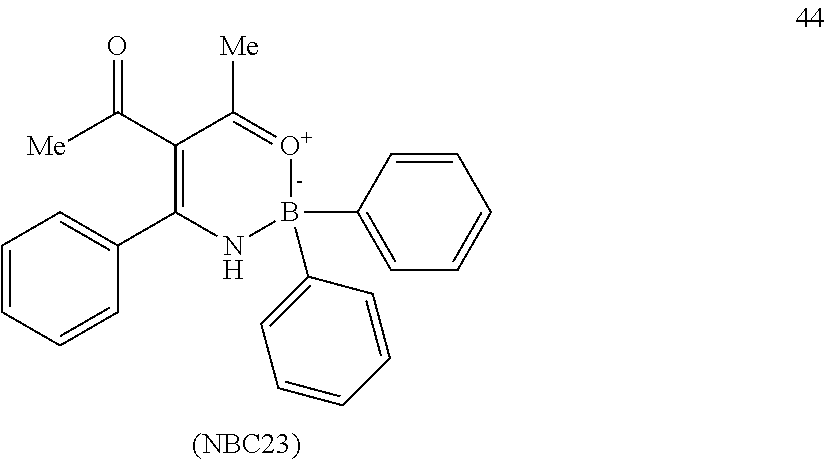


General Procedure for Acetoacetamide-Based Oxazaborinine Derivative


General Procedure for di(aryl)oxazaborinine Synthesis


General Procedure for aryl(phenyl)oxazaborinine Synthesis


- 1 Rock, K. L., Latz, E., Ontiveros, F. & Kono, H. The sterile inflammatory response. Annual review of immunology 28, 321-342, doi:10.1146/annurev-immunol-030409-101311 (2010).
- 2 Dinarello, C. A., Simon, A. & van der Meer, J. W. Treating inflammation by blocking interleukin-1 in a broad spectrum of diseases. Nature reviews. Drug discovery 11, 633-652, doi:10.1038/nrd3800 (2012).
- 3 Chen, G. Y. & Nunez, G. Sterile inflammation: sensing and reacting to damage. Nature reviews. Immunology 10, 826-837, doi:10.1038/nri2873 (2010).
- 4 Takeuchi, O. & Akira, S. Pattern recognition receptors and inflammation. Cell 140, 805-820, doi:10.1016/j.cell.2010.01.022 (2010).
- 5 Latz, E., Xiao, T. S. & Stutz, A. Activation and regulation of the inflammasomes. Nature reviews.
Immunology 13, 397-411, doi:10.1038/nri3452 (2013). - 6 Gross, O. et al. Inflammasome activators induce interleukin-1 alpha secretion via distinct pathways with differential requirement for the protease function of caspase-1.
Immunity 36, 388-400, doi:10.1016/j.immuni.2012.01.018 (2012). - 7 Denes, A., Lopez-Castejon, G. & Brough, D. Caspase-1: is IL-1 just the tip of the ICEberg? Cell death & disease 3, e338, doi:10.1038/cddis.2012.86 (2012).
- 8 Mariathasan, S. et al. Cryopyrin activates the inflammasome in response to toxins and ATP. Nature 440, 228-232, doi:10.1038/nature04515 (2006).
- 9 Luheshi, N. M., Giles, J. A., Lopez-Castejon, G. & Brough, D. Sphingosine regulates the NLRP3-inflammasome and IL-1 beta release from macrophages. European journal of immunology 42, 716-725, doi:10.1002/eji.201142079 (2012).
- 10 Martinon, F., Petrilli, V., Mayor, A., Tardivel, A. & Tschopp, J. Gout-associated uric acid crystals activate the NALP3 inflammasome. Nature 440, 237-241, doi:10.1038/nature04516 (2006).
- 11 Duewell, P. et al. NLRP3 inflammasomes are required for atherogenesis and activated by cholesterol crystals. Nature 464, 1357-1361, doi:10.1038/nature08938 (2010).
- 12 Halle, A. et al. The NALP3 inflammasome is involved in the innate immune response to amyloid-beta. Nature immunology 9, 857-865, doi:10.1038/ni.1636 (2008).
- 13 Munoz-Planillo, R. et al. K(+) efflux is the common trigger of NLRP3 inflammasome activation by bacterial toxins and particulate matter.
Immunity 38, 1142-1153, doi:10.1016/j.immuni.2013.05.016 (2013). - 14 Hornung, V. & Latz, E. Critical functions of priming and lysosomal damage for NLRP3 activation. European journal of
immunology 40, 620-623, doi:10.1002/eji.200940185 (2010). - 15 Shimada, K. et al. Oxidized mitochondrial DNA activates the NLRP3 inflammasome during apoptosis.
Immunity 36, 401-414, doi:10.1016/j.immuni.2012.01.009 (2012). - 16 Lopez-Castejon, G. et al. Deubiquitinases regulate the activity of caspase-1 and interleukin-1 beta secretion via assembly of the inflammasome. The Journal of biological chemistry 288, 2721-2733, doi:10.1074/jbc.M112.422238 (2013).
- 17 Juliana, C. et al. Non-transcriptional priming and deubiquitination regulate NLRP3 inflammasome activation. The Journal of biological chemistry 287, 36617-36622, doi:10.1074/jbc.M112.407130 (2012).
- 18 Py, B. F., Kim, M. S., Vakifahmetoglu-Norberg, H. & Yuan, J. Deubiquitination of NLRP3 by BRCC3 critically regulates inflammasome activity. Molecular cell 49, 331-338, doi:10.1016/j.molcel.2012.11.009 (2013).
- 19 Dinarello, C. A. & van der Meer, J. W. Treating inflammation by blocking interleukin-1 in humans. Seminars in immunology 25, 469-484, doi:10.1016/j.smim.2013.10.008 (2013).
- Lopez-Castejon, G. & Pelegrin, P. Current status of inflammasome blockers as anti-inflammatory drugs. Expert opinion on investigational drugs 21, 995-1007, doi:10.1517/13543784.2012.690032 (2012).
- 21 Veronese, A. C., Talmelli, C. & Gandolfi, V., Metal-catalyzed Reactions of β-Dicarbonyls with Trichloroacetonitrile: Synthesis of β-Trichloromethylenaminodiones. J. Mol. Catal. 1986; 34: 195-198.
- 22 Hosoya, T., Uekusa, H., Ohashi, Y., Ohhara, T & Kuroki, R. A New Photoisomerization Process of the 4-Cyanobutyl Group in a Cobaloxime Complex Crystal Observed by Neutron Diffration. Bull. Chem. Soc. Jpn. 2006; 79(5): 692-701.
- 23 Vasil'ev, L. S., Azarevich, O. G., Bogdanov, V. S., Ugrak, B. I. & Dorokhov, V. A. Chelate synthesis of functionally substituted 2-trichloromethylpyridines. Russ. Chem. Bull. 1994; 43(7): 1342-1343.
- 24 Coenen, M., Faust, J., Ringel, C. & Mayer, R. Synthesen mit Trichloracetonitril. J. Prakt. Chem. 1965; 27(5-6): 239-250.
- 25 Vasil'ev, L. S., Azarevich, O. G., Bogdanov, V. S., Bochkareva, M. N. & Dorokhov, V. A. Boron chelates with 5,5,5-trifluoro- and 5,5,5-trichloro-4-aminopent-3-en-2-ones. Bull. Russ. Acad. Sci. Ch +. 1992; 41(11): 2104-2107.
- 26 Álvarez-Pérez, M. & Marco-Contelles, J. Modification of conditions for the selective p reparation of 2-amino-3-cyano-4-phenylpyridines. ARKIVOC. 2011; ii: 283-296.
- 27 Ibrahim, N. S., Abdelrazek, F. M., Aziz, S. I. & Elnagdi, M. H. Nitriles in Organic Synthesis: The Reaction of Trichloroacetonitrile with Active Methylene Reagents. Monatsh Chem. 1985; 116: 551-556.
Claims (25)

-L1-X1—Rb


Applications Claiming Priority (3)
| Application Number | Priority Date | Filing Date | Title |
|---|---|---|---|
| GBGB1513481.0A GB201513481D0 (en) | 2015-07-30 | 2015-07-30 | Inhibitor compounds |
| GB1513481.0 | 2015-07-30 | ||
| PCT/GB2016/052332 WO2017017469A1 (en) | 2015-07-30 | 2016-07-28 | Cyclic diarylboron derivatives as nlrp3 inflammasome inhibitors |
Publications (2)
| Publication Number | Publication Date |
|---|---|
| US20180215772A1 US20180215772A1 (en) | 2018-08-02 |
| US10570157B2 true US10570157B2 (en) | 2020-02-25 |
Family
ID=54062933
Family Applications (1)
| Application Number | Title | Priority Date | Filing Date |
|---|---|---|---|
| US15/748,557 Expired - Fee Related US10570157B2 (en) | 2015-07-30 | 2016-07-28 | Cyclic diarylboron derivatives as NLRP3 inflammasome inhibitors |
Country Status (4)
| Country | Link |
|---|---|
| US (1) | US10570157B2 (en) |
| EP (1) | EP3328868A1 (en) |
| GB (1) | GB201513481D0 (en) |
| WO (1) | WO2017017469A1 (en) |
Cited By (2)
| Publication number | Priority date | Publication date | Assignee | Title |
|---|---|---|---|---|
| US11613548B2 (en) | 2021-02-19 | 2023-03-28 | Sudo Biosciences Limited | Substituted pyridines, pyridazines, pyrimidines, and 1,2,4-triazines as TYK2 inhibitors |
| US12084458B2 (en) | 2021-02-19 | 2024-09-10 | Sudo Biosciences Limited | Substituted pyridines, pyridazines, and pyrimidines as TYK2 inhibitors |
Families Citing this family (11)
| Publication number | Priority date | Publication date | Assignee | Title |
|---|---|---|---|---|
| WO2018225018A1 (en) | 2017-06-09 | 2018-12-13 | Cadila Healthcare Limited | Novel substituted sulfoximine compounds |
| WO2019043610A1 (en) | 2017-08-31 | 2019-03-07 | Cadila Healthcare Limited | Novel substituted sulfonylurea derivatives |
| CN111801320A (en) | 2018-01-10 | 2020-10-20 | 里科瑞尔姆Ip控股有限责任公司 | benzamide compound |
| HUE069970T2 (en) | 2019-01-14 | 2025-04-28 | Zydus Lifesciences Ltd | Novel substituted sulfonylurea derivatives |
| WO2020212484A1 (en) | 2019-04-17 | 2020-10-22 | INSERM (Institut National de la Santé et de la Recherche Médicale) | Methods and compositions for treatment of nlrp3 inflammasome mediated il-1beta dependent disorders |
| WO2021198511A1 (en) | 2020-04-03 | 2021-10-07 | INSERM (Institut National de la Santé et de la Recherche Médicale) | Methods and compositions for treatment of sars-cov-2 infection |
| WO2022008597A1 (en) | 2020-07-08 | 2022-01-13 | INSERM (Institut National de la Santé et de la Recherche Médicale) | Methods and pharmaceutical composition for the treatment of infectious diseases |
| WO2022084300A1 (en) | 2020-10-20 | 2022-04-28 | INSERM (Institut National de la Santé et de la Recherche Médicale) | Methods for diagnosis and monitoring form of coronavirus infection |
| CN116178486A (en) * | 2022-09-01 | 2023-05-30 | 西南大学 | Asymmetric hydrogenation synthesis method and application of unnatural polypeptide |
| WO2024261302A1 (en) | 2023-06-22 | 2024-12-26 | Institut National de la Santé et de la Recherche Médicale | Nlrp3 inhibitors, pak1/2 inhibitors and/or caspase 1 inhibitors for use in the treatment of rac2 monogenic disorders |
| WO2025153532A1 (en) | 2024-01-16 | 2025-07-24 | NodThera Limited | Nlrp3 inhibitors and glp-1 agonists combination therapies |
Citations (2)
| Publication number | Priority date | Publication date | Assignee | Title |
|---|---|---|---|---|
| WO2003059916A2 (en) | 2002-01-10 | 2003-07-24 | The Pennsylvania State Research Foundation | Methods for the preparation of alkyl diaryl borinates and complexed diarylborinic acids |
| WO2006048679A2 (en) | 2004-11-05 | 2006-05-11 | Oled-T Limited | Electroluminescent complexes |
-
2015
- 2015-07-30 GB GBGB1513481.0A patent/GB201513481D0/en not_active Ceased
-
2016
- 2016-07-28 US US15/748,557 patent/US10570157B2/en not_active Expired - Fee Related
- 2016-07-28 EP EP16747586.2A patent/EP3328868A1/en not_active Withdrawn
- 2016-07-28 WO PCT/GB2016/052332 patent/WO2017017469A1/en not_active Ceased
Patent Citations (2)
| Publication number | Priority date | Publication date | Assignee | Title |
|---|---|---|---|---|
| WO2003059916A2 (en) | 2002-01-10 | 2003-07-24 | The Pennsylvania State Research Foundation | Methods for the preparation of alkyl diaryl borinates and complexed diarylborinic acids |
| WO2006048679A2 (en) | 2004-11-05 | 2006-05-11 | Oled-T Limited | Electroluminescent complexes |
Non-Patent Citations (18)
Cited By (4)
| Publication number | Priority date | Publication date | Assignee | Title |
|---|---|---|---|---|
| US11613548B2 (en) | 2021-02-19 | 2023-03-28 | Sudo Biosciences Limited | Substituted pyridines, pyridazines, pyrimidines, and 1,2,4-triazines as TYK2 inhibitors |
| US12084458B2 (en) | 2021-02-19 | 2024-09-10 | Sudo Biosciences Limited | Substituted pyridines, pyridazines, and pyrimidines as TYK2 inhibitors |
| US12103937B2 (en) | 2021-02-19 | 2024-10-01 | Sudo Biosciences Limited | Substituted pyridines and pyridazines as TYK2 inhibitors |
| US12122785B2 (en) | 2021-02-19 | 2024-10-22 | Sudo Biosciences Limited | Substituted pyridines, pyridazines, pyrimidines, and 1,2,4-triazines as TYK2 inhibitors |
Also Published As
| Publication number | Publication date |
|---|---|
| US20180215772A1 (en) | 2018-08-02 |
| EP3328868A1 (en) | 2018-06-06 |
| GB201513481D0 (en) | 2015-09-16 |
| WO2017017469A1 (en) | 2017-02-02 |
Similar Documents
| Publication | Publication Date | Title |
|---|---|---|
| US10570157B2 (en) | Cyclic diarylboron derivatives as NLRP3 inflammasome inhibitors | |
| CA2914525C (en) | Sulfoximine substituted quinazolines for pharmaceutical compositions | |
| US9688654B2 (en) | Compounds inhibiting leucine-rich repeat kinase enzyme activity | |
| US10647678B2 (en) | Quinoline derivatives as inhibitors of heat shock factor 1 pathway activity | |
| JP2016523923A (en) | Tricyclic pyrido-carboxamide derivatives as ROCK inhibitors | |
| JPWO2004043936A1 (en) | PLK inhibitor | |
| JP6804540B2 (en) | Sulfamide derivatives and their manufacturing methods and applications | |
| CN106699785A (en) | 2-(N-oxide pyridine-2-ylamino)-pyrido[2,3-d]pyrimidin-7-one compound as CDK4/6 inhibitor | |
| CN111094265A (en) | Pyrazole derivative compound and use thereof | |
| US20230278958A1 (en) | Tricyclic heterocycles | |
| CN108463222B (en) | Heterocyclic Compounds for the Treatment of Diseases | |
| HK1246779A1 (en) | Chromene derivatives as phoshoinositide 3-kinases inhibitors | |
| JP7812861B2 (en) | Tricyclic pyrimidines as cyclin-dependent kinase 7 (cdk7) inhibitors | |
| AU2017382217B2 (en) | Diaryl purine derivatives with improved bioavailability | |
| US11744824B2 (en) | 2-amino-3-carbonyl imidazopyridine and pyrazolopyridine compounds | |
| CA2929742A1 (en) | Sulfoximine substituted quinazolines for pharmaceutical compositions | |
| US20140378451A1 (en) | Cannabinoid-2-Receptor Agonists | |
| US20190000853A1 (en) | Antiviral 4-(2-amino-6-heterocylyl-9h-purin-9-yl)-2-cyclopentene-1 -methanol compounds | |
| US20240300968A1 (en) | 6-substituted naphthalene-1,3-disulfonic acid derivatives as modulators of the extracellular nicotinamide phosphoribosyl transferase (enampt) for the treatment of e.g. diabetes | |
| US20240299400A1 (en) | Transcription Factor GLI1 Inhibitors and Uses Thereof | |
| WO2015128674A1 (en) | Quinoline compounds | |
| US20250163070A1 (en) | Spiro compound and application thereof | |
| CN121405694A (en) | OGA inhibitors and their applications | |
| HK40033047B (en) | Imidazopyridine derivatives and the use thereof as medicament | |
| HK40033047A (en) | Imidazopyridine derivatives and the use thereof as medicament |
Legal Events
| Date | Code | Title | Description |
|---|---|---|---|
| FEPP | Fee payment procedure |
Free format text: ENTITY STATUS SET TO UNDISCOUNTED (ORIGINAL EVENT CODE: BIG.); ENTITY STATUS OF PATENT OWNER: LARGE ENTITY |
|
| AS | Assignment |
Owner name: THE UNIVERSITY OF MANCHESTER, UNITED KINGDOM Free format text: ASSIGNMENT OF ASSIGNORS INTEREST;ASSIGNORS:BROUGH, DAVID;ALLAN, STUART MCRAE;FREEMAN, SALLY;AND OTHERS;REEL/FRAME:044989/0943 Effective date: 20180205 |
|
| STPP | Information on status: patent application and granting procedure in general |
Free format text: RESPONSE TO NON-FINAL OFFICE ACTION ENTERED AND FORWARDED TO EXAMINER |
|
| STPP | Information on status: patent application and granting procedure in general |
Free format text: NON FINAL ACTION MAILED |
|
| STPP | Information on status: patent application and granting procedure in general |
Free format text: NOTICE OF ALLOWANCE MAILED -- APPLICATION RECEIVED IN OFFICE OF PUBLICATIONS |
|
| STPP | Information on status: patent application and granting procedure in general |
Free format text: AWAITING TC RESP., ISSUE FEE NOT PAID |
|
| STPP | Information on status: patent application and granting procedure in general |
Free format text: NOTICE OF ALLOWANCE MAILED -- APPLICATION RECEIVED IN OFFICE OF PUBLICATIONS |
|
| STPP | Information on status: patent application and granting procedure in general |
Free format text: PUBLICATIONS -- ISSUE FEE PAYMENT VERIFIED |
|
| STCF | Information on status: patent grant |
Free format text: PATENTED CASE |
|
| CC | Certificate of correction | ||
| FEPP | Fee payment procedure |
Free format text: MAINTENANCE FEE REMINDER MAILED (ORIGINAL EVENT CODE: REM.); ENTITY STATUS OF PATENT OWNER: LARGE ENTITY |
|
| LAPS | Lapse for failure to pay maintenance fees |
Free format text: PATENT EXPIRED FOR FAILURE TO PAY MAINTENANCE FEES (ORIGINAL EVENT CODE: EXP.); ENTITY STATUS OF PATENT OWNER: LARGE ENTITY |
|
| STCH | Information on status: patent discontinuation |
Free format text: PATENT EXPIRED DUE TO NONPAYMENT OF MAINTENANCE FEES UNDER 37 CFR 1.362 |
|
| FP | Lapsed due to failure to pay maintenance fee |
Effective date: 20240225 |