US10568160B2 - Aggregation mechanism for moving vehicles - Google Patents

Aggregation mechanism for moving vehicles Download PDF

Info

Publication number
US10568160B2
US10568160B2 US16/015,296 US201816015296A US10568160B2 US 10568160 B2 US10568160 B2 US 10568160B2 US 201816015296 A US201816015296 A US 201816015296A US 10568160 B2 US10568160 B2 US 10568160B2
Authority
US
United States
Prior art keywords
client device
wireless client
mobile wireless
access point
transmission
Prior art date
Legal status (The legal status is an assumption and is not a legal conclusion. Google has not performed a legal analysis and makes no representation as to the accuracy of the status listed.)
Active
Application number
US16/015,296
Other versions
US20180302939A1 (en
Inventor
Evgeny Yankevich
Paul Stager
Matt Silverman
Current Assignee (The listed assignees may be inaccurate. Google has not performed a legal analysis and makes no representation or warranty as to the accuracy of the list.)
Cisco Technology Inc
Original Assignee
Cisco Technology Inc
Priority date (The priority date is an assumption and is not a legal conclusion. Google has not performed a legal analysis and makes no representation as to the accuracy of the date listed.)
Filing date
Publication date
Application filed by Cisco Technology Inc filed Critical Cisco Technology Inc
Priority to US16/015,296 priority Critical patent/US10568160B2/en
Publication of US20180302939A1 publication Critical patent/US20180302939A1/en
Application granted granted Critical
Publication of US10568160B2 publication Critical patent/US10568160B2/en
Active legal-status Critical Current
Anticipated expiration legal-status Critical

Links

Images

Classifications

    • HELECTRICITY
    • H04ELECTRIC COMMUNICATION TECHNIQUE
    • H04WWIRELESS COMMUNICATION NETWORKS
    • H04W76/00Connection management
    • H04W76/10Connection setup
    • H04W76/15Setup of multiple wireless link connections
    • HELECTRICITY
    • H04ELECTRIC COMMUNICATION TECHNIQUE
    • H04LTRANSMISSION OF DIGITAL INFORMATION, e.g. TELEGRAPHIC COMMUNICATION
    • H04L1/00Arrangements for detecting or preventing errors in the information received
    • H04L1/0001Systems modifying transmission characteristics according to link quality, e.g. power backoff
    • H04L1/0006Systems modifying transmission characteristics according to link quality, e.g. power backoff by adapting the transmission format
    • H04L1/0007Systems modifying transmission characteristics according to link quality, e.g. power backoff by adapting the transmission format by modifying the frame length
    • HELECTRICITY
    • H04ELECTRIC COMMUNICATION TECHNIQUE
    • H04LTRANSMISSION OF DIGITAL INFORMATION, e.g. TELEGRAPHIC COMMUNICATION
    • H04L25/00Baseband systems
    • H04L25/02Details ; arrangements for supplying electrical power along data transmission lines
    • H04L25/0202Channel estimation
    • H04L25/0222Estimation of channel variability, e.g. coherence bandwidth, coherence time, fading frequency
    • HELECTRICITY
    • H04ELECTRIC COMMUNICATION TECHNIQUE
    • H04LTRANSMISSION OF DIGITAL INFORMATION, e.g. TELEGRAPHIC COMMUNICATION
    • H04L27/00Modulated-carrier systems
    • H04L27/26Systems using multi-frequency codes
    • H04L27/2601Multicarrier modulation systems
    • H04L27/2602Signal structure
    • HELECTRICITY
    • H04ELECTRIC COMMUNICATION TECHNIQUE
    • H04LTRANSMISSION OF DIGITAL INFORMATION, e.g. TELEGRAPHIC COMMUNICATION
    • H04L27/00Modulated-carrier systems
    • H04L27/26Systems using multi-frequency codes
    • H04L27/2601Multicarrier modulation systems
    • H04L27/2626Arrangements specific to the transmitter only
    • H04L27/2646Arrangements specific to the transmitter only using feedback from receiver for adjusting OFDM transmission parameters, e.g. transmission timing or guard interval length
    • HELECTRICITY
    • H04ELECTRIC COMMUNICATION TECHNIQUE
    • H04WWIRELESS COMMUNICATION NETWORKS
    • H04W28/00Network traffic management; Network resource management
    • H04W28/02Traffic management, e.g. flow control or congestion control
    • H04W28/06Optimizing the usage of the radio link, e.g. header compression, information sizing, discarding information
    • HELECTRICITY
    • H04ELECTRIC COMMUNICATION TECHNIQUE
    • H04WWIRELESS COMMUNICATION NETWORKS
    • H04W4/00Services specially adapted for wireless communication networks; Facilities therefor
    • H04W4/02Services making use of location information
    • H04W4/023Services making use of location information using mutual or relative location information between multiple location based services [LBS] targets or of distance thresholds
    • HELECTRICITY
    • H04ELECTRIC COMMUNICATION TECHNIQUE
    • H04WWIRELESS COMMUNICATION NETWORKS
    • H04W4/00Services specially adapted for wireless communication networks; Facilities therefor
    • H04W4/02Services making use of location information
    • H04W4/025Services making use of location information using location based information parameters
    • H04W4/027Services making use of location information using location based information parameters using movement velocity, acceleration information

Definitions

  • the present disclosure generally relates to methods and apparatus to estimate a channel coherence time and a maximum aggregation frame size in wireless communication systems.
  • Channel coherence time describes the time duration during which characteristics of a wireless channel do not vary. Knowledge of the channel coherence time or the detection of a sudden change in the channel state may be used to improve the efficiency of several functions in a wireless system. Indeed, the length of the aggregated packets is usually less than the channel coherence time to ensure that data are successfully exchanged (transmitted and/or received) between wireless client devices and access points.
  • Mobility of the wireless client devices is another factor which reduces the channel coherence time. Therefore, when a wireless client device is mobile relative to the access points, a minimal packet aggregation length suitable for all velocities, or no aggregation at all, is used to ensure proper/successful data exchanges.
  • FIG. 1 is a simplified block diagram illustration of a wireless client device and an access point of a wireless communication network, constructed and operative in accordance with an embodiment of the present invention
  • FIG. 2 is a simplified block diagram illustration of an access point controller, constructed and operative in accordance with an embodiment of the present invention.
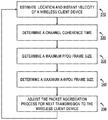
  • FIG. 3 is a simplified flow chart diagram of a method for determining a maximum aggregate frame size in accordance with embodiments of the present invention.
  • a method implemented on an access point of a wireless communication system includes: determining an estimate for a relative velocity between a mobile wireless client device and the said access point, the mobile wireless client device communicating wirelessly with the access point over a channel; determining a channel coherence time for the channel using the estimated relative velocity; and determining a maximum aggregated frame size based on the determined channel coherence time.
  • the wireless communication network 100 comprises a moving vehicle 110 such as, but not limited to, a train moving along a track 120 .
  • Wireless local area network access points APs
  • APs Wireless local area network access points
  • FIG. 1 shows a wireless communication system or network constructed and operative in accordance with an embodiment of the present invention.
  • the wireless communication network 100 comprises a moving vehicle 110 such as, but not limited to, a train moving along a track 120 .
  • Wireless local area network access points (APs) are deployed along the path of the track 120 to provide network connectivity to end users located in the moving vehicle 110 .
  • AP 130 is shown in FIG. 1 although those skilled in the art will appreciate that a plurality of APs 130 are typically provided at regular intervals along the path of the track 120 .
  • the AP 130 is connected to a wired local area network (WLAN) and is operable to communicate wirelessly over channels with one or more wireless client devices 111 located in the moving vehicle 110 .
  • WLAN wired local area network
  • the wireless client device 111 may be any type of electronic device having wireless connectivity such as, but not limited to, a laptop computer, a tablet computer, a smartphone, a mobile computing device or any other handheld device.
  • the wireless client device 111 may be a workgroup bridge (WGB) device which operates as a mobile wireless client device with respect to the trackside AP 130 . In such a situation, the WGB device is connected to a switch to serve client devices inside the moving vehicle 110 which do not have wireless network connectivity.
  • WGB workgroup bridge
  • the AP 130 and the one or more wireless client devices 111 comprises one or more antennas for communicating over channels using a wireless communication protocol, such as an IEEE 802.11 wireless communication protocol.
  • IEEE 802.11 technology is evolving from 802.11a/b/g to 802.11n/ac in order to meet the high-throughput demand of different wireless client devices.
  • IEEE 802.11n introduced two frame aggregation schemes. One of these schemes, known as A-MPDU (aggregate Medium Access Control Protocol Data Unit), amortizes the physical (PHY) protocol overhead over multiple frames by packing several MPDUs into a single A-MPDU.
  • IEEE 802.11ac uses the same frame aggregation scheme but extends the maximum frame size.
  • the maximum frame size of a PPDU Physical layer conversion Protocol Data Unit typically comprising a PHY header, a preamble and an A-MPDU
  • the maximum frame size of a PPDU is further dependent on the channel coherence time for the IEEE 802.11n and ac wireless networking standards.
  • the channel coherence time may be defined as the time interval during which the wireless channel parameters do not vary, or vary by an insignificant amount.
  • the parameters of the channel are defined by the Doppler frequency spread which is a function of the relative velocity between the wireless client device 111 and the AP 130 .
  • FIG. 1 shows a moving vehicle 110 moving in the direction of arrow 112 associated with the wireless client device 111 .
  • the Doppler frequency shift (F D ) of the transmission due to the movement of the wireless client device 111 relative to the AP 130 may be approximated by the following equation:
  • the duration of the PPDU is typically less than the channel coherence time. Therefore, the channel coherence time (and consequently the maximum frame size of the PPDU) is dependent on the position and velocity of the wireless client device 111 relative to the AP 130 .
  • the AP 130 comprises a controller 140 which is configured to provide estimates of the maximum frame size of the PPDU as well as the maximum frame size of the A-MPDU. The AP 130 is then operable to use these estimates to dynamically aggregate packets that are to be transmitted to the wireless client device 111 over the channel.
  • FIG. 2 is a simplified block diagram illustration of a controller constructed and operative in accordance with an embodiment of the present invention.
  • the controller 140 typically comprises an input/output (I/O) communication interface 141 , a processor 142 , a mobility estimator 143 and a memory 144 .
  • I/O input/output
  • the I/O communication interface 141 may be any suitable communication interface providing a two-way coupling enabling the AP 130 and the controller 140 to exchange data.
  • the I/O communication interface 141 is further operable to pass data received from the AP 130 to the processor 142 , the mobility estimator 143 or to the memory 144 for later use.
  • the processor 142 is a microcontroller or a microprocessor, for example, configured to execute software instructions stored in memory 144 .
  • the mobility estimator component 143 may include a filter, such as for example, but not limited to, a Kalman filter which is configured to provide estimates of different parameters relevant to the wireless client device 111 based at least on a received signal strength indication (RSSI).
  • a filter such as for example, but not limited to, a Kalman filter which is configured to provide estimates of different parameters relevant to the wireless client device 111 based at least on a received signal strength indication (RSSI).
  • RSSI received signal strength indication
  • Non-limiting examples of these parameters include, but are not limited to: instant velocity of the wireless client device 111 ; distance between the wireless client device 111 and the AP 130 ; angle between the vector of movement (i.e. arrow 112 ) associated with the wireless client device 111 and the AP 130 ; and coordinates of the wireless client device 111 in the coordinate system of the AP 130 .
  • These estimates may then be passed to the processor 142 for immediate processing and/or stored in memory 144 to be processed at a later time.
  • the memory 144 may comprise read only memory (ROM), random access memory (RAM), magnetic disk storage media devices, optical storage media devices, flash memory devices, electrical, optical, or other physical/tangible (e.g. non-transitory) memory storage devices.
  • ROM read only memory
  • RAM random access memory
  • magnetic disk storage media devices such as magnetic disks
  • optical storage media devices such as magnetic tapes
  • flash memory devices such as electrical, optical, or other physical/tangible (e.g. non-transitory) memory storage devices.
  • memory 144 may comprise one or more computer readable storage media (e.g. memory device) encoded with software comprising computer executable instructions and when the software is executed (by the processor 142 ) it is operable to perform the operations described hereinbelow.
  • memory 144 stores or is encoded with instructions for:
  • the memory 144 is further operable to store information/data including, but not limited to, AP neighbor lists and neighbor tables, aggregation length tables, regulatory domain channel definitions, Dynamic Frequency Selection (DFS) channel definitions, MAC addresses, Internet Protocol (IP) addresses, Modulation and Coding Schemes (MCS) index values, etc.
  • information/data including, but not limited to, AP neighbor lists and neighbor tables, aggregation length tables, regulatory domain channel definitions, Dynamic Frequency Selection (DFS) channel definitions, MAC addresses, Internet Protocol (IP) addresses, Modulation and Coding Schemes (MCS) index values, etc.
  • FIG. 3 is a flow chart diagram of a method for estimating an A-MPDU frame size operative in accordance with an embodiment of the present invention.
  • the process starts at step 310 where the mobility estimator 143 provides estimates of different parameters relevant to the wireless client device 111 based at least on a received signal strength indication (RSSI).
  • RSSI received signal strength indication
  • the mobility estimator 143 receives a RSSI relevant to the transmission received from the wireless client device 111 as input.
  • the mobility estimator 143 which may include a filter such as, but not limited to, a Kalman filter, returns estimates of at least one or more of the following parameters: the instant velocity of the wireless client device 111 ; the distance between the wireless client device 111 and the AP 130 ; the angle between the vector of movement (i.e.
  • the mobility estimator 143 is further configured to determine the relative velocity between the wireless client device 111 and the AP 130 .
  • the processor 142 is configured to execute a relevant set of instructions stored in memory 144 , which when executed return the relative velocity using the estimates provided by the mobility estimator 143 . This is achieved using the following mathematical equations:
  • x C denotes the estimated x-coordinate of the wireless client device 111 within the coordinate system of the AP 130 ; and D is the estimated distance between the wireless client device 111 and the AP 130 ;
  • V c V ⁇ cos ⁇ ⁇ ⁇ ⁇ V ⁇ x c D
  • V C is the relative velocity
  • V is the estimated instant velocity of the wireless client device 111 .
  • the determined relative velocity is used to determine a channel coherence time.
  • the channel coherence time T c is inversely proportional to the maximum Doppler frequency spread. Therefore, the channel coherence time T c may be obtained using the relative velocity V c determined in step 310 .
  • Table 1 gives some examples of determined channel coherence times for different determined relative velocities:
  • the maximum frame size of the PPDU in Orthogonal Frequency Division Multiplexing (OFDM) symbols may be determined. Determining the number of OFDM symbols per coherence time may be easily performed since the duration of each OFDM symbol is 4 microseconds. The results of this determination for each determined coherence channel time is illustrated in the last column of Table 1. Those skilled in the art will appreciate that step 330 may be performed in addition or alternatively to step 320 .
  • OFDM Orthogonal Frequency Division Multiplexing
  • step 340 the maximum A-MPDU frame size is determined for the channel coherence time T c determined in step 320 and/or for the maximum PPDU frame size determined in step 330 .
  • This determination is typically dependent on the MCS, the signal bandwidth (BW) and the number of spatial streams (NSS) used by the wireless client device 111 to communicate with the AP 130 .
  • the MCS typically defines the PPDU preamble length (Pr len ) and a constellation of other parameters including, but not limited to, the number of uncoded bits per OFDM symbols (N DBPS ).
  • the preamble length further depends on the number of spatial streams that will be used for the next signal transmission.
  • Table 2 and Table 3 shows these different parameters for each MCS for the 802.11n and 802.11ac wireless communication protocols:
  • step 350 the controller 140 is configured to adjust the packet aggregation process for the next transmission according to the maximum A-MPDU frame size determined in step 340 .
  • the process goes back to step 310 thereby enabling a dynamic control and adjustment of the maximum A-MDPU frame size during communication between the wireless client device 111 and the AP 130 .
  • step 310 remains unchanged and provides as output the determined relative velocity between the wireless client device 111 and the AP 130 . Then, the determined relative velocity may be used as an initial entry index to retrieve the channel coherence time T c (step 320 ) and/or the maximum PPDU frame size (step 330 ) by table look-up.
  • the maximum A-MPDU frame size may be computed for a particular MCS, signal bandwidth and number of spatial streams used by the mobile wireless client device 111 to communicate wirelessly with the AP 130 .
  • step 350 remains unchanged and the controller 140 is configured to adjust the packet aggregation process for the next transmission according to the maximum A-MPDU frame size retrieved in step 340 . Once done, the process goes back to step 310 thereby enabling a dynamic control and adjustment of the maximum A-MDPU frame size during communication between the wireless client device 111 and the AP 130 .
  • the moving vehicle 110 may comprise a plurality of wireless client device 111 . Therefore, the determination of the maximum A-MPDU frame size may be performed globally (i.e. for a WGB 111 serving a plurality of client devices 111 ) or individually (i.e. on a per wireless client device basis).

Landscapes

  • Engineering & Computer Science (AREA)
  • Computer Networks & Wireless Communication (AREA)
  • Signal Processing (AREA)
  • Quality & Reliability (AREA)
  • Power Engineering (AREA)
  • Mobile Radio Communication Systems (AREA)

Abstract

In one embodiment, a method implemented on an access point of a wireless communication system includes: determining an estimate for a relative velocity between a mobile wireless client device and the access point, the mobile wireless client device communicating wirelessly with the access point over a channel; determining a channel coherence time for the channel using said estimated relative velocity; and determining a maximum aggregated frame size based on the determined channel coherence time.

Description

CROSS-REFERENCE TO RELATED APPLICATIONS
This application is a continuation of U.S. application Ser. No. 14/629,511, filed Feb. 24, 2015, the entirety of which is incorporated herein by reference.
TECHNICAL FIELD
The present disclosure generally relates to methods and apparatus to estimate a channel coherence time and a maximum aggregation frame size in wireless communication systems.
BACKGROUND
Channel coherence time describes the time duration during which characteristics of a wireless channel do not vary. Knowledge of the channel coherence time or the detection of a sudden change in the channel state may be used to improve the efficiency of several functions in a wireless system. Indeed, the length of the aggregated packets is usually less than the channel coherence time to ensure that data are successfully exchanged (transmitted and/or received) between wireless client devices and access points.
Mobility of the wireless client devices is another factor which reduces the channel coherence time. Therefore, when a wireless client device is mobile relative to the access points, a minimal packet aggregation length suitable for all velocities, or no aggregation at all, is used to ensure proper/successful data exchanges.
BRIEF DESCRIPTION OF THE DRAWINGS
The present invention will be understood and appreciated more fully from the following detailed description, taken in conjunction with the drawings in which:
FIG. 1 is a simplified block diagram illustration of a wireless client device and an access point of a wireless communication network, constructed and operative in accordance with an embodiment of the present invention;
FIG. 2 is a simplified block diagram illustration of an access point controller, constructed and operative in accordance with an embodiment of the present invention; and
FIG. 3 is a simplified flow chart diagram of a method for determining a maximum aggregate frame size in accordance with embodiments of the present invention.
DESCRIPTION OF EXAMPLE EMBODIMENTS Overview
In one embodiment, a method implemented on an access point of a wireless communication system includes: determining an estimate for a relative velocity between a mobile wireless client device and the said access point, the mobile wireless client device communicating wirelessly with the access point over a channel; determining a channel coherence time for the channel using the estimated relative velocity; and determining a maximum aggregated frame size based on the determined channel coherence time.
DETAILED DESCRIPTION OF EXAMPLE EMBODIMENTS
Reference is now made to FIG. 1, which shows a wireless communication system or network constructed and operative in accordance with an embodiment of the present invention. The wireless communication network 100 comprises a moving vehicle 110 such as, but not limited to, a train moving along a track 120. Wireless local area network access points (APs) are deployed along the path of the track 120 to provide network connectivity to end users located in the moving vehicle 110. For the sake of simplicity of depiction, only one AP 130 is shown in FIG. 1 although those skilled in the art will appreciate that a plurality of APs 130 are typically provided at regular intervals along the path of the track 120. The AP 130 is connected to a wired local area network (WLAN) and is operable to communicate wirelessly over channels with one or more wireless client devices 111 located in the moving vehicle 110.
The wireless client device 111 may be any type of electronic device having wireless connectivity such as, but not limited to, a laptop computer, a tablet computer, a smartphone, a mobile computing device or any other handheld device. Alternatively and/or additionally, the wireless client device 111 may be a workgroup bridge (WGB) device which operates as a mobile wireless client device with respect to the trackside AP 130. In such a situation, the WGB device is connected to a switch to serve client devices inside the moving vehicle 110 which do not have wireless network connectivity.
The AP 130 and the one or more wireless client devices 111 comprises one or more antennas for communicating over channels using a wireless communication protocol, such as an IEEE 802.11 wireless communication protocol. IEEE 802.11 technology is evolving from 802.11a/b/g to 802.11n/ac in order to meet the high-throughput demand of different wireless client devices. To achieve high throughput between an access point and a wireless client device, IEEE 802.11n introduced two frame aggregation schemes. One of these schemes, known as A-MPDU (aggregate Medium Access Control Protocol Data Unit), amortizes the physical (PHY) protocol overhead over multiple frames by packing several MPDUs into a single A-MPDU. IEEE 802.11ac uses the same frame aggregation scheme but extends the maximum frame size. Also, all the frames transmitted use the A-MPDU scheme. The maximum frame size of a PPDU (Physical layer conversion Protocol Data Unit typically comprising a PHY header, a preamble and an A-MPDU) is further dependent on the channel coherence time for the IEEE 802.11n and ac wireless networking standards.
The channel coherence time may be defined as the time interval during which the wireless channel parameters do not vary, or vary by an insignificant amount. For moving vehicles, such as the moving vehicle 110, the parameters of the channel are defined by the Doppler frequency spread which is a function of the relative velocity between the wireless client device 111 and the AP 130.
FIG. 1 shows a moving vehicle 110 moving in the direction of arrow 112 associated with the wireless client device 111. In such a configuration, the Doppler frequency shift (FD) of the transmission due to the movement of the wireless client device 111 relative to the AP 130 may be approximated by the following equation:
F D = V λ C · cos α = V · F C c · cos α
where:
    • V denotes the instant velocity of the moving vehicle 110;
    • c denotes the propagation speed of light in vacuum;
    • λC denotes the wavelength of the carrier frequency;
    • α denotes the angle between the vector of movement (i.e. arrow 112) and the AP 130; and
    • FC denotes the carrier frequency.
      Hence, the Doppler frequency shift reaches its maximum for α angle values of 0 and 180 degrees. Also, the Doppler frequency shift reaches its minimum for an α angle value of 90 degrees. For a wireless client device 111 moving at a velocity of 200 mph and a carrier frequency of 6 GHz, the approximate maximal Doppler shift value would be 1.78 KHz. In the worst case scenario in which the transmission reflects from another moving vehicle coming in the opposite direction, the maximal Doppler shift value will double to 3.55 KHz. Although there is no specific definition for the channel coherence time (TC), it is known to be inversely proportional to the maximum Doppler frequency spread (FD MAX ):
T C 1 F D MAX
To achieve a proper and successful transmission/reception, the duration of the PPDU is typically less than the channel coherence time. Therefore, the channel coherence time (and consequently the maximum frame size of the PPDU) is dependent on the position and velocity of the wireless client device 111 relative to the AP 130. In order to ensure an optimal quality of service, the AP 130 comprises a controller 140 which is configured to provide estimates of the maximum frame size of the PPDU as well as the maximum frame size of the A-MPDU. The AP 130 is then operable to use these estimates to dynamically aggregate packets that are to be transmitted to the wireless client device 111 over the channel.
Reference is now made to FIG. 2, which is a simplified block diagram illustration of a controller constructed and operative in accordance with an embodiment of the present invention. The controller 140 typically comprises an input/output (I/O) communication interface 141, a processor 142, a mobility estimator 143 and a memory 144.
The I/O communication interface 141 may be any suitable communication interface providing a two-way coupling enabling the AP 130 and the controller 140 to exchange data. The I/O communication interface 141 is further operable to pass data received from the AP 130 to the processor 142, the mobility estimator 143 or to the memory 144 for later use.
The processor 142 is a microcontroller or a microprocessor, for example, configured to execute software instructions stored in memory 144.
The mobility estimator component 143 may include a filter, such as for example, but not limited to, a Kalman filter which is configured to provide estimates of different parameters relevant to the wireless client device 111 based at least on a received signal strength indication (RSSI). Non-limiting examples of these parameters include, but are not limited to: instant velocity of the wireless client device 111; distance between the wireless client device 111 and the AP 130; angle between the vector of movement (i.e. arrow 112) associated with the wireless client device 111 and the AP 130; and coordinates of the wireless client device 111 in the coordinate system of the AP 130. These estimates may then be passed to the processor 142 for immediate processing and/or stored in memory 144 to be processed at a later time.
The memory 144 may comprise read only memory (ROM), random access memory (RAM), magnetic disk storage media devices, optical storage media devices, flash memory devices, electrical, optical, or other physical/tangible (e.g. non-transitory) memory storage devices. Thus, in general, memory 144 may comprise one or more computer readable storage media (e.g. memory device) encoded with software comprising computer executable instructions and when the software is executed (by the processor 142) it is operable to perform the operations described hereinbelow. For example, memory 144 stores or is encoded with instructions for:
    • determining a relative velocity between the wireless client device 111 and the AP 130;
    • determining a channel coherence time;
    • determining a maximum frame size of the PPDU and/or the A-MPDU; and
    • controlling the packet aggregation process.
The memory 144 is further operable to store information/data including, but not limited to, AP neighbor lists and neighbor tables, aggregation length tables, regulatory domain channel definitions, Dynamic Frequency Selection (DFS) channel definitions, MAC addresses, Internet Protocol (IP) addresses, Modulation and Coding Schemes (MCS) index values, etc.
Reference is now made to FIG. 3, which is a flow chart diagram of a method for estimating an A-MPDU frame size operative in accordance with an embodiment of the present invention.
The process starts at step 310 where the mobility estimator 143 provides estimates of different parameters relevant to the wireless client device 111 based at least on a received signal strength indication (RSSI). Typically, the mobility estimator 143 receives a RSSI relevant to the transmission received from the wireless client device 111 as input. In response, the mobility estimator 143 which may include a filter such as, but not limited to, a Kalman filter, returns estimates of at least one or more of the following parameters: the instant velocity of the wireless client device 111; the distance between the wireless client device 111 and the AP 130; the angle between the vector of movement (i.e. arrow 112) associated with the wireless client device 111 and the AP 130; and the coordinates of the wireless client device 111 in the coordinate system of the AP 130. The x and y coordinates of the wireless client device 111 are typically returned by the Kalman filter. Alternatively, the x-coordinate may be returned by the Kalman filter while the y-coordinate, corresponding to the distance between the AP 130 and the path 120 may already be known by or provided to the AP 130. Based on these estimated parameters, the mobility estimator 143 is further configured to determine the relative velocity between the wireless client device 111 and the AP 130. Alternatively, the processor 142 is configured to execute a relevant set of instructions stored in memory 144, which when executed return the relative velocity using the estimates provided by the mobility estimator 143. This is achieved using the following mathematical equations:
cos α x C D
where: xC denotes the estimated x-coordinate of the wireless client device 111 within the coordinate system of the AP 130; and D is the estimated distance between the wireless client device 111 and the AP 130; and
V c = V · cos α V · x c D
where: VC is the relative velocity; and V is the estimated instant velocity of the wireless client device 111.
Then, at step 320, the determined relative velocity is used to determine a channel coherence time. As explained above in relation to FIG. 1, the channel coherence time Tc is inversely proportional to the maximum Doppler frequency spread. Therefore, the channel coherence time Tc may be obtained using the relative velocity Vc determined in step 310. The following table (Table 1) gives some examples of determined channel coherence times for different determined relative velocities:
TABLE 1
Aggregation Length Table
Index Relative Channel coherence
VC/W velocity VC time TC Number of
(km/h) (km/h) (microseconds) OFDM symbols
1 10 18520 4629
2 20 9346 2336
3 30 6252 1562
4 40 4694 1173
5 50 3760 940
6 60 3126 781
7 70 2680 670
8 80 2348 587
9 90 2088 522
10 100 1880 470
11 110 1708 426
12 120 1564 391
13 130 1446 361
14 140 1344 335
15 150 1254 313
16 160 1174 293
17 170 1104 276
18 180 1044 261
19 190 990 247
20 200 940 235
21 210 894 223
22 220 854 213
23 230 816 204
24 240 784 196
25 250 752 188
26 260 724 180
27 270 696 174
28 280 672 168
29 290 648 162
30 300 628 156
31 310 608 151
32 320 588 147
33 330 570 142
At step 330, the maximum frame size of the PPDU in Orthogonal Frequency Division Multiplexing (OFDM) symbols may be determined. Determining the number of OFDM symbols per coherence time may be easily performed since the duration of each OFDM symbol is 4 microseconds. The results of this determination for each determined coherence channel time is illustrated in the last column of Table 1. Those skilled in the art will appreciate that step 330 may be performed in addition or alternatively to step 320.
The process then moves to step 340 in which the maximum A-MPDU frame size is determined for the channel coherence time Tc determined in step 320 and/or for the maximum PPDU frame size determined in step 330. This determination is typically dependent on the MCS, the signal bandwidth (BW) and the number of spatial streams (NSS) used by the wireless client device 111 to communicate with the AP 130. The MCS typically defines the PPDU preamble length (Prlen) and a constellation of other parameters including, but not limited to, the number of uncoded bits per OFDM symbols (NDBPS). The preamble length further depends on the number of spatial streams that will be used for the next signal transmission. The following tables (Table 2 and Table 3), provided for illustration purposes only, shows these different parameters for each MCS for the 802.11n and 802.11ac wireless communication protocols:
TABLE 2
802.11n MCS parameters
Preamble Number of uncoded bits per
length Prlen OFDM symbols NDBPS
MCS (microseconds) 20 MHz 40 MHz
0 36 26 54
1 36 52 108
2 36 78 162
3 36 104 216
4 36 156 324
5 36 208 432
6 36 234 486
7 36 260 540
8 40 52 108
9 40 104 216
10 40 156 324
11 40 208 432
12 40 312 648
13 40 416 864
14 40 468 972
15 40 520 1080
16 44 78 162
17 44 156 324
18 44 234 486
19 44 312 648
20 44 468 972
21 44 624 1296
22 44 702 1458
23 44 780 1620
TABLE 3
802.11ac MCS parameters
Preamble Number of uncoded bits per
length Prlen OFDM symbols NDBPS
MCS (microseconds) 20 Mz 40 MHz 80 MHz
1 SS
0 36 26 54 117
1 36 52 108 234
2 36 78 162 351
3 36 104 216 468
4 36 156 324 702
5 36 208 432 936
6 36 234 486 1053
7 36 260 540 1170
8 36 312 648 1404
9 36 X 720 1560
2 SSs
0 40 52 108 234
1 40 104 216 468
2 40 156 324 702
3 40 208 432 936
4 40 312 648 1404
5 40 416 864 1872
6 40 468 972 2106
7 40 520 1080 2340
8 40 524 1296 2808
9 40 X 1440 3120
3 SSs
0 44 78 162 351
1 44 156 324 702
2 44 234 486 1053
3 44 312 648 1404
4 44 468 972 2106
5 44 624 1296 2808
6 44 702 1458 X
7 44 780 1620 3510
8 44 936 1944 4212
9 44 1040 2160 4680

Determination of the maximum A-MPDU frame size (in octets) is therefore computed for a particular MCS, a signal bandwidth and a specific number of spatial streams using the following mathematical equations:
    • for long guard interval and using the channel coherence time Tc determined in step 320:
L = [ T c - Pr len LGI_T OFDM ] · N DBPS ( BW , N SS ) 8
    • for short guard interval and using the channel coherence time Tc determined in step 320:
L = [ T c - Pr len SGI_T OFDM ] · N DBPS ( BW , N SS ) 8
    • for long guard interval and using the maximum PPDU frame size determined in step 330:
L = [ N OFDM - Pr len , S LGI_T OFDM ] · N DBPS ( BW , N SS ) 8
    • for short guard interval and using the maximum PPDU frame size determined in step 330:
L = [ N OFDM - Pr len , S SGI_T OFDM ] · N DBPS ( BW , N SS ) 8
where:
    • Tc denotes the channel coherence time in microseconds;
    • Prlen denotes the PHY preamble length in microseconds;
    • Prlen,S denotes the PHY preamble length in OFDM symbols;
    • NOFDM denotes the maximum PPDU frame size in OFDM symbols;
    • NDBPS(BW, NSS) denotes the number of uncoded data bit per OFDM symbol. This parameter is a function of the signal bandwidth, the number of spatial streams and further depends on the supported standard (e.g. 802.11n or 802.11 ac);
    • LGI_TOFDM denotes the duration of the OFDM symbol including long guard interval (which is usually equals to 4 microseconds);
    • SGI_TOFDM denotes the duration of the OFDM symbol including short guard interval (which is usually equals to 3.6 microseconds);
    • NSS denotes the number of spatial streams; and
    • BW denotes the signal bandwidth.
Finally, the process moves to step 350 where the controller 140 is configured to adjust the packet aggregation process for the next transmission according to the maximum A-MPDU frame size determined in step 340. Once done, the process goes back to step 310 thereby enabling a dynamic control and adjustment of the maximum A-MDPU frame size during communication between the wireless client device 111 and the AP 130.
Although FIG. 3 is described as a real time sequential process, the calculations for the channel coherence time and/or the maximum PPDU frame size may be performed in advance and stored in memory 144 in any suitable form. These calculations may be performed for a plurality of different relative velocities and signal characteristics. In this example embodiment of the present invention, step 310 remains unchanged and provides as output the determined relative velocity between the wireless client device 111 and the AP 130. Then, the determined relative velocity may be used as an initial entry index to retrieve the channel coherence time Tc (step 320) and/or the maximum PPDU frame size (step 330) by table look-up. Subsequently, the maximum A-MPDU frame size may be computed for a particular MCS, signal bandwidth and number of spatial streams used by the mobile wireless client device 111 to communicate wirelessly with the AP 130. Finally, step 350 remains unchanged and the controller 140 is configured to adjust the packet aggregation process for the next transmission according to the maximum A-MPDU frame size retrieved in step 340. Once done, the process goes back to step 310 thereby enabling a dynamic control and adjustment of the maximum A-MDPU frame size during communication between the wireless client device 111 and the AP 130.
As explained above in relation to FIG. 1, the moving vehicle 110 may comprise a plurality of wireless client device 111. Therefore, the determination of the maximum A-MPDU frame size may be performed globally (i.e. for a WGB 111 serving a plurality of client devices 111) or individually (i.e. on a per wireless client device basis).
Although the above embodiments have been described in the context of the 802.11 communication protocol, those skilled in the art will realize that other implementations are possible.
It is appreciated that various features of the invention which are, for clarity, described in the contexts of separate embodiments may also be provided in combination in a single embodiment. Conversely, various features of the invention which are, for brevity, described in the context of a single embodiment may also be provided separately or in any suitable subcombination.
It will be appreciated by persons skilled in the art that the present invention is not limited by what has been particularly shown and described hereinabove. Rather the scope of the invention is defined by the appended claims and equivalents thereof:
Claims (20)

What is claimed is:
1. A method implemented by an access point of a wireless communication system, the method comprising:
determining an estimated relative velocity between a mobile wireless client device and said access point, said mobile wireless client device communicating wirelessly with said access point over a channel;
determining a channel coherence time for said channel using said estimated relative velocity;
determining a maximum aggregated frame size based on a maximum physical layer conversion protocol data unit in Orthogonal Frequency Division Multiplexed (OFDM) symbols determined according to the channel coherence time, a physical layer preamble length in OFDM symbols, a duration of an OFDM symbol, and a number of uncoded data bits per OFDM symbol; and
dynamically aggregating packets that are to be transmitted to the mobile wireless client device based on the maximum aggregated frame size.
2. The method of claim 1, wherein determining the channel coherence time includes:
determining a Doppler frequency shift associated with a transmission between the mobile wireless client device and the access point based on the estimated relative velocity; and
computing the channel coherence time based on the Doppler frequency shift.
3. The method of claim 1, wherein said determining an estimate for a relative velocity is based at least on a received signal strength indication received from said mobile wireless client device.
4. The method of claim 3, further comprising:
providing estimates of parameters relevant to said mobile wireless client device using said received signal strength indication, said parameters comprising: an instant velocity of said mobile wireless client device; an angle between said mobile wireless client device and said access point; a distance between said mobile wireless client device and said access point; and a position of said mobile wireless client device relative to said access point; and
determining an estimate of a relative velocity between said mobile wireless client device and said access point using said estimates.
5. The method of claim 1, wherein determining the maximum aggregated frame size is based on said channel coherence time for a particular modulation and coding scheme, channel bandwidth and number of spatial streams used by said mobile wireless client device to communicate wirelessly with said access point.
6. The method of claim 5, wherein determining the maximum aggregated frame size comprises determining a maximum aggregate medium access control protocol data unit for a short guard interval using said channel coherence time.
7. The method of claim 5, wherein determining the maximum aggregated frame size comprises determining a maximum aggregate medium access control protocol data unit for a long guard interval using said channel coherence time.
8. The method of claim 5, further comprising:
determining a maximum physical layer conversion protocol data unit frame size using said channel coherence time; and
determining a maximum aggregate medium access control protocol data unit for a short guard interval using said maximum physical layer conversion protocol data unit frame size.
9. The method of claim 1, wherein determining the maximum aggregated frame size includes:
computing a difference between the maximum physical layer conversion protocol data unit in OFDM symbols and the physical layer preamble length in OFDM symbols;
dividing the difference by the duration of the OFDM symbol to produce an intermediate product; and
multiplying the intermediate product by the number of uncoded data bits per OFDM symbol.
10. The method of claim 9, wherein the physical layer preamble length is a function of transmission bandwidth of a transmission sent by the mobile wireless client device, number of spatial streams transmitted by the mobile wireless client device in the transmission and modulation and coding scheme used for the transmission.
11. The method of claim 10, wherein the number of uncoded data bits per OFDM symbol is a function of transmission bandwidth of the transmission sent by the mobile wireless client device, number of spatial streams transmitted by the mobile wireless client device in the transmission and modulation and coding scheme used for the transmission.
12. An access point controller comprising:
a processor, said processor being operable to:
determine an estimate relative velocity between a mobile wireless client device and an access point, said mobile wireless client device communicating wirelessly with said access point over a channel;
determine a channel coherence time for said channel using said estimated relative velocity;
determine a maximum aggregated frame size based on a maximum physical layer conversion protocol data unit in Orthogonal Frequency Division Multiplexed (OFDM) symbols determined according to the channel coherence time, a physical layer preamble length in OFDM symbols, a duration of an OFDM symbol, and a number of uncoded data bits per OFDM symbol; and
dynamically aggregate packets that are to be transmitted to the mobile wireless client device based on the maximum aggregate frame size.
13. The access point controller of claim 12, wherein the processor is configured to determine the channel coherence time by:
determining a Doppler frequency shift associated with a transmission between the mobile wireless client device and the access point based on the estimated relative velocity; and
computing the channel coherence time based on the Doppler frequency shift.
14. The access point controller of claim 12, wherein said processor executes a Kalman filler configured to provide estimates of parameters relevant to said mobile wireless client device using a received signal strength indication, said parameters comprising: an instant velocity of said mobile wireless client device; a distance between said mobile wireless client device and said access point; an angle between said mobile wireless client device and said access point; and a position of said mobile wireless client device relative to said access point.
15. The access point controller of claim 14, wherein the processor is configured determine the maximum aggregate frame size by:
computing a difference between the maximum physical layer conversion protocol data unit in OFDM symbols and the physical layer preamble length in OFDM symbols;
dividing the difference by the duration of the OFDM symbol to produce an intermediate product; and
multiplying the intermediate product by the number of uncoded data bits per OFDM symbol.
16. The access point controller of claim 15, wherein the physical layer preamble length is a function of transmission bandwidth of a transmission sent by the mobile wireless client device, number of spatial streams transmitted by the mobile wireless client device in the transmission and modulation and coding scheme used for the transmission, and wherein the number of uncoded data bits per OFDM symbol is a function of transmission bandwidth of the transmission sent by the mobile wireless client device, number of spatial streams transmitted by the mobile wireless client device in the transmission and modulation and coding scheme used for the transmission.
17. One or more non-transitory computer readable storage media encoded with software comprising computer executable instructions and when the software is executed operable to:
determine an estimated relative velocity between a mobile wireless client device and an access point, said mobile wireless client device communicating wirelessly with said access point over a channel;
determine a channel coherence time for said channel using said estimated relative velocity;
determine a maximum aggregated frame size based on a maximum physical layer conversion protocol data unit in Orthogonal Frequency Division Multiplexed (OFDM) symbols determined according to the channel coherence time, a physical layer preamble length in OFDM symbols, a duration of an OFDM symbol, and a number of uncoded data bits per OFDM symbol; and
dynamically aggregate packets that are to be transmitted to the mobile wireless client device based on the maximum aggregate frame size.
18. The one or more non-transitory computer readable storage media of claim 17, wherein the instructions operable to determine the maximum aggregated frame size include instructions operable to:
compute a difference between the maximum physical layer conversion protocol data unit in OFDM symbols and the physical layer preamble length in OFDM symbols;
divide the difference by the duration of the OFDM symbol to produce an intermediate product; and
multiply the intermediate product by the number of uncoded data bits per OFDM symbol.
19. The one or more non-transitory computer readable storage media of claim 18, wherein the physical layer preamble length is a function of transmission bandwidth of a transmission sent by the mobile wireless client device, number of spatial streams transmitted by the mobile wireless client device in the transmission and modulation and coding scheme used for the transmission, and wherein the number of uncoded data bits per OFDM symbol is a function of transmission bandwidth of the transmission sent by the mobile wireless client device, number of spatial streams transmitted by the mobile wireless client device in the transmission and modulation and coding scheme used for the transmission.
20. The one or more non-transitory computer readable storage media of claim 17, wherein the estimated relative velocity is equal to V multiplied by cos α, wherein V is an estimated instantaneous velocity of the mobile wireless client device, and wherein α is an angle between a vector of the estimated instantaneous velocity of the mobile wireless client device and the access point.
US16/015,296 2015-02-24 2018-06-22 Aggregation mechanism for moving vehicles Active US10568160B2 (en)

Priority Applications (1)

Application Number Priority Date Filing Date Title
US16/015,296 US10568160B2 (en) 2015-02-24 2018-06-22 Aggregation mechanism for moving vehicles

Applications Claiming Priority (2)

Application Number Priority Date Filing Date Title
US14/629,511 US20160249398A1 (en) 2015-02-24 2015-02-24 Aggregation mechanism for moving vehicles
US16/015,296 US10568160B2 (en) 2015-02-24 2018-06-22 Aggregation mechanism for moving vehicles

Related Parent Applications (1)

Application Number Title Priority Date Filing Date
US14/629,511 Continuation US20160249398A1 (en) 2015-02-24 2015-02-24 Aggregation mechanism for moving vehicles

Publications (2)

Publication Number Publication Date
US20180302939A1 US20180302939A1 (en) 2018-10-18
US10568160B2 true US10568160B2 (en) 2020-02-18

Family

ID=56693906

Family Applications (2)

Application Number Title Priority Date Filing Date
US14/629,511 Abandoned US20160249398A1 (en) 2015-02-24 2015-02-24 Aggregation mechanism for moving vehicles
US16/015,296 Active US10568160B2 (en) 2015-02-24 2018-06-22 Aggregation mechanism for moving vehicles

Family Applications Before (1)

Application Number Title Priority Date Filing Date
US14/629,511 Abandoned US20160249398A1 (en) 2015-02-24 2015-02-24 Aggregation mechanism for moving vehicles

Country Status (1)

Country Link
US (2) US20160249398A1 (en)

Families Citing this family (6)

* Cited by examiner, † Cited by third party
Publication number Priority date Publication date Assignee Title
US20160249398A1 (en) 2015-02-24 2016-08-25 Cisco Technology, Inc. Aggregation mechanism for moving vehicles
US9974023B2 (en) * 2015-09-25 2018-05-15 Intel Corporation Apparatus, system and method of communicating a wakeup packet
US10999110B2 (en) 2017-07-07 2021-05-04 Qualcomm Incorporated Techniques for selecting PPDU format parameters
US11381441B2 (en) * 2018-11-28 2022-07-05 Nxp Usa, Inc. Dispersion compensation in mm-wave communication over plastic waveguide using OFDM
US11070301B2 (en) 2019-03-05 2021-07-20 Cisco Technology, Inc. Learning-based wireless transmission parameter adaptation based on client activity detection
US12256422B2 (en) * 2022-05-16 2025-03-18 Qualcomm Incorporated Automatic gain control for super-high order modulations

Citations (18)

* Cited by examiner, † Cited by third party
Publication number Priority date Publication date Assignee Title
US5597136A (en) * 1992-06-29 1997-01-28 Deutsche Aerospace Ag Method of independently controlling a guided flying body bearing a warhead and arrangement for implementing the method
US6795686B2 (en) 2001-12-05 2004-09-21 Quicksilver Technology Method and system for increasing availability and proximity of base stations for cellular communications via mobile base stations
US20080042898A1 (en) * 2006-08-15 2008-02-21 Computer Associates Think, Inc. System and Method for Locating Wireless Devices
US7359771B2 (en) 2006-02-01 2008-04-15 Alcatel Method to provide wireless broadband communication to a high-speed movable vehicle
US7474676B2 (en) * 2004-09-10 2009-01-06 Mitsubishi Electric Research Laboratories, Inc. Frame aggregation in wireless communications networks
US20090247186A1 (en) * 2008-03-28 2009-10-01 University Of South Carolina Dynamic Localization Using Geographical Information Systems
US20090262692A1 (en) 2008-03-10 2009-10-22 Kim Olszewski Method and system for variable-sized resource block allocation within ofdma communication systems
US7701975B1 (en) * 2003-11-19 2010-04-20 Marvell International Ltd. Technique for reducing physical layer (PHY) overhead in wireless LAN systems
US20100131751A1 (en) * 2008-07-08 2010-05-27 Interdigital Patent Holdings, Inc. Support of physical layer security in wireless local area networks
US20110019557A1 (en) 2009-07-21 2011-01-27 Microsoft Corporation Packet aggregation
US20110026623A1 (en) * 2009-07-29 2011-02-03 Sudhir Srinivasa Methods and Apparatus for WLAN Transmission
US20110217934A1 (en) * 2008-11-11 2011-09-08 Toshiyuki Oga Mobile radio communication system, mobile communication device, and frequency control method thereof
US20120170565A1 (en) * 2009-08-26 2012-07-05 Yong Ho Seok Method and apparatus for multiple frame transmission for supporting mu-mimo
US8457546B2 (en) 2008-07-23 2013-06-04 Microsoft Corporation Interactive WiFi connectivity for moving vehicles
US20130177115A1 (en) * 2011-07-05 2013-07-11 Qualcomm Incorporated Systems and methods for addressing doppler effect in wireless communications systems
US8559887B2 (en) 2009-07-09 2013-10-15 Cisco Technology, Inc. Coherence time estimation and mobility detection for wireless channel
US20150078291A1 (en) 2013-09-16 2015-03-19 Kapsch Trafficcom Ag Method for transmitting messages in ad hoc networks
US20160249398A1 (en) 2015-02-24 2016-08-25 Cisco Technology, Inc. Aggregation mechanism for moving vehicles

Patent Citations (18)

* Cited by examiner, † Cited by third party
Publication number Priority date Publication date Assignee Title
US5597136A (en) * 1992-06-29 1997-01-28 Deutsche Aerospace Ag Method of independently controlling a guided flying body bearing a warhead and arrangement for implementing the method
US6795686B2 (en) 2001-12-05 2004-09-21 Quicksilver Technology Method and system for increasing availability and proximity of base stations for cellular communications via mobile base stations
US7701975B1 (en) * 2003-11-19 2010-04-20 Marvell International Ltd. Technique for reducing physical layer (PHY) overhead in wireless LAN systems
US7474676B2 (en) * 2004-09-10 2009-01-06 Mitsubishi Electric Research Laboratories, Inc. Frame aggregation in wireless communications networks
US7359771B2 (en) 2006-02-01 2008-04-15 Alcatel Method to provide wireless broadband communication to a high-speed movable vehicle
US20080042898A1 (en) * 2006-08-15 2008-02-21 Computer Associates Think, Inc. System and Method for Locating Wireless Devices
US20090262692A1 (en) 2008-03-10 2009-10-22 Kim Olszewski Method and system for variable-sized resource block allocation within ofdma communication systems
US20090247186A1 (en) * 2008-03-28 2009-10-01 University Of South Carolina Dynamic Localization Using Geographical Information Systems
US20100131751A1 (en) * 2008-07-08 2010-05-27 Interdigital Patent Holdings, Inc. Support of physical layer security in wireless local area networks
US8457546B2 (en) 2008-07-23 2013-06-04 Microsoft Corporation Interactive WiFi connectivity for moving vehicles
US20110217934A1 (en) * 2008-11-11 2011-09-08 Toshiyuki Oga Mobile radio communication system, mobile communication device, and frequency control method thereof
US8559887B2 (en) 2009-07-09 2013-10-15 Cisco Technology, Inc. Coherence time estimation and mobility detection for wireless channel
US20110019557A1 (en) 2009-07-21 2011-01-27 Microsoft Corporation Packet aggregation
US20110026623A1 (en) * 2009-07-29 2011-02-03 Sudhir Srinivasa Methods and Apparatus for WLAN Transmission
US20120170565A1 (en) * 2009-08-26 2012-07-05 Yong Ho Seok Method and apparatus for multiple frame transmission for supporting mu-mimo
US20130177115A1 (en) * 2011-07-05 2013-07-11 Qualcomm Incorporated Systems and methods for addressing doppler effect in wireless communications systems
US20150078291A1 (en) 2013-09-16 2015-03-19 Kapsch Trafficcom Ag Method for transmitting messages in ad hoc networks
US20160249398A1 (en) 2015-02-24 2016-08-25 Cisco Technology, Inc. Aggregation mechanism for moving vehicles

Non-Patent Citations (2)

* Cited by examiner, † Cited by third party
Title
IEEE 802.11n-2009, Published Oct. 29, 2009.
Salim, Kalifa Abboud, Channel Prediction Based Adaptive Packet Length for Wireless Communications, Int'l Journal of Advanced Computer Technology (6 pages) can be found at: http://jact.org/volume3issue1/IJ0310038.pdf.

Also Published As

Publication number Publication date
US20180302939A1 (en) 2018-10-18
US20160249398A1 (en) 2016-08-25

Similar Documents

Publication Publication Date Title
US10568160B2 (en) Aggregation mechanism for moving vehicles
US11032237B1 (en) Changing a basic service set color identifier
CN109417817B (en) Wireless communication method using trigger information and wireless communication terminal using the same
US11457068B2 (en) Communication format for a wireless network
CN101002498B (en) Channel Acoustics for Improved System Performance
US10171148B2 (en) Wireless communication device
USRE49622E1 (en) Wireless communication device and wireless communication method
CN110784875A (en) Wireless communication method and device in wireless local area network
CN112492702A (en) Wireless communication method for simultaneous data communication and wireless communication terminal using the same
TW202015386A (en) Eht transmission protection mechanism in 6 ghz
KR20130093522A (en) Method and apparatus for determining channel bandwidth
KR20160075617A (en) System, method and device for dynamically setting response indication deferral in wireless networks
US9706575B2 (en) Multiple access method and system with frequency multiplexing of several request to send messages per source node
US10715288B2 (en) Wireless local area network sounding protocol
US10063342B2 (en) Wireless communication device and wireless communication method
WO2022166644A1 (en) Mimo beamforming-based sensing method and related apparatus
WO2021063315A1 (en) Cooperative work method and system of radar and communication integrated system
CN110996342B (en) STF transmitting and receiving method and device, storage medium and terminal
JP2009528754A (en) Guard interval length selection based on channel coherence bandwidth in OFDM systems
WO2023107780A1 (en) Cyclic shift reporting for a reference signal
EP4304104A1 (en) Concurrent peer-to-peer transmissions via interference alignment
CN109412711B (en) Pairing method and device for asymmetric in-band full-duplex communication and terminal
Munene et al. A throughput drop estimation model and its application to joint optimization of transmission power, frequency channel, and channel bonding in IEEE 802.11 n WLAN for large-scale IoT environments
CN104158579A (en) Method and device for antenna selection
Vijay et al. High-efficiency WLANs for dense deployment scenarios

Legal Events

Date Code Title Description
FEPP Fee payment procedure

Free format text: ENTITY STATUS SET TO UNDISCOUNTED (ORIGINAL EVENT CODE: BIG.); ENTITY STATUS OF PATENT OWNER: LARGE ENTITY

STPP Information on status: patent application and granting procedure in general

Free format text: NON FINAL ACTION MAILED

STPP Information on status: patent application and granting procedure in general

Free format text: RESPONSE TO NON-FINAL OFFICE ACTION ENTERED AND FORWARDED TO EXAMINER

STPP Information on status: patent application and granting procedure in general

Free format text: FINAL REJECTION MAILED

STPP Information on status: patent application and granting procedure in general

Free format text: NOTICE OF ALLOWANCE MAILED -- APPLICATION RECEIVED IN OFFICE OF PUBLICATIONS

STPP Information on status: patent application and granting procedure in general

Free format text: PUBLICATIONS -- ISSUE FEE PAYMENT VERIFIED

STCF Information on status: patent grant

Free format text: PATENTED CASE

MAFP Maintenance fee payment

Free format text: PAYMENT OF MAINTENANCE FEE, 4TH YEAR, LARGE ENTITY (ORIGINAL EVENT CODE: M1551); ENTITY STATUS OF PATENT OWNER: LARGE ENTITY

Year of fee payment: 4