US10565801B2 - Information processing apparatus, information processing method and user equipment - Google Patents
Information processing apparatus, information processing method and user equipment Download PDFInfo
- Publication number
- US10565801B2 US10565801B2 US15/841,445 US201715841445A US10565801B2 US 10565801 B2 US10565801 B2 US 10565801B2 US 201715841445 A US201715841445 A US 201715841445A US 10565801 B2 US10565801 B2 US 10565801B2
- Authority
- US
- United States
- Prior art keywords
- dimensional model
- predetermined
- depth map
- information processing
- point cloud
- Prior art date
- Legal status (The legal status is an assumption and is not a legal conclusion. Google has not performed a legal analysis and makes no representation as to the accuracy of the status listed.)
- Expired - Fee Related
Links
Images




Classifications
-
- G—PHYSICS
- G06—COMPUTING OR CALCULATING; COUNTING
- G06T—IMAGE DATA PROCESSING OR GENERATION, IN GENERAL
- G06T19/00—Manipulating three-dimensional [3D] models or images for computer graphics
- G06T19/20—Editing of three-dimensional [3D] images, e.g. changing shapes or colours, aligning objects or positioning parts
-
- G—PHYSICS
- G06—COMPUTING OR CALCULATING; COUNTING
- G06T—IMAGE DATA PROCESSING OR GENERATION, IN GENERAL
- G06T17/00—Three-dimensional [3D] modelling for computer graphics
-
- G—PHYSICS
- G06—COMPUTING OR CALCULATING; COUNTING
- G06T—IMAGE DATA PROCESSING OR GENERATION, IN GENERAL
- G06T7/00—Image analysis
- G06T7/30—Determination of transform parameters for the alignment of images, i.e. image registration
- G06T7/33—Determination of transform parameters for the alignment of images, i.e. image registration using feature-based methods
- G06T7/337—Determination of transform parameters for the alignment of images, i.e. image registration using feature-based methods involving reference images or patches
-
- G—PHYSICS
- G06—COMPUTING OR CALCULATING; COUNTING
- G06T—IMAGE DATA PROCESSING OR GENERATION, IN GENERAL
- G06T7/00—Image analysis
- G06T7/30—Determination of transform parameters for the alignment of images, i.e. image registration
- G06T7/33—Determination of transform parameters for the alignment of images, i.e. image registration using feature-based methods
- G06T7/344—Determination of transform parameters for the alignment of images, i.e. image registration using feature-based methods involving models
-
- G—PHYSICS
- G06—COMPUTING OR CALCULATING; COUNTING
- G06T—IMAGE DATA PROCESSING OR GENERATION, IN GENERAL
- G06T2207/00—Indexing scheme for image analysis or image enhancement
- G06T2207/10—Image acquisition modality
- G06T2207/10024—Color image
-
- G—PHYSICS
- G06—COMPUTING OR CALCULATING; COUNTING
- G06T—IMAGE DATA PROCESSING OR GENERATION, IN GENERAL
- G06T2207/00—Indexing scheme for image analysis or image enhancement
- G06T2207/10—Image acquisition modality
- G06T2207/10028—Range image; Depth image; 3D point clouds
-
- G—PHYSICS
- G06—COMPUTING OR CALCULATING; COUNTING
- G06T—IMAGE DATA PROCESSING OR GENERATION, IN GENERAL
- G06T2219/00—Indexing scheme for manipulating 3D models or images for computer graphics
- G06T2219/20—Indexing scheme for editing of 3D models
- G06T2219/2004—Aligning objects, relative positioning of parts
Definitions
- the present disclosure generally relates to information processing, and in particular to an information processing apparatus, an information processing method and a user equipment for reconstruction of three-dimensional model and/or optimization of depth map.
- a surface of a static object based on a depth measurement of the object.
- depth information can be obtained by technology such as triangulation or time-of-flight (ToF).
- ToF time-of-flight
- 3D reconstruction of a surface of an object may be realized by fusing the depth maps.
- These reconstruction schemes are usually used to reconstruct static objects.
- RGB-D color-depth
- An information processing apparatus includes a processing circuitry.
- the processing circuitry is configured to acquire at least one depth map of an object and a predetermined parametric three-dimensional model, wherein the predetermined three-dimensional model has at least one deformation parameter for controlling at least one deformation of at least a part of the predetermined three-dimensional model.
- the processing circuitry is further configured to determine at least one correspondence between a feature point in the at least a part of the predetermined three-dimensional model and a pixel of the depth map.
- the processing circuitry is further configured to generate a reconstructed three-dimensional model of the object from the depth map(s) based on the determined correspondence(s), with predetermined deformation parameter(s) being applicable to the reconstructed three-dimensional model.
- An information processing method includes: acquiring a depth map of an object and a predetermined three-dimensional model, wherein the predetermined three-dimensional model has a deformation parameter for controlling a deformation of at least a part of the predetermined three-dimensional model; determining a correspondence between a feature point in the at least a part of the predetermined three-dimensional model and a pixel of the depth map; and generating a reconstructed three-dimensional model of the object from the depth map based on the determined correspondence, the deformation parameter being applicable to the reconstructed three-dimensional model.
- an information processing apparatus which includes a processing circuitry.
- the processing circuitry is configured to: acquire a depth map of an object and a predetermined three-dimensional model; register the predetermined three-dimensional model to three-dimensional coordinate points generated from the depth map to obtain a registered three-dimensional model; and perform an optimization on the depth map based on the registered three-dimensional model.
- An information processing method includes: acquiring a depth map of an object and a predetermined three-dimensional model; registering the predetermined three-dimensional model to three-dimensional coordinate points generated from the depth map to obtain a registered three-dimensional model; and performing an optimization on the depth map based on the registered three-dimensional model.
- embodiments of the present disclosure further include a user equipment, which includes a user interface device for receiving an operation instruction from a user.
- the user equipment includes or is communicatively coupled to the information processing apparatus according to the above-described embodiment, the operation instruction including an instruction of specifying or selecting the predetermined three-dimensional model, an instruction of specifying or adjusting the deformation parameter, or an instruction related to the registration.
- a parameterized and deformable 3D model can be reconstructed, a way of reconstructing a semantic 3D model from original input data is provided. Further, the optimization of depth data can be performed effectively based on an existing 3D model.
- FIG. 1 is a block diagram illustrating a configuration example of an information processing apparatus according to an embodiment of the present disclosure
- FIG. 2 is a block diagram illustrating a configuration example of an information processing apparatus according to another embodiment
- FIG. 3 is a block diagram illustrating a configuration example of an information processing apparatus according to yet another embodiment
- FIG. 4 is a block diagram illustrating a configuration example of an information processing apparatus according to still another embodiment
- FIG. 5 is a flowchart illustrating a process example of an information processing method according to an embodiment of the present disclosure
- FIG. 6 is a block diagram illustrating a configuration example of an information processing apparatus according to another embodiment of the present disclosure.
- FIG. 7 is a flowchart illustrating a process example of an information processing method according to another embodiment of the present disclosure.
- FIG. 8 is a block diagram illustrating a configuration example of an information processing apparatus according to an embodiment of the present disclosure.
- FIG. 9 is a block diagram illustrating a configuration example of an information processing apparatus according to another embodiment of the present disclosure.
- FIG. 10 is a block diagram illustrating an exemplary structure of a computer implementing a method and an apparatus according to the present disclosure
- FIG. 11 is a schematic diagram for illustrating an overall configuration of an information processing in an exemplary embodiment according to the present disclosure
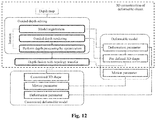
- FIG. 12 is a schematic diagram for illustrating an overall process of an information processing in an exemplary embodiment according to the present disclosure
- FIGS. 13A and 13B are schematic diagrams for illustrating a topology transfer
- FIG. 14 is a diagram illustrating a generating process of a depth image for testing a processing effect of an exemplary embodiment of the present disclosure
- FIG. 15 illustrates an example of a processing effect of model registration according to an exemplary embodiment of the present disclosure
- FIG. 16 illustrates example images for testing a processing effect of an exemplary embodiment of the present disclosure
- FIG. 17 illustrates 3D models reconstructed based on the example images in FIG. 16 according to an exemplary embodiment of the present disclosure.
- FIG. 18 illustrates deformations performed based on deformation parameters by 3D models reconstructed according to an exemplary embodiment.
- FIG. 1 illustrates a configuration example of an information processing apparatus 100 according to an embodiment of the present disclosure.
- the information processing apparatus may be implemented as a personal computer (such as a desktop computer and a laptop computer), a work station, a game machine (such as a motion sensing game machine), a television, a mobile terminal (such as a smart phone, a tablet computer and a portable game terminal) or an image capturing device (such as a camera and a monitor).
- a personal computer such as a desktop computer and a laptop computer
- a game machine such as a motion sensing game machine
- a television a mobile terminal (such as a smart phone, a tablet computer and a portable game terminal) or an image capturing device (such as a camera and a monitor).
- a mobile terminal such as a smart phone, a tablet computer and a portable game terminal
- an image capturing device such as a camera and a monitor.
- the application of embodiments of the present disclosure is not limited to the above, but may be applied
- the information processing apparatus 100 includes a processing circuitry 110 .
- the processing circuitry 110 may be implemented as a particular chip, a chipset, a central processing unit (CPU) or the like.
- the processing circuitry 110 includes an acquisition unit 111 , a determination unit 113 and a generation unit 115 . It should be noted that, although the acquisition unit 111 , the determination unit 113 and the generation unit 115 are shown in form of functional blocks in the drawings, it should be understood that, the functions thereof may also be realized by the processing circuitry 110 as a whole, rather than being realized by actual discrete components of the processing circuitry 110 . In addition, although the processing circuitry 110 is shown by one block in the diagram, the information processing apparatus 100 may include multiple processing circuitries, and functions of the acquisition unit 111 , the determination unit 113 and the generation unit 115 may be distributed among the multiple processing circuitries, so that the multiple processing circuitries perform these functions cooperatively.
- the acquisition unit 111 is configured to acquire a depth map of an object and a predetermined three-dimensional model.
- the predetermined three-dimensional model has a deformation parameter for controlling a deformation of at least a part of the predetermined three-dimensional model.
- the depth map may be obtained by a depth image capturing device in real time, or may be obtained from depth data previously obtained and stored in a storage device.
- a predetermined three-dimensional model there have been a variety of 3D models that can control a movement of a specific part by a parameter.
- the deformations of these models (usually hundreds or thousands of voxels are changed) are usually controlled by a small number of parameters.
- These parameterized models are typically used to reconstruct a non-rigid surface of interest, such as a human face.
- FaceShift is a representative commercial software that uses parameterized deformation to reconstruct a face, and can be used for transferring an facial expression.
- the object or a movable part of the object may include a human face.
- the determination unit 113 is configured to determine a correspondence between a feature point in the at least a part of the predetermined three-dimensional model obtained by the acquisition unit 111 and a pixel of the depth map obtained by the acquisition unit 111 .
- Feature points in the model may be determined in various ways according to specific applications.
- the feature points may include vertices in the model.
- the feature points may not contain all the vertices in the model.
- the feature points may only contain vertices in an area of interest, or may contain representative vertices extracted from the vertices with a specific density (or spacing).
- the correspondence between the feature point of the 3D model and the pixel of the depth map may be determined by registering the predetermined three-dimensional model to a point cloud generated based on the depth map, and projecting the registered feature points to an image plane of the depth map.
- the above-described projection process may provide a dense correspondence between the pixels and the voxels, that is, a voxel projected to an image plane is considered to be corresponding to a pixel onto which the voxel is projected.
- the predetermined three-dimensional model may be registered to a point cloud by using an iterative closest point (ICP) method.
- ICP iterative closest point
- the ICP method includes a rigid ICP method and a non-rigid ICP method.
- the embodiment of the present disclosure may include the above two registration methods, and may include performing the above two registration methods iteratively.
- a registration process may include: performing an overall rigid registration on the predetermined three-dimensional model and the point cloud; on the basis of the rigid registration, adjusting a deformation parameter to perform a local non-rigid registration on the predetermined three-dimensional model and the point cloud; performing the rigid registration and the non-rigid registration iteratively.
- a user instruction may be referred to for improving the registration accuracy, such that the shape of the predetermined three-dimensional model is fitted to the point cloud.
- the generation unit 115 may generate a reconstructed three-dimensional model of the object from the depth map based on the correspondence determined by the determination unit 113 , wherein the deformation parameter being applicable to the reconstructed three-dimensional model.
- the generation of the reconstructed three-dimensional model may include, for example: determining a topological relationship of pixels of the depth map from a topological relationship of feature points of the predetermined three-dimensional model, based on the correspondence between feature points of the predetermined three-dimensional model and pixels of the depth map determined by the determination unit 113 ; and determining a topological relationship between feature points of the reconstructed three-dimensional model based on the topological relationship between the pixels of the depth map.
- a vertex topological relationship is extracted from the predetermined three-dimensional model and transferred to a pixel domain. Then, the depth map is fused to reconstruct a three-dimensional model represented in form of voxel. In this way, the topological relationship is transferred from pixel domain to voxel domain.
- FIG. 13 illustrates two possible manners of converting the vertex topological relationship into a voxel topological relationship.
- a first manner as shown in FIG. 13A adjacent vertices are projected to adjacent pixels of the depth map.
- the vertices have dense correspondences in the pixel domain.
- Such topology can be naturally reproduced in the voxel domain because volumetric representation has the assumption that adjacent voxels are connected.
- vertices are sparsely projected to the pixel domain.
- depth interpolation and topological expansion may be used according to an embodiment.
- the depth interpolation may be performed in the voxel domain by the typical non-uniform rational B-spline (NURBS) method or may be performed in the pixel domain by the typical bicubic interpolation method.
- Topological expansion may be performed by adding pixels on connection edges into the topology.
- topology transfer may be performed by: obtaining one pixel position corresponding to the feature point by a coordinate averaging; dividing a three-dimensional space into voxels, converting the depth map into a three-dimensional point cloud, determining a relationship between the point cloud and the voxels according to a nearest neighbor principle; merging a plurality of three-dimensional point clouds to obtain a voxel-based reconstructed 3D model, a voxel with a value serves as a feature point of the reconstructed three-dimensional model; and determining the topological relationship between feature points of the reconstructed three-dimensional model based on the correspondence of the pixels of the depth map, the point cloud and the voxels.
- ⁇ x 0 , y 0 , z 0 ⁇ is a vertex in the merging result
- ⁇ x 1 , y 1 , z 1 ⁇ and ⁇ x 2 , y 2 , z 2 ⁇ are two individual results. In this way, the number of vertices in the voxel domain is kept unchanged, which is identical to the number of vertices in the predetermined three-dimensional model.
- the transferred topology may not be completely the same as the actual topology.
- FIG. 13B shows a sparse transferred topology and a denser actual topology of the voxels.
- the actual topology is denser than the transferred one because adjacent voxels will be connected together in the volumetric representation during a mesh extraction process.
- the three-dimensional model (referred to as the reconstructed three-dimensional model herein) of the object is reconstructed.
- the reconstructed three-dimensional model, the transferred topology, and the deformation parameters defined for the topology constitute a new parameterized three-dimensional model.
- the new three-dimensional model (the reconstructed three-dimensional model) may deform in a way similar to that of the predetermined three-dimensional model.
- the predetermined three-dimensional model may also be used to optimize the depth map.
- an information processing apparatus 200 includes a processing circuitry 210 .
- the processing circuitry 210 includes an acquisition unit 211 , a determination unit 213 , a generation unit 215 , a registration unit 217 and an optimization unit 219 .
- the acquisition unit 211 , the determination unit 213 and the generation unit 215 are similar to the acquisition unit 111 , the determination unit 113 and the generation unit 115 described with reference to FIG. 1 , respectively, the description of which is omitted here.
- the registration unit 217 is configured to register the predetermined three-dimensional model acquired by the acquisition unit 211 to a point cloud generated based on the depth map acquired by the acquisition unit 211 , to obtain a registered three-dimensional model.
- the registration of the predetermined three-dimensional model to the point cloud may be performed using the above-mentioned manner such as the ICP method.
- the optimization unit 219 is configured to optimize the depth map acquired by the acquisition unit 211 based on the registered three-dimensional model obtained by the registration unit 217 .
- the optimization unit 219 may be configured to derive an optimized depth map by solving an objective function containing a first fidelity term related to a depth value of a current depth map of the object and a second fidelity term related to a depth value of a depth map obtained based on the registered three-dimensional model.
- the objective function may further include a regularization term for preserving a smoothness of the optimized depth map.
- the proposed depth editing process is used to generate a sequence of new depth maps with optimized depth value and pixel-vertex correspondences.
- the guided depth editing is formulated as an optimization problem that consists of the following three parts:
- the first part ⁇ X ⁇ Z ⁇ 2 2 in the Equation (2) is the fidelity term that preserves basic content of the depth map, where X represents the output depth map.
- Equation (2) is a regularization term preserving the piece-wise smoothness of the depth map by using weighted sum of squares,
- ⁇ pq is a weight reflecting a similarity between depth values Z(p) and Z(q)
- ⁇ s and ⁇ z are pre-defined constants.
- Equation (2) is another fidelity term that changes the depth values so that the point cloud converted from the depth map fits better to the predetermined three-dimensional model, where Z* is the depth map generated by rendering the fitted predetermined three-dimensional model to an image plane.
- a common point-to-plane ICP is adopted first to perform a rigid transformation from the predetermined three-dimensional model to the point cloud obtained from the current depth map X. Then, the non-rigid point-to-plane ICP may be applied in model registration for better fitting surfaces of the model to the point cloud. In the model registration, the rigid and non-rigid ICP methods may be applied iteratively to guarantee a good fitting. Thereafter, the fitted model is projected to the image plane to generate Z*.
- the deformation parameters of the predetermined three-dimensional model may be manually adjusted so that the model can be better fitted to the point cloud.
- the above projection process also provides a dense correspondence between the pixels and the vertices, i.e., the voxel that is projected on the image plane is considered to be corresponding to the pixel onto which the voxel is projected.
- the first two parts of the optimization model in the Equation (2) may be used for depth enhancement, and the third part establishes a correspondence between the predetermined three-dimensional model and the depth map in the form of image domain processing.
- Constants ⁇ and ⁇ are balancing parameters which may be adjusted as required.
- processes of the above optimization, model registration, and depth rendering may be performed iteratively.
- the registration unit 217 and the optimization unit 219 may further be configured to perform registration and optimization iteratively.
- the depth map may be acquired by a depth image capturing device in real time.
- the information processing apparatus may include an image acquisition device.
- FIG. 3 illustrates a configuration example of an information processing apparatus according to the present embodiment.
- the information processing apparatus 300 includes a processing circuitry 310 and an image acquisition device 320 .
- the processing circuitry 310 includes an acquisition unit 311 , a determination unit 313 and a generation unit 315 , which are similar to the acquisition unit 111 , the determination unit 113 and the generation unit 115 described with reference to FIG. 1 , respectively, the description of which is omitted here.
- the image acquisition device 320 is configured to acquire a depth map of an object.
- the acquisition unit 311 of the processing circuitry 310 may acquire the depth map from the image acquisition device 320 .
- the image acquisition device 320 may further acquire an intensity map such as a color image of the object, and the intensity image may, for example, be used to assist or guide the registration between the predetermined three-dimensional and the depth map.
- the image acquisition device 320 may include, for example, a depth sensor or any existing apparatus capable of generating a depth image, such as Kinect sensor from the Microsoft corporation, a RealSense sensor from the Intel corporation and other mixed depth acquiring system. Further, the image acquisition device 320 may also include an RGB-D data collection device including a depth image capturing device such as a depth sensor and an intensity image capturing device such as a color camera. Specifically, the color camera, for example, can collect a consecutive color image sequence, which may be any camera on the market; and the depth sensor collects a consecutive depth map sequence, and may be structured light depth acquisition device such as the Kinect, or may be a ToF camera.
- Deformation of the reconstructed three-dimensional model of the object may be controlled by a user after the reconstructed three-dimensional model of the object, to which the deformation parameter is applicable, is generated according to the above embodiment. Further, as described above, during the model registration process, for example, the deformation parameters of the predetermined three-dimensional model may be manually adjusted so that the model can better fit to the point cloud.
- the information processing apparatus according to an embodiment may be configured to receive input from a user.
- an information processing apparatus 400 includes a processing circuitry 410 and an instruction input device 420 .
- the processing circuitry 410 includes an acquisition unit 411 , a determination unit 413 , a generation unit 415 and a control unit 417 .
- the acquisition unit 411 , the determination unit 413 and the generation unit 415 are similar to the acquisition unit 111 , the determination unit 113 and the generation unit 115 described with reference to FIG. 1 , respectively, the description of which is omitted here.
- the instruction input device 420 is configured to acquire an operation instruction from a user.
- the control unit 417 is configured to control a deformation of the reconstructed three-dimensional model and/or the predetermined three-dimensional model based on the operation instruction inputted via the instruction input device 420 .
- control of the deformation may include guiding movement of a feature point without topology information based on topology information of an adjacent feature point.
- a voxel or a vertex located in a deformable topology region but without a topology definition may be changed in a smooth way by using deformation interpolation.
- a vertex v i without a topology definition its adjacent vertices may be searched for, and the movement of the vertex v i is guided by using a subset of vertices with topology definitions, i.e.,
- T represents the 6-DOF three-dimensional transformation whose index indicates the vertex to be transformed
- ⁇ i indicates a subset of vertices with topology definitions
- c j is a coefficient for a vertex v j .
- the relation of c j ⁇ 1/ ⁇ v i ⁇ v j ⁇ 2 2 may be defined, where
- Information processing 1106 as shown in FIG. 11 may be implemented in hardware or software, which acquires a predetermined three-dimensional model such as a head model 1102 and depth data of an object such as a depth map 1104 from a data source.
- the predetermined three-dimensional model has a deformation parameter.
- the object whose three-dimensional model is to be reconstructed (such as a head of a human in the example) may have dynamic characteristics similar to the predetermined three-dimensional model.
- an intensity map 1114 such as a color image synchronized with the depth map may further be acquired.
- a user 1110 may select a predetermined three-dimensional model having a predetermined deformable surface for an object via a user interface 1108 , for example.
- a depth map (optionally, and a corresponding color image) of the real object may be loaded.
- the depth map and the color image may be obtained from, for example, an RGB-D sensor, or from a pre-stored file.
- the information processing 1106 performs processes corresponding to the above-described embodiment to obtain a reconstructed three-dimensional model 1112 .
- Deformation of the reconstructed three-dimensional model may be controlled through the deformation parameter so as to realize functions such as expression editing, realistic animation or virtual reality.
- interaction with the user may be performed in a manner described in the above exemplary embodiment, to manually adjust a fitting result in a depth editing process, for example.
- the information processing 1106 may be performed by the information processing apparatus according to the above-described embodiment of the present disclosure.
- a user interface 1108 and the information processing apparatus according to the above-described embodiment of the present disclosure may be integrated into the same user equipment; alternatively, the user interface 1108 may be implemented as a separate user equipment communicatively coupled with the information processing apparatus according to the above-described of the present disclosure.
- the information processing 1106 may be performed in a cloud, for example.
- the user equipment may be implemented as, for example, a personal computer, a work station, a game machine, a television, a mobile terminal (such as a smart phone, a tablet computer and a portable game terminal) or an image capturing device (such as a camera and a monitor).
- a mobile terminal such as a smart phone, a tablet computer and a portable game terminal
- an image capturing device such as a camera and a monitor.
- the user interface may include any apparatus capable of obtaining a user instruction (and presenting information to the user).
- FIG. 12 illustrates an overall framework of a three-dimensional reconstructing process of a deformable object according to an exemplary embodiment, which involves processes of three-dimensional reconstruction, depth enhancement and three-dimensional model registration.
- the predetermined three-dimensional model is introduced to a conventional three-dimensional reconstruction framework by guided depth editing.
- the proposed reconstructed framework can reconstruct a three-dimensional model having a predetermined motion parameter after a topology transfer is performed in depth fusion processing.
- Various types of deformable objects can be processed by the framework.
- the information processing method according to the present embodiment includes the following steps.
- step S 510 a depth map of an object and a predetermined three-dimensional model are acquired, wherein the predetermined three-dimensional model has a deformation parameter for controlling a deformation of at least a part of the predetermined three-dimensional model.
- step S 520 a correspondence between a feature point in the at least a part of the predetermined three-dimensional model and a pixel of the depth map is determined.
- step S 530 a reconstructed three-dimensional model of the object is generated from the depth map based on the determined correspondence, the deformation parameter being applicable to the reconstructed three-dimensional model.
- Embodiments of generating a deformable three-dimensional model of an object are described above.
- the present disclosure further includes an embodiment of optimizing a depth map of an object based on a predetermined three-dimensional model.
- an information processing apparatus 600 includes a processing circuitry 610 .
- the processing circuitry 610 includes an acquisition unit 611 , a registration unit 613 and an optimization unit 615 .
- the acquisition unit 611 is configured to acquire a depth map of an object and a predetermined three-dimensional model.
- the registration unit 613 is configured to register the predetermined three-dimensional model to three-dimensional coordinate points (for example, a point cloud) generated from the depth map, to obtain a registered three-dimensional model.
- three-dimensional coordinate points for example, a point cloud
- the optimization unit 615 is configured to perform an optimization on the depth map based on the registered three-dimensional model.
- the optimization unit 615 may be configured to derive an optimized depth map by solving an objective function containing a first fidelity term related to a depth value of a current depth map of the object and a second fidelity term related to a depth value of a depth map obtained based on the registered three-dimensional model.
- the objective function may further include a regularization term for preserving a smoothness of the optimized depth map.
- the registration unit 613 and the optimization unit 615 may be configured to perform the registration and the optimization iteratively.
- FIG. 7 illustrates an information processing method according to an embodiment, which includes the following steps.
- step S 710 a depth map of an object and a predetermined three-dimensional model are acquired.
- step S 720 the predetermined three-dimensional model is registered to three-dimensional coordinate points (for example, a point cloud) generated from the depth map, to obtain a registered three-dimensional model.
- three-dimensional coordinate points for example, a point cloud
- step S 730 an optimization is performed on the depth map based on the registered three-dimensional model.
- FIG. 8 and FIG. 9 illustrate additional configuration examples of information processing apparatus according to the embodiment in the above aspects.
- an information processing apparatus 800 includes an acquisition device 810 , a determination device 820 and a generation device 830 .
- the acquisition device 810 is configured to acquire a depth map of an object and a predetermined three-dimensional model, wherein the predetermined three-dimensional model has a deformation parameter for controlling a deformation of at least a part of the predetermined three-dimensional model.
- the determination device 820 is configured to determine a correspondence between a feature point in the at least a part of the predetermined three-dimensional model and a pixel of the depth map.
- the generation device 830 is configured to generate a reconstructed three-dimensional model of the object from the depth map based on the determined correspondence, the deformation parameter being applicable to the reconstructed three-dimensional model.
- an information processing apparatus 900 includes an acquisition device 910 , a registration device 920 and an optimization device 930 .
- the acquisition device 910 is configured to acquire a depth map of an object and a predetermined three-dimensional model.
- the registration device 920 is configured to register the predetermined three-dimensional model to three-dimensional coordinate points generated from the depth map, to obtain a registered three-dimensional model.
- the optimization device 930 is configured to perform an optimization on the depth map based on the registered three-dimensional model.
- embodiments of the present disclosure may further include a user equipment including a user interface device such as a user interface 1108 as shown in FIG. 11 .
- the user interface device is configured to receive an operation instruction from a user.
- the user equipment includes or is communicatively coupled to the information processing apparatus according to the above-described embodiment, the operation instruction including an instruction of specifying or selecting the predetermined three-dimensional model, an instruction of specifying or adjusting the deformation parameter, or an instruction of specifying or selecting the predetermined three-dimensional model or an instruction related to the registration.
- the solution according to the embodiments of the present disclosure may be used to reconstruct many types of objects having parameterized deformation definition, for example, a human head having a deformable face, a human arm having a deformable hand, an animal having deformable legs, a vehicle having deformable doors.
- the solution provides three-dimensional reconstruction with semantics and parameterized deformation.
- a three-dimensional face model “FaceWarehouse” is used as an example of the predetermined three-dimensional model having a vertex topology to which deformation may be applied.
- a test depth map is obtained from a data set consisting of three-dimensional face expressions of many people.
- FIG. 14 illustrates a status of the depth data involved in the generating process, specifically, (a) is a point cloud obtained based on a clean depth map; (b) is a point cloud obtained based on a depth map with noise; and (c) is a point cloud obtained based on a depth map to which the effect of quantization step is further added.
- a guided depth editing may be performed in a coarse-to-fine manner.
- a face may be detected by an existing face detecting method, and two-dimensional landmark points may be extracted using, for example, an active shape model (ASM) alignment algorithm, as shown in FIG. 15( a ) .
- ASM active shape model
- These two-dimensional landmark points may be converted into three-dimensional points based on their depth values, after which the alignment may be refined, for example, using a registration method based on Singular Value Decomposition (SVD), to obtain the alignment result as shown in FIG. 15( b ) .
- Singular Value Decomposition Singular Value Decomposition
- depth editing may be performed iteratively in a manner described in the above embodiment so as to obtain a fine alignment result, a refined depth map and a fitted model surface, as shown in FIG. 15( c ) .
- a refined depth map and a better fitted three-dimensional model can be obtained by the guided depth editing.
- Equation (2) The mean absolute error (MAE) is used to measure the difference between the refined depth map and a true value. It can be seen from these results that the proposed guided depth editing can produce more accurate depth refinement. Hence, the solution according to the embodiment of the present disclosure is robust against noises and the effects of quantization step.
- FIG. 16 illustrates frames of the captured color images.
- the object keeps unchanged so that a better reconstruction of the object can be achieved by the depth fusion.
- FIG. 16 shows an image sequence of a mannequin obtained at a distance of 1.6 meters
- (b) shows an image sequence of the mannequin obtained at a distance of 2.0 meters
- (c) shows an image sequence of a person obtained at a distance of 1.6 meters
- (d) shows an image sequence of a person obtained at a distance of 2.0 meters.
- FIG. 16 only the intensity maps are illustrated in FIG. 16 .
- each pixel has a corresponding point in the face region and there is no need to perform an interpolation. Instead, the depth maps are fused together directly, and the pixel-wise topology is transferred to a voxel domain.
- the fused depth maps provide a three-dimensional model for each RGB-D sequence.
- (a) shows a three-dimensional model reconstructed based on the image sequence of the mannequin obtained at a distance of 1.6 meters
- (b) shows a three-dimensional model reconstructed based on the image sequence of the mannequin obtained at a distance of 2.0 meters
- (c) shows a three-dimensional model reconstructed based on the image sequence of the human obtained at a distance of 1.6 meters
- (d) shows a three-dimensional model reconstructed based on the image sequence of the human obtained at a distance of 2.0 meters.
- the illustrated reconstructed model is incomplete since only the images of the frontal part of the head are captured.
- FIG. 18 shows two examples of the semantic deformation.
- the left side shows an intensity map obtained by projecting the reconstructed three-dimensional mode to a front view
- the right side shows the predetermined model controlled by a specific deformation parameter set.
- (a) and (b) illustrate the models with deformation parameters being all set as zero (i.e., no deformation).
- (c) illustrates a model deformed by an “opening mouth” parameter, where both the reconstructed model and predetermined model perform an action of “opening mouth”.
- both the reconstructed model and the predetermined model are controlled by a “half smile” parameter. It can be seen that the reconstructed models also have semantic deformation parameters.
- each steps of the above-described method and each of constituent modules and/or units of the above-described device may be implemented as software, firmware, hardware, or a combination thereof.
- a program constituting the software for implementing the above-described method may be installed from a storage medium or a network to a computer (for example, the general-purpose computer 1000 shown in FIG. 10 ) having a dedicated hardware structure.
- the computer can execute various functions when being installed with various programs.
- the following components are connected to the input/output interface 1005 : an input section 1006 including a keyboard, a mouse and the like, an output section 1007 including a display such as a Cathode Ray Tube (CRT) and a Liquid Crystal Display (LCD), a speaker and the like, the storage section 1008 including a hard disk and the like, and a communication section 1009 including a network interface card such as a LAN card, a modem and the like.
- the communication section 1009 performs communication processing via a network such as the Internet.
- a drive 1010 may also be connected to the input/output interface 1005 .
- a removable medium 1011 such as a magnetic disk, an optical disk, a magneto-optical disk, a semiconductor memory and the like is mounted on the drive 1010 as necessary such that a computer program read out therefrom is installed in the storage section 1008 .
- a program constituting the software is installed from the network such as the Internet or the storage medium such as the removable medium 1011 .
- the storage medium is not limited to the removable medium 1011 shown in FIG. 10 in which the program is stored and which is distributed separately from the device so as to provide the program to the user.
- the removable medium 1011 include a magnetic disk including a Floppy Disk (registered trademark), an optical disk including a Compact Disk Read Only Memory (CD-ROM) and a Digital Versatile Disc (DVD), a magneto-optical disk including a MiniDisc (MD) (registered trademark), and a semiconductor memory.
- the storage medium may be the ROM 1002 , the hard disk contained in the storage section 1008 or the like.
- the program is stored in the storage medium, and the storage medium is distributed to the user together with the device containing the storage medium.
- the storage medium used for carrying the program product including machine-readable instructions is included in the present disclosure.
- the storage medium includes but not limited to, a floppy diskette, an optical disk, a magneto-optical disk, a memory card, a memory stick and so on.
- reference numerals consist of numerals are used to represent each step and/or unit. It will be understood by those skilled in the art that these reference numerals are used for convenience of description and illustration only and are not intended to represent order or any other limit thereof.
- the method of the present disclosure is not limited to be performed in a chronological order described in the specification, but may also be performed in other time-sequentially, in parallel, or independently. Therefore, the order of execution of the methods described in this specification does not limit the technical scope of the present disclosure.
Landscapes
- Engineering & Computer Science (AREA)
- Physics & Mathematics (AREA)
- General Physics & Mathematics (AREA)
- Theoretical Computer Science (AREA)
- Computer Graphics (AREA)
- Software Systems (AREA)
- Architecture (AREA)
- Computer Hardware Design (AREA)
- General Engineering & Computer Science (AREA)
- Computer Vision & Pattern Recognition (AREA)
- Geometry (AREA)
- Processing Or Creating Images (AREA)
Abstract
Description
{x 0 ,y 0 ,z 0}=0.5{x 1 ,y 1 ,z 1}+0.5{x 2 ,y 2 ,z 2}, Equation (1)
in the Equation (2) is a regularization term preserving the piece-wise smoothness of the depth map by using weighted sum of squares, where
in the Equation (2) is another fidelity term that changes the depth values so that the point cloud converted from the depth map fits better to the predetermined three-dimensional model, where Z* is the depth map generated by rendering the fitted predetermined three-dimensional model to an image plane.
for smooth transformation.
from the model as defined in Equation (2). The mean absolute error (MAE) is used to measure the difference between the refined depth map and a true value. It can be seen from these results that the proposed guided depth editing can produce more accurate depth refinement. Hence, the solution according to the embodiment of the present disclosure is robust against noises and the effects of quantization step.
| TABLE 1 | |||||
| Distance | Baseline | Guided depth | |||
| (meter) | Noise level | method | editing | ||
| 1.50 | 32.18 | 4.12 | 3.59 | ||
| 1.75 | 43.79 | 5.36 | 4.50 | ||
| 2.00 | 57.20 | 6.65 | 5.46 | ||
| 2.30 | 75.65 | 8.11 | 6.13 | ||
Claims (14)
Applications Claiming Priority (3)
| Application Number | Priority Date | Filing Date | Title |
|---|---|---|---|
| CN201710127688 | 2017-03-06 | ||
| CN201710127688.3A CN108694740A (en) | 2017-03-06 | 2017-03-06 | Information processing equipment, information processing method and user equipment |
| CN201710127688.3 | 2017-03-06 |
Publications (2)
| Publication Number | Publication Date |
|---|---|
| US20180253909A1 US20180253909A1 (en) | 2018-09-06 |
| US10565801B2 true US10565801B2 (en) | 2020-02-18 |
Family
ID=63357420
Family Applications (1)
| Application Number | Title | Priority Date | Filing Date |
|---|---|---|---|
| US15/841,445 Expired - Fee Related US10565801B2 (en) | 2017-03-06 | 2017-12-14 | Information processing apparatus, information processing method and user equipment |
Country Status (2)
| Country | Link |
|---|---|
| US (1) | US10565801B2 (en) |
| CN (1) | CN108694740A (en) |
Cited By (1)
| Publication number | Priority date | Publication date | Assignee | Title |
|---|---|---|---|---|
| US11900537B2 (en) | 2020-05-25 | 2024-02-13 | Technologies Shapeshift 3D Inc. | Method and device for constraining shape deformation of 3D objects |
Families Citing this family (22)
| Publication number | Priority date | Publication date | Assignee | Title |
|---|---|---|---|---|
| WO2016029970A1 (en) * | 2014-08-29 | 2016-03-03 | Toyota Motor Europe Nv/Sa | Method and system for scanning an object using an rgb-d sensor |
| WO2018011370A1 (en) * | 2016-07-13 | 2018-01-18 | Naked Labs Austria Gmbh | Efficient volumetric reconstruction with depth sensors |
| US10832471B2 (en) * | 2017-03-27 | 2020-11-10 | Mitsubishi Electric Research Laboratories, Inc. | Fast T-spline fitting system and method |
| EP3467782A1 (en) * | 2017-10-06 | 2019-04-10 | Thomson Licensing | Method and device for generating points of a 3d scene |
| WO2020018931A1 (en) | 2018-07-19 | 2020-01-23 | Activ Surgical, Inc. | Systems and methods for multi-modal sensing of depth in vision systems for automated surgical robots |
| CN109472741B (en) * | 2018-09-30 | 2023-05-30 | 先临三维科技股份有限公司 | Three-dimensional splicing method and device |
| CN109376791B (en) * | 2018-11-05 | 2020-11-24 | 北京旷视科技有限公司 | Depth algorithm precision calculation method, device, electronic device, and readable storage medium |
| CA3125288A1 (en) * | 2018-12-28 | 2020-07-02 | Activ Surgical, Inc. | Generation of synthetic three-dimensional imaging from partial depth maps |
| CN111724419A (en) * | 2019-03-19 | 2020-09-29 | 长春工业大学 | Research on an improved extreme learning machine-based TOF camera depth data space registration algorithm |
| CN110084979B (en) * | 2019-04-23 | 2022-05-10 | 暗物智能科技(广州)有限公司 | Human-computer interaction method, device, controller and interactive device |
| CN109920011B (en) * | 2019-05-16 | 2020-01-10 | 长沙智能驾驶研究院有限公司 | External parameter calibration method, device and equipment for laser radar and binocular camera |
| CN110751731B (en) * | 2019-10-16 | 2023-03-24 | 光沦科技(深圳)有限公司 | 3D reconstruction method and system for structured light |
| CN111179418B (en) * | 2019-12-31 | 2024-02-27 | 中国人民解放军陆军工程大学 | A three-dimensional human body measurement method and device that does not require the user to be naked |
| CN111340935A (en) * | 2020-01-23 | 2020-06-26 | 北京市商汤科技开发有限公司 | Point cloud data processing method, intelligent driving method, related device and electronic equipment |
| CN111882595B (en) * | 2020-07-28 | 2024-01-26 | 河海大学常州校区 | A human body semantic feature extraction method and system |
| CN111915741A (en) * | 2020-08-13 | 2020-11-10 | 广东申义实业投资有限公司 | VR generater based on three-dimensional reconstruction |
| CN111968165B (en) * | 2020-08-19 | 2024-01-23 | 北京拙河科技有限公司 | Dynamic human body three-dimensional model completion method, device, equipment and medium |
| CN113781653B (en) * | 2021-08-17 | 2022-09-23 | 北京百度网讯科技有限公司 | Object model generation method and device, electronic equipment and storage medium |
| CN114004039B (en) * | 2021-09-16 | 2024-05-31 | 厦门大学 | Shape and position parameters and hole depth prediction method for air film holes of hollow turbine blade of aeroengine |
| CN115965665B (en) * | 2021-10-12 | 2026-04-14 | 奥林巴斯株式会社 | Method for finding a set of corresponding points in an image to be registered, image registration method, medical image registration system |
| CN114494595B (en) * | 2022-01-19 | 2026-03-03 | 上海得物信息集团有限公司 | Biological model construction method and three-dimensional dimension measurement method |
| CN117218171A (en) * | 2022-05-31 | 2023-12-12 | 鸿海精密工业股份有限公司 | Depth estimation model optimization and object distance detection methods and related equipment |
Citations (5)
| Publication number | Priority date | Publication date | Assignee | Title |
|---|---|---|---|---|
| US8112254B1 (en) * | 2008-05-01 | 2012-02-07 | Lucasfilm Entertainment Company Ltd. | Transferring surface attributes across geometric models |
| US20120176477A1 (en) * | 2004-07-30 | 2012-07-12 | Dor Givon | Methods, Systems, Devices and Associated Processing Logic for Generating Stereoscopic Images and Video |
| US20150009214A1 (en) * | 2013-07-08 | 2015-01-08 | Vangogh Imaging, Inc. | Real-time 3d computer vision processing engine for object recognition, reconstruction, and analysis |
| US9348950B2 (en) * | 2012-02-28 | 2016-05-24 | Disney Enterprises, Inc. | Perceptually guided capture and stylization of 3D human figures |
| US20170091996A1 (en) * | 2015-09-25 | 2017-03-30 | Magic Leap, Inc. | Methods and Systems for Detecting and Combining Structural Features in 3D Reconstruction |
-
2017
- 2017-03-06 CN CN201710127688.3A patent/CN108694740A/en active Pending
- 2017-12-14 US US15/841,445 patent/US10565801B2/en not_active Expired - Fee Related
Patent Citations (5)
| Publication number | Priority date | Publication date | Assignee | Title |
|---|---|---|---|---|
| US20120176477A1 (en) * | 2004-07-30 | 2012-07-12 | Dor Givon | Methods, Systems, Devices and Associated Processing Logic for Generating Stereoscopic Images and Video |
| US8112254B1 (en) * | 2008-05-01 | 2012-02-07 | Lucasfilm Entertainment Company Ltd. | Transferring surface attributes across geometric models |
| US9348950B2 (en) * | 2012-02-28 | 2016-05-24 | Disney Enterprises, Inc. | Perceptually guided capture and stylization of 3D human figures |
| US20150009214A1 (en) * | 2013-07-08 | 2015-01-08 | Vangogh Imaging, Inc. | Real-time 3d computer vision processing engine for object recognition, reconstruction, and analysis |
| US20170091996A1 (en) * | 2015-09-25 | 2017-03-30 | Magic Leap, Inc. | Methods and Systems for Detecting and Combining Structural Features in 3D Reconstruction |
Cited By (1)
| Publication number | Priority date | Publication date | Assignee | Title |
|---|---|---|---|---|
| US11900537B2 (en) | 2020-05-25 | 2024-02-13 | Technologies Shapeshift 3D Inc. | Method and device for constraining shape deformation of 3D objects |
Also Published As
| Publication number | Publication date |
|---|---|
| US20180253909A1 (en) | 2018-09-06 |
| CN108694740A (en) | 2018-10-23 |
Similar Documents
| Publication | Publication Date | Title |
|---|---|---|
| US20180253909A1 (en) | Information processing apparatus, information processing method and user equipment | |
| Roessle et al. | Dense depth priors for neural radiance fields from sparse input views | |
| Mac Aodha et al. | Patch based synthesis for single depth image super-resolution | |
| Dou et al. | Scanning and tracking dynamic objects with commodity depth cameras | |
| US10484663B2 (en) | Information processing apparatus and information processing method | |
| Berger et al. | State of the art in surface reconstruction from point clouds | |
| JP7040278B2 (en) | Training method and training device for image processing device for face recognition | |
| US10373380B2 (en) | 3-dimensional scene analysis for augmented reality operations | |
| US9361723B2 (en) | Method for real-time face animation based on single video camera | |
| Corsini et al. | Perceptual metrics for static and dynamic triangle meshes | |
| US10521919B2 (en) | Information processing device and information processing method for applying an optimization model | |
| CN103414861B (en) | A kind of method of projector frame self-adaptive Geometry rectification | |
| Varol et al. | Monocular 3D reconstruction of locally textured surfaces | |
| EP3571667A1 (en) | Real-time generation of synthetic data from multi-shot structured light sensors for three-dimensional object pose estimation | |
| Mandal et al. | Depth map restoration from undersampled data | |
| Wang et al. | Dynamic human body reconstruction and motion tracking with low-cost depth cameras | |
| Llull et al. | Evaluation of 3D reconstruction for cultural heritage applications | |
| Dib et al. | Mosar: Monocular semi-supervised model for avatar reconstruction using differentiable shading | |
| Meister et al. | Real versus realistically rendered scenes for optical flow evaluation | |
| Teufel et al. | Humanolat: A large-scale dataset for full-body human relighting and novel-view synthesis | |
| Hu et al. | Predicting high-fidelity human body models from impaired point clouds | |
| Dai et al. | Augmenting a 3D morphable model of the human head with high resolution ears | |
| Petrovska et al. | Geometric accuracy analysis between neural radiance fields (NeRFs) and terrestrial laser scanning (TLS) | |
| Niemirepo et al. | Open3DGen: open-source software for reconstructing textured 3D models from RGB-D images | |
| CN120726213A (en) | Furniture design rendering method, system, device and medium |
Legal Events
| Date | Code | Title | Description |
|---|---|---|---|
| AS | Assignment |
Owner name: SONY CORPORATION, JAPAN Free format text: ASSIGNMENT OF ASSIGNORS INTEREST;ASSIGNORS:CHEN, CHONGYU;ZHANG, LEI;SIGNING DATES FROM 20170921 TO 20170922;REEL/FRAME:044394/0346 |
|
| FEPP | Fee payment procedure |
Free format text: ENTITY STATUS SET TO UNDISCOUNTED (ORIGINAL EVENT CODE: BIG.); ENTITY STATUS OF PATENT OWNER: LARGE ENTITY |
|
| STPP | Information on status: patent application and granting procedure in general |
Free format text: NON FINAL ACTION MAILED |
|
| STPP | Information on status: patent application and granting procedure in general |
Free format text: RESPONSE TO NON-FINAL OFFICE ACTION ENTERED AND FORWARDED TO EXAMINER |
|
| STPP | Information on status: patent application and granting procedure in general |
Free format text: FINAL REJECTION MAILED |
|
| STPP | Information on status: patent application and granting procedure in general |
Free format text: ADVISORY ACTION MAILED |
|
| STPP | Information on status: patent application and granting procedure in general |
Free format text: DOCKETED NEW CASE - READY FOR EXAMINATION |
|
| STPP | Information on status: patent application and granting procedure in general |
Free format text: NOTICE OF ALLOWANCE MAILED -- APPLICATION RECEIVED IN OFFICE OF PUBLICATIONS |
|
| STPP | Information on status: patent application and granting procedure in general |
Free format text: PUBLICATIONS -- ISSUE FEE PAYMENT RECEIVED |
|
| STCF | Information on status: patent grant |
Free format text: PATENTED CASE |
|
| FEPP | Fee payment procedure |
Free format text: MAINTENANCE FEE REMINDER MAILED (ORIGINAL EVENT CODE: REM.); ENTITY STATUS OF PATENT OWNER: LARGE ENTITY |
|
| LAPS | Lapse for failure to pay maintenance fees |
Free format text: PATENT EXPIRED FOR FAILURE TO PAY MAINTENANCE FEES (ORIGINAL EVENT CODE: EXP.); ENTITY STATUS OF PATENT OWNER: LARGE ENTITY |
|
| STCH | Information on status: patent discontinuation |
Free format text: PATENT EXPIRED DUE TO NONPAYMENT OF MAINTENANCE FEES UNDER 37 CFR 1.362 |
|
| FP | Lapsed due to failure to pay maintenance fee |
Effective date: 20240218 |