US10565386B2 - Security systems and methods based on cryptographic utility token inventory tenure - Google Patents
Security systems and methods based on cryptographic utility token inventory tenure Download PDFInfo
- Publication number
- US10565386B2 US10565386B2 US16/391,144 US201916391144A US10565386B2 US 10565386 B2 US10565386 B2 US 10565386B2 US 201916391144 A US201916391144 A US 201916391144A US 10565386 B2 US10565386 B2 US 10565386B2
- Authority
- US
- United States
- Prior art keywords
- entity
- utility token
- smart contract
- transistor
- inventory
- Prior art date
- Legal status (The legal status is an assumption and is not a legal conclusion. Google has not performed a legal analysis and makes no representation as to the accuracy of the status listed.)
- Active
Links
Images




Classifications
-
- H—ELECTRICITY
- H04—ELECTRIC COMMUNICATION TECHNIQUE
- H04L—TRANSMISSION OF DIGITAL INFORMATION, e.g. TELEGRAPHIC COMMUNICATION
- H04L9/00—Cryptographic mechanisms or cryptographic arrangements for secret or secure communications; Network security protocols
- H04L9/50—Cryptographic mechanisms or cryptographic arrangements for secret or secure communications; Network security protocols using hash chains, e.g. blockchains or hash trees
-
- G—PHYSICS
- G06—COMPUTING OR CALCULATING; COUNTING
- G06F—ELECTRIC DIGITAL DATA PROCESSING
- G06F21/00—Security arrangements for protecting computers, components thereof, programs or data against unauthorised activity
- G06F21/60—Protecting data
- G06F21/602—Providing cryptographic facilities or services
-
- G—PHYSICS
- G06—COMPUTING OR CALCULATING; COUNTING
- G06F—ELECTRIC DIGITAL DATA PROCESSING
- G06F21/00—Security arrangements for protecting computers, components thereof, programs or data against unauthorised activity
- G06F21/30—Authentication, i.e. establishing the identity or authorisation of security principals
- G06F21/31—User authentication
- G06F21/33—User authentication using certificates
- G06F21/335—User authentication using certificates for accessing specific resources, e.g. using Kerberos tickets
-
- G—PHYSICS
- G06—COMPUTING OR CALCULATING; COUNTING
- G06F—ELECTRIC DIGITAL DATA PROCESSING
- G06F21/00—Security arrangements for protecting computers, components thereof, programs or data against unauthorised activity
- G06F21/60—Protecting data
- G06F21/604—Tools and structures for managing or administering access control systems
-
- G—PHYSICS
- G06—COMPUTING OR CALCULATING; COUNTING
- G06F—ELECTRIC DIGITAL DATA PROCESSING
- G06F21/00—Security arrangements for protecting computers, components thereof, programs or data against unauthorised activity
- G06F21/60—Protecting data
- G06F21/62—Protecting access to data via a platform, e.g. using keys or access control rules
-
- G—PHYSICS
- G06—COMPUTING OR CALCULATING; COUNTING
- G06F—ELECTRIC DIGITAL DATA PROCESSING
- G06F21/00—Security arrangements for protecting computers, components thereof, programs or data against unauthorised activity
- G06F21/60—Protecting data
- G06F21/64—Protecting data integrity, e.g. using checksums, certificates or signatures
-
- G06N7/005—
-
- G—PHYSICS
- G06—COMPUTING OR CALCULATING; COUNTING
- G06N—COMPUTING ARRANGEMENTS BASED ON SPECIFIC COMPUTATIONAL MODELS
- G06N7/00—Computing arrangements based on specific mathematical models
- G06N7/01—Probabilistic graphical models, e.g. probabilistic networks
-
- H—ELECTRICITY
- H04—ELECTRIC COMMUNICATION TECHNIQUE
- H04L—TRANSMISSION OF DIGITAL INFORMATION, e.g. TELEGRAPHIC COMMUNICATION
- H04L9/00—Cryptographic mechanisms or cryptographic arrangements for secret or secure communications; Network security protocols
- H04L9/32—Cryptographic mechanisms or cryptographic arrangements for secret or secure communications; Network security protocols including means for verifying the identity or authority of a user of the system or for message authentication, e.g. authorization, entity authentication, data integrity or data verification, non-repudiation, key authentication or verification of credentials
- H04L9/3236—Cryptographic mechanisms or cryptographic arrangements for secret or secure communications; Network security protocols including means for verifying the identity or authority of a user of the system or for message authentication, e.g. authorization, entity authentication, data integrity or data verification, non-repudiation, key authentication or verification of credentials using cryptographic hash functions
- H04L9/3239—Cryptographic mechanisms or cryptographic arrangements for secret or secure communications; Network security protocols including means for verifying the identity or authority of a user of the system or for message authentication, e.g. authorization, entity authentication, data integrity or data verification, non-repudiation, key authentication or verification of credentials using cryptographic hash functions involving non-keyed hash functions, e.g. modification detection codes [MDCs], MD5, SHA or RIPEMD
-
- G—PHYSICS
- G06—COMPUTING OR CALCULATING; COUNTING
- G06N—COMPUTING ARRANGEMENTS BASED ON SPECIFIC COMPUTATIONAL MODELS
- G06N5/00—Computing arrangements using knowledge-based models
- G06N5/02—Knowledge representation; Symbolic representation
- G06N5/022—Knowledge engineering; Knowledge acquisition
-
- H04L2209/38—
Definitions
- the consumer has a right to access the service or its underlying application software interfaces (API).
- API application software interfaces
- the consumer never possesses the software or its executable code. If the consumer stops paying for the subscription, access is withdrawn and is unavailable.
- this model did not standardize or solve the resulting issue with ownership of the consumers' data on the system. That is, when using a subscription license, how does a user retain control of the data produced or held in the subscription-based license system? If the system stores the data in the vendor's infrastructure (very typical due to efficiency), then the consumer will need some ability to extract their data from the vendor's storage.
- Some examples of the use of the subscription licensing model are Google GSuite, Microsoft Office 365, and Adobe Creative Cloud.
- FIG. 1 schematically illustrates a system in which respective distributed ledger nodes interact according to one or more improved technologies.
- FIG. 2 schematically illustrates a system in which respective users or other entities interact with one another and with participating mining rigs or similar distributed devices in which one or more improved technologies may be incorporated.
- FIG. 3 depicts a client device in which one or more improved technologies may be incorporated.
- FIG. 4 depicts a distributed ledger verification device in which one or more improved technologies may be incorporated.
- FIG. 5 depicts a server in which one or more improved technologies may be incorporated.
- FIG. 6 depicts an earlier state of (a variant of) the system of FIG. 1 .
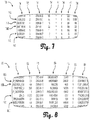
- FIG. 7 depicts a media-resident record list in which one or more improved technologies may be incorporated.
- FIG. 8 depicts another media-resident record list in which one or more improved technologies may be incorporated.
- FIG. 9 is a plot showing how trustworthiness can increase over time in which one or more improved vetting technologies may be incorporated.
- FIG. 10 depicts a particular scenario and progressive data flow in which client devices interact with one or more servers according to one or more improved technologies.
- FIG. 11 is a semi-log plot showing how trustworthiness can increase over time in which one or more improved vetting technologies may be incorporated.
- FIG. 12 is another plot showing how trustworthiness can increase over time in which one or more improved vetting technologies may be incorporated.
- FIG. 13 depicts special-purpose transistor-based circuitry in which one or more improved technologies may be incorporated.
- FIG. 14 depicts an operational flow in which one or more improved technologies may be incorporated.
- FIG. 15 depicts event-sequencing logic including one or more decision protocols in which one or more improved technologies may be incorporated.
- FIG. 16 depicts relative trustworthiness indications of several entities varying across an interval of time in which one or more improved technologies may be manifested.
- FIG. 17 depicts a transfer function generally indicating a positive correlation between an effective rate/steepness of several trajectories and a corresponding cryptographic utility token inventory each belonging to a respective entity.
- FIG. 18 depicts an apportionment to an entity that increases in trust over a period of several weeks to describe a context in which such growth is so slow that the entity becomes untrusted in this period.
- FIG. 19 depicts an apportionment to an initially untrusted entity that increases in trust over the same period of several weeks to describe how such growth is so fast that the entity becomes trusted in this period.
- FIG. 20 depicts an apportionment to an intermediate entity that increases in trust moderately to exemplify how such an entity can be neither trusted nor untrusted both before and after the same exemplary period of several weeks.
- FIG. 21 depicts time-varying normalized apportionments reflecting the raw apportionments depicted in FIGS. 18-20 over the same period of several weeks.
- FIG. 22 depicts additional special-purpose transistor-based circuitry in which one or more improved technologies may be incorporated.
- FIG. 23 depicts time-varying normalized apportionments like those of FIG. 21 but reflecting dedications of apportionments transferred among the eligible entities.
- FIG. 24 depicts a particular scenario and progressive data flow in which client devices may each interact with one or more servers generally as described above with reference to FIG. 10 .
- FIG. 25 depicts an operational flow in which one or more improved technologies may be incorporated for data filtering configured to protect a restricted forum or its participants from malicious uploads or participants (or both).
- FIG. 26 depicts another operational flow in which one or more improved technologies may be incorporated for implementing fraud-resistant task delegation.
- inventory-type instruction sets are those that primarily implement asset transfers or verifications thereof, moving quantities among accounts rather than changing them.
- data transformative instruction sets are those that primarily implement other kinds of computations. Although one of these types of instruction sets may invoke the other as a subroutine, only very rarely is a single code component of instructions a true hybrid.
- On-chain refers to (permanent) inclusion in a blockchain, whether or not such content is public or transparent. “On-list” encompasses not only on-chain but also other content linked and effectively rendered immutable using cryptography (e.g. in a consensus-based data verification). In an implementation that includes “on-list” content (e.g. a blockchain or tangle) as described below, “off-list” refers to content elements (e.g.
- a “batch” data distribution is one in which data is directed to numerous recipients within a limited time (e.g. less than 24 hours) after a triggering event (e.g. an administrator action or weekly trigger time).
- a triggering event e.g. an administrator action or weekly trigger time.
- “Numerous” as used herein refers to more than one dozen.
- Terms like “processor,” “center,” “unit,” “computer,” or other such descriptors herein are used in their normal sense, in reference to an inanimate structure. Such terms do not include any people, irrespective of their location or employment or other association with the thing described, unless context dictates otherwise.
- “For” is not used to articulate a mere intended purpose in phrases like “circuitry for” or “instruction for,” moreover, but is used normally, in descriptively identifying special purpose software or structures.
- values are “apportionments” if they quantify reputation, risk, trustworthiness, or similar attributes of respective entities with a scalar magnitude so as to facilitate relative ranking therebetween. This may include cardinal numbers but not ordinal rankings insofar that the latter are already ranked.
- FIG. 1 schematically illustrates a system 100 in which respective distributed ledger nodes 170 , 180 , 190 interact.
- Each node primarily include a blockchain or other distributed ledger, each occasionally progressing downward with the addition of a new block.
- node 170 includes an oldest block 177 A (built upon one or more predecessor blocks), a newest block 177 H, and other blocks 177 B-G between them.
- Node 180 likewise includes an oldest block 188 A, a newest block 188 D, and other blocks 188 B-C between them.
- Node 190 likewise includes a chain of blocks.
- node 180 has been constructed by a series of interactions with these other nodes 170 , 190 .
- One or more smart contracts of node 180 see FIG.
- a firewall 189 may be used to protect node 180 from pernicious code components or other forms of intrusion (e.g. from node 190 ).
- additional constraints may be imposed by one or more servers (e.g. of a network containing a private or hybrid public/private node 180 ).
- a plain reference numeral (e.g. like 177 ) may refer generally to a member of a class of items (e.g. like ledger blocks) exemplified with a hybrid numeral (e.g. like 177 A) and it will be understood that every item identified with a hybrid numeral is also an exemplar of the class.
- a reference numeral shared between figures refers to the same item, most figures depict respective embodiments.
- FIG. 2 schematically illustrates a system 200 in which respective entities 210 A-B interact with one another and with participating mining rigs 400 K or similar distributed devices 400 A-J many of which are, at various times, able to implement a transaction 241 or confirm an asset transfer or other occurrence as described below (e.g. by confirmations 242 ).
- a private entity 210 A comprises one or more node management servers 500 A that interact with one or more client devices 300 A thereof (e.g. via respective instances of linkage 244 A).
- a public or collective entity 210 B comprises one or more node management servers 500 B that interact with one or more client devices 300 B thereof (e.g. via respective instances of linkage 244 B).
- a private entity 210 A comprises one or more node management servers 500 A that interact with one or more client devices 300 A thereof (e.g. via respective instances of linkage 244 A).
- a public or collective entity 210 B comprises one or more node management servers 500 B that interact with one or more client devices 300 B thereof (e
- the entities 210 A-B may cooperate so that updates (e.g. indicia of dispensations, distributed ledger recordations, or other events) to values maintained at (one or more instances of) server 500 B are received and so that adequately timely confirmations to those updates can occur in a decentralized fashion.
- updates e.g. indicia of dispensations, distributed ledger recordations, or other events
- server 500 B may receive updates (e.g. indicia of dispensations, distributed ledger recordations, or other events) to values maintained at (one or more instances of) server 500 B are received and so that adequately timely confirmations to those updates can occur in a decentralized fashion.
- numerous proof-of-work blockchain nodes 400 A, 400 C, 400 D, 400 E, 400 G, 400 H, 400 K e.g. each implementing a mining rig
- may validate changes to node 180 e.g. by correctly identifying which block 177 H was added last) so as to maintain or rebuild consensus.
- such consensus may be maintained or rebuilt using numerous (proof-of-stake or other) secure blockchain nodes 400 B, 400 F, 4001 , 4001 not configured as a mining rig may validate changes to node 180 in other blockchain proof architectures currently in public use.
- Device 300 may include one or more instances of processors 302 , memory 304 , user inputs 308 , and display hardware 312 all interconnected along with the network interface 306 via a bus 316 .
- One or more network interfaces 306 allow device 300 to connect via the Internet or other networks to or within entities 210 of FIG. 2 ).
- Memory 304 generally comprises a random access memory (“RAM”), a read only memory (“ROM”), and a permanent mass storage device, such as a disk drive.
- Memory 304 may contain one or more instances of operating systems 310 , web browsers 314 , and local apps 324 . These and other software components may be loaded from a non-transitory computer readable storage medium 318 into memory 304 of the client device 300 using a drive mechanism (not shown) associated with a non-transitory computer readable storage medium 318 , such as a floppy disc, tape, DVD/CD-ROM drive, flash card, memory card, or the like. In some embodiments, software components may also be loaded via the network interface 306 , rather than via a computer readable storage medium 318 . Special-purpose circuitry 322 may, in some variants, include some or all of the event-sequencing logic described below (e.g. in a peer-to-peer implementation) and one or more security features 360 (e.g. a fob or similar security apparatus).
- Special-purpose circuitry 322 may, in some variants, include some or all of the event-sequencing logic described below (e.g. in
- security feature 360 may implement or otherwise interact with a removable or other digital wallet 366 .
- Such wallets may (optionally) each include one or more instances of private keys 381 , of utility tokens 382 , of crypto currency 383 , of provenance data 384 , or of device-executable code snippets (e.g. smart contracts) or the like as described below.
- client device 300 may include many more components than those shown in FIG. 3 , but it is not necessary that all conventional components be shown in order to disclose an illustrative embodiment.
- Device 400 may include one or more instances of processors 402 , memory 404 , user inputs 408 , and display hardware 412 all interconnected along with the network interface 406 via a bus 416 .
- One or more network interfaces 406 allow device 400 to connect via the Internet or other networks to or within entities 210 of FIG. 2 ).
- Memory 404 generally comprises a random access memory (“RAM”), a read only memory (“ROM”), and a permanent mass storage device, such as a disk drive.
- Memory 404 may contain one or more instances of operating systems 410 and special-purpose software. These and other software components may be loaded from a non-transitory computer readable storage medium 418 into memory 404 of the client device 400 using a drive mechanism (not shown) associated with a non-transitory computer readable storage medium 418 , such as a floppy disc, tape, DVD/CD-ROM drive, flash card, memory card, or the like. In some embodiments, software components may also be loaded via the network interface 406 , rather than via a computer readable storage medium 418 . Special-purpose circuitry 422 may, in some variants, include some or all of the event-sequencing logic described below (e.g.
- client device 400 may include many more components than those shown in FIG. 4 , but it is not necessary that all conventional components be shown in order to disclose an illustrative embodiment.
- Device 500 may include one or more instances of processors 502 , memory 504 , user inputs 508 , and display hardware 512 all interconnected along with the network interface 506 via a bus 516 .
- One or more network interfaces 506 allow device 500 to connect via the Internet or other networks to or within entities 210 of FIG. 2 ).
- Memory 504 generally comprises a random access memory (“RAM”), a read only memory (“ROM”), and a permanent mass storage device, such as a disk drive.
- Memory 504 may contain one or more instances of operating systems 510 , hosted websites 520 , and aggregation modules 526 . These and other software components may be loaded from a non-transitory computer readable storage medium 518 into memory 504 of the client device 500 using a drive mechanism (not shown) associated with a non-transitory computer readable storage medium 518 , such as a floppy disc, tape, DVD/CD-ROM drive, flash card, memory card, or the like. In some embodiments, software components may also be loaded via the network interface 506 , rather than via a computer readable storage medium 518 . Special-purpose circuitry 522 may, in some variants, include some or all of the event-sequencing logic described below (e.g.
- client device 500 may include many more components than those shown in FIG. 5 , but it is not necessary that all conventional components be shown in order to disclose an illustrative embodiment.
- FIG. 6 depicts an earlier state of (a variant of) the system 100 of FIG. 1 , a configuration in which one or more servers 500 A of a private or semi-private network (e.g. coinciding with entity 210 A) interact with one or more servers 500 B of a public or semi-public network 610 (e.g. coinciding with entity 210 B).
- a (blockchain or other) distributed ledger node 170 shows the oldest block 177 A thereof in FIG. 1 together with several of the preceding blocks 677 A-E of the node. Most or all of these contain various elements 685 A of interest in a permanent, public, verified, distributed arrangement.
- a private or other proprietary ledger node 180 shows the oldest block 188 A thereof in FIG. 1 together with several of the preceding blocks 688 A-C of the node. Most or all of these contain various elements 685 B of interest in a permanent, secure arrangement that is at least partly accessible externally.
- Such elements 685 B may include one or more instances of smart contracts 625 or other code components 630 and in some variants may also include other content components 640 or shared resources 650 (or both) on-list as described herein.
- code components 630 may include one or more instances of routine or subroutine versions 631 (e.g. of device-executable code or source code thereof); of smart contract or other identifiers 632 (see FIG. 8 ); of trustworthiness-indicative or other scores 633 (e.g.
- Such content components 640 may include one or more instances of service version identifiers 641 (e.g. identifying a most up-to-date version 631 of a code component 630 ), termset version identifiers 642 (e.g.
- Such shared resources 650 may include built-in code (built-in subroutines called by some smart contracts 625 ) or a local instance 655 of a complete copy of a public ledger node 170 , 190 .
- node 170 may reflect timestamped transitions from a service version identifier 641 of 1.5 just before block 677 D to a service version identifier 641 of 1.6 in block 677 D and several minutes later to a service version identifier 641 of 1.7 in block 677 A as shown.
- Such service version identifiers 641 may pertain to all executions of a given module type (e.g. see FIG. 8 ) by a particular entity therebetween, for example. This can occur, for example, in a context in which a service type provenance would otherwise not be recorded on-chain without having access to the executions of the corresponding code component 630 .
- node 170 may reflect timestamped transitions from a termset version identifier 642 of 4.2 just before block 677 C to a termset version identifier 642 of 4.3 in block 677 C and several minutes later to a termset version identifier 642 of 4.45 in block 677 A as shown.
- Such transitions of termset version identifiers 642 may affect any and all executions of a given module type therebetween, for example, stating what priority will be applied or how utility tokens will be expended for the invocation of such execution. This can occur, for example, in a context in which public consensus could not otherwise be reached as to termset provenance (i.e. which license terms and conditions were in effect at the time of a particular execution of a code component).
- FIG. 7 depicts a list 700 of records 740 A-E each describing a (e.g. human) user or other content source 741 (e.g. a corporation or other entity 120 ).
- Each record 740 may include one or more instances of (privilege) tiers 741 (see FIG. 11 ); of dates 743 reflecting when that entity joined a cohort of users having privileges (e.g. according to the tiers 741 ) in some or all of network 620 ; of counts 744 (e.g. reflecting how many modules or versions have been uploaded by that entity); of (e.g. Boolean indications of) eligibility 745 for a lower privilege (e.g. posting a pictographic image or comment); of eligibility 746 for a higher privilege (e.g.
- balances 748 may affect how fast a (positive scalar or other quantification of) trustworthiness of a content source 741 may increase, which may trigger (e.g. upon reaching a host-specified threshold as described herein) trigger a corresponding privilege (e.g. a power to upload content components 640 ).
- FIG. 8 depicts a list 800 of records 850 A-D each describing a smart contract or other device-executable code component 630 (e.g. in an inventory available to a particular user).
- Each record 850 may include one or more instances of alphanumeric or other module types 851 ; of alphanumeric or other version identifiers 852 ; of upload or release dates 853 ; of source identifiers 854 (e.g. corresponding to a content source 741 of list 700 ); of trustworthiness scores 855 (e.g. that increase over time at a variable rate absent suspicious behavior); of (Boolean indications of) suitability 856 for execution indicative of a high-enough trustworthiness (e.g.
- a current or recent balance 748 of a source 741 may affect how fast a (positive scalar or other quantification of) trustworthiness of a content component 640 is allowed to increase. This may trigger (e.g. upon reaching a host-specified threshold as described herein) a corresponding privilege (e.g. accessibility by or distribution to a larger cohort of users) for a given module or version 852 .
- FIG. 9 exemplifies how (e.g. a scalar evaluation of) trustworthiness (e.g. of an entity or code component 630 ) can increase over time.
- a vertical axis 911 signifies a score 747 , 855 (e.g. positively) indicative of trust plotted against a horizontal axis 912 signifying fixed units of time (e.g. days).
- a linear trajectory 961 shows trustworthiness increasing steadily from an initial value 937 A to a threshold value 937 B over a course of a few increments of time (e.g. from time 21 to time 25), wherein a privilege or other manifestation of status is bestowed (e.g. by one or more processors 502 ) upon reaching the threshold value 937 B.
- an incremental increase or other manifestation of a slope of trajectory 961 may depend upon a current utility token balance 748 such that increasing the balance 748 incrementally decreases the interval 991 and decreasing the balance 748 incrementally increases the interval 991 .
- an exponential, parabolic, hyperbolic, weighted polynomial, or other accelerating trajectory 962 may likewise quantify trustworthiness steadily increasing from initial value 937 A to threshold value 937 B over a course of the same interval 991 . See FIGS. 11-12 .
- FIG. 10 depicts a particular scenario and progressive data flow 1000 in which client devices 300 (operated by users or other human entities 10 A-B) interact with one or more servers 500 A configured to control node 180 , one or more servers 500 B configured to facilitate access to node 170 (e.g. an Ethereum blockchain or other distributed ledger node featuring transaction-based state transitions and smart contract functionality), and one or more servers 500 C configured to facilitate access to node 190 (e.g. a NEO blockchain or other distributed ledger node that supports code compiled into a secure executable environment).
- a coder or other human entity 10 A configures a membership or similar account (e.g. on network 620 ) by establishing a profile and other account parameters 1015 A.
- an execution requester or other human entity 10 B configures a membership or similar account by establishing a profile and other account parameters 1015 B as described herein.
- entity 10 A uploads a smart contract update 1020 containing a smart contract or other device-executable code component 630 that becomes a definitive version 852 of that module type 851 upon recordation onto (a then-newest block 188 A of) node 180 .
- a corresponding code component update provenance 1030 e.g. manifested as a hash function of block 188 A or otherwise of content including code component 630 ) of that update 1020 is recorded onto a public node 170 (e.g. by one or more servers 500 B thereof).
- a request 1045 for an execution of (whatever is the current version of) that module type 851 is sent from entity 10 B (e.g. the “requester”). If status-related requirements (e.g. pertaining to privileges as described below) permit a grant of that request, an execution of the code component 630 commences (e.g. as service 1050 ) and a corresponding notification (of the grant) is sent. And a corresponding code component execution provenance 1060 (e.g. including one or more dispensations of any utility tokens 382 authorized by the requester and required for such execution) of that update 1020 is recorded onto a public node 170 (e.g. by one or more servers 500 B thereof).
- a public node 170 e.g. by one or more servers 500 B thereof.
- such execution may include ongoing periodic or other multiple iterative component executions (e.g. every few hours or days) that effectively monitor one or more nodes 170 for the appearance of one or more defined phenomena of interest (e.g. transactions to or from a requester-specified digital wallet 366 that exceed a requester-specified event frequency).
- executions may include ongoing periodic or other multiple iterative component executions (e.g. every few hours or days) that effectively monitor one or more nodes 170 for the appearance of one or more defined phenomena of interest (e.g. transactions to or from a requester-specified digital wallet 366 that exceed a requester-specified event frequency).
- scores 633 , 747 , 855 are updated or otherwise maintained 1065 (e.g. periodically in light of a current utility token balance 748 ).
- scores 633 , 747 , 855 are updated or otherwise maintained 1065 (e.g. periodically in light of a current utility token balance 748 ).
- scores cross a threshold corresponding to an eligibility or other meaningful transition, a corresponding notification 1070 is sent to one or more entities 10 B.
- a smart contract update or other update 1080 occurs in relation to a code component 630 identified by an entity, in some variants that will trigger another such corresponding notification 1070 .
- a smart contract service 1050 provides for iterative execution of a particular code component 630 that monitors one or more public nodes 170 , a check 1081 of that node 170 (or a local instance 655 thereof) is initiated and a result 1082 is received (e.g. “Found” or “Not Found”). In some instances such results 1082 may be recorded to (e.g. a newest block of) or otherwise conditionally manifested as a transaction 1085 to another public blockchain (e.g. node 190 ). As used herein an “iterative” operation is one that occurs periodically (hourly or daily, e.g.) or otherwise repeatedly.
- FIG. 11 depicts a semi-log plot 1100 with additional quantified examples of how trustworthiness (e.g. of an entity 10 ) can be deemed to increase over time.
- a vertical axis 1111 signifies (a logarithmic plot of) a score 747 indicative of trust plotted against a horizontal axis 1112 signifying fixed units of time (e.g. in years).
- a tier 742 of “1” corresponds to range 1101 of scores 747 above 1600.
- a tier 742 of “2” corresponds to range 1102 of scores 747 above 800.
- a tier 742 of “3” corresponds to range 1103 of scores 747 above 400.
- a tier 742 of “4” corresponds to range 1104 of scores 747 above 200.
- a tier 742 of “5” corresponds to range 1105 of scores 747 above 100.
- a tier 742 of “6” corresponds to range 1106 of scores 747 above 50.
- Intermediate trajectory 1161 reflects how an entity identified as (a username of) “PIXAR_CO2” might have risen from an initial score 747 below 50 (in 2016) linearly to a most recent score 747 above 800 in 2022.
- a much faster trajectory 1162 indicates a traversal of range 1105 that would have taken much less than a year.
- a transition 1167 marks decelerating transition (e.g.
- VIKESFAN a divestiture of a substantial majority of utility tokens experience by a user called “VIKESFAN” in late 2020, so that the traversal of range 1105 (across interval 1179 ) was actually much slower, taking more than a year to a most recent score of 204.
- FIG. 12 like exemplifies how trustworthiness increases (e.g. from an initial value 1237 A to a threshold value 1237 B-C) can be made faster or slower, depicting a score 855 (e.g. of a smart contract or other code component 630 ) can be deemed to increase over time 1212 (e.g. in incremental units 41-49 of an hour or a day).
- a logarithmic, parabolic, hyperbolic, weighted polynomial, or other decelerating trajectory 1261 may likewise quantify trustworthiness steadily increasing from an initial value 1237 A (e.g. signifying a transition 1267 ) to a threshold value 1237 C over an intermediate interval 1291 of a few hours or days.
- a score 855 of the code component traverses the same increase in an interval 1292 that is more than 10% longer (slower) than the intermediate trajectory 1261 .
- a score 855 of the code component 630 traverses the same increase in an interval 1293 that is more than 10% shorter (faster) than the intermediate trajectory 1261 .
- FIG. 9 it can be seen from FIG. 9 that the same variations can be implemented for accelerating or linear trajectories 961 - 962 as well.
- FIG. 13 depicts special-purpose transistor-based circuitry 1300 —optionally implemented as an ASIC or in a UI governance server, for example—in which some or all of the functional modules described herein may be implemented.
- Transistor-based circuitry 1300 includes one or more instances of sequencing modules 1331 , for example, each including an electrical node set 1341 upon which informational data is represented digitally as a corresponding voltage configuration 1351 .
- Transistor-based circuitry 1300 likewise includes one or more instances of sequencing modules 1332 each including an electrical node set 1342 upon which informational data is represented digitally as a corresponding voltage configuration 1352 .
- Transistor-based circuitry 1300 likewise includes one or more instances of responsive modules 1333 each including an electrical node set 1343 upon which informational data is represented digitally as a corresponding voltage configuration 1353 .
- Transistor-based circuitry 1300 likewise includes one or more instances of responsive modules 1334 each including an electrical node set 1344 upon which informational data is represented digitally as a corresponding voltage configuration 1354 .
- Transistor-based circuitry 1300 likewise includes one or more instances of responsive modules 1335 each including an electrical node set 1345 upon which informational data is represented digitally as a corresponding voltage configuration 1355 .
- such a module implements such functionality jointly (e.g. in conjunction with other modules or processors 302 described herein).
- such modules (or components thereof) may be distributed (e.g. so that some are implemented in special-purpose circuitry 522 of respective servers 500 ) as described above.
- FIG. 1400 illustrates an operational flow 1400 suitable for use with at least one embodiment, such as may be performed (in some variants) on one or more servers 500 using special-purpose circuitry 522 .
- FIG. 14 not all events of information management are illustrated in FIG. 14 . Rather, for clarity, only those steps reasonably relevant to describing the distributed ledger interaction aspects of flow 1400 are shown and described.
- Those having ordinary skill in the art will also recognize the present embodiment is merely one exemplary embodiment and that variations on the present embodiment may be made without departing from the scope of the broader inventive concept set forth in the clauses and claims below.
- Operation 1410 describes recording one or more (device-executable code components 630 , service version identifiers 641 , terms version identifiers 642 , or other) elements of a first version of a first smart contract privately on a first private blockchain (e.g. one or more sequencing modules 1331 in one or more servers 500 A triggering a recordation of one or more elements 685 B of a first version 631 of a first smart contract privately on node 180 ).
- a first private blockchain e.g. one or more sequencing modules 1331 in one or more servers 500 A triggering a recordation of one or more elements 685 B of a first version 631 of a first smart contract privately on node 180 .
- node 180 implements the first private blockchain, in which a timestamp of a block containing the entire first smart contract or a code component 630 thereof is manifested as a voltage configuration 1351 on node set 1341 , in which version control of the first smart contract is maintained on the one or more servers 500 A (e.g. on node 180 ); in which the one or more servers 500 A are configured to disable and report on any actual or apparent instance of unauthorized activity discovered (e.g.
- the one or more servers 500 A may suggest to a requesting entity 10 B that an older version 852 of the same module type 851 may be used in response to data corruption or other indicia of defects resulting from an execution of one or more code components 630 ; in which insufficient termset-indicative or service-version-indicative metadata (or both) would otherwise be difficult to obtain in relation to a particular execution; in which a vulnerability in network 610 was first found by an enterprising discoverer (e.g. entity 10 A); and in which the discoverer would otherwise be incentivized to exploit the vulnerability rather than report it.
- an enterprising discoverer e.g. entity 10 A
- Operation 1420 describes retrieving blockchain data in a first public blockchain by executing the first smart contract using one or more parameters that identify both the first public blockchain and the blockchain data to be retrieved (e.g. one or more sequencing modules 1332 of the one or more servers 500 A initiating an execution of the first version 631 of the first smart contract and thereby retrieving the blockchain data using one or more parameters 634 that explicitly or otherwise identify both node 170 and the elements 685 A to be retrieved from it).
- one or more sequencing modules 1332 of the one or more servers 500 A initiating an execution of the first version 631 of the first smart contract and thereby retrieving the blockchain data using one or more parameters 634 that explicitly or otherwise identify both node 170 and the elements 685 A to be retrieved from it).
- node 170 implements the first public blockchain
- the node data comprises one or more elements 685 A of block 677 A
- an address of a local instance 655 of node 170 is manifested as a voltage configuration 1352 on node set 1342 ; in which the local instance 655 is kept current enough that the blockchain data is validly retrieved from the public node 170 (e.g. by updates of once or more per hour) even if the first smart contract really only ever reads from the local instance 655 ; and in which sequencing module 1332 invokes most or all of the responsive modules 1333 - 1335 described herein.
- one or more responsive modules 1333 is configured to compute one or more scores 633 , 747 , 855 described above and to implement conditional privileges accordingly; in which resulting eligibilities 744 - 745 and suitabilities 856 (e.g. according to tiers 742 and threshold values 937 , 1237 described herein) are thereby determined and manifested as a voltage configuration 1353 on node set 1343 ; and in which the special-purpose circuitry 1300 would not otherwise achieve a workable balance between expediting legitimate activity and disempowering mischief (e.g. trolling and other malicious activity).
- Operation 1430 describes configuring a second smart contract to include a first transaction that is partly based on the blockchain data from the first public blockchain and partly based on a public ledger destination (e.g. one or more sequencing modules 1334 of the one or more servers 500 A creating or adapting the second smart contract 625 to include one or more elements 685 in a transaction partly based on first public ledger node data from node 170 and partly based on an address of the public ledger destination).
- This can occur, for example, in a context in which the first public ledger node data includes one or more elements 685 A of block 177 A (as shown in FIG. 1 ); in which the public ledger destination comprises (a newest block 199 of) node 190 ; and in which the second smart contract 625 is assembled on one or more servers 500 A of network 620 .
- Operation 1440 describes implementing the first transaction of the second smart contract partly based on the blockchain data from the first public blockchain and partly based on the public ledger destination (e.g. one or more sequencing modules 1335 of the one or more servers 500 A implementing at least some of the second smart contract 625 include one or more elements 685 C as the first transaction).
- the public ledger destination includes node 170 (e.g. at block 177 D); in which the first public ledger node data includes one or more elements 685 A of block 177 A (as shown in FIG. 1 ); and in which an inalterable version-controlled module type 851 (e.g. implementing the first smart contract or other built-in code component 630 ) could not otherwise be securely and selectively shared among users selectively (e.g. as a privilege described herein).
- block 677 E For example an instance of block 677 E was recorded when a service version identifier 641 of a first smart contract was 1.5 and when a termset version identifier 642 of the first smart contract was 4.2 in a particular scenario relating to FIGS. 6 and 14 .
- a service version identifier 641 of the same smart contract became 1.6 (e.g. signifying a different version of the software implementing that smart contract).
- an administrator of the one or more servers 500 A may trigger a reversion to a prior service version state (e.g. version 1.5) or implement a new version 1.7 copied or adapted from earlier blocks (e.g.
- a termset version identifier 642 of the same smart contract became 4.3 upon block 677 C being recorded.
- Such changes may signify a threshold 937 , 1237 being adjusted, for example, or a utility token changing basis (e.g. from a unit of time to an instance of execution per token).
- a complaint is received (e.g. reflecting an unexpected overcharge or misdirected token movement) in regard to terms or conditions of such service under version 4.3
- an administrator of the one or more servers 500 A may trigger a reversion to a prior termset version state (e.g. version 4.2) or implement a new version 4.45 copied or adapted from earlier blocks (e.g.
- FIG. 15 depicts event-sequencing logic 1500 that may be implemented or invoked (i.e. used for guiding a signal path or sequence of events) in one or more of the methods or systems 100 , 200 described herein with regard to one or more individuals or other entities 1510 .
- a selected individual or other particular entity 1510 A is designated to provide a security-related product or service (a validation or certification, e.g.) that another selected individual or other particular entity 1510 B needs or has requested.
- One or more (instances of) decision protocols 1536 implement or monitor one or more outcomes 1545 each in the form of a record 1535 associating the entity/entities with each other or to a privilege (or both) as described below.
- a hierarchical privilege schema may be used in which only highly trusted entities 10 , 210 , 1510 are permitted to generate and own each original content thread 1530 . This can occur, for example, in a context in which qualifying entities are automatically and conditionally determined using one or more highly selective original-content-thread-qualifying thresholds 1537 A applied so that less-invested, less-committed forum participants cannot immediately serve this key function.
- One or more less-selective original-content-thread-qualifying thresholds 1537 may be imposed as a prerequisite for the unmoderated introduction of various types of replies 1532 in some variants.
- a privilege hierarchy may be imposed in which one or more graphic-image-qualifying thresholds 1537 D may be imposed that are each less selective than a corresponding user-activatable-link-qualifying threshold 1537 B or more selective than a corresponding thread-reply-qualifying threshold 1537 C (or both).
- determinants may also influence a trust-related score 633 , 747 , 855 of a candidate entity or option.
- determinants may include a success ratio, a “like” count or similar metric of crowdsourced validation, an offered product or service price or required price threshold, or other such qualifying parameter.
- noise 1529 may be simply treated as noise 1529 .
- a signal-to-noise ratio is high enough—manifested as a large-enough correlation coefficient in plots like that of FIG. 17 , for example—a family of trustworthiness indications suited to numerous applications is presented as a meaningful security advance in the fields of cryptographic utility tokens and distributed ledgers.
- Outcomes 1545 of particular interest in examples described below include one or more instances of invitations 1541 (e.g. to participate in a beta test or similar group initiative), of selections 1542 (e.g. of an entity 1510 A who will provide a security related product or service or of an entity 1510 B who will receive the product or service), or of notifications 1543 or lists 1544 .
- Such conditional notifications 1543 to an entity 10 , 210 , 1510 may concern projects or interactions not yet available to members of the entity's current tier 742 but within a prescribed range (e.g. of 1 or 2 tiers).
- outcomes 1545 may conditionally include identifications (in a list 1544 ) of other community members who are within such a prescribed range and who have expressed a willingness to be identified (for mentoring purposes, e.g.).
- FIG. 16 depicts relative trustworthiness indications 1676 of several entities 10 varying across an interval 1688 of time 1605 (e.g. of several days or several months).
- a vertical axis signifies risk 1601 that is contraindicative of (putative) trustworthiness.
- a range of risk-indicative levels 1637 A-G span a low trust level 1637 A upward to one or more higher trust levels 1637 F-G.
- Several entities 10 each have a respective initial trust level (i.e. roughly at a time 1681 ) and respective trajectory 1677 .
- a gradual trajectory 1677 A signifies a trustworthiness indication 1676 that does not change much over a prescribed interval.
- a steep trajectory 1677 B signifies a trustworthiness indication 1676 that changes much more over a prescribed interval.
- each of the entities 10 are shown as manifesting a respective trust level at a particular time 1682 and a respective trajectory 1677 .
- a trajectory 1677 may decrease in response to an inventory decrease or vice versa.
- a progression of trust levels 1637 A-G as shown may each implement a respective manifested-trust-indicative qualifying threshold value 937 , 1237 .
- FIG. 17 depicts a transfer function 1700 generally indicating a positive correlation between a rate 1707 of respective trajectories 1677 and a respective inventory 1708 of cryptographic utility tokens 382 .
- Such transfer functions may include one or more components 1555 based on one or more exponential functions 1551 , logarithmic functions 1552 , or polynomial functions 1553 of a corresponding inventory 1708 .
- such transfer functions may reflect a cooldown function 1554 or other occurrence granting, modifying, or limiting an eligibility of an entity (in a normalized apportionment as described with reference to FIG. 23 , e.g.). Such effects may be sudden or temporary (or both) in some implementations.
- transfer function 1700 may effectively implement a staircase or other monotonic function 1755 that accounts for more than half of the data points 1786 (each representing a respective entity at a particular moment of time, e.g.) visible on a linear-scale scatter plot as shown.
- data points 1786 each representing a respective entity at a particular moment of time, e.g.
- transfer function 1700 may effectively implement a staircase or other monotonic function 1755 that accounts for more than half of the data points 1786 (each representing a respective entity at a particular moment of time, e.g.) visible on a linear-scale scatter plot as shown.
- data points are sufficient in number (more than 12, e.g.) and not all aligned vertically or horizontally, they may define a useful “best fit” line or other “best fit” polynomial function that models the transfer function 1700 if a substantial correlation exists therebetween.
- a rate 1707 and inventory 1708 are “substantially correlating” if any outlying data points 1786 A are close and infrequent enough to a monotonic staircase function 1755 that the rate 1707 and inventory 1708 have a (Pearson product-moment) correlation coefficient with a magnitude greater than 0.6.
- FIG. 18 depicts an apportionment 1801 to an initially trusted “first” entity 10 that increases in trust by daily increments through several weeks 31-37 to describe a context in which such growth is so slow that the “first” entity becomes untrusted in this period of time 1805 .
- the (arbitrary raw) units of apportionment in this instance are shown to increase from below 1000 to above 1500 raw increments.
- an apportionment is “fairly uniform” among a cohort of two or more entities if none of the entities is “trusted” or “untrusted.” This can occur, for example, in a context in which an apportionment of each of the entities in the cohort differs from a median apportionment M of the cohort by less than 10%. Entities who have an apportionment within 10% of M are described herein as “intermediately trusted.” If an intermediately trusted entity becomes less trusted (through partial divestiture or dilution, e.g.), that entity may become “untrusted.” If an intermediately untrusted entity becomes more trusted (through heavy investment or other noteworthy participation, e.g.), that entity may become “trusted.”
- FIG. 19 depicts an apportionment 1802 to an initially untrusted “second” entity 10 that increases in trust by daily increments over a similar period (including a transitional interval 1988 and a suspiciously large growth 1989 signaling a possible attack, as further described below) to describe how such growth is so fast that the “second” entity becomes trusted in this period.
- the units of apportionment in this instance are shown to increase from below 500 to above 10000 raw increments.
- FIG. 20 depicts an apportionment 1803 to a steady intermediate “third” entity 10 (neither trusted nor untrusted initially) that increases in trust by moderate daily increments to exemplify how such an entity can be neither trusted nor untrusted both before and after the transitional interval 1988 .
- FIG. 21 depicts a time-varying normalized apportionment 2181 comprises an instantaneous apportionment 2181 A at the outset of week 31 that is proportional to the corresponding first-shown raw apportionment 1801 associated with the “first” entity.
- a time-varying normalized apportionment 2182 comprises an instantaneous apportionment 2182 A at the outset of week 31 that is proportional to the corresponding first-shown raw apportionment 1802 associated with the “second” entity.
- a time-varying normalized apportionment 2183 comprises an instantaneous apportionment 2183 A at the outset of week 31 that is proportional to the corresponding first-shown raw apportionment 1803 associated with the “third” entity.
- apportionment 1803 is initially larger than apportionment 1802 and smaller than apportionment 1801 at the outset of week 31, so is instantaneous apportionment 2183 A larger than apportionment instantaneous apportionment 2182 A and smaller than apportionment instantaneous apportionment 2181 A to which they correspond.
- the several normalized values 2181 B, 2182 B, 2183 B respectively stand in proportion to their raw apportionment counterparts 1801 - 1803 at the outset of week 33.
- the several normalized values 2181 C, 2182 C, 2183 C respectively stand in proportion to their raw apportionment counterparts 1801 - 1803 at the same time partway through week 36.
- the several normalized values 2181 D, 2182 D, 2183 D respectively stand in proportion to their raw apportionment counterparts 1801 - 1803 at the same time partway through week 37.
- Attenuations are described below (with reference to FIGS. 24 and 26 , e.g.). Such attenuations may, as described herein, maintain a balance between allowing cryptographic utility token inventories to serve their conventional functions and using inventory tenure to guard against nefarious software.
- additional apportionments are “attenuated” if they signal diminishing returns for a later addition relative to that of an earlier addition (using a logarithmic or similar attenuation function, e.g.). See FIG. 24 .
- a growth of a value is “large” if, during any one-week interval, the growth exceeds 100% (i.e. so that the value more than doubles).
- a growth is “very large” if, during a one-week interval, the growth exceeds 900% (i.e. so that the value increases by more than an order of magnitude).
- an apportionment dilution or other shrinkage of a value is “large” if, during a one-week interval, the shrinkage exceeds 50% (i.e. so that the value loses more than half its magnitude).
- a shrinkage of a value is “very large” if, during a one-week interval, the shrinkage exceeds 90%.
- an attenuation prevents” an event if the event would have happened but—for the attenuation.
- Transistor-based circuitry 2200 includes one or more instances of association modules 2231 , for example, each including an electrical node set 2241 upon which informational data is represented digitally as a corresponding voltage configuration 2251 .
- Transistor-based circuitry 2200 likewise includes one or more instances of auditing modules 2232 each including an electrical node set 2242 upon which informational data is represented digitally as a corresponding voltage configuration 2252 .
- Transistor-based circuitry 2200 likewise includes one or more instances of update modules 2233 each including an electrical node set 2243 upon which informational data is represented digitally as a corresponding voltage configuration 2253 .
- Transistor-based circuitry 2200 likewise includes one or more instances of thread origination modules 2234 each including an electrical node set 2244 upon which informational data is represented digitally as a corresponding voltage configuration 2254 .
- Transistor-based circuitry 2200 likewise includes one or more instances of sequencing modules 2235 each including an electrical node set 2245 upon which informational data is represented digitally as a corresponding voltage configuration 2255 .
- Transistor-based circuitry 2200 likewise includes one or more instances of invocation modules 2236 each including an electrical node set 2246 upon which informational data is represented digitally as a corresponding voltage configuration 2256 .
- Transistor-based circuitry 2200 likewise includes one or more instances of link posting modules 2237 each including an electrical node set 2247 upon which informational data is represented digitally as a corresponding voltage configuration 2257 .
- Transistor-based circuitry 2200 likewise includes one or more instances of image posting modules 2238 each including an electrical node set 2248 upon which informational data is represented digitally as a corresponding voltage configuration 2258 .
- Transistor-based circuitry 2200 likewise includes one or more instances of thread reply modules 2239 each including an electrical node set 2249 upon which informational data is represented digitally as a corresponding voltage configuration 2259 .
- a module implements such functionality jointly (e.g. in conjunction with one or more invocation modules 2236 or processors 302 described herein).
- such modules may be distributed (e.g. so that some are implemented in special-purpose circuitry 522 of respective servers 500 ) as described above.
- FIG. 23 depicts time-varying normalized apportionments like those of FIG. 21 but reflecting dedications 2361 , 2362 of apportionments transferred among entities who are eligible at least before or after such dedications.
- a time-varying normalized apportionment 2381 comprises an instantaneous apportionment 2381 A at the outset of week 31 that is proportional to a sum of the corresponding first-shown raw apportionment 1801 , 1802 associated with the “first” and “third” entities, signifying an alternative event sequence in which the “third” entity 10 does not become eligible until the end of week 31.
- the several normalized values 2381 B, 2382 B, 2383 B respectively stand in proportion to their raw apportionment counterparts 1801 - 1803 at the outset of week 33 as shown in FIGS. 18-21 .
- the several normalized values 2381 C, 2382 C, 2383 C respectively stand in proportion to their raw apportionment counterparts 1801 - 1803 at the same time partway through week 36 just as shown in FIGS. 18-21 .
- a complete dedication 2362 allows an entirety of the “third” entity's apportionment 2383 to be dedicated to the “second” entity, rendering the “third” entity again ineligible.
- This dedication 2362 will create a higher likelihood that the “second” entity would prevail in a probabilistic selection 1542 that occurs thereafter, but systemic integrity is nonetheless maintained by virtue of the attenuation described below, insofar that a significant apportionment 2381 D will remain with the now-untrusted “first” entity (equal to apportionment 2181 D) during any such selection. Moreover it is hoped that a risk of a probabilistic selection 1542 in favor of the now-untrusted “first” entity, even if diminished to one part-per-million or lower, would effectively deter even an affluent and nefarious artificial intelligence coordinating the activities of the “second” entity.
- a “probabilistic selection” is an unforeseeable (i.e. random or pseudorandom) selection in which a likelihood of each eligible entity Ei being selected/matched depends upon a size of a corresponding one of the apportionments A 1 -N in relation to one or more other entities Ej who are also eligible and a size of one or more apportionments A 1 -N to which they each correspond, wherein N>1.
- FIG. 24 depicts a particular scenario and progressive data flow 2400 in which client devices 300 may interact with one or more servers 500 D generally as described above with reference to FIG. 10 .
- Various human entities 10 A-E each establish a membership or similar account (e.g. on network 620 ) by creating a profile and providing various account parameters 1015 . Thereafter they acquire respective inventories 2438 of cryptographic utility tokens and receive a typical apportionment 2444 (across a transition interval 1588 , 1988 as described above, for example). Thereafter they may initiate one or more acquisitions 2447 of additional inventories of cryptographic utility tokens and accordingly receive additional apportionments 2464 (across a transition interval 1588 , 1988 as described above, for example).
- an apportionment is “additional” if it signals an increase in trust, whether or not a negative or other inverse trust index (quantifying risk 1601 , e.g.) is used.
- a negative or other inverse trust index quantifying risk 1601 , e.g.
- an attenuation 2455 mitigates such additional apportionments 2464 as a deceleration (observable as a shrinkage in the upward trend at higher inventories as shown in FIG. 17 ) and a somewhat smaller dilution 2465 affecting one or more entities 10 C who did not participate in such acquisition than would have occurred without the attenuation 2465 .
- FIG. 25 depicts a security implementation flow 2500 in which one or more improved technologies may be incorporated.
- operation 2510 may be performed by one or more instances of association modules 2231 within which one or more corresponding voltage configurations 2251 manifest one or more records 1535 that each associate an entity identifier with an inventory 1708 or a history thereof.
- operation 2520 may be performed by one or more instances of auditing modules 2232 within which one or more corresponding voltage configurations 2252 manifest one or more fractional probability/likelihood expression such as a normalized apportionment 2181 - 2183 .
- operation 2530 may be performed by one or more instances of sequencing modules 2235 within which one or more corresponding voltage configurations 2255 manifest one or more thresholds 1537 operably coupled to a comparator, optionally implemented so that OL>LL>GL>TL.
- operation 2540 may be performed by one or more instances of thread origination modules 2234 within which one or more corresponding voltage configurations 2254 manifest one or more headers 1531 of an original thread 1530 .
- operation 2550 may be performed by one or more instances of link posting modules 2237 within which one or more corresponding voltage configurations 2257 manifest one or more appropriately authorized hyperlinks 1534 .
- operation 2560 may be performed by one or more instances of image posting modules 2238 within which one or more corresponding voltage configurations 2258 manifest one or more appropriately authorized images 1533 .
- operation 2570 may be performed by one or more instances of thread reply modules 2239 within which one or more corresponding voltage configurations 2259 manifest one or more appropriately authorized text-only replies 1532 .
- FIG. 26 depicts another security implementation flow in which one or more improved technologies may be incorporated.
- operation 2610 may be performed by one or more instances of association modules 2231 within which one or more corresponding voltage configurations 2251 manifest one or more records 1535 that each associate an entity identifier with an inventory 1708 or a history thereof.
- operation 2620 may be performed by one or more instances of auditing modules 2232 within which one or more corresponding voltage configurations 2252 manifest one or more fractional probability/likelihood expression such as a normalized apportionment 2181 - 2183 .
- operation 2630 may be performed by one or more other instances of auditing modules 2232 within which one or more corresponding voltage configurations 2252 manifest one or more appropriately authorized text-only replies 1532 .
- operation 2640 may be performed by one or more instances of update modules 2233 within which one or more corresponding voltage configurations 2253 manifest a scalar quantification of a current inventory 1708 .
- operation 2650 may be performed by one or more instances of sequencing modules 2235 within which one or more corresponding voltage configurations 2255 manifest one or more random or pseudorandom selections 1542 (in a record 1535 , e.g.).
- 20170287090 System and method for creating and executing data-driven legal contracts; U.S. Pub. No. 20170116693 (“Systems and Methods for Decentralizing Commerce and Rights Management for Digital Assets Using a Blockchain Rights Ledger; U.S. Pub. No. 20170109668 (“Model for Linking Between Nonconsecutively Performed Steps in a Business Process; U.S. Pub. No. 20170109639 (“General Model for Linking Between Nonconsecutively Performed Steps in Business Processes; U.S. Pub. No. 20170109638 (“Ensemble-Based Identification of Executions of a Business Process”); U.S. Pub. No.
- 20160260095 Containerized Computational Task Execution Management Using a Secure Distributed Transaction Ledger”
- U.S. Pub. No. 20120095908 Distributed Computing for Engaging Software Services”
- U.S. Pub. No. 20120020476 Method for Performing a Cryptographic Task in an Electronic Hardware Component”
- U.S. Pub. No. 20100332336 System and method for electronic wallet conversion”.
- 20180332070 (“User Behavior Profile Environment”); U.S. Pub. No. 20180300476 (“Dynamic episodic networks”); U.S. Pub. No. 20180332072 (“User Behavior Profile Including Temporal Detail Corresponding to User Interaction”); U.S. Pub. No. 20180167198 (“Trust Enabled Decentralized Asset Tracking for Supply Chain and Automated Inventory Management”); U.S. Pub. No. 20180157825 (“Systems and Methods for Determining Trust Levels for Computing Components Using Blockchain”); U.S. Pub. No. 20180097841 (“System and method for omnichannel social engineering attack avoidance”); and U.S. Pub. No. 20130061288 (“Method for controlling trust and confidentiality in daily transactions of the digital environment”).
- a security method at least party based on a utility token inventory tenure comprising:
- a security system at least party based on a utility token inventory tenure, the security system comprising:
- the one or more trust-indicative qualifying threshold values 937 , 1237 include an original-content-thread-qualifying threshold 1637 A corresponding to an original-content-thread-qualifying trust level 1637 .
- the one or more trust-indicative qualifying threshold values 937 , 1237 include a user-activatable-link-qualifying threshold 1637 B corresponding to a user-activatable-link-qualifying trust level 1637 .
- the one or more trust-indicative qualifying threshold values 937 , 1237 include a graphic-image-qualifying threshold 1637 D corresponding to a graphic-image-qualifying trust level 1637 .
- the one or more trust-indicative qualifying threshold values 937 , 1237 include a thread-reply-qualifying threshold 1637 C corresponding to a thread-reply-qualifying trust level 1637 .
- a distributed public ledger interaction system comprising:
- transistor-based circuitry configured to execute the first version 631 of the first smart contract comprises:
- transistor-based circuitry configured to execute the first version 631 of the first smart contract comprises:
- the private ledger node 180 resides on one or more private servers 500 B wherein one or more (instances of) application-type code components 630 are configured to be initiated only by an expenditure of one or more special-purpose utility tokens 382 and wherein at least one of the one or more special-purpose utility tokens 382 includes a first embedded license term in a smart contract codifying one or more requirements that a request 1045 must fulfill before a particular service 1050 identified by the request may be accessed.
- the private ledger node resides on one or more private servers 500 B configured so that one or more (e.g. instances of) code components 630 are impossible for a particular user (e.g. a member or other entity 10 B) to initiate directly through any payment tokens (e.g. Bitcoin or similar cryptocurrencies) but in which the particular user can initiate (an execution of) at least one of the one or more code components 630 by expending some number of special-purpose utility tokens 382 (e.g. DragonTM tokens as described below) owned by the particular user.
- special-purpose utility tokens 382 e.g. DragonTM tokens as described below
- the transistor-based circuitry configured to execute the first version 631 of the first smart contract causes one or more processors 502 (when executing the first version 631 ) to transmit the first transaction of the second smart contract to the second public ledger node 190
- the first public ledger node data includes a first service version identifier 641 (e.g. becoming a service version 1.7 by virtue of one or more elements 685 A in block 677 A)
- the prior public ledger node data includes a prior service version identifier 641 (having been a service version 1.5 just before block 677 D and service version 1.6 by virtue of one or more elements 685 A in block 677 D).
- the transistor-based circuitry configured to execute the first version 631 of the first smart contract causes one or more processors 502 (when executing the first version 631 ) to transmit the first transaction of the second smart contract to the second public ledger node
- the first public ledger node data includes a first termset version identifier 642 (e.g. becoming a termset version 4.45 by virtue of one or more elements 685 A in block 677 A)
- the prior public ledger node data includes a prior termset version identifier 642 (e.g. updating from termset version 4.2 to termset version 4.3 by including an element 685 A of 4.3 in a transaction of a new block 677 C).
- the transistor-based circuitry configured to execute the first version 631 of the first smart contract causes one or more processors 502 (when executing the first version 631 ) to transmit the first transaction of the second smart contract to the second public ledger node, wherein the first public ledger node data includes a first service version identifier 641 and a first termset version identifier 642 and wherein the prior public ledger node data includes a prior service version identifier 641 and a prior termset version identifier 642 .
- transistor-based circuitry 1300 is also configured to perform one or more methods described below.
- a distributed public ledger interaction method comprising:
- the invoking transistor-based circuitry configured to execute the first version 631 of the first smart contract comprises (at least) iteratively monitoring one or more public nodes 170 for one or more requester-specified phenomena of interest, wherein the one or more requester-specified phenomena of interest include first and second asset transfers from a requester-specified digital wallet 366 with a frequency of occurrence that exceeds a requester-specified frequency threshold.
- the first private ledger node resides on one or more private servers 500 configured so that one or more (e.g. instances of) code components 630 are impossible for a particular entity 10 B to invoke (e.g. trigger an execution of) directly through any payment token (e.g. plentiful Bitcoin owned by the particular entity 10 B and available) but in which the particular entity 10 B can initiate (an execution of) at least one of the one or more code components 630 by expending some number of special-purpose utility tokens 382 (e.g. a quantity of “Dragons” as described below) owned by the particular entity 10 B.
- special-purpose utility tokens 382 e.g. a quantity of “Dragons” as described below
- the second smart contract 625 contains a special-purpose license that is maintained on the public ledger destination via a consensus-based distributed authentication protocol (e.g. in a block of a blockchain), wherein the special-purpose license is configured to control access to another (instance of) code component 630 .
Landscapes
- Engineering & Computer Science (AREA)
- Theoretical Computer Science (AREA)
- Computer Security & Cryptography (AREA)
- Physics & Mathematics (AREA)
- General Physics & Mathematics (AREA)
- Software Systems (AREA)
- General Engineering & Computer Science (AREA)
- Computer Hardware Design (AREA)
- Health & Medical Sciences (AREA)
- Bioethics (AREA)
- General Health & Medical Sciences (AREA)
- Computer Networks & Wireless Communication (AREA)
- Signal Processing (AREA)
- Automation & Control Theory (AREA)
- Data Mining & Analysis (AREA)
- Algebra (AREA)
- Artificial Intelligence (AREA)
- Computational Mathematics (AREA)
- Probability & Statistics with Applications (AREA)
- Evolutionary Computation (AREA)
- Mathematical Analysis (AREA)
- Mathematical Optimization (AREA)
- Pure & Applied Mathematics (AREA)
- Computing Systems (AREA)
- Mathematical Physics (AREA)
- Debugging And Monitoring (AREA)
- Information Transfer Between Computers (AREA)
Abstract
Description
-
- invoking transistor-based circuitry (e.g. one or more association modules 2231 of transistor-based circuitry 2200) configured to associate a
first entity 10 with a first utilitytoken inventory 1708 and afirst trustworthiness indication 1676, wherein the first trustworthiness indication is a first apportionment A1 (e.g. see “first” apportionments depicted with reference toFIG. 16, 18 , or 21-26); - invoking transistor-based circuitry (e.g. one or more other association modules 2231 of transistor-based circuitry 2200) configured to associate a
second entity 10 with a second utilitytoken inventory 1708 and asecond trustworthiness indication 1676, wherein the second trustworthiness indication is a second apportionment A2 (e.g. see “second” apportionments depicted with reference toFIG. 16, 19 , or 21-26); - invoking transistor-based circuitry (e.g. one or more other association modules 2231 of transistor-based circuitry 2200) configured to associate a
third entity 10 with a third utilitytoken inventory 1708 and athird trustworthiness indication 1676, wherein the third trustworthiness indication is a third apportionment A3 (e.g. see “third” apportionments depicted with reference toFIG. 16 or 20-26 ); - invoking transistor-based circuitry (e.g. one or
more auditing modules 2232 or update modules of transistor-based circuitry 2200) configured to observe one or more of the first, second, or third apportionments shifting across a transitional interval 1588, 1988 each at a corresponding rate 1707 (e.g. at asteep trajectory 1677A or a gradual trajectory 1677B, e.g.) correlating with its corresponding utilitytoken inventory 1708 such that even though A1>A3>A2 initially that A1<A3<A2 after the transitional interval 1688, 1988 (e.g. as depicted inFIG. 16 or 19 ); - invoking transistor-based circuitry (e.g. one or
more comparison modules 2233 of transistor-based circuitry 2200) configured to apply one or more trust-indicative qualifying threshold values 937, 1237 (e.g. as depicted inFIG. 9 or 12 ) each manifesting a corresponding trust level 1637; and - invoking transistor-based circuitry (e.g. one or
more sequencing modules 2235 of transistor-based circuitry 2200) configured to transmit (an invitation, authorization, disabled control, or other visible expression/humanly observable presentation of) a selectivelyinclusive outcome 1545 of adecision protocol 1536 conditionally, as an automatic response (at least partly) based on the transitional interval 1588, 1988 being long enough.
- invoking transistor-based circuitry (e.g. one or more association modules 2231 of transistor-based circuitry 2200) configured to associate a
-
- transmitting an invitation 1541 for the
second entity 10 to participate in a beta software release as an automatic and conditional response to a determination that the second apportionment A2 has reached or exceeded a beta software release participation threshold; and - transmitting software access authorization data (comprising a hyperlink or access key, e.g.) as a conditional response to a
reply 1532 indicating thesecond entity 10 has accepted the invitation 1541.
- transmitting an invitation 1541 for the
-
- determining one or more changes that occurred during the transitional interval 1588, 1988 in the first, second, and third apportionments each according to a respective trajectory 1677 corresponding with a
rate 1707 at least partly based on and having a substantial correlation with a respective one of the first, second, or third utilitytoken inventories 1708, wherein the “substantial” correlation signifies that the (effective)rates 1707 andtoken inventories 1708 exhibit a (Pearson product-moment) correlation coefficient R with a magnitude greater than 0.6.
- determining one or more changes that occurred during the transitional interval 1588, 1988 in the first, second, and third apportionments each according to a respective trajectory 1677 corresponding with a
-
- implementing a staircase-
type transfer function 1755 that exhibits a substantial correlation betweennumerous rates 1707 and a corresponding one of numerous utilitytoken inventories 1708 wherein therates 1707 each affect a corresponding one of numerous apportionments 1801-1803 that include the first, second, and third apportionments and wherein the numerous utilitytoken inventories 1708 include the first, second, and third utility token inventories.
- implementing a staircase-
-
- implementing a staircase-
type transfer function 1755 that exhibits a substantial correlation betweennumerous rates 1707 and a corresponding one of numerous utilitytoken inventories 1708 wherein therates 1707 each affect a corresponding one of numerous apportionments 1801-1803 that include the first, second, and third apportionments, wherein the numerous utilitytoken inventories 1708 include the first, second, and third utility token inventories, and wherein therates 1707 and theinventories 1708 collectively have a Pearson product-moment correlation coefficient with a magnitude greater than 0.75.
- implementing a staircase-
-
- implementing a staircase-
type transfer function 1755 that exhibits a substantial correlation betweennumerous rates 1707 and a corresponding one of numerous utilitytoken inventories 1708 wherein therates 1707 each affect a corresponding one of numerous apportionments 1801-1803 that include the first, second, and third apportionments, wherein the numerous utilitytoken inventories 1708 include the first, second, and third utility token inventories, and wherein therates 1707 and theinventories 1708 collectively have a Pearson product-moment correlation coefficient with a magnitude greater than 0.95.
- implementing a staircase-
-
- implementing a staircase-
type transfer function 1755 that exhibits a substantial correlation betweennumerous rates 1707 and a corresponding one of numerous utilitytoken inventories 1708 wherein therates 1707 each affect a corresponding one of numerous apportionments 1801-1803 that include the first, second, and third apportionments, wherein the numerous utilitytoken inventories 1708 include the first, second, and third utility token inventories, and wherein therates 1707 and theinventories 1708 collectively have a Pearson product-moment correlation coefficient with a magnitude greater than 0.99.
- implementing a staircase-
-
- determining one or more changes that occurred during the transitional interval 1588, 1988 in the first, second, and third apportionments each according to a rate 1707 (e.g. corresponding to a relatively
gradual trajectory 1677A, a steeper trajectory 1677B, or other values therebetween generally as depicted inFIGS. 16-17 ) at least partly based on a respective one of the first, second, or third utilitytoken inventories 1708.
- determining one or more changes that occurred during the transitional interval 1588, 1988 in the first, second, and third apportionments each according to a rate 1707 (e.g. corresponding to a relatively
-
- iteratively determining one or more changes that occurred during the transitional interval 1588, 1988 in the first, second, and third apportionments each according to a time-varying respective trajectory 1677 corresponding with a
rate 1707 at least partly based on and correlating with a respective one of the first, second, or third utilitytoken inventories 1708 among a cohort of numerous utilitytoken inventories 1708.
- iteratively determining one or more changes that occurred during the transitional interval 1588, 1988 in the first, second, and third apportionments each according to a time-varying respective trajectory 1677 corresponding with a
-
- expressing the apportionments 2181-2183 as percentages each as a (percentage or other) fractional value greater than zero and less than one (as shown in
FIGS. 21 & 23 ).
- expressing the apportionments 2181-2183 as percentages each as a (percentage or other) fractional value greater than zero and less than one (as shown in
-
- determining one or more changes that occurred during the transitional interval 1588, 1988 in the first, second, and third apportionments 2181-2183 each according to a respective trajectory 1677 corresponding with a
rate 1707 at least partly based on and having a substantial correlation with a respective one of the first, second, or third utilitytoken inventories 1708, wherein the correlation signifies that therates 1707 andtoken inventories 1708 exhibit a (Pearson product-moment) correlation coefficient R with a magnitude greater than 0.75 among a cohort of numerous utilitytoken inventories 1708.
- determining one or more changes that occurred during the transitional interval 1588, 1988 in the first, second, and third apportionments 2181-2183 each according to a respective trajectory 1677 corresponding with a
-
- determining one or more changes that occurred during the transitional interval 1588, 1988 in the first, second, and third apportionments 2181-2183 each according to a respective trajectory 1677 corresponding with a
rate 1707 at least partly based on and having a substantial correlation with a respective one of the first, second, or third utilitytoken inventories 1708, wherein the correlation signifies that therates 1707 andtoken inventories 1708 exhibit a (Pearson product-moment) correlation coefficient R with a magnitude greater than 0.95 among a cohort of numerous utilitytoken inventories 1708.
- determining one or more changes that occurred during the transitional interval 1588, 1988 in the first, second, and third apportionments 2181-2183 each according to a respective trajectory 1677 corresponding with a
-
- determining one or more changes that occurred during the transitional interval 1588, 1988 in the first, second, and third apportionments 2181-2183 each according to a respective trajectory 1677 corresponding with a
rate 1707 at least partly based on and having a substantial correlation with a respective one of the first, second, or third utilitytoken inventories 1708, wherein the correlation signifies that therates 1707 andtoken inventories 1708 exhibit a (Pearson product-moment) correlation coefficient R with a magnitude greater than 0.99 among a cohort of numerous utilitytoken inventories 1708.
- determining one or more changes that occurred during the transitional interval 1588, 1988 in the first, second, and third apportionments 2181-2183 each according to a respective trajectory 1677 corresponding with a
-
- recording one or more elements of a first version of a first smart contract privately on a first cryptographically authenticatable node in response to the
first entity 10 transmitting a request for an execution of a first smart contract, the request including an expenditure of a number of special-purposecryptographic utility tokens 382 from the first utilitytoken inventory 1708, wherein the number is greater than zero.
- recording one or more elements of a first version of a first smart contract privately on a first cryptographically authenticatable node in response to the
-
- recording one or more elements of a first version of a first smart contract privately on a first cryptographically authenticatable node in response to the
first entity 10 transmitting a request for an execution of a first smart contract, the request including an expenditure of a number of special-purposecryptographic utility tokens 382 from the first utilitytoken inventory 1708, wherein the number is greater than zero and less than one.
- recording one or more elements of a first version of a first smart contract privately on a first cryptographically authenticatable node in response to the
-
- recording one or more elements of a first version of a first smart contract privately on a first cryptographically authenticatable node in response to the
first entity 10 transmitting a request for an execution of a first smart contract, the request including an expenditure of a number of special-purposecryptographic utility tokens 382 from the first utilitytoken inventory 1708; and - executing the first version of the first smart contract so as to retrieve first cryptographically authenticatable node data in a first cryptographically authenticatable node by executing the first version of the first smart contract using one or more parameters that identify both the first cryptographically authenticatable node and the first cryptographically authenticatable node data to be retrieved and so as to configure a second smart contract to include a first transaction that is partly based on the first cryptographically authenticatable node data from the first cryptographically authenticatable node and partly based on a first attribute of a distributed ledger destination and so as to implement the first transaction of the second smart contract partly based on the first cryptographically authenticatable node data from the first cryptographically authenticatable node and partly based on the distributed ledger destination identifying the first cryptographically authenticatable node or one or more other cryptographically authenticatable nodes (or both).
- recording one or more elements of a first version of a first smart contract privately on a first cryptographically authenticatable node in response to the
-
- iteratively monitoring one or more public nodes for one or more requester-specified phenomena of interest by another
entity 10, wherein the one or more requester-specified phenomena of interest include first and second asset transfers from a requester-specified digital wallet; and - transmitting to one or more mining rig nodes a result of the first transaction of the second smart contract partly based on the first cryptographically authenticatable node data from the first cryptographically authenticatable node and partly based on the distributed ledger destination being implemented.
- iteratively monitoring one or more public nodes for one or more requester-specified phenomena of interest by another
-
- monitoring as the
first entity 10 becomes untrusted and thesecond entity 10 becomes trusted during the transitional interval 1688, 1988; - thereafter monitoring a large growth (i.e. more than doubling) of the second utility token inventory 1708 (e.g. as described with reference to
FIG. 26 at operation 2630); - providing an additional apportionment (e.g. reflected in growth 1989) to the trusted second entity resulting from the large growth with a cumulative
incremental attenuation 2455 upon the additional apportionment; and - thereafter using one or more of the apportionments 2181-2183 in a
probabilistic selection 1542 of a single one theentities 10 in creating an integrityverification task assignment 2492.
- monitoring as the
-
- allowing the
first entity 10 to become untrusted and thesecond entity 10 to become trusted during the transitional interval 1688, 1988; - thereafter allowing a large growth (i.e. more than doubling) of the second utility token inventory 1708 (e.g. as described with reference to
FIG. 26 at operation 2630); - iteratively providing an additional apportionment (e.g. reflected in growth 1989) to the trusted second entity resulting from the large growth with a cumulative
incremental attenuation 2455 upon the additional apportionment, wherein the cumulativeincremental attenuation 2455 is large enough to protect a net apportionment 2181 of the untrusted first entity from suffering a verylarge dilution 2465 notwithstanding the large growth of the second utilitytoken inventory 1708; and - thereafter using one or more of the apportionments 2181-2183 in a
probabilistic selection 1542 of a single one theentities 10 in creating an integrityverification task assignment 2492.
- allowing the
-
- allowing the
first entity 10 to become untrusted and thesecond entity 10 to become trusted during the transitional interval 1688, 1988; - thereafter allowing a large growth (i.e. more than doubling) of the second utility token inventory 1708 (e.g. as described with reference to
FIG. 26 at operation 2630); - iteratively providing an additional apportionment (e.g. reflected in growth 1989) to the trusted second entity resulting from the large growth with a cumulative
incremental attenuation 2455 upon the additional apportionment, wherein the cumulativeincremental attenuation 2455 is large enough to protect a net apportionment 2181 of the untrusted first entity from suffering a verylarge dilution 2465 notwithstanding the large growth of the second utilitytoken inventory 1708; and - thereafter using one or more of the apportionments in a
probabilistic selection 1542 of a single one theentities 10 in creating atask assignment 2492 that allows the single one of the entities to perform an integrity verification 2494.
- allowing the
-
- allowing the
first entity 10 to become untrusted and thesecond entity 10 to become trusted during the transitional interval 1688, 1988; - thereafter allowing a large growth (i.e. more than doubling) of the second utility token inventory 1708 (e.g. as described with reference to
FIG. 26 at operation 2630); - iteratively providing an additional apportionment (e.g. reflected in growth 1989) to the trusted second entity resulting from the large growth with a cumulative
incremental attenuation 2455 upon the additional apportionment, wherein the cumulativeincremental attenuation 2455 is large enough to protect a net apportionment 2181 of the untrusted first entity from suffering a verylarge dilution 2465 notwithstanding the large growth of the second utilitytoken inventory 1708; and - thereafter using one or more of the apportionments in a
probabilistic selection 1542 of a single one theentities 10 in creating atask assignment 2492 that allows the single one of the entities to perform an integrity verification 2494.
- allowing the
-
- using one or more of the apportionments in a probabilistic selection of a single one the entities in creating a task assignment requested by the single one of the entities to have an integrity verification 2494 performed on behalf of the single one of the entities.
-
- transistor-based circuitry (e.g. one or more association modules 2231 of transistor-based circuitry 2200) configured to associate a
first entity 10 with a first utilitytoken inventory 1708 and afirst trustworthiness indication 1676, wherein the first trustworthiness indication is a first apportionment A1 (e.g. see “first” apportionments depicted with reference toFIG. 16, 18 , or 21-26); - transistor-based circuitry (e.g. one or more other association modules 2231 of transistor-based circuitry 2200) configured to associate a
second entity 10 with a second utilitytoken inventory 1708 and asecond trustworthiness indication 1676, wherein the second trustworthiness indication is a second apportionment A2 (e.g. see “second” apportionments depicted with reference toFIG. 16, 19 , or 21-26); - transistor-based circuitry (e.g. one or more other association modules 2231 of transistor-based circuitry 2200) configured to associate a
third entity 10 with a third utilitytoken inventory 1708 and athird trustworthiness indication 1676, wherein the third trustworthiness indication is a third apportionment A3 (e.g. see “third” apportionments depicted with reference toFIG. 16 or 20-26 ); - transistor-based circuitry (e.g. one or
more auditing modules 2232 or update modules of transistor-based circuitry 2200) configured to allow one or more of the first, second, or third apportionments to shift across a transitional interval 1588, 1988 each at a corresponding rate 1707 (e.g. at asteep trajectory 1677A or a gradual trajectory 1677B, e.g.) correlating with its corresponding utilitytoken inventory 1708 such that even though A1>A3>A2 initially that A1<A3<A2 after the transitional interval 1688, 1988 (e.g. as depicted inFIG. 16 or 19 ); - transistor-based circuitry (e.g. one or
more comparison modules 2233 of transistor-based circuitry 2200) configured to apply one or more trust-indicative qualifying threshold values 937, 1237 (e.g. as depicted inFIG. 9 or 12 ) each manifesting a corresponding trust level 1637; - transistor-based circuitry (e.g. one or
more sequencing modules 2235 of transistor-based circuitry 2200) configured to transmit (an invitation, authorization, disabled control, or other visible expression/humanly observable presentation of) a selectivelyinclusive outcome 1545 of adecision protocol 1536 conditionally, as an automatic response (at least partly) based on the transitional interval 1588, 1988 being long enough.
- transistor-based circuitry (e.g. one or more association modules 2231 of transistor-based circuitry 2200) configured to associate a
-
- transistor-based circuitry (e.g. one or more comparison modules of transistor-based circuitry 2200) configured to transmit an (invitation 1541 or other)
authorization notification 1543 for thesecond entity 10 to originate a content thread 1530 (in a restricted forum) as a conditional response to a comparison between the second apportionment 1576 and an original-content-thread-qualifying threshold 1537A indicating that thesecond entity 10 has more than the original-content-thread-qualifying trust level 1637 at atime 1682 when one or more of theother entities 10 are less trusted than the second entity.
- transistor-based circuitry (e.g. one or more comparison modules of transistor-based circuitry 2200) configured to transmit an (invitation 1541 or other)
-
- transistor-based circuitry (e.g. one or more comparison modules of transistor-based circuitry 2200) configured to transmit an
authorization notification 1543 for thethird entity 10 to post a thread reply in a content thread 1530 (in a restricted forum) as a conditional response to a comparison between the third apportionment 1576 and a thread-reply-qualifying threshold 1537C indicating that thethird entity 10 has more than the thread-reply-qualifying trust level 1637 after the transitional interval at a time when thethird entity 10 is trusted enough to post the thread reply but not enough to post any graphic images (e.g. when thethird entity 10 is trusted more than the thread-reply-qualifying trust level TL but less than the graphic-image-qualifying trust level GL in the example ofFIG. 25 ).
- transistor-based circuitry (e.g. one or more comparison modules of transistor-based circuitry 2200) configured to transmit an
-
- transistor-based circuitry (e.g. one or more other modules of circuitry 2200) configured to transmit an invitation 1541 or
other authorization notification 1543 for thesecond entity 10 to originate a content thread 1530 (in a restricted forum) as a conditional response to a comparison between the second apportionment 1576 and an original-content-thread-qualifying threshold 1537A indicating that thesecond entity 10 has more than the original-content-thread-qualifying trust level OL at a time when one or more of the other entities are less trusted than the second entity E2.
- transistor-based circuitry (e.g. one or more other modules of circuitry 2200) configured to transmit an invitation 1541 or
-
- transistor-based circuitry (e.g. one or more other modules of circuitry 2200) configured to transmit an invitation 1541 or
other authorization notification 1543 for thethird entity 10 to post a thread reply in a content thread 1530 (in a restricted forum) as a conditional response to a comparison between the third apportionment 1576 and a thread-reply-qualifying threshold 1537C indicating that thethird entity 10 has more than the thread-reply-qualifying trust level TL after the transitional interval at a time when thethird entity 10 is trusted enough to post the thread reply but not enough to post any graphic images (e.g. when thethird entity 10 is trusted more than the thread-reply-qualifying trust level TL but less than the graphic-image-qualifying trust level GL).
- transistor-based circuitry (e.g. one or more other modules of circuitry 2200) configured to transmit an invitation 1541 or
-
- transistor-based circuitry (e.g. one or more other association modules 2231 of transistor-based circuitry 2200) configured to associate a
fourth entity 10 with a fourth utilitytoken inventory 1708 and afourth trustworthiness indication 1676, wherein the fourth trustworthiness indication is a fourth apportionment A4 (e.g. see “fourth” apportionments depicted with reference toFIG. 7-8, 15-16 , or 25); and - transistor-based circuitry (e.g. one or more other association modules 2231 of transistor-based circuitry 2200) configured to associate a
fifth entity 10 with a fifth utilitytoken inventory 1708 and afifth trustworthiness indication 1676; wherein the fifth trustworthiness indication is a fifth apportionment A5 (e.g. see “fifth” apportionments depicted with reference toFIG. 7-8, 15-16 , or 25); - transistor-based circuitry (e.g. one or more other modules of circuitry 2200) configured to transmit an invitation 1541 or
other authorization notification 1543 for thefourth entity 10 to post a graphic image in a content thread 1530 (in a restricted forum) as a conditional response to a comparison between the fourth apportionment 1576 and a graphic-image-qualifying threshold 1537D indicating that thefourth entity 10 has more than the graphic-image-qualifying trust level GL after the transitional interval at a time when thefourth entity 10 is trusted enough to post the graphic image but not enough to post any user-activatable links (e.g. when thefourth entity 10 is trusted more than the graphic-image-qualifying trust level GL but less than the user-activatable-link-qualifying trust level LL).
- transistor-based circuitry (e.g. one or more other association modules 2231 of transistor-based circuitry 2200) configured to associate a
-
- transistor-based circuitry (e.g. one or more other association modules 2231 of transistor-based circuitry 2200) configured to associate a
fourth entity 10 with a fourth utilitytoken inventory 1708 and afourth trustworthiness indication 1676, wherein the fourth trustworthiness indication is a fourth apportionment A4 (e.g. see “fourth” apportionments depicted with reference toFIG. 7-8, 15-16 , or 25); and - transistor-based circuitry (e.g. one or more other association modules 2231 of transistor-based circuitry 2200) configured to associate a
fifth entity 10 with a fifth utilitytoken inventory 1708 and afifth trustworthiness indication 1676; wherein the fifth trustworthiness indication is a fifth apportionment A5 (e.g. see “fifth” apportionments depicted with reference toFIG. 7-8, 15-16 , or 25); - transistor-based circuitry (e.g. one or more other modules of circuitry 2200) configured to transmit an invitation 1541 or
other authorization notification 1543 for thefifth entity 10 to post a user-activatable-link in a content thread 1530 (in a restricted forum) as a conditional response to a comparison between the fifth apportionment 1576 and a user-activatable-link-qualifying threshold 1537B indicating that thefifth entity 10 has more than the user-activatable-link-qualifying trust level OL after the transitional interval at a time when thefifth entity 10 is trusted enough to post the user-activatable-link but not enough to originate any content thread (e.g. when thefifth entity 10 is trusted more than the user-activatable-link-qualifying trust level LL but less than the original-content-thread-qualifying trust level OL).
- transistor-based circuitry (e.g. one or more other association modules 2231 of transistor-based circuitry 2200) configured to associate a
-
- transistor-based circuitry (e.g. one or more other association modules 2231 of transistor-based circuitry 2200) configured to associate a
fourth entity 10 with a fourth utilitytoken inventory 1708 and afourth trustworthiness indication 1676, wherein the fourth trustworthiness indication is a fourth apportionment A4 (e.g. see “fourth” apportionments depicted with reference toFIG. 7-8, 15-16 , or 25); and - transistor-based circuitry (e.g. one or more other association modules 2231 of transistor-based circuitry 2200) configured to associate a
fifth entity 10 with a fifth utilitytoken inventory 1708 and afifth trustworthiness indication 1676; wherein the fifth trustworthiness indication is a fifth apportionment A5 (e.g. see “fifth” apportionments depicted with reference toFIG. 7-8, 15-16 , or 25); wherein A1<A3<A4<A5<A2 at a particular instant oftime 1682 after the transitional interval 1688, 1988; wherein the automatic response is also (partly) based on the transitional interval 1588, 1988 not being long enough for the first entity to become qualified (such as by the first entity becoming or remaining untrusted during the transitional interval 1588, 1988) but wherein the transitional interval 1588, 1988 is “long enough” insofar that it is long enough for the second entity to become qualified (such as by apportionment A2 manifesting a large stake-based trustworthiness over time and thereby shifting across one ormore qualifying thresholds 1537 during the transitional interval 1588, 1988).
- transistor-based circuitry (e.g. one or more other association modules 2231 of transistor-based circuitry 2200) configured to associate a
-
- transistor-based circuitry (e.g. one or more sequencing modules 1331 of transistor-based circuitry 1300) configured to record one or more (device-
executable code components 630,service version identifiers 641,terms version identifiers 642, or other) elements 685B of afirst version 631 of a first smart contract (e.g. comprising an instance of device-executable code component 630) privately (e.g. on one or more secure servers 500B) on a first private ledger node (e.g. node 180); and - transistor-based circuitry (e.g. one or more sequencing modules 1332) configured to execute the
first version 631 of the first smart contract (e.g. 1) so as to retrieve first public ledger node data (e.g. comprising one or more elements 685A of block 677A) in a first public ledger node (e.g. comprising a public blockchain or other distributed ledger node 170) by executing thefirst version 631 of the first smart contract using one ormore parameters 634 that identify both the first public ledger node (e.g. node 170) and the first public ledger node data (e.g. comprising elements 685A) to be retrieved and (e.g. 2) so as to configure a second smart contract (e.g. comprising another instance of device-executable code component 630) to include a first transaction that is partly based on the first public ledger node data from the first public ledger node (e.g. particular elements 685A of node 170) and partly based on a first attribute of a public ledger destination (e.g. an address ofnode 170 or format requirement of node 190) and (3) so as to implement the first transaction of the second smart contract partly based on the first public ledger node data from the first public ledger node and partly based on the public ledger destination.
- transistor-based circuitry (e.g. one or more sequencing modules 1331 of transistor-based circuitry 1300) configured to record one or more (device-
-
- transistor-based circuitry configured to condition an execution of the
first version 631 of the first smart contract upon a first trustworthiness indication (e.g. ascore 633 along a trajectory that generally increases with time) reaching an execution trust requirement (e.g. a threshold 1237), wherein a first entity is associated with the execution trust requirement upon a completion of a first temporal interval that depends upon a utility token balance 748 of the first entity during the first temporal interval 1291, wherein a second entity is associated with the execution trust requirement upon a completion of a second temporal interval that depends upon a utility token balance 748 of the second entity during the secondtemporal interval 1292, wherein a third entity is associated with the execution trust requirement upon a completion of a thirdtemporal interval 1293 that depends upon a utility token balance 748 of the third entity during the third temporal interval, and wherein all of the temporal intervals 1291-1293 are negatively correlated with the utility token balances (e.g. each to a corresponding one of the utility token balances so as to associate steeper trust increases with larger token balances).
- transistor-based circuitry configured to condition an execution of the
-
- transistor-based circuitry configured to condition an execution of the
first version 631 of the first smart contract upon a first trustworthiness indication (e.g. score 747 or score 855) reaching a threshold value 937 wherein a first entity (e.g. identified as “VIKESFAN21”) achieves an execution trust requirement in a first temporal interval 1291 (having a duration that is) negatively correlated with a utility token balance 748 of the first entity during the first temporal interval 1291, wherein negative correlation signifies that a second entity is associated with the execution trust requirement in a secondtemporal interval 1292 that is longer than the first temporal interval 1291 because the second entity has had a lower utility token balance 748 than the utility token balance 748 of the first entity during the first temporal interval 1291, and wherein a third entity is associated with the execution trust requirement in a thirdtemporal interval 1293 that is shorter than the first temporal interval 1291 because the third entity has had a higher utility token balance 748 than the utility token balance 748 of the first entity during the first temporal interval 1291.
- transistor-based circuitry configured to condition an execution of the
-
- transistor-based circuitry configured to condition an
availability notification 1070 of thefirst version 631 of the first smart contract upon a first trustworthiness indication wherein thefirst version 631 achieves an availability notification trust requirement (e.g. a threshold 1237) in a first temporal interval 1291 negatively correlated with a utility token balance 748 (e.g. wherein an aggregate balance decreasing tends to lengthen the time interval in a stepwise or monotonic fashion) of asource 741 of thefirst version 631 during the first temporal interval 1291.
- transistor-based circuitry configured to condition an
-
- a physical article implementing a digital wallet 366 configured to receive one or more special-
purpose utility tokens 382 upon an execution of the second smart contract.
- a physical article implementing a digital wallet 366 configured to receive one or more special-
-
- a physical article implementing a digital wallet 366 that includes crypto assets 373 (e.g. utility tokens or cryptocurrency) that can later be used by an owner of the digital wallet 366.
-
- transistor-based circuitry (e.g. as an instance of special-purpose circuitry 522) configured to execute the
first version 631 of the first smart contract so as to retrieve the first public ledger node data in the first public ledger node so as to detect a first parametric update (e.g. one ormore versions 631 or other elements 685A of blocks 677 changing) therein relative to prior public ledger node data (e.g. as shown inFIG. 6 ).
- transistor-based circuitry (e.g. as an instance of special-purpose circuitry 522) configured to execute the
-
- invoking transistor-based circuitry (e.g. one or more sequencing modules 1331) configured to record one or more (device-
executable code components 630,service version identifiers 641,terms version identifiers 642, or other) elements 685B of afirst version 631 of a first smart contract (e.g. comprising an instance of device-executable code component 630) privately (e.g. on one or more secure servers 500B) on a first private ledger node (e.g. node 180); and - invoking transistor-based circuitry (e.g. one or more sequencing modules 1332) configured to execute the
first version 631 of the first smart contract (e.g. 1) so as to retrieve first public ledger node data (e.g. comprising one or more elements 685A of block 677A) in a first public ledger node (e.g. comprising a public blockchain or other distributed ledger node 170) by executing thefirst version 631 of the first smart contract using one ormore parameters 634 that identify both the first public ledger node (e.g. node 170) and the first public ledger node data (e.g. comprising elements 685A) to be retrieved and (2) so as to configure a second smart contract 625 (e.g. comprising a data-transformative instruction set or some other instance of a device-executable code component 630) to include a first transaction that is partly based on the first public ledger node data from the first public ledger node (e.g. particular elements 685A of node 170) and partly based on a first attribute of a public ledger destination (e.g. an address ofnode 170 or format requirement of node 190) and (3) so as to implement the first transaction of the second smart contract partly based on the first public ledger node data from the first public ledger node and partly based on the public ledger destination.
- invoking transistor-based circuitry (e.g. one or more sequencing modules 1331) configured to record one or more (device-
-
- transmitting a result of the first transaction of the second smart contract (e.g. transaction 241) partly based on the first public ledger node data from the first public ledger node and partly based on the public ledger destination being implemented to one or more
mining rig nodes 400G-H.
- transmitting a result of the first transaction of the second smart contract (e.g. transaction 241) partly based on the first public ledger node data from the first public ledger node and partly based on the public ledger destination being implemented to one or more
-
- accepting an expenditure of a
utility token 382 belonging to an entity 10B who transmitted arequest 1045 for an execution of the first smart contract that is conditional upon therequest 1045 being granted, wherein theutility token 382 contains an embedded license term defining a smart contract initiation protocol that must be used for therequest 1045 to be granted.
- accepting an expenditure of a
-
- accepting an expenditure of a
utility token 382 belonging to an entity 10B who transmitted arequest 1045 for an execution of the first smart contract that is conditional upon therequest 1045 being granted, wherein theutility token 382 contains an embedded license term defining a smart contract initiation protocol that includes a particular request format that must be used for therequest 1045 to be granted.
- accepting an expenditure of a
-
- accepting an expenditure of a
utility token 382 belonging to an entity 10B who transmitted arequest 1045 for an execution of the first smart contract that is conditional upon therequest 1045 being granted, wherein theutility token 382 contains an embedded license term defining a smart contract initiation protocol that must be used for therequest 1045 to be granted, and wherein a stateless protocol is used as the smart contract initiation protocol.
- accepting an expenditure of a
-
- accepting an expenditure of a
utility token 382 belonging to an entity 10B who transmitted arequest 1045 for an execution of the first smart contract that is conditional upon therequest 1045 being granted, wherein theutility token 382 contains an embedded license term defining a smart contract initiation protocol that must be used for therequest 1045 to be granted, and wherein a Representation State Transfer protocol is used as the smart contract initiation protocol.
- accepting an expenditure of a
-
- iteratively monitoring one or more
public nodes 170 for one or more requester-specified phenomena of interest, wherein the one or more requester-specified phenomena of interest include first and second asset transfers from a requester-specified digital wallet 366.
- iteratively monitoring one or more
-
- iteratively monitoring one or more
public nodes 170 for one or more requester-specified phenomena of interest, wherein the one or more requester-specified phenomena of interest include first and second asset transfers from a requester-specified digital wallet 366 with a frequency of occurrence that exceeds a requester-specified frequency threshold.
- iteratively monitoring one or more
-
- recording an entirety of the
first version 631 of the first smart contract with metadata describing thefirst version 631 of the first smart contract all in a single block of the firstprivate ledger node 170, wherein the metadata includes analphanumeric identifier 632 of the first smart contract, wherein the metadata includes a then-current score 633 of the first smart contract, wherein the metadata includes a natural language description of one ormore parameters 634 with which the first smart contract may be executed, and wherein the metadata includes a requiredtier 742 or other quantification that a requester must satisfy to be eligible to initiate an execution of the first smart contract.
- recording an entirety of the
-
- iteratively executing the first transaction of the second smart contract on an ongoing periodic basis.
-
- iteratively executing the first transaction of the second smart contract on an ongoing periodic basis with a frequency greater than once per week.
-
- iteratively executing the first transaction of the second smart contract on an ongoing periodic basis with a frequency greater than once per day.
-
- iteratively monitoring one or more
public nodes
- iteratively monitoring one or more
-
- iteratively monitoring one or more
public nodes
- iteratively monitoring one or more
-
- iteratively monitoring one or more
public nodes
- iteratively monitoring one or more
-
- iteratively monitoring one or more
public nodes
- iteratively monitoring one or more
-
- implementing an
interchain interaction system 100 like that depicted inFIG. 1 .
- implementing an
-
- transmitting a result of the second smart contract to a cryptographically secured handheld digital wallet 366 like that of
FIG. 3 .
- transmitting a result of the second smart contract to a cryptographically secured handheld digital wallet 366 like that of
-
- implementing an interchain interaction system having
smart contracts 625 and other sharedresources 650 like those depicted inFIG. 6 .
- implementing an interchain interaction system having
-
- implementing an interchain interaction system using a media-
resident record list 700 like that ofFIG. 7 to characterize respectivehuman entities 10.
- implementing an interchain interaction system using a media-
-
- implementing an interchain interaction system using a media-
resident record list 800 like that ofFIG. 8 to characterize respective version-controlled types ofcode components 630.
- implementing an interchain interaction system using a media-
-
- implementing a
conditional notification 1070 to an entity 10B who has requested and received aservice 1050 as depicted inFIG. 10 .
- implementing a
-
- implementing a
conditional notification 1070 like that ofFIG. 10 .
- implementing a
-
- implementing a scoring system to imbue an entity 10A (e.g. the entity who supplied the code component as depicted in
FIGS. 11-12 ) with an evaluation of trustworthiness (e.g. quantified as a current score 855 or other apportionment 1801-1803, 2181-2183) growing withtime 1805 at a (net effective nominal)rate 1707 that depends upon a cryptographic utilitytoken inventory 1708 of the entity 10A.
- implementing a scoring system to imbue an entity 10A (e.g. the entity who supplied the code component as depicted in
-
- implementing a scoring system to imbue a
code component 630 with an evaluation of trustworthiness (e.g. quantified as a current score 855) growing with time at a (net effective nominal)rate 1707 that depends upon a token balance 748 of an entity 10A who supplied the code component as depicted inFIGS. 11-12 .
- implementing a scoring system to imbue a
Claims (20)
Priority Applications (1)
| Application Number | Priority Date | Filing Date | Title |
|---|---|---|---|
| US16/391,144 US10565386B2 (en) | 2017-08-11 | 2019-04-22 | Security systems and methods based on cryptographic utility token inventory tenure |
Applications Claiming Priority (4)
| Application Number | Priority Date | Filing Date | Title |
|---|---|---|---|
| US201762544218P | 2017-08-11 | 2017-08-11 | |
| US16/101,343 US10135607B1 (en) | 2017-08-11 | 2018-08-10 | Distributed ledger interaction systems and methods |
| US16/206,830 US10268829B2 (en) | 2017-08-11 | 2018-11-30 | Security systems and methods based on cryptographic utility token inventory tenure |
| US16/391,144 US10565386B2 (en) | 2017-08-11 | 2019-04-22 | Security systems and methods based on cryptographic utility token inventory tenure |
Related Parent Applications (1)
| Application Number | Title | Priority Date | Filing Date |
|---|---|---|---|
| US16/206,830 Continuation US10268829B2 (en) | 2017-08-11 | 2018-11-30 | Security systems and methods based on cryptographic utility token inventory tenure |
Publications (2)
| Publication Number | Publication Date |
|---|---|
| US20190251271A1 US20190251271A1 (en) | 2019-08-15 |
| US10565386B2 true US10565386B2 (en) | 2020-02-18 |
Family
ID=65807572
Family Applications (2)
| Application Number | Title | Priority Date | Filing Date |
|---|---|---|---|
| US16/206,830 Active US10268829B2 (en) | 2017-08-11 | 2018-11-30 | Security systems and methods based on cryptographic utility token inventory tenure |
| US16/391,144 Active US10565386B2 (en) | 2017-08-11 | 2019-04-22 | Security systems and methods based on cryptographic utility token inventory tenure |
Family Applications Before (1)
| Application Number | Title | Priority Date | Filing Date |
|---|---|---|---|
| US16/206,830 Active US10268829B2 (en) | 2017-08-11 | 2018-11-30 | Security systems and methods based on cryptographic utility token inventory tenure |
Country Status (1)
| Country | Link |
|---|---|
| US (2) | US10268829B2 (en) |
Cited By (1)
| Publication number | Priority date | Publication date | Assignee | Title |
|---|---|---|---|---|
| US11366677B2 (en) * | 2020-08-31 | 2022-06-21 | Alipay (Hangzhou) Information Technology Co., Ltd. | Methods, blockchain nodes, and node devices for executing smart contract |
Families Citing this family (18)
| Publication number | Priority date | Publication date | Assignee | Title |
|---|---|---|---|---|
| US11546162B2 (en) | 2017-11-09 | 2023-01-03 | Nchain Licensing Ag | Systems and methods for ensuring correct execution of computer program using a mediator computer system |
| WO2019092543A1 (en) | 2017-11-09 | 2019-05-16 | nChain Holdings Limited | System for securing verification key from alteration and verifying validity of a proof of correctness |
| GB201720946D0 (en) | 2017-12-15 | 2018-01-31 | Nchain Holdings Ltd | Computer-implemented system and method |
| CN111466095B (en) | 2017-12-13 | 2024-05-14 | 区块链控股有限公司 | System and method for secure sharing of encrypted material |
| FR3079322B1 (en) * | 2018-03-26 | 2021-07-02 | Commissariat Energie Atomique | METHOD AND SYSTEM FOR MANAGING ACCESS TO PERSONAL DATA BY MEANS OF A SMART CONTRACT |
| US10922309B2 (en) | 2018-11-19 | 2021-02-16 | Dragonchain, Inc. | Distributed ledger interaction system and methods |
| US10839320B2 (en) | 2018-12-18 | 2020-11-17 | Rokfin, Inc. | Determining network-effects with decentralized applications |
| US11017329B2 (en) * | 2018-12-18 | 2021-05-25 | Rokfin, Inc. | Dampening token allocations based on non-organic subscriber behaviors |
| US12120192B2 (en) | 2018-12-18 | 2024-10-15 | Rokfin, Inc. | Surge protection for scheduling minting of cryptographic tokens |
| SG10201910109RA (en) * | 2019-10-30 | 2020-07-29 | Accenture Global Solutions Ltd | Leading-party-initiated cryptologic coordinated symmetric conditional key release |
| US11232441B2 (en) * | 2019-10-30 | 2022-01-25 | Accenture Global Solutions Limited | Cryptologic coordinated symmetric conditional key release |
| US12099997B1 (en) | 2020-01-31 | 2024-09-24 | Steven Mark Hoffberg | Tokenized fungible liabilities |
| US11349840B1 (en) | 2020-11-06 | 2022-05-31 | Seagate Technology Llc | Heuristic based authentication protocol for stateless protocol |
| US20240193682A1 (en) * | 2021-03-31 | 2024-06-13 | 453I | Systems and methods for creating and exchanging cryptographically verifiable utility tokens associated with an individual |
| US12323405B2 (en) * | 2021-05-05 | 2025-06-03 | Jpmorgan Chase Bank, N.A. | Method and system for providing smart contract catalogue |
| US11748793B2 (en) | 2021-10-04 | 2023-09-05 | Ebay Inc. | Transaction access control using tokenized reputation scores |
| US12100001B2 (en) | 2021-11-04 | 2024-09-24 | Ebay Inc. | Cosigning using tokenized reputation scores |
| WO2025042417A1 (en) | 2023-08-23 | 2025-02-27 | Yuga Labs, Inc. | Blockchain-based metadata handling protocols |
Citations (7)
| Publication number | Priority date | Publication date | Assignee | Title |
|---|---|---|---|---|
| US20160021093A1 (en) * | 2013-10-04 | 2016-01-21 | Gentago Services | System and a method for validating an identification token |
| US20170011460A1 (en) | 2015-07-09 | 2017-01-12 | Ouisa, LLC | Systems and methods for trading, clearing and settling securities transactions using blockchain technology |
| US20170132630A1 (en) | 2015-11-11 | 2017-05-11 | Bank Of America Corporation | Block chain alias for person-to-person payments |
| US20180247191A1 (en) * | 2017-02-03 | 2018-08-30 | Milestone Entertainment Llc | Architectures, systems and methods for program defined entertainment state system, decentralized cryptocurrency system and system with segregated secure functions and public functions |
| US20180285840A1 (en) * | 2017-01-23 | 2018-10-04 | Syed Kamran Hasan | Universal bchain e3a connections (ubec) |
| US20180337769A1 (en) * | 2017-05-16 | 2018-11-22 | Arm Ltd. | Blockchain for securing and/or managing iot network-type infrastructure |
| US20190036887A1 (en) * | 2017-03-17 | 2019-01-31 | Labyrinth Research Llc | Unified control of privacy-impacting devices |
Family Cites Families (27)
| Publication number | Priority date | Publication date | Assignee | Title |
|---|---|---|---|---|
| US8473355B2 (en) | 2002-12-06 | 2013-06-25 | Facebook, Inc. | System and method for electronic wallet conversion |
| US8913741B2 (en) | 2009-03-31 | 2014-12-16 | France Telecom | Method for performing a cryptographic task in an electronic hardware component |
| US20120095908A1 (en) | 2010-04-19 | 2012-04-19 | Robert Matthew Barrie | Distributed Computing for Engaging Software Services |
| US9569771B2 (en) | 2011-04-29 | 2017-02-14 | Stephen Lesavich | Method and system for storage and retrieval of blockchain blocks using galois fields |
| US20170109639A1 (en) | 2011-05-08 | 2017-04-20 | Panaya Ltd. | General Model for Linking Between Nonconsecutively Performed Steps in Business Processes |
| US20170109638A1 (en) | 2011-05-08 | 2017-04-20 | Panaya Ltd. | Ensemble-Based Identification of Executions of a Business Process |
| US20170109668A1 (en) | 2011-05-08 | 2017-04-20 | Panaya Ltd. | Model for Linking Between Nonconsecutively Performed Steps in a Business Process |
| US20130061288A1 (en) | 2011-09-06 | 2013-03-07 | Invit Information Services Ltda | Method for controlling trust and confidentiality in daily transactions of the digital environment |
| US20130106894A1 (en) | 2011-10-31 | 2013-05-02 | Elwha LLC, a limited liability company of the State of Delaware | Context-sensitive query enrichment |
| US10628578B2 (en) | 2013-03-15 | 2020-04-21 | Imagine Communications Corp. | Systems and methods for determining trust levels for computing components using blockchain |
| US9672499B2 (en) | 2014-04-02 | 2017-06-06 | Modernity Financial Holdings, Ltd. | Data analytic and security mechanism for implementing a hot wallet service |
| AU2015311866B2 (en) | 2014-09-03 | 2018-06-07 | Nant Holdings Ip, Llc | Synthetic genomic variant-based secure transaction devices, systems and methods |
| US20160260095A1 (en) | 2015-03-02 | 2016-09-08 | Dell Products, Lp | Containerized Computational Task Execution Management Using a Secure Distributed Transaction Ledger |
| US9881176B2 (en) | 2015-06-02 | 2018-01-30 | ALTR Solutions, Inc. | Fragmenting data for the purposes of persistent storage across multiple immutable data structures |
| US20170116693A1 (en) | 2015-10-27 | 2017-04-27 | Verimatrix, Inc. | Systems and Methods for Decentralizing Commerce and Rights Management for Digital Assets Using a Blockchain Rights Ledger |
| WO2017173399A1 (en) | 2016-03-31 | 2017-10-05 | Clause, Inc. | System and method for creating and executing data-driven legal contracts |
| US10068397B2 (en) | 2016-04-06 | 2018-09-04 | Guardtime IP Holdings, Ltd. | System and method for access control using context-based proof |
| US9646029B1 (en) | 2016-06-02 | 2017-05-09 | Swirlds, Inc. | Methods and apparatus for a distributed database within a network |
| US9747586B1 (en) | 2016-06-28 | 2017-08-29 | Cpn Gold B.V. | System and method for issuance of electronic currency substantiated by a reserve of assets |
| US10992700B2 (en) | 2016-10-03 | 2021-04-27 | Telepathy Ip Holdings | System and method for enterprise authorization for social partitions |
| US10621510B2 (en) | 2016-11-09 | 2020-04-14 | Cognitive Scale, Inc. | Hybrid blockchain data architecture for use within a cognitive environment |
| US10896255B2 (en) | 2016-11-14 | 2021-01-19 | The Quantum Group, Inc. | Dynamic episodic networks |
| US20180167198A1 (en) | 2016-12-09 | 2018-06-14 | Cisco Technology, Inc. | Trust enabled decentralized asset tracking for supply chain and automated inventory management |
| US10594495B2 (en) | 2016-12-23 | 2020-03-17 | Walmart Apollo, Llc | Verifying authenticity of computer readable information using the blockchain |
| US10523526B2 (en) | 2016-12-28 | 2019-12-31 | Acronis International Gmbh | System and method for managing services and licenses using a blockchain network |
| US9882918B1 (en) | 2017-05-15 | 2018-01-30 | Forcepoint, LLC | User behavior profile in a blockchain |
| US10250381B1 (en) | 2018-02-22 | 2019-04-02 | Capital One Services, Llc | Content validation using blockchain |
-
2018
- 2018-11-30 US US16/206,830 patent/US10268829B2/en active Active
-
2019
- 2019-04-22 US US16/391,144 patent/US10565386B2/en active Active
Patent Citations (7)
| Publication number | Priority date | Publication date | Assignee | Title |
|---|---|---|---|---|
| US20160021093A1 (en) * | 2013-10-04 | 2016-01-21 | Gentago Services | System and a method for validating an identification token |
| US20170011460A1 (en) | 2015-07-09 | 2017-01-12 | Ouisa, LLC | Systems and methods for trading, clearing and settling securities transactions using blockchain technology |
| US20170132630A1 (en) | 2015-11-11 | 2017-05-11 | Bank Of America Corporation | Block chain alias for person-to-person payments |
| US20180285840A1 (en) * | 2017-01-23 | 2018-10-04 | Syed Kamran Hasan | Universal bchain e3a connections (ubec) |
| US20180247191A1 (en) * | 2017-02-03 | 2018-08-30 | Milestone Entertainment Llc | Architectures, systems and methods for program defined entertainment state system, decentralized cryptocurrency system and system with segregated secure functions and public functions |
| US20190036887A1 (en) * | 2017-03-17 | 2019-01-31 | Labyrinth Research Llc | Unified control of privacy-impacting devices |
| US20180337769A1 (en) * | 2017-05-16 | 2018-11-22 | Arm Ltd. | Blockchain for securing and/or managing iot network-type infrastructure |
Cited By (1)
| Publication number | Priority date | Publication date | Assignee | Title |
|---|---|---|---|---|
| US11366677B2 (en) * | 2020-08-31 | 2022-06-21 | Alipay (Hangzhou) Information Technology Co., Ltd. | Methods, blockchain nodes, and node devices for executing smart contract |
Also Published As
| Publication number | Publication date |
|---|---|
| US20190251271A1 (en) | 2019-08-15 |
| US20190095631A1 (en) | 2019-03-28 |
| US10268829B2 (en) | 2019-04-23 |
Similar Documents
| Publication | Publication Date | Title |
|---|---|---|
| US10268829B2 (en) | Security systems and methods based on cryptographic utility token inventory tenure | |
| US10666426B2 (en) | Distributed ledger interaction systems and methods | |
| US10922309B2 (en) | Distributed ledger interaction system and methods | |
| Pasdar et al. | Connect API with blockchain: A survey on blockchain oracle implementation | |
| CN110688425B (en) | Method and system for conditionally deferring transactions for blockchains | |
| US11381589B2 (en) | Systems and methods for distributed extended common vulnerabilities and exposures data management | |
| US20250190966A1 (en) | Blockchain Synchronization and Point-of-Sale Integration Systems | |
| CN110490728B (en) | Blockchain-based transaction, transaction supervision method, device and equipment | |
| US11057188B2 (en) | Database service token | |
| JP2025061573A (en) | Method for distributing digital assets registered on a blockchain and autonomous computing agent | |
| CN113508412A (en) | Feedback communication protocol based on casting and destruction block chains | |
| US20170148264A1 (en) | System and method for managing behavior | |
| CN114450708A (en) | Chaincode recommendation based on existing chaincode | |
| Daraghmi et al. | A Blockchain‐Based Editorial Management System | |
| TW202026936A (en) | Block chain-based user feature value acquisition and application method and device | |
| CN110084698A (en) | Interactive system, exchange method and device based on block chain | |
| US12587490B2 (en) | Managing digital artifact access using agentic artificial intelligence models | |
| Tran et al. | Machine‐as‐a‐service: Blockchain‐based management and maintenance of industrial appliances | |
| CN116860866A (en) | Block chain-based data sharing method, device, equipment and storage medium | |
| US11849046B2 (en) | Freshness visibility in supply-chain | |
| CN111444416B (en) | Financial business promotion method, system and device | |
| CN115168828A (en) | Account security login method and device and electronic equipment | |
| CN115099926B (en) | Credit data analysis method, sharing method, device and equipment based on blockchain | |
| US11887146B2 (en) | Product exploration-based promotion | |
| Gupta | Autonomy, Efficiency, Privacy and Traceability in Blockchain-enabled IoT Data Marketplace |
Legal Events
| Date | Code | Title | Description |
|---|---|---|---|
| FEPP | Fee payment procedure |
Free format text: ENTITY STATUS SET TO UNDISCOUNTED (ORIGINAL EVENT CODE: BIG.); ENTITY STATUS OF PATENT OWNER: SMALL ENTITY |
|
| FEPP | Fee payment procedure |
Free format text: ENTITY STATUS SET TO SMALL (ORIGINAL EVENT CODE: SMAL); ENTITY STATUS OF PATENT OWNER: SMALL ENTITY |
|
| AS | Assignment |
Owner name: DRAGONCHAIN, INC., WASHINGTON Free format text: ASSIGNMENT OF ASSIGNORS INTEREST;ASSIGNORS:ROETS, JOE;SONIER, PAUL;REEL/FRAME:049203/0882 Effective date: 20181203 |
|
| STPP | Information on status: patent application and granting procedure in general |
Free format text: NON FINAL ACTION MAILED |
|
| STPP | Information on status: patent application and granting procedure in general |
Free format text: NOTICE OF ALLOWANCE MAILED -- APPLICATION RECEIVED IN OFFICE OF PUBLICATIONS |
|
| STPP | Information on status: patent application and granting procedure in general |
Free format text: AWAITING TC RESP, ISSUE FEE PAYMENT RECEIVED |
|
| STPP | Information on status: patent application and granting procedure in general |
Free format text: PUBLICATIONS -- ISSUE FEE PAYMENT VERIFIED |
|
| STCF | Information on status: patent grant |
Free format text: PATENTED CASE |
|
| FEPP | Fee payment procedure |
Free format text: MAINTENANCE FEE REMINDER MAILED (ORIGINAL EVENT CODE: REM.); ENTITY STATUS OF PATENT OWNER: SMALL ENTITY |
|
| FEPP | Fee payment procedure |
Free format text: SURCHARGE FOR LATE PAYMENT, SMALL ENTITY (ORIGINAL EVENT CODE: M2554); ENTITY STATUS OF PATENT OWNER: SMALL ENTITY |
|
| MAFP | Maintenance fee payment |
Free format text: PAYMENT OF MAINTENANCE FEE, 4TH YR, SMALL ENTITY (ORIGINAL EVENT CODE: M2551); ENTITY STATUS OF PATENT OWNER: SMALL ENTITY Year of fee payment: 4 |
|
| AS | Assignment |
Owner name: DRAGONCHAIN, LLC, WYOMING Free format text: ASSIGNMENT OF ASSIGNORS INTEREST;ASSIGNOR:DRAGONCHAIN, INC.;REEL/FRAME:070365/0539 Effective date: 20250219 |