US10564310B2 - Dielectric logging with broadband excitation - Google Patents
Dielectric logging with broadband excitation Download PDFInfo
- Publication number
- US10564310B2 US10564310B2 US15/906,853 US201815906853A US10564310B2 US 10564310 B2 US10564310 B2 US 10564310B2 US 201815906853 A US201815906853 A US 201815906853A US 10564310 B2 US10564310 B2 US 10564310B2
- Authority
- US
- United States
- Prior art keywords
- formation
- parameter
- signal
- frequency
- borehole
- Prior art date
- Legal status (The legal status is an assumption and is not a legal conclusion. Google has not performed a legal analysis and makes no representation as to the accuracy of the status listed.)
- Active, expires
Links
Images




Classifications
-
- G—PHYSICS
- G01—MEASURING; TESTING
- G01V—GEOPHYSICS; GRAVITATIONAL MEASUREMENTS; DETECTING MASSES OR OBJECTS; TAGS
- G01V3/00—Electric or magnetic prospecting or detecting; Measuring magnetic field characteristics of the earth, e.g. declination, deviation
- G01V3/38—Processing data, e.g. for analysis, for interpretation, for correction
-
- E—FIXED CONSTRUCTIONS
- E21—EARTH OR ROCK DRILLING; MINING
- E21B—EARTH OR ROCK DRILLING; OBTAINING OIL, GAS, WATER, SOLUBLE OR MELTABLE MATERIALS OR A SLURRY OF MINERALS FROM WELLS
- E21B49/00—Testing the nature of borehole walls; Formation testing; Methods or apparatus for obtaining samples of soil or well fluids, specially adapted to earth drilling or wells
-
- E—FIXED CONSTRUCTIONS
- E21—EARTH OR ROCK DRILLING; MINING
- E21B—EARTH OR ROCK DRILLING; OBTAINING OIL, GAS, WATER, SOLUBLE OR MELTABLE MATERIALS OR A SLURRY OF MINERALS FROM WELLS
- E21B49/00—Testing the nature of borehole walls; Formation testing; Methods or apparatus for obtaining samples of soil or well fluids, specially adapted to earth drilling or wells
- E21B49/08—Obtaining fluid samples or testing fluids, in boreholes or wells
- E21B49/087—Well testing, e.g. testing for reservoir productivity or formation parameters
-
- G—PHYSICS
- G01—MEASURING; TESTING
- G01V—GEOPHYSICS; GRAVITATIONAL MEASUREMENTS; DETECTING MASSES OR OBJECTS; TAGS
- G01V3/00—Electric or magnetic prospecting or detecting; Measuring magnetic field characteristics of the earth, e.g. declination, deviation
- G01V3/18—Electric or magnetic prospecting or detecting; Measuring magnetic field characteristics of the earth, e.g. declination, deviation specially adapted for well-logging
- G01V3/20—Electric or magnetic prospecting or detecting; Measuring magnetic field characteristics of the earth, e.g. declination, deviation specially adapted for well-logging operating with propagation of electric current
-
- G—PHYSICS
- G01—MEASURING; TESTING
- G01V—GEOPHYSICS; GRAVITATIONAL MEASUREMENTS; DETECTING MASSES OR OBJECTS; TAGS
- G01V3/00—Electric or magnetic prospecting or detecting; Measuring magnetic field characteristics of the earth, e.g. declination, deviation
- G01V3/18—Electric or magnetic prospecting or detecting; Measuring magnetic field characteristics of the earth, e.g. declination, deviation specially adapted for well-logging
- G01V3/30—Electric or magnetic prospecting or detecting; Measuring magnetic field characteristics of the earth, e.g. declination, deviation specially adapted for well-logging operating with electromagnetic waves
-
- E21B2049/085—
-
- E—FIXED CONSTRUCTIONS
- E21—EARTH OR ROCK DRILLING; MINING
- E21B—EARTH OR ROCK DRILLING; OBTAINING OIL, GAS, WATER, SOLUBLE OR MELTABLE MATERIALS OR A SLURRY OF MINERALS FROM WELLS
- E21B43/00—Methods or apparatus for obtaining oil, gas, water, soluble or meltable materials or a slurry of minerals from wells
- E21B43/11—Perforators; Permeators
-
- E—FIXED CONSTRUCTIONS
- E21—EARTH OR ROCK DRILLING; MINING
- E21B—EARTH OR ROCK DRILLING; OBTAINING OIL, GAS, WATER, SOLUBLE OR MELTABLE MATERIALS OR A SLURRY OF MINERALS FROM WELLS
- E21B43/00—Methods or apparatus for obtaining oil, gas, water, soluble or meltable materials or a slurry of minerals from wells
- E21B43/25—Methods for stimulating production
- E21B43/26—Methods for stimulating production by forming crevices or fractures
-
- E—FIXED CONSTRUCTIONS
- E21—EARTH OR ROCK DRILLING; MINING
- E21B—EARTH OR ROCK DRILLING; OBTAINING OIL, GAS, WATER, SOLUBLE OR MELTABLE MATERIALS OR A SLURRY OF MINERALS FROM WELLS
- E21B47/00—Survey of boreholes or wells
- E21B47/12—Means for transmitting measuring-signals or control signals from the well to the surface, or from the surface to the well, e.g. for logging while drilling
- E21B47/14—Means for transmitting measuring-signals or control signals from the well to the surface, or from the surface to the well, e.g. for logging while drilling using acoustic waves
- E21B47/18—Means for transmitting measuring-signals or control signals from the well to the surface, or from the surface to the well, e.g. for logging while drilling using acoustic waves through the well fluid, e.g. mud pressure pulse telemetry
-
- E—FIXED CONSTRUCTIONS
- E21—EARTH OR ROCK DRILLING; MINING
- E21B—EARTH OR ROCK DRILLING; OBTAINING OIL, GAS, WATER, SOLUBLE OR MELTABLE MATERIALS OR A SLURRY OF MINERALS FROM WELLS
- E21B49/00—Testing the nature of borehole walls; Formation testing; Methods or apparatus for obtaining samples of soil or well fluids, specially adapted to earth drilling or wells
- E21B49/08—Obtaining fluid samples or testing fluids, in boreholes or wells
- E21B49/087—Well testing, e.g. testing for reservoir productivity or formation parameters
- E21B49/0875—Well testing, e.g. testing for reservoir productivity or formation parameters determining specific fluid parameters
-
- E—FIXED CONSTRUCTIONS
- E21—EARTH OR ROCK DRILLING; MINING
- E21B—EARTH OR ROCK DRILLING; OBTAINING OIL, GAS, WATER, SOLUBLE OR MELTABLE MATERIALS OR A SLURRY OF MINERALS FROM WELLS
- E21B7/00—Special methods or apparatus for drilling
- E21B7/04—Directional drilling
Definitions
- Geologic formations may contain reservoirs of sought-after hydrocarbons. Boreholes are typically drilled into the reservoirs where the hydrocarbons can be extracted through rock fractures in the formations. Logging tools may be conveyed through the boreholes in order to characterize the formations so that drilling and/or completion resources can be used efficiently. Hence, innovations that improve the accuracy of formation characterization would be well received in the drilling and production industries.
- the method includes: transmitting a first time-domain transient electromagnetic (EM) signal into a borehole penetrating the formation and into the formation using a downhole EM wave propagation tool configured to be conveyed through the borehole, the first time-domain transient EM signal having frequency domain components in a range of at least 1 MHz to 1 GHz; receiving a second time-domain transient EM signal from the borehole and the formation due to the transmitting of the first EM signal using the downhole EM wave propagation tool, the second time-domain transient EM signal having frequency domain components in the range of at least 1 MHz to 1 GHz; calculating, with a processor, an S-parameter attenuation as a function of frequency and an S-parameter phase shift as a function of frequency using the first time-domain transient EM signal and the second time-domain transient EM signal; identifying, with the processor, a reference having a reference S-parameter attenuation
- EM time-domain transient electromagnetic
- the apparatus includes: a downhole EM wave propagation tool configured to be conveyed through a borehole penetrating the formation and having a broadband transmitter assembly configured to transmit a first electromagnetic (EM) signal into the borehole and the formation, the first EM signal having frequency domain components in a range of at least 1 MHz to 1 GHz, the broadband transmitter assembly comprising a transmitter antenna; and a broadband receiver assembly included in the downhole EM wave propagation tool and configured to receive a second time-domain transient EM signal from the borehole and the formation due to the transmitting of the first time-domain transient EM signal using the downhole EM wave propagation tool, the second time-domain transient EM signal having frequency domain components in the range of at least 1 MHz to 1 GHz, the broadband receiver assembly having a receiver antenna.
- EM electromagnetic
- the apparatus also includes a processor configure to: calculate an S-parameter attenuation as a function of frequency and an S-parameter phase shift as a function of frequency using the first EM signal and the second EM signal; identify a reference comprising a reference S-parameter attenuation as a function of frequency and a reference S-parameter phase shift as a function of frequency that are within a specified range of the calculated S-parameter attenuation as a function of frequency and the calculated S-parameter phase shift as a function of frequency, the reference representing a reference EM wave propagation tool parameter, a borehole parameter, and a formation parameter, the formation parameter comprising at least one of a resistivity value and a permittivity value of the formation as a function of frequency; and assign the at least one of the resistivity value and the permittivity value of the reference to the formation as a function of logging depth.
- the apparatus further includes physical-action apparatus configured to perform the physical action related to the formation using the at least one of the associated resistivity value and the
- FIG. 1 illustrates a cross-sectional view of a drilling system having an induction tool disposed in a borehole penetrating the earth;
- FIG. 2 illustrates a cross-sectional view of a production system using the borehole
- FIG. 3 depicts aspects of a shape of excitation voltage in a transmitter
- FIG. 4 depicts aspects of voltage of a received signal
- FIG. 5 depicts aspects of an S-parameter amplitude spectrum of the received signal
- FIG. 6 depicts aspects of an S-parameter phase spectrum of the received signal
- FIG. 7 is a flow chart for a method for performing a physical action related to a formation.
- the methods and apparatuses involve conveying an Electromagnetic (EM) wave propagation tool through a borehole penetrating a formation.
- the EM wave propagation tool transmits first electromagnetic (EM) energy into the borehole and formation.
- the first EM energy or first signal has a shape that has sine wave components having frequencies in a range of from at least 1 MHz to 1 GHz. That is, the shape of first signal is made up of sine waves having frequencies in at least the 1 MHz to 1 GHz range.
- Second EM energy or second signal is received due to the transmitting of the first EM energy.
- the first and second signals are transformed into the frequency domain using a Fourier transform to provide an S-parameter amplitude spectrum and an S-parameter phase spectrum for each of the first and second signals. Attenuation and phase difference between the spectrums are then used to obtain the dielectric permittivity of the formation and/or a relative amount of oil or hydrocarbons with respect to water.
- the EM wave propagation tool acquires data over a plurality of depths
- the dielectric permittivity of the formation and/or a relative amount of oil or hydrocarbons with respect to water is determined as a function of depth.
- the physical action is then performed based on the dielectric permittivity of the formation and/or a relative amount of oil or hydrocarbons with respect to water as a function of depth.
- An advantage of using a broadband regime for interrogating the formation is to acquire a dense multi-frequency spectrum suitable for determining dispersive dielectric characteristics of the formation.
- prior art dielectric tools use very few discreet frequencies (between one and five frequencies for example) resulting in a loss of useful information that could have made an inversion of measurements more robust (i.e., providing a repeatable converging solution).
- Many factors can affect how a system of pores and fluid disposed in the pores react to a particular EM frequency. Some factors include type of fluids, size of pores, distribution of sizes, and shapes of the pores.
- the dense multi-frequency spectrum can adequately accommodate the different types of factors in interrogating the formation to provide more accurate information regarding the dispersive dielectric characteristics of the formation.
- FIG. 1 illustrates drilling apparatus used for implementing the methods disclosed herein.
- FIG. 1 is a cross-sectional view of a borehole 2 (may also be referred to as a wellbore or well) penetrating the earth 3 , which includes a formation 4 .
- the formation 4 may include a reservoir of hydrocarbons such as oil or gas and other fluids such as water or brine.
- a drilling system 8 includes a drill rig 9 that is configured to drill the borehole 2 .
- a drill bit 7 is disposed at the distal end of a drill tubular 5 for drilling the borehole 2 .
- the drill tubular 5 may be a drill string made up of a plurality of connected drill pipes 6 .
- Drilling fluid or mud is pumped through the drill tubular 5 to lubricate the drill bit 7 and flush cuttings from the borehole 2 .
- the drilling fluid is pumped by a drilling fluid pump and a flow rate of the drill fluid is controlled by a drilling fluid control valve.
- the drilling fluid pump and flow control valve may be controlled by a drilling parameter controller 19 to maintain a suitable pressure and flow rate to prevent the borehole 2 from collapsing. Suitable drilling fluid pressure and flow parameters may be determined by knowing the stresses of the formation rock, which can be determined from knowledge of fracture surrounding the wellbore 2 .
- the drilling parameter controller 19 is configured to control, such as by feedback control for example, parameters used to drill the borehole
- the drill tubular 5 includes a bottomhole assembly (BHA) 10 .
- the BHA 10 includes a downhole EM wave propagation tool 11 configured to sense resistivity or inversely conductivity of the formation 4 as a function of logging depth.
- the downhole EM wave propagation tool 11 includes a transmitter assembly 12 that includes a transmitter antenna 13 (e.g., a coil) and a receiver assembly 14 that includes a receiver antenna 15 (e.g., a coil) spaced a distance D from the transmitter antenna 13 .
- the transmitter assembly 12 is configured to transmit first EM energy (or a first signal) into the borehole 2 and the formation 4 .
- the first signal is a broadband time-domain transient signal having sine wave frequency components in a range of at least 1 MHz to 1 GHz).
- the receiver assembly 14 is configured to receive second EM energy (or a second signal) also in the broadband range of frequencies due to the transmitting of the first EM energy.
- Electronics for the transmitter assembly 12 and/or the receiver assembly 14 may be included in downhole electronics 16 .
- Data acquired by the downhole EM wave propagation tool 11 may be transmitted to the surface by telemetry for processing such as by a computer processing system 17 .
- This data may be processed downhole by the downhole electronics 16 , at the surface by the computer processing system 16 , or by some combination thereof.
- the downhole EM wave propagation tool 11 may be carried by the drill tubular 5
- the drill tubular 5 may be referred to as a carrier.
- the BHA 10 may also include a geo-steering system 18 .
- the geo-steering system 18 is configured to steer the drill bit 7 in order to drill the borehole 2 according to a selected trajectory, path or geometry.
- the trajectory, path or geometry in general is selected to optimize hydrocarbon production from the borehole 2 .
- the trajectory is selected to place the wellbore in a formation volume having a maximum hydrocarbon availability or within a selected range of the maximum hydrocarbon availability.
- Steering commands may be transmitted from the drilling parameter controller 19 to the geo-steering system 18 by the telemetry.
- Telemetry in one or more embodiments may include mud-pulse telemetry or wired drill pipe.
- Downhole electronics 16 may act as an interface with the telemetry. Drilling system operation may be performed by the downhole electronics 18 , the surface computer processing system 17 , or some combination thereof.
- FIG. 2 depicts aspects of production equipment for producing hydrocarbons from the earth formation 4 in a cross-sectional view.
- a production rig 20 is configured to perform actions related to the production of hydrocarbons from a reservoir in the formation 4 via the borehole 2 .
- the production rig 20 may include a pump 26 configured to pump hydrocarbons entering the borehole 2 to the surface at a selected flow rate based on the amount of fluids in the formation 4 at a certain depth.
- the borehole 2 may be lined by a casing 27 to prevent the borehole 2 from collapsing.
- the production rig 20 may include a formation or reservoir stimulation system 28 configured to stimulate the earth formation 4 to increase the flow of hydrocarbons.
- the reservoir stimulation system 28 is configured to hydraulically fracture rock in the formation 4 .
- the formation 4 is fractured in zones or depth intervals that have an amount of hydrocarbons (e.g., on a percentage basis relative to other fluids) that exceed a threshold value.
- the production rig 20 may also be configured to convey a downhole tool 21 through the borehole 2 .
- the downhole EM wave propagation tool 11 may be included in the downhole tool 21 , which may be conveyed through the borehole 2 by a carrier such as an armored wireline 23 that also provides communications to the surface.
- the downhole tool 21 maybe configured to perforate the casing 27 at selected locations based on a characteristic measured by the downhole EM wave propagation tool 11 to provide perforations that enable communication of formation fluids with the borehole 2 for extraction.
- a depth or depth interval for perforation is selected based on an amount of hydrocarbons (e.g., on a percentage basis relative to other fluids) that exceed a threshold value.
- FIG. 2 also illustrates a computer processing system 22 .
- the computer processing system 22 is configured to implement the methods disclosed herein. Further, the computer processing system 22 may be configured to act as a controller for controlling operations of the production rig 20 to include well logging, downhole tool operation and/or formation stimulation operation.
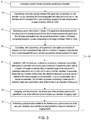
- FIG. 3 is a flow chart for a method 30 for performing a physical action related to a formation.
- Block 31 calls for conveying a carrier through a borehole penetrating the formation.
- the carrier can be a drill string, coiled tubing, a slick line, or a wireline.
- Block 32 calls for transmitting a first time-domain transient EM signal into the borehole and the formation using a downhole EM wave propagation tool disposed on the carrier, the first time-domain transient EM signal comprising frequency domain components in a range of at least 1 MHz to 1 GHz. In one or more embodiments, the number of frequency domain components in that range is at least ten.
- the number of frequency domain components is at least 100 or 1000 or more. In general, an increase in the number of frequency domain components will result in an increase in accuracy of values of properties determined using those frequency domain components. In one or more embodiments, the selected number of frequency domain components is spread evenly throughout the range of at least 1 MHz to 1 GHz. In one or more embodiments, the transmitting is performed by a transmitter assembly that is part of the downhole EM wave propagation tool.
- the transmitter assembly includes a transmitter antenna and associated transmitter electronics.
- FIG. 4 illustrates one example of a broadband shape of excitation voltage applied to the transmitter antenna.
- Block 33 calls for receiving a second time-domain transient EM signal from the borehole and the formation due to the transmitting of the first time-domain transient EM signal using the EM wave propagation tool, the second time-domain transient EM signal comprising frequency domain components in the range of at least 1 MHz to 1 GHz.
- the receiving is performed by a receiver assembly that is part of the downhole EM wave propagation tool.
- the receiver assembly includes a receiver antenna and associated receiver electronics.
- the receiver antenna is spaced a distance D from the transmitter antenna. In one or more embodiments, the distance D is nine inches.
- FIG. 5 illustrates one example of a broadband shape of voltage induced in the receiver antenna due to the transmitted pulse illustrated in FIG. 4 .
- the receiver antenna is spaced nine inches from the transmitter antenna. Measurements can be made while the downhole EM wave propagation tool is moving or, alternatively, while the tool is temporarily stopped at certain depths in order to provide measurements that are a function of depth in the borehole.
- block 34 calls for calculating, with a processor, an S-parameter attenuation as a function of frequency and an S-parameter phase shift as a function of frequency using the first time-domain transient EM signal and the second time-domain transient EM signal.
- a Fourier transform is applied to the first and second signals to provide a magnitude and phase as a function of frequency for each of those signals.
- the S-parameter attenuation is thus a difference in the magnitudes of the transformed first and second signals.
- the S-parameter phase shift is thus a difference in the phases of the transformed first and second signals.
- FIG. 6 illustrates one example of an S-parameter amplitude spectrum of the received signal obtained through Fourier transform of the time-domain signal illustrated in FIG. 5 .
- FIG. 7 illustrates one example of an S-parameter phase spectrum obtained through Fourier transform of the time-domain signal illustrated in FIG. 5 . If the phase of the transmitted first EM signal is considered at zero, then the phase spectrum illustrated in FIG. 7 can be considered to be a phase difference spectrum. Similarly, if the amplitude of the transmitted first EM signal is arbitrarily considered to be zero, then the magnitude spectrum illustrated in FIG. 6 can be considered to be a magnitude attenuation spectrum.
- block 35 calls identifying, with the processor, a reference comprising a reference S-parameter attenuation as a function of frequency and a reference S-parameter phase shift as a function of frequency that are within a selected range of the calculated S-parameter attenuation as a function of frequency and the calculated S-parameter phase shift as a function of frequency, the reference representing at least one of a reference EM wave propagation tool parameter, a borehole parameter, and a formation parameter, the formation parameter comprising at least one of a resistivity value and a permittivity value of the formation as a function of frequency.
- ⁇ r is the formation relative permittivity
- ⁇ is the formation conductivity
- ⁇ is the angular frequency
- ⁇ 0 is the vacuum permittivity constant.
- references can be generated.
- One way is by laboratory testing using an EM wave propagation tool having a known configuration.
- the EM wave propagation tool can be used to test or benchmark various formation samples where each sample has known characteristics.
- the various formation samples can have various types and combinations of fluids, various pore shapes, and various pore sizes.
- Another way is to generate synthetic data using known physics modeling software such as COMSOL Multiphysics® for example.
- the synthetic data can be generated for EM wave propagation tools having various configurations interrogating various formations having various characteristics.
- block 36 calls for Assigning, with the processor, the at least one of the resistivity value and the permittivity value of the reference to the formation as a function of logging depth. That is, once the closest match to one reference in a plurality of references is determined, the resistivity value and/or the complex permittivity value of the formation as a function of depth of the matched reference is assigned to the formation of interest as a function of logging depth.
- Block 37 calls for performing a physical action related to the formation using the at least one of the assigned resistivity value and the assigned permittivity value as a function of logging depth.
- the method 30 may also include determining a salinity value of a fluid in the formation using the associated resistivity value and the physical action may include developing the formation based on the salinity value being less than or equal to a threshold value.
- the term “developing” is inclusive of any actions related to producing hydrocarbons from a formation and may include drilling a new borehole or extending an existing borehole, hydraulically fracturing formation rock, placing and perforating a casing as non-limiting examples. Each of the actions is based on data obtained by the broadband EM wave propagation tool where the data meets a criterion with respect to a contemplated type of action.
- the method 30 may also include calculating a relative amount of hydrocarbons in the formation with respect to another fluid as a function of depth in the formation using the associated complex permittivity of the formation as a function of frequency; and performing the physical action related to the formation using the calculated relative amount of hydrocarbons with respect to another fluid as a function of logging depth in the formation.
- the physical action may include drilling a borehole into the formation having a trajectory that leads to a formation zone having at least a specified relative amount of hydrocarbons with respect to the another fluid.
- physical action may include hydraulically fracturing a formation zone having at least a specified relative amount of hydrocarbons with respect to the another fluid.
- the physical action may include placing a casing in the borehole based on the formation having at least a specified relative amount of hydrocarbons with respect to the another fluid over a range of depths. In one or more embodiments, the physical action may include perforating a casing lining the borehole in a formation zone having at least a specified relative amount of hydrocarbons with respect to the another fluid.
- dispersion model used to explain dispersive behavior of formation resistivity and dielectric constant.
- One dispersion model is the CRIM model. At frequencies of the order of 1 GHz and higher, the permittivity responds mainly to water volume, whereas at frequencies of 100 MHz and below the permittivity responds not only to water volume but also to interfacial polarization related to the rock texture.
- a method for performing a physical action related to a formation comprising: transmitting a first time-domain transient electromagnetic (EM) signal into a borehole penetrating the formation and into the formation using a downhole EM wave propagation tool configured to be conveyed through the borehole, the first time-domain transient EM signal comprising frequency domain components in a range of at least 1 MHz to 1 GHz; receiving a second time-domain transient EM signal from the borehole and the formation due to the transmitting of the first EM signal using the downhole EM wave propagation tool, the second time-domain transient EM signal comprising frequency domain components in the range of at least 1 MHz to 1 GHz; calculating, with a processor, an S-parameter attenuation as a function of frequency and an S-parameter phase shift as a function of frequency using the first time-domain transient EM signal and the second time-domain transient EM signal: identifying, with the processor, a reference comprising a reference S-parameter attenuation as
- calculating comprises performing a Fourier transform on the first time-domain transient EM signal and the second time-domain transient EM signal.
- the method according to any prior embodiment further comprising: calculating a relative amount of hydrocarbons in the formation with respect to another fluid as a function of depth in the formation using the associated resistivity and permittivity of the formation and a dispersion model as functions of frequency: and performing the physical action related to the formation using the calculated relative amount of hydrocarbons with respect to another fluid as a function of logging depth in the formation.
- hydrocarbons comprise oil and the another fluid comprises water.
- the dispersion model comprises at least one of the following forms: CRIM model, Generalized CRIM model, Cole-Cole model, Cole-Davidson model, and Hoviciak-Megami model.
- the physical action comprises drilling a borehole into the formation having a trajectory that leads to a formation zone having at least a specified relative amount of hydrocarbons with respect to the another fluid.
- the physical action comprises hydraulically fracturing a formation zone having at least a specified relative amount of hydrocarbons with respect to the another fluid.
- the physical action comprises placing a casing in the borehole based on the formation having at least a specified relative amount of hydrocarbons with respect to the another fluid over a range of depths.
- the physical action comprises perforating a casing lining the borehole in a formation zone having at least a specified relative amount of hydrocarbons with respect to the another fluid.
- the method according to any prior embodiment further comprising determining a salinity value of a fluid in the formation using the associated resistivity value and wherein the physical action comprises developing the formation based on the salinity value being less than or equal to a threshold value.
- the reference accounts for at least a portion of a parasitic effect of the first EM signal propagating through the borehole and not through the formation.
- the downhole EM wave propagation tool is disposed on a carrier configured to be conveyed through the borehole and the method further comprises conveying the carrier through the borehole.
- An apparatus for performing a physical action related to a formation comprising: a downhole EM wave propagation tool configured to be conveyed through a borehole penetrating the formation and comprising a broadband transmitter assembly configured to transmit a first electromagnetic (EM) signal into the borehole and the formation, the first EM signal comprising frequency domain components in a range of at least 1 MHz to 1 GHz, the broadband transmitter assembly comprising a transmitter antenna: a broadband receiver assembly included in the downhole EM wave propagation tool and configured to receive a second time-domain transient EM signal from the borehole and the formation due to the transmitting of the first time-domain transient EM signal using the downhole EM wave propagation tool, the second time-domain transient EM signal comprising frequency domain components in the range of at least 1 MHz to 1 GHz, the broadband receiver assembly comprising a receiver antenna; a processor configure to: calculate an S-parameter attenuation as a function of frequency and an S-parameter phase shift as a function of frequency using the first EM
- the processor is further configured to calculate a relative amount of hydrocarbons in the formation with respect to another fluid as a function of logging depth in the formation using the associated complex permittivity of the formation as a function of frequency and the apparatus for performing the physical action related to the formation is further configured to perform the physical action using the calculated relative amount of hydrocarbons with respect to another fluid as a function of logging depth in the formation.
- the carrier comprises one of a drill string, coiled tubing, a slick line, and a wireline.
- various analysis components may be used, including a digital and/or an analog system.
- the surface computer processing system 17 , 22 , the downhole EM wave propagation tool 11 , the drilling parameter controller 14 , the geo-steering system 15 , the downhole electronics 16 , the reservoir stimulation system 28 , and/or the downhole tool 21 may include digital and/or analog systems.
- the system may have components such as a processor, storage media, memory, input, output, communications link (wired, wireless, optical or other), user interfaces (e.g., a display or printer), software programs, signal processors (digital or analog) and other such components (such as resistors, capacitors, inductors and others) to provide for operation and analyses of the apparatus and methods disclosed herein in any of several manners well-appreciated in the art.
- components such as a processor, storage media, memory, input, output, communications link (wired, wireless, optical or other), user interfaces (e.g., a display or printer), software programs, signal processors (digital or analog) and other such components (such as resistors, capacitors, inductors and others) to provide for operation and analyses of the apparatus and methods disclosed herein in any of several manners well-appreciated in the art.
- a power supply e.g., at least one of a generator, a remote supply and a battery, magnet, electromagnet, sensor, electrode, transmitter, receiver, transceiver, antenna, controller, optical unit, electrical unit or electromechanical unit may be included in support of the various aspects discussed herein or in support of other functions beyond this disclosure.
- carrier means any device, device component, combination of devices, media and/or member that may be used to convey, house, support or otherwise facilitate the use of another device, device component, combination of devices, media and/or member.
- Other exemplar) non-limiting carriers include drill strings of the coiled tube type, of the jointed pipe type and any combination or portion thereof.
- Other carrier examples include casing pipes, wirelines, wireline sondes, slickline sondes, drop shots, bottom-hole-assemblies, drill string inserts, modules, internal housings and substrate portions thereof.
Landscapes
- Life Sciences & Earth Sciences (AREA)
- Engineering & Computer Science (AREA)
- Geology (AREA)
- Physics & Mathematics (AREA)
- Mining & Mineral Resources (AREA)
- Environmental & Geological Engineering (AREA)
- General Life Sciences & Earth Sciences (AREA)
- Fluid Mechanics (AREA)
- Geochemistry & Mineralogy (AREA)
- Remote Sensing (AREA)
- Geophysics (AREA)
- General Physics & Mathematics (AREA)
- Electromagnetism (AREA)
- Geophysics And Detection Of Objects (AREA)
Abstract
Description
which characterizes dispersive formation, is determined. εr is the formation relative permittivity, σ is the formation conductivity, ω is the angular frequency, ε0 is the vacuum permittivity constant. The high density spectrums illustrated in


where εr=(1+χe) is the relative permittivity (real number) and χe is the susceptibility (

where
where
is called complex relative permittivity.
From rot

k=√{square root over (μω2ε0ε*)}=ω√{square root over (με0(εr −iσ/ωε 0))}.
√{square root over (εFormation*)}=(1−Φ)√{square root over (εMatrix)}+S WΦ√{square root over (εWater*)}+(1−S W)Φ√{square root over (εOil)} (4)
The above expression is called the complex refractive index method, CRIM. Note that the DC (i.e., zero frequency) limit of this equation is Archie's equation with m=n=2.
(εFormation*)n=(1−Φ)εMatrix n +S WΦ(εWater*)n+(1−S W)ΦεOil n, (5)
where εFormation* and εWater* are complex numbers, while εMatrix and εOil are real numbers, and n is real number. Unlike equation (4), equation (5) provides more flexibility in fitting the measurements since offers additional fitting parameter n.
where conductivity σ proportional to the water salinity.
where σ corresponds to the water conductivity at the DC limit. Both parameter β and α varies between 0 and 1. When α=0 Havriliak-Negami coincides with Cole-Davidson. Hence, by using the CRIM model or any of the alternative mixing laws, the relative amount of hydrocarbons such as oil can be determined with respect to another fluid such as water.

Claims (19)
Priority Applications (4)
| Application Number | Priority Date | Filing Date | Title |
|---|---|---|---|
| US15/906,853 US10564310B2 (en) | 2018-02-27 | 2018-02-27 | Dielectric logging with broadband excitation |
| ARP190100417A AR114398A1 (en) | 2018-02-27 | 2019-02-18 | DIELECTRIC ACQUISITION OF RECORDS WITH BROADBAND STIMULATION |
| PCT/US2019/019161 WO2019168753A1 (en) | 2018-02-27 | 2019-02-22 | Dielectric logging with broadband excitation |
| EP19761527.1A EP3759523B1 (en) | 2018-02-27 | 2019-02-22 | Dielectric logging with broadband excitation |
Applications Claiming Priority (1)
| Application Number | Priority Date | Filing Date | Title |
|---|---|---|---|
| US15/906,853 US10564310B2 (en) | 2018-02-27 | 2018-02-27 | Dielectric logging with broadband excitation |
Publications (2)
| Publication Number | Publication Date |
|---|---|
| US20190265382A1 US20190265382A1 (en) | 2019-08-29 |
| US10564310B2 true US10564310B2 (en) | 2020-02-18 |
Family
ID=67685748
Family Applications (1)
| Application Number | Title | Priority Date | Filing Date |
|---|---|---|---|
| US15/906,853 Active 2038-07-10 US10564310B2 (en) | 2018-02-27 | 2018-02-27 | Dielectric logging with broadband excitation |
Country Status (4)
| Country | Link |
|---|---|
| US (1) | US10564310B2 (en) |
| EP (1) | EP3759523B1 (en) |
| AR (1) | AR114398A1 (en) |
| WO (1) | WO2019168753A1 (en) |
Cited By (1)
| Publication number | Priority date | Publication date | Assignee | Title |
|---|---|---|---|---|
| US20220035063A1 (en) * | 2019-02-18 | 2022-02-03 | Schlumberger Technology Corporation | Engineering completion and selective fracturing of lateral wellbores |
Families Citing this family (5)
| Publication number | Priority date | Publication date | Assignee | Title |
|---|---|---|---|---|
| GB2581839A (en) * | 2019-03-01 | 2020-09-02 | Equinor Energy As | Estimating water saturation of a subsurface formation |
| CN110673218A (en) * | 2019-09-05 | 2020-01-10 | 中国科学院地质与地球物理研究所 | Method for extracting IP information in transient electromagnetic response of grounding wire source |
| WO2021173150A1 (en) * | 2020-02-28 | 2021-09-02 | Schlumberger Technology Corporation | Quantification of formation water saturation and salinity using relative permittivity and conductivity measurements |
| CN111859647B (en) * | 2020-07-09 | 2021-08-31 | 广西交通设计集团有限公司 | A Design Method of Semi-Aerial Transient Electromagnetic Observation Area |
| CN121410813B (en) * | 2025-12-08 | 2026-05-15 | 四川省第九地质大队 | A geological exploration method based on time-frequency electromagnetic method |
Citations (27)
| Publication number | Priority date | Publication date | Assignee | Title |
|---|---|---|---|---|
| US3891916A (en) | 1973-08-27 | 1975-06-24 | Texaco Inc | Dual radio frequency measurement of dielectric constant and resistivity of borehole media |
| US4009434A (en) | 1974-12-09 | 1977-02-22 | Texaco Inc. | Dielectric induction logging system for obtaining water and residual oil saturation of earth formations |
| US4012689A (en) | 1974-10-24 | 1977-03-15 | Texaco Inc. | Radio frequency resistivity and dielectric constant well logging utilizing phase shift measurement |
| US4107597A (en) | 1976-12-13 | 1978-08-15 | Texaco Inc. | Electromagnetic wave propagation well logging utilizing multiple phase shift measurement |
| DE2832433A1 (en) | 1978-07-24 | 1980-02-14 | Texaco Development Corp | Resistivity and dielectric constant determination of earth formations - uses electromagnetic wave logging system to transmit, and receive at different spacings at 30 megahertz |
| US4489276A (en) | 1982-01-20 | 1984-12-18 | The United States Of America As Represented By The United States Department Of Energy | Dual-cone double-helical downhole logging device |
| US4594551A (en) | 1983-03-31 | 1986-06-10 | Texaco Inc. | Method of deep penetration well logging using three receivers |
| US4687995A (en) | 1984-03-05 | 1987-08-18 | Texaco Inc. | Secondary field dielectric constant and/or resistivity well logging system and method |
| US4785247A (en) | 1983-06-27 | 1988-11-15 | Nl Industries, Inc. | Drill stem logging with electromagnetic waves and electrostatically-shielded and inductively-coupled transmitter and receiver elements |
| US5132623A (en) | 1990-11-20 | 1992-07-21 | Chevron Research And Technology Company | Method and apparatus for broadband measurement of dielectric properties |
| US5367262A (en) * | 1991-07-12 | 1994-11-22 | Halliburton Logging Serivces, Inc. | Advances in high frequency dielectric logging |
| US5811973A (en) | 1994-03-14 | 1998-09-22 | Baker Hughes Incorporated | Determination of dielectric properties with propagation resistivity tools using both real and imaginary components of measurements |
| US6509738B1 (en) | 2000-07-14 | 2003-01-21 | Schlumberger Technology Corporation | Electromagnetic induction well logging instrument having azimuthally sensitive response |
| US6777940B2 (en) | 2002-11-08 | 2004-08-17 | Ultima Labs, Inc. | Apparatus and method for resistivity well logging |
| WO2005117450A1 (en) | 2004-05-28 | 2005-12-08 | Koninklijke Philips Electronics N.V. | Method of and device for encoding a data stream |
| US20110068796A1 (en) | 2009-09-18 | 2011-03-24 | Baker Hughes Incorporated | Frequency filtering and adjustment of electromagnetically received signals from antennas |
| US20110251795A1 (en) | 2010-04-13 | 2011-10-13 | Baker Hughes Incorporated | Dielectric spectroscopy for downhole fluid analysis during formation testing |
| US8680865B2 (en) | 2010-03-19 | 2014-03-25 | Schlumberger Technology Corporation | Single well reservoir imaging apparatus and methods |
| US20150008928A1 (en) | 2012-07-11 | 2015-01-08 | Pico Technologies Llc | Electronics for a Thin Bed Array Induction Logging System |
| US8957683B2 (en) | 2008-11-24 | 2015-02-17 | Halliburton Energy Services, Inc. | High frequency dielectric measurement tool |
| US20160094331A1 (en) * | 2014-09-26 | 2016-03-31 | Avago Technologies General IP (Singapore) Pte. Ltd . | Multiplexers and Duplexers Having Active Cancellation for Improved Isolation between Transmit and Receive Ports |
| US9356342B1 (en) * | 2011-12-12 | 2016-05-31 | The Boeing Company | Method for determining an antenna pattern in a reverberant environment |
| US20160187521A1 (en) | 2014-08-18 | 2016-06-30 | Schlumberger Technology Corporation | Multi-Frequency Electromagnetic Tensor Measurements |
| US20160282512A1 (en) | 2013-12-06 | 2016-09-29 | Halliburton Energy Services, Inc. | Fracture detection and characterization using resistivity images |
| US20160363686A1 (en) | 2015-06-12 | 2016-12-15 | Baker Hughes Incorporated | Antenna structures and apparatus for dielectric logging |
| US20170010377A1 (en) | 2014-04-02 | 2017-01-12 | Baker Hughes Incorporated | Imaging of earth formation with high frequency sensor |
| US20170102479A1 (en) | 2015-10-12 | 2017-04-13 | Baker Hughes Incorporated | Whole-space inversion using phase correction method for multi-frequency dielectric array logging tool |
Family Cites Families (4)
| Publication number | Priority date | Publication date | Assignee | Title |
|---|---|---|---|---|
| CN100424523C (en) * | 2004-06-01 | 2008-10-08 | 埃克森美孚上游研究公司 | Kalman filter method for processing electromagnetic data |
| EP2734869B1 (en) | 2011-07-18 | 2020-02-26 | Baker Hughes, a GE company, LLC | Finding oil content of the formation using dielectric spectroscopy |
| CN107002488A (en) | 2014-12-31 | 2017-08-01 | 哈利伯顿能源服务公司 | Formation logging using multicomponent signal-based measurements of anisotropic permittivity and resistivity |
| US10459110B2 (en) | 2016-07-08 | 2019-10-29 | Baker Hughes, A Ge Company, Llc | Flexible conductive shield for downhole electromagnetic noise suppression |
-
2018
- 2018-02-27 US US15/906,853 patent/US10564310B2/en active Active
-
2019
- 2019-02-18 AR ARP190100417A patent/AR114398A1/en active IP Right Grant
- 2019-02-22 WO PCT/US2019/019161 patent/WO2019168753A1/en not_active Ceased
- 2019-02-22 EP EP19761527.1A patent/EP3759523B1/en active Active
Patent Citations (27)
| Publication number | Priority date | Publication date | Assignee | Title |
|---|---|---|---|---|
| US3891916A (en) | 1973-08-27 | 1975-06-24 | Texaco Inc | Dual radio frequency measurement of dielectric constant and resistivity of borehole media |
| US4012689A (en) | 1974-10-24 | 1977-03-15 | Texaco Inc. | Radio frequency resistivity and dielectric constant well logging utilizing phase shift measurement |
| US4009434A (en) | 1974-12-09 | 1977-02-22 | Texaco Inc. | Dielectric induction logging system for obtaining water and residual oil saturation of earth formations |
| US4107597A (en) | 1976-12-13 | 1978-08-15 | Texaco Inc. | Electromagnetic wave propagation well logging utilizing multiple phase shift measurement |
| DE2832433A1 (en) | 1978-07-24 | 1980-02-14 | Texaco Development Corp | Resistivity and dielectric constant determination of earth formations - uses electromagnetic wave logging system to transmit, and receive at different spacings at 30 megahertz |
| US4489276A (en) | 1982-01-20 | 1984-12-18 | The United States Of America As Represented By The United States Department Of Energy | Dual-cone double-helical downhole logging device |
| US4594551A (en) | 1983-03-31 | 1986-06-10 | Texaco Inc. | Method of deep penetration well logging using three receivers |
| US4785247A (en) | 1983-06-27 | 1988-11-15 | Nl Industries, Inc. | Drill stem logging with electromagnetic waves and electrostatically-shielded and inductively-coupled transmitter and receiver elements |
| US4687995A (en) | 1984-03-05 | 1987-08-18 | Texaco Inc. | Secondary field dielectric constant and/or resistivity well logging system and method |
| US5132623A (en) | 1990-11-20 | 1992-07-21 | Chevron Research And Technology Company | Method and apparatus for broadband measurement of dielectric properties |
| US5367262A (en) * | 1991-07-12 | 1994-11-22 | Halliburton Logging Serivces, Inc. | Advances in high frequency dielectric logging |
| US5811973A (en) | 1994-03-14 | 1998-09-22 | Baker Hughes Incorporated | Determination of dielectric properties with propagation resistivity tools using both real and imaginary components of measurements |
| US6509738B1 (en) | 2000-07-14 | 2003-01-21 | Schlumberger Technology Corporation | Electromagnetic induction well logging instrument having azimuthally sensitive response |
| US6777940B2 (en) | 2002-11-08 | 2004-08-17 | Ultima Labs, Inc. | Apparatus and method for resistivity well logging |
| WO2005117450A1 (en) | 2004-05-28 | 2005-12-08 | Koninklijke Philips Electronics N.V. | Method of and device for encoding a data stream |
| US8957683B2 (en) | 2008-11-24 | 2015-02-17 | Halliburton Energy Services, Inc. | High frequency dielectric measurement tool |
| US20110068796A1 (en) | 2009-09-18 | 2011-03-24 | Baker Hughes Incorporated | Frequency filtering and adjustment of electromagnetically received signals from antennas |
| US8680865B2 (en) | 2010-03-19 | 2014-03-25 | Schlumberger Technology Corporation | Single well reservoir imaging apparatus and methods |
| US20110251795A1 (en) | 2010-04-13 | 2011-10-13 | Baker Hughes Incorporated | Dielectric spectroscopy for downhole fluid analysis during formation testing |
| US9356342B1 (en) * | 2011-12-12 | 2016-05-31 | The Boeing Company | Method for determining an antenna pattern in a reverberant environment |
| US20150008928A1 (en) | 2012-07-11 | 2015-01-08 | Pico Technologies Llc | Electronics for a Thin Bed Array Induction Logging System |
| US20160282512A1 (en) | 2013-12-06 | 2016-09-29 | Halliburton Energy Services, Inc. | Fracture detection and characterization using resistivity images |
| US20170010377A1 (en) | 2014-04-02 | 2017-01-12 | Baker Hughes Incorporated | Imaging of earth formation with high frequency sensor |
| US20160187521A1 (en) | 2014-08-18 | 2016-06-30 | Schlumberger Technology Corporation | Multi-Frequency Electromagnetic Tensor Measurements |
| US20160094331A1 (en) * | 2014-09-26 | 2016-03-31 | Avago Technologies General IP (Singapore) Pte. Ltd . | Multiplexers and Duplexers Having Active Cancellation for Improved Isolation between Transmit and Receive Ports |
| US20160363686A1 (en) | 2015-06-12 | 2016-12-15 | Baker Hughes Incorporated | Antenna structures and apparatus for dielectric logging |
| US20170102479A1 (en) | 2015-10-12 | 2017-04-13 | Baker Hughes Incorporated | Whole-space inversion using phase correction method for multi-frequency dielectric array logging tool |
Non-Patent Citations (2)
| Title |
|---|
| Notification of Transmittal of the International Search Report and the Written Opinion of the International Searching Authority, PCT/US2019/001961; dated May 21, 2019; 11 pages. |
| Schlumberger; "Dielectric Scanner"; 2017; Sclumberger Limited;[retrieved on Sep. 19, 2017]; Retrived from the internet; URL:http//www.slb.com/services/characterization/petrophysics/wireline/dielectric_scanner.aspx; 2 pages. |
Cited By (2)
| Publication number | Priority date | Publication date | Assignee | Title |
|---|---|---|---|---|
| US20220035063A1 (en) * | 2019-02-18 | 2022-02-03 | Schlumberger Technology Corporation | Engineering completion and selective fracturing of lateral wellbores |
| US11726228B2 (en) * | 2019-02-18 | 2023-08-15 | Schlumberger Technology Corporation | Engineering completion and selective fracturing of lateral wellbores |
Also Published As
| Publication number | Publication date |
|---|---|
| EP3759523B1 (en) | 2024-03-27 |
| EP3759523A4 (en) | 2021-11-17 |
| WO2019168753A1 (en) | 2019-09-06 |
| AR114398A1 (en) | 2020-09-02 |
| US20190265382A1 (en) | 2019-08-29 |
| EP3759523A1 (en) | 2021-01-06 |
Similar Documents
| Publication | Publication Date | Title |
|---|---|---|
| EP3759523B1 (en) | Dielectric logging with broadband excitation | |
| EP2699945B1 (en) | A method for determining formation porosity | |
| EP3732510B1 (en) | Real-time inversion of array dielectric downhole measurements with advanced search for intial values to eliminate non-uniqueness | |
| US10649110B2 (en) | Determination of shale content of formation from dispersive multi-frequency dielectric measurements | |
| US8598895B2 (en) | System and method to measure dielectric constant in a subterranean well | |
| US20150260874A1 (en) | System and Method for Imaging Subterranean Formations | |
| US20170284190A1 (en) | Reservoir Monitoring Using Galvanically Excited Transient Electromagnetic Fields | |
| Yao et al. | Reservoir permeability estimation from time-lapse log data | |
| WO2017165480A2 (en) | Estimating parameters of archie's law and formation texture information | |
| WO2016209822A1 (en) | Predicting hydraulic fracture propagation | |
| US20180372906A1 (en) | Determining Downhole Wettability | |
| WO2017075430A1 (en) | Real-time true resistivity estimation for logging-while-drilling tools | |
| US10344571B2 (en) | Optimization of excitation source placement for downhole ranging and telemetry operations | |
| WO2022026443A1 (en) | Determine formation's textural parameters using advancing logging data | |
| US20190284911A1 (en) | Optimization of Excitation Source Placement for Downhole Telemetry Operations | |
| US10947841B2 (en) | Method to compute density of fractures from image logs | |
| WO2018075019A1 (en) | Relative permeability estimation methods and systems employing downhole pressure transient analysis, saturation analysis, and porosity analysis | |
| US11060397B2 (en) | Disposing a carrier downhole in a wellbore to evaluate an earth formation | |
| AU2015200156B2 (en) | Methods and systems for estimating formation resistivity and porosity |
Legal Events
| Date | Code | Title | Description |
|---|---|---|---|
| FEPP | Fee payment procedure |
Free format text: ENTITY STATUS SET TO UNDISCOUNTED (ORIGINAL EVENT CODE: BIG.); ENTITY STATUS OF PATENT OWNER: LARGE ENTITY |
|
| AS | Assignment |
Owner name: BAKER HUGHES, A GE COMPANY, LLC, TEXAS Free format text: ASSIGNMENT OF ASSIGNORS INTEREST;ASSIGNORS:ITSKOVICH, GREGORY B.;LE, FEI;KHOKHAR, RASHID W.;SIGNING DATES FROM 19901219 TO 20180222;REEL/FRAME:045834/0413 |
|
| STPP | Information on status: patent application and granting procedure in general |
Free format text: NOTICE OF ALLOWANCE MAILED -- APPLICATION RECEIVED IN OFFICE OF PUBLICATIONS |
|
| STPP | Information on status: patent application and granting procedure in general |
Free format text: NOTICE OF ALLOWANCE MAILED -- APPLICATION RECEIVED IN OFFICE OF PUBLICATIONS |
|
| STCF | Information on status: patent grant |
Free format text: PATENTED CASE |
|
| MAFP | Maintenance fee payment |
Free format text: PAYMENT OF MAINTENANCE FEE, 4TH YEAR, LARGE ENTITY (ORIGINAL EVENT CODE: M1551); ENTITY STATUS OF PATENT OWNER: LARGE ENTITY Year of fee payment: 4 |