US10563029B2 - Resin composition and prepreg, resin sheet, laminate, and printed circuit board - Google Patents
Resin composition and prepreg, resin sheet, laminate, and printed circuit board Download PDFInfo
- Publication number
- US10563029B2 US10563029B2 US15/738,854 US201615738854A US10563029B2 US 10563029 B2 US10563029 B2 US 10563029B2 US 201615738854 A US201615738854 A US 201615738854A US 10563029 B2 US10563029 B2 US 10563029B2
- Authority
- US
- United States
- Prior art keywords
- group
- resin composition
- compound
- mass
- resin
- Prior art date
- Legal status (The legal status is an assumption and is not a legal conclusion. Google has not performed a legal analysis and makes no representation as to the accuracy of the status listed.)
- Active, expires
Links
- 0 *C=CC.C/C=C/C1=CC=CC=C1.C/C=C/C1=CC=CC=C1.CCC Chemical compound *C=CC.C/C=C/C1=CC=CC=C1.C/C=C/C1=CC=CC=C1.CCC 0.000 description 26
- QESNNBRRYCBDQB-LAZNYTCVSA-N C/C=C/C1=CC=CC=C1.C/C=C/C1=CC=CC=C1.CCC Chemical compound C/C=C/C1=CC=CC=C1.C/C=C/C1=CC=CC=C1.CCC QESNNBRRYCBDQB-LAZNYTCVSA-N 0.000 description 3
- JRZSSQRNBKDVDD-LQIBPGRFSA-N C/C=C/C1=CC=CC=C1OC1=CC=C(C(=O)C2=CC=C(OC3=C(/C=C/C)C=CC=C3)C=C2)C=C1 Chemical compound C/C=C/C1=CC=CC=C1OC1=CC=C(C(=O)C2=CC=C(OC3=C(/C=C/C)C=CC=C3)C=C2)C=C1 JRZSSQRNBKDVDD-LQIBPGRFSA-N 0.000 description 3
- NCOYHAJJCAHAQT-UHFFFAOYSA-N C=CCC.C=CCC.C=CCC.C=CCC.O=C1C2C3C=CC(C3)C2C(=O)N1C1=CC=C(CC2=CC=C(N3C(=O)C4C5C=CC(C5)C4C3=O)C=C2)C=C1.O=C1C2C3C=CC(C3)C2C(=O)N1CC1=CC=CC(CN2C(=O)C3C4C=CC(C4)C3C2=O)=C1 Chemical compound C=CCC.C=CCC.C=CCC.C=CCC.O=C1C2C3C=CC(C3)C2C(=O)N1C1=CC=C(CC2=CC=C(N3C(=O)C4C5C=CC(C5)C4C3=O)C=C2)C=C1.O=C1C2C3C=CC(C3)C2C(=O)N1CC1=CC=CC(CN2C(=O)C3C4C=CC(C4)C3C2=O)=C1 NCOYHAJJCAHAQT-UHFFFAOYSA-N 0.000 description 3
- NOZXAIXLMRGEQU-UHFFFAOYSA-N C.C.CCC1=CC=C(CC)C=C1 Chemical compound C.C.CCC1=CC=C(CC)C=C1 NOZXAIXLMRGEQU-UHFFFAOYSA-N 0.000 description 2
- DSNHSQKRULAAEI-UHFFFAOYSA-N CCC1=CC=C(CC)C=C1 Chemical compound CCC1=CC=C(CC)C=C1 DSNHSQKRULAAEI-UHFFFAOYSA-N 0.000 description 2
- UQEBURHSWWDHNK-OSEPRGRFSA-N C=CCC1=CC2CC1C1C(=O)N(C3=CC=C(C(C)C)C=C3)C(=O)C21.CC(C)C1=CC=C(N2C(=O)C3C4C=C(/C=C/CC5CC(=O)N(C(C)C)C5=O)C(C4)C3C2=O)C=C1.CC(C)C1=CC=C(N2C(=O)C3C4C=C(/C=C/CC5CC(=O)N(C(C)C)C5=O)C(C4)C3C2=O)C=C1.CC(C)C1=CC=C(N2C(=O)C3C4CC(C3C2=O)C2C4=CC(CC3CC(=O)N(C(C)C)C3=O)C3C(=O)N(C)C(=O)C32)C=C1.CC(C)N1C(=O)C=CC1=O.CC(C)N1C(=O)C=CC1=O Chemical compound C=CCC1=CC2CC1C1C(=O)N(C3=CC=C(C(C)C)C=C3)C(=O)C21.CC(C)C1=CC=C(N2C(=O)C3C4C=C(/C=C/CC5CC(=O)N(C(C)C)C5=O)C(C4)C3C2=O)C=C1.CC(C)C1=CC=C(N2C(=O)C3C4C=C(/C=C/CC5CC(=O)N(C(C)C)C5=O)C(C4)C3C2=O)C=C1.CC(C)C1=CC=C(N2C(=O)C3C4CC(C3C2=O)C2C4=CC(CC3CC(=O)N(C(C)C)C3=O)C3C(=O)N(C)C(=O)C32)C=C1.CC(C)N1C(=O)C=CC1=O.CC(C)N1C(=O)C=CC1=O UQEBURHSWWDHNK-OSEPRGRFSA-N 0.000 description 1
- VFCSUSIZWXPCHF-UHFFFAOYSA-N C=CCCC(C(C1)C2C(N3Cc4cccc(CN(C(C5C6C7C(CCC=C)=CC5C7)=O)C6=O)c4)=O)=CC1C2C3=O Chemical compound C=CCCC(C(C1)C2C(N3Cc4cccc(CN(C(C5C6C7C(CCC=C)=CC5C7)=O)C6=O)c4)=O)=CC1C2C3=O VFCSUSIZWXPCHF-UHFFFAOYSA-N 0.000 description 1
- BOJJGDUAXXFRTI-UHFFFAOYSA-N C=CCCC(C(C1)C2C(N3c4ccc(Cc(cc5)ccc5N(C(C5C6C7C(CCC=C)=CC5C7)=O)C6=O)cc4)=O)=CC1C2C3=O Chemical compound C=CCCC(C(C1)C2C(N3c4ccc(Cc(cc5)ccc5N(C(C5C6C7C(CCC=C)=CC5C7)=O)C6=O)cc4)=O)=CC1C2C3=O BOJJGDUAXXFRTI-UHFFFAOYSA-N 0.000 description 1
Classifications
-
- C—CHEMISTRY; METALLURGY
- C08—ORGANIC MACROMOLECULAR COMPOUNDS; THEIR PREPARATION OR CHEMICAL WORKING-UP; COMPOSITIONS BASED THEREON
- C08J—WORKING-UP; GENERAL PROCESSES OF COMPOUNDING; AFTER-TREATMENT NOT COVERED BY SUBCLASSES C08B, C08C, C08F, C08G or C08H
- C08J5/00—Manufacture of articles or shaped materials containing macromolecular substances
- C08J5/24—Impregnating materials with prepolymers which can be polymerised in situ, e.g. manufacture of prepregs
-
- C—CHEMISTRY; METALLURGY
- C08—ORGANIC MACROMOLECULAR COMPOUNDS; THEIR PREPARATION OR CHEMICAL WORKING-UP; COMPOSITIONS BASED THEREON
- C08G—MACROMOLECULAR COMPOUNDS OBTAINED OTHERWISE THAN BY REACTIONS ONLY INVOLVING UNSATURATED CARBON-TO-CARBON BONDS
- C08G73/00—Macromolecular compounds obtained by reactions forming a linkage containing nitrogen with or without oxygen or carbon in the main chain of the macromolecule, not provided for in groups C08G12/00 - C08G71/00
- C08G73/06—Polycondensates having nitrogen-containing heterocyclic rings in the main chain of the macromolecule
- C08G73/10—Polyimides; Polyester-imides; Polyamide-imides; Polyamide acids or similar polyimide precursors
- C08G73/12—Unsaturated polyimide precursors
-
- B—PERFORMING OPERATIONS; TRANSPORTING
- B32—LAYERED PRODUCTS
- B32B—LAYERED PRODUCTS, i.e. PRODUCTS BUILT-UP OF STRATA OF FLAT OR NON-FLAT, e.g. CELLULAR OR HONEYCOMB, FORM
- B32B15/00—Layered products comprising a layer of metal
- B32B15/04—Layered products comprising a layer of metal comprising metal as the main or only constituent of a layer, which is next to another layer of the same or of a different material
- B32B15/08—Layered products comprising a layer of metal comprising metal as the main or only constituent of a layer, which is next to another layer of the same or of a different material of synthetic resin
-
- B—PERFORMING OPERATIONS; TRANSPORTING
- B32—LAYERED PRODUCTS
- B32B—LAYERED PRODUCTS, i.e. PRODUCTS BUILT-UP OF STRATA OF FLAT OR NON-FLAT, e.g. CELLULAR OR HONEYCOMB, FORM
- B32B15/00—Layered products comprising a layer of metal
- B32B15/04—Layered products comprising a layer of metal comprising metal as the main or only constituent of a layer, which is next to another layer of the same or of a different material
- B32B15/08—Layered products comprising a layer of metal comprising metal as the main or only constituent of a layer, which is next to another layer of the same or of a different material of synthetic resin
- B32B15/085—Layered products comprising a layer of metal comprising metal as the main or only constituent of a layer, which is next to another layer of the same or of a different material of synthetic resin comprising polyolefins
-
- B—PERFORMING OPERATIONS; TRANSPORTING
- B32—LAYERED PRODUCTS
- B32B—LAYERED PRODUCTS, i.e. PRODUCTS BUILT-UP OF STRATA OF FLAT OR NON-FLAT, e.g. CELLULAR OR HONEYCOMB, FORM
- B32B15/00—Layered products comprising a layer of metal
- B32B15/04—Layered products comprising a layer of metal comprising metal as the main or only constituent of a layer, which is next to another layer of the same or of a different material
- B32B15/08—Layered products comprising a layer of metal comprising metal as the main or only constituent of a layer, which is next to another layer of the same or of a different material of synthetic resin
- B32B15/088—Layered products comprising a layer of metal comprising metal as the main or only constituent of a layer, which is next to another layer of the same or of a different material of synthetic resin comprising polyamides
-
- B—PERFORMING OPERATIONS; TRANSPORTING
- B32—LAYERED PRODUCTS
- B32B—LAYERED PRODUCTS, i.e. PRODUCTS BUILT-UP OF STRATA OF FLAT OR NON-FLAT, e.g. CELLULAR OR HONEYCOMB, FORM
- B32B15/00—Layered products comprising a layer of metal
- B32B15/04—Layered products comprising a layer of metal comprising metal as the main or only constituent of a layer, which is next to another layer of the same or of a different material
- B32B15/08—Layered products comprising a layer of metal comprising metal as the main or only constituent of a layer, which is next to another layer of the same or of a different material of synthetic resin
- B32B15/09—Layered products comprising a layer of metal comprising metal as the main or only constituent of a layer, which is next to another layer of the same or of a different material of synthetic resin comprising polyesters
-
- B—PERFORMING OPERATIONS; TRANSPORTING
- B32—LAYERED PRODUCTS
- B32B—LAYERED PRODUCTS, i.e. PRODUCTS BUILT-UP OF STRATA OF FLAT OR NON-FLAT, e.g. CELLULAR OR HONEYCOMB, FORM
- B32B15/00—Layered products comprising a layer of metal
- B32B15/14—Layered products comprising a layer of metal next to a fibrous or filamentary layer
-
- B—PERFORMING OPERATIONS; TRANSPORTING
- B32—LAYERED PRODUCTS
- B32B—LAYERED PRODUCTS, i.e. PRODUCTS BUILT-UP OF STRATA OF FLAT OR NON-FLAT, e.g. CELLULAR OR HONEYCOMB, FORM
- B32B15/00—Layered products comprising a layer of metal
- B32B15/20—Layered products comprising a layer of metal comprising aluminium or copper
-
- B—PERFORMING OPERATIONS; TRANSPORTING
- B32—LAYERED PRODUCTS
- B32B—LAYERED PRODUCTS, i.e. PRODUCTS BUILT-UP OF STRATA OF FLAT OR NON-FLAT, e.g. CELLULAR OR HONEYCOMB, FORM
- B32B17/00—Layered products essentially comprising sheet glass, or glass, slag, or like fibres
- B32B17/02—Layered products essentially comprising sheet glass, or glass, slag, or like fibres in the form of fibres or filaments
- B32B17/04—Layered products essentially comprising sheet glass, or glass, slag, or like fibres in the form of fibres or filaments bonded with or embedded in a plastic substance
-
- B—PERFORMING OPERATIONS; TRANSPORTING
- B32—LAYERED PRODUCTS
- B32B—LAYERED PRODUCTS, i.e. PRODUCTS BUILT-UP OF STRATA OF FLAT OR NON-FLAT, e.g. CELLULAR OR HONEYCOMB, FORM
- B32B27/00—Layered products comprising a layer of synthetic resin
- B32B27/28—Layered products comprising a layer of synthetic resin comprising synthetic resins not wholly covered by any one of the sub-groups B32B27/30 - B32B27/42
- B32B27/281—Layered products comprising a layer of synthetic resin comprising synthetic resins not wholly covered by any one of the sub-groups B32B27/30 - B32B27/42 comprising polyimides
-
- B—PERFORMING OPERATIONS; TRANSPORTING
- B32—LAYERED PRODUCTS
- B32B—LAYERED PRODUCTS, i.e. PRODUCTS BUILT-UP OF STRATA OF FLAT OR NON-FLAT, e.g. CELLULAR OR HONEYCOMB, FORM
- B32B27/00—Layered products comprising a layer of synthetic resin
- B32B27/32—Layered products comprising a layer of synthetic resin comprising polyolefins
-
- B—PERFORMING OPERATIONS; TRANSPORTING
- B32—LAYERED PRODUCTS
- B32B—LAYERED PRODUCTS, i.e. PRODUCTS BUILT-UP OF STRATA OF FLAT OR NON-FLAT, e.g. CELLULAR OR HONEYCOMB, FORM
- B32B27/00—Layered products comprising a layer of synthetic resin
- B32B27/34—Layered products comprising a layer of synthetic resin comprising polyamides
-
- B—PERFORMING OPERATIONS; TRANSPORTING
- B32—LAYERED PRODUCTS
- B32B—LAYERED PRODUCTS, i.e. PRODUCTS BUILT-UP OF STRATA OF FLAT OR NON-FLAT, e.g. CELLULAR OR HONEYCOMB, FORM
- B32B27/00—Layered products comprising a layer of synthetic resin
- B32B27/36—Layered products comprising a layer of synthetic resin comprising polyesters
-
- B—PERFORMING OPERATIONS; TRANSPORTING
- B32—LAYERED PRODUCTS
- B32B—LAYERED PRODUCTS, i.e. PRODUCTS BUILT-UP OF STRATA OF FLAT OR NON-FLAT, e.g. CELLULAR OR HONEYCOMB, FORM
- B32B5/00—Layered products characterised by the non- homogeneity or physical structure, i.e. comprising a fibrous, filamentary, particulate or foam layer; Layered products characterised by having a layer differing constitutionally or physically in different parts
-
- B—PERFORMING OPERATIONS; TRANSPORTING
- B32—LAYERED PRODUCTS
- B32B—LAYERED PRODUCTS, i.e. PRODUCTS BUILT-UP OF STRATA OF FLAT OR NON-FLAT, e.g. CELLULAR OR HONEYCOMB, FORM
- B32B5/00—Layered products characterised by the non- homogeneity or physical structure, i.e. comprising a fibrous, filamentary, particulate or foam layer; Layered products characterised by having a layer differing constitutionally or physically in different parts
- B32B5/02—Layered products characterised by the non- homogeneity or physical structure, i.e. comprising a fibrous, filamentary, particulate or foam layer; Layered products characterised by having a layer differing constitutionally or physically in different parts characterised by structural features of a fibrous or filamentary layer
-
- B—PERFORMING OPERATIONS; TRANSPORTING
- B32—LAYERED PRODUCTS
- B32B—LAYERED PRODUCTS, i.e. PRODUCTS BUILT-UP OF STRATA OF FLAT OR NON-FLAT, e.g. CELLULAR OR HONEYCOMB, FORM
- B32B5/00—Layered products characterised by the non- homogeneity or physical structure, i.e. comprising a fibrous, filamentary, particulate or foam layer; Layered products characterised by having a layer differing constitutionally or physically in different parts
- B32B5/02—Layered products characterised by the non- homogeneity or physical structure, i.e. comprising a fibrous, filamentary, particulate or foam layer; Layered products characterised by having a layer differing constitutionally or physically in different parts characterised by structural features of a fibrous or filamentary layer
- B32B5/022—Non-woven fabric
-
- B—PERFORMING OPERATIONS; TRANSPORTING
- B32—LAYERED PRODUCTS
- B32B—LAYERED PRODUCTS, i.e. PRODUCTS BUILT-UP OF STRATA OF FLAT OR NON-FLAT, e.g. CELLULAR OR HONEYCOMB, FORM
- B32B5/00—Layered products characterised by the non- homogeneity or physical structure, i.e. comprising a fibrous, filamentary, particulate or foam layer; Layered products characterised by having a layer differing constitutionally or physically in different parts
- B32B5/02—Layered products characterised by the non- homogeneity or physical structure, i.e. comprising a fibrous, filamentary, particulate or foam layer; Layered products characterised by having a layer differing constitutionally or physically in different parts characterised by structural features of a fibrous or filamentary layer
- B32B5/024—Woven fabric
-
- B—PERFORMING OPERATIONS; TRANSPORTING
- B32—LAYERED PRODUCTS
- B32B—LAYERED PRODUCTS, i.e. PRODUCTS BUILT-UP OF STRATA OF FLAT OR NON-FLAT, e.g. CELLULAR OR HONEYCOMB, FORM
- B32B5/00—Layered products characterised by the non- homogeneity or physical structure, i.e. comprising a fibrous, filamentary, particulate or foam layer; Layered products characterised by having a layer differing constitutionally or physically in different parts
- B32B5/22—Layered products characterised by the non- homogeneity or physical structure, i.e. comprising a fibrous, filamentary, particulate or foam layer; Layered products characterised by having a layer differing constitutionally or physically in different parts characterised by the presence of two or more layers which are next to each other and are fibrous, filamentary, formed of particles or foamed
- B32B5/24—Layered products characterised by the non- homogeneity or physical structure, i.e. comprising a fibrous, filamentary, particulate or foam layer; Layered products characterised by having a layer differing constitutionally or physically in different parts characterised by the presence of two or more layers which are next to each other and are fibrous, filamentary, formed of particles or foamed one layer being a fibrous or filamentary layer
- B32B5/28—Layered products characterised by the non- homogeneity or physical structure, i.e. comprising a fibrous, filamentary, particulate or foam layer; Layered products characterised by having a layer differing constitutionally or physically in different parts characterised by the presence of two or more layers which are next to each other and are fibrous, filamentary, formed of particles or foamed one layer being a fibrous or filamentary layer impregnated with or embedded in a plastic substance
-
- C—CHEMISTRY; METALLURGY
- C08—ORGANIC MACROMOLECULAR COMPOUNDS; THEIR PREPARATION OR CHEMICAL WORKING-UP; COMPOSITIONS BASED THEREON
- C08F—MACROMOLECULAR COMPOUNDS OBTAINED BY REACTIONS ONLY INVOLVING CARBON-TO-CARBON UNSATURATED BONDS
- C08F222/00—Copolymers of compounds having one or more unsaturated aliphatic radicals, each having only one carbon-to-carbon double bond, and at least one being terminated by a carboxyl radical and containing at least one other carboxyl radical in the molecule; Salts, anhydrides, esters, amides, imides, or nitriles thereof
-
- C—CHEMISTRY; METALLURGY
- C08—ORGANIC MACROMOLECULAR COMPOUNDS; THEIR PREPARATION OR CHEMICAL WORKING-UP; COMPOSITIONS BASED THEREON
- C08G—MACROMOLECULAR COMPOUNDS OBTAINED OTHERWISE THAN BY REACTIONS ONLY INVOLVING UNSATURATED CARBON-TO-CARBON BONDS
- C08G73/00—Macromolecular compounds obtained by reactions forming a linkage containing nitrogen with or without oxygen or carbon in the main chain of the macromolecule, not provided for in groups C08G12/00 - C08G71/00
-
- C—CHEMISTRY; METALLURGY
- C08—ORGANIC MACROMOLECULAR COMPOUNDS; THEIR PREPARATION OR CHEMICAL WORKING-UP; COMPOSITIONS BASED THEREON
- C08J—WORKING-UP; GENERAL PROCESSES OF COMPOUNDING; AFTER-TREATMENT NOT COVERED BY SUBCLASSES C08B, C08C, C08F, C08G or C08H
- C08J5/00—Manufacture of articles or shaped materials containing macromolecular substances
- C08J5/04—Reinforcing macromolecular compounds with loose or coherent fibrous material
- C08J5/0405—Reinforcing macromolecular compounds with loose or coherent fibrous material with inorganic fibres
- C08J5/043—Reinforcing macromolecular compounds with loose or coherent fibrous material with inorganic fibres with glass fibres
-
- C—CHEMISTRY; METALLURGY
- C08—ORGANIC MACROMOLECULAR COMPOUNDS; THEIR PREPARATION OR CHEMICAL WORKING-UP; COMPOSITIONS BASED THEREON
- C08J—WORKING-UP; GENERAL PROCESSES OF COMPOUNDING; AFTER-TREATMENT NOT COVERED BY SUBCLASSES C08B, C08C, C08F, C08G or C08H
- C08J5/00—Manufacture of articles or shaped materials containing macromolecular substances
- C08J5/24—Impregnating materials with prepolymers which can be polymerised in situ, e.g. manufacture of prepregs
- C08J5/241—Impregnating materials with prepolymers which can be polymerised in situ, e.g. manufacture of prepregs using inorganic fibres
- C08J5/244—Impregnating materials with prepolymers which can be polymerised in situ, e.g. manufacture of prepregs using inorganic fibres using glass fibres
-
- C—CHEMISTRY; METALLURGY
- C08—ORGANIC MACROMOLECULAR COMPOUNDS; THEIR PREPARATION OR CHEMICAL WORKING-UP; COMPOSITIONS BASED THEREON
- C08L—COMPOSITIONS OF MACROMOLECULAR COMPOUNDS
- C08L35/00—Compositions of homopolymers or copolymers of compounds having one or more unsaturated aliphatic radicals, each having only one carbon-to-carbon double bond, and at least one being terminated by a carboxyl radical, and containing at least one other carboxyl radical in the molecule, or of salts, anhydrides, esters, amides, imides or nitriles thereof; Compositions of derivatives of such polymers
-
- C—CHEMISTRY; METALLURGY
- C08—ORGANIC MACROMOLECULAR COMPOUNDS; THEIR PREPARATION OR CHEMICAL WORKING-UP; COMPOSITIONS BASED THEREON
- C08L—COMPOSITIONS OF MACROMOLECULAR COMPOUNDS
- C08L79/00—Compositions of macromolecular compounds obtained by reactions forming in the main chain of the macromolecule a linkage containing nitrogen with or without oxygen or carbon only, not provided for in groups C08L61/00 - C08L77/00
- C08L79/04—Polycondensates having nitrogen-containing heterocyclic rings in the main chain; Polyhydrazides; Polyamide acids or similar polyimide precursors
-
- H01L23/00—
-
- H01L23/145—
-
- H01L23/562—
-
- H—ELECTRICITY
- H05—ELECTRIC TECHNIQUES NOT OTHERWISE PROVIDED FOR
- H05K—PRINTED CIRCUITS; CASINGS OR CONSTRUCTIONAL DETAILS OF ELECTRIC APPARATUS; MANUFACTURE OF ASSEMBLAGES OF ELECTRICAL COMPONENTS
- H05K1/00—Printed circuits
- H05K1/02—Details
- H05K1/03—Use of materials for the substrate
- H05K1/0313—Organic insulating material
- H05K1/032—Organic insulating material consisting of one material
- H05K1/0326—Organic insulating material consisting of one material containing O
-
- H—ELECTRICITY
- H10—SEMICONDUCTOR DEVICES; ELECTRIC SOLID-STATE DEVICES NOT OTHERWISE PROVIDED FOR
- H10W—GENERIC PACKAGES, INTERCONNECTIONS, CONNECTORS OR OTHER CONSTRUCTIONAL DETAILS OF DEVICES COVERED BY CLASS H10
- H10W42/00—Arrangements for protection of devices
- H10W42/121—Arrangements for protection of devices protecting against mechanical damage
-
- H—ELECTRICITY
- H10—SEMICONDUCTOR DEVICES; ELECTRIC SOLID-STATE DEVICES NOT OTHERWISE PROVIDED FOR
- H10W—GENERIC PACKAGES, INTERCONNECTIONS, CONNECTORS OR OTHER CONSTRUCTIONAL DETAILS OF DEVICES COVERED BY CLASS H10
- H10W70/00—Package substrates; Interposers; Redistribution layers [RDL]
- H10W70/60—Insulating or insulated package substrates; Interposers; Redistribution layers
- H10W70/67—Insulating or insulated package substrates; Interposers; Redistribution layers characterised by their insulating layers or insulating parts
- H10W70/69—Insulating materials thereof
- H10W70/695—Organic materials
-
- H—ELECTRICITY
- H10—SEMICONDUCTOR DEVICES; ELECTRIC SOLID-STATE DEVICES NOT OTHERWISE PROVIDED FOR
- H10W—GENERIC PACKAGES, INTERCONNECTIONS, CONNECTORS OR OTHER CONSTRUCTIONAL DETAILS OF DEVICES COVERED BY CLASS H10
- H10W99/00—Subject matter not provided for in other groups of this subclass
-
- B—PERFORMING OPERATIONS; TRANSPORTING
- B32—LAYERED PRODUCTS
- B32B—LAYERED PRODUCTS, i.e. PRODUCTS BUILT-UP OF STRATA OF FLAT OR NON-FLAT, e.g. CELLULAR OR HONEYCOMB, FORM
- B32B2250/00—Layers arrangement
- B32B2250/02—2 layers
-
- B—PERFORMING OPERATIONS; TRANSPORTING
- B32—LAYERED PRODUCTS
- B32B—LAYERED PRODUCTS, i.e. PRODUCTS BUILT-UP OF STRATA OF FLAT OR NON-FLAT, e.g. CELLULAR OR HONEYCOMB, FORM
- B32B2250/00—Layers arrangement
- B32B2250/03—3 layers
-
- B—PERFORMING OPERATIONS; TRANSPORTING
- B32—LAYERED PRODUCTS
- B32B—LAYERED PRODUCTS, i.e. PRODUCTS BUILT-UP OF STRATA OF FLAT OR NON-FLAT, e.g. CELLULAR OR HONEYCOMB, FORM
- B32B2250/00—Layers arrangement
- B32B2250/04—4 layers
-
- B—PERFORMING OPERATIONS; TRANSPORTING
- B32—LAYERED PRODUCTS
- B32B—LAYERED PRODUCTS, i.e. PRODUCTS BUILT-UP OF STRATA OF FLAT OR NON-FLAT, e.g. CELLULAR OR HONEYCOMB, FORM
- B32B2250/00—Layers arrangement
- B32B2250/40—Symmetrical or sandwich layers, e.g. ABA, ABCBA, ABCCBA
-
- B—PERFORMING OPERATIONS; TRANSPORTING
- B32—LAYERED PRODUCTS
- B32B—LAYERED PRODUCTS, i.e. PRODUCTS BUILT-UP OF STRATA OF FLAT OR NON-FLAT, e.g. CELLULAR OR HONEYCOMB, FORM
- B32B2255/00—Coating on the layer surface
- B32B2255/02—Coating on the layer surface on fibrous or filamentary layer
-
- B—PERFORMING OPERATIONS; TRANSPORTING
- B32—LAYERED PRODUCTS
- B32B—LAYERED PRODUCTS, i.e. PRODUCTS BUILT-UP OF STRATA OF FLAT OR NON-FLAT, e.g. CELLULAR OR HONEYCOMB, FORM
- B32B2255/00—Coating on the layer surface
- B32B2255/06—Coating on the layer surface on metal layer
-
- B—PERFORMING OPERATIONS; TRANSPORTING
- B32—LAYERED PRODUCTS
- B32B—LAYERED PRODUCTS, i.e. PRODUCTS BUILT-UP OF STRATA OF FLAT OR NON-FLAT, e.g. CELLULAR OR HONEYCOMB, FORM
- B32B2255/00—Coating on the layer surface
- B32B2255/10—Coating on the layer surface on synthetic resin layer or on natural or synthetic rubber layer
-
- B—PERFORMING OPERATIONS; TRANSPORTING
- B32—LAYERED PRODUCTS
- B32B—LAYERED PRODUCTS, i.e. PRODUCTS BUILT-UP OF STRATA OF FLAT OR NON-FLAT, e.g. CELLULAR OR HONEYCOMB, FORM
- B32B2255/00—Coating on the layer surface
- B32B2255/26—Polymeric coating
-
- B—PERFORMING OPERATIONS; TRANSPORTING
- B32—LAYERED PRODUCTS
- B32B—LAYERED PRODUCTS, i.e. PRODUCTS BUILT-UP OF STRATA OF FLAT OR NON-FLAT, e.g. CELLULAR OR HONEYCOMB, FORM
- B32B2260/00—Layered product comprising an impregnated, embedded, or bonded layer wherein the layer comprises an impregnation, embedding, or binder material
- B32B2260/02—Composition of the impregnated, bonded or embedded layer
- B32B2260/021—Fibrous or filamentary layer
-
- B—PERFORMING OPERATIONS; TRANSPORTING
- B32—LAYERED PRODUCTS
- B32B—LAYERED PRODUCTS, i.e. PRODUCTS BUILT-UP OF STRATA OF FLAT OR NON-FLAT, e.g. CELLULAR OR HONEYCOMB, FORM
- B32B2260/00—Layered product comprising an impregnated, embedded, or bonded layer wherein the layer comprises an impregnation, embedding, or binder material
- B32B2260/04—Impregnation, embedding, or binder material
- B32B2260/046—Synthetic resin
-
- B—PERFORMING OPERATIONS; TRANSPORTING
- B32—LAYERED PRODUCTS
- B32B—LAYERED PRODUCTS, i.e. PRODUCTS BUILT-UP OF STRATA OF FLAT OR NON-FLAT, e.g. CELLULAR OR HONEYCOMB, FORM
- B32B2262/00—Composition or structural features of fibres which form a fibrous or filamentary layer or are present as additives
- B32B2262/02—Synthetic macromolecular fibres
-
- B—PERFORMING OPERATIONS; TRANSPORTING
- B32—LAYERED PRODUCTS
- B32B—LAYERED PRODUCTS, i.e. PRODUCTS BUILT-UP OF STRATA OF FLAT OR NON-FLAT, e.g. CELLULAR OR HONEYCOMB, FORM
- B32B2262/00—Composition or structural features of fibres which form a fibrous or filamentary layer or are present as additives
- B32B2262/02—Synthetic macromolecular fibres
- B32B2262/0261—Polyamide fibres
- B32B2262/0269—Aromatic polyamide fibres
-
- B—PERFORMING OPERATIONS; TRANSPORTING
- B32—LAYERED PRODUCTS
- B32B—LAYERED PRODUCTS, i.e. PRODUCTS BUILT-UP OF STRATA OF FLAT OR NON-FLAT, e.g. CELLULAR OR HONEYCOMB, FORM
- B32B2262/00—Composition or structural features of fibres which form a fibrous or filamentary layer or are present as additives
- B32B2262/02—Synthetic macromolecular fibres
- B32B2262/0276—Polyester fibres
-
- B—PERFORMING OPERATIONS; TRANSPORTING
- B32—LAYERED PRODUCTS
- B32B—LAYERED PRODUCTS, i.e. PRODUCTS BUILT-UP OF STRATA OF FLAT OR NON-FLAT, e.g. CELLULAR OR HONEYCOMB, FORM
- B32B2262/00—Composition or structural features of fibres which form a fibrous or filamentary layer or are present as additives
- B32B2262/10—Inorganic fibres
-
- B—PERFORMING OPERATIONS; TRANSPORTING
- B32—LAYERED PRODUCTS
- B32B—LAYERED PRODUCTS, i.e. PRODUCTS BUILT-UP OF STRATA OF FLAT OR NON-FLAT, e.g. CELLULAR OR HONEYCOMB, FORM
- B32B2262/00—Composition or structural features of fibres which form a fibrous or filamentary layer or are present as additives
- B32B2262/10—Inorganic fibres
- B32B2262/101—Glass fibres
-
- B—PERFORMING OPERATIONS; TRANSPORTING
- B32—LAYERED PRODUCTS
- B32B—LAYERED PRODUCTS, i.e. PRODUCTS BUILT-UP OF STRATA OF FLAT OR NON-FLAT, e.g. CELLULAR OR HONEYCOMB, FORM
- B32B2307/00—Properties of the layers or laminate
- B32B2307/50—Properties of the layers or laminate having particular mechanical properties
- B32B2307/51—Elastic
-
- B—PERFORMING OPERATIONS; TRANSPORTING
- B32—LAYERED PRODUCTS
- B32B—LAYERED PRODUCTS, i.e. PRODUCTS BUILT-UP OF STRATA OF FLAT OR NON-FLAT, e.g. CELLULAR OR HONEYCOMB, FORM
- B32B2307/00—Properties of the layers or laminate
- B32B2307/50—Properties of the layers or laminate having particular mechanical properties
- B32B2307/546—Flexural strength; Flexion stiffness
-
- B—PERFORMING OPERATIONS; TRANSPORTING
- B32—LAYERED PRODUCTS
- B32B—LAYERED PRODUCTS, i.e. PRODUCTS BUILT-UP OF STRATA OF FLAT OR NON-FLAT, e.g. CELLULAR OR HONEYCOMB, FORM
- B32B2307/00—Properties of the layers or laminate
- B32B2307/70—Other properties
- B32B2307/714—Inert, i.e. inert to chemical degradation, corrosion
-
- B—PERFORMING OPERATIONS; TRANSPORTING
- B32—LAYERED PRODUCTS
- B32B—LAYERED PRODUCTS, i.e. PRODUCTS BUILT-UP OF STRATA OF FLAT OR NON-FLAT, e.g. CELLULAR OR HONEYCOMB, FORM
- B32B2307/00—Properties of the layers or laminate
- B32B2307/70—Other properties
- B32B2307/718—Weight, e.g. weight per square meter
-
- B—PERFORMING OPERATIONS; TRANSPORTING
- B32—LAYERED PRODUCTS
- B32B—LAYERED PRODUCTS, i.e. PRODUCTS BUILT-UP OF STRATA OF FLAT OR NON-FLAT, e.g. CELLULAR OR HONEYCOMB, FORM
- B32B2307/00—Properties of the layers or laminate
- B32B2307/70—Other properties
- B32B2307/732—Dimensional properties
-
- B—PERFORMING OPERATIONS; TRANSPORTING
- B32—LAYERED PRODUCTS
- B32B—LAYERED PRODUCTS, i.e. PRODUCTS BUILT-UP OF STRATA OF FLAT OR NON-FLAT, e.g. CELLULAR OR HONEYCOMB, FORM
- B32B2311/00—Metals, their alloys or their compounds
- B32B2311/12—Copper
-
- B—PERFORMING OPERATIONS; TRANSPORTING
- B32—LAYERED PRODUCTS
- B32B—LAYERED PRODUCTS, i.e. PRODUCTS BUILT-UP OF STRATA OF FLAT OR NON-FLAT, e.g. CELLULAR OR HONEYCOMB, FORM
- B32B2311/00—Metals, their alloys or their compounds
- B32B2311/24—Aluminium
-
- B—PERFORMING OPERATIONS; TRANSPORTING
- B32—LAYERED PRODUCTS
- B32B—LAYERED PRODUCTS, i.e. PRODUCTS BUILT-UP OF STRATA OF FLAT OR NON-FLAT, e.g. CELLULAR OR HONEYCOMB, FORM
- B32B2457/00—Electrical equipment
- B32B2457/08—PCBs, i.e. printed circuit boards
-
- C—CHEMISTRY; METALLURGY
- C08—ORGANIC MACROMOLECULAR COMPOUNDS; THEIR PREPARATION OR CHEMICAL WORKING-UP; COMPOSITIONS BASED THEREON
- C08J—WORKING-UP; GENERAL PROCESSES OF COMPOUNDING; AFTER-TREATMENT NOT COVERED BY SUBCLASSES C08B, C08C, C08F, C08G or C08H
- C08J2379/00—Characterised by the use of macromolecular compounds obtained by reactions forming in the main chain of the macromolecule a linkage containing nitrogen with or without oxygen, or carbon only, not provided for in groups C08J2361/00 - C08J2377/00
- C08J2379/04—Polycondensates having nitrogen-containing heterocyclic rings in the main chain; Polyhydrazides; Polyamide acids or similar polyimide precursors
-
- C—CHEMISTRY; METALLURGY
- C08—ORGANIC MACROMOLECULAR COMPOUNDS; THEIR PREPARATION OR CHEMICAL WORKING-UP; COMPOSITIONS BASED THEREON
- C08K—Use of inorganic or non-macromolecular organic substances as compounding ingredients
- C08K3/00—Use of inorganic substances as compounding ingredients
- C08K3/28—Nitrogen-containing compounds
- C08K2003/282—Binary compounds of nitrogen with aluminium
-
- C—CHEMISTRY; METALLURGY
- C08—ORGANIC MACROMOLECULAR COMPOUNDS; THEIR PREPARATION OR CHEMICAL WORKING-UP; COMPOSITIONS BASED THEREON
- C08K—Use of inorganic or non-macromolecular organic substances as compounding ingredients
- C08K3/00—Use of inorganic substances as compounding ingredients
- C08K3/38—Boron-containing compounds
- C08K2003/382—Boron-containing compounds and nitrogen
- C08K2003/385—Binary compounds of nitrogen with boron
-
- C—CHEMISTRY; METALLURGY
- C08—ORGANIC MACROMOLECULAR COMPOUNDS; THEIR PREPARATION OR CHEMICAL WORKING-UP; COMPOSITIONS BASED THEREON
- C08K—Use of inorganic or non-macromolecular organic substances as compounding ingredients
- C08K3/00—Use of inorganic substances as compounding ingredients
- C08K3/34—Silicon-containing compounds
- C08K3/36—Silica
-
- H01L21/4846—
-
- H—ELECTRICITY
- H05—ELECTRIC TECHNIQUES NOT OTHERWISE PROVIDED FOR
- H05K—PRINTED CIRCUITS; CASINGS OR CONSTRUCTIONAL DETAILS OF ELECTRIC APPARATUS; MANUFACTURE OF ASSEMBLAGES OF ELECTRICAL COMPONENTS
- H05K1/00—Printed circuits
- H05K1/02—Details
- H05K1/03—Use of materials for the substrate
- H05K1/0313—Organic insulating material
- H05K1/032—Organic insulating material consisting of one material
- H05K1/0346—Organic insulating material consisting of one material containing N
-
- H—ELECTRICITY
- H05—ELECTRIC TECHNIQUES NOT OTHERWISE PROVIDED FOR
- H05K—PRINTED CIRCUITS; CASINGS OR CONSTRUCTIONAL DETAILS OF ELECTRIC APPARATUS; MANUFACTURE OF ASSEMBLAGES OF ELECTRICAL COMPONENTS
- H05K1/00—Printed circuits
- H05K1/02—Details
- H05K1/03—Use of materials for the substrate
- H05K1/0313—Organic insulating material
- H05K1/0353—Organic insulating material consisting of two or more materials, e.g. two or more polymers, polymer + filler, + reinforcement
- H05K1/0366—Organic insulating material consisting of two or more materials, e.g. two or more polymers, polymer + filler, + reinforcement reinforced, e.g. by fibres, fabrics
-
- H—ELECTRICITY
- H05—ELECTRIC TECHNIQUES NOT OTHERWISE PROVIDED FOR
- H05K—PRINTED CIRCUITS; CASINGS OR CONSTRUCTIONAL DETAILS OF ELECTRIC APPARATUS; MANUFACTURE OF ASSEMBLAGES OF ELECTRICAL COMPONENTS
- H05K1/00—Printed circuits
- H05K1/02—Details
- H05K1/03—Use of materials for the substrate
- H05K1/0313—Organic insulating material
- H05K1/0353—Organic insulating material consisting of two or more materials, e.g. two or more polymers, polymer + filler, + reinforcement
- H05K1/0373—Organic insulating material consisting of two or more materials, e.g. two or more polymers, polymer + filler, + reinforcement containing additives, e.g. fillers
-
- H—ELECTRICITY
- H10—SEMICONDUCTOR DEVICES; ELECTRIC SOLID-STATE DEVICES NOT OTHERWISE PROVIDED FOR
- H10W—GENERIC PACKAGES, INTERCONNECTIONS, CONNECTORS OR OTHER CONSTRUCTIONAL DETAILS OF DEVICES COVERED BY CLASS H10
- H10W70/00—Package substrates; Interposers; Redistribution layers [RDL]
- H10W70/01—Manufacture or treatment
- H10W70/05—Manufacture or treatment of insulating or insulated package substrates, or of interposers, or of redistribution layers
Definitions
- the present invention relates to a resin composition and a prepreg, a resin sheet, a laminate, and a printed circuit board comprising the same.
- One example of the measures includes reduction in thermal expansion of insulating layers for use in printed circuit boards. This approach is to bring the coefficient of thermal expansion of a printed circuit board close to the coefficient of thermal expansion of a semiconductor device to thereby suppress the warpage (see, for example, Patent Literatures 1 and 2).
- metal foil-clad laminates obtained by laminating a prepreg in a semi-cured state (B-stage) of a thermosetting resin composition with a metal foil such as a copper foil and applying heat and pressure to the resulting laminate are routinely used as printed circuit boards.
- the prepreg should have moderate flowability.
- high viscosity during melting by heating melt viscosity
- the laminate When the prepreg is laminated with the metal foil such as a copper foil, the laminate is exposed to a chemical solution in an etching step, a desmear step, a plating step, and the like. Therefore, if the laminate has low chemical resistance, the quality or productivity of products is disadvantageously deteriorated. Particularly, in the desmear step, a strongly alkaline washing solution is used for the purpose of removing smears caused by mechanical drill or laser drill. Therefore, if the laminate has insufficient chemical resistance, the inner walls of through-holes or the surface of other resin layers is eluted in addition to smears, and as a result, the undesired contamination of the laminate becomes pronounced (desmear resistance).
- the present invention has been made in light of these circumstances, and an object of the present invention is to provide a resin composition having low melt viscosity, excellent moldability attributed to high resin flow properties, and excellent desmear resistance.
- the present inventors have conducted diligent studies and consequently found that the object can be attained by use of a resin composition comprising a compound having a particular structure, an alkenyl-substituted nadimide, and a maleimide compound. On the basis of the finding, the present invention has been completed.
- a resin composition comprising
- R represents a phenyl group which may have one or more of an alkyl group having 1 to 6 carbon atoms, an alkoxy group, a phenoxy group, a hydroxyl group or an amino group, a naphthyl group which may have one or more of an alkyl group having 1 to 6 carbon atoms, an alkoxy group, a phenoxy group, a hydroxyl group or an amino group, or a biphenyl group which may have one or more of an alkyl group having 1 to 6 carbon atoms, an alkoxy group, a phenoxy group, a hydroxyl group or an amino group, and R′ represents a methyl group, a phenyl group, a naphthyl group, a biphenyl group, or a benzyl group, wherein each of the phenyl group, the naphthyl group, the biphenyl group and the benzyl group and the benzyl
- R a represents a group represented by the following general formula (c), and a plurality of R b moieties each independently represent a methyl group, a phenyl group, a naphthyl group, a biphenyl group, or a benzyl group, wherein each of the phenyl group, the naphthyl group, the biphenyl group and the benzyl group may have one or more alkyl groups having 1 to 6 carbon atoms:
- each R c independently represents a methylene group, an isopropylidene group, or a substituent represented by —CO—, —O—, —S— or >SO 2 , and n represents an integer of 0 to 5.
- the resin composition according to ⁇ 1> wherein the compound represented by the general formula (a) or the general formula (b) comprises at least one compound selected from the group consisting of 1-propenylbenzene, 1-methoxy-4-(1-propenyl)benzene, 1,2-diphenylethene, 4-propenyl-phenol, and a compound represented by the following formula (b1):
- the resin composition according to ⁇ 1> or ⁇ 2> wherein the resin composition comprises, as the alkenyl-substituted nadimide compound, a compound represented by the following general formula (1):
- each R 1 independently represents a hydrogen atom or an alkyl group having 1 to 6 carbon atoms
- R 2 represents an alkylene group having 1 to 6 carbon atoms, a phenylene group, a biphenylene group, a naphthylene group, or a group represented by the following general formula (2) or (3):
- R 3 represents a methylene group, an isopropylidene group, or a substituent represented by —CO—, —O—, —S—, or >SO 2 , and
- each R 4 independently represents an alkylene group having 1 to 4 carbon atoms, or a group represented by >SO 2 . ⁇ 4>
- the resin composition comprises, as the maleimide compound, at least one compound selected from the group consisting of bis(4-maleimidophenyl)methane, 2,2-bis ⁇ 4-(4-maleimidophenoxy)-phenyl ⁇ propane, bis(3-ethyl-5-methyl-4-maleimidophenyl)methane, polytetramethylene oxide-bis(4-maleimidobenzoate), and a maleimide compound represented by the following general formula (6):
- each R 5 independently represents a hydrogen atom or a methyl group
- n 1 represents an integer of 1 or more.
- the resin composition according to ⁇ 6> wherein the resin composition comprises, as the cyanic acid ester compound, a compound represented by the following general formula (7) and/or (8):
- each R 6 independently represents a hydrogen atom or a methyl group, and n 2 represents an integer of 1 or more, and
- each R 7 independently represents a hydrogen atom or a methyl group
- n 3 represents an integer of 1 or more.
- the resin composition according to ⁇ 8> wherein the resin composition comprises, as the inorganic filler, at least one selected from the group consisting of silica, alumina, aluminum nitride, and boron nitride.
- a prepreg comprising a base material and the resin composition according to any of ⁇ 1> to ⁇ 9>, the base material being impregnated or coated with the resin composition.
- the base material is at least one selected from the group consisting of E glass cloth, T glass cloth, S glass cloth, Q glass cloth, and an organic fiber.
- a resin sheet comprising a support and the resin composition according to any of ⁇ 1> to ⁇ 9>, the support being coated with the resin composition.
- a laminate comprising one or more layers of at least one selected from the group consisting of the prepreg according to ⁇ 10> or ⁇ 11> and the resin sheet according to ⁇ 12>,
- the laminate comprises a cured product of the resin composition contained in the at least one selected from the group consisting of the prepreg and the resin sheet.
- a metal foil-clad laminate comprising at least one selected from the group consisting of the prepreg according to ⁇ 10> or ⁇ 11> and the resin sheet according to ⁇ 12>, and a metal foil disposed on one side or both sides of the at least one selected from the group consisting of the prepreg and the resin sheet,
- the metal foil-clad laminate comprises a cured product of the resin composition contained in the at least one selected from the group consisting of the prepreg and the resin sheet.
- a printed circuit board comprising an insulating layer and a conductor layer formed on the surface of the insulating layer, wherein the insulating layer comprises the resin composition according to any of ⁇ 1> to ⁇ 9>.
- the present invention can provide a resin composition having low melt viscosity, excellent moldability attributed to high resin flow properties, and excellent desmear resistance.
- the resin composition of the present embodiment is a resin composition comprising a compound represented by the following general formula (a) or the following general formula (b) (hereinafter, also referred to as “compound A”), an alkenyl-substituted nadimide compound, and a maleimide compound: R—CH ⁇ CH—R′ (a) wherein R represents a phenyl group which may have one or more of an alkyl group having 1 to 6 carbon atoms, an alkoxy group, a phenoxy group, a hydroxyl group or an amino group, a naphthyl group which may have one or more of an alkyl group having 1 to 6 carbon atoms, an alkoxy group, a phenoxy group, a hydroxyl group or an amino group, or a biphenyl group which may have one or more of an alkyl group having 1 to 6 carbon atoms, an alkoxy group, a phenoxy group, a hydroxyl group or an amino group, and R′ represents
- R a represents a group represented by the following general formula (c), and a plurality of R b moieties each independently represent a methyl group, a phenyl group, a naphthyl group, a biphenyl group, or a benzyl group, wherein each of the phenyl group, the naphthyl group, the biphenyl group and the benzyl group may have one or more alkyl groups having 1 to 6 carbon atoms:
- each R c independently represents a methylene group, an isopropylidene group, or a substituent represented by —CO—, —O—, —S— or >SO 2 , and n represents an integer of 0 to 5.
- the present inventors have studied the reason why the viscosity of the resin composition comprising the alkenyl-substituted nadimide compound and the maleimide compound increases to result in lowering the resin flow properties, and consequently hypothesized that, while the alkenyl-substituted nadimide compound and the maleimide compound cause a reaction such as ene reaction (e.g., the formula (i) given below) or Diels-Alder reaction (e.g., the formula (ii) given below), these reactions proceeds too rapidly.
- ene reaction e.g., the formula (i) given below
- Diels-Alder reaction e.g., the formula (ii) given below
- the present inventors have surprisingly found, on the basis of the hypothesis, that combined use with the compound A, which is an ⁇ -alkenylphenyl compound, can suppress increase in viscosity and exerts high resin flow properties.
- the reason for this is uncertain, but is presumed as follows: when the compound A reacts with the maleimide compound, the reaction proceeds slowly, for example, because the ene reaction does not proceed while the phenyl moiety loses aromaticity with the progress of the Diels-Alder reaction. As a result, the reaction temperature of the resin composition used in combination with the compound A is elevated. Thus, the melt viscosity of the resin composition can be reduced so that high resin flow properties are exerted. This presumably allows the resin composition to exert excellent moldability.
- the Diels-Alder reaction, etc. described above facilitates forming a stable structure such as a 6-membered ring structure, and therefore, presumably, the resin composition of the present embodiment can also exert excellent desmear resistance.
- the working effects of the present embodiment are not limited by these presumptions.
- R represents a phenyl group which may have one or more of an alkyl group having 1 to 6 carbon atoms, an alkoxy group, a phenoxy group, a hydroxyl group or an amino group, a naphthyl group which may have one or more of an alkyl group having 1 to 6 carbon atoms, an alkoxy group, a phenoxy group, a hydroxyl group or an amino group, or a biphenyl group which may have one or more of an alkyl group having 1 to 6 carbon atoms, an alkoxy group, a phenoxy group, a hydroxyl group or an amino group, and is preferably the phenyl group in view of moldability and desmear resistance.
- R′ is a methyl group, a phenyl group, a naphthyl group, a biphenyl group, or a benzyl group, wherein each of the phenyl group, the naphthyl group, the biphenyl group and the benzyl group may have one or more alkyl groups having 1 to 6 carbon atoms.
- R′ is preferably a methyl group or the phenyl group in view of moldability.
- R a is a group represented by the general formula (c), and a plurality of R b are each independently a methyl group, a phenyl group, a naphthyl group, a biphenyl group, or a benzyl group, wherein each of the phenyl group, the naphthyl group, the biphenyl group and the benzyl group may have one or more alkyl groups having 1 to 6 carbon atoms.
- each R c independently represents a methylene group, an isopropylidene group, or a substituent represented by —CO—, —O—, —S— or >SO 2
- n represents an integer of 0 to 5.
- n is preferably an integer of 0 to 3.
- the compound A is not particularly limited as long as the compound A has a structure represented by the general formula (a) or the general formula (b). Specific examples thereof include 1-propenylbenzene, 1-methoxy-4-(l-propenyl)benzene, 1,2-diphenylethene (stilbene), 4-propenyl-phenol, and a compound represented by the formula (b1) given below. Among them, 1,2-diphenylethene or a compound represented by the formula (b1) given below is preferred, and a compound represented by the formula (b1) given below is more preferred, in view of moldability and desmear resistance. These compounds A may be used singly or may be used in combinations of two or more thereof.
- the content of the compound A can be suitably determined and is preferably 5 to 30 parts by mass, more preferably 10 to 20 parts by mass, based on 100 parts by mass in total of resin-constituting components in the resin composition.
- the content of the compound A falls within the range described above, resin flow properties, desmear resistance, etc. can be further improved.
- the alkenyl-substituted nadimide compound is not particularly limited as long as the alkenyl-substituted nadimide compound is an allyl compound having two or more nadimide groups in the molecule.
- the alkenyl-substituted nadimide compound is preferably a compound represented by the following general formula (1) in view of increasing elastic modulus under heat (e.g., flexural modulus at a solder reflow temperature):
- each R 1 independently represents a hydrogen atom or an alkyl group having 1 to 6 carbon atoms
- R 2 represents an alkylene group having 1 to 6 carbon atoms, a phenylene group, a biphenylene group, a naphthylene group, or a group represented by the following general formula (2) or (3):
- R 3 represents a methylene group, an isopropylidene group, or a substituent represented by —CO—, —O—, —S—, or >SO 2 .
- each R 4 independently represents an alkylene group having 1 to 4 carbon atoms, or a group represented by >SO 2 .
- a compound represented by the formula (4) and/or (5) given below is more preferred as the alkenyl-substituted nadimide compound.
- Commercially available products can also be used as these compounds.
- Examples of the compound represented by the formula (4) include “BANI-M” manufactured by Maruzen Petrochemical Co., Ltd.
- Examples of the compound represented by the formula (5) include “BANI-X” manufactured by Maruzen Petrochemical Co., Ltd. These compounds may be used singly or may be used in combinations of two or more thereof.
- the content of the alkenyl-substituted nadimide compound can be suitably determined in consideration of the ratio of the number of functional group between alkenyl groups as a functional group in the alkenyl-substituted nadimide compound and maleimide groups in the maleimide compound, and is preferably 10 to 60 parts by mass, more preferably 15 to 50 parts by mass, further preferably 20 to 40 parts by mass, based on 100 parts by mass in total of resin-constituting components in the resin composition.
- the resulting resin composition can maintain excellent moldability even with an inorganic filler, while curability, elastic modulus under heat, desmear resistance, etc. can be further improved.
- the maleimide compound is not particularly limited as long as the compound has one or more maleimide groups in the molecule.
- Preferred examples thereof include N-phenylmaleimide, N-hydroxyphenylmaleimide, bis(4-maleimidophenyl)methane, 2,2-bis ⁇ 4-(4-maleimidophenoxy)-phenyl ⁇ propane, bis(3,5-dimethyl-4-maleimidophenyl)methane, bis(3-ethyl-5-methyl-4-maleimidophenyl)methane, bis(3,5-diethyl-4-maleimidophenyl)methane, polytetramethylene oxide-bis(4-maleimidobenzoate), a maleimide compound represented by the formula (6) given below, prepolymers of these maleimide compounds, and prepolymers of the maleimide compounds and amine compounds. These compounds may be used singly or may be used in combinations of two or more thereof.
- each R 5 independently represents a hydrogen atom or a methyl group, and n 1 represents an integer of 1 or more.
- R 5 is preferably a hydrogen atom.
- n 1 is preferably 10 or less, more preferably 7 or less.
- the maleimide compound represented by the formula (6) may be used singly or may be used in combinations of two or more thereof. In the present embodiment, the combination of two or more maleimide compounds represented by the formula (6) is preferred.
- Such a mixture of the maleimide compounds more preferably comprises a maleimide compound wherein n 1 is 2 or more and further preferably comprises a maleimide compound wherein n 1 is 3 or more, in view of providing a more favorable rate of elastic modulus loss.
- the maleimide compound is more preferably at least one compound selected from the group consisting of bis(4-maleimidophenyl)methane, 2,2-bis ⁇ 4-(4-maleimidophenoxy)-phenyl ⁇ propane, bis(3-ethyl-5-methyl-4-maleimidophenyl)methane, polytetramethylene oxide-bis(4-maleimidobenzoate), and a maleimide compound represented by the formula (6), in view of increasing elastic modulus under heat.
- the content of the maleimide compound can be suitably determined in consideration of the ratio of the number of functional group between the number of alkenyl groups (a) as a functional group in the alkenyl-substituted nadimide compound and the number of maleimide groups (1) in the maleimide compound ([ ⁇ / ⁇ ]), and is preferably 10 to 70 parts by mass, more preferably 15 to 60 parts by mass, further preferably 20 to 50 parts by mass, based on 100 parts by mass in total of resin-constituting components in the resin composition.
- the content of the maleimide compound falls within the range described above, the resulting resin composition can maintain excellent moldability even with an inorganic filler, while curability, elastic modulus under heat, desmear resistance, etc. can be further improved.
- the ratio of the number of maleimide groups ( ⁇ ) in the maleimide compound to the number of alkenyl groups (a) in the alkenyl-substituted nadimide compound [P/a] is preferably 0.9 to 4.3, more preferably 1.5 to 4.0.
- this functional group ratio ([P/a]) falls within the range described above, low thermal expansion, elastic modulus under heat, heat resistance, heat resistance upon moisture-absorbing, desmear resistance, easy curability, etc. can be further improved.
- the resin composition of the present embodiment further comprises a cyanic acid ester compound in view of desmear resistance and high elastic modulus under heat.
- a cyanic acid ester compound in view of desmear resistance and high elastic modulus under heat.
- the type of the cyanic acid ester compound include, but are not particularly limited to, a naphthol aralkyl-based cyanic acid ester represented by the general formula (7) given below, a novolac-based cyanic acid ester represented by the general formula (8) given below, biphenyl aralkyl-based cyanic acid esters, bis(3,3-dimethyl-4-cyanatophenyl)methane, bis(4-cyanatophenyl)methane, 1,3-dicyanatobenzene, 1,4-dicyanatobenzene, 1,3,5-tricyanatobenzene, 1,3-dicyanatonaphthalene, 1,4-dicyanatonaphthalene, 1,6-dicyanatonaphthalene,
- each R 6 independently represents a hydrogen atom or a methyl group, and n 2 represents an integer of 1 or more.
- R 6 is preferably a hydrogen atom.
- the upper limit of n 2 is preferably 10 or less, more preferably 6 or less.
- each R 7 independently represents a hydrogen atom or a methyl group, and n 3 represents an integer of 1 or more.
- R 7 is preferably a hydrogen atom.
- the upper limit of n 3 is preferably 10 or less, more preferably 7 or less.
- a naphthol aralkyl-based cyanic acid ester represented by the general formula (7), a novolac-based cyanic acid ester represented by the general formula (8), or a biphenyl aralkyl-based cyanic acid ester is more preferred because of excellent flame retardancy, high curability, and the low coefficient of thermal expansion of a cured product.
- a naphthol aralkyl-based cyanic acid ester represented by the general formula (7) or a novolac-based cyanic acid ester represented by the general formula (8) is further preferred.
- the content of the cyanic acid ester compound is preferably 0.1 to 20 parts by mass, more preferably 1 to 10 parts by mass, further preferably 1 to 5 parts by mass, based on 100 parts by mass in total of resin-constituting components in the resin composition.
- the resulting resin composition can maintain excellent moldability even with an inorganic filler, while curability, elastic modulus under heat, desmear resistance, etc. can be further improved.
- the cyanic acid ester compound used in the present embodiment may be produced by any method existing as a cyanic acid ester synthesis method.
- the cyanic acid ester compound can be obtained by reacting a naphthol aralkyl-based phenol resin represented by the general formula (9) given below with cyanogen halide in the presence of a basic compound in an inert organic solvent.
- An alternate method that may be adopted involves forming a salt of a similar naphthol aralkyl-based phenol resin and a basic compound in a solution containing water, followed by two-phase interfacial reaction with cyanogen halide for synthesis.
- each R 8 independently represents a hydrogen atom or a methyl group and is particularly preferably a hydrogen atom.
- n 4 represents an integer of 1 or more.
- the upper limit of n 4 is preferably 10, more preferably 6.
- the naphthol aralkyl-based cyanic acid ester compound can be selected from those obtained by condensing cyanic acid with a naphthol aralkyl resin obtained through the reaction of a naphthol such as ⁇ -naphthol or f-naphthol with p-xylylene glycol, ⁇ , ⁇ ′-dimethoxy-p-xylene, 1,4-di(2-hydroxy-2-propyl)benzene, or the like.
- a naphthol such as ⁇ -naphthol or f-naphthol with p-xylylene glycol, ⁇ , ⁇ ′-dimethoxy-p-xylene, 1,4-di(2-hydroxy-2-propyl)benzene, or the like.
- the resin composition of the present embodiment further comprises an inorganic filler.
- the inorganic filler is not particularly limited as long as the inorganic filler has insulating properties.
- examples thereof include silicas (e.g., natural silica, fused silica, amorphous silica, and hollow silica), alumina, aluminum nitride, boron nitride, boehmite, molybdenum oxide, titanium oxide, silicone rubber, hybrid silicone powder, zinc borate, zinc stannate, clay, kaolin, talc, fired clay, fired kaolin, fired talc, mica, short glass fiber (fine glass powders such as E glass and D glass), hollow glass, and spherical glass.
- These inorganic fillers may be used singly or may be used in combinations of two or more thereof.
- At least one material selected from the group consisting of silica, alumina, aluminum nitride, and boron nitride is preferred.
- silica is preferred in view of low thermal expansion
- alumina, aluminum nitride, or boron nitride is preferred in view of high thermal conductivity.
- the content of the inorganic filler is not particularly limited and is preferably 50 to 500 parts by mass based on 100 parts by mass in total of resin-constituting components in the resin composition in view of characteristics such as low thermal expansion and high thermal conductivity.
- the content of the inorganic filler is more preferably 100 to 300 parts by mass, further preferably 100 to 250 parts by mass.
- a component other than the inorganic filler such as a silane coupling agent or a wetting dispersant, may also be used in order to improve the dispersibility of fine particles and the adhesion strength between the resin and the fine particles or glass cloth.
- the silane coupling agent is not particularly limited as long as the silane coupling agent is generally used in the surface treatment of inorganic matter. Specific examples thereof include: aminosilane-based silane coupling agents such as ⁇ -aminopropyltriethoxysilane and N- ⁇ -(aminoethyl)- ⁇ -aminopropyltrimethoxysilane; epoxysilane-based silane coupling agents such as ⁇ -glycidoxypropyltrimethoxysilane; acrylsilane-based silane coupling agents such as ⁇ -acryloxypropyltrimethoxysilane; cationic silane-based silane coupling agents such as N- ⁇ -(N-vinylbenzylaminoethyl)- ⁇ -aminopropyltrimethoxysilane hydrochloride; phenylsilane-based silane coupling agents; and styrylsilane-based coupling agents such as p-styryltrimeth
- the wetting dispersant is not particularly limited as long as the wetting dispersant is used as a dispersion stabilizer for paint.
- examples of the wetting dispersant include “DISPERBYK-110”, “DISPERBYK-111”, “DISPERBYK-118”, “DISPERBYK-180”, “DISPERBYK-161”, “BYK-W996”, “BYK-W9010”, and “BYK-W903” manufactured by BYK Japan K.K. These wetting dispersants may be used singly or may be used in combinations of two or more thereof.
- the resin composition of the present embodiment may be supplemented with an additional resin, in addition to the components described above, without impairing the intended characteristics of the present embodiment.
- the type of the additional resin is not particularly limited as long as the resin does not impair insulating properties. Examples thereof include epoxy resins, benzoxazine compounds, phenol resins, and thermoplastic resins. Appropriately combined use with these resins can further improve metal adhesion, stress-relaxing properties, etc.
- the epoxy resin is not particularly limited as long as the compound has two or more epoxy groups in one molecule.
- examples thereof include bisphenol A-based epoxy resins, bisphenol E-based epoxy resins, bisphenol F-based epoxy resins, bisphenol S-based epoxy resins, phenol novolac-based epoxy resins, bisphenol A novolac-based epoxy resins, cresol novolac-based epoxy resins, biphenyl-based epoxy resins, naphthalene-based epoxy resins, dihydroanthracene-based epoxy resins, naphthylene ether-based epoxy resins, trifunctional phenol-based epoxy resins, tetrafunctional phenol-based epoxy resins, glycidyl ester-based epoxy resins, phenol aralkyl-based epoxy resins, biphenyl aralkyl-based epoxy resins, aralkyl novolac-based epoxy resins, naphthol aralkyl-based epoxy resins, dicyclopen
- a naphthylene ether-based epoxy resin or a biphenyl aralkyl-based epoxy resin is more preferred in view of heat resistance and low thermal expansion.
- These epoxy resins may be used singly or may be used in combinations of two or more thereof.
- the content of the epoxy resin is not particularly limited and is preferably 5 to 50% by mass, more preferably 7 to 35% by mass, based on 100 parts by mass in total of resin-constituting components in the resin composition.
- the content of the epoxy resin falls within the range described above, heat resistance and curability tend to be further improved.
- a curing accelerator may also be used as long as it does not impair intended characteristics.
- the curing accelerator include, but are not limited to: imidazole compounds; organic peroxides such as benzoyl peroxide, lauroyl peroxide, acetyl peroxide, p-chlorobenzoyl peroxide, and di-tert-butyl-di-perphthalate; azo compounds such as azobisnitrile; tertiary amines such as N,N-dimethylbenzylamine, N,N-dimethylaniline, N,N-dimethyltoluidine, 2-N-ethylanilinoethanol, tri-n-butylamine, pyridine, quinoline, N-methylmorpholine, triethanolamine, triethylenediamine, tetramethylbutanediamine, and N-methylpiperidine; phenols such as phenol, xylenol, cresol, res
- the resin composition of the present embodiment preferably comprises an imidazole compound as the curing accelerator.
- the imidazole compound is not particularly limited and is preferably an imidazole compound represented by the following formula (10) from the viewpoint of more effectively and reliably exerting the working effects of the present embodiment.
- Ar represents a phenyl group, a naphthalene group, a biphenyl group, or an anthracene group, or a monovalent group thereof modified with a hydroxy group and is particularly preferably a phenyl group.
- R 9 represents a hydrogen atom, an alkyl group or a monovalent group thereof modified with a hydroxy group, or an aryl group. Examples of the aryl group include, but are not limited to, a substituted or unsubstituted phenyl group, naphthalene group, biphenyl group, and anthracene group.
- a phenyl group is preferred. More preferably, both of the Ar group and the R 9 group are phenyl groups.
- imidazole compound examples include, but are not limited to, 2-methylimidazole, 2-ethyl-4-methylimidazole, 2-phenylimidazole, 1-cyanoethyl-2-phenylimidazole, 1-cyanoethyl-2-ethyl-4-methylimidazole, 2-phenyl-4,5-dihydroxymethylimidazole, 2-phenyl-4-methyl-5-hydroxymethylimidazole, 2,4,5-triphenylimidazole, and 2-phenyl-4-methylimidazole.
- 2,4,5-triphenylimidazole or 2-phenyl-4-methylimidazole is more preferred, and 2,4,5-triphenylimidazole is particularly preferred.
- the content of the imidazole compound is not particularly limited and is preferably 0.01 to 10 parts by mass, more preferably 0.1 to 5 parts by mass, based on 100 parts by mass in total of resin-constituting components in the resin composition.
- the content of the imidazole compound falls within such a range, a resin composition, a prepreg, and a resin sheet excellent in curability and moldability, and a metal foil-clad laminate and a printed circuit board from these raw materials can be obtained.
- the resin composition of the present embodiment may contain a solvent, if necessary.
- a solvent for example, use of an organic solvent reduces viscosity during the preparation of the resin composition and thus improves handleability while enhancing the impregnation of glass cloth with the resin composition.
- the type of the solvent is not particularly limited as long as the solvent is capable of dissolving a portion or the whole of the resins in the resin composition. Specific examples thereof include, but are not limited to: ketones such as acetone, methyl ethyl ketone, and methylcellosolve; aromatic hydrocarbons such as toluene and xylene; amides such as dimethylformamide; and propylene glycol monomethyl ether and its acetate. These solvents may be used singly or may be used in combinations of two or more thereof.
- the resin composition of the present embodiment can be prepared according to a routine method.
- a preferred method involves obtaining a resin composition homogeneously containing the compound A represented by the general formula (a) or the general formula (b), the alkenyl-substituted nadimide compound, the maleimide compound, and other optional components mentioned above.
- these components can be sequentially added to the solvent and fully stirred to readily prepare the resin composition of the present embodiment.
- organic solvent can be used, if necessary, in the preparation of the resin composition of the present embodiment.
- the type of the organic solvent is not particularly limited as long as the solvent is capable of dissolving the resins in the resin composition. Specific examples thereof are as listed above.
- Treatment for uniformly dissolving or dispersing each component can be carried out in the preparation of the resin composition.
- the inorganic filler can be uniformly dispersed by stirring and dispersion treatment using a stirring vessel equipped with a stirrer having an appropriate stirring ability. This enhances the dispersibility of the inorganic filler in the resin composition.
- the stirring, mixing, or kneading treatment can be appropriately carried out using an apparatus known in the art such as an apparatus aimed at mixing, for example, a ball mill or a bead mill, or a revolution- or rotation-type mixing apparatus.
- the prepreg of the present embodiment is a prepreg comprising a base material and the resin composition of the present embodiment, the base material being impregnated or coated with the resin composition.
- the prepreg of the present embodiment can be obtained, for example, by combining the resin composition with the base material, specifically, impregnating or coating the base material with the resin composition.
- the method for producing the prepreg of the present embodiment can be carried out according to a routine method without particular limitations. Examples thereof include a method which involves impregnating or coating the base material with the resin composition, followed by semi-curing (conversion to B-stage) by heating or the like for 1 to 30 minutes in a drier of 100 to 200° C. to prepare the prepreg.
- the amount of the resin composition (including the inorganic filler) based on the total mass of the prepreg is not particularly limited and is preferably in the range of 30 to 90% by mass.
- the base material for use in the prepreg of the present embodiment is not limited and can be appropriately selected for use from various printed circuit board materials known in the art according to the intended use or performance. Specific examples thereof include, but are not particularly limited to: glass fibers such as E glass, D glass, S glass, Q glass, spherical glass, NE glass, and T glass; non-glass inorganic fibers such as quartz; wholly aromatic polyamides such as poly-p-phenyleneterephthalamide (Kevlar®, manufactured by Du Pont K.K.) and co-poly-p-phenylene/3,4′-oxydiphenylene/terephthalamide (Technora®, manufactured by Teijin Techno Products, Ltd.); polyesters such as 2,6-hydroxynaphthoic acid/p-hydroxybenzoic acid (Vectran®, manufactured by Kuraray Co., Ltd.); and organic fibers such as poly-p-phenylene benzoxazole (Zylon®, manufactured by Toyobo Co., Ltd
- E glass cloth, T glass cloth, S glass cloth, Q glass cloth, or an organic fiber is preferred from the viewpoint of low thermal expansion.
- These base materials may be used singly or may be used in combinations of two or more thereof.
- Examples of the form of the base material include, but are not particularly limited to, woven fabrics, nonwoven fabrics, lobings, chopped strand mats, and surfacing mats.
- the textures of the woven fabrics are not particularly limited, and, for example, plain weave, mat weave, and twill weave are known.
- the base material can be appropriately selected for use from these materials known in the art according to the intended use or performance. Such a base material subjected to opening treatment or a glass woven fabric surface-treated with a silane coupling agent or the like is preferably used.
- the base material is not particularly limited by its thickness and mass. Usually, the base material of approximately 0.01 to 0.3 mm is preferably used.
- the base material is preferably a glass woven fabric having a thickness of 200 ⁇ m or less and a mass of 250 g/m 2 or less, more preferably a glass woven fabric made of, for example, E glass, S glass, or T glass fiber, from the viewpoint of strength and water absorbability.
- the laminate of the present embodiment comprises one or more layers of at least one selected from the group consisting of the prepreg mentioned above and a resin sheet mentioned later and comprises a cured product of the resin composition contained in the at least one selected from the group consisting of the aforementioned prepreg and the resin sheet.
- This laminate can be obtained by curing one or more layers of, for example, the prepreg.
- the metal foil-clad laminate of the present embodiment is a metal foil-clad laminate comprising at least one selected from the group consisting of the aforementioned prepreg and resin sheet, and a metal foil disposed on one side or both sides of the at least one selected from the group consisting of the aforementioned prepreg and resin sheet, wherein the metal foil-clad laminate comprises a cured product of the resin composition contained in the at least one selected from the group consisting of the aforementioned prepreg and resin sheet.
- This metal foil-clad laminate can be obtained by laminating, for example, the prepreg, with a metal foil, followed by curing.
- the metal foil-clad laminate of the present embodiment can be obtained by providing at least one or more layers of, for example, the prepreg, and disposing the metal foil on one side or both sides thereof, followed by lamination molding. More specifically, the metal foil-clad laminate can be produced by providing one or more layers of the aforementioned prepreg, disposing the metal (e.g., copper or aluminum) foil on one side or both sides thereof if desired, and lamination-molding this construct according to the need.
- the metal foil used is not particularly limited as long as the metal foil can be used as a printed circuit board material.
- a copper foil known in the art such as a rolled copper foil or an electrolytic copper foil is preferred.
- the thickness of the metal foil is not particularly limited and is preferably 1 to 70 ⁇ m, more preferably 1.5 to 35 ⁇ m.
- the metal foil-clad laminate is not particularly limited by its molding method and molding conditions and can be molded by use of a general approach and conditions for laminates for printed circuit boards and multilayer boards. For example, a multiplaten press, a multiplaten vacuum press, a continuous molding machine, or an autoclave molding machine can be used in the molding of the metal foil-clad laminate.
- the metal foil-clad laminate is generally molded at a temperature of 100 to 300° C. and a pressure of 2 to 100 kgf/cm 2 in terms of surface pressure for a heating time in the range of 0.05 to 5 hours. If necessary, post curing may be further carried out at a temperature of 150 to 300° C.
- the prepreg may be lamination-molded in combination with a separately prepared wiring board for an inner layer to obtain a multilayer board.
- the metal foil-clad laminate of the present embodiment can be preferably used as a printed circuit board by forming a predetermined wiring pattern.
- the metal foil-clad laminate of the present embodiment has a low coefficient of thermal expansion and favorable moldability, metal foil peel strength, and chemical resistance (particularly, desmear resistance) and can thus be used particularly effectively as a printed circuit board for semiconductor packages required to have such performance.
- the resin sheet of the present embodiment comprises a support and the resin composition, the support being coated with the resin composition. Specifically, the resin composition is laminated on one side or both sides of the support.
- the resin sheet is used as an approach for thinning and can be produced, for example, by directly coating a support such as a metal foil or a film with a thermosetting resin (including the inorganic filler) for use in prepregs, etc., followed by drying.
- the support for use in the production of the resin sheet of the present embodiment is not particularly limited, and any of various printed circuit board materials known in the art can be used.
- Examples thereof include polyimide films, polyamide films, polyester films, polyethylene terephthalate (PET) films, polybutylene terephthalate (PBT) films, polypropylene (PP) films, polyethylene (PE) films, aluminum foils, copper foils, and gold foils.
- PET polyethylene terephthalate
- PBT polybutylene terephthalate
- PP polypropylene
- PE polyethylene
- aluminum foils copper foils
- gold foils aluminum foils
- an electrolytic copper foil or a PET film is preferred.
- the resin sheet of the present embodiment is particularly preferably a product obtained by coating the support with the aforementioned resin composition, followed by semi-curing (conversion to B-stage).
- the method for producing the resin sheet of the present embodiment is generally preferably a method for producing a composite of a B-stage resin and a support. Specific examples thereof include a method which involves coating the support such as a copper foil with the resin composition, followed by semi-curing by a method such as heating for 1 to 60 minutes in a drier of 100 to 200° C. to produce the resin sheet.
- the amount of the resin composition applied to the support is preferably in the range of 1 to 300 m in terms of the resin thickness of the resin sheet.
- the resin sheet of the present embodiment can be used as a buildup material for printed circuit boards.
- the laminate of the present embodiment can be obtained by curing one or more layers of, for example, the resin sheet.
- the metal foil-clad laminate of the present embodiment can be obtained by laminating, for example, the resin sheet, with a metal foil, followed by curing.
- the metal foil-clad laminate of the present embodiment can be obtained by using, for example, the resin sheet, and disposing the metal foil on one side or both sides thereof, followed by lamination molding.
- the metal foil-clad laminate can be produced by providing, for example, one layer of the resin sheet mentioned above or two or more layers of the resin sheet separated from its support as desired, disposing the metal (e.g., copper or aluminum) foil on one side or both sides thereof, and lamination-molding this construct according to the need.
- the metal foil used is not particularly limited as long as the metal foil can be used as a printed circuit board material.
- a copper foil known in the art such as a rolled copper foil or an electrolytic copper foil is preferred.
- the metal foil-clad laminate is not particularly limited by its molding method and molding conditions and can be molded by use of a general approach and conditions for laminates for printed circuit boards and multilayer boards. For example, a multiplaten press, a multiplaten vacuum press, a continuous molding machine, or an autoclave molding machine can be used in the molding of the metal foil-clad laminate.
- the metal foil-clad laminate is generally molded at a temperature of 100 to 300° C. and a pressure of 2 to 100 kgf/cm 2 in terms of surface pressure for a heating time in the range of 0.05 to 5 hours. If necessary, post curing may be further carried out at a temperature of 150 to 300° C.
- the laminate of the present embodiment may be a laminate obtained by curing one or more layers of a resin sheet and one or more layers of a prepreg or may be a metal foil-clad laminate obtained by curing a metal foil laminated with a resin sheet and a prepreg.
- an electroless plating approach may be used for forming a conductor layer that serves as a circuit and preparing a printed circuit board.
- the printed circuit board of the present embodiment is a printed circuit board comprising an insulating layer and a conductor layer formed on the surface of this insulating layer, wherein this insulating layer comprises the resin composition mentioned above.
- the printed circuit board of the present embodiment is prepared, for example, by forming a conductor layer that serves as a circuit by use of a metal foil or electroless plating on the insulating layer.
- the conductor layer is generally constituted by copper or aluminum.
- the insulating layer for printed circuit boards with the conductor layer formed thereon can be preferably used as a printed circuit board by forming a predetermined wiring pattern.
- the printed circuit board of the present embodiment can be particularly effectively used as a printed circuit board for semiconductor packages, because by virtue of the insulating layer comprising the resin composition mentioned above, the printed circuit board maintains the excellent elastic modulus even at a reflow temperature during semiconductor packaging and thereby effectively suppresses the warpage of semiconductor plastic packages, and is excellent in metal foil peel strength and desmear resistance.
- the printed circuit board of the present embodiment can be produced by, for example, the following method: first, the metal foil-clad laminate (copper-clad laminate, etc.) is prepared. The surface of the metal foil-clad laminate is subjected to etching treatment for the formation of an inner layer circuit to prepare an inner layer substrate. The inner layer circuit surface of this inner layer substrate is subjected, if necessary, to surface treatment for enhancing adhesion strength. Subsequently, a required number of the prepreg is laminated on the resulting inner layer circuit surface. A metal foil for an outer layer circuit is laterally laminated thereon, followed by integral molding under heat and pressure.
- the metal foil-clad laminate copper-clad laminate, etc.
- a multilayer laminate is produced in which the insulating layer composed of the base material and a cured product of thermosetting resin composition is formed between the inner layer circuit and the metal foil for an outer layer circuit.
- this multilayer laminate is processed by hole drilling for through-holes or via holes and then subjected to desmear treatment for removing smear, which is a residue of resins derived from the resin components contained in the cured product layer.
- desmear treatment for removing smear, which is a residue of resins derived from the resin components contained in the cured product layer.
- the inside walls of these holes are coated with a metal plating film for the community between the inner layer circuit and the metal foil for an outer layer circuit.
- the metal foil for an outer layer circuit is further subjected to etching treatment for the formation of the outer layer circuit to produce the printed circuit board.
- the prepreg mentioned above base material impregnated with the resin composition mentioned above
- the resin sheet mentioned above or the resin composition layer of the metal foil-clad laminate (layer composed of the resin composition mentioned above) constitutes the insulating layer comprising the resin composition mentioned above.
- the insulating layer preferably has a difference of 20% or less, more preferably 0 to 20%, further preferably 0 to 15%, between the flexural modulus at 25° C. and the flexural modulus under heat at 250° C.
- the insulating layer has a favorable rate of elastic modulus maintenance.
- the rate of elastic modulus maintenance refers to the ratio of the flexural modulus at 250° C. to the flexural modulus at 25° C.
- examples of the approach for setting the difference between the flexural modulus at 25° C. and the flexural modulus under heat at 250° C. of the insulating layer to within 20% include, but are not particularly limited to, appropriately adjusting the type and content of each component in the resin composition for use in the insulating layer to the ranges described above.
- a reactor equipped with a thermometer, a stirrer, a dropping funnel, and a reflux condenser was cooled to 0 to 5° C. in advance using brine and charged with 7.47 g (0.122 mol) of cyanogen chloride, 9.75 g (0.0935 mol) of 35% hydrochloric acid, 76 mL of water, and 44 mL of methylene chloride.
- Electrolytic copper foils having a thickness of 12 ⁇ m (manufactured by Mitsui Mining & Smelting Co., Ltd., “3EC-III”) were disposed on the upper and lower sides of 1 layer or 4 layers of the prepreg obtained in each of Examples and Comparative Example, and the resultant was lamination-molded at a pressure of 30 kgf/cm 2 and a temperature of 220° C. for 120 minutes to obtain a copper-clad laminate having an insulating layer thickness of 0.1 mm or 0.4 mm. Desmear resistance was evaluated using the obtained copper-clad laminate.
- the copper foils were removed from each copper-clad laminate by etching. Then, the resulting sample was dipped in a swelling solution (manufactured by Atotech Japan K.K., “Swelling Dip Securiganth P”) at 80° C. for 10 minutes, then dipped in a roughening solution (manufactured by Atotech Japan K.K., “Concentrate Compact CP”) at 80° C. for 5 minutes, and finally dipped in a neutralizing solution (manufactured by Atotech Japan K.K., “Reduction Conditioner Securiganth P500”) at 45° C. for 10 minutes. The amount of decrease in mass (% by mass) between before and after the treatment was determined. This experiment was carried out three times. The arithmetic average of the rates of decrease in mass in the 3 runs of the experiment was used as an evaluation value.
- a swelling solution manufactured by Atotech Japan K.K., “Swelling Dip Securiganth P”
- a roughening solution manufactured
- the flexural modulus was measured by assay at each of 25° C. and 250° C. using an autograph (manufactured by Shimadzu Corp., AG-Xplus) according to JIS C 6481.
- Rate of elastic modulus loss [ ⁇ ( a ) ⁇ ( b ) ⁇ /( a )] ⁇ 100
- Example 1 Example 2
- Example 3 Example 4 Desmear resistance Rate of change in ⁇ 0.64 ⁇ 0.57 ⁇ 0.58 ⁇ 0.63 ⁇ 0.55 mass [%] Lowest melt viscosity of poise 137261 38146 92243 110767 21584 prepreg Rate of elastic modulus [%] 10 16 13 12 20 loss
- the resin composition, the prepreg, the resin sheet, the laminate, the metal foil-clad laminate, the insulating layer for printed circuit boards, and the printed circuit board according to the present invention can be preferably used as members for various electronics including personal computers, and communication devices.
Landscapes
- Chemical & Material Sciences (AREA)
- Engineering & Computer Science (AREA)
- Chemical Kinetics & Catalysis (AREA)
- Medicinal Chemistry (AREA)
- Polymers & Plastics (AREA)
- Organic Chemistry (AREA)
- Health & Medical Sciences (AREA)
- Materials Engineering (AREA)
- Manufacturing & Machinery (AREA)
- Microelectronics & Electronic Packaging (AREA)
- Inorganic Chemistry (AREA)
- Textile Engineering (AREA)
- Reinforced Plastic Materials (AREA)
- Compositions Of Macromolecular Compounds (AREA)
- Laminated Bodies (AREA)
- Polyoxymethylene Polymers And Polymers With Carbon-To-Carbon Bonds (AREA)
- Macromolecular Compounds Obtained By Forming Nitrogen-Containing Linkages In General (AREA)
- Physics & Mathematics (AREA)
- Condensed Matter Physics & Semiconductors (AREA)
- General Physics & Mathematics (AREA)
Abstract

wherein Ra represents a group represented by the following general formula (c),

Description
- Patent Literature 1: Japanese Patent Laid-Open No. 2013-216884
- Patent Literature 2: Japanese Patent Laid-Open No. 2009-035728
- Patent Literature 3: Japanese Patent Laid-Open No. 2013-001807
R—CH═CH—R′ (a)
wherein R represents a phenyl group which may have one or more of an alkyl group having 1 to 6 carbon atoms, an alkoxy group, a phenoxy group, a hydroxyl group or an amino group, a naphthyl group which may have one or more of an alkyl group having 1 to 6 carbon atoms, an alkoxy group, a phenoxy group, a hydroxyl group or an amino group, or a biphenyl group which may have one or more of an alkyl group having 1 to 6 carbon atoms, an alkoxy group, a phenoxy group, a hydroxyl group or an amino group, and R′ represents a methyl group, a phenyl group, a naphthyl group, a biphenyl group, or a benzyl group, wherein each of the phenyl group, the naphthyl group, the biphenyl group and the benzyl group may have one or more alkyl groups having 1 to 6 carbon atoms, and

wherein Ra represents a group represented by the following general formula (c), and a plurality of Rb moieties each independently represent a methyl group, a phenyl group, a naphthyl group, a biphenyl group, or a benzyl group, wherein each of the phenyl group, the naphthyl group, the biphenyl group and the benzyl group may have one or more alkyl groups having 1 to 6 carbon atoms:

wherein each Rc independently represents a methylene group, an isopropylidene group, or a substituent represented by —CO—, —O—, —S— or >SO2, and n represents an integer of 0 to 5.
<2>

<3>

wherein each R1 independently represents a hydrogen atom or an alkyl group having 1 to 6 carbon atoms, and R2 represents an alkylene group having 1 to 6 carbon atoms, a phenylene group, a biphenylene group, a naphthylene group, or a group represented by the following general formula (2) or (3):

wherein R3 represents a methylene group, an isopropylidene group, or a substituent represented by —CO—, —O—, —S—, or >SO2, and

wherein each R4 independently represents an alkylene group having 1 to 4 carbon atoms, or a group represented by >SO2.
<4>

<5>

wherein each R5 independently represents a hydrogen atom or a methyl group, and n1 represents an integer of 1 or more.
<6>

wherein each R6 independently represents a hydrogen atom or a methyl group, and n2 represents an integer of 1 or more, and
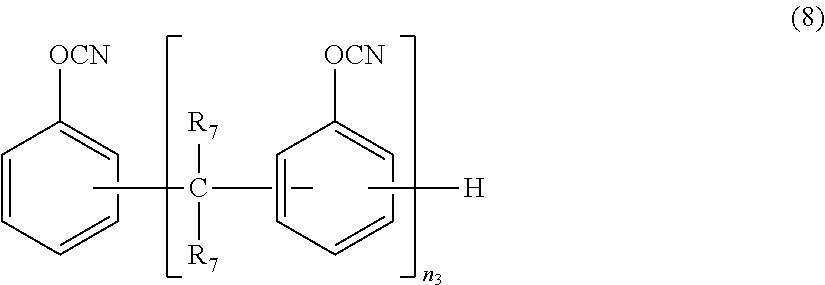
wherein each R7 independently represents a hydrogen atom or a methyl group, and n3 represents an integer of 1 or more.
<8>
R—CH═CH—R′ (a)
wherein R represents a phenyl group which may have one or more of an alkyl group having 1 to 6 carbon atoms, an alkoxy group, a phenoxy group, a hydroxyl group or an amino group, a naphthyl group which may have one or more of an alkyl group having 1 to 6 carbon atoms, an alkoxy group, a phenoxy group, a hydroxyl group or an amino group, or a biphenyl group which may have one or more of an alkyl group having 1 to 6 carbon atoms, an alkoxy group, a phenoxy group, a hydroxyl group or an amino group, and R′ represents a methyl group, a phenyl group, a naphthyl group, a biphenyl group, or a benzyl group, wherein each of the phenyl group, the naphthyl group, the biphenyl group and the benzyl group may have one or more alkyl groups having 1 to 6 carbon atoms, and

wherein Ra represents a group represented by the following general formula (c), and a plurality of Rb moieties each independently represent a methyl group, a phenyl group, a naphthyl group, a biphenyl group, or a benzyl group, wherein each of the phenyl group, the naphthyl group, the biphenyl group and the benzyl group may have one or more alkyl groups having 1 to 6 carbon atoms:

wherein each Rc independently represents a methylene group, an isopropylidene group, or a substituent represented by —CO—, —O—, —S— or >SO2, and n represents an integer of 0 to 5.


[β/α]=(Parts by mass of (β)/Functional group equivalent of (β))/(Parts by mass of (α)/Functional group equivalent of (α))
Rate of elastic modulus loss=[{(a)−(b)}/(a)]×100
| TABLE 1 | ||||||
| Comparative | ||||||
| Example 1 | Example 1 | Example 2 | Example 3 | Example 4 | ||
| Desmear resistance | Rate of change in | −0.64 | −0.57 | −0.58 | −0.63 | −0.55 |
| mass [%] | ||||||
| Lowest melt viscosity of | poise | 137261 | 38146 | 92243 | 110767 | 21584 |
| prepreg | ||||||
| Rate of elastic modulus | [%] | 10 | 16 | 13 | 12 | 20 |
| loss | ||||||
Claims (9)
R—CH═CH—R′ (a)


Applications Claiming Priority (3)
| Application Number | Priority Date | Filing Date | Title |
|---|---|---|---|
| JP2015135200 | 2015-07-06 | ||
| JP2015-135200 | 2015-07-06 | ||
| PCT/JP2016/069748 WO2017006894A1 (en) | 2015-07-06 | 2016-07-04 | Resin composition, prepreg, resin sheet, laminate plate, and printed wiring board |
Publications (2)
| Publication Number | Publication Date |
|---|---|
| US20180186952A1 US20180186952A1 (en) | 2018-07-05 |
| US10563029B2 true US10563029B2 (en) | 2020-02-18 |
Family
ID=57685626
Family Applications (1)
| Application Number | Title | Priority Date | Filing Date |
|---|---|---|---|
| US15/738,854 Active 2036-12-05 US10563029B2 (en) | 2015-07-06 | 2016-07-04 | Resin composition and prepreg, resin sheet, laminate, and printed circuit board |
Country Status (7)
| Country | Link |
|---|---|
| US (1) | US10563029B2 (en) |
| EP (1) | EP3321319B1 (en) |
| JP (2) | JP7188883B2 (en) |
| KR (1) | KR102605758B1 (en) |
| CN (1) | CN107709452B (en) |
| TW (1) | TWI746445B (en) |
| WO (1) | WO2017006894A1 (en) |
Families Citing this family (5)
| Publication number | Priority date | Publication date | Assignee | Title |
|---|---|---|---|---|
| KR102605758B1 (en) * | 2015-07-06 | 2023-11-23 | 미츠비시 가스 가가쿠 가부시키가이샤 | Resin composition, prepreg, resin sheet, laminate plate, and printed wiring board |
| JP7145403B2 (en) * | 2017-04-27 | 2022-10-03 | 三菱瓦斯化学株式会社 | SUPPORT AND METHOD FOR MANUFACTURING SEMICONDUCTOR DEVICE MOUNTING BOARD USING THE SAME |
| CN114127180B (en) * | 2019-06-28 | 2023-06-09 | 三菱瓦斯化学株式会社 | Thin films, laminates, semiconductor wafers with thin film layers, semiconductor mounting substrates with thin film layers, and semiconductor devices |
| US12195566B2 (en) | 2019-06-28 | 2025-01-14 | Mitsubishi Gas Chemical Company, Inc. | Film, laminate, semiconductor wafer with film layer, substrate for mounting semiconductor with film layer, and semiconductor device |
| JP7803333B2 (en) * | 2023-11-29 | 2026-01-21 | 味の素株式会社 | resin composition |
Citations (12)
| Publication number | Priority date | Publication date | Assignee | Title |
|---|---|---|---|---|
| JPH06100633A (en) | 1992-09-18 | 1994-04-12 | Maruzen Petrochem Co Ltd | Thermosetting resin composition |
| JPH07165825A (en) | 1993-12-16 | 1995-06-27 | Sumitomo Bakelite Co Ltd | Thermosetting resin composition |
| US20090017316A1 (en) | 2007-07-12 | 2009-01-15 | Mitsubishi Gas Chemical Company, Inc. | Prepreg and laminate |
| JP2009191218A (en) | 2008-02-18 | 2009-08-27 | Sumitomo Bakelite Co Ltd | Circuit board resin composition, prepreg and laminate |
| JP2011088981A (en) | 2009-10-21 | 2011-05-06 | Mitsubishi Plastics Inc | Polymaleimide-based composition |
| JP2011102345A (en) | 2009-11-10 | 2011-05-26 | Mitsubishi Plastics Inc | Polymaleimide-based composition |
| JP2012197336A (en) | 2011-03-18 | 2012-10-18 | Panasonic Corp | Imide resin composition and method of producing the imide resin composition, prepreg, metal clad laminate, and printed wiring board |
| JP2013001807A (en) | 2011-06-16 | 2013-01-07 | Panasonic Corp | Resin composition for electronic circuit board material, prepreg and laminated plate |
| JP2013127022A (en) | 2011-12-19 | 2013-06-27 | Panasonic Corp | Thermosetting resin composition, sealing material, and electronic parts using them |
| JP2013216884A (en) | 2012-03-14 | 2013-10-24 | Hitachi Chemical Co Ltd | Thermosetting resin composition, prepreg and laminated plate |
| WO2014061812A1 (en) | 2012-10-19 | 2014-04-24 | 三菱瓦斯化学株式会社 | Resin composition, prepreg, laminate, and printed wiring board |
| TW201504039A (en) | 2013-06-03 | 2015-02-01 | Mitsubishi Gas Chemical Co | Resin composition for printed wiring board material, and prepreg, resin sheet, metal foil-clad laminate and printed wiring board using same |
Family Cites Families (4)
| Publication number | Priority date | Publication date | Assignee | Title |
|---|---|---|---|---|
| US5013804A (en) * | 1989-04-14 | 1991-05-07 | Ciba-Geigy Corporation | Curable mixtures containing a bismaleimide and a propenyl compound |
| CN104524548A (en) * | 2006-12-18 | 2015-04-22 | 阿塞勒隆制药公司 | Activin-ACTRII antagonists and uses for increasing red blood cell levels |
| JP6303407B2 (en) * | 2012-12-03 | 2018-04-04 | Jnc株式会社 | Curable composition and use thereof |
| KR102605758B1 (en) * | 2015-07-06 | 2023-11-23 | 미츠비시 가스 가가쿠 가부시키가이샤 | Resin composition, prepreg, resin sheet, laminate plate, and printed wiring board |
-
2016
- 2016-07-04 KR KR1020177032039A patent/KR102605758B1/en active Active
- 2016-07-04 JP JP2017527442A patent/JP7188883B2/en active Active
- 2016-07-04 US US15/738,854 patent/US10563029B2/en active Active
- 2016-07-04 WO PCT/JP2016/069748 patent/WO2017006894A1/en not_active Ceased
- 2016-07-04 CN CN201680038293.XA patent/CN107709452B/en active Active
- 2016-07-04 EP EP16821363.5A patent/EP3321319B1/en active Active
- 2016-07-06 TW TW105121321A patent/TWI746445B/en active
-
2021
- 2021-05-14 JP JP2021082678A patent/JP7116370B2/en active Active
Patent Citations (15)
| Publication number | Priority date | Publication date | Assignee | Title |
|---|---|---|---|---|
| JPH06100633A (en) | 1992-09-18 | 1994-04-12 | Maruzen Petrochem Co Ltd | Thermosetting resin composition |
| JPH07165825A (en) | 1993-12-16 | 1995-06-27 | Sumitomo Bakelite Co Ltd | Thermosetting resin composition |
| US20090017316A1 (en) | 2007-07-12 | 2009-01-15 | Mitsubishi Gas Chemical Company, Inc. | Prepreg and laminate |
| JP2009035728A (en) | 2007-07-12 | 2009-02-19 | Mitsubishi Gas Chem Co Inc | Prepreg and laminate |
| JP2009191218A (en) | 2008-02-18 | 2009-08-27 | Sumitomo Bakelite Co Ltd | Circuit board resin composition, prepreg and laminate |
| JP2011088981A (en) | 2009-10-21 | 2011-05-06 | Mitsubishi Plastics Inc | Polymaleimide-based composition |
| JP2011102345A (en) | 2009-11-10 | 2011-05-26 | Mitsubishi Plastics Inc | Polymaleimide-based composition |
| JP2012197336A (en) | 2011-03-18 | 2012-10-18 | Panasonic Corp | Imide resin composition and method of producing the imide resin composition, prepreg, metal clad laminate, and printed wiring board |
| JP2013001807A (en) | 2011-06-16 | 2013-01-07 | Panasonic Corp | Resin composition for electronic circuit board material, prepreg and laminated plate |
| JP2013127022A (en) | 2011-12-19 | 2013-06-27 | Panasonic Corp | Thermosetting resin composition, sealing material, and electronic parts using them |
| JP2013216884A (en) | 2012-03-14 | 2013-10-24 | Hitachi Chemical Co Ltd | Thermosetting resin composition, prepreg and laminated plate |
| WO2014061812A1 (en) | 2012-10-19 | 2014-04-24 | 三菱瓦斯化学株式会社 | Resin composition, prepreg, laminate, and printed wiring board |
| US20150267047A1 (en) * | 2012-10-19 | 2015-09-24 | Mitsubishi Gas Chemical Company, Inc. | Resin composition, prepreg, laminate, and printed wiring board |
| TW201504039A (en) | 2013-06-03 | 2015-02-01 | Mitsubishi Gas Chemical Co | Resin composition for printed wiring board material, and prepreg, resin sheet, metal foil-clad laminate and printed wiring board using same |
| US20160125971A1 (en) | 2013-06-03 | 2016-05-05 | Mitsubishi Gas Chemical Company, Inc. | Resin composition for printed wiring board material and prepreg, resin sheet, metal foil-clad laminate, and printed wiring board using the same |
Non-Patent Citations (2)
| Title |
|---|
| International Preliminary Report on Patentability from Patent Application No. PCT/JP2016/069748, dated Jan. 9, 2018. |
| International Search Report from Patent Application No. PCT/JP2016/069748, dated Sep. 20, 2016. |
Also Published As
| Publication number | Publication date |
|---|---|
| KR20180027411A (en) | 2018-03-14 |
| CN107709452A (en) | 2018-02-16 |
| US20180186952A1 (en) | 2018-07-05 |
| TWI746445B (en) | 2021-11-21 |
| JP2021138956A (en) | 2021-09-16 |
| JP7188883B2 (en) | 2022-12-13 |
| EP3321319A4 (en) | 2019-03-06 |
| KR102605758B1 (en) | 2023-11-23 |
| CN107709452B (en) | 2021-03-02 |
| TW201710344A (en) | 2017-03-16 |
| WO2017006894A1 (en) | 2017-01-12 |
| EP3321319B1 (en) | 2022-10-05 |
| EP3321319A1 (en) | 2018-05-16 |
| JP7116370B2 (en) | 2022-08-10 |
| JPWO2017006894A1 (en) | 2018-04-19 |
Similar Documents
| Publication | Publication Date | Title |
|---|---|---|
| US10550228B2 (en) | Resin composition, prepreg, metal foil-clad laminate, and printed circuit board | |
| US11769607B2 (en) | Resin composition, prepreg, resin sheet, metal foil-clad laminate, and printed circuit board | |
| US10292260B2 (en) | Insulating layer for printed circuit board and printed circuit board | |
| JP7116370B2 (en) | Resin composition, prepreg, resin sheet, laminate, and printed wiring board | |
| EP3321322B1 (en) | Resin composition, prepreg, resin sheet, metal foil-clad laminate, and printed circuit board | |
| US10676579B2 (en) | Resin composition, prepreg, resin sheet, metal foil-clad laminate, and printed circuit board | |
| US10721817B2 (en) | Resin composition, prepreg or resin sheet comprising the resin composition, and laminate and printed circuit board comprising them | |
| US10703874B2 (en) | Resin composition, prepreg or resin sheet comprising the resin composition, and laminate and printed circuit board comprising them | |
| EP3322268B1 (en) | Method for producing printed circuit board, and resin composition | |
| US10717837B2 (en) | Resin composition and prepreg, resin sheet, laminate, and printed circuit board comprising same |
Legal Events
| Date | Code | Title | Description |
|---|---|---|---|
| FEPP | Fee payment procedure |
Free format text: ENTITY STATUS SET TO UNDISCOUNTED (ORIGINAL EVENT CODE: BIG.); ENTITY STATUS OF PATENT OWNER: LARGE ENTITY |
|
| AS | Assignment |
Owner name: MITSUBISHI GAS CHEMICAL COMPANY, INC., JAPAN Free format text: ASSIGNMENT OF ASSIGNORS INTEREST;ASSIGNORS:TAKANO, YOICHI;TOMIZAWA, KATSUYA;KUBO, TAKASHI;AND OTHERS;SIGNING DATES FROM 20180122 TO 20180207;REEL/FRAME:044988/0041 |
|
| STPP | Information on status: patent application and granting procedure in general |
Free format text: DOCKETED NEW CASE - READY FOR EXAMINATION |
|
| STPP | Information on status: patent application and granting procedure in general |
Free format text: NON FINAL ACTION MAILED |
|
| STPP | Information on status: patent application and granting procedure in general |
Free format text: RESPONSE TO NON-FINAL OFFICE ACTION ENTERED AND FORWARDED TO EXAMINER |
|
| STPP | Information on status: patent application and granting procedure in general |
Free format text: NOTICE OF ALLOWANCE MAILED -- APPLICATION RECEIVED IN OFFICE OF PUBLICATIONS |
|
| STPP | Information on status: patent application and granting procedure in general |
Free format text: PUBLICATIONS -- ISSUE FEE PAYMENT RECEIVED |
|
| STCF | Information on status: patent grant |
Free format text: PATENTED CASE |
|
| MAFP | Maintenance fee payment |
Free format text: PAYMENT OF MAINTENANCE FEE, 4TH YEAR, LARGE ENTITY (ORIGINAL EVENT CODE: M1551); ENTITY STATUS OF PATENT OWNER: LARGE ENTITY Year of fee payment: 4 |