US10562905B2 - Carboxy tetrahydropyrazolopyrazine compounds for the treatment of infectious diseases - Google Patents
Carboxy tetrahydropyrazolopyrazine compounds for the treatment of infectious diseases Download PDFInfo
- Publication number
- US10562905B2 US10562905B2 US16/247,084 US201916247084A US10562905B2 US 10562905 B2 US10562905 B2 US 10562905B2 US 201916247084 A US201916247084 A US 201916247084A US 10562905 B2 US10562905 B2 US 10562905B2
- Authority
- US
- United States
- Prior art keywords
- methyl
- dihydro
- oxo
- pyrazolo
- trifluorophenyl
- Prior art date
- Legal status (The legal status is an assumption and is not a legal conclusion. Google has not performed a legal analysis and makes no representation as to the accuracy of the status listed.)
- Active
Links
- 0 *C1C([2*])N2/N=C\C([1*])=C/2CN1C(=O)N[4*] Chemical compound *C1C([2*])N2/N=C\C([1*])=C/2CN1C(=O)N[4*] 0.000 description 10
- CZLQCQWNAQLZPY-LSUGHSKXSA-N C[C@H]1CN2N=CC(N3C(=O)CC(N4CCC[C@H]4C(=O)O)[C@@H]3C)=C2CN1C(=O)NC1=CC(F)=C(F)C(F)=C1 Chemical compound C[C@H]1CN2N=CC(N3C(=O)CC(N4CCC[C@H]4C(=O)O)[C@@H]3C)=C2CN1C(=O)NC1=CC(F)=C(F)C(F)=C1 CZLQCQWNAQLZPY-LSUGHSKXSA-N 0.000 description 2
- KNZKGONMYVZWSZ-UEWDXFNNSA-N C[C@H]1CN2N=CC(N3CC(C4=C(C(=O)O)C=CC=N4)CC3=O)=C2CN1C(=O)NC1=CC(F)=C(F)C(F)=C1 Chemical compound C[C@H]1CN2N=CC(N3CC(C4=C(C(=O)O)C=CC=N4)CC3=O)=C2CN1C(=O)NC1=CC(F)=C(F)C(F)=C1 KNZKGONMYVZWSZ-UEWDXFNNSA-N 0.000 description 2
- QTGPLRRBPJPBLE-JPJOHVBFSA-N C[C@H]1[C@H](C)N2N=CC(N3CC(N4CCC[C@H]4C(=O)O)CC3=O)=C2CN1C(=O)NC1=CC(F)=C(F)C(F)=C1 Chemical compound C[C@H]1[C@H](C)N2N=CC(N3CC(N4CCC[C@H]4C(=O)O)CC3=O)=C2CN1C(=O)NC1=CC(F)=C(F)C(F)=C1 QTGPLRRBPJPBLE-JPJOHVBFSA-N 0.000 description 2
- CNZOBMSOJNRLKU-ZBXTZWDGSA-M B.COC(=O)C1CCCC1.COC(=O)[C@@H]1CCCN1C1CC(=O)C[C@H]1C.COC(=O)[C@@H]1CCCN1C1CC(=O)N(C(=O)OC(C)(C)C)[C@H]1C.COC(=O)[C@@H]1CCCN1C1CC(=O)N(C2=C3CN(C(=O)CC4=CC(F)=C(F)C(F)=C4)[C@@H](C)CN3N=C2)[C@H]1C.COC(=O)[C@@H]1CCCN1C1CC(=O)N(C2=C3CN(C(=O)OC(C)(C)C)[C@@H](C)CN3N=C2)[C@H]1C.C[C@H]1C(=O)CC(=O)N1C(=O)OC(C)(C)C.C[C@H]1CN2N=CC(I)=C2CN1C(=O)OC(C)(C)C.C[C@H]1CN2N=CC(N3C(=O)CC(N4CCC[C@H]4C(=O)O)[C@@H]3C)=C2CN1C(=O)CC1=CC(F)=C(F)C(F)=C1.Cl.N#C[Na].O=C(CC1=CC(F)=C(F)C(F)=C1)OC1=CC=CC=C1.[I-3].[I-].[Li]O Chemical compound B.COC(=O)C1CCCC1.COC(=O)[C@@H]1CCCN1C1CC(=O)C[C@H]1C.COC(=O)[C@@H]1CCCN1C1CC(=O)N(C(=O)OC(C)(C)C)[C@H]1C.COC(=O)[C@@H]1CCCN1C1CC(=O)N(C2=C3CN(C(=O)CC4=CC(F)=C(F)C(F)=C4)[C@@H](C)CN3N=C2)[C@H]1C.COC(=O)[C@@H]1CCCN1C1CC(=O)N(C2=C3CN(C(=O)OC(C)(C)C)[C@@H](C)CN3N=C2)[C@H]1C.C[C@H]1C(=O)CC(=O)N1C(=O)OC(C)(C)C.C[C@H]1CN2N=CC(I)=C2CN1C(=O)OC(C)(C)C.C[C@H]1CN2N=CC(N3C(=O)CC(N4CCC[C@H]4C(=O)O)[C@@H]3C)=C2CN1C(=O)CC1=CC(F)=C(F)C(F)=C1.Cl.N#C[Na].O=C(CC1=CC(F)=C(F)C(F)=C1)OC1=CC=CC=C1.[I-3].[I-].[Li]O CNZOBMSOJNRLKU-ZBXTZWDGSA-M 0.000 description 1
- BGFXKFUQTOZYRO-GAQUBEFVSA-N BrC1=CNN=C1.C[C@@H](O)[C@@H](C)O.C[C@@H]([C@@H](C)O)N1C=C(Br)C=N1.C[C@@H]([C@H](C)N1C(=O)C2=C(C=CC=C2)C1=O)N1C=C(Br)C=N1.C[C@H](N)[C@H](C)N1C=C(Br)C=N1.C[C@H](NCC1=CC=CC=C1)[C@H](C)N1C=C(Br)C=N1.C[C@H]1OS(=O)(=O)O[C@@H]1C.NN.O=C1NC(=O)C2=C1C=CC=C2.O=CC1=CC=CC=C1.O=S(Cl)Cl Chemical compound BrC1=CNN=C1.C[C@@H](O)[C@@H](C)O.C[C@@H]([C@@H](C)O)N1C=C(Br)C=N1.C[C@@H]([C@H](C)N1C(=O)C2=C(C=CC=C2)C1=O)N1C=C(Br)C=N1.C[C@H](N)[C@H](C)N1C=C(Br)C=N1.C[C@H](NCC1=CC=CC=C1)[C@H](C)N1C=C(Br)C=N1.C[C@H]1OS(=O)(=O)O[C@@H]1C.NN.O=C1NC(=O)C2=C1C=CC=C2.O=CC1=CC=CC=C1.O=S(Cl)Cl BGFXKFUQTOZYRO-GAQUBEFVSA-N 0.000 description 1
- KVOJKZUWSGXRLL-NPNNUONXSA-M C.COC(=O)C1=CC=CC=C1N.COC(=O)C1=CC=CC=C1NC1CC(=O)N(C2=C3\CN(C(=O)OC(C)(C)C)[C@@H](C)CN3/N=C\2)C1.COC(=O)C1=CC=CC=C1NC1CNC(=O)C1.C[C@H]1CN2/N=C\C(I)=C/2CN1C(=O)OC(C)(C)C.C[C@H]1CN2/N=C\C(N3CC(NC4=CC=CC=C4C(=O)O)CC3=O)=C/2CN1.C[C@H]1CN2/N=C\C(N3CC(NC4=CC=CC=C4C(=O)O)CC3=O)=C/2CN1C(=O)NC1=CC(F)=C(F)C(F)=C1.O=C(CC1=CC(F)=C(F)C(F)=C1)OC1=CC=CC=C1.O=C1CNC(=O)C1.[Cu]I Chemical compound C.COC(=O)C1=CC=CC=C1N.COC(=O)C1=CC=CC=C1NC1CC(=O)N(C2=C3\CN(C(=O)OC(C)(C)C)[C@@H](C)CN3/N=C\2)C1.COC(=O)C1=CC=CC=C1NC1CNC(=O)C1.C[C@H]1CN2/N=C\C(I)=C/2CN1C(=O)OC(C)(C)C.C[C@H]1CN2/N=C\C(N3CC(NC4=CC=CC=C4C(=O)O)CC3=O)=C/2CN1.C[C@H]1CN2/N=C\C(N3CC(NC4=CC=CC=C4C(=O)O)CC3=O)=C/2CN1C(=O)NC1=CC(F)=C(F)C(F)=C1.O=C(CC1=CC(F)=C(F)C(F)=C1)OC1=CC=CC=C1.O=C1CNC(=O)C1.[Cu]I KVOJKZUWSGXRLL-NPNNUONXSA-M 0.000 description 1
- ZRTKRVOOLMWAEI-WZCXZJDOSA-K C=CC(=O)OCC.CC(=O)O[Pd]OC(C)=O.CC(C)(C)[Si](C)(C)Cl.CC(C)(C)[Si](C)(C)OCC1=CC=CC=C1C1CCC(=O)C1.CC(C)(C)[Si](C)(C)OCC1=CC=CC=C1I.CCOC(=O)/C=C/C1=CC=CC=C1CO[Si](C)(C)C(C)(C)C.CCOC(=O)CC(CN(=O)=O)C1=CC=CC=C1CO[Si](C)(C)C(C)(C)C.C[C@H]1CN2/N=C\C(I)=C/2CN1C(=O)OC(C)(C)C.OCC1=CC=CC=C1I.[Cu]I.[Zn] Chemical compound C=CC(=O)OCC.CC(=O)O[Pd]OC(C)=O.CC(C)(C)[Si](C)(C)Cl.CC(C)(C)[Si](C)(C)OCC1=CC=CC=C1C1CCC(=O)C1.CC(C)(C)[Si](C)(C)OCC1=CC=CC=C1I.CCOC(=O)/C=C/C1=CC=CC=C1CO[Si](C)(C)C(C)(C)C.CCOC(=O)CC(CN(=O)=O)C1=CC=CC=C1CO[Si](C)(C)C(C)(C)C.C[C@H]1CN2/N=C\C(I)=C/2CN1C(=O)OC(C)(C)C.OCC1=CC=CC=C1I.[Cu]I.[Zn] ZRTKRVOOLMWAEI-WZCXZJDOSA-K 0.000 description 1
- HHGGOXBTVDPUSM-HLBSCFTASA-J C=CC(=O)OCC.CC(=O)O[Pd]OC(C)=O.CCOC(=O)/C=C/C1=CC=CC(C(=O)OC)=C1.CCOC(=O)CC(CN(=O)=O)C1=CC=CC(C(=O)OC)=C1.COC(=O)C1=CC(C2CC(=O)N(C3=C4\CN(C(=O)OC(C)(C)C)[C@@H](C)CN4/N=C\3)C2)=CC=C1.COC(=O)C1=CC(C2CNC(=O)C2)=CC=C1.COC(=O)C1=CC(I)=CC=C1.COC(=O)C1=CC=CC(C2CC(=O)N(C3=C4\CN(C(=O)NC5=CC(F)=C(F)C(F)=C5)[C@@H](C)CN4/N=C\3)C2)=C1.C[C@H]1CN2/N=C\C(I)=C/2CN1C(=O)OC(C)(C)C.C[C@H]1CN2/N=C\C(N3CC(C4=CC(C(=O)O)=CC=C4)CC3=O)=C/2CN1C(=O)NC1=CC(F)=C(F)C(F)=C1.C[N+](=O)[O-].O=C(NC1=CC(F)=C(F)C(F)=C1)OC1=CC=CC=C1.[Cu]I.[I-3].[Li]O.[Zn] Chemical compound C=CC(=O)OCC.CC(=O)O[Pd]OC(C)=O.CCOC(=O)/C=C/C1=CC=CC(C(=O)OC)=C1.CCOC(=O)CC(CN(=O)=O)C1=CC=CC(C(=O)OC)=C1.COC(=O)C1=CC(C2CC(=O)N(C3=C4\CN(C(=O)OC(C)(C)C)[C@@H](C)CN4/N=C\3)C2)=CC=C1.COC(=O)C1=CC(C2CNC(=O)C2)=CC=C1.COC(=O)C1=CC(I)=CC=C1.COC(=O)C1=CC=CC(C2CC(=O)N(C3=C4\CN(C(=O)NC5=CC(F)=C(F)C(F)=C5)[C@@H](C)CN4/N=C\3)C2)=C1.C[C@H]1CN2/N=C\C(I)=C/2CN1C(=O)OC(C)(C)C.C[C@H]1CN2/N=C\C(N3CC(C4=CC(C(=O)O)=CC=C4)CC3=O)=C/2CN1C(=O)NC1=CC(F)=C(F)C(F)=C1.C[N+](=O)[O-].O=C(NC1=CC(F)=C(F)C(F)=C1)OC1=CC=CC=C1.[Cu]I.[I-3].[Li]O.[Zn] HHGGOXBTVDPUSM-HLBSCFTASA-J 0.000 description 1
- OFPBROAXWJTCDL-BUXYVTAZSA-N CC#N.C[C@@H](CO)N(CC1=CC=NN1)C(=O)OC(C)(C)C.C[C@@H](COS(C)(=O)=O)N(CC1=CC=NN1)C(=O)OC(C)(C)C.C[C@H](N)CO.C[C@H]1CN2N=CC(I)=C2CN1C(=O)OC(C)(C)C.C[C@H]1CN2N=CC=C2CN1C(=O)OC(C)(C)C.O=CC1=CC=NN1.SN=[IH].[2H]CF.[I-].[NaH] Chemical compound CC#N.C[C@@H](CO)N(CC1=CC=NN1)C(=O)OC(C)(C)C.C[C@@H](COS(C)(=O)=O)N(CC1=CC=NN1)C(=O)OC(C)(C)C.C[C@H](N)CO.C[C@H]1CN2N=CC(I)=C2CN1C(=O)OC(C)(C)C.C[C@H]1CN2N=CC=C2CN1C(=O)OC(C)(C)C.O=CC1=CC=NN1.SN=[IH].[2H]CF.[I-].[NaH] OFPBROAXWJTCDL-BUXYVTAZSA-N 0.000 description 1
- JGBKCIXXLQFKNR-FSNGEQEWSA-N CC(=O)CN1C2COCC1C(=O)N(C1=C3CN(C(=O)OC(C)(C)C)[C@@H](C)CN3N=C1)C2.CC(C)(C)OC(=O)N1CC2COCC(C1)N2.CC(C)(C)OC(=O)N1CC2COCC(C1=O)N2C(=O)OCC1=CC=CC=C1.CCOC(=O)CBr.C[C@H]1CN2N=CC(I)=C2CN1.C[C@H]1CN2N=CC(N3CC4COCC(C3=O)N4C(=O)OCC3=CC=CC=C3)=C2CN1C(=O)OC(C)(C)C.[I-] Chemical compound CC(=O)CN1C2COCC1C(=O)N(C1=C3CN(C(=O)OC(C)(C)C)[C@@H](C)CN3N=C1)C2.CC(C)(C)OC(=O)N1CC2COCC(C1)N2.CC(C)(C)OC(=O)N1CC2COCC(C1=O)N2C(=O)OCC1=CC=CC=C1.CCOC(=O)CBr.C[C@H]1CN2N=CC(I)=C2CN1.C[C@H]1CN2N=CC(N3CC4COCC(C3=O)N4C(=O)OCC3=CC=CC=C3)=C2CN1C(=O)OC(C)(C)C.[I-] JGBKCIXXLQFKNR-FSNGEQEWSA-N 0.000 description 1
- AXZNZEDECYWDHC-VAMYJXFHSA-N CC(C)(C)OC(=O)OC(=O)OC(C)(C)C.C[C@H]1[C@H](C)N2N=CC(Br)=C2CN1CC1=CC=CC=C1.C[C@H]1[C@H](C)N2N=CC(I)=C2CN1C(=O)OC(C)(C)C.C[C@H]1[C@H](C)N2N=CC=C2CN1C(=O)OC(C)(C)C.SN=[IH].[IH-2] Chemical compound CC(C)(C)OC(=O)OC(=O)OC(C)(C)C.C[C@H]1[C@H](C)N2N=CC(Br)=C2CN1CC1=CC=CC=C1.C[C@H]1[C@H](C)N2N=CC(I)=C2CN1C(=O)OC(C)(C)C.C[C@H]1[C@H](C)N2N=CC=C2CN1C(=O)OC(C)(C)C.SN=[IH].[IH-2] AXZNZEDECYWDHC-VAMYJXFHSA-N 0.000 description 1
- KUCSPJQZQIUGGJ-XHUQVVGLSA-L CC1=CC=C(S(=O)(=O)OC2=CC(=O)N(C(=O)OC(C)(C)C)C2)C=C1.COC(=O)C1=C(B2OC(C)(C)C(C)(C)O2)C=C(F)C=C1.COC(=O)C1=C(Br)C=C(F)C=C1.COC(=O)C1=C(C2=CC(=O)CC2)C=C(F)C=C1.COC(=O)C1=C(C2CC(=O)N(C3=C4\CN(C(=O)NC5=CC(F)=C(F)C(F)=C5)[C@@H](C)CN4/N=C\3)C2)C=C(F)C=C1.COC(=O)C1=C(C2CCC(=O)C2)C=C(F)C=C1.COC(=O)C1=CC=C(F)C=C1C1CC(=O)N(C2=C3\CN(C(=O)OC(C)(C)C)[C@@H](C)CN3/N=C\2)C1.C[C@H]1CN2/N=C\C(I)=C/2CN1C(=O)OC(C)(C)C.C[C@H]1CN2/N=C\C(N3CC(C4=C(C(=O)O)C=CC(F)=C4)CC3=O)=C/2CN1C(=O)NC1=CC(F)=C(F)C(F)=C1.O=C(NC1=CC(F)=C(F)C(F)=C1)OC1=CC=CC=C1.O[Na].[Cu]I.[I-3] Chemical compound CC1=CC=C(S(=O)(=O)OC2=CC(=O)N(C(=O)OC(C)(C)C)C2)C=C1.COC(=O)C1=C(B2OC(C)(C)C(C)(C)O2)C=C(F)C=C1.COC(=O)C1=C(Br)C=C(F)C=C1.COC(=O)C1=C(C2=CC(=O)CC2)C=C(F)C=C1.COC(=O)C1=C(C2CC(=O)N(C3=C4\CN(C(=O)NC5=CC(F)=C(F)C(F)=C5)[C@@H](C)CN4/N=C\3)C2)C=C(F)C=C1.COC(=O)C1=C(C2CCC(=O)C2)C=C(F)C=C1.COC(=O)C1=CC=C(F)C=C1C1CC(=O)N(C2=C3\CN(C(=O)OC(C)(C)C)[C@@H](C)CN3/N=C\2)C1.C[C@H]1CN2/N=C\C(I)=C/2CN1C(=O)OC(C)(C)C.C[C@H]1CN2/N=C\C(N3CC(C4=C(C(=O)O)C=CC(F)=C4)CC3=O)=C/2CN1C(=O)NC1=CC(F)=C(F)C(F)=C1.O=C(NC1=CC(F)=C(F)C(F)=C1)OC1=CC=CC=C1.O[Na].[Cu]I.[I-3] KUCSPJQZQIUGGJ-XHUQVVGLSA-L 0.000 description 1
- GNFQSQIRLUJLIW-RBOKCWHTSA-L COC(=O)C1CCCC1.COC(=O)[C@@H]1CCCN1C1CC(=O)N(C2=C3CN(C(=O)NC4=CC(F)=C(F)C(F)=C4)[C@@H](C)CN3N=C2)C1.COC(=O)[C@@H]1CCCN1C1CC(=O)N(C2=C3CN(C(=O)OC(C)(C)C)[C@@H](C)CN3N=C2)C1.COC(=O)[C@@H]1CCCN1C1CCC(=O)C1.C[C@H]1CN2N=CC(I)=C2CN1C(=O)OC(C)(C)C.C[C@H]1CN2N=CC(N3CC(N4CCC[C@H]4C(=O)O)CC3=O)=C2CN1C(=O)NC1=CC(F)=C(F)C(F)=C1.O=C(CC1=CC(F)=C(F)C(F)=C1)OC1=CC=CC=C1.O=C1CCC(=O)C1.[Cu]I.[I-3].[I-].[Li]O Chemical compound COC(=O)C1CCCC1.COC(=O)[C@@H]1CCCN1C1CC(=O)N(C2=C3CN(C(=O)NC4=CC(F)=C(F)C(F)=C4)[C@@H](C)CN3N=C2)C1.COC(=O)[C@@H]1CCCN1C1CC(=O)N(C2=C3CN(C(=O)OC(C)(C)C)[C@@H](C)CN3N=C2)C1.COC(=O)[C@@H]1CCCN1C1CCC(=O)C1.C[C@H]1CN2N=CC(I)=C2CN1C(=O)OC(C)(C)C.C[C@H]1CN2N=CC(N3CC(N4CCC[C@H]4C(=O)O)CC3=O)=C2CN1C(=O)NC1=CC(F)=C(F)C(F)=C1.O=C(CC1=CC(F)=C(F)C(F)=C1)OC1=CC=CC=C1.O=C1CCC(=O)C1.[Cu]I.[I-3].[I-].[Li]O GNFQSQIRLUJLIW-RBOKCWHTSA-L 0.000 description 1
- UDUQGBGENCSWEE-XTIDWKMFSA-N C[C@@H](C[n]1ncc(N(CC(C2)N(CCC3)[C@@H]3C(O)=O)C2=O)c1C1)N1C(Nc(cc1F)cc(F)c1F)=O Chemical compound C[C@@H](C[n]1ncc(N(CC(C2)N(CCC3)[C@@H]3C(O)=O)C2=O)c1C1)N1C(Nc(cc1F)cc(F)c1F)=O UDUQGBGENCSWEE-XTIDWKMFSA-N 0.000 description 1
- UDUQGBGENCSWEE-WAPNNBGYSA-N C[C@@H](C[n]1ncc(N(CC(C2)N(CCC3)[C@H]3C(O)=O)C2=O)c1C1)N1C(Nc(cc1F)cc(F)c1F)=O Chemical compound C[C@@H](C[n]1ncc(N(CC(C2)N(CCC3)[C@H]3C(O)=O)C2=O)c1C1)N1C(Nc(cc1F)cc(F)c1F)=O UDUQGBGENCSWEE-WAPNNBGYSA-N 0.000 description 1
- CZLQCQWNAQLZPY-MOYSLGNUSA-N C[C@H]1CN2/N=C\C(N3C(=O)CC(N4CCC[C@@H]4C(=O)O)[C@@H]3C)=C/2CN1C(=O)NC1=CC(F)=C(F)C(F)=C1 Chemical compound C[C@H]1CN2/N=C\C(N3C(=O)CC(N4CCC[C@@H]4C(=O)O)[C@@H]3C)=C/2CN1C(=O)NC1=CC(F)=C(F)C(F)=C1 CZLQCQWNAQLZPY-MOYSLGNUSA-N 0.000 description 1
- RLPWKAIWGIIYKT-OPFPJEHXSA-N C[C@H]1CN2/N=C\C(N3CC(N4CCC(C(=O)O)C4)CC3=O)=C/2CN1C(=O)NC1=CC(F)=C(F)C(F)=C1 Chemical compound C[C@H]1CN2/N=C\C(N3CC(N4CCC(C(=O)O)C4)CC3=O)=C/2CN1C(=O)NC1=CC(F)=C(F)C(F)=C1 RLPWKAIWGIIYKT-OPFPJEHXSA-N 0.000 description 1
- HJLNVIDJQRETKW-UDBNUGGLSA-N C[C@H]1CN2/N=C\C(N3CC4COCC(C3=O)N4CC(=O)O)=C/2CN1C(=O)NC1=CC(F)=C(F)C(F)=C1 Chemical compound C[C@H]1CN2/N=C\C(N3CC4COCC(C3=O)N4CC(=O)O)=C/2CN1C(=O)NC1=CC(F)=C(F)C(F)=C1 HJLNVIDJQRETKW-UDBNUGGLSA-N 0.000 description 1
- UHHYMIGUBPLUDV-QMMMGPOBSA-N C[C@H]1CN2N=CC(I)=C2CN1C(=O)OC(C)(C)C Chemical compound C[C@H]1CN2N=CC(I)=C2CN1C(=O)OC(C)(C)C UHHYMIGUBPLUDV-QMMMGPOBSA-N 0.000 description 1
- IDLXSEWXLSLCNG-UEWDXFNNSA-N C[C@H]1CN2N=CC(N3CC(C4=C(C(=O)O)C=C(F)C=C4)CC3=O)=C2CN1C(=O)NC1=CC(F)=C(F)C(F)=C1 Chemical compound C[C@H]1CN2N=CC(N3CC(C4=C(C(=O)O)C=C(F)C=C4)CC3=O)=C2CN1C(=O)NC1=CC(F)=C(F)C(F)=C1 IDLXSEWXLSLCNG-UEWDXFNNSA-N 0.000 description 1
- CRNXVMUXQIPMSS-UEWDXFNNSA-N C[C@H]1CN2N=CC(N3CC(C4=C(C(=O)O)C=CC(F)=C4)CC3=O)=C2CN1C(=O)NC1=CC(F)=C(F)C(F)=C1 Chemical compound C[C@H]1CN2N=CC(N3CC(C4=C(C(=O)O)C=CC(F)=C4)CC3=O)=C2CN1C(=O)NC1=CC(F)=C(F)C(F)=C1 CRNXVMUXQIPMSS-UEWDXFNNSA-N 0.000 description 1
- QNGVHIYHSNVKMS-LSLKUGRBSA-N C[C@H]1CN2N=CC(N3CC(C4=C(C(=O)O)C=CC=C4)CC3=O)=C2CN1C(=O)NC1=CC(F)=C(F)C(F)=C1 Chemical compound C[C@H]1CN2N=CC(N3CC(C4=C(C(=O)O)C=CC=C4)CC3=O)=C2CN1C(=O)NC1=CC(F)=C(F)C(F)=C1 QNGVHIYHSNVKMS-LSLKUGRBSA-N 0.000 description 1
- YHDTWCNFJBPJLS-CFMCSPIPSA-N C[C@H]1CN2N=CC(N3CC(C4=C(F)C=CC=C4C(=O)O)CC3=O)=C2CN1C(=O)CC1=CC(F)=C(F)C(F)=C1 Chemical compound C[C@H]1CN2N=CC(N3CC(C4=C(F)C=CC=C4C(=O)O)CC3=O)=C2CN1C(=O)CC1=CC(F)=C(F)C(F)=C1 YHDTWCNFJBPJLS-CFMCSPIPSA-N 0.000 description 1
- VPSYZZGQCRDXFZ-PIVQAISJSA-N C[C@H]1CN2N=CC(N3CC(C4=CC(C(=O)O)=CC=C4)CC3=O)=C2CN1C(=O)CC1=CC(F)=C(F)C(F)=C1 Chemical compound C[C@H]1CN2N=CC(N3CC(C4=CC(C(=O)O)=CC=C4)CC3=O)=C2CN1C(=O)CC1=CC(F)=C(F)C(F)=C1 VPSYZZGQCRDXFZ-PIVQAISJSA-N 0.000 description 1
- VYNNGAHMNIUXHN-KNVGNIICSA-N C[C@H]1CN2N=CC(N3CC(C4=CC=C(C(=O)O)C=C4)CC3=O)=C2CN1C(=O)NC1=CC(F)=C(F)C(F)=C1 Chemical compound C[C@H]1CN2N=CC(N3CC(C4=CC=C(C(=O)O)C=C4)CC3=O)=C2CN1C(=O)NC1=CC(F)=C(F)C(F)=C1 VYNNGAHMNIUXHN-KNVGNIICSA-N 0.000 description 1
- ANJXDQHJWVRQDV-UEWDXFNNSA-N C[C@H]1CN2N=CC(N3CC(C4=CC=CC(F)=C4C(=O)O)CC3=O)=C2CN1C(=O)NC1=CC(F)=C(F)C(F)=C1 Chemical compound C[C@H]1CN2N=CC(N3CC(C4=CC=CC(F)=C4C(=O)O)CC3=O)=C2CN1C(=O)NC1=CC(F)=C(F)C(F)=C1 ANJXDQHJWVRQDV-UEWDXFNNSA-N 0.000 description 1
- JYZWEEHIUAKQBE-UEWDXFNNSA-N C[C@H]1CN2N=CC(N3CC(C4=NC(C(=O)O)=CC=C4)CC3=O)=C2CN1C(=O)NC1=CC(F)=C(F)C(F)=C1 Chemical compound C[C@H]1CN2N=CC(N3CC(C4=NC(C(=O)O)=CC=C4)CC3=O)=C2CN1C(=O)NC1=CC(F)=C(F)C(F)=C1 JYZWEEHIUAKQBE-UEWDXFNNSA-N 0.000 description 1
- OZJVVBADIWSJMK-NBFOIZRFSA-N C[C@H]1CN2N=CC(N3CC(N(C)CC(=O)O)CC3=O)=C2CN1C(=O)CC1=CC(F)=C(F)C(F)=C1 Chemical compound C[C@H]1CN2N=CC(N3CC(N(C)CC(=O)O)CC3=O)=C2CN1C(=O)CC1=CC(F)=C(F)C(F)=C1 OZJVVBADIWSJMK-NBFOIZRFSA-N 0.000 description 1
- QMIPTCSCBYSHAP-PLXAZLAVSA-N C[C@H]1CN2N=CC(N3CC(N4CCC[C@@H]4C(=O)O)CC3=O)=C2CN1C(=O)CC1=CC(F)=C(F)C(F)=C1 Chemical compound C[C@H]1CN2N=CC(N3CC(N4CCC[C@@H]4C(=O)O)CC3=O)=C2CN1C(=O)CC1=CC(F)=C(F)C(F)=C1 QMIPTCSCBYSHAP-PLXAZLAVSA-N 0.000 description 1
- QMIPTCSCBYSHAP-LWSHRDBSSA-N C[C@H]1CN2N=CC(N3CC(N4CCC[C@H]4C(=O)O)CC3=O)=C2CN1C(=O)CC1=CC(F)=C(F)C(F)=C1 Chemical compound C[C@H]1CN2N=CC(N3CC(N4CCC[C@H]4C(=O)O)CC3=O)=C2CN1C(=O)CC1=CC(F)=C(F)C(F)=C1 QMIPTCSCBYSHAP-LWSHRDBSSA-N 0.000 description 1
- MIDRGUVFEJECDN-LBAUFKAWSA-N C[C@H]1CN2N=CC(N3CC(NC4=CC=CC=C4C(=O)O)CC3=O)=C2CN1C(=O)CC1=CC(F)=C(F)C(F)=C1 Chemical compound C[C@H]1CN2N=CC(N3CC(NC4=CC=CC=C4C(=O)O)CC3=O)=C2CN1C(=O)CC1=CC(F)=C(F)C(F)=C1 MIDRGUVFEJECDN-LBAUFKAWSA-N 0.000 description 1
- CZSJQKGPVCDGGO-PAQWIUEPSA-N C[C@H]1CN2N=CC(N3CC4COCC(C3=O)N4CC(=O)O)=C2CN1.C[C@H]1CN2N=CC(N3CC4COCC(C3=O)N4CC(=O)O)=C2CN1C(=O)NC1=CC(F)=C(F)C(F)=C1.O=C(CC1=CC(F)=C(F)C(F)=C1)OC1=CC=CC=C1.[I-3] Chemical compound C[C@H]1CN2N=CC(N3CC4COCC(C3=O)N4CC(=O)O)=C2CN1.C[C@H]1CN2N=CC(N3CC4COCC(C3=O)N4CC(=O)O)=C2CN1C(=O)NC1=CC(F)=C(F)C(F)=C1.O=C(CC1=CC(F)=C(F)C(F)=C1)OC1=CC=CC=C1.[I-3] CZSJQKGPVCDGGO-PAQWIUEPSA-N 0.000 description 1
- TXEIVLSUMSDOFU-IUCAKERBSA-N C[C@H]1[C@H](C)N2N=CC(I)=C2CN1C(=O)OC(C)(C)C Chemical compound C[C@H]1[C@H](C)N2N=CC(I)=C2CN1C(=O)OC(C)(C)C TXEIVLSUMSDOFU-IUCAKERBSA-N 0.000 description 1
- BHSXJQAMKKLPAD-UHFFFAOYSA-N NC1=CC(F)=C(F)C(F)=C1.O=C(CC1=CC(F)=C(F)C(F)=C1)OC1=CC=CC=C1.O=C(Cl)OC1=CC=CC=C1.[I-3] Chemical compound NC1=CC(F)=C(F)C(F)=C1.O=C(CC1=CC(F)=C(F)C(F)=C1)OC1=CC=CC=C1.O=C(Cl)OC1=CC=CC=C1.[I-3] BHSXJQAMKKLPAD-UHFFFAOYSA-N 0.000 description 1
- CYKSWGCGKGBUFB-UHFFFAOYSA-N O=C(CC1=CC(F)=C(F)C(F)=C1)OC1=CC=CC=C1 Chemical compound O=C(CC1=CC(F)=C(F)C(F)=C1)OC1=CC=CC=C1 CYKSWGCGKGBUFB-UHFFFAOYSA-N 0.000 description 1
Classifications
-
- C—CHEMISTRY; METALLURGY
- C07—ORGANIC CHEMISTRY
- C07D—HETEROCYCLIC COMPOUNDS
- C07D487/00—Heterocyclic compounds containing nitrogen atoms as the only ring hetero atoms in the condensed system, not provided for by groups C07D451/00 - C07D477/00
- C07D487/02—Heterocyclic compounds containing nitrogen atoms as the only ring hetero atoms in the condensed system, not provided for by groups C07D451/00 - C07D477/00 in which the condensed system contains two hetero rings
- C07D487/04—Ortho-condensed systems
-
- A—HUMAN NECESSITIES
- A61—MEDICAL OR VETERINARY SCIENCE; HYGIENE
- A61P—SPECIFIC THERAPEUTIC ACTIVITY OF CHEMICAL COMPOUNDS OR MEDICINAL PREPARATIONS
- A61P31/00—Antiinfectives, i.e. antibiotics, antiseptics, chemotherapeutics
- A61P31/12—Antivirals
-
- A—HUMAN NECESSITIES
- A61—MEDICAL OR VETERINARY SCIENCE; HYGIENE
- A61P—SPECIFIC THERAPEUTIC ACTIVITY OF CHEMICAL COMPOUNDS OR MEDICINAL PREPARATIONS
- A61P31/00—Antiinfectives, i.e. antibiotics, antiseptics, chemotherapeutics
- A61P31/12—Antivirals
- A61P31/20—Antivirals for DNA viruses
-
- C—CHEMISTRY; METALLURGY
- C07—ORGANIC CHEMISTRY
- C07D—HETEROCYCLIC COMPOUNDS
- C07D487/00—Heterocyclic compounds containing nitrogen atoms as the only ring hetero atoms in the condensed system, not provided for by groups C07D451/00 - C07D477/00
- C07D487/02—Heterocyclic compounds containing nitrogen atoms as the only ring hetero atoms in the condensed system, not provided for by groups C07D451/00 - C07D477/00 in which the condensed system contains two hetero rings
- C07D487/08—Bridged systems
-
- C—CHEMISTRY; METALLURGY
- C07—ORGANIC CHEMISTRY
- C07D—HETEROCYCLIC COMPOUNDS
- C07D498/00—Heterocyclic compounds containing in the condensed system at least one hetero ring having nitrogen and oxygen atoms as the only ring hetero atoms
- C07D498/02—Heterocyclic compounds containing in the condensed system at least one hetero ring having nitrogen and oxygen atoms as the only ring hetero atoms in which the condensed system contains two hetero rings
- C07D498/08—Bridged systems
Definitions
- the present invention relates to organic compounds useful for therapy and/or prophylaxis in a mammal, and in particular for treating hepatitis B virus infection, and their pharmaceutical activity, manufacture, pharmaceutical compositions containing them and their potential use as medicaments.
- the present invention relates to compounds of the formula (I),
- the compounds of this invention are useful for the treatment or prophylaxis of hepatitis B virus infection.
- Hepatitis B virus (HBV) infection is a major public health problem worldwide, roughly 30% of the world's population show serological evidence of current or past infection.
- HBV Hepatitis B virus
- HCC hepatocellular carcinoma
- Recent studies have shown that progression to liver cirrhosis and HCC in patients with chronic HBV infection is significantly associated with circulating HBV DNA levels.
- antiviral therapy against HBV is critical to prevent the progression to cirrhosis or development of HCC.
- HBV is a small, enveloped virus that belongs to the Hepadnaviridae family. It contains a partly double-stranded DNA genome with approximately 3200 base pairs. HBV have a strong preference for infecting human hepatocytes. The life cycle begins when HBV attaches to the host cell membrane via its envelope proteins. The precise mechanism of viral entry has not been fully elucidated.
- the viral relaxed circular DNA (rcDNA) containing nucleocapsids are released into the cytoplasm and transported to the nucleus. In the nucleus, the rcDNA is repaired by both viral and cellular enzymes to form covalently closed circular DNA (cccDNA).
- each infected cell contains 1-50 cccDNA molecules as unique episomal minichromosomes.
- Both subgenomic RNA (sgRNA) and pregenomic RNA (pgRNA) are transcribed from the cccDNA using the cellular transcriptional machinery. After nuclear export, the pgRNA is translated into the core protein and the viral polymerase. The sgRNA is translated into the regulatory X protein and the three envelope proteins. Self-assembly of the RNA-containing viral nucleocapsid takes place via complex formation of the pgRNA with the core protein and the polymerase. Inside the nucleocapsid, the pgRNA is reverse transcribed into negative-strand DNA.
- rcDNA is then generated by plus-strand synthesis from the negative-strand DNA.
- the nucleocapsids are either re-imported to the nucleus for cccDNA amplification or enveloped and released via the endoplasmic reticulum (ER).
- ER endoplasmic reticulum
- the reverse transcriptase lacks proofreading activity; thus, mutations of the viral genome are frequent and result in the coexistence of genetically distinct viral species in infected individuals (quasispecies).
- CTB chronic hepatitis B
- IFN interferon
- PEG-IFN conventional IFN and PEG-IFN
- NUCs nucleos(t)ide analogues
- the main difference between immunomodulatory agents and NUCs is that PEG-IFN has the advantage of a finite duration of use, whereas the use of NUCs is indefinite.
- the major drawback of PEG-IFN is its high frequency of adverse events. Some viral genotypes do not show good responses to interferon therapy.
- nucleocapsid assembly is a critical step for HBV genome replication. As the synthesis of viral DNA takes place exclusively within the nucleocapsid, the assembly and disassembly of nucleocapsid must be precisely regulated to ensure correct packaging and release of the viral genome. Nucleocapsid assembly is an evolutionary constraint process that limits the diversity of HBV, and it is highly sensitive to even subtle molecular disturbances.
- HAP heteroaryldihydropyrimidines
- Bay 41-4109 compounds named Bay 38-7690 and Bay 39-5493
- phenylpropenamide derivatives such as AT-61 and AT-130
- Capsid has become a promising drug target with several molecules under clinical stage. There is still a need to develop new treatments for the prophylaxis and treatment of hepatitis B virus infection.
- the present invention relates to novel compounds of formula (I),
- Objects of the present invention are novel compounds of formula (I), their manufacture, medicaments based on a compound in accordance with the invention and their production as well as the use of compounds of formula (I) as HBV inhibitors and for the treatment or prophylaxis of HBV infection.
- C 1-6 alkyl denotes a monovalent linear or branched saturated hydrocarbon group of 1 to 6 carbon atoms. In particular embodiments, C 1-6 alkyl has 1 to 6 carbon atoms, and in more particular embodiments 1 to 4 carbon atoms. Examples of C 1-6 alkyl include methyl, ethyl, propyl, isopropyl, n-butyl, iso-butyl, sec-butyl or tert-butyl.
- halo or halogen are used interchangeably herein and denote fluoro, chloro, bromo or iodo.
- carboxyphenyl denotes a phenyl group wherein one of the hydrogen atoms of the phenyl group has been replaced by carboxy.
- halocarboxyphenyl denotes a carboxyphenyl group wherein at least one of the hydrogen atoms of the phenyl group has been replaced by halogen.
- halocarboxyphenyl examples are chlorocarboxyphenyl, fluorocarboxyphenyl, difluorocarboxyphenyl and chlorofluorocarboxyphenyl.
- oxo denotes a divalent oxygen atom ⁇ O.
- diastereomer denotes a stereoisomer with two or more centers of chirality and whose molecules are not mirror images of one another. Diastereomers have different physical properties, e.g. melting points, boiling points, spectral properties, activities and reactivities.
- enantiomers denotes two stereoisomers of a compound which are non-superimposable mirror images of one another.
- pharmaceutically acceptable salts denotes salts which are not biologically or otherwise undesirable.
- Pharmaceutically acceptable salts include both acid and base addition salts.
- pharmaceutically acceptable acid addition salt denotes those pharmaceutically acceptable salts formed with inorganic acids such as hydrochloric acid, hydrobromic acid, sulfuric acid, nitric acid, carbonic acid, phosphoric acid, and organic acids selected from aliphatic, cycloaliphatic, aromatic, araliphatic, heterocyclic, carboxylic, and sulfonic classes of organic acids such as formic acid, acetic acid, propionic acid, glycolic acid, gluconic acid, lactic acid, pyruvic acid, oxalic acid, malic acid, maleic acid, maloneic acid, succinic acid, fumaric acid, tartaric acid, citric acid, aspartic acid, ascorbic acid, glutamic acid, anthranilic acid, benzoic acid, cinnamic acid, mandelic acid, embonic acid, phenylacetic acid, methanesulfonic acid, ethanesulfonic acid, p-toluene
- pharmaceutically acceptable base addition salt denotes those pharmaceutically acceptable salts formed with an organic or inorganic base.
- acceptable inorganic bases include sodium, potassium, ammonium, calcium, magnesium, iron, zinc, copper, manganese, and aluminum salts.
- Salts derived from pharmaceutically acceptable organic nontoxic bases includes salts of primary, secondary, and tertiary amines, substituted amines including naturally occurring substituted amines, cyclic amines and basic ion exchange resins, such as isopropylamine, trimethylamine, diethylamine, triethylamine, tripropylamine, ethanolamine, 2-diethylaminoethanol, trimethamine, dicyclohexylamine, lysine, arginine, histidine, caffeine, procaine, hydrabamine, choline, betaine, ethylenediamine, glucosamine, methylglucamine, theobromine, purines, piperizine, piperidine, N-ethylpiperidine, and polyamine resins.
- substituted amines including naturally occurring substituted amines, cyclic amines and basic ion exchange resins, such as isopropylamine, trimethylamine, diethylamine, trieth
- Racemates can be separated according to known methods into the enantiomers.
- diastereomeric salts which can be separated by crystallization are formed from the racemic mixtures by reaction with an optically active acid such as e.g. D- or L-tartaric acid, mandelic acid, malic acid, lactic acid or camphorsulfonic acid.
- the present invention provides (i) novel compounds having the general formula (I),
- a further embodiment of the present invention is a compound of formula (I), wherein
- a further embodiment of the present invention is (ii) a compound of formula (I), wherein
- a further embodiment of the present invention is a compound of formula (I), wherein
- particular compounds of the present invention are (iii) selected from:
- the compounds of the present invention can be prepared by any conventional means. Suitable processes for synthesizing these compounds as well as their starting materials are provided in the schemes below and in the examples. All substituents, in particular, R 1 to R 4 are as defined above unless otherwise indicated. Furthermore, and unless explicitly otherwise stated, all reactions, reaction conditions, abbreviations and symbols have the meanings well known to a person of ordinary skill in organic chemistry.
- Compound of formula IV (ring A) is oxooxadiazabicyclo[3.3.1]nonane substituted by carboxyC 1-6 alkyl; or oxopyrrolidine, said oxopyrrolidine being once substituted by carboxyC 1-6 alkyl(C 1-6 alkyl)amino, carboxyphenyl, carboxyphenylamino, halocarboxyphenyl or carboxypyrrolidinyl, or twice substituted by carboxypyrrolidinyl and C 1-6 alkyl.
- X is bromo or iodo.
- This invention also relates to a process for the preparation of a compound of formula (I) comprising the following reaction:
- R 1 and R 4 are defined above.
- the acid can be for example HCl/EtOAc and TFA/DCM;
- phosgene equivalent can be for example triphosgene and carbonyldiimidazole.
- a compound of formula (I) when manufactured according to the above process is also an object of the invention.
- compositions or medicaments containing the compounds of the invention and a therapeutically inert carrier, diluent or excipient, as well as methods of using the compounds of the invention to prepare such compositions and medicaments.
- compounds of formula (I) may be formulated by mixing at ambient temperature at the appropriate pH, and at the desired degree of purity, with physiologically acceptable carriers, i.e., carriers that are non-toxic to recipients at the dosages and concentrations employed into a galenical administration form.
- the pH of the formulation depends mainly on the particular use and the concentration of compound, but preferably ranges anywhere from about 3 to about 8.
- a compound of formula (I) is formulated in an acetate buffer, at pH 5.
- the compounds of formula (I) are sterile.
- the compound may be stored, for example, as a solid or amorphous composition, as a lyophilized formulation or as an aqueous solution.
- compositions are formulated, dosed, and administered in a fashion consistent with good medical practice.
- Factors for consideration in this context include the particular disorder being treated, the particular mammal being treated, the clinical condition of the individual patient, the cause of the disorder, the site of delivery of the agent, the method of administration, the scheduling of administration, and other factors known to medical practitioners.
- the “effective amount” of the compound to be administered will be governed by such considerations, and is the minimum amount necessary to the suppression of serum HBV DNA levels, or HBeAg seroconversion to HBeAb, or HBsAg loss, or normalization of alanine aminotransferase levels and improvement in liver histology. For example, such amount may be below the amount that is toxic to normal cells, or the mammal as a whole.
- the pharmaceutically effective amount of the compound of the invention administered parenterally per dose will be in the range of about 0.01 to 100 mg/kg, alternatively about 0.1 to 20 mg/kg of patient body weight per day, with the typical initial range of compound used being 0.3 to 15 mg/kg/day.
- oral unit dosage forms such as tablets and capsules, contain from about 0.1 to about 1000 mg of the compound of the invention.
- the compounds of the invention may be administered by any suitable means, including oral, topical (including buccal and sublingual), rectal, vaginal, transdermal, parenteral, subcutaneous, intraperitoneal, intrapulmonary, intradermal, intrathecal and epidural and intranasal, and, if desired for local treatment, intralesional administration.
- Parenteral infusions include intramuscular, intravenous, intraarterial, intraperitoneal, or subcutaneous administration.
- the compounds of the present invention may be administered in any convenient administrative form, e.g., tablets, powders, capsules, solutions, dispersions, suspensions, syrups, sprays, suppositories, gels, emulsions, patches, etc.
- Such compositions may contain components conventional in pharmaceutical preparations, e.g., diluents, carriers, pH modifiers, sweeteners, bulking agents, and further active agents.
- a typical formulation is prepared by mixing a compound of the present invention and a carrier or excipient.
- Suitable carriers and excipients are well known to those skilled in the art and are described in detail in, e.g., Ansel, Howard C., et al., Ansel's Pharmaceutical Dosage Forms and Drug Delivery Systems . Philadelphia: Lippincott, Williams & Wilkins, 2004; Gennaro, Alfonso R., et al. Remington: The Science and Practice of Pharmacy . Philadelphia: Lippincott, Williams & Wilkins, 2000; and Rowe, Raymond C. Handbook of Pharmaceutical Excipients . Chicago, Pharmaceutical Press, 2005.
- the formulations may also include one or more buffers, stabilizing agents, surfactants, wetting agents, lubricating agents, emulsifiers, suspending agents, preservatives, antioxidants, opaquing agents, glidants, processing aids, colorants, sweeteners, perfuming agents, flavoring agents, diluents and other known additives to provide an elegant presentation of the drug (i.e., a compound of the present invention or pharmaceutical composition thereof) or aid in the manufacturing of the pharmaceutical product (i.e., medicament).
- buffers stabilizing agents, surfactants, wetting agents, lubricating agents, emulsifiers, suspending agents, preservatives, antioxidants, opaquing agents, glidants, processing aids, colorants, sweeteners, perfuming agents, flavoring agents, diluents and other known additives to provide an elegant presentation of the drug (i.e., a compound of the present invention or pharmaceutical composition thereof) or aid in the manufacturing
- An example of a suitable oral dosage form is a tablet containing about 0.1 mg to 1000 mg of the compound of the invention compounded with about 30 mg to 90 mg anhydrous lactose, about 5 mg to 40 mg sodium croscarmellose, about 5 mg to 30 mg polyvinylpyrrolidone (PVP) K30, and about 1 mg to 10 mg magnesium stearate.
- the powdered ingredients are first mixed together and then mixed with a solution of the PVP.
- the resulting composition can be dried, granulated, mixed with the magnesium stearate and compressed to tablet form using conventional equipment.
- An example of an aerosol formulation can be prepared by dissolving the compound, for example 5 mg to 400 mg, of the invention in a suitable buffer solution, e.g. a phosphate buffer, adding a tonicifier, e.g. a salt such sodium chloride, if desired.
- the solution may be filtered, e.g., using a 0.2 micron filter, to remove impurities and contaminants
- An embodiment therefore, includes a pharmaceutical composition comprising a compound of formula (I), or a stereoisomer or pharmaceutically acceptable salt thereof.
- a pharmaceutical composition comprising a compound of formula (I), or a stereoisomer or pharmaceutically acceptable salt thereof, together with a pharmaceutically acceptable carrier or excipient.
- the compounds of the invention can inhibit HBV's DNA synthesis and reduce HBV DNA levels. Accordingly, the compounds of the invention are useful for the treatment or prophylaxis of HBV infection.
- the invention relates to the use of a compound of formula (I) for the treatment or prophylaxis of HBV infection.
- the invention relates in particular to the use of a compound of formula (I) for the preparation of a medicament for the treatment or prophylaxis of HBV infection.
- Another embodiment includes a method for the treatment or prophylaxis of HBV infection which method comprises administering an effective amount of a compound of formula (I), a stereoisomer, tautomer, prodrug or pharmaceutically acceptable salt thereof.
- DIAD diisopropyl azodicarboxylate
- DIPEA N,N-diisopropylethylamine
- PE petroleum ether
- pgRNA pre-genomic RNA
- LC/MS spectra of compounds were obtained using a LC/MS (WatersTM Alliance 2795-Micromass ZQ). LC/MS conditions were as follows (running time 6 mins):
- Acidic condition A: 0.1% formic acid in H 2 O: B: 0.1% formic acid in acetonitrile;
- Mass spectra generally only ions which indicate the parent mass are reported, and unless otherwise stated the mass ion quoted is the positive mass ion (M+H) + .
- the microwave assisted reactions were carried out in a Biotage Initiator Sixty or CEM Discover.
- Step 1 Preparation of tert-butyl N-[(1S)-2-hydroxy-1-methyl-ethyl]-N-(1H-pyrazol-5-ylmethyl)carbamate (Compound I-1b)
- Step 4 Preparation of tert-butyl (6S)-3-iodo-6-methyl-6,7-dihydro-4H-pyrazolo[1,5-a]pyrazine-5-carboxylate (intermediate I-1)
- Step 3 Preparation of 2-((2S,3S)-3-(4-bromo-1H-pyrazol-1-yl)butan-2-yl)isoindoline-1,3-dione (Compound I-2d)
- Step 7 Preparation of tert-butyl (6S,7S)-6,7-dimethyl-6,7-dihydro-4H-pyrazolo[1,5-a]pyrazine-5-carboxylate (Compound I-2h)
- Step 8 Preparation of tert-butyl (6S,7S)-3-iodo-6,7-dimethyl-6,7-dihydro-4H-pyrazolo[1,5-a]pyrazine-5-carboxylate (Intermediate I-2)
- Step 2 Preparation of tert-butyl (6S)-3-[4-[(2S)-2-methoxycarbonylpyrrolidin-1-yl]-2-oxo-pyrrolidin-1-yl]-6-methyl-6,7-dihydro-4H-pyrazol[1,5-a]pyrazine-5-carboxylate (Compound 1c)
- Step 3 Preparation of methyl (2S)-1-[1-[(6S)-6-methyl-5-[(3,4,5-trifluorophenyl)carbamoyl]-6,7-dihydro-4H-pyrazolo[1,5-a]pyrazin-3-yl]-5-oxo-pyrrolidin-3-yl]pyrrolidine-2-carboxylate (Compound 1d)
- Step 4 Preparation of (2S)-1-[1-[(6S)-6-methyl-5-[(3,4,5-trifluorophenyl)carbamoyl]-6,7-dihydro-4H-pyrazolo[1,5-a]pyrazin-3-yl]-5-oxo-pyrrolidin-3-yl]pyrrolidine-2-carboxylic acid (Example 1)
- Example 1 (30 mg) as a white solid.
- Step 1 Preparation of tert-butyl (2S)-3-[(2S)-2-methoxycarbonylpyrrolidin-1-yl]-2-methyl-5-oxo-pyrrolidine-1-carboxylate (Compound 2b)
- Step 4 Preparation of methyl (2S)-1-[(2S)-2-methyl-1-[(6S)-6-methyl-5-[(3,4,5-trifluorophenyl)carbamoyl]-6,7-dihydro-4H-pyrazolo[1,5-a]pyrazin-3-yl]-5-oxo-pyrrolidin-3-yl]pyrrolidine-2-carboxylate (Compound 2e)
- Step 5 Preparation of (2S)-1-[(2S)-2-methyl-1-[(6S)-6-methyl-5-[(3,4,5-trifluorophenyl)carbamoyl]-6,7-dihydro-4H-pyrazolo[1,5-a]pyrazin-3-yl]-5-oxo-pyrrolidin-3-yl]pyrrolidine-2-carboxylic (Example 2)
- Example 3 was prepared in analogy to Example 1 by using methyl 2-(methylamino)acetate instead of methyl (2S)-pyrrolidine-2-carboxylate.
- Example 3 (10 mg) was obtained as a white solid.
- LCMS (M+H + ): 480.9, 1 H NMR (400 MHz, METHANOL-d 4 ) ⁇ ppm 7.70-7.65 (m, 1H), 7.30-7.20 (m, 2H), 5.10-5.01 (m, 1H), 4.95-4.73 (m, 1H), 4.47 (d, J 17.1 Hz, 1H), 4.44-4.34 (m, 1H), 4.32-4.00 (m, 6H), 3.10-2.85 (m, 5H), 1.30-1.15 (m, 3H)
- Example 4 was prepared in analogy to Example 2 by using methyl (2R)-pyrrolidine-2-carboxylate instead of methyl (2S)-pyrrolidine-2-carboxylate.
- Example 4 (38 mg) was obtained as a white solid.
- Example 5 was prepared in analogy to Example 1 by using methyl pyrrolidine-3-carboxylate instead of methyl (2S)-pyrrolidine-2-carboxylate.
- Example 5 (10 mg) was obtained as a white solid.
- LCMS (M+H + ) 506.9, 1 H NMR (400 MHz, DMSO-d 6 ) ⁇ ppm 1 H NMR (400 MHz, DMSO-d 6 ) ⁇ 9.19 (s, 1H), 8.30 (br s, 1H), 7.61 (s, 0.5H), 7.60 (s, 0.5H), 7.48-7.38 (m, 2H), 5.03-4.92 (m, 1H), 4.91-4.80 (m, 1H), 4.44-4.32 (m, 1H), 4.24-4.15 (m, 1H), 4.14-4.06 (m, 1H), 3.89-3.83 (m, 2H), 3.50-3.40 (m, 1H), 3.22-3.11 (m, 1H), 2.98-2.
- Example 6 was prepared in analogy to Example 1 by using tert-butyl (6S,7S)-3-iodo-6,7-dimethyl-6,7-dihydro-4H-pyrazolo[1,5-a]pyrazine-5-carboxylate (Intermediate I-2) instead of tert-butyl (6S)-3-iodo-6-methyl-6,7-dihydro-4H-pyrazolo[1,5-a]pyrazine-5-carboxylate (Intermediate I-1).
- Prep-HPLC purification afforded Example 6 as two isomers, Example 6-1 and Example 6-2.
- Example 6-1 (14 mg) was obtained as white solid.
- Example 6-2 (27 mg) was obtained as white solid.
- Step 5 Preparation of tert-butyl (6S)-3-[4-[2-[[tert-butyl(dimethyl)silyl]oxymethyl]phenyl]-2-oxo-pyrrolidin-1-yl]-6-methyl-6,7-dihydro-4H-pyrazolo[1,5-a]pyrazine-5-carboxylate (Compound 7f)
- Step 7 Preparation of 2-[1-[(6S)-5-tert-butoxycarbonyl-6-methyl-6,7-dihydro-4H-pyrazolo[1,5-a]pyrazin-3-yl]-5-oxo-pyrrolidin-3-yl]benzoic acid (Compound 7h)
- Step 8 Preparation of 2-[1-[(6S)-6-methyl-5-[(3,4,5-trifluorophenyl)carbamoyl]-6,7-dihydro-4H-pyrazolo[1,5-a]pyrazin-3-yl]-5-oxo-pyrrolidin-3-yl]benzoic acid (Example 7)
- Example 7 could be separated to two isomers, Example 7-1 (peak 1) and Example 7-2 (peak 2), by SFC (chiral column, Chiralcel® OD-H, 5 ⁇ m, 20 ⁇ 250 mm; mobile phase, 80% CO 2 and 20% MeOH (MeOH+0.5% NH 3 H 2 O); flow rate 65 mL/min, back pressure 100 bar)
- SFC chiral column, Chiralcel® OD-H, 5 ⁇ m, 20 ⁇ 250 mm
- mobile phase 80% CO 2 and 20% MeOH (MeOH+0.5% NH 3 H 2 O); flow rate 65 mL/min, back pressure 100 bar
- Example 9 was prepared in analogy to Example 1 by using methyl (2R)-pyrrolidine-2-carboxylate instead of methyl (2S)-pyrrolidine-2-carboxylate.
- Example 9 (54 mg) was obtained as a white solid.
- Example 10 was prepared in analogy to Example 7 by using (2-bromo-3-fluoro-phenyl)methanol instead of (2-iodophenyl)methanol. Separation of the final product by SFC gave Example 10 as two isomers, Example 10-1 and Example 10-2. SFC conditions: chiral column, chiralcel® OZ-H, 5 ⁇ m, 20 ⁇ 250 mm; mobile phase, 80% CO 2 and 20% MeOH (MeOH+0.5% NH 3 H 2 O); flow rate, 65 mL/min, back pressure 100 bar.
- Example 10-1 was obtained (12 mg) as a white solid.
- Example 10-2 was obtained (8 mg) as a white solid.
- Example 11 was prepared in analogy to Example 7 by using (2-bromo-6-fluoro-phenyl)methanol instead of (2-iodophenyl)methanol. Separation of the final product by SFC gave Example 11 as two isomers, Example 11-1 and Example 11-2. SFC conditions: chiral column, Chiralcel® OZ-H, 5 ⁇ m, 20 ⁇ 250 mm; mobile phase, 80% CO 2 and 20% MeOH (MeOH+0.5% NH 3 H 2 O); flow rate, 65 mL/min, back pressure 100 bar.
- Example 11-1 was obtained (22 mg) as a white solid.
- Example 11-2 was obtained (22 mg) as a white solid.
- Step 2 Preparation of tert-butyl (6S)-3-[4-(2-methoxycarbonylanilino)-2-oxo-pyrrolidin-1-yl]-6-methyl-6,7-dihydro-4H-pyrazolo[1,5-a]pyrazine-5-carboxylate (Compound 12b)
- Step 3 Preparation of 2-[[1-[(6S)-6-methyl-4,5,6,7-tetrahydropyrazolo[1,5-a]pyrazin-3-yl]-5-oxo-pyrrolidin-3-yl]amino]benzoic acid (Compound 12c)
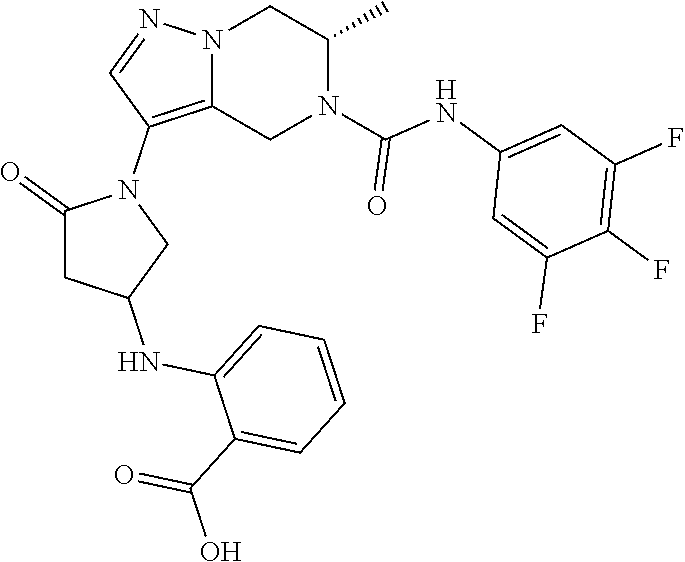
- Step 4 Preparation of 2-[[1-[(6S)-6-methyl-5-[(3,4,5-trifluorophenyl)carbamoyl]-6,7-dihydro-4H-pyrazolo[1,5-a]pyrazin-3-yl]-5-oxo-pyrrolidin-3-yl]amino]benzoic acid (Example 12)
- Example 13 (3.5 mg) as a white solid.
- LCMS (M+H + ) 509.1; 1 H NMR (400 MHz, DMSO-d6) ⁇ ppm 9.30-9.20 (m, 1H), 7.66 (s, 0.5H), 7.65 (s, 0.5H), 7.50-7.38 (m, 1H), 4.91-4.73 (m, 2H), 4.43 (s, 1H), 4.32 (m, 1H), 4.27-4.12 (m, 3H), 4.07-3.85 (m, 3H), 3.78-3.62 (m, 5H), 1.20-1.10 (m, 3H)
- Step 1 Preparation of methyl 4-fluoro-2-(4,4,5,5-tetramethyl-1,3,2-dioxaborolan-2-yl)benzoate (Compound 14b)
- Step 4 Preparation of tert-butyl (6S)-3-[4-(5-fluoro-2-methoxycarbonyl-phenyl)-2-oxo-pyrrolidin-1-yl]-6-methyl-6,7-dihydro-4H-pyrazolo[1,5-a]pyrazine-5-carboxylate (Compound 14e)
- Step 5 Preparation of methyl 4-fluoro-2-[1-[(6S)-6-methyl-5-[(3,4,5-trifluorophenyl)carbamoyl]-6,7-dihydro-4H-pyrazolo[1,5-a]pyrazin-3-yl]-5-oxo-pyrrolidin-3-yl]benzoate (Compound 14f)
- Step 6 Preparation of 4-fluoro-2-[1-[(6S)-6-methyl-5-[(3,4,5-trifluorophenyl)carbamoyl]-6,7-dihydro-4H-pyrazolo[1,5-a]pyrazin-3-yl]-5-oxo-pyrrolidin-3-yl]benzoic acid (Example 14)
- Example 15 was prepared in analogy to Example 14 by using methyl 2-bromo-5-fluorobenzoate instead of methyl 2-bromo-4-fluorobenzoate (compound 14a).
- Example 15 (7 mg) was obtained as white solid.
- Example 16 was prepared in analogy to Example 8 by using methyl 4-iodobenzoate instead of methyl 3-iodobenzoate (compound 8a).
- Example 16 120 mg was obtained as a white solid.
- LCMS (M+H + ): 514.4, 1 H NMR (400 MHz, METHANOL-d 4 ) ⁇ ppm 8.07-8.03 (m, 2H), 7.68 (s, 1H), 7.55-7.50 (m, 2H), 7.33-7.25 (m, 2H), 5.14-5.03 (m, 1H), 5.01-4.91 (m, 1H), 4.61-4.49 (m, 1H), 4.34-4.15 (m, 3H), 4.00-3.91 (m, 2H), 3.06-2.97 (m, 1H), 2.84-2.75 (m, 1H), 1.29 (t, J 7.3 Hz, 3H).
- Example 17 was prepared in analogy to Example 8 by using ethyl 6-bromopyridine-2-carboxylate instead of methyl 3-iodobenzoate (compound 8a).
- Example 17 (100 mg) was obtained as a white solid.
- Example 18 was prepared in analogy to Example 8 by using tert-butyl 2-bromopyridine-3-carboxylate instead of methyl 3-iodobenzoate (compound 8a).
- Example 18 (11 mg) was obtained as a white solid.
- LCMS (M+H + ): 515.5, 1 H NMR (400 MHz, METHANOL-d 4 ) ⁇ ppm 8.78-8.73 (m, 1H), 8.36-8.32 (m, 1H), 7.63 (s, 1H), 7.45-7.39 (m, 1H), 7.34-7.25 (m, 2H), 5.15-5.03 (m, 1H), 5.01-4.93 (m, 1H), 4.86-4.81 (m, 1H), 4.53 (d, J 16.9 Hz, 1H), 4.34-4.23 (m, 2H), 4.20-4.13 (m, 1H), 4.10-3.99 (m, 1H), 3.04-2.96 (m, 2H), 1.32-1.24 (m
- HepG2.2.15 is a stably-transfected cell line containing the HBV genome. It is derived from the hepatoblastoma cell line Hep G2 (American Type Culture Collection, ATCC® HB-8065TM) by the published procedures described in reference: MA Selles et al. Proc. Natl. Acad. Sci. USA 1987, 84, 1005-1009.
- the cell line was maintained in Dulbecco's modified Eagle's medium and nutrient mixture F-12 (DMEM/F-12, Gibco, Cat.#: 11320-033) supplemented with 10% fetal bovine serum (Gibco, Cat.#:10099-141), 100 U/mL penicillin, 100 ⁇ g/mL streptomycin (Gibco, Cat.#:15140-122), and 0.3 mg/mL of G418 Sulfate (Gibco, Cat.#: 10131-027).
- DMEM/F-12 Dulbecco's modified Eagle's medium and nutrient mixture F-12
- HepG2.2.15 cells were seeded into 96-well plates at a density of 3 ⁇ 10 4 cells per well in culture media of 100 ⁇ L DMEM/F-12 supplemented with 2.5% fetal bovine serum, 100 U/mL penicillin, 100 ⁇ g/mL streptomycin and cultured overnight at 37° C.
- the test compounds were serially half-log diluted in DMSO, then diluted 100 times in culture media. 100 ⁇ L culture media containing diluted compounds were added into the plates to reach 0.5% final concentration of DMSO in every well. Five days after compound treatment, culture supernatant was collected for further analysis.
- culture supernatant was processed by 500 ⁇ g/mL Proteinase K (Sigma, Cat.#:P2308) digestion at 50° C. for 1 hour. After heat inactivation of the enzyme at 95° C. for 15 minutes, the samples were subjected to HBV DNA quantification by qPCR. The effective compound concentration at which HBV replication was inhibited by 50% (EC 50 ) was determined.
Landscapes
- Organic Chemistry (AREA)
- Chemical & Material Sciences (AREA)
- Health & Medical Sciences (AREA)
- Life Sciences & Earth Sciences (AREA)
- Virology (AREA)
- Animal Behavior & Ethology (AREA)
- Pharmacology & Pharmacy (AREA)
- Veterinary Medicine (AREA)
- Communicable Diseases (AREA)
- Oncology (AREA)
- Chemical Kinetics & Catalysis (AREA)
- General Chemical & Material Sciences (AREA)
- Medicinal Chemistry (AREA)
- Nuclear Medicine, Radiotherapy & Molecular Imaging (AREA)
- Public Health (AREA)
- General Health & Medical Sciences (AREA)
- Engineering & Computer Science (AREA)
- Molecular Biology (AREA)
- Biotechnology (AREA)
- Pharmaceuticals Containing Other Organic And Inorganic Compounds (AREA)
- Nitrogen Condensed Heterocyclic Rings (AREA)
- Nitrogen And Oxygen Or Sulfur-Condensed Heterocyclic Ring Systems (AREA)
Abstract

-
- or pharmaceutically acceptable salts, enantiomer or diastereomer thereof, wherein R1 to R3 are as described above. The compounds may be useful for the treatment or prophylaxis of hepatitis B virus infection.
Description

or pharmaceutically acceptable salts, enantiomer or diastereomer thereof, wherein R1 to R4 are as described below. The compounds of this invention are useful for the treatment or prophylaxis of hepatitis B virus infection.

wherein
- R1 is oxooxadiazabicyclo[3.3.1]nonanyl substituted by carboxyC1-6alkyl; or
- oxopyrrolidinyl, said oxopyrrolidinyl being once substituted by carboxyC1-6alkyl(C1-6alkyl)amino, carboxyphenyl, carboxypyridinyl, carboxyphenylamino, halocarboxyphenyl or carboxypyrrolidinyl; or twice substituted by carboxypyrrolidinyl and C1-6alkyl;
- R2 is H or C1-6alkyl;
- R3 is C1-6alkyl;
- R4 is phenyl, said phenyl being three times substituted by halogen;

wherein
- R1 is oxooxadiazabicyclo[3.3.1]nonanyl substituted by carboxyC1-6alkyl; or
- oxopyrrolidinyl, said oxopyrrolidinyl being once substituted by carboxyC1-6alkyl(C1-6alkyl)amino, carboxyphenyl, carboxypyridinyl, carboxyphenylamino, halocarboxyphenyl or carboxypyrrolidinyl; or twice substituted by carboxypyrrolidinyl and C1-6alkyl;
- R2 is H or C1-6alkyl;
- R3 is C1-6alkyl;
- R4 is phenyl, said phenyl being three times substituted by halogen;
or pharmaceutically acceptable salt, enantiomer or diastereomer thereof.
- R1 is oxooxadiazabicyclo[3.3.1]nonanyl substituted by carboxyC1-6alkyl; or
- oxopyrrolidinyl, said oxopyrrolidinyl being once substituted by carboxyC1-6alkyl(C1-6alkyl)amino, carboxyphenyl, carboxyphenylamino, halocarboxyphenyl or carboxypyrrolidinyl; or twice substituted by carboxypyrrolidinyl and C1-6alkyl;
- R2 is H or C1-6alkyl;
- R3 is C1-6alkyl;
- R4 is phenyl, said phenyl being three times substituted by halogen;
or pharmaceutically acceptable salt, enantiomer or diastereomer thereof.
- R1 is carboxymethyl(methyl)aminooxopyrrolidinyl, carboxypyrrolidinyloxopyrrolidinyl, carboxypyrrolidinyl(methyl)oxopyrrolidinyl, carboxyphenyloxopyrrolidinyl, carboxypyridinyloxopyrrolidinyl, carboxyphenylaminooxopyrrolidinyl, fluorocarboxyphenyloxopyrrolidinyl or carboxymethyloxooxadiazabicyclo[3.3.1]nonanyl;
- R2 is H or methyl;
- R3 is methyl;
- R4 is trifluorophenyl;
or pharmaceutically acceptable salt, enantiomer or diastereomer thereof.
- R1 is carboxymethyl(methyl)aminooxopyrrolidinyl, carboxypyrrolidinyloxopyrrolidinyl, carboxypyrrolidinyl(methyl)oxopyrrolidinyl, carboxyphenyloxopyrrolidinyl, carboxyphenylaminooxopyrrolidinyl, fluorocarboxyphenyloxopyrrolidinyl or carboxymethyloxooxadiazabicyclo[3.3.1]nonanyl;
- R2 is H or methyl;
- R3 is methyl;
- R4 is trifluorophenyl;
or pharmaceutically acceptable salt, enantiomer or diastereomer thereof.
- (2S)-1-[1-[(6S)-6-methyl-5-[(3,4,5-trifluorophenyl)carbamoyl]-6,7-dihydro-4H-pyrazolo[1,5-a]pyrazin-3-yl]-5-oxo-pyrrolidin-3-yl]pyrrolidine-2-carboxylic acid;
- (2S)-1-[(2S)-2-methyl-1-[(6S)-6-methyl-5-[(3,4,5-trifluorophenyl)carbamoyl]-6,7-dihydro-4H-pyrazolo[1,5-a]pyrazin-3-yl]-5-oxo-pyrrolidin-3-yl]pyrrolidine-2-carboxylic acid;
- 2-[methyl-[1-[(6S)-6-methyl-5-[(3,4,5-trifluorophenyl)carbamoyl]-6,7-dihydro-4H-pyrazolo[1,5-a]pyrazin-3-yl]-5-oxo-pyrrolidin-3-yl]amino]acetic acid;
- (2R)-1-[(2S)-2-methyl-1-[(6S)-6-methyl-5-[(3,4,5-trifluorophenyl)carbamoyl]-6,7-dihydro-4H-pyrazolo[1,5-a]pyrazin-3-yl]-5-oxo-pyrrolidin-3-yl]pyrrolidine-2-carboxylic acid;
- 1-[1-[(6S)-6-methyl-5-[(3,4,5-trifluorophenyl)carbamoyl]-6,7-dihydro-4H-pyrazolo[1,5-a]pyrazin-3-yl]-5-oxo-pyrrolidin-3-yl]pyrrolidine-3-carboxylic acid;
- (2S)-1-[1-[(6S,7S)-6,7-dimethyl-5-[(3,4,5-trifluorophenyl)carbamoyl]-6,7-dihydro-4H-pyrazolo[1,5-a]pyrazin-3-yl]-5-oxo-pyrrolidin-3-yl]pyrrolidine-2-carboxylic acid;
- 2-[1-[(6S)-6-methyl-5-[(3,4,5-trifluorophenyl)carbamoyl]-6,7-dihydro-4H-pyrazolo[1,5-a]pyrazin-3-yl]-5-oxo-pyrrolidin-3-yl]benzoic acid;
- 3-[1-[(6S)-6-methyl-5-[(3,4,5-trifluorophenyl)carbamoyl]-6,7-dihydro-4H-pyrazolo[1,5-a]pyrazin-3-yl]-5-oxo-pyrrolidin-3-yl]benzoic acid;
- (2R)-1-[1-[(6S)-6-methyl-5-[(3,4,5-trifluorophenyl)carbamoyl]-6,7-dihydro-4H-pyrazolo[1,5-a]pyrazin-3-yl]-5-oxo-pyrrolidin-3-yl]pyrrolidine-2-carboxylic acid;
- 3-fluoro-2-[1-[(6S)-6-methyl-5-[(3,4,5-trifluorophenyl)carbamoyl]-6,7-dihydro-4H-pyrazolo[1,5-a]pyrazin-3-yl]-5-oxo-pyrrolidin-3-yl]benzoic acid;
- 2-fluoro-6-[1-[(6S)-6-methyl-5-[(3,4,5-trifluorophenyl)carbamoyl]-6,7-dihydro-4H-pyrazolo[1,5-a]pyrazin-3-yl]-5-oxo-pyrrolidin-3-yl]benzoic acid;
- 2-[[1-[(6S)-6-methyl-5-[(3,4,5-trifluorophenyl)carbamoyl]-6,7-dihydro-4H-pyrazolo[1,5-a]pyrazin-3-yl]-5-oxo-pyrrolidin-3-yl]amino]benzoic acid;
- 2-[7-[(6S)-6-methyl-5-[(3,4,5-trifluorophenyl)carbamoyl]-6,7-dihydro-4H-pyrazolo[1,5-a]pyrazin-3-yl]-6-oxo-3-oxa-7,9-diazabicyclo[3.3.1]nonan-9-yl]acetic acid;
- 4-fluoro-2-[1-[(6S)-6-methyl-5-[(3,4,5-trifluorophenyl)carbamoyl]-6,7-dihydro-4H-pyrazolo[1,5-a]pyrazin-3-yl]-5-oxo-pyrrolidin-3-yl]benzoic acid;
- 5-fluoro-2-[1-[(6S)-6-methyl-5-[(3,4,5-trifluorophenyl)carbamoyl]-6,7-dihydro-4H-pyrazolo[1,5-a]pyrazin-3-yl]-5-oxo-pyrrolidin-3-yl]benzoic acid;
- 4-[1-[(6S)-6-methyl-5-[(3,4,5-trifluorophenyl)carbamoyl]-6,7-dihydro-4H-pyrazolo[1,5-a]pyrazin-3-yl]-5-oxo-pyrrolidin-3-yl]benzoic acid;
- 6-[1-[(6S)-6-methyl-5-[(3,4,5-trifluorophenyl)carbamoyl]-6,7-dihydro-4H-pyrazolo[1,5-a]pyrazin-3-yl]-5-oxo-pyrrolidin-3-yl]pyridine-2-carboxylic acid; and
- 2-[1-[(6S)-6-methyl-5-[(3,4,5-trifluorophenyl)carbamoyl]-6,7-dihydro-4H-pyrazolo[1,5-a]pyrazin-3-yl]-5-oxo-pyrrolidin-3-yl]pyridine-3-carboxylic acid.
Synthesis


The title compound was prepared according to the following scheme:


The title compound was prepared according to the following scheme:




The title compound was prepared according to the following scheme:


| TABLE 1 |
| Activity of compounds of this invention in HepG2.2.15 assay |
| Example | EC50 | ||
| No. | (μM) | ||
| 1 | 0.126 | ||
| 2 | 0.098 | ||
| 3 | 0.139 | ||
| 4 | 0.105 | ||
| 5 | 0.240 | ||
| 6-1 | 0.112 | ||
| 6-2 | 0.099 | ||
| 7 | 0.022 | ||
| 7-1 | 0.034 | ||
| 7-2 | 0.014 | ||
| 8 | 0.089 | ||
| 9 | 0.124 | ||
| 10-1 | 0.106 | ||
| 10-2 | 0.017 | ||
| 11-1 | 0.312 | ||
| 11-2 | 0.077 | ||
| 12 | 0.288 | ||
| 13 | 0.099 | ||
| 14 | 0.030 | ||
| 15 | 0.057 | ||
| 16 | 0.228 | ||
| 18 | 0.102 | ||
Claims (6)


Priority Applications (1)
| Application Number | Priority Date | Filing Date | Title |
|---|---|---|---|
| US16/790,400 US20200181156A1 (en) | 2016-07-14 | 2020-02-13 | Carboxy tetrahydropyrazolopyrazine compounds for the treatment of infectious diseases |
Applications Claiming Priority (7)
| Application Number | Priority Date | Filing Date | Title |
|---|---|---|---|
| WOPCT/CN2016/090036 | 2016-07-14 | ||
| CN2016090036 | 2016-07-14 | ||
| CNPCT/CN2016/090036 | 2016-07-14 | ||
| CN2017080438 | 2017-04-13 | ||
| WOPCT/CN2017/080438 | 2017-04-13 | ||
| CNPCT/CN2017/080438 | 2017-04-13 | ||
| PCT/EP2017/067319 WO2018011162A1 (en) | 2016-07-14 | 2017-07-11 | Carboxy 6,7-dihydro-4h-pyrazolo[1,5-a]pyrazine compounds for the treatment of infectious diseases |
Related Parent Applications (1)
| Application Number | Title | Priority Date | Filing Date |
|---|---|---|---|
| PCT/EP2017/067319 Continuation WO2018011162A1 (en) | 2016-07-14 | 2017-07-11 | Carboxy 6,7-dihydro-4h-pyrazolo[1,5-a]pyrazine compounds for the treatment of infectious diseases |
Related Child Applications (1)
| Application Number | Title | Priority Date | Filing Date |
|---|---|---|---|
| US16/790,400 Continuation US20200181156A1 (en) | 2016-07-14 | 2020-02-13 | Carboxy tetrahydropyrazolopyrazine compounds for the treatment of infectious diseases |
Publications (2)
| Publication Number | Publication Date |
|---|---|
| US20190322670A1 US20190322670A1 (en) | 2019-10-24 |
| US10562905B2 true US10562905B2 (en) | 2020-02-18 |
Family
ID=59313250
Family Applications (2)
| Application Number | Title | Priority Date | Filing Date |
|---|---|---|---|
| US16/247,084 Active US10562905B2 (en) | 2016-07-14 | 2019-01-14 | Carboxy tetrahydropyrazolopyrazine compounds for the treatment of infectious diseases |
| US16/790,400 Abandoned US20200181156A1 (en) | 2016-07-14 | 2020-02-13 | Carboxy tetrahydropyrazolopyrazine compounds for the treatment of infectious diseases |
Family Applications After (1)
| Application Number | Title | Priority Date | Filing Date |
|---|---|---|---|
| US16/790,400 Abandoned US20200181156A1 (en) | 2016-07-14 | 2020-02-13 | Carboxy tetrahydropyrazolopyrazine compounds for the treatment of infectious diseases |
Country Status (5)
| Country | Link |
|---|---|
| US (2) | US10562905B2 (en) |
| EP (1) | EP3484885B1 (en) |
| JP (1) | JP7034133B2 (en) |
| CN (1) | CN109415368B (en) |
| WO (1) | WO2018011162A1 (en) |
Cited By (1)
| Publication number | Priority date | Publication date | Assignee | Title |
|---|---|---|---|---|
| US20200181156A1 (en) * | 2016-07-14 | 2020-06-11 | Hoffmann-La Roche Inc. | Carboxy tetrahydropyrazolopyrazine compounds for the treatment of infectious diseases |
Families Citing this family (52)
| Publication number | Priority date | Publication date | Assignee | Title |
|---|---|---|---|---|
| WO2018011100A1 (en) * | 2016-07-14 | 2018-01-18 | F. Hoffmann-La Roche Ag | Novel tetrahydropyrazolopyridine compounds for the treatment of infectious diseases |
| JP7051804B2 (en) * | 2016-07-14 | 2022-04-11 | エフ.ホフマン-ラ ロシュ アーゲー | 6,7-dihydro-4H-pyrazolo [1,5-a] pyrazine compound and 6,7-dihydro-4H-triazolo [1,5-a] pyrazine compound for the treatment of infectious diseases |
| MA46535A (en) | 2016-10-14 | 2019-08-21 | Prec Biosciences Inc | SPECIFIC MODIFIED MEGANUCLEASES OF RECOGNITION SEQUENCES IN THE HEPATITIS B VIRUS GENOME |
| GEP20227373B (en) | 2017-11-02 | 2022-04-25 | Aicuris Gmbh & Co Kg | Novel, highly active amino-thiazole substituted indole-2-carboxamides active against the hepatitis b virus (hbv) |
| CN111527087A (en) | 2017-11-02 | 2020-08-11 | 艾库里斯有限及两合公司 | Novel highly active pyrazolo-piperidine substituted indole-2-carboxamides with anti-hepatitis B virus (HBV) activity |
| EP3728283B1 (en) | 2017-12-20 | 2023-11-22 | Institute of Organic Chemistry and Biochemistry ASCR, V.V.I. | 3'3' cyclic dinucleotides with phosphonate bond activating the sting adaptor protein |
| CN111511754B (en) | 2017-12-20 | 2023-09-12 | 捷克共和国有机化学与生物化学研究所 | 2’3’ cyclic dinucleotide with phosphonate bond that activates STING adapter protein |
| KR102526964B1 (en) | 2018-02-26 | 2023-04-28 | 길리애드 사이언시즈, 인코포레이티드 | Substituted pyrrolizine compounds as HBV replication inhibitors |
| US20200407365A1 (en) * | 2018-02-28 | 2020-12-31 | Novartis Ag | Indole-2-carbonyl compounds and their use for the treatment of hepatitis b |
| WO2019195181A1 (en) | 2018-04-05 | 2019-10-10 | Gilead Sciences, Inc. | Antibodies and fragments thereof that bind hepatitis b virus protein x |
| TW202005654A (en) | 2018-04-06 | 2020-02-01 | 捷克科學院有機化學與生物化學研究所 | 2'2'-cyclic dinucleotides |
| TWI833744B (en) | 2018-04-06 | 2024-03-01 | 捷克科學院有機化學與生物化學研究所 | 3'3'-cyclic dinucleotides |
| TWI818007B (en) | 2018-04-06 | 2023-10-11 | 捷克科學院有機化學與生物化學研究所 | 2'3'-cyclic dinucleotides |
| TW201945388A (en) | 2018-04-12 | 2019-12-01 | 美商精密生物科學公司 | Optimized engineered meganucleases having specificity for a recognition sequence in the hepatitis B virus genome |
| US20190359645A1 (en) | 2018-05-03 | 2019-11-28 | Institute Of Organic Chemistry And Biochemistry Ascr, V.V.I. | 2'3'-cyclic dinucleotides comprising carbocyclic nucleotide |
| WO2020028097A1 (en) | 2018-08-01 | 2020-02-06 | Gilead Sciences, Inc. | Solid forms of (r)-11-(methoxymethyl)-12-(3-methoxypropoxy)-3,3-dimethyl-8-0x0-2,3,8,13b-tetrahydro-1h-pyrido[2,1-a]pyrrolo[1,2-c] phthalazine-7-c arboxylic acid |
| KR102658602B1 (en) | 2018-10-31 | 2024-04-19 | 길리애드 사이언시즈, 인코포레이티드 | Substituted 6-azabenzimidazole compounds with HPK1 inhibitory activity |
| FI3873903T3 (en) | 2018-10-31 | 2024-03-26 | Gilead Sciences Inc | Substituted 6-azbenzimidazole compounds as HPK1 inhibitors |
| AR116946A1 (en) | 2018-11-02 | 2021-06-30 | Aicuris Gmbh & Co Kg | DERIVATIVES OF UREA 6,7-DIHIDRO-4H-PIRAZOLO [4,3-C] PYRIDINES ACTIVE AGAINST THE VIRUS OF HEPATITIS B (HBV) |
| UY38435A (en) | 2018-11-02 | 2020-05-29 | Aicuris Gmbh & Co Kg | NEW UREA 6,7-DIHIDRO-4H-PIRAZOL [1,5-A] PIRAZINAS ACTIVE AGAINST THE VIRUS OF HEPATITIS B (HBV) |
| PY1991603A (en) | 2018-11-02 | 2020-09-17 | Aicuris Gmbh & Co Kg | NEW 6,7-DIHYDRO-4H-PYRAZOLE [1,5-A] PYRAZINE INDOLE -2-CARBOXAMIDES ACTIVE AGAINST HEPATITIS B VIRUS (HBV) |
| UY38434A (en) * | 2018-11-02 | 2020-05-29 | Aicuris Gmbh & Co Kg | NEW 6,7-DIHYDRO-4H-PYRAZOLE [1,5-A] PIRAZIN INDOL-2-CARBOXAMIDES ACTIVE AGAINST THE HEPATITIS B VIRUS (HBV) |
| UY38437A (en) | 2018-11-02 | 2020-05-29 | Aicuris Gmbh & Co Kg | NEW UREA 6,7-DIHIDRO-4H-PIRAZOLO [1,5-A] PYRAZINES ACTIVE AGAINST THE HEPATITIS B VIRUS (HBV) |
| CA3118339A1 (en) | 2018-11-02 | 2020-05-07 | Aicuris Gmbh & Co. Kg | Novel urea 6,7-dihydro-4h-thiazolo[5,4-c]pyridines active against the hepatitis b virus (hbv) |
| CN113454088A (en) * | 2019-02-26 | 2021-09-28 | 豪夫迈·罗氏有限公司 | Process for the preparation of (6S) -3- [ (4S) -4-cyano-2-oxo-pyrrolidin-1-yl ] -6-methyl-N- (3,4, 5-trifluorophenyl) -6, 7-dihydro-4H-pyrazolo [1,5-a ] pyrazine-5-carboxamide |
| CA3129011C (en) | 2019-03-07 | 2023-12-19 | Institute Of Organic Chemistry And Biochemistry Ascr, V.V.I. | 3'3'-cyclic dinucleotides and prodrugs thereof |
| EP3935065A1 (en) | 2019-03-07 | 2022-01-12 | Institute of Organic Chemistry and Biochemistry ASCR, V.V.I. | 3'3'-cyclic dinucleotide analogue comprising a cyclopentanyl modified nucleotide as sting modulator |
| EP3934757B1 (en) | 2019-03-07 | 2023-02-22 | Institute of Organic Chemistry and Biochemistry ASCR, V.V.I. | 2'3'-cyclic dinucleotides and prodrugs thereof |
| TW202210480A (en) | 2019-04-17 | 2022-03-16 | 美商基利科學股份有限公司 | Solid forms of a toll-like receptor modulator |
| TWI751517B (en) | 2019-04-17 | 2022-01-01 | 美商基利科學股份有限公司 | Solid forms of a toll-like receptor modulator |
| EP3962914A1 (en) | 2019-04-30 | 2022-03-09 | AiCuris GmbH & Co. KG | Novel indole-2-carboxamides active against the hepatitis b virus (hbv) |
| BR112021021580A2 (en) | 2019-04-30 | 2022-01-04 | Aicuris Gmbh & Co Kg | Innovative phenyl and pyridyl ureas active against hepatitis b virus (hbv) |
| JP2022533007A (en) | 2019-04-30 | 2022-07-21 | アイクリス ゲゼルシャフト ミット ベシュレンクテル ハフツング ウント コンパニー コマンディトゲゼルシャフト | A novel indolizine-2-carboxamide that is active against hepatitis B virus (HBV) |
| BR112021021652A2 (en) | 2019-04-30 | 2021-12-21 | Aicuris Gmbh & Co Kg | Innovative oxalyl piperazines active against hepatitis B virus (HBV) |
| TWI826690B (en) | 2019-05-23 | 2023-12-21 | 美商基利科學股份有限公司 | Substituted eneoxindoles and uses thereof |
| MX2021015452A (en) | 2019-06-25 | 2022-02-11 | Gilead Sciences Inc | FLT3L-FC FUSION PROTEINS AND METHODS OF USE. |
| WO2021034804A1 (en) | 2019-08-19 | 2021-02-25 | Gilead Sciences, Inc. | Pharmaceutical formulations of tenofovir alafenamide |
| KR20220074917A (en) | 2019-09-30 | 2022-06-03 | 길리애드 사이언시즈, 인코포레이티드 | HBV vaccines and methods of treating HBV |
| CN110804061B (en) * | 2019-11-13 | 2021-01-05 | 中国医学科学院医药生物技术研究所 | Pyrazolopyrazine carboxamides containing cyclopropyl moieties and their applications |
| DK4069729T3 (en) | 2019-12-06 | 2025-04-07 | Prec Biosciences Inc | OPTIMIZED, MODIFIED MEGANUCLEASES WITH SPECIFICITY FOR A RECOGNITION SEQUENCE IN THE HEPATITIS B VIRUS GENOME |
| AR121620A1 (en) | 2020-03-20 | 2022-06-22 | Gilead Sciences Inc | 4-C-SUBSTITUTED-2-HALO-2-DEOXIADENOSINE NUCLEOSIDE PRODRUGS AND METHODS OF PREPARATION AND USE THEREOF |
| JP7712352B2 (en) | 2020-08-07 | 2025-07-23 | ギリアード サイエンシーズ, インコーポレイテッド | Prodrugs of phosphonamide nucleotide analogues and pharmaceutical uses thereof - Patents.com |
| TW202406932A (en) | 2020-10-22 | 2024-02-16 | 美商基利科學股份有限公司 | Interleukin-2-fc fusion proteins and methods of use |
| EP4337223A1 (en) | 2021-05-13 | 2024-03-20 | Gilead Sciences, Inc. | Combination of a tlr8 modulating compound and anti-hbv sirna therapeutics |
| AU2022298639C1 (en) | 2021-06-23 | 2025-07-17 | Gilead Sciences, Inc. | Diacylglyercol kinase modulating compounds |
| AU2022299051B2 (en) | 2021-06-23 | 2025-03-13 | Gilead Sciences, Inc. | Diacylglyercol kinase modulating compounds |
| KR20240005901A (en) | 2021-06-23 | 2024-01-12 | 길리애드 사이언시즈, 인코포레이티드 | Diacylglycerol Kinase Modulating Compounds |
| KR20240025616A (en) | 2021-06-23 | 2024-02-27 | 길리애드 사이언시즈, 인코포레이티드 | Diacylglycerol Kinase Modulating Compounds |
| US20250345389A1 (en) | 2024-05-13 | 2025-11-13 | Gilead Sciences, Inc. | Combination therapies |
| WO2025240246A1 (en) | 2024-05-13 | 2025-11-20 | Gilead Sciences, Inc. | Combination therapies with ribavirin |
| WO2025240244A1 (en) | 2024-05-13 | 2025-11-20 | Gilead Sciences, Inc. | Combination therapies comprising bulevirtide and lonafarnib for use in the treatment of hepatitis d virus infection |
| WO2025240242A1 (en) | 2024-05-13 | 2025-11-20 | Gilead Sciences, Inc. | Combination therapies with ribavirin |
Citations (9)
| Publication number | Priority date | Publication date | Assignee | Title |
|---|---|---|---|---|
| WO2009085983A1 (en) | 2007-12-19 | 2009-07-09 | Genentech, Inc. | 5-anilinoimidazopyridines and methods of use |
| WO2013096744A1 (en) | 2011-12-21 | 2013-06-27 | Novira Therapeutics, Inc. | Hepatitis b antiviral agents |
| WO2014033167A1 (en) | 2012-08-28 | 2014-03-06 | Janssen R&D Ireland | Fused bicyclic sulfamoyl derivatives and the use thereof as medicaments for the treatment of hepatitis b |
| WO2014033170A1 (en) | 2012-08-28 | 2014-03-06 | Janssen R&D Ireland | Sulfamoyl-arylamides and the use thereof as medicaments for the treatment of hepatitis b |
| WO2014111871A1 (en) | 2013-01-17 | 2014-07-24 | Aurigene Discovery Technologies Limited | 4,5-dihydroisoxazole derivatives as nampt inhibitors |
| WO2014152725A1 (en) | 2013-03-15 | 2014-09-25 | Biogen Idec Ma Inc. | S1p and/or atx modulating agents |
| WO2016109689A2 (en) | 2014-12-30 | 2016-07-07 | Novira Therapeutics, Inc. | Derivatives and methods of treating hepatitis b infections |
| WO2016113273A1 (en) | 2015-01-16 | 2016-07-21 | F. Hoffmann-La Roche Ag | Pyrazine compounds for the treatment of infectious diseases |
| WO2017198744A1 (en) | 2016-05-20 | 2017-11-23 | F. Hoffmann-La Roche Ag | Novel pyrazine compounds with oxygen, sulfur and nitrogen linker for the treatment of infectious diseases |
Family Cites Families (3)
| Publication number | Priority date | Publication date | Assignee | Title |
|---|---|---|---|---|
| EA201690979A1 (en) * | 2013-11-14 | 2016-08-31 | Новира Терапьютикс, Инк. | AZEPAN DERIVATIVES AND METHODS OF TREATING HEPATITIS B INFECTIONS |
| EP3143020B1 (en) * | 2014-05-13 | 2019-08-21 | F. Hoffmann-La Roche AG | Dihydroquinolizinones for the treatment and prophylaxis of hepatitis b virus infection |
| JP7034133B2 (en) * | 2016-07-14 | 2022-03-11 | エフ.ホフマン-ラ ロシュ アーゲー | Carboxyl 6,7-dihydro-4H-pyrazolo [1,5-a] pyrazine compounds for the treatment of infectious diseases |
-
2017
- 2017-07-11 JP JP2019501647A patent/JP7034133B2/en not_active Expired - Fee Related
- 2017-07-11 EP EP17737570.6A patent/EP3484885B1/en active Active
- 2017-07-11 CN CN201780039292.1A patent/CN109415368B/en not_active Expired - Fee Related
- 2017-07-11 WO PCT/EP2017/067319 patent/WO2018011162A1/en not_active Ceased
-
2019
- 2019-01-14 US US16/247,084 patent/US10562905B2/en active Active
-
2020
- 2020-02-13 US US16/790,400 patent/US20200181156A1/en not_active Abandoned
Patent Citations (13)
| Publication number | Priority date | Publication date | Assignee | Title |
|---|---|---|---|---|
| WO2009085983A1 (en) | 2007-12-19 | 2009-07-09 | Genentech, Inc. | 5-anilinoimidazopyridines and methods of use |
| WO2013096744A1 (en) | 2011-12-21 | 2013-06-27 | Novira Therapeutics, Inc. | Hepatitis b antiviral agents |
| WO2014033167A1 (en) | 2012-08-28 | 2014-03-06 | Janssen R&D Ireland | Fused bicyclic sulfamoyl derivatives and the use thereof as medicaments for the treatment of hepatitis b |
| WO2014033170A1 (en) | 2012-08-28 | 2014-03-06 | Janssen R&D Ireland | Sulfamoyl-arylamides and the use thereof as medicaments for the treatment of hepatitis b |
| WO2014111871A1 (en) | 2013-01-17 | 2014-07-24 | Aurigene Discovery Technologies Limited | 4,5-dihydroisoxazole derivatives as nampt inhibitors |
| WO2014152725A1 (en) | 2013-03-15 | 2014-09-25 | Biogen Idec Ma Inc. | S1p and/or atx modulating agents |
| WO2016109689A2 (en) | 2014-12-30 | 2016-07-07 | Novira Therapeutics, Inc. | Derivatives and methods of treating hepatitis b infections |
| WO2016109689A3 (en) | 2014-12-30 | 2016-08-25 | Novira Therapeutics, Inc. | Derivatives and methods of treating hepatitis b infections |
| WO2016113273A1 (en) | 2015-01-16 | 2016-07-21 | F. Hoffmann-La Roche Ag | Pyrazine compounds for the treatment of infectious diseases |
| US9890167B2 (en) | 2015-01-16 | 2018-02-13 | Hoffmann-La Roche Inc. | Pyrazine compounds for the treatment of infectious diseases |
| US20180334461A1 (en) | 2015-01-16 | 2018-11-22 | Hoffmann-La Roche Inc. | Novel pyrazine compounds for the treatment of infectious diseases |
| WO2017198744A1 (en) | 2016-05-20 | 2017-11-23 | F. Hoffmann-La Roche Ag | Novel pyrazine compounds with oxygen, sulfur and nitrogen linker for the treatment of infectious diseases |
| US20190185476A1 (en) | 2016-05-20 | 2019-06-20 | Hoffmann-La Roche Inc. | Novel pyrazine compounds with oxygen sulfur and nitrogen linker for the treatment of infectious diseases |
Non-Patent Citations (2)
| Title |
|---|
| Barsanti et al., "Structure-Based Drug Design of Novel Potent and Selective Tetrahydropyrazolo[1,5-a]pyrazined as ATR Inhibitors" ACS Medicinal Chemistry Letters 6(1):37-41 ( 2014). |
| ISR and Written Opinion for PCT/EP2017/067319 (dated Sep. 26, 2017). |
Cited By (1)
| Publication number | Priority date | Publication date | Assignee | Title |
|---|---|---|---|---|
| US20200181156A1 (en) * | 2016-07-14 | 2020-06-11 | Hoffmann-La Roche Inc. | Carboxy tetrahydropyrazolopyrazine compounds for the treatment of infectious diseases |
Also Published As
| Publication number | Publication date |
|---|---|
| US20190322670A1 (en) | 2019-10-24 |
| CN109415368A (en) | 2019-03-01 |
| JP2019521145A (en) | 2019-07-25 |
| EP3484885B1 (en) | 2020-03-04 |
| US20200181156A1 (en) | 2020-06-11 |
| CN109415368B (en) | 2021-04-30 |
| EP3484885A1 (en) | 2019-05-22 |
| WO2018011162A1 (en) | 2018-01-18 |
| JP7034133B2 (en) | 2022-03-11 |
Similar Documents
| Publication | Publication Date | Title |
|---|---|---|
| US10562905B2 (en) | Carboxy tetrahydropyrazolopyrazine compounds for the treatment of infectious diseases | |
| US10604527B2 (en) | Pyrazine compounds for the treatment of hepatitis B infection | |
| US10683299B2 (en) | Pyrazolopyrazine and triazolopyrazine compounds for the treatment of infectious diseases | |
| US10428069B2 (en) | 6-fused heteroaryldihydropyrimidines for the treatment and prophylaxis of hepatitis B virus infection | |
| US11168086B2 (en) | Methods of synthesizing pyrazine compounds | |
| WO2018011160A1 (en) | 6,7-dihydro-4h-pyrazolo[1,5-a]pyrazine compounds for the treatment of infectious diseases | |
| HK40004446B (en) | Carboxy 6,7-dihydro-4h-pyrazolo[1,5-a]pyrazine compounds for the treatment of infectious diseases | |
| HK40004446A (en) | Carboxy 6,7-dihydro-4h-pyrazolo[1,5-a]pyrazine compounds for the treatment of infectious diseases | |
| HK40002665A (en) | Novel 6-fused heteroaryldihydropyrimidines for the treatment and prophylaxis of hepatitis b virus infection | |
| HK40002185A (en) | Novel pyrazine compounds with oxygen, sulfur and nitrogen linker for the treatment of infectious diseases | |
| HK40002185B (en) | Novel pyrazine compounds with oxygen, sulfur and nitrogen linker for the treatment of infectious diseases | |
| HK1230189A1 (en) | Novel 6-fused heteroaryldihydropyrimidines for the treatment and prophylaxis of hepatitis b virus infection |
Legal Events
| Date | Code | Title | Description |
|---|---|---|---|
| FEPP | Fee payment procedure |
Free format text: ENTITY STATUS SET TO UNDISCOUNTED (ORIGINAL EVENT CODE: BIG.); ENTITY STATUS OF PATENT OWNER: LARGE ENTITY |
|
| AS | Assignment |
Owner name: ROCHE R&D CENTER (CHINA) LTD., CHINA Free format text: ASSIGNMENT OF ASSIGNORS INTEREST;ASSIGNORS:HU, TAISHAN;KOU, BUYU;LIU, HAIXIA;AND OTHERS;SIGNING DATES FROM 20161110 TO 20161125;REEL/FRAME:048134/0328 Owner name: HOFFMANN-LA ROCHE INC., NEW JERSEY Free format text: ASSIGNMENT OF ASSIGNORS INTEREST;ASSIGNOR:F. HOFFMANN-LA ROCHE AG;REEL/FRAME:048124/0396 Effective date: 20170620 Owner name: HOFFMANN-LA ROCHE INC., NEW JERSEY Free format text: ASSIGNMENT OF ASSIGNORS INTEREST;ASSIGNOR:F. HOFFMANN-LA ROCHE AG;REEL/FRAME:048124/0147 Effective date: 20170120 Owner name: F. HOFFMANN-LA ROCHE AG, SWITZERLAND Free format text: ASSIGNMENT OF ASSIGNORS INTEREST;ASSIGNOR:ROCHE R&D CENTER (CHINA) LTD.;REEL/FRAME:048124/0058 Effective date: 20161125 Owner name: F. HOFFMANN-LA ROCHE AG, SWITZERLAND Free format text: ASSIGNMENT OF ASSIGNORS INTEREST;ASSIGNOR:ROCHE R&D CENTER (CHINA) LTD.;REEL/FRAME:048124/0341 Effective date: 20170605 Owner name: ROCHE R&D CENTER (CHINA) LTD., CHINA Free format text: ASSIGNMENT OF ASSIGNORS INTEREST;ASSIGNORS:HU, TAISHAN;KOU, BUYU;LIU, HAIXIA;AND OTHERS;REEL/FRAME:048124/0279 Effective date: 20170605 |
|
| STPP | Information on status: patent application and granting procedure in general |
Free format text: NOTICE OF ALLOWANCE MAILED -- APPLICATION RECEIVED IN OFFICE OF PUBLICATIONS |
|
| STPP | Information on status: patent application and granting procedure in general |
Free format text: AWAITING TC RESP, ISSUE FEE PAYMENT VERIFIED |
|
| STCF | Information on status: patent grant |
Free format text: PATENTED CASE |
|
| MAFP | Maintenance fee payment |
Free format text: PAYMENT OF MAINTENANCE FEE, 4TH YEAR, LARGE ENTITY (ORIGINAL EVENT CODE: M1551); ENTITY STATUS OF PATENT OWNER: LARGE ENTITY Year of fee payment: 4 |