US10562893B2 - Benzimidazoles derivatives as Tec kinases family inhibitors - Google Patents
Benzimidazoles derivatives as Tec kinases family inhibitors Download PDFInfo
- Publication number
- US10562893B2 US10562893B2 US15/772,919 US201615772919A US10562893B2 US 10562893 B2 US10562893 B2 US 10562893B2 US 201615772919 A US201615772919 A US 201615772919A US 10562893 B2 US10562893 B2 US 10562893B2
- Authority
- US
- United States
- Prior art keywords
- substituted
- unsubstituted
- mmol
- cycloalkyl
- formula
- Prior art date
- Legal status (The legal status is an assumption and is not a legal conclusion. Google has not performed a legal analysis and makes no representation as to the accuracy of the status listed.)
- Expired - Fee Related
Links
- 0 *C(=O)NC1=NC2=CC(C[Y])=CC=C2N1*C Chemical compound *C(=O)NC1=NC2=CC(C[Y])=CC=C2N1*C 0.000 description 61
- GCEGAQGWQHZQIR-UHFFFAOYSA-N C/C([Rb])=C(/[RaH])C(=O)O Chemical compound C/C([Rb])=C(/[RaH])C(=O)O GCEGAQGWQHZQIR-UHFFFAOYSA-N 0.000 description 7
- WUWOBTSWLQTXIA-UHFFFAOYSA-N CC(=O)/C([RaH])=C(\C)[Rb] Chemical compound CC(=O)/C([RaH])=C(\C)[Rb] WUWOBTSWLQTXIA-UHFFFAOYSA-N 0.000 description 7
- HCJSFZVCYWIVAN-UHFFFAOYSA-N C/C([Rb])=C(/[RaH])C(=O)C(C)C Chemical compound C/C([Rb])=C(/[RaH])C(=O)C(C)C HCJSFZVCYWIVAN-UHFFFAOYSA-N 0.000 description 6
- LVWFOTJIKFSBLF-UHFFFAOYSA-N BB.CCC(C)C.CN(C)C Chemical compound BB.CCC(C)C.CN(C)C LVWFOTJIKFSBLF-UHFFFAOYSA-N 0.000 description 5
- PPABAUKKVNQHCF-UHFFFAOYSA-N BB.CCN.CN Chemical compound BB.CCN.CN PPABAUKKVNQHCF-UHFFFAOYSA-N 0.000 description 4
- XFNOKIBZOUUOPX-UHFFFAOYSA-N BB.CCN.CN(C)C Chemical compound BB.CCN.CN(C)C XFNOKIBZOUUOPX-UHFFFAOYSA-N 0.000 description 4
- PFRZOBPYYYRKID-UHFFFAOYSA-N BB.CC(C)N.CCC(C)C Chemical compound BB.CC(C)N.CCC(C)C PFRZOBPYYYRKID-UHFFFAOYSA-N 0.000 description 3
- WDLPBVRXUHTVKT-UHFFFAOYSA-N BB.CCC(C)C.CN Chemical compound BB.CCC(C)C.CN WDLPBVRXUHTVKT-UHFFFAOYSA-N 0.000 description 3
- LBHKOLKLAQNMKP-KRWDZBQOSA-N C=CC(=O)NC1=CC=C(N2C3=CC=C(CN[C@@H](C)C(C)(C)C)C=C3N=C2NC(=O)C2=CC=C(C(F)F)S2)C=C1 Chemical compound C=CC(=O)NC1=CC=C(N2C3=CC=C(CN[C@@H](C)C(C)(C)C)C=C3N=C2NC(=O)C2=CC=C(C(F)F)S2)C=C1 LBHKOLKLAQNMKP-KRWDZBQOSA-N 0.000 description 2
- DVMJGQXCIBYLQJ-UHFFFAOYSA-N C=CC(=O)NC1=CC=CC(N2C3=CC=C(C(=O)NC4CCCCC4)C=C3N=C2NC(=O)C2=CC=C(C(F)F)S2)=C1 Chemical compound C=CC(=O)NC1=CC=CC(N2C3=CC=C(C(=O)NC4CCCCC4)C=C3N=C2NC(=O)C2=CC=C(C(F)F)S2)=C1 DVMJGQXCIBYLQJ-UHFFFAOYSA-N 0.000 description 2
- YRBQTUHRNLQHKQ-UHFFFAOYSA-N C=CC(=O)NC1=CC=CC(N2C3=CC=C(CN4CCOCC4)C=C3N=C2NC(=O)C2=CC=C(C(F)F)S2)=C1 Chemical compound C=CC(=O)NC1=CC=CC(N2C3=CC=C(CN4CCOCC4)C=C3N=C2NC(=O)C2=CC=C(C(F)F)S2)=C1 YRBQTUHRNLQHKQ-UHFFFAOYSA-N 0.000 description 2
- ORFZJMPDFWIQGL-IBGZPJMESA-N C=CC(=O)NC1=CC=CC(N2C3=CC=C(CN[C@@H](C)C(C)(C)C)C=C3N=C2NC(=O)C2=CC=NC=C2)=C1 Chemical compound C=CC(=O)NC1=CC=CC(N2C3=CC=C(CN[C@@H](C)C(C)(C)C)C=C3N=C2NC(=O)C2=CC=NC=C2)=C1 ORFZJMPDFWIQGL-IBGZPJMESA-N 0.000 description 2
- FRXUUECDMIKIQH-SFHVURJKSA-N C=CC(=O)NC1=CC=CC(N2C3=CC=C(CN[C@@H](C)C(C)(C)C)C=C3N=C2NC(=O)C2=CN(C)N=C2)=C1 Chemical compound C=CC(=O)NC1=CC=CC(N2C3=CC=C(CN[C@@H](C)C(C)(C)C)C=C3N=C2NC(=O)C2=CN(C)N=C2)=C1 FRXUUECDMIKIQH-SFHVURJKSA-N 0.000 description 2
- GECFFIYXUMJPOF-KRWDZBQOSA-N C=CC(=O)NC1=CC=CC(N2C3=CC=C(CN[C@@H](C)C(C)(C)C)C=C3N=C2NC(=O)C2=CN=CS2)=C1 Chemical compound C=CC(=O)NC1=CC=CC(N2C3=CC=C(CN[C@@H](C)C(C)(C)C)C=C3N=C2NC(=O)C2=CN=CS2)=C1 GECFFIYXUMJPOF-KRWDZBQOSA-N 0.000 description 2
- KQJMOCMJTXSFFJ-INIZCTEOSA-N C=CC(=O)NC1=CC=CC(N2C3=CC=C(CN[C@@H](C)CC)C=C3N=C2NC(=O)C2=CC=C(C(F)F)S2)=C1 Chemical compound C=CC(=O)NC1=CC=CC(N2C3=CC=C(CN[C@@H](C)CC)C=C3N=C2NC(=O)C2=CC=C(C(F)F)S2)=C1 KQJMOCMJTXSFFJ-INIZCTEOSA-N 0.000 description 2
- UWDSLMZJTAQBAZ-QGZVFWFLSA-N C=CC(=O)NC1=CC=CC(N2C3=CC=C(CN[C@H](C)C(C)(C)C)C=C3N=C2NC(=O)C2=CC=C(C(F)F)S2)=C1 Chemical compound C=CC(=O)NC1=CC=CC(N2C3=CC=C(CN[C@H](C)C(C)(C)C)C=C3N=C2NC(=O)C2=CC=C(C(F)F)S2)=C1 UWDSLMZJTAQBAZ-QGZVFWFLSA-N 0.000 description 2
- QIVGMXINWSVIBY-YSIASYRMSA-N C=CC(=O)N[C@H]1CC[C@@H](N2C3=CC=C(CN[C@@H](C)C(C)(C)C)C=C3N=C2NC(=O)C2=CC=C(C(F)F)S2)CC1 Chemical compound C=CC(=O)N[C@H]1CC[C@@H](N2C3=CC=C(CN[C@@H](C)C(C)(C)C)C=C3N=C2NC(=O)C2=CC=C(C(F)F)S2)CC1 QIVGMXINWSVIBY-YSIASYRMSA-N 0.000 description 2
- ZDOGECMLWIKIHZ-HDICACEKSA-N C=CC(=O)N[C@H]1C[C@@H](N2C3=CC=C(C(=O)NC4CCCCC4)C=C3N=C2NC(=O)C2=CC=C(C(F)F)S2)C1 Chemical compound C=CC(=O)N[C@H]1C[C@@H](N2C3=CC=C(C(=O)NC4CCCCC4)C=C3N=C2NC(=O)C2=CC=C(C(F)F)S2)C1 ZDOGECMLWIKIHZ-HDICACEKSA-N 0.000 description 2
- SWTGOINYXDXODP-RYQLBKOJSA-N C=CC(=O)N[C@H]1C[C@@H](N2C3=CC=C(CN[C@@H](C)C(C)(C)C)C=C3N=C2NC(=O)C2=CC=C(C(F)F)S2)C1 Chemical compound C=CC(=O)N[C@H]1C[C@@H](N2C3=CC=C(CN[C@@H](C)C(C)(C)C)C=C3N=C2NC(=O)C2=CC=C(C(F)F)S2)C1 SWTGOINYXDXODP-RYQLBKOJSA-N 0.000 description 2
- XYVVOVXLKBDWFD-HDICACEKSA-N C=CC(N[C@H](C1)C[C@H]1[n]1c(NC(c2ccc(C(F)F)[s]2)=O)nc2c1ccc(NC(C1CCCCC1)=O)c2)=O Chemical compound C=CC(N[C@H](C1)C[C@H]1[n]1c(NC(c2ccc(C(F)F)[s]2)=O)nc2c1ccc(NC(C1CCCCC1)=O)c2)=O XYVVOVXLKBDWFD-HDICACEKSA-N 0.000 description 2
- ZUYBWOWBLRNRSS-UHFFFAOYSA-N CC(C)C1=CC=C2CCN(C)C2=C1.CC(C)C1=CC=C2OCCN(C)C2=C1 Chemical compound CC(C)C1=CC=C2CCN(C)C2=C1.CC(C)C1=CC=C2OCCN(C)C2=C1 ZUYBWOWBLRNRSS-UHFFFAOYSA-N 0.000 description 2
- CUZXYQWOHOCOBZ-FODNIUQCSA-N CC(C)[C@H]1CC[C@@H](N(C)C)CC1.CC(C)[C@H]1C[C@@H](N(C)C)C1.CC[C@@H]1CCC[C@H](C(C)C)C1.CC[C@H]1CCC[C@@H](C(C)C)C1.CN[C@@H]1CC[C@H](C(C)C)C1.CN[C@H]1CC[C@@H](C(C)C)C1.CN[C@H]1CC[C@@H](C(C)C)CC1.CN[C@H]1C[C@@H](C(C)C)C1 Chemical compound CC(C)[C@H]1CC[C@@H](N(C)C)CC1.CC(C)[C@H]1C[C@@H](N(C)C)C1.CC[C@@H]1CCC[C@H](C(C)C)C1.CC[C@H]1CCC[C@@H](C(C)C)C1.CN[C@@H]1CC[C@H](C(C)C)C1.CN[C@H]1CC[C@@H](C(C)C)C1.CN[C@H]1CC[C@@H](C(C)C)CC1.CN[C@H]1C[C@@H](C(C)C)C1 CUZXYQWOHOCOBZ-FODNIUQCSA-N 0.000 description 2
- DBWRXFXUWHCBGY-UHFFFAOYSA-N B.CC(C)(C)OC(=O)NC1=CC(NC2=CC=C(CO)C=C2[N+](=O)[O-])=CC=C1.CC(C)(C)[Si](C)(C)Cl.CC1=CC=CC(NC2=CC=C(C=O)C=C2[N+](=O)[O-])=C1.CCC1=CC=C(NC2=CC=CC(NC(=O)OC(C)(C)C)=C2)C([N+](=O)[O-])=C1.[NaH] Chemical compound B.CC(C)(C)OC(=O)NC1=CC(NC2=CC=C(CO)C=C2[N+](=O)[O-])=CC=C1.CC(C)(C)[Si](C)(C)Cl.CC1=CC=CC(NC2=CC=C(C=O)C=C2[N+](=O)[O-])=C1.CCC1=CC=C(NC2=CC=CC(NC(=O)OC(C)(C)C)=C2)C([N+](=O)[O-])=C1.[NaH] DBWRXFXUWHCBGY-UHFFFAOYSA-N 0.000 description 1
- HKXSRGNMLJPQSB-UHFFFAOYSA-N BB.CC(C)N(C)C.CCC(C)C Chemical compound BB.CC(C)N(C)C.CCC(C)C HKXSRGNMLJPQSB-UHFFFAOYSA-N 0.000 description 1
- DLPOHFFVPSIXEX-UHFFFAOYSA-N BBB.CC(C)C.CC(C)N(C)C1=CC=CC=C1 Chemical compound BBB.CC(C)C.CC(C)N(C)C1=CC=CC=C1 DLPOHFFVPSIXEX-UHFFFAOYSA-N 0.000 description 1
- XZOWIDWEILDUIT-HDLSFGHSSA-N Br.C=CC(=O)Cl.C=CC(=O)N1CCC2=C1C=C(N1C3=CC=C(CN(C(=O)OCC4=CC=CC=C4)[C@@H](C)C(C)(C)C)C=C3N=C1NC(=O)C1=CC=C(C(F)F)S1)C=C2.C=CC(=O)N1CCC2=C1C=C(N1C3=CC=C(CN[C@@H](C)C(C)(C)C)C=C3N=C1NC(=O)C1=CC=C(C(F)F)S1)C=C2.C[C@H](NCC1=CC=C2C(=C1)N=C(NC(=O)C1=CC=C(C(F)F)S1)N2C1=CC2=C(C=C1)CCN2C(=O)CCBr)C(C)(C)C Chemical compound Br.C=CC(=O)Cl.C=CC(=O)N1CCC2=C1C=C(N1C3=CC=C(CN(C(=O)OCC4=CC=CC=C4)[C@@H](C)C(C)(C)C)C=C3N=C1NC(=O)C1=CC=C(C(F)F)S1)C=C2.C=CC(=O)N1CCC2=C1C=C(N1C3=CC=C(CN[C@@H](C)C(C)(C)C)C=C3N=C1NC(=O)C1=CC=C(C(F)F)S1)C=C2.C[C@H](NCC1=CC=C2C(=C1)N=C(NC(=O)C1=CC=C(C(F)F)S1)N2C1=CC2=C(C=C1)CCN2C(=O)CCBr)C(C)(C)C XZOWIDWEILDUIT-HDLSFGHSSA-N 0.000 description 1
- QJMNONFKTPOCLM-FIXRAFFPSA-N Br.C[C@H](N(CC1=CC=C2C(=C1)N=C(NC(=O)C1=CC=C(C(F)F)S1)N2[C@H]1CC[C@@H](NC(=O)CCBr)CC1)C(=O)OCC1=CC=CC=C1)C(C)(C)C.C[C@H](NCC1=CC=C2C(=C1)N=C(NC(=O)C1=CC=C(C(F)F)S1)N2[C@H]1CC[C@@H](NC(=O)CCBr)CC1)C(C)(C)C.O=C(Cl)CCBr Chemical compound Br.C[C@H](N(CC1=CC=C2C(=C1)N=C(NC(=O)C1=CC=C(C(F)F)S1)N2[C@H]1CC[C@@H](NC(=O)CCBr)CC1)C(=O)OCC1=CC=CC=C1)C(C)(C)C.C[C@H](NCC1=CC=C2C(=C1)N=C(NC(=O)C1=CC=C(C(F)F)S1)N2[C@H]1CC[C@@H](NC(=O)CCBr)CC1)C(C)(C)C.O=C(Cl)CCBr QJMNONFKTPOCLM-FIXRAFFPSA-N 0.000 description 1
- VKPVPAPHAPELFR-UHFFFAOYSA-N C.C.C.C.C.C.C.C.C.C.C.C.C.C.CC(C)C1=CC=C(C(C)F)S1.CC(C)C1=CC=C(C2=CC=CO2)S1.CC(C)C1=CC=C(OCC2=CC=CC=C2)C=C1.CC(C)C1=CC=CC(C#N)=C1.CC(C)C1=CC=CC(F)=C1.CC(C)C1=CC=CC(O)=C1.CC(C)C1=CC=CC=C1.CC(C)C1=CC=CN1C.CC(C)C1=CC=CO1.CC(C)C1=CC=CS1.CC(C)C1=CC=CS1.CC(C)C1=CN(C)N=C1.CC(C)C1=CN=CC=C1.CC(C)C1=CN=CN=C1.CC(C)C1=CN=CO1.CC(C)C1=CN=CS1.CC(C)C1=NC=CC=C1.CC(C)C1=NC=CS1.CC1=CC(C(C)C)=CC=C1.CC1=CC(C(C)C)=CC=C1.CC1=CC=C(C(C)C)C=C1.CC1=CC=C(C(C)C)C=C1.CC1=CC=C(C(C)C)C=C1.COC1=CC=C(C(C)C)C=C1 Chemical compound C.C.C.C.C.C.C.C.C.C.C.C.C.C.CC(C)C1=CC=C(C(C)F)S1.CC(C)C1=CC=C(C2=CC=CO2)S1.CC(C)C1=CC=C(OCC2=CC=CC=C2)C=C1.CC(C)C1=CC=CC(C#N)=C1.CC(C)C1=CC=CC(F)=C1.CC(C)C1=CC=CC(O)=C1.CC(C)C1=CC=CC=C1.CC(C)C1=CC=CN1C.CC(C)C1=CC=CO1.CC(C)C1=CC=CS1.CC(C)C1=CC=CS1.CC(C)C1=CN(C)N=C1.CC(C)C1=CN=CC=C1.CC(C)C1=CN=CN=C1.CC(C)C1=CN=CO1.CC(C)C1=CN=CS1.CC(C)C1=NC=CC=C1.CC(C)C1=NC=CS1.CC1=CC(C(C)C)=CC=C1.CC1=CC(C(C)C)=CC=C1.CC1=CC=C(C(C)C)C=C1.CC1=CC=C(C(C)C)C=C1.CC1=CC=C(C(C)C)C=C1.COC1=CC=C(C(C)C)C=C1 VKPVPAPHAPELFR-UHFFFAOYSA-N 0.000 description 1
- PICNGZXAVONEKY-UHFFFAOYSA-N C.C.C.C.C.C.C.C.C.CC(C)C1=CC=C(C(C)F)S1.CC(C)C1=CC=C(C2=CC=CO2)S1.CC(C)C1=CC=CC=C1.CC(C)C1=CC=CN1C.CC(C)C1=CC=CO1.CC(C)C1=CC=CS1.CC(C)C1=CC=CS1.CC(C)C1=CN(C)N=C1.CC(C)C1=CN=CC=C1.CC(C)C1=CN=CN=C1.CC(C)C1=CN=CO1.CC(C)C1=CN=CS1.CC(C)C1=NC=CC=C1.CC(C)C1=NC=CS1 Chemical compound C.C.C.C.C.C.C.C.C.CC(C)C1=CC=C(C(C)F)S1.CC(C)C1=CC=C(C2=CC=CO2)S1.CC(C)C1=CC=CC=C1.CC(C)C1=CC=CN1C.CC(C)C1=CC=CO1.CC(C)C1=CC=CS1.CC(C)C1=CC=CS1.CC(C)C1=CN(C)N=C1.CC(C)C1=CN=CC=C1.CC(C)C1=CN=CN=C1.CC(C)C1=CN=CO1.CC(C)C1=CN=CS1.CC(C)C1=NC=CC=C1.CC(C)C1=NC=CS1 PICNGZXAVONEKY-UHFFFAOYSA-N 0.000 description 1
- OHPOZVNIQCFTIM-UHFFFAOYSA-N C.C.C.C.C.CC(C)C1=CC=C(OCC2=CC=CC=C2)C=C1.CC(C)C1=CC=CC(C#N)=C1.CC(C)C1=CC=CC(F)=C1.CC1=CC(C(C)C)=CC=C1.CC1=CC(C(C)C)=CC=C1.CC1=CC(C(C)C)=CC=C1.CC1=CC=C(C(C)C)C=C1.CC1=CC=C(C(C)C)C=C1.CC1=CC=C(C(C)C)C=C1.COC1=CC=C(C(C)C)C=C1 Chemical compound C.C.C.C.C.CC(C)C1=CC=C(OCC2=CC=CC=C2)C=C1.CC(C)C1=CC=CC(C#N)=C1.CC(C)C1=CC=CC(F)=C1.CC1=CC(C(C)C)=CC=C1.CC1=CC(C(C)C)=CC=C1.CC1=CC(C(C)C)=CC=C1.CC1=CC=C(C(C)C)C=C1.CC1=CC=C(C(C)C)C=C1.CC1=CC=C(C(C)C)C=C1.COC1=CC=C(C(C)C)C=C1 OHPOZVNIQCFTIM-UHFFFAOYSA-N 0.000 description 1
- JHFPRYLAPYLTJW-KAJYURDESA-N C.C.C.C.CC(C)C1=CC(N(C)C)=CC=C1.CC(C)C1=CC=C2CCN(C)C2=C1.CC(C)C1=CC=C2OCCN(C)C2=C1.CC(C)[C@H]1CC[C@@H](N(C)C)CC1.CC(C)[C@H]1C[C@@H](N(C)C)C1.CC[C@@H]1CCC[C@H](C(C)C)C1.CC[C@H]1CCC[C@@H](C(C)C)C1.CNC1=C(F)C=CC(C(C)C)=C1.CNC1=CC=C(C(C)C)C=C1.CNC1=CC=C(F)C(C(C)C)=C1.CNC1=CC=CC(C(C)C)=C1.CN[C@@H]1CC[C@H](C(C)C)C1.CN[C@H]1CC[C@@H](C(C)C)C1.CN[C@H]1CC[C@@H](C(C)C)CC1.CN[C@H]1C[C@@H](C(C)C)C1 Chemical compound C.C.C.C.CC(C)C1=CC(N(C)C)=CC=C1.CC(C)C1=CC=C2CCN(C)C2=C1.CC(C)C1=CC=C2OCCN(C)C2=C1.CC(C)[C@H]1CC[C@@H](N(C)C)CC1.CC(C)[C@H]1C[C@@H](N(C)C)C1.CC[C@@H]1CCC[C@H](C(C)C)C1.CC[C@H]1CCC[C@@H](C(C)C)C1.CNC1=C(F)C=CC(C(C)C)=C1.CNC1=CC=C(C(C)C)C=C1.CNC1=CC=C(F)C(C(C)C)=C1.CNC1=CC=CC(C(C)C)=C1.CN[C@@H]1CC[C@H](C(C)C)C1.CN[C@H]1CC[C@@H](C(C)C)C1.CN[C@H]1CC[C@@H](C(C)C)CC1.CN[C@H]1C[C@@H](C(C)C)C1 JHFPRYLAPYLTJW-KAJYURDESA-N 0.000 description 1
- PDKCIOZBJSDRQT-UHFFFAOYSA-N C.C.CC(C)C1=CC=C(C(C)F)S1.CC(C)C1=CC=C(C2=CC=CO2)S1.CC(C)C1=CC=CS1 Chemical compound C.C.CC(C)C1=CC=C(C(C)F)S1.CC(C)C1=CC=C(C2=CC=CO2)S1.CC(C)C1=CC=CS1 PDKCIOZBJSDRQT-UHFFFAOYSA-N 0.000 description 1
- YRQLVTQXQSXOEL-UHFFFAOYSA-M C.CC(C)(C)OC(=O)NC1=CC=CC(N)=C1.CC1=CC=CC(N2C3=CC=C(OCC4=CC=CC=C4)C=C3N=C2N)=C1.CC1=CC=CC(NC2=CC=C(OCC3=CC=CC=C3)C=C2N)=C1.CC1=CC=CC(NC2=CC=C(OCC3=CC=CC=C3)C=C2[N+](=O)[O-])=C1.N#CBr.O=COO[K].O=[N+]([O-])C1=CC(O)=CC=C1I.O=[N+]([O-])C1=CC(OCC2=CC=CC=C2)=CC=C1I.[KH] Chemical compound C.CC(C)(C)OC(=O)NC1=CC=CC(N)=C1.CC1=CC=CC(N2C3=CC=C(OCC4=CC=CC=C4)C=C3N=C2N)=C1.CC1=CC=CC(NC2=CC=C(OCC3=CC=CC=C3)C=C2N)=C1.CC1=CC=CC(NC2=CC=C(OCC3=CC=CC=C3)C=C2[N+](=O)[O-])=C1.N#CBr.O=COO[K].O=[N+]([O-])C1=CC(O)=CC=C1I.O=[N+]([O-])C1=CC(OCC2=CC=CC=C2)=CC=C1I.[KH] YRQLVTQXQSXOEL-UHFFFAOYSA-M 0.000 description 1
- NIEVTPJSDIICQT-UHFFFAOYSA-N C.CC1=CC(N)=CC=C1.CC1=CC=CC(N2C3=CC=C(N(C)S(C)(=O)=O)C=C3N=C2N)=C1.CC1=CC=CC(NC2=CC=C(N(C)S(C)(=O)=O)C=C2N)=C1.CC1=CC=CC(NC2=CC=C(N(C)S(C)(=O)=O)C=C2[N+](=O)[O-])=C1.CI.CN(C1=CC=C(I)C([N+](=O)[O-])=C1)S(C)(=O)=O.CS(=O)(=O)CC1=CC=C(I)C([N+](=O)[O-])=C1.CS(=O)(=O)Cl.N#CBr.NC1=CC=C(I)C([N+](=O)[O-])=C1.[NaH] Chemical compound C.CC1=CC(N)=CC=C1.CC1=CC=CC(N2C3=CC=C(N(C)S(C)(=O)=O)C=C3N=C2N)=C1.CC1=CC=CC(NC2=CC=C(N(C)S(C)(=O)=O)C=C2N)=C1.CC1=CC=CC(NC2=CC=C(N(C)S(C)(=O)=O)C=C2[N+](=O)[O-])=C1.CI.CN(C1=CC=C(I)C([N+](=O)[O-])=C1)S(C)(=O)=O.CS(=O)(=O)CC1=CC=C(I)C([N+](=O)[O-])=C1.CS(=O)(=O)Cl.N#CBr.NC1=CC=C(I)C([N+](=O)[O-])=C1.[NaH] NIEVTPJSDIICQT-UHFFFAOYSA-N 0.000 description 1
- RHWPLYHDLFVCGC-WUFPAYGVSA-N C/C=C/C(=O)C(C)C.C=C(F)C(=O)C(C)C.C=CC(=O)C(C)C.CC#CC(=O)C(C)C.CC(C)C(=O)/C=C/CN(C)C Chemical compound C/C=C/C(=O)C(C)C.C=C(F)C(=O)C(C)C.C=CC(=O)C(C)C.CC#CC(=O)C(C)C.CC(C)C(=O)/C=C/CN(C)C RHWPLYHDLFVCGC-WUFPAYGVSA-N 0.000 description 1
- BOOWYCZBHBNRDP-WZYXNOGVSA-N C/C=C/C(=O)C(C)C.C=C(F)C(=O)C(C)C.C=CC(=O)C(C)C.CC(C)C(=O)/C=C/CN(C)C Chemical compound C/C=C/C(=O)C(C)C.C=C(F)C(=O)C(C)C.C=CC(=O)C(C)C.CC(C)C(=O)/C=C/CN(C)C BOOWYCZBHBNRDP-WZYXNOGVSA-N 0.000 description 1
- JYHALZCXKKEASP-IWHGQQBYSA-N C/C=C/C(=O)NC1=CC=CC(N2C3=CC=C(CN[C@@H](C)C(C)(C)C)C=C3N=C2NC(=O)C2=CC=C(C(F)F)S2)=C1 Chemical compound C/C=C/C(=O)NC1=CC=CC(N2C3=CC=C(CN[C@@H](C)C(C)(C)C)C=C3N=C2NC(=O)C2=CC=C(C(F)F)S2)=C1 JYHALZCXKKEASP-IWHGQQBYSA-N 0.000 description 1
- GUEIWPXSPORSOP-SQQVDAMQSA-N C/C=C/C(=O)O.C=C(F)C(=O)O Chemical compound C/C=C/C(=O)O.C=C(F)C(=O)O GUEIWPXSPORSOP-SQQVDAMQSA-N 0.000 description 1
- JJVVPOFYBGPNKW-UHFFFAOYSA-N C1CCNC1.C=CC(=O)NC1=CC=CC(N2C3=CC=C(CN4CCCC4)C=C3N=C2NC(=O)C2=CC=C(C(F)F)S2)=C1.CC(=O)OB[Na].CC(=O)OOC(C)=O Chemical compound C1CCNC1.C=CC(=O)NC1=CC=CC(N2C3=CC=C(CN4CCCC4)C=C3N=C2NC(=O)C2=CC=C(C(F)F)S2)=C1.CC(=O)OB[Na].CC(=O)OOC(C)=O JJVVPOFYBGPNKW-UHFFFAOYSA-N 0.000 description 1
- YIZWNPVLRFTRAW-UHFFFAOYSA-N C1COCCN1.C=CC(=O)NC1=CC=CC(N2C3=CC=C(CN4CCOCC4)C=C3N=C2NC(=O)C2=CC=NO2)=C1.CC(=O)OB[Na].CC(=O)OOC(C)=O Chemical compound C1COCCN1.C=CC(=O)NC1=CC=CC(N2C3=CC=C(CN4CCOCC4)C=C3N=C2NC(=O)C2=CC=NO2)=C1.CC(=O)OB[Na].CC(=O)OOC(C)=O YIZWNPVLRFTRAW-UHFFFAOYSA-N 0.000 description 1
- CDKDPBRDXQCBBH-KRWDZBQOSA-N C=C(F)C(=O)NC1=CC=CC(N2C3=CC=C(CN[C@@H](C)C(C)(C)C)C=C3N=C2NC(=O)C2=CC=C(C(F)F)S2)=C1 Chemical compound C=C(F)C(=O)NC1=CC=CC(N2C3=CC=C(CN[C@@H](C)C(C)(C)C)C=C3N=C2NC(=O)C2=CC=C(C(F)F)S2)=C1 CDKDPBRDXQCBBH-KRWDZBQOSA-N 0.000 description 1
- SNOYUTZWILESAI-UHFFFAOYSA-N C=CC(=O)C(C)C Chemical compound C=CC(=O)C(C)C SNOYUTZWILESAI-UHFFFAOYSA-N 0.000 description 1
- BDUWOBSMEJLOSY-UHFFFAOYSA-N C=CC(=O)Cl.C=CC(=O)NC1=CC=CC(N2C3=CC=C(C=O)C=C3N=C2NC(=O)C2=CC=C(C(F)F)S2)=C1.C=CC(=O)NC1=CC=CC(N2C3=CC=C(CO)C=C3N=C2NC(=O)C2=CC=C(C(F)F)S2)=C1 Chemical compound C=CC(=O)Cl.C=CC(=O)NC1=CC=CC(N2C3=CC=C(C=O)C=C3N=C2NC(=O)C2=CC=C(C(F)F)S2)=C1.C=CC(=O)NC1=CC=CC(N2C3=CC=C(CO)C=C3N=C2NC(=O)C2=CC=C(C(F)F)S2)=C1 BDUWOBSMEJLOSY-UHFFFAOYSA-N 0.000 description 1
- FQOQNZFUGJRJEC-UHFFFAOYSA-N C=CC(=O)Cl.C=CC(=O)NC1=CC=CC(N2C3=CC=C(C=O)C=C3N=C2NC(=O)C2=CC=NO2)=C1.C=CC(=O)NC1=CC=CC(N2C3=CC=C(CO)C=C3N=C2NC(=O)C2=CC=NO2)=C1 Chemical compound C=CC(=O)Cl.C=CC(=O)NC1=CC=CC(N2C3=CC=C(C=O)C=C3N=C2NC(=O)C2=CC=NO2)=C1.C=CC(=O)NC1=CC=CC(N2C3=CC=C(CO)C=C3N=C2NC(=O)C2=CC=NO2)=C1 FQOQNZFUGJRJEC-UHFFFAOYSA-N 0.000 description 1
- YTTOVLFMBHMWJA-UHFFFAOYSA-N C=CC(=O)Cl.C=CC(=O)NC1=CC=CC(N2C3=CC=C(C=O)C=C3N=C2NC(=O)C2=CC=NS2)=C1.C=CC(=O)NC1=CC=CC(N2C3=CC=C(CO)C=C3N=C2NC(=O)C2=CC=NS2)=C1.CCC1=CC=C2C(=C1)N=C(NC(=O)C1=CC=NS1)N2C1=CC(C)=CC=C1.Cl.NC1=CC=CC(N2C3=CC=C(CO)C=C3N=C2NC(=O)C2=CC=NS2)=C1.O=C(O)C1=CC=NS1 Chemical compound C=CC(=O)Cl.C=CC(=O)NC1=CC=CC(N2C3=CC=C(C=O)C=C3N=C2NC(=O)C2=CC=NS2)=C1.C=CC(=O)NC1=CC=CC(N2C3=CC=C(CO)C=C3N=C2NC(=O)C2=CC=NS2)=C1.CCC1=CC=C2C(=C1)N=C(NC(=O)C1=CC=NS1)N2C1=CC(C)=CC=C1.Cl.NC1=CC=CC(N2C3=CC=C(CO)C=C3N=C2NC(=O)C2=CC=NS2)=C1.O=C(O)C1=CC=NS1 YTTOVLFMBHMWJA-UHFFFAOYSA-N 0.000 description 1
- VYNSSLHKGKPHDC-UHFFFAOYSA-N C=CC(=O)Cl.C=CC(=O)NC1=CC=CC(N2C3=CC=C(C=O)C=C3N=C2NC(=O)C2=CN=CN=C2)=C1.C=CC(=O)NC1=CC=CC(N2C3=CC=C(CO)C=C3N=C2NC(=O)C2=CN=CN=C2)=C1 Chemical compound C=CC(=O)Cl.C=CC(=O)NC1=CC=CC(N2C3=CC=C(C=O)C=C3N=C2NC(=O)C2=CN=CN=C2)=C1.C=CC(=O)NC1=CC=CC(N2C3=CC=C(CO)C=C3N=C2NC(=O)C2=CN=CN=C2)=C1 VYNSSLHKGKPHDC-UHFFFAOYSA-N 0.000 description 1
- GDPOBVCEMBARIX-WJJZJSGTSA-N C=CC(=O)Cl.C=CC(=O)NC1=CC=CC(N2C3=CC=C(CN(C(=O)OCC4=CC=CC=C4)[C@@H](C)C(C)(C)C)C=C3N=C2NC(=O)C2=CC=C(C(F)F)S2)=C1.C=CC(=O)NC1=CC=CC(N2C3=CC=C(CN[C@@H](C)C(C)(C)C)C=C3N=C2NC(=O)C2=CC=C(C(F)F)S2)=C1 Chemical compound C=CC(=O)Cl.C=CC(=O)NC1=CC=CC(N2C3=CC=C(CN(C(=O)OCC4=CC=CC=C4)[C@@H](C)C(C)(C)C)C=C3N=C2NC(=O)C2=CC=C(C(F)F)S2)=C1.C=CC(=O)NC1=CC=CC(N2C3=CC=C(CN[C@@H](C)C(C)(C)C)C=C3N=C2NC(=O)C2=CC=C(C(F)F)S2)=C1 GDPOBVCEMBARIX-WJJZJSGTSA-N 0.000 description 1
- ZPHYBTMZLJUGJN-FERBBOLQSA-N C=CC(=O)Cl.C=CC(=O)NC1=CC=CC(N2C3=CC=C(N(C)C(=O)[C@H](C)N4CCOCC4)C=C3N=C2NC(=O)C2=CC=C(C(F)F)S2)=C1 Chemical compound C=CC(=O)Cl.C=CC(=O)NC1=CC=CC(N2C3=CC=C(N(C)C(=O)[C@H](C)N4CCOCC4)C=C3N=C2NC(=O)C2=CC=C(C(F)F)S2)=C1 ZPHYBTMZLJUGJN-FERBBOLQSA-N 0.000 description 1
- QZOAOCGGWVDKFD-UHFFFAOYSA-N C=CC(=O)Cl.C=CC(=O)NC1=CC=CC(N2C3=CC=C(N(C)S(C)(=O)=O)C=C3N=C2NC(=O)C2=CC=C(C(F)F)S2)=C1 Chemical compound C=CC(=O)Cl.C=CC(=O)NC1=CC=CC(N2C3=CC=C(N(C)S(C)(=O)=O)C=C3N=C2NC(=O)C2=CC=C(C(F)F)S2)=C1 QZOAOCGGWVDKFD-UHFFFAOYSA-N 0.000 description 1
- YILPXMOAAOKAON-UHFFFAOYSA-N C=CC(=O)Cl.C=CC(=O)NC1=CC=CC(N2C3=CC=C(OCC4=CC=CC=C4)C=C3N=C2NC(=O)C2=CC=C(C(F)F)S2)=C1 Chemical compound C=CC(=O)Cl.C=CC(=O)NC1=CC=CC(N2C3=CC=C(OCC4=CC=CC=C4)C=C3N=C2NC(=O)C2=CC=C(C(F)F)S2)=C1 YILPXMOAAOKAON-UHFFFAOYSA-N 0.000 description 1
- IVOWPMSFVNAKKK-BQGZAEEGSA-N C=CC(=O)Cl.C=CC(=O)N[C@H]1C[C@@H](N2C3=CC=C(C(=O)N(C)C4CCCCC4)C=C3N=C2NC(=O)C2=CC=C(C(F)F)S2)C1 Chemical compound C=CC(=O)Cl.C=CC(=O)N[C@H]1C[C@@H](N2C3=CC=C(C(=O)N(C)C4CCCCC4)C=C3N=C2NC(=O)C2=CC=C(C(F)F)S2)C1 IVOWPMSFVNAKKK-BQGZAEEGSA-N 0.000 description 1
- HIJVMTMXOJYLHG-GNXQHMNLSA-N C=CC(=O)Cl.C=CC(=O)N[C@H]1C[C@@H](N2C3=CC=C(C(=O)NC4CCCCC4)C=C3N=C2NC(=O)C2=CC=C(C(F)F)S2)C1 Chemical compound C=CC(=O)Cl.C=CC(=O)N[C@H]1C[C@@H](N2C3=CC=C(C(=O)NC4CCCCC4)C=C3N=C2NC(=O)C2=CC=C(C(F)F)S2)C1 HIJVMTMXOJYLHG-GNXQHMNLSA-N 0.000 description 1
- NJLMOJTVOLWGBX-AQDIUKAZSA-N C=CC(=O)Cl.C=CC(=O)N[C@H]1C[C@@H](N2C3=CC=C(CC(=O)C4CCCCC4)C=C3N=C2NC(=O)C2=CC=C(C(F)F)S2)C1 Chemical compound C=CC(=O)Cl.C=CC(=O)N[C@H]1C[C@@H](N2C3=CC=C(CC(=O)C4CCCCC4)C=C3N=C2NC(=O)C2=CC=C(C(F)F)S2)C1 NJLMOJTVOLWGBX-AQDIUKAZSA-N 0.000 description 1
- LYMHMVOAWRLBPS-BQGZAEEGSA-N C=CC(=O)Cl.C=CC(=O)N[C@H]1C[C@@H](N2C3=CC=C(N(C)C(=O)C4CCCCC4)C=C3N=C2NC(=O)C2=CC=C(C(F)F)S2)C1 Chemical compound C=CC(=O)Cl.C=CC(=O)N[C@H]1C[C@@H](N2C3=CC=C(N(C)C(=O)C4CCCCC4)C=C3N=C2NC(=O)C2=CC=C(C(F)F)S2)C1 LYMHMVOAWRLBPS-BQGZAEEGSA-N 0.000 description 1
- YBFRSAJGXXLQKC-SFHVURJKSA-N C=CC(=O)N(C)C1=CC=CC(N2C3=CC=C(CN[C@@H](C)C(C)(C)C)C=C3N=C2NC(=O)C2=CC=C(C(F)F)S2)=C1 Chemical compound C=CC(=O)N(C)C1=CC=CC(N2C3=CC=C(CN[C@@H](C)C(C)(C)C)C=C3N=C2NC(=O)C2=CC=C(C(F)F)S2)=C1 YBFRSAJGXXLQKC-SFHVURJKSA-N 0.000 description 1
- GNQYVCIZPOBDIE-AADSMUJASA-N C=CC(=O)N(C)[C@H]1CC[C@@H](N2C3=CC=C(CN[C@@H](C)C(C)(C)C)C=C3N=C2NC(=O)C2=CC=C(C(C)F)S2)CC1 Chemical compound C=CC(=O)N(C)[C@H]1CC[C@@H](N2C3=CC=C(CN[C@@H](C)C(C)(C)C)C=C3N=C2NC(=O)C2=CC=C(C(C)F)S2)CC1 GNQYVCIZPOBDIE-AADSMUJASA-N 0.000 description 1
- GLQKKBHABOMFTK-SESVDKBCSA-N C=CC(=O)N(C)[C@H]1CC[C@@H](N2C3=CC=C(CN[C@@H](C)C(C)(C)C)C=C3N=C2NC(=O)C2=CC=C(C(F)F)S2)CC1 Chemical compound C=CC(=O)N(C)[C@H]1CC[C@@H](N2C3=CC=C(CN[C@@H](C)C(C)(C)C)C=C3N=C2NC(=O)C2=CC=C(C(F)F)S2)CC1 GLQKKBHABOMFTK-SESVDKBCSA-N 0.000 description 1
- DKYZSEAGDAOJBA-FTPFQEDHSA-N C=CC(=O)N(C)[C@H]1C[C@@H](N2C3=CC=C(CN[C@@H](C)C(C)(C)C)C=C3N=C2NC(=O)C2=CC=C(C(C)F)S2)C1 Chemical compound C=CC(=O)N(C)[C@H]1C[C@@H](N2C3=CC=C(CN[C@@H](C)C(C)(C)C)C=C3N=C2NC(=O)C2=CC=C(C(C)F)S2)C1 DKYZSEAGDAOJBA-FTPFQEDHSA-N 0.000 description 1
- AQQKSFSQVMDNOZ-YTQUADARSA-N C=CC(=O)N(C)[C@H]1C[C@@H](N2C3=CC=C(CN[C@@H](C)C(C)(C)C)C=C3N=C2NC(=O)C2=CC=C(C(F)F)S2)C1 Chemical compound C=CC(=O)N(C)[C@H]1C[C@@H](N2C3=CC=C(CN[C@@H](C)C(C)(C)C)C=C3N=C2NC(=O)C2=CC=C(C(F)F)S2)C1 AQQKSFSQVMDNOZ-YTQUADARSA-N 0.000 description 1
- GIPRVJODWQHRAL-SFHVURJKSA-N C=CC(=O)N1CCC2=C1C=C(N1C3=CC=C(CN[C@@H](C)C(C)(C)C)C=C3N=C1NC(=O)C1=CC=C(C(F)F)S1)C=C2 Chemical compound C=CC(=O)N1CCC2=C1C=C(N1C3=CC=C(CN[C@@H](C)C(C)(C)C)C=C3N=C1NC(=O)C1=CC=C(C(F)F)S1)C=C2 GIPRVJODWQHRAL-SFHVURJKSA-N 0.000 description 1
- WEMDURXWGLYDDD-SFHVURJKSA-N C=CC(=O)N1CCOC2=C1C=C(N1C3=CC=C(CN[C@@H](C)C(C)(C)C)C=C3N=C1NC(=O)C1=CC=C(C(F)F)S1)C=C2 Chemical compound C=CC(=O)N1CCOC2=C1C=C(N1C3=CC=C(CN[C@@H](C)C(C)(C)C)C=C3N=C1NC(=O)C1=CC=C(C(F)F)S1)C=C2 WEMDURXWGLYDDD-SFHVURJKSA-N 0.000 description 1
- UOIJXQWESMKTPK-INIZCTEOSA-N C=CC(=O)NC1=CC(N2C3=CC=C(CN[C@@H](C)C(C)(C)C)C=C3N=C2NC(=O)C2=CC=C(C(F)F)S2)=C(F)C=C1 Chemical compound C=CC(=O)NC1=CC(N2C3=CC=C(CN[C@@H](C)C(C)(C)C)C=C3N=C2NC(=O)C2=CC=C(C(F)F)S2)=C(F)C=C1 UOIJXQWESMKTPK-INIZCTEOSA-N 0.000 description 1
- LXTGUAQILFEUDN-INIZCTEOSA-N C=CC(=O)NC1=CC(N2C3=CC=C(CN[C@@H](C)C(C)(C)C)C=C3N=C2NC(=O)C2=CC=C(C(F)F)S2)=CC=C1F Chemical compound C=CC(=O)NC1=CC(N2C3=CC=C(CN[C@@H](C)C(C)(C)C)C=C3N=C2NC(=O)C2=CC=C(C(F)F)S2)=CC=C1F LXTGUAQILFEUDN-INIZCTEOSA-N 0.000 description 1
- OPUYTXGLHIYLSO-UHFFFAOYSA-N C=CC(=O)NC1=CC=CC(N2C3=CC=C(C(=O)N(C)C4CCCCC4)C=C3N=C2NC(=O)C2=CC=C(C(F)F)S2)=C1 Chemical compound C=CC(=O)NC1=CC=CC(N2C3=CC=C(C(=O)N(C)C4CCCCC4)C=C3N=C2NC(=O)C2=CC=C(C(F)F)S2)=C1 OPUYTXGLHIYLSO-UHFFFAOYSA-N 0.000 description 1
- SGJFPZIFSBKZBQ-UHFFFAOYSA-N C=CC(=O)NC1=CC=CC(N2C3=CC=C(C=O)C=C3N=C2NC(=O)C2=CC=C(C(F)F)S2)=C1 Chemical compound C=CC(=O)NC1=CC=CC(N2C3=CC=C(C=O)C=C3N=C2NC(=O)C2=CC=C(C(F)F)S2)=C1 SGJFPZIFSBKZBQ-UHFFFAOYSA-N 0.000 description 1
- FBLNBFORNFLRDO-UHFFFAOYSA-N C=CC(=O)NC1=CC=CC(N2C3=CC=C(C=O)C=C3N=C2NC(=O)C2=CC=NO2)=C1 Chemical compound C=CC(=O)NC1=CC=CC(N2C3=CC=C(C=O)C=C3N=C2NC(=O)C2=CC=NO2)=C1 FBLNBFORNFLRDO-UHFFFAOYSA-N 0.000 description 1
- BZNCYLFGKPEDNG-UHFFFAOYSA-N C=CC(=O)NC1=CC=CC(N2C3=CC=C(C=O)C=C3N=C2NC(=O)C2=CC=NS2)=C1 Chemical compound C=CC(=O)NC1=CC=CC(N2C3=CC=C(C=O)C=C3N=C2NC(=O)C2=CC=NS2)=C1 BZNCYLFGKPEDNG-UHFFFAOYSA-N 0.000 description 1
- JTIWSFOIWVBXLJ-UHFFFAOYSA-N C=CC(=O)NC1=CC=CC(N2C3=CC=C(C=O)C=C3N=C2NC(=O)C2=CN=CN=C2)=C1 Chemical compound C=CC(=O)NC1=CC=CC(N2C3=CC=C(C=O)C=C3N=C2NC(=O)C2=CN=CN=C2)=C1 JTIWSFOIWVBXLJ-UHFFFAOYSA-N 0.000 description 1
- OWYMAJQQZNBXFJ-SFHVURJKSA-N C=CC(=O)NC1=CC=CC(N2C3=CC=C(CN(C(C)=O)[C@@H](C)C(C)(C)C)C=C3N=C2NC(=O)C2=CC=C(C(F)F)S2)=C1 Chemical compound C=CC(=O)NC1=CC=CC(N2C3=CC=C(CN(C(C)=O)[C@@H](C)C(C)(C)C)C=C3N=C2NC(=O)C2=CC=C(C(F)F)S2)=C1 OWYMAJQQZNBXFJ-SFHVURJKSA-N 0.000 description 1
- VAZYFTPPQBJBAG-FERBBOLQSA-N C=CC(=O)NC1=CC=CC(N2C3=CC=C(CN(C(C)=O)[C@@H](C)C(C)(C)C)C=C3N=C2NC(=O)C2=CC=C(C(F)F)S2)=C1.CC(=O)Cl Chemical compound C=CC(=O)NC1=CC=CC(N2C3=CC=C(CN(C(C)=O)[C@@H](C)C(C)(C)C)C=C3N=C2NC(=O)C2=CC=C(C(F)F)S2)=C1.CC(=O)Cl VAZYFTPPQBJBAG-FERBBOLQSA-N 0.000 description 1
- GLBKURLDTQOCGL-UHFFFAOYSA-N C=CC(=O)NC1=CC=CC(N2C3=CC=C(CN4CCCC4)C=C3N=C2NC(=O)C2=CC=C(C(F)F)S2)=C1 Chemical compound C=CC(=O)NC1=CC=CC(N2C3=CC=C(CN4CCCC4)C=C3N=C2NC(=O)C2=CC=C(C(F)F)S2)=C1 GLBKURLDTQOCGL-UHFFFAOYSA-N 0.000 description 1
- KUEHCCKHLIWDSA-HXUWFJFHSA-N C=CC(=O)NC1=CC=CC(N2C3=CC=C(CN4CCC[C@@H]4CO)C=C3N=C2NC(=O)C2=CC=C(C(F)F)S2)=C1 Chemical compound C=CC(=O)NC1=CC=CC(N2C3=CC=C(CN4CCC[C@@H]4CO)C=C3N=C2NC(=O)C2=CC=C(C(F)F)S2)=C1 KUEHCCKHLIWDSA-HXUWFJFHSA-N 0.000 description 1
- KUEHCCKHLIWDSA-FQEVSTJZSA-N C=CC(=O)NC1=CC=CC(N2C3=CC=C(CN4CCC[C@H]4CO)C=C3N=C2NC(=O)C2=CC=C(C(F)F)S2)=C1 Chemical compound C=CC(=O)NC1=CC=CC(N2C3=CC=C(CN4CCC[C@H]4CO)C=C3N=C2NC(=O)C2=CC=C(C(F)F)S2)=C1 KUEHCCKHLIWDSA-FQEVSTJZSA-N 0.000 description 1
- MGULJILXMLUEQW-UHFFFAOYSA-N C=CC(=O)NC1=CC=CC(N2C3=CC=C(CN4CCN(CCO)CC4)C=C3N=C2NC(=O)C2=CC=C(C(F)F)S2)=C1 Chemical compound C=CC(=O)NC1=CC=CC(N2C3=CC=C(CN4CCN(CCO)CC4)C=C3N=C2NC(=O)C2=CC=C(C(F)F)S2)=C1 MGULJILXMLUEQW-UHFFFAOYSA-N 0.000 description 1
- YMAXEBLJBPSRHB-UHFFFAOYSA-N C=CC(=O)NC1=CC=CC(N2C3=CC=C(CN4CCOCC4)C=C3N=C2NC(=O)C2=CC=NO2)=C1 Chemical compound C=CC(=O)NC1=CC=CC(N2C3=CC=C(CN4CCOCC4)C=C3N=C2NC(=O)C2=CC=NO2)=C1 YMAXEBLJBPSRHB-UHFFFAOYSA-N 0.000 description 1
- JUKRUURNOHPZOU-UHFFFAOYSA-N C=CC(=O)NC1=CC=CC(N2C3=CC=C(CN4CCOCC4)C=C3N=C2NC(=O)C2=CC=NS2)=C1 Chemical compound C=CC(=O)NC1=CC=CC(N2C3=CC=C(CN4CCOCC4)C=C3N=C2NC(=O)C2=CC=NS2)=C1 JUKRUURNOHPZOU-UHFFFAOYSA-N 0.000 description 1
- GSURYKUVGFRLAV-HDICACEKSA-N C=CC(=O)NC1=CC=CC(N2C3=CC=C(CN4C[C@H](C)O[C@H](C)C4)C=C3N=C2NC(=O)C2=CC=C(C(F)F)S2)=C1 Chemical compound C=CC(=O)NC1=CC=CC(N2C3=CC=C(CN4C[C@H](C)O[C@H](C)C4)C=C3N=C2NC(=O)C2=CC=C(C(F)F)S2)=C1 GSURYKUVGFRLAV-HDICACEKSA-N 0.000 description 1
- YUSYHNLKVIZBJR-UHFFFAOYSA-N C=CC(=O)NC1=CC=CC(N2C3=CC=C(CNC4CCCCC4)C=C3N=C2NC(=O)C2=CC=C(C(F)F)S2)=C1 Chemical compound C=CC(=O)NC1=CC=CC(N2C3=CC=C(CNC4CCCCC4)C=C3N=C2NC(=O)C2=CC=C(C(F)F)S2)=C1 YUSYHNLKVIZBJR-UHFFFAOYSA-N 0.000 description 1
- MWYGMEBIZGXKFY-UHFFFAOYSA-N C=CC(=O)NC1=CC=CC(N2C3=CC=C(CNC4CCCCC4)C=C3N=C2NC(=O)C2=CC=C(C(F)F)S2)=C1.CC(=O)OB[Na].CC(=O)OOC(C)=O.NC1CCCCC1 Chemical compound C=CC(=O)NC1=CC=CC(N2C3=CC=C(CNC4CCCCC4)C=C3N=C2NC(=O)C2=CC=C(C(F)F)S2)=C1.CC(=O)OB[Na].CC(=O)OOC(C)=O.NC1CCCCC1 MWYGMEBIZGXKFY-UHFFFAOYSA-N 0.000 description 1
- GRJKCTHSCCJLQE-UHFFFAOYSA-N C=CC(=O)NC1=CC=CC(N2C3=CC=C(CNCC(C)(C)C)C=C3N=C2NC(=O)C2=CC=C(C(F)F)S2)=C1 Chemical compound C=CC(=O)NC1=CC=CC(N2C3=CC=C(CNCC(C)(C)C)C=C3N=C2NC(=O)C2=CC=C(C(F)F)S2)=C1 GRJKCTHSCCJLQE-UHFFFAOYSA-N 0.000 description 1
- OAFNMGIAJZLCPT-UHFFFAOYSA-N C=CC(=O)NC1=CC=CC(N2C3=CC=C(CNCC(C)(C)CO)C=C3N=C2NC(=O)C2=CC=C(C(F)F)S2)=C1 Chemical compound C=CC(=O)NC1=CC=CC(N2C3=CC=C(CNCC(C)(C)CO)C=C3N=C2NC(=O)C2=CC=C(C(F)F)S2)=C1 OAFNMGIAJZLCPT-UHFFFAOYSA-N 0.000 description 1
- WSWYCSJPYYCFMQ-UHFFFAOYSA-N C=CC(=O)NC1=CC=CC(N2C3=CC=C(CNCC)C=C3N=C2NC(=O)C2=CC=C(C(F)F)S2)=C1 Chemical compound C=CC(=O)NC1=CC=CC(N2C3=CC=C(CNCC)C=C3N=C2NC(=O)C2=CC=C(C(F)F)S2)=C1 WSWYCSJPYYCFMQ-UHFFFAOYSA-N 0.000 description 1
- VMTCTBFJPJDCKJ-UHFFFAOYSA-N C=CC(=O)NC1=CC=CC(N2C3=CC=C(CNCCCO)C=C3N=C2NC(=O)C2=CC=C(C(F)F)S2)=C1 Chemical compound C=CC(=O)NC1=CC=CC(N2C3=CC=C(CNCCCO)C=C3N=C2NC(=O)C2=CC=C(C(F)F)S2)=C1 VMTCTBFJPJDCKJ-UHFFFAOYSA-N 0.000 description 1
- MUKYYTIRLSHOLE-UHFFFAOYSA-N C=CC(=O)NC1=CC=CC(N2C3=CC=C(CNCCCOCCOCCCCC(C)=O)C=C3N=C2NC(=O)C2=CC=C(C(F)F)S2)=C1 Chemical compound C=CC(=O)NC1=CC=CC(N2C3=CC=C(CNCCCOCCOCCCCC(C)=O)C=C3N=C2NC(=O)C2=CC=C(C(F)F)S2)=C1 MUKYYTIRLSHOLE-UHFFFAOYSA-N 0.000 description 1
- LVQSCEFIFSNADU-UHFFFAOYSA-N C=CC(=O)NC1=CC=CC(N2C3=CC=C(CNCCOCCOC)C=C3N=C2NC(=O)C2=CC=C(C(F)F)S2)=C1 Chemical compound C=CC(=O)NC1=CC=CC(N2C3=CC=C(CNCCOCCOC)C=C3N=C2NC(=O)C2=CC=C(C(F)F)S2)=C1 LVQSCEFIFSNADU-UHFFFAOYSA-N 0.000 description 1
- JNXRDFRLWNVVMK-FQEVSTJZSA-N C=CC(=O)NC1=CC=CC(N2C3=CC=C(CN[C@@H](C)C(C)(C)C)C=C3N=C2NC(=O)C2=CC(C#N)=CC=C2)=C1 Chemical compound C=CC(=O)NC1=CC=CC(N2C3=CC=C(CN[C@@H](C)C(C)(C)C)C=C3N=C2NC(=O)C2=CC(C#N)=CC=C2)=C1 JNXRDFRLWNVVMK-FQEVSTJZSA-N 0.000 description 1
- MZXZBVYUSBYKCM-IBGZPJMESA-N C=CC(=O)NC1=CC=CC(N2C3=CC=C(CN[C@@H](C)C(C)(C)C)C=C3N=C2NC(=O)C2=CC(Cl)=CC=C2)=C1 Chemical compound C=CC(=O)NC1=CC=CC(N2C3=CC=C(CN[C@@H](C)C(C)(C)C)C=C3N=C2NC(=O)C2=CC(Cl)=CC=C2)=C1 MZXZBVYUSBYKCM-IBGZPJMESA-N 0.000 description 1
- MTBCJDVXCFMHKE-IBGZPJMESA-N C=CC(=O)NC1=CC=CC(N2C3=CC=C(CN[C@@H](C)C(C)(C)C)C=C3N=C2NC(=O)C2=CC(F)=CC=C2)=C1 Chemical compound C=CC(=O)NC1=CC=CC(N2C3=CC=C(CN[C@@H](C)C(C)(C)C)C=C3N=C2NC(=O)C2=CC(F)=CC=C2)=C1 MTBCJDVXCFMHKE-IBGZPJMESA-N 0.000 description 1
- HDZSZOOBPXXXMS-IBGZPJMESA-N C=CC(=O)NC1=CC=CC(N2C3=CC=C(CN[C@@H](C)C(C)(C)C)C=C3N=C2NC(=O)C2=CC(O)=CC=C2)=C1 Chemical compound C=CC(=O)NC1=CC=CC(N2C3=CC=C(CN[C@@H](C)C(C)(C)C)C=C3N=C2NC(=O)C2=CC(O)=CC=C2)=C1 HDZSZOOBPXXXMS-IBGZPJMESA-N 0.000 description 1
- SHOGYIWVSLQSNL-FQEVSTJZSA-N C=CC(=O)NC1=CC=CC(N2C3=CC=C(CN[C@@H](C)C(C)(C)C)C=C3N=C2NC(=O)C2=CC(OC)=CC=C2)=C1 Chemical compound C=CC(=O)NC1=CC=CC(N2C3=CC=C(CN[C@@H](C)C(C)(C)C)C=C3N=C2NC(=O)C2=CC(OC)=CC=C2)=C1 SHOGYIWVSLQSNL-FQEVSTJZSA-N 0.000 description 1
- GCHDPGCEBXOBPL-FQEVSTJZSA-N C=CC(=O)NC1=CC=CC(N2C3=CC=C(CN[C@@H](C)C(C)(C)C)C=C3N=C2NC(=O)C2=CC=C(C#N)C=C2)=C1 Chemical compound C=CC(=O)NC1=CC=CC(N2C3=CC=C(CN[C@@H](C)C(C)(C)C)C=C3N=C2NC(=O)C2=CC=C(C#N)C=C2)=C1 GCHDPGCEBXOBPL-FQEVSTJZSA-N 0.000 description 1
- UWDSLMZJTAQBAZ-KRWDZBQOSA-N C=CC(=O)NC1=CC=CC(N2C3=CC=C(CN[C@@H](C)C(C)(C)C)C=C3N=C2NC(=O)C2=CC=C(C(F)F)S2)=C1 Chemical compound C=CC(=O)NC1=CC=CC(N2C3=CC=C(CN[C@@H](C)C(C)(C)C)C=C3N=C2NC(=O)C2=CC=C(C(F)F)S2)=C1 UWDSLMZJTAQBAZ-KRWDZBQOSA-N 0.000 description 1
- NURMJDRYQZYZDK-IBGZPJMESA-N C=CC(=O)NC1=CC=CC(N2C3=CC=C(CN[C@@H](C)C(C)(C)C)C=C3N=C2NC(=O)C2=CC=C(C3=CN=CO3)S2)=C1 Chemical compound C=CC(=O)NC1=CC=CC(N2C3=CC=C(CN[C@@H](C)C(C)(C)C)C=C3N=C2NC(=O)C2=CC=C(C3=CN=CO3)S2)=C1 NURMJDRYQZYZDK-IBGZPJMESA-N 0.000 description 1
- KJPVJAFQDUXUQQ-IBGZPJMESA-N C=CC(=O)NC1=CC=CC(N2C3=CC=C(CN[C@@H](C)C(C)(C)C)C=C3N=C2NC(=O)C2=CC=C(Cl)C=C2)=C1 Chemical compound C=CC(=O)NC1=CC=CC(N2C3=CC=C(CN[C@@H](C)C(C)(C)C)C=C3N=C2NC(=O)C2=CC=C(Cl)C=C2)=C1 KJPVJAFQDUXUQQ-IBGZPJMESA-N 0.000 description 1
- WWLBSGQUNKWUBD-IBGZPJMESA-N C=CC(=O)NC1=CC=CC(N2C3=CC=C(CN[C@@H](C)C(C)(C)C)C=C3N=C2NC(=O)C2=CC=C(F)C=C2)=C1 Chemical compound C=CC(=O)NC1=CC=CC(N2C3=CC=C(CN[C@@H](C)C(C)(C)C)C=C3N=C2NC(=O)C2=CC=C(F)C=C2)=C1 WWLBSGQUNKWUBD-IBGZPJMESA-N 0.000 description 1
- YHVWTXGLGSRFIL-FQEVSTJZSA-N C=CC(=O)NC1=CC=CC(N2C3=CC=C(CN[C@@H](C)C(C)(C)C)C=C3N=C2NC(=O)C2=CC=C(OC)C=C2)=C1 Chemical compound C=CC(=O)NC1=CC=CC(N2C3=CC=C(CN[C@@H](C)C(C)(C)C)C=C3N=C2NC(=O)C2=CC=C(OC)C=C2)=C1 YHVWTXGLGSRFIL-FQEVSTJZSA-N 0.000 description 1
- DGZXCNACGATTFZ-VWLOTQADSA-N C=CC(=O)NC1=CC=CC(N2C3=CC=C(CN[C@@H](C)C(C)(C)C)C=C3N=C2NC(=O)C2=CC=C(OCC3=CC=CC=C3)C=C2)=C1 Chemical compound C=CC(=O)NC1=CC=CC(N2C3=CC=C(CN[C@@H](C)C(C)(C)C)C=C3N=C2NC(=O)C2=CC=C(OCC3=CC=CC=C3)C=C2)=C1 DGZXCNACGATTFZ-VWLOTQADSA-N 0.000 description 1
- WJZHMZUNJZVZFN-IBGZPJMESA-N C=CC(=O)NC1=CC=CC(N2C3=CC=C(CN[C@@H](C)C(C)(C)C)C=C3N=C2NC(=O)C2=CC=CC=N2)=C1 Chemical compound C=CC(=O)NC1=CC=CC(N2C3=CC=C(CN[C@@H](C)C(C)(C)C)C=C3N=C2NC(=O)C2=CC=CC=N2)=C1 WJZHMZUNJZVZFN-IBGZPJMESA-N 0.000 description 1
- PIDAJRPAKVCFOP-SFHVURJKSA-N C=CC(=O)NC1=CC=CC(N2C3=CC=C(CN[C@@H](C)C(C)(C)C)C=C3N=C2NC(=O)C2=CC=CS2)=C1 Chemical compound C=CC(=O)NC1=CC=CC(N2C3=CC=C(CN[C@@H](C)C(C)(C)C)C=C3N=C2NC(=O)C2=CC=CS2)=C1 PIDAJRPAKVCFOP-SFHVURJKSA-N 0.000 description 1
- LFETUAVRZPEDLC-SFHVURJKSA-N C=CC(=O)NC1=CC=CC(N2C3=CC=C(CN[C@@H](C)C(C)(C)C)C=C3N=C2NC(=O)C2=CC=NN2C)=C1 Chemical compound C=CC(=O)NC1=CC=CC(N2C3=CC=C(CN[C@@H](C)C(C)(C)C)C=C3N=C2NC(=O)C2=CC=NN2C)=C1 LFETUAVRZPEDLC-SFHVURJKSA-N 0.000 description 1
- ZAJMRDADJLUKEX-KRWDZBQOSA-N C=CC(=O)NC1=CC=CC(N2C3=CC=C(CN[C@@H](C)C(C)(C)C)C=C3N=C2NC(=O)C2=CC=NO2)=C1 Chemical compound C=CC(=O)NC1=CC=CC(N2C3=CC=C(CN[C@@H](C)C(C)(C)C)C=C3N=C2NC(=O)C2=CC=NO2)=C1 ZAJMRDADJLUKEX-KRWDZBQOSA-N 0.000 description 1
- FTVBSMMTSHBKFK-KRWDZBQOSA-N C=CC(=O)NC1=CC=CC(N2C3=CC=C(CN[C@@H](C)C(C)(C)C)C=C3N=C2NC(=O)C2=CC=NS2)=C1 Chemical compound C=CC(=O)NC1=CC=CC(N2C3=CC=C(CN[C@@H](C)C(C)(C)C)C=C3N=C2NC(=O)C2=CC=NS2)=C1 FTVBSMMTSHBKFK-KRWDZBQOSA-N 0.000 description 1
- ZOWVPTUMEFOJSU-IBGZPJMESA-N C=CC(=O)NC1=CC=CC(N2C3=CC=C(CN[C@@H](C)C(C)(C)C)C=C3N=C2NC(=O)C2=CN=C(C(C)C)S2)=C1 Chemical compound C=CC(=O)NC1=CC=CC(N2C3=CC=C(CN[C@@H](C)C(C)(C)C)C=C3N=C2NC(=O)C2=CN=C(C(C)C)S2)=C1 ZOWVPTUMEFOJSU-IBGZPJMESA-N 0.000 description 1
- WFSWEBXMDGLBJS-IBGZPJMESA-N C=CC(=O)NC1=CC=CC(N2C3=CC=C(CN[C@@H](C)C(C)(C)C)C=C3N=C2NC(=O)C2=CN=CC=C2)=C1 Chemical compound C=CC(=O)NC1=CC=CC(N2C3=CC=C(CN[C@@H](C)C(C)(C)C)C=C3N=C2NC(=O)C2=CN=CC=C2)=C1 WFSWEBXMDGLBJS-IBGZPJMESA-N 0.000 description 1
- IJGCARILECMILD-SFHVURJKSA-N C=CC(=O)NC1=CC=CC(N2C3=CC=C(CN[C@@H](C)C(C)(C)C)C=C3N=C2NC(=O)C2=CN=CN=C2)=C1 Chemical compound C=CC(=O)NC1=CC=CC(N2C3=CC=C(CN[C@@H](C)C(C)(C)C)C=C3N=C2NC(=O)C2=CN=CN=C2)=C1 IJGCARILECMILD-SFHVURJKSA-N 0.000 description 1
- VSDCMWIXIFWIJL-XQDYRIACSA-N C=CC(=O)NC1=CC=CC(N2C3=CC=C(CN[C@@H](C)C(C)(C)C)C=C3N=C2NC(=O)C2=CN=CN=C2)=C1.CC(=O)OB[Na].CC(=O)OOC(C)=O.C[C@H](N)C(C)(C)C Chemical compound C=CC(=O)NC1=CC=CC(N2C3=CC=C(CN[C@@H](C)C(C)(C)C)C=C3N=C2NC(=O)C2=CN=CN=C2)=C1.CC(=O)OB[Na].CC(=O)OOC(C)=O.C[C@H](N)C(C)(C)C VSDCMWIXIFWIJL-XQDYRIACSA-N 0.000 description 1
- KAIAZTRFKACZEN-KRWDZBQOSA-N C=CC(=O)NC1=CC=CC(N2C3=CC=C(CN[C@@H](C)C(C)(C)C)C=C3N=C2NC(=O)C2=CN=CO2)=C1 Chemical compound C=CC(=O)NC1=CC=CC(N2C3=CC=C(CN[C@@H](C)C(C)(C)C)C=C3N=C2NC(=O)C2=CN=CO2)=C1 KAIAZTRFKACZEN-KRWDZBQOSA-N 0.000 description 1
- COHNQNBWLKONOV-KRWDZBQOSA-N C=CC(=O)NC1=CC=CC(N2C3=CC=C(CN[C@@H](C)C(C)(C)C)C=C3N=C2NC(=O)C2=NC=CS2)=C1 Chemical compound C=CC(=O)NC1=CC=CC(N2C3=CC=C(CN[C@@H](C)C(C)(C)C)C=C3N=C2NC(=O)C2=NC=CS2)=C1 COHNQNBWLKONOV-KRWDZBQOSA-N 0.000 description 1
- MSHPVFXMNAAWKJ-DEOSSOPVSA-N C=CC(=O)NC1=CC=CC(N2C3=CC=C(CN[C@@H](CO)C(C)(C)C)C=C3N=C2NC(=O)C2=CC=C(C(F)F)S2)=C1 Chemical compound C=CC(=O)NC1=CC=CC(N2C3=CC=C(CN[C@@H](CO)C(C)(C)C)C=C3N=C2NC(=O)C2=CC=C(C(F)F)S2)=C1 MSHPVFXMNAAWKJ-DEOSSOPVSA-N 0.000 description 1
- IGXXNJPTGDQIQD-MHZLTWQESA-N C=CC(=O)NC1=CC=CC(N2C3=CC=C(CN[C@@H](COCCOC)C(C)(C)C)C=C3N=C2NC(=O)C2=CC=C(C(F)F)S2)=C1 Chemical compound C=CC(=O)NC1=CC=CC(N2C3=CC=C(CN[C@@H](COCCOC)C(C)(C)C)C=C3N=C2NC(=O)C2=CC=C(C(F)F)S2)=C1 IGXXNJPTGDQIQD-MHZLTWQESA-N 0.000 description 1
- MSHPVFXMNAAWKJ-XMMPIXPASA-N C=CC(=O)NC1=CC=CC(N2C3=CC=C(CN[C@H](CO)C(C)(C)C)C=C3N=C2NC(=O)C2=CC=C(C(F)F)S2)=C1 Chemical compound C=CC(=O)NC1=CC=CC(N2C3=CC=C(CN[C@H](CO)C(C)(C)C)C=C3N=C2NC(=O)C2=CC=C(C(F)F)S2)=C1 MSHPVFXMNAAWKJ-XMMPIXPASA-N 0.000 description 1
- XHCQPTWBMGYGLR-RVWIWJKTSA-N C=CC(=O)NC1=CC=CC(N2C3=CC=C(CN[C@H]4CC[C@@H](O)CC4)C=C3N=C2NC(=O)C2=CC=C(C(F)F)S2)=C1 Chemical compound C=CC(=O)NC1=CC=CC(N2C3=CC=C(CN[C@H]4CC[C@@H](O)CC4)C=C3N=C2NC(=O)C2=CC=C(C(F)F)S2)=C1 XHCQPTWBMGYGLR-RVWIWJKTSA-N 0.000 description 1
- MPBPFNRZPOWADX-PEPAQOBHSA-N C=CC(=O)NC1=CC=CC(N2C3=CC=C(CN[C@H]4CC[C@@H](OCCOC)CC4)C=C3N=C2NC(=O)C2=CC=C(C(F)F)S2)=C1 Chemical compound C=CC(=O)NC1=CC=CC(N2C3=CC=C(CN[C@H]4CC[C@@H](OCCOC)CC4)C=C3N=C2NC(=O)C2=CC=C(C(F)F)S2)=C1 MPBPFNRZPOWADX-PEPAQOBHSA-N 0.000 description 1
- XHCQPTWBMGYGLR-XGAFWQRZSA-N C=CC(=O)NC1=CC=CC(N2C3=CC=C(CN[C@H]4CC[C@H](O)CC4)C=C3N=C2NC(=O)C2=CC=C(C(F)F)S2)=C1 Chemical compound C=CC(=O)NC1=CC=CC(N2C3=CC=C(CN[C@H]4CC[C@H](O)CC4)C=C3N=C2NC(=O)C2=CC=C(C(F)F)S2)=C1 XHCQPTWBMGYGLR-XGAFWQRZSA-N 0.000 description 1
- CZSIFMPXGIANPP-XGAFWQRZSA-N C=CC(=O)NC1=CC=CC(N2C3=CC=C(CN[C@H]4CC[C@H](O)CC4)C=C3N=C2NC(=O)C2=CC=NO2)=C1 Chemical compound C=CC(=O)NC1=CC=CC(N2C3=CC=C(CN[C@H]4CC[C@H](O)CC4)C=C3N=C2NC(=O)C2=CC=NO2)=C1 CZSIFMPXGIANPP-XGAFWQRZSA-N 0.000 description 1
- IXEYJVMQJCUJAJ-XGAFWQRZSA-N C=CC(=O)NC1=CC=CC(N2C3=CC=C(CN[C@H]4CC[C@H](O)CC4)C=C3N=C2NC(=O)C2=CC=NS2)=C1 Chemical compound C=CC(=O)NC1=CC=CC(N2C3=CC=C(CN[C@H]4CC[C@H](O)CC4)C=C3N=C2NC(=O)C2=CC=NS2)=C1 IXEYJVMQJCUJAJ-XGAFWQRZSA-N 0.000 description 1
- FJEXIGLOHFIKRW-IQVWNXGSSA-N C=CC(=O)NC1=CC=CC(N2C3=CC=C(CN[C@H]4CC[C@H](O)CC4)C=C3N=C2NC(=O)C2=CC=NS2)=C1.CC(=O)OB[Na].CC(=O)OOC(C)=O.N[C@H]1CC[C@H](O)CC1 Chemical compound C=CC(=O)NC1=CC=CC(N2C3=CC=C(CN[C@H]4CC[C@H](O)CC4)C=C3N=C2NC(=O)C2=CC=NS2)=C1.CC(=O)OB[Na].CC(=O)OOC(C)=O.N[C@H]1CC[C@H](O)CC1 FJEXIGLOHFIKRW-IQVWNXGSSA-N 0.000 description 1
- MPBPFNRZPOWADX-SAIGFBBZSA-N C=CC(=O)NC1=CC=CC(N2C3=CC=C(CN[C@H]4CC[C@H](OCCOC)CC4)C=C3N=C2NC(=O)C2=CC=C(C(F)F)S2)=C1 Chemical compound C=CC(=O)NC1=CC=CC(N2C3=CC=C(CN[C@H]4CC[C@H](OCCOC)CC4)C=C3N=C2NC(=O)C2=CC=C(C(F)F)S2)=C1 MPBPFNRZPOWADX-SAIGFBBZSA-N 0.000 description 1
- JIMRAVGOURJRPU-BJGXBERSSA-N C=CC(=O)NC1=CC=CC(N2C3=CC=C(CN[C@H]4CC[C@H](OCCOC)CC4)C=C3N=C2NC(=O)C2=CC=C(C(F)F)S2)=C1.CC(=O)OB[Na].CC(=O)OOC(C)=O Chemical compound C=CC(=O)NC1=CC=CC(N2C3=CC=C(CN[C@H]4CC[C@H](OCCOC)CC4)C=C3N=C2NC(=O)C2=CC=C(C(F)F)S2)=C1.CC(=O)OB[Na].CC(=O)OOC(C)=O JIMRAVGOURJRPU-BJGXBERSSA-N 0.000 description 1
- GNUDYEHKYOHVET-UHFFFAOYSA-N C=CC(=O)NC1=CC=CC(N2C3=CC=C(CO)C=C3N=C2NC(=O)C2=CC=C(C(F)F)S2)=C1 Chemical compound C=CC(=O)NC1=CC=CC(N2C3=CC=C(CO)C=C3N=C2NC(=O)C2=CC=C(C(F)F)S2)=C1 GNUDYEHKYOHVET-UHFFFAOYSA-N 0.000 description 1
- LJCXADBHWZKYSU-SFHVURJKSA-N C=CC(=O)NC1=CC=CC(N2C3=CC=C(N(C)C(=O)[C@H](C)N4CCOCC4)C=C3N=C2NC(=O)C2=CC=C(C(F)F)S2)=C1 Chemical compound C=CC(=O)NC1=CC=CC(N2C3=CC=C(N(C)C(=O)[C@H](C)N4CCOCC4)C=C3N=C2NC(=O)C2=CC=C(C(F)F)S2)=C1 LJCXADBHWZKYSU-SFHVURJKSA-N 0.000 description 1
- RLRQGPMJMPXFIP-UHFFFAOYSA-N C=CC(=O)NC1=CC=CC(N2C3=CC=C(N(C)S(C)(=O)=O)C=C3N=C2NC(=O)C2=CC=C(C(F)F)S2)=C1 Chemical compound C=CC(=O)NC1=CC=CC(N2C3=CC=C(N(C)S(C)(=O)=O)C=C3N=C2NC(=O)C2=CC=C(C(F)F)S2)=C1 RLRQGPMJMPXFIP-UHFFFAOYSA-N 0.000 description 1
- BLJQKUWKZAWLSS-UHFFFAOYSA-N C=CC(=O)NC1=CC=CC(N2C3=CC=C(OCC4=CC=CC=C4)C=C3N=C2NC(=O)C2=CC=C(C(F)F)S2)=C1 Chemical compound C=CC(=O)NC1=CC=CC(N2C3=CC=C(OCC4=CC=CC=C4)C=C3N=C2NC(=O)C2=CC=C(C(F)F)S2)=C1 BLJQKUWKZAWLSS-UHFFFAOYSA-N 0.000 description 1
- XPCDCQXXWXQWAV-ZYQCVRHCSA-N C=CC(=O)N[C@@H]1CCC[C@H](N2C3=CC=C(CN[C@@H](C)C(C)(C)C)C=C3N=C2NC(=O)C2=CC=C(C(C)F)S2)C1 Chemical compound C=CC(=O)N[C@@H]1CCC[C@H](N2C3=CC=C(CN[C@@H](C)C(C)(C)C)C=C3N=C2NC(=O)C2=CC=C(C(C)F)S2)C1 XPCDCQXXWXQWAV-ZYQCVRHCSA-N 0.000 description 1
- CWQYGQGPPULIRU-SXLOBPIMSA-N C=CC(=O)N[C@@H]1CCC[C@H](N2C3=CC=C(CN[C@@H](C)C(C)(C)C)C=C3N=C2NC(=O)C2=CC=C(C(F)F)S2)C1 Chemical compound C=CC(=O)N[C@@H]1CCC[C@H](N2C3=CC=C(CN[C@@H](C)C(C)(C)C)C=C3N=C2NC(=O)C2=CC=C(C(F)F)S2)C1 CWQYGQGPPULIRU-SXLOBPIMSA-N 0.000 description 1
- UPXYPCLSBDQURI-AHCYVFFZSA-N C=CC(=O)N[C@@H]1CC[C@H](N2C3=CC=C(CN[C@@H](C)C(C)(C)C)C=C3N=C2NC(=O)C2=CC=C(C(C)F)S2)C1 Chemical compound C=CC(=O)N[C@@H]1CC[C@H](N2C3=CC=C(CN[C@@H](C)C(C)(C)C)C=C3N=C2NC(=O)C2=CC=C(C(C)F)S2)C1 UPXYPCLSBDQURI-AHCYVFFZSA-N 0.000 description 1
- RQHPEGYBWYMSLE-UHOSZYNNSA-N C=CC(=O)N[C@@H]1CC[C@H](N2C3=CC=C(CN[C@@H](C)C(C)(C)C)C=C3N=C2NC(=O)C2=CC=C(C(F)F)S2)C1 Chemical compound C=CC(=O)N[C@@H]1CC[C@H](N2C3=CC=C(CN[C@@H](C)C(C)(C)C)C=C3N=C2NC(=O)C2=CC=C(C(F)F)S2)C1 RQHPEGYBWYMSLE-UHOSZYNNSA-N 0.000 description 1
- XPCDCQXXWXQWAV-VVMPSMSVSA-N C=CC(=O)N[C@H]1CCC[C@@H](N2C3=CC=C(CN[C@@H](C)C(C)(C)C)C=C3N=C2NC(=O)C2=CC=C(C(C)F)S2)C1 Chemical compound C=CC(=O)N[C@H]1CCC[C@@H](N2C3=CC=C(CN[C@@H](C)C(C)(C)C)C=C3N=C2NC(=O)C2=CC=C(C(C)F)S2)C1 XPCDCQXXWXQWAV-VVMPSMSVSA-N 0.000 description 1
- CWQYGQGPPULIRU-YSIASYRMSA-N C=CC(=O)N[C@H]1CCC[C@@H](N2C3=CC=C(CN[C@@H](C)C(C)(C)C)C=C3N=C2NC(=O)C2=CC=C(C(F)F)S2)C1 Chemical compound C=CC(=O)N[C@H]1CCC[C@@H](N2C3=CC=C(CN[C@@H](C)C(C)(C)C)C=C3N=C2NC(=O)C2=CC=C(C(F)F)S2)C1 CWQYGQGPPULIRU-YSIASYRMSA-N 0.000 description 1
- LJUALGOZRLQDTA-KSNOWIBYSA-N C=CC(=O)N[C@H]1CC[C@@H](N2C3=CC=C(CN[C@@H](C)C(C)(C)C)C=C3N=C2NC(=O)C2=CC=C(C#N)C=C2)CC1 Chemical compound C=CC(=O)N[C@H]1CC[C@@H](N2C3=CC=C(CN[C@@H](C)C(C)(C)C)C=C3N=C2NC(=O)C2=CC=C(C#N)C=C2)CC1 LJUALGOZRLQDTA-KSNOWIBYSA-N 0.000 description 1
- UPXYPCLSBDQURI-FTPFQEDHSA-N C=CC(=O)N[C@H]1CC[C@@H](N2C3=CC=C(CN[C@@H](C)C(C)(C)C)C=C3N=C2NC(=O)C2=CC=C(C(C)F)S2)C1 Chemical compound C=CC(=O)N[C@H]1CC[C@@H](N2C3=CC=C(CN[C@@H](C)C(C)(C)C)C=C3N=C2NC(=O)C2=CC=C(C(C)F)S2)C1 UPXYPCLSBDQURI-FTPFQEDHSA-N 0.000 description 1
- CRPKHSBJDZWJAQ-VVMPSMSVSA-N C=CC(=O)N[C@H]1CC[C@@H](N2C3=CC=C(CN[C@@H](C)C(C)(C)C)C=C3N=C2NC(=O)C2=CC=C(C(C)F)S2)CC1 Chemical compound C=CC(=O)N[C@H]1CC[C@@H](N2C3=CC=C(CN[C@@H](C)C(C)(C)C)C=C3N=C2NC(=O)C2=CC=C(C(C)F)S2)CC1 CRPKHSBJDZWJAQ-VVMPSMSVSA-N 0.000 description 1
- RQHPEGYBWYMSLE-YTQUADARSA-N C=CC(=O)N[C@H]1CC[C@@H](N2C3=CC=C(CN[C@@H](C)C(C)(C)C)C=C3N=C2NC(=O)C2=CC=C(C(F)F)S2)C1 Chemical compound C=CC(=O)N[C@H]1CC[C@@H](N2C3=CC=C(CN[C@@H](C)C(C)(C)C)C=C3N=C2NC(=O)C2=CC=C(C(F)F)S2)C1 RQHPEGYBWYMSLE-YTQUADARSA-N 0.000 description 1
- AFUSLZROFRZITN-ACIOBRDBSA-N C=CC(=O)N[C@H]1CC[C@@H](N2C3=CC=C(CN[C@@H](C)C(C)(C)C)C=C3N=C2NC(=O)C2=CC=C(C3=CC=CO3)S2)CC1 Chemical compound C=CC(=O)N[C@H]1CC[C@@H](N2C3=CC=C(CN[C@@H](C)C(C)(C)C)C=C3N=C2NC(=O)C2=CC=C(C3=CC=CO3)S2)CC1 AFUSLZROFRZITN-ACIOBRDBSA-N 0.000 description 1
- AARJAAOVMJVMQG-ILWGZMRPSA-N C=CC(=O)N[C@H]1CC[C@@H](N2C3=CC=C(CN[C@@H](C)C(C)(C)C)C=C3N=C2NC(=O)C2=CC=C(C3=CN=CO3)S2)CC1 Chemical compound C=CC(=O)N[C@H]1CC[C@@H](N2C3=CC=C(CN[C@@H](C)C(C)(C)C)C=C3N=C2NC(=O)C2=CC=C(C3=CN=CO3)S2)CC1 AARJAAOVMJVMQG-ILWGZMRPSA-N 0.000 description 1
- JDBVSTLWQUROEW-AJSBUHFISA-N C=CC(=O)N[C@H]1CC[C@@H](N2C3=CC=C(CN[C@@H](C)C(C)(C)C)C=C3N=C2NC(=O)C2=CC=CN=C2)CC1 Chemical compound C=CC(=O)N[C@H]1CC[C@@H](N2C3=CC=C(CN[C@@H](C)C(C)(C)C)C=C3N=C2NC(=O)C2=CC=CN=C2)CC1 JDBVSTLWQUROEW-AJSBUHFISA-N 0.000 description 1
- SNEDFONMADCVBO-YSIASYRMSA-N C=CC(=O)N[C@H]1CC[C@@H](N2C3=CC=C(CN[C@@H](C)C(C)(C)C)C=C3N=C2NC(=O)C2=CC=NS2)CC1 Chemical compound C=CC(=O)N[C@H]1CC[C@@H](N2C3=CC=C(CN[C@@H](C)C(C)(C)C)C=C3N=C2NC(=O)C2=CC=NS2)CC1 SNEDFONMADCVBO-YSIASYRMSA-N 0.000 description 1
- NZSYDIYMUPJNNZ-OBWYXDCWSA-N C=CC(=O)N[C@H]1C[C@@H](N2C3=CC=C(C(=O)N(C)C4CCCCC4)C=C3N=C2NC(=O)C2=CC=C(C(C)F)S2)C1 Chemical compound C=CC(=O)N[C@H]1C[C@@H](N2C3=CC=C(C(=O)N(C)C4CCCCC4)C=C3N=C2NC(=O)C2=CC=C(C(C)F)S2)C1 NZSYDIYMUPJNNZ-OBWYXDCWSA-N 0.000 description 1
- VOBKBXLKUDJIIV-IZAXUBKRSA-N C=CC(=O)N[C@H]1C[C@@H](N2C3=CC=C(C(=O)N(C)C4CCCCC4)C=C3N=C2NC(=O)C2=CC=C(C(F)F)S2)C1 Chemical compound C=CC(=O)N[C@H]1C[C@@H](N2C3=CC=C(C(=O)N(C)C4CCCCC4)C=C3N=C2NC(=O)C2=CC=C(C(F)F)S2)C1 VOBKBXLKUDJIIV-IZAXUBKRSA-N 0.000 description 1
- BCRKLBPDXWFVBR-XGSMCBPESA-N C=CC(=O)N[C@H]1C[C@@H](N2C3=CC=C(C(=O)NC4CCCCC4)C=C3N=C2NC(=O)C2=CC=C(C(C)F)S2)C1 Chemical compound C=CC(=O)N[C@H]1C[C@@H](N2C3=CC=C(C(=O)NC4CCCCC4)C=C3N=C2NC(=O)C2=CC=C(C(C)F)S2)C1 BCRKLBPDXWFVBR-XGSMCBPESA-N 0.000 description 1
- KXVWZJHILVBUSZ-PRJVBOEPSA-N C=CC(=O)N[C@H]1C[C@@H](N2C3=CC=C(CC(=O)C4CCCCC4)C=C3N=C2NC(=O)C2=CC=C(C(C)F)S2)C1 Chemical compound C=CC(=O)N[C@H]1C[C@@H](N2C3=CC=C(CC(=O)C4CCCCC4)C=C3N=C2NC(=O)C2=CC=C(C(C)F)S2)C1 KXVWZJHILVBUSZ-PRJVBOEPSA-N 0.000 description 1
- KVQVIJUDYNEQOM-KDURUIRLSA-N C=CC(=O)N[C@H]1C[C@@H](N2C3=CC=C(CC(=O)C4CCCCC4)C=C3N=C2NC(=O)C2=CC=C(C(F)F)S2)C1 Chemical compound C=CC(=O)N[C@H]1C[C@@H](N2C3=CC=C(CC(=O)C4CCCCC4)C=C3N=C2NC(=O)C2=CC=C(C(F)F)S2)C1 KVQVIJUDYNEQOM-KDURUIRLSA-N 0.000 description 1
- HTORFLOUHRYVPD-WOCFUTGOSA-N C=CC(=O)N[C@H]1C[C@@H](N2C3=CC=C(CN[C@@H](C)C(C)(C)C)C=C3N=C2NC(=O)C2=CC=C(C(C)F)S2)C1 Chemical compound C=CC(=O)N[C@H]1C[C@@H](N2C3=CC=C(CN[C@@H](C)C(C)(C)C)C=C3N=C2NC(=O)C2=CC=C(C(C)F)S2)C1 HTORFLOUHRYVPD-WOCFUTGOSA-N 0.000 description 1
- LLEIDYCEJPYTOW-OBWYXDCWSA-N C=CC(=O)N[C@H]1C[C@@H](N2C3=CC=C(N(C)C(=O)C4CCCCC4)C=C3N=C2NC(=O)C2=CC=C(C(C)F)S2)C1 Chemical compound C=CC(=O)N[C@H]1C[C@@H](N2C3=CC=C(N(C)C(=O)C4CCCCC4)C=C3N=C2NC(=O)C2=CC=C(C(C)F)S2)C1 LLEIDYCEJPYTOW-OBWYXDCWSA-N 0.000 description 1
- LBLDRHMUHLQUMY-IZAXUBKRSA-N C=CC(=O)N[C@H]1C[C@@H](N2C3=CC=C(N(C)C(=O)C4CCCCC4)C=C3N=C2NC(=O)C2=CC=C(C(F)F)S2)C1 Chemical compound C=CC(=O)N[C@H]1C[C@@H](N2C3=CC=C(N(C)C(=O)C4CCCCC4)C=C3N=C2NC(=O)C2=CC=C(C(F)F)S2)C1 LBLDRHMUHLQUMY-IZAXUBKRSA-N 0.000 description 1
- QVXFCZWKFQBLIF-CLHUEVIQSA-N CC#CC(=O)NC1=CC=CC(N2C3=CC=C(C=O)C=C3N=C2NC(=O)C2=CC=C(C(F)F)S2)=C1.CC#CC(=O)NC1=CC=CC(N2C3=CC=C(CN[C@@H](C)C(C)(C)C)C=C3N=C2NC(=O)C2=CC=C(C(F)F)S2)=C1.CC#CC(=O)NC1=CC=CC(N2C3=CC=C(CO)C=C3N=C2NC(=O)C2=CC=C(C(F)F)S2)=C1.CC#CC(=O)O.CC(=O)OB[Na].CC(=O)OOC(C)=O.C[C@H](N)C(C)(C)C Chemical compound CC#CC(=O)NC1=CC=CC(N2C3=CC=C(C=O)C=C3N=C2NC(=O)C2=CC=C(C(F)F)S2)=C1.CC#CC(=O)NC1=CC=CC(N2C3=CC=C(CN[C@@H](C)C(C)(C)C)C=C3N=C2NC(=O)C2=CC=C(C(F)F)S2)=C1.CC#CC(=O)NC1=CC=CC(N2C3=CC=C(CO)C=C3N=C2NC(=O)C2=CC=C(C(F)F)S2)=C1.CC#CC(=O)O.CC(=O)OB[Na].CC(=O)OOC(C)=O.C[C@H](N)C(C)(C)C QVXFCZWKFQBLIF-CLHUEVIQSA-N 0.000 description 1
- ZYIXVFYYDURMNY-SFHVURJKSA-N CC#CC(=O)NC1=CC=CC(N2C3=CC=C(CN[C@@H](C)C(C)(C)C)C=C3N=C2NC(=O)C2=CC=C(C(F)F)S2)=C1 Chemical compound CC#CC(=O)NC1=CC=CC(N2C3=CC=C(CN[C@@H](C)C(C)(C)C)C=C3N=C2NC(=O)C2=CC=C(C(F)F)S2)=C1 ZYIXVFYYDURMNY-SFHVURJKSA-N 0.000 description 1
- LUEHNHVFDCZTGL-UHFFFAOYSA-N CC#CC(=O)O Chemical compound CC#CC(=O)O LUEHNHVFDCZTGL-UHFFFAOYSA-N 0.000 description 1
- RVRPDZDUOWFERO-JTQLQIEISA-N CC(=O)N(CC(C)C)[C@@H](C)C(C)(C)C Chemical compound CC(=O)N(CC(C)C)[C@@H](C)C(C)(C)C RVRPDZDUOWFERO-JTQLQIEISA-N 0.000 description 1
- VUAXTLUFTRSBOD-YQQLGJOGSA-N CC(=O)N(CC(C)C)[C@@H](C)C(C)(C)C.CC(C)C(=O)N(C)C1CCCCC1.CC(C)C(=O)NC1CCCCC1.CC(C)CC(=O)C1CCCCC1.CC(C)CN1C[C@H](C)O[C@H](C)C1.CC(C)CO.CC(C)COCC1=CC=CC=C1.CC(C)N(C)C(=O)C1CCCCC1.CC(C)N(C)C(=O)[C@H](C)N1CCOCC1.CC(C)N(C)S(C)(=O)=O Chemical compound CC(=O)N(CC(C)C)[C@@H](C)C(C)(C)C.CC(C)C(=O)N(C)C1CCCCC1.CC(C)C(=O)NC1CCCCC1.CC(C)CC(=O)C1CCCCC1.CC(C)CN1C[C@H](C)O[C@H](C)C1.CC(C)CO.CC(C)COCC1=CC=CC=C1.CC(C)N(C)C(=O)C1CCCCC1.CC(C)N(C)C(=O)[C@H](C)N1CCOCC1.CC(C)N(C)S(C)(=O)=O VUAXTLUFTRSBOD-YQQLGJOGSA-N 0.000 description 1
- GMAWIQJIUSMVFJ-GQHOIOEISA-M CC(=O)OB[Na].CC(=O)OOC(C)=O.CC(C)(C)OC(=O)N1CCC2=C1C=C(N)C=C2.CC(C)(C)OC(=O)N1CCC2=C1C=C(NC1=CC=C(C=O)C=C1[N+](=O)[O-])C=C2.C[C@H](N(CC1=CC=C(NC2=CC3=C(C=C2)CCN3C(=O)OC(C)(C)C)C(N)=C1)C(=O)OCC1=CC=CC=C1)C(C)(C)C.C[C@H](N(CC1=CC=C(NC2=CC3=C(C=C2)CCN3C(=O)OC(C)(C)C)C([N+](=O)[O-])=C1)C(=O)OCC1=CC=CC=C1)C(C)(C)C.C[C@H](N)C(C)(C)C.C[C@H](NCC1=CC=C(NC2=CC3=C(C=C2)CCN3C(=O)OC(C)(C)C)C([N+](=O)[O-])=C1)C(C)(C)C.O=C(Cl)OCC1=CC=CC=C1.O=CC1=CC=C(F)C([N+](=O)[O-])=C1.O=COO[Na].[Zn] Chemical compound CC(=O)OB[Na].CC(=O)OOC(C)=O.CC(C)(C)OC(=O)N1CCC2=C1C=C(N)C=C2.CC(C)(C)OC(=O)N1CCC2=C1C=C(NC1=CC=C(C=O)C=C1[N+](=O)[O-])C=C2.C[C@H](N(CC1=CC=C(NC2=CC3=C(C=C2)CCN3C(=O)OC(C)(C)C)C(N)=C1)C(=O)OCC1=CC=CC=C1)C(C)(C)C.C[C@H](N(CC1=CC=C(NC2=CC3=C(C=C2)CCN3C(=O)OC(C)(C)C)C([N+](=O)[O-])=C1)C(=O)OCC1=CC=CC=C1)C(C)(C)C.C[C@H](N)C(C)(C)C.C[C@H](NCC1=CC=C(NC2=CC3=C(C=C2)CCN3C(=O)OC(C)(C)C)C([N+](=O)[O-])=C1)C(C)(C)C.O=C(Cl)OCC1=CC=CC=C1.O=CC1=CC=C(F)C([N+](=O)[O-])=C1.O=COO[Na].[Zn] GMAWIQJIUSMVFJ-GQHOIOEISA-M 0.000 description 1
- PECZZTGNBAGNSY-FCMGKSMPSA-N CC(=O)OB[Na].CC(=O)OOC(C)=O.CC(C)(C)OC(=O)NC1=CC=CC(N)=C1.CC1=CC=CC(NC2=CC=C(C=O)C=C2[N+](=O)[O-])=C1.C[C@H](N)C(C)(C)C.C[C@H](NCC1=CC=C(NC2=CC=CC(NC(=O)OC(C)(C)C)=C2)C([N+](=O)[O-])=C1)C(C)(C)C.O=CC1=CC=C(F)C([N+](=O)[O-])=C1 Chemical compound CC(=O)OB[Na].CC(=O)OOC(C)=O.CC(C)(C)OC(=O)NC1=CC=CC(N)=C1.CC1=CC=CC(NC2=CC=C(C=O)C=C2[N+](=O)[O-])=C1.C[C@H](N)C(C)(C)C.C[C@H](NCC1=CC=C(NC2=CC=CC(NC(=O)OC(C)(C)C)=C2)C([N+](=O)[O-])=C1)C(C)(C)C.O=CC1=CC=C(F)C([N+](=O)[O-])=C1 PECZZTGNBAGNSY-FCMGKSMPSA-N 0.000 description 1
- SXOOYTLLFIJMCL-YLBGMQAXSA-N CC(=O)OB[Na].CC(=O)OOC(C)=O.CC(C)(C)OC(=O)N[C@H]1CC[C@@H](N)CC1.CC(C)(C)OC(=O)N[C@H]1CC[C@@H](NC2=CC=C(C=O)C=C2[N+](=O)[O-])CC1.C[C@H](N)C(C)(C)C.C[C@H](NCC1=CC=C(N[C@H]2CC[C@@H](NC(=O)OC(C)(C)C)CC2)C([N+](=O)[O-])=C1)C(C)(C)C.O=CC1=CC=C(F)C([N+](=O)[O-])=C1 Chemical compound CC(=O)OB[Na].CC(=O)OOC(C)=O.CC(C)(C)OC(=O)N[C@H]1CC[C@@H](N)CC1.CC(C)(C)OC(=O)N[C@H]1CC[C@@H](NC2=CC=C(C=O)C=C2[N+](=O)[O-])CC1.C[C@H](N)C(C)(C)C.C[C@H](NCC1=CC=C(N[C@H]2CC[C@@H](NC(=O)OC(C)(C)C)CC2)C([N+](=O)[O-])=C1)C(C)(C)C.O=CC1=CC=C(F)C([N+](=O)[O-])=C1 SXOOYTLLFIJMCL-YLBGMQAXSA-N 0.000 description 1
- PXTLTSMYMHZCJR-CUBXEFNYSA-N CC(=O)OB[Na].CC(=O)OOC(C)=O.CN(C)C/C=C/C(=O)NC1=CC=CC(N2C3=CC=C(C=O)C=C3N=C2NC(=O)C2=CC=C(C(F)F)S2)=C1.CN(C)C/C=C/C(=O)NC1=CC=CC(N2C3=CC=C(CO)C=C3N=C2NC(=O)C2=CC=C(C(F)F)S2)=C1.C[C@H](N)C(C)(C)C.C[C@H](NCC1=CC=C2C(=C1)N=C(NC(=O)C1=CC=C(C(F)F)S1)N2C1=CC(NC(=O)/C=C/CN(C)C)=CC=C1)C(C)(C)C.O=C(Cl)/C=C/CBr Chemical compound CC(=O)OB[Na].CC(=O)OOC(C)=O.CN(C)C/C=C/C(=O)NC1=CC=CC(N2C3=CC=C(C=O)C=C3N=C2NC(=O)C2=CC=C(C(F)F)S2)=C1.CN(C)C/C=C/C(=O)NC1=CC=CC(N2C3=CC=C(CO)C=C3N=C2NC(=O)C2=CC=C(C(F)F)S2)=C1.C[C@H](N)C(C)(C)C.C[C@H](NCC1=CC=C2C(=C1)N=C(NC(=O)C1=CC=C(C(F)F)S1)N2C1=CC(NC(=O)/C=C/CN(C)C)=CC=C1)C(C)(C)C.O=C(Cl)/C=C/CBr PXTLTSMYMHZCJR-CUBXEFNYSA-N 0.000 description 1
- GFDUGFPFPNLYJJ-ZNPARHFUSA-N CC(C)(C)OC(=O)N[C@@H]1CCC[C@H](N)C1.CC(C)(C)OC(=O)N[C@H]1CC[C@@H](N)CC1.CC(C)(C)OC(=O)N[C@H]1C[C@@H](N)C1.CN(C(=O)OC(C)(C)C)[C@H]1C[C@@H](N)C1.CN(C)[C@H]1CC[C@@H](N)CC1.C[C@@H]1CC[C@H](N)C1.C[C@H]1CCC[C@@H](N)C1.C[C@H]1CC[C@@H](N)C1 Chemical compound CC(C)(C)OC(=O)N[C@@H]1CCC[C@H](N)C1.CC(C)(C)OC(=O)N[C@H]1CC[C@@H](N)CC1.CC(C)(C)OC(=O)N[C@H]1C[C@@H](N)C1.CN(C(=O)OC(C)(C)C)[C@H]1C[C@@H](N)C1.CN(C)[C@H]1CC[C@@H](N)CC1.C[C@@H]1CC[C@H](N)C1.C[C@H]1CCC[C@@H](N)C1.C[C@H]1CC[C@@H](N)C1 GFDUGFPFPNLYJJ-ZNPARHFUSA-N 0.000 description 1
- PHGQLDWBEDASMZ-WYGAKJOMSA-N CC(C)(C)OC(=O)N[C@H]1C[C@@H](N)C1.CC(C)(C)OC(=O)N[C@H]1C[C@@H](N2C3=CC=C(C(=O)NC4CCCCC4)C=C3N=C2N)C1.CC(C)(C)OC(=O)N[C@H]1C[C@@H](NC2=CC=C(C(=O)NC3CCCCC3)C=C2N)C1.CC(C)(C)OC(=O)N[C@H]1C[C@@H](NC2=CC=C(C(=O)NC3CCCCC3)C=C2[N+](=O)[O-])C1.N#CBr Chemical compound CC(C)(C)OC(=O)N[C@H]1C[C@@H](N)C1.CC(C)(C)OC(=O)N[C@H]1C[C@@H](N2C3=CC=C(C(=O)NC4CCCCC4)C=C3N=C2N)C1.CC(C)(C)OC(=O)N[C@H]1C[C@@H](NC2=CC=C(C(=O)NC3CCCCC3)C=C2N)C1.CC(C)(C)OC(=O)N[C@H]1C[C@@H](NC2=CC=C(C(=O)NC3CCCCC3)C=C2[N+](=O)[O-])C1.N#CBr PHGQLDWBEDASMZ-WYGAKJOMSA-N 0.000 description 1
- UMRMVBCFEJKLMI-WMXNSYECSA-N CC(C)(C)OC(=O)N[C@H]1C[C@@H](N)C1.CC(C)(C)OC(=O)N[C@H]1C[C@@H](N2C3=CC=C(CC(=O)C4CCCCC4)C=C3N=C2N)C1.CC(C)(C)OC(=O)N[C@H]1C[C@@H](NC2=CC=C(CC(=O)C3CCCCC3)C=C2N)C1.CC(C)(C)OC(=O)N[C@H]1C[C@@H](NC2=CC=C(CC(=O)C3CCCCC3)C=C2[N+](=O)[O-])C1.N#CBr Chemical compound CC(C)(C)OC(=O)N[C@H]1C[C@@H](N)C1.CC(C)(C)OC(=O)N[C@H]1C[C@@H](N2C3=CC=C(CC(=O)C4CCCCC4)C=C3N=C2N)C1.CC(C)(C)OC(=O)N[C@H]1C[C@@H](NC2=CC=C(CC(=O)C3CCCCC3)C=C2N)C1.CC(C)(C)OC(=O)N[C@H]1C[C@@H](NC2=CC=C(CC(=O)C3CCCCC3)C=C2[N+](=O)[O-])C1.N#CBr UMRMVBCFEJKLMI-WMXNSYECSA-N 0.000 description 1
- AYXVVJVBIRZNNM-AWSHHRBUSA-N CC(C)(C)OC(=O)N[C@H]1C[C@@H](N)C1.CI.CN(C(=O)C1CCCCC1)C1=CC=C(F)C([N+](=O)[O-])=C1.CN(C(=O)C1CCCCC1)C1=CC=C(N[C@H]2C[C@@H](NC(=O)OC(C)(C)C)C2)C(N)=C1.CN(C(=O)C1CCCCC1)C1=CC=C(N[C@H]2C[C@@H](NC(=O)OC(C)(C)C)C2)C([N+](=O)[O-])=C1.NC1=CC=C(F)C([N+](=O)[O-])=C1.O=C(CC1=CC=C(F)C([N+](=O)[O-])=C1)C1CCCCC1.O=C(O)C1CCCCC1.[3H]B[U].[NaH] Chemical compound CC(C)(C)OC(=O)N[C@H]1C[C@@H](N)C1.CI.CN(C(=O)C1CCCCC1)C1=CC=C(F)C([N+](=O)[O-])=C1.CN(C(=O)C1CCCCC1)C1=CC=C(N[C@H]2C[C@@H](NC(=O)OC(C)(C)C)C2)C(N)=C1.CN(C(=O)C1CCCCC1)C1=CC=C(N[C@H]2C[C@@H](NC(=O)OC(C)(C)C)C2)C([N+](=O)[O-])=C1.NC1=CC=C(F)C([N+](=O)[O-])=C1.O=C(CC1=CC=C(F)C([N+](=O)[O-])=C1)C1CCCCC1.O=C(O)C1CCCCC1.[3H]B[U].[NaH] AYXVVJVBIRZNNM-AWSHHRBUSA-N 0.000 description 1
- XZBFMMXKLICNTI-WBAWAUQSSA-N CC(C)(C)OC(=O)N[C@H]1C[C@@H](N2C3=CC=C(C(=O)NC4CCCCC4)C=C3N=C2NC(=O)C2=CC=C(C(F)F)S2)C1.Cl.N[C@H]1C[C@@H](N2C3=CC=C(C(=O)NC4CCCCC4)C=C3N=C2NC(=O)C2=CC=C(C(F)F)S2)C1.O=C(O)C1=CC=C(C(F)F)S1 Chemical compound CC(C)(C)OC(=O)N[C@H]1C[C@@H](N2C3=CC=C(C(=O)NC4CCCCC4)C=C3N=C2NC(=O)C2=CC=C(C(F)F)S2)C1.Cl.N[C@H]1C[C@@H](N2C3=CC=C(C(=O)NC4CCCCC4)C=C3N=C2NC(=O)C2=CC=C(C(F)F)S2)C1.O=C(O)C1=CC=C(C(F)F)S1 XZBFMMXKLICNTI-WBAWAUQSSA-N 0.000 description 1
- GQTUUICSHHZJPZ-DIMVLPCUSA-N CC(C)(C)OC(=O)N[C@H]1C[C@@H](N2C3=CC=C(CC(=O)C4CCCCC4)C=C3N=C2NC(=O)C2=CC=C(C(F)F)S2)C1.Cl.N[C@H]1C[C@@H](N2C3=CC=C(CC(=O)C4CCCCC4)C=C3N=C2NC(=O)C2=CC=C(C(F)F)S2)C1.O=C(O)C1=CC=C(C(F)F)S1 Chemical compound CC(C)(C)OC(=O)N[C@H]1C[C@@H](N2C3=CC=C(CC(=O)C4CCCCC4)C=C3N=C2NC(=O)C2=CC=C(C(F)F)S2)C1.Cl.N[C@H]1C[C@@H](N2C3=CC=C(CC(=O)C4CCCCC4)C=C3N=C2NC(=O)C2=CC=C(C(F)F)S2)C1.O=C(O)C1=CC=C(C(F)F)S1 GQTUUICSHHZJPZ-DIMVLPCUSA-N 0.000 description 1
- PLLJZUWQMJDCJY-ZZQFZPQRSA-N CC(C)(C)OC(=O)N[C@H]1C[C@H](C)C1.CC(C)(C)OC(=O)N[C@H]1C[C@H](N)C1.CC(C)(C)OC(=O)N[C@H]1C[C@H](N=[N+]=[N-])C1.CC(C)(C)OC(=O)N[C@H]1C[C@H](O)C1.CC(C)(C)OC(=O)OC(=O)OC(C)(C)C.CS(=O)(=O)Cl.N[C@H]1C[C@H](O)C1.[N-]=[N+]=N[Na] Chemical compound CC(C)(C)OC(=O)N[C@H]1C[C@H](C)C1.CC(C)(C)OC(=O)N[C@H]1C[C@H](N)C1.CC(C)(C)OC(=O)N[C@H]1C[C@H](N=[N+]=[N-])C1.CC(C)(C)OC(=O)N[C@H]1C[C@H](O)C1.CC(C)(C)OC(=O)OC(=O)OC(C)(C)C.CS(=O)(=O)Cl.N[C@H]1C[C@H](O)C1.[N-]=[N+]=N[Na] PLLJZUWQMJDCJY-ZZQFZPQRSA-N 0.000 description 1
- QNAKVNLURNIJMZ-UHFFFAOYSA-N CC(C)C(=O)N(C)C1CCCCC1.CC(C)C(=O)NC1CCCCC1 Chemical compound CC(C)C(=O)N(C)C1CCCCC1.CC(C)C(=O)NC1CCCCC1 QNAKVNLURNIJMZ-UHFFFAOYSA-N 0.000 description 1
- DGMYREVOXFXJEN-UHFFFAOYSA-N CC(C)C1=CC(N(C)C)=CC=C1.CNC1=C(F)C=CC(C(C)C)=C1.CNC1=CC=C(C(C)C)C=C1.CNC1=CC=C(F)C(C(C)C)=C1.CNC1=CC=CC(C(C)C)=C1 Chemical compound CC(C)C1=CC(N(C)C)=CC=C1.CNC1=C(F)C=CC(C(C)C)=C1.CNC1=CC=C(C(C)C)C=C1.CNC1=CC=C(F)C(C(C)C)=C1.CNC1=CC=CC(C(C)C)=C1 DGMYREVOXFXJEN-UHFFFAOYSA-N 0.000 description 1
- HCQWXBYTAOEUEI-XRIOVQLTSA-N CC(C)CC(=O)C1CCCCC1.CC(C)N(C)C(=O)C1CCCCC1.CC(C)N(C)C(=O)[C@H](C)N1CCOCC1 Chemical compound CC(C)CC(=O)C1CCCCC1.CC(C)N(C)C(=O)C1CCCCC1.CC(C)N(C)C(=O)[C@H](C)N1CCOCC1 HCQWXBYTAOEUEI-XRIOVQLTSA-N 0.000 description 1
- AEIWHCKFZTZZTJ-HULMHDLSSA-N CC(C)CN1CCCC1.CC(C)CN1CCC[C@@H]1CO.CC(C)CN1CCC[C@H]1CO.CC(C)CN1CCN(CCO)CC1.CC(C)CN1CCOCC1.CC(C)CN1C[C@H](C)O[C@H](C)C1 Chemical compound CC(C)CN1CCCC1.CC(C)CN1CCC[C@@H]1CO.CC(C)CN1CCC[C@H]1CO.CC(C)CN1CCN(CCO)CC1.CC(C)CN1CCOCC1.CC(C)CN1C[C@H](C)O[C@H](C)C1 AEIWHCKFZTZZTJ-HULMHDLSSA-N 0.000 description 1
- GIEKVAQQEJIMMO-VJEZYSMYSA-N CC(C)CN1CCCC1.CC(C)CN1CCC[C@@H]1CO.CC(C)CN1CCC[C@H]1CO.CC(C)CN1CCN(CCO)CC1.CC(C)CN1CCOCC1.CC(C)CNC1CCCCC1.CC(C)CNCC(C)(C)C.CC(C)CNCC(C)(C)CO.CC(C)CNCCCO.CC(C)CN[C@@H](C)C(C)(C)C.CC(C)CN[C@@H](CO)C(C)(C)C.CC(C)CN[C@H](C)C(C)(C)C.CC(C)CN[C@H](CO)C(C)(C)C.CC(C)CN[C@H]1CC[C@@H](O)CC1.CC(C)CN[C@H]1CC[C@H](O)CC1.CCNCC(C)C.CC[C@H](C)NCC(C)C.COCCCO[C@H]1CC[C@@H](NCC(C)C)CC1.COCCCO[C@H]1CC[C@H](NCC(C)C)CC1.COCCOCCNCC(C)C.COCCOC[C@H](NCC(C)C)C(C)(C)C Chemical compound CC(C)CN1CCCC1.CC(C)CN1CCC[C@@H]1CO.CC(C)CN1CCC[C@H]1CO.CC(C)CN1CCN(CCO)CC1.CC(C)CN1CCOCC1.CC(C)CNC1CCCCC1.CC(C)CNCC(C)(C)C.CC(C)CNCC(C)(C)CO.CC(C)CNCCCO.CC(C)CN[C@@H](C)C(C)(C)C.CC(C)CN[C@@H](CO)C(C)(C)C.CC(C)CN[C@H](C)C(C)(C)C.CC(C)CN[C@H](CO)C(C)(C)C.CC(C)CN[C@H]1CC[C@@H](O)CC1.CC(C)CN[C@H]1CC[C@H](O)CC1.CCNCC(C)C.CC[C@H](C)NCC(C)C.COCCCO[C@H]1CC[C@@H](NCC(C)C)CC1.COCCCO[C@H]1CC[C@H](NCC(C)C)CC1.COCCOCCNCC(C)C.COCCOC[C@H](NCC(C)C)C(C)(C)C GIEKVAQQEJIMMO-VJEZYSMYSA-N 0.000 description 1
- NTHXCVVINMRYTH-HLUDILGNSA-N CC(C)CNC1CCCCC1.CC(C)CNCC(C)(C)C.CC(C)CNCC(C)(C)CO.CC(C)CNCCCO.CC(C)CN[C@@H](C)C(C)(C)C.CC(C)CN[C@@H](CO)C(C)(C)C.CC(C)CN[C@H](C)C(C)(C)C.CC(C)CN[C@H](CO)C(C)(C)C.CC(C)CN[C@H]1CC[C@@H](O)CC1.CC(C)CN[C@H]1CC[C@H](O)CC1.CCNCC(C)C.CC[C@H](C)NCC(C)C.COCCCO[C@H]1CC[C@@H](NCC(C)C)CC1.COCCCO[C@H]1CC[C@H](NCC(C)C)CC1.COCCOCCNCC(C)C.COCCOC[C@H](NCC(C)C)C(C)(C)C Chemical compound CC(C)CNC1CCCCC1.CC(C)CNCC(C)(C)C.CC(C)CNCC(C)(C)CO.CC(C)CNCCCO.CC(C)CN[C@@H](C)C(C)(C)C.CC(C)CN[C@@H](CO)C(C)(C)C.CC(C)CN[C@H](C)C(C)(C)C.CC(C)CN[C@H](CO)C(C)(C)C.CC(C)CN[C@H]1CC[C@@H](O)CC1.CC(C)CN[C@H]1CC[C@H](O)CC1.CCNCC(C)C.CC[C@H](C)NCC(C)C.COCCCO[C@H]1CC[C@@H](NCC(C)C)CC1.COCCCO[C@H]1CC[C@H](NCC(C)C)CC1.COCCOCCNCC(C)C.COCCOC[C@H](NCC(C)C)C(C)(C)C NTHXCVVINMRYTH-HLUDILGNSA-N 0.000 description 1
- OUZGTSNLZHTHAZ-UHFFFAOYSA-N CC(C)CO.CC(C)COCC1=CC=CC=C1 Chemical compound CC(C)CO.CC(C)COCC1=CC=CC=C1 OUZGTSNLZHTHAZ-UHFFFAOYSA-N 0.000 description 1
- FTNJEMBLYVWDKZ-UHFFFAOYSA-N CC(C)N(C)S(C)(=O)=O Chemical compound CC(C)N(C)S(C)(=O)=O FTNJEMBLYVWDKZ-UHFFFAOYSA-N 0.000 description 1
- UFKUPENAPJAUHC-UHFFFAOYSA-N CC(NCCCOCCOCCCNCc(cc1)cc(nc2NC(c3ccc(C(F)F)[s]3)=O)c1[n]2-c1cccc(NC(C=C)=O)c1)=O Chemical compound CC(NCCCOCCOCCCNCc(cc1)cc(nc2NC(c3ccc(C(F)F)[s]3)=O)c1[n]2-c1cccc(NC(C=C)=O)c1)=O UFKUPENAPJAUHC-UHFFFAOYSA-N 0.000 description 1
- IKUVQMWPGHURQD-UHFFFAOYSA-M CC1=CC(N)=CC=C1.CC1=CC=CC(N2C3=CC=C(N(C)C(=O)OCC4=CC=CC=C4)C=C3N=C2N)=C1.CC1=CC=CC(NC2=CC=C(N(C)C(=O)OCC3=CC=CC=C3)C=C2N)=C1.CC1=CC=CC(NC2=CC=C(N(C)C(=O)OCC3=CC=CC=C3)C=C2[N+](=O)[O-])=C1.CCC1=CC=C(I)C([N+](=O)[O-])=C1.CN(C(=O)OCC1=CC=CC=C1)C1=CC=C(I)C([N+](=O)[O-])=C1.N#CBr.O=C(Cl)OCC1=CC=CC=C1.O=COO[Na].[Zn] Chemical compound CC1=CC(N)=CC=C1.CC1=CC=CC(N2C3=CC=C(N(C)C(=O)OCC4=CC=CC=C4)C=C3N=C2N)=C1.CC1=CC=CC(NC2=CC=C(N(C)C(=O)OCC3=CC=CC=C3)C=C2N)=C1.CC1=CC=CC(NC2=CC=C(N(C)C(=O)OCC3=CC=CC=C3)C=C2[N+](=O)[O-])=C1.CCC1=CC=C(I)C([N+](=O)[O-])=C1.CN(C(=O)OCC1=CC=CC=C1)C1=CC=C(I)C([N+](=O)[O-])=C1.N#CBr.O=C(Cl)OCC1=CC=CC=C1.O=COO[Na].[Zn] IKUVQMWPGHURQD-UHFFFAOYSA-M 0.000 description 1
- OEXLESZVGJWCQE-BOXHHOBZSA-N CC1=CC=CC(N2C3=CC=C(CN(C(=O)OCC4=CC=CC=C4)[C@@H](C)C(C)(C)C)C=C3N=C2N)=C1.N#CBr Chemical compound CC1=CC=CC(N2C3=CC=C(CN(C(=O)OCC4=CC=CC=C4)[C@@H](C)C(C)(C)C)C=C3N=C2N)=C1.N#CBr OEXLESZVGJWCQE-BOXHHOBZSA-N 0.000 description 1
- GNYYESVUCIJXOG-DBDXRPEKSA-N CC1=CC=CC(N2C3=CC=C(CN(C(=O)OCC4=CC=CC=C4)[C@@H](C)C(C)(C)C)C=C3N=C2NC(=O)C2=CC=C(C(F)F)S2)=C1.C[C@H](N(CC1=CC=C2C(=C1)N=C(NC(=O)C1=CC=C(C(F)F)S1)N2C1=CC(N)=CC=C1)C(=O)OCC1=CC=CC=C1)C(C)(C)C.O=C(O)C1=CC=C(C(F)F)S1 Chemical compound CC1=CC=CC(N2C3=CC=C(CN(C(=O)OCC4=CC=CC=C4)[C@@H](C)C(C)(C)C)C=C3N=C2NC(=O)C2=CC=C(C(F)F)S2)=C1.C[C@H](N(CC1=CC=C2C(=C1)N=C(NC(=O)C1=CC=C(C(F)F)S1)N2C1=CC(N)=CC=C1)C(=O)OCC1=CC=CC=C1)C(C)(C)C.O=C(O)C1=CC=C(C(F)F)S1 GNYYESVUCIJXOG-DBDXRPEKSA-N 0.000 description 1
- NSNDGNSYEUQXSD-ARROMIHPSA-N CC1=CC=CC(N2C3=CC=C(N(C)C(=O)OCC4=CC=CC=C4)C=C3N=C2NC(=O)C2=CC=C(C(F)F)S2)=C1.CC1=CC=CC(N2C3=CC=C(N(C)C(=O)[C@H](C)N4CCOCC4)C=C3N=C2NC(=O)C2=CC=C(C(F)F)S2)=C1.CCC1=CC=C2C(=C1)N=C(NC(=O)C1=CC=C(C(F)F)S1)N2C1=CC(C)=CC=C1.C[C@@H](C(=O)N(C)C1=CC=C2C(=C1)N=C(NC(=O)C1=CC=C(C(F)F)S1)N2C1=CC(N)=CC=C1)N1CCOCC1.C[C@@H](C(=O)O)N1CCOCC1.Cl.O=C(O)C1=CC=C(C(F)F)S1 Chemical compound CC1=CC=CC(N2C3=CC=C(N(C)C(=O)OCC4=CC=CC=C4)C=C3N=C2NC(=O)C2=CC=C(C(F)F)S2)=C1.CC1=CC=CC(N2C3=CC=C(N(C)C(=O)[C@H](C)N4CCOCC4)C=C3N=C2NC(=O)C2=CC=C(C(F)F)S2)=C1.CCC1=CC=C2C(=C1)N=C(NC(=O)C1=CC=C(C(F)F)S1)N2C1=CC(C)=CC=C1.C[C@@H](C(=O)N(C)C1=CC=C2C(=C1)N=C(NC(=O)C1=CC=C(C(F)F)S1)N2C1=CC(N)=CC=C1)N1CCOCC1.C[C@@H](C(=O)O)N1CCOCC1.Cl.O=C(O)C1=CC=C(C(F)F)S1 NSNDGNSYEUQXSD-ARROMIHPSA-N 0.000 description 1
- IXQLQTCCMCLANY-UHFFFAOYSA-N CC1=CC=CC(N2C3=CC=C(N(C)S(C)(=O)=O)C=C3N=C2NC(=O)C2=CC=C(C(F)F)S2)=C1.CN(C1=CC=C2C(=C1)N=C(NC(=O)C1=CC=C(C(F)F)S1)N2C1=CC(N)=CC=C1)S(C)(=O)=O.Cl.O=C(O)C1=CC=C(C(F)F)S1 Chemical compound CC1=CC=CC(N2C3=CC=C(N(C)S(C)(=O)=O)C=C3N=C2NC(=O)C2=CC=C(C(F)F)S2)=C1.CN(C1=CC=C2C(=C1)N=C(NC(=O)C1=CC=C(C(F)F)S1)N2C1=CC(N)=CC=C1)S(C)(=O)=O.Cl.O=C(O)C1=CC=C(C(F)F)S1 IXQLQTCCMCLANY-UHFFFAOYSA-N 0.000 description 1
- HWBGNCSPLPQEPW-UHFFFAOYSA-N CC1=CC=CC(N2C3=CC=C(OCC4=CC=CC=C4)C=C3N=C2NC(=O)C2=CC=C(C(F)F)S2)=C1.NC1=CC=CC(N2C3=CC=C(OCC4=CC=CC=C4)C=C3N=C2NC(=O)C2=CC=C(C(F)F)S2)=C1.O=C(O)C1=CC=C(C(F)F)S1 Chemical compound CC1=CC=CC(N2C3=CC=C(OCC4=CC=CC=C4)C=C3N=C2NC(=O)C2=CC=C(C(F)F)S2)=C1.NC1=CC=CC(N2C3=CC=C(OCC4=CC=CC=C4)C=C3N=C2NC(=O)C2=CC=C(C(F)F)S2)=C1.O=C(O)C1=CC=C(C(F)F)S1 HWBGNCSPLPQEPW-UHFFFAOYSA-N 0.000 description 1
- JUHWTUJFRLSFKZ-UHFFFAOYSA-N CCC1=CC=C(NC2=CC=CC(NC(=O)OC(C)(C)C)=C2)C([N+](=O)[O-])=C1.CCC1=CC=C2C(=C1)N=C(N)N2C1=CC=CC(NC(=O)OC(C)(C)C)=C1.N#CBr Chemical compound CCC1=CC=C(NC2=CC=CC(NC(=O)OC(C)(C)C)=C2)C([N+](=O)[O-])=C1.CCC1=CC=C2C(=C1)N=C(N)N2C1=CC=CC(NC(=O)OC(C)(C)C)=C1.N#CBr JUHWTUJFRLSFKZ-UHFFFAOYSA-N 0.000 description 1
- KVJHTQKACSVWTE-UHFFFAOYSA-N CCC1=CC=C2C(=C1)N=C(NC(=O)C1=CC=C(C(F)F)S1)N2C1=CC(C)=CC=C1.Cl.NC1=CC=CC(N2C3=CC=C(CO)C=C3N=C2NC(=O)C2=CC=C(C(F)F)S2)=C1.O=C(O)C1=CC=C(C(F)F)S1 Chemical compound CCC1=CC=C2C(=C1)N=C(NC(=O)C1=CC=C(C(F)F)S1)N2C1=CC(C)=CC=C1.Cl.NC1=CC=CC(N2C3=CC=C(CO)C=C3N=C2NC(=O)C2=CC=C(C(F)F)S2)=C1.O=C(O)C1=CC=C(C(F)F)S1 KVJHTQKACSVWTE-UHFFFAOYSA-N 0.000 description 1
- BSSAJQSAAIDJDE-UHFFFAOYSA-N CCC1=CC=C2C(=C1)N=C(NC(=O)C1=CC=NO1)N2C1=CC(C)=CC=C1.Cl.NC1=CC=CC(N2C3=CC=C(CO)C=C3N=C2NC(=O)C2=CC=NO2)=C1.O=C(O)C1=CC=NO1 Chemical compound CCC1=CC=C2C(=C1)N=C(NC(=O)C1=CC=NO1)N2C1=CC(C)=CC=C1.Cl.NC1=CC=CC(N2C3=CC=C(CO)C=C3N=C2NC(=O)C2=CC=NO2)=C1.O=C(O)C1=CC=NO1 BSSAJQSAAIDJDE-UHFFFAOYSA-N 0.000 description 1
- IMFVIYCDERFIIH-UHFFFAOYSA-N CCC1=CC=C2C(=C1)N=C(NC(=O)C1=CN=CN=C1)N2C1=CC(C)=CC=C1.Cl.NC1=CC=CC(N2C3=CC=C(CO)C=C3N=C2NC(=O)C2=CN=CN=C2)=C1.O=C(O)C1=CN=CN=C1 Chemical compound CCC1=CC=C2C(=C1)N=C(NC(=O)C1=CN=CN=C1)N2C1=CC(C)=CC=C1.Cl.NC1=CC=CC(N2C3=CC=C(CO)C=C3N=C2NC(=O)C2=CN=CN=C2)=C1.O=C(O)C1=CN=CN=C1 IMFVIYCDERFIIH-UHFFFAOYSA-N 0.000 description 1
- YLUKWVBIKLESNO-YMPPOUHLSA-N CN(C(=O)C1=CC=C2C(=C1)N=C(N)N2[C@H]1C[C@@H](NC(=O)OC(C)(C)C)C1)C1CCCCC1.N#CBr Chemical compound CN(C(=O)C1=CC=C2C(=C1)N=C(N)N2[C@H]1C[C@@H](NC(=O)OC(C)(C)C)C1)C1CCCCC1.N#CBr YLUKWVBIKLESNO-YMPPOUHLSA-N 0.000 description 1
- XLCDGQFMFSZDCJ-MMXMBVPTSA-N CN(C(=O)C1=CC=C2C(=C1)N=C(NC(=O)C1=CC=C(C(F)F)S1)N2[C@H]1C[C@@H](N)C1)C1CCCCC1.CN(C(=O)C1=CC=C2C(=C1)N=C(NC(=O)C1=CC=C(C(F)F)S1)N2[C@H]1C[C@@H](NC(=O)OC(C)(C)C)C1)C1CCCCC1.Cl.O=C(O)C1=CC=C(C(F)F)S1 Chemical compound CN(C(=O)C1=CC=C2C(=C1)N=C(NC(=O)C1=CC=C(C(F)F)S1)N2[C@H]1C[C@@H](N)C1)C1CCCCC1.CN(C(=O)C1=CC=C2C(=C1)N=C(NC(=O)C1=CC=C(C(F)F)S1)N2[C@H]1C[C@@H](NC(=O)OC(C)(C)C)C1)C1CCCCC1.Cl.O=C(O)C1=CC=C(C(F)F)S1 XLCDGQFMFSZDCJ-MMXMBVPTSA-N 0.000 description 1
- GYYKXBKGJKCFMT-YMPPOUHLSA-N CN(C(=O)C1CCCCC1)C1=CC=C2C(=C1)N=C(N)N2[C@H]1C[C@@H](NC(=O)OC(C)(C)C)C1.N#CBr Chemical compound CN(C(=O)C1CCCCC1)C1=CC=C2C(=C1)N=C(N)N2[C@H]1C[C@@H](NC(=O)OC(C)(C)C)C1.N#CBr GYYKXBKGJKCFMT-YMPPOUHLSA-N 0.000 description 1
- JBGOOJBGJPCFBQ-MMXMBVPTSA-N CN(C(=O)C1CCCCC1)C1=CC=C2C(=C1)N=C(NC(=O)C1=CC=C(C(F)F)S1)N2[C@H]1C[C@@H](N)C1.CN(C(=O)C1CCCCC1)C1=CC=C2C(=C1)N=C(NC(=O)C1=CC=C(C(F)F)S1)N2[C@H]1C[C@@H](NC(=O)OC(C)(C)C)C1.Cl.O=C(O)C1=CC=C(C(F)F)S1 Chemical compound CN(C(=O)C1CCCCC1)C1=CC=C2C(=C1)N=C(NC(=O)C1=CC=C(C(F)F)S1)N2[C@H]1C[C@@H](N)C1.CN(C(=O)C1CCCCC1)C1=CC=C2C(=C1)N=C(NC(=O)C1=CC=C(C(F)F)S1)N2[C@H]1C[C@@H](NC(=O)OC(C)(C)C)C1.Cl.O=C(O)C1=CC=C(C(F)F)S1 JBGOOJBGJPCFBQ-MMXMBVPTSA-N 0.000 description 1
- VRNDFDAXCYLETB-DFPBULDPSA-M COCCBr.COCCO[C@H]1CC[C@H](N(CC2=CC=CC=C2)CC2=CC=CC=C2)CC1.N[C@H]1CC[C@H](O)CC1.O=COO[K].O[C@H]1CC[C@H](N(CC2=CC=CC=C2)CC2=CC=CC=C2)CC1.[KH].[NaH] Chemical compound COCCBr.COCCO[C@H]1CC[C@H](N(CC2=CC=CC=C2)CC2=CC=CC=C2)CC1.N[C@H]1CC[C@H](O)CC1.O=COO[K].O[C@H]1CC[C@H](N(CC2=CC=CC=C2)CC2=CC=CC=C2)CC1.[KH].[NaH] VRNDFDAXCYLETB-DFPBULDPSA-M 0.000 description 1
- YFUKJAYFLVIFPJ-KYZUINATSA-N COCCO[C@H]1CC[C@H](N)CC1 Chemical compound COCCO[C@H]1CC[C@H](N)CC1 YFUKJAYFLVIFPJ-KYZUINATSA-N 0.000 description 1
- BRTNLTGPPOQGSF-SAHFAVPOSA-M C[C@H](N(CC1=CC=C(NC2=CC=CC(NC(=O)OC(C)(C)C)=C2)C(N)=C1)C(=O)OCC1=CC=CC=C1)C(C)(C)C.C[C@H](N(CC1=CC=C(NC2=CC=CC(NC(=O)OC(C)(C)C)=C2)C([N+](=O)[O-])=C1)C(=O)OCC1=CC=CC=C1)C(C)(C)C.O=C(Cl)OCC1=CC=CC=C1.O=COO[Na].[Zn] Chemical compound C[C@H](N(CC1=CC=C(NC2=CC=CC(NC(=O)OC(C)(C)C)=C2)C(N)=C1)C(=O)OCC1=CC=CC=C1)C(C)(C)C.C[C@H](N(CC1=CC=C(NC2=CC=CC(NC(=O)OC(C)(C)C)=C2)C([N+](=O)[O-])=C1)C(=O)OCC1=CC=CC=C1)C(C)(C)C.O=C(Cl)OCC1=CC=CC=C1.O=COO[Na].[Zn] BRTNLTGPPOQGSF-SAHFAVPOSA-M 0.000 description 1
- BRVWQBWUQJPDRG-MYVDYETFSA-M C[C@H](N(CC1=CC=C(N[C@H]2CC[C@@H](NC(=O)OC(C)(C)C)CC2)C(N)=C1)C(=O)OCC1=CC=CC=C1)C(C)(C)C.C[C@H](N(CC1=CC=C(N[C@H]2CC[C@@H](NC(=O)OC(C)(C)C)CC2)C([N+](=O)[O-])=C1)C(=O)OCC1=CC=CC=C1)C(C)(C)C.O=C(Cl)OCC1=CC=CC=C1.O=COO[Na].[Zn] Chemical compound C[C@H](N(CC1=CC=C(N[C@H]2CC[C@@H](NC(=O)OC(C)(C)C)CC2)C(N)=C1)C(=O)OCC1=CC=CC=C1)C(C)(C)C.C[C@H](N(CC1=CC=C(N[C@H]2CC[C@@H](NC(=O)OC(C)(C)C)CC2)C([N+](=O)[O-])=C1)C(=O)OCC1=CC=CC=C1)C(C)(C)C.O=C(Cl)OCC1=CC=CC=C1.O=COO[Na].[Zn] BRVWQBWUQJPDRG-MYVDYETFSA-M 0.000 description 1
- YXPFRMVUARQYAR-BQAIUKQQSA-N C[C@H](N(CC1=CC=C2C(=C1)N=C(N)N2C1=CC2=C(C=C1)CCN2C(=O)OC(C)(C)C)C(=O)OCC1=CC=CC=C1)C(C)(C)C.N#CBr Chemical compound C[C@H](N(CC1=CC=C2C(=C1)N=C(N)N2C1=CC2=C(C=C1)CCN2C(=O)OC(C)(C)C)C(=O)OCC1=CC=CC=C1)C(C)(C)C.N#CBr YXPFRMVUARQYAR-BQAIUKQQSA-N 0.000 description 1
- OOXWKSOIRXMKNE-AICKGGCXSA-N C[C@H](N(CC1=CC=C2C(=C1)N=C(N)N2[C@H]1CC[C@@H](NC(=O)OC(C)(C)C)CC1)C(=O)OCC1=CC=CC=C1)C(C)(C)C.N#CBr Chemical compound C[C@H](N(CC1=CC=C2C(=C1)N=C(N)N2[C@H]1CC[C@@H](NC(=O)OC(C)(C)C)CC1)C(=O)OCC1=CC=CC=C1)C(C)(C)C.N#CBr OOXWKSOIRXMKNE-AICKGGCXSA-N 0.000 description 1
- FILMVWMRQKHRCN-NYHYEHQXSA-N C[C@H](N(CC1=CC=C2C(=C1)N=C(NC(=O)C1=CC=C(C(F)F)S1)N2C1=CC2=C(C=C1)CCN2)C(=O)OCC1=CC=CC=C1)C(C)(C)C.C[C@H](N(CC1=CC=C2C(=C1)N=C(NC(=O)C1=CC=C(C(F)F)S1)N2C1=CC2=C(C=C1)CCN2C(=O)OC(C)(C)C)C(=O)OCC1=CC=CC=C1)C(C)(C)C.O=C(O)C1=CC=C(C(F)F)S1 Chemical compound C[C@H](N(CC1=CC=C2C(=C1)N=C(NC(=O)C1=CC=C(C(F)F)S1)N2C1=CC2=C(C=C1)CCN2)C(=O)OCC1=CC=CC=C1)C(C)(C)C.C[C@H](N(CC1=CC=C2C(=C1)N=C(NC(=O)C1=CC=C(C(F)F)S1)N2C1=CC2=C(C=C1)CCN2C(=O)OC(C)(C)C)C(=O)OCC1=CC=CC=C1)C(C)(C)C.O=C(O)C1=CC=C(C(F)F)S1 FILMVWMRQKHRCN-NYHYEHQXSA-N 0.000 description 1
- KZTDLOHIQCLRNM-LHYYIKNASA-N C[C@H](N(CC1=CC=C2C(=C1)N=C(NC(=O)C1=CC=C(C(F)F)S1)N2[C@H]1CC[C@@H](N)CC1)C(=O)OCC1=CC=CC=C1)C(C)(C)C.C[C@H](N(CC1=CC=C2C(=C1)N=C(NC(=O)C1=CC=C(C(F)F)S1)N2[C@H]1CC[C@@H](NC(=O)OC(C)(C)C)CC1)C(=O)OCC1=CC=CC=C1)C(C)(C)C.O=C(O)C1=CC=C(C(F)F)S1 Chemical compound C[C@H](N(CC1=CC=C2C(=C1)N=C(NC(=O)C1=CC=C(C(F)F)S1)N2[C@H]1CC[C@@H](N)CC1)C(=O)OCC1=CC=CC=C1)C(C)(C)C.C[C@H](N(CC1=CC=C2C(=C1)N=C(NC(=O)C1=CC=C(C(F)F)S1)N2[C@H]1CC[C@@H](NC(=O)OC(C)(C)C)CC1)C(=O)OCC1=CC=CC=C1)C(C)(C)C.O=C(O)C1=CC=C(C(F)F)S1 KZTDLOHIQCLRNM-LHYYIKNASA-N 0.000 description 1
- CXOIHZLWSJKBKZ-ZBWUASRJSA-N C[C@H](NCC1=CC=C2C(=C1)N=C(NC(=O)C1=CC=C(C(F)F)S1)N2C1=CC(NC(=O)/C=C/CN(C)C)=CC=C1)C(C)(C)C Chemical compound C[C@H](NCC1=CC=C2C(=C1)N=C(NC(=O)C1=CC=C(C(F)F)S1)N2C1=CC(NC(=O)/C=C/CN(C)C)=CC=C1)C(C)(C)C CXOIHZLWSJKBKZ-ZBWUASRJSA-N 0.000 description 1
- IMLXLGZJLAOKJN-IZLXSQMJSA-N N[C@H](CC1)CC[C@@H]1O Chemical compound N[C@H](CC1)CC[C@@H]1O IMLXLGZJLAOKJN-IZLXSQMJSA-N 0.000 description 1
Classifications
-
- C—CHEMISTRY; METALLURGY
- C07—ORGANIC CHEMISTRY
- C07D—HETEROCYCLIC COMPOUNDS
- C07D409/00—Heterocyclic compounds containing two or more hetero rings, at least one ring having sulfur atoms as the only ring hetero atoms
- C07D409/02—Heterocyclic compounds containing two or more hetero rings, at least one ring having sulfur atoms as the only ring hetero atoms containing two hetero rings
- C07D409/12—Heterocyclic compounds containing two or more hetero rings, at least one ring having sulfur atoms as the only ring hetero atoms containing two hetero rings linked by a chain containing hetero atoms as chain links
-
- A—HUMAN NECESSITIES
- A61—MEDICAL OR VETERINARY SCIENCE; HYGIENE
- A61K—PREPARATIONS FOR MEDICAL, DENTAL OR TOILETRY PURPOSES
- A61K45/00—Medicinal preparations containing active ingredients not provided for in groups A61K31/00 - A61K41/00
- A61K45/06—Mixtures of active ingredients without chemical characterisation, e.g. antiphlogistics and cardiaca
-
- A—HUMAN NECESSITIES
- A61—MEDICAL OR VETERINARY SCIENCE; HYGIENE
- A61K—PREPARATIONS FOR MEDICAL, DENTAL OR TOILETRY PURPOSES
- A61K47/00—Medicinal preparations characterised by the non-active ingredients used, e.g. carriers or inert additives; Targeting or modifying agents chemically bound to the active ingredient
- A61K47/02—Inorganic compounds
-
- A—HUMAN NECESSITIES
- A61—MEDICAL OR VETERINARY SCIENCE; HYGIENE
- A61K—PREPARATIONS FOR MEDICAL, DENTAL OR TOILETRY PURPOSES
- A61K47/00—Medicinal preparations characterised by the non-active ingredients used, e.g. carriers or inert additives; Targeting or modifying agents chemically bound to the active ingredient
- A61K47/06—Organic compounds, e.g. natural or synthetic hydrocarbons, polyolefins, mineral oil, petrolatum or ozokerite
- A61K47/16—Organic compounds, e.g. natural or synthetic hydrocarbons, polyolefins, mineral oil, petrolatum or ozokerite containing nitrogen, e.g. nitro-, nitroso-, azo-compounds, nitriles, cyanates
-
- A—HUMAN NECESSITIES
- A61—MEDICAL OR VETERINARY SCIENCE; HYGIENE
- A61P—SPECIFIC THERAPEUTIC ACTIVITY OF CHEMICAL COMPOUNDS OR MEDICINAL PREPARATIONS
- A61P29/00—Non-central analgesic, antipyretic or antiinflammatory agents, e.g. antirheumatic agents; Non-steroidal antiinflammatory drugs [NSAID]
-
- A—HUMAN NECESSITIES
- A61—MEDICAL OR VETERINARY SCIENCE; HYGIENE
- A61P—SPECIFIC THERAPEUTIC ACTIVITY OF CHEMICAL COMPOUNDS OR MEDICINAL PREPARATIONS
- A61P31/00—Antiinfectives, i.e. antibiotics, antiseptics, chemotherapeutics
- A61P31/12—Antivirals
-
- A—HUMAN NECESSITIES
- A61—MEDICAL OR VETERINARY SCIENCE; HYGIENE
- A61P—SPECIFIC THERAPEUTIC ACTIVITY OF CHEMICAL COMPOUNDS OR MEDICINAL PREPARATIONS
- A61P35/00—Antineoplastic agents
-
- A—HUMAN NECESSITIES
- A61—MEDICAL OR VETERINARY SCIENCE; HYGIENE
- A61P—SPECIFIC THERAPEUTIC ACTIVITY OF CHEMICAL COMPOUNDS OR MEDICINAL PREPARATIONS
- A61P37/00—Drugs for immunological or allergic disorders
-
- C—CHEMISTRY; METALLURGY
- C07—ORGANIC CHEMISTRY
- C07D—HETEROCYCLIC COMPOUNDS
- C07D235/00—Heterocyclic compounds containing 1,3-diazole or hydrogenated 1,3-diazole rings, condensed with other rings
- C07D235/02—Heterocyclic compounds containing 1,3-diazole or hydrogenated 1,3-diazole rings, condensed with other rings condensed with carbocyclic rings or ring systems
- C07D235/04—Benzimidazoles; Hydrogenated benzimidazoles
- C07D235/24—Benzimidazoles; Hydrogenated benzimidazoles with hetero atoms or with carbon atoms having three bonds to hetero atoms with at the most one bond to halogen, e.g. ester or nitrile radicals, directly attached in position 2
- C07D235/30—Nitrogen atoms not forming part of a nitro radical
- C07D235/32—Benzimidazole-2-carbamic acids, unsubstituted or substituted; Esters thereof; Thio-analogues thereof
-
- C—CHEMISTRY; METALLURGY
- C07—ORGANIC CHEMISTRY
- C07D—HETEROCYCLIC COMPOUNDS
- C07D401/00—Heterocyclic compounds containing two or more hetero rings, having nitrogen atoms as the only ring hetero atoms, at least one ring being a six-membered ring with only one nitrogen atom
- C07D401/02—Heterocyclic compounds containing two or more hetero rings, having nitrogen atoms as the only ring hetero atoms, at least one ring being a six-membered ring with only one nitrogen atom containing two hetero rings
- C07D401/12—Heterocyclic compounds containing two or more hetero rings, having nitrogen atoms as the only ring hetero atoms, at least one ring being a six-membered ring with only one nitrogen atom containing two hetero rings linked by a chain containing hetero atoms as chain links
-
- C—CHEMISTRY; METALLURGY
- C07—ORGANIC CHEMISTRY
- C07D—HETEROCYCLIC COMPOUNDS
- C07D403/00—Heterocyclic compounds containing two or more hetero rings, having nitrogen atoms as the only ring hetero atoms, not provided for by group C07D401/00
- C07D403/02—Heterocyclic compounds containing two or more hetero rings, having nitrogen atoms as the only ring hetero atoms, not provided for by group C07D401/00 containing two hetero rings
- C07D403/12—Heterocyclic compounds containing two or more hetero rings, having nitrogen atoms as the only ring hetero atoms, not provided for by group C07D401/00 containing two hetero rings linked by a chain containing hetero atoms as chain links
-
- C—CHEMISTRY; METALLURGY
- C07—ORGANIC CHEMISTRY
- C07D—HETEROCYCLIC COMPOUNDS
- C07D409/00—Heterocyclic compounds containing two or more hetero rings, at least one ring having sulfur atoms as the only ring hetero atoms
- C07D409/14—Heterocyclic compounds containing two or more hetero rings, at least one ring having sulfur atoms as the only ring hetero atoms containing three or more hetero rings
-
- C—CHEMISTRY; METALLURGY
- C07—ORGANIC CHEMISTRY
- C07D—HETEROCYCLIC COMPOUNDS
- C07D413/00—Heterocyclic compounds containing two or more hetero rings, at least one ring having nitrogen and oxygen atoms as the only ring hetero atoms
- C07D413/02—Heterocyclic compounds containing two or more hetero rings, at least one ring having nitrogen and oxygen atoms as the only ring hetero atoms containing two hetero rings
- C07D413/12—Heterocyclic compounds containing two or more hetero rings, at least one ring having nitrogen and oxygen atoms as the only ring hetero atoms containing two hetero rings linked by a chain containing hetero atoms as chain links
-
- C—CHEMISTRY; METALLURGY
- C07—ORGANIC CHEMISTRY
- C07D—HETEROCYCLIC COMPOUNDS
- C07D413/00—Heterocyclic compounds containing two or more hetero rings, at least one ring having nitrogen and oxygen atoms as the only ring hetero atoms
- C07D413/14—Heterocyclic compounds containing two or more hetero rings, at least one ring having nitrogen and oxygen atoms as the only ring hetero atoms containing three or more hetero rings
-
- C—CHEMISTRY; METALLURGY
- C07—ORGANIC CHEMISTRY
- C07D—HETEROCYCLIC COMPOUNDS
- C07D417/00—Heterocyclic compounds containing two or more hetero rings, at least one ring having nitrogen and sulfur atoms as the only ring hetero atoms, not provided for by group C07D415/00
- C07D417/02—Heterocyclic compounds containing two or more hetero rings, at least one ring having nitrogen and sulfur atoms as the only ring hetero atoms, not provided for by group C07D415/00 containing two hetero rings
- C07D417/12—Heterocyclic compounds containing two or more hetero rings, at least one ring having nitrogen and sulfur atoms as the only ring hetero atoms, not provided for by group C07D415/00 containing two hetero rings linked by a chain containing hetero atoms as chain links
Definitions
- the present invention relates to a novel family of protein kinase inhibitors, their pharmaceutically acceptable salts, to pharmacological compositions that contain them and to their use of the inhibitors to treat or prevent diseases, disorders and conditions associated with kinase function.
- Protein kinases are a large group of intracellular and transmembrane signalling proteins in eukaryotic cells (Manning G. et al, (2002) Science, 298: 1912-1934). Phosphorylation of specific amino acid residues in target proteins by protein kinases can modulate their activity leading to profound changes in cellular signalling and metabolism. Kinases play key roles in the regulation of cellular proliferation, survival, differentiation and function. Many kinases have been implicated in disease and, as such, are attractive therapeutic targets.
- the Tec family of kinases consists of Tyrosine kinase expressed in hepatocellular carcinoma (TEC), Interleukin-2 inducible T-cell kinase (ITK, also known as TSK and EMT), Resting lymphocyte kinase (RLK, also known as TXK), Bruton's tyrosine kinase (BTK), Bone marrow kinase on the X-chromosome (BMX, also known as ETK) (Bradshaw J M Cell Signal. 2010; 22(8):1175-84). These intracellular kinases play important roles in the development and function of lymphocytes and myeloid cells (Horwood et al. Int Rev Immunol.
- Tec family members such as ITK, TEC and BMX are expressed in cancerous cells where they may play a role in cancer cell survival and malignancy (Carson C C et al. Clin Cancer Res. 2015; 21(9):2167-76, Mano H. et al. Oncogene. 1990; 5(12):1781-6, Cenni B et al. Int Rev Immunol. 2012; 31(2):166-73).
- ITK is an important component of T-cell signaling function and differentiation. ITK is activated upon stimulation of T-cell receptors and initiates a signaling cascade that results in cellular activation, cytokine release and rapid proliferation. ITK is important in T-helper (Th) cell development and function including Th1, Th2, Th9, Th17 and T-regulatory cell development (Fowell D J et al. 1999 Immunity 11:399-409; Gomez-Rodriguez J. et al. 2014 J. Exp Med 211:529-543, Gomez-Rodriguez J. et al 2016 Nat Commun. 2016; 7:10857).
- Th T-helper
- ITK ⁇ / ⁇ CD4+ T-cells show significant reduction in the production of Th1 and Th17 cytokines and exhibit skewed T-effector/Treg-cell ratios with a bias towards FoxP3+ Treg (Kannan A et al 2015. J Neurosci. 35:221-233, Gomez-Rodriguez J. et al. 2014 J. Exp Med 211:529-543). Furthermore, specific inhibition of an allele-sensitive ITK mutant shows that ITK is important in Th1, Th2, Th17, and iNKT-cell cytokine production (Kannan A et al Eur. J. Immunol. 2015. 45: 2276-2285).
- ITK is an important target for prevention or treatment of diseases involving Th cytokines, or where modulation of immunosuppressive Treg cells is desired.
- polymorphisms in the ITK promoter that increase ITK expression in humans have been linked to increased asthma incidence (Lee, S. H. et al. 2011 Ann Hum Genet 75:359-369) and ITK preferentially regulates the secretion of the Th2 cytokines IL-5 and IL-13 in models of allergic asthma suggesting that ITK inhibitors may be useful in the treatment of asthma (Muller C et al. 2003J Immunol. 170:5056-63).
- ITK is upregulated in lesional skin from patients with allergic contact dermatitis, atopic dermatitis and psoriasis (von Bonin A et al. 2010. Exp. Derm; 20, 41-47).
- RLK is another Tec family member that is expressed in T-cells (Hu Q et al. 1995 J. Biol Chem. 270:1928-1934). TXK and ITK regulate Th cell-mediated responses via their differential expression in Th1 and Th2 cells, respectively (Sahu N et al. J. Immunol. 2008, 181:6125-6131). Furthermore, while ITK ⁇ / ⁇ mice have impaired in NKT cell generation this defect is exacerbated in the absence of both RLK and ITK (Felices M. et al. 2008, J Immunol. 180:3007-3018).
- TEC kinase first shown to be expressed in hepatocellular carcinoma (Mano et al. 1990 Oncogene. 5:1781-6), is expressed in normal B and T-cells and is up-regulated upon T-cell activation in Th1 and Th2 cells (Tomlinson M G et al 2004 Mol. Cell. Biol., 24:2455-2466).
- TEC may have different roles from either ITK or RLK.
- TEC has a unique subcellular distribution differential protein interactions compared with ITK and RLK (Tomlinson M G et al 2004 Mol. Cell.
- TEC but not RLK or LTK, is a tyrosine kinase of c-Maf leading to enhancement of c-Maf-dependent IL-4 promoter activity (Liu C C et al. 2015 PLoS One. 10:e0127617).
- TEC controls assembly of the non-cannonical caspase 8 inflammasome involved in fungal sepsis and Tec-deficient mice are highly resistant to candidiasis (Zwolanek F et al. 2014 PLoS Pathog 10, e1004525).
- ITK modulates neuroinflammation due to experimental autoimmune encephalomyelitis (EAE), the animal model of multiple sclerosis (MS). ITK ⁇ / ⁇ mice exhibit reduced disease severity, and transfer of ITK ⁇ / ⁇ CD4+ T-cells into T-cell-deficient mice results in lower EAE disease severity (Kannan Ak et al. J. Neurosci, 2015; 35:221-233). ITK ⁇ / ⁇ mice exhibit decreased inflammatory response in contact hypersensitivity models (Von Bonin et al.
- ITK insulin receptor kinase
- RLK a small molecule inhibitor of ITK and RLK has shown efficacy in the mouse adoptive T-cell transfer model of colitis (Cho H-S et al. 2015; J. Immunol. 195: 4822-31).
- a selective ITK inhibitor blocked leukocyte lung infiltration following ovalbumin challenge in a rat model of asthma (Lin T A et al. 2004 Biochemistry. 43:11056-11062). Additionally, an ITK inhibitor was effective in mouse models of skin contact hypersensitivity (von Bonin A et al. 2010. Exp. Derm; 20, 41-47). Furthermore, ITK inhibitors can alter the HIV replication at various stages of viral life cycle including viral entry, gp120-induced actin reorganization, transcription from viral long terminal repeats (LTR) and virion assembly release from T-cells (Readinger J A et al. Proc Natl Acad Sci USA. 2008; 105(18):6684-9).
- LTR long terminal repeats
- ITK inhibition alleviates T-cell activation and murine myocardial inflammation associated with Coxsackie virus CVB3 infection (He F et al. Mol Immunol. 2014; 59(1):30-8) and ITK is required for efficient replication of influenza virus in infected T-cells (Fan K et al. J Gen Virol. 2012; 93(Pt 5):987-97).
- inhibitors of the Tec family kinases may be useful in the treatment of a variety of human and animal diseases.
- the present invention relates to a novel family of covalent kinase inhibitors.
- Compounds of this class have been found to have inhibitory activity against members of the Tec kinase family, particularly ITK, BTK, BMX and/or RLK (TXK) and/or TEC.
- One aspect of the present invention is directed to a compound of Formula I:
- ring B 1 is selected from substituted or unsubstituted cycloalkyl, substituted or unsubstituted heterocyclyl, substituted or unsubstituted aryl, or substituted or unsubstituted heteroaryl; or
- ring B 2 is selected from substituted or unsubstituted polycyclic ring system;
- R 1 is selected from hydrogen, lower alkyl or lower cycloalkyl;
- n is an integer from 0 to 1;
- E is:
- X is either:
- a pharmaceutical composition comprising a compound disclosed herein of Formula I, and/or a pharmaceutically acceptable salt, solvate, solvate of salt, stereoisomer, tautomer, isotope, prodrug, complex or biologically active metabolite thereof; and one or more pharmaceutically acceptable excipients.
- composition of the present invention comprising a compound of Formula I, and/or a pharmaceutically acceptable salt, solvate, solvate of salt, stereoisomer, tautomer, isotope, prodrug, complex or biologically active metabolite thereof suitable for use in therapy, wherein a subject is suffering of a disease, disorder or condition in which one or more TEC kinase family member activity is implicated and can be treated by kinase inhibition.
- the present invention relates to the use of a compound of Formula I as defined herein, or a pharmaceutically acceptable salt or solvate thereof, in the manufacture of a medicament for use in subjects for the treatment or prevention of protein kinase mediated diseases or conditions, for the treatment of cancer, autoimmune diseases, allergic diseases, inflammatory diseases, graft-versus-host disease, thromboembolic diseases, neurological disorders, viral infections, bone-related diseases or combinations thereof.
- Another aspect of the present invention provides the synthetic methods used to prepare compounds of Formula I of the present invention and are not intended to be limiting.
- a method of preventing or treating a disease treatable by inhibition of ITK in a patient which comprises administering to the patient a pharmaceutical composition comprising a compound of Formula I and/or a pharmaceutically acceptable salt, solvate, solvate of salt, stereoisomer, tautomer, isotope, prodrug, complex or biologically active metabolite thereof disclosed herein in a therapeutically effective amount and one or more pharmaceutically acceptable excipients.
- the disease or conditions include allergic diseases, autoimmune diseases, inflammatory diseases, thromboembolic diseases, bone-related diseases, cancer, graft-versus-host disease, and thereof.
- the patient suffers from a disease or disorder that can be treated by kinase inhibition.
- the compound disclosed herein and/or pharmaceutically acceptable salt thereof can inhibit one or more kinases including but not limited to ITK, RLK (also known as TXK), BLK, BMX, BTK, JAK3, and/or TEC.
- the present invention provides a pharmaceutical combination comprising a compound of Formula I, Formula IIa, Formula IIb, Formula IIc of the present invention or a pharmaceutically acceptable salt, solvate, solvate of salt, stereoisomer, tautomer, isotope, prodrug, complex or biologically active metabolite thereof and at least one additional active pharmaceutical ingredient for the treatment or prevention of cancer, autoimmune diseases, allergic diseases, inflammatory diseases or viral infection in combination therapy.
- the present invention provides a method of treatment wherein further comprising administering of a therapeutically effective amount of at least one additional active pharmaceutical ingredient for the treatment of cancer, autoimmune diseases, allergic diseases, inflammatory diseases, neurological disorders or viral infection in combination therapy.
- the additional active pharmaceutical ingredient is administered together with the compounds of Formula I, Formula IIa, Formula IIb, Formula IIc, or a pharmaceutically acceptable salt, solvate, solvate of salt, stereoisomer, tautomer, isotope, prodrug, complex or biologically active metabolite thereof as a single dosage form or separately as part of a multiple dosage form.
- the additional active pharmaceutical ingredient is selected from the group comprising: steroids, leukotriene antagonists, anti-histamines, anti-cancer, anti-viral, anti-biotic agents, protein kinase inhibitors or combinations thereof.
- compositions suitable for pharmaceutical or clinical use may comprise appropriate carriers or excipients, such as those for topical, inhalation, or systemic administration.
- the compound of the present invention may be administered alone or in combination with one or more pharmaceutically acceptable active for the treatment or prevention of a protein kinase mediated condition.
- the present invention is directed to a compound of Formula I:
- ring B 1 is selected from substituted or unsubstituted cycloalkyl, substituted or unsubstituted heterocyclyl, substituted or unsubstituted aryl, or substituted or unsubstituted heteroaryl; or
- ring B 2 is selected from substituted or unsubstituted polycyclic ring system;
- R 1 is selected from hydrogen, lower alkyl or lower cycloalkyl;
- n is an integer from 0 to 1;
- E is:
- X is either:
- R is selected from substituted or unsubstituted 5- and 6-membered aryl ring or substituted or unsubstituted 5- and 6-membered heteroaryl ring;
- L is independently selected from
- X is selected from C 1-6 alkylene, —(C 1-6 alkylene)-NR 2 —, —(C 1-6 alkylene)-NR 3 —, —(C 1-6 alkylene)-O—, —O—, —S—, —S(O) m —, —NR 2 —, —NR 3 —, —C(O)—, —C(O)O—, —C(O)NR 2 —, —C(O)ONR 2 —, and —S(O) m NR 2 —; wherein
- An embodiment includes compounds of Formula I, wherein Ra, Rb and Rc are independently selected from the group consisting of hydrogen, —CN, halogen, C 1-3 substituted or unsubstituted alkyl chain, or substituted or unsubstituted heteroalkyl chain of 2 to 3 atoms.
- An embodiment includes compounds of Formula I, wherein ring B 1 is a 3- to 8-membered substituted or unsubstituted cycloalkyl ring, or a 3- to 8-membered substituted or unsubstituted heterocyclic ring.
- An embodiment includes compounds of Formula I, wherein ring B 1 is a substituted or unsubstituted aryl ring, or a substituted or unsubstituted heteroaryl ring, for example a substituted or unsubstituted phenyl ring or a substituted or unsubstituted 5 to 6 membered heteroaryl ring.
- An embodiment includes compounds of Formula I, wherein ring B 1 is a substituted or unsubstituted 5-, and 6-membered aryl ring, or a substituted or unsubstituted 5-, and 6-membered heteroaryl ring.
- An embodiment includes compounds of Formula I, wherein ring B 1 is a substituted or unsubstituted 6-membered aryl ring, for example a substituted or unsubstituted phenyl ring.
- An embodiment includes compounds of Formula I, wherein ring B 1 is a substituted or unsubstituted cycloalkyl ring.
- B 1 is selected from substituted or unsubstituted: cyclobutyl, cyclopentyl or cyclohexyl and n is 0.
- B 1 is selected from substituted or unsubstituted phenyl, and n is 0.
- An embodiment includes compounds of Formula I where R 1 is hydrogen or methyl.
- An embodiment includes compounds of Formula I, wherein R 1 is hydrogen.
- An embodiment includes compounds of Formula I, wherein R 1 is methyl.
- An embodiment includes compounds of Formula I, wherein B 2 is a substituted or unsubstituted polycyclic ring system, for example a 9- or 10-membered polycyclic ring system.
- B 2 is:
- B 3 is a 3- to 8-membered substituted or unsubstituted heterocyclyl ring.
- B 3 may also be a 5- or 6-membered substituted or unsubstituted heterocyclyl ring.
- B 3 is pyrolidine, morpholine, piperidine, or piperazine.
- B 3 is pyrolidine or morpholine. Accordingly, B 2 may be:
- An embodiment includes compounds of Formula I, wherein R is a substituted or unsubstituted 6-membered aryl ring, for example a substituted or unsubstituted phenyl ring.
- An embodiment includes compounds of Formula I, wherein R is a substituted or unsubstituted 5- or 6-heteroaryl ring.
- An embodiment includes compounds of Formula I, wherein R is a substituted or unsubstituted 5-membered heteroaryl ring.
- An embodiment includes compounds of Formula I, wherein R is a substituted or unsubstituted 6-membered heteroaryl ring.
- An embodiment includes compounds of formula I where X—Y is selected from —CH 2 —NH—Y, —CH 2 —NR 2 —Y, —C(O)—NR 2 —Y, —NR 2 C(O)—Y, —NR 2 SO 2 —Y, —O—CH 2 —Y, —CH—NR 3 —Y, —CH 2 —Y wherein Y is as defined herein.
- An embodiment includes compounds of Formula I, where X—Y is selected from —CH 2 —NH—Y, and wherein Y is as defined herein.
- An embodiment includes compounds of Formula I, where X—Y is selected from —CH 2 —NR 2 —Y, and wherein R 2 and Y are as defined herein.
- An embodiment includes compounds of Formula I, where X—Y is selected from —C(O)—NR 2 —Y, and wherein R 2 and Y are as defined herein.
- An embodiment includes compounds of Formula I, where X—Y is selected from —NR 2 C(O)—Y, and wherein R 2 and Y are as defined herein.
- An embodiment includes compounds of Formula I, where X—Y is selected from —NR 2 SO 2 —Y, and wherein R 2 and Y are as defined herein.
- An embodiment includes compounds of Formula I, where X—Y is selected from —O—CH 2 —Y, and wherein Y is as defined herein.
- An embodiment includes compounds of Formula I, where X—Y is selected from —CH 2 —NR 3 —Y, and wherein R 3 and Y are as defined herein.
- An embodiment includes compounds of Formula I, where X—Y is selected from —CH 2 —Y, and wherein Y is as defined herein.
- B 1 is selected from substituted or unsubstituted: cyclobutyl, cyclopentyl, cyclohexyl or phenyl.
- B 1 is selected from substituted or unsubstituted: cyclobutyl, cyclopentyl, cyclohexyl or phenyl, and n is 0.
- More preferred embodiment includes compounds of Formula I where, wherein L-E is selected from the group consisting of:
- An alternate embodiment includes compounds of Formula I, wherein L-E is selected from:
- An embodiment of the present invention includes compounds of Formula I, where E is
- An alternate embodiment includes compounds of Formula I, where X—Y is selected from:
- An embodiment of the present invention includes compounds of Formula I, where X—Y is selected from:
- An embodiment of the present invention includes compounds of Formula I, where X—Y is selected from:
- An embodiment of the present invention includes compounds of Formula I, wherein X—Y is
- An embodiment of the present invention includes compounds of Formula I, wherein X—Y is selected from:
- An embodiment of the present invention includes compounds of Formula I, wherein X—Y is selected from:
- An embodiment of the present invention includes compounds of Formula I, wherein X—Y is
- An embodiment of the present invention includes compounds of Formula I where, wherein R is selected from the group consisting of:
- An embodiment of the present invention includes compounds of Formula I, wherein R is selected from the group consisting of:
- R is selected from substituted or unsubstituted 5- and 6-membered aryl ring or substituted or unsubstituted 5- and 6-membered heteroaryl ring;
- X—Y is selected from the group consisting of: —CH 2 —NH—Y, —CH 2 —NR 2 —Y, —CH 2 —NR 3 —Y, —NR 2 C(O)—Y, —C(O)NR 2 —Y, or —CH 2 —Y;
- the compound of Formula IIa is preferably the compound represented by Formula IIa or a pharmaceutically acceptable salt or solvate thereof. It may just be the simple compound of Formula IIa in one embodiment.
- R is selected from substituted or unsubstituted 5- and 6-membered aryl ring or substituted or unsubstituted 5- and 6-membered heteroaryl ring;
- X—Y is selected from the group consisting of:
- the compound of Formula IIb is preferably the compound represented by Formula IIb or a pharmaceutically acceptable salt or solvate thereof. It may just be the simple compound of Formula IIb in one embodiment.
- R is selected from substituted or unsubstituted 5- and 6-membered aryl ring or substituted or unsubstituted 5- and 6-membered heteroaryl ring;
- X—Y is selected from the group consisting of:
- the compound of Formula IIc is preferably the compound represented by Formula IIc or a pharmaceutically acceptable salt or solvate thereof. It may just be the simple compound of Formula IIc in one embodiment.
- R, X, Y, L and E are as defined above.
- the compounds of the present invention may have activity as inhibitors of protein kinases including tyrosine protein kinases. Most particularly, compounds of the present invention may inhibit ITK enzyme and ITK-dependent cellular functions.
- compounds of Formula I may be formulated into a pharmaceutical composition which comprises an effective amount of a compound of the present invention with a pharmaceutically acceptable diluent or carrier.
- a pharmaceutical composition which comprises a compound of Formula I, or a pharmaceutically acceptable salt or solvate thereof, in association with at least one pharmaceutically acceptable excipient, diluent or carrier.
- the pharmaceutical compositions may be in a conventional pharmaceutical form suitable for oral administration (e.g., tablets, capsules, granules, powders and syrups), parenteral administration (e.g., injections (intravenous, intramuscular, or subcutaneous)), drop infusion preparations, inhalation, eye lotion, topical administration (e.g., ointment), or suppositories.
- parenteral administration e.g., injections (intravenous, intramuscular, or subcutaneous)
- drop infusion preparations e.g., inhalation, eye lotion
- topical administration e.g., ointment
- suppositories e.g., ointment
- the compounds may be formulated into pharmaceutically acceptable dosage forms by conventional methods known to those skilled in the art.
- compound refers also to its pharmaceutically acceptable salt, solvate, solvate of salt, stereoisomer, tautomer, isotope, prodrug, complex or biologically active metabolite thereof.
- pharmaceutically effective amount refers to any amount of the composition for the prevention and treatment of humans that is effective in preventing or treating a disease or condition associated with protein kinase activity.
- phrases “pharmaceutically acceptable” is employed herein to refer to those ligands, materials, compositions, and/or dosage forms which are, within the scope of sound medical judgment, suitable for use in contact with the tissues of human beings and animals without excessive toxicity, irritation, allergic response, or other problem or complication, commensurate with a reasonable benefit/risk ratio.
- pharmaceutically acceptable carrier means a pharmaceutically acceptable material, composition, or vehicle, such as a liquid or solid filler, diluent, excipient, solvent or encapsulating material.
- a pharmaceutically acceptable material such as a liquid or solid filler, diluent, excipient, solvent or encapsulating material.
- Each carrier must be acceptable in the sense of being compatible with the other ingredients of the formulation, including the active ingredient, and not injurious or harmful to the patient.
- materials which can serve as pharmaceutically acceptable carriers include: (1) sugars, such as lactose, glucose, and sucrose; (2) starches, such as corn starch, potato starch, and substituted or unsubstituted ⁇ -cyclodextrin; (3) cellulose, and its derivatives, such as sodium carboxymethyl cellulose, ethyl cellulose, and cellulose acetate; (4) powdered tragacanth; (5) malt; (6) gelatin; (7) talc; (8) excipients, such as cocoa butter and suppository waxes; (9) oils, such as peanut oil, cottonseed oil, safflower oil, sesame oil, olive oil, corn oil, and soybean oil; (10) glycols, such as propylene glycol; (11) polyols, such as glycerin, sorbitol, mannitol, and polyethylene glycol; (12) esters, such as ethyl oleate and ethyl laurate;
- “pharmaceutically acceptable carrier” such as cellulose, calcium silicate, corn starch, lactose, sucrose, dextrose, calcium phosphate, stearic acid, magnesium stearate, calcium stearate, gelatin, talc, surfactants, suspending agents, emulsifiers, diluents, and others may be used.
- “pharmaceutically acceptable carrier” such as water, saline, glucose solution, glucose solution analogs, alcohols, glycols, ethers (e.g., polyethylene glycol 400), oils, fatty acids, fatty acid esters, glycerides, surfactants, suspending agents, emulsifiers, and others may be used.
- pharmaceutically acceptable salt refers to the relatively non-toxic, inorganic and organic acid addition salts of the compound(s). These salts can be prepared in situ during the final isolation and purification of the compound(s), or by separately reacting a purified compound(s) in its free base form with a suitable organic or inorganic acid, and isolating the salt thus formed.
- Representative salts include the hydrobromide, hydrochloride, sulfate, bisulfate, phosphate, nitrate, acetate, valerate, oleate, palmitate, stearate, laurate, benzoate, lactate, phosphate, tosylate, citrate, maleate, fumarate, succinate, tartrate, naphthylate, mesylate, glucoheptonate, lactobionate, laurylsulphonate salts, and amino acid salts, and the like (See, for example, Berge et al. (1977) “Pharmaceutical Salts”, J. Pharm. Sci. 66: 1-19).
- the compounds of the present invention may contain one or more acidic functional groups and, thus, are capable of forming pharmaceutically acceptable salts with pharmaceutically acceptable bases.
- pharmaceutically acceptable salts refers to the relatively non-toxic inorganic and organic base addition salts of a compound(s). These salts can likewise be prepared in situ during the final isolation and purification of the compound(s), or by separately reacting the purified compound(s) in its free acid form with a suitable base, such as the hydroxide, carbonate, or bicarbonate of a pharmaceutically acceptable metal cation, with ammonia, or with a pharmaceutically acceptable organic primary, secondary, or tertiary amine.
- Representative alkali or alkaline earth salts include the lithium, sodium, potassium, calcium, magnesium, and aluminum salts, and the like.
- Representative organic amines useful for the formation of base addition salts include ethylamine, diethylamine, ethylenediamine, ethanolamine, diethanolamine, piperazine, and the like (see, for example, Berge et al., supra).
- affinity tag means a ligand or group, linked either to a compound of the present invention or to a protein kinase domain, that allows the conjugate to be extracted from a solution.
- spirocycle refers to bicyclic rings system connected through just one atom.
- the rings can be different or identical.
- the connecting atom also called spiroatom, is preferably a quaternary carbon.
- Spirocycle may be optionally substituted with one or more substituents as defined herein.
- alkyl refers to a saturated hydrocarbon chain. Alkyl chains may be straight or branched. Alkyl chains may be optionally substituted with one or more substituents as defined herein. Representative alkyl groups include methyl, ethyl, propyl, (n-propyl and isopropyl) butyl (n-butyl, t-butyl and isobutyl), pentyl (n-pentyl and isopentyl), hexyl and the like. In certain preferred embodiments, alkyl substituents are lower alkyl groups, e.g., having from 1 to 6 carbon atoms, and in certain embodiments having C 1 to C 3 carbon atoms.
- alkenyl refers to an unsaturated hydrocarbon chain analogous in length and possible substitution to the “alkyl” described above, but that contain at least one double bond.
- Representative alkenyl groups include vinyl, propen-2-yl, crotyl, isopenten-2-yl, 1,3-butadien-2-yl, 2,4-pentadienyl, and 1,4-pentadien-3-yl.
- alkenyl substituents are lower alkenyl groups, e.g., having from 2 to 6 carbon atoms.
- alkynyl refers to an unsaturated hydrocarbon chain analogous in length and possible substitution to the “alkyl” described above, but that contain at least one triple bond.
- Representative alkynyl groups include ethynyl, 1- and 3-propynyl, and 3-butynyl.
- alkynyl substituents are lower alkyl groups, e.g., having from 2 to 6 carbon atoms.
- alkylene refers to an alkyl group with two open valencies.
- heteroalkyl refers to a saturated or partially saturated chain containing one to four heteroatoms selected from the group consisting of O, N and S, and wherein the nitrogen and sulfur atoms may optionally be oxidized and the nitrogen atom may optionally be quaternized. Heteroalkyl chains may be straight or branched. Heteroalkyl chains may be optionally substituted with one or more substituents as defined herein.
- the heteroatom(s) O, N and S may be placed at any interior position of the heteroalkyl group. Up to two heteroatoms may be consecutive.
- cycloalkyl refers to a saturated or partially saturated non-aromatic ring, more preferably 3- to 8-membered ring, in which each atom of the ring is carbon or; refers to a spirocycle where each ring is a saturated or partially saturated hydrocarbon ring and the spiro atom is carbon. Cycloalkyl rings may be optionally substituted with one or more substituents as defined herein.
- cycloalkyl also include polycyclic ring systems having two or more cyclic rings in which two or more carbons are common to two adjoining rings wherein at least one of the rings is cycloalkyl, e.g., the other cyclic rings can be aryls, heteroaryls, and/or heterocyclyls.
- Representative cycloalkyl rings include cyclopropyl, cyclobutyl, cyclopentyl, cyclohexyl, 1-cyclohexenyl, 3-cyclohexen-1-yl, cycloheptyl, tetrahydronaphthyl, indanyl, adamantly and combinations thereof.
- heterocyclyl alternatively “heterocyclic”, as used herein, refers to non-aromatic ring structures, more preferably 3- to 8-membered rings, whose ring structures include one to four heteroatoms or; refers to a spirocycle where the bicyclic rings system contains 1 to 4 heteroatoms. Heterocyclyl rings may be optionally substituted with one or more substituents as defined herein.
- heterocyclyl or “heterocyclic” also include polycyclic ring systems having two or more cyclic rings in which two or more carbons are common to two adjoining rings wherein at least one of the rings is heterocyclic, e.g., the other cyclic rings can be cycloalkyls, aryls and/or heteroaryls.
- Heterocyclyl groups include, for example, tetrahydrofuran, piperidine, piperazine, pyrrolidine, morpholine, lactones, lactams and combinations thereof.
- aryl refers to 5-, 6-, and 7-membered aromatic rings in which each atom of the ring is carbon.
- Aryl rings may be optionally substituted with one or more substituents as defined herein.
- aryl also includes polycyclic ring systems having two or more cyclic rings in which two or more carbons are common to two adjoining rings wherein at least one of the rings is aryl, e.g., the other cyclic rings can be cycloalkyls, heteroaryls, and/or heterocyclyls.
- Aryl groups include, for example, benzene, naphthalene, phenanthrene, anthracene and combinations thereof.
- heteroaryl refers to 5-, 6-, and 7-membered aromatic rings whose ring structures include one to four heteroatoms. Heteroaryl rings may be optionally substituted with one or more substituents as defined herein.
- heteroaryl also includes polycyclic ring systems having two or more cyclic rings in which two or more carbons are common to two adjoining rings wherein at least one of the rings is heteroaryl, e.g., the other cyclic rings can be cycloalkyls, aryls and/or heterocyclyls.
- Heteroaryl groups include, for example, pyrrole, furan, thiophene, imidazole, isoxazole, oxazole, thiazole, triazole, pyrazole, pyridine, pyrazine, pyridazine and pyrimidine, and combinations thereof.
- polycyclyl alternatively “polycyclic”, as used herein, refer to two or more rings (e.g., cycloalkyls, aryls, heteroaryls, and/or heterocyclyls) in which two or more carbons are common to two adjoining rings, e.g., the rings are “fused rings”. Polycyclyl rings may be optionally substituted with one or more substituents as defined herein.
- aralkyl refers to an alkyl group substituted with an aryl group, for example —(CH 2 ) p —Ar and p is an integer from 1 to 8 and Ar may be selected from any suitable aryl ring system, for example phenyl or napthyl.
- aralkyl may be benzyl.
- heteroaryl refers to an alkyl group substituted with a heteroaryl group, for example —(CH 2 ) p -Het and p is an integer from 1 to 8 and Het is any suitable heteroaryl ring system, such as those discussed in the above paragraphs.
- alkoxy refers to an alkyl ether substituent, wherein the term alkyl is as defined above.
- Representative alkoxy groups include methoxy, ethoxy, propoxy, tert-butoxy and combinations thereof.
- ether refers to an oxy group bridging two moieties linked at carbon atoms.
- alkoxyalkyl refers to an alkyl group substituted with an alkoxy group, thereby forming ether.
- halo or “halogen”, as used herein, refers to fluorine, chlorine, bromine and iodine.
- heteroatom refers to an atom of any element other than carbon or hydrogen. Preferred heteroatoms are nitrogen, oxygen, and sulfur.
- hydrocarbon refers to a group consisting entirely of carbon and hydrogen.
- haloalkyl refers to an alkyl substituent wherein one or more hydrogens are replaced by a halogen.
- carbonyl when alone includes formyl —CH(O) and in combination is a —C(O) group.
- carboxyl refers to —C(O)OH or the corresponding “carboxylate” anion, such as in a carboxylic acid salt.
- acyl refers to —C(O)R wherein R is alkyl, heteroalkyl, haloalkyl, cycloalkyl, heterocyclyl, aryl or heteroaryl as defined above.
- Representative acyl groups include acetyl, trifluoroacethyl, benzoyl, and the combinations thereof.
- alkoxycarbonyl refers to —C(O)OR wherein R is alkyl as defined above.
- Representative alkoxycarbonyl groups include methoxycarbonyl, ethoxycarbonyl, and the combinations thereof.
- alkylthio refers to a thioether —SR wherein R is alkyl as defined above.
- Representative alkylthio groups include methylthio, ethytthio and combinations thereof.
- sulfonate refers to a salt or ester of a sulfonic acid —OSO 2 R wherein R is alkyl, heteroalkyl, haloalkyl, cycloalkyl, heterocyclyl, aryl or heteroaryl as defined above.
- Representative sulfonate groups include mesylate, besylate, tosylate, and combinations thereof.
- sulfonyl refers to —SO 2 R wherein R is alkyl, heteroalkyl, haloalkyl, cycloalkyl, heterocyclyl, aryl or heteroaryl as defined above.
- Representative sulfonate groups include methylsufonyl, ethylsulfonyl, and combinations thereof.
- sulfamoyl refers to —SO 2 NH 2 .
- sulfonamido refers to —S(O) 2 NRR′ wherein R and R′ are independently selected from alkyl, heteroalkyl, haloalkyl, cycloalkyl, heterocyclyl, aryl and heteroaryl as defined above. R and R′ may combine to form a heterocyclyl ring.
- amino refers to —NRR′ wherein R and R′ are independently selected from hydrogen, alkyl, heteroalkyl, haloalkyl, cycloalkyl, heterocyclyl, aryl and heteroaryl as defined above. R and R′ may combine to form a heterocyclyl ring.
- amide refers to —C(O)NRR′ wherein R and R′ are independently selected from hydrogen, alkyl, heteroalkyl, haloalkyl, cycloalkyl, heterocyclyl, aryl or heteroaryl as defined above. R and R′ may combine to form an heterocyclyl ring.
- substituted refers to moieties having substituents replacing hydrogen on one or more atoms of the backbone. It will be understood that “substitution” or “substituted with” includes the implicit proviso that such substitution is in accordance with permitted valence of the substituted atom and the substituent, and that the substitution results in a stable compound, e.g., which does not spontaneously undergo transformation such as by rearrangement, cyclization, elimination, etc. As used herein, the term “substituted” is contemplated to include all permissible substituents of organic compounds. The permissible substituents can be one or more and the same or different for appropriate organic compounds. For purposes of this invention, the heteroatoms such as nitrogen may have hydrogen substituents and/or any permissible substituents of organic compounds described herein which satisfy the valences of the heteroatoms.
- Substituents can include, for example, an alkyl, an alkenyl, an alkynyl, a haloalkyl, a heteroalkyl, a cycloalkyl, a heterocyclyl, an aryl, a heteroaryl, a halogen, a hydroxyl, a carbonyl, carboxyl, an alkoxycarbonyl, a formyl, or an acyl, a thiocarbonyl (such as a thioester, a thioacetate, or a thioformate), an alkoxy, a phosphoryl, a phosphate, a phosphonate, a phosphinate, an amino, an amido, an amidine, an imine, a cyano, a nitro, an azido, a sulfhydryl, an alkylthio, a sulfate, a sulfonate, a sulf
- the term “probe” means a compound of the invention which is labeled with either a detectable label or an affinity tag, and which is capable of binding, either covalently or non-covalently, to a protein kinase domain.
- the probe When, for example, the probe is non-covalently bound, it may be displaced by a test compound.
- the probe When, for example, the probe is bound covalently, it may be used to form cross-linked adducts, which may be quantified and inhibited by a test compound.
- prodrug denotes a compound that is a drug precursor which, upon administration to a subject, is converted within the body into a compound of Formula I, Formula IIa, Formula IIb or Formula IIc.
- Prodrugs of compounds of Formula I, Formula IIa, Formula IIb, Formula IIc or pharmaceutically acceptable salts or solvates thereof are within the scope of this disclosure.
- biologically active metabolite means a pharmacologically active product produced through metabolism in the body of a specified compound or salt thereof.
- subject or “patient” means a human or an animal subject for prevention or treatment.
- the use is ex vivo, for example in vitro, such as an in vitro assay.
- Compounds of the invention also include all isotopes of atoms present in the Intermediates and/or final Compounds.
- Isotopes include those atoms having the same atomic number but different mass numbers.
- isotopes of hydrogen include deuterium and tritium.
- the compounds of the present invention are inhibitors of protein kinase activity and are suitable for use in therapy.
- An aspect of the present invention provides a method of inhibiting protein kinase activity in a cell, the method comprising administering to said cell compound of Formula I as defined herein, or a pharmaceutically acceptable salt or solvate thereof.
- the present invention provides a method of inhibiting protein kinase in vitro or in vivo, said method comprising contacting a cell with an effective amount of a compound of Formula I, Formula IIa, Formula IIb, Formula IIc or a pharmaceutically acceptable salt, solvate, solvate of salt, stereoisomer, tautomer, isotope, prodrug, complex or biologically active metabolite thereof.
- a further aspect of the present invention provides a method of inhibiting protein kinase activity in a human or animal subject for treatment or prevention of protein kinase mediated disease, the method comprising administering to said subject an effective amount of a compound of Formula I, Formula IIa, Formula IIb or Formula IIc as defined herein, or a pharmaceutically acceptable salt or solvate of salt, stereoisomer, tautomer, isotope, prodrug, complex or biologically active metabolite thereof.
- protein kinase mediated disease is used herein associated with abnormal or undesirable cellular responses triggered or maintained by protein kinase-mediated events. Furthermore, aberrant activation, mutation or excessive expressions of various protein kinases are implicated in the mechanism of multiple diseases and disorders. These diseases include, but are not limited to cancer, autoimmune disease, inflammation, viral infection and neurological disease.
- the disclosed compounds are used in the treatment of a patient that suffers from a disease or disorder that can be treated by kinase inhibition.
- the compound disclosed herein and/or pharmaceutically acceptable salt thereof can inhibit one or more kinases including but not limited to ITK, RLK (also known as TXK), BLK, BMX, BTK, JAK3, and/or TEC.
- the protein kinase inhibited by compounds of the present invention is ITK, BTK, BMX, RLK, or TEC singly or in combination.
- the compounds of the present invention may be suitable for use in the treatment of or prevention of diseases that involve ITK, BTK, BMX, RLK or TEC, i.e. diseases that involve T cells and/or NK cells, for example, cancer, autoimmune diseases, allergic diseases, inflammatory diseases, viral infection and combinations thereof.
- diseases that involve ITK, BTK, BMX, RLK or TEC i.e. diseases that involve T cells and/or NK cells, for example, cancer, autoimmune diseases, allergic diseases, inflammatory diseases, viral infection and combinations thereof.
- a compound disclosed herein and/or pharmaceutically acceptable salt thereof is administered to a patient in need or recognized need thereof to prevent or treat an inflammatory disorder.
- a compound disclosed herein and/or pharmaceutically acceptable salt thereof is administered to a patient in need or recognized need thereof to prevent or treat an inflammatory disorder characterized by excessive or undesired cytokine activity or production.
- a compound and/or pharmaceutically acceptable salt thereof is administered to a patient in need or recognized need thereof to prevent or treat lung inflammation, allergic asthma, pneumonia, psoriasis, atopic dermatitis or a combination thereof.
- a compound and/or pharmaceutically acceptable salt thereof is administered to a patient in need of or recognized need thereof to prevent or treat uveitis or dry eye disease.
- an autoimmune disease in the present invention examples include arthritis, systemic lupus erythematosus, rheumatoid arthritis, psoriasis, psoriatic arthritis, Still's disease, juvenile arthritis, type I diabetes, inflammatory bowel disease, myasthenia gravis, Hashimoto's thyroiditis, Ord's thyroiditis, Basedow's disease, Sjogren's syndrome, multiple sclerosis, Guillain-Barre syndrome, acute disseminated encephalomyelitis, Addison disease, opsocionus-myoclonus syndrome, ankylosing spondylitis, antiphospholipid antibody syndrome, aplastic anemia, autoimmune hepatitis, celiac disease, Goodpasture's syndrome, idiopathic thrombocytopenic purpura, optic neuritis, scleroderma, primary biliary cirrhosis, Reiter's disease, Takayasu arteritis, temporal art
- Examples of an allergic disease in the present invention include allergy, anaphylaxis, allergic conjunctivitis, allergic rhinitis, atopic dermatitis and the combinations thereof.
- Examples of an inflammatory disease in the present invention include asthma, appendicitis, blepharitis, bronchiolitis, bronchitis, bursitis, cervicitis, cholangitis, cholecystitis, colitis, conjunctivitis, cystitis, dacryoadenitis, dermatitis, dermatomyositis, encephalitis, endocarditis, endometritis, enteritis, epicondylitis, epididymitis, fasciitis, fibrositis, gastritis, gastroenteritis, hepatitis, hidradenitis suppurativa, inflammatory bowel disease, laryngitis, mastitis, meningitis, myelitis, myocarditis, myositis nephritis, oophoritis, orchitis, osteitis, osteoarthritis, pancreatitis, parotitis, pericardi
- Examples of a viral infection include HIV/AIDS, influenza and combinations thereof.
- T-cell lymphomas and T-cell leukemias including peripheral T-cell lymphoma, Seazry syndrome/cutaneous T-cell lymphoma, acute lymphoblastic leukemia, and adult T-cell leukemia/lymphoma. Additional examples include NK/T-cell lymphoma, nasal type and aggressive NK-cell leukemia, as well as melanoma and hepatocellular carcinoma.
- the compound of Formula I, Formula IIa, Formula IIb, Formula IIc or pharmaceutically acceptable salts, solvates, solvates of salts, stereoisomers, tautomers, isotopes, prodrugs, complexes, or biologically active metabolites thereof is acting by inhibiting one or more of the host cell kinases involved in cell proliferation, cell survival, viral replication, autoimmunity, an inflammatory disease or an infectious disease.
- a method for treating a subject suffering from a protein kinase mediated disease or condition comprising administering to the subject a therapeutically effective amount of the compound of Formula I, Formula IIa, Formula IIb, Formula IIc, or pharmaceutically acceptable salt, solvate, solvate of salt, stereoisomer, tautomer, isotope, prodrug, complex or biologically active metabolite thereof, in combination with at least one pharmaceutically acceptable carrier.
- the compound of Formula I, Formula IIa, Formula IIb, Formula IIc or pharmaceutically acceptable salts, solvates, solvates of salts, stereoisomers, tautomers, isotopes, prodrugs, complexes, or biologically active metabolites thereof is acting as inhibitor of cell kinases as anti-inflammatory, autoimmune modulators or anti-cancer agents.
- the compound of Formula I, Formula IIa, Formula IIb, Formula IIc or pharmaceutically acceptable salts, solvates, solvates of salts, stereoisomers, tautomers, isotopes, prodrugs, complexes, or biologically active metabolites thereof is acting by inhibiting one or more of the host cell kinases involved in T-cell function proliferation or polarization.
- the compounds of Formula I, Formula IIa, Formula IIb, Formula IIc or pharmaceutically acceptable salts, solvates, solvates of salts, stereoisomers, tautomers, isotopes, prodrugs, complexes, or biologically active metabolites thereof are suitable for use in the preparation of a medicament for inhibiting a protein kinase activity selected from ITK, BTK, BMX, RLK and combinations thereof in a subject.
- the compounds of Formula I, Formula IIa, Formula IIb, Formula IIc or pharmaceutically acceptable salts, solvates, solvates of salts, stereoisomers, tautomers, isotopes, prodrugs, complexes, or biologically active metabolites thereof and pharmaceutically acceptable compositions of the present invention can be employed in combination therapies, the compounds and pharmaceutically acceptable compositions may have potential utility in combination with other therapies for the treatment of cancer, viral infections, immune, inflammatory, neurological diseases, proliferative and allergic disorders.
- Example includes but not limited to co-administration with steroids, leukotriene antagonists, anti-histamines, anti-cancer, anti-viral, anti-biotic agents or other protein kinase inhibitors.
- the anti-cancer agent may be selected from the group consisting of: cell signal transduction inhibitors, mitosis inhibitors, alkylating agents, anti-metabolites, intercalating anticancer agents, topoisomerase inhibitors, immunotherapic agents, anti-hormonal agents, and a mixture thereof.
- the additional active pharmaceutical ingredient used in the combination is appropriate for the disease being treated and said additional active pharmaceutical ingredient is administered together with the compounds of Formula I, Formula IIa, Formula IIb, Formula IIc as a single dosage form or separately as part of a multiple dosage form.
- the compounds of the present invention are indicated both in the therapeutic and/or prophylactic treatment of the above-mentioned conditions.
- the dosage administered will vary with the compound employed, the subject, the mode of administration, the treatment desired and the disorder indicated.
- the daily dosage may be between about 0.01 mg/kg to about 100 mg/kg and preferably from about 1 mg/kg to about 25 mg/kg, of the subject body weight per day, one or more times a day, to obtain the desired therapeutic effect.
- a pharmaceutical acceptable composition of the present invention may be obtained by conventional procedures using conventional pharmaceutical excipients, well known in the art. It may typically comprise pharmaceutically acceptable additives, carriers or excipients.
- the pharmaceutical composition of the present invention may be formulated in accordance with conventional methods, and may be prepared in the form of oral formulations such as tablets, pills, powders, capsules, syrups, emulsions, microemulsions and others, or parenteral formulations such as intramuscular, intravenous or subcutaneous administrations.
- Solid dosage forms for oral administration include capsules, tablets, pills, powders, and granules.
- Liquid dosage forms for oral administration include, but are not limited to, pharmaceutically acceptable emulsions, microemulsions, solutions, suspensions, syrups and elixirs.
- the liquid dosage forms may contain inert diluents and can also include adjuvants such as wetting agents, emulsifying and suspending agents, sweetening, flavoring, and perfuming agents.
- the present invention contemplates compounds of Formula I, Formula IIa, Formula IIb, Formula IIc or pharmaceutical salts thereof.
- the invention also contemplates solvates, solvates of salts, stereoisomers, tautomers, isotopes, prodrugs, complexes or biologically active metabolites of the compounds of Formula I, Formula IIa, Formula IIb and Formula IIc.
- sterile injectable aqueous or oleaginous suspensions may be formulated according to the known art using suitable dispersing or wetting agents and suspending agents.
- the sterile injectable preparation may also be a sterile injectable solution, suspension or emulsion in a nontoxic parenterally acceptable diluent or solvent, for example, as a solution in 1,3-butanediol.
- acceptable vehicles and solvents that may be employed are water, Ringer's solution, U.S.P. and isotonic sodium chloride solution.
- sterile, fixed oils are conventionally employed as a solvent or suspending medium.
- any bland fixed oil can be employed including synthetic mono- or diglycerides.
- fatty acids such as oleic acid are used in the preparation of injectables.
- compositions of the present invention can be employed in combination therapies, wherein the additional active pharmaceutical ingredient is selected from the group comprising steroids, leukotriene antagonists, anti-histamines, anti-cancer, anti-viral, anti-biotic agents, protein kinase inhibitors and combinations thereof.
- a probe comprising the compound of Formula I, Formula IIa, Formula IIb, Formula IIc covalently conjugated to a detectable label or affinity tag for said compound.
- the probe wherein the detectable label is selected from the group consisting of a fluorescent moiety, a chemiluminescent moiety, a paramagnetic contrast agent, a metal chelate, a radioactive isotope containing moiety and biotin.
- Intermediate A3 is obtained by reacting commercially available Intermediate A1 with an amine of formula A2 where ring B 1 , n and R 1 are as defined above and PG 1 is a suitable protecting group. Reductive amination of Intermediate A3 with an amine of formula YNH 2 where Y is as defined above provides Intermediate A4. Protection of the alkyl amino group with a suitable protective group PG 2 provides Intermediate A5. Reduction of the nitro group provides Intermediate A6 which is then cyclized to the corresponding aminobenzimidazole Intermediate A7. Coupling of Intermediate A7 with an acid of formula RCO 2 H under standard coupling conditions or with an activated acid of formula RC(O)LG, where R is as defined above and LG is a leaving group, provides Intermediate A8. Removal of PG 1 protecting group provides Intermediate A9.
- R a , R b and R c are as defined above and LG is a leaving group followed by removal of PG 2 protective group.
- ring B 2 , n and PG 1 are as defined above.
- X—Y is selected from —CH 2 —NR 2 —Y are prepared as described below:
- ring B 2 , n and PG 1 are as defined above.
- X—Y is selected from —C(O)NR 2 —Y are prepared as described below:
- Intermediate C3 is obtained by coupling commercially available Intermediate C1 with an amine of formula YNHR 2 where Y and R 2 are as defined above under standard coupling conditions.
- Intermediate C3 is obtained in a 2 steps sequence by coupling Intermediate C1 with an amine of formula YNH 2 where Y is as defined above under standard coupling conditions followed by reacting Intermediate C2 with an Intermediate of formula R 2 LG, where R 2 is as defined above and LG is a leaving group, in a presence of a base.
- Intermediate C4 is obtained by reacting Intermediate C2 or C3 with an amine of formula A2 where ring B 1 , n and R 1 are as defined above and PG 1 is a suitable protecting group.
- R a , R b and R c are as defined above and LG is a leaving group.
- ring B 2 , n and PG 1 are as defined above.
- X—Y is selected from —NR 2 C(O)—Y are prepared as described below:
- Intermediate D3 is obtained in a 2 steps sequence by first reacting commercially available Intermediate D1 with an acid of formula YCO 2 H under standard coupling conditions or with an activated acid of formula YC(O)LG, where Y is as defined above and LG is a leaving group, to provide Intermediate D2; Intermediate D2 is then treated with R 2 LG, where R 2 is as defined above and LG is a leaving group, in a presence of a base to provide Intermediate D3.
- Intermediate D4 is obtained by reacting Intermediate D2 or D3 with an amine of formula A2 where ring B 1 , n and R 1 are as defined above and PG 1 is a suitable protecting group. Reduction of the nitro group provides Intermediate C5 which is then cyclized to the corresponding aminobenzimidazole Intermediate D6.
- R a , R b and R c are as defined above and LG is a leaving group.
- X—Y is selected from —NR 2 C(O)—Y are prepared as described below:
- Intermediate E1 Protection of commercially available Intermediate E1 provides Intermediate E2 where R 2 is as defined above and PG 4 is a suitable protecting group.
- Intermediate E3 is obtained by reacting Intermediates E2 with an amine of formula A2 where ring B 1 , n and R 1 are as defined above and PG 1 is a suitable protecting group. Reduction of the nitro group provides Intermediate E4 which is then cyclized to the corresponding aminobenzimidazole Intermediate E5.
- Coupling of Intermediate E5 with an acid of formula RCO 2 H under standard coupling conditions or with an activated acid of formula RC(O)LG where R is as defined above and LG is a leaving group provides Intermediate E6. Removal of PG 1 protecting group provides Intermediate E7.
- Intermediates E8 is obtained by coupling Intermediate E7 with an acid of formula
- ring B 2 , n and PG 1 are as defined above.
- X—Y is selected from —NR 2 SO 2 —Y are prepared as described below:
- Intermediate F3 is obtained in a 2 steps sequence by first reacting commercially available Intermediate F1 with an Intermediate of formula Y—SO 2 -LG where Y is as defined and LG is a leaving group, followed by reacting Intermediate F2 with an Intermediate of formula R 2 LG, where R 2 is as defined above and LG is a leaving group, in a presence of a base.
- a Buchwald cross coupling reaction of Intermediates F2 or F3 with an amine of formula A2 provides Intermediate F4 where ring B 1 , n and R 1 are as defined above and PG 1 is a suitable protecting group. Reduction of the nitro group provides Intermediate F5 which is then cyclized to the corresponding aminobenzimidazole Intermediate F6.
- R a , R b and R c are as defined above and LG is a leaving group.
- ring B 2 , n and PG 1 are as defined above.
- X—Y is selected from —O—CH 2 —Y are prepared as described below:
- Intermediate G2 is obtained by reacting commercially available Intermediate G1 with an Intermediate of formula Y—CH 2 -LG, where Y is as described above and LG is a leaving group, in a presence of a base.
- Intermediate G2 is obtained by reacting Intermediate F1 with an Intermediate of formula Y—CH 2 —OH under Mitsunobu conditions.
- a Buchwald cross coupling reaction of Intermediate G2 with an amine of formula A2 provides Intermediate G3 where ring B 1 , n and R 1 are as defined above and PG 1 is a suitable protecting group. Reduction of the nitro group provides Intermediate G4 which is then cyclized to the corresponding aminobenzimidazole Intermediate G5.
- R a , R b and R c are as defined above and LG is a leaving group.
- ring B 2 , n and PG 1 are as defined above.
- X—Y is selected from —CH 2 —NR 3 —Y are prepared as described below:
- ring B 2 , n and PG 1 are as defined above.
- Compounds 54, 55, 67 and 71 were prepared in a similar manner to Compound 3 by replacing 5-(difluoromethyl)thiophene-2-carboxylic acid with 4-cyanobenzoic acid, nicotinic acid, isothiazole-5-carboxylic acid and 5-(oxazol-5-yl)thiophene-2-carboxylic acid respectively.
- Compound 73 was prepared in a similar manner to Compound 75 by replacing trans-4-aminocyclohexanol with morpholine.
- Compound 48 was prepared in a similar manner to Compound 65 by replacing Intermediate 20-e with tert-butyl 3-aminophenylcarbamate 1-b for the synthesis of Intermediate 27-f.
- the compounds of the invention have one or more chiral centres, for example one or two chiral centres. All enantiomers and diastereomers of the above compounds are contemplated by the invention.
- the compounds of the invention have the (R)-configuration at the stereocentre.
- the compounds of the invention have the (S)-configuration at the stereocentre. Where compounds have two stereocentres the stereocentres may have (R),(R) configuration, (S),(R) configuration, (R),(S) configuration or (S),(S) configuration.
- the invention also contemplates racemic mixtures of these compounds.
- Inhibition of cellular ITK was assessed by measuring proliferation of PBMCs following stimulation with anti-CD3 and anti-CD28 antibodies.
- Individual wells of 96 well tissue culture plates were coated with 50 ⁇ L of 5 ⁇ g/mL anti-CD3 (OKT3, eBiosciences) for 2 hours at 37° C.
- Human PBMCs (Stemcell Technologies catalog #70025.3) were plated in 96-well plates at a final concentration of 9.2 ⁇ 10e5 cells/mL in complete media (RPMI, 10% heat inactivated FBS, 55 uM ⁇ -mercaptoethanol) and pre-treated with compound curves for 30 minutes at 37° C., 5% CO 2 . Pre-treated cells plus compounds were transferred to washed anti-CD3 coated plates.
- Soluble anti-CD28 (CD28.2 eBiosciences) was added to each well at a final concentration of 2 ⁇ g/mL.
- the cells were placed in a humidified 37° C. incubator with 5% CO 2 for 72 hours and metabolic viability was measured by quantification of ATP levels with Cell Titer-Glo (Promega catalog # G9242).
- Controls included unstimulated cells and vehicle alone.
- EC50 values (50% proliferation in the presence of compound as compared to vehicle treated controls) were calculated from dose response compound curves using GraphPad Prism Software.
- ITK Inhibition of cellular ITK was assessed by measuring release of IL-2 following stimulation with anti-CD3 and anti-CD28 antibodies.
- Individual wells of 96 well tissue culture plates were coated with 50 ⁇ L of 10 ⁇ g/mL anti-CD3 (OKT3, eBiosciences) for 2 hours at 37° C.
- Jurkat human acute T cell leukemia cells ATCC were plated in 96-well plates at a final concentration of 9.2 ⁇ 10e5 cells/mL in complete media (RPMI, 10% FBS, 1.5 g/L sodium bicarbonate, 10 mM Hepes, 1 mM sodium pyruvate, 4.5 g/L glucose) and pre-treated with compound curves for 30 minutes at 37° C., 5% CO 2 .
- Pre-treated cells plus compounds were transferred to washed anti-CD3 coated plates.
- Soluble anti-CD28 (CD28.2 eBiosciences) was added to each well at a final concentration of 1 ⁇ g/mL.
- the cells were placed in a humidified 37° C. incubator with 5% CO 2 for 48 hours and IL-2 release was measured using a commercial ELISA (BD Bioscience catalog #555190).
- Controls included unstimulated cells and vehicle alone.
- EC50 values (50% IL-2 release in the presence of compound as compared to vehicle treated controls) were calculated from dose response compound curves using GraphPad Prism Software.
- the in vitro kinase assays were performed at Nanosyn utilizing micro-fluidic detection technology.
- the test compounds were serially pre-diluted in DMSO and added, by the acoustic dispensing (Labcyte® 550), directly to 384 well assay plates into 10 uL of a buffer with enzyme comprising: 100 mM HEPES, pH7.5, 5 mM MgCl 2 , 0.1% bovine serum albumin, 1 mM DTT, 0.01% Triton X-100 and the enzyme.
- Final DMSO concentration was maintained at 1% in all samples, including the controls.
- the reactions were initiated by addition of ATP (to the specified concentration) and the fluorescently labeled peptide substrate to a final concentration of 1 uM, and incubated for 3 hours at 25° C. Following incubation, the reactions were quenched by addition of 40 ⁇ L of termination buffer (100 mM HEPES, pH7.5, 0.01% Triton X-100, 50 mM EDTA). Terminated plates were analyzed using Caliper LabChip® 3000 microfluidic electrophoresis instrument (Caliper Life Sciences/Perkin Elmer). The enzymatic modification of the peptide substrate (phosphorylation) results in a change of net charge enabling electrophoretic separation of product from substrate.
- termination buffer 100 mM HEPES, pH7.5, 0.01% Triton X-100, 50 mM EDTA
- Negative control samples (0%-inhibition in the absence of inhibitor, DMSO only) and positive control samples (100%-inhibition, in the absence of enzyme or in the presence of control inhibitor) were assembled in replicates of four and were used to calculate %-inhibition values in the presence of compounds.
- the inhibition curves (P inh versus inhibitor concentration) were fitted by 4 parameter sigmoid dose-response model using XLfit software (IDBS).
- the in vitro kinase assays were performed at Nanosyn utilizing micro-fluidic detection technology.
- the test compounds were serially pre-diluted in DMSO and added, by the acoustic dispensing (Labcyte® 550), directly to 384well assay plates into 10 uL of a buffer with enzyme comprising: 100 mM HEPES, pH7.5, 5 mM MgCl 2 , 0.1% bovine serum albumin, 1 mM DTT, 0.01% Triton X-100 and the enzyme.
- Final DMSO concentration was maintained at 1% in all samples, including the controls.
- the reactions were initiated by addition of ATP (to the specified concentration) and the fluorescently labeled peptide substrate to a final concentration of 1 uM, and incubated for 3 hours at 25° C. Following incubation, the reactions were quenched by addition of 40 ⁇ L of termination buffer (100 mM HEPES, pH7.5, 0.01% Triton X-100, 50 mM EDTA). Terminated plates were analyzed using Caliper LabChip® 3000 microfluidic electrophoresis instrument (Caliper Life Sciences/Perkin Elmer). The enzymatic modification of the peptide substrate (phosphorylation) results in a change of net charge enabling electrophoretic separation of product from substrate.
- termination buffer 100 mM HEPES, pH7.5, 0.01% Triton X-100, 50 mM EDTA
- Negative control samples (0%-inhibition in the absence of inhibitor, DMSO only) and positive control samples (100%-inhibition, in the absence of enzyme or in the presence of control inhibitor) were assembled in replicates of four and were used to calculate %-inhibition values in the presence of compounds.
- the inhibition curves (P inh versus inhibitor concentration) were fitted by 4 parameter sigmoid dose-response model using XLfit software (IDBS).
- the in vitro kinase assays were performed at Nanosyn utilizing micro-fluidic detection technology.
- the test compounds were serially pre-diluted in DMSO and added, by the acoustic dispensing (Labcyte® 550), directly to 384well assay plates into 10 uL of a buffer with enzyme comprising: 100 mM HEPES, pH7.5, 5 mM MgCl 2 , 0.1% bovine serum albumin, 1 mM DTT, 0.01% Triton X-100 and the enzyme.
- Final DMSO concentration was maintained at 1% in all samples, including the controls.
- the reactions were initiated by addition of ATP (to the specified concentration) and the fluorescently labeled peptide substrate to a final concentration of 1 uM, and incubated for 3 hours at 25° C. Following incubation, the reactions were quenched by addition of 40 ⁇ L of termination buffer (100 mM HEPES, pH7.5, 0.01% Triton X-100, 50 mM EDTA). Terminated plates were analyzed using Caliper LabChip® 3000 microfluidic electrophoresis instrument (Caliper Life Sciences/Perkin Elmer). The enzymatic modification of the peptide substrate (phosphorylation) results in a change of net charge enabling electrophoretic separation of product from substrate.
- termination buffer 100 mM HEPES, pH7.5, 0.01% Triton X-100, 50 mM EDTA
- Negative control samples (0%-inhibition in the absence of inhibitor, DMSO only) and positive control samples (100%-inhibition, in the absence of enzyme or in the presence of control inhibitor) were assembled in replicates of four and were used to calculate %-inhibition values in the presence of compounds.
- the inhibition curves (P inh versus inhibitor concentration) were fitted by 4 parameter sigmoid dose-response model using XLfit software (IDBS).
Landscapes
- Chemical & Material Sciences (AREA)
- Organic Chemistry (AREA)
- Health & Medical Sciences (AREA)
- Life Sciences & Earth Sciences (AREA)
- Medicinal Chemistry (AREA)
- Pharmacology & Pharmacy (AREA)
- Animal Behavior & Ethology (AREA)
- General Health & Medical Sciences (AREA)
- Public Health (AREA)
- Veterinary Medicine (AREA)
- General Chemical & Material Sciences (AREA)
- Chemical Kinetics & Catalysis (AREA)
- Nuclear Medicine, Radiotherapy & Molecular Imaging (AREA)
- Epidemiology (AREA)
- Engineering & Computer Science (AREA)
- Bioinformatics & Cheminformatics (AREA)
- Immunology (AREA)
- Pain & Pain Management (AREA)
- Rheumatology (AREA)
- Virology (AREA)
- Communicable Diseases (AREA)
- Oncology (AREA)
- Inorganic Chemistry (AREA)
- Oil, Petroleum & Natural Gas (AREA)
- Pharmaceuticals Containing Other Organic And Inorganic Compounds (AREA)
Abstract

Description

or pharmaceutically acceptable salt, solvate, solvate of salt, stereoisomer, tautomer, isotope, prodrug, complex or biologically active metabolite thereof, wherein
R is selected from substituted or unsubstituted aryl, or substituted or unsubstituted heteroaryl;
L is independently selected from

where the ring B1 is selected from substituted or unsubstituted cycloalkyl, substituted or unsubstituted heterocyclyl, substituted or unsubstituted aryl, or substituted or unsubstituted heteroaryl;
or

where the ring B2 is selected from substituted or unsubstituted polycyclic ring system;
R1 is selected from hydrogen, lower alkyl or lower cycloalkyl;
n is an integer from 0 to 1;
E is:

-
- wherein:
- Ra, Rb and Rc are independently selected from hydrogen, halogen, —CN, substituted or unsubstituted alkyl, substituted or unsubstituted heteroalkyl, substituted or unsubstituted cycloalkyl, and substituted or unsubstituted heterocyclyl; or
- Ra and Rb taken together with the carbon atoms to which they are attached form a 3- to 8-membered substituted or unsubstituted cycloalkyl ring, or form a 3- to 8-membered substituted or unsubstituted heterocyclyl ring, and Rc is selected as above; or
- Rb and Rc taken together with the carbon atom to which they are attached form a 3- to 8-membered substituted or unsubstituted cycloalkyl ring, or form a 3- to 8-membered substituted or unsubstituted heterocyclyl ring, and Ra is selected as above; or
- Ra and Rb taken together with the carbon atoms to which they are attached form a triple bond and Rc is selected as above;
provided L-E is selected from

X is either:
-
- 1) selected from alkylene, -(alkylene)-NR2—, -(alkylene)-NR3—, -(alkylene)-O—, —O—, —S—, —S(O)m—, —NR2—, —NR3—, —C(O)—, —C(O)O—, —C(O)NR2—, —C(O)ONR2—, or —S(O)mNR2—;
- R2 is selected from hydrogen, lower alkyl or lower cycloalkyl;
- R3 is selected from —C(O)R4, —C(O)OR4 or —S(O)mR4;
- R4 is selected from lower alkyl or lower cycloalkyl; and
- m is an integer selected from 1 to 2; or
- 2) X is a bond; and
Y is selected from hydrogen, halogen, substituted or unsubstituted alkyl, substituted or unsubstituted alkenyl, substituted or unsubstituted alkynyl, substituted or unsubstituted heteroalkyl, substituted or unsubstituted cycloalkyl, substituted or unsubstituted heterocyclyl, substituted or unsubstituted aryl, substituted or unsubstituted heteroaryl, substituted or unsubstituted aralkyl, or substituted or unsubstituted heteroaralkyl.
- 1) selected from alkylene, -(alkylene)-NR2—, -(alkylene)-NR3—, -(alkylene)-O—, —O—, —S—, —S(O)m—, —NR2—, —NR3—, —C(O)—, —C(O)O—, —C(O)NR2—, —C(O)ONR2—, or —S(O)mNR2—;

or pharmaceutically acceptable salt, solvate, solvate of salt, stereoisomer, tautomer, isotope, prodrug, complex or biologically active metabolite thereof, wherein
R is selected from substituted or unsubstituted aryl, or substituted or unsubstituted heteroaryl;
L is independently selected from

where the ring B1 is selected from substituted or unsubstituted cycloalkyl, substituted or unsubstituted heterocyclyl, substituted or unsubstituted aryl, or substituted or unsubstituted heteroaryl;
or

where the ring B2 is selected from substituted or unsubstituted polycyclic ring system;
R1 is selected from hydrogen, lower alkyl or lower cycloalkyl;
n is an integer from 0 to 1;
E is:

-
- wherein:
- Ra, Rb and Rc are independently selected from hydrogen, halogen, —CN, substituted or unsubstituted alkyl, substituted or unsubstituted heteroalkyl, substituted or unsubstituted cycloalkyl, and substituted or unsubstituted heterocyclyl; or
- Ra and Rb taken together with the carbon atoms to which they are attached form a 3- to 8-membered substituted or unsubstituted cycloalkyl ring, or form a 3- to 8-membered substituted or unsubstituted heterocyclyl ring, and Rc is selected as above; or
- Rb and Rc taken together with the carbon atom to which they are attached form a 3- to 8-membered substituted or unsubstituted cycloalkyl ring, or form a 3- to 8-membered substituted or unsubstituted heterocyclyl ring, and Ra is selected as above; or
- Ra and Rb taken together with the carbon atoms to which they are attached form a triple bond and Rc is selected as above;
wherein L-E is selected from

X is either:
-
- 1) selected from alkylene, -(alkylene)-NR2—, -(alkylene)-NR3—, -(alkylene)-O—, —O—, —S—, —S(O)m—, —NR2—, —NR3—, —C(O)—, —C(O)O—, —C(O)NR2—, —C(O)ONR2—, or —S(O)mNR2—;
- R2 is selected from hydrogen, lower alkyl or lower cycloalkyl;
- R3 is selected from —C(O)R4, —C(O)OR4 or —S(O)mR4;
- R4 is selected from lower alkyl or lower cycloalkyl; and
- m is an integer selected from 1 to 2; or
- 2) X is a bond, and
Y is selected from hydrogen, halogen, substituted or unsubstituted alkyl, substituted or unsubstituted alkenyl, substituted or unsubstituted alkynyl, substituted or unsubstituted heteroalkyl, substituted or unsubstituted cycloalkyl, substituted or unsubstituted heterocyclyl, substituted or unsubstituted aryl, substituted or unsubstituted heteroaryl, substituted or unsubstituted aralkyl, or substituted or unsubstituted heteroaralkyl.

Wherein R is selected from substituted or unsubstituted 5- and 6-membered aryl ring or substituted or unsubstituted 5- and 6-membered heteroaryl ring;
L is independently selected from

-
- Wherein ring B1 is selected from substituted or unsubstituted 3- to 8-membered cycloalkyl ring, substituted or unsubstituted 3- to 8-membered heterocyclyl ring, substituted or unsubstituted 5- and 6-membered aryl ring, substituted or unsubstituted 5- and 6-membered heteroaryl ring;
- or

-
- wherein ring B2 is selected from substituted or unsubstituted 9- to 12-membered polycyclic ring system;
- R1 is selected from hydrogen, C1-6 alkyl or 3- to 8-membered cycloalkyl ring;
- n is an integer selected from 0 or 1;
E is selected from the group:

-
- wherein Ra, Rb and Rc are independently selected from hydrogen, halogen, —CN, substituted or unsubstituted C14 alkyl chain, substituted or unsubstituted heteroalkyl chain of 2 to 6 atoms, substituted or unsubstituted 3- to 8-membered cycloalkyl ring, or substituted or unsubstituted 3- to 8-membered heterocyclyl ring; or
- Ra and Rb taken together with the carbon atoms to which they are attached form a 3- to 8-membered substituted or unsubstituted cycloalkyl ring or form a 3- to 8-membered substituted or unsubstituted heterocyclyl ring and Rc is selected as above; or
- Rb and Rc taken together with the carbon atom to which they are attached form a 3- to 8-membered substituted or unsubstituted cycloalkyl ring, or form a 3- to 8-membered substituted or unsubstituted heterocyclyl ring, and Ra is selected as above; or
- Ra and Rb taken together with the carbon atoms to which they are attached form a triple bond and Rc is selected as above;
wherein L-E is selected from

X is selected from C1-6 alkylene, —(C1-6alkylene)-NR2—, —(C1-6 alkylene)-NR3—, —(C1-6 alkylene)-O—, —O—, —S—, —S(O)m—, —NR2—, —NR3—, —C(O)—, —C(O)O—, —C(O)NR2—, —C(O)ONR2—, and —S(O)mNR2—;
wherein
-
- R2 is selected from hydrogen, C1-6alkyl or 3- to 8-membered cycloalkyl ring;
- R3 is selected from —C(O)R4, —C(O)OR4 and —S(O)mR4;
- R4 is selected from C1-6alkyl or 3- to 8-membered cycloalkyl ring;
- m is an integer selected from 1 to 2; or
X is a bond, and;
Y is selected from the group consisting of hydrogen, halogen, substituted or unsubstituted C1-6 alkyl chain, substituted or unsubstituted C2-6 alkenyl chain, substituted or unsubstituted C2-6 alkynyl chain, substituted or unsubstituted heteroalkyl chain of 2 to 6 atoms, substituted or unsubstituted 3- to 8-membered cycloalkyl ring, substituted or unsubstituted 3- to 8-membered heterocyclyl ring, substituted or unsubstituted 5-, and 6-membered aryl ring, substituted or unsubstituted 5-, and 6-membered heteroaryl ring, substituted or unsubstituted aralkyl, or substituted or unsubstituted heteroaralkyl.

wherein B3 is a 3- to 8-membered substituted or unsubstituted heterocyclyl ring.


wherein
R is selected from substituted or unsubstituted 5- and 6-membered aryl ring or substituted or unsubstituted 5- and 6-membered heteroaryl ring;
X—Y is selected from the group consisting of:
—CH2—NH—Y, —CH2—NR2—Y, —CH2—NR3—Y, —NR2C(O)—Y, —C(O)NR2—Y, or —CH2—Y;
wherein
-
- R2 is selected from hydrogen, C1-6 alkyl chain or 3- to 8-membered cycloalkyl ring;
- R3 is selected from —C(O)R4, —C(O)OR4 or —S(O)mR4; wherein m is an integer from 1 to 2;
- R4 is selected from C1-6 alkyl chain or 3- to 8-membered cycloalkyl ring;
- Y is selected from the group consisting of hydrogen, halogen, substituted or unsubstituted C1-6 alkyl chain, substituted or unsubstituted C2-6 alkenyl chain, substituted or unsubstituted C2-6 alkynyl chain, substituted or unsubstituted heteroalkyl chain of 2 to 6 atoms, substituted or unsubstituted 3- to 8-membered cycloalkyl ring, substituted or unsubstituted 3- to 8-membered heterocyclyl ring, substituted or unsubstituted 5-, and 6-membered aryl ring, substituted or unsubstituted 5-, and 6-membered heteroaryl ring, substituted or unsubstituted aralkyl, or substituted or unsubstituted heteroaralkyl;
n1 is an integer from 0 to 3;
n2 is an integer from 1 to 3; and
R1 is selected from hydrogen, C1-6 alkyl chain or 3- to 8-membered cycloalkyl ring.

wherein
R is selected from substituted or unsubstituted 5- and 6-membered aryl ring or substituted or unsubstituted 5- and 6-membered heteroaryl ring;
X—Y is selected from the group consisting of:
-
- —CH2—NH—Y, —CH—NR2—Y, —CH2—NR3—Y, —NR2C(O)—Y, —C(O)NR2—Y, or —CH2—Y;
wherein - R2 is selected from hydrogen, C1-6 alkyl chain or 3- to 8-membered cycloalkyl ring;
- R3 is selected from —C(O)R4, —C(O)OR4 or —S(O)mR4; wherein m is an integer from 1 to 2;
- R4 is selected from C1-6 alkyl chain or 3- to 8-membered cycloalkyl ring;
- Y is selected from the group consisting of hydrogen, halogen, substituted or unsubstituted C1-6 alkyl chain, substituted or unsubstituted C2-6 alkenyl chain, substituted or unsubstituted C2-6 alkynyl chain, substituted or unsubstituted heteroalkyl chain of 2 to 6 atoms, substituted or unsubstituted 3- to 8-membered cycloalkyl ring, substituted or unsubstituted 3- to 8-membered heterocyclyl ring, substituted or unsubstituted 5-, and 6-membered aryl ring, substituted or unsubstituted 5-, and 6-membered heteroaryl ring, substituted or unsubstituted aralkyl, or substituted or unsubstituted heteroaralkyl;
X1 is selected from hydrogen or halogen; and
R1 is selected from hydrogen, C1-6 alkyl chain or 3- to 8-membered cycloalkyl ring.
- —CH2—NH—Y, —CH—NR2—Y, —CH2—NR3—Y, —NR2C(O)—Y, —C(O)NR2—Y, or —CH2—Y;

wherein
R is selected from substituted or unsubstituted 5- and 6-membered aryl ring or substituted or unsubstituted 5- and 6-membered heteroaryl ring;
X—Y is selected from the group consisting of:
-
- —CH2—NH—Y, —CH—NR2—Y, —CH2—NR3—Y, —NR2C(O)—Y, —C(O)NR2—Y, or —CH2—Y;
wherein - R2 is selected from hydrogen, C1-6 alkyl chain or 3- to 8-membered cycloalkyl ring;
- R3 is selected from —C(O)R4, —C(O)OR4 or —S(O)mR4; wherein m is an integer from 1 to 2;
- R4 is selected from C1-6 alkyl chain or 3- to 8-membered cycloalkyl ring;
- Y is selected from the group consisting of hydrogen, halogen, substituted or unsubstituted C1-6 alkyl chain, substituted or unsubstituted C2-6 alkenyl chain, substituted or unsubstituted C2-6 alkynyl chain, substituted or unsubstituted heteroalkyl chain of 2 to 6 atoms, substituted or unsubstituted 3- to 8-membered cycloalkyl ring, substituted or unsubstituted 3- to 8-membered heterocyclyl ring, substituted or unsubstituted 5-, and 6-membered aryl ring, substituted or unsubstituted 5-, and 6-membered heteroaryl ring, substituted or unsubstituted aralkyl, or substituted or unsubstituted heteroaralkyl; and
ring B3 is a 3- to 8-membered substituted or unsubstituted heterocyclic ring.
- —CH2—NH—Y, —CH—NR2—Y, —CH2—NR3—Y, —NR2C(O)—Y, —C(O)NR2—Y, or —CH2—Y;

wherein R, X, Y, L and E are as defined above.

and pharmaceutically acceptable salts, solvates, solvate of salts, stereoisomers, tautomers, isotopes, prodrugs, and complex or biologically active metabolites thereof.
- AIDS Acquired Immune Deficiency Syndrome
- ATP Adenosine Triphosphate
- BLK B lymphocyte kinase
- BMX Bone marrow-expressed kinase
- BTK Bruton's Tyrosine Kinase
- DMSO Dimethyl sulfoxide
- EDTA Ethylenediaminetetraacetic acid
- FCS Fetal Calf serum
- HIV Human immunodeficiency virus
- JAK3 Janus Kinase
- ITK Interleukin-2 inducible T-cell kinase
- NK/T-cell Natural killer T-cell
- PBMC Peripheral blood mononuclear cells
- PBS Phosphate buffered saline
- RPMI Roswell Park Memorial Institute medium
- RLK/TXK Resting lymphocyte kinase
- TEC Tyrosine kinase expressed in carcinoma
- Tec Family of protein-tyrosine kinases
- MS mass spectrometry
- ml milliliter
- μl microliter
- mmol millimole
- THF tetrahydrofuran
- DMF dimethylformamide
- MeOH methanol
- EtOH ethanol
- THF tetrahydrofuran
- DCM dichloromethane
- EtOAc Ethyl acetate
- AcOH acetic acid
- K2CO3 Potassium carbonate
- NaH Sodium hydride
- Pd/C Palladium on carbon
- TEA triethylamine
- DIPEA diisopropylethylamine
- DEA diethylamine
- NaHCO3 sodium bicarbonate
- Cs2CO3 cesium carbonate
- NaBH(OAc)3 sodium triacetoxyborohydride
- CbzCl benzyl chloroformate
- MsCl methanesulfonyl chloride
- Boc2O di-tert-butyl dicarbonate
- MeI Iodomethane
- MgSO4 magnesium sulfate
- Zn Zinc dust
- SO3 Sulfur trioxide
- BrCN cyanogen bromide
- HBr hydrogen bromide
- HCl Hydrogen chloride
- TFA trifluoroacetic acid
- HATU (1-[Bis(dimethylamino)methylene]-1H-1,2,3-triazolo[4,5-b]pyridinium 3-oxid hexafluorophosphate)
- H BTU (2-(1H-benzotriazol-1-yl)-1,1,3,3-tetramethyluronium hexafluorophosphate)
- Pd2dba3 Tris(dibenzylideneacetone)dipalladium(0)
- XPhos 2-Dicyclohexylphosphino-2′,4′,6′-triisopropylbiphenyl
- NaN3 sodium azide
General Synthetic Methods

and X—Y is selected from —CH—NH—Y
are prepared as described below:

under standard coupling conditions or with an activated acid of formula

where Ra, Rb and Rc are as defined above and LG is a leaving group followed by removal of PG2 protective group.


and X—Y is selected from —CH2—NH—Y are prepared in a similar manner by substituting

with

where ring B2, n and PG1 are as defined above.

and X—Y is selected from —CH2—NR2—Y are prepared as described below:

under standard coupling conditions or with an activated acid of formula

where Ra, Rb and Rc are as defined above and LG is a leaving group provides Intermediate B7 which is oxidized to provide Intermediate B8. Reductive amination of Intermediate B8 with an amine of formula Y—NHR2 where Y and R2 are as described above provides compounds of Formula I.


and X—Y is —CH2—NR2—Y are prepared in a similar manner by substituting

with

where ring B2, n and PG1 are as defined above.

and X—Y is selected from —C(O)NR2—Y are prepared as described below:

under standard coupling conditions or with an activated acid of formula

where Ra, Rb and Rc are as defined above and LG is a leaving group.


and X—Y is selected from —C(O)NR2—Y are prepared in a similar manner by substituting

with

where ring B2, n and PG1 are as defined above.

and X—Y is selected from —NR2C(O)—Y are prepared as described below:

under standard coupling conditions or with an activated acid of formula

where Ra, Rb and Rc are as defined above and LG is a leaving group.


and X—Y is selected from —NR2C(O)—Y are prepared in a similar manner by substituting

with

where ring B2, n and P are as defined above.

and X—Y is selected from —NR2C(O)—Y are prepared as described below:

under standard coupling conditions or with an activated acid of formula

where Ra, Rb and Rc are as defined above and LG is a leaving group. Removal of PG4 protecting group provides Intermediate E9. Coupling of Intermediate D9 with an acid of formula YCO2H under standard coupling conditions or with an activated acid of formula YC(O)LG where Y is as defined above and LG is a leaving group provides compounds of Formula I.


and X—Y is selected from —NR2C(O)—Y are prepared in a similar manner by substituting

with

where ring B2, n and PG1 are as defined above.

and X—Y is selected from —NR2SO2—Y are prepared as described below:

under standard coupling conditions or with an activated acid of formula

where Ra, Rb and Rc are as defined above and LG is a leaving group.


and X—Y is selected from —NR2C(O)—Y are prepared in a similar manner by substituting

with

where ring B2, n and PG1 are as defined above.

and X—Y is selected from —O—CH2—Y are prepared as described below:

under standard coupling conditions or with an activated acid of formula

where Ra, Rb and Rc are as defined above and LG is a leaving group.


and X—Y is selected from —O—CH2—Y are prepared in a similar manner by substituting

with

where ring B2, n and PG1 are as defined above.

and X—Y is selected from —CH2—NR3—Y are prepared as described below:


and X—Y is selected from —CH2—NR3—Y are prepared in a similar manner by substituting

with

where ring B2, n and PG1 are as defined above.


Step 1: Intermediate 1-c

Step 1: Intermediate 2-b
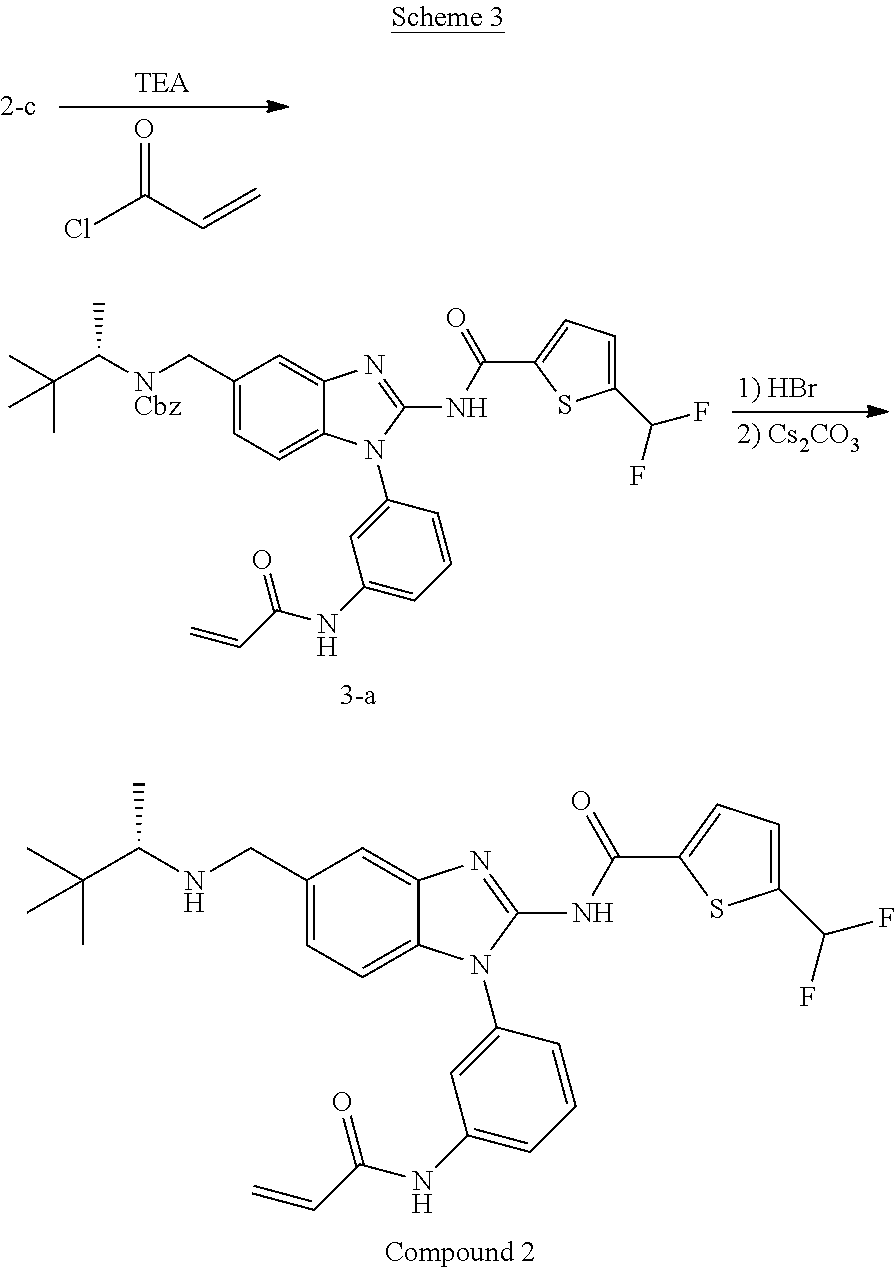
Step 1: Intermediate 3-a


Step 1: Intermediate 4-b

Step 1: Intermediate 5-a


Step 1: Intermediate 6-a

respectively for the synthesis Intermediate 4-f.
Synthesis of Intermediate 7-d:


Step 1: Intermediate 7-a


Step 1: Intermediate 8-a


Step 1: Intermediate 10-b


Step 1: Intermediate 12-a


Step 1: Intermediate 13-a


Step 1: Intermediate 17-b

Step 1: Intermediate 18-a

Step 1: Intermediate 19-a

Step 1: Intermediate 20-b


Step 1: Intermediate 21-b

Step 1: Intermediate 22-a


Step 1: Intermediate 24-a

Step 1: Intermediate 25-a


Step 1: Intermediate 27-b

Step 1: Intermediate 28-a


Step 1: Intermediate 30-a

Step 1: Intermediate 31-a


Step 1: Intermediate 33-b

Step 1: Intermediate 34-a


Step 1: Intermediate 36-a

with

respectively.
Synthesis of Compound 78:

Step 1: Intermediate 37-a

Step 1: Intermediate 38-b

Step 1: Intermediate 39-a


Step 1: Intermediate 41-b


| TABLE 1 |
| Example Compounds of Formula I |
| Com- | ||
| pound | Structure | MS (m/z) |
| 1 |
 |
[M + H]+ = 530.3 |
| 2 |
 |
[M + H]+ = 552.3 |
| 3 |
 |
[M + H]+ = 558.3 |
| 4 |
 |
[M + H]+ = 552.4 |
| 5 |
 |
[M + H]+ = 566.4 |
| 6 |
 |
[M + H]+ = 544.3 |
| 7 |
 |
[M + H]+ = 514.3 |
| 8 |
 |
[M + H]+ = 526.4 |
| 9 |
 |
[M + H]+ = 521.2 |
| 10 |
 |
[M + H]+ = 530.6 |
| 11 |
 |
[M + H]+ = 521.4 |
| 12 |
 |
[M + H]+ = 503.3 |
| 13 |
 |
[M + H]+ = 502.3 |
| 14 |
 |
[M + H]+ = 550.3 |
| 15 |
 |
[M + H]+ = 531.2 |
| 16 |
 |
[M + H]+ = 497.2 |
| 17 |
 |
[M + H]+ = 503.3 |
| 18 |
 |
[M + H]+ = 544.2 |
| 19 |
 |
[M + H]+ = 497.4 |
| 20 |
 |
[M + H]+ = 514.3 |
| 21 |
 |
[M + H]+ = 524.3 |
| 22 |
 |
[M + H]+ = 568.3 |
| 23 |
 |
[M + H]+ = 538.3 |
| 24 |
 |
[M + H]+ = 526.4 |
| 25 |
 |
[M + H]+ = 569.3 |
| 26 |
 |
[M + H]+ = 512.3 |
| 27 |
 |
[M + H]+ = 497.3 |
| 28 |
 |
[M + H]+ = 500.4 |
| 29 |
 |
[M + H]+ = 554.3 |
| 30 |
 |
[M + H]+ = 552.3 |
| 31 |
 |
[M + H]+ = 566.3 |
| 32 |
 |
[M + H]+ = 522.3 |
| 33 |
 |
[M + H]+ = 570.3 |
| 34 |
 |
[M + H]+ = 570.3 |
| 35 |
 |
[M + H]+ = 566.3 |
| 36 |
 |
[M + H]+ = 594.3 |
| 37 |
 |
[M + H]+ = 602.3 |
| 38 |
 |
[M + H]+ = 487.3 |
| 39 |
 |
[M + H]+ = 526.7 |
| 40 |
 |
[M + H]+ = 496.2 |
| 41 |
 |
[M + H]+ = 498.3 |
| 42 |
 |
[M + H]+ = 487.1 |
| 43 |
 |
[M + H]+ = 503.3 |
| 44 |
 |
[M + H]+ = 552.3 |
| 45 |
 |
[M + H]+ = 552.2 |
| 46 |
 |
[M + H]+ = 570.2 |
| 47 |
 |
[M + H]+ = 568.2 |
| 48 |
 |
[M + H]+ = 578.3 |
| 49 |
 |
[M + H]+ = 500.2 |
| 50 |
 |
[M + H]+ = 538.2 |
| 51 |
 |
[M + H]+ = 624.1 |
| 52 |
 |
[M + H]+ = 624.1 |
| 53 |
 |
[M + H]+ = 564.2 |
| 54 |
 |
[M + H]+ = 527.4 |
| 55 |
 |
[M + H]+ = 503.4 |
| 56 |
 |
[M + H]+ = 578.3 |
| 57 |
 |
[M + H]+ = 594.4 |
| 58 |
 |
[M + H]+ = 572.3 |
| 59 |
 |
[M + H]+ = 581.2 |
| 60 |
 |
[M + H]+ = 624.1 |
| 61 |
 |
[M + H]+ = 566.2 |
| 62 |
 |
[M + H]+ = 544.2 |
| 63 |
 |
[M + H]+ = 556.3 |
| 64 |
 |
[M + H]+ = 542.2 |
| 65 |
 |
[M + H]+ = 556.2 |
| 66 |
 |
[M + H]+ = 669.2 |
| 67 |
 |
[M + H]+ = 509.3 |
| 68 |
 |
[M + H]+ = 558.3 |
| 69 |
 |
[M + H]+ = 469.2 |
| 70 |
 |
[M + H]+ = 542.2 |
| 71 |
 |
[M + H]+ = 575.4 |
| 72 |
 |
[M + H]+ = 564.3 |
| 73 |
 |
[M + H]+ = 489.2 |
| 74 |
 |
[M + H]+ = 501.2 |
| 75 |
 |
[M + H]+ = 517.2 |
| 76 |
 |
[M + H]+ = 473.3 |
| 77 |
 |
[M + H]+ = 609.2 |
| 78 |
 |
[M + H]+ = 609.2 |
| 79 |
 |
[M + H]+ = 545.1 |
| 80 |
 |
[M + H]+ = 546.1 |
| 81 |
 |
[M + H]+ = 558.3 |
| 82 |
 |
[M + H]+ = 545.3 |
| 83 |
 |
[M + H]+ = 566.2 |
| 84 |
 |
[M + H]+ = 570.2 |
| 85 |
 |
[M + H]+ = 467.1 |
| 86 |
 |
[M + H]+ = 413.4 |
| 87 |
 |
[M + H]+ = 402.4 |
| 88 |
 |
[M + H]+ = 418.4 |
| TABLE 2 |
| Results |
| Compound | EC50 (nM) | ||
| 1 | b | ||
| 2 | b | ||
| 3 | c | ||
| 4 | c | ||
| 5 | b | ||
| 6 | b | ||
| 7 | b | ||
| 8 | c | ||
| 9 | b | ||
| 10 | b | ||
| 11 | b | ||
| 12 | c | ||
| 13 | b | ||
| 14 | b | ||
| 15 | b | ||
| 16 | b | ||
| 17 | b | ||
| 18 | b | ||
| 19 | b | ||
| 20 | c | ||
| 21 | a | ||
| 22 | a | ||
| 23 | a | ||
| 24 | c | ||
| 25 | a | ||
| 26 | c | ||
| 27 | c | ||
| 28 | b | ||
| 29 | a | ||
| 30 | a | ||
| 31 | a | ||
| 32 | a | ||
| 33 | a | ||
| 34 | c | ||
| 35 | a | ||
| 36 | b | ||
| 37 | c | ||
| 38 | b | ||
| 39 | a | ||
| 40 | a | ||
| 41 | b | ||
| 42 | b | ||
| 43 | a | ||
| 44 | a | ||
| 45 | a | ||
| 46 | b | ||
| 47 | a | ||
| 48 | b | ||
| 49 | c | ||
| 50 | a | ||
| 51 | a | ||
| 52 | a | ||
| 53 | b | ||
| 54 | c | ||
| 55 | c | ||
| 56 | b | ||
| 57 | b | ||
| 58 | c | ||
| 59 | a | ||
| 60 | a | ||
| 61 | a | ||
| 62 | c | ||
| 63 | c | ||
| 64 | c | ||
| 65 | c | ||
| 66 | b | ||
| 67 | c | ||
| 68 | a | ||
| 69 | b | ||
| 70 | c | ||
| 71 | b | ||
| 72 | c | ||
| 73 | b | ||
| 74 | c | ||
| 75 | c | ||
| 76 | b | ||
| 77 | b | ||
| 78 | c | ||
| 79 | c | ||
| 80 | b | ||
| 81 | b | ||
| 83 | c | ||
| 84 | b | ||
| a-EC50 < 10 nM; | |||
| b-10 nM < EC50 < 100 nM, | |||
| c-EC50 > 100 nM | |||
| TABLE 4 |
| Results |
| Compound | EC50 (nM) | ||
| 1 | b | ||
| 2 | a | ||
| 3 | b | ||
| 4 | b | ||
| 5 | a | ||
| 6 | a | ||
| 7 | b | ||
| 8 | b | ||
| 9 | b | ||
| 10 | b | ||
| 11 | c | ||
| 12 | c | ||
| 13 | b | ||
| 14 | a | ||
| 15 | b | ||
| 16 | b | ||
| 17 | b | ||
| 18 | a | ||
| 19 | a | ||
| 20 | b | ||
| 21 | b | ||
| 22 | a | ||
| 23 | a | ||
| 24 | c | ||
| 25 | a | ||
| 26 | b | ||
| 27 | c | ||
| 28 | a | ||
| 29 | a | ||
| 30 | b | ||
| 31 | a | ||
| 32 | a | ||
| 33 | a | ||
| 34 | c | ||
| 35 | b | ||
| 36 | b | ||
| 37 | c | ||
| 38 | a | ||
| 39 | b | ||
| 40 | b | ||
| 41 | a | ||
| 42 | a | ||
| 43 | a | ||
| 50 | a | ||
| 54 | c | ||
| 57 | b | ||
| 59 | a | ||
| 62 | b | ||
| 67 | b | ||
| 72 | b | ||
| 73 | a | ||
| 76 | a | ||
| 77 | a | ||
| 78 | b | ||
| 80 | b | ||
| 81 | a | ||
| 82 | b | ||
| 84 | b | ||
| a-EC50 < 10 nM; | |||
| b-10 nM < EC50 < 100 nM, | |||
| c-EC50 > 100 nM | |||
| TABLE 5 |
| Results of ITK kinase inhibition |
| Compound | EC50 (nM) | ||
| 1 | a | ||
| 2 | a | ||
| 3 | b | ||
| 9 | a | ||
| 11 | a | ||
| 12 | c | ||
| 16 | a | ||
| 17 | b | ||
| 18 | a | ||
| 19 | a | ||
| 25 | a | ||
| 27 | c | ||
| 28 | a | ||
| 31 | a | ||
| 38 | a | ||
| 42 | b | ||
| 43 | a | ||
| 50 | a | ||
| 62 | a | ||
| 68 | a | ||
| 77 | a | ||
| 81 | a | ||
| a-EC50 < 10 nM; | |||
| b-10 nM < EC50 < 100 nM, | |||
| c-EC50 > 100 nM | |||
| TABLE 6 |
| Results of RLK/TXK kinase inhibition |
| Compound | EC50 (nM) | ||
| 1 | b | ||
| 2 | a | ||
| 3 | b | ||
| 9 | a | ||
| 11 | a | ||
| 12 | b | ||
| 16 | a | ||
| 17 | a | ||
| 18 | a | ||
| 19 | b | ||
| 25 | a | ||
| 27 | c | ||
| 28 | a | ||
| 31 | a | ||
| 38 | a | ||
| 42 | b | ||
| 43 | a | ||
| 50 | a | ||
| 62 | b | ||
| 68 | a | ||
| 77 | a | ||
| 81 | b | ||
| a-EC50 < 10 nM; | |||
| b-10 nM < EC50 < 100 nM, | |||
| c-EC50 > 100 nM | |||
| TABLE 7 |
| Results of Tec kinase |
| inhibition |
| Compound | EC50 (nM) | ||
| 2 | b | ||
| 9 | b | ||
| 25 | a | ||
| 28 | b | ||
| 38 | b | ||
| a-EC50 < 10 nM; | |||
| b-10 nM < EC50 < 100 nM, | |||
| c-EC50 > 100 nM | |||
Claims (10)


Applications Claiming Priority (3)
| Application Number | Priority Date | Filing Date | Title |
|---|---|---|---|
| CA2906137A CA2906137A1 (en) | 2015-09-25 | 2015-09-25 | Novel protein kinase inhibitors |
| CA2906137 | 2015-09-25 | ||
| PCT/CA2016/051110 WO2017049401A1 (en) | 2015-09-25 | 2016-09-22 | New benzimidazoles derivatives as tec kinases family inhibitors |
Related Parent Applications (1)
| Application Number | Title | Priority Date | Filing Date |
|---|---|---|---|
| PCT/CA2016/051110 A-371-Of-International WO2017049401A1 (en) | 2015-09-25 | 2016-09-22 | New benzimidazoles derivatives as tec kinases family inhibitors |
Related Child Applications (1)
| Application Number | Title | Priority Date | Filing Date |
|---|---|---|---|
| US16/737,725 Division US20200385369A1 (en) | 2015-09-25 | 2020-01-08 | New benzimidazoles derivatives as tec kinases family inhibitors |
Publications (2)
| Publication Number | Publication Date |
|---|---|
| US20180319781A1 US20180319781A1 (en) | 2018-11-08 |
| US10562893B2 true US10562893B2 (en) | 2020-02-18 |
Family
ID=58385432
Family Applications (2)
| Application Number | Title | Priority Date | Filing Date |
|---|---|---|---|
| US15/772,919 Expired - Fee Related US10562893B2 (en) | 2015-09-25 | 2016-09-22 | Benzimidazoles derivatives as Tec kinases family inhibitors |
| US16/737,725 Abandoned US20200385369A1 (en) | 2015-09-25 | 2020-01-08 | New benzimidazoles derivatives as tec kinases family inhibitors |
Family Applications After (1)
| Application Number | Title | Priority Date | Filing Date |
|---|---|---|---|
| US16/737,725 Abandoned US20200385369A1 (en) | 2015-09-25 | 2020-01-08 | New benzimidazoles derivatives as tec kinases family inhibitors |
Country Status (4)
| Country | Link |
|---|---|
| US (2) | US10562893B2 (en) |
| EP (1) | EP3353170A4 (en) |
| CA (2) | CA2906137A1 (en) |
| WO (1) | WO2017049401A1 (en) |
Families Citing this family (5)
| Publication number | Priority date | Publication date | Assignee | Title |
|---|---|---|---|---|
| CA2939286A1 (en) * | 2016-08-17 | 2018-02-17 | Pharmascience Inc. | Spirocyclic containing compounds and pharmaceutical uses thereof |
| CA2976819A1 (en) * | 2017-08-21 | 2019-02-21 | Pharmascience Inc. | Benzimidazole compounds as kinase inhibitors |
| EP3692033A1 (en) * | 2017-10-05 | 2020-08-12 | GlaxoSmithKline Intellectual Property Development Limited | Modulators of stimulator of interferon genes (sting) useful in treating hiv |
| WO2019069270A1 (en) * | 2017-10-05 | 2019-04-11 | Glaxosmithkline Intellectual Property Development Limited | Modulators of stimulator of interferon genes (sting) |
| CN111655682B (en) * | 2018-08-29 | 2024-05-31 | 杭州阿诺生物医药科技有限公司 | A highly active STING protein agonist compound |
Citations (3)
| Publication number | Priority date | Publication date | Assignee | Title |
|---|---|---|---|---|
| WO2013184766A1 (en) * | 2012-06-06 | 2013-12-12 | Irm Llc | Compounds and compositions for modulating egfr activity |
| WO2014036016A1 (en) | 2012-08-31 | 2014-03-06 | Principia Biopharma Inc. | Benzimidazole derivatives as itk inhibitors |
| WO2015134210A1 (en) | 2014-03-03 | 2015-09-11 | Principia Biopharma, Inc. | BENZIMIDAZOLE DERIVATIVES AS RLK and ITK INHIBITORS |
-
2015
- 2015-09-25 CA CA2906137A patent/CA2906137A1/en not_active Abandoned
-
2016
- 2016-09-22 WO PCT/CA2016/051110 patent/WO2017049401A1/en not_active Ceased
- 2016-09-22 EP EP16847688.5A patent/EP3353170A4/en not_active Withdrawn
- 2016-09-22 US US15/772,919 patent/US10562893B2/en not_active Expired - Fee Related
- 2016-09-22 CA CA3037971A patent/CA3037971A1/en not_active Abandoned
-
2020
- 2020-01-08 US US16/737,725 patent/US20200385369A1/en not_active Abandoned
Patent Citations (3)
| Publication number | Priority date | Publication date | Assignee | Title |
|---|---|---|---|---|
| WO2013184766A1 (en) * | 2012-06-06 | 2013-12-12 | Irm Llc | Compounds and compositions for modulating egfr activity |
| WO2014036016A1 (en) | 2012-08-31 | 2014-03-06 | Principia Biopharma Inc. | Benzimidazole derivatives as itk inhibitors |
| WO2015134210A1 (en) | 2014-03-03 | 2015-09-11 | Principia Biopharma, Inc. | BENZIMIDAZOLE DERIVATIVES AS RLK and ITK INHIBITORS |
Non-Patent Citations (30)
Also Published As
| Publication number | Publication date |
|---|---|
| CA2906137A1 (en) | 2017-03-25 |
| EP3353170A4 (en) | 2019-06-12 |
| US20200385369A1 (en) | 2020-12-10 |
| CA3037971A1 (en) | 2017-03-30 |
| EP3353170A1 (en) | 2018-08-01 |
| WO2017049401A1 (en) | 2017-03-30 |
| US20180319781A1 (en) | 2018-11-08 |
Similar Documents
| Publication | Publication Date | Title |
|---|---|---|
| US10752615B2 (en) | Spirocyclic containing compounds and pharmaceutical uses thereof | |
| US11530219B2 (en) | Ligands to cereblon (CRBN) | |
| US12233054B2 (en) | Dimeric immuno-modulatory compounds against cereblon-based mechanisms | |
| US20200385369A1 (en) | New benzimidazoles derivatives as tec kinases family inhibitors | |
| US12030892B2 (en) | CRBN modulators | |
| US8129387B2 (en) | Substituted 5,6-dihydroimidazo[1,5-F]pteridines useful as protein kinase inhibitors | |
| US9951077B2 (en) | Aminopyridazinone compounds as protein kinase inhibitors | |
| US9493440B2 (en) | Compounds inhibiting leucine-rich repeat kinase enzyme activity | |
| US8912178B2 (en) | mTOR selective kinase inhibitors | |
| US20120184557A1 (en) | Pyrazolo[1,5-a]-1,3,5-triazine derivatives, preparation thereof, and therapeutic use thereof | |
| US12139492B2 (en) | Substituted pyrimidines for the targeted degradation of Bruton's tyrosine kinase | |
| US20170273985A1 (en) | Tricyclic derivative | |
| US20180179210A1 (en) | Inhibitors of the TEC Kinase Enzyme Family | |
| US20240199654A1 (en) | Ctla-4 small molecule degradation agent and application thereof | |
| US20200215036A1 (en) | Benzimidazole compounds as kinase inhibitors | |
| CA2965813A1 (en) | Spirocyclic containing compounds and pharmaceutical uses thereof |
Legal Events
| Date | Code | Title | Description |
|---|---|---|---|
| FEPP | Fee payment procedure |
Free format text: ENTITY STATUS SET TO UNDISCOUNTED (ORIGINAL EVENT CODE: BIG.); ENTITY STATUS OF PATENT OWNER: LARGE ENTITY |
|
| AS | Assignment |
Owner name: PHARMASCIENCE INC., CANADA Free format text: ASSIGNMENT OF ASSIGNORS INTEREST;ASSIGNORS:LAURENT, ALAIN;ROSE, YANNICK;MORRIS, STEPHEN J.;SIGNING DATES FROM 20160927 TO 20160928;REEL/FRAME:047975/0922 Owner name: GB005, INC., CALIFORNIA Free format text: ASSIGNMENT OF ASSIGNORS INTEREST;ASSIGNOR:PHARMASCIENCE INC.;REEL/FRAME:047976/0794 Effective date: 20180809 |
|
| STPP | Information on status: patent application and granting procedure in general |
Free format text: RESPONSE TO NON-FINAL OFFICE ACTION ENTERED AND FORWARDED TO EXAMINER |
|
| STPP | Information on status: patent application and granting procedure in general |
Free format text: NON FINAL ACTION MAILED |
|
| AS | Assignment |
Owner name: MIDCAP FINANCIAL TRUST, AS AGENT, MARYLAND Free format text: SECURITY INTEREST;ASSIGNORS:GOSSAMER BIO, INC.;GOSSAMER BIO SERVICES, INC.;GB001, INC.;AND OTHERS;REEL/FRAME:049081/0335 Effective date: 20190502 |
|
| STPP | Information on status: patent application and granting procedure in general |
Free format text: RESPONSE TO NON-FINAL OFFICE ACTION ENTERED AND FORWARDED TO EXAMINER |
|
| STPP | Information on status: patent application and granting procedure in general |
Free format text: NOTICE OF ALLOWANCE MAILED -- APPLICATION RECEIVED IN OFFICE OF PUBLICATIONS |
|
| STCF | Information on status: patent grant |
Free format text: PATENTED CASE |
|
| FEPP | Fee payment procedure |
Free format text: MAINTENANCE FEE REMINDER MAILED (ORIGINAL EVENT CODE: REM.); ENTITY STATUS OF PATENT OWNER: LARGE ENTITY |
|
| LAPS | Lapse for failure to pay maintenance fees |
Free format text: PATENT EXPIRED FOR FAILURE TO PAY MAINTENANCE FEES (ORIGINAL EVENT CODE: EXP.); ENTITY STATUS OF PATENT OWNER: LARGE ENTITY |
|
| STCH | Information on status: patent discontinuation |
Free format text: PATENT EXPIRED DUE TO NONPAYMENT OF MAINTENANCE FEES UNDER 37 CFR 1.362 |
|
| FP | Lapsed due to failure to pay maintenance fee |
Effective date: 20240218 |
|
| AS | Assignment |
Owner name: GB008, INC., CALIFORNIA Free format text: RELEASE OF SECURITY INTEREST IN INTELLECTUAL PROPERTY COLLATERAL AT REEL/FRAME NO. 49081/0335;ASSIGNOR:MIDCAP FINANCIAL TRUST, AS AGENT;REEL/FRAME:067310/0307 Effective date: 20240503 Owner name: GB007, INC., CALIFORNIA Free format text: RELEASE OF SECURITY INTEREST IN INTELLECTUAL PROPERTY COLLATERAL AT REEL/FRAME NO. 49081/0335;ASSIGNOR:MIDCAP FINANCIAL TRUST, AS AGENT;REEL/FRAME:067310/0307 Effective date: 20240503 Owner name: GB005, INC., CALIFORNIA Free format text: RELEASE OF SECURITY INTEREST IN INTELLECTUAL PROPERTY COLLATERAL AT REEL/FRAME NO. 49081/0335;ASSIGNOR:MIDCAP FINANCIAL TRUST, AS AGENT;REEL/FRAME:067310/0307 Effective date: 20240503 Owner name: GB004, INC., CALIFORNIA Free format text: RELEASE OF SECURITY INTEREST IN INTELLECTUAL PROPERTY COLLATERAL AT REEL/FRAME NO. 49081/0335;ASSIGNOR:MIDCAP FINANCIAL TRUST, AS AGENT;REEL/FRAME:067310/0307 Effective date: 20240503 Owner name: GB003, INC., CALIFORNIA Free format text: RELEASE OF SECURITY INTEREST IN INTELLECTUAL PROPERTY COLLATERAL AT REEL/FRAME NO. 49081/0335;ASSIGNOR:MIDCAP FINANCIAL TRUST, AS AGENT;REEL/FRAME:067310/0307 Effective date: 20240503 Owner name: GB002, INC., CALIFORNIA Free format text: RELEASE OF SECURITY INTEREST IN INTELLECTUAL PROPERTY COLLATERAL AT REEL/FRAME NO. 49081/0335;ASSIGNOR:MIDCAP FINANCIAL TRUST, AS AGENT;REEL/FRAME:067310/0307 Effective date: 20240503 Owner name: GB001, INC., CALIFORNIA Free format text: RELEASE OF SECURITY INTEREST IN INTELLECTUAL PROPERTY COLLATERAL AT REEL/FRAME NO. 49081/0335;ASSIGNOR:MIDCAP FINANCIAL TRUST, AS AGENT;REEL/FRAME:067310/0307 Effective date: 20240503 Owner name: GOSSAMER BIO SERVICES, INC., CALIFORNIA Free format text: RELEASE OF SECURITY INTEREST IN INTELLECTUAL PROPERTY COLLATERAL AT REEL/FRAME NO. 49081/0335;ASSIGNOR:MIDCAP FINANCIAL TRUST, AS AGENT;REEL/FRAME:067310/0307 Effective date: 20240503 Owner name: GOSSAMER BIO, INC., CALIFORNIA Free format text: RELEASE OF SECURITY INTEREST IN INTELLECTUAL PROPERTY COLLATERAL AT REEL/FRAME NO. 49081/0335;ASSIGNOR:MIDCAP FINANCIAL TRUST, AS AGENT;REEL/FRAME:067310/0307 Effective date: 20240503 |