US10562838B2 - Process for the alkoxycarbonylation of olefins in a medium having a low Brønsted acid concentration - Google Patents
Process for the alkoxycarbonylation of olefins in a medium having a low Brønsted acid concentration Download PDFInfo
- Publication number
- US10562838B2 US10562838B2 US15/651,042 US201715651042A US10562838B2 US 10562838 B2 US10562838 B2 US 10562838B2 US 201715651042 A US201715651042 A US 201715651042A US 10562838 B2 US10562838 B2 US 10562838B2
- Authority
- US
- United States
- Prior art keywords
- alkyl
- heteroaryl
- cycloalkyl
- aryl
- radicals
- Prior art date
- Legal status (The legal status is an assumption and is not a legal conclusion. Google has not performed a legal analysis and makes no representation as to the accuracy of the status listed.)
- Active
Links
- 0 *C=C.*CCC(C)=O.C.[C-]#[O+] Chemical compound *C=C.*CCC(C)=O.C.[C-]#[O+] 0.000 description 9
- CHHZKTPJDPHAFY-UHFFFAOYSA-L BrC1=NC=CC=C1.CC(C)(C)P(Cl)C1=CC=CC=N1.CC(C)(C)P(Cl)Cl.CC(C)[Mg]Cl[Li]Cl.Cl[Mg]C1=NC=CC=C1 Chemical compound BrC1=NC=CC=C1.CC(C)(C)P(Cl)C1=CC=CC=N1.CC(C)(C)P(Cl)Cl.CC(C)[Mg]Cl[Li]Cl.Cl[Mg]C1=NC=CC=C1 CHHZKTPJDPHAFY-UHFFFAOYSA-L 0.000 description 1
- MYDKVEXLVBGVLK-UHFFFAOYSA-N C1C2=CC=C1C2 Chemical compound C1C2=CC=C1C2 MYDKVEXLVBGVLK-UHFFFAOYSA-N 0.000 description 1
- PSJXDRJDRBXLGP-UHFFFAOYSA-L CP(CC1=CC=CC=C1CP(C)C(C)(C)C)C(C)(C)C.ClCC1=CC=CC=C1CCl.Cl[Mg]CC1=CC=CC=C1C[Mg]Cl Chemical compound CP(CC1=CC=CC=C1CP(C)C(C)(C)C)C(C)(C)C.ClCC1=CC=CC=C1CCl.Cl[Mg]CC1=CC=CC=C1C[Mg]Cl PSJXDRJDRBXLGP-UHFFFAOYSA-L 0.000 description 1
- JSBBIRXJYAOZQO-ZCFIWIBFSA-N C[C@H]1C=C(C)C=C1 Chemical compound C[C@H]1C=C(C)C=C1 JSBBIRXJYAOZQO-ZCFIWIBFSA-N 0.000 description 1
Images

Classifications
-
- C—CHEMISTRY; METALLURGY
- C07—ORGANIC CHEMISTRY
- C07C—ACYCLIC OR CARBOCYCLIC COMPOUNDS
- C07C67/00—Preparation of carboxylic acid esters
- C07C67/36—Preparation of carboxylic acid esters by reaction with carbon monoxide or formates
- C07C67/38—Preparation of carboxylic acid esters by reaction with carbon monoxide or formates by addition to an unsaturated carbon-to-carbon bond
-
- B—PERFORMING OPERATIONS; TRANSPORTING
- B01—PHYSICAL OR CHEMICAL PROCESSES OR APPARATUS IN GENERAL
- B01J—CHEMICAL OR PHYSICAL PROCESSES, e.g. CATALYSIS OR COLLOID CHEMISTRY; THEIR RELEVANT APPARATUS
- B01J27/00—Catalysts comprising the elements or compounds of halogens, sulfur, selenium, tellurium, phosphorus or nitrogen; Catalysts comprising carbon compounds
- B01J27/06—Halogens; Compounds thereof
- B01J27/128—Halogens; Compounds thereof with iron group metals or platinum group metals
- B01J27/13—Platinum group metals
-
- B—PERFORMING OPERATIONS; TRANSPORTING
- B01—PHYSICAL OR CHEMICAL PROCESSES OR APPARATUS IN GENERAL
- B01J—CHEMICAL OR PHYSICAL PROCESSES, e.g. CATALYSIS OR COLLOID CHEMISTRY; THEIR RELEVANT APPARATUS
- B01J31/00—Catalysts comprising hydrides, coordination complexes or organic compounds
- B01J31/16—Catalysts comprising hydrides, coordination complexes or organic compounds containing coordination complexes
- B01J31/24—Phosphines, i.e. phosphorus bonded to only carbon atoms, or to both carbon and hydrogen atoms, including e.g. sp2-hybridised phosphorus compounds such as phosphabenzene, phosphole or anionic phospholide ligands
-
- C—CHEMISTRY; METALLURGY
- C07—ORGANIC CHEMISTRY
- C07C—ACYCLIC OR CARBOCYCLIC COMPOUNDS
- C07C67/00—Preparation of carboxylic acid esters
- C07C67/48—Separation; Purification; Stabilisation; Use of additives
- C07C67/62—Use of additives, e.g. for stabilisation
-
- C—CHEMISTRY; METALLURGY
- C07—ORGANIC CHEMISTRY
- C07C—ACYCLIC OR CARBOCYCLIC COMPOUNDS
- C07C69/00—Esters of carboxylic acids; Esters of carbonic or haloformic acids
- C07C69/02—Esters of acyclic saturated monocarboxylic acids having the carboxyl group bound to an acyclic carbon atom or to hydrogen
- C07C69/12—Acetic acid esters
- C07C69/14—Acetic acid esters of monohydroxylic compounds
-
- B—PERFORMING OPERATIONS; TRANSPORTING
- B01—PHYSICAL OR CHEMICAL PROCESSES OR APPARATUS IN GENERAL
- B01J—CHEMICAL OR PHYSICAL PROCESSES, e.g. CATALYSIS OR COLLOID CHEMISTRY; THEIR RELEVANT APPARATUS
- B01J2531/00—Additional information regarding catalytic systems classified in B01J31/00
- B01J2531/80—Complexes comprising metals of Group VIII as the central metal
- B01J2531/82—Metals of the platinum group
- B01J2531/824—Palladium
Definitions
- the present invention relates to a process for the alkoxycarbonylation of olefins, wherein the alkoxycarbonylation takes place in a medium having a low Br ⁇ nsted acid concentration.
- alkoxycarbonylation of alkenes is a process of increasing significance.
- An alkoxycarbonylation is understood to mean the reaction of unsaturated compounds such as olefins, with carbon monoxide and alcohols in the presence of a metal or of a metal complex and of a ligand to give the corresponding esters:
- Scheme 1 General reaction equation of the alkoxycarbonylation of an ethylenically unsaturated compound.
- the alkoxycarbonylation is customarily carried out with addition of strong Br ⁇ nsted acids, examples being para-toluenesulphonic acid, methanesulphonic acid or sulphuric acid. This, however, is a disadvantage for the industrial use of the alkoxycarbonylation, since it entails increased corrosion of the reactors and other equipment.
- the problem addressed by the present invention is therefore that of providing a process for the alkoxycarbonylation of olefins wherein the addition of Br ⁇ nsted acids can be kept low and wherein good yields can be achieved.
- process steps a), b), c) and d) can be effected in any desired sequence.
- the addition of CO is effected after the co-reactants have been initially charged in steps a) to c).
- Steps d) and e) can be effected simultaneously or successively.
- CO can also be fed in in two or more steps, in such a way that, for example, a portion of the CO is first fed in, then the mixture is heated, and then a further portion of CO is fed in.
- a bidentate phosphine ligand which is substituted on at least one phosphorus atom by at least one heteroaryl radical it is possible to carry out the alkoxycarbonylation of ethylenically unsaturated compounds without adding strong Br ⁇ nsted acids having an acid strength of pK a ⁇ 3, or with addition of not more than 0.1 mol %, based on the amount of substance of the ethylenically unsaturated compound, without any accompanying losses in yield.
- corrosion problems are avoided, and/or it is unnecessary to use expensive, acid-resistant steels in the large-scale plant.
- the amount of added Br ⁇ nsted acid having an acid strength of pK a ⁇ 3 in the reaction mixture is preferably less than 0.01 mol %, preferably less than 0.001 mol %, very preferably less than 0.0001 mol %, most preferably 0 mol %, based on the amount of substance of the ethylenically unsaturated compound.
- the fraction of the Br ⁇ nsted acid here is calculated on the basis of the overall amount of substance of all added Br ⁇ nsted acids having an acid strength of pK a ⁇ 3.
- the amount of substance of the ethylenically unsaturated compound that is used as a basis is the overall amount of substance of the ethylenically unsaturated compound introduced.
- the term “Br ⁇ nsted acids” refers to compounds which are able to give up protons (proton donors). This term therefore does not include Lewis acids (electron pair acceptors), which are unable to give up protons, such as the Pd compound PdCl 2 , for example.
- the reported acid strength pK a is based on the pK a determined under standard conditions (25° C., 1.01325 bar).
- the acid strength pK a in the context of this invention relates to the pK a of the first protolysis step.
- the process of the invention is preferably also carried out without addition of a less strong Br ⁇ nsted acid of pKa ⁇ 5, preferably pK a ⁇ 6.
- the fraction of Br ⁇ nsted acid having an acid strength of pK a ⁇ 5, preferably pK a ⁇ 6, in the reaction mixture is less than 0.1 mol %, preferably less than 0.01 mol %, more preferably still less than 0.001 mol %, very preferably less than 0.0001 mol %, most preferably 0 mol %, based on the amount of substance of the ethylenically unsaturated compound.
- Bidentate phosphine ligands for the purposes of this invention are ligands which comprise two phosphine groups, where the phosphorous atoms of both phosphine groups are able together to coordinate a palladium atom. It has emerged that as a result of at least one phosphorous atom being substituted by at least one heteroaryl group, it is possible to achieve a high yield in the acid-free alkoxycarbonylation.
- the heteroaryl group is preferably a —(C 3 -C 20 )-heteroaryl group.
- Suitable heteroaryl groups are, for example, furyl, thienyl, pyrrolyl, oxazolyl, isoxazolyl, thiazolyl, isothiazolyl, imidazolyl, pyrazolyl, furazanyl, tetrazolyl, pyridyl, pyridazinyl, pyrimidyl, pyrazinyl, benzofuranyl, indolyl, isoindolyl, benzimidazolyl, quinolyl, isoquinolyl.
- heteroaryl groups having five to ten ring atoms, preferably five or six ring atoms.
- the stated heteroaryl groups may be substituted here by one or more substituents selected from —(C 1 -C 12 )-alkyl, —(C 3 -C 12 )-cycloalkyl, —(C 3 -C 12 )-heterocycloalkyl, —O—(C 1 -C 12 )-alkyl, —O—(C 1 -C 12 )-alkyl-(C 6 -C 20 )-aryl, —O—(C 3 -C 12 )-cycloalkyl, —S—(C 1 -C 12 )-alkyl, —S—(C 3 -C 12 )-cycloalkyl, —COO—(C 1 -C 12 )-alkyl, —COO—(C 3 -C 12 )-cycloalkyl, —CONH—(C 1 -C 12 )-alkyl, —CONH—(C 3 -C 12
- substituents selected from —(C 1 -C 12 )-alkyl, —(C 3 -C 12 )-cycloalkyl, —O—(C 1 -C 12 )-alkyl, —O—(C 3 -C 12 )-cycloalkyl, —(C 6 -C 20 )-aryl, —(C 6 -C 20 )-aryl-(C 1 -C 12 )-alkyl, —(C 6 -C 20 )-aryl-O—(C 1 -C 12 )-alkyl, —(C 3 -C 20 )-heteroaryl, —(C 3 -C 20 )-heteroaryl-(C 1 -C 12 )-alkyl, —(C 3 -C 20 )-heteroaryl-O—(C 1 -C 12 )-alkyl.
- Particularly preferred is substitution of the phosphorous atoms of both phosphine groups by at least one heteroaryl group.
- the bidentate phosphine ligand is selected from a compound according to one of the formulae (I) and (II)
- R 1 , R 2 , R 3 , R 4 , R 1′ , R 2′ , R 3′ , R 4′ are each independently selected from —(C 1 -C 12 )-alkyl, —(C 3 -C 12 )-cycloalkyl, —(C 3 -C 12 )-heterocycloalkyl, —(C 6 -C 20 )-aryl, —(C 3 -C 20 )-heteroaryl; at least one of the R 1 , R 2 , R 3 , R 4 radicals or at least one of the R 1′ , R 2′ , R 3′ , R 4′ radicals is a —(C 3 -C 20 )-heteroaryl radical; and R 1 , R 2 , R 3 , R 4 , R 1′ , R 2′ , R 3′ , R 4′ if they are —(C 1 -C 12 )-alkyl, —(
- (C 1 -C 12 )-alkyl encompasses straight-chain and branched alkyl groups having 1 to 12 carbon atoms. These are preferably (C 1 -C 8 )-alkyl groups, more preferably (C 1 -C 5 )-alkyl, most preferably (C 1 -C 4 )-alkyl.
- Suitable (C 1 -C 12 )-alkyl groups are especially methyl, ethyl, propyl, isopropyl, n-butyl, iso-butyl, sec-butyl, tert-butyl, n-pentyl, 2-pentyl, 2-methylbutyl, 3-methylbutyl, 1,2-dimethylpropyl, 1,1-dimethylpropyl, 2,2-dimethylpropyl, 1-ethylpropyl, n-hexyl, 2-hexyl, 2-methylpentyl, 3-methylpentyl, 4-methylpentyl, 1,1-dimethylbutyl, 1,2-dimethylbutyl, 2,2-dimethylbutyl, 1,3-dimethylbutyl, 2,3-dimethylbutyl, 3,3-dimethylbutyl, 1,1,2-trimethylpropyl, 1,2,2-trimethylpropyl, 1-ethylbutyl, 1-ethyl-2
- the elucidations relating to the expression (C 1 -C 12 )-alkyl also apply particularly to the alkyl groups in —O—(C 1 -C 12 )-alkyl, —S—(C 1 -C 12 )-alkyl, —COO—(C 1 -C 12 )-alkyl, —CONH—(C 1 -C 12 )-alkyl, —CO—(C 1 -C 12 )-alkyl and —N—[(C 1 -C 12 )-alkyl] 2 .
- (C 3 -C 12 )-cycloalkyl encompasses mono-, bi- or tricyclic hydrocarbyl groups having 3 to 12 carbon atoms. Preferably, these groups are (C 5 -C 12 )-cycloalkyl.
- the (C 3 -C 12 )-cycloalkyl groups have preferably 3 to 8, more preferably 5 or 6, ring atoms.
- Suitable (C 3 -C 12 )-cycloalkyl groups are especially cyclopropyl, cyclobutyl, cyclopentyl, cyclohexyl, cycloheptyl, cyclooctyl, cyclododecyl, cyclopentadecyl, norbornyl, adamantyl.
- the elucidations relating to the expression (C 3 -C 12 )-cycloalkyl also apply particularly to the cycloalkyl groups in —O—(C 3 -C 12 )-cycloalkyl, —S—(C 3 -C 12 )-cycloalkyl, —COO—(C 3 -C 12 )-cycloalkyl, —CONH—(C 3 -C 12 )-cycloalkyl, —CO—(C 3 -C 12 )-cycloalkyl.
- (C 3 -C 12 )-heterocycloalkyl encompasses nonaromatic, saturated or partly unsaturated cycloaliphatic groups having 3 to 12 carbon atoms, where one or more of the ring carbon atoms are replaced by heteroatoms.
- the (C 3 -C 12 )-heterocycloalkyl groups have preferably 3 to 8, more preferably 5 or 6, ring atoms and are optionally substituted by aliphatic side chains.
- the heterocycloalkyl groups as opposed to the cycloalkyl groups, one or more of the ring carbon atoms are replaced by heteroatoms or heteroatom-containing groups.
- heteroatoms or the heteroatom-containing groups are preferably selected from O, S, N, N( ⁇ O), C( ⁇ O), S( ⁇ O).
- a (C 3 -C 12 )-heterocycloalkyl group in the context of this invention is thus also ethylene oxide.
- Suitable (C 3 -C 12 )-heterocycloalkyl groups are especially tetrahydrothiophenyl, tetrahydrofuryl, tetrahydropyranyl and dioxanyl.
- (C 6 -C 20 )-aryl encompasses mono- or polycyclic aromatic hydrocarbyl radicals having 6 to 20 carbon atoms. These are preferably (C 6 -C 14 )-aryl, more preferably (C 6 -C 10 )-aryl.
- Suitable (C 5 -C 20 )-aryl groups are especially phenyl, naphthyl, indenyl, fluorenyl, anthracenyl, phenanthrenyl, naphthacenyl, chrysenyl, pyrenyl, coronenyl.
- Preferred (C 6 -C 20 )-aryl groups are phenyl, naphthyl and anthracenyl.
- (C 3 -C 20 )-heteroaryl encompasses mono- or polycyclic aromatic hydrocarbyl radicals having 3 to 20 carbon atoms, where one or more of the carbon atoms are replaced by heteroatoms. Preferred heteroatoms are N, O and S.
- the (C 3 -C 20 )-heteroaryl groups have 3 to 20, preferably 6 to 14 and more preferably 6 to 10 ring atoms.
- pyridyl in the context of this invention is a C 6 -heteroaryl radical; furyl is a C 5 -heteroaryl radical.
- Suitable (C 3 -C 20 )-heteroaryl groups are especially furyl, thienyl, pyrrolyl, oxazolyl, isoxazolyl, thiazolyl, isothiazolyl, imidazolyl, pyrazolyl, furazanyl, tetrazolyl, pyridyl, pyridazinyl, pyrimidyl, pyrazinyl, benzofuranyl, indolyl, isoindolyl, benzimidazolyl, quinolyl, isoquinolyl.
- halogen especially encompasses fluorine, chlorine, bromine and iodine. Particular preference is given to fluorine and chlorine.
- the R 1 , R 2 , R 3 , R 1′ , R 2′ , R 3′ , R 4′ radicals if they are —(C 1 -C 12 )-alkyl, —(C 3 -C 12 )-cycloalkyl, —(C 3 -C 12 )-heterocycloalkyl, —(C 5 -C 20 )-aryl, or —(C 3 -C 20 )-heteroaryl, may each independently be substituted by one or more substituents selected from —(C 1 -C 12 )-alkyl, —(C 3 -C 12 )-cycloalkyl, —(C 3 -C 12 )-heterocycloalkyl, —O—(C 1 -C 12 )-alkyl, —O—(C 1 -C 12 )-alkyl-(C 6 -C 20 )-aryl, —O—(
- the R 1 , R 2 , R 3 , R 4 , R 1′ , R 2′ , R 3′ , R 4′ radicals if they are —(C 1 -C 12 )-alkyl, —(C 3 -C 12 )-cycloalkyl, —(C 3 -C 12 )-heterocycloalkyl, —(C 6 -C 20 )-aryl, or —(C 3 -C 20 )-heteroaryl, may each independently be substituted by one or more substituents selected from —(C 1 -C 12 )-alkyl, —(C 3 -C 12 )-cycloalkyl, —O—(C 1 -C 12 )-alkyl, —O—(C 1 -C 12 )-alkyl-(C 6 -C 26 )-aryl, —O—(C 3 -C 12 )-cycloalkyl, —
- the R 1 , R 2 , R 3 , R 4 , R 1′ , R 2′ , R 3′ , R 4′ radicals if they are —(C 1 -C 12 )-alkyl, —(C 3 -C 12 )-cycloalkyl, (C 3 -C 12 )-heterocycloalkyl, —(C 6 -C 20 )-aryl, or —(C 3 -C 20 )-heteroaryl, may each independently be substituted by one or more substituents selected from —(C 1 -C 12 )-alkyl, —O—(C 1 -C 12 )-alkyl-(C 6 -C 20 )-aryl, —(C 3 -C 20 )-heteroaryl, —(C 3 -C 20 )-heteroaryl-(C 1 -C 12 )-alkyl, —(C 3 -C 20 )
- the R 1 , R 2 , R 3 , R 4 , R 1′ , R 2′ , R 3′ , R 4′ radicals if they are —(C 1 -C 12 )-alkyl, —(C 3 -C 12 )-cycloalkyl, —(C 3 -C 12 )-heterocycloalkyl, —(C 6 -C 20 )-aryl, or —(C 3 -C 20 )-heteroaryl, may each independently be substituted by one or more substituents selected from —(C 1 -C 12 )-alkyl and —(C 3 -C 20 )-heteroaryl.
- the R 1 , R 2 , R 3 , R 4 , R 1′ , R 2′ , R 3′ , R 4′ radicals are unsubstituted if they are —(C 1 -C 12 )-alkyl, —(C 3 -C 12 )-cycloalkyl, or —(C 3 -C 12 )-heterocycloalkyl, and may be substituted as described if they are —(C 3 -C 20 )-aryl, or —(C 3 -C 20 )-heteroaryl.
- the R 1 , R 2 , R 3 , R 4 , R 1′ , R 2′ , R 3′ , R 4′ radicals are unsubstituted if they are —(C 1 -C 12 )-alkyl, —(C 3 -C 12 )-cycloalkyl, —(C 3 -C 12 )-heterocycloalkyl, —(C 6 -C 20 )-aryl, or —(C 3 -C 20 )-heteroaryl.
- R 1 , R 2 , R 3 , R 4 , R 1′ , R 2′ , R 3′ and R 4′ are each independently selected from —(C 1 -C 12 )-alkyl, —(C 3 -C 12 )-cycloalkyl. —(C 3 -C 12 )-heterocycloalkyl, —(C 6 -C 20 )-aryl, —(C 3 -C 20 )-heteroaryl;
- At least one of the radicals R 1 , R 2 , R 3 and R 4 , and/or at least one of the radicals R 1′ , R 2′ , R 3′ and R 4′ is a —(C 3 -C 20 )-heteroaryl radical;
- R 1 , R 2 , R 3 , R 4 , R 1′ , R 2′ , R 3′ and R 4′ if they are —(C 1 -C 12 )-alkyl, —(C 3 -C 12 )-cycloalkyl, —(C 3 -C 12 )- heterocycloalkyl, —(C 6 -C 20 )-aryl or —(C 3 -C 20 )-heteroaryl,
- R 1 , R 2 , R 3 , R 4 , R 1′ , R 2′ , R 3′ , R 4′ are each independently selected from —(C 1 -C 12 )-alkyl, —(C 6 -C 20 )-aryl, —(C 3 -C 20 )-heteroaryl;
- R 1 , R 2 , R 3 , R 4 radicals or at least one of the R 1′ , R 2′ , R 3′ , R 4′ radicals is a —(C 3 -C 20 )-heteroaryl radical;
- R 1 , R 2 , R 3 , R 4 , R 1′ , R 2′ , R 3′ , R 4′ if they are —(C 1 -C 12 )-alkyl, —(C 5 -C 20 )-aryl or (C 3 -C 20 )-heteroaryl,
- At least two of the R 1 , R 2 , R 3 , R 4 radicals or at least two of the R 1′ , R 2′ , R 3′ , R 4′ radicals are a —(C 3 -C 20 )-heteroaryl radical.
- the R 1 and R 3 radicals or the R 1′ and R 3′ radicals are each a —(C 3 -C 20 )-heteroaryl radical and may each independently be substituted by one or more of the substituents described above.
- the R 2 and R 4 radicals or the R 2′ and R 4′ radicals are not a —(C 3 -C 20 )-heteroaryl radical.
- the R 2 and R 4 radicals or the R 2′ and R 4′ radicals are selected from —(C 1 -C 12 )-alkyl, —(C 3 -C 12 )-cycloalkyl, —(C 3 -C 12 )-heterocycloalkyl, —(C 6 -C 20 )-aryl, most preferably from —(C 1 -C 12 )-alkyl, —(C 3 -C 12 )-cycloalkyl, —(C 6 -C 20 )-aryl.
- radicals R 1 , R 2 and R 3 and/or the radicals R 1′ , R 2′ and R 3′ are each a —(C 3 -C 26 )-heteroaryl radical and may each independently be substituted by one or more of the above-described substituents.
- R 4 or R 4′ in this case is not a —(C 3 -C 20 )-heteroaryl radical.
- R 4 or R 4′ in this case is selected from —(C 1 -C 12 )-alkyl, —(C 3 -C 12 )-cycloalkyl, —(C 3 -C 12 )-heterocycloalkyl, —(C 6 -C 20 )-aryl, most preferably from —(C 1 -C 12 )-alkyl, —(C 3 -C 12 )-cycloalkyl, —(C 6 -C 20 )-aryl.
- R 1 , R 2 , R 3 and R 4 or R 1′ , R 2′ , R 3′ and R 4′ radicals are a —(C 6 -C 20 )-heteroaryl radical and may each independently be substituted by one or more of the substituents described above.
- the R 1 , R 2 , R 3 and R 4 or R 1′ , R 2′ , R 3′ , and R 4′ radicals, if they are a heteroaryl radical, are each independently selected from heteroaryl radicals having five to ten ring atoms, preferably a heteroaryl radical having five or six ring atoms.
- the R 1 , R 2 , R 3 and R 4 or R 1′ , R 2′ , R 3′ and R 4′ radicals, if they are a heteroaryl radical, are a heteroaryl radical having six ring atoms.
- the R 1 , R 2 , R 3 and R 4 or R 1′ , R 2′ , R 3′ and R 4′ radicals, if they are a heteroaryl radical, are a heteroaryl radical having five ring atoms.
- the R 1 , R 2 , R 3 and R 4 or R 1′ , R 2′ , R 3′ and R 4′ radicals are each independently selected from furyl, thienyl, pyrrolyl, oxazolyl, isoxazolyl, thiazolyl, isothiazolyl, imidazolyl, pyrazolyl, furazanyl, tetrazolyl, pyridyl, pyridazinyl, pyrimidyl, pyrazinyl, benzofuranyl, indolyl, isoindolyl, benzimidazolyl, quinolyl, isoquinolyl, where the heteroaryl radicals mentioned may be substituted as described above.
- the R 1 , R 2 , R 3 and R 4 or R 1′ , R 2′ , R 3′ and R 4′ radicals are each independently selected from furyl, thienyl, pyrrolyl, imidazolyl, pyridyl, pyrimidyl, indolyl, where the heteroaryl radicals mentioned may be substituted as described above.
- the R 1 , R 2 , R 3 and R 4 or R 1′ , R 2′ , R 3′ and R 4′ radicals are each independently selected from 2-furyl, 2-thienyl, 2-pyrrolyl, 2-imidazolyl, 2-pyridyl, 2-pyrimidyl, 2-indolyl, where the heteroaryl radicals mentioned may be substituted as described above.
- the R 1 , R 2 , R 3 and R 4 or R 1′ , R 2′ , R 3′ and R 4′ radicals are each independently selected from 2-furyl, 2-thienyl, N-methyl-2-pyrrolyl, N-phenyl-2-pyrrolyl, N-(2-methoxyphenyl)-2-pyrrolyl, 2-pyrrolyl, N-methyl-2-imidazolyl, 2-imidazolyl, 2-pyridyl, 2-pyrimidyl, N-phenyl-2-indolyl, 2-indolyl, where the heteroaryl radicals mentioned have no further substitution.
- radicals R 1 and R 3 and/or R 1′ and R 3′ are each a —(C 3 -C 20 )-heteroaryl radical having five or six ring atoms,
- radicals R 2 and R 4 and/or R 2′ and R 4′ are each independently selected from —(C 1 -C 12 )-alkyl, —(C 3 -C 12 )-cycloalkyl, —(C 3 -C 12 )-heterocycloalkyl, —(C 6 -C 20 )-aryl;
- R 1 , R 3 , R 1′ and R 3′ and also R 2 , R 2′ , R 4 and R 4′ if they are —(C 1 -C 12 )-alkyl, —(C 3 -C 12 )-cycloalkyl, —(C 3 -C 12 )-heterocycloalkyl or —(C 6 -C 20 )-aryl,
- radicals R 1 and R 3 and/or R 1′ and R 3′ are each a —(C 3 -C 20 )-heteroaryl radical having five or six ring atoms, and the radicals R 2 and R 4 and/or R 2′ and R 4′ are each —(C 1 -C 12 )-alkyl;
- R 1 , R 3 , and R 3′ and also R 2 , R 2′ , R 4 and R 4′ may each independently be substituted by one or more of the substituents described above.
- radicals R 1 and R 3 and/or R 1′ and R 3′ are each a —(C 3 -C 20 )-heteroaryl radical selected from furyl, thienyl, pyrrolyl, irnidazolyl, pyridyl, pyrimidyl, indolyl,
- radicals R 2 and R 4 are each independently selected from —(C 1 -C 12 )-alkyl, —(C 3 -C 12 )-cycloalkyl, —(C 3 -C 12 )-heterocycloalkyl, —(C 5 -C 20 )-aryl;
- R 1 and R 3 and also R 2 and R 4 if they are —(C 1 -C 12 )-alkyl, —(C 3 -C 12 )-cycloalkyl, —(C 3 -C 12 )-heterocycloalkyl or —(C 6 -C 20 )-aryl,
- the bidentate phosphine ligand is a compound of formula I, where R 1 , R 2 , R 3 and R 4 are defined as stated above.
- the bidentate phosphine ligand is preferably a compound of formula I,
- radicals R 1 and R 3 are each a —(C 3 -C 20 )-heteroaryl radical having five or six ring atoms;
- radicals R 2 and R 4 are each independently selected from —(C 1 -C 12 )-alkyl, —(C 3 -C 12 )-cycloalkyl, —(C 3 -C 12 )-heterocycloalkyl, —(C 6 -C 20 )-aryl;
- R 1 , R 2 , R 3 and R 4 may each independently be substituted by one or more of the substituents described above.
- the bidentate phosphine ligand is a compound of formula I, where the radicals R 1 and R 3 are each a —(C 3 -C 20 )-heteroaryl radical having six ring atoms; the radicals R 2 and R 4 are each —(C 1 -C 12 )-alkyl.
- Compound 8 is particularly preferred in this context.
- the ethylenically unsaturated compounds used as reactant in the process according to the invention contain one or more carbon-carbon double bonds. These compounds are also referred to hereinafter as olefins for simplification.
- the double bonds may be terminal or internal.
- the ethylenically unsaturated compounds may, in addition to the one or more double bonds, contain further functional groups.
- the ethylenically unsaturated compound comprises one or more functional groups selected from carboxyl, thiocarboxyl, sulpho, sulphinyl, carboxylic anhydride, imide, carboxylic ester, sulphonic ester, carbamoyl, sulphamoyl, cyano, carbonyl, carbonothioyl, hydroxyl, sulphhydryl, amino, ether, thioether, aryl, heteroaryl or silyl groups and/or halogen substituents.
- the ethylenically unsaturated compound preferably comprises a total of 2 to 30 carbon atoms, preferably 2 to 22 carbon atoms, more preferably 2 to 12 carbon atoms.
- the ethylenically unsaturated compound does not comprise any further functional groups apart from carbon-carbon double bonds.
- Suitable ethylenically unsaturated compounds are, for example:
- C4 olefins such as 1-butene, cis-2-butene, trans-2-butene, mixture of cis- and trans-2-butane, isobutene, 1,3-butadiene; raffinate I to III, crack-C4
- C5 olefins such as 1-pentene, 2-pentene, 2-methyl-1-butene, 2-methyl-2-butene, 2-methyl-1,3-butadiene (isoprene), 1,3-pentadiene;
- C6 olefins such as tetramethylethylene, 1,3-hexadiene, 1,3-cyclohexadiene;
- C7 olefins such as 1-methylcyclohexene, 2,4-heptadiene, norbornadiene;
- C8 olefins such as 1-octene, 2-octene, cyclooctene, di-n-butene, diisobutene, 1,5-cyclooctadiene, 1,7-octadiene;
- C9 olefins such as tripropene
- C10 olefins such as dicyclopentadiene
- terpenes such as limonene, geraniol, farnesol, pinene, myrcene, carvone, 3-carene;
- polyunsaturated compounds having 18 carbon atoms such as linoleic acid or linolenic acid
- esters of unsaturated carboxylic acids such as vinyl esters of acetic or propionic acid, alkyl esters of unsaturated carboxylic acids, methyl or ethyl esters of acrylic acid and methacrylic acid, oleic esters, such as methyl or ethyl oleate, esters of linoleic or linolenic acid; vinyl compounds such as vinyl acetate, vinylcyclohexene, styrene, alpha-methylstyrene, 2-isopropenylnaphthalene; 2-methyl-2-pentenal, methyl 3-pentenoate, methacrylic anhydride.
- the ethylenically unsaturated compound is selected from propene, 1-butene, cis- and/or trans-2-butene, or mixtures thereof.
- the ethylenically unsaturated compound is selected from 1-pentene, cis- and/or trans-2-pentene, 2-methyl-1-butene, 2-methyl-2-butene, 3-methyl-1-butane, or mixtures thereof.
- the ethylenically unsaturated compound is selected from ethene, propene, 1-butene, cis- and/or trans-2-butene, isobutene, 1,3-butadiene, 1-pentene, cis- and/or trans-2-pentene, 2-methyl-1-butene, 3-methyl-1-butene, 2-methyl-2-butene, hexene, tetramethylethylene, heptene, n-octene, 1-octene, 2-octene, or mixtures thereof.
- a mixture of ethylenically unsaturated compounds is used.
- a mixture in the context of this invention refers to a composition comprising at least two different ethylenically unsaturated compounds, where the proportion of each individual ethylenically unsaturated compound is preferably at least 5% by weight, based on the total weight of the mixture.
- Suitable mixtures of ethylenically unsaturated compounds are those called raffinates I to III.
- Raffinate I comprises 40% to 50% isobutene, 20% to 30% 1-butene, 10% to 20% cis- and trans-2-butene, up to 1% 1,3-butadiene and 10% to 20% n-butane and isobutane.
- Raffinate II is a portion of the C 4 fraction which arises in naphtha cracking and consists essentially of the isomeric n-butenes, isobutane and n-butane after removal of isobutene from raffinate I.
- Raffinate III is a portion of the C 4 fraction which arises in naphtha cracking and consists essentially of the isomeric n-butenes and n-butane.
- di-n-butene also referred to as dibutene, DNB or DnB.
- Di-n-butene is an isomer mixture of C8 olefins which arises from the dimerization of mixtures of 1-butene, cis-2-butene and trans-2-butene.
- raffinate II or raffinate III streams are generally subjected to a catalytic oligomerization, wherein the butanes present (n/iso) emerge unchanged and the olefins present are converted fully or partly.
- higher oligomers tributene C12, tetrabutene C16 generally also form, which are removed by distillation after the reaction. These can likewise be used as reactants.
- a mixture comprising isobutene, 1-butene, cis- and trans-2-butene is used.
- the mixture comprises 1-butene, cis- and trans-2-butene.
- the alkoxycarbonylation according to the invention is catalysed by the Pd complex.
- the Pd complex may either be added in process step b) as a preformed complex comprising Pd and the phosphine ligands described above or be formed in situ from a compound comprising Pd and the free phosphine ligand.
- the compound comprising Pd is also referred to as catalyst precursor.
- the ligand can be added in excess, such that the unbound ligand is also present in the reaction mixture.
- the compound comprising Pd is selected from palladium chloride (PdCl 2 ), palladium(II) acetylacetonate [Pd(acac) 2 ], palladium(II) acetate [Pd(OAc) 2 ], dichloro(1,5-cyclooctadiene)palladium(II) [Pd(cod) 2 Cl 2 ], bis(dibenzylideneacetone)palladium [Pd(dba) 2 ], bis(acetonitrile)dichloropalladium(II) [Pd(CH 3 CN) 2 Cl 2 ], palladium(cinnamyl) dichloride [Pd(cinnamyl)Cl 2 ].
- the compound comprising Pd is PdCl 2 , Pd(acac) 2 or Pd(OAc) 2 .
- PdCl 2 is particularly suitable.
- the alcohol in process step c) may be branched or linear, cyclic, alicyclic, partly cyclic or aliphatic, and is especially a C 1 - to C 30 -alkanol. It is possible to use monoalcohols or polyalcohols.
- the alcohol in process step c) comprises preferably 1 to 30 carbon atoms, more preferably 1 to 22 carbon atoms, especially preferably 1 to 12 carbon atoms. It may be a monoalcohol or a polyalcohol.
- the alcohol may, in addition to the one or more hydroxyl groups, contain further functional groups.
- the alcohol may additionally comprise one or more functional groups selected from carboxyl, thiocarboxyl, sulpho, sulphinyl, carboxylic anhydride, imide, carboxylic ester, sulphonic ester, carbamoyl, sulphamoyl, cyano, carbonyl, carbonothioyl, sulphhydryl, amino, ether, thioether, aryl, heteroaryl or silyl groups and/or halogen substituents.
- the alcohol does not comprise any further functional groups except for hydroxyl groups.
- the alcohol may contain unsaturated and aromatic groups. However, it is preferably an aliphatic alcohol.
- An aliphatic alcohol in the context of this invention refers to an alcohol which does not comprise any aromatic groups, i.e., for example, an alkanol, alkenol or alkynol.
- the alcohol in process step c) is selected from the group of the monoalcohols.
- the alcohol in process step c) is selected from: methanol, ethanol, 1-propanol, isopropanol, isobutanol, tert-butanol, 1-butanol, 2-butanol, 1-pentanol, 2-pentanol, 3-pentanol, 1-hexanol, cyclohexanol, phenol, 2-ethylhexanol, isononanol, 2-propylheptanol.
- the alcohol in process step c) is selected from methanol, ethanol, 1-propanol, 1-butanol, 1-pentanol, 1-hexanol, 2-propanol, tert-butanol, 3-pentanol, cyclohexanol, phenol, and mixtures thereof.
- the alcohol in process step c) is selected from the group of the polyalcohols.
- the alcohol in process step c) is selected from: diols, trials, tetraols.
- the alcohol in process step c) is selected from: cyclohexane-1,2-diol, ethane-1,2-diol, propane-1,3-diol, glycerol, butane-1,2,4-triol, 2-hydroxymethylpropane-1,3-diol, 1,2,6-trihydroxyhexane, pentaerythritol, 1,1,1-tri(hydroxymethyl)ethane, catechol, resorcinol and hydroxyhydroquinone.
- the alcohol in process step c) is selected from: sucrose, fructose, mannose, sorbose, galactose and glucose.
- the alcohol in process step c) is selected from methanol, ethanol, 1-propanol, 1-butanol, 1-pentanol, 1-hexanol.
- the alcohol in process step c) is selected from: methanol, ethanol.
- the alcohol in process step c) is methanol.
- the alcohol in process step c) is used in excess.
- the alcohol in process step c) is used simultaneously as solvent.
- a further solvent is used, selected from: toluene, xylene, tetrahydrofuran (THF) and methylene chloride (CH 2 Cl 2 ).
- CO is fed in in step d) preferably at a partial CO pressure between 0.1 and 10 MPa (1 to 100 bar), preferably between 1 and 8 MPa (10 to 80 bar), more preferably between 2 and 4 MPa (20 to 40 bar).
- the reaction mixture is heated in step e) of the process according to the invention preferably to a temperature between 10° C. and 180° C., preferably between 20 and 160° C., more preferably between 40 and 120° C. in order to convert the ethylenically unsaturated compound to an ester.
- the molar ratio of the ethylenically unsaturated compound initially charged in step a) to the alcohol added in step c) is preferably between 1:1 and 1:20, more preferably 1:2 to 1:10, more preferably 1:3 to 1:4.
- the mass ratio of Pd to the ethylenically unsaturated compound initially charged in step a) is preferably between 0.001% and 0.5% by weight, preferably between 0.01% and 0.1% by weight, more preferably between 0.01% and 0.05% by weight.
- the molar ratio of the bidentate phosphine ligand to Pd is preferably between 0.1:1 and 400:1, preferably between 0.5:1 and 400:1, more preferably between 1:1 and 100:1, most preferably between 2:1 and 50:1.
- FIG. 1 effect of the palladium precursor on the methoxycarbonylation of ethylene with ligands 3, 4 and 8.
- FIG. 2 acid-free methoxycarbonylation of ethene with ligands 3, 4 and 8
- the recording of nuclear resonance spectra was effected on Bruker Avance 300 or Bruker Avance 400, gas chromatography analysis on Agilent GC 7890A, elemental analysis on Leco TruSpec CHNS and Varian ICP-OES 715, and ESI-TOF mass spectrometry on Thermo Electron Finnigan MAT 95-XP and Agilent 6890 N/5973 instruments.
- the Grignard for the synthesis of chloro-2-pyridyl-t-butylphosphine is prepared by the “Knochel method” with isopropylmagnesium chloride (Angew. Chem, 2004, 43, 2222-2226).
- the workup is effected according to the method of Budzelaar (Organometallics 1990, 9, 1222-1227).
- the aqueous solution is extracted with a pipette of ether and the organic phase is dried over Na 2 SO 4 .
- a GC of the ethereal solution is recorded.
- a large amount of pyridine has formed compared to 2-bromopyridine, conversions are high. At ⁇ 10° C., there has been little conversion. After warming up to room temperature and stirring for 1-2 hours, the reaction solution turns brown-yellow. A GC test shows complete conversion. Now the Grignard solution can be slowly added dropwise with a syringe pump to a solution of 1.748 g (11 mmol) of dichloro-tert-butylphosphine in 10 ml of THF which has been cooled to ⁇ 15° C. beforehand.
- dichloro-tert-butylphosphine solution is cooled. At room temperature, considerable amounts of dipyridyl-tert-butylphosphine would be obtained. A clear yellow solution is initially formed, which then turns cloudy. The mixture is left to warm up to room temperature and to stir overnight. The solvent is removed under high vacuum and a whitish solid which is brown in places is obtained. The solid is suspended with 20 ml of heptane and the solid is comminuted in an ultrasound bath. After allowing the white solid to settle out, the solution is decanted. The operation is repeated twice with 10-20 ml each time of heptane. After concentration of the heptane solution under high vacuum, it is distilled under reduced pressure. At 4.6 mbar, oil bath 120° C. and distillation temperature 98° C., the product can be distilled. 1.08 g of a colourless oil are obtained. (50%).
- a 31 P NMR of the solution again shows the product peak, now at 7.39 ppm, and a signal at 40.4 ppm.
- the product can be purified by column chromatography.
- the ether solution is applied under argon to a short column eluted with diethyl ether.
- the orange product front runs away right at the front and can easily be collected. Removal of the ether gives 241 mg (16%) of a viscous orange oil in a purity of approximately 95%.
- the dilithium salt of the ferrocene is again prepared in 15 ml of heptane.
- the chloro-2-pyridyl-tert-butylphosphine is dissolved, instead of in heptane, in 10 ml of THF, since the chlorophosphine dissolves better in THF.
- the work-up procedure was likewise optimized: after the boiling under reflux, the reaction mixture is quenched with just 1 ml of H 2 O and the solvent (heptane and THF) is removed completely under a high vacuum. The dark-yellow-orange, tough solid is taken up in 8 ml of H 2 O and 15 ml of diethyl ether and stirred for 1 minute.
- the aqueous phase is removed by syringe and the organic phase is washed three times with H 2 O.
- the organic phase is dried over Na 2 SO 4 and filtered.
- the product is washed out of the Na 2 SO 4 with three times 10 ml of diethyl ether until the solution is virtually colourless.
- the dark-orange solution is concentrated to a volume of 10 ml and passed under argon through a column containing silica gel 60.
- the eluent used is again diethyl ether.
- the filtrate is substantially lighter and orange. Removal of the solvent gives 1.16 g of a tough orange solid (64%).
- the cloudy THF solution is decanted and the activated magnesium powder is washed twice with 1-2 ml of THF. Then another 20 ml of fresh THF are added.
- a solution of 1.21 g (6.9 mmol) of ⁇ , ⁇ ′-dichloro-o-xylene in 70 ml of THE is slowly added dropwise with a syringe pump. The THF solution gradually turns a darker colour.
- the THF suspension is filtered to remove the unconverted magnesium powder and the content of Grignard compound is determined as follows:
- the autoclave is stirred for 20 h and the pressure drop is measured using a pressure sensor and the Specview software from Parr Instruments. The yields of product indicated in the diagram are in agreement with the consumption of gas.
- the autoclave is subsequently cooled to room temperature and the pressure is let off.
- the contents of the autoclave are transferred to a 50 ml Schlenk vessel, and 1 ml of isooctane is added as an internal standard.
- the yieid of methyl propionate is determined by GC analysis.
- TON turnover number, defined as moles of product per mole of catalyst metal
- TOF turnover frequency, defined as TON per unit time for the attainment of a particular conversion, e.g. 50%
- the n/iso ratio indicates the ratio of olefins converted terminally esters to olefins converted internally to esters.
- n selectivities reported hereinafter relate to the proportion of terminal methoxycarbonylation based on the overall yield of methoxycarbonylation products.
- a 25 ml Parr autoclave is charged under argon with PdCl 2 (2.53 mg, 0.04 mol % based on the amount of substance of ethylene) and 3 (22.5 mg, 0.16 mol % based on the amount of substance of ethylene) and 5 ml of methanol. Then 1 g (35.7 mmol) of ethylene is transferred into the autoclave. Mass is monitored via weighing of the autoclave. The autoclave is heated to 80° C. The pressure in the autoclave at this point is 20 bar at 80° C. Then 30 bar of CO are injected. The contents are stirred at 80° C. for 20 h and the pressure drop in the autoclave is measured. The autoclave is then cooled and the residual pressure is let off. The contents of the autoclave are then transferred to a 50 ml Schlenk vessel and admixed with 1 ml of isooctane as an internal standard. A GC analysis is carried out for determination of yield. The yield is 20%.
- a 25 ml Parr autoclave is charged under argon with PdCl 2 (2.53 mg, 0.04 mol % based on the amount of substance of ethylene) and 8 (29.5 mg, 0.16 mol % based on the amount of substance of ethylene) and 5 ml of methanol. Then 1 g (35.7 mmol) of ethylene is transferred into the autoclave. Mass is monitored via weighing of the autoclave. The autoclave is heated to 80° C. The pressure in the autoclave at this point is 20 bar at 80° C. Then 30 bar of CO are injected. The contents are stirred at 80° C. for 20 h and the pressure drop in the autoclave is measured. The autoclave is then cooled and the residual pressure is let off. The contents of the autoclave are then transferred to a 50 ml Schlenk vessel and admixed with 1 ml of isooctane as an internal standard. A GC analysis is carried out for determination of yield. The yield is 100%.
- a 25 ml Parr autoclave is charged under argon with PdCl 2 (2.53 mg, 0.04 mol %, here and always hereinafter, based on the amount of substance of ethylene) and 4 (29.5 mg, 0.16 mol %, here and always hereinafter, based on the amount of substance of ethylene) and 5 ml of methanol. Then 1 g (35.7 mmol) of ethylene is transferred into the autoclave. Mass is monitored via weighing of the autoclave. The autoclave is heated to 80° C. The pressure in the autoclave at this point is 20 bar at 80° C. Then 30 bar of CO are injected. The contents are stirred at 80° C. for 20 h and the pressure drop in the autoclave is measured.
- the autoclave is then cooled and the residual pressure is let off.
- the contents of the autoclave are then transferred to a 50 ml Schlenk vessel and admixed with 1 ml of isooctane as an internal standard.
- a GC analysis is carried out for determination of yield. The yield is 100%.
- a 25 ml Parr autoclave is charged under argon with Pd(acac) 2 (4.34 mg, 0.04 mol %) and 3 (22.5 mg, 0.16 mol %) and 5 ml of methanol. Then 1 g (35.7 mmol) of ethylene is transferred into the autoclave. Mass is monitored via weighing of the autoclave. The autoclave is heated to 80° C. The pressure in the autoclave at this point is 20 bar at 80° C. Then 30 bar of CO are injected. The contents are stirred at 80° C. for 20 h and the pressure drop in the autoclave is measured. The autoclave is then cooled and the residual pressure is let off.
- the contents of the autoclave are then transferred to a 50 ml Schlenk vessel and admixed with 1 ml of isooctane as an internal standard.
- a GC analysis takes place for determination of yield. Yield of product is not detectable.
- a 25 ml Parr autoclave is charged under argon with Pd(acac) 2 (4.34 mg, 0.04 mol %) and 8 (29.5 mg, 0.16 mol %) and 5 ml of methanol. Then 1 g (35.7 mmol) of ethylene is transferred into the autoclave. Mass is monitored via weighing of the autoclave. The autoclave is heated to 80° C. The pressure in the autoclave at this point is 20 bar at 80° C. Then 30 bar of CO are injected. The contents are stirred at 80° C. for 20 h and the pressure drop in the autoclave is measured. The autoclave is then cooled and the residual pressure is let off. The contents of the autoclave are then transferred to a 50 ml Schlenk vessel and admixed with 1 ml of isooctane as an internal standard. A GC analysis takes place for determination of yield. The yield is 60%.
- a 25 mi Parr autoclave is charged under argon with Pd(OAc) 2 (3.2 mg, 0.04 mol %) and 8 (29.5 mg, 0.16 mol %) and 5 ml of methanol. Then 1 g (35.7 mmol) of ethylene is transferred into the autoclave. Mass is monitored via weighing of the autoclave. The autoclave is heated to 80° C. The pressure in the autoclave at this point is 20 bar at 80° C. Then 30 bar of CO are injected. The contents are stirred at 80° C. for 20 h and the pressure drop in the autoclave is measured. The autoclave is then cooled and the residual pressure is let off. The contents of the autoclave are then transferred to a 50 ml Schlenk vessel and admixed with 1 ml of isooctane as an internal standard. A GC analysis takes place for determination of yield. The yield is 58%.
- FIG. 1 Effect of the palladium precursor on the methoxycarbonylation of ethylene with ligands 3, 4 and 8.
- FIG. 2 Acid-free methoxycarbonylation of ethene with ligands 3, 4 and 8
- FIG. 2 shows results for the acid-free methoxycarbonylation of ethylene with ligands 3, 4 and 8.
- the reference point is the methoxycarbonylation with ligand 8 and the Pd compound palladium acetate Pd(OAc) 2 at 80° C.
- Pd(OAc) 2 palladium acetate
Landscapes
- Chemical & Material Sciences (AREA)
- Organic Chemistry (AREA)
- Chemical Kinetics & Catalysis (AREA)
- Engineering & Computer Science (AREA)
- Materials Engineering (AREA)
- Inorganic Chemistry (AREA)
- Organic Low-Molecular-Weight Compounds And Preparation Thereof (AREA)
- Catalysts (AREA)
- Low-Molecular Organic Synthesis Reactions Using Catalysts (AREA)
Abstract
- a) introducing an ethylenically unsaturated compound;
- b) adding a ligand-metal complex comprising Pd and a bidentate phosphine ligand, or adding a bidentate phosphine ligand and a compound which comprises Pd;
- c) adding an alcohol;
- d) supplying CO;
- e) heating the reaction mixture, the ethylenically unsaturated compound being reacted to form an ester,
where the reaction mixture is admixed with less than 0.1 mol %, based on the amount of substance of the ethylenically unsaturated compound, of Brønsted acids having an acid strength of pKa≤3,
characterized in that the phosphine ligand is substituted on at least one phosphorus atom by at least one heteroaryl radical.
Description

Scheme 1: General reaction equation of the alkoxycarbonylation of an ethylenically unsaturated compound.
- a) introducing an ethylenically unsaturated compound;
- b) adding a ligand-metal complex comprising Pd and a bidentate phosphine ligand, or adding a bidentate phosphine ligand and a compound which comprises Pd;
- c) adding an alcohol;
- d) supplying CO;
- e) heating the reaction mixture, the ethylenically unsaturated compound being reacted to form an ester,
where the reaction mixture is admixed with less than 0.1 mol %, based on the amount of substance of the ethylenically unsaturated compound, of Brønsted acids having an acid strength of pKa≤3,
characterized in that the phosphine ligand is substituted on at least one phosphorus atom by at least one heteroaryl radical.
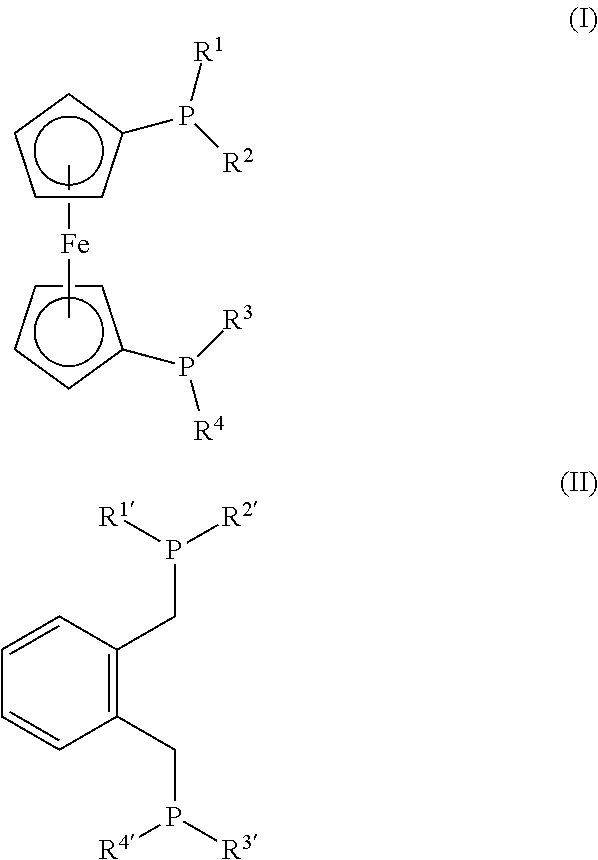
where
R1, R2, R3, R4, R1′, R2′, R3′, R4′ are each independently selected from —(C1-C12)-alkyl, —(C3-C12)-cycloalkyl, —(C3-C12)-heterocycloalkyl, —(C6-C20)-aryl, —(C3-C20)-heteroaryl; at least one of the R1, R2, R3, R4 radicals or at least one of the R1′, R2′, R3′, R4′ radicals is a —(C3-C20)-heteroaryl radical;
and
R1, R2, R3, R4, R1′, R2′, R3′, R4′ if they are —(C1-C12)-alkyl, —(C3-C12)-cycloalkyl, —(C3-C12)- heterocycloalkyl, —(C6-C20)-aryl or —(C3-C20)-heteroaryl,
may each independently be substituted by one or more substituents selected from —(C1-C12)-alkyl, —(C3-C12)-cycloalkyl, —(C3-C12)-heterocycloalkyl, —O—(C1-C12)-alkyl, —O—(C1-C12)-alkyl-(C6-C20)-aryl, —O—(C3-C12)-cycloalkyl, —S—(C1-C12)-alkyl, —S—(C3-C12)-cycloalkyl, —COO—(C1-C12)-alkyl, —COO—(C3-C12)-cycloalkyl, —CONH—(C1-C12)-alkyl, —CONH—(C3-C12)-cycloalkyl, —CO—(C1-C12)-alkyl, —CO—(C3-C12)-cycloalkyl, —N—[(C1-C12)-alkyl]2, —(C5-C20)-aryl, —(C6-C20)-aryl-(C1-C12)-alkyl, —(C6-C20)-aryl-O—(C1-C12)-alkyl, —(C3-C20)-heteroaryl, —(C3-C20)-heteroaryl-(C1-C12)-alkyl, —(C3-C20)-heteroaryl-O—(C1-C12)-alkyl, —COOH, —OH, —SO3H, ≥NH2, halogen.

vinyl compounds such as vinyl acetate, vinylcyclohexene, styrene, alpha-methylstyrene, 2-isopropenylnaphthalene; 2-methyl-2-pentenal, methyl 3-pentenoate, methacrylic anhydride.


Variant A:


Claims (12)


Applications Claiming Priority (3)
| Application Number | Priority Date | Filing Date | Title |
|---|---|---|---|
| EP16180058.6 | 2016-07-19 | ||
| EP16180058 | 2016-07-19 | ||
| EP16180058.6A EP3272733B1 (en) | 2016-07-19 | 2016-07-19 | Method for the alcoxycarbonylation of olefins in a medium with low brønsted acid concentration |
Publications (2)
| Publication Number | Publication Date |
|---|---|
| US20180022686A1 US20180022686A1 (en) | 2018-01-25 |
| US10562838B2 true US10562838B2 (en) | 2020-02-18 |
Family
ID=56497603
Family Applications (1)
| Application Number | Title | Priority Date | Filing Date |
|---|---|---|---|
| US15/651,042 Active US10562838B2 (en) | 2016-07-19 | 2017-07-17 | Process for the alkoxycarbonylation of olefins in a medium having a low Brønsted acid concentration |
Country Status (11)
| Country | Link |
|---|---|
| US (1) | US10562838B2 (en) |
| EP (1) | EP3272733B1 (en) |
| JP (1) | JP6571135B2 (en) |
| KR (1) | KR102039377B1 (en) |
| CN (1) | CN107628952A (en) |
| CA (1) | CA2973694C (en) |
| ES (1) | ES2722052T3 (en) |
| MX (1) | MX377075B (en) |
| MY (1) | MY175178A (en) |
| SG (1) | SG10201705858UA (en) |
| TW (1) | TWI691482B (en) |
Cited By (2)
| Publication number | Priority date | Publication date | Assignee | Title |
|---|---|---|---|---|
| US11440863B2 (en) | 2019-06-12 | 2022-09-13 | Evonik Operations Gmbh | Process for preparing an alcohol from hydrocarbons |
| US11629115B2 (en) | 2019-12-17 | 2023-04-18 | Evonik Operations Gmbh | Alkoxycarbonylation of trivinylcyclohexane |
Families Citing this family (8)
| Publication number | Priority date | Publication date | Assignee | Title |
|---|---|---|---|---|
| EP3502085B1 (en) * | 2017-12-21 | 2020-03-11 | Evonik Operations GmbH | Method for direct conversion of alkenes to carboxylic acids |
| EP4001256A1 (en) * | 2020-11-24 | 2022-05-25 | Evonik Operations GmbH | Method for alkoxycarbonylation of ethylenically unsaturated compounds using benzene-based diphosphine ligands and aluminum triflate |
| CN115772195A (en) * | 2021-09-06 | 2023-03-10 | 惠州凯特立斯科技有限公司 | Pyridine-based phosphine ligand compounds and applications thereof |
| CN116003467A (en) * | 2021-10-21 | 2023-04-25 | 惠州凯特立斯科技有限公司 | A kind of novel triphosphine compound and its synthetic method and application |
| JP7474310B2 (en) * | 2021-12-17 | 2024-04-24 | エボニック オクセノ ゲーエムベーハー ウント コー. カーゲー | Process for hydroformylation of olefins using Pt and xanthophos |
| EP4452919A1 (en) | 2021-12-23 | 2024-10-30 | Röhm GmbH | Process for producing alkyl methacrylates with higher yields and reduced emissions of volatile organic compounds |
| CN115819461B (en) * | 2022-11-02 | 2024-06-07 | 黄河三角洲京博化工研究院有限公司 | Bidentate phosphine ligand and preparation method thereof |
| WO2025237424A1 (en) * | 2024-05-17 | 2025-11-20 | 中国科学院上海有机化学研究所 | Method for synthesizing long-carbon fatty acid ester by hydroesterifying long-carbon olefin |
Citations (6)
| Publication number | Priority date | Publication date | Assignee | Title |
|---|---|---|---|---|
| JPH04215851A (en) | 1990-02-05 | 1992-08-06 | Shell Internatl Res Maatschappij Bv | Catalyst system for carbonylation |
| WO1995006027A1 (en) | 1993-08-23 | 1995-03-02 | Dsm N.V. | Process for the preparation of a mixture of alkyl pentenoates |
| US6284925B1 (en) | 1998-06-19 | 2001-09-04 | Degussa-Huls Ag | Use of ferrocenyl ligands for catalytic, enantioselective hydrogenation |
| US6335471B1 (en) | 1997-08-13 | 2002-01-01 | Ineos Acrylics Uk Limited | Method of manufacturing phosphine compound |
| WO2011083305A1 (en) | 2010-01-05 | 2011-07-14 | Lucite International Uk Limited | Process for the carbonylation of ethylenically unsaturated compounds, novel carbonylation ligands and catalyst systems incorporating such ligands |
| US20170022236A1 (en) | 2015-07-23 | 2017-01-26 | Evonik Degussa Gmbh | Ferrocene-based compounds and palladium catalysts based thereon for the alkoxycarbonylation of ethylenically unsaturated compounds |
-
2016
- 2016-07-19 EP EP16180058.6A patent/EP3272733B1/en active Active
- 2016-07-19 ES ES16180058T patent/ES2722052T3/en active Active
-
2017
- 2017-07-13 MX MX2017009235A patent/MX377075B/en active IP Right Grant
- 2017-07-14 CA CA2973694A patent/CA2973694C/en active Active
- 2017-07-14 MY MYPI2017702587A patent/MY175178A/en unknown
- 2017-07-14 JP JP2017137958A patent/JP6571135B2/en active Active
- 2017-07-17 TW TW106123834A patent/TWI691482B/en active
- 2017-07-17 SG SG10201705858UA patent/SG10201705858UA/en unknown
- 2017-07-17 US US15/651,042 patent/US10562838B2/en active Active
- 2017-07-18 KR KR1020170090732A patent/KR102039377B1/en active Active
- 2017-07-18 CN CN201710585090.9A patent/CN107628952A/en active Pending
Patent Citations (18)
| Publication number | Priority date | Publication date | Assignee | Title |
|---|---|---|---|---|
| JPH04215851A (en) | 1990-02-05 | 1992-08-06 | Shell Internatl Res Maatschappij Bv | Catalyst system for carbonylation |
| WO1995006027A1 (en) | 1993-08-23 | 1995-03-02 | Dsm N.V. | Process for the preparation of a mixture of alkyl pentenoates |
| JPH09501691A (en) | 1993-08-23 | 1997-02-18 | デーエスエム ナムローゼ フェンノートシャップ | Preparation of a mixture of alkyl pentanoates |
| US5693851A (en) | 1993-08-23 | 1997-12-02 | Dsm N.V. | Process for the preparation of a mixture of alkyl pentenoates |
| US6335471B1 (en) | 1997-08-13 | 2002-01-01 | Ineos Acrylics Uk Limited | Method of manufacturing phosphine compound |
| US6284925B1 (en) | 1998-06-19 | 2001-09-04 | Degussa-Huls Ag | Use of ferrocenyl ligands for catalytic, enantioselective hydrogenation |
| US20120330016A1 (en) * | 2010-01-05 | 2012-12-27 | Lucite International Uk Limited | Process for the carbonylation of ethylenically unsaturated compounds, novel carbonylation ligands and catalyst systems incorporating such ligands |
| KR20120127435A (en) | 2010-01-05 | 2012-11-21 | 루사이트 인터내셔널 유케이 리미티드 | Process for the carbonylation of ethylenically unsaturated compounds, novel carbonylation ligands and catalyst systems incorporating such ligands |
| WO2011083305A1 (en) | 2010-01-05 | 2011-07-14 | Lucite International Uk Limited | Process for the carbonylation of ethylenically unsaturated compounds, novel carbonylation ligands and catalyst systems incorporating such ligands |
| JP2013516449A (en) | 2010-01-05 | 2013-05-13 | ルーサイト インターナショナル ユーケー リミテッド | Method for carbonylation of ethylenically unsaturated compounds, novel carbonylation ligands and catalyst systems incorporating such ligands |
| US8969560B2 (en) | 2010-01-05 | 2015-03-03 | Lucite International Uk Limited | Process for the carbonylation of ethylenically unsaturated compounds, novel carbonylation ligands and catalyst systems incorporating such ligands |
| US9381503B2 (en) | 2010-01-05 | 2016-07-05 | Lucite International Uk Limited | Process for the carbonylation of ethylenically unsaturated compounds, novel carbonylation ligands and catalyst systems incorporating such ligands |
| US20170022236A1 (en) | 2015-07-23 | 2017-01-26 | Evonik Degussa Gmbh | Ferrocene-based compounds and palladium catalysts based thereon for the alkoxycarbonylation of ethylenically unsaturated compounds |
| US20170022235A1 (en) | 2015-07-23 | 2017-01-26 | Evonik Degussa Gmbh | Ferrocene-based compounds and palladium catalysts based thereon for the alkoxycarbonylation of ethylenically unsaturated compounds |
| US20170022138A1 (en) | 2015-07-23 | 2017-01-26 | Evonik Degussa Gmbh | Butyl-bridged diphosphine ligands for alkoxycarbonylation |
| US20170022137A1 (en) | 2015-07-23 | 2017-01-26 | Evonik Degussa Gmbh | Benzene-based diphosphine ligands for alkoxycarbonylation |
| US20170022234A1 (en) | 2015-07-23 | 2017-01-26 | Evonik Degussa Gmbh | Phosphine ligand and palladium catalysts based thereon for the alkoxycarbonylation of ethylenically unsaturated compounds |
| US20170022139A1 (en) | 2015-07-23 | 2017-01-26 | Evonik Degussa Gmbh | Monophosphine compounds and palladium catalysts based thereon for the alkoxycarbonylation of ethylenically unsaturated compounds |
Non-Patent Citations (24)
| Title |
|---|
| Armarego, Wilfred L.F., et al. Purification of Laboratory Chemicals, Butterworth Heinemann (Elsevier), 6th edition, Oxford 2009 (index and chapter abstracts provided). |
| Budzelaar, Peter H.M. et al. Synthesis and Coordination Chemistry of a New Class of Binucleating Ligands: Pyridyl-Substituted Diphosphines. Organometallics, 1990, vol. 9, pp. 1222-1227. |
| Dong et al. (Nature Communication 2017, 8, 14117. * |
| European Search Report dated Jan. 5, 2017 for EP 16 18 0054 (1 page). |
| Harris, Robin K. et al. Further Conventions for NMR Shielding and Chemical Shifts. Pure Appl. Chem., 2008, vol. 80, pp. 59-84. |
| Harris, Robin K. et al. NMR Nomenclature, Nuclear Spin Properties and Conventions for Chemical Shifts, Pure Appl. Chem., 2001, vol. 73, pp. 1795-1818. |
| Japanese Office Action dated Oct. 16, 2018 for JP Patent Application No. 2017137958 (4 pages in Japanese with English machine translation). |
| Jennerjahn, R. et al. Palladium-Catalyzed Isomerization and Hydroformylation of Olefins. European Journal of Chemistry, 2009, vol. 15, pp. 6383-6388. |
| Khokarale et al., Zwitterion enhanced performance in palladium-phosphine catalyzed ethylene methoxycarbonylation, Catalysis Communications 44, (2014), pp. 73-75. |
| Köppe, Ralf, et al. Quntenchemische und Experimentelle Untersuchungen zur Stabilität und Struktur von GaAs5 und InAs5 . Angew. Chem. 2004, vol. 116, pp. 2222-2225. |
| Korean Office Action dated Jan. 8, 2019 for KR Patent Application No. 10-2017-0090732 (6 pages in Korean with English machine translation). |
| Search Report dated Mar. 12, 2019 for Taiwan Patent Application No. 106123834 (1 page in Chinese with English machine translation). |
| Singapore Search Report for SG 10201705858U, dated Mar. 1, 2018 (3 pages). |
| U.S. Appl. No. 15/649,743, filed Jul. 14, 2017, Dong, et al. |
| U.S. Appl. No. 15/649,759, filed Jul. 14, 2017, Dong, et al. |
| U.S. Appl. No. 15/649,770, filed Jul. 14, 2017, Dong, et al. |
| U.S. Appl. No. 15/649,781, filed Jul. 14, 2017, Dong, et al. |
| U.S. Appl. No. 15/651,062, filed Jul. 17, 2017, Dong, et al. |
| U.S. Appl. No. 15/651,105, filed Jul. 17, 2017, Dong, et al. |
| U.S. Appl. No. 15/651,169, filed Jul. 17, 2017, Dong, et al. |
| Wang, L. et al. Enantioselective bis-alkoxycarbonylation of styrene catalyzed by novel chiral dipyridylphosphine cationic palladium(II) complexes. Journal of Molecular Catalysis A: Chemical, vol. 196 (2003), pp. 171-178. |
| Wang, L. et al. One-Step Synthesis of Chiral Dimethyl 2-0xo-3-phenyl-glutarate in the Asymmetric Triple-carbonylation of Styrene. Chinese Journal of Catalysis, vol. 32, 2011, pp. 1143-1148. |
| William Clegg et al., "Highly active and selective catalysts for the production of methyl propanoate via the methoxycarbonylation of ethane", Chem. Commun., (1999), pp. 1877-1878. |
| Xianjie Fang et al., Palladium-Catalyzed Alkoxycarbonylation of Conjugated Dienes under Acid-Free Conditions: Atom-Economic Synthesis of β, γ-Unsaturated Esters**, Chem. Int. Ed (2014), pp. 9030-9034. |
Cited By (3)
| Publication number | Priority date | Publication date | Assignee | Title |
|---|---|---|---|---|
| US11440863B2 (en) | 2019-06-12 | 2022-09-13 | Evonik Operations Gmbh | Process for preparing an alcohol from hydrocarbons |
| US11629115B2 (en) | 2019-12-17 | 2023-04-18 | Evonik Operations Gmbh | Alkoxycarbonylation of trivinylcyclohexane |
| US12077494B2 (en) | 2019-12-17 | 2024-09-03 | Evonik Oxeno Gmbh & Co. Kg | Alkoxycarbonylation of trivinylcyclohexane |
Also Published As
| Publication number | Publication date |
|---|---|
| KR102039377B1 (en) | 2019-11-04 |
| JP6571135B2 (en) | 2019-09-04 |
| JP2018058818A (en) | 2018-04-12 |
| MX377075B (en) | 2025-03-07 |
| MY175178A (en) | 2020-06-12 |
| KR20180009714A (en) | 2018-01-29 |
| CA2973694A1 (en) | 2018-01-19 |
| ES2722052T3 (en) | 2019-08-07 |
| MX2017009235A (en) | 2018-09-10 |
| TWI691482B (en) | 2020-04-21 |
| EP3272733B1 (en) | 2019-01-02 |
| CN107628952A (en) | 2018-01-26 |
| SG10201705858UA (en) | 2018-02-27 |
| TW201815741A (en) | 2018-05-01 |
| CA2973694C (en) | 2022-09-27 |
| US20180022686A1 (en) | 2018-01-25 |
| EP3272733A1 (en) | 2018-01-24 |
Similar Documents
| Publication | Publication Date | Title |
|---|---|---|
| US10562838B2 (en) | Process for the alkoxycarbonylation of olefins in a medium having a low Brønsted acid concentration | |
| US20230348356A1 (en) | Butyl-bridged diphosphine ligands for alkoxycarbonylation | |
| US10544174B2 (en) | Process for the alkoxycarbonylation of ethylenically unsaturated compounds with monophosphine ligands | |
| US10202409B2 (en) | 1, 1′ -bis(phosphino)ferrocene ligands for alkoxycarbonylation | |
| US9938310B2 (en) | 1, 1′-bis(phosphino)ferrocene ligands for alkoxycarbonylation |
Legal Events
| Date | Code | Title | Description |
|---|---|---|---|
| AS | Assignment |
Owner name: EVONIK DEGUSSA GMBH, GERMANY Free format text: ASSIGNMENT OF ASSIGNORS INTEREST;ASSIGNORS:FANG, XIANJIE;DONG, KAIWU;NEUMANN, HELFRIED;AND OTHERS;SIGNING DATES FROM 20180207 TO 20180306;REEL/FRAME:045909/0887 |
|
| STPP | Information on status: patent application and granting procedure in general |
Free format text: FINAL REJECTION MAILED |
|
| STPP | Information on status: patent application and granting procedure in general |
Free format text: RESPONSE AFTER FINAL ACTION FORWARDED TO EXAMINER |
|
| STPP | Information on status: patent application and granting procedure in general |
Free format text: DOCKETED NEW CASE - READY FOR EXAMINATION |
|
| STPP | Information on status: patent application and granting procedure in general |
Free format text: NOTICE OF ALLOWANCE MAILED -- APPLICATION RECEIVED IN OFFICE OF PUBLICATIONS |
|
| STPP | Information on status: patent application and granting procedure in general |
Free format text: AWAITING TC RESP, ISSUE FEE PAYMENT VERIFIED |
|
| STCF | Information on status: patent grant |
Free format text: PATENTED CASE |
|
| AS | Assignment |
Owner name: EVONIK OPERATIONS GMBH, GERMANY Free format text: CHANGE OF NAME;ASSIGNOR:EVONIK DEGUSSA GMBH;REEL/FRAME:052254/0052 Effective date: 20191104 |
|
| MAFP | Maintenance fee payment |
Free format text: PAYMENT OF MAINTENANCE FEE, 4TH YEAR, LARGE ENTITY (ORIGINAL EVENT CODE: M1551); ENTITY STATUS OF PATENT OWNER: LARGE ENTITY Year of fee payment: 4 |
|
| AS | Assignment |
Owner name: EVONIK OXENO GMBH & CO. KG, GERMANY Free format text: ASSIGNMENT OF ASSIGNORS INTEREST;ASSIGNOR:EVONIK OPERATIONS GMBH;REEL/FRAME:066242/0585 Effective date: 20231012 |