US10558196B2 - Three-dimensional object division output apparatus and its application - Google Patents
Three-dimensional object division output apparatus and its application Download PDFInfo
- Publication number
- US10558196B2 US10558196B2 US14/848,600 US201514848600A US10558196B2 US 10558196 B2 US10558196 B2 US 10558196B2 US 201514848600 A US201514848600 A US 201514848600A US 10558196 B2 US10558196 B2 US 10558196B2
- Authority
- US
- United States
- Prior art keywords
- division
- dimensional object
- end point
- size
- output
- Prior art date
- Legal status (The legal status is an assumption and is not a legal conclusion. Google has not performed a legal analysis and makes no representation as to the accuracy of the status listed.)
- Active, expires
Links
Images






Classifications
-
- G—PHYSICS
- G05—CONTROLLING; REGULATING
- G05B—CONTROL OR REGULATING SYSTEMS IN GENERAL; FUNCTIONAL ELEMENTS OF SUCH SYSTEMS; MONITORING OR TESTING ARRANGEMENTS FOR SUCH SYSTEMS OR ELEMENTS
- G05B19/00—Program-control systems
- G05B19/02—Program-control systems electric
- G05B19/18—Numerical control [NC], i.e. automatically operating machines, in particular machine tools, e.g. in a manufacturing environment, so as to execute positioning, movement or co-ordinated operations by means of program data in numerical form
- G05B19/4097—Numerical control [NC], i.e. automatically operating machines, in particular machine tools, e.g. in a manufacturing environment, so as to execute positioning, movement or co-ordinated operations by means of program data in numerical form characterised by using design data to control NC machines, e.g. CAD/CAM
- G05B19/4099—Surface or curve machining, making three-dimensional [3D] objects, e.g. desktop manufacturing
-
- B—PERFORMING OPERATIONS; TRANSPORTING
- B29—WORKING OF PLASTICS; WORKING OF SUBSTANCES IN A PLASTIC STATE IN GENERAL
- B29C—SHAPING OR JOINING OF PLASTICS; SHAPING OF MATERIAL IN A PLASTIC STATE, NOT OTHERWISE PROVIDED FOR; AFTER-TREATMENT OF THE SHAPED PRODUCTS, e.g. REPAIRING
- B29C64/00—Additive manufacturing, i.e. manufacturing of three-dimensional [3D] objects by additive deposition, additive agglomeration or additive layering, e.g. by 3D printing, stereolithography or selective laser sintering
- B29C64/30—Auxiliary operations or equipment
- B29C64/386—Data acquisition or data processing for additive manufacturing
-
- G—PHYSICS
- G09—EDUCATION; CRYPTOGRAPHY; DISPLAY; ADVERTISING; SEALS
- G09B—EDUCATIONAL OR DEMONSTRATION APPLIANCES; APPLIANCES FOR TEACHING, OR COMMUNICATING WITH, THE BLIND, DEAF OR MUTE; MODELS; PLANETARIA; GLOBES; MAPS; DIAGRAMS
- G09B23/00—Models for scientific, medical, or mathematical purposes, e.g. full-sized devices for demonstration purposes
- G09B23/28—Models for scientific, medical, or mathematical purposes, e.g. full-sized devices for demonstration purposes for medicine
- G09B23/30—Anatomical models
-
- B—PERFORMING OPERATIONS; TRANSPORTING
- B33—ADDITIVE MANUFACTURING TECHNOLOGY
- B33Y—ADDITIVE MANUFACTURING, i.e. MANUFACTURING OF THREE-DIMENSIONAL [3D] OBJECTS BY ADDITIVE DEPOSITION, ADDITIVE AGGLOMERATION OR ADDITIVE LAYERING, e.g. BY 3D PRINTING, STEREOLITHOGRAPHY OR SELECTIVE LASER SINTERING
- B33Y50/00—Data acquisition or data processing for additive manufacturing
- B33Y50/02—Data acquisition or data processing for additive manufacturing for controlling or regulating additive manufacturing processes
-
- G—PHYSICS
- G05—CONTROLLING; REGULATING
- G05B—CONTROL OR REGULATING SYSTEMS IN GENERAL; FUNCTIONAL ELEMENTS OF SUCH SYSTEMS; MONITORING OR TESTING ARRANGEMENTS FOR SUCH SYSTEMS OR ELEMENTS
- G05B2219/00—Program-control systems
- G05B2219/30—Nc systems
- G05B2219/35—Nc in input of data, input till input file format
- G05B2219/35134—3-D cad-cam
-
- G—PHYSICS
- G05—CONTROLLING; REGULATING
- G05B—CONTROL OR REGULATING SYSTEMS IN GENERAL; FUNCTIONAL ELEMENTS OF SUCH SYSTEMS; MONITORING OR TESTING ARRANGEMENTS FOR SUCH SYSTEMS OR ELEMENTS
- G05B2219/00—Program-control systems
- G05B2219/30—Nc systems
- G05B2219/49—Nc machine tool, till multiple
- G05B2219/49007—Making, forming 3-D object, model, surface
-
- Y—GENERAL TAGGING OF NEW TECHNOLOGICAL DEVELOPMENTS; GENERAL TAGGING OF CROSS-SECTIONAL TECHNOLOGIES SPANNING OVER SEVERAL SECTIONS OF THE IPC; TECHNICAL SUBJECTS COVERED BY FORMER USPC CROSS-REFERENCE ART COLLECTIONS [XRACs] AND DIGESTS
- Y02—TECHNOLOGIES OR APPLICATIONS FOR MITIGATION OR ADAPTATION AGAINST CLIMATE CHANGE
- Y02P—CLIMATE CHANGE MITIGATION TECHNOLOGIES IN THE PRODUCTION OR PROCESSING OF GOODS
- Y02P90/00—Enabling technologies with a potential contribution to greenhouse gas [GHG] emissions mitigation
- Y02P90/02—Total factory control, e.g. smart factories, flexible manufacturing systems [FMS] or integrated manufacturing systems [IMS]
Definitions
- the present disclosure relates to a three-dimensional object division output apparatus that outputs an object having a tree structure by dividing the object into parts that do not exceed an output range of a three-dimensional object creation apparatus when the object is output to the three-dimensional object creation apparatus and its application.
- Such a three-dimensional model is produced based on tomograms of the patient obtained by a CT (Computed Tomography) apparatus, an MRI (Magnetic Resonance Imaging) apparatus and the like.
- CT Computer Tomography
- MRI Magnetic Resonance Imaging
- Patent Document 1 discloses a method in which data of a target region are extracted from tomographic data of a patient obtained by imaging the patient by a CT apparatus, an MRI apparatus or the like. Further, cross-sectional data for creating a model are generated from the extracted tomographic data, and a precision powder model is produced by depositing powder material by using the generated cross-sectional data. Further, blood vessels or an organ for each patient is produced with transparent or semi-transparent flexible polymer, such as silicon, by using the produced precision powder model, as a mold.
- Patent Document 2 discloses a method in which structures, such as a liver region, hepatic arteries and hepatic veins, are extracted from three-dimensional volume data, and surface data of these structures are generated. After three-dimensional model data are generated by combining the surface data of the structures, a three-dimensional model is produced by a three-dimensional printer by using slice data obtained by dividing the three-dimensional model at contour surfaces.
- a large-scale three-dimensional printer corresponding to the size of the object is needed.
- an object creation apparatus such as a three-dimensional printer
- a large-scale three-dimensional printer is extremely expensive. Therefore, in actual cases, an object is divided into small objects, and each of the small objects is output from a small-scale three-dimensional printer, and the whole large object is produced by joining the small objects together after then.
- bronchi which have a tree structure
- the size of a divided part exceeds the output range of a three-dimensional printer in some cases.
- the present disclosure provides a three-dimensional object division output apparatus that outputs a three-dimensional object to a three-dimensional object creation apparatus by dividing the three-dimensional object into parts in such a manner that a small piece is not output when the three-dimensional object is output from the three-dimensional object creation apparatus and its application.
- a three-dimensional object division output apparatus of the present disclosure includes an extraction unit that extracts, from volume data, a three-dimensional object having a tree structure including plural end points, plural branch points, at least one edge each connecting one of the plural end points and one of the plural branch points to each other, and at least one edge each connecting two of the plural branch points to each other, a first end point determination unit that determines one of the plural end points, as a first end point, a division position search unit that searches for a division position on an edge present on a path from a second end point, which is one of the plurality of end points other than the first end point, toward the first end point, and at the division position, the size of a downstream tree structure spreading from the division position toward a direction opposite to the first end point changing from a size within an output range of a three-dimensional object creation apparatus to a size exceeding the output range, a division unit that divides, at the division position obtained by search, the three-dimensional object into a division object the size of which is within the output range and a remaining
- An operation method of a three-dimensional object division output apparatus of the present disclosure is an operation method of the three-dimensional object division output apparatus including an extraction unit, a first end point determination unit, a division position search unit, a division unit and an output unit.
- the method includes an extraction step in which the extraction unit extracts, from volume data, a three-dimensional object having a tree structure including plural end points, plural branch points, at least one edge each connecting one of the plural end points and one of the plural branch points to each other, and at least one edge each connecting two of the plural branch points to each other, a first end point determination step in which the first end point determination unit determines one of the plural end points, as a first end point, a division position search step in which the division position search unit that searches for a division position on an edge present on a path from a second end point, which is one of the plurality of end points other than the first end point, toward the first end point, and at the division position, the size of a downstream tree structure spreading from the division position toward a direction opposite to the
- a three-dimensional object division output program of the present disclosure causes a computer to execute an extraction step that extracts, from volume data, a three-dimensional object having a tree structure including plural end points, plural branch points, at least one edge each connecting one of the plural end points and one of the plural branch points to each other, and at least one edge each connecting two of the plural branch points to each other, a first end point determination step that determines one of the plural end points, as a first end point, a division position search step that searches for a division position on an edge present on a path from a second end point, which is one of the plurality of end points other than the first end point, toward the first end point, and at the division position, the size of a downstream tree structure spreading from the division position toward a direction opposite to the first end point changing from a size within an output range of a three-dimensional object creation apparatus to a size exceeding the output range, a division step that divides, at the division position obtained by search, the three-dimensional object into a division object the size of which is within the output
- the “tree structure” includes plural end points, plural branch points, at least one edge each connecting an end point and a branch point to each other, and at least one edge each connecting two branch points to each other, and has a hierarchical structure in which edges branch at branch points.
- the “three-dimensional object having a tree structure” is bronchi, blood vessels and the like.
- the “output range of a three-dimensional object creation apparatus” is represented by the maximum height, width and depth of an object that the three-dimensional object creation apparatus can output. Further, the expression “the size of a division object exceeds the output range of a three-dimensional object creation apparatus” means that at least one of the height, the width and the depth of the division object exceeds the size of the maximum output range of the three-dimensional object creation apparatus.
- the division position search unit may search, in order of reaching each branch point, for a branch point at which the size of a downstream tree structure spreading therefrom toward a direction opposite to the first end point changes from a size within the output range to a size exceeding the output range, and search an edge immediately before the branch point, obtained by search, for the division position at which the size of the division object becomes a size within the output range.
- the division position search unit may search each edge on a path from the second end point to the first end point for an edge connecting two branch points to each other, and the size of a downstream tree structure spreading from one of the two branch points toward a direction opposite to the first end point being within the output range while the size of a downstream tree structure spreading from the other one of the two branch points toward a direction opposite to the first end point exceeds the output range, and search the edge for the division position at which the size of the division object becomes a size within the output range.
- the three-dimensional object division output apparatus further includes a repetition control unit that repeatedly generates, with respect to the three-dimensional object excluding the division object, a new division object by using the division position search unit and the division unit.
- the division position search unit selects, as the second end point, an end point having a longest total length of edges on a path to the first end point therefrom from end points included in the three-dimensional object or the three-dimensional object excluding the division object other than the first end point.
- the first end point may be a specific end point.
- the “specific end point” may be, for example, an end point constituting a root of a tree structure.
- Another three-dimensional object division output apparatus of the present disclosure includes an extraction unit that extracts, from volume data, a three-dimensional object having a tree structure including plural end points, plural branch points, at least one edge each connecting one of the plural end points and one of the plural branch points to each other, and at least one edge each connecting two of the plural branch points to each other, a third end point selection unit that selects one of the plural end points, as a third end point, a selected region determination unit that determines a selected region by advancing on a path from the third end point toward another end point of the tree structure while selecting, at each branch point reached from the third end point, an edge having a largest number of edges continuing forward therefrom from edges to which the branch point branches, and by repeating processing of including, in the selected region, a downstream tree structure spreading from each of the branch points toward a direction opposite to a direction in which processing advances on the path, a division position search unit that searches each branch point on the path for a branch point at which the size of the tree structure included in the selected region becomes a
- An operation method of another three-dimensional object division output apparatus of the present disclosure is an operation method of the three-dimensional object division output apparatus including an extraction unit, a third end point selection unit, a selected region determination unit, a division position search unit, a division unit and an output unit.
- the method includes an extraction step in which the extraction unit extracts, from volume data, a three-dimensional object having a tree structure including plural end points, plural branch points, at least one edge each connecting one of the plural end points and one of the plural branch points to each other, and at least one edge each connecting two of the plural branch points to each other, a third end point selection step in which the third end point selection unit selects one of the plural end points, as a third end point, a selected region determination step in which the selected region determination unit determines a selected region by advancing on a path from the third end point toward another end point of the tree structure while selecting, at each branch point reached from the third end point, an edge having a largest number of edges continuing forward therefrom from edges to which the branch point branches, and by repeating processing of including, in the selected region, a downstream tree structure spreading from each of the branch points toward a direction opposite to a direction in which processing advances on the path, a division position search step in which the division position search unit searches each branch point on the path for a branch point at which the
- Another three-dimensional object division output program of the present disclosure causes a computer to execute an extraction step that extracts, from volume data, a three-dimensional object having a tree structure including plural end points, plural branch points, at least one edge each connecting one of the plural end points and one of the plural branch points to each other, and at least one edge each connecting two of the plural branch points to each other, a third end point selection step that selects one of the plural end points, as a third end point, a selected region determination step that determines a selected region by advancing on a path from the third end point toward another end point of the tree structure while selecting, at each branch point reached from the third end point, an edge having a largest number of edges continuing forward therefrom from edges to which the branch point branches, and by repeating processing of including, in the selected region, a downstream tree structure spreading from each of the branch points toward a direction opposite to a direction in which processing advances on the path, a division position search step that searches each branch point on the path for a branch point at which the size of the tree structure included in the
- three-dimensional object division output apparatus further includes a repetition control unit that repeatedly generates, with respect to the three-dimensional object excluding the division object, a new division object by using the third end point selection unit, the selected region determination unit, the division position search unit and the division unit.
- the division position search unit searches for a division position at which the size of the division object becomes a size within the output range, and also if the diameter of a cut surface of the three-dimensional object divided at the division position is less than a predetermined value, a division position at which the diameter of a cut surface is greater than the predetermined value on the same edge.
- a path is followed from one of plural end points of a tree structure of a three-dimensional object toward another end point of the tree structure, and a branch point at which the size of a division object changes from a size within an output range of a three-dimensional object creation apparatus to a size exceeding the output range is searched for.
- a division object is generated by dividing the three-dimensional object at a point on an edge immediately before the branch point obtained by search, and output to the three-dimensional object creation apparatus. Accordingly, it is possible to divide the three-dimensional object in such a manner that a small piece is not output, and to output the three-dimensional object to a three-dimensional printer by minimizing the number of times of output. Further, it is possible to reduce the number of positions at which parts are joined together when the divided parts of the three-dimensional object are assembled together.
- program of the present disclosure may be provided being recorded on a computer readable medium.
- computer readable media are not limited to any specific type of device, and include, but are not limited to: floppy disks, CD's, RAM's, ROM's, hard disks, and magnetic tapes.
- Such computer-readable storage media store data and/or instructions that cause a machine to perform the functions in the present disclosure.
- FIG. 1 is a schematic diagram illustrating the configuration of a three-dimensional model production system to which a three-dimensional object division output apparatus according to an embodiment of the present disclosure has been applied;
- FIG. 2 is a functional block diagram of a three-dimensional object division output unit according to a first embodiment of the present disclosure
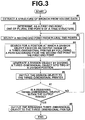
- FIG. 3 is a flow chart showing a flow of processing of a three-dimensional model production system according to the first embodiment of the present disclosure
- FIG. 4 is a diagram illustrating an example of a tree structure
- FIG. 5 is a diagram for explaining selection of an end point other than a root from plural end points of a tree structure
- FIG. 6A is a diagram for explaining a method for selecting a selected region by following a path from a second end point (No. 1);
- FIG. 6B is a diagram for explaining the method for selecting a selected region by following the path from the second end point (No. 2);
- FIG. 6C is a diagram for explaining the method for selecting a selected region by following the path from the second end point (No. 3);
- FIG. 7 is a diagram illustrating processes of dividing a tree structure
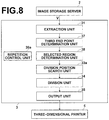
- FIG. 8 is a functional block diagram of a three-dimensional object division output unit according to a second embodiment of the present disclosure.
- FIG. 9 is a flow chart showing a flow of processing of a three-dimensional model production system according to the second embodiment of the present disclosure.
- FIG. 10 is a diagram for explaining selection of a third end point
- FIG. 11A is a diagram for explaining a method for selecting a path in the second embodiment of the present disclosure (No. 1);
- FIG. 11B is a diagram for explaining the method for selecting the path in the second embodiment of the present disclosure (No. 2);
- FIG. 11C is a diagram for explaining the method for selecting the path in the second embodiment of the present disclosure (No. 3).
- FIG. 1 is a schematic diagram illustrating the hardware configuration of a three-dimensional model production system in which a three-dimensional object division output apparatus is provided. As illustrated in FIG. 1 , this system includes a modality 1 , an image storage server 2 , an image processing workstation 3 , and a three-dimensional object creation apparatus 4 , which are connected to each other through a network 5 in such a manner that they can communicate with each other.
- the modality 1 may include an apparatus that generates image data of a three-dimensional medical image representing a target region of a patient by imaging the target region, and outputs the image data, as image information, by attaching supplementary information defined by the DICOM (Digital Imaging and Communications in Medicine) standard to the image data.
- image data obtained by imaging by a CT, MRI or the like.
- image data of a three-dimensional medical image will be used, as volume data.
- the image storage server 2 is a computer that stores, in an image database, volume data obtained at the modality 1 or image data generated by image processing at the image processing workstation 3 , and manages the data.
- the image storage server 2 includes a large capacity external storage apparatus and software for managing database (for example, ORDB (Object Relational Database) management software).
- the image processing workstation 3 is a computer that performs, based on a request by a user, image processing on volume data obtained from the modality 1 or the image storage server 2 .
- the image processing workstation 3 includes known hardware configuration, such as a CPU (Central Processing Unit), a main memory, an auxiliary storage unit, an input output interface, a communication interface, an input device (a mouse, keyboard and the like), a display device (a display monitor) and a data bus. Further, a known operating system or the like has been installed in the image processing workstation 3 .
- the three-dimensional object division output apparatus of the present disclosure has been installed in this image processing workstation 3 .
- the processing of the three-dimensional object division output apparatus is performed by executing a program installed from a recording medium, such as a CD-ROM (Compact Disc Read Only Memory).
- a program installed from a recording medium, such as a CD-ROM (Compact Disc Read Only Memory).
- the program may be installed after being downloaded from a storage apparatus of a server connected through a network, such as the Internet.
- the three-dimensional object creation apparatus 4 generates data of contour surfaces (cross-sectional data or the like) of a three-dimensional object to be output, and produces a three-dimensional object by depositing, based on the cross-sectional data, cross-sectional shapes one on another.
- a method for producing a three-dimensional object there are an inkjet method, in which liquid resin is gradually cured by outputting ultraviolet rays or the like to the resin, an FDM (Fused Deposition Modeling) method, in which thermally fused resin is successively deposited little by little, a binding jetting method, in which an adhesive is jetted onto powder resin, and the like.
- the three-dimensional object creation apparatus will be referred to as a three-dimensional printer.
- FIG. 2 is a block diagram illustrating a three-dimensional object division output unit (a three-dimensional object division output apparatus) according to a first embodiment of the present disclosure, which is one of functions of the image processing workstation 3 .
- FIG. 3 is a flow chart showing a flow of processing.
- the three-dimensional object division output unit in an embodiment of the present disclosure is achieved by an extraction unit 31 , a first end point determination unit 32 , a division position search unit 33 , a division unit 34 , an output unit 35 and a repetition control unit 36 .
- the extraction unit 31 extracts a three-dimensional object having a tree structure from volume data.
- a three-dimensional object having a tree structure are blood vessels and bronchi.
- bronchi are used as an example of the three-dimensional object, and a case of extracting the bronchi from volume data obtained by imaging at a CT apparatus will be described.
- the image processing workstation 3 retrieves, from the image storage server 2 , volume data V of a patient for whom a three-dimensional model should be produced, and receives volume data V.
- the image processing workstation 3 extracts the structure of the bronchi of the patient from received volume data V by using the extraction unit 31 (# 1 ).
- the bronchi in volume data V appear as a region having low CT values (voxel values) in a CT image, because voxels within the bronchi correspond to an air region.
- the bronchial wall is considered as a linear structure having relatively high CT values. Therefore, a set of voxels having image values that have likelihood of the bronchi is extracted as a bronchial region by using a region expansion method. Further, thinning is performed on the extracted bronchial region, and an obtained linear structure representing the bronchi is extracted.
- the bronchi are extracted by performing, based on the distribution of CT values, structure analysis of morphology on each voxel.
- the bronchi branch at many stages, and the diameter of the bronchi becomes narrower toward their terminal ends. Therefore, Gaussian pyramid images (in other words, plural three-dimensional images having different resolutions) are generated, in advance, by performing multiple resolution transformation on volume data to make the bronchi (a linear structure) in various sizes detectable.
- a linear structure in various sizes is detected by scanning a detection algorithm for each image of the generated Gaussian pyramid.
- the linear structure extracted in this manner is not always detected as a tree structure in which all linear structures are connected to each other. Therefore, the connection relationship of the detected linear structures is reconstructed. Extraction of the tree structure of the bronchi is completed by this reconstruction.
- the extracted linear structure is classified into end points, branch points and edges.
- Tree structure data representing the bronchi are obtained by connecting the end points and the branch points of the tree structure by the edges. Further, feature values, such as the diameter of the bronchi at each position of the tree structure and the length of each edge (a length between branch points of the bronchi), are also stored as tree structure data, if necessary.
- a different method may be used.
- the tree structure may be extracted by using the method in combination with the other method.
- Methods for extracting a tree structure disclosed in Japanese Unexamined Patent Publication No. 2010-220742, Japanese Unexamined Patent publication No. 2011-212312, Japanese Unexamined Patent Publication No. 2012-200403, Japanese Unexamined Patent Publication No. 2012-228396, which were filed by the applicant of the present application, and the like may be used.
- a tree structure includes plural end points, plural branch points, at least one edge connecting an end point and a branch point to each other and at least one edge connecting two branch points to each other.
- FIG. 4 is a diagram illustrating an example of a tree structure when the bronchi have been extracted.
- edges are represented by lines.
- intersections of edges represent branch points (In the left section of FIG. 4 , an intersection without white circle ⁇ represents a state in which edges cross each other but they are three-dimensionally apart from each other. Therefore, they are not branch points.
- FIGS. 5 through 7 , FIG. 10 and FIGS. 11A through 11C will be used also in explanation using FIGS. 5 through 7 , FIG. 10 and FIGS. 11A through 11C .
- a first end point determination unit 32 determines one of plural end points of a tree structure, as a first end point (# 2 ).
- an end point regarded as a root which corresponds to an entrance position of the bronchi, is determined as the first end point.
- the root may be determined by user's selection of an end point corresponding to the entrance of the bronchi from plural end points of an extracted tree structure.
- an end point at the entrance position of the bronchi may be determined as the root by performing feature (for example, the size of a diameter, characteristics of a form or the like) analysis on a three-dimensional object.
- the right section of the diagram of FIG. 4 illustrates a state in which end point Root of a root (black circle •) has been determined.
- a division position search unit 33 searches a path advancing from one of plural end points of a tree structure other than the root toward the root for a division position on an edge at which the size of a downstream tree structure spreading therefrom in a direction opposite to a direction in which the path advances toward the root becomes a size exceeding an output range of a three-dimensional printer 4 .
- the term “upstream” represents a part of the tree structure extending from a branch point toward the root (first end point)
- the term “downstream” represents a part of the tree structure extending from a branch point in a direction opposite to the root.
- end point (second end point) E 1 is selected from plural end points of the tree structure (# 3 ).
- a path from root Root to end point E 1 is uniquely determined as indicated by a bold line in FIG. 5 . This path is followed backward from end point E 1 to root Root, and a position at which a division object exceeds the output range of the three-dimensional printer 4 is searched for (# 4 ). It is desirable to select, as second end point E 1 , an end point having a longest total length of edges on the path to the root therefrom from end points included in the three-dimensional object other than the root.
- search When search reaches first branch point B 1 by following the path from second end point E 1 , two edges located in the downstream direction of branch B 1 are added to a selected region (indicated by a frame in FIG. 6A ). If the selected region does not exceed the output range of the three-dimensional printer 4 , search advances to branch point B 2 . Similarly, all the tree structures located in the downstream direction of branch point B 2 are added to the selected region also at branch point B 2 (indicated by a frame in FIG. 6B ). If the selected region does not exceed the output range of the three-dimensional printer 4 , search further advances to branch point B 3 , and all the tree structures located in the downstream direction of branch point B 3 are added to the selected region (indicated by a frame in FIG. 6C ).
- point P at which the selected region exceeds the output range of the three-dimensional printer 4 is set on an edge reaching branch point B 3 from branch point B 2 , and point P is determined as a division position.
- Judgment as to whether a selected region exceeds the output range of the three-dimensional printer 4 or not may be made by judging whether all of the height, width and depth of the selected region are less than or equal to the maximum height, width and depth of the output range of the three-dimensional printer 4 .
- point P at which the height, width and depth of a tree structure located in the downstream direction of point P are less than or equal to the maximum height, width and depth of the output range of the three-dimensional printer 4 is a division position.
- a convex hull formed by envelope surfaces is obtained by applying an algorithm for calculating a convex hull to end points of a tree structure included in a division object obtainable by dividing the tree structure at a point on an edge. Further, judgment is made as to whether this convex hull is within the output range of the three-dimensional printer 4 .
- the output range of the three-dimensional printer 4 is defined by a rectangular parallelepiped.
- a circumscribed rectangular parallelepiped having a height, a width and a depth all of which are less than or equal to those of the maximum output range of the three-dimensional printer 4 , and at least one of which is the size of the maximum output range, should be found.
- judgment as to whether the output range of the three-dimensional printer 4 is exceeded or not may be made by judging whether the height, width and depth when the tree structure is inclined are within the output range of the three-dimensional printer 4 .
- a division position to which the path is followed backward as far as possible from end point E 1 is searched for.
- the division position to which the path is followed backward as far as possible from end point E 1 is searched for in this manner, it is possible to reduce the number of times of division of the three-dimensional object.
- the division position search unit 33 searches for a position at which the size of a division object becomes a size within the output range, and also if the diameter of a cut surface of the three-dimensional object divided at the division position is less than a predetermined value, a position at which the diameter of a cut surface is greater than the predetermined value on the same edge, and determines the position as the division position.
- an object such as the bronchi
- the probability that point P at which the size of the division object becomes a size within the output range of the three-dimensional printer 4 while a path is followed backward from a terminal end of the bronchi, as described above, is directly determined as the division position is high, because the bronchi normally become thicker (in other words, the diameter of the bronchi increases) as the position is closer to the root.
- the diameter of the blood vessel at the division position is small in some cases, depending on the manner of selecting an end point as a root.
- the diameter is less than a predetermined value, it is desirable to determine, as a division position, a position having a diameter greater than a predetermined value on the edge on which the division position is present or a position having the largest diameter on the edge on which the division position is present.
- a portion of the edge between branch point B 2 and point P is searched for a division position.
- the division unit 34 divides the three-dimensional object into two at the division position.
- the division unit 34 divides the three-dimensional object into an object having a size within the output range, as a division object, and a remaining object (# 5 ).
- the output unit 35 outputs the generated division object to the three-dimensional printer 4 (# 6 ). Specifically, the output unit 35 generates cross-sectional data by dividing the division object at contour surfaces, and outputs the cross-sectional data to the three-dimensional printer 4 . If the division object in this state is not within the output range of the three-dimensional printer 4 , the output unit 35 generates cross-sectional data by dividing the division object at contour surfaces in a state in which the division object is inclined so that the division object is within the output range.
- division object After the division object is output, if the remaining three-dimensional object excluding the output division object exceeds the output range of the three-dimensional printer, division is performed again (# 7 -NO).
- the repetition control unit 36 makes processing return to step # 3 , and the division position search unit 33 searches for a division position again.
- the division position search unit 33 selects an end point from end points included in the three-dimensional object excluding the division object other than the root, and determines the selected end point, as second end point E 1 (# 3 ). It is desirable to select, as second end point E 1 , an end point having a longest total length of edges on a path to the root therefrom from the end points included in the three-dimensional object excluding the division object.
- a division position is searched for by following backward a path between this second end point E 1 and root Root (# 4 ), and a division object is generated by dividing the three-dimensional object (# 5 ), and the division object is output to the three-dimensional printer 4 (# 6 ). These kinds of processing are repeated until the remaining three-dimensional object, which excludes the output division object, becomes a size within the output range of the three-dimensional printer 4 .
- the remaining three-dimensional object, excluding the output division objects becomes a size within the output range of the three-dimensional printer 4 (# 7 —YES)
- the remaining three-dimensional object is output to the three-dimensional printer 4 , and processing ends (# 8 ).
- FIG. 7 illustrates a manner of dividing the tree structure.
- a division object is generated by searching the tree structure for a division position from a lower left end point of the tree structure (a frame part in section a, which is the leftmost section in FIG. 7 ).
- a division object is generated by searching the tree structure for a division position from a lower right end point of the tree structure (a frame part in section b, which is the second section from the left in FIG. 7 ).
- a division object is generated by searching the tree structure for a division position from a lower left end point of a remaining tree structure (a frame part in section c, which is the third section from the left in FIG. 7 ).
- a division object is generated by searching the tree structure for a division position from a lower right end point of a remaining tree structure (a frame part in section d, which is the rightmost section in FIG. 7 ).
- the division position search unit 33 searches, in order of reaching each branch point on the path from the second end point toward the root, for a branch point at which the size of a downstream tree structure spreading therefrom becomes a size within the output range.
- the division position search unit 33 may search all edges on the path from the end point to the root, in any order, for an edge connecting two branch points to each other, and the size of a downstream tree structure spreading from one of the two branch points being within the output range while the size of a downstream tree structure spreading from the other one of the two branch points exceeds the output range.
- the division position search unit 33 may search the edge for the division position.
- the division position search unit 33 may search, in order of reaching each branch point when search is performed from the root toward the second end point, for a branch point at which the size of a downstream tree structure spreading therefrom becomes a size within the output range.
- the first end point is a root
- the first end point is not necessarily the root.
- a specific end point of the tree structure should be selected as the first end point.
- a three-dimensional object division output unit according to a second embodiment of the present disclosure will be described.
- a specific end point such as a root
- a case in which a division position is searched for while a path on which search advances is determined at each branch point will be described.
- the configuration of a three-dimensional model production system is the same as that of the first embodiment.
- FIG. 8 is a block diagram illustrating a three-dimensional object division output unit, which is the second embodiment of the present disclosure, as one of functions of the image processing workstation 3 .
- FIG. 9 is a flow chart showing a flow of processing.
- the three-dimensional object division output unit in the second embodiment of the present disclosure is achieved by the extraction unit 31 , a third end point selection unit 37 , a selected region determination unit 38 , a division position search unit 33 a , the division unit 34 , the output unit 35 and a repetition control unit 36 a .
- the extraction unit 31 is the same as that of the first embodiment. Therefore, detailed descriptions will be omitted.
- the image processing workstation 3 retrieves, from the image storage server 2 , volume data V of a patient for whom a three-dimensional model should be produced.
- the image processing workstation 3 extracts the structure of the bronchi of the patient from received volume data V by using the extraction unit 31 (# 11 ).
- the third end point selection unit 37 selects, as third end point E 2 , one of plural end points of the three dimensional object (# 12 ).
- the selected region determination unit 38 starts processing from third end point E 2 , and advances while selecting, at each reached branch point, an edge having a largest number of edges continuing forward therefrom from edges to which the branch point branches, as a path, and searches for a position at which a division object exceeds the output range of the three-dimensional printer 4 (# 13 ).
- the term “upstream” represents a part of the tree structure extending from a branch point in an advancing direction of the path
- the term “downstream” represents a part of the tree structure extending from a branch point in a direction opposite to the advancing direction of the path.
- the selected region determination unit 38 selects, at branch point B 1 , which is the first reached branch point, an edge between branch point B 1 and branch point B 2 , as the path.
- the selected region determination unit 38 selects the edge from two edges branching from branch point B 1 , namely, an edge between branch point B 1 and end point E 3 and the edge between branch point B 1 and branch point B 2 , because the number of edges continuing forward from the edge between branch point B 1 and branch point B 2 (16 edges) is larger than the number of edges continuing forward from the edge between branch point B 1 and end point E 3 (an upper right section in the diagram of FIG. 11A ).
- the selected region determination unit 38 does not select the edge between branch point B 1 and end point E 3 , as the path, because there is only one edge (a lower right section in the diagram of FIG. 11A ). Further, edges located on the downstream side of branch point B 1 are included in the selected region (indicated by a frame in a left section in the diagram of FIG. 11A ).
- the division position search unit 33 a searches each branch point on the path for a branch point at which the size of the tree structure included in the selected region becomes a size exceeding the output range of the three-dimensional printer 4 from a size within the output range of the three-dimensional printer 4 .
- Judgement as to whether the size of the selected region exceeds the output range of the three-dimensional printer 4 or not may be made in a similar manner to the first embodiment by judging whether all of the height, width and depth of the selected region are less than or equal to the maximum height, width and depth of the output range of the three-dimensional printer 4 . Therefore, judgment is made as to whether the selected region on the downstream side of branch point B 1 exceeds the output range of the three-dimensional printer 4 . If the selected region does not exceed the output range, search advances to next branch point B 2 .
- the selected region determination unit 38 selects an edge between branch point B 2 and branch point B 3 , as the path, from two edges branching from branch point B 2 , namely, an edge between branch point B 2 and end point E 4 and the edge between branch point B 2 and branch point B 3 , because the number of edges continuing forward from the edge between branch point B 2 and branch point B 3 (13 edges) is larger than the number of edges continuing forward from the edge between branch point B 2 and end point E 4 (an upper right section in the diagram of FIG. 11B ). Meanwhile, the selected region determination unit 38 does not select the edge between branch point B 2 and end point E 4 , as the path, because there is only one edge (a lower right section in the diagram of FIG. 11B ). Further, edges located on the downstream side of branch point B 2 are included in the selected region (indicated by a frame in a left section in the diagram of FIG. 11B ).
- the division position search unit 33 a judges whether the selected region on the downstream side of branch point B 2 exceeds the size of the output range of the three-dimensional printer 4 . If the selected region does not exceed the size of the output range, processing advances to next branch point B 3 .
- the selected region determination unit 38 selects an edge between branch point B 3 and branch point B 4 , as the path, from two edges branching from branch point B 3 , namely, an edge between branch point B 3 and branch point B 4 and an edge between branch point B 3 and branch point B 5 , because the number of edges continuing forward from the edge between branch point B 3 and branch point B 4 , which is 7 (an upper right section in the diagram of FIG. 11C ), is larger than the number of edges continuing forward from the edge between branch point B 3 and branch point B 5 , which is 5 (a lower right section in the diagram of FIG. 11C ).
- the selected region determination unit 38 does not select the edge between branch point B 3 and branch point B 5 , as the path, because there are a smaller number of edges continuing forward. Further, a part of the tree structure located on the downstream side of branch point B 3 is included in the selected region (indicated by a frame in a left section in the diagram of FIG. 11C ).
- the division unit 34 divides the three-dimensional object into two at the division position.
- the division unit 34 divides the three-dimensional object into an object having a size within the output range, as a division object, and a remaining object (# 14 ).
- the output unit 35 outputs the generated division object to the three-dimensional printer 4 (# 15 ).
- division object After the division object is output, if the remaining three-dimensional object, which excludes the output division object, exceeds the output range of the three-dimensional printer 4 , division is performed again (# 16 —NO).
- the repetition control unit 36 a makes processing return to step # 12 .
- the third end point selection unit 37 selects other third end point E 2 again (# 12 ), and the division position search unit 33 a searches for a division position.
- a division position is searched for by following a path backward from this third end point E 2 , as described above (# 13 ), and a division object is generated by dividing the three-dimensional object (# 14 ), and the division object is output to the three-dimensional printer 4 (# 15 ).
- These kinds of processing are repeated until the remaining three-dimensional object, which excludes the output division object, becomes a size within the output range of the three-dimensional printer 4 .
- the remaining three-dimensional object which excludes the output division objects, becomes a size within the output range of the three-dimensional printer 4 ( 416 —YES), the remaining three-dimensional object is output to the three-dimensional printer 4 , and processing ends (# 17 ).
- the division object is output to the three-dimensional printer 4 after providing a connecting portion on each of two cut surfaces of the divided objects.
- the connecting portions have shapes that make the division objects fittable together at the cut surfaces
- the shape of a cut surface obtained by dividing the bronchi or blood vessels at an edge is close to a circle. If a connecting portion in circular shape is provided, as the connecting portion, when the division objects are connected to each other, an edge is rotated in some cases, and connected in a direction different from a direction in which the edge should be originally connected. Therefore, it is desirable that the shape of the connecting portion is a scalene triangle, a trapezoid or the like, which uniquely specifies a direction of fitting the connecting portion. Further, when the three-dimensional object is divided at plural positions into division objects, it is desirable that the shapes or sizes of connecting portions of the division objects differ at the plural positions to prevent erroneous connection of the connecting portions.
- a part or all of the steps of the three-dimensional object division output unit may be performed by a computer, or by a system configured by at least one computer, a server and a storage device connected to each other through a network.
- each equipment is controlled by a program of the three-dimensional object division output unit described in the specification of the present application, and which is installed from a recording medium, such as a CD-ROM.
- the program may be installed after being downloaded from a storage device of a server connected to the computer through a network, such as the Internet.
Landscapes
- Engineering & Computer Science (AREA)
- Physics & Mathematics (AREA)
- Manufacturing & Machinery (AREA)
- General Physics & Mathematics (AREA)
- Chemical & Material Sciences (AREA)
- Materials Engineering (AREA)
- Human Computer Interaction (AREA)
- Automation & Control Theory (AREA)
- Computational Mathematics (AREA)
- Business, Economics & Management (AREA)
- Medicinal Chemistry (AREA)
- Algebra (AREA)
- General Health & Medical Sciences (AREA)
- Mathematical Analysis (AREA)
- Mathematical Optimization (AREA)
- Mathematical Physics (AREA)
- Pure & Applied Mathematics (AREA)
- Medical Informatics (AREA)
- Educational Administration (AREA)
- Educational Technology (AREA)
- Theoretical Computer Science (AREA)
- Health & Medical Sciences (AREA)
- Mechanical Engineering (AREA)
- Optics & Photonics (AREA)
- Apparatus For Radiation Diagnosis (AREA)
- Magnetic Resonance Imaging Apparatus (AREA)
- Instructional Devices (AREA)
Abstract
Description
Claims (13)
Applications Claiming Priority (2)
| Application Number | Priority Date | Filing Date | Title |
|---|---|---|---|
| JP2014-186300 | 2014-09-12 | ||
| JP2014186300A JP6053736B2 (en) | 2014-09-12 | 2014-09-12 | Three-dimensional object division output device and its application |
Publications (2)
| Publication Number | Publication Date |
|---|---|
| US20160075088A1 US20160075088A1 (en) | 2016-03-17 |
| US10558196B2 true US10558196B2 (en) | 2020-02-11 |
Family
ID=55453933
Family Applications (1)
| Application Number | Title | Priority Date | Filing Date |
|---|---|---|---|
| US14/848,600 Active 2036-11-15 US10558196B2 (en) | 2014-09-12 | 2015-09-09 | Three-dimensional object division output apparatus and its application |
Country Status (2)
| Country | Link |
|---|---|
| US (1) | US10558196B2 (en) |
| JP (1) | JP6053736B2 (en) |
Families Citing this family (1)
| Publication number | Priority date | Publication date | Assignee | Title |
|---|---|---|---|---|
| JP6080267B2 (en) * | 2014-09-12 | 2017-02-15 | 富士フイルム株式会社 | Three-dimensional object division output device and its application |
Citations (12)
| Publication number | Priority date | Publication date | Assignee | Title |
|---|---|---|---|---|
| JP2003241647A (en) | 2002-02-15 | 2003-08-29 | Japan Science & Technology Corp | Individualized medical three-dimensional model, method of manufacturing the same, and manufacturing apparatus thereof |
| US20090024152A1 (en) * | 2007-07-17 | 2009-01-22 | Searete Llc, A Limited Liability Corporation Of The State Of Delaware | Custom-fitted blood vessel sleeve |
| JP2010220742A (en) | 2009-03-23 | 2010-10-07 | Fujifilm Corp | Image processing apparatus and method, and program |
| US20110190626A1 (en) | 2010-01-31 | 2011-08-04 | Fujifilm Corporation | Medical image diagnosis assisting apparatus and method, and computer readable recording medium on which is recorded program for the same |
| JP2012200403A (en) | 2011-03-25 | 2012-10-22 | Fujifilm Corp | Endoscope insertion support device, operation method for the same, and endoscope insertion support program |
| US20120275682A1 (en) | 2011-04-27 | 2012-11-01 | Fujifilm Corporation | Tree structure extraction apparatus, method and program |
| JP2013222361A (en) | 2012-04-18 | 2013-10-28 | Fujifilm Corp | Three-dimensional model data generation apparatus, method, and program |
| US20150268058A1 (en) * | 2014-03-18 | 2015-09-24 | Sri International | Real-time system for multi-modal 3d geospatial mapping, object recognition, scene annotation and analytics |
| US20160046074A1 (en) * | 2014-08-14 | 2016-02-18 | Samsung Sds Co., Ltd. | Apparatus and method for control of three-dimensional printing |
| US20160077504A1 (en) * | 2014-09-12 | 2016-03-17 | Fujifilm Corporation | Three-dimensional object division output apparatus and its application |
| US20160148541A1 (en) * | 2013-04-24 | 2016-05-26 | Tallinn University Of Technology | A patient specific anatomic kidney phatnom |
| US20180001184A1 (en) * | 2016-05-02 | 2018-01-04 | Bao Tran | Smart device |
Family Cites Families (4)
| Publication number | Priority date | Publication date | Assignee | Title |
|---|---|---|---|---|
| JP2002251209A (en) * | 2001-02-23 | 2002-09-06 | Minolta Co Ltd | Data processor, data processing method, recording medium and its program |
| CN101548296B (en) * | 2006-06-16 | 2013-04-24 | 皇家飞利浦电子股份有限公司 | Automated hierarchical splitting of anatomical trees |
| KR20090032543A (en) * | 2007-09-28 | 2009-04-01 | 한국과학기술원 | How to make 3D large sculptures |
| JP2012223338A (en) * | 2011-04-19 | 2012-11-15 | Fujifilm Corp | Tree structure creation apparatus, method, and program |
-
2014
- 2014-09-12 JP JP2014186300A patent/JP6053736B2/en active Active
-
2015
- 2015-09-09 US US14/848,600 patent/US10558196B2/en active Active
Patent Citations (15)
| Publication number | Priority date | Publication date | Assignee | Title |
|---|---|---|---|---|
| JP2003241647A (en) | 2002-02-15 | 2003-08-29 | Japan Science & Technology Corp | Individualized medical three-dimensional model, method of manufacturing the same, and manufacturing apparatus thereof |
| US20090024152A1 (en) * | 2007-07-17 | 2009-01-22 | Searete Llc, A Limited Liability Corporation Of The State Of Delaware | Custom-fitted blood vessel sleeve |
| JP2010220742A (en) | 2009-03-23 | 2010-10-07 | Fujifilm Corp | Image processing apparatus and method, and program |
| US20110190626A1 (en) | 2010-01-31 | 2011-08-04 | Fujifilm Corporation | Medical image diagnosis assisting apparatus and method, and computer readable recording medium on which is recorded program for the same |
| JP2011212312A (en) | 2010-03-31 | 2011-10-27 | Fujifilm Corp | Medical diagnostic imaging supporting system and method, and program |
| JP2012200403A (en) | 2011-03-25 | 2012-10-22 | Fujifilm Corp | Endoscope insertion support device, operation method for the same, and endoscope insertion support program |
| US20120275682A1 (en) | 2011-04-27 | 2012-11-01 | Fujifilm Corporation | Tree structure extraction apparatus, method and program |
| JP2012228396A (en) | 2011-04-27 | 2012-11-22 | Fujifilm Corp | Tree structure extraction apparatus, method and program |
| JP2013222361A (en) | 2012-04-18 | 2013-10-28 | Fujifilm Corp | Three-dimensional model data generation apparatus, method, and program |
| US20150029184A1 (en) | 2012-04-18 | 2015-01-29 | Fujifilm Corporation | Three-dimensional model data generation device, method and program |
| US20160148541A1 (en) * | 2013-04-24 | 2016-05-26 | Tallinn University Of Technology | A patient specific anatomic kidney phatnom |
| US20150268058A1 (en) * | 2014-03-18 | 2015-09-24 | Sri International | Real-time system for multi-modal 3d geospatial mapping, object recognition, scene annotation and analytics |
| US20160046074A1 (en) * | 2014-08-14 | 2016-02-18 | Samsung Sds Co., Ltd. | Apparatus and method for control of three-dimensional printing |
| US20160077504A1 (en) * | 2014-09-12 | 2016-03-17 | Fujifilm Corporation | Three-dimensional object division output apparatus and its application |
| US20180001184A1 (en) * | 2016-05-02 | 2018-01-04 | Bao Tran | Smart device |
Also Published As
| Publication number | Publication date |
|---|---|
| JP2016055606A (en) | 2016-04-21 |
| JP6053736B2 (en) | 2016-12-27 |
| US20160075088A1 (en) | 2016-03-17 |
Similar Documents
| Publication | Publication Date | Title |
|---|---|---|
| US10150281B2 (en) | Three-dimensional object division output apparatus and its application | |
| US9697639B2 (en) | Three-dimensional model data generation device, method and program | |
| US10147223B2 (en) | Apparatus and method for computer-aided diagnosis | |
| CN103679810B (en) | The three-dimensional rebuilding method of liver's CT image | |
| CN110189258B (en) | Arteria carotis lumen and tube wall automatic division method based on the multi-modal sequence of MRI | |
| CN106373168A (en) | Medical image based segmentation and 3D reconstruction method and 3D printing system | |
| CN114037663A (en) | Blood vessel segmentation method, device and computer readable medium | |
| US20080107318A1 (en) | Object Centric Data Reformation With Application To Rib Visualization | |
| CN110796670A (en) | A kind of dissection artery segmentation method and device | |
| EP3314582B1 (en) | Interactive mesh editing | |
| WO2019152850A1 (en) | Segmentation of anatomic structures | |
| CN117115150B (en) | Method, computing device and medium for determining branch vessels | |
| US9530238B2 (en) | Image processing apparatus, method and program utilizing an opacity curve for endoscopic images | |
| KR101989156B1 (en) | Method, apparatus and medical imaging system for segmenting image of object from image of organ | |
| US9713504B2 (en) | Surgery assistance apparatus and method, and non-transitory recording medium having stored therein surgery assistance program | |
| US9905004B2 (en) | Image processing device, method, and recording medium having stored therein program | |
| US9483832B2 (en) | Surgery assistance apparatus and method, and non-transitory recording medium having stored therein surgery assistance program | |
| US10558196B2 (en) | Three-dimensional object division output apparatus and its application | |
| US20070127800A1 (en) | Branch Extension Method For Airway Segmentation | |
| CN120635120A (en) | Method for determining target boundary, method for generating three-dimensional mask, and electronic device | |
| JP5465291B2 (en) | Image processing apparatus and image processing method | |
| CN108492304B (en) | Medical image segmentation method based on multi-directional contour | |
| Rettmann et al. | Validation of semi-automatic segmentation of the left atrium | |
| CN108898666B (en) | A Blood Vessel Modeling Method Based on Ellipsoid Fitting Radial Basis Function | |
| CN121458917A (en) | Three-dimensional reconstruction and emergency internal medicine operation planning method and device |
Legal Events
| Date | Code | Title | Description |
|---|---|---|---|
| AS | Assignment |
Owner name: FUJIFILM CORPORATION, JAPAN Free format text: ASSIGNMENT OF ASSIGNORS INTEREST;ASSIGNOR:IHARA, SATOSHI;REEL/FRAME:036520/0622 Effective date: 20150610 |
|
| STPP | Information on status: patent application and granting procedure in general |
Free format text: RESPONSE TO NON-FINAL OFFICE ACTION ENTERED AND FORWARDED TO EXAMINER |
|
| STPP | Information on status: patent application and granting procedure in general |
Free format text: NON FINAL ACTION MAILED |
|
| STPP | Information on status: patent application and granting procedure in general |
Free format text: RESPONSE TO NON-FINAL OFFICE ACTION ENTERED AND FORWARDED TO EXAMINER |
|
| STPP | Information on status: patent application and granting procedure in general |
Free format text: NOTICE OF ALLOWANCE MAILED -- APPLICATION RECEIVED IN OFFICE OF PUBLICATIONS |
|
| STPP | Information on status: patent application and granting procedure in general |
Free format text: PUBLICATIONS -- ISSUE FEE PAYMENT RECEIVED |
|
| STCF | Information on status: patent grant |
Free format text: PATENTED CASE |
|
| MAFP | Maintenance fee payment |
Free format text: PAYMENT OF MAINTENANCE FEE, 4TH YEAR, LARGE ENTITY (ORIGINAL EVENT CODE: M1551); ENTITY STATUS OF PATENT OWNER: LARGE ENTITY Year of fee payment: 4 |