US10550881B2 - Axle and bearing for conveyor chain link - Google Patents

Axle and bearing for conveyor chain link Download PDF

Info

Publication number
US10550881B2
US10550881B2 US15/660,123 US201715660123A US10550881B2 US 10550881 B2 US10550881 B2 US 10550881B2 US 201715660123 A US201715660123 A US 201715660123A US 10550881 B2 US10550881 B2 US 10550881B2
Authority
US
United States
Prior art keywords
axle pin
roller bearing
conveyor chain
link
bearing wheel
Prior art date
Legal status (The legal status is an assumption and is not a legal conclusion. Google has not performed a legal analysis and makes no representation as to the accuracy of the status listed.)
Active
Application number
US15/660,123
Other versions
US20180031033A1 (en
Inventor
William Watson LAVIGNO, IV
Kristopher Jon SODERSTROM
Current Assignee (The listed assignees may be inaccurate. Google has not performed a legal analysis and makes no representation or warranty as to the accuracy of the list.)
AMF Automation Technologies LLC
Original Assignee
AMF Automation Technologies LLC
Priority date (The priority date is an assumption and is not a legal conclusion. Google has not performed a legal analysis and makes no representation as to the accuracy of the date listed.)
Filing date
Publication date
Application filed by AMF Automation Technologies LLC filed Critical AMF Automation Technologies LLC
Priority to US15/660,123 priority Critical patent/US10550881B2/en
Publication of US20180031033A1 publication Critical patent/US20180031033A1/en
Priority to US15/977,859 priority patent/US10533634B2/en
Priority to PCT/US2018/037043 priority patent/WO2018227213A1/en
Assigned to AMF automation Technologies, LLC reassignment AMF automation Technologies, LLC ASSIGNMENT OF ASSIGNORS INTEREST (SEE DOCUMENT FOR DETAILS). Assignors: LAVIGNO, WILLIAM WATSON, IV, SODERSTROM, KRISTOPHER JON
Application granted granted Critical
Publication of US10550881B2 publication Critical patent/US10550881B2/en
Active legal-status Critical Current
Anticipated expiration legal-status Critical

Links

Images

Classifications

    • FMECHANICAL ENGINEERING; LIGHTING; HEATING; WEAPONS; BLASTING
    • F16ENGINEERING ELEMENTS AND UNITS; GENERAL MEASURES FOR PRODUCING AND MAINTAINING EFFECTIVE FUNCTIONING OF MACHINES OR INSTALLATIONS; THERMAL INSULATION IN GENERAL
    • F16CSHAFTS; FLEXIBLE SHAFTS; ELEMENTS OR CRANKSHAFT MECHANISMS; ROTARY BODIES OTHER THAN GEARING ELEMENTS; BEARINGS
    • F16C19/00Bearings with rolling contact, for exclusively rotary movement
    • F16C19/02Bearings with rolling contact, for exclusively rotary movement with bearing balls essentially of the same size in one or more circular rows
    • F16C19/10Bearings with rolling contact, for exclusively rotary movement with bearing balls essentially of the same size in one or more circular rows for axial load mainly
    • BPERFORMING OPERATIONS; TRANSPORTING
    • B21MECHANICAL METAL-WORKING WITHOUT ESSENTIALLY REMOVING MATERIAL; PUNCHING METAL
    • B21KMAKING FORGED OR PRESSED METAL PRODUCTS, e.g. HORSE-SHOES, RIVETS, BOLTS OR WHEELS
    • B21K25/00Uniting components to form integral members, e.g. turbine wheels and shafts, caulks with inserts, with or without shaping of the components
    • BPERFORMING OPERATIONS; TRANSPORTING
    • B65CONVEYING; PACKING; STORING; HANDLING THIN OR FILAMENTARY MATERIAL
    • B65GTRANSPORT OR STORAGE DEVICES, e.g. CONVEYORS FOR LOADING OR TIPPING, SHOP CONVEYOR SYSTEMS OR PNEUMATIC TUBE CONVEYORS
    • B65G17/00Conveyors having an endless traction element, e.g. a chain, transmitting movement to a continuous or substantially-continuous load-carrying surface or to a series of individual load-carriers; Endless-chain conveyors in which the chains form the load-carrying surface
    • B65G17/30Details; Auxiliary devices
    • B65G17/32Individual load-carriers
    • BPERFORMING OPERATIONS; TRANSPORTING
    • B65CONVEYING; PACKING; STORING; HANDLING THIN OR FILAMENTARY MATERIAL
    • B65GTRANSPORT OR STORAGE DEVICES, e.g. CONVEYORS FOR LOADING OR TIPPING, SHOP CONVEYOR SYSTEMS OR PNEUMATIC TUBE CONVEYORS
    • B65G17/00Conveyors having an endless traction element, e.g. a chain, transmitting movement to a continuous or substantially-continuous load-carrying surface or to a series of individual load-carriers; Endless-chain conveyors in which the chains form the load-carrying surface
    • B65G17/30Details; Auxiliary devices
    • B65G17/38Chains or like traction elements; Connections between traction elements and load-carriers
    • B65G17/40Chains acting as load-carriers
    • BPERFORMING OPERATIONS; TRANSPORTING
    • B65CONVEYING; PACKING; STORING; HANDLING THIN OR FILAMENTARY MATERIAL
    • B65GTRANSPORT OR STORAGE DEVICES, e.g. CONVEYORS FOR LOADING OR TIPPING, SHOP CONVEYOR SYSTEMS OR PNEUMATIC TUBE CONVEYORS
    • B65G39/00Rollers, e.g. drive rollers, or arrangements thereof incorporated in roller-ways or other types of mechanical conveyors 
    • B65G39/10Arrangements of rollers
    • B65G39/20Arrangements of rollers attached to moving belts or chains
    • FMECHANICAL ENGINEERING; LIGHTING; HEATING; WEAPONS; BLASTING
    • F16ENGINEERING ELEMENTS AND UNITS; GENERAL MEASURES FOR PRODUCING AND MAINTAINING EFFECTIVE FUNCTIONING OF MACHINES OR INSTALLATIONS; THERMAL INSULATION IN GENERAL
    • F16CSHAFTS; FLEXIBLE SHAFTS; ELEMENTS OR CRANKSHAFT MECHANISMS; ROTARY BODIES OTHER THAN GEARING ELEMENTS; BEARINGS
    • F16C13/00Rolls, drums, discs, or the like; Bearings or mountings therefor
    • F16C13/006Guiding rollers, wheels or the like, formed by or on the outer element of a single bearing or bearing unit, e.g. two adjacent bearings, whose ratio of length to diameter is generally less than one
    • FMECHANICAL ENGINEERING; LIGHTING; HEATING; WEAPONS; BLASTING
    • F16ENGINEERING ELEMENTS AND UNITS; GENERAL MEASURES FOR PRODUCING AND MAINTAINING EFFECTIVE FUNCTIONING OF MACHINES OR INSTALLATIONS; THERMAL INSULATION IN GENERAL
    • F16CSHAFTS; FLEXIBLE SHAFTS; ELEMENTS OR CRANKSHAFT MECHANISMS; ROTARY BODIES OTHER THAN GEARING ELEMENTS; BEARINGS
    • F16C19/00Bearings with rolling contact, for exclusively rotary movement
    • F16C19/02Bearings with rolling contact, for exclusively rotary movement with bearing balls essentially of the same size in one or more circular rows
    • F16C19/04Bearings with rolling contact, for exclusively rotary movement with bearing balls essentially of the same size in one or more circular rows for radial load mainly
    • F16C19/06Bearings with rolling contact, for exclusively rotary movement with bearing balls essentially of the same size in one or more circular rows for radial load mainly with a single row or balls
    • FMECHANICAL ENGINEERING; LIGHTING; HEATING; WEAPONS; BLASTING
    • F16ENGINEERING ELEMENTS AND UNITS; GENERAL MEASURES FOR PRODUCING AND MAINTAINING EFFECTIVE FUNCTIONING OF MACHINES OR INSTALLATIONS; THERMAL INSULATION IN GENERAL
    • F16CSHAFTS; FLEXIBLE SHAFTS; ELEMENTS OR CRANKSHAFT MECHANISMS; ROTARY BODIES OTHER THAN GEARING ELEMENTS; BEARINGS
    • F16C33/00Parts of bearings; Special methods for making bearings or parts thereof
    • F16C33/30Parts of ball or roller bearings
    • F16C33/32Balls
    • FMECHANICAL ENGINEERING; LIGHTING; HEATING; WEAPONS; BLASTING
    • F16ENGINEERING ELEMENTS AND UNITS; GENERAL MEASURES FOR PRODUCING AND MAINTAINING EFFECTIVE FUNCTIONING OF MACHINES OR INSTALLATIONS; THERMAL INSULATION IN GENERAL
    • F16CSHAFTS; FLEXIBLE SHAFTS; ELEMENTS OR CRANKSHAFT MECHANISMS; ROTARY BODIES OTHER THAN GEARING ELEMENTS; BEARINGS
    • F16C33/00Parts of bearings; Special methods for making bearings or parts thereof
    • F16C33/30Parts of ball or roller bearings
    • F16C33/34Rollers; Needles
    • FMECHANICAL ENGINEERING; LIGHTING; HEATING; WEAPONS; BLASTING
    • F16ENGINEERING ELEMENTS AND UNITS; GENERAL MEASURES FOR PRODUCING AND MAINTAINING EFFECTIVE FUNCTIONING OF MACHINES OR INSTALLATIONS; THERMAL INSULATION IN GENERAL
    • F16CSHAFTS; FLEXIBLE SHAFTS; ELEMENTS OR CRANKSHAFT MECHANISMS; ROTARY BODIES OTHER THAN GEARING ELEMENTS; BEARINGS
    • F16C33/00Parts of bearings; Special methods for making bearings or parts thereof
    • F16C33/30Parts of ball or roller bearings
    • F16C33/58Raceways; Race rings
    • F16C33/583Details of specific parts of races
    • F16C33/586Details of specific parts of races outside the space between the races, e.g. end faces or bore of inner ring
    • FMECHANICAL ENGINEERING; LIGHTING; HEATING; WEAPONS; BLASTING
    • F16ENGINEERING ELEMENTS AND UNITS; GENERAL MEASURES FOR PRODUCING AND MAINTAINING EFFECTIVE FUNCTIONING OF MACHINES OR INSTALLATIONS; THERMAL INSULATION IN GENERAL
    • F16CSHAFTS; FLEXIBLE SHAFTS; ELEMENTS OR CRANKSHAFT MECHANISMS; ROTARY BODIES OTHER THAN GEARING ELEMENTS; BEARINGS
    • F16C35/00Rigid support of bearing units; Housings, e.g. caps, covers
    • F16C35/04Rigid support of bearing units; Housings, e.g. caps, covers in the case of ball or roller bearings
    • F16C35/06Mounting or dismounting of ball or roller bearings; Fixing them onto shaft or in housing
    • F16C35/063Fixing them on the shaft
    • F16C35/0635Fixing them on the shaft the bore of the inner ring being of special non-cylindrical shape which co-operates with a complementary shape on the shaft, e.g. teeth, polygonal sections
    • FMECHANICAL ENGINEERING; LIGHTING; HEATING; WEAPONS; BLASTING
    • F16ENGINEERING ELEMENTS AND UNITS; GENERAL MEASURES FOR PRODUCING AND MAINTAINING EFFECTIVE FUNCTIONING OF MACHINES OR INSTALLATIONS; THERMAL INSULATION IN GENERAL
    • F16GBELTS, CABLES, OR ROPES, PREDOMINANTLY USED FOR DRIVING PURPOSES; CHAINS; FITTINGS PREDOMINANTLY USED THEREFOR
    • F16G13/00Chains
    • F16G13/02Driving-chains
    • F16G13/06Driving-chains with links connected by parallel driving-pins with or without rollers so called open links
    • FMECHANICAL ENGINEERING; LIGHTING; HEATING; WEAPONS; BLASTING
    • F16ENGINEERING ELEMENTS AND UNITS; GENERAL MEASURES FOR PRODUCING AND MAINTAINING EFFECTIVE FUNCTIONING OF MACHINES OR INSTALLATIONS; THERMAL INSULATION IN GENERAL
    • F16GBELTS, CABLES, OR ROPES, PREDOMINANTLY USED FOR DRIVING PURPOSES; CHAINS; FITTINGS PREDOMINANTLY USED THEREFOR
    • F16G13/00Chains
    • F16G13/02Driving-chains
    • F16G13/10Driving-chains with universal joints
    • FMECHANICAL ENGINEERING; LIGHTING; HEATING; WEAPONS; BLASTING
    • F16ENGINEERING ELEMENTS AND UNITS; GENERAL MEASURES FOR PRODUCING AND MAINTAINING EFFECTIVE FUNCTIONING OF MACHINES OR INSTALLATIONS; THERMAL INSULATION IN GENERAL
    • F16CSHAFTS; FLEXIBLE SHAFTS; ELEMENTS OR CRANKSHAFT MECHANISMS; ROTARY BODIES OTHER THAN GEARING ELEMENTS; BEARINGS
    • F16C2226/00Joining parts; Fastening; Assembling or mounting parts
    • F16C2226/50Positive connections
    • F16C2226/52Positive connections with plastic deformation, e.g. caulking or staking
    • FMECHANICAL ENGINEERING; LIGHTING; HEATING; WEAPONS; BLASTING
    • F16ENGINEERING ELEMENTS AND UNITS; GENERAL MEASURES FOR PRODUCING AND MAINTAINING EFFECTIVE FUNCTIONING OF MACHINES OR INSTALLATIONS; THERMAL INSULATION IN GENERAL
    • F16CSHAFTS; FLEXIBLE SHAFTS; ELEMENTS OR CRANKSHAFT MECHANISMS; ROTARY BODIES OTHER THAN GEARING ELEMENTS; BEARINGS
    • F16C2326/00Articles relating to transporting
    • F16C2326/58Conveyor systems, e.g. rollers or bearings therefor

Definitions

  • the present invention relates generally to the field of conveyor equipment for manufacturing, and more particularly to a roller chain axle and bearing assembly for conveyor equipment such as in commercial baking systems, which reduces wear and improves equipment longevity.
  • Continuous conveyor systems are utilized in various commercial production equipment systems, such as in oven and proofer systems for commercial bakeries. These conveyor systems commonly include a roller chain that carries baking trays or other conveyed equipment or materials along a track or guide path through various stations of the system.
  • Known roller chains may include bearing wheels or rollers coupled by an axle pin to link pieces of the conveyor chain.
  • axle pin that holds the single row bearings together through the powder metal linkage pieces of the chain will sometimes spin freely around the inside of the bearing. This spinning may accelerate wear of the equipment, resulting in equipment failures, increased maintenance requirements, and system downtime.
  • the present invention provides an axle and bearing for a conveyor chain link that includes anti-spin engagement between the bearing and the axle and includes anti-spin engagement between the axle and the link component.
  • the present invention relates to conveyor chain link including a link component, and axle pin, and at least one roller bearing wheel.
  • the axle pin includes an elongated generally cylindrical axle pin body having a medial portion and two distal ends.
  • the medial portion of the axle pin body has at least one surface engagement feature configured for anti-spin engagement with the link component.
  • the at least one roller bearing wheel includes at least one engagement feature configured for anti-spin engagement with one of the distal ends of the axle pin body.
  • the invention in another aspect, relates to a method of assembling a conveyor chain link, the method includes positioning two roller bearing wheels on each side of a link component.
  • Each roller bearing wheel comprises a central hole and the link component comprises a bore extending through a width of the link component.
  • the hole of each roller bearing wheel is positioned to align with the bore of the link component.
  • an axle pin having an elongated generally cylindrical axle pin body and two distal ends is push fitted through the holes in the roller bearing wheels and the bore in the link component.
  • the axle pin includes a medial portion with at least one surface engagement feature.
  • the axle pin is positioned such that the at least one surface engagement feature is at least partially positioned within the bore of the link component and the distal ends of the axle pin extend beyond the holes of the roller bearing wheels.
  • the distal ends of the axle pin are deformed to attach the roller bearing wheels to the link component.
  • the invention in still another aspect, relates to conveyor chain link including at least one roller bearing wheel, an axle pin, and a link component.
  • the roller bearing wheel includes a female receiver opening having a cross-section wherein the female receiver opening cross-section comprises at least one flat surface.
  • the axle pin includes first and second axial ends, at least one of the axial ends defining a male engagement profile, wherein the male engagement profile is configured to match the female receiver opening cross-section of the roller bearing wheel.
  • the invention relates to a conveyor chain for a commercial baking conveyor comprising a plurality of conveyor chain links coupled to one another to form an elongate assembly allowing relative pivotal movement between adjacent links.
  • At least one link comprises a link component, an axle pin, and a roller bearing wheel.
  • the link component includes first and second ends, each configured to attach to an adjacent link in the conveyor chain, and a medial section therebetween.
  • the medial section includes a bore.
  • the axle pin includes first and second axle ends and a medial section therebetween.
  • the medial portion comprises at least one surface engagement feature configured for anti-spin engagement with the bore of the link component.
  • the at least one roller bearing wheel where an inner circumference of the roller bearing wheel comprises at least one engagement feature configured for anti-spin engagement with one of the first or second axle ends of the axle pin.
  • FIG. 1 is a perspective view of a conveyor system including a conveyor chain, to which example embodiments of the present invention can be applied.
  • FIG. 2 is a perspective view of a conveyor chain link according to an example embodiment of the invention.
  • FIG. 3 is a perspective view of the bearing of the conveyor chain link of FIG. 2 .
  • FIG. 4 is a perspective view of the axle pin of the conveyor chain link of FIG. 2 .
  • FIG. 5 is a perspective view of the link component of the conveyor chain link of FIG. 2 .
  • FIG. 6 is a perspective view of the conveyor chain link of FIG. 2 .
  • FIG. 7A is a detailed view of an inner race of the bearing of FIG. 3 .
  • FIG. 7B is a detailed view of the inner race of FIG. 7A and an undeformed distal end of an axle pin.
  • FIG. 8A is a cutaway view of the conveyor chain link of FIG. 2 .
  • FIG. 8B is a cutaway view of the axle pin and bearing race of FIG. 8A .
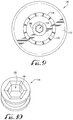
  • FIG. 9 is a side view of bearing for a conveyor chain link according to another example embodiment of the present invention.
  • FIG. 10 is a perspective view of a portion of the inner race of FIG. 9 .
  • FIG. 11 is a perspective view of an axle pin and the bearing race of FIG. 10 .
  • FIGS. 1 and 2 show a conveyor system 10 for commercial production of baked goods.
  • the conveyor system 10 includes a roller chain 20 that travels through and along a guide track 80 .
  • the roller chain 20 may have one or more carrier(s) 82 mounted thereto, for carrying baking trays 84 and/or other conveyed equipment along a conveyor path defined by the guide track 80 .
  • the guide track 80 can carry baking trays 84 through a proofer, oven, or other commercial baking equipment.
  • the roller chain 20 comprises a plurality of interconnected links 22 pivotally or flexibly coupled to one another, allowing the chain to conform to and follow the conveyor path of the guide track 80 .
  • One or more of the links 22 preferably comprise roller-carrier links 24 , to which vertical roller bearing wheels 30 are mounted.
  • One or more links 22 can also optionally carry horizontal guide wheels or rollers 26 oriented generally transverse or perpendicular to the vertical roller bearing wheels 30 .
  • the roller-carrier links 24 shown in FIGS. 3-6 , generally comprise at least one roller bearing wheel 30 , an axle pin 50 , and a link component 60 .
  • the roller carrier link 24 includes two roller bearing wheels 30 .
  • the roller bearing wheels 30 are mounted to the link component 60 by the axle pin 50 extending through a bore or channel 62 in the link component.
  • a roller bearing wheel 30 according to an example embodiment of the invention is shown in FIG. 3 .
  • the roller bearing wheel 30 is generally circular including an outer race 32 having a circular outer circumferential rim and a concentrically located inner race 34 .
  • a plurality of ball bearings 36 are retained in an annular space between the inner race 34 and the outer race 32 .
  • the roller bearing wheel 30 is generally formed from a metal material, for example standard grade steel.
  • the outer race 32 is configured to rotate as it moves along the guide track 80 .
  • the inner race 34 is configured to remain generally stationary.
  • the inner race 34 includes a front surface 40 and a rear surface 42 with a hole 38 extending through the inner race from the front surface to the back surface.
  • the inner diameter or inner circumference of the front face 40 of the inner race 34 includes a chamfer or beveled section 44 extending inward toward the hole 38 .
  • the inner race 34 can include an engagement feature 46 configured for anti-spin engagement with the axle pin 50 .
  • four groves 46 are provided at approximately 90° intervals about the beveled section 44 of the inner race 34 .
  • the grooves 46 are formed by laser etching or otherwise machined into or onto the beveled surface 44 of the inner race 34 .
  • the grooves 46 can have, for example, a depth of around 0.015 inches and a width of about 0.100 inches.
  • the inner race 34 does not include a beveled section 44 , and the grooves are positioned on the front surface 40 .
  • more or fewer grooves 46 can be used.
  • the grooves 46 are configured to interact with the axle pin as detailed below.
  • other engagement features are used for anti-spin engagement with the axle pin 50 .
  • the axle pin 50 generally has an elongated, cylindrical axle pin body having a medial portion 52 and two distal ends 54 .
  • the axle pin 50 includes a knurled or ribbed central or medial portion 52 having alternating ridges and grooves extending generally parallel with the lengthwise axis of the pin.
  • the ribbed medial portion 52 is configured to create friction between the axle pin 50 and the link component 60 to prevent spinning of the axle pin.
  • another pattern can be used on the medial portion 52 to create friction.
  • the distal or outer ends 54 of the axle pin 50 are configured to be received within the inner diameter of the inner bearing race 34 of the roller bearing wheel 30 with an interference or press fit.
  • the outer ends 54 of the axle pin 50 are preferably flared or riveted down to expand the outer diameter of the ends and cause the material of the axle pin to flow or expand into the groove or grooves 46 in the inner bearing race 34 to attach the roller bearing wheel 30 to the link component 60 . This is intended to lock the axle pin 50 in place within the inner bearing race 34 of the roller bearing wheels 30 and resist or prevent spinning of the axle pin within the inner bearing race 34 .
  • the outer diameter of the axle pin 50 is about 0.32 inches and the length is about 1.75 inches.
  • the outer diameter and length of the axle pin 50 can optionally be larger or smaller in alternative embodiments.
  • the fit between the ends 54 of the axle pin and the hole 38 in the inner race 34 is preferably configured to maintain engagement and resist spinning or relative movement between the engaged surfaces, through an intended range of operating temperatures and thermal expansion and contraction of the equipment.
  • the axle pin 50 is generally formed from a metal material, such as standard grade steel.
  • the axle pin can also be plated, for example in zinc.
  • the medial portion 52 of the axle pin 50 is induction hardened to be a greater hardness than the link component 60 .
  • the medial portion 52 of the axle pin 50 is hardened at a depth of around 1/16 th of an inch.
  • the medial portion 52 is hardened to have a hardness of around 120 on the Rockwell B Hardness scale. This allows the medial portion 52 to provide “bite” into, or displace the material of, the bore 62 of the link component 60 for a more secure engagement.
  • the ends 54 of the axle pin 50 are unhardened allowing the material at the ends of the pin to more freely expand into the engagement feature 46 of the inner race 34 of the roller bearing wheel 30 .
  • the ends 54 of the axle pin 50 have a hardness of about 60 on the Rockwell B hardness scale.
  • a link component 60 according to an example embodiment of the invention is shown in FIG. 5 .
  • the link component 60 generally includes a bore or channel 62 in the medial portion of the link.
  • the ends 64 of the link component 60 are configured to attach to the next link 22 in the roller chain.
  • the link component 60 includes a first attachment 66 generally parallel to the bore 62 and a second attachment 68 generally perpendicular to the bore.
  • the fit between the bore 62 and the medial portion 52 of the axle pin 50 is preferably configured to maintain engagement and resist spinning or relative movement between the engaged surfaces through an intended range of operating temperatures and thermal expansion and contraction of the equipment.
  • the link component 60 is generally formed from a metal material, such as standard grade steel.
  • the link component can also be plated, for example in zinc.
  • the metal has a hardness on the Rockwell B hardness scale of about 80 to about 100.
  • the roller bearing wheels 30 are positioned on either side of the link component 60 .
  • the rear surface 42 of the inner race 34 of the roller bearing wheels abuts the link component 60 and the front surface 40 of the inner race faces outward so that the engagement component 46 on the inner race is exposed, as shown in FIG. 8A .
  • the hole 38 in the inner race 34 of each roller bearing wheel 30 is aligned with the bore 62 of the link component 60 .
  • the axle pin 50 is push or press fitted through the hole 38 in the inner race 34 of the first roller bearing wheel 30 , through the bore 62 in the link component 60 and through the hole in the inner race of the second roller bearing wheel.
  • the axle pin 50 is positioned such that the medial portion 52 is within the bore 62 of the link component 60 and each end 54 of the axle pin extends beyond the hole 38 in each roller bearing wheel 30 , as shown in FIG. 7B .
  • the ends 54 of the axle pin 50 are then flared or riveted down, for example by orbital forming from both sides, to expand the outer diameter of the ends of the axle pin and cause the material of the axle pin to flow or expand into the engagement feature 46 on the inner bearing race 34 , as shown in FIGS. 8A and 8B .
  • the flared ends of the axle pin 50 holds the roller bearing wheels 30 in engagement with the link component 60 .
  • the roller carrier link 24 has one roller bearing wheel 30 positioned on one side of the roller pin link 60 .
  • the link component 60 can include grooves 46 , similar to those on the roller bearing wheel 30 , configured to engage a deformed end of the axle pin 50 .
  • FIGS. 9-11 show an axle and bearing for a conveyor chain link, for example in a chain for a commercial baking system conveyor, according to another example embodiment of the invention.
  • the roller bearing wheel 130 shown in FIG. 9 , includes an outer race 132 , an inner race 134 , and a plurality of ball bearings 136 similar to the previous embodiment.
  • the inner bearing race 134 includes a central female receiver opening or hole 138 bounded by at least one flat surface 146 .
  • the hole 138 includes a plurality of flat surfaces 146 defining a polygonal bearing race receiver opening.
  • FIG. 9 shows an axle and bearing for a conveyor chain link, for example in a chain for a commercial baking system conveyor, according to another example embodiment of the invention.
  • the roller bearing wheel 130 shown in FIG. 9 , includes an outer race 132 , an inner race 134 , and a plurality of ball bearings 136 similar to the previous embodiment.
  • the inner bearing race 134 includes a central female receiver opening or hole 138 bounded
  • the bearing race receiver opening 138 is hexagonal, bounded by six uniformly configured flat surfaces 146 .
  • three, four, five, seven, eight, or more flat surfaces 146 may bound and define a triangular, rectangular, square, pentagonal, heptagonal, octagonal, or other regular or irregular polygonal female bearing race receiver opening 138 .
  • the bearing race receiver opening 138 may be semi-circular having one or more flat surfaces 146 or keyed peripheral surface features.
  • the conveyor chain link includes an axle pin 150 , shown in FIG. 11 , with a male engagement profile configured to fit the female bearing race receiver 138 .
  • the axle pin 150 generally comprises an elongate body having first and second ends 154 , 156 , and a transverse dimension extending generally perpendicular to the axial direction. At least one of the first and second ends 154 , 156 defines a male engagement profile having at least one flat surface 158 formed thereon.
  • the axle pin 50 includes a plurality of flat surfaces 158 defining a polygonal male engagement profile for cooperative engagement with the female receiver opening 138 of the inner race 134 of the roller bearing wheel 130 .
  • the male engagement profile is hexagonal, comprising six uniformly configured flat surfaces 158 .
  • the male engagement profile can comprise three, four, five, seven, eight, or more flat surfaces 158 to define a triangular, rectangular, square, pentagonal, heptagonal, octagonal, or other regular or irregular polygonal male engagement profile.
  • the male engagement profile can be semi-circular having one or more flat or keyed peripheral surface features configured to generally match and be received within the corresponding female receiver opening 138 of the inner race 134 of the roller bearing wheel 130 .
  • the medial portion 152 of the axle pin 150 is optionally knurled or otherwise configured, as described in the previous embodiment, for engagement with a link component 60 .
  • the roller carrier link is assembled similar to the previous embodiment.
  • the inner race 134 of the roller bearing wheel 130 can also include an engagement feature such as the grooves of to the previous embodiment.

Landscapes

  • Engineering & Computer Science (AREA)
  • General Engineering & Computer Science (AREA)
  • Mechanical Engineering (AREA)
  • Rolling Contact Bearings (AREA)
  • Chain Conveyers (AREA)

Abstract

The invention relates to an axle and bearing for a conveyor chain link, such as those used in commercial bakery equipment. The conveyor chain link generally includes at least one roller bearing wheel with a central hole, an axle pin, and a link component with a bore. The axle pin is configured to extend through the hole in the roller bearing wheel and the bore in the link component to attach the at least one roller bearing wheel to the link component. The axle pin includes a medial portion having at least one surface engagement feature configured for anti-spin engagement with the link component. The roller bearing wheel includes at least one engagement feature for anti-spin engagement with the distal end of the axle pin.

Description

CROSS-REFERENCE TO RELATED APPLICATION
This application claims the benefit of U.S. Provisional Patent Application Ser. No. 62/366,792 filed Jul. 26, 2016, U.S. Provisional Patent Application Ser. No. 62/439,512 filed Dec. 28, 2016 and U.S. Provisional Patent Application Ser. No. 62/516,170 filed Jun. 7, 2017, the entireties of which are hereby incorporated herein by reference for all purposes.
TECHNICAL FIELD
The present invention relates generally to the field of conveyor equipment for manufacturing, and more particularly to a roller chain axle and bearing assembly for conveyor equipment such as in commercial baking systems, which reduces wear and improves equipment longevity.
BACKGROUND
Continuous conveyor systems are utilized in various commercial production equipment systems, such as in oven and proofer systems for commercial bakeries. These conveyor systems commonly include a roller chain that carries baking trays or other conveyed equipment or materials along a track or guide path through various stations of the system. Known roller chains may include bearing wheels or rollers coupled by an axle pin to link pieces of the conveyor chain.
In some known conveyor systems, the axle pin that holds the single row bearings together through the powder metal linkage pieces of the chain will sometimes spin freely around the inside of the bearing. This spinning may accelerate wear of the equipment, resulting in equipment failures, increased maintenance requirements, and system downtime.
Accordingly, it can be seen that needs exist for improved conveyor system equipment. It is to the provision of an axle and bearing for conveyor chain linkage meeting these and other needs that the present invention is primarily directed.
SUMMARY
In example embodiments, the present invention provides an axle and bearing for a conveyor chain link that includes anti-spin engagement between the bearing and the axle and includes anti-spin engagement between the axle and the link component.
In one aspect, the present invention relates to conveyor chain link including a link component, and axle pin, and at least one roller bearing wheel. The axle pin includes an elongated generally cylindrical axle pin body having a medial portion and two distal ends. The medial portion of the axle pin body has at least one surface engagement feature configured for anti-spin engagement with the link component. The at least one roller bearing wheel includes at least one engagement feature configured for anti-spin engagement with one of the distal ends of the axle pin body.
In another aspect, the invention relates to a method of assembling a conveyor chain link, the method includes positioning two roller bearing wheels on each side of a link component. Each roller bearing wheel comprises a central hole and the link component comprises a bore extending through a width of the link component. The hole of each roller bearing wheel is positioned to align with the bore of the link component. Next, an axle pin having an elongated generally cylindrical axle pin body and two distal ends is push fitted through the holes in the roller bearing wheels and the bore in the link component. The axle pin includes a medial portion with at least one surface engagement feature. The axle pin is positioned such that the at least one surface engagement feature is at least partially positioned within the bore of the link component and the distal ends of the axle pin extend beyond the holes of the roller bearing wheels. Next, the distal ends of the axle pin are deformed to attach the roller bearing wheels to the link component.
In still another aspect, the invention relates to conveyor chain link including at least one roller bearing wheel, an axle pin, and a link component. The roller bearing wheel includes a female receiver opening having a cross-section wherein the female receiver opening cross-section comprises at least one flat surface. The axle pin includes first and second axial ends, at least one of the axial ends defining a male engagement profile, wherein the male engagement profile is configured to match the female receiver opening cross-section of the roller bearing wheel.
In still another aspect, the invention relates to a conveyor chain for a commercial baking conveyor comprising a plurality of conveyor chain links coupled to one another to form an elongate assembly allowing relative pivotal movement between adjacent links. At least one link comprises a link component, an axle pin, and a roller bearing wheel. The link component includes first and second ends, each configured to attach to an adjacent link in the conveyor chain, and a medial section therebetween. The medial section includes a bore. The axle pin includes first and second axle ends and a medial section therebetween. The medial portion comprises at least one surface engagement feature configured for anti-spin engagement with the bore of the link component. The at least one roller bearing wheel, where an inner circumference of the roller bearing wheel comprises at least one engagement feature configured for anti-spin engagement with one of the first or second axle ends of the axle pin.
These and other aspects, features and advantages of the invention will be understood with reference to the drawing figures and detailed description herein, and will be realized by means of the various elements and combinations particularly pointed out in the appended claims. It is to be understood that both the foregoing general description and the following brief description of the drawings and detailed description of example embodiments are explanatory of example embodiments of the invention, and are not restrictive of the invention, as claimed.
BRIEF DESCRIPTION OF THE DRAWINGS
FIG. 1 is a perspective view of a conveyor system including a conveyor chain, to which example embodiments of the present invention can be applied.
FIG. 2 is a perspective view of a conveyor chain link according to an example embodiment of the invention.
FIG. 3 is a perspective view of the bearing of the conveyor chain link of FIG. 2.
FIG. 4 is a perspective view of the axle pin of the conveyor chain link of FIG. 2.
FIG. 5 is a perspective view of the link component of the conveyor chain link of FIG. 2.
FIG. 6 is a perspective view of the conveyor chain link of FIG. 2.
FIG. 7A is a detailed view of an inner race of the bearing of FIG. 3.
FIG. 7B is a detailed view of the inner race of FIG. 7A and an undeformed distal end of an axle pin.
FIG. 8A is a cutaway view of the conveyor chain link of FIG. 2.
FIG. 8B is a cutaway view of the axle pin and bearing race of FIG. 8A.
FIG. 9 is a side view of bearing for a conveyor chain link according to another example embodiment of the present invention.
FIG. 10 is a perspective view of a portion of the inner race of FIG. 9.
FIG. 11 is a perspective view of an axle pin and the bearing race of FIG. 10.
DETAILED DESCRIPTION OF EXAMPLE EMBODIMENTS
The present invention may be understood more readily by reference to the following detailed description of example embodiments taken in connection with the accompanying drawing figures, which form a part of this disclosure. It is to be understood that this invention is not limited to the specific devices, methods, conditions or parameters described and/or shown herein, and that the terminology used herein is for the purpose of describing particular embodiments by way of example only and is not intended to be limiting of the claimed invention. Any and all patents and other publications identified in this specification are incorporated by reference as though fully set forth herein.
Also, as used in the specification including the appended claims, the singular forms “a,” “an,” and “the” include the plural, and reference to a particular numerical value includes at least that particular value, unless the context clearly dictates otherwise. Ranges may be expressed herein as from “about” or “approximately” one particular value and/or to “about” or “approximately” another particular value. When such a range is expressed, another embodiment includes from the one particular value and/or to the other particular value. Similarly, when values are expressed as approximations, by use of the antecedent “about,” it will be understood that the particular value forms another embodiment.
With reference now to the drawing figures, wherein like reference numbers represent corresponding parts throughout the several views, FIGS. 1 and 2 show a conveyor system 10 for commercial production of baked goods. The conveyor system 10 includes a roller chain 20 that travels through and along a guide track 80. The roller chain 20 may have one or more carrier(s) 82 mounted thereto, for carrying baking trays 84 and/or other conveyed equipment along a conveyor path defined by the guide track 80. For example the guide track 80 can carry baking trays 84 through a proofer, oven, or other commercial baking equipment.
The roller chain 20 comprises a plurality of interconnected links 22 pivotally or flexibly coupled to one another, allowing the chain to conform to and follow the conveyor path of the guide track 80. One or more of the links 22 preferably comprise roller-carrier links 24, to which vertical roller bearing wheels 30 are mounted. One or more links 22 can also optionally carry horizontal guide wheels or rollers 26 oriented generally transverse or perpendicular to the vertical roller bearing wheels 30.
The roller-carrier links 24, shown in FIGS. 3-6, generally comprise at least one roller bearing wheel 30, an axle pin 50, and a link component 60. In the depicted embodiment, the roller carrier link 24 includes two roller bearing wheels 30. The roller bearing wheels 30 are mounted to the link component 60 by the axle pin 50 extending through a bore or channel 62 in the link component.
A roller bearing wheel 30 according to an example embodiment of the invention is shown in FIG. 3. The roller bearing wheel 30 is generally circular including an outer race 32 having a circular outer circumferential rim and a concentrically located inner race 34. In the example embodiment, a plurality of ball bearings 36 are retained in an annular space between the inner race 34 and the outer race 32. The roller bearing wheel 30 is generally formed from a metal material, for example standard grade steel. The outer race 32 is configured to rotate as it moves along the guide track 80. The inner race 34 is configured to remain generally stationary. The inner race 34 includes a front surface 40 and a rear surface 42 with a hole 38 extending through the inner race from the front surface to the back surface. In example embodiments, the inner diameter or inner circumference of the front face 40 of the inner race 34 includes a chamfer or beveled section 44 extending inward toward the hole 38. The inner race 34 can include an engagement feature 46 configured for anti-spin engagement with the axle pin 50. In the depicted embodiment, four groves 46 are provided at approximately 90° intervals about the beveled section 44 of the inner race 34. In example embodiments, the grooves 46 are formed by laser etching or otherwise machined into or onto the beveled surface 44 of the inner race 34. The grooves 46 can have, for example, a depth of around 0.015 inches and a width of about 0.100 inches. In other embodiments, the inner race 34 does not include a beveled section 44, and the grooves are positioned on the front surface 40. In other embodiment, more or fewer grooves 46 can be used. The grooves 46 are configured to interact with the axle pin as detailed below. In other embodiments, other engagement features are used for anti-spin engagement with the axle pin 50.
An axle pin 50 according to an example embodiment of the invention is shown in FIG. 4. The axle pin 50 generally has an elongated, cylindrical axle pin body having a medial portion 52 and two distal ends 54. In the depicted embodiment, the axle pin 50 includes a knurled or ribbed central or medial portion 52 having alternating ridges and grooves extending generally parallel with the lengthwise axis of the pin. The ribbed medial portion 52 is configured to create friction between the axle pin 50 and the link component 60 to prevent spinning of the axle pin. In other embodiments, another pattern can be used on the medial portion 52 to create friction. The distal or outer ends 54 of the axle pin 50 are configured to be received within the inner diameter of the inner bearing race 34 of the roller bearing wheel 30 with an interference or press fit. The outer ends 54 of the axle pin 50 are preferably flared or riveted down to expand the outer diameter of the ends and cause the material of the axle pin to flow or expand into the groove or grooves 46 in the inner bearing race 34 to attach the roller bearing wheel 30 to the link component 60. This is intended to lock the axle pin 50 in place within the inner bearing race 34 of the roller bearing wheels 30 and resist or prevent spinning of the axle pin within the inner bearing race 34.
In example embodiments, the outer diameter of the axle pin 50 is about 0.32 inches and the length is about 1.75 inches. The outer diameter and length of the axle pin 50 can optionally be larger or smaller in alternative embodiments. The fit between the ends 54 of the axle pin and the hole 38 in the inner race 34 is preferably configured to maintain engagement and resist spinning or relative movement between the engaged surfaces, through an intended range of operating temperatures and thermal expansion and contraction of the equipment. The axle pin 50 is generally formed from a metal material, such as standard grade steel. The axle pin can also be plated, for example in zinc. In example embodiments, the medial portion 52 of the axle pin 50 is induction hardened to be a greater hardness than the link component 60. For example, the medial portion 52 of the axle pin 50 is hardened at a depth of around 1/16th of an inch. For example, the medial portion 52 is hardened to have a hardness of around 120 on the Rockwell B Hardness scale. This allows the medial portion 52 to provide “bite” into, or displace the material of, the bore 62 of the link component 60 for a more secure engagement. Optionally, the ends 54 of the axle pin 50 are unhardened allowing the material at the ends of the pin to more freely expand into the engagement feature 46 of the inner race 34 of the roller bearing wheel 30. In example embodiments, the ends 54 of the axle pin 50 have a hardness of about 60 on the Rockwell B hardness scale.
A link component 60 according to an example embodiment of the invention is shown in FIG. 5. The link component 60 generally includes a bore or channel 62 in the medial portion of the link. The ends 64 of the link component 60 are configured to attach to the next link 22 in the roller chain. In the example embodiment, the link component 60 includes a first attachment 66 generally parallel to the bore 62 and a second attachment 68 generally perpendicular to the bore. The fit between the bore 62 and the medial portion 52 of the axle pin 50 is preferably configured to maintain engagement and resist spinning or relative movement between the engaged surfaces through an intended range of operating temperatures and thermal expansion and contraction of the equipment. The link component 60 is generally formed from a metal material, such as standard grade steel. The link component can also be plated, for example in zinc. In example embodiments, the metal has a hardness on the Rockwell B hardness scale of about 80 to about 100.
To assemble the roller carrier link 24 as shown in FIG. 6, the roller bearing wheels 30 are positioned on either side of the link component 60. The rear surface 42 of the inner race 34 of the roller bearing wheels abuts the link component 60 and the front surface 40 of the inner race faces outward so that the engagement component 46 on the inner race is exposed, as shown in FIG. 8A. The hole 38 in the inner race 34 of each roller bearing wheel 30 is aligned with the bore 62 of the link component 60. The axle pin 50 is push or press fitted through the hole 38 in the inner race 34 of the first roller bearing wheel 30, through the bore 62 in the link component 60 and through the hole in the inner race of the second roller bearing wheel. The axle pin 50 is positioned such that the medial portion 52 is within the bore 62 of the link component 60 and each end 54 of the axle pin extends beyond the hole 38 in each roller bearing wheel 30, as shown in FIG. 7B. The ends 54 of the axle pin 50 are then flared or riveted down, for example by orbital forming from both sides, to expand the outer diameter of the ends of the axle pin and cause the material of the axle pin to flow or expand into the engagement feature 46 on the inner bearing race 34, as shown in FIGS. 8A and 8B. The flared ends of the axle pin 50 holds the roller bearing wheels 30 in engagement with the link component 60. In alternative embodiments, the roller carrier link 24 has one roller bearing wheel 30 positioned on one side of the roller pin link 60. In this embodiment, the link component 60 can include grooves 46, similar to those on the roller bearing wheel 30, configured to engage a deformed end of the axle pin 50.
FIGS. 9-11 show an axle and bearing for a conveyor chain link, for example in a chain for a commercial baking system conveyor, according to another example embodiment of the invention. The roller bearing wheel 130, shown in FIG. 9, includes an outer race 132, an inner race 134, and a plurality of ball bearings 136 similar to the previous embodiment. However, in this embodiment, the inner bearing race 134 includes a central female receiver opening or hole 138 bounded by at least one flat surface 146. In example embodiments, the hole 138 includes a plurality of flat surfaces 146 defining a polygonal bearing race receiver opening. In the depicted embodiment, shown in detail in FIG. 10, the bearing race receiver opening 138 is hexagonal, bounded by six uniformly configured flat surfaces 146. In alternative embodiments, three, four, five, seven, eight, or more flat surfaces 146 may bound and define a triangular, rectangular, square, pentagonal, heptagonal, octagonal, or other regular or irregular polygonal female bearing race receiver opening 138. In still further embodiments, the bearing race receiver opening 138 may be semi-circular having one or more flat surfaces 146 or keyed peripheral surface features.
The conveyor chain link includes an axle pin 150, shown in FIG. 11, with a male engagement profile configured to fit the female bearing race receiver 138. The axle pin 150 generally comprises an elongate body having first and second ends 154, 156, and a transverse dimension extending generally perpendicular to the axial direction. At least one of the first and second ends 154, 156 defines a male engagement profile having at least one flat surface 158 formed thereon. In example embodiments, the axle pin 50 includes a plurality of flat surfaces 158 defining a polygonal male engagement profile for cooperative engagement with the female receiver opening 138 of the inner race 134 of the roller bearing wheel 130. In the depicted embodiment, the male engagement profile is hexagonal, comprising six uniformly configured flat surfaces 158. In alternative embodiments, the male engagement profile can comprise three, four, five, seven, eight, or more flat surfaces 158 to define a triangular, rectangular, square, pentagonal, heptagonal, octagonal, or other regular or irregular polygonal male engagement profile. In still further embodiments, the male engagement profile can be semi-circular having one or more flat or keyed peripheral surface features configured to generally match and be received within the corresponding female receiver opening 138 of the inner race 134 of the roller bearing wheel 130. The medial portion 152 of the axle pin 150 is optionally knurled or otherwise configured, as described in the previous embodiment, for engagement with a link component 60. The roller carrier link is assembled similar to the previous embodiment. The inner race 134 of the roller bearing wheel 130 can also include an engagement feature such as the grooves of to the previous embodiment.
While the invention has been described with reference to example embodiments, it will be understood by those skilled in the art that a variety of modifications, additions and deletions are within the scope of the invention, as defined by the following claims.

Claims (8)

What is claimed is:
1. A conveyor chain link comprising:
a link component;
an axle pin comprising an elongated generally cylindrical axle pin body having a medial portion and two distal ends, wherein the medial portion comprises at least one surface engagement feature configured for anti-spin engagement with the link component; and
at least one roller bearing wheel comprising at least one engagement feature configured for anti-spin engagement with one of the distal ends of the axle pin;
wherein the medial portion of the axle pin body is hardened to have a hardness greater than the link component to a depth of about 1/16 of an inch.
2. The conveyor chain link of claim 1, wherein the at least one roller bearing wheel comprises an outer race having a circular outer circumferential rim and a concentrically located inner race with a central hole in the inner race.
3. The conveyor chain link of claim 2, wherein an inside diameter of the inner race is beveled.
4. The conveyor chain link of claim 2, wherein the at least one engagement feature on the at least one roller bearing wheel comprises at least one groove positioned on an inside diameter of the inner race.
5. The conveyor chain link of claim 1, wherein the at least one surface engagement feature comprises a knurled outer surface of the medial portion of the axle pin body.
6. The conveyor chain link of claim 1, wherein a distal end of the axle pin is configured to deform into the at least one engagement feature in the at least one roller bearing wheel.
7. The conveyor chain link of claim 6, comprising two roller bearing wheels wherein each distal end of the axle pin is configured to deform into the at least one engagement feature in each roller bearing wheel.
8. A conveyor chain comprising a plurality of conveyor chain links according to claim 1, successively coupled to one another to form an elongate assembly allowing relative pivotal movement between adjacent links.
US15/660,123 2016-07-26 2017-07-26 Axle and bearing for conveyor chain link Active US10550881B2 (en)

Priority Applications (3)

Application Number Priority Date Filing Date Title
US15/660,123 US10550881B2 (en) 2016-07-26 2017-07-26 Axle and bearing for conveyor chain link
US15/977,859 US10533634B2 (en) 2016-07-26 2018-05-11 Axle and bearing for conveyor chain link
PCT/US2018/037043 WO2018227213A1 (en) 2017-06-07 2018-06-12 Axle and bearing for conveyor chain link

Applications Claiming Priority (4)

Application Number Priority Date Filing Date Title
US201662366792P 2016-07-26 2016-07-26
US201662439512P 2016-12-28 2016-12-28
US201762516170P 2017-06-07 2017-06-07
US15/660,123 US10550881B2 (en) 2016-07-26 2017-07-26 Axle and bearing for conveyor chain link

Related Child Applications (1)

Application Number Title Priority Date Filing Date
US15/977,859 Continuation-In-Part US10533634B2 (en) 2016-07-26 2018-05-11 Axle and bearing for conveyor chain link

Publications (2)

Publication Number Publication Date
US20180031033A1 US20180031033A1 (en) 2018-02-01
US10550881B2 true US10550881B2 (en) 2020-02-04

Family

ID=59558482

Family Applications (1)

Application Number Title Priority Date Filing Date
US15/660,123 Active US10550881B2 (en) 2016-07-26 2017-07-26 Axle and bearing for conveyor chain link

Country Status (2)

Country Link
US (1) US10550881B2 (en)
WO (1) WO2018022727A1 (en)

Cited By (4)

* Cited by examiner, † Cited by third party
Publication number Priority date Publication date Assignee Title
US11220401B2 (en) * 2020-01-15 2022-01-11 AMF automation Technologies, LLC Conveyorized baking system with improved dust shield support
US11299352B2 (en) * 2018-09-12 2022-04-12 Korea Wheel Corporation Automatic cart transport system
US11653601B2 (en) 2021-03-31 2023-05-23 Korea Wheel Corporation Plant cultivation system using plant hangers with plant trays at multiple heights
US11678616B2 (en) 2018-09-12 2023-06-20 Korea Wheel Corporation Plant cultivation system using trolley conveyor

Families Citing this family (3)

* Cited by examiner, † Cited by third party
Publication number Priority date Publication date Assignee Title
US10533634B2 (en) 2016-07-26 2020-01-14 AMF automation Technologies, LLC Axle and bearing for conveyor chain link
PL3620408T3 (en) * 2018-08-31 2025-10-13 John Bean Technologies Corporation HARDENED COMPONENTS IN THE CONVEYOR DRIVE SYSTEM
US10889445B2 (en) * 2019-05-01 2021-01-12 Frost Tech Llc Extended life conveyor chain trolley and method

Citations (32)

* Cited by examiner, † Cited by third party
Publication number Priority date Publication date Assignee Title
US2640585A (en) 1948-07-10 1953-06-02 Fisher & Ludlow Ltd Conveyer chain
US3015527A (en) 1959-11-04 1962-01-02 Chain Belt Co Bearing assembly
US3602150A (en) * 1969-05-01 1971-08-31 Frost & Son C L Suspended trolley conveyor system
US3653493A (en) * 1970-06-01 1972-04-04 Stewart Engineering Equipment Conveyor apparatus
US3951076A (en) 1974-09-20 1976-04-20 American Chain & Cable Company, Inc. Trolley construction
US3971601A (en) * 1974-12-02 1976-07-27 C. L. Frost & Son, Inc. Sanitary anti-friction trolley wheel
US4059180A (en) * 1976-12-02 1977-11-22 Rexnord Inc. Roller assembly with improved mounting means
US4367905A (en) * 1980-11-19 1983-01-11 C. L. Frost & Son, Inc. Wheeled support assembly for conveyors with locking and fastening feature
US4555014A (en) * 1982-08-02 1985-11-26 Chain Supply Company Conveyor chain link structure
US4729470A (en) * 1984-03-26 1988-03-08 Stewart Systems, Inc. Continuous proofing and baking apparatus having improved conveyor system
US4798149A (en) * 1982-12-02 1989-01-17 Florkey's Conveyor Service, Inc. Wheel lock assembly
US4852722A (en) * 1986-02-20 1989-08-01 Quipp Incorporated Single gripper conveyor system
US5277126A (en) * 1993-03-19 1994-01-11 Allor Manufacturing, Inc. Trolley roller assembly
US5461851A (en) * 1993-07-09 1995-10-31 Koenig & Bauer Aktiengesellschaft Roller chain
US5584584A (en) * 1993-04-19 1996-12-17 Agco Corporation Bearing assembly with a splined inner race
US6209716B1 (en) * 1998-11-05 2001-04-03 The Laitram Corporation Knuckle drive link conveyor belt systems with removable load conveying surface members
US20020060143A1 (en) * 1999-09-23 2002-05-23 Sasib North America, Inc. Conveyor for continuous proofing and baking apparatus
US6450326B1 (en) * 2000-03-29 2002-09-17 Frank F. Hoffmann Enclosed track conveyor chain assembly
US20030029701A1 (en) * 2001-08-07 2003-02-13 Sykora Frank B. Long wear conveyor assembly
US20030075420A1 (en) * 2001-10-24 2003-04-24 Jervis B. Webb Company Conveyor chains and wheel assemblies used in conveyor chains
US20030178288A1 (en) * 1999-09-23 2003-09-25 Kilby Leonard R. Conveyor for continuous proofing and baking apparatus
US20050061637A1 (en) * 1999-09-23 2005-03-24 Kilby Leonard R. Conveyor for continuous proofing and baking apparatus
US20050067252A1 (en) * 2003-09-26 2005-03-31 Bowen Brian D. Pre-loaded roller turn roller
US6874617B1 (en) * 2003-09-26 2005-04-05 Span Tech Llc Modular link conveyor chain with rotatable article engaging assemblies
US20060118363A1 (en) * 2003-01-17 2006-06-08 Carder Tom Self-lubricating overhead conveyor system
US20070209911A1 (en) * 2006-03-08 2007-09-13 Ferag Ag Conveyor chain comprising chain links connected to one another via pivoting bearings, and a method for assembling the chain links
US20090044719A1 (en) 2007-08-14 2009-02-19 Frost, Inc. Trolley assembly with non-rotatable axle
US8602015B2 (en) 2009-01-23 2013-12-10 John Michelon Cutting chain
US20140298659A1 (en) * 2010-12-07 2014-10-09 Aktiebolaget Skf Method of providing rolling bearing for tensioning roller device and associated tensioning roller
US20140374219A1 (en) * 2013-06-24 2014-12-25 Thomas Otto Thrust chain link of a conveyor chain, conveyor chain, conveyor system and method for positioning a retaining adapter on a conveyor chain
US8985310B2 (en) * 2009-02-16 2015-03-24 Beumer Gmbh & Co. Kg Sorting conveyor
US20170313521A1 (en) * 2016-04-29 2017-11-02 Daifuku Co., Ltd. Conveying Equipment With Utilization Of Conveying Traveling Body

Patent Citations (36)

* Cited by examiner, † Cited by third party
Publication number Priority date Publication date Assignee Title
US2640585A (en) 1948-07-10 1953-06-02 Fisher & Ludlow Ltd Conveyer chain
US3015527A (en) 1959-11-04 1962-01-02 Chain Belt Co Bearing assembly
US3602150A (en) * 1969-05-01 1971-08-31 Frost & Son C L Suspended trolley conveyor system
US3653493A (en) * 1970-06-01 1972-04-04 Stewart Engineering Equipment Conveyor apparatus
US3951076A (en) 1974-09-20 1976-04-20 American Chain & Cable Company, Inc. Trolley construction
US3971601A (en) * 1974-12-02 1976-07-27 C. L. Frost & Son, Inc. Sanitary anti-friction trolley wheel
US4059180A (en) * 1976-12-02 1977-11-22 Rexnord Inc. Roller assembly with improved mounting means
US4367905A (en) * 1980-11-19 1983-01-11 C. L. Frost & Son, Inc. Wheeled support assembly for conveyors with locking and fastening feature
US4555014A (en) * 1982-08-02 1985-11-26 Chain Supply Company Conveyor chain link structure
US4798149A (en) * 1982-12-02 1989-01-17 Florkey's Conveyor Service, Inc. Wheel lock assembly
US4729470A (en) * 1984-03-26 1988-03-08 Stewart Systems, Inc. Continuous proofing and baking apparatus having improved conveyor system
US4852722A (en) * 1986-02-20 1989-08-01 Quipp Incorporated Single gripper conveyor system
US5277126A (en) * 1993-03-19 1994-01-11 Allor Manufacturing, Inc. Trolley roller assembly
US5584584A (en) * 1993-04-19 1996-12-17 Agco Corporation Bearing assembly with a splined inner race
US5461851A (en) * 1993-07-09 1995-10-31 Koenig & Bauer Aktiengesellschaft Roller chain
US6209716B1 (en) * 1998-11-05 2001-04-03 The Laitram Corporation Knuckle drive link conveyor belt systems with removable load conveying surface members
US20030178288A1 (en) * 1999-09-23 2003-09-25 Kilby Leonard R. Conveyor for continuous proofing and baking apparatus
US20020060143A1 (en) * 1999-09-23 2002-05-23 Sasib North America, Inc. Conveyor for continuous proofing and baking apparatus
US7086525B2 (en) * 1999-09-23 2006-08-08 Stewart Systems, Inc. Conveyor for continuous proofing and baking apparatus
US6968943B2 (en) * 1999-09-23 2005-11-29 Stewart Systems, Inc. Conveyor for continuous proofing and baking apparatus
US20050061637A1 (en) * 1999-09-23 2005-03-24 Kilby Leonard R. Conveyor for continuous proofing and baking apparatus
US20020179416A1 (en) * 2000-03-29 2002-12-05 Hoffmann Frank F. Enclosed track conveyor chain assembly
US6450326B1 (en) * 2000-03-29 2002-09-17 Frank F. Hoffmann Enclosed track conveyor chain assembly
US20050139455A1 (en) * 2001-08-07 2005-06-30 Greylock, Inc. Long wear conveyor assembly
US20030029701A1 (en) * 2001-08-07 2003-02-13 Sykora Frank B. Long wear conveyor assembly
US20030075420A1 (en) * 2001-10-24 2003-04-24 Jervis B. Webb Company Conveyor chains and wheel assemblies used in conveyor chains
US20060118363A1 (en) * 2003-01-17 2006-06-08 Carder Tom Self-lubricating overhead conveyor system
US6874617B1 (en) * 2003-09-26 2005-04-05 Span Tech Llc Modular link conveyor chain with rotatable article engaging assemblies
US20050067252A1 (en) * 2003-09-26 2005-03-31 Bowen Brian D. Pre-loaded roller turn roller
US20070209911A1 (en) * 2006-03-08 2007-09-13 Ferag Ag Conveyor chain comprising chain links connected to one another via pivoting bearings, and a method for assembling the chain links
US20090044719A1 (en) 2007-08-14 2009-02-19 Frost, Inc. Trolley assembly with non-rotatable axle
US8602015B2 (en) 2009-01-23 2013-12-10 John Michelon Cutting chain
US8985310B2 (en) * 2009-02-16 2015-03-24 Beumer Gmbh & Co. Kg Sorting conveyor
US20140298659A1 (en) * 2010-12-07 2014-10-09 Aktiebolaget Skf Method of providing rolling bearing for tensioning roller device and associated tensioning roller
US20140374219A1 (en) * 2013-06-24 2014-12-25 Thomas Otto Thrust chain link of a conveyor chain, conveyor chain, conveyor system and method for positioning a retaining adapter on a conveyor chain
US20170313521A1 (en) * 2016-04-29 2017-11-02 Daifuku Co., Ltd. Conveying Equipment With Utilization Of Conveying Traveling Body

Non-Patent Citations (1)

* Cited by examiner, † Cited by third party
Title
International Search Report & Written Opinion for PCT/US2017/043901; dated Nov. 8, 2017; 21 pgs.

Cited By (4)

* Cited by examiner, † Cited by third party
Publication number Priority date Publication date Assignee Title
US11299352B2 (en) * 2018-09-12 2022-04-12 Korea Wheel Corporation Automatic cart transport system
US11678616B2 (en) 2018-09-12 2023-06-20 Korea Wheel Corporation Plant cultivation system using trolley conveyor
US11220401B2 (en) * 2020-01-15 2022-01-11 AMF automation Technologies, LLC Conveyorized baking system with improved dust shield support
US11653601B2 (en) 2021-03-31 2023-05-23 Korea Wheel Corporation Plant cultivation system using plant hangers with plant trays at multiple heights

Also Published As

Publication number Publication date
WO2018022727A1 (en) 2018-02-01
US20180031033A1 (en) 2018-02-01

Similar Documents

Publication Publication Date Title
US10550881B2 (en) Axle and bearing for conveyor chain link
US10533634B2 (en) Axle and bearing for conveyor chain link
KR101632519B1 (en) Bearing outer race
US2435839A (en) Taper roller bearing and cage
EP3412924A1 (en) Ball bearing cam follower for an adjustable aircraft seat
US5857554A (en) Conveyors
US11306807B2 (en) Maintenance free extended life cam follower for a necker machine
US20120207419A1 (en) Rolling body cage for a ball bearing
WO2018227213A1 (en) Axle and bearing for conveyor chain link
US3537766A (en) Roller bearing cage and roller unit and spacer therefor
US10465744B2 (en) Angular contact ball bearing having a cold-formed bearing ring, and a method for manufacturing a bearing ring of said angular contact ball bearing
US6330788B1 (en) Plate chains with wear-resistant chain joints
US2525622A (en) Bearing retainer
CN105275995A (en) Improved ball separator for ball bearing assembly
US20030188951A1 (en) Heavy unit load conveyor wheel
US10753402B2 (en) Bearing assembly and bearing cage
US9416848B2 (en) Pin-roller chain
US20150285304A1 (en) Ball roller bearing
US2458762A (en) Method of making cages for ball bearings
JP2003028170A (en) Double row rolling bearing
US1616827A (en) Sheet-metal cage for roller bearings
US10023394B2 (en) Pressure roller bearing for a pallet car
US1689505A (en) Cage for roller bearings
US2383142A (en) Roller bearing
US20110235959A1 (en) Cage for radial roller bearings with limited width availability

Legal Events

Date Code Title Description
STPP Information on status: patent application and granting procedure in general

Free format text: RESPONSE TO NON-FINAL OFFICE ACTION ENTERED AND FORWARDED TO EXAMINER

STPP Information on status: patent application and granting procedure in general

Free format text: NON FINAL ACTION MAILED

STPP Information on status: patent application and granting procedure in general

Free format text: NOTICE OF ALLOWANCE MAILED -- APPLICATION RECEIVED IN OFFICE OF PUBLICATIONS

AS Assignment

Owner name: AMF AUTOMATION TECHNOLOGIES, LLC, GEORGIA

Free format text: ASSIGNMENT OF ASSIGNORS INTEREST;ASSIGNORS:LAVIGNO, WILLIAM WATSON, IV;SODERSTROM, KRISTOPHER JON;SIGNING DATES FROM 20160708 TO 20171218;REEL/FRAME:051233/0663

STPP Information on status: patent application and granting procedure in general

Free format text: PUBLICATIONS -- ISSUE FEE PAYMENT VERIFIED

STCF Information on status: patent grant

Free format text: PATENTED CASE

MAFP Maintenance fee payment

Free format text: PAYMENT OF MAINTENANCE FEE, 4TH YEAR, LARGE ENTITY (ORIGINAL EVENT CODE: M1551); ENTITY STATUS OF PATENT OWNER: LARGE ENTITY

Year of fee payment: 4