US10550221B2 - Electrochromic polymer and synthesis and uses thereof - Google Patents
Electrochromic polymer and synthesis and uses thereof Download PDFInfo
- Publication number
- US10550221B2 US10550221B2 US16/033,012 US201816033012A US10550221B2 US 10550221 B2 US10550221 B2 US 10550221B2 US 201816033012 A US201816033012 A US 201816033012A US 10550221 B2 US10550221 B2 US 10550221B2
- Authority
- US
- United States
- Prior art keywords
- optionally substituted
- monomer
- black
- polymer
- formula
- Prior art date
- Legal status (The legal status is an assumption and is not a legal conclusion. Google has not performed a legal analysis and makes no representation as to the accuracy of the status listed.)
- Active
Links
- 0 [1*]C1([2*])COC2=C(C(C)(C)C)SC(C(C)(C)C)=C2OC1 Chemical compound [1*]C1([2*])COC2=C(C(C)(C)C)SC(C(C)(C)C)=C2OC1 0.000 description 27
- FITVQUMLGWRKKG-UHFFFAOYSA-N CCCOC(C)(C)C Chemical compound CCCOC(C)(C)C FITVQUMLGWRKKG-UHFFFAOYSA-N 0.000 description 11
- MZFRKYXVQYNOFA-UHFFFAOYSA-N CC1=CC=C(Br)/C2=N/S/N=C\12 Chemical compound CC1=CC=C(Br)/C2=N/S/N=C\12 MZFRKYXVQYNOFA-UHFFFAOYSA-N 0.000 description 4
- FRSCCZDSSYMDKY-UHFFFAOYSA-N CCCCC(CC)COCC1(COCC(CC)CCCC)COC2=C(Br)SC(Br)=C2OC1 Chemical compound CCCCC(CC)COCC1(COCC(CC)CCCC)COC2=C(Br)SC(Br)=C2OC1 FRSCCZDSSYMDKY-UHFFFAOYSA-N 0.000 description 4
- YYKZOERQHDYCMV-UHFFFAOYSA-N CCCCC(CC)COCC1(COCC(CC)CCCC)COC2=CSC=C2OC1 Chemical compound CCCCC(CC)COCC1(COCC(CC)CCCC)COC2=CSC=C2OC1 YYKZOERQHDYCMV-UHFFFAOYSA-N 0.000 description 4
- UFUASROORFXIGR-UHFFFAOYSA-N CCCOC1=CC(C)=C(OCCC)C=C1Br Chemical compound CCCOC1=CC(C)=C(OCCC)C=C1Br UFUASROORFXIGR-UHFFFAOYSA-N 0.000 description 3
- IURYLWFNBQKHKI-UHFFFAOYSA-N *.B.C.C.CC.CC.CC.CC Chemical compound *.B.C.C.CC.CC.CC.CC IURYLWFNBQKHKI-UHFFFAOYSA-N 0.000 description 2
- FEOWHLLJXAECMU-UHFFFAOYSA-N Brc(c1n[s]nc11)ccc1Br Chemical compound Brc(c1n[s]nc11)ccc1Br FEOWHLLJXAECMU-UHFFFAOYSA-N 0.000 description 2
- IFHCUYIQGJJNIU-UHFFFAOYSA-N *.B.C.CC.CC.CC.CC Chemical compound *.B.C.CC.CC.CC.CC IFHCUYIQGJJNIU-UHFFFAOYSA-N 0.000 description 1
- KYDGBLCWMHZQLE-UHFFFAOYSA-N CC(C)(C)C1=CC=C(C(C)(C)C)C2=NSN=C12 Chemical compound CC(C)(C)C1=CC=C(C(C)(C)C)C2=NSN=C12 KYDGBLCWMHZQLE-UHFFFAOYSA-N 0.000 description 1
- ORSOHJYFEHPSFQ-UHFFFAOYSA-N CCCCC(CC)CCCC1(CCCC(CC)CCCC)COC2=C(C(C)(C)C)SC(C(C)(C)C)=C2OC1 Chemical compound CCCCC(CC)CCCC1(CCCC(CC)CCCC)COC2=C(C(C)(C)C)SC(C(C)(C)C)=C2OC1 ORSOHJYFEHPSFQ-UHFFFAOYSA-N 0.000 description 1
- PBJQCJKIUCCRPY-UHFFFAOYSA-N CCCCC(CC)COCC(C)(C)C Chemical compound CCCCC(CC)COCC(C)(C)C PBJQCJKIUCCRPY-UHFFFAOYSA-N 0.000 description 1
- ZOVLTDATVFPBGT-UHFFFAOYSA-N CCCOC1=CC(Br)=C(OCCC)C=C1Br Chemical compound CCCOC1=CC(Br)=C(OCCC)C=C1Br ZOVLTDATVFPBGT-UHFFFAOYSA-N 0.000 description 1
- KANYOOGAVWYCTJ-UHFFFAOYSA-N CCCOC1=CC(C(C)(C)C)=C(OCCC)C=C1C(C)(C)C Chemical compound CCCOC1=CC(C(C)(C)C)=C(OCCC)C=C1C(C)(C)C KANYOOGAVWYCTJ-UHFFFAOYSA-N 0.000 description 1
Images




Classifications
-
- C—CHEMISTRY; METALLURGY
- C09—DYES; PAINTS; POLISHES; NATURAL RESINS; ADHESIVES; COMPOSITIONS NOT OTHERWISE PROVIDED FOR; APPLICATIONS OF MATERIALS NOT OTHERWISE PROVIDED FOR
- C09K—MATERIALS FOR MISCELLANEOUS APPLICATIONS, NOT PROVIDED FOR ELSEWHERE
- C09K9/00—Tenebrescent materials, i.e. materials for which the range of wavelengths for energy absorption is changed as a result of excitation by some form of energy
- C09K9/02—Organic tenebrescent materials
-
- G—PHYSICS
- G02—OPTICS
- G02F—OPTICAL DEVICES OR ARRANGEMENTS FOR THE CONTROL OF LIGHT BY MODIFICATION OF THE OPTICAL PROPERTIES OF THE MEDIA OF THE ELEMENTS INVOLVED THEREIN; NON-LINEAR OPTICS; FREQUENCY-CHANGING OF LIGHT; OPTICAL LOGIC ELEMENTS; OPTICAL ANALOGUE/DIGITAL CONVERTERS
- G02F1/00—Devices or arrangements for the control of the intensity, colour, phase, polarisation or direction of light arriving from an independent light source, e.g. switching, gating or modulating; Non-linear optics
- G02F1/01—Devices or arrangements for the control of the intensity, colour, phase, polarisation or direction of light arriving from an independent light source, e.g. switching, gating or modulating; Non-linear optics for the control of the intensity, phase, polarisation or colour
- G02F1/15—Devices or arrangements for the control of the intensity, colour, phase, polarisation or direction of light arriving from an independent light source, e.g. switching, gating or modulating; Non-linear optics for the control of the intensity, phase, polarisation or colour based on an electrochromic effect
- G02F1/153—Constructional details
- G02F1/155—Electrodes
-
- C—CHEMISTRY; METALLURGY
- C08—ORGANIC MACROMOLECULAR COMPOUNDS; THEIR PREPARATION OR CHEMICAL WORKING-UP; COMPOSITIONS BASED THEREON
- C08G—MACROMOLECULAR COMPOUNDS OBTAINED OTHERWISE THAN BY REACTIONS ONLY INVOLVING UNSATURATED CARBON-TO-CARBON BONDS
- C08G2261/00—Macromolecular compounds obtained by reactions forming a carbon-to-carbon link in the main chain of the macromolecule
- C08G2261/10—Definition of the polymer structure
- C08G2261/12—Copolymers
-
- C—CHEMISTRY; METALLURGY
- C08—ORGANIC MACROMOLECULAR COMPOUNDS; THEIR PREPARATION OR CHEMICAL WORKING-UP; COMPOSITIONS BASED THEREON
- C08G—MACROMOLECULAR COMPOUNDS OBTAINED OTHERWISE THAN BY REACTIONS ONLY INVOLVING UNSATURATED CARBON-TO-CARBON BONDS
- C08G2261/00—Macromolecular compounds obtained by reactions forming a carbon-to-carbon link in the main chain of the macromolecule
- C08G2261/10—Definition of the polymer structure
- C08G2261/12—Copolymers
- C08G2261/122—Copolymers statistical
-
- C—CHEMISTRY; METALLURGY
- C08—ORGANIC MACROMOLECULAR COMPOUNDS; THEIR PREPARATION OR CHEMICAL WORKING-UP; COMPOSITIONS BASED THEREON
- C08G—MACROMOLECULAR COMPOUNDS OBTAINED OTHERWISE THAN BY REACTIONS ONLY INVOLVING UNSATURATED CARBON-TO-CARBON BONDS
- C08G2261/00—Macromolecular compounds obtained by reactions forming a carbon-to-carbon link in the main chain of the macromolecule
- C08G2261/10—Definition of the polymer structure
- C08G2261/14—Side-groups
- C08G2261/142—Side-chains containing oxygen
- C08G2261/1424—Side-chains containing oxygen containing ether groups, including alkoxy
-
- C—CHEMISTRY; METALLURGY
- C08—ORGANIC MACROMOLECULAR COMPOUNDS; THEIR PREPARATION OR CHEMICAL WORKING-UP; COMPOSITIONS BASED THEREON
- C08G—MACROMOLECULAR COMPOUNDS OBTAINED OTHERWISE THAN BY REACTIONS ONLY INVOLVING UNSATURATED CARBON-TO-CARBON BONDS
- C08G2261/00—Macromolecular compounds obtained by reactions forming a carbon-to-carbon link in the main chain of the macromolecule
- C08G2261/10—Definition of the polymer structure
- C08G2261/22—Molecular weight
- C08G2261/228—Polymers, i.e. more than 10 repeat units
-
- C—CHEMISTRY; METALLURGY
- C08—ORGANIC MACROMOLECULAR COMPOUNDS; THEIR PREPARATION OR CHEMICAL WORKING-UP; COMPOSITIONS BASED THEREON
- C08G—MACROMOLECULAR COMPOUNDS OBTAINED OTHERWISE THAN BY REACTIONS ONLY INVOLVING UNSATURATED CARBON-TO-CARBON BONDS
- C08G2261/00—Macromolecular compounds obtained by reactions forming a carbon-to-carbon link in the main chain of the macromolecule
- C08G2261/30—Monomer units or repeat units incorporating structural elements in the main chain
- C08G2261/31—Monomer units or repeat units incorporating structural elements in the main chain incorporating aromatic structural elements in the main chain
- C08G2261/312—Non-condensed aromatic systems, e.g. benzene
-
- C—CHEMISTRY; METALLURGY
- C08—ORGANIC MACROMOLECULAR COMPOUNDS; THEIR PREPARATION OR CHEMICAL WORKING-UP; COMPOSITIONS BASED THEREON
- C08G—MACROMOLECULAR COMPOUNDS OBTAINED OTHERWISE THAN BY REACTIONS ONLY INVOLVING UNSATURATED CARBON-TO-CARBON BONDS
- C08G2261/00—Macromolecular compounds obtained by reactions forming a carbon-to-carbon link in the main chain of the macromolecule
- C08G2261/30—Monomer units or repeat units incorporating structural elements in the main chain
- C08G2261/31—Monomer units or repeat units incorporating structural elements in the main chain incorporating aromatic structural elements in the main chain
- C08G2261/314—Condensed aromatic systems, e.g. perylene, anthracene or pyrene
-
- C—CHEMISTRY; METALLURGY
- C08—ORGANIC MACROMOLECULAR COMPOUNDS; THEIR PREPARATION OR CHEMICAL WORKING-UP; COMPOSITIONS BASED THEREON
- C08G—MACROMOLECULAR COMPOUNDS OBTAINED OTHERWISE THAN BY REACTIONS ONLY INVOLVING UNSATURATED CARBON-TO-CARBON BONDS
- C08G2261/00—Macromolecular compounds obtained by reactions forming a carbon-to-carbon link in the main chain of the macromolecule
- C08G2261/30—Monomer units or repeat units incorporating structural elements in the main chain
- C08G2261/31—Monomer units or repeat units incorporating structural elements in the main chain incorporating aromatic structural elements in the main chain
- C08G2261/314—Condensed aromatic systems, e.g. perylene, anthracene or pyrene
- C08G2261/3142—Condensed aromatic systems, e.g. perylene, anthracene or pyrene fluorene-based, e.g. fluorene, indenofluorene, or spirobifluorene
-
- C—CHEMISTRY; METALLURGY
- C08—ORGANIC MACROMOLECULAR COMPOUNDS; THEIR PREPARATION OR CHEMICAL WORKING-UP; COMPOSITIONS BASED THEREON
- C08G—MACROMOLECULAR COMPOUNDS OBTAINED OTHERWISE THAN BY REACTIONS ONLY INVOLVING UNSATURATED CARBON-TO-CARBON BONDS
- C08G2261/00—Macromolecular compounds obtained by reactions forming a carbon-to-carbon link in the main chain of the macromolecule
- C08G2261/30—Monomer units or repeat units incorporating structural elements in the main chain
- C08G2261/32—Monomer units or repeat units incorporating structural elements in the main chain incorporating heteroaromatic structural elements in the main chain
- C08G2261/322—Monomer units or repeat units incorporating structural elements in the main chain incorporating heteroaromatic structural elements in the main chain non-condensed
- C08G2261/3223—Monomer units or repeat units incorporating structural elements in the main chain incorporating heteroaromatic structural elements in the main chain non-condensed containing one or more sulfur atoms as the only heteroatom, e.g. thiophene
-
- C—CHEMISTRY; METALLURGY
- C08—ORGANIC MACROMOLECULAR COMPOUNDS; THEIR PREPARATION OR CHEMICAL WORKING-UP; COMPOSITIONS BASED THEREON
- C08G—MACROMOLECULAR COMPOUNDS OBTAINED OTHERWISE THAN BY REACTIONS ONLY INVOLVING UNSATURATED CARBON-TO-CARBON BONDS
- C08G2261/00—Macromolecular compounds obtained by reactions forming a carbon-to-carbon link in the main chain of the macromolecule
- C08G2261/30—Monomer units or repeat units incorporating structural elements in the main chain
- C08G2261/32—Monomer units or repeat units incorporating structural elements in the main chain incorporating heteroaromatic structural elements in the main chain
- C08G2261/324—Monomer units or repeat units incorporating structural elements in the main chain incorporating heteroaromatic structural elements in the main chain condensed
- C08G2261/3241—Monomer units or repeat units incorporating structural elements in the main chain incorporating heteroaromatic structural elements in the main chain condensed containing one or more nitrogen atoms as the only heteroatom, e.g. carbazole
-
- C—CHEMISTRY; METALLURGY
- C08—ORGANIC MACROMOLECULAR COMPOUNDS; THEIR PREPARATION OR CHEMICAL WORKING-UP; COMPOSITIONS BASED THEREON
- C08G—MACROMOLECULAR COMPOUNDS OBTAINED OTHERWISE THAN BY REACTIONS ONLY INVOLVING UNSATURATED CARBON-TO-CARBON BONDS
- C08G2261/00—Macromolecular compounds obtained by reactions forming a carbon-to-carbon link in the main chain of the macromolecule
- C08G2261/30—Monomer units or repeat units incorporating structural elements in the main chain
- C08G2261/32—Monomer units or repeat units incorporating structural elements in the main chain incorporating heteroaromatic structural elements in the main chain
- C08G2261/324—Monomer units or repeat units incorporating structural elements in the main chain incorporating heteroaromatic structural elements in the main chain condensed
- C08G2261/3242—Monomer units or repeat units incorporating structural elements in the main chain incorporating heteroaromatic structural elements in the main chain condensed containing one or more oxygen atoms as the only heteroatom, e.g. benzofuran
-
- C—CHEMISTRY; METALLURGY
- C08—ORGANIC MACROMOLECULAR COMPOUNDS; THEIR PREPARATION OR CHEMICAL WORKING-UP; COMPOSITIONS BASED THEREON
- C08G—MACROMOLECULAR COMPOUNDS OBTAINED OTHERWISE THAN BY REACTIONS ONLY INVOLVING UNSATURATED CARBON-TO-CARBON BONDS
- C08G2261/00—Macromolecular compounds obtained by reactions forming a carbon-to-carbon link in the main chain of the macromolecule
- C08G2261/30—Monomer units or repeat units incorporating structural elements in the main chain
- C08G2261/32—Monomer units or repeat units incorporating structural elements in the main chain incorporating heteroaromatic structural elements in the main chain
- C08G2261/324—Monomer units or repeat units incorporating structural elements in the main chain incorporating heteroaromatic structural elements in the main chain condensed
- C08G2261/3243—Monomer units or repeat units incorporating structural elements in the main chain incorporating heteroaromatic structural elements in the main chain condensed containing one or more sulfur atoms as the only heteroatom, e.g. benzothiophene
-
- C—CHEMISTRY; METALLURGY
- C08—ORGANIC MACROMOLECULAR COMPOUNDS; THEIR PREPARATION OR CHEMICAL WORKING-UP; COMPOSITIONS BASED THEREON
- C08G—MACROMOLECULAR COMPOUNDS OBTAINED OTHERWISE THAN BY REACTIONS ONLY INVOLVING UNSATURATED CARBON-TO-CARBON BONDS
- C08G2261/00—Macromolecular compounds obtained by reactions forming a carbon-to-carbon link in the main chain of the macromolecule
- C08G2261/30—Monomer units or repeat units incorporating structural elements in the main chain
- C08G2261/32—Monomer units or repeat units incorporating structural elements in the main chain incorporating heteroaromatic structural elements in the main chain
- C08G2261/324—Monomer units or repeat units incorporating structural elements in the main chain incorporating heteroaromatic structural elements in the main chain condensed
- C08G2261/3246—Monomer units or repeat units incorporating structural elements in the main chain incorporating heteroaromatic structural elements in the main chain condensed containing nitrogen and sulfur as heteroatoms
-
- C—CHEMISTRY; METALLURGY
- C08—ORGANIC MACROMOLECULAR COMPOUNDS; THEIR PREPARATION OR CHEMICAL WORKING-UP; COMPOSITIONS BASED THEREON
- C08G—MACROMOLECULAR COMPOUNDS OBTAINED OTHERWISE THAN BY REACTIONS ONLY INVOLVING UNSATURATED CARBON-TO-CARBON BONDS
- C08G2261/00—Macromolecular compounds obtained by reactions forming a carbon-to-carbon link in the main chain of the macromolecule
- C08G2261/40—Polymerisation processes
- C08G2261/41—Organometallic coupling reactions
-
- C—CHEMISTRY; METALLURGY
- C08—ORGANIC MACROMOLECULAR COMPOUNDS; THEIR PREPARATION OR CHEMICAL WORKING-UP; COMPOSITIONS BASED THEREON
- C08G—MACROMOLECULAR COMPOUNDS OBTAINED OTHERWISE THAN BY REACTIONS ONLY INVOLVING UNSATURATED CARBON-TO-CARBON BONDS
- C08G2261/00—Macromolecular compounds obtained by reactions forming a carbon-to-carbon link in the main chain of the macromolecule
- C08G2261/50—Physical properties
- C08G2261/54—Physical properties electrochromatic
-
- C—CHEMISTRY; METALLURGY
- C08—ORGANIC MACROMOLECULAR COMPOUNDS; THEIR PREPARATION OR CHEMICAL WORKING-UP; COMPOSITIONS BASED THEREON
- C08G—MACROMOLECULAR COMPOUNDS OBTAINED OTHERWISE THAN BY REACTIONS ONLY INVOLVING UNSATURATED CARBON-TO-CARBON BONDS
- C08G61/00—Macromolecular compounds obtained by reactions forming a carbon-to-carbon link in the main chain of the macromolecule
- C08G61/12—Macromolecular compounds containing atoms other than carbon in the main chain of the macromolecule
- C08G61/122—Macromolecular compounds containing atoms other than carbon in the main chain of the macromolecule derived from five- or six-membered heterocyclic compounds, other than imides
- C08G61/123—Macromolecular compounds containing atoms other than carbon in the main chain of the macromolecule derived from five- or six-membered heterocyclic compounds, other than imides derived from five-membered heterocyclic compounds
-
- C—CHEMISTRY; METALLURGY
- C08—ORGANIC MACROMOLECULAR COMPOUNDS; THEIR PREPARATION OR CHEMICAL WORKING-UP; COMPOSITIONS BASED THEREON
- C08G—MACROMOLECULAR COMPOUNDS OBTAINED OTHERWISE THAN BY REACTIONS ONLY INVOLVING UNSATURATED CARBON-TO-CARBON BONDS
- C08G61/00—Macromolecular compounds obtained by reactions forming a carbon-to-carbon link in the main chain of the macromolecule
- C08G61/12—Macromolecular compounds containing atoms other than carbon in the main chain of the macromolecule
- C08G61/122—Macromolecular compounds containing atoms other than carbon in the main chain of the macromolecule derived from five- or six-membered heterocyclic compounds, other than imides
- C08G61/123—Macromolecular compounds containing atoms other than carbon in the main chain of the macromolecule derived from five- or six-membered heterocyclic compounds, other than imides derived from five-membered heterocyclic compounds
- C08G61/126—Macromolecular compounds containing atoms other than carbon in the main chain of the macromolecule derived from five- or six-membered heterocyclic compounds, other than imides derived from five-membered heterocyclic compounds with a five-membered ring containing one sulfur atom in the ring
-
- C—CHEMISTRY; METALLURGY
- C09—DYES; PAINTS; POLISHES; NATURAL RESINS; ADHESIVES; COMPOSITIONS NOT OTHERWISE PROVIDED FOR; APPLICATIONS OF MATERIALS NOT OTHERWISE PROVIDED FOR
- C09K—MATERIALS FOR MISCELLANEOUS APPLICATIONS, NOT PROVIDED FOR ELSEWHERE
- C09K2211/00—Chemical nature of organic luminescent or tenebrescent compounds
- C09K2211/14—Macromolecular compounds
- C09K2211/1408—Carbocyclic compounds
- C09K2211/1416—Condensed systems
-
- C—CHEMISTRY; METALLURGY
- C09—DYES; PAINTS; POLISHES; NATURAL RESINS; ADHESIVES; COMPOSITIONS NOT OTHERWISE PROVIDED FOR; APPLICATIONS OF MATERIALS NOT OTHERWISE PROVIDED FOR
- C09K—MATERIALS FOR MISCELLANEOUS APPLICATIONS, NOT PROVIDED FOR ELSEWHERE
- C09K2211/00—Chemical nature of organic luminescent or tenebrescent compounds
- C09K2211/14—Macromolecular compounds
- C09K2211/1408—Carbocyclic compounds
- C09K2211/1425—Non-condensed systems
-
- C—CHEMISTRY; METALLURGY
- C09—DYES; PAINTS; POLISHES; NATURAL RESINS; ADHESIVES; COMPOSITIONS NOT OTHERWISE PROVIDED FOR; APPLICATIONS OF MATERIALS NOT OTHERWISE PROVIDED FOR
- C09K—MATERIALS FOR MISCELLANEOUS APPLICATIONS, NOT PROVIDED FOR ELSEWHERE
- C09K2211/00—Chemical nature of organic luminescent or tenebrescent compounds
- C09K2211/14—Macromolecular compounds
- C09K2211/1441—Heterocyclic
- C09K2211/145—Heterocyclic containing oxygen as the only heteroatom
-
- C—CHEMISTRY; METALLURGY
- C09—DYES; PAINTS; POLISHES; NATURAL RESINS; ADHESIVES; COMPOSITIONS NOT OTHERWISE PROVIDED FOR; APPLICATIONS OF MATERIALS NOT OTHERWISE PROVIDED FOR
- C09K—MATERIALS FOR MISCELLANEOUS APPLICATIONS, NOT PROVIDED FOR ELSEWHERE
- C09K2211/00—Chemical nature of organic luminescent or tenebrescent compounds
- C09K2211/14—Macromolecular compounds
- C09K2211/1441—Heterocyclic
- C09K2211/1458—Heterocyclic containing sulfur as the only heteroatom
-
- C—CHEMISTRY; METALLURGY
- C09—DYES; PAINTS; POLISHES; NATURAL RESINS; ADHESIVES; COMPOSITIONS NOT OTHERWISE PROVIDED FOR; APPLICATIONS OF MATERIALS NOT OTHERWISE PROVIDED FOR
- C09K—MATERIALS FOR MISCELLANEOUS APPLICATIONS, NOT PROVIDED FOR ELSEWHERE
- C09K2211/00—Chemical nature of organic luminescent or tenebrescent compounds
- C09K2211/14—Macromolecular compounds
- C09K2211/1441—Heterocyclic
- C09K2211/1466—Heterocyclic containing nitrogen as the only heteroatom
-
- C—CHEMISTRY; METALLURGY
- C09—DYES; PAINTS; POLISHES; NATURAL RESINS; ADHESIVES; COMPOSITIONS NOT OTHERWISE PROVIDED FOR; APPLICATIONS OF MATERIALS NOT OTHERWISE PROVIDED FOR
- C09K—MATERIALS FOR MISCELLANEOUS APPLICATIONS, NOT PROVIDED FOR ELSEWHERE
- C09K2211/00—Chemical nature of organic luminescent or tenebrescent compounds
- C09K2211/14—Macromolecular compounds
- C09K2211/1441—Heterocyclic
- C09K2211/1483—Heterocyclic containing nitrogen and sulfur as heteroatoms
-
- G—PHYSICS
- G02—OPTICS
- G02F—OPTICAL DEVICES OR ARRANGEMENTS FOR THE CONTROL OF LIGHT BY MODIFICATION OF THE OPTICAL PROPERTIES OF THE MEDIA OF THE ELEMENTS INVOLVED THEREIN; NON-LINEAR OPTICS; FREQUENCY-CHANGING OF LIGHT; OPTICAL LOGIC ELEMENTS; OPTICAL ANALOGUE/DIGITAL CONVERTERS
- G02F1/00—Devices or arrangements for the control of the intensity, colour, phase, polarisation or direction of light arriving from an independent light source, e.g. switching, gating or modulating; Non-linear optics
- G02F1/01—Devices or arrangements for the control of the intensity, colour, phase, polarisation or direction of light arriving from an independent light source, e.g. switching, gating or modulating; Non-linear optics for the control of the intensity, phase, polarisation or colour
- G02F1/15—Devices or arrangements for the control of the intensity, colour, phase, polarisation or direction of light arriving from an independent light source, e.g. switching, gating or modulating; Non-linear optics for the control of the intensity, phase, polarisation or colour based on an electrochromic effect
- G02F1/1514—Devices or arrangements for the control of the intensity, colour, phase, polarisation or direction of light arriving from an independent light source, e.g. switching, gating or modulating; Non-linear optics for the control of the intensity, phase, polarisation or colour based on an electrochromic effect characterised by the electrochromic material, e.g. by the electrodeposited material
- G02F1/1516—Devices or arrangements for the control of the intensity, colour, phase, polarisation or direction of light arriving from an independent light source, e.g. switching, gating or modulating; Non-linear optics for the control of the intensity, phase, polarisation or colour based on an electrochromic effect characterised by the electrochromic material, e.g. by the electrodeposited material comprising organic material
- G02F1/15165—Polymers
Definitions
- the disclosure relates generally to electrochromic polymer thin films, and more particularly, to black-to-transmissive electrochromic polymer thin films with a high optical contrast and a fast switch, and methods of using and making the same.
- Electrochromism refers to a reversible optical spectrum change upon an electron transfer reaction induced via an application of voltage.
- electrochromic (EC) materials play an increasingly vital role in both academic and practical areas since it achieves a reversible and highly stable variation of transmissive/absorptive spectra and tunable colors between doped and undoped states, and hence possesses a great potential to be used in smart windows mirror, sunglasses, digital signage and displays, as well as electronic paper.
- inorganic materials such as (transition) metal oxides and their complexes are the most widely exploited color-changing materials due to broad polaron absorption and high photochemistry, nevertheless, always limited by a slow respond time and low coloration efficiency.
- a polaron is a quasiparticle used to understand interactions between electrons and atoms in a solid material.
- a photochemistry refers to a chemical reaction caused by absorption of light.
- conjugated polymers have been recognized as desired materials in all sorts of electrochromic devices (ECDs) for their tunable colors, high optical contrast, easy processability, and long-term stability.
- ECDs electrochromic devices
- ECPs black-to-transmissive electrochromic polymers
- Organic black-to-transmissive EC materials include (1) individual copolymers absorbing the entire visible spectrum, and (2) complementary compositions based on “color-mixing” theory to achieve a complete spectrum and a black-to-transmissive EC display. When two or more different monomers unite together to polymerize, their result is called a copolymer and its process is called copolymerization.
- Various sorts of black-to-transmissive ECDs are reported with the second method by blending multicolored compounds or constructing complementary multilayers. Consequently cathodically coloring layer EC materials can potentially complement an anodically coloring electrode to form a panchromatic absorption spectrum within the visible spectrum.
- the resulting colors obtained by this method show a relatively low optical contrast, complex process, or pseudo-color phenomenon. Also, performance and manipulation limitations seriously limit the applications in a narrow range.
- the first neutral-state black-to-transmissive polymeric electrochrome was proposed and developed by Reynolds group (P. M. Beaujuge, S. Ellinger, J. R. Reynolds, the donor-acceptor approach allows a black-to-transmissive switching polymeric electrochrome, Nat. Mater. 2008, 7, 795-799). Then they made further improvements and investigated several kinds of copolymers in lower fabrication and processing costs, as well as good performance, exhibiting fast switching responds, high optical contrast. Nevertheless, additional improvements are still required for more uniform and broad absorbance across the entire visible spectrum to meet needs of the applications.
- This disclosure presents individual black-to-transmissive electrochromic copolymers which absorb over the entire visible spectrum, and methods of preparing the copolymers as well as their uses in ECDs.
- One aspect of the present disclosure is directed to a black-to-transmissive electrochromic polymer having more uniform and broad absorbance across the entire visible spectrum.
- the black-to-transmissive electrochromic polymer is of Formula (I):
- An optical contrast as high as nearly 70% may be achieved within 10 seconds in electrochromic thin films made of the black polymer.
- Another aspect of the present disclosure is directed to a method for synthesizing a black-to-transmissive electrochromic polymer via controlling monomer feed ratios in a direct arylation polymerization.
- the feed ratios of monomers 2, 3 and 4 may range from 0.2-0.6, 0.2-0.45, 0.2-0.35, respectively, wherein monomers 1, 2, 3 and 4 are as described herein.
- a black-to-transmissive ECD based on the as-prepared electrochromic films may be designed using a transparent indium tin oxide (ITO) as a counter electrode for charge storage.
- FIG. 1 is a graphical diagram illustrating a reaction scheme for a synthesis of black polymers, consistent with exemplary embodiments of the present disclosure.
- FIG. 2A is a graph illustrating measurement results of solution absorption of black polymers in chloroform
- FIG. 2B is a graph illustrating measurement results of normalized film absorption of the black polymers, consistent with exemplary embodiments of the present disclosure.
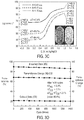
- FIG. 3A is a graph illustrating measurement results of cyclic voltammograms of polymer P4;
- FIG. 3B is a graph illustrating measurement results of spectroelectrochemistry of polymer P4,
- FIG. 3C a graph illustrating lightness (L*) as a function of applied potential for spin-coated P4 film,
- FIG. 3D is a graph illustrating a summary of the square wave potential step chronoabsorptometry of a P4 spin-coated ITO; consistent with exemplary embodiments of the present disclosure.
- FIGS. 4A-D are graphs illustrating square-wave potential-step chronoabsorptometry of P1, P2, P3 and P4 spin-coated ITOs respectively, consistent with exemplary embodiments of the present disclosure.
- FIGS. 5A-B are graphs illustrating A transmittance and B current change of polymer P4 in 10 s interval steps between 0 and 1.2 V, consistent with exemplary embodiments of the present disclosure.
- FIG. 6 is a graph illustrating measurement results of transmittance spectra of an ECD, consistent with exemplary embodiments of the present disclosure.
- compositions and methods include the recited elements, but not excluding others.
- Consisting essentially of when used to define compositions and methods, shall mean excluding other elements of any essential significance to the combination. For example, a composition consisting essentially of the elements as defined herein would not exclude other elements that do not materially affect the basic and novel characteristic(s) of the claimed invention.
- Consisting of shall mean excluding more than trace amount of other ingredients and substantial method steps recited. Embodiments defined by each of these transition terms are within the scope of this invention.
- amino refers to the —NH 2 radical
- hydroxy or “hydroxyl” refers to the OH radical
- thioxo refers to the ⁇ S substituent, etc.
- Alkyl refers to a straight or branched hydrocarbon chain radical consisting solely of carbon (C) and hydrogen (H) atoms, which is saturated or unsaturated (i.e., contains one or more double and/or triple bonds), having from 1 to 30 carbon atoms (C 1 -C 30 alkyl), and which is attached to the rest of the molecule by a single bond, e.g., methyl, ethyl, n-propyl, 1-methylethyl (iso-propyl), n-butyl, n-pentyl, 1,1-dimethylethyl (t-butyl), 3-methylhexyl, 2-methylhexyl, ethenyl, prop-1-enyl, but-1-enyl, pent-1-enyl, penta-1,4-dienyl, ethynyl, propynyl, butynyl, pentynyl, hexynyl,
- Alkylene or “alkylene chain” refers to a straight or branched divalent hydrocarbon chain linking the rest of the molecule to a radical group, consisting solely of carbon and hydrogen, which is saturated or unsaturated (i.e., contains one or more double and/or triple bonds), and having from 2 to 30 carbon atoms (C 2 -C 30 alkylene), e.g., methylene, ethylene, propylene, n-butylene, ethenylene, propenylene, n-butenylene, propynylene, n-butynylene, and the like.
- the alkylene chain is attached to the rest of the molecule through a single or double bond and to the radical group through a single or double bond.
- the points of attachment of the alkylene chain to the rest of the molecule and to the radical group can be through one carbon or any two carbons within the chain. Unless stated otherwise specifically in the specification, an alkylene chain may be optionally substituted.
- Alkylcarbonyl refers to a radical of the formula —(C ⁇ O)R a where R a is a C 1 -C 30 alkyl radical as defined above. Unless stated otherwise specifically in the specification, an alkylcarbonyl group may be optionally substituted.
- Alkoxy refers to a radical of the formula —OR a where R a is a C 1 -C 30 alkyl radical as defined above.
- a “haloalkoxy” is an alkoxy group as defined above, wherein at least one carbon-hydrogen bond is replaced with a carbon-halogen bond. Unless stated otherwise specifically in the specification, an alkoxy or haloalkoxy group may be optionally substituted.
- Alkoxyalkyl refers to a radical of the formula —R b OR a where R a is a C 1 -C 30 alkyl radical as defined above, and R b is a C 2 -C 30 alkylene radical as defined above.
- a “haloalkoxyalkyl” group is an alkoxyalkyl, wherein at least one carbon-hydrogen bond is replaced with a carbon-halogen bond. Unless stated otherwise specifically in the specification, an alkoxyalkyl or haloalkoxyalkyl group may be optionally substituted.
- Alkoxycarbonyl refers to a radical of the formula —(C ⁇ O)OR a where R a is a C 1 -C 30 alkyl radical as defined above. Unless stated otherwise specifically in the specification, an alkoxycarbonyl group may be optionally substituted.
- Alkoxycarbonylalkyl refers to a radical of the formula —R b (C ⁇ O)OR a where R a is a C 1 -C 30 alkyl radical as defined above, and R b is a C 2 -C 30 alkylene as defined above. Unless stated otherwise specifically in the specification, an alkoxycarbonylalkyl group may be optionally substituted.
- Aminylcarbonyl refers to a radical of the formula —(C ⁇ O)N(R a ) 2 , where each R a is independently H or a C 1 -C 30 alkyl group as defined above. Unless stated otherwise specifically in the specification, an aminylcarbonyl group may be optionally substituted.
- Aminylalkyl refers to a radical of the formula —R a N(R b ) 2 where R a is a C 2 -C 30 alkylene as defined above, and each R b is independently a C 1 -C 30 alkyl radical as defined above. Unless stated otherwise specifically in the specification, an aminylalky group may be optionally substituted.
- Alkylaminyl refers to a radical of the formula —NHR a or —NR a R a where each R a is independently a C 1 -C 30 alkyl radical as defined above, and R a is a C 1 -C 30 alky radical as defined above. Unless stated otherwise specifically in the specification, an aminylalky group may be optionally substituted.
- Alkylsulfonyl refers to a radical of the formula —S(O) 2 R a where R a is a C 1 -C 30 alkyl radical as defined above. Unless stated otherwise specifically in the specification, an alkylsulfonyl group may be optionally substituted.
- Alkylsulfonylalkyl refers to a radical of the formula —R b S(O) 2 R a where R a is a C 1 -C 30 alkyl radical as defined above, and R b is a C 2 -C 30 alkylene radical as defined above. Unless stated otherwise specifically in the specification, an alkylsulfonylalkyl group may be optionally substituted.
- Cyanoalkyl is a C 1 -C 30 alkyl group as defined above, wherein at least one carbon-hydrogen bond is replaced with a carbon-cyano bond. Unless stated otherwise specifically in the specification, a cyanoalkyl group may be optionally substituted.
- Hydroxylalkyl refers to a C 1 -C 30 alkyl radical as defined above, which has been substituted by one or more hydroxyl groups. Unless stated otherwise specifically in the specification, a hydroxylalkyl group may be optionally substituted.
- Aryl refers to a hydrocarbon ring system radical comprising hydrogen, 6 to 18 carbon atoms and at least one aromatic ring.
- the aryl radical may be a monocyclic, bicyclic, tricyclic or tetracyclic ring system, which may include fused or bridged ring systems.
- Aryl radicals include, but are not limited to, aryl radicals derived from phenyl, naphthyl, anthryl, etc. Unless stated otherwise specifically in the specification, the term “aryl” is meant to include aryl radicals that are optionally substituted.
- Conjugated polymer refers to a polymer having alternating single and double (or triple) carbon-carbon bonds along at least a portion of the polymer backbone.
- “Cycloalkyl” or “carbocyclic ring” refers to a stable non-aromatic monocyclic or polycyclic hydrocarbon radical consisting solely of carbon and hydrogen atoms, which may include fused or bridged ring systems, having from 3 to 15 carbon atoms, and which is saturated or unsaturated and attached to the rest of the molecule by a single bond.
- Monocyclic radicals may include, but are not limited to, cyclopropyl, cyclobutyl, cyclopentyl, cyclohexyl, cycloheptyl, and cyclooctyl.
- Polycyclic radicals may include, but are not limited to, adamantyl, norbornyl, decalinyl, 7,7-dimethyl-bicyclo[2.2.1]heptanyl, and the like. Unless otherwise stated specifically in the specification, a cycloalkyl group may be optionally substituted.
- Cycloalkylaminyl refers to a radical of the formula —NR a R c where R a is, independently, H or a C 1 -C 30 alkyl radical as defined above, and R c is a C 3 -C 15 cycloalkyl radical as defined above. Unless stated otherwise specifically in the specification, an aminylalky group may be optionally substituted.
- Cycloalkylalkylaminyl refers to a radical of the formula —NR a R b —R c where R a is independently H or a C 1 -C 30 alkyl radical as defined above, R b is a C 2 -C 30 alkylene radical as defined above, and R c is a C 3 -C 15 cycloalkyl radical as defined above. Unless stated otherwise specifically in the specification, a cycloalkylalkylaminyl group may be optionally substituted.
- Cycloalkylalkyl refers to a radical of the formula —R b R c where R b is a C 2 -C 30 alkylene chain as defined above, and R c is a C 3 -C 15 cycloalkyl radical as defined above. Unless stated otherwise specifically in the specification, a cycloalkylalkyl group may be optionally substituted.
- Cycloalkylalkyloxy refers to a radical of the formula —OR b R c where R b is a C 2 -C 30 alkylene chain as defined above, and R c is a C 3 -C 15 cycloalkyl radical as defined above. Unless stated otherwise specifically in the specification, a cycloalkylalkyloxy group may be optionally substituted.
- fused refers to any ring structure described herein which is fused to an existing ring structure in the compounds of the invention.
- the fused ring is a heterocyclyl ring or a heteroaryl ring
- any carbon atom on the existing ring structure which becomes part of the fused heterocyclyl ring or the fused heteroaryl ring may be replaced with a nitrogen atom.
- Halo or “halogen” refers to bromo, chloro, fluoro or iodo.
- Haloalkyl refers to a C 1 -C 30 alkyl radical as defined above, that is substituted by one or more halo radicals as defined above, e.g., trifluoromethyl, difluoromethyl, trichloromethyl, 2,2,2-trifluoroethyl, 1,2-difluoroethyl, 3-bromo-2-fluoropropyl, 1,2-dibromoethyl, and the like. Unless stated otherwise specifically in the specification, a haloalkyl group may be optionally substituted.
- Heterocyclyl or “heterocyclic ring” refers to a stable 3- to 18-membered non-aromatic ring radical which consists of 2 to 12 carbon atoms and from 1 to 6 heteroatoms selected from the group consisting of nitrogen, oxygen and sulfur.
- the heterocyclyl radical may be a monocyclic, bicyclic, tricyclic or tetracyclic ring system, which may include fused or bridged ring systems; and the nitrogen, carbon or sulfur atoms in the heterocyclyl radical may be optionally oxidized; the nitrogen atom may be optionally quaternized; and the heterocyclyl radical may be partially or fully saturated.
- heterocyclyl radicals may include, but are not limited to, dioxolanyl, thienyl[1,3]dithianyl, decahydroisoquinolyl, imidazolinyl, imidazolidinyl, isothiazolidinyl, isoxazolidinyl, morpholinyl, octahydroindolyl, octahydroisoindolyl, 2-oxopiperazinyl, 2-oxopiperidinyl, 2-oxopyrrolidinyl, oxazolidinyl, piperidinyl, piperazinyl, 4-piperidonyl, pyrrolidinyl, pyrazolidinyl, quinuclidinyl, thiazolidinyl, tetrahydrofuryl, trithianyl, tetrahydropyranyl, thiomorpholinyl, thiamorpholinyl, 1-oxo-thio-
- Heterocyclyloxy refers to a radical of the formula —OR d , wherein R d is a C 1 -C 12 heterocyclyl radical as defined above. Unless stated otherwise specifically in the specification, a heterocyclyloxy group may be optionally substituted.
- Heterocyclylalkyloxy refers to a radical of the formula —OR b R d where R b is a C 2 -C 30 alkylene chain as defined above, and R d is a C 1 -C 12 heterocyclyl radical as defined above. Unless stated otherwise specifically in the specification, a heterocyclylalkyloxy group may be optionally substituted.
- Heterocyclylaminyl refers to a radical of the formula —N(R a ) 2 R d where R a is independently H or a C 1 -C 30 alkyl radical as defined above, and R d is a C 1 -C 12 heterocyclyl radical as defined above. Unless stated otherwise specifically in the specification, a heterocyclylaminyl group may be optionally substituted.
- Heterocyclylalkylaminyl refers to a radical of the formula —NR a R b —R d where R a is H or a C 1 -C 30 alkyl radical as defined above, R b is a C 2 -C 30 alkylene radical as defined above, and R d is a C 1 -C 12 heterocyclyl radical as defined above. Unless stated otherwise specifically in the specification, a cycloalkylalkylaminyl group may be optionally substituted.
- Heterocyclylcarbonyl refers to a radical of the formula —C( ⁇ O)R d where R d is a C 1 -C 12 heterocyclyl radical as defined above. Unless stated otherwise specifically in the specification, a heterocyclycarbonyl group may be optionally substituted.
- Heterocyclylalkyl refers to a radical of the formula —R b R d where R b is a C 2 -C 30 alkylene chain as defined above, and R d is a C 1 -C 12 heterocyclyl radical as defined above. Unless stated otherwise specifically in the specification, a heterocyclylalkyl group may be optionally substituted.
- Heteroaryl refers to a 5 to 14 membered ring system radical comprising hydrogen atoms, 1 to 13 carbon atoms, 1 to 6 heteroatoms selected from the group consisting of nitrogen, oxygen and sulfur, and at least one aromatic ring.
- the heteroaryl radical may be a monocyclic, bicyclic, tricyclic or tetracyclic ring system, which may include fused or bridged ring systems; and the nitrogen, carbon or sulfur atoms in the heteroaryl radical may be optionally oxidized; the nitrogen atom may be optionally quaternized.
- Examples include, but are not limited to, azepinyl, acridinyl, benzimidazolyl, benzothiazolyl, benzindolyl, benzodioxolyl, benzofuranyl, benzooxazolyl, benzothiazolyl, benzothiadiazolyl, benzo[b][1,4]dioxepinyl, 1,4-benzodioxanyl, benzonaphthofuranyl, benzoxazolyl, benzodioxolyl, benzodioxinyl, benzopyranyl, benzopyranonyl, benzofuranyl, benzofuranonyl, benzothienyl (benzothiophenyl), benzotriazolyl, benzo[4,6]imidazo[1,2-a]pyridinyl, carbazolyl, cinnolinyl, dibenzofuranyl, dibenzothiophenyl, furany
- Heteroarylalkyl refers to a radical of the formula —R b R c where R b is a C 2 -C 30 alkylene chain as defined above, and R e is a C 1 -C 13 heteroaryl radical as defined above. Unless stated otherwise specifically in the specification, a heteroarylalkyl group may be optionally substituted.
- substituted means any of the above groups (e.g., alkyl, alkylene, alkylcarbonyl, alkoxy, alkoxyalkyl, haloalkoxyalkyl, alkoxycarbonyl, alkoxycarbonylalkyl, aminylcarbonyl, aminylalkyl, alkylaminyl, alkyl sulfonyl, alkylsulfonylalkyl, cyanoalkyl, hydroxylalkyl, aryl, cycloalkyl, cycloalkylalkyl, cycloalkyloxy, cycloalkylaminyl, cycloalkylalkylaminyl, cycloalkylalkyloxy, haloalkyl, heterocyclyl, heterocyclyloxy, heterocyclylalkyloxy, heterocyclylaminyl, heterocyclylalkylaminyl, heterocyclylcarbonyl,
- “Substituted” also means any of the above groups in which one or more hydrogen atoms are replaced by a higher-order bond (e.g., a double- or triple-bond) to a heteroatom such as oxygen in oxo, carbonyl, carboxyl, and ester groups; and nitrogen in groups such as imines, oximes, hydrazones, and nitriles.
- a higher-order bond e.g., a double- or triple-bond
- nitrogen in groups such as imines, oximes, hydrazones, and nitriles.
- substituted includes any of the above groups in which one or more hydrogen atoms are replaced with —NR g R h , —NR g C( ⁇ O)R h , —NR g C( ⁇ O)NR g R h , —NR g C( ⁇ O)OR h , —NR g SO 2 R h , —OC( ⁇ O)NR g R h , —OR g , —SR g , —SOR g , —SO 2 R g , —OSO 2 R g , —SO 2 OR g , ⁇ NSO 2 R g , and —SO 2 NR g R h .
- “Substituted also means any of the above groups in which one or more hydrogen atoms are replaced with —C( ⁇ O)R g , —C( ⁇ O)OR g , —C( ⁇ O)NR g R h , —CH 2 SO 2 R g , —CH 2 SO 2 NR g R h .
- R g and R h are the same or different and independently hydrogen, alkyl, alkoxy, alkylaminyl, thioalkyl, aryl, aralkyl, cycloalkyl, cycloalkylalkyl, haloalkyl, heterocyclyl, N-heterocyclyl, heterocyclylalkyl, heteroaryl, N-heteroaryl and/or heteroarylalkyl.
- “Substituted” further means any of the above groups in which one or more hydrogen atoms are replaced by a bond to an amino, alkylaminyl, cyano, hydroxyl, imino, nitro, oxo, thioxo, halo, alkyl, alkoxy, alkylaminyl, thioalkyl, aryl, aralkyl, cycloalkyl, cycloalkylalkyl, haloalkyl, heterocyclyl, N-heterocyclyl, heterocyclylalkyl, heteroaryl, N-heteroaryl and/or heteroarylalkyl group.
- each of the foregoing substituents may also be optionally substituted with one or more of the above substituents.
- Optional or “optionally” means that the subsequently described event of circumstances may or may not occur, and that the description includes instances where said event or circumstance occurs and instances in which it does not.
- optionally substituted aryl means that the aryl radical may or may not be substituted and that the description includes both substituted aryl radicals and aryl radicals having no substitution.
- contacting refers to bringing two or more chemical molecules to close proximity so that a chemical reaction between the two or more chemical molecules can occur.
- contacting may comprise mixing and optionally continuously mixing the chemicals.
- Contacting may be done by fully or partially dissolving or suspending two or more chemicals in one or more solvents, mixing of a chemical in a solvent with another chemical in solid and/or gas phase or being attached on a solid support, such as a resin, or mixing two or more chemicals in gas or solid phase and/or on a solid support, that are generally known to those skilled in the art.
- black-to-transmissive electrochromic polymers (hereinafter also referred to as “black polymers”) that absorb across the entire visible spectrum and realize an obvious color change from black to transmissive with an applied voltage. Also provided is a method for synthesizing a black polymer via controlling monomer feed ratios in a direct arylation polymerization.
- the direct arylation polymerization method features formations of C—C bonds between halogenated arenes and simple arenes with active C—H bonds, thereby circumventing the preparation of organometallic derivatives and decreasing overall production cost of conjugated polymers.
- x ranges from about 0.2 to about 0.6, y ranges from about 1.2 to about 1.45, and z ranges from about 0.2 to about 0.35. In some embodiments, x ranges from about 0.2 to about 0.4, y ranges from about 1.3 to about 1.45, and z ranges from about 0.2 to about 0.35. In some embodiments, xis about 0.2, y is about 1.2, and z is about 0.35. In some embodiments, x is about 0.3, y is about 1.45, and z is about 0.25. In some embodiments, xis about 0.4, y is about 1.35, and z is about 0.25. In some embodiments, xis about 0.4, y is about 1.4, and z is about 0.2. In some embodiments, x is about 0.6, y is about 1.2, and z is about 0.2.
- each R 1 and R 2 is independently C 1 -C 30 alkoxyalkyl. In some embodiments, each R 1 and R 2 is independently unsubstituted C 1 -C 30 alkoxyalkyl.
- one or two of R 3 , R 4 , R 5 , R 6 , R 7 and R 8 are independently C 1 -C 30 alkoxy, and the rest of R 3 , R 4 , R 5 , R 6 , R 7 and R 8 are hydrogen.
- each R 3 and R 6 is hydrogen, and each R 4 and R 5 is independently C 1 -C 30 alkoxy.
- R 3 , R 4 , R 5 , R 6 , R 7 and R 8 are two of R 3 , R 4 , R 5 , R 6 , R 7 and R 8 .
- R 3 , R 4 , R 5 , R 6 , R 7 and R 8 are hydrogen.
- each R 3 and R 6 is hydrogen, and each R 4 and R 5 is hydrogen
- each R 9 and R 10 is hydrogen.
- each R 3 and R 6 is hydrogen, and each R 4 and R 5 is independently C 1 -C 30 alkoxy.
- each R 3 and R 6 is hydrogen, and each R 4 and R 5 is independently C 1 -C 30 alkoxy. In some embodiments, each R 3 and R 6 is hydrogen, and each R 4 and R 5 is
- R 3 is hydrogen. In some embodiments, R 3 is independently C 1 -C 30 alkoxy. In some embodiments, R 3 is
- each R 3 and R 4 is independently hydrogen or C 1 -C 30 alkoxy. In some embodiments, each R 3 and R 4 is hydrogen or
- two of R 3 , R 4 , R 5 , R 6 , R 7 and R 8 are independently C 1 -C 30 alkoxy, and the rest of R 3 , R 4 , R 5 , R 6 , R 7 and R 8 are hydrogen. In some embodiments, two of R 3 , R 4 , R 5 , R 6 , R 7 and R 8 are independently
- R 3 , R 4 , R 5 , R 6 , R 7 and R 8 are hydrogen.
- a black-to-transmissive electrochromic polymer comprising:
- x ranges from about 0.2 to about 0.6, y′ ranges from about 0.2 to about 0.45, and z ranges from about 0.2 to about 0.35. In some embodiments, x ranges from about 0.2 to about 0.4, y′ ranges from about 0.3 to about 0.45, and z ranges from about 0.2 to about 0.35. In some embodiments, x is about 0.2, y′ is about 0.2, and z is about 0.35. In some embodiments, x is about 0.3, y′ is about 0.45, and z is about 0.25. In some embodiments, x is about 0.4, y′ is about 0.35, and z is about 0.25. In some embodiments, x is about 0.4, y′ is about 0.4, and z is about 0.2. In some embodiments, x is about 0.6, y′ is about 0.2, and z is about 0.2.
- Monomer 1 is of the formula
- Monomer 2 is of the formula
- each R 3 and R 6 is hydrogen, and each R 4 and R 5 is independently C 1 -C 30 alkoxy.
- Monomer 2 is of the formula
- Monomer 2 is of the formula
- each R 3 and R 6 is hydrogen, and each R 4 and R 5 is independently C 1 -C 30 alkoxy. In some embodiments, each R 3 and R 6 is hydrogen, and each R 4 and R 5 is
- Monomer 2 is of the formula
- R 3 is hydrogen. In some embodiments, R 3 is independently C 1 -C 30 alkoxy. In some embodiments, R 3 is
- Monomer 2 is of the formula
- each R 3 and R 4 is independently hydrogen or C 1 -C 30 alkoxy. In some embodiments, each R 3 and R 4 is independently hydrogen or
- Monomer 2 is of the formula
- two of R 3 , R 4 , R 5 , R 6 , R 7 and R 8 are independently C 1 -C 30 alkoxy, and the rest of R 3 , R 4 , R 5 , R 6 , R 7 and R 8 are hydrogen. In some embodiments, two of R 3 , R 4 , R 5 , R 6 , R 7 and R 8 are
- R 3 , R 4 , R 5 , R 6 , R 7 and R 8 are hydrogen.
- Monomer 3 is of the formula
- Monomer 4 is of the formula
- the polymerization condition comprises K 2 CO 3 , PivOH, and Pd(OAc) 2 .
- the polymerization condition comprises about 2-3 equivalent of K 2 CO 3 , about 0.1-0.5 equivalent of PivOH and about 0.01-0.05 equivalent of Pd(OAc) 2 with respect to 1 equivalent of Monomer 1.
- the polymerization condition comprises about 2.6 equivalent of K 2 CO 3 , about 0.3 equivalent of PivOH and about 0.02 equivalent of Pd(OAc) 2 with respect to 1 equivalent of Monomer 1.
- the polymerization condition further comprises an inert atmosphere and a degassed solvent selected from N-methyl-2-pyrrolidone, N,N-dimethylacetamide, and N,N-dimethylformamide, or a combination thereof.
- the polymerization condition further comprises a temperature of about 100° C. to about 200° C. or about 140° C.
- the polymerization condition further comprises isolating the black-to-transmissive electrochromic polymer.
- isolating the black-to-transmissive electrochromic polymer comprises
- a black-to-transmissive electrochromic polymer wherein the polymer is synthesized by a method comprising
- the ratio of Monomer 1:Monomer 2:Monomer 3:Monomer 4 is 1:x:y′:z, x+y′+z is about 1, x ranges from about 0.2 to about 0.6, y′ ranges from about 0.2 to about 0.45, and z ranges from about 0.2 to about 0.35.
- Monomer 1 is of the formula
- Monomer 2 is of the formula
- Monomer 3 is of the formula
- Monomer 4 is of the formula
- the polymer is a black-to-transmissive electrochromic conjugated copolymer.
- the polymer has an average molecular weight of about 5.0-100 kDa.
- the polymer has a polydispersity index of about 1.2-1.7.
- the polymer has a low band gap of about 1.61-1.65 eV.
- the black-to-transmissive electrochromic polymer has a normalized absorbance from about 420 nm to about 680 nm of at least 0.7.
- the black-to-transmissive electrochromic polymer has a normalized absorbance from about 420 nm to about 680 nm of at least 0.9.
- x is about 0.3-0.4. In some embodiments, y′ is about 0.35-0.45. In some embodiments, z is about 0.2-0.25.
- x is about 0.3
- y′ is about 0.45
- z is about 0.25.
- x is about 0.4
- y′ is about 0.35
- z is about 0.25.
- x is about 0.4
- y′ is about 0.4
- z is about 0.25.
- x is about 0.4
- y′ is about 0.4
- z is about 0.2.
- the polymer has an absorbance spectrum during 400-750 nm related to a ⁇ - ⁇ * transition.
- a black-to-transmissive electrochromic polymer thin film comprising an indium tin oxide (ITO) coated glass spin-coated with a black-to-transmissive polymer described herein.
- ITO indium tin oxide
- the film changes color from black (L* is 0-60, a* is ⁇ 10 to 5, and b* is ⁇ 10 to 5) to transmissive (L* is 70 to 100, a* is ⁇ 10 to 5, and b* is ⁇ 10 to 5) with an applied voltage of 0-1.2 V, L* represents lightness, and a* and b* are hue and chroma values, respectively.
- the film changes color from black (L* is 20-50, a* is ⁇ 10 to 5, and b* is ⁇ 10 to 5) to transmissive (L* is 80 to 90, a* is ⁇ 10 to 5, and b* is ⁇ 10 to 5) with an applied voltage of 0-1.2 V, L* represents lightness, and a* and b* are hue and chroma values, respectively.
- the film changes color from black (L* is about 49.2, a* is ⁇ 10 to 5, and b* is ⁇ 10 to 5) to transmissive (L* is about 85, a* is ⁇ 10 to 5, and b* is ⁇ 10 to 5) with an applied voltage of 0-1.2 V, L* represents lightness, and a* and b* are hue and chroma values, respectively.
- the film changes color from black (L* is 20-50, a* is ⁇ 5 to 0, and b* is ⁇ 10 to 0) to transmissive (L* is 80 to 90, a* is ⁇ 5 to 0, and b* is ⁇ 5 to 0) with an applied voltage of 0-1.2 V, L* represents lightness, and a* and b* are hue and chroma values, respectively.
- the film changes color from black (L* is about 49.2, a* is ⁇ 5 to 0, and b* is ⁇ 10 to 0) to transmissive (L* is about 85, a* is ⁇ 5 to 0, and b* is ⁇ 5 to 0) with an applied voltage of 0-1.2 V, L* represents lightness, and a* and b* are hue and chroma values, respectively.
- the film changes color from black (L* is about 49.2, a* is about 3.6, b* is about ⁇ 7.7) to transmissive (L* is about 85, a* is about ⁇ 4.6, b* is about ⁇ 5.8) with an applied voltage of about 0 to about 1.2 V, L* represents lightness, and a* and b* are hue and chroma values, respectively.
- the film reaches an optical contrast of about 70% within 10 seconds on a small conductive substrate.
- the film has a coloration efficiency of at least 100 cm 2 C ⁇ 1 , at least 125 cm 2 C ⁇ 1 , at least 150 cm 2 C ⁇ 1 , at least 175 cm 2 C ⁇ 1 , or at least 200 cm 2 C ⁇ 1 .
- the film has a coloration time of no more than 5 seconds and a bleaching time of no more than about 5 seconds.
- the film has a coloration time of about 3.73 seconds and a bleaching time of about 3.70 seconds on small conductive substrate, such as a conductive substrate having an area of less than 1 square inch.
- the film has a coloration efficiency of at least 100 cm 2 /C.
- the film has an optical loss of no more than 10% or no more than 5% after 1400 long-term oxidation-reduction switch cycles.
- an electrochromic device comprising:
- the electrochromic device displays a contrast of about 40% or more.
- the electrochromic device switches color from black (a* is ⁇ 5 to 0, b* is ⁇ 10 to 0) when a potential of ⁇ 1V is applied to transmissive (a* is ⁇ 8 to 0, b* is ⁇ 5 to 0) when a potential of 1.8 V is applied, and a* and b* are hue and chroma values, respectively.
- a*, b* consistently in a range of ⁇ 13 to 0.
- L* represents lightness (ranging from 0 to 100).
- An optical contrast as high as nearly 70% can be reached within 10 seconds in electrochromic thin films made of the black polymer, which is superior to reported black-to-transmissive electrochromic materials.
- a black-to-transmissive ECD based on the as-prepared electrochromic films can be designed using a transparent indium tin oxide (ITO) as a counter electrode for charge storage.
- ITO transparent indium tin oxide
- the D-A approach alternating electron-rich and electron-deficient moieties along a ⁇ -conjugated backbone, has been proved especially valuable in the synthesis of dual-band and broadly absorbing chromophores with useful photovoltaic and electrochromic properties.
- a chromophore refers to an atom or group whose presence is responsible for the color of a compound.
- An evolution of the two-band spectral absorption can be observed on varying relative compositions of electron-rich and electron-deficient substituents along the ⁇ -conjugated backbone.
- average molecular weights (Mn) and polydispersity index (PDI) are about 5.0 to 15.8 kDa and 1.2 to 1.7, respectively.
- Polydispersity index refers to either molecular mass or degree of polymerization.
- Ratios of polymer components, electrochemical properties and GPC (Gel Permeation Chromatography) estimated molecular weights for P1 to P5 are listed in Table 1.
- ⁇ onset stands for an onset of a lower-energy optical transition
- E HOMO is a HOMO (highest occupied molecular orbital) energy level of a black polymer
- E LUMO is a LUMO (lowest unoccupied molecular orbital) energy level of a black polymer
- E ox is an onset oxidation potential of a black polymer
- Eg is a band gap (Eg) of a black polymer.
- FIG. 1 shows a reaction scheme for polymerizations of black polymers, in accordance to exemplary embodiments of the present disclosure.
- All reagents can be obtained from Sigma Aldrich or Acros and used without further purification unless otherwise noted.
- Ferrocene (Fc), and Octadecyltrichlorosilane (OTS) can be used without further purification and kept in a desiccator.
- Propylene carbonate (PC, 99.5%) obtained from Sigma-Aldrich may be purified by a solvent purification system in vacuum.
- Tetrabutylammonium hexafluorophosphate (TBAPF 6 , ⁇ 99.0%), platinum wire (99.0%) can be obtained from Sigma-Aldrich.
- ITO coated glass slides CG-501N-CUV
- CG-501N-CUV can be obtained from Delta Technologies, Ltd., and sequentially cleaned with deionized water, ethanol and acetone.
- 1 equivalent of Monomer 1 may be added to a reaction container, and followed by different ratios of Monomer 2, 3, 4 to obtain a solution.
- K 2 CO 3 , PivOH and Pd(OAc) 2 may also be added into the container to create a mixture with the solution.
- O 2 is removed from the container by, for example, purged with N 2 , and this process may be repeated for three times.
- a degassed solvent such as N-methyl-2-pyrrolidone, N,N-dimethylacetamide, or N,N-dimethylformamide, can be added to the mixture in the container and the mixture may be heated, such as at a temperature of about 100° C. to about 200° C.
- reaction mixture comprising the polymer.
- the hot reaction mixture may be first transferred to a solvent, such as CH 3 OH, and then transferred to an aqueous acid solution, such as 1M HCl.
- the reaction mixture can be filtered to obtain a solid material which may be further dissolved in an organic solvent, such as chloroform, and washed with an aqueous acid solution, such as 1M HCl solution.
- the organic phase may be concentrated and precipitated with another solvent, such as CH 3 OH.
- the black polymer in a form of a black solid can be obtained by filtering and drying the organic phase.
- 1.0 equivalent of 3,4-propylenedioxythiophene (Prodot) monomer 1 may be added to a Schlenk tube, and followed by different ratios of monomer 2, 3, 4 to obtain a solution.
- K 2 CO 3 e.g., 2.6 eq.
- PivOH e.g., 0.3 eq.
- Pd(OAc) 2 e.g., 0.02 eq.
- the tube may be kept under vacuum for about 5 min and purged with N 2 , and this process may be repeated for three times.
- degassed solvent N-methyl-2-pyrrolidone (NMP, and 1.0 g monomer 1 use 40 ml of solvent) can be added to the mixture in the tube and the tube may be heated in an oil bath at 140° C. for 18 hour under nitrogen to create a reaction mixture.
- the hot reaction mixture may be first transferred to a solvent of CH 3 OH with a ratio of 1:1 and then transferred to 1M HCl with stir.
- the reaction mixture can be filtered to obtain a solid material which may be further dissolved in chloroform and washed with 1M HCl solution.
- an organic phase may be concentrated and precipitate with CH 3 OH.
- the black polymer in a form of a black solid can be obtained by filtering and drying the organic phase. P1 to P5 were prepared accordingly.
- conductive sides of cleaned ITO slides may be treated with a UV-ozone chamber for 20 mins to obtain functionalized ITOs.
- the functionalized ITOs may be immersed into an OTS/hexane solution (1 vol %) for 80 mins to form an OTS-modified ITO, and subsequently dried by nitrogen blowing.
- Solutions of the black polymers in chloroform (60 mg/mL) then can be spin-coated (1500 rpm) onto OTS-modified ITO electrodes to form thin electrochromic films. Thickness ( ⁇ 250-450 nm) of the spin-coated films can be controlled via adjusting a concentration of the black polymer solution from 40-70 mg/mL.
- 1 H and 13 C NMR (nuclear magnetic resonance) spectra may be recorded on a Brucker ARX 400 at 293 K with deuterized chlorofrom as solvent. Size exclusive chromatography (SEC) may be performed in tetrahydrofuran under room temperature with calibration curve based on polystyrene standards.
- SEC Size exclusive chromatography
- UV-vis-NIR spectra ultraviolet-visible-Near-infrared spectra
- electrochemistry related studies of the polymer films may be carried out on BioLogic SP-150 in a traditional three-electrode system.
- a Pt wire may be used as a counter electrode
- an Ag/AgCl reference electrode may be calibrated with Fc/Fc + (0.2 M of Fc/propylene carbonate (PC) in 0.2 M of TBAPF 6 /PC)
- the ITO-coated black polymer films may be used as working electrodes.
- the Cyclic Voltammetry (CV) may be measured from 0-1.2V at 40 mV/s scan rate in a 0.2 M TBAPF 6 /PC electrolyte solution.
- CV is a type of potentiodynamic electrochemical measurement, and is used to study the electrochemical properties of an analyte in solution.
- UV-vis spectra, Spectroelectrochemistry, Kinetic and Color measurement may be recorded on an Agilent Cary 500 Scan UV-vis-NIR spectrophotometer. Photographs of the polymer solutions and films may be illuminated with a D65 light source in building mode and recorded using a digital camera (Nikon D500) in a viewing booth (GTI Graphic Technology, Inc.) All photographs are presented as received without further alteration.
- FIG. 2A presents solution UV-visible absorption spectra of the black polymers from P1 to P5 in chloroform in accordance to exemplary embodiments of the present disclosure.
- Insets in FIG. 2A show colors of the black polymers in solution.
- the five spectra all displayed broad “merging” band in the visible light region, which is different from typical D-A polymer spectra with two single absorption bands.
- P1 demonstrates a deficient absorption at a short-wavelength absorption of 458 nm and thus reveals a blue-green color.
- bathochromic shift is a change of spectral band position in the absorption, reflectance, transmittance, or emission spectrum of a molecule to a longer wavelength (lower frequency).
- Hypsochromic shift is a change of spectral band position in the absorption, reflectance, transmittance, or emission spectrum of a molecule to a shorter wavelength (higher frequency).
- the polymer solutions may be spin-coated onto ITO slides, and the corresponding solid-state optical absorbance spectra are presented in FIG. 2B .
- Insets in FIG. 2B show colors of the black polymers in solid states. All films demonstrated more black colors and bathochromic shifts relative to their solutions. This may be resulted from a higher degree of order and a more planarity of the polymer chains in the solid state, which may lead to a more black color.
- the band gap (Eg) is an vital and indispensable factor for evaluating opto-electronic properties
- FIG. 3A shows measurement results of cyclic voltammograms of P4 in 0.2 M TBAPF 6 /PC at 40 mV/s; and FIG. 3B shows measurement results of spectroelectrochemistry of P4, in accordance to exemplary embodiments in the present disclosure.
- the film of P4 may be spin-coated onto ITO-coated glass from chloroform (60 mg mL ⁇ 1 ).
- An electrochemical oxidation of the film may be carried out in 0.2 M TBAPF 6 /PC solution, with Ag/AgCl as a quasi-reference electrode (calibrated against Fc/Fc + ), and a platinum wire as the counter electrode.
- the applied potential may be increased from 0 to +1.2 V vs. Ag/AgCl.
- FIG. 3C shows data of lightness (L*) as a function of applied potential for spin-coated P4 film, with L*, a*, and b* values listed.
- the insets in FIG. 3C are photographs of the films in fully neutral (left) and oxidized states (right), respectively.
- FIG. 3D shows data of square-wave potential-step chronoabsorptometry of P4 spin-coated on ITO (monitored at 500 nm, 0 to +1.2 V vs. Ag/AgCl in 0.2 M TBAPF 6 /PC electrolyte solution) with a switching time for 100 s, 80 s, 60 s, 40 s, 20 s, 10 s, 5 s, and 2 s.
- a CV measurement may be first conducted to probe and determine a redox potential range, which may be cycled for several times at 40 mV/s to obtain some stable and reproducible curves.
- FIG. 3A reveals a 16th CV cycles of the P4 film, exhibiting a full and irreversible switch between 0-1.2 V with an onset oxidation potential (E ox ) of 0.38 V versus an Ag/AgCl pseudoreference electrode. Subsequently, the film may be neutralized at ⁇ 0.2 V for 60 s at the same condition, and then changes of absorbance spectra from black to transmittance may be recorded under various applied voltages.
- E ox onset oxidation potential
- the film appears black in the neutral state, and shows a broad absorbance spectrum during 400-750 nm related to the ⁇ - ⁇ * transition, while as the polymer film is doped, the broad peak in the visible region is depleted, and a polaronic and bipolaronic transition appear successively in the near-IR (800-1200 nm) and IR region (>1200 nm).
- colors can be measured quantitatively utilizing the CIE 1976 L*a*b* color standards, where CIE 1976 is a color space adopted by the International Commission on Illumination (CIE) in 1976, L* represents lightness (ranging from 0 to 100), and a* and b* are hue and chroma values, respectively. More specifically, positive and negative a* values correspond to red and green hues, respectively, and positive and negative b* values denote yellow and blue chromas. Colorimetrical measurements of the black polymer films have been investigated, and P4 shows a relatively blacker color in comparison with others. The results are listed in Table 2. Here, t c is a coloration time, t b is a bleaching time and CE is coloration efficiency.
- CIE 1976 is a color space adopted by the International Commission on Illumination (CIE) in 1976
- L* represents lightness (ranging from 0 to 100)
- a* and b* are hue and chroma values, respectively. More specifically, positive and negative a* values correspond to
- colorimetrical measurements may also be performed via varying film thickness.
- the applied potential is added up to 0.4 V, the bleaching process may occur, which is consistent with the CV results.
- the film switching may be first examined using transmittance change at a certain wavelength as a function of switch time by applying square-wave potential steps for periods of 100, 80, 60, 40, 20, 10, 5, and 2 s.
- the P4 film shows a largest transmittance change monitored, an excellent switching performance as high as 69.7% at a longer switch time (100 s), also maintaining ⁇ T>63.2% at 5 s and above.
- the ⁇ T decreased to 46.0% (a 23.72% loss) at a faster switching pulse of 2 s.
- Table 3 shows the ⁇ T of FIGS. 4A-D .
- the measurements may be performed by a combination of chronoamperometry and an in-situ UV-vis-NIR spectrophotometer via alternating potentials from 0 to 1.2 V.
- a response time may be defined as the time required for a 90% change in the full transmittance at 500 nm.
- an as-prepared P4 film, the coloration time (t c ) may be 3.73 s, and the bleaching time (t b ) may be 3.7 s.
- the fast switching speed may be due to a good connection between an active film (P4) and the OTS-functionalized ITO substrate.
- a coloration efficiency is defined as the change in optical density (OD) per unit of inserted charge (Q), which are measured in a simultaneous chronocoulometry and chronoabsorptometry experiment, with the percent transmittance during the switch monitored at the absorbance maxima.
- Chronocoulometry is used to study kinetics of chemical reactions, diffusion processes, and adsorption. In this technique, a potential step is applied to an electrode and the resulting cumulative charge vs. time is observed. This technique is very similar to Chronoamperometry, except that the integrated charge is recorded in Chronocoulometry instead of raw current.
- a CE value of 202.4 cm 2 C ⁇ 1 may be obtained for the P4 film (shown in Table 2 and FIG. 5B ), which is superior and comparable to those of previously reported black polymer materials.
- the stability of repeated redox test may be carried out by repeating square-wave potential steps of 10 s (switching between 0 to 1.2 V vs. Ag/AgCl) for 1400 cycles. As shown in FIG. 3D , the film demonstrated outstanding switching stability with only a decrease of 2.1% for transmittance changes.
- black-to-transmissive ECDs may be assembled with P4 as a working electrode and a colorless ITO as a counter electrode layer, respectively.
- Transmittance spectra of the ECDs in the neutral and bleaching state may be measured across the entire visible region, and the detail changes may be shown in FIG. 6 .
- Insets in FIG. 6 show photographs of a same device in reduction and oxidation states.
- transmittance contrast of about 43.6% at 500 nm.
- polymer P4 can be validated to be an effective and valuable electrochromic material. Further efforts may be put into searching for a well-matched courter electrode and constructing a high-performance ECD.
- a black-to-transmissive electrochromic material with relatively homogenous and broad absorption band can be synthesized.
- the feed ratios of Monomers 2, 3 and 4 may range from 0.2-0.6, 0.2-0.45, 0.2-0.35, respectively.
- the synthesized black material can be realized a tunable color switching from saturated black to transmissive, which are superior to previous reported black-to-transmissive electrochromic materials.
- Black polymers may be developed via controlling a monomer feed ratio in a direct arylation polymerization. Spectroelectrochemistry and colorimetry may exhibit a clear black-to-transmissive upon electrochemical doping.
- An optimal electrochromic polymer demonstrated high-performance in terms of most broad and uniform visible absorption, a high optical contrast, and long-term redox stability.
- this disclosure presents a strategy to design and synthesis electrochromic materials.
- the high-performance resulting black-to-transmissive polymers can be exploited in privacy glass, optical communication, data storage and some related electrochromic devices.
Landscapes
- Chemical & Material Sciences (AREA)
- Physics & Mathematics (AREA)
- Nonlinear Science (AREA)
- Organic Chemistry (AREA)
- Materials Engineering (AREA)
- Engineering & Computer Science (AREA)
- General Physics & Mathematics (AREA)
- Optics & Photonics (AREA)
- Health & Medical Sciences (AREA)
- Chemical Kinetics & Catalysis (AREA)
- Medicinal Chemistry (AREA)
- Polymers & Plastics (AREA)
- Plural Heterocyclic Compounds (AREA)
- Polyoxymethylene Polymers And Polymers With Carbon-To-Carbon Bonds (AREA)
Abstract
Description

-
- is of the formula

-

-
- of the formula

-

or a combination thereof;
-
- of the formula

-

-
- each of R1, R2, R3, R4, R5, R6, R7, R8, R9, and R10 is independently hydrogen, optionally substituted C1-C30 alkyl, optionally substituted C2-C30 alkenyl, optionally substituted C2-C30 alkynyl, optionally substituted C2-C30 alkylcarbonyl, optionally substituted C1-C30 alkoxy, optionally substituted C3-C30 alkoxyalkyl, optionally substituted C2-C30 alkoxycarbonyl, optionally substituted C4-C30 alkoxycarbonylalkyl, optionally substituted C1-C30 aminylcarbonyl, optionally substituted C4-C30 aminylalkyl, optionally substituted C1-C30 alkylaminyl, optionally substituted C1-C30 alkyl sulfonyl, optionally substituted C3-C30 alkylsulfonylalkyl, optionally substituted C6-C18 aryl, optionally substituted C3-C15 cycloalkyl, optionally substituted C3-C30 cycloalkylaminyl, optionally substituted C5-C30 cycloalkylalkylaminyl, optionally substituted C5-C30 cycloalkylalkyl, optionally substituted C5-C30 cycloalkylalkyloxy, optionally substituted C1-C12 heterocyclyl, optionally substituted C1-C12 heterocyclyloxy, optionally substituted C3-C30 heterocyclylalkyloxy, optionally substituted C1-C30 heterocyclylalkyloxy, optionally substituted C1-C30 heterocyclylaminyl, optionally substituted C5-C30 heterocyclylalkylaminyl, optionally substituted C2-C12 heterocyclylcarbonyl, optionally substituted C3-C30 heterocyclylalkyl, optionally substituted C1-C13 heteroaryl, or optionally substituted C3-C30 heteroarylalkyl;
- each r, s and t is independently an integer of equal to or greater than 1;
- n is an integer of equal to or greater than 1;
- represents connection to the rest of the molecule; and

- the average ratio of ,, andin the polymer is x:y:z, wherein x ranges from about 0.2 to about 0.6, y ranges from about 1.2 to about 1.45, and z ranges from about 0.2 to about 0.45, and x+y+z=2.

-
- is of the formula
-

-
- of the formula
-

or a combination thereof;
-
- of the formula
-

-
- each of R1, R2, R3, R4, R5, R6, R7, R8, R9, and R10 is independently hydrogen, optionally substituted C1-C30 alkyl, optionally substituted C2-C30 alkenyl, optionally substituted C2-C30 alkynyl, optionally substituted C2-C30 alkylcarbonyl, optionally substituted C1-C30 alkoxy, optionally substituted C3-C30 alkoxyalkyl, optionally substituted C2-C30 alkoxycarbonyl, optionally substituted C4-C30 alkoxycarbonylalkyl, optionally substituted C1-C30 aminylcarbonyl, optionally substituted C4-C30 aminylalkyl, optionally substituted C1-C30 alkylaminyl, optionally substituted C1-C30 alkyl sulfonyl, optionally substituted C3-C30 alkylsulfonylalkyl, optionally substituted C6-C18 aryl, optionally substituted C3-C15 cycloalkyl, optionally substituted C3-C30 cycloalkylaminyl, optionally substituted C5-C30 cycloalkylalkylaminyl, optionally substituted C5-C30 cycloalkylalkyl, optionally substituted C5-C30 cycloalkylalkyloxy, optionally substituted C1-C12 heterocyclyl, optionally substituted C1-C12 heterocyclyloxy, optionally substituted C3-C30 heterocyclylalkyloxy, optionally substituted C1-C30 heterocyclylalkyloxy, optionally substituted C1-C30 heterocyclylaminyl, optionally substituted C5-C30 heterocyclylalkylaminyl, optionally substituted C2-C12 heterocyclylcarbonyl, optionally substituted C3-C30 heterocyclylalkyl, optionally substituted C1-C13 heteroaryl, or optionally substituted C3-C30 heteroarylalkyl;
- each r, s and t is independently an integer of equal to or greater than 1;
- n is an integer of equal to or greater than 1;
- represents connection to the rest of the molecule; and
- the average ratio of ,, andin the polymer is x:y:z, wherein x ranges from about 0.2 to about 0.6, y ranges from about 1.2 to about 1.45, and z ranges from about 0.2 to about 0.45, and x+y+z is about 2.


and the rest of R3, R4, R5, R6, R7 and R8 are hydrogen.


In some embodiments, each R3 and R6 is hydrogen, and each R4 and R5 is independently C1-C30 alkoxy.


In some embodiments, each R3 and R6 is hydrogen, and each R4 and R5 is independently C1-C30 alkoxy. In some embodiments, each R3 and R6 is hydrogen, and each R4 and R5 is


In some embodiments, R3 is hydrogen. In some embodiments, R3 is independently C1-C30 alkoxy. In some embodiments, R3 is


In some embodiments, each R3 and R4 is independently hydrogen or C1-C30 alkoxy. In some embodiments, each R3 and R4 is hydrogen or


In some embodiments, two of R3, R4, R5, R6, R7 and R8 are independently C1-C30 alkoxy, and the rest of R3, R4, R5, R6, R7 and R8 are hydrogen. In some embodiments, two of R3, R4, R5, R6, R7 and R8 are independently

and the rest of R3, R4, R5, R6, R7 and R8 are hydrogen.

-
- contacting
Monomer 1,Monomer 2,Monomer 3 andMonomer 4 under polymerization conditions to form the black-to-transmissive electrochromic polymer, - wherein a ratio of Monomer 1:Monomer 2:Monomer 3:
Monomer 4 is 1:x:y′:z, x+y′+z is about 1, x ranges from about 0.2 to about 0.6, y′ ranges from about 0.2 to about 0.45, and z ranges from about 0.2 to about 0.45; -
Monomer 1 is of the formula
- contacting

-
-
Monomer 2 is of the formula
-

or a combination thereof,
-
-
Monomer 3 is of the formula
-

-
- and
Monomer 4 is of the formula
- and

-
- wherein each of R1, R2, R3, R4, R5, R6, R7, R8, R9, and R10 is independently hydrogen, optionally substituted C1-C30 alkyl, optionally substituted C2-C30 alkenyl, optionally substituted C2-C30 alkynyl, optionally substituted C2-C30 alkylcarbonyl, optionally substituted C1-C30 alkoxy, optionally substituted C3-C30 alkoxyalkyl, optionally substituted C2-C30 alkoxycarbonyl, optionally substituted C4-C30 alkoxycarbonylalkyl, optionally substituted C1-C30 aminylcarbonyl, optionally substituted C4-C30 aminylalkyl, optionally substituted C1-C30 alkylaminyl, optionally substituted C1-C30 alkyl sulfonyl, optionally substituted C3-C30 alkylsulfonylalkyl, optionally substituted C6-C18 aryl, optionally substituted C3-C15 cycloalkyl, optionally substituted C3-C30 cycloalkylaminyl, optionally substituted C5-C30 cycloalkylalkylaminyl, optionally substituted C5-C30 cycloalkylalkyl, optionally substituted C5-C30 cycloalkylalkyloxy, optionally substituted C1-C12 heterocyclyl, optionally substituted C1-C12 heterocyclyloxy, optionally substituted C3-C30 heterocyclylalkyloxy, optionally substituted C1-C30 heterocyclylalkyloxy, optionally substituted C1-C30 heterocyclylaminyl, optionally substituted C5-C30 heterocyclylalkylaminyl, optionally substituted C2-C12 heterocyclylcarbonyl, optionally substituted C3-C30 heterocyclylalkyl, optionally substituted C1-C13 heteroaryl, or optionally substituted C3-C30 heteroarylalkyl.


In some embodiments, each R3 and R6 is hydrogen, and each R4 and R5 is independently C1-C30 alkoxy.


In some embodiments, each R3 and R6 is hydrogen, and each R4 and R5 is independently C1-C30 alkoxy. In some embodiments, each R3 and R6 is hydrogen, and each R4 and R5 is


In some embodiments, R3 is hydrogen. In some embodiments, R3 is independently C1-C30 alkoxy. In some embodiments, R3 is


In some embodiments, each R3 and R4 is independently hydrogen or C1-C30 alkoxy. In some embodiments, each R3 and R4 is independently hydrogen or


In some embodiments, two of R3, R4, R5, R6, R7 and R8 are independently C1-C30 alkoxy, and the rest of R3, R4, R5, R6, R7 and R8 are hydrogen. In some embodiments, two of R3, R4, R5, R6, R7 and R8 are

and the rest of R3, R4, R5, R6, R7 and R8 are hydrogen.


-
- transferring the reaction mixture to a solvent of CH3OH;
- transferring the reaction mixture to an aqueous HCl solution;
- filtering the reaction mixture to obtain a solid material;
- dissolving the solid material in chloroform and washing the solid material with an aqueous HCl solution;
- concentrating and precipitating the solid material with CH3OH; and
- obtaining the polymer by filtering and drying.
-
- contacting
Monomer 1,Monomer 2,Monomer 3 andMonomer 4 under a direct arylation polymerization condition, - wherein a ratio of Monomer 1:Monomer 2:Monomer 3:
Monomer 4 is 1:x:y′:z, x+y′+z is about 1, x ranges from about 0.2 to about 0.6, y′ ranges from about 0.2 to about 0.45, and z ranges from about 0.2 to about 0.45, andMonomer 1,Monomer 2,Monomer 3 andMonomer 4 are as described herein.
- contacting


-
- an octadecyltrichlorosilane (OTS) modified indium tin oxide (ITO) electrode spin-coated with a black-to-transmissive electrochromic polymer described herein as a working electrode; and
- a colorless ITO as a counter electrode layer.
| TABLE 1 | ||||||||||
| Eox | ||||||||||
| λonset | (vs | Eg | EHOMO | ELUMO | Mn | |||||
| x + y′ + z = 1 | x | y′ | z | (nm) | Ag/Ag+) | (eV) | (eV) | (eV) | (g/mol) | PDI |
| P1 | 0.2 | 0.45 | 0.35 | 767 | 0.42 | 1.62 | −4.90 | −3.28 | 15800 | 1.7 |
| P2 | 0.3 | 0.45 | 0.25 | 769 | 0.37 | 1.61 | −4.85 | −3.24 | 12100 | 1.5 |
| P3 | 0.4 | 0.4 | 0.25 | 760 | 0.42 | 1.63 | −4.90 | −3.27 | 5500 | 1.4 |
| P4 | 0.4 | 0.4 | 0.2 | 750 | 0.38 | 1.65 | −4.86 | −3.21 | 6400 | 1.4 |
| P5 | 0.6 | 0.2 | 0.2 | 760 | 0.42 | 1.63 | −4.90 | −3.27 | 5000 | 1.2 |
| TABLE 2 | ||||||||||||
| ΔT | CE | |||||||||||
| λmax | (%, at | (cm2 | tb | tc | ||||||||
| (nm) | L | a | b | L* | a* | b* | 10 s) | C−1) | (s) | (s) | ||
| |
630 | 23.7 | −20.0 | −15.9 | 61.5 | −17.8 | −25.9 | 43.76 | 205.1 | 8.30 | 6.00 |
| |
626 | 31.0 | −8.7 | −10.8 | 75.1 | −8.7 | −11.7 | 51.56 | 199.6 | 4.61 | 5.04 |
| |
482 | 28.6 | −7.0 | −9.9 | 68.1 | −10.7 | −16.7 | 57.03 | 165.7 | 4.89 | 4.60 |
| |
500 | 49.2 | 3.6 | −7.7 | 85.0 | −4.6 | −5.8 | 69.68 | 202.4 | 3.73 | 3.70 |
| |
630 | 44.0 | −13.9 | −11.2 | 76.9 | −7.4 | −11.0 | 45.62 | 188.0 | 3.83 | 2.38 |
| TABLE 3 | ||
| ΔT (%) | ||
| poly- | 100 s | ||||||||
| |
100 s | 80 s | 60 s | 40 s | 20 s | 10 |
5 |
2 s | (2) |
| P1 | 51.6 | 51.0 | 50.8 | 50.6 | 47.2 | 46.2 | 35.9 | 11.2 | 51.4 |
| P2 | 43.8 | 43.1 | 42.3 | 40.0 | 33.7 | 26.9 | 14.6 | 4.1 | 43.3 |
| P3 | 57.0 | 56.0 | 55.4 | 54.7 | 54.0 | 52.6 | 45.3 | 46.0 | 55.11 |
| P4 | 45.6 | 44.8 | 44.6 | 44.4 | 44.3 | 43.8 | 42.2 | 26.8 | 45.2 |
Claims (20)


Priority Applications (2)
| Application Number | Priority Date | Filing Date | Title |
|---|---|---|---|
| US16/033,012 US10550221B2 (en) | 2017-07-14 | 2018-07-11 | Electrochromic polymer and synthesis and uses thereof |
| US16/718,600 US11124601B2 (en) | 2017-07-14 | 2019-12-18 | Electrochromic polymer and synthesis and uses thereof |
Applications Claiming Priority (2)
| Application Number | Priority Date | Filing Date | Title |
|---|---|---|---|
| US201762532693P | 2017-07-14 | 2017-07-14 | |
| US16/033,012 US10550221B2 (en) | 2017-07-14 | 2018-07-11 | Electrochromic polymer and synthesis and uses thereof |
Related Child Applications (1)
| Application Number | Title | Priority Date | Filing Date |
|---|---|---|---|
| US16/718,600 Continuation US11124601B2 (en) | 2017-07-14 | 2019-12-18 | Electrochromic polymer and synthesis and uses thereof |
Publications (2)
| Publication Number | Publication Date |
|---|---|
| US20190016852A1 US20190016852A1 (en) | 2019-01-17 |
| US10550221B2 true US10550221B2 (en) | 2020-02-04 |
Family
ID=65000601
Family Applications (2)
| Application Number | Title | Priority Date | Filing Date |
|---|---|---|---|
| US16/033,012 Active US10550221B2 (en) | 2017-07-14 | 2018-07-11 | Electrochromic polymer and synthesis and uses thereof |
| US16/718,600 Active US11124601B2 (en) | 2017-07-14 | 2019-12-18 | Electrochromic polymer and synthesis and uses thereof |
Family Applications After (1)
| Application Number | Title | Priority Date | Filing Date |
|---|---|---|---|
| US16/718,600 Active US11124601B2 (en) | 2017-07-14 | 2019-12-18 | Electrochromic polymer and synthesis and uses thereof |
Country Status (6)
| Country | Link |
|---|---|
| US (2) | US10550221B2 (en) |
| EP (1) | EP3652235B1 (en) |
| CN (1) | CN110892001B (en) |
| DK (1) | DK3652235T3 (en) |
| ES (1) | ES2923118T3 (en) |
| WO (1) | WO2019014370A1 (en) |
Families Citing this family (16)
| Publication number | Priority date | Publication date | Assignee | Title |
|---|---|---|---|---|
| CN111393616B (en) * | 2020-02-29 | 2022-09-27 | 浙江工业大学 | Black electrochromic polymer, preparation thereof and electrochromic polymer film |
| US12168714B2 (en) * | 2020-07-16 | 2024-12-17 | Ambilight Inc. | All-donor black electrochromic polymer and method for preparing same |
| CN112126091A (en) * | 2020-08-18 | 2020-12-25 | 浙江工业大学 | A kind of copolymer film with black display and its preparation method and application |
| CN117280279A (en) * | 2021-10-14 | 2023-12-22 | 安比莱特 | Electrochromic polymers containing pyrrole derivatives and thiophenes |
| US12372842B2 (en) | 2022-02-09 | 2025-07-29 | Ambilight Inc | High transparency electrochromic polymers |
| US11879098B2 (en) | 2022-02-09 | 2024-01-23 | Ambilight Inc. | High transparency electrochromic polymers |
| US11874578B2 (en) | 2022-02-09 | 2024-01-16 | Ambilight Inc. | High transparency electrochromic polymers |
| US12174505B2 (en) | 2022-02-09 | 2024-12-24 | Ambilight Inc | High transparency electrochromic polymers |
| US12529932B2 (en) * | 2022-02-09 | 2026-01-20 | Ambilight Inc | High transparency electrochromic polymers |
| WO2023156919A1 (en) * | 2022-02-16 | 2023-08-24 | Gentex Corporation | Electrochromic block copolymers and devices made with such copolymers |
| CN115490836B (en) * | 2022-08-18 | 2024-06-07 | 浙江工业大学 | Electrochromic polymer capable of reversibly converting from yellow to high transmittance and application thereof |
| JP7819682B2 (en) * | 2023-08-08 | 2026-02-25 | 住友ベークライト株式会社 | Electrochromic sheet and electrochromic device |
| JP7639850B2 (en) * | 2023-06-12 | 2025-03-05 | 住友ベークライト株式会社 | Electrochromic lenses and electrochromic devices |
| CN119081078B (en) * | 2024-10-23 | 2025-11-04 | 北京大学深圳研究生院 | A black conductive polymer material and its application |
| CN119638962B (en) * | 2024-11-01 | 2026-03-27 | 五邑大学 | A deuterium-containing polymer, its preparation method and application |
| CN119192546B (en) * | 2024-11-28 | 2025-04-04 | 烟台正海合泰科技股份有限公司 | Conjugated polymer, preparation method thereof and application thereof in electrochromic device |
Citations (2)
| Publication number | Priority date | Publication date | Assignee | Title |
|---|---|---|---|---|
| US8383761B2 (en) | 2007-10-30 | 2013-02-26 | University Of Florida Research Foundation, Inc. | Green to transmissive soluble electrochromic polymers |
| US20160244553A1 (en) | 2015-02-20 | 2016-08-25 | Georgia Tech Research Corporation | Donor-Acceptor Compositions to Achieve High Contrast Broadly Absorbing Electrochromic Polymers |
Family Cites Families (3)
| Publication number | Priority date | Publication date | Assignee | Title |
|---|---|---|---|---|
| KR20120068911A (en) * | 2009-10-16 | 2012-06-27 | 가부시키가이샤 리코 | Electrochromic compound, electrochromic composition, and display element |
| CN105473641A (en) * | 2013-06-18 | 2016-04-06 | 佛罗里达大学研究基金会股份有限公司 | Method for preparing dioxyheterocycle-based electrochromic polymers |
| JP6697448B2 (en) * | 2014-05-23 | 2020-05-20 | ユニバーシティ オブ フロリダ リサーチ ファンデーション インコーポレーティッド | Widely absorbing electrochromic polymer |
-
2018
- 2018-07-11 EP EP18832823.1A patent/EP3652235B1/en active Active
- 2018-07-11 CN CN201880043175.7A patent/CN110892001B/en active Active
- 2018-07-11 ES ES18832823T patent/ES2923118T3/en active Active
- 2018-07-11 WO PCT/US2018/041681 patent/WO2019014370A1/en not_active Ceased
- 2018-07-11 DK DK18832823.1T patent/DK3652235T3/en active
- 2018-07-11 US US16/033,012 patent/US10550221B2/en active Active
-
2019
- 2019-12-18 US US16/718,600 patent/US11124601B2/en active Active
Patent Citations (2)
| Publication number | Priority date | Publication date | Assignee | Title |
|---|---|---|---|---|
| US8383761B2 (en) | 2007-10-30 | 2013-02-26 | University Of Florida Research Foundation, Inc. | Green to transmissive soluble electrochromic polymers |
| US20160244553A1 (en) | 2015-02-20 | 2016-08-25 | Georgia Tech Research Corporation | Donor-Acceptor Compositions to Achieve High Contrast Broadly Absorbing Electrochromic Polymers |
Non-Patent Citations (6)
| Title |
|---|
| Beaujuge et al., "The donor-acceptor approach allows a black-to-transmissive switching polymeric electrochrome", Nature Materials, 2008, vol. 7, pp. 795-799. |
| Huihui Xie et al., "The optimization of donor-to-acceptor feed ratios with the aim of obtaining black-to-transmissive switching polymers based on isoindigo as the electron-deficient moiety", RSC Advances, vol. 7, 2017, pp. 11840-11851. |
| Jen-Hsien Huang et al., "The Influence of Charge Trapping on the Electrochromic Performance of Poly(3,4˜alkylenedioxythiophene) Derivatives", Applied Materials & Interfaces, vol. 2, No. 2, 2010, pp. 351-359. |
| Jeonghun Kim et al., "Solution Processable and Patternable Poly(3,4-alkylenedioxythiophene)s for Large-Area Electrochromic Films", Advanced Materials, vol. 23, 2011, pp. 4168-4173. |
| Organic Electronics 37 (2016) 169-177. * |
| PCT International Search Report and the Written Opinion dated Nov. 9, 2018, issued in related International Application No. PCT/US2018/041681 (10 pages). |
Also Published As
| Publication number | Publication date |
|---|---|
| EP3652235A4 (en) | 2021-04-28 |
| EP3652235B1 (en) | 2022-06-22 |
| WO2019014370A1 (en) | 2019-01-17 |
| WO2019014370A9 (en) | 2020-01-30 |
| DK3652235T3 (en) | 2022-09-05 |
| ES2923118T3 (en) | 2022-09-23 |
| CN110892001B (en) | 2021-12-03 |
| US20200123313A1 (en) | 2020-04-23 |
| EP3652235A1 (en) | 2020-05-20 |
| US11124601B2 (en) | 2021-09-21 |
| US20190016852A1 (en) | 2019-01-17 |
| CN110892001A (en) | 2020-03-17 |
Similar Documents
| Publication | Publication Date | Title |
|---|---|---|
| US11124601B2 (en) | Electrochromic polymer and synthesis and uses thereof | |
| EP2848668B1 (en) | Electrochromic two-core viologen derivatives and optical articles containing them | |
| Wang et al. | Ambipolar, multi-electrochromic polypyromellitimides and polynaphthalimides containing di (tert-butyl)-substituted bis (triarylamine) units | |
| Qi et al. | Dendritic mixed-valence dinuclear ruthenium complexes for optical attenuation at telecommunication wavelengths | |
| Kung et al. | Solution-processable, high-T g, ambipolar polyimide electrochromics bearing pyrenylamine units | |
| Du et al. | Donor-π-bridge-acceptor type polymeric materials with pendant electron-withdrawing groups for electrochromic applications | |
| US20110006272A1 (en) | Electrochromic films prepared by supramolecular self-assembly | |
| Zheng et al. | Novel polyimides containing flexible carbazole blocks with electrochromic and electrofluorescencechromic properties | |
| Lin et al. | Novel near-infrared and multi-colored electrochromic polybenzoxazines with electroactive triarylamine moieties | |
| Halder et al. | Enhancement of the electrochemical performance of a cathodically coloured organic electrochromic material through the formation of hydrogen bonded supramolecular polymer assembly | |
| Wang et al. | 4-(Furan-2-yl) phenyl-containing polydithienylpyrroles as promising electrodes for high contrast and coloration efficiency electrochromic devices | |
| Yen et al. | Triphenylamine‐based polyimides with trimethyl substituents for gas separation membrane and electrochromic applications | |
| Hellström et al. | Blue-to-transmissive electrochromic switching of solution processable donor–acceptor polymers | |
| Yang et al. | A Free‐standing electrochromic material of poly (5, 7‐bis (2‐(3, 4‐ethylenedioxy) thienyl)‐indole) and its application in electrochromic device | |
| Kuai et al. | Self-assembled flexible metallo-supramolecular film based on Fe (II) ion and triphenylamine-subsituted alkyl terpyridine towards electrochromic application | |
| Cai et al. | Multifunctional polyamides containing pyrrole unit with different triarylamine units owning electrochromic, electrofluorochromic and photoelectron conversion properties | |
| US10294416B2 (en) | Yellow to transmissive electrochromic polymers | |
| Ho et al. | Substitution and isomeric effects of triarylamine polyamides for electrochromic supercapacitors and heat-shielding applications | |
| CN104387566B (en) | A kind of D A D type electrochromic polymeric compounds using pyrido heterocycle as acceptor | |
| Kuo et al. | Electrochromic polymers based on 3, 5-di (9H-carbazol-9-yl) benzonitrile and bithiophene as anodically coloring films for high-contrast and rapid switching electrochromic devices | |
| Pan et al. | Molecular engineering of colorless triphenylamine-based polymers for multicolor electrochromism and energy storage | |
| US11384198B2 (en) | High-gap yellow and orange electrochromic polymers | |
| Hsiao et al. | Effects of π-bridges on the electrochemical and electrochromic properties of bis (triarylamine)-based aramids | |
| Yen et al. | High Tg, ambipolar, and near‐infrared electrochromic anthraquinone‐based aramids with intervalence charge‐transfer behavior | |
| Berns et al. | Electrochromic polyiminocarbazolylenes with latent hydrogen bonding |
Legal Events
| Date | Code | Title | Description |
|---|---|---|---|
| FEPP | Fee payment procedure |
Free format text: ENTITY STATUS SET TO UNDISCOUNTED (ORIGINAL EVENT CODE: BIG.); ENTITY STATUS OF PATENT OWNER: SMALL ENTITY |
|
| FEPP | Fee payment procedure |
Free format text: ENTITY STATUS SET TO SMALL (ORIGINAL EVENT CODE: SMAL); ENTITY STATUS OF PATENT OWNER: SMALL ENTITY |
|
| STPP | Information on status: patent application and granting procedure in general |
Free format text: DOCKETED NEW CASE - READY FOR EXAMINATION |
|
| STPP | Information on status: patent application and granting procedure in general |
Free format text: NON FINAL ACTION MAILED |
|
| STPP | Information on status: patent application and granting procedure in general |
Free format text: FINAL REJECTION MAILED |
|
| AS | Assignment |
Owner name: FURCIFER INC., CALIFORNIA Free format text: ASSIGNMENT OF ASSIGNORS INTEREST;ASSIGNORS:MEI, JIANGUO;HE, JIAZHI;ZHOU, YAN;SIGNING DATES FROM 20180710 TO 20190904;REEL/FRAME:050283/0733 |
|
| STPP | Information on status: patent application and granting procedure in general |
Free format text: NOTICE OF ALLOWANCE MAILED -- APPLICATION RECEIVED IN OFFICE OF PUBLICATIONS |
|
| STPP | Information on status: patent application and granting procedure in general |
Free format text: AWAITING TC RESP., ISSUE FEE NOT PAID |
|
| STPP | Information on status: patent application and granting procedure in general |
Free format text: PUBLICATIONS -- ISSUE FEE PAYMENT RECEIVED |
|
| STPP | Information on status: patent application and granting procedure in general |
Free format text: PUBLICATIONS -- ISSUE FEE PAYMENT VERIFIED |
|
| STCF | Information on status: patent grant |
Free format text: PATENTED CASE |
|
| CC | Certificate of correction | ||
| MAFP | Maintenance fee payment |
Free format text: PAYMENT OF MAINTENANCE FEE, 4TH YR, SMALL ENTITY (ORIGINAL EVENT CODE: M2551); ENTITY STATUS OF PATENT OWNER: SMALL ENTITY Year of fee payment: 4 |
|
| AS | Assignment |
Owner name: LANNRAY ADVANCED MATERIALS CO. LTD, CHINA Free format text: ASSIGNMENT OF ASSIGNORS INTEREST;ASSIGNOR:FURCIFER INC.;REEL/FRAME:067352/0974 Effective date: 20240507 |