US10547007B2 - Compound, organic electroluminescent material, organic electroluminescent element, and electronic apparatus - Google Patents
Compound, organic electroluminescent material, organic electroluminescent element, and electronic apparatus Download PDFInfo
- Publication number
- US10547007B2 US10547007B2 US15/502,401 US201515502401A US10547007B2 US 10547007 B2 US10547007 B2 US 10547007B2 US 201515502401 A US201515502401 A US 201515502401A US 10547007 B2 US10547007 B2 US 10547007B2
- Authority
- US
- United States
- Prior art keywords
- group
- substituted
- formula
- carbon atoms
- ring
- Prior art date
- Legal status (The legal status is an assumption and is not a legal conclusion. Google has not performed a legal analysis and makes no representation as to the accuracy of the status listed.)
- Expired - Fee Related, expires
Links
- 0 CC(C)(c1c2)c(cc(cc3)N(c(cc4)cc(cc5C6(C)C)c4cc5-c4c6cc(cccc5)c5c4)c4cc(C)cc(C)c4)c3-c1cc1c2-c2c(cccc3)c3ccc2*1(C)C Chemical compound CC(C)(c1c2)c(cc(cc3)N(c(cc4)cc(cc5C6(C)C)c4cc5-c4c6cc(cccc5)c5c4)c4cc(C)cc(C)c4)c3-c1cc1c2-c2c(cccc3)c3ccc2*1(C)C 0.000 description 28
- KEYPJAWLQGJDHY-XZVVQQHRSA-N B=NS.CC1(C)C2=C(C=C3C=CC(Br)=CC3=C2)C2=C1/C=C1/C=CC=C/C1=C/2.CC1(C)C2=C(C=C3C=CC=CC3=C2)C2=C1/C=C1/C=CC=C/C1=C/2.[2H]CF Chemical compound B=NS.CC1(C)C2=C(C=C3C=CC(Br)=CC3=C2)C2=C1/C=C1/C=CC=C/C1=C/2.CC1(C)C2=C(C=C3C=CC=CC3=C2)C2=C1/C=C1/C=CC=C/C1=C/2.[2H]CF KEYPJAWLQGJDHY-XZVVQQHRSA-N 0.000 description 1
- KUXIJAIVKVJMOB-UHFFFAOYSA-N BrC1=CC2=C(C=CC=C2)C=C1Br.C1=CC2=CC3=C(C=C2C=C1)C1=CC2=C(C=CC=C2)C=C1C3.CC(C)(C)C1=CC=C(CC2=CC3=CC4=C(C=C3C=C2)C2=CC3=C(C=CC=C3)C=C2C4(C)C)C=C1.CC(C)(C)C1=CC=C(N(C2=CC=C3C=C4C(=CC3=C2)C(C)(C)C2=C4C=C3C=CC=CC3=C2)C2=CC3=CC4=C(C=C3C=C2)C2=CC3=C(C=CC=C3)C=C2C4(C)C)C=C1.CC(C)(C)C1=CC=C(N)C=C1.CC1(C)C2=CC3=C(C=CC(Br)=C3)C=C2C2=C1C=C1C=CC=CC1=C2.CC1(C)C2=CC3=C(C=CC=C3)C=C2C2=C1C=C1C=C(Br)C=CC1=C2.CC1(C)OB(B2OC(C)(C)C(C)(C)O2)OC1(C)C.CC1=C(C2=CC3=C(C=CC=C3)C=C2Cl)C=C2C=CC=CC2=C1.CC1=CC2=C(C=CC=C2)C=C1B1OC(C)(C)C(C)(C)O1.CC1=CC2=C(C=CC=C2)C=C1Br.ClC1=CC2=C(C=CC=C2)C=C1I Chemical compound BrC1=CC2=C(C=CC=C2)C=C1Br.C1=CC2=CC3=C(C=C2C=C1)C1=CC2=C(C=CC=C2)C=C1C3.CC(C)(C)C1=CC=C(CC2=CC3=CC4=C(C=C3C=C2)C2=CC3=C(C=CC=C3)C=C2C4(C)C)C=C1.CC(C)(C)C1=CC=C(N(C2=CC=C3C=C4C(=CC3=C2)C(C)(C)C2=C4C=C3C=CC=CC3=C2)C2=CC3=CC4=C(C=C3C=C2)C2=CC3=C(C=CC=C3)C=C2C4(C)C)C=C1.CC(C)(C)C1=CC=C(N)C=C1.CC1(C)C2=CC3=C(C=CC(Br)=C3)C=C2C2=C1C=C1C=CC=CC1=C2.CC1(C)C2=CC3=C(C=CC=C3)C=C2C2=C1C=C1C=C(Br)C=CC1=C2.CC1(C)OB(B2OC(C)(C)C(C)(C)O2)OC1(C)C.CC1=C(C2=CC3=C(C=CC=C3)C=C2Cl)C=C2C=CC=CC2=C1.CC1=CC2=C(C=CC=C2)C=C1B1OC(C)(C)C(C)(C)O1.CC1=CC2=C(C=CC=C2)C=C1Br.ClC1=CC2=C(C=CC=C2)C=C1I KUXIJAIVKVJMOB-UHFFFAOYSA-N 0.000 description 1
- DWFHLTVLPADGPV-GLIMQPGKSA-N C/C(/N)=C(\C(\I)=C(/C)\N)/N Chemical compound C/C(/N)=C(\C(\I)=C(/C)\N)/N DWFHLTVLPADGPV-GLIMQPGKSA-N 0.000 description 1
- VNKCHDASKVMXGS-GLIMQPGKSA-N C/C(/N)=C(\C(\N)=C(/C)\N)/N Chemical compound C/C(/N)=C(\C(\N)=C(/C)\N)/N VNKCHDASKVMXGS-GLIMQPGKSA-N 0.000 description 1
- GUHCRGBFDMGOPZ-UHFFFAOYSA-N C1=CC2=CC3=C(C=C2C=C1)C1=C(/C=C2/C=CC=C/C2=C/1)C3.CC(=O)OC1C2=C(C=C3C=CC=CC3=C2)C2=C1/C=C1/C=CC=C/C1=C/2.CCO Chemical compound C1=CC2=CC3=C(C=C2C=C1)C1=C(/C=C2/C=CC=C/C2=C/1)C3.CC(=O)OC1C2=C(C=C3C=CC=CC3=C2)C2=C1/C=C1/C=CC=C/C1=C/2.CCO GUHCRGBFDMGOPZ-UHFFFAOYSA-N 0.000 description 1
- FYXYRFOBUAUGHC-PRQZKWGPSA-N C1=CC2=CC3=C(C=C2C=C1)C1=C(/C=C2/C=CC=C/C2=C/1)C3.CC1(C)C2=C(C=C3C=CC=CC3=C2)C2=C1/C=C1/C=CC=C/C1=C/2.[2H]C[SH]=O Chemical compound C1=CC2=CC3=C(C=C2C=C1)C1=C(/C=C2/C=CC=C/C2=C/1)C3.CC1(C)C2=C(C=C3C=CC=CC3=C2)C2=C1/C=C1/C=CC=C/C1=C/2.[2H]C[SH]=O FYXYRFOBUAUGHC-PRQZKWGPSA-N 0.000 description 1
- IUMPIZUOBWELLX-UHFFFAOYSA-N C1=CC2=CC=C(C3=CC=C(C4=C5C=CC=CC5=C(C5=C6C=CC=CC6=CC=C5)C5=C4C=CC=C5)C=C3)C=C2C=C1.C1=CC=C(C2=CC=C(C3=CC=C(N(C4=CC=CC=C4)C4=CC=C(C5=CC=C(N(C6=CC=C(C7=CC=CC=C7)C=C6)C6=CC=C(C7=CC=CC=C7)C=C6)C=C5)C=C4)C=C3)C=C2)C=C1.C1=CC=C(C2=CC=C(N(C3=CC=C(C4=CC=CC5=C4OC4=C5C=CC=C4)C=C3)C3=CC=C(C4=C5OC6=C(C=CC=C6)C5=CC=C4)C=C3)C=C2)C=C1.[C-]#[N+]C1=NC2=C3N=C([N+]#[C-])C([N+]#[C-])=NC3=C3N=C(C#N)C(C#N)=NC3=C2N=C1C#N Chemical compound C1=CC2=CC=C(C3=CC=C(C4=C5C=CC=CC5=C(C5=C6C=CC=CC6=CC=C5)C5=C4C=CC=C5)C=C3)C=C2C=C1.C1=CC=C(C2=CC=C(C3=CC=C(N(C4=CC=CC=C4)C4=CC=C(C5=CC=C(N(C6=CC=C(C7=CC=CC=C7)C=C6)C6=CC=C(C7=CC=CC=C7)C=C6)C=C5)C=C4)C=C3)C=C2)C=C1.C1=CC=C(C2=CC=C(N(C3=CC=C(C4=CC=CC5=C4OC4=C5C=CC=C4)C=C3)C3=CC=C(C4=C5OC6=C(C=CC=C6)C5=CC=C4)C=C3)C=C2)C=C1.[C-]#[N+]C1=NC2=C3N=C([N+]#[C-])C([N+]#[C-])=NC3=C3N=C(C#N)C(C#N)=NC3=C2N=C1C#N IUMPIZUOBWELLX-UHFFFAOYSA-N 0.000 description 1
- HPWLXTHNETZJEM-UHFFFAOYSA-M C1=CC=C(C2=CC=C(C3=CC(C4=CC(N5C6=C(C=CC=C6)C6=C5C=CC=C6)=CC(N5C6=C(C=CC=C6)C6=C5C=CC=C6)=C4)=NC(C4=CC=CC=C4)=N3)C=C2)C=C1.[Li]1OC2=C3C(=CC=C2)C=CC=N13 Chemical compound C1=CC=C(C2=CC=C(C3=CC(C4=CC(N5C6=C(C=CC=C6)C6=C5C=CC=C6)=CC(N5C6=C(C=CC=C6)C6=C5C=CC=C6)=C4)=NC(C4=CC=CC=C4)=N3)C=C2)C=C1.[Li]1OC2=C3C(=CC=C2)C=CC=N13 HPWLXTHNETZJEM-UHFFFAOYSA-M 0.000 description 1
- SRVFBIRUPLRIQZ-UHFFFAOYSA-N C1CCOC1.CC(=O)OC1C2=C(C=C3C=CC=CC3=C2)C2=C1/C=C1/C=CC=C/C1=C/2.OC1C2=C(C=C3C=CC=CC3=C2)C2=C1/C=C1/C=CC=C/C1=C/2 Chemical compound C1CCOC1.CC(=O)OC1C2=C(C=C3C=CC=CC3=C2)C2=C1/C=C1/C=CC=C/C1=C/2.OC1C2=C(C=C3C=CC=CC3=C2)C2=C1/C=C1/C=CC=C/C1=C/2 SRVFBIRUPLRIQZ-UHFFFAOYSA-N 0.000 description 1
- UBYLKSXYLZQFQA-UHFFFAOYSA-N CC(C)(C)C1=CC=C(N(C2=CC3=C(C=C2)C2=C(C=C3)C3=C(C4=C(C=CC=C4)C=C3)C2(C)C)C2=CC3=C(C=C2)C2=C(/C=C4/C5=C(C=CC6=C5C=CC=C6)C(C)(C)/C4=C/2)C3(C)C)C=C1.CC1=CC(C)=CC(N(C2=CC3=C(C=C2)C2=C(C=C3)C3=C(C4=C(C=CC=C4)C=C3)C2(C)C)C2=CC3=C(C=C2)C2=C(C=CC4=C2C=CC=C4)C3(C)C)=C1.CC1=CC(C)=CC(N(C2=CC3=CC4=C(C=C3C=C2)C2=C(C=C3C=CC=CC3=C2)C4(C)C)C2=CC3=C(C=C2)C2=C(C=CC4=C2C=CC=C4)C3(C)C)=C1.CC1=CC=CC(C)=C1N(C1=CC2=CC3=C(C=C2C=C1)C1=C(C=C2C=CC=CC2=C1)C3(C)C)C1=CC2=C(C=C1)C1=C(C=CC3=C1C=CC=C3)C2(C)C Chemical compound CC(C)(C)C1=CC=C(N(C2=CC3=C(C=C2)C2=C(C=C3)C3=C(C4=C(C=CC=C4)C=C3)C2(C)C)C2=CC3=C(C=C2)C2=C(/C=C4/C5=C(C=CC6=C5C=CC=C6)C(C)(C)/C4=C/2)C3(C)C)C=C1.CC1=CC(C)=CC(N(C2=CC3=C(C=C2)C2=C(C=C3)C3=C(C4=C(C=CC=C4)C=C3)C2(C)C)C2=CC3=C(C=C2)C2=C(C=CC4=C2C=CC=C4)C3(C)C)=C1.CC1=CC(C)=CC(N(C2=CC3=CC4=C(C=C3C=C2)C2=C(C=C3C=CC=CC3=C2)C4(C)C)C2=CC3=C(C=C2)C2=C(C=CC4=C2C=CC=C4)C3(C)C)=C1.CC1=CC=CC(C)=C1N(C1=CC2=CC3=C(C=C2C=C1)C1=C(C=C2C=CC=CC2=C1)C3(C)C)C1=CC2=C(C=C1)C1=C(C=CC3=C1C=CC=C3)C2(C)C UBYLKSXYLZQFQA-UHFFFAOYSA-N 0.000 description 1
- OCWKHKNCFQNJSM-UHFFFAOYSA-N CC(C)(C)C1=CC=C(N(C2=CC3=C(C=C2)C2=C(C=C3)C3=C(C4=C(C=CC=C4)C=C3)C2(C)C)C2=CC3=C(C=C2)C2=C(C=C3)C3=C(C4=C(C=CC=C4)C=C3)C2(C)C)C=C1.CC1(C)C2=C(C=CC3=C2C=CC=C3)C2=C1C1=C(C=C2)C=C(N(C2=CC=C(C3=CC=CC=C3)C=C2)C2=CC3=C(C=C2)C2=C(C=C3)C3=C(C4=C(C=CC=C4)C=C3)C2(C)C)C=C1.CC1=CC(C)=CC(N(C2=CC3=CC4=C(C=C3C=C2)C2=C(C=C3C=CC=CC3=C2)C4(C)C)C2=C/C3=C(\C=C/2)C2=C(C=C3)C3=C(C4=C(C=CC=C4)C=C3)C2(C)C)=C1.CC1=CC(C)=CC(N(C2=CC3=CC4=C(C=C3C=C2)C2=C(C=C3C=CC=CC3=C2)C4(C)C)C2=C/C3=CC4=C(C=C3\C=C/2)C2=C(C=C3C=CC=CC3=C2)C4(C)C)=C1 Chemical compound CC(C)(C)C1=CC=C(N(C2=CC3=C(C=C2)C2=C(C=C3)C3=C(C4=C(C=CC=C4)C=C3)C2(C)C)C2=CC3=C(C=C2)C2=C(C=C3)C3=C(C4=C(C=CC=C4)C=C3)C2(C)C)C=C1.CC1(C)C2=C(C=CC3=C2C=CC=C3)C2=C1C1=C(C=C2)C=C(N(C2=CC=C(C3=CC=CC=C3)C=C2)C2=CC3=C(C=C2)C2=C(C=C3)C3=C(C4=C(C=CC=C4)C=C3)C2(C)C)C=C1.CC1=CC(C)=CC(N(C2=CC3=CC4=C(C=C3C=C2)C2=C(C=C3C=CC=CC3=C2)C4(C)C)C2=C/C3=C(\C=C/2)C2=C(C=C3)C3=C(C4=C(C=CC=C4)C=C3)C2(C)C)=C1.CC1=CC(C)=CC(N(C2=CC3=CC4=C(C=C3C=C2)C2=C(C=C3C=CC=CC3=C2)C4(C)C)C2=C/C3=CC4=C(C=C3\C=C/2)C2=C(C=C3C=CC=CC3=C2)C4(C)C)=C1 OCWKHKNCFQNJSM-UHFFFAOYSA-N 0.000 description 1
- VBNBPTFAFPNQPA-UHFFFAOYSA-N CC(C)(C)C1=CC=C(N(C2=CC3=C(C=C2)C2=C(C=C3)C3=C(C4=C(C=CC=C4)C=C3)C2(C)C)C2=CC3=C(C=C2)C2=C(C=C4C(=C2)OC2=C4C=CC=C2)C3(C)C)C=C1.CC1=CC(C)=CC(N(C2=CC3=C(C=C2)C2=C(C=C3)C3=C(C4=C(C=CC=C4)C=C3)C2(C)C)C2=CC3=C(C=C2)C2=C(C=C4C(=C2)C(C)(C)C2=C4C4=C(C=CC=C4)C=C2)C3(C)C)=C1.CC1=CC(C)=CC(N(C2=CC3=C(C=C2)C2=C(C=C4C(=C2)C(C)(C)C2=C4C4=C(C=CC=C4)C=C2)C3(C)C)C2=C/C3=CC4=C(C=C3\C=C/2)C2=C(C=C3C=CC=CC3=C2)C4(C)C)=C1.CC1=CC=CC(C)=C1N(C1=CC2=C(C=C1)C1=C(C=C3C(=C1)C(C)(C)C1=C3C3=C(C=CC=C3)C=C1)C2(C)C)C1=C/C2=CC3=C(C=C2\C=C/1)C1=C(C=C2C=CC=CC2=C1)C3(C)C Chemical compound CC(C)(C)C1=CC=C(N(C2=CC3=C(C=C2)C2=C(C=C3)C3=C(C4=C(C=CC=C4)C=C3)C2(C)C)C2=CC3=C(C=C2)C2=C(C=C4C(=C2)OC2=C4C=CC=C2)C3(C)C)C=C1.CC1=CC(C)=CC(N(C2=CC3=C(C=C2)C2=C(C=C3)C3=C(C4=C(C=CC=C4)C=C3)C2(C)C)C2=CC3=C(C=C2)C2=C(C=C4C(=C2)C(C)(C)C2=C4C4=C(C=CC=C4)C=C2)C3(C)C)=C1.CC1=CC(C)=CC(N(C2=CC3=C(C=C2)C2=C(C=C4C(=C2)C(C)(C)C2=C4C4=C(C=CC=C4)C=C2)C3(C)C)C2=C/C3=CC4=C(C=C3\C=C/2)C2=C(C=C3C=CC=CC3=C2)C4(C)C)=C1.CC1=CC=CC(C)=C1N(C1=CC2=C(C=C1)C1=C(C=C3C(=C1)C(C)(C)C1=C3C3=C(C=CC=C3)C=C1)C2(C)C)C1=C/C2=CC3=C(C=C2\C=C/1)C1=C(C=C2C=CC=CC2=C1)C3(C)C VBNBPTFAFPNQPA-UHFFFAOYSA-N 0.000 description 1
- GVVBKUULLRNZSO-UHFFFAOYSA-N CC(C)(C)C1=CC=C(N(C2=CC3=C(C=C2)C2=C(C=C3)C3=C(C4=C(C=CC=C4)C=C3)C2(C)C)C2=CC3=C(C=C2)C2=C(C=C4OC5=C(C=CC=C5)C4=C2)C3(C)C)C=C1.CC(C)(C)C1=CC=C(N(C2=CC3=CC4=C(C=C3C=C2)C2=C(C=C3C=CC=CC3=C2)C4(C)C)C2=CC3=C(C=C2)C2=C(C=C4OC5=C(C=CC=C5)C4=C2)C3(C)C)C=C1.CC1(C)C2=C(C=C3C(=C2)OC2=C3C=CC=C2)C2=C1C=C(N(C1=CC=C(C3=CC=CC=C3)C=C1)C1=CC3=C(C=C1)C1=C(C=C3)C3=C(C4=C(C=CC=C4)C=C3)C1(C)C)C=C2.CC1=CC(C)=CC(N(C2=CC3=CC4=C(C=C3C=C2)C2=C(C=C3C=CC=CC3=C2)C4(C)C)C2=CC3=C(C=C2)C2=C(C=C4C(=C2)OC2=C4C=CC=C2)C3(C)C)=C1 Chemical compound CC(C)(C)C1=CC=C(N(C2=CC3=C(C=C2)C2=C(C=C3)C3=C(C4=C(C=CC=C4)C=C3)C2(C)C)C2=CC3=C(C=C2)C2=C(C=C4OC5=C(C=CC=C5)C4=C2)C3(C)C)C=C1.CC(C)(C)C1=CC=C(N(C2=CC3=CC4=C(C=C3C=C2)C2=C(C=C3C=CC=CC3=C2)C4(C)C)C2=CC3=C(C=C2)C2=C(C=C4OC5=C(C=CC=C5)C4=C2)C3(C)C)C=C1.CC1(C)C2=C(C=C3C(=C2)OC2=C3C=CC=C2)C2=C1C=C(N(C1=CC=C(C3=CC=CC=C3)C=C1)C1=CC3=C(C=C1)C1=C(C=C3)C3=C(C4=C(C=CC=C4)C=C3)C1(C)C)C=C2.CC1=CC(C)=CC(N(C2=CC3=CC4=C(C=C3C=C2)C2=C(C=C3C=CC=CC3=C2)C4(C)C)C2=CC3=C(C=C2)C2=C(C=C4C(=C2)OC2=C4C=CC=C2)C3(C)C)=C1 GVVBKUULLRNZSO-UHFFFAOYSA-N 0.000 description 1
- RHGPVQKKAAAMKW-UHFFFAOYSA-N CC(C)(C)C1=CC=C(N(C2=CC3=C(C=C2)C2=C(C=C3)C3=C(C4=C(C=CC=C4)C=C3)C2(C)C)C2=CC3=C(C=C2)C2=C(C=CC4=C2C=CC=C4)C3(C)C)C=C1.CC1=CC(C)=CC(N(C2=CC3=C(C=C2)C2=C(C=C3)C3=C(C4=C(C=CC=C4)C=C3)C2(C)C)C2=CC3=C(C=C2)C2=C(C=CC=C2)C3(C2=CC=CC=C2)C2=CC=CC=C2)=C1.CC1=CC(C)=CC(N(C2=CC3=C(C=C2)C2=C(C=CC=C2)C3(C2=CC=CC=C2)C2=CC=CC=C2)C2=C/C3=CC4=C(C=C3\C=C/2)C2=C(C=C3C=CC=CC3=C2)C4(C)C)=C1 Chemical compound CC(C)(C)C1=CC=C(N(C2=CC3=C(C=C2)C2=C(C=C3)C3=C(C4=C(C=CC=C4)C=C3)C2(C)C)C2=CC3=C(C=C2)C2=C(C=CC4=C2C=CC=C4)C3(C)C)C=C1.CC1=CC(C)=CC(N(C2=CC3=C(C=C2)C2=C(C=C3)C3=C(C4=C(C=CC=C4)C=C3)C2(C)C)C2=CC3=C(C=C2)C2=C(C=CC=C2)C3(C2=CC=CC=C2)C2=CC=CC=C2)=C1.CC1=CC(C)=CC(N(C2=CC3=C(C=C2)C2=C(C=CC=C2)C3(C2=CC=CC=C2)C2=CC=CC=C2)C2=C/C3=CC4=C(C=C3\C=C/2)C2=C(C=C3C=CC=CC3=C2)C4(C)C)=C1 RHGPVQKKAAAMKW-UHFFFAOYSA-N 0.000 description 1
- QYVCSXNYHWQJEH-UHFFFAOYSA-N CC(C)(C)C1=CC=C(N(C2=CC3=C(C=C2)C2=C(C=C4C(=C2)C(C)(C)C2=C4C4=C(C=CC=C4)C=C2)C3(C)C)C2=CC3=C(C=C2)C2=C(C=C4C(=C2)C(C)(C)C2=C4C4=C(C=CC=C4)C=C2)C3(C)C)C=C1 Chemical compound CC(C)(C)C1=CC=C(N(C2=CC3=C(C=C2)C2=C(C=C4C(=C2)C(C)(C)C2=C4C4=C(C=CC=C4)C=C2)C3(C)C)C2=CC3=C(C=C2)C2=C(C=C4C(=C2)C(C)(C)C2=C4C4=C(C=CC=C4)C=C2)C3(C)C)C=C1 QYVCSXNYHWQJEH-UHFFFAOYSA-N 0.000 description 1
- DBBKAMROXICSQV-UHFFFAOYSA-N CC(C)(C)C1=CC=C(N(C2=CC3=C(C=C2)C2=C(C=C4C(=C2)OC2=C4C=CC=C2)C3(C)C)C2=C/C3=CC4=C(C=C3\C=C/2)C2=C(C=C3C=CC=CC3=C2)C4(C)C)C=C1.CC1(C)C2=C(C=C3C=CC=CC3=C2)C2=C1C=C1/C=C(N(C3=CC=C(C4=CC=CC=C4)C=C3)C3=CC4=C(C=C3)C3=C(C=C5C(=C3)OC3=C5C=CC=C3)C4(C)C)\C=C/C1=C2.CC1(C)C2=C(C=C3OC4=C(C=CC=C4)C3=C2)C2=C1C=C(N(C1=CC=C(C3=CC=CC=C3)C=C1)C1=CC3=C(C=C1)C1=C(C=C3)C3=C(C4=C(C=CC=C4)C=C3)C1(C)C)C=C2 Chemical compound CC(C)(C)C1=CC=C(N(C2=CC3=C(C=C2)C2=C(C=C4C(=C2)OC2=C4C=CC=C2)C3(C)C)C2=C/C3=CC4=C(C=C3\C=C/2)C2=C(C=C3C=CC=CC3=C2)C4(C)C)C=C1.CC1(C)C2=C(C=C3C=CC=CC3=C2)C2=C1C=C1/C=C(N(C3=CC=C(C4=CC=CC=C4)C=C3)C3=CC4=C(C=C3)C3=C(C=C5C(=C3)OC3=C5C=CC=C3)C4(C)C)\C=C/C1=C2.CC1(C)C2=C(C=C3OC4=C(C=CC=C4)C3=C2)C2=C1C=C(N(C1=CC=C(C3=CC=CC=C3)C=C1)C1=CC3=C(C=C1)C1=C(C=C3)C3=C(C4=C(C=CC=C4)C=C3)C1(C)C)C=C2 DBBKAMROXICSQV-UHFFFAOYSA-N 0.000 description 1
- FAXDGGBDTALMNM-UHFFFAOYSA-N CC(C)(C)C1=CC=C(N(C2=CC3=C(C=C2)C2=C(C=CC4=C2C=CC=C4)C3(C)C)C2=C/C3=CC4=C(C=C3\C=C/2)C2=C(C=C3C=CC=CC3=C2)C4(C)C)C=C1.CC1(C)C2=C(C=C3C=CC=CC3=C2)C2=C1C=C1/C=C(N(C3=CC=C(C4=CC=CC=C4)C=C3)C3=CC4=C(C=C3)C3=C(C=CC5=C3C=CC=C5)C4(C)C)\C=C/C1=C2.CC1(C)C2=C(C=CC(N(C3=CC=C(C4=CC=CC=C4)C=C3)C3=CC4=C(C=C3)C3=C(C=C4)C4=C(C5=C(C=CC=C5)C=C4)C3(C)C)=C2)C2=C1C=CC1=C2C=CC=C1 Chemical compound CC(C)(C)C1=CC=C(N(C2=CC3=C(C=C2)C2=C(C=CC4=C2C=CC=C4)C3(C)C)C2=C/C3=CC4=C(C=C3\C=C/2)C2=C(C=C3C=CC=CC3=C2)C4(C)C)C=C1.CC1(C)C2=C(C=C3C=CC=CC3=C2)C2=C1C=C1/C=C(N(C3=CC=C(C4=CC=CC=C4)C=C3)C3=CC4=C(C=C3)C3=C(C=CC5=C3C=CC=C5)C4(C)C)\C=C/C1=C2.CC1(C)C2=C(C=CC(N(C3=CC=C(C4=CC=CC=C4)C=C3)C3=CC4=C(C=C3)C3=C(C=C4)C4=C(C5=C(C=CC=C5)C=C4)C3(C)C)=C2)C2=C1C=CC1=C2C=CC=C1 FAXDGGBDTALMNM-UHFFFAOYSA-N 0.000 description 1
- ANNRHKUICHPJDG-UHFFFAOYSA-N CC(C)(C)C1=CC=C(N(C2=CC3=C(C=C2)C2=C(C=CC=C2)C3(C2=CC=CC=C2)C2=CC=CC=C2)C2=C/C3=C(\C=C/2)C2=C(C=C3)C3=C(C4=C(C=CC=C4)C=C3)C2(C)C)C=C1.CC1=CC(C)=CC(N(C2=CC3=C(C=C2)C2=C(C=C3)C3=C(C4=C(C=CC=C4)C=C3)C2(C)C)C2=C/C3=C(\C=C/2)C2=C(C=C3)C3=C(C4=C(C=CC=C4)C=C3)C2(C)C)=C1.CC1=CC=CC(C)=C1N(C1=CC2=C(C=C1)C1=C(C=C2)C2=C(C3=C(C=CC=C3)C=C2)C1(C)C)C1=C/C2=C(\C=C/1)C1=C(C=C2)C2=C(C3=C(C=CC=C3)C=C2)C1(C)C.CC1=CC=CC=C1N(C1=CC2=C(C=C1)C1=C(C=C2)C2=C(C3=C(C=CC=C3)C=C2)C1(C)C)C1=C/C2=C(\C=C/1)C1=C(C=C2)C2=C(C3=C(C=CC=C3)C=C2)C1(C)C Chemical compound CC(C)(C)C1=CC=C(N(C2=CC3=C(C=C2)C2=C(C=CC=C2)C3(C2=CC=CC=C2)C2=CC=CC=C2)C2=C/C3=C(\C=C/2)C2=C(C=C3)C3=C(C4=C(C=CC=C4)C=C3)C2(C)C)C=C1.CC1=CC(C)=CC(N(C2=CC3=C(C=C2)C2=C(C=C3)C3=C(C4=C(C=CC=C4)C=C3)C2(C)C)C2=C/C3=C(\C=C/2)C2=C(C=C3)C3=C(C4=C(C=CC=C4)C=C3)C2(C)C)=C1.CC1=CC=CC(C)=C1N(C1=CC2=C(C=C1)C1=C(C=C2)C2=C(C3=C(C=CC=C3)C=C2)C1(C)C)C1=C/C2=C(\C=C/1)C1=C(C=C2)C2=C(C3=C(C=CC=C3)C=C2)C1(C)C.CC1=CC=CC=C1N(C1=CC2=C(C=C1)C1=C(C=C2)C2=C(C3=C(C=CC=C3)C=C2)C1(C)C)C1=C/C2=C(\C=C/1)C1=C(C=C2)C2=C(C3=C(C=CC=C3)C=C2)C1(C)C ANNRHKUICHPJDG-UHFFFAOYSA-N 0.000 description 1
- PFWQOOYOUDTGRK-UHFFFAOYSA-N CC(C)(C)C1=CC=C(N(C2=CC3=C(C=C2)C2=C(C=CC=C2)C3(C2=CC=CC=C2)C2=CC=CC=C2)C2=C/C3=CC4=C(C=C3\C=C/2)C2=C(C=C3C=CC=CC3=C2)C4(C)C)C=C1.CC1(C)C2=C(C=C3C=CC=CC3=C2)C2=C1C=C1/C=C(N(C3=CC=C(C4=CC=CC=C4)C=C3)C3=CC4=C(C=C3)C3=C(C=CC=C3)C4(C3=CC=CC=C3)C3=CC=CC=C3)\C=C/C1=C2.CC1(C)C2=C(C=CC3=C2C=CC=C3)C2=C1C1=C(C=C2)/C=C(N(C2=CC=C(C3=CC=CC=C3)C=C2)C2=CC3=C(C=C2)C2=C(C=CC=C2)C3(C2=CC=CC=C2)C2=CC=CC=C2)\C=C/1 Chemical compound CC(C)(C)C1=CC=C(N(C2=CC3=C(C=C2)C2=C(C=CC=C2)C3(C2=CC=CC=C2)C2=CC=CC=C2)C2=C/C3=CC4=C(C=C3\C=C/2)C2=C(C=C3C=CC=CC3=C2)C4(C)C)C=C1.CC1(C)C2=C(C=C3C=CC=CC3=C2)C2=C1C=C1/C=C(N(C3=CC=C(C4=CC=CC=C4)C=C3)C3=CC4=C(C=C3)C3=C(C=CC=C3)C4(C3=CC=CC=C3)C3=CC=CC=C3)\C=C/C1=C2.CC1(C)C2=C(C=CC3=C2C=CC=C3)C2=C1C1=C(C=C2)/C=C(N(C2=CC=C(C3=CC=CC=C3)C=C2)C2=CC3=C(C=C2)C2=C(C=CC=C2)C3(C2=CC=CC=C2)C2=CC=CC=C2)\C=C/1 PFWQOOYOUDTGRK-UHFFFAOYSA-N 0.000 description 1
- NCWXDOZAVHKBSL-UHFFFAOYSA-N CC(C)(C)C1=CC=C(N(C2=CC3=CC4=C(C=C3C=C2)C2=C(C=C3C=CC=CC3=C2)C4(C)C)C2=C/C3=CC4=C(C=C3\C=C/2)C2=C(C=C3C=CC=CC3=C2)C4(C)C)C=C1.CC(C)(C)C1=CC=C(N(C2=CC3=CC4=C(C=C3C=C2)C2=C(C=C3C=CC=CC3=C2)C4(C)C)C2=CC3=C(C=C2)C2=C(C=C3)C3=C(C4=C(C=CC=C4)C=C3)C2(C)C)C=C1.CC1(C)C2=C(C=C3C=CC=CC3=C2)C2=C1C=C1C=C(N(C3=CC=C(C4=CC=CC=C4)C=C3)C3=C/C4=CC5=C(C=C4\C=C/3)C3=C(C=C4C=CC=CC4=C3)C5(C)C)C=CC1=C2.CC1(C)C2=C(C=C3C=CC=CC3=C2)C2=C1C=C1C=C(N(C3=CC=C(C4=CC=CC=C4)C=C3)C3=CC4=C(C=C3)C3=C(C=C4)C4=C(C5=C(C=CC=C5)C=C4)C3(C)C)C=CC1=C2 Chemical compound CC(C)(C)C1=CC=C(N(C2=CC3=CC4=C(C=C3C=C2)C2=C(C=C3C=CC=CC3=C2)C4(C)C)C2=C/C3=CC4=C(C=C3\C=C/2)C2=C(C=C3C=CC=CC3=C2)C4(C)C)C=C1.CC(C)(C)C1=CC=C(N(C2=CC3=CC4=C(C=C3C=C2)C2=C(C=C3C=CC=CC3=C2)C4(C)C)C2=CC3=C(C=C2)C2=C(C=C3)C3=C(C4=C(C=CC=C4)C=C3)C2(C)C)C=C1.CC1(C)C2=C(C=C3C=CC=CC3=C2)C2=C1C=C1C=C(N(C3=CC=C(C4=CC=CC=C4)C=C3)C3=C/C4=CC5=C(C=C4\C=C/3)C3=C(C=C4C=CC=CC4=C3)C5(C)C)C=CC1=C2.CC1(C)C2=C(C=C3C=CC=CC3=C2)C2=C1C=C1C=C(N(C3=CC=C(C4=CC=CC=C4)C=C3)C3=CC4=C(C=C3)C3=C(C=C4)C4=C(C5=C(C=CC=C5)C=C4)C3(C)C)C=CC1=C2 NCWXDOZAVHKBSL-UHFFFAOYSA-N 0.000 description 1
- RBEPSTLKQMICJH-UHFFFAOYSA-N CC(C)(C)C1=CC=C(N(C2=CC3=CC4=C(C=C3C=C2)C2=C(C=C3C=CC=CC3=C2)C4(C)C)C2=CC3=C(C=C2)C2=C(/C=C4/C5=C(C=CC6=C5C=CC=C6)C(C)(C)/C4=C/2)C3(C)C)C=C1.CC1(C)C2=C(C=C3C=CC=CC3=C2)C2=C1C=C1C=C(N(C3=CC=C(C4=CC=CC=C4)C=C3)C3=CC4=C(C=C3)C3=C(/C=C5/C6=C(C=CC7=C6C=CC=C7)C(C)(C)/C5=C/3)C4(C)C)C=CC1=C2.CC1(C)C2=C(C=CC(N(C3=CC=C(C4=CC=CC=C4)C=C3)C3=CC4=C(C=C3)C3=C(C=C4)C4=C(C5=C(C=CC=C5)C=C4)C3(C)C)=C2)C2=C1/C=C1/C3=C(C=CC4=C3C=CC=C4)C(C)(C)/C1=C/2 Chemical compound CC(C)(C)C1=CC=C(N(C2=CC3=CC4=C(C=C3C=C2)C2=C(C=C3C=CC=CC3=C2)C4(C)C)C2=CC3=C(C=C2)C2=C(/C=C4/C5=C(C=CC6=C5C=CC=C6)C(C)(C)/C4=C/2)C3(C)C)C=C1.CC1(C)C2=C(C=C3C=CC=CC3=C2)C2=C1C=C1C=C(N(C3=CC=C(C4=CC=CC=C4)C=C3)C3=CC4=C(C=C3)C3=C(/C=C5/C6=C(C=CC7=C6C=CC=C7)C(C)(C)/C5=C/3)C4(C)C)C=CC1=C2.CC1(C)C2=C(C=CC(N(C3=CC=C(C4=CC=CC=C4)C=C3)C3=CC4=C(C=C3)C3=C(C=C4)C4=C(C5=C(C=CC=C5)C=C4)C3(C)C)=C2)C2=C1/C=C1/C3=C(C=CC4=C3C=CC=C4)C(C)(C)/C1=C/2 RBEPSTLKQMICJH-UHFFFAOYSA-N 0.000 description 1
- SBEXXJPWBPQJKX-UHFFFAOYSA-N CC(C)(c1c2)c(cc(cc3)N(c(cc4)ccc4-c4ccccc4)c(cc4)cc5c4cc4-c6cc(cccc7)c7cc6C(C)(C)c4c5)c3-c1cc1c2c2ccccc2[o]1 Chemical compound CC(C)(c1c2)c(cc(cc3)N(c(cc4)ccc4-c4ccccc4)c(cc4)cc5c4cc4-c6cc(cccc7)c7cc6C(C)(C)c4c5)c3-c1cc1c2c2ccccc2[o]1 SBEXXJPWBPQJKX-UHFFFAOYSA-N 0.000 description 1
- SOATWONJTRDJKX-UHFFFAOYSA-N CC(C)(c1c2)c(cc(cc3)N(c(cc4)ccc4-c4ccccc4)c(ccc4c5C6(C)C)cc4ccc5-c4c6c(cccc5)c5cc4)c3-c1cc1c2c(cccc2)c2[o]1 Chemical compound CC(C)(c1c2)c(cc(cc3)N(c(cc4)ccc4-c4ccccc4)c(ccc4c5C6(C)C)cc4ccc5-c4c6c(cccc5)c5cc4)c3-c1cc1c2c(cccc2)c2[o]1 SOATWONJTRDJKX-UHFFFAOYSA-N 0.000 description 1
- QHWHZAZWAISODS-UHFFFAOYSA-N CC(C)(c1c2)c(cc(cc3)N(c4ccccc4)c(cc4)cc5c4cc4-c6cc(cccc7)c7cc6C(C)(C)c4c5)c3-c1cc1c2[s]c2ccccc12 Chemical compound CC(C)(c1c2)c(cc(cc3)N(c4ccccc4)c(cc4)cc5c4cc4-c6cc(cccc7)c7cc6C(C)(C)c4c5)c3-c1cc1c2[s]c2ccccc12 QHWHZAZWAISODS-UHFFFAOYSA-N 0.000 description 1
- AXBVQZYPMYITOF-UHFFFAOYSA-N CC(C)(c1c2)c(cc(cc3)N(c4ccccc4)c(cc4)cc5c4cc4-c6cc(cccc7)c7cc6C(C)(C)c4c5)c3-c1cc1c2c2ccccc2[s]1 Chemical compound CC(C)(c1c2)c(cc(cc3)N(c4ccccc4)c(cc4)cc5c4cc4-c6cc(cccc7)c7cc6C(C)(C)c4c5)c3-c1cc1c2c2ccccc2[s]1 AXBVQZYPMYITOF-UHFFFAOYSA-N 0.000 description 1
- QCTVDOCYSMRLFB-UHFFFAOYSA-N CC(C)(c1c2)c(cc(cc3)N(c4ccccc4)c(ccc4c5)cc4cc(C4(C)C)c5-c5c4c(cccc4)c4cc5)c3-c1cc1c2c2ccccc2[o]1 Chemical compound CC(C)(c1c2)c(cc(cc3)N(c4ccccc4)c(ccc4c5)cc4cc(C4(C)C)c5-c5c4c(cccc4)c4cc5)c3-c1cc1c2c2ccccc2[o]1 QCTVDOCYSMRLFB-UHFFFAOYSA-N 0.000 description 1
- UDPRPDOEIGGFOT-UHFFFAOYSA-N CC(C)(c1c2)c(cc(cc3)N(c4ccccc4)c4cc(-c5c(C6(C)C)ccc7c5cccc7)c6c5c4cccc5)c3-c1cc1c2c2ccccc2[o]1 Chemical compound CC(C)(c1c2)c(cc(cc3)N(c4ccccc4)c4cc(-c5c(C6(C)C)ccc7c5cccc7)c6c5c4cccc5)c3-c1cc1c2c2ccccc2[o]1 UDPRPDOEIGGFOT-UHFFFAOYSA-N 0.000 description 1
- BOHBCFKRWBOOJZ-UHFFFAOYSA-N CC(C)(c1c2)c(cc(cc3)N(c4ccccc4)c4cc5ccc6-c7ccc(cccc8)c8c7C(C)(C)c6c5cc4)c3-c1cc1c2c(cccc2)c2[s]1 Chemical compound CC(C)(c1c2)c(cc(cc3)N(c4ccccc4)c4cc5ccc6-c7ccc(cccc8)c8c7C(C)(C)c6c5cc4)c3-c1cc1c2c(cccc2)c2[s]1 BOHBCFKRWBOOJZ-UHFFFAOYSA-N 0.000 description 1
- PFJTTZJTEVGMRO-UHFFFAOYSA-N CC(C)(c1c2)c3cc(N(c4ccccc4)c(c(cccc4)c4cc4C5(C)C)c4-c4c5c(cccc5)c5cc4)ccc3-c1cc1c2c(cccc2)c2[o]1 Chemical compound CC(C)(c1c2)c3cc(N(c4ccccc4)c(c(cccc4)c4cc4C5(C)C)c4-c4c5c(cccc5)c5cc4)ccc3-c1cc1c2c(cccc2)c2[o]1 PFJTTZJTEVGMRO-UHFFFAOYSA-N 0.000 description 1
- NMQYJHYMTGZXHA-UHFFFAOYSA-N CC1(C)C2=C(C3=C(C=CC=C3)C(N(C3=CC=CC=C3)C3=C/C4=C(\C=C/3)C3=C(C=C4)C4=C(C=C5C=CC=CC5=C4)C3(C)C)=C2)C2=C1C1=C(C=CC=C1)C=C2.CC1(C)C2=C(C3=C(C=CC=C3)C(N(C3=CC=CC=C3)C3=CC4=C(C5=C3C=CC=C5)C3=C(C5=C(C=CC=C5)C=C3)C4(C)C)=C2)C2=C1C1=C(C=CC=C1)C=C2.CC1(C)C2=C(C=C3C=CC(N(C4=CC=CC=C4)C4=CC5=C(C6=C4C=CC=C6)C4=C(C6=C(C=CC=C6)C=C4)C5(C)C)=CC3=C2)C2=C1C=CC1=C2C=CC=C1.CC1(C)C2=C(C=C3C=CC=CC3=C2)C2=C1/C=C(/N(C1=CC=CC=C1)C1=CC3=C(C4=C1C=CC=C4)C1=C(C4=C(C=CC=C4)C=C1)C3(C)C)C1=C2C=CC=C1 Chemical compound CC1(C)C2=C(C3=C(C=CC=C3)C(N(C3=CC=CC=C3)C3=C/C4=C(\C=C/3)C3=C(C=C4)C4=C(C=C5C=CC=CC5=C4)C3(C)C)=C2)C2=C1C1=C(C=CC=C1)C=C2.CC1(C)C2=C(C3=C(C=CC=C3)C(N(C3=CC=CC=C3)C3=CC4=C(C5=C3C=CC=C5)C3=C(C5=C(C=CC=C5)C=C3)C4(C)C)=C2)C2=C1C1=C(C=CC=C1)C=C2.CC1(C)C2=C(C=C3C=CC(N(C4=CC=CC=C4)C4=CC5=C(C6=C4C=CC=C6)C4=C(C6=C(C=CC=C6)C=C4)C5(C)C)=CC3=C2)C2=C1C=CC1=C2C=CC=C1.CC1(C)C2=C(C=C3C=CC=CC3=C2)C2=C1/C=C(/N(C1=CC=CC=C1)C1=CC3=C(C4=C1C=CC=C4)C1=C(C4=C(C=CC=C4)C=C1)C3(C)C)C1=C2C=CC=C1 NMQYJHYMTGZXHA-UHFFFAOYSA-N 0.000 description 1
- NJCGCKOYRQKKHP-UHFFFAOYSA-N CC1(C)C2=C(C3=C(C=CC=C3)C(N(C3=CC=CC=C3)C3=C4C=CC=CC4=CC4=C3C3=C(C5=C(C=CC=C5)C=C3)C4(C)C)=C2)C2=C1C1=C(C=CC=C1)C=C2.CC1(C)C2=C(C3=C(C=CC=C3)C(N(C3=CC=CC=C3)C3=CC4=C(C5=C3C=CC=C5)C(C)(C)C3=C4C4=C(C=CC=C4)C=C3)=C2)C2=C1C1=C(C=CC=C1)C=C2.CC1(C)C2=C(C=C3C=CC(N(C4=CC=CC=C4)C4=CC5=C(C6=C4C=CC=C6)C4=C(C6=C(C=CC=C6)C=C4)C5(C)C)=CC3=C2)C2=C1C1=C(C=CC=C1)C=C2.CC1(C)C2=C(C=C3C=CC(N(C4=CC=CC=C4)C4=CC5=C(C=C4)C4=C(C=C5)C5=C(C6=C(C=CC=C6)C=C5)C4(C)C)=CC3=C2)C2=C1C=CC1=C2C=CC=C1 Chemical compound CC1(C)C2=C(C3=C(C=CC=C3)C(N(C3=CC=CC=C3)C3=C4C=CC=CC4=CC4=C3C3=C(C5=C(C=CC=C5)C=C3)C4(C)C)=C2)C2=C1C1=C(C=CC=C1)C=C2.CC1(C)C2=C(C3=C(C=CC=C3)C(N(C3=CC=CC=C3)C3=CC4=C(C5=C3C=CC=C5)C(C)(C)C3=C4C4=C(C=CC=C4)C=C3)=C2)C2=C1C1=C(C=CC=C1)C=C2.CC1(C)C2=C(C=C3C=CC(N(C4=CC=CC=C4)C4=CC5=C(C6=C4C=CC=C6)C4=C(C6=C(C=CC=C6)C=C4)C5(C)C)=CC3=C2)C2=C1C1=C(C=CC=C1)C=C2.CC1(C)C2=C(C=C3C=CC(N(C4=CC=CC=C4)C4=CC5=C(C=C4)C4=C(C=C5)C5=C(C6=C(C=CC=C6)C=C5)C4(C)C)=CC3=C2)C2=C1C=CC1=C2C=CC=C1 NJCGCKOYRQKKHP-UHFFFAOYSA-N 0.000 description 1
- VNIOBTYGPMDNJG-UHFFFAOYSA-N CC1(C)C2=C(C3=C(C=CC=C3)C(N(C3=CC=CC=C3)C3=CC4=C(C=C3)C3=C(C5=C(C=CC=C5)C5=C3C=CC=C5)C4(C)C)=C2)C2=C1C1=C(C=CC=C1)C=C2.CC1(C)C2=C(C=C3/C=C\C(N(C4=CC=CC=C4)C4=CC5=C(C=C4)C4=C(C6=C(C=CC=C6)C6=C4C=CC=C6)C5(C)C)=C/C3=C2)C2=C1C=CC1=C2C=CC=C1.CC1(C)C2=C(C=C3C=CC=CC3=C2)C2=C1C1=C(C=C2)C=C(N(C2=CC=CC=C2)C2=CC3=C(C=C2)C2=C(C4=C(C=CC=C4)C4=C2C=CC=C4)C3(C)C)C=C1.CC1(C)C2=C(C=C3C=CC=CC3=C2)C2=C1C=C(N(C1=CC=CC=C1)C1=CC3=C(C=C1)C1=C(C4=C(C=CC=C4)C4=C1C=CC=C4)C3(C)C)C1=C2C=CC=C1 Chemical compound CC1(C)C2=C(C3=C(C=CC=C3)C(N(C3=CC=CC=C3)C3=CC4=C(C=C3)C3=C(C5=C(C=CC=C5)C5=C3C=CC=C5)C4(C)C)=C2)C2=C1C1=C(C=CC=C1)C=C2.CC1(C)C2=C(C=C3/C=C\C(N(C4=CC=CC=C4)C4=CC5=C(C=C4)C4=C(C6=C(C=CC=C6)C6=C4C=CC=C6)C5(C)C)=C/C3=C2)C2=C1C=CC1=C2C=CC=C1.CC1(C)C2=C(C=C3C=CC=CC3=C2)C2=C1C1=C(C=C2)C=C(N(C2=CC=CC=C2)C2=CC3=C(C=C2)C2=C(C4=C(C=CC=C4)C4=C2C=CC=C4)C3(C)C)C=C1.CC1(C)C2=C(C=C3C=CC=CC3=C2)C2=C1C=C(N(C1=CC=CC=C1)C1=CC3=C(C=C1)C1=C(C4=C(C=CC=C4)C4=C1C=CC=C4)C3(C)C)C1=C2C=CC=C1 VNIOBTYGPMDNJG-UHFFFAOYSA-N 0.000 description 1
- BUENDRIZMSEQKQ-UHFFFAOYSA-N CC1(C)C2=C(C3=C(C=CC=C3)C(N(C3=CC=CC=C3)C3=CC4=C(C=C3)C3=C(C5=C4C=CC=C5)C4=C(C=CC=C4)C3(C)C)=C2)C2=C1C1=C(C=CC=C1)C=C2.CC1(C)C2=C(C3=C(C=CC=C3)C=C2)C2=C1C1=C(C=CC=C1)C(N(C1=CC=CC=C1)C1=CC3=C(C=C1)C1=C(C4=C3C=CC=C4)C3=C(C=CC=C3)C1(C)C)=C2.CC1(C)C2=C(C3=C1C1=C(C=CC=C1)C=C3)C(N(C1=CC=CC=C1)C1=CC3=C(C=C1)C1=C(C4=C3C=CC=C4)C3=C(C=CC=C3)C1(C)C)=C1C=CC=CC1=C2.CC1(C)C2=C(C=C3/C=C\C(N(C4=CC=CC=C4)C4=CC5=C(C=C4)C4=C(C6=C5C=CC=C6)C5=C(C=CC=C5)C4(C)C)=C/C3=C2)C2=C1C1=C(C=CC=C1)/C=C\2.CC1(C)C2=C(C=C3/C=C\C(N(C4=CC=CC=C4)C4=CC5=C(C=C4)C4=C(C6=C5C=CC=C6)C5=C(C=CC=C5)C4(C)C)=C/C3=C2)C2=C1C=CC1=C2C=CC=C1 Chemical compound CC1(C)C2=C(C3=C(C=CC=C3)C(N(C3=CC=CC=C3)C3=CC4=C(C=C3)C3=C(C5=C4C=CC=C5)C4=C(C=CC=C4)C3(C)C)=C2)C2=C1C1=C(C=CC=C1)C=C2.CC1(C)C2=C(C3=C(C=CC=C3)C=C2)C2=C1C1=C(C=CC=C1)C(N(C1=CC=CC=C1)C1=CC3=C(C=C1)C1=C(C4=C3C=CC=C4)C3=C(C=CC=C3)C1(C)C)=C2.CC1(C)C2=C(C3=C1C1=C(C=CC=C1)C=C3)C(N(C1=CC=CC=C1)C1=CC3=C(C=C1)C1=C(C4=C3C=CC=C4)C3=C(C=CC=C3)C1(C)C)=C1C=CC=CC1=C2.CC1(C)C2=C(C=C3/C=C\C(N(C4=CC=CC=C4)C4=CC5=C(C=C4)C4=C(C6=C5C=CC=C6)C5=C(C=CC=C5)C4(C)C)=C/C3=C2)C2=C1C1=C(C=CC=C1)/C=C\2.CC1(C)C2=C(C=C3/C=C\C(N(C4=CC=CC=C4)C4=CC5=C(C=C4)C4=C(C6=C5C=CC=C6)C5=C(C=CC=C5)C4(C)C)=C/C3=C2)C2=C1C=CC1=C2C=CC=C1 BUENDRIZMSEQKQ-UHFFFAOYSA-N 0.000 description 1
- HRHFFLFCSOSQLY-UHFFFAOYSA-N CC1(C)C2=C(C3=C(C=CC=C3)C(N(C3=CC=CC=C3)C3=CC4=C(C=C3)C3=C(C=C4)C4=C(C5=C(C=CC=C5)C=C4)C3(C)C)=C2)C2=C1C1=C(C=CC=C1)C=C2.CC1(C)C2=C(C3=C(C=CC=C3)C=C2)C2=C1C1=C(C=C2)C=C(N(C2=CC=CC=C2)C2=CC3=C(C4=C2C=CC=C4)C2=C(C4=C(C=CC=C4)C=C2)C3(C)C)C=C1.CC1(C)C2=C(C3=C(C=CC=C3)C=C2)C2=C1C=C(N(C1=CC=CC=C1)C1=CC3=C(C4=C1C=CC=C4)C1=C(C4=C(C=CC=C4)C=C1)C3(C)C)C1=C2C=CC=C1.CC1(C)C2=C(C=C3C=CC=CC3=C2)C2=C1C=C1C=C(N(C3=CC=CC=C3)C3=CC4=C(C5=C3C=CC=C5)C3=C(C5=C(C=CC=C5)C=C3)C4(C)C)C=CC1=C2 Chemical compound CC1(C)C2=C(C3=C(C=CC=C3)C(N(C3=CC=CC=C3)C3=CC4=C(C=C3)C3=C(C=C4)C4=C(C5=C(C=CC=C5)C=C4)C3(C)C)=C2)C2=C1C1=C(C=CC=C1)C=C2.CC1(C)C2=C(C3=C(C=CC=C3)C=C2)C2=C1C1=C(C=C2)C=C(N(C2=CC=CC=C2)C2=CC3=C(C4=C2C=CC=C4)C2=C(C4=C(C=CC=C4)C=C2)C3(C)C)C=C1.CC1(C)C2=C(C3=C(C=CC=C3)C=C2)C2=C1C=C(N(C1=CC=CC=C1)C1=CC3=C(C4=C1C=CC=C4)C1=C(C4=C(C=CC=C4)C=C1)C3(C)C)C1=C2C=CC=C1.CC1(C)C2=C(C=C3C=CC=CC3=C2)C2=C1C=C1C=C(N(C3=CC=CC=C3)C3=CC4=C(C5=C3C=CC=C5)C3=C(C5=C(C=CC=C5)C=C3)C4(C)C)C=CC1=C2 HRHFFLFCSOSQLY-UHFFFAOYSA-N 0.000 description 1
- BXXKIJBVYDTKGN-UHFFFAOYSA-N CC1(C)C2=C(C3=C(C=CC=C3)C(N(C3=CC=CC=C3)C3=CC4=C(C=C3)C3=C(C=CC=C3)C43C4=C(C=CC=C4)C4=C3C=CC=C4)=C2)C2=C1C1=C(C=CC=C1)C=C2.CC1(C)C2=C(C=C3C=CC=CC3=C2)C2=C1C=C(N(C1=CC=CC=C1)C1=CC3=C(C=C1)C1=C(C=CC=C1)C31C3=C(C=CC=C3)C3=C1C=CC=C3)C1=C2C=CC=C1 Chemical compound CC1(C)C2=C(C3=C(C=CC=C3)C(N(C3=CC=CC=C3)C3=CC4=C(C=C3)C3=C(C=CC=C3)C43C4=C(C=CC=C4)C4=C3C=CC=C4)=C2)C2=C1C1=C(C=CC=C1)C=C2.CC1(C)C2=C(C=C3C=CC=CC3=C2)C2=C1C=C(N(C1=CC=CC=C1)C1=CC3=C(C=C1)C1=C(C=CC=C1)C31C3=C(C=CC=C3)C3=C1C=CC=C3)C1=C2C=CC=C1 BXXKIJBVYDTKGN-UHFFFAOYSA-N 0.000 description 1
- HEOJMFPBNQRINN-UHFFFAOYSA-N CC1(C)C2=C(C3=C(C=CC=C3)C=C2)C2=C1/C=C(/N(C1=CC=CC=C1)C1=CC3=C(C=C1)C1=C(C4=C3C=CC=C4)C3=C(C=CC=C3)C1(C)C)C1=C2C=CC=C1.CC1(C)C2=C(C3=C(C=CC=C3)C=C2)C2=C1C1=C(C=C2)/C=C(N(C2=CC=CC=C2)C2=CC3=C(C=C2)C2=C(C4=C3C=CC=C4)C3=C(C=CC=C3)C2(C)C)\C=C/1.CC1(C)C2=C(C=C3C=CC=CC3=C2)C2=C1/C=C(/N(C1=CC=CC=C1)C1=CC3=C(C=C1)C1=C(C4=C3C=CC=C4)C3=C(C=CC=C3)C1(C)C)C1=C2C=CC=C1.CC1(C)C2=C(C=C3C=CC=CC3=C2)C2=C1C1=C(C=C2)/C=C(N(C2=CC=CC=C2)C2=CC3=C(C=C2)C2=C(C4=C3C=CC=C4)C3=C(C=CC=C3)C2(C)C)\C=C/1.CC1(C)C2=C(C=C3C=CC=CC3=C2)C2=C1C=C1C=C(N(C3=CC=CC=C3)C3=CC4=C(C=C3)C3=C(C5=C4C=CC=C5)C4=C(C=CC=C4)C3(C)C)C=CC1=C2 Chemical compound CC1(C)C2=C(C3=C(C=CC=C3)C=C2)C2=C1/C=C(/N(C1=CC=CC=C1)C1=CC3=C(C=C1)C1=C(C4=C3C=CC=C4)C3=C(C=CC=C3)C1(C)C)C1=C2C=CC=C1.CC1(C)C2=C(C3=C(C=CC=C3)C=C2)C2=C1C1=C(C=C2)/C=C(N(C2=CC=CC=C2)C2=CC3=C(C=C2)C2=C(C4=C3C=CC=C4)C3=C(C=CC=C3)C2(C)C)\C=C/1.CC1(C)C2=C(C=C3C=CC=CC3=C2)C2=C1/C=C(/N(C1=CC=CC=C1)C1=CC3=C(C=C1)C1=C(C4=C3C=CC=C4)C3=C(C=CC=C3)C1(C)C)C1=C2C=CC=C1.CC1(C)C2=C(C=C3C=CC=CC3=C2)C2=C1C1=C(C=C2)/C=C(N(C2=CC=CC=C2)C2=CC3=C(C=C2)C2=C(C4=C3C=CC=C4)C3=C(C=CC=C3)C2(C)C)\C=C/1.CC1(C)C2=C(C=C3C=CC=CC3=C2)C2=C1C=C1C=C(N(C3=CC=CC=C3)C3=CC4=C(C=C3)C3=C(C5=C4C=CC=C5)C4=C(C=CC=C4)C3(C)C)C=CC1=C2 HEOJMFPBNQRINN-UHFFFAOYSA-N 0.000 description 1
- REECLNSOSZQYDL-UHFFFAOYSA-N CC1(C)C2=C(C3=C(C=CC=C3)C=C2)C2=C1C1=C(C=C2)C=C(N(C2=CC=CC=C2)C2=C3C=CC=CC3=CC3=C2C2=C(C4=C(C=CC=C4)C=C2)C3(C)C)C=C1.CC1(C)C2=C(C3=C(C=CC=C3)C=C2)C2=C1C1=C(C=C2)C=C(N(C2=CC=CC=C2)C2=CC3=C(C4=C2C=CC=C4)C(C)(C)C2=C3C3=C(C=CC=C3)C=C2)C=C1.CC1(C)C2=C(C3=C(C=CC=C3)C=C2)C2=C1C1=C(C=CC=C1)C(N(C1=CC=CC=C1)C1=CC3=C(C=C1)C1=C(C=C3)C3=C(C4=C(C=CC=C4)/C=C\3)C1(C)C)=C2.CC1(C)C2=C(C3=C1C1=C(C=CC=C1)C=C3)C(N(C1=CC=CC=C1)C1=CC3=C(C=C1)C1=C(C=C3)C3=C(C4=C(C=CC=C4)/C=C\3)C1(C)C)=C1C=CC=CC1=C2.CC1(C)C2=C(C=CC3=C2C=CC(N(C2=CC=CC=C2)C2=CC4=C(C=C2)C2=C(C=C4)C4=C(C5=C(C=CC=C5)/C=C\4)C2(C)C)=C3)C2=C1C1=C(C=CC=C1)/C=C\2 Chemical compound CC1(C)C2=C(C3=C(C=CC=C3)C=C2)C2=C1C1=C(C=C2)C=C(N(C2=CC=CC=C2)C2=C3C=CC=CC3=CC3=C2C2=C(C4=C(C=CC=C4)C=C2)C3(C)C)C=C1.CC1(C)C2=C(C3=C(C=CC=C3)C=C2)C2=C1C1=C(C=C2)C=C(N(C2=CC=CC=C2)C2=CC3=C(C4=C2C=CC=C4)C(C)(C)C2=C3C3=C(C=CC=C3)C=C2)C=C1.CC1(C)C2=C(C3=C(C=CC=C3)C=C2)C2=C1C1=C(C=CC=C1)C(N(C1=CC=CC=C1)C1=CC3=C(C=C1)C1=C(C=C3)C3=C(C4=C(C=CC=C4)/C=C\3)C1(C)C)=C2.CC1(C)C2=C(C3=C1C1=C(C=CC=C1)C=C3)C(N(C1=CC=CC=C1)C1=CC3=C(C=C1)C1=C(C=C3)C3=C(C4=C(C=CC=C4)/C=C\3)C1(C)C)=C1C=CC=CC1=C2.CC1(C)C2=C(C=CC3=C2C=CC(N(C2=CC=CC=C2)C2=CC4=C(C=C2)C2=C(C=C4)C4=C(C5=C(C=CC=C5)/C=C\4)C2(C)C)=C3)C2=C1C1=C(C=CC=C1)/C=C\2 REECLNSOSZQYDL-UHFFFAOYSA-N 0.000 description 1
- OCJPBIRRVLQQQC-UHFFFAOYSA-N CC1(C)C2=C(C3=C(C=CC=C3)C=C2)C2=C1C1=C(C=C2)C=C(N(C2=CC=CC=C2)C2=CC3=C(C=C2)C2=C(C4=C(C=CC=C4)C4=C2C=CC=C4)C3(C)C)C=C1.CC1(C)C2=C(C3=C(C=CC=C3)C=C2)C2=C1C=C(N(C1=CC=CC=C1)C1=CC3=C(C=C1)C1=C(C4=C(C=CC=C4)C4=C1C=CC=C4)C3(C)C)C1=C2C=CC=C1.CC1(C)C2=C(C=C3C=CC=CC3=C2)C2=C1C=C1/C=C(N(C3=CC=CC=C3)C3=CC4=C(C=C3)C3=C(C5=C(C=CC=C5)C5=C3C=CC=C5)C4(C)C)\C=C/C1=C2.CC1(C)C2=C(C=CC(N(C3=CC=CC=C3)C3=CC4=C(C=C3)C3=C(C=C4)C4=C(C5=C(C=CC=C5)C=C4)C3(C)C)=C2)C2=C1C1=C(C=CC=C1)C1=C2C=CC=C1 Chemical compound CC1(C)C2=C(C3=C(C=CC=C3)C=C2)C2=C1C1=C(C=C2)C=C(N(C2=CC=CC=C2)C2=CC3=C(C=C2)C2=C(C4=C(C=CC=C4)C4=C2C=CC=C4)C3(C)C)C=C1.CC1(C)C2=C(C3=C(C=CC=C3)C=C2)C2=C1C=C(N(C1=CC=CC=C1)C1=CC3=C(C=C1)C1=C(C4=C(C=CC=C4)C4=C1C=CC=C4)C3(C)C)C1=C2C=CC=C1.CC1(C)C2=C(C=C3C=CC=CC3=C2)C2=C1C=C1/C=C(N(C3=CC=CC=C3)C3=CC4=C(C=C3)C3=C(C5=C(C=CC=C5)C5=C3C=CC=C5)C4(C)C)\C=C/C1=C2.CC1(C)C2=C(C=CC(N(C3=CC=CC=C3)C3=CC4=C(C=C3)C3=C(C=C4)C4=C(C5=C(C=CC=C5)C=C4)C3(C)C)=C2)C2=C1C1=C(C=CC=C1)C1=C2C=CC=C1 OCJPBIRRVLQQQC-UHFFFAOYSA-N 0.000 description 1
- WRCFPOFCBAGAAJ-UHFFFAOYSA-N CC1(C)C2=C(C3=C(C=CC=C3)C=C2)C2=C1C1=C(C=C2)C=C(N(C2=CC=CC=C2)C2=CC3=C(C=C2)C2=C(C=C3)C3=C(C4=C(C=CC=C4)C=C3)C2(C)C)C=C1.CC1(C)C2=C(C3=C(C=CC=C3)C=C2)C2=C1C1=C(C=C2)C=C(N(C2=CC=CC=C2)C2=CC3=C(C=C2)C2=C(C=C3)C3=C(C=CC4=C3C=CC=C4)C2(C)C)C=C1.CC1(C)C2=C(C3=C(C=CC=C3)C=C2)C2=C1C=C(N(C1=CC=CC=C1)C1=C3C=CC=CC3=CC3=C1C1=C(C4=C(C=CC=C4)C=C1)C3(C)C)C1=C2C=CC=C1.CC1(C)C2=C(C3=C(C=CC=C3)C=C2)C2=C1C=C(N(C1=CC=CC=C1)C1=CC3=C(C4=C1C=CC=C4)C(C)(C)C1=C3C3=C(C=CC=C3)C=C1)C1=C2C=CC=C1 Chemical compound CC1(C)C2=C(C3=C(C=CC=C3)C=C2)C2=C1C1=C(C=C2)C=C(N(C2=CC=CC=C2)C2=CC3=C(C=C2)C2=C(C=C3)C3=C(C4=C(C=CC=C4)C=C3)C2(C)C)C=C1.CC1(C)C2=C(C3=C(C=CC=C3)C=C2)C2=C1C1=C(C=C2)C=C(N(C2=CC=CC=C2)C2=CC3=C(C=C2)C2=C(C=C3)C3=C(C=CC4=C3C=CC=C4)C2(C)C)C=C1.CC1(C)C2=C(C3=C(C=CC=C3)C=C2)C2=C1C=C(N(C1=CC=CC=C1)C1=C3C=CC=CC3=CC3=C1C1=C(C4=C(C=CC=C4)C=C1)C3(C)C)C1=C2C=CC=C1.CC1(C)C2=C(C3=C(C=CC=C3)C=C2)C2=C1C=C(N(C1=CC=CC=C1)C1=CC3=C(C4=C1C=CC=C4)C(C)(C)C1=C3C3=C(C=CC=C3)C=C1)C1=C2C=CC=C1 WRCFPOFCBAGAAJ-UHFFFAOYSA-N 0.000 description 1
- YIFRVXHASYYYNH-UHFFFAOYSA-N CC1(C)C2=C(C3=C(C=CC=C3)C=C2)C2=C1C1=C(C=C2)C=C(N(C2=CC=CC=C2)C2=CC3=C(C=C2)C2=C(C=CC=C2)C32C3=C(C=CC=C3)C3=C2C=CC=C3)C=C1.CC1(C)C2=C(C3=C(C=CC=C3)C=C2)C2=C1C=C(N(C1=CC=CC=C1)C1=CC3=C(C=C1)C1=C(C=CC=C1)C31C3=C(C=CC=C3)C3=C1C=CC=C3)C1=C2C=CC=C1.CC1(C)C2=C(C=C3C=CC=CC3=C2)C2=C1C1=C(C=C2)C=C(N(C2=CC=CC=C2)C2=CC3=C(C=C2)C2=C(C=CC=C2)C32C3=C(C=CC=C3)C3=C2C=CC=C3)C=C1.CC1(C)C2=C(C=C3C=CC=CC3=C2)C2=C1C=C1/C=C(N(C3=CC=CC=C3)C3=CC4=C(C=C3)C3=C(C=CC=C3)C43C4=C(C=CC=C4)C4=C3C=CC=C4)\C=C/C1=C2 Chemical compound CC1(C)C2=C(C3=C(C=CC=C3)C=C2)C2=C1C1=C(C=C2)C=C(N(C2=CC=CC=C2)C2=CC3=C(C=C2)C2=C(C=CC=C2)C32C3=C(C=CC=C3)C3=C2C=CC=C3)C=C1.CC1(C)C2=C(C3=C(C=CC=C3)C=C2)C2=C1C=C(N(C1=CC=CC=C1)C1=CC3=C(C=C1)C1=C(C=CC=C1)C31C3=C(C=CC=C3)C3=C1C=CC=C3)C1=C2C=CC=C1.CC1(C)C2=C(C=C3C=CC=CC3=C2)C2=C1C1=C(C=C2)C=C(N(C2=CC=CC=C2)C2=CC3=C(C=C2)C2=C(C=CC=C2)C32C3=C(C=CC=C3)C3=C2C=CC=C3)C=C1.CC1(C)C2=C(C=C3C=CC=CC3=C2)C2=C1C=C1/C=C(N(C3=CC=CC=C3)C3=CC4=C(C=C3)C3=C(C=CC=C3)C43C4=C(C=CC=C4)C4=C3C=CC=C4)\C=C/C1=C2 YIFRVXHASYYYNH-UHFFFAOYSA-N 0.000 description 1
- ATQNWYYWUSNRKL-UHFFFAOYSA-N CC1(C)C2=C(C3=C(C=CC=C3)C=C2)C2=C1C1=C(C=CC=C1)C(N(C1=CC=CC=C1)C1=C3C=CC=CC3=CC3=C1C1=C(C4=C(C=CC=C4)C=C1)C3(C)C)=C2.CC1(C)C2=C(C3=C1C1=C(C=CC=C1)C=C3)C(N(C1=CC=CC=C1)C1=C3C=CC=CC3=CC3=C1C1=C(C4=C(C=CC=C4)C=C1)C3(C)C)=C1C=CC=CC1=C2.CC1(C)C2=CC3=C(C=C2C2=C1C=CC1=C2C=CC=C1)C(C)(C)C1=C3C=CC(N(C2=CC=CC=C2)C2=CC3=C(C=C2)C2=C(C=C3)C3=C(C4=C(C=CC=C4)C=C3)C2(C)C)=C1.CC1(C)C2=CC3=C(C=C2C2=C1C=CC1=C2C=CC=C1)C(C)(C)C1=C3C=CC(N(C2=CC=CC=C2)C2=CC3=C(C=C2)C2=C(C=C3)C3=C(C=CC4=C3C=CC=C4)C2(C)C)=C1 Chemical compound CC1(C)C2=C(C3=C(C=CC=C3)C=C2)C2=C1C1=C(C=CC=C1)C(N(C1=CC=CC=C1)C1=C3C=CC=CC3=CC3=C1C1=C(C4=C(C=CC=C4)C=C1)C3(C)C)=C2.CC1(C)C2=C(C3=C1C1=C(C=CC=C1)C=C3)C(N(C1=CC=CC=C1)C1=C3C=CC=CC3=CC3=C1C1=C(C4=C(C=CC=C4)C=C1)C3(C)C)=C1C=CC=CC1=C2.CC1(C)C2=CC3=C(C=C2C2=C1C=CC1=C2C=CC=C1)C(C)(C)C1=C3C=CC(N(C2=CC=CC=C2)C2=CC3=C(C=C2)C2=C(C=C3)C3=C(C4=C(C=CC=C4)C=C3)C2(C)C)=C1.CC1(C)C2=CC3=C(C=C2C2=C1C=CC1=C2C=CC=C1)C(C)(C)C1=C3C=CC(N(C2=CC=CC=C2)C2=CC3=C(C=C2)C2=C(C=C3)C3=C(C=CC4=C3C=CC=C4)C2(C)C)=C1 ATQNWYYWUSNRKL-UHFFFAOYSA-N 0.000 description 1
- PFNNEVOEPCLWMJ-UHFFFAOYSA-N CC1(C)C2=C(C3=C(C=CC=C3)C=C2)C2=C1C1=C(C=CC=C1)C(N(C1=CC=CC=C1)C1=CC3=C(C4=C1C=CC=C4)C(C)(C)C1=C3C3=C(C=CC=C3)C=C1)=C2.CC1(C)C2=C(C=CC=C2)C2=C1C=C(N(C1=CC=CC=C1)C1=C/C3=CC4=C(C=C3\C=C/1)C1=C(C3=C(C=CC=C3)C=C1)C4(C)C)C=C2.CC1(C)C2=C(C=CC=C2)C2=C1C=C(N(C1=CC=CC=C1)C1=C/C3=CC4=C(C=C3\C=C/1)C1=C(C=CC3=C1C=CC=C3)C4(C)C)C=C2.CC1(C)C2=C(C=CC=C2)C2=C1C=C(N(C1=CC=CC=C1)C1=C3C=CC=CC3=CC3=C1C1=C(C4=C(C=CC=C4)C=C1)C3(C)C)C=C2.CC1(C)C2=C(C=CC=C2)C2=C1C=C(N(C1=CC=CC=C1)C1=CC3=C(C4=C1C=CC=C4)C(C)(C)C1=C3C3=C(C=CC=C3)C=C1)C=C2 Chemical compound CC1(C)C2=C(C3=C(C=CC=C3)C=C2)C2=C1C1=C(C=CC=C1)C(N(C1=CC=CC=C1)C1=CC3=C(C4=C1C=CC=C4)C(C)(C)C1=C3C3=C(C=CC=C3)C=C1)=C2.CC1(C)C2=C(C=CC=C2)C2=C1C=C(N(C1=CC=CC=C1)C1=C/C3=CC4=C(C=C3\C=C/1)C1=C(C3=C(C=CC=C3)C=C1)C4(C)C)C=C2.CC1(C)C2=C(C=CC=C2)C2=C1C=C(N(C1=CC=CC=C1)C1=C/C3=CC4=C(C=C3\C=C/1)C1=C(C=CC3=C1C=CC=C3)C4(C)C)C=C2.CC1(C)C2=C(C=CC=C2)C2=C1C=C(N(C1=CC=CC=C1)C1=C3C=CC=CC3=CC3=C1C1=C(C4=C(C=CC=C4)C=C1)C3(C)C)C=C2.CC1(C)C2=C(C=CC=C2)C2=C1C=C(N(C1=CC=CC=C1)C1=CC3=C(C4=C1C=CC=C4)C(C)(C)C1=C3C3=C(C=CC=C3)C=C1)C=C2 PFNNEVOEPCLWMJ-UHFFFAOYSA-N 0.000 description 1
- RHFLDKKSIMPPIN-UHFFFAOYSA-N CC1(C)C2=C(C3=C(C=CC=C3)C=C2)C2=C1C1=C(C=CC=C1)C(N(C1=CC=CC=C1)C1=CC3=C(C=C1)C1=C(C4=C(C=CC=C4)C4=C1C=CC=C4)C3(C)C)=C2.CC1(C)C2=C(C3=C1C1=C(C=CC=C1)C=C3)C(N(C1=CC=CC=C1)C1=CC3=C(C=C1)C1=C(C4=C(C=CC=C4)C4=C1C=CC=C4)C3(C)C)=C1C=CC=CC1=C2.CC1(C)C2=C(C=C3/C=C\C(N(C4=CC=CC=C4)C4=CC5=C(C=C4)C4=C(C6=C(C=CC=C6)C6=C4C=CC=C6)C5(C)C)=C/C3=C2)C2=C1C1=C(C=CC=C1)/C=C\2.CC1(C)C2=C(C=CC3=C2C=CC=C3)C2=C1C1=C(C=C2)C=C(N(C2=CC=CC=C2)C2=CC3=C(C=C2)C2=C(C=CC=C2)C32C3=C(C=CC=C3)C3=C2C=CC=C3)C=C1 Chemical compound CC1(C)C2=C(C3=C(C=CC=C3)C=C2)C2=C1C1=C(C=CC=C1)C(N(C1=CC=CC=C1)C1=CC3=C(C=C1)C1=C(C4=C(C=CC=C4)C4=C1C=CC=C4)C3(C)C)=C2.CC1(C)C2=C(C3=C1C1=C(C=CC=C1)C=C3)C(N(C1=CC=CC=C1)C1=CC3=C(C=C1)C1=C(C4=C(C=CC=C4)C4=C1C=CC=C4)C3(C)C)=C1C=CC=CC1=C2.CC1(C)C2=C(C=C3/C=C\C(N(C4=CC=CC=C4)C4=CC5=C(C=C4)C4=C(C6=C(C=CC=C6)C6=C4C=CC=C6)C5(C)C)=C/C3=C2)C2=C1C1=C(C=CC=C1)/C=C\2.CC1(C)C2=C(C=CC3=C2C=CC=C3)C2=C1C1=C(C=C2)C=C(N(C2=CC=CC=C2)C2=CC3=C(C=C2)C2=C(C=CC=C2)C32C3=C(C=CC=C3)C3=C2C=CC=C3)C=C1 RHFLDKKSIMPPIN-UHFFFAOYSA-N 0.000 description 1
- AWGWLQKLQJRRMF-UHFFFAOYSA-N CC1(C)C2=C(C3=C(C=CC=C3)C=C2)C2=C1C1=C(C=CC=C1)C(N(C1=CC=CC=C1)C1=CC3=C(C=C1)C1=C(C=CC=C1)C31C3=C(C=CC=C3)C3=C1C=CC=C3)=C2.CC1(C)C2=C(C3=C1C1=C(C=CC=C1)C=C3)C(N(C1=CC=CC=C1)C1=CC3=C(C=C1)C1=C(C=CC=C1)C31C3=C(C=CC=C3)C3=C1C=CC=C3)=C1C=CC=CC1=C2.CC1(C)C2=C(C=C3C=CC(N(C4=CC=CC=C4)C4=CC5=C(C=C4)C4=C(C=CC=C4)C54C5=C(C=CC=C5)C5=C4C=CC=C5)=CC3=C2)C2=C1C1=C(C=CC=C1)C=C2.CC1(C)C2=C(C=C3C=CC(N(C4=CC=CC=C4)C4=CC5=C(C=C4)C4=C(C=CC=C4)C54C5=C(C=CC=C5)C5=C4C=CC=C5)=CC3=C2)C2=C1C=CC1=C2C=CC=C1 Chemical compound CC1(C)C2=C(C3=C(C=CC=C3)C=C2)C2=C1C1=C(C=CC=C1)C(N(C1=CC=CC=C1)C1=CC3=C(C=C1)C1=C(C=CC=C1)C31C3=C(C=CC=C3)C3=C1C=CC=C3)=C2.CC1(C)C2=C(C3=C1C1=C(C=CC=C1)C=C3)C(N(C1=CC=CC=C1)C1=CC3=C(C=C1)C1=C(C=CC=C1)C31C3=C(C=CC=C3)C3=C1C=CC=C3)=C1C=CC=CC1=C2.CC1(C)C2=C(C=C3C=CC(N(C4=CC=CC=C4)C4=CC5=C(C=C4)C4=C(C=CC=C4)C54C5=C(C=CC=C5)C5=C4C=CC=C5)=CC3=C2)C2=C1C1=C(C=CC=C1)C=C2.CC1(C)C2=C(C=C3C=CC(N(C4=CC=CC=C4)C4=CC5=C(C=C4)C4=C(C=CC=C4)C54C5=C(C=CC=C5)C5=C4C=CC=C5)=CC3=C2)C2=C1C=CC1=C2C=CC=C1 AWGWLQKLQJRRMF-UHFFFAOYSA-N 0.000 description 1
- ITBOYPSTMHFKNR-UHFFFAOYSA-N CC1(C)C2=C(C3=C(C=CC=C3)C=C2)C2=C1C=C(N(C1=CC3=C(C4=C1C=CC=C4)C1=C(C=CC4=C1C=CC=C4)C3(C)C)C1=CC3=C(C4=C1C=CC=C4)C1=C(C=CC4=C1C=CC=C4)C3(C)C)C1=C2C=CC=C1.CC1(C)C2=C(C=C3C=CC=CC3=C2)C2=C1C=C1C=C(N(C3=CC=CC=C3)C3=CC4=C(C=C3)C3=C(C=CC5=C3C3=C(C=CC=C3)C5(C)C)C4(C)C)C=CC1=C2.CC1(C)C2=C(C=C3C=CC=CC3=C2)C2=C1C=C1C=C(N(C3=CC=CC=C3)C3=CC4=C(C=C3)C3=C(C=CC5=C3SC3=C5C=CC=C3)C4(C)C)C=CC1=C2.CC1(C)C2=CC3=C(C=CC(N(C4=CC5=C(C=C4)C=C4C(=C5)C(C)(C)C5=C4C=C4C=CC=CC4=C5)C4=CC5=C(C=C4)C=C4C(=C5)C(C)(C)C5=C4C=C4C=CC=CC4=C5)=C3)C=C2C2=C1C=C1C=CC=CC1=C2 Chemical compound CC1(C)C2=C(C3=C(C=CC=C3)C=C2)C2=C1C=C(N(C1=CC3=C(C4=C1C=CC=C4)C1=C(C=CC4=C1C=CC=C4)C3(C)C)C1=CC3=C(C4=C1C=CC=C4)C1=C(C=CC4=C1C=CC=C4)C3(C)C)C1=C2C=CC=C1.CC1(C)C2=C(C=C3C=CC=CC3=C2)C2=C1C=C1C=C(N(C3=CC=CC=C3)C3=CC4=C(C=C3)C3=C(C=CC5=C3C3=C(C=CC=C3)C5(C)C)C4(C)C)C=CC1=C2.CC1(C)C2=C(C=C3C=CC=CC3=C2)C2=C1C=C1C=C(N(C3=CC=CC=C3)C3=CC4=C(C=C3)C3=C(C=CC5=C3SC3=C5C=CC=C3)C4(C)C)C=CC1=C2.CC1(C)C2=CC3=C(C=CC(N(C4=CC5=C(C=C4)C=C4C(=C5)C(C)(C)C5=C4C=C4C=CC=CC4=C5)C4=CC5=C(C=C4)C=C4C(=C5)C(C)(C)C5=C4C=C4C=CC=CC4=C5)=C3)C=C2C2=C1C=C1C=CC=CC1=C2 ITBOYPSTMHFKNR-UHFFFAOYSA-N 0.000 description 1
- WVJNSHDHYGIDFH-UHFFFAOYSA-N CC1(C)C2=C(C3=C(C=CC=C3)C=C2)C2=C1C=C(N(C1=CC=CC=C1)C1=CC3=C(C4=C1C=CC=C4)C1=C(C=CC4=C1C=CC=C4)C3(C)C)C1=C2C=CC=C1.CC1(C)C2=C(C3=C(C=CC=C3)C=C2)C2=C1C=C(N(C1=CC=CC=C1)C1=CC3=C(C=C1)C1=C(C=C3)C3=C(/C=C\C4=C3C=CC=C4)C1(C)C)C1=C2C=CC=C1.CC1(C)C2=C(C3=C(C=CC=C3)C=C2)C2=C1C=C(N(C1=CC=CC=C1)C1=CC3=C(C=C1)C1=C(C=C3)C3=C(C4=C(C=CC=C4)C=C3)C1(C)C)C1=C2C=CC=C1.CC1(C)C2=C(C=C3C=CC=CC3=C2)C2=C1C=C1C=C(N(C3=CC=CC=C3)C3=C4C=CC=CC4=CC4=C3C3=C(C5=C(C=CC=C5)C=C3)C4(C)C)C=CC1=C2 Chemical compound CC1(C)C2=C(C3=C(C=CC=C3)C=C2)C2=C1C=C(N(C1=CC=CC=C1)C1=CC3=C(C4=C1C=CC=C4)C1=C(C=CC4=C1C=CC=C4)C3(C)C)C1=C2C=CC=C1.CC1(C)C2=C(C3=C(C=CC=C3)C=C2)C2=C1C=C(N(C1=CC=CC=C1)C1=CC3=C(C=C1)C1=C(C=C3)C3=C(/C=C\C4=C3C=CC=C4)C1(C)C)C1=C2C=CC=C1.CC1(C)C2=C(C3=C(C=CC=C3)C=C2)C2=C1C=C(N(C1=CC=CC=C1)C1=CC3=C(C=C1)C1=C(C=C3)C3=C(C4=C(C=CC=C4)C=C3)C1(C)C)C1=C2C=CC=C1.CC1(C)C2=C(C=C3C=CC=CC3=C2)C2=C1C=C1C=C(N(C3=CC=CC=C3)C3=C4C=CC=CC4=CC4=C3C3=C(C5=C(C=CC=C5)C=C3)C4(C)C)C=CC1=C2 WVJNSHDHYGIDFH-UHFFFAOYSA-N 0.000 description 1
- NHUPYRFMABYDIW-UHFFFAOYSA-N CC1(C)C2=C(C3=C(C=CC=C3)C=C2)C2=C1C=C(N(C1=CC=CC=C1)C1=CC3=C(C=C1)C1=C(C=C3)C3=C(C=C4C=CC=CC4=C3)C1(C)C)C1=C2C=CC=C1.CC1(C)C2=C(C=C3C=CC=CC3=C2)C2=C1C1=C(C=C2)C=C(N(C2=CC=CC=C2)C2=C/C3=C(\C=C/2)C2=C(C=C3)C3=C(C=C4C=CC=CC4=C3)C2(C)C)C=C1.CC1(C)C2=C(C=C3C=CC=CC3=C2)C2=C1C1=C(C=C2)C=C(N(C2=CC=CC=C2)C2=CC3=C(C=C2)C2=C(C=C3)C3=C(/C=C\C4=C3C=CC=C4)C2(C)C)C=C1.CC1(C)C2=C(C=C3C=CC=CC3=C2)C2=C1C=C(N(C1=CC=CC=C1)C1=CC3=C(C=C1)C1=C(C=C3)C3=C(C=C4C=CC=CC4=C3)C1(C)C)C1=C2C=CC=C1.CC1(C)C2=C(C=C3C=CC=CC3=C2)C2=C1C=C1/C=C(N(C3=CC=CC=C3)C3=CC4=C(C=C3)C3=C(C=C4)C4=C(C=C5C=CC=CC5=C4)C3(C)C)\C=C/C1=C2 Chemical compound CC1(C)C2=C(C3=C(C=CC=C3)C=C2)C2=C1C=C(N(C1=CC=CC=C1)C1=CC3=C(C=C1)C1=C(C=C3)C3=C(C=C4C=CC=CC4=C3)C1(C)C)C1=C2C=CC=C1.CC1(C)C2=C(C=C3C=CC=CC3=C2)C2=C1C1=C(C=C2)C=C(N(C2=CC=CC=C2)C2=C/C3=C(\C=C/2)C2=C(C=C3)C3=C(C=C4C=CC=CC4=C3)C2(C)C)C=C1.CC1(C)C2=C(C=C3C=CC=CC3=C2)C2=C1C1=C(C=C2)C=C(N(C2=CC=CC=C2)C2=CC3=C(C=C2)C2=C(C=C3)C3=C(/C=C\C4=C3C=CC=C4)C2(C)C)C=C1.CC1(C)C2=C(C=C3C=CC=CC3=C2)C2=C1C=C(N(C1=CC=CC=C1)C1=CC3=C(C=C1)C1=C(C=C3)C3=C(C=C4C=CC=CC4=C3)C1(C)C)C1=C2C=CC=C1.CC1(C)C2=C(C=C3C=CC=CC3=C2)C2=C1C=C1/C=C(N(C3=CC=CC=C3)C3=CC4=C(C=C3)C3=C(C=C4)C4=C(C=C5C=CC=CC5=C4)C3(C)C)\C=C/C1=C2 NHUPYRFMABYDIW-UHFFFAOYSA-N 0.000 description 1
- OHXZBPABOVTPSZ-UHFFFAOYSA-N CC1(C)C2=C(C3=C(C=CC=C3)C=C2)C2=C1C=C(N(C1=CC=CC=C1)C1=CC3=CC4=C(C=C3C=C1)C1=C(C3=C(C=CC=C3)C=C1)C4(C)C)C1=C2C=CC=C1.CC1(C)C2=C(C=C3C=CC(N(C4=CC=CC=C4)C4=C/C5=C(\C=C/4)C4=C(C=C5)C5=C(C=C6C=CC=CC6=C5)C4(C)C)=CC3=C2)C2=C1C1=C(C=CC=C1)C=C2.CC1(C)C2=C(C=C3C=CC(N(C4=CC=CC=C4)C4=CC5=C(C=C4)C4=C(C=C5)C5=C(/C=C\C6=C5C=CC=C6)C4(C)C)=CC3=C2)C2=C1C1=C(C=CC=C1)C=C2.CC1(C)C2=C(C=C3C=CC=CC3=C2)C2=C1C=C1/C=C(N(C3=CC=CC=C3)C3=CC4=CC5=C(C=C4C=C3)C3=C(C4=C(C=CC=C4)C=C3)C5(C)C)\C=C/C1=C2 Chemical compound CC1(C)C2=C(C3=C(C=CC=C3)C=C2)C2=C1C=C(N(C1=CC=CC=C1)C1=CC3=CC4=C(C=C3C=C1)C1=C(C3=C(C=CC=C3)C=C1)C4(C)C)C1=C2C=CC=C1.CC1(C)C2=C(C=C3C=CC(N(C4=CC=CC=C4)C4=C/C5=C(\C=C/4)C4=C(C=C5)C5=C(C=C6C=CC=CC6=C5)C4(C)C)=CC3=C2)C2=C1C1=C(C=CC=C1)C=C2.CC1(C)C2=C(C=C3C=CC(N(C4=CC=CC=C4)C4=CC5=C(C=C4)C4=C(C=C5)C5=C(/C=C\C6=C5C=CC=C6)C4(C)C)=CC3=C2)C2=C1C1=C(C=CC=C1)C=C2.CC1(C)C2=C(C=C3C=CC=CC3=C2)C2=C1C=C1/C=C(N(C3=CC=CC=C3)C3=CC4=CC5=C(C=C4C=C3)C3=C(C4=C(C=CC=C4)C=C3)C5(C)C)\C=C/C1=C2 OHXZBPABOVTPSZ-UHFFFAOYSA-N 0.000 description 1
- IUNSYSFROJSPHC-UHFFFAOYSA-N CC1(C)C2=C(C=C3C(=C2)C2=C(C=CC=C2)N3C2=CC=CC=C2)C2=C1C=C(N(C1=CC=CC=C1)/C1=C/C3=C(C4=C1C=CC=C4)C1=C(/C=C\C4=C1C=CC=C4)C3(C)C)C=C2.CC1(C)C2=C(C=C3C(=C2)C2=C(C=CC=C2)N3C2=CC=CC=C2)C2=C1C=C(N(C1=CC=CC=C1)C1=C/C3=C(\C=C/1)C1=C(C=C3)C3=C(/C=C\C4=C3C=CC=C4)C1(C)C)C=C2.CC1(C)C2=C(C=C3C(=C2)C2=C(C=CC=C2)N3C2=CC=CC=C2)C2=C1C=C(N(C1=CC=CC=C1)C1=C/C3=C(\C=C/1)C1=C(C=C3)C3=C(C4=C(C=CC=C4)C=C3)C1(C)C)C=C2.CC1(C)C2=C(C=C3C(=C2)C2=C(C=CC=C2)N3C2=CC=CC=C2)C2=C1C=C(N(C1=CC=CC=C1)C1=C/C3=C(\C=C/1)C1=C(C=C3)C3=C(C=C4C=CC=CC4=C3)C1(C)C)C=C2.CC1(C)C2=C(C=C3C=CC=CC3=C2)C2=C1C=C1/C=C(N(C3=CC=CC=C3)C3=CC4=C(C=C3)C3=C(C=C5C(=C3)N(C3=CC=CC=C3)C3=C5C=CC=C3)C4(C)C)\C=C/C1=C2 Chemical compound CC1(C)C2=C(C=C3C(=C2)C2=C(C=CC=C2)N3C2=CC=CC=C2)C2=C1C=C(N(C1=CC=CC=C1)/C1=C/C3=C(C4=C1C=CC=C4)C1=C(/C=C\C4=C1C=CC=C4)C3(C)C)C=C2.CC1(C)C2=C(C=C3C(=C2)C2=C(C=CC=C2)N3C2=CC=CC=C2)C2=C1C=C(N(C1=CC=CC=C1)C1=C/C3=C(\C=C/1)C1=C(C=C3)C3=C(/C=C\C4=C3C=CC=C4)C1(C)C)C=C2.CC1(C)C2=C(C=C3C(=C2)C2=C(C=CC=C2)N3C2=CC=CC=C2)C2=C1C=C(N(C1=CC=CC=C1)C1=C/C3=C(\C=C/1)C1=C(C=C3)C3=C(C4=C(C=CC=C4)C=C3)C1(C)C)C=C2.CC1(C)C2=C(C=C3C(=C2)C2=C(C=CC=C2)N3C2=CC=CC=C2)C2=C1C=C(N(C1=CC=CC=C1)C1=C/C3=C(\C=C/1)C1=C(C=C3)C3=C(C=C4C=CC=CC4=C3)C1(C)C)C=C2.CC1(C)C2=C(C=C3C=CC=CC3=C2)C2=C1C=C1/C=C(N(C3=CC=CC=C3)C3=CC4=C(C=C3)C3=C(C=C5C(=C3)N(C3=CC=CC=C3)C3=C5C=CC=C3)C4(C)C)\C=C/C1=C2 IUNSYSFROJSPHC-UHFFFAOYSA-N 0.000 description 1
- NGKAQUSOBDJUQB-UHFFFAOYSA-N CC1(C)C2=C(C=C3C(=C2)C2=C(C=CC=C2)N3C2=CC=CC=C2)C2=C1C=C(N(C1=CC=CC=C1)/C1=C/C3=C(C4=C1C=CC=C4)C1=C(C=C4C=CC=CC4=C1)C3(C)C)C=C2.CC1(C)C2=C(C=C3C(=C2)C2=C(C=CC=C2)N3C2=CC=CC=C2)C2=C1C=C(N(C1=CC=CC=C1)C1=C/C3=CC4=C(C=C3\C=C/1)C1=C(C3=C(C=CC=C3)/C=C\1)C4(C)C)C=C2.CC1(C)C2=C(C=C3C(=C2)C2=C(C=CC=C2)N3C2=CC=CC=C2)C2=C1C=C(N(C1=CC=CC=C1)C1=C/C3=CC4=C(C=C3\C=C/1)C1=C(C=CC3=C1C=CC=C3)C4(C)C)C=C2.CC1(C)C2=C(C=C3C(=C2)C2=C(C=CC=C2)N3C2=CC=CC=C2)C2=C1C=C(N(C1=CC=CC=C1)C1=CC3=C(C4=C1C=CC=C4)C1=C(C4=C(C=CC=C4)C=C1)C3(C)C)C=C2 Chemical compound CC1(C)C2=C(C=C3C(=C2)C2=C(C=CC=C2)N3C2=CC=CC=C2)C2=C1C=C(N(C1=CC=CC=C1)/C1=C/C3=C(C4=C1C=CC=C4)C1=C(C=C4C=CC=CC4=C1)C3(C)C)C=C2.CC1(C)C2=C(C=C3C(=C2)C2=C(C=CC=C2)N3C2=CC=CC=C2)C2=C1C=C(N(C1=CC=CC=C1)C1=C/C3=CC4=C(C=C3\C=C/1)C1=C(C3=C(C=CC=C3)/C=C\1)C4(C)C)C=C2.CC1(C)C2=C(C=C3C(=C2)C2=C(C=CC=C2)N3C2=CC=CC=C2)C2=C1C=C(N(C1=CC=CC=C1)C1=C/C3=CC4=C(C=C3\C=C/1)C1=C(C=CC3=C1C=CC=C3)C4(C)C)C=C2.CC1(C)C2=C(C=C3C(=C2)C2=C(C=CC=C2)N3C2=CC=CC=C2)C2=C1C=C(N(C1=CC=CC=C1)C1=CC3=C(C4=C1C=CC=C4)C1=C(C4=C(C=CC=C4)C=C1)C3(C)C)C=C2 NGKAQUSOBDJUQB-UHFFFAOYSA-N 0.000 description 1
- RGAQRXXBSHZXJP-UHFFFAOYSA-N CC1(C)C2=C(C=C3C(=C2)C2=C(C=CC=C2)N3C2=CC=CC=C2)C2=C1C=C(N(C1=CC=CC=C1)C1=C3C=CC=CC3=CC3=C1C1=C(C4=C(C=CC=C4)C=C1)C3(C)C)C=C2.CC1(C)C2=C(C=C3C(=C2)C2=C(C=CC=C2)N3C2=CC=CC=C2)C2=C1C=C(N(C1=CC=CC=C1)C1=CC3=C(C4=C1C=CC=C4)C(C)(C)C1=C3C3=C(C=CC=C3)C=C1)C=C2.CC1(C)C2=C(C=C3C=CC(N(C4=CC=C(C5=CC=CC=C5)C=C4)C4=C\C=C5\C6=C(C=CC=C6)C(C)(C)\C5=C\4)=CC3=C2)C2=C1/C=C1/C=CC=C/C1=C/2.CC1(C)C2=C(C=C3C=CC(N(C4=CC=C5C(=C4)C4=C(C=CC=C4)C4=C5C=CC=C4)C4=C\C=C5\C6=C(C=CC=C6)C(C)(C)\C5=C\4)=CC3=C2)C2=C1/C=C1/C=CC=C/C1=C/2 Chemical compound CC1(C)C2=C(C=C3C(=C2)C2=C(C=CC=C2)N3C2=CC=CC=C2)C2=C1C=C(N(C1=CC=CC=C1)C1=C3C=CC=CC3=CC3=C1C1=C(C4=C(C=CC=C4)C=C1)C3(C)C)C=C2.CC1(C)C2=C(C=C3C(=C2)C2=C(C=CC=C2)N3C2=CC=CC=C2)C2=C1C=C(N(C1=CC=CC=C1)C1=CC3=C(C4=C1C=CC=C4)C(C)(C)C1=C3C3=C(C=CC=C3)C=C1)C=C2.CC1(C)C2=C(C=C3C=CC(N(C4=CC=C(C5=CC=CC=C5)C=C4)C4=C\C=C5\C6=C(C=CC=C6)C(C)(C)\C5=C\4)=CC3=C2)C2=C1/C=C1/C=CC=C/C1=C/2.CC1(C)C2=C(C=C3C=CC(N(C4=CC=C5C(=C4)C4=C(C=CC=C4)C4=C5C=CC=C4)C4=C\C=C5\C6=C(C=CC=C6)C(C)(C)\C5=C\4)=CC3=C2)C2=C1/C=C1/C=CC=C/C1=C/2 RGAQRXXBSHZXJP-UHFFFAOYSA-N 0.000 description 1
- OINVSSZRBGVONB-UHFFFAOYSA-N CC1(C)C2=C(C=C3C(=C2)OC2=C3C=CC=C2)C2=C1C=C(N(C1=CC3=C(C=C1)C1=C(C=C3)C3=C(C4=C(C=CC=C4)C=C3)C1(C)C)C1=C/C=C3/C4=C(C=CC=C4)C4=C(C=CC=C4)/C3=C\1)C=C2.CC1(C)C2=C(C=C3C(=C2)OC2=C3C=CC=C2)C2=C1C=C(N(C1=CC3=C(C=C1)C1=C(C=C3)C3=C(C4=C(C=CC=C4)C=C3)C1(C)C)C1=C/C=C3/C=CC=C/C3=C\1)C=C2.CC1(C)C2=C(C=C3C=CC=CC3=C2)C2=C1C=C1C=C(N(C3=CC4=C(C=C3)C3=C(C=C5OC6=C(C=CC=C6)C5=C3)C4(C)C)C3=C/C=C4/C5=C(C=CC=C5)C5=C(C=CC=C5)/C4=C\3)C=CC1=C2.CC1(C)C2=C(C=C3C=CC=CC3=C2)C2=C1C=C1C=C(N(C3=CC4=C(C=C3)C3=C(C=C5OC6=C(C=CC=C6)C5=C3)C4(C)C)C3=C/C=C4/C=CC=C/C4=C\3)C=CC1=C2 Chemical compound CC1(C)C2=C(C=C3C(=C2)OC2=C3C=CC=C2)C2=C1C=C(N(C1=CC3=C(C=C1)C1=C(C=C3)C3=C(C4=C(C=CC=C4)C=C3)C1(C)C)C1=C/C=C3/C4=C(C=CC=C4)C4=C(C=CC=C4)/C3=C\1)C=C2.CC1(C)C2=C(C=C3C(=C2)OC2=C3C=CC=C2)C2=C1C=C(N(C1=CC3=C(C=C1)C1=C(C=C3)C3=C(C4=C(C=CC=C4)C=C3)C1(C)C)C1=C/C=C3/C=CC=C/C3=C\1)C=C2.CC1(C)C2=C(C=C3C=CC=CC3=C2)C2=C1C=C1C=C(N(C3=CC4=C(C=C3)C3=C(C=C5OC6=C(C=CC=C6)C5=C3)C4(C)C)C3=C/C=C4/C5=C(C=CC=C5)C5=C(C=CC=C5)/C4=C\3)C=CC1=C2.CC1(C)C2=C(C=C3C=CC=CC3=C2)C2=C1C=C1C=C(N(C3=CC4=C(C=C3)C3=C(C=C5OC6=C(C=CC=C6)C5=C3)C4(C)C)C3=C/C=C4/C=CC=C/C4=C\3)C=CC1=C2 OINVSSZRBGVONB-UHFFFAOYSA-N 0.000 description 1
- KMWYQNKWQSFVID-UHFFFAOYSA-N CC1(C)C2=C(C=C3C(=C2)OC2=C3C=CC=C2)C2=C1C=C(N(C1=CC=C(C3=CC=C(C4=CC=CC=C4)C=C3)C=C1)C1=CC3=C(C=C1)C1=C(C=C3)C3=C(C4=C(C=CC=C4)C=C3)C1(C)C)C=C2.CC1(C)C2=C(C=C3C=CC=CC3=C2)C2=C1C=C1C=C(N(C3=CC=C(C4=CC=C(C5=CC=CC=C5)C=C4)C=C3)C3=CC4=C(C=C3)C3=C(C=C5OC6=C(C=CC=C6)C5=C3)C4(C)C)C=CC1=C2.CC1(C)C2=C(C=C3C=CC=CC3=C2)C2=C1C=C1C=C(N(C3=CC=C(C4=CC=CC=C4)C=C3)C3=CC4=C(C=C3)C3=C(C=C5OC6=C(C=CC=C6)C5=C3)C4(C)C)C=CC1=C2 Chemical compound CC1(C)C2=C(C=C3C(=C2)OC2=C3C=CC=C2)C2=C1C=C(N(C1=CC=C(C3=CC=C(C4=CC=CC=C4)C=C3)C=C1)C1=CC3=C(C=C1)C1=C(C=C3)C3=C(C4=C(C=CC=C4)C=C3)C1(C)C)C=C2.CC1(C)C2=C(C=C3C=CC=CC3=C2)C2=C1C=C1C=C(N(C3=CC=C(C4=CC=C(C5=CC=CC=C5)C=C4)C=C3)C3=CC4=C(C=C3)C3=C(C=C5OC6=C(C=CC=C6)C5=C3)C4(C)C)C=CC1=C2.CC1(C)C2=C(C=C3C=CC=CC3=C2)C2=C1C=C1C=C(N(C3=CC=C(C4=CC=CC=C4)C=C3)C3=CC4=C(C=C3)C3=C(C=C5OC6=C(C=CC=C6)C5=C3)C4(C)C)C=CC1=C2 KMWYQNKWQSFVID-UHFFFAOYSA-N 0.000 description 1
- DMXJKHWOAJLWEY-UHFFFAOYSA-N CC1(C)C2=C(C=C3C(=C2)OC2=C3C=CC=C2)C2=C1C=C(N(C1=CC=CC(C3=CC=CC=C3)=C1)C1=CC3=C(C=C1)C1=C(C=C3)C3=C(C4=C(C=CC=C4)C=C3)C1(C)C)C=C2.CC1(C)C2=C(C=C3C=CC(N(C4=CC=CC=C4C4=CC=CC=C4)C4=C/C5=C(\C=C/4)C4=C(C=C6OC7=C(C=CC=C7)C6=C4)C5(C)C)=CC3=C2)C2=C1/C=C1/C=CC=C/C1=C/2.CC1(C)C2=C(C=C3C=CC=CC3=C2)C2=C1C=C1C=C(N(C3=CC=CC(C4=CC=CC=C4)=C3)C3=CC4=C(C=C3)C3=C(C=C5OC6=C(C=CC=C6)C5=C3)C4(C)C)C=CC1=C2.CC1(C)C2=C(C=CC(N(C3=CC=CC=C3C3=CC=CC=C3)C3=C\C4=C(\C=C/3)C3=C(/C=C\4)C4=C(C5=C(C=CC=C5)C=C4)C3(C)C)=C2)C2=C1/C=C1/OC3=C(C=CC=C3)/C1=C/2 Chemical compound CC1(C)C2=C(C=C3C(=C2)OC2=C3C=CC=C2)C2=C1C=C(N(C1=CC=CC(C3=CC=CC=C3)=C1)C1=CC3=C(C=C1)C1=C(C=C3)C3=C(C4=C(C=CC=C4)C=C3)C1(C)C)C=C2.CC1(C)C2=C(C=C3C=CC(N(C4=CC=CC=C4C4=CC=CC=C4)C4=C/C5=C(\C=C/4)C4=C(C=C6OC7=C(C=CC=C7)C6=C4)C5(C)C)=CC3=C2)C2=C1/C=C1/C=CC=C/C1=C/2.CC1(C)C2=C(C=C3C=CC=CC3=C2)C2=C1C=C1C=C(N(C3=CC=CC(C4=CC=CC=C4)=C3)C3=CC4=C(C=C3)C3=C(C=C5OC6=C(C=CC=C6)C5=C3)C4(C)C)C=CC1=C2.CC1(C)C2=C(C=CC(N(C3=CC=CC=C3C3=CC=CC=C3)C3=C\C4=C(\C=C/3)C3=C(/C=C\4)C4=C(C5=C(C=CC=C5)C=C4)C3(C)C)=C2)C2=C1/C=C1/OC3=C(C=CC=C3)/C1=C/2 DMXJKHWOAJLWEY-UHFFFAOYSA-N 0.000 description 1
- GOCABHJAHSJCEH-UHFFFAOYSA-N CC1(C)C2=C(C=C3C=CC(Br)=CC3=C2)C2=C1/C=C1/C=CC=C/C1=C/2.CC1(C)C2=C(C=C3C=CC(CC4=CC=CC=C4)=CC3=C2)C2=C1/C=C1/C=CC=C/C1=C/2 Chemical compound CC1(C)C2=C(C=C3C=CC(Br)=CC3=C2)C2=C1/C=C1/C=CC=C/C1=C/2.CC1(C)C2=C(C=C3C=CC(CC4=CC=CC=C4)=CC3=C2)C2=C1/C=C1/C=CC=C/C1=C/2 GOCABHJAHSJCEH-UHFFFAOYSA-N 0.000 description 1
- MZMQMGNIBTYNRS-UHFFFAOYSA-N CC1(C)C2=C(C=C3C=CC(CC4=CC=CC=C4)=CC3=C2)C2=C1/C=C1/C=CC=C/C1=C/2.CC1(C)C2=CC3=CC(N(C4=CC=CC=C4)C4=CC=C5C=C6C(=CC5=C4)C(C)(C)C4=C6C=C5C=CC=CC5=C4)=CC=C3C=C2C2=C1C=C1C=CC=CC1=C2 Chemical compound CC1(C)C2=C(C=C3C=CC(CC4=CC=CC=C4)=CC3=C2)C2=C1/C=C1/C=CC=C/C1=C/2.CC1(C)C2=CC3=CC(N(C4=CC=CC=C4)C4=CC=C5C=C6C(=CC5=C4)C(C)(C)C4=C6C=C5C=CC=CC5=C4)=CC=C3C=C2C2=C1C=C1C=CC=CC1=C2 MZMQMGNIBTYNRS-UHFFFAOYSA-N 0.000 description 1
- KHSGSXURFWCEOG-UHFFFAOYSA-N CC1(C)C2=C(C=C3C=CC(N(C4=CC=CC=C4)/C4=C/C5=C(C6=C4C=CC=C6)C(C)(C)C4=C5C5=C(C=CC=C5)C=C4)=CC3=C2)C2=C1C1=C(C=CC=C1)C=C2.CC1(C)C2=C(C=C3C=CC(N(C4=CC=CC=C4)C4=C/C5=CC6=C(C=C5\C=C/4)C4=C(C5=C(C=CC=C5)C=C4)C6(C)C)=CC3=C2)C2=C1C1=C(C=CC=C1)C=C2.CC1(C)C2=C(C=C3C=CC(N(C4=CC=CC=C4)C4=C5C=CC=CC5=CC5=C4C4=C(C6=C(C=CC=C6)C=C4)C5(C)C)=CC3=C2)C2=C1C1=C(C=CC=C1)C=C2.CC1(C)C2=C(C=C3C=CC=CC3=C2)C2=C1C1=C(C=C2)C=C(N(C2=CC=CC=C2)C2=CC3=C(C=C2)C2=C(C=C3)C3=C(C4=C(C=CC=C4)C=C3)C2(C)C)C=C1 Chemical compound CC1(C)C2=C(C=C3C=CC(N(C4=CC=CC=C4)/C4=C/C5=C(C6=C4C=CC=C6)C(C)(C)C4=C5C5=C(C=CC=C5)C=C4)=CC3=C2)C2=C1C1=C(C=CC=C1)C=C2.CC1(C)C2=C(C=C3C=CC(N(C4=CC=CC=C4)C4=C/C5=CC6=C(C=C5\C=C/4)C4=C(C5=C(C=CC=C5)C=C4)C6(C)C)=CC3=C2)C2=C1C1=C(C=CC=C1)C=C2.CC1(C)C2=C(C=C3C=CC(N(C4=CC=CC=C4)C4=C5C=CC=CC5=CC5=C4C4=C(C6=C(C=CC=C6)C=C4)C5(C)C)=CC3=C2)C2=C1C1=C(C=CC=C1)C=C2.CC1(C)C2=C(C=C3C=CC=CC3=C2)C2=C1C1=C(C=C2)C=C(N(C2=CC=CC=C2)C2=CC3=C(C=C2)C2=C(C=C3)C3=C(C4=C(C=CC=C4)C=C3)C2(C)C)C=C1 KHSGSXURFWCEOG-UHFFFAOYSA-N 0.000 description 1
- PJXAXLPXMNCTIY-UHFFFAOYSA-N CC1(C)C2=C(C=C3C=CC(N(C4=CC=CC=C4)/C4=C5\C=CC=C\C5=C\C5=C4C4=C(C6=C(C=CC=C6)C=C4)C5(C)C)=CC3=C2)C2=C1C=CC1=C2C=CC=C1.CC1(C)C2=C(C=C3C=CC(N(C4=CC=CC=C4)C4=CC5=C(C6=C4C=CC=C6)C(C)(C)C4=C5C5=C(C=CC=C5)C=C4)=CC3=C2)C2=C1C=CC1=C2C=CC=C1.CC1(C)C2=C(C=C3C=CC(N(C4=CC=CC=C4)C4=CC5=C(C=C4)C4=C(C=C5)C5=C(C6=C(C=CC=C6)C=C5)C4(C)C)=CC3=C2)C2=C1C1=C(C=CC=C1)C=C2.CC1(C)C2=C(C=C3C=CC(N(C4=CC=CC=C4)C4=CC5=CC6=C(C=C5C=C4)C4=C(C5=C(C=CC=C5)C=C4)C6(C)C)=CC3=C2)C2=C1C=CC1=C2C=CC=C1.CC1(C)C2=C(C=C3C=CC(N(C4=CC=CC=C4)C4=CC5=CC6=C(C=C5C=C4)C4=C(C=CC5=C4C=CC=C5)C6(C)C)=CC3=C2)C2=C1C=CC1=C2C=CC=C1 Chemical compound CC1(C)C2=C(C=C3C=CC(N(C4=CC=CC=C4)/C4=C5\C=CC=C\C5=C\C5=C4C4=C(C6=C(C=CC=C6)C=C4)C5(C)C)=CC3=C2)C2=C1C=CC1=C2C=CC=C1.CC1(C)C2=C(C=C3C=CC(N(C4=CC=CC=C4)C4=CC5=C(C6=C4C=CC=C6)C(C)(C)C4=C5C5=C(C=CC=C5)C=C4)=CC3=C2)C2=C1C=CC1=C2C=CC=C1.CC1(C)C2=C(C=C3C=CC(N(C4=CC=CC=C4)C4=CC5=C(C=C4)C4=C(C=C5)C5=C(C6=C(C=CC=C6)C=C5)C4(C)C)=CC3=C2)C2=C1C1=C(C=CC=C1)C=C2.CC1(C)C2=C(C=C3C=CC(N(C4=CC=CC=C4)C4=CC5=CC6=C(C=C5C=C4)C4=C(C5=C(C=CC=C5)C=C4)C6(C)C)=CC3=C2)C2=C1C=CC1=C2C=CC=C1.CC1(C)C2=C(C=C3C=CC(N(C4=CC=CC=C4)C4=CC5=CC6=C(C=C5C=C4)C4=C(C=CC5=C4C=CC=C5)C6(C)C)=CC3=C2)C2=C1C=CC1=C2C=CC=C1 PJXAXLPXMNCTIY-UHFFFAOYSA-N 0.000 description 1
- IHVHTAZQQQCLHP-UHFFFAOYSA-N CC1(C)C2=C(C=C3C=CC(N(C4=CC=CC=C4)C4=C/C5=C(\C=C/4)C4=C(C=C5)C5=C(C=C6C=CC=CC6=C5)C4(C)C)=CC3=C2)C2=C1C=CC1=C2C=CC=C1.CC1(C)C2=C(C=C3C=CC(N(C4=CC=CC=C4)C4=CC5=C(C6=C4C=CC=C6)C4=C(C=C6C=CC=CC6=C4)C5(C)C)=CC3=C2)C2=C1C=CC1=C2C=CC=C1.CC1(C)C2=C(C=C3C=CC(N(C4=CC=CC=C4)C4=CC5=C(C6=C4C=CC=C6)C4=C(C=CC6=C4C=CC=C6)C5(C)C)=CC3=C2)C2=C1C=CC1=C2C=CC=C1.CC1(C)C2=C(C=C3C=CC(N(C4=CC=CC=C4)C4=CC5=C(C=C4)C4=C(C=C5)C5=C(C=CC6=C5C=CC=C6)C4(C)C)=CC3=C2)C2=C1C=CC1=C2C=CC=C1.CC1(C)C2=C(C=C3C=CC=CC3=C2)C2=C1C=C1C=C(N(C3=CC=CC=C3)C3=CC4=CC5=C(C=C4C=C3)C3=C(C=CC4=C3C=CC=C4)C5(C)C)C=CC1=C2 Chemical compound CC1(C)C2=C(C=C3C=CC(N(C4=CC=CC=C4)C4=C/C5=C(\C=C/4)C4=C(C=C5)C5=C(C=C6C=CC=CC6=C5)C4(C)C)=CC3=C2)C2=C1C=CC1=C2C=CC=C1.CC1(C)C2=C(C=C3C=CC(N(C4=CC=CC=C4)C4=CC5=C(C6=C4C=CC=C6)C4=C(C=C6C=CC=CC6=C4)C5(C)C)=CC3=C2)C2=C1C=CC1=C2C=CC=C1.CC1(C)C2=C(C=C3C=CC(N(C4=CC=CC=C4)C4=CC5=C(C6=C4C=CC=C6)C4=C(C=CC6=C4C=CC=C6)C5(C)C)=CC3=C2)C2=C1C=CC1=C2C=CC=C1.CC1(C)C2=C(C=C3C=CC(N(C4=CC=CC=C4)C4=CC5=C(C=C4)C4=C(C=C5)C5=C(C=CC6=C5C=CC=C6)C4(C)C)=CC3=C2)C2=C1C=CC1=C2C=CC=C1.CC1(C)C2=C(C=C3C=CC=CC3=C2)C2=C1C=C1C=C(N(C3=CC=CC=C3)C3=CC4=CC5=C(C=C4C=C3)C3=C(C=CC4=C3C=CC=C4)C5(C)C)C=CC1=C2 IHVHTAZQQQCLHP-UHFFFAOYSA-N 0.000 description 1
- IWMIZOXVWVGFCR-UHFFFAOYSA-N CC1(C)C2=C(C=C3C=CC(N(C4=CC=CC=C4C4=CC=C(C5=CC=CC=C5)C=C4)C4=C/C5=C(\C=C/4)C4=C(C=C6OC7=C(C=CC=C7)C6=C4)C5(C)C)=CC3=C2)C2=C1/C=C1/C=CC=C/C1=C/2.CC1(C)C2=C(C=CC(N(C3=CC=CC=C3C3=CC=C(C4=CC=CC=C4)C=C3)C3=C\C4=C(\C=C/3)C3=C(/C=C\4)C4=C(C5=C(C=CC=C5)C=C4)C3(C)C)=C2)C2=C1/C=C1/OC3=C(C=CC=C3)/C1=C/2.CC1=CC(N(C2=CC3=C(C=C2)C2=C(C=C3)C3=C(C4=C(C=CC=C4)C=C3)C2(C)C)C2=CC3=C(C=C2)C2=C(C=C4OC5=C(C=CC=C5)C4=C2)C3(C)C)=CC=C1.CC1=CC=C(N(C2=CC3=C(C=C2)C2=C(C=C3)C3=C(C4=C(C=CC=C4)C=C3)C2(C)C)C2=CC3=C(C=C2)C2=C(C=C4OC5=C(C=CC=C5)C4=C2)C3(C)C)C=C1.CC1=CC=C(N(C2=CC3=CC4=C(C=C3C=C2)C2=C(C=C3C=CC=CC3=C2)C4(C)C)C2=CC3=C(C=C2)C2=C(C=C4OC5=C(C=CC=C5)C4=C2)C3(C)C)C=C1 Chemical compound CC1(C)C2=C(C=C3C=CC(N(C4=CC=CC=C4C4=CC=C(C5=CC=CC=C5)C=C4)C4=C/C5=C(\C=C/4)C4=C(C=C6OC7=C(C=CC=C7)C6=C4)C5(C)C)=CC3=C2)C2=C1/C=C1/C=CC=C/C1=C/2.CC1(C)C2=C(C=CC(N(C3=CC=CC=C3C3=CC=C(C4=CC=CC=C4)C=C3)C3=C\C4=C(\C=C/3)C3=C(/C=C\4)C4=C(C5=C(C=CC=C5)C=C4)C3(C)C)=C2)C2=C1/C=C1/OC3=C(C=CC=C3)/C1=C/2.CC1=CC(N(C2=CC3=C(C=C2)C2=C(C=C3)C3=C(C4=C(C=CC=C4)C=C3)C2(C)C)C2=CC3=C(C=C2)C2=C(C=C4OC5=C(C=CC=C5)C4=C2)C3(C)C)=CC=C1.CC1=CC=C(N(C2=CC3=C(C=C2)C2=C(C=C3)C3=C(C4=C(C=CC=C4)C=C3)C2(C)C)C2=CC3=C(C=C2)C2=C(C=C4OC5=C(C=CC=C5)C4=C2)C3(C)C)C=C1.CC1=CC=C(N(C2=CC3=CC4=C(C=C3C=C2)C2=C(C=C3C=CC=CC3=C2)C4(C)C)C2=CC3=C(C=C2)C2=C(C=C4OC5=C(C=CC=C5)C4=C2)C3(C)C)C=C1 IWMIZOXVWVGFCR-UHFFFAOYSA-N 0.000 description 1
- UMLBEFNJWMZUHC-UHFFFAOYSA-N CC1(C)C2=C(C=C3C=CC(N(C4=CC=CC=C4C4=CC=C(C5=CC=CC=C5)C=C4)C4=C/C5=C/C6=C(\C=C5\C=C/4)C4=C(C=C5C=CC=CC5=C4)C6(C)C)=CC3=C2)C2=C1/C=C1/C=CC=C/C1=C/2.CC1=CC(N(C2=CC3=CC4=C(C=C3C=C2)C2=C(C=C3C=CC=CC3=C2)C4(C)C)C2=C/C3=C(\C=C/2)C2=C(C=C3)C3=C(C4=C(C=CC=C4)C=C3)C2(C)C)=CC=C1.CC1=CC=C(N(C2=CC3=CC4=C(C=C3C=C2)C2=C(C=C3C=CC=CC3=C2)C4(C)C)C2=C/C3=C(\C=C/2)C2=C(C=C3)C3=C(C4=C(C=CC=C4)C=C3)C2(C)C)C=C1.CC1=CC=C(N(C2=CC3=CC4=C(C=C3C=C2)C2=C(C=C3C=CC=CC3=C2)C4(C)C)C2=C/C3=CC4=C(C=C3\C=C/2)C2=C(C=C3C=CC=CC3=C2)C4(C)C)C=C1 Chemical compound CC1(C)C2=C(C=C3C=CC(N(C4=CC=CC=C4C4=CC=C(C5=CC=CC=C5)C=C4)C4=C/C5=C/C6=C(\C=C5\C=C/4)C4=C(C=C5C=CC=CC5=C4)C6(C)C)=CC3=C2)C2=C1/C=C1/C=CC=C/C1=C/2.CC1=CC(N(C2=CC3=CC4=C(C=C3C=C2)C2=C(C=C3C=CC=CC3=C2)C4(C)C)C2=C/C3=C(\C=C/2)C2=C(C=C3)C3=C(C4=C(C=CC=C4)C=C3)C2(C)C)=CC=C1.CC1=CC=C(N(C2=CC3=CC4=C(C=C3C=C2)C2=C(C=C3C=CC=CC3=C2)C4(C)C)C2=C/C3=C(\C=C/2)C2=C(C=C3)C3=C(C4=C(C=CC=C4)C=C3)C2(C)C)C=C1.CC1=CC=C(N(C2=CC3=CC4=C(C=C3C=C2)C2=C(C=C3C=CC=CC3=C2)C4(C)C)C2=C/C3=CC4=C(C=C3\C=C/2)C2=C(C=C3C=CC=CC3=C2)C4(C)C)C=C1 UMLBEFNJWMZUHC-UHFFFAOYSA-N 0.000 description 1
- VDNIUNWOPDOTDQ-UHFFFAOYSA-N CC1(C)C2=C(C=C3C=CC(N(C4=CC=CC=C4C4=CC=C(C5=CC=CC=C5)C=C4)C4=C\C5=C(\C=C/4)C4=C(/C=C\5)C5=C(C6=C(C=CC=C6)C=C5)C4(C)C)=CC3=C2)C2=C1/C=C1/C=CC=C/C1=C/2.CC1(C)C2=C(C=C3C=CC(N(C4=CC=CC=C4C4=CC=CC=C4)C4=C/C5=C/C6=C(\C=C5\C=C/4)C4=C(C=C5C=CC=CC5=C4)C6(C)C)=CC3=C2)C2=C1/C=C1/C=CC=C/C1=C/2.CC1(C)C2=C(C=C3C=CC(N(C4=CC=CC=C4C4=CC=CC=C4)C4=C\C5=C(\C=C/4)C4=C(/C=C\5)C5=C(C6=C(C=CC=C6)C=C5)C4(C)C)=CC3=C2)C2=C1/C=C1/C=CC=C/C1=C/2 Chemical compound CC1(C)C2=C(C=C3C=CC(N(C4=CC=CC=C4C4=CC=C(C5=CC=CC=C5)C=C4)C4=C\C5=C(\C=C/4)C4=C(/C=C\5)C5=C(C6=C(C=CC=C6)C=C5)C4(C)C)=CC3=C2)C2=C1/C=C1/C=CC=C/C1=C/2.CC1(C)C2=C(C=C3C=CC(N(C4=CC=CC=C4C4=CC=CC=C4)C4=C/C5=C/C6=C(\C=C5\C=C/4)C4=C(C=C5C=CC=CC5=C4)C6(C)C)=CC3=C2)C2=C1/C=C1/C=CC=C/C1=C/2.CC1(C)C2=C(C=C3C=CC(N(C4=CC=CC=C4C4=CC=CC=C4)C4=C\C5=C(\C=C/4)C4=C(/C=C\5)C5=C(C6=C(C=CC=C6)C=C5)C4(C)C)=CC3=C2)C2=C1/C=C1/C=CC=C/C1=C/2 VDNIUNWOPDOTDQ-UHFFFAOYSA-N 0.000 description 1
- QZBVZUZBWIAHGC-UHFFFAOYSA-N CC1(C)C2=C(C=C3C=CC=CC3=C2)C2=C1C1=C(C=C2)C=C(N(C2=CC=CC=C2)C2=C3C=CC=CC3=CC3=C2C2=C(C4=C(C=CC=C4)C=C2)C3(C)C)C=C1.CC1(C)C2=C(C=C3C=CC=CC3=C2)C2=C1C1=C(C=C2)C=C(N(C2=CC=CC=C2)C2=CC3=C(C4=C2C=CC=C4)C(C)(C)C2=C3C3=C(C=CC=C3)C=C2)C=C1.CC1(C)C2=C(C=C3C=CC=CC3=C2)C2=C1C=C(N(C1=CC=CC=C1)C1=CC3=C(C4=C1C=CC=C4)C1=C(C=CC4=C1C=CC=C4)C3(C)C)C1=C2C=CC=C1.CC1(C)C2=C(C=C3C=CC=CC3=C2)C2=C1C=C(N(C1=CC=CC=C1)C1=CC3=C(C=C1)C1=C(C=C3)C3=C(/C=C\C4=C3C=CC=C4)C1(C)C)C1=C2C=CC=C1.CC1(C)C2=C(C=C3C=CC=CC3=C2)C2=C1C=C(N(C1=CC=CC=C1)C1=CC3=C(C=C1)C1=C(C=C3)C3=C(C4=C(C=CC=C4)C=C3)C1(C)C)C1=C2C=CC=C1 Chemical compound CC1(C)C2=C(C=C3C=CC=CC3=C2)C2=C1C1=C(C=C2)C=C(N(C2=CC=CC=C2)C2=C3C=CC=CC3=CC3=C2C2=C(C4=C(C=CC=C4)C=C2)C3(C)C)C=C1.CC1(C)C2=C(C=C3C=CC=CC3=C2)C2=C1C1=C(C=C2)C=C(N(C2=CC=CC=C2)C2=CC3=C(C4=C2C=CC=C4)C(C)(C)C2=C3C3=C(C=CC=C3)C=C2)C=C1.CC1(C)C2=C(C=C3C=CC=CC3=C2)C2=C1C=C(N(C1=CC=CC=C1)C1=CC3=C(C4=C1C=CC=C4)C1=C(C=CC4=C1C=CC=C4)C3(C)C)C1=C2C=CC=C1.CC1(C)C2=C(C=C3C=CC=CC3=C2)C2=C1C=C(N(C1=CC=CC=C1)C1=CC3=C(C=C1)C1=C(C=C3)C3=C(/C=C\C4=C3C=CC=C4)C1(C)C)C1=C2C=CC=C1.CC1(C)C2=C(C=C3C=CC=CC3=C2)C2=C1C=C(N(C1=CC=CC=C1)C1=CC3=C(C=C1)C1=C(C=C3)C3=C(C4=C(C=CC=C4)C=C3)C1(C)C)C1=C2C=CC=C1 QZBVZUZBWIAHGC-UHFFFAOYSA-N 0.000 description 1
- YKVVYOBFPGVAAW-UHFFFAOYSA-N CC1(C)C2=C(C=C3C=CC=CC3=C2)C2=C1C=C(N(C1=CC=CC=C1)C1=C3C=CC=CC3=CC3=C1C1=C(C4=C(C=CC=C4)C=C1)C3(C)C)C1=C2C=CC=C1.CC1(C)C2=C(C=C3C=CC=CC3=C2)C2=C1C=C(N(C1=CC=CC=C1)C1=CC3=C(C4=C1C=CC=C4)C(C)(C)C1=C3C3=C(C=CC=C3)C=C1)C1=C2C=CC=C1.CC1(C)C2=C(C=C3C=CC=CC3=C2)C2=C1C=C(N(C1=CC=CC=C1)C1=CC3=C(C4=C1C=CC=C4)C1=C(C=C4C=CC=CC4=C1)C3(C)C)C1=C2C=CC=C1.CC1(C)C2=C(C=C3C=CC=CC3=C2)C2=C1C=C1/C=C(N(C3=CC=CC=C3)C3=CC4=C(C5=C3C=CC=C5)C3=C(C=C5C=CC=CC5=C3)C4(C)C)\C=C/C1=C2 Chemical compound CC1(C)C2=C(C=C3C=CC=CC3=C2)C2=C1C=C(N(C1=CC=CC=C1)C1=C3C=CC=CC3=CC3=C1C1=C(C4=C(C=CC=C4)C=C1)C3(C)C)C1=C2C=CC=C1.CC1(C)C2=C(C=C3C=CC=CC3=C2)C2=C1C=C(N(C1=CC=CC=C1)C1=CC3=C(C4=C1C=CC=C4)C(C)(C)C1=C3C3=C(C=CC=C3)C=C1)C1=C2C=CC=C1.CC1(C)C2=C(C=C3C=CC=CC3=C2)C2=C1C=C(N(C1=CC=CC=C1)C1=CC3=C(C4=C1C=CC=C4)C1=C(C=C4C=CC=CC4=C1)C3(C)C)C1=C2C=CC=C1.CC1(C)C2=C(C=C3C=CC=CC3=C2)C2=C1C=C1/C=C(N(C3=CC=CC=C3)C3=CC4=C(C5=C3C=CC=C5)C3=C(C=C5C=CC=CC5=C3)C4(C)C)\C=C/C1=C2 YKVVYOBFPGVAAW-UHFFFAOYSA-N 0.000 description 1
- ASTIIZBJCRNJLG-UHFFFAOYSA-N CC1(C)C2=C(C=C3C=CC=CC3=C2)C2=C1C=C(N(C1=CC=CC=C1)C1=CC3=CC4=C(C=C3C=C1)C1=C(C3=C(C=CC=C3)C=C1)C4(C)C)C1=C2C=CC=C1 Chemical compound CC1(C)C2=C(C=C3C=CC=CC3=C2)C2=C1C=C(N(C1=CC=CC=C1)C1=CC3=CC4=C(C=C3C=C1)C1=C(C3=C(C=CC=C3)C=C1)C4(C)C)C1=C2C=CC=C1 ASTIIZBJCRNJLG-UHFFFAOYSA-N 0.000 description 1
- XFSBNTXZDITFIU-UHFFFAOYSA-N CC1(C)C2=C(C=C3C=CC=CC3=C2)C2=C1C=C1/C=C(N(C3=CC4=C(C=C3)C3=C(C=C5C(=C3)OC3=C5C=CC=C3)C4(C)C)C3=C/C=C4/C5=C(C=CC=C5)C5=C(C=CC=C5)/C4=C\3)\C=C/C1=C2.CC1(C)C2=C(C=C3C=CC=CC3=C2)C2=C1C=C1/C=C(N(C3=CC=CC(C4=CC=CC=C4)=C3)C3=CC4=C(C=C3)C3=C(C=C5C(=C3)OC3=C5C=CC=C3)C4(C)C)\C=C/C1=C2.CC1(C)C2=C(C=C3OC4=C(C=CC=C4)C3=C2)C2=C1/C=C(N(C1=CC3=C(C=C1)C1=C(/C=C\3)C3=C(C4=C(C=CC=C4)C=C3)C1(C)C)C1=CC=CC=C1C1=CC=CC=C1)\C=C/2.CC1(C)C2=C(C=C3OC4=C(C=CC=C4)C3=C2)C2=C1C=C(N(C1=CC=CC(C3=CC=CC=C3)=C1)C1=CC3=C(C=C1)C1=C(C=C3)C3=C(C4=C(C=CC=C4)C=C3)C1(C)C)C=C2 Chemical compound CC1(C)C2=C(C=C3C=CC=CC3=C2)C2=C1C=C1/C=C(N(C3=CC4=C(C=C3)C3=C(C=C5C(=C3)OC3=C5C=CC=C3)C4(C)C)C3=C/C=C4/C5=C(C=CC=C5)C5=C(C=CC=C5)/C4=C\3)\C=C/C1=C2.CC1(C)C2=C(C=C3C=CC=CC3=C2)C2=C1C=C1/C=C(N(C3=CC=CC(C4=CC=CC=C4)=C3)C3=CC4=C(C=C3)C3=C(C=C5C(=C3)OC3=C5C=CC=C3)C4(C)C)\C=C/C1=C2.CC1(C)C2=C(C=C3OC4=C(C=CC=C4)C3=C2)C2=C1/C=C(N(C1=CC3=C(C=C1)C1=C(/C=C\3)C3=C(C4=C(C=CC=C4)C=C3)C1(C)C)C1=CC=CC=C1C1=CC=CC=C1)\C=C/2.CC1(C)C2=C(C=C3OC4=C(C=CC=C4)C3=C2)C2=C1C=C(N(C1=CC=CC(C3=CC=CC=C3)=C1)C1=CC3=C(C=C1)C1=C(C=C3)C3=C(C4=C(C=CC=C4)C=C3)C1(C)C)C=C2 XFSBNTXZDITFIU-UHFFFAOYSA-N 0.000 description 1
- YYDKMISSGFOLEG-UHFFFAOYSA-N CC1(C)C2=C(C=C3C=CC=CC3=C2)C2=C1C=C1/C=C(N(C3=CC4=C(C=C3)C3=C(C=C5C(=C3)OC3=C5C=CC=C3)C4(C)C)C3=C/C=C4/C=CC=C/C4=C\3)\C=C/C1=C2.CC1(C)C2=C(C=C3OC4=C(C=CC=C4)C3=C2)C2=C1C=C(N(C1=CC3=C(C=C1)C1=C(C=C3)C3=C(C4=C(C=CC=C4)C=C3)C1(C)C)C1=C/C=C3/C4=C(C=CC=C4)C4=C(C=CC=C4)/C3=C\1)C=C2 Chemical compound CC1(C)C2=C(C=C3C=CC=CC3=C2)C2=C1C=C1/C=C(N(C3=CC4=C(C=C3)C3=C(C=C5C(=C3)OC3=C5C=CC=C3)C4(C)C)C3=C/C=C4/C=CC=C/C4=C\3)\C=C/C1=C2.CC1(C)C2=C(C=C3OC4=C(C=CC=C4)C3=C2)C2=C1C=C(N(C1=CC3=C(C=C1)C1=C(C=C3)C3=C(C4=C(C=CC=C4)C=C3)C1(C)C)C1=C/C=C3/C4=C(C=CC=C4)C4=C(C=CC=C4)/C3=C\1)C=C2 YYDKMISSGFOLEG-UHFFFAOYSA-N 0.000 description 1
- FNPZPDJGKIWMHD-UHFFFAOYSA-N CC1(C)C2=C(C=C3C=CC=CC3=C2)C2=C1C=C1/C=C(N(C3=CC4=C(C=C3)C3=C(C=CC5=C3C=CC=C5)C4(C)C)C3=C/C=C4\C5=C(C=CC=C5)C5=C(C=CC=C5)\C4=C\3)\C=C/C1=C2.CC1(C)C2=C(C=C3C=CC=CC3=C2)C2=C1C=C1/C=C(N(C3=CC4=C(C=C3)C3=C(C=CC5=C3C=CC=C5)C4(C)C)C3=C/C=C4\C=CC=C\C4=C\3)\C=C/C1=C2.CC1(C)C2=C(C=CC(N(C3=CC4=C(C=C3)C3=C(C=C4)C4=C(C5=C(C=CC=C5)C=C4)C3(C)C)C3=C/C=C4/C5=C(C=CC=C5)C5=C(C=CC=C5)/C4=C\3)=C2)C2=C1C=CC1=C2C=CC=C1 Chemical compound CC1(C)C2=C(C=C3C=CC=CC3=C2)C2=C1C=C1/C=C(N(C3=CC4=C(C=C3)C3=C(C=CC5=C3C=CC=C5)C4(C)C)C3=C/C=C4\C5=C(C=CC=C5)C5=C(C=CC=C5)\C4=C\3)\C=C/C1=C2.CC1(C)C2=C(C=C3C=CC=CC3=C2)C2=C1C=C1/C=C(N(C3=CC4=C(C=C3)C3=C(C=CC5=C3C=CC=C5)C4(C)C)C3=C/C=C4\C=CC=C\C4=C\3)\C=C/C1=C2.CC1(C)C2=C(C=CC(N(C3=CC4=C(C=C3)C3=C(C=C4)C4=C(C5=C(C=CC=C5)C=C4)C3(C)C)C3=C/C=C4/C5=C(C=CC=C5)C5=C(C=CC=C5)/C4=C\3)=C2)C2=C1C=CC1=C2C=CC=C1 FNPZPDJGKIWMHD-UHFFFAOYSA-N 0.000 description 1
- RYOAIIBLSZDOBA-UHFFFAOYSA-N CC1(C)C2=C(C=C3C=CC=CC3=C2)C2=C1C=C1/C=C(N(C3=CC=C(C4=CC=C(C5=CC=CC=C5)C=C4)C=C3)C3=CC4=C(C=C3)C3=C(C=C5C(=C3)OC3=C5C=CC=C3)C4(C)C)\C=C/C1=C2.CC1(C)C2=C(C=C3OC4=C(C=CC=C4)C3=C2)C2=C1C=C(N(C1=CC3=C(C=C1)C1=C(C=C3)C3=C(C4=C(C=CC=C4)C=C3)C1(C)C)C1=C/C=C3/C=CC=C/C3=C\1)C=C2.CC1(C)C2=C(C=C3OC4=C(C=CC=C4)C3=C2)C2=C1C=C(N(C1=CC=C(C3=CC=C(C4=CC=CC=C4)C=C3)C=C1)C1=CC3=C(C=C1)C1=C(C=C3)C3=C(C4=C(C=CC=C4)C=C3)C1(C)C)C=C2 Chemical compound CC1(C)C2=C(C=C3C=CC=CC3=C2)C2=C1C=C1/C=C(N(C3=CC=C(C4=CC=C(C5=CC=CC=C5)C=C4)C=C3)C3=CC4=C(C=C3)C3=C(C=C5C(=C3)OC3=C5C=CC=C3)C4(C)C)\C=C/C1=C2.CC1(C)C2=C(C=C3OC4=C(C=CC=C4)C3=C2)C2=C1C=C(N(C1=CC3=C(C=C1)C1=C(C=C3)C3=C(C4=C(C=CC=C4)C=C3)C1(C)C)C1=C/C=C3/C=CC=C/C3=C\1)C=C2.CC1(C)C2=C(C=C3OC4=C(C=CC=C4)C3=C2)C2=C1C=C(N(C1=CC=C(C3=CC=C(C4=CC=CC=C4)C=C3)C=C1)C1=CC3=C(C=C1)C1=C(C=C3)C3=C(C4=C(C=CC=C4)C=C3)C1(C)C)C=C2 RYOAIIBLSZDOBA-UHFFFAOYSA-N 0.000 description 1
- TYSAFBZJKPEEKA-UHFFFAOYSA-N CC1(C)C2=C(C=C3C=CC=CC3=C2)C2=C1C=C1/C=C(N(C3=CC=C(C4=CC=C(C5=CC=CC=C5)C=C4)C=C3)C3=CC4=C(C=C3)C3=C(C=CC5=C3C=CC=C5)C4(C)C)\C=C/C1=C2.CC1(C)C2=C(C=CC(N(C3=CC4=C(C=C3)C3=C(C=C4)C4=C(C5=C(C=CC=C5)C=C4)C3(C)C)C3=C/C=C4/C=CC=C/C4=C\3)=C2)C2=C1C=CC1=C2C=CC=C1.CC1(C)C2=C(C=CC(N(C3=CC=C(C4=CC=C(C5=CC=CC=C5)C=C4)C=C3)C3=CC4=C(C=C3)C3=C(C=C4)C4=C(C5=C(C=CC=C5)C=C4)C3(C)C)=C2)C2=C1C=CC1=C2C=CC=C1 Chemical compound CC1(C)C2=C(C=C3C=CC=CC3=C2)C2=C1C=C1/C=C(N(C3=CC=C(C4=CC=C(C5=CC=CC=C5)C=C4)C=C3)C3=CC4=C(C=C3)C3=C(C=CC5=C3C=CC=C5)C4(C)C)\C=C/C1=C2.CC1(C)C2=C(C=CC(N(C3=CC4=C(C=C3)C3=C(C=C4)C4=C(C5=C(C=CC=C5)C=C4)C3(C)C)C3=C/C=C4/C=CC=C/C4=C\3)=C2)C2=C1C=CC1=C2C=CC=C1.CC1(C)C2=C(C=CC(N(C3=CC=C(C4=CC=C(C5=CC=CC=C5)C=C4)C=C3)C3=CC4=C(C=C3)C3=C(C=C4)C4=C(C5=C(C=CC=C5)C=C4)C3(C)C)=C2)C2=C1C=CC1=C2C=CC=C1 TYSAFBZJKPEEKA-UHFFFAOYSA-N 0.000 description 1
- OFMKLFGMYSUHHA-UHFFFAOYSA-N CC1(C)C2=C(C=C3C=CC=CC3=C2)C2=C1C=C1/C=C(N(C3=CC=CC(C4=CC=CC=C4)=C3)C3=CC4=C(C=C3)C3=C(C=CC5=C3C=CC=C5)C4(C)C)\C=C/C1=C2.CC1(C)C2=C(C=CC(N(C3=CC=CC(C4=CC=CC=C4)=C3)C3=CC4=C(C=C3)C3=C(C=C4)C4=C(C5=C(C=CC=C5)C=C4)C3(C)C)=C2)C2=C1C=CC1=C2C=CC=C1.CC1(C)C2=C(C=CC(N(C3=CC=CC=C3C3=CC=CC=C3)C3=C\C4=C(\C=C/3)C3=C(/C=C\4)C4=C(C5=C(C=CC=C5)C=C4)C3(C)C)=C2)C2=C1/C=C\C1=C2C=CC=C1 Chemical compound CC1(C)C2=C(C=C3C=CC=CC3=C2)C2=C1C=C1/C=C(N(C3=CC=CC(C4=CC=CC=C4)=C3)C3=CC4=C(C=C3)C3=C(C=CC5=C3C=CC=C5)C4(C)C)\C=C/C1=C2.CC1(C)C2=C(C=CC(N(C3=CC=CC(C4=CC=CC=C4)=C3)C3=CC4=C(C=C3)C3=C(C=C4)C4=C(C5=C(C=CC=C5)C=C4)C3(C)C)=C2)C2=C1C=CC1=C2C=CC=C1.CC1(C)C2=C(C=CC(N(C3=CC=CC=C3C3=CC=CC=C3)C3=C\C4=C(\C=C/3)C3=C(/C=C\4)C4=C(C5=C(C=CC=C5)C=C4)C3(C)C)=C2)C2=C1/C=C\C1=C2C=CC=C1 OFMKLFGMYSUHHA-UHFFFAOYSA-N 0.000 description 1
- AZPVHWWUNNFRGY-UHFFFAOYSA-N CC1(C)C2=C(C=C3C=CC=CC3=C2)C2=C1C=C1/C=C(N(C3=CC=CC=C3)C3=CC4=C(C=C3)C3=C(C=C5C(=C3)OC3=C5C=CC=C3)C4(C)C)\C=C/C1=C2.CC1(C)C2=C(C=C3OC4=C(C=CC=C4)C3=C2)C2=C1C=C(N(C1=CC=CC=C1)/C1=C/C3=C(C4=C1C=CC=C4)C1=C(C=C4C=CC=CC4=C1)C3(C)C)C=C2.CC1(C)C2=C(C=C3OC4=C(C=CC=C4)C3=C2)C2=C1C=C(N(C1=CC=CC=C1)C1=C/C3=C(\C=C/1)C1=C(C=C3)C3=C(C=C4C=CC=CC4=C3)C1(C)C)C=C2.CC1(C)C2=C(C=C3OC4=C(C=CC=C4)C3=C2)C2=C1C=C(N(C1=CC=CC=C1)C1=CC3=C(C4=C1C=CC=C4)C1=C(C4=C(C=CC=C4)C=C1)C3(C)C)C=C2 Chemical compound CC1(C)C2=C(C=C3C=CC=CC3=C2)C2=C1C=C1/C=C(N(C3=CC=CC=C3)C3=CC4=C(C=C3)C3=C(C=C5C(=C3)OC3=C5C=CC=C3)C4(C)C)\C=C/C1=C2.CC1(C)C2=C(C=C3OC4=C(C=CC=C4)C3=C2)C2=C1C=C(N(C1=CC=CC=C1)/C1=C/C3=C(C4=C1C=CC=C4)C1=C(C=C4C=CC=CC4=C1)C3(C)C)C=C2.CC1(C)C2=C(C=C3OC4=C(C=CC=C4)C3=C2)C2=C1C=C(N(C1=CC=CC=C1)C1=C/C3=C(\C=C/1)C1=C(C=C3)C3=C(C=C4C=CC=CC4=C3)C1(C)C)C=C2.CC1(C)C2=C(C=C3OC4=C(C=CC=C4)C3=C2)C2=C1C=C(N(C1=CC=CC=C1)C1=CC3=C(C4=C1C=CC=C4)C1=C(C4=C(C=CC=C4)C=C1)C3(C)C)C=C2 AZPVHWWUNNFRGY-UHFFFAOYSA-N 0.000 description 1
- AKTSFOSDKQGUON-UHFFFAOYSA-N CC1(C)C2=C(C=C3C=CC=CC3=C2)C2=C1C=C1/C=C(N(C3=CC=CC=C3)C3=CC4=C(C=C3)C3=C(C=C5C(=C3)SC3=C5C=CC=C3)C4(C)C)\C=C/C1=C2.CC1(C)C2=C(C=C3SC4=C(C=CC=C4)C3=C2)C2=C1C=C(N(C1=CC=CC=C1)/C1=C/C3=C(C4=C1C=CC=C4)C1=C(/C=C\C4=C1C=CC=C4)C3(C)C)C=C2.CC1(C)C2=C(C=C3SC4=C(C=CC=C4)C3=C2)C2=C1C=C(N(C1=CC=CC=C1)C1=C/C3=C(\C=C/1)C1=C(C=C3)C3=C(/C=C\C4=C3C=CC=C4)C1(C)C)C=C2.CC1(C)C2=C(C=C3SC4=C(C=CC=C4)C3=C2)C2=C1C=C(N(C1=CC=CC=C1)C1=C/C3=C(\C=C/1)C1=C(C=C3)C3=C(C4=C(C=CC=C4)C=C3)C1(C)C)C=C2 Chemical compound CC1(C)C2=C(C=C3C=CC=CC3=C2)C2=C1C=C1/C=C(N(C3=CC=CC=C3)C3=CC4=C(C=C3)C3=C(C=C5C(=C3)SC3=C5C=CC=C3)C4(C)C)\C=C/C1=C2.CC1(C)C2=C(C=C3SC4=C(C=CC=C4)C3=C2)C2=C1C=C(N(C1=CC=CC=C1)/C1=C/C3=C(C4=C1C=CC=C4)C1=C(/C=C\C4=C1C=CC=C4)C3(C)C)C=C2.CC1(C)C2=C(C=C3SC4=C(C=CC=C4)C3=C2)C2=C1C=C(N(C1=CC=CC=C1)C1=C/C3=C(\C=C/1)C1=C(C=C3)C3=C(/C=C\C4=C3C=CC=C4)C1(C)C)C=C2.CC1(C)C2=C(C=C3SC4=C(C=CC=C4)C3=C2)C2=C1C=C(N(C1=CC=CC=C1)C1=C/C3=C(\C=C/1)C1=C(C=C3)C3=C(C4=C(C=CC=C4)C=C3)C1(C)C)C=C2 AKTSFOSDKQGUON-UHFFFAOYSA-N 0.000 description 1
- WYRWBFMBFZSOHQ-UHFFFAOYSA-N CC1(C)C2=C(C=C3C=CC=CC3=C2)C2=C1C=C1/C=C(N(C3=CC=CC=C3C3=CC=C(C4=CC=CC=C4)C=C3)C3=C/C4=C(\C=C/3)C3=C(C=C5C(=C3)OC3=C5C=CC=C3)C4(C)C)\C=C/C1=C2.CC1(C)C2=C(C=C3C=CC=CC3=C2)C2=C1C=C1/C=C(N(C3=CC=CC=C3C3=CC=CC=C3)C3=C/C4=C(\C=C/3)C3=C(C=C5C(=C3)OC3=C5C=CC=C3)C4(C)C)\C=C/C1=C2.CC1(C)C2=C(C=C3OC4=C(C=CC=C4)C3=C2)C2=C1/C=C(N(C1=CC3=C(C=C1)C1=C(/C=C\3)C3=C(C4=C(C=CC=C4)C=C3)C1(C)C)C1=CC=CC=C1C1=CC=C(C3=CC=CC=C3)C=C1)\C=C/2.CC1=CC=C(N(C2=CC3=C(C=C2)C2=C(C=C3)C3=C(C4=C(C=CC=C4)C=C3)C2(C)C)C2=CC3=C(C=C2)C2=C(C=C4C(=C2)OC2=C4C=CC=C2)C3(C)C)C=C1 Chemical compound CC1(C)C2=C(C=C3C=CC=CC3=C2)C2=C1C=C1/C=C(N(C3=CC=CC=C3C3=CC=C(C4=CC=CC=C4)C=C3)C3=C/C4=C(\C=C/3)C3=C(C=C5C(=C3)OC3=C5C=CC=C3)C4(C)C)\C=C/C1=C2.CC1(C)C2=C(C=C3C=CC=CC3=C2)C2=C1C=C1/C=C(N(C3=CC=CC=C3C3=CC=CC=C3)C3=C/C4=C(\C=C/3)C3=C(C=C5C(=C3)OC3=C5C=CC=C3)C4(C)C)\C=C/C1=C2.CC1(C)C2=C(C=C3OC4=C(C=CC=C4)C3=C2)C2=C1/C=C(N(C1=CC3=C(C=C1)C1=C(/C=C\3)C3=C(C4=C(C=CC=C4)C=C3)C1(C)C)C1=CC=CC=C1C1=CC=C(C3=CC=CC=C3)C=C1)\C=C/2.CC1=CC=C(N(C2=CC3=C(C=C2)C2=C(C=C3)C3=C(C4=C(C=CC=C4)C=C3)C2(C)C)C2=CC3=C(C=C2)C2=C(C=C4C(=C2)OC2=C4C=CC=C2)C3(C)C)C=C1 WYRWBFMBFZSOHQ-UHFFFAOYSA-N 0.000 description 1
- MGBVVCURUOFPDJ-UHFFFAOYSA-N CC1(C)C2=C(C=C3C=CC=CC3=C2)C2=C1C=C1C=C(N(C3=C/C4=CC5=C(C=C4\C=C/3)C3=C(C=C4C=CC=CC4=C3)C5(C)C)C3=C/C=C4/C=CC=C/C4=C\3)C=CC1=C2.CC1(C)C2=C(C=C3C=CC=CC3=C2)C2=C1C=C1C=C(N(C3=CC4=C(C=C3)C3=C(C=C4)C4=C(C5=C(C=CC=C5)C=C4)C3(C)C)C3=C/C=C4/C=CC=C/C4=C\3)C=CC1=C2.CC1(C)C2=C(C=C3C=CC=CC3=C2)C2=C1C=C1C=C(N(C3=CC=C(C4=CC=C(C5=CC=CC=C5)C=C4)C=C3)C3=C/C4=CC5=C(C=C4\C=C/3)C3=C(C=C4C=CC=CC4=C3)C5(C)C)C=CC1=C2.CC1(C)C2=C(C=C3C=CC=CC3=C2)C2=C1C=C1C=C(N(C3=CC=C(C4=CC=C(C5=CC=CC=C5)C=C4)C=C3)C3=CC4=C(C=C3)C3=C(C=C4)C4=C(C5=C(C=CC=C5)C=C4)C3(C)C)C=CC1=C2 Chemical compound CC1(C)C2=C(C=C3C=CC=CC3=C2)C2=C1C=C1C=C(N(C3=C/C4=CC5=C(C=C4\C=C/3)C3=C(C=C4C=CC=CC4=C3)C5(C)C)C3=C/C=C4/C=CC=C/C4=C\3)C=CC1=C2.CC1(C)C2=C(C=C3C=CC=CC3=C2)C2=C1C=C1C=C(N(C3=CC4=C(C=C3)C3=C(C=C4)C4=C(C5=C(C=CC=C5)C=C4)C3(C)C)C3=C/C=C4/C=CC=C/C4=C\3)C=CC1=C2.CC1(C)C2=C(C=C3C=CC=CC3=C2)C2=C1C=C1C=C(N(C3=CC=C(C4=CC=C(C5=CC=CC=C5)C=C4)C=C3)C3=C/C4=CC5=C(C=C4\C=C/3)C3=C(C=C4C=CC=CC4=C3)C5(C)C)C=CC1=C2.CC1(C)C2=C(C=C3C=CC=CC3=C2)C2=C1C=C1C=C(N(C3=CC=C(C4=CC=C(C5=CC=CC=C5)C=C4)C=C3)C3=CC4=C(C=C3)C3=C(C=C4)C4=C(C5=C(C=CC=C5)C=C4)C3(C)C)C=CC1=C2 MGBVVCURUOFPDJ-UHFFFAOYSA-N 0.000 description 1
- XHQCYSJDXJGXCT-UHFFFAOYSA-N CC1(C)C2=C(C=C3C=CC=CC3=C2)C2=C1C=C1C=C(N(C3=C/C=C4/C5=C(C=CC=C5)C5=C(C=CC=C5)/C4=C\3)C3=C/C4=CC5=C(C=C4\C=C/3)C3=C(C=C4C=CC=CC4=C3)C5(C)C)C=CC1=C2.CC1(C)C2=C(C=C3C=CC=CC3=C2)C2=C1C=C1C=C(N(C3=CC4=C(C=C3)C3=C(C=C4)C4=C(C5=C(C=CC=C5)C=C4)C3(C)C)C3=C/C=C4/C5=C(C=CC=C5)C5=C(C=CC=C5)/C4=C\3)C=CC1=C2.CC1(C)C2=C(C=C3C=CC=CC3=C2)C2=C1C=C1C=C(N(C3=CC=CC(C4=CC=CC=C4)=C3)C3=C/C4=CC5=C(C=C4\C=C/3)C3=C(C=C4C=CC=CC4=C3)C5(C)C)C=CC1=C2.CC1(C)C2=C(C=C3C=CC=CC3=C2)C2=C1C=C1C=C(N(C3=CC=CC(C4=CC=CC=C4)=C3)C3=CC4=C(C=C3)C3=C(C=C4)C4=C(C5=C(C=CC=C5)C=C4)C3(C)C)C=CC1=C2 Chemical compound CC1(C)C2=C(C=C3C=CC=CC3=C2)C2=C1C=C1C=C(N(C3=C/C=C4/C5=C(C=CC=C5)C5=C(C=CC=C5)/C4=C\3)C3=C/C4=CC5=C(C=C4\C=C/3)C3=C(C=C4C=CC=CC4=C3)C5(C)C)C=CC1=C2.CC1(C)C2=C(C=C3C=CC=CC3=C2)C2=C1C=C1C=C(N(C3=CC4=C(C=C3)C3=C(C=C4)C4=C(C5=C(C=CC=C5)C=C4)C3(C)C)C3=C/C=C4/C5=C(C=CC=C5)C5=C(C=CC=C5)/C4=C\3)C=CC1=C2.CC1(C)C2=C(C=C3C=CC=CC3=C2)C2=C1C=C1C=C(N(C3=CC=CC(C4=CC=CC=C4)=C3)C3=C/C4=CC5=C(C=C4\C=C/3)C3=C(C=C4C=CC=CC4=C3)C5(C)C)C=CC1=C2.CC1(C)C2=C(C=C3C=CC=CC3=C2)C2=C1C=C1C=C(N(C3=CC=CC(C4=CC=CC=C4)=C3)C3=CC4=C(C=C3)C3=C(C=C4)C4=C(C5=C(C=CC=C5)C=C4)C3(C)C)C=CC1=C2 XHQCYSJDXJGXCT-UHFFFAOYSA-N 0.000 description 1
- QQCWFTMBDSXFSA-UHFFFAOYSA-N CC1(C)C2=C(C=C3C=CC=CC3=C2)C2=C1C=C1C=C(N(C3=CC4=C(C=C3)C3=C(/C=C5/C6=C(C=CC7=C6C=CC=C7)C(C)(C)/C5=C/3)C4(C)C)C3=C/C=C4/C5=C(C=CC=C5)C5=C(C=CC=C5)/C4=C\3)C=CC1=C2.CC1(C)C2=C(C=C3C=CC=CC3=C2)C2=C1C=C1C=C(N(C3=CC=C4C=CC=CC4=C3)C3=CC4=C(C=C3)C3=C(/C=C5/C6=C(C=CC7=C6C=CC=C7)C(C)(C)/C5=C/3)C4(C)C)C=CC1=C2.CC1(C)C2=C(C=CC(N(C3=CC4=C(C=C3)C3=C(C=C4)C4=C(C5=C(C=CC=C5)C=C4)C3(C)C)C3=C/C=C4/C5=C(C=CC=C5)C5=C(C=CC=C5)/C4=C\3)=C2)C2=C1/C=C1/C3=C(C=CC4=C3C=CC=C4)C(C)(C)/C1=C/2 Chemical compound CC1(C)C2=C(C=C3C=CC=CC3=C2)C2=C1C=C1C=C(N(C3=CC4=C(C=C3)C3=C(/C=C5/C6=C(C=CC7=C6C=CC=C7)C(C)(C)/C5=C/3)C4(C)C)C3=C/C=C4/C5=C(C=CC=C5)C5=C(C=CC=C5)/C4=C\3)C=CC1=C2.CC1(C)C2=C(C=C3C=CC=CC3=C2)C2=C1C=C1C=C(N(C3=CC=C4C=CC=CC4=C3)C3=CC4=C(C=C3)C3=C(/C=C5/C6=C(C=CC7=C6C=CC=C7)C(C)(C)/C5=C/3)C4(C)C)C=CC1=C2.CC1(C)C2=C(C=CC(N(C3=CC4=C(C=C3)C3=C(C=C4)C4=C(C5=C(C=CC=C5)C=C4)C3(C)C)C3=C/C=C4/C5=C(C=CC=C5)C5=C(C=CC=C5)/C4=C\3)=C2)C2=C1/C=C1/C3=C(C=CC4=C3C=CC=C4)C(C)(C)/C1=C/2 QQCWFTMBDSXFSA-UHFFFAOYSA-N 0.000 description 1
- GVZZAYNLBOEENR-UHFFFAOYSA-N CC1(C)C2=C(C=C3C=CC=CC3=C2)C2=C1C=C1C=C(N(C3=CC=C(C4=CC=C(C5=CC=CC=C5)C=C4)C=C3)C3=CC4=C(C=C3)C3=C(/C=C5/C6=C(C=CC7=C6C=CC=C7)C(C)(C)/C5=C/3)C4(C)C)C=CC1=C2.CC1(C)C2=C(C=CC(N(C3=CC4=C(C=C3)C3=C(C=C4)C4=C(C5=C(C=CC=C5)C=C4)C3(C)C)C3=C/C=C4/C=CC=C/C4=C\3)=C2)C2=C1/C=C1/C3=C(C=CC4=C3C=CC=C4)C(C)(C)/C1=C/2.CC1(C)C2=C(C=CC(N(C3=CC=C(C4=CC=C(C5=CC=CC=C5)C=C4)C=C3)C3=CC4=C(C=C3)C3=C(C=C4)C4=C(C5=C(C=CC=C5)C=C4)C3(C)C)=C2)C2=C1/C=C1/C3=C(C=CC4=C3C=CC=C4)C(C)(C)/C1=C/2 Chemical compound CC1(C)C2=C(C=C3C=CC=CC3=C2)C2=C1C=C1C=C(N(C3=CC=C(C4=CC=C(C5=CC=CC=C5)C=C4)C=C3)C3=CC4=C(C=C3)C3=C(/C=C5/C6=C(C=CC7=C6C=CC=C7)C(C)(C)/C5=C/3)C4(C)C)C=CC1=C2.CC1(C)C2=C(C=CC(N(C3=CC4=C(C=C3)C3=C(C=C4)C4=C(C5=C(C=CC=C5)C=C4)C3(C)C)C3=C/C=C4/C=CC=C/C4=C\3)=C2)C2=C1/C=C1/C3=C(C=CC4=C3C=CC=C4)C(C)(C)/C1=C/2.CC1(C)C2=C(C=CC(N(C3=CC=C(C4=CC=C(C5=CC=CC=C5)C=C4)C=C3)C3=CC4=C(C=C3)C3=C(C=C4)C4=C(C5=C(C=CC=C5)C=C4)C3(C)C)=C2)C2=C1/C=C1/C3=C(C=CC4=C3C=CC=C4)C(C)(C)/C1=C/2 GVZZAYNLBOEENR-UHFFFAOYSA-N 0.000 description 1
- WQAOUYPCJRKCPY-UHFFFAOYSA-N CC1(C)C2=C(C=C3C=CC=CC3=C2)C2=C1C=C1C=C(N(C3=CC=C(C4=CC=C(C5=CC=CC=C5)C=C4)C=C3)C3=CC4=C(C=C3)C3=C(C=CC=C3)C4(C3=CC=CC=C3)C3=CC=CC=C3)C=CC1=C2.CC1(C)C2=C(C=CC3=C2C=CC=C3)C2=C1C1=C(C=C2)/C=C(N(C2=CC=C(C3=CC=C(C4=CC=CC=C4)C=C3)C=C2)C2=CC3=C(C=C2)C2=C(C=CC=C2)C3(C2=CC=CC=C2)C2=CC=CC=C2)\C=C/1 Chemical compound CC1(C)C2=C(C=C3C=CC=CC3=C2)C2=C1C=C1C=C(N(C3=CC=C(C4=CC=C(C5=CC=CC=C5)C=C4)C=C3)C3=CC4=C(C=C3)C3=C(C=CC=C3)C4(C3=CC=CC=C3)C3=CC=CC=C3)C=CC1=C2.CC1(C)C2=C(C=CC3=C2C=CC=C3)C2=C1C1=C(C=C2)/C=C(N(C2=CC=C(C3=CC=C(C4=CC=CC=C4)C=C3)C=C2)C2=CC3=C(C=C2)C2=C(C=CC=C2)C3(C2=CC=CC=C2)C2=CC=CC=C2)\C=C/1 WQAOUYPCJRKCPY-UHFFFAOYSA-N 0.000 description 1
- NIYAACOCSLUTEU-UHFFFAOYSA-N CC1(C)C2=C(C=C3C=CC=CC3=C2)C2=C1C=C1C=C(N(C3=CC=C4C(=C3)C3=C(C=CC=C3)C3=C4C=CC=C3)C3=CC4=C(C=C3)C3=C(C=CC=C3)C4(C3=CC=CC=C3)C3=CC=CC=C3)C=CC1=C2.CC1(C)C2=C(C=C3C=CC=CC3=C2)C2=C1C=C1C=C(N(C3=CC=CC(C4=CC=CC=C4)=C3)C3=CC4=C(C=C3)C3=C(C=CC=C3)C4(C3=CC=CC=C3)C3=CC=CC=C3)C=CC1=C2.CC1(C)C2=C(C=CC3=C2C=CC=C3)C2=C1C1=C(C=C2)/C=C(N(C2=CC=CC(C3=CC=CC=C3)=C2)C2=CC3=C(C=C2)C2=C(C=CC=C2)C3(C2=CC=CC=C2)C2=CC=CC=C2)\C=C/1 Chemical compound CC1(C)C2=C(C=C3C=CC=CC3=C2)C2=C1C=C1C=C(N(C3=CC=C4C(=C3)C3=C(C=CC=C3)C3=C4C=CC=C3)C3=CC4=C(C=C3)C3=C(C=CC=C3)C4(C3=CC=CC=C3)C3=CC=CC=C3)C=CC1=C2.CC1(C)C2=C(C=C3C=CC=CC3=C2)C2=C1C=C1C=C(N(C3=CC=CC(C4=CC=CC=C4)=C3)C3=CC4=C(C=C3)C3=C(C=CC=C3)C4(C3=CC=CC=C3)C3=CC=CC=C3)C=CC1=C2.CC1(C)C2=C(C=CC3=C2C=CC=C3)C2=C1C1=C(C=C2)/C=C(N(C2=CC=CC(C3=CC=CC=C3)=C2)C2=CC3=C(C=C2)C2=C(C=CC=C2)C3(C2=CC=CC=C2)C2=CC=CC=C2)\C=C/1 NIYAACOCSLUTEU-UHFFFAOYSA-N 0.000 description 1
- CLBFRGVUPULKPT-UHFFFAOYSA-N CC1(C)C2=C(C=C3C=CC=CC3=C2)C2=C1C=C1C=C(N(C3=CC=C4C=CC=CC4=C3)C3=CC4=C(C=C3)C3=C(C=CC=C3)C4(C3=CC=CC=C3)C3=CC=CC=C3)C=CC1=C2.CC1(C)C2=C(C=CC3=C2C=CC=C3)C2=C1C1=C(C=C2)/C=C(N(C2=CC=C3C(=C2)C2=C(C=CC=C2)C2=C3C=CC=C2)C2=CC3=C(C=C2)C2=C(C=CC=C2)C3(C2=CC=CC=C2)C2=CC=CC=C2)\C=C/1.CC1(C)C2=C(C=CC3=C2C=CC=C3)C2=C1C1=C(C=C2)/C=C(N(C2=CC=C3C=CC=CC3=C2)C2=CC3=C(C=C2)C2=C(C=CC=C2)C3(C2=CC=CC=C2)C2=CC=CC=C2)\C=C/1 Chemical compound CC1(C)C2=C(C=C3C=CC=CC3=C2)C2=C1C=C1C=C(N(C3=CC=C4C=CC=CC4=C3)C3=CC4=C(C=C3)C3=C(C=CC=C3)C4(C3=CC=CC=C3)C3=CC=CC=C3)C=CC1=C2.CC1(C)C2=C(C=CC3=C2C=CC=C3)C2=C1C1=C(C=C2)/C=C(N(C2=CC=C3C(=C2)C2=C(C=CC=C2)C2=C3C=CC=C2)C2=CC3=C(C=C2)C2=C(C=CC=C2)C3(C2=CC=CC=C2)C2=CC=CC=C2)\C=C/1.CC1(C)C2=C(C=CC3=C2C=CC=C3)C2=C1C1=C(C=C2)/C=C(N(C2=CC=C3C=CC=CC3=C2)C2=CC3=C(C=C2)C2=C(C=CC=C2)C3(C2=CC=CC=C2)C2=CC=CC=C2)\C=C/1 CLBFRGVUPULKPT-UHFFFAOYSA-N 0.000 description 1
- IGKNVXNVGAEGQH-UHFFFAOYSA-N CC1(C)C2=C(C=C3C=CC=CC3=C2)C2=C1C=C1C=C(N(C3=CC=CC(C4=CC=CC=C4)=C3)C3=CC4=C(C=C3)C3=C(/C=C5/C6=C(C=CC7=C6C=CC=C7)C(C)(C)/C5=C/3)C4(C)C)C=CC1=C2.CC1(C)C2=C(C=CC(N(C3=CC=CC(C4=CC=CC=C4)=C3)C3=CC4=C(C=C3)C3=C(C=C4)C4=C(C5=C(C=CC=C5)C=C4)C3(C)C)=C2)C2=C1/C=C1/C3=C(C=CC4=C3C=CC=C4)C(C)(C)/C1=C/2.CC1(C)C2=CC3=C(C=C2C2=C1C=CC1=C2C=CC=C1)C(C)(C)C1=C3C=CC(N(C2=CC=CC=C2C2=CC=CC=C2)C2=C\C3=C(\C=C/2)C2=C(/C=C\3)C3=C(C4=C(C=CC=C4)C=C3)C2(C)C)=C1 Chemical compound CC1(C)C2=C(C=C3C=CC=CC3=C2)C2=C1C=C1C=C(N(C3=CC=CC(C4=CC=CC=C4)=C3)C3=CC4=C(C=C3)C3=C(/C=C5/C6=C(C=CC7=C6C=CC=C7)C(C)(C)/C5=C/3)C4(C)C)C=CC1=C2.CC1(C)C2=C(C=CC(N(C3=CC=CC(C4=CC=CC=C4)=C3)C3=CC4=C(C=C3)C3=C(C=C4)C4=C(C5=C(C=CC=C5)C=C4)C3(C)C)=C2)C2=C1/C=C1/C3=C(C=CC4=C3C=CC=C4)C(C)(C)/C1=C/2.CC1(C)C2=CC3=C(C=C2C2=C1C=CC1=C2C=CC=C1)C(C)(C)C1=C3C=CC(N(C2=CC=CC=C2C2=CC=CC=C2)C2=C\C3=C(\C=C/2)C2=C(/C=C\3)C3=C(C4=C(C=CC=C4)C=C3)C2(C)C)=C1 IGKNVXNVGAEGQH-UHFFFAOYSA-N 0.000 description 1
- NJLMRZAIFJPHAF-UHFFFAOYSA-N CC1(C)C2=C(C=C3C=CC=CC3=C2)C2=C1C=C1C=C(N(C3=CC=CC=C3)C3=C/C4=CC5=C(C=C4\C=C/3)C3=C(C=C4C=CC=CC4=C3)C5(C)C)C=CC1=C2.CC1(C)C2=C(C=C3C=CC=CC3=C2)C2=C1C=C1C=C(N(C3=CC=CC=C3)C3=CC4=C(C5=C3C=CC=C5)C(C)(C)C3=C4C4=C(C=CC=C4)C=C3)C=CC1=C2.CC1(C)C2=C(C=C3C=CC=CC3=C2)C2=C1C=C1C=C(N(C3=CC=CC=C3)C3=CC4=C(C5=C3C=CC=C5)C3=C(C=CC5=C3C=CC=C5)C4(C)C)C=CC1=C2.CC1(C)C2=C(C=C3C=CC=CC3=C2)C2=C1C=C1C=C(N(C3=CC=CC=C3)C3=CC4=C(C=C3)C3=C(C=C4)C4=C(/C=C\C5=C4C=CC=C5)C3(C)C)C=CC1=C2.CC1(C)C2=C(C=C3C=CC=CC3=C2)C2=C1C=C1C=C(N(C3=CC=CC=C3)C3=CC4=C(C=C3)C3=C(C=C4)C4=C(C5=C(C=CC=C5)C=C4)C3(C)C)C=CC1=C2 Chemical compound CC1(C)C2=C(C=C3C=CC=CC3=C2)C2=C1C=C1C=C(N(C3=CC=CC=C3)C3=C/C4=CC5=C(C=C4\C=C/3)C3=C(C=C4C=CC=CC4=C3)C5(C)C)C=CC1=C2.CC1(C)C2=C(C=C3C=CC=CC3=C2)C2=C1C=C1C=C(N(C3=CC=CC=C3)C3=CC4=C(C5=C3C=CC=C5)C(C)(C)C3=C4C4=C(C=CC=C4)C=C3)C=CC1=C2.CC1(C)C2=C(C=C3C=CC=CC3=C2)C2=C1C=C1C=C(N(C3=CC=CC=C3)C3=CC4=C(C5=C3C=CC=C5)C3=C(C=CC5=C3C=CC=C5)C4(C)C)C=CC1=C2.CC1(C)C2=C(C=C3C=CC=CC3=C2)C2=C1C=C1C=C(N(C3=CC=CC=C3)C3=CC4=C(C=C3)C3=C(C=C4)C4=C(/C=C\C5=C4C=CC=C5)C3(C)C)C=CC1=C2.CC1(C)C2=C(C=C3C=CC=CC3=C2)C2=C1C=C1C=C(N(C3=CC=CC=C3)C3=CC4=C(C=C3)C3=C(C=C4)C4=C(C5=C(C=CC=C5)C=C4)C3(C)C)C=CC1=C2 NJLMRZAIFJPHAF-UHFFFAOYSA-N 0.000 description 1
- JCYVDCSZJHXOMG-UHFFFAOYSA-N CC1(C)C2=C(C=C3C=CC=CC3=C2)C2=C1C=C1C=C(N(C3=CC=CC=C3)C3=CC4=C(C5=C3C=CC=C5)C3=C(C=CC=C3)C4(C)C)C=CC1=C2.CC1(C)C2=C(C=CC(N(C3=CC=CC=C3)C3=C4C=CC=CC4=CC4=C3C3=C(C5=C(C=CC=C5)C=C3)C4(C)C)=C2)C2=C1C=CC1=C2C=CC=C1.CC1(C)C2=C(C=CC=C2)C2=C1C=C(N(C1=CC=CC=C1)C1=CC3=C(C4=C1C=CC=C4)C1=C(C=CC4=C1C=CC=C4)C3(C)C)C1=C2C=CC=C1.CC1(C)C2=C(C=CC=C2)C2=C1C=C(N(C1=CC=CC=C1)C1=CC3=C(C=C1)C1=C(C=C3)C3=C(C4=C(C=CC=C4)C=C3)C1(C)C)C1=C2C=CC=C1.CC1(C)C2=C(C=CC=C2)C2=C1C=C(N(C1=CC=CC=C1)C1=CC3=C(C=C1)C1=C(C=C3)C3=C(C=CC4=C3C=CC=C4)C1(C)C)C1=C2C=CC=C1 Chemical compound CC1(C)C2=C(C=C3C=CC=CC3=C2)C2=C1C=C1C=C(N(C3=CC=CC=C3)C3=CC4=C(C5=C3C=CC=C5)C3=C(C=CC=C3)C4(C)C)C=CC1=C2.CC1(C)C2=C(C=CC(N(C3=CC=CC=C3)C3=C4C=CC=CC4=CC4=C3C3=C(C5=C(C=CC=C5)C=C3)C4(C)C)=C2)C2=C1C=CC1=C2C=CC=C1.CC1(C)C2=C(C=CC=C2)C2=C1C=C(N(C1=CC=CC=C1)C1=CC3=C(C4=C1C=CC=C4)C1=C(C=CC4=C1C=CC=C4)C3(C)C)C1=C2C=CC=C1.CC1(C)C2=C(C=CC=C2)C2=C1C=C(N(C1=CC=CC=C1)C1=CC3=C(C=C1)C1=C(C=C3)C3=C(C4=C(C=CC=C4)C=C3)C1(C)C)C1=C2C=CC=C1.CC1(C)C2=C(C=CC=C2)C2=C1C=C(N(C1=CC=CC=C1)C1=CC3=C(C=C1)C1=C(C=C3)C3=C(C=CC4=C3C=CC=C4)C1(C)C)C1=C2C=CC=C1 JCYVDCSZJHXOMG-UHFFFAOYSA-N 0.000 description 1
- ODILNYWLDYMVBW-UHFFFAOYSA-N CC1(C)C2=C(C=C3C=CC=CC3=C2)C2=C1C=C1C=C(N(C3=CC=CC=C3)C3=CC4=C(C=C3)C3=C(/C=C5/SC6=C(C=CC=C6)/C5=C/3)C4(C)C)C=CC1=C2.CC1(C)C2=C(C=C3C=CC=CC3=C2)C2=C1C=C1C=C(N(C3=CC=CC=C3)C3=CC4=C(C=C3)C3=C(/C=C5C(=C/3)\C3=C(C=CC=C3)N\5C3=CC=CC=C3)C4(C)C)C=CC1=C2 Chemical compound CC1(C)C2=C(C=C3C=CC=CC3=C2)C2=C1C=C1C=C(N(C3=CC=CC=C3)C3=CC4=C(C=C3)C3=C(/C=C5/SC6=C(C=CC=C6)/C5=C/3)C4(C)C)C=CC1=C2.CC1(C)C2=C(C=C3C=CC=CC3=C2)C2=C1C=C1C=C(N(C3=CC=CC=C3)C3=CC4=C(C=C3)C3=C(/C=C5C(=C/3)\C3=C(C=CC=C3)N\5C3=CC=CC=C3)C4(C)C)C=CC1=C2 ODILNYWLDYMVBW-UHFFFAOYSA-N 0.000 description 1
- LGUQLORGMAVAHD-UHFFFAOYSA-N CC1(C)C2=C(C=C3C=CC=CC3=C2)C2=C1C=C1C=C(N(C3=CC=CC=C3)C3=CC4=C(C=C3)C3=C(/C=C5C(=C/3)\C3=C(C=CC=C3)C\5(C)C)C4(C)C)C=CC1=C2.CC1(C)C2=C(C=C3C=CC=CC3=C2)C2=C1C=C1C=C(N(C3=CC=CC=C3)C3=CC4=C(C=C3)C3=C(C5=C(C=C3)C3=C(C=CC=C3)N5C3=CC=CC=C3)C4(C)C)C=CC1=C2.CC1(C)C2=C(C=C3C=CC=CC3=C2)C2=C1C=C1C=C(N(C3=CC=CC=C3)C3=CC4=C(C=C3)C3=C(C5=C(C=C3)C3=C(C=CC=C3)S5)C4(C)C)C=CC1=C2 Chemical compound CC1(C)C2=C(C=C3C=CC=CC3=C2)C2=C1C=C1C=C(N(C3=CC=CC=C3)C3=CC4=C(C=C3)C3=C(/C=C5C(=C/3)\C3=C(C=CC=C3)C\5(C)C)C4(C)C)C=CC1=C2.CC1(C)C2=C(C=C3C=CC=CC3=C2)C2=C1C=C1C=C(N(C3=CC=CC=C3)C3=CC4=C(C=C3)C3=C(C5=C(C=C3)C3=C(C=CC=C3)N5C3=CC=CC=C3)C4(C)C)C=CC1=C2.CC1(C)C2=C(C=C3C=CC=CC3=C2)C2=C1C=C1C=C(N(C3=CC=CC=C3)C3=CC4=C(C=C3)C3=C(C5=C(C=C3)C3=C(C=CC=C3)S5)C4(C)C)C=CC1=C2 LGUQLORGMAVAHD-UHFFFAOYSA-N 0.000 description 1
- LGODVGRTLVOBPL-UHFFFAOYSA-N CC1(C)C2=C(C=C3C=CC=CC3=C2)C2=C1C=C1C=C(N(C3=CC=CC=C3)C3=CC4=C(C=C3)C3=C(C5=C(C=C3)C(C)(C)C3=C5C=CC=C3)C4(C)C)C=CC1=C2.CC1(C)C2=C(C=C3C=CC=CC3=C2)C2=C1C=C1C=C(N(C3=CC=CC=C3)C3=CC4=C(C=C3)C3=C(C5=C(C=C3)OC3=C5C=CC=C3)C4(C)C)C=CC1=C2.CC1(C)C2=C(C=C3C=CC=CC3=C2)C2=C1C=C1C=C(N(C3=CC=CC=C3)C3=CC4=C(C=C3)C3=C(C=CC5=C3C3=C(C=CC=C3)S5)C4(C)C)C=CC1=C2 Chemical compound CC1(C)C2=C(C=C3C=CC=CC3=C2)C2=C1C=C1C=C(N(C3=CC=CC=C3)C3=CC4=C(C=C3)C3=C(C5=C(C=C3)C(C)(C)C3=C5C=CC=C3)C4(C)C)C=CC1=C2.CC1(C)C2=C(C=C3C=CC=CC3=C2)C2=C1C=C1C=C(N(C3=CC=CC=C3)C3=CC4=C(C=C3)C3=C(C5=C(C=C3)OC3=C5C=CC=C3)C4(C)C)C=CC1=C2.CC1(C)C2=C(C=C3C=CC=CC3=C2)C2=C1C=C1C=C(N(C3=CC=CC=C3)C3=CC4=C(C=C3)C3=C(C=CC5=C3C3=C(C=CC=C3)S5)C4(C)C)C=CC1=C2 LGODVGRTLVOBPL-UHFFFAOYSA-N 0.000 description 1
- FVNGYGOAYLVUGC-UHFFFAOYSA-N CC1(C)C2=C(C=C3C=CC=CC3=C2)C2=C1C=C1C=C(N(C3=CC=CC=C3)C3=CC4=C(C=C3)C3=C(C5=C(C=C3)C3=C(C=CC=C3)C5(C)C)C4(C)C)C=CC1=C2.CC1(C)C2=C(C=C3C=CC=CC3=C2)C2=C1C=C1C=C(N(C3=CC=CC=C3)C3=CC4=C(C=C3)C3=C(C5=C(C=C3)C3=C(C=CC=C3)O5)C4(C)C)C=CC1=C2.CC1(C)C2=C(C=C3C=CC=CC3=C2)C2=C1C=C1C=C(N(C3=CC=CC=C3)C3=CC4=C(C=C3)C3=C(C5=C(C=C3)N(C3=CC=CC=C3)C3=C5C=CC=C3)C4(C)C)C=CC1=C2.CC1(C)C2=C(C=C3C=CC=CC3=C2)C2=C1C=C1C=C(N(C3=CC=CC=C3)C3=CC4=C(C=C3)C3=C(C5=C(C=C3)SC3=C5C=CC=C3)C4(C)C)C=CC1=C2 Chemical compound CC1(C)C2=C(C=C3C=CC=CC3=C2)C2=C1C=C1C=C(N(C3=CC=CC=C3)C3=CC4=C(C=C3)C3=C(C5=C(C=C3)C3=C(C=CC=C3)C5(C)C)C4(C)C)C=CC1=C2.CC1(C)C2=C(C=C3C=CC=CC3=C2)C2=C1C=C1C=C(N(C3=CC=CC=C3)C3=CC4=C(C=C3)C3=C(C5=C(C=C3)C3=C(C=CC=C3)O5)C4(C)C)C=CC1=C2.CC1(C)C2=C(C=C3C=CC=CC3=C2)C2=C1C=C1C=C(N(C3=CC=CC=C3)C3=CC4=C(C=C3)C3=C(C5=C(C=C3)N(C3=CC=CC=C3)C3=C5C=CC=C3)C4(C)C)C=CC1=C2.CC1(C)C2=C(C=C3C=CC=CC3=C2)C2=C1C=C1C=C(N(C3=CC=CC=C3)C3=CC4=C(C=C3)C3=C(C5=C(C=C3)SC3=C5C=CC=C3)C4(C)C)C=CC1=C2 FVNGYGOAYLVUGC-UHFFFAOYSA-N 0.000 description 1
- IHUTXNFLSTUYES-UHFFFAOYSA-N CC1(C)C2=C(C=C3C=CC=CC3=C2)C2=C1C=C1C=C(N(C3=CC=CC=C3)C3=CC4=C(C=C3)C3=C(C=CC5=C3C(C)(C)C3=C5C=CC=C3)C4(C)C)C=CC1=C2.CC1(C)C2=C(C=C3C=CC=CC3=C2)C2=C1C=C1C=C(N(C3=CC=CC=C3)C3=CC4=C(C=C3)C3=C(C=CC5=C3C3=C(C=CC=C3)N5C3=CC=CC=C3)C4(C)C)C=CC1=C2.CC1(C)C2=C(C=C3C=CC=CC3=C2)C2=C1C=C1C=C(N(C3=CC=CC=C3)C3=CC4=C(C=C3)C3=C(C=CC5=C3C3=C(C=CC=C3)O5)C4(C)C)C=CC1=C2.CC1(C)C2=C(C=C3C=CC=CC3=C2)C2=C1C=C1C=C(N(C3=CC=CC=C3)C3=CC4=C(C=C3)C3=C(C=CC5=C3N(C3=CC=CC=C3)C3=C5C=CC=C3)C4(C)C)C=CC1=C2.CC1(C)C2=C(C=C3C=CC=CC3=C2)C2=C1C=C1C=C(N(C3=CC=CC=C3)C3=CC4=C(C=C3)C3=C(C=CC5=C3OC3=C5C=CC=C3)C4(C)C)C=CC1=C2 Chemical compound CC1(C)C2=C(C=C3C=CC=CC3=C2)C2=C1C=C1C=C(N(C3=CC=CC=C3)C3=CC4=C(C=C3)C3=C(C=CC5=C3C(C)(C)C3=C5C=CC=C3)C4(C)C)C=CC1=C2.CC1(C)C2=C(C=C3C=CC=CC3=C2)C2=C1C=C1C=C(N(C3=CC=CC=C3)C3=CC4=C(C=C3)C3=C(C=CC5=C3C3=C(C=CC=C3)N5C3=CC=CC=C3)C4(C)C)C=CC1=C2.CC1(C)C2=C(C=C3C=CC=CC3=C2)C2=C1C=C1C=C(N(C3=CC=CC=C3)C3=CC4=C(C=C3)C3=C(C=CC5=C3C3=C(C=CC=C3)O5)C4(C)C)C=CC1=C2.CC1(C)C2=C(C=C3C=CC=CC3=C2)C2=C1C=C1C=C(N(C3=CC=CC=C3)C3=CC4=C(C=C3)C3=C(C=CC5=C3N(C3=CC=CC=C3)C3=C5C=CC=C3)C4(C)C)C=CC1=C2.CC1(C)C2=C(C=C3C=CC=CC3=C2)C2=C1C=C1C=C(N(C3=CC=CC=C3)C3=CC4=C(C=C3)C3=C(C=CC5=C3OC3=C5C=CC=C3)C4(C)C)C=CC1=C2 IHUTXNFLSTUYES-UHFFFAOYSA-N 0.000 description 1
- NXPNVLFIJKXZAV-UHFFFAOYSA-N CC1(C)C2=C(C=C3C=CC=CC3=C2)C2=C1C=C1C=C(N(C3=CC=CC=C3)C3=CC4=C(C=C3)C3=C(C=CC5=C3C=CC=C5)C4(C)C)C=CC1=C2.CC1(C)C2=C(C=CC(N(C3=CC=CC=C3)C3=CC4=C(C5=C3C=CC=C5)C3=C(C=CC5=C3C=CC=C5)C4(C)C)=C2)C2=C1C=CC1=C2C=CC=C1.CC1(C)C2=C(C=CC(N(C3=CC=CC=C3)C3=CC4=C(C=C3)C3=C(C=C4)C4=C(C5=C(C=CC=C5)C=C4)C3(C)C)=C2)C2=C1C=CC1=C2C=CC=C1.CC1(C)C2=C(C=CC(N(C3=CC=CC=C3)C3=CC4=C(C=C3)C3=C(C=C4)C4=C(C=C5C=CC=CC5=C4)C3(C)C)=C2)C2=C1C=CC1=C2C=CC=C1.CC1(C)C2=C(C=CC(N(C3=CC=CC=C3)C3=CC4=C(C=C3)C3=C(C=C4)C4=C(C=CC5=C4C=CC=C5)C3(C)C)=C2)C2=C1C=CC1=C2C=CC=C1 Chemical compound CC1(C)C2=C(C=C3C=CC=CC3=C2)C2=C1C=C1C=C(N(C3=CC=CC=C3)C3=CC4=C(C=C3)C3=C(C=CC5=C3C=CC=C5)C4(C)C)C=CC1=C2.CC1(C)C2=C(C=CC(N(C3=CC=CC=C3)C3=CC4=C(C5=C3C=CC=C5)C3=C(C=CC5=C3C=CC=C5)C4(C)C)=C2)C2=C1C=CC1=C2C=CC=C1.CC1(C)C2=C(C=CC(N(C3=CC=CC=C3)C3=CC4=C(C=C3)C3=C(C=C4)C4=C(C5=C(C=CC=C5)C=C4)C3(C)C)=C2)C2=C1C=CC1=C2C=CC=C1.CC1(C)C2=C(C=CC(N(C3=CC=CC=C3)C3=CC4=C(C=C3)C3=C(C=C4)C4=C(C=C5C=CC=CC5=C4)C3(C)C)=C2)C2=C1C=CC1=C2C=CC=C1.CC1(C)C2=C(C=CC(N(C3=CC=CC=C3)C3=CC4=C(C=C3)C3=C(C=C4)C4=C(C=CC5=C4C=CC=C5)C3(C)C)=C2)C2=C1C=CC1=C2C=CC=C1 NXPNVLFIJKXZAV-UHFFFAOYSA-N 0.000 description 1
- VNUVEUWHYNDMKB-UHFFFAOYSA-N CC1(C)C2=C(C=C3C=CC=CC3=C2)C2=C1C=C1C=C(N(C3=CC=CC=C3)C3=CC4=C(C=C3)C3=C(C=CC=C3)C4(C)C)C=CC1=C2.CC1(C)C2=C(C=CC=C2)C2=C1C=C(N(C1=CC=CC=C1)C1=C/C3=C(\C=C/1)C1=C(C=C3)C3=C(C=C4C=CC=CC4=C3)C1(C)C)C=C2.CC1(C)C2=C(C=CC=C2)C2=C1C=C(N(C1=CC=CC=C1)C1=CC3=C(C4=C1C=CC=C4)C1=C(C4=C(C=CC=C4)C=C1)C3(C)C)C=C2.CC1(C)C2=C(C=CC=C2)C2=C1C=C(N(C1=CC=CC=C1)C1=CC3=C(C4=C1C=CC=C4)C1=C(C=C4C=CC=CC4=C1)C3(C)C)C=C2 Chemical compound CC1(C)C2=C(C=C3C=CC=CC3=C2)C2=C1C=C1C=C(N(C3=CC=CC=C3)C3=CC4=C(C=C3)C3=C(C=CC=C3)C4(C)C)C=CC1=C2.CC1(C)C2=C(C=CC=C2)C2=C1C=C(N(C1=CC=CC=C1)C1=C/C3=C(\C=C/1)C1=C(C=C3)C3=C(C=C4C=CC=CC4=C3)C1(C)C)C=C2.CC1(C)C2=C(C=CC=C2)C2=C1C=C(N(C1=CC=CC=C1)C1=CC3=C(C4=C1C=CC=C4)C1=C(C4=C(C=CC=C4)C=C1)C3(C)C)C=C2.CC1(C)C2=C(C=CC=C2)C2=C1C=C(N(C1=CC=CC=C1)C1=CC3=C(C4=C1C=CC=C4)C1=C(C=C4C=CC=CC4=C1)C3(C)C)C=C2 VNUVEUWHYNDMKB-UHFFFAOYSA-N 0.000 description 1
- OQVQKNWKQSQUFS-UHFFFAOYSA-N CC1(C)C2=C(C=C3C=CC=CC3=C2)C2=C1C=C1C=C(N(C3=CC=CC=C3C3=CC=C(C4=CC=CC=C4)C=C3)C3=C/C4=C(\C=C/3)C3=C(C=CC5=C3C=CC=C5)C4(C)C)C=CC1=C2.CC1(C)C2=C(C=C3C=CC=CC3=C2)C2=C1C=C1C=C(N(C3=CC=CC=C3C3=CC=CC=C3)C3=C/C4=C(\C=C/3)C3=C(C=CC5=C3C=CC=C5)C4(C)C)C=CC1=C2.CC1(C)C2=C(C=CC(N(C3=CC4=C(C=C3)C3=C(/C=C\4)C4=C(C5=C(C=CC=C5)C=C4)C3(C)C)C3=CC=CC=C3C3=CC=C(C4=CC=CC=C4)C=C3)=C2)C2=C1C=CC1=C2C=CC=C1.CC1=CC=C(N(C2=CC3=C(C=C2)C2=C(C=C3)C3=C(C4=C(C=CC=C4)C=C3)C2(C)C)C2=CC3=C(C=C2)C2=C(C=CC4=C2C=CC=C4)C3(C)C)C=C1 Chemical compound CC1(C)C2=C(C=C3C=CC=CC3=C2)C2=C1C=C1C=C(N(C3=CC=CC=C3C3=CC=C(C4=CC=CC=C4)C=C3)C3=C/C4=C(\C=C/3)C3=C(C=CC5=C3C=CC=C5)C4(C)C)C=CC1=C2.CC1(C)C2=C(C=C3C=CC=CC3=C2)C2=C1C=C1C=C(N(C3=CC=CC=C3C3=CC=CC=C3)C3=C/C4=C(\C=C/3)C3=C(C=CC5=C3C=CC=C5)C4(C)C)C=CC1=C2.CC1(C)C2=C(C=CC(N(C3=CC4=C(C=C3)C3=C(/C=C\4)C4=C(C5=C(C=CC=C5)C=C4)C3(C)C)C3=CC=CC=C3C3=CC=C(C4=CC=CC=C4)C=C3)=C2)C2=C1C=CC1=C2C=CC=C1.CC1=CC=C(N(C2=CC3=C(C=C2)C2=C(C=C3)C3=C(C4=C(C=CC=C4)C=C3)C2(C)C)C2=CC3=C(C=C2)C2=C(C=CC4=C2C=CC=C4)C3(C)C)C=C1 OQVQKNWKQSQUFS-UHFFFAOYSA-N 0.000 description 1
- SOVBSGJXILSMBQ-UHFFFAOYSA-N CC1(C)C2=C(C=C3C=CC=CC3=C2)C2=C1C=C1C=C(N(C3=CC=CC=C3C3=CC=C(C4=CC=CC=C4)C=C3)C3=C/C4=C(\C=C/3)C3=C(C=CC=C3)C4(C3=CC=CC=C3)C3=CC=CC=C3)C=CC1=C2.CC1(C)C2=C(C=C3C=CC=CC3=C2)C2=C1C=C1C=C(N(C3=CC=CC=C3C3=CC=CC=C3)C3=C/C4=C(\C=C/3)C3=C(C=CC=C3)C4(C3=CC=CC=C3)C3=CC=CC=C3)C=CC1=C2.CC1(C)C2=C(C=CC3=C2C=CC=C3)C2=C1C1=C(C=C2)/C=C(N(C2=CC3=C(C=C2)C2=C(C=CC=C2)C3(C2=CC=CC=C2)C2=CC=CC=C2)C2=CC=CC=C2C2=CC=C(C3=CC=CC=C3)C=C2)\C=C/1.CC1(C)C2=C(C=CC3=C2C=CC=C3)C2=C1C1=C(C=C2)/C=C(N(C2=CC3=C(C=C2)C2=C(C=CC=C2)C3(C2=CC=CC=C2)C2=CC=CC=C2)C2=CC=CC=C2C2=CC=CC=C2)\C=C/1 Chemical compound CC1(C)C2=C(C=C3C=CC=CC3=C2)C2=C1C=C1C=C(N(C3=CC=CC=C3C3=CC=C(C4=CC=CC=C4)C=C3)C3=C/C4=C(\C=C/3)C3=C(C=CC=C3)C4(C3=CC=CC=C3)C3=CC=CC=C3)C=CC1=C2.CC1(C)C2=C(C=C3C=CC=CC3=C2)C2=C1C=C1C=C(N(C3=CC=CC=C3C3=CC=CC=C3)C3=C/C4=C(\C=C/3)C3=C(C=CC=C3)C4(C3=CC=CC=C3)C3=CC=CC=C3)C=CC1=C2.CC1(C)C2=C(C=CC3=C2C=CC=C3)C2=C1C1=C(C=C2)/C=C(N(C2=CC3=C(C=C2)C2=C(C=CC=C2)C3(C2=CC=CC=C2)C2=CC=CC=C2)C2=CC=CC=C2C2=CC=C(C3=CC=CC=C3)C=C2)\C=C/1.CC1(C)C2=C(C=CC3=C2C=CC=C3)C2=C1C1=C(C=C2)/C=C(N(C2=CC3=C(C=C2)C2=C(C=CC=C2)C3(C2=CC=CC=C2)C2=CC=CC=C2)C2=CC=CC=C2C2=CC=CC=C2)\C=C/1 SOVBSGJXILSMBQ-UHFFFAOYSA-N 0.000 description 1
- BQFXVMMCAAVARU-UHFFFAOYSA-N CC1(C)C2=C(C=C3OC4=C(C=CC=C4)C3=C2)C2=C1C=C(N(C1=CC=CC=C1)/C1=C/C3=C(C4=C1C=CC=C4)C1=C(C=CC4=C1C=CC=C4)C3(C)C)C=C2.CC1(C)C2=C(C=C3OC4=C(C=CC=C4)C3=C2)C2=C1C=C(N(C1=CC=CC=C1)C1=CC3=C(C=C1)C1=C(C=C3)C3=C(C4=C(C=CC=C4)C=C3)C1(C)C)C=C2.CC1(C)C2=C(C=C3OC4=C(C=CC=C4)C3=C2)C2=C1C=C(N(C1=CC=CC=C1)C1=CC3=C(C=C1)C1=C(C=C3)C3=C(C=CC4=C3C=CC=C4)C1(C)C)C=C2.CC1(C)C2=CC3=C(C=C2C2=C1C=CC1=C2C=CC=C1)C(C)(C)C1=C3C=CC(N(C2=CC=CC=C2)C2=C3C=CC=CC3=CC3=C2C2=C(C4=C(C=CC=C4)C=C2)C3(C)C)=C1 Chemical compound CC1(C)C2=C(C=C3OC4=C(C=CC=C4)C3=C2)C2=C1C=C(N(C1=CC=CC=C1)/C1=C/C3=C(C4=C1C=CC=C4)C1=C(C=CC4=C1C=CC=C4)C3(C)C)C=C2.CC1(C)C2=C(C=C3OC4=C(C=CC=C4)C3=C2)C2=C1C=C(N(C1=CC=CC=C1)C1=CC3=C(C=C1)C1=C(C=C3)C3=C(C4=C(C=CC=C4)C=C3)C1(C)C)C=C2.CC1(C)C2=C(C=C3OC4=C(C=CC=C4)C3=C2)C2=C1C=C(N(C1=CC=CC=C1)C1=CC3=C(C=C1)C1=C(C=C3)C3=C(C=CC4=C3C=CC=C4)C1(C)C)C=C2.CC1(C)C2=CC3=C(C=C2C2=C1C=CC1=C2C=CC=C1)C(C)(C)C1=C3C=CC(N(C2=CC=CC=C2)C2=C3C=CC=CC3=CC3=C2C2=C(C4=C(C=CC=C4)C=C2)C3(C)C)=C1 BQFXVMMCAAVARU-UHFFFAOYSA-N 0.000 description 1
- KEDPHEPEGHFVGZ-UHFFFAOYSA-N CC1(C)C2=C(C=C3OC4=C(C=CC=C4)C3=C2)C2=C1C=C(N(C1=CC=CC=C1)C1=C/C3=CC4=C(C=C3\C=C/1)C1=C(C3=C(C=CC=C3)/C=C\1)C4(C)C)C=C2.CC1(C)C2=C(C=C3OC4=C(C=CC=C4)C3=C2)C2=C1C=C(N(C1=CC=CC=C1)C1=C/C3=CC4=C(C=C3\C=C/1)C1=C(C=CC3=C1C=CC=C3)C4(C)C)C=C2.CC1(C)C2=C(C=C3OC4=C(C=CC=C4)C3=C2)C2=C1C=C(N(C1=CC=CC=C1)C1=C3C=CC=CC3=CC3=C1C1=C(C4=C(C=CC=C4)C=C1)C3(C)C)C=C2.CC1(C)C2=C(C=C3OC4=C(C=CC=C4)C3=C2)C2=C1C=C(N(C1=CC=CC=C1)C1=CC3=C(C4=C1C=CC=C4)C(C)(C)C1=C3C3=C(C=CC=C3)C=C1)C=C2 Chemical compound CC1(C)C2=C(C=C3OC4=C(C=CC=C4)C3=C2)C2=C1C=C(N(C1=CC=CC=C1)C1=C/C3=CC4=C(C=C3\C=C/1)C1=C(C3=C(C=CC=C3)/C=C\1)C4(C)C)C=C2.CC1(C)C2=C(C=C3OC4=C(C=CC=C4)C3=C2)C2=C1C=C(N(C1=CC=CC=C1)C1=C/C3=CC4=C(C=C3\C=C/1)C1=C(C=CC3=C1C=CC=C3)C4(C)C)C=C2.CC1(C)C2=C(C=C3OC4=C(C=CC=C4)C3=C2)C2=C1C=C(N(C1=CC=CC=C1)C1=C3C=CC=CC3=CC3=C1C1=C(C4=C(C=CC=C4)C=C1)C3(C)C)C=C2.CC1(C)C2=C(C=C3OC4=C(C=CC=C4)C3=C2)C2=C1C=C(N(C1=CC=CC=C1)C1=CC3=C(C4=C1C=CC=C4)C(C)(C)C1=C3C3=C(C=CC=C3)C=C1)C=C2 KEDPHEPEGHFVGZ-UHFFFAOYSA-N 0.000 description 1
- OQUCZBOFBCRFRS-UHFFFAOYSA-N CC1(C)C2=C(C=C3SC4=C(C=CC=C4)C3=C2)C2=C1C=C(N(C1=CC=CC=C1)/C1=C/C3=C(C4=C1C=CC=C4)C1=C(C=C4C=CC=CC4=C1)C3(C)C)C=C2.CC1(C)C2=C(C=C3SC4=C(C=CC=C4)C3=C2)C2=C1C=C(N(C1=CC=CC=C1)C1=C/C3=C(\C=C/1)C1=C(C=C3)C3=C(C=C4C=CC=CC4=C3)C1(C)C)C=C2.CC1(C)C2=C(C=C3SC4=C(C=CC=C4)C3=C2)C2=C1C=C(N(C1=CC=CC=C1)C1=CC3=C(C4=C1C=CC=C4)C1=C(C4=C(C=CC=C4)C=C1)C3(C)C)C=C2 Chemical compound CC1(C)C2=C(C=C3SC4=C(C=CC=C4)C3=C2)C2=C1C=C(N(C1=CC=CC=C1)/C1=C/C3=C(C4=C1C=CC=C4)C1=C(C=C4C=CC=CC4=C1)C3(C)C)C=C2.CC1(C)C2=C(C=C3SC4=C(C=CC=C4)C3=C2)C2=C1C=C(N(C1=CC=CC=C1)C1=C/C3=C(\C=C/1)C1=C(C=C3)C3=C(C=C4C=CC=CC4=C3)C1(C)C)C=C2.CC1(C)C2=C(C=C3SC4=C(C=CC=C4)C3=C2)C2=C1C=C(N(C1=CC=CC=C1)C1=CC3=C(C4=C1C=CC=C4)C1=C(C4=C(C=CC=C4)C=C1)C3(C)C)C=C2 OQUCZBOFBCRFRS-UHFFFAOYSA-N 0.000 description 1
- RCSBOMQEWKKTKX-UHFFFAOYSA-N CC1(C)C2=C(C=C3SC4=C(C=CC=C4)C3=C2)C2=C1C=C(N(C1=CC=CC=C1)C1=C/C3=CC4=C(C=C3\C=C/1)C1=C(C3=C(C=CC=C3)/C=C\1)C4(C)C)C=C2.CC1(C)C2=C(C=C3SC4=C(C=CC=C4)C3=C2)C2=C1C=C(N(C1=CC=CC=C1)C1=C/C3=CC4=C(C=C3\C=C/1)C1=C(C=CC3=C1C=CC=C3)C4(C)C)C=C2.CC1(C)C2=C(C=C3SC4=C(C=CC=C4)C3=C2)C2=C1C=C(N(C1=CC=CC=C1)C1=C3C=CC=CC3=CC3=C1C1=C(C4=C(C=CC=C4)C=C1)C3(C)C)C=C2.CC1(C)C2=C(C=C3SC4=C(C=CC=C4)C3=C2)C2=C1C=C(N(C1=CC=CC=C1)C1=CC3=C(C4=C1C=CC=C4)C(C)(C)C1=C3C3=C(C=CC=C3)C=C1)C=C2 Chemical compound CC1(C)C2=C(C=C3SC4=C(C=CC=C4)C3=C2)C2=C1C=C(N(C1=CC=CC=C1)C1=C/C3=CC4=C(C=C3\C=C/1)C1=C(C3=C(C=CC=C3)/C=C\1)C4(C)C)C=C2.CC1(C)C2=C(C=C3SC4=C(C=CC=C4)C3=C2)C2=C1C=C(N(C1=CC=CC=C1)C1=C/C3=CC4=C(C=C3\C=C/1)C1=C(C=CC3=C1C=CC=C3)C4(C)C)C=C2.CC1(C)C2=C(C=C3SC4=C(C=CC=C4)C3=C2)C2=C1C=C(N(C1=CC=CC=C1)C1=C3C=CC=CC3=CC3=C1C1=C(C4=C(C=CC=C4)C=C1)C3(C)C)C=C2.CC1(C)C2=C(C=C3SC4=C(C=CC=C4)C3=C2)C2=C1C=C(N(C1=CC=CC=C1)C1=CC3=C(C4=C1C=CC=C4)C(C)(C)C1=C3C3=C(C=CC=C3)C=C1)C=C2 RCSBOMQEWKKTKX-UHFFFAOYSA-N 0.000 description 1
- FBAXOHSUMURQRN-UHFFFAOYSA-N CC1(C)C2=C(C=CC(N(C3=CC=CC=C3)C3=C/C4=CC5=C(C=C4\C=C/3)C3=C(/C=C\C4=C3C=CC=C4)C5(C)C)=C2)C2=C1C=CC1=C2C=CC=C1.CC1(C)C2=C(C=CC(N(C3=CC=CC=C3)C3=C/C4=CC5=C(C=C4\C=C/3)C3=C(C4=C(C=CC=C4)/C=C\3)C5(C)C)=C2)C2=C1C=CC1=C2C=CC=C1.CC1(C)C2=C(C=CC(N(C3=CC=CC=C3)C3=CC4=C(C5=C3C=CC=C5)C(C)(C)C3=C4C4=C(C=CC=C4)/C=C\3)=C2)C2=C1C=CC1=C2C=CC=C1.CC1(C)C2=C(C=CC(N(C3=CC=CC=C3)C3=CC4=C(C5=C3C=CC=C5)C3=C(C5=C(C=CC=C5)C=C3)C4(C)C)=C2)C2=C1C=CC1=C2C=CC=C1.CC1(C)C2=C(C=CC(N(C3=CC=CC=C3)C3=CC4=C(C5=C3C=CC=C5)C3=C(C=C5C=CC=CC5=C3)C4(C)C)=C2)C2=C1C=CC1=C2C=CC=C1 Chemical compound CC1(C)C2=C(C=CC(N(C3=CC=CC=C3)C3=C/C4=CC5=C(C=C4\C=C/3)C3=C(/C=C\C4=C3C=CC=C4)C5(C)C)=C2)C2=C1C=CC1=C2C=CC=C1.CC1(C)C2=C(C=CC(N(C3=CC=CC=C3)C3=C/C4=CC5=C(C=C4\C=C/3)C3=C(C4=C(C=CC=C4)/C=C\3)C5(C)C)=C2)C2=C1C=CC1=C2C=CC=C1.CC1(C)C2=C(C=CC(N(C3=CC=CC=C3)C3=CC4=C(C5=C3C=CC=C5)C(C)(C)C3=C4C4=C(C=CC=C4)/C=C\3)=C2)C2=C1C=CC1=C2C=CC=C1.CC1(C)C2=C(C=CC(N(C3=CC=CC=C3)C3=CC4=C(C5=C3C=CC=C5)C3=C(C5=C(C=CC=C5)C=C3)C4(C)C)=C2)C2=C1C=CC1=C2C=CC=C1.CC1(C)C2=C(C=CC(N(C3=CC=CC=C3)C3=CC4=C(C5=C3C=CC=C5)C3=C(C=C5C=CC=CC5=C3)C4(C)C)=C2)C2=C1C=CC1=C2C=CC=C1 FBAXOHSUMURQRN-UHFFFAOYSA-N 0.000 description 1
- UHJQHYDKVIUMMZ-UHFFFAOYSA-N CC1(C)C2=C(C=CC3=C2C=CC=C3)C2=C1C1=C(C=C2)C=C(N(C2=CC3=C(C=C2)C2=C(C=C3)C3=C(C4=C(C=CC=C4)C=C3)C2(C)C)C2=C/C=C3/C4=C(C=CC=C4)C4=C(C=CC=C4)/C3=C\2)C=C1.CC1(C)C2=C(C=CC3=C2C=CC=C3)C2=C1C1=C(C=C2)C=C(N(C2=CC3=C(C=C2)C2=C(C=C3)C3=C(C4=C(C=CC=C4)C=C3)C2(C)C)C2=C/C=C3/C=CC=C/C3=C\2)C=C1.CC1(C)C2=C(C=CC3=C2C=CC=C3)C2=C1C1=C(C=C2)C=C(N(C2=CC=C(C3=CC=C(C4=CC=CC=C4)C=C3)C=C2)C2=CC3=C(C=C2)C2=C(C=C3)C3=C(C4=C(C=CC=C4)C=C3)C2(C)C)C=C1.CC1(C)C2=C(C=CC3=C2C=CC=C3)C2=C1C1=C(C=C2)C=C(N(C2=CC=CC(C3=CC=CC=C3)=C2)C2=CC3=C(C=C2)C2=C(C=C3)C3=C(C4=C(C=CC=C4)C=C3)C2(C)C)C=C1 Chemical compound CC1(C)C2=C(C=CC3=C2C=CC=C3)C2=C1C1=C(C=C2)C=C(N(C2=CC3=C(C=C2)C2=C(C=C3)C3=C(C4=C(C=CC=C4)C=C3)C2(C)C)C2=C/C=C3/C4=C(C=CC=C4)C4=C(C=CC=C4)/C3=C\2)C=C1.CC1(C)C2=C(C=CC3=C2C=CC=C3)C2=C1C1=C(C=C2)C=C(N(C2=CC3=C(C=C2)C2=C(C=C3)C3=C(C4=C(C=CC=C4)C=C3)C2(C)C)C2=C/C=C3/C=CC=C/C3=C\2)C=C1.CC1(C)C2=C(C=CC3=C2C=CC=C3)C2=C1C1=C(C=C2)C=C(N(C2=CC=C(C3=CC=C(C4=CC=CC=C4)C=C3)C=C2)C2=CC3=C(C=C2)C2=C(C=C3)C3=C(C4=C(C=CC=C4)C=C3)C2(C)C)C=C1.CC1(C)C2=C(C=CC3=C2C=CC=C3)C2=C1C1=C(C=C2)C=C(N(C2=CC=CC(C3=CC=CC=C3)=C2)C2=CC3=C(C=C2)C2=C(C=C3)C3=C(C4=C(C=CC=C4)C=C3)C2(C)C)C=C1 UHJQHYDKVIUMMZ-UHFFFAOYSA-N 0.000 description 1
- JXGZXPYHRVNPCU-UHFFFAOYSA-N CC1(C)C2=C(C=CC3=C2C=CC=C3)C2=C1C1=C(C=C2)C=C(N(C2=CC=CC=C2C2=CC=C(C3=CC=CC=C3)C=C2)C2=C\C3=C(\C=C/2)C2=C(/C=C\3)C3=C(C4=C(C=CC=C4)C=C3)C2(C)C)C=C1.CC1(C)C2=C(C=CC3=C2C=CC=C3)C2=C1C1=C(C=C2)C=C(N(C2=CC=CC=C2C2=CC=CC=C2)C2=C\C3=C(\C=C/2)C2=C(/C=C\3)C3=C(C4=C(C=CC=C4)C=C3)C2(C)C)C=C1.CC1=CC(N(C2=CC3=C(C=C2)C2=C(C=C3)C3=C(C4=C(C=CC=C4)C=C3)C2(C)C)C2=C/C3=C(\C=C/2)C2=C(C=C3)C3=C(C4=C(C=CC=C4)C=C3)C2(C)C)=CC=C1.CC1=CC=C(N(C2=CC3=C(C=C2)C2=C(C=C3)C3=C(C4=C(C=CC=C4)C=C3)C2(C)C)C2=C/C3=C(\C=C/2)C2=C(C=C3)C3=C(C4=C(C=CC=C4)C=C3)C2(C)C)C=C1 Chemical compound CC1(C)C2=C(C=CC3=C2C=CC=C3)C2=C1C1=C(C=C2)C=C(N(C2=CC=CC=C2C2=CC=C(C3=CC=CC=C3)C=C2)C2=C\C3=C(\C=C/2)C2=C(/C=C\3)C3=C(C4=C(C=CC=C4)C=C3)C2(C)C)C=C1.CC1(C)C2=C(C=CC3=C2C=CC=C3)C2=C1C1=C(C=C2)C=C(N(C2=CC=CC=C2C2=CC=CC=C2)C2=C\C3=C(\C=C/2)C2=C(/C=C\3)C3=C(C4=C(C=CC=C4)C=C3)C2(C)C)C=C1.CC1=CC(N(C2=CC3=C(C=C2)C2=C(C=C3)C3=C(C4=C(C=CC=C4)C=C3)C2(C)C)C2=C/C3=C(\C=C/2)C2=C(C=C3)C3=C(C4=C(C=CC=C4)C=C3)C2(C)C)=CC=C1.CC1=CC=C(N(C2=CC3=C(C=C2)C2=C(C=C3)C3=C(C4=C(C=CC=C4)C=C3)C2(C)C)C2=C/C3=C(\C=C/2)C2=C(C=C3)C3=C(C4=C(C=CC=C4)C=C3)C2(C)C)C=C1 JXGZXPYHRVNPCU-UHFFFAOYSA-N 0.000 description 1
- LFFKSHUYODWTMT-UHFFFAOYSA-N CC1(C)C2=C(C=CC3=CC(N(C4=CC=C5C(=C4)C=CC4=C5C(C)(C)C5=C4C=CC4=C5C=CC=C4)C4=CC=C5C(=C4)C=CC4=C5C(C)(C)C5=C4C=CC4=C5C=CC=C4)=CC=C32)C2=C1C1=C(C=CC=C1)C=C2.CC1=CC(C)=CC(N(C2=CC3=C(C=C2)C2=C(C=C3)C3=C(C4=C(C=CC=C4)C=C3)C2(C)C)C2=CC3=C(C=C2)C2=C(C=C4OC5=C(C=CC=C5)C4=C2)C3(C)C)=C1.CC1=CC(C)=CC(N(C2=CC3=CC4=C(C=C3C=C2)C2=C(C=C3C=CC=CC3=C2)C4(C)C)C2=CC3=C(C=C2)C2=C(C=C4OC5=C(C=CC=C5)C4=C2)C3(C)C)=C1.CC1=CC=CC(C)=C1N(C1=CC2=CC3=C(C=C2C=C1)C1=C(C=C2C=CC=CC2=C1)C3(C)C)C1=CC2=C(C=C1)C1=C(C=C3OC4=C(C=CC=C4)C3=C1)C2(C)C Chemical compound CC1(C)C2=C(C=CC3=CC(N(C4=CC=C5C(=C4)C=CC4=C5C(C)(C)C5=C4C=CC4=C5C=CC=C4)C4=CC=C5C(=C4)C=CC4=C5C(C)(C)C5=C4C=CC4=C5C=CC=C4)=CC=C32)C2=C1C1=C(C=CC=C1)C=C2.CC1=CC(C)=CC(N(C2=CC3=C(C=C2)C2=C(C=C3)C3=C(C4=C(C=CC=C4)C=C3)C2(C)C)C2=CC3=C(C=C2)C2=C(C=C4OC5=C(C=CC=C5)C4=C2)C3(C)C)=C1.CC1=CC(C)=CC(N(C2=CC3=CC4=C(C=C3C=C2)C2=C(C=C3C=CC=CC3=C2)C4(C)C)C2=CC3=C(C=C2)C2=C(C=C4OC5=C(C=CC=C5)C4=C2)C3(C)C)=C1.CC1=CC=CC(C)=C1N(C1=CC2=CC3=C(C=C2C=C1)C1=C(C=C2C=CC=CC2=C1)C3(C)C)C1=CC2=C(C=C1)C1=C(C=C3OC4=C(C=CC=C4)C3=C1)C2(C)C LFFKSHUYODWTMT-UHFFFAOYSA-N 0.000 description 1
- ZFDWWAYRDTVDTJ-UHFFFAOYSA-N CC1(C)C2=C(C=CC=C2)C2=C1C1=C(C=C(N(C3=CC=CC=C3)C3=CC4=C(C=C3)C3=C(C=C4)C4=C(C5=C(C=CC=C5)C=C4)C3(C)C)C=C1)C1=C2C=CC=C1.CC1(C)C2=CC3=C(C=C2C2=C1C=CC=C2)C(C)(C)C1=C3C=CC(N(C2=CC=CC=C2)/C2=C/C3=C(C4=C2C=CC=C4)C(C)(C)C2=C3C3=C(C=CC=C3)C=C2)=C1.CC1(C)C2=CC3=C(C=C2C2=C1C=CC=C2)C(C)(C)C1=C3C=CC(N(C2=CC=CC=C2)C2=C/C3=CC4=C(C=C3\C=C/2)C2=C(C3=C(C=CC=C3)/C=C\2)C4(C)C)=C1.CC1(C)C2=CC3=C(C=C2C2=C1C=CC=C2)C(C)(C)C1=C3C=CC(N(C2=CC=CC=C2)C2=C3C=CC=CC3=CC3=C2C2=C(C4=C(C=CC=C4)C=C2)C3(C)C)=C1 Chemical compound CC1(C)C2=C(C=CC=C2)C2=C1C1=C(C=C(N(C3=CC=CC=C3)C3=CC4=C(C=C3)C3=C(C=C4)C4=C(C5=C(C=CC=C5)C=C4)C3(C)C)C=C1)C1=C2C=CC=C1.CC1(C)C2=CC3=C(C=C2C2=C1C=CC=C2)C(C)(C)C1=C3C=CC(N(C2=CC=CC=C2)/C2=C/C3=C(C4=C2C=CC=C4)C(C)(C)C2=C3C3=C(C=CC=C3)C=C2)=C1.CC1(C)C2=CC3=C(C=C2C2=C1C=CC=C2)C(C)(C)C1=C3C=CC(N(C2=CC=CC=C2)C2=C/C3=CC4=C(C=C3\C=C/2)C2=C(C3=C(C=CC=C3)/C=C\2)C4(C)C)=C1.CC1(C)C2=CC3=C(C=C2C2=C1C=CC=C2)C(C)(C)C1=C3C=CC(N(C2=CC=CC=C2)C2=C3C=CC=CC3=CC3=C2C2=C(C4=C(C=CC=C4)C=C2)C3(C)C)=C1 ZFDWWAYRDTVDTJ-UHFFFAOYSA-N 0.000 description 1
- UQQZCSQHEKFKQJ-UHFFFAOYSA-N CC1(C)C2=C(C=CC=C2)C2=C1C=C(N(C1=CC=CC=C1)C1=C/C3=C(\C=C/1)C1=C(C=C3)C3=C(C=C4C=CC=CC4=C3)C1(C)C)C1=C2C=CC=C1.CC1(C)C2=C(C=CC=C2)C2=C1C=C(N(C1=CC=CC=C1)C1=C/C3=CC4=C(C=C3\C=C/1)C1=C(/C=C\C3=C1C=CC=C3)C4(C)C)C1=C2C=CC=C1.CC1(C)C2=C(C=CC=C2)C2=C1C=C(N(C1=CC=CC=C1)C1=C/C3=CC4=C(C=C3\C=C/1)C1=C(C3=C(C=CC=C3)/C=C\1)C4(C)C)C1=C2C=CC=C1.CC1(C)C2=C(C=CC=C2)C2=C1C=C(N(C1=CC=CC=C1)C1=CC3=C(C4=C1C=CC=C4)C1=C(C4=C(C=CC=C4)C=C1)C3(C)C)C1=C2C=CC=C1.CC1(C)C2=C(C=CC=C2)C2=C1C=C(N(C1=CC=CC=C1)C1=CC3=C(C4=C1C=CC=C4)C1=C(C=C4C=CC=CC4=C1)C3(C)C)C1=C2C=CC=C1 Chemical compound CC1(C)C2=C(C=CC=C2)C2=C1C=C(N(C1=CC=CC=C1)C1=C/C3=C(\C=C/1)C1=C(C=C3)C3=C(C=C4C=CC=CC4=C3)C1(C)C)C1=C2C=CC=C1.CC1(C)C2=C(C=CC=C2)C2=C1C=C(N(C1=CC=CC=C1)C1=C/C3=CC4=C(C=C3\C=C/1)C1=C(/C=C\C3=C1C=CC=C3)C4(C)C)C1=C2C=CC=C1.CC1(C)C2=C(C=CC=C2)C2=C1C=C(N(C1=CC=CC=C1)C1=C/C3=CC4=C(C=C3\C=C/1)C1=C(C3=C(C=CC=C3)/C=C\1)C4(C)C)C1=C2C=CC=C1.CC1(C)C2=C(C=CC=C2)C2=C1C=C(N(C1=CC=CC=C1)C1=CC3=C(C4=C1C=CC=C4)C1=C(C4=C(C=CC=C4)C=C1)C3(C)C)C1=C2C=CC=C1.CC1(C)C2=C(C=CC=C2)C2=C1C=C(N(C1=CC=CC=C1)C1=CC3=C(C4=C1C=CC=C4)C1=C(C=C4C=CC=CC4=C1)C3(C)C)C1=C2C=CC=C1 UQQZCSQHEKFKQJ-UHFFFAOYSA-N 0.000 description 1
- MXPKVZQKUKJOIB-UHFFFAOYSA-N CC1(C)C2=C(C=CC=C2)C2=C1C=C(N(C1=CC=CC=C1)C1=C3C=CC=CC3=CC3=C1C1=C(C4=C(C=CC=C4)C=C1)C3(C)C)C1=C2C=CC=C1.CC1(C)C2=C(C=CC=C2)C2=C1C=C(N(C1=CC=CC=C1)C1=CC3=C(C4=C1C=CC=C4)C(C)(C)C1=C3C3=C(C=CC=C3)C=C1)C1=C2C=CC=C1.CC1(C)C2=C(C=CC=C2)C2=C1C=C(N(C1=CC=CC=C1)C1=CC3=C(C4=C1C=CC=C4)C1=C(C=CC4=C1C=CC=C4)C3(C)C)C=C2.CC1(C)C2=C(C=CC=C2)C2=C1C=C(N(C1=CC=CC=C1)C1=CC3=C(C=C1)C1=C(C=C3)C3=C(C4=C(C=CC=C4)C=C3)C1(C)C)C=C2.CC1(C)C2=C(C=CC=C2)C2=C1C=C(N(C1=CC=CC=C1)C1=CC3=C(C=C1)C1=C(C=C3)C3=C(C=CC4=C3C=CC=C4)C1(C)C)C=C2 Chemical compound CC1(C)C2=C(C=CC=C2)C2=C1C=C(N(C1=CC=CC=C1)C1=C3C=CC=CC3=CC3=C1C1=C(C4=C(C=CC=C4)C=C1)C3(C)C)C1=C2C=CC=C1.CC1(C)C2=C(C=CC=C2)C2=C1C=C(N(C1=CC=CC=C1)C1=CC3=C(C4=C1C=CC=C4)C(C)(C)C1=C3C3=C(C=CC=C3)C=C1)C1=C2C=CC=C1.CC1(C)C2=C(C=CC=C2)C2=C1C=C(N(C1=CC=CC=C1)C1=CC3=C(C4=C1C=CC=C4)C1=C(C=CC4=C1C=CC=C4)C3(C)C)C=C2.CC1(C)C2=C(C=CC=C2)C2=C1C=C(N(C1=CC=CC=C1)C1=CC3=C(C=C1)C1=C(C=C3)C3=C(C4=C(C=CC=C4)C=C3)C1(C)C)C=C2.CC1(C)C2=C(C=CC=C2)C2=C1C=C(N(C1=CC=CC=C1)C1=CC3=C(C=C1)C1=C(C=C3)C3=C(C=CC4=C3C=CC=C4)C1(C)C)C=C2 MXPKVZQKUKJOIB-UHFFFAOYSA-N 0.000 description 1
- XDRWHTMYDJDOAB-UHFFFAOYSA-N CC1(C)C2=CC(N(C3=CC=CC=C3)C3=CC4=C(C=C3)C3=C(C=CC5=C3C=CC=C5)C4(C)C)=CC=C2C2=C1C=CC1=C2C=CC=C1.CC1(C)C2=CC3=C(C=C2C2=C1C=CC1=C2C=CC=C1)C(C)(C)C1=C3C=CC(N(C2=CC=CC=C2)C2=CC3=C(C=C2)C2=C(C=C4C(=C2)C(C)(C)C2=C4C4=C(C=CC=C4)C=C2)C3(C)C)=C1 Chemical compound CC1(C)C2=CC(N(C3=CC=CC=C3)C3=CC4=C(C=C3)C3=C(C=CC5=C3C=CC=C5)C4(C)C)=CC=C2C2=C1C=CC1=C2C=CC=C1.CC1(C)C2=CC3=C(C=C2C2=C1C=CC1=C2C=CC=C1)C(C)(C)C1=C3C=CC(N(C2=CC=CC=C2)C2=CC3=C(C=C2)C2=C(C=C4C(=C2)C(C)(C)C2=C4C4=C(C=CC=C4)C=C2)C3(C)C)=C1 XDRWHTMYDJDOAB-UHFFFAOYSA-N 0.000 description 1
- GKSXLZUIIXLRFP-UHFFFAOYSA-N CC1(C)C2=CC3=C(C=C2C2=C1C=CC1=C2C=CC=C1)C(C)(C)C1=C3C=CC(N(C2=CC=CC=C2)C2=C/C3=CC4=C(C=C3\C=C/2)C2=C(C3=C(C=CC=C3)/C=C\2)C4(C)C)=C1.CC1(C)C2=CC3=C(C=C2C2=C1C=CC1=C2C=CC=C1)C(C)(C)C1=C3C=CC(N(C2=CC=CC=C2)C2=C/C3=CC4=C(C=C3\C=C/2)C2=C(C=CC3=C2C=CC=C3)C4(C)C)=C1.CC1(C)C2=CC3=C(C=C2C2=C1C=CC1=C2C=CC=C1)C(C)(C)C1=C3C=CC(N(C2=CC=CC=C2)C2=CC3=C(C4=C2C=CC=C4)C(C)(C)C2=C3C3=C(C=CC=C3)C=C2)=C1.CC1(C)C2=CC3=C(C=C2C2=C1C=CC1=C2C=CC=C1)C(C)(C)C1=C3C=CC(N(C2=CC=CC=C2)C2=CC3=C(C4=C2C=CC=C4)C2=C(C4=C(C=CC=C4)C=C2)C3(C)C)=C1 Chemical compound CC1(C)C2=CC3=C(C=C2C2=C1C=CC1=C2C=CC=C1)C(C)(C)C1=C3C=CC(N(C2=CC=CC=C2)C2=C/C3=CC4=C(C=C3\C=C/2)C2=C(C3=C(C=CC=C3)/C=C\2)C4(C)C)=C1.CC1(C)C2=CC3=C(C=C2C2=C1C=CC1=C2C=CC=C1)C(C)(C)C1=C3C=CC(N(C2=CC=CC=C2)C2=C/C3=CC4=C(C=C3\C=C/2)C2=C(C=CC3=C2C=CC=C3)C4(C)C)=C1.CC1(C)C2=CC3=C(C=C2C2=C1C=CC1=C2C=CC=C1)C(C)(C)C1=C3C=CC(N(C2=CC=CC=C2)C2=CC3=C(C4=C2C=CC=C4)C(C)(C)C2=C3C3=C(C=CC=C3)C=C2)=C1.CC1(C)C2=CC3=C(C=C2C2=C1C=CC1=C2C=CC=C1)C(C)(C)C1=C3C=CC(N(C2=CC=CC=C2)C2=CC3=C(C4=C2C=CC=C4)C2=C(C4=C(C=CC=C4)C=C2)C3(C)C)=C1 GKSXLZUIIXLRFP-UHFFFAOYSA-N 0.000 description 1
- DVVUKEKIAHEWOK-UHFFFAOYSA-N CC1(C)C2=CC3=C(C=C2C2=C1C=CC1=C2C=CC=C1)C(C)(C)C1=C3C=CC(N(C2=CC=CC=C2)C2=C/C3=CC4=C(C=C3\C=C/2)C2=C(C=C3C=CC=CC3=C2)C4(C)C)=C1.CC1(C)C2=CC3=C(C=C2C2=C1C=CC1=C2C=CC=C1)C(C)(C)C1=C3C=CC(N(C2=CC=CC=C2)C2=CC3=C(C4=C2C=CC=C4)C2=C(C=C4C=CC=CC4=C2)C3(C)C)=C1.CC1(C)C2=CC3=C(C=C2C2=C1C=CC1=C2C=CC=C1)C(C)(C)C1=C3C=CC(N(C2=CC=CC=C2)C2=CC3=C(C4=C2C=CC=C4)C2=C(C=CC4=C2C=CC=C4)C3(C)C)=C1.CC1(C)C2=CC3=C(C=C2C2=C1C=CC1=C2C=CC=C1)C(C)(C)C1=C3C=CC(N(C2=CC=CC=C2)C2=CC3=C(C=C2)C2=C(C=C3)C3=C(C=C4C=CC=CC4=C3)C2(C)C)=C1 Chemical compound CC1(C)C2=CC3=C(C=C2C2=C1C=CC1=C2C=CC=C1)C(C)(C)C1=C3C=CC(N(C2=CC=CC=C2)C2=C/C3=CC4=C(C=C3\C=C/2)C2=C(C=C3C=CC=CC3=C2)C4(C)C)=C1.CC1(C)C2=CC3=C(C=C2C2=C1C=CC1=C2C=CC=C1)C(C)(C)C1=C3C=CC(N(C2=CC=CC=C2)C2=CC3=C(C4=C2C=CC=C4)C2=C(C=C4C=CC=CC4=C2)C3(C)C)=C1.CC1(C)C2=CC3=C(C=C2C2=C1C=CC1=C2C=CC=C1)C(C)(C)C1=C3C=CC(N(C2=CC=CC=C2)C2=CC3=C(C4=C2C=CC=C4)C2=C(C=CC4=C2C=CC=C4)C3(C)C)=C1.CC1(C)C2=CC3=C(C=C2C2=C1C=CC1=C2C=CC=C1)C(C)(C)C1=C3C=CC(N(C2=CC=CC=C2)C2=CC3=C(C=C2)C2=C(C=C3)C3=C(C=C4C=CC=CC4=C3)C2(C)C)=C1 DVVUKEKIAHEWOK-UHFFFAOYSA-N 0.000 description 1
- UMSLGSIEHVBGNW-UHFFFAOYSA-N CC1(C)C2=CC3=C(C=C2C2=C1C=CC1=C2C=CC=C1)C(C)(C)C1=C3C=CC(N(C2=CC=CC=C2C2=CC=C(C3=CC=CC=C3)C=C2)C2=C/C3=C(\C=C/2)C2=C(C=C3)C3=C(C4=C(C=CC=C4)C=C3)C2(C)C)=C1.CC1(C)C2=CC3=C(C=C2C2=C1C=CC1=C2C=CC=C1)C(C)(C)C1=C3C=CC(N(C2=CC=CC=C2C2=CC=C(C3=CC=CC=C3)C=C2)C2=C/C3=CC4=C(C=C3\C=C/2)C2=C(C=C3C=CC=CC3=C2)C4(C)C)=C1.CC1(C)C2=CC3=C(C=C2C2=C1C=CC1=C2C=CC=C1)C(C)(C)C1=C3C=CC(N(C2=CC=CC=C2C2=CC=CC=C2)C2=C/C3=CC4=C(C=C3\C=C/2)C2=C(C=C3C=CC=CC3=C2)C4(C)C)=C1 Chemical compound CC1(C)C2=CC3=C(C=C2C2=C1C=CC1=C2C=CC=C1)C(C)(C)C1=C3C=CC(N(C2=CC=CC=C2C2=CC=C(C3=CC=CC=C3)C=C2)C2=C/C3=C(\C=C/2)C2=C(C=C3)C3=C(C4=C(C=CC=C4)C=C3)C2(C)C)=C1.CC1(C)C2=CC3=C(C=C2C2=C1C=CC1=C2C=CC=C1)C(C)(C)C1=C3C=CC(N(C2=CC=CC=C2C2=CC=C(C3=CC=CC=C3)C=C2)C2=C/C3=CC4=C(C=C3\C=C/2)C2=C(C=C3C=CC=CC3=C2)C4(C)C)=C1.CC1(C)C2=CC3=C(C=C2C2=C1C=CC1=C2C=CC=C1)C(C)(C)C1=C3C=CC(N(C2=CC=CC=C2C2=CC=CC=C2)C2=C/C3=CC4=C(C=C3\C=C/2)C2=C(C=C3C=CC=CC3=C2)C4(C)C)=C1 UMSLGSIEHVBGNW-UHFFFAOYSA-N 0.000 description 1
- NMBPORRMVFRHRH-UHFFFAOYSA-N CC1(C)C2=CC3=C(C=C2C2=C1C=CC=C2)C(C)(C)C1=C3C=CC(N(C2=CC=CC=C2)/C2=C/C3=C(C4=C2C=CC=C4)C2=C(C=C4C=CC=CC4=C2)C3(C)C)=C1.CC1(C)C2=CC3=C(C=C2C2=C1C=CC=C2)C(C)(C)C1=C3C=CC(N(C2=CC=CC=C2)C2=C/C3=C(\C=C/2)C2=C(C=C3)C3=C(C=C4C=CC=CC4=C3)C2(C)C)=C1.CC1(C)C2=CC3=C(C=C2C2=C1C=CC=C2)C(C)(C)C1=C3C=CC(N(C2=CC=CC=C2)C2=C/C3=CC4=C(C=C3\C=C/2)C2=C(/C=C\C3=C2C=CC=C3)C4(C)C)=C1.CC1(C)C2=CC3=C(C=C2C2=C1C=CC=C2)C(C)(C)C1=C3C=CC(N(C2=CC=CC=C2)C2=CC3=C(C4=C2C=CC=C4)C2=C(C4=C(C=CC=C4)C=C2)C3(C)C)=C1 Chemical compound CC1(C)C2=CC3=C(C=C2C2=C1C=CC=C2)C(C)(C)C1=C3C=CC(N(C2=CC=CC=C2)/C2=C/C3=C(C4=C2C=CC=C4)C2=C(C=C4C=CC=CC4=C2)C3(C)C)=C1.CC1(C)C2=CC3=C(C=C2C2=C1C=CC=C2)C(C)(C)C1=C3C=CC(N(C2=CC=CC=C2)C2=C/C3=C(\C=C/2)C2=C(C=C3)C3=C(C=C4C=CC=CC4=C3)C2(C)C)=C1.CC1(C)C2=CC3=C(C=C2C2=C1C=CC=C2)C(C)(C)C1=C3C=CC(N(C2=CC=CC=C2)C2=C/C3=CC4=C(C=C3\C=C/2)C2=C(/C=C\C3=C2C=CC=C3)C4(C)C)=C1.CC1(C)C2=CC3=C(C=C2C2=C1C=CC=C2)C(C)(C)C1=C3C=CC(N(C2=CC=CC=C2)C2=CC3=C(C4=C2C=CC=C4)C2=C(C4=C(C=CC=C4)C=C2)C3(C)C)=C1 NMBPORRMVFRHRH-UHFFFAOYSA-N 0.000 description 1
- UAAOGWACZGUZRO-UHFFFAOYSA-N CC1(C)C2=CC3=C(C=C2C2=C1C=CC=C2)C(C)(C)C1=C3C=CC(N(C2=CC=CC=C2)C2=C/C3=CC4=C(C=C3\C=C/2)C2=C(C=C3C=CC=CC3=C2)C4(C)C)=C1.CC1(C)C2=CC3=C(C=C2C2=C1C=CC=C2)C(C)(C)C1=C3C=CC(N(C2=CC=CC=C2)C2=CC3=C(C4=C2C=CC=C4)C2=C(C=CC4=C2C=CC=C4)C3(C)C)=C1.CC1(C)C2=CC3=C(C=C2C2=C1C=CC=C2)C(C)(C)C1=C3C=CC(N(C2=CC=CC=C2)C2=CC3=C(C=C2)C2=C(C=C3)C3=C(/C=C\C4=C3C=CC=C4)C2(C)C)=C1.CC1(C)C2=CC3=C(C=C2C2=C1C=CC=C2)C(C)(C)C1=C3C=CC(N(C2=CC=CC=C2)C2=CC3=C(C=C2)C2=C(C=C3)C3=C(C4=C(C=CC=C4)C=C3)C2(C)C)=C1 Chemical compound CC1(C)C2=CC3=C(C=C2C2=C1C=CC=C2)C(C)(C)C1=C3C=CC(N(C2=CC=CC=C2)C2=C/C3=CC4=C(C=C3\C=C/2)C2=C(C=C3C=CC=CC3=C2)C4(C)C)=C1.CC1(C)C2=CC3=C(C=C2C2=C1C=CC=C2)C(C)(C)C1=C3C=CC(N(C2=CC=CC=C2)C2=CC3=C(C4=C2C=CC=C4)C2=C(C=CC4=C2C=CC=C4)C3(C)C)=C1.CC1(C)C2=CC3=C(C=C2C2=C1C=CC=C2)C(C)(C)C1=C3C=CC(N(C2=CC=CC=C2)C2=CC3=C(C=C2)C2=C(C=C3)C3=C(/C=C\C4=C3C=CC=C4)C2(C)C)=C1.CC1(C)C2=CC3=C(C=C2C2=C1C=CC=C2)C(C)(C)C1=C3C=CC(N(C2=CC=CC=C2)C2=CC3=C(C=C2)C2=C(C=C3)C3=C(C4=C(C=CC=C4)C=C3)C2(C)C)=C1 UAAOGWACZGUZRO-UHFFFAOYSA-N 0.000 description 1
- AWHRHMAKMBLCMG-UHFFFAOYSA-N CC1(C)c(cc(cc(cc2)N(c3ccccc3)c(cc3)cc(C(C)(C)c4c5)c3-c4cc3c5c4ccccc4[o]3)c2c2)c2-c2c1ccc1c2cccc1 Chemical compound CC1(C)c(cc(cc(cc2)N(c3ccccc3)c(cc3)cc(C(C)(C)c4c5)c3-c4cc3c5c4ccccc4[o]3)c2c2)c2-c2c1ccc1c2cccc1 AWHRHMAKMBLCMG-UHFFFAOYSA-N 0.000 description 1
- CRBVBUJKPGZZOW-UHFFFAOYSA-N CC1(C)c(cc(cc2)N(c3ccccc3)c(cc3)cc4c3cc3-c5cc(cccc6)c6cc5C(C)(C)c3c4)c2-c2c3[o]c4ccccc4c3ccc12 Chemical compound CC1(C)c(cc(cc2)N(c3ccccc3)c(cc3)cc4c3cc3-c5cc(cccc6)c6cc5C(C)(C)c3c4)c2-c2c3[o]c4ccccc4c3ccc12 CRBVBUJKPGZZOW-UHFFFAOYSA-N 0.000 description 1
- WUOYZXFZJSRFDR-UHFFFAOYSA-N CC1(C)c(cc(cc2)N(c3ccccc3)c(ccc3c4C5(C)C)cc3ccc4-c3c5ccc4c3cccc4)c2-c2c1cc(c(cccc1)c1[s]1)c1c2 Chemical compound CC1(C)c(cc(cc2)N(c3ccccc3)c(ccc3c4C5(C)C)cc3ccc4-c3c5ccc4c3cccc4)c2-c2c1cc(c(cccc1)c1[s]1)c1c2 WUOYZXFZJSRFDR-UHFFFAOYSA-N 0.000 description 1
- QJHQYKAYTBZVKM-UHFFFAOYSA-N CC1(C)c2cc(N(c3ccccc3)c(c(cccc3)c3cc3C4(C)C)c3-c(cc3)c4c(cc4)c3cc4-c3cc(c(-c(cc4)c(C5(C)C)c(cc6)c4cc6N(c4ccccc4)c4cc6ccc7-c8ccc(cccc9)c9c8C(C)(C)c7c6cc4)c5cc4)c4cc3)c(cccc3)c3c2-c2c1ccc1c2cccc1 Chemical compound CC1(C)c2cc(N(c3ccccc3)c(c(cccc3)c3cc3C4(C)C)c3-c(cc3)c4c(cc4)c3cc4-c3cc(c(-c(cc4)c(C5(C)C)c(cc6)c4cc6N(c4ccccc4)c4cc6ccc7-c8ccc(cccc9)c9c8C(C)(C)c7c6cc4)c5cc4)c4cc3)c(cccc3)c3c2-c2c1ccc1c2cccc1 QJHQYKAYTBZVKM-UHFFFAOYSA-N 0.000 description 1
- FXDLCFMSZKZOFV-UHFFFAOYSA-N CC1(C)c2cc(N(c3ccccc3)c(cc3)cc(C(C)(C)c4c5)c3-c4cc3c5c4ccccc4[s]3)c(cccc3)c3c2-c2c(cccc3)c3ccc12 Chemical compound CC1(C)c2cc(N(c3ccccc3)c(cc3)cc(C(C)(C)c4c5)c3-c4cc3c5c4ccccc4[s]3)c(cccc3)c3c2-c2c(cccc3)c3ccc12 FXDLCFMSZKZOFV-UHFFFAOYSA-N 0.000 description 1
- KPILAQUDALHRQP-UHFFFAOYSA-N CC1(C)c2cc(N(c3ccccc3)c(cc3)cc(cc4C5(C)C)c3cc4-c3c5cc(cccc4)c4c3)ccc2-c2c(c(cccc3)c3[o]3)c3ccc12 Chemical compound CC1(C)c2cc(N(c3ccccc3)c(cc3)cc(cc4C5(C)C)c3cc4-c3c5cc(cccc4)c4c3)ccc2-c2c(c(cccc3)c3[o]3)c3ccc12 KPILAQUDALHRQP-UHFFFAOYSA-N 0.000 description 1
- RDYZZZXFVZJODK-UHFFFAOYSA-N CC1(C)c2cc(N(c3ccccc3)c3cc(C(C)(C)c4cc(cccc5)c5cc4-4)c-4c4c3cccc4)c(cccc3)c3c2-c2c(cccc3)c3ccc12 Chemical compound CC1(C)c2cc(N(c3ccccc3)c3cc(C(C)(C)c4cc(cccc5)c5cc4-4)c-4c4c3cccc4)c(cccc3)c3c2-c2c(cccc3)c3ccc12 RDYZZZXFVZJODK-UHFFFAOYSA-N 0.000 description 1
- MRJXNASVWNRGSE-UHFFFAOYSA-N CC1(C)c2cc(cc(cc3)N(c4ccccc4)c(cc4)cc5c4-c4ccc(c6ccccc6[s]6)c6c4C5(C)C)c3cc2-c2c1cc(cccc1)c1c2 Chemical compound CC1(C)c2cc(cc(cc3)N(c4ccccc4)c(cc4)cc5c4-c4ccc(c6ccccc6[s]6)c6c4C5(C)C)c3cc2-c2c1cc(cccc1)c1c2 MRJXNASVWNRGSE-UHFFFAOYSA-N 0.000 description 1
- PUPDOYOBZNTKDB-UHFFFAOYSA-N CC1=CC(C)=CC(N(C2=CC3=C(C=C2)C2=C(C=C3)C3=C(C4=C(C=CC=C4)C=C3)C2(C)C)C2=CC3=C(C=C2)C2=C(C=C4C(=C2)OC2=C4C=CC=C2)C3(C)C)=C1.CC1=CC=CC(C)=C1N(C1=CC2=C(C=C1)C1=C(C=C2)C2=C(C3=C(C=CC=C3)C=C2)C1(C)C)C1=CC2=C(C=C1)C1=C(C=C3C(=C1)OC1=C3C=CC=C1)C2(C)C.CC1=CC=CC(C)=C1N(C1=CC2=CC3=C(C=C2C=C1)C1=C(C=C2C=CC=CC2=C1)C3(C)C)C1=CC2=C(C=C1)C1=C(C=C3C(=C1)OC1=C3C=CC=C1)C2(C)C.CC1=CC=CC=C1N(C1=CC2=CC3=C(C=C2C=C1)C1=C(C=C2C=CC=CC2=C1)C3(C)C)C1=CC2=C(C=C1)C1=C(C=C3C(=C1)OC1=C3C=CC=C1)C2(C)C Chemical compound CC1=CC(C)=CC(N(C2=CC3=C(C=C2)C2=C(C=C3)C3=C(C4=C(C=CC=C4)C=C3)C2(C)C)C2=CC3=C(C=C2)C2=C(C=C4C(=C2)OC2=C4C=CC=C2)C3(C)C)=C1.CC1=CC=CC(C)=C1N(C1=CC2=C(C=C1)C1=C(C=C2)C2=C(C3=C(C=CC=C3)C=C2)C1(C)C)C1=CC2=C(C=C1)C1=C(C=C3C(=C1)OC1=C3C=CC=C1)C2(C)C.CC1=CC=CC(C)=C1N(C1=CC2=CC3=C(C=C2C=C1)C1=C(C=C2C=CC=CC2=C1)C3(C)C)C1=CC2=C(C=C1)C1=C(C=C3C(=C1)OC1=C3C=CC=C1)C2(C)C.CC1=CC=CC=C1N(C1=CC2=CC3=C(C=C2C=C1)C1=C(C=C2C=CC=CC2=C1)C3(C)C)C1=CC2=C(C=C1)C1=C(C=C3C(=C1)OC1=C3C=CC=C1)C2(C)C PUPDOYOBZNTKDB-UHFFFAOYSA-N 0.000 description 1
- WCRGLFRUPMKVCE-UHFFFAOYSA-N CC1=CC(N(C2=CC3=C(C=C2)C2=C(C=C3)C3=C(C4=C(C=CC=C4)C=C3)C2(C)C)C2=CC3=C(C=C2)C2=C(C=C4C(=C2)C(C)(C)C2=C4C4=C(C=CC=C4)C=C2)C3(C)C)=CC=C1.CC1=CC=C(N(C2=CC3=C(C=C2)C2=C(C=C3)C3=C(C4=C(C=CC=C4)C=C3)C2(C)C)C2=CC3=C(C=C2)C2=C(C=C4C(=C2)C(C)(C)C2=C4C4=C(C=CC=C4)C=C2)C3(C)C)C=C1.CC1=CC=C(N(C2=CC3=C(C=C2)C2=C(C=C4C(=C2)C(C)(C)C2=C4C4=C(C=CC=C4)C=C2)C3(C)C)C2=C/C3=CC4=C(C=C3\C=C/2)C2=C(C=C3C=CC=CC3=C2)C4(C)C)C=C1 Chemical compound CC1=CC(N(C2=CC3=C(C=C2)C2=C(C=C3)C3=C(C4=C(C=CC=C4)C=C3)C2(C)C)C2=CC3=C(C=C2)C2=C(C=C4C(=C2)C(C)(C)C2=C4C4=C(C=CC=C4)C=C2)C3(C)C)=CC=C1.CC1=CC=C(N(C2=CC3=C(C=C2)C2=C(C=C3)C3=C(C4=C(C=CC=C4)C=C3)C2(C)C)C2=CC3=C(C=C2)C2=C(C=C4C(=C2)C(C)(C)C2=C4C4=C(C=CC=C4)C=C2)C3(C)C)C=C1.CC1=CC=C(N(C2=CC3=C(C=C2)C2=C(C=C4C(=C2)C(C)(C)C2=C4C4=C(C=CC=C4)C=C2)C3(C)C)C2=C/C3=CC4=C(C=C3\C=C/2)C2=C(C=C3C=CC=CC3=C2)C4(C)C)C=C1 WCRGLFRUPMKVCE-UHFFFAOYSA-N 0.000 description 1
- XJHSBZOJNOOAGS-UHFFFAOYSA-N CC1=CC(N(C2=CC3=C(C=C2)C2=C(C=C3)C3=C(C4=C(C=CC=C4)C=C3)C2(C)C)C2=CC3=C(C=C2)C2=C(C=C4C(=C2)OC2=C4C=CC=C2)C3(C)C)=CC=C1.CC1=CC(N(C2=CC3=CC4=C(C=C3C=C2)C2=C(C=C3C=CC=CC3=C2)C4(C)C)C2=CC3=C(C=C2)C2=C(C=C4C(=C2)OC2=C4C=CC=C2)C3(C)C)=CC=C1.CC1=CC=C(N(C2=CC3=CC4=C(C=C3C=C2)C2=C(C=C3C=CC=CC3=C2)C4(C)C)C2=CC3=C(C=C2)C2=C(C=C4C(=C2)OC2=C4C=CC=C2)C3(C)C)C=C1.CC1=CC=CC=C1N(C1=CC2=C(C=C1)C1=C(C=C2)C2=C(C3=C(C=CC=C3)C=C2)C1(C)C)C1=CC2=C(C=C1)C1=C(C=C3C(=C1)OC1=C3C=CC=C1)C2(C)C Chemical compound CC1=CC(N(C2=CC3=C(C=C2)C2=C(C=C3)C3=C(C4=C(C=CC=C4)C=C3)C2(C)C)C2=CC3=C(C=C2)C2=C(C=C4C(=C2)OC2=C4C=CC=C2)C3(C)C)=CC=C1.CC1=CC(N(C2=CC3=CC4=C(C=C3C=C2)C2=C(C=C3C=CC=CC3=C2)C4(C)C)C2=CC3=C(C=C2)C2=C(C=C4C(=C2)OC2=C4C=CC=C2)C3(C)C)=CC=C1.CC1=CC=C(N(C2=CC3=CC4=C(C=C3C=C2)C2=C(C=C3C=CC=CC3=C2)C4(C)C)C2=CC3=C(C=C2)C2=C(C=C4C(=C2)OC2=C4C=CC=C2)C3(C)C)C=C1.CC1=CC=CC=C1N(C1=CC2=C(C=C1)C1=C(C=C2)C2=C(C3=C(C=CC=C3)C=C2)C1(C)C)C1=CC2=C(C=C1)C1=C(C=C3C(=C1)OC1=C3C=CC=C1)C2(C)C XJHSBZOJNOOAGS-UHFFFAOYSA-N 0.000 description 1
- FTWABQHYDAHBRK-UHFFFAOYSA-N CC1=CC(N(C2=CC3=C(C=C2)C2=C(C=C3)C3=C(C4=C(C=CC=C4)C=C3)C2(C)C)C2=CC3=C(C=C2)C2=C(C=CC4=C2C=CC=C4)C3(C)C)=CC=C1.CC1=CC=C(N(C2=CC3=CC4=C(C=C3C=C2)C2=C(C=C3C=CC=CC3=C2)C4(C)C)C2=CC3=C(C=C2)C2=C(C=CC4=C2C=CC=C4)C3(C)C)C=C1 Chemical compound CC1=CC(N(C2=CC3=C(C=C2)C2=C(C=C3)C3=C(C4=C(C=CC=C4)C=C3)C2(C)C)C2=CC3=C(C=C2)C2=C(C=CC4=C2C=CC=C4)C3(C)C)=CC=C1.CC1=CC=C(N(C2=CC3=CC4=C(C=C3C=C2)C2=C(C=C3C=CC=CC3=C2)C4(C)C)C2=CC3=C(C=C2)C2=C(C=CC4=C2C=CC=C4)C3(C)C)C=C1 FTWABQHYDAHBRK-UHFFFAOYSA-N 0.000 description 1
- CGHLQAQNVWJKNZ-UHFFFAOYSA-N CC1=CC(N(C2=CC3=C(C=C2)C2=C(C=C3)C3=C(C4=C(C=CC=C4)C=C3)C2(C)C)C2=CC3=C(C=C2)C2=C(C=CC=C2)C3(C2=CC=CC=C2)C2=CC=CC=C2)=CC=C1.CC1=CC(N(C2=CC3=C(C=C2)C2=C(C=CC=C2)C3(C2=CC=CC=C2)C2=CC=CC=C2)C2=C/C3=CC4=C(C=C3\C=C/2)C2=C(C=C3C=CC=CC3=C2)C4(C)C)=CC=C1.CC1=CC=C(N(C2=CC3=C(C=C2)C2=C(C=C3)C3=C(C4=C(C=CC=C4)C=C3)C2(C)C)C2=CC3=C(C=C2)C2=C(C=CC=C2)C3(C2=CC=CC=C2)C2=CC=CC=C2)C=C1.CC1=CC=C(N(C2=CC3=C(C=C2)C2=C(C=CC=C2)C3(C2=CC=CC=C2)C2=CC=CC=C2)C2=C/C3=CC4=C(C=C3\C=C/2)C2=C(C=C3C=CC=CC3=C2)C4(C)C)C=C1 Chemical compound CC1=CC(N(C2=CC3=C(C=C2)C2=C(C=C3)C3=C(C4=C(C=CC=C4)C=C3)C2(C)C)C2=CC3=C(C=C2)C2=C(C=CC=C2)C3(C2=CC=CC=C2)C2=CC=CC=C2)=CC=C1.CC1=CC(N(C2=CC3=C(C=C2)C2=C(C=CC=C2)C3(C2=CC=CC=C2)C2=CC=CC=C2)C2=C/C3=CC4=C(C=C3\C=C/2)C2=C(C=C3C=CC=CC3=C2)C4(C)C)=CC=C1.CC1=CC=C(N(C2=CC3=C(C=C2)C2=C(C=C3)C3=C(C4=C(C=CC=C4)C=C3)C2(C)C)C2=CC3=C(C=C2)C2=C(C=CC=C2)C3(C2=CC=CC=C2)C2=CC=CC=C2)C=C1.CC1=CC=C(N(C2=CC3=C(C=C2)C2=C(C=CC=C2)C3(C2=CC=CC=C2)C2=CC=CC=C2)C2=C/C3=CC4=C(C=C3\C=C/2)C2=C(C=C3C=CC=CC3=C2)C4(C)C)C=C1 CGHLQAQNVWJKNZ-UHFFFAOYSA-N 0.000 description 1
- PVWDYGPVQAAOKR-UHFFFAOYSA-N CC1=CC(N(C2=CC3=C(C=C2)C2=C(C=C4C(=C2)C(C)(C)C2=C4C4=C(C=CC=C4)C=C2)C3(C)C)C2=C/C3=CC4=C(C=C3\C=C/2)C2=C(C=C3C=CC=CC3=C2)C4(C)C)=CC=C1.CC1=CC=CC(C)=C1N(C1=CC2=C(C=C1)C1=C(C=C2)C2=C(C3=C(C=CC=C3)C=C2)C1(C)C)C1=CC2=C(C=C1)C1=C(C=C3C(=C1)C(C)(C)C1=C3C3=C(C=CC=C3)C=C1)C2(C)C.CC1=CC=CC=C1N(C1=CC2=C(C=C1)C1=C(C=C2)C2=C(C3=C(C=CC=C3)C=C2)C1(C)C)C1=CC2=C(C=C1)C1=C(C=C3C(=C1)C(C)(C)C1=C3C3=C(C=CC=C3)C=C1)C2(C)C.CC1=CC=CC=C1N(C1=CC2=C(C=C1)C1=C(C=C3C(=C1)C(C)(C)C1=C3C3=C(C=CC=C3)C=C1)C2(C)C)C1=C/C2=CC3=C(C=C2\C=C/1)C1=C(C=C2C=CC=CC2=C1)C3(C)C Chemical compound CC1=CC(N(C2=CC3=C(C=C2)C2=C(C=C4C(=C2)C(C)(C)C2=C4C4=C(C=CC=C4)C=C2)C3(C)C)C2=C/C3=CC4=C(C=C3\C=C/2)C2=C(C=C3C=CC=CC3=C2)C4(C)C)=CC=C1.CC1=CC=CC(C)=C1N(C1=CC2=C(C=C1)C1=C(C=C2)C2=C(C3=C(C=CC=C3)C=C2)C1(C)C)C1=CC2=C(C=C1)C1=C(C=C3C(=C1)C(C)(C)C1=C3C3=C(C=CC=C3)C=C1)C2(C)C.CC1=CC=CC=C1N(C1=CC2=C(C=C1)C1=C(C=C2)C2=C(C3=C(C=CC=C3)C=C2)C1(C)C)C1=CC2=C(C=C1)C1=C(C=C3C(=C1)C(C)(C)C1=C3C3=C(C=CC=C3)C=C1)C2(C)C.CC1=CC=CC=C1N(C1=CC2=C(C=C1)C1=C(C=C3C(=C1)C(C)(C)C1=C3C3=C(C=CC=C3)C=C1)C2(C)C)C1=C/C2=CC3=C(C=C2\C=C/1)C1=C(C=C2C=CC=CC2=C1)C3(C)C PVWDYGPVQAAOKR-UHFFFAOYSA-N 0.000 description 1
- VHASOBWQWSLXNS-UHFFFAOYSA-N CC1=CC(N(C2=CC3=CC4=C(C=C3C=C2)C2=C(C=C3C=CC=CC3=C2)C4(C)C)C2=C/C3=CC4=C(C=C3\C=C/2)C2=C(C=C3C=CC=CC3=C2)C4(C)C)=CC=C1.CC1=CC=CC(C)=C1N(C1=CC2=CC3=C(C=C2C=C1)C1=C(C=C2C=CC=CC2=C1)C3(C)C)C1=C/C2=C(\C=C/1)C1=C(C=C2)C2=C(C3=C(C=CC=C3)C=C2)C1(C)C.CC1=CC=CC(C)=C1N(C1=CC2=CC3=C(C=C2C=C1)C1=C(C=C2C=CC=CC2=C1)C3(C)C)C1=C/C2=CC3=C(C=C2\C=C/1)C1=C(C=C2C=CC=CC2=C1)C3(C)C.CC1=CC=CC=C1N(C1=CC2=CC3=C(C=C2C=C1)C1=C(C=C2C=CC=CC2=C1)C3(C)C)C1=C/C2=C(\C=C/1)C1=C(C=C2)C2=C(C3=C(C=CC=C3)C=C2)C1(C)C.CC1=CC=CC=C1N(C1=CC2=CC3=C(C=C2C=C1)C1=C(C=C2C=CC=CC2=C1)C3(C)C)C1=C/C2=CC3=C(C=C2\C=C/1)C1=C(C=C2C=CC=CC2=C1)C3(C)C Chemical compound CC1=CC(N(C2=CC3=CC4=C(C=C3C=C2)C2=C(C=C3C=CC=CC3=C2)C4(C)C)C2=C/C3=CC4=C(C=C3\C=C/2)C2=C(C=C3C=CC=CC3=C2)C4(C)C)=CC=C1.CC1=CC=CC(C)=C1N(C1=CC2=CC3=C(C=C2C=C1)C1=C(C=C2C=CC=CC2=C1)C3(C)C)C1=C/C2=C(\C=C/1)C1=C(C=C2)C2=C(C3=C(C=CC=C3)C=C2)C1(C)C.CC1=CC=CC(C)=C1N(C1=CC2=CC3=C(C=C2C=C1)C1=C(C=C2C=CC=CC2=C1)C3(C)C)C1=C/C2=CC3=C(C=C2\C=C/1)C1=C(C=C2C=CC=CC2=C1)C3(C)C.CC1=CC=CC=C1N(C1=CC2=CC3=C(C=C2C=C1)C1=C(C=C2C=CC=CC2=C1)C3(C)C)C1=C/C2=C(\C=C/1)C1=C(C=C2)C2=C(C3=C(C=CC=C3)C=C2)C1(C)C.CC1=CC=CC=C1N(C1=CC2=CC3=C(C=C2C=C1)C1=C(C=C2C=CC=CC2=C1)C3(C)C)C1=C/C2=CC3=C(C=C2\C=C/1)C1=C(C=C2C=CC=CC2=C1)C3(C)C VHASOBWQWSLXNS-UHFFFAOYSA-N 0.000 description 1
- NRWJRBFBIFPKSM-UHFFFAOYSA-N CC1=CC(N(C2=CC3=CC4=C(C=C3C=C2)C2=C(C=C3C=CC=CC3=C2)C4(C)C)C2=CC3=C(C=C2)C2=C(C=C4OC5=C(C=CC=C5)C4=C2)C3(C)C)=CC=C1.CC1=CC=CC(C)=C1N(C1=CC2=C(C=C1)C1=C(C=C2)C2=C(C3=C(C=CC=C3)C=C2)C1(C)C)C1=CC2=C(C=C1)C1=C(C=C3OC4=C(C=CC=C4)C3=C1)C2(C)C.CC1=CC=CC=C1N(C1=CC2=C(C=C1)C1=C(C=C2)C2=C(C3=C(C=CC=C3)C=C2)C1(C)C)C1=CC2=C(C=C1)C1=C(C=C3OC4=C(C=CC=C4)C3=C1)C2(C)C.CC1=CC=CC=C1N(C1=CC2=CC3=C(C=C2C=C1)C1=C(C=C2C=CC=CC2=C1)C3(C)C)C1=CC2=C(C=C1)C1=C(C=C3OC4=C(C=CC=C4)C3=C1)C2(C)C Chemical compound CC1=CC(N(C2=CC3=CC4=C(C=C3C=C2)C2=C(C=C3C=CC=CC3=C2)C4(C)C)C2=CC3=C(C=C2)C2=C(C=C4OC5=C(C=CC=C5)C4=C2)C3(C)C)=CC=C1.CC1=CC=CC(C)=C1N(C1=CC2=C(C=C1)C1=C(C=C2)C2=C(C3=C(C=CC=C3)C=C2)C1(C)C)C1=CC2=C(C=C1)C1=C(C=C3OC4=C(C=CC=C4)C3=C1)C2(C)C.CC1=CC=CC=C1N(C1=CC2=C(C=C1)C1=C(C=C2)C2=C(C3=C(C=CC=C3)C=C2)C1(C)C)C1=CC2=C(C=C1)C1=C(C=C3OC4=C(C=CC=C4)C3=C1)C2(C)C.CC1=CC=CC=C1N(C1=CC2=CC3=C(C=C2C=C1)C1=C(C=C2C=CC=CC2=C1)C3(C)C)C1=CC2=C(C=C1)C1=C(C=C3OC4=C(C=CC=C4)C3=C1)C2(C)C NRWJRBFBIFPKSM-UHFFFAOYSA-N 0.000 description 1
- IFPOSICXDZASCS-UHFFFAOYSA-N CC1=CC(N(C2=CC3=CC4=C(C=C3C=C2)C2=C(C=C3C=CC=CC3=C2)C4(C)C)C2=CC3=C(C=C2)C2=C(C=CC4=C2C=CC=C4)C3(C)C)=CC=C1.CC1=CC=CC(C)=C1N(C1=CC2=C(C=C1)C1=C(C=C2)C2=C(C3=C(C=CC=C3)C=C2)C1(C)C)C1=CC2=C(C=C1)C1=C(C=CC3=C1C=CC=C3)C2(C)C.CC1=CC=CC=C1N(C1=CC2=C(C=C1)C1=C(C=C2)C2=C(C3=C(C=CC=C3)C=C2)C1(C)C)C1=CC2=C(C=C1)C1=C(C=CC3=C1C=CC=C3)C2(C)C.CC1=CC=CC=C1N(C1=CC2=CC3=C(C=C2C=C1)C1=C(C=C2C=CC=CC2=C1)C3(C)C)C1=CC2=C(C=C1)C1=C(C=CC3=C1C=CC=C3)C2(C)C Chemical compound CC1=CC(N(C2=CC3=CC4=C(C=C3C=C2)C2=C(C=C3C=CC=CC3=C2)C4(C)C)C2=CC3=C(C=C2)C2=C(C=CC4=C2C=CC=C4)C3(C)C)=CC=C1.CC1=CC=CC(C)=C1N(C1=CC2=C(C=C1)C1=C(C=C2)C2=C(C3=C(C=CC=C3)C=C2)C1(C)C)C1=CC2=C(C=C1)C1=C(C=CC3=C1C=CC=C3)C2(C)C.CC1=CC=CC=C1N(C1=CC2=C(C=C1)C1=C(C=C2)C2=C(C3=C(C=CC=C3)C=C2)C1(C)C)C1=CC2=C(C=C1)C1=C(C=CC3=C1C=CC=C3)C2(C)C.CC1=CC=CC=C1N(C1=CC2=CC3=C(C=C2C=C1)C1=C(C=C2C=CC=CC2=C1)C3(C)C)C1=CC2=C(C=C1)C1=C(C=CC3=C1C=CC=C3)C2(C)C IFPOSICXDZASCS-UHFFFAOYSA-N 0.000 description 1
- WVSDMSIOQXSPTM-PRQZKWGPSA-N O=C1C2=C(C=C3C=CC=CC3=C2)C2=C1/C=C1/C=CC=C/C1=C/2.OC1C2=C(C=C3C=CC=CC3=C2)C2=C1/C=C1/C=CC=C/C1=C/2.[2H]CF Chemical compound O=C1C2=C(C=C3C=CC=CC3=C2)C2=C1/C=C1/C=CC=C/C1=C/2.OC1C2=C(C=C3C=CC=CC3=C2)C2=C1/C=C1/C=CC=C/C1=C/2.[2H]CF WVSDMSIOQXSPTM-PRQZKWGPSA-N 0.000 description 1
Images


Classifications
-
- H01L51/006—
-
- C—CHEMISTRY; METALLURGY
- C07—ORGANIC CHEMISTRY
- C07C—ACYCLIC OR CARBOCYCLIC COMPOUNDS
- C07C211/00—Compounds containing amino groups bound to a carbon skeleton
- C07C211/43—Compounds containing amino groups bound to a carbon skeleton having amino groups bound to carbon atoms of six-membered aromatic rings of the carbon skeleton
- C07C211/57—Compounds containing amino groups bound to a carbon skeleton having amino groups bound to carbon atoms of six-membered aromatic rings of the carbon skeleton having amino groups bound to carbon atoms of six-membered aromatic rings being part of condensed ring systems of the carbon skeleton
- C07C211/61—Compounds containing amino groups bound to a carbon skeleton having amino groups bound to carbon atoms of six-membered aromatic rings of the carbon skeleton having amino groups bound to carbon atoms of six-membered aromatic rings being part of condensed ring systems of the carbon skeleton with at least one of the condensed ring systems formed by three or more rings
-
- C—CHEMISTRY; METALLURGY
- C07—ORGANIC CHEMISTRY
- C07D—HETEROCYCLIC COMPOUNDS
- C07D307/00—Heterocyclic compounds containing five-membered rings having one oxygen atom as the only ring hetero atom
- C07D307/77—Heterocyclic compounds containing five-membered rings having one oxygen atom as the only ring hetero atom ortho- or peri-condensed with carbocyclic rings or ring systems
-
- C—CHEMISTRY; METALLURGY
- C07—ORGANIC CHEMISTRY
- C07D—HETEROCYCLIC COMPOUNDS
- C07D333/00—Heterocyclic compounds containing five-membered rings having one sulfur atom as the only ring hetero atom
- C07D333/50—Heterocyclic compounds containing five-membered rings having one sulfur atom as the only ring hetero atom condensed with carbocyclic rings or ring systems
-
- C—CHEMISTRY; METALLURGY
- C09—DYES; PAINTS; POLISHES; NATURAL RESINS; ADHESIVES; COMPOSITIONS NOT OTHERWISE PROVIDED FOR; APPLICATIONS OF MATERIALS NOT OTHERWISE PROVIDED FOR
- C09K—MATERIALS FOR MISCELLANEOUS APPLICATIONS, NOT PROVIDED FOR ELSEWHERE
- C09K11/00—Luminescent materials, e.g. electroluminescent or chemiluminescent
- C09K11/06—Luminescent materials, e.g. electroluminescent or chemiluminescent containing organic luminescent materials
-
- H—ELECTRICITY
- H10—SEMICONDUCTOR DEVICES; ELECTRIC SOLID-STATE DEVICES NOT OTHERWISE PROVIDED FOR
- H10K—ORGANIC ELECTRIC SOLID-STATE DEVICES
- H10K50/00—Organic light-emitting devices
-
- H—ELECTRICITY
- H10—SEMICONDUCTOR DEVICES; ELECTRIC SOLID-STATE DEVICES NOT OTHERWISE PROVIDED FOR
- H10K—ORGANIC ELECTRIC SOLID-STATE DEVICES
- H10K85/00—Organic materials used in the body or electrodes of devices covered by this subclass
- H10K85/60—Organic compounds having low molecular weight
- H10K85/615—Polycyclic condensed aromatic hydrocarbons, e.g. anthracene
- H10K85/623—Polycyclic condensed aromatic hydrocarbons, e.g. anthracene containing five rings, e.g. pentacene
-
- H—ELECTRICITY
- H10—SEMICONDUCTOR DEVICES; ELECTRIC SOLID-STATE DEVICES NOT OTHERWISE PROVIDED FOR
- H10K—ORGANIC ELECTRIC SOLID-STATE DEVICES
- H10K85/00—Organic materials used in the body or electrodes of devices covered by this subclass
- H10K85/60—Organic compounds having low molecular weight
- H10K85/631—Amine compounds having at least two aryl rest on at least one amine-nitrogen atom, e.g. triphenylamine
- H10K85/633—Amine compounds having at least two aryl rest on at least one amine-nitrogen atom, e.g. triphenylamine comprising polycyclic condensed aromatic hydrocarbons as substituents on the nitrogen atom
-
- C—CHEMISTRY; METALLURGY
- C07—ORGANIC CHEMISTRY
- C07C—ACYCLIC OR CARBOCYCLIC COMPOUNDS
- C07C2603/00—Systems containing at least three condensed rings
- C07C2603/02—Ortho- or ortho- and peri-condensed systems
- C07C2603/52—Ortho- or ortho- and peri-condensed systems containing five condensed rings
-
- C—CHEMISTRY; METALLURGY
- C07—ORGANIC CHEMISTRY
- C07C—ACYCLIC OR CARBOCYCLIC COMPOUNDS
- C07C2603/00—Systems containing at least three condensed rings
- C07C2603/93—Spiro compounds
- C07C2603/94—Spiro compounds containing "free" spiro atoms
-
- C—CHEMISTRY; METALLURGY
- C09—DYES; PAINTS; POLISHES; NATURAL RESINS; ADHESIVES; COMPOSITIONS NOT OTHERWISE PROVIDED FOR; APPLICATIONS OF MATERIALS NOT OTHERWISE PROVIDED FOR
- C09K—MATERIALS FOR MISCELLANEOUS APPLICATIONS, NOT PROVIDED FOR ELSEWHERE
- C09K2211/00—Chemical nature of organic luminescent or tenebrescent compounds
- C09K2211/10—Non-macromolecular compounds
- C09K2211/1003—Carbocyclic compounds
- C09K2211/1007—Non-condensed systems
-
- C—CHEMISTRY; METALLURGY
- C09—DYES; PAINTS; POLISHES; NATURAL RESINS; ADHESIVES; COMPOSITIONS NOT OTHERWISE PROVIDED FOR; APPLICATIONS OF MATERIALS NOT OTHERWISE PROVIDED FOR
- C09K—MATERIALS FOR MISCELLANEOUS APPLICATIONS, NOT PROVIDED FOR ELSEWHERE
- C09K2211/00—Chemical nature of organic luminescent or tenebrescent compounds
- C09K2211/10—Non-macromolecular compounds
- C09K2211/1003—Carbocyclic compounds
- C09K2211/1011—Condensed systems
-
- C—CHEMISTRY; METALLURGY
- C09—DYES; PAINTS; POLISHES; NATURAL RESINS; ADHESIVES; COMPOSITIONS NOT OTHERWISE PROVIDED FOR; APPLICATIONS OF MATERIALS NOT OTHERWISE PROVIDED FOR
- C09K—MATERIALS FOR MISCELLANEOUS APPLICATIONS, NOT PROVIDED FOR ELSEWHERE
- C09K2211/00—Chemical nature of organic luminescent or tenebrescent compounds
- C09K2211/10—Non-macromolecular compounds
- C09K2211/1003—Carbocyclic compounds
- C09K2211/1014—Carbocyclic compounds bridged by heteroatoms, e.g. N, P, Si or B
-
- H01L51/0055—
-
- H01L51/0058—
-
- H01L51/5012—
-
- H—ELECTRICITY
- H10—SEMICONDUCTOR DEVICES; ELECTRIC SOLID-STATE DEVICES NOT OTHERWISE PROVIDED FOR
- H10K—ORGANIC ELECTRIC SOLID-STATE DEVICES
- H10K50/00—Organic light-emitting devices
- H10K50/10—OLEDs or polymer light-emitting diodes [PLED]
- H10K50/11—OLEDs or polymer light-emitting diodes [PLED] characterised by the electroluminescent [EL] layers
-
- H—ELECTRICITY
- H10—SEMICONDUCTOR DEVICES; ELECTRIC SOLID-STATE DEVICES NOT OTHERWISE PROVIDED FOR
- H10K—ORGANIC ELECTRIC SOLID-STATE DEVICES
- H10K50/00—Organic light-emitting devices
- H10K50/10—OLEDs or polymer light-emitting diodes [PLED]
- H10K50/11—OLEDs or polymer light-emitting diodes [PLED] characterised by the electroluminescent [EL] layers
- H10K50/12—OLEDs or polymer light-emitting diodes [PLED] characterised by the electroluminescent [EL] layers comprising dopants
-
- H—ELECTRICITY
- H10—SEMICONDUCTOR DEVICES; ELECTRIC SOLID-STATE DEVICES NOT OTHERWISE PROVIDED FOR
- H10K—ORGANIC ELECTRIC SOLID-STATE DEVICES
- H10K85/00—Organic materials used in the body or electrodes of devices covered by this subclass
- H10K85/60—Organic compounds having low molecular weight
- H10K85/615—Polycyclic condensed aromatic hydrocarbons, e.g. anthracene
- H10K85/626—Polycyclic condensed aromatic hydrocarbons, e.g. anthracene containing more than one polycyclic condensed aromatic rings, e.g. bis-anthracene
Definitions
- the present invention relates to compounds, materials for organic electroluminescence devices, organic electroluminescence devices, and electronic devices.
- organic electroluminescence devices have been used in wide applications, such as an emission device for mobile displays.
- a blue fluorescent emitting component i.e. a blue emitting material (blue dopant material) for use in such applications
- a diamine compound of a fused aryl ring has been hitherto mainly developed.
- a diaminopyrene dopant has been known to have a high color purity.
- Patent Literatures 1 to 5 propose fluorene compounds as materials which realize the emission of light with a shorter wavelength.
- known fluorene compounds provide, in many cases, an emission spectrum having a broad peak with a large half width or having a peak with a second peak.
- a material which provides an emission spectrum having no second peak and a small half width has been required in the application to display.
- the present invention provides a material which enables the emission of light of a purer blue (shorter wavelength), a narrower half width (higher color purity), and more suitable spectrum (single peak without second peak), as compared with the emission of light obtained by the emitting materials described in Patent Literature 1 to 5.
- the present invention provides a material for organic EL device comprising the compound and an organic EL device comprising the compound.
- the present invention provides an electronic device comprising the organic EL device.
- the inventors have found that a compound comprising the specific fused fluorene structure represented by formula (1) as the main skeleton, wherein one monocyclic ring is fused to each of two benzene rings of the fluorene structure, enables the emission of light of a purer blue (shorter wavelength), a narrower half width (higher color purity), and more suitable spectrum (single peak with no second peak).
- the present invention has been made on the basis of this finding.
- Ar is a substituted or unsubstituted alkyl group having 1 to 20 carbon atoms, a substituted or unsubstituted aryl group having 6 to 30 ring carbon atoms, or a substituted or unsubstituted nitrogen-comprising heteroaryl group having 5 to 30 ring atoms;
- each of L 1 and L 2 is independently a single bond, a substituted or unsubstituted arylene group having 6 to 30 ring carbon atoms, a substituted or unsubstituted heteroarylene group having 5 to 30 ring atoms, or a substituted or unsubstituted divalent linking group, wherein 2 to 4 groups selected from an arylene group having 6 to 30 ring carbon atoms and a heteroarylene group having 5 to 30 ring atoms are bonded to each other via a single bond;
- A is a monovalent group represented by formula (2):
- each of R 1 and R 2 is independently a hydrogen atom, a substituted or unsubstituted alkyl group having 1 to 20 carbon atoms; a mono-, di-, or trialkylsilyl group each comprising a substituted or unsubstituted alkyl group having 1 to 20 carbon atoms; a substituted or unsubstituted aryl group having 6 to 30 ring carbon atoms; a mono-, di-, or triarylsilyl group each comprising a substituted or unsubstituted aryl group having 6 to 30 ring carbon atoms; or a substituted or unsubstituted heteroaryl group having 5 to 30 ring atoms; wherein R 1 and R 2 may be bonded to each other to form a ring;
- each of R 11 to R 18 is independently a hydrogen atom; a substituted or unsubstituted alkyl group having 1 to 20 carbon atoms; a mono-, di-, or trialkylsilyl group each comprising a substituted or unsubstituted alkyl group having 1 to 20 carbon atoms; a substituted or unsubstituted aryl group having 6 to 30 ring carbon atoms; a mono-, di-, or triarylsilyl group each comprising a substituted or unsubstituted aryl group having 6 to 30 ring carbon atoms; or a substituted or unsubstituted heteroaryl group having 5 to 30 ring atoms;
- R 3 to R 6 which do not form the divalent group represented by formula (3), R 7 to R 10 which do not form the divalent group represented by formula (4), and R 11 to R 18 is a single bond bonded to L 1 ;
- each selected from R 3 to R 6 which do not form the divalent group represented by formula (3) and is not a single bond bonded to L 1 , and each selected from R 7 to R 10 which do not form the divalent group represented by formula (4) and is not a single bond bonded to L 1 is independently a hydrogen atom; a substituted or unsubstituted alkyl group having 1 to 20 carbon atoms; a mono-, di-, or trialkylsilyl group each comprising a substituted or unsubstituted alkyl group having 1 to 20 carbon atoms; a substituted or unsubstituted aryl group having 6 to 30 ring carbon atoms; a mono-, di-, or triarylsilyl group each comprising a substituted or unsubstituted aryl group having 6 to 30 ring carbon atoms; or a substituted or unsubstituted heteroaryl group having 5 to 30 ring atoms;
- B is a monovalent group represented by formula (5):
- each of R 21 and R 22 is independently a hydrogen atom, a substituted or unsubstituted alkyl group having 1 to 20 carbon atoms, a mono-, di-, or trialkylsilyl group each comprising a substituted or unsubstituted alkyl group having 1 to 20 carbon atoms, a substituted or unsubstituted aryl group having 6 to 30 ring carbon atoms, a mono-, di-, or triarylsilyl group each comprising a substituted or unsubstituted aryl group having 6 to 30 ring carbon atoms, or a substituted or unsubstituted heteroaryl group having 5 to 30 ring atoms, wherein R 21 and R 22 may be bonded to each other to form a ring;
- each of R 23 to R 30 is independently a hydrogen atom, a substituted or unsubstituted alkyl group having 1 to 20 carbon atoms, a mono-, di-, or trialkylsilyl group each comprising a substituted or unsubstituted alkyl group having 1 to 20 carbon atoms, a substituted or unsubstituted aryl group having 6 to 30 ring carbon atoms, a mono-, di-, or triarylsilyl group each comprising a substituted or unsubstituted aryl group having 6 to 30 ring carbon atoms, or a substituted or unsubstituted heteroaryl group having 5 to 30 ring atoms;
- R 23 and R 24 , R 24 and R 25 , and R 25 and R 26 may be bonded to each other to form a ring;
- R 27 and R 28 , R 28 and R 29 , and R 29 and R 30 may be bonded to each other to form a carbon ring;
- R 27 to R 30 which do not form the optional carbon ring is a single bond bonded to L 2 , or one of ring carbon atoms of the carbon ring which is optionally formed by one pair selected from R 27 and R 28 , R 28 and R 29 , and R 29 and R 30 is bonded to L 2 ;
- an optional substituent referred to by “substituted or unsubstituted” is selected from the group consisting of a substituted or unsubstituted alkyl group having 1 to 20 carbon atoms; a mono-, di-, or trialkylsilyl group each comprising a substituted or unsubstituted alkyl group having 1 to 20 carbon atoms; a substituted or unsubstituted aryl group having 6 to 30 ring carbon atoms; a mono-, di-, or triarylsilyl group each comprising a substituted or unsubstituted aryl group having 6 to 30 ring carbon atoms; and a substituted or unsubstituted heteroaryl group having 5 to 30 ring atoms.
- a material for organic electroluminescence device comprising the compound (1) is provided.
- an organic electroluminescence device which comprises a cathode, an anode, and at least one organic thin film layer provided between the cathode and the anode, wherein the at least one organic thin film layer comprises a light emitting layer and at least one layer of the at least one organic thin film layer comprises the compound (1).
- an electronic device comprising the organic electroluminescence device.
- the compound (1) realizes the emission of light of a purer blue (shorter wavelength), a narrower half width (higher color purity), and a more suitable spectrum (single peak with no second peak).
- a material for organic EL device comprising the compound and an organic EL device comprising the compound are provided.
- an electronic device comprising the organic EL device is provided.
- FIG. 1 is a schematic view showing the structure of the organic EL device in an aspect of the invention.
- FIG. 2 is a chart showing an emission spectrum of the compound 1 synthesized in Example 1.
- FIG. 3 is a chart showing an emission spectrum of the compound 2 synthesized in Example 2.
- FIG. 4 is a chart showing an emission spectrum of the comparative compound 1.
- FIG. 5 is a chart showing an emission spectrum of the comparative compound 2.
- FIG. 6 is a chart showing an emission spectrum of the organic EL device produced in Example 3.
- FIG. 7 is a chart showing an emission spectrum of the organic EL device produced in Comparative Example 3.
- XX to YY carbon atoms referred to by “a substituted or unsubstituted group ZZ having XX to YY carbon atoms” used herein is the number of carbon atoms of the unsubstituted group ZZ and does not include any carbon atom in the substituent of the substituted group ZZ.
- YY is larger than “XX” and each represents an integer of 1 or more.
- XX to YY atoms referred to by “a substituted or unsubstituted group ZZ having XX to YY atoms” used herein is the number of atoms of the unsubstituted group ZZ and does not include any atom in the substituent of the substituted group ZZ. “YY” is larger than “XX” and each represents an integer of 1 or more.
- unsubstituted group ZZ referred to by “substituted or unsubstituted group ZZ” used herein means that no hydrogen atom in the group ZZ is substituted by a substituent.
- hydroxide atom used herein includes isotopes different in the neutron numbers, i.e., light hydrogen (protium), heavy hydrogen (deuterium), and tritium.
- the number of “ring carbon atoms” referred to herein means the number of the carbon atoms included in the atoms which are members forming the ring itself of a compound in which a series of atoms is bonded to form a ring (for example, a monocyclic compound, a fused ring compound, a cross-linked compound, a carbocyclic compound, and a heterocyclic compound). If the ring has a substituent, the carbon atom in the substituent is not included in the ring carbon atom. The same applies to the number of “ring carbon atom” described below, unless otherwise noted.
- a benzene ring has 6 ring carbon atoms
- a naphthalene ring has 10 ring carbon atoms
- a pyridinyl group has 5 ring carbon atoms
- a furanyl group has 4 ring carbon atoms. If a benzene ring or a naphthalene ring has, for example, an alkyl substituent, the carbon atom in the alkyl substituent is not counted as the ring carbon atom of the benzene or naphthalene ring.
- the number of “ring atom” referred to herein means the number of the atoms which are members forming the ring itself (for example, a monocyclic ring, a fused ring, and a ring assembly) of a compound in which a series of atoms is bonded to form the ring (for example, a monocyclic compound, a fused ring compound, a cross-linked compound, a carbocyclic compound, and a heterocyclic compound).
- the atom not forming the ring for example, hydrogen atom(s) for saturating the valence of the atom which forms the ring
- the atom in a substituent if the ring is substituted, are not counted as the ring atom.
- a pyridine ring has 6 ring atoms
- a quinazoline ring has 10 ring atoms
- a furan ring has 5 ring atoms.
- the hydrogen atom on the ring carbon atom of a pyridine ring or a quinazoline ring and the atom in a substituent are not counted as the ring atom.
- the atom in the fluorene substituent is not counted as the ring atom of the fluorene ring.
- the optional substituent referred to by “substituted or unsubstituted” used herein is selected from an alkyl group having 1 to 20, preferably 1 to 10, and more preferably 1 to 5 carbon atoms; a mono-, di-, or trialkylsilyl group each comprising an alkyl group having 1 to 20, preferably 1 to 10, and more preferably 1 to 5 carbon atoms; an aryl group having 6 to 30, preferably 6 to 24, and more preferably 6 to 18 ring carbon atoms; a mono-, di-, or triarylsilyl group each comprising an aryl group having 6 to 30, preferably 6 to 24, and more preferably 6 to 18 ring carbon atoms; and a heteroaryl group having 5 to 50, preferably 6 to 24, more preferably 6 to 18 ring atoms which includes 1 to 5, preferably 1 to 3, more preferably 1 or 2 heteroatoms, wherein the heteroatoms are the same or different and selected from a nitrogen atom, an oxygen atom and a sulfur atom.
- Ar is a substituted or unsubstituted alkyl group having 1 to 20 carbon atoms, a substituted or unsubstituted aryl group having 6 to 30 ring carbon atoms, or a substituted or unsubstituted nitrogen-comprising heteroaryl group having 5 to 30 ring atoms.
- Examples of the alkyl group having 1 to 20, preferably 1 to 10, and more preferably 1 to 5 carbon atoms for Ar include a methyl group, an ethyl group, a n-propyl group, an isopropyl group, a n-butyl group, an isobutyl group, a s-butyl group, a t-butyl group, a pentyl group (inclusive of isomeric groups), a hexyl group (inclusive of isomeric groups), a heptyl group (inclusive of isomeric groups), an octyl group (inclusive of isomeric groups), a nonyl group (inclusive of isomeric groups), a decyl group (inclusive of isomeric groups), an undecyl group (inclusive of isomeric groups), and a dodecyl group (inclusive of isomeric groups), with a methyl group, an ethyl group, a n-propyl
- Examples of the aryl group having 6 to 30, preferably 6 to 24, and more preferably 6 to 18 ring carbon atoms for Ar include a phenyl group, a biphenylyl group, a terphenylyl group, a naphthyl group, an acenaphthylenyl group, an anthryl group, a benzanthryl group, an aceanthryl group, a phenanthryl group, a benzo[c]phenanthryl group, a phenalenyl group, a fluorenyl group, a picenyl group, a pentaphenyl group, a pyrenyl group, a chrysenyl group, a benzo[g]chrysenyl group, a s-indanyl group, an as-indanyl group, a fluoranthenyl group, a benzo[k]fluoranthenyl group, a triphenylenyl group
- substituted aryl group examples include a phenylnaphthyl group, a naphthylphenyl group, a tolyl group, a xylyl group, a 9,9-dimethylfluorenyl group, a 9,9-diphenylfluorenyl group, a t-butylphenyl group, a monovalent group represented by formula (2) or (5) which is mentioned below in detail.
- the nitrogen-comprising heteroaryl group having 5 to 30, preferably 6 to 24, and more preferably 6 to 18 ring atoms for Ar comprises at least one, preferably 1 to 5, more preferably 1 to 3, and still more preferably 1 to 2 ring hetero atoms, which may be the same or different and selected from, for example, a nitrogen atom, a sulfur atom, and an oxygen atom.
- the ring hetero atom comprises at least one nitrogen atom.
- nitrogen-comprising heteroaryl group examples include a pyrrolyl group, a pyridyl group, a pyridazinyl group, a pyrimidinyl group, a pyrazinyl group, a triazinyl group, an imidazolyl group, an oxazolyl group, a thiazolyl group, a pyrazolyl group, an isoxazolyl group, an isothiazolyl group, an oxadiazolyl group, a thiadiazolyl group, a triazolyl group, a tetrazolyl group, an indolyl group, an isoindolyl group, an indolizinyl group, a quinolizinyl group, a quinolyl group, an isoquinolyl group, a cinnolyl group, a phthalazinyl group, a quinazolinyl group, a quinox
- Ar is preferably a substituted or unsubstituted aryl group having 6 to 30 ring carbon atoms, more preferably a phenyl group, a biphenylyl group, a triphenylenyl group, a terphenyl group, a tolyl group, a xylyl group, an isopropylphenyl group, a t-butylphenyl group, a naphthyl group, or a monovalent group represented by formula (2) or (5), still more preferably a terphenyl group, a tolyl group, a xylyl group, an isopropylphenyl group, a t-butylphenyl group, a naphthyl group, or a triphenylenyl group, and particularly preferably a phenyl group, a tolyl group, a xylyl group, or a t-butylphenyl group.
- Each of L 1 and L 2 is independently a single bond, a substituted or unsubstituted arylene group having 6 to 30 ring carbon atoms, a substituted or unsubstituted heteroarylene group having 5 to 30 ring atoms, or a substituted or unsubstituted divalent linking group, wherein 2 to 4 groups selected from an arylene group having 6 to 30 ring carbon atoms and a heteroarylene group having 5 to 30 ring atoms are bonded to each other via a single bond.
- Examples, preferred examples, more preferred examples, and still more preferred examples of the arylene group having 6 to 30, preferably 6 to 24, and more preferably 6 to 18 ring carbon atoms for L 1 and L 2 include divalent groups obtained by removing one hydrogen atom from the aryl group having 6 to 30 ring carbon atoms mentioned above, preferred example thereof, more preferred example thereof, and still more preferred example thereof.
- the heteroarylene group having 5 to 30, preferably 6 to 24, and more preferably 6 to 18 ring atoms for L 1 and L 2 comprises at least one, preferably 1 to 5, more preferably 1 to 3, and still more preferably 1 to 2 ring hetero atoms, which may be the same or different and selected from, for example, a nitrogen atom, a sulfur atom, and an oxygen atom.
- heteroarylene group examples include divalent residues of pyrrole, furan, thiophene, pyridine, pyridazine, pyrimidine, pyrazine, triazine, imidazole, oxazole, thiazole, pyrazole, isoxazole, isothiazole, oxadiazole, thiadiazole, triazole, tetrazole, indole, isoindole, benzofuran, isobenzofuran, benzothiophene, isobenzothiophene, indolizine, quinolizine, quinoline, isoquinoline, cinnoline, phthalazine, quinazoline, quinoxaline, benzimidazole, benzoxazole, benzothiazole, indazole, benzisoxazole, benzisothiazole, dibenzofuran, dibenzothiophene, carbazole, phen
- each of L 1 and L 2 is independently a single bond, a substituted or unsubstituted arylene group having 6 to 30 ring carbon atoms, or a substituted or unsubstituted heteroarylene group having 5 to 30 ring atoms, more preferably a single bond, an arylene group having 6 to 30 ring carbon atoms, or a heteroarylene group having 5 to 30 ring atoms, still more preferably a single bond or an arylene group having 6 to 30 ring carbon atoms, and particularly preferably a single bond.
- A is a monovalent group represented by formula (2):
- Each of R 1 and R 2 is independently a hydrogen atom, a substituted or unsubstituted alkyl group having 1 to 20 carbon atoms, a mono-, di-, or trialkylsilyl group each comprising a substituted or unsubstituted alkyl group having 1 to 20 carbon atoms, a substituted or unsubstituted aryl group having 6 to 30 ring carbon atoms, a mono-, di-, or triarylsilyl group each comprising a substituted or unsubstituted aryl group having 6 to 30 ring carbon atoms, or a substituted or unsubstituted heteroaryl group having 5 to 30 ring atoms, wherein R 1 and R 2 may be bonded to each other to form a ring.
- examples, preferred examples, more preferred examples, and still more preferred examples of the alkyl group having 1 to 20, preferably 1 to 10, and more preferably 1 to 5 carbon atoms; the alkyl group having 1 to 20, preferably 1 to 10, and more preferably 1 to 5 carbon atoms in each of the mono-, di-, and trialkylsilyl groups; the aryl group having 6 to 30, preferably 6 to 24, and more preferably 6 to 18 ring carbon atoms; and the aryl group having 6 to 30, preferably 6 to 24, and more preferably 6 to 18 ring carbon atoms in each of the mono-, di-, and triarylsilyl groups are the same as the examples, the preferred examples, the more preferred examples, and the still more preferred examples of the alkyl group and the aryl group, which are mentioned above with respect to Ar.
- the alkylsilyl group is preferably a trimethylsilyl group, a triethylsilyl group, a t-butyldimethylsilyl group, a pyropydimethylsilyl group, and an isopyropydimethylsilyl group, more preferably a trimethylsilyl group and a triethylsilyl group, and still more preferably a trimethylsilyl group.
- the arylsilyl group is preferably a triphenylsilyl group.
- the heteroaryl group having 5 to 30, preferably 6 to 24, and more preferably 6 to 18 ring atoms for R 1 and R 2 comprises at least one, preferably 1 to 5, more preferably 1 to 3, and still more preferably 1 to 2 ring hetero atoms, which may be the same or different and selected from a nitrogen atom, a sulfur atom, and an oxygen atom.
- heteroaryl group examples include a pyrrolyl group, a furyl group, a thienyl group, a pyridyl group, a pyridazinyl group, a pyrimidinyl group, a pyrazinyl group, a triazinyl group, an imidazolyl group, an oxazolyl group, a thiazolyl group, a pyrazolyl group, an isoxazolyl group, an isothiazolyl group, an oxadiazolyl group, a thiadiazolyl group, a triazolyl group, a tetrazolyl group, an indolyl group, an isoindolyl group, a benzofuranyl group, an isobenzofuranyl group, a benzothiophenyl group, an isobenzothiophenyl group, an indolizinyl group, a quinolizinyl group, a
- each of R 1 and R 2 is independently a hydrogen atom, a substituted or unsubstituted alkyl group having 1 to 20 carbon atoms, or a substituted or unsubstituted aryl group having 6 to 30 ring carbon atoms, more preferably an alkyl group having 1 to 20 carbon atoms or an aryl group having 6 to 30 ring carbon atoms, still more preferably a methyl group, an ethyl group, a n-propyl group, an isopropyl group, or a phenyl group, and particularly preferably a methyl group.
- R 1 and R 2 may be bonded to each other to form a ring.
- the ring to be formed by R 1 and R 2 together with the carbon atom to which R 1 and R 2 are bonded include a cyclopentane ring, a cyclohexane ring, a fluorene ring (a 9,9-spirofluorene structure is formed together with the fluorene ring to which R 1 and R 2 are bonded).
- Adjacent two groups in one pair selected from R 3 and R 4 , R 4 and R 5 , and R 5 and R 6 are bonded to each other to form a divalent group represented by formula (3).
- Adjacent two groups in one pair selected from R 7 and R 8 , R 8 and R 9 , and R 9 and R 10 are bonded to each other to form a divalent group represented by formula (4).
- formula (3) and formula (4) are the same. In another embodiment of the invention, formula (3) is different from formula (4).
- Each of R 11 to R 18 is independently a hydrogen atom, a substituted or unsubstituted alkyl group having 1 to 20 carbon atoms; a mono-, di-, or trialkylsilyl group each comprising a substituted or unsubstituted alkyl group having 1 to 20 carbon atoms; a substituted or unsubstituted aryl group having 6 to 30 ring carbon atoms; a mono-, di-, or triarylsilyl group each comprising a substituted or unsubstituted aryl group having 6 to 30 ring carbon atoms, or a substituted or unsubstituted heteroaryl group having 5 to 30 ring atoms.
- each of R 11 to R 18 is independently a hydrogen atom, a substituted or unsubstituted alkyl group having 1 to 20 carbon atoms, or a substituted or unsubstituted aryl group having 6 to 30 ring carbon atoms, more preferably a hydrogen atom, an alkyl group having 1 to 20 carbon atoms, or an aryl group having 6 to 30 ring carbon atoms, and still more preferably a hydrogen atom.
- R 3 to R 6 which do not form the divalent group represented by formula (3)
- R 7 to R 10 which do not form the divalent group represented by formula (4)
- R 11 to R 18 is a single bond bonded to L 1 .
- Each of R 3 to R 1 which do not form the divalent group represented by formula (3) and is not a single bond bonded to L 1 , and each of R 7 to R 10 which do not form the divalent group represented by formula (4) and is not a single bond bonded to L 1 is independently a hydrogen atom; a substituted or unsubstituted alkyl group having 1 to 20 carbon atoms; a mono-, di-, or trialkylsilyl group each comprising a substituted or unsubstituted alkyl group having 1 to 20 carbon atoms; a substituted or unsubstituted aryl group having 6 to 30 ring carbon atoms; a mono-, di-, or triarylsilyl group each comprising a substituted or unsubstituted aryl group having 6 to 30 ring carbon atoms, or a substituted or unsubstituted heteroaryl group having 5 to 30 ring atoms.
- Each of R 3 to R 6 which do not form the divalent group represented by formula (3) and is not a single bond bonded to L 1 , and each of R 7 to R 10 which do not form the divalent group represented by formula (4) and is not a single bond bonded to L 1 is independently preferably a hydrogen atom, a substituted or unsubstituted alkyl group having 1 to 20 carbon atoms, or a substituted or unsubstituted aryl group having 6 to 30 ring carbon atoms, more preferably a hydrogen atom, an alkyl group having 1 to 20 carbon atoms, or an aryl group having 6 to 30 ring carbon atoms, and still more preferably a hydrogen atom.
- Formula (2) (inclusive of formula (2) for Ar) is preferably represented by any of formulae (6) to (11), more preferably represented by any of formulae (6), (8), and (9), and still more preferably represented by formula (6) or (9).
- R 1 to R 18 are as defined above.
- one of R 5 to R 8 and R 11 to R 18 , preferably R 13 or R 16 is a single bond which is bonded to L 1 .
- one of R 5 , R 6 , R 9 , R 10 , and R 11 to R 18 preferably R 5 , R 9 , or R 13 is a single bond which is bonded to L 1 .
- R 3 , R 4 , R 9 , R 10 , and R 11 to R 18 preferably R 4 or R 9 is a single bond which is bonded to L 1 .
- R 3 , R 6 , R 7 , R 10 , and R 11 to R 18 preferably R 12 or R 17 is a single bond which is bonded to L 1 .
- one of R 5 to R 7 , R 10 , and R 11 to R 18 , preferably R 7 , R 13 , or R 17 is a single bond which is bonded to L 1 .
- R 3 , R 4 , R 7 , R 10 , and R 11 to R 18 preferably R 4 or R 17 is a single bond which is bonded to L 1 .
- B is a monovalent group represented by formula (5):
- Each of R 21 and R 22 is independently a hydrogen atom, a substituted or unsubstituted alkyl group having 1 to 20 carbon atoms, a mono-, di-, or trialkylsilyl group each comprising a substituted or unsubstituted alkyl group having 1 to 20 carbon atoms, a substituted or unsubstituted aryl group having 6 to 30 ring carbon atoms, a mono-, di-, or triarylsilyl group each comprising a substituted or unsubstituted aryl group having 6 to 30 ring carbon atoms, or a substituted or unsubstituted heteroaryl group having 5 to 30 ring atoms, wherein R 21 and R 22 may be bonded to each other to form a ring.
- each of R 21 and R 22 is independently a hydrogen atom, a substituted or unsubstituted alkyl group having 1 to 20 carbon atoms, or a substituted or unsubstituted aryl group having 6 to 30 ring carbon atoms, more preferably an alkyl group having 1 to 20 carbon atoms or an aryl group having 6 to 30 ring carbon atoms, still more preferably a methyl group, an ethyl group, a n-propyl group, an isopropyl group, or a phenyl group, and particularly preferably a methyl group.
- R 21 and R 22 may be bonded to each other to form a ring.
- the ring to be formed by R 21 and R 22 together with the carbon atom to which R 21 and R 22 are bonded include a cyclopentane ring, a cyclohexane ring, a fluorene ring (a 9,9-spirofluorene structure is formed together with the fluorene ring to which R 21 and R 22 are bonded).
- Each of R 23 to R 30 is independently a hydrogen atom, a substituted or unsubstituted alkyl group having 1 to 20 carbon atoms; a mono-, di-, or trialkylsilyl group each comprising a substituted or unsubstituted alkyl group having 1 to 20 carbon atoms; a substituted or unsubstituted aryl group having 6 to 30 ring carbon atoms; a mono-, di-, or triarylsilyl group each comprising a substituted or unsubstituted aryl group having 6 to 30 ring carbon atoms; or a substituted or unsubstituted heteroaryl group having 5 to 30 ring atoms.
- One selected from R 27 to R 30 may be a single bond bonded to L 2 .
- examples, preferred examples, more preferred examples, and still more preferred examples of the alkyl group having 1 to 20, preferably 1 to 10, and more preferably 1 to 5 carbon atoms; the alkyl group having 1 to 20, preferably 1 to 10, and more preferably 1 to 5 carbon atoms in each of the mono-, di-, and trialkylsilyl groups; the aryl group having 6 to 30, preferably 6 to 24, and more preferably 6 to 18 ring carbon atoms; the aryl group having 6 to 30, preferably 6 to 24, and more preferably 6 to 18 ring carbon atoms in each of the mono-, di-, and triarylsilyl groups, and the heteroaryl group having 5 to 30, preferably 6 to 24, and more preferably 6 to 18 ring atoms are the same as the examples, the preferred examples, the more preferred examples, and the still more preferred examples of the corresponding groups which are described above with respect to R 1 and R 2 .
- each of R 23 to R 30 is independently a hydrogen atom, a substituted or unsubstituted alkyl group having 1 to 20 carbon atoms, or a substituted or unsubstituted aryl group having 6 to 30 ring carbon atoms, more preferably a hydrogen atom, an alkyl group having 1 to 20 carbon atoms, or an aryl group having 6 to 30 ring carbon atoms, and still more preferably a hydrogen atom.
- Adjacent groups in one or two pairs selected from R 23 and R 24 , R 24 and R 25 , and R 25 and R 26 may be bonded to each other to form a ring.
- Adjacent groups in one or two pairs selected from R 27 and R 28 , R 28 and R 29 , and R 29 and R 30 may be bonded to each other to form a carbon ring.
- one selected from R 27 to R 30 which do not form the optional carbon ring is a single bond bonded to L 2 , or one of ring carbon atoms of the carbon ring which is optionally formed by one pair selected from R 27 and R 28 , R 28 and R 29 , and R 29 and R 30 is bonded to L 2 .
- the divalent group which is optionally formed by one or two pairs selected from R 23 and R 24 , R 24 and R 25 , and R 25 and R 26 is preferably represented by formula (12) or (13).
- the divalent group which is optionally formed by one or two pairs selected from R 27 and R 28 , R 28 and R 29 , and R 29 and R 30 is preferably represented by formula (14).
- Each of R 31 to R 34 , R 35 to R 38 , and R 39 to R 42 is independently a hydrogen atom, a substituted or unsubstituted alkyl group having 1 to 20 carbon atoms, a mono-, di-, or trialkylsilyl group each comprising a substituted or unsubstituted alkyl group having 1 to 20 carbon atoms, a substituted or unsubstituted aryl group having 6 to 30 ring carbon atoms, a mono-, di-, or triarylsilyl group each comprising a substituted or unsubstituted aryl group having 6 to 30 ring carbon atoms, or a substituted or unsubstituted heteroaryl group having 5 to 30 ring atoms.
- Adjacent two groups respectively selected from R 31 to R 34 , R 35 to R 38 , and R 39 to R 42 may be bonded to each other to form, together with the carbon atoms to which two groups are bonded, a ring, such as a benzene ring.
- R 39 to R 42 may be a single bond which is bonded to L 2 .
- each of R 31 to R 34 , R 35 to R 38 , and R 39 to R 42 is independently a hydrogen atom, a substituted or unsubstituted alkyl group having 1 to 20 carbon atoms, or a substituted or unsubstituted aryl group having 6 to 30 ring carbon atoms, more preferably a hydrogen atom, an alkyl group having 1 to 20 carbon atoms, or an aryl group having 6 to 30 ring carbon atoms, and still more preferably a hydrogen atom.
- X is CR 43 R 44 , NR 45 , O, or S.
- Each of R 43 to R 45 is independently a hydrogen atom, a substituted or unsubstituted alkyl group having 1 to 20 carbon atoms; a mono-, di-, or trialkylsilyl group each comprising a substituted or unsubstituted alkyl group having 1 to 20 carbon atoms; a substituted or unsubstituted aryl group having 6 to 30 ring carbon atoms; a mono-, di-, or triarylsilyl group each comprising a substituted or unsubstituted aryl group having 6 to 30 ring carbon atoms; or a substituted or unsubstituted heteroaryl group having 5 to 30 ring atoms, wherein R 43 and R 44 may be bonded to each other to form a ring.
- examples, preferred examples, more preferred examples, and still more preferred examples of the alkyl group having 1 to 20, preferably 1 to 10, and more preferably 1 to 5 carbon atoms; the alkyl group having 1 to 20, preferably 1 to 10, and more preferably 1 to 5 carbon atoms in each of the mono-, di-, and trialkylsilyl groups; the aryl group having 6 to 30, preferably 6 to 24, and more preferably 6 to 18 ring carbon atoms; the aryl group having 6 to 30, preferably 6 to 24, and more preferably 6 to 18 ring carbon atoms in each of the mono-, di-, and triarylsilyl groups, and the heteroaryl group having 5 to 30, preferably 6 to 24, and more preferably 6 to 18 ring atoms are the same as the examples, the preferred examples, the more preferred examples, and the still more preferred examples of the corresponding groups which are described above with respect to R 1 and R 2 .
- Each of R 43 and R 44 is preferably a hydrogen atom, a substituted or unsubstituted alkyl group having 1 to 20 carbon atoms, or a substituted or unsubstituted aryl group having 6 to 30 ring carbon atoms, more preferably a hydrogen atom, an alkyl group having 1 to 20 carbon atoms, or an aryl group having 6 to 30 ring carbon atoms, and still more preferably a methyl group or a phenyl group.
- R 45 is preferably a hydrogen atom, a substituted or unsubstituted alkyl group having 1 to 20 carbon atoms, or a substituted or unsubstituted aryl group having 6 to 30 ring carbon atoms, more preferably a hydrogen atom, an alkyl group having 1 to 20 carbon atoms, or an aryl group having 6 to 30 ring carbon atoms, and still more preferably a phenyl group.
- Formula (5) is preferably represented by any of formulae (15) to (54), more preferably any of formula (15), (18), (19), (24), (25), (26), (28) to (37), and (39) to (41), and still more preferably any of formulae (15), (19), (28), (30) to (33), (35), (36), and (37).
- R 21 to R 45 are as defined above.
- R 27 , R 28 , and R 39 to R 42 preferably R 40 is a single bond which is bonded to L 2 .
- R 29 is a single bond which is bonded to L 2 .
- one of R 27 , R 28 , and R 39 to R 42 , preferably R 28 or R 40 is a single bond which is bonded to L 2 .
- R 29 is a single bond which is bonded to L 2 .
- R 27 , R 30 , and R 39 to R 42 preferably R 41 is a single bond which is bonded to L 2 .
- one of R 27 , R 30 , and R 39 to R 42 , preferably R 27 or R 41 is a single bond which is bonded to L 2 .
- R 40 is a single bond which is bonded to L 2 .
- R 41 is a single bond which is bonded to L 2 .
- R 29 is a single bond which is bonded to L 2 .
- two groups R 31 , two groups R 32 , two groups R 33 , and two groups R 34 may be the same or different, respectively, and one of R 27 to R 30 , preferably R 29 is a single bond which is bonded to L 2 .
- two groups R 39 , two groups R 40 , two groups R 41 , and two groups R 42 may be the same or different, respectively, and one of these groups, preferably R 40 on the benzene ring fused to the position 1-2 (side a) of the fluorene structure is a single bond which is bonded to L 2 .
- R 27 to R 30 preferably R 29 is a single bond which is bonded to L 2 .
- R 27 to R 30 preferably R 27 or R 29 is a single bond which is bonded to L 2 .
- R 27 to R 30 preferably R 29 is a single bond which is bonded to L 2 .
- R 29 is a single bond which is bonded to L 2 .
- one of R 27 to R 30 preferably one of R 27 to R 29 is a single bond which is bonded to L 2 .
- one of R 27 to R 30 preferably R 29 is a single bond which is bonded to L 2 .
- the compound (1) is represented by formula (1) wherein Ar is a monovalent group represented by formula (5), and B and Ar are preferably the same.
- the compound (1) is represented by formula (1) wherein A and B are the same, preferably A being represented by any of formulae (6) to (11), and B being represented by any of formulae (15) to (23).
- the compound (1) is represented by formula (1) wherein Ar is a monovalent group represented by formula (2), preferably, each of A and Ar is represented by any of formulae (6) to (11), B is represented by any of formulae (15) to (23), and A, B, and Ar are the same.
- the compound (1) is useful as a material for organic EL device, particularly as a dopant material for a fluorescent emitting layer.
- the production method of the compound (1) is not limited, and one of ordinary skill in the art can easily produce the compound (1) by using or modifying the known synthesis reaction with reference to the examples described below.
- the organic EL device comprises at least one of organic thin film layer between a cathode and an anode.
- the at least one of organic thin film layer comprise a light emitting layer, and at least one layer of the at least one of organic thin film layer comprises the compound represented by formula (1) (compound (1)).
- Examples of the organic thin film layer which comprises the compound (1) include an anode-side organic thin film layer formed between an anode and a light emitting layer (hole transporting layer, hole injecting layer, etc.), a light emitting layer, a cathode-side organic thin film layer formed between a cathode and a light emitting layer (electron transporting layer, electron injecting layer, etc.), a space layer, and a blocking layer, although not limited thereto.
- the compound (1) is usable as, for example, a host material or a dopant material for use in a light emitting layer of a fluorescent emission unit, a host material for use in a light emitting layer of a phosphorescent emission unit, and a hole transporting layer material or an electron transporting layer material in an emission unit, and preferably usable as a host material or a dopant material for use in a light emitting layer of a fluorescent emission unit, a host material for use in a light emitting layer of a phosphorescent emission unit, and a hole transporting layer material in an emission unit.
- the organic EL device in an aspect of the invention may be any of a fluorescent or phosphorescent single color emitting device, a white-emitting device of fluorescent-phosphorescent hybrid type, a simple-type emitting device having a single emission unit, and a tandem emitting device having two or more emission units, with a fluorescent device being preferred.
- the “emission unit” referred to herein is the smallest unit for emitting light by the recombination of injected holes and injected electrons, which comprises one or more organic thin film layers wherein at least one layer is a light emitting layer.
- the emission unit may be a laminated unit comprising two or more layers selected from a phosphorescent light emitting layer and a fluorescent light emitting layer.
- a space layer may be disposed between the light emitting layers to prevent the diffusion of excitons generated in the phosphorescent light emitting layer into the fluorescent light emitting layer. Representative layered structures of the simple-type emission unit are shown below:
- the emission color of the fluorescent emitting layer and that of the phosphorescent emitting layer may be different.
- the layered structure of the laminated emission unit (d) may be hole transporting layer/first phosphorescent emitting layer (red emission)/second phosphorescent emitting layer (green emission)/space layer/fluorescent emitting layer (blue emission)/electron transporting layer.
- An electron blocking layer may be disposed between the light emitting layer and the hole transporting layer or between the light emitting layer and the space layer, if necessary.
- a hole blocking layer may be disposed between the light emitting layer and the electron transporting layer, if necessary.
- the layered structure of the first emission unit and the second emission unit may be selected from those described above with respect to the emission unit.
- the intermediate layer is also called an intermediate electrode, an intermediate conductive layer, a charge generation layer, an electron withdrawing layer, a connecting layer, or an intermediate insulating layer.
- the intermediate layer may be formed by known materials which can supply electrons to the first emission unit and holes to the second emission unit.
- FIG. 1 A schematic structure of an example of the organic EL device is shown in FIG. 1 , wherein the organic EL device 1 comprises a substrate 2 , an anode 3 , a cathode 4 , and an emission unit 10 disposed between the anode 3 and the cathode 4 .
- the emission unit 10 comprises a light emitting layer 5 .
- a hole injecting/transporting layer 6 anode-side organic thin film layer
- an electron injecting/transporting layer 7 cathode-side organic thin film layer
- An electron blocking layer (not shown) may be disposed on the side of anode 3 of the light emitting layer 5
- a hole blocking layer (not shown) may be disposed on the side of cathode 4 of the light emitting layer 5 . With these blocking layers, electrons and holes are confined in the light emitting layer 5 to increase the exciton generation in the light emitting layer 5 .
- a host is referred to as a fluorescent host when combinedly used with a fluorescent dopant (fluorescent emitting material) and as a phosphorescent host when combinedly used with a phosphorescent dopant. Therefore, the fluorescent host and the phosphorescent host are not distinguished from each other merely by the difference in their molecular structures.
- the term “phosphorescent host” means a material for constituting a phosphorescent emitting layer containing a phosphorescent dopant and does not mean a material that cannot be utilized as a material for a fluorescent emitting layer. The same applies to the fluorescent host.
- the substrate is a support for the emitting device and made of, for example, glass, quartz, and plastics.
- the substrate may be a flexible substrate, for example, a plastic substrate made of polycarbonate, polyarylate, polyether sulfone, polypropylene, polyester, polyvinyl fluoride, and polyvinyl chloride.
- An inorganic deposition film is also usable.
- the anode is formed on the substrate preferably from a metal, an alloy, an electrically conductive compound, and a mixture thereof, each having a large work function, for example, 4.5 eV or more.
- the material for the anode include indium oxide-tin oxide (ITO: indium tin oxide), indium oxide-tin oxide doped with silicon or silicon oxide, indium oxide-zinc oxide, indium oxide doped with tungsten oxide and zinc oxide, and graphene.
- gold Au
- platinum Pt
- nickel Ni
- tungsten W
- Cr chromium
- Mo molybdenum
- iron Fe
- Co cobalt
- Cu copper
- palladium Pd
- titanium Ti
- a nitride of the above metal for example, titanium nitride
- a film of indium oxide-zinc oxide is formed by sputtering an indium oxide target doped with 1 to 10 wt % of zinc oxide
- a film of indium oxide doped with tungsten oxide and zinc oxide is formed by sputtering an indium oxide target doped with 0.5 to 5 wt % of tungsten oxide and 0.1 to 1 wt % of zinc oxide.
- a vacuum vapor deposition method, a coating method, an inkjet method, and a spin coating method are usable.
- a hole injecting layer to be optionally formed in contact with the anode is formed from a composite material which is capable of easily injecting holes independently of the work function of the anode. Therefore, when a hole injecting layer is provided, the anode can be formed by a various kind of material which is usable as an electrode material, for example, a metal, an alloy, an electroconductive compound, a mixture thereof, and a group 1 element and a group 2 element of the periodic table.
- a material having a small work function for example, the group 1 element and the group 2 element of the periodic table, i.e., an alkali metal, such as lithium (Li) and cesium (Cs), an alkaline earth metal, such as magnesium (Mg), calcium (Ca), and strontium (Sr), and an alloy thereof, such as MgAg and AlLi, are also usable.
- an alkali metal such as lithium (Li) and cesium (Cs)
- an alkaline earth metal such as magnesium (Mg), calcium (Ca), and strontium (Sr)
- an alloy thereof such as MgAg and AlLi
- a rare earth metal such as europium (Eu) and ytterbium (Yb)
- the alkali metal, the alkaline earth metal, and the alloy thereof can be made into the anode by a vacuum vapor deposition or a sputtering method. When a silver paste, etc. is used, a coating method and an ink
- the hole injecting layer comprises a highly hole injecting material.
- the highly hole injecting material include molybdenum oxide, titanium oxide, vanadium oxide, rhenium oxide, ruthenium oxide, chromium oxide, zirconium oxide, hafnium oxide, tantalum oxide, silver oxide, tungsten oxide, and manganese oxide.
- the following low molecular aromatic amine compound is also usable: 4,4′,4′′-tris(N,N-diphenylamino)triphenylamine (TDATA), 4,4′,4′′-tris[N-(3-methylphenyl)-N-phenylamino]triphenylamine (MTDATA), 4,4′-bis[N-(4-diphenylaminophenyl)-N-phenylamino]biphenyl (DPAB), 4,4′-bis(N-( ⁇ 4-[N′-(3-methylphenyl)-N′-phenylamino]phenyl ⁇ -N-phenylamino)biphenyl (DNTPD), 1,3,5-tris[N-(4-diphenylaminophenyl)-N-phenylamino]benzene (DPA3B), 3-[N-(9-phenylcarbazole-3-yl)-N-phenylamino]-9-phenylcarba
- a macromolecular compound such as an oligomer, a dendrimer, a polymer, is also usable.
- examples thereof include poly(N-vinylcarbazole) (PVK), poly(4-vinyltriphenylamine) (PVTPA), poly[N-(4- ⁇ N′-[4-(4-diphenylamino)phenyl]phenyl-N′-phenylamino ⁇ phenyl)methacrylamide] (PTPDMA), and poly[N,N′-bis(4-butylphenyl)-N,N′-bis(phenyl)benzidine] (Poly-TPD).
- PVK poly(N-vinylcarbazole)
- PVTPA poly(4-vinyltriphenylamine)
- PTPDMA poly[N-(4- ⁇ N′-[4-(4-diphenylamino)phenyl]phenyl-N′-phenylamino ⁇ phenyl)meth
- An acid-added macromolecular compound such as poly(3,4-ethylenedioxythiophene)/poly(styrenesulfonic acid) (PEDOT/PSS) and polyaniline/poly(styrenesulfonic acid) (PAni/PSS), is also usable.
- PEDOT/PSS poly(3,4-ethylenedioxythiophene)/poly(styrenesulfonic acid)
- PAni/PSS polyaniline/poly(styrenesulfonic acid)
- the hole transporting layer comprises a highly hole-transporting material.
- the hole transporting layer may contain an aromatic amine compound, a carbazole derivative, an anthracene derivative, etc., for examples, an aromatic amine compound, such as 4,4′-bis[N-(1-naphthyl)-N-phenylamino]biphenyl (NPB), N,N′-bis(3-methylphenyl)-N,N′-diphenyl-[1,1′-biphenyl]-4,4′-diamine (TPD), 4-phenyl-4′-(9-phenylfluorene-9-yl)triphenylamine (BAFLP), 4,4′-bis[N-(9,9-dimethylfluorene-2-yl)-N-phenylamino]biphenyl (DFLDPBi), 4,4′,4′′-tris(N,N-diphenylamino)triphenylamine (TDATA), 4,4′
- the hole transporting layer may comprise a carbazole derivative, such as 4,4′-di(9-carbazolyl)biphenyl (CBP), 9-[4-(9-carbazolyl)phenyl]-10-phenylanthracene (CzPA), and 9-phenyl-3-[4-(10-phenyl-9-anthryl)phenyl]-9H-carbazole (PCzPA); an anthracene derivative, such as 2-t-butyl-9,10-di(2-naphthyl)anthracene (t-BuDNA), 9,10-di(2-naphthyl)anthracene (DNA), and 9,10-diphenylanthracene (DPAnth); and a macromolecular compound, such as poly(N-vinylcarbazole) (PVK) and poly(4-vinyltriphenylamine) (PVTPA).
- CBP 4,4′-di(9
- the layer comprising a highly hole-transporting material may be a single layer or a laminate of two or more layers each comprising the material mentioned above.
- the light emitting layer comprises a highly light-emitting material and may be formed from a various kind of materials.
- a fluorescent emitting compound and a phosphorescent emitting compound are usable as the highly light-emitting material.
- the fluorescent emitting compound is a compound capable of emitting light from a singlet excited state
- the phosphorescent emitting compound is a compound capable of emitting light from a triplet excited state.
- At least one light emitting layer of the organic EL device preferably comprises the compound (1), more preferably as a fluorescent dopant material.
- the following light emitting materials (dopant materials) other than the compound (1) are also usable in the light emitting layer.
- blue fluorescent emitting material for use in the light emitting layer examples include a pyrene derivative, a styrylamine derivative, a chrysene derivative, a fluoranthene derivative, a fluorene derivative, a diamine derivative, and a triarylamine derivative, such as N,N′-bis[4-(9H-carbazole-9-yl)phenyl]-N,N′-diphenylstilbene-4,4′-diamine (YGA2S), 4-(9H-carbazole-9-yl)-4′-(10-phenyl-9-anthryl)triphenylamine (YGAPA), and 4-(10-phenyl-9-anthryl)-4′-(9-phenyl-9H-carb azole-3-yl)triphenylamine (PCBAPA).
- a pyrene derivative such as N,N′-bis[4-(9H-carbazole-9-yl)phenyl]-N,
- a tetracene derivative and a diamine derivative such as N,N,N′,N′-tetrakis(4-methylphenyl)tetracene-5,11-diamine (p-mPhTD) and 7,14-diphenyl-N,N,N′,N′-tetrakis(4-methylphenyl)acenaphtho[1,2-a]fluoranthene-3
- blue phosphorescent emitting material for use in the light emitting layer include a metal complex, such as an iridium complex, an osmium complex, and a platinum complex.
- a metal complex such as an iridium complex, an osmium complex, and a platinum complex.
- examples thereof include bis[2-(4′,6′-difluorophenyl)pyridinato-N,C2′]iridium(III) tetrakis(1-pyrazolyl)borato (FIr 6 ), bis[2-(4′,6′-difluorophenyl)pyridinato-N,C2′]iridium(III) picolinato (FIrpic), bis[2-(3′,5′-bistrifluoromethylphenyl)pyridinato-N,C2′]iridium(III) picolinato (Ir(CF 3 ppy) 2 (pic)), and bis[2-(4′,6′-di
- an iridium complex such as tris(2-phenylpyridinato-N,C2′(Ir(ppy) 3 ), bis(2-phenylpyridinato-N,C2′)iridium(III)
- red phosphorescent emitting material for use in the light emitting layer examples include a metal complex, such as an iridium complex, a platinum complex, a terbium complex, and a europium complex.
- a metal complex such as an iridium complex, a platinum complex, a terbium complex, and a europium complex.
- organometallic complex such as bis[2-(2′-benzo[4,5- ⁇ ]thienyl)pyridinato-N,C3′]iridium(III) acetylacetonato (Ir(btp) 2 (acac)), bis(1-phenylisoquinolinato-N,C2′)iridium(III) acetylacetonato (Ir(piq) 2 (acac)), (acetylacetonato)bis[2,3-bis(4-fluorophenyl)quinoxalinato]iridium(III) (Ir(Fdpq
- a rare earth metal complex such as tris(acetylacetonato) (monophenanthroline)terbium(III) (Tb(acac) 3 (Phen)), tris(1,3-diphenyl-1,3-propanedionato)(monophenanthroline)europium(III) (Eu(DBM) 3 (Phen)), and tris[1-(2-thenoyl)-3,3,3-trifluoroacetonato](monophenanthroline)europium(III) (Eu(TTA) 3 (Phen)), emits light from the rare earth metal ion (electron transition between different multiple states), and therefore, usable as a phosphorescent emitting compound.
- the light emitting layer may be formed by dispersing the highly light-emitting material (dopant material) mentioned above in another material (host material).
- the host material may be selected from various kinds of materials and is preferably a material having a lowest unoccupied molecular orbital level (LUMO level) higher than that of the dopant material and a highest occupied molecular orbital level (HOMO level) lower than that of the dopant material.
- LUMO level lowest unoccupied molecular orbital level
- HOMO level highest occupied molecular orbital level
- the host material may include, for example, (1) a metal complex, such as an aluminum complex, a beryllium complex, and a zinc complex; (2) a heterocyclic compound, such as an oxadiazole derivative, a benzimidazole derivative, and a phenanthroline derivative; (3) a fused aromatic compound, such as a carbazole derivative, an anthracene derivative, a phenanthrene derivative, a pyrene derivative, and a chrysene derivative; and (4) an aromatic amine compound, such as a triarylamine derivative and a fused aromatic polycyclic amine derivative.
- a metal complex such as an aluminum complex, a beryllium complex, and a zinc complex
- a heterocyclic compound such as an oxadiazole derivative, a benzimidazole derivative, and a phenanthroline derivative
- a fused aromatic compound such as a carbazole derivative, an anthracene derivative, a phenanthrene derivative
- Examples thereof include a metal complex, such as tris(8-quinolinolato)aluminum(III) (Alq), tris(4-methyl-8-quinolinolato)aluminum(III) (Almq 3 ), bis(10-hydroxybenzo[h]quinolinato)beryllium(II) (BeBq 2 ), bis(2-methyl-8-quinolinolato)(4-phenylphenolato)aluminum(III) (BAlq), bis(8-quinolinolato)zinc(II) (Znq), bis[2-(2-benzoxazolyl)phenolato]zinc(II) (ZnPBO), and bis[2-(2-benzothiazolyl)phenolato]zinc(II) (ZnBTZ); a heterocyclic compound, such as 2-(4-biphenylyl)-5-(4-tert-butylphenyl)-1,3,4-oxadiazole (PB
- the electron transporting layer comprises a highly electron-transporting material, for example, (1) a metal complex, such as an aluminum complex, a beryllium complex, and a zinc complex; (2) a heteroaromatic compound, such as an imidazole derivative, a benzimidazole derivative, an azine derivative, a carbazole derivative, and a phenanthroline derivative; and (3) a macromolecular compound.
- a metal complex such as an aluminum complex, a beryllium complex, and a zinc complex
- a heteroaromatic compound such as an imidazole derivative, a benzimidazole derivative, an azine derivative, a carbazole derivative, and a phenanthroline derivative
- a macromolecular compound for example, (1) a metal complex, such as an aluminum complex, a beryllium complex, and a zinc complex
- a heteroaromatic compound such as an imidazole derivative, a benzimidazole derivative, an azine derivative,
- the metal complex examples include tris(8-quinolinolato)aluminum (III) (Alq), tris(4-methyl-8-quinolinolato)aluminum (Almq 3 ), bis(10-hydroxybenzo[h]quinolinato)beryllium (BeBq 2 ), bis(2-methyl-8-quinolinato) (4-phenylphenolato)aluminum (III)(BAlq), bis(8-quinolinato)zinc(II) (Znq), bis[2-(2-benzoxazolyl)phenolato]zinc(II) (ZnPBO), and bis[2-(2-benzothiazolyl)phenolato]zinc(II)(ZnBTZ).
- heteroaromatic compound examples include 2-(4-biphenylyl)-5-(4-tert-butylphenyl)-1,3,4-oxadiazole (PBD), 1,3-bis[5-(ptert-butylphenyl)-1,3,4-oxadiazole-2-yl]benzene (OXD-7), 3-(4-tert-butylphenyl)-4-phenyl-5-(4-biphenylyl)-1,2,4-triazole (TAZ), 3-(4-tert-butylphenyl)-4-(4-ethylphenyl)-5-(4-biphenylyl)-1,2,4-triazole (p-EtTAZ), bathophenanthroline (BPhen), bathocuproine (BCP), and 4,4′-bis(5-methylbenzoxazole-2-yl)stilbene (BzOs).
- PBD 2-(4-biphenylyl)-5-(4
- the above compounds have an electron mobility of mainly 10 ⁇ 6 cm 2 /Vs or more.
- the macromolecular compound include poly[(9,9-dihexylfluorene-2,7-diyl)-co-(pyridine-3,5-diyl)] (PF-Py), and poly[(9,9-dioctylfluorene-2,7-diyl)-co-(2,2′-bipyridine-6,6′-diyl)] (PF-BPy).
- the electron transporting layer may be a single layer or a laminate of two or more layers each comprising the material mentioned above.
- the electron injecting layer comprises a highly electron-injecting material, for example, an alkali metal, an alkaline earth metal, and a compound of these metals, such as lithium (Li), cesium (Cs), calcium (Ca), lithium fluoride (LiF), cesium fluoride (CsF), calcium fluoride (CaF2), and lithium oxide (LiOx).
- a highly electron-injecting material for example, an alkali metal, an alkaline earth metal, and a compound of these metals, such as lithium (Li), cesium (Cs), calcium (Ca), lithium fluoride (LiF), cesium fluoride (CsF), calcium fluoride (CaF2), and lithium oxide (LiOx).
- an electron transporting material which is doped with an alkali metal, an alkaline earth metal or a compound thereof, for example, Alq doped with magnesium (Mg), is also usable. By using such a material, electrons are efficiently injected from the cath
- a composite material obtained by mixing an organic compound and an electron donor is also usable in the electron injecting layer.
- Such a composite material is excellent in the electron injecting ability and the electron transporting ability, because the organic compound receives electrons from the electron donor.
- the organic compound is preferably a material excellent in transporting the received electrons. Examples thereof are the materials for the electron transporting layer mentioned above, such as the metal complex and the aromatic heterocyclic compound. Any material capable of giving its electron to another organic compound is usable as the electron donor.
- Preferred examples thereof are an alkali metal, an alkaline earth metal, and a rare earth metal, such as lithium, cesium, magnesium, calcium, erbium, and ytterbium; an alkali metal oxide and an alkaline earth metal oxide, such as, lithium oxide, calcium oxide, and barium oxide; a Lewis base, such as magnesium oxide; and an organic compound, such as tetrathiafulvalene (TTF).
- a rare earth metal such as lithium, cesium, magnesium, calcium, erbium, and ytterbium
- an alkali metal oxide and an alkaline earth metal oxide such as, lithium oxide, calcium oxide, and barium oxide
- a Lewis base such as magnesium oxide
- an organic compound such as tetrathiafulvalene (TTF).
- the cathode is formed preferably from a metal, an alloy, an electrically conductive compound, or a mixture thereof, each having a small work function, for example, a work function of 3.8 eV or less.
- the material for the cathode include a metal of the group 1 or 2 of the periodic table, for example, an alkali metal, such as lithium (Li) and cesium (Cs), an alkaline earth metal, such as magnesium (Mg), an alloy containing these metals (for example, MgAg and AlLi), a rare earth metal, such as europium (Eu) and ytterbium (Yb), and an alloy containing a rare earth metal.
- the alkali metal, the alkaline earth metal, and the alloy thereof can be made into the cathode by a vacuum vapor deposition or a sputtering method.
- a vacuum vapor deposition or a sputtering method When a silver paste, etc. is used, a coating method and an inkjet method are usable.
- the material for the cathode can be selected independently from the work function and various electroconductive materials, such as Al, Ag, ITO, graphene, and indium oxide-tin oxide doped with silicon or silicon oxide, are usable. These electroconductive materials are made into films by a sputtering method, an inkjet method, and a spin coating method.
- Each layer of the organic EL device in an aspect of the invention can be formed by a known method, such as a vapor deposition method and a coating method.
- each layer can be formed by a known vapor deposition method, such as a vacuum vapor deposition method and a molecular beam evaporation method (MBE method), and a known coating method using a solution of the compound for forming the layer, such as a dipping method, a spin coating method, a casting method, a bar coating method, and a roll coating method.
- a known vapor deposition method such as a vacuum vapor deposition method and a molecular beam evaporation method (MBE method
- MBE method molecular beam evaporation method
- a known coating method using a solution of the compound for forming the layer such as a dipping method, a spin coating method, a casting method, a bar coating method, and a roll coating method.
- each organic thin film layer is not particularly limited and preferably several nanometers to 1 ⁇ m, because an excessively small thickness may cause defects such as pin holes and an excessively large thickness may require a high driving voltage.
- the organic electroluminescence device can be used in an electronic device, for example, as display parts, such as organic EL panel module, display devices of television sets, mobile phones, personal computer, etc., and light emitting sources of lighting equipment and vehicle lighting equipment.
- display parts such as organic EL panel module, display devices of television sets, mobile phones, personal computer, etc., and light emitting sources of lighting equipment and vehicle lighting equipment.
- the intermediate 1 (24 g) synthesized by the method described in JP 2009-057323A was dissolved in dimethylformamide (500 mL), and sodium borohydride (12 g) and aluminum chloride (40 g) were added to the resultant solution little by little under cooling with ice. After stirring the mixture at room temperature for 2 h, a 1 M aqueous solution of sodium hydroxide was added under cooling with ice. The obtained mixture was filtered through Celite. The filtrate was washed with a saturated brine and then extracted with dichloromethane. The solvent was evaporated off under reduced pressure. The obtained residue was purified by a silica gel column chromatography to obtain the intermediate 2 (21.4 g, 89% yield).
- the intermediate 2 (21 g) obtained in Synthesis Example 2 was dissolved in tetrahydrofuran (500 mL), and triethylamine (18 g) was added to the resultant solution. The obtained mixture was stirred for 2 h while adding acetyl chloride (16 g) dropwise under cooling with ice. After adding water under cooling with ice, the mixture was washed with a saturated brine and then extracted with dichloromethane. The solvent was evaporated off under reduced pressure. The obtained residue was purified by a silica gel column chromatography to obtain the intermediate 3 (21.7 g, 90% yield).
- the intermediate 3 (21 g) obtained in Synthesis Example 2 was dissolved in ethanol (1 L), and a 10% palladium/carbon (10 g) was added to the resultant solution. After replacing the atmosphere with hydrogen gas, the mixture was vigorously stirred at room temperature for 8 h. The reaction mixture was filtered through Celite and the solvent was evaporated off under reduced pressure. The obtained residue was purified by a silica gel column chromatography to obtain the intermediate 4 (11.9 g, 69% yield).
- the intermediate 4 (11 g) obtained in Synthesis Example 3 was dissolved in dimethylsulfoxide (500 mL). After adding potassium t-butoxide (28 g) to the resultant solution under cooling with ice, methyl iodide (36 g) was added dropwise. After stirring at room temperature for 6 h, an aqueous solution of ammonium chloride was added under cooling with ice. The obtained mixture was extracted with dichloromethane and the solvent was evaporated off under reduced pressure. The obtained residue was purified by a silica gel column chromatography to obtain the intermediate 5 (8.8 g, 72% yield).
- the intermediate 5 (150 mg) obtained in Synthesis Example 4 was dissolved in dimethylformamide (15 mL), and N-bromosuccinimide (181 mg) was added to the resultant solution at room temperature. After stirring at room temperature for one hour, the residue was purified by a silica gel column chromatography to obtain the intermediate 6 (146 mg, 77% yield).
- the compound 2 was synthesized according to the following scheme.
- the intermediate 6 was obtained in the same manner as in Synthesis Example 4 and Synthesis Example 5.
- the intermediate 9 (0.26 g), the intermediate 6 (0.22 g), tris(dibenzylideneacetone)dipalladium (0.011 g), tri-t-butylphosphonium tetrafluoroborate (0.014 g), sodium t-butoxide (0.113 g), and xylene (3 mL) were charged in a flask.
- the resultant mixture was stirred at 100° C. for 3 h under heating.
- the reaction solution was purified by a silica gel column chromatography and the obtained solid was washed with methanol to obtain a yellow solid (0.21 g, 49% solid).
- a toluene solution of the compound 1 (10 ⁇ 5 mol/L) was used as a measuring sample.
- the emission spectrum of the sample was measured by using a fluorescence spectrophotometer F-7100 manufactured by Hitachi High-Technologies Corporation at a normal temperature (300 K). The result is shown in FIG. 2 .
- the emission spectrum of the compound 2 was measured in the same manner. The result is shown in FIG. 3 .
- each emission spectrum of the compounds 1 and 2 of the invention has an emission peak in the wavelength region suitable for a blue emitting device.
- the emission peak has a narrow half width and has no second peak, i.e., is a single peak. Therefore, a blue emitting organic EL device with a high color purity is obtained by using the compound of the invention which comprises a specific main skeleton, i.e., a fused fluorene structure, as a dopant material for the light emitting layer.
- a glass substrate of 25 mm ⁇ 75 mm ⁇ 1.1 mm thickness having ITO transparent electrode (anode) (product of Geomatec Company) was cleaned by ultrasonic cleaning in isopropyl alcohol for 5 min and then UV ozone cleaning for 30 min.
- the cleaned glass substrate having the transparent electrode lines was mounted to a substrate holder of a vacuum vapor deposition apparatus.
- the compound HI-1 was vapor-deposited on the surface on which the transparent electrode line was formed so as to cover the transparent electrode, thereby forming an HI-1 film of 10 nm thick.
- the HI-1 film works as a hole injecting layer.
- the compound HT-1 was vapor deposited to form an HT-1 film of 80 nm thick on the HI-1 film.
- the HT-1 film works as a first hole transporting layer.
- the compound HT-2 was vapor deposited to form an HT-2 film of 10 nm thick on the HT-1 film.
- the HT-2 film works as a second hole transporting layer.
- the compound BH-1 (host material) and the compound 2 (dopant material) were vapor co-deposited to form a light emitting layer of 25 nm thick.
- the concentration or the compound 2 was 4% by weight.
- the compounds ET-1 and the compound ET-2 were vapor deposited in a weight ratio of 1:1 to form an electron transporting layer of 25 nm thick.
- the compound ET-2 was vapor deposited to form an electron injecting layer of 1 nm thick.
- a metallic Al was vapor deposited on the ET-2 layer to form a metal cathode of 80 nm thick.
- the organic EL device was thus produced.
- the emission spectrum of the organic EL device thus produced was measure by using a spectroradiometer “CS-1000” (manufactured by Konica Minolta, Inc.) by applying a voltage to the device so as to regulate the current density to 10 mA/cm 2 .
- the result is shown in FIG. 6 , wherein the maximum intensity of the measured spectroradiometric spectrum is taken as 1.0.
- the chromaticity of the light emitted from the device is shown in Table 1.
- An organic EL device was produced in the same manner as in Example 3 except for using the comparative compound 3 in place of the compound 2.
- the device was evaluated in the same manner as in Example 3, the results of which are shown in FIG. 7 and Table 1.
- the emission spectrum of FIG. 6 for the EL device using the compound 2 of the invention is a single peak spectrum having no second peak. This means that the emission component of the longer wavelength side is reduced in the emission from the EL device of the invention.
- the CIEy value of the device using the compound of the invention is smaller, showing that a deeper blue emission with a good chromaticity is obtained.
- the compound of the invention realizes an organic EL device with a good color purity, and therefore, is advantageous for optical design.
Landscapes
- Chemical & Material Sciences (AREA)
- Organic Chemistry (AREA)
- Engineering & Computer Science (AREA)
- Materials Engineering (AREA)
- Physics & Mathematics (AREA)
- Spectroscopy & Molecular Physics (AREA)
- Optics & Photonics (AREA)
- Electroluminescent Light Sources (AREA)
Abstract

wherein Ar is a substituted or unsubstituted alkyl group having 1 to 20 carbon atoms, a substituted or unsubstituted aryl group having 6 to 30 ring carbon atoms, or a substituted or unsubstituted nitrogen-comprising heteroaryl group having 5 to 30 ring atoms; each of L1 and L2 is independently a single bond, a substituted or unsubstituted arylene group having 6 to 30 ring carbon atoms, a substituted or unsubstituted heteroarylene group having 5 to 30 ring atoms, or a substituted or unsubstituted divalent linking group wherein 2 to 4 groups selected from an arylene group having 6 to 30 ring carbon atoms and a heteroarylene group having 5 to 30 ring atoms are bonded to each other via a single bond; A is a monovalent group represented by formula (2); and B is a monovalent group represented by formula (5):

wherein R1 to R10 and R21 to R30 are as defined in the description, enables the emission of light of a purer blue (shorter wavelength), a narrower half width (higher color purity), and a single peak with no second peak.
Description
- Patent Literature 1: JP 2008-115093A
- Patent Literature 2: WO2014/069602
- Patent Literature 3: WO2008/006449
- Patent Literature 4: WO2014/037077
- Patent Literature 5: WO2014/106522


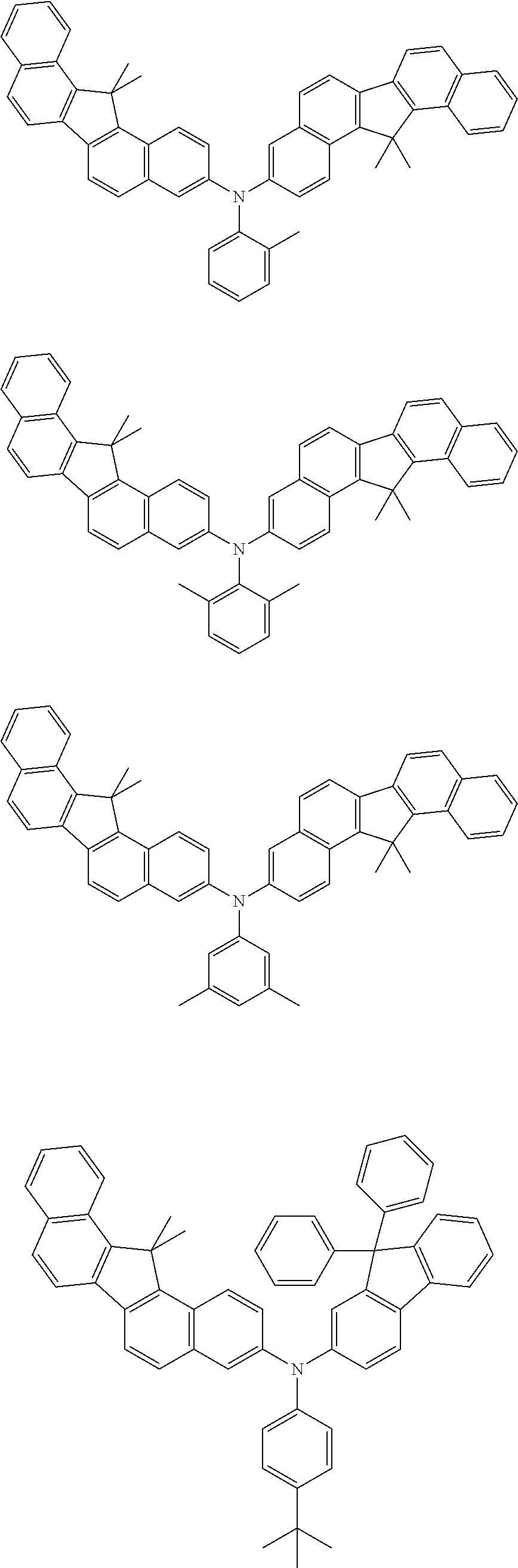


Organic Electroluminescence Device


Evaluation of Organic EL Device

| TABLE 1 | |||
| Chromaticity | |||
| CIEx | CIEy | ||
| Example 3 | |
0.140 | 0.094 | ||
| Comparative | Comparative | 0.143 | 0.110 | ||
| Example 3 | |
||||
- 1: Organic EL device
- 2: Substrate
- 3: Anode
- 4: Cathode
- 5: Light emitting layer
- 6: Anode-side organic thin film layer
- 7: Cathode-side organic thin film layer
- 10: Emission unit
Claims (20)


Applications Claiming Priority (3)
| Application Number | Priority Date | Filing Date | Title |
|---|---|---|---|
| JP2014208414 | 2014-10-09 | ||
| JP2014-208414 | 2014-10-09 | ||
| PCT/JP2015/078692 WO2016056640A1 (en) | 2014-10-09 | 2015-10-08 | Compound, organic electroluminescent element material, organic electroluminescent element, and electronic apparatus |
Publications (2)
| Publication Number | Publication Date |
|---|---|
| US20170222144A1 US20170222144A1 (en) | 2017-08-03 |
| US10547007B2 true US10547007B2 (en) | 2020-01-28 |
Family
ID=55653244
Family Applications (1)
| Application Number | Title | Priority Date | Filing Date |
|---|---|---|---|
| US15/502,401 Expired - Fee Related US10547007B2 (en) | 2014-10-09 | 2015-10-08 | Compound, organic electroluminescent material, organic electroluminescent element, and electronic apparatus |
Country Status (2)
| Country | Link |
|---|---|
| US (1) | US10547007B2 (en) |
| WO (1) | WO2016056640A1 (en) |
Families Citing this family (4)
| Publication number | Priority date | Publication date | Assignee | Title |
|---|---|---|---|---|
| KR102847917B1 (en) * | 2016-05-03 | 2025-08-20 | 듀폰스페셜티머터리얼스코리아 유한회사 | Organic electroluminescent compound and organic electroluminescent device comprising the same |
| CN106972111B (en) * | 2017-06-01 | 2018-11-20 | 上海天马有机发光显示技术有限公司 | Organic luminescent device and display device |
| US11177446B2 (en) | 2017-09-14 | 2021-11-16 | Beijing Summer Sprout Technology Co., Ltd. | Silicon containing organic fluorescent materials |
| CN113372313B (en) * | 2021-07-02 | 2022-08-12 | 长春海谱润斯科技股份有限公司 | Triarylamine compound and organic electroluminescent device thereof |
Citations (9)
| Publication number | Priority date | Publication date | Assignee | Title |
|---|---|---|---|---|
| US20030118866A1 (en) * | 2001-10-30 | 2003-06-26 | Lg Electronics Inc. | Organic electroluminescent device |
| WO2008006449A1 (en) | 2006-07-11 | 2008-01-17 | Merck Patent Gmbh | Novel materials for organic electroluminescent devices |
| JP2008115093A (en) | 2006-11-01 | 2008-05-22 | Idemitsu Kosan Co Ltd | Aminodibenzofluorene derivative and organic electroluminescence device using the same |
| US20080145708A1 (en) * | 2005-04-14 | 2008-06-19 | Merck Patent Gmbh | Compounds For Organic Electronic Devices |
| KR20120112257A (en) | 2011-04-01 | 2012-10-11 | 에스에프씨 주식회사 | New compounds and organic light-emitting diode including the same |
| WO2014037077A1 (en) | 2012-09-04 | 2014-03-13 | Merck Patent Gmbh | Connections for electronic devices |
| WO2014069602A1 (en) | 2012-11-02 | 2014-05-08 | 出光興産株式会社 | Organic electroluminescence element |
| US20140131681A1 (en) * | 2012-11-02 | 2014-05-15 | Idemitsu Kosan Co., Ltd. | Organic electroluminescent device |
| WO2014106522A1 (en) | 2013-01-03 | 2014-07-10 | Merck Patent Gmbh | Materials for electronic devices |
Family Cites Families (1)
| Publication number | Priority date | Publication date | Assignee | Title |
|---|---|---|---|---|
| US20090026749A1 (en) * | 2007-07-27 | 2009-01-29 | Sandvik Innovations, Llc | Interactive book having electronic circuits triggered by levels of illumination |
-
2015
- 2015-10-08 US US15/502,401 patent/US10547007B2/en not_active Expired - Fee Related
- 2015-10-08 WO PCT/JP2015/078692 patent/WO2016056640A1/en not_active Ceased
Patent Citations (11)
| Publication number | Priority date | Publication date | Assignee | Title |
|---|---|---|---|---|
| US20030118866A1 (en) * | 2001-10-30 | 2003-06-26 | Lg Electronics Inc. | Organic electroluminescent device |
| US20080145708A1 (en) * | 2005-04-14 | 2008-06-19 | Merck Patent Gmbh | Compounds For Organic Electronic Devices |
| WO2008006449A1 (en) | 2006-07-11 | 2008-01-17 | Merck Patent Gmbh | Novel materials for organic electroluminescent devices |
| JP2008115093A (en) | 2006-11-01 | 2008-05-22 | Idemitsu Kosan Co Ltd | Aminodibenzofluorene derivative and organic electroluminescence device using the same |
| US20090267491A1 (en) | 2006-11-01 | 2009-10-29 | Idemitsu Kosan Co., Ltd. | Aminodibenzofluorene derivative and organic electroluminescence device using the same |
| KR20120112257A (en) | 2011-04-01 | 2012-10-11 | 에스에프씨 주식회사 | New compounds and organic light-emitting diode including the same |
| WO2014037077A1 (en) | 2012-09-04 | 2014-03-13 | Merck Patent Gmbh | Connections for electronic devices |
| US20150255720A1 (en) | 2012-09-04 | 2015-09-10 | Merck Patent Gmbh | Compounds for Electronic Devices |
| WO2014069602A1 (en) | 2012-11-02 | 2014-05-08 | 出光興産株式会社 | Organic electroluminescence element |
| US20140131681A1 (en) * | 2012-11-02 | 2014-05-15 | Idemitsu Kosan Co., Ltd. | Organic electroluminescent device |
| WO2014106522A1 (en) | 2013-01-03 | 2014-07-10 | Merck Patent Gmbh | Materials for electronic devices |
Non-Patent Citations (1)
| Title |
|---|
| International Search Report dated Dec. 22, 2015 in PCT/JP2015/078692 filed Oct. 8, 2015. |
Also Published As
| Publication number | Publication date |
|---|---|
| WO2016056640A1 (en) | 2016-04-14 |
| US20170222144A1 (en) | 2017-08-03 |
Similar Documents
| Publication | Publication Date | Title |
|---|---|---|
| US10424740B2 (en) | Compound, material for organic electroluminescence devices, organic electroluminescence device, and electronic device | |
| US12384739B2 (en) | Compound, material for organic electroluminescent elements, organic electroluminescent element and electronic device | |
| US10243148B2 (en) | Aromatic amine compound, and organic electroluminescent elements including the compound | |
| US11283025B2 (en) | Compound, material for organic electroluminescence elements, organic electroluminescence element, and electronic device | |
| US11479544B2 (en) | Compound, material for organic electroluminescence element, organic electroluminescence element, and electronic device | |
| US11053229B2 (en) | Compound, material for organic electroluminescent element, organic electroluminescent element, and electronic device | |
| US11616200B2 (en) | Compound, material for organic electroluminescent element, organic electroluminescent element, and electronic apparatus | |
| US20210094937A1 (en) | Compound, material for organic electroluminescent elements, organic electroluminescent element, and electronic device | |
| US12615959B2 (en) | Organic electroluminescence device and electronic apparatus provided with the same | |
| WO2018164265A1 (en) | Compound, organic electroluminescent element material, organic electroluminescent element, and electronic device | |
| US12428409B2 (en) | Compound, material for organic electroluminescent elements, organic electroluminescent element, and electronic device | |
| US10840456B2 (en) | Compound, material for organic electroluminescence devices, organic electroluminescence device, and electronic device | |
| US12590076B2 (en) | Compound, material for organic electroluminescent element, organic electroluminescent element, and electronic device | |
| US11903308B2 (en) | Compound, material for organic electroluminescent element, organic electroluminescent element, and electronic device | |
| US10170707B2 (en) | Compound, material for organic electroluminescence element, organic electroluminescence element, and electronic device | |
| US12069943B2 (en) | Compound, material for organic electroluminescent elements, organic electroluminescent element, and electronic device | |
| US20250230167A1 (en) | Compound, material for organic electroluminescent elements, organic electroluminescent element, and electronic device | |
| US20180219157A1 (en) | Compound, material for organic electroluminescence elements, organic electroluminescence element, and electronic device | |
| US10547007B2 (en) | Compound, organic electroluminescent material, organic electroluminescent element, and electronic apparatus | |
| US20220359831A1 (en) | Compound, material for organic electroluminescent elements, organic electroluminescent element, and electronic device | |
| US20240140904A1 (en) | Compound, material for organic electroluminescent elements, organic electroluminescent element, and electronic device | |
| US20220289717A1 (en) | Compound, mixture thereof, material for organic electroluminescence device, organic electroluminescence device, and electronic device | |
| US20230301176A1 (en) | Compound, material for organic electroluminescence elements, organic electroluminescence element, and electronic device | |
| US20240188425A1 (en) | Compound, material for organic electroluminescent elements, organic electroluminescent element, and electronic device | |
| US20230389347A1 (en) | Compound, material for organic electroluminescent elements, organic electroluminescent element, and electronic device |
Legal Events
| Date | Code | Title | Description |
|---|---|---|---|
| AS | Assignment |
Owner name: IDEMITSU KOSAN CO., LTD., JAPAN Free format text: ASSIGNMENT OF ASSIGNORS INTEREST;ASSIGNORS:HAKETA, TASUKU;ITO, HIROKATSU;KUDO, YU;AND OTHERS;REEL/FRAME:041195/0708 Effective date: 20161221 |
|
| STPP | Information on status: patent application and granting procedure in general |
Free format text: DOCKETED NEW CASE - READY FOR EXAMINATION |
|
| STPP | Information on status: patent application and granting procedure in general |
Free format text: NON FINAL ACTION MAILED |
|
| STPP | Information on status: patent application and granting procedure in general |
Free format text: RESPONSE TO NON-FINAL OFFICE ACTION ENTERED AND FORWARDED TO EXAMINER |
|
| STPP | Information on status: patent application and granting procedure in general |
Free format text: NOTICE OF ALLOWANCE MAILED -- APPLICATION RECEIVED IN OFFICE OF PUBLICATIONS |
|
| STPP | Information on status: patent application and granting procedure in general |
Free format text: PUBLICATIONS -- ISSUE FEE PAYMENT RECEIVED |
|
| STCF | Information on status: patent grant |
Free format text: PATENTED CASE |
|
| CC | Certificate of correction | ||
| FEPP | Fee payment procedure |
Free format text: MAINTENANCE FEE REMINDER MAILED (ORIGINAL EVENT CODE: REM.); ENTITY STATUS OF PATENT OWNER: LARGE ENTITY |
|
| LAPS | Lapse for failure to pay maintenance fees |
Free format text: PATENT EXPIRED FOR FAILURE TO PAY MAINTENANCE FEES (ORIGINAL EVENT CODE: EXP.); ENTITY STATUS OF PATENT OWNER: LARGE ENTITY |
|
| STCH | Information on status: patent discontinuation |
Free format text: PATENT EXPIRED DUE TO NONPAYMENT OF MAINTENANCE FEES UNDER 37 CFR 1.362 |
|
| FP | Lapsed due to failure to pay maintenance fee |
Effective date: 20240128 |