US10544338B2 - Tape adhesive for an insulating tape in an insulation system and an insulation system - Google Patents
Tape adhesive for an insulating tape in an insulation system and an insulation system Download PDFInfo
- Publication number
- US10544338B2 US10544338B2 US15/560,652 US201615560652A US10544338B2 US 10544338 B2 US10544338 B2 US 10544338B2 US 201615560652 A US201615560652 A US 201615560652A US 10544338 B2 US10544338 B2 US 10544338B2
- Authority
- US
- United States
- Prior art keywords
- tape adhesive
- tape
- accelerator
- blend
- anhydride
- Prior art date
- Legal status (The legal status is an assumption and is not a legal conclusion. Google has not performed a legal analysis and makes no representation as to the accuracy of the status listed.)
- Active, expires
Links
- 0 CC(COC1CCCCC1O)(COC1CCCCC1O)COC1CCCCC1O.OC1CCCCC1CO/C=C\COC1CCCCC1O.OC1CCCCC1OC1ccC(OC2CCCCC2O)C1.OC1CCCCC1OCC#CCOC1CCCCC1O.OC1CCCCC1OCC(COC1CCCCC1O)OC1CCCCC1O.OC1CCCCC1OCCOCCOC1CCCCC1O.OC1CCCCC1OCCOCCOCCOC1CCCCC1O.OC1CCCCC1Oc1c(OC2CCCCC2O)CCC1.[1*]C.[1*]C.[1*]C.[1*]C.[1*]C.[1*]C.[1*]C.[1*]C.[1*]C.[1*]C.[1*]C.[1*]C.[1*]C.[1*]C.[1*]C.[1*]C.[1*]C.[1*]C.[1*]C.[1*]C.[2*]C([3*])(COC1CCCCC1O)OC1CCCCC1O Chemical compound CC(COC1CCCCC1O)(COC1CCCCC1O)COC1CCCCC1O.OC1CCCCC1CO/C=C\COC1CCCCC1O.OC1CCCCC1OC1ccC(OC2CCCCC2O)C1.OC1CCCCC1OCC#CCOC1CCCCC1O.OC1CCCCC1OCC(COC1CCCCC1O)OC1CCCCC1O.OC1CCCCC1OCCOCCOC1CCCCC1O.OC1CCCCC1OCCOCCOCCOC1CCCCC1O.OC1CCCCC1Oc1c(OC2CCCCC2O)CCC1.[1*]C.[1*]C.[1*]C.[1*]C.[1*]C.[1*]C.[1*]C.[1*]C.[1*]C.[1*]C.[1*]C.[1*]C.[1*]C.[1*]C.[1*]C.[1*]C.[1*]C.[1*]C.[1*]C.[1*]C.[2*]C([3*])(COC1CCCCC1O)OC1CCCCC1O 0.000 description 3
Classifications
-
- C—CHEMISTRY; METALLURGY
- C09—DYES; PAINTS; POLISHES; NATURAL RESINS; ADHESIVES; COMPOSITIONS NOT OTHERWISE PROVIDED FOR; APPLICATIONS OF MATERIALS NOT OTHERWISE PROVIDED FOR
- C09J—ADHESIVES; NON-MECHANICAL ASPECTS OF ADHESIVE PROCESSES IN GENERAL; ADHESIVE PROCESSES NOT PROVIDED FOR ELSEWHERE; USE OF MATERIALS AS ADHESIVES
- C09J171/00—Adhesives based on polyethers obtained by reactions forming an ether link in the main chain; Adhesives based on derivatives of such polymers
- C09J171/02—Polyalkylene oxides
-
- B—PERFORMING OPERATIONS; TRANSPORTING
- B32—LAYERED PRODUCTS
- B32B—LAYERED PRODUCTS, i.e. PRODUCTS BUILT-UP OF STRATA OF FLAT OR NON-FLAT, e.g. CELLULAR OR HONEYCOMB, FORM
- B32B19/00—Layered products comprising a layer of natural mineral fibres or particles, e.g. asbestos, mica
- B32B19/02—Layered products comprising a layer of natural mineral fibres or particles, e.g. asbestos, mica the layer of fibres or particles being impregnated or embedded in a plastic substance
-
- C—CHEMISTRY; METALLURGY
- C08—ORGANIC MACROMOLECULAR COMPOUNDS; THEIR PREPARATION OR CHEMICAL WORKING-UP; COMPOSITIONS BASED THEREON
- C08G—MACROMOLECULAR COMPOUNDS OBTAINED OTHERWISE THAN BY REACTIONS ONLY INVOLVING UNSATURATED CARBON-TO-CARBON BONDS
- C08G65/00—Macromolecular compounds obtained by reactions forming an ether link in the main chain of the macromolecule
- C08G65/02—Macromolecular compounds obtained by reactions forming an ether link in the main chain of the macromolecule from cyclic ethers by opening of the heterocyclic ring
- C08G65/26—Macromolecular compounds obtained by reactions forming an ether link in the main chain of the macromolecule from cyclic ethers by opening of the heterocyclic ring from cyclic ethers and other compounds
- C08G65/2603—Macromolecular compounds obtained by reactions forming an ether link in the main chain of the macromolecule from cyclic ethers by opening of the heterocyclic ring from cyclic ethers and other compounds the other compounds containing oxygen
- C08G65/2606—Macromolecular compounds obtained by reactions forming an ether link in the main chain of the macromolecule from cyclic ethers by opening of the heterocyclic ring from cyclic ethers and other compounds the other compounds containing oxygen containing hydroxyl groups
-
- C—CHEMISTRY; METALLURGY
- C08—ORGANIC MACROMOLECULAR COMPOUNDS; THEIR PREPARATION OR CHEMICAL WORKING-UP; COMPOSITIONS BASED THEREON
- C08G—MACROMOLECULAR COMPOUNDS OBTAINED OTHERWISE THAN BY REACTIONS ONLY INVOLVING UNSATURATED CARBON-TO-CARBON BONDS
- C08G65/00—Macromolecular compounds obtained by reactions forming an ether link in the main chain of the macromolecule
- C08G65/02—Macromolecular compounds obtained by reactions forming an ether link in the main chain of the macromolecule from cyclic ethers by opening of the heterocyclic ring
- C08G65/26—Macromolecular compounds obtained by reactions forming an ether link in the main chain of the macromolecule from cyclic ethers by opening of the heterocyclic ring from cyclic ethers and other compounds
- C08G65/2603—Macromolecular compounds obtained by reactions forming an ether link in the main chain of the macromolecule from cyclic ethers by opening of the heterocyclic ring from cyclic ethers and other compounds the other compounds containing oxygen
- C08G65/2606—Macromolecular compounds obtained by reactions forming an ether link in the main chain of the macromolecule from cyclic ethers by opening of the heterocyclic ring from cyclic ethers and other compounds the other compounds containing oxygen containing hydroxyl groups
- C08G65/2612—Macromolecular compounds obtained by reactions forming an ether link in the main chain of the macromolecule from cyclic ethers by opening of the heterocyclic ring from cyclic ethers and other compounds the other compounds containing oxygen containing hydroxyl groups containing aromatic or arylaliphatic hydroxyl groups
-
- C—CHEMISTRY; METALLURGY
- C09—DYES; PAINTS; POLISHES; NATURAL RESINS; ADHESIVES; COMPOSITIONS NOT OTHERWISE PROVIDED FOR; APPLICATIONS OF MATERIALS NOT OTHERWISE PROVIDED FOR
- C09J—ADHESIVES; NON-MECHANICAL ASPECTS OF ADHESIVE PROCESSES IN GENERAL; ADHESIVE PROCESSES NOT PROVIDED FOR ELSEWHERE; USE OF MATERIALS AS ADHESIVES
- C09J171/00—Adhesives based on polyethers obtained by reactions forming an ether link in the main chain; Adhesives based on derivatives of such polymers
-
- H—ELECTRICITY
- H01—ELECTRIC ELEMENTS
- H01B—CABLES; CONDUCTORS; INSULATORS; SELECTION OF MATERIALS FOR THEIR CONDUCTIVE, INSULATING OR DIELECTRIC PROPERTIES
- H01B3/00—Insulators or insulating bodies characterised by the insulating materials; Selection of materials for their insulating or dielectric properties
- H01B3/02—Insulators or insulating bodies characterised by the insulating materials; Selection of materials for their insulating or dielectric properties mainly consisting of inorganic substances
- H01B3/04—Insulators or insulating bodies characterised by the insulating materials; Selection of materials for their insulating or dielectric properties mainly consisting of inorganic substances mica
-
- H—ELECTRICITY
- H01—ELECTRIC ELEMENTS
- H01B—CABLES; CONDUCTORS; INSULATORS; SELECTION OF MATERIALS FOR THEIR CONDUCTIVE, INSULATING OR DIELECTRIC PROPERTIES
- H01B3/00—Insulators or insulating bodies characterised by the insulating materials; Selection of materials for their insulating or dielectric properties
- H01B3/18—Insulators or insulating bodies characterised by the insulating materials; Selection of materials for their insulating or dielectric properties mainly consisting of organic substances
- H01B3/30—Insulators or insulating bodies characterised by the insulating materials; Selection of materials for their insulating or dielectric properties mainly consisting of organic substances plastics; resins; waxes
- H01B3/40—Insulators or insulating bodies characterised by the insulating materials; Selection of materials for their insulating or dielectric properties mainly consisting of organic substances plastics; resins; waxes epoxy resins
-
- H—ELECTRICITY
- H01—ELECTRIC ELEMENTS
- H01B—CABLES; CONDUCTORS; INSULATORS; SELECTION OF MATERIALS FOR THEIR CONDUCTIVE, INSULATING OR DIELECTRIC PROPERTIES
- H01B3/00—Insulators or insulating bodies characterised by the insulating materials; Selection of materials for their insulating or dielectric properties
- H01B3/18—Insulators or insulating bodies characterised by the insulating materials; Selection of materials for their insulating or dielectric properties mainly consisting of organic substances
- H01B3/30—Insulators or insulating bodies characterised by the insulating materials; Selection of materials for their insulating or dielectric properties mainly consisting of organic substances plastics; resins; waxes
- H01B3/42—Insulators or insulating bodies characterised by the insulating materials; Selection of materials for their insulating or dielectric properties mainly consisting of organic substances plastics; resins; waxes polyesters; polyethers; polyacetals
- H01B3/427—Polyethers
Definitions
- the invention relates to a tape adhesive for an insulating tape in an insulation system and to an insulation system, especially an insulation system for electrical machines in the high-voltage sector from 1 kV upward, comprising an anhydride-free impregnating resin, for example an impregnating resin having oxirane functionalities.
- Electrical machines contain in the multitude of longitudinal grooves in the laminated stator core, special kinds of coil windings. These coils are generally made of copper, which produce a magnetic field that propagates in all directions by virtue of time-selective applications of current. This field in turn drives the freely rotating rotor suspended in the stator bore, the rotor being able to react to the induced magnetic field in the form of forced rotation, for example, by virtue of a multitude of applied permanent magnets. Thus, electrical energy can be converted to kinetic energy.
- the laminated stator core is at ground potential, and the coils by contrast at a high kilovolt potential.
- the coils in the stator grooves must accordingly be electrically insulated with respect to ground.
- each and every coil is insulated with a special mica paper-based tape (“mica tape”) multiple times with a defined overlap.
- Mica is used since it is an inorganic solid insulation material in platelet form that is capable of retarding electrical erosion under electrical partial discharge scenarios for a long periods, and has good chemical and thermal stability.
- Mica tapes consist, for example, of mica paper and one or more carriers (e.g., foil) joined to one another via a tape adhesive. Mica tapes are used with preference over mica paper, since mica paper alone does not have the mechanical strength necessary for an insulation process.
- accelerators may be added that have a catalytic effect on the thermal curing of an impregnating agent subsequently applied externally after the coils insulated with mica tape have been fitted into the laminated stator cores and electrically connected.
- accelerators may be added that have a catalytic effect on the thermal curing of an impregnating agent subsequently applied externally after the coils insulated with mica tape have been fitted into the laminated stator cores and electrically connected.
- the air in the voids of the windings and especially in the groove gaps of the laminated stator core is displaced by the impregnating agent. Since this distance from insulated coil to which current is applied to the laminated core is generally kept as small as possible, field strengths of several kV/mm are by no means rare at that point.
- the insulation material has to be chosen accordingly.
- Thermally curable epoxy resin/anhydride mixtures have been found to be reliable for these purposes.
- the stators from the electrical machines composed of their individual parts, together with the fitted and mica tape-insulated coils, are wholly flooded according to the prior art with a mobile epoxy resin/phthalic anhydride formulation in a vacuum chamber and then impregnated under pressure.
- a mobile epoxy resin/phthalic anhydride formulation in a vacuum chamber and then impregnated under pressure.
- the final curing is generally effected under standard pressure in an industrial kiln.
- the accelerator in the mica tape here has the task of gelation and curing the impregnating resin applied, which has to date always been epoxy resin with phthalic anhydride, within a desired period of time at a defined temperature.
- the impregnating agent which has become established as the industrial standard is a mixture of distilled bisphenol A diglycidyl ether and methylhexahydro-phthalic anhydride; this very mobile formulation which, in the absence of accelerator substances, has a desirably long storage stability at impregnation temperature (for example doubling of the initial viscosity only after several weeks), but reacts rapidly to give the high polymer in the presence of catalytically active species.
- the tape adhesive and tape accelerator should be inert with respect to one another. Ideally, all three components (tape adhesive, tape accelerator and impregnating agent) only react with one another at the moment of encounter during the VPI process. This achieves the best possible crosslinking and binding, compatibility and ultimately freedom from faults and cavities and hence long electrical lifetimes of the “main insulation” of the electrical machine that is the ultimate result of the curing.
- the impregnating agent (“impregnating resin”) has to date always still been an epoxy resin/phthalic anhydride mixture
- an amine derivative is often the method of choice for initiation of curing.
- the tape accelerator is frequently a substituted amine, for example based on a piperazine or the like, because it is possible by virtue of this species to establish comparatively high glass transition temperatures in epoxy resin/anhydride mixtures on thermal curing.
- zinc naphthenate is an established tape accelerator.
- the tape adhesive is ideally likewise oxirane-functional for optimal compatibility or reaction with the impregnating resin, a problem that arises is that of storage stability in the mica tape.
- accelerators that initiate anionic and/or cationic polymerization mechanisms are used, and are therefore found to be less inert with respect to the conventional tape adhesives than with respect to an accelerator for an acid anhydride/reactive resin mixture.
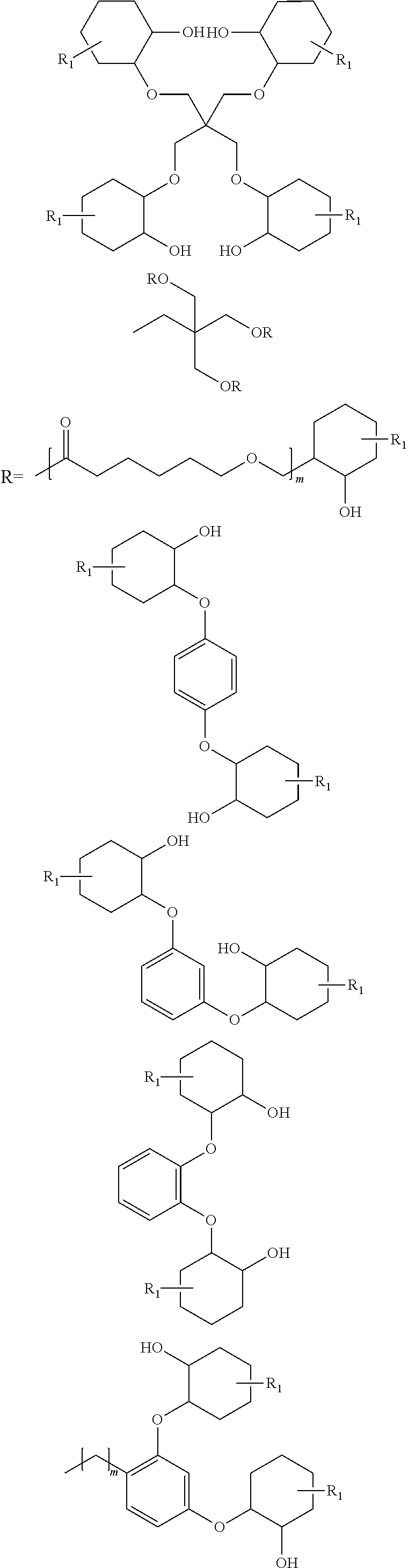
- the present invention provides a tape adhesive for an insulation system, the tape adhesive having a dynamic viscosity of 1-100 Pa*s at impregnation temperature, which may comprise an addition product formed from a bisphenol, diol, triol and/or higher alcohol, referred to hereinafter as an “A(OH) n ” segment, with cyclohexene oxide or a cyclohexene oxide derivative, referred to hereinafter as a “Cy” segment.
- Embodiments of the invention may also provide an insulation system comprising a solid insulation material, an anhydride-free impregnating resin, an accelerator and a tape adhesive.
- the present invention for the first time provides a tape adhesive suitable for impregnating processes for an insulation system, comprising solid insulation material such as mica, an anhydride-free impregnating resin and an accelerator for the anhydride-free impregnating resin, wherein the tape adhesive is adjusted with respect to the reactivity of an accelerator or curing catalyst of an anhydride-free impregnating resin in relation to the storage stability of the overall system.
- the present invention is directed to an insulation system that may comprise a solid insulation material, an anhydride-free impregnating resin, an accelerator, and an oxirane group free tape adhesive having a viscosity of about 5 to about 20 Pa*s at about 70° C.
- the present invention is directed to an insulation system comprising a solid insulation material, an anhydride-free impregnating resin, an accelerator, and a tape adhesive
- the tape adhesive comprises an addition product formed from an A(OH) n segment comprising bisphenols, diols, triols and/or higher alcohols, with a Cy segment comprising a cyclohexene oxide, a cyclohexene oxide derivative, or mixtures of a cyclohexene oxide and a cyclohexene oxide derivative.
- the tape adhesive has a dynamic viscosity of 1-100 Pa*s at impregnation temperature.
- A(OH) n Suitable examples of A(OH) n are:
- the tape adhesive has a viscosity of 5-20 Pa*s at about 70° C.
- compounds suitable as tape adhesives are react with anionically and/or cationically curing accelerator substances for conventional 1,2-diepoxides, especially of bisphenol A diglycidyl ether and/or bisphenol F diglycidyl ether having repeat units n ⁇ 0.
- the tape adhesive of the present invention is free of oxirane groups.
- accelerators with relatively high vacuum stability that initiate anionic polymerization for example tri-N-methylpiperazine derivative of TMPT, give the required storage stability of the mica insulation tape with tape adhesives that are free of oxirane groups.
- cyclohexene oxide and/or a cyclohexene oxide derivatized on the aliphatic cycle only have one oxirane group each, the reaction of these epoxy groups with the hydroxyl groups of the A(OH) n segment does not give any cycloaliphatic oxirane groups capable of reaction at a later stage, which can react with anionic and/or cationically mediating accelerator substances in the insulation tape.
- he synthesis of the tape adhesive substances of the invention is possible, for example, by reaction of the particular A(OH) n reactant with cyclohexene oxide and/or a cyclohexene oxide derivative.
- these novel tape adhesive derivatives are additionally also capable of being polymerized into ionically curing, especially phthalic anhydride-free formulations.
- novel tape adhesives of the present invention are likewise also suitable as carriers or encapsulations for ionically active accelerator types, for instance hexafluoroantimonates, tetrafluoroborates and hexafluorophosphates and/or sulfonium derivatives as representatives of what are called superacids or superacid salts, but also for more vacuum-stable alkylmethyl-imidazoles, especially 1-decyl-2-methylimidazole.
- ionically active accelerator types for instance hexafluoroantimonates, tetrafluoroborates and hexafluorophosphates and/or sulfonium derivatives as representatives of what are called superacids or superacid salts, but also for more vacuum-stable alkylmethyl-imidazoles, especially 1-decyl-2-methylimidazole.
- these show only marginal catalysis, if any, of the bimolecular hydroxyl etherification reaction with compounds containing hydroxyl groups even at elevated temperature around 70° C.
- the tape adhesive is a substance which is viscous to highly viscous or has solidified in amorphous form at room temperature, which takes the form, for example, of a blend with one or more accelerators that are solid or liquid at room temperature in a content of 50%-99.5% by weight, preferably of 60%-95% by weight, especially preferably of 70%-90% by weight.
- the accelerator used may, for example, be an ionically active curing catalyst, for example an organic and/or inorganic superacid or a superacid salt, an alkylimidazole and/or an alkylimidazole derivative, alkylpyrazole and/or an alkylpyrazole derivative etc.
- an ionically active curing catalyst for example an organic and/or inorganic superacid or a superacid salt, an alkylimidazole and/or an alkylimidazole derivative, alkylpyrazole and/or an alkylpyrazole derivative etc.
- the impregnating agent used in preferred embodiments is an anhydride-free impregnating resin;
- the impregnating resin may comprise one or more compounds selected from the group of the following compounds: undistilled and/or distilled, optionally reactively diluted bisphenol A diglycidyl ether, undistilled and/or distilled, optionally reactively diluted bisphenol F diglycidyl ether, hydrogenated bisphenol A diglycidyl ether and/or hydrogenated bisphenol F diglycidyl ether, pure and/or solvent-thinned epoxy novolak and/or epoxy-phenol novolak, cycloaliphatic epoxy resins such as 3,4-epoxycyclohexylmethyl 3,4-epoxycyclohexylcarboxylate, e.g.
- ERL-4221 bis(3,4-epoxycyclohexylmethyl) adipate, e.g. ERL-4299; Celloxide 2081, vinylcyclohexene diepoxide, e.g. ERL-4206; Celloxide 2000, 2-(3,4-epoxycyclohexyl-5,5-spiro-3,4-epoxy)-cyclohexane-meta-dioxane, e.g. ERL-4234; diglycidyl hexahydro-phthalate, e.g.
- N,N-diglycidyl-para-glycidyloxyaniline e.g. MY0500, MY0510, N,N-diglycidyl-meta-glycidyloxyaniline, e.g. MY0600, MY0610, N,N,N′
- the present invention for the first time provides a tape adhesive suitable for conventional impregnating processes for an insulation system, comprising solid insulation material such as mica, an anhydride-free impregnating resin and an accelerator for the anhydride-free impregnating resin, wherein the tape adhesive is adjusted with respect to the reactivity of an accelerator or curing catalyst of an anhydride-free impregnating resin in relation to the storage stability of the overall system.
Landscapes
- Chemical & Material Sciences (AREA)
- Chemical Kinetics & Catalysis (AREA)
- Organic Chemistry (AREA)
- Health & Medical Sciences (AREA)
- Medicinal Chemistry (AREA)
- Polymers & Plastics (AREA)
- Inorganic Chemistry (AREA)
- Physics & Mathematics (AREA)
- Spectroscopy & Molecular Physics (AREA)
- Adhesives Or Adhesive Processes (AREA)
- Insulation, Fastening Of Motor, Generator Windings (AREA)
- Insulating Bodies (AREA)
Abstract
Description
-
- monoethylene glycol (C2H4) (OH)2, butanediols (C4H8) (OH)2, butenediols (C4H6) (OH)2, butynediol (C4H4) (OH)2, polyethylene glycols H(OC2H4)x (OH)2 with x=1 to 5000, propylene glycol (C3H6) (OH)2, polypropylene glycols H(OC3H6)x (OH)2 with x=1 to 5000, diethylene glycol (C2H8O) (OH)2, propanediols (C3H6) (OH)2, neopentyl glycol (C5H10) (OH)2, cyclopentanediols (C5H8) (OH)2, cyclopentenediols (C5H6) (OH)2, glycerol (C3H5) (OH)3, pentanediols (C5H10) (OH)2, pentaerythritol (C5H8) (OH)4, hexanediols (C6H12) (OH)2, hexylene glycols (C6H12) (OH)2, heptanediols (C7H14) (OH)2, octanediols (C8H16) (OH)2, polycaprolactonediols, polycaprolactonetriols, hydroquinone (C6H4) (OH)2, resorcinol (C6H4) (OH)2, (pyro)catechol (C6H4) (OH)2, rucinol (C10H12) (OH)2, triethylene glycol (C6H12) (OH)2,
- fully aromatic, partly hydrogenated and/or fully hydrogenated bisphenol A (C15H14) (OH)2, (C15H28) (OH)2, bisphenol F (C13H10) (OH)2, bisphenol S (C12H8O2S) (OH)2,
- tricyclodecanedimethanol (C12H18) (OH)2, glycerol carbonate (C4H5) (OH)1.


Claims (10)
Applications Claiming Priority (4)
| Application Number | Priority Date | Filing Date | Title |
|---|---|---|---|
| DE102015205328.8A DE102015205328A1 (en) | 2015-03-24 | 2015-03-24 | Tape adhesive for an insulating tape in an insulation system and insulation system |
| DE102015205328.8 | 2015-03-24 | ||
| DE102015205328 | 2015-03-24 | ||
| PCT/EP2016/055557 WO2016150764A1 (en) | 2015-03-24 | 2016-03-15 | Tape adhesive for an insulating tape in an insulation system and insulation system |
Publications (2)
| Publication Number | Publication Date |
|---|---|
| US20180094177A1 US20180094177A1 (en) | 2018-04-05 |
| US10544338B2 true US10544338B2 (en) | 2020-01-28 |
Family
ID=55640703
Family Applications (1)
| Application Number | Title | Priority Date | Filing Date |
|---|---|---|---|
| US15/560,652 Active 2036-08-19 US10544338B2 (en) | 2015-03-24 | 2016-03-15 | Tape adhesive for an insulating tape in an insulation system and an insulation system |
Country Status (7)
| Country | Link |
|---|---|
| US (1) | US10544338B2 (en) |
| EP (1) | EP3245063B1 (en) |
| CN (1) | CN107429139B (en) |
| BR (1) | BR112017019546B1 (en) |
| DE (1) | DE102015205328A1 (en) |
| RU (1) | RU2692730C2 (en) |
| WO (1) | WO2016150764A1 (en) |
Families Citing this family (10)
| Publication number | Priority date | Publication date | Assignee | Title |
|---|---|---|---|---|
| DE102015205328A1 (en) | 2015-03-24 | 2016-09-29 | Siemens Aktiengesellschaft | Tape adhesive for an insulating tape in an insulation system and insulation system |
| DE102015213535A1 (en) | 2015-07-17 | 2017-01-19 | Siemens Aktiengesellschaft | Solid insulation material, use for this purpose and insulation system manufactured therewith |
| DE102015213815A1 (en) | 2015-07-17 | 2017-01-19 | Siemens Aktiengesellschaft | Solid insulation material, use for this purpose and insulation system manufactured therewith |
| DE102015213537A1 (en) | 2015-07-17 | 2017-01-19 | Siemens Aktiengesellschaft | Solid, in particular band-shaped, insulating material, formulation for an impregnating agent for producing an insulation system in a Vakuumimprägnierverfahren with it and machines with such insulation system |
| DE102016203867A1 (en) | 2016-03-09 | 2017-09-14 | Siemens Aktiengesellschaft | Solid insulation material, use for this purpose and insulation system manufactured therewith |
| US20200058416A1 (en) * | 2016-11-01 | 2020-02-20 | Huntsman Advanced Materials Licensing (Switzerland) Gmbh | Electrical Insulation System Based on Epoxy Resins for Generators and Motors |
| DE102017201498A1 (en) | 2017-01-31 | 2018-08-02 | Siemens Aktiengesellschaft | Winding tape insulation system for electrical machines, use thereof as well as electrical machine |
| EP3716290A1 (en) * | 2019-03-28 | 2020-09-30 | Siemens Aktiengesellschaft | Formulation for an insulation system, insulation system thereof, and electric machine with insulation system |
| EP4003954A1 (en) | 2019-09-04 | 2022-06-01 | Siemens Aktiengesellschaft | Tape accelerator and use thereof, solid insulating material, and anhydride-free insulation system |
| EP3996113A1 (en) * | 2020-11-05 | 2022-05-11 | Siemens Aktiengesellschaft | Shielding stripe for rotary electric high voltage machine, use of same and electric machine |
Citations (9)
| Publication number | Priority date | Publication date | Assignee | Title |
|---|---|---|---|---|
| US2656290A (en) * | 1948-10-28 | 1953-10-20 | Westinghouse Electric Corp | Processes for producing electrical coils insulated with mica and synthetic resins and the products thereof |
| US3556925A (en) | 1961-06-23 | 1971-01-19 | Siemens Ag | Method of producing an insulating sleeve of mica tape impregnated with thermosetting epoxide impregnating resin mixture and product thereof |
| WO1990000802A1 (en) | 1988-07-14 | 1990-01-25 | Siemens Aktiengesellschaft | Insulating tape for making an insulating sheath impregnated with a heat-curing epoxide resin/acid anhydride mixture for electrical conductors |
| US6140590A (en) | 1997-05-16 | 2000-10-31 | Abb Research Ltd. | Stator winding insulation |
| US6774250B1 (en) | 1999-06-12 | 2004-08-10 | Huntsman Advanced Materials Americas Inc. | Process for the preparation of reaction products of cycloaliphatic epoxides with multifunctional hydroxy compounds |
| RU2332736C1 (en) | 2004-06-16 | 2008-08-27 | Айсоволта Аг | Mica-loaded tape with maximum mica content |
| US20130147307A1 (en) * | 2011-12-07 | 2013-06-13 | Hitachi, Ltd. | Dry Mica Tape, Electrically insulated Coil Using the Same, and Electrical Rotating Machine Using the Same |
| WO2016050450A1 (en) | 2014-09-30 | 2016-04-07 | Siemens Aktiengesellschaft | Insulation system for electrical machines |
| WO2016150764A1 (en) | 2015-03-24 | 2016-09-29 | Siemens Aktiengesellschaft | Tape adhesive for an insulating tape in an insulation system and insulation system |
-
2015
- 2015-03-24 DE DE102015205328.8A patent/DE102015205328A1/en not_active Withdrawn
-
2016
- 2016-03-15 RU RU2017132974A patent/RU2692730C2/en active
- 2016-03-15 BR BR112017019546-1A patent/BR112017019546B1/en active IP Right Grant
- 2016-03-15 CN CN201680017313.5A patent/CN107429139B/en active Active
- 2016-03-15 EP EP16712289.4A patent/EP3245063B1/en active Active
- 2016-03-15 WO PCT/EP2016/055557 patent/WO2016150764A1/en not_active Ceased
- 2016-03-15 US US15/560,652 patent/US10544338B2/en active Active
Patent Citations (11)
| Publication number | Priority date | Publication date | Assignee | Title |
|---|---|---|---|---|
| US2656290A (en) * | 1948-10-28 | 1953-10-20 | Westinghouse Electric Corp | Processes for producing electrical coils insulated with mica and synthetic resins and the products thereof |
| US3556925A (en) | 1961-06-23 | 1971-01-19 | Siemens Ag | Method of producing an insulating sleeve of mica tape impregnated with thermosetting epoxide impregnating resin mixture and product thereof |
| WO1990000802A1 (en) | 1988-07-14 | 1990-01-25 | Siemens Aktiengesellschaft | Insulating tape for making an insulating sheath impregnated with a heat-curing epoxide resin/acid anhydride mixture for electrical conductors |
| US5158826A (en) * | 1988-07-14 | 1992-10-27 | Siemens Aktiengesellschaft | Insulating tape for manufacturing an insulating sleeve, impregnated with a hot-curing epoxy-resin acid-anhydride system, for electrical conductors |
| US6140590A (en) | 1997-05-16 | 2000-10-31 | Abb Research Ltd. | Stator winding insulation |
| RU2189099C2 (en) | 1997-05-16 | 2002-09-10 | Абб Рисерч Лтд. | Stator winding insulation |
| US6774250B1 (en) | 1999-06-12 | 2004-08-10 | Huntsman Advanced Materials Americas Inc. | Process for the preparation of reaction products of cycloaliphatic epoxides with multifunctional hydroxy compounds |
| RU2332736C1 (en) | 2004-06-16 | 2008-08-27 | Айсоволта Аг | Mica-loaded tape with maximum mica content |
| US20130147307A1 (en) * | 2011-12-07 | 2013-06-13 | Hitachi, Ltd. | Dry Mica Tape, Electrically insulated Coil Using the Same, and Electrical Rotating Machine Using the Same |
| WO2016050450A1 (en) | 2014-09-30 | 2016-04-07 | Siemens Aktiengesellschaft | Insulation system for electrical machines |
| WO2016150764A1 (en) | 2015-03-24 | 2016-09-29 | Siemens Aktiengesellschaft | Tape adhesive for an insulating tape in an insulation system and insulation system |
Non-Patent Citations (2)
| Title |
|---|
| International Search Report and Written Opinion, Application No. PCT/EP2016/055557, 17 pages, dated May 24, 2016. |
| Russian Office Action, Application No. 2017132974/05, 13 pages, dated Jul. 13, 2018. |
Also Published As
| Publication number | Publication date |
|---|---|
| RU2017132974A (en) | 2019-04-24 |
| WO2016150764A1 (en) | 2016-09-29 |
| CN107429139B (en) | 2020-12-04 |
| BR112017019546A2 (en) | 2018-05-02 |
| EP3245063A1 (en) | 2017-11-22 |
| US20180094177A1 (en) | 2018-04-05 |
| EP3245063B1 (en) | 2022-07-20 |
| RU2692730C2 (en) | 2019-06-26 |
| BR112017019546B1 (en) | 2022-04-12 |
| DE102015205328A1 (en) | 2016-09-29 |
| CN107429139A (en) | 2017-12-01 |
| RU2017132974A3 (en) | 2019-04-24 |
Similar Documents
| Publication | Publication Date | Title |
|---|---|---|
| US20180094177A1 (en) | Tape Adhesive for an Insulating Tape in an Insulation System and an Insulation System | |
| US10522265B2 (en) | Solid insulation material | |
| RU2704804C2 (en) | Solid insulating material, use of solid insulating material and electric machine | |
| US10505425B2 (en) | Insulation system for electrical machines | |
| JPH0597976A (en) | Acid anhydride based one-pack type epoxy resin composition | |
| JP7171619B2 (en) | Method for producing alicyclic epoxy compound product | |
| US10778058B2 (en) | Solid insulation material | |
| JP2016029153A (en) | Curing agent for anion curable compound, curable composition, and cured product | |
| AU2012301383A1 (en) | Process for the impregnation of air core reactors, impregnated air core reactor and use of an impregnation system | |
| US20180215960A1 (en) | Solid Insulation Material | |
| EP3430629B1 (en) | Electrical insulation system based on epoxy resins for generators and motors | |
| CN113785016A (en) | Latent curing catalyst and resin composition containing the same | |
| KR20240021798A (en) | Epoxy resin and method for producing epoxy resin | |
| KR102301768B1 (en) | Phosphorus-containing compound, and curable epoxy resin composition containing same | |
| US20200066421A1 (en) | Wrapping-Tape Insulating System for Electrical Machines, Use Therefor, and Electrical Machine | |
| US20210102027A1 (en) | Potting Compound and Insulating Material | |
| US20220238252A1 (en) | Additives, Corresponding Uses, Insulation Systems, and Electric Machines | |
| JP2021181504A (en) | Composition for moisture-proof sealing material | |
| JP2005041925A (en) | Epoxy resin sealing material composition | |
| KR101226662B1 (en) | One-component type epoxy resin composition containing non-encapsulative surface modified amines curing agent and anisotropic-electroconductive adhesive using the same | |
| EP4400525A1 (en) | One component liquid epoxy resin composition | |
| EP4648815A1 (en) | A blood oxygenator with reduced pressure drop | |
| WO2025263483A1 (en) | Epoxy resin, method for producing epoxy resin, epoxy composition, curable composition, cured product, method for producing cured product, and compound | |
| KR20190078610A (en) | Epoxy resin-based electrical insulation systems for generators and motors | |
| TW202244170A (en) | One component polymerizable composition for trickle impregnation |
Legal Events
| Date | Code | Title | Description |
|---|---|---|---|
| AS | Assignment |
Owner name: SIEMENS AKTIENGESELLSCHAFT, GERMANY Free format text: ASSIGNMENT OF ASSIGNORS INTEREST;ASSIGNORS:HUBER, JUERGEN;OLBRICH, IRENE;SCHIRM, DIETER;AND OTHERS;REEL/FRAME:043663/0175 Effective date: 20170816 |
|
| FEPP | Fee payment procedure |
Free format text: ENTITY STATUS SET TO UNDISCOUNTED (ORIGINAL EVENT CODE: BIG.); ENTITY STATUS OF PATENT OWNER: LARGE ENTITY |
|
| STPP | Information on status: patent application and granting procedure in general |
Free format text: DOCKETED NEW CASE - READY FOR EXAMINATION |
|
| STPP | Information on status: patent application and granting procedure in general |
Free format text: NON FINAL ACTION MAILED |
|
| STPP | Information on status: patent application and granting procedure in general |
Free format text: RESPONSE TO NON-FINAL OFFICE ACTION ENTERED AND FORWARDED TO EXAMINER |
|
| STPP | Information on status: patent application and granting procedure in general |
Free format text: NOTICE OF ALLOWANCE MAILED -- APPLICATION RECEIVED IN OFFICE OF PUBLICATIONS |
|
| STPP | Information on status: patent application and granting procedure in general |
Free format text: PUBLICATIONS -- ISSUE FEE PAYMENT RECEIVED |
|
| STCF | Information on status: patent grant |
Free format text: PATENTED CASE |
|
| MAFP | Maintenance fee payment |
Free format text: PAYMENT OF MAINTENANCE FEE, 4TH YEAR, LARGE ENTITY (ORIGINAL EVENT CODE: M1551); ENTITY STATUS OF PATENT OWNER: LARGE ENTITY Year of fee payment: 4 |
|
| AS | Assignment |
Owner name: INNOMOTICS GMBH, GERMANY Free format text: ASSIGNMENT OF ASSIGNORS INTEREST;ASSIGNOR:SIEMENS AKTIENGESELLSCHAFT;REEL/FRAME:065612/0733 Effective date: 20231107 |