US10544112B2 - Identification of ebsulfur analogues with broad-spectrum antifungal activity - Google Patents
Identification of ebsulfur analogues with broad-spectrum antifungal activity Download PDFInfo
- Publication number
- US10544112B2 US10544112B2 US15/940,544 US201815940544A US10544112B2 US 10544112 B2 US10544112 B2 US 10544112B2 US 201815940544 A US201815940544 A US 201815940544A US 10544112 B2 US10544112 B2 US 10544112B2
- Authority
- US
- United States
- Prior art keywords
- substituted
- unsubstituted
- compound
- salt
- formula
- Prior art date
- Legal status (The legal status is an assumption and is not a legal conclusion. Google has not performed a legal analysis and makes no representation as to the accuracy of the status listed.)
- Active
Links
- BZHMBWZPUJHVEE-UHFFFAOYSA-N CC(C)CC(C)C Chemical compound CC(C)CC(C)C BZHMBWZPUJHVEE-UHFFFAOYSA-N 0.000 description 12
- 0 *N1CC2=C(C=CC=[Y]2)C1=O.[1*]C Chemical compound *N1CC2=C(C=CC=[Y]2)C1=O.[1*]C 0.000 description 11
- KXUHSQYYJYAXGZ-UHFFFAOYSA-N CC(C)CC1=CC=CC=C1 Chemical compound CC(C)CC1=CC=CC=C1 KXUHSQYYJYAXGZ-UHFFFAOYSA-N 0.000 description 9
- QWTDNUCVQCZILF-UHFFFAOYSA-N CCC(C)C Chemical compound CCC(C)C QWTDNUCVQCZILF-UHFFFAOYSA-N 0.000 description 9
- RWGFKTVRMDUZSP-UHFFFAOYSA-N CC(C)C1=CC=CC=C1 Chemical compound CC(C)C1=CC=CC=C1 RWGFKTVRMDUZSP-UHFFFAOYSA-N 0.000 description 6
- BSXOIXPSVDVNBD-UHFFFAOYSA-N CC(C)C1CCCCCCC1 Chemical compound CC(C)C1CCCCCCC1 BSXOIXPSVDVNBD-UHFFFAOYSA-N 0.000 description 6
- HFPZCAJZSCWRBC-UHFFFAOYSA-N CC1=CC=C(C(C)C)C=C1 Chemical compound CC1=CC=C(C(C)C)C=C1 HFPZCAJZSCWRBC-UHFFFAOYSA-N 0.000 description 6
- CODCGGILXPHCLE-UHFFFAOYSA-N C#CC1=CC=C(C(C)C)C=C1 Chemical compound C#CC1=CC=C(C(C)C)C=C1 CODCGGILXPHCLE-UHFFFAOYSA-N 0.000 description 3
- ZISSAWUMDACLOM-UHFFFAOYSA-N CC(C)C(C)(C)C Chemical compound CC(C)C(C)(C)C ZISSAWUMDACLOM-UHFFFAOYSA-N 0.000 description 3
- ISDSLPMQFWIUPU-UHFFFAOYSA-N CC(C)C12CC3CC(CC(C3)C1)C2 Chemical compound CC(C)C12CC3CC(CC(C3)C1)C2 ISDSLPMQFWIUPU-UHFFFAOYSA-N 0.000 description 3
- PMPBFICDXLLSRM-UHFFFAOYSA-N CC(C)C1=C2C=CC=CC2=CC=C1 Chemical compound CC(C)C1=C2C=CC=CC2=CC=C1 PMPBFICDXLLSRM-UHFFFAOYSA-N 0.000 description 3
- SPPWGCYEYAMHDT-UHFFFAOYSA-N CC(C)C1=CC=C(C(C)C)C=C1 Chemical compound CC(C)C1=CC=C(C(C)C)C=C1 SPPWGCYEYAMHDT-UHFFFAOYSA-N 0.000 description 3
- QQKLFCIOCMYHJV-UHFFFAOYSA-N CC(C)C1=NC2=C(C=C1)/C=C\C=C/2 Chemical compound CC(C)C1=NC2=C(C=C1)/C=C\C=C/2 QQKLFCIOCMYHJV-UHFFFAOYSA-N 0.000 description 3
- PFYPDUUXDADWKC-UHFFFAOYSA-N CC(C)C1=NC=CC=C1 Chemical compound CC(C)C1=NC=CC=C1 PFYPDUUXDADWKC-UHFFFAOYSA-N 0.000 description 3
- TVSBRLGQVHJIKT-UHFFFAOYSA-N CC(C)C1CCCC1 Chemical compound CC(C)C1CCCC1 TVSBRLGQVHJIKT-UHFFFAOYSA-N 0.000 description 3
- GWESVXSMPKAFAS-UHFFFAOYSA-N CC(C)C1CCCCC1 Chemical compound CC(C)C1CCCCC1 GWESVXSMPKAFAS-UHFFFAOYSA-N 0.000 description 3
- MDCOXJWSLOKGER-UHFFFAOYSA-N CC(C)C1CCCCCC1 Chemical compound CC(C)C1CCCCCC1 MDCOXJWSLOKGER-UHFFFAOYSA-N 0.000 description 3
- RMKJTYPFCFNTGQ-UHFFFAOYSA-N CC1=CC(C)=CC(C(C)C)=C1 Chemical compound CC1=CC(C)=CC(C(C)C)=C1 RMKJTYPFCFNTGQ-UHFFFAOYSA-N 0.000 description 3
- UNEATYXSUBPPKP-UHFFFAOYSA-N CC(C)C1=CC=CC(C(C)C)=C1 Chemical compound CC(C)C1=CC=CC(C(C)C)=C1 UNEATYXSUBPPKP-UHFFFAOYSA-N 0.000 description 2
- ZMIHLLNNQVJXDJ-UHFFFAOYSA-N CC(C)C1=NC=C(Cl)C=C1 Chemical compound CC(C)C1=NC=C(Cl)C=C1 ZMIHLLNNQVJXDJ-UHFFFAOYSA-N 0.000 description 2
- PNWYHLNLNRQWEU-UHFFFAOYSA-N CC1=CC(Br)=CC(C(C)C)=C1 Chemical compound CC1=CC(Br)=CC(C(C)C)=C1 PNWYHLNLNRQWEU-UHFFFAOYSA-N 0.000 description 2
- XCYJPXQACVEIOS-UHFFFAOYSA-N CC1=CC=CC(C(C)C)=C1 Chemical compound CC1=CC=CC(C(C)C)=C1 XCYJPXQACVEIOS-UHFFFAOYSA-N 0.000 description 2
- RDWXSJCICPOOKO-UHFFFAOYSA-N CN1SC2=C(C=CC=C2)C1=O Chemical compound CN1SC2=C(C=CC=C2)C1=O RDWXSJCICPOOKO-UHFFFAOYSA-N 0.000 description 2
- SNBUMPJLHQPLII-UHFFFAOYSA-N COC1=CC(C(C)C)=CC(C)=C1 Chemical compound COC1=CC(C(C)C)=CC(C)=C1 SNBUMPJLHQPLII-UHFFFAOYSA-N 0.000 description 2
- HBANFBQHSPMQKY-UHFFFAOYSA-N C.CC(C)C1=CC=CC(C(C)C)=C1 Chemical compound C.CC(C)C1=CC=CC(C(C)C)=C1 HBANFBQHSPMQKY-UHFFFAOYSA-N 0.000 description 1
- NZSDHAXDRSHURO-UHFFFAOYSA-N CC(C)C1=CC(Br)=CC(Br)=C1 Chemical compound CC(C)C1=CC(Br)=CC(Br)=C1 NZSDHAXDRSHURO-UHFFFAOYSA-N 0.000 description 1
- GBSGGFCCQZUXNB-UHFFFAOYSA-N CC(C)C1=CC(Br)=CC=C1 Chemical compound CC(C)C1=CC(Br)=CC=C1 GBSGGFCCQZUXNB-UHFFFAOYSA-N 0.000 description 1
- MOZHUOIQYVYEPN-UHFFFAOYSA-N CC(C)C1=CC=C(Br)C=C1 Chemical compound CC(C)C1=CC=C(Br)C=C1 MOZHUOIQYVYEPN-UHFFFAOYSA-N 0.000 description 1
- FHBSIIZALGOVLM-UHFFFAOYSA-N CC(C)C1=CC=C(Cl)C=C1 Chemical compound CC(C)C1=CC=C(Cl)C=C1 FHBSIIZALGOVLM-UHFFFAOYSA-N 0.000 description 1
- XZISOEPNTDOUEA-UHFFFAOYSA-N CC(C)C1=CC=C(F)C=C1 Chemical compound CC(C)C1=CC=C(F)C=C1 XZISOEPNTDOUEA-UHFFFAOYSA-N 0.000 description 1
- VXTGRTCJPGCZEY-UHFFFAOYSA-N CC1=CN=C(C(C)C)C=C1 Chemical compound CC1=CN=C(C(C)C)C=C1 VXTGRTCJPGCZEY-UHFFFAOYSA-N 0.000 description 1
- JVSWJIKNEAIKJW-UHFFFAOYSA-N CCCCCC(C)C Chemical compound CCCCCC(C)C JVSWJIKNEAIKJW-UHFFFAOYSA-N 0.000 description 1
- ZUBZATZOEPUUQF-UHFFFAOYSA-N CCCCCCC(C)C Chemical compound CCCCCCC(C)C ZUBZATZOEPUUQF-UHFFFAOYSA-N 0.000 description 1
- CNPVJWYWYZMPDS-UHFFFAOYSA-N CCCCCCCCC(C)C Chemical compound CCCCCCCCC(C)C CNPVJWYWYZMPDS-UHFFFAOYSA-N 0.000 description 1
- OAXBDAJSNJFCPC-UHFFFAOYSA-N COC1=CC(OC)=CC(C(C)C)=C1 Chemical compound COC1=CC(OC)=CC(C(C)C)=C1 OAXBDAJSNJFCPC-UHFFFAOYSA-N 0.000 description 1
Images


Classifications
-
- C—CHEMISTRY; METALLURGY
- C07—ORGANIC CHEMISTRY
- C07D—HETEROCYCLIC COMPOUNDS
- C07D275/00—Heterocyclic compounds containing 1,2-thiazole or hydrogenated 1,2-thiazole rings
- C07D275/04—Heterocyclic compounds containing 1,2-thiazole or hydrogenated 1,2-thiazole rings condensed with carbocyclic rings or ring systems
- C07D275/06—Heterocyclic compounds containing 1,2-thiazole or hydrogenated 1,2-thiazole rings condensed with carbocyclic rings or ring systems with hetero atoms directly attached to the ring sulfur atom
-
- A—HUMAN NECESSITIES
- A01—AGRICULTURE; FORESTRY; ANIMAL HUSBANDRY; HUNTING; TRAPPING; FISHING
- A01N—PRESERVATION OF BODIES OF HUMANS OR ANIMALS OR PLANTS OR PARTS THEREOF; BIOCIDES, e.g. AS DISINFECTANTS, AS PESTICIDES OR AS HERBICIDES; PEST REPELLANTS OR ATTRACTANTS; PLANT GROWTH REGULATORS
- A01N43/00—Biocides, pest repellants or attractants, or plant growth regulators containing heterocyclic compounds
- A01N43/72—Biocides, pest repellants or attractants, or plant growth regulators containing heterocyclic compounds having rings with nitrogen atoms and oxygen or sulfur atoms as ring hetero atoms
- A01N43/80—Biocides, pest repellants or attractants, or plant growth regulators containing heterocyclic compounds having rings with nitrogen atoms and oxygen or sulfur atoms as ring hetero atoms five-membered rings with one nitrogen atom and either one oxygen atom or one sulfur atom in positions 1,2
-
- A—HUMAN NECESSITIES
- A61—MEDICAL OR VETERINARY SCIENCE; HYGIENE
- A61P—SPECIFIC THERAPEUTIC ACTIVITY OF CHEMICAL COMPOUNDS OR MEDICINAL PREPARATIONS
- A61P31/00—Antiinfectives, i.e. antibiotics, antiseptics, chemotherapeutics
- A61P31/10—Antimycotics
Definitions
- the invention relates to small molecule compounds and pharmaceutically acceptable salts thereof that are useful, among other functions, as anti-fungal agents.
- the invention also relates to the use of these compounds and pharmaceutical compositions in the treatment of patients or crops with fungal infections.
- Candida species are the predominant cause of invasive systemic fungal infections, with a reported prevalence at 6.9 cases per 1000 patients (Kett, D. H. et al. (2011) Extended prevalence of infection in ICU study (EPIC II) group of investigators Candida bloodstream infections in intensive care units: analysis of the extended prevalence of infection in intensive care unit study. Crit. Care Med. 39, 665-670).
- Candida infections rank fourth among all hospital-acquired systemic infections in intensive care units (Wisplinghoff, H. et al. (2004) Nosocomial bloodstream infections in US hospitals: analysis of 24,179 cases from a prospective nationwide surveillance study. Clin. Infect. Dis. 39, 309-317).
- Candida infections represent the seventh to tenth most common bloodstream infections (Kullberg, B. J. and Arendrup, M. C. (2015) Invasive candidiasis. N. Engl. J. Med. 373, 1445-1456). Additionally, many patients are now infected with other fungal species, including Aspergillus fumigatus, Aspergillus nidulans, and Cryptococcus neoformans (Mayr, A. and Lass-Florl, C. (2011) Epidemiology and antifungal resistance in invasive aspergillosis according to primary disease: review of the literature. Eur. J. Med. Res. 16, 153-157; van der Linden, J. W.
- Common therapeutic agents used to treat fungal infections include azoles (e.g., fluconazole (FLC), itraconazole (ITC), posaconazole (POS), and voriconazole (VOR)), polyenes (e.g., amphotericin B (AmB), nystatin (NYS), and candicidin (CAN)), allylamines (e.g., butenafine, naftifine, and terbinafine), and echinocandins (e.g., micafungin, caspofungin, and anidulafungin).
- azoles e.g., fluconazole (FLC), itraconazole (ITC), posaconazole (POS), and voriconazole (VOR)
- polyenes e.g., amphotericin B (AmB), nystatin (NYS), and candicidin (CAN)
- allylamines e.g., but
- the first strategy is the development of compounds with novel mechanisms of action distinct from previous antifungal agents.
- compound E1210 was discovered as a novel first-in-class antifungal compound by the Tsukuba Research Laboratories of Eisai Co., Ltd. This compound was discovered to inhibit fungal glycosylphosphatidylinositol (GPI) biosynthesis and validated in murine models of candidiasis, aspergillosis, and fusariosis (Hata, K. et al.
- GPI fungal glycosylphosphatidylinositol
- the second strategy is the combination of two antifungal agents.
- the literature there are many examples using two compounds in conjunction to produce synergistic antifungal activity and reduce resistance as well as toxicity (Kontoyiannis, D. P. and Lewis, R. E. (2004) Toward more effective antifungal therapy: the prospects of combination therapy. Br. J. Haematol. 126, 165-175; Day, J. N. et al. (2013) Combination antifungal therapy for cryptococcal meningitis. N. Engl. J. Med. 368, 1291-1302). Specifically, in patients diagnosed with cryptococcal meningitis, the combination therapy of flucytosine and AmB was shown to be essential for successful clinical outcomes (Perfect, J. R. et al.
- the third strategy is the use of known compounds for new applications.
- the decongestant drug octodrine was identified as a broad-spectrum antifungal compound.
- the invention is directed to novel ebselen and ebsulfur analogues and novel pharmaceutical compositions comprising ebselen and ebsulfur analogues of formula (I).
- the invention is also directed to novel methods of treating infections caused by fungal species comprising administration of ebselen, ebsulfur, ebselen analogues, and ebsulfur analogues of formula (I).
- FIG. 1A Time-kill analysis of ebselen (1) (black inverted triangles), ebsulfur (2a) (white triangles), compound 3a (black squares) was performed at 0, 3, 6, 9, 12, and 24 h. Cultures were exposed to compounds at 1 ⁇ their respective MIC values. Untreated culture (black circles) was used as the negative control and AmB (white circles) was used the positive control.
- FIG. 1B Time-kill analysis of ebselen (1) (black inverted triangles), ebsulfur (2a) (white triangles), compound 3a (black squares) was performed at 0, 3, 6, 9, 12, and 24 h. Cultures were exposed to compounds at 2 ⁇ their respective MIC values. Untreated culture (black circles) was used as the negative control and AmB (white circles) was used the positive control.
- FIG. 1C Time-kill analysis of ebselen (1) (black inverted triangles), ebsulfur (2a) (white triangles), compound 3a (black squares) was performed at 0, 3, 6, 9, 12, and 24 h. Cultures were exposed to compounds at 4 ⁇ their respective MIC values. Untreated culture (black circles) was used as the negative control and AmB (white circles) was used the positive control.
- FIG. 2A Mammalian cell cytotoxicity of ebselen (1) (black bars), and compounds 3a (white bars), 3b (gray bars), and 3g (bars with dashes) was determined against HEK 293 cell line. Triton-X 100® (1%, v/v) was used as the positive control (data not shown).
- FIG. 2B Mammalian cell cytotoxicity of ebselen (1) (black bars), and compounds 3a (white bars), 3b (gray bars), and 3g (bars with dashes) was determined against J774 cell line. Triton-X 100® (1%, v/v) was used as the positive control (data not shown).
- FIG. 3 ROS induction assay of ebselen (1), ebsulfur (2a), and compound 3a was performed against C. albicans ATCC 10231 (strain A). Candida cells were treated with no drug (negative control), 1 mM of H 2 O 2 (positive control), or ebselen, 2a, and 3a at their 1 ⁇ and 2 ⁇ respective MIC values for 1 h at 37° C. DCFH-DA (40 ⁇ g/mL) was added to detect ROS and the samples were analyzed using a Zeiss Axovert 200M fluorescence microscope.
- the invention employs two strategies to overcome antifungal drug resistance: (1) the use of known compounds previously unknown to have anti-fungal activity; and (2) the development of new anti-fungal compounds.
- Ebselen is an organoseleno compound, which has completed phase I clinical trial for general safety in human use. Ebselen has diverse therapeutic applications and has been studied in several clinical trials. (Azad, G. K. and Tomar, R. S. (2014) Ebselen, a promising antioxidant drug: mechanisms of action and targets of biological pathways. Mol. Biol. Rep. 41, 4865-4879). Ebselen is currently in phase 2 clinical trials for the treatment of chemotherapy-induced hearing loss and Meniere's disease (http://clinicaltrials.gov). Furthermore, ebselen completed a 300-patient phase 3 clinical trial for cerebral ischemia in Japan (Parnham, M. J. and Sies, H. (2013) The early research and development of ebselen. Biochem. Pharmacol. 86, 1248-1253). It has been surprisingly discovered that ebselen also exhibits anti-fungal activity.
- the ebsulfur, or 1,2-benzisothiazol-3(2H)-one, scaffold has been shown to exhibit a narrow spectrum of antibacterial activity, i.e., it exhibits activity only against methicillin-resistant Staphylococcus aureus (MRSA) (Ngo, H. X. et al. (2016) Development of ebsulfur analogues as potent antibacterials against methicillin-resistant Staphylococcus aureus. Bioorg. Med. Chem. doi: 10.1016/j.bmc.2016.03.060). It has also been surprisingly discovered that the ebsulfur scaffold also exhibits anti-fungal activity.
- MRSA methicillin-resistant Staphylococcus aureus
- aryl refers to aromatic groups having 6 to 24 carbon atoms
- substituted aryl refers to aryl groups further bearing one or more substituents.
- heteroaryl refers to aromatic groups having 4 to 23 carbon atoms and at least one or more element selected from the group consisting of nitrogen, oxygen, and sulfur; “substituted heteroaryl” refers to heteroaryl groups further bearing one or more substituents.
- alkyl refers to straight or branched chain alkyl radicals having 1 to 20 carbon atoms
- substituted alkyl refers to alkyl radicals further bearing one or more substituents.
- lower alkyl refers to straight or branched chain alkyl radicals having in the range of 1 to 4 carbon atoms.
- cycloalkyl refers to cyclic ring-containing moieties containing 3 to 20 carbon atoms
- substituted cycloalkyl refers to cycloalkyl moieties further bearing one or more substituents.
- pharmaceutically acceptable refers to a non-toxic material that does not interfere with the effectiveness of the active ingredient(s).
- terapéuticaally effective amount means an amount of a compound of the invention that (i) treats or prevents the particular disease, condition, or disorder, (ii) attenuates, ameliorates, or eliminates one or more symptoms of the particular disease, condition, or disorder, or (iii) prevents or delays the onset of one or more symptoms of the particular disease, condition, or disorder described herein.
- Substituted aryl groups, substituted heteroaryl groups, substituted alkyl groups, and substituted cycloalkyl groups are substituted with one or more substituents selected from the group consisting of C 1 -C 6 alkyl, —OR a , —SR b , —NR c R d , —F, —Cl, —Br, —I, —CN, —NO 2 , phenyl, pyridyl, —CHO, —COOR e , —CO(NR f R g ); wherein each of R a , R b , R c , R d ., R e , R f , and R g are independently selected from H or C 1 -C 6 alkyl.
- Salts are acid addition salts, including Cl ⁇ , Br, I ⁇ , NO 2 ⁇ , HSO 4 ⁇ , SO 4 ⁇ , HPO 4 ⁇ , PO 4 2 ⁇ , ethanesulfonate, trifluromethane sulfate, p-toluenesulfonate, benzenesulfonate, salicylate, propionate, ascorbate, aspartate, fumarate, galactarate, maleate, citrate, glutamate, glycolate, lactate, malate, maleate, tartrate, oxalate, succinate, and the like.
- the salt preferably is pharmaceutically acceptable.
- pharmaceutically acceptable salt refers to a salt prepared by combining a compound of Formula I with an acid whose anion, or a base whose cation, is generally considered suitable for human consumption.
- Pharmaceutically acceptable salts are particularly useful as products of the methods of the invention because of their greater aqueous solubility relative to the parent compound.
- salts of the compounds of this invention are non-toxic “pharmaceutically acceptable salts.”
- Salts encompassed within the term “pharmaceutically acceptable salts” refer to non-toxic salts of the compounds of this invention which are generally prepared by reacting the free base with a suitable organic or inorganic acid.
- Form (I) may be hereinafter referred to as a “compound(s) of the invention,” “the invention,” and “compound of Formula I.” Such terms are also defined to include all forms of the compound of Formula I, including hydrates, solvates, isomers, crystalline and non-crystalline forms, isomorphs, polymorphs, and metabolites thereof.
- the compounds of the invention, or pharmaceutically acceptable salts thereof may exist in unsolvated and solvated forms.
- the solvent or water When the solvent or water is tightly bound, the complex will have a well-defined stoichiometry independent of humidity.
- the solvent or water is weakly bound, as in channel solvates and hygroscopic compounds, the water/solvent content will be dependent on humidity and drying conditions. In such cases, non-stoichiometry will be the norm.
- the invention provides compounds of formula (I):
- a further embodiment of the invention is a compound of formula (I), wherein: X is Se; Y is C; R 1 is —H, and R is substituted or unsubstituted aryl, substituted or unsubstituted heteroaryl, substituted or unsubstituted alkyl, or substituted or unsubstituted cycloalkyl; or a salt thereof.
- a further embodiment of the invention is a compound of formula (I), wherein: X is Se; Y is C; R 1 is —H, and R is substituted or unsubstituted aryl or substituted or unsubstituted heteroaryl; or a salt thereof.
- a further embodiment of the invention is a compound of formula (I), wherein: X is Se; Y is C; R 1 is —H, and R is substituted or unsubstituted aryl; or a salt thereof.
- a further embodiment of the invention is a compound of formula (I), wherein: X is Se; Y is C; R 1 is —H, and R is a substituted or unsubstituted aryl selected from the group consisting of substituted or unsubstituted phenyl, substituted or unsubstituted naphthalene, substituted or unsubstituted anthracene, substituted or unsubstituted phenanthrene, and substituted or unsubstituted pyrene; or a salt thereof.
- a further embodiment of the invention is a compound of formula (I), wherein: X is Se; Y is C; R 1 is —H, and R is substituted or unsubstituted heteroaryl; or a salt thereof.
- a further embodiment of the invention is a compound of formula (I), wherein: X is Se; Y is C; R 1 is —H, and R is a substituted or unsubstituted heteroaryl selected from the group consisting of substituted or unsubstituted pyridine, substituted or unsubstituted quinoline, substituted or unsubstituted thiophene, substituted or unsubstituted pyrrole, substituted or unsubstituted furan, substituted or unsubstituted imidazole, substituted or unsubstituted oxazole, and substituted or unsubstituted thiazole; or a salt thereof.
- a further embodiment of the invention is a compound of formula (I), wherein: X is Se; Y is C; R 1 is —H, and R is substituted or unsubstituted alkyl, or substituted or unsubstituted cycloalkyl; or a salt thereof.
- a further embodiment of the invention is a compound of formula (I), wherein: X is Se; Y is C; R 1 is —H, and R is substituted or unsubstituted alkyl; or a salt thereof.
- a further embodiment of the invention is a compound of formula (I), wherein: X is Se; Y is C; R 1 is —H, and R is a C 1 -C 20 alkyl that is unsubstituted or substituted with one or more substituents selected from the group consisting of C 1 -C 6 alkyl, —OR a , —SR b , —F, —Cl, —Br, —I, —CN, —NO 2 , phenyl, pyridyl, —CHO, —COOR e , —CO(NR f R g ); wherein each of R a , R b , R d , R e , R f , and R g are independently selected from H or C 1 -C 6 alkyl; or a salt thereof.
- a further embodiment of the invention is a compound of formula (I), wherein: X is Se; Y is C; R 1 is —H, and R is selected from the group consisting of substituted or unsubstituted butyl, pentyl, hexyl, heptyl, octyl, decyl, and dodecyl; or a salt thereof.
- a further embodiment of the invention is a compound of formula (I), wherein: X is Se; Y is C; R 1 is —H, and R is substituted or unsubstituted cycloalkyl; or a salt thereof.
- a further embodiment of the invention is a compound of formula (I), wherein: X is Se; Y is C; R 1 is —H, and R is a monocyclic C 3 -C 20 alkyl that is unsubstituted or substituted with one or more substituents selected from the group consisting of C 1 -C 6 alkyl, —OR a , —SR b , —F, —Cl, —Br, —I, —CN, —NO 2 , phenyl, pyridyl, —CHO, —COOR e , —CO(NR f R g ); wherein each of R a , R b , R c , R d , R e , R f , and R g are independently selected from H or C 1 -C 6 alkyl; or a salt thereof.
- a further embodiment of the invention is a compound of formula (I), wherein: X is Se; Y is C; R 1 is —H, and R is selected from the group consisting of substituted or unsubstituted cyclopropyl, cyclobutyl, cyclopentyl, cyclohexyl, cycloheptyl, cyclooctyl, cyclodecyl, and cyclododecyl; or a salt thereof.
- a further embodiment of the invention is a compound of formula (I), wherein: X is Se; Y is C; R 1 is —H, and R is a bicyclic C 6 -C 20 alkyl that is unsubstituted or substituted with one or more substituents selected from the group consisting of C 1 -C 6 alkyl, —OR a , —SR b , —F, —Cl, —Br, —I, —CN, —NO 2 , phenyl, pyridyl, —CHO, —COOR e , —CO(NR f R g ); wherein each of R a , R b , R c , R d , R e , R f , and R g are independently selected from H or C 1 -C 6 alkyl; or a salt thereof.
- a further embodiment of the invention is a compound of formula (I), wherein: X is Se; Y is C; R 1 is —H, and R is selected from decalin or norbornane; or a salt thereof.
- a further embodiment of the invention is a compound of formula (I), wherein: X is Se; Y is C; R 1 is —H, and R is a tricyclic C 3 -C 20 alkyl that is unsubstituted or substituted with one or more substituents selected from the group consisting of C 1 -C 6 alkyl, —OR a , —SR b , —NR c R d , —F, —Cl, —Br, —I, —CN, —NO 2 , phenyl, pyridyl, —CHO, —COOR e , —CO(NR f R g ); wherein each of R a , R b , R c , R d , R e , R f , and R g are independently selected from H or C 1 -C 6 alkyl; or a salt thereof.
- a further embodiment of the invention is a compound of formula (I), wherein: X is Se; Y is C; R 1 is —H, and R is adamantane; or a salt thereof.
- a further embodiment of the invention is a compound of formula (I), wherein: X is S; Y is C; R 1 is —H, and R is substituted or unsubstituted aryl, substituted or unsubstituted heteroaryl, substituted or unsubstituted alkyl, or substituted or unsubstituted cycloalkyl; or a salt thereof.
- a further embodiment of the invention is a compound of formula (I), wherein: X is S; Y is C; R 1 is —H, and R is substituted or unsubstituted aryl or substituted or unsubstituted heteroaryl; or a salt thereof.
- a further embodiment of the invention is a compound of formula (I), wherein: X is S; Y is C; R 1 is —H, and R is substituted or unsubstituted aryl; or a salt thereof.
- a further embodiment of the invention is a compound of formula (I), wherein: X is S; Y is C; R 1 is —H, and R is a substituted or unsubstituted aryl selected from the group consisting of substituted or unsubstituted phenyl, substituted or unsubstituted naphthalene, substituted or unsubstituted anthracene, substituted or unsubstituted phenanthrene, and substituted or unsubstituted pyrene; or a salt thereof.
- a further embodiment of the invention is a compound of formula (I), wherein: X is S; Y is C; R 1 is —H, and R is substituted or unsubstituted heteroaryl; or a salt thereof.
- a further embodiment of the invention is a compound of formula (I), wherein: X is S; Y is C; R 1 is —H, and R is a substituted or unsubstituted heteroaryl selected from the group consisting of substituted or unsubstituted pyridine, substituted or unsubstituted quinoline, substituted or unsubstituted thiophene, substituted or unsubstituted pyrrole, substituted or unsubstituted furan, substituted or unsubstituted imidazole, substituted or unsubstituted oxazole, and substituted or unsubstituted thiazole; or a salt thereof.
- a further embodiment of the invention is a compound of formula (I), wherein: X is S; Y is C; R 1 is —H, and R is substituted or unsubstituted alkyl, or substituted or unsubstituted cycloalkyl; or a salt thereof.
- a further embodiment of the invention is a compound of formula (I), wherein: X is S; Y is C; R 1 is —H, and R is substituted or unsubstituted alkyl; or a salt thereof.
- a further embodiment of the invention is a compound of formula (I), wherein: X is S; Y is C; R 1 is —H, and R is a C 1 -C 20 alkyl that is unsubstituted or substituted with one or more substituents selected from the group consisting of C 1 -C 6 alkyl, —OR a , —SR b , —NR c R d , —Cl, —Br, —I, —CN, —NO 2 , phenyl, pyridyl, —CHO, —COOR e , —CO(NR f R g ); wherein each of R a , R b , R d , R e , R f , and R g are independently selected from H or C 1 -C 6 alkyl; or a salt thereof.
- a further embodiment of the invention is a compound of formula (I), wherein: X is S; Y is C; R 1 is —H, and R is selected from the group consisting of substituted or unsubstituted butyl, pentyl, hexyl, heptyl, octyl, decyl, and dodecyl; or a salt thereof.
- a further embodiment of the invention is a compound of formula (I), wherein: X is S; Y is C; R 1 is —H, and R is substituted or unsubstituted cycloalkyl; or a salt thereof.
- a further embodiment of the invention is a compound of formula (I), wherein: X is S; Y is C; R 1 is —H, and R is a monocyclic C 3 -C 20 alkyl that is unsubstituted or substituted with one or more substituents selected from the group consisting of C 1 -C 6 alkyl, —OR a , —SR b , —NR c R d , —F, —Cl, —Br, —I, —CN, —NO 2 , phenyl, pyridyl, —CHO, —COOR e , —CO(NR f R g ); wherein each of R a , R b , R c , R d , R e , R f , and R g are independently selected from H or C 1 -C 6 alkyl; or a salt thereof.
- a further embodiment of the invention is a compound of formula (I), wherein: X is S; Y is C; R 1 is —H, and R is selected from the group consisting of substituted or unsubstituted cyclopropyl, cyclobutyl, cyclopentyl, cyclohexyl, cycloheptyl, cyclooctyl, cyclodecyl, and cyclododecyl; or a salt thereof.
- a further embodiment of the invention is a compound of formula (I), wherein: X is S; Y is C; R 1 is —H, and R is a bicyclic C 6 -C 20 alkyl that is unsubstituted or substituted with one or more substituents selected from the group consisting of C 1 -C 6 alkyl, —OR a , —SR b , —NR c R d , —F, —Cl, —Br, —I, —CN, —NO 2 , phenyl, pyridyl, —CHO, —COOR e , —CO(NR f R g ); wherein each of R a , R b , R e , R d , R e , R f , and R g are independently selected from H or C 1 -C 6 alkyl; or a salt thereof.
- a further embodiment of the invention is a compound of formula (I), wherein: X is S; Y is C; R 1 is —H, and R is selected from decalin or norbornane; or a salt thereof.
- a further embodiment of the invention is a compound of formula (I), wherein: X is S; Y is C; R 1 is —H, and R is a tricyclic C 3 -C 20 alkyl that is unsubstituted or substituted with one or more substituents selected from the group consisting of C 1 -C 6 alkyl, —OR a , —SR b , —F, —Cl, —Br, —I, —CN, —NO 2 , phenyl, pyridyl, —CHO, —COOR e , —CO(NR f R g ); wherein each of R a , R b , R e , R d , R e , R f , and R g are independently selected from H or C 1 -C 6 alkyl; or a salt thereof.
- a further embodiment of the invention is a compound of formula (I), wherein: X is S; Y is C; R 1 is —H, and R is adamantane; or a salt thereof.
- a further embodiment of the invention is a compound of formula (I), wherein: X is S ⁇ O; Y is C; R 1 is —H, and R is substituted or unsubstituted alkyl, or substituted or unsubstituted cycloalkyl; or a salt thereof.
- a further embodiment of the invention is a compound of formula (I), wherein: X is S ⁇ O; Y is C; R 1 is —H, and R is substituted or unsubstituted alkyl; or a salt thereof.
- a further embodiment of the invention is a compound of formula (I), wherein: X is S ⁇ O; Y is C; R 1 is —H, and R is a C 1 -C 20 alkyl that is unsubstituted or substituted with one or more substituents selected from the group consisting of C 1 -C 6 alkyl, —OR a , —SR b , —NR c R d , —F, —Cl, —Br, —I, —CN, —NO 2 , phenyl, pyridyl, —CHO, —COOR e , —CO(NR f R g ); wherein each of R a , R b , R c , R d , R e , R f , and R g are independently selected from H or C 1 -C 6 alkyl; or a salt thereof.
- a further embodiment of the invention is a compound of formula (I), wherein: X is S ⁇ O; Y is C; R 1 is —H, and R is selected from the group consisting of substituted or unsubstituted butyl, pentyl, hexyl, heptyl, octyl, decyl, and dodecyl; or a salt thereof.
- a further embodiment of the invention is a compound of formula (I), wherein: X is S ⁇ O; Y is C; R 1 is —H, and R is substituted or unsubstituted cycloalkyl; or a salt thereof.
- a further embodiment of the invention is a compound of formula (I), wherein: X is S ⁇ O; Y is C; R 1 is —H, and R is a monocyclic C 3 -C 20 alkyl that is unsubstituted or substituted with one or more substituents selected from the group consisting of C 1 -C 6 alkyl, —OR a , —SR b , —NR c R d , —F, —Cl, —Br, —I, —CN, —NO 2 , phenyl, pyridyl, —CHO, —COOR e , —CO(NR f R g ); wherein each of R a , R b , R c , R d , R e , R f , and R g are independently selected from H or C 1 -C 6 alkyl; or a salt thereof.
- a further embodiment of the invention is a compound of formula (I), wherein: X is S ⁇ O; Y is C; R 1 is —H, and R is selected from the group consisting of substituted or unsubstituted cyclopropyl, cyclobutyl, cyclopentyl, cyclohexyl, cycloheptyl, cyclooctyl, cyclodecyl, and cyclododecyl; or a salt thereof.
- a further embodiment of the invention is a compound of formula (I), wherein:
- a further embodiment of the invention is a compound of formula (I), wherein: X is S; Y is N; R 1 is selected from the group consisting of —H, —OH, —NH 2 , —OR b , CF 3 , NO 2 , or CN; R is selected from the group consisting of substituted alkyl, unsubstituted alkyl, and OR a ; R a is selected from the group consisting of linear C 1-16 alkyl groups, branched C 1-16 alkyl groups, or linear pegylated C 4-16 alkyl groups; or a salt thereof.
- a further embodiment of the invention is a compound of formula (I), wherein: X is S; Y is N; R 1 is selected from the group consisting of —H, —OH, —NH 2 , —OMe, —OEt, OPr, OiPr, CF 3 , NO 2 , or CN; and R is selected from methyl, ethyl, propyl, or isopropyl; or a salt thereof.
- a further embodiment of the invention is a compound of formula (I), wherein: X is S; Y is N; R 1 is selected from the group consisting of —H, —OH, —NH 2 , —OMe, —OEt, OPr, OiPr, CF 3 , NO 2 , or CN; and R is —O—CH 2 —CH 2 —O—CH 2 ; or a salt thereof.
- a further embodiment of the invention is a compound of formula (I), wherein: X is S; Y is O; R 1 is selected from the group consisting of —H, —OH, —NH 2 , —OR b , CF 3 , NO 2 , or CN; R is selected from the group consisting of substituted alkyl, unsubstituted alkyl, and OR a ; R a is selected from the group consisting of linear C 1-16 alkyl groups, branched C 1-16 alkyl groups, or linear pegylated C 4-16 alkyl groups; or a salt thereof.
- a further embodiment of the invention is a compound of formula (I), wherein: X is S; Y is O; R 1 is selected from the group consisting of —H, —OH, —NH 2 , —OMe, —OEt, OPr, OiPr, CF 3 , NO 2 , or CN; and R is selected from methyl, ethyl, propyl, or isopropyl; or a salt thereof.
- a further embodiment of the invention is a compound of formula (I), wherein: X is S; Y is O; R 1 is selected from the group consisting of —H, —OH, —NH 2 , —OMe, —OEt, OPr, OiPr, CF 3 , NO 2 , or CN; and R is —O—CH 2 —CH 2 —O—CH 2 ; or a salt thereof.
- Another aspect of the invention is a new pharmaceutical composition
- a new pharmaceutical composition comprising a therapeutically effective amount of at least one compound of formula (I) or a salt thereof and at least one pharmaceutically acceptable excipient.
- the compounds of the invention may be administered by any suitable route, preferably in the form of a pharmaceutical composition adapted to such a route, and in a dose effective for the treatment intended.
- the active compounds and compositions for example, may be administered orally, rectally, parenterally, or topically.
- Oral administration of a solid dose form may be, for example, presented in discrete units, such as hard or soft capsules, pills, cachets, lozenges, or tablets, each containing a predetermined amount of at least one compound of the invention.
- the oral administration may be in a powder or granule form.
- the oral dose form is sub-lingual, such as, for example, a lozenge.
- the compounds of Formula I are ordinarily combined with one or more adjuvants.
- Such capsules or tablets may contain a controlled-release formulation.
- the dosage forms also may comprise buffering agents or may be prepared with enteric coatings.
- oral administration may be in a liquid dose form.
- Liquid dosage forms for oral administration include, for example, pharmaceutically acceptable emulsions, solutions, suspensions, syrups, and elixirs containing inert diluents commonly used in the art (e.g., water).
- Such compositions also may comprise adjuvants, such as wetting, emulsifying, suspending, flavoring (e.g., sweetening), and/or perfuming agents.
- the invention comprises a parenteral dose form.
- Parenteral administration includes, for example, subcutaneous injections, intravenous injections, intraperitoneal injections, intramuscular injections, intrasternal injections, and infusion.
- injectable preparations e.g., sterile injectable aqueous or oleaginous suspensions
- suitable dispersing, wetting agents, and/or suspending agents may be formulated according to the known art using suitable dispersing, wetting agents, and/or suspending agents.
- Topical administration includes, for example, transdermal administration, such as via transdermal patches or iontophoresis devices, intraocular administration, or intranasal or inhalation administration.
- Compositions for topical administration also include, for example, topical gels, sprays, ointments, and creams.
- a topical formulation may include a compound which enhances absorption or penetration of the active ingredient through the skin or other affected areas.
- Typical formulations for this purpose include gels, hydrogels, lotions, solutions, creams, ointments, dusting powders, dressings, foams, films, skin patches, wafers, implants, sponges, fibres, bandages and microemulsions. Liposomes may also be used.
- Typical carriers include alcohol, water, mineral oil, liquid petrolatum, white petrolatum, glycerin, polyethylene glycol and propylene glycol.
- Penetration enhancers may be incorporated; see, for example, J. Pharm. Sci., 88 (10), 955-958, by Finnin and Morgan (October 1999).
- Formulations suitable for topical administration to the eye include, for example, eye drops wherein the compound of this invention is dissolved or suspended in a suitable carrier.
- a typical formulation suitable for ocular or aural administration may be in the form of drops of a micronized suspension or solution in isotonic, pH-adjusted, sterile saline.
- Other formulations suitable for ocular and aural administration include ointments, biodegradable (e.g., absorbable gel sponges, collagen) and non-biodegradable (e.g., silicone) implants, wafers, lenses and particulate or vesicular systems, such as niosomes or liposomes.
- a polymer such as cross-linked polyacrylic acid, polyvinyl alcohol, hyaluronic acid, a cellulosic polymer, for example, hydroxypropylmethyl cellulose, hydroxyethyl cellulose, or methyl cellulose, or a heteropolysaccharide polymer, for example, gelan gum, may be incorporated together with a preservative, such as benzalkonium chloride.
- a preservative such as benzalkonium chloride.
- Such formulations may also be delivered by iontophoresis.
- the active compounds of the invention are conveniently delivered in the form of a solution or suspension from a pump spray container that is squeezed or pumped by the patient or as an aerosol spray presentation from a pressurized container or a nebulizer, with the use of a suitable propellant.
- Formulations suitable for intranasal administration are typically administered in the form of a dry powder (either alone, as a mixture, for example, in a dry blend with lactose, or as a mixed component particle, for example, mixed with phospholipids, such as phosphatidylcholine) from a dry powder inhaler or as an aerosol spray from a pressurized container, pump, spray, atomizer (preferably an atomizer using electrohydrodynamics to produce a fine mist), or nebulizer, with or without the use of a suitable propellant, such as 1,1,1,2-tetrafluoroethane or 1,1,1,2,3,3,3-heptafluoropropane.
- the powder may comprise a bioadhesive agent, for example, chitosan or cyclodextrin.
- the invention comprises a rectal dose form.
- rectal dose form may be in the form of, for example, a suppository. Cocoa butter is a traditional suppository base, but various alternatives may be used as appropriate.
- compositions of the invention may be prepared by any of the well-known techniques of pharmacy, such as effective formulation and administration procedures.
- effective formulations and administration procedures are well known in the art and are described in standard textbooks.
- Formulation of drugs is discussed in, for example, Hoover, John E., Remington's Pharmaceutical Sciences, Mack Publishing Co., Easton, Pa., 1975; Liberman et al., Eds., Pharmaceutical Dosage Forms, Marcel Decker, New York, N.Y., 1980; and Kibbe et al., Eds., Handbook of Pharmaceutical Excipients (3.sup.rd Ed.), American Pharmaceutical Association, Washington, 1999.
- the dosage regimen for the compounds and/or compositions containing the compounds is based on a variety of factors, including the type, age, weight, sex and medical condition of the patient; the severity of the condition; the route of administration; and the activity of the particular compound employed. Thus the dosage regimen may vary widely. Dosage levels of the order from about 0.01 mg to about 100 mg per kilogram of body weight per day are useful in the treatment of the above-indicated conditions.
- pharmaceutical compounds of formula (I) or salts thereof may be present in pharmaceutical compositions in an amount of 1 ⁇ g to 1000 mg, 1 ⁇ g to 1 mg, 1 ⁇ g to 500 1 ⁇ g to 250 or 1 ⁇ g to 100 ⁇ g.
- Pharmaceutical compounds of formula (I) or salts thereof may also be present in pharmaceutical compositions in an amount of 1 mg to 1000 mg, 1 mg to 500 mg, 1 mg to 250 mg, 1 mg to 100 mg, .
- the administration of the compound will be repeated a plurality of times in a day. Multiple doses per day typically may be used to increase the total daily dose, if desired.
- Another aspect of the invention is a new pharmaceutical composition
- a new pharmaceutical composition comprising a therapeutically effective amount of at least one compound of formula (I) or a salt thereof and at least one pharmaceutically acceptable excipient, wherein the pharmaceutical composition is administered once per day, twice per day, or three times per day.
- a further embodiment of the invention is a new pharmaceutical composition
- a new pharmaceutical composition comprising a therapeutically effective amount of at least one compound of formula (I) or a salt thereof and at least one pharmaceutically acceptable excipient, wherein the pharmaceutical composition is in the form of a solution, suspension, gel, emulsion, solid, or powder. Any of these forms may be used for oral administration, topical administration, or parenteral administration, intranasal administration, or rectal administration.
- Another aspect of the invention is a new agricultural composition
- a new agricultural composition comprising a therapeutically effective amount of at least one compound of formula (I) or a salt thereof and at least one agriculturally acceptable excipient.
- the compounds of the invention may be administered by any suitable route, preferably in the form of an agricultural composition adapted to such a route, and in a dose effective for the treatment intended.
- the active compounds and compositions may be administered to plant parts or to the soil or other growth medium surrounding the roots of the plants or to the seed of the plant before it is sown using standard agricultural techniques (such as spraying).
- Agricultural compositions of the invention may be prepared by any of the well-known techniques of agricultural practices, such as effective formulation and administration procedures.
- the dosage regimen for the compounds and/or compositions containing the compounds is based on a variety of factors, including the type of agricultural crop, the weather, and the season; the severity of the condition; the route of administration; and the activity of the particular compound employed. Thus the dosage regimen may vary widely. Dosage levels of the order from about 0.01 mg to about 100 mg per kilogram of plant weight per day are useful in the treatment of the above-indicated conditions.
- Yet another aspect of the invention is a new method of treating an infection caused by a fungal species, comprising administering to a subject in need thereof a therapeutically effective amount of a compound of formula (I):
- subject in need of treatment of an infection caused by a fungal species with a therapeutically effective amount of a compound of formula (I) may be an animal.
- animals that may be treated according to the invention include invertebrates and vertebrates.
- invertebrates that may be treated according to the invention include Apis mellifera, Drosophila melanogaster, and Caenorhabditis elegans.
- vertebrates that may be treated according to the invention include fish (e.g., zebrafish), amphibians (e.g., Xenopus laevis and Xenopus tropicalis ), and mammals.
- subject in need of treatment of an infection caused by a fungal species with a therapeutically effective amount of a compound of formula (I) may be a mammal.
- mammals that may be treated according to the invention include humans, primates, horses, sheep, pigs, cows, mice, rats, rabbits, dogs, and cats.
- a further embodiment of the invention is a new method of treating an infection caused by a fungal species, comprising administering to a subject in need thereof a therapeutically effective amount of a compound of formula (I), wherein: X is Se; Y is C; R 1 is —H, and R is substituted or unsubstituted aryl, substituted or unsubstituted heteroaryl, substituted or unsubstituted alkyl, or substituted or unsubstituted cycloalkyl; or a salt thereof.
- a compound of formula (I) wherein: X is Se; Y is C; R 1 is —H, and R is substituted or unsubstituted aryl, substituted or unsubstituted heteroaryl, substituted or unsubstituted alkyl, or substituted or unsubstituted cycloalkyl; or a salt thereof.
- a further embodiment of the invention is a new method of treating an infection caused by a fungal species, comprising administering to a subject in need thereof a therapeutically effective amount of a compound of formula (I), wherein: X is Se; Y is C; R 1 is —H, and R is substituted or unsubstituted aryl or substituted or unsubstituted heteroaryl; or a salt thereof.
- a compound of formula (I) wherein: X is Se; Y is C; R 1 is —H, and R is substituted or unsubstituted aryl or substituted or unsubstituted heteroaryl; or a salt thereof.
- a further embodiment of the invention is a new method of treating an infection caused by a fungal species, comprising administering to a subject in need thereof a therapeutically effective amount of a compound of formula (I), wherein: X is Se; Y is C; R 1 is —H, and R is substituted or unsubstituted aryl; or a salt thereof.
- a compound of formula (I) wherein: X is Se; Y is C; R 1 is —H, and R is substituted or unsubstituted aryl; or a salt thereof.
- a further embodiment of the invention is a new method of treating an infection caused by a fungal species, comprising administering to a subject in need thereof a therapeutically effective amount of a compound of formula (I), wherein: X is Se; Y is C; R 1 is —H, and R is a substituted or unsubstituted aryl selected from the group consisting of substituted or unsubstituted phenyl, substituted or unsubstituted naphthalene, substituted or unsubstituted anthracene, substituted or unsubstituted phenanthrene, and substituted or unsubstituted pyrene; or a salt thereof.
- a compound of formula (I) wherein: X is Se; Y is C; R 1 is —H, and R is a substituted or unsubstituted aryl selected from the group consisting of substituted or unsubstituted phenyl, substituted or unsubstituted na
- a further embodiment of the invention is a new method of treating an infection caused by a fungal species, comprising administering to a subject in need thereof a therapeutically effective amount of a compound of formula (I), wherein: X is Se; Y is C; R 1 is —H, and R is substituted or unsubstituted heteroaryl; or a salt thereof.
- a compound of formula (I) wherein: X is Se; Y is C; R 1 is —H, and R is substituted or unsubstituted heteroaryl; or a salt thereof.
- a further embodiment of the invention is a new method of treating an infection caused by a fungal species, comprising administering to a subject in need thereof a therapeutically effective amount of a compound of formula (I), wherein: X is Se; Y is C; R 1 is —H, and R is a substituted or unsubstituted heteroaryl selected from the group consisting of substituted or unsubstituted pyridine, substituted or unsubstituted quinoline, substituted or unsubstituted thiophene, substituted or unsubstituted pyrrole, substituted or unsubstituted furan, substituted or unsubstituted imidazole, substituted or unsubstituted oxazole, and substituted or unsubstituted thiazole; or a salt thereof.
- a compound of formula (I) wherein: X is Se; Y is C; R 1 is —H, and R is a substituted or unsubstituted
- a further embodiment of the invention is a new method of treating an infection caused by a fungal species, comprising administering to a subject in need thereof a therapeutically effective amount of a compound of formula (I), wherein: X is Se; Y is C; R 1 is —H, and R is substituted or unsubstituted alkyl, or substituted or unsubstituted cycloalkyl; or a salt thereof.
- a compound of formula (I) wherein: X is Se; Y is C; R 1 is —H, and R is substituted or unsubstituted alkyl, or substituted or unsubstituted cycloalkyl; or a salt thereof.
- a further embodiment of the invention is a new method of treating an infection caused by a fungal species, comprising administering to a subject in need thereof a therapeutically effective amount of a compound of formula (I), wherein: X is Se; Y is C; R 1 is —H, and R is substituted or unsubstituted alkyl; or a salt thereof.
- a compound of formula (I) wherein: X is Se; Y is C; R 1 is —H, and R is substituted or unsubstituted alkyl; or a salt thereof.
- a further embodiment of the invention is a new method of treating an infection caused by a fungal species, comprising administering to a subject in need thereof a therapeutically effective amount of a compound of formula (I), wherein: X is Se; Y is C; R 1 is —H, and R is a C 1 -C 20 alkyl that is unsubstituted or substituted with one or more substituents selected from the group consisting of C 1 -C 6 alkyl, —OR a , —SR b , —NR c R d , —F, —Cl, —Br, —I, —CN, —NO 2 , phenyl, pyridyl, —CHO, —COOR e , —CO(NR f R g ); wherein each of R a , R b , R c , R d , R e , R f , and R g are independently selected from H or C 1 -
- a further embodiment of the invention is a new method of treating an infection caused by a fungal species, comprising administering to a subject in need thereof a therapeutically effective amount of a compound of formula (I), wherein: X is Se; Y is C; R 1 is —H, and R is selected from the group consisting of substituted or unsubstituted butyl, pentyl, hexyl, heptyl, octyl, decyl, and dodecyl; or a salt thereof.
- a compound of formula (I) wherein: X is Se; Y is C; R 1 is —H, and R is selected from the group consisting of substituted or unsubstituted butyl, pentyl, hexyl, heptyl, octyl, decyl, and dodecyl; or a salt thereof.
- a further embodiment of the invention is a new method of treating an infection caused by a fungal species, comprising administering to a subject in need thereof a therapeutically effective amount of a compound of formula (I), wherein: X is Se; Y is C; R 1 is —H, and R is substituted or unsubstituted cycloalkyl; or a salt thereof.
- a compound of formula (I) wherein: X is Se; Y is C; R 1 is —H, and R is substituted or unsubstituted cycloalkyl; or a salt thereof.
- a further embodiment of the invention is a new method of treating an infection caused by a fungal species, comprising administering to a subject in need thereof a therapeutically effective amount of a compound of formula (I), wherein: X is Se; Y is C; R 1 is —H, and R is a monocyclic C 3 -C 20 alkyl that is unsubstituted or substituted with one or more substituents selected from the group consisting of C 1 -C 6 alkyl, —OR a , —SR b , —NR c R d , —F, —Cl, —Br, —I, —CN, —NO 2 , phenyl, pyridyl, —CHO, —COOR e , —CO(NR f R g ); wherein each of R a , R b , R c , R d , R e , R f , and R g are independently selected from H or C
- a further embodiment of the invention is a new method of treating an infection caused by a fungal species, comprising administering to a subject in need thereof a therapeutically effective amount of a compound of formula (I), wherein: X is Se; Y is C; R 1 is —H, and R is selected from the group consisting of substituted or unsubstituted cyclopropyl, cyclobutyl, cyclopentyl, cyclohexyl, cycloheptyl, cyclooctyl, cyclodecyl, and cyclododecyl; or a salt thereof.
- a compound of formula (I) wherein: X is Se; Y is C; R 1 is —H, and R is selected from the group consisting of substituted or unsubstituted cyclopropyl, cyclobutyl, cyclopentyl, cyclohexyl, cycloheptyl, cyclooctyl,
- a further embodiment of the invention is a new method of treating an infection caused by a fungal species, comprising administering to a subject in need thereof a therapeutically effective amount of a compound of formula (I), wherein: X is Se; Y is C; R 1 is —H, and R is a bicyclic C 6 -C 20 alkyl that is unsubstituted or substituted with one or more substituents selected from the group consisting of C 1 -C 6 alkyl, —OR a , —SR b , —NR c R d , —F, —Cl, —Br, —I, —CN, —NO 2 , phenyl, pyridyl, —CHO, —COOR e , —CO(NR f R g ); wherein each of R a , R b , R c , R d , R e , R f , and R g are independently selected from H or C
- a further embodiment of the invention is a new method of treating an infection caused by a fungal species, comprising administering to a subject in need thereof a therapeutically effective amount of a compound of formula (I), wherein: X is Se; Y is C; R 1 is —H, and R is selected from decalin or norbornane; or a salt thereof.
- a compound of formula (I) wherein: X is Se; Y is C; R 1 is —H, and R is selected from decalin or norbornane; or a salt thereof.
- a further embodiment of the invention is a new method of treating an infection caused by a fungal species, comprising administering to a subject in need thereof a therapeutically effective amount of a compound of formula (I), wherein: X is Se; Y is C; R 1 is —H, and R is a tricyclic C 3 -C 20 alkyl that is unsubstituted or substituted with one or more substituents selected from the group consisting of C 1 -C 6 alkyl, —OR a , —SR b , —NR c R d , —F, —Cl, —Br, —I, —CN, —NO 2 , phenyl, pyridyl, —CHO, —COOR e , —CO(NR f R g ); wherein each of R a , R b , R c , R d , R e , R f , and R g are independently selected from H or C
- a further embodiment of the invention is a new method of treating an infection caused by a fungal species, comprising administering to a subject in need thereof a therapeutically effective amount of a compound of formula (I), wherein: X is Se; Y is C; R 1 is —H, and R is adamantane; or a salt thereof.
- a compound of formula (I) wherein: X is Se; Y is C; R 1 is —H, and R is adamantane; or a salt thereof.
- a further embodiment of the invention is a new method of treating an infection caused by a fungal species, comprising administering to a subject in need thereof a therapeutically effective amount of a compound of formula (I), wherein: X is S; Y is C; R 1 is —H, and R is substituted or unsubstituted aryl, substituted or unsubstituted heteroaryl, substituted or unsubstituted alkyl, or substituted or unsubstituted cycloalkyl; or a salt thereof.
- a compound of formula (I) wherein: X is S; Y is C; R 1 is —H, and R is substituted or unsubstituted aryl, substituted or unsubstituted heteroaryl, substituted or unsubstituted alkyl, or substituted or unsubstituted cycloalkyl; or a salt thereof.
- a further embodiment of the invention is a new method of treating an infection caused by a fungal species, comprising administering to a subject in need thereof a therapeutically effective amount of a compound of formula (I), wherein: X is S; Y is C; R 1 is —H, and R is substituted or unsubstituted aryl or substituted or unsubstituted heteroaryl; or a salt thereof.
- a compound of formula (I) wherein: X is S; Y is C; R 1 is —H, and R is substituted or unsubstituted aryl or substituted or unsubstituted heteroaryl; or a salt thereof.
- a further embodiment of the invention is a new method of treating an infection caused by a fungal species, comprising administering to a subject in need thereof a therapeutically effective amount of a compound of formula (I), wherein: X is S; Y is C; R 1 is —H, and R is substituted or unsubstituted aryl; or a salt thereof.
- a compound of formula (I) wherein: X is S; Y is C; R 1 is —H, and R is substituted or unsubstituted aryl; or a salt thereof.
- a further embodiment of the invention is a new method of treating an infection caused by a fungal species, comprising administering to a subject in need thereof a therapeutically effective amount of a compound of formula (I), wherein: X is S; Y is C; R 1 is —H, and R is a substituted or unsubstituted aryl selected from the group consisting of substituted or unsubstituted phenyl, substituted or unsubstituted naphthalene, substituted or unsubstituted anthracene, substituted or unsubstituted phenanthrene, and substituted or unsubstituted pyrene; or a salt thereof.
- a compound of formula (I) wherein: X is S; Y is C; R 1 is —H, and R is a substituted or unsubstituted aryl selected from the group consisting of substituted or unsubstituted phenyl, substituted or unsubstituted na
- a further embodiment of the invention is a new method of treating an infection caused by a fungal species, comprising administering to a subject in need thereof a therapeutically effective amount of a compound of formula (I), wherein: X is S; Y is C; R 1 is —H, and R is substituted or unsubstituted heteroaryl; or a salt thereof.
- a compound of formula (I) wherein: X is S; Y is C; R 1 is —H, and R is substituted or unsubstituted heteroaryl; or a salt thereof.
- a further embodiment of the invention is a new method of treating an infection caused by a fungal species, comprising administering to a subject in need thereof a therapeutically effective amount of a compound of formula (I), wherein: X is S; Y is C; R 1 is —H, and R is a substituted or unsubstituted heteroaryl selected from the group consisting of substituted or unsubstituted pyridine, substituted or unsubstituted quinoline, substituted or unsubstituted thiophene, substituted or unsubstituted pyrrole, substituted or unsubstituted furan, substituted or unsubstituted imidazole, substituted or unsubstituted oxazole, and substituted or unsubstituted thiazole; or a salt thereof.
- X is S
- Y is C
- R 1 is —H
- R is a substituted or unsubstituted heteroaryl selected from the group consisting
- a further embodiment of the invention is a new method of treating an infection caused by a fungal species, comprising administering to a subject in need thereof a therapeutically effective amount of a compound of formula (I), wherein: X is S; Y is C; R 1 is —H, and R is substituted or unsubstituted alkyl, or substituted or unsubstituted cycloalkyl; or a salt thereof.
- a compound of formula (I) wherein: X is S; Y is C; R 1 is —H, and R is substituted or unsubstituted alkyl, or substituted or unsubstituted cycloalkyl; or a salt thereof.
- a further embodiment of the invention is a new method of treating an infection caused by a fungal species, comprising administering to a subject in need thereof a therapeutically effective amount of a compound of formula (I), wherein: X is S; Y is C; R 1 is —H, and R is substituted or unsubstituted alkyl; or a salt thereof.
- a compound of formula (I) wherein: X is S; Y is C; R 1 is —H, and R is substituted or unsubstituted alkyl; or a salt thereof.
- a further embodiment of the invention is a new method of treating an infection caused by a fungal species, comprising administering to a subject in need thereof a therapeutically effective amount of a compound of formula (I), wherein: X is S; Y is C; R 1 is —H, and R is a C 1 -C 20 alkyl that is unsubstituted or substituted with one or more substituents selected from the group consisting of C 1 -C 6 alkyl, —OR a , —SR b , —NR c R d , —F, —Cl, —Br, —I, —CN, —NO 2 , phenyl, pyridyl, —CHO, —COOR e , —CO(NR f R g ); wherein each of R a , R b , R c , R d , R e , R f , and R g are independently selected from H or C 1 -
- a further embodiment of the invention is a new method of treating an infection caused by a fungal species, comprising administering to a subject in need thereof a therapeutically effective amount of a compound of formula (I), wherein: X is S; Y is C; R 1 is —H, and R is selected from the group consisting of substituted or unsubstituted butyl, pentyl, hexyl, heptyl, octyl, decyl, and dodecyl; or a salt thereof.
- a compound of formula (I) wherein: X is S; Y is C; R 1 is —H, and R is selected from the group consisting of substituted or unsubstituted butyl, pentyl, hexyl, heptyl, octyl, decyl, and dodecyl; or a salt thereof.
- a further embodiment of the invention is a new method of treating an infection caused by a fungal species, comprising administering to a subject in need thereof a therapeutically effective amount of a compound of formula (I), wherein: X is S; Y is C; R 1 is —H, and R is substituted or unsubstituted cycloalkyl; or a salt thereof.
- a compound of formula (I) wherein: X is S; Y is C; R 1 is —H, and R is substituted or unsubstituted cycloalkyl; or a salt thereof.
- a further embodiment of the invention is a new method of treating an infection caused by a fungal species, comprising administering to a subject in need thereof a therapeutically effective amount of a compound of formula (I), wherein: X is S; Y is C; R 1 is —H, and R is a monocyclic C 3 -C 20 alkyl that is unsubstituted or substituted with one or more substituents selected from the group consisting of C 1 -C 6 alkyl, —OR a , —SR b , —NR c R d , —F, —Cl, —Br, —I, —CN, —NO 2 , phenyl, pyridyl, —CHO, —COOR e , —CO(NR f R g ); wherein each of R a , R b , R c , R d , R e , R f , and R g are independently selected from H or C
- a further embodiment of the invention is a new method of treating an infection caused by a fungal species, comprising administering to a subject in need thereof a therapeutically effective amount of a compound of formula (I), wherein: X is S; Y is C; R 1 is —H, and R is selected from the group consisting of substituted or unsubstituted cyclopropyl, cyclobutyl, cyclopentyl, cyclohexyl, cycloheptyl, cyclooctyl, cyclodecyl, and cyclododecyl; or a salt thereof.
- a compound of formula (I) wherein: X is S; Y is C; R 1 is —H, and R is selected from the group consisting of substituted or unsubstituted cyclopropyl, cyclobutyl, cyclopentyl, cyclohexyl, cycloheptyl, cyclooctyl,
- a further embodiment of the invention is a new method of treating an infection caused by a fungal species, comprising administering to a subject in need thereof a therapeutically effective amount of a compound of formula (I), wherein: X is S; Y is C; R 1 is —H, and R is a bicyclic C 6 -C 20 alkyl that is unsubstituted or substituted with one or more substituents selected from the group consisting of C 1 -C 6 alkyl, —OR a , —SR b , —NR c R d , —F, —Cl, —Br, —I, —CN, —NO 2 , phenyl, pyridyl, —CHO, —COOR e , —CO(NR f R g ); wherein each of R a , R b , R c , R d , R e , R f , and R g are independently selected from H or C
- a further embodiment of the invention is a new method of treating an infection caused by a fungal species, comprising administering to a subject in need thereof a therapeutically effective amount of a compound of formula (I), wherein: X is S; Y is C; R 1 is —H, and R is selected from decalin or norbornane; or a salt thereof.
- a compound of formula (I) wherein: X is S; Y is C; R 1 is —H, and R is selected from decalin or norbornane; or a salt thereof.
- a further embodiment of the invention is a new method of treating an infection caused by a fungal species, comprising administering to a subject in need thereof a therapeutically effective amount of a compound of formula (I), wherein: X is S; Y is C; R 1 is —H, and R is a tricyclic C 3 -C 20 alkyl that is unsubstituted or substituted with one or more substituents selected from the group consisting of C 1 -C 6 alkyl, —OR a , —SR b , —NR c R d , —F, —Cl, —Br, —I, —CN, —NO 2 , phenyl, pyridyl, —CHO, —COOR e , —CO(NR f R g ); wherein each of R a , R b , R c , R d , R e , R f , and R g are independently selected from H or C
- a further embodiment of the invention is a new method of treating an infection caused by a fungal species, comprising administering to a subject in need thereof a therapeutically effective amount of a compound of formula (I), wherein: X is S; Y is C; R 1 is —H, and R is adamantane; or a salt thereof.
- a compound of formula (I) wherein: X is S; Y is C; R 1 is —H, and R is adamantane; or a salt thereof.
- a further embodiment of the invention is a new method of treating an infection caused by a fungal species, comprising administering to a subject in need thereof a therapeutically effective amount of a compound of formula (I), wherein: X is S ⁇ O; Y is C; R 1 is —H, and R is substituted or unsubstituted alkyl, or substituted or unsubstituted cycloalkyl; or a salt thereof.
- X is S ⁇ O
- Y is C
- R 1 is —H
- R is substituted or unsubstituted alkyl, or substituted or unsubstituted cycloalkyl; or a salt thereof.
- a further embodiment of the invention is a new method of treating an infection caused by a fungal species, comprising administering to a subject in need thereof a therapeutically effective amount of a compound of formula (I), wherein: X is S ⁇ O; Y is C; R 1 is —H, and R is substituted or unsubstituted alkyl; or a salt thereof.
- a compound of formula (I) wherein: X is S ⁇ O; Y is C; R 1 is —H, and R is substituted or unsubstituted alkyl; or a salt thereof.
- a further embodiment of the invention is a new method of treating an infection caused by a fungal species, comprising administering to a subject in need thereof a therapeutically effective amount of a compound of formula (I), wherein: X is S ⁇ O; Y is C; R 1 is —H, and R is a C 1 -C 20 alkyl that is unsubstituted or substituted with one or more substituents selected from the group consisting of C 1 -C 6 alkyl, —OR a , —SR b , —NR c R d , —F, —Cl, —Br, —I, —CN, —NO 2 , phenyl, pyridyl, —CHO, —COOR e , —CO(NR f R g ); wherein each of R a , R b , R c , R d , R e , R f , and R g are independently selected from H or C 1
- a further embodiment of the invention is a new method of treating an infection caused by a fungal species, comprising administering to a subject in need thereof a therapeutically effective amount of a compound of formula (I), wherein: X is S ⁇ O; Y is C; R 1 is —H, and R is selected from the group consisting of substituted or unsubstituted butyl, pentyl, hexyl, heptyl, octyl, decyl, and dodecyl; or a salt thereof.
- a compound of formula (I) wherein: X is S ⁇ O; Y is C; R 1 is —H, and R is selected from the group consisting of substituted or unsubstituted butyl, pentyl, hexyl, heptyl, octyl, decyl, and dodecyl; or a salt thereof.
- a further embodiment of the invention is a new method of treating an infection caused by a fungal species, comprising administering to a subject in need thereof a therapeutically effective amount of a compound of formula (I), wherein: X is S ⁇ O; Y is C; R 1 is —H, and R is substituted or unsubstituted cycloalkyl; or a salt thereof.
- a compound of formula (I) wherein: X is S ⁇ O; Y is C; R 1 is —H, and R is substituted or unsubstituted cycloalkyl; or a salt thereof.
- a further embodiment of the invention is a new method of treating an infection caused by a fungal species, comprising administering to a subject in need thereof a therapeutically effective amount of a compound of formula (I), wherein: X is S ⁇ O; Y is C; R 1 is —H, and R is a monocyclic C 3 -C 20 alkyl that is unsubstituted or substituted with one or more substituents selected from the group consisting of C 1 -C 6 alkyl, —OR a , —SR b , —F, —Cl, —Br, —I, —CN, —NO 2 , phenyl, pyridyl, —CHO, —COOR e , —CO(NR f R g ); wherein each of R a , R b , R c , R d , R e , R f , and R g are independently selected from H or C 1 -C 6 alkyl
- a further embodiment of the invention is a new method of treating an infection caused by a fungal species, comprising administering to a subject in need thereof a therapeutically effective amount of a compound of formula (I), wherein: X is S ⁇ O; Y is C; R 1 is —H, and R is selected from the group consisting of substituted or unsubstituted cyclopropyl, cyclobutyl, cyclopentyl, cyclohexyl, cycloheptyl, cyclooctyl, cyclodecyl, and cyclododecyl; or a salt thereof.
- a compound of formula (I) wherein: X is S ⁇ O; Y is C; R 1 is —H, and R is selected from the group consisting of substituted or unsubstituted cyclopropyl, cyclobutyl, cyclopentyl, cyclohexyl, cycloheptyl, cyclooc
- a further embodiment of the invention is a new method of treating an infection caused by a fungal species, comprising administering to a subject in need thereof a therapeutically effective amount of a compound of formula (I), wherein:
- a further embodiment of the invention is a method of treating an infection caused by a fungal species, comprising administering to a subject in need thereof a therapeutically effective amount of a compound of formula (I) or a salt thereof, wherein the fungal species is a Candida, Aspergillus, Trichophyton, Fusarium, Microsporum, Blumeria, Podosphaera, Sphaerotheca, Phakopsora, Puccinia, Uromyces, Peronospora, Phytophthora, Plasmopara, Pythium, Alternaria, Cercospora, Cladiosporium, Colletotrichum, Cycloconium, Cochliobolus, Gloeosporium, Glomerella, Guignardia, Leptosphaeria, Magnaporthe, Botrytis, Penicillium, Sclerotinia, Verticillium, Rhizoctonia, Sclerotium, Nectria, Monilinia , and Helminth
- a further embodiment of the invention is a method of treating an infection caused by a fungal species, comprising administering to a subject in need thereof a therapeutically effective amount of a compound of formula (I) or a salt thereof, wherein the fungal species is selected from the group consisting of Candida albicans, Candida glabrata, Candida krusei, or Candida parapsilosis.
- a further embodiment of the invention is a method of treating an infection caused by a fungal species, comprising administering to a subject in need thereof a therapeutically effective amount of a compound of formula (I) or a salt thereof, wherein the fungal species is selected from the group consisting of Aspergillus flavus, Aspergillus nidulans, and Aspergillus terreus.
- a further embodiment of the invention is a method of treating an infection caused by a fungal species, comprising administering to a subject in need thereof a therapeutically effective amount of a compound of formula (I) or a salt thereof, wherein the fungal species is selected from the group consisting of Trichophyton rubrum, Trichophyton tonsurans, and Trichophyton interdigitale.
- a further embodiment of the invention is a method of treating an infection caused by a fungal species, comprising administering to a subject in need thereof a therapeutically effective amount of a compound of formula (I) or a salt thereof, wherein the fungal species is selected from the group consisting of Microsporum canis and Microsporum gypseum.
- the subject in need of treatment of an infection caused by a fungal species with a therapeutically effective amount of a compound of formula (I) may be a mammal.
- mammals that may be treated according to the invention include humans, primates, horses, sheep, pigs, cows, mice, rats, rabbits, dogs, and cats.
- the subject in need of treatment of an infection caused by a fungal species with a therapeutically effective amount of a compound of formula (I) may be an agricultural crop.
- agricultural crops that may be treated according to the invention include grains, vegetables, and fruit.
- a further embodiment of the invention is a method of treating powdery mildew diseases comprising administering to a subject in need thereof a therapeutically effective amount of a compound of formula (I) or a salt thereof, wherein the powdery mildew diseases include (1) Blumeria diseases caused, for example, by Blumeria graminis; (2) Podosphaera diseases caused, for example, by Podosphaera leucotricha; and (3) Sphaerotheca diseases caused, for example, by Sphaerotheca fuliginea.
- a further embodiment of the invention is a method of treating rust diseases comprising administering to a subject in need thereof a therapeutically effective amount of a compound of formula (I) or a salt thereof, wherein the rust diseases include (1) Phakopsora diseases caused, for example, by Phakopsora pachyrhizi and Phakopsora meibomiae; (2) Puccinia diseases caused, for example, by Puccinia recondite, and Puccinia triticina; and (3) Uromyces diseases caused, for example, by Uromyces appendiculatus.
- the rust diseases include (1) Phakopsora diseases caused, for example, by Phakopsora pachyrhizi and Phakopsora meibomiae; (2) Puccinia diseases caused, for example, by Puccinia recondite, and Puccinia triticina; and (3) Uromyces diseases caused, for example, by Uromyces appendiculatus.
- a further embodiment of the invention is a method of treating oomycete diseases comprising administering to a subject in need thereof a therapeutically effective amount of a compound of formula (I) or a salt thereof, wherein the oomycete diseases include (1) Peronospora diseases caused, for example, by Peronospora pisi and Peronospora brassicae; (2) Phytophthora diseases caused, for example, by Phytophthora infestans; (3) Plasmopara diseases caused, for example, by Plasmopara viticola; and (4) Pythium diseases caused, for example, by Pythium ultimum.
- a further embodiment of the invention is a method of treating leafspot, leaf blotch and leaf blight diseases comprising administering to a subject in need thereof a therapeutically effective amount of a compound of formula (I) or a salt thereof, wherein the leafspot, leaf blotch, and leaf blight diseases include (1) Alternaria diseases caused, for example, by Alternaria solani; (2) Cercospora diseases caused, for example, by Cercospora beticola; (3) Cladiosporium diseases caused, for example, by Cladiosporium cucumerinum; (4) Colletotrichum diseases caused, for example, by Colletotrichum lindemuthianum; (5) Cycloconium diseases caused, for example, by Cycloconium oleaginum; (6) Cochliobolus diseases caused, for example, by Cochliobolus sativus; (7) Gloeosporium diseases caused, for example, by Gloeosporium laeticolor; (8) Glomerella diseases caused, for example,
- a further embodiment of the invention is a method of treating fruit rot and mold diseases comprising administering to a subject in need thereof a therapeutically effective amount of a compound of formula (I) or a salt thereof, wherein the fruit rot and mold diseases include (1) Aspergillus diseases caused, for example, by Aspergillus flavus; (2) Botrytis diseases caused, for example, by Botrytis cinerea; (3) Penicillium diseases caused, for example, by Penicillium expansum and Penicillium purpurogenum; (4) Sclerotinia diseases caused, for example, by Sclerotinia sclerotiorum; and (5) Verticillium diseases caused, for example, by Verticillium alboatrum.
- Aspergillus diseases caused, for example, by Aspergillus flavus
- Botrytis diseases caused, for example, by Botrytis cinerea
- Penicillium diseases caused, for example, by Penicillium expansum and Penicillium purpurogenum
- a further embodiment of the invention is a method of treating seed- and soil-borne decay, mold, wilt, rot, and damping-off diseases comprising administering to a subject in need thereof a therapeutically effective amount of a compound of formula (I) or a salt thereof, wherein the seed- and soil-borne decay, mold, wilt, rot, and damping-off diseases include (1) Fusarium diseases caused, for example, by Fusarium culmorum; (2) Phytophthora diseases caused, for example, by Phytophthora cactorum; (3) Rhizoctonia diseases caused, for example, by Rhizoctonia solani; and (4) Sclerotium diseases caused, for example, by Sclerotium rolfsii;
- a further embodiment of the invention is a method of treating canker, broom and dieback diseases comprising administering to a subject in need thereof a therapeutically effective amount of a compound of formula (I) or a salt thereof, wherein the canker, broom and dieback diseases include Nectria diseases caused, for example, by Nectria galligena.
- a further embodiment of the invention is a method of treating Blight Diseases comprising administering to a subject in need thereof a therapeutically effective amount of a compound of formula (I) or a salt thereof, wherein the blight diseases include Monilinia diseases caused, for example, by Monilinia laxa.
- a further embodiment of the invention is a method of treating diseases of flowers and seeds comprising administering to a subject in need thereof a therapeutically effective amount of a compound of formula (I) or a salt thereof, wherein the diseases of flowers and seeds include (1) Botrytis diseases caused, for example, by Botrytis cinerea; and (2) Helminthosporium diseases caused, for example, by Helminthosporium solani.
- the compounds of the invention can be used, alone or in combination with other therapeutic agents, in the treatment of various conditions or disease states.
- the compound(s) of the invention and other therapeutic agent(s) may be may be administered simultaneously (either in the same dosage form or in separate dosage forms) or sequentially.
- Two or more compounds may be administered simultaneously, concurrently or sequentially. Additionally, simultaneous administration may be carried out by mixing the compounds prior to administration or by administering the compounds at the same point in time but at different anatomic sites or using different routes of administration.
- the invention includes the use of a combination of a compound of Formula (I) and one or more additional pharmaceutically active agent(s). If a combination of active agents is administered, then they may be administered sequentially or simultaneously, in separate dosage forms or combined in a single dosage form. Accordingly, the invention also includes pharmaceutical compositions comprising an amount of: (a) a first agent comprising a compound of Formula I or a pharmaceutically acceptable salt of the compound; (b) a second pharmaceutically active agent; and (c) a pharmaceutically acceptable carrier, vehicle or diluent.
- Suitable pharmaceutical agents that may be used in combination with the compounds of the invention include, without limitation: include azoles (e.g., fluconazole (FLC), itraconazole (ITC), posaconazole (POS), and voriconazole (VOR)), polyenes (e.g., amphotericin B (AmB), nystatin (NYS), and candicidin (CAN)), allylamines (e.g., butenafine, naftifine, and terbinafine), and echinocandins (e.g., micafungin, caspofungin, and anidulafungin).
- azoles e.g., fluconazole (FLC), itraconazole (ITC), posaconazole (POS), and voriconazole (VOR)
- polyenes e.g., amphotericin B (AmB), nystatin (NYS), and candicidin (CAN)
- compositions of the invention may contain pharmaceutical excipients including antiadherents, binders, disintegrants, fillers, diluents, glidants, lubricants, preservatives, and the like, which are known to a person skilled in the art.
- Suitable pharmaceutically acceptable excipients include, but are not limited to, antioxidants, preservatives, coloring, flavoring and diluting agents, emulsifying agents, suspending agents, solvents, fillers, bulking agents, buffers, delivery vehicles, diluents, and/or pharmaceutical adjuvants.
- Ebsulfur and its analogues were prepared according to the procedures disclosed in Ngo, H. X. et al. (2016) Development of ebsulfur analogues as potent antibacterials against methicillin-resistant Staphylococcus aureus. Bioorg. Med. Chem. doi: 10.1016/j.bmc.2016.03.060, which is incorporated herein by reference in its entirety.
- amphotericin B (AmB), fluconazole (FLC), itraconazole (ITC), posaconazole (POS), and voriconazole (VOR) were obtained from AK Scientific (Union City, Calif., USA) and used without further purification. AmB, FLC, ITC, POS, and VOR were dissolved in DMSO at a final concentration of 5 mg/mL. All these antifungal agent stocks were stored at ⁇ 20° C.
- Candida albicans ATCC 10231 (strain A), C. albicans ATCC 64124 (strain B), and C. albicans ATCC MYA-2876(S) (strain C) were kindly provided by Dr. Jon Y. Takemoto (Utah State University, Logan, UT, USA).
- C. albicans ATCC MYA-90819(R) (strain D)
- C. albicans ATCC MYA-2310(S) strain E
- C. albicans ATCC 1237(R) (strain F)
- albicans ATCC MYA-1003(R) (strain G), Candida glabrata ATCC 2001 (strain H), Candida krusei ATCC 6258 (strain I), and Candida parapsilosis ATCC 22019 (strain J) were obtained from the American Type Culture Collection (ATCC, Manassas, Va., USA).
- the (S) and (R) indicate that ATCC reports these strains to be susceptible (S) and resistant (R) to ITC and FLC.
- the filamentous fungal strains Aspergillus flavus ATCC MYA-3631 (strain K), and Aspergillus terreus ATCC MYA-3633 (strain M) were also obtained from the American Type Culture Collection (ATCC, Manassas, Va., USA).
- Aspergillus nidulans ATCC 38163 (strain L) was kindly provided by Dr. Jon S. Thorson (University of Kentucky, Lexington, Ky., USA), respectively.
- Yeast strains were cultured at 35° C. Filamentous fungal strains were cultured at 25° C. and the spores were harvested.
- the human embryonic kidney cell line HEK-293 (ATCC CRL-1573) and the murine macrophage cell line J774A.1 (ATCC TIB-67) were kindly provided by Dr. Matthew S. Gentry and Dr. David J. Feola (University of Kentucky, Lexington, Ky., USA), respectively.
- the HEK-293 cell line was grown in Dulbecco's Modified Eagle's Medium (DMEM) (ATCC, Manassas, Va., USA) with 10% fetal bovine serum (FBS) (ATCC, Manassas, Va., USA) and 1% Pen/Strep (ATCC, Manassas, Va., USA).
- DMEM Dulbecco's Modified Eagle's Medium
- FBS fetal bovine serum
- Pen/Strep ATCC, Manassas, Va., USA
- the J774A.1 cell line was grown under the same conditions, except that the medium used was a different type of DMEM (catalog #30-2002, ATCC, Manassas, Va., USA).
- the HEK-293 cell line was passaged by trypsinization with 0.05%-trypsin-0.53 mM EDTA (ATCC, Manassas, Va., USA).
- the J774A.1 cell line was passaged mechanically by cell scrapers (ATCC, Manassas, Va., USA). Cell confluency was observed by using a Nikon Eclipse TS100 microscope (Minato, Tokyo, Japan).
- MIC values against fungal strains were determined based on a previously published protocol. MIC values for ebsulfur (2a) analogues against fungal cells were evaluated in 96-well plates as described in the CLSI document M27-A3 with minor modifications. Some of the fungal strains, such as C. albicans ATCC 64124 (strain B) tend to produce pseudohyphae (filaments) in RPMI 1640 medium, which was found to hinder cell counting when using a hemocytometer. Therefore, potato dextrose broth (PDB) was used to grow the yeast inocula of all strains tested, which were later diluted in RPMI 1640 medium to perform determination of MIC values.
- C. albicans ATCC 64124 strain B
- pseudohyphae filaments
- RPMI 1640 medium which was found to hinder cell counting when using a hemocytometer. Therefore, potato dextrose broth (PDB) was used to grow the yeast inocula of all strains tested, which were later diluted in RP
- Two-fold serial dilution of the working stocks was prepared by addition of RPMI 1640 medium (100 ⁇ L) and cell suspension (100 ⁇ L) to 96-well microtiter plate to achieve final drug and inoculum concentrations ranging from 12.5-0.02 ⁇ g/mL and 5 ⁇ 10 3 CFU/mL, respectively. Plates were incubated for 48 h at 35° C.
- MIC values for all tested compounds studied were defined as the lowest drug concentration that inhibits the visible growth of fungal strains after a 48-h incubation period.
- MIC assays for the spore-forming filamentous fungi such as strain A. flavus ATCC MYA-3631 (strain K) were performed in a similar fashion.
- the filamentous fungal strains were first cultured at 25° C. on potato dextrose agar (PDA) plates for 3-5 days or until confluent. Spores were collected by washing the surface of the agar plates with dd H 2 O (5 mL) and then isolated the spores by gravity filtration (the spores are H 2 O soluble).
- spores were then counted by using a hemocytometer and added to the MIC assays to achieve a final concentration of 5 ⁇ 10 3 cells/mL.
- researchers working with spores should wear a facemask to prevent spore inhalation.
- D C. albicans ATCC 90819(R)
- E C. albicans ATCC MYA-2310(S)
- F C. albicans ATCC MYA-1237(R)
- G C. albicans ATCC MYA-1003(R)
- H Candida glabrata ATCC 2001
- I Candida krusei ATCC 6258
- J Candida parapsilosis ATCC 22019.
- the (S) and (R) indicate that ATCC reports these strains to be susceptible (S) and resistant (R) to ITC and FLC.
- K Aspergillus flavus ATCC MYA-3631
- L Aspergillus nidulans ATCC 38163
- M Aspergillus terreus ATCC MYA-3633.
- FLC fluconazole
- ITC itraconazole
- POS posaconazole
- VOR voriconazole.
- MIC-0 values are reported for compounds 1-4n and AmB, whereas MIC-2 values are reported for azoles.
- MIC-0 values are reported for all copmounds. ND indicates that MIC values were not determined due to solubility issues with the compound.
- ITC, POS, and VOR displayed similar activity against the strains presented here, with MIC values mostly ranging from ⁇ 0.03-31.2 ⁇ g/mL.
- the azole compounds are potent inhibitors of human cytochrome P450 enzymes, which somewhat limit their applications due to drug-drug interactions with co-administered drugs. Dvorak, Z. (2011) Drug-drug interactions by azole antifungals: Beyond a dogma of CYP3A4 enzyme activity inhibition. Toxicol. Lett. 202, 129-132. ITC and VOR are also generally not as well tolerated as FLC. Wang, J. L. et al.
- Ebselen (1) was tested first against the panel of Candida strains (A-J). Ebselen (1) displayed good activity against strains D, E, H, I, and J (1.56-6.25 ⁇ g/mL) and poor activity against strains A, B, C, F, and G ( ⁇ 12.5 ⁇ g/mL). When compared to the controls, these MIC values were generally better than the MIC values of the azoles (except against strains A and H-J), but were worse than those of AmB. Next, ebsulfur (2a) was evaluated. Ebsulfur (2a) displayed a very similar anti- Candida profile to that of ebselen (1).
- the m-monosubstituted analogues (2g,h) and the 3,5-disubstituted analogues (2i-k) were examined next. While the m-Br substitution of 2g was not beneficial at all (>12.5 ⁇ g/mL) against Candida strains, the m-iPr (2h), m,m-di-Br (2i), m,m-di-Me (2j), and m,m-di-OMe (2k) analogues were overall better tolerated with good to moderate MIC values (3.13->12.5 ⁇ g/mL).
- Analogues with complex aromatic rings such as the naphthyl (21), pyridyl (2m,n), and quinolinyl (2o), were examined next.
- Compounds 21,m displayed good to poor activity (6.25->12.5 ⁇ g/mL), while compound 2n was poorly active (>12.5 ⁇ g/mL) and 2o could not be evaluated due to solubility issues in the RPMI 1640 medium.
- ebselen 2 series resulted in analogues with mostly good MIC values that are comparable to the parent ebsulfur (2a).
- compounds 2d, 2e, 2h, and 2i displayed incrementally improved MIC values when compared to those of ebsulfur (2a).
- the C 8 analogue (3c) was slightly worse when compared to the C 5 (3a) and C 6 (3b) analogues (specifically against strains A and C), and the C 12 analogue (3d) displayed poor MIC values (>12.5 ⁇ g/mL).
- ebsulfur analogue 3a was 20- to 320-fold more potent in MIC values (except against strain J) than FLC.
- ebsulfur analogue 3a was 1.25- to 10-fold more active.
- Branched alkyl ebsulfur analogues such as iso-butyl (3e) and iso-amyl (3f) analogues, were also evaluated. Both 3e and 3f were equally as effective as 3a and 3b (0.39-1.56 ⁇ g/mL). In addition, the tent-butyl ebsulfur analogue 3g was also as effective as 3a-f (within 2-fold dilution, 0.78-3.13 ⁇ g/mL). Thus, against Candida strains, analogues with aliphatic alkyl chains (linear or branched) were found to be very beneficial, which could possibly be attributed to the added rotational flexibility.
- Non-aromatic ring analogues (3k-o) were also evaluated.
- the cyclopentyl analogue (3k) was found to be just as active (0.39-1.56 ⁇ g/mL) as analogues 3a-c.
- the cyclohexyl analogue (31) displayed very good to good activity (0.78-3.13 ⁇ g/mL), but overall was not as active as analogue 3k.
- the cycloheptyl (3m) and cyclooctyl (3n) analogues were also not as active as analogues 3k,1.
- Adamantyl analogue (3o) was not soluble in the RPMI 1640 medium that was used for determination of MIC values.
- the SAR showed a modest preference for smaller size ring, as systematically expanding the ring size resulted in a gradual loss in activity.
- Ebsulfur is a benzisothiazolone cytocidal inhibitor targeting the trypanothione reductase of Trypanosoma brucei. J. Biol. Chem. 288, 27456-27468.
- Ebselen (1) has been reported to utilize the electrophilic Se—N bond to covalently bind to cysteine residues of multiple enzyme targets.
- Linear-chain C 5 , C 6 , and C 8 analogues (3a-c) displayed excellent activity at ng/mL concentrations ( ⁇ 0.02-0.20 ⁇ g/mL). These results were equivalent or slightly better when comparing them to VOR (0.03-0.24 ⁇ g/mL), the gold standard for the treatment of invasive aspergillosis.
- Other analogues (3e-m) displayed very good activity (0.10-0.78 ⁇ g/mL), but they were not as effective as 3a-c.
- the cyclooctyl analogue (3n) displayed excellent activity against Aspergillus strains ( ⁇ 0.02-0.05 ⁇ g/mL). These values were equivalent to analogues 3a-c.
- the efficiency of the compounds to kill C. albicans ATCC 64124 (strain B) was monitored using a previously published protocol.
- the cell suspensions were prepared to achieve an inoculum of approximately 1-4 ⁇ 10 5 CFU/mL in RPMI 1640 medium at 35° C. 100 ⁇ L of cell suspension was added to 900 ⁇ L of sterile dd H 2 O (control) or to sterile dd H 2 O with ebselen, ebsulfur (2a), and 3a at concentrations of 1 ⁇ , 2 ⁇ , and 4 ⁇ their respective MIC values.
- Time-kill assays with ebsulfur (2a) and analogue 3a were performed to determine the rate of fungicidal activity of the compounds if the invention. The results were compared to ebselen (1) and the clinically potent and widely used antifungal agent AmB, which also served as positive control in the time-kill assays. First, all tested compounds (ebselen (1), ebsulfur (2a), 3a, and AmB) were dosed at lx their respective MIC values ( FIG. 2A ).
- mRBCs Murine red blood cells (1 mL) were suspended in 9 mL of phosphate buffer saline (PBS; 10 mM, pH 7.2) and then centrifuged (1,200 rpm) for 10 min at room temperature. mRBCs were washed with PBS 4 times and then resuspended in fresh PBS (5 mL) to achieve the final concentration of (1 ⁇ 10 7 mRBCs/mL). Compounds were serially diluted in Eppendorf tubes containing H 2 O (100 ⁇ L).
- PBS phosphate buffer saline
- mRBC suspension was then added to achieve final concentrations ranging from 31.2-0.24 ⁇ g/mL and 5 ⁇ 10 6 mRBCs/mL of tested compounds and mRBCs, respectively.
- the tubes were then incubated for 1 h at 37° C. Tubes containing dd H 2 O (200 ⁇ L) and triton X-100® (1% v/v, 2 ⁇ t) served as negative (blank) and positive (100%) control, respectively.
- aminoglycoside analogues with linear alkyl chains could be toxic to red blood cells (RBCs) because, due to their ultra-thin cell membranes, RBCs are prone to hemolysis. Therefore, analogues with linear alkyl chains, such as the C 5 analogue 3a and the C 8 analogue 3c, were tested against murine red blood cells (mRBCs) and compared to ebselen (1) ( FIG. 3 ). Most of the tested compounds (ebselen (1), ebsulfur (2a), and compound 3c) did not show significant hemolytic activity until 15.6 ⁇ g/mL.
- compound 3a initially appeared to be hemolytic at approximately 3.9 ⁇ g/mL, this compound exhibited remarkable potency against fungal cells.
- the MIC values of compound 3a were at least 5- to 195-fold lower than the hemolytic concentrations for Candida and Aspergillus strains, respectively. Thus, some cytocidal selectivity towards fungal cells was observed.
- Compounds 3a, 3b, and 3g (in terms of their overall antifungal activity against both Candida and Aspergillus strains) were evaluated against two different mammalian cell lines, which have normal cell membranes and are not susceptible to membrane-lytic compounds.
- HEK-293 and J774A.1 cell lines were grown in various Dulbecco's Modified Eagle's Medium (DMEM) with 10% fetal bovine serum (FBS) and 1% Pen/Strep at 37° C. with 5% CO 2 .
- DMEM Dulbecco's Modified Eagle's Medium
- FBS fetal bovine serum
- Pen/Strep 1% Pen/Strep at 37° C. with 5% CO 2 .
- the confluent cells were either trypsinized with 0.05%-trypsin-0.53 mM EDTA (HEK-293 cell line) or mechanically removed by cell scrapers (J774A.1 cell line).
- the cells were transferred into 96-well microtiter plates at a density of 1 ⁇ 10 4 cells/mL (HEK-293 cell line) or 2 ⁇ 10 4 cells/mL (J774A.1 cell line) and were grown for 16 h overnight. The following day, the media were replaced by fresh media (100 ⁇ L) containing no compound (negative control), triton-X 100® (positive control) (1%, v/v), and serially diluted ebselen (1), 3a, 3b, and 3g at final concentrations of 10-0.02 ⁇ g/mL. Every well contained 0.1% DMSO, which is not toxic against these mammalian cell lines. The cells were incubated with tested compounds for another 24 h at 37° C. with 5% CO 2 .
- DCFH-DA 2′,7′-dichlorodihydrofluorescein diacetate
- DCFH-DA 2′,7′-dichlorodihydrofluorescein diacetate
- the DCFH-DA probe is first hydrolyzed to the non-fluorescent 2′,7′-dichlorodihydrofluorescein (DCFH) by cellular esterases. After that, DCFH is oxidized to the highly fluorescent 2′,7′-dichlorofluorescein (DCF) by intracellular ROS. A colony of C.
- albicans ATCC 10231 (strain A) was used to inoculate 5 mL of PDB in a Falcon tube and grown overnight at 35° C. at 200 rpm. In the morning, the culture was diluted by addition of fungal cells (200 ⁇ L) to RPMI 1640 medium (800 After that, newly diluted cell suspension (100 ⁇ L) was added to the RPMI 1640 medium (900 ⁇ L) containing no drug (negative control) or ebselen, 2a, and 3a, at their 1 ⁇ and 2 ⁇ MIC values and incubated for 1 h at 37° C.
- Compounds 3a, 3b, and 3g were evaluated for their cytotoxicity against HEK293 and J774 cell lines using a resazurin assay. The percentage of surviving cells treated with the analogues versus the percentage of surviving cells treated was compared with ebselen (1) ( FIG. 4 ). Against the HEK293 cell line ( FIG. 4A ), the analogues (3a, 3b, and 3g) were observed to be slightly more toxic but overall, quite comparable to ebselen (1) at all concentrations tested. Overall, all the tested compounds (ebselen (1), 3a, 3b, and 3g) induced approximately 50 to 40% cell death at 10 ⁇ g/mL ( FIG. 4A ).
- cytotoxicity data of ebselen (1) found in the present study to other reported in vitro mammalian cytotoxicity studies of ebselen (1) was verified. Given the good tolerability of ebselen (1) during clinical trials, it was interesting to us that compounds 3a and 3b displayed similar in vitro cytotoxicity.
- the HEK293 cell line was chosen to determine the potential for kidney injury. The kidney is a highly perfused organ and comes in contact with many compounds due to renal excretion. Thus, many compounds such as AmB are highly nephrotoxic and cause great burden to patients with compromised renal function.
- the scaffold merits further consideration and optimization as a possible antifungal candidate based on two particular reasons.
- many potent antifungal compounds are only available intravenously (e.g., polyenes and echinocandins)
- the IDSA clinical practice guideline recommends the use of step-down therapies for many invasive fungal diseases.
- DCFH-DA 2′,7′-dichlorodihydrofluorescin diacetate
- FIG. 5 As a positive control, cells were treated with H 2 O 2 , which is an inducer of hydroxyl radical formation. After 1-h treatment, all the compounds tested and the positive control were found to be highly fluorescent, indicating ROS induction. Samples that were treated with different doses of compounds (1 ⁇ and 2 ⁇ their respective MIC values) were also compared, and it was observed that the amount ROS induction could be concentration dependent. It is unclear, however, whether this ROS induction in C. albicans spp. is due to inhibition of a specific fungal enzyme responsible for ROS regulation or it is a downstream secondary effect as the ebselen (1) and ebsulfur (2a) scaffolds inhibit enzymes that are unrelated to ROS generation.
- mice in each treatment group contains three mice. On the day of treatment, mice in each treatment group receive the appropriate intravenous (IV) doses of vehicle, low, medium, and high dose. Body changes and other signs of toxicity of the treated mice are monitored over a period of 2 weeks. Common signs of toxicity include weight loss, shakiness, distress, etc. Mice observed losing more than 15% body weight are euthanized. The maximum tolerated dose is determined as the dose that causes unacceptable side effects or signs of toxicity.
- IV intravenous
- Bioanalytical Method Development Next, bioanalytical methods are developed and the lower limit of detection dose is determined for the selected compounds of formula (I) using reversed-phase high-performance liquid chromatography (HPLC). Masses of the compounds are confirmed by Q-TOF Tandem Mass Spectrometer.
- mice chosen for pharmacokinetics studies are determined by the lower limit of detection dose and the maximum tolerated doses. Healthy outbred CD-1 female mice from 4 to 5 weeks old, weighing between 20 to 25 g are used. For each dose, mice are randomly divided into 2 h, 4 h, 8 h, 12 h, and 24 h treatment groups. There are three mice for each time point. At each time point, the blood sample is collected to determine plasma drug concentration by saphenous vein bleed (50 ⁇ L of whole blood). Geometric mean concentrations of total drug in plasma are calculated for each time point. Pharmacokinetic parameters are derived using noncompartmental analysis.
- Doses of compounds of formula (I) are selected to perform pharmacodynamics (PD) experiment to understand whether the compounds are effective in clearing Candida spp. and Aspergillus spp. in vivo.
- Clinical C. albicans, C. glabrata, and A. fumigatus isolates are obtained from patients at University of Kentucky Medical Center.
- An infection model for pharmacodynamic studies reported by Seyedmousavi et al. 2014 is used.
- CD-1 female mice, 4 to 5 weeks old, weighing 20 to 25 g are randomized into three treatment groups: placebo, ebsulfur analogue, and itraconazole with three mice per group.
- mice In order to infect the mice, the mice are first treated with cyclophosphamide (150 mg/kg on days ⁇ 4 and +4, and 100 mg/kg on day ⁇ 1). On day 0 and 2 h after drug treatments, mice are infected with C. albicans, C. glabrata, A. fumigatus isolates. For the blood infection models of C. albicans and C. glabrata, mice are given inoculum iv. For the special pulmonary Aspergillosis mouse model, mice are infected via instillation of the inoculum through the animals' nares using a well-established procedure in the literature.
- the inoculum size is determined to be corresponding to the LD 90 (lethal dose, 90%) of the mice.
- the infected mice are treated with the appropriate treatments based on their assigned groups. Survival in days post-infection are recorded for each mouse in each group. Clinical toxicity effects are monitored. Mice demonstrating acute signs of disease are humanely euthanized. On day 15 post-infection, all surviving mice are euthanized.
- mice Eight-week old female BALB/c mice are used for topical treatment studies (Harlan Laboratories, Indianapolis, Ind.) (Thangamani et al. 2015). Mice are injected intradermally with an inoculum of a dermatophyte fungal strain. After 48 h, the site of infection develops into an open wound. The mice are randomized into 5 groups of 3 mice in each. One group receives petroleum jelly alone. Three groups receive 0.5%, 1%, and 2% ebsulfur analogue in petroleum jelly. The fifth group receives the FDA-approved drug Lamisil or terbinafine product. All groups are treated twice a day for 5 days. After the last treatment, recovery of each group is monitored.
- Honeybee toxicity The published methods by the U.S. Environmental Protection Agency (EPA) Office of Prevention, Pesticides, and Toxic Substances (OPPTS) are followed with minor modifications (EPA, US 1996). As recommended by the OPPTS, Apis mellifera species is used. Worker honeybees are seized at the entrance of a single healthy hive the day of use. The bees are brought to the laboratory and kept in a small cage at room temperature. Honey bees are first anesthetized with CO 2 before use and transferred to three individual cups having total of 10 bees in each cup. To evaluate the toxicity effect of ebsulfur compounds against honeybees, acute oral and acute contact tests are performed.
- EPA U.S. Environmental Protection Agency
- OPPTS Toxic Substances
- honeybees are fed with 200 ⁇ L of different concentrations of ebsulfur compounds.
- honeybees are anesthetized again with CO 2 and different concentrations of ebsulfur compounds are applied in 1 ⁇ L drops to the ventral side of the thorax of each bee.
- the bees are fed with 3 mL of sucrose solution (50% volume of sucrose and 50% volume of water).
- sucrose solution 50% volume of sucrose and 50% volume of water.
- the cups are stored at 28° C. incubator for 48 h and are checked every 4 h. The ratio of living to dead bees is recorded.
- the treatments with each concentration are replicated at least thrice.
- Leaf Infection Assay The published protocol by Chang et al. (2010) is followed to perform leaf and wheat head spikelets infection assays. Rapidly maturing wheat cultivar Apogee (Bugbee et al. 1997) is used for this experiment.
- the phytotoxic effect of compounds of formula (I) are evaluated by applying the compounds on the leaf of wheat plant. To achieve this, various concentrations of compounds of formula (I) at 2 ⁇ MIC, 6 ⁇ MIC and 20 ⁇ MIC are prepared in 0.25% (w/v) agar and 0.2% (v/v) Tween® 20 solution and on leaf. Next, F. graminearum spores are mixed at the final concentration of 1 ⁇ 10 4 macroconidia/mL along with the compounds of formula (I) at each concentration.
- Wheat Head Spikelets Infection Assay The published protocol by Chang et al. (2010) is followed to perform wheat head spikelets infection assay. Rapidly maturing wheat cultivar Apogee (Bugbee et al. 1997) is used for this experiment. Wheat cultivar Apogee is grown for 5-6 weeks in a greenhouse to the flowering stage. The florets (one per spikelet) are first treated with various concentrations of compounds of formula (I) at 2 ⁇ MIC, 6 ⁇ MIC and 20 ⁇ MIC and then are inoculated by F. graminearum macroconidia. The development of disease symptoms such as chlorosis, spikelet curling and dehydration is recorded after 4 days.
Landscapes
- Life Sciences & Earth Sciences (AREA)
- Organic Chemistry (AREA)
- Chemical & Material Sciences (AREA)
- Health & Medical Sciences (AREA)
- General Health & Medical Sciences (AREA)
- Dentistry (AREA)
- Oncology (AREA)
- Plant Pathology (AREA)
- Wood Science & Technology (AREA)
- Zoology (AREA)
- Environmental Sciences (AREA)
- Pest Control & Pesticides (AREA)
- Agronomy & Crop Science (AREA)
- Communicable Diseases (AREA)
- Engineering & Computer Science (AREA)
- Chemical Kinetics & Catalysis (AREA)
- General Chemical & Material Sciences (AREA)
- Medicinal Chemistry (AREA)
- Nuclear Medicine, Radiotherapy & Molecular Imaging (AREA)
- Pharmacology & Pharmacy (AREA)
- Animal Behavior & Ethology (AREA)
- Public Health (AREA)
- Veterinary Medicine (AREA)
- Pharmaceuticals Containing Other Organic And Inorganic Compounds (AREA)
Abstract
Description


-
- wherein
- X may be Se, S, or S═O;
- Y may be C, N, or O;
- R may be substituted or unsubstituted aryl, substituted or unsubstituted heteroaryl, substituted or unsubstituted alkyl, substituted or unsubstituted cycloalkyl, or ORa;
- R1 may be —H, —OH, —NH2, ORb, CF3, NO2, or CN;
- Ra may be linear or branched C1-16 alkyl groups or linear pegylated C4-16 alkyl groups; and
- Rb may be linear or branched C1-16 alkyl groups;
- or a salt thereof.
-
- X=Se; Y=C; R1=—H, and

-
- X=Se; Y=C; R1=—H, and

-
- X=Se; Y=C; R1=—H, and

-
- X=Se; Y=C; R1=—H, and

-
- X=Se; Y=C; R1=—H, and

-
- X=Se; Y=C; R1=—H, and

-
- X=Se; Y=C; R1=—H, and

-
- X=Se; Y=C; R1=—H, and

-
- X=Se; Y=C; R1=—H, and

-
- X=Se; Y=C; R1=—H, and

-
- X=Se; Y=C; R1=—H, and

-
- X=Se; Y=C; R1=—H, and

-
- X=Se; Y=C; R1=—H, and

-
- X=Se; Y=C; R1=—H, and

-
- X=Se; Y=C; R1=—H, and

-
- X=Se; Y=C; R1=—H, and

-
- X=Se; Y=C; R1=—H, and

-
- X=Se; Y=C; R1=—H, and

-
- X=Se; Y=C; R1=—H, and

-
- X=Se; Y=C; R1=—H, and

-
- X=Se; Y=C; R1=—H, and

-
- X=Se; Y=C; R1=—H, and

-
- X=Se; Y=C; R1=—H, and

-
- X=Se; Y=C; R1=—H, and

-
- X=Se; Y=C; R1=—H, and

-
- X=Se; Y=C; R1=—H, and

-
- X=Se; Y=C; R1=—H, and

-
- X=Se; Y=C; R1=—H, and

-
- X=Se; Y=C; R1=—H, and

-
- X=Se; Y=C; R1=—H, and

-
- X=Se; Y=C; R1=—H, and

-
- X=Se═O; Y=C; R1=—H, and

-
- X=Se═O; Y=C; R1=—H, and or

-
- X=Se═O; Y=C; R1=—H, and


-
- wherein
- X may be Se, S, or S═O;
- Y may be C, N, or O;
- R may be substituted or unsubstituted aryl, substituted or unsubstituted heteroaryl, substituted or unsubstituted alkyl, substituted or unsubstituted cycloalkyl, or ORa; R1 may be —H, —OH, —NH2, ORb, CF3, NO2, or CN;
- Ra may be linear or branched C1-16 alkyl groups or linear pegylated C4-16 alkyl groups; and
- Rb may be linear or branched C1-16 alkyl groups; or a salt thereof.


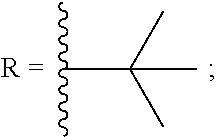


| TABLE 1 | |||
| Cpd | Yeast Strains | Filamentous Fungi | |
| # | R | A | B | C | D | E | F | G | H | I | J | | L | M | |
| 1 |
 |
12.5 | 12.5 | 12.5 | 1.56 | 3.13 | >12.5 | 12.5 | 1.56 | 1.56 | 6.25 | 6.25 | 1.56 | 1.56 | |
| 2a |
 |
12.5 | >12.5 | 12.5 | 3.13 | 6.25 | >12.5 | >12.5 | 6.25 | 3.13 | 12.5 | 6.25 | 6.25 | 6.25 | |
| 2b |
 |
3.13 | 6.25 | 3.13 | 3.13 | 3.13 | 6.25 | 1.56 | 6.25 | 3.13 | 12.5 | 6.25 | 12.5 | 12.5 | |
| 2c |
 |
3.13 | >12.5 | 12.5 | 6.25 | 6.25 | 6.25 | 12.5 | 6.25 | 3.13 | 12.5 | 6.25 | 6.25 | 6.25 | |
| 2d |
 |
3.13 | 3.13 | 1.56 | 3.13 | 0.78 | 1.56 | 3.13 | 6.25 | 3.13 | 6.25 | 12.5 | 12.5 | 12.5 | |
| 2e |
 |
3.13 | 3.13 | 3.13 | 3.13 | 3.13 | 6.25 | 3.13 | 3.13 | 3.13 | 3.13 | 6.25 | 6.25 | 6.25 | |
| 2f |
 |
12.5 | 12.5 | >12.5 | 12.5 | >12.5 | 12.5 | 12.5 | 6.25 | 6.25 | 12.5 | 12.5 | 12.5 | 12.5 | |
| 2g |
 |
>12.5 | 12.5 | 12.5 | 12.5 | >12.5 | 12.5 | 12.5 | 12.5 | 12.5 | 12.5 | 12.5 | 12.5 | 12.5 | |
| 2h |
 |
3.13 | 3.13 | 3.13 | 3.13 | 3.13 | 3.13 | 3.13 | 3.13 | 3.13 | 3.13 | 6.25 | 12.5 | 12.5 | |
| 2i |
 |
3.13 | 6.25 | 6.25 | 6.25 | 6.25 | 3.13 | 6.25 | 6.25 | 6.25 | 6.25 | 12.5 | 3.13 | 12.5 | |
| 2j |
 |
3.13 | 6.25 | 1.56 | 12.5 | 0.78 | 3.13 | 3.13 | 12.5 | 12.5 | 12.5 | 12.5 | 12.5 | 12.5 | |
| 2k |
 |
12.5 | 12.5 | 3.13 | 3.13 | 1.56 | 12.5 | 12.5 | 6.25 | 6.25 | 6.25 | 6.25 | 6.25 | 6.25 | |
| 2l |
 |
6.25 | 12.5 | >12.5 | 3.13 | >12.5 | >12.5 | 6.25 | 12.5 | 6.25 | 12.5 | 12.5 | 12.5 | 12.5 | |
| 2m |
 |
6.25 | 6.25 | 12.5 | 6.25 | 6.25 | 6.25 | 6.25 | 12.5 | 6.25 | 12.5 | 12.5 | 12.5 | 12.5 | |
| 2n |
 |
12.5 | 12.5 | 12.5 | >12.5 | 12.5 | 12.5 | 12.5 | >12.5 | >12.5 | >12.5 | >12.5 | >12.5 | >12.5 | |
| 2o |
 |
ND | ND | ND | ND | ND | ND | ND | ND | ND | ND | | ND | ND | |
| 3a |
 |
1.56 | 0.39 | 0.78 | 1.56 | 0.39 | 0.78 | 0.78 | 1.56 | 0.78 | 0.78 | ≤0.02 | ≤0.02 | ≤0.02 | |
| 3b |
 |
1.56 | 1.56 | 0.78 | 1.56 | 0.78 | 1.56 | 0.78 | 1.56 | 0.78 | 0.78 | ≤0.02 | ≤≤0.02 | ≤0.02 | |
| 3c |
 |
6.25 | 1.56 | 6.25 | 3.13 | 1.56 | 1.56 | 1.56 | 1.56 | 1.56 | 0.78 | ≤0.02 | ≤0.02 | ≤0.02 | |
| 3d |
 |
>12.5 | >12.5 | >12.5 | >12.5 | >12.5 | >12.5 | >12.5 | 12.5 | >12.5 | >12.5 | >12.5 | >12.5 | >12.5 | |
| 3e |
 |
0.78 | 1.56 | 0.78 | 0.78 | 0.78 | 0.78 | 1.56 | 1.56 | 0.39 | 0.78 | 0.20 | 0.02 | 0.10 | |
| 3f |
 |
1.56 | 0.78 | 1.56 | 0.78 | 0.78 | 0.78 | 1.56 | 1.56 | 0.39 | 1.56 | 0.20 | 0.02 | 0.10 | |
| 3g |
 |
0.78 | 1.56 | 3.13 | 1.56 | 1.56 | 1.56 | 1.56 | 1.56 | 0.78 | 1.56 | 0.10 | 0.10 | 0.10 | |
| 3h |
 |
0.39 | 1.56 | 1.56 | 1.56 | 1.56 | 1.56 | 0.78 | 1.56 | 0.39 | 0.78 | 0.78 | 0.39 | 0.39 | |
| 3i |
 |
1.56 | 1.56 | 1.56 | 1.56 | 1.56 | 1.56 | 1.56 | 1.56 | 1.56 | 1.56 | 0.78 | 0.20 | 0.20 | |
| 3j |
 |
6.25 | 3.13 | 6.25 | 3.13 | 6.25 | 6.25 | 6.25 | 1.56 | 1.56 | 6.25 | 0.78 | 0.20 | 0.20 | |
| 3k |
 |
0.39 | 1.56 | 0.78 | 0.39 | 0.39 | 0.39 | 0.78 | 0.78 | 0.39 | 1.56 | 0.20 | 0.10 | 0.10 | |
| 3l |
 |
0.78 | 1.56 | 3.13 | 0.78 | 1.56 | 0.78 | 1.56 | 1.56 | 0.78 | 1.56 | 0.20 | 0.20 | 0.20 | |
| 3m |
 |
1.56 | 1.56 | 3.13 | 1.56 | 3.13 | 1.56 | 3.13 | 3.13 | 0.39 | 3.13 | 0.10 | 0.20 | 0.20 | |
| 3n |
 |
3.13 | 3.13 | 6.25 | 6.25 | 6.25 | 6.25 | 6.25 | 3.13 | 0.39 | 3.13 | ≤0.02 | 0.05 | ≤0.02 | |
| 3o |
 |
ND | ND | ND | ND | ND | ND | ND | ND | ND | ND | ND | ND | ND | |
| 4e |
 |
>12.5 | >12.5 | >12.5 | >12.5 | >12.5 | >12.5 | >12.5 | >12.5 | >12.5 | >12.5 | >12.5 | >12.5 | >12.5 | |
| 4f |
 |
>12.5 | >12.5 | >12.5 | >12.5 | >12.5 | >12.5 | >12.5 | >12.5 | >12.5 | >12.5 | >12.5 | >12.5 | >12.5 | |
| 4n |
 |
>12.5 | >12.5 | >12.5 | >12.5 | >12.5 | >12.5 | >12.5 | >12.5 | >12.5 | >12.5 | >12.5 | >12.5 | >12.5 | |
| AmB | — | 3.9 | 3.9 | 1.95 | 0.98 | 1.95 | 3.9 | 3.9 | 1.95 | 3.9 | 1.95 | 15.6 | 15.6 | 3.9 | |
| FLC | — | 62.5a | >125a | 15.6a | >125a | >125a | 62.5a | 62.5a | >31.2 | >31.2 | 1.95 | 6.25 | 6.25a | 62.5 | |
| ITC | — | 0.5a | >62.5a | 7.8a | 31.2a | 31.2a | 31.2a | 31.2a | 7.8 | 0.48 | 0.12 | 0.48 | 0.195a | 0.975 | |
| POS | — | 0.5a | >62.5a | 7.8a | 31.2a | 31.2a | 15.6a | 15.6a | 0.12 | 0.06 | <0.03 | 0.24 | 0.195a | 0.48 | |
| VOR | — | 7.8 | >31.2 | 0.975 | 1.95 | 1.95 | 0.975 | 7.8 | 0.06 | 0.12 | <0.03 | 0.24 | 0.03 | 0.12 | |
| Yeast strains: A = Candida albicans ATCC 10231, B = C. albicans ATCC 64124, C = C. albicans ATCC MYA-2876 S), D = C. albicans ATCC 90819(R), E = C. albicans ATCC MYA-2310(S), F = C. albicans ATCC MYA-1237(R), G = C. albicans ATCC MYA-1003(R), H = Candida glabrata ATCC 2001, I = Candida krusei ATCC 6258, J = Candida parapsilosis ATCC 22019. NOTE: Here, the (S) and (R) indicate that ATCC reports these strains to be susceptible (S) and resistant (R) to ITC and FLC. | |||||||||||||||
| Filamentous fungi: K = Aspergillus flavus ATCC MYA-3631, L = Aspergillus nidulans ATCC 38163, M = Aspergillus terreus ATCC MYA-3633. | |||||||||||||||
| Known antifungal agents: AmB = amphotericin B, FLC = fluconazole, ITC = itraconazole, POS = posaconazole, and VOR = voriconazole. | |||||||||||||||
| aThese values were previously reported in Shrestha, S. K. et al. (2015) Amphiphilic tobramycin analogues as antibacteral and antifungal agents. Antimicrob. Agents Chemother. 59, 4861-4869. | |||||||||||||||
| bFor yeast strains: MIC-0 values are reported for compounds 1-4n and AmB, whereas MIC-2 values are reported for azoles. For filamentous fungi, MIC-0 values are reported for all copmounds. | |||||||||||||||
| ND indicates that MIC values were not determined due to solubility issues with the compound. | |||||||||||||||


Claims (9)

Priority Applications (1)
| Application Number | Priority Date | Filing Date | Title |
|---|---|---|---|
| US15/940,544 US10544112B2 (en) | 2017-03-29 | 2018-03-29 | Identification of ebsulfur analogues with broad-spectrum antifungal activity |
Applications Claiming Priority (2)
| Application Number | Priority Date | Filing Date | Title |
|---|---|---|---|
| US201762478403P | 2017-03-29 | 2017-03-29 | |
| US15/940,544 US10544112B2 (en) | 2017-03-29 | 2018-03-29 | Identification of ebsulfur analogues with broad-spectrum antifungal activity |
Publications (2)
| Publication Number | Publication Date |
|---|---|
| US20180282291A1 US20180282291A1 (en) | 2018-10-04 |
| US10544112B2 true US10544112B2 (en) | 2020-01-28 |
Family
ID=63672973
Family Applications (1)
| Application Number | Title | Priority Date | Filing Date |
|---|---|---|---|
| US15/940,544 Active US10544112B2 (en) | 2017-03-29 | 2018-03-29 | Identification of ebsulfur analogues with broad-spectrum antifungal activity |
Country Status (1)
| Country | Link |
|---|---|
| US (1) | US10544112B2 (en) |
Families Citing this family (4)
| Publication number | Priority date | Publication date | Assignee | Title |
|---|---|---|---|---|
| US20220332689A1 (en) * | 2019-09-16 | 2022-10-20 | The Trustees Of Columbia University In The City Of New York | Identification of compounds that inhibit stress granule formation and tau aggregation by targeting tiai |
| CN112209899B (en) * | 2020-04-03 | 2023-03-10 | 华中师范大学 | Benzoselenothiazolidone compound and application thereof as well as bactericide |
| CN112057448A (en) * | 2020-04-03 | 2020-12-11 | 华中师范大学 | Application of benzoselenazolones and a fungicide |
| WO2025151885A1 (en) * | 2024-01-12 | 2025-07-17 | University Of Wyoming | Attenuation of phytofungal pathogenicity by autophagy modulators |
Citations (1)
| Publication number | Priority date | Publication date | Assignee | Title |
|---|---|---|---|---|
| WO2018059606A1 (en) * | 2016-09-28 | 2018-04-05 | 江苏辉丰生物农业股份有限公司 | Bactericidal composition containing benzisothiazolinone and mandipropamid |
-
2018
- 2018-03-29 US US15/940,544 patent/US10544112B2/en active Active
Patent Citations (1)
| Publication number | Priority date | Publication date | Assignee | Title |
|---|---|---|---|---|
| WO2018059606A1 (en) * | 2016-09-28 | 2018-04-05 | 江苏辉丰生物农业股份有限公司 | Bactericidal composition containing benzisothiazolinone and mandipropamid |
Non-Patent Citations (141)
| Title |
|---|
| Abdelkhalek et al., "Repurposing ebselen for decolonization of vancomycin-resistant enterococci (VRE)," PLoS ONE, Jun. 28, 2018, pp. 1-14, vol. 13, No. 6 (14 pages). |
| Abdul-Hay et al., "Selective Targeting of Extracellular Insulin-Degrading Enzyme by Quasi-Irreversible Thiol-Modifying Inhibitors," ACS Chemical Biology, 2015, pp. 2716-2724, vol. 10 (nine (9) pages). |
| Arendrup, "Epidemiology of invasive candidiasis," Current Opinion in Critical Care, 2010, pp. 445-452, vol. 16 (eight (8) pages). |
| Azad et al., "Ebselen induces reactive oxygen species (ROS)-mediated cytotoxicity in Saccharomyces cerevisiae with inhibition of glutamate dehydrogenase being a target," FEBS Open Bio, 2014, pp. 77-89, vol. 4 (13 pages). |
| Azad et al., "Ebselen, a promising antioxidant drug: mechanisms of action and targets of biological pathways," Mol Biol Rep, 2014, pp. 4865-4879, vol. 41 (15 pages). |
| Baginski et al., "Amphotericin B and Its New Derivatives-Mode of Action," Current Drug Metabolism, 2009, pp. 459-469, vol. 10, No. 5 (11 pages). |
| Baginski et al., "Amphotericin B and Its New Derivatives—Mode of Action," Current Drug Metabolism, 2009, pp. 459-469, vol. 10, No. 5 (11 pages). |
| Barber, "Methicillin-resistant staphylococci," J. clin. Path., Feb. 21, 1961, pp. 385-393, vol. 14 (nine (9) pages). |
| Ben-Ami et al., "Antibiotic Exposure as a Risk Factor for Fluconazole-Resistant Candida Bloodstream Infection," Antimicrobial Agents and Chemotherapy, May 2012, pp. 2518-2523, vol. 56, No. 5 (six (6) pages). |
| Bender et al., "A small-molecule antivirulence agent for treating Clostridium difficile infection," Science Translational Medicine, Sep. 23, 2015, pp. 1-11, vol. 7, No. 306 (12 pages). |
| Benhamou et al., "Di-N-Methylation of Anti-Gram-Positive Aminoglycoside-Derived Membrane Disruptors Improves Antimicrobial Potency and Broadens Spectrum to Gram-Negative Bacteria," Angew. Chem. Int. Ed., 2015, pp. 13617-13621, vol. 54 (five (5) pages). |
| Bera et al., Antibacterial Activities of Aminoglycoside Antibiotics-Derived Cationic Amphiphiles. Polyol-Modified Neomycin B-, Kanamycin A-, Amikacin-, and Neamine-Based Amphiphiles with Potent Broad Spectrum Antibacterial Activity, Journal of Medicinal Chemistry, 2010, pp. 3626-3631, vol. 53 (six (6) pages). |
| Bhakuni et al., "An efficient copper mediated synthetic methodology for benzo[d]isothiazol-3(2H)-ones and related sulfur-nitrogen heterocycles," Tetrahedron Letters, 2012, pp. 1354-1357, vol. 53 (four (4) pages). |
| Bhowmick et al., "Highly Efficient Glutathione Peroxidase and Peroxiredoxin Mimetics Protect Mammalian Cells against Oxidative Damage," Angew. Chem. Int. Ed., 2015, pp. 8449-8453, vol. 54 (five (5) pages). |
| Bjarnsholt, "The Role of Bacterial Biofilms in Chronic Infections," APMIS, 2013, pp. 1-58, (58 pages). |
| Boucher et al., "Bad Bugs, No Drugs: No Eskape! An Update from the Infectious Diseases Society of America," Clinical Infectious Diseases, Jan. 1, 2009, pp. 1-12, vol. 48 (12 pages). |
| Brahemi et al., "Exploring the Structural Requirements for Inhibition of the Ubiquitin E3 Ligase Breast Cancer Associated Protein 2 (BCA2) as a Treatment for Breast Cancer," Journal of Medicinal Chemistry, 2010, pp. 2757-2765, vol. 53, No. 7 (nine (9) pages). |
| Bueno et al., "Cytotoxicity and Genotoxicity Evaluation of Organochalcogens in Human Leucocytes: A Comparative Study between Ebselen, Diphenyl Diselenide, and Diphenyl Ditelluride," BioMed Research international, 2013, pp. 1-6, vol. 2013 (seven (7) pages). |
| Bugbee et al., "Registration of 'USU-Apogee' Wheat," Crop Science, 1997, pp. 626, vol. 37 (three (3) pages). |
| Bugbee et al., "Yield Comparisons and Unique Characteristics of the Dwarf Wheat Cultivar 'USU-Apogee,'" Dwarf Crops, 1999, Paper 10 (five (5) pages). |
| Bugbee et al., "Registration of ‘USU-Apogee’ Wheat," Crop Science, 1997, pp. 626, vol. 37 (three (3) pages). |
| Bugbee et al., "Yield Comparisons and Unique Characteristics of the Dwarf Wheat Cultivar ‘USU-Apogee,’" Dwarf Crops, 1999, Paper 10 (five (5) pages). |
| Capper et al., "The cysteine-reactive small molecule ebselen facilitates effective SOD1 maturation," Nature Communications, 2018, pp. 1-9, vol. 9, No. 1693 (nine (9) pages). |
| Chang et al., "Antibacterial to antifungal conversion of neamine aminoglycosides through alkyl modification. Strategy for reviving old drugs into agrofungicides," The Journal of Antibiotics, 2010, pp. 667-672, vol. 63 (six (6) pages). |
| Chang et al., "Antifungal amphiphilic aminoglycosides," Med. Chem. Commun., 2014, pp. 1048-1057, vol. 5 (10 pages). |
| Chen et al., "Target discovery of ebselen with a biotinylated probe," Chem. Commun., 2018, pp. 9506-9509, vol. 54 (four (4) pages). |
| ClinicalTrials.gov, "SPI-1005 for Prevention and Treatment of Chemotherapy Induced Hearing Loss," https://clinicaltrials.gov/ct2/show/NCT01451863?term=ebselen&cond=chemotherapy-induced+hearing+loss&rank=1, retrieved Aug. 16, 2019 (five (5) pages). |
| ClinicalTrials.gov, "SPI-1005 for the Treatment of Patients With Meniere's Disease," https://clinicaltrials.gov/ct2/show/NCT03325790?term=ebselen&cond=Meniere+Disease&rank=2, retrieved Aug. 16, 2019 (six (6) pages). |
| ClinicalTrials.gov, "Study to Evaluate SPI-1005 in Adults With Meniere's Disease," htts://clinicatrials.gov/ct2/show/NCT02603081?term.ebselen&cond=Meniere+Disease&rank=1, retrieved Aug. 16, 2019 (five (5) pages). |
| Correa et al., "Novel Alternative for the N-S Bond Formation and Its Application to the Synthesis of Benzisothiazol-3-ones," Organic Letters, 2006, pp. 4811-4813, vol. 8, No. 21 (three (3) pages). |
| Cronin et al., "Safety of triazole antifungal drugs in patients with cancer," Journal of Antimicrobial Chemotherapy, 2010, pp. 410-416, vol. 65 (seven (7) pages). |
| Dahl et al., "Potent, Selective, and Orally Available Benzoisothiazolone Phosphomannose Isomerase Inhibitors as Probes for Congenital Disorder of Glycosylation Ia," Journal of Medicinal Chemistry, May 3, 2011, pp. 3661-3668, vol. 54 (eight (8) pages). |
| Dantes et al., "National Burden of Invasive Methicillin-Resistant Staphylococcus aureus Infections, United States, 2011," JAMA Internal Medicine, Nov. 25, 2013, pp. 1970-1978, vol. 173, No. 21 (nine (9) pages). |
| Dartois et al., "Systemic Antibacterial Activity of Novel Synthetic Cyclic Peptides," Antimicrobial Agents and Chemotherapy, Aug. 2005, pp. 3302-3310, vol. 49, No. 8 (nine (9) pages). |
| Day et al., "Combination Antifungal Therapy for Cryptococcal Meningitis," The New England Journal of Medicine, Apr. 4, 2013, pp. 1291-1302, vol. 368, No. 14 (12 pages). |
| De Munnik et al., "Targeting the Mycobacterium tuberculosis transpeptidase LdtMt2 with cysteine-reactive inhibitors including ebselen," Chem. Commun., 2019, (four (4) pages). |
| Deray, "Amphotericin B nephrotoxicity," Journal of Antimicrobial Chemotherapy, 2002, pp. 37-41, vol. 49, Suppl. S1 (five (5) pages). |
| Du et al., "In Vitro Neurotoxicity of Methylisothiazolinone, a Commonly Used Industrial and Household Biocide, Proceeds via a Zinc and Extracellular Signal-Regulated Kinase Mitogen-Activated Protein Kinase-Dependent Pathway," The Journal of Neuroscience, Sep. 1, 2002, pp. 7408-7416, vol. 22, No. 17 (nine (9) pages). |
| Dvorak, "Drug-drug interactions by azole antifungals: Beyond a dogma of CYP3A4 enzyme activity inhibition," Toxicology Letters, 2011, pp. 129-132, vol. 202 (four (4) pages). |
| Favrot et al., "Inactivation of the Mycobacterium tuberculosis Antigen 85 Complex by Covalent, Allosteric Inhibitors," The Journal of Biological Chemistry, Sep. 5, 2014, pp. 25031-25040, vol. 289, No. 36 (11 pages). |
| Finnin et al., "Transdermal Penetration Enhancers: Applications, Limitations, and Potential," Journal of Pharmaceutical Sciences, Oct. 1999, pp. 955-958, vol. 88, No. 10 (four (4) pages). |
| Fosso et al., "New trends in the use of aminoglycosides," Med. Chem. Commun., 2014, pp. 1075-1091, vol. 5 (17 pages). |
| Fosso et al., "Structure-Activity Relationships for Antibacterial to Antifungal Conversion of Kanamycin to Amphiphilic Analogues," The Journal of Organic Chemistry, Mar. 31, 2015, pp. 4398-4411, vol. 80 (14 pages). |
| Fosso et al., "Synthesis and Bioactivities of Kanamycin B-Derived Cationic Amphiphiles," Journal of Medicinal Chemistry, Nov. 22, 2015, pp. 9124-9132, vol. 58 (nine (9) pages). |
| Gajadeera et al., "Antimycobacterial activity of DNA intercalator inhibitors of Mycobacterium tuberculosis primase DnaG," The Journal of Antibiotics, 2015, pp. 153-157, vol. 68 (five (5) pages). |
| Garland et al., "Covalent Modifiers of Botulinum Neurotoxin Counteract Toxin Persistence," ACS Chemical Biology, 2019, pp. 76-87, vol. 14 (12 pages). |
| Goins et al., "Exploring Covalent Allosteric Inhibition of Antigen 85C from Mycobacterium tuberculosis by Ebselen Derivatives," ACS Infectious Diseases, Mar. 13, 2017, pp. 378-387, vol. 3 (10 pages). |
| Gopinath et al., "Benzisothiazolones arrest the cell cycle at the G2/M phase and induce apoptosis in HeLa cells," Med. Chem. Commun., 2013, pp. 749-752, vol. 4 (four (4) pages). |
| Gopinath, P., et al., Broad spectrum anti-infective properties of benzisothiazolones and the parallels in their anti-bacterial and anti-fungal effects, Bioorganic & Medicinal Chemistry Letters, 27(5), 1291-1295 (2017). (Year: 2017). * |
| Gustafsson et al., "Bacillus anthracis Thioredoxin Systems, Characterization and Role as Electron Donors for Ribonucleotide Reductase," The Journal of Biological Chemistry, Nov. 16, 2012, pp. 39686-39697, vol. 287, No. 47 (13 pages). |
| Hafkin et al., "Efficacy and Safety of AFN-1252, the First Staphylococcus-Specific Antibacterial Agent, in the Treatment of Acute Bacterial Skin and Skin Structure Infections, Including Those in Patients with Significant Comorbidities," Antimicrobial Agents and Chemotherapy, Mar. 2016, pp. 1695-1701, vol. 60, No. 3 (seven (7) pages). |
| Harris, "Methicillin-resistant Staphylococcus aureus (MRSA) (Beyond the Basics)", UpToDate, 2016, https://web.archive.org/web/20160318066312/https://www.uptodate.com/contents/methicillin-resistant-staphylococcus-aureus-mrsa-beyond-th-basics, retrieved Aug. 16, 2019 (four (4) pages). |
| Harris, "Methicillin-resistant Staphylococcus aureus (MRSA) (Beyond the Basics)," UpToDate 2019, https:/www.uptodate.com/contents/methicillin-resilstant-staphyococcus-aureus-mrsa-beyond-the-basics/print, retrieved Aug. 15, 2019 (nine (9) pages). |
| Hata et al., "Efficacy of Oral E1210, a New Broad-Spectrum Antifungal with a Novel Mechanism of Action, in Murine Models of Candidiasis Aspergillosis, and Fusariosis," Antimicrobial Agents and Chemotherapy, Oct. 2011, pp. 4543-4551, vol. 55, No. 10 (nine (9) pages). |
| Herzog et al., "6-Thioether Tobramycin Analogues: Towards Selective Targeting of Bacterial Membranes," Angew. Chem. Int. Ed., 2012, pp. 5652-5656, vol. 51 (five (5) pages). |
| Hu et al., "Design, synthesis, and biological evaluation of histone deacetylase inhibitors possessing glutathione peroxidase-like and antioxidant activities against Alzheimer's disease," Bioorganic & Medicinal Chemistry, 2018, pp. 5718-5729, vol. 26 (12 pages). |
| Hughes et al., "Interactions between antifungal and antiretroviral agents," Expert Opin. Drug Saf., 2010, pp. 723-742, vol. 9, No. 5 (20 pages). |
| Huy X. Ngo, et al., Identification of Ebsulfur Analogues with Broad-Spectrum Antifungal Activity, ChemMedChem 2016, 11, 1507-1516. (Year: 2016). * |
| Jin et al., "Investigation of synergistic antimicrobial effects of the drug combinations of meropenem and 1,2-benzisoselenazol-3(2H)-one derivatives on carbapenem-resistant Enterobacteriaceae producing NDM-1," European Journal of Medicinal Chemistry, 2018, pp. 285-302, vol. 155 (18 pages). |
| Kamigata et al., "Photochemical Ring-expansion Reaction of 1,2-Benzisothiazolinones," Bull. Chem. Soc. Jpn., Nov. 1985, pp. 3131-3136, vol. 58, No. 11 (six (6) pages). |
| Kanafani et al., "Resistance to Antifungal Agents: Mechanisms and Clinical Impact," Clinical Infectious Diseases, Jan. 1, 2008, pp. 120-128, vol. 46 (nine (9) pages). |
| Kett et al., "Candida bloodstream infections in intensive care units: Analysis of the extended prevalence of infection in intensive care unit study," Crit Care Med, 2011, pp. 665-670, vol. 39, No. 4 (six (6) pages). |
| Kim et al., "Repurposing FDA approved drugs against the human fungal pathogen, Candida albicans," Annals of Clinical Microbiology and Antimicrobials, 2015, pp. 1-11, vol. 14, No. 32 (11 pages). |
| Kontoyiannis et al., "Toward more effective antifungal therapy: the prospects of combination therapy," British Journal of Haematology, 2004, pp. 165-175, vol. 126 (11 pages). |
| Kullberg et al., "Invasive Candidiasis," The New England Journal of Medicine, Oct. 8, 2015, pp. 1445-1456, vol. 373, No. 15 (12 pages). |
| Lepri et al., "Indole Based Weapons to Fight Antibiotic Resistance: A Structure-Activity Relationship Study," Journal of Medicinal Chemistry, Jan. 12, 2016, pp. 867-891, vol. 59 (25 pages). |
| Leroux et al., "Identification of ebselen as a potent inhibitor of insulin degrading enzyme by a drug repurposing screening," European Journal of Medicinal Chemistry, 2019, pp. 557-566, vol. 179 (10 pages). |
| Li et al., "An efficient approach to construct benzisothiazol-3(2H)-ones via copper-catalyzed consecutive reaction of 2-halobenzamides and carbon disulfide," Organic & Biomolecular Chemistry, 2016, pp. 6297-6303, vol. 14 (seven (7) pages). |
| Li et al., "Diorcinol D Exerts Fungicidal Action against Candida albicans through Cytoplasm Membrane Destruction and ROS Accumulation," PLoS ONE, Jun. 5, 2015, pp. 1-16, vol. 10, No. 6 (16 pages). |
| Lin et al., "Aspergillosis Case-Fatality Rate: Systematic Review of the Literature," Clinical Infectious Diseases, Feb. 1, 2001, pp. 358-366, vol. 32, No. 3 (nine (9) pages). |
| Linsky et al., "Screening for Dimethylarginine Dimethylaminohydrolase Inhibitors Reveals Ebselen as a Bioavailable Inactivator," ACS Medicinal Chemistry Letters, Jun. 8, 2011, pp. 592-596, vol. 2 (five (5) pages). |
| Liu et al., "Design, synthesis and evaluation of 1,2-benzisothiazol-3-one derivatives as potent caspase-3 inhibitors," Bioorganic & Medicinal Chemistry, 2013, pp. 2960-2967, vol. 21 (eight (8) pages). |
| Lortholary et al., "Recent Exposure to Caspofungin or Fluconazole Influences the Epidemiology of Candidemia: a Prospective Multicenter Study Involving 2,441 Patients," Antimicrobial Agents and Chemotherapy, Feb. 2011, pp. 532-538, vol. 55, No. 2 (seven (7) pages). |
| Lu et al., "Ebsulfur Is a Benzisothiazolone Cytocidal Inhibitor Targeting the Trypanothione Reductase of Trypanosoma brucei," The Journal of Biological Chemistry, Sep. 20, 2013, pp. 27456-27468, vol. 288, No. 38 (14 pages). |
| Lu et al., "Inhibition of bacterial thioredoxin reductase: an antibiotic mechanism targeting bacteria lacking glutathione," The FASEEB Journal, 2013, pp. 1394-1403, vol. 27 (10 pages). |
| Lynch et al., "Development of Ebselen, a Glutathione Peroxidase Mimic, for the Prevention and Treatment of Noise-Induced Hearing Loss," Seminars in Hearing, 2009, pp. 47-55, vol. 30, No. 1 (nine (9) pages). |
| Macegoniuk et al, "1,2-Benzisoselenazol-3(2H)-one Derivatives As a New Class of Bacterial Urease Inhibitors," Journal of Medicinal Chemistry, Aug. 14, 2016, pp. 8125-8133, vol. 59 (nine (9) pages). |
| Marshall et al., "Structure, Mechanism, and Inhibition of Aspergillus fumigatus Thioredoxin Reductase," Antimicrobial Agents and Chemotherapy, Mar. 2019, pp. 1-15, vol. 63, No. 3 (15 pages). |
| Mayr et al., "Epidemiology and Antifungal Resistance in Invasive Aspergillosis According to Primary Disease-Review of the Literature," European Journal of Medical Research, Apr. 28, 2011, pp. 153-157, vol. 16 (five (5) pages). |
| Mayr et al., "Epidemiology and Antifungal Resistance in Invasive Aspergillosis According to Primary Disease—Review of the Literature," European Journal of Medical Research, Apr. 28, 2011, pp. 153-157, vol. 16 (five (5) pages). |
| Miorelli et al., "Antioxidant and anti-mutagenic effects of ebselen in yeast and in cultured mammalian V79 cells," Mutagenesis, Feb. 10, 2008, pp. 93-99, vol. 23, No. 2 (seven (7) pages). |
| Moen et al., "Liposomal Amphotericin B: A Review of its Use as Empirical Therapy in Febrile Neutropenia and in the Treatment of Invasive Fungal Infections," Drugs, 2009, pp. 361-392, vol. 69, No. 3 (32 pages). |
| Morris et al., "Echinocandins in the management of invasive fungal infections, part 1," Am J Health-Syst Pharm, Sep. 15, 2006, pp. 1693-1703, vol. 63 (11 pages). |
| Motyl et al., "Basic Microbiological Techniques Used in Antibacterial Drug Discovery," Current Protocols in Pharmacology, 2005, pp. 13A.3.1-13A.3.22 (22 pages). |
| Mukherjee et al., "Ebselen Inhibits Hepatitis C Virus NS3 Helicase Binding to Nucleic Acid and Prevents Viral Replication," ACS Chemical Biology, Aug. 6, 2014, pp. 2393-2403, vol. 9 (11 pages). |
| Ngo et al. "Identification of Ebsulfur Analogues with Broad-Spectrum Antifungal Activity," ChemMedChem 2016, 11, pp. 1507-1516, vol. 11, with Supporting Information (17 pages). |
| Ngo et al., "A complex game of hide and seek: the search for new antifungals," Med. Chem. Commun. 2016, pp. 1285-1306, vol. 7 (22 pages). |
| Ngo et al., "Development ebsulfur analogues as potent antibacterials against methicillin-resistant Staphylococcus aureus," Bioorganic & Medicinal Chemistry, 2016, pp. 6298-6306, vol. 24, with Supporting Information (62 pages). |
| Nozawa et al., "Susceptibility of Methicillin-Resistant Staphylococcus aureus to the Selenium-Containing Compound 2-Phenyl-1,2-Benzoisoselenazol-3(2H)-One (PZ51)," Antimicrobial Agents and Chemotherapy, Aug. 1989, pp. 1388-1390, vol. 33, No. 8 (three (3) pages). |
| Ozyigit et al., "Different dose-dependent effects of ebselen in sciatic nerve ischemia-reperfusion injury in rats," Bosnian Journal of Basic Medical Sciences, 2015, pp. 36-43, vol. 15, No. 4 (eight (8) pages). |
| Pacula et al., "New Chiral Ebselen Analogues with Antioxidant and Cytotoxic Potential," Molecules, 2017, pp. 1-15, vol. 22 (15 pages). |
| Pappas et al., "Clinical Practice Guideline for the Management of Candidiasis: 2016 Update by the Infectious Diseases Society of America," Clinical Infectious Diseases, Feb. 15, 2016, pp. e1-e50, vol. 62, No. 4 (50 pages). |
| Parnham et al., "The early research and development of ebselen," Biochemical Pharmacology, 2013, pp. 1248-1253, vol. 86 (six (6) pages). |
| Pasko et al., "Fluconazole: A New Triazole Antifungal Agent," DICP, The Annals of Pharmacotherapy, Sep. 1990, pp. 860-867, vol. 24 (eight (8) pages). |
| Perfect et al., "Clinical Practice Guidelines for the Management of Cryptococcal Disease: 2010 Update by the Infectious Diseases Society of America," Clinical Infectious Diseases, Feb. 1, 2010, pp. 291-322, vol. 50 (32 pages). |
| Pietka-Ottlik et al., "Crucial Role of Selenium in the Virucidal Activity of Benzisoselenazol-3(2H)-ones and Related Diselenides," Molecules, 2010, pp. 8214-8228, vol. 15 (15 pages). |
| Pratta et al., "Effect of ebselen on IL-1-induced alterations in cartilage metabolism," Inflammation Research, 1998, pp. 115-121, vol. 47 (seven (7) pages). |
| Price et al., "Molecular Mechanism of Action of Antimalarial Benzoisothiazolones: Species-Selective Inhibitors of the Plasmodium spp. MEP Pathway enzyme, IspD," Scientific Reports, Nov. 18, 2016, pp. 1-12, vol. 6, No. 36777 (12 pages). |
| Rex et al., Reference Method for Broth Dilution Antifungal Susceptibility Testing of Yeasts; Approved Standard-Third Edition, Clinical and Laboratory Standards Institute (CLSI), 2008, M27-A3, vol. 28, No. 14 (seven (7) pages). |
| Rex et al., Reference Method for Broth Dilution Antifungal Susceptibility Testing of Yeasts; Approved Standard—Third Edition, Clinical and Laboratory Standards Institute (CLSI), 2008, M27-A3, vol. 28, No. 14 (seven (7) pages). |
| Ruan et al., "Kidney-Type Glutaminase Inhibitor Hexylselen Selectively Kills Cancer Cells via a Three-Pronged Mechanism," ACS Pharmacology & Translational Science, Jan. 11, 2019, pp. 18-30, vol. 2 (13 pages). |
| Sanguinetti et al., "Antifungal drug resistance among Candida species: mechanisms and clinical impact," Mycoses, 2015, pp. 2-13, vol. 58, Suppl. 2 (12 pages). |
| Sano et al., "A Practical Synthesis of N-Substituted 1,2-Benzisothiazolin-3-ones from N,N'-Disubstituted 2,2'-Dithiodibenzamides," Synthesis, 2004, pp. 1585-1588, No. 10 (four (4) pages). |
| Sarma et al., "Redox Regulation of Protein Tyrosine Phosphatase 1B (PTP1B): A Biomimetic Study on the Unexpected Formation of a Sulfenyl Amide Intermediate," J. Am. Chem. Soc., 2007, pp. 8872-8881, vol. 129, No. 28 (10 pages). |
| Scharf et al., "Thioredoxin Is an Essential Protein Induced by Multiple Stresses in Bacillus subtilis," Journal of Bacteriology, Apr. 1998, pp. 1869-1877, vol. 180, No. 7 (nine (9) pages). |
| Schnuch et al., "Patch testing with preservatives, antimicrobials and industrial biocides. Results from a multicenter study," British Journal of Dermatology, 1998, pp. 467-476, vol. 138 (10 pages). |
| Seyedmousavi et al., "Antifungal Susceptibility Patterns of Opportunistic Fungi in the Genera Verruconis and Ochroconis," Antimicrobial Agents and Chemotherapy, Jun. 2014, pp. 3285-3292, vol. 58, No. 6 (eight (8) pages). |
| Seyedmousavi et al., "Intrapulmonary Posaconazole Penetration at the Infection Site in an Immunosuppressed Murine Model of Invasive Pulmonary Aspergillosis Receiving Oral Prophylactic Regimens," Antimicrobial Agents and Chemotherapy, May 2014, pp. 2964-2967, vol. 58, No. 5 (four (4) pages). |
| Shah et al., "Impact of Prior Inappropriate Fluconazole Dosing on Isolation of Fluconazole-Nonsusceptible Candida Species in Hospitalized Patients with Candidemia," Antimicrobial Agents and Chemotherapy, Jun. 2012, pp. 3239-3243, vol. 56, No. 6 (five (5) pages). |
| Sharlow et al., "A Target-Based High Throughput Screen Yields Trypanosoma brucei Hexokinase Small Molecule Inhibitors with Antiparasitic Activity," PLoS Neglected Tropical Diseases, Apr. 2010, pp. 1-8, vol. 4, No. 4 (eight (8) pages). |
| Shrestha et al., "A combination approach to treating fungal infections," Scientific Reports, Nov. 23, 2015, pp. 1-11, vol. 5, No. 17070 (11 pages). |
| Shrestha et al., "Amphiphilic Tobramycin Analogues as Antibacterial and Antifungal Agents," Antimicrobial Agents and Chemotherapy, Aug. 2015, pp. 4861-4869, vol. 59, No. 8 (nine (9) pages). |
| Simanjuntak et al., "Ebselen alleviates testicular pathology in mice with Zika virus infection and prevents its sexual transmission," PLoS Pathogens, Feb. 15, 2018, pp. 1-23, vol. 14, No. 2 (23 pages). |
| Singh et al., "A safe lithium mimetic for bipolar disorder," Nature Communications, Jan. 8, 2013, pp. 1-7, vol. 4 (seven (7) pages. |
| Singh et al., "The resurgence of covalent drugs," Nature Reviews Drug Discovery, Apr. 2011, pp. 307-317, vol. 10. |
| Sloan et al., "Cryptococcal meningitis: epidemiology and therapeutic options," Clinical Epidemiology, 2014, pp. 169-182, vol. 6 (14 pages). |
| Stoyanovsky et al., "Design and Synthesis of a Mitochondria-Targeted Mimic of Glutathione Peroxidase, MitoEbselen-2, as a Radiation Mitigator," ACS Medicinal Chemistry Letters, Nov. 18, 2014, pp. 1304-1307, vol. 5 (four (4) pages). |
| Su et al., "Ebsulfur as a potent scaffold for inhibition and labelling of New Delhi metallo-β-lactamase-1 in vitro and in vivo," Bioorganic Chemistry, 2019, pp. 192-201, vol. 84 (10 pages). |
| Tang et al., "Aglycone Ebselen and β-D-Xyloside Primed Glycosaminoglycans Co-contribute to Ebselen (β-D-Xyloside-Induced Cytotoxicity," Journal of Medicinal Chemistry, 2018, pp. 2937-2948, vol. 61 (12 pages). |
| Terentis et al., "The Selenazal Drug Ebselen Potently Inhibits Indoleamine 2,3-Dioxygenase by Targeting Enzyme Cysteine Residues," Biochemistry, 2010, pp. 591-600, vol. 49, No. 3 (10 pages). |
| Thangamani et al., "Repurposing Clinical Molecule Ebselen to Combat Drug Resistant Pathogens," PLoS ONE, Jul. 29, 2015, pp. 1-16, vol. 10, No. 7 (16 pages). |
| Thangamani et al., "Repurposing ebselen for treatment of multidrug-resistant staphylococcal infections," Scientific Reports, Jun. 26, 2015, pp. 1-13, vol. 5, No. 11596 (13 pages). |
| Uchida et al., "The Thermal Decomposition of N,O-Diacyl-N-t-butylhydroxylamines. III. Novel Routes to 2-Substituted 1,2-Benzisothiazol-3-(2H)-ones," Bull. Chem. Soc. Jpn., Apr. 1982, pp. 1183-1187, vol. 55, No. 4 (five (5) pages). |
| United States Environmental Protection Agency (EPA), "Ecological Effects Test Guidelines: OCSPP 850.3020: Honey Bee Acute Contact Toxicity Test," EPA 712-C-019, Jan. 2012 (14 pages). |
| United States Environmental Protection Agency (EPA), "Ecological Effects Test Guidelines: OPPTS 850.3020: Honey Bee Acute Contact Toxicity", "Public Draft" EPA 712-C-96-147, Apr. 1996 (eight (8) pages). |
| Uziel et al., "Transcriptional Regulation of the Staphylococcus aureus Thioredoxin and Thioredoxin Reductase Genes in Response to Oxygen and Disulfide Stress," Journal of Bacteriology, Jan. 2004, pp. 326-334, vol. 186, No. 2 (nine (9) pages). |
| Van Der Linden et al., "Prospective Multicenter International Surveillance of Azole Resistance in Aspergillus fumigatus," Emerging Infectious Diseases, Jun. 2015, pp. 1041-1044, vol. 21, No. 6 (four (4) pages). |
| Vasan et al., "Inhibitors of the Salicylate Synthase (Mbtl) from Mycobacterium tuberculosis Discovered by High-Throughput Screening," ChemMedChem, 2010, pp. 2079-2087, vol. 5, No. 12 (nine (9) pages). |
| Wall et al., "Screening a Repurposing Library for Inhibitors of Multidrug-Resistant Candida auris Identifies Ebselen as a Repositionable Candidate for Antifungal Drug Development," Antimicrobial Agents and Chemotherapy, Oct. 2018, pp. 1-13, vol. 62, No. 10 (13 pages). |
| Walsh et al., "Treatment of Aspergillosis: Clinical Practice Guidelines of the Infectious Diseases Society of America," Clinical Infectious Diseases, Feb. 1, 2008, pp. 327-360, vol. 46, No. 3 (34 pages). |
| Wang et al. "Developing selective histone deacetylases (HDACs) inhibitors through ebselen and analogs," Drug Design, Development and Therapy, 2017, pp. 1369-1382, vol. 11 (14 pages). |
| Wang et al., "Copper-Catalyzed Intramolecular N-S Bond Formation by Oxidative Dehydrogenative Cyclization," The Journal of Organic Chemistry, 2013, pp. 7337-7342, vol. 78 (six (6) pages). |
| Wang et al., "Synthesis and evaluation of 8-hydroxyquinolin derivatives substituted with (benzo[d][1,2]selenazol-3(2H)-one) as effective inhibitor of metal-induced Aβ aggregation and antioxidant," Bioorganic & Medicinal Chemistry, 2016, pp. 4741-4749 vol. 24 (nine (9) pages). |
| Wang et al., "Systematic Review and Meta-Analysis of the Tolerability and Hepatotoxicity of Antifungals in Empirical and Definitive Therapy for Invasive Fungal Infection," Antimicrobial Agents and Chemotherapy, Jun. 2010, pp. 2409-2419, vol. 54, No. 6 (11 pages). |
| White et al., "Identification of Small-Molecule Inhibitors of the Ribonuclease H2 Enzyme," Journal of Biomolecular Screening, 2013, pp. 610-620, vol. 18, No. 5 (11 pages). |
| Wisplinghoff et al., "Nosocomial Bloodstream Infections in US Hospitals: Analysis of 24,179 Cases from a Prospective Nationwide Surveillance Study," Clinical Infectious Diseases, Aug. 1, 2004, pp. 309-317, vol. 39 (nine (9) pages). |
| Yamaguchi et al., "Ebselen in Acute Ischemic Stroke: A Placebo-Controlled, Double-blind Clinical Trial," Stroke, 1998, pp. 12-17, vol. 29 (seven (7) pages). |
| Yu et al., "Ebselen: Mechanisms of Glutamate Dehydrogenase and Glutaminase Enzyme Inhibition," ACS Chemical Biology, Oct. 26, 2017, pp. 3003-3011, vol. 12 (nine (9) pages). |
| Zou et al., "Synergistic antibacterial activity of silver with antibiotics correlating with the upregulation of the ROS production," Scientific Reports, Jul. 24, 2018, pp. 1-11, vol. 8, No. 11131 (11 pages). |
| Zou et al., "Synergistic antibacterial effect of silver and ebselen against multidrug-resistant Gram-negative bacterial infections," EMBO Molecular Medicine, 2017, pp. 1165-1178, vol. 9, No. 8 (14 pages). |
| Zumbuehl et al., "An Amphotericin B-Fluorescein Conjugate as a Powerful Probe for Biochemical Studies of the Membrane," Angew. Chem. Int. Ed., 2004, pp. 5181-5185, vol. 43 (five (5) pages). |
Also Published As
| Publication number | Publication date |
|---|---|
| US20180282291A1 (en) | 2018-10-04 |
Similar Documents
| Publication | Publication Date | Title |
|---|---|---|
| US20250289852A1 (en) | Antifungal agents and uses thereof | |
| Bazina et al. | Discovery of novel quaternary ammonium compounds based on quinuclidine-3-ol as new potential antimicrobial candidates | |
| Hata et al. | In vitro and in vivo antifungal activities of ER-30346, a novel oral triazole with a broad antifungal spectrum | |
| US20180282291A1 (en) | Identification of Ebsulfur Analogues with Broad-Spectrum Antifungal Activity | |
| US20240124392A1 (en) | Anti-fungals compounds targeting the synthesis of fungal sphingolipids | |
| Ghosh et al. | Aryl-alkyl-lysines: membrane-active fungicides that act against biofilms of Candida albicans | |
| US9648880B2 (en) | Antifungal agents and uses thereof | |
| US9139616B2 (en) | Isolation, identification, and uses of antifungal compounds | |
| US11369586B2 (en) | Antifungal peptoids | |
| US12103916B2 (en) | Antifungal compounds | |
| US20190015400A1 (en) | Antifungal Compositions | |
| JP2009507915A (en) | Use of amine-borane compounds as antibacterial agents | |
| US20240391889A1 (en) | Antimicrobial compounds and the methods of use | |
| US9669044B2 (en) | Aminoglycoside and azole compositions and methods | |
| US20160060285A1 (en) | Aminoglycosides, Methods of Synthesis, and Associated Applications | |
| HK1232898A1 (en) | Antifungal agents and uses thereof | |
| HK1241392A1 (en) | Antifungal agents and uses thereof | |
| HK1241392B (en) | Antifungal agents and uses thereof | |
| HK1232898B (en) | Antifungal agents and uses thereof | |
| HK1193362B (en) | Antifungal agents and uses thereof | |
| HK1193362A (en) | Antifungal agents and uses thereof | |
| WO2016069776A1 (en) | Ecteinamycin, compositions and uses thereof |
Legal Events
| Date | Code | Title | Description |
|---|---|---|---|
| AS | Assignment |
Owner name: UNIVERSITY OF KENTUCKY RESEARCH FOUNDATION, KENTUCKY Free format text: ASSIGNMENT OF ASSIGNORS INTEREST;ASSIGNORS:GARNEAU-TSODIKOVA, SYLVIE;NGO, HUY;SHRESTHA, SANJIB;SIGNING DATES FROM 20180328 TO 20180329;REEL/FRAME:045391/0937 Owner name: UNIVERSITY OF KENTUCKY RESEARCH FOUNDATION, KENTUC Free format text: ASSIGNMENT OF ASSIGNORS INTEREST;ASSIGNORS:GARNEAU-TSODIKOVA, SYLVIE;NGO, HUY;SHRESTHA, SANJIB;SIGNING DATES FROM 20180328 TO 20180329;REEL/FRAME:045391/0937 |
|
| FEPP | Fee payment procedure |
Free format text: ENTITY STATUS SET TO UNDISCOUNTED (ORIGINAL EVENT CODE: BIG.); ENTITY STATUS OF PATENT OWNER: SMALL ENTITY |
|
| FEPP | Fee payment procedure |
Free format text: ENTITY STATUS SET TO SMALL (ORIGINAL EVENT CODE: SMAL); ENTITY STATUS OF PATENT OWNER: SMALL ENTITY |
|
| STPP | Information on status: patent application and granting procedure in general |
Free format text: NON FINAL ACTION MAILED |
|
| STPP | Information on status: patent application and granting procedure in general |
Free format text: NOTICE OF ALLOWANCE MAILED -- APPLICATION RECEIVED IN OFFICE OF PUBLICATIONS |
|
| STPP | Information on status: patent application and granting procedure in general |
Free format text: DOCKETED NEW CASE - READY FOR EXAMINATION |
|
| STPP | Information on status: patent application and granting procedure in general |
Free format text: NOTICE OF ALLOWANCE MAILED -- APPLICATION RECEIVED IN OFFICE OF PUBLICATIONS |
|
| STPP | Information on status: patent application and granting procedure in general |
Free format text: PUBLICATIONS -- ISSUE FEE PAYMENT VERIFIED |
|
| STCF | Information on status: patent grant |
Free format text: PATENTED CASE |
|
| FEPP | Fee payment procedure |
Free format text: MAINTENANCE FEE REMINDER MAILED (ORIGINAL EVENT CODE: REM.); ENTITY STATUS OF PATENT OWNER: SMALL ENTITY |
|
| FEPP | Fee payment procedure |
Free format text: SURCHARGE FOR LATE PAYMENT, SMALL ENTITY (ORIGINAL EVENT CODE: M2554); ENTITY STATUS OF PATENT OWNER: SMALL ENTITY |
|
| MAFP | Maintenance fee payment |
Free format text: PAYMENT OF MAINTENANCE FEE, 4TH YR, SMALL ENTITY (ORIGINAL EVENT CODE: M2551); ENTITY STATUS OF PATENT OWNER: SMALL ENTITY Year of fee payment: 4 |