US10531863B2 - Quick disconnect assembly and method of use - Google Patents

Quick disconnect assembly and method of use Download PDF

Info

Publication number
US10531863B2
US10531863B2 US15/542,251 US201615542251A US10531863B2 US 10531863 B2 US10531863 B2 US 10531863B2 US 201615542251 A US201615542251 A US 201615542251A US 10531863 B2 US10531863 B2 US 10531863B2
Authority
US
United States
Prior art keywords
nut
housing
channel
threaded shaft
quick disconnect
Prior art date
Legal status (The legal status is an assumption and is not a legal conclusion. Google has not performed a legal analysis and makes no representation as to the accuracy of the status listed.)
Active, expires
Application number
US15/542,251
Other versions
US20180263609A1 (en
Inventor
Roland F. Gatturna
Stephen A. Santangelo
Current Assignee (The listed assignees may be inaccurate. Google has not performed a legal analysis and makes no representation or warranty as to the accuracy of the list.)
Smith and Nephew Inc
Original Assignee
Smith and Nephew Inc
Priority date (The priority date is an assumption and is not a legal conclusion. Google has not performed a legal analysis and makes no representation as to the accuracy of the date listed.)
Filing date
Publication date
Application filed by Smith and Nephew Inc filed Critical Smith and Nephew Inc
Priority to US15/542,251 priority Critical patent/US10531863B2/en
Assigned to SMITH & NEPHEW, INC reassignment SMITH & NEPHEW, INC ASSIGNMENT OF ASSIGNORS INTEREST (SEE DOCUMENT FOR DETAILS). Assignors: SANTANGELO, STEPHEN A., GATTURNA, ROLAND F.
Publication of US20180263609A1 publication Critical patent/US20180263609A1/en
Application granted granted Critical
Publication of US10531863B2 publication Critical patent/US10531863B2/en
Active legal-status Critical Current
Adjusted expiration legal-status Critical

Links

Images

Classifications

    • AHUMAN NECESSITIES
    • A61MEDICAL OR VETERINARY SCIENCE; HYGIENE
    • A61BDIAGNOSIS; SURGERY; IDENTIFICATION
    • A61B17/00Surgical instruments, devices or methods
    • AHUMAN NECESSITIES
    • A61MEDICAL OR VETERINARY SCIENCE; HYGIENE
    • A61BDIAGNOSIS; SURGERY; IDENTIFICATION
    • A61B17/00Surgical instruments, devices or methods
    • A61B17/04Surgical instruments, devices or methods for suturing wounds; Holders or packages for needles or suture materials
    • AHUMAN NECESSITIES
    • A61MEDICAL OR VETERINARY SCIENCE; HYGIENE
    • A61BDIAGNOSIS; SURGERY; IDENTIFICATION
    • A61B17/00Surgical instruments, devices or methods
    • A61B2017/0046Surgical instruments, devices or methods with a releasable handle; with handle and operating part separable
    • BPERFORMING OPERATIONS; TRANSPORTING
    • B25HAND TOOLS; PORTABLE POWER-DRIVEN TOOLS; MANIPULATORS
    • B25GHANDLES FOR HAND IMPLEMENTS
    • B25G3/00Attaching handles to the implements
    • B25G3/02Socket, tang, or like fixings
    • B25G3/12Locking and securing devices

Definitions

  • the present disclosure relates to quick disconnect assemblies in general and, more particularly, to a quick disconnect housing and shaft assembly used in a surgical apparatus.
  • a surgical apparatus may contain a shaft inserted into a housing and secured in place in many ways, such as with a set screw, a locking shaft collar, or a cross-pin fitting into a groove.
  • the shaft may need to be detached and removed from the housing, for example, with a surgical apparatus that has a reusable handle and a single-use front end. Therefore, it is desirable for the surgical apparatus to have a quick disconnect mechanism between the housing and shaft that is simple, cost-effective, reliable and easy to use.
  • the disclosure described herein is a quick disconnect assembly including a generally tubular housing extending between distal and proximal ends, and a rotatable nut adapted to secure a threaded shaft.
  • This mechanism can be applied to any surgical construct where a removable component is desired, particularly with reusable and disposable components.
  • the quick disconnect assembly of this disclosure will accommodate a variety of shaft lengths and/or configurations.
  • the quick disconnect assembly of this disclosure provides the ability to slide and lock with a separate axial movement. Both the shaft and the housing can easily be assembled and disassembled repeatedly.
  • the housing and shaft can further be assembled and disassembled at adjustable positions. The adjustments to the positions can be of any granularity.
  • the quick disconnect assembly of this disclosure is furthermore advantageous over the prior art because current apparatuses require at least one additional mechanical element to lock the shaft to the nut.
  • the present disclosure uses fewer parts, leading to simplicity, reduced costs, and ease of use for surgeons.
  • the quick disconnect assembly includes a tubular housing extending along a longitudinal axis between a proximal end and a distal end.
  • the housing includes a cannulation extending between the proximal and distal ends.
  • the cannulation includes a first portion extending from the housing proximal end and a second portion. The second portion is continuous with the first portion, extending from the housing distal end and having a diameter smaller than the first portion.
  • the housing further includes a cam pin secured to the housing and extending transverse to the longitudinal axis within the first portion.
  • the housing also includes a nut positioned within the housing.
  • the nut includes a first, threaded channel formed through a length of the nut and adapted to threadingly engage a threaded shaft, a second, non-threaded channel extending at a selected angle with respect to the first channel and intersecting the first channel, the second channel having a diameter greater than the threaded shaft, and an arcuate groove formed on an outer surface of the nut and extending between the proximal and distal ends of the nut.
  • the first channel of the nut is oriented such that, when the cam pin engages the groove at about a distal end of the nut, the nut is positioned in a loading position where the second channel extends approximately parallel to the longitudinal axis of the housing.
  • the second channel of the nut is oriented such that, when the cam pin engages the groove at about a proximal end of the nut, the nut is positioned in a locking position where the first channel extends approximately parallel to the longitudinal axis of the housing.
  • the housing is tubular.
  • the nut comprises a non-threaded channel.
  • the quick disconnect assembly comprises a threaded shaft threadingly engaged with the first channel of the nut and a nut carrier axially coupled to the nut. Distal advancement of the threaded shaft while the nut is in the loading position engages a distal end of the threaded shaft with a nut carrier and distally advances the nut carrier and nut. The nut is urged from the loading position to the locking position by the distal advancement of the threaded shaft such that threads of the first channel threadingly engage the threads of the threaded shaft. Insertion of the threaded shaft into the nut is not inhibited by the second channel when the nut is in the loading position.
  • the diameter of the second portion of the housing cannulation is selected to prevent distal movement of the nut when the nut is in the locking position.
  • a diameter of the non-threaded channel of the nut is selected to allow passage of the threaded shaft.
  • a clearance inside the housing is selected to allow the nut to rotate into the loading position but to restrict the nut from rotating into a position that would disengage the threaded shaft from the first channel of the nut.
  • the method includes: engaging a cam pin secured to a housing with a distal end of a groove formed in the surface of a nut, the nut comprising a first channel in communication with a second channel extending at a selected angle with respect to the first channel and intersecting the first channel, wherein the nut is positioned within a cannulation of the housing such that the second channel of the nut extends approximately parallel to a longitudinal axis of the housing; inserting a threaded shaft into the first channel of the nut; and distally advancing the threaded shaft within the nut until a distal end of the threaded shaft engages with a nut carrier and distally advances the nut carrier and the nut within the cannulation of the housing.
  • the distal advancement of the nut within the cannulation of the housing causes the cam pin to move from the distal end of the groove to the proximal end of the groove.
  • the first channel of the nut extends approximately parallel to the longitudinal axis of the housing and the threaded shaft is lockingly engaged with the threaded channel of the nut.
  • the cannulation of the housing comprises a first portion and a second portion, a diameter of the second portion being smaller than a diameter of the first portion. The diameter of the second portion of the housing cannulation is selected to prevent distal movement of the nut when the threaded shaft is lockingly engaged with the threaded channel of the nut.
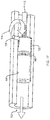
  • FIG. 1A is a diagram illustrating an example embodiment of the loading position of present disclosure
  • FIGS. 1B-D illustrate details of the embodiment of FIG. 1A ;
  • FIG. 1E is a diagram illustrating the transition from the loading to the locking position of the embodiment of FIG. 1A ;
  • FIG. 1F is a diagram illustrating the locking position of the embodiment of FIG. 1A .
  • Comprise, include, and/or plural forms of each are open ended and include the listed parts and can include additional parts that are not listed. And/or is open ended and includes one or more of the listed parts and combinations of the listed parts.
  • FIGS. 1A-E illustrate an example embodiment of the quick disconnect assembly 100 of this disclosure and its method of use.
  • the components of the quick disconnect assembly 100 may vary in size, shape or materials and are selected to be suitable to the surgical apparatus of their use.
  • the quick disconnect assembly 100 generally includes a housing 102 (shown in cross-section), a nut carrier 104 , a rotatable nut 108 and a threaded shaft 112 .
  • the nut carrier 104 includes a distally extending bed 105 on which the rotatable nut 108 rests.
  • the housing 102 can be a tubular housing extending along a longitudinal axis between a proximal end and a distal end. However, a person of ordinary skill in the art can recognize that the housing 102 can be extrapolated as a housing of another shape in other embodiments.
  • the housing 102 can include a cannulation 116 extending between the proximal and distal ends.
  • the nut carrier 104 and the rotatable nut 108 are positioned within the cannulation 116 , as described in more detail below.
  • the nut carrier 104 includes an internal, non-threaded cannulation 124 extending from a proximal to a distal end.
  • the shapes of both of the nut carrier 104 and the rotatable nut 108 can be tubular, but are selected to match the inside shape of the cannulation 116 .
  • the threaded shaft 112 may be disposable.
  • the rotatable nut 108 includes a first channel 118 and a second channel 120 , described in more detail below.
  • the cannulation 116 can include a first portion 116 a and a second portion 116 b .
  • the first portion 116 a extends from the proximal end of the housing 102 .
  • the second portion 116 b is continuous with the first portion 116 a and extends from the distal end of the housing 102 .
  • the second portion 116 b has a diameter smaller than a diameter of the first portion 116 a , the diameter being selected to prevent distal movement of the rotatable nut 108 .
  • the housing 102 can also include a cam pin 106 secured to the housing 102 and extending traverse to the longitudinal axis within the first portion 116 a . The function of the cam pin 106 will be described further below.
  • the nut 108 ( FIG. 1A ) is disposed within the first portion 116 a .
  • the nut carrier 104 ( FIG. 1A ) is primarily disposed within the second portion 116 b but may extend into the first portion
  • the rotatable nut 108 includes a first, threaded channel 118 formed through a length of the rotatable nut 108 and adapted to threadingly engage the shaft 112 .
  • the rotatable nut 108 includes a second, non-threaded channel 120 extending at a selected angle with respect to the first channel 118 and intersecting the first channel 118 at a midpoint of a center line of the threaded shaft 118 .
  • the second channel 120 has a diameter greater than a diameter of the shaft 112 , the diameter being selected to allow the shaft 112 to slide in the second channel 120 .
  • the rotatable nut 108 further includes an arcuate groove 122 formed on an outer surface of the rotatable nut 108 and extending between the proximal and distal ends of the rotatable nut 108 .
  • the groove 122 is configured to engage the cam pin 106 ( FIG. 1B ), as further described below.
  • the loading position of the quick release assembly of this disclosure is shown.
  • the first channel 118 ( FIG. 1C ) of the rotatable nut 108 is oriented such that, when the cam pin 106 engages the groove 122 ( FIG. 1D ) at about a distal end of the nut 108 , the cam pin 106 rotates the rotatable nut 108 into the loading, or unlocked, position, along the direction of unlocking rotation 110 .
  • the second channel 120 ( FIG. 1C ) of the rotatable nut 108 extends approximately parallel to the longitudinal axis of the housing 102 .
  • the shaft 112 is inserted into the housing 102 through the rotatable nut 108 , and partially into the cannulation 124 of the nut carrier 104 . It is contemplated by this disclosure that a suture may be attached to the shaft 112 prior to insertion. Once the threaded shaft 112 has found its correct depth within the housing 102 , the nut carrier 104 will be drawn back distally within the housing 102 , causing the rotatable nut 108 to be rotated by the cam pin 106 into the locked position.
  • FIG. 1F shows the locked position of the quick release assembly of this disclosure.
  • the rotatable nut 108 is oriented such that, when the cam pin 106 engages the groove 122 ( FIG. 1D ) at about a proximal end of the rotatable nut 108 , the cam pin 106 forces the rotatable nut 108 into the locking position as the nut carrier 104 pulls the shaft 112 into the housing 102 .
  • the rotatable nut 108 rotates along a direction of locking rotation 114 to turn into the locking position.
  • the nut carrier 104 is driven back distally along the longitudinal axis of the housing 102 , where a reduced housing inside diameter ( FIG.
  • the first channel 116 a ( FIG. 1C ) extends approximately parallel to the longitudinal axis of the housing 102 .
  • the nut carrier 104 is then axially coupled to the rotatable nut 108 by means of the shaft 112 , it should be noted that enough clearance inside the housing 102 is required for the nut 108 to rotate into the loading position. At the same time, the clearance inside the housing 102 must also restrict the nut 108 from rotating into a position that would decouple it from the shaft 112 .
  • insertion of the shaft 112 into the rotatable nut 108 is not inhibited by the second channel 120 when the rotatable nut 108 is in the loading position.
  • distal advancement of the shaft 112 While the rotatable nut 108 is in the loading position engages a distal end of the shaft 112 with the nut carrier 104 and distally advances the nut carrier 104 and rotatable nut 108 .
  • the rotatable nut 108 is urged from the loading position to the locking position by the distal advancement of the shaft 112 such that threads of the first channel 118 threadingly engage the threads of the shaft 112 .
  • the quick disconnect assembly can be configured to allow for the nut to pivot and move along the threaded shaft in small increments without rotating.

Landscapes

  • Health & Medical Sciences (AREA)
  • Life Sciences & Earth Sciences (AREA)
  • Surgery (AREA)
  • Heart & Thoracic Surgery (AREA)
  • Engineering & Computer Science (AREA)
  • Biomedical Technology (AREA)
  • Nuclear Medicine, Radiotherapy & Molecular Imaging (AREA)
  • Medical Informatics (AREA)
  • Molecular Biology (AREA)
  • Animal Behavior & Ethology (AREA)
  • General Health & Medical Sciences (AREA)
  • Public Health (AREA)
  • Veterinary Medicine (AREA)
  • Surgical Instruments (AREA)
  • Mutual Connection Of Rods And Tubes (AREA)

Abstract

A quick disconnect assembly including a tubular housing. The housing includes a cam pin secured to the housing and a nut positioned within the housing cannulation. The nut has a first threaded channel adapted to engage a threaded shaft, a second, non-threaded channel extending at an angle to the first channel, and an arcuate groove formed on an outer surface of the nut. When the cam pin of the housing engages the groove at about a distal end of the nut, the nut is positioned in a loading position where the second channel extends approximately parallel to the longitudinal axis of the housing. When the cam pin engages the groove at about a proximal end of the nut, the nut is positioned in a locking position where the first channel extends approximately parallel to the longitudinal axis of the housing.

Description

CROSS-REFERENCE TO RELATED APPLICATIONS
This application is the U.S. national phase entry under 35 U.S.C. § 371 of International Application No. PCT/US2016/012572, filed Jan. 8, 2016, entitled QUICK DISCONNECT ASSEMBLY AND METHOD OF USE, which in turn claims priority to and benefit of U.S. Provisional Application No. 62/101,161, filed Jan. 8, 2015, the contents of which are incorporated herein by reference in their entirety for all purposes.
FIELD OF THE INVENTION
The present disclosure relates to quick disconnect assemblies in general and, more particularly, to a quick disconnect housing and shaft assembly used in a surgical apparatus.
BACKGROUND
A surgical apparatus may contain a shaft inserted into a housing and secured in place in many ways, such as with a set screw, a locking shaft collar, or a cross-pin fitting into a groove. During a surgical operation, the shaft may need to be detached and removed from the housing, for example, with a surgical apparatus that has a reusable handle and a single-use front end. Therefore, it is desirable for the surgical apparatus to have a quick disconnect mechanism between the housing and shaft that is simple, cost-effective, reliable and easy to use.
SUMMARY
The disclosure described herein is a quick disconnect assembly including a generally tubular housing extending between distal and proximal ends, and a rotatable nut adapted to secure a threaded shaft. This mechanism can be applied to any surgical construct where a removable component is desired, particularly with reusable and disposable components. Advantageously, the quick disconnect assembly of this disclosure will accommodate a variety of shaft lengths and/or configurations. Furthermore, the quick disconnect assembly of this disclosure provides the ability to slide and lock with a separate axial movement. Both the shaft and the housing can easily be assembled and disassembled repeatedly. The housing and shaft can further be assembled and disassembled at adjustable positions. The adjustments to the positions can be of any granularity.
The quick disconnect assembly of this disclosure is furthermore advantageous over the prior art because current apparatuses require at least one additional mechanical element to lock the shaft to the nut. The present disclosure uses fewer parts, leading to simplicity, reduced costs, and ease of use for surgeons.
In an embodiment of the quick disconnect assembly of this disclosure, the quick disconnect assembly includes a tubular housing extending along a longitudinal axis between a proximal end and a distal end. The housing includes a cannulation extending between the proximal and distal ends. The cannulation includes a first portion extending from the housing proximal end and a second portion. The second portion is continuous with the first portion, extending from the housing distal end and having a diameter smaller than the first portion.
The housing further includes a cam pin secured to the housing and extending transverse to the longitudinal axis within the first portion. The housing also includes a nut positioned within the housing. The nut includes a first, threaded channel formed through a length of the nut and adapted to threadingly engage a threaded shaft, a second, non-threaded channel extending at a selected angle with respect to the first channel and intersecting the first channel, the second channel having a diameter greater than the threaded shaft, and an arcuate groove formed on an outer surface of the nut and extending between the proximal and distal ends of the nut. The first channel of the nut is oriented such that, when the cam pin engages the groove at about a distal end of the nut, the nut is positioned in a loading position where the second channel extends approximately parallel to the longitudinal axis of the housing. The second channel of the nut is oriented such that, when the cam pin engages the groove at about a proximal end of the nut, the nut is positioned in a locking position where the first channel extends approximately parallel to the longitudinal axis of the housing.
In further embodiments, the housing is tubular. The nut comprises a non-threaded channel. The quick disconnect assembly comprises a threaded shaft threadingly engaged with the first channel of the nut and a nut carrier axially coupled to the nut. Distal advancement of the threaded shaft while the nut is in the loading position engages a distal end of the threaded shaft with a nut carrier and distally advances the nut carrier and nut. The nut is urged from the loading position to the locking position by the distal advancement of the threaded shaft such that threads of the first channel threadingly engage the threads of the threaded shaft. Insertion of the threaded shaft into the nut is not inhibited by the second channel when the nut is in the loading position. The diameter of the second portion of the housing cannulation is selected to prevent distal movement of the nut when the nut is in the locking position. A diameter of the non-threaded channel of the nut is selected to allow passage of the threaded shaft. A clearance inside the housing is selected to allow the nut to rotate into the loading position but to restrict the nut from rotating into a position that would disengage the threaded shaft from the first channel of the nut.
In an embodiment of the method of connecting a housing and shaft of this disclosure, the method includes: engaging a cam pin secured to a housing with a distal end of a groove formed in the surface of a nut, the nut comprising a first channel in communication with a second channel extending at a selected angle with respect to the first channel and intersecting the first channel, wherein the nut is positioned within a cannulation of the housing such that the second channel of the nut extends approximately parallel to a longitudinal axis of the housing; inserting a threaded shaft into the first channel of the nut; and distally advancing the threaded shaft within the nut until a distal end of the threaded shaft engages with a nut carrier and distally advances the nut carrier and the nut within the cannulation of the housing. The distal advancement of the nut within the cannulation of the housing causes the cam pin to move from the distal end of the groove to the proximal end of the groove. When the cam pin engages the proximal end of the groove, the first channel of the nut extends approximately parallel to the longitudinal axis of the housing and the threaded shaft is lockingly engaged with the threaded channel of the nut. The cannulation of the housing comprises a first portion and a second portion, a diameter of the second portion being smaller than a diameter of the first portion. The diameter of the second portion of the housing cannulation is selected to prevent distal movement of the nut when the threaded shaft is lockingly engaged with the threaded channel of the nut.
BRIEF DESCRIPTION OF THE DRAWINGS
The foregoing will be apparent from the following more particular description of example embodiments of the disclosure, as illustrated in the accompanying drawings.
FIG. 1A is a diagram illustrating an example embodiment of the loading position of present disclosure;
FIGS. 1B-D illustrate details of the embodiment of FIG. 1A;
FIG. 1E is a diagram illustrating the transition from the loading to the locking position of the embodiment of FIG. 1A; and
FIG. 1F is a diagram illustrating the locking position of the embodiment of FIG. 1A.
DETAILED DESCRIPTION
Examples of the quick disconnect assembly of this disclosure will now be discussed with reference to the figures.
In the description that follows, like components have been given the same reference numerals, regardless of whether they are shown in different examples. To illustrate example(s) in a clear and concise manner, the drawings may not necessarily be to scale and certain features may be shown in somewhat schematic form. Features that are described and/or illustrated with respect to one example may be used in the same way or in a similar way in one or more other examples and/or in combination with or instead of the features of the other examples.
Comprise, include, and/or plural forms of each are open ended and include the listed parts and can include additional parts that are not listed. And/or is open ended and includes one or more of the listed parts and combinations of the listed parts.
FIGS. 1A-E illustrate an example embodiment of the quick disconnect assembly 100 of this disclosure and its method of use. The components of the quick disconnect assembly 100 may vary in size, shape or materials and are selected to be suitable to the surgical apparatus of their use.
In FIG. 1A, the quick disconnect assembly 100 generally includes a housing 102 (shown in cross-section), a nut carrier 104, a rotatable nut 108 and a threaded shaft 112. The nut carrier 104 includes a distally extending bed 105 on which the rotatable nut 108 rests. The housing 102 can be a tubular housing extending along a longitudinal axis between a proximal end and a distal end. However, a person of ordinary skill in the art can recognize that the housing 102 can be extrapolated as a housing of another shape in other embodiments. The housing 102 can include a cannulation 116 extending between the proximal and distal ends. The nut carrier 104 and the rotatable nut 108 are positioned within the cannulation 116, as described in more detail below. The nut carrier 104 includes an internal, non-threaded cannulation 124 extending from a proximal to a distal end. The shapes of both of the nut carrier 104 and the rotatable nut 108 can be tubular, but are selected to match the inside shape of the cannulation 116. The threaded shaft 112 may be disposable. The rotatable nut 108 includes a first channel 118 and a second channel 120, described in more detail below.
As shown in FIG. 1B, the cannulation 116 can include a first portion 116 a and a second portion 116 b. The first portion 116 a extends from the proximal end of the housing 102. The second portion 116 b is continuous with the first portion 116 a and extends from the distal end of the housing 102. The second portion 116 b has a diameter smaller than a diameter of the first portion 116 a, the diameter being selected to prevent distal movement of the rotatable nut 108. The housing 102 can also include a cam pin 106 secured to the housing 102 and extending traverse to the longitudinal axis within the first portion 116 a. The function of the cam pin 106 will be described further below. The nut 108 (FIG. 1A) is disposed within the first portion 116 a. The nut carrier 104 (FIG. 1A) is primarily disposed within the second portion 116 b but may extend into the first portion 116 a.
As shown in FIG. 1C, the rotatable nut 108 includes a first, threaded channel 118 formed through a length of the rotatable nut 108 and adapted to threadingly engage the shaft 112. The rotatable nut 108 includes a second, non-threaded channel 120 extending at a selected angle with respect to the first channel 118 and intersecting the first channel 118 at a midpoint of a center line of the threaded shaft 118. The second channel 120 has a diameter greater than a diameter of the shaft 112, the diameter being selected to allow the shaft 112 to slide in the second channel 120.
As shown in FIG. 1D, the rotatable nut 108 further includes an arcuate groove 122 formed on an outer surface of the rotatable nut 108 and extending between the proximal and distal ends of the rotatable nut 108. The groove 122 is configured to engage the cam pin 106 (FIG. 1B), as further described below.
Returning now to FIG. 1A, the loading position of the quick release assembly of this disclosure is shown. As shown in FIG. 1A, the first channel 118 (FIG. 1C) of the rotatable nut 108 is oriented such that, when the cam pin 106 engages the groove 122 (FIG. 1D) at about a distal end of the nut 108, the cam pin 106 rotates the rotatable nut 108 into the loading, or unlocked, position, along the direction of unlocking rotation 110. In this position, the second channel 120 (FIG. 1C) of the rotatable nut 108 extends approximately parallel to the longitudinal axis of the housing 102.
As shown in FIG. 1E, the shaft 112 is inserted into the housing 102 through the rotatable nut 108, and partially into the cannulation 124 of the nut carrier 104. It is contemplated by this disclosure that a suture may be attached to the shaft 112 prior to insertion. Once the threaded shaft 112 has found its correct depth within the housing 102, the nut carrier 104 will be drawn back distally within the housing 102, causing the rotatable nut 108 to be rotated by the cam pin 106 into the locked position.
FIG. 1F shows the locked position of the quick release assembly of this disclosure. In FIG. 1F, the rotatable nut 108 is oriented such that, when the cam pin 106 engages the groove 122 (FIG. 1D) at about a proximal end of the rotatable nut 108, the cam pin 106 forces the rotatable nut 108 into the locking position as the nut carrier 104 pulls the shaft 112 into the housing 102. The rotatable nut 108 rotates along a direction of locking rotation 114 to turn into the locking position. The nut carrier 104 is driven back distally along the longitudinal axis of the housing 102, where a reduced housing inside diameter (FIG. 1B) captures and locks the rotatable nut 108 in its locked position. In this position, the first channel 116 a (FIG. 1C) extends approximately parallel to the longitudinal axis of the housing 102. The nut carrier 104 is then axially coupled to the rotatable nut 108 by means of the shaft 112, it should be noted that enough clearance inside the housing 102 is required for the nut 108 to rotate into the loading position. At the same time, the clearance inside the housing 102 must also restrict the nut 108 from rotating into a position that would decouple it from the shaft 112.
It should also be noted that insertion of the shaft 112 into the rotatable nut 108 is not inhibited by the second channel 120 when the rotatable nut 108 is in the loading position. As shown in FIG. 1F, distal advancement of the shaft 112. While the rotatable nut 108 is in the loading position engages a distal end of the shaft 112 with the nut carrier 104 and distally advances the nut carrier 104 and rotatable nut 108. The rotatable nut 108 is urged from the loading position to the locking position by the distal advancement of the shaft 112 such that threads of the first channel 118 threadingly engage the threads of the shaft 112.
It is contemplated by this disclosure that the quick disconnect assembly can be configured to allow for the nut to pivot and move along the threaded shaft in small increments without rotating.
While this disclosure has been particularly shown and described with references to example embodiments thereof, it will be understood by those skilled in the art that various changes in form and details may be made therein without departing from the scope of the disclosure encompassed by the appended claims.

Claims (13)

The invention claimed is:
1. A quick disconnect assembly, comprising:
a housing extending along a longitudinal axis between a proximal end and a distal end, the housing further including:
a cannulation extending between the proximal and distal ends, the cannulation including a first portion extending from the housing proximal end, and a second portion, continuous with the first portion, extending from the housing distal end and having a diameter smaller than a diameter of the first portion; and
a cam pin secured to the housing and extending transverse to the longitudinal axis within the first portion;
a nut positioned within the housing cannulation, the nut comprising:
a first, threaded channel formed through a length of the nut and adapted to threadingly engage a threaded shaft;
a second, non-threaded channel extending at a selected angle with respect to the first channel and intersecting the first channel, the second channel having a diameter greater than a diameter of the threaded shaft; and
an arcuate groove formed on an outer surface of the nut and extending between the proximal and distal ends of the nut;
a nut carrier axially coupled to the nut;
wherein the first channel of the nut is oriented such that, when the cam pin engages the groove at about a distal end of the nut, the nut is positioned in a loading position where the second channel extends approximately parallel to the longitudinal axis of the housing; and
wherein the second channel of the nut is oriented such that, when the cam pin engages the groove at about a proximal end of the nut, the nut is positioned in a locking position where the first channel extends approximately parallel to the longitudinal axis of the housing.
2. The quick disconnect assembly of claim 1, further comprising a threaded shaft threadingly engaged with the first channel of the nut.
3. The quick disconnect assembly of claim 2, wherein a clearance inside the housing is selected to allow the nut to rotate into the loading position but to restrict the nut from rotating into a position that would disengage the threaded shaft from the first channel of the nut.
4. The quick disconnect assembly of claim 1, wherein distal advancement of the threaded shaft while the nut is in the loading position engages a distal end of the threaded shaft with the nut carrier and distally advances the nut carrier and nut.
5. The quick disconnect assembly of claim 4, wherein the nut is urged from the loading position to the locking position by the distal advancement of the threaded shaft such that threads of the first channel threadingly engage the threads of the threaded shaft.
6. The quick disconnect assembly of claim 1, wherein insertion of the threaded shaft into the nut is not inhibited by the second channel when the nut is in the loading position.
7. The quick disconnect assembly of claim 1, wherein the housing is tubular.
8. The quick disconnect assembly of claim 1, wherein the diameter of the second portion of the housing cannulation is selected to prevent distal movement of the nut when the nut is in the locking position.
9. The quick disconnect assembly of claim 1, wherein the nut carrier comprises a non-threaded channel.
10. The quick disconnect assembly of claim 9, wherein a diameter of the non-threaded channel of the nut is selected to allow passage of the threaded shaft.
11. A method of connecting a housing and shaft, the method comprising:
engaging a cam pin secured to a housing with a distal end of a groove formed in the surface of a nut, the nut comprising a first channel in communication with a second channel extending at a selected angle with respect to the first channel and intersecting the first channel, wherein the nut is positioned within a cannulation of the housing such that the second channel of the nut extends approximately parallel to a longitudinal axis of the housing;
inserting a threaded shaft into the first channel of the nut;
distally advancing the threaded shaft within the nut until a distal end of the threaded shaft engages with a nut carrier axially coupled to the nut and distally advances the nut carrier and the nut within the cannulation of the housing;
wherein the distal advancement of the nut within the cannulation of the housing causes the cam pin to move from the distal end of the groove to the proximal end of the groove;
wherein, when the cam pin engages the proximal end of the groove, the first channel of the nut extends approximately parallel to the longitudinal axis of the housing and the threaded shaft is lockingly engaged with the threaded channel of the nut.
12. The method of claim 11, wherein the cannulation of the housing comprises a first portion and a second portion, a diameter of the second portion being smaller than a diameter of the first portion.
13. The method of claim 12, wherein the diameter of the second portion of the housing cannulation is selected to prevent distal movement of the nut when the threaded shaft is lockingly engaged with the threaded channel of the nut.
US15/542,251 2015-01-08 2016-01-08 Quick disconnect assembly and method of use Active 2037-02-23 US10531863B2 (en)

Priority Applications (1)

Application Number Priority Date Filing Date Title
US15/542,251 US10531863B2 (en) 2015-01-08 2016-01-08 Quick disconnect assembly and method of use

Applications Claiming Priority (3)

Application Number Priority Date Filing Date Title
US201562101161P 2015-01-08 2015-01-08
PCT/US2016/012572 WO2016112244A2 (en) 2015-01-08 2016-01-08 Quick disconnect assembly and method of use
US15/542,251 US10531863B2 (en) 2015-01-08 2016-01-08 Quick disconnect assembly and method of use

Publications (2)

Publication Number Publication Date
US20180263609A1 US20180263609A1 (en) 2018-09-20
US10531863B2 true US10531863B2 (en) 2020-01-14

Family

ID=55315725

Family Applications (1)

Application Number Title Priority Date Filing Date
US15/542,251 Active 2037-02-23 US10531863B2 (en) 2015-01-08 2016-01-08 Quick disconnect assembly and method of use

Country Status (4)

Country Link
US (1) US10531863B2 (en)
EP (1) EP3242604A2 (en)
CN (1) CN107106154B (en)
WO (1) WO2016112244A2 (en)

Citations (20)

* Cited by examiner, † Cited by third party
Publication number Priority date Publication date Assignee Title
US3585824A (en) 1969-03-21 1971-06-22 Dzus Fastener Co Fastener assembly
US4143446A (en) * 1977-05-26 1979-03-13 Down Dennis L R Rope or cable clamp device
US4247163A (en) * 1978-09-18 1981-01-27 Trw Inc. Clamp construction
US4597699A (en) 1984-08-27 1986-07-01 Erickson Tool Company Quick-connect mechanism
US4941246A (en) * 1989-09-19 1990-07-17 Finnegan Danny E Rasping device
US5125761A (en) * 1990-04-09 1992-06-30 Cullen William E Seismic hold down device
US5344194A (en) 1991-06-03 1994-09-06 Yazaki Corporation Connectors with lever
US6283966B1 (en) * 1999-07-07 2001-09-04 Sulzer Spine-Tech Inc. Spinal surgery tools and positioning method
US6461075B2 (en) * 2000-01-31 2002-10-08 Manfred Bickel Device for securing a handle on a tool
US20030001387A1 (en) 1999-12-21 2003-01-02 Kao Corporation Pipe connecting structure and cleaning tool
US20030085572A1 (en) 2001-11-06 2003-05-08 Jean-Paul Froment Quick connection for the removable join of two pipes
US6605077B2 (en) * 1998-06-18 2003-08-12 Scimed Life Systems, Inc. Snap handle assembly for an endoscopic instrument
US6659997B1 (en) * 1999-11-26 2003-12-09 Sulzer Orthopedics Ltd. Operating tool
US6669702B2 (en) * 2001-02-10 2003-12-30 Precined S.A. Modular tool connection assembly
US6862776B2 (en) * 2003-04-23 2005-03-08 Chia-Yu Chen Positioning structure of a retractable handle
US6874201B2 (en) * 2002-08-07 2005-04-05 The Sherwin-Williams Company Tool extension assembly with quick release lock mechanism
US20050121906A1 (en) 2003-11-13 2005-06-09 Alain-Christophe Tiberghien Female connection element and quick connection incorporating such an element
US7587791B2 (en) * 2006-01-18 2009-09-15 Mou-Tang Liou Tool
US7721391B2 (en) * 2007-05-10 2010-05-25 The Wooster Brush Company Quick release lock mechanisms for handle extensions
US8800113B1 (en) * 2013-03-15 2014-08-12 Blackstone Medical, Inc. Rigid modular connector

Family Cites Families (5)

* Cited by examiner, † Cited by third party
Publication number Priority date Publication date Assignee Title
US7448823B2 (en) * 2004-06-09 2008-11-11 Fred Silva Quick release shackle pin system
US7722623B2 (en) * 2006-05-12 2010-05-25 Warsaw Orthopedic, Inc. Instruments and methods for delivering multiple implants
CN201151450Y (en) * 2007-11-29 2008-11-19 广州易整车料有限公司 Quick-release locking device
US20130096568A1 (en) * 2011-10-18 2013-04-18 Warsaw Orthopedic, Inc. Modular tool apparatus and method
CN104411259B (en) * 2012-02-08 2017-06-13 Epix整形外科股份有限公司 Implant insertion device with continuously adjustable aiming assembly

Patent Citations (20)

* Cited by examiner, † Cited by third party
Publication number Priority date Publication date Assignee Title
US3585824A (en) 1969-03-21 1971-06-22 Dzus Fastener Co Fastener assembly
US4143446A (en) * 1977-05-26 1979-03-13 Down Dennis L R Rope or cable clamp device
US4247163A (en) * 1978-09-18 1981-01-27 Trw Inc. Clamp construction
US4597699A (en) 1984-08-27 1986-07-01 Erickson Tool Company Quick-connect mechanism
US4941246A (en) * 1989-09-19 1990-07-17 Finnegan Danny E Rasping device
US5125761A (en) * 1990-04-09 1992-06-30 Cullen William E Seismic hold down device
US5344194A (en) 1991-06-03 1994-09-06 Yazaki Corporation Connectors with lever
US6605077B2 (en) * 1998-06-18 2003-08-12 Scimed Life Systems, Inc. Snap handle assembly for an endoscopic instrument
US6283966B1 (en) * 1999-07-07 2001-09-04 Sulzer Spine-Tech Inc. Spinal surgery tools and positioning method
US6659997B1 (en) * 1999-11-26 2003-12-09 Sulzer Orthopedics Ltd. Operating tool
US20030001387A1 (en) 1999-12-21 2003-01-02 Kao Corporation Pipe connecting structure and cleaning tool
US6461075B2 (en) * 2000-01-31 2002-10-08 Manfred Bickel Device for securing a handle on a tool
US6669702B2 (en) * 2001-02-10 2003-12-30 Precined S.A. Modular tool connection assembly
US20030085572A1 (en) 2001-11-06 2003-05-08 Jean-Paul Froment Quick connection for the removable join of two pipes
US6874201B2 (en) * 2002-08-07 2005-04-05 The Sherwin-Williams Company Tool extension assembly with quick release lock mechanism
US6862776B2 (en) * 2003-04-23 2005-03-08 Chia-Yu Chen Positioning structure of a retractable handle
US20050121906A1 (en) 2003-11-13 2005-06-09 Alain-Christophe Tiberghien Female connection element and quick connection incorporating such an element
US7587791B2 (en) * 2006-01-18 2009-09-15 Mou-Tang Liou Tool
US7721391B2 (en) * 2007-05-10 2010-05-25 The Wooster Brush Company Quick release lock mechanisms for handle extensions
US8800113B1 (en) * 2013-03-15 2014-08-12 Blackstone Medical, Inc. Rigid modular connector

Non-Patent Citations (4)

* Cited by examiner, † Cited by third party
Title
Chinese Application No. 2016800052874 Search Report.
Chinese Application No. 2016800052874 the First Office Action.
European Application No. 16703637.5-1122 Examination Report dated Oct. 16, 2019.
International Search Report for PCT/US16/012572 dated Jun. 14, 2016.

Also Published As

Publication number Publication date
WO2016112244A2 (en) 2016-07-14
CN107106154B (en) 2020-05-12
EP3242604A2 (en) 2017-11-15
CN107106154A (en) 2017-08-29
US20180263609A1 (en) 2018-09-20

Similar Documents

Publication Publication Date Title
US9039740B2 (en) Tissue fixation delivery apparatus
US9924934B2 (en) Surgical anchor delivery system
US10918429B2 (en) Fracture fixation system including locking cap and wire
US8142436B2 (en) Retraction tube for use with bone screw
US10716602B2 (en) Instrument for guiding a rod into an implant receiving area
US10893895B2 (en) Minimally invasive screw extension assembly
EP2990002B1 (en) Intramedullary nail
US20220192723A1 (en) Bone fracture fixation device with transverse set screw and aiming guide
US10117692B2 (en) Fixing means for fixation of bone fragments at bone fractures
US11471153B2 (en) Suture capture device and method of capturing a suture
US10531863B2 (en) Quick disconnect assembly and method of use
DE102013209413A1 (en) Device for providing an access opening in a body, in particular for a spine operation
US9949770B2 (en) Pedicle screw engaging control instrument with a guidewire capturing system
US20190167911A1 (en) Quick-connect syringe and needle system
DE102017120620A1 (en) Bone anchor and extension device
WO2010116493A1 (en) Compound needle with lock mechanism
DE102011109209A1 (en) Fixing device for fixing intramedullary nail for treating fracture of long bone at e.g. thigh of elderly patient, has clamping sleeve with gripping end for gripping end part of intramedullary nail, where sleeve is slotted at gripping end
JP2015534854A (en) Trocar assembly

Legal Events

Date Code Title Description
AS Assignment

Owner name: SMITH & NEPHEW, INC, TENNESSEE

Free format text: ASSIGNMENT OF ASSIGNORS INTEREST;ASSIGNORS:GATTURNA, ROLAND F.;SANTANGELO, STEPHEN A.;SIGNING DATES FROM 20171109 TO 20171204;REEL/FRAME:044338/0435

STPP Information on status: patent application and granting procedure in general

Free format text: DOCKETED NEW CASE - READY FOR EXAMINATION

STPP Information on status: patent application and granting procedure in general

Free format text: PUBLICATIONS -- ISSUE FEE PAYMENT RECEIVED

STPP Information on status: patent application and granting procedure in general

Free format text: PUBLICATIONS -- ISSUE FEE PAYMENT VERIFIED

STCF Information on status: patent grant

Free format text: PATENTED CASE

MAFP Maintenance fee payment

Free format text: PAYMENT OF MAINTENANCE FEE, 4TH YEAR, LARGE ENTITY (ORIGINAL EVENT CODE: M1551); ENTITY STATUS OF PATENT OWNER: LARGE ENTITY

Year of fee payment: 4