US10526540B2 - Liquid crystal aligning agent, liquid crystal alignment layer comprising the same and method for preparing liquid crystal alignment layer - Google Patents
Liquid crystal aligning agent, liquid crystal alignment layer comprising the same and method for preparing liquid crystal alignment layer Download PDFInfo
- Publication number
- US10526540B2 US10526540B2 US15/565,878 US201715565878A US10526540B2 US 10526540 B2 US10526540 B2 US 10526540B2 US 201715565878 A US201715565878 A US 201715565878A US 10526540 B2 US10526540 B2 US 10526540B2
- Authority
- US
- United States
- Prior art keywords
- liquid crystal
- group
- aligning agent
- crystal aligning
- alignment layer
- Prior art date
- Legal status (The legal status is an assumption and is not a legal conclusion. Google has not performed a legal analysis and makes no representation as to the accuracy of the status listed.)
- Active, expires
Links
- 239000004973 liquid crystal related substance Substances 0.000 title claims abstract description 106
- 239000003795 chemical substances by application Substances 0.000 title claims abstract description 55
- 238000000034 method Methods 0.000 title claims description 24
- 239000010410 layer Substances 0.000 claims description 39
- 239000004642 Polyimide Substances 0.000 claims description 33
- 229920001721 polyimide Polymers 0.000 claims description 33
- 239000000126 substance Substances 0.000 claims description 33
- 239000011247 coating layer Substances 0.000 claims description 27
- SECXISVLQFMRJM-UHFFFAOYSA-N N-Methylpyrrolidone Chemical compound CN1CCCC1=O SECXISVLQFMRJM-UHFFFAOYSA-N 0.000 claims description 26
- 239000001257 hydrogen Substances 0.000 claims description 18
- 229910052739 hydrogen Inorganic materials 0.000 claims description 18
- 239000002243 precursor Substances 0.000 claims description 18
- 239000007787 solid Substances 0.000 claims description 17
- 125000000524 functional group Chemical group 0.000 claims description 16
- 239000000758 substrate Substances 0.000 claims description 16
- 239000000203 mixture Substances 0.000 claims description 15
- 125000000008 (C1-C10) alkyl group Chemical group 0.000 claims description 14
- 125000002947 alkylene group Chemical group 0.000 claims description 11
- 230000001678 irradiating effect Effects 0.000 claims description 9
- 238000000576 coating method Methods 0.000 claims description 8
- 125000004435 hydrogen atom Chemical group [H]* 0.000 claims description 8
- UFHFLCQGNIYNRP-UHFFFAOYSA-N Hydrogen Chemical compound [H][H] UFHFLCQGNIYNRP-UHFFFAOYSA-N 0.000 claims description 7
- 239000011248 coating agent Substances 0.000 claims description 7
- 238000001035 drying Methods 0.000 claims description 7
- 239000003960 organic solvent Substances 0.000 claims description 7
- ZMXDDKWLCZADIW-UHFFFAOYSA-N N,N-Dimethylformamide Chemical compound CN(C)C=O ZMXDDKWLCZADIW-UHFFFAOYSA-N 0.000 claims description 5
- YEJRWHAVMIAJKC-UHFFFAOYSA-N 4-Butyrolactone Chemical compound O=C1CCCO1 YEJRWHAVMIAJKC-UHFFFAOYSA-N 0.000 claims description 4
- DLFVBJFMPXGRIB-UHFFFAOYSA-N Acetamide Chemical compound CC(N)=O DLFVBJFMPXGRIB-UHFFFAOYSA-N 0.000 claims description 4
- 125000000732 arylene group Chemical group 0.000 claims description 4
- JHIVVAPYMSGYDF-UHFFFAOYSA-N cyclohexanone Chemical compound O=C1CCCCC1 JHIVVAPYMSGYDF-UHFFFAOYSA-N 0.000 claims description 4
- 125000000962 organic group Chemical group 0.000 claims description 4
- -1 9-fluorenylmethoxycarbonyl group Chemical group 0.000 claims description 3
- BGTOWKSIORTVQH-UHFFFAOYSA-N cyclo-pentanone Natural products O=C1CCCC1 BGTOWKSIORTVQH-UHFFFAOYSA-N 0.000 claims description 3
- POAOYUHQDCAZBD-UHFFFAOYSA-N 2-butoxyethanol Chemical compound CCCCOCCO POAOYUHQDCAZBD-UHFFFAOYSA-N 0.000 claims description 2
- 229910052736 halogen Inorganic materials 0.000 claims description 2
- 150000002367 halogens Chemical class 0.000 claims description 2
- 125000005931 tert-butyloxycarbonyl group Chemical group [H]C([H])([H])C(OC(*)=O)(C([H])([H])[H])C([H])([H])[H] 0.000 claims description 2
- BGTOWKSIORTVQH-HOSYLAQJSA-N cyclopentanone Chemical group O=[13C]1CCCC1 BGTOWKSIORTVQH-HOSYLAQJSA-N 0.000 claims 1
- 238000002360 preparation method Methods 0.000 abstract description 16
- 230000001747 exhibiting effect Effects 0.000 abstract description 3
- 150000002148 esters Chemical class 0.000 description 24
- OKKJLVBELUTLKV-UHFFFAOYSA-N Methanol Chemical compound OC OKKJLVBELUTLKV-UHFFFAOYSA-N 0.000 description 21
- XLYOFNOQVPJJNP-UHFFFAOYSA-N water Substances O XLYOFNOQVPJJNP-UHFFFAOYSA-N 0.000 description 19
- 239000000463 material Substances 0.000 description 13
- JUJWROOIHBZHMG-UHFFFAOYSA-N Pyridine Chemical compound C1=CC=NC=C1 JUJWROOIHBZHMG-UHFFFAOYSA-N 0.000 description 12
- 238000006243 chemical reaction Methods 0.000 description 12
- 229920000642 polymer Polymers 0.000 description 11
- 239000000654 additive Substances 0.000 description 10
- 239000002904 solvent Substances 0.000 description 10
- 238000007789 sealing Methods 0.000 description 9
- 239000000243 solution Substances 0.000 description 8
- IJGRMHOSHXDMSA-UHFFFAOYSA-N Atomic nitrogen Chemical compound N#N IJGRMHOSHXDMSA-UHFFFAOYSA-N 0.000 description 7
- QVGXLLKOCUKJST-UHFFFAOYSA-N atomic oxygen Chemical compound [O] QVGXLLKOCUKJST-UHFFFAOYSA-N 0.000 description 7
- 229910001873 dinitrogen Inorganic materials 0.000 description 7
- 239000001301 oxygen Substances 0.000 description 7
- 229910052760 oxygen Inorganic materials 0.000 description 7
- LDSPUPOZPVNYFP-XCVCLJGOSA-N (4-aminophenyl) (e)-3-(4-aminophenyl)prop-2-enoate Chemical compound C1=CC(N)=CC=C1OC(=O)\C=C\C1=CC=C(N)C=C1 LDSPUPOZPVNYFP-XCVCLJGOSA-N 0.000 description 6
- 0 *OC(C)=O.B.C.C.CC.CC.CC.CC.CC.CC(=O)*O.CC(=O)CC1=CC=C(/C=C/C(=O)*C2=CC=C(C)C=C2)C=C1.CC(=O)N(C(C)=O)C1=CC=C(/C=C/C(=O)*C2=CC=C(C)C=C2)C=C1.CC(=O)N(C)C(C)=O.CCC(C)=O.[1*]OC(=O)C(C)N[2*] Chemical compound *OC(C)=O.B.C.C.CC.CC.CC.CC.CC.CC(=O)*O.CC(=O)CC1=CC=C(/C=C/C(=O)*C2=CC=C(C)C=C2)C=C1.CC(=O)N(C(C)=O)C1=CC=C(/C=C/C(=O)*C2=CC=C(C)C=C2)C=C1.CC(=O)N(C)C(C)=O.CCC(C)=O.[1*]OC(=O)C(C)N[2*] 0.000 description 6
- 210000004027 cell Anatomy 0.000 description 6
- 230000000052 comparative effect Effects 0.000 description 6
- 238000004132 cross linking Methods 0.000 description 6
- 210000002858 crystal cell Anatomy 0.000 description 6
- 239000012153 distilled water Substances 0.000 description 6
- 239000012535 impurity Substances 0.000 description 6
- UMJSCPRVCHMLSP-UHFFFAOYSA-N pyridine Natural products COC1=CC=CN=C1 UMJSCPRVCHMLSP-UHFFFAOYSA-N 0.000 description 6
- 229920005575 poly(amic acid) Polymers 0.000 description 5
- 230000008569 process Effects 0.000 description 5
- KVXKBAKLIBCORH-UHFFFAOYSA-N CC(C)=O.CCC(C)=N Chemical compound CC(C)=O.CCC(C)=N KVXKBAKLIBCORH-UHFFFAOYSA-N 0.000 description 4
- 150000001412 amines Chemical class 0.000 description 4
- 238000001354 calcination Methods 0.000 description 4
- 238000010438 heat treatment Methods 0.000 description 4
- 238000002347 injection Methods 0.000 description 4
- 239000007924 injection Substances 0.000 description 4
- CTSLXHKWHWQRSH-UHFFFAOYSA-N oxalyl chloride Chemical compound ClC(=O)C(Cl)=O CTSLXHKWHWQRSH-UHFFFAOYSA-N 0.000 description 4
- 238000007106 1,2-cycloaddition reaction Methods 0.000 description 3
- NGNBDVOYPDDBFK-UHFFFAOYSA-N 2-[2,4-di(pentan-2-yl)phenoxy]acetyl chloride Chemical compound CCCC(C)C1=CC=C(OCC(Cl)=O)C(C(C)CCC)=C1 NGNBDVOYPDDBFK-UHFFFAOYSA-N 0.000 description 3
- XEKOWRVHYACXOJ-UHFFFAOYSA-N Ethyl acetate Chemical compound CCOC(C)=O XEKOWRVHYACXOJ-UHFFFAOYSA-N 0.000 description 3
- 239000003054 catalyst Substances 0.000 description 3
- 150000001875 compounds Chemical class 0.000 description 3
- 230000000694 effects Effects 0.000 description 3
- 239000011521 glass Substances 0.000 description 3
- 150000002431 hydrogen Chemical class 0.000 description 3
- 230000001965 increasing effect Effects 0.000 description 3
- 238000002329 infrared spectrum Methods 0.000 description 3
- 238000004519 manufacturing process Methods 0.000 description 3
- VLKZOEOYAKHREP-UHFFFAOYSA-N n-Hexane Chemical compound CCCCCC VLKZOEOYAKHREP-UHFFFAOYSA-N 0.000 description 3
- 238000006552 photochemical reaction Methods 0.000 description 3
- 230000002829 reductive effect Effects 0.000 description 3
- CURLTUGMZLYLDI-UHFFFAOYSA-N Carbon dioxide Chemical compound O=C=O CURLTUGMZLYLDI-UHFFFAOYSA-N 0.000 description 2
- CTQNGGLPUBDAKN-UHFFFAOYSA-N Cc1c(C)cccc1 Chemical compound Cc1c(C)cccc1 CTQNGGLPUBDAKN-UHFFFAOYSA-N 0.000 description 2
- 150000001413 amino acids Chemical class 0.000 description 2
- 239000000987 azo dye Substances 0.000 description 2
- WKDNYTOXBCRNPV-UHFFFAOYSA-N bpda Chemical compound C1=C2C(=O)OC(=O)C2=CC(C=2C=C3C(=O)OC(C3=CC=2)=O)=C1 WKDNYTOXBCRNPV-UHFFFAOYSA-N 0.000 description 2
- 239000006227 byproduct Substances 0.000 description 2
- UHOVQNZJYSORNB-UHFFFAOYSA-N c1ccccc1 Chemical compound c1ccccc1 UHOVQNZJYSORNB-UHFFFAOYSA-N 0.000 description 2
- ZYGHJZDHTFUPRJ-UHFFFAOYSA-N coumarin Chemical compound C1=CC=C2OC(=O)C=CC2=C1 ZYGHJZDHTFUPRJ-UHFFFAOYSA-N 0.000 description 2
- 238000004821 distillation Methods 0.000 description 2
- 125000001495 ethyl group Chemical group [H]C([H])([H])C([H])([H])* 0.000 description 2
- 238000011156 evaluation Methods 0.000 description 2
- 230000003993 interaction Effects 0.000 description 2
- 229910052751 metal Inorganic materials 0.000 description 2
- 239000002184 metal Substances 0.000 description 2
- 125000002496 methyl group Chemical group [H]C([H])([H])* 0.000 description 2
- 238000012986 modification Methods 0.000 description 2
- 230000004048 modification Effects 0.000 description 2
- 239000000178 monomer Substances 0.000 description 2
- 238000000059 patterning Methods 0.000 description 2
- 238000003825 pressing Methods 0.000 description 2
- 239000000047 product Substances 0.000 description 2
- 125000006239 protecting group Chemical group 0.000 description 2
- 125000006850 spacer group Chemical group 0.000 description 2
- 238000001308 synthesis method Methods 0.000 description 2
- 238000009281 ultraviolet germicidal irradiation Methods 0.000 description 2
- 125000003088 (fluoren-9-ylmethoxy)carbonyl group Chemical group 0.000 description 1
- VLDPXPPHXDGHEW-UHFFFAOYSA-N 1-chloro-2-dichlorophosphoryloxybenzene Chemical compound ClC1=CC=CC=C1OP(Cl)(Cl)=O VLDPXPPHXDGHEW-UHFFFAOYSA-N 0.000 description 1
- XNWFRZJHXBZDAG-UHFFFAOYSA-N 2-METHOXYETHANOL Chemical compound COCCO XNWFRZJHXBZDAG-UHFFFAOYSA-N 0.000 description 1
- SVONRAPFKPVNKG-UHFFFAOYSA-N 2-ethoxyethyl acetate Chemical compound CCOCCOC(C)=O SVONRAPFKPVNKG-UHFFFAOYSA-N 0.000 description 1
- HCGFUIQPSOCUHI-UHFFFAOYSA-N 2-propan-2-yloxyethanol Chemical compound CC(C)OCCO HCGFUIQPSOCUHI-UHFFFAOYSA-N 0.000 description 1
- IFDHROVUPALJGC-UHFFFAOYSA-N CC1=CC(C)=C(C)C=C1C.CC1=CC=C(C(=O)C2=CC(C)=C(C)C=C2)C=C1C.CC1=CC=C(C(=O)OCCOC(=O)C2=CC(C)=C(C)C=C2)C=C1C.CC1=CC=C(C(C)(C2=CC(C)=C(C)C=C2)C(F)(F)F)C=C1C.CC1=CC=C(C2=CC(C)=C(C)C=C2)C=C1C.CC1=CC=C(OC2=CC(C)=C(C)C=C2)C=C1C.CC1=CC=C(OC2=CC=C(C(C)(C)C3=CC=C(OC4=CC(C)=C(C)C=C4)C=C3)C=C2)C=C1C.CC1=CC=C(S(=O)C2=CC(C)=C(C)C=C2)C=C1C.CC1=CC=C(SC2=CC(C)=C(C)C=C2)C=C1C.CC1C(C)C(C)C1C Chemical compound CC1=CC(C)=C(C)C=C1C.CC1=CC=C(C(=O)C2=CC(C)=C(C)C=C2)C=C1C.CC1=CC=C(C(=O)OCCOC(=O)C2=CC(C)=C(C)C=C2)C=C1C.CC1=CC=C(C(C)(C2=CC(C)=C(C)C=C2)C(F)(F)F)C=C1C.CC1=CC=C(C2=CC(C)=C(C)C=C2)C=C1C.CC1=CC=C(OC2=CC(C)=C(C)C=C2)C=C1C.CC1=CC=C(OC2=CC=C(C(C)(C)C3=CC=C(OC4=CC(C)=C(C)C=C4)C=C3)C=C2)C=C1C.CC1=CC=C(S(=O)C2=CC(C)=C(C)C=C2)C=C1C.CC1=CC=C(SC2=CC(C)=C(C)C=C2)C=C1C.CC1C(C)C(C)C1C IFDHROVUPALJGC-UHFFFAOYSA-N 0.000 description 1
- YCKRFDGAMUMZLT-UHFFFAOYSA-N Fluorine atom Chemical compound [F] YCKRFDGAMUMZLT-UHFFFAOYSA-N 0.000 description 1
- 239000004677 Nylon Substances 0.000 description 1
- 229920000297 Rayon Polymers 0.000 description 1
- BLRPTPMANUNPDV-UHFFFAOYSA-N Silane Chemical compound [SiH4] BLRPTPMANUNPDV-UHFFFAOYSA-N 0.000 description 1
- RTAQQCXQSZGOHL-UHFFFAOYSA-N Titanium Chemical compound [Ti] RTAQQCXQSZGOHL-UHFFFAOYSA-N 0.000 description 1
- GTDPSWPPOUPBNX-UHFFFAOYSA-N ac1mqpva Chemical compound CC12C(=O)OC(=O)C1(C)C1(C)C2(C)C(=O)OC1=O GTDPSWPPOUPBNX-UHFFFAOYSA-N 0.000 description 1
- 239000002253 acid Substances 0.000 description 1
- 230000009471 action Effects 0.000 description 1
- 238000004873 anchoring Methods 0.000 description 1
- 125000002178 anthracenyl group Chemical group C1(=CC=CC2=CC3=CC=CC=C3C=C12)* 0.000 description 1
- 125000003118 aryl group Chemical group 0.000 description 1
- 230000015572 biosynthetic process Effects 0.000 description 1
- 239000001569 carbon dioxide Substances 0.000 description 1
- 229910002092 carbon dioxide Inorganic materials 0.000 description 1
- 125000002915 carbonyl group Chemical group [*:2]C([*:1])=O 0.000 description 1
- 125000003178 carboxy group Chemical group [H]OC(*)=O 0.000 description 1
- 238000012668 chain scission Methods 0.000 description 1
- 229940114081 cinnamate Drugs 0.000 description 1
- 238000007796 conventional method Methods 0.000 description 1
- 229960000956 coumarin Drugs 0.000 description 1
- 235000001671 coumarin Nutrition 0.000 description 1
- 238000006352 cycloaddition reaction Methods 0.000 description 1
- 230000003247 decreasing effect Effects 0.000 description 1
- 239000000428 dust Substances 0.000 description 1
- 238000005516 engineering process Methods 0.000 description 1
- 230000002708 enhancing effect Effects 0.000 description 1
- 238000002474 experimental method Methods 0.000 description 1
- 239000000835 fiber Substances 0.000 description 1
- 229910052731 fluorine Inorganic materials 0.000 description 1
- 239000011737 fluorine Substances 0.000 description 1
- 230000006872 improvement Effects 0.000 description 1
- 230000002427 irreversible effect Effects 0.000 description 1
- 125000001449 isopropyl group Chemical group [H]C([H])([H])C([H])(*)C([H])([H])[H] 0.000 description 1
- 230000000670 limiting effect Effects 0.000 description 1
- 229920001778 nylon Polymers 0.000 description 1
- 238000007539 photo-oxidation reaction Methods 0.000 description 1
- 238000001782 photodegradation Methods 0.000 description 1
- 238000007699 photoisomerization reaction Methods 0.000 description 1
- 229920002939 poly(N,N-dimethylacrylamides) Polymers 0.000 description 1
- 229920000548 poly(silane) polymer Polymers 0.000 description 1
- 229920006254 polymer film Polymers 0.000 description 1
- 238000007639 printing Methods 0.000 description 1
- 230000001737 promoting effect Effects 0.000 description 1
- 125000001436 propyl group Chemical group [H]C([*])([H])C([H])([H])C([H])([H])[H] 0.000 description 1
- 230000005855 radiation Effects 0.000 description 1
- 239000002964 rayon Substances 0.000 description 1
- 239000011541 reaction mixture Substances 0.000 description 1
- 230000009467 reduction Effects 0.000 description 1
- 238000010992 reflux Methods 0.000 description 1
- 230000002441 reversible effect Effects 0.000 description 1
- 229910000077 silane Inorganic materials 0.000 description 1
- 238000004528 spin coating Methods 0.000 description 1
- 238000005507 spraying Methods 0.000 description 1
- 238000006467 substitution reaction Methods 0.000 description 1
- 238000003786 synthesis reaction Methods 0.000 description 1
- 239000010936 titanium Substances 0.000 description 1
- 229910052719 titanium Inorganic materials 0.000 description 1
- WBYWAXJHAXSJNI-VOTSOKGWSA-M trans-cinnamate Chemical compound [O-]C(=O)\C=C\C1=CC=CC=C1 WBYWAXJHAXSJNI-VOTSOKGWSA-M 0.000 description 1
- 238000007738 vacuum evaporation Methods 0.000 description 1
Classifications
-
- C—CHEMISTRY; METALLURGY
- C09—DYES; PAINTS; POLISHES; NATURAL RESINS; ADHESIVES; COMPOSITIONS NOT OTHERWISE PROVIDED FOR; APPLICATIONS OF MATERIALS NOT OTHERWISE PROVIDED FOR
- C09K—MATERIALS FOR MISCELLANEOUS APPLICATIONS, NOT PROVIDED FOR ELSEWHERE
- C09K19/00—Liquid crystal materials
- C09K19/52—Liquid crystal materials characterised by components which are not liquid crystals, e.g. additives with special physical aspect: solvents, solid particles
- C09K19/54—Additives having no specific mesophase characterised by their chemical composition
- C09K19/56—Aligning agents
-
- C—CHEMISTRY; METALLURGY
- C08—ORGANIC MACROMOLECULAR COMPOUNDS; THEIR PREPARATION OR CHEMICAL WORKING-UP; COMPOSITIONS BASED THEREON
- C08G—MACROMOLECULAR COMPOUNDS OBTAINED OTHERWISE THAN BY REACTIONS ONLY INVOLVING UNSATURATED CARBON-TO-CARBON BONDS
- C08G73/00—Macromolecular compounds obtained by reactions forming a linkage containing nitrogen with or without oxygen or carbon in the main chain of the macromolecule, not provided for in groups C08G12/00 - C08G71/00
- C08G73/06—Polycondensates having nitrogen-containing heterocyclic rings in the main chain of the macromolecule
- C08G73/10—Polyimides; Polyester-imides; Polyamide-imides; Polyamide acids or similar polyimide precursors
- C08G73/1003—Preparatory processes
- C08G73/1007—Preparatory processes from tetracarboxylic acids or derivatives and diamines
- C08G73/101—Preparatory processes from tetracarboxylic acids or derivatives and diamines containing chain terminating or branching agents
-
- C—CHEMISTRY; METALLURGY
- C08—ORGANIC MACROMOLECULAR COMPOUNDS; THEIR PREPARATION OR CHEMICAL WORKING-UP; COMPOSITIONS BASED THEREON
- C08G—MACROMOLECULAR COMPOUNDS OBTAINED OTHERWISE THAN BY REACTIONS ONLY INVOLVING UNSATURATED CARBON-TO-CARBON BONDS
- C08G73/00—Macromolecular compounds obtained by reactions forming a linkage containing nitrogen with or without oxygen or carbon in the main chain of the macromolecule, not provided for in groups C08G12/00 - C08G71/00
- C08G73/06—Polycondensates having nitrogen-containing heterocyclic rings in the main chain of the macromolecule
- C08G73/10—Polyimides; Polyester-imides; Polyamide-imides; Polyamide acids or similar polyimide precursors
- C08G73/1067—Wholly aromatic polyimides, i.e. having both tetracarboxylic and diamino moieties aromatically bound
-
- C—CHEMISTRY; METALLURGY
- C08—ORGANIC MACROMOLECULAR COMPOUNDS; THEIR PREPARATION OR CHEMICAL WORKING-UP; COMPOSITIONS BASED THEREON
- C08G—MACROMOLECULAR COMPOUNDS OBTAINED OTHERWISE THAN BY REACTIONS ONLY INVOLVING UNSATURATED CARBON-TO-CARBON BONDS
- C08G73/00—Macromolecular compounds obtained by reactions forming a linkage containing nitrogen with or without oxygen or carbon in the main chain of the macromolecule, not provided for in groups C08G12/00 - C08G71/00
- C08G73/06—Polycondensates having nitrogen-containing heterocyclic rings in the main chain of the macromolecule
- C08G73/10—Polyimides; Polyester-imides; Polyamide-imides; Polyamide acids or similar polyimide precursors
- C08G73/16—Polyester-imides
-
- C—CHEMISTRY; METALLURGY
- C08—ORGANIC MACROMOLECULAR COMPOUNDS; THEIR PREPARATION OR CHEMICAL WORKING-UP; COMPOSITIONS BASED THEREON
- C08L—COMPOSITIONS OF MACROMOLECULAR COMPOUNDS
- C08L79/00—Compositions of macromolecular compounds obtained by reactions forming in the main chain of the macromolecule a linkage containing nitrogen with or without oxygen or carbon only, not provided for in groups C08L61/00 - C08L77/00
- C08L79/04—Polycondensates having nitrogen-containing heterocyclic rings in the main chain; Polyhydrazides; Polyamide acids or similar polyimide precursors
- C08L79/08—Polyimides; Polyester-imides; Polyamide-imides; Polyamide acids or similar polyimide precursors
-
- C—CHEMISTRY; METALLURGY
- C09—DYES; PAINTS; POLISHES; NATURAL RESINS; ADHESIVES; COMPOSITIONS NOT OTHERWISE PROVIDED FOR; APPLICATIONS OF MATERIALS NOT OTHERWISE PROVIDED FOR
- C09D—COATING COMPOSITIONS, e.g. PAINTS, VARNISHES OR LACQUERS; FILLING PASTES; CHEMICAL PAINT OR INK REMOVERS; INKS; CORRECTING FLUIDS; WOODSTAINS; PASTES OR SOLIDS FOR COLOURING OR PRINTING; USE OF MATERIALS THEREFOR
- C09D179/00—Coating compositions based on macromolecular compounds obtained by reactions forming in the main chain of the macromolecule a linkage containing nitrogen, with or without oxygen, or carbon only, not provided for in groups C09D161/00 - C09D177/00
- C09D179/04—Polycondensates having nitrogen-containing heterocyclic rings in the main chain; Polyhydrazides; Polyamide acids or similar polyimide precursors
- C09D179/08—Polyimides; Polyester-imides; Polyamide-imides; Polyamide acids or similar polyimide precursors
-
- G—PHYSICS
- G02—OPTICS
- G02F—OPTICAL DEVICES OR ARRANGEMENTS FOR THE CONTROL OF LIGHT BY MODIFICATION OF THE OPTICAL PROPERTIES OF THE MEDIA OF THE ELEMENTS INVOLVED THEREIN; NON-LINEAR OPTICS; FREQUENCY-CHANGING OF LIGHT; OPTICAL LOGIC ELEMENTS; OPTICAL ANALOGUE/DIGITAL CONVERTERS
- G02F1/00—Devices or arrangements for the control of the intensity, colour, phase, polarisation or direction of light arriving from an independent light source, e.g. switching, gating or modulating; Non-linear optics
- G02F1/01—Devices or arrangements for the control of the intensity, colour, phase, polarisation or direction of light arriving from an independent light source, e.g. switching, gating or modulating; Non-linear optics for the control of the intensity, phase, polarisation or colour
- G02F1/13—Devices or arrangements for the control of the intensity, colour, phase, polarisation or direction of light arriving from an independent light source, e.g. switching, gating or modulating; Non-linear optics for the control of the intensity, phase, polarisation or colour based on liquid crystals, e.g. single liquid crystal display cells
- G02F1/133—Constructional arrangements; Operation of liquid crystal cells; Circuit arrangements
- G02F1/1333—Constructional arrangements; Manufacturing methods
- G02F1/1337—Surface-induced orientation of the liquid crystal molecules, e.g. by alignment layers
-
- C—CHEMISTRY; METALLURGY
- C09—DYES; PAINTS; POLISHES; NATURAL RESINS; ADHESIVES; COMPOSITIONS NOT OTHERWISE PROVIDED FOR; APPLICATIONS OF MATERIALS NOT OTHERWISE PROVIDED FOR
- C09K—MATERIALS FOR MISCELLANEOUS APPLICATIONS, NOT PROVIDED FOR ELSEWHERE
- C09K2323/00—Functional layers of liquid crystal optical display excluding electroactive liquid crystal layer characterised by chemical composition
-
- C—CHEMISTRY; METALLURGY
- C09—DYES; PAINTS; POLISHES; NATURAL RESINS; ADHESIVES; COMPOSITIONS NOT OTHERWISE PROVIDED FOR; APPLICATIONS OF MATERIALS NOT OTHERWISE PROVIDED FOR
- C09K—MATERIALS FOR MISCELLANEOUS APPLICATIONS, NOT PROVIDED FOR ELSEWHERE
- C09K2323/00—Functional layers of liquid crystal optical display excluding electroactive liquid crystal layer characterised by chemical composition
- C09K2323/02—Alignment layer characterised by chemical composition
-
- C—CHEMISTRY; METALLURGY
- C09—DYES; PAINTS; POLISHES; NATURAL RESINS; ADHESIVES; COMPOSITIONS NOT OTHERWISE PROVIDED FOR; APPLICATIONS OF MATERIALS NOT OTHERWISE PROVIDED FOR
- C09K—MATERIALS FOR MISCELLANEOUS APPLICATIONS, NOT PROVIDED FOR ELSEWHERE
- C09K2323/00—Functional layers of liquid crystal optical display excluding electroactive liquid crystal layer characterised by chemical composition
- C09K2323/02—Alignment layer characterised by chemical composition
- C09K2323/027—Polyimide
-
- G—PHYSICS
- G02—OPTICS
- G02F—OPTICAL DEVICES OR ARRANGEMENTS FOR THE CONTROL OF LIGHT BY MODIFICATION OF THE OPTICAL PROPERTIES OF THE MEDIA OF THE ELEMENTS INVOLVED THEREIN; NON-LINEAR OPTICS; FREQUENCY-CHANGING OF LIGHT; OPTICAL LOGIC ELEMENTS; OPTICAL ANALOGUE/DIGITAL CONVERTERS
- G02F1/00—Devices or arrangements for the control of the intensity, colour, phase, polarisation or direction of light arriving from an independent light source, e.g. switching, gating or modulating; Non-linear optics
- G02F1/01—Devices or arrangements for the control of the intensity, colour, phase, polarisation or direction of light arriving from an independent light source, e.g. switching, gating or modulating; Non-linear optics for the control of the intensity, phase, polarisation or colour
- G02F1/13—Devices or arrangements for the control of the intensity, colour, phase, polarisation or direction of light arriving from an independent light source, e.g. switching, gating or modulating; Non-linear optics for the control of the intensity, phase, polarisation or colour based on liquid crystals, e.g. single liquid crystal display cells
- G02F1/133—Constructional arrangements; Operation of liquid crystal cells; Circuit arrangements
- G02F1/1333—Constructional arrangements; Manufacturing methods
- G02F1/1337—Surface-induced orientation of the liquid crystal molecules, e.g. by alignment layers
- G02F1/133711—Surface-induced orientation of the liquid crystal molecules, e.g. by alignment layers by organic films, e.g. polymeric films
- G02F1/133723—Polyimide, polyamide-imide
-
- G—PHYSICS
- G02—OPTICS
- G02F—OPTICAL DEVICES OR ARRANGEMENTS FOR THE CONTROL OF LIGHT BY MODIFICATION OF THE OPTICAL PROPERTIES OF THE MEDIA OF THE ELEMENTS INVOLVED THEREIN; NON-LINEAR OPTICS; FREQUENCY-CHANGING OF LIGHT; OPTICAL LOGIC ELEMENTS; OPTICAL ANALOGUE/DIGITAL CONVERTERS
- G02F1/00—Devices or arrangements for the control of the intensity, colour, phase, polarisation or direction of light arriving from an independent light source, e.g. switching, gating or modulating; Non-linear optics
- G02F1/01—Devices or arrangements for the control of the intensity, colour, phase, polarisation or direction of light arriving from an independent light source, e.g. switching, gating or modulating; Non-linear optics for the control of the intensity, phase, polarisation or colour
- G02F1/13—Devices or arrangements for the control of the intensity, colour, phase, polarisation or direction of light arriving from an independent light source, e.g. switching, gating or modulating; Non-linear optics for the control of the intensity, phase, polarisation or colour based on liquid crystals, e.g. single liquid crystal display cells
- G02F1/133—Constructional arrangements; Operation of liquid crystal cells; Circuit arrangements
- G02F1/1333—Constructional arrangements; Manufacturing methods
- G02F1/1337—Surface-induced orientation of the liquid crystal molecules, e.g. by alignment layers
- G02F1/13378—Surface-induced orientation of the liquid crystal molecules, e.g. by alignment layers by treatment of the surface, e.g. embossing, rubbing or light irradiation
- G02F1/133788—Surface-induced orientation of the liquid crystal molecules, e.g. by alignment layers by treatment of the surface, e.g. embossing, rubbing or light irradiation by light irradiation, e.g. linearly polarised light photo-polymerisation
-
- Y10T428/10—
-
- Y10T428/1005—
-
- Y10T428/1023—
Definitions
- the present invention relates to a liquid crystal aligning agent for use as an alignment layer for liquid crystal display. More specifically, the present invention relates to a liquid crystal aligning agent capable of improving an imidization rate and thus exhibiting an excel ent alignment state, a liquid crystal alignment layer including the same and a preparation method thereof.
- a liquid crystal display includes a liquid crystal layer having a uniformly aligned molecule.
- a liquid crystal alignment layer for aligning a liquid crystal can be manufactured by a rubbing process, that is, by rubbing a rubbing fiber such as nylon or rayon with a polymer film.
- a rubbing process that is, by rubbing a rubbing fiber such as nylon or rayon with a polymer film.
- the photo-alignment method is one of the best methods for replacing the rubbing process. As compared to the rubbing method, the photo-alignment method can more easily adjust the liquid crystal alignment axis and the anchoring energy, thereby achieving a high uniformity of the liquid crystal.
- the photo-alignment method can overcome the disadvantages of the rubbing process by which electric charging and foreign substances such as dust are generated, and can easily perform a patterning process.
- the photo-alignment effect can be exhibited by orientational ordering formed on the alignment layer by irradiation of polarized light.
- the molecular orientational ordering of the photo-alignment layer occurs due to selective photochemical reactions, and these photochemical reactions are clearly different as the types of photosensitive species vary.
- the photochemical classification of photochemical materials can be divided into groups as follows.
- the first group consists of materials containing photosensitive species that undergo a trans-cis photoisomerization reaction.
- the first group includes azo compounds. Specific examples include azo dyes, azo dye blends and azo polymers [3,4], etc. which are chemically [1] and physically [2] absorbed.
- the second group consists of materials having photosensitive by-products resulting from photodegradation such as photooxidation or polymer chain scission, etc.
- Specific examples of the materials having the photosensitive by-products include photosensitive polyimides [5] and polysilanes [6], etc.
- the third group which is mainly studied, includes materials undergoing photo-cross-linking in the form of a cycloaddition. These materials include cinnamate [7,8], coumarin and chalconyl chromophores [10] that undergo [2+2] cycloaddition reaction. The [2+2] cycloaddition reaction is typical of an anthracenyl chromophore [11].
- Azo compounds exhibit excellent liquid crystal alignment properties at a low radiation dose (0.5 J/cm 2 or less), but are unstable to light and heat because the photochemical reaction is reversible photochemistry.
- Photodegradable materials generally require a high irradiation dose (10 J/cm 2 or higher) and exhibit a high residual image.
- Photo-crosslinking materials are generally more resistant to light and heat, compared to photodegradable materials, due to irreversible photo-crosslinking products in which the alignment of polymer chains is stabilized.
- a polymer in which a photosensitive group is introduced into a side chain of the polymer has been used as a photo-crosslinking material. Since the liquid crystal alignment performance of these materials is changed by AC driving, there is a limitation in that an AC residual image remains in a liquid crystal display.
- polyamic acid ester-based polyimide precursors show a slightly lower degree of imidization in the curing process for preparing a liquid crystal alignment layer, and thus, additives such as base catalysts, amino acids and the like were used to improve the imidization rate.
- additives such as base catalysts, amino acids and the like were used to improve the imidization rate.
- the liquid crystal alignment properties were slightly reduced by the DC driving as such additives partially remained in the alignment layer.
- liquid crystal alignment layer including the liquid crystal aligning agent and a preparation method thereof.
- the present invention provides a liquid crystal aligning agent including at least one selected group the group consisting of a polyimide precursor including a repeating unit represented by Chemical Formula 1 below and a terminal group represented by Chemical Formula 2 below; and a polyimide including a repeating unit represented by Chemical Formula 3 below and a terminal group represented by Chemical Formula 2 below:
- X is each independently a tetravalent organic group
- R is each independently hydrogen or a C 1-10 alkyl group
- R a and R b are each independently hydrogen or a C 1-10 alkyl group
- R 1 is hydrogen or a C 1-10 alkyl group
- R 2 is a thermally decomposable functional group
- B is at least one bivalent functional group selected from the group consisting of a C 1-10 alkylene group, a C 6-20 arylene group, a C 7-20 arylalkylene group,
- Z is 0 or 1.
- the present invention provides a liquid crystal alignment layer including the liquid crystal aligning agent described above.
- the present invention provides a method for preparing a liquid crystal alignment layer comprising: coating the liquid crystal aligning agent described above on a substrate to form a coating layer; drying the coating layer; irradiating the surface of the dried coating layer with polarized ultraviolet light to perform alignment treatment; and heat-treating the alignment-treated coating layer.
- the liquid crystal alignment performance due to the AC driving is constantly maintained due to the improvement of the imidization rate, thereby reducing AC residual image. Further, the imidization rate can be increased without using additives, and thus it is possible to minimize the residual image by DC driving which can be expressed by a residual monomer.
- the present invention provides a liquid crystal aligning agent represented by Chemical Formula 1.
- the present invention provides a liquid crystal alignment layer including the liquid crystal aligning agent.
- the present invention provides a method for preparing a liquid crystal alignment layer comprising: coating the liquid crystal aligning agent on a substrate to form a coating layer; drying the coating layer; and irradiating the surface of the dried coating layer with polarized ultraviolet light to perform alignment treatment.
- liquid crystal aligning agent the liquid crystal alignment layer including the same and the preparation method thereof according to specific embodiments of the present invention will be described in more detail.
- each layer or element when each layer or element is referred to as being formed “on” or “over” each of the layers or elements, each layer or element can be directly formed on each of the layers or elements, or another layer or element may be additionally formed between each layer, or on an object or substrate.
- a liquid crystal aligning agent including at least one selected group the group consisting of a polyimide precursor comprising a repeating unit represented by Chemical Formula 1 below and a terminal group represented by Chemical Formula 2 below; and a polyimide comprising a repeating unit represented by Chemical Formula 3 below and a terminal group represented by Chemical Formula 2 below:
- X is each independently a tetravalent organic group
- R is each independently hydrogen or a C 1-10 alkyl group
- R a and R b are each independently hydrogen or an C 1-10 alkyl group
- R 1 is hydrogen or a C 1-10 alkyl group
- R 2 is a thermally decomposable functional group
- A is —O—, —S—, —NH— or a C 1-10 alkylene group
- B is at least one bivalent functional group selected from the group consisting of a C 1-10 alkylene group, a C 6-20 arylene group, a C 7-2 arylalkylene group,
- Z is 0 or 1.
- Typical polyamic acid ester-based polyimide precursors show a slightly lower degree of imidization in the curing process for preparing a liquid crystal alignment layer, and thus the imidization rate has been improved by using additives such as base catalysts, amino acids and the like.
- additives such as base catalysts, amino acids and the like.
- the present inventors have conducted studies to improve the limitations of these polyamic acid ester-based polyimide precursors, and found through experiments that the liquid crystal aligning agent comprising the polyimide precursor including the repeating unit represented by Chemical Formula 1 and the terminal group represented by Chemical Formula 2, and the polyimide including the repeating unit represented by Chemical Formula 3 and the terminal group represented by Chemical Formula 2 can increase the imidization rate due to the terminal group represented by Chemical Formula 2 even without using the additives, thereby minimizing the phenomenon of decreasing the liquid crystal alignment properties resulting from the use of the additives. Therefore, the present invention has been completed on the basis of such a finding.
- the repeating unit represented by Chemical Formula 1 above has a structure in which a photoreactive group is introduced into the main chain of polyamic acid or polyamic acid ester, and an alignment occurs by bonding between the main chains as the photoreactive groups are included in the main chains, and thus the liquid crystal alignment performance can be constantly maintained even under AC driving conditions.
- a polarized ultraviolet light is irradiated to the polyimide precursor or polyimide
- a [2+2]cycloaddition reaction is induced. Due to this reaction, the major axis of liquid crystals can be aligned in a direction perpendicular or parallel to the direction of the irradiated polarized ultraviolet light.
- the photoreaction rate and stability can be further enhanced by the additional photoreaction of the C ⁇ C bond introduced into the polymer.
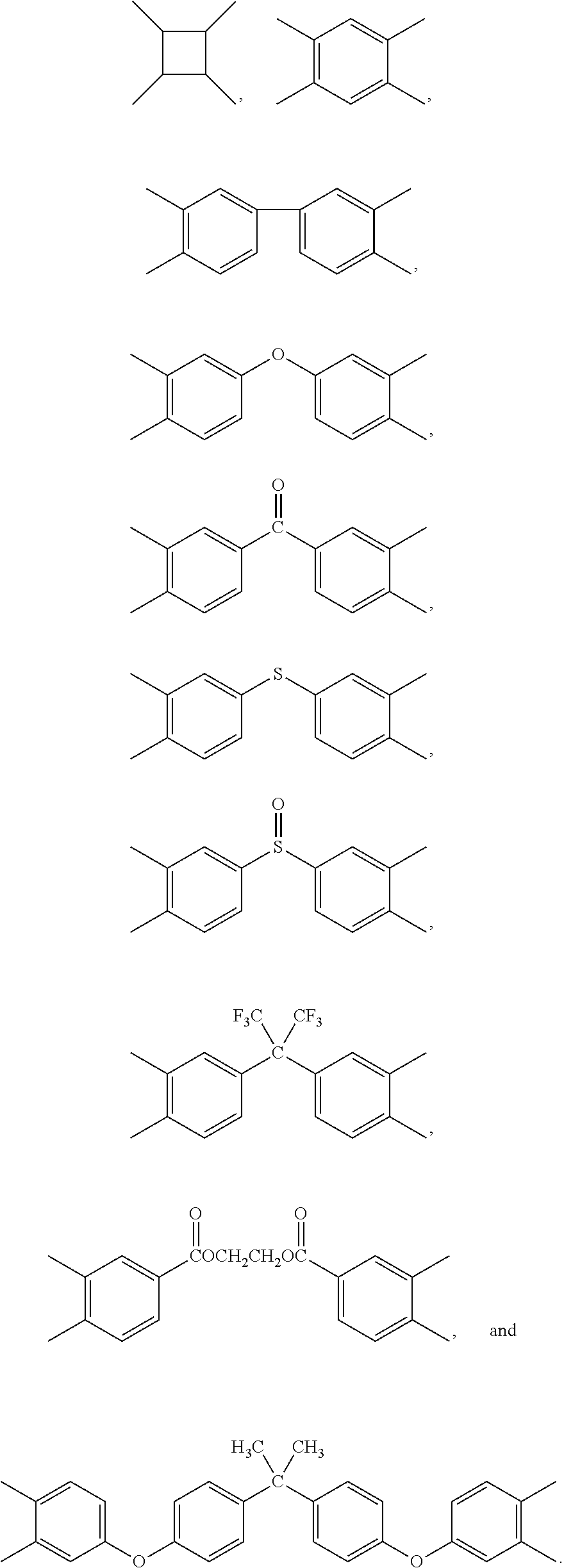
- the X may be each independently a tetravalent organic group, and specifically, it may be at least one functional group selected from the group consisting of Chemical Formulae 4 to 7 below:
- R 3 to R 6 are each independently at least one bivalent functional group selected from the group consisting of a direct bond, —O—, —S—, —C(O)—, —S(O)—, —C(O)O—, —O(C)O—, C 1-10 alkylene and —C(R′) (R′′)—, and when the R 3 to R 6 include two or more functional groups, they are linked to each other,
- R′ and R′′ are each independently an C 1-10 alkyl group substituted or unsubstituted with hydrogen or halogen.
- X can be selected from the group consisting of Chemical Formulae below:
- R of Chemical Formula 1 above may be each independently hydrogen or a C 1-10 alkyl group, and may preferably be hydrogen, methyl or ethyl.
- R a and R b may be each independently hydrogen or an C 1-10 alkyl group, and may preferably be hydrogen, 2-methyl, 3-methyl, 2,3-dimethyl, 2,6-dimethyl and 3,5-dimethyl.
- the A may be O—, —S—, —NH— or C 1-10 alkylene, but may preferably be —O—, —NH—, —(CH 2 )— or (CH 2 ) 2 —.
- the carboxyl group helps the imidization reaction through the interaction with a carbonyl group in the polymer, and the amine can play an important role acting as a catalyst to enhance the imidization degree.
- the protecting group of the amine represented by R 2 can prevent the reaction from occurring during the preparation of the liquid crystal alignment layer, thereby enabling an introduction thereof into the terminal group.
- the R 1 may be hydrogen or a C 1-10 alkyl group, and may preferably be hydrogen, methyl, ethyl, propyl or isopropyl.
- the R 2 is a thermally decomposable functional group, and when decomposed by heat, carbon dioxide is generated, and it is converted to hydrogen as a deprotecting reaction occurs, and consequently is converted to an amine structure.
- a thermally decomposable functional group may be preferably a tert-butoxycarbonyl group (BOC) or a 9-fluorenylmethoxycarbonyl group (FMOC).
- the B may be at least one bivalent functional group selected from the group consisting of a C 1-10 alkylene group, a C 6-20 arylene group, a C 7-20 arylalkylene group,
- the arylalkylene group refers to a functional group in which an aryl group and an alkylene group are linked.
- the liquid crystal aligning agent of one embodiment includes at least one selected from the group consisting of a polyimide precursor and a polyimide, and the weight average molecular weight of the polyimide precursor may be about 5,000 to 100,000 g/mol and the weight average molecular weight of the polyimide may be about 5,000 to 100,000 g/mol.
- the polyimide precursor has a structure in which a group for promoting the imidization reaction is introduced into the terminal of a polymer, whereby the portion protected by the protecting group during the heat treatment process may cause a deprotecting reaction, thereby improving the imidization rate by the newly generated functional group.
- the polyimide prepared by heating the polyimide precursor may cause a cross-linking reaction by the terminal amine represented by Chemical Formula 2, thereby enhancing the chemical resistance and strength.
- the liquid crystal aligning agent of one embodiment may include one or both of the polyimide precursor and the polyimide having the above-described characteristics.
- the liquid crystal aligning agent may be in a state of being dissolved in an organic solvent.
- the kind of the organic solvent and the concentration of the solution, etc. may be determined depending on the type and use of the polyimide precursor and the polyimide included in the liquid crystal aligning agent.
- cyclopentanone cyclohexanone, N-methylpyrrolidone, DMF (dimethylformamide), acetamide, ⁇ -butyrolactone, 2-butoxyethanol or a mixture thereof, etc.
- DMF dimethylformamide
- acetamide ⁇ -butyrolactone
- 2-butoxyethanol 2-butoxyethanol or a mixture thereof, etc.
- the solid concentration of the liquid crystal aligning agent is selected in consideration of the molecular weight, viscosity, volatility and the like of the polyimide precursor and polyimide.
- the liquid crystal aligning agent is preferably presented within a range of 0.5 to 30% by weight based on the total weight of the solution dissolved in a solvent.
- the liquid crystal aligning agent may further include, in addition to the organic solvent for dissolving the polymer, a solvent for improving the uniformity of the coating layer when the liquid crystal aligning agent is coated onto the substrate.
- a solvent a solvent which has a surface tension lower than that of the organic solvent is generally used.
- ethylene glycol monoethyl ether acetate, ethylene glycol mono isopropyl ether, ethylene glycol monomethyl ether and the like can be used.
- liquid crystal alignment layer including the liquid crystal aligning agent of one embodiment.
- the liquid crystal aligning agent of one embodiment comprises the polyimide precursor including a specific terminal group and the polyimide, thereby increasing the imidization rate.
- the liquid crystal alignment performance due to the AC driving is constantly maintained, which reduces the AC residual image resulting therefrom.
- the imidization rate can be increased without the use of the additives, the residual image due to the DC driving which can be expressed by a residual monomer can be minimized.
- a method for preparing a liquid crystal alignment layer comprising: coating the liquid crystal aligning agent of one embodiment onto a substrate to form a coating layer; drying the coating layer; irradiating the surface of the dried coating layer with polarized ultraviolet light to perform alignment treatment; and heat-treating the alignment-treated coating layer.
- the coating method may be determined depending on the type and use of the liquid crystal aligning agent. For example, it can be coated onto the surface of a substrate formed by patterning a transparent conductive film or a metal electrode by using a method such as a roll coater method, a spinner method, a printing method, an inkjet spraying method or a slit nozzle method.
- liquid crystal aligning agent when the liquid crystal aligning agent is coated, in some cases, functional silane-containing compounds, functional fluorine-containing compounds and functional titanium-containing compounds are previously coated onto the substrate in order to further enhance the adhesion of the substrate surface, the transparent conductive layer, the metal electrode and the coating layer.
- the step of drying the coating layer may be carried out through heating of a coating layer or vacuum evaporation, etc.
- the drying step is preferably carried out at 50 to 150° C. for 10 to 300 seconds.
- the alignment treatment can be carried out by irradiating polarized ultraviolet light in the wavelength range of 150 to 450 nm.
- the intensity of the exposure may vary depending on the type of a polymer, and an energy of 50 mJ/cm 2 to 10 J/cm 2 , preferably an energy of 500 mJ/cm 2 to 5 J/cm 2 may be irradiated.
- a polarized ultraviolet light may be used.
- the polarized ultraviolet light may be irradiated perpendicularly to the substrate surface, or may be irradiated by directing an angle of incidence toward a specific angle, but is preferably irradiated perpendicularly to the substrate surface.
- the substrate temperature at the time of irradiating the ultraviolet light is preferably at room temperature. In some cases, however, the ultraviolet light may be irradiated in a heated state within a temperature range of 100° C. or lower.
- the alignment-treated coating layer is heat-treated.
- the step of heat-treatment may be carried out at 150 to 250° C. for 1 to 60 minutes, preferably at 180 to 240° C. for 5 to 20 minutes.
- the thickness of the final liquid crystal alignment layer formed through the above-described series of steps is preferably 50 to 300 nm.
- liquid crystal display including the liquid crystal alignment layer of one embodiment.
- the liquid crystal display can be prepared according to a conventional method known in the art.
- a sealing agent impregnated with a ball spacer is coated in the form of a jar onto the lower plate of the two photoreaction-induced glass substrates having the liquid crystal alignment layer of one embodiment.
- the alignment layers formed on the upper plate and lower plate are aligned such that they face each other, the upper and lower plates are bonded together using a pressing machine, and then a sealing agent is cured by irradiating UV between the bonded upper and lower plates, thereby preparing an empty cell.
- a liquid crystal is injected into the empty cell using a liquid crystal injecting device capable of vacuum injection.
- the sealing agent is coated onto the injection hole of the cell into which the liquid crystal is injected and is cured by UV irradiation, and thereby the liquid crystal cell is completed.
- a 500 ml 3-neck round flask was purged with nitrogen gas to remove water and oxygen in the flask, and acid dianhydride and MeOH (10 wt %) were added thereto and heated under reflux for 5 hours at 75° C. After completely dissolving the solid and completing the reaction, the solvent was removed by distillation under reduced pressure to obtain a product. Thereto, ethyl acetate (EA, 0.5 M) was added and stirred. When the solid was dispersed, 3 equivalents of oxalyl chloride was slowly added, and 2 to 3 drops of DMF were added. The reaction mixture was heated to 80° C. and stirred for 6 hours. After completion of the reaction, the solvent was removed by distillation under reduced pressure and washed with hexane 2 to 3 times to remove a trace amount of oxalyl chloride.
- EA ethyl acetate
- PMDA-OMe-Cl 38 g, 86.5%) was obtained using pyromellitic dianhydride (PDMA 30 g, 0.138 mol) through the synthesis method of acid chloride.
- BPDA-OMe-Cl (33 g, 82%) was obtained using 3,3′,4,4′-biphenyl tetracarboxylic acid dianhydride (BPDA 30 g, 0.102 mol) through the synthesis method of acid chloride.
- BPDA-OMe-Cl (15 g, 0.038 mol) obtained in Preparation Example 2, Boc-Phe (NH 2 )—OH (2.341 g, 0.008 mol), pyridine (6.605 g, 0.084 mol) and 46.676 g of NMP were added dropwise, and the mixture was polymerized for 24 hours to obtain polyamic ester (10 wt %).
- the obtained polyamic ester was precipitated in a mixture of distilled water and methanol to obtain 25.5 g of solid.
- BPDA-OMe-Cl (15 g, 0.038 mol) obtained in Preparation Example 2, Boc-Phe (NH 2 )—OH (3.192 g, 0.011 mol), pyridine (6.605 g, 0.084 mol) and 47.513 g of NMP were added dropwise, and the mixture was polymerized for 24 hours to obtain polyamic ester (10 wt %).
- the obtained polyamic ester was precipitated in a mixture of distilled water and methanol to obtain 25.5 g of solid.
- Each of the polymers prepared according to Examples 1 to 4 and Comparative Examples 1 and 2 was diluted to a solid content of 4 to 5% by weight to prepare a photo-aligning agent.
- a liquid crystal cell was prepared by the following method using the thus-prepared photo-aligning agent.
- the identical photo-aligning agent was sufficiently dropped on a substrate (lower plate) having an ITO electrode pattern formed on a glass substrate having a size of 25 mm ⁇ 27 mm and on a glass substrate (upper plate) having no ITO electrode pattern formed, and then subjected to spin coating at about 1500 to 6000 rpm for 30 seconds or 40 seconds. Under these conditions, a coating layer having a final thickness of 70 to 150 nm was formed on the upper plate and the lower plate.
- the upper plate and lower plate coated with the photo-aligning agent were placed on a hot plate at about 70° C. to perform preliminary calcination for 100 seconds.
- Ultraviolet rays were irradiated with an appropriate exposure amount using an exposure apparatus (UIS-S2021J7-YD01, Ushio LPUV) in which a linear polarizer was adhered to the coating layer formed on the upper plate and the lower plate.
- UIS-S2021J7-YD01 Ushio LPUV
- a sealing agent impregnated with a 3 ⁇ m ball spacer was coated onto the lower plate in the form of a jar through EzROBO-3 manufactured by IEI (Iwashita Engineering Inc.).
- the sealing agent could be coated to have a thickness of 2 to 5 ⁇ m m after sealing.
- the alignment layers formed on the upper plate and lower plate were aligned such that they face each other, the upper and lower plates were bonded together using a pressing machine (BS-7220), and then the sealing agent was cured by irradiating UV between the bonded upper and lower plates to cure the sealing agent, thereby preparing an empty cell.
- a liquid crystal was injected into the empty cell using a liquid crystal injecting device capable of vacuum injection. Thereafter, the sealing agent was coated onto the injection hole of the cell into which the liquid crystal was injected and was cured by UV irradiation, thereby preparing the liquid crystal cell.
- the IR spectrum of the coating layer obtained by preliminary calcination on a hot plate at 70° C. for 100 seconds and the IR spectrum of the coating layer obtained by calcination (curing) on a hot place at 230° C. for 1000 seconds after coating of the photo-aligning agent during the preparation process of the liquid crystal cell were obtained. Then, the area (S) of the N—H peak appearing at 1540 cm-1 in the IR spectra above was compared, and the rate of reduction after calcination at 230° C. was defined as the imidization rate. The rate was calculated and shown in Table 1
- the liquid crystal aligning agent of Examples includes the polyamic ester having a specific terminal group and thus exhibit a very high imidization rate, as compared to the Comparative Examples including the polyamic ester which does not include the terminal group.
Landscapes
- Chemical & Material Sciences (AREA)
- Organic Chemistry (AREA)
- Physics & Mathematics (AREA)
- Chemical Kinetics & Catalysis (AREA)
- Medicinal Chemistry (AREA)
- Polymers & Plastics (AREA)
- Health & Medical Sciences (AREA)
- Crystallography & Structural Chemistry (AREA)
- Engineering & Computer Science (AREA)
- Materials Engineering (AREA)
- Nonlinear Science (AREA)
- Mathematical Physics (AREA)
- Optics & Photonics (AREA)
- General Physics & Mathematics (AREA)
- Spectroscopy & Molecular Physics (AREA)
- Life Sciences & Earth Sciences (AREA)
- Wood Science & Technology (AREA)
- Liquid Crystal (AREA)
- Macromolecular Compounds Obtained By Forming Nitrogen-Containing Linkages In General (AREA)
Abstract
Description


and


and


and when the B includes two or more functional groups, they are linked to each other. The arylalkylene group refers to a functional group in which an aryl group and an alkylene group are linked.
| TABLE 1 | ||||
| Appropriate | Liquid crystal | |||
| exposure | aligning | Imidization | ||
| amount | property | rate | ||
| Example 1 | 0.75 to 1 J | ∘ | 62 | ||
| Example 2 | ∘ | 78 | |||
| Example 3 | ∘ | 60 | |||
| Example 4 | ∘ | 81 | |||
| Comparative | 1 to 3 J | ∘ | 53 | ||
| Example 1 | |||||
| Comparative | ∘ | 50 | |||
| Example 2 | |||||
Claims (11)


Applications Claiming Priority (3)
| Application Number | Priority Date | Filing Date | Title |
|---|---|---|---|
| KR1020160037215A KR101989587B1 (en) | 2016-03-28 | 2016-03-28 | Liquid crystal photoalignment agent, liquid crystal photoalignment film containing the same and method for preparing liquid crystal photoalignment film |
| KR10-2016-0037215 | 2016-03-28 | ||
| PCT/KR2017/003354 WO2017171368A1 (en) | 2016-03-28 | 2017-03-28 | Liquid crystal aligning agent, liquid crystal aligning film comprising same and method for manufacturing liquid crystal aligning film |
Publications (2)
| Publication Number | Publication Date |
|---|---|
| US20180094193A1 US20180094193A1 (en) | 2018-04-05 |
| US10526540B2 true US10526540B2 (en) | 2020-01-07 |
Family
ID=59966150
Family Applications (1)
| Application Number | Title | Priority Date | Filing Date |
|---|---|---|---|
| US15/565,878 Active 2037-08-02 US10526540B2 (en) | 2016-03-28 | 2017-03-28 | Liquid crystal aligning agent, liquid crystal alignment layer comprising the same and method for preparing liquid crystal alignment layer |
Country Status (6)
| Country | Link |
|---|---|
| US (1) | US10526540B2 (en) |
| JP (1) | JP6541866B2 (en) |
| KR (1) | KR101989587B1 (en) |
| CN (1) | CN107438654B (en) |
| TW (1) | TWI639874B (en) |
| WO (1) | WO2017171368A1 (en) |
Families Citing this family (3)
| Publication number | Priority date | Publication date | Assignee | Title |
|---|---|---|---|---|
| JP7163920B2 (en) * | 2017-07-28 | 2022-11-01 | 日産化学株式会社 | Liquid crystal alignment agent, liquid crystal alignment film and liquid crystal display element |
| KR102591368B1 (en) * | 2018-03-16 | 2023-10-19 | 삼성전자주식회사 | Olygomer, composition including oligomer, article prepared from the composition, method for preparing article, and display device including the article |
| CN116594228A (en) * | 2023-05-17 | 2023-08-15 | 深圳秋田微电子股份有限公司 | Method for manufacturing liquid crystal panel, and liquid crystal display device |
Citations (25)
| Publication number | Priority date | Publication date | Assignee | Title |
|---|---|---|---|---|
| JPS57131227A (en) | 1981-02-09 | 1982-08-14 | Nippon Telegr & Teleph Corp <Ntt> | Photopolymer and its production |
| JPS59145216A (en) | 1983-02-07 | 1984-08-20 | Ube Ind Ltd | Organic solvent-soluble photosensitive polyamide-imide |
| US20020019558A1 (en) | 1998-04-01 | 2002-02-14 | Kanegafuchi Kagaku Kogyo Kabushiki Kaisha | Diamine and acid anhydride |
| TW200535120A (en) | 2004-02-12 | 2005-11-01 | Chisso Corp | Dianine, polymer, liquid crystal display aligned film and liquid crystal display device |
| US20070128378A1 (en) | 2005-12-01 | 2007-06-07 | Kyung-Jun Kim | Method of producing liquid crystal aligning layer, liquid crystal aligning layer produced using the same, and liquid crystal display including liquid crystal aligning layer |
| KR20070058233A (en) | 2005-12-01 | 2007-06-08 | 주식회사 엘지화학 | Novel polyimides and methods for their preparation |
| KR100789595B1 (en) | 2006-11-28 | 2007-12-27 | 주식회사 엘지화학 | Novel polyimides and methods for their preparation |
| CN101558100A (en) | 2007-01-09 | 2009-10-14 | Lg化学株式会社 | Novel copolyimide, liquid crystal alignment layer comprising the same, and liquid crystal display comprising the same |
| WO2010050523A1 (en) | 2008-10-29 | 2010-05-06 | 日産化学工業株式会社 | Diamine, polyimide, liquid crystal aligning agent, and liquid crystal alignment film |
| WO2011149071A1 (en) | 2010-05-28 | 2011-12-01 | 日産化学工業株式会社 | Liquid crystal aligning agent containing thermally cleavable group-containing compound, and liquid crystal alignment film |
| KR101108227B1 (en) | 2007-10-10 | 2012-01-31 | 주식회사 엘지화학 | Liquid crystal aligning polymer and liquid crystal aligning film comprising same and liquid crystal display comprising same |
| KR20130038230A (en) | 2010-03-15 | 2013-04-17 | 닛산 가가쿠 고교 가부시키 가이샤 | Liquid crystal alignment agent containing end-modified polyamic acid ester, and liquid crystal alignment film |
| KR20130048726A (en) | 2010-03-15 | 2013-05-10 | 닛산 가가쿠 고교 가부시키 가이샤 | Liquid crystal alignment agent containing polyamic acid ester, and liquid crystal alignment film |
| KR20130049699A (en) | 2011-11-03 | 2013-05-14 | 제일모직주식회사 | Liquid crystal alignment agent, liquid crystal alignment film manufactured using same, and liquid crystal display device including the liquid crystal alignment film |
| CN103571501A (en) | 2012-08-03 | 2014-02-12 | Jsr株式会社 | Liquid crystal aligning agent, liquid crystal alignment film, liquid crystal display device, and manufacturing method for the liquid crystal alignment film |
| KR20140048890A (en) | 2011-06-28 | 2014-04-24 | 닛산 가가쿠 고교 가부시키 가이샤 | Method for producing liquid crystal alignment film, liquid crystal alignment film, and liquid crystal display element |
| KR20140072198A (en) | 2011-10-12 | 2014-06-12 | 닛산 가가쿠 고교 가부시키 가이샤 | Liquid crystal alignment agent, liquid crystal alignment film, and liquid crystal display element |
| CN104395282A (en) | 2012-04-26 | 2015-03-04 | 日产化学工业株式会社 | Diamine, polymer, liquid crystal aligning agent, liquid crystal alignment film, and liquid crystal display element |
| KR20150037576A (en) | 2013-09-30 | 2015-04-08 | 주식회사 엘지화학 | Photoalignment polymer, liquid crystal alignment layer and its preparation method comprising the same |
| WO2015060360A1 (en) | 2013-10-23 | 2015-04-30 | 日産化学工業株式会社 | Liquid crystal aligning agent containing polyimide precursor having thermally cleavable group and/or polyimide |
| WO2015060363A1 (en) | 2013-10-23 | 2015-04-30 | 日産化学工業株式会社 | Liquid crystal aligning agent, liquid crystal alignment film and liquid crystal display element |
| KR20150052111A (en) | 2012-08-29 | 2015-05-13 | 닛산 가가쿠 고교 가부시키 가이샤 | Liquid crystal alignment agent, liquid crystal alignment film, liquid crystal display element |
| KR20150118527A (en) | 2014-04-14 | 2015-10-22 | 제이엔씨 주식회사 | Liquid crystal aligning agents, liquid crystal alignment films and liquid crystal display devices |
| CN105367560A (en) | 2014-08-14 | 2016-03-02 | 捷恩智株式会社 | Tetracarboxylic dianhydride containing triazole, polymer, liquid crystal aligning agent, liquid crystal aligning membrane, and display element |
| US20160195777A1 (en) | 2015-01-07 | 2016-07-07 | Samsung Display Co., Ltd. | Photo-alignment layer and liquid crystal display |
Family Cites Families (1)
| Publication number | Priority date | Publication date | Assignee | Title |
|---|---|---|---|---|
| US8065999B2 (en) * | 2008-07-14 | 2011-11-29 | W.C. Bradley Co. | Adjustable cooking grate for barbeque grills |
-
2016
- 2016-03-28 KR KR1020160037215A patent/KR101989587B1/en active Active
-
2017
- 2017-03-28 TW TW106110376A patent/TWI639874B/en active
- 2017-03-28 WO PCT/KR2017/003354 patent/WO2017171368A1/en not_active Ceased
- 2017-03-28 JP JP2018500763A patent/JP6541866B2/en active Active
- 2017-03-28 CN CN201780001170.3A patent/CN107438654B/en active Active
- 2017-03-28 US US15/565,878 patent/US10526540B2/en active Active
Patent Citations (36)
| Publication number | Priority date | Publication date | Assignee | Title |
|---|---|---|---|---|
| JPS57131227A (en) | 1981-02-09 | 1982-08-14 | Nippon Telegr & Teleph Corp <Ntt> | Photopolymer and its production |
| JPS59145216A (en) | 1983-02-07 | 1984-08-20 | Ube Ind Ltd | Organic solvent-soluble photosensitive polyamide-imide |
| US20020019558A1 (en) | 1998-04-01 | 2002-02-14 | Kanegafuchi Kagaku Kogyo Kabushiki Kaisha | Diamine and acid anhydride |
| TW200535120A (en) | 2004-02-12 | 2005-11-01 | Chisso Corp | Dianine, polymer, liquid crystal display aligned film and liquid crystal display device |
| CN101137699A (en) | 2005-12-01 | 2008-03-05 | Lg化学株式会社 | Novel polyimide and process for producing the same |
| KR20070058233A (en) | 2005-12-01 | 2007-06-08 | 주식회사 엘지화학 | Novel polyimides and methods for their preparation |
| US20070161775A1 (en) | 2005-12-01 | 2007-07-12 | Xing-Zhong Fang | Novel polyimide and method for preparing the same |
| CN101321845A (en) | 2005-12-01 | 2008-12-10 | Lg化学株式会社 | Method of preparing liquid crystal alignment layer, liquid crystal alignment layer prepared using the same, and liquid crystal display including the liquid crystal alignment layer |
| US20070128378A1 (en) | 2005-12-01 | 2007-06-07 | Kyung-Jun Kim | Method of producing liquid crystal aligning layer, liquid crystal aligning layer produced using the same, and liquid crystal display including liquid crystal aligning layer |
| KR100789595B1 (en) | 2006-11-28 | 2007-12-27 | 주식회사 엘지화학 | Novel polyimides and methods for their preparation |
| CN101558100A (en) | 2007-01-09 | 2009-10-14 | Lg化学株式会社 | Novel copolyimide, liquid crystal alignment layer comprising the same, and liquid crystal display comprising the same |
| KR100939628B1 (en) | 2007-01-09 | 2010-01-29 | 주식회사 엘지화학 | Novel polyimide copolymer, liquid crystal alignment film comprising the same, and liquid crystal display comprising the same |
| US20100060834A1 (en) | 2007-01-09 | 2010-03-11 | Xing-Zhong Fang | Copolyimide, liquid crystal aligning layer comprising the same , and liquid crystal display comprising the same |
| KR101108227B1 (en) | 2007-10-10 | 2012-01-31 | 주식회사 엘지화학 | Liquid crystal aligning polymer and liquid crystal aligning film comprising same and liquid crystal display comprising same |
| WO2010050523A1 (en) | 2008-10-29 | 2010-05-06 | 日産化学工業株式会社 | Diamine, polyimide, liquid crystal aligning agent, and liquid crystal alignment film |
| KR20110079733A (en) | 2008-10-29 | 2011-07-07 | 닛산 가가쿠 고교 가부시키 가이샤 | Diamine, polyimide, liquid crystal aligning agent, and liquid crystal aligning film |
| KR20130048726A (en) | 2010-03-15 | 2013-05-10 | 닛산 가가쿠 고교 가부시키 가이샤 | Liquid crystal alignment agent containing polyamic acid ester, and liquid crystal alignment film |
| KR20130038230A (en) | 2010-03-15 | 2013-04-17 | 닛산 가가쿠 고교 가부시키 가이샤 | Liquid crystal alignment agent containing end-modified polyamic acid ester, and liquid crystal alignment film |
| WO2011149071A1 (en) | 2010-05-28 | 2011-12-01 | 日産化学工業株式会社 | Liquid crystal aligning agent containing thermally cleavable group-containing compound, and liquid crystal alignment film |
| KR20130109018A (en) | 2010-05-28 | 2013-10-07 | 닛산 가가쿠 고교 가부시키 가이샤 | Liquid crystal aligning agent containing thermally cleavable group-containing compound, and liquid crystal alignment film |
| KR20140048890A (en) | 2011-06-28 | 2014-04-24 | 닛산 가가쿠 고교 가부시키 가이샤 | Method for producing liquid crystal alignment film, liquid crystal alignment film, and liquid crystal display element |
| CN103827740A (en) | 2011-06-28 | 2014-05-28 | 日产化学工业株式会社 | Method for producing liquid crystal alignment film, liquid crystal alignment film, and liquid crystal display element |
| KR20140072198A (en) | 2011-10-12 | 2014-06-12 | 닛산 가가쿠 고교 가부시키 가이샤 | Liquid crystal alignment agent, liquid crystal alignment film, and liquid crystal display element |
| KR20130049699A (en) | 2011-11-03 | 2013-05-14 | 제일모직주식회사 | Liquid crystal alignment agent, liquid crystal alignment film manufactured using same, and liquid crystal display device including the liquid crystal alignment film |
| CN104395282A (en) | 2012-04-26 | 2015-03-04 | 日产化学工业株式会社 | Diamine, polymer, liquid crystal aligning agent, liquid crystal alignment film, and liquid crystal display element |
| CN103571501A (en) | 2012-08-03 | 2014-02-12 | Jsr株式会社 | Liquid crystal aligning agent, liquid crystal alignment film, liquid crystal display device, and manufacturing method for the liquid crystal alignment film |
| KR20150052111A (en) | 2012-08-29 | 2015-05-13 | 닛산 가가쿠 고교 가부시키 가이샤 | Liquid crystal alignment agent, liquid crystal alignment film, liquid crystal display element |
| KR20150037576A (en) | 2013-09-30 | 2015-04-08 | 주식회사 엘지화학 | Photoalignment polymer, liquid crystal alignment layer and its preparation method comprising the same |
| WO2015060360A1 (en) | 2013-10-23 | 2015-04-30 | 日産化学工業株式会社 | Liquid crystal aligning agent containing polyimide precursor having thermally cleavable group and/or polyimide |
| WO2015060363A1 (en) | 2013-10-23 | 2015-04-30 | 日産化学工業株式会社 | Liquid crystal aligning agent, liquid crystal alignment film and liquid crystal display element |
| US20160244673A1 (en) | 2013-10-23 | 2016-08-25 | Nissan Chemical Industries, Ltd. | Liquid crystal aligning agent, liquid crystal alignment film and liquid crystal display device |
| US20160264867A1 (en) | 2013-10-23 | 2016-09-15 | Nissan Chemical Industries, Ltd. | Liquid crystal aligning agent containing polyimide precursor having thermally-leaving group and/or polyimide |
| KR20150118527A (en) | 2014-04-14 | 2015-10-22 | 제이엔씨 주식회사 | Liquid crystal aligning agents, liquid crystal alignment films and liquid crystal display devices |
| CN105367560A (en) | 2014-08-14 | 2016-03-02 | 捷恩智株式会社 | Tetracarboxylic dianhydride containing triazole, polymer, liquid crystal aligning agent, liquid crystal aligning membrane, and display element |
| US20160195777A1 (en) | 2015-01-07 | 2016-07-07 | Samsung Display Co., Ltd. | Photo-alignment layer and liquid crystal display |
| KR20160085407A (en) | 2015-01-07 | 2016-07-18 | 삼성디스플레이 주식회사 | Photo alignment agent, photo alignment layer, liquid crystal display device and method of manufacturing the same |
Non-Patent Citations (1)
| Title |
|---|
| PCT Search Report & Written Opinion issued for International Application No. PCT/KR2017/003354 dated Jul. 7, 2017, 10 pages. |
Also Published As
| Publication number | Publication date |
|---|---|
| WO2017171368A1 (en) | 2017-10-05 |
| JP2018523164A (en) | 2018-08-16 |
| US20180094193A1 (en) | 2018-04-05 |
| CN107438654A (en) | 2017-12-05 |
| CN107438654B (en) | 2020-08-14 |
| TWI639874B (en) | 2018-11-01 |
| KR101989587B1 (en) | 2019-06-14 |
| JP6541866B2 (en) | 2019-07-10 |
| TW201736921A (en) | 2017-10-16 |
| KR20170111549A (en) | 2017-10-12 |
Similar Documents
| Publication | Publication Date | Title |
|---|---|---|
| US11630350B2 (en) | Liquid crystal alignment composition, method for preparing liquid crystal alignment film, and liquid crystal alignment film using the same | |
| KR101809650B1 (en) | Preparation method of photoalignment layer | |
| WO2017196001A1 (en) | Liquid crystal alignment agent compositions, liquid crystal alignment layer manufacturing method, liquid crystal alignment layer using same, and liquid crystal display device | |
| TWI616473B (en) | Polymer for liquid crystal aligning agent and preparation method thereof, liquid crystal aligning agent, liquid crystal aligning film and liquid crystal display device | |
| JP7620264B2 (en) | Liquid crystal alignment agent, liquid crystal alignment film, and liquid crystal display element | |
| US10526540B2 (en) | Liquid crystal aligning agent, liquid crystal alignment layer comprising the same and method for preparing liquid crystal alignment layer | |
| TWI758513B (en) | Liquid crystal alignment agent, liquid crystal alignment film and liquid crystal display element using the same | |
| US20190256778A1 (en) | Liquid crystal aligning agent composition, method for preparing liquid crystal alignment film using same, and liquid crystal alignment film using same | |
| KR101973192B1 (en) | Liquid crystal alignment composition, method of preparing liquid crystal alignment film, and liquid crystal alignment film using the same | |
| CN114080443B (en) | Liquid crystal alignment agent, liquid crystal alignment film, and liquid crystal display element using the same | |
| KR101971210B1 (en) | Polymer for liquid crystal photoalignment, liquid crystal photoalignment film containing the same and method for preparing liquid crystal photoalignment film | |
| TWI816022B (en) | Liquid crystal alignment agent, liquid crystal alignment film and liquid crystal display elements using the same | |
| KR100822499B1 (en) | Novel polyimides and methods for their preparation | |
| CN111936923B (en) | Liquid crystal aligning agent, liquid crystal aligning film and liquid crystal display element | |
| CN110177856B (en) | Liquid crystal aligning agent composition, method for manufacturing liquid crystal alignment film using same, and liquid crystal alignment film using same | |
| TW202328291A (en) | Liquid crystal alignment agent, liquid crystal alignment film, liquid crystal display element, and compound | |
| KR101835183B1 (en) | Photo-alignment agent composition, and process for producing photo-alignment film using same | |
| JP7544138B2 (en) | Liquid crystal alignment agent, liquid crystal alignment film, and liquid crystal display element | |
| KR100789595B1 (en) | Novel polyimides and methods for their preparation | |
| WO2025079672A1 (en) | Liquid crystal alignment agent, liquid crystal alignment film, and liquid crystal display element | |
| WO2025079671A1 (en) | Liquid crystal alignment agent, liquid crystal alignment film, and liquid crystal display element | |
| JP2021517272A (en) | Liquid crystal alignment agent composition, manufacturing method of liquid crystal alignment film using it, liquid crystal alignment film and liquid crystal display element using it. |
Legal Events
| Date | Code | Title | Description |
|---|---|---|---|
| AS | Assignment |
Owner name: LG CHEM, LTD., KOREA, REPUBLIC OF Free format text: ASSIGNMENT OF ASSIGNORS INTEREST;ASSIGNORS:KWON, SOON HO;JO, JUNG HO;PARK, HANG AH;AND OTHERS;REEL/FRAME:043841/0892 Effective date: 20170906 |
|
| FEPP | Fee payment procedure |
Free format text: ENTITY STATUS SET TO UNDISCOUNTED (ORIGINAL EVENT CODE: BIG.); ENTITY STATUS OF PATENT OWNER: LARGE ENTITY |
|
| STPP | Information on status: patent application and granting procedure in general |
Free format text: DOCKETED NEW CASE - READY FOR EXAMINATION |
|
| STPP | Information on status: patent application and granting procedure in general |
Free format text: NON FINAL ACTION MAILED |
|
| STPP | Information on status: patent application and granting procedure in general |
Free format text: RESPONSE TO NON-FINAL OFFICE ACTION ENTERED AND FORWARDED TO EXAMINER |
|
| STPP | Information on status: patent application and granting procedure in general |
Free format text: NOTICE OF ALLOWANCE MAILED -- APPLICATION RECEIVED IN OFFICE OF PUBLICATIONS |
|
| STPP | Information on status: patent application and granting procedure in general |
Free format text: PUBLICATIONS -- ISSUE FEE PAYMENT VERIFIED |
|
| STPP | Information on status: patent application and granting procedure in general |
Free format text: PUBLICATIONS -- ISSUE FEE PAYMENT VERIFIED |
|
| STCF | Information on status: patent grant |
Free format text: PATENTED CASE |
|
| MAFP | Maintenance fee payment |
Free format text: PAYMENT OF MAINTENANCE FEE, 4TH YEAR, LARGE ENTITY (ORIGINAL EVENT CODE: M1551); ENTITY STATUS OF PATENT OWNER: LARGE ENTITY Year of fee payment: 4 |