US10517952B2 - Nucleophile-triggered degradable materials and methods of making and using the same - Google Patents
Nucleophile-triggered degradable materials and methods of making and using the same Download PDFInfo
- Publication number
- US10517952B2 US10517952B2 US15/532,911 US201515532911A US10517952B2 US 10517952 B2 US10517952 B2 US 10517952B2 US 201515532911 A US201515532911 A US 201515532911A US 10517952 B2 US10517952 B2 US 10517952B2
- Authority
- US
- United States
- Prior art keywords
- ond
- hours
- multivalent
- peg
- nucleophile
- Prior art date
- Legal status (The legal status is an assumption and is not a legal conclusion. Google has not performed a legal analysis and makes no representation as to the accuracy of the status listed.)
- Active, expires
Links
- 0 CC1=C([Y])C2(C)C=C(C*CC3=CC4(C)OC3C(C)=C4[Y][Y])C1O2.CC1=C([Y])C2(C)C=CC1(C*CC13C=CC(C)(O1)C([Y][Y])=C3C)O2.CC1=C([Y])C2(C)C=CC1(CCC(=O)CCCC(=O)CCC13C=CC(C)(O1)C([Y])=C3C)O2.O=C=O.O=C=O.[H]C12C=C(C*CC3=CC4([H])OC3C(CC)=C4C(F)(F)F)C(O1)C(C(=O)OC)=C2C Chemical compound CC1=C([Y])C2(C)C=C(C*CC3=CC4(C)OC3C(C)=C4[Y][Y])C1O2.CC1=C([Y])C2(C)C=CC1(C*CC13C=CC(C)(O1)C([Y][Y])=C3C)O2.CC1=C([Y])C2(C)C=CC1(CCC(=O)CCCC(=O)CCC13C=CC(C)(O1)C([Y])=C3C)O2.O=C=O.O=C=O.[H]C12C=C(C*CC3=CC4([H])OC3C(CC)=C4C(F)(F)F)C(O1)C(C(=O)OC)=C2C 0.000 description 6
- LCOJOIYFKMLDPA-UHFFFAOYSA-N O=C(CCOCC(CO)(COCCC(=O)NCC1=CC=CO1)COCCC(=O)NCC1=CC=CO1)NCC1=CC=CO1 Chemical compound O=C(CCOCC(CO)(COCCC(=O)NCC1=CC=CO1)COCCC(=O)NCC1=CC=CO1)NCC1=CC=CO1 LCOJOIYFKMLDPA-UHFFFAOYSA-N 0.000 description 2
- PFPJQOYCDSPQEB-UHFFFAOYSA-N C.C.CC1(C)OO1.COC(=O)C1=C(C(=O)OC)C2(CNC(=O)CCCC(=O)NCC34C=CC(O3)C(C)=C4C)C=CC1O2.COC(=O)C1=C(C(=O)OC)C2(CNC(=O)CCCC(=O)NCC34OC(C(C)=C3C)C3OC34)OC1C1OC12.O=C=O.O=C=O.O=C=O.O=C=O Chemical compound C.C.CC1(C)OO1.COC(=O)C1=C(C(=O)OC)C2(CNC(=O)CCCC(=O)NCC34C=CC(O3)C(C)=C4C)C=CC1O2.COC(=O)C1=C(C(=O)OC)C2(CNC(=O)CCCC(=O)NCC34OC(C(C)=C3C)C3OC34)OC1C1OC12.O=C=O.O=C=O.O=C=O.O=C=O PFPJQOYCDSPQEB-UHFFFAOYSA-N 0.000 description 1
- JYOSSWZNPJVOJO-UHFFFAOYSA-N C.C.CC1=CC=C(CNC(=O)CCCC(=O)NCC2=CC=C(C)O2)O1.CC1=CC=CC=C1.COC(=O)C#CC(=O)OC.COC(=O)C1=C(C(=O)OC)C2(CNC(=O)CCCC(=O)NCC34C=CC(C)(O3)C(C)=C4C)C=CC1(C)O2.O=C=O.O=C=O Chemical compound C.C.CC1=CC=C(CNC(=O)CCCC(=O)NCC2=CC=C(C)O2)O1.CC1=CC=CC=C1.COC(=O)C#CC(=O)OC.COC(=O)C1=C(C(=O)OC)C2(CNC(=O)CCCC(=O)NCC34C=CC(C)(O3)C(C)=C4C)C=CC1(C)O2.O=C=O.O=C=O JYOSSWZNPJVOJO-UHFFFAOYSA-N 0.000 description 1
- VANYJOIBABSYPQ-UHFFFAOYSA-N C.CC#CC(=O)OC.CC1=CC=CC=C1.COC(=O)C1=C(C(=O)OC)C2(CNC(=O)CC(O)(CC(=O)NCC34C=CC(O3)C(C)=C4C(=O)OC)C(=O)NCC34C=CC(O3)C(C(=O)OC)=C4C(=O)OC)C=CC1O2.O=C(CC(O)(CC(=O)NCC1=CC=CO1)C(=O)NCC1=CC=CO1)NCC1=CC=CO1.O=C=O.O=C=O.[S-2] Chemical compound C.CC#CC(=O)OC.CC1=CC=CC=C1.COC(=O)C1=C(C(=O)OC)C2(CNC(=O)CC(O)(CC(=O)NCC34C=CC(O3)C(C)=C4C(=O)OC)C(=O)NCC34C=CC(O3)C(C(=O)OC)=C4C(=O)OC)C=CC1O2.O=C(CC(O)(CC(=O)NCC1=CC=CO1)C(=O)NCC1=CC=CO1)NCC1=CC=CO1.O=C=O.O=C=O.[S-2] VANYJOIBABSYPQ-UHFFFAOYSA-N 0.000 description 1
- ZXUOJASTNSEBES-UHFFFAOYSA-N C.CC#CC(=O)OC.CC1=CC=CC=C1.COC(=O)C1=C(C(=O)OC)C2(CNC(=O)CCCC(=O)O)C=CC1O2.O=C=O.[H]C1=CC=C(CNC(=O)CCCC(=O)O)O1 Chemical compound C.CC#CC(=O)OC.CC1=CC=CC=C1.COC(=O)C1=C(C(=O)OC)C2(CNC(=O)CCCC(=O)O)C=CC1O2.O=C=O.[H]C1=CC=C(CNC(=O)CCCC(=O)O)O1 ZXUOJASTNSEBES-UHFFFAOYSA-N 0.000 description 1
- SFDCIDVFTSQBRI-UHFFFAOYSA-N C.CC#CC(=O)OC.CC1=CC=CC=C1.COC(=O)C1=C(C(=O)OC)C2(CNC(=O)CCOCC(COCCC(=O)NCC34C=CC(O3)C(C)=C4C)(COCCC(=O)NCC34C=CC(O3)C(C)=C4C)COCCC(=O)NCC34C=CC(O3)C(C(=O)OC)=C4C(=O)OC)C=CC1O2.O=C(CCOCC(COCCC(=O)NCC1=CC=CO1)(COCCC(=O)NCC1=CC=CO1)COCCC(=O)NCC1=CC=CO1)NCC1=CC=CO1.O=C=O.O=C=O.O=C=O.O=C=O.O=C=O.[S-4] Chemical compound C.CC#CC(=O)OC.CC1=CC=CC=C1.COC(=O)C1=C(C(=O)OC)C2(CNC(=O)CCOCC(COCCC(=O)NCC34C=CC(O3)C(C)=C4C)(COCCC(=O)NCC34C=CC(O3)C(C)=C4C)COCCC(=O)NCC34C=CC(O3)C(C(=O)OC)=C4C(=O)OC)C=CC1O2.O=C(CCOCC(COCCC(=O)NCC1=CC=CO1)(COCCC(=O)NCC1=CC=CO1)COCCC(=O)NCC1=CC=CO1)NCC1=CC=CO1.O=C=O.O=C=O.O=C=O.O=C=O.O=C=O.[S-4] SFDCIDVFTSQBRI-UHFFFAOYSA-N 0.000 description 1
- NLFMQHCWOUFMDC-UHFFFAOYSA-M C.CC1=C(C)C2(CNC(=O)CCCC(=O)NCC3=CC=CO3)C=CC1O2.CC1=CC=CC=C1.CCC#CC(F)(F)F.CCOC(=O)C1=C(C(F)(F)F)C2C=CC1(CNC(=O)CCCC(=O)NCC13C=CC(O1)C(C)=C3C)O2.O=C=O.O=C=O.O=C=O.O=C=O.O=C=O.[SH-] Chemical compound C.CC1=C(C)C2(CNC(=O)CCCC(=O)NCC3=CC=CO3)C=CC1O2.CC1=CC=CC=C1.CCC#CC(F)(F)F.CCOC(=O)C1=C(C(F)(F)F)C2C=CC1(CNC(=O)CCCC(=O)NCC13C=CC(O1)C(C)=C3C)O2.O=C=O.O=C=O.O=C=O.O=C=O.O=C=O.[SH-] NLFMQHCWOUFMDC-UHFFFAOYSA-M 0.000 description 1
- NJWZIKHLZZATEM-UHFFFAOYSA-M C.CC1=C(C)C2(CNC(=O)CCCC(=O)NCC3=CC=CO3)C=CC1O2.COC(=O)C1=C(C(=O)OC)C2(CNC(=O)CCCC(=O)O)C=CC1O2.O=C=O.O=C=O.[H]C1=CC=C(CN)O1.[SH-] Chemical compound C.CC1=C(C)C2(CNC(=O)CCCC(=O)NCC3=CC=CO3)C=CC1O2.COC(=O)C1=C(C(=O)OC)C2(CNC(=O)CCCC(=O)O)C=CC1O2.O=C=O.O=C=O.[H]C1=CC=C(CN)O1.[SH-] NJWZIKHLZZATEM-UHFFFAOYSA-M 0.000 description 1
- SMNBHTIPTFABRJ-UHFFFAOYSA-N C=CC#N.COC(=O)C#CC(=O)OC.COC(=O)C1=C(C)C2(CNC(=O)CCOCC(COCCC(=O)NCC34C=CC(O3)C(C(=O)OC)=C4C)(COCCC(=O)NCC34C=CC(O3)C(C)=C4C(=O)OC)COCCC(=O)NCC34C=CC(O3)C(C)=C4C(=O)OC)C=CC1O2.O=C(CCOCC(COCCC(=O)NCC1=CC=CO1)(COCCC(=O)NCC1=CC=CO1)COCCC(=O)NCC1=CC=CO1)NCC1=CC=CO1.O=C=O.O=C=O.O=C=O.O=C=O.OCC(CO)(CO)CO.[C-]#[N+]CCOCC(COCCC#N)(COCCC#N)COCC[N+]#[C-].[S-4].[SH-3] Chemical compound C=CC#N.COC(=O)C#CC(=O)OC.COC(=O)C1=C(C)C2(CNC(=O)CCOCC(COCCC(=O)NCC34C=CC(O3)C(C(=O)OC)=C4C)(COCCC(=O)NCC34C=CC(O3)C(C)=C4C(=O)OC)COCCC(=O)NCC34C=CC(O3)C(C)=C4C(=O)OC)C=CC1O2.O=C(CCOCC(COCCC(=O)NCC1=CC=CO1)(COCCC(=O)NCC1=CC=CO1)COCCC(=O)NCC1=CC=CO1)NCC1=CC=CO1.O=C=O.O=C=O.O=C=O.O=C=O.OCC(CO)(CO)CO.[C-]#[N+]CCOCC(COCCC#N)(COCCC#N)COCC[N+]#[C-].[S-4].[SH-3] SMNBHTIPTFABRJ-UHFFFAOYSA-N 0.000 description 1
- MUBFEEJWPYMKEL-UHFFFAOYSA-N C=CC#N.OCC(CO)(CO)CO.[C-]#[N+]CCOCC(COCCC#N)(COCCC#N)COCC[N+]#[C-].[SH-3] Chemical compound C=CC#N.OCC(CO)(CO)CO.[C-]#[N+]CCOCC(COCCC#N)(COCCC#N)COCC[N+]#[C-].[SH-3] MUBFEEJWPYMKEL-UHFFFAOYSA-N 0.000 description 1
- FRXWJTSIWRPSPQ-UHFFFAOYSA-N CC#CC(=O)OC.CC1=CC=CC=C1.COC(=O)C1=C(C(=O)OC)C2(CNC(=O)CC(O)(CC(=O)NCC34C=CC(O3)C(C(=O)OC)=C4C(=O)OC)C(=O)NCC34C=CC(O3)C(C(=O)OC)=C4C(=O)OC)C=CC1O2.O=C(CC(O)(CC(=O)NCC1=CC=CO1)C(=O)NCC1=CC=CO1)NCC1=CC=CO1.O=C(O)CC(O)(CC(=O)O)C(=O)O.O=C=O.[H]C1=CC=C(CN)O1.[S-2] Chemical compound CC#CC(=O)OC.CC1=CC=CC=C1.COC(=O)C1=C(C(=O)OC)C2(CNC(=O)CC(O)(CC(=O)NCC34C=CC(O3)C(C(=O)OC)=C4C(=O)OC)C(=O)NCC34C=CC(O3)C(C(=O)OC)=C4C(=O)OC)C=CC1O2.O=C(CC(O)(CC(=O)NCC1=CC=CO1)C(=O)NCC1=CC=CO1)NCC1=CC=CO1.O=C(O)CC(O)(CC(=O)O)C(=O)O.O=C=O.[H]C1=CC=C(CN)O1.[S-2] FRXWJTSIWRPSPQ-UHFFFAOYSA-N 0.000 description 1
- HCBANHOAPRLRKF-UHFFFAOYSA-N CC1(C)OO1.COC(=O)C1=C(C(=O)OC)C2(CNC(C)=O)C=CC1O2.COC(=O)C1=C(C(=O)OC)C2(CNC(C)=O)OC1C1OC12 Chemical compound CC1(C)OO1.COC(=O)C1=C(C(=O)OC)C2(CNC(C)=O)C=CC1O2.COC(=O)C1=C(C(=O)OC)C2(CNC(C)=O)OC1C1OC12 HCBANHOAPRLRKF-UHFFFAOYSA-N 0.000 description 1
- NOFJUIOQCIHJQW-UHFFFAOYSA-N CC1=CC(C)=C2C=C3C=CC(CCC(=O)NCCN4C(=O)C=CC4=O)=N3B(F)(F)N12.CSCCOCCOCC(COCCOCCS)(COCCOCCS)COCCOCCS.SCCOCCOCC(COCCOCCS)(COCCOCCS)COCCOCCS Chemical compound CC1=CC(C)=C2C=C3C=CC(CCC(=O)NCCN4C(=O)C=CC4=O)=N3B(F)(F)N12.CSCCOCCOCC(COCCOCCS)(COCCOCCS)COCCOCCS.SCCOCCOCC(COCCOCCS)(COCCOCCS)COCCOCCS NOFJUIOQCIHJQW-UHFFFAOYSA-N 0.000 description 1
- XHMCBDBKRWGOIQ-UHFFFAOYSA-N CC1=CC=C(CN)O1.CC1=CC=C(CNC(=O)CCCC(=O)NCC2=CC=C(C)O2)O1.CC1=CC=C(CNC(=O)CCCC(=O)O)O1 Chemical compound CC1=CC=C(CN)O1.CC1=CC=C(CNC(=O)CCCC(=O)NCC2=CC=C(C)O2)O1.CC1=CC=C(CNC(=O)CCCC(=O)O)O1 XHMCBDBKRWGOIQ-UHFFFAOYSA-N 0.000 description 1
- NPZJCUYOIIDDCL-UHFFFAOYSA-N CC1=CC=C(CN)O1.CC1=CC=C(CNC(=O)CCCC(=O)O)O1.O=C1CCCC(=O)O1 Chemical compound CC1=CC=C(CN)O1.CC1=CC=C(CNC(=O)CCCC(=O)O)O1.O=C1CCCC(=O)O1 NPZJCUYOIIDDCL-UHFFFAOYSA-N 0.000 description 1
- FIBNSXGVVKVUQD-UHFFFAOYSA-N CC1=CC=CC=C1.CCOC(=O)C#CC(F)(F)F.CCOC(=O)C1=C(C(F)(F)F)C2C=CC1(CNC(=O)CCCC(=O)NCC13C=CC(O1)C(C)=C3CC)O2.O=C=O.[H]C1=CC=C(CNC(=O)CCCC(=O)NCC2=CC=C([H])O2)O1 Chemical compound CC1=CC=CC=C1.CCOC(=O)C#CC(F)(F)F.CCOC(=O)C1=C(C(F)(F)F)C2C=CC1(CNC(=O)CCCC(=O)NCC13C=CC(O1)C(C)=C3CC)O2.O=C=O.[H]C1=CC=C(CNC(=O)CCCC(=O)NCC2=CC=C([H])O2)O1 FIBNSXGVVKVUQD-UHFFFAOYSA-N 0.000 description 1
- QULNMHRPVJSBKN-UHFFFAOYSA-N CC1=CC=CC=C1.COC(=O)C#CC(=O)OC.COC(=O)C1=C(C(=O)OC)C2(CNC(=O)CCCC(=O)NCC34C=CC(O3)C(C)=C4C)C=CC1O2.O=C=O.O=C=O.[H]C1=CC=C(CNC(=O)CCCC(=O)NCC2=CC=C([H])O2)O1 Chemical compound CC1=CC=CC=C1.COC(=O)C#CC(=O)OC.COC(=O)C1=C(C(=O)OC)C2(CNC(=O)CCCC(=O)NCC34C=CC(O3)C(C)=C4C)C=CC1O2.O=C=O.O=C=O.[H]C1=CC=C(CNC(=O)CCCC(=O)NCC2=CC=C([H])O2)O1 QULNMHRPVJSBKN-UHFFFAOYSA-N 0.000 description 1
- DDRPCXLAQZKBJP-UHFFFAOYSA-N NCc1ccc[o]1 Chemical compound NCc1ccc[o]1 DDRPCXLAQZKBJP-UHFFFAOYSA-N 0.000 description 1
- VANNPISTIUFMLH-UHFFFAOYSA-N O=C(CCC1)OC1=O Chemical compound O=C(CCC1)OC1=O VANNPISTIUFMLH-UHFFFAOYSA-N 0.000 description 1
- HGBMEVYTRGYYNL-UHFFFAOYSA-N O=C(CCC1=CC=CO1)CC(O)(CC(=O)CCC1=CC=CO1)C(=O)NCC1=CC=CO1.O=C(O)CC(O)(CC(=O)O)C(=O)O.[H]C1=CC=C(CN)O1.[S-2] Chemical compound O=C(CCC1=CC=CO1)CC(O)(CC(=O)CCC1=CC=CO1)C(=O)NCC1=CC=CO1.O=C(O)CC(O)(CC(=O)O)C(=O)O.[H]C1=CC=C(CN)O1.[S-2] HGBMEVYTRGYYNL-UHFFFAOYSA-N 0.000 description 1
- KOYLPGPOYLNJKU-UHFFFAOYSA-N O=C(CCOCC(COCCC(=O)NCC1=CC=CO1)(COCCC(=O)NCC1=CC=CO1)COCCC(=O)NCC1=CC=CO1)NCC1=CC=CO1.[C-]#[N+]CCOCC(COCCC#N)(COCCC#N)COCC[N+]#[C-].[S-4].[SH-3] Chemical compound O=C(CCOCC(COCCC(=O)NCC1=CC=CO1)(COCCC(=O)NCC1=CC=CO1)COCCC(=O)NCC1=CC=CO1)NCC1=CC=CO1.[C-]#[N+]CCOCC(COCCC#N)(COCCC#N)COCC[N+]#[C-].[S-4].[SH-3] KOYLPGPOYLNJKU-UHFFFAOYSA-N 0.000 description 1
- MIJQDRNZQMGWAV-UHFFFAOYSA-N O=C1CCCC(=O)O1.[H]C1=CC=C(CN)O1.[H]C1=CC=C(CNC(=O)CCCC(=O)O)O1 Chemical compound O=C1CCCC(=O)O1.[H]C1=CC=C(CN)O1.[H]C1=CC=C(CNC(=O)CCCC(=O)O)O1 MIJQDRNZQMGWAV-UHFFFAOYSA-N 0.000 description 1
- CBTWBHNTVWLLRB-UHFFFAOYSA-N [H]C1=CC=C(CN)O1.[H]C1=CC=C(CNC(=O)CCCC(=O)NCC2=CC=C([H])O2)O1.[H]C1=CC=C(CNC(=O)CCCC(=O)O)O1 Chemical compound [H]C1=CC=C(CN)O1.[H]C1=CC=C(CNC(=O)CCCC(=O)NCC2=CC=C([H])O2)O1.[H]C1=CC=C(CNC(=O)CCCC(=O)O)O1 CBTWBHNTVWLLRB-UHFFFAOYSA-N 0.000 description 1
Images


Classifications
-
- A—HUMAN NECESSITIES
- A61—MEDICAL OR VETERINARY SCIENCE; HYGIENE
- A61K—PREPARATIONS FOR MEDICAL, DENTAL OR TOILETRY PURPOSES
- A61K47/00—Medicinal preparations characterised by the non-active ingredients used, e.g. carriers or inert additives; Targeting or modifying agents chemically bound to the active ingredient
- A61K47/30—Macromolecular organic or inorganic compounds, e.g. inorganic polyphosphates
- A61K47/34—Macromolecular compounds obtained otherwise than by reactions only involving carbon-to-carbon unsaturated bonds, e.g. polyesters, polyamino acids, polysiloxanes, polyphosphazines, copolymers of polyalkylene glycol or poloxamers
-
- A—HUMAN NECESSITIES
- A61—MEDICAL OR VETERINARY SCIENCE; HYGIENE
- A61L—METHODS OR APPARATUS FOR STERILISING MATERIALS OR OBJECTS IN GENERAL; DISINFECTION, STERILISATION OR DEODORISATION OF AIR; CHEMICAL ASPECTS OF BANDAGES, DRESSINGS, ABSORBENT PADS OR SURGICAL ARTICLES; MATERIALS FOR BANDAGES, DRESSINGS, ABSORBENT PADS OR SURGICAL ARTICLES
- A61L15/00—Chemical aspects of, or use of materials for, bandages, dressings or absorbent pads
- A61L15/16—Bandages, dressings or absorbent pads for physiological fluids such as urine or blood, e.g. sanitary towels, tampons
- A61L15/42—Use of materials characterised by their function or physical properties
- A61L15/62—Compostable, hydrosoluble or hydrodegradable materials
-
- A—HUMAN NECESSITIES
- A61—MEDICAL OR VETERINARY SCIENCE; HYGIENE
- A61L—METHODS OR APPARATUS FOR STERILISING MATERIALS OR OBJECTS IN GENERAL; DISINFECTION, STERILISATION OR DEODORISATION OF AIR; CHEMICAL ASPECTS OF BANDAGES, DRESSINGS, ABSORBENT PADS OR SURGICAL ARTICLES; MATERIALS FOR BANDAGES, DRESSINGS, ABSORBENT PADS OR SURGICAL ARTICLES
- A61L27/00—Materials for grafts or prostheses or for coating grafts or prostheses
- A61L27/50—Materials characterised by their function or physical properties, e.g. injectable or lubricating compositions, shape-memory materials, surface modified materials
- A61L27/58—Materials at least partially resorbable by the body
-
- C—CHEMISTRY; METALLURGY
- C08—ORGANIC MACROMOLECULAR COMPOUNDS; THEIR PREPARATION OR CHEMICAL WORKING-UP; COMPOSITIONS BASED THEREON
- C08G—MACROMOLECULAR COMPOUNDS OBTAINED OTHERWISE THAN BY REACTIONS ONLY INVOLVING UNSATURATED CARBON-TO-CARBON BONDS
- C08G73/00—Macromolecular compounds obtained by reactions forming a linkage containing nitrogen with or without oxygen or carbon in the main chain of the macromolecule, not provided for in groups C08G12/00 - C08G71/00
- C08G73/02—Polyamines
- C08G73/0273—Polyamines containing heterocyclic moieties in the main chain
-
- C—CHEMISTRY; METALLURGY
- C08—ORGANIC MACROMOLECULAR COMPOUNDS; THEIR PREPARATION OR CHEMICAL WORKING-UP; COMPOSITIONS BASED THEREON
- C08G—MACROMOLECULAR COMPOUNDS OBTAINED OTHERWISE THAN BY REACTIONS ONLY INVOLVING UNSATURATED CARBON-TO-CARBON BONDS
- C08G75/00—Macromolecular compounds obtained by reactions forming a linkage containing sulfur with or without nitrogen, oxygen, or carbon in the main chain of the macromolecule
- C08G75/02—Polythioethers
- C08G75/04—Polythioethers from mercapto compounds or metallic derivatives thereof
- C08G75/045—Polythioethers from mercapto compounds or metallic derivatives thereof from mercapto compounds and unsaturated compounds
-
- C—CHEMISTRY; METALLURGY
- C08—ORGANIC MACROMOLECULAR COMPOUNDS; THEIR PREPARATION OR CHEMICAL WORKING-UP; COMPOSITIONS BASED THEREON
- C08J—WORKING-UP; GENERAL PROCESSES OF COMPOUNDING; AFTER-TREATMENT NOT COVERED BY SUBCLASSES C08B, C08C, C08F, C08G or C08H
- C08J3/00—Processes of treating or compounding macromolecular substances
- C08J3/24—Crosslinking, e.g. vulcanising, of macromolecules
-
- A—HUMAN NECESSITIES
- A61—MEDICAL OR VETERINARY SCIENCE; HYGIENE
- A61K—PREPARATIONS FOR MEDICAL, DENTAL OR TOILETRY PURPOSES
- A61K9/00—Medicinal preparations characterised by special physical form
- A61K9/0012—Galenical forms characterised by the site of application
- A61K9/0019—Injectable compositions; Intramuscular, intravenous, arterial, subcutaneous administration; Compositions to be administered through the skin in an invasive manner
-
- A—HUMAN NECESSITIES
- A61—MEDICAL OR VETERINARY SCIENCE; HYGIENE
- A61K—PREPARATIONS FOR MEDICAL, DENTAL OR TOILETRY PURPOSES
- A61K9/00—Medicinal preparations characterised by special physical form
- A61K9/0012—Galenical forms characterised by the site of application
- A61K9/0019—Injectable compositions; Intramuscular, intravenous, arterial, subcutaneous administration; Compositions to be administered through the skin in an invasive manner
- A61K9/0024—Solid, semi-solid or solidifying implants, which are implanted or injected in body tissue
-
- A—HUMAN NECESSITIES
- A61—MEDICAL OR VETERINARY SCIENCE; HYGIENE
- A61K—PREPARATIONS FOR MEDICAL, DENTAL OR TOILETRY PURPOSES
- A61K9/00—Medicinal preparations characterised by special physical form
- A61K9/06—Ointments; Bases therefor; Other semi-solid forms, e.g. creams, sticks, gels
-
- C—CHEMISTRY; METALLURGY
- C08—ORGANIC MACROMOLECULAR COMPOUNDS; THEIR PREPARATION OR CHEMICAL WORKING-UP; COMPOSITIONS BASED THEREON
- C08G—MACROMOLECULAR COMPOUNDS OBTAINED OTHERWISE THAN BY REACTIONS ONLY INVOLVING UNSATURATED CARBON-TO-CARBON BONDS
- C08G2210/00—Compositions for preparing hydrogels
-
- C—CHEMISTRY; METALLURGY
- C08—ORGANIC MACROMOLECULAR COMPOUNDS; THEIR PREPARATION OR CHEMICAL WORKING-UP; COMPOSITIONS BASED THEREON
- C08G—MACROMOLECULAR COMPOUNDS OBTAINED OTHERWISE THAN BY REACTIONS ONLY INVOLVING UNSATURATED CARBON-TO-CARBON BONDS
- C08G2230/00—Compositions for preparing biodegradable polymers
Definitions
- Degradable materials are can be used in a variety of applications, including but not limited to medical applications. Improved degradable materials and methods of making the same are desired.
- degradable materials for instance, polymeric and hyperbranched crosslinked materials that can be made with oxanorbornadiene (OND) linkages.
- OND linkages can be activated for cleavage at a predetermined rate by the addition of a nucleophile (e.g., a thiol or amine) to the OND structure.
- nucleophile e.g., a thiol or amine
- the degradable materials disclosed herein can comprise fragmentation technology that can be triggered by a molecular binding event, followed by decomposition at predetermined rates.
- degradable materials comprising the reaction product of an oxanorbornadiene crosslinker or derivative thereof and a multivalent nucleophile-terminated compound, wherein the reaction product is a degradable elastic solid capable of entraining cargo.
- the oxanorbornadiene crosslinker or derivative thereof is multivalent
- the multivalent nucleophile-terminated compound is a multivalent nucleophile-terminated monomer.
- the multivalent nucleophile-terminated compound is a multivalent nucleophile-terminated macromer.
- the reaction between the multivalent nucleophile-terminated compound and oxanorbornadiene crosslinker or derivative thereof trigger programmed fragmentation of adducts that causes the material to degrade.
- the oxanorbornadiene crosslinker comprises at least one of the following:
- the degradable material further comprises a divalent chain propagator.
- the divalent chain propagator comprises at least one of the following:
- the nucleophile comprises a thiol, phosphine, or amine.
- the multivalent nucleophile-terminated compound comprises a thiol-terminated multivalent polyethylene glycol. In some embodiments, the multivalent nucleophile-terminated compound has a valency of 4, 5, 6, or 8.
- the multivalent nucleophile-terminated compound is also comprises endgroups pre-labeled and/or post-labeled with a probe or cargo.
- the degradable material further comprises a second compound comprising end groups pre-labeled and/or post-labeled with a probe or cargo.
- the compound is pre-labeled and/or post-labeled with a probe or cargo to achieve added functionality (e.g., recruiting a cell, releasing a molecule, tuning a material property (e.g., hydrophobicity, hydrophilicity, charge state, polarity or a combination thereof), or a combination thereof).
- the molecule comprises a pharmaceutical agent (e.g., chemotherapeutic agent, anti-inflammatory agent, cytotoxic molecule, antimicrobial agent, immunological adjuvant, antibody, protein, peptide, or combination thereof), antimicrobial, nanoparticle, imaging agent, protein, or a combination thereof.
- a pharmaceutical agent e.g., chemotherapeutic agent, anti-inflammatory agent, cytotoxic molecule, antimicrobial agent, immunological adjuvant, antibody, protein, peptide, or combination thereof
- the protein is covalently tethered or physically entrained.
- the probe comprises a fluorescent dye, an imaging agent, a radioactive label, or a combination thereof.
- the cargo comprises a small molecule, a protein, a nanoparticle, or a combination thereof.
- the degradable material has a tunable cargo release half-life (e.g., 30 seconds to 1 year, 12 hours to 1 month).
- the degradable material further comprises an additive (e.g., a buffer, catalytic base, or combination thereof).
- the multivalent nucleophile-terminated compound is present in a concentration of 2.5 wt % to 80 wt % in a solution that becomes a gel.
- the reaction product is post-functionalized with a second oxanorbornadiene crosslinker or derivative thereof.
- the degradable material is a hyperbranched crosslinked and polymeric material.
- the degradable material is an elastic hydrogel.
- the degradable material is an organogel.
- Degradable materials comprising a polymeric and hyperbranched crosslinked material made with oxanorbornadiene linkage that can be activated for cleavage at a predetermined rate by addition of a nucleophile are also disclosed herein. Also disclosed herein are uses of the degradable materials disclosed herein in applications such as wound dressing, injectable drug device, implantable drug device, tissue engineering substrate, 3D cell culture, or combination thereof.
- Disclosed herein are methods for producing a degradable material comprising: combining a solution of a multivalent nucleophile-terminated compound and an oxanorbornadiene crosslinker to yield elastic solids capable of entraining cargo, wherein the reaction between the multivalent nucleophile-terminated compound and oxanorbornadiene trigger programmed fragmentation of adducts, and wherein the programmed fragmentation of adducts causes the material to degrade.
- the combining takes place at room temperature. In some embodiments, the combining takes place at physiological temperature. In some embodiments, the combining takes place at a temperature from 20° C. to 40° C.
- the combining takes place and at a pH that leads to gelation in less than a minute. In some embodiments, the combining takes place at a pH from 6 to 8. In some embodiments, the combining takes place at a pH of 7.4.
- the half-life of fragmentation of adducts is programmed by the choice of oxanorbomadiene crosslinker or derivative thereof and choice of valence thereof. In some embodiments, the programmed fragmentation of adducts takes place at a half-life of adduct fragmentation of 30 seconds to 4 months. In some embodiments, the half-life of adduct fragmentation is from 12 hours to 1 month.
- the cargo is entrained.
- the cargo comprises a small molecule, a protein, a nanoparticles, or a combination thereof.
- the reaction between the multivalent nucleophile-terminated compound and oxanorbornadiene crosslinker or derivative thereof trigger programmed fragmentation of adducts that causes the material to degrade.
- FIG. 1A depicts species formed during degradation of PEG-OND hydrogels.
- FIG. 1B depicts an inversion test for hydrogel degradation; gels derived from 8 were stable indefinitely.
- FIG. 1C depicts angular frequency dependence of G′ and G′′ at a fixed strain of 1% at 22° C. for gel formed with 8.
- FIG. 1D depicts time dependence of G′ and G′′ for gel formed with linker 7c at a constant strain of 5% and an angular frequency of 1 rad/sec, at 4° C. and 22° C.
- FIG. 2A depicts a schematic of release of erosion probe (EP) during gel degradation.
- FIG. 2B depicts erosion profiles resulting from varying OND linker identity.
- FIG. 2C depicts erosion profiles resulting from ratios of linkers.
- FIG. 2D depicts erosion profiles resulting from OND valence.
- FIG. 2E depicts demonstrated insensitivity of erosion behavior to pH of swelling buffer. Dotted lines represent theoretical reverse gelation thresholds.
- FIG. 3A depicts the release of entrained carboxyfluorescein cargos from PEG-OND hydrogels. Dotted lines represent fit for diffusion of cargo from PEG-OND gel 8.
- FIG. 3B depicts the release of entrained bovine serum albumin cargos from PEG-OND hydrogels. Dotted lines represent fit for diffusion of cargo from PEG-OND gel 8.
- FIG. 3C depicts the release of entrained bacteriophage Qb virus-like particle cargos from PEG-OND hydrogels.
- FIG. 4 depicts, on the left, upright samples 2 minutes after addition of triethylamine; on the right, shows the same samples after inversion. Samples at 0.4 2.1 wt % are free-flowing solutions.
- FIG. 5 depicts oscillatory time sweep of the gel derived from bis-EONB 8 and 4-PEG-SH (1:1 ratio of reactive groups) at 37° C.
- FIG. 9 depicts monitoring hydrogel degradation by inversion test. Incubation performed at 50° C. for (A) 0 hours, (B) 2 hours, (C) 3 hours, (D) 8.5 hours, (E) 20.5 hours, (F) 5 days.
- FIG. 10 depicts 1 H NMR spectra of PEG-OND Hydrogel formed with 4-PEG-SH macromer and bis-ONDs 7a.
- A bis-OND 7a in KDPO 4 /K 2 PO 4 buffer (pH 7.4)
- B PEG-OND hydrogel from 4-PEG-SH and 7a, 10 mins after mixing at 22° C.
- C Sample at reverse-gelation point
- D Sample after complete degradation.
- Second and fifth highlighted vertical band distinctive OND peaks
- third highlighted vertical band distinctive OND-thiol adduct peaks
- first and fourth highlighted vertical band distinctive furan peaks.
- FIG. 11 depicts 1 H NMR spectra of PEG-OND Hydrogel formed with 4-PEG-SH macromer and bis-ONDs 7b.
- A PEG-OND hydrogel from 4-PEG-SH and 7a, 15 mins after mixing at 22° C.
- FIG. 12 depicts observed conversion of OND-thiol adducts to furan vs. time in a 3.5 wt % PEG-OND hydrogel formed with bis-OND 7a.
- the horizontal dotted line represents the theoretical reverse gelation point.
- FIG. 13 depicts observed conversion of OND-thiol adducts to furan vs. time in a 3.5 wt % PEG-OND hydrogel formed with bis-OND 7b.
- the horizontal dotted line represents the theoretical reverse gelation point.
- FIG. 14 depicts quantitation of fluorogenic OND-thiol adduct concentration as a means of determining thiol concentration.
- FIG. 15 depicts probe S-6 in pH 7.4 PBS incubated for 18 hours at 4° C. in buffer alone (left), or in the presence of a 60 ⁇ L PEG-OND hydrogels formed with linker 8 (middle), and 7a (right). Fluorescent gel and supernatant indicate residual 4-PEG-SH thiols are accessible post-gelation for further modification.
- FIG. 16 depicts GPC analysis of BODIPY FL maleimide-labeled 4-PEG-SH macromer.
- FIG. 17 depicts GPC analysis of supernatant (swelling buffer) of BODIPY-labeled 3.5 wt % hydrogel formed with linker 7b.
- A 64 hours of incubation at 37° C., gel still intact;
- B Sample from A after 180 hours at 37° C., post-disintegration of gel.
- C Sample after 180 hours at 37° C., post-disintegration of gel, no buffer exchanges.
- FIG. 18 depicts GPC analysis of supernatant (swelling buffer) of BODIPY-labeled 3.5 wt % hydrogel formed with linker 8 after 72 hours of incubation at 37° C.
- FIG. 19 depicts a comparison of hydrogel erosion for gels prepared with unmodified 4-PEG-SH macromer, or 4-PEG-SH with 3% of end groups modified with a BODIPY-FL erosion probe and bis-OND linkers 7b or 7a (A and B, respectively).
- FIG. 20 depicts overlay of erosion profile for PEG-OND (7a) hydrogel and time frame of gel collapse observed in time-lapse video (S2 Video, described infra).
- FIG. 21A depicts the release of entrained FITC-labeled BSA with ⁇ 0.4 accessible thiols per protein from bis-OND hydrogels 7a, 7b, and 8. Tracking the fraction of BSA released over time reveals that ⁇ 20% of BSA becomes tethered to the network (horizontal dashed lines).
- FIG. 21B is a representation of BSA entrained in bis-OND hydrogels and tethered to the network by reaction with terminal OND electrophiles (dotted box).
- FIG. 22 depicts 1 H NMR spectra of 5a.
- FIG. 23 depicts 1 H NMR spectra of 5b.
- FIG. 24 depicts 1 H NMR spectra of 6a.
- FIG. 25 depicts 1 H NMR spectra of 6b.
- FIG. 26 depicts 1 H NMR spectra of 7a.
- FIG. 27 depicts 1 H NMR spectra of 7b.
- FIG. 28 depicts 1 H NMR spectra of 7c.
- FIG. 29 depicts 1 H NMR spectra of 8.
- FIG. 30 depicts 1 H NMR spectra of 9.
- FIG. 31 depicts 1 H NMR spectra of S-1.
- FIG. 32 depicts 1 H NMR spectra of 10.
- FIG. 33 depicts 1 H NMR spectra of S-2.
- FIG. 34 depicts 1 H NMR spectra of 11.
- FIG. 35 depicts 1 H NMR spectra of S-3.
- FIG. 36 depicts 1 H NMR spectra of S-4.
- FIG. 37 depicts 1 H NMR spectra of S-4′.
- FIG. 38 depicts 1 H NMR spectra of 12.
- FIG. 39 depicts 1 H NMR spectra of S-5.
- FIG. 40 depicts 1 H NMR spectra of Epoxy-11.
- FIG. 41 depicts synthesis of symmetric and asymmetric bis-ONDs, and structures of tris- and tetra-ONDs.
- FIG. 42 depicts formation of PEG-OND hydrogels.
- FIG. 43A depicts labeling of bovine serum albumin with FITC using sodium borate buffer.
- FIG. 43B depicts labeling of bovine serum albumin with FITC using potassium phosphate buffer.
- FIG. 44 depicts labeling of Q ⁇ virus-like particle with FITC using standard protocol.
- FIG. 45 depicts entrainment of fluorescent cargo in hydrogels for comparison of release rates.
- degradable materials for instance, polymeric and hyperbranched crosslinked materials that can be made with oxanorbornadiene (OND) linkages.
- OND linkages can be activated for cleavage at a predetermined rate by the addition of a nucleophile (e.g., a thiol, phosphine, or amine) to the OND structure.
- a nucleophile e.g., a thiol, phosphine, or amine
- the degradable materials disclosed herein can comprise fragmentation technology that can be triggered by a molecular binding event, followed by decomposition at predetermined rates.
- degradable materials for instance, polymeric and hyperbranched crosslinked materials that can be made with oxanorbornadiene (OND) linkages.
- OND linkages can be activated for cleavage at a predetermined rate by the addition of a nucleophile (e.g., a thiol or amine) to the OND structure.
- nucleophile e.g., a thiol or amine
- the degradable materials disclosed herein can comprise fragmentation technology that can be triggered by a molecular binding event, followed by decomposition at predetermined rates.
- degradable materials comprising the reaction product of an oxanorbornadiene crosslinker or derivative thereof and a multivalent nucleophile-terminated compound, wherein the reaction product is a degradable elastic solid capable of entraining cargo.
- the oxanorbomadiene crosslinker or derivative thereof is multivalent
- the multivalent nucleophile-terminated compound is a multivalent nucleophile-terminated monomer.
- the multivalent nucleophile-terminated compound is a multivalent nucleophile-terminated macromer.
- the reaction between the multivalent nucleophile-terminated compound and oxanorbornadiene crosslinker or derivative thereof trigger programmed fragmentation of adducts that causes the material to degrade.
- the oxanorbomadiene crosslinker comprises at least one of the following:
- the degradable materials that can be programmed for a desired level of stability and degradation rate.
- the fundamental chemistry of oxanorbornadiene (OND) linkages can be found in, for instance, Hong et al., Thiol - Selective Fluorogenic Probes for Labeling and Release, 131 J. AM. CHEM. SOC'Y 9986, 9986-94 (2009), and Kislukhin et al., Degradable Conjugates from Oxanorbornadiene Reagents, 134 J. AM. CHEM. SOC'Y 64914, 64914-91 (2012), each of which is incorporated by reference herein in its entirety.
- the oxanorbornadiene crosslinker or derivative thereof can comprise any multivalent substituted 7-oxanorborandiene derivative, as exemplified in the structures above.
- Polyvalent core molecules can also be derived from other multivalent precursors (e.g., citric acid, pentaerythritol, amine-terminated multivalent polyethyleneglycol).
- Other possible substitutions of the 7-oxanorbornadiene scaffold are described in Kislunkhin et al., Degradable Conjugates from Oxanorbornadiene Reagents, 134 J. Am. Chem. Soc'y 64914, 64914-91 (2012).
- the degradable material further comprises a divalent chain propagator.
- the divalent chain propagator comprises a divalent nucleophilic species or divalent electrophilic species.
- divalent nucleophilic species include compounds such as substituted dithioalkanes (for example, dithiothreitol), substituted diaminoalkanes (for example, 1,3-diaminopropane), telechelic amine- or thiol-terminated polymers and copolymers (for example, amine- or thiol-terminated linear polyethylene glycols and tri-block polyethylene glycol-polypropylene glycol-polyethylene glycol or poloxamer linkers).
- divalent electrophilic species include bis-maleimides, bis-N-hydroxysuccinimidyl esters, bis-acrylate or acyrlamide, bis-haloalkanes, and substituted bis-epoxyoxanorbornenes derived from substituted bis-oxanorbornadiene crosslinkers.
- Higher valence epoxyoxanorbornenes i.e. valence >2 may also be employed as chain propagators and non-degradable cross-linkers. Many of these divalent chain propagators are commercially available chemicals. Chemical structures of representative examples of these species are below:
- the nucleophile comprises a thiol, phosphine, or amine.
- the multivalent nucleophile-terminated compound comprises a thiol-terminated multivalent polyethylene glycol. In some embodiments, the multivalent nucleophile-terminated compound has a valency of 4, 5, 6, or 8.
- the multivalent nucleophile-terminated compound is also comprises endgroups pre-labeled and/or post-labeled with a probe or cargo.
- the degradable material further comprises a second compound comprising end groups pre-labeled and/or post-labeled with a probe or cargo.
- the compound is pre-labeled and/or post-labeled with a probe or cargo to achieve added functionality (e.g., recruiting a cell, releasing a molecule, tuning a material property (e.g., hydrophobicity, hydrophilicity, charge state, polarity or a combination thereof), or a combination thereof).
- the molecule comprises a pharmaceutical agent (e.g., chemotherapeutic agent, anti-inflammatory agent, cytotoxic molecule, antimicrobial agent, immunological adjuvant, antibody, protein, peptide, or combination thereof), antimicrobial, nanoparticle, imaging agent, protein, or a combination thereof.
- a pharmaceutical agent e.g., chemotherapeutic agent, anti-inflammatory agent, cytotoxic molecule, antimicrobial agent, immunological adjuvant, antibody, protein, peptide, or combination thereof
- cytotoxic molecules include doxorubicin or camptothecin.
- anti-inflammatory agents include, for instance, salicylic acid or ibuprofen.
- antimicrobial compound pharmaceutical agents include erythromycin A. Any pharmaceutical agent or biologic capable of entrainment in the degradable material can be used.
- the protein is covalently tethered or physically entrained.
- the probe comprises fluorescent dye (such as BODIPY-FL, fluorescein, rhodamine, and cyanine dyes), or other imaging agent (for example, magnetic resonance imaging contrast agents such as gadolinium DOTA and related derivatives), or radioactive label (such as 31 P-labeled DNA or oligonucleotide), or a combination thereof.
- the cargo comprises a small molecule, a protein, a nanoparticle, or a combination thereof.
- the degradable material further comprises an additive (e.g., a buffer, catalytic base, or combination thereof).
- the multivalent nucleophile-terminated compound is present in a concentration of 2.5 wt % to 80 wt % (e.g., 2.5 wt % to 5 wt %, 5 wt % to 10 wt %, 10 wt % to 20 wt %, 20 wt % to 30 wt %, 30 wt % to 40 wt %, 40 wt % to 50 wt %, 50 wt % to 60 wt %, 60 wt % to 70 wt %, 70 wt % to 80 wt %, 2.5 wt % to 20 wt %, 20 wt % to 40 wt %, 40 wt % to 60 wt %, 60 wt % to 80 wt %, 2.5 wt % to 45 wt %, 45 wt % to 80 wt %) in a solution
- the reaction product is post-functionalized with a second oxanorbornadiene crosslinker or derivative thereof.
- the degradable material is a hyperbranched crosslinked and polymeric material.
- the degradable material is an elastic hydrogel.
- the degradable material is an organogel.
- Degradable materials comprising a polymeric and hyperbranched crosslinked material made with oxanorbornadiene linkage that can be activated for cleavage at a predetermined rate by addition of a nucleophile are also disclosed herein. Also disclosed herein are uses of the degradable materials disclosed herein in applications such as wound dressing, injectable drug device, implantable drug device, tissue engineering substrate, 3D cell culture, or combination thereof.
- Disclosed herein are methods for producing a degradable material comprising: combining a solution of a multivalent nucleophile-terminated compound and an oxanorbornadiene crosslinker to yield elastic solids capable of entraining cargo, wherein the reaction between the multivalent nucleophile-terminated compound and oxanorbornadiene trigger programmed fragmentation of adducts, and wherein the programmed fragmentation of adducts causes the material to degrade.
- the combining takes place at room temperature. In some embodiments, the combining takes place at physiological temperature. In some embodiments, the combining takes place at a temperature from 20° C. to 40° C. (e.g., 20° C. to 22° C., 22° C. to 24° C., 24° C. to 26° C., 26° C. to 28° C., 28° C. to 30° C., 30° C. to 32° C., 32° C. to 34° C., 34° C. to 36° C., 36° C. to 38° C., 38° C. to 40° C.).
- 20° C. to 40° C. e.g., 20° C. to 22° C., 22° C. to 24° C., 24° C. to 26° C., 26° C. to 28° C., 28° C. to 30° C., 30° C. to 32° C., 32° C. to 34° C., 34° C. to 36° C., 36° C.
- the combining takes place and at a pH that leads to gelation in less than a minute. In some embodiments, the combining takes place at a pH from 6 to 8 (e.g., 6 to 6.5, 6.5 to 7, 7 to 7.5, 7.5 to 8, 6 to 7, 7 to 8, 6.5 to 7.5, 7.2 to 7.6). In some embodiments, the combining takes place at a pH of 7.4.
- the half-life of fragmentation of adducts is programmed by the choice of oxanorbornadiene crosslinker or derivative thereof and choice of valence thereof. In some embodiments, the programmed fragmentation of adducts takes place at a half-life of adduct fragmentation of 30 seconds to 4 months. In some embodiments, the half-life of adduct fragmentation is from 12 hours to 1 month. In some embodiments, the reaction of nucleophiles (e.g., thiol and amine) with ONDs can serve as a mechanism for gelation.
- nucleophiles e.g., thiol and amine
- the reaction of nucleophiles (e.g., thiol and amine) with ONDs can trigger for the programmed fragmentation of the adducts by a retro-Diels-Alder mechanism to liberate a thiomaleate or aminomaleate and a furan.
- This can provide a method of generating degradable hyperbranched materials and elastic hydrogels.
- the half-life of adduct fragmentation is tunable, and varies with features present on the parent OND linker. Half-life of adduct fragmentation can vary from minutes to months at physiologically relevant temperatures (e.g., 35° C. to 40° C., 36.5° C.
- the half-life of adduct fragmentation is 30 seconds or greater (e.g., 1 minute or greater, 2 minutes or greater, 3 minutes or greater, 4 minutes or greater, 5 minutes or greater, 10 minutes or greater, 15 minutes or greater, 30 minutes or greater, 45 minutes or greater, 1 hour or greater, 2 hours or greater, 5 hours or greater, 8 hours or greater, 12 hours or greater, 16 hours or greater, 20 hours or greater, 1 day or greater, 3 days or greater, 5 days or greater, 1 week or greater, 2 weeks or greater, 1 month or greater, 2 months or greater, 3 months or greater) at physiological relevant temperatures and pH.
- the half-life of adduct fragmentation is 4 months or less (e.g., 2 minutes or less, 3 minutes or less, 4 minutes or less, 5 minutes or less, 10 minutes or less, 15 minutes or less, 30 minutes or less, 45 minutes or less, 1 hour or less, 2 hours or less, 5 hours or less, 8 hours or less, 12 hours or less, 16 hours or less, 20 hours or less, 1 day or less, 3 days or less, 5 days or less, 1 week or less, 2 weeks or less, 1 month or less, 2 months or less, 3 months or less, or 4 months or less) at physiological relevant temperatures and pH.
- the half-life of adduct fragmentation is from 30 seconds to 4 months (e.g.
- a unique feature of the OND linkers can be that the fragmentation of thiol adducts can be pH insensitive. This contrasts existing cleavable linker technologies where rate of fragmentation varies greatly with changes in pH. The disclosed embodiments herein show almost invariant degradation rates in a pH range of 1.2-9.0. Accordingly, degradable hyperbranched polymers and hydrogels disclosed herein have a wide range of potential specialty applications in biomedicine and bioengineering.
- the disclosed materials and methods can be used in applications in, for instance, wound dressings, injectable/implantable drug eluting depots, 3D cell culture and tissue engineering substrates, degradable sutures, biomaterials, therapeutic drug release, vaccine delivery, and enteric coatings for drug delivery in the stomach and gut.
- the degradable materials and methods disclosed herein can be used for any application in which degradation (e.g., biodegradability) is important.
- the degradable materials comprise cargo.
- the cargo is entrained in the degradable material.
- the cargo comprises a small molecule, a protein, a nanoparticles, or a combination thereof.
- the material can be tuned to have a particular cargo release rate and/or material degradation rates in a pH-independent fashion.
- the half-life of cargo release can vary from minutes to months at physiologically relevant temperatures (e.g., 35° C. to 40° C., 36.5° C. to 37.5° C.) and pH (e.g., 7 to 8, 7.2 to 7.6, 7.4).
- the half-life of cargo release is 30 seconds or greater (e.g., 1 minute or greater, 2 minutes or greater, 3 minutes or greater, 4 minutes or greater, 5 minutes or greater, 10 minutes or greater, 15 minutes or greater, 30 minutes or greater, 45 minutes or greater, 1 hour or greater, 2 hours or greater, 5 hours or greater, 8 hours or greater, 12 hours or greater, 16 hours or greater, 20 hours or greater, 1 day or greater, 3 days or greater, 5 days or greater, 1 week or greater, 2 weeks or greater, 1 month or greater, 2 months or greater, 3 months or greater, 6 months or greater, 9 months or greater, 11 months or greater) at physiological relevant temperatures and pH.
- the half-life of cargo release is 1 year or less (e.g., 2 minutes or less, 3 minutes or less, 4 minutes or less, 5 minutes or less, 10 minutes or less, 15 minutes or less, 30 minutes or less, 45 minutes or less, 1 hour or less, 2 hours or less, 5 hours or less, 8 hours or less, 12 hours or less, 16 hours or less, 20 hours or less, 1 day or less, 3 days or less, 5 days or less, 1 week or less, 2 weeks or less, 1 month or less, 2 months or less, 3 months or less, 4 months or less, 6 months or less, 9 months or less, or 11 months or less) at physiological relevant temperatures and pH.
- 1 year or less e.g., 2 minutes or less, 3 minutes or less, 4 minutes or less, 5 minutes or less, 10 minutes or less, 15 minutes or less, 30 minutes or less, 45 minutes or less, 1 hour or less, 2 hours or less, 5 hours or less, 8 hours or less, 12 hours or less, 16 hours or less, 20 hours or less, 1 day or less, 3
- the half-life of cargo release is from 30 seconds to 1 year (e.g., 1 day to 1 week, 30 seconds to 1 minute, 1 minute to 5 minutes, 5 minutes to 10 minutes, 10 minutes to 15 minutes, 15 minutes to 30 minutes, 30 minutes to 1 hour, 1 hour to 2 hours, 2 hours to 4 hours, 4 hours to 8 hours, 8 hours to 16 hours, 16 hours to 24 hours, 1 day to 2 days, 2 days to 4 days, 4 days to 7 days, 1 week to 2 weeks, 2 weeks to 4 weeks, 1 month to 2 months, 2 months to 4 months, 30 seconds to 8 hours, 8 hours to 1 day, 1 day to 1 week, 1 week to 1 month, 1 month to 4 months, 30 seconds to 1 week, 1 week to 2 months, 2 months to 4 months) at physiological relevant temperatures and pH.
- the time for full cargo release can vary from minutes to months at physiologically relevant temperatures (e.g., 35° C. to 40° C., 36.5° C. to 37.5° C.) and pH (e.g., 7 to 8, 7.2 to 7.6, 7.4).
- physiologically relevant temperatures e.g., 35° C. to 40° C., 36.5° C. to 37.5° C.
- pH e.g., 7 to 8, 7.2 to 7.6, 7.4
- the full cargo release time is 30 seconds or greater (e.g., 1 minute or greater, 2 minutes or greater, 3 minutes or greater, 4 minutes or greater, 5 minutes or greater, 10 minutes or greater, 15 minutes or greater, 30 minutes or greater, 45 minutes or greater, 1 hour or greater, 2 hours or greater, 5 hours or greater, 8 hours or greater, 12 hours or greater, 16 hours or greater, 20 hours or greater, 1 day or greater, 3 days or greater, 5 days or greater, 1 week or greater, 2 weeks or greater, 1 month or greater, 2 months or greater, 3 months or greater, 6 months or greater, 9 months or greater, 11 months or greater) at physiological relevant temperatures and pH.
- the full cargo release time is 1 year or less (e.g., 2 minutes or less, 3 minutes or less, 4 minutes or less, 5 minutes or less, 10 minutes or less, 15 minutes or less, 30 minutes or less, 45 minutes or less, 1 hour or less, 2 hours or less, 5 hours or less, 8 hours or less, 12 hours or less, 16 hours or less, 20 hours or less, 1 day or less, 3 days or less, 5 days or less, 1 week or less, 2 weeks or less, 1 month or less, 2 months or less, 3 months or less, 4 months or less, 6 months or less, 9 months or less, or 11 months or less) at physiological relevant temperatures and pH.
- 1 year or less e.g., 2 minutes or less, 3 minutes or less, 4 minutes or less, 5 minutes or less, 10 minutes or less, 15 minutes or less, 30 minutes or less, 45 minutes or less, 1 hour or less, 2 hours or less, 5 hours or less, 8 hours or less, 12 hours or less, 16 hours or less, 20 hours or less, 1 day or less, 3 days or
- the full cargo release time is from 30 seconds to 1 year (e.g., 1 day to 1 week, 30 seconds to 1 minute, 1 minute to 5 minutes, 5 minutes to 10 minutes, 10 minutes to 15 minutes, 15 minutes to 30 minutes, 30 minutes to 1 hour, 1 hour to 2 hours, 2 hours to 4 hours, 4 hours to 8 hours, 8 hours to 16 hours, 16 hours to 24 hours, 1 day to 2 days, 2 days to 4 days, 4 days to 7 days, 1 week to 2 weeks, 2 weeks to 4 weeks, 1 month to 2 months, 2 months to 4 months, 30 seconds to 8 hours, 8 hours to 1 day, 1 day to 1 week, 1 week to 1 month, 1 month to 4 months, 30 seconds to 1 week, 1 week to 2 months, 2 months to 4 months) at physiological relevant temperatures and pH.
- the degradable material finally fully degrades, the entrained cargo remaining in the degradable material can fully release in a final burst.
- the reaction between the multivalent nucleophile-terminated compound and oxanorbornadiene crosslinker or derivative thereof trigger programmed fragmentation of adducts that causes the material to degrade.
- the degradable materials disclosed herein can be formed by conjugate addition of multivalent amine- or thiol-terminated compound and multivalent oxanorbornadiene cross-linkers or divalent chain propagators.
- OND linkers present an internal maleate moiety, which can be a potent electrophile with good chemoselectivity toward soft nucleophiles such as thiols.
- the combination of a solution of thiol-labeled compounds and OND linkers at room temperature (20° C. to 22° C.) and physiological pH (7.4) leads to gelation in less than a minute and can yield elastic solids that are capable of entraining cargos (e.g., small molecules, proteins, nanoparticles, or combinations thereof).
- the compound endgroups can be pre-labeled with probes, or other molecular cargos, to achieve added functionality (e.g., recruiting cells or releasing drug molecules).
- the OND linkage can be easily prepared from cheap starting materials, and divalent chain propagators can be prepared in sufficient purity for gelation reactions without need for chromatographic purification. This can be desirable for applications that require larger scales where chromatographic purification may be cost-prohibitive.
- the concerted nature of the retro-Diels-Alder fragmentation is likely responsible for the pH-insensitive degradation behavior of the materials disclosed in some embodiments herein.
- a range of degradation rates are accessible at physiologically compatible solvent, pH and temperature without greatly affecting material composition (e.g., ratio of macromers to chain propagators or crosslinkers), or physical properties or the network materials.
- the degradable materials disclosed herein can be, for instance, hydrogels, elastic hydrogels, degradable hyperbranched materials, or combinations thereof.
- Hydrogels are water-swollen polymer networks that have found widespread use in a variety of fields, including tissue engineering, three-dimensional cell culture, and the controlled or sustained delivery of biologically active molecules.
- Polyethylene glycol (PEG) hydrogels for instance, have received much attention, particularly for biomedical applications, due to their low toxicity and relative lack of immunogenicity. Additionally, PEG hydrogels can be readily permeable to diffusion by both proteins and small molecules.
- PEG reagents A wide range of linear and branched PEG reagents are commercially available, and facile installation of different functional groups at chain ends enables the exploration of a number of bioorthogonal chemistries to form, for instance, PEG networks, including strain promoted azide-alkyne cycloaddition, Diels-Alder reaction, Michael addition, and thiol-ene reactions. It is desirable to generate degradable hydrogel matrices, with breakdown mediated by various mechanisms including, but not limited to, enzymatic degradation, ester bond hydrolysis, photocleavage, ⁇ -elimination, retro-Diels-Alder (rDA), and retro-Michael reactions.
- rDA retro-Diels-Alder
- OND linkers 7-oxanorbornadiene dicarboxylate (OND) linkers were examined in which the OND moiety provides for both the connecting (conjugate addition) and cleavage (retro-Diels-Alder, rDA) reactions, building from reports of the chemistry of small-molecule variants (Scheme 1, below).
- Scheme 1, below reports of the chemistry of small-molecule variants.
- the resulting modular OND-based hydrogels exhibited predictable and widely varying stabilities, with little sensitivity of decomposition rate to variations in pH.
- divalent OND linkers by Diels-Alder reaction were prepared from readily accessible furan derivatives and electron deficient acetylenes, as shown in FIG. 41 .
- Three OND moieties were incorporated into multivalent-OND compounds 7, 10, 11, and 12, designed to yield thiol adducts with varying stabilities to rDA fragmentation.
- the cleavage-resistant linker 8 was prepared by epoxidation of 7a with dimethyldioxirane (DMDO). While epoxyoxanorbornene linkers exhibit similar rates of Michael addition as ONDs, their adducts are incapable of rDA fragmentation.
- DMDO dimethyldioxirane
- PEG-OND hydrogels were prepared by mixing tetravalent thiol-terminated PEG (4-PEG-SH, M w ⁇ 2,500 Da for each arm) at 3.5 weight percent and multivalent OND linkers at equimolar concentration of thiol and electrophile in phosphate buffer containing 7% DMSO by volume ( FIG. 42 ). The reactions were mixed briefly and the gel was allowed to cure at temperature or 37° C. Gelation time was recorded as the point at which the sample no longer flowed upon inversion of the reaction vessel. For all linkers except 7c, self-supporting gels were observed in less than 90 seconds at pH 7.2 and room temperature, and in approximately 30 seconds at pH 7.4 and 37° C.
- the left arrow marks a loop defect
- the right arrow indicates an unreacted chain end
- the dotted-line box highlights a productive linkage
- Degradation rates of the PEG-OND hydrogels in the absence of swelling buffer varied with temperature and with the identity of OND used to form the gel.
- Gels derived from OND 7a were stable for more than two weeks at 4° C. by the inversion test, but collapsed after 12 hours at 37° C., and within 3 hours at 50° C.
- gels formed using 7b were stable for more than 60 hours at 37° C., and approximately 13 hours at 50° C.
- the same trend was observed by time-lapse photography, in which gels were subjected to heating while supporting a glass bead (see S1 video): gels derived from 8 remained intact, and gels derived from 7b were more stable than those made with 7a.
- FIG. 1A depicts species formed during degradation of PEG-OND hydrogels.
- FIG. 1B depicts an inversion test for hydrogel degradation; gels derived from 8 were stable indefinitely.
- FIG. 1C depicts angular frequency dependence of G′ and G′′ at a fixed strain of 1% at 22° C. for gel formed with 8. Similar data for gels from 7a and 7c are shown in FIGS. 7 and 10 .
- FIG. 1D depicts time dependence of G′ and G′′ for gel formed with linker 7c at a constant strain of 5% and an angular frequency of 1 rad/sec, at 4° C. and 22° C.
- PEG-OND hydrogels prepared with divalent OND linkers reached the reverse gelation point at a conversion close to the value predicted by Flory and Rehner for step growth gels (dotted lines in FIGS. 2B-E ).
- the higher-valent ONDs 11 and 12 produced more stable gels than those formed from divalent ONDs, but reverse gelation occurred earlier than predicted by theory ( FIG. 2D ).
- FIG. 2A depicts a schematic of release of erosion probe (EP) during gel degradation.
- FIG. 2B depicts erosion profiles resulting from varying OND linker identity.
- FIG. 2C depicts erosion profiles resulting from ratios of linkers.
- FIG. 2D depicts erosion profiles resulting from OND valence.
- FIG. 2E depicts demonstrated insensitivity of erosion behavior to pH of swelling buffer. Dotted lines represent theoretical reverse gelation thresholds.
- Reagents and solvents were purchased from commercial sources and used as received, unless otherwise stated. When dry solvents were required, solvents were passed through activated alumina columns on a MBraun solvent purification system (MB-SPS), and collected in oven-dried glassware before use. Water was purified on a Millipore Milli-Q Advantage A10 system. Dimethyl acetylenedicarboxylate (DMAD) was purified before use by passing a 50% (v/v) solution in dichloromethane (DCM) through a column of normal phase silica gel (60 mesh), eluting with DCM and condensing under reduced pressure. Unless otherwise stated, the reactions were performed under inert atmosphere in capped reaction vessels.
- MBraun solvent purification system MBraun solvent purification system
- Nuclear magnetic resonance (NMR) spectra were obtained on Briiker AMX-400, and DRX-500 instruments in deuterated solvents (Cambridge Isotope Laboratories, Inc.) and referenced to the signals of residual protium in the NMR solvent. Spectra were processed in MestReNova-LITE software (Mestrelab Research). Routine mass spectra were obtained on an Advion Compact Mass Spectrometer (G1946D) ESI-MSD instrument, using direct sample injection followed with 9:1 CH 3 CN:H 2 O containing 0.1% formic acid as mobile phase.
- High-resolution mass spectrometry was performed on an Agilent 6230 ESI-TOF LC/MS instrument (G6230B) operating at 4 GHz with internal reference.
- LC was performed on an Agilent 1260 HPLC with a mobile phase gradient from 0%-90% acetonitrile/water containing 0.1% formic acid on a Zorbax Extend-C18 Rapid Resolution HT (2.1 ⁇ 50 mm, 1.8 ⁇ m). Melting points were measured in a Fisher-Johns melting point apparatus and are corrected.
- IR spectra were recorded on a Nicolet 6700 FTIR spectrophotometer with Smart Performer single-bounce ATR module in thin films or in solids dispersed on a diamond crystal.
- Absorbance spectra were recorded on an Evolution 220 UV-Vis spectrophotometer (ThermoFisher). Absorbance and fluorescence spectra were also collected on a VarioskanFlash plate reader (ThermoFisher). Rheological measurements were obtained on a Physica MCR 501 rheometer (Anton Paar), equipped with a peltier plate and an evaporation blocker hood. Measurements were taken using a truncated cone-plate geometry (part no. 47709, serial no. 11810), and gels were prepared in situ and trimmed before doing any measurements.
- GPC Gel permeation chromatography analysis was performed in DMF containing 0.1% LiBr additive at 1 mL/min flow rate (LC-20AD pump) on a Shimadzu GPC setup equipped with two Phenomenex Phenogel 10 ⁇ m linear columns (300 ⁇ 7.8 mm), autosampler (SIL-20A) and column oven (CTO-20A) set at 40° C. Detection was achieved using a diode array detector (SPD-M20A), and RI detector (RID-10A), and instrument was calibrated with EasiVial poly(methyl methacrylate) standards (Agilent).
- SPD-M20A diode array detector
- RID-10A RI detector
- Time-lapse photography was collected using Chronolapse software (v.1.0.4) and Creative Labs webcam (model VF0070), and photos were compiled using iMovie software (2009, v8.0.6). Still photographs were collected using built-in cameras on iPhone 3 gs and 5c models.
- Glutaric anhydride (2.4 g, 21.2 mmol, 1.18 equiv) was added portion-wise over 10 min to a solution of furfurylamine (1.74 g, 17.9 mmol) in 0.1 wt. % aqueous sodium dodecyl sulfonate (60 mL). The resulting solution was placed at 4° C. overnight. The colorless crystals of the product were filtered, washed with cold water (60 mL), and dried under vacuum, providing 1.67 g (45%) of 5a as colorless crystals. Additional 5a was recovered by EtOAc extraction (3 ⁇ 15 mL) of the filtrate.
- the organic layer was dried over sodium sulfate, filtered and condensed in vacuum.
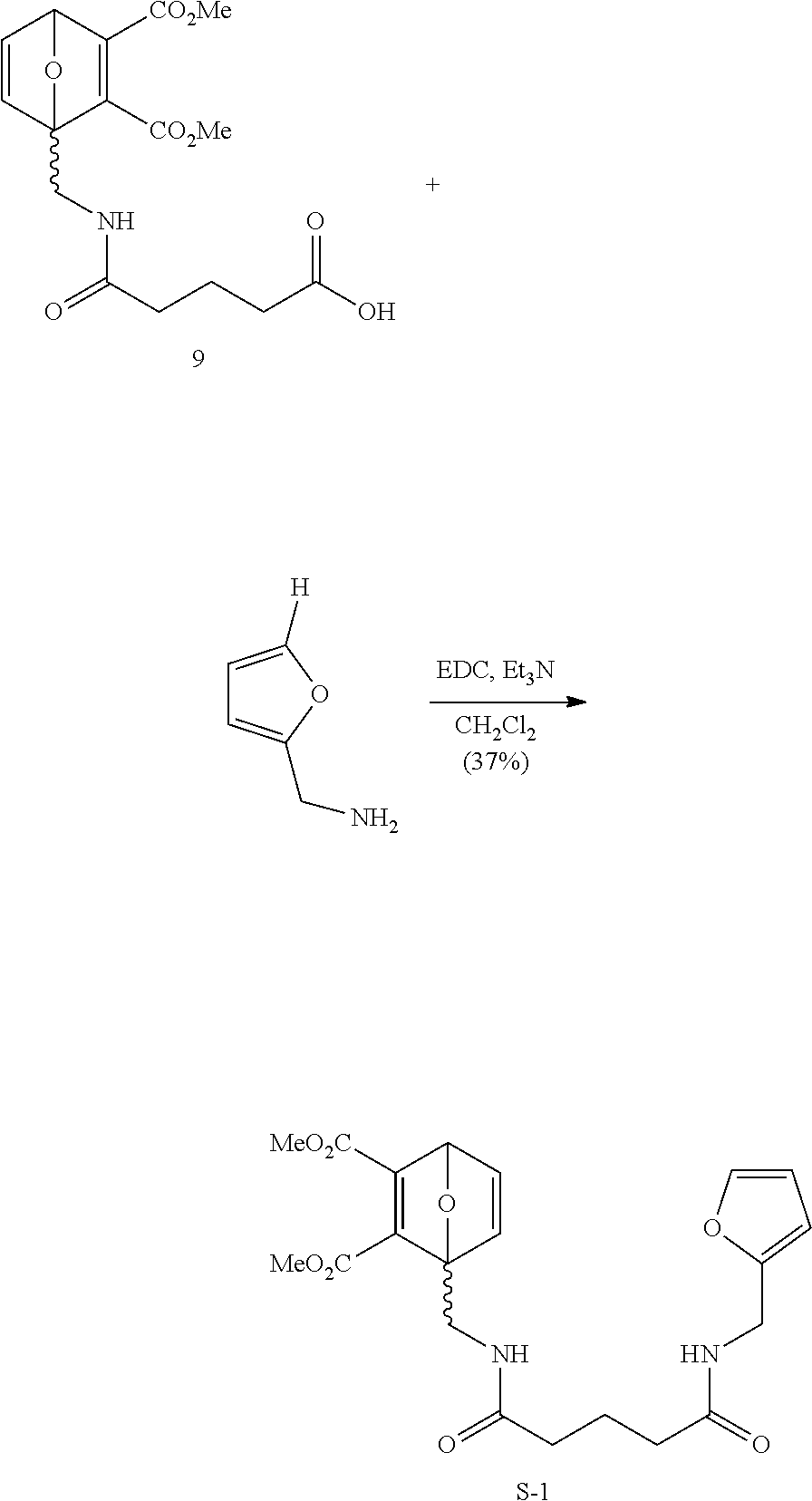
- the organic crude was further purified by silica gel column chromatography, eluting with a gradient from hexanes to 5% MeOH/EtOAc to yield a white solid (76 mg, 37%).
- R f 0.63 (10% MeOH/EtOAc with 0.5% AcOH).
- Asymmetric OND-furan S-1 (75.5 mg, 0.175 mmol, 1.0 equiv) was combined with ethyl 4,4,4-trifluoro-2-butynoate (32.5 ⁇ L, 0.228 mmols, 1.3 equiv), and 500 ⁇ L toluene in a sealed vial under argon. The mixture was heated directly on a hot plate at 60° C. for 48 hours. After cooling to room temperature, 3.5 mL diethyl ether was added to yield a pale yellow precipitate, which was collected by vacuum filtration.
- Tris-furan S-2 (100.2 mg, 0.233 mmol, 1.0 equiv) was combined with dimethyl acetylenedicarboxylate (115 ⁇ L, 0.9334 mmols, 4 equiv) and 100 ⁇ L toluene in a sealed vial.
- the vial was purged with argon and heated directly on a hot plate at 70° C. for 20 hours.
- the reaction was then cooled to room temperature and purified by flash chromatography on silica gel, eluting with a gradient from ethyl acetate through 10% MeOH/EtOAc to yield a pale foaming solid (184.5 mg, 92%).
- R f 0.10 (EtOAc).
- Tetra-nitrile S-3 was prepared using a previously described protocol in Weizman et al., 118 J. Am. Chem. Soc'y 12368. 12368-75 (1996), the procedure being incorporated herein by reference in its entirety. Briefly, pentaerythriotol (1.00 g, 7.34 mmol, 1 equiv.) was combined with acrylonitrile (2.175 mL, 33.03 mmols, 4.5 equiv.) at room temperature and 100 ⁇ L of 40 wt % aqueous sodium hydroxide was added. The mixture was stirred under nitrogen at room temperature for 24 hours.
- Tetra-furan S-4 was prepared from the crude tetra-carboxylate formed by a previously described hydrolysis of tetra-nitrile S-3. 2 Briefly, the tetra-nitrile (1.5141 g, 4.35 mmols) was dissolved in 3 mL concentrated HCl and refluxed at 100° C. under nitrogen for 4 hours. The crude was suspended in 50 mL ethyl acetate and washed with 20 mL of water. The water layer was extracted with 4 ⁇ 20 mL EtOAc, and the organic layers were dried over anhydrous sodium sulfate and condensed at reduced pressure to yield a colorless viscous syrup (1.5 g, 81%).
- Tetra-furan S-4 (76.9 mg, 0.104 mmols, 1 equiv) was combined with dimethyl acetylenedicarboxylate (64 ⁇ L, 0.519 mmols, 5 equiv.) and 200 ⁇ L toluene in a sealed 4 mL vial. The mixture was heated while stirring directly on a hot plate for 18 hours at 70° C. The crude was then purified by flash chromatography on silica gel, eluting with a gradient from ethyl acetate through 10% MeOH/EtOAc to yield an off-white foaming solid (98.4 mg, 72%). R f 0.23 (10% MeOH/EtOAc).
- conversion of the OND to the corresponding epoxyoxanorbornene (EONB) can be facilitated in high conversion using either dimethyldioxirane (DMDO) or 3-chloroperoxybenzoic acid (mCPBA).
- DMDO dimethyldioxirane
- mCPBA 3-chloroperoxybenzoic acid
- test epoxidations were carried out with mono-, tri- and tetra-valent ONDs. Reactions with mono- and tris-ONDs proceeded smoothly. While epoxidation was observed in the case of tetra-OND 12 with DMDO, the reaction was complicated by the presence of ether linkages in the linker core structure, which are easily oxidized by DMDO reagent.
- Tris-OND 11 (30.0 mg, 0.035 mmols, 1 equiv.) was dissolved in 1.95 mL of a ⁇ 0.07 M solution of DMDO ( ⁇ 3.9 equiv) in acetone and stirred at room temperature for 19 hours. The reaction mixture was faintly cloudy, and was filtered before condensing the filtrate under reduced pressure, and drying the residue on high vacuum to yield a pale foaming solid (30.5 mg, 96%). R f 0.53 (10% MeOH/EtOAc).
- Oscillatory rheology was used to assess the viscoelastic properties of selected PEG-OND hydrogels.
- 4-PEG-SH macromer and bis-EONB 8 were combined in a 1:1 thiol:electrophile ratio (1:2 molar ratio) in 100 mM pH 7.2 potassium phosphate buffer containing 7% (v/v) DMSO.
- the solution was briefly mixed by pipetting and immediately deposited on the center of the rheometer bottom plate, which was maintained at 37° C.
- the truncated cone was then brought in contact with the bis-EONB/4-PEG-SH mixture before setting of the gel by positioning the tool at the measuring position.
- the sample was inspected for spillovers and trimmed as required.
- the elastic (storage) and viscous (loss) moduli, G′ and G′′, respectively, were then measured as a function of time for a constant strain of 1% and an angular frequency of 1 rad/sec.
- the ability to store energy is described by G′, while the amount of energy dissipated is related with G′′. It was observed that the sample experienced a rapid transformation from an initial state in which G′ was not much larger than G′′ to a state in which G′ was clearly predominant, as shown in FIG. 5 ; this is consistent with gelation.
- hydrogels comprised of 3.5 wt % 4-PEG-SH+bis-OND/EONB (7a, 7b, and 8, respectively) in pH 7.4 100 mM potassium phosphate buffer containing 7% DMSO (v/v) were formed in glass culture tubes and allowed to set for 15 minutes.
- a glass bead ⁇ 160 mg, stained with blue Sharpie-brand marker to improve visibility was placed carefully on top of each gel, and a drop of silicon oil was added to prevent evaporation at the surface of the gels.
- the tubes were sealed with lab parafilm and incubated in a 50° C. oil bath.
- a 500 ⁇ L 3.5 wt % PEG-OND hydrogel were prepared by mixing 465 ⁇ L of 3.76 wt % 4-PEG-SH in pH 7.4 KDPO 4 /K 2 PO 4 buffer and 35 ⁇ L 85 mM 7a in DMSO-d 6 and vortexing to mix.
- 1 H-NMR spectra were collected on the sample 10 minutes after mixing. Samples were then incubated at 37° C. and 1 H-NMR were collected periodically. Additionally, spectra were collected as close as possible to the reverse gelation point to determine fractional conversion of OND-thiol adduct to furan. The sample was monitored until complete conversion of thiol adducts to furan was observed ( FIG. 10 , blue highlighted peaks to green highlighted peaks).
- a 3.5 wt % hydrogel formed with linker 7b was prepared in a similar fashion.
- the sample was a self-supporting gel when the tube was inverted 1 minute after mixing.
- a 1 H NMR spectrum was collected ⁇ 15 minutes after mixing the sample. All OND linker was converted to the corresponding thiol adduct.
- the sample was then placed in a 37° C. incubator and spectra were collected periodically until the gel was no longer intact, as determined by the inversion test ( FIG. 11 ).
- the degree of conversion of the OND-thiol adducts to furan when sample no longer contained a self-supporting gel was close to the theoretical reverse gelation point for gels formed by step-growth polymerization between tetravalent and divalent components (See section VII.3. for details).
- the degree of conversion of adduct to furan was determined from integration of the C5 and C6 olefinic protons of thiol adducts (blue highlight, FIGS. 10 and 11 ) and the integrals of furan protons (green highlights).
- P c step-growth is the fraction of crosslinks between monomers A and B at the critical gelation point (or reverse gelation point)
- f A is the valence of monomer A
- f B is the valence of monomer B
- r is the stoichiometric ratio of reactive groups A and B.
- M c [ 2 M n - v _ V 1 [ ln ⁇ ( 1 - v 2 , s ) + ( v 2 , s ) + ( ⁇ ⁇ ( v 2 , s ) 2 ] ( v 2 , r ) ⁇ [ ( v 2 , s v 2 , r ) 1 / 3 - v 2 , s 2 ⁇ v 2 , r ] ] - 1 ( Equation ⁇ ⁇ S ⁇ ⁇ 5 )
- M n is the number average molecular weight for the polymeric macromer (10,000 g/mol)
- v is the specific volume of the polymer (0.84 cm 3 /g for PEG)
- V 1 is the molar volume of solvent used for swelling (18 cm 3 /g for water)
- ⁇ is the polymer-interaction parameter (0.43 for PEG-H 2 O and assumed constant for the described experiments).
- V 2 , and V 2
- q w m s m d ( Equation ⁇ ⁇ S ⁇ ⁇ 8 )
- q F m c m d ( Equation ⁇ ⁇ S ⁇ ⁇ 9 )
- m s is the mass of the gel after equilibrium swelling
- m c is the mass of the gel after curing
- m d is the mass of the dried gel, or input mass of polymer and crosslinkers.
- n 2 ⁇ M c M r ( Equation ⁇ ⁇ S ⁇ ⁇ 11 )
- M c the average molecular weight between crosslinks, calculated as described in the previous section
- M r the molecular weight of the repeating unit for the PEG macromer (44 g/mol).
- the calculated mesh sizes for the hydrogels studied by equilibrium swelling are shown in Table S2.
- the thiol content of cured hydrogels was determined by swelling gels in the presence of a small fluorogenic OND S-6, which we have previously described in our lab.
- This probe reacts with thiols to produce a fluorescent adduct ( FIG. 14A ).
- the intensity of fluorescence correlates linearly with the concentration of adduct S-7; this was demonstrated by incubation increasing concentrations of S-6 with a large excess of N-acetyl cysteine to produce the standard curve shown in FIG. 14B .
- the concentration of reagent S-6 in solution can be determined by quenching with thiol.
- reagent S-6 can be used to quantify thiol in solution.
- probe S-6 should easily permeate the hydrogel network under swelling conditions and react with accessible residual thiols present in the gel network.
- 60 ⁇ L hydrogels were freshly prepared from 4-PEG-SH macromer and either linkers 8 or 7a as described in section III of this document. After curing for 20 minutes at room temperature, 3 mL of pH 7.4 0.1M PBS buffer containing 200 ⁇ M probe S-6 was added, and the gel was swelled at 4° C. for 18 hours. To account for hydrolytic degradation of our thiol probe during incubation, a sample was prepared with S-6 in buffer alone (lacking 4-PEG-SH and bis-OND linkers).
- 4-PEG-SH macromer (5.032 ⁇ mol thiol) was weighed into a tared vial in a glove box under inert atmosphere ( ⁇ 10 ppm O 2 ) and dissolved in 191 ⁇ L dry acetonitrile. Less than 1 ⁇ L of Et 3 N was added followed by dropwise addition of 202 ⁇ L 0.74 mM BODIPY-FL maleimide (0.151 ⁇ mol, 3% of thiol content) in acetonitrile over 10 minutes. The resulting neon-green solution was stirred at room temperature wrapped in foil for 2 hours, and then condensed under vacuum to dryness. This residue was redissolved at 3.76 wt % PEG in pH 7.2 100 mM phosphate buffered saline for use in hydrogel formation.
- BODIPY-labeled 4-PEG-SH prepared above was used to form hydrogels using a method identical to unlabeled gels. Briefly, BODIPY-labeled 4-PEG-SH was combined with DMSO stocks of multivalent ONDs at equimolar concentration of thiol and electrophile. All reactions yielded self-supporting gels within one minute after mixing the two components at room temperature. These gelations were carried out in an oxygen-free environment and gels were allowed to set for 20 minutes at room temperature before dilution with 3 mL of swelling buffer (variable composition, as described in main text).
- Additional gel samples formed with linker 7b were prepared for the purpose of analyzing the contents of the supernatant during erosion. These samples were swelled in Milli-Q ultrapure water and incubated at 37° C. At various time points during the erosion experiment, the supernatant was removed and dried in vacuum. The residue was taken up in DMF containing 0.1% LiBr and analyzed by gel permeation chromatography. Combinations of monomeric and oligomeric species of PEG macromer were observed. To compare composition of supernatant contents at different stages of erosion, the supernatant was removed and replaced by fresh swelling supernatant. After the desired degree of erosion, this supernatant was also collected for analysis. These supernatant “snapshots” were compared to a sample that did not undergo supernatant changes during erosion ( FIG. 17 ).
- hydrogels were prepared with 4-PEG-SH macromer that was unlabeled with BODIPY erosion probe. Briefly, 200 ⁇ L gels were prepared by addition of 186 ⁇ L 3.76 wt % 4-PEG-SH macromer solution to 14 ⁇ L of a solution of bis-ONDs 7a or 7b in DMSO to yield a final composition of 3.5 wt % 4-4-PEG-SH macromer with 7% DMSO (v/v) and a 1:1 ratio of thiol:OND electrophile. The samples were mixed briefly with a pipet. Self-supporting gels were observed by the inversion test within one minute, but were allowed to stand at room temperature for 20 minutes.
- the mass of the cured gel was measured before suspending the samples in 6 mL of pH 7.4 0.1M PBS buffer and placing in a 37° C. incubator. At various time points, the gels were briefly removed to room temperature, excess buffer was slowly poured off and wicked away with the edge of a Kimwipe delicate task wipe without touching the gel sample. The mass of the gel was measured, and 6 mL fresh buffer (pre-warmed to 37° C.) was added before returning the sample to 37° C. incubation. This process was continued until no gel remained. The mass of the hydrogel remaining at a given time point over the mass of the cured gel was plotted vs. time ( FIG. 19 ).
- the remainder of the culture tube was filled with ⁇ 7 of buffer at the appropriate pH (pH 1.2 HCl/NaCl with 1 mg/mL pepsin, pH 5.0 acetate, pH 7.4 phosphate buffered saline, and pH 9.0 sodium carbonate buffer).
- the non-degradable control was diluted with pH 7.4 phosphate buffer.
- the tubes were sealed with lab parafilm and incubated in a 37° C. oil bath. Photos were collected every 2 minutes for 22 hours using Chronolapse software (v.1.0.4) and a Creative Labs webcam. Photographs were compiled in chronological order using iMovie software, with each photo occupying one 0.1 s frame. The resulting video is available as Supporting Movie S2.
- Bovine serum albumin contains a conserved free cysteine (cys-34) that can be oxidized or capped as a mixed disulfide during isolation and storage of the protein.
- the thiol content of a stock of BSA was determined by the Ellman-Wilson assay and found to be ⁇ 0.40 thiols per BSA protein.
- a bright yellow band was eluted with 3.5 mL of PBS to yield labeled BSA at ⁇ 2 mg/mL. This solution was carried on to prepare hydrogels with entrained dye-labeled and thiol-depleted BSA (see section X.2).
- Wild-type Q ⁇ virus-like particles were obtained by recombinant expression in E. coli and purified by sucrose gradient using a previously described protocol. 500 ⁇ L of a 4.6 mg/mL solution of wild-type Q ⁇ virus-like particles in pH 8.5 100 mM sodium borate buffer was added slowly to a solution of fluorescein isothiocyanate (FITC, 20 ⁇ L 25.7 mM stock in DMSO, 0.19 equiv dye per primary amine on particle) at room temperature and stirred for one hour ( FIG. 44 ). The resulting labeled protein nanoparticle was purified by 12 buffer exchanges with pH 7.4 100 mM phosphate buffered saline on Amicon size exclusion filter (MWCO 3 kDa).
- FITC fluorescein isothiocyanate
- the labeled protein solutions prepared as described in the previous section were diluted three-fold with pH 7.4 100 mM phosphate buffer and used to dissolve the 4-PEG-SH macromer at 3.76 wt %. This solution was used in an identical manner as pure 4-PEG-SH solution for the purpose of forming PEG-OND hydrogels ( FIG. 45 ). All samples formed self-supporting hydrogels within 1 min after mixing, as determined by the inversion test.
- the first set contained 1 mM small molecule probe 5/6-carboxyfluorescein, while the second and third sets contained FITC labeled BSA and Q ⁇ virus-like particle, respectively.
- the gels were allowed to set for 30 minutes at room temperature before dilution with 3 mL of pH 7.4 100 mM phosphate buffered saline. The samples were incubated at 37° C. and the increase in absorbance of the supernatant at 497 nm was monitored. The fraction of released dye was plotted against incubation time.
- the hydrodynamic radii of encapsulated cargoes are 0.8 nm, 3.48 nm, and 14.5 nm for carboxyfluorescein, bovine serum albumin, and wild-type Q ⁇ virus-like particle, respectively. Smaller cargoes are able to diffuse out of the hydrogel network, with carboxyfluorescein diffusion occurring very rapidly, and BSA experiencing some hindrance.
- Bovine serum albumin with ⁇ 0.4 thiols per protein present during entrainment/gelation produced hydrogels that released a fraction of protein cargo by diffusion, and the remaining fraction was found to be associated with the gel network.
- roughly 20% of BSA in gels derived from linker 7b was found be released with a slow rate similar to that observed in experiments with erosion-probe labeled macromers. This behavior may be useful in tuning the release rate of substrates that would otherwise diffuse freely from the network, as is observed in the case of BSA that is capped with N-ethylmaleimide before entrainment.
Landscapes
- Health & Medical Sciences (AREA)
- Chemical & Material Sciences (AREA)
- Life Sciences & Earth Sciences (AREA)
- Medicinal Chemistry (AREA)
- Veterinary Medicine (AREA)
- Public Health (AREA)
- Epidemiology (AREA)
- Animal Behavior & Ethology (AREA)
- General Health & Medical Sciences (AREA)
- Organic Chemistry (AREA)
- Chemical Kinetics & Catalysis (AREA)
- Polymers & Plastics (AREA)
- Inorganic Chemistry (AREA)
- Proteomics, Peptides & Aminoacids (AREA)
- Pharmacology & Pharmacy (AREA)
- Oral & Maxillofacial Surgery (AREA)
- Transplantation (AREA)
- Hematology (AREA)
- Dermatology (AREA)
- Materials Engineering (AREA)
- Engineering & Computer Science (AREA)
- Medicines Containing Antibodies Or Antigens For Use As Internal Diagnostic Agents (AREA)
- Medicinal Preparation (AREA)
Abstract
Description


| TABLE 1 |
| Comparative Hydrogel Swelling Results |
| Equilibrium | ||||||
| Swelling | Gel | Mc | ||||
| Entry | Linker | Ratioa | Fractionb | (g/mol)c | ||
| 1 | 7a | 1.70 ± 0.04d | 0.91 ± 0.03 | 4080 ± 57 | ||
| 2 | 7b | 1.40 ± 0.02 | 0.96 ± 0.02 | 3698 ± 16 | ||
| 3 | 8 | 1.60 ± 0.10 | 0.97 ± 0.01 | 3900 ± 93 | ||
| 4 | 10 | 1.87 ± 0.12 | 0.98 ± 0.04 | 4112 ± 94 | ||
| 5 | 7a + 7b | 1.71 ± 0.04 | 0.99 ± 0.04 | 3981 ± 36 | ||
| 6 | 11 | 1.54 ± 0.07 | 0.98 ± 0.08 | 3846 ± 102 | ||
| 7 | 12 | 1.44 ± 0.08 | 0.96 ± 0.05 | 3740 ± 95 | ||
| aMass post-swelling/mass pre-swelling, | ||||||
| bMass of dry residue post-swelling/input mass of OND and 4-PEG-SH, | ||||||
| cCalculated using the Flory-Rehner equation, see Supporting Information. | ||||||
| dError represents standard deviation for n = 3 separate gels. | ||||||




VII.2. Gel Fraction Determination
VII.3. Calculations with Flory-Rehner Elastic Theory
Critical Gelation/Reverse Gelation Point:
where Pc step-growth is the fraction of crosslinks between monomers A and B at the critical gelation point (or reverse gelation point), fA is the valence of monomer A, fB is the valence of monomer B, and r is the stoichiometric ratio of reactive groups A and B. The value of Pc step-growth for a network formed from an equimolar mixture of 4-armed PEG-SH (fA=4) and divalent OND (or EONB) linkers (fB) is:
Calculation of Theoretical Molecular Weight Between Crosslinks
| TABLE S1 |
| Summarized linker molecular weights, |
| valence, and calculated Mc, ideal. |
| Entry | Linker | MWB (g/mol) | Valence, fB | Mc, ideal (g/mol) | ||
| 1 | 7a | 574.5 | 2 | 5,575 | ||
| 2 | 7b | 622.5 | 2 | 5,623 | ||
| 3 | 8 | 606.5 | 2 | 5,607 | ||
| 4 | 10 | 598.5 | 2 | 5,599 | ||
| 5 | 7a + 7b | 598.5 a | 2 | 5,599 | ||
| 6 | 11 | 855.8 | 3 | 2,785 | ||
| 7 | 12 | 1,309.2 | 4 | 2,827 | ||
| a Average molecular weight for a equimolar mixture of | ||||||
Experimental Determination of Molecular Weight Between Crosslinks by Equilibrium Swelling
where Mn is the number average molecular weight for the polymeric macromer (10,000 g/mol),
where qw is the weight swelling ratio after equilibrium swelling, qF is the weight swelling ratio after curing, ρp is the density of the polymer (1.12 g/cm3 for PEG), ρwater=ρcure solvent is the density of swelling solvent and solvent during gel formation (1.00 g/cm3 for water). The weight swelling ratios qw and qF are determined from data gathered in equilibrium swelling experiments using the following relationships:
where ms is the mass of the gel after equilibrium swelling, mc is the mass of the gel after curing, and md is the mass of the dried gel, or input mass of polymer and crosslinkers.
(
where l is the average bond length in the polymer (0.146 nm for PEG) and Cn is the characteristic ratio of the polymer (4.0 for PEG). The average number of bonds between crosslinks, n is calculated using the following equation:
where Mc is the average molecular weight between crosslinks, calculated as described in the previous section, and Mr is the molecular weight of the repeating unit for the PEG macromer (44 g/mol). Finally, the mesh size, ξ, is calculated using the following relationship:
ξ=v 2,s −1/3(
where v2, is the partial volume of polymer in the equilibrium swollen hydrogel, and is calculated using the experimentally determined equilibrium weight swelling ratios. The calculated mesh sizes for the hydrogels studied by equilibrium swelling are shown in Table S2.
| TABLE S2 |
| Calculated mesh size for various equilibrium-swollen gels. |
| Entry | Linker | (nm)a |
| 1 | 7a | 15.2 ± 0.9 |
| 2 | 7b | 13.1 ± 0.1 |
| 3 | 8 | 14.0 ± 0.9 |
| 4 | 10 | 15.1 ± 1.3 |
| 5 | 7a + 7b | 14.4 ± 0.5 |
| 6 | 11 | 13.7 ± 1.3 |
| 7 | 12 | 13.3 ± 0.9 |
| aCalculated using Equations S9-S11 using equilibrium swelling data. | ||
VIII. Post-Functionalization and Determination of Residual Hydrogel Thiol Content
| TABLE S3 |
| Residual Thiol Content of Swelled Hydrogels |
| Sol Fraction | Gel Fraction | |
| Linker | % Residual Thiol | % |
| 7a | 8.1 ± 3.2 | 10.8 ± 2.4 |
| 8 | 2.1 ± 0.4 | 12.8 ± 2.2 |
IX. Monitoring Erosion of Swollen Hydrogels
IX.1. Dye labeling of 4-PEG-SH (10K)

Claims (16)
Priority Applications (1)
| Application Number | Priority Date | Filing Date | Title |
|---|---|---|---|
| US15/532,911 US10517952B2 (en) | 2014-12-02 | 2015-12-02 | Nucleophile-triggered degradable materials and methods of making and using the same |
Applications Claiming Priority (4)
| Application Number | Priority Date | Filing Date | Title |
|---|---|---|---|
| US201462086438P | 2014-12-02 | 2014-12-02 | |
| US201562261328P | 2015-12-01 | 2015-12-01 | |
| US15/532,911 US10517952B2 (en) | 2014-12-02 | 2015-12-02 | Nucleophile-triggered degradable materials and methods of making and using the same |
| PCT/US2015/063551 WO2016090060A1 (en) | 2014-12-02 | 2015-12-02 | Nucleophile-triggered degradble materials and methods of making and using the same |
Related Parent Applications (1)
| Application Number | Title | Priority Date | Filing Date |
|---|---|---|---|
| PCT/US2015/063551 A-371-Of-International WO2016090060A1 (en) | 2014-12-02 | 2015-12-02 | Nucleophile-triggered degradble materials and methods of making and using the same |
Related Child Applications (1)
| Application Number | Title | Priority Date | Filing Date |
|---|---|---|---|
| US16/703,299 Continuation US20200108146A1 (en) | 2014-12-02 | 2019-12-04 | Nucleophile-Triggered Degradable Materials and Methods of Making and Using the Same |
Publications (2)
| Publication Number | Publication Date |
|---|---|
| US20170360940A1 US20170360940A1 (en) | 2017-12-21 |
| US10517952B2 true US10517952B2 (en) | 2019-12-31 |
Family
ID=56092420
Family Applications (2)
| Application Number | Title | Priority Date | Filing Date |
|---|---|---|---|
| US15/532,911 Active 2036-04-26 US10517952B2 (en) | 2014-12-02 | 2015-12-02 | Nucleophile-triggered degradable materials and methods of making and using the same |
| US16/703,299 Abandoned US20200108146A1 (en) | 2014-12-02 | 2019-12-04 | Nucleophile-Triggered Degradable Materials and Methods of Making and Using the Same |
Family Applications After (1)
| Application Number | Title | Priority Date | Filing Date |
|---|---|---|---|
| US16/703,299 Abandoned US20200108146A1 (en) | 2014-12-02 | 2019-12-04 | Nucleophile-Triggered Degradable Materials and Methods of Making and Using the Same |
Country Status (2)
| Country | Link |
|---|---|
| US (2) | US10517952B2 (en) |
| WO (1) | WO2016090060A1 (en) |
Families Citing this family (8)
| Publication number | Priority date | Publication date | Assignee | Title |
|---|---|---|---|---|
| CN104515760B (en) * | 2014-12-17 | 2017-10-31 | 深圳市纳观生物有限公司 | Two Colour Fluorescence positions super-resolution biology microscope method and system |
| CN107625992B (en) * | 2017-10-01 | 2020-05-08 | 山东朱氏堂医疗器械有限公司 | Soluble dressing and preparation method thereof |
| SE541313C2 (en) * | 2017-10-13 | 2019-06-25 | Amferia Ab | Amphiphilic antimicrobial hydrogel |
| CN108586775B (en) * | 2018-05-04 | 2019-11-12 | 四川大学 | In-situ cross-linked hyperbranched polyether hydrogel for long-term filling in the eye and preparation method thereof |
| CN109021258B (en) * | 2018-07-12 | 2020-12-22 | 首都师范大学 | A kind of preparation method of electrochemical signal ultra-stable conductive hydrogel |
| WO2020028525A1 (en) * | 2018-07-31 | 2020-02-06 | City Of Hope | Sumo inhibitor compounds and uses thereof |
| CN109912817B (en) * | 2019-03-08 | 2021-05-18 | 苏州大学 | Hydrogel nanoparticles for measuring ionizing radiation dose and preparation method thereof |
| CN110938013A (en) * | 2019-12-13 | 2020-03-31 | 长江大学 | Three-dimensional cage-shaped hyperbranched monomer and preparation method and application thereof |
Citations (2)
| Publication number | Priority date | Publication date | Assignee | Title |
|---|---|---|---|---|
| EP0448148A2 (en) * | 1990-03-23 | 1991-09-25 | METALLGESELLSCHAFT Aktiengesellschaft | Polymers with improved heat resistance and method of making same |
| US20110142886A1 (en) | 2009-12-01 | 2011-06-16 | Intezyne Technologies, Incorporated | Pegylated polyplexes for polynucleotide delivery |
-
2015
- 2015-12-02 US US15/532,911 patent/US10517952B2/en active Active
- 2015-12-02 WO PCT/US2015/063551 patent/WO2016090060A1/en not_active Ceased
-
2019
- 2019-12-04 US US16/703,299 patent/US20200108146A1/en not_active Abandoned
Patent Citations (2)
| Publication number | Priority date | Publication date | Assignee | Title |
|---|---|---|---|---|
| EP0448148A2 (en) * | 1990-03-23 | 1991-09-25 | METALLGESELLSCHAFT Aktiengesellschaft | Polymers with improved heat resistance and method of making same |
| US20110142886A1 (en) | 2009-12-01 | 2011-06-16 | Intezyne Technologies, Incorporated | Pegylated polyplexes for polynucleotide delivery |
Non-Patent Citations (8)
| Title |
|---|
| Aimetti, AA et al. "Poly (ethylene glycol) hydrogels formed by thiol-ene photopolymerization for enzyme-responsive protein delivery." Biomaterials. 2009, vol. 30, No. 30, abstract; p. 6049; figure 1. |
| Hong, Vet al. "Thiol-selective fluorogenic probes for labeling and release." Journal of the American Chemical Society, 2009, vol. 131, No. 29, pp. 9986-9994. |
| International Preliminary Report on Patentability from related PCT Application No. PCT/US2015/063551 dated Jun. 15, 2017 (8 pages). |
| International Search Report issued by the International Searching Authority dated Feb. 12, 2016. |
| Kislukhin, AA et al. "Degradable conjugates from oxanorbornadiene reagents." Journal of the American Chemical Society. 2012, vol. 134, No. 14, pp. 6491-6497 and S1-327; abstract; pp. 6491-6492, 6495-6496, S20-S21, S26. |
| Shin, H et al. "Cross-linking and degradation of step-growth hydrogels formed by thiol-ene photoclick chemistry." Biomacromolecules, 2012, vol. 13, No. 7, pp. 2003-2012. |
| Van Berkel, SS, et al. "Metal-Free Triazole Formation as a Tool for Bioconjugation." ChemBioChem, 2007, vol. 8, No. 13, pp. 1504-1508. |
| Written Opinion issued by the International Searching Authority dated Feb. 12, 2016. |
Also Published As
| Publication number | Publication date |
|---|---|
| US20200108146A1 (en) | 2020-04-09 |
| WO2016090060A1 (en) | 2016-06-09 |
| US20170360940A1 (en) | 2017-12-21 |
Similar Documents
| Publication | Publication Date | Title |
|---|---|---|
| US20200108146A1 (en) | Nucleophile-Triggered Degradable Materials and Methods of Making and Using the Same | |
| AU2019280076B2 (en) | Polymer dye modification and applications | |
| ES2759112T3 (en) | Cucurbituril-based hydrogels | |
| ES3046711T3 (en) | Photoactive macromolecules and uses thereof | |
| ES2404685T3 (en) | Heterobifunctional poly (ethylene glycol) derivatives and methods for their preparation | |
| EP2104515B1 (en) | Method for preparing a polymer conjugate | |
| JP5800323B2 (en) | Temperature, pH and salt concentration sensitive separator and its use | |
| US20250162975A1 (en) | Compositions and methods for protein labeling, modification, analysis, and targeted delivery | |
| TW201319129A (en) | Method for manufacturing block copolymer | |
| JP2022114240A (en) | Polyimide containing crown ether structure | |
| KR20240074754A (en) | Method for synthesizing mucin and its products | |
| Zhu et al. | Transition of Conformation and Solubility in β-Sheet-Structured Poly (l-cysteine) s with Methylthio or Sulfonium Pendants | |
| CN102803228B (en) | The unstable triggers unit of acid | |
| Vallejos et al. | Working with water insoluble organic molecules in aqueous media: fluorene derivative-containing polymers as sensory materials for the colorimetric sensing of cyanide in water | |
| JPWO2012165356A1 (en) | Thermosensitive polyamino acid or salt thereof | |
| KR20190034571A (en) | A stable hydrolysis-resistant synthetic poly-riboyllithol phosphate derivative as a vaccine against Haemophilus influenzae type b | |
| Bardts et al. | Microwave Assisted Synthesis of Thiol Modified Polymethacrylic acid and Its Cross‐Linking with Allyl Modified Polymethacrylic acid via Thiol‐ene “Click” Reaction | |
| KR20130017111A (en) | A process of labeling biomolecules by using dye compounds with vinylsulfone group | |
| VandenBerg et al. | Dynamic‐Covalent Crosslinking of Benzenetricarboxamide–Phenylboronate Conjugates | |
| BR112017009308B1 (en) | GRAFT COPOLYMER EXCIPIENT PRODUCTION METHOD WITH A SUPERIOR PROTEIN AND PEPTIDE BINDING PROPERTY, AND COMPOSITION | |
| JP6925579B2 (en) | Biodegradable hydrogel with cyclic benzylidene acetal structure | |
| Marco-Dufort | Engineering dynamic covalent networks for biomedical applications | |
| KR101135158B1 (en) | Heteroarm star polymer by using dityrosine | |
| HK40079635A (en) | Conjugates undergoing intramolecular rearrangements | |
| SU1034383A1 (en) | Copolymers of n-vinylpyrrolidone with derivatives of 5,6-benzo-alpha-pyrone possesssing antigen properties |
Legal Events
| Date | Code | Title | Description |
|---|---|---|---|
| AS | Assignment |
Owner name: GEORGIA TECH RESEARCH CORPORATION, GEORGIA Free format text: ASSIGNMENT OF ASSIGNORS INTEREST;ASSIGNORS:FINN, M. G.;HIGGINSON, CODY JAMES;SIGNING DATES FROM 20160305 TO 20160706;REEL/FRAME:042747/0474 |
|
| FEPP | Fee payment procedure |
Free format text: ENTITY STATUS SET TO SMALL (ORIGINAL EVENT CODE: SMAL); ENTITY STATUS OF PATENT OWNER: SMALL ENTITY |
|
| STPP | Information on status: patent application and granting procedure in general |
Free format text: NON FINAL ACTION MAILED |
|
| AS | Assignment |
Owner name: NATIONAL SCIENCE FOUNDATION, VIRGINIA Free format text: CONFIRMATORY LICENSE;ASSIGNOR:GEORGIA INSTITUTE OF TECHNOLOGY;REEL/FRAME:048356/0115 Effective date: 20190204 |
|
| STPP | Information on status: patent application and granting procedure in general |
Free format text: FINAL REJECTION MAILED |
|
| STPP | Information on status: patent application and granting procedure in general |
Free format text: NOTICE OF ALLOWANCE MAILED -- APPLICATION RECEIVED IN OFFICE OF PUBLICATIONS |
|
| STPP | Information on status: patent application and granting procedure in general |
Free format text: NOTICE OF ALLOWANCE MAILED -- APPLICATION RECEIVED IN OFFICE OF PUBLICATIONS |
|
| STPP | Information on status: patent application and granting procedure in general |
Free format text: AWAITING TC RESP., ISSUE FEE NOT PAID |
|
| STPP | Information on status: patent application and granting procedure in general |
Free format text: PUBLICATIONS -- ISSUE FEE PAYMENT VERIFIED |
|
| STCF | Information on status: patent grant |
Free format text: PATENTED CASE |
|
| MAFP | Maintenance fee payment |
Free format text: PAYMENT OF MAINTENANCE FEE, 4TH YR, SMALL ENTITY (ORIGINAL EVENT CODE: M2551); ENTITY STATUS OF PATENT OWNER: SMALL ENTITY Year of fee payment: 4 |