US10517111B2 - Mitigating scheduling conflicts in wireless communication devices - Google Patents
Mitigating scheduling conflicts in wireless communication devices Download PDFInfo
- Publication number
- US10517111B2 US10517111B2 US15/708,746 US201715708746A US10517111B2 US 10517111 B2 US10517111 B2 US 10517111B2 US 201715708746 A US201715708746 A US 201715708746A US 10517111 B2 US10517111 B2 US 10517111B2
- Authority
- US
- United States
- Prior art keywords
- slot
- piconet
- data
- wireless device
- full
- Prior art date
- Legal status (The legal status is an assumption and is not a legal conclusion. Google has not performed a legal analysis and makes no representation as to the accuracy of the status listed.)
- Active, expires
Links
Images




Classifications
-
- H—ELECTRICITY
- H04—ELECTRIC COMMUNICATION TECHNIQUE
- H04W—WIRELESS COMMUNICATION NETWORKS
- H04W72/00—Local resource management
- H04W72/12—Wireless traffic scheduling
- H04W72/1263—Mapping of traffic onto schedule, e.g. scheduled allocation or multiplexing of flows
-
- H—ELECTRICITY
- H04—ELECTRIC COMMUNICATION TECHNIQUE
- H04W—WIRELESS COMMUNICATION NETWORKS
- H04W72/00—Local resource management
- H04W72/50—Allocation or scheduling criteria for wireless resources
- H04W72/52—Allocation or scheduling criteria for wireless resources based on load
-
- H—ELECTRICITY
- H04—ELECTRIC COMMUNICATION TECHNIQUE
- H04W—WIRELESS COMMUNICATION NETWORKS
- H04W72/00—Local resource management
- H04W72/04—Wireless resource allocation
- H04W72/044—Wireless resource allocation based on the type of the allocated resource
- H04W72/0446—Resources in time domain, e.g. slots or frames
-
- H04W72/1252—
-
- H—ELECTRICITY
- H04—ELECTRIC COMMUNICATION TECHNIQUE
- H04W—WIRELESS COMMUNICATION NETWORKS
- H04W4/00—Services specially adapted for wireless communication networks; Facilities therefor
- H04W4/70—Services for machine-to-machine communication [M2M] or machine type communication [MTC]
-
- H—ELECTRICITY
- H04—ELECTRIC COMMUNICATION TECHNIQUE
- H04W—WIRELESS COMMUNICATION NETWORKS
- H04W4/00—Services specially adapted for wireless communication networks; Facilities therefor
- H04W4/80—Services using short range communication, e.g. near-field communication [NFC], radio-frequency identification [RFID] or low energy communication
-
- H—ELECTRICITY
- H04—ELECTRIC COMMUNICATION TECHNIQUE
- H04W—WIRELESS COMMUNICATION NETWORKS
- H04W84/00—Network topologies
- H04W84/18—Self-organising networks, e.g. ad-hoc networks or sensor networks
- H04W84/20—Leader-follower arrangements
Definitions
- a personal area network may be defined as a computer network used for data transmission amongst devices such as computers, telephones, tablets, personal digital assistants, wearables, Internet of Things (IoT) devices, etc.
- a PAN may be used for communication between the devices themselves (e.g., interpersonal communication), or for connecting one or more devices to a higher level network and the Internet via an uplink, wherein one “master” device takes up the role as internet router.
- a wireless PAN is a network for interconnecting devices wherein the connections are wireless, using wireless technologies, such as Bluetooth.
- a piconet consists of two or more devices occupying the same physical channel (e.g., synchronized to a common clock and hopping sequence).
- a piconet allows for one master (or primary) device to interconnect with up to seven active slave (or secondary) devices.
- examples of piconets include a cell phone connected to a computer, a laptop and a Bluetooth-enabled digital camera, or several tablet computers that are connected to each other.
- a scatternet is formed in a seamless, ad-hoc fashion allowing for inter-piconet communication.
- a scatternet is a type of computer network consisting of two or more piconets, wherein a Bluetooth node may be a master in one piconet and a slave in one or more other piconets.
- piconet scheduling may not be coordinated so the shared master/slave node in the Bluetooth scatternet may have scheduling conflicts that result in packet drops. Accordingly, a need exists for mitigating scheduling conflicts in wireless communication devices within a scatternet.
- Some exemplary embodiments are directed to a method performed by at a wireless device configured as a slave in a first piconet and configured as a master in a second piconet.
- the method includes determining whether the wireless device has data to transmit over the second piconet to an other wireless device, determining an availability of a full slot in a first piconet schedule, selecting a data transmission scheme based on the availability of the full slot in the first piconet schedule and transmitting the data via the second piconet to the other wireless device in accordance with the selected data transmission scheme.
- Some other exemplary embodiments are directed to a wireless device capable of communicating via a first piconet and a second piconet.
- the wireless device includes a baseband processor configured to determine whether the wireless device has data to transmit over the second piconet to an other wireless device, determine an availability of a full slot in a first piconet schedule and select a data transmission scheme based on the availability of the full slot in the first piconet schedule and a transceiver configured to transmit the data via the second piconet to the other wireless device in accordance with the selected data transmission scheme.
- Still other exemplary embodiments are directed to a wireless device including a non-transitory memory having a program stored thereon and a processor. Execution of the program causes the processor to perform operations including determining whether the wireless device has data to transmit over the second piconet to an other wireless device, determining an availability of a full slot in a schedule of the first piconet, selecting a data transmission scheme based on the availability of the full slot in the schedule of the first piconet and transmitting the data via the second piconet to the other wireless device in accordance with the selected data transmission scheme.
- FIG. 1 shows an exemplary embodiment of a scatternet including two piconets and for use in wireless audio headphones.
- FIG. 2 shows an exemplary table for the packet types and payload of a bud-to-bud (“B2B”) piconet for wireless audio headphones.
- B2B bud-to-bud
- FIG. 3 shows show an exemplary graph of a scheduling conflict between a B2B piconet and a source-to-bud (“S2B”) piconet for wireless audio headphones in communication with a source device.
- S2B source-to-bud
- FIG. 4 shows a transmission graph using the various sub-schemes for partial slot and full-slot-listen according to the exemplary embodiments described herein.
- FIG. 5 shows the transmission graph for an example of a Partial-slot Scheme, as well as the impact on the IFS, according to the exemplary embodiments described herein.
- FIG. 6 shows the transmission graph for a further example of a Partial-slot Scheme, as well as the impact on the IFS, according to the exemplary embodiments described herein.
- FIG. 7 shows the transmission graph for an example of a Full-slot-listen Scheme, as well as the impact on the IFS, according to the exemplary embodiments described herein.
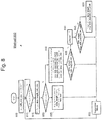
- FIG. 8 shows an exemplary method for mitigating scheduling conflicts in wireless communication devices according to various embodiments described herein.
- FIG. 9 shows an exemplary method for mitigating scheduling conflicts in wireless communication devices based on different schemes described herein.
- FIG. 10 shows an exemplary device 1000 (e.g., wireless audio buds) for mitigating scheduling conflicts in wireless communication devices according to various embodiments described herein
- the exemplary embodiments may be further understood with reference to the following description and the appended drawings, wherein like elements are referred to with the same reference numerals.
- the exemplary embodiments describe mitigating scheduling conflicts in wireless communication devices within a scatternet. It should be noted that while the exemplary embodiments described herein refer to scheduling conflicts in a Bluetooth scatternet, any type of network may implement the systems and methods described herein, and thus the various embodiments are not limited to a Bluetooth scatternet or piconets in general. Furthermore, while exemplary embodiments described herein may relate to a scatternet for use with wireless audio headphones (e.g., wireless earbuds), the systems and methods may be applied to connecting any wireless device and is not limited to wireless audio headphones.
- wireless audio headphones e.g., wireless earbuds
- FIG. 1 shows an exemplary embodiment of a scatternet 100 including two piconets 102 and 104 for use with two wireless audio headphones 108 , 110 (e.g., wireless audio buds) in communication with a source device 106 (e.g., a mobile phone).
- the first piconet 102 is a source-to-bud (“S2B”) piconet, wherein the source device 106 is the master and a primary audio bud 108 is a slave.
- the second piconet 104 is a bud-to-bud (“B2B”) piconet, wherein the primary audio bud 108 is the master and a secondary audio bud 110 is a slave.
- S2B source-to-bud
- B2B bud-to-bud
- one or more other devices also may be present in either or both of the first piconet 102 and the second piconet 104 .
- the secondary audio bud 110 may “eavesdrop” on the source device 106 as it communicates with the primary audio bud 108 .
- the secondary audio bud 110 may know the schedule for communications between the secondary audio bud 110 and the primary audio bud 108 on the B2B piconet 104 .
- the secondary audio bud 110 may eavesdrop on the communication between the source device 106 and the primary audio bud 108 .
- the secondary audio bud 110 may have generally the same (or in some cases, an even better) communication channel to listen to communications from the source device 106 .
- the B2B piconet 104 may be used for audio synchronization and general control (e.g., battery life, adaptive frequency hopping (“AFH”) map updates, etc.) between the two audio buds 108 and 110 .
- FIG. 2 shows an exemplary table 200 for the packet types and payload(s) of the B2B piconet 104 .
- the packet types may include NULL packets, POLL packets, ID packets, and payload packets (e.g., 2-DH1 Bluetooth packets).
- the NULL and POLL packets may be characterized as short general control packets that utilize the greatest portion of the B2B link.
- a great number of the packets exchanged over the B2B piconet 104 may have a small payload.
- this characteristic of the B2B packets may be used to improve scheduling coordination between the B2B piconet 104 and the S2B piconet 102 .
- FIG. 3 shows an exemplary graph 300 of a scheduling conflict between the B2B piconet 104 and the S2B piconet 102 for the wireless audio buds 108 , 110 in communication with the source device 106 .
- the graph 300 illustrates packet transmissions over time, wherein the highlighted portion 310 depicts the time in which conflicts may occur. That is, at the times within the highlighted portion 310 , both the B2B piconet 104 and the S2B piconet 102 may have communications scheduled that may lead to a conflict between the B2B piconet 104 and the S2B piconet 102 .
- scheduling conflicts between the S2B piconet 102 and the B2B piconet 104 may cause Bluetooth audio packet drops and retransmissions, thereby resulting in audio glitches.
- the wireless B2B link may utilize a greater main link bandwidth and thereby can result in degraded overall performance.
- multiple B2B link transmission schemes are proposed to avoid conflicting with S2B transmissions.
- These exemplary transmission schemes may include, but are not limited to, partial-slot schemes and full-slot-listen schemes, that utilize either S2B partial slots or S2B full slots, respectively, that do not occupy main link bandwidth (e.g., source link bandwidth).
- main link bandwidth e.g., source link bandwidth
- the time in the schedule of the S2B piconet 102 may be separated into multiple time slots and thus, the exemplary schemes are termed “slot” schemes because the schemes use one or more of these slots in the S2B piconet 102 schedule.
- slot Using available time in the S2B piconet 102 schedule (e.g., time when there are no communications scheduled for the S2B piconet 102 ) for B2B piconet 104 communications prevents scheduling conflicts between the two piconets 102 and 104 .
- FIG. 4 shows a transmission graph 400 using the various sub-schemes for partial slot and full-slot-listen, according to the exemplary embodiments described herein. It may be considered in graph 400 that two (2) S2B slots 405 and 407 are illustrated. Two of the exemplary partial-slot schemes may be referred to as Partial-slot Scheme A and Partial-slot Scheme B. According to the exemplary partial-slot operations, the B2B piconet 104 may use remaining time in the S2B slot(s) 405 , 407 when transmission and reception with the source device 106 via the S2B piconet 102 is finished. The two Partial-slot Schemes A and B may be differentiated based on whether the B2B poll and response are included within the same partial slot(s).
- the Partial-slot Scheme A may use an S2B piconet partial slot 405 , incorporating the master poll 420 and slave response 430 in the same slot with inter-frame spacing (“IFS”).
- IFS may be defined as the time gap between frames for transmission/reception (“Tx/Rx”) switching, baseband processing, etc.
- the IFS may be a hardware constraint to allow the various hardware components of the primary audio bud 108 and the secondary audio bud 110 to tune from the S2B piconet 102 to the B2B piconet 104 , switch between a transmission mode and a reception mode, etc. No communication should occur during this IFS to allow the hardware components to be set up properly to commence communications. Minimizing the IFS design (e.g., the time for IFS) may allow for communications to meet the maximum supported B2B payload requirements.
- the Partial-slot Scheme A allows for the available time in slot 405 after the S2B piconet communication 410 to include both the B2B communication 420 from primary audio bud 108 to the secondary audio bud 110 , as well as the B2B communication 430 from secondary audio bud 110 to the primary audio bud 108 . Accordingly, both of these the B2B communications 420 and 430 may be included in the same slot 405 , using the available time of the S2B slot 405 for the B2B link.
- the Partial-slot Scheme B may also use an S2B piconet partial slot, however the master poll and slave response are not included in the same slot.
- the available time in slot 405 following the S2B piconet communication 440 may include the B2B communication 450 from primary audio bud 108 to the secondary audio bud 110 .
- the B2B communication 460 from secondary audio bud 110 to the primary audio bud 108 may take place in the next available slot.
- the next available slot may or may not be the next slot 407 . That is, the B2B communication 460 may occur in slot 407 , but need not always occur in slot 407 . Instead, in some instances, the B2B communication 460 may occur during a later slot. Accordingly, while these B2B communications 450 and 460 may use the available time of the S2B slot for communications on the B2B link, these B2B communications 450 and 460 do not reside in the same slot.
- the exemplary Full-slot Scheme may use S2B full slots to listen and transmit communications. For instance, a B2B communication 480 may initiate listen up until a header portion of the S2B communication 470 to determine if the B2B communication 480 may use the remaining portion of the S2B slot 405 . The B2B communication 480 may also determine whether it may use the next S2B slot 407 , as well, if the source device 106 does not use it (e.g., for polling the audio buds 108 and 110 ).
- the B2B communication 480 may opportunistically utilize both the remaining portion of the S2B slot 405 and a further portion of the following S2B slot 407 for the communication from the primary audio bud 108 to the secondary audio bud 110 .
- the following S2B slot 407 may also include the B2B communication 490 from secondary audio bud 110 back to the primary audio bud 108 .
- FIG. 5 shows the transmission graph 500 for the Partial-slot Scheme A as well as an impact graph 560 on the IFS according to the exemplary embodiments described herein.
- the transmission graph 500 shows nine (9) slots 501 - 509 in the S2B piconet 102 schedule.
- the slots 501 - 505 and 507 - 509 are being used for S2B piconet 102 communications and there is no available time in these slots for any B2B piconet 104 communications.
- the slot 506 may be considered to have available time that may be used for B2B piconet 104 communications.
- the slot 506 may be the slot in the S2B piconet 102 schedule that is used for an acknowledgement (“ACK”) that is sent from the slave (primary audio bud 108 ) to the master (source 106 ).
- ACK acknowledgement
- This ACK may take up little time of the slot 506 such that the remaining time of the slot 506 may be used for the B2B piconet 104 communications, specifically using the Partial-slot Scheme A.
- the slot 520 may be a 625 ⁇ s time slot.
- the slot 506 having a length of 625 ⁇ s is only exemplary and other slot lengths may be used and may depend on the type of communication scheme being used for the piconet.
- the first portion of the slot 506 is used for the S2B communication 530 (e.g., the ACK transmitted from the primary audio bud 108 to the source 106 ). However, the remainder of the slot 506 is available for B2B piconet 104 communications.
- each of these devices may understand the schedule for the S2B piconet 102 and may understand that there is available time in the slot 506 for the B2B piconet 104 communications.
- the primary audio bud 108 and the secondary audio bud 110 may tune to the B2B piconet 104 (and take any other steps to prepare for communication via the B2B piconet 104 ) during the IFS 535 .
- the primary audio bud 108 may transmit a B2B communication 540 to the secondary audio bud 110 .
- there is another IFS 545 where the primary audio bud 108 and the secondary audio bud 110 switch between the respective transmission and reception modes.
- the secondary audio bud 110 may transmit a B2B communication 550 to the primary audio bud 108 .
- there is another IFS 555 where the primary audio bud 108 and the secondary audio bud 110 may tune to the S2B piconet 102 to prepare to receive the transmissions scheduled for the slot 507 .
- the Partial-slot Scheme A allows a complete round (poll/response) of B2B piconet communications (e.g., B2B communications 540 and 550 ) within the slot 506 .
- B2B piconet communications e.g., B2B communications 540 and 550
- this scheme prevents any scheduling conflicts between the S2B piconet 102 and the B2B piconet 104 because the B2B piconet 104 communications (e.g., B2B communications 540 and 550 ) are limited to times when there are no scheduled S2B piconet 102 communications.
- the B2B communications have a size that allows the communications to be inserted into the available time within the S2B piconet 102 slots without degradation in the performance of the B2B piconet 104 .
- the exemplary schemes may be used to avoid scheduling conflicts in the scatternet when the use of the schemes does not seriously degrade communications within any of the individual piconets.
- the impact graph 560 illustrates the maximum supported B2B packet payload length for various transmission rates (e.g., basic date rate (“BDR”), enhanced data rate (“EDR”)-2, EDR-3, etc.) versus IFS for the Partial-slot Scheme A. As can be seen from the graph 560 , a shorter IFS may allow for higher B2B data transfers.
- BDR basic date rate
- EDR enhanced data rate
- EDR-3 EDR-3
- FIG. 6 shows the transmission graph 600 for a further example of a Partial-slot Scheme, as well as an impact graph 660 on the IFS, according to the exemplary embodiments described herein. Similar to the graph 500 of FIG. 5 , the transmission graph 600 shows nine (9) slots 601 - 609 in the S2B piconet 102 schedule with the slots 601 - 605 and 607 - 609 being used for S2B piconet 102 communications. However, the slot 606 may be considered to have available time that may be used for B2B piconet 104 communications.
- the slot 606 may be the slot in the S2B piconet 102 schedule that is used for the ACK that is sent from the slave (primary audio bud 108 ) to the master (source 106 ). This available time may be used for the B2B piconet 104 communications, specifically using the Partial-slot Scheme B. It should be noted that the slot 606 may also be used for other short S2B piconet 102 communications besides the ACK communication described above or the slot 606 may have no scheduled S2B piconet 102 communications, thereby leaving at least a portion of the slot 606 available for B2B piconet 104 communications.
- the first portion of the slot 606 is used for the S2B communication 630 (e.g., the ACK transmitted from the primary audio bud 108 to the source 106 ). However, the remainder of the slot 606 is available for B2B piconet 104 communications. Similar to the description above, the primary audio bud 108 and the secondary audio bud 110 may understand the schedule for the S2B piconet 102 and may understand that there is available time in the slot 606 for the B2B piconet 104 communications.
- the primary audio bud 108 may transmit a B2B communication 640 to the secondary audio bud 110 .
- the primary audio bud 108 and the secondary audio bud 110 may tune to the S2B piconet 102 to prepare to receive the transmissions scheduled for the slot 607 .
- the Partial-slot Scheme B allows a single B2B piconet communication (e.g., B2B communication 640 ) within the slot 606 .
- the single B2B communication 640 may be considered a poll that is transmitted from the master (primary audio bud 108 ) to the slave (secondary audio bud 110 ).
- the single B2B communication may also be a response, e.g., a communication from the slave to the master.
- the primary audio bud 108 has transmitted a poll and will be expecting a response to that poll from the secondary audio bud 110 .
- This response is illustrated in FIG. 6 as the B2B communication 650 that is not shown as occurring within the slot 606 .
- the B2B communication 650 will occur in a later slot when the later slot has available time for the B2B communication 650 .
- this later slot is some slot after slot 609 that is not illustrated in FIG. 6 .
- the next slot that has available time may be any slot that occurs after the slot 606 .
- the complete communication (poll/response) between the primary audio bud 108 and the secondary audio bud 110 may be accomplished.
- Partial-slot Scheme B the reason for splitting the poll/response in the manner proposed by Partial-slot Scheme B is that the two B2B communications (including the required IFSs) may not fit in the remaining available time after the S2B communication 630 in the slot 606 .
- this scheme also prevents any scheduling conflicts between the S2B piconet 102 and the B2B piconet 104 because the B2B piconet 104 communication (e.g., B2B communication 640 ) is limited to times when there are no scheduled S2B piconet 102 communications.
- B2B piconet 104 communication e.g., B2B communication 640
- the impact graph 660 illustrates the maximum supported B2B packet payload length for various transmission rates (e.g., BDR, EDR-2, EDR-3, etc.) versus IFS for the Partial-slot Scheme B.
- BDR bandwidth
- EDR-2 e.g., EDR-2
- EDR-3 e.g., EDR-3
- IFS the Partial-slot Scheme B
- FIG. 7 shows the transmission graph 700 for an example of a Full-slot-listen Scheme, as well as an impact graph 760 on the IFS, according to the exemplary embodiments described herein.
- FIG. 7 also shows two exemplary Bluetooth Asynchronous Connection-Less (“ET ACL”) frame formats for the S2B communications, a BDR frame format 750 and an EDR frame format 755 .
- EDR frame format 750 and 755 include an access code and header portion.
- the access code identifies packets exchanged on a physical channel. Thus, packets sent in the same physical channel may be preceded by the same access code.
- the packet header contains information indicating a destination slave for an exemplary packet in a master-to-slave transmission slot. The header may also indicate the source slave for a slave-to-master transmission slot.
- the components of the B2B piconet 104 may listen to the communications of the S2B piconet 102 , including the access code and header portions, to determine whether the full slot will be available for B2B transmissions. That is, the contents of these two fields of the frame formats 750 and 755 will indicate to the primary audio bud 108 and the secondary audio bud 110 whether the S2B piconet 102 will be using the remainder of the slot.
- the access code and header portions of the frame formats may have a length of 126 ⁇ s. Thus, if the remainder of the slot is available, the remaining time will be the length of the slot minus 126 ⁇ s.
- the availability may be determined based on information included in the access code and header. Alternatively, the availability may be determined based on the lack of an access code and/or header transmitted in the first portion of the slot.
- slot start nominal time plus jitter requirement time e.g. 10 ⁇ s
- the next full slot e.g., 625 ⁇ s
- slot time may be available if the detected access code is not matched (e.g., the packet is not sent to the source piconet), or if the access code is matched but not the packet header (e.g., the packet is sent to the source piconet but not to the intended receiver).
- the remaining slot time may be based on the full slot (625 ⁇ s) less the current decision time taken from the slot start. Accordingly, this remaining slot time and the next full slot (625 ⁇ s) may be available. However, if the packet is addressed to the intended receiver, then the remaining slot time less the decision time and the next full slot may not be available for use.
- the transmission graph 700 shows two slots 710 and 715 .
- each slot is 625 ⁇ s for a total length of 1250 ⁇ s for the two slots 710 and 715 .
- two slots 710 and 715 are shown because the slots are arranged in an even/odd arrangement meaning that if there is no payload scheduled for transmission in the S2B piconet 102 in the even slot (e.g., slot 710 ) there will also be no transmission scheduled for the next odd slot (e.g., slot 715 ). For example, if no poll is sent, a corresponding response also will not be sent.
- the primary audio bud 108 and the secondary audio bud 110 determine that the remainder of slot 710 is available, this will also mean that the entire slot 715 will also be available.
- the primary audio bud 108 and the secondary audio bud 110 will listen 720 for the first 126 ⁇ s of the slot 710 . If it is determined that there is no S2B communication scheduled for the remainder of the slot 710 , the primary audio bud 108 and the secondary audio bud 110 will understand that the remainder of slot 710 (e.g., 625 ⁇ s-126 ⁇ s) and the entire slot 715 (e.g., 625 ⁇ s) will be available for the B2B communications. This description will continue as if this is the case, e.g. the remainder of slot 710 and all of slot 715 are available for the B2B communications.
- the primary audio bud 108 may transmit a B2B communication 730 to the secondary audio bud 110 .
- the B2B communication 730 may be the poll, e.g., the transmission from the master (primary audio bud 108 ) to the slave (secondary audio bud 110 ).
- the B2B communication 730 is shown as using the remainder of the slot 710 and extending into slot 715 . This may be the case, but it also may be the case that the B2B communication 730 is completed prior to the end of the slot 710 . The point being that the complete poll may be transmitted even if it is longer than the remainder of the slot 710 .
- the primary audio bud 108 and the secondary audio bud 110 switch between the respective transmission and reception modes.
- the secondary audio bud 110 may transmit the response B2B communication 740 to the primary audio bud 108 .
- there is another IFS 745 where the primary audio bud 108 and the secondary audio bud 110 may tune to the S2B piconet 102 to prepare for the transmissions scheduled for the next slot.
- the Full-slot-listen Scheme allows a complete round (poll/response) of B2B piconet communications (e.g., B2B communications 730 and 740 ) within the slots 710 and 715 that are not being used by the S2B communications.
- this scheme also prevents any scheduling conflicts between the S2B piconet 102 and the B2B piconet 104 because the B2B piconet 104 communications (e.g., B2B communications 730 and 740 ) are limited to times when there are no scheduled S2B piconet 102 communications.
- this Full-slot-listen Scheme also allows for a B2B communication to extend beyond the current slot.
- the B2B communications that are started in a slot are completed prior to the end of that slot.
- the impact graph 760 illustrates the maximum supported B2B packet payload length for various transmission rates (e.g., BDR, EDR-2, EDR-3, etc.) versus IFS for the Full-slot-listen Scheme. Unlike the impact graphs for the Partial-slot schemes, the impact graph 760 does not converge to zero (0) because, as described above, the B2B communications are allowed to extend beyond the current slot.
- various transmission rates e.g., BDR, EDR-2, EDR-3, etc.
- FIG. 8 shows an exemplary method 800 for mitigating scheduling conflicts in wireless communication devices according to various embodiments described herein.
- the method 800 will be described with reference to the scatternet 100 including the S2B piconet 102 having the source 106 (master) and the primary audio bud 108 (slave) and the B2B piconet 104 having the primary audio bud 108 (master) and the secondary audio bud 110 (slave).
- Each of the primary audio bud 108 and the secondary audio bud 110 may perform the operations of method 800 .
- the initial B2B transmission slot use is set to “Primary.” In other words, the primary audio bud 108 may be designated to use the B2B slot.
- the Full-slot-listen Scheme takes priority, e.g., if it is possible to use the full slot scheme, this scheme will be used. If a full slot is available, the method 800 may advance to 825 to determine if fragmentation is required. Specifically, in 825 the transmission may be fragmented so that the data length can be supported according to the link rate. For example, referring to FIG.
- the amount of data that is to be transmitted may take more time than is provided in slots 710 and 715 .
- the data will be fragmented such that only the amount of data that can be transmitted in the time of slots 710 and 715 will be used. The remaining data will be transmitted at some later available time.
- the method 800 may advance to the transceiver block 855 . The operations associated with the transceiver block 855 will be described in greater detail below with respect to FIG. 9 .
- the method 800 may advance to 830 .
- the maximum payload may be calculated for each of the partial-slot schemes (e.g., Scheme A or Scheme B). Specifically, the maximum payload for B2B transmissions may be based on the available air-time (e.g., the remaining time in the current slot less any required IFS time) and the link rate information retrieved in 815 .
- the maximum payload will consider both the poll and response since both communications will be sent in the available time in the current slot if Scheme A is ultimately used.
- Scheme B only the poll will be considered in the maximum payload determination because it will be considered that only the poll will be sent in the available time in the current slot.
- the data length retrieved in 815 may be compared to the maximum payload length for Partial-slot Scheme A. If the data length is less than or equal to the maximum payload length determined for Partial-slot Scheme A, the method 800 may advance to the transceiver block 855 . However, if the data length is greater than the maximum payload length determined for Partial-slot Scheme A, the method 800 may advance to 840 .
- the scheme may be designated as the Partial-slot Scheme B. That is, since the data length is greater than the maximum length allowed for Scheme A, Scheme B will be used.
- the data length retrieved in 815 may be compared to the maximum payload length for Partial-slot Scheme B. If the data length is less than or equal to the maximum payload length determined for Partial-slot Scheme B, the method 800 may advance to the transceiver block 855 . However, if the data length is greater than the maximum payload length for Partial-slot Scheme B, the method 800 may advance to 850 .
- the space time (“s.t.”) of the transmission data may be fragmented such that the data length is equal to the maximum payload length for Partial-slot Scheme B.
- the fragmenting may be similar to that described above with reference to 825 .
- the data length for the poll transmission may exceed the maximum payload length.
- the payload will be fragmented such that the payload may be transmitted in the current time slot.
- the method 800 may advance to the transceiver block 855 .
- FIG. 9 shows an exemplary method 900 for mitigating scheduling conflicts in wireless communication devices based on different schemes described herein.
- method 900 may represent the operations of the transceiver block 855 of method 800 in FIG. 8 . More specifically, the method 900 may represent the operations of the hardware transceiver devices in the primary audio bud 108 and the secondary audio bud 110 .
- the transceivers of the devices of the B2B piconet 104 may switch to a B2B piconet frequency. This operation may correspond to the IFS 535 , 635 and 725 of FIGS. 5-7 , respectively.
- the primary audio bud 108 may transmit data while the secondary audio bud 110 may receive data. For example, if Partial-slot Scheme A is currently being used, the primary audio bud 108 will transmit the B2B communication 540 of FIG. 5 and the secondary audio bud 110 will receive the B2B communication 540 during 945 . If the Full-slot-listen Scheme is currently being used, the primary audio bud 108 will transmit the B2B communication 730 of FIG. 7 and the secondary audio bud 110 will receive the B2B communication 730 during 945 .
- the transceivers of the primary audio bud 108 and the secondary audio bud 110 may switch their corresponding operating mode (e.g., the primary audio bud 108 transceiver from transmission mode to reception mode and the secondary audio bud 110 transceiver from reception mode to transmission mode). This operation may correspond to the IFS 545 and 735 of FIGS. 5 and 7 , respectively.
- the primary audio bud 108 may receive data while the secondary audio bud 110 may transmit data.
- Partial-slot Scheme A is currently being used, the secondary audio bud 110 will transmit the B2B communication 550 of FIG. 5 and the primary audio bud 108 will receive the B2B communication 550 during 955 .
- the secondary audio bud 110 will transmit the B2B communication 740 of FIG. 7 and the primary audio bud 108 will receive the B2B communication 740 during 945 .
- the method 900 will advance to 960 that will be described in greater detail below.
- the method 900 may advance to 920 .
- the B2B slot use is initialized to the primary audio bud 108 . If the B2B slot is currently set to the primary audio bud 108 , in 925 the primary audio bud 108 may transmit data while the secondary audio bud 110 may receive data. For example, the primary audio bud 108 will transmit the B2B communication 640 of FIG. 6 and the secondary audio bud 110 will receive the B2B communication 640 during 925 . Following 925 , the B2B slot use may be set to the secondary audio bud 110 in 930 and the method 900 may advance to 960 that will be described in greater detail below.
- the primary audio bud 108 may receive data while the secondary audio bud 110 may transmit data.
- the secondary audio bud 110 will transmit the B2B communication 650 of FIG. 6 and the primary audio bud 108 will receive the B2B communication 650 during 935 .
- the B2B slot use may be set to the primary audio bud 108 in 940 and the scheme may be designated as “not B.”
- the method 900 may advance to 960 .
- the method 900 advances to 960 where the transceivers of the devices of the B2B piconet 104 (e.g., the primary audio bud 108 and the secondary audio bud 110 ) may switch to a S2B piconet frequency.
- This operation may correspond to the IFS 555 , 645 and 745 of FIGS. 5-7 , respectively.
- step 960 the method 800 will return to 810 to determine if there is any data to be transmitted or received. More specifically, upon completing the method 900 as described in the transceiver block 855 of FIG. 9 , the operations of the method 800 may restart at step 810 with a possible change in conditions (e.g., B2B slot use flag, scheme flag, etc.). For instance, as noted above, the B2B slot use may be set to “Primary” at 805 upon an initial operation of method 800 . However, this condition may change from “Primary” to “Secondary” when the method 800 reaches 855 and, subsequently reaches 930 in method 900 .
- B2B slot use flag e.g., a possible change in conditions
- Such a change in this condition will change the operation of the transceiver 855 (specifically, at 920 ) upon the next iteration of method 800 .
- the scheme may be set to “Scheme B” at 840 upon comparing the data length to a maximum payload data length.
- this condition may change from “Scheme B” to “Scheme not-B” when the method 800 reaches 855 and, subsequently reaches 940 in method 900 .
- Such a change in this condition will change the operation of the transceiver 855 (specifically, at 915 ) upon the next iteration of method 800 .
- FIG. 10 shows an exemplary device 1000 (e.g., wireless audio buds) for mitigating scheduling conflicts in wireless communication devices according to various embodiments described herein.
- the device 1000 may represent any electronic device (e.g., primary audio bud 108 ) that is configured to perform wireless functionalities, such as but not limited to communicating with a master device (e.g., the source device 106 ) as well as a slave device (e.g., the secondary audio bud 110 ).
- a master device e.g., the source device 106
- a slave device e.g., the secondary audio bud 110
- the device 1000 may also represent the other components of the exemplary scatternet, such as the source device 106 and the secondary audio bud 110 .
- the device 1000 is not limited to audio buds and may represent any portable wireless device, such as, but not limited to a wearable computing device, a mobile phone, a tablet computer, a personal computer, a VoIP telephone, an Internet of Things (IoT) device, etc.
- the device 1000 may also be a client stationary device such as a desktop terminal.
- the exemplary device 1000 may include a transceiver 1010 connected to an antenna 1015 , a baseband processor 1020 and a controller 1030 , as well as other components.
- the other components may include, for example, a memory, a battery, ports to electrically connect the device 1000 to other electronic devices, etc.
- the controller 1030 may control the communication functions of the transceiver 1010 and the baseband processor 1020 .
- the controller 1030 may also control non-communication function related to the other components, such as the memory, the battery, etc.
- the baseband processor 1020 may be a chip compatible with a wireless communication standard, such as Bluetooth.
- the baseband processor 1020 may be configured to execute a plurality of applications of the device 1000 .
- the applications may include the above-referenced methods related to the exemplary embodiments, such as but not limited to, the selection and implementation of the Partial-slot Schemes A and B and/or the Full-slot-listen Scheme as described in method 800 FIG. 8 .
- the transceiver 1010 may also be configured to execute a plurality of applications of the device 1000 .
- the applications may include the above-referenced methods related to the exemplary embodiments, such as but not limited to, the selection and implementation of the Partial-slot Schemes A and B and/or the Full-slot-listen Scheme as described in method 900 FIG. 9 .
- the baseband processor 1020 , the controller 103 and the transceiver 1010 may include circuitry (with or without firmware) to perform the functionalities described herein. That is, the functionalities described herein are not required to be implemented as applications, but may also be implemented as chip level or board level integrated circuits.
Landscapes
- Engineering & Computer Science (AREA)
- Computer Networks & Wireless Communication (AREA)
- Signal Processing (AREA)
- Mobile Radio Communication Systems (AREA)
Abstract
Description
Claims (20)
Priority Applications (1)
| Application Number | Priority Date | Filing Date | Title |
|---|---|---|---|
| US15/708,746 US10517111B2 (en) | 2016-09-21 | 2017-09-19 | Mitigating scheduling conflicts in wireless communication devices |
Applications Claiming Priority (2)
| Application Number | Priority Date | Filing Date | Title |
|---|---|---|---|
| US201662397693P | 2016-09-21 | 2016-09-21 | |
| US15/708,746 US10517111B2 (en) | 2016-09-21 | 2017-09-19 | Mitigating scheduling conflicts in wireless communication devices |
Publications (2)
| Publication Number | Publication Date |
|---|---|
| US20180084569A1 US20180084569A1 (en) | 2018-03-22 |
| US10517111B2 true US10517111B2 (en) | 2019-12-24 |
Family
ID=61617646
Family Applications (1)
| Application Number | Title | Priority Date | Filing Date |
|---|---|---|---|
| US15/708,746 Active 2038-02-15 US10517111B2 (en) | 2016-09-21 | 2017-09-19 | Mitigating scheduling conflicts in wireless communication devices |
Country Status (1)
| Country | Link |
|---|---|
| US (1) | US10517111B2 (en) |
Families Citing this family (12)
| Publication number | Priority date | Publication date | Assignee | Title |
|---|---|---|---|---|
| KR102335903B1 (en) * | 2017-09-29 | 2021-12-06 | 삼성전자주식회사 | Method and apparatus for communication between electronic devices |
| US10555156B2 (en) * | 2017-11-09 | 2020-02-04 | Audiowise Technology Inc. | Wireless bluetooth communication mechanism capable of effectively reducing number of audio packet retransmission |
| US10212569B1 (en) * | 2017-11-09 | 2019-02-19 | Pixart Imaging Inc. | Bluetooth audio communication system and method for acknowledging reception of packets of audio streams at a slave and master devices |
| US11153701B2 (en) * | 2018-01-19 | 2021-10-19 | Cypress Semiconductor Corporation | Dual advanced audio distribution profile (A2DP) sink |
| CN109150221B (en) * | 2018-08-01 | 2020-05-26 | Oppo广东移动通信有限公司 | A wearable device master-slave switching method and related products |
| US11109440B2 (en) * | 2018-11-02 | 2021-08-31 | Plantronics, Inc. | Discontinuous transmission on short-range packet-based radio links |
| CN110381485B (en) * | 2019-06-14 | 2021-01-29 | 华为技术有限公司 | Bluetooth communication method, TWS (two way communication system) Bluetooth headset and terminal |
| CN110324827B (en) * | 2019-07-26 | 2020-06-30 | 西北工业大学 | Cognitive safety transmission method based on wireless information and power joint transmission |
| KR20210020542A (en) * | 2019-08-16 | 2021-02-24 | 삼성전자주식회사 | Method for supporting multiple links in bluetooth network environment and electronic device thereof |
| CN110602675A (en) * | 2019-08-22 | 2019-12-20 | 歌尔股份有限公司 | Earphone pair translation method and device, earphone pair and translation system |
| EP3793160B1 (en) * | 2019-09-12 | 2023-01-25 | Catena Holding bv | Wireless peripherals communication |
| CN111954123B (en) * | 2020-08-13 | 2022-03-04 | 上海富芮坤微电子有限公司 | Method, system, medium, and wireless audio device for information synchronization of wireless audio devices |
Citations (18)
| Publication number | Priority date | Publication date | Assignee | Title |
|---|---|---|---|---|
| WO2001028157A2 (en) * | 1999-10-09 | 2001-04-19 | Koninklijke Philips Electronics N.V. | Low power radio network |
| US20020065045A1 (en) * | 2000-11-27 | 2002-05-30 | Samsung Electronics Co., Ltd. | Method of information sharing between cellular and local wireless communication systems |
| US20030076842A1 (en) * | 2000-12-01 | 2003-04-24 | Per Johansson | Flexible inter-network communication scheduling |
| US20030088682A1 (en) * | 2001-02-28 | 2003-05-08 | Hlasny Daryl J | Communication period management in a communication system |
| US6775258B1 (en) * | 2000-03-17 | 2004-08-10 | Nokia Corporation | Apparatus, and associated method, for routing packet data in an ad hoc, wireless communication system |
| US20050221752A1 (en) * | 2002-05-31 | 2005-10-06 | Koninklijke Philips Electronics N.V. | Message routing in a radio network |
| US6975613B1 (en) * | 1999-12-06 | 2005-12-13 | Telefonaktiebolaget L M Ericsson (Publ) | System and method for scheduling communication sessions in an ad-hoc network |
| US7047051B2 (en) * | 2001-10-25 | 2006-05-16 | Symbol Technologies, Inc. | Method of and arrangement for minimizing power consumption and data latency of an electro-optical reader in a wireless network |
| US20070268875A1 (en) * | 2006-05-16 | 2007-11-22 | Integrated System Solution Corp. | Role exchange method for Bluetooth system |
| US20100002676A1 (en) * | 2007-01-19 | 2010-01-07 | Panasonic Corporation | Radio communication method and radio communication device |
| US20100226455A1 (en) * | 2009-03-03 | 2010-09-09 | Ron Porat | Closed Loop Mimo Harmonized Feedback |
| US20120176947A1 (en) * | 2011-01-07 | 2012-07-12 | Interdigital Patent Holdings, Inc. | Method and apparatus for sending feedback for multi-cell high speed downlink packet access operations |
| US20130107828A1 (en) * | 2011-10-29 | 2013-05-02 | Esmael Hejazi Dinan | Efficient Special Subframe Allocation |
| US20130142288A1 (en) * | 2011-12-05 | 2013-06-06 | Esmael Hejazi Dinan | Control Channel Detection |
| US20140169795A1 (en) * | 2009-01-30 | 2014-06-19 | Altorr Corporation | Smartphone control of electrical devices |
| US8768252B2 (en) * | 2010-09-02 | 2014-07-01 | Apple Inc. | Un-tethered wireless audio system |
| US20150022011A1 (en) * | 2013-07-17 | 2015-01-22 | Samsung Electronics Co., Ltd. | Method and apparatus for network communication in wireless power transmission system |
| US20160119820A1 (en) * | 2014-10-28 | 2016-04-28 | Qualcomm Incorporated | Transmitting data through partially available time slots |
-
2017
- 2017-09-19 US US15/708,746 patent/US10517111B2/en active Active
Patent Citations (18)
| Publication number | Priority date | Publication date | Assignee | Title |
|---|---|---|---|---|
| WO2001028157A2 (en) * | 1999-10-09 | 2001-04-19 | Koninklijke Philips Electronics N.V. | Low power radio network |
| US6975613B1 (en) * | 1999-12-06 | 2005-12-13 | Telefonaktiebolaget L M Ericsson (Publ) | System and method for scheduling communication sessions in an ad-hoc network |
| US6775258B1 (en) * | 2000-03-17 | 2004-08-10 | Nokia Corporation | Apparatus, and associated method, for routing packet data in an ad hoc, wireless communication system |
| US20020065045A1 (en) * | 2000-11-27 | 2002-05-30 | Samsung Electronics Co., Ltd. | Method of information sharing between cellular and local wireless communication systems |
| US20030076842A1 (en) * | 2000-12-01 | 2003-04-24 | Per Johansson | Flexible inter-network communication scheduling |
| US20030088682A1 (en) * | 2001-02-28 | 2003-05-08 | Hlasny Daryl J | Communication period management in a communication system |
| US7047051B2 (en) * | 2001-10-25 | 2006-05-16 | Symbol Technologies, Inc. | Method of and arrangement for minimizing power consumption and data latency of an electro-optical reader in a wireless network |
| US20050221752A1 (en) * | 2002-05-31 | 2005-10-06 | Koninklijke Philips Electronics N.V. | Message routing in a radio network |
| US20070268875A1 (en) * | 2006-05-16 | 2007-11-22 | Integrated System Solution Corp. | Role exchange method for Bluetooth system |
| US20100002676A1 (en) * | 2007-01-19 | 2010-01-07 | Panasonic Corporation | Radio communication method and radio communication device |
| US20140169795A1 (en) * | 2009-01-30 | 2014-06-19 | Altorr Corporation | Smartphone control of electrical devices |
| US20100226455A1 (en) * | 2009-03-03 | 2010-09-09 | Ron Porat | Closed Loop Mimo Harmonized Feedback |
| US8768252B2 (en) * | 2010-09-02 | 2014-07-01 | Apple Inc. | Un-tethered wireless audio system |
| US20120176947A1 (en) * | 2011-01-07 | 2012-07-12 | Interdigital Patent Holdings, Inc. | Method and apparatus for sending feedback for multi-cell high speed downlink packet access operations |
| US20130107828A1 (en) * | 2011-10-29 | 2013-05-02 | Esmael Hejazi Dinan | Efficient Special Subframe Allocation |
| US20130142288A1 (en) * | 2011-12-05 | 2013-06-06 | Esmael Hejazi Dinan | Control Channel Detection |
| US20150022011A1 (en) * | 2013-07-17 | 2015-01-22 | Samsung Electronics Co., Ltd. | Method and apparatus for network communication in wireless power transmission system |
| US20160119820A1 (en) * | 2014-10-28 | 2016-04-28 | Qualcomm Incorporated | Transmitting data through partially available time slots |
Also Published As
| Publication number | Publication date |
|---|---|
| US20180084569A1 (en) | 2018-03-22 |
Similar Documents
| Publication | Publication Date | Title |
|---|---|---|
| US10517111B2 (en) | Mitigating scheduling conflicts in wireless communication devices | |
| US10681773B2 (en) | Real-time relay of wireless communications | |
| US10172146B2 (en) | Wi-Fi and bluetooth coexistence | |
| US7725118B2 (en) | Multi-radio wireless communication device and method for coordinating communications between potentially interfering radios | |
| US7929912B2 (en) | Apparatus for and method of Bluetooth and WiMAX coexistence in a mobile handset | |
| US7333514B2 (en) | Flexible frame scheduler for simultaneous circuit-and packet-switched communication | |
| US10237193B2 (en) | Prioritizing short-range wireless packets for time-sensitive applications | |
| US9485778B2 (en) | WiFi real-time streaming and bluetooth coexistence | |
| TWI556614B (en) | Ip mtu control based on multiradio schedule | |
| US8619750B2 (en) | Co-existence for co-located radios which operate in the same frequency band | |
| CN112491516B (en) | Communication method and device | |
| JP2019004459A (en) | Optimized Bluetooth scheduling for accessory devices | |
| US10609761B2 (en) | Adaptive signal strength thresholds for peer-to-peer synchronization and data communication | |
| US20230209519A1 (en) | Wireless communication method and apparatus, terminal, and storage medium | |
| CN103959678A (en) | Radio coexistence in wireless networks | |
| EP3903545B1 (en) | Network coordination | |
| TW200830767A (en) | Method and system for transmitting voice data by using wireless LAN and bluetooth | |
| US11553506B2 (en) | Multi-radio coexistence aware intelligent WiFi data aggregation | |
| US20230096022A1 (en) | Optimized Eco-system Design with Thread Devices | |
| WO2014137160A1 (en) | Slot-based d2d communication method and apparatus | |
| CN114503721A (en) | Hybrid automatic repeat request feedback method and device | |
| US11109216B2 (en) | Operation optimization for trigger-based instant communication | |
| US11147126B2 (en) | Neighbor awareness networking discovery window congestion mitigation | |
| US10855411B2 (en) | Voice quality over bluetooth link by enhancing scheduler behavior for retransmission frames | |
| CN115550888B (en) | Transmission method, device, equipment and medium |
Legal Events
| Date | Code | Title | Description |
|---|---|---|---|
| FEPP | Fee payment procedure |
Free format text: ENTITY STATUS SET TO UNDISCOUNTED (ORIGINAL EVENT CODE: BIG.); ENTITY STATUS OF PATENT OWNER: LARGE ENTITY |
|
| AS | Assignment |
Owner name: APPLE INC., CALIFORNIA Free format text: ASSIGNMENT OF ASSIGNORS INTEREST;ASSIGNORS:LI, LEI;CHEN, XIAOJUN;REDDY, VUSTHLA SUNIL;AND OTHERS;SIGNING DATES FROM 20170923 TO 20170926;REEL/FRAME:043807/0470 |
|
| STPP | Information on status: patent application and granting procedure in general |
Free format text: DOCKETED NEW CASE - READY FOR EXAMINATION |
|
| STPP | Information on status: patent application and granting procedure in general |
Free format text: NON FINAL ACTION MAILED |
|
| STPP | Information on status: patent application and granting procedure in general |
Free format text: RESPONSE TO NON-FINAL OFFICE ACTION ENTERED AND FORWARDED TO EXAMINER |
|
| STPP | Information on status: patent application and granting procedure in general |
Free format text: NOTICE OF ALLOWANCE MAILED -- APPLICATION RECEIVED IN OFFICE OF PUBLICATIONS |
|
| STPP | Information on status: patent application and granting procedure in general |
Free format text: PUBLICATIONS -- ISSUE FEE PAYMENT VERIFIED |
|
| STCF | Information on status: patent grant |
Free format text: PATENTED CASE |
|
| CC | Certificate of correction | ||
| MAFP | Maintenance fee payment |
Free format text: PAYMENT OF MAINTENANCE FEE, 4TH YEAR, LARGE ENTITY (ORIGINAL EVENT CODE: M1551); ENTITY STATUS OF PATENT OWNER: LARGE ENTITY Year of fee payment: 4 |