US10505243B2 - Balun - Google Patents

Balun Download PDF

Info

Publication number
US10505243B2
US10505243B2 US15/786,111 US201715786111A US10505243B2 US 10505243 B2 US10505243 B2 US 10505243B2 US 201715786111 A US201715786111 A US 201715786111A US 10505243 B2 US10505243 B2 US 10505243B2
Authority
US
United States
Prior art keywords
line
balun
inductance element
subline
edge
Prior art date
Legal status (The legal status is an assumption and is not a legal conclusion. Google has not performed a legal analysis and makes no representation as to the accuracy of the status listed.)
Active, expires
Application number
US15/786,111
Other versions
US20180123202A1 (en
Inventor
Hiroya Suzuki
Yuta Ashida
Noriaki Ootsuka
Current Assignee (The listed assignees may be inaccurate. Google has not performed a legal analysis and makes no representation or warranty as to the accuracy of the list.)
TDK Corp
Original Assignee
TDK Corp
Priority date (The priority date is an assumption and is not a legal conclusion. Google has not performed a legal analysis and makes no representation as to the accuracy of the date listed.)
Filing date
Publication date
Application filed by TDK Corp filed Critical TDK Corp
Publication of US20180123202A1 publication Critical patent/US20180123202A1/en
Application granted granted Critical
Publication of US10505243B2 publication Critical patent/US10505243B2/en
Active legal-status Critical Current
Adjusted expiration legal-status Critical

Links

Images

Classifications

    • HELECTRICITY
    • H01ELECTRIC ELEMENTS
    • H01PWAVEGUIDES; RESONATORS, LINES, OR OTHER DEVICES OF THE WAVEGUIDE TYPE
    • H01P5/00Coupling devices of the waveguide type
    • H01P5/08Coupling devices of the waveguide type for linking dissimilar lines or devices
    • H01P5/10Coupling devices of the waveguide type for linking dissimilar lines or devices for coupling balanced lines or devices with unbalanced lines or devices
    • HELECTRICITY
    • H01ELECTRIC ELEMENTS
    • H01PWAVEGUIDES; RESONATORS, LINES, OR OTHER DEVICES OF THE WAVEGUIDE TYPE
    • H01P1/00Auxiliary devices
    • H01P1/02Bends; Corners; Twists
    • H01P1/022Bends; Corners; Twists in waveguides of polygonal cross-section
    • HELECTRICITY
    • H03ELECTRONIC CIRCUITRY
    • H03HIMPEDANCE NETWORKS, e.g. RESONANT CIRCUITS; RESONATORS
    • H03H7/00Multiple-port networks comprising only passive electrical elements as network components
    • H03H7/42Networks for transforming balanced signals into unbalanced signals and vice versa, e.g. baluns
    • H03H7/422Networks for transforming balanced signals into unbalanced signals and vice versa, e.g. baluns comprising distributed impedance elements together with lumped impedance elements
    • HELECTRICITY
    • H01ELECTRIC ELEMENTS
    • H01QANTENNAS, i.e. RADIO AERIALS
    • H01Q5/00Arrangements for simultaneous operation of antennas on two or more different wavebands, e.g. dual-band or multi-band arrangements
    • H01Q5/30Arrangements for providing operation on different wavebands
    • H01Q5/307Individual or coupled radiating elements, each element being fed in an unspecified way
    • H01Q5/314Individual or coupled radiating elements, each element being fed in an unspecified way using frequency dependent circuits or components, e.g. trap circuits or capacitors
    • H01Q5/335Individual or coupled radiating elements, each element being fed in an unspecified way using frequency dependent circuits or components, e.g. trap circuits or capacitors at the feed, e.g. for impedance matching
    • H02M2007/4815
    • HELECTRICITY
    • H02GENERATION; CONVERSION OR DISTRIBUTION OF ELECTRIC POWER
    • H02MAPPARATUS FOR CONVERSION BETWEEN AC AND AC, BETWEEN AC AND DC, OR BETWEEN DC AND DC, AND FOR USE WITH MAINS OR SIMILAR POWER SUPPLY SYSTEMS; CONVERSION OF DC OR AC INPUT POWER INTO SURGE OUTPUT POWER; CONTROL OR REGULATION THEREOF
    • H02M7/00Conversion of AC power input into DC power output; Conversion of DC power input into AC power output
    • H02M7/42Conversion of DC power input into AC power output without possibility of reversal
    • H02M7/44Conversion of DC power input into AC power output without possibility of reversal by static converters
    • H02M7/48Conversion of DC power input into AC power output without possibility of reversal by static converters using discharge tubes with control electrode or semiconductor devices with control electrode
    • H02M7/4815Resonant converters
    • HELECTRICITY
    • H03ELECTRONIC CIRCUITRY
    • H03BGENERATION OF OSCILLATIONS, DIRECTLY OR BY FREQUENCY-CHANGING, BY CIRCUITS EMPLOYING ACTIVE ELEMENTS WHICH OPERATE IN A NON-SWITCHING MANNER; GENERATION OF NOISE BY SUCH CIRCUITS
    • H03B5/00Generation of oscillations using amplifier with regenerative feedback from output to input
    • H03B5/08Generation of oscillations using amplifier with regenerative feedback from output to input with frequency-determining element comprising lumped inductance and capacitance
    • H03B5/12Generation of oscillations using amplifier with regenerative feedback from output to input with frequency-determining element comprising lumped inductance and capacitance active element in amplifier being semiconductor device
    • H03B5/1237Generation of oscillations using amplifier with regenerative feedback from output to input with frequency-determining element comprising lumped inductance and capacitance active element in amplifier being semiconductor device comprising means for varying the frequency of the generator
    • H03B5/1262Generation of oscillations using amplifier with regenerative feedback from output to input with frequency-determining element comprising lumped inductance and capacitance active element in amplifier being semiconductor device comprising means for varying the frequency of the generator the means comprising switched elements
    • H03B5/1265Generation of oscillations using amplifier with regenerative feedback from output to input with frequency-determining element comprising lumped inductance and capacitance active element in amplifier being semiconductor device comprising means for varying the frequency of the generator the means comprising switched elements switched capacitors
    • HELECTRICITY
    • H03ELECTRONIC CIRCUITRY
    • H03HIMPEDANCE NETWORKS, e.g. RESONANT CIRCUITS; RESONATORS
    • H03H7/00Multiple-port networks comprising only passive electrical elements as network components
    • H03H7/38Impedance-matching networks
    • YGENERAL TAGGING OF NEW TECHNOLOGICAL DEVELOPMENTS; GENERAL TAGGING OF CROSS-SECTIONAL TECHNOLOGIES SPANNING OVER SEVERAL SECTIONS OF THE IPC; TECHNICAL SUBJECTS COVERED BY FORMER USPC CROSS-REFERENCE ART COLLECTIONS [XRACs] AND DIGESTS
    • Y02TECHNOLOGIES OR APPLICATIONS FOR MITIGATION OR ADAPTATION AGAINST CLIMATE CHANGE
    • Y02BCLIMATE CHANGE MITIGATION TECHNOLOGIES RELATED TO BUILDINGS, e.g. HOUSING, HOUSE APPLIANCES OR RELATED END-USER APPLICATIONS
    • Y02B70/00Technologies for an efficient end-user side electric power management and consumption
    • Y02B70/10Technologies improving the efficiency by using switched-mode power supplies [SMPS], i.e. efficient power electronics conversion e.g. power factor correction or reduction of losses in power supplies or efficient standby modes

Definitions

  • the present invention relates to a wideband capable balun.
  • Baluns for converting between balanced and unbalanced signals are one of electronic components for use in transmission/reception circuits of wireless communication apparatuses such as communication apparatuses for television broadcasting, cellular phones, and wireless LAN communication apparatuses.
  • a balun includes an unbalanced port for input and output of an unbalanced signal and two balanced ports for input and output of two balanced element signals constituting a balanced signal.
  • the good amplitude balance characteristic means that the two balanced element signals outputted from the two balanced ports upon input of an unbalanced signal to the unbalanced port are different in amplitude from each other by approximately zero.
  • the good phase balance characteristic means that the two balanced element signals outputted from the two balanced ports upon input of an unbalanced signal to the unbalanced port are different in phase from each other by approximately 180 degrees.
  • baluns capable of being used over relatively wide frequency bands include Marchand baluns, an example of which is disclosed in U.S. Patent Application Publication No. 2006/0061430 A1.
  • baluns for use in the wireless communication apparatuses be capable of being used over a wider frequency band.
  • a balun of the present invention includes an unbalanced port, a first balanced port, a second balanced port, a main line, a subline, a first capacitor, and an impedance matching section.
  • the main line has a first end and a second end opposite to each other.
  • the subline is configured to be electromagnetically coupled to the main line and has a first end and a second end opposite to each other.
  • the first capacitor is provided between the first end of the main line and the unbalanced port.
  • the impedance matching section is provided between the second end of the subline and the second balanced port.
  • the second end of the main line is connected to a ground.
  • the first end of the subline is connected to the first balanced port.
  • the impedance matching section may be an LC circuit including an inductor and a second capacitor.
  • the impedance matching section may include a first path connecting the second end of the subline and the second balanced port, and a second path connecting the first path and the ground.
  • the first path may include an inductor.
  • the second path may include a second capacitor.
  • the first path may include a first inductance element and a second inductance element having their respective inductances and configured to be inductively coupled to each other.
  • Each of the first and second inductance elements may have a first end and a second end opposite to each other.
  • the first end of the first inductance element is connected to the second end of the subline.
  • the first end of the second inductance element is connected to the second balanced port.
  • the second end of the first inductance element and the second end of the second inductance element are connected to each other, and connected to the ground via the second path.
  • the second path includes a second capacitor.
  • the first inductance element may be a first line
  • the second inductance element may be a second line.
  • the first line and the second line may be configured to be capacitively coupled to each other.
  • the first line may include a first line portion.
  • the second line may include a second line portion opposed to the first line portion.
  • the first line portion has a first edge and a second edge opposite to each other, the first edge of the first line portion being closest to the second end of the subline in terms of circuit configuration.
  • the second line portion has a first edge and a second edge opposite to each other, the first edge of the second line portion being closest to the second balanced port in terms of circuit configuration.
  • the first edge of the second line portion is physically closer to the second edge of the first line portion than to any other part of the first line portion.
  • the second edge of the second line portion is physically closer to the first edge of the first line portion than to any other part of the first line portion.
  • the balun of the present invention may further include a multilayer structure for integrating the unbalanced port, the first and second balanced ports, the main line, the subline, the first capacitor and the impedance matching section.
  • the multilayer structure includes a plurality of dielectric layers and a plurality of conductor layers stacked on each other.
  • the balun of the present invention achieves a wider usable frequency band than that of a Marchand balun by utilizing the resonance of a series resonant circuit formed by the main line and the first capacitor.
  • the present invention thus provides a balun capable of being used over a wide frequency band.
  • FIG. 1 is a circuit diagram illustrating the circuit configuration of a balun according to an embodiment of the invention.
  • FIG. 2 is a circuit diagram illustrating a first example of circuit configuration of an impedance matching section of the balun of FIG. 1 .
  • FIG. 3 is a circuit diagram illustrating a second example of circuit configuration of the impedance matching section of the balun of FIG. 1 .
  • FIG. 4 is a circuit diagram illustrating a third example of circuit configuration of the impedance matching section of the balun of FIG. 1 .
  • FIG. 5 is a circuit diagram illustrating a fourth example of circuit configuration of the impedance matching section of the balun of FIG. 1 .
  • FIG. 6 is a perspective view of the balun of the embodiment of the invention.
  • FIG. 7 is a perspective view illustrating the interior of a multilayer structure of the balun of FIG. 6 .
  • FIG. 8 is a perspective view illustrating a part of the interior of the multilayer structure of the balun of FIG. 6 .
  • FIG. 9A is an explanatory diagram illustrating a patterned surface of a first dielectric layer of the multilayer structure of the balun of FIG. 6 .
  • FIG. 9B is an explanatory diagram illustrating a patterned surface of a second dielectric layer of the multilayer structure of the balun of FIG. 6 .
  • FIG. 9C is an explanatory diagram illustrating a patterned surface of a third dielectric layer of the multilayer structure of the balun of FIG. 6 .
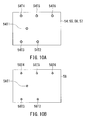
  • FIG. 10A is an explanatory diagram illustrating a patterned surface of each of a fourth to a seventh dielectric layer of the multilayer structure of the balun of FIG. 6 .
  • FIG. 10B is an explanatory diagram illustrating a patterned surface of an eighth dielectric layer of the multilayer structure of the balun of FIG. 6 .
  • FIG. 11A is an explanatory diagram illustrating a patterned surface of a ninth dielectric layer of the multilayer structure of the balun of FIG. 6 .
  • FIG. 11B is an explanatory diagram illustrating a patterned surface of a tenth dielectric layer of the multilayer structure of the balun of FIG. 6 .
  • FIG. 12A is an explanatory diagram illustrating a patterned surface of an eleventh dielectric layer of the multilayer structure of the balun of FIG. 6 .
  • FIG. 12B is an explanatory diagram illustrating a patterned surface of each of a twelfth and a thirteenth dielectric layer of the multilayer structure of the balun of FIG. 6 .
  • FIG. 12C is an explanatory diagram illustrating a patterned surface of a fourteenth dielectric layer of the multilayer structure of the balun of FIG. 6 .
  • FIG. 13A is an explanatory diagram illustrating a patterned surface of a fifteenth dielectric layer of the multilayer structure of the balun of FIG. 6 .
  • FIG. 13B is an explanatory diagram illustrating a patterned surface of a sixteenth dielectric layer of the multilayer structure of the balun of FIG. 6 .
  • FIG. 13C is an explanatory diagram illustrating a patterned surface of each of a seventeenth and an eighteenth dielectric layer of the multilayer structure of the balun of FIG. 6 .
  • FIG. 14A is an explanatory diagram illustrating a patterned surface of a nineteenth dielectric layer of the multilayer structure of the balun of FIG. 6 .
  • FIG. 14B is an explanatory diagram illustrating a patterned surface of a twentieth dielectric layer of the multilayer structure of the balun of FIG. 6 .
  • FIG. 14C is an explanatory diagram illustrating a patterned surface of a twenty-first dielectric layer of the multilayer structure of the balun of FIG. 6 .
  • FIG. 15 is a circuit diagram illustrating the circuit configuration of a comparative example balun.
  • FIG. 16 is a characteristic diagram illustrating an example of reflection characteristics of the balun according to the embodiment of the invention and the comparative example balun.
  • FIG. 17 is a characteristic diagram illustrating an example of pass characteristics of the balun according to the embodiment of the invention and the comparative example balun.
  • FIG. 18 is a characteristic diagram illustrating an example of amplitude balance characteristics of the balun according to the embodiment of the invention and the comparative example balun.
  • FIG. 19 is a characteristic diagram illustrating an example of phase balance characteristics of the balun according to the embodiment of the invention and the comparative example balun.
  • FIG. 1 illustrates the circuit configuration of the balun according to the embodiment.
  • the balun 1 includes an unbalanced port 11 , a first balanced port 21 , a second balanced port 22 , a main line 10 , a subline 20 , a first capacitor C 1 , and an impedance matching section 30 .
  • the subline 20 is configured to be electromagnetically coupled to the main line 10 .
  • the main line 10 has a first end 10 a and a second end 10 b opposite to each other.
  • the subline 20 has a first end 20 a and a second end 20 b opposite to each other.
  • the first capacitor C 1 is provided between the first end 10 a of the main line 10 and the unbalanced port 11 .
  • the impedance matching section 30 is provided between the second end 20 b of the subline 20 and the second balanced port 22 .
  • the second end 10 b of the main line 10 is connected to the ground.
  • the first end 20 a of the subline 20 is connected to the first balanced port 21 .
  • the impedance matching section 30 is a circuit for performing impedance matching so that the impedance of the balun 1 as viewed from the first and second balanced ports 21 and 22 has a value equal or nearly equal to the value of a characteristic impedance of a balanced line connected to the first and second balanced ports 21 and 22 .
  • the impedance matching section 30 causes a change in the phase of a signal passing through the impedance matching section 30 so as to provide a good phase balance characteristic in the usable frequency band of the balun 1 .
  • the impedance matching section 30 includes a first path 31 connecting the second end 20 b of the subline 20 and the second balanced port 22 , and a second path 32 connecting the first path 31 and the ground.
  • the first path 31 includes a first inductance element L 1 and a second inductance element L 2 having their respective inductances and configured to be inductively coupled to each other.
  • Each of the first and second inductance elements L 1 and L 2 has a first end and a second end opposite to each other.
  • the first end and the second end of the first inductance element L 1 will be denoted by L 1 a and L 1 b , respectively.
  • the first end and the second end of the second inductance element L 2 will be denoted by L 2 a and L 2 b , respectively.
  • the first end L 1 a of the first inductance element L 1 is connected to the second end 20 b of the subline 20 .
  • the first end L 2 a of the second inductance element L 2 is connected to the second balanced port 22 .
  • the second end L 1 b of the first inductance element L 1 and the second end L 2 b of the second inductance element L 2 are connected to each other, and connected to the ground via the second path 32 .
  • the second path 32 includes a second capacitor C 2 .
  • Each of the first and second inductance elements L 1 and L 2 may be a line or an inductor which is a lumped constant element.
  • the first example shown in FIG. 2 is an example in which each of the first and second inductance elements L 1 and L 2 is a line.
  • the second example shown in FIG. 3 is an example in which each of the first and second inductance elements L 1 and L 2 is an inductor.
  • the first inductance element L 1 is taken as a first line
  • the second inductance element L 2 is taken as a second line.
  • the first line and the second line are configured to be at least inductively coupled to each other.
  • the first line and the second line may be further configured to be capacitively coupled to each other such that the capacitance between the first line and the second line is distributed continuously along the first and second lines, like a distributed constant circuit.
  • the first line may include a first line portion
  • the second line may include a second line portion opposed to the first line portion.
  • the first line portion has a first edge and a second edge opposite to each other.
  • the first edge of the first line portion is closest to the second end 20 b of the subline 20 in terms of circuit configuration.
  • the second line portion has a first edge and a second edge opposite to each other.
  • the first edge of the second line portion is closest to the second balanced port 22 in terms of circuit configuration.
  • the first edge of the second line portion is physically closer to the second edge of the first line portion than to any other part of the first line portion.
  • the second edge of the second line portion is physically closer to the first edge of the first line portion than to any other part of the first line portion.
  • the first inductance element L 1 and the second inductance element L 2 may be configured to be capacitively coupled to each other via a capacitor which is a lumped constant element.
  • the impedance matching section 30 shown in FIG. 3 may further include a third path 33 connecting the first end L 1 a of the first inductance element L 1 and the first end L 2 a of the second inductance element L 2 .
  • the third path 33 includes a third capacitor C 3 for establishing capacitive coupling between the first inductance element L 1 and the second inductance element L 2 .
  • the impedance matching section 30 is an LC circuit including an inductor L 11 and a second capacitor C 11 .
  • the circuit configuration of the third example is that of a low-pass filter, in particular.
  • the impedance matching section 30 includes a first path 31 connecting the second end 20 b of the subline 20 and the second balanced port 22 , and a second path 32 connecting the first path 31 and the ground, as in the first and second examples.
  • the first path 31 includes the inductor L 11 .
  • the second path 32 includes the second capacitor C 11 .
  • the second path 32 further includes a third capacitor C 12 .
  • the second capacitor C 11 is provided between one end of the inductor L 11 and the ground.
  • the third capacitor C 12 is provided between the other end of the inductor L 11 and the ground.
  • the impedance matching section 30 is an LC circuit including an inductor L 21 and a second capacitor C 21 .
  • the impedance matching section 30 includes a first path 31 connecting the second end 20 b of the subline 20 and the second balanced port 22 , and a second path 32 connecting the first path 31 and the ground, as in the first to third examples.
  • the first path 31 includes the inductor L 21 .
  • the second path 32 includes the second capacitor C 21 .
  • the second path 32 further includes an inductor L 22 connected in series to the second capacitor C 21 .
  • the second capacitor C 21 is provided between one end of the inductor L 21 and one end of the inductor L 22 .
  • the other end of the inductor L 22 is connected to the ground.
  • the second path 32 further includes a third capacitor C 22 provided between the other end of the inductor L 21 and the one end of the inductor L 22 .
  • FIG. 6 is a perspective view of the balun 1 .
  • the balun 1 of FIG. 6 includes a multilayer structure 50 for integrating the unbalanced port 11 , the first and second balanced ports 21 and 22 , the main line 10 , the subline 20 , the first capacitor C 1 and the impedance matching section 30 .
  • the multilayer structure 50 includes a plurality of dielectric layers and a plurality of conductor layers stacked on each other.
  • the multilayer structure 50 is shaped like a rectangular solid and has a periphery.
  • the periphery of the multilayer structure 50 includes a top surface 50 A, a bottom surface 50 B, and four side surfaces 50 C, 50 D, 50 E and 50 F.
  • the top surface 50 A and the bottom surface 50 B are opposite each other.
  • the side surfaces 50 C and 50 D are opposite each other.
  • the side surfaces 50 E and 50 F are opposite each other.
  • the side surfaces 50 C to 50 F are perpendicular to the top surface 50 A and the bottom surface 50 B.
  • the dielectric layers and the conductor layers are stacked in the direction perpendicular to the top surface 50 A and the bottom surface 50 B. This direction will be referred to as the stacking direction.
  • the stacking direction is shown by the arrow T in FIG. 6 .
  • the top surface 50 A and the bottom surface 50 B are located at opposite ends in the stacking direction T.
  • the balun 1 of FIG. 6 includes first to sixth terminals 111 , 112 , 113 , 114 , 115 and 116 .
  • the first, third and fourth terminals 111 , 113 and 114 respectively correspond to the unbalanced port 11 , the first balanced port 21 and the second balanced port 22 of FIG. 1 .
  • the second, fifth and sixth terminals 112 , 115 and 116 are connected to the ground.
  • the terminals 111 to 116 are located on the bottom surface 50 B of the multilayer structure 50 .
  • the multilayer structure 50 will be described in detail with reference to FIG. 7 to FIG. 14C .
  • the multilayer structure 50 includes 21 dielectric layers stacked on each other.
  • the 21 dielectric layers will be referred to as the first to twenty-first dielectric layers in the order from bottom to top.
  • FIG. 7 is a perspective view illustrating the interior of the multilayer structure 50 .
  • FIG. 8 is a perspective view illustrating a part of the interior of the multilayer structure 50 .
  • FIGS. 9A to 9C illustrate the respective patterned surfaces of the first to third dielectric layers.
  • FIG. 10A illustrates the patterned surface of each of the fourth to seventh dielectric layers.
  • FIG. 10B illustrates the patterned surface of the eighth dielectric layer.
  • FIG. 11A and 11B illustrate the respective patterned surfaces of the ninth and tenth dielectric layers.
  • FIG. 12A illustrates the patterned surface of the eleventh dielectric layer.
  • FIG. 12B illustrates the patterned surface of each of the twelfth and thirteenth dielectric layers.
  • FIG. 12C illustrates the patterned surface of the fourteenth dielectric layer.
  • FIG. 13A illustrates the patterned surface of the fifteenth dielectric layer.
  • FIG. 13B illustrates the patterned surface of the sixteenth dielectric layer.
  • FIG. 13C illustrates the patterned surface of each of the seventeenth and eighteenth dielectric layers.
  • FIGS. 14A to 14C illustrate the respective patterned surfaces of the nineteenth to twenty-first dielectric layers.
  • the first to sixth terminals 111 , 112 , 113 , 114 , 115 and 116 are formed on the patterned surface of the first dielectric layer 51 . Further, through holes 51 T 1 , 51 T 2 , 51 T 3 , 51 T 4 , 51 T 5 and 51 T 6 are formed in the dielectric layer 51 and connected to the terminals 111 , 112 , 113 , 114 , 115 and 116 , respectively.
  • a conductor layer 521 is formed on the patterned surface of the second dielectric layer 52 .
  • the conductor layer 521 is used for forming the first capacitor C 1 .
  • through holes 52 T 2 , 52 T 3 , 52 T 4 , 52 T 5 and 52 T 6 are formed in the dielectric layer 52 .
  • the through holes 51 T 2 to 51 T 6 shown in FIG. 9A are connected to the through holes 52 T 2 to 52 T 6 , respectively.
  • the through hole 51 T 1 shown in FIG. 9A is connected to the conductor layer 521 .
  • a conductor layer 531 is formed on the patterned surface of the third dielectric layer 53 .
  • the conductor layer 531 is used for forming the first capacitor C 1 .
  • through holes 53 T 1 , 53 T 2 , 53 T 3 , 53 T 4 , 53 T 5 and 53 T 6 are formed in the dielectric layer 53 .
  • the through hole 53 T 1 is connected to the conductor layer 531 .
  • the through holes 52 T 2 to 52 T 6 shown in FIG. 9B are connected to the through holes 53 T 2 to 53 T 6 , respectively.
  • through holes 54 T 1 , 54 T 2 , 54 T 3 , 54 T 4 , 54 T 5 and 54 T 6 are formed in each of the fourth to seventh dielectric layers 54 , 55 , 56 and 57 .
  • every vertically adjacent through holes denoted by the same reference signs are connected to each other.
  • the through holes 53 T 1 to 53 T 6 shown in FIG. 9C are respectively connected to the through holes 54 T 1 to 54 T 6 formed in the dielectric layer 54 .
  • through holes 58 T 1 , 58 T 2 , 58 T 3 , 58 T 4 , 58 T 5 and 58 T 6 are formed in the eighth dielectric layer 58 .
  • the through holes 54 T 1 to 54 T 6 formed in the dielectric layer 57 of FIG. 10A are connected to the through holes 58 T 1 to 58 T 6 , respectively.
  • a conductor layer 591 is formed on the patterned surface of the ninth dielectric layer 59 .
  • the conductor layer 591 is used for forming the main line 10 .
  • the conductor layer 591 has a first end and a second end.
  • through holes 59 T 3 , 59 T 4 , 59 T 5 and 59 T 6 are formed in the dielectric layer 59 .
  • the through holes 58 T 3 to 58 T 6 shown in FIG. 10B are connected to the through holes 59 T 3 to 59 T 6 , respectively.
  • the through hole 58 T 1 shown in FIG. 10B is connected to a portion of the conductor layer 591 near the first end thereof.
  • the through hole 58 T 2 shown in FIG. 10B is connected to a portion of the conductor layer 591 near the second end thereof.
  • a conductor layer 601 is formed on the patterned surface of the tenth dielectric layer 60 .
  • the conductor layer 601 is used for forming the subline 20 .
  • the conductor layer 601 has a first end and a second end.
  • through holes 60 T 4 , 60 T 5 , 60 T 6 and 60 T 7 are formed in the dielectric layer 60 .
  • the through holes 59 T 4 to 59 T 6 shown in FIG. 11A are connected to the through holes 60 T 4 to 60 T 6 , respectively.
  • the through hole 60 T 7 is connected to a portion of the conductor layer 601 near the second end thereof.
  • the through hole 59 T 3 shown in FIG. 11A is connected to a portion of the conductor layer 601 near the first end thereof.
  • a conductor layer 611 is formed on the patterned surface of the eleventh dielectric layer 61 . Further, through holes 61 T 4 , 61 T 5 , 61 T 6 and 61 T 7 are formed in the dielectric layer 61 .
  • the through holes 60 T 4 to 60 T 6 shown in FIG. 11B are connected to the through holes 61 T 4 to 61 T 6 , respectively.
  • the through hole 60 T 7 shown in FIG. 11B and the through hole 61 T 7 are connected to the conductor layer 611 .
  • through holes 62 T 4 , 62 T 5 , 62 T 6 and 62 T 7 are formed in each of the twelfth and thirteenth dielectric layers 62 and 63 .
  • every vertically adjacent through holes denoted by the same reference signs are connected to each other.
  • the through holes 61 T 4 to 61 T 7 shown in FIG. 12A are respectively connected to the through holes 62 T 4 to 62 T 7 formed in the dielectric layer 62 .
  • through holes 64 T 4 , 64 T 5 , 64 T 6 and 64 T 7 are formed in the fourteenth dielectric layer 64 .
  • the through holes 62 T 4 to 62 T 7 formed in the dielectric layer 63 of FIG. 12B are connected to the through holes 64 T 4 to 64 T 7 , respectively.
  • conductor layers 651 and 652 are formed on the patterned surface of the fifteenth dielectric layer 65 .
  • the conductor layer 651 is used for forming the second capacitor C 2 .
  • through holes 65 T 4 and 65 T 7 are formed in the dielectric layer 65 .
  • the through hole 64 T 4 shown in FIG. 12C is connected to the through hole 65 T 4 .
  • the through hole 64 T 7 shown in FIG. 12C and the through hole 65 T 7 are connected to the conductor layer 652 .
  • the through holes 64 T 5 and 64 T 6 shown in FIG. 12C are connected to the conductor layer 651 .
  • a conductor layer 661 is formed on the patterned surface of the sixteenth dielectric layer 66 .
  • the conductor layer 661 is used for forming the second capacitor C 2 .
  • through holes 66 T 4 , 66 T 7 and 66 T 8 are formed in the dielectric layer 66 .
  • the through holes 65 T 4 and 65 T 7 shown in FIG. 13A are connected to the through holes 66 T 4 and 66 T 7 , respectively.
  • the through hole 66 T 8 is connected to the conductor layer 661 .
  • through holes 67 T 4 , 67 T 7 and 67 T 8 are formed in each of the seventeenth and eighteenth dielectric layers 67 and 68 .
  • every vertically adjacent through holes denoted by the same reference signs are connected to each other.
  • the through holes 66 T 4 , 66 T 7 and 66 T 8 shown in FIG. 13B are respectively connected to the through holes 67 T 4 , 67 T 7 and 67 T 8 formed in the dielectric layer 67 .
  • a conductor layer 691 is formed on the patterned surface of the nineteenth dielectric layer 69 .
  • the conductor layer 691 is used for forming the first inductance element L 1 .
  • the conductor layer 691 has a first end and a second end.
  • through holes 69 T 4 and 69 T 8 are formed in the dielectric layer 69 .
  • the through hole 67 T 4 formed in the dielectric layer 68 of FIG. 13C is connected to the through hole 69 T 4 .
  • the through hole 67 T 8 formed in the dielectric layer 68 of FIG. 13C and the through hole 69 T 8 are connected to a portion of the conductor layer 691 near the second end thereof.
  • the through hole 67 T 7 formed in the dielectric layer 68 of FIG. 13C is connected to a portion of the conductor layer 691 near the first end thereof.
  • a conductor layer 701 is formed on the patterned surface of the twentieth dielectric layer 70 .
  • the conductor layer 701 is used for forming the second inductance element L 2 .
  • the conductor layer 701 has a first end and a second end.
  • the through hole 69 T 4 shown in FIG. 14A is connected to a portion of the conductor layer 701 near the first end thereof.
  • the through hole 69 T 8 shown in FIG. 14A is connected to a portion of the conductor layer 701 near the second end thereof.
  • a mark 711 is formed on the patterned surface of the twenty-first dielectric layer 71 .
  • the multilayer structure 50 shown in FIG. 6 is formed by stacking the first to twenty-first dielectric layers 51 to 71 such that the patterned surface of the first dielectric layer 51 also serves as the bottom surface 50 B of the multilayer structure 50 .
  • FIG. 7 illustrates the interior of the multilayer structure 50 .
  • FIG. 7 omits the mark 711 .
  • FIG. 8 illustrates a part of the interior of the multilayer structure 50 .
  • the main line 10 is formed of the conductor layer 591 shown in FIG. 11A .
  • the portion of the conductor layer 591 near the first end thereof is connected to the conductor layer 531 shown in FIG. 9C via the through holes 53 T 1 , 54 T 1 and 58 T 1 .
  • the portion of the conductor layer 591 near the second end thereof is connected to the second terminal 112 via the through holes 51 T 2 , 52 T 2 , 53 T 2 , 54 T 2 and 58 T 2 .
  • the subline 20 is formed of the conductor layer 601 shown in FIG. 11B .
  • the portion of the conductor layer 601 near the first end thereof is connected to the third terminal 113 via the through holes 51 T 3 , 52 T 3 , 53 T 3 , 54 T 3 , 58 T 3 and 59 T 3 .
  • the portion of the conductor layer 601 near the second end thereof is connected to the conductor layer 691 shown in FIG. 14A via the through hole 60 T 7 , the conductor layer 611 , the through holes 61 T 7 , 62 T 7 and 64 T 7 , the conductor layer 652 , and the through holes 65 T 7 , 66 T 7 and 67 T 7 .
  • the first capacitor C 1 is foil led of the conductor layers 521 and 531 shown in FIGS. 9B and 9C , and the dielectric layer 52 interposed between the conductor layers 521 and 531 .
  • the conductor layer 521 is connected to the first terminal 111 via the through hole 51 T 1 .
  • the conductor layer 531 is connected via the through holes 53 T 1 , 54 T 1 and 58 T 1 to the conductor layer 591 forming the main line 10 .
  • the first inductance element L 1 is formed of the conductor layer 691 shown in FIG. 14A .
  • the portion of the conductor layer 691 near the first end thereof is connected to the conductor layer 601 forming the subline 20 via the through hole 60 T 7 , the conductor layer 611 , the through holes 61 T 7 , 62 T 7 and 64 T 7 , the conductor layer 652 , and the through holes 65 T 7 , 66 T 7 and 67 T 7 .
  • the portion of the conductor layer 691 near the second end thereof is connected to the conductor layer 661 shown in FIG. 13B via the through holes 66 T 8 and 67 T 8 , and also connected to the conductor layer 701 shown in FIG. 14B via the through hole 69 T 8 .
  • junction between the conductor layer 691 and the through hole 67 T 7 formed in the dielectric layer 68 corresponds to the first end L 1 a of the first inductance element L 1 .
  • junction between the conductor layer 691 and the through hole 67 T 8 formed in the dielectric layer 68 corresponds to the second end L 1 b of the first inductance element L 1 .
  • the second inductance element L 2 is formed of the conductor layer 701 shown in FIG. 14B .
  • the portion of the conductor layer 701 near the first end thereof is connected to the fourth terminal 114 via the through holes 51 T 4 , 52 T 4 , 53 T 4 , 54 T 4 , 58 T 4 , 59 T 4 , 60 T 4 , 61 T 4 , 62 T 4 , 64 T 4 , 65 T 4 , 66 T 4 , 67 T 4 and 69 T 4 .
  • the portion of the conductor layer 701 near the second end thereof is connected via the through hole 69 T 8 to the conductor layer 691 forming the first inductance element L 1 .
  • junction between the conductor layer 701 and the through hole 69 T 4 corresponds to the first end L 2 a of the second inductance element L 2 .
  • junction between the conductor layer 701 and the through hole 69 T 8 corresponds to the second end L 2 b of the second inductance element L 2 .
  • the second capacitor C 2 is formed of the conductor layers 651 and 661 shown in FIGS. 13A and 13B and the dielectric layer 65 interposed between the conductor layers 651 and 661 .
  • the conductor layer 651 is connected to the fifth and sixth terminals 115 and 116 via the through holes 51 T 5 , 51 T 6 , 52 T 5 , 52 T 6 , 53 T 5 , 53 T 6 , 54 T 5 , 54 T 6 , 58 T 5 , 58 T 6 , 59 T 5 , 59 T 6 , 60 T 5 , 60 T 6 , 61 T 5 , 61 T 6 , 62 T 5 , 62 T 6 , 64 T 5 and 64 T 6 .
  • the conductor layer 661 is connected via the through holes 66 T 8 and 67 T 8 to the conductor layer 691 forming the first inductance element L 1 .
  • the first inductance element L 1 is the first line and the second inductance element L 2 is the second line.
  • the first line is formed of the conductor layer 691 shown in FIG. 14A .
  • the second line is formed of the conductor layer 701 shown in FIG. 14B .
  • the first line includes a first line portion 31 A.
  • the first line portion 31 A is shown with hatching.
  • the first line portion 31 A has a first edge 31 Aa and a second edge 31 Ab opposite to each other, the first edge 31 Aa being closest to the subline 20 in terms of circuit configuration.
  • the first edge 31 Aa is located near the first end L 1 a of the first inductance element L 1 .
  • the second edge 31 Ab is located near the second end L 1 b of the first inductance element L 1 .
  • the second line includes a second line portion 31 B opposed to the first line portion 31 A.
  • the second line portion 31 B is shown with hatching.
  • the second line portion 31 B has a first edge 31 Ba and a second edge 31 Bb opposite to each other, the first edge 31 Ba being closest to the second balanced port 22 in terms of circuit configuration.
  • the first edge 31 Ba is located near the first end L 2 a of the second inductance element L 2 .
  • the second edge 31 Bb is located near the second end L 2 b of the second inductance element L 2 .
  • the first edge 31 Ba of the second line portion 31 B is physically closer to the second edge 31 Ab of the first line portion 31 A than to any other part of the first line portion 31 A.
  • the second edge 31 Bb of the second line portion 31 B is physically closer to the first edge 31 Aa of the first line portion 31 A than to any other part of the first line portion 31 A.
  • the unbalanced port 11 is used to input and output an unbalanced signal
  • the first balanced port 21 is used to input and output a first balanced element signal
  • the second balanced port 22 is used to input and output a second balanced element signal.
  • the first balanced element signal and the second balanced element signal constitute a balanced signal.
  • the balun 1 converts between the balanced signal and the unbalanced signal.
  • the subline 20 and the impedance matching section 30 are designed to provide a phase difference of 180 or near 180 degrees between the first and second balanced element signals to be outputted from the first and second balanced ports 21 and 22 upon input of an unbalanced signal to the unbalanced port 11 in the usable frequency band of the balun 1 .
  • each of the main line 10 and the subline 20 may be a line having a length equivalent to one-half or approximately one-half of a wavelength that corresponds to a predetermined frequency within the usable frequency band of the balun 1 .
  • the impedance matching section 30 may be designed to cause a 360- or near 360-degree change in the phase of a signal of the aforementioned predetermined frequency when the signal passes through the impedance matching section 30 .
  • a series resonant circuit is formed by the main line 10 and the first capacitor C 1 .
  • This enables creation of an attenuation pole in the reflection characteristic of the balun 1 by means of resonance of the series resonant circuit.
  • the frequency at which the attenuation pole occurs that is, the resonant frequency of the series resonant circuit, is preferably adjusted to fall within the usable frequency band of the balun 1 .
  • this embodiment provides a good pass characteristic and a good reflection characteristic over a wider frequency band as compared with Marchand baluns. The embodiment thus enables the balun 1 to be capable of being used over a wide frequency band.
  • the impedance matching section 30 can have any other various configurations that enable the impedance matching section 30 to perform the impedance matching function and the phase changing function.
  • the embodiment thus offers a wide range of design possibilities for the impedance matching section 30 and the balun 1 , which may be appropriately selected according to the characteristic, shape and other conditions required of the balun 1 .
  • the effects of the balun 1 according to the embodiment will now be described in more detail with reference to the results of a simulation comparing characteristics between the balun 1 according to the embodiment and a comparative example balun 201 .
  • the comparative example balun 201 is a Marchand balun.
  • FIG. 15 is a circuit diagram illustrating the circuit configuration of the comparative example balun 201 .
  • the comparative example balun 201 includes an unbalanced port 211 , a first balanced port 221 A, a second balanced port 221 B, a first unbalanced transmission line 210 A, a second unbalanced transmission line 210 B, a first balanced transmission line 220 A and a second balanced transmission line 220 B.
  • the first unbalanced transmission line 210 A and the second unbalanced transmission line 210 B are connected in series.
  • the first balanced transmission line 220 A is configured to be electromagnetically coupled to the first unbalanced transmission line 210 A.
  • the second balanced transmission line 220 B is configured to be electromagnetically coupled to the second unbalanced transmission line 210 B.
  • One end of the first unbalanced transmission line 210 A is connected to the unbalanced port 211 .
  • the other end of the first unbalanced transmission line 210 A is connected to one end of the second unbalanced transmission line 210 B.
  • One end of the first balanced transmission line 220 A is connected to the first balanced port 221 A.
  • One end of the second balanced transmission line 220 B is connected to the second balanced port 221 B.
  • the other end of the first balanced transmission line 220 A and the other end of the second balanced transmission line 220 B are connected to the ground.
  • the baluns 1 and 201 were designed so that the center frequencies of the passbands of the baluns 1 and 201 were equal.
  • the reflection characteristics, pass characteristics, amplitude balance characteristics and phase balance characteristics of the baluns 1 and 201 were determined.
  • FIG. 16 illustrates an example of the reflection characteristics of the baluns 1 and 201 .
  • the reflection characteristics of the baluns are represented here using a single-ended S-parameter representing the response of a signal outputted from the unbalanced port upon input of an unbalanced signal to the unbalanced port. This S-parameter will hereinafter be referred to as return loss.
  • the horizontal axis represents frequency
  • the vertical axis represents return loss.
  • line 81 represents the reflection characteristic of the balun 1
  • line 82 represents the reflection characteristic of the balun 201 .
  • the reflection characteristic 82 of the balun 201 shows one attenuation pole in the frequency range on the horizontal axis of FIG. 16 .
  • the reflection characteristic 81 of the balun 1 shows two attenuation poles, i.e., a first attenuation pole 91 and a second attenuation pole 92 , in the frequency range on the horizontal axis of FIG. 16 .
  • the first attenuation pole 91 results from the resonance of the series resonant circuit formed by the main line 10 and the first capacitor C 1 .
  • the second attenuation pole 92 results from the resonance of a portion of the balun 1 constituted of the main line 10 , the subline 20 and the impedance matching section 30 .
  • baluns it is required of baluns to have such a reflection characteristic that when the return loss value is denoted as ⁇ R dB, the value of R be sufficiently large over a wide frequency band.
  • the value of R is sufficiently large over a wide frequency band by virtue of the presence of the two attenuation poles 91 and 92 .
  • the reflection characteristic 81 of the balun 1 clearly shows a larger width than the reflection characteristic 82 of the balun 201 . It can thus be said that the reflection characteristic 81 of the balun 1 is good over a wider frequency band than the reflection characteristic 82 of the balun 201 .
  • FIG. 17 illustrates an example of the pass characteristics of the baluns 1 and 201 .
  • the pass characteristics of the baluns are represented here using a mixed-mode S-parameter representing the response of a difference signal of two balanced element signals outputted from the two balanced ports upon input of an unbalanced signal to the unbalanced port. This S-parameter will hereinafter be referred to as insertion loss.
  • the horizontal axis represents frequency
  • the vertical axis represents insertion loss.
  • line 83 represents the pass characteristic of the balun 1
  • line 84 represents the pass characteristic of the balun 201 .
  • baluns it is required of baluns to have such a pass characteristic that when the insertion loss value is denoted as ⁇ I dB, the value of I be sufficiently small over a wide frequency band.
  • the pass characteristic 83 of the balun 1 clearly shows a larger width than the pass characteristic 84 of the balun 201 . It can thus be said that the pass characteristic 83 of the balun 1 is good over a wider frequency band than the pass characteristic 84 of the balun 201 . This effect results from the presence of the two attenuation poles 91 and 92 in the reflection characteristic 81 of the balun 1 as described above.
  • FIG. 18 illustrates an example of amplitude balance characteristics of the baluns 1 and 201 .
  • the amplitude balance characteristics of the baluns are represented here using a difference in amplitude between the two balanced element signals outputted from the two balanced ports upon input of an unbalanced signal to the unbalanced port, which will hereinafter be simply referred to as the amplitude difference.
  • the amplitude difference is expressed in positive values when the amplitude of the first balanced element signal is greater than the amplitude of the second balanced element signal, and in negative values when the amplitude of the first balanced element signal is smaller than the amplitude of the second balanced element signal.
  • the horizontal axis represents frequency
  • the vertical axis represents amplitude difference.
  • line 85 represents the amplitude balance characteristic of the balun 1
  • line 86 represents the amplitude balance characteristic of the balun 201 .
  • the amplitude differences for the baluns 1 and 201 are both close to 0 (dB).
  • the amplitude balance characteristic 85 of the balun 1 and the amplitude balance characteristic 86 of the balun 201 are both good in the frequency range on the horizontal axis of FIG. 18 .
  • FIG. 19 illustrates an example of phase balance characteristics of the baluns 1 and 201 .
  • the phase balance characteristics of the baluns are represented here using a difference in phase between the two balanced element signals outputted from the two balanced ports upon input of an unbalanced signal to the unbalanced port, which will hereinafter be simply referred to as the phase difference.
  • the phase difference represents the magnitude of advancement of the phase of the first balanced element signal relative to the phase of the second balanced element signal.
  • the horizontal axis represents frequency
  • the vertical axis represents phase difference.
  • line 87 represents the phase balance characteristic of the balun 1
  • line 88 represents the phase balance characteristic of the balun 201 .
  • the phase differences for the baluns 1 and 201 are both close to 180 degrees.
  • the phase balance characteristic 87 of the balun 1 and the phase balance characteristic 88 of the balun 201 are both good in the frequency range on the horizontal axis of FIG. 19 .
  • the balun 1 provides a good pass characteristic and a good reflection characteristic over a wider frequency band when compared with the comparative example balun 201 , i.e., a Marchand balun.
  • the usable frequency band of the balun 1 in the example shown in FIGS. 16 to 19 includes at least the 1000 to 7000 MHz (1 to 7 GHz) frequency band.
  • the configuration of FIG. 2 may be modified to further include a third path connecting the first end L 1 a of the first inductance element L 1 and the first end L 2 a of the second inductance element L 2 .
  • the third path includes a third capacitor which is a lumped constant element.
  • the first line (the first inductance element L 1 ) and the second line (the second inductance element L 2 ) may or may not be configured to be capacitively coupled to each other such that the capacitance between the first line and the second line is distributed continuously along the first and second lines.
  • the impedance matching section 30 may be a delay line formed of a line.

Landscapes

  • Coils Or Transformers For Communication (AREA)
  • Fixed Capacitors And Capacitor Manufacturing Machines (AREA)

Abstract

A balun includes an unbalanced port, a first balanced port, a second balanced port, a main line, a subline, a capacitor, and an impedance matching section. The subline is configured to be electromagnetically coupled to the main line. The main line has a first end and a second end opposite to each other. The subline has a first end and a second end opposite to each other. The capacitor is provided between the first end of the main line and the unbalanced port. The impedance matching section is provided between the second end of the subline and the second balanced port. The second end of the main line is connected to a ground. The first end of the subline is connected to the first balanced port.

Description

BACKGROUND OF THE INVENTION 1. Field of the Invention
The present invention relates to a wideband capable balun.
2. Description of the Related Art
Baluns for converting between balanced and unbalanced signals are one of electronic components for use in transmission/reception circuits of wireless communication apparatuses such as communication apparatuses for television broadcasting, cellular phones, and wireless LAN communication apparatuses. A balun includes an unbalanced port for input and output of an unbalanced signal and two balanced ports for input and output of two balanced element signals constituting a balanced signal.
It is required of the baluns to exhibit a good amplitude balance characteristic and a good phase balance characteristic over a wide frequency band. The good amplitude balance characteristic means that the two balanced element signals outputted from the two balanced ports upon input of an unbalanced signal to the unbalanced port are different in amplitude from each other by approximately zero. The good phase balance characteristic means that the two balanced element signals outputted from the two balanced ports upon input of an unbalanced signal to the unbalanced port are different in phase from each other by approximately 180 degrees.
Conventional baluns capable of being used over relatively wide frequency bands include Marchand baluns, an example of which is disclosed in U.S. Patent Application Publication No. 2006/0061430 A1.
The recent advances in television broadcasting technologies, mobile communication technologies and the like have extended the usable frequency bands of wireless communication apparatuses. It is thus required that baluns for use in the wireless communication apparatuses be capable of being used over a wider frequency band.
SUMMARY OF THE INVENTION
It is an object of the present invention to provide a balun capable of being used over a wide frequency band.
A balun of the present invention includes an unbalanced port, a first balanced port, a second balanced port, a main line, a subline, a first capacitor, and an impedance matching section. The main line has a first end and a second end opposite to each other. The subline is configured to be electromagnetically coupled to the main line and has a first end and a second end opposite to each other. The first capacitor is provided between the first end of the main line and the unbalanced port. The impedance matching section is provided between the second end of the subline and the second balanced port. The second end of the main line is connected to a ground. The first end of the subline is connected to the first balanced port.
In the balun of the present invention, the impedance matching section may be an LC circuit including an inductor and a second capacitor.
In the balun of the present invention, the impedance matching section may include a first path connecting the second end of the subline and the second balanced port, and a second path connecting the first path and the ground. The first path may include an inductor. The second path may include a second capacitor.
When the impedance matching section includes the first path and the second path, the first path may include a first inductance element and a second inductance element having their respective inductances and configured to be inductively coupled to each other. Each of the first and second inductance elements may have a first end and a second end opposite to each other. The first end of the first inductance element is connected to the second end of the subline. The first end of the second inductance element is connected to the second balanced port. The second end of the first inductance element and the second end of the second inductance element are connected to each other, and connected to the ground via the second path. The second path includes a second capacitor.
The first inductance element may be a first line, and the second inductance element may be a second line. In such a case, the first line and the second line may be configured to be capacitively coupled to each other. The first line may include a first line portion. The second line may include a second line portion opposed to the first line portion. The first line portion has a first edge and a second edge opposite to each other, the first edge of the first line portion being closest to the second end of the subline in terms of circuit configuration. The second line portion has a first edge and a second edge opposite to each other, the first edge of the second line portion being closest to the second balanced port in terms of circuit configuration. The first edge of the second line portion is physically closer to the second edge of the first line portion than to any other part of the first line portion. The second edge of the second line portion is physically closer to the first edge of the first line portion than to any other part of the first line portion.
The balun of the present invention may further include a multilayer structure for integrating the unbalanced port, the first and second balanced ports, the main line, the subline, the first capacitor and the impedance matching section. The multilayer structure includes a plurality of dielectric layers and a plurality of conductor layers stacked on each other.
The balun of the present invention achieves a wider usable frequency band than that of a Marchand balun by utilizing the resonance of a series resonant circuit formed by the main line and the first capacitor. The present invention thus provides a balun capable of being used over a wide frequency band.
Other and further objects, features and advantages of the invention will appear more fully from the following description.
BRIEF DESCRIPTION OF THE DRAWINGS
FIG. 1 is a circuit diagram illustrating the circuit configuration of a balun according to an embodiment of the invention.
FIG. 2 is a circuit diagram illustrating a first example of circuit configuration of an impedance matching section of the balun of FIG. 1.
FIG. 3 is a circuit diagram illustrating a second example of circuit configuration of the impedance matching section of the balun of FIG. 1.
FIG. 4 is a circuit diagram illustrating a third example of circuit configuration of the impedance matching section of the balun of FIG. 1.
FIG. 5 is a circuit diagram illustrating a fourth example of circuit configuration of the impedance matching section of the balun of FIG. 1.
FIG. 6 is a perspective view of the balun of the embodiment of the invention.
FIG. 7 is a perspective view illustrating the interior of a multilayer structure of the balun of FIG. 6.
FIG. 8 is a perspective view illustrating a part of the interior of the multilayer structure of the balun of FIG. 6.
FIG. 9A is an explanatory diagram illustrating a patterned surface of a first dielectric layer of the multilayer structure of the balun of FIG. 6.
FIG. 9B is an explanatory diagram illustrating a patterned surface of a second dielectric layer of the multilayer structure of the balun of FIG. 6.
FIG. 9C is an explanatory diagram illustrating a patterned surface of a third dielectric layer of the multilayer structure of the balun of FIG. 6.
FIG. 10A is an explanatory diagram illustrating a patterned surface of each of a fourth to a seventh dielectric layer of the multilayer structure of the balun of FIG. 6.
FIG. 10B is an explanatory diagram illustrating a patterned surface of an eighth dielectric layer of the multilayer structure of the balun of FIG. 6.
FIG. 11A is an explanatory diagram illustrating a patterned surface of a ninth dielectric layer of the multilayer structure of the balun of FIG. 6.
FIG. 11B is an explanatory diagram illustrating a patterned surface of a tenth dielectric layer of the multilayer structure of the balun of FIG. 6.
FIG. 12A is an explanatory diagram illustrating a patterned surface of an eleventh dielectric layer of the multilayer structure of the balun of FIG. 6.
FIG. 12B is an explanatory diagram illustrating a patterned surface of each of a twelfth and a thirteenth dielectric layer of the multilayer structure of the balun of FIG. 6.
FIG. 12C is an explanatory diagram illustrating a patterned surface of a fourteenth dielectric layer of the multilayer structure of the balun of FIG. 6.
FIG. 13A is an explanatory diagram illustrating a patterned surface of a fifteenth dielectric layer of the multilayer structure of the balun of FIG. 6.
FIG. 13B is an explanatory diagram illustrating a patterned surface of a sixteenth dielectric layer of the multilayer structure of the balun of FIG. 6.
FIG. 13C is an explanatory diagram illustrating a patterned surface of each of a seventeenth and an eighteenth dielectric layer of the multilayer structure of the balun of FIG. 6.
FIG. 14A is an explanatory diagram illustrating a patterned surface of a nineteenth dielectric layer of the multilayer structure of the balun of FIG. 6.
FIG. 14B is an explanatory diagram illustrating a patterned surface of a twentieth dielectric layer of the multilayer structure of the balun of FIG. 6.
FIG. 14C is an explanatory diagram illustrating a patterned surface of a twenty-first dielectric layer of the multilayer structure of the balun of FIG. 6.
FIG. 15 is a circuit diagram illustrating the circuit configuration of a comparative example balun.
FIG. 16 is a characteristic diagram illustrating an example of reflection characteristics of the balun according to the embodiment of the invention and the comparative example balun.
FIG. 17 is a characteristic diagram illustrating an example of pass characteristics of the balun according to the embodiment of the invention and the comparative example balun.
FIG. 18 is a characteristic diagram illustrating an example of amplitude balance characteristics of the balun according to the embodiment of the invention and the comparative example balun.
FIG. 19 is a characteristic diagram illustrating an example of phase balance characteristics of the balun according to the embodiment of the invention and the comparative example balun.
DETAILED DESCRIPTION OF THE PREFERRED EMBODIMENT
An embodiment of the present invention will now be described in detail with reference to the drawings. First, reference is made to FIG. 1 to describe the circuit configuration of a balun according to the embodiment of the invention. FIG. 1 illustrates the circuit configuration of the balun according to the embodiment. As shown in FIG. 1, the balun 1 includes an unbalanced port 11, a first balanced port 21, a second balanced port 22, a main line 10, a subline 20, a first capacitor C1, and an impedance matching section 30. The subline 20 is configured to be electromagnetically coupled to the main line 10.
The main line 10 has a first end 10 a and a second end 10 b opposite to each other. The subline 20 has a first end 20 a and a second end 20 b opposite to each other. The first capacitor C1 is provided between the first end 10 a of the main line 10 and the unbalanced port 11. The impedance matching section 30 is provided between the second end 20 b of the subline 20 and the second balanced port 22. The second end 10 b of the main line 10 is connected to the ground. The first end 20 a of the subline 20 is connected to the first balanced port 21.
The impedance matching section 30 is a circuit for performing impedance matching so that the impedance of the balun 1 as viewed from the first and second balanced ports 21 and 22 has a value equal or nearly equal to the value of a characteristic impedance of a balanced line connected to the first and second balanced ports 21 and 22. The impedance matching section 30 causes a change in the phase of a signal passing through the impedance matching section 30 so as to provide a good phase balance characteristic in the usable frequency band of the balun 1.
A first to a fourth example of circuit configuration of the impedance matching section 30 will be described with reference to FIG. 2 to FIG. 5. The first example shown in FIG. 2 and the second example shown in FIG. 3 will be described first. In the first and second examples, the impedance matching section 30 includes a first path 31 connecting the second end 20 b of the subline 20 and the second balanced port 22, and a second path 32 connecting the first path 31 and the ground. The first path 31 includes a first inductance element L1 and a second inductance element L2 having their respective inductances and configured to be inductively coupled to each other. Each of the first and second inductance elements L1 and L2 has a first end and a second end opposite to each other. The first end and the second end of the first inductance element L1 will be denoted by L1 a and L1 b, respectively. The first end and the second end of the second inductance element L2 will be denoted by L2 a and L2 b, respectively.
The first end L1 a of the first inductance element L1 is connected to the second end 20 b of the subline 20. The first end L2 a of the second inductance element L2 is connected to the second balanced port 22. The second end L1 b of the first inductance element L1 and the second end L2 b of the second inductance element L2 are connected to each other, and connected to the ground via the second path 32. As shown in FIG. 2 and FIG. 3, the second path 32 includes a second capacitor C2.
The configuration of the first inductance element L1 and the second inductance element L2 will now be described in detail. Each of the first and second inductance elements L1 and L2 may be a line or an inductor which is a lumped constant element. The first example shown in FIG. 2 is an example in which each of the first and second inductance elements L1 and L2 is a line. The second example shown in FIG. 3 is an example in which each of the first and second inductance elements L1 and L2 is an inductor.
In the first example, the first inductance element L1 is taken as a first line, and the second inductance element L2 is taken as a second line. The first line and the second line are configured to be at least inductively coupled to each other. The first line and the second line may be further configured to be capacitively coupled to each other such that the capacitance between the first line and the second line is distributed continuously along the first and second lines, like a distributed constant circuit.
In the first example, the first line may include a first line portion, and the second line may include a second line portion opposed to the first line portion. The first line portion has a first edge and a second edge opposite to each other. The first edge of the first line portion is closest to the second end 20 b of the subline 20 in terms of circuit configuration. The second line portion has a first edge and a second edge opposite to each other. The first edge of the second line portion is closest to the second balanced port 22 in terms of circuit configuration. The first edge of the second line portion is physically closer to the second edge of the first line portion than to any other part of the first line portion. The second edge of the second line portion is physically closer to the first edge of the first line portion than to any other part of the first line portion. The first and second line portions will be described in more detail later.
In the second example, as shown in FIG. 3, the first inductance element L1 and the second inductance element L2 may be configured to be capacitively coupled to each other via a capacitor which is a lumped constant element. To be more specific, the impedance matching section 30 shown in FIG. 3 may further include a third path 33 connecting the first end L1 a of the first inductance element L1 and the first end L2 a of the second inductance element L2. The third path 33 includes a third capacitor C3 for establishing capacitive coupling between the first inductance element L1 and the second inductance element L2.
The third example shown in FIG. 4 will now be described. In the third example, the impedance matching section 30 is an LC circuit including an inductor L11 and a second capacitor C11. The circuit configuration of the third example is that of a low-pass filter, in particular. In the third example, the impedance matching section 30 includes a first path 31 connecting the second end 20 b of the subline 20 and the second balanced port 22, and a second path 32 connecting the first path 31 and the ground, as in the first and second examples. In the third example, the first path 31 includes the inductor L11. The second path 32 includes the second capacitor C11.
In the third example, the second path 32 further includes a third capacitor C12. The second capacitor C11 is provided between one end of the inductor L11 and the ground. The third capacitor C12 is provided between the other end of the inductor L11 and the ground.
The fourth example shown in FIG. 5 will now be described. In the fourth example, the impedance matching section 30 is an LC circuit including an inductor L21 and a second capacitor C21. In the fourth example, the impedance matching section 30 includes a first path 31 connecting the second end 20 b of the subline 20 and the second balanced port 22, and a second path 32 connecting the first path 31 and the ground, as in the first to third examples. In the fourth example, the first path 31 includes the inductor L21. The second path 32 includes the second capacitor C21.
In the fourth example, the second path 32 further includes an inductor L22 connected in series to the second capacitor C21. The second capacitor C21 is provided between one end of the inductor L21 and one end of the inductor L22. The other end of the inductor L22 is connected to the ground. In the fourth example, the second path 32 further includes a third capacitor C22 provided between the other end of the inductor L21 and the one end of the inductor L22.
An example of the structure of the balun 1 will now be described. The example to be described here is where the impedance matching section 30 of the balun 1 has the circuit configuration of the first example shown in FIG. 2. FIG. 6 is a perspective view of the balun 1. The balun 1 of FIG. 6 includes a multilayer structure 50 for integrating the unbalanced port 11, the first and second balanced ports 21 and 22, the main line 10, the subline 20, the first capacitor C1 and the impedance matching section 30. As will be described in detail later, the multilayer structure 50 includes a plurality of dielectric layers and a plurality of conductor layers stacked on each other.
The multilayer structure 50 is shaped like a rectangular solid and has a periphery. The periphery of the multilayer structure 50 includes a top surface 50A, a bottom surface 50B, and four side surfaces 50C, 50D, 50E and 50F. The top surface 50A and the bottom surface 50B are opposite each other. The side surfaces 50C and 50D are opposite each other. The side surfaces 50E and 50F are opposite each other. The side surfaces 50C to 50F are perpendicular to the top surface 50A and the bottom surface 50B. In the multilayer structure 50, the dielectric layers and the conductor layers are stacked in the direction perpendicular to the top surface 50A and the bottom surface 50B. This direction will be referred to as the stacking direction. The stacking direction is shown by the arrow T in FIG. 6. The top surface 50A and the bottom surface 50B are located at opposite ends in the stacking direction T.
The balun 1 of FIG. 6 includes first to sixth terminals 111, 112, 113, 114, 115 and 116. The first, third and fourth terminals 111, 113 and 114 respectively correspond to the unbalanced port 11, the first balanced port 21 and the second balanced port 22 of FIG. 1. The second, fifth and sixth terminals 112, 115 and 116 are connected to the ground. The terminals 111 to 116 are located on the bottom surface 50B of the multilayer structure 50.
The multilayer structure 50 will be described in detail with reference to FIG. 7 to FIG. 14C. The multilayer structure 50 includes 21 dielectric layers stacked on each other. The 21 dielectric layers will be referred to as the first to twenty-first dielectric layers in the order from bottom to top. FIG. 7 is a perspective view illustrating the interior of the multilayer structure 50. FIG. 8 is a perspective view illustrating a part of the interior of the multilayer structure 50. FIGS. 9A to 9C illustrate the respective patterned surfaces of the first to third dielectric layers. FIG. 10A illustrates the patterned surface of each of the fourth to seventh dielectric layers. FIG. 10B illustrates the patterned surface of the eighth dielectric layer. FIGS. 11A and 11B illustrate the respective patterned surfaces of the ninth and tenth dielectric layers. FIG. 12A illustrates the patterned surface of the eleventh dielectric layer. FIG. 12B illustrates the patterned surface of each of the twelfth and thirteenth dielectric layers. FIG. 12C illustrates the patterned surface of the fourteenth dielectric layer. FIG. 13A illustrates the patterned surface of the fifteenth dielectric layer. FIG. 13B illustrates the patterned surface of the sixteenth dielectric layer. FIG. 13C illustrates the patterned surface of each of the seventeenth and eighteenth dielectric layers. FIGS. 14A to 14C illustrate the respective patterned surfaces of the nineteenth to twenty-first dielectric layers.
As shown in FIG. 9A, the first to sixth terminals 111, 112, 113, 114, 115 and 116 are formed on the patterned surface of the first dielectric layer 51. Further, through holes 51T1, 51T2, 51T3, 51T4, 51 T5 and 51T6 are formed in the dielectric layer 51 and connected to the terminals 111, 112, 113, 114, 115 and 116, respectively.
As shown in FIG. 9B, a conductor layer 521 is formed on the patterned surface of the second dielectric layer 52. The conductor layer 521 is used for forming the first capacitor C1. Further, through holes 52T2, 52T3, 52T4, 52T5 and 52T6 are formed in the dielectric layer 52. The through holes 51T2 to 51T6 shown in FIG. 9A are connected to the through holes 52T2 to 52T6, respectively. The through hole 51T1 shown in FIG. 9A is connected to the conductor layer 521.
As shown in FIG. 9C, a conductor layer 531 is formed on the patterned surface of the third dielectric layer 53. The conductor layer 531 is used for forming the first capacitor C1. Further, through holes 53T1, 53T2, 53T3, 53T4, 53T5 and 53T6 are formed in the dielectric layer 53. The through hole 53T1 is connected to the conductor layer 531. The through holes 52T2 to 52T6 shown in FIG. 9B are connected to the through holes 53T2 to 53T6, respectively.
As shown in FIG. 10A, through holes 54T1, 54T2, 54T3, 54T4, 54T5 and 54T6 are formed in each of the fourth to seventh dielectric layers 54, 55, 56 and 57. In the dielectric layers 54 to 57, every vertically adjacent through holes denoted by the same reference signs are connected to each other. The through holes 53T1 to 53T6 shown in FIG. 9C are respectively connected to the through holes 54T1 to 54T6 formed in the dielectric layer 54.
As shown in FIG. 10B, through holes 58T1, 58T2, 58T3, 58T4, 58T5 and 58T6 are formed in the eighth dielectric layer 58. The through holes 54T1 to 54T6 formed in the dielectric layer 57 of FIG. 10A are connected to the through holes 58T1 to 58T6, respectively.
As shown in FIG. 11A, a conductor layer 591 is formed on the patterned surface of the ninth dielectric layer 59. The conductor layer 591 is used for forming the main line 10. The conductor layer 591 has a first end and a second end. Further, through holes 59T3, 59T4, 59T5 and 59T6 are formed in the dielectric layer 59. The through holes 58T3 to 58T6 shown in FIG. 10B are connected to the through holes 59T3 to 59T6, respectively. The through hole 58T1 shown in FIG. 10B is connected to a portion of the conductor layer 591 near the first end thereof. The through hole 58T2 shown in FIG. 10B is connected to a portion of the conductor layer 591 near the second end thereof.
As shown in FIG. 11B, a conductor layer 601 is formed on the patterned surface of the tenth dielectric layer 60. The conductor layer 601 is used for forming the subline 20. The conductor layer 601 has a first end and a second end. Further, through holes 60T4, 60T5, 60T6 and 60T7 are formed in the dielectric layer 60. The through holes 59T4 to 59T6 shown in FIG. 11A are connected to the through holes 60T4 to 60T6, respectively. The through hole 60T7 is connected to a portion of the conductor layer 601 near the second end thereof. The through hole 59T3 shown in FIG. 11A is connected to a portion of the conductor layer 601 near the first end thereof.
As shown in FIG. 12A, a conductor layer 611 is formed on the patterned surface of the eleventh dielectric layer 61. Further, through holes 61T4, 61T5, 61T6 and 61T7 are formed in the dielectric layer 61. The through holes 60T4 to 60T6 shown in FIG. 11B are connected to the through holes 61T4 to 61T6, respectively. The through hole 60T7 shown in FIG. 11B and the through hole 61T7 are connected to the conductor layer 611.
As shown in FIG. 12B, through holes 62T4, 62T5, 62T6 and 62T7 are formed in each of the twelfth and thirteenth dielectric layers 62 and 63. In the dielectric layers 62 and 63, every vertically adjacent through holes denoted by the same reference signs are connected to each other. The through holes 61T4 to 61T7 shown in FIG. 12A are respectively connected to the through holes 62T4 to 62T7 formed in the dielectric layer 62.
As shown in FIG. 12C, through holes 64T4, 64T5, 64T6 and 64T7 are formed in the fourteenth dielectric layer 64. The through holes 62T4 to 62T7 formed in the dielectric layer 63 of FIG. 12B are connected to the through holes 64T4 to 64T7, respectively.
As shown in FIG. 13A, conductor layers 651 and 652 are formed on the patterned surface of the fifteenth dielectric layer 65. The conductor layer 651 is used for forming the second capacitor C2. Further, through holes 65T4 and 65T7 are formed in the dielectric layer 65. The through hole 64T4 shown in FIG. 12C is connected to the through hole 65T4. The through hole 64T7 shown in FIG. 12C and the through hole 65T7 are connected to the conductor layer 652. The through holes 64T5 and 64T6 shown in FIG. 12C are connected to the conductor layer 651.
As shown in FIG. 13B, a conductor layer 661 is formed on the patterned surface of the sixteenth dielectric layer 66. The conductor layer 661 is used for forming the second capacitor C2. Further, through holes 66T4, 66T7 and 66T8 are formed in the dielectric layer 66. The through holes 65T4 and 65T7 shown in FIG. 13A are connected to the through holes 66T4 and 66T7, respectively. The through hole 66T8 is connected to the conductor layer 661.
As shown in FIG. 13C, through holes 67T4, 67T7 and 67T8 are formed in each of the seventeenth and eighteenth dielectric layers 67 and 68. In the dielectric layers 67 and 68, every vertically adjacent through holes denoted by the same reference signs are connected to each other. The through holes 66T4, 66T7 and 66T8 shown in FIG. 13B are respectively connected to the through holes 67T4, 67T7 and 67T8 formed in the dielectric layer 67.
As shown in FIG. 14A, a conductor layer 691 is formed on the patterned surface of the nineteenth dielectric layer 69. The conductor layer 691 is used for forming the first inductance element L1. The conductor layer 691 has a first end and a second end. Further, through holes 69T4 and 69T8 are formed in the dielectric layer 69. The through hole 67T4 formed in the dielectric layer 68 of FIG. 13C is connected to the through hole 69T4. The through hole 67T8 formed in the dielectric layer 68 of FIG. 13C and the through hole 69T8 are connected to a portion of the conductor layer 691 near the second end thereof. The through hole 67T7 formed in the dielectric layer 68 of FIG. 13C is connected to a portion of the conductor layer 691 near the first end thereof.
As shown in FIG. 14B, a conductor layer 701 is formed on the patterned surface of the twentieth dielectric layer 70. The conductor layer 701 is used for forming the second inductance element L2. The conductor layer 701 has a first end and a second end. The through hole 69T4 shown in FIG. 14A is connected to a portion of the conductor layer 701 near the first end thereof. The through hole 69T8 shown in FIG. 14A is connected to a portion of the conductor layer 701 near the second end thereof.
As shown in FIG. 14C, a mark 711 is formed on the patterned surface of the twenty-first dielectric layer 71.
The multilayer structure 50 shown in FIG. 6 is formed by stacking the first to twenty-first dielectric layers 51 to 71 such that the patterned surface of the first dielectric layer 51 also serves as the bottom surface 50B of the multilayer structure 50. FIG. 7 illustrates the interior of the multilayer structure 50. FIG. 7 omits the mark 711. FIG. 8 illustrates a part of the interior of the multilayer structure 50.
Now, a description will be given of correspondences of the circuit components of the balun 1 shown in FIG. 1 and the first example circuit components of the impedance matching section 30 shown in FIG. 2 with the components inside the multilayer structure 50 shown in FIGS. 9A to 14C. The main line 10 is formed of the conductor layer 591 shown in FIG. 11A. The portion of the conductor layer 591 near the first end thereof is connected to the conductor layer 531 shown in FIG. 9C via the through holes 53T1, 54T1 and 58T1. The portion of the conductor layer 591 near the second end thereof is connected to the second terminal 112 via the through holes 51T2, 52T2, 53T2, 54T2 and 58T2.
The subline 20 is formed of the conductor layer 601 shown in FIG. 11B. The portion of the conductor layer 601 near the first end thereof is connected to the third terminal 113 via the through holes 51T3, 52T3, 53T3, 54T3, 58T3 and 59T3. The portion of the conductor layer 601 near the second end thereof is connected to the conductor layer 691 shown in FIG. 14A via the through hole 60T7, the conductor layer 611, the through holes 61T7, 62T7 and 64T7, the conductor layer 652, and the through holes 65T7, 66T7 and 67T7.
The first capacitor C1 is foil led of the conductor layers 521 and 531 shown in FIGS. 9B and 9C, and the dielectric layer 52 interposed between the conductor layers 521 and 531. The conductor layer 521 is connected to the first terminal 111 via the through hole 51T1. The conductor layer 531 is connected via the through holes 53T1, 54T1 and 58T1 to the conductor layer 591 forming the main line 10.
The first inductance element L1 is formed of the conductor layer 691 shown in FIG. 14A. The portion of the conductor layer 691 near the first end thereof is connected to the conductor layer 601 forming the subline 20 via the through hole 60T7, the conductor layer 611, the through holes 61T7, 62T7 and 64T7, the conductor layer 652, and the through holes 65T7, 66T7 and 67T7. The portion of the conductor layer 691 near the second end thereof is connected to the conductor layer 661 shown in FIG. 13B via the through holes 66T8 and 67T8, and also connected to the conductor layer 701 shown in FIG. 14B via the through hole 69T8. The junction between the conductor layer 691 and the through hole 67T7 formed in the dielectric layer 68 corresponds to the first end L1 a of the first inductance element L1. The junction between the conductor layer 691 and the through hole 67T8 formed in the dielectric layer 68 corresponds to the second end L1 b of the first inductance element L1.
The second inductance element L2 is formed of the conductor layer 701 shown in FIG. 14B. The portion of the conductor layer 701 near the first end thereof is connected to the fourth terminal 114 via the through holes 51T4, 52T4, 53T4, 54T4, 58T4, 59T4, 60T4, 61T4, 62T4, 64T4, 65T4, 66T4, 67T4 and 69T4. The portion of the conductor layer 701 near the second end thereof is connected via the through hole 69T8 to the conductor layer 691 forming the first inductance element L1. The junction between the conductor layer 701 and the through hole 69T4 corresponds to the first end L2 a of the second inductance element L2. The junction between the conductor layer 701 and the through hole 69T8 corresponds to the second end L2 b of the second inductance element L2.
The second capacitor C2 is formed of the conductor layers 651 and 661 shown in FIGS. 13A and 13B and the dielectric layer 65 interposed between the conductor layers 651 and 661. The conductor layer 651 is connected to the fifth and sixth terminals 115 and 116 via the through holes 51T5, 51T6, 52T5, 52T6, 53T5, 53T6, 54T5, 54T6, 58T5, 58T6, 59T5, 59T6, 60T5, 60T6, 61T5, 61T6, 62T5, 62T6, 64T5 and 64T6. The conductor layer 661 is connected via the through holes 66T8 and 67T8 to the conductor layer 691 forming the first inductance element L1.
As previously mentioned, in the first example of the impedance matching section 30, the first inductance element L1 is the first line and the second inductance element L2 is the second line. The first line is formed of the conductor layer 691 shown in FIG. 14A. The second line is formed of the conductor layer 701 shown in FIG. 14B.
The first line includes a first line portion 31A. In FIG. 14A the first line portion 31A is shown with hatching. The first line portion 31A has a first edge 31Aa and a second edge 31Ab opposite to each other, the first edge 31Aa being closest to the subline 20 in terms of circuit configuration. The first edge 31Aa is located near the first end L1 a of the first inductance element L1. The second edge 31Ab is located near the second end L1 b of the first inductance element L1.
The second line includes a second line portion 31B opposed to the first line portion 31A. In FIG. 14B the second line portion 31B is shown with hatching. The second line portion 31B has a first edge 31Ba and a second edge 31Bb opposite to each other, the first edge 31Ba being closest to the second balanced port 22 in terms of circuit configuration. The first edge 31Ba is located near the first end L2 a of the second inductance element L2. The second edge 31Bb is located near the second end L2 b of the second inductance element L2.
As shown in FIGS. 14A and 14B, the first edge 31Ba of the second line portion 31B is physically closer to the second edge 31Ab of the first line portion 31A than to any other part of the first line portion 31A. The second edge 31Bb of the second line portion 31B is physically closer to the first edge 31Aa of the first line portion 31A than to any other part of the first line portion 31A.
The operation and effects of the balun 1 according to this embodiment will now be described. In the balun 1, the unbalanced port 11 is used to input and output an unbalanced signal, the first balanced port 21 is used to input and output a first balanced element signal, and the second balanced port 22 is used to input and output a second balanced element signal. The first balanced element signal and the second balanced element signal constitute a balanced signal. The balun 1 converts between the balanced signal and the unbalanced signal.
The subline 20 and the impedance matching section 30 are designed to provide a phase difference of 180 or near 180 degrees between the first and second balanced element signals to be outputted from the first and second balanced ports 21 and 22 upon input of an unbalanced signal to the unbalanced port 11 in the usable frequency band of the balun 1. For example, each of the main line 10 and the subline 20 may be a line having a length equivalent to one-half or approximately one-half of a wavelength that corresponds to a predetermined frequency within the usable frequency band of the balun 1. In such a case, the impedance matching section 30 may be designed to cause a 360- or near 360-degree change in the phase of a signal of the aforementioned predetermined frequency when the signal passes through the impedance matching section 30.
In the balun 1 according to the embodiment, a series resonant circuit is formed by the main line 10 and the first capacitor C1. This enables creation of an attenuation pole in the reflection characteristic of the balun 1 by means of resonance of the series resonant circuit. The frequency at which the attenuation pole occurs, that is, the resonant frequency of the series resonant circuit, is preferably adjusted to fall within the usable frequency band of the balun 1. By virtue of the creation of the attenuation pole in the reflection characteristic of the balun 1, this embodiment provides a good pass characteristic and a good reflection characteristic over a wider frequency band as compared with Marchand baluns. The embodiment thus enables the balun 1 to be capable of being used over a wide frequency band.
In the balun 1 according to the embodiment, possible configurations of the impedance matching section 30 are not limited to the foregoing first to fourth examples. The impedance matching section 30 can have any other various configurations that enable the impedance matching section 30 to perform the impedance matching function and the phase changing function. The embodiment thus offers a wide range of design possibilities for the impedance matching section 30 and the balun 1, which may be appropriately selected according to the characteristic, shape and other conditions required of the balun 1.
The effects of the balun 1 according to the embodiment will now be described in more detail with reference to the results of a simulation comparing characteristics between the balun 1 according to the embodiment and a comparative example balun 201. The comparative example balun 201 is a Marchand balun.
FIG. 15 is a circuit diagram illustrating the circuit configuration of the comparative example balun 201. As shown in FIG. 15, the comparative example balun 201 includes an unbalanced port 211, a first balanced port 221A, a second balanced port 221B, a first unbalanced transmission line 210A, a second unbalanced transmission line 210B, a first balanced transmission line 220A and a second balanced transmission line 220B.
The first unbalanced transmission line 210A and the second unbalanced transmission line 210B are connected in series. The first balanced transmission line 220A is configured to be electromagnetically coupled to the first unbalanced transmission line 210A. The second balanced transmission line 220B is configured to be electromagnetically coupled to the second unbalanced transmission line 210B.
One end of the first unbalanced transmission line 210A is connected to the unbalanced port 211. The other end of the first unbalanced transmission line 210A is connected to one end of the second unbalanced transmission line 210B.
One end of the first balanced transmission line 220A is connected to the first balanced port 221A. One end of the second balanced transmission line 220B is connected to the second balanced port 221B. The other end of the first balanced transmission line 220A and the other end of the second balanced transmission line 220B are connected to the ground.
For the simulation, the baluns 1 and 201 were designed so that the center frequencies of the passbands of the baluns 1 and 201 were equal. In the simulation, the reflection characteristics, pass characteristics, amplitude balance characteristics and phase balance characteristics of the baluns 1 and 201 were determined.
FIG. 16 illustrates an example of the reflection characteristics of the baluns 1 and 201. The reflection characteristics of the baluns are represented here using a single-ended S-parameter representing the response of a signal outputted from the unbalanced port upon input of an unbalanced signal to the unbalanced port. This S-parameter will hereinafter be referred to as return loss. In FIG. 16 the horizontal axis represents frequency, and the vertical axis represents return loss. In FIG. 16, line 81 represents the reflection characteristic of the balun 1, and line 82 represents the reflection characteristic of the balun 201.
As shown in FIG. 16, the reflection characteristic 82 of the balun 201 shows one attenuation pole in the frequency range on the horizontal axis of FIG. 16. On the other hand, the reflection characteristic 81 of the balun 1 shows two attenuation poles, i.e., a first attenuation pole 91 and a second attenuation pole 92, in the frequency range on the horizontal axis of FIG. 16. The first attenuation pole 91 results from the resonance of the series resonant circuit formed by the main line 10 and the first capacitor C1. The second attenuation pole 92 results from the resonance of a portion of the balun 1 constituted of the main line 10, the subline 20 and the impedance matching section 30.
It is required of baluns to have such a reflection characteristic that when the return loss value is denoted as −R dB, the value of R be sufficiently large over a wide frequency band. For the reflection characteristic 81 of the balun 1, the value of R is sufficiently large over a wide frequency band by virtue of the presence of the two attenuation poles 91 and 92. For example, when the widths of the frequency bands over which the value of R is 3 or more are compared between the reflection characteristics 81 and 82, the reflection characteristic 81 of the balun 1 clearly shows a larger width than the reflection characteristic 82 of the balun 201. It can thus be said that the reflection characteristic 81 of the balun 1 is good over a wider frequency band than the reflection characteristic 82 of the balun 201.
FIG. 17 illustrates an example of the pass characteristics of the baluns 1 and 201. The pass characteristics of the baluns are represented here using a mixed-mode S-parameter representing the response of a difference signal of two balanced element signals outputted from the two balanced ports upon input of an unbalanced signal to the unbalanced port. This S-parameter will hereinafter be referred to as insertion loss. In FIG. 17 the horizontal axis represents frequency, and the vertical axis represents insertion loss. In FIG. 17, line 83 represents the pass characteristic of the balun 1, and line 84 represents the pass characteristic of the balun 201.
It is required of baluns to have such a pass characteristic that when the insertion loss value is denoted as −I dB, the value of I be sufficiently small over a wide frequency band. For example, when the widths of the frequency bands over which the value of I is 3 or less are compared between the pass characteristics 83 and 84, the pass characteristic 83 of the balun 1 clearly shows a larger width than the pass characteristic 84 of the balun 201. It can thus be said that the pass characteristic 83 of the balun 1 is good over a wider frequency band than the pass characteristic 84 of the balun 201. This effect results from the presence of the two attenuation poles 91 and 92 in the reflection characteristic 81 of the balun 1 as described above.
FIG. 18 illustrates an example of amplitude balance characteristics of the baluns 1 and 201. The amplitude balance characteristics of the baluns are represented here using a difference in amplitude between the two balanced element signals outputted from the two balanced ports upon input of an unbalanced signal to the unbalanced port, which will hereinafter be simply referred to as the amplitude difference. The amplitude difference is expressed in positive values when the amplitude of the first balanced element signal is greater than the amplitude of the second balanced element signal, and in negative values when the amplitude of the first balanced element signal is smaller than the amplitude of the second balanced element signal. In FIG. 18 the horizontal axis represents frequency, and the vertical axis represents amplitude difference. In FIG. 18, line 85 represents the amplitude balance characteristic of the balun 1, and line 86 represents the amplitude balance characteristic of the balun 201.
In the frequency range on the horizontal axis of FIG. 18, the amplitude differences for the baluns 1 and 201 are both close to 0 (dB). Thus, the amplitude balance characteristic 85 of the balun 1 and the amplitude balance characteristic 86 of the balun 201 are both good in the frequency range on the horizontal axis of FIG. 18.
FIG. 19 illustrates an example of phase balance characteristics of the baluns 1 and 201. The phase balance characteristics of the baluns are represented here using a difference in phase between the two balanced element signals outputted from the two balanced ports upon input of an unbalanced signal to the unbalanced port, which will hereinafter be simply referred to as the phase difference. The phase difference represents the magnitude of advancement of the phase of the first balanced element signal relative to the phase of the second balanced element signal. In FIG. 19 the horizontal axis represents frequency, and the vertical axis represents phase difference. In FIG. 19, line 87 represents the phase balance characteristic of the balun 1, and line 88 represents the phase balance characteristic of the balun 201.
In the frequency range on the horizontal axis of FIG. 19, the phase differences for the baluns 1 and 201 are both close to 180 degrees. Thus, the phase balance characteristic 87 of the balun 1 and the phase balance characteristic 88 of the balun 201 are both good in the frequency range on the horizontal axis of FIG. 19.
As can be seen from FIG. 16 and FIG. 17, the balun 1 according to the embodiment provides a good pass characteristic and a good reflection characteristic over a wider frequency band when compared with the comparative example balun 201, i.e., a Marchand balun. The usable frequency band of the balun 1 in the example shown in FIGS. 16 to 19 includes at least the 1000 to 7000 MHz (1 to 7 GHz) frequency band.
The present invention is not limited to the foregoing embodiment, and various modifications may be made thereto. For example, for the impedance matching section 30, the configuration of FIG. 2 may be modified to further include a third path connecting the first end L1 a of the first inductance element L1 and the first end L2 a of the second inductance element L2. The third path includes a third capacitor which is a lumped constant element. In such a case, the first line (the first inductance element L1) and the second line (the second inductance element L2) may or may not be configured to be capacitively coupled to each other such that the capacitance between the first line and the second line is distributed continuously along the first and second lines. Alternatively, the impedance matching section 30 may be a delay line formed of a line.
Obviously, many modifications and variations of the present invention are possible in the light of the above teachings. Thus, it is to be understood that, within the scope of the appended claims and equivalents thereof, the invention may be practiced in other than the foregoing most preferable embodiment.

Claims (11)

What is claimed is:
1. A balun comprising:
an unbalanced port;
a first balanced port;
a second balanced port;
a main line having a first end and a second end opposite to each other, the second end of the main line being connected to a ground;
a subline configured to be electromagnetically coupled to the main line and having a first end and a second end opposite to each other, the first end of the subline being directly connected to the first balanced port;
a first capacitor provided between the first end of the main line and the unbalanced port; and
an impedance matching section provided between the second end of the subline and the second balanced port, wherein
the impedance matching section includes a first path connecting the second end of the subline and the second balanced port, and a second path connecting the first path and the ground,
the first path includes an inductor, and
the second path includes a second capacitor.
2. The balun according to claim 1, further comprising a multilayer structure for integrating the unbalanced port, the first and second balanced ports, the main line, the subline, the first capacitor and the impedance matching section, the multilayer structure including a plurality of dielectric layers and a plurality of conductor layers stacked on each other.
3. A balun comprising:
an unbalanced port;
a first balanced port;
a second balanced port;
a main line having a first end and a second end opposite to each other, the second end of the main line being connected to a ground;
a subline configured to be electromagnetically coupled to the main line and having a first end and a second end opposite to each other, the first end of the subline being directly connected to the first balanced port;
a first capacitor provided between the first end of the main line and the unbalanced port; and
an impedance matching section provided between the second end of the subline and the second balanced port, wherein
the impedance matching section includes a first path connecting the second end of the subline and the second balanced port, and a second path connecting the first path and the ground,
the first path includes a first inductance element and a second inductance element having their respective inductances and configured to be inductively coupled to each other,
each of the first and second inductance elements has a first end and a second end opposite to each other,
the first end of the first inductance element is connected to the second end of the subline,
the first end of the second inductance element is connected to the second balanced port,
the second end of the first inductance element and the second end of the second inductance element are connected to each other, and connected to the ground via the second path, and
the second path includes a second capacitor.
4. The balun according to claim 3, further comprising a multilayer structure for integrating the unbalanced port, the first and second balanced ports, the main line, the subline, the first capacitor and the impedance matching section, the multilayer structure including a plurality of dielectric layers and a plurality of conductor layers stacked on each other.
5. The balun according to claim 3, wherein the first inductance element is a first line, and the second inductance element is a second line.
6. The balun according to claim 5, wherein the first line and the second line are configured to be capacitively coupled to each other.
7. The balun according to claim 5, wherein
the first line includes a first line portion,
the second line includes a second line portion opposed to the first line portion,
the first line portion has a first edge and a second edge opposite to each other, the first edge of the first line portion being closest to the second end of the subline in circuit configuration,
the second line portion has a first edge and a second edge opposite to each other, the first edge of the second line portion being closest to the second balanced port in circuit configuration,
the first edge of the second line portion is physically closer to the second edge of the first line portion than to any other part of the first line portion, and
the second edge of the second line portion is physically closer to the first edge of the first line portion than to any other part of the first line portion.
8. A balun comprising:
an unbalanced port;
a first balanced port;
a second balanced port;
a main line having a first end and a second end opposite to each other, the second end of the main line being connected to a ground;
a subline configured to be electromagnetically coupled to the main line and having a first end and a second end opposite to each other, the first end of the subline being connected to the first balanced port;
a first capacitor provided between the first end of the main line and the unbalanced port; and
an impedance matching section provided between the second end of the subline and the second balanced port, the impedance matching section including:
a first path connecting the second end of the subline and the second balanced port, the first path including:
a first inductance element having a first inductance, the first inductance element including:
a first end connected to the second end of the subline; and
a second end opposite to the first end of the first inductance element; and
a second inductance element having a second inductance, and configured to be inductively coupled to the first inductance element, the second inductance element including:
a first end connected to the second balanced port; and
a second end opposite to the first end of the second inductance element, the second end of the second inductance element being connected to the second end of the first inductance element; and
a second path connecting the first path and the ground, the second path including a second capacitor,
wherein the second end of the first inductance element and the second end of the second inductance element are connected to the ground via the second path.
9. The balun according to claim 8, wherein the first inductance element is a first line, and the second inductance element is a second line.
10. The balun according to claim 9, wherein the first line and the second line are configured to be capacitively coupled to each other.
11. The balun according to claim 9, wherein
the first line includes a first line portion,
the second line includes a second line portion opposed to the first line portion,
the first line portion has a first edge and a second edge opposite to each other, the first edge of the first line portion being closest to the second end of the subline in circuit configuration,
the second line portion has a first edge and a second edge opposite to each other, the first edge of the second line portion being closest to the second balanced port in circuit configuration,
the first edge of the second line portion is physically closer to the second edge of the first line portion than to any other part of the first line portion, and
the second edge of the second line portion is physically closer to the first edge of the first line portion than to any other part of the first line portion.
US15/786,111 2016-10-28 2017-10-17 Balun Active 2037-11-28 US10505243B2 (en)

Applications Claiming Priority (2)

Application Number Priority Date Filing Date Title
JP2016-211191 2016-10-28
JP2016211191A JP6885016B2 (en) 2016-10-28 2016-10-28 Balun

Publications (2)

Publication Number Publication Date
US20180123202A1 US20180123202A1 (en) 2018-05-03
US10505243B2 true US10505243B2 (en) 2019-12-10

Family

ID=62022635

Family Applications (1)

Application Number Title Priority Date Filing Date
US15/786,111 Active 2037-11-28 US10505243B2 (en) 2016-10-28 2017-10-17 Balun

Country Status (3)

Country Link
US (1) US10505243B2 (en)
JP (1) JP6885016B2 (en)
CN (1) CN108023150B (en)

Cited By (1)

* Cited by examiner, † Cited by third party
Publication number Priority date Publication date Assignee Title
SE2100010A1 (en) * 2021-01-21 2022-07-22 Saab Ab Compact balun with out-of-band spurious suppression

Families Citing this family (4)

* Cited by examiner, † Cited by third party
Publication number Priority date Publication date Assignee Title
CN115516707A (en) * 2020-05-13 2022-12-23 株式会社村田制作所 Balancer
CN112952332B (en) * 2021-02-09 2021-10-15 大连海事大学 A Broadband Unbalanced Balanced-Unbalanced Filtering Power Divider
CN112952331B (en) * 2021-02-09 2021-11-02 大连海事大学 A miniaturized balanced-unbalanced filter power divider
CN113745786B (en) * 2021-09-17 2025-06-13 深圳振华富电子有限公司 A balun structure

Citations (5)

* Cited by examiner, † Cited by third party
Publication number Priority date Publication date Assignee Title
US5644272A (en) * 1996-03-05 1997-07-01 Telefonaktiebolaget Lm Ericsson High frequency balun provided in a multilayer substrate
JP2002177404A (en) 2000-12-18 2002-06-25 Marutaka Co Ltd Very high frequency treatment device
US20060061430A1 (en) 2004-09-23 2006-03-23 Samsung Electro-Mechanics Co., Ltd. Laminated balun transformer
US7215218B2 (en) * 2001-01-22 2007-05-08 Broadcom Corporation Balun transformer with means for reducing a physical dimension thereof
US9035717B2 (en) * 2012-08-09 2015-05-19 Murata Manufacturing Co., Ltd. Balun transformer

Family Cites Families (5)

* Cited by examiner, † Cited by third party
Publication number Priority date Publication date Assignee Title
JP2001036310A (en) * 1999-07-23 2001-02-09 Nec Corp 180-degree phase shifter
JP2002217616A (en) * 2001-01-15 2002-08-02 Alps Electric Co Ltd Balanced-to-unbalanced transformer
JP2002368553A (en) * 2001-06-08 2002-12-20 Mitsubishi Electric Corp High frequency amplifier and wireless transmission device using the same
JP4042860B2 (en) * 2003-12-05 2008-02-06 太陽誘電株式会社 Balun
JP5946024B2 (en) * 2014-02-18 2016-07-05 Tdk株式会社 Directional coupler

Patent Citations (5)

* Cited by examiner, † Cited by third party
Publication number Priority date Publication date Assignee Title
US5644272A (en) * 1996-03-05 1997-07-01 Telefonaktiebolaget Lm Ericsson High frequency balun provided in a multilayer substrate
JP2002177404A (en) 2000-12-18 2002-06-25 Marutaka Co Ltd Very high frequency treatment device
US7215218B2 (en) * 2001-01-22 2007-05-08 Broadcom Corporation Balun transformer with means for reducing a physical dimension thereof
US20060061430A1 (en) 2004-09-23 2006-03-23 Samsung Electro-Mechanics Co., Ltd. Laminated balun transformer
US9035717B2 (en) * 2012-08-09 2015-05-19 Murata Manufacturing Co., Ltd. Balun transformer

Non-Patent Citations (1)

* Cited by examiner, † Cited by third party
Title
Translation of Sep. 27, 2019 Office Action issued in Chinese Patent Application No. 201711020702.6.

Cited By (3)

* Cited by examiner, † Cited by third party
Publication number Priority date Publication date Assignee Title
SE2100010A1 (en) * 2021-01-21 2022-07-22 Saab Ab Compact balun with out-of-band spurious suppression
WO2022159016A1 (en) * 2021-01-21 2022-07-28 Saab Ab Compact balun with out-of-band spurious suppression
SE544605C2 (en) * 2021-01-21 2022-09-20 Saab Ab Compact balun with out-of-band spurious suppression

Also Published As

Publication number Publication date
JP2018074346A (en) 2018-05-10
US20180123202A1 (en) 2018-05-03
JP6885016B2 (en) 2021-06-09
CN108023150B (en) 2020-08-14
CN108023150A (en) 2018-05-11

Similar Documents

Publication Publication Date Title
US10505243B2 (en) Balun
US10084225B2 (en) Directional coupler
US9035717B2 (en) Balun transformer
US9653771B2 (en) Directional coupler
US7068122B2 (en) Miniaturized multi-layer balun
US10658720B2 (en) Multilayer electronic component
US10027306B2 (en) Non-reciprocal, tunable notch amplifying RF front-ends based on distributedly modulated capacitors (DMC)
US11664778B2 (en) Band-pass filter
US9634639B2 (en) Tunable electronic circuit which converts balanced signals to unbalanced signals
JPWO2013069498A1 (en) LC filter circuit and high frequency module
US20190363421A1 (en) Power distribution circuit and multiplex power distribution circuit
US9871500B2 (en) Multilayer electronic component
US8018305B2 (en) Electronic component
US8283995B2 (en) Balanced-output triplexer
US10998876B2 (en) Balun
US11431071B2 (en) Multilayer balun
US12334620B2 (en) Marchand balun formed in a laminated substrate and including main lines and sub-lines formed by partial lines having specified distance relationships
US7880562B2 (en) Balanced-output triplexer
US20220294411A1 (en) Branching filter
KR100517946B1 (en) Structure for balun
KR101482954B1 (en) LC diplexer and access point apparatus
US10911014B2 (en) Electronic component
KR101689816B1 (en) Compact marchand balun using metamaterial
KR101687004B1 (en) Compact marchand balun using metamaterial

Legal Events

Date Code Title Description
AS Assignment

Owner name: TDK CORPORATION, JAPAN

Free format text: ASSIGNMENT OF ASSIGNORS INTEREST;ASSIGNORS:SUZUKI, HIROYA;ASHIDA, YUTA;OOTSUKA, NORIAKI;REEL/FRAME:043885/0334

Effective date: 20171006

FEPP Fee payment procedure

Free format text: ENTITY STATUS SET TO UNDISCOUNTED (ORIGINAL EVENT CODE: BIG.); ENTITY STATUS OF PATENT OWNER: LARGE ENTITY

STPP Information on status: patent application and granting procedure in general

Free format text: NON FINAL ACTION MAILED

STPP Information on status: patent application and granting procedure in general

Free format text: RESPONSE TO NON-FINAL OFFICE ACTION ENTERED AND FORWARDED TO EXAMINER

STPP Information on status: patent application and granting procedure in general

Free format text: FINAL REJECTION MAILED

STPP Information on status: patent application and granting procedure in general

Free format text: RESPONSE AFTER FINAL ACTION FORWARDED TO EXAMINER

STPP Information on status: patent application and granting procedure in general

Free format text: NOTICE OF ALLOWANCE MAILED -- APPLICATION RECEIVED IN OFFICE OF PUBLICATIONS

STCF Information on status: patent grant

Free format text: PATENTED CASE

STCF Information on status: patent grant

Free format text: PATENTED CASE

MAFP Maintenance fee payment

Free format text: PAYMENT OF MAINTENANCE FEE, 4TH YEAR, LARGE ENTITY (ORIGINAL EVENT CODE: M1551); ENTITY STATUS OF PATENT OWNER: LARGE ENTITY

Year of fee payment: 4