US10501642B2 - Stable star-structured functional polyolefins - Google Patents
Stable star-structured functional polyolefins Download PDFInfo
- Publication number
- US10501642B2 US10501642B2 US14/923,002 US201514923002A US10501642B2 US 10501642 B2 US10501642 B2 US 10501642B2 US 201514923002 A US201514923002 A US 201514923002A US 10501642 B2 US10501642 B2 US 10501642B2
- Authority
- US
- United States
- Prior art keywords
- polyolefin
- star
- group
- polyolefins
- nucleophile
- Prior art date
- Legal status (The legal status is an assumption and is not a legal conclusion. Google has not performed a legal analysis and makes no representation as to the accuracy of the status listed.)
- Expired - Fee Related, expires
Links
- 229920000098 polyolefin Polymers 0.000 title claims abstract description 168
- BLRPTPMANUNPDV-UHFFFAOYSA-N Silane Chemical compound [SiH4] BLRPTPMANUNPDV-UHFFFAOYSA-N 0.000 claims abstract description 50
- 238000000034 method Methods 0.000 claims abstract description 41
- 229910000077 silane Inorganic materials 0.000 claims abstract description 38
- 239000012038 nucleophile Substances 0.000 claims abstract description 36
- 125000002947 alkylene group Chemical group 0.000 claims abstract description 28
- 125000005842 heteroatom Chemical group 0.000 claims abstract description 22
- 239000000203 mixture Substances 0.000 claims abstract description 22
- 229910052739 hydrogen Inorganic materials 0.000 claims abstract description 21
- 239000001257 hydrogen Substances 0.000 claims abstract description 21
- 125000004429 atom Chemical group 0.000 claims abstract description 15
- 230000000269 nucleophilic effect Effects 0.000 claims abstract description 15
- 125000000008 (C1-C10) alkyl group Chemical group 0.000 claims abstract description 12
- 125000006832 (C1-C10) alkylene group Chemical group 0.000 claims abstract description 9
- 238000009472 formulation Methods 0.000 claims abstract description 7
- 125000004435 hydrogen atom Chemical group [H]* 0.000 claims abstract description 5
- 125000005647 linker group Chemical group 0.000 claims abstract description 5
- 125000000391 vinyl group Chemical group [H]C([*])=C([H])[H] 0.000 claims description 38
- 229920002554 vinyl polymer Polymers 0.000 claims description 37
- IJGRMHOSHXDMSA-UHFFFAOYSA-N nitrogen Substances N#N IJGRMHOSHXDMSA-UHFFFAOYSA-N 0.000 claims description 30
- 238000009833 condensation Methods 0.000 claims description 27
- -1 C6 to C20 arylenes Chemical group 0.000 claims description 26
- 230000005494 condensation Effects 0.000 claims description 24
- 229920001577 copolymer Polymers 0.000 claims description 24
- 229910052757 nitrogen Inorganic materials 0.000 claims description 17
- 238000006243 chemical reaction Methods 0.000 claims description 16
- VYPSYNLAJGMNEJ-UHFFFAOYSA-N Silicium dioxide Chemical compound O=[Si]=O VYPSYNLAJGMNEJ-UHFFFAOYSA-N 0.000 claims description 15
- 125000003545 alkoxy group Chemical group 0.000 claims description 13
- VHOQXEIFYTTXJU-UHFFFAOYSA-N Isobutylene-isoprene copolymer Chemical compound CC(C)=C.CC(=C)C=C VHOQXEIFYTTXJU-UHFFFAOYSA-N 0.000 claims description 12
- 239000004743 Polypropylene Substances 0.000 claims description 12
- XUIMIQQOPSSXEZ-UHFFFAOYSA-N Silicon Chemical group [Si] XUIMIQQOPSSXEZ-UHFFFAOYSA-N 0.000 claims description 12
- 229920001155 polypropylene Polymers 0.000 claims description 12
- 229910052710 silicon Inorganic materials 0.000 claims description 12
- 125000001931 aliphatic group Chemical group 0.000 claims description 11
- 150000003973 alkyl amines Chemical class 0.000 claims description 11
- 125000002102 aryl alkyloxo group Chemical group 0.000 claims description 11
- 125000004104 aryloxy group Chemical group 0.000 claims description 11
- 125000004103 aminoalkyl group Chemical group 0.000 claims description 10
- 239000004698 Polyethylene Substances 0.000 claims description 8
- 229920000573 polyethylene Polymers 0.000 claims description 8
- 229920002943 EPDM rubber Polymers 0.000 claims description 7
- QVGXLLKOCUKJST-UHFFFAOYSA-N atomic oxygen Chemical compound [O] QVGXLLKOCUKJST-UHFFFAOYSA-N 0.000 claims description 7
- 150000001875 compounds Chemical class 0.000 claims description 7
- 125000002573 ethenylidene group Chemical group [*]=C=C([H])[H] 0.000 claims description 7
- 229920002857 polybutadiene Polymers 0.000 claims description 7
- 229920001195 polyisoprene Polymers 0.000 claims description 7
- 239000000377 silicon dioxide Substances 0.000 claims description 7
- XLYOFNOQVPJJNP-UHFFFAOYSA-N water Chemical group O XLYOFNOQVPJJNP-UHFFFAOYSA-N 0.000 claims description 7
- RTZKZFJDLAIYFH-UHFFFAOYSA-N Diethyl ether Chemical compound CCOCC RTZKZFJDLAIYFH-UHFFFAOYSA-N 0.000 claims description 6
- NINIDFKCEFEMDL-UHFFFAOYSA-N Sulfur Chemical compound [S] NINIDFKCEFEMDL-UHFFFAOYSA-N 0.000 claims description 6
- 229920001971 elastomer Polymers 0.000 claims description 6
- 239000000806 elastomer Substances 0.000 claims description 6
- 238000006735 epoxidation reaction Methods 0.000 claims description 6
- BHEPBYXIRTUNPN-UHFFFAOYSA-N hydridophosphorus(.) (triplet) Chemical compound [PH] BHEPBYXIRTUNPN-UHFFFAOYSA-N 0.000 claims description 6
- 238000006459 hydrosilylation reaction Methods 0.000 claims description 6
- 229910052760 oxygen Inorganic materials 0.000 claims description 6
- 239000001301 oxygen Substances 0.000 claims description 6
- 239000011593 sulfur Substances 0.000 claims description 6
- 229910052717 sulfur Inorganic materials 0.000 claims description 6
- 230000004580 weight loss Effects 0.000 claims description 6
- 125000006294 amino alkylene group Chemical group 0.000 claims description 5
- QJGQUHMNIGDVPM-UHFFFAOYSA-N nitrogen group Chemical group [N] QJGQUHMNIGDVPM-UHFFFAOYSA-N 0.000 claims description 5
- 239000002904 solvent Substances 0.000 claims description 5
- 150000002170 ethers Chemical class 0.000 claims description 4
- XLYOFNOQVPJJNP-UHFFFAOYSA-M hydroxide Chemical compound [OH-] XLYOFNOQVPJJNP-UHFFFAOYSA-M 0.000 claims description 4
- 238000010992 reflux Methods 0.000 claims description 4
- 125000002887 hydroxy group Chemical group [H]O* 0.000 claims description 3
- 239000000945 filler Substances 0.000 abstract description 6
- 239000006057 Non-nutritive feed additive Substances 0.000 abstract description 2
- 239000000654 additive Substances 0.000 abstract 1
- FZHAPNGMFPVSLP-UHFFFAOYSA-N silanamine Chemical class [SiH3]N FZHAPNGMFPVSLP-UHFFFAOYSA-N 0.000 description 22
- 0 [1*][Si@@]([2*])([3*])CC([5*])[Y]([4*])P=O Chemical compound [1*][Si@@]([2*])([3*])CC([5*])[Y]([4*])P=O 0.000 description 20
- YXFVVABEGXRONW-UHFFFAOYSA-N Toluene Chemical compound CC1=CC=CC=C1 YXFVVABEGXRONW-UHFFFAOYSA-N 0.000 description 18
- 229920000642 polymer Polymers 0.000 description 17
- KFZMGEQAYNKOFK-UHFFFAOYSA-N Isopropanol Chemical compound CC(C)O KFZMGEQAYNKOFK-UHFFFAOYSA-N 0.000 description 10
- 230000015572 biosynthetic process Effects 0.000 description 9
- 150000002431 hydrogen Chemical group 0.000 description 9
- 125000004122 cyclic group Chemical group 0.000 description 8
- PBKONEOXTCPAFI-UHFFFAOYSA-N TCB Natural products ClC1=CC=C(Cl)C(Cl)=C1 PBKONEOXTCPAFI-UHFFFAOYSA-N 0.000 description 7
- 238000005227 gel permeation chromatography Methods 0.000 description 7
- 239000000047 product Substances 0.000 description 7
- 239000011541 reaction mixture Substances 0.000 description 7
- UHOVQNZJYSORNB-UHFFFAOYSA-N Benzene Chemical compound C1=CC=CC=C1 UHOVQNZJYSORNB-UHFFFAOYSA-N 0.000 description 6
- UFHFLCQGNIYNRP-UHFFFAOYSA-N Hydrogen Chemical group [H][H] UFHFLCQGNIYNRP-UHFFFAOYSA-N 0.000 description 6
- 125000000217 alkyl group Chemical group 0.000 description 6
- 230000000694 effects Effects 0.000 description 6
- 238000003786 synthesis reaction Methods 0.000 description 6
- 239000003795 chemical substances by application Substances 0.000 description 5
- 230000007423 decrease Effects 0.000 description 5
- 238000007306 functionalization reaction Methods 0.000 description 5
- 125000000959 isobutyl group Chemical group [H]C([H])([H])C([H])(C([H])([H])[H])C([H])([H])* 0.000 description 5
- 125000002496 methyl group Chemical group [H]C([H])([H])* 0.000 description 5
- 238000001228 spectrum Methods 0.000 description 5
- 239000008096 xylene Substances 0.000 description 5
- OKTJSMMVPCPJKN-UHFFFAOYSA-N Carbon Chemical compound [C] OKTJSMMVPCPJKN-UHFFFAOYSA-N 0.000 description 4
- 229910052799 carbon Inorganic materials 0.000 description 4
- 239000003054 catalyst Substances 0.000 description 4
- 238000001914 filtration Methods 0.000 description 4
- 238000011065 in-situ storage Methods 0.000 description 4
- 230000008569 process Effects 0.000 description 4
- 150000004756 silanes Chemical class 0.000 description 4
- QVLAWKAXOMEXPM-UHFFFAOYSA-N 1,1,1,2-tetrachloroethane Chemical class ClCC(Cl)(Cl)Cl QVLAWKAXOMEXPM-UHFFFAOYSA-N 0.000 description 3
- 238000005160 1H NMR spectroscopy Methods 0.000 description 3
- 125000003903 2-propenyl group Chemical group [H]C([*])([H])C([H])=C([H])[H] 0.000 description 3
- OKKJLVBELUTLKV-UHFFFAOYSA-N Methanol Chemical compound OC OKKJLVBELUTLKV-UHFFFAOYSA-N 0.000 description 3
- 150000001412 amines Chemical class 0.000 description 3
- 150000002118 epoxides Chemical class 0.000 description 3
- 239000002105 nanoparticle Substances 0.000 description 3
- QQONPFPTGQHPMA-UHFFFAOYSA-N propylene Natural products CC=C QQONPFPTGQHPMA-UHFFFAOYSA-N 0.000 description 3
- 125000004805 propylene group Chemical group [H]C([H])([H])C([H])([*:1])C([H])([H])[*:2] 0.000 description 3
- 238000012546 transfer Methods 0.000 description 3
- 150000003738 xylenes Chemical class 0.000 description 3
- 238000001644 13C nuclear magnetic resonance spectroscopy Methods 0.000 description 2
- NHQDETIJWKXCTC-UHFFFAOYSA-N 3-chloroperbenzoic acid Chemical compound OOC(=O)C1=CC=CC(Cl)=C1 NHQDETIJWKXCTC-UHFFFAOYSA-N 0.000 description 2
- PAYRUJLWNCNPSJ-UHFFFAOYSA-N Aniline Chemical compound NC1=CC=CC=C1 PAYRUJLWNCNPSJ-UHFFFAOYSA-N 0.000 description 2
- LYCAIKOWRPUZTN-UHFFFAOYSA-N Ethylene glycol Chemical compound OCCO LYCAIKOWRPUZTN-UHFFFAOYSA-N 0.000 description 2
- CTQNGGLPUBDAKN-UHFFFAOYSA-N O-Xylene Chemical compound CC1=CC=CC=C1C CTQNGGLPUBDAKN-UHFFFAOYSA-N 0.000 description 2
- 125000000746 allylic group Chemical group 0.000 description 2
- 238000004458 analytical method Methods 0.000 description 2
- 238000000149 argon plasma sintering Methods 0.000 description 2
- 239000007795 chemical reaction product Substances 0.000 description 2
- 239000007859 condensation product Substances 0.000 description 2
- 125000003827 glycol group Chemical group 0.000 description 2
- 238000010438 heat treatment Methods 0.000 description 2
- JGZKUKYUQJUUNE-UHFFFAOYSA-L magnesium;ethoxyethane;dibromide Chemical compound [Mg+2].[Br-].[Br-].CCOCC JGZKUKYUQJUUNE-UHFFFAOYSA-L 0.000 description 2
- 238000000569 multi-angle light scattering Methods 0.000 description 2
- 239000002114 nanocomposite Substances 0.000 description 2
- 238000005580 one pot reaction Methods 0.000 description 2
- 230000037361 pathway Effects 0.000 description 2
- 239000002798 polar solvent Substances 0.000 description 2
- 239000002243 precursor Substances 0.000 description 2
- 238000012545 processing Methods 0.000 description 2
- 238000000425 proton nuclear magnetic resonance spectrum Methods 0.000 description 2
- 230000009467 reduction Effects 0.000 description 2
- 239000000243 solution Substances 0.000 description 2
- 239000000126 substance Substances 0.000 description 2
- 238000006467 substitution reaction Methods 0.000 description 2
- 238000010998 test method Methods 0.000 description 2
- BTBUEUYNUDRHOZ-UHFFFAOYSA-N Borate Chemical compound [O-]B([O-])[O-] BTBUEUYNUDRHOZ-UHFFFAOYSA-N 0.000 description 1
- 239000004322 Butylated hydroxytoluene Substances 0.000 description 1
- NLZUEZXRPGMBCV-UHFFFAOYSA-N Butylhydroxytoluene Chemical compound CC1=CC(C(C)(C)C)=C(O)C(C(C)(C)C)=C1 NLZUEZXRPGMBCV-UHFFFAOYSA-N 0.000 description 1
- BJLGDULPADMURF-UHFFFAOYSA-N C.C=CCC.CCC1CO1 Chemical compound C.C=CCC.CCC1CO1 BJLGDULPADMURF-UHFFFAOYSA-N 0.000 description 1
- BHSWQTVUWYFZQH-UHFFFAOYSA-N C=CCC(C)CC(C)CC Chemical compound C=CCC(C)CC(C)CC BHSWQTVUWYFZQH-UHFFFAOYSA-N 0.000 description 1
- VMXALRPQRAKNGE-UHFFFAOYSA-N C=CCC.CCCC[Si](C)(C)O[Si](C)(C)CCCOCC1CO1.[H][Si](C)(C)O[Si](C)(C)CCCOCC1CO1.[Pt] Chemical compound C=CCC.CCCC[Si](C)(C)O[Si](C)(C)CCCOCC1CO1.[H][Si](C)(C)O[Si](C)(C)CCCOCC1CO1.[Pt] VMXALRPQRAKNGE-UHFFFAOYSA-N 0.000 description 1
- YWAKXRMUMFPDSH-UHFFFAOYSA-N C=CCCC Chemical compound C=CCCC YWAKXRMUMFPDSH-UHFFFAOYSA-N 0.000 description 1
- CSPCETSHFUXWEG-UHFFFAOYSA-N CC1CN(CCN)[Si](C)(C)C1 Chemical compound CC1CN(CCN)[Si](C)(C)C1 CSPCETSHFUXWEG-UHFFFAOYSA-N 0.000 description 1
- KBMWHJQEBDBWGH-UHFFFAOYSA-O CC1C[SH+](C)(C)N(CCN)C1 Chemical compound CC1C[SH+](C)(C)N(CCN)C1 KBMWHJQEBDBWGH-UHFFFAOYSA-O 0.000 description 1
- AFABGHUZZDYHJO-UHFFFAOYSA-N CCCC(C)C Chemical compound CCCC(C)C AFABGHUZZDYHJO-UHFFFAOYSA-N 0.000 description 1
- ZDAYOLJGHJSQNB-UHFFFAOYSA-N CCCC(C)CC(C)CC(C)C.CCCC(C)CCCC(C)C.CCCCCC(C)CC(C)C.CCCCCCCC(C)C Chemical compound CCCC(C)CC(C)CC(C)C.CCCC(C)CCCC(C)C.CCCCCC(C)CC(C)C.CCCCCCCC(C)C ZDAYOLJGHJSQNB-UHFFFAOYSA-N 0.000 description 1
- NMEPHPOFYLLFTK-UHFFFAOYSA-N CCCCCCCC[Si](OC)(OC)OC Chemical compound CCCCCCCC[Si](OC)(OC)OC NMEPHPOFYLLFTK-UHFFFAOYSA-N 0.000 description 1
- DSHIIZSUCZONJW-UHFFFAOYSA-N CCC[Si](CCCCCCC[Si](OCC)(OCC)OCC)(OCC)OCC Chemical compound CCC[Si](CCCCCCC[Si](OCC)(OCC)OCC)(OCC)OCC DSHIIZSUCZONJW-UHFFFAOYSA-N 0.000 description 1
- VBSUMMHIJNZMRM-UHFFFAOYSA-N CCO[Si](CCC1=CC=CC=C1)(OCC)OCC Chemical compound CCO[Si](CCC1=CC=CC=C1)(OCC)OCC VBSUMMHIJNZMRM-UHFFFAOYSA-N 0.000 description 1
- ZXLIHYFOOKCZCV-UHFFFAOYSA-N CCO[Si](CCCCCCCCCCN)(OCC)OCC Chemical compound CCO[Si](CCCCCCCCCCN)(OCC)OCC ZXLIHYFOOKCZCV-UHFFFAOYSA-N 0.000 description 1
- TZAKHNORFOVVDL-UHFFFAOYSA-N CCO[Si](CCCCCCN)(OCC)OCC Chemical compound CCO[Si](CCCCCCN)(OCC)OCC TZAKHNORFOVVDL-UHFFFAOYSA-N 0.000 description 1
- SWDDLRSGGCWDPH-UHFFFAOYSA-N CCO[Si](CCCCN)(OCC)OCC Chemical compound CCO[Si](CCCCN)(OCC)OCC SWDDLRSGGCWDPH-UHFFFAOYSA-N 0.000 description 1
- WYTZZXDRDKSJID-UHFFFAOYSA-N CCO[Si](CCCN)(OCC)OCC Chemical compound CCO[Si](CCCN)(OCC)OCC WYTZZXDRDKSJID-UHFFFAOYSA-N 0.000 description 1
- GPKKJNVWXLBHNS-UHFFFAOYSA-N CC[Si](CCCCCC(O)COCCC[Si](OC)(OC)OC)(OC)OC Chemical compound CC[Si](CCCCCC(O)COCCC[Si](OC)(OC)OC)(OC)OC GPKKJNVWXLBHNS-UHFFFAOYSA-N 0.000 description 1
- BOBRLTFSKSABPY-UHFFFAOYSA-N CN1[H]O[Si](O)(O)CCC(C)(C)C1 Chemical compound CN1[H]O[Si](O)(O)CCC(C)(C)C1 BOBRLTFSKSABPY-UHFFFAOYSA-N 0.000 description 1
- QODCJNVCANZGEF-UHFFFAOYSA-N CN1[H]O[Si](O)(O)CCCC1 Chemical compound CN1[H]O[Si](O)(O)CCCC1 QODCJNVCANZGEF-UHFFFAOYSA-N 0.000 description 1
- AFHIENFINVBRCA-UHFFFAOYSA-O CO[SH+](CCc1cccc(CNCCN)c1)(OC)OC Chemical compound CO[SH+](CCc1cccc(CNCCN)c1)(OC)OC AFHIENFINVBRCA-UHFFFAOYSA-O 0.000 description 1
- KIJDMKUPUUYDLN-UHFFFAOYSA-N CO[Si](CCC(C)(C)CN)(OC)OC Chemical compound CO[Si](CCC(C)(C)CN)(OC)OC KIJDMKUPUUYDLN-UHFFFAOYSA-N 0.000 description 1
- FQYXWLFFJIZRFO-UHFFFAOYSA-N CO[Si](CCC1=CC=CC(CNCCN)=C1)(OC)OC Chemical compound CO[Si](CCC1=CC=CC(CNCCN)=C1)(OC)OC FQYXWLFFJIZRFO-UHFFFAOYSA-N 0.000 description 1
- DFZGBLVHGSETPS-UHFFFAOYSA-N CO[Si](CCCCC1=CC=CC=C1)(OC)OC Chemical compound CO[Si](CCCCC1=CC=CC=C1)(OC)OC DFZGBLVHGSETPS-UHFFFAOYSA-N 0.000 description 1
- LUKADFWSVMKNSY-UHFFFAOYSA-N CO[Si](CCCCCCCCCCCCCCN)(OC)OC Chemical compound CO[Si](CCCCCCCCCCCCCCN)(OC)OC LUKADFWSVMKNSY-UHFFFAOYSA-N 0.000 description 1
- RRKIKESGAZRUEG-UHFFFAOYSA-N CO[Si](CCCCCCN)(OC)OC Chemical compound CO[Si](CCCCCCN)(OC)OC RRKIKESGAZRUEG-UHFFFAOYSA-N 0.000 description 1
- OBERQVNRYVFBKQ-UHFFFAOYSA-N CO[Si](CCCCCCNCCN)(OC)OC Chemical compound CO[Si](CCCCCCNCCN)(OC)OC OBERQVNRYVFBKQ-UHFFFAOYSA-N 0.000 description 1
- SJECZPVISLOESU-UHFFFAOYSA-N CO[Si](CCCN)(OC)OC Chemical compound CO[Si](CCCN)(OC)OC SJECZPVISLOESU-UHFFFAOYSA-N 0.000 description 1
- BRNBYPNQQNFBEX-UHFFFAOYSA-N CO[Si]1(OC)CCCNCCN1 Chemical compound CO[Si]1(OC)CCCNCCN1 BRNBYPNQQNFBEX-UHFFFAOYSA-N 0.000 description 1
- VGGSQFUCUMXWEO-UHFFFAOYSA-N Ethene Chemical compound C=C VGGSQFUCUMXWEO-UHFFFAOYSA-N 0.000 description 1
- 239000005977 Ethylene Substances 0.000 description 1
- 238000005481 NMR spectroscopy Methods 0.000 description 1
- RUYCDLIMQZXLFF-UHFFFAOYSA-N N[SiH3].N[SiH3].N[SiH3] Chemical compound N[SiH3].N[SiH3].N[SiH3] RUYCDLIMQZXLFF-UHFFFAOYSA-N 0.000 description 1
- 239000006087 Silane Coupling Agent Substances 0.000 description 1
- 239000004809 Teflon Substances 0.000 description 1
- 229920006362 Teflon® Polymers 0.000 description 1
- FTEPVGGPJFNOIK-UHFFFAOYSA-N [C].[C].[Si] Chemical compound [C].[C].[Si] FTEPVGGPJFNOIK-UHFFFAOYSA-N 0.000 description 1
- UIYWAQXAJKQUAU-UHFFFAOYSA-N [O].[O].[Si] Chemical compound [O].[O].[Si] UIYWAQXAJKQUAU-UHFFFAOYSA-N 0.000 description 1
- 239000012190 activator Substances 0.000 description 1
- 239000000853 adhesive Substances 0.000 description 1
- 230000001070 adhesive effect Effects 0.000 description 1
- 230000032683 aging Effects 0.000 description 1
- 150000001336 alkenes Chemical class 0.000 description 1
- 150000001408 amides Chemical class 0.000 description 1
- 125000003277 amino group Chemical group 0.000 description 1
- 239000003963 antioxidant agent Substances 0.000 description 1
- 230000003078 antioxidant effect Effects 0.000 description 1
- 125000001797 benzyl group Chemical group [H]C1=C([H])C([H])=C(C([H])=C1[H])C([H])([H])* 0.000 description 1
- 229920001400 block copolymer Polymers 0.000 description 1
- 150000001638 boron Chemical class 0.000 description 1
- 229940095259 butylated hydroxytoluene Drugs 0.000 description 1
- 235000010354 butylated hydroxytoluene Nutrition 0.000 description 1
- 230000015556 catabolic process Effects 0.000 description 1
- 239000003153 chemical reaction reagent Substances 0.000 description 1
- 238000000576 coating method Methods 0.000 description 1
- 239000002131 composite material Substances 0.000 description 1
- 238000010276 construction Methods 0.000 description 1
- 238000005260 corrosion Methods 0.000 description 1
- 230000007797 corrosion Effects 0.000 description 1
- 239000007822 coupling agent Substances 0.000 description 1
- 125000002704 decyl group Chemical group [H]C([H])([H])C([H])([H])C([H])([H])C([H])([H])C([H])([H])C([H])([H])C([H])([H])C([H])([H])C([H])([H])C([H])([H])* 0.000 description 1
- 238000006731 degradation reaction Methods 0.000 description 1
- 230000001419 dependent effect Effects 0.000 description 1
- 125000005265 dialkylamine group Chemical group 0.000 description 1
- 150000001993 dienes Chemical class 0.000 description 1
- ICYXLXKMZOOGPX-UHFFFAOYSA-N dimethylsilyloxy-dimethyl-[3-(oxiran-2-ylmethoxy)propyl]silane Chemical compound C[SiH](C)O[Si](C)(C)CCCOCC1CO1 ICYXLXKMZOOGPX-UHFFFAOYSA-N 0.000 description 1
- 239000002270 dispersing agent Substances 0.000 description 1
- 239000006185 dispersion Substances 0.000 description 1
- 238000010494 dissociation reaction Methods 0.000 description 1
- 230000005593 dissociations Effects 0.000 description 1
- 238000004090 dissolution Methods 0.000 description 1
- RCNRJBWHLARWRP-UHFFFAOYSA-N ethenyl-[ethenyl(dimethyl)silyl]oxy-dimethylsilane;platinum Chemical compound [Pt].C=C[Si](C)(C)O[Si](C)(C)C=C RCNRJBWHLARWRP-UHFFFAOYSA-N 0.000 description 1
- 125000001495 ethyl group Chemical group [H]C([H])([H])C([H])([H])* 0.000 description 1
- 150000002171 ethylene diamines Chemical class 0.000 description 1
- 230000007717 exclusion Effects 0.000 description 1
- 238000002474 experimental method Methods 0.000 description 1
- 238000010528 free radical solution polymerization reaction Methods 0.000 description 1
- 239000003517 fume Substances 0.000 description 1
- 229920001002 functional polymer Polymers 0.000 description 1
- 239000011521 glass Substances 0.000 description 1
- 230000009477 glass transition Effects 0.000 description 1
- 229920000578 graft copolymer Polymers 0.000 description 1
- 229910052735 hafnium Inorganic materials 0.000 description 1
- 229920001519 homopolymer Polymers 0.000 description 1
- WGCNASOHLSPBMP-UHFFFAOYSA-N hydroxyacetaldehyde Natural products OCC=O WGCNASOHLSPBMP-UHFFFAOYSA-N 0.000 description 1
- 238000010348 incorporation Methods 0.000 description 1
- 238000002347 injection Methods 0.000 description 1
- 239000007924 injection Substances 0.000 description 1
- 239000010954 inorganic particle Substances 0.000 description 1
- 239000013067 intermediate product Substances 0.000 description 1
- 238000002955 isolation Methods 0.000 description 1
- 239000000463 material Substances 0.000 description 1
- 239000011159 matrix material Substances 0.000 description 1
- 230000007246 mechanism Effects 0.000 description 1
- 239000012968 metallocene catalyst Substances 0.000 description 1
- 239000003658 microfiber Substances 0.000 description 1
- 239000000178 monomer Substances 0.000 description 1
- 239000002121 nanofiber Substances 0.000 description 1
- 239000010955 niobium Substances 0.000 description 1
- 229910052758 niobium Inorganic materials 0.000 description 1
- GUCVJGMIXFAOAE-UHFFFAOYSA-N niobium atom Chemical compound [Nb] GUCVJGMIXFAOAE-UHFFFAOYSA-N 0.000 description 1
- 125000002524 organometallic group Chemical group 0.000 description 1
- 239000002245 particle Substances 0.000 description 1
- 229920002959 polymer blend Polymers 0.000 description 1
- 238000006116 polymerization reaction Methods 0.000 description 1
- 238000011045 prefiltration Methods 0.000 description 1
- 125000002924 primary amino group Chemical group [H]N([H])* 0.000 description 1
- 230000001737 promoting effect Effects 0.000 description 1
- 125000001436 propyl group Chemical group [H]C([*])([H])C([H])([H])C([H])([H])[H] 0.000 description 1
- 229920005653 propylene-ethylene copolymer Polymers 0.000 description 1
- 238000010926 purge Methods 0.000 description 1
- KIDHWZJUCRJVML-UHFFFAOYSA-N putrescine Chemical class NCCCCN KIDHWZJUCRJVML-UHFFFAOYSA-N 0.000 description 1
- 230000009257 reactivity Effects 0.000 description 1
- 238000000926 separation method Methods 0.000 description 1
- SCPYDCQAZCOKTP-UHFFFAOYSA-N silanol Chemical compound [SiH3]O SCPYDCQAZCOKTP-UHFFFAOYSA-N 0.000 description 1
- 238000001542 size-exclusion chromatography Methods 0.000 description 1
- 239000002002 slurry Substances 0.000 description 1
- 230000000087 stabilizing effect Effects 0.000 description 1
- 239000000758 substrate Substances 0.000 description 1
- 238000010189 synthetic method Methods 0.000 description 1
- 238000012360 testing method Methods 0.000 description 1
- 239000010409 thin film Substances 0.000 description 1
- 239000003643 water by type Substances 0.000 description 1
- 238000010626 work up procedure Methods 0.000 description 1
- 229910052726 zirconium Inorganic materials 0.000 description 1
- 239000004711 α-olefin Substances 0.000 description 1
Images


Classifications
-
- C—CHEMISTRY; METALLURGY
- C09—DYES; PAINTS; POLISHES; NATURAL RESINS; ADHESIVES; COMPOSITIONS NOT OTHERWISE PROVIDED FOR; APPLICATIONS OF MATERIALS NOT OTHERWISE PROVIDED FOR
- C09D—COATING COMPOSITIONS, e.g. PAINTS, VARNISHES OR LACQUERS; FILLING PASTES; CHEMICAL PAINT OR INK REMOVERS; INKS; CORRECTING FLUIDS; WOODSTAINS; PASTES OR SOLIDS FOR COLOURING OR PRINTING; USE OF MATERIALS THEREFOR
- C09D5/00—Coating compositions, e.g. paints, varnishes or lacquers, characterised by their physical nature or the effects produced; Filling pastes
- C09D5/08—Anti-corrosive paints
-
- B—PERFORMING OPERATIONS; TRANSPORTING
- B60—VEHICLES IN GENERAL
- B60C—VEHICLE TYRES; TYRE INFLATION; TYRE CHANGING; CONNECTING VALVES TO INFLATABLE ELASTIC BODIES IN GENERAL; DEVICES OR ARRANGEMENTS RELATED TO TYRES
- B60C1/00—Tyres characterised by the chemical composition or the physical arrangement or mixture of the composition
- B60C1/0016—Compositions of the tread
-
- C—CHEMISTRY; METALLURGY
- C08—ORGANIC MACROMOLECULAR COMPOUNDS; THEIR PREPARATION OR CHEMICAL WORKING-UP; COMPOSITIONS BASED THEREON
- C08F—MACROMOLECULAR COMPOUNDS OBTAINED BY REACTIONS ONLY INVOLVING CARBON-TO-CARBON UNSATURATED BONDS
- C08F10/00—Homopolymers and copolymers of unsaturated aliphatic hydrocarbons having only one carbon-to-carbon double bond
-
- C—CHEMISTRY; METALLURGY
- C08—ORGANIC MACROMOLECULAR COMPOUNDS; THEIR PREPARATION OR CHEMICAL WORKING-UP; COMPOSITIONS BASED THEREON
- C08F—MACROMOLECULAR COMPOUNDS OBTAINED BY REACTIONS ONLY INVOLVING CARBON-TO-CARBON UNSATURATED BONDS
- C08F8/00—Chemical modification by after-treatment
-
- C—CHEMISTRY; METALLURGY
- C08—ORGANIC MACROMOLECULAR COMPOUNDS; THEIR PREPARATION OR CHEMICAL WORKING-UP; COMPOSITIONS BASED THEREON
- C08F—MACROMOLECULAR COMPOUNDS OBTAINED BY REACTIONS ONLY INVOLVING CARBON-TO-CARBON UNSATURATED BONDS
- C08F8/00—Chemical modification by after-treatment
- C08F8/08—Epoxidation
-
- C—CHEMISTRY; METALLURGY
- C08—ORGANIC MACROMOLECULAR COMPOUNDS; THEIR PREPARATION OR CHEMICAL WORKING-UP; COMPOSITIONS BASED THEREON
- C08F—MACROMOLECULAR COMPOUNDS OBTAINED BY REACTIONS ONLY INVOLVING CARBON-TO-CARBON UNSATURATED BONDS
- C08F8/00—Chemical modification by after-treatment
- C08F8/12—Hydrolysis
-
- C—CHEMISTRY; METALLURGY
- C08—ORGANIC MACROMOLECULAR COMPOUNDS; THEIR PREPARATION OR CHEMICAL WORKING-UP; COMPOSITIONS BASED THEREON
- C08F—MACROMOLECULAR COMPOUNDS OBTAINED BY REACTIONS ONLY INVOLVING CARBON-TO-CARBON UNSATURATED BONDS
- C08F8/00—Chemical modification by after-treatment
- C08F8/30—Introducing nitrogen atoms or nitrogen-containing groups
-
- C—CHEMISTRY; METALLURGY
- C08—ORGANIC MACROMOLECULAR COMPOUNDS; THEIR PREPARATION OR CHEMICAL WORKING-UP; COMPOSITIONS BASED THEREON
- C08F—MACROMOLECULAR COMPOUNDS OBTAINED BY REACTIONS ONLY INVOLVING CARBON-TO-CARBON UNSATURATED BONDS
- C08F8/00—Chemical modification by after-treatment
- C08F8/42—Introducing metal atoms or metal-containing groups
-
- C—CHEMISTRY; METALLURGY
- C08—ORGANIC MACROMOLECULAR COMPOUNDS; THEIR PREPARATION OR CHEMICAL WORKING-UP; COMPOSITIONS BASED THEREON
- C08G—MACROMOLECULAR COMPOUNDS OBTAINED OTHERWISE THAN BY REACTIONS ONLY INVOLVING UNSATURATED CARBON-TO-CARBON BONDS
- C08G81/00—Macromolecular compounds obtained by interreacting polymers in the absence of monomers, e.g. block polymers
-
- C—CHEMISTRY; METALLURGY
- C08—ORGANIC MACROMOLECULAR COMPOUNDS; THEIR PREPARATION OR CHEMICAL WORKING-UP; COMPOSITIONS BASED THEREON
- C08G—MACROMOLECULAR COMPOUNDS OBTAINED OTHERWISE THAN BY REACTIONS ONLY INVOLVING UNSATURATED CARBON-TO-CARBON BONDS
- C08G81/00—Macromolecular compounds obtained by interreacting polymers in the absence of monomers, e.g. block polymers
- C08G81/02—Macromolecular compounds obtained by interreacting polymers in the absence of monomers, e.g. block polymers at least one of the polymers being obtained by reactions involving only carbon-to-carbon unsaturated bonds
- C08G81/021—Block or graft polymers containing only sequences of polymers of C08C or C08F
-
- C—CHEMISTRY; METALLURGY
- C09—DYES; PAINTS; POLISHES; NATURAL RESINS; ADHESIVES; COMPOSITIONS NOT OTHERWISE PROVIDED FOR; APPLICATIONS OF MATERIALS NOT OTHERWISE PROVIDED FOR
- C09D—COATING COMPOSITIONS, e.g. PAINTS, VARNISHES OR LACQUERS; FILLING PASTES; CHEMICAL PAINT OR INK REMOVERS; INKS; CORRECTING FLUIDS; WOODSTAINS; PASTES OR SOLIDS FOR COLOURING OR PRINTING; USE OF MATERIALS THEREFOR
- C09D123/00—Coating compositions based on homopolymers or copolymers of unsaturated aliphatic hydrocarbons having only one carbon-to-carbon double bond; Coating compositions based on derivatives of such polymers
- C09D123/26—Coating compositions based on homopolymers or copolymers of unsaturated aliphatic hydrocarbons having only one carbon-to-carbon double bond; Coating compositions based on derivatives of such polymers modified by chemical after-treatment
- C09D123/36—Coating compositions based on homopolymers or copolymers of unsaturated aliphatic hydrocarbons having only one carbon-to-carbon double bond; Coating compositions based on derivatives of such polymers modified by chemical after-treatment by reaction with compounds containing nitrogen, e.g. by nitration
-
- C—CHEMISTRY; METALLURGY
- C08—ORGANIC MACROMOLECULAR COMPOUNDS; THEIR PREPARATION OR CHEMICAL WORKING-UP; COMPOSITIONS BASED THEREON
- C08F—MACROMOLECULAR COMPOUNDS OBTAINED BY REACTIONS ONLY INVOLVING CARBON-TO-CARBON UNSATURATED BONDS
- C08F2810/00—Chemical modification of a polymer
- C08F2810/40—Chemical modification of a polymer taking place solely at one end or both ends of the polymer backbone, i.e. not in the side or lateral chains
-
- C—CHEMISTRY; METALLURGY
- C08—ORGANIC MACROMOLECULAR COMPOUNDS; THEIR PREPARATION OR CHEMICAL WORKING-UP; COMPOSITIONS BASED THEREON
- C08G—MACROMOLECULAR COMPOUNDS OBTAINED OTHERWISE THAN BY REACTIONS ONLY INVOLVING UNSATURATED CARBON-TO-CARBON BONDS
- C08G77/00—Macromolecular compounds obtained by reactions forming a linkage containing silicon with or without sulfur, nitrogen, oxygen or carbon in the main chain of the macromolecule
-
- C—CHEMISTRY; METALLURGY
- C08—ORGANIC MACROMOLECULAR COMPOUNDS; THEIR PREPARATION OR CHEMICAL WORKING-UP; COMPOSITIONS BASED THEREON
- C08G—MACROMOLECULAR COMPOUNDS OBTAINED OTHERWISE THAN BY REACTIONS ONLY INVOLVING UNSATURATED CARBON-TO-CARBON BONDS
- C08G77/00—Macromolecular compounds obtained by reactions forming a linkage containing silicon with or without sulfur, nitrogen, oxygen or carbon in the main chain of the macromolecule
- C08G77/04—Polysiloxanes
- C08G77/22—Polysiloxanes containing silicon bound to organic groups containing atoms other than carbon, hydrogen and oxygen
- C08G77/26—Polysiloxanes containing silicon bound to organic groups containing atoms other than carbon, hydrogen and oxygen nitrogen-containing groups
-
- C—CHEMISTRY; METALLURGY
- C08—ORGANIC MACROMOLECULAR COMPOUNDS; THEIR PREPARATION OR CHEMICAL WORKING-UP; COMPOSITIONS BASED THEREON
- C08G—MACROMOLECULAR COMPOUNDS OBTAINED OTHERWISE THAN BY REACTIONS ONLY INVOLVING UNSATURATED CARBON-TO-CARBON BONDS
- C08G77/00—Macromolecular compounds obtained by reactions forming a linkage containing silicon with or without sulfur, nitrogen, oxygen or carbon in the main chain of the macromolecule
- C08G77/42—Block-or graft-polymers containing polysiloxane sequences
- C08G77/44—Block-or graft-polymers containing polysiloxane sequences containing only polysiloxane sequences
-
- C—CHEMISTRY; METALLURGY
- C08—ORGANIC MACROMOLECULAR COMPOUNDS; THEIR PREPARATION OR CHEMICAL WORKING-UP; COMPOSITIONS BASED THEREON
- C08G—MACROMOLECULAR COMPOUNDS OBTAINED OTHERWISE THAN BY REACTIONS ONLY INVOLVING UNSATURATED CARBON-TO-CARBON BONDS
- C08G77/00—Macromolecular compounds obtained by reactions forming a linkage containing silicon with or without sulfur, nitrogen, oxygen or carbon in the main chain of the macromolecule
- C08G77/42—Block-or graft-polymers containing polysiloxane sequences
- C08G77/442—Block-or graft-polymers containing polysiloxane sequences containing vinyl polymer sequences
-
- C—CHEMISTRY; METALLURGY
- C08—ORGANIC MACROMOLECULAR COMPOUNDS; THEIR PREPARATION OR CHEMICAL WORKING-UP; COMPOSITIONS BASED THEREON
- C08G—MACROMOLECULAR COMPOUNDS OBTAINED OTHERWISE THAN BY REACTIONS ONLY INVOLVING UNSATURATED CARBON-TO-CARBON BONDS
- C08G77/00—Macromolecular compounds obtained by reactions forming a linkage containing silicon with or without sulfur, nitrogen, oxygen or carbon in the main chain of the macromolecule
- C08G77/48—Macromolecular compounds obtained by reactions forming a linkage containing silicon with or without sulfur, nitrogen, oxygen or carbon in the main chain of the macromolecule in which at least two but not all the silicon atoms are connected by linkages other than oxygen atoms
-
- C—CHEMISTRY; METALLURGY
- C08—ORGANIC MACROMOLECULAR COMPOUNDS; THEIR PREPARATION OR CHEMICAL WORKING-UP; COMPOSITIONS BASED THEREON
- C08G—MACROMOLECULAR COMPOUNDS OBTAINED OTHERWISE THAN BY REACTIONS ONLY INVOLVING UNSATURATED CARBON-TO-CARBON BONDS
- C08G77/00—Macromolecular compounds obtained by reactions forming a linkage containing silicon with or without sulfur, nitrogen, oxygen or carbon in the main chain of the macromolecule
- C08G77/48—Macromolecular compounds obtained by reactions forming a linkage containing silicon with or without sulfur, nitrogen, oxygen or carbon in the main chain of the macromolecule in which at least two but not all the silicon atoms are connected by linkages other than oxygen atoms
- C08G77/50—Macromolecular compounds obtained by reactions forming a linkage containing silicon with or without sulfur, nitrogen, oxygen or carbon in the main chain of the macromolecule in which at least two but not all the silicon atoms are connected by linkages other than oxygen atoms by carbon linkages
-
- C—CHEMISTRY; METALLURGY
- C08—ORGANIC MACROMOLECULAR COMPOUNDS; THEIR PREPARATION OR CHEMICAL WORKING-UP; COMPOSITIONS BASED THEREON
- C08G—MACROMOLECULAR COMPOUNDS OBTAINED OTHERWISE THAN BY REACTIONS ONLY INVOLVING UNSATURATED CARBON-TO-CARBON BONDS
- C08G77/00—Macromolecular compounds obtained by reactions forming a linkage containing silicon with or without sulfur, nitrogen, oxygen or carbon in the main chain of the macromolecule
- C08G77/48—Macromolecular compounds obtained by reactions forming a linkage containing silicon with or without sulfur, nitrogen, oxygen or carbon in the main chain of the macromolecule in which at least two but not all the silicon atoms are connected by linkages other than oxygen atoms
- C08G77/54—Nitrogen-containing linkages
-
- C—CHEMISTRY; METALLURGY
- C08—ORGANIC MACROMOLECULAR COMPOUNDS; THEIR PREPARATION OR CHEMICAL WORKING-UP; COMPOSITIONS BASED THEREON
- C08L—COMPOSITIONS OF MACROMOLECULAR COMPOUNDS
- C08L83/00—Compositions of macromolecular compounds obtained by reactions forming in the main chain of the macromolecule a linkage containing silicon with or without sulfur, nitrogen, oxygen or carbon only; Compositions of derivatives of such polymers
-
- C—CHEMISTRY; METALLURGY
- C08—ORGANIC MACROMOLECULAR COMPOUNDS; THEIR PREPARATION OR CHEMICAL WORKING-UP; COMPOSITIONS BASED THEREON
- C08L—COMPOSITIONS OF MACROMOLECULAR COMPOUNDS
- C08L83/00—Compositions of macromolecular compounds obtained by reactions forming in the main chain of the macromolecule a linkage containing silicon with or without sulfur, nitrogen, oxygen or carbon only; Compositions of derivatives of such polymers
- C08L83/04—Polysiloxanes
- C08L83/08—Polysiloxanes containing silicon bound to organic groups containing atoms other than carbon, hydrogen and oxygen
-
- C—CHEMISTRY; METALLURGY
- C08—ORGANIC MACROMOLECULAR COMPOUNDS; THEIR PREPARATION OR CHEMICAL WORKING-UP; COMPOSITIONS BASED THEREON
- C08L—COMPOSITIONS OF MACROMOLECULAR COMPOUNDS
- C08L83/00—Compositions of macromolecular compounds obtained by reactions forming in the main chain of the macromolecule a linkage containing silicon with or without sulfur, nitrogen, oxygen or carbon only; Compositions of derivatives of such polymers
- C08L83/10—Block- or graft-copolymers containing polysiloxane sequences
Definitions
- the present invention relates to branched functional polyolefins and to methods of obtaining such polyolefins.
- Functional polyolefins with high reactivity and high stability for various multi-component formulations such as composites, adhesives, and tires are always challenging.
- Functional polyolefins with complex architectures are critical in performance enhancement and rheological properties for some applications, which adds another layer of difficulty in efficient and economic synthesis/process.
- Such functional polymers have a particularly desirable use in dispersing agents for inorganic particles within polymer matrices, and as processing agents for difficult to process polymers.
- fillers it is desirable to add fillers to polymer compositions to improve properties such as heat distortion temperatures, dimensional stability, and stiffness.
- properties such as heat distortion temperatures, dimensional stability, and stiffness.
- fillers are not compatible with polymers, especially polyolefin polymers which tend to be highly non-polar.
- a further problem is that there is an increasing desire to use nanoparticles (less than 0.1 ⁇ m in one dimension) to improve the performance of thin films and micro and nano-fibers made from polyolefins. Such nanoparticles have very high surface areas so they disperse even more poorly than larger particles.
- What is needed is a way to thoroughly disperse polar nanoparticles such as silica into a polyolefin (e.g., polyethylene and/or polypropylene) matrix.
- polar nanoparticles such as silica
- a polyolefin e.g., polyethylene and/or polypropylene
- What is needed is a method to effect or “control” condensation by aminosilane species to form complex hydrophilic-hydrophobic materials.
- the present invention(s) is directed to such an end.
- stable star-structured functional polyolefins comprising a polyolefin bound at any position along its chain length to at least one nucleophile-containing silane of the following formula:
- Also disclosed is a method of forming stable star-structured functional polyolefins comprising combining at least one polyolefin with at least one nucleophile-reactive group or unsaturation at one or both of the chain ends and/or inside the chain; and at least one nucleophile-containing silane; preferably an aminosilane to form a functional polyolefin; wherein the at least one site of unsaturation or nucleophile-reactive group forms a covalent bond with the nucleophilic atom of the nucleophile-containing silane, and effecting condensation between functional polyolefins to form star-structured functional polyolefins having a branching number of at least 2.
- FIG. 1 are overlay of 1 H NMR Spectra of vinyl/vinylidene terminated polyolefin (“VTP”) (top) and PO-Epoxide (bottom).
- VTP vinyl/vinylidene terminated polyolefin
- PO-Epoxide bottom
- FIG. 2 are overlay of 1 H NMR Spectra of PO-epoxide (top) and inventive PO-aminosilanes.
- FIG. 3 are plots of Mw of VTP and its counterpart PO-aminosilanes as a function of time at 120° C.
- FIG. 4 are plots of g′ of VTP and its counterpart PO-aminosilanes as a function of time at 120° C.
- FIG. 5 are plots of Mw of VTP2 and its counterpart PO2-aminosilanes as a function of time at 120° C.
- the new synthetic method disclosed herein involves the introduction of at least one silane functionality onto a polyolefin backbone, preferably at least at the chain end.
- silane functionalization step an in-situ self-condensation occurs simultaneously, giving rise to moderately to highly complex branched structures as well as the functionality.
- the “one-pot” tandem functionalization and condensation synthetic step is efficient and economic.
- the complexity and degree of condensation can be determined by the silane species involved, most of which are commercially available.
- the resulting silane-functionalized polyolefins (“star-structured functional polyolefins”) are stable at elevated temperatures over extended time periods, demonstrated by the relatively constant molecular weights in comparison to the non-functionalized polyolefins.
- the attached silane functionality as well as the stable structure, enable the polyolefins to be applied in various formulations and products in which one or more components are typically incompatible with polyolefins.
- the new synthesis allows facile and efficient functionalization and construction of complex architecture at the same time with good control through rational substrate choice, leading to new easy-processing (long-chain branched) polyolefin coupling agents for fillers, uniquely suited to improve filler dispersion without compromising processability.
- the functionalization of the polyolefin can be started with any polyolefin with unsaturations in the backbone or nucleophile-reactive site, preferably at a pendant group or chain end.
- Suitable polyolefins include, but are not limited to, polybutadienes and polyisoprenes, either in homopolymer or copolymer forms, ethylene-propylene-diene terpolymers, and preferably vinyl/vinylidene-terminated polyolefins.
- the unsaturation may be converted to epoxide in one preferred reaction pathway, which subsequently reacts with a nucleophile (e.g., amine) as part of a silane agent, typically with an alkoxysilane.
- a nucleophile e.g., amine
- the alkoxysilane (or silanol) is able to condense, and the condensation degree can be tuned by conditions such as temperature, pH, and most particularly the chemical/steric nature of the
- the invention includes a star-structured functional polyolefins comprising a polyolefin bound at any position along its chain length to at least one nucleophile-containing silane of the following formula (1):
- stable what is meant is that the structures' molecular weight does not decrease as measured by GPC by more than 15% when exposed to a temperature of at least 100° C. for 48 hours, preferably in its “neat” or undiluted form. Most preferably, the weight loss (decrease in the Mw) after one week at 120° C. of the star-structured functional polyolefins is less than 5, or 10, or 15% of its original Mw.
- valency of X what would readily be understood by those of skill in the art is that, for instance, if “X” were an oxygen group, there could only be one silane group, where if “X” were a carbon-based group, there could be one, two, or three silanes bound thereto, but preferably there is only one.
- the polyolefin “PO” bound to at least one nucleophile-containing silane anywhere along the polyolefin chain is selected from the group consisting of polybutadienes, polyisoprenes, isobutylene-isoprene copolymer, halogenated isobutylene-isoprene copolymer, isobutylene-p-methylstyrene copolymer, halogenated isobutylene-p-methylstyrene copolymer, ethylene-propylene-diene terpolymers, vinyl/vinylidene-terminated polypropylenes (atactic or isotactic), vinyl/vinylidene-terminated polyethylenes, and vinyl/vinylidene-terminated ethylene-propylene copolymers.
- halogenated isobutylene-p-methylstyrene copolymer is an example of a PO in which the reactive group is the halogenated (e.g., brominated) center and not an unsaturation.
- the “PO” has an open valency in at least one position (the position along the chain involved in bonding to the silane) such that it is covalently bound to the nucleophile-containing silane, preferably at the “Nu” group of the silane.
- the silane is desirably intact in at least one position along the PO, preferably 2, or 3, or 4 or more up to 20, or 30 positions along the chain, preferably at least at a terminal position of the PO. This is the case in particular for vinyl/vinylidene-terminated polyolefins.
- VTP vinyl/vinylidene-terminated polyolefins
- VTP's useful herein are polymers as first described in U.S. Pat. No. 8,372,930 having at least one terminus (CH 2 ⁇ CHCH 2 — oligomer or polymer) represented by formula (3):
- the amount of allyl chain ends is determined using 1 H NMR at 120° C. using deuterated tetrachloroethane as the solvent on a 500 MHz machine, and in selected cases confirmed by 13 C NMR.
- Resconi has reported proton and carbon assignments (neat perdeuterated tetrachloroethane used for proton spectra while a 50:50 mixture of normal and perdeuterated tetrachloroethane was used for carbon spectra; all spectra were recorded at 100° C. on a Bruker AM 300 spectrometer operating at 300 MHz for proton and 75.43 MHz for carbon) for vinyl-terminated polyolefins in Resconi et. al, 114, J. A M . C HEM . S OC., 1025-1032 (1992), that are useful herein.
- the vinyl/vinylidene-terminated propylene-based polymers may also contain an isobutyl chain end at the end opposite the allyl group.
- “Isobutyl chain end” is defined to be an oligomer having at least one terminus represented by the formula (5):
- the isobutyl chain end is represented by one of the following formulae (6):
- the percentage of isobutyl end groups can be determined using 13 C NMR (as described in the example section) and the chemical shift assignments in Resconi for 100% propylene oligomers.
- the vinyl/vinylidene-terminated polymers described herein have an allylic terminus, and at the opposite end of the polymer an isobutyl terminus.
- the VTPs can be made by any suitable means, but most preferably the VTPs are made using conventional slurry or solution polymerization processes using a combination of bridged metallocene catalyst compounds (especially bridged bis-indenyl or bridged 4-substituted bis-indenyl metallocenes) with a high-molecular volume (at least a total volume of 250 ⁇ 3 ) perfluorinated boron activator such as Dimethylaniliniumtetrakis(perfluoronaphthyl) borate, for example, as described in WO 2015/009474, U.S. Pat. Nos. 8,841,397 and 8,623,974.
- bridged metallocene catalyst compounds especially bridged bis-indenyl or bridged 4-substituted bis-indenyl metallocenes
- a high-molecular volume at least a total volume of 250 ⁇ 3
- perfluorinated boron activator such as Dimethylaniliniumtetraki
- the vinyl/vinylidene-terminated polyolefin (and the corresponding “PO” group) can be any polyolefin having a vinyl/vinylidene-terminal group, and is preferably selected from the group consisting of vinyl/vinylidene-terminated isotactic polypropylenes, atactic polypropylenes, syndiotactic polypropylenes, polyethylenes, propylene-butene copolymers, propylene-hexene copolymers, and propylene-ethylene copolymers (wherein the copolymers may be random, elastomeric, impact and/or block), and combinations thereof, each having a number-average molecular weight (Mn) of at least 200 g/mole.
- Mn number-average molecular weight
- the VTP may be a copolymer wherein the C 2 content (ethylene derived units) of the vinyl/vinylidene-terminated polyolefin is from 3 to 50 wt %, and the C 3 content (propylene derived units) is from 50 to 97 wt %.
- the VTP may contain a third comonomer, and in these cases, the C 4 through C 14 content (units derived from C 4 to C 14 ⁇ -olefins or dienes) is from 5 to 30 wt % in those embodiments, while the C 2 content is from 5 to 50 wt % and the C 3 content is from 20 to 90 wt %.
- greater than 70, or 80, or 90, or 94, or 96% of the VTP comprises terminal vinyl and/or vinylidene groups; or within the range of from 50, or 60 wt % to 70, or 80, or 90, or 95, or 98 or 99%.
- the vinyl/vinylidene-terminated polyolefins preferably have a number average molecular weight (Mn) value of at least 200, or 400, or 600, or 1000, or 5000, or 20,000 g/mole, or within the range of from 200, or 400, or 600, or 1,000, or 5,000, or 10,000, or 20,000 g/mole to 20,000, or 30,000, or 40,000, or 50,000, or 100,000 g/mole.
- Mn number average molecular weight
- the vinyl/vinylidene-terminated polyolefins preferably have a weight-average molecular weight (Mw) value of at least 400, or 500, or 1,000, or 2000 g/mole, or preferably within the range from 400, or 400, or 1,000, or 2,000, or 4,000, or 5,000, or 10,000 g/mole to 25,000, or 30,000, or 40,000, or 50,000, or 100,000, or 200,000, or 250,000 g/mole.
- Mw/Mn molecular weight distribution
- the VTP useful herein is amorphous polypropylene, and desirably has a glass transition temperature (Tg) of less than 10 or 5 or 0° C., more preferably less than 0, or ⁇ 5, or ⁇ 10° C.; or within the range of from 0, or ⁇ 5, or ⁇ 10° C. to ⁇ 30, or ⁇ 40, or ⁇ 50° C. or as described herein.
- Tg glass transition temperature
- the VTPs are preferably linear, meaning that there is no polymeric or oligomeric branching from the polymer backbone, or described quantitatively, having a branching index “g” (or g′ (vis avg) ) of at least 0.90 or 0.96 or 0.97 or 0.98, wherein the “branching index” is measured and determined as in U.S. Pat. No. 7,807,769.
- VTP is one wherein the vinyl terminated polyolefin is a compound or mixture of compounds represented by the formula (7):
- each “R” is selected from hydrogen and C1 to C4 or C10 alkyls, preferably hydrogen or methyl, or a mixture thereof; and n is an integer from 20, or 40 to 100, or 200, or 500, or 800, or 1000, or 1500, or 2000. It is these VTPs that are reacted, under suitable conditions, with a functionalizing agent to form the functionalized polyolefins which can react with the nucleophile containing silanes, or form an intermediate reactive group such as a glycol as described herein (through epoxidation or hydrosilylation, for example) to form star-structured functionalized polyolefins.
- a functionalizing agent to form the functionalized polyolefins which can react with the nucleophile containing silanes, or form an intermediate reactive group such as a glycol as described herein (through epoxidation or hydrosilylation, for example) to form star-structured functionalized polyolefins.
- this formed start-structured functional polyolefin can be combined with other components such as another polyolefin to be used as a processing aid, or can be combined with elastomers, curatives, fillers and other agents common in the tire tread industry and used for forming tire treads.
- the invention described herein also includes a method of forming the star-structured functional polyolefins comprising combining at least one polyolefin comprising at least one nucleophile-reactive group or unsaturation at one or both of the chain ends and/or inside the chain; and at least one “nucleophile-containing silane”, preferably an aminosilane, to form a functionalized polyolefin (e.g., PO-aminosilane); wherein the at least one site of unsaturation or nucleophile-reactive group forms a covalent bond with the nucleophilic atom of the nucleophile-containing silane.
- a functionalized polyolefin e.g., PO-aminosilane
- condensation between functional polyolefins is effected, such as by continued heating in solvent (refluxing, such as in xylene, toluene and/or benzene) for at least 2 hours, or within a range from 2, or 4 hours to 10, or 20, or 30 hours.
- solvent refluxing, such as in xylene, toluene and/or benzene
- branching of the polyolefins is accomplished where the functional polyolefins bond together though the silanes (carbon-silicon-carbon or oxygen-silicon-oxygen) linkages, thus forming star-structured functional polyolefins having a branching number of at least 2.
- the occurrence and nature of the condensation is largely influenced by the structure of the aminosilane used to make the functionalized polyolefin.
- nucleophile portion e.g., nitrogen
- silicon certain lengths and structures that favor cyclic formation, facilitating zwitterion intermediate, stabilizing monomeric silane species, and causing less condensation, while certain lengths and structures don't have such effect, causing more condensation.
- the “nucleophile-containing silane” is selected from compounds having the following structure (8):
- the “nucleophile-containing silane” is selected from aminosilane compounds having the following structure (9):
- R 1 to R 6 have the meanings as defined above, m is an integer within the range from 1, or 2 to 5, or 8, or 10, and each of R′ and R′′ are independently selected from hydrogen and C1 to C5 alkyls; most preferably each of R′ and R′′ are either hydrogen or methyl groups.
- the structures resulting in the reaction between the aminosilanes and VTPs are the functional polyolefins (e.g., “PO-aminosilanes”), and the condensation product of this are the star-structured functional polyolefins (e.g., “star structured PO-aminosilanes”).
- the components that go into forming the star-structured functional polyolefin can be combined in any number of ways to effect the formation of a covalent bond between the nucleophile-containing silane and the functionalized polyolefin.
- the combining occurs under hydroaminoalkylation conditions (A), where the VTP labeled as (7) reacts with the nucleophile-containing silane (8) to form the PO-aminosilane.
- the pathway (B) may be used where a VTP (7) with at least one unsaturation is treated first with a functionalizing agent (“FA”), prior to combining with the at least one nucleophile-containing silane, by one or more of direct epoxidation, and/or hydrosilylation.
- FA functionalizing agent
- the reaction would typically be carried out in non-polar, aprotic medium, preferably xylenes, toluene, and/or benzene by combining the desired aminosilane, for example, with the VTP at a temperature within the range from 120, or 130, or 140° C. to 170, or 180, or 190° C.
- non-polar, aprotic medium preferably xylenes, toluene, and/or benzene
- a catalyst can be used that would allow a lower temperature, such as an Group 4 to 6 amino catalyst, for example, a halotantalum amide catalyst or niobium binaphtholate, or compounds such as Zr, Hf, or Ti(NR 2 ) 4 , where “R” can me methyl, ethyl, propyl, or benzyl groups. It is then cooled down to room temperature and precipitated in a polar solvent such as isopropanol. In any case, after reacting for 2 to 24 or 26 or 48 hours, the product is recovered by filtration and dried at about 60° C. in a vacuum oven until the weight is constant.
- a polar solvent such as isopropanol
- the nucleophile when it is a nitrogen or nitrogen containing group (such as in structure (9)), it may react with a glycol group or some other moiety that is capable of forming a covalent bond with the nitrogen, such glycol group either already part of the PO (“FA” in scheme (B) above), or simultaneously combined therewith.
- the method further comprises a step of exposing the reaction product of the initial “combining” step to in situ condensation.
- the reaction it typically carried out under nitrogen protection, where the PO-epoxide is dissolved in appropriate amount of non-polar, aprotic medium (e.g., toluene or xylene) in a flask equipped with a condenser, followed by addition of appropriate amount of aminosilane and magnesium bromide ethyl etherate.
- aprotic medium e.g., toluene or xylene
- the reaction mixture is then stirred under room temperature (23° C.) to refluxing temperature for 2 to 12 hours. It is then cooled down to room temperature and precipitated in a polar solvent such as isopropanol.
- a polar solvent such as isopropanol.
- the product is recovered by filtration and dried at about 60° C. in a vacuum oven until the weight is constant.
- all two and/or three steps preferably the step of combining the functionalized polyolefin with the nucleophile containing silane followed by condensation, occur together in one system or reaction unit—or “one pot”—such that there is no separate reaction steps and isolation of intermediate products.
- the polyolefin with at least one nucleophile-reactive group or unsaturation is selected from the group consisting of polybutadienes, polyisoprenes, isobutylene-isoprene copolymer, halogenated isobutylene-isoprene copolymer, isobutylene-p-methylstyrene copolymer, halogenated isobutylene-p-methylstyrene copolymer, ethylene-propylene-diene terpolymers, vinyl/vinylidene-terminated polypropylenes (atactic or isotactic), vinyl/vinylidene-terminated polyethylenes, and vinyl/vinylidene-terminated ethylene-propylene copolymers.
- the number of PO groups associated with one structure (1) can be systematically tailored to suit the needs of the end user, such as within the range from 2, or 3, or 4, or 6, or 8 to 15, or 20, or 30.
- a method of tailoring the branching number of a silane-functionalized polyolefin wherein the at least one nucleophile-containing silane is chosen to favor the zwitterion at one extreme, or cyclic intermediate at the other extreme by varying the reaction temperature, the pH of the medium, the identity of “X”, R5, or any combination thereof.
- the “X” group can be varied to be an alkylene selected from C3 to C10 linear alkylenes, C4 to C11 branched alkylenes (e.g., methyl branches along an alkylene-chain), C3 to C10 linear aminoalkylenes, and C4 to C11 branched aminoalkylenes.
- R5 in structure (1) can preferably be varied to be a hydrogen, or C1 to C5 alkyl groups. Most preferably, as the tendency to form an amino-silane zwitterion increases, the branching number decreases. As mentioned, and can be seen herein, this can be systematically effectuated.
- X is a C3 and below linear alkylene thus favoring less branching, preferably a branching number of 7 and below; or in another example X is a branched, most preferably geminally substituted C4 alkylene and above thus favoring more branching, preferably a branching number of 8 and above.
- a highly processable polyolefin blend can be made comprising a polyolefin and within the range from 0.1, or 0.5 wt % to 5, or 10, or 20 wt % of at least one star-structured functional polyolefin, based on the weight of the blend, as described above.
- the star-structured functional polyolefins here can have a branching number (number of PO groups associated in one structure (1)) of at least 3, or within a range from 3, or 8, or 11 to 15, or 20, or 30.
- a tire tread formulation can be made comprising the star-structured functional polyolefins, preferably comprising at least one elastomer, silica, and the star-structured functional polyolefins.
- the star-structured functional polyolefins in this case can have a branching number of at least 2, or within a range from 2 to 5, or 10.
- vinyl/vinylidene terminated atactic polypropylene was synthesized using organometallic coordinated polymerization as described in US 2009/0318644, resulting in a polymer having a weight average molecular weight of about 90,000 g/mole.
- Polyolefin-epoxide (PO-epoxide) was synthesized by either direct epoxidation of unsaturated polyolefins (Scheme 1) or hydrosilylation with hydrosilane-epoxide species (Scheme 2).
- Procedure for direct epoxidation was as follows: under nitrogen protection, VTP was dissolved in xylenes in a 3-neck round bottom flask equipped with a condenser, followed by addition of a molar equivalent amount of meta-chloroperoxybenzoic acid (m-CPBA). The reaction mixture was stirred under room temperature to 90° C. for 2 to 12 hours. It was then cooled down to room temperature and precipitated in methanol. The product was recovered by filtration and dried in 60° C. vacuum oven until the weight was constant.
- m-CPBA meta-chloroperoxybenzoic acid
- Procedure for hydrosilylation was as follows: in a nitrogen-filled glove box, VTP was dissolved in toluene, followed by addition of molar equivalent amount of (3-glycidoxypropyl)-1,1,3,3-tetramethyldisiloxane and Karstedt's catalyst (Platinum(0)-1,3-divinyl-1,1,3,3-tetramethyldisiloxane complex”, used in ca. 2% solution in xylenes) solution. The reaction mixture was transferred to a fume hood, and stirred overnight at room temperature with slow dry air purging. The reaction mixture was then concentrated and precipitated in isopropanol. The product was recovered by filtration and dried in 60° C. vacuum oven until the weight was constant.
- the PO-epoxide was characterized by proton nuclear magnetic resonance ( 1 H NMR). As shown in the representative spectra ( FIG. 1 ), after the reaction, unsaturation disappeared and epoxide appeared.
- Multi-branch star polyolefin-aminosilanes were synthesized by epoxide-opening of PO-epoxide with nucleophile-containing silanes, using aminosilanes as an example, and in-situ condensation (Scheme 3), meaning that no separation of the first reaction product took place.
- Table 1 shows the aminosilanes that were used to make the example star structured PO-aminosilanes described herein, with assigned numbers for ease of reference.
- the star structured PO-aminosilanes were characterized by 1 H NMR. As shown in the representative spectra ( FIG. 2 ), after the reaction, epoxide disappeared and aminosilane appeared.
- Molecular weight and complexity of polyolefin-aminosilanes were characterized by triple-detector gel permeation chromatography (GPC-3D). Stability study was performed by placing the samples in a vacuum oven at 120° C. Aliquots of samples were taken out from the oven at set time intervals and instantly subjected to GPC-3D analysis. As shown in FIG. 3 , functionalization and condensation at various degrees happened at the same time, resulting in higher molecular weights of the functionalized POs. The molecular weights of the functionalized POs depend on the specific aminosilanes attached.
- Star structured PO-aminosilanes are relatively more stable to degradation than its VTP precursor. As demonstrated in FIG. 3 and summarized in Table 2, the VTP suffered 77% molecular weight loss over one week in the 120° C. vacuum oven, while the condensed star structured PO-aminosilanes (except for No. 11) showed less or very little molecular weight loss.
- the star structure of the condensed PO-aminosilanes was also stable to further condensation over the long period of time at elevated temperature.
- molecular weights of the PO-aminosilanes didn't increase significantly over the time, indicating no more substantial condensation after the synthesis.
- the branching index g′ is relatively constant, indicating there is neither additional condensation nor dissociation of the complex structure.
- a g′ value of about 1 ( ⁇ 0.1) corresponds to linear polymer structure. Lower g′ value indicates more compact structure of the polymer, in this case, more branches of the star structure.
- a g′ value of about 0.7 (star structured PO-aminosilane No. 11) implies roughly 3-branches
- a g′ value of about 0.6 star structured PO-aminosilane No. 9
- a g′ value of about 0.5 star structured PO-aminosilane No. 7 implies roughly 5-branches
- a g′ value of about 0.2 (star structured PO-aminosilane No. 5) implies roughly 15-branches.
- the number of branches of the star structured PO-aminosilanes is dependent on the aminosilane structure among other factors such as pH, reaction temperatures, concentrations and molecular weights.
- a proposed mechanism is shown in Scheme 4.
- the zwitterion species favor monomeric PO-aminosilane (linear) graft polymers, preventing it from self-condensation and resulting in larger g′ values.
- the non-charged species are prone to self-condensation, resulting in multi-branch stars with smaller g′ values.
- the tendency of forming zwitterions is mainly determined by m, n, R, R 1 , R 2 , R 3 , R + and R 5 (see scheme 4 below) where (m+n) is 0 or any integer, R is typically proton or alkyls, R 1 and R 2 are typically alkyls or alkoxys, R 3 and R 4 are independently protons or any groups larger than proton, and R 5 is typically proton, alkyls or aminoalkyls.
- any factor or combination of factors among m, n, and the R groups that favors the cyclic intermediate (facilitating proton transfer from hydroxyl to amine) is expected to lead to the zwitterion structure which will decrease the branches number.
- an (m+n) of 0, 1, or 2 which corresponds to a 5-membered, 6-membered, or 7-membered cyclic intermediate respectively, favors zwitterion and stabilizes monomer PO-aminosilane.
- both R + and R ++ are larger than hydrogen (e.g., geminal di-substitution of the “X” group in structure (1)), the cyclic intermediate is also more favored.
- a more electron-donating group R 5 such as alkyls and aminoalkyls, makes the amine a better hydrogen bond acceptor, facilitating proton transfer and promoting the zwitterion structure.
- star-structured functional polyolefins e.g., star structured PO-aminosilanes
- condensation products e.g., condensation products, and methods of making both, described here in numbered paragraphs is:
Landscapes
- Chemical & Material Sciences (AREA)
- Organic Chemistry (AREA)
- Chemical Kinetics & Catalysis (AREA)
- Health & Medical Sciences (AREA)
- Medicinal Chemistry (AREA)
- Polymers & Plastics (AREA)
- General Chemical & Material Sciences (AREA)
- Engineering & Computer Science (AREA)
- Wood Science & Technology (AREA)
- Life Sciences & Earth Sciences (AREA)
- Materials Engineering (AREA)
- Mechanical Engineering (AREA)
- Addition Polymer Or Copolymer, Post-Treatments, Or Chemical Modifications (AREA)
- Compositions Of Macromolecular Compounds (AREA)
- Other Resins Obtained By Reactions Not Involving Carbon-To-Carbon Unsaturated Bonds (AREA)
Abstract

wherein Y is a di- or trivalent linker group selected from heteroatoms, C1 to C10 alkylenes, and other groups disclosed herein; Nu is a nucleophilic atom or unsaturation group; R5 is selected from hydrogen, and C1 to C10 alkyls, and other groups as disclosed herein; X is a divalent group selected from linear and branched alkylenes and heteroatom-alkylenes, and other groups as disclosed herein; and PO is a polyolefin having a weight average molecular weight of at least 400 g/mole; with the proviso that at least one of R1, R2, and R3 is selected from the same or different functional polyolefin moieties. Star-structured functional polyolefins are useful as filler dispersive additives in tire formulations and processing aids.
Description

wherein:
- “Y” is a di- or trivalent linker group selected from heteroatoms, C1 to C10 alkylenes, heteroatom substituted C1 to C10 alkylenes, C6 to C20 arylenes, and heteroatom substituted C6 to C20 arylenes; R4 is selected from hydrogen, heteroatoms, and C1 to C10 alkyls;
- “Nu” is a nucleophilic atom or unsaturation group; preferably nitrogen, oxygen, sulfur, or phosphorous;
- R5 is selected from hydrogen, and C1 to C10 alkyls, C1 to C10 aminoalkyls, C6 to C20 aryls, C7 to C22 alkylaryls, and C7 to C22 arylalkyls;
- “X” is at least a divalent group selected from heteroatoms, C1 to C20 linear alkylenes, a C2 to C22 aminoalkylenes, C2 to C22 divalent ethers, and C2 to C22 or C40 branched alkylene;
- at least one silane group wherein each R1, R2, and R3 are independently selected from hydrogen, hydroxide, C1 to C10 alkoxys, C6 to C30 aryloxys, C7 to C30 arylalkyloxys, and C1 to C10 alkylamines, wherein any 2- or more groups can form an aliphatic or aromatic cyclic structure that includes the silicon atom; and
- “PO” is a polyolefin having a weight average molecular weight (“Mw”) of at least 400 g/mole; and “n” is an integer within the range from 1, or 2, or 5 to 10, or 20, or 30;
- with the proviso that at least one of R1, R2, and R3 is selected from “functional polyolefin moieties” having the following structure:

- wherein, the functional polyolefin moiety is covalently bonded through any one or more of R1′, R2′, or R3′; and where any other one or more of R1′, R2′, or R3′ is independently selected from hydroxide, C1 to C10 alkoxys, C6 to C30 aryloxys, C7 to C30 arylalkyloxys, and C1 to C10 alkylamines, wherein any 2- or more groups can form an aliphatic or aromatic cyclic structure that includes the silicon atom functional polyolefin moieties.

wherein:
- “Y” is a di- or trivalent linker group selected from heteroatoms, C1 to C10 alkylenes, heteroatom substituted C1 to C10 alkylenes, C6 to C20 arylenes, and heteroatom substituted C6 to C20 arylenes; R4 is selected from hydrogen, heteroatoms, and C1 to C10 alkyls; most preferably R4 is hydroxyl or hydrogen;
- “Nu” is a nucleophilic atom or unsaturation group; preferably nitrogen, oxygen, sulfur, or phosphorous; and most preferably Nu is nitrogen;
- R5 is selected from hydrogen, and C1 to C10 alkyls, C1 to C10 aminoalkyls, C6 to C20 aryls, C7 to C22 alkylaryls, C7 to C22 aminoaryls, and C7 to C22 arylalkyls;
- “X” is at least a divalent group selected from heteroatoms, C1 to C20 linear alkylenes, a C2 to C22 aminoalkylenes, C2 to C22 divalent ethers, and C2 to C22 or C40 branched alkylene; preferably wherein X is a C1 to C20 linear alkylene, or a C1 to C40 branched alkylene; most preferably X is a divalent C2 to C20 linear or branched alkylene;
- at least one silane group (depending on the valency of “X”) wherein each R1, R2, and R3 are independently selected from hydrogen, hydroxide, C1 to C10 alkoxys, C6 to C30 aryloxys, C7 to C30 arylalkyloxys, and C1 to C10 alkylamines, wherein any 2- or more groups can form an aliphatic or aromatic cyclic structure that includes the silicon atom; preferably each R1, R2, and R3 are independently selected from hydrogen and C1 to C5 alkoxys; and
- “PO” is a polyolefin having a Mw of at least 400 g/mole; and
- “n” is an integer within the range from 1, or 2, or 5 to 10, or 20, or 30;
- with the proviso that at least one of R1, R2, and R3 is selected from functional polyolefin moieties having the following structure (2):

- wherein the functional polyolefin moiety is covalently bonded through any one or more of R1′, R2′, or R3′; and where any other one or more of R1′, R2′, or R3′ is independently selected from hydroxide, C1 to C10 alkoxys, C6 to C30 aryloxys, C7 to C30 arylalkyloxys, and C1 to C10 alkylamines, wherein any 2- or more groups can form an aliphatic or aromatic cyclic structure that includes the silicon atom functional polyolefin moieties. Most preferably, at least one of R1′, R2′, or R3′ is selected from functional polyolefin moieties.

- where the “” here represents the “PO” portion of the inventive functionalized polyolefins. In a preferred embodiment the allyl chain ends are represented by the formula (4):


- wherein each R1, R2, and R3 are independently selected from hydrogen, hydroxide, C1 to C10 alkoxys, C6 to C30 aryloxys, C7 to C30 arylalkyloxys, and C1 to C10 alkylamines, wherein any 2- or more groups can form an aliphatic or aromatic cyclic structure with that includes the silicon atom; or as preferably described elsewhere herein;
- “Nu” is a nucleophilic atom or unsaturation group; preferably nitrogen, oxygen, sulfur, or phosphorous; or as preferably described elsewhere herein;
- “X” is a divalent group selected from heteroatoms, C1 to C20 linear alkylene, a C2 to C22 aminoalkylene, C2 to C22 divalent ether, and C2 to C22 or C40 branched alkylene; or as preferably described elsewhere herein;
- R5 and R6 are independently selected from hydrogen, C1 to C10 alkyls, C1 to C10 aminoalkyls (e.g., ethylene diamines, tetramethylenediamines, etc.), C6 to C20 aryls, C7 to C22 alkylaryls, C7 to C22 aminoaryls (e.g., aniline), and C7 to C22 arylalkyls, and either R5 or R6 can optionally be another silane group as below; and
- at least one silane group (depending on the valency of X) wherein any one of R1, R2 or R3 may form a 5 to 10 membered alkylene or aminoalkylene ring with Nu, or as preferably described elsewhere herein.

wherein R1 to R6 have the meanings as defined above, m is an integer within the range from 1, or 2 to 5, or 8, or 10, and each of R′ and R″ are independently selected from hydrogen and C1 to C5 alkyls; most preferably each of R′ and R″ are either hydrogen or methyl groups. The structures resulting in the reaction between the aminosilanes and VTPs are the functional polyolefins (e.g., “PO-aminosilanes”), and the condensation product of this are the star-structured functional polyolefins (e.g., “star structured PO-aminosilanes”).

- Branching. The inventive block copolymers herein are highly branched and thus, quantifying the branching must take into account some factors. The calculated g′vis avg values (or simply g′) herein can be determined as described in US 2013/0090433.
- Molecular Weights. Polymer molecular weight (weight-average molecular weight, Mw, number-average molecular weight, Mn, and z-averaged molecular weight, Mz) and molecular weight distribution (Mw/Mn) are determined using Size-Exclusion Chromatography. Equipment consists of a High Temperature Size Exclusion Chromatograph (either from Waters Corporation or Polymer Laboratories), with a differential refractive index detector (DRI), an online light scattering detector, and a viscometer (SEC-DRI-LS-VIS). In particular, a triple-detector GPC was used herein, which has both DIR and MALLS, but the MALLS Mw were extracted for stability studies. The y-axis of the figure state “Mw (HT-GPC-3D-TCB LS)”, which means “weight-averaged molecular weight (high-temperature GPC, triple-detector, TCB solvent, from Light Scattering detector)”. Three
Polymer Laboratories PLgel 10 mm Mixed-B columns are used. The nominal flow rate is 0.5 cm3/min and the nominal injection volume is 300 μL. The various transfer lines, columns and differential refractometer (the DRI detector) are contained in an oven maintained at 135° C. Solvent for the SEC experiment is prepared by dissolving 6 grams of butylated hydroxy toluene as an antioxidant in 4 liters ofreagent grade
Synthesis of Vinyl/Vinylidene Terminated Polyolefins


| TABLE 1 |
| Representative Aminosilanes Investigated |
| Ref. | |
| No. | |
| 1 |  |
| 2 |  |
| 3 |  |
| 4 |  |
| 5 |  |
| 6 |  |
| 7 |  |
| 8 | 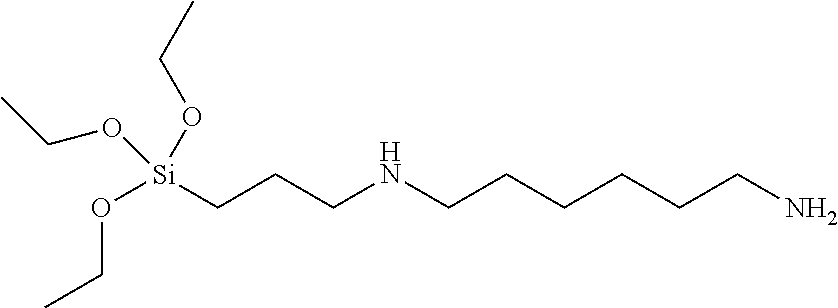 |
| 9 |  |
| 10 |  |
| 11 |  |
| 12 |  |
| 13 |  |
| 14 |  |
| 15 |  |
| 16 |  |
| 17 |  |
Molecular Weight/Complexity and Stability of Polyolefin-Aminosilanes
| TABLE 2 |
| Mw Reduction of VTP and its Star Structured PO-Aminosilanes after One |
| Week in Oven |
| PO- | PO- | PO- | |||
| PO-aminosilane | aminosilane | aminosilane | aminosilane | ||
| Loss of MW: | VTP | No. 5 | No. 7 | No. 9 | No. 11 |
| % Mw | 77 | −1 | 10 | −4 | 67 |
| Reduction After | |||||
| 1 week | |||||

| TABLE 3 |
| Correlations between Branches Number and Aminosilane Structure |
| Ref. | Branch | |||||||
| Aminosilane | No. | No. | g′ | m + n | R+/R++ | R5 | Comment | Cyclic intermediate |
| 15 | 3 | 0.7 | 2 | H | Amino- alkyl | Both 7-membered ring and e- donating R5 favor zwitterion. Least degree of condensation. |
 |
|
| 9 | 4 | 0.6 | 2 | H | H | 7-membered ring favors zwitterion. Less degree of condensation. |
 |
|
| 7 | 5 | 0.5 | 3 | CH3 | H | Geminal di-substitution favors zwitterion. Less degree of condensation. |
 |
|
| 5 | 15 | 0.2 | 3 | H | H | No features favor zwitterion. High degree of condensation. |
 |
|
- P1. Star-structured functional polyolefins comprising a polyolefin bound at any position along its chain length to at least one nucleophile-containing silane of the following formula:

-
- Y is a di- or trivalent linker group selected from heteroatoms, C1 to C10 alkylenes, heteroatom substituted C1 to C10 alkylenes, C6 to C20 arylenes, and heteroatom substituted C6 to C20 arylenes; R4 is selected from hydrogen, heteroatoms, and C1 to C10 alkyls;
- Nu is a nucleophilic atom or unsaturation group; preferably nitrogen, oxygen, sulfur, or phosphorous;
- R5 is selected from hydrogen, and C1 to C10 alkyls, C1 to C10 aminoalkyls, C6 to C20 aryls, C7 to C22 alkylaryls, C7 to C22 aminoaryls, and C7 to C22 arylalkyls;
- X is at least a divalent group selected from heteroatoms, C1 to C20 linear alkylenes, a C2 to C22 aminoalkylenes, C2 to C22 divalent ethers, and C2 to C22 or C40 branched alkylene;
- silane group wherein each R1, R2, and R3 are independently selected from hydrogen, hydroxide, C1 to C10 alkoxys, C6 to C30 aryloxys, C7 to C30 arylalkyloxys, and C1 to C10 alkylamines, wherein any 2- or more groups can form an aliphatic or aromatic cyclic structure that includes the silicon atom; and
- PO is a polyolefin having a Mw of at least 400 g/mole; and
- “n” is an integer within the range from 1, or 2, or 5 to 10, or 20, or 30;
- with the proviso that at least one of R1, R2, and R3 is selected from functional polyolefin moieties having the following structure:

-
- wherein the functional polyolefin moiety is covalently bonded through any one or more of R1′, R2′, or R3′; and where any other one or more of R1′, R2′, or R3′ is independently selected from hydroxide, C1 to C10 alkoxys, C6 to C30 aryloxys, C7 to C30 arylalkyloxys, and C1 to C10 alkylamines, wherein any 2- or more groups can form an aliphatic or aromatic cyclic structure that includes the silicon atom functional polyolefin moieties.
- P2. The star-structured functional polyolefins of numbered
paragraph 1, wherein at least one of R1′, R2′, and R3′ is selected from functional polyolefin moieties. - P3. The star-structured functional polyolefins of numbered
paragraphs - P4. The star-structured functional polyolefins of any one of the previous numbered paragraphs, wherein the weight loss after one week at 120° C. is less than 5, or 10, or 15% of its original Mw.
- P5. A highly processable polyolefin blend comprising a polyolefin and within the range from 0.1, or 0.5 wt % to 5, or 10, or 20 wt % of at least one star-structured functional polyolefin, based on the weight of the blend, of any one of the previous numbered paragraphs.
- P6. The highly processable polyolefin of numbered
paragraph 5, the star-structured functional polyolefins having a branching number (number of PO groups associated in one structure) of at least 3, or within a range from 3, or 8, or 11 to 15, or 20, or 30. - P7. A tire tread formulation comprising the star-structured functional polyolefins of any one of the previous numbered paragraphs comprising at least one elastomer, silica, and the star-structured functional polyolefins.
- P8. The tire tread formulation of numbered
paragraph 7, the star-structured functional polyolefins having a branching number (number of PO groups associated in one structure) of at least 2, or within a range from 2 to 5, or 10. - P9. A method of forming star-structured functional polyolefins of any one of the previous numbered paragraphs comprising combining:
- a) at least one polyolefin comprising at least one nucleophile-reactive group or unsaturation at one or both of the chain ends and/or inside the chain; and
- b) at least one nucleophile-containing silane to form a functional polyolefin;
- wherein the at least one site of unsaturation or nucleophile-reactive group forms a covalent bond with the nucleophilic atom of the nucleophile-containing silane;
- c) effecting condensation between functional polyolefins to form star-structured functional polyolefins having a branching number of at least 2.
- P10. The method of numbered
paragraph 9, wherein the polyolefin with at least one nucleophile-reactive group or unsaturation is selected from the group consisting of polybutadienes, polyisoprenes, isobutylene-isoprene copolymer, halogenated isobutylene-isoprene copolymer, isobutylene-p-methylstyrene copolymer, halogenated isobutylene-p-methylstyrene copolymer, ethylene-propylene-diene terpolymers, vinyl/vinylidene-terminated polypropylenes, vinyl/vinylidene-terminated polyethylenes, and vinyl/vinylidene-terminated ethylene-propylene copolymers. - P11. The method of any one of numbered paragraphs 9-10, wherein the polyolefin comprising at least one nucleophile-reactive group or unsaturation is a vinyl/vinylidene terminated polyolefin.
- P12. The method of any one of numbered paragraphs 9-11, wherein all reaction steps occur together (in one system, container, vessel, etc.).
- P13. The method of any one of numbered paragraphs 9-12, having a branching number within the range from 2, or 3, or 4, or 6, or 8 to 15, or 20, or 30.
- P14. The method of any one of numbered paragraphs 9-13, wherein the nucleophile-containing silane is selected from compounds having the following structure:

-
- wherein each R1, R2, and R3 are independently selected from hydrogen, hydroxide, C1 to C10 alkoxys, C6 to C30 aryloxys, C7 to C30 arylalkyloxys, and C1 to C10 alkylamines, wherein any 2- or more groups can form an aliphatic or aromatic cyclic structure with that includes the silicon atom;
- Nu is a nucleophilic atom or unsaturation group; preferably nitrogen, oxygen, sulfur, or phosphorous;
- X is at least a divalent group selected from heteroatoms, C1 to C20 linear alkylene, a C2 to C22 aminoalkylene, C2 to C22 divalent ether, and C2 to C22 or C40 branched alkylene;
- R5 and R6 are independently selected from hydrogen, C1 to C10 alkyls, C1 to C10 aminoalkyls, C6 to C20 aryls, C7 to C22 alkylaryls, C7 to C22 aminoaryls, and C7 to C22 arylalkyls; and
- silane group wherein any one of R1, R2 or R3 may form a 5 to 10 membered alkylene or aminoalkylene ring with Nu.
- P15. The method of any one of numbered paragraphs 9-14, wherein the combining occurs under hydroaminoalkylation conditions.
- P16. The method of any one of numbered paragraphs 9-15, wherein the polyolefin with at least one unsaturation is treated first, prior to combining with the at least one aminosilane, by one or more of direct epoxidation, and/or hydrosilylation.
- P17. The method of any one of numbered paragraphs 9-16, wherein as the tendency to form an aminosilane zwitterion increase, the branching number decreases.
- P18. The method of any one of numbered paragraphs 9-17, further comprising combining the star-structured functional polyolefins with at least one elastomer and silica to form a tire tread composition.
- P19. A method of tailoring the branching number of a silane-functionalized polyolefin of any one of the previous numbered paragraphs, wherein the at least one nucleophile-containing silane is chosen to favor the zwitterion or cyclic intermediate by varying the reaction temperature, the pH of the medium, the identity of “X”, R5, or any combination thereof; more preferably, comprising choosing the structure of the nucleophile-containing silane and/or the conditions under which the reaction is performed, thus effecting the formation of a zwitterion or cyclic intermediate and effecting the branching number.
For all jurisdictions in which the doctrine of “incorporation by reference” applies, all of the test methods, patent publications, patents and reference articles are hereby incorporated by reference either in their entirety or for the relevant portion for which they are referenced.
Claims (24)


Priority Applications (2)
| Application Number | Priority Date | Filing Date | Title |
|---|---|---|---|
| US14/923,002 US10501642B2 (en) | 2014-12-04 | 2015-10-26 | Stable star-structured functional polyolefins |
| US16/058,516 US11053396B2 (en) | 2014-12-04 | 2018-08-08 | Stable star-structured functional polyolefins |
Applications Claiming Priority (3)
| Application Number | Priority Date | Filing Date | Title |
|---|---|---|---|
| US201462087377P | 2014-12-04 | 2014-12-04 | |
| US201562154340P | 2015-04-29 | 2015-04-29 | |
| US14/923,002 US10501642B2 (en) | 2014-12-04 | 2015-10-26 | Stable star-structured functional polyolefins |
Related Child Applications (1)
| Application Number | Title | Priority Date | Filing Date |
|---|---|---|---|
| US16/058,516 Continuation US11053396B2 (en) | 2014-12-04 | 2018-08-08 | Stable star-structured functional polyolefins |
Publications (2)
| Publication Number | Publication Date |
|---|---|
| US20160159944A1 US20160159944A1 (en) | 2016-06-09 |
| US10501642B2 true US10501642B2 (en) | 2019-12-10 |
Family
ID=56093690
Family Applications (3)
| Application Number | Title | Priority Date | Filing Date |
|---|---|---|---|
| US14/923,002 Expired - Fee Related US10501642B2 (en) | 2014-12-04 | 2015-10-26 | Stable star-structured functional polyolefins |
| US14/923,060 Abandoned US20160160071A1 (en) | 2014-12-04 | 2015-10-26 | Water-Based Polyolefin Corrosion Inhibitors Based on Vinyl/Vinylidene Terminated Polyolefins |
| US16/058,516 Active US11053396B2 (en) | 2014-12-04 | 2018-08-08 | Stable star-structured functional polyolefins |
Family Applications After (2)
| Application Number | Title | Priority Date | Filing Date |
|---|---|---|---|
| US14/923,060 Abandoned US20160160071A1 (en) | 2014-12-04 | 2015-10-26 | Water-Based Polyolefin Corrosion Inhibitors Based on Vinyl/Vinylidene Terminated Polyolefins |
| US16/058,516 Active US11053396B2 (en) | 2014-12-04 | 2018-08-08 | Stable star-structured functional polyolefins |
Country Status (1)
| Country | Link |
|---|---|
| US (3) | US10501642B2 (en) |
Families Citing this family (3)
| Publication number | Priority date | Publication date | Assignee | Title |
|---|---|---|---|---|
| KR102407460B1 (en) * | 2015-12-18 | 2022-06-13 | 롬 앤드 하아스 컴패니 | Retanning of chrome-free leather fabric |
| US20220389202A1 (en) * | 2021-06-08 | 2022-12-08 | Cooper-Standard Automotive, Inc., | Fortrex additive for low rolling resistance tires |
| US20230097006A1 (en) * | 2021-07-30 | 2023-03-30 | C-Polar Technologies, Inc. | Biocompatible space-charged electret materials with antibacterial and antiviral effects and methods of manufacture thereof |
Citations (26)
| Publication number | Priority date | Publication date | Assignee | Title |
|---|---|---|---|---|
| JPS6220558A (en) * | 1985-07-18 | 1987-01-29 | Sunstar Giken Kk | Adhesive agent composition |
| US6084030A (en) * | 1995-08-04 | 2000-07-04 | Dsm Copolymer, Inc. | Branched polymers with polyolefin arms |
| US6127481A (en) * | 1995-08-04 | 2000-10-03 | Dsm Copolymer, Inc. | Branched polyolefin polymers as additives in fuel and lubricating oil compositions |
| WO2004024800A1 (en) | 2002-09-13 | 2004-03-25 | Zeon Corporation | Conjugated diene rubber, rubber composition, and process for producing conjugated diene rubber |
| WO2009155517A2 (en) | 2008-06-20 | 2009-12-23 | Exxonmobil Chemical Patent Inc. | Olefin functionalization by metathesis reaction |
| WO2009155471A2 (en) | 2008-06-20 | 2009-12-23 | Exxonmobil Chemical Patents Inc. | High vinyl terminated propylene based oligomers |
| US20110178233A1 (en) | 2008-04-29 | 2011-07-21 | Societe De Technologie Michelin | Elastomer Mixture Mainly Comprising a Diene Elastomer Coupled by an Aminoalkoxysilane Group, Rubber Composition Including the Same and Methods for Obtaining Same |
| WO2012134716A2 (en) | 2011-03-25 | 2012-10-04 | Exxonmobil Chemical Patents Inc., A Corporation Of The State Of Deleware | Block copolymers from silylated vinyl terminated macromers |
| WO2012134717A2 (en) | 2011-03-25 | 2012-10-04 | Exxonmobil Chemical Patents Inc. | Vinyl terminated higher olefin polymers and methods to produce thereof |
| US20120283346A1 (en) * | 2010-01-06 | 2012-11-08 | Michael Backer | Modified Polyolefins |
| US8399724B2 (en) | 2011-03-25 | 2013-03-19 | Exxonmobil Chemical Patents Inc. | Vinyl terminated higher olefin copolymers and methods to produce thereof |
| WO2013041151A1 (en) | 2010-12-23 | 2013-03-28 | Compagnie Generale Des Etablissements Michelin | Tyre the tread of which comprises a thermoplastic polyurethane block copolymer |
| US20130197180A1 (en) | 2011-03-25 | 2013-08-01 | Exxonmobil Chemical Patents Inc. | Enhanced Catalyst Performance for Production of Vinyl Terminated Propylene and Ethylene/Propylene Macromers |
| US8501894B2 (en) | 2011-03-25 | 2013-08-06 | Exxonmobil Chemical Patents Inc. | Hydrosilyation of vinyl macromers with metallocenes |
| US20130296471A1 (en) | 2010-11-26 | 2013-11-07 | Michelin Recherche Et Technique S.A. | Tyre tread |
| US20130310528A1 (en) | 2011-03-25 | 2013-11-21 | Exxonmobil Chemical Patents Inc. | Novel Catalysts and Methods of Use Thereof to Produce Vinyl Terminated Polymers |
| US8623974B2 (en) | 2011-03-25 | 2014-01-07 | Exxonmobil Chemical Patents Inc. | Branched vinyl terminated polymers and methods for production thereof |
| US8669326B2 (en) | 2011-03-25 | 2014-03-11 | Exxonmobil Chemical Patents Inc. | Amine functionalized polyolefin and methods for preparation thereof |
| US20140088213A1 (en) * | 2012-09-24 | 2014-03-27 | Exxonmobil Chemical Patents Inc. | Branched Polyethylenes by Hydrosilation Grafting to Improve Processability of Polyethylene |
| US20140088264A1 (en) | 2012-09-24 | 2014-03-27 | Exxonmobil Chemical Patents Inc. | Hydroamination Of Aldehyde-Containing Macromonomers |
| WO2014052200A1 (en) | 2012-09-27 | 2014-04-03 | Exxonmobil Chemical Patents Inc. | Vinyl terminated polymers and methods to produce thereof |
| US8835563B2 (en) | 2011-03-25 | 2014-09-16 | Exxonmobil Chemical Patents Inc. | Block copolymers from silylated vinyl terminated macromers |
| US20140275433A1 (en) | 2013-03-14 | 2014-09-18 | Exxonmobil Research And Engineering Company | Amination of polymers terminated with aldehyde group and their functionalized derivatives for fouling mitigation in hydrocarbon refining processes |
| US8840996B2 (en) | 2011-12-19 | 2014-09-23 | Exxonmobil Research And Engineering Company | Processes for making polyolefin nanocomposites |
| US8841397B2 (en) | 2011-03-25 | 2014-09-23 | Exxonmobil Chemical Patents Inc. | Vinyl terminated higher olefin polymers and methods to produce thereof |
| WO2015023382A1 (en) | 2013-08-16 | 2015-02-19 | Exxonmobil Chemical Patents Inc. | Compatibilized tire tread compositions |
Family Cites Families (7)
| Publication number | Priority date | Publication date | Assignee | Title |
|---|---|---|---|---|
| BR9906549B1 (en) * | 1998-06-22 | 2009-01-13 | vulcanized thermoplastic silane elastomer compositions and process for preparing same. | |
| GB9927315D0 (en) * | 1999-11-18 | 2000-01-12 | Champion Technology Inc | Inhibitor compositions |
| TW200426191A (en) * | 2003-03-27 | 2004-12-01 | Sumitomo Chemical Co | Coating liquid for forming insulating film and method for producing insulating film |
| US20060247369A1 (en) * | 2005-04-29 | 2006-11-02 | Griswold Roy M | Silylated polymer derived from butadiene and solvent-resistant pressure sensitive adhesive composition containing same |
| JP2013514430A (en) * | 2009-12-18 | 2013-04-25 | エクソンモービル リサーチ アンド エンジニアリング カンパニー | Polyalkylene epoxy polyamine additive for soil reduction in hydrocarbon refining process |
| KR101365902B1 (en) * | 2013-01-14 | 2014-03-12 | 금호석유화학 주식회사 | Terminal modifier for conjugated diene polymers |
| CN103130955B (en) * | 2013-03-07 | 2015-06-17 | 京东方科技集团股份有限公司 | Photosensitive oligomer for photoresist, preparation method and negative photoresist composition thereof |
-
2015
- 2015-10-26 US US14/923,002 patent/US10501642B2/en not_active Expired - Fee Related
- 2015-10-26 US US14/923,060 patent/US20160160071A1/en not_active Abandoned
-
2018
- 2018-08-08 US US16/058,516 patent/US11053396B2/en active Active
Patent Citations (32)
| Publication number | Priority date | Publication date | Assignee | Title |
|---|---|---|---|---|
| JPS6220558A (en) * | 1985-07-18 | 1987-01-29 | Sunstar Giken Kk | Adhesive agent composition |
| US6084030A (en) * | 1995-08-04 | 2000-07-04 | Dsm Copolymer, Inc. | Branched polymers with polyolefin arms |
| US6127481A (en) * | 1995-08-04 | 2000-10-03 | Dsm Copolymer, Inc. | Branched polyolefin polymers as additives in fuel and lubricating oil compositions |
| WO2004024800A1 (en) | 2002-09-13 | 2004-03-25 | Zeon Corporation | Conjugated diene rubber, rubber composition, and process for producing conjugated diene rubber |
| US20110178233A1 (en) | 2008-04-29 | 2011-07-21 | Societe De Technologie Michelin | Elastomer Mixture Mainly Comprising a Diene Elastomer Coupled by an Aminoalkoxysilane Group, Rubber Composition Including the Same and Methods for Obtaining Same |
| WO2009155471A2 (en) | 2008-06-20 | 2009-12-23 | Exxonmobil Chemical Patents Inc. | High vinyl terminated propylene based oligomers |
| WO2009155472A2 (en) | 2008-06-20 | 2009-12-23 | Exxonmobile Chemical Patents Inc. | Functionalized high vinyl terminated propylene based oligomers |
| WO2009155510A2 (en) | 2008-06-20 | 2009-12-23 | Exxonmobil Chemical Patents Inc. | Polymacromonomer and process for production thereof |
| WO2009155517A2 (en) | 2008-06-20 | 2009-12-23 | Exxonmobil Chemical Patent Inc. | Olefin functionalization by metathesis reaction |
| US8372930B2 (en) | 2008-06-20 | 2013-02-12 | Exxonmobil Chemical Patents Inc. | High vinyl terminated propylene based oligomers |
| US20120283346A1 (en) * | 2010-01-06 | 2012-11-08 | Michael Backer | Modified Polyolefins |
| US20130296471A1 (en) | 2010-11-26 | 2013-11-07 | Michelin Recherche Et Technique S.A. | Tyre tread |
| WO2013041151A1 (en) | 2010-12-23 | 2013-03-28 | Compagnie Generale Des Etablissements Michelin | Tyre the tread of which comprises a thermoplastic polyurethane block copolymer |
| US8501894B2 (en) | 2011-03-25 | 2013-08-06 | Exxonmobil Chemical Patents Inc. | Hydrosilyation of vinyl macromers with metallocenes |
| US8669326B2 (en) | 2011-03-25 | 2014-03-11 | Exxonmobil Chemical Patents Inc. | Amine functionalized polyolefin and methods for preparation thereof |
| US20130197180A1 (en) | 2011-03-25 | 2013-08-01 | Exxonmobil Chemical Patents Inc. | Enhanced Catalyst Performance for Production of Vinyl Terminated Propylene and Ethylene/Propylene Macromers |
| WO2012134717A2 (en) | 2011-03-25 | 2012-10-04 | Exxonmobil Chemical Patents Inc. | Vinyl terminated higher olefin polymers and methods to produce thereof |
| WO2012134716A2 (en) | 2011-03-25 | 2012-10-04 | Exxonmobil Chemical Patents Inc., A Corporation Of The State Of Deleware | Block copolymers from silylated vinyl terminated macromers |
| US20130310528A1 (en) | 2011-03-25 | 2013-11-21 | Exxonmobil Chemical Patents Inc. | Novel Catalysts and Methods of Use Thereof to Produce Vinyl Terminated Polymers |
| US8623974B2 (en) | 2011-03-25 | 2014-01-07 | Exxonmobil Chemical Patents Inc. | Branched vinyl terminated polymers and methods for production thereof |
| US8841394B2 (en) | 2011-03-25 | 2014-09-23 | Exxonmobil Chemical Patents Inc. | Vinyl terminated higher olefin copolymers and methods to produce thereof |
| US8981029B2 (en) | 2011-03-25 | 2015-03-17 | Exxonmobil Chemical Patents Inc. | Branched vinyl terminated polymers and methods for production thereof |
| US8399724B2 (en) | 2011-03-25 | 2013-03-19 | Exxonmobil Chemical Patents Inc. | Vinyl terminated higher olefin copolymers and methods to produce thereof |
| US8841397B2 (en) | 2011-03-25 | 2014-09-23 | Exxonmobil Chemical Patents Inc. | Vinyl terminated higher olefin polymers and methods to produce thereof |
| US8816027B2 (en) | 2011-03-25 | 2014-08-26 | Exxonmobil Chemical Patents Inc. | Catalysts and methods of use thereof to produce vinyl terminated polymers |
| US8835563B2 (en) | 2011-03-25 | 2014-09-16 | Exxonmobil Chemical Patents Inc. | Block copolymers from silylated vinyl terminated macromers |
| US8840996B2 (en) | 2011-12-19 | 2014-09-23 | Exxonmobil Research And Engineering Company | Processes for making polyolefin nanocomposites |
| US20140088264A1 (en) | 2012-09-24 | 2014-03-27 | Exxonmobil Chemical Patents Inc. | Hydroamination Of Aldehyde-Containing Macromonomers |
| US20140088213A1 (en) * | 2012-09-24 | 2014-03-27 | Exxonmobil Chemical Patents Inc. | Branched Polyethylenes by Hydrosilation Grafting to Improve Processability of Polyethylene |
| WO2014052200A1 (en) | 2012-09-27 | 2014-04-03 | Exxonmobil Chemical Patents Inc. | Vinyl terminated polymers and methods to produce thereof |
| US20140275433A1 (en) | 2013-03-14 | 2014-09-18 | Exxonmobil Research And Engineering Company | Amination of polymers terminated with aldehyde group and their functionalized derivatives for fouling mitigation in hydrocarbon refining processes |
| WO2015023382A1 (en) | 2013-08-16 | 2015-02-19 | Exxonmobil Chemical Patents Inc. | Compatibilized tire tread compositions |
Non-Patent Citations (11)
| Title |
|---|
| English language abstract JP 62-20558, Jan. 1987. * |
| Gelest Inc., "Silane Coupling Agents: Connecting Across Boundaries," 2006, pp. 1-58. |
| Herzon et al., "Hydroaminoalkylation of Unactivated Olefins with Dialkylamines," Journal of American Chemistry Society, 2008, vol. 130, pp. 14940-14941. |
| Matoishi et al., "Preparation and Characteristics of Well-defined Polyethylene/Poly(ethylene glycol) Hybrid Materials of Different Molecular Architectures," Chemistry Letters, 2010, vol. 39, pp. 1028-1029. |
| Matoishi et al., "Value-added olefin-based materials originating from FI catalysis: Production of vinyl-and A1-terminated PEs, end-functionalized PEs, and PE/polyethylene glycol hybrid materials," Catalysis Today, 2011, vol. 164, pp. 2-8. |
| Matoishi et al., "Value-added olefin-based materials originating from FI catalysis: Production of vinyl—and A1—terminated PEs, end-functionalized PEs, and PE/polyethylene glycol hybrid materials," Catalysis Today, 2011, vol. 164, pp. 2-8. |
| U.S. Appl. No. 61/704,611, filed Sep. 24, 2012, Kulkarini et al. |
| U.S. Appl. No. 61/704,725, filed Sep. 24, 2012, Crowther et al. |
| U.S. Appl. No. 61/860,407, filed Jul. 31, 2014, Tsou et al. |
| U.S. Appl. No. 61/866,702, filed Aug. 16, 2013, Blok et al. |
| U.S. Appl. No. 62/068,043, filed Oct. 24, 2014, Blok et al. |
Also Published As
| Publication number | Publication date |
|---|---|
| US20180346736A1 (en) | 2018-12-06 |
| US11053396B2 (en) | 2021-07-06 |
| US20160160071A1 (en) | 2016-06-09 |
| US20160159944A1 (en) | 2016-06-09 |
Similar Documents
| Publication | Publication Date | Title |
|---|---|---|
| US11312856B2 (en) | Block copolymer composition | |
| US11053396B2 (en) | Stable star-structured functional polyolefins | |
| US20140005349A1 (en) | Polyisobutylenes and process for making same | |
| US20160152758A1 (en) | Compatibilized Tire Tread Compositions | |
| WO1999005215A1 (en) | Curable adhesive composition | |
| Wang et al. | Organic-inorganic poly (hydroxyether of bisphenol A) copolymers with double-decker silsesquioxane in the main chains | |
| JP7246313B2 (en) | Curable composition | |
| US9840597B2 (en) | Polyamide-polyolefin copolymers and methods of making them | |
| KR100563751B1 (en) | Alkenyl ether functional polyisobutylenes and methods for the preparation thereof | |
| CN113423794B (en) | curable composition | |
| CN114207017B (en) | curable composition | |
| CN101889048A (en) | Benzoxazine-based curable compositions, their preparation and cured products thereof | |
| US20160222187A1 (en) | Toughened Polyolefin Nanocomposites Using Silane Functionalized Polyolefins | |
| US10280270B2 (en) | Silane functionalized polyolefins for polyolefin nanocomposites | |
| US8183315B2 (en) | Polymer composition | |
| TWI507449B (en) | Method for producing solvent - soluble reactive polysiloxane | |
| JP7404105B2 (en) | curable composition | |
| WO2025013696A1 (en) | Double-terminal (meth)acrylic-modified silicone macromer having tertiary amino group or quaternary ammonium cation site in molecular chain, and method for producing same | |
| JP4750295B2 (en) | Curable composition | |
| EP4656671A1 (en) | Q-t-siloxane-based polymeric compositions with aminophenyl, isocyanate or epoxide functionality, and method for preparing same | |
| US9657116B2 (en) | Process of polyolefin functionalization | |
| CN121427276A (en) | Curable composition | |
| JPWO2019239782A1 (en) | A method for producing a vinyl ether functional organopolysiloxane, a polymerizable composition and a cured product thereof. | |
| US20050261441A1 (en) | Polyisobutylene composition and cured polyisobutylene product | |
| US20230250113A1 (en) | Silirane-functionalised compounds, in particular organosilicon compounds, for preparing siloxanes |
Legal Events
| Date | Code | Title | Description |
|---|---|---|---|
| AS | Assignment |
Owner name: EXXONMOBIL CHEMICAL PATENTS INC., TEXAS Free format text: ASSIGNMENT OF ASSIGNORS INTEREST;ASSIGNORS:YANG, YONG;TSOU, ANDY H.;SLAUGHTER, KIMARI T. M.;SIGNING DATES FROM 20151028 TO 20151030;REEL/FRAME:036936/0716 |
|
| STPP | Information on status: patent application and granting procedure in general |
Free format text: FINAL REJECTION MAILED |
|
| STPP | Information on status: patent application and granting procedure in general |
Free format text: DOCKETED NEW CASE - READY FOR EXAMINATION |
|
| STPP | Information on status: patent application and granting procedure in general |
Free format text: NOTICE OF ALLOWANCE MAILED -- APPLICATION RECEIVED IN OFFICE OF PUBLICATIONS |
|
| STCF | Information on status: patent grant |
Free format text: PATENTED CASE |
|
| FEPP | Fee payment procedure |
Free format text: MAINTENANCE FEE REMINDER MAILED (ORIGINAL EVENT CODE: REM.); ENTITY STATUS OF PATENT OWNER: LARGE ENTITY |
|
| LAPS | Lapse for failure to pay maintenance fees |
Free format text: PATENT EXPIRED FOR FAILURE TO PAY MAINTENANCE FEES (ORIGINAL EVENT CODE: EXP.); ENTITY STATUS OF PATENT OWNER: LARGE ENTITY |
|
| STCH | Information on status: patent discontinuation |
Free format text: PATENT EXPIRED DUE TO NONPAYMENT OF MAINTENANCE FEES UNDER 37 CFR 1.362 |
|
| FP | Lapsed due to failure to pay maintenance fee |
Effective date: 20231210 |