US1049787A - Process of preparing matrices for electrotyping. - Google Patents
Process of preparing matrices for electrotyping. Download PDFInfo
- Publication number
- US1049787A US1049787A US68746512A US1912687465A US1049787A US 1049787 A US1049787 A US 1049787A US 68746512 A US68746512 A US 68746512A US 1912687465 A US1912687465 A US 1912687465A US 1049787 A US1049787 A US 1049787A
- Authority
- US
- United States
- Prior art keywords
- matrix
- electrotyping
- blacklead
- matrices
- temperature
- Prior art date
- Legal status (The legal status is an assumption and is not a legal conclusion. Google has not performed a legal analysis and makes no representation as to the accuracy of the status listed.)
- Expired - Lifetime
Links
- 238000000034 method Methods 0.000 title description 11
- 239000011159 matrix material Substances 0.000 description 19
- OKTJSMMVPCPJKN-UHFFFAOYSA-N Carbon Chemical compound [C] OKTJSMMVPCPJKN-UHFFFAOYSA-N 0.000 description 18
- 238000001816 cooling Methods 0.000 description 9
- 241000209456 Plumbago Species 0.000 description 3
- 239000010439 graphite Substances 0.000 description 3
- 239000002184 metal Substances 0.000 description 3
- 229910052751 metal Inorganic materials 0.000 description 3
- PXHVJJICTQNCMI-UHFFFAOYSA-N Nickel Chemical compound [Ni] PXHVJJICTQNCMI-UHFFFAOYSA-N 0.000 description 2
- 239000002932 luster Substances 0.000 description 2
- 239000002245 particle Substances 0.000 description 2
- 229910000831 Steel Inorganic materials 0.000 description 1
- 230000015572 biosynthetic process Effects 0.000 description 1
- 239000011248 coating agent Substances 0.000 description 1
- 238000000576 coating method Methods 0.000 description 1
- 230000007547 defect Effects 0.000 description 1
- 230000008021 deposition Effects 0.000 description 1
- 230000007775 late Effects 0.000 description 1
- 238000004519 manufacturing process Methods 0.000 description 1
- 229910052759 nickel Inorganic materials 0.000 description 1
- 238000012545 processing Methods 0.000 description 1
- 239000010959 steel Substances 0.000 description 1
Images
Classifications
-
- B—PERFORMING OPERATIONS; TRANSPORTING
- B41—PRINTING; LINING MACHINES; TYPEWRITERS; STAMPS
- B41M—PRINTING, DUPLICATING, MARKING, OR COPYING PROCESSES; COLOUR PRINTING
- B41M5/00—Duplicating or marking methods; Sheet materials for use therein
- B41M5/025—Duplicating or marking methods; Sheet materials for use therein by transferring ink from the master sheet
- B41M5/04—Duplicating or marking methods; Sheet materials for use therein by transferring ink from the master sheet using solvent-soluble dyestuffs on the master sheets, e.g. alcohol-soluble
-
- Y—GENERAL TAGGING OF NEW TECHNOLOGICAL DEVELOPMENTS; GENERAL TAGGING OF CROSS-SECTIONAL TECHNOLOGIES SPANNING OVER SEVERAL SECTIONS OF THE IPC; TECHNICAL SUBJECTS COVERED BY FORMER USPC CROSS-REFERENCE ART COLLECTIONS [XRACs] AND DIGESTS
- Y10—TECHNICAL SUBJECTS COVERED BY FORMER USPC
- Y10S—TECHNICAL SUBJECTS COVERED BY FORMER USPC CROSS-REFERENCE ART COLLECTIONS [XRACs] AND DIGESTS
- Y10S428/00—Stock material or miscellaneous articles
- Y10S428/908—Impression retention layer, e.g. print matrix, sound record
Definitions
- My invention relates to the art of electrotyping, and consists of certain improvements in the process of preparing the wax matrices for the' recept-ion of .the electrodeposited shell or coatin'g.
- the method of i procedure well known of course, is to sur- 'face coat.
- the' waX matrices With blacklead or plumbago to form one of the poles of an electric couple in order that the metal may' be electro-deposited thereon.
- the success-of ⁇ the work' depends largely upon the successful application of the, blacklead or the matrices plumbago.
- ablewvays, 12 means being provided to reciprocate the matrix. 'The range of movement may bethat indicated by the dotted lines.
- the frame may be provided with a switch 1 3 for controlling the'motor.
- the cooling chamber or compartment 15 may have a door or lid giving access to the blackleading machine.
- the action of the brushes tends to fiatten the relatively delicate half-tone impressions; to break down the edges of the'type recesses -in the matrix; to separate from the matrix mi nute particles of the wax of which they are composed, and to cause the ends of the bris- ⁇ tles to pick up minute particles, a condition which not only spoils the matrix, but also clogsth'e ends' of the bristles and' renders them substantially ineflicent.
- a separate apartment such as a refrigeratoror the like, may receive and serve as a temporary storage receptacle for a quantity of the 'WaXed lates after they have received the type, hal -tone and the like impressions.
Landscapes
- Display Devices Of Pinball Game Machines (AREA)
Description
i a citizen of the United States, and a resi-' UNT-ED srrArrESPA TE:NI"oFFcE.` V s n. WELSH, or COLLINGSWOOD, NEW JERSEY, ASSIGNOR or oNE-HALF ro -'ILLIIIAM easner.
HARVY EVERT KENDI& OF PHILADELPHIA, PENNSYLVANIA.
rnocnss or ranrnmn MA'rmoEs ron ELECTROTYPING.
Patented Jan. 7, &913.
' Application filed March 30, 1 912. Serial No. 681 465.
i all' whom -iay concem: i a
Be it known that VVILLIAM HJWVELSH,
dent of Collingswood, Ca'mden cOunty, New Jersey, have inVent-ed an Improved Process of Preparng Matrices for Electrotyping, of which the following is a specifica'tion.
My invention relates to the art of electrotyping, and consists of certain improvements in the process of preparing the wax matrices for the' recept-ion of .the electrodeposited shell or coatin'g. The method of i procedure, well known of course, is to sur- 'face coat. the' waX matrices With blacklead or plumbago to form one of the poles of an electric couple in order that the metal may' be electro-deposited thereon. The success-of`the work' depends largely upon the successful application of the, blacklead or the matrices plumbago. By preference, should be blackleaded n such manner as to present a meta'llie luster, and in order to pr'oduce this efi'ectthe blacklead' must be vigorously applied to "the surface of the wax in such manner as to insure absolutely its application to every part of the matrx.
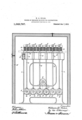
' The means ordinarily employecl for this which ta p pur mseni-e rapidly oscillating brushes surface of 'the wax in a very rapid nanner, but relatively delcately in i order that excessive wear of the brush on 'perniittng a relatively violent application of thelbrushes designed to apply the 'blacklead to the surface thereof. 3 I have shown in the drawing a blackleading machine, inclosed in a cooling chamber ,or coinpartment, comprising a suitable fra'n 1, having guideways 2, for vertically vreciprocating rods 3, attached to pitmen 4:,
on shafts all of which may be preferably driven in the same direction by the gearing 6,' indicated bythebroken lines; motion being preferably mpart'ed to` such gearing by a belt 7 v from a motor 8. y The upper ends of the rods are Secured at 9 tobrushes 10 and rapid movement of said rods by the means described causes the brushes to rise and fall'upon the plate and beat into or onto the *surface of the matrix the blacklead The matrix is ndicated at 11; being pref,-' 'erably mounted upon rollers, or other suit--.
ablewvays, 12; means being provided to reciprocate the matrix. 'The range of movement may bethat indicated by the dotted lines. The frame may be provided with a switch 1 3 for controlling the'motor. The cooling chamber or compartment 15 may have a door or lid giving access to the blackleading machine. i
Under ordinary circumstances, the waxed 4 plate having type and half-tone impressions,
sngly or combined, is placed invthe machine upon suitable means Whereby it may be traversed 'back and forth; being, sub jected while` moying to the action of the vertically reciprocating brushes; blacklead or plumbago being dusted upon the surface a of the same as may be required to properly cover or coat such surface 'to be subsquently plated with the deposited metal.
In most electrotyping shops, the temperature i'anges fairly high, and in general the i' consistency ofthe wax isrelatively sotter than it should be to insure the production of a perfect matrix. In such instance, the action of the brushes tends to fiatten the relatively delicate half-tone impressions; to break down the edges of the'type recesses -in the matrix; to separate from the matrix mi nute particles of the wax of which they are composed, and to cause the ends of the bris- `tles to pick up minute particles, a condition which not only spoils the matrix, but also clogsth'e ends' of the bristles and' renders them substantially ineflicent. I propose t-herefore toremedy these defects; mprove the quality of the matrix; insure the proper action of the brush, and prolong thelife of ,the same by maintaining the matrix at a relatively low temperature during the blackleading operation. This may be accomplished in a number of` ways. A separate apartment, such as a refrigeratoror the like, may receive and serve as a temporary storage receptacle for a quantity of the 'WaXed lates after they have received the type, hal -tone and the like impressions. These plates are then .taken to the blackleading machine while atsubstantially the temperature referred to and they may be kept at such temperature' by cooling means applied directly to the blac'kleadin'g machine, or to a compartment in which it is located, so thatwhile the blackleading operation is proceeding, the matrix is still cool and relatively hard.
The result ofthe operation of blackleading the cool, rlatively hard wax plate is to impart a high meta-llic luster to the same;
kthe blacklead being beaten onto or into the matrix.
`surface of the same so as to afford a proper surface, insuring the deposition of metal in a proper manner with respect to the type recesses and half-tone impressons of the coated gaps which might occur at; in or ad jacent the Walls of the type recesses or the half-tone impressions may be bridgd .with out difiiculty and 'without damage "to the electrotype. In the formation of a nickel or nickel-steel surface, however, the depsit must take place wholly within the bath and it is impossible to bridge any gaps which mayoccur in the wall surfaces of the type impression recesses. This makes it absolutely necessary that the coating of such walls shall. be complete and this result is attained in carrying out the process forming the subject of my invention.
It will be understood, of course, that the cooling of the matrix should not be carried' to such an eXtent' as to render the wax brittle. Proper cooling insures full advantage of the natural tough qualites of the WaX, employed and, other conditions governing to a greater orcless degree, I have discovered that thedesirable temperature'is to be found between 45 to 60 F.
r I claim: V
l. In the art of electrotyping, the process of preparing matrices, which' consists' in cooling the same to a temperaturenot 'eX- ceeding 60 F., maintaining said natrices at such temperature, and simultaneouslyapplyture.
` 4:. In the art of electrotyping, the process ing blacklead by a series of sharp blows .distributed over the surface of the matrix.
2. In the art ofelectrotyping, the process of preparing matrices, wvhich consists in cooling the same to a temperature not eX- ceecling F., maintaiping said matrices at such temperature, simultaneously applying blacklead by a series of sharp blows distributed over the surface of the matrix, and moving said plate while the blacklead is being applied. i
3.'111 the art of electrotyping, the process of preparing matrices, .which consists in maintaining said matrices at a temperature not cx ceeding 60 F., and applying the blacklead bya series of sharp blowsdistributed over the surface of the matrix-while the matrix is maintained at such temperaof preparing matrices, which consists in maintaining-said matrices at a temperature between 45 and 60 F., and applying the blacklead by a series of sharp blows distributed over the surface of the matrix while the matrix is maintained at such cool temperature. c
5. In"thea`rt of electrotyping, the process which consistsin cooling 'a waxed' type or half-tone inpression plate forning the matrix to a temperature not exceeding 60 FT, applying blacklead to the surface thereof,
and causing such *blacklead to adhere to the surface by the application of blows momentarily applied and distributed over the surface of the plate. 4
G. In the art of electrotyping, the process 'which consists in cooling the waxed type or half-tone\impression plnte forming the matrix to a temperature between l5 and 60 F., applying blacklead to the surface thereof,
'and causing such blacklcad to adhee to the surface by the application of blows momentarily applied and distributed over the sur-` i face of the plate. i
In' testimony whereof, I have signed my name to this specification, in the presence of two subscribing witnesses WM. H. WELSH.
a l/Vitnesses:
MU'RRAY C. BOYER, WVM. A. BARR.
copies of this patent may be obtained for five cents each; by addressng the Commissioner of Patenti Washington, I). C."
Priority Applications (1)
| Application Number | Priority Date | Filing Date | Title |
|---|---|---|---|
| US68746512A US1049787A (en) | 1912-03-30 | 1912-03-30 | Process of preparing matrices for electrotyping. |
Applications Claiming Priority (1)
| Application Number | Priority Date | Filing Date | Title |
|---|---|---|---|
| US68746512A US1049787A (en) | 1912-03-30 | 1912-03-30 | Process of preparing matrices for electrotyping. |
Publications (1)
| Publication Number | Publication Date |
|---|---|
| US1049787A true US1049787A (en) | 1913-01-07 |
Family
ID=3118055
Family Applications (1)
| Application Number | Title | Priority Date | Filing Date |
|---|---|---|---|
| US68746512A Expired - Lifetime US1049787A (en) | 1912-03-30 | 1912-03-30 | Process of preparing matrices for electrotyping. |
Country Status (1)
| Country | Link |
|---|---|
| US (1) | US1049787A (en) |
-
1912
- 1912-03-30 US US68746512A patent/US1049787A/en not_active Expired - Lifetime
Similar Documents
| Publication | Publication Date | Title |
|---|---|---|
| JP2002515090A (en) | Electrodeposition of amorphous and microcrystalline nickel-tungsten coatings | |
| CN102803546B (en) | Process for production of coated article having excellent corrosion resistance, and coated article | |
| US2155392A (en) | Method of forming printing cylinders | |
| US5013409A (en) | Electrodeposition process | |
| CN112359393B (en) | A kind of wear-resistant anti-vibration coating and preparation method thereof | |
| US2776256A (en) | Process of making intaglio printing cylinders | |
| US1865767A (en) | Electroplating equipment | |
| US1688645A (en) | Printing plate and method of making the same | |
| US988763A (en) | Process of bending electrotypes. | |
| US192112A (en) | Improvement in the art of making molds and their counterparts | |
| US1069857A (en) | Planographic printing-surface. | |
| US1688648A (en) | Process of curving printing plates | |
| US415348A (en) | Method of producing crystallized metal plates | |
| US548320A (en) | Victor lowendahl | |
| US1191353A (en) | Composition and mold for stereotypes. | |
| US901965A (en) | Preparation of electrotype-molds. | |
| US1293562A (en) | Method of making jackets for engine-cylinders. | |
| US1321793A (en) | Matthew m | |
| US1529803A (en) | Cadmium-coated mold | |
| US1373837A (en) | Process of renovating polishing-plates | |
| US1085861A (en) | Manganese-steel stamp-shoe. | |
| US282879A (en) | Gakrett | |
| US1328351A (en) | Mold for molding artificial teeth | |
| US857926A (en) | Process of producing steel dies. | |
| US925321A (en) | Process for facing stereotype-metal. |