US10492317B1 - Easily assembled and disassembled latching structure - Google Patents

Easily assembled and disassembled latching structure Download PDF

Info

Publication number
US10492317B1
US10492317B1 US16/383,800 US201916383800A US10492317B1 US 10492317 B1 US10492317 B1 US 10492317B1 US 201916383800 A US201916383800 A US 201916383800A US 10492317 B1 US10492317 B1 US 10492317B1
Authority
US
United States
Prior art keywords
plate
sliding plate
latching
arches
axial direction
Prior art date
Legal status (The legal status is an assumption and is not a legal conclusion. Google has not performed a legal analysis and makes no representation as to the accuracy of the status listed.)
Expired - Fee Related
Application number
US16/383,800
Other versions
US20190343012A1 (en
Inventor
Li-Li Ho
Cheng-Chung Chang
Yi-Fei Yu
Current Assignee (The listed assignees may be inaccurate. Google has not performed a legal analysis and makes no representation or warranty as to the accuracy of the list.)
Sercomm Corp
Original Assignee
Sercomm Corp
Priority date (The priority date is an assumption and is not a legal conclusion. Google has not performed a legal analysis and makes no representation as to the accuracy of the date listed.)
Filing date
Publication date
Application filed by Sercomm Corp filed Critical Sercomm Corp
Assigned to SERCOMM CORPORATION reassignment SERCOMM CORPORATION ASSIGNMENT OF ASSIGNORS INTEREST (SEE DOCUMENT FOR DETAILS). Assignors: CHANG, CHENG-CHUNG, HO, LI-LI, YU, YI-FEI
Publication of US20190343012A1 publication Critical patent/US20190343012A1/en
Application granted granted Critical
Publication of US10492317B1 publication Critical patent/US10492317B1/en
Expired - Fee Related legal-status Critical Current
Anticipated expiration legal-status Critical

Links

Images

Classifications

    • HELECTRICITY
    • H05ELECTRIC TECHNIQUES NOT OTHERWISE PROVIDED FOR
    • H05KPRINTED CIRCUITS; CASINGS OR CONSTRUCTIONAL DETAILS OF ELECTRIC APPARATUS; MANUFACTURE OF ASSEMBLAGES OF ELECTRICAL COMPONENTS
    • H05K5/00Casings, cabinets or drawers for electric apparatus
    • H05K5/02Details
    • H05K5/0217Mechanical details of casings
    • H05K5/0221Locks; Latches
    • HELECTRICITY
    • H05ELECTRIC TECHNIQUES NOT OTHERWISE PROVIDED FOR
    • H05KPRINTED CIRCUITS; CASINGS OR CONSTRUCTIONAL DETAILS OF ELECTRIC APPARATUS; MANUFACTURE OF ASSEMBLAGES OF ELECTRICAL COMPONENTS
    • H05K7/00Constructional details common to different types of electric apparatus
    • H05K7/02Arrangements of circuit components or wiring on supporting structure
    • H05K7/023Stackable modules
    • HELECTRICITY
    • H05ELECTRIC TECHNIQUES NOT OTHERWISE PROVIDED FOR
    • H05KPRINTED CIRCUITS; CASINGS OR CONSTRUCTIONAL DETAILS OF ELECTRIC APPARATUS; MANUFACTURE OF ASSEMBLAGES OF ELECTRICAL COMPONENTS
    • H05K5/00Casings, cabinets or drawers for electric apparatus
    • H05K5/02Details
    • H05K5/0256Details of interchangeable modules or receptacles therefor, e.g. cartridge mechanisms

Definitions

  • the invention relates in general to a latching structure, and more particularly to an easily assembled and disassembled latching structure.
  • the present invention relates to an easily assembled and disassembled latching structure.
  • the sliding plate is disposed on the first plate and movable between a latching position and a retracted position in a first axial direction on the first surface of the first plate.
  • it is quite easy to assemble and disassemble the first plate and the second plate.
  • the latching structure includes a first plate, a second plate and a sliding plate.
  • the first plate includes a plurality of first arches recessed from a second surface of the first plate and projecting from a first surface of the first plate.
  • the first arches each has an alignment hole passing underneath each of the first arches in a first axial direction.
  • the first surface is opposite to the second surface.
  • the second plate includes a plurality of second arches. Each of the second arches is adapted to be accommodated by a corresponding one of the alignment holes.
  • Each of the second arches has a latching hole passing underneath each of the second arches in the first axial direction.
  • the sliding plate includes a plurality of pins respectively corresponding to the latching holes.
  • the sliding plate is disposed on the first surface of the first plate and movable between a latching position and a retracted position in the first axial direction.
  • the pins are each located in a corresponding one of the latching holes to block separation of the first plate from the second plate in a second axial direction perpendicular to the first axial direction.
  • the pins When the sliding plate is located at the retracted position, the pins each separates from the corresponding one of the latching holes to allow separation of the first plate from the second plate in the second axial direction.
  • the present invention provides an easily assembled and disassembled latching structure.
  • the first plate and the sliding plate disposed on the first plate, and the second plate may be respectively disposed on the two modular products, which can be assembled with each other, at the time of shipment, and the combination of the two modular products is very simple, convenient and reliable.
  • FIG. 1A is an exploded view showing an application of an easily assembled and disassembled latching structure according to one embodiment of the present invention.
  • FIG. 1B is a three-dimensional diagram of the application according to FIG. 1A .
  • FIG. 2A is a three-dimensional diagram of the first plate viewed from top angle according to one embodiment of the present invention.
  • FIG. 2B is a three-dimensional diagram of the first plate viewed from bottom angle according to one embodiment of the present invention.
  • FIG. 3A is a three-dimensional diagram of the second plate viewed from top angle according to one embodiment of the present invention.
  • FIG. 3B is a three-dimensional diagram of the second plate viewed from bottom angle according to one embodiment of the present invention.
  • FIG. 4 is a three-dimensional diagram of the sliding plate according to one embodiment of the present invention.
  • FIG. 5A is a schematic view showing that the sliding plate is assembled to the first plate.
  • FIG. 5B is a cross-sectional view of FIG. 5A along line 5 B- 5 B′.
  • FIG. 5C is an enlarged view of a region R in FIG. 5A .
  • FIG. 6A is a schematic view showing that the sliding plate is located at the retracted position.
  • FIG. 6B is a cross-sectional view of FIG. 6A along line 6 B- 6 B′.
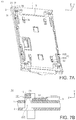
  • FIG. 7A is a schematic view showing that the second plate is assembled to the first plate of FIG. 6A .
  • FIG. 7B is a cross-sectional view of FIG. 7A along line 7 B- 76 ′.
  • FIG. 8A is a schematic view showing that the sliding plate is located at the latching position.
  • FIG. 8B is a cross-sectional view of FIG. 8A along line 8 B- 8 B′.
  • FIG. 8C is a cross-sectional view of FIG. 8A along line 8 C- 8 C′.
  • the latching structure 10 includes a first plate 1 , a second plate 2 and a sliding plate 3 .
  • the sliding plate 3 is assembled to the first plate 1 .
  • the latching structure 10 may be applied to the assembly of two modular products, wherein the two modular products may be provided with respective functions and applications.
  • the latching structure 10 may also be applied to the assembly of one modular product and one modular cover.
  • the first plate 1 and the sliding plate 3 are disposed on a first communication device 101
  • the second plate 2 is disposed on a second communication device 102
  • the first communication device 101 and the second communication device 102 may respectively be one of the communication devices, such as an Internet of Things communication device, a base station, a small cell, a Wi-Fi access hotspot, a router, and the like.
  • the first plate 1 may be used as a side plate of the first communication device 101 .
  • the first plate 1 may be disposed on a first side 101 S 1 of the first communication device 101
  • the sliding plate 3 may be disposed on a surface of the first plate 1 facing the interior of the first communication device 101
  • the second plate 2 may be used as a side plate of the second communication device 102 .
  • the second plate 2 may be disposed on a second side 102 S 2 of the second communication device 102 .
  • FIG. 1B is a three-dimensional diagram of the application according to FIG. 1A
  • the first communication device 101 and the second communication device 102 may be assembled together by facing the second side 102 S 2 of the second communication device 102 to the first side 101 S 1 of the first communication device 101 .
  • both of the first plate 1 and the second plate 2 may have respective openings 1 H and 2 H to allow passage of the electrical connectors between the first communication device 101 and the second communication device 102 .
  • the latching structure 10 the assembly/disassembly of the first communication device 101 and the second communication 102 may be more simple and convenient.
  • the latching structure 10 may respectively be disposed on two modular products, which can be assembled with each other, at the time of shipment. Therefore, there is no need to have additional joining element to facilitate the combination of the two modular products.
  • the first communication device 101 may further be assembled to a third communication device (not depicted).
  • another second plate 2 may be disposed on the second side 10152 of the first communication device 101
  • another first plate 1 and sliding plate 3 may be disposed on the first side of the third communication device in the same way
  • the first communication device 101 and the third communication device are assembled together by facing the second side 10152 of the first communication device 101 to the first side of the third communication device.
  • the second communication device 102 may also be assembled to a fourth communication device.
  • first plate 1 and sliding plate 3 may be disposed on the first side 102 S 1 of the second communication device 102
  • still another second plate 2 may be disposed on the second side of the fourth communication device in the same way, and the fourth communication device and the second communication device 102 are assembled together by facing the second side of the fourth communication device to the first side 102 S 1 of the second communication device 102 .
  • the user may be free to choose at least two modular products to combine together.
  • the first side of each device mentioned above refers to the side facing negative X axis in the drawing
  • the second side refers to the side facing positive X axis in the drawing.
  • FIG. 2A and FIG. 2B are three-dimensional diagrams of the first plate 1 respectively viewed from two different angles according to one embodiment of the present invention.
  • the first plate 1 includes the first surface 11 and the second surface 12 opposite to each other, wherein the first surface 11 faces the positive X axis, and the second surface 12 faces the negative X axis.
  • the first plate 1 includes a plurality of first arches 13 projecting from the first surface 11 of the first plate 1 and recessed from the second surface 12 of the first plate 1 . In some embodiment, the first arches 13 may be disposed on four corners of the first plate 1 .
  • Each of the first arches 13 has an alignment hole 131 .
  • the alignment hole 131 passes beneath each first arch 13 in an axial direction parallel to Z axis.
  • the alignment hole 131 is further recessed from the second surface 12 of the first plate 1 in a direction towards the positive X axis, but does not pass through each first arch 13 in a direction towards the positive X axis.
  • FIG. 3A and FIG. 3B are three-dimensional diagrams of the second plate 2 respectively viewed from two different angles according to one embodiment of the present invention.
  • the second plate 2 includes the first surface 21 and the second surface 22 opposite to each other, wherein the first surface 21 faces the positive X axis, and the second surface 22 faces the negative X axis.
  • the second plate 2 includes a plurality of second arches 23 projecting from the first surface 21 of the second plate 2 .
  • the second arches 23 correspond to the first arches 13 of the first plate 1 .
  • the positions and quantity of the second arches 23 correspond to those of the first arches 13 of the first plate 1 .
  • Each of the second arches 23 has a latching hole 231 .
  • the latching hole 231 passes beneath each second arch 23 in an axial direction parallel to Z axis.
  • the latching hole 231 is further recessed from the second surface 22 of the second plate 2 in a direction towards the positive X axis, but does not pass through each second arch 23 in a direction towards the positive X axis.
  • the alignment holes 131 of the first arches 13 of the first plate 1 accommodate the second arches 23 of the second plate 2 , respectively.
  • the top portions of the second arches 23 partially occupy the space of the alignment holes 131 , respectively.
  • FIG. 4 is a three-dimensional diagram of the sliding plate 3 according to one embodiment of the present invention.
  • the sliding plate 3 includes a plurality of pins 31 , and each pin 31 extends in Z axis.
  • the pins 31 correspond to the alignment holes 131 of the first arches 13 of the first plate 1 and the latching holes 231 of the second arches 23 of the second plate 2 .
  • the positions and quantity of the pins 31 correspond to those of the alignment holes 131 of the first arches 13 of the first plate 1 and those of the latching holes 231 of the second arches 23 of the second plate 2 .
  • the sliding plate 3 is firstly disposed on the first surface 11 of the first plate 1 , and on the first surface 11 , the sliding plate 3 is movable between a latching position and a retracted position in Z axis.
  • the pins 31 are each located in a corresponding one of the alignment holes 131 of the first arches 13 of the first plate 1 .
  • the pins 31 each separates from the corresponding one of the alignment holes 131 .
  • the second arches 23 are allowed to enter the alignment holes 131 in a direction towards the positive X axis, or separate from the alignment holes 131 in a direction towards the negative X axis.
  • the sliding plate 3 may move in the positive Z axis to the latching position, such that the pins 31 are each located in a corresponding one of the latching holes 231 of the second arches 23 of the second plate 2 . Accordingly, the pins 31 may block separation of the first plate 1 from the second plate 2 in X axis.
  • the first plate 1 may has a recessed positioning portion 14 recessed form the first surface 11 of the first plate 1 in the negative X axis.
  • the recessed positioning portion 14 includes a first recess portion 141 and a second recess portion 142 .
  • the sliding plate 3 may include an elastic positioning portion 35 .
  • the elastic positioning portion 35 When the sliding plate 3 is located at the retracted position, the elastic positioning portion 35 may be fit into the first recess portion 141 . Thus, the sliding plate 3 cannot easily have relative motion with respect to the first plate 1 in the Z axis.
  • the elastic positioning portion 35 may be detached from the first recess portion 141 .
  • the elastic positioning portion 35 may be fit into the second recess portion 142 .
  • the sliding plate 3 cannot easily have relative motion with respect to the first plate 1 in the Z axis.
  • the engagement of the first recess portion 141 and the elastic positioning portion 35 or the engagement of the second recess portion 142 and the elastic positioning portion 35 may further enhance user's hand feelings during operation.
  • the elastic positioning portion 35 when the elastic positioning portion 35 is fit into the first recess portion 141 , the user may be aware that the sliding plate 3 is at the retracted position.
  • the elastic positioning portion 35 When the elastic positioning portion 35 is fit into the second recess portion 142 , the user may be aware that the sliding plate 3 is at the latching position.
  • FIG. 5A is a schematic view showing that the sliding plate 3 is assembled to the first plate 1 .
  • the first plate 1 may further include a plurality of restraining portions 16 disposed on two opposite sides of the first plate 1 and projecting from the first surface 11 .
  • the restraining portions 16 are configured to restrict the sliding plate 3 to moving in Z axis and blocking separation of the sliding plate 3 from the first plate 1 in X axis.
  • the restraining portion 16 may be formed of L shape.
  • the sliding plate 3 may have a plurality of concave portions 36 recessed inwardly from two opposite side portions 37 of the sliding plate 3 and corresponding to the restraining portions 16 of the first plate 1 .
  • the positions and quantity of the concave portions 36 correspond to those of the restraining portions 16 of the first plate 1 .
  • the restraining portion 16 may pass through a corresponding one of the concave portions 36 , such that the sliding plate 3 may disposed on the first surface 11 of the first plate 1 with no interference.
  • FIG. 5B a cross-sectional view of FIG. 5A along line 5 B- 5 B′ is illustrated.
  • the restraining portion 16 of the first plate 1 passes through the corresponding concave portion 36 .
  • the elastic positioning portion 35 abuts against the first surface 11 of the first plate 1 , and is not fit into the first recess portion 141 yet.
  • FIG. 6A is a schematic view showing that the sliding plate 3 is located at the retracted position.
  • FIG. 6B is a cross-sectional view of FIG. 6A along line 6 B- 6 B′.
  • the elastic positioning portion 35 is fit into the first recess portion 141 .
  • the sliding plate 3 would not move in Z axis if there is no sufficient force applied to the sliding plate 3 to detach the elastic positioning portion 35 from the first recess portion 141 .
  • the restraining portion 16 of the first plate 1 deviated from the corresponding concave portion 36 of the sliding plate 3 , such that the side portion 37 of the sliding plate 3 enters a space formed by the L-shaped region of the restraining portion 16 , preventing the sliding plate 3 from separating form the first plate 1 in the positive X axis. Hence, the step of disposing the sliding plate 3 on the first surface 11 of the first plate 1 is completed.
  • FIG. 7A is a schematic view showing that the second plate 2 is assembled to the first plate 1 of FIG. 6A .
  • FIG. 7B is a cross-sectional view of FIG. 7A along line 7 B- 7 B′.
  • the second plate 2 is moved close to the first plate 1 by facing the first surface 21 of the second plate 2 to the second surface 12 of the first plate 1 , and each of the alignment holes 131 of the first arches 13 of the first plate 1 accommodates each of the second arches 23 of the second plate 2 . Since each of the pins 31 has not entered the corresponding one of the latching holes 231 of the second arches 23 , the first plate 1 may separate from the second plate 2 in X axis.
  • FIG. 8A is a schematic view showing that the sliding plate 3 is located at the latching position.
  • FIG. 8B is a cross-sectional view of FIG. 8A along line 8 B- 8 B′.
  • FIG. 8C is a cross-sectional view of FIG. 8A along line 8 C- 8 C′.
  • each of the side portions 37 of the sliding plate 3 remains in the space formed by the L-shaped region of the restraining portion 16 .
  • the sliding plate 3 cannot easily separate from the first plate 1 in the positive X axis.
  • the pins 31 are each located in a corresponding one of the latching holes 231 of the second arches 23 .
  • the pins 31 may block separation of the first plate 1 from the second plate 2 in X axis.
  • each pin 31 when the sliding plate 3 is located at the latching position, each pin 31 further extends through and is projected from each latching hole 231 in Z axis. In other words, each of the pins 31 are longer than each of the latching holes 231 in Z axis. Thus, the pins 31 may securely block separation of the first plate 1 from the second plate 2 in X axis, preventing the pins 31 from being detached from the latching holes 231 due to deformation.
  • the sliding plate 3 may further include a plurality of elastic arms 33 disposed on two opposite sides of the sliding plate 3 and corresponding to some of the restraining portions 16 of the first plate 1 .
  • Each of the elastic arms 33 comprises a hook 331 .
  • the hook 331 is coupled with a corresponding one of the restraining portions 16 , such that the sliding plate 3 is securely located at the latching position.
  • the sliding plate 3 would not move in the negative Z axis if there is no sufficient force applied to the sliding plate 3 in the negative Z axis to detach the hook 331 from the restraining portion 16 .
  • the first plate 1 and the sliding plate 3 may respectively include a positioning rib 15 and a positioning groove 32 .
  • the positioning rib 15 may be formed of T shape, and include a vertical portion 151 disposed perpendicular to the first surface 11 and a horizontal portion 152 disposed parallel to the first surface 11 .
  • the positioning groove 32 extends in Z axis.
  • the vertical portion 151 has a width W 1
  • the positioning groove 32 has a width W 2 .
  • the width W 2 may be approximately equal to the width W 1 , and therefore the vertical portion 151 of the positioning rib 15 may move inside of the positioning groove 32 .
  • the positioning rib 15 abuts against the positioning groove 32 . More specifically, both of the vertical portion 151 and the horizontal portion 152 of the positioning rib 15 abut against the positioning groove 32 .
  • the frictional force resulting from the contact of the positioning rib 15 and the positioning groove 32 may enhance user's hand feelings during operation.
  • the vertical portion 151 is restricted to moving inside of the positioning groove 32 .
  • the horizontal portion 152 may prevent the sliding plate 3 from separating from the first plate 1 in the positive X axis, and the sliding plate 3 is therefore restricted to moving in Z axis.
  • the positioning rib 15 and the positioning groove 32 of the present invention are not limited to the above configurations.
  • the first plate 1 and the sliding plate 3 are assembled first, as shown in FIG. 5A and FIG. 6A , such that on the first surface 11 of the first plate 1 , the sliding plate 3 is movable between the latching position and the retracted position in Z axis.
  • the first plate 1 may have a plurality of screw holes 1 S for a plurality of screwing members passing through to fasten the first plate 1 on the first communication device 101 .
  • the second surface 12 of the first plate 1 is used as an appearance surface of the first communication device 101
  • the sliding plate 3 is disposed on the first surface 11 used as the inner surface.
  • the second plate 2 may have a plurality of screw holes 2 S for a plurality of screwing members passing through to fasten the second plate 2 on the second communication device 102 .
  • the first surface 21 of the second plate 2 is used as an appearance surface of the second communication device 102 .
  • the latching structure 10 may be respectively disposed on two modular products, which can be assembled with each other.
  • the sliding plate 3 may include a pinch portion 34 for the user to move sliding plate 3 with fingers.
  • the pinch portion 34 is disposed adjacent to a bottom portion 101 b of the first communication device 101 .
  • the bottom portion 101 b of the communication device 101 may, for example, be a base, a bottom plate or any structure that can be a stand for supporting the first communication device 101 on a plane.
  • the pinch portion 34 does not project from the bottom portion 101 b of the first communication device 101 .
  • the pinch portion 34 may project out from the bottom portion 101 b of the first communication device 101 .
  • the first communication device 101 cannot firmly stand on the plane, such that the user may be aware that the sliding plate 3 is not located at the exact position. The user may then move the sliding plate 2 to the latching position, so that the first communication device 101 may stand on the plane.
  • the second plate 2 may have a pinch space 24 disposed corresponding to the pinch portion 34 . That is, the pinch space 24 is disposed adjacent to a bottom portion 102 b of the second communication device 102 .
  • the bottom portion 102 b of the second communication device 102 may, for example, be a base, a bottom plate or any structure that can be a stand for supporting the second communication device 102 on a plane.
  • the pinch space 24 may allow the user to pinch the pinch portion 34 with fingers.
  • the easily assembled and disassembled latching structure provided above may be respectively disposed on the two modular products, which can be assembled with each other, and the combination of the two modular products is very simple, convenient and reliable.

Landscapes

  • Engineering & Computer Science (AREA)
  • Microelectronics & Electronic Packaging (AREA)
  • Toys (AREA)
  • Connection Of Plates (AREA)

Abstract

A latching structure includes a first plate, a second plate and a sliding plate disposed on a surface of the first plate and movable in a first direction. The first plate includes first arches each having an alignment hole in the first direction. The second plate includes second arches each having a latching hole in the first direction. The sliding plate includes pins corresponding to the latching holes. When the alignment hole accommodates the second arch and the sliding plate is located at a latching position, the pin is located in a corresponding latching hole to block separation of the first plate from the second plate in a second direction. When the sliding plate is located at a retracted position, the pin separates from the corresponding latching hole to allow separation of the first plate from the second plate in the second direction.

Description

CROSS-REFERENCE TO RELATED APPLICATION
This application claims the benefit of People's Republic of China application Serial No. 201820651302.9, filed on May 3, 2018, the subject matter of which is incorporated herein by reference.
TECHNICAL FIELD
The invention relates in general to a latching structure, and more particularly to an easily assembled and disassembled latching structure.
BACKGROUND
To provide consumers with a variety of choices, there are some modular products available for consumers to purchase, and these modular products can be assembled with each other to meet the needs of consumers.
However, such modular products which are inconvenient to be assembled or disassembled may give users a bad experience.
SUMMARY
The present invention relates to an easily assembled and disassembled latching structure. The sliding plate is disposed on the first plate and movable between a latching position and a retracted position in a first axial direction on the first surface of the first plate. Thus, it is quite easy to assemble and disassemble the first plate and the second plate.
According to one aspect of the present invention, an easily assembled and disassembled latching structure is provided. The latching structure includes a first plate, a second plate and a sliding plate. The first plate includes a plurality of first arches recessed from a second surface of the first plate and projecting from a first surface of the first plate. The first arches each has an alignment hole passing underneath each of the first arches in a first axial direction. The first surface is opposite to the second surface. The second plate includes a plurality of second arches. Each of the second arches is adapted to be accommodated by a corresponding one of the alignment holes. Each of the second arches has a latching hole passing underneath each of the second arches in the first axial direction. The sliding plate includes a plurality of pins respectively corresponding to the latching holes. The sliding plate is disposed on the first surface of the first plate and movable between a latching position and a retracted position in the first axial direction. When each of the alignment holes accommodates a corresponding one of the second arches and the sliding plate is located at the latching position, the pins are each located in a corresponding one of the latching holes to block separation of the first plate from the second plate in a second axial direction perpendicular to the first axial direction. When the sliding plate is located at the retracted position, the pins each separates from the corresponding one of the latching holes to allow separation of the first plate from the second plate in the second axial direction.
According to the above, the present invention provides an easily assembled and disassembled latching structure. The first plate and the sliding plate disposed on the first plate, and the second plate may be respectively disposed on the two modular products, which can be assembled with each other, at the time of shipment, and the combination of the two modular products is very simple, convenient and reliable.
BRIEF DESCRIPTION OF THE DRAWINGS
FIG. 1A is an exploded view showing an application of an easily assembled and disassembled latching structure according to one embodiment of the present invention.
FIG. 1B is a three-dimensional diagram of the application according to FIG. 1A.
FIG. 2A is a three-dimensional diagram of the first plate viewed from top angle according to one embodiment of the present invention.
FIG. 2B is a three-dimensional diagram of the first plate viewed from bottom angle according to one embodiment of the present invention.
FIG. 3A is a three-dimensional diagram of the second plate viewed from top angle according to one embodiment of the present invention.
FIG. 3B is a three-dimensional diagram of the second plate viewed from bottom angle according to one embodiment of the present invention.
FIG. 4 is a three-dimensional diagram of the sliding plate according to one embodiment of the present invention.
FIG. 5A is a schematic view showing that the sliding plate is assembled to the first plate.
FIG. 5B is a cross-sectional view of FIG. 5A along line 5B-5B′.
FIG. 5C is an enlarged view of a region R in FIG. 5A.
FIG. 6A is a schematic view showing that the sliding plate is located at the retracted position.
FIG. 6B is a cross-sectional view of FIG. 6A along line 6B-6B′.
FIG. 7A is a schematic view showing that the second plate is assembled to the first plate of FIG. 6A.
FIG. 7B is a cross-sectional view of FIG. 7A along line 7B-76′.
FIG. 8A is a schematic view showing that the sliding plate is located at the latching position.
FIG. 8B is a cross-sectional view of FIG. 8A along line 8B-8B′.
FIG. 8C is a cross-sectional view of FIG. 8A along line 8C-8C′.
In the following detailed description, for purposes of explanation, numerous specific details are set forth in order to provide a thorough understanding of the disclosed embodiments. It will be apparent, however, that one or more embodiments may be practiced without these specific details. In other instances, well-known structures and devices are schematically shown in order to simplify the drawing.
DETAILED DESCRIPTION
Detailed descriptions of the present invention are disclosed below with a number of embodiments. Although the present invention does not illustrate all possible embodiments, other embodiments not disclosed in the present invention are still applicable. Moreover, the dimension scales used in the accompanying drawings are not based on actual proportion of the product. Therefore, the specification and drawings are for explaining and describing the embodiment only, not for limiting the scope of protection of the present invention. Furthermore, in the drawings of the embodiments, some elements are omitted so that technical features of the present invention can be clearly illustrated. Designations common to the accompanying drawings and embodiments are used to indicate identical or similar elements.
Referring to FIG. 1A, an exploded view showing an application of an easily assembled and disassembled latching structure 10 according to one embodiment of the present invention is illustrated. The latching structure 10 includes a first plate 1, a second plate 2 and a sliding plate 3. The sliding plate 3 is assembled to the first plate 1. The latching structure 10 may be applied to the assembly of two modular products, wherein the two modular products may be provided with respective functions and applications. The latching structure 10 may also be applied to the assembly of one modular product and one modular cover.
For example, in one embodiment, the first plate 1 and the sliding plate 3 are disposed on a first communication device 101, and the second plate 2 is disposed on a second communication device 102. In this example, the first communication device 101 and the second communication device 102 may respectively be one of the communication devices, such as an Internet of Things communication device, a base station, a small cell, a Wi-Fi access hotspot, a router, and the like. The first plate 1 may be used as a side plate of the first communication device 101. For example, the first plate 1 may be disposed on a first side 101S1 of the first communication device 101, and the sliding plate 3 may be disposed on a surface of the first plate 1 facing the interior of the first communication device 101. The second plate 2 may be used as a side plate of the second communication device 102. For example, the second plate 2 may be disposed on a second side 102S2 of the second communication device 102.
FIG. 1B is a three-dimensional diagram of the application according to FIG. 1A, Referring to FIG. 1A and FIG. 1B, the first communication device 101 and the second communication device 102 may be assembled together by facing the second side 102S2 of the second communication device 102 to the first side 101S1 of the first communication device 101. Here, both of the first plate 1 and the second plate 2 may have respective openings 1H and 2H to allow passage of the electrical connectors between the first communication device 101 and the second communication device 102. By the latching structure 10, the assembly/disassembly of the first communication device 101 and the second communication 102 may be more simple and convenient. In addition, the latching structure 10 may respectively be disposed on two modular products, which can be assembled with each other, at the time of shipment. Therefore, there is no need to have additional joining element to facilitate the combination of the two modular products.
Furthermore, the first communication device 101 may further be assembled to a third communication device (not depicted). In this condition, another second plate 2 may be disposed on the second side 10152 of the first communication device 101, another first plate 1 and sliding plate 3 may be disposed on the first side of the third communication device in the same way, and the first communication device 101 and the third communication device are assembled together by facing the second side 10152 of the first communication device 101 to the first side of the third communication device. Similarly, the second communication device 102 may also be assembled to a fourth communication device. In this condition, still another first plate 1 and sliding plate 3 may be disposed on the first side 102S1 of the second communication device 102, still another second plate 2 may be disposed on the second side of the fourth communication device in the same way, and the fourth communication device and the second communication device 102 are assembled together by facing the second side of the fourth communication device to the first side 102S1 of the second communication device 102. Thus, the user may be free to choose at least two modular products to combine together. For convenience of explanation, the first side of each device mentioned above refers to the side facing negative X axis in the drawing, and the second side refers to the side facing positive X axis in the drawing.
FIG. 2A and FIG. 2B are three-dimensional diagrams of the first plate 1 respectively viewed from two different angles according to one embodiment of the present invention. The first plate 1 includes the first surface 11 and the second surface 12 opposite to each other, wherein the first surface 11 faces the positive X axis, and the second surface 12 faces the negative X axis. The first plate 1 includes a plurality of first arches 13 projecting from the first surface 11 of the first plate 1 and recessed from the second surface 12 of the first plate 1. In some embodiment, the first arches 13 may be disposed on four corners of the first plate 1.
Each of the first arches 13 has an alignment hole 131. Referring to FIG. 2A, the alignment hole 131 passes beneath each first arch 13 in an axial direction parallel to Z axis. In addition, referring to FIG. 2B, the alignment hole 131 is further recessed from the second surface 12 of the first plate 1 in a direction towards the positive X axis, but does not pass through each first arch 13 in a direction towards the positive X axis.
FIG. 3A and FIG. 3B are three-dimensional diagrams of the second plate 2 respectively viewed from two different angles according to one embodiment of the present invention. The second plate 2 includes the first surface 21 and the second surface 22 opposite to each other, wherein the first surface 21 faces the positive X axis, and the second surface 22 faces the negative X axis. The second plate 2 includes a plurality of second arches 23 projecting from the first surface 21 of the second plate 2. The second arches 23 correspond to the first arches 13 of the first plate 1. For example, the positions and quantity of the second arches 23 correspond to those of the first arches 13 of the first plate 1.
Each of the second arches 23 has a latching hole 231. Referring to FIG. 3A, the latching hole 231 passes beneath each second arch 23 in an axial direction parallel to Z axis. In addition, referring to FIG. 3B, in one embodiment, the latching hole 231 is further recessed from the second surface 22 of the second plate 2 in a direction towards the positive X axis, but does not pass through each second arch 23 in a direction towards the positive X axis.
Referring to FIG. 2A, FIG. 2B and FIG. 3A, when the first surface 21 of the second plate 2 is attached to the second surface 12 of the first plate 1, the alignment holes 131 of the first arches 13 of the first plate 1 accommodate the second arches 23 of the second plate 2, respectively. In other words, the top portions of the second arches 23 partially occupy the space of the alignment holes 131, respectively.
FIG. 4 is a three-dimensional diagram of the sliding plate 3 according to one embodiment of the present invention. Referring to FIG. 4, the sliding plate 3 includes a plurality of pins 31, and each pin 31 extends in Z axis. The pins 31 correspond to the alignment holes 131 of the first arches 13 of the first plate 1 and the latching holes 231 of the second arches 23 of the second plate 2. For example, the positions and quantity of the pins 31 correspond to those of the alignment holes 131 of the first arches 13 of the first plate 1 and those of the latching holes 231 of the second arches 23 of the second plate 2.
Referring to FIG. 2A, FIG. 2B, FIG. 3A, FIG. 3B and FIG. 4, the sliding plate 3 is firstly disposed on the first surface 11 of the first plate 1, and on the first surface 11, the sliding plate 3 is movable between a latching position and a retracted position in Z axis. When the sliding plate 3 is located at the latching position, the pins 31 are each located in a corresponding one of the alignment holes 131 of the first arches 13 of the first plate 1. When the sliding plate 3 is located at the retracted position, the pins 31 each separates from the corresponding one of the alignment holes 131. In a condition when the sliding plate 3 is located at the retracted position, the second arches 23 are allowed to enter the alignment holes 131 in a direction towards the positive X axis, or separate from the alignment holes 131 in a direction towards the negative X axis. When the alignment hole 131 of each first arch 13 of the first plate 1 accommodates each of the second arches 23 of the second plate 2, the sliding plate 3 may move in the positive Z axis to the latching position, such that the pins 31 are each located in a corresponding one of the latching holes 231 of the second arches 23 of the second plate 2. Accordingly, the pins 31 may block separation of the first plate 1 from the second plate 2 in X axis.
In one embodiment, the first plate 1 may has a recessed positioning portion 14 recessed form the first surface 11 of the first plate 1 in the negative X axis. The recessed positioning portion 14 includes a first recess portion 141 and a second recess portion 142. In addition, the sliding plate 3 may include an elastic positioning portion 35. When the sliding plate 3 is located at the retracted position, the elastic positioning portion 35 may be fit into the first recess portion 141. Thus, the sliding plate 3 cannot easily have relative motion with respect to the first plate 1 in the Z axis. While the sliding plate 3 moves from the retracted position to the latching portion in the positive Z axis, the elastic positioning portion 35 may be detached from the first recess portion 141. When the sliding plate 3 is located at the latching position, the elastic positioning portion 35 may be fit into the second recess portion 142. Thus, the sliding plate 3 cannot easily have relative motion with respect to the first plate 1 in the Z axis.
Furthermore, the engagement of the first recess portion 141 and the elastic positioning portion 35 or the engagement of the second recess portion 142 and the elastic positioning portion 35 may further enhance user's hand feelings during operation. In other words, when the elastic positioning portion 35 is fit into the first recess portion 141, the user may be aware that the sliding plate 3 is at the retracted position. When the elastic positioning portion 35 is fit into the second recess portion 142, the user may be aware that the sliding plate 3 is at the latching position.
FIG. 5A is a schematic view showing that the sliding plate 3 is assembled to the first plate 1. Referring to FIG. 2A, FIG. 2B, FIG. 4 and FIG. 5, the first plate 1 may further include a plurality of restraining portions 16 disposed on two opposite sides of the first plate 1 and projecting from the first surface 11. The restraining portions 16 are configured to restrict the sliding plate 3 to moving in Z axis and blocking separation of the sliding plate 3 from the first plate 1 in X axis. In one embodiment, the restraining portion 16 may be formed of L shape. Correspondingly, the sliding plate 3 may have a plurality of concave portions 36 recessed inwardly from two opposite side portions 37 of the sliding plate 3 and corresponding to the restraining portions 16 of the first plate 1. For example, the positions and quantity of the concave portions 36 correspond to those of the restraining portions 16 of the first plate 1. By the design of the corresponding restraining portions 16 and the concave portions 36, when the sliding plate 3 moves close to the first surface 11 of the first plate 1 in the negative X axis, the restraining portion 16 may pass through a corresponding one of the concave portions 36, such that the sliding plate 3 may disposed on the first surface 11 of the first plate 1 with no interference.
Referring to FIG. 5B, a cross-sectional view of FIG. 5A along line 5B-5B′ is illustrated. The restraining portion 16 of the first plate 1 passes through the corresponding concave portion 36. At this moment, the elastic positioning portion 35 abuts against the first surface 11 of the first plate 1, and is not fit into the first recess portion 141 yet.
Next, the sliding plate 3 is moved to the retracted position in the positive Z axis. FIG. 6A is a schematic view showing that the sliding plate 3 is located at the retracted position. FIG. 6B is a cross-sectional view of FIG. 6A along line 6B-6B′. Referring to FIG. 6A and FIG. 6B, when the sliding plate 3 is located at the retracted position, the elastic positioning portion 35 is fit into the first recess portion 141. In this condition, the sliding plate 3 would not move in Z axis if there is no sufficient force applied to the sliding plate 3 to detach the elastic positioning portion 35 from the first recess portion 141. In addition, the restraining portion 16 of the first plate 1 deviated from the corresponding concave portion 36 of the sliding plate 3, such that the side portion 37 of the sliding plate 3 enters a space formed by the L-shaped region of the restraining portion 16, preventing the sliding plate 3 from separating form the first plate 1 in the positive X axis. Hence, the step of disposing the sliding plate 3 on the first surface 11 of the first plate 1 is completed.
FIG. 7A is a schematic view showing that the second plate 2 is assembled to the first plate 1 of FIG. 6A. FIG. 7B is a cross-sectional view of FIG. 7A along line 7B-7B′. Referring to FIG. 7A and FIG. 7B, next, in a condition that the sliding plate 3 is located at the retracted position, the second plate 2 is moved close to the first plate 1 by facing the first surface 21 of the second plate 2 to the second surface 12 of the first plate 1, and each of the alignment holes 131 of the first arches 13 of the first plate 1 accommodates each of the second arches 23 of the second plate 2. Since each of the pins 31 has not entered the corresponding one of the latching holes 231 of the second arches 23, the first plate 1 may separate from the second plate 2 in X axis.
Next, the sliding plate 3 is moved to the latching position in the positive Z axis. FIG. 8A is a schematic view showing that the sliding plate 3 is located at the latching position. FIG. 8B is a cross-sectional view of FIG. 8A along line 8B-8B′. FIG. 8C is a cross-sectional view of FIG. 8A along line 8C-8C′. Referring to FIG. 8A and FIG. 8B, when the sliding plate 3 is located at the latching position, the elastic positioning portion 35 is fit into the second recess portion 142. In addition, while the sliding plate 3 is moving to the latching position from the retracted position in the positive Z axis, each of the side portions 37 of the sliding plate 3 remains in the space formed by the L-shaped region of the restraining portion 16. Thus, during the time that the sliding plate 3 moves between the retracted position and the latching position, the sliding plate 3 cannot easily separate from the first plate 1 in the positive X axis.
Referring to FIG. 8A and FIG. 8C, when the sliding plate 3 is located at the latching position, the pins 31 are each located in a corresponding one of the latching holes 231 of the second arches 23. Thus, the pins 31 may block separation of the first plate 1 from the second plate 2 in X axis.
In one embodiment, when the sliding plate 3 is located at the latching position, each pin 31 further extends through and is projected from each latching hole 231 in Z axis. In other words, each of the pins 31 are longer than each of the latching holes 231 in Z axis. Thus, the pins 31 may securely block separation of the first plate 1 from the second plate 2 in X axis, preventing the pins 31 from being detached from the latching holes 231 due to deformation.
In one embodiment, the sliding plate 3 may further include a plurality of elastic arms 33 disposed on two opposite sides of the sliding plate 3 and corresponding to some of the restraining portions 16 of the first plate 1. Each of the elastic arms 33 comprises a hook 331. As shown in FIG. 8A, when the sliding plate 3 is located at the latching position, the hook 331 is coupled with a corresponding one of the restraining portions 16, such that the sliding plate 3 is securely located at the latching position. Thus, the sliding plate 3 would not move in the negative Z axis if there is no sufficient force applied to the sliding plate 3 in the negative Z axis to detach the hook 331 from the restraining portion 16.
On the other hand, to enhance user's hand feelings during operation, and further assist in restricting the sliding plate 3 to moving in Z axis, the first plate 1 and the sliding plate 3 may respectively include a positioning rib 15 and a positioning groove 32. Referring to FIG. 5C, the positioning rib 15 may be formed of T shape, and include a vertical portion 151 disposed perpendicular to the first surface 11 and a horizontal portion 152 disposed parallel to the first surface 11. The positioning groove 32 extends in Z axis. The vertical portion 151 has a width W1, and the positioning groove 32 has a width W2. The width W2 may be approximately equal to the width W1, and therefore the vertical portion 151 of the positioning rib 15 may move inside of the positioning groove 32. As shown in FIG. 7A and FIG. 8A, when the sliding plate 3 moves between the latching position and the retracted position in Z axis, the positioning rib 15 abuts against the positioning groove 32. More specifically, both of the vertical portion 151 and the horizontal portion 152 of the positioning rib 15 abut against the positioning groove 32. The frictional force resulting from the contact of the positioning rib 15 and the positioning groove 32 may enhance user's hand feelings during operation. Furthermore, when the sliding plate 3 moves between the latching position and the retracted position in Z axis, the vertical portion 151 is restricted to moving inside of the positioning groove 32. The horizontal portion 152 may prevent the sliding plate 3 from separating from the first plate 1 in the positive X axis, and the sliding plate 3 is therefore restricted to moving in Z axis. The positioning rib 15 and the positioning groove 32 of the present invention are not limited to the above configurations.
Through the above configurations, the first plate 1 and the sliding plate 3 are assembled first, as shown in FIG. 5A and FIG. 6A, such that on the first surface 11 of the first plate 1, the sliding plate 3 is movable between the latching position and the retracted position in Z axis. Next, as shown in FIG. 1A, FIG. 2A and FIG. 2B, the first plate 1 may have a plurality of screw holes 1S for a plurality of screwing members passing through to fasten the first plate 1 on the first communication device 101. Thus, the second surface 12 of the first plate 1 is used as an appearance surface of the first communication device 101, and the sliding plate 3 is disposed on the first surface 11 used as the inner surface. In addition, as shown in FIG. 1A, FIG. 3A and FIG. 3B, the second plate 2 may have a plurality of screw holes 2S for a plurality of screwing members passing through to fasten the second plate 2 on the second communication device 102. Thus, the first surface 21 of the second plate 2 is used as an appearance surface of the second communication device 102. Hence, at the time of shipment, the latching structure 10 may be respectively disposed on two modular products, which can be assembled with each other. After the steps described with reference to FIG. 7A and FIG. 8A, the combination of the first communication device 101 and the second communication device 102 is very simple, convenient and reliable.
Moreover, referring to FIG. 1A and FIG. 4, the sliding plate 3 may include a pinch portion 34 for the user to move sliding plate 3 with fingers. The pinch portion 34 is disposed adjacent to a bottom portion 101 b of the first communication device 101. The bottom portion 101 b of the communication device 101 may, for example, be a base, a bottom plate or any structure that can be a stand for supporting the first communication device 101 on a plane. When the sliding plate 3 is located at the latching position, the pinch portion 34 does not project from the bottom portion 101 b of the first communication device 101. When the sliding plate 3 is located at the retracted position, the pinch portion 34 may project out from the bottom portion 101 b of the first communication device 101. In this condition, the first communication device 101 cannot firmly stand on the plane, such that the user may be aware that the sliding plate 3 is not located at the exact position. The user may then move the sliding plate 2 to the latching position, so that the first communication device 101 may stand on the plane.
Furthermore, referring to FIG. 1A and FIG. 3A, the second plate 2 may have a pinch space 24 disposed corresponding to the pinch portion 34. That is, the pinch space 24 is disposed adjacent to a bottom portion 102 b of the second communication device 102. The bottom portion 102 b of the second communication device 102 may, for example, be a base, a bottom plate or any structure that can be a stand for supporting the second communication device 102 on a plane. In a condition that the first communication device 101 and the second communication device 102 are combined with each other, the pinch space 24 may allow the user to pinch the pinch portion 34 with fingers.
At the time of shipment, the easily assembled and disassembled latching structure provided above may be respectively disposed on the two modular products, which can be assembled with each other, and the combination of the two modular products is very simple, convenient and reliable.
It will be apparent to those skilled in the art that various modifications and variations can be made to the disclosed embodiments. It is intended that the specification and examples be considered as exemplary only, with a true scope of the invention being indicated by the following claims and their equivalents.

Claims (10)

What is claimed is:
1. A latching structure comprising:
a first plate comprising a plurality of first arches projecting from a first surface of the first plate and recessed from a second surface of the first plate, the first arches each having an alignment hole passing underneath each of the first arches in a first axial direction, wherein the first surface is opposite to the second surface;
a second plate comprising a plurality of second arches each having a latching hole, wherein each of the second arches is adapted to be accommodated by a corresponding one of the alignment holes, and each of the latching holes passes underneath each of the second arches in the first axial direction; and
a sliding plate comprising a plurality of pins respectively corresponding to the latching holes, the sliding plate disposed on the first surface of the first plate and movable between a latching position and a retracted position in the first axial direction;
wherein when each of the alignment holes accommodates a corresponding one of the second arches and the sliding plate is located at the latching position, the pins are each located in a corresponding one of the latching holes to block separation of the first plate from the second plate in a second axial direction perpendicular to the first axial direction;
when the sliding plate is located at the retracted position, the pins each separates from the corresponding one of the latching holes to allow separation of the first plate from the second plate in the second axial direction.
2. The latching structure according to claim 1, wherein each of the pins are longer than each of the latching holes.
3. The latching structure according to claim 1, wherein the first plate is a side plate of a communication device; the sliding plate comprises a pinch portion disposed adjacent to a bottom portion of the communication device, and when the sliding plate is located at the retracted position, the pinch portion projects out from the bottom portion of the communication device.
4. The latching structure according to claim 3, wherein the second plate has a pinch space disposed corresponding to the pinch portion.
5. The latching structure according to claim 1, wherein the first arches are disposed on four corners of the first plate.
6. The latching structure according to claim 1, wherein the first plate has a first recess portion and a second recess portion, the sliding plate further comprises an elastic positioning portion;
when the sliding plate is located at the retracted position, the elastic positioning portion is fit into the first recess portion;
when the sliding plate is located at the latching position, the elastic positioning portion is fit into the second recess portion.
7. The latching structure according to claim 1, wherein the first plate and the sliding plate respectively comprise a positioning rib and a positioning groove;
when the sliding plate moves between the latching position and the retracted position in the first axial direction, the positioning rib abuts against the positioning groove.
8. The latching structure according to claim 7, wherein the positioning rib and the positioning groove are configured to block separation of the sliding plate from the first plate in the second axial direction when the sliding plate moves between the latching position and the retracted position in the first axial direction.
9. The latching structure according to claim 1, wherein the first plate further comprises a plurality of restraining portions disposed on two opposite sides of the first plate and projecting from the first surface, and the restraining portions are configured to restrict the sliding plate to moving in the first axial direction and blocking separation of the sliding plate from the first plate in the second axial direction when the sliding plate is located at the retracted position.
10. The latching structure according to claim 9, wherein the sliding plate further comprises a plurality of elastic arms disposed on two opposite sides of the sliding plate and corresponding to parts of the restraining portions, the elastic arms each comprises a hook, and when the sliding plate is located at the latching position, the hook is coupled with a corresponding one of the restraining portions.
US16/383,800 2018-05-03 2019-04-15 Easily assembled and disassembled latching structure Expired - Fee Related US10492317B1 (en)

Applications Claiming Priority (3)

Application Number Priority Date Filing Date Title
CN201820651302U 2018-05-03
CN201820651302.9U CN208113175U (en) 2018-05-03 2018-05-03 Convenient for assembling/disassembly snap-in structure
CN201820651302.9 2018-05-03

Publications (2)

Publication Number Publication Date
US20190343012A1 US20190343012A1 (en) 2019-11-07
US10492317B1 true US10492317B1 (en) 2019-11-26

Family

ID=64114040

Family Applications (1)

Application Number Title Priority Date Filing Date
US16/383,800 Expired - Fee Related US10492317B1 (en) 2018-05-03 2019-04-15 Easily assembled and disassembled latching structure

Country Status (2)

Country Link
US (1) US10492317B1 (en)
CN (1) CN208113175U (en)

Cited By (2)

* Cited by examiner, † Cited by third party
Publication number Priority date Publication date Assignee Title
US20240292548A1 (en) * 2023-02-24 2024-08-29 Zhejiang Holip Electronic Technology Co., Ltd Structure of control panel and frequency converter
US12349294B2 (en) * 2022-03-11 2025-07-01 Suprema Inc. Terminal apparatus assembly and terminal equipment including same

Families Citing this family (2)

* Cited by examiner, † Cited by third party
Publication number Priority date Publication date Assignee Title
DE102019214751A1 (en) * 2019-09-26 2021-04-01 Mahle International Gmbh casing
US11574656B2 (en) * 2020-02-13 2023-02-07 International Business Machines Corporation Automated tape library deep slot protection

Citations (13)

* Cited by examiner, † Cited by third party
Publication number Priority date Publication date Assignee Title
US6375283B1 (en) * 1998-11-10 2002-04-23 Matsushita Electric Industrial Co., Ltd. Radio device housing
US20040264113A1 (en) * 2003-06-30 2004-12-30 Darr Christopher J. Smart junction box for automobile
US20080105010A1 (en) * 2006-11-08 2008-05-08 Chiang Wei-Liang Door lock assembly having a cam associated with a handle to transmit movements to a latch operating spindle
US20090305754A1 (en) * 2008-06-10 2009-12-10 Hong Fu Jin Precision Industry (Shenzen) Co., Ltd Slide mechanism for slide-type terminal device
US20110115349A1 (en) * 2008-07-15 2011-05-19 William Philip Dernier Electronic apparatus and associated disassembly release tool
US20110149488A1 (en) * 2009-12-23 2011-06-23 Shenzhen Futaihong Precision Industry Co., Ltd. Slide mechanism for slide-type portable electronic device
US8480186B2 (en) * 2009-04-30 2013-07-09 Byd Company Limited Shell assembling device and shell having the same
US8701279B2 (en) * 2007-09-04 2014-04-22 Apple Inc. Method for assembling an electronic device
US20150061475A1 (en) * 2013-08-30 2015-03-05 Western Digital Technologies, Inc. Latch system
US20160120047A1 (en) * 2014-10-22 2016-04-28 Hon Hai Precision Industry Co., Ltd. Electronic device with concealed coupling member
US9332659B2 (en) * 2013-09-27 2016-05-03 Shinko Electric Industries Co., Ltd. Electronic component case and electronic component device
US9545019B2 (en) * 2013-09-04 2017-01-10 Sony Corporation Housing and housing component
US9585270B2 (en) * 2014-12-12 2017-02-28 Hong Fu Jin Precision Industry (Wuhan) Co., Ltd. Router

Patent Citations (13)

* Cited by examiner, † Cited by third party
Publication number Priority date Publication date Assignee Title
US6375283B1 (en) * 1998-11-10 2002-04-23 Matsushita Electric Industrial Co., Ltd. Radio device housing
US20040264113A1 (en) * 2003-06-30 2004-12-30 Darr Christopher J. Smart junction box for automobile
US20080105010A1 (en) * 2006-11-08 2008-05-08 Chiang Wei-Liang Door lock assembly having a cam associated with a handle to transmit movements to a latch operating spindle
US8701279B2 (en) * 2007-09-04 2014-04-22 Apple Inc. Method for assembling an electronic device
US20090305754A1 (en) * 2008-06-10 2009-12-10 Hong Fu Jin Precision Industry (Shenzen) Co., Ltd Slide mechanism for slide-type terminal device
US20110115349A1 (en) * 2008-07-15 2011-05-19 William Philip Dernier Electronic apparatus and associated disassembly release tool
US8480186B2 (en) * 2009-04-30 2013-07-09 Byd Company Limited Shell assembling device and shell having the same
US20110149488A1 (en) * 2009-12-23 2011-06-23 Shenzhen Futaihong Precision Industry Co., Ltd. Slide mechanism for slide-type portable electronic device
US20150061475A1 (en) * 2013-08-30 2015-03-05 Western Digital Technologies, Inc. Latch system
US9545019B2 (en) * 2013-09-04 2017-01-10 Sony Corporation Housing and housing component
US9332659B2 (en) * 2013-09-27 2016-05-03 Shinko Electric Industries Co., Ltd. Electronic component case and electronic component device
US20160120047A1 (en) * 2014-10-22 2016-04-28 Hon Hai Precision Industry Co., Ltd. Electronic device with concealed coupling member
US9585270B2 (en) * 2014-12-12 2017-02-28 Hong Fu Jin Precision Industry (Wuhan) Co., Ltd. Router

Cited By (3)

* Cited by examiner, † Cited by third party
Publication number Priority date Publication date Assignee Title
US12349294B2 (en) * 2022-03-11 2025-07-01 Suprema Inc. Terminal apparatus assembly and terminal equipment including same
US20240292548A1 (en) * 2023-02-24 2024-08-29 Zhejiang Holip Electronic Technology Co., Ltd Structure of control panel and frequency converter
US12526931B2 (en) * 2023-02-24 2026-01-13 Zhejiang Holip Electronic Technology Co., Ltd Structure of control panel and frequency converter

Also Published As

Publication number Publication date
US20190343012A1 (en) 2019-11-07
CN208113175U (en) 2018-11-16

Similar Documents

Publication Publication Date Title
US10492317B1 (en) Easily assembled and disassembled latching structure
US7739760B2 (en) Bedstead assembly with a foldable support frame
US11212934B2 (en) Server chassis
US20180329460A1 (en) Flexible hinge device having cam structure
TWM550964U (en) Thin type hinge
US20190129514A1 (en) Foldable portable keyboard
KR101944173B1 (en) Table frame
CN103717017B (en) Sliding mechanism and slide plate type electronic device
KR20210009476A (en) Foldable display apparatus
US8953333B2 (en) Electronic device and fixing structure thereof
US6467108B1 (en) Structure of corner members for a playpen
US20050016091A1 (en) Tenon-snap joint structure for glass panel mounting frames
CN107103845B (en) Spliced display screen
JP3078523U (en) Computer case
KR20170055775A (en) Assembly table
TWI692295B (en) Shielding cover
US20170324203A1 (en) Electrical connector
US10722402B2 (en) Goggle device and buckling module thereof
US20060254176A1 (en) Combinative partition
JP4224193B2 (en) Folding container
TWI545426B (en) Display device and method for assembling the same
US20200408287A1 (en) Linear actuator, actuator device and assembly method thereof
CN111615316B (en) Shielding case
JP7278568B2 (en) assembly box
KR100304016B1 (en) Apparatus for assembling housing of image display device

Legal Events

Date Code Title Description
AS Assignment

Owner name: SERCOMM CORPORATION, TAIWAN

Free format text: ASSIGNMENT OF ASSIGNORS INTEREST;ASSIGNORS:HO, LI-LI;CHANG, CHENG-CHUNG;YU, YI-FEI;REEL/FRAME:048880/0903

Effective date: 20190401

FEPP Fee payment procedure

Free format text: ENTITY STATUS SET TO UNDISCOUNTED (ORIGINAL EVENT CODE: BIG.); ENTITY STATUS OF PATENT OWNER: LARGE ENTITY

STCF Information on status: patent grant

Free format text: PATENTED CASE

FEPP Fee payment procedure

Free format text: MAINTENANCE FEE REMINDER MAILED (ORIGINAL EVENT CODE: REM.); ENTITY STATUS OF PATENT OWNER: LARGE ENTITY

LAPS Lapse for failure to pay maintenance fees

Free format text: PATENT EXPIRED FOR FAILURE TO PAY MAINTENANCE FEES (ORIGINAL EVENT CODE: EXP.); ENTITY STATUS OF PATENT OWNER: LARGE ENTITY

STCH Information on status: patent discontinuation

Free format text: PATENT EXPIRED DUE TO NONPAYMENT OF MAINTENANCE FEES UNDER 37 CFR 1.362

FP Lapsed due to failure to pay maintenance fee

Effective date: 20231126