US10488556B2 - System for multivariate climate change forecasting with uncertainty quantification - Google Patents
System for multivariate climate change forecasting with uncertainty quantification Download PDFInfo
- Publication number
- US10488556B2 US10488556B2 US15/127,635 US201515127635A US10488556B2 US 10488556 B2 US10488556 B2 US 10488556B2 US 201515127635 A US201515127635 A US 201515127635A US 10488556 B2 US10488556 B2 US 10488556B2
- Authority
- US
- United States
- Prior art keywords
- climate
- metrics
- time period
- variable
- precipitation
- Prior art date
- Legal status (The legal status is an assumption and is not a legal conclusion. Google has not performed a legal analysis and makes no representation as to the accuracy of the status listed.)
- Active, expires
Links
Images



Classifications
-
- G—PHYSICS
- G01—MEASURING; TESTING
- G01W—METEOROLOGY
- G01W1/00—Meteorology
- G01W1/10—Devices for predicting weather conditions
-
- G—PHYSICS
- G01—MEASURING; TESTING
- G01W—METEOROLOGY
- G01W1/00—Meteorology
- G01W1/02—Instruments for indicating weather conditions by measuring two or more variables, e.g. humidity, pressure, temperature, cloud cover or wind speed
- G01W1/06—Instruments for indicating weather conditions by measuring two or more variables, e.g. humidity, pressure, temperature, cloud cover or wind speed giving a combined indication of weather conditions
-
- G06N7/005—
-
- G—PHYSICS
- G06—COMPUTING OR CALCULATING; COUNTING
- G06N—COMPUTING ARRANGEMENTS BASED ON SPECIFIC COMPUTATIONAL MODELS
- G06N7/00—Computing arrangements based on specific mathematical models
- G06N7/01—Probabilistic graphical models, e.g. probabilistic networks
-
- G—PHYSICS
- G06—COMPUTING OR CALCULATING; COUNTING
- G06N—COMPUTING ARRANGEMENTS BASED ON SPECIFIC COMPUTATIONAL MODELS
- G06N7/00—Computing arrangements based on specific mathematical models
- G06N7/08—Computing arrangements based on specific mathematical models using chaos models or non-linear system models
-
- Y—GENERAL TAGGING OF NEW TECHNOLOGICAL DEVELOPMENTS; GENERAL TAGGING OF CROSS-SECTIONAL TECHNOLOGIES SPANNING OVER SEVERAL SECTIONS OF THE IPC; TECHNICAL SUBJECTS COVERED BY FORMER USPC CROSS-REFERENCE ART COLLECTIONS [XRACs] AND DIGESTS
- Y02—TECHNOLOGIES OR APPLICATIONS FOR MITIGATION OR ADAPTATION AGAINST CLIMATE CHANGE
- Y02A—TECHNOLOGIES FOR ADAPTATION TO CLIMATE CHANGE
- Y02A90/00—Technologies having an indirect contribution to adaptation to climate change
- Y02A90/10—Information and communication technologies [ICT] supporting adaptation to climate change, e.g. for weather forecasting or climate simulation
Definitions
- the present system and method are able to more rigorously quantify the uncertainty in extreme climate events and climate indices to provide stakeholders with best and worst case bounds in metrics used for impacts assessment, hazards planning, and engineering design.
- the system and method use a Bayesian model that combines and iteratively weights archived data outputs of multiple global climate models against reference observational datasets to estimate probability distributions for global and regional climate extremes and climate indices.
- the model incorporates prior aggregate understanding of physics by assigning weights to climate models partially according to their ability to capture regional adherence to observed climate data.
- the system and method employ a Bayesian framework to build statistical distributions for extremes or climate indices, rather than mean values.
- the present framework provides an integration of physical relationships between various climate variable using observed and simulated data. For example, there is an expected relationship between precipitation extremes and average temperature, for which there is a significant amount of physical evidence, available in the scientific literature.
- results can be spatially and temporally downscaled and translated to robust stakeholder metrics, such as Intensity-Duration-Frequency curves and engineering load factors, to provide stakeholders with reliable tools for coping with future precipitation extremes and related hydrological extremes.
- stakeholder metrics such as Intensity-Duration-Frequency curves and engineering load factors
- a system for providing multivariate climate change forecasting comprises:
- processors and memory and machine-readable instructions stored in the memory that, upon execution by the one or more processors cause the system to carry out operations comprising:
- a method for providing multivariate climate change forecasting comprises:
- climate model data comprising simulated historical climate model data used in one or more climate models and simulated future climate model data from the one or more climate models;
- observational data comprising historical observed climate data
- each of the metrics comprising:
- variable climate features include precipitation extremes and temperatures.
- variable climate features include one or more of precipitation, temperature, wind direction, wind speed, sea surface temperature, convective available potential energy, soil moisture, crop moisture, droughts, hurricanes, heatwaves, cold snaps, tornadoes, heating degree days, cooling degree days, heatwave intensity, or coldwave intensity.
- the climate indices include indices representing heating degree days, cooling degree days, soil moisture, precipitation; crop moisture, heatwave intensity, or coldwave intensity.
- system or method further comprise determining a climate model weight for each of the one or more climate models from which the climate model data were obtained.
- the step of providing a statistical distribution of extremes or climate indices comprises estimating framework parameters using the simulated historical climate model data and the simulated future climate model data over historical and future time periods, the parameters comprising descriptions of the variable climate features and dependences among the variable climate features.
- the step of providing a statistical distribution of extremes or climate indices comprises: using the climate model data and the observational climate data to obtain a distribution for each climate variable, the distribution described by a set of random unknown parameters, providing a prior distribution for each of the random unknown parameters; and deriving posterior distributions using a Bayesian model.
- the step of providing a statistical distribution of extremes or climate indices comprises: sorting the climate model data and the observational climate data by numeric magnitude of extreme events or climate indices to obtain rankings; statistically comparing rankings of the climate model data from a least some of the climate models to the rankings of the observational climate data to derive weights for each climate model simulation; and from the weights, deriving a distribution of extreme events or climate indices over a determined time period.
- the distribution in the step of providing a statistical distribution of extremes of climate indices, is simulated using a Markov Chain Monte Carlo computational engine.
- the determined future time period comprises a monthly time period, a seasonal time period, an annual time period, or a multi-annual time period.
- the metrics are determined globally or for a specified geographic region.
- the metrics include one or more of a future temperature distribution for a specified geographic region, and a future precipitation extremes distribution for a specified geographic region.
- the metrics include one or more of a future distribution of precipitation, temperature, wind direction, wind speed, sea surface temperature, convective available potential energy, soil moisture, crop moisture, droughts, hurricanes, heatwaves, cold snaps, tornadoes, heating degree days, cooling degree days, heatwave intensity, or coldwave intensity for a specified geographic region.
- the metrics include one or more bias parameters for any one of the climate model simulations.
- system or method further comprising determining from the metrics a precipitation intensity-duration-frequency curve and outputting the precipitation intensity-duration-frequency curve to the output device.
- system or method further comprise determining from the metrics precipitation extremes projections and estimating changes in rainfall events expected to be exceeded only once on average in the determined future time period.
- system or method further comprise determining from the metrics probable maximum precipitation ratios for the determined future time period and an evolution of the probable maximum precipitation ratios over time.
- system or method further comprise determining from the metrics probable maximum ratios for one or more of precipitation, temperature, wind direction, wind speed, sea surface temperature, convective available potential energy, soil moisture, crop moisture, droughts, hurricanes, heatwaves, cold snaps, tornadoes, heating degree days, cooling degree days, heatwave intensity, and coldwave intensity for a determined future time period and an evolution of the probable maximum ratio over time.
- system or method further comprise determining from the metrics temperature change projections for a specified geographic region.
- system or method further comprise determining from the metrics precipitation extremes change projections for a specified geographic region.
- system or method further comprise determining from the metrics projections of changes in one or more of precipitation, temperature, wind direction, wind speed, sea surface temperature, convective available potential energy, soil moisture, crop moisture, droughts, hurricanes, heatwaves, cold snaps, tornadoes, heating degree days, cooling degree days, heatwave intensity, and coldwave intensity for a specified geographic region.
- system or method further comprise determining from the metrics climate model skill diagnostics.
- the output device comprises a computer, a personal computer, a workstation, a server, a laptop computer, a tablet computer, a mobile telephone, a mobile computing device, a monitor, a video display device, a printer.
- FIG. 1 is a schematic illustration of a data setup for various climate models, using mean temperature and rainfall extremes as an example
- FIG. 2 is a schematic illustration of a number of observational datasets using the examples of FIG. 1 ;
- FIG. 3 is a schematic illustration of a statistical framework model using the examples of FIG. 1 ;
- FIG. 4 is a schematic illustration of determining various outputs from the statistical framework model of FIG. 3 ;
- FIG. 5 is a graph illustrating observed and simulated temperature and precipitation maxima for each September from 1950-1974 and regression fits of the data from the present framework for a Missouri watershed region;
- FIG. 6 is a graph illustrating observed and simulated temperature and precipitation maxima from 1975-1999 as a holdout period for the Missouri watershed region;
- FIG. 7 is a graph illustrating projected distribution of extremes for September 1975-1999 for the Missouri watershed region
- FIG. 8 is a graph illustrating posterior distributions for weights for each climate model for the Missouri watershed region
- FIGS. 9A and 9B are graphs illustrating posterior distributions for all months between 1975 and 1999 of a variance of precipitation extremes with temperature for the Missouri watershed region;
- FIG. 10A is a graphical comparison of precipitation extremes for the posterior distributions determined by the present system and method and original Global climate Model forecasts;
- FIG. 10B is a further graphical comparison similar to FIG. 10A for 25 year precipitation extremes events
- FIG. 11 is further graphical comparison of precipitation extremes for full Bayesian posterior distributions determined by the present system and method and original Global climate Model forecasts.
- the system and method can take as input climate data from multiple sources. These inputs can include publicly available data sets outputted and archived from, for example and without limitation, global climate models, regional climate models, hydrological models, reanalysis models, satellite and radar observations, and direct station observations.
- the system and method provide an “asynchronous” mapping in which, for observations, extremes of climate variables and their covariates (for example, rainfall extremes and temperature) are sorted by value from lowest to highest. The same sorting is done on simulated data from the climate models. Values are not compared from the same year; rather values are compared in terms of their rank.
- This asynchronous mapping is useful and novel in this Bayesian context, because climate models do not provide exact forecasts for a particular year, but rather attempt to provide a correct distribution of extremes in a given time period.
- the system and method can also provide statistical distributions for various climate indices as well as extremes.
- the system and method take the climate data inputs and, through a set of statistical models and software processes, transform them into metrics and informatics useful for generating state of the art long-lead time climate change predictions as well as best estimate uncertainty information surrounding these predictions. These predictions and uncertainties can in turn be fed into a geospatial database where they can be visualized and analyzed in stakeholder decision support systems.
- the system and method also produce a variety of diagnostic metrics that are useful for understanding how the statistical framework arrives at predictions and their uncertainty. These can in turn be utilized to understand the reliability of climate model forecasts and how to best tune the statistical framework to improve predictions.
- FIG. 1 a graphical depiction of the data setup for climate models is described.
- Three climate models are indicated schematically at 10 in FIG. 1 ; it will be appreciated that any number of climate models can be used.
- Each of the climate models produce simulations (runs) (b) of historical climate 12 and of future climate 14 under greenhouse gas change scenarios. These simulations result respectively in simulated historical climate model data 16 and simulated future climate model data 18 based on assumed socio-economic scenarios of evolutions of global greenhouse emissions used by each model.
- each model contains simulated historical spatio-temporal mean temperature data (c) and precipitation extremes data (d), as well as simulated spatio-temporal mean temperature data (e) and precipitation extremes data (f) for future time periods.
- Types of simulated historical and future climate model data can include, for example and without limitation, precipitation, temperature, wind direction, wind speed, sea surface temperature, convective available potential energy; soil moisture, crop moisture, droughts, heatwave intensity, coldwave intensity, hurricanes, heatwaves, cold snaps, and tornadoes.
- GCMs global climate models
- RCMs regional climate models
- FIG. 2 is a schematic graphical depiction of observational datasets.
- spatio-temporal observational data 22 such as mean temperature data (h) and precipitation extremes data (i).
- various observational datasets are available in the public domain, as known by those of skill in the art.
- Types of data can include, for example and without limitation, precipitation, temperature, wind direction, wind speed, sea surface temperature, convective available potential energy, soil moisture, crop moisture, droughts, heatwave intensity, coldwave intensity, hurricanes, heatwaves, cold snaps, and tornadoes.
- box 30 shows, as an example, all temperature data (d, f, i), both from climate models and from observations, as shown in FIGS. 1-2 .
- box 32 shows all precipitation extremes data (e, g, j), both from climate models and observations, as shown in FIGS. 1-2 . All of these data entities are fed into a statistical framework 34 , which employs a Bayesian model (described with more particularity below).
- the framework uses the data entities to estimate unknown framework parameters 36 that describe features of one or more climate variables as well as dependence structures 38 between the climate variables.
- the parameters can describe features of mean temperature (k) and precipitation extremes (l).
- the parameters can also include weights for each climate model.
- the statistical framework 34 defines a model between the data and all the unknown parameters.
- the framework employs a Bayesian model that builds a statistical distribution for climate variable extremes or indices.
- the Bayesian model framework provides a ranking by sorting extremes or indices (and their covariates) by value from lowest to highest. Values are not compared based on a same year, but in terms of their rank over a given time period.
- the framework employs an algorithm that this a collection of Bayesian posterior distributions equations that integrate (i) multiple observations of climate extremes or indices and covariates that may contain information relevant to their prediction; (ii) multiple historical simulations from multiple climate models, meant to emulate the statistical attributes of the observations in (i); and (iii) multiple future simulations from multiple climate models, all to assign weights to the model simulations in terms of their abilities to replicate observed covariance relationships between extremes and covariates.
- the posterior distributions of extremes or indices distributions in the future reflect weighted averages of model simulations and in practice, are simulated using a Markov Chain Monte Carlo (MCMC) computational method.
- MCMC Markov Chain Monte Carlo
- climate indices can include, for example and without limitation, heating degree days (based on temperature), cooling degree days (based on temperature), Palmer Drought Severity Index (based on soil moisture); Standardized Precipitation Index (based on precipitation or lack of precipitation); crop moisture index (based on temperature and precipitation), heatwave intensity (based on temperature and/or humidity), and coldwave intensity (based on temperature and/or wind speed).
- metrics of interest 42 can include, for example, a prediction of a future climate variable for a determined future time period, a confidence bound of the prediction of the future climate variable for the determined future time period, and a prediction bound for the future climate variable for the determined future time period.
- output metrics can include (n) predictions of future temperature given an assumed greenhouse gas scenario as well as (o) confidence bounds around that prediction.
- Metric (n) can be annual average temperature in the future relative to the past or a seasonal cycle in the future, i.e. a month by month index of average temperature change; likewise metric (o) can be for annual data or monthly data.
- the same predictions and confidence bounds can be generated for precipitation extremes in the future (p)-(q). For both (o) and (q) are confidence bounds for most likely changes only.
- metrics (r) and (s) are prediction bounds, or the upper and lower bound of behavior that could be seen in any one given year of the future time period, for mean temperature and precipitation extremes, respectively. These by definition are mathematically wider than metrics (o) and (q).
- metric (t) provides annual average and monthly information on how much weight was assigned to each climate model j and what those weights are based on (i.e., why one might trust one climate model more than another). This information can be useful to various science communities.
- Metrics (u) are metrics that describe the estimated relationship between temperature and precipitation extremes as well as climate model deviations from those estimates. This provides more information on true climate in a geographic region of interest and which climate models are estimating that dependence structure correctly versus incorrectly.
- the metrics of interest 42 from FIG. 3 are shown here in the top box. They are “raw” in the sense that they are useful but should be converted to forms and portrayed through mediums that stakeholders can readily use. For example, those more “raw” metrics of interest can be converted into a variety of outputs 44 such as geospatial infographics, data products, and data visualizations that can be of interest to a variety of stakeholders. For example, metric (v) takes precipitation extremes projections and converts them into intensity-duration-frequency (IDF) curves or data that feeds into IDF curves, which are tools commonly used by civil engineering stakeholders for structural and hydraulic design applications.
- IDF intensity-duration-frequency
- Metric (w) similarly takes precipitation extremes projections and estimates changes in T-year events, or rainfall events that are expected to only happen once every T years.
- Metric (x) is the same idea but for Probable Maximum Precipitation (PMP) estimates and how they will evolve over time.
- Metrics (v)-(x) are derived from precipitation extremes.
- Metrics (y)-(z) are more direct consequences of the statistical framework.
- Metrics (aa) are diagnostics about climate models that can inform the broadly defined science communities about models and potential areas for improvement or innovation.
- the gray areas of 44 represent examples of industries and stakeholders who would be recipients of the aforementioned products.
- the position of metrics (v) (aa) represents where the products are likely valuable in terms of those stakeholders.
- the outputs or metrics from the framework 34 can include, for example, a simulated future temperature distribution for a given geographic region or a simulated future precipitation extremes distribution for a given geographic region. These can be broken down into “T-year events,” for example, a distribution for a 25-year precipitation event. This means that, in that future time period (which may be some 30 year window, like 2016-2045, for example), this is the distribution of uncertainty around a rainfall event that would only expect to be see exceeded once every 25 years.
- the framework outputs can be used to provide bias parameters for any individual climate model, for both temperature and for precipitation extremes, to give an indication of how incorrect the particular model is on average.
- the framework can provide weights for each climate model, which signify the relative amount each particular climate model can be trusted.
- temperature weights reflect a mixture of (1) how skillful a climate model is at emulating historically observed temperature and (2) how much it agrees with its peers in terms of future projections.
- Precipitation extremes weights reflect a mixture of (1) how skillful a climate model is at emulating historically observed precipitation extremes and (2) how much it agrees with its peers in terms of future projections and (3) how well the climate model emulates real relationships between observed temperature and precipitation extremes. Weights can be helpful in understanding which climate models are doing well and hence which physical processes they are getting right, which can potentially be useful feedback for the climate modeling community.
- the framework 34 can employ data from any suitable dataset.
- the Intergovernmental Panel on Climate Change, fifth report (CMIP5) has archived global climate model (GCM) data, which provides outputs from many global climate models that have been developed, run, and their outputs saved for others to analyze.
- GCM global climate model
- These models include historical model outputs/simulations, in which the GCMs attempt to emulate the statistics of climate over years already experienced subject to past greenhouse gas conditions.
- the present framework can harness data from years in these historical simulations and compares them to real observed data from the same period.
- these models include future model outputs, in which the GCMs assume some future greenhouse gas trajectory and then do detailed “what if” modeling of how the earth would look over this time period (say, 2016-2100).
- the present framework provides credible information on uncertainty distributions for these models.
- meteorological data can be found at egr.scu.edu/emaurer/data.shtml, under “Gridded Observed Meteorological Data.”
- observational datasets can also be found that are publically available are described in journals.ametsoc.org/doi/abs/10.1175/JCLI-D-12-00508.1. These two datasets have been used in the present system as the observational datasets that were compared to the GCM historical simulations, which influences the weights according the GCM historical simulations, which in turn inform the distribution of future rainfall extremes.
- the system and method can be used in conjunction with or integrated into web portals or systems, products, and services of other firms or ventures that provide geospatial data visualization, with the capability to integrate the predictions and uncertainty information into the geospatial data visualization.
- the output metrics can be transmitted to any suitable output device.
- Output devices can include, as examples and without limitation, a computer, a personal computer, a workstation, a server, a laptop computer, a tablet computer, a mobile telephone, a monitor, a display device, a printer.
- Suitable graphical interfaces and applications can be provided to provide the output in any desired format or visualization.
- the system and method can be available via an Internet browser.
- users can conduct sophisticated analyses by uploading their data, for example location and details on structures they are planning on building, and contextualizing the appropriateness of their designs with best and worst case bounds from the present model's projections.
- users can conduct analyses including custom cost-risk tradeoff assessments and risk-adjusted net present value calculations of proposed structure designs.
- These users can be engineers, scientists, and/or project managers that need to justify their decisions to upper level management or to contacts in the insurance industry, who may need to, for example, validate the resilience of their designs to offer them discounted insurance rates.
- the system and method can be available in a simpler form, for executive level users or organizational purchasers of technology.
- This system can also be available via a laptop or desktop Internet browser.
- This user typically does not need to use it on a daily basis but more in terms of understanding the value add it brings for his or her organization.
- the user can interact with the system and method through specific case studies and demos, explore the outputs it provides, and/or explore the ability to interact with it by providing data to it.
- This system and method can provide a basis for quick decision making and product evaluation.
- the system and method can be available through a mobile application.
- This variant is designed for simpler interaction with lower and upper bound projections of climate indices of interest. It can be designed to work alone (a simple query that calls a projection given a user's geospatial location with a few simple inputs the user provides, e.g., the type of climate index they need, perhaps a snow or rain load, or characteristics of a 100-year storm).
- the system can also be designed to interact via a database, with a more sophisticated variant of the system. For example, an onsite architect could query the design specifications that for example, a project manager or engineer provided via a sophisticated analysis.
- CAD computer aided design
- the metrics determined by the system and method can be useful in a variety of applications.
- the metrics can be used to generate intensity duration frequency (IDF) curves and/or probable maximum precipitation (PMP) analytics, which are used in hydraulic and structural engineering and the water resources sector.
- IDF intensity duration frequency
- PMP probable maximum precipitation
- the system can be used to provide a probability of rainfall level exceedance, such as the probability of rainfall greater than, e.g., 3 inches in 24 hours in a particular geographic region.
- the metrics can be used as an input for flood hazard modeling and to derive appropriate rain or snow load factures used in structural engineering.
- the system can be used for weather, environmental, and weather extremes predictions for the energy, insurance, agriculture industries, and for climate model diagnostics for the broad research sector.
- the generation of new, state of the art IDF curves can be used by, for example, structural engineers, hydraulic engineers from municipalities, private contractors, and others in redefining design specifications to handle a changing global, regional, and local climate with changing extreme and severe weather events and hazards.
- predictions for climate change indicators relevant to the energy industry can include predictions and uncertainty therein relevant to metrics such as Heating Degree Days and Cooling Degree Days, which are commonly used in energy planning and demand forecasting. These predictions can be useful in long-term planning for government or industrial entities that need to do long-term energy supply and demand-based planning where it is expected that climate change will alter energy needs into the future.
- the data model of framework 34 is described with more particularity as follows, using temperature and precipitation extremes as an example.
- the indexing notation is the following:
- the prior distributions reflect the belief, before looking at any data, in how the unknowns should behave statistically. In computational practice, all of these parameters are set to be quite small, relatively speaking, so that they exert much less influence on the posterior distributions (described further below) than the actual data.
- the posterior distributions are derived using the priors and data models. These are used in the MCMC routine to approximate distributions for each unknown parameter.
- N 10,000
- FIGS. 5-11 depict data, using 16 Global climate Models (GCMs), from one watershed region, in Missouri (“Missouri Region”, as defined by the United States Geological Survey's Watershed Boundary Dataset, Hydrologic Unit 2 .
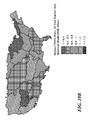
- FIGS. 10-11 show analytics over 18 watersheds that encompass the continental U.S., to obtain a meta-analysis perspective.
- FIG. 5 depicts one month—September—for the years 1950-1974.
- FIGS. 5, 6, and 7 For clarity of depicting the data in FIGS. 5, 6, and 7 , only a single month is shown; it will be appreciated that similar graphs are generated for each month, January to December, for the same time period, 1950-1974.
- Each point is same day temperature (X-axis) and precipitation maxima (Y-axis) from this time period, 1950-1974.
- Larger black dots are observations, and black shading represents 95% regression confidence bounds, and the more opaque black shading represents 95% prediction intervals.
- the other smaller dots represent statistics of GCMs and corresponding lines are their regression fits.
- each GCM can be depicted with, for example, a particular color or symbol to distinguish from the other GCMs.
- This depiction makes the goal of the Bayesian model visual, to provide a posterior that captures the prediction interval (the most opaque bounds) reliably for the current regime and uses those weights for the future climatological regime.
- FIG. 6 is similar to FIG. 5 , but for the month of September for the years 1975-1999.
- This time period is used as a “holdout” a regime for which observations exist, but where the Bayesian model is not actually including them in finding posterior distributions for the random parameters. It can be seen from this time period that a lot of the biases and patterns are the same over different time regimes, lending some confidence that if the system can learn a set of weights that work well in one time period, they should work well later. There are no guarantees given non-stationarity, long lead times, and possible non-linearities when predictions are made much further out into the future.
- FIG. 7 illustrates the projected distribution of extremes for September 1975-1999 as a full probability distribution.
- the solid black dots are actual observations.
- the other symbols (each representing a different model simulation) are the original projections from the 16 climate models.
- the probability distribution is the output from the Bayesian framework.
- the solid vertical line 61 is the average of the observed values, the solid line 62 is the same but for our probability distribution, and the solid line 63 is the same but for the average of the original climate model simulations.
- the dashed lines 64 are 99.9% prediction bounds for the Bayesian outputs (that is, 99.9% of the values from the model fall between these two dashed lines).
- the dashed lines 65 are the minimum and maximum values as obtained from the full set of original climate model outputs.
- FIGS. 10A and 10B show that the posterior mean values of extremes are usually better in terms of error performance compared to the held out observations;
- FIG. 11 shows that the posterior uncertainty intervals are significantly more “precise” (less wide) than using the original, raw GCM forecast bounds implying that the present Bayesian model can be useful for uncertainty reduction.
- FIG. 8 illustrates posterior distributions for the weights, ⁇ j,m , normalized to add up to 1 over each Markov Chain Monte Carlo (MCMC) iteration. This can be a useful diagnostic to understand how “reliable” each GCM's output is and hence how it was weighted in the MCMC routine.
- Each distribution curve can be depicted using a same color or symbol to map to FIGS. 5-7 .
- FIG. 9 illustrates, for all months from 1975-1999, posterior distributions for ⁇ m ′, which can serve to quantify the inferred true relationship (direction and magnitude) between temperature and precipitation extremes and the uncertainty in that relationship.
- the black vertical line is positioned at 0, and the shaded vertical lines are the 99% posterior interval.
- extremes are averaged each quantile and month, for the posterior distribution and then the equal weighted average over the original GCMs forecasts. Then the root mean squared error (RMSE) is computed over all those combinations (25 quantiles (q) ⁇ 12 months (m), so an RMSE is computed over all 300 combinations) with held out observations as the reference set. This is done for each of the 18 watersheds. This is done for the Bayesian posterior averages and then for the multimodel ensemble (MME) average. Then the ratio of those 2 RMSEs is taken. With two exceptions on the west coast, the present model outperforms the MME mean. (Smaller RSME is better.)
- the Bayesian model performs better, according to this measure, for 14 of the 18 watersheds.
- the width of the full Bayesian posterior distribution of m,q′ ′ is computed for each month, and then averaged all 12 months, for the holdout time region (1975-1999).
- the same is computed for the full collection of GCMs (the multimodel ensemble, or MME), which is the maximum data point minus the minimum data point in that collection, over all 12 months.
- MME multimodel ensemble
- the ratio of these two is computed for each watershed.
- the Bayesian model gives a narrower distribution of precipitation extremes in 14 of the 18 watersheds. The notable exception is the red “Lower Mississippi” region, where the Bayesian model projects with much larger uncertainty—which is ultimately an artifact of its sensitivity to several extreme outliers in the original GCM projections.
- the system and method can provide a number of advantages, depending on the embodiment. For example, interconnections between multiple climate variables (such as temperature, rainfall, and wind) can be considered by blending a variety of publicly available climate models and observed datasets. Adaptive metrics can be provided for prediction and uncertainty in stakeholder metrics, like IDF curves, for long lead times into the future. Metrics for evaluating the quality and reliability of climate models can be included that may be useful to the climate modeling scientific community. The system and method can be used at various geospatial and temporal scales to meet stakeholder-specific location and time of event needs.
- climate variables such as temperature, rainfall, and wind
- Adaptive metrics can be provided for prediction and uncertainty in stakeholder metrics, like IDF curves, for long lead times into the future. Metrics for evaluating the quality and reliability of climate models can be included that may be useful to the climate modeling scientific community.
- the system and method can be used at various geospatial and temporal scales to meet stakeholder-specific location and time of event needs.
- the system and method can provide a commercial framework that provides for an improvement in regional and local spatial scale prediction of an uncertainty in extreme weather events and other crucial stakeholder metrics, such as hydrological indicators and Intensity-Duration-Frequency (IDF) curves.
- the best possible predictions and uncertainties can be provided based on the most up to date datasets, unlike current indicators and IDF curves, which are often based on old data and do not consider shifts in global, regional, and local climate conditions.
- the system and method are adaptive and automated, such that a user can query updated predictions and uncertainty bounds that will adjust depending on new observed data and climate models.
Landscapes
- Environmental & Geological Engineering (AREA)
- Engineering & Computer Science (AREA)
- Life Sciences & Earth Sciences (AREA)
- Atmospheric Sciences (AREA)
- Biodiversity & Conservation Biology (AREA)
- Ecology (AREA)
- Environmental Sciences (AREA)
- Management, Administration, Business Operations System, And Electronic Commerce (AREA)
Abstract
Description
-
- obtaining, from one or more climate model datasets, climate model data comprising simulated historical climate model data used in one or more climate models and simulated future climate model data from the one or more climate models;
- obtaining, from one or more climate observational datasets, observational data comprising historical observed climate data;
- providing a statistical distribution of extremes or climate indices for one or more variable climate features using the climate model data and the observational model data;
- determining one or more metrics from the variable climate features, each of the metrics comprising:
- a prediction of a future climate variable for a determined future time period,
- a confidence bound of the prediction of the future climate variable for the determined future time period, and
- a prediction bound for the future climate variable for the determined future time period; and
- outputting the one or more metrics to an output device.
-
- a prediction of a future climate variable for a determined future time period,
- a confidence bound of the prediction of the future climate variable for the determined future time period, and
- a prediction bound for the future climate variable for the determined future time period; and
-
- j: 1, . . . J—index for GCMs
- k: 1, . . . K—index for (potentially multiple) observational datasets
- m: 1, . . . M—index for seasons (e.g., months or summer, autumn, etc.)
- q: 1, . . . Q—index for quantiles of precipitation maxima (i.e., where q=Q is the most extreme precipitation event, one that we only expect to see every Q years and q=1 the least, or an event we expect to be met or exceeded every year). This is for the “historical” data only (i.e., the time regime where we compare observations to GCM back-casts).
- q′: 1, . . . Q′: same, but for the future period, or the time regime for which we are actually trying to build a statistical (distributional) forecast.
Each of the following variables is obtained from data. Each is assumed to follow a distribution captured by a set of random (unknown) parameters. Each are described as follows: - 1. Observed temperature follows a normal distribution with an unknown mean, μm, and known variance, λk −1, which also ultimately serves as the weight we assign to observations in determining ρm:
O k,m,q ·N(μm,λk −1) - 2. Temperature from Global Climate Model (GCM) hindcasts, which also follow a normal distribution with mean μm but also with an unknown bias, γj,m and an unknown variance/inverse weight λj −1. This weight will ultimately determine each GCM's relative contribution to determining μm:
X j,m,q ˜N(μm+γj,m,λj −1) - 3. Temperature from GCM projections, which also follow a normal distribution with mean νm but also with an unknown bias, γj,m′ and the same unknown variance/inverse weight λj −1, but scaled with θm −1 (which, if it's larger than 1, and we want that to be the case, will really be saying temperature in the future is more uncertain/variable than historical temperature, which makes sense):
Y j,m,q′ ˜N(νm+γj,m′,θm −1λj −1) - 4. Historical, observed log-transformed precipitation extremes quantiles also follow a normal distribution with a mean described by a unknown ‘level’, m,q, and a parameter ϕm to quantify how that value varies with temperature. εk,m −1 is the variance; it is fixed, and, as with temperature, also reflects the weight we put on observations:

W k,m,q ˜N(m,qϕm(O k,m,q−μm),εk,m −1) - 5. The same as 4 but for historical GCM simulated precipitation extremes, and with a GCM, season-specific bias term constant over time, τj,m, and a variance (inverse weight) εj,m −1:
Z j,m,q ˜N(m,q+τj,m+ϕm(X j,m,q−μm−γj,m),εj,m −1) - 6. The same as 5 but for future GCM simulated precipitation extremes. The scaling parameter, χm −1, like θm −1 for temperature, if larger than 1, reflects higher uncertainty/variability in future extremes:
Z j,m,q ′˜N(m,q′′+τj,m+ϕm′(Y j,m,q′−νm−γj,m′),χm −1εj,m −1)
The goal is to then find statistical distributions for each of the unknowns that all fall on the right side of the equations 1-6. The ultimately target variables arem,q, andm,q′′−m,q, or the behavior of “true” future precipitation extremes, both alone and compared to historical “true” precipitation extremes. To do this, a Markov Chain Monte Carlo (MCMC) computational routine can be used that looks at each unknown sequentially conditional on current knowledge about every other unknown. This is a Bayesian model, then, which needs prior distributions for each unknown.
P(μm)˜N(μ0,m,σ0,m −1)
P(γj,m)˜N(γ0,m,ζ0,m −1)
P(νm)˜N(ν0,m,η0,m −1)
P(γj,m′)˜N(γ0,m′,κ0,m −1)
P(λj,m)˜G(α0,m,β0,m −1)
P(θm)˜G(δ0,m,∈0,m)
P(
P(τj,m)˜N(τ0,m,∈0,m −1)
P(ϕm)˜N(ϕ0,m,ψ0,m −1)
P(
P(ϕm′)˜N(ϕ0,m′,ω0,m −1)
P(εj,m)˜G(δ0,m,π0,m)
P(χm)˜G(ρ0,m,ρ0,m,)
Claims (54)
Priority Applications (1)
| Application Number | Priority Date | Filing Date | Title |
|---|---|---|---|
| US15/127,635 US10488556B2 (en) | 2014-03-28 | 2015-03-27 | System for multivariate climate change forecasting with uncertainty quantification |
Applications Claiming Priority (4)
| Application Number | Priority Date | Filing Date | Title |
|---|---|---|---|
| US201461971932P | 2014-03-28 | 2014-03-28 | |
| US201461972919P | 2014-03-31 | 2014-03-31 | |
| US15/127,635 US10488556B2 (en) | 2014-03-28 | 2015-03-27 | System for multivariate climate change forecasting with uncertainty quantification |
| PCT/US2015/022922 WO2015148887A1 (en) | 2014-03-28 | 2015-03-27 | System for multivariate climate change forecasting with uncertainty quantification |
Publications (2)
| Publication Number | Publication Date |
|---|---|
| US20170176640A1 US20170176640A1 (en) | 2017-06-22 |
| US10488556B2 true US10488556B2 (en) | 2019-11-26 |
Family
ID=54196430
Family Applications (1)
| Application Number | Title | Priority Date | Filing Date |
|---|---|---|---|
| US15/127,635 Active 2035-10-26 US10488556B2 (en) | 2014-03-28 | 2015-03-27 | System for multivariate climate change forecasting with uncertainty quantification |
Country Status (3)
| Country | Link |
|---|---|
| US (1) | US10488556B2 (en) |
| EP (1) | EP3123267B1 (en) |
| WO (1) | WO2015148887A1 (en) |
Cited By (4)
| Publication number | Priority date | Publication date | Assignee | Title |
|---|---|---|---|---|
| KR20230045303A (en) * | 2021-09-28 | 2023-04-04 | 울산대학교 산학협력단 | apparatus operating method for estimating extreme rainfall based of investigating the future change and apparatus of thereof |
| US11754750B1 (en) | 2023-02-17 | 2023-09-12 | Entropic Innovation Llc | Method and system for short to long-term flood forecasting |
| US11810200B1 (en) * | 2021-08-31 | 2023-11-07 | United Services Automobile Association (Usaa) | System and method for emergency release of funds |
| US20230408991A1 (en) * | 2022-06-17 | 2023-12-21 | University Of Leeds | Systems and Methods for Probabilistic Forecasting of Extremes |
Families Citing this family (52)
| Publication number | Priority date | Publication date | Assignee | Title |
|---|---|---|---|---|
| CN105808948B (en) * | 2016-03-08 | 2017-02-15 | 中国水利水电科学研究院 | Automatic correctional multi-mode value rainfall ensemble forecast method |
| WO2017170086A1 (en) * | 2016-03-31 | 2017-10-05 | 日本電気株式会社 | Information processing system, information processing device, simulation method, and recording medium containing simulation program |
| US11361544B2 (en) | 2017-05-22 | 2022-06-14 | State Farm Mutual Automobile Insurance Company | Systems and methods for determining building damage |
| US11694269B2 (en) * | 2017-08-22 | 2023-07-04 | Entelligent Inc. | Climate data processing and impact prediction systems |
| US10521863B2 (en) * | 2017-08-22 | 2019-12-31 | Bdc Ii, Llc | Climate data processing and impact prediction systems |
| CN108510114B (en) * | 2018-03-27 | 2022-07-08 | 生态环境部核与辐射安全中心 | Nuclear power plant public dose prediction method caused by nuclide in future weather scene |
| CN109002604B (en) * | 2018-07-12 | 2023-04-07 | 山东省农业科学院科技信息研究所 | Soil water content prediction method based on Bayes maximum entropy |
| CN109063905B (en) * | 2018-07-20 | 2021-11-09 | 北京师范大学 | Water resource random planning method adapting to climate change |
| CN109472393B (en) * | 2018-09-30 | 2021-01-15 | 广州地理研究所 | Spatial downscaling precipitation data detection method and device and electronic equipment |
| CN110058328B (en) * | 2019-01-30 | 2021-02-26 | 沈阳区域气候中心 | Multi-mode combined downscaling prediction method for northeast summer rainfall |
| US10871594B2 (en) * | 2019-04-30 | 2020-12-22 | ClimateAI, Inc. | Methods and systems for climate forecasting using artificial neural networks |
| US10909446B2 (en) * | 2019-05-09 | 2021-02-02 | ClimateAI, Inc. | Systems and methods for selecting global climate simulation models for training neural network climate forecasting models |
| US11537889B2 (en) | 2019-05-20 | 2022-12-27 | ClimateAI, Inc. | Systems and methods of data preprocessing and augmentation for neural network climate forecasting models |
| WO2021021852A1 (en) * | 2019-08-01 | 2021-02-04 | The Trustees Of Princeton University | System and method for environment-dependent probabilistic tropical cyclone modeling |
| CN110703358A (en) * | 2019-09-26 | 2020-01-17 | 南京信息工程大学 | Method for calculating influence of sea surface temperature on coastal area precipitation |
| CN111091237B (en) * | 2019-12-01 | 2023-08-18 | 庞轶舒 | Prediction technology for upstream annual runoff of Yangtze river |
| CN111325392B (en) * | 2020-02-18 | 2023-09-29 | 中国气象科学研究院 | Precipitation forecasting system in tropical cyclone process |
| CN111766642B (en) * | 2020-06-16 | 2021-07-23 | 中国气象科学研究院 | Daily precipitation forecast system for landfall tropical cyclone |
| CN111880245B (en) * | 2020-08-03 | 2021-09-24 | 中国气象科学研究院 | Precipitation Forecast System for Landfall of Tropical Cyclones |
| CN111915098B (en) * | 2020-08-16 | 2024-09-13 | 兰州交通大学 | Prediction method for precipitation form transformation based on BP neural network |
| KR102490132B1 (en) * | 2020-12-17 | 2023-01-20 | 대한민국 | Lagrangian convective available potential energy calculation method using back trajectory model |
| US11687620B2 (en) | 2020-12-17 | 2023-06-27 | International Business Machines Corporation | Artificial intelligence generated synthetic image data for use with machine language models |
| CN113128871B (en) * | 2021-04-21 | 2023-10-20 | 中国林业科学研究院资源信息研究所 | Cooperative estimation method for larch distribution change and productivity under climate change condition |
| CN113268710B (en) * | 2021-05-17 | 2024-08-06 | 中国水利水电科学研究院 | Drought extremum information output method and device, electronic equipment and medium |
| CN113487069B (en) * | 2021-06-22 | 2022-10-11 | 浙江大学 | Regional flood disaster risk assessment method based on GRACE daily degradation scale and novel DWSDI index |
| CN113704693B (en) * | 2021-08-19 | 2024-02-02 | 华北电力大学 | A high-precision effective wave height data estimation method |
| CN113849978B (en) * | 2021-09-26 | 2024-09-06 | 华北电力大学 | Optimal selection method for physical parameterization of regional climate model based on variance analysis |
| CN114004449A (en) * | 2021-09-26 | 2022-02-01 | 华北电力大学 | Hot wave identification method considering climate change |
| CN114066059B (en) * | 2021-11-16 | 2023-03-28 | 中科三清科技有限公司 | Method and device for predicting environmental pollution |
| CN114429076A (en) * | 2021-12-01 | 2022-05-03 | 南京师范大学 | Weather evolution simulation method based on Bayes network |
| CN114330850B (en) * | 2021-12-21 | 2023-11-17 | 南京大学 | Abnormal relative trend generation method and system for climate prediction |
| CN114910981B (en) * | 2022-06-15 | 2023-04-11 | 中山大学 | Quantitative evaluation method and system for rainfall forecast overlap and newly added information in adjacent forecast periods |
| CN115168808B (en) * | 2022-07-11 | 2025-06-20 | 中山大学 | A method for analyzing the characteristic quantities of drought-flood sudden transition events |
| CN114970222B (en) * | 2022-08-02 | 2022-11-11 | 中国科学院地理科学与资源研究所 | A HASM-based correction method and system for daily mean temperature deviation in regional climate models |
| CN115358463B (en) * | 2022-08-18 | 2023-06-30 | 长沙学院 | Ecological sensitive area power transmission and transformation construction engineering water environment monitoring and influence assessment method |
| CN115758856B (en) * | 2022-09-09 | 2026-04-07 | 北京师范大学 | A research method for studying the impacts of landscape patterns and climate change on the future water quality of a watershed. |
| CN115563439B (en) * | 2022-10-31 | 2023-05-16 | 深圳市气象局(深圳市气象台) | Calculation method and storage medium of dragon boat water intensity index |
| KR102841986B1 (en) * | 2023-01-06 | 2025-08-04 | 서울대학교산학협력단 | Apparatus and method for predicting severe convective area based on the numerical prediction model |
| CN116523302B (en) * | 2023-04-14 | 2024-06-04 | 中国地质大学(武汉) | Ocean-inland drought event identification and propagation mechanism analysis method and system |
| CN116522764B (en) * | 2023-04-17 | 2023-12-19 | 华中科技大学 | Hot wave-flood composite disaster assessment method considering influence of climate change |
| US20240370802A1 (en) * | 2023-05-05 | 2024-11-07 | Riskthinking.Ai Inc. | System and method for physical climate risk indicators |
| CN116384591B (en) * | 2023-05-23 | 2023-08-29 | 中国水利水电科学研究院 | Drought prediction method, system and medium based on big data |
| CN116451879B (en) * | 2023-06-16 | 2023-08-25 | 武汉大学 | A drought risk prediction method, system and electronic equipment |
| CN117421629B (en) * | 2023-10-12 | 2024-04-09 | 中国地质大学(武汉) | Method for analyzing enhancement mechanism of land water circulation in dry and wet areas and identifying warming signals |
| CN117455041B (en) * | 2023-10-19 | 2024-05-28 | 上海应用技术大学 | A multi-objective control and utilization method for predicted future water resources |
| CN117113515B (en) * | 2023-10-23 | 2024-01-05 | 湖南大学 | Pavement design method, device, equipment and storage medium |
| CN117332909B (en) * | 2023-12-01 | 2024-03-08 | 南京师范大学 | Multi-scale urban waterlogging road traffic exposure prediction method based on intelligent agent |
| CN119513599B (en) * | 2024-11-05 | 2025-11-11 | 华中科技大学 | Agricultural drought prediction method and system integrating space-time feature learning |
| CN119151753B (en) * | 2024-11-13 | 2025-01-24 | 河海大学 | A river-atmosphere coupled heat wave assessment method and system |
| CN119202483B (en) * | 2024-11-29 | 2025-02-07 | 武汉大学 | Extreme precipitation prediction method and device, electronic equipment and storage medium |
| CN121352222B (en) * | 2025-10-20 | 2026-04-21 | 盐源县林业和草原局 | A method for evaluating the effectiveness of forest vegetation restoration |
| CN121009273A (en) * | 2025-10-28 | 2025-11-25 | 山东省计算中心(国家超级计算济南中心) | A Method and System for Calculating the Return Period of Extreme Precipitation Based on an Adaptive Distribution Model |
Citations (14)
| Publication number | Priority date | Publication date | Assignee | Title |
|---|---|---|---|---|
| US6061013A (en) | 1995-12-26 | 2000-05-09 | Thomson-Csf | Method for determining the precipitation ratio by double polarization radar and meteorological radar for implementing such process |
| US20020194113A1 (en) | 2001-06-15 | 2002-12-19 | Abb Group Services Center Ab | System, method and computer program product for risk-minimization and mutual insurance relations in meteorology dependent activities |
| US20060085164A1 (en) * | 2004-10-05 | 2006-04-20 | Leyton Stephen M | Forecast decision system and method |
| US20060271297A1 (en) * | 2005-05-28 | 2006-11-30 | Carlos Repelli | Method and apparatus for providing environmental element prediction data for a point location |
| US7249007B1 (en) * | 2002-01-15 | 2007-07-24 | Dutton John A | Weather and climate variable prediction for management of weather and climate risk |
| US20080167822A1 (en) | 2004-08-03 | 2008-07-10 | Abhl | Climatic Forecast System |
| US20090138415A1 (en) * | 2007-11-02 | 2009-05-28 | James Justin Lancaster | Automated research systems and methods for researching systems |
| US8160995B1 (en) | 2008-04-18 | 2012-04-17 | Wsi, Corporation | Tropical cyclone prediction system and method |
| US8204846B1 (en) * | 2008-04-18 | 2012-06-19 | Wsi, Corporation | Tropical cyclone prediction system and method |
| US20120221376A1 (en) | 2011-02-25 | 2012-08-30 | Intuitive Allocations Llc | System and method for optimization of data sets |
| US20130110399A1 (en) * | 2011-10-31 | 2013-05-02 | Insurance Bureau Of Canada | System and method for predicting and preventing flooding |
| US20130231906A1 (en) * | 2010-10-04 | 2013-09-05 | Ofs Fitel, Llc | Statistical Prediction Functions For Natural Chaotic Systems And Computer Models Thereof |
| US20140372039A1 (en) * | 2013-04-04 | 2014-12-18 | Sky Motion Research, Ulc | Method and system for refining weather forecasts using point observations |
| US20150193713A1 (en) * | 2012-06-12 | 2015-07-09 | Eni S.P.A. | Short- to long-term temperature forecasting system for the production, management and sale of energy resources |
-
2015
- 2015-03-27 EP EP15769898.6A patent/EP3123267B1/en active Active
- 2015-03-27 WO PCT/US2015/022922 patent/WO2015148887A1/en not_active Ceased
- 2015-03-27 US US15/127,635 patent/US10488556B2/en active Active
Patent Citations (14)
| Publication number | Priority date | Publication date | Assignee | Title |
|---|---|---|---|---|
| US6061013A (en) | 1995-12-26 | 2000-05-09 | Thomson-Csf | Method for determining the precipitation ratio by double polarization radar and meteorological radar for implementing such process |
| US20020194113A1 (en) | 2001-06-15 | 2002-12-19 | Abb Group Services Center Ab | System, method and computer program product for risk-minimization and mutual insurance relations in meteorology dependent activities |
| US7249007B1 (en) * | 2002-01-15 | 2007-07-24 | Dutton John A | Weather and climate variable prediction for management of weather and climate risk |
| US20080167822A1 (en) | 2004-08-03 | 2008-07-10 | Abhl | Climatic Forecast System |
| US20060085164A1 (en) * | 2004-10-05 | 2006-04-20 | Leyton Stephen M | Forecast decision system and method |
| US20060271297A1 (en) * | 2005-05-28 | 2006-11-30 | Carlos Repelli | Method and apparatus for providing environmental element prediction data for a point location |
| US20090138415A1 (en) * | 2007-11-02 | 2009-05-28 | James Justin Lancaster | Automated research systems and methods for researching systems |
| US8160995B1 (en) | 2008-04-18 | 2012-04-17 | Wsi, Corporation | Tropical cyclone prediction system and method |
| US8204846B1 (en) * | 2008-04-18 | 2012-06-19 | Wsi, Corporation | Tropical cyclone prediction system and method |
| US20130231906A1 (en) * | 2010-10-04 | 2013-09-05 | Ofs Fitel, Llc | Statistical Prediction Functions For Natural Chaotic Systems And Computer Models Thereof |
| US20120221376A1 (en) | 2011-02-25 | 2012-08-30 | Intuitive Allocations Llc | System and method for optimization of data sets |
| US20130110399A1 (en) * | 2011-10-31 | 2013-05-02 | Insurance Bureau Of Canada | System and method for predicting and preventing flooding |
| US20150193713A1 (en) * | 2012-06-12 | 2015-07-09 | Eni S.P.A. | Short- to long-term temperature forecasting system for the production, management and sale of energy resources |
| US20140372039A1 (en) * | 2013-04-04 | 2014-12-18 | Sky Motion Research, Ulc | Method and system for refining weather forecasts using point observations |
Non-Patent Citations (7)
| Title |
|---|
| A. Schardong, et al., Water Resources Research Report-Computerized Tool for the Development of Intensity-Duration-Frequency Curves under a Changing Climate-Users Manual v.1.1, Department of Civil and Environmental Engineering, The University of Western Ontario, London, Ontario, Canada, Feb. 2015, 70 pgs. |
| A. Schardong, et al., Water Resources Research Report—Computerized Tool for the Development of Intensity-Duration-Frequency Curves under a Changing Climate—Users Manual v.1.1, Department of Civil and Environmental Engineering, The University of Western Ontario, London, Ontario, Canada, Feb. 2015, 70 pgs. |
| C. Huntingford, et al., "Regional climate-model predictions of extreme rainfall for a changing climate", Q. J. R. Meteorol. Soc., (2003), vol. 129, pp. 1607-1621. |
| C. Tebaldi, et al., "Joint projections of temperature and precipitation change from multiple climate models: a hierarchical Bayesian approach", J.R. Statist. Soc. A, (2009), vol. 172, Part 1, pp. 83-106. |
| Ganguly, et al., "Multivariate dependence among extremes, abrupt change and anomalies iin space and time for climate applications", Workshop on "Data Mining for Anomaly Detection" in conjunction with Eleventh ACM SIGKDD International Conference on Knowledge Discovery and Data Mining, KDD ' 05, Aug. 21, 2005, Chicago, IL, pp. 25-26. |
| R.K. Srivastav, et al., Water Resources Research Report-Computerized Tool for the Development of Intensity-Duration-Frequency Curves under a Changing Climate-Technical Manual v.1.1, Department of Civil and Environmental Engineering, The University of Western Ontario, London, Ontario, Canada, Feb. 2015, 94 pgs. |
| R.K. Srivastav, et al., Water Resources Research Report—Computerized Tool for the Development of Intensity-Duration-Frequency Curves under a Changing Climate—Technical Manual v.1.1, Department of Civil and Environmental Engineering, The University of Western Ontario, London, Ontario, Canada, Feb. 2015, 94 pgs. |
Cited By (7)
| Publication number | Priority date | Publication date | Assignee | Title |
|---|---|---|---|---|
| US11810200B1 (en) * | 2021-08-31 | 2023-11-07 | United Services Automobile Association (Usaa) | System and method for emergency release of funds |
| US12340422B1 (en) | 2021-08-31 | 2025-06-24 | United Services Automobile Association (Usaa) | System and method for emergency release of funds |
| KR20230045303A (en) * | 2021-09-28 | 2023-04-04 | 울산대학교 산학협력단 | apparatus operating method for estimating extreme rainfall based of investigating the future change and apparatus of thereof |
| KR102618240B1 (en) | 2021-09-28 | 2023-12-27 | 울산대학교 산학협력단 | apparatus operating method for estimating extreme rainfall based of investigating the future change and apparatus of thereof |
| US20230408991A1 (en) * | 2022-06-17 | 2023-12-21 | University Of Leeds | Systems and Methods for Probabilistic Forecasting of Extremes |
| US12412111B2 (en) * | 2022-06-17 | 2025-09-09 | University Of Leeds | Systems and methods for probabilistic forecasting of extremes |
| US11754750B1 (en) | 2023-02-17 | 2023-09-12 | Entropic Innovation Llc | Method and system for short to long-term flood forecasting |
Also Published As
| Publication number | Publication date |
|---|---|
| EP3123267A1 (en) | 2017-02-01 |
| EP3123267B1 (en) | 2019-10-16 |
| EP3123267A4 (en) | 2017-11-01 |
| US20170176640A1 (en) | 2017-06-22 |
| WO2015148887A1 (en) | 2015-10-01 |
Similar Documents
| Publication | Publication Date | Title |
|---|---|---|
| US10488556B2 (en) | System for multivariate climate change forecasting with uncertainty quantification | |
| Salvi et al. | High‐resolution multisite daily rainfall projections in India with statistical downscaling for climate change impacts assessment | |
| Nault et al. | Predictive models for assessing the passive solar and daylight potential of neighborhood designs: A comparative proof-of-concept study | |
| Herath et al. | A spatial temporal downscaling approach to development of IDF relations for Perth airport region in the context of climate change | |
| Ning et al. | Probabilistic projections of anthropogenic climate change impacts on precipitation for the mid-Atlantic region of the United States | |
| Chavas et al. | US hurricanes and economic damage: Extreme value perspective | |
| Muñoz et al. | Cross–time scale interactions and rainfall extreme events in southeastern South America for the austral summer. Part II: Predictive skill | |
| Rahimi et al. | An uncertainty-based regional comparative analysis on the performance of different bias correction methods in statistical downscaling of precipitation | |
| Lehmann et al. | Spatial modelling framework for the characterisation of rainfall extremes at different durations and under climate change | |
| Della-Marta et al. | Improved estimates of the European winter windstorm climate and the risk of reinsurance loss using climate model data | |
| Rashid et al. | Fluvial flood losses in the contiguous United States under climate change | |
| Renard et al. | A hidden climate indices modeling framework for Multivariable space‐time data | |
| Doss‐Gollin et al. | A subjective Bayesian framework for synthesizing deep uncertainties in climate risk management | |
| Vanem et al. | Bayesian hierarchical space-time models with application to significant wave height | |
| Alizadeh et al. | Improving the outputs of regional heavy rainfall forecasting models using an adaptive real-time approach | |
| Ghosn et al. | Risk-informed design and safety assessment of structures in a changing climate: A review of US practice and a path forward | |
| Roy et al. | Climate scenarios of extreme precipitation using a combination of parametric and non-parametric bias correction methods in the province of Québec | |
| Bhadra et al. | Non-stationary stochastic modelling of precipitation extremes in the changing climate | |
| Acharya et al. | Calibrated multi‐model ensemble seasonal prediction of Bangladesh summer monsoon rainfall | |
| Guardamagna et al. | Detection of limit cycle signatures of El Niño in models and observations using reservoir computing | |
| Dura et al. | Improving Precipitation Interpolation Using Anisotropic Variograms Derived from Convection-Permitting Regional Climate Model Simulations | |
| Mazrooei et al. | Utilizing probabilistic downscaling methods to develop streamflow forecasts from climate forecasts | |
| Salas et al. | Learning inter-annual flood loss risk models from historical flood insurance claims and extreme rainfall data | |
| Miralles | Wind, Hail, and Climate Extremes: Modelling and Attribution Studies for Environmental Data | |
| Lu et al. | Bayesian spatiotemporal nonstationary model quantifies robust increases in daily extreme rainfall across the Western Gulf Coast |
Legal Events
| Date | Code | Title | Description |
|---|---|---|---|
| AS | Assignment |
Owner name: NORTHEASTERN UNIVERSITY, MASSACHUSETTS Free format text: ASSIGNMENT OF ASSIGNORS INTEREST;ASSIGNORS:KODRA, EVAN;GANGULY, AUROOP R.;REEL/FRAME:040059/0766 Effective date: 20150330 |
|
| AS | Assignment |
Owner name: NORTHEASTERN UNIVERSITY, MASSACHUSETTS Free format text: ASSIGNMENT OF ASSIGNORS INTEREST;ASSIGNORS:KODRA, EVAN;GANGULY, AUROOP R.;REEL/FRAME:040087/0883 Effective date: 20150330 |
|
| AS | Assignment |
Owner name: NATIONAL SCIENCE FOUNDATION, VIRGINIA Free format text: CONFIRMATORY LICENSE;ASSIGNOR:NORTHEASTERN UNIVERSITY;REEL/FRAME:041257/0281 Effective date: 20161206 |
|
| STPP | Information on status: patent application and granting procedure in general |
Free format text: FINAL REJECTION MAILED |
|
| STPP | Information on status: patent application and granting procedure in general |
Free format text: NOTICE OF ALLOWANCE MAILED -- APPLICATION RECEIVED IN OFFICE OF PUBLICATIONS |
|
| STPP | Information on status: patent application and granting procedure in general |
Free format text: PUBLICATIONS -- ISSUE FEE PAYMENT VERIFIED |
|
| STCF | Information on status: patent grant |
Free format text: PATENTED CASE |
|
| MAFP | Maintenance fee payment |
Free format text: PAYMENT OF MAINTENANCE FEE, 4TH YR, SMALL ENTITY (ORIGINAL EVENT CODE: M2551); ENTITY STATUS OF PATENT OWNER: SMALL ENTITY Year of fee payment: 4 |