US10487103B2 - Oligonucleotide derivative, oligonucleotide construct using the same, and methods for producing them - Google Patents
Oligonucleotide derivative, oligonucleotide construct using the same, and methods for producing them Download PDFInfo
- Publication number
- US10487103B2 US10487103B2 US15/560,994 US201615560994A US10487103B2 US 10487103 B2 US10487103 B2 US 10487103B2 US 201615560994 A US201615560994 A US 201615560994A US 10487103 B2 US10487103 B2 US 10487103B2
- Authority
- US
- United States
- Prior art keywords
- linker
- oligonucleotide
- compound
- oligonucleotide derivative
- mmol
- Prior art date
- Legal status (The legal status is an assumption and is not a legal conclusion. Google has not performed a legal analysis and makes no representation as to the accuracy of the status listed.)
- Expired - Fee Related
Links
- 0 CC(C*=CI(C)N)O[C@@](CC[*@@](C)C(OC(C)=O)=*O)O Chemical compound CC(C*=CI(C)N)O[C@@](CC[*@@](C)C(OC(C)=O)=*O)O 0.000 description 10
- IQARGOSIBMZSHW-ROULGDKDSA-N CC(C)C1=CC=CC=C1.CC(C)CC(C1=CC=C(C(C)C)C=C1)C(C)C.CC(C)C[C@H]1O[C@@H](C(C)C)C(O)[C@H]1C(C)C.CCC(C)C.CCC(C)C Chemical compound CC(C)C1=CC=CC=C1.CC(C)CC(C1=CC=C(C(C)C)C=C1)C(C)C.CC(C)C[C@H]1O[C@@H](C(C)C)C(O)[C@H]1C(C)C.CCC(C)C.CCC(C)C IQARGOSIBMZSHW-ROULGDKDSA-N 0.000 description 3
- FNQCACPCLJSNRF-JRJZVBNRSA-N CC.CC(=O)NC1[C@@H](C)[C@H](C)C(CO)O[C@H]1OC(C)C.CC(=O)NC1[C@H](OC(C)=O)OC(CC(C)C)[C@@H](C)[C@@H]1C.CC(=O)NC1[C@H](OC(C)C)OC(CO)[C@@H](O)[C@@H]1O.CC(C)C.CC(C)C.CC(C)O[C@@H]1OC(CO)[C@@H](O)[C@H](O)C1N.CC1=CC=C(CN2C=CN=N2)C=C1.CN1C=CN=N1.COCC1=CC(C)=CC(COC)=C1.COCC1=CC(C)=CC(COC)=C1.S.S.S=S.S=S Chemical compound CC.CC(=O)NC1[C@@H](C)[C@H](C)C(CO)O[C@H]1OC(C)C.CC(=O)NC1[C@H](OC(C)=O)OC(CC(C)C)[C@@H](C)[C@@H]1C.CC(=O)NC1[C@H](OC(C)C)OC(CO)[C@@H](O)[C@@H]1O.CC(C)C.CC(C)C.CC(C)O[C@@H]1OC(CO)[C@@H](O)[C@H](O)C1N.CC1=CC=C(CN2C=CN=N2)C=C1.CN1C=CN=N1.COCC1=CC(C)=CC(COC)=C1.COCC1=CC(C)=CC(COC)=C1.S.S.S=S.S=S FNQCACPCLJSNRF-JRJZVBNRSA-N 0.000 description 3
- XTBMVDAFYOEGJU-ANQQTWSLSA-N C.C.CC.CC(=O)NC1[C@@H](C)[C@H](C)C(CO)O[C@H]1OC(C)C.CC(=O)NC1[C@H](OC(C)=O)OC(CC(C)C)[C@@H](C)[C@@H]1C.CC(=O)NC1[C@H](OC(C)C)OC(CO)[C@@H](O)[C@@H]1O.CC(C)C.CC(C)C.CC(C)O[C@@H]1OC(CO)[C@@H](O)[C@H](O)C1N.CC1=CC=C(CN2C=CN=N2)C=C1.CN1C=CN=N1.COCC1=CC(C)=CC(COC)=C1.COCC1=CC(C)=CC(COC)=C1.S.S.S=S.S=S Chemical compound C.C.CC.CC(=O)NC1[C@@H](C)[C@H](C)C(CO)O[C@H]1OC(C)C.CC(=O)NC1[C@H](OC(C)=O)OC(CC(C)C)[C@@H](C)[C@@H]1C.CC(=O)NC1[C@H](OC(C)C)OC(CO)[C@@H](O)[C@@H]1O.CC(C)C.CC(C)C.CC(C)O[C@@H]1OC(CO)[C@@H](O)[C@H](O)C1N.CC1=CC=C(CN2C=CN=N2)C=C1.CN1C=CN=N1.COCC1=CC(C)=CC(COC)=C1.COCC1=CC(C)=CC(COC)=C1.S.S.S=S.S=S XTBMVDAFYOEGJU-ANQQTWSLSA-N 0.000 description 2
- QHZJXAMKJHGLJU-NPJLUWSWSA-N CCC1OC(OC(C)=O)C(C)[C@@H](C)[C@@H]1C.CCC1O[C@H](Br)C(C)[C@@H](C)[C@@H]1C Chemical compound CCC1OC(OC(C)=O)C(C)[C@@H](C)[C@@H]1C.CCC1O[C@H](Br)C(C)[C@@H](C)[C@@H]1C QHZJXAMKJHGLJU-NPJLUWSWSA-N 0.000 description 2
- AJZHZOJBQDUKDN-WBDFAVLPSA-N C#CC1=CC(CO)=CC(CO)=C1.C#CC1=CC(CO)=CC(CO)=C1.CC(=O)NC1[C@H](OC(C)=O)OC(CN2C=C(C3=CC(CO)=CC(CO)=C3)N=N2)[C@@H](C)[C@@H]1C.CC(=O)NC1[C@H](OC(C)=O)OC(CN=[N+]=[N-])[C@@H](C)[C@@H]1C.CC(=O)O[C@@H]1OC(CN2C=C(C3=CC(CO)=CC(CO)=C3)N=N2)[C@@H](C)[C@H](C)C1N.CC(=O)O[C@@H]1OC(CN=[N+]=[N-])[C@@H](C)[C@H](C)C1N.Cl.Cl Chemical compound C#CC1=CC(CO)=CC(CO)=C1.C#CC1=CC(CO)=CC(CO)=C1.CC(=O)NC1[C@H](OC(C)=O)OC(CN2C=C(C3=CC(CO)=CC(CO)=C3)N=N2)[C@@H](C)[C@@H]1C.CC(=O)NC1[C@H](OC(C)=O)OC(CN=[N+]=[N-])[C@@H](C)[C@@H]1C.CC(=O)O[C@@H]1OC(CN2C=C(C3=CC(CO)=CC(CO)=C3)N=N2)[C@@H](C)[C@H](C)C1N.CC(=O)O[C@@H]1OC(CN=[N+]=[N-])[C@@H](C)[C@H](C)C1N.Cl.Cl AJZHZOJBQDUKDN-WBDFAVLPSA-N 0.000 description 1
- YFAAUHHYXYSJNA-WTMQMJMGSA-N C#CC1=CC(CO)=CC(CO)=C1.C#CC1=CC(CO)=CC(COC(C2=CC=CC=C2)(C2=CC=C(OC)C=C2)C2=CC=C(OC)C=C2)=C1.C#CC1=CC(COC(C2=CC=CC=C2)(C2=CC=C(OC)C=C2)C2=CC=C(OC)C=C2)=CC(COC(=O)CCC(=O)CC)=C1.C#CC1=CC(COC(C2=CC=CC=C2)(C2=CC=C(OC)C=C2)C2=CC=C(OC)C=C2)=CC(COC(=O)CCC(=O)O)=C1.C#CC1=CC(COC(C2=CC=CC=C2)(C2=CC=C(OC)C=C2)C2=CC=C(OC)C=C2)=CC(COP(OCCC#N)N(C(C)C)C(C)C)=C1.[2H]CF Chemical compound C#CC1=CC(CO)=CC(CO)=C1.C#CC1=CC(CO)=CC(COC(C2=CC=CC=C2)(C2=CC=C(OC)C=C2)C2=CC=C(OC)C=C2)=C1.C#CC1=CC(COC(C2=CC=CC=C2)(C2=CC=C(OC)C=C2)C2=CC=C(OC)C=C2)=CC(COC(=O)CCC(=O)CC)=C1.C#CC1=CC(COC(C2=CC=CC=C2)(C2=CC=C(OC)C=C2)C2=CC=C(OC)C=C2)=CC(COC(=O)CCC(=O)O)=C1.C#CC1=CC(COC(C2=CC=CC=C2)(C2=CC=C(OC)C=C2)C2=CC=C(OC)C=C2)=CC(COP(OCCC#N)N(C(C)C)C(C)C)=C1.[2H]CF YFAAUHHYXYSJNA-WTMQMJMGSA-N 0.000 description 1
- SRBXRPSQTFGYSC-FVQVZTTNSA-N C#CC1=CC(CO)=CC(CO)=C1.CC(=O)O[C@@H]1OC(CO[C@@H]2OC(CN3C=C(C4=CC(CO)=CC(CO)=C4)N=N3)[C@@H](C)[C@H](C)C2NC(=O)C(F)(F)F)[C@@H](C)[C@H](C)C1NC(=O)C(F)(F)F.CC(=O)O[C@@H]1OC(CO[C@@H]2OC(CN=[N+]=[N-])[C@@H](C)[C@H](C)C2NC(=O)C(F)(F)F)[C@@H](C)[C@H](C)C1NC(=O)C(F)(F)F Chemical compound C#CC1=CC(CO)=CC(CO)=C1.CC(=O)O[C@@H]1OC(CO[C@@H]2OC(CN3C=C(C4=CC(CO)=CC(CO)=C4)N=N3)[C@@H](C)[C@H](C)C2NC(=O)C(F)(F)F)[C@@H](C)[C@H](C)C1NC(=O)C(F)(F)F.CC(=O)O[C@@H]1OC(CO[C@@H]2OC(CN=[N+]=[N-])[C@@H](C)[C@H](C)C2NC(=O)C(F)(F)F)[C@@H](C)[C@H](C)C1NC(=O)C(F)(F)F SRBXRPSQTFGYSC-FVQVZTTNSA-N 0.000 description 1
- GSVDINQZUCBDSB-UHFFFAOYSA-M C#CC1=CC(CO)=CC(CO)=C1.COC(=O)C1=CC(C#C[Si](C)(C)C)=CC(C(=O)OC)=C1.COC(=O)C1=CC(C)=CC(C(=O)OC)=C1.COC(=O)C1=CC(N)=CC(C(=O)OC)=C1.O.O.[AlH3].[K]I.[Li]C1CCCO1 Chemical compound C#CC1=CC(CO)=CC(CO)=C1.COC(=O)C1=CC(C#C[Si](C)(C)C)=CC(C(=O)OC)=C1.COC(=O)C1=CC(C)=CC(C(=O)OC)=C1.COC(=O)C1=CC(N)=CC(C(=O)OC)=C1.O.O.[AlH3].[K]I.[Li]C1CCCO1 GSVDINQZUCBDSB-UHFFFAOYSA-M 0.000 description 1
- HPKIKLGHPPSQGP-ZYHRMMQSSA-N C#CC1=CC(COP(=O)(O)OC2C[C@H](N3C=C(C)C(=O)NC3=O)O[C@@H]2COP(=O)(O)OC2[C@H](O)[C@H](N3C=CC(N)=NC3=O)O[C@@H]2COP(=O)(O)OC(C)C)=CC(CO)=C1 Chemical compound C#CC1=CC(COP(=O)(O)OC2C[C@H](N3C=C(C)C(=O)NC3=O)O[C@@H]2COP(=O)(O)OC2[C@H](O)[C@H](N3C=CC(N)=NC3=O)O[C@@H]2COP(=O)(O)OC(C)C)=CC(CO)=C1 HPKIKLGHPPSQGP-ZYHRMMQSSA-N 0.000 description 1
- MGVIEXMTHGRROK-AMXQZFSZSA-N C#CC1=CC(COP(=O)(O)OCCCCOP(=O)(O)OC2[C@H](O)[C@H](N3C=CC(N)=NC3=O)O[C@@H]2COP(=O)(O)OC(C)C)=CC(CO)=C1 Chemical compound C#CC1=CC(COP(=O)(O)OCCCCOP(=O)(O)OC2[C@H](O)[C@H](N3C=CC(N)=NC3=O)O[C@@H]2COP(=O)(O)OC(C)C)=CC(CO)=C1 MGVIEXMTHGRROK-AMXQZFSZSA-N 0.000 description 1
- SMZYFTMGPLHNRF-LOCWQYTHSA-N C#CC1=CC(COP(=O)(O)OCCCCOP(=O)(O)OCCCCOP(=O)(O)OC2[C@H](O)[C@H](N3C=CC(N)=NC3=O)O[C@@H]2COP(=O)(O)OC(C)C)=CC(CO)=C1 Chemical compound C#CC1=CC(COP(=O)(O)OCCCCOP(=O)(O)OCCCCOP(=O)(O)OC2[C@H](O)[C@H](N3C=CC(N)=NC3=O)O[C@@H]2COP(=O)(O)OC(C)C)=CC(CO)=C1 SMZYFTMGPLHNRF-LOCWQYTHSA-N 0.000 description 1
- BPCJXIPPOAKZPD-LNOSORSNSA-N C.NC[C@@H](CS)C(=O)O.[N-]=[N+]=NCC1=CC=C(C(=O)CCCCCC(=O)CCN2C(=O)C=CC2=O)C=C1.[N-]=[N+]=NCC1=CC=C(C(=O)CCCCCC(=O)CCN2C(=O)CC(SC[C@H](CN)C(=O)O)C2=O)C=C1 Chemical compound C.NC[C@@H](CS)C(=O)O.[N-]=[N+]=NCC1=CC=C(C(=O)CCCCCC(=O)CCN2C(=O)C=CC2=O)C=C1.[N-]=[N+]=NCC1=CC=C(C(=O)CCCCCC(=O)CCN2C(=O)CC(SC[C@H](CN)C(=O)O)C2=O)C=C1 BPCJXIPPOAKZPD-LNOSORSNSA-N 0.000 description 1
- QOMJPXQGSGRURX-ILSQLJLUSA-N C=CCCCCO[C@@H]1OC(CC)[C@@H](C)[C@H](C)C1C.CCC1O[C@@H](OCCCCC(=O)O)C(C)[C@@H](C)[C@@H]1C Chemical compound C=CCCCCO[C@@H]1OC(CC)[C@@H](C)[C@H](C)C1C.CCC1O[C@@H](OCCCCC(=O)O)C(C)[C@@H](C)[C@@H]1C QOMJPXQGSGRURX-ILSQLJLUSA-N 0.000 description 1
- BOXLIQBWIMDKJO-KMHXPMJWSA-N C=CCCCCO[C@@H]1OC(CC)[C@@H](C)[C@H](C)C1C.CCC1O[C@H]2OC(C)=NC2[C@@H](C)[C@@H]1C Chemical compound C=CCCCCO[C@@H]1OC(CC)[C@@H](C)[C@H](C)C1C.CCC1O[C@H]2OC(C)=NC2[C@@H](C)[C@@H]1C BOXLIQBWIMDKJO-KMHXPMJWSA-N 0.000 description 1
- WASVEYPBGOOTEV-CQAKFSJHSA-N CC(=O)NC1[C@H](OC(C)=O)OC(CN2C=C(C3=CC(COC(C)(C)C)=CC(CO)=C3)N=N2)[C@@H](C)[C@@H]1C.CC(=O)O[C@@H]1OC(CN2C=C(C3=CC(COC(C)(C)C)=CC(CO)=C3)N=N2)[C@@H](C)[C@H](C)C1NC(=O)C(F)(F)F Chemical compound CC(=O)NC1[C@H](OC(C)=O)OC(CN2C=C(C3=CC(COC(C)(C)C)=CC(CO)=C3)N=N2)[C@@H](C)[C@@H]1C.CC(=O)O[C@@H]1OC(CN2C=C(C3=CC(COC(C)(C)C)=CC(CO)=C3)N=N2)[C@@H](C)[C@H](C)C1NC(=O)C(F)(F)F WASVEYPBGOOTEV-CQAKFSJHSA-N 0.000 description 1
- BRYJGFISLSQJLU-XSKWACBUSA-N CC(=O)NC1[C@H](OC(C)=O)OC(CN2C=C(C3=CC(COP(=O)(O)OCCCCOP(=O)(O)OCCCCOP(=O)(O)OC4[C@H](O)[C@H](N5C=CC(N)=NC5=O)O[C@@H]4COP(=O)(O)OC(C)C)=CC(CO)=C3)N=N2)[C@@H](C)[C@@H]1C Chemical compound CC(=O)NC1[C@H](OC(C)=O)OC(CN2C=C(C3=CC(COP(=O)(O)OCCCCOP(=O)(O)OCCCCOP(=O)(O)OC4[C@H](O)[C@H](N5C=CC(N)=NC5=O)O[C@@H]4COP(=O)(O)OC(C)C)=CC(CO)=C3)N=N2)[C@@H](C)[C@@H]1C BRYJGFISLSQJLU-XSKWACBUSA-N 0.000 description 1
- YHHYSSBJOPUJFJ-AVPJCNCSSA-N CC(=O)NC1[C@H](OC(C)=O)OC(CN=[N+]=[N-])[C@@H](C)[C@@H]1C.CC(=O)O[C@@H]1OC(CN=[N+]=[N-])[C@@H](C)[C@H](C)C1N.Cl Chemical compound CC(=O)NC1[C@H](OC(C)=O)OC(CN=[N+]=[N-])[C@@H](C)[C@@H]1C.CC(=O)O[C@@H]1OC(CN=[N+]=[N-])[C@@H](C)[C@H](C)C1N.Cl YHHYSSBJOPUJFJ-AVPJCNCSSA-N 0.000 description 1
- JTFNPOSGFMELPI-GBWDSTPJSA-N CC(=O)OC1[C@H](OC(C)=O)[C@@H](N=[N+]=[N-])OC(C)[C@H]1C.CC(=O)OC1[C@H](OC(C)=O)[C@H](Br)OC(C)[C@H]1C Chemical compound CC(=O)OC1[C@H](OC(C)=O)[C@@H](N=[N+]=[N-])OC(C)[C@H]1C.CC(=O)OC1[C@H](OC(C)=O)[C@H](Br)OC(C)[C@H]1C JTFNPOSGFMELPI-GBWDSTPJSA-N 0.000 description 1
- QELKNWPPPNLXOL-LTTVBEHHSA-N CC(=O)OC1[C@H](OC(C)=O)[C@@H](N=[N+]=[N-])OC(C)[C@H]1C.CC1O[C@H](N=[N+]=[N-])[C@@H](O)C(O)[C@@H]1O Chemical compound CC(=O)OC1[C@H](OC(C)=O)[C@@H](N=[N+]=[N-])OC(C)[C@H]1C.CC1O[C@H](N=[N+]=[N-])[C@@H](O)C(O)[C@@H]1O QELKNWPPPNLXOL-LTTVBEHHSA-N 0.000 description 1
- QILMCUAWKGENKQ-SYDBGMQASA-N CC(=O)OC1[C@H](OC(C)=O)[C@@H](OCCCCCCNC(=O)C2=CC=C(CN=[N+]=[N-])C=C2)OC(C)[C@H]1C.CC(=O)OC1[C@H](OC(C)=O)[C@H](Br)OC(C)[C@H]1C Chemical compound CC(=O)OC1[C@H](OC(C)=O)[C@@H](OCCCCCCNC(=O)C2=CC=C(CN=[N+]=[N-])C=C2)OC(C)[C@H]1C.CC(=O)OC1[C@H](OC(C)=O)[C@H](Br)OC(C)[C@H]1C QILMCUAWKGENKQ-SYDBGMQASA-N 0.000 description 1
- DDZBDEOCHZMZCE-BRMDHFTISA-N CC(=O)OC1[C@H](OC(C)=O)[C@@H](OCCCCCCNC(=O)C2=CC=C(CN=[N+]=[N-])C=C2)OC(C)[C@H]1C.CC1O[C@H](OCCCCCCNC(=O)C2=CC=C(CN=[N+]=[N-])C=C2)[C@@H](O)C(O)[C@@H]1O Chemical compound CC(=O)OC1[C@H](OC(C)=O)[C@@H](OCCCCCCNC(=O)C2=CC=C(CN=[N+]=[N-])C=C2)OC(C)[C@H]1C.CC1O[C@H](OCCCCCCNC(=O)C2=CC=C(CN=[N+]=[N-])C=C2)[C@@H](O)C(O)[C@@H]1O DDZBDEOCHZMZCE-BRMDHFTISA-N 0.000 description 1
- JNPJBSOXCCWFFU-IWNAKNIHSA-N CC(=O)OC1[C@H](OC(C)=O)[C@H](Br)OC(C)[C@H]1C.CC(=O)OC1[C@H](OC(C)=O)[C@H](OC(C)=O)OC(C)[C@H]1C Chemical compound CC(=O)OC1[C@H](OC(C)=O)[C@H](Br)OC(C)[C@H]1C.CC(=O)OC1[C@H](OC(C)=O)[C@H](OC(C)=O)OC(C)[C@H]1C JNPJBSOXCCWFFU-IWNAKNIHSA-N 0.000 description 1
- WRRKGPDBCFFZJE-MVKJYLOESA-N CC(=O)O[C@@H]1OC(CN=[N+]=[N-])[C@@H](C)[C@H](C)C1N.CC(=O)O[C@@H]1OC(CN=[N+]=[N-])[C@@H](C)[C@H](C)C1NC(=O)C(F)(F)F.C[C@@H]1C(CN=[N+]=[N-])O[C@@H](SC2=CC=CC=C2)C(NC(=O)C(F)(F)F)[C@H]1C.Cl Chemical compound CC(=O)O[C@@H]1OC(CN=[N+]=[N-])[C@@H](C)[C@H](C)C1N.CC(=O)O[C@@H]1OC(CN=[N+]=[N-])[C@@H](C)[C@H](C)C1NC(=O)C(F)(F)F.C[C@@H]1C(CN=[N+]=[N-])O[C@@H](SC2=CC=CC=C2)C(NC(=O)C(F)(F)F)[C@H]1C.Cl WRRKGPDBCFFZJE-MVKJYLOESA-N 0.000 description 1
- TYZAWHBUAYUWQH-YAQXKLQRSA-N CC(=O)O[C@@H]1OC(CO)[C@@H](C)[C@H](C)C1N.CC(=O)O[C@@H]1OC(CO)[C@@H](C)[C@H](C)C1NC(=O)C(F)(F)F.COC1=CC=C(/C=N/C2[C@H](O)OC(CO)[C@@H](O)[C@@H]2O)C=C1.COC1=CC=C(/C=N/C2[C@H](OC(C)=O)OC(CO[Si](C)(C)C(C)(C)C)[C@@H](C)[C@@H]2C)C=C1.Cl Chemical compound CC(=O)O[C@@H]1OC(CO)[C@@H](C)[C@H](C)C1N.CC(=O)O[C@@H]1OC(CO)[C@@H](C)[C@H](C)C1NC(=O)C(F)(F)F.COC1=CC=C(/C=N/C2[C@H](O)OC(CO)[C@@H](O)[C@@H]2O)C=C1.COC1=CC=C(/C=N/C2[C@H](OC(C)=O)OC(CO[Si](C)(C)C(C)(C)C)[C@@H](C)[C@@H]2C)C=C1.Cl TYZAWHBUAYUWQH-YAQXKLQRSA-N 0.000 description 1
- AYWKQNYUGUGQCK-CBVACOKCSA-N CC(=O)O[C@@H]1OC(CO)[C@@H](C)[C@H](C)C1NC(=O)C(F)(F)F.CC(=O)O[C@@H]1OC(COC(=O)CCCCCCCCCCNC(=O)C2=CC(CN=[N+]=[N-])=CC=C2)[C@@H](C)[C@H](C)C1NC(=O)C(F)(F)F.[N-]=[N+]=NCC1=CC=C(C(=O)CCCCCCCCCCCC(=O)O)C=C1 Chemical compound CC(=O)O[C@@H]1OC(CO)[C@@H](C)[C@H](C)C1NC(=O)C(F)(F)F.CC(=O)O[C@@H]1OC(COC(=O)CCCCCCCCCCNC(=O)C2=CC(CN=[N+]=[N-])=CC=C2)[C@@H](C)[C@H](C)C1NC(=O)C(F)(F)F.[N-]=[N+]=NCC1=CC=C(C(=O)CCCCCCCCCCCC(=O)O)C=C1 AYWKQNYUGUGQCK-CBVACOKCSA-N 0.000 description 1
- LDBPSSAYYDMPLR-GOPINVFPSA-N CC(=O)O[C@@H]1OC(CO)[C@@H](C)[C@H](C)C1NC(=O)C(F)(F)F.CC(=O)O[C@@H]1OC(CO[C@@H]2OC(CN=[N+]=[N-])[C@@H](C)[C@H](C)C2NC(=O)C(F)(F)F)[C@@H](C)[C@H](C)C1NC(=O)C(F)(F)F.C[C@@H]1C(CN=[N+]=[N-])O[C@@H](SC2=CC=CC=C2)C(NC(=O)C(F)(F)F)[C@H]1C Chemical compound CC(=O)O[C@@H]1OC(CO)[C@@H](C)[C@H](C)C1NC(=O)C(F)(F)F.CC(=O)O[C@@H]1OC(CO[C@@H]2OC(CN=[N+]=[N-])[C@@H](C)[C@H](C)C2NC(=O)C(F)(F)F)[C@@H](C)[C@H](C)C1NC(=O)C(F)(F)F.C[C@@H]1C(CN=[N+]=[N-])O[C@@H](SC2=CC=CC=C2)C(NC(=O)C(F)(F)F)[C@H]1C LDBPSSAYYDMPLR-GOPINVFPSA-N 0.000 description 1
- OIQNLBSKTNFRPC-KXXATFGHSA-N CC(=O)O[C@@H]1OC(COC=O)[C@@H](C)[C@H](C)C1C.CC1[C@@H](C)[C@H](C)C(COC=O)O[C@@H]1Br Chemical compound CC(=O)O[C@@H]1OC(COC=O)[C@@H](C)[C@H](C)C1C.CC1[C@@H](C)[C@H](C)C(COC=O)O[C@@H]1Br OIQNLBSKTNFRPC-KXXATFGHSA-N 0.000 description 1
- OJPLAMJLGWWMQN-OUSDXWPNSA-N CC(C)(C)N[C@@H](CCNC(=O)CCCCCCC(=O)C(C)(C)C)C(=O)O.CC(C)(C)SC1CC(=O)N(CCC(=O)CCCCCC(=O)C(C)(C)C)C1=O Chemical compound CC(C)(C)N[C@@H](CCNC(=O)CCCCCCC(=O)C(C)(C)C)C(=O)O.CC(C)(C)SC1CC(=O)N(CCC(=O)CCCCCC(=O)C(C)(C)C)C1=O OJPLAMJLGWWMQN-OUSDXWPNSA-N 0.000 description 1
- XCGNLZLCDLBHLF-UHFFFAOYSA-N CC.CC1=CC=C(CN=[N+]=[N-])C=C1.CN=[N+]=[N-].S.S Chemical compound CC.CC1=CC=C(CN=[N+]=[N-])C=C1.CN=[N+]=[N-].S.S XCGNLZLCDLBHLF-UHFFFAOYSA-N 0.000 description 1
- AAQDSXJDAJDRCD-JDQGRTGVSA-N CC1[C@@H](C)[C@H](C)C(COC=O)O[C@@H]1Br.CC1[C@@H](C)[C@H](C)C(COC=O)O[C@H]1N=[N+]=[N-] Chemical compound CC1[C@@H](C)[C@H](C)C(COC=O)O[C@@H]1Br.CC1[C@@H](C)[C@H](C)C(COC=O)O[C@H]1N=[N+]=[N-] AAQDSXJDAJDRCD-JDQGRTGVSA-N 0.000 description 1
- JTIFUVSIHZMGKD-UDHXOZEKSA-N CC1[C@H](OCCCCCCNC(=O)C2=CC=C(CN=[N+]=[N-])C=C2)OC(CO)[C@@H](O)[C@@H]1O.CCC1O[C@@H](OCCCCCCNC(=O)C2=CC=C(CN=[N+]=[N-])C=C2)C(C)[C@@H](C)[C@@H]1C Chemical compound CC1[C@H](OCCCCCCNC(=O)C2=CC=C(CN=[N+]=[N-])C=C2)OC(CO)[C@@H](O)[C@@H]1O.CCC1O[C@@H](OCCCCCCNC(=O)C2=CC=C(CN=[N+]=[N-])C=C2)C(C)[C@@H](C)[C@@H]1C JTIFUVSIHZMGKD-UDHXOZEKSA-N 0.000 description 1
- FSKGPHBBJAXQDH-RVKSACAYSA-N CCC1O[C@@H](CC(=O)CCCCCNC(=O)C2=CC=C(CN=[N+]=[N-])C=C2)C(C)[C@@H](C)[C@@H]1C.CCC1O[C@@H](N)C(C)[C@@H](C)[C@@H]1C Chemical compound CCC1O[C@@H](CC(=O)CCCCCNC(=O)C2=CC=C(CN=[N+]=[N-])C=C2)C(C)[C@@H](C)[C@@H]1C.CCC1O[C@@H](N)C(C)[C@@H](C)[C@@H]1C FSKGPHBBJAXQDH-RVKSACAYSA-N 0.000 description 1
- FEZCTYKLNUHAJU-OAEXCJKNSA-N CCC1O[C@@H](N)C(C)[C@@H](C)[C@@H]1C.CCC1O[C@@H](N=[N+]=[N-])C(C)[C@@H](C)[C@@H]1C Chemical compound CCC1O[C@@H](N)C(C)[C@@H](C)[C@@H]1C.CCC1O[C@@H](N=[N+]=[N-])C(C)[C@@H](C)[C@@H]1C FEZCTYKLNUHAJU-OAEXCJKNSA-N 0.000 description 1
- MLLZQPVDORSCFT-JDQGRTGVSA-N CCC1O[C@@H](N=[N+]=[N-])C(C)[C@@H](C)[C@@H]1C.CCC1O[C@H](Br)C(C)[C@@H](C)[C@@H]1C Chemical compound CCC1O[C@@H](N=[N+]=[N-])C(C)[C@@H](C)[C@@H]1C.CCC1O[C@H](Br)C(C)[C@@H](C)[C@@H]1C MLLZQPVDORSCFT-JDQGRTGVSA-N 0.000 description 1
- PROCILHBVCRECU-MAPMSLJJSA-N CCC1O[C@@H](N=[N+]=[N-])C(C)[C@@H](C)[C@@H]1C.[N-]=[N+]=N[C@@H]1OC(CO)[C@@H](O)[C@H](O)C1O Chemical compound CCC1O[C@@H](N=[N+]=[N-])C(C)[C@@H](C)[C@@H]1C.[N-]=[N+]=N[C@@H]1OC(CO)[C@@H](O)[C@H](O)C1O PROCILHBVCRECU-MAPMSLJJSA-N 0.000 description 1
- AOHNBPRKLUKOKX-IUACGECDSA-N CCC1O[C@@H](OC(C)=O)C(NC(C)=O)[C@@H](C)[C@@H]1C.CCC1O[C@H](Br)C(NC(C)=O)[C@@H](C)[C@@H]1C Chemical compound CCC1O[C@@H](OC(C)=O)C(NC(C)=O)[C@@H](C)[C@@H]1C.CCC1O[C@H](Br)C(NC(C)=O)[C@@H](C)[C@@H]1C AOHNBPRKLUKOKX-IUACGECDSA-N 0.000 description 1
- ATEBKXSHANDQSS-CKSUSPACSA-N CCC1O[C@@H](OCCCCCCCC(=O)C2=CC=C(CN=[N+]=[N-])C=C2)C(C)[C@@H](C)[C@@H]1C.CCC1O[C@H](Br)C(C)[C@@H](C)[C@@H]1C Chemical compound CCC1O[C@@H](OCCCCCCCC(=O)C2=CC=C(CN=[N+]=[N-])C=C2)C(C)[C@@H](C)[C@@H]1C.CCC1O[C@H](Br)C(C)[C@@H](C)[C@@H]1C ATEBKXSHANDQSS-CKSUSPACSA-N 0.000 description 1
- GIFRQMWLFRVHFX-RNJZACOFSA-N CCC1O[C@@H](OCCCCCCCC(=O)C2=CC=C(CN=[N+]=[N-])C=C2)C(C)[C@@H](C)[C@@H]1C.[N-]=[N+]=NCC1=CC=C(C(=O)CCCCCCCO[C@@H]2OC(CO)[C@@H](O)[C@H](O)C2O)C=C1 Chemical compound CCC1O[C@@H](OCCCCCCCC(=O)C2=CC=C(CN=[N+]=[N-])C=C2)C(C)[C@@H](C)[C@@H]1C.[N-]=[N+]=NCC1=CC=C(C(=O)CCCCCCCO[C@@H]2OC(CO)[C@@H](O)[C@H](O)C2O)C=C1 GIFRQMWLFRVHFX-RNJZACOFSA-N 0.000 description 1
- PIHJATXDELKHFK-VYZDIMOMSA-N CCC1O[C@@H](OCCCCCCNC(=O)C2=CC=C(CN=[N+]=[N-])C=C2)C(C)[C@@H](C)[C@@H]1C.CCC1O[C@H](Br)C(C)[C@@H](C)[C@@H]1C Chemical compound CCC1O[C@@H](OCCCCCCNC(=O)C2=CC=C(CN=[N+]=[N-])C=C2)C(C)[C@@H](C)[C@@H]1C.CCC1O[C@H](Br)C(C)[C@@H](C)[C@@H]1C PIHJATXDELKHFK-VYZDIMOMSA-N 0.000 description 1
- KLDGANNZXKZFBE-NVABVTTASA-N CCC1O[C@@H](OCCCCCCNC(=O)C2=CC=C(CN=[N+]=[N-])C=C2)C(C)[C@@H](C)[C@@H]1C.CCC1O[C@H]2OC(C)=NC2[C@@H](C)[C@@H]1C Chemical compound CCC1O[C@@H](OCCCCCCNC(=O)C2=CC=C(CN=[N+]=[N-])C=C2)C(C)[C@@H](C)[C@@H]1C.CCC1O[C@H]2OC(C)=NC2[C@@H](C)[C@@H]1C KLDGANNZXKZFBE-NVABVTTASA-N 0.000 description 1
- JQKIZLVTOYKBED-XFZGEFQRSA-N CCC1O[C@@H](OCCCCCCNC(=O)C2=CC=C(CN=[N+]=[N-])C=C2)C(C)[C@@H](C)[C@@H]1C.[N-]=[N+]=NCC1=CC=C(C(=O)NCCCCCCO[C@@H]2OC(CO)[C@@H](O)[C@H](O)C2O)C=C1 Chemical compound CCC1O[C@@H](OCCCCCCNC(=O)C2=CC=C(CN=[N+]=[N-])C=C2)C(C)[C@@H](C)[C@@H]1C.[N-]=[N+]=NCC1=CC=C(C(=O)NCCCCCCO[C@@H]2OC(CO)[C@@H](O)[C@H](O)C2O)C=C1 JQKIZLVTOYKBED-XFZGEFQRSA-N 0.000 description 1
- PGBLFEFFAHPYRP-IYJNPXDUSA-N CCC1O[C@@H](OCCCCCCNC(=O)C2=CC=C(CN=[N+]=[N-])C=C2)C(NC(C)=O)[C@@H](C)[C@@H]1C.CCC1O[C@H](Br)C(NC(C)=O)[C@@H](C)[C@@H]1C Chemical compound CCC1O[C@@H](OCCCCCCNC(=O)C2=CC=C(CN=[N+]=[N-])C=C2)C(NC(C)=O)[C@@H](C)[C@@H]1C.CCC1O[C@H](Br)C(NC(C)=O)[C@@H](C)[C@@H]1C PGBLFEFFAHPYRP-IYJNPXDUSA-N 0.000 description 1
- RVVMXSJRDVYMDR-BQTUIPBPSA-N CCC1O[C@@H](OCCCCCCNC(=O)C2=CC=C(CN=[N+]=[N-])C=C2)C(NC(C)=O)[C@@H](C)[C@@H]1C.[N-]=[N+]=NCC1=CC=C(C(=O)NCCCCCCO[C@@H]2OC(CO)[C@@H](O)[C@H](O)C2N)C=C1 Chemical compound CCC1O[C@@H](OCCCCCCNC(=O)C2=CC=C(CN=[N+]=[N-])C=C2)C(NC(C)=O)[C@@H](C)[C@@H]1C.[N-]=[N+]=NCC1=CC=C(C(=O)NCCCCCCO[C@@H]2OC(CO)[C@@H](O)[C@H](O)C2N)C=C1 RVVMXSJRDVYMDR-BQTUIPBPSA-N 0.000 description 1
- WRWHMULHVNHDMD-UHFFFAOYSA-N CCCCCC(=O)CCOCC(COCCC(=O)CCCCNC(=O)OC(C)(C)C)(COCCC(=O)NCCCC)CC(=O)CCCCCCCCCCCC(=O)C1=CC=C(CN=[N+]=[N-])C=C1.[N-]=[N+]=NCC1=CC=C(C(=O)CCCCCCCCCCCC(=O)CC(COCCC(=O)CCCCN)(COCCC(=O)CCCCN)COCCC(=O)NCCCN)C=C1 Chemical compound CCCCCC(=O)CCOCC(COCCC(=O)CCCCNC(=O)OC(C)(C)C)(COCCC(=O)NCCCC)CC(=O)CCCCCCCCCCCC(=O)C1=CC=C(CN=[N+]=[N-])C=C1.[N-]=[N+]=NCC1=CC=C(C(=O)CCCCCCCCCCCC(=O)CC(COCCC(=O)CCCCN)(COCCC(=O)CCCCN)COCCC(=O)NCCCN)C=C1 WRWHMULHVNHDMD-UHFFFAOYSA-N 0.000 description 1
- IAIITOZAKUHDDV-UHFFFAOYSA-N CCCCCC(=O)CCOCC(COCCC(=O)CCCCNC(=O)OC(C)(C)C)(COCCC(=O)NCCCC)CC(=O)CCCCCCCCCCCC(=O)C1=CC=C(CN=[N+]=[N-])C=C1.[N-]=[N+]=NCC1=CC=C(C(=O)CCCCCCCCCCCC(=O)CC(COCCOC=O)(COCCOC=O)COCCOC=O)C=C1 Chemical compound CCCCCC(=O)CCOCC(COCCC(=O)CCCCNC(=O)OC(C)(C)C)(COCCC(=O)NCCCC)CC(=O)CCCCCCCCCCCC(=O)C1=CC=C(CN=[N+]=[N-])C=C1.[N-]=[N+]=NCC1=CC=C(C(=O)CCCCCCCCCCCC(=O)CC(COCCOC=O)(COCCOC=O)COCCOC=O)C=C1 IAIITOZAKUHDDV-UHFFFAOYSA-N 0.000 description 1
- MDJAVVNVBITJEW-GQXQWGJUSA-N CCCCCCCCCCCCCCCC[C@]1(C)CCC2=C(C)C(O)=C(C)C(C)=C2O1.CCCCCCCCCCCCCCCC[C@]1(C)CCC2=C(C)C(OCCCCCCO)=C(C)C(C)=C2O1 Chemical compound CCCCCCCCCCCCCCCC[C@]1(C)CCC2=C(C)C(O)=C(C)C(C)=C2O1.CCCCCCCCCCCCCCCC[C@]1(C)CCC2=C(C)C(OCCCCCCO)=C(C)C(C)=C2O1 MDJAVVNVBITJEW-GQXQWGJUSA-N 0.000 description 1
- ACEKUOSHBGJAFS-FTPHSQSGSA-N CCCCCCCCCCCCCCCC[C@]1(C)CCC2=C(C)C(OCCCCCCN=[N+]=[N-])=C(C)C(C)=C2O1.CCCCCCCCCCCCCCCC[C@]1(C)CCC2=C(C)C(OCCCCCCO)=C(C)C(C)=C2O1 Chemical compound CCCCCCCCCCCCCCCC[C@]1(C)CCC2=C(C)C(OCCCCCCN=[N+]=[N-])=C(C)C(C)=C2O1.CCCCCCCCCCCCCCCC[C@]1(C)CCC2=C(C)C(OCCCCCCO)=C(C)C(C)=C2O1 ACEKUOSHBGJAFS-FTPHSQSGSA-N 0.000 description 1
- TVNVNGCRTCVIPM-UHFFFAOYSA-N CCCCCO.CCCCCOP(OCCC#N)N(C(C)C)C(C)C.COC1=CC=C(C(Cl)(C2=CC=CC=C2)C2=CC=C(OC)C=C2)C=C1.OCCCCO Chemical compound CCCCCO.CCCCCOP(OCCC#N)N(C(C)C)C(C)C.COC1=CC=C(C(Cl)(C2=CC=CC=C2)C2=CC=C(OC)C=C2)C=C1.OCCCCO TVNVNGCRTCVIPM-UHFFFAOYSA-N 0.000 description 1
- USDHWVUHQYAPAT-UHFFFAOYSA-N CCCOCC(COCCC)(COCCC)CC(=O)CCCCCCCCCCCC(=O)C1=CC=C(CN=[N+]=[N-])C=C1.O=C=O.O=C=O.O=C=O.[N-]=[N+]=NCC1=CC=C(C(=O)CCCCCCCCCCCC(=O)CC(COCCOC=O)(COCCOC=O)COCCOC=O)C=C1 Chemical compound CCCOCC(COCCC)(COCCC)CC(=O)CCCCCCCCCCCC(=O)C1=CC=C(CN=[N+]=[N-])C=C1.O=C=O.O=C=O.O=C=O.[N-]=[N+]=NCC1=CC=C(C(=O)CCCCCCCCCCCC(=O)CC(COCCOC=O)(COCCOC=O)COCCOC=O)C=C1 USDHWVUHQYAPAT-UHFFFAOYSA-N 0.000 description 1
- YIFHBEWQIBEUHH-UHFFFAOYSA-N CCCOCC(COCCC)(COCCC)CC(=O)CCCCCCCCCCCC(=O)C1=CC=C(CN=[N+]=[N-])C=C1.O=C=O.O=C=O.O=C=O.[N-]=[N+]=NCC1=CC=C(C(=O)CCCCCCCCCCCOC=O)C=C1 Chemical compound CCCOCC(COCCC)(COCCC)CC(=O)CCCCCCCCCCCC(=O)C1=CC=C(CN=[N+]=[N-])C=C1.O=C=O.O=C=O.O=C=O.[N-]=[N+]=NCC1=CC=C(C(=O)CCCCCCCCCCCOC=O)C=C1 YIFHBEWQIBEUHH-UHFFFAOYSA-N 0.000 description 1
- OSUCHZIILUMZOF-UHFFFAOYSA-N NCCCCCC(=O)O.[N-]=[N+]=NCC1=CC=C(C(=O)CCCCCCC(=O)O)C=C1.[N-]=[N+]=NCC1=CC=C(C(=O)ON2C(=O)CCC2=O)C=C1 Chemical compound NCCCCCC(=O)O.[N-]=[N+]=NCC1=CC=C(C(=O)CCCCCCC(=O)O)C=C1.[N-]=[N+]=NCC1=CC=C(C(=O)ON2C(=O)CCC2=O)C=C1 OSUCHZIILUMZOF-UHFFFAOYSA-N 0.000 description 1
- DQJOGTFRDJZEMD-UHFFFAOYSA-N NCCCCCCCCCCC(=O)O.[N-]=[N+]=NCC1=CC=C(C(=O)CCCCCCCCCCCC(=O)O)C=C1.[N-]=[N+]=NCC1=CC=C(C(=O)ON2C(=O)CCC2=O)C=C1 Chemical compound NCCCCCCCCCCC(=O)O.[N-]=[N+]=NCC1=CC=C(C(=O)CCCCCCCCCCCC(=O)O)C=C1.[N-]=[N+]=NCC1=CC=C(C(=O)ON2C(=O)CCC2=O)C=C1 DQJOGTFRDJZEMD-UHFFFAOYSA-N 0.000 description 1
- NWDXARYGYGNZDP-UHFFFAOYSA-N NCCCCCCO.[N-]=[N+]=NCC1=CC=C(C(=O)CCCCCCCO)C=C1.[N-]=[N+]=NCC1=CC=C(C(=O)ON2C(=O)CCC2=O)C=C1 Chemical compound NCCCCCCO.[N-]=[N+]=NCC1=CC=C(C(=O)CCCCCCCO)C=C1.[N-]=[N+]=NCC1=CC=C(C(=O)ON2C(=O)CCC2=O)C=C1 NWDXARYGYGNZDP-UHFFFAOYSA-N 0.000 description 1
- KVPDYLPFMVYLBB-BCUMBMMVSA-N NCCCC[C@H](CN)C(=O)O.[N-]=[N+]=NCC1=CC=C(C(=O)CCCCCCC(=O)NCCCC[C@H](CN)C(=O)O)C=C1.[N-]=[N+]=NCC1=CC=C(C(=O)CCCCCCC(=O)ON2C(=O)CCC2=O)C=C1 Chemical compound NCCCC[C@H](CN)C(=O)O.[N-]=[N+]=NCC1=CC=C(C(=O)CCCCCCC(=O)NCCCC[C@H](CN)C(=O)O)C=C1.[N-]=[N+]=NCC1=CC=C(C(=O)CCCCCCC(=O)ON2C(=O)CCC2=O)C=C1 KVPDYLPFMVYLBB-BCUMBMMVSA-N 0.000 description 1
- FORWFOIWGAGFHJ-UHFFFAOYSA-N NCCCN.[N-]=[N+]=NCC1=CC=C(C(=O)CCCCN)C=C1.[N-]=[N+]=NCC1=CC=C(C(=O)ON2C(=O)CCC2=O)C=C1 Chemical compound NCCCN.[N-]=[N+]=NCC1=CC=C(C(=O)CCCCN)C=C1.[N-]=[N+]=NCC1=CC=C(C(=O)ON2C(=O)CCC2=O)C=C1 FORWFOIWGAGFHJ-UHFFFAOYSA-N 0.000 description 1
- HHMMZCMTFXZWCM-UHFFFAOYSA-N NCCOCCOCCN.[N-]=[N+]=NCC1=CC=C(C(=O)CCCOCCOCCN)C=C1.[N-]=[N+]=NCC1=CC=C(C(=O)ON2C(=O)CCC2=O)C=C1 Chemical compound NCCOCCOCCN.[N-]=[N+]=NCC1=CC=C(C(=O)CCCOCCOCCN)C=C1.[N-]=[N+]=NCC1=CC=C(C(=O)ON2C(=O)CCC2=O)C=C1 HHMMZCMTFXZWCM-UHFFFAOYSA-N 0.000 description 1
- LXAAPJVDUXUWBJ-KBGNDYOISA-N OCC1OC(O)C(O)[C@@H](O)[C@@H]1O.[N-]=[N+]=N[C@H]1OC(CO)[C@@H](O)[C@H](O)C1O Chemical compound OCC1OC(O)C(O)[C@@H](O)[C@@H]1O.[N-]=[N+]=N[C@H]1OC(CO)[C@@H](O)[C@H](O)C1O LXAAPJVDUXUWBJ-KBGNDYOISA-N 0.000 description 1
- RSOUKFQVLPTLEH-UHFFFAOYSA-N [N-]=[N+]=NCC1=CC=C(C(=O)CCCCCC(=O)CCN2C(=O)C=CC2=O)C=C1.[N-]=[N+]=NCC1=CC=C(C(=O)CCCCN)C=C1 Chemical compound [N-]=[N+]=NCC1=CC=C(C(=O)CCCCCC(=O)CCN2C(=O)C=CC2=O)C=C1.[N-]=[N+]=NCC1=CC=C(C(=O)CCCCN)C=C1 RSOUKFQVLPTLEH-UHFFFAOYSA-N 0.000 description 1
- KFPIFLXBEZGBMO-UHFFFAOYSA-N [N-]=[N+]=NCC1=CC=C(C(=O)CCCCCCC(=O)O)C=C1.[N-]=[N+]=NCC1=CC=C(C(=O)CCCCCCC(=O)ON2C(=O)CCC2=O)C=C1 Chemical compound [N-]=[N+]=NCC1=CC=C(C(=O)CCCCCCC(=O)O)C=C1.[N-]=[N+]=NCC1=CC=C(C(=O)CCCCCCC(=O)ON2C(=O)CCC2=O)C=C1 KFPIFLXBEZGBMO-UHFFFAOYSA-N 0.000 description 1
Images


Classifications
-
- C—CHEMISTRY; METALLURGY
- C07—ORGANIC CHEMISTRY
- C07H—SUGARS; DERIVATIVES THEREOF; NUCLEOSIDES; NUCLEOTIDES; NUCLEIC ACIDS
- C07H19/00—Compounds containing a hetero ring sharing one ring hetero atom with a saccharide radical; Nucleosides; Mononucleotides; Anhydro-derivatives thereof
- C07H19/02—Compounds containing a hetero ring sharing one ring hetero atom with a saccharide radical; Nucleosides; Mononucleotides; Anhydro-derivatives thereof sharing nitrogen
- C07H19/04—Heterocyclic radicals containing only nitrogen atoms as ring hetero atom
- C07H19/056—Triazole or tetrazole radicals
-
- A—HUMAN NECESSITIES
- A61—MEDICAL OR VETERINARY SCIENCE; HYGIENE
- A61P—SPECIFIC THERAPEUTIC ACTIVITY OF CHEMICAL COMPOUNDS OR MEDICINAL PREPARATIONS
- A61P43/00—Drugs for specific purposes, not provided for in groups A61P1/00-A61P41/00
-
- C—CHEMISTRY; METALLURGY
- C07—ORGANIC CHEMISTRY
- C07H—SUGARS; DERIVATIVES THEREOF; NUCLEOSIDES; NUCLEOTIDES; NUCLEIC ACIDS
- C07H13/00—Compounds containing saccharide radicals esterified by carbonic acid or derivatives thereof, or by organic acids, e.g. phosphonic acids
- C07H13/02—Compounds containing saccharide radicals esterified by carbonic acid or derivatives thereof, or by organic acids, e.g. phosphonic acids by carboxylic acids
- C07H13/04—Compounds containing saccharide radicals esterified by carbonic acid or derivatives thereof, or by organic acids, e.g. phosphonic acids by carboxylic acids having the esterifying carboxyl radicals attached to acyclic carbon atoms
-
- C—CHEMISTRY; METALLURGY
- C07—ORGANIC CHEMISTRY
- C07H—SUGARS; DERIVATIVES THEREOF; NUCLEOSIDES; NUCLEOTIDES; NUCLEIC ACIDS
- C07H21/00—Compounds containing two or more mononucleotide units having separate phosphate or polyphosphate groups linked by saccharide radicals of nucleoside groups, e.g. nucleic acids
- C07H21/02—Compounds containing two or more mononucleotide units having separate phosphate or polyphosphate groups linked by saccharide radicals of nucleoside groups, e.g. nucleic acids with ribosyl as saccharide radical
-
- C—CHEMISTRY; METALLURGY
- C07—ORGANIC CHEMISTRY
- C07H—SUGARS; DERIVATIVES THEREOF; NUCLEOSIDES; NUCLEOTIDES; NUCLEIC ACIDS
- C07H21/00—Compounds containing two or more mononucleotide units having separate phosphate or polyphosphate groups linked by saccharide radicals of nucleoside groups, e.g. nucleic acids
- C07H21/04—Compounds containing two or more mononucleotide units having separate phosphate or polyphosphate groups linked by saccharide radicals of nucleoside groups, e.g. nucleic acids with deoxyribosyl as saccharide radical
-
- C—CHEMISTRY; METALLURGY
- C12—BIOCHEMISTRY; BEER; SPIRITS; WINE; VINEGAR; MICROBIOLOGY; ENZYMOLOGY; MUTATION OR GENETIC ENGINEERING
- C12N—MICROORGANISMS OR ENZYMES; COMPOSITIONS THEREOF; PROPAGATING, PRESERVING, OR MAINTAINING MICROORGANISMS; MUTATION OR GENETIC ENGINEERING; CULTURE MEDIA
- C12N15/00—Mutation or genetic engineering; DNA or RNA concerning genetic engineering, vectors, e.g. plasmids, or their isolation, preparation or purification; Use of hosts therefor
- C12N15/09—Recombinant DNA-technology
-
- C—CHEMISTRY; METALLURGY
- C12—BIOCHEMISTRY; BEER; SPIRITS; WINE; VINEGAR; MICROBIOLOGY; ENZYMOLOGY; MUTATION OR GENETIC ENGINEERING
- C12Q—MEASURING OR TESTING PROCESSES INVOLVING ENZYMES, NUCLEIC ACIDS OR MICROORGANISMS; COMPOSITIONS OR TEST PAPERS THEREFOR; PROCESSES OF PREPARING SUCH COMPOSITIONS; CONDITION-RESPONSIVE CONTROL IN MICROBIOLOGICAL OR ENZYMOLOGICAL PROCESSES
- C12Q2600/00—Oligonucleotides characterized by their use
- C12Q2600/158—Expression markers
Definitions
- the present invention relates to an oligonucleotide derivative, an oligonucleotide construct using the same, and methods for producing them.
- RNAi RNA interference
- dsRNA double-stranded RNA
- nucleic acid medicines require a drug delivery system (DDS) that allows nucleotides to pass through the cell membrane.
- DDS drug delivery system
- a lipofection technique using liposomes has been developed as a technique for introducing nucleotides into cells.
- a complex is formed by binding a positively-charged cationic liposome around negatively-charged DNA to allow the DNA etc. to be incorporated into cells through cell surfaces by an endocytosis phenomenon.
- the lipofection technique is a DDS utilizing mere endocytosis, and therefore lacks in cell selectivity.
- a chemically-modified oligonucleotide which is obtained by introducing asialoglycopeptide chains at the 3′ end of an oligonucleotide so as to be introduced into cells through an asialoglycoprotein receptor (ASGPR) (Patent Literatures 2 and 3).
- ASGPR asialoglycoprotein receptor
- FIG. 4 a chemically-modified oligonucleotide obtained by this method has a complicated chemical structure having three asialoglycopeptide chains, and its synthesis requires complicated operations.
- Patent Literature 1 JP-A-2010-195698
- Patent Literature 2 WO 2012-037254
- Patent Literature 3 JP-T-2013-541334
- Patent Literature 1 As described above, the present inventors have succeeded in introducing an ethynyl group into an oligonucleotide (Patent Literature 1). Therefore, the present inventors have tried to further bind a saccharide, a peptide chain, or a natural compound to this ethynyl group by a click reaction. This is because it is known that many receptors that recognize a specific saccharide are present on cell membrane surfaces (e.g., desmin and vimentin present on the surfaces of hepatocytes etc. are known to selectively recognize N-acetylglucosamine), and therefore drug delivery via receptors that recognize a sugar chain can be expected. The same can be expected for a peptide chain and a natural compound.
- receptors that recognize a specific saccharide are present on cell membrane surfaces (e.g., desmin and vimentin present on the surfaces of hepatocytes etc. are known to selectively recognize N-acetylglucosamine), and therefore drug delivery via
- the present inventors have found that when a saccharide, a peptide chain, or a natural compound is bound to an ethynyl group-modified oligonucleotide by a click reaction, a sugar-modified oligonucleotide derivative can be easily synthesized in good yield. Further, the present inventors have found that a siRNA modified with this oligonucleotide derivative can be introduced into cells without using a lipofection reagent. These findings have led to the completion of the present invention.
- an oligonucleotide derivative according to a first aspect of the present invention is represented by the following formula (1).
- a saccharide substituent represented by S in the formula includes a disaccharide substituent and a polysaccharide substituent as well as a monosaccharide substituent.
- the sugar substituent includes also an amino sugar and an amino sugar derivative having an acylated amino group.
- R 1 and R 2 each independently represent hydrogen or a phosphate group
- a, b, and c are independently integers of 0 or more, and at least one of them is 1 or more
- a and B are independently modified or unmodified oligonucleotides whose total chain length is 3 or more, and A and B do not contain hydroxyl groups at 3′ and 5′ ends of the oligonucleotide
- S represents a sugar substituent, a peptide chain, or a tocopherol-binding group
- an alkyl group may be bound instead of hydrogen bound to a benzene ring.
- an oligonucleotide derivative according to a second aspect of the present invention is represented by the formula (2) as shown in FIG. 6 .
- S in the formula is a sugar substituent, a peptide chain, or a tocopherol-binding group
- the sugar substituent includes a disaccharide substituent and a polysaccharide substituent as well as a monosaccharide substituent.
- the sugar substituent includes also an amino sugar and an amino sugar derivative having an acylated amino group.
- R 1 and R 2 each independently represent hydrogen or a phosphate group; a, b, and c are independently integers of 0 or more, and at least one of them is 1 or more; A and B are independently modified or unmodified oligonucleotides whose total chain length is 3 or more, and A and B do not contain hydroxyl groups at 3′ and 5′ ends of the oligonucleotide; an alkyl group may be bound instead of hydrogen bound to a benzene ring; S represents a sugar substituent, a peptide chain, or a tocopherol-binding group; n represents a natural number of 0 to 4; LINKER represents a linker; and
- X represents any one of
- carbon marked with ⁇ is bound to a triazole ring, and fluorine and/or an alkyl group may be bound instead of hydrogen bound to X.
- the sugar substituent may be one represented by the following chemical structural formula (3) or (3′):
- R 3 and R 4 are each independently H, Ac, or COCF 3 (R 3 ⁇ H, Ac, or COCF 3 ; R 4 ⁇ H, Ac, or COCF 3 ).
- the acyl group may be modified with a fluorine atom (e.g., a trifluoroacetyl group).
- a fluorine atom e.g., a trifluoroacetyl group.
- hydrophobicity can be increased. Therefore, it is considered that when a receptor on a cell membrane surface easily receives a hydrophobic functional group, permeability is increased.
- An oligonucleotide derivative according to a third aspect of the present invention is represented by the formula as shown in FIG. 7 .
- R 1 and R 2 each independently represent hydrogen or a phosphate group; a, b, and c are independently integers of 0 or more, and at least one of them is 1 or more; A and B are independently modified or unmodified oligonucleotides whose total chain length is 3 or more, and A and B do not contain hydroxyl groups at 3′ and 5′ ends of the oligonucleotide; an alkyl group may be bound instead of hydrogen bound to a benzene ring; LINKER represents a linker; and
- X represents any one of
- carbon marked with ⁇ is bound to a triazole ring, and fluorine and/or an alkyl group may be bound instead of hydrogen bound to X.
- R 1 and R 2 in the oligonucleotide derivative according to the present invention may be H.
- b may be 0.
- both a and b may be 0.
- c may be 1 or more and 5 or less.
- a and B may have a partial sequence of mRNA of a predetermined gene or its complementary sequence.
- RNA interference can be exerted on the mRNA, and therefore protein synthesis by the target mRNA can be inhibited.
- the total chain length of A and B may be 10 or more and 35 or less.
- siRNAs and miRNAs have lengths within this range, and can inhibit protein synthesis by their target RNA.
- a and B may be oligoribonucleotides.
- an oligonucleotide construct according to the present invention is an oligonucleotide construct for regulating gene expression, and comprises the oligonucleotide derivative according to the present invention.
- Specific examples of the application of such an oligonucleotide construct for regulating gene expression include single- and double-stranded DNAs, single- and double-stranded RNAs, DNA/RNA chimeras, and DNA/RNA hybrids.
- Other examples of the application include antigenes, antisenses, aptamers, siRNAs, miRNAs, shRNAs, and ribozymes.
- the oligonucleotide construct according to the present invention may have a unit represented by the formula (4) or (5) as shown in FIGS. 8A and 8B at a dangling end.
- S represents a sugar substituent, a peptide chain, or a tocopherol-binding group
- n a natural number of 0 to 4
- LINKER represents a linker
- carbon marked with ⁇ is bound to a triazole ring, and fluorine and/or an alkyl group may be bound instead of hydrogen bound to X.
- the oligonucleotide construct according to the present invention may be a siRNA wherein in the oligonucleotide derivative, a and b are 0, c is 1 or 2, and a unit represented by the formula (4) or (5) is contained at a 3′ dangling end.
- the oligonucleotide derivative according to the present invention may be used as an oligonucleotide construct for genetic diagnosis. Further, this construct may be a probe.
- the oligonucleotide derivative according to the present invention can be synthesized by a so-called click reaction using a compound according to the present invention represented by the formula (6) or (7) as shown in FIG. 9 and an ethynyl group-containing oligonucleotide.
- S represents a sugar substituent, a peptide chain, or a tocopherol-binding group
- n a natural number of 0 to 4
- LINKER represents a linker
- This compound can be used as a unit for chemically modifying the dangling end of a siRNA.
- An oligonucleotide can be modified with one or two or more selected from the above compounds according to the present invention. Further, at least one unit represented by the formula (4) or (5) can be introduced into an oligonucleotide by any one of addition, substitution, and insertion, or a combination of two or more of them.
- FIG. 1 is a diagram showing an example of a siRNA having partial structures (4) at its 3′ ends.
- FIG. 2 is a graph showing the results of evaluation of the ability to inhibit gene expression by Dual-Luciferase reporter assay.
- FIG. 3 is a schematic diagram showing that a siRNA selectively binds to a ligand and is selectively delivered into a cell.
- FIG. 4 is a molecular formula of a chemically-modified oligonucleotide described in Patent Literature 2 which is obtained by introducing asialoglycopeptide chains at the 3′ end of an oligonucleotide.
- FIG. 5 shows photographs showing the observation results of uptake of duplexes of sugar- or RGD peptide-modified RNA and RNA having a fluorescein-modified 5′ end and an unmodified fluorescein-labeled RNA duplex by HeLa cells with the use of a confocal microscope.
- FIG. 6 shows the formula (2).
- FIG. 7 shows an oligonucleotide derivative according to a third aspect of the present invention.
- FIGS. 8A and 8 b show the formulas (4) and (5).
- FIG. 9 shows the formulas (6) and (7).
- FIG. 10 illustrates click reaction between compound 19 and RNA.
- FIG. 11 illustrates click reaction between compound 38 and RNA.
- FIG. 12 illustrates click reaction between compound 50 and RNA.
- FIG. 13 illustrates click reaction between compound 52 and RNA.
- FIG. 14 illustrates click reaction between compound 53 and RNA.
- FIG. 15 illustrates click reaction between compound 55 and RNA.
- FIG. 16 illustrates click reaction between compound 56 and RNA.
- FIG. 17 illustrates click reaction between compound 63 and RNA.
- FIG. 18 illustrates click reaction between compound 64 and RNA.
- FIG. 19 illustrates click reaction between Azide-CDRG and RNA.
- An oligonucleotide derivative according to a first aspect of the present invention is represented by the following formula (1), and an oligonucleotide derivative according to a second aspect of the present invention is represented by the formula (2) as shown in FIG. 6 .
- R 1 and R 2 each independently represent hydrogen or a phosphate group
- a, b, and c are independently integers of 0 or more, and at least one of them is 1 or more
- a and B are independently modified or unmodified oligonucleotides whose total chain length is 3 or more, and A and B do not contain hydroxyl groups at 3′ and 5′ ends of the oligonucleotide
- S represents a sugar substituent, a peptide chain, or a tocopherol-binding group
- an alkyl group may be bound instead of hydrogen bound to a benzene ring.
- R 1 and R 2 each independently represent hydrogen or a phosphate group; a, b, and c are independently integers of 0 or more, and at least one of them is 1 or more; A and B are independently modified or unmodified oligonucleotides whose total chain length is 3 or more, and A and B do not contain hydroxyl groups at 3′ and 5′ ends of the oligonucleotide; an alkyl group may be bound instead of hydrogen bound to a benzene ring; S represents a sugar substituent, a peptide chain, or a tocopherol-binding group; n represents a natural number of 0 to 4; LINKER represents a linker; and
- X represents any one of
- carbon marked with ⁇ is bound to a triazole ring, and fluorine and/or an alkyl group may be bound instead of hydrogen bound to X.
- the oligonucleotide derivative according to the first aspect of the present invention has a partial structure represented by the formula (4) at at least one of the both ends and middle of the oligonucleotide derivative.
- the oligonucleotide derivative according to the second aspect of the present invention has a partial structure represented by the formula (5) at at least one of the both ends and middle of the oligonucleotide derivative.
- the oligonucleotide derivative can be introduced into cells through ligands on cell membrane surfaces, such as vimentin and an asialoglycoprotein receptor (ASGPR).
- ASGPR asialoglycoprotein receptor
- oligonucleotide is a concept including a modified oligonucleotide.
- the sugar substituent in the above (4) and (5) is not particularly limited, and may be a monosaccharide such as glucose, fructose, galactose, mannose, fucose, glucosamine, fructosamine, galactosamine, or mannosamine, or an oligosaccharide of dimer or higher oligomer such as sucrose, lactose, or maltose.
- the sugar substituent may be an amino sugar or an amino sugar in which an acyl group has been bound to an amino group. In this case, a fluorine element may be bound to the acyl group.
- the linker in the (5) is not particularly limited as long as it is a linker that can be adapted to a sugar substituent, a peptide chain, or a hydroxyl group of tocopherol. Examples of the linker will be shown below (in the formulas, n is a natural number).
- the linker increases the degree of freedom of movement of a sugar substituent or a peptide chain. Therefore, it can be considered that the introduction of the linker makes it easy to bind a sugar substituent or a peptide chain to a ligand (receptor) on the cell membrane.
- two “—CH 2 O—” groups and a triazole ring on a benzene ring may be bound to any positions on the benzene ring.
- an alkyl group may be bound instead of hydrogen directly bound to the benzene ring.
- the alkyl group include alkyl groups having 1 to 4 carbon atoms. Specific examples of such an alkyl group include a methyl group, an ethyl group, a n-propyl group, a n-butyl group, an isobutyl group, and a tert-butyl group.
- this partial structure (4) or (5) when provided at the 5′ end of an oligonucleotide, resistance to exonuclease that acts on the 5′ end is effectively imparted.
- this partial structure (4) or (5) when provided at the 3′ end of an oligonucleotide, this partial structure (4) or (5) is effective for exonuclease that acts on the 3′ end, and is effective for improving the silencing effect of RNAi. Therefore, for example, when resistance to nuclease that acts on the 3′ end needs to be improved, a and b may be 0. On the other hand, when resistance to nuclease that acts on the 5′ end needs to be improved, b and c may be 0.
- a, b, and c shall each be at least 1, but a, b, and c may each be 2 or more, or a total of any two of a, b, and c may be 2 or more.
- this partial structure (4) or (5) is provided at a site other than the both ends of an oligonucleotide, endonuclease resistance can be effectively imparted to a site other than the 3′ and 5′ ends of the oligonucleotide.
- the number and positions of the partial structures (4) or (5) in the oligonucleotide derivative according to the present invention are determined in consideration of nuclease resistance and the effect of introduction of the partial structure (4) or (5) on the oligonucleotide derivative.
- the mode in which an existing nucleotide is replaced with the partial structure (4) or (5) has an advantage that the chain length of a siRNA is not increased.
- the partial structure (4) or (5) may be appropriately provided, if necessary.
- the partial structures (4) or (5) can be formed on the 3′ and 5′ end sides.
- the partial structure (4) or (5) provided at a site other than the 5′ and 3′ ends may be effective.
- the partial structure (4) or (5) may be provided on one or both of the 3′ and 5′ end sides.
- a and B are each independently modified or unmodified oligonucleotides, and may be the same or different.
- oligonucleotide refers to a polymer having nucleotides, which are monomers generally constituting an oligonucleotide or a polynucleotide, as monomer units.
- nucleotide refers to a deoxyribonucleotide and/or a ribonucleotide as a monomer unit.
- a polymer having deoxyribonucleotides, which are nucleotides, as monomer units is referred to as DNA
- a polymer having ribonucleotides, which are nucleotides, as monomer units is referred to as RNA.
- the oligonucleotide derivative according to the present invention includes not only so-called DNAs and RNAs but also oligomers of monomer units thereof. Further, the oligonucleotide includes also RNA/DNA chimeras.
- the modified or unmodified oligonucleotide includes not only oligonucleotides made of only nucleotides containing natural bases such as guanine, cytosine, thymine, adenine, uracil, and methyl cytosine that are purines and pyrimidines but also oligonucleotides having one or two or more nucleotides chemically modified at any of the base moiety, sugar moiety, and phosphate moiety thereof.
- each of the base sequence of the oligonucleotide A and the base sequence of the oligonucleotide B or a combination of them may have a partial sequence of sense or antisense strand of DNA or mRNA of a predetermined gene or a complementary sequence thereof.
- Such complementarity allows hybridization with a target nucleic acid of any kind, which makes it possible to allow the oligonucleotide derivative to fulfill its intended function.
- the length of A and B is not particularly limited, and can be set according to the intended use.
- the length of A and B is preferably 10 or more and 35 or less. Further, in the case of an antisense, the length of A and B may be about 10 or more and 30 or less. In the case of a siRNA, the total chain length of A and B is preferably 15 or more and 35 or less, more preferably 30 or less. Further, in the case of a primer, the total chain length of A and B is 10 or more and 30 or less, and in the case of a probe, the total chain length of A and B is preferably 10 or more and 30 or less.
- the oligonucleotide derivative according to the present invention is used for, for example, a siRNA, an shRNA, an antisense, a ribozyme, or an aptamer
- the monomer units of A and B may be modified or unmodified oligoribonucleotides.
- An oligonucleotide construct according to the present invention has one or two or more kinds of the oligonucleotide derivatives according to the present invention.
- the oligonucleotide construct may have a single form of single-stranded DNA, double-stranded DNA, single-stranded RNA, double-stranded RNA, DMA/RNA chimera, or DNA/RNA hybrid or a combination form of two or more of them.
- the oligonucleotide construct may contain a modified oligonucleotide.
- the oligonucleotide construct having any of such forms preferably has the partial structure (4) or (5) at a site that may be a target of nuclease.
- These partial structures can be provided at a terminal mismatch or dangling end.
- the partial structure (4) or (5) is preferably provided at a dangling end.
- the partial structure (4) or (5) can be provided in a bulge, mismatch internal loop, hair pin loop, or the like.
- the oligonucleotide construct according to the present invention has improved nuclease resistance, and therefore can be used for various applications such as regulation of gene expression, research, and diagnosis.
- Examples of the application of the oligonucleotide construct for regulating gene expression include anti-genes, antisenses, aptamers, siRNAs, miRNAs, shRNAs, and ribozymes.
- siRNAs and shRNAs both nuclease resistance and silencing activity can be improved by substitutionally or additionally introducing the partial structure (4) or (5) into dT at a 3′ overhang end.
- FIG. 1 shows an example of a siRNA having the partial structures (4) at its 3′ ends.
- an example of the oligonucleotide construct for diagnosis or research includes a probe.
- a probe is an oligonucleotide that has a sequence specific to a target nucleic acid defined by design or selection and that is obtained so as to hybridize with the target nucleic acid under predetermined stringency conditions.
- a probe constructed using the oligonucleotide derivative has enhanced nuclease resistance, and therefore the effect of nuclease contained in a sample containing a target nucleic acid can be reduced or avoided. Therefore, a sample can be prepared even when nuclease is poorly removed or nuclease removal treatment is omitted. As a result, a genetic diagnosis or examination can be performed easily.
- a compound represented by a formula (6) or (7) as shown in FIG. 9 is a compound preferably used for producing the oligonucleotide derivative according to the present invention:
- S represents a sugar substituent, a peptide chain, or a tocopherol-binding group
- n a natural number of 0 to 4
- LINKER represents a linker
- An oligonucleotide having an ethynyl group can be obtained by a conventionally-known nucleic acid synthesis method. Then, a click reaction with the compound (6) or (7) according to the present invention is appropriately performed. In this way, the oligonucleotide derivative according to the present invention can be produced.
- an oligonucleotide derivative having the partial structure (4) or (5) at its 5′ end can be obtained by introducing the partial structure (4) or (5) into an oligonucleotide having an ethynyl group at its 5′ end obtained by a conventional nucleic acid synthesis method by a click reaction with the compound (6) and (7).
- the two or more partial structures (4) or (5) may be continuously introduced by performing a click reaction with an oligonucleotide having continuous ethynyl groups at its 5′ end. In this way, an oligonucleotide derivative having one or two or more partial structures (4) or (5) on its 5′ end side can be obtained.
- an oligonucleotide derivative having a unit of the partial structure (4) or (5) on its 3′ end side can be obtained by a click reaction between an oligonucleotide having an ethynyl group at its 5′ end obtained by a conventional nucleic acid synthesis method and the compound (6) or (7).
- an oligonucleotide derivative having the partial structure (4) or (5) at a site other than its 3′ and 5′ ends can be obtained by a click reaction between an oligonucleotide having an ethynyl group at a site other than its 3′ and 5′ ends and the compound (6) or (7) according to the present invention.
- An oligonucleotide can be modified by introducing at least one partial structure (4) or (5) into an oligonucleotide of known or unknown sequence by any of addition, substitution, and insertion or a combination of two or more of them. Such modification makes it possible to obtain an RNA construct having high silencing effect in addition to nuclease resistance.
- the introduction of the partial structure (4) or (5) may be performed in accordance with the method for producing an oligonucleotide derivative.
- the oligonucleotide derivative according to the present invention can be used as a gene expression inhibitor when constructed so as to function as a siRNA, an antisense, or the like. Further, the oligonucleotide derivative according to the present invention can be used as an active ingredient of a pharmaceutical composition for preventing or treating a disease in humans and non-human animals.
- the oligonucleotide derivative according to the present invention constructed as a gene expression inhibitor is effective for preventing or treating a disease associated with gene expression.
- the oligonucleotide derivative according to the present invention can be used as a test reagent or a diagnostic reagent such as a probe when constructed so as to fulfill its hybridization function.
- a test reagent or a diagnostic reagent such as a probe when constructed so as to fulfill its hybridization function.
- such an oligonucleotide construct can be supported by a solid carrier such as a chip or beads so as to be used as an inspection device, a diagnostic device, or a part thereof.
- a test reagent or diagnostic reagent can also be used in combination with another reagent or diagnostic reagent or another device to provide a test or diagnostic kit.
- the oligonucleotide derivative according to the present invention can also be used for a gene expression inhibition method utilizing the gene expression inhibitory action of an oligonucleotide construct comprising the oligonucleotide derivative according to the present invention. Further, the oligonucleotide derivative according to the present invention can also be used for a gene detection method utilizing the hybridization function of the oligonucleotide construct according to the present invention.
- a compound 6 as an amidited nucleotide derivative and a compound 8 as a CPG resin were synthesized through a synthetic route shown in the following schemes I and II. More specifically, the amino group of dimethyl 5-aminoisophthalate 1 was iodinated to obtain a compound 2 in a yield of 55%, and then an iodine group was converted to trimethylsilylacetylene to obtain a compound 3 in a yield of 95%. Further, reduction and detrimethylsilylation were performed to obtain a compound 4 in a yield of 70%.
- the thus obtained compound 4 was modified with 4,4′-dimethoxytrityl chloride (DMTrCl) as shown in Scheme II to obtain a compound 5 in a yield of 49%, and the compound 5 was further amidited to obtain a compound 6 in a yield of 38%. Further, the compound 5 was succinylated, and then a CPG resin was modified therewith to obtain a compound 8 with an activity of 48.9 ⁇ mol/g.
- DMTrCl 4,4′-dimethoxytrityl chloride
- dimethyl 5-aminoisophthalate (1) (6.27 g, 30.0 mmol) was added to 39 mL of hydrochloric acid (2 M) cooled with ice. After the mixture was stirred at 0° C. or less for several minutes, 21.6 mL of an aqueous solution of NaNO 2 (2.52 g, 36.5 mmol, 1.2 eq.) cooled with ice was added dropwise. Further, 30 mL of dichloromethane was added, and the mixture was stirred for 5 hours after reaching room temperature.
- the compound 2 (96.0 mg, 0.3 mmol), bis(triphenylphosphine)palladium dichloride (16.8 mg, 4 mol %), cuprous iodide (4.6 mg, 8 mol %), and triphenylphosphine (11.8 mg, 15 mol %) were subjected to freeze-pump-thaw cycles for three times. Further, trimethylsilyl acetylene (83.9 ⁇ L, 2.0 eq) and piperidine (0.5 mL, 16.8 eq) were dissolved in THF (5 mL).
- the solution was subjected to freeze-pump-thaw cycles for three times and then mixed with the compound 2 (96.0 mg, 0.3 mmol), bis(triphenylphosphine)palladium dichloride (16.8 mg, 4 mol %), cuprous iodide (4.6 mg, 8 mol %), and triphenylphosphine that had been subjected to freeze-pump-thaw cycles, and the mixture was stirred at room temperature for 12 hours. Then, the solvent was distilled off under reduced pressure.
- the compound 5 (646 mg, 1.0 mmol) was dissolved in THF (5.0 mL), N,N-diisopropylethylamine (0.86 mL, 5.0 mmol, 5.0 eq.) was added, and chloro(2-cyanoethoxy)(N,N-diisopropylamino)phosphine (0.44 mL, 2.0 mmol, 2.0 eq.) was further added dropwise. After the mixture was stirred at room temperature for 1 hour, the reaction was quenched with a NaHCO 3 solution.
- the compound 5 (674.9 mg, 1.45 mmol), succinic anhydride (580.8 mg, 5.80 mmol), and DMAP (1.91 mg, 0.017 mmol) were dissolved in pyridine (3.9 mL), the solution was stirred at room temperature under an Ar atmosphere for 72 hours, CHCl 3 and H 2 O were added, and the organic layer was washed with H 2 O and brine, dried over sodium sulfate, distilled under reduced pressure, and vacuum-dried.
- the CPG resin was washed with pyridine, EtOH, and MeCN and then vacuum-dried to obtain a compound 8 as a chemically-modified CPG resin with an activity of 48.9 ⁇ mol/g.
- the activity was determined by placing 6 mg of this CPG resin on a glass filter, pouring a solution of HClO 4 : EtOH (3:2, v/v) to obtain a filtrate, and measuring the absorbance of the filtrate at a UV wavelength of 498 nm (wavelength of DMTr group).
- a compound 9 represented by the above formula was synthesized as a compound for constructing an amino sugar moiety having an acylated amino group in the oligonucleotide derivative according to the present invention. The details will be described below.
- Huisgen reaction click reaction
- compound 9 Huisgen reaction
- compound 4 Huisgen reaction (click reaction) between the above-described compound 9 and compound 4 was performed as a model reaction.
- Huisgen reaction click reaction
- the same reaction was performed with the unacylated amino sugar derivative hydrochloride used as a raw material of the compound 9, but Huisgen reaction (click reaction) did not occur
- An amidite 13 was prepared from a compound 11 via a trityl 12 through the following synthetic route.
- a compound 11 shown in the above synthetic route was used as a starting material, and one of the hydroxyl groups was 4,4′-dimethoxytrityl-protected with DMTrCl to obtain a trityl 12. The details will be described below.
- the hydroxyl group of the trityl 12 was phosphitylated to obtain an amidite 13.
- the operation was performed in a glove bag under completely anhydrous conditions.
- siRNAs shown in Table 1 were synthesized by the following procedures. (This sequence targets Renilla Luciferase).
- AS denotes a common antisense strand
- S1, S2, S3, and S3-GlcNAc denote sense strands.
- the upper-case letters denote DNA
- the lower-case letters denote RNA. The structures of the 3′ ends of the sequences are shown below.
- AS was synthesized using a DNA automatic synthesizer (ABI 3400 DNA Synthesizer; Applied Biosystems) on a scale of 1 ⁇ mol of a dT-modified solid-phase carrier (Glen Research).
- dT-CE Phosphoramidite (Glen Research)
- RNA Phosphoramidite (Sigma-Aldrich) were prepared in a 0.1 M acetonitrile solution.
- the coupling time of the phosphoramidites was set to 20 minutes.
- the synthesis was terminated in a state where a DMTr group was removed.
- the cleavage of AS from the solid-phase carrier and deprotection were performed in accordance with standard methods.
- the residue after drying under reduced pressure was purified by 20% denatured PAGE.
- the band of the AS was excised and shaken overnight in a gel elution buffer (0.1 N TEAA (pH 7.0), 1 mM EDTA).
- the AS was recovered from the gel elution buffer using a Sep-Pak (trademark) tC 18 reversed phase column.
- the structure of the purified AS was confirmed by MALDI-TOF/Ms (AXIMA-CFR plus; Shimadzu Corporation).
- Synthesis of S1 was performed using 1 ⁇ mol of the solid-phase carrier compound 8.
- the other conditions and the structure confirmation method are the same as those used in the synthesis of AS.
- Synthesis of S2 was performed using 1 ⁇ mol of the solid-phase carrier compound 8.
- the compound 13 was prepared and used as a 0.15 M acetonitrile solution.
- the other conditions and the structure confirmation method are the same as those used in the synthesis of AS.
- Synthesis of S3 was performed using 1 ⁇ mol of the solid-phase carrier compound 8.
- the compound 13 was prepared and used as a 0.15 M acetonitrile solution.
- the other conditions and the structure confirmation method are the same as those used in the synthesis of AS.
- 1,3,4-tri-O-acetyl-2-acetamido-6-azido- ⁇ -D-glucopyranose (9) (10 mM solution in DMSO, 3 ⁇ L, 30 nmol), and acetonitrile (2.2 ⁇ L) were added to sterilized 1 M phosphate buffer (pH 7.0) (2.2 ⁇ L) and sterilized water (9.6 ⁇ L) in an Eppendorf tube, and were stirred for 1 minute by a vortex mixer.
- Each of the antisense strand AS and the sense strand S3-GlcNAc synthesized in such a manner as described above was transferred to an Eppendorf tube in an amount of 210 pmol, dried, and dissolved in siRNA buffer (GE Dharmacon) (100 ⁇ L), and the solution was heated at 100° C. for 5 minutes and then allowed to stand for 1 hour or more to form a double strand.
- siRNA buffer GE Dharmacon
- siRNA having TT as dangling end nucleotides in both strands
- HeLa cells (provided from NIH) were suspended in OPTI-MEM at 4000 cells/45 ⁇ L on the day before introduction of siRNA, and then 0.1 ⁇ g/ ⁇ L psi-CHECK (registered trademark)-2 vector (Promega) (18 ⁇ L), TransFast (registered trademark) Transfection Reagent (Promega) (27 ⁇ L), Opti-MEM (registered trademark) (Life Technologies) (315 ⁇ L) were added. Then, 50 ⁇ L of the cell suspension was placed in each well of a 96 well plate and incubated at 37° C. for 1 hour. Then, 15% BS in DMEM (100 ⁇ L) was added, and the cell suspension was cultured for 24 hours.
- psi-CHECK registered trademark-2 vector
- TransFast registered trademark
- Transfection Reagent Promega
- Opti-MEM registered trademark
- both the siRNAs fulfilled the function of silencing a gene associated with Luciferase.
- the siRNA having S3-GlcNAc as a sense strand binds to a specific ligand that is present on the cell membrane surfaces of HeLa cells and that recognizes an amino sugar chain, and is introduced into the cells by endocytosis mediated by this ligand.
- a siRNA using the oligonucleotide derivative according to the present invention selectively binds to a ligand and is selectively delivered into cells.
- such a delivery system can be applied not only to siRNAs but also to anti-genes, antisenses, aptamers, miRNAs, shRNAs, and the like.
- an amino sugar substituent S having a trifluoroacetylated amino group may be used instead of an amino sugar substituent S having an acetylated amino group (see the following partial structure a).
- a trifluoroacetylglucosamine derivative 17 was synthesized through the following synthetic route.
- the compound 15 (260 mg, 0.56 mmol) was dissolved in acetone (0.95 mL), and the solution was warmed in a water bath at 40° C. Then, 5 N hydrochloric acid (149.00 ⁇ L) was added, and the mixture was stirred. After 45 minutes, the disappearance of the compound 15 was confirmed by TLC. The precipitate was collected by suction filtration and washed with 1,4-dioxane to obtain a compound 16 as a white crystal (123 mg, 0.36 mmol, 65%).
- a trifluoroacetylglucosamine derivative 19 having an azide group and a thiophenol group was synthesized through the following synthetic mute.
- a trifluoroacetylglucosamine derivative 20 was synthesized by combining the compound 19 and the compound 17 synthesized in the above manner.
- 1l-aminoundecanoic acid 22 (2.64 g, 13.1 mmol, 1.2 eq.) and triethylamine (3.80 mL, 27.3 mmol, 2.5 eq.) were dissolved in DMF (54.5 mL), succinimidyl 4-(azidomethyl)benzoate 21 (2.99 g, 10.9 mmol) was added, and the mixture was stirred. It is to be noted that the compound 21 was synthesized by a method described in A. Gopin, S. Ebner, B. Attali, and D. Shabat, Bioconjugate Chem., 2006, 17, 1432-1440. The disappearance of the raw material was confirmed by TLC after 48 hours.
- the trifluoroacetylglucosamine derivatives 20 and 27 obtained in such a manner as described above can readily modify oligonucleotides by a click reaction using the azide group present in their molecules as a foothold.
- the thus modified oligonucleotide derivative is recognized by a receptor that is present on cell membrane surfaces and that recognizes an amino sugar, and is therefore easily taken into the nuclei of cells by endocytosis. Therefore, the modified oligonucleotide derivative can be expected to be introduced into cells without using a lipofection reagent. Further, it is considered that when a receptor on cell membrane surfaces easily receives a hydrophobic functional group, permeability is increased due to an increase in hydrophobicity achieved by the introduction of fluorine atoms.
- the compound 29 (581 mg, 2.00 mmol) and NHS (279 mg, 2.40 mmol, 1.2 eq) were dissolved in DMF (10 mL).
- WSC (581 mg, 3.00 mmol, 1.5 eq) was added, and the mixture was stirred. After 18 hours, the disappearance of the raw material was confirmed by TLC (ethyl acetate, detection with UV).
- the reaction solution was diluted with ethyl acetate and then subjected to liquid-liquid extraction with distilled water three times. Then, the organic layer was washed with brine once. The organic layer was dehydrated with anhydrous sodium sulfate, and the solvent was distilled off under reduced pressure.
- D-mannose penta acetate (0.70 g, 1.80 mmol) was dissolved in CH 2 Cl 2 (40 mL), and 0.69 M HBr in AcOH (7 mL) was slowly added dropwise with ice cooling under an Ar atmosphere. After the completion of the dropwise addition, the reaction solution was returned to room temperature and stirred. After 23 hours, the disappearance of the raw material was confirmed by TLC (hexane:EtOAc 2:1, 5% sulfuric acid in MeOH). The reaction solution was cooled with ice, brine was added, and the mixture was stirred. After 30 minutes, the aqueous layer was removed, saturated sodium bicarbonate water was added, and the mixture was stirred.
- reaction solution was diluted with CH 2 Cl 2 and then subjected to liquid-liquid extraction with a saturated aqueous sodium hydrogen carbonate solution and water. After washed with brine, the organic layer was dried over anhydrous sodium sulfate and distilled under reduced pressure. A compound 48 (0.63 g, 1.53 mmol, 85%) was obtained as an oil.
- oxazoline 54 (0.38 g, 1.14 mmol) was dissolved in CH 2 Cl 2 (10 mL), the compound 28 (0.42 g, 1.53 mmol, 1.3 eq.) and (+)-10-camphorsulfonic acid (0.07 g, 0.31 mmol, 0.3 eq.) were added, and the mixture was stirred. After 19 hours, the disappearance of the raw material was confirmed by TLC (EtOAc, UV, 5% sulfuric acid in MeOH). TEACH was added, and the mixture was stirred for 30 minutes. The reaction solution was diluted with CH 2 Cl 2 and then subjected to liquid-liquid extraction with saturated sodium hydrogen carbonate and water.
- a compound 55 (0.45 g, 0.73 mmol, 64%) was obtained as a white solid.
- oxazoline 54 (0.96 g, 2.91 mmol) was dissolved in CH 2 Cl 2 (7 mL), 5-hexen-1-ol (0.4 mL, 3.39 mmol, 1.2 eq.) and molecular sieves 4A (1.04 g) were added, and the mixture was stirred. After 30 minutes, trimethylsilyl trifluoromethanesulfonate (0.3 mL, 1.64 mmol, 0.6 eq.) was added dropwise, and the mixture was stirred. After 15 hours, the disappearance of the raw material was confirmed by TLC (EtOAc, 5% sulfuric acid in MeOH).
- the reaction solution was subjected to suction filtration using CH 2 Cl 2 , and the filtrate was diluted with CH 2 Cl 2 and subjected to liquid-liquid extraction with saturated sodium hydrogen carbonate.
- the organic layer was washed with distilled water and dried over anhydrous sodium sulfate, and the solvent was distilled off under reduced pressure.
- a saturated aqueous sodium hydrogen carbonate solution was added to adjust the pH>7.0. Then, the reaction solution was diluted with CH 2 Cl 2 and subjected to extraction. The aqueous layer was adjusted to pH ⁇ 7.0 with 5% citric acid. Then, the aqueous layer was diluted with CH 2 Cl 2 and subjected to extraction. The organic layer was dried over anhydrous sodium sulfate. Then, the solvent was distilled off under reduced pressure to obtain a compound 62 (1.73 g, 65%) as a white crystal.
- the compound 65 (367 mg, 0.69 mmol) was dissolved in DMF (7 mL) under an argon atmosphere. Triphenylphosphine (239 mg, 0.91 mmol), sodium azide (228 mg, 3.51 mmol), and carbon tetrabromide (348 mg, 1.05 mmol) were added, and the mixture was well stirred. After 48 hours, the completion of reaction was confirmed by TLC. Then, the reaction solution was subjected to extraction with distilled water and ethyl acetate, and then the organic layer was washed with brine and dried over anhydrous sodium sulfate.
- a peptide KPFVYLI (2.1 mg, 3 ⁇ mol) was placed in a vial, and dissolved in HEPES buffer (250 ⁇ L, pH 8.5).
- the compound 30 (1.3 mg, 3 ⁇ mol) dissolved in DMSO (25 ⁇ L) was added, and the mixture was stirred at room temperature.
- MeCN (about 100 ⁇ L) was added until the precipitated compound 30 was dissolved, and the solution was further stirred at room temperature for 4 hours.
- the S3 (0.5 mM solution in H 2 O, 1 ⁇ L, 0.5 nmol) and the compound 19 (5 mM solution in DMSO, 3 ⁇ L, 15 nmol) were added to sterilized 1 M phosphate buffer (pH 7.0) (1 ⁇ L) and sterilized water (3 ⁇ L) in an Eppendorf tube, and the mixture was vortexed for about 1 minute. Then, sodium ascorbate (25 mM solution in H 2 O, 1 ⁇ L, 25 nmol) and copper sulfate pentahydrate (25 mM solution in H 2 O, 1 ⁇ L, 25 nmol) were added in order, and the mixture was vortexed for about 1 minute and allowed to stand at 37° C. for 15 minutes. The reaction solution was purified by HPLC to obtain a desired product (S3-GlcNCF3). (See FIG. 10 )
- the S3 (0.5 mM solution in H 2 O, 1 ⁇ L, 0.5 nmol), and the compound 38 (5 mM solution in DMSO, 3 ⁇ L, 15 nmol) were added to sterilized 1 M phosphate buffer (pH 7.0) (1 ⁇ L) and sterilized water (3 ⁇ L) in an Eppendorf tube, and the mixture was vortexed for about 1 minute. Then, sodium ascorbate (25 mM solution in H 2 O, 1 ⁇ L, 25 nmol) and copper sulfate pentahydrate (25 mM solution in H 2 O, 1 ⁇ L, 25 nmol) were added in order, and the mixture was vortexed for about 1 minute and allowed to stand at 37° C. for 15 minutes. The reaction solution was purified by HPLC to obtain a desired product (S3-C6Glc deAc). (See FIG. 11 )
- the S3 (0.5 mM solution in H 2 O, 1 ⁇ L, 0.5 nmol) and the compound 50 (5 mM solution in DMSO, 3 ⁇ L, 15 nmol) were added to sterilized 1 M phosphate buffer (pH 7.0) (1 ⁇ L) and sterilized water (3 ⁇ L) in an Eppendorf tube, and the mixture was vortexed for about 1 minute. Then, sodium ascorbate (25 mM solution in H 2 O, 1 ⁇ L, 25 nmol) and copper sulfate pentahydrate (25 mM solution in H 2 O, 1 ⁇ L, 25 nmol) were added in order, and the mixture was vortexed for 1 minute and allowed to stand at 37° C. for 15 minutes. The reaction solution was purified by HPLC to obtain a desired product (S3-C6Man). (See FIG. 12 )
- the S3 (0.5 mM solution in H 2 O, 1 ⁇ L, 0.5 nmol) and the compound 52 (5 mM solution in DMSO, 3 ⁇ L, 15 nmol) were added to sterilized 1 M phosphate buffer (pH 7.0) (1 ⁇ L) and sterilized water (3 ⁇ L) in an Eppendorf tube, and the mixture was vortexed for about 1 minute. Then, sodium ascorbate (25 mM solution in H 2 O, 1 ⁇ L, 25 nmol) and copper sulfate pentahydrate (25 mM solution in H 2 O, 1 ⁇ L, 25 nmol) were added in order, and the mixture was vortexed for about 1 minute and allowed to stand at 37° C. for 15 minutes. The reaction solution was purified by HPLC to obtain a desired product (S3-C6GlcCF 3 ). (See FIG. 13 )
- the S3 (0.5 mM solution in H 2 O, 1 ⁇ L, 0.5 nmol) and the compound 53 (5 mM solution in DMSO, 3 ⁇ L, 15 nmol) were added to sterilized 1 M phosphate buffer (pH 7.0) (1 ⁇ L) and sterilized water (3 ⁇ L) in an Eppendorf tube, and the mixture was vortexed for about 1 minute. Then, sodium ascorbate (25 mM solution in H 2 O, 1 ⁇ L, 25 nmol) and copper sulfate pentahydrate (25 mM solution in H 2 , 1 ⁇ L, 25 nmol) were added in order, and the mixture was vortexed for about 1 minute and allowed to stand at 37° C. for 15 minutes. The reaction solution was purified by HPLC to obtain a desired product (S3-C6GlcNH 2 ). (See FIG. 14 )
- the S3 (0.5 mM solution in H 2 O, 1 ⁇ L, 0.5 nmol) and the compound 55 (5 mM solution in DMSO, 3 ⁇ L, 15 nmol) were added to sterilized 1 M phosphate buffer (pH 7.0) (1 ⁇ L) and sterilized water (3 ⁇ L) in an Eppendorf tube, and the mixture was vortexed for about 1 minute. Then, sodium ascorbate (25 mM solution in H 2 O, 1 ⁇ L, 25 nmol) and copper sulfate pentahydrate (25 mM solution in H 2 O, 1 ⁇ L, 25 nmol) were added in order, and the mixture was vortexed for about 1 minute and allowed to stand at 37° C. for 15 minutes. The reaction solution was purified by HPLC to obtain a desired product (S3-C6GlcNAc). (See FIG. 15 )
- the S3 (0.5 mM solution in H 2 O, 1 ⁇ L, 0.5 nmol) and the compound 56 (5 mM solution in DMSO, 3 ⁇ L, 15 nmol) were added to sterilized 1 M phosphate buffer (pH 7.0) (1 ⁇ L) and sterilized water (3 ⁇ L) in an Eppendorf tube, and the mixture was vortexed for about 1 minute. Then, sodium ascorbate (25 mM solution in H 2 O, 1 ⁇ L, 25 nmol) and copper sulfate pentahydrate (25 mM solution in 20, 1 ⁇ L, 25 nmol) were added in order, and the mixture was vortexed for about 1 minute and allowed to stand at 37° C. for 15 minutes. The reaction solution was purified by HPLC to obtain a desired product (S3-C6GlcNAc deAc). (See FIG. 16 )
- the S1 (0.5 mM solution in H 2 O, 1 ⁇ L, 0.5 nmol) and the compound 63 (5 mM solution in DMSO, 3 ⁇ L, 15 nmol) were added to sterilized 1 M phosphate buffer (pH 7.0) (1 ⁇ L) and sterilized water (3 ⁇ L) in an Eppendorf tube, and the mixture was vortexed for about 1 minute. Then, sodium ascorbate (25 mM solution in H 2 , 1 ⁇ L, 25 nmol) and copper sulfate pentahydrate (25 mM solution in H 2 O, 1 ⁇ L, 25 nmol) were added in order, and the mixture was vortexed for about 1 minute and allowed to stand at 37° C. for 15 minutes. The reaction solution was purified by HPLC to obtain a desired product (S1-trisGlcNAc). (See FIG. 17 )
- the S1 (0.5 mM solution in H 2 O, 1 ⁇ L, 0.5 nmol) and the compound 64 (5 mM solution in DMSO, 3 ⁇ L, 15 nmol) were added to sterilized 1 M phosphate buffer (pH 7.0) (1 ⁇ L) and sterilized water (3 ⁇ L) in an Eppendorf tube, and the mixture was vortexed for about 1 minute. Then, sodium ascorbate (25 mM solution in H 2 O, 1 ⁇ L, 25 nmol) and copper sulfate pentahydrate (25 mM solution in H 2 O, 1 ⁇ L, 25 nmol) were added in order, and the mixture was vortexed for about 1 minute and allowed to stand at 37° C. for 15 minutes. The reaction solution was purified by HPLC to obtain a desired product (S1-trisGlcNAc_deAc). (See FIG. 18 )
- the S3 (0.5 mM solution in H 2 O, 2 ⁇ L, 1 nmol), the Azide-CDGR (15 mM solution in DMSO, 1 ⁇ L, 15 nmol), and acetonitrile (1.0 ⁇ L) were added to sterilized 1 M phosphate buffer (pH 7.0) (1.0 ⁇ L) and sterilized water (3 ⁇ L) in an Eppendorf tube, and the mixture was vortexed for about 1 minute.
- 1 M phosphate buffer pH 7.0
- the sugar- or RGD peptide-modified RNA and RNA having a fluorescein-modified 5′ end were annealed in PBS buffer to form a duplex.
- the modified RNA duplex was dissolved in OPTI-MEM to a final concentration of 400 nM, and the solution was added to HeLa cells.
- a positive control was also prepared by introducing an unmodified fluorescein-labeled RNA duplex (final concentration: 100 nM) into HeLa cells using TransFast (Promega).
- a negative control was also prepared by adding, to HeLa cells, a solution obtained by dissolving an unmodified fluorescein-labeled RNA duplex in OPTI-MEM to a final concentration of 400 nM. After 4 hours, uptake of the modified RNA duplex into HeLa cells was observed using a confocal microscope (LSM 710, Carl Zeiss).
- nucleic acid oligomer which is useful in the medical field such as RNA drug discovery expected to be developed into personalized medicine.
Landscapes
- Chemical & Material Sciences (AREA)
- Organic Chemistry (AREA)
- Health & Medical Sciences (AREA)
- Life Sciences & Earth Sciences (AREA)
- Molecular Biology (AREA)
- Biochemistry (AREA)
- Engineering & Computer Science (AREA)
- Genetics & Genomics (AREA)
- Biotechnology (AREA)
- General Health & Medical Sciences (AREA)
- Bioinformatics & Cheminformatics (AREA)
- Zoology (AREA)
- Wood Science & Technology (AREA)
- General Engineering & Computer Science (AREA)
- Biomedical Technology (AREA)
- Plant Pathology (AREA)
- Physics & Mathematics (AREA)
- Microbiology (AREA)
- Biophysics (AREA)
- Pharmacology & Pharmacy (AREA)
- Veterinary Medicine (AREA)
- Animal Behavior & Ethology (AREA)
- Chemical Kinetics & Catalysis (AREA)
- General Chemical & Material Sciences (AREA)
- Public Health (AREA)
- Nuclear Medicine, Radiotherapy & Molecular Imaging (AREA)
- Medicinal Chemistry (AREA)
- Pharmaceuticals Containing Other Organic And Inorganic Compounds (AREA)
- Medicines That Contain Protein Lipid Enzymes And Other Medicines (AREA)
- Saccharide Compounds (AREA)
- Medicinal Preparation (AREA)
- Medicines Containing Antibodies Or Antigens For Use As Internal Diagnostic Agents (AREA)
Abstract

wherein A and B are independently modified or unmodified oligonucleotides whose total chain length is 3 or more, and A and B do not contain hydroxyl groups at 3′ and 5′ ends of the oligonucleotide; S represents a sugar substituent, a peptide chain, or a tocopherol-binding group; and an alkyl group may be bound instead of hydrogen bound to a benzene ring.
Description

wherein R1 and R2 each independently represent hydrogen or a phosphate group; a, b, and c are independently integers of 0 or more, and at least one of them is 1 or more; A and B are independently modified or unmodified oligonucleotides whose total chain length is 3 or more, and A and B do not contain hydroxyl groups at 3′ and 5′ ends of the oligonucleotide; S represents a sugar substituent, a peptide chain, or a tocopherol-binding group; and an alkyl group may be bound instead of hydrogen bound to a benzene ring.

wherein carbon marked with α is bound to a triazole ring, and fluorine and/or an alkyl group may be bound instead of hydrogen bound to X.

X═O or NH; and
R3 and R4 are each independently H, Ac, or COCF3 (R3═H, Ac, or COCF3; R4═H, Ac, or COCF3).

wherein carbon marked with α is bound to a triazole ring, and fluorine and/or an alkyl group may be bound instead of hydrogen bound to X.

wherein R1 and R2 each independently represent hydrogen or a phosphate group; a, b, and c are independently integers of 0 or more, and at least one of them is 1 or more; A and B are independently modified or unmodified oligonucleotides whose total chain length is 3 or more, and A and B do not contain hydroxyl groups at 3′ and 5′ ends of the oligonucleotide; S represents a sugar substituent, a peptide chain, or a tocopherol-binding group; an alkyl group may be bound instead of hydrogen bound to a benzene ring.

wherein carbon marked with α is bound to a triazole ring, and fluorine and/or an alkyl group may be bound instead of hydrogen bound to X.

Examples of the linker used when S is a peptide chain


(Synthesis of Trityl 12)
| TABLE 1 | ||
| [M − H]− | ||
| Oligonucleotide | Sequence (5′-3′) | Calculated | Found |
| AS | guaggaguagugaaaggccTT | 6809.0 | 6808.5 |
| S1 | ggccuuucacuacuccuacTBE | 6748.9 | 6749.5 |
| S2 | ggccuuucacuacuccuacC4BE | 6596.9 | 6597.2 |
| S3 | ggccuuucacuacuccuacC4C4BE | 6748.9 | 6749.1 |
| S3-GlcNAc | ggccuuucacuacuccuacC4C4BGlcNAc | 6791.0 | 6791.6 |
    |
|||


- [1] a) J. Morel, Helv. Chim. Acta, 1958, 41, 1501-1504; b) S. Ogawa, H. Fujimori, T. Suami, Bull. Soc. Chim. Jpn., 1976, 49, 2585-2586.
- [2] H. Y. Song, M. H. Ngai, Z. Y. Song. P. A. MacAry, J. Hobley and M. J. Lear, Org. Biomol. Chem., 2009, 7, 3400-3406.
- [3] T. Machida, K. Lang, L. Xue, J. W. Chin and N. Winssinger, Bioconjugate Chem. 2015, 26, 802-806.
- [4] L.-A. Jouanno, A. Chevalier, N. Sekkat, N. Perzo, H. Castel, A. Romieu, N. Lange, C. Sabot and P.-Y. Renard, J. Org Chem., 2014, 79, 10353-10366.
Claims (25)


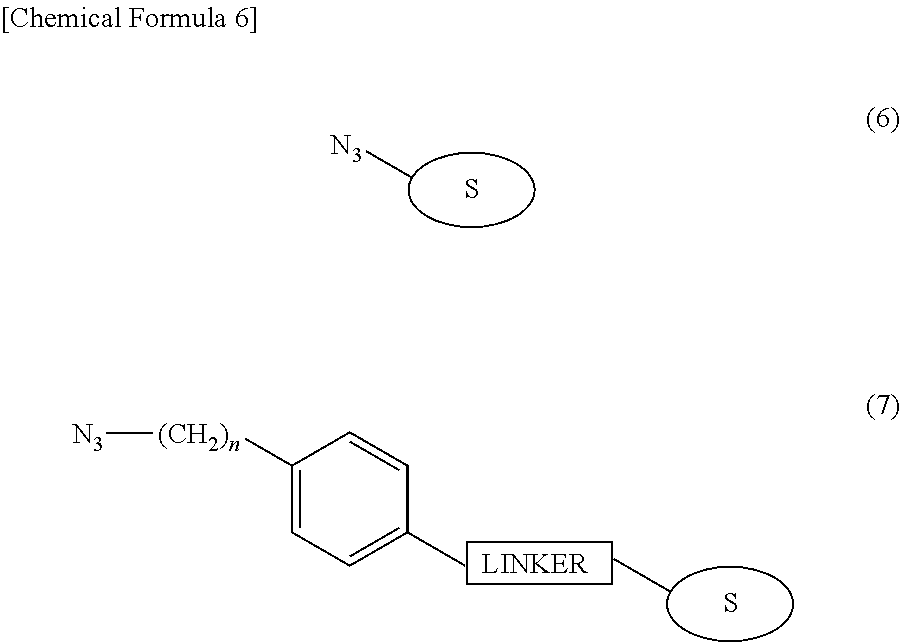

Applications Claiming Priority (3)
| Application Number | Priority Date | Filing Date | Title |
|---|---|---|---|
| JP2015060689 | 2015-03-24 | ||
| JP2015-060689 | 2015-03-24 | ||
| PCT/JP2016/059398 WO2016152980A1 (en) | 2015-03-24 | 2016-03-24 | Oligonucleotide derivative, oligonucleotide construct using same, and methods for producing these |
Publications (2)
| Publication Number | Publication Date |
|---|---|
| US20180094017A1 US20180094017A1 (en) | 2018-04-05 |
| US10487103B2 true US10487103B2 (en) | 2019-11-26 |
Family
ID=56977584
Family Applications (1)
| Application Number | Title | Priority Date | Filing Date |
|---|---|---|---|
| US15/560,994 Expired - Fee Related US10487103B2 (en) | 2015-03-24 | 2016-03-24 | Oligonucleotide derivative, oligonucleotide construct using the same, and methods for producing them |
Country Status (3)
| Country | Link |
|---|---|
| US (1) | US10487103B2 (en) |
| JP (1) | JP6667179B2 (en) |
| WO (1) | WO2016152980A1 (en) |
Cited By (1)
| Publication number | Priority date | Publication date | Assignee | Title |
|---|---|---|---|---|
| US12649799B2 (en) | 2018-06-14 | 2026-06-09 | Mochida Pharmaceutical Co., Ltd. | Crosslinked alginic acid |
Families Citing this family (9)
| Publication number | Priority date | Publication date | Assignee | Title |
|---|---|---|---|---|
| CA3134610A1 (en) | 2018-04-09 | 2019-10-17 | Yale University | Bifunctional small molecules to target the selective degradation of circulating proteins |
| US12697391B2 (en) | 2018-04-09 | 2026-08-04 | Yale University | Bi-functional molecules to degrade circulating proteins |
| US12485178B2 (en) | 2018-04-09 | 2025-12-02 | Yale University | Bifunctional small molecules to target the selective degradation of circulating proteins |
| WO2020262642A1 (en) | 2019-06-28 | 2020-12-30 | 持田製薬株式会社 | Transplantation device using chemically crosslinked alginic acid |
| JP7618778B2 (en) * | 2021-01-20 | 2025-01-21 | アーゴーナ・ファーマシューティカルズ・カンパニー・リミテッド | Ligand compounds, conjugates and their applications |
| CN116917476A (en) * | 2021-03-03 | 2023-10-20 | 国立大学法人东京大学 | Acyclic threoninol nucleic acid |
| ES2989849T3 (en) | 2022-02-25 | 2024-11-27 | Polyplus Transfection | Purification, detection and quantification methods of residual transfection reagents based on PEI |
| JP7725042B2 (en) | 2023-05-19 | 2025-08-19 | 国立研究開発法人科学技術振興機構 | Composition for treating hematopoietic tumors, medicine for treating hematopoietic tumors, and composition for inhibiting proliferation of cancerous cells in hematopoietic tumors |
| CN119504601A (en) * | 2024-11-06 | 2025-02-25 | 南昌大学 | A heterogeneous bifunctional crosslinking agent and its preparation method and application |
Citations (8)
| Publication number | Priority date | Publication date | Assignee | Title |
|---|---|---|---|---|
| US20090124571A1 (en) | 2006-04-28 | 2009-05-14 | Francois Morvan | Method for the synthesis of oligonucleotide derivatives |
| JP2010508015A (en) | 2006-10-31 | 2010-03-18 | ベースクリック ゲーエムベーハー | Click chemistry for the production of reporter molecules |
| JP2010132578A (en) | 2008-12-02 | 2010-06-17 | Kyushu Univ | Nucleoside triphosphate derivative, nucleic acid probe, multi-labeled nucleic acid probe and method for detecting target nucleic acid |
| JP2010195698A (en) | 2009-02-24 | 2010-09-09 | Gifu Univ | Oligonucleotide derivative, oligonucleotide structure obtained using oligonucleotide derivative, compound for synthesizing oligonucleotide derivative and method for producing oligonucleotide derivative |
| US20100234282A1 (en) | 2007-11-28 | 2010-09-16 | National University Corporation Tokyo Medical And Dental University | System for delivering nucleic acids for suppressing target gene expression by utilizing endogenous chylomicron |
| US20120035115A1 (en) | 2008-09-23 | 2012-02-09 | Alnylam Pharmaceuticals, Inc. | Chemical modifications of monomers and oligonucleotides with cycloaddition |
| WO2012037254A1 (en) | 2010-09-15 | 2012-03-22 | Alnylam Pharmaceuticals, Inc. | MODIFIED iRNA AGENTS |
| WO2013139803A1 (en) | 2012-03-19 | 2013-09-26 | MAX-PLANCK-Gesellschaft zur Förderung der Wissenschaften e.V. | Carbohydrate-glycolipid conjugate vaccines |
-
2016
- 2016-03-24 JP JP2017508427A patent/JP6667179B2/en active Active
- 2016-03-24 US US15/560,994 patent/US10487103B2/en not_active Expired - Fee Related
- 2016-03-24 WO PCT/JP2016/059398 patent/WO2016152980A1/en not_active Ceased
Patent Citations (13)
| Publication number | Priority date | Publication date | Assignee | Title |
|---|---|---|---|---|
| US20090124571A1 (en) | 2006-04-28 | 2009-05-14 | Francois Morvan | Method for the synthesis of oligonucleotide derivatives |
| JP2009535323A (en) | 2006-04-28 | 2009-10-01 | サントル ナショナル ドゥ ラ ルシェルシュ シアンティフィク | Method for synthesizing oligonucleotide derivatives |
| JP2010508015A (en) | 2006-10-31 | 2010-03-18 | ベースクリック ゲーエムベーハー | Click chemistry for the production of reporter molecules |
| US20100081137A1 (en) | 2006-10-31 | 2010-04-01 | Thomas Carell | Click Chemistry for the Production of Reporter Molecules |
| US20100234282A1 (en) | 2007-11-28 | 2010-09-16 | National University Corporation Tokyo Medical And Dental University | System for delivering nucleic acids for suppressing target gene expression by utilizing endogenous chylomicron |
| JP2011504874A (en) | 2007-11-28 | 2011-02-17 | 国立大学法人 東京医科歯科大学 | Nucleic acid delivery system that suppresses target gene expression using endogenous chylomicrons |
| US20120035115A1 (en) | 2008-09-23 | 2012-02-09 | Alnylam Pharmaceuticals, Inc. | Chemical modifications of monomers and oligonucleotides with cycloaddition |
| JP2012513953A (en) | 2008-09-23 | 2012-06-21 | アルニラム ファーマスーティカルズ インコーポレイテッド | Chemical modification of monomers and oligonucleotides using cycloaddition |
| JP2010132578A (en) | 2008-12-02 | 2010-06-17 | Kyushu Univ | Nucleoside triphosphate derivative, nucleic acid probe, multi-labeled nucleic acid probe and method for detecting target nucleic acid |
| JP2010195698A (en) | 2009-02-24 | 2010-09-09 | Gifu Univ | Oligonucleotide derivative, oligonucleotide structure obtained using oligonucleotide derivative, compound for synthesizing oligonucleotide derivative and method for producing oligonucleotide derivative |
| WO2012037254A1 (en) | 2010-09-15 | 2012-03-22 | Alnylam Pharmaceuticals, Inc. | MODIFIED iRNA AGENTS |
| JP2013541334A (en) | 2010-09-15 | 2013-11-14 | アルニラム ファーマスーティカルズ インコーポレイテッド | Modified iRNA agent |
| WO2013139803A1 (en) | 2012-03-19 | 2013-09-26 | MAX-PLANCK-Gesellschaft zur Förderung der Wissenschaften e.V. | Carbohydrate-glycolipid conjugate vaccines |
Non-Patent Citations (8)
| Title |
|---|
| English translation of the International Preliminary Report on Patentability (Forms PCT/IB/338 and PCT/IPEA/409), dated Sep. 28, 2017, for International Application No. PCT/JP2016/059398. |
| Fujimoto et al, "Synthesis of versatile fluorescent sensors based on Click chemistry: detection of unsaturated fatty acids by their pyrene-emission switching", Chemical Communications, No. 46, 2009, pp. 7164-7166. |
| Google machine translation of JP2010195698A, https://patents.google.com/patent/JP2010195698A/en?oq=JP2010195698A, accessed online on Dec. 13, 2018. (Year: 2018). * |
| International Preliminary Report on Patentability (PCT/IPEA/409) issued in PCT/JP2016/059398, completed on Aug. 9, 2016. |
| International Search Report (PCT/ISA/210) issued in PCT/JP2016/059398, dated Jun. 14, 2016. |
| Jouanno et al., "Kondrat'eva Ligation: Diels-Alder-Based Irreversible Reaction for Bioconjugation", The Journal of Organic Chemistry, vol. 79, No. 21, 2014, pp. 10353-10366. |
| Peschke et al, "Controlled coupling of peptides at their C-termini", Peptides, vol. 30, No. 4, 2009, pp. 689-698. |
| Written Opinion (PCT/ISA/237) issued in PCT/JP2016/059398, dated Jun. 14, 2016. |
Cited By (1)
| Publication number | Priority date | Publication date | Assignee | Title |
|---|---|---|---|---|
| US12649799B2 (en) | 2018-06-14 | 2026-06-09 | Mochida Pharmaceutical Co., Ltd. | Crosslinked alginic acid |
Also Published As
| Publication number | Publication date |
|---|---|
| US20180094017A1 (en) | 2018-04-05 |
| JPWO2016152980A1 (en) | 2018-01-25 |
| WO2016152980A1 (en) | 2016-09-29 |
| JP6667179B2 (en) | 2020-03-18 |
Similar Documents
| Publication | Publication Date | Title |
|---|---|---|
| US20180094017A1 (en) | Oligonucleotide derivative, oligonucleotide construct using the same, and methods for producing them | |
| AU2020280438B2 (en) | Nucleic acid, pharmaceutical composition, conjugate, preparation method, and use | |
| AU2025283518A1 (en) | Oligonucleotide compositions and methods thereof | |
| US7772387B2 (en) | Oligonucleotides comprising a modified or non-natural nucleobase | |
| CN110023322B (en) | Novel bicyclic nucleosides and oligomers prepared therefrom | |
| AU2017245687A1 (en) | Nucleic acid linked to a trivalent glycoconjugate | |
| WO2017192664A1 (en) | Oligonucleotide compositions and methods thereof | |
| KR20180103166A (en) | Nucleic acid complex | |
| AU2020282453A1 (en) | Nucleic acid, pharmaceutical composition and conjugate, preparation method and use | |
| SG171914A1 (en) | Method for the synthesis of phosphorus atom modified nucleic acids | |
| AU2005327517B2 (en) | Oligonucleotides comprising a non-phosphate backbone linkage | |
| TW201909925A (en) | Nucleic acid complex | |
| JPWO2017010575A1 (en) | β2GPI gene expression-suppressing nucleic acid complex | |
| CN118852286A (en) | Compounds, conjugates and uses thereof | |
| CN111377984A (en) | Compounds and conjugates, methods for their preparation and use | |
| TW202613310A (en) | GalNAc compound containing triazole structure and oligonucleotide conjugate thereof | |
| JP2024528270A (en) | Ligand conjugates for the delivery of therapeutically active agents - Patents.com | |
| KR20260042246A (en) | Multicargo-containing complex and its uses | |
| KR20210098477A (en) | Nucleic Acid Complex | |
| WO2024208357A1 (en) | Dsrna molecule for regulating expression of cideb mrna | |
| CN114929729B (en) | Nucleic acid complex and pharmaceutical composition containing the same | |
| US12150997B1 (en) | Compound, a conjugate and uses thereof | |
| RU2816898C2 (en) | Nucleic acid, pharmaceutical composition and conjugate, method of production and use | |
| AU2023202951A1 (en) | A compound, a conjugate and uses thereof | |
| RU2797833C1 (en) | Oligonucleotide compositions and methods related to them |
Legal Events
| Date | Code | Title | Description |
|---|---|---|---|
| FEPP | Fee payment procedure |
Free format text: ENTITY STATUS SET TO UNDISCOUNTED (ORIGINAL EVENT CODE: BIG.); ENTITY STATUS OF PATENT OWNER: LARGE ENTITY |
|
| AS | Assignment |
Owner name: GIFU UNIVERSITY, JAPAN Free format text: ASSIGNMENT OF ASSIGNORS INTEREST;ASSIGNORS:KITADE, YUKIO;SHIBATA, AYA;SIGNING DATES FROM 20170824 TO 20170829;REEL/FRAME:043680/0680 |
|
| STPP | Information on status: patent application and granting procedure in general |
Free format text: RESPONSE TO NON-FINAL OFFICE ACTION ENTERED AND FORWARDED TO EXAMINER |
|
| STPP | Information on status: patent application and granting procedure in general |
Free format text: NOTICE OF ALLOWANCE MAILED -- APPLICATION RECEIVED IN OFFICE OF PUBLICATIONS |
|
| STPP | Information on status: patent application and granting procedure in general |
Free format text: AWAITING TC RESP., ISSUE FEE NOT PAID |
|
| STPP | Information on status: patent application and granting procedure in general |
Free format text: PUBLICATIONS -- ISSUE FEE PAYMENT RECEIVED |
|
| STPP | Information on status: patent application and granting procedure in general |
Free format text: PUBLICATIONS -- ISSUE FEE PAYMENT VERIFIED |
|
| STPP | Information on status: patent application and granting procedure in general |
Free format text: PUBLICATIONS -- ISSUE FEE PAYMENT VERIFIED |
|
| STCF | Information on status: patent grant |
Free format text: PATENTED CASE |
|
| FEPP | Fee payment procedure |
Free format text: MAINTENANCE FEE REMINDER MAILED (ORIGINAL EVENT CODE: REM.); ENTITY STATUS OF PATENT OWNER: LARGE ENTITY |
|
| LAPS | Lapse for failure to pay maintenance fees |
Free format text: PATENT EXPIRED FOR FAILURE TO PAY MAINTENANCE FEES (ORIGINAL EVENT CODE: EXP.); ENTITY STATUS OF PATENT OWNER: LARGE ENTITY |
|
| STCH | Information on status: patent discontinuation |
Free format text: PATENT EXPIRED DUE TO NONPAYMENT OF MAINTENANCE FEES UNDER 37 CFR 1.362 |
|
| FP | Lapsed due to failure to pay maintenance fee |
Effective date: 20231126 |