US10483737B2 - Electrical box with dual-hinged cover - Google Patents

Electrical box with dual-hinged cover Download PDF

Info

Publication number
US10483737B2
US10483737B2 US16/250,086 US201916250086A US10483737B2 US 10483737 B2 US10483737 B2 US 10483737B2 US 201916250086 A US201916250086 A US 201916250086A US 10483737 B2 US10483737 B2 US 10483737B2
Authority
US
United States
Prior art keywords
cover
pivot
retaining elements
housing
outlet box
Prior art date
Legal status (The legal status is an assumption and is not a legal conclusion. Google has not performed a legal analysis and makes no representation as to the accuracy of the status listed.)
Active
Application number
US16/250,086
Other versions
US20190222009A1 (en
Inventor
Norman R. Byrne
Joel T. Ruiter
Peter Bergendahl
Joseph D. Ward
Juan Carlos Angulo
Current Assignee (The listed assignees may be inaccurate. Google has not performed a legal analysis and makes no representation or warranty as to the accuracy of the list.)
Byrne Electrical Specialists Inc
Original Assignee
Individual
Priority date (The priority date is an assumption and is not a legal conclusion. Google has not performed a legal analysis and makes no representation as to the accuracy of the date listed.)
Filing date
Publication date
Application filed by Individual filed Critical Individual
Priority to US16/250,086 priority Critical patent/US10483737B2/en
Assigned to BYRNE ELECTRICAL SPECIALISTS, INC. reassignment BYRNE ELECTRICAL SPECIALISTS, INC. ASSIGNMENT OF ASSIGNORS INTEREST (SEE DOCUMENT FOR DETAILS). Assignors: BYRNE, NORMAN R., ANGULO, JUAN CARLOS, WARD, JOSEPH D., RUITER, JOEL T., BERGENDAHL, PETER
Assigned to BYRNE, NORMAN R. reassignment BYRNE, NORMAN R. ASSIGNMENT OF ASSIGNORS INTEREST (SEE DOCUMENT FOR DETAILS). Assignors: BYRNE ELECTRICAL SPECIALISTS, INC.
Publication of US20190222009A1 publication Critical patent/US20190222009A1/en
Application granted granted Critical
Publication of US10483737B2 publication Critical patent/US10483737B2/en
Active legal-status Critical Current
Anticipated expiration legal-status Critical

Links

Images

Classifications

    • HELECTRICITY
    • H02GENERATION; CONVERSION OR DISTRIBUTION OF ELECTRIC POWER
    • H02GINSTALLATION OF ELECTRIC CABLES OR LINES, OR OF COMBINED OPTICAL AND ELECTRIC CABLES OR LINES
    • H02G3/00Installations of electric cables or lines or protective tubing therefor in or on buildings, equivalent structures or vehicles
    • H02G3/02Details
    • H02G3/08Distribution boxes; Connection or junction boxes
    • H02G3/081Bases, casings or covers
    • HELECTRICITY
    • H02GENERATION; CONVERSION OR DISTRIBUTION OF ELECTRIC POWER
    • H02GINSTALLATION OF ELECTRIC CABLES OR LINES, OR OF COMBINED OPTICAL AND ELECTRIC CABLES OR LINES
    • H02G3/00Installations of electric cables or lines or protective tubing therefor in or on buildings, equivalent structures or vehicles
    • H02G3/02Details
    • H02G3/08Distribution boxes; Connection or junction boxes
    • H02G3/14Fastening of cover or lid to box

Definitions

  • the present invention relates to electrical power and/or data distribution units for mounting at or along or within work surfaces, furnishings, and the like.
  • Electrical power outlets and/or electronic data outlets are commonly provided at work surfaces for use by persons located at or near the work surface. In some cases, it is desirable to provide selective access to electrical power and/or electronic data outlets so that users have the option of limiting or precluding access to the outlets, such as when the outlets are not needed, or for aesthetic reasons.
  • the present invention provides an electrical power and/or electronic data center for a work surface, which has a lid or cover that can alternately be opened in either of two directions about either of two spaced-apart pivot axes that are defined in part by a pair of spaced-apart pivot arms.
  • a lid or cover that can alternately be opened in either of two directions about either of two spaced-apart pivot axes that are defined in part by a pair of spaced-apart pivot arms.
  • magnets are used to provide a latching function plus sensory (“haptic”) feedback to a user, indicating when the cover has been fully closed and can again be opened in either direction.
  • an outlet box with dual-hinged cover includes a housing, a cover, a pair of pivot arms for securing the cover to the housing, and a retaining element for releasably securing the cover in a closed position.
  • the housing defines an opening to a cavity and includes a pair of spaced-apart sidewalls.
  • the cover is positionable inside an opening in the housing, and may have a floating appearance with no direct contact between the cover and the housing.
  • the pivot arms are positioned at opposite sides of the cover, and have respective distal end portions pivotably coupled to the cover at opposite ends of the cover.
  • the pivot arms have proximal end portions pivotably coupled to respective ones of the sidewalls.
  • the cover is openable from the closed position in a first direction about a first pivot axis that extends through the proximal end portion of a first pivot arm, and the cover is alternately openable from the closed position in a second direction about a second pivot axis that extends through the proximal end portion of a second pivot arm.
  • a retaining element is positioned at each of the pivot arms, and a corresponding retaining element is positioned at each of the sidewalls.
  • Each of the corresponding retaining elements is configured to interact with a corresponding one of the retaining elements to releasably secure the cover in a closed position, and to provide sensory feedback to a user as the cover moves from an open position to the closed position.
  • the outlet box provides convenience access to electrical or electronic outlets at a work surface or the like, from opposite sides of the outlet box.
  • Its dual-hinged door may have a floating appearance with no direct contact between the door and the housing, even with the door closed, and the door may be closed while power and/or data cords are extending out of the housing past the door.
  • FIG. 1A is a top perspective view of an electrical box with dual-hinged cover in accordance with the present invention, viewed from front-right and shown with the cover in a first open position;
  • FIG. 1B is another top perspective view of the electrical box, viewed from front-right and shown with the cover in a closed position;
  • FIG. 1C is another top perspective view of the electrical box, viewed from front-right and shown with the cover in a second open position that is different from the first open position of FIG. 1A ;
  • FIG. 2A is another top perspective view of the electrical box of FIG. 1A , viewed from back-right;
  • FIG. 2B is another top perspective view of the electrical box of FIG. 1B , viewed from back-right and shown with the cover in a closed position;
  • FIG. 2C is another top perspective view of the electrical box of FIG. 1C , viewed from back-right;
  • FIG. 3 is a bottom perspective view of the electrical box
  • FIG. 4 is a top plan view of the electrical box with the cover in the closed position
  • FIG. 4A is a side sectional elevation taken along line A-A in FIG. 4 ;
  • FIG. 4B is a side sectional elevation taken along line B-B in FIG. 4 ;
  • FIG. 5 is a top plan view of the electrical box with the cover in the first open position
  • FIGS. 5A and 5 A 1 are side sectional elevations taken along line A-A in FIG. 5 , with FIG. 5 A 1 being an enlarged view;
  • FIG. 5B is a side sectional elevation taken along line B-B in FIG. 5 ;
  • FIG. 6 is a top plan view of the electrical box with the cover in the second open position
  • FIG. 6B is a side sectional elevation taken along line B-B in FIG. 6 ;
  • FIG. 4 is a top plan view of the electrical box with the cover in the closed position
  • FIG. 4A is a side sectional elevation taken along line A-A in FIG. 4 ;
  • FIG. 4B is a side sectional elevation taken along line B-B in FIG. 4 ;
  • FIG. 7 is an exploded perspective view of the electrical box with dual-hinged cover
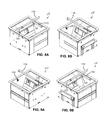
  • FIGS. 8A and 8B are top perspective views of another electrical box with dual-hinged cover in accordance with the present invention, viewed respectively from front-right and front left, and shown with the cover in a first open position;
  • FIGS. 9A and 9B are top perspective views of the electrical box of FIGS. 8A and 8B , viewed respectively from front-right and front left, and shown with the cover in a second open position;
  • FIG. 10 is a top plan view of the electrical box of FIGS. 8A-9B , shown with the cover in a closed position;
  • FIG. 10A is a side sectional elevation taken along line A-A in FIG. 10 ;
  • FIG. 10B is a side sectional elevation taken along line B-B in FIG. 10 ;
  • FIG. 11 is a top plan view of the electrical box of FIGS. 8A-9B , shown with the cover in the second open position;
  • FIG. 11A is a side sectional elevation taken along line A-A in FIG. 11 ;
  • FIG. 11B is a side sectional elevation taken along line B-B in FIG. 11 ;
  • FIG. 12 is a top plan view of the electrical box of FIGS. 8A-9B , shown with the cover in the first open position;
  • FIG. 12B is a side sectional elevation taken along line B-B in FIG. 12 .
  • an electrical power and/or electronic data center 10 is configured for mounting in or along a work surface, a furniture article, or the like.
  • the electrical power and/or electronic data center 10 may be referenced herein as an “electrical box,” it will be appreciated that the unit may be adapted to carry for high and/or low voltage electrical power outlets, electronic data outlets, pass-throughs, functional electronic devices, or combinations thereof.
  • Electrical box 10 includes a main housing 12 having an open upper end 14 , which is fitted with a lid or cover 16 that can alternately be opened in either of two directions from a closed position, such as shown in FIGS. 1A-2C .
  • Cover 16 may be lifted and pivoted about either of two spaced-apart pivot axes A 1 , A 2 ( FIGS. 1A-2C ) that are defined in part by a pair of spaced-apart pivot arms 20 , 22 .
  • the first pivot arm 20 has a proximal end 20 a that is pivotably coupled to a first sidewall 12 a of housing 12 , and a distal end 20 b that is pivotably coupled to a second end 16 b of the cover 16 .
  • the second pivot arm 22 has a proximal end 22 a that is pivotably coupled to a second sidewall 12 b of housing 12 , and a distal end 22 b that is pivotably coupled to a first end 16 a of the cover 16 .
  • Cover 16 is mechanically attached to each of the pivot arms 20 , 22 only at each pivot arm's respective distal end 20 b , 22 b.
  • pivot arms 20 , 22 limits movement of the cover 16 during normal use so that when the cover 16 is pivoted open in a first direction (curved arrow in FIG. 1A ) about a first pivot axis A 1 , it is substantially prevented from pivoting about the second pivot axis A 2 until the cover 16 has first been closed.
  • first direction curved arrow in FIG. 1A
  • second pivot axis A 2 the cover 16 has first been closed.
  • a snap-on hook 24 a formed at the first end 16 a of cover 16 secures the cover to a pivot pin 26 along the first pivot axis A 1 , such as shown in FIGS. 5A and 5A-1 .
  • cover 16 is said to be “substantially prevented” from pivoting about the second pivot axis A 2 when the cover has already been pivoted open about the first pivot axis, it will be appreciated that when the cover 16 is pivoted open about the first axis A 1 , sufficient force could be applied so as to separate the snap-on hook 24 a from the pivot pin 26 that is along the first pivot axis A 1 , or to partially raise the distal end 22 b of the second pivot arm 22 in a manner that causes twisting of the cover 16 .
  • cover 16 is substantially prevented from moving in the manners specified above during normal use, it will be understood that sufficient force could be used to detach the cover from one or both pivot arms 20 , 22 , or to cause deflections of the cover 16 and/or the pivot arms 20 , 22 , and potentially also cause deflections of the housing sidewalls 12 a , 12 b , when different forces are applied that are not typical of normal opening and closing use of the cover 16 . Similarly, cover 16 cannot be lifted straight up from the closed position ( FIGS.
  • cover-retaining elements in the form of magnets 28 , 30 are used to provide a latching function and sensory (“haptic”) feedback to a user, indicating when the cover has been fully closed and can again be opened in either direction.
  • an arm magnet 28 is mounted in a respective arm bore 32 formed at the distal end 20 b , 22 b of each pivot arm 20 , 22 .
  • a corresponding housing magnet 30 is mounted in a respective bore 34 formed in each of the first sidewall 12 a and the second sidewall 12 b .
  • the arm magnets 28 may be somewhat loosely retained in their respective arm bores 32 , so that the arm magnets 28 are free to make at least small movements within the bores 32 .
  • the arm magnet 28 When one of the arm magnets 28 is placed in close proximity to a corresponding one of the housing magnets 32 , the arm magnet 28 may “snap” into a position within the arm bore 32 that is furthest outboard, being drawn to the nearby housing magnet 30 by magnetic attraction due to opposite magnetic polarities of the adjacent magnets 28 , 30 .
  • the movement of the arm magnet 28 may produce an audible sound and/or brief vibration that is detectable by the hand of a user, thus providing sensory or haptic feedback to the user indicating that the cover 16 is closed.
  • the arm magnets 28 do not contact the housing magnets 30 at any time during normal opening and closing operation of the cover 16 .
  • the arm magnets' 28 attraction to the housing magnets 30 when the cover 16 is closed helps to retain the cover in the closed position, but the attraction is not so strong so as to make it difficult to manually open the cover 16 .
  • a magnetically permeable material such as iron or steel may be substituted for some of the magnets described above, without departing from the spirit and scope of the present invention.
  • FIG. 7 a front housing piece 12 c and a rear housing piece 12 d , which cooperate with the left and right sidewalls 12 a , 12 b to enclose an interior of the center.
  • a top bezel 34 forms the upper portions of housing 12 and may rest atop a work surface when the center 10 is inserted into an opening formed in the work surface.
  • Inside the housing 12 there is a generally U-shaped electrical outlet support 36 with openings 38 formed in its upwardly-extending legs ( FIG. 7 ), a bottom support wall 40 that extends from a lower bight portion of the outlet support 36 to fit between bottom wall portions of the front and rear housing pieces 12 c , 12 d .
  • Additional outlet support plates 42 with respective openings 44 mount behind the upwardly-extending walls of the U-shaped electrical outlet support 36 , and are used to secure electrical outlets 46 for access to users through the top opening 14 , such as shown in the sectional views.
  • Bottom support wall 40 defines one or more openings 48 ( FIG. 3 ) through which wiring (not shown) for outlets 46 may pass, optionally with strain relief grommets provided at each opening.
  • Outlets 46 may be high voltage AC power outlets, low voltage (e.g., under 30 volt) DC power outlets, or substantially any type of electronic data or signal outlet or receptacle.
  • cover 16 to be mounted within bezel 34 , and with a gap formed between each perimeter edge (including first end 16 a , second end 16 b , a first side 16 c and a second side 16 d opposite the first side 16 c ) of cover 16 and a corresponding inner perimeter edge of bezel 34 when the cover 16 is closed.
  • a top surface 50 of the cover 16 may be set flush with a top surface of bezel 34 when the cover is closed, such as shown in FIGS. 1B, 2B, and 4-4B .
  • First pivot arm 20 a is obscured from view by a first overhang region 50 a of top surface 50 at the first side 16 c of the cover 16
  • second pivot arm 20 b is obscured from view by second overhang region 50 b of the top surface 50 at the second side 16 d of the cover.
  • a larger gap is formed between the opposite ends 16 a , 16 b of the cover 16 and the corresponding portions of the bezel 34 and the corresponding front and rear housing pieces 12 c , 12 d .
  • These over-size gaps provide extra clearance for data and/or power cords to exit the open upper end 14 of the main housing 12 while the door 16 is closed.
  • larger electrical plugs including electrical power transformers with integrated plugs
  • the door 16 can be closed with cords protruding through the larger gaps.
  • the second snap-on hook 24 b extends further along the second end 16 b of cover 16 in the direction of first side 16 c and first overhang region 50 a , than it extends in the direction of second side 16 d and second overhang region 50 b .
  • This provides wider clearance for the wider proximal end 22 a of the second arm 22 , under the second overhang region 50 b at second end 16 b of the cover 16 , and narrower clearance for the narrower distal end 20 b of the first arm 22 under the first overhang region 50 a at second end 16 b of the cover 16 .
  • the first snap-on hook 24 b has the appearance of being slightly laterally offset relative to the second snap-on hook 24 a , because at the first end 16 a of the cover 16 there is located the wider proximal end 20 a of the first pivot arm 20 under the cover's first side 16 c , and the narrower distal end 22 b of the second pivot arm 22 under the cover's second side 16 d .
  • the cover 16 may have a “floating” appearance when closed, with each pivot arm 20 , 22 being substantially hidden when viewed from above.
  • each mechanical latch 130 has a horizontal protrusion or nose 130 a that is engaged by an edge of a respective recess-type catch 132 formed along a lower region of each pivot arm 120 , 122 , as the cover 116 is opened and closed.
  • Mechanical latches 130 and catches 132 may be made from resilient materials, such as resinous plastic, to permit limited deflection during latching and unlatching.

Landscapes

  • Engineering & Computer Science (AREA)
  • Architecture (AREA)
  • Civil Engineering (AREA)
  • Structural Engineering (AREA)
  • Casings For Electric Apparatus (AREA)
  • Connector Housings Or Holding Contact Members (AREA)

Abstract

An electrical box supports one or more electrical or electronic data outlets in a cavity, with a dual-hinged door at least partially covering an opening to the cavity when the door is closed. The door is openable in either of two directions by pivoting it about either of two spaced-apart pivot axes that are defined by respective pivot arms coupled to opposite ends and opposite sides of the door, the pivot arms being further coupled at their respective proximal ends to opposite walls of the housing. A retaining feature releasably secures the door in the closed position and may provide sensory feedback to a user upon closing the door. Optionally, the door has a floating appearance in the opening to the cavity, with no direct contact existing between the door and the housing.

Description

CROSS REFERENCE TO RELATED APPLICATION
The present application claims the benefit of U.S. provisional application Ser. No. 62/618,625, filed Jan. 17, 2018, which is hereby incorporated herein by reference in its entirety.
FIELD OF THE INVENTION
The present invention relates to electrical power and/or data distribution units for mounting at or along or within work surfaces, furnishings, and the like.
BACKGROUND OF THE INVENTION
Electrical power outlets and/or electronic data outlets are commonly provided at work surfaces for use by persons located at or near the work surface. In some cases, it is desirable to provide selective access to electrical power and/or electronic data outlets so that users have the option of limiting or precluding access to the outlets, such as when the outlets are not needed, or for aesthetic reasons.
SUMMARY OF THE INVENTION
The present invention provides an electrical power and/or electronic data center for a work surface, which has a lid or cover that can alternately be opened in either of two directions about either of two spaced-apart pivot axes that are defined in part by a pair of spaced-apart pivot arms. During normal use, when the lid or cover is pivoted open in a first direction about a first pivot axis, it is incapable of pivoting about the second pivot axis until the lid or cover has first been closed. Likewise, during normal use when the lid or cover is pivoted open in a second direction about the second pivot axis, it is incapable of pivoting about the first pivot axis until the lid or cover has first been closed. Optionally, magnets are used to provide a latching function plus sensory (“haptic”) feedback to a user, indicating when the cover has been fully closed and can again be opened in either direction.
In one form of the present invention, an outlet box with dual-hinged cover includes a housing, a cover, a pair of pivot arms for securing the cover to the housing, and a retaining element for releasably securing the cover in a closed position. The housing defines an opening to a cavity and includes a pair of spaced-apart sidewalls. The cover is positionable inside an opening in the housing, and may have a floating appearance with no direct contact between the cover and the housing. The pivot arms are positioned at opposite sides of the cover, and have respective distal end portions pivotably coupled to the cover at opposite ends of the cover. The pivot arms have proximal end portions pivotably coupled to respective ones of the sidewalls. The cover is openable from the closed position in a first direction about a first pivot axis that extends through the proximal end portion of a first pivot arm, and the cover is alternately openable from the closed position in a second direction about a second pivot axis that extends through the proximal end portion of a second pivot arm.
Optionally, a retaining element is positioned at each of the pivot arms, and a corresponding retaining element is positioned at each of the sidewalls. Each of the corresponding retaining elements is configured to interact with a corresponding one of the retaining elements to releasably secure the cover in a closed position, and to provide sensory feedback to a user as the cover moves from an open position to the closed position.
Thus, the outlet box provides convenience access to electrical or electronic outlets at a work surface or the like, from opposite sides of the outlet box. Its dual-hinged door may have a floating appearance with no direct contact between the door and the housing, even with the door closed, and the door may be closed while power and/or data cords are extending out of the housing past the door.
These and other objects, advantages, purposes and features of the present invention will become apparent upon review of the following specification in conjunction with the drawings.
BRIEF DESCRIPTION OF THE DRAWINGS
FIG. 1A is a top perspective view of an electrical box with dual-hinged cover in accordance with the present invention, viewed from front-right and shown with the cover in a first open position;
FIG. 1B is another top perspective view of the electrical box, viewed from front-right and shown with the cover in a closed position;
FIG. 1C is another top perspective view of the electrical box, viewed from front-right and shown with the cover in a second open position that is different from the first open position of FIG. 1A;
FIG. 2A is another top perspective view of the electrical box of FIG. 1A, viewed from back-right;
FIG. 2B is another top perspective view of the electrical box of FIG. 1B, viewed from back-right and shown with the cover in a closed position;
FIG. 2C is another top perspective view of the electrical box of FIG. 1C, viewed from back-right;
FIG. 3 is a bottom perspective view of the electrical box;
FIG. 4 is a top plan view of the electrical box with the cover in the closed position;
FIG. 4A is a side sectional elevation taken along line A-A in FIG. 4;
FIG. 4B is a side sectional elevation taken along line B-B in FIG. 4;
FIG. 5 is a top plan view of the electrical box with the cover in the first open position;
FIGS. 5A and 5A1 are side sectional elevations taken along line A-A in FIG. 5, with FIG. 5A1 being an enlarged view;
FIG. 5B is a side sectional elevation taken along line B-B in FIG. 5;
FIG. 6 is a top plan view of the electrical box with the cover in the second open position;
FIGS. 6A and 6A1 are side sectional elevations taken along line A-A in FIG. 6, with FIG. 6A1 being an enlarged view;
FIG. 6B is a side sectional elevation taken along line B-B in FIG. 6;
FIG. 4 is a top plan view of the electrical box with the cover in the closed position;
FIG. 4A is a side sectional elevation taken along line A-A in FIG. 4;
FIG. 4B is a side sectional elevation taken along line B-B in FIG. 4;
FIG. 7 is an exploded perspective view of the electrical box with dual-hinged cover;
FIGS. 8A and 8B are top perspective views of another electrical box with dual-hinged cover in accordance with the present invention, viewed respectively from front-right and front left, and shown with the cover in a first open position;
FIGS. 9A and 9B are top perspective views of the electrical box of FIGS. 8A and 8B, viewed respectively from front-right and front left, and shown with the cover in a second open position;
FIG. 10 is a top plan view of the electrical box of FIGS. 8A-9B, shown with the cover in a closed position;
FIG. 10A is a side sectional elevation taken along line A-A in FIG. 10;
FIG. 10B is a side sectional elevation taken along line B-B in FIG. 10;
FIG. 11 is a top plan view of the electrical box of FIGS. 8A-9B, shown with the cover in the second open position;
FIG. 11A is a side sectional elevation taken along line A-A in FIG. 11;
FIG. 11B is a side sectional elevation taken along line B-B in FIG. 11;
FIG. 12 is a top plan view of the electrical box of FIGS. 8A-9B, shown with the cover in the first open position;
FIG. 12A is a side sectional elevation taken along line A-A in FIG. 12; and
FIG. 12B is a side sectional elevation taken along line B-B in FIG. 12.
DESCRIPTION OF THE PREFERRED EMBODIMENTS
Referring now to the drawings and the illustrative embodiments depicted therein, an electrical power and/or electronic data center 10 is configured for mounting in or along a work surface, a furniture article, or the like. Although the electrical power and/or electronic data center 10 may be referenced herein as an “electrical box,” it will be appreciated that the unit may be adapted to carry for high and/or low voltage electrical power outlets, electronic data outlets, pass-throughs, functional electronic devices, or combinations thereof. Electrical box 10 includes a main housing 12 having an open upper end 14, which is fitted with a lid or cover 16 that can alternately be opened in either of two directions from a closed position, such as shown in FIGS. 1A-2C.
Cover 16 may be lifted and pivoted about either of two spaced-apart pivot axes A1, A2 (FIGS. 1A-2C) that are defined in part by a pair of spaced-apart pivot arms 20, 22. The first pivot arm 20 has a proximal end 20 a that is pivotably coupled to a first sidewall 12 a of housing 12, and a distal end 20 b that is pivotably coupled to a second end 16 b of the cover 16. The second pivot arm 22 has a proximal end 22 a that is pivotably coupled to a second sidewall 12 b of housing 12, and a distal end 22 b that is pivotably coupled to a first end 16 a of the cover 16. Cover 16 is mechanically attached to each of the pivot arms 20, 22 only at each pivot arm's respective distal end 20 b, 22 b.
This configuration of pivot arms 20, 22 limits movement of the cover 16 during normal use so that when the cover 16 is pivoted open in a first direction (curved arrow in FIG. 1A) about a first pivot axis A1, it is substantially prevented from pivoting about the second pivot axis A2 until the cover 16 has first been closed. This is because when cover 16 is in the first open configuration of FIG. 1A, the pivot connection between the proximal end 20 a of first pivot arm 20 and first sidewall 12 a prevents cover 16 from being lifted away from the housing 12 and restricts the cover's movement to only pivoting about the first pivot axis A1. A snap-on hook 24 a formed at the first end 16 a of cover 16 secures the cover to a pivot pin 26 along the first pivot axis A1, such as shown in FIGS. 5A and 5A-1.
Likewise, when the cover 16 is pivoted open in the second direction (curved arrow in FIG. 1C) about the second pivot axis A2, it is substantially prevented from pivoting about the first pivot axis A1 until the cover 16 has first been closed. This is because when cover 16 is in the second open configuration of FIG. 1C, the pivot connection between the proximal end 22 a of second pivot arm 22 prevents cover 16 from being lifted away from the housing 12 and restricts the cover's movement to only pivoting about the second pivot axis A2. A snap-on hook 24 b formed at the second end 16 b of cover 16 secures the cover 16 to another pivot pin 26 along the second pivot axis A2, such as shown in FIGS. 6A and 6A-1.
Although the cover 16 is said to be “substantially prevented” from pivoting about the second pivot axis A2 when the cover has already been pivoted open about the first pivot axis, it will be appreciated that when the cover 16 is pivoted open about the first axis A1, sufficient force could be applied so as to separate the snap-on hook 24 a from the pivot pin 26 that is along the first pivot axis A1, or to partially raise the distal end 22 b of the second pivot arm 22 in a manner that causes twisting of the cover 16. Likewise, when the cover 16 is pivoted open about the second axis A2, sufficient force could be applied so as to separate a second snap-on hook 24 b from a pivot pin 26 that is along the second pivot axis A2, or to partially raise the distal end 20 b of the first pivot arm 20 in a manner that causes twisting of the cover 16. Thus, while the cover 16 is substantially prevented from moving in the manners specified above during normal use, it will be understood that sufficient force could be used to detach the cover from one or both pivot arms 20, 22, or to cause deflections of the cover 16 and/or the pivot arms 20, 22, and potentially also cause deflections of the housing sidewalls 12 a, 12 b, when different forces are applied that are not typical of normal opening and closing use of the cover 16. Similarly, cover 16 cannot be lifted straight up from the closed position (FIGS. 1B and 2B) and away from housing 12 and its opening 14 without bending or twisting the pivot arms 20, 22, unless both pivot pins 26 are first disengaged from the respective snap-on hooks 24 a, 24 b, as can be envisioned with reference to FIGS. 4A and 4B.
In the illustrated embodiment of FIGS. 1-7, cover-retaining elements in the form of magnets 28, 30 are used to provide a latching function and sensory (“haptic”) feedback to a user, indicating when the cover has been fully closed and can again be opened in either direction. Referring to FIG. 7, an arm magnet 28 is mounted in a respective arm bore 32 formed at the distal end 20 b, 22 b of each pivot arm 20, 22. A corresponding housing magnet 30 is mounted in a respective bore 34 formed in each of the first sidewall 12 a and the second sidewall 12 b. The arm magnets 28 may be somewhat loosely retained in their respective arm bores 32, so that the arm magnets 28 are free to make at least small movements within the bores 32. When one of the arm magnets 28 is placed in close proximity to a corresponding one of the housing magnets 32, the arm magnet 28 may “snap” into a position within the arm bore 32 that is furthest outboard, being drawn to the nearby housing magnet 30 by magnetic attraction due to opposite magnetic polarities of the adjacent magnets 28, 30. The movement of the arm magnet 28 may produce an audible sound and/or brief vibration that is detectable by the hand of a user, thus providing sensory or haptic feedback to the user indicating that the cover 16 is closed. In the illustrated embodiment the arm magnets 28 do not contact the housing magnets 30 at any time during normal opening and closing operation of the cover 16. The arm magnets' 28 attraction to the housing magnets 30 when the cover 16 is closed helps to retain the cover in the closed position, but the attraction is not so strong so as to make it difficult to manually open the cover 16. It will be appreciated that a magnetically permeable material such as iron or steel may be substituted for some of the magnets described above, without departing from the spirit and scope of the present invention.
Other components of the electrical power and/or electronic data center 10 include a front housing piece 12 c and a rear housing piece 12 d, which cooperate with the left and right sidewalls 12 a, 12 b to enclose an interior of the center. A top bezel 34 forms the upper portions of housing 12 and may rest atop a work surface when the center 10 is inserted into an opening formed in the work surface. Inside the housing 12 there is a generally U-shaped electrical outlet support 36 with openings 38 formed in its upwardly-extending legs (FIG. 7), a bottom support wall 40 that extends from a lower bight portion of the outlet support 36 to fit between bottom wall portions of the front and rear housing pieces 12 c, 12 d. Additional outlet support plates 42 with respective openings 44 mount behind the upwardly-extending walls of the U-shaped electrical outlet support 36, and are used to secure electrical outlets 46 for access to users through the top opening 14, such as shown in the sectional views. Bottom support wall 40 defines one or more openings 48 (FIG. 3) through which wiring (not shown) for outlets 46 may pass, optionally with strain relief grommets provided at each opening. Outlets 46 may be high voltage AC power outlets, low voltage (e.g., under 30 volt) DC power outlets, or substantially any type of electronic data or signal outlet or receptacle.
The arrangement described hereinabove with reference to FIGS. 1-7 permits cover 16 to be mounted within bezel 34, and with a gap formed between each perimeter edge (including first end 16 a, second end 16 b, a first side 16 c and a second side 16 d opposite the first side 16 c) of cover 16 and a corresponding inner perimeter edge of bezel 34 when the cover 16 is closed. In that arrangement, a top surface 50 of the cover 16 may be set flush with a top surface of bezel 34 when the cover is closed, such as shown in FIGS. 1B, 2B, and 4-4B. First pivot arm 20 a is obscured from view by a first overhang region 50 a of top surface 50 at the first side 16 c of the cover 16, and second pivot arm 20 b is obscured from view by second overhang region 50 b of the top surface 50 at the second side 16 d of the cover. In the illustrated embodiment of FIGS. 1-7, a larger gap is formed between the opposite ends 16 a, 16 b of the cover 16 and the corresponding portions of the bezel 34 and the corresponding front and rear housing pieces 12 c, 12 d. These over-size gaps provide extra clearance for data and/or power cords to exit the open upper end 14 of the main housing 12 while the door 16 is closed. In this manner, larger electrical plugs (including electrical power transformers with integrated plugs) may be connected to outlets 46 inside the main housing 12 with the door 16 open, and then the door 16 can be closed with cords protruding through the larger gaps.
As can be seen in FIGS. 1A and 2C, the second snap-on hook 24 b extends further along the second end 16 b of cover 16 in the direction of first side 16 c and first overhang region 50 a, than it extends in the direction of second side 16 d and second overhang region 50 b. This provides wider clearance for the wider proximal end 22 a of the second arm 22, under the second overhang region 50 b at second end 16 b of the cover 16, and narrower clearance for the narrower distal end 20 b of the first arm 22 under the first overhang region 50 a at second end 16 b of the cover 16. The first snap-on hook 24 b has the appearance of being slightly laterally offset relative to the second snap-on hook 24 a, because at the first end 16 a of the cover 16 there is located the wider proximal end 20 a of the first pivot arm 20 under the cover's first side 16 c, and the narrower distal end 22 b of the second pivot arm 22 under the cover's second side 16 d. Thus, the cover 16 may have a “floating” appearance when closed, with each pivot arm 20, 22 being substantially hidden when viewed from above.
Other variations include, for example, a mechanically-latched electrical power and/or electronic data center 110 of FIGS. 8A-12B, which is functionally similar to the electrical power and/or electronic data center 10 described above. The mechanically latched unit 110 uses cover retaining elements in the form of mechanical latches 130 instead of magnets to provide a lid-latching feature, as will be understood with reference to the drawings. In the illustrated embodiment, and as best shown in FIGS. 11A-11B, 12A-12B, each mechanical latch 130 has a horizontal protrusion or nose 130 a that is engaged by an edge of a respective recess-type catch 132 formed along a lower region of each pivot arm 120, 122, as the cover 116 is opened and closed. Mechanical latches 130 and catches 132 may be made from resilient materials, such as resinous plastic, to permit limited deflection during latching and unlatching.
Accordingly, the electrical power and/or electronic data center of the present invention provides users with access to electrical or electronic data outlets in a cavity that may be recessed into a work surface such as a table or desk. To facilitate inserting or removing plugs or other connectors at the outlets, the dual-hinged door provides convenient access to the cavity from opposite sides thereof, as the door can be opened about two different pivot axes and in different pivot directions. An optional magnet or other form of releasable latch can be used to secure the door in the closed position, and may provide sensory feedback indicating that the door is fully closed.
Changes and modifications in the specifically-described embodiments may be carried out without departing from the principles of the present invention, which is intended to be limited only by the scope of the appended claims as interpreted according to the principles of patent law including the doctrine of equivalents.

Claims (20)

The embodiments of the invention in which an exclusive property or privilege is claimed are defined as follows:
1. An outlet box with dual-hinged cover, comprising:
a housing defining an opening and comprising a pair of spaced-apart sidewalls;
a cover coupled to said housing and positionable inside said opening;
a pair of spaced-apart pivot arms at opposite sides of said cover, said pivot arms having respective distal end portions pivotably coupled to said cover at opposite ends of said cover, and said pivot arms having proximal end portions pivotably coupled to respective ones of said sidewalls; and
a retaining element at each of said first and second pivot arms and a corresponding retaining element at each of said sidewalls, wherein each of said corresponding retaining elements is configured to interact with a corresponding one of said retaining elements to releasably secure said cover in a closed position, and to provide sensory feedback to a user as said cover moves from an open position to the closed position;
wherein said cover is openable from the closed position in a first direction about a first pivot axis extending through said proximal end portion of a first of said pivot arms, and said cover is openable from the closed position in a second direction about a second pivot axis extending through said proximal end portion of a second of said pivot arms.
2. The outlet box of claim 1, wherein said cover comprises respective first and second overhang regions at opposite sides thereof, said first and second overhang regions positioned directly over the entireties of respective ones of said first and second pivot arms when said cover is in the closed position.
3. The outlet box of claim 1, wherein each of said retaining elements is positioned between said proximal end and said distal end of a respective one of said first and second pivot arms.
4. The outlet box of claim 3, wherein each of said retaining elements and each of said corresponding retaining elements comprises a magnet or a magnetically permeable material.
5. The outlet box of claim 4, wherein said first and second pivot arms define respective cavities for receiving respective ones of said retaining elements, wherein said cavities are larger than said retaining elements, and wherein said retaining elements are movable within said cavities in response to close proximity with a respective one of said corresponding retaining elements upon closing of said cover.
6. The outlet box of claim 1, wherein said corresponding retaining elements comprise respective protrusions and said retaining elements comprise respective catches formed in said pivot arms.
7. The outlet box of claim 1, wherein said cover is sized and shaped to fit within said opening without said cover directly contacting any portion of said housing when said cover is in the closed position.
8. The outlet box of claim 7, wherein said cover is coupled to said housing only via said first and second pivot arms.
9. The outlet box of claim 8, wherein said cover is continuously coupled to said housing via said first and second pivot arms in said closed position, when opened in the first direction, and when opened in the second direction.
10. The outlet box of claim 1, wherein said cover comprises a snap-on hook at each opposite end thereof, wherein said distal ends of said pivot arms are pivotably coupled to respective ones of said snap-on hooks via respective pivot pins.
11. An outlet box with dual-hinged cover, comprising:
a housing defining an opening having first and second sides opposite one another and first and second ends opposite one another;
a cover coupled to said housing at said opening and having first and second sides opposite one another and positioned adjacent said first and second sides of said housing, respectively, when said cover is in a closed position;
an outlet support coupled to said housing below said opening, wherein access to said outlet support is limited by said cover in the closed position;
a first pivot arm at said first side of said cover and a second pivot arm at said second side of said cover, said first pivot arm having a proximal end pivotably coupled to said first side of said housing and a distal end pivotably coupled to said first side of said cover, and said second pivot arm having a proximal end pivotably coupled to said second side of said housing and a distal end pivotably coupled to said second side of said cover;
wherein said cover is pivotably openable from the closed position in a first direction about a first pivot axis defined through said proximal end of said first pivot arm and said distal end of said second pivot arm;
wherein said cover is pivotably openable from the closed position in a second direction about a second pivot axis defined through said proximal end of said second pivot arm and said distal end of said first pivot arm;
wherein said first and second pivot arms are configured to preclude pivoting of said cover about said second pivot axis when said cover is opened in said first direction, and said first and second pivot arms are configured to preclude pivoting of said cover about said first pivot axis when said cover is opened in said second direction.
12. The outlet box of claim 11, wherein said cover comprises respective first and second overhang regions at said first and second sides, said first and second overhang regions positioned directly over the entireties of respective ones of said first and second pivot arms when said cover is in the closed position.
13. The outlet box of claim 11, further comprising a retaining element at each of said first and second pivot arms, and a corresponding retaining element at each of said first and second sides of said housing, wherein each of said corresponding retaining element is configured to interact with a corresponding one of said retaining elements to releasably secure said door in the closed position.
14. The outlet box of claim 13, wherein each of said retaining elements is positioned between said proximal end and said distal end of a respective one of said first and second pivot arms.
15. The outlet box of claim 13, wherein each of said retaining elements and each of said corresponding retaining elements comprises a magnet or a magnetically permeable material.
16. The outlet box of claim 15, wherein said first and second pivot arms define respective cavities for receiving respective ones of said retaining elements, wherein said cavities are larger than said retaining elements, and wherein said retaining elements are movable within said cavities in response to close proximity with a respective one of said corresponding retaining elements, to provide sensory feedback to a user when said cover is moved from an open position to the closed position.
17. The outlet box of claim 13, wherein said corresponding retaining elements comprise respective protrusions and said retaining elements comprise respective catches.
18. The outlet box of claim 11, wherein said cover is sized and shaped to fit within said opening without said cover directly contacting any portion of said housing when said cover is in the closed position.
19. The outlet box of claim 11, wherein said cover is coupled to said housing only via said first and second pivot arms.
20. The outlet box of claim 19, wherein said cover is continuously coupled to said housing via said first and second pivot arms in said closed position, when opened in the first direction, and when opened in the second direction.
US16/250,086 2018-01-17 2019-01-17 Electrical box with dual-hinged cover Active US10483737B2 (en)

Priority Applications (1)

Application Number Priority Date Filing Date Title
US16/250,086 US10483737B2 (en) 2018-01-17 2019-01-17 Electrical box with dual-hinged cover

Applications Claiming Priority (2)

Application Number Priority Date Filing Date Title
US201862618625P 2018-01-17 2018-01-17
US16/250,086 US10483737B2 (en) 2018-01-17 2019-01-17 Electrical box with dual-hinged cover

Publications (2)

Publication Number Publication Date
US20190222009A1 US20190222009A1 (en) 2019-07-18
US10483737B2 true US10483737B2 (en) 2019-11-19

Family

ID=67214283

Family Applications (1)

Application Number Title Priority Date Filing Date
US16/250,086 Active US10483737B2 (en) 2018-01-17 2019-01-17 Electrical box with dual-hinged cover

Country Status (3)

Country Link
US (1) US10483737B2 (en)
CA (1) CA3030419A1 (en)
MX (1) MX390383B (en)

Cited By (2)

* Cited by examiner, † Cited by third party
Publication number Priority date Publication date Assignee Title
US20200389989A1 (en) * 2019-06-08 2020-12-10 Norman R. Byrne Lay-flat lid with hidden dual hinge
USD1007440S1 (en) 2020-09-11 2023-12-12 Norman R. Byrne Power and data center

Families Citing this family (2)

* Cited by examiner, † Cited by third party
Publication number Priority date Publication date Assignee Title
USD887984S1 (en) * 2018-01-17 2020-06-23 Norman R. Byrne Power and data center
USD877701S1 (en) * 2018-06-08 2020-03-10 Norman R. Byrne Power and data center

Citations (16)

* Cited by examiner, † Cited by third party
Publication number Priority date Publication date Assignee Title
US550338A (en) 1895-11-26 Georg bauer
US3290719A (en) 1964-05-27 1966-12-13 Philco Corp Door structure
US3685093A (en) 1969-07-18 1972-08-22 Wes E Sanders Hinge construction
US4132034A (en) 1977-10-25 1979-01-02 Siclen William C Van Refrigerator door with double acting hinge
US4414576A (en) 1981-09-25 1983-11-08 Vicon Industries, Inc. Housing assembly for electrical apparatus
US5195272A (en) 1990-12-17 1993-03-23 Kato Hatsujo Kaisha, Ltd. Lid switching device
US5355556A (en) 1993-01-26 1994-10-18 Aircom Metal Products, Inc. Enclosure having reversible door and hinge therefor
US5548927A (en) 1994-04-29 1996-08-27 Samsung Electronics Co., Ltd. Door opening and closing apparatus
US5647652A (en) 1995-12-20 1997-07-15 Chrysler Corporation Dual-hinged center console
US5926916A (en) 1996-04-23 1999-07-27 Samsung Electronics Co., Ltd. Computer housing having a door which can be opened/closed from either side
US6003716A (en) 1997-09-05 1999-12-21 Ford Motor Company Dual opening console
US6806426B1 (en) * 2003-08-25 2004-10-19 Arlington Industries, Inc. Two-way electrical box cover
US20080110661A1 (en) * 2006-11-14 2008-05-15 Thomas & Betts International, Inc. Dual hinge recess weatherproof electrical box assembly
US20080296039A1 (en) * 2007-06-04 2008-12-04 Thomas & Betts International, Inc. Dual-hinge recessed outdoor box and cover
US20100181091A1 (en) * 2009-01-21 2010-07-22 Thomas & Betts International, Inc. Weatherproof while-in-use electrical box cover with insertable hinge pin
US9450390B1 (en) * 2015-06-29 2016-09-20 Reliance Controls Corporation Electrical box cover

Patent Citations (16)

* Cited by examiner, † Cited by third party
Publication number Priority date Publication date Assignee Title
US550338A (en) 1895-11-26 Georg bauer
US3290719A (en) 1964-05-27 1966-12-13 Philco Corp Door structure
US3685093A (en) 1969-07-18 1972-08-22 Wes E Sanders Hinge construction
US4132034A (en) 1977-10-25 1979-01-02 Siclen William C Van Refrigerator door with double acting hinge
US4414576A (en) 1981-09-25 1983-11-08 Vicon Industries, Inc. Housing assembly for electrical apparatus
US5195272A (en) 1990-12-17 1993-03-23 Kato Hatsujo Kaisha, Ltd. Lid switching device
US5355556A (en) 1993-01-26 1994-10-18 Aircom Metal Products, Inc. Enclosure having reversible door and hinge therefor
US5548927A (en) 1994-04-29 1996-08-27 Samsung Electronics Co., Ltd. Door opening and closing apparatus
US5647652A (en) 1995-12-20 1997-07-15 Chrysler Corporation Dual-hinged center console
US5926916A (en) 1996-04-23 1999-07-27 Samsung Electronics Co., Ltd. Computer housing having a door which can be opened/closed from either side
US6003716A (en) 1997-09-05 1999-12-21 Ford Motor Company Dual opening console
US6806426B1 (en) * 2003-08-25 2004-10-19 Arlington Industries, Inc. Two-way electrical box cover
US20080110661A1 (en) * 2006-11-14 2008-05-15 Thomas & Betts International, Inc. Dual hinge recess weatherproof electrical box assembly
US20080296039A1 (en) * 2007-06-04 2008-12-04 Thomas & Betts International, Inc. Dual-hinge recessed outdoor box and cover
US20100181091A1 (en) * 2009-01-21 2010-07-22 Thomas & Betts International, Inc. Weatherproof while-in-use electrical box cover with insertable hinge pin
US9450390B1 (en) * 2015-06-29 2016-09-20 Reliance Controls Corporation Electrical box cover

Cited By (2)

* Cited by examiner, † Cited by third party
Publication number Priority date Publication date Assignee Title
US20200389989A1 (en) * 2019-06-08 2020-12-10 Norman R. Byrne Lay-flat lid with hidden dual hinge
USD1007440S1 (en) 2020-09-11 2023-12-12 Norman R. Byrne Power and data center

Also Published As

Publication number Publication date
CA3030419A1 (en) 2019-07-17
US20190222009A1 (en) 2019-07-18
MX2019000690A (en) 2019-08-16
MX390383B (en) 2025-03-20

Similar Documents

Publication Publication Date Title
US10483737B2 (en) Electrical box with dual-hinged cover
CA2787678C (en) Cable enclosure and radius-limiting cable guide with integral magnetic door catch
US7234739B2 (en) Magnetic latch assembly
CN100334772C (en) Charging stand having open and closed positions
JP3225341U (en) USB connector with cover
MXPA05007904A (en) Improvements in or relating to safety covers for electric sockets and the like.
USD959592S1 (en) Reptile trap enclosure
US6234387B1 (en) Mail box insert assembly
KR200443610Y1 (en) Wire duct
WO2009152263A1 (en) Thermoplastic electrical enclosure
CN106764271B (en) Display device
US5944561A (en) Electrical connector and cover assembly
US20230046856A1 (en) Enclosure for electrical installations
JPH01255177A (en) Interlocking device
US4146281A (en) Articulated electrical extension device
JP5671303B2 (en) Wiring opening cover device
EP1693538A1 (en) Magnetic latch assembly
CN107692465A (en) A kind of portable magnetic self-locking box of office goods and its application method
JP2010212314A (en) Housing for storing electric equipment
US20020182936A1 (en) Multi-outlet adapter with safety cover
JP2000308239A (en) Wiring tool for floor
CN205458039U (en) Cooking utensil
JP3080554B2 (en) Storage case for fishing hooks
TWM644732U (en) Locking mechanism and storage cabinet with the same
CN217743601U (en) Butterfly door subassembly reaches bathroom cabinet including it

Legal Events

Date Code Title Description
FEPP Fee payment procedure

Free format text: ENTITY STATUS SET TO UNDISCOUNTED (ORIGINAL EVENT CODE: BIG.); ENTITY STATUS OF PATENT OWNER: LARGE ENTITY

AS Assignment

Owner name: BYRNE ELECTRICAL SPECIALISTS, INC., MICHIGAN

Free format text: ASSIGNMENT OF ASSIGNORS INTEREST;ASSIGNORS:BYRNE, NORMAN R.;RUITER, JOEL T.;BERGENDAHL, PETER;AND OTHERS;SIGNING DATES FROM 20190211 TO 20190318;REEL/FRAME:049357/0511

Owner name: BYRNE, NORMAN R., MICHIGAN

Free format text: ASSIGNMENT OF ASSIGNORS INTEREST;ASSIGNOR:BYRNE ELECTRICAL SPECIALISTS, INC.;REEL/FRAME:049357/0518

Effective date: 20190318

STPP Information on status: patent application and granting procedure in general

Free format text: PUBLICATIONS -- ISSUE FEE PAYMENT VERIFIED

STCF Information on status: patent grant

Free format text: PATENTED CASE

MAFP Maintenance fee payment

Free format text: PAYMENT OF MAINTENANCE FEE, 4TH YEAR, LARGE ENTITY (ORIGINAL EVENT CODE: M1551); ENTITY STATUS OF PATENT OWNER: LARGE ENTITY

Year of fee payment: 4