US10479769B2 - Processes for the preparation of eluxadoline - Google Patents
Processes for the preparation of eluxadoline Download PDFInfo
- Publication number
- US10479769B2 US10479769B2 US16/335,013 US201716335013A US10479769B2 US 10479769 B2 US10479769 B2 US 10479769B2 US 201716335013 A US201716335013 A US 201716335013A US 10479769 B2 US10479769 B2 US 10479769B2
- Authority
- US
- United States
- Prior art keywords
- formula
- compound
- acid
- group
- eluxadoline
- Prior art date
- Legal status (The legal status is an assumption and is not a legal conclusion. Google has not performed a legal analysis and makes no representation as to the accuracy of the status listed.)
- Active
Links
- 0 *OC(=O)C1=C(OC)C=CC(CN[C@@H](C)C2=NC(C3=CC=CC=C3)=CN2)=C1 Chemical compound *OC(=O)C1=C(OC)C=CC(CN[C@@H](C)C2=NC(C3=CC=CC=C3)=CN2)=C1 0.000 description 25
- YYKCFFFHGRUDFT-AWEZNQCLSA-N COC(=O)C1=C(OC)C=CC(CN[C@@H](C)C2=NC(C3=CC=CC=C3)=CN2)=C1 Chemical compound COC(=O)C1=C(OC)C=CC(CN[C@@H](C)C2=NC(C3=CC=CC=C3)=CN2)=C1 YYKCFFFHGRUDFT-AWEZNQCLSA-N 0.000 description 14
- XQFMQMXJXWTGON-QMMMGPOBSA-N C[C@H](N)C1=NC(C2=CC=CC=C2)=CN1 Chemical compound C[C@H](N)C1=NC(C2=CC=CC=C2)=CN1 XQFMQMXJXWTGON-QMMMGPOBSA-N 0.000 description 11
- QFNHIDANIVGXPE-FNZWTVRRSA-N [H][C@](N)(CC1=C(C)C=C(C(N)=O)C=C1C)C(=O)N(CC1=CC(C(=O)O)=C(OC)C=C1)[C@@]([H])(C)C1=NC(C2=CC=CC=C2)=CN1 Chemical compound [H][C@](N)(CC1=C(C)C=C(C(N)=O)C=C1C)C(=O)N(CC1=CC(C(=O)O)=C(OC)C=C1)[C@@]([H])(C)C1=NC(C2=CC=CC=C2)=CN1 QFNHIDANIVGXPE-FNZWTVRRSA-N 0.000 description 11
- CNRMXICSYWVJRD-UHFFFAOYSA-N [H]C(=O)C1=CC(C(=O)OC)=C(OC)C=C1 Chemical compound [H]C(=O)C1=CC(C(=O)OC)=C(OC)C=C1 CNRMXICSYWVJRD-UHFFFAOYSA-N 0.000 description 5
- RQNOXHLAOVABGC-VIFPVBQESA-N CN[C@@H](C)C1=NC(C2=CC=CC=C2)=CN1 Chemical compound CN[C@@H](C)C1=NC(C2=CC=CC=C2)=CN1 RQNOXHLAOVABGC-VIFPVBQESA-N 0.000 description 4
- IWDPWKLTLCLZLA-AWEZNQCLSA-N C[C@H](NC(=O)OCC1=CC=CC=C1)C1=NC(C2=CC=CC=C2)=CN1 Chemical compound C[C@H](NC(=O)OCC1=CC=CC=C1)C1=NC(C2=CC=CC=C2)=CN1 IWDPWKLTLCLZLA-AWEZNQCLSA-N 0.000 description 3
Classifications
-
- C—CHEMISTRY; METALLURGY
- C07—ORGANIC CHEMISTRY
- C07D—HETEROCYCLIC COMPOUNDS
- C07D233/00—Heterocyclic compounds containing 1,3-diazole or hydrogenated 1,3-diazole rings, not condensed with other rings
- C07D233/54—Heterocyclic compounds containing 1,3-diazole or hydrogenated 1,3-diazole rings, not condensed with other rings having two double bonds between ring members or between ring members and non-ring members
- C07D233/64—Heterocyclic compounds containing 1,3-diazole or hydrogenated 1,3-diazole rings, not condensed with other rings having two double bonds between ring members or between ring members and non-ring members with substituted hydrocarbon radicals attached to ring carbon atoms, e.g. histidine
Definitions
- the present invention relates to processes for the preparation of eluxadoline.
- the present invention also provides a compound of Formula V, a process for its preparation, and its use for the preparation of eluxadoline.
- Eluxadoline chemically is 5-[[[(2S)-2-amino-3-[4-(aminocarbonyl)-2,6-dimethylphenyl]-1-oxopropyl][(1S)-1-(4-phenyl-1H-imidazol-2-yl)ethyl]amino]methyl]-2-methoxybenzoic acid, represented by Formula I.
- Eluxadoline is a mu-opioid receptor agonist, indicated in adults for the treatment of irritable bowel syndrome with diarrhea (IBS-D).
- PCT Publication No. WO2009/009480 allegedly discloses Form a and Form crystals of eluxadoline.
- the present invention relates to an improved process for the preparation of eluxadoline and its intermediates.
- the present invention provides environmentally friendly, cost-effective, easy to handle, and industrially advantageous processes for the preparation of eluxadoline and its intermediates.
- the processes of the present invention provide eluxadoline having a chromatographic purity of about 97%.
- the processes of the present invention also provide the compound of Formula V having a chromatographic purity of about 95%.
- room temperature refers to a temperature in the range of 25° C. to 35° C.
- C 1-6 alkyl refers to methyl, ethyl, n-propyl, iso-propyl, n-butyl, iso-butyl, sec-butyl, tert-butyl, n-pentyl, neo-pentyl, iso-pentyl, sec-pentyl, n-hexyl, iso-hexyl, 2,3-dimethylbutyl, or neo-hexyl.
- nitrogen protecting group refers to benzyloxycarbonyl, acetyl, tert-butoxycarbonyl, trityl, p-toluenesulfonyl, or 9-fluorenylmethoxy carbonyl groups.
- a first aspect of the present invention provides a process for the preparation of a compound of Formula V,
- the salt is selected from the group consisting of citrate, acetate, fumarate, lactate, maleate, malate, tartrate, benzoate, mesylate, oxalate, tosylate, and succinate; and R is hydrogen or C 1-6 alkyl; comprising
- R is hydrogen or C 1-6 alkyl
- a second aspect of the present invention provides a process for the preparation of eluxadoline of Formula I,
- PG is a nitrogen protecting group; in the presence of a deprotecting agent to obtain a compound of Formula III;
- R is hydrogen or C 1-6 alkyl; followed by the treatment with an acid to obtain a compound of Formula V;
- the salt is selected from the group consisting of citrate, acetate, fumarate, lactate, maleate, malate, tartrate, benzoate, mesylate, oxalate, tosylate, and succinate; and R is hydrogen or C 1-6 alkyl; and
- a third aspect of the present invention provides a process for the preparation of a compound of Formula V,
- salt is selected from the group consisting of citrate, acetate, fumarate, lactate, maleate, malate, tartrate, benzoate, mesylate, oxalate, tosylate, and succinate; and R is hydrogen or C 1-6 alkyl; comprising reductive amination of a compound of Formula III
- R is hydrogen or C 1-6 alkyl
- a fourth aspect of the present invention provides a process for the preparation of eluxadoline of Formula I,
- R is hydrogen or C 1-6 alkyl; followed by the treatment with an acid to obtain a compound of Formula V;
- the salt is selected from the group consisting of citrate, acetate, fumarate, lactate, maleate, malate, tartrate, benzoate, mesylate, oxalate, tosylate, and succinate; and R is hydrogen or C 1-6 alkyl; and
- a fifth aspect of the present invention provides a process for the preparation of a compound of Formula Va,
- salt is selected from the group consisting of citrate, acetate, fumarate, lactate, maleate, malate, tartrate, benzoate, mesylate, oxalate, tosylate, and succinate; comprising
- a sixth aspect of the present invention provides a process for the preparation of eluxadoline of Formula I,
- the salt is selected from the group consisting of citrate, acetate, fumarate, lactate, maleate, malate, tartrate, benzoate, mesylate, oxalate, tosylate, and succinate;
- a seventh aspect of the present invention provides a process for the preparation of a compound of Formula Va,
- salt is selected from the group consisting of citrate, acetate, fumarate, lactate, maleate, malate, tartrate, benzoate, mesylate, oxalate, tosylate, and succinate; comprising reductive amination of a compound of Formula III
- An eighth aspect of the present invention provides a process for the preparation of eluxadoline of Formula I,
- the salt is selected from the group consisting of citrate, acetate, fumarate, lactate, maleate, malate, tartrate, benzoate, mesylate, oxalate, tosylate, and succinate;
- a ninth aspect of the present invention provides a process for the preparation of eluxadoline of Formula I,
- PG is a nitrogen protecting group; in the presence of a deprotecting agent to obtain a compound of Formula III;
- R is hydrogen or C 1-6 alkyl
- the salt is selected from the group consisting of citrate, acetate, fumarate, lactate, maleate, malate, tartrate, benzoate, mesylate, oxalate, tosylate, and succinate;
- R is hydrogen or C 1-6 alkyl;
- R is hydrogen or C 1-6 alkyl
- a tenth aspect of the present invention provides a process for the preparation of eluxadoline of Formula I,
- salt is selected from the group consisting of citrate, acetate, fumarate, lactate, maleate, malate, tartrate, benzoate, mesylate, oxalate, tosylate, and succinate;
- An eleventh aspect of the present invention provides a process for the preparation of a compound of Formula VI,
- R is hydrogen or C 1-6 alkyl
- the salt is selected from the group consisting of citrate, acetate, fumarate, lactate, maleate, malate, tartrate, benzoate, mesylate, oxalate, tosylate, and succinate; and R is hydrogen or C 1-6 alkyl.
- a twelfth aspect of the present invention provides a process for the preparation of eluxadoline of Formula I,
- salt is selected from the group consisting of citrate, acetate, fumarate, lactate, maleate, malate, tartrate, benzoate, mesylate, oxalate, tosylate, and succinate; and R is hydrogen or C 1-6 alkyl; to obtain a compound of Formula VI,
- R is hydrogen or C 1-6 alkyl
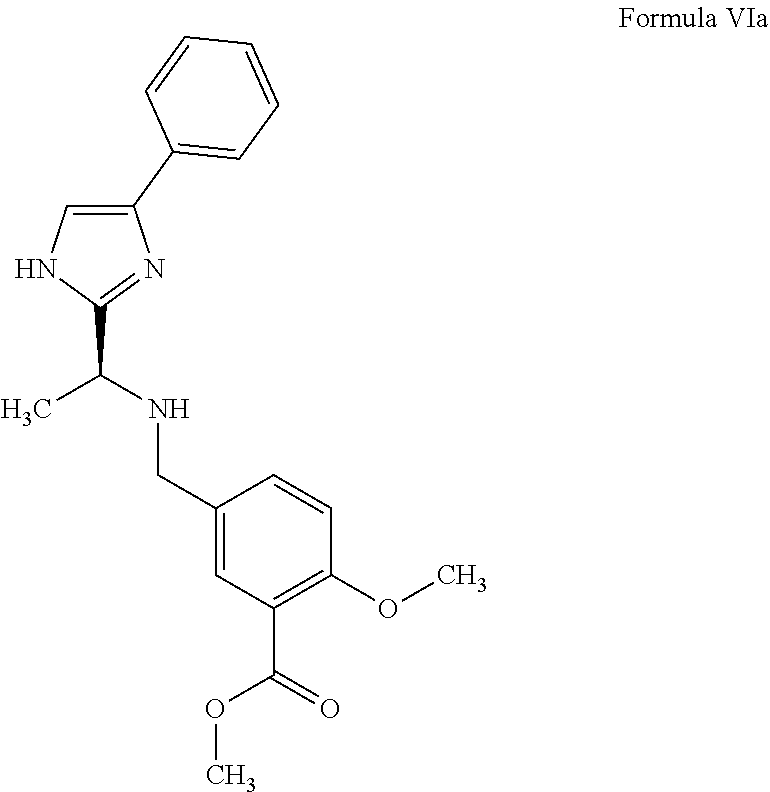
- a thirteenth aspect of the present invention provides a process for the preparation of a compound of Formula VIa,
- the salt is selected from the group consisting of citrate, acetate, fumarate, lactate, maleate, malate, tartrate, benzoate, mesylate, oxalate, tosylate, and succinate.
- a fourteenth aspect of the present invention provides a process for the preparation of eluxadoline of Formula I,
- salt is selected from the group consisting of citrate, acetate, fumarate, lactate, maleate, malate, tartrate, benzoate, mesylate, oxalate, tosylate, and succinate; to obtain a compound of Formula VIa; and
- a fifteenth aspect of the present invention provides a compound of Formula V,
- the salt is selected from the group consisting of citrate, acetate, fumarate, lactate, maleate, malate, tartrate, benzoate, mesylate, oxalate, tosylate, and succinate; and R is hydrogen or C 1-6 alkyl.
- a sixteenth aspect of the present invention provides use of a compound of Formula V
- the salt is selected from the group consisting of citrate, acetate, fumarate, lactate, maleate, malate, tartrate, benzoate, mesylate, oxalate, tosylate, and succinate; and R is hydrogen or C 1-6 alkyl; for the preparation of eluxadoline.
- a seventeenth aspect of the present invention provides a compound of Formula Va,
- the salt is selected from the group consisting of citrate, acetate, fumarate, lactate, maleate, malate, tartrate, benzoate, mesylate, oxalate, tosylate, and succinate.
- An eighteenth aspect of the present invention provides use of a compound of Formula Va,
- the salt is selected from the group consisting of citrate, acetate, fumarate, lactate, maleate, malate, tartrate, benzoate, mesylate, oxalate, tosylate, and succinate; for the preparation of eluxadoline.
- the compound of Formula II or IIa may be prepared by any method known in the art, for example, the method described in U.S. Pat. No. 7,741,356.
- the deprotection of the compound of Formula II or IIa to obtain the compound of Formula III is carried out in the presence of a deprotecting agent in a solvent.
- the deprotecting agent is selected from the group consisting of palladium on carbon (Pd/C), Raney Nickel, and hydrochloric acid.
- the deprotection of the compound of Formula II or IIa is carried out under hydrogen pressure of about 3.0 kg/cm 2 to about 4.5 kg/cm 2 .
- the solvent is selected from the group consisting of alcohols, nitriles, halogenated hydrocarbons, ethers, water, and mixtures thereof.
- alcohols include methanol, ethanol, propanol, iso-propanol, n-butanol, and iso-butanol.
- An example of nitrile is acetonitrile.
- halogenated hydrocarbons include dichloromethane, dichloroethane, chloroform, and carbon tetrachloride.
- ethers include tetrahydrofuran, ethyl methyl ether, diethyl ether, and diisopropyl ether.
- the deprotection of the compound of Formula II or IIa is carried out in about 30 minutes to about 10 hours, for example, in about 2 hours to about 6 hours.
- the deprotection of the compound of Formula II or Formula IIa is carried out at a temperature of about 10° C. to about 40° C., for example, about 20° C. to about 35° C.
- the compound of Formula III may optionally be isolated by filtration, decantation, extraction, distillation, evaporation, chromatography, precipitation, concentration, crystallization, centrifugation, and recrystallization.
- the compound of Formula III may be dried using conventional techniques, for example, drying, drying under vacuum, spray drying, suck drying, air drying, or agitated thin film drying.
- the reductive amination of the compound of Formula III with the compound of Formula IV or IVa is carried out optionally in the presence of a reducing agent and molecular sieves in a solvent.
- the compound of Formula IV or IVa may be prepared by any method known in the art, for example, the method described in U.S. Pat. No. 7,741,356.
- the reductive amination of the compound of Formula III may be carried out after isolation from the reaction mixture in which it is formed, or the reaction mixture containing the compound of Formula III may be used for the reaction with the compound of Formula IV or IVa.
- the reducing agent is selected from the group consisting of sodium borohydride, sodium cyanoborohydride, sodium triacetoxyborohydride, lithium borohydride, potassium borohydride, Raney Nickel, and Palladium on carbon (Pd/C).
- the reductive amination of the compound of Formula III with the compound of Formula IV or IVa is carried out under hydrogen pressure of about 3.0 kg/cm 2 to about 4.5 kg/cm 2 .
- the solvent is selected from the group consisting of alcohols, nitriles, halogenated hydrocarbons, ethers, water, and mixtures thereof.
- alcohols include methanol, ethanol, propanol, iso-propanol, n-butanol, and iso-butanol.
- An example of nitrile is acetonitrile.
- halogenated hydrocarbons include dichloromethane, dichloroethane, chloroform, and carbon tetrachloride.
- ethers include tetrahydrofuran, ethyl methyl ether, diethyl ether, and diisopropyl ether.
- reaction mixture obtained after the reductive amination of the compound of Formula III with the compound of Formula IV or IVa may be treated with an acid to obtain the compound of Formula V or Va or the reaction mass obtained after the reductive amination of the compound of Formula III with the compound of Formula IV or IVa may be isolated which may further be treated with an acid to obtain the compound of Formula V or Va.
- the acid is selected from the group consisting of citric acid, acetic acid, fumaric acid, lactic acid, maleic acid, malic acid, tartaric acid, benzoic acid, methanesulfonic acid, oxalic acid, p-toluenesulfonic acid, and succinic acid.
- the reductive amination of the compound of Formula III with the compound of Formula IV or IVa is carried out for about 10 minutes to about 10 hours, for example, for about 10 minutes to about 6 hours.
- the reductive amination of the compound of Formula III with the compound of Formula IV or IVa is carried out at a temperature of about 0° C. to about 45° C., for example, about 0° C. to about 30° C.
- the treatment of the reaction mixture with an acid is carried out for about 1 hour to about 30 hours, for example, for about 1 hour to about 24 hours.
- the treatment of the reaction mixture with an acid is carried out at a temperature of about 5° C. to about 60° C., for example, about 10° C. to about 55° C.
- the compound of Formula V or Va may optionally be isolated by filtration, decantation, extraction, distillation, evaporation, chromatography, precipitation, concentration, crystallization, centrifugation, and recrystallization.
- the compound of Formula V or Va may be dried using conventional techniques, for example, drying, drying under vacuum, spray drying, air drying, or agitated thin film drying.
- the base is selected from the group consisting of sodium hydroxide, potassium hydroxide, lithium hydroxide, calcium hydroxide, sodium bicarbonate, potassium bicarbonate, and cesium hydroxide.
- the solvent is selected from the group consisting of alcohols, nitriles, halogenated hydrocarbons, ethers, water, and mixtures thereof.
- alcohols include methanol, ethanol, propanol, iso-propanol, n-butanol, and iso-butanol.
- An example of nitrile is acetonitrile.
- halogenated hydrocarbons include dichloromethane, dichloroethane, chloroform, and carbon tetrachloride.
- ethers include tetrahydrofuran, ethyl methyl ether, diethyl ether, and diisopropyl ether.
- the treatment of the compound of Formula V or Va with a base is carried out for about 5 minutes to about 10 hours, for example, for about 10 minutes to about 4 hours.
- the treatment of the compound of Formula V or Va with a base is carried out at a temperature of about 15° C. to about 40° C., for example, about 18° C. to about 25° C.
- the reaction mixture containing the compound of Formula VI or VIa may be used as such for the preparation of eluxadoline or the compound of Formula VI or VIa may optionally be isolated by filtration, decantation, extraction, distillation, evaporation, chromatography, precipitation, concentration, crystallization, centrifugation, and recrystallization.
- the compound of Formula VI or VIa may be dried using conventional techniques, for example, drying, drying under vacuum, spray drying, air drying, or agitated thin film drying.
- the compound of Formula VI or VIa is converted to methyl 5-( ⁇ [N-(tert-butoxycarbonyl)-4-carbamoyl-2,6-dimethyl-L-phenylalanyl][(1S)-1-(4-phenyl-1H-imidazol-2-yl)ethyl]amino ⁇ methyl)-2-methoxybenzoate by following the process known in the art, for example, as disclosed in U.S. Pat. No. 7,741,356 or as described herein.
- Methyl 5-( ⁇ [N-(tert-butoxycarbonyl)-4-carbamoyl-2,6-dimethyl-L-phenylalanyl][(1S)-1-(4-phenyl-1H-imidazol-2-yl)ethyl]amino ⁇ methyl)-2-methoxybenzoate is converted to eluxadoline of Formula I by the processes known in the art, for example, as disclosed in U.S. Pat. No. 7,741,356 or as described in our copending application.
- Chromatographic purity of the samples was determined by HPLC using Water® Alliance® HPLC system, Water 2695 separation module with 2489 UV visible detector.
- the NMR spectrum was recorded using a Bruker® Avance III (400 MHz) NMR spectrometer.
- the IR spectrum was recorded using a Perkin Elmer® instrument.
- Mass spectrum was recorded using a MASS (API2000) LC/MS-MS system, Q Trap® LC/MS-MS system (Applied Biosystems).
- Methyl 5-formyl-2-methoxybenzoate (16.54 g; Formula IVa or IV, when R is methyl) was added to the filtrate at room temperature to obtain a reaction mixture.
- the reaction mixture was stirred for one hour at room temperature and then cooled to 0° C.
- Sodium borohydride (4.39 g) was added in lots to the reaction mixture and then stirred for 4 hours at 0° C. to 10° C.
- Sodium borohydride (1.1 g) was again added in lots at 0° C. to 10° C. and then stirred for 2 hours at 0° C. to 10° C.
- Water (75 mL) and dichloromethane (105 mL) were added to the reaction mixture at 0° C. to 10° C.
- Example 1 Preparation of methyl 2-methoxy-5-( ⁇ [(1S)-1-(4-phenyl-1H-imidazol-2-yl)ethyl]amino ⁇ methyl)benzoate citrate (Formula Va or V, when R is methyl)
- the reaction mass was filtered through Hyflo® bed and then washed with methanol to obtain a filtrate.
- the filtrate was taken in a reaction flask and methyl 5-formyl-2-methoxybenzoate (0.15 kg; Formula IVa or IV, when R is methyl) was added at room temperature.
- the reaction mixture was stirred for one hour.
- Methyl 5-formyl-2-methoxybenzoate (15 g; Formula IVa or IV, when R is methyl
- the pH of the reaction mixture was adjusted to 3.0 to 3.5 using 50% solution of citric acid ( ⁇ 0.7 kg citric acid in 1.4 L water) and then stirred overnight at 10° C. to 25° C.
- the solid so obtained was filtered, washed with aqueous methanol (50%, 0.3 L) and then suck dried to obtain a wet material.
- the wet material was washed with water (1.5 L) to obtain a slurry.
- Methanol (1.2 L) was added to the slurry and then heated to 50° C. to 55° C.
- the slurry was stirred for 30 minutes at 50° C. to 55° C., cooled to 25° C. to 30° C. and then stirred for one hour.
- the reaction mixture was filtered, washed with methanol (0.3 L) and then suck dried to obtain a wet cake.
- the wet cake was dried under vacuum at 50° C. to 55° C. for 20 hours to obtain the title compound.
- IR ⁇ max (KBr): 3423, 3007, 2952, 2842, 2707, 1909, 1702, 1617, 1583, 1502, 1459, 1438, 1389, 1306, 1266, 1208, 1158, 1086, 1121, 1025, 995, 900, 823, 764, 787, 764, 735, 694, 504, 467, 434, 419, 409 cm ⁇ 1 .
- Citrate content (on anhydrous basis (% w/w)): 33.55
- Benzyl [(1S)-1-(4-phenyl-1H-imidazol-2-yl)ethyl]carbamate (10 g; Formula Ha or Formula II, when PG is benzyloxycarbonyl) was added to methanol (50 mL) at room temperature. Palladium on carbon (2.5%, 1 g) was added to the mixture at room temperature. Hydrogen pressure (3.0 kg/cm 2 to 4 kg/cm 2 ) was applied to the reaction mixture and then stirred for 3 hours at 28° C. to 30° C. The reaction mass was filtered through Hyflo® bed and then washed with methanol (20 mL) to obtain a filtrate.
- Benzyl [(1S)-1-(4-phenyl-1H-imidazol-2-yl)ethyl]carbamate (10 g; Formula Ha or Formula II, when PG is benzyloxycarbonyl) was added to methanol (50 mL) at room temperature. Palladium on carbon (2.5%, 50% wet; 4 g) was added at room temperature. Hydrogen pressure (3.0 kg/cm 2 to 4.0 kg/cm 2 ) was applied to the reaction mass and then stirred for 2 hours at 30° C.
- Methyl 5-formyl-2-methoxybenzoate (5.7 g; Formula IVa or IV, when R is methyl) was added to the mixture at room temperature and hydrogen pressure (3.0 kg/cm 2 to 4.0 kg/cm 2 ) was applied. The reaction mixture was stirred for 4 hours at 30° C. The reaction mixture was filtered through Hyflo® bed and then washed with methanol (20 mL) to obtain a filtrate. An aqueous solution of citric acid (50%, 14 mL) was added to the filtrate at room temperature to obtain a reaction mass. The reaction mass was stirred for 2 hours at 20° C. to 22° C. The solid so obtained was filtered, washed with water (50 mL), suck dried and then dried overnight in air oven at 60° C. to 65° C. to obtain the title compound.
- Benzyl [(1S)-1-(4-phenyl-1H-imidazol-2-yl)ethyl]carbamate (10 g; Formula Ha or Formula II, when PG is benzyloxycarbonyl) was added to methanol (50 mL) at room temperature. Palladium on carbon (2.5%, 50% wet; 4 g) was added to the mixture at room temperature. Methyl 5-formyl-2-methoxybenzoate (6.3 g; Formula IVa or IV, when R is methyl) was added to the mixture at room temperature and hydrogen pressure (3.5 kg/cm 2 to 4.0 kg/cm 2 ) was applied. The reaction mixture was stirred for 2 hours at 30° C.
- Methyl 5-formyl-2-methoxybenzoate (0.94 g; Formula IVa or IV, when R is methyl) and activated molecular sieves (4 ⁇ , 5 g) were added to the reaction mixture at room temperature.
- Hydrogen pressure (3.0 kg/cm 2 to 4.0 kg/cm 2 ) was again applied to the reaction mixture and then stirred for 4 hours at 30° C.
- the reaction mixture was filtered through Hyflo® bed and washed with methanol (20 mL) to obtain a filtrate.
- An aqueous solution of citric acid (50%, 13 mL) was added to the filtrate at room temperature.
- the reaction mixture was stirred for 2 hours at 20° C. to 22° C.
- the solid so obtained was filtered, washed with water (50 mL), suck dried and then dried overnight in air oven at 60° C. to 65° C. to obtain the title compound.
- the layers were separated and the organic layer was washed with DI water (240 mL).
- the organic layer was treated with anhydrous sodium sulphate (12 g) and then recovered under vacuum at 40° C. to 45° C.
- the oil so obtained was dissolved in dichloromethane (750 mL) and recovered under vacuum at 40° C. to 45° C. to obtain an oil.
- Example 2 The oil (obtained from Example 2) was dissolved in N,N-dimethylformamide (150 mL) to obtain a solution.
- 1-Ethyl-3-(3-dimethylaminopropyl)carbodiimide (42.74 g) was added and then stirred for 2 hours at 28° C. to 30° C.
- Methyl 5-( ⁇ [N-(tert-butoxycarbonyl)-4-carbamoyl-2,6-dimethyl-L-phenylalanyl][(1S)-1-(4-phenyl-1H-imidazol-2-yl)ethyl]amino ⁇ methyl)-2-methoxybenzoate was converted to eluxadoline as per procedure disclosed in U.S. Pat. No. 7,741,356 or as described in our copending application.
Landscapes
- Chemical & Material Sciences (AREA)
- Organic Chemistry (AREA)
- Pharmaceuticals Containing Other Organic And Inorganic Compounds (AREA)
- Nitrogen And Oxygen Or Sulfur-Condensed Heterocyclic Ring Systems (AREA)
Abstract
Description


wherein the salt is selected from the group consisting of citrate, acetate, fumarate, lactate, maleate, malate, tartrate, benzoate, mesylate, oxalate, tosylate, and succinate; and
R is hydrogen or C1-6 alkyl;
comprising
-
- a) deprotecting a compound of Formula II

wherein PG is a nitrogen protecting group;
in the presence of a deprotecting agent to obtain a compound of Formula III; and

-
- b) reductive amination of the compound of Formula III with a compound of Formula IV

wherein R is hydrogen or C1-6 alkyl;
followed by the treatment with an acid to obtain a compound of Formula V.

comprising
-
- a) deprotecting a compound of Formula II

wherein PG is a nitrogen protecting group;
in the presence of a deprotecting agent to obtain a compound of Formula III;

-
- b) reductive amination of the compound of Formula III with a compound of Formula IV

wherein R is hydrogen or C1-6 alkyl;
followed by the treatment with an acid to obtain a compound of Formula V;

wherein the salt is selected from the group consisting of citrate, acetate, fumarate, lactate, maleate, malate, tartrate, benzoate, mesylate, oxalate, tosylate, and succinate; and
R is hydrogen or C1-6 alkyl; and
-
- c) converting the compound of Formula V to eluxadoline of Formula I.

wherein the salt is selected from the group consisting of citrate, acetate, fumarate, lactate, maleate, malate, tartrate, benzoate, mesylate, oxalate, tosylate, and succinate; and
R is hydrogen or C1-6 alkyl;
comprising reductive amination of a compound of Formula III

with a compound of Formula IV

wherein R is hydrogen or C1-6 alkyl;
followed by the treatment with an acid.

comprising
-
- a) reductive amination of a compound of Formula III

with a compound of Formula IV

wherein R is hydrogen or C1-6 alkyl;
followed by the treatment with an acid to obtain a compound of Formula V;

wherein the salt is selected from the group consisting of citrate, acetate, fumarate, lactate, maleate, malate, tartrate, benzoate, mesylate, oxalate, tosylate, and succinate; and
R is hydrogen or C1-6 alkyl; and
-
- b) converting the compound of Formula V to eluxadoline of Formula I.

wherein the salt is selected from the group consisting of citrate, acetate, fumarate, lactate, maleate, malate, tartrate, benzoate, mesylate, oxalate, tosylate, and succinate;
comprising
-
- a) deprotecting a compound of Formula IIa

in the presence of a deprotecting agent to obtain a compound of Formula III; and

-
- b) reductive amination of the compound of Formula III with a compound of Formula IVa

followed by the treatment with an acid.

comprising
-
- a) deprotecting a compound of Formula IIa

in the presence of a deprotecting agent to obtain a compound of Formula III;

-
- b) reductive amination of the compound of Formula III with a compound of Formula IVa

followed by the treatment with an acid to obtain a compound of Formula Va;

wherein the salt is selected from the group consisting of citrate, acetate, fumarate, lactate, maleate, malate, tartrate, benzoate, mesylate, oxalate, tosylate, and succinate; and
-
- c) converting the compound of Formula Va to eluxadoline of Formula I.

wherein the salt is selected from the group consisting of citrate, acetate, fumarate, lactate, maleate, malate, tartrate, benzoate, mesylate, oxalate, tosylate, and succinate;
comprising reductive amination of a compound of Formula III

with a compound of Formula IVa

followed by the treatment with an acid.

comprising
-
- a) reductive amination of a compound of Formula III

with a compound of Formula IVa

followed by the treatment with an acid to obtain a compound of Formula Va;

wherein the salt is selected from the group consisting of citrate, acetate, fumarate, lactate, maleate, malate, tartrate, benzoate, mesylate, oxalate, tosylate, and succinate; and
-
- b) converting the compound of Formula Va to eluxadoline of Formula I.

comprising
-
- a) deprotecting a compound of Formula II

wherein PG is a nitrogen protecting group;
in the presence of a deprotecting agent to obtain a compound of Formula III;

-
- b) reductive amination of the compound of Formula III with a compound of Formula IV

wherein R is hydrogen or C1-6 alkyl;
followed by the treatment with an acid to obtain the compound of Formula V;

wherein the salt is selected from the group consisting of citrate, acetate, fumarate, lactate, maleate, malate, tartrate, benzoate, mesylate, oxalate, tosylate, and succinate;
R is hydrogen or C1-6 alkyl;
-
- c) treating the compound of Formula V with a base to obtain a compound of Formula VI;

wherein R is hydrogen or C1-6 alkyl; and
-
- d) converting the compound of Formula VI to eluxadoline of Formula I.

comprising
-
- a) deprotecting a compound of Formula IIa

in the presence of a deprotecting agent to obtain a compound of Formula III;

-
- b) reductive amination of the compound of Formula III with a compound of Formula IVa

followed by the treatment with an acid to obtain a compound of Formula Va;

wherein the salt is selected from the group consisting of citrate, acetate, fumarate, lactate, maleate, malate, tartrate, benzoate, mesylate, oxalate, tosylate, and succinate;
-
- c) treating the compound of Formula Va with a base to obtain a compound of Formula VIa; and

-
- d) converting the compound of Formula VIa to eluxadoline of Formula I.

wherein R is hydrogen or C1-6 alkyl;
comprising treating a compound of Formula V with a base

wherein the salt is selected from the group consisting of citrate, acetate, fumarate, lactate, maleate, malate, tartrate, benzoate, mesylate, oxalate, tosylate, and succinate; and
R is hydrogen or C1-6 alkyl.

comprising
-
- a) treating a compound of Formula V with a base

wherein the salt is selected from the group consisting of citrate, acetate, fumarate, lactate, maleate, malate, tartrate, benzoate, mesylate, oxalate, tosylate, and succinate; and
R is hydrogen or C1-6 alkyl;
to obtain a compound of Formula VI,

wherein R is hydrogen or C1-6 alkyl; and
-
- b) converting the compound of Formula VI to eluxadoline of Formula I.

comprising treating a compound of Formula Va with a base

wherein the salt is selected from the group consisting of citrate, acetate, fumarate, lactate, maleate, malate, tartrate, benzoate, mesylate, oxalate, tosylate, and succinate.

comprising
-
- a) treating a compound of Formula Va with a base

wherein the salt is selected from the group consisting of citrate, acetate, fumarate, lactate, maleate, malate, tartrate, benzoate, mesylate, oxalate, tosylate, and succinate;
to obtain a compound of Formula VIa; and
-
- b) converting the compound of Formula VIa to eluxadoline of Formula I.

wherein the salt is selected from the group consisting of citrate, acetate, fumarate, lactate, maleate, malate, tartrate, benzoate, mesylate, oxalate, tosylate, and succinate; and
R is hydrogen or C1-6 alkyl.

wherein the salt is selected from the group consisting of citrate, acetate, fumarate, lactate, maleate, malate, tartrate, benzoate, mesylate, oxalate, tosylate, and succinate; and
R is hydrogen or C1-6 alkyl;
for the preparation of eluxadoline.

wherein the salt is selected from the group consisting of citrate, acetate, fumarate, lactate, maleate, malate, tartrate, benzoate, mesylate, oxalate, tosylate, and succinate.

wherein the salt is selected from the group consisting of citrate, acetate, fumarate, lactate, maleate, malate, tartrate, benzoate, mesylate, oxalate, tosylate, and succinate;
for the preparation of eluxadoline.
Claims (10)


Applications Claiming Priority (3)
| Application Number | Priority Date | Filing Date | Title |
|---|---|---|---|
| IN201611031959 | 2016-09-20 | ||
| IN201611031959 | 2016-09-20 | ||
| PCT/IB2017/055704 WO2018055528A2 (en) | 2016-09-20 | 2017-09-20 | Processes for the preparation of eluxadoline |
Publications (2)
| Publication Number | Publication Date |
|---|---|
| US20190248748A1 US20190248748A1 (en) | 2019-08-15 |
| US10479769B2 true US10479769B2 (en) | 2019-11-19 |
Family
ID=61690207
Family Applications (1)
| Application Number | Title | Priority Date | Filing Date |
|---|---|---|---|
| US16/335,013 Active US10479769B2 (en) | 2016-09-20 | 2017-09-20 | Processes for the preparation of eluxadoline |
Country Status (3)
| Country | Link |
|---|---|
| US (1) | US10479769B2 (en) |
| EP (1) | EP3515434A4 (en) |
| WO (1) | WO2018055528A2 (en) |
Citations (6)
| Publication number | Priority date | Publication date | Assignee | Title |
|---|---|---|---|---|
| US5347051A (en) | 1993-05-28 | 1994-09-13 | Hoechst Celanese Corporation | Processes for preparing amines |
| WO2009009480A2 (en) | 2007-07-09 | 2009-01-15 | Janssen Pharmaceutica N.V. | Novel crystals and process of making 5-({[2-amino-3-(4-carbamoyl-2,6-dimethyl-phenyl)-propionyl]-[1-(4-phenyl-1h-imidazol-2-yl)-ethyl]-amino}-methyl)-2-methoxy- benzoic acid |
| US7629488B2 (en) | 2005-03-14 | 2009-12-08 | Janssen Pharmaceutica N.V. | Process for the preparation of opioid modulators |
| US7741356B2 (en) | 2004-03-15 | 2010-06-22 | Janssen Pharmaceutica N.V. | Compounds as opioid receptor modulators |
| US8710256B2 (en) | 2008-10-27 | 2014-04-29 | Janssen Pharmaceutica, N.V. | Process for the preparation of protected L-alanine derivatives |
| US20140271854A1 (en) | 2013-03-14 | 2014-09-18 | Furiex Pharmaceuticals | Opioid receptor modulator dosage formulations |
Family Cites Families (2)
| Publication number | Priority date | Publication date | Assignee | Title |
|---|---|---|---|---|
| EP3272741A1 (en) * | 2016-07-21 | 2018-01-24 | Euticals S.P.A. | New stable solvate crystalline forms of eluxadoline |
| US12637431B2 (en) * | 2016-05-03 | 2026-05-26 | Msn Laboratories Private Limited, R&D Center | Process for the preparation of 5-[[[(2S)-2-amino-3-[4-(aminocarbonyl)-2,6-dimethylphenyl]-1-oxopropyl] [(1S)-1-(4-phenyl-1H-imidazol-2-yl)ethyl]amino] methyl-2-methoxybenzoic acid and its polymorphs thereof |
-
2017
- 2017-09-20 US US16/335,013 patent/US10479769B2/en active Active
- 2017-09-20 EP EP17852507.7A patent/EP3515434A4/en not_active Withdrawn
- 2017-09-20 WO PCT/IB2017/055704 patent/WO2018055528A2/en not_active Ceased
Patent Citations (8)
| Publication number | Priority date | Publication date | Assignee | Title |
|---|---|---|---|---|
| US5347051A (en) | 1993-05-28 | 1994-09-13 | Hoechst Celanese Corporation | Processes for preparing amines |
| US7741356B2 (en) | 2004-03-15 | 2010-06-22 | Janssen Pharmaceutica N.V. | Compounds as opioid receptor modulators |
| US20160030393A1 (en) | 2004-03-15 | 2016-02-04 | Jannsen Pharmaceutica Nv | Novel compounds as opioid receptor modulators |
| US7629488B2 (en) | 2005-03-14 | 2009-12-08 | Janssen Pharmaceutica N.V. | Process for the preparation of opioid modulators |
| WO2009009480A2 (en) | 2007-07-09 | 2009-01-15 | Janssen Pharmaceutica N.V. | Novel crystals and process of making 5-({[2-amino-3-(4-carbamoyl-2,6-dimethyl-phenyl)-propionyl]-[1-(4-phenyl-1h-imidazol-2-yl)-ethyl]-amino}-methyl)-2-methoxy- benzoic acid |
| WO2009009480A3 (en) | 2007-07-09 | 2009-03-12 | Janssen Pharmaceutica Nv | Novel crystals and process of making 5-({[2-amino-3-(4-carbamoyl-2,6-dimethyl-phenyl)-propionyl]-[1-(4-phenyl-1h-imidazol-2-yl)-ethyl]-amino}-methyl)-2-methoxy- benzoic acid |
| US8710256B2 (en) | 2008-10-27 | 2014-04-29 | Janssen Pharmaceutica, N.V. | Process for the preparation of protected L-alanine derivatives |
| US20140271854A1 (en) | 2013-03-14 | 2014-09-18 | Furiex Pharmaceuticals | Opioid receptor modulator dosage formulations |
Non-Patent Citations (2)
| Title |
|---|
| International Preliminary Report on Patentability for International Application No. PCT/IB2017/055704, issued by WIPO, dated 2018. |
| International Search Report and Written Opinion for International Application No. PCT/IB2017/055704, issued by US/ISA dated Apr. 26, 2018. |
Also Published As
| Publication number | Publication date |
|---|---|
| EP3515434A2 (en) | 2019-07-31 |
| WO2018055528A3 (en) | 2018-06-07 |
| EP3515434A4 (en) | 2020-02-26 |
| US20190248748A1 (en) | 2019-08-15 |
| WO2018055528A2 (en) | 2018-03-29 |
Similar Documents
| Publication | Publication Date | Title |
|---|---|---|
| US11440912B2 (en) | Process for the preparation of ribociclib and its salts | |
| US20130158265A1 (en) | Sitagliptin, salts and polymorphs thereof | |
| US10125115B2 (en) | Process for the preparation of efinaconazole | |
| US20190359619A1 (en) | Process for the preparation of remimazolam and solid state forms of remimazolam salts | |
| US8501960B2 (en) | Saxagliptin intermediates, saxagliptin polymorphs, and processes for preparation thereof | |
| EP3341359B2 (en) | Process for preparation of apremilast | |
| US9260428B2 (en) | Process and intermediates for the synthesis of 8-[{1-(3,5-bis-(trifluoromethyl)phenyl)-ethoxy}-methyl]-8-phenyl-1,7-diaza-spiro[4.5]decan-2-one compounds | |
| WO2017076293A1 (en) | Method for preparing oxazolidinone intermediate | |
| US9567332B2 (en) | Process for the preparation and purification of apixaban | |
| US10981877B2 (en) | Production method for pyrazole-amide compound | |
| US20250361226A1 (en) | Pharmaceutically acceptable salt of benzo[c]chroman compound and polymorphic form and use of pharmaceutically acceptable salt | |
| US20100036125A1 (en) | Synthesis of ccr5 receptor antagonists | |
| US20260103451A1 (en) | Process for preparing pyrimidinyl bipyridine compound and intermediate therefor | |
| WO2014111953A1 (en) | Process for preparation of anacetrapib and intermediates thereof | |
| US8716476B2 (en) | Process for the preparation of alfuzosin hydrochloride | |
| US20190248748A1 (en) | Processes for the preparation of eluxadoline | |
| IL167167A (en) | Intermediates in producing phenoxyacetic acid derivatives and method of using the same | |
| CN107428761B (en) | The method for preparing dipeptidyl peptidase-4 (DPP-4) inhibitor | |
| CA2879824A1 (en) | Saxagliptin salts | |
| JP6622501B2 (en) | Method for producing aldehyde | |
| CN119954778A (en) | A method for synthesizing lenacapvir sodium and its series of intermediate compounds | |
| US20220048859A1 (en) | Synthetic process | |
| US20150329489A1 (en) | Saxagliptin salts | |
| HK1102303B (en) | Synthesis of ccr5 receptor antagonists |
Legal Events
| Date | Code | Title | Description |
|---|---|---|---|
| FEPP | Fee payment procedure |
Free format text: ENTITY STATUS SET TO UNDISCOUNTED (ORIGINAL EVENT CODE: BIG.); ENTITY STATUS OF PATENT OWNER: LARGE ENTITY |
|
| AS | Assignment |
Owner name: SUN PHARMACEUTICAL INDUSTRIES LIMITED, INDIA Free format text: ASSIGNMENT OF ASSIGNORS INTEREST;ASSIGNORS:ISMAIL, INAMDAR MURAD;MOHAN, SRIRAM HARI;HIRPARA, KETAN VITHALBHAI;REEL/FRAME:049036/0718 Effective date: 20170413 |
|
| STPP | Information on status: patent application and granting procedure in general |
Free format text: NOTICE OF ALLOWANCE MAILED -- APPLICATION RECEIVED IN OFFICE OF PUBLICATIONS |
|
| STPP | Information on status: patent application and granting procedure in general |
Free format text: PUBLICATIONS -- ISSUE FEE PAYMENT RECEIVED |
|
| STCF | Information on status: patent grant |
Free format text: PATENTED CASE |
|
| MAFP | Maintenance fee payment |
Free format text: PAYMENT OF MAINTENANCE FEE, 4TH YEAR, LARGE ENTITY (ORIGINAL EVENT CODE: M1551); ENTITY STATUS OF PATENT OWNER: LARGE ENTITY Year of fee payment: 4 |