US10470588B2 - Modular label track system - Google Patents
Modular label track system Download PDFInfo
- Publication number
- US10470588B2 US10470588B2 US15/848,769 US201715848769A US10470588B2 US 10470588 B2 US10470588 B2 US 10470588B2 US 201715848769 A US201715848769 A US 201715848769A US 10470588 B2 US10470588 B2 US 10470588B2
- Authority
- US
- United States
- Prior art keywords
- product
- face
- label
- shelf
- modular
- Prior art date
- Legal status (The legal status is an assumption and is not a legal conclusion. Google has not performed a legal analysis and makes no representation as to the accuracy of the status listed.)
- Active
Links
- 230000008520 organization Effects 0.000 claims abstract description 10
- 238000000034 method Methods 0.000 claims description 13
- 230000008859 change Effects 0.000 claims description 7
- 238000002372 labelling Methods 0.000 claims description 5
- HRANPRDGABOKNQ-ORGXEYTDSA-N (1r,3r,3as,3br,7ar,8as,8bs,8cs,10as)-1-acetyl-5-chloro-3-hydroxy-8b,10a-dimethyl-7-oxo-1,2,3,3a,3b,7,7a,8,8a,8b,8c,9,10,10a-tetradecahydrocyclopenta[a]cyclopropa[g]phenanthren-1-yl acetate Chemical compound C1=C(Cl)C2=CC(=O)[C@@H]3C[C@@H]3[C@]2(C)[C@@H]2[C@@H]1[C@@H]1[C@H](O)C[C@@](C(C)=O)(OC(=O)C)[C@@]1(C)CC2 HRANPRDGABOKNQ-ORGXEYTDSA-N 0.000 claims 1
- 238000010586 diagram Methods 0.000 description 4
- 230000008569 process Effects 0.000 description 4
- 230000008901 benefit Effects 0.000 description 2
- 230000004075 alteration Effects 0.000 description 1
- 230000001419 dependent effect Effects 0.000 description 1
- 230000007246 mechanism Effects 0.000 description 1
- 238000012986 modification Methods 0.000 description 1
- 230000004048 modification Effects 0.000 description 1
Images




Classifications
-
- A—HUMAN NECESSITIES
- A47—FURNITURE; DOMESTIC ARTICLES OR APPLIANCES; COFFEE MILLS; SPICE MILLS; SUCTION CLEANERS IN GENERAL
- A47F—SPECIAL FURNITURE, FITTINGS, OR ACCESSORIES FOR SHOPS, STOREHOUSES, BARS, RESTAURANTS OR THE LIKE; PAYING COUNTERS
- A47F5/00—Show stands, hangers, or shelves characterised by their constructional features
- A47F5/0043—Show shelves
- A47F5/0068—Shelf extensions, e.g. fixed on price rail
-
- A—HUMAN NECESSITIES
- A47—FURNITURE; DOMESTIC ARTICLES OR APPLIANCES; COFFEE MILLS; SPICE MILLS; SUCTION CLEANERS IN GENERAL
- A47F—SPECIAL FURNITURE, FITTINGS, OR ACCESSORIES FOR SHOPS, STOREHOUSES, BARS, RESTAURANTS OR THE LIKE; PAYING COUNTERS
- A47F5/00—Show stands, hangers, or shelves characterised by their constructional features
- A47F5/08—Show stands, hangers, or shelves characterised by their constructional features secured to the wall, ceiling, or the like; Wall-bracket display devices
- A47F5/0807—Display panels, grids or rods used for suspending merchandise or cards supporting articles; Movable brackets therefor
- A47F5/0869—Accessories for article-supporting brackets, e.g. price- indicating means, not covered by a single one of groups A47F5/08
-
- G—PHYSICS
- G09—EDUCATION; CRYPTOGRAPHY; DISPLAY; ADVERTISING; SEALS
- G09F—DISPLAYING; ADVERTISING; SIGNS; LABELS OR NAME-PLATES; SEALS
- G09F3/00—Labels, tag tickets, or similar identification or indication means; Seals; Postage or like stamps
- G09F3/08—Fastening or securing by means not forming part of the material of the label itself
- G09F3/18—Casings, frames or enclosures for labels
- G09F3/20—Casings, frames or enclosures for labels for adjustable, removable, or interchangeable labels
- G09F3/204—Casings, frames or enclosures for labels for adjustable, removable, or interchangeable labels specially adapted to be attached to a shelf or the like
-
- G—PHYSICS
- G09—EDUCATION; CRYPTOGRAPHY; DISPLAY; ADVERTISING; SEALS
- G09F—DISPLAYING; ADVERTISING; SIGNS; LABELS OR NAME-PLATES; SEALS
- G09F3/00—Labels, tag tickets, or similar identification or indication means; Seals; Postage or like stamps
- G09F3/08—Fastening or securing by means not forming part of the material of the label itself
- G09F3/18—Casings, frames or enclosures for labels
- G09F3/20—Casings, frames or enclosures for labels for adjustable, removable, or interchangeable labels
- G09F3/208—Electronic labels, Labels integrating electronic displays
-
- G—PHYSICS
- G09—EDUCATION; CRYPTOGRAPHY; DISPLAY; ADVERTISING; SEALS
- G09F—DISPLAYING; ADVERTISING; SIGNS; LABELS OR NAME-PLATES; SEALS
- G09F3/00—Labels, tag tickets, or similar identification or indication means; Seals; Postage or like stamps
- G09F3/08—Fastening or securing by means not forming part of the material of the label itself
- G09F3/18—Casings, frames or enclosures for labels
- G09F3/20—Casings, frames or enclosures for labels for adjustable, removable, or interchangeable labels
- G09F3/201—Enclosures enveloping completely the labels
Definitions
- aspects of the present invention relate to a system for identifying products on a retail shelf, and more specifically to a system for identifying products on a retail shelf according to a modular organization that retains a modular sequence and position of products as they are added and removed.
- One method of displaying goods for sale would be to position them on elongated store shelves organized into a number of modular spaces or “modules”. Locations of products on shelves may now be found by their aisle and module designations. Typically, a product offered for sale is placed in one or more adjacent modules according to an overall modular plan. The modular plan indicates the aisle and module where each product is displayed.
- the modular plan allows store associates to more easily find a desired product location. An associate would need to find a product location when re-stocking that location when there are few or no products at that location.
- Plugging a module is stocking the module with a temporary replacement product which is intended to be removed when a shipment of the original product has been received.
- the ‘gap’ can be ‘collapsed’. ‘Collapsing’ a module is temporarily allocating a portion or all of the space of the module to at least one adjacent module.
- a product's modular space When a product's modular space is adjusted or ‘flexed’, either due to a temporary or permanent store plan, it typically remains that way until it is discovered by a store employee such as an associate or manager.
- Discovery usually requires the store associate to find and compare the current layout to the modular plan to correct the layout. This can be accomplished by acquiring information which may include a listing of facings, shelf capacity, and the modular sequence number. This may require that the store associates have a device such as a handheld printer to print out the modular information and/or plans to correct the layout.
- Maintaining the original modular plan is important. Flexibility to change the location of some products in certain circumstances is also required.
- One embodiment of the current invention may be described as a shelf label system for modular product organization that identifies product information on a retail store shelf having at least one elongated shelf label track attached to a front face of the retail store shelf, a plurality of label holders, each fitting within and able to move along a length of the shelf label track, each shelf label holder associated with a modular space on the retail store shelf.
- Each label holder has a main panel, and a hinged panel which is connected to the main panel with a hinge, and which can be folded in a closed position covering the main panel such that only a first face of the hinged panel is visible.
- the label holder may also be in an open position opened away from the main panel, such that a face of the main panel and a second face of the hinged panel are visible and show information on a temporary product.
- the current invention may also be embodied as a method of displaying labels for products on retail shelves arranged in a modular fashion, having the steps of providing an elongated shelf label track which is mounted on a front face of a retail shelf, extending past a plurality of modular spaces, and a plurality of label holders that may slide along the shelf label track.
- the label holders may be in a closed position exposing a first face of a hinged panel or be in an open position, exposing a second face of the hinged panel and the face of the main panel, stocking products each at a designated modular space, positioning label holders adjacent to a plurality of modular spaces, and attaching a label to a first face of the hinged panels having product labeling information relating to the adjacent product.
- the current invention may also be embodied as a shelf label system for modular product organization that identifies information of products having a retail shelf that is divided into a plurality of modular spaces, at least one elongated shelf label conduit attached to a front face of at least one retail shelf, the shelf label conduit having a lengthwise slot and enlarged cutouts, and a plurality of label holders.
- Each label holder includes a head within the shelf label conduit and is able to move along a length of the shelf label track, each label holder associated with and positioned adjacent to a modular space on the retail shelf, a flattened neck coupled to the head having a thickness allowing it to extend and slide through a slot, and a panel coupled to the neck.
- the panel has a first face adapted to display information of a product located in an adjacent modular space and a second face adapted to display information indicating that the product is unavailable when there are no products in the modular space.
- the head, neck and cutouts are sized and shaped to allow the panel to flip to change within a cutout between a ‘normal position’ of the first face being outward and visible and a ‘product unavailable position’ in which the second face is outward and visible.
- FIG. 1 is a block diagram showing the main elements of a modular track label system in accordance with one embodiment of the present invention.
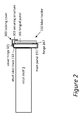
- FIG. 2 is a side elevational cross-sectional view of the modular track label system of FIG. 1 .
- FIG. 3 is a block diagram showing the main elements of a modular track label system in accordance with another embodiment of the present invention.
- FIG. 4 is a flowchart indicating a process according to one embodiment of the current invention.
- the current shelf label system would be used when initially setting up products according to a desired modular plan. It may also be used when the modular plan changes, when prices change, and when items are being counted.
- the shelf label system displays the product and price information which customers use to make purchasing decisions.
- the labeling should indicate information about the temporary product. There should also be some visible indication to the store associate that the module is being filled with a temporary product, and an indication of the original product stored in this module.
- FIG. 1 is a block diagram showing the main elements of a modular track label system in accordance with one embodiment of the present invention.
- FIG. 1 A typical retail shelf 3 in a store is shown in FIG. 1 .
- the retail shelf 3 is divided into modular spaces 7 - 1 , 7 - 2 . . . 7 - 7 (collectively referred to as modular space 7 ).
- These modular spaces 7 in FIG. 1 are shown having the same width. However, these modular spaces may be adjusted (flexed) such that a module may be collapsed and the space is allocated to one or more adjacent modular spaces.
- Original products 9 are stored on retail shelf 3 at each of the modular spaces shown here except for modular space 7 - 3 and 7 - 4 .
- a temporary product 11 is shown being stored at modular spaces 7 - 3 and 7 - 4 .
- the temporary product 11 may be placed there because the original product 9 which is intended to be there may be out of stock, or discontinued.
- Replacing a product with another product in the same modular space is referred to as “plugging” the modular space.
- a shelf label track 110 is attached to the front face of the retail shelf 3 . This typically has upper and lower edges which are designed to hold a plurality of label holders 250 , but allows it to slide along the length of shelf label track 110 .
- a plurality of hinged panels 161 has a first face 163 which is visible when the hinged panel 161 is in the closed position, as is shown for modular spaces 7 - 1 , 7 - 2 , 7 - 5 , 7 - 6 and, 7 - 7 .
- the first face 163 of hinged panel 161 is used to hold a label that has product information and typically pricing for the original products 9 at each of the modular spaces.
- hinged panel 161 adjacent to modular space 7 - 3 is shown in a partially opened position which now exposes a face 153 of a main panel 151 , and a second face 165 of hinged panel 161 .
- hinged panel 161 is in its fully opened position as shown adjacent to modular space 7 - 4 .
- hinged panel 161 is now flat against shelf label track 110 showing second face 165 and showing the face 153 of main panel 151 .
- one face may be used to display information of temporary product 11 and the second face may be used to indicate that the original product 9 is currently out of stock and that temporary product 11 is being stored in the modular space in place of the original product 9 .
- FIG. 2 is a side elevational cross-sectional view of the modular track label system of FIG. 1 .
- FIG. 2 shows a portion of the retail shelf 3 with the shelf label track 110 attached to its front face.
- a label holder 150 is shown in cross-section partially inside shelf label track 110 .
- Shelf label track 110 has top and bottom projections angled towards its center that retain main panel 151 .
- a hinge 167 is attached between main panel 151 and hinged panel 161 . As shown in FIG. 2 , hinged panel 161 is folded over the top of main panel 151 .
- a locking cover 300 having a securing structure 303 which extends at least partially over the main panel 151 and hinged panel 161 . This prevents any changes to the position of hinged panel 161 relative to main panel 151 .
- Locking cover 300 is shown in cross-section here but it may extend for a portion of shelf label track 110 , or for substantially the entire length of shelf label track 110 .
- Securing structure 303 may be pivoted upward on cover hinge 301 so as to allow hinged panel 161 to be flipped open relative to main panel 151 , or to move label holder 150 along shelf label track 110 .
- Securing structure 303 may then be positioned as shown in FIG. 2 to lock main panel 151 and hinged panel 161 in place.
- locking cover 300 may include a lock and key to prevent shoppers from tampering with label holder 150 .
- FIG. 3 is a block diagram showing the main elements of a modular shelf label system 200 in accordance with another embodiment of the present invention.
- a retail shelf 3 is shown having a plurality of modular spaces 7 - 1 , 7 - 2 , 7 - 3 , . . . 7 - 7 .
- Modular spaces 7 - 1 , 7 - 2 , 7 - 3 , 7 - 4 and 7 - 7 are stocked with the original product 9 .
- Modular spaces 7 - 5 and 7 - 6 are stocked with a temporary product 11 since original product 9 is unavailable.
- a shelf label conduit 210 extends for substantially the entire length of retail shelf 3 .
- a slot 211 extends on a front side of shelf label conduit 210 for most of its length.
- a plurality of shelf label holders 250 have an enlarged head 259 which is contained within shelf label conduit 210 , and allowed to slide inside shelf label conduit 210 .
- Each head 259 is connected to a neck 257 having a cross-section small enough to fit into and slide along slot 211 .
- a panel 251 is connected to each neck 257 .
- Each panel 251 has a 1st face 253 and a second face 255 .
- shelf label holder 250 at modular space 7 - 2 is positioned to show first face 253 that carries a label or is printed with information relating to original product 9 .
- Shelf label holder 250 is allowed to be moved upward and pivoted on head 259 such that the neck 257 fits into and slides along slot 211 . Shelf label holder 250 may then be moved left or right to different cutouts 213 . Once the shelf label holder 250 is positioned in a cutout 213 , such as shelf label holder 250 adjacent to modular space 7 - 5 , it may be allowed to be rotated as shown by the arrows. This allows shelf label holder 250 to pivot and then be moved downward into the position shown for shelf label holder 250 adjacent to modular space 7 - 6 . This now shows the second face 255 and information relating to a temporary product 11 adjacent to the shelf label holder 250 in the modular space 7 - 6 .
- This shelf label system 200 therefore allows shelf label holders 250 to be moved from one cutout 213 to another, while keeping their relative sequence, and preserving the modular organization.
- FIG. 4 is a flowchart indicating a process according to one embodiment of the current invention.
- the method of displaying labels for products 9 on retail shelves 3 arranged in a modular fashion starts at step 301 .
- an elongated shelf label track 110 is provided that is mounted on a front face of a retail shelf 3 .
- the elongated shelf label track 110 extends adjacent to the plurality of modular spaces 7 .
- a plurality of label holders 150 are slidingly attached to the shelf label track 110 sequenced according to a modular plan.
- the label holders 150 have a main panel 151 hinged to a hinged panel 161 .
- Each shelf label holder may be in a closed position exposing a first face 163 of a hinged panel 161 or be in an open position, exposing a second face 165 of the hinged panel 161 and the face 153 of the main panel 151 .
- each original product is stocked at a designated modular space 7 , according to a modular organization plan.
- a label holder 150 is positioned adjacent to a modular space 7 .
- step 311 product information pertaining to each original product in the modular space adjacent the label holder is provided on the label holder's first face 163 of the hinged panels 161 . This information may be printed on a label which is attached to the label holder.
- step 313 it is determined if the original product 9 is unavailable; if so, (“yes”) then the process continues at step 317 . If not (“no”), the process ends at step 315 .
- step 317 a temporary product 11 is stocked in the empty modular space 7 previously filled by the original product, for a temporary period of time.
- step 319 the label holder 150 is opened to an open position to hide the first face 163 of the hinged panel 161 , and to expose the second face 165 of the hinged panel 161 and the face 153 of the main panel 151 .
- step 321 product information of the temporary product 11 is provided on one of the exposed faces 153 , 165 .
- step 323 an indication is attached to one of the exposed faces 153 , 165 that the original product 9 that was located at the modular spaces 7 - 3 , 7 - 4 is now temporarily unavailable.
- the modular spaces may be flexed to plug or collapse a modular space, but retain all of the information required to return the current layout back to its original modular plan.
- the shelf label track 110 may have ‘slide rule’ style demarcations along its length to identify the beginning or end of an original module space and expanded modular spaces. It can also identify the original location of collapsed modular spaces, the original locations of labels, etc.
- Another alternative embodiment of the current invention incorporates a lock which requires a key to unlock the locking cover 300 .
- the current system has the ability to easily display labels and return them to their original state with little work, effort or research.
- the current system allows for increased visibility of store modular changes for reporting purposes.
- the current system restricts modular design changes and alterations in the store to authorized users.
Landscapes
- Physics & Mathematics (AREA)
- General Physics & Mathematics (AREA)
- Engineering & Computer Science (AREA)
- Theoretical Computer Science (AREA)
- Management, Administration, Business Operations System, And Electronic Commerce (AREA)
Abstract
Description
Claims (19)
Priority Applications (1)
| Application Number | Priority Date | Filing Date | Title |
|---|---|---|---|
| US15/848,769 US10470588B2 (en) | 2016-12-21 | 2017-12-20 | Modular label track system |
Applications Claiming Priority (2)
| Application Number | Priority Date | Filing Date | Title |
|---|---|---|---|
| US201662437409P | 2016-12-21 | 2016-12-21 | |
| US15/848,769 US10470588B2 (en) | 2016-12-21 | 2017-12-20 | Modular label track system |
Publications (2)
| Publication Number | Publication Date |
|---|---|
| US20180168366A1 US20180168366A1 (en) | 2018-06-21 |
| US10470588B2 true US10470588B2 (en) | 2019-11-12 |
Family
ID=62556438
Family Applications (1)
| Application Number | Title | Priority Date | Filing Date |
|---|---|---|---|
| US15/848,769 Active US10470588B2 (en) | 2016-12-21 | 2017-12-20 | Modular label track system |
Country Status (1)
| Country | Link |
|---|---|
| US (1) | US10470588B2 (en) |
Families Citing this family (1)
| Publication number | Priority date | Publication date | Assignee | Title |
|---|---|---|---|---|
| FR3099020B1 (en) * | 2019-07-15 | 2022-01-14 | Ses Imagotag | Imaging device for a shelf bracket and shelving system comprising the imaging device |
Citations (14)
| Publication number | Priority date | Publication date | Assignee | Title |
|---|---|---|---|---|
| US4593824A (en) * | 1984-12-14 | 1986-06-10 | Armstrong Store Fixture Corporation | Tag holder |
| EP0557361B1 (en) | 1990-11-16 | 1996-10-16 | Clares-Regisbrook Systems Limited | Electronic labelling system |
| US6035569A (en) | 1997-01-20 | 2000-03-14 | Trion Industries, Inc. | Devices for mounting and display of electronic labels and the like |
| US20020034067A1 (en) * | 2000-09-19 | 2002-03-21 | Massaro Michael J. | Electronic display for store shelves |
| US6481133B1 (en) * | 2001-03-19 | 2002-11-19 | Henschel-Steinau, Inc. | Shelf product management and information display |
| US20030136832A1 (en) * | 2000-09-19 | 2003-07-24 | Massaro Michael J. | Display system for store shelves |
| US6796445B2 (en) | 1998-09-16 | 2004-09-28 | Issac Cyrluk | Shelf-front assembly for labeling and retaining products |
| US20050046692A1 (en) * | 2002-01-11 | 2005-03-03 | Barry Bronson | Labeling apparatus and method for disk storage media |
| US7340856B1 (en) | 2006-05-13 | 2008-03-11 | American Gasket Technologies, Inc. | Adjustable attachment for holder of light objects |
| US7530188B2 (en) | 2004-04-08 | 2009-05-12 | Checkpoint Systems, Inc. | Adapter for attaching an electronic shelf label to a blister hook |
| US20110239501A1 (en) * | 2010-03-05 | 2011-10-06 | Dana Industries Inc. | Signage system and method for displaying merchandise on shelves |
| US20120073174A1 (en) | 2010-09-28 | 2012-03-29 | Bird Gregory M | Label holder |
| CA2798624C (en) | 2012-12-12 | 2014-01-14 | Target Brands, Inc. | Sign holder assembly and associated methods |
| US20160133165A1 (en) * | 2013-04-17 | 2016-05-12 | Store Electronic Systems | Electronic labelling device |
-
2017
- 2017-12-20 US US15/848,769 patent/US10470588B2/en active Active
Patent Citations (14)
| Publication number | Priority date | Publication date | Assignee | Title |
|---|---|---|---|---|
| US4593824A (en) * | 1984-12-14 | 1986-06-10 | Armstrong Store Fixture Corporation | Tag holder |
| EP0557361B1 (en) | 1990-11-16 | 1996-10-16 | Clares-Regisbrook Systems Limited | Electronic labelling system |
| US6035569A (en) | 1997-01-20 | 2000-03-14 | Trion Industries, Inc. | Devices for mounting and display of electronic labels and the like |
| US6796445B2 (en) | 1998-09-16 | 2004-09-28 | Issac Cyrluk | Shelf-front assembly for labeling and retaining products |
| US20020034067A1 (en) * | 2000-09-19 | 2002-03-21 | Massaro Michael J. | Electronic display for store shelves |
| US20030136832A1 (en) * | 2000-09-19 | 2003-07-24 | Massaro Michael J. | Display system for store shelves |
| US6481133B1 (en) * | 2001-03-19 | 2002-11-19 | Henschel-Steinau, Inc. | Shelf product management and information display |
| US20050046692A1 (en) * | 2002-01-11 | 2005-03-03 | Barry Bronson | Labeling apparatus and method for disk storage media |
| US7530188B2 (en) | 2004-04-08 | 2009-05-12 | Checkpoint Systems, Inc. | Adapter for attaching an electronic shelf label to a blister hook |
| US7340856B1 (en) | 2006-05-13 | 2008-03-11 | American Gasket Technologies, Inc. | Adjustable attachment for holder of light objects |
| US20110239501A1 (en) * | 2010-03-05 | 2011-10-06 | Dana Industries Inc. | Signage system and method for displaying merchandise on shelves |
| US20120073174A1 (en) | 2010-09-28 | 2012-03-29 | Bird Gregory M | Label holder |
| CA2798624C (en) | 2012-12-12 | 2014-01-14 | Target Brands, Inc. | Sign holder assembly and associated methods |
| US20160133165A1 (en) * | 2013-04-17 | 2016-05-12 | Store Electronic Systems | Electronic labelling device |
Non-Patent Citations (1)
| Title |
|---|
| "Pop Rotating Sign Clip Merchandise Clamp Clear With Price Label Holder 10 PCS," Ebay.com, accessed Oct. 5, 2016. |
Also Published As
| Publication number | Publication date |
|---|---|
| US20180168366A1 (en) | 2018-06-21 |
Similar Documents
| Publication | Publication Date | Title |
|---|---|---|
| JP7220221B2 (en) | A method for matching the merchandise layout of a gondola in a sales area to a realogram database representing an assumed merchandise layout in the gondola, a computer program product containing code instructions for performing the method, and a system for confirming the merchandise layout in a gondola in a sales area. | |
| US9030322B2 (en) | Method and apparatus for securely displaying media products | |
| US20050256726A1 (en) | System and method for mapping of planograms | |
| US9245292B2 (en) | Product management using electronic price labels | |
| US10885577B2 (en) | System and method for retail space management | |
| US10470588B2 (en) | Modular label track system | |
| JP2021015576A (en) | Article management system and article management method | |
| US6464133B1 (en) | Property management system | |
| US11426013B2 (en) | Product display pusher system and associated retail fixture system | |
| US20060229887A1 (en) | Warehouse management system | |
| US5263744A (en) | Specialized order form technique to rapidly obtain best order numbers for products | |
| US6707989B1 (en) | Method and apparatus for providing baggage identification tags | |
| US7963060B2 (en) | Product display device | |
| US6942146B2 (en) | System and method for bin management | |
| AU2014303067B2 (en) | Localized library recommendation system | |
| US3784027A (en) | Display device and method of merchandising and inventory control | |
| WO2024142387A1 (en) | Work support system, work support method, and program | |
| JP7622632B2 (en) | Product management system, product management method, computer program, and recording medium | |
| CN109740984B (en) | Order processing method and device | |
| US20040044537A1 (en) | System and method for determining a shipping configuration for a part | |
| US7752088B1 (en) | On site physical inventory method | |
| US20030001382A1 (en) | Caution ESD label with double MAC address number label attachment | |
| US8561332B2 (en) | Multi-way signage | |
| US20090049723A1 (en) | Product display designator | |
| KR102870991B1 (en) | Electronic shelf laber having auxiliary display unit |
Legal Events
| Date | Code | Title | Description |
|---|---|---|---|
| FEPP | Fee payment procedure |
Free format text: ENTITY STATUS SET TO UNDISCOUNTED (ORIGINAL EVENT CODE: BIG.); ENTITY STATUS OF PATENT OWNER: LARGE ENTITY |
|
| AS | Assignment |
Owner name: WAL-MART STORES, INC., ARKANSAS Free format text: ASSIGNMENT OF ASSIGNORS INTEREST;ASSIGNORS:BRYAN, GREG;TAYLOR, ROBERT JAMES;REEL/FRAME:045100/0432 Effective date: 20161222 |
|
| AS | Assignment |
Owner name: WALMART APOLLO, LLC, ARKANSAS Free format text: ASSIGNMENT OF ASSIGNORS INTEREST;ASSIGNOR:WAL-MART STORES, INC.;REEL/FRAME:046436/0129 Effective date: 20180226 |
|
| STPP | Information on status: patent application and granting procedure in general |
Free format text: RESPONSE TO NON-FINAL OFFICE ACTION ENTERED AND FORWARDED TO EXAMINER |
|
| STPP | Information on status: patent application and granting procedure in general |
Free format text: FINAL REJECTION MAILED |
|
| STPP | Information on status: patent application and granting procedure in general |
Free format text: NOTICE OF ALLOWANCE MAILED -- APPLICATION RECEIVED IN OFFICE OF PUBLICATIONS |
|
| STPP | Information on status: patent application and granting procedure in general |
Free format text: AWAITING TC RESP, ISSUE FEE PAYMENT VERIFIED |
|
| STCF | Information on status: patent grant |
Free format text: PATENTED CASE |
|
| MAFP | Maintenance fee payment |
Free format text: PAYMENT OF MAINTENANCE FEE, 4TH YEAR, LARGE ENTITY (ORIGINAL EVENT CODE: M1551); ENTITY STATUS OF PATENT OWNER: LARGE ENTITY Year of fee payment: 4 |